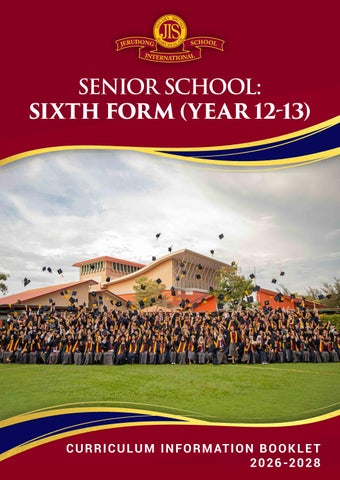
SENIOR SCHOOL: SIXTH FORM (YEAR 12-13)
C U R R I C U L U M I N F O R M AT I O N B O O K L E T 2 0 2 6 -2 0 2 8
Welcome to
Jerudong Int School
ternational
Sixth Form Curriculum Information Booklet
iv / Jerudong International School
Sixth Form Curriculum Information Booklet
Contents Important Contacts ............................................................................................................................................................
1
Welcome from the Executive Principal .......................................................................................................................
2
The Student Profile .............................................................................................................................................................
3
Life in the Sixth Form ..........................................................................................................................................................
4
Vice Principal & Head of Senior School .......................................................................................................................
6
Welcome to the Sixth Form .............................................................................................................................................
7
Friday ONE ...............................................................................................................................................................................
16
Higher Education .................................................................................................................................................................
18
Sixth Form Academic Results ........................................................................................................................................
20
International Baccalaureate Diploma Programme
22
Group 1: Studies in Language and Literature ......
24-26
Group 4: Experimental Sciences .........................
English Language & Literature
Biology
English Literature (HL)
Design & Technology
Chinese Language & Literature (SL)
Environmental Systems and Societies (ESS) SL
Group 2: Language Acquisition ...........................
27-37
Language B English (SL & HL)
Physics Sports, Exercise & Health Science
French AB Initio (SL)
Group 5: Mathematics ......................................
French B (SL & HL)
Mathematics
Malay B (SL) Chinese B (SL)
Group 6: The Arts (and Electives) .........................
Spanish AB Initio (SL)
Music
Spanish B (SL & HL)
Theatre
Group 3: Individuals and Societies ......................
38-44
Economics
45-51
52-53
54-59
Visual Art Chemistry Geography
Geography History: 20th Century World History Psychology
60-61
International BTEC Level 3 Creative Media
62
A Level Programme University Language Requirements ....................
64-66
Geography ..........................................................
International English Language Testing System
History ................................................................
Extended Project Qualification Accounting .......................................................... Art & Design: Fine Art ........................................... Art, Design & Textiles ........................................... Biology ................................................................ Business ............................................................. Chemistry ........................................................... Computer Science ............................................... Design & Technology: Product Design ................... Drama ................................................................. Economics ..........................................................
English Literature ................................................ French .................................................................
AS English Language
67 68 69 70 71 71 73 74 75 77
Mathematics ....................................................... Further Mathematics ........................................... Media Studies ..................................................... Music .................................................................. Music Technology ............................................... Physics ............................................................... Physical Education (PE) ....................................... Psychology ......................................................... Spanish ...............................................................
Enrolment Information ......................................................................................................................................................
78 79 81 83 84 85 86 87 88 89 90 92 93
97
Jerudong International School / v
Sixth Form Curriculum Information Booklet
vi / Jerudong International School
Sixth Form Curriculum Information Booklet
Important Contacts Mailing Address: P.O. Box 1408 Bandar Seri Begawan BS8672, Brunei
Street Address: Jalan Universiti Kampong Tungku Bandar Seri Begawan BE2119, Brunei
admissions@jis.edu.bn or office@jis.edu.bn +673-241-1000 www.jerudonginternationalschool.com @JISBrunei
Executive Principal
Day Houses
Nicholas Sheehan
Argus
Executive Principal’s Secretary
Angela McCambridge
Pui Yin Woo
principal.secretary@jis.edu.bn
ext. 7117
Barbet
Vice Principal & Head of Senior School
Antony McCambridge
Daniel Milner
Blackeye
Academic Director
Rachel Brown
Alex Cook
Fireback
Pastoral Director
Olivia Prince
Lynsay Scott
Frogmouth
Assistant Head of Senior School (Years 12-13)
Sue Mead
John van der Marel
Hawk
Assistant Head of Senior School (Years 10-11)
Matthew Smith
Ralph Morel
Heron
Upper Years Secretary
Naomi Williams
Amy Lai
amy.lai@jis.edu.bn
ext. 7116
Peter Foster
Jennifer Cole
Sandpiper
Middle Years Secretaries
Ingrid Lush
myo@jis.edu.bn
Aiman Ali
hsms.barbet@jis.edu.bn hsms.blackeye@jis.edu.bn hsms.fireback@jis.edu.bn hsms.frogmouth@jis.edu.bn hsms.hawk@jis.edu.bn hsms.heron@jis.edu.bn
Monarch
Assistant Head of Senior School (Years 7-9)
Izzah Abdul Kadir
hsms.argus@jis.edu.bn
ext. 1100
Skylark
ext. 1106
Yvette Conway
hsms.monarch@jis.edu.bn hsms.sandpiper@jis.edu.bn hsms.skylark@jis.edu.bn
Swift
Accounts Karen Yong
Dave Smith accounts@jis.edu.bn
ext. 1314
Wee Hui Tan
hsms.swift@jis.edu.bn
Whistler Juliette Horsford
hsms.whistler@jis.edu.bn
Stationery and Uniform Shop Liza Sheriff
jis.shop@jis.edu.bn
ext. 5240/5244
Admissions Rebecca Dillon
Boarding Houses - Boys Eagle
admissions@jis.edu.bn
ext. 1205
Dan Stirling
Kerima-Jo Rahman
ext. 1206
Ibis
Farah Sabli
ext. 7100
Ed Lockyer
Sil Suan Tan
ext. 1129
School Counsellors
hsms.eagle@jis.edu.bn hsms.ibis@jis.edu.bn
Boarding Houses - Girls
Gavin Rodgers (Lead) counsellor@jis.edu.bn
ext. 1211
Kingfisher
Anth McKay
ext. 2313
Beenal Roberts
Nadzirah Suhaimi
ext. 2313
Osprey Jennifer May
hsms.kingfisher@jis.edu.bn hsms.osprey@jis.edu.bn
Jerudong International School / 1
Sixth Form Curriculum Information Booklet
Executive Principal
A warm welcome to Jerudong International School (JIS) in Brunei.
inclusivity and our curriculum is designed not only to challenge students to think critically but also to inspire them to become
As a community, we are committed to creating an environment
confident, creative and compassionate leaders of tomorrow.
of excellence and holistic development, where every individual
We are dedicated to developing well-rounded individuals who are not
is encouraged to reach their full potential, both academically and
only academically proficient but also socially responsible, culturally
personally. We are an academically selective school offering the
aware and globally minded. Whether through our academic
British International School curriculum, and are very proud to be a
programmes, extracurricular activities, or pastoral care, we aim to
Beacon Status School following our COBIS Patron’s Accreditation.
provide an enriching educational experience that prepares students
This means that parents can be safe in the knowledge that when
for success in an ever-changing world.
they choose to enrol their child in JIS, they will be receiving an outstanding, transformative education.
We also appreciate the important role that parents play in guiding the educational progress of their children and work closely in
We work hard to create a challenging and nurturing environment
partnership with our parents, to support us in reinforcing our values.
that enables each child to flourish. Students consistently excel in their examinations and go on to top universities around the world,
We warmly welcome you to visit us and see why Jerudong
including Oxbridge and the Russell Group of universities. We believe
International School is a truly exceptional place to learn and grow.
in the traditional values of an independent school education but we also embrace exciting innovative, new practices. At JIS, we are proud to uphold a strong ethos based on our values of Challenge, Respect and Inspire encouraging responsibility and a passion for learning. We believe in the power of collaboration and
2 / Jerudong International School
Welcome to Jerudong International School!
Nicholas Sheehan EXECUTIVE PRINCIPAL
Sixth Form Curriculum Information Booklet
Jerudong International School / 3
Sixth Form Curriculum Information Booklet
LIFE IN THE SIXTH FORM PEACE WEEK EARTH WEEK INTERNATIONAL WEEK FOOTBALL FUNDAY WAR OF COLOURS MUSICAL PRODUCTIONS SHOWCASE CONCERT HOUSE CONCERT LUNCHTIME LECTURES FOBISIA GAMES HOUSE SPORT DUKE OF EDINBURGH MODEL UNITED NATIONS ECO JIS BORNEO PROJECT PENAN SUPPORT DIVING CLUB
THE CHOICE IS YOURS. 4 / Jerudong International School
Sixth Form Curriculum Information Booklet
STUDYING A LEVELS AT JIS
After having fallen in love with Economics during my IGCSE years, I knew I wanted to pursue a career in said field. With such certainty, I knew the A Level pathway was the right choice for me as I could solely focus on the subjects I was interested in. Each new topic and area deepened and refined my academic passion; aside from Economics, taking Maths allowed me to further my quantitative skills, whilst English Literature taught me critical thinking and analysis. Moreover, as JIS provides a wide array of activities students can involve themselves in, A Levels have given me the freedom and time to enjoy extracurricular activities, especially roles in leadership. As Head Girl, Heron’s Spirit and Middle Years prefect, member of the sustainability council, member of the volleyball club, project leader, and more, A Levels has provided the opportunity to find that essential balance between school and life, equipping me with a diverse set of skills needed for life after JIS. Hana Hamzah (Head Girl) - Heron House
STUDYING THE IB DIPLOMA AT JIS
The International Baccalaureate Diploma Programme (IBDP) has proven to be an excellent choice to pursue my academic interest. Studying a broad range of subjects allows you to develop a variety of essential skills for future endeavours. This is supported by the DP core (Theory of Knowledge, Extended Essay and CAS) which focuses heavily on allowing you to delve further into a specific area of your interest and use your knowledge in a wider context. The programme therefore is not only suitable for those who are still unsure about their future plans, but also for those who want to be best prepared for the demands of higher education. Overall, the programme offers countless opportunities to explore your interests and discover more about yourself, helping you uncover your true passion and purpose. Even with high demands, especially towards the end of the course, the IBDP has been a highly rewarding experience that has gone far beyond the confines of the classroom. I am confident in saying that I feel ready to explore what the future holds and tackle any problems that may arise. Clemens Bindseil (Head Boy) - Barbet House
STUDYING BTEC IN CREATIVE MEDIA AT JIS
As a BTEC Media student, I have gained invaluable skills that go beyond the technical aspects of media and music. While I have learnt to operate industry-standard equipment and software, the programme has also taught me the importance of networking, teamwork, and refining my soft skills, such as communication and adaptability which will be useful in the future. The supportive teaching staff provide just the right balance of guidance and freedom, allowing us to express our creativity without unnecessary interference. This has helped me grow as an individual and as a collaborative team member, preparing me for real-world opportunities in any industry, especially the media industry. Raziq Nizam - Frogmouth House
Jerudong International School / 5
Sixth Form Curriculum Information Booklet
Vice Principal & Head of Senior School • IBDP: A broad, balanced curriculum of six subjects (three at higher level, three at standard level), paired with an Extended Essay (EE), Theory of Knowledge (TOK), and active participation in Creativity, Activity, Service (CAS). Supporting Growth and Balance The Sixth Form years bring exciting opportunities, but they also come with challenges as students navigate advanced coursework and balance academic and social responsibilities. At JIS, we provide robust support systems to help students make these adjustments successfully. Our House system continues to foster a sense of belonging, providing the emotional and pastoral care students need to thrive. Our dedicated and The Sixth Form/pre-university years at Jerudong International School
experienced Sixth Form team offers personalised guidance, ensuring
are a time of immense opportunity, growth, and preparation for the future.
that every student feels supported, encouraged, and equipped to meet
These pivotal years grant students greater freedom and responsibility
the high expectations of these years.
as they take charge of their own educational journey, make important decisions about higher education and careers, and step confidently into
A Global Perspective
their roles as young leaders.
The international diversity of our school community broadens students’ horizons and deepens their understanding of the world. By learning
At JIS, the learning process evolves into a dynamic partnership between
alongside peers from varied cultural and national backgrounds, students
students and teachers. Our experienced and dedicated educators are
develop empathy alongside essential cultural and global awareness.
committed to inspiring and guiding students, helping them realise their
These qualities, coupled with humility and kindness, are at the heart of
full potential. In addition, our highly skilled Higher Education faculty
our ethos.
provides personalised advice and support to ensure each student is wellprepared to navigate the university application process with confidence.
Through initiatives like the Polio Points rewards programme, students are encouraged to embody these values, embracing ‘teaspoons of
Three Pathways to Success
change’—small yet impactful actions that positively influence the world
JIS is proud to offer a choice of three distinct pathways in the Sixth Form,
around them.
allowing students to tailor their education to their interests, strengths, and aspirations:
Empowering the Future
• A Levels
As students prepare to leave JIS, they will do so with confidence,
• International BTEC
ambition, and a commitment to making a meaningful impact. We
• International Baccalaureate Diploma Programme (IBDP)
encourage every student to explore the vast opportunities before them, to face challenges with resilience, and to act as a force for good in their
We value the diversity of these pathways and work closely with students
communities.
and parents to ensure a clear understanding of each option. This range of choices enriches our community, fostering a more dynamic and
These years are not just about academic achievement—they are about
inclusive educational environment.
becoming compassionate, responsible, and innovative leaders who can
• A Levels: A focused, in-depth study of three or four subjects, with
shape a better future.
opportunities to pursue the Extended Project Qualification (EPQ) and develop essential thinking and learning skills. • International BTEC: A practical, vocational qualification equivalent to three A Levels. The BTEC is assessed through real-world assignments and prepares students for higher education or direct entry into the workforce. Students may also take one additional A Level alongside their BTEC studies.
6 / Jerudong International School
Welcome to the Sixth Form at Jerudong International School, where possibilities become realities, and every step prepares you to lead with purpose and passion.
Dr. Daniel Milner VICE PRINCIPAL & HEAD OF SENIOR SCHOOL
Sixth Form Curriculum Information Booklet
Welcome to the Sixth Form INTRODUCTION
Jerudong International School is an academically selective school that follows the British International School system. We have the Patron’s Accreditation from COBIS and are a Beacon Status School, we are an accredited IB World School and a HMC School. Our schooling goes from Nursery through to Year 13. Our school year is from late August to early July. We have approximately 1700 students from 45 nationalities. The Junior School is Nursery to Year 6. The Senior School comprises Years 7 to 13. Years 7-9 are known as the Middle Years, with class sizes up to a maximum of 22. Years 10 & 11 culminate in the IGCSE and class sizes are usually a maximum of 20 children. Years 12 - 13 are known as the Sixth Form or Pre-University and we offer the A-Level Programme, the International Baccalaureate Diploma Programme (IBDP) and the Pearson BTEC Level 3 Extended Diploma.
OUR CAMPUS
The School is situated on an extensive 120 acre single campus with outstanding facilities. The campus is divided into ‘zones’ for different purposes e.g. Junior School, Boarding and a Middle Years area; so whilst the campus is extensive, it is not daunting for new students joining us. We work very hard to help students settle and familiarise themselves with the campus. Our outstanding facilities include 27 science laboratories, specialist classrooms, Performing Arts Centre, an Outdoor Discovery area, Sports Complex plus more.
OUR TEACHERS
Our qualified and experienced teachers are primarily from the UK. All employees of the School are safety checked and police screened prior to employment. The average length of time that a teacher stays in JIS is 8 years! This means that we have a stable teaching community who are invested in the students.
ACADEMIC YEAR GROUP PLACEMENTS DATE OF BIRTH
AUGUST 2026 - JULY 2027
AUGUST 2027 - JULY 2028
AUGUST 2028 - JULY 2029
1 Sept 2016
to
31 Aug 2017
1 Sept 2015
to
31 Aug 2016
Year 7
Year 8
1st Sept 2014
to
31st Aug 2015
Year 7
Year 8
Year 9
1 Sept 2013
to
31 Aug 2014
Year 8
Year 9
Year 10
1 Sept 2012
to
31 Aug 2013
Year 9
Year 10
Year 11
1st Sept 2011
to
31st Aug 2012
Year 10
Year 11
Year 12
1st Sept 2010
to
31st Aug 2011
Year 11
Year 12
Year 13
1 Sept 2009
to
31 Aug 2010
Year 12
Year 13
1st Sept 2008
to
31st Aug 2009
Year 13
st
st
st st
st
Year 7
st
st
st st
st
HOME SCHOOL PARTNERSHIP
Parents and teachers together play an important role in educating children and need to support each other in order for their child to be as successful as possible. We welcome parents into the school and appreciate all offers of help. Parents work alongside staff and children in a variety of roles including student reading, assisting on school excursions and as leaders of Co-Curricular Activities (CCAs). We approach parents to request help with specific tasks but we welcome any skills or expertise that parents feel they can offer. The relationship between staff and parents is open and friendly. We value good communication with parents and recognise the importance of keeping channels of communication open to ensure all students have a positive and successful experience during their time in JIS. Communication is regular and occurs in formal situations such as Parent Meetings, Parent-Teacher Consultations, written reports and during informal situations such as a brief chat at the end of the day. Teachers are happy to make an appointment to meet with parents, or speak on the phone, if there are any specific concerns or questions concerning your child. The school also offers information directly to parents through the Parent Portal on Firefly. Parents can access data on attendance, timetables and achievements as well electronic versions of reports for their child. You can also follow us on a range of social media, including Instagram, X (formerly Twitter), Youtube and Facebook. Jerudong International School / 7
Sixth Form Curriculum Information Booklet
THE SCHOOL CALENDAR
The school calendar is posted on the school website: https://www.jerudonginternationalschool.com/school-life/calendar.
TERM DATES TERM 1
TERM 2
TERM 3
26 August - 11 December 2026
12 January - 19 March 2027
5 April - 9 July 2027
Mid-Term Break: 19 - 23 October
Mid-Term Break: 5 - 9 February
Mid-Term Break: 31 May - 7 June
End of Term Holiday:
End of Term Holiday:
End of School Holiday Starts:
12 December 2026 - 10 January 2027
20 March - 4 April 2027
10 July 2027
THE SCHOOL DAY
The School Day starts at 7.30am, Monday to Friday. We expect our students to be punctual and on site by 7.25am. School finishes at 3pm for Senior Students, Monday - Thursday. It finishes at 11.45am on Friday. Co-curricular activities can take place before or after school. Some additional activities are also on offer at the weekends.
SAMPLE TIMETABLE MONDAY
TUESDAY
6.40 - 7.25
WEDNESDAY
THURSDAY
Early CCA
7.30 - 7.45
FRIDAY 6.40 - 7.25
Early CCA
7.30 - 8.25
Friday ONE
7.50 - 8.45
Period 1
Period 1
Period 1
Period 1
8.35 - 9.30
Period 2
8.50 - 9.45
Period 2
Period 2
Period 2
Period 2
9.30 - 9.45
BREAK
9.50 - 10.45
Period 3
10.10 - 11.05
Period 3
Period 3
Period 3
Period 3
10.50 - 11.45
Period 4
11.10 - 12.05
Period 4
Period 4
Period 4
Period 4
House Time
BREAK
9.45 - 10.10
LUNCH (12.15 - 13.00 - Senior CCA)
12.05 - 13.05 13.05 - 14.00
Period 5
Period 5
Period 5
Period 5
14.00 - 15.00
Period 6
Period 6
Period 6
Period 6
15.10 - 15.55
CCA 1
16.00 - 16.45
CCA 2
16.50 - 17.35
Senior CCA 3
ATTENDANCE
Regular attendance at school is a key factor in ensuring your child’s academic success at school. Please ensure that your child attends school as often as possible and arrives punctually at 7.25am. The attendance register is taken each morning and also in each lesson. If your child is late to school it is important that you notify the School office and your child’s Tutor in order to update the register. If for any reason your child needs to be excused from PE lessons or other school activities, it is important that they bring a letter of explanation and hand this to their Tutor or subject specialist. We strongly discourage parents from taking their children on holidays during term time. This is likely to have a negative impact on their educational development and may affect their final I/GCSE examination results.
CO-CURRICULAR ACTIVITIES (CCA)
At JIS, we believe strongly in the education of the whole child and encourage them to make the most of all of the opportunities available to them. Although academic work is important, education is not just about acquiring paper qualifications. The promotion of essential physical and personal skills such as communication, cooperation and problem solving skills, leadership where appropriate, form the focus of the extensive Co-Curricular Activities programme. All activities are designed to excite and enthuse students, encouraging them to willingly offer input, challenge their understanding and stretch their imagination. These are significant opportunities and they offer our students the chance to develop personal skills and qualities which will stand them in great stead throughout their lives. Each term students make their selections based on the wide range of activities on offer. Students sign up by going to JIS School Buddy link: https://jis.schoolsbuddy.net (Only available to students from their first day in school). Students should not be on the premises after 5:00 pm, unless they are attending a CCA or Ugama lessons. They should be picked up promptly at the end of the day or after a CCA or swimming lesson.
8 / Jerudong International School
Sixth Form Curriculum Information Booklet
INSTRUMENTAL MUSIC TUITION
Students can enrol in the School’s Instrumental Music Programme. Students receive tuition in an instrument of their choice with a specialist music teacher. These lessons are scheduled during the school day. Individual and shared lessons are available. Parents are able to hire instruments from the Music faculty. Fees for this programme are additional to the tuition fees. For more information about this programme and the fee structure contact the Music secretary or the Head of Music at music@jis.edu.bn.
FIREFLY LEARNING PLATFORM
Firefly is our online learning platform that brings together students, teachers and parents. It allows us to set homework, track progress and share resources. Firefly makes it easy for students to access all the resources they need to stay organised with their school work and homework. It helps students: • Stay organised and submit work, from any device. • Access learning resources from anywhere. • Collaborate with teachers and peers. Parents can also be involved with their son or daughter’s learning. They can: • Check homework and timetables for their son or daughter. • Access their son / daughter’s School Report online. • Engage with their son or daughter’s learning. • Access a large amount of general information about the Houses and subjects. • Access a ‘Parent Information’ section with lots of useful information e.g. Menus etc. • Access the ‘Events’ to find out what is happening in the School Parents can access the Firefly Platform from their child’s first day in school.
DIGITAL LEARNING
The School campus has full WiFi access and all students have access to the School’s network. Students are given an account name and password for access. The School has an excellent website which provides information about the school and its curriculum. The address of the website is www. jerudonginternationalschool.com. Once enrolled in the school, students have access to Firefly - a learning portal. This is also used by parents and teachers, with different permission levels. Parents can access personal information about their child as well as detailed information about the curriculum and life in school. Digital learning is key to ensuring that every student gets the most out of their JIS learning experience. Our policy of anytime, anywhere learning has led to students using prescribed digital devices to access the sitewide Wifi. This easy access to technology provides many opportunities to assist our students organisational and planning skills. By using their device to access Firefly, our live planner, they will have up to date information regarding assembly, CCA, House, and sporting arrangements. They will also have quick access to their lesson timetable and can easily email staff for help and advice. Students are expected to behave responsibly with technology and once they have been given a login name and password they are expected to read and complete the ICT Acceptable Use Policy form to ensure that they use these facilities in accordance with the school’s terms and conditions. Parents are also required to sign this form. This form, combined with our internet filters helps us keep students protected and safe. All students in Years 12 and 13 are expected to bring their own digital device (Chromebook or laptop) to use as a learning and organisational tool.
Jerudong International School / 9
Sixth Form Curriculum Information Booklet
Argus House
Barbet House
Eagle House
Frogmouth House
Whistler House
Skylark House
Fireback House
Sandpiper House
Hawk House
Ibis House
Monarch House
Swift House
Osprey House
Blackeye House
Kingfisher House
Heron House
HOUSE SYSTEM
All Senior School students (Years 7–13) are allocated to a House. A House is a community of up to 70 students. There are eight girls’ Houses and eight boys’ Houses, with each House having a brother / sister House of the opposite gender. The House system is in place to provide an avenue for pastoral care, competition and camaraderie amongst the students. Siblings of the same gender are placed in the same House upon enrolment. As Jerudong International School has a strong boarding community, four of these Houses are for boarding students, and thus for Boarding students they actually live in their ‘House’ too! The remaining twelve Houses are for day students. Boarding Houses are partnered with Day Houses which encourages Boarders and Day students to meet. The Houses at JIS are named after birds native to Borneo. Students easily identify who is in their House by their individual house ties and House T-Shirts. A House Captain and Deputy Captain are selected for each House and they are assisted by other students in different leadership positions, unique to each House. During the school year Polio Points are awarded for a variety of reasons in line with the whole school aims. These can be demonstrated in lessons and in wider opportunities including competitions, academic or personal achievement, sportsmanship, kindness and cooperation. At the end of the year the overall winning House is presented with the House Trophy. The Head of the House is a teacher who is the Housemaster / Housemistress who has overall responsibility for the academic and social development of the students in their House. The students are allocated into tutor groups for each House. The tutor groups for students are split into Years 7–9 and Years 10–13. Each morning, Monday to Thursday, from 7.30 am–7.45 am, students will attend tutor group where they will register for school but also have the opportunity to do a variety of activities which may range from chatting with their tutor about a number of topics, planning for House events or having homework diaries checked. Every Friday morning, there is a longer ‘House’ period from 7.30 am–8.25 am, known as FridayOne. During FridayOne, House assemblies can be held or the students have the opportunity to go into greater depth for a number of support issues such as coping with exams, academic life as well a life beyond the lessons that they have here at JIS.
10 / Jerudong International School
Sixth Form Curriculum Information Booklet
The Houses provide a wonderful opportunity for many different activities. Every Thursday afternoon, after school, are House sporting competitions e.g. football, netball, rugby and swimming—to name just a few! Once a week, other House activities occur such as lunchtime Music Performance, the ‘War of Words’—the House debating competition; Spelling Bee, House Quizzes, the list is endless! Every student becomes passionate about their House and supporting their friends within their House. Parents are encouraged to develop a relationship with their child’s tutor and also the Housemaster or Housemistress so that JIS and parents can work together to help each child fulfil their maximum potential.
Year 12 School Student Council
Year 13 School Student Council
STUDENT LEADERSHIP
In addition to the House Leadership teams, students can nominate themselves to be on the Student Councils. Years 7-9: There are Councils for Year 7, Year 8 and Year 9. Years 10-13: There are councils for Year 10, Year 11 and Year 12. Year 7-13 students can all also join the Senior School Council. There are also a range of leadership opportunities such as Eco-JIS, Well-Being and an Equity, Diversity and Inclusion Group.
The Senior School Council The role of the Senior School Council is to help create positive change within the Senior School community. To create, amend and improve the systems and structures the School has in place, to act as a voice for the students in the Senior School and lastly, to create a shared ethos and bond the four year levels together. The Council also plays a key part in helping students transitioning to the school and to make everyone feel part of the Senior School family.
How does the Senior School Council work? The Senior School Council comprises students from Years 7-13. The Senior School Council meets with the Vice Principal - Head of Senior School once a week to discuss ways to improve the school. Then it is up to the Council. The Senior School Council is involved in many activities around the school, such as acting as ambassadors by conducting school tours for visiting students and guests, organising social opportunities for the year groups as well as leading whole school events such as Peace Week and International Day. The Head Students meet with the Principal once a month and speak with him about making real change within the whole School that hopefully benefit all students in the Senior School.
THE POLIO POINTS REWARD SYSTEM
This is a student led initiative across the whole School. Polio Points are earned by following the Student Aims both in and out of lessons: Communication, Engagement, Resilience, Thinking, Leadership and Integration. A set of 6 polio points (one per school aim) is then used to purchase a polio vaccine through UNICEF to help in the effort to contribute to the worldwide eradication of the disease. As a School, we want to encourage our students to do well as well as think of others. Polio Points empowers our students to make a difference to the lives of some of the most vulnerable communities in the world. Although Polio Points is an external organisation (http://teaspoonsofchange. org/) the students at JIS have worked to adapt the idea to fit the school aims and what they think will benefit the students as a system of rewards. By this Scheme, our students improve the lives of other children around the world.
Jerudong International School / 11
Sixth Form Curriculum Information Booklet
MAKING A DIFFERENCE: SUPPORTING CHARITIES
In addition to the Polio Points scheme, the school also supports other charities, such as the Borneo Project and Penan Support group, to name a few. Student-led activities are organised throughout the academic year and are integrated with the key learning objectives in our curriculum. We take pride in the JIS community for its unwavering support of local charities and less fortunate communities.
EXCURSIONS AND TRIPS
An integral part of the education in the School is the range of field trips and excursions which students experience. These excursions broaden a student’s understanding of work that is being covered in class in a practical and enjoyable way. We have worked hard to develop excellent opportunities within Brunei to ensure all our students can experience a truly holistic educational experience. Year 7 to Year 9 - Residential Trips (1 night) e.g. Temburong Years 10 to 13 - a range of trips linked to subjects and / or CCAs e.g. International Award (Duke of Edinburgh).
THE HEALTH CENTRE
JIS has a well equipped Health Centre staffed by 3 registered nurses. As well as treating any child who has an accident or feels unwell during the school day, the Health Centre works with students and families who have long term health conditions or needs. The service links in with other pastoral care providers in the school providing a multidisciplinary approach to student well being.
Illness or Accidents It is important that the emergency contact information given to the school is current, as this ensures timely contact with home and allows for swift communication of all needs between home and the Health Centre. If you are out of the country please ensure that your child’s classroom teacher or house master is notified with an emergency contact. On admission or during your child’s time at JIS, the health centre should be notified or updated regarding any medical conditions (long or short term) so that adequate support can be provided while your child is on site. This information is treated confidentially and only shared to staff who have contact with the student. Please let us know immediately if your child is unwell and inform us of any medical diagnosis that may result in the spread of an illness to other students or staff. If it is something that can be passed on to others, keep your child at home. If they are recovering from an illness and are not able to take part in Physical Education lessons, inform us by letter. In the event of a minor accident or sickness, children are taken to the nurse in the Health Centre and given first aid and made comfortable until they are able to return to class. If an injury causes us concern or hospital treatment is required we first seek the advice of the nurse and then make every effort to contact a parent or the listed emergency contact as soon as possible. Where this is not possible we will make arrangements to accompany and transport children to hospital and seek further medical advice. If appropriate the services of an ambulance will be used.
Medication No form of medication is allowed to be held by students on site in both the Junior and Senior schools. All medication required must be handed into the health centre and a consent form completed. These medications may be for long term conditions or for a short term treatment but must be given to the Health Centre Staff and not kept in students bags or lockers. Teaching and Administrative staff are not allowed to give out medication on school site - for school trips they undertake training and are able to administer when off site.
Sun Safety Students must use sun protection (and insect repellant) on exposed skin if they are outside for an extended time. School hats are worn outside and students are encouraged to make use of available shade. All classrooms have a supply of sunscreen for the children to use. All students must have a hat which they wear at break and lunchtimes. We operate a ‘No Hat, No Play’ policy for students wishing to play sports on the school fields.
12 / Jerudong International School
Sixth Form Curriculum Information Booklet
SCHOOL UNIFORM - SENIOR SCHOOL (YEARS 7-13)
Jerudong International School (JIS) believes that a clear uniform policy plays a valuable role in contributing to the school ethos. We expect all who attend JIS to have a high standard of appearance whilst wearing school uniform whether inside or outside of school. The purpose of this policy is to provide clear guidance to students, teachers, parents and other stakeholders about the expectations of the school with regard to uniform and appearance and the strategies used to maintain a high standard at all times. At any time that students wear school uniform they are representing the school and must wear the appropriate uniform in the appropriate manner. It is important that the school uniform is worn correctly. The uniform is available for purchase from the stationery and uniform shop.
Roles and Responsibilities • The Principal and School Academic Leadership Team are responsible for ensuring the policy is followed. • House Masters, House Mistresses, Tutors and class teachers (Junior school) are responsible for checking uniform daily. • School staff, including teaching and support staff, are responsible for ensuring that the policy and procedures are followed and consistently and fairly applied. • Parents and carers are responsible for ensuring that their son or daughter wears the correct uniform inside and outside of school. • Students are expected to take full responsibility for their own appearance and will be made fully aware of the school policy, procedures and expectations. The Assistant Head of School will judge if a student is inappropriately presented and may, after liaising with the relevant Vice Principal, send a student home to return properly dressed. Parents should check with the Housemaster or Housemistress if they have any doubt about the suitability of items of clothing they intend to buy for students to wear in school.
Approved Uniform for Boys White Collar Button Shirt
Shirt needs to be long enough to be tucked in. Short Sleeves / Long Sleeves.
Long Navy Blue Tailored Trousers
Trousers need to be loosely hanging. Tight fitted trousers are not allowed. Plain blue / brown / black belt only. Long Black trousers only for Year 12 & 13.
School Tie
Years 7-11: House Tie Years 12-13: Maroon Tie
Black Shoes
PE Kit
JIS Jumper / Cardigan
Shoes that are all black should be worn - stitching, lacing, edging around the base of the shoe. No coloured flashes, labels or logos. Plain white / black socks only. JIS white and maroon dri-fit shirt (long / short sleeves). JIS maroon dri-fit shorts / track pants. Appropriate footwear for the sports activity e.g. trainers, football boots etc. Only official JIS jumpers / cardigans are allowed to be worn in and around school.
The following is NOT approved for Boys • Underwear should not be visible. • Hair should be neat and clean. Hair should not touch the shoulders. • Extreme styles or garishly coloured hair are not allowed. • No jewellery or makeup should be worn. • Tattoos are forbidden. • Earrings / ear studs are forbidden (unless for religious or cultural reasons).
• No facial hair may be grown unless it is for religious reasons, whereby written permission should be obtained from the Head of School. • Coloured contacts are acceptable so long as they are of a natural colour (green, blue, brown etc.). Contacts of unnatural colours e.g. red or purple are not allowed. • Headphones should not be worn around school.
Jerudong International School / 13
Sixth Form Curriculum Information Booklet
Approved Uniform for Girls White Collar Button Shirt
Short Sleeves / Long Sleeves.
JIS Tartan Skirt
Midi Length (just below the knees) OR Full Length (by the ankles)
Religious Headscarves
Plain white / black only.
School Tie
Years 7-11: House Tie Years 12-13: Maroon Tie
Black Shoes
PE Kit
JIS Jumper / Cardigan
Shoes that are all black should be worn - stitching, lacing, edging around the base of the shoe. No coloured flashes, labels or logos. Plain white / black socks only. JIS white and maroon dri-fit shirt (long / short sleeves). JIS maroon dri-fit shorts / track pants. Appropriate footwear for the sports activity e.g. trainers, football boots etc. Only official JIS jumpers / cardigans are allowed to be worn in and around school.
The following is NOT approved for Girls • Underwear should not be visible. • Hair colour must be natural and style and must be appropriate (at discretion of the school) for school (no unnatural highlights or multi tone colouring). • Hair should not obscure the eyes and hair that falls below the shoulder should, if requested, be tied back whilst in school. • Girls in Years 7-11 should not wear make up in school. Sixth Form girls may wear discreet foundation. • Girls in Years 7-11 should not wear nail varnish in school. Sixth Form girls may wear subtle/natural nail varnish. False nails should not be worn.
• Girls may wear ONE flat signet ring, ONE small stud in the lobe of each ear, ONE bangle & ONE necklace (except during PE and some practical lessons). • Tattoos are forbidden. • For health and safety reasons, other forms of body piercing jewellery are not allowed (discreet nose studs are allowed for cultural and religious reasons). • Coloured contacts are acceptable so long as they are of a natural colour (green, blue, brown etc.). Contacts of unnatural colours e.g. red or purple are not allowed. • Headphones should not be worn around school.
PE Kit PE kit can only be worn to school if students have PE Period 1. On Friday no student should be coming to school in PE kit unless permission has been given by the HsM. Students should (on most occasions) change out of PE kit at the end of PE lessons.
Non Uniform Days Clothes should be worn that are appropriate for a school environment. Shoulders and midriffs should be covered and shorts or skirts should be of an appropriate length. Logos on clothes should be non-offensive.
SAFEGUARDING CHILDREN
The health, safety and well-being of every child at Jerudong International School is our prime concern. We listen to our students and take seriously what they tell us. Our aim is that children will enjoy their time as students in this school. We also want to work in partnership with our parents to help each child to achieve their full potential and make a positive contribution. The school has a Child Protection Policy in line with this for the safety of all. This Child Protection Policy is available to parents on our Firefly Parent Portal. If you are at all worried about the welfare, health or safety of a child please speak to the school counsellors or your child’s Housemistress / Housemaster or Head of Senior School.
FOOD @ JIS
JIS is committed to providing the whole school community with a modern, healthy menu and dining experience. We are constantly working on ways we can improve the food offered in our school canteens. Our aims are always to focus on freshly prepared food with great variety that is both nutritious, delicious and attractive. Students in Years 7 - 11 eat their snacks and lunch at the ‘Borneo Pasar’ Canteen. Students in Years 12 & 13 eat their snacks and lunch at the ‘Hornbill’ Canteen. We have two halal certified caterers - Serikandi and Grazestar who both operate in these canteens. They offer a varied and extensive range of items served from different kiosks. They can cater for any special diets requested and daily vegan / gluten-free and vegetarian hot meals are available. The variety each day includes a hot food station (Western and Asian choices), Salad bar, Pasta station, Sushi and Rice Boxes, ‘Make your own Sandwich’, Live Grilling, Fresh Fruit Slices and Juices and Grilled Cheese Sandwiches. All food purchases are offered with a free salad pot. Parents can view the menus on the Firefly parent portal and meals can be pre-ordered. Students purchase food using credit on their Campus Card account. For Boarders, a daily credit value is automatically added. For day students, parents can add credit by paying cash to Accounts or paying online. Parents can also set a daily limit for their child. All menu items are available for pre-ordering via the online Campus Card account.
14 / Jerudong International School
Sixth Form Curriculum Information Booklet
Daily menus are available via Firefly. The Firefly food pages also have monthly updates of new items added to the menus. There is an active food committee open to all Senior School students for food tasting and feedback sessions are held during lunch times each term. The School is committed to recycling / reusing and reducing waste and so we encourage parents to provide their children with a container to collect their lunch. Students will also bring their own water bottles and fill them using the water fountains. Water jugs and beakers are also available in the Borneo Pasar Canteen and Hornbill Canteen.
PARENT ID PASSES AND CAR PASS
All parents are issued with a security ID Pass and also a car pass which allows them to access the school campus. Parents are required to wear their Parent Pass when on the school campus.
SCHOOL LIBRARY
Children in Years 7-11 will visit the School Library as part of their school curriculum. However, JIS parents are welcome to register as Community Borrowers. This will allow parents to borrow books for their own personal enjoyment or/and to borrow additional books for their children. Parents are welcome to visit the library 7.30am - 8am each morning (Monday - Friday) and 3pm - 4pm (Monday - Thursday).
UGAMA
Ugama is the study of Islam. It is taught in the Malay language (Bahasa Melayu) and is compulsory for all Bruneian Muslim students in Years 2 - 8. Classes commence at 3.00pm on Monday to Thursday and 2.45pm on Fridays. Please contact ugama@jis.edu.bn for more information.
Middle Years Curriculum Information / 15
Jerudong International School / 15
Sixth Form Curriculum Information Booklet
Friday ONE The pastoral system at Jerudong International School (JIS) is
all year groups. The HsMs create a programme for the students
unique and focuses solely on providing the most comprehensive
to learn the key house values and grow as individuals.
support network for our students as possible. FridayOne is a time for students to integrate, participate in house events and seize
Tutor time allows focused time for tutors and students to meet
opportunities for leadership and personal challenge. Students
to discuss academic progress and plan strategic interventions.
are defined not only by the content they learn at JIS but also the
The tutor is the first step towards solving the small issues that
relationships they build and it is essential we guarantee time
can impede a student’s academic progress. A strong bond
for these bonds to develop. Every Friday morning the students
within a tutor group offers one of the most important layers of
have an hour of the week that is set aside as pastoral time and
pastoral support here at JIS.
falls under three central strands: House time, Tutor time and Lifeskills.
Lastly, Lifeskills at JIS aims to equip students with the knowledge, self-understanding and social, emotional and
House time gives the Housemasters/mistresses (HsMs) of our
intellectual skills necessary to live a healthy, safe and well-
16 Houses the opportunity to create shared experiences for the
balanced life and to achieve their full potential both at JIS and
students in their care. These activities strengthen the strong
in later years. A well designed Lifeskills programme can be a
feeling of community at JIS of which we are so proud and allow
powerful tool in helping students overcome problems and the
students to get to know one another and make friends across
JIS Lifeskills programme draws on established practices, but
16 / Jerudong International School
Sixth Form Curriculum Information Booklet
has been tailored to reflect the exact demands of the students
Resilience. In the Upper Years (Years 10-13) the same values
living in a Bruneian and international school context. It aims to
are continued but delivered through Relationships, Global
give the students an awareness of the need for balance in life
Citizenship and Mental Health. In Year 12 we have embedded
and the impact that neglect of one area, such as physical or
the Higher Education programme into FridayOne. In Year 13
emotional health, can have on their performance in other areas,
the students embark upon a course entirely focused on their
including academic success.
departure from JIS and, for many of them, a move to university in a different country other than their own. With this in mind the
Whilst it is considered important to make students aware
students go through a series of sessions focused on preparing
of the risks associated with harmful practices, the Lifeskills
for Independent Living.
curriculum at JIS takes a positive, preventative approach, aimed at empowering students with the self-awareness and emotional
At JIS we are committed to educating the whole child and
resilience required to confront the challenges of life. Lifeskills is
consider FridayOne to be the most important hour of the week.
organised around three strands that have been chosen through consultation with the HsMs and the students themselves. They cover the three key focuses of physical health, emotional health and intellectual health. In the Middle Years (Year 7-9) these strands are labelled Friendships, Healthy living and Emotional School Profile / 17
Jerudong International School / 17
Sixth Form Curriculum Information Booklet
Higher Education & Career Guidance The School puts a high priority on guiding and assisting students through the process of applying to university and managing their own career development.
H.E. OVERVIEW
Students are challenged to aim high, within their capabilities, and are well informed about how to maximise their chances of gaining places at leading universities worldwide. In keeping with the hard work they put in, the vast majority of JIS graduates achieve their ambitions and enter leading institutions throughout the world, including the very highest ranked universities in the United Kingdom, prestigious Group of Eight institutions in Australia, Ivy League universities in the United States and the best universities in many other countries around the world.
Year 12 Higher Education Evening A core event in the annual HE calendar is the Year 12 Higher Education Evening, held late January or early February each year. A combination of formal presentations and country specific information booths, the HE Evening is an important forum via which information is disseminated to students and parents (or guardians) regarding the application procedures to universities around the globe. The HE Evening affords parents an understanding of the way in which the higher education curriculum is delivered at JIS, including the school’s expectations of students and important deadlines that must be met. During term two and three of Year 12, students attend a significant number of dedicated Higher Education lessons. These take place in some Friday ONE sessions for all students and as part of the JIS core programme for A Level and BTEC students. These sessions are led by experienced members of staff and are used to guide the students through the complex process of researching their options, deciding what and where to study and making the applications to universities. The students will also benefit from one to one counselling, guidance and assistance.
Unifrog The university application process at JIS uses the Unifrog platform. All students have a personal account which also has parental access. Unifrog provides information on the application process for a wide range of countries as well as very useful shortlisting tools which allow for well thought out and practical university choices. In addition, Unifrog also provides information on a wide range of different careers and courses. The range of courses available after JIS continues to grow and UniFrog ensures that our students are aware of and prepared for the latest developments in Higher Education.
Oxbridge and Ivy League Preparation Students aspiring to apply to Oxbridge (i.e. Oxford or Cambridge Universities in the UK) or Ivy League institutions in the United States, are given specialised guidance in preparing their applications. Advice is given on writing Personal Statements or application essays and students are thoroughly prepared for entrance interviews via small group workshops and one to one sessions. Students attend these sessions by invitation.
Additional Admissions Tests Gaining admission to certain highly competitive academic disciplines and some highly ranked institutions requires a high level of performance in specific admissions tests, taken in addition to A Levels or IB examinations. There are specific additional tests required to pursue Medicine and related disciplines in the UK, namely the Test of Mathematics for University Admission (TMUA) and the United Kingdom Clinical Aptitude Test (UKCAT); whilst the Law National Admissions Test (LNAT) is required for admission to some Law courses. Various other tests are required for entry to specific subject areas at Oxford and Cambridge Universities. Similar tests may be required in other countries, such as the Undergraduate Medical Admissions Test (UMAT) for Undergraduate Medicine programmes in Australia. Specialist staff work with students on a systematic basis to prepare them to do well in these additional tests.
Advice for those applying to take professional degree courses Specialist booklets containing both higher education advice and careers information are available for the major professions; namely architecture, engineering, law, and medicine. Nominated staff mentors provide advice and guidance to students wishing to pursue these careers.
18 / Jerudong International School
Sixth Form Curriculum Information Booklet
Education exhibitions and school visits There are numerous education exhibitions held outside of school throughout the year which students are encouraged to attend, such as the UK Education Exhibition at which, typically, thirty or more UK universities are represented. A substantial number of universities from around the world, in particular the UK, Australia, Canada and the United States, send representatives to visit the school to provide briefings to HE staff and make presentations to students. These presentations are generally held at lunchtime in the Higher Education Office, and provide an invaluable opportunity for students to find out general and specific information about institutions they are considering applying to.
CAREERS GUIDANCE
JIS arranges visits by professionals from within the parent, alumni and wider community to give presentations about their careers and the opportunities within their professions. These guests will usually present at lunchtime and students are encouraged to attend and to actively engage with the speakers. When appropriate we also ask our guests to present in subject classes where their experience is particularly relevant to the subject content being studied to help our students develop an understanding of the real life application of the topics they cover in class. To assist students with their future choices and to help enhance their university application the school encourages students to undertake work placements and internships. The school can help facilitate these placements in some areas and they can take place during the long holiday and also during Enrichment Week in Year 12.
HIGHER EDUCATION FACULTY MEMBERS Daniel Roberts
Joe Wall
Assistant Head of Secondary School (Sixth Form Curriculum)
Australia & Europe University Counsellor
& Asian University Counsellor (Dean)
joe.wall@jis.edu.bn
dan.roberts@jis.edu.bn
Vicki Cook
Andy McCulloch
Law Admissions Counsellor
UK & North America University Counsellor
vicki.cook@jis.edu.bn
andy.mcculloch@jis.edu.bn
Izzattul Matussin
Stacy Sun
HE Administration Officer
Medicine Admissions Counsellor
izzattul.matussin@jis.edu.bn
stacy.sun@jis.edu.bn
Kitty Tittle Oxbridge Counsellor kitty.tittle@jis.edu.bn
Higher Education Evening Jerudong International School / 19
Sixth Form Curriculum Information Booklet
Sixth Form Academic Results 2024-2025 Jerudong International School (JIS) is proud to celebrate the
Nine students achieved a combination of A* or A grades in all three
outstanding examination results of its Class of 2025 across the A
A Level subjects. Claire Chong achieved 3 A* grades in all of her A
Level, International Baccalaureate (IB) Diploma Programme and the
Levels. Gideon Chan, Iggy Malik, Elijah Cheam (with an additional A in
Pearson BTEC International Level 3 Extended Diploma in Creative
AS English), Flora Ngu, Nur Adlina binti Ariffin, Nur Adibah Husna binti
Media. These results reflect the school’s strong commitment to
Hj Johari (Ministry of Religious Affairs scholarship student), Milly Lenk
academic excellence and the remarkable dedication of its students.
and Syifa A’leeya binti Hj Mohd Serudin (Ministry of Religious Affairs scholarship student) each achieved three A* or A grades. Additionally, eight students attained A grades in all their subjects: Clara Ang, Travis Chambers, Lyeenah Hamidiah Hj Abdul Hamid (Ministry of Education scholarship student), Johnny Morel, Min Nyi, Nur Alya Alisya binti Abd Rahman (Ministry of Religious Affairs scholarship student), Nadia Shasmeen binti Mohd Shahrulnizam and Jia Hui Tan.
The A Level students celebrated an exceptional range of results, with 35.1% of all grades awarded being A* or A and 66.8% achieving A*, A or B grades. Among the top achievers are Justin Deng, Muhamad Zaim Aqel bin Mohamad Azri (a Ministry of Education scholarship student), Li Jia
The IB Diploma Programme (IBDP) students also delivered an
Chong and Amanda Goh, who each earned an impressive 4 A* or A
outstanding set of results, achieving an average score of 32.1,
grades in their A Level examinations. Pg Qaiyimah Nurul Bolkiah binti
surpassing the global average of 30.58. The highest score achieved
Pg Hj Md Hakimmuddin, a Ministry of Religious Affairs scholarship
was an outstanding 43 points by Evie May. Two students earned
student, also excelled with 4 A grades.
an exceptional 40 points: Yin Xin Hwong (Ministry of Education
20 / Jerudong International School
Sixth Form Curriculum Information Booklet
scholarship student) and Allen Shih. Muhammad Saedon Hj Sahralidin
of Manchester, University of Bristol, University of Warwick, University
(Ministry of Education scholarship student) and Muhammad Faaiezul
of Leeds, University of Toronto, McGill University, University of British
Aiman Dr Hj Zulhilmi achieved an impressive 39 points.
Columbia, Monash University, University of Queensland and many more around the world.
Four students scored 38 points: Clemens Bindseil, Ayden Goh, Mélanie Poulain and Olivia Smith. Three students earned 37 points: Aryeeb
Mr. Nicholas Sheehan, Executive Principal of JIS shared: “While
Ahsan, Adelina Shalapinina and Lilly von Kuestenfeld. Two students
our top-performing students leave JIS with exceptional academic
achieved 36 points: Sienna Holmes and Sana Hamid. Two students
achievements, what truly sets them apart is the positive impact they
scored 35 points: Jayde Courtoreille and Abby Ting.
have made as young leaders within our school community. Their influence, character and commitment have left a lasting legacy. These successes are the result of a powerful partnership between our students, their supportive families and our dedicated Academic Team. Alongside our teaching and pastoral staff, this team continues to deliver a holistic education that encourages every student to excel and grow into their very best selves.” - Press Release (August 2025)
In addition to the IB Diploma and A Level achievements, Jerudong International School proudly celebrates the success of its second cohort of students completing the BTEC International Level 3 Extended Diploma in Creative Media, with a 100% pass rate. In the BTEC grading system, Distinction* (D*) and Distinction (D) are the highest achievable grades, equivalent to top A Level results, followed by Merit (M) and Pass (P). Among this year’s cohort, Mohammad Raziq Rayyan Mohammad Nizam achieved an exceptional DDD, the equivalent of three A grades at A Level and 144 UCAS points. His Royal Highness Prince ‘Abdul Wakeel earned an impressive DDM, comparable to AAC grades at A Level and 128 UCAS points. With these remarkable achievements, graduates will be attending top universities around the world, including University College London, University of Edinburgh, King’s College London, University Jerudong International School / 21
IB DIPLOMA
Sixth Form Curriculum Information Booklet
International Baccalaureate Diploma The
International
Baccalaureate
(IB)
Diploma
Programme is designed as an academically challenging and balanced scheme of education with final examinations that prepares students for success at university and life beyond. The course is taught over two years and is recognised and respected by the world’s leading universities. IB students study six subjects: three at Higher Level and three at Standard Level. Students must choose one subject from each of Groups 1 to 5, thus ensuring breadth of experience in languages, social studies, the experimental sciences and mathematics. The sixth subject may be an arts subject chosen from Group 6, or the student may choose another subject from Groups 2, 3 or 4 (an Elective). Three
subjects
are
taken
at
Higher
Level
(recommended 240 teaching hours) and three others at Standard Level (150 teaching hours). The IB curriculum is displayed in the diagram with six academic areas. At its heart are the Approaches to Learning and Approaches to Teaching. In addition, the IB Diploma programme has three core requirements that are included to broaden the educational experience and challenge students to apply their knowledge and understanding. The Extended Essay (EE) is a requirement for students to engage in a 4,000 word independent research project through an in-depth study of a question relating to one of the subjects they are studying. Theory of Knowledge (TOK) is a course that challenges students to think critically about knowledge. It explores how we acquire, evaluate, and use knowledge across the arts, human sciences, natural sciences, language, history and maths encouraging open-mindedness and intellectual curiosity. Through discussions, presentations, exhibitions, educational visits and an essay, students develop skills in analysis, reflection, and communication, preparing them for the complex world outside of school..
Creativity, Activity, Service (CAS) requires that students actively learn from the experience of doing real tasks beyond the classroom. Students can combine all three components or do activities related to each one of them separately. Students will develop an understanding of the IB learner profile. The ten aspirational qualities of the learner profile inspire and motivate the work of teachers, students and schools, providing a statement of the aims and values of the IB and a definition of what is meant by ‘internationalmindedness’. IB learners strive to be inquirers, thinkers, communicators, risk-takers, knowledgeable, principled, open-minded, caring, balanced and reflective.
22 / Jerudong International School
Sixth Form Curriculum Information Booklet
programme and to satisfactory participation in the creativity, action, service requirement. The highest total that a Diploma programme student can be awarded is 45 points. Students that do not gain at least 24 points receive a certificate of results. Students who do not secure the IB diploma instead receive standalone grades in the courses they have successfully completed. These IB courses can be used for entry to university in many countries.
GROUP 1
GROUP 2
Studies in Language and Literature • English Language &
Language Acquisition
GROUP 3 Individuals and Societies
GROUP 4
GROUP 5
GROUP 6
Experimental Sciences
Mathematics
The Arts (and Electives)
• English B
• Economics
• Biology
• Mathematics (HL)
• Music
• French Ab Initio (SL)
• Geography
• Design & Technology
• Mathematics (SL)
• Theatre
• English Literature (HL) • French B
• History
• Environmental Systems & Societies (SL)
• Visual Arts
• Chinese Language &
• Psychology
• Physics
Electives
• Sports, Exercise & Health Science
• Chemistry
Literature
Literature A (SL)
• Malay B (SL) • Mandarin B (SL) • Spanish B (SL)
• Geography
Please Note: All subject are offered at HL and SL unless otherwise indicated. Subjects may not run if there are insufficient student numbers.
ASSESSMENT Grade
7
6
5
4
3
2
1
N
Comment
Excellent
Very Good
Good
Satisfactory
Mediocre
Poor
Very Poor
No Grade
To find out more about the International Baccalaureate Diploma, please visit www.ibo.org
Jerudong International School / 23
IB DIPLOMA
The IB Diploma is awarded to students who gain at least 24 points, subject to certain minimum levels of performance across the whole
IB DIPLOMA
Sixth Form Curriculum Information Booklet
GROUP 1: STUDIES IN LANGUAGE AND LITERATURE ENGLISH LANGUAGE & LITERATURE ENTRY REQUIREMENTS
Students will be expected to read extensively beyond the course set texts. They must therefore have the self-discipline and initiative to undertake independent study and research and be willing to develop extended written and spoken outcomes.
SPECIAL FEATURES
IB English Language and Literature is a fantastic course for both broadening our appreciation of our literary heritage and for deepening our understanding of the huge role language plays in shaping our day to day lives. Through studying a wide range of literary and non-literary texts in a variety of media, students will investigate the nature of language itself and the ways in which it shapes and is influenced by identity and culture. Approaches to English in the course are meant to be wide-ranging and can include literary theory, sociolinguistics, media studies and critical discourse analysis among others. Both analytical writing and creative responses to texts are significant aspects of the course. Debate and discussion are central to the learning process, and oral skills are also assessed in the Global Issues assessment. The range of issues and theories encountered on the course plus students’ growth as critical readers and thinkers make the course excellent preparation for an examined life and all university courses.
COURSEWORK CONTENT
There are three main approaches in the course, all of which are explored through a range of non-literary texts as well as 4 literary texts for Standard Level and 6 literary texts for Higher Level. The key concepts of the three approaches are summarised below: Readers, Writers and Texts
Time and Space
Connecting Texts
• Range of forms
• Range of historical and/or cultural perspectives
• Making fruitful comparisons
• Contexts of production and reception
• Cultural contexts
• Themes across works
• Alternative interpretations
• How texts both reflect and shape society
• Conventions, genre and traditions
• Personal and critical responses to close
• Consideration of personal and cultural
• Critical response to complex
reading
perspectives
COURSE ASSESSMENT
relationships among texts
Paper 1: Guided textual analysis 35%
Paper 2: Comparative contextual essay 25%
Individual Oral: Global issue 20%
SL (1 hour 15 mins): Guided analysis of a previously unseen non-literary extract or text from a choice of two. HL (2 hour 15 mins): Two guided analyses of previously unseen literary extracts or texts.
SL - 35% HL - 25% 1 hour 45 mins The paper consists of four general questions. In response to one question, students write a comparative essay based on two works studied in the course.
SL - 30% HL - 20% Supported by an extract from one work from a work of fiction and one of non-fiction, students will offer a prepared response on a global issue of their choice. Presentations are 10 minutes, followed by 5 minutes of questions.
24 / Jerudong International School
HL Essay 20% A 1200-1500 word essay exploring a line of enquiry in connection with a studied text or work.
GROUP 1: STUDIES IN L ANGUAGE AND LITER ATURE
Sixth Form Curriculum Information Booklet IB DIPLOMA
ENGLISH LITERATURE (HL) ENTRY REQUIREMENTS
Students will be expected to read extensively beyond the course set texts. They must therefore have the self-discipline and initiative to undertake independent study and research and be willing to develop extended written and spoken outcomes.
SPECIAL FEATURES
IB English Literature is a fantastic course for deepening appreciation of our literary heritage. Literature is concerned with our conceptions, interpretations and experiences of the world. The course is organised into three areas of exploration and seven central concepts, and focuses on the study of literary works. Together, the three areas of exploration of the course add up to a comprehensive exploration of literature from a variety of cultures, literary forms and periods. Students learn to appreciate the artistry of literature, and develop the ability to reflect critically on their reading, presenting literary analysis powerfully through both oral and written communication Both analytical writing and creative responses to texts are significant aspects of the course. Debate and discussion are central to the learning process, and oral skills are also assessed in the Global Issues assessment. The range of issues and theories encountered on the course plus students’ growth as critical readers and thinkers make the course excellent preparation for a range of university courses. The study of literature is also considered advantageous in careers such as law.
COURSEWORK CONTENT
There are three main approaches in the course, all of which are explored through thirteen literary texts, four of which are in translation. The key concepts of the three approaches are summarised below: Readers, Writers and Texts
Time and Space
Connecting Texts
• Range of forms
• Range of historical and/or cultural perspectives
• Making fruitful comparisons
• Contexts of production and reception
• Cultural contexts
• Themes across works
• Alternative interpretations
• How texts both reflect and shape society
• Conventions, genre and traditions
• Personal and critical responses to close
• Consideration of personal and cultural
• Critical response to complex
reading
perspectives
COURSE ASSESSMENT Paper 1: Guided textual analysis 35%
Paper 2: Comparative contextual essay 25%
relationships among texts
Individual Oral: Global issue 20%
HL Essay 20%
HL: 2 hour 15 mins
1 hour 45 mins
Supported by an extract from one
A 1200-1500 word
Two guided analyses of
The paper consists of four
work written originally in the language
essay exploring a
previously unseen literary
general questions. In response
studied and one from a work studied in
line of enquiry in
extracts or texts.
to one question, students write
translation, students will offer a prepared
connection with a
a comparative essay based on
response on a global issue of their
studied text or work.
two works studied in the course.
choice. Presentations are 10 minutes, followed by 5 minutes of questions.
Jerudong International School / 25
IB DIPLOMA
Sixth Form Curriculum Information Booklet
GROUP 1: STUDIES IN L ANGUAGE AND LITER ATURE
CHINESE LANGUAGE & LITERATURE (SL) ENTRY REQUIREMENTS
Chinese Language and Literature Standard Level is a suitable course for students who want to build an accelerated study of the language beyond the Diploma programme. Students require to: • Have taken IGCSE Chinese Language & Literature • Earn a B in IGCSE Chinese as a Second Language, Extended Syllabus (IGCSE) and show evidence of studies in literature • Earn an A in IGCSE Chinese as a Second Language, Core Syllabus (IGCSE) and show evidence of studies in literature
COURSEWORK CONTENT
The study of the texts produced in a language is central to an active engagement with language and culture and, by extension, to how we see and understand the world in which we live. A key aim of the language A: language and literature course is to encourage students to question the meaning generated by language and texts, which, it can be argued, is rarely straightforward and unambiguous. Helping students to focus closely on the language of the texts they study and to become aware of the role of each text’s wider context in shaping its meaning is central to the course. The Language A: Language and Literature course aims to develop in students skills of textual analysis and the understanding that texts, both literary and non-literary, can be seen as autonomous yet simultaneously related to culturally determined reading practices. The course is designed to be flexible—teachers have the opportunity to construct it in a way that reflects the interests and concerns that are relevant to their students while developing in students a range of transferable skills. An understanding of the ways in which formal elements are used to create meaning in a text is combined with an exploration of how that meaning is affected by reading practices that are culturally defined and by the circumstances of production and reception. In view of the international nature of the IB and its commitment to intercultural understanding, the language A: language and literature course does not limit the study of texts to the products of one culture or of the cultures covered by any one language. The study of literature in translation from other cultures is especially important to IB Diploma Programme students because it contributes to a global perspective, thereby promoting an insight into, and understanding of, the different ways in which cultures influence and shape the experiences of life common to all humanity.
COURSE ASSESSMENT
EXTERNAL ASSESSMENT (70%)
INTERNAL ASSESSMENT (30%)
Paper 1: Guided Textual Analysis (1 hour 15 minutes)
Paper 2: Comparative Essay (1 hour 45 minutes)
Individual Oral (15 minutes) - This component consists of an individual oral which is internally assessed by the teacher and externally moderated by the IB at the end of the course.
The paper consists of two
The paper consists of
Supported by an extract from one non-literary body of work and one
non-literary passages, from
four general questions. In
from a literary work, students will offer a prepared response of 10
two different text types, each
response to one question
minutes, followed by 5 minutes of questions by the teacher, to the
accompanied by a question.
students write a comparative
following prompt: Examine the ways in which the global issue of your
Students choose one passage
essay based on two literary
choice is presented through the content and form of one of the works
and write an analysis of it.
works studied in the course.
and one of the bodies of work that you have studied.
(20 marks)
(30 marks)
(40 marks)
26 / Jerudong International School
Sixth Form Curriculum Information Booklet
LANGUAGE B ENGLISH (SL & HL) SUBJECT OVERVIEW
The main focus of the IB English Language B course is on language acquisition, the development of language skills and intercultural understanding. These skills are developed through the study and use of a range of texts, written and spoken. Language B English is not intended solely for the study of specific subject matter or content.
COURSE STRUCTURE
In IB English Language B, you will study five course themes: • Identities
• Human ingenuity
• Experiences
• Social organisation
• Sharing the planet
Standard Levels and Higher Levels are differentiated by the number of lessons, the depth of syllabus coverage, the study of literature at HL, the level of difficulty and the demands of assessment and the assessment criteria. Standard Level students will have 6 lessons every two weeks. Higher Level students will have 9 lessons every two weeks. At HL, students are required to study two literary works originally written in English, and are expected to extend the range and complexity of the language they use and understand in order to communicate.
WHY CHOOSE TO STUDY ENGLISH LANGUAGE B?
Language B English enables students to increase competence in the target language and deepen their awareness and appreciation of English speaking cultures. It is designed for English as an Additional Language learners who wish to use English either for employment purposes or for use in English medium tertiary institutions.
COURSE ASSESSMENT
You should have attained at least a B grade in IGCSE English Language or a C at IGCSE English as a Second Language for entry to Language B English. A willingness to study conscientiously and an ability to work independently is expected.
FRENCH AB INITIO (SL) SUBJECT OVERVIEW
Language Ab Initio is a language acquisition course designed to provide students with the necessary skills and intercultural understanding to enable them to communicate successfully in an environment where the language studied is spoken. It is designed for students with no prior experience of the target language, or for those students with very limited previous exposure. It should be noted that language ab initio is offered at SL only. At the language ab initio level, a student develops receptive, productive and interactive communicative skills. Students learn to communicate in the target language in familiar and unfamiliar contexts.
COURSE STRUCTURE
The course is structured around the five prescribed themes of identities, experiences, human ingenuity, social organization and sharing the planet. Additionally, the language ab initio syllabus prescribes four topics for each of the five prescribed themes. In total, there are 20 topics that must be addressed in the language ab initio course. The conceptual understandings (audience, context, purpose, meaning, variation) are to be kept in mind when connecting the themes and topics to receptive, productive and interactive skills development. At the language Ab Initio level, a student develops receptive, productive and interactive communicative skills. Students learn to communicate in the target language in familiar and unfamiliar contexts. • Receptive: Students understand, both aurally and in writing, simple sentences and some more complex sentences relating to the five prescribed themes and related topics. They understand simple authentic and adapted written and audio texts and related questions in the target language.
Jerudong International School / 27
IB DIPLOMA
GROUP 2: LANGUAGE ACQUISITION
IB DIPLOMA
Sixth Form Curriculum Information Booklet
GROUP 2: L ANGUAGE ACQUISITION
• Productive: Students express information fairly accurately, in both writing and in speech, using a range of basic vocabulary and grammatical structures. They communicate orally and respond appropriately to most questions on the five prescribed themes and related topics. • Interactive: Students understand and respond clearly to some information and ideas within the range of the five prescribed themes and related topics. They engage in simple conversations. They use strategies to negotiate meaning and foster communication.
EXAMINATIONS
EXTERNAL ASSESSMENT (75%) - 2 hours 45 minutes
Paper 1: Productive Skills (1 hour) Two written tasks of 70-150 words each froma choice of three tasks,
INTERNAL ASSESSMENT (25%)
Paper 2: Receptive Skills (1 hour 45 minutes) • Listening comprehension - 45 minutes (25 marks) 25%
Individual Oral (15 minutes) A conversation with the teacher, based on a visual stimulus and at least one additional
choosing a text type for each task
• Reading comprehension - 1 hour (40 marks) 25%
course theme. (30 marks)
from among those listed in the
* Comprehension exercises on three audio
* This is internally assessed by the teacher
examination instructions.
passages and three written texts, drawn from all
and externally moderated by the IB at the
(30 marks) - 25%
five themes.
end of the course.
WHY CHOOSE TO STUDY FRENCH AB INITIO?
Foreign languages help prepare you to work in many types of jobs. For example, you may want to graduate in a particular foreign language and become certified to teach. This would enable you to take a job either teaching that foreign language, teaching English as a foreign language, or teaching in a bilingual setting. Combining languages with the study of business can help prepare you for jobs in foreign commerce, including banking, marketing, import-export, purchasing, finance, advertising, consulting, etc. Combining language with law studies could lead to a career in international law. Included among the numerous professions in which a knowledge of foreign languages can be helpful are the following: government service, social work, architecture, engineering, journalism, public relations, library service, archaeology, philosophy, medicine, the travel industry, telecommunications, music, theatre, and research scholarship.
COURSE REQUIREMENTS
Language Ab Initio is designed for students with no prior experience of the target language, or for those students with very limited previous exposure. Students will be introduced to the conceptual understandings that underlie language acquisition and begin to develop receptive, productive and interactive skills.
LINK WITH CAREERS
With the growing involvement of countries in international business and the increasingly multinational character of societies themselves, the importance of foreign languages in nearly every kind of occupation is evident. The bus driver who deals with both city residents and foreign tourists who speak a variety of languages, the automobile executive marketing his products abroad, the scientist using foreign research material, the social worker assigned to a foreign speaking neighbourhood, the flights attendant on a transatlantic run, the restaurant manager greeting a group of foreign visitors, the publisher drawing up a contract with a foreign novelist, the television producer of foreign language specials - the number of people who use a foreign language in their work is virtually unlimited. Generally, business firms and other organisations are not likely to hire employees on the basis of their language skills alone. But a substantial number of them have come to recognise the specific needs for foreign languages, and most of them foresee a growth in the need for language skills, both in their own particular businesses and in the general employment market. And if there is one thing that employers can agree on in regard to the future, it is change - change in the size, scope, and direction of their businesses, and change in the talents they will demand. Success in the world of work may very well depend on the ability of an employee to adapt to changing requirements - to convert general training and potential abilities into active, productive skills. The engineer whose knowledge of French comes in handy every so often this year may find in five years that his language skills are as valuable to his company as his technical abilities. And a junior administrator for a city hospital may find himself obliged to look for a new job when French becomes a requirement for his position - and he doesn’t have it…. Extract taken and adapted from an article published at Bale University.
28 / Jerudong International School
GROUP 2: L ANGUAGE ACQUISITION
Sixth Form Curriculum Information Booklet IB DIPLOMA
FRENCH B (SL & HL) SUBJECT OVERVIEW
The Language B course is a language acquisition course designed to provide students with the necessary skills and intercultural understanding to enable them to communicate successfully in an environment where the language studied is spoken. It is designed for students with some previous experience of the target language. Students further develop their ability to communicate in the target language through the study of language, themes and texts. In doing so, they also develop conceptual understandings of how language works, as appropriate to the level of the course.
COURSE STRUCTURE
Five prescribed themes provide opportunities for students to communicate about matters of personal, local or national, and global interest. The five prescribed themes are: • Identities
• Human ingenuity
• Experiences
• Social organisation
• Sharing the planet
The themes allow students to compare the target language and culture(s) to other languages and cultures with which they are familiar. • Receptive Skills: Students understand a range of written and spoken authentic personal, professional and mass media texts on topics of interest. They understand descriptions of events, feelings and wishes; they understand comparisons and recognize a straightforward, linear argument. They use context to deduce the meaning of sentences and unknown words and phrases. • Productive Skills: Students write texts for a variety of purposes and make oral presentations on topics of interest. They write descriptive texts and personal correspondence; they make comparisons, narrate stories, provide detailed accounts, and express their thoughts and opinions on abstract or cultural topics. • Interactive Skills: Students initiate and maintain the flow of conversations and discussions. They express and respond to opinions and feelings on a variety of topics. They use and understand clear speech on a variety of topics relating to course content and the culture(s) of the target language. Students use a variety of strategies to negotiate meaning and foster communication. At HL, students are expected to extend the range and complexity of the language they use and understand in order to communicate. They continue to develop their knowledge of vocabulary and grammar, as well as their conceptual understanding of how language works, in order to construct, analyse and evaluate arguments on a variety of topics relating to course content and the target language culture(s).
SL EXAMINATIONS
EXTERNAL ASSESSMENT (75%) - 3 hours
INTERNAL ASSESSMENT (25%)
Paper 1: Productive Skills (1 hour 15 minutes) - 25%
Paper 2: Receptive Skills (1 hour 45 minutes) 25% for Listening & 25% for Reading
Individual Oral (15 minutes)
One written task of 250-400 words from a choice of three, each from a different theme, choosing a text type from among those listed in the examination instructions. (30 marks)
• Listening comprehension (45 minutes) 25 marks • Reading comprehension (1 hour) 40 marks * Comprehension exercises on three audio passages and three written texts, drawn from all five themes.
A conversation with the teacher, based on a visual stimulus and at least one additional course theme. (30 marks) * Assessed by JIS and moderated by the IB at the end of the course.
HL EXAMINATIONS
EXTERNAL ASSESSMENT (75%) - 3 hours 30 minutes
INTERNAL ASSESSMENT (25%)
Paper 1: Productive Skills (1 hour 30 minutes) - 25%
Paper 2: Receptive Skills (2 hours) - 25% for Listening & 25% for Reading
Individual Oral (15 minutes)
One written task of 450-600 words from a choice of three, each from a different theme, choosing a text type from among those listed in the examination instructions. (30 marks)
• Listening comprehension (1 hour) 25 marks • Reading comprehension (1 hour) 40 marks * Comprehension exercises on three audio passages and three written texts, drawn from all five themes.
A conversation with the teacher, based on an extract from one of the literary works studied in class, followed by discussion based on one mor more of the themes from the syllabus. (30 marks) * Assessed by JIS and moderated by the IB at the end of the course.
Jerudong International School / 29
IB DIPLOMA
Sixth Form Curriculum Information Booklet
GROUP 2: L ANGUAGE ACQUISITION
WHY CHOOSE THE SUBJECT ?
Foreign languages help prepare you to work in many types of jobs. For example, you may want to graduate in a particular foreign language and become certified to teach. This would enable you to take a job either teaching that foreign language, teaching English as a foreign language, or teaching in a bilingual setting. Combining languages with the study of business can help prepare you for jobs in foreign commerce, including banking, marketing, importexport, purchasing, finance, advertising, consulting, etc. Combining language with law studies could lead to a career in international law. Included among the numerous professions in which a knowledge of foreign languages can be helpful are the following: government service, social work, architecture, engineering, journalism, public relations, library service, archaeology, philosophy, medicine, the travel industry, telecommunications, music, theatre, and research scholarship.
COURSE REQUIREMENTS
Language B is designed for students with some experience in the target language; providing students with an appropriate degree of challenge is important for their development. Schools are encouraged to factor student target language proficiency and Diploma Programme SL/HL balance into the placement decision for each individual student. Language B SL is designed for students with some previous experience in the target language who already have the ability to communicate in the language in familiar contexts. While in the course, they will further develop this ability. Students will explore the conceptual understandings that underlie language acquisition and begin to use higher-level thinking in the development of receptive, productive and interactive skills. Language B HL is designed for students with previous experience in the target language who have the ability to communicate in that language in a variety of contexts and for a variety of purposes. As the study of two literary works originally written in the target language is compulsory in language B HL, entering the course with these communication skills would allow the student to begin the study of works of literature originally written in the target language. During the course, students are expected to use higher-order thinking skills in the development of their receptive, productive and interactive skills.
LINK WITH CAREERS
With the growing involvement of countries in international business and the increasingly multinational character of societies themselves, the importance of foreign languages in nearly every kind of occupation is evident. The bus driver who deals with both city residents and foreign tourists who speak a variety of languages, the automobile executive marketing his products abroad, the scientist using foreign research material, the social worker assigned to a foreign speaking neighbourhood, the flight attendant on a transatlantic run, the restaurant manager greeting a group of foreign visitors, the publisher drawing up a contract with a foreign novelist, the television producer of foreign language specials - the number of people who use a foreign language in their work is virtually unlimited. Generally, business firms and other organisations are not likely to hire employees on the basis of their language skills alone. But a substantial number of them have come to recognise the specific needs for foreign languages, and most of them foresee a growth in the need for language skills, both in their own particular businesses and in the general employment market. And if there is one thing that employers can agree on in regard to the future, it is change - change in the size, scope, and direction of their businesses, and change in the talents they will demand. Success in the world of work may very well depend on the ability of an employee to adapt to changing requirements - to convert general training and potential abilities into active, productive skills. The engineer whose knowledge of French comes in handy every so often this year may find in five years that his language skills are as valuable to his company as his technical abilities. And a junior administrator for a city hospital may find himself obliged to look for a new job when French becomes a requirement for his position - and he doesn’t have it…. Extract taken and adapted from an article published at Bale University.
30 / Jerudong International School
GROUP 2: L ANGUAGE ACQUISITION
Sixth Form Curriculum Information Booklet IB DIPLOMA
MALAY B (SL) SUBJECT OVERVIEW
Malay B (Standard Level) is a language acquisition course designed for students with some previous experience of the Malay language. In the Malay B course, students further develop their ability to communicate in standard Malay language through the study of language, themes and texts. In doing so, they also develop conceptual understandings of how language works. The course is designed to provide students with the necessary skills and intercultural understanding to enable them to communicate successfully in the Malay Archipelago and environments where the Malay language is spoken. This process allows the learner to go beyond the confines of the classroom, expanding their awareness of the world and fostering respect for cultural diversity both in familiar and unfamiliar contexts.
COURSE STRUCTURE
The five prescribed themes covered in the course provide opportunities for students to communicate about matters of personal, local or national, and global interest. The themes allow students to compare the Malay language and cultures to other languages and cultures with which they are familiar. The themes also provide opportunities for students to make connections to other disciplinary areas in the Diploma Programme. The five prescribed themes are: • Identities
• Human ingenuity
• Experiences
• Social organisation
COURSE ASSESSMENT
EXTERNAL ASSESSMENT (75%)
• Sharing the planet
INTERNAL ASSESSMENT (25%)
Paper 1: Productive Skills (1 hour 15 minutes) - 25%
Paper 2: Receptive Skills (1 hour 45 minutes) 25% for Listening & 25% for Reading
Individual Oral (12-15 minutes, additional 15 minutes preparation time)
One writing task of 250–400 words from a choice of three, each from a different theme, choosing a text type from among those listed in the examination instructions. (30 marks)
• Listening comprehension (45 minutes) 25 marks • Reading comprehension (1 hour) 40 marks * Comprehension exercises on three audio passages and three written texts, drawn from all five themes.
A conversation with the teacher, based on a visual stimulus and at least one additional course theme. (30 marks) * Assessed by JIS and moderated by the IB at the end of the course.
WHY CHOOSE TO STUDY THE SUBJECT?
1. Develop international-mindedness through the study of Malay language, cultures, and ideas and issues of global significance. 2. Enable students to communicate in Malay language in a range of contexts and for a variety of purposes. 3. Encourage, through the study of Malay texts and through social interaction, an awareness and appreciation of a variety of perspectives of people from diverse cultures. 4. Develop students’ understanding of the relationship between the languages and cultures with which they are familiar. 5. Develop students’ awareness of the importance of language in relation to other areas of knowledge. 6. Provide students, through language learning and the process of inquiry, with opportunities for intellectual engagement and the development of critical- and creative-thinking skills. 7. Provide students with a basis for further study, work and leisure through the use of Malay language. 8. Foster curiosity, creativity and a lifelong enjoyment of language learning. 9. Hands-on cultural activities throughout the course.
COURSE REQUIREMENTS
Malay B (Standard Level) is a suitable course for the following students who achieved: • B grade in BGCE O Level Bahasa Melayu examination • A grade in IGCSE Malay Foreign Language examination • or have other relevant prior Malay language learning (subjected to placement test)
Jerudong International School / 31
IB DIPLOMA
Sixth Form Curriculum Information Booklet
GROUP 2: L ANGUAGE ACQUISITION
FAQS
Is Malay Literature taught and assessed in Malay B? Literature is introduced in Malay B but will not be tested in both the internal and external assessment.
Is Malay Ab Initio offered? The International Baccalaureate (IB) is no longer offering Malay Ab Initio as a language acquisition option
Is there a textbook for Malay B? No, texts and resources are chosen by teachers from various sources suitable within the Malay Archipelago for the course study to allow students to achieve the aims of the Malay B course. Resources used will be current, accurate and take into consideration the IB mission of intercultural understanding and respect.
How much grammar will be taught in class? Teaching grammar is not an aim in itself. In order for the students to achieve the language acquisition objectives as stated in the curriculum, and be able to demonstrate proficiency of the assessment criteria, grammar will always be taught in context.
CHINESE B (SL) SUBJECT OVERVIEW
Chinese (Standard Level) is a language acquisition programme and provides students with necessary skills and understanding to communicate successfully in Chinese. Students are expected to further develop their ability to communicate through the study of the Chinese language, themes and texts, and to develop skills beyond the Primary/Secondary level. It enables students to gain competence in the language and allows them to access a broader range of input, experiences and perspectives of the Chinese language, culture and society, as well as the enjoyment of being able to communicate in Chinese. Five themes provide relevant contexts for studying the language in the Diploma Programme and opportunities for students to communicate about matters of personal, local or national, and global interest. The themes allow students to compare the target language and culture(s) to other languages and cultures with which they are familiar. They also provide opportunities for students to make connections to other disciplinary areas in the IB Diploma Programme.
COURSE STRUCTURE
The components of this course cover five prescribed themes: • Identities
• Human ingenuity
• Experiences
• Social organisation
• Sharing the planet
Students are required to demonstrate their ability across the four skills of listening, speaking, reading and writing in:
EXTERNAL ASSESSMENT (75%)
INTERNAL ASSESSMENT (25%)
Paper 1: Productive Skills (1 hour 15 minutes) - 25%
Paper 2: Receptive Skills (1 hour 45 minutes) 25% for Listening & 25% for Reading
Individual Oral (12-15 minutes, additional 15 minutes preparation time)
One writing task of 300–480 characters from a choice of three, each from a different theme, choosing a text type from among those listed in the examination instructions. (30 marks)
• Listening comprehension (45 minutes) 25 marks • Reading comprehension (1 hour) 40 marks * Comprehension exercises on three audio passages and three written texts, drawn from all five themes.
A 3-4 minutes speech based on a visual stimulus followed by conversation with the teacher and another discussion based on an additional theme. (30 marks) * Assessed by JIS and moderated by the IB at the end of the course.
WHY CHOOSE THE SUBJECT
The rise of China in the twenty-first century presents new economic, political and social realities that demand the ability for non-Chinese to be proficient in the language. Intercultural understanding and communication proficiency are distinct edge for whichever career path a student may choose. Beyond a career that requires a foreign language as a primary skill such as teaching, interpreting and translating, there are many other fields where understanding a foreign language is a highly desirable skill. These include professional careers such as the media and journalism, government services, the arts, fashion, medicine and many more professions. 32 / Jerudong International School
GROUP 2: L ANGUAGE ACQUISITION
Sixth Form Curriculum Information Booklet
Chinese B (Standard Level) is a suitable course for students who want to build an accelerated study of the language beyond the Diploma programme. They should have achieved at least an A grade in their I/GCSE Foreign Language Chinese, or have some other relevant prior learning. It is expected that students have a genuine interest in language learning as well as an interest in Chinese culture and society. The willingness to study conscientiously and the ability to work independently are equally important.
FAQS
Is there a textbook for Chinese B? No, texts and resources are chosen by teachers from various sources suitable for the course study to allow students to achieve the aims of the Chinese B course. Resources used will be current, accurate and take into consideration the IB mission of intercultural understanding and respect.
How much grammar will be taught in class? Teaching grammar is not an aim in itself. In order for the students to achieve the language acquisition objectives as stated in the curriculum, and be able to demonstrate proficiency of the assessment criteria, grammar will always be taught in context.
How many hours of Chinese will I have in a week? You will have three lessons and one homework (2 hours) session per week.
How much time do I need to dedicate excluding classroom lessons and homework? You should dedicate around 20 - 30 minutes daily to revise and practise the language.
SPANISH AB INITIO (SL) SUBJECT OVERVIEW
Language Ab Initio is a language acquisition course designed to provide students with the necessary skills and intercultural understanding to enable them to communicate successfully in an environment where the language studied is spoken. It is designed for students with no prior experience of the target language, or for those students with very limited previous exposure. It should be noted that language ab initio is offered at SL only. At the language ab initio level, a student develops receptive, productive and interactive communicative skills. Students learn to communicate in the target language in familiar and unfamiliar contexts.
COURSE STRUCTURE
The course is structured around the five prescribed themes of identities, experiences, human ingenuity, social organization and sharing the planet. Additionally, the language ab initio syllabus prescribes four topics for each of the five prescribed themes. In total, there are 20 topics that must be addressed in the language ab initio course. The conceptual understandings (audience, context, purpose, meaning, variation) are to be kept in mind when connecting the themes and topics to receptive, productive and interactive skills development. At the language Ab Initio level, a student develops receptive, productive and interactive communicative skills. Students learn to communicate in the target language in familiar and unfamiliar contexts. • Receptive: Students understand, both aurally and in writing, simple sentences and some more complex sentences relating to the five prescribed themes and related topics. They understand simple authentic and adapted written and audio texts and related questions in the target language. • Productive: Students express information fairly accurately, in both writing and in speech, using a range of basic vocabulary and grammatical structures. They communicate orally and respond appropriately to most questions on the five prescribed themes and related topics. • Interactive: Students understand and respond clearly to some information and ideas within the range of the five prescribed themes and related topics. They engage in simple conversations. They use strategies to negotiate meaning and foster communication.
Jerudong International School / 33
IB DIPLOMA
COURSE REQUIREMENTS
IB DIPLOMA
Sixth Form Curriculum Information Booklet
EXAMINATIONS
EXTERNAL ASSESSMENT (75%) - 2 hours 45 minutes
GROUP 2: L ANGUAGE ACQUISITION
INTERNAL ASSESSMENT (25%)
Paper 1: Productive Skills (1 hour) 30 marks — 25%
Paper 2: Receptive Skills (1 hour 45 minutes) 65 marks — 50%
Individual Oral — 30 marks (Internally assessed, externally moderated)
Two written tasks of 70–150 words each from a choice of three tasks, choosing a text type for each task from among those listed in the examination instructions.
Listening comprehension (45 minutes) — 25 marks, 25% Reading comprehension (1 hour) — 40 marks, 25% * Comprehension exercises on three audio passages and three written texts, drawn from all five themes.
A conversation with the teacher, based on a visual stimulus and at least one additional course theme.
WHY CHOOSE THE SUBJECT?
Foreign languages help prepare you to work in many types of jobs. For example, you may want to graduate in a particular foreign language and become certified to teach. This would enable you to take a job either teaching that foreign language, teaching English as a foreign language, or teaching in a bilingual setting. Combining languages with the study of business can help prepare you for jobs in foreign commerce, including banking, marketing, import-export, purchasing, finance, advertising, consulting, etc. Combining language with law studies could lead to a career in international law. Included among the numerous professions in which a knowledge of foreign languages can be helpful are the following: government service, social work, architecture, engineering, journalism, public relations, library service, archaeology, philosophy, medicine, the travel industry, telecommunications, music, theatre, and research scholarship.
COURSE REQUIREMENTS
Language Ab Initio is designed for students with no prior experience of the target language, or for those students with very limited previous exposure. Students will be introduced to the conceptual understandings that underlie language acquisition and begin to develop receptive, productive and interactive skills.
LINK WITH CAREERS
With the growing involvement of countries in international business and the increasingly multinational character of societies themselves, the importance of foreign languages in nearly every kind of occupation is evident. The bus driver who deals with both city residents and foreign tourists who speak a variety of languages, the automobile executive marketing his products abroad, the scientist using foreign research material, the social worker assigned to a foreign speaking neighbourhood, the flights attendant on a transatlantic run, the restaurant manager greeting a group of foreign visitors, the publisher drawing up a contract with a foreign novelist, the television producer of foreign language specials - the number of people who use a foreign language in their work is virtually unlimited. Generally, business firms and other organisations are not likely to hire employees on the basis of their language skills alone. But a substantial number of them have come to recognise the specific needs for foreign languages, and most of them foresee a growth in the need for language skills, both in their own particular businesses and in the general employment market. And if there is one thing that employers can agree on in regard to the future, it is change - change in the size, scope, and direction of their businesses, and change in the talents they will demand. Success in the world of work may very well depend on the ability of an employee to adapt to changing requirements - to convert general training and potential abilities into active, productive skills. The engineer whose knowledge of Spanish comes in handy every so often this year may find in five years that his language skills are as valuable to his company as his technical abilities. And a junior administrator for a city hospital may find himself obliged to look for a new job when Spanish becomes a requirement for his position - and he does not have it…. Extract taken and adapted from an article published at Bale University.
34 / Jerudong International School
GROUP 2: L ANGUAGE ACQUISITION
Sixth Form Curriculum Information Booklet IB DIPLOMA
SPANISH B (SL & HL) SUBJECT OVERVIEW
The Language B course is a language acquisition course designed to provide students with the necessary skills and intercultural understanding to enable them to communicate successfully in an environment where the language studied is spoken. It is designed for students with some previous experience of the target language. Students further develop their ability to communicate in the target language through the study of language, themes and texts. In doing so, they also develop conceptual understandings of how language works, as appropriate to the level of the course.
COURSE STRUCTURE
Five prescribed themes provide opportunities for students to communicate about matters of personal, local or national, and global interest. The five prescribed themes are: • Identities
• Human ingenuity
• Experiences
• Social organisation
• Sharing the planet
The themes allow students to compare the target language and culture(s) to other languages and cultures with which they are familiar. • Receptive Skills: Students understand a range of written and spoken authentic personal, professional and mass media texts on topics of interest. They understand descriptions of events, feelings and wishes; they understand comparisons and recognize a straightforward, linear argument. They use context to deduce the meaning of sentences and unknown words and phrases. • Productive Skills: Students write texts for a variety of purposes and make oral presentations on topics of interest. They write descriptive texts and personal correspondence; they make comparisons, narrate stories, provide detailed accounts, and express their thoughts and opinions on abstract or cultural topics. • Interactive Skills: Students initiate and maintain the flow of conversations and discussions. They express and respond to opinions and feelings on a variety of topics. They use and understand clear speech on a variety of topics relating to course content and the culture(s) of the target language. Students use a variety of strategies to negotiate meaning and foster communication. At HL, students are expected to extend the range and complexity of the language they use and understand in order to communicate. They continue to develop their knowledge of vocabulary and grammar, as well as their conceptual understanding of how language works, in order to construct, analyse and evaluate arguments on a variety of topics relating to course content and the target language culture(s).
SL EXAMINATIONS
EXTERNAL ASSESSMENT (75%) - 3 hours
INTERNAL ASSESSMENT (25%)
Paper 1: Productive Skills (1 hour 15 minutes) - 25%
Paper 2: Receptive Skills (1 hour 45 minutes) 25% for Listening & 25% for Reading
Individual Oral (15 minutes)
One written task of 250-400 words from a choice of three, each from a different theme, choosing a text type from among those listed in the examination instructions. (30 marks)
• Listening comprehension (45 minutes) 25 marks • Reading comprehension (1 hour) 40 marks * Comprehension exercises on three audio passages and three written texts, drawn from all five themes.
A conversation with the teacher, based on a visual stimulus and at least one additional course theme. (30 marks) * Assessed by JIS and moderated by the IB at the end of the course.
Jerudong International School / 35
IB DIPLOMA
Sixth Form Curriculum Information Booklet
HL EXAMINATIONS
EXTERNAL ASSESSMENT (75%) - 3 hours 30 minutes
GROUP 2: L ANGUAGE ACQUISITION
INTERNAL ASSESSMENT (25%)
Paper 1: Productive Skills (1 hour 30 minutes) - 25%
Paper 2: Receptive Skills (2 hours) - 25% for Listening & 25% for Reading
Individual Oral (15 minutes)
One written task of 450-600 words from a choice of three, each from a different theme, choosing a text type from among those listed in the examination instructions. (30 marks)
• Listening comprehension (1 hour) 25 marks • Reading comprehension (1 hour) 40 marks * Comprehension exercises on three audio passages and three written texts, drawn from all five themes.
A conversation with the teacher, based on an extract from one of the literary works studied in class, followed by discussion based on one mor more of the themes from the syllabus. (30 marks) * Assessed by JIS and moderated by the IB at the end of the course.
WHY CHOOSE THE SUBJECT?
Foreign languages help prepare you to work in many types of jobs. For example, you may want to graduate in a particular foreign language and become certified to teach. This would enable you to take a job either teaching that foreign language, teaching English as a foreign language, or teaching in a bilingual setting. Combining languages with the study of business can help prepare you for jobs in foreign commerce, including banking, marketing, importexport, purchasing, finance, advertising, consulting, etc. Combining language with law studies could lead to a career in international law. Included among the numerous professions in which a knowledge of foreign languages can be helpful are the following: government service, social work, architecture, engineering, journalism, public relations, library service, archaeology, philosophy, medicine, the travel industry, telecommunications, music, theatre, and research scholarship.
COURSE REQUIREMENTS
Language B is designed for students with some experience in the target language; providing students with an appropriate degree of challenge is important for their development. Schools are encouraged to factor student target language proficiency and Diploma Programme SL/HL balance into the placement decision for each individual student. Language B SL is designed for students with some previous experience in the target language who already have the ability to communicate in the language in familiar contexts. While in the course, they will further develop this ability. Students will explore the conceptual understandings that underlie language acquisition and begin to use higher-level thinking in the development of receptive, productive and interactive skills. Language B HL is designed for students with previous experience in the target language who have the ability to communicate in that language in a variety of contexts and for a variety of purposes. As the study of two literary works originally written in the target language is compulsory in language B HL, entering the course with these communication skills would allow the student to begin the study of works of literature originally written in the target language. During the course, students are expected to use higher-order thinking skills in the development of their receptive, productive and interactive skills.
LINK WITH CAREERS
With the growing involvement of countries in international business and the increasingly multinational character of societies themselves, the importance of foreign languages in nearly every kind of occupation is evident. The bus driver who deals with both city residents and foreign tourists who speak a variety of languages, the automobile executive marketing his products abroad, the scientist using foreign research material, the social worker assigned to a foreign speaking neighbourhood, the flight attendant on a transatlantic run, the restaurant manager greeting a group of foreign visitors, the publisher drawing up a contract with a foreign novelist, the television producer of foreign language specials - the number of people who use a foreign language in their work is virtually unlimited.
36 / Jerudong International School
GROUP 2: L ANGUAGE ACQUISITION
Sixth Form Curriculum Information Booklet
number of them have come to recognise the specific needs for foreign languages, and most of them foresee a growth in the need for language skills, both in their own particular businesses and in the general employment market. And if there is one thing that employers can agree on in regard to the future, it is change - change in the size, scope, and direction of their businesses, and change in the talents they will demand. Success in the world of work may very well depend on the ability of an employee to adapt to changing requirements - to convert general training and potential abilities into active, productive skills. The engineer whose knowledge of French comes in handy every so often this year may find in five years that his language skills are as valuable to his company as his technical abilities. And a junior administrator for a city hospital may find himself obliged to look for a new job when French becomes a requirement for his position - and he doesn’t have it…. Extract taken and adapted from an article published at Bale University.
Jerudong International School / 37
IB DIPLOMA
Generally, business firms and other organisations are not likely to hire employees on the basis of their language skills alone. But a substantial
IB DIPLOMA
Sixth Form Curriculum Information Booklet
GROUP 3: INDIVIDUALS & SOCIETIES ECONOMICS SUBJECT OVERVIEW
The Economics course recently been updated and now reflects a modern up to date approach to the study of this subject. The course examines 4 key areas of economics; microeconomic theory, macroeconomic theory, development economics and international economics. The new syllabus also ensures students study modern economic theories from the fields of behavioural economics, environmental economics and ethical consideration which are now at the forefront of economics studied at university level and within governments NGO’s and large global corporate organisations. This is a demanding subject, which requires students to develop higher order critical thinking skills and the ability to interlink complex topics to produce high level written analysis. You must be able to analyze data provided on economic scenarios and apply mathematical models alongside their understanding of key economics philosophies. To excel students will be required to work independently beyond the classroom and require high motivation levels in the subject, to cope with a high workload, especially at a higher level. This subject provides students with a good grounding in the skills required for all university courses but especially Economics, Politics, Journalism, International Relations and as a suitable humanities subject for those aiming at top 100 universities. At both Higher and Standard Level the Economics IB courses enhance numerical, analytical and evaluative skills. Students are encouraged to empathise with the different groups affected by economic events and policies. The courses require students to think carefully and accurately about complex and interrelated theories and concepts. They learn to write coherently and concisely. The knowledge, understanding and skills developed during the courses are useful for those who wish to undertake undergraduate studies in Economics or a related field. For those that do not wish to continue their studies in this area, the knowledge and understanding gained helps guide one’s decision making effectively in business, government and when making personal financial decisions. There are many links between Economics and the IB Theory of Knowledge course and many IB students choose Economics as a subject area for the extended essay component of the IB.
COURSE STRUCTURE
Economics is the study of how the world’s scarce resources are allocated. The market system is used widely around the world, and this is the main focus of the course. However, governments also play a significant role in allocating resources and in controlling the market. Therefore the role of the state is also investigated. Following the first unit entitled ‘Introduction to Economics’, students study three main areas: • Microeconomics: This unit has two main themes. Firstly, how markets work. The students examine demand and supply analysis as well as various measures of elasticity. The second part looks at why markets may fail to result in desirable outcomes and how governments can intervene to correct market failure. This involves the study of the increasingly important Environmental Economics in the HL course. • Macroeconomics: This unit covers the key macroeconomic concepts such as unemployment, inflation, economic growth, poverty and inequality. The relationships between these variables is investigated, primarily using aggregate demand and supply analysis. • The global economy: This unit considers the role that global interconnection play in all our lives. The ability to buy and sell goods, to work or to invest almost anywhere in the world has been one of the most significant changes of the 20th and 21st centuries. This unit considers, in detail, the impacts of these changes and the factors that have an impact both globally and locally of variables such as patterns of global trade and investment, exchange rates, the balance of payments and the emergence of trading blocs in many of the world regions.
WHY CHOOSE THE SUBJECT?
In a globalising world, this unit is both significant and relevant for students. It covers international trade, protectionism, the balance of payments as well as the role and impact of international organisations and trading blocs. The students will also analyse the barriers preventing sustainable economic development around the world and the strategies that can be used to enable such development. Economics is a social science and it studies people in societies and how they interact with each other. You will learn how economies decide the best use of resources and how these resources should be divided between society. Economics can be seen in all areas of everyday life and you
38 / Jerudong International School
GROUP 3: INDIVIDUALS & SOCIETIES
Sixth Form Curriculum Information Booklet
and consider different points of view through evaluation. The most important reason to study economics is that it will help you understand how the world works, you will better understand how people’s lives can be improved with economic policy and how some of the world’s problems have been caused by various economic decisions.
COURSE REQUIREMENTS
To study Economics at both Standard and Higher Level, students should have at least a grade 6 in I/GCSE Mathematics and I/GCSE English. Students do not need to have studied Economics previously to undertake this course. However if I/GCSE Economics has been studied, students should have secured at least a grade 6. Successful students are interested in the world around them, knowledgeable about international events and familiar with economic terms and concepts, such as inflation, unemployment and economic growth.
FAQS
What is the examination? EXTERNAL ASSESSMENT 80% at HL and 70% at SL
Paper 1: Essay paper (Higher Level, 20%; Standard Level, 30%)This paper consists of longer answer questions. Students have to explain and evaluate key economic theories. Paper 2: Data response paper (Higher Level, 30%; Standard Level, 40%). This paper consists of
Higher Level students complete three shorter questions based on economic data. Students have to apply their toolkit of economic theory examination papers compared to two to a detailed case study. papers at Standard Level.
Paper 3: A policy paper based. (Higher Level only, 30%). This paper will require students to make policy recommendations based on both qualitative and quantitative data.
INTERNAL ASSESSMENT 20% at HL and 30% at SL
Portfolio of three commentaries on news articles: These commentaries require a student to use economic theories and concepts to explain, analyse and evaluate issues raised in a news article. The commentaries have strict word limits and as a result encourage students to develop effective and efficient writing styles.
GEOGRAPHY WHY CHOOSE GEOGRAPHY?
Geography is probably the most important subject in school. Why? Well, in Geography you are studying the world we live in and our relationship with it. Climate change, energy use, resources, migration - all of these topics, and more, are in the news every day. Geography covers all of these and allows you to make sense of the world around you, and to discover your place in that world. Without Geography, you are literally nowhere! Geography is a subject that uses a great many transferable skills. You will learn geographical facts, but will also use your writing skills, math skills and your research skills, among others. Universities and employers love geographers, because they can apply so many skills to many different situations. So, come and join the JIS Geography team. You won’t regret it!
WHAT WILL I LEARN ON THIS COURSE?
Geography is a dynamic subject that is firmly grounded in the real world and focuses on the interactions between individuals, societies and physical processes in both time and space. It seeks to identify trends and patterns in these interactions. It also investigates the way in which people adapt and respond to change, and evaluates actual and possible management strategies associated with such change. Geography describes and helps to explain the similarities and differences between different places. These may be defined on a variety of scales and from the perspectives of a different range of actors, with varying powers over decision-making processes. Some of the key questions which you will investigate are listed below: • What are the forces influencing our natural environment – the landscapes, the plants and animals and the weather and climate? • What are the issues affecting people and the places where they live? How are cities changing? Why are they changing? • How are people affecting the environment we all live in? What are the opportunities, the challenges and the constraints? • What decisions are being made about the use and management of resources, and who makes these decisions? Jerudong International School / 39
IB DIPLOMA
can apply economic reasoning to your own decision making. You will learn how to use economic terminology, how to explain economic theory
GROUP 3: INDIVIDUALS & SOCIETIES
IB DIPLOMA
Sixth Form Curriculum Information Booklet
• An appreciation of current events and world problems such as the effects of natural hazards and the plight of refugees? • How to plan and conduct a fieldwork investigation – the collection of primary and secondary evidence and how to analyse it. • You will develop the ability to make links and connections across a wide variety of topics..
WHAT KIND OF STUDENT IS THIS COURSE SUITABLE FOR? This course will appeal to those students who:
• Have an interest in and concern for the environment. • Are interested in current affairs and enjoy studying a subject that is relevant to their own lives and experiences. • Want the opportunity to carry out practical work outdoors as well as class work. • Enjoy finding out their own answers – not just being taught. • Enjoy travel and finding out about new people, landscapes and events.
IB ASSESSMENT FRAMEWORK Exam Paper 1: Geographical Themes
Exam Paper 2: Geographical Perspectives (Global Change)
Exam Paper 3: Geographical Perspectives (Global Interactions)
Topics: • Oceans & Coasts • Urban Environments • Geophysical Hazards
SL: 1 Hour 30 minutes - choose 2 topics (20 marks each) HL: 2 Hours 15 minutes - choose 3 questions (20 marks each) Each topic awards 10 marks for shorter questions and 10 marks for a single, extended answer (from a choice of two)
Topics: • Population Distribution- changing population • Global Climate-vulnerability and reliance • Global Resource-consumption and security
SL & HL: 1 Hour 15 minutes • Section A: 3 topics with shorter styled questions (3 x 10 marks) • Section B: Structured questions based on infographic/visual stimulus (10 marks) • Section C: 1 extended answer from a choice of two (10 marks)
Topics: • Power, places and networks • Human Development and Diversity • Global risks and resilience
HL only: 1 Hour One extended answer in two parts (12+16 marks) from a choice of 3 questions.
Internal Assessment Fieldwork report: based on a suitable topic from the syllabus (25 marks)
SL= 25% / HL =20%
FAQS
Facts that you should know... • Geography is one of the most popular optional IB options at JIS and around the world • Geography links extremely well with History as well as specialist Science and Arts subjects, so it is ideal for a balanced curriculum • Geography has one of the highest rates of graduate employability, as well as being highly valued by employers worldwide • The qualification leads on to IUniversity Level Geography and contains all the knowledge, skills and understanding necessary for further study
HE PATHWAYS
Will Geography be useful to you in the future? Geography will help you to be more aware of everyday situations and issues faced by the people who live around you, in other parts of Brunei, and across the world. Geography is a highly topical subject, ever changing as world events unfold. When you see newspaper articles or television reports about such events as a typhoon in the Philippines, wildfires in Australia or a climate change conference in Poland, then your Geography course will help you make sense of what is going on by making balanced judgements. Geography will make you an aware and better informed citizen. Choosing Geography with other subjects that interest you could lead to a promising future career. Some combinations are listed below along with the type of jobs you could expect to qualify for:
40 / Jerudong International School
GROUP 3: INDIVIDUALS & SOCIETIES
Sixth Form Curriculum Information Booklet
Art + Design & Technology Physics, Chemistry, Biology History, Economics, Business Modern Languages Mathematics
POTENTIAL CAREER
g g g g g g
Various Subjects
Advertising, Architecture, Cartography, Landscape Design, Surveying Engineering, Environmental Health, Estate Management, Nature Conservation Archaeology, Law, Libraries, Museums, Publishing, Politics, Diplomat Business, Overseas Marketing, Leisure and Tourism Civil Engineering, Meteorology, Mining, Navigation, Photography Leisure Services, Sport and Recreation Management, Social and Youth Work, Surveying, Transport Services, Banks, Building Societies, Business, Civil Service, Secretary/Personal Assistant, Police, Army, Health Service, Teaching.
HISTORY: 20TH CENTURY WORLD HISTORY SUBJECT OVERVIEW
In IB History in Years 12 and 13, we study several topics depending on whether you opt for Standard or Higher Level. There will be two exam papers for SL and three for HL at the end of Year 13. Both SL and HL will also complete an internal assessment. Paper 1: 1 hour source-based
Paper 2: 1 hour 30 minutes extended Paper 3 (HL only): 2 hours
Internal Assessment: An
paper worth 30% (SL) and 20%
writing paper worth 45% (SL) and
30 minutes extended writing
investigation on a topic of your
(HL) of your overall grade.
25% (HL) of your overall grade.
paper worth 35% of your
choice worth 25% (SL) or 20%
overall grade.
(HL) of your overall grade.
COURSE STRUCTURE Standard Level
We study the three units below and complete a historical investigation as part of the SL course. • Move to Global War – This unit focuses on the military expansion of different countries in the 1930s. We will study the role of the Japanese in Asia, the expansion of Germany and Italy and their actions, which led to the outbreak of war. • Authoritarian States – This module looks at several different authoritarian states from the C20th and the methods leaders used to maintain power, including terror, propaganda, and treatment of the opposition and minority groups. • Causes and Effects of Wars – We will study various wars from the C20th. This topic explores the causes of wars and how warfare is conducted. We will investigate different types of war, technology and weaponry used in combat.
Higher Level For those students who have opted for HL, they will study the three topics above, as well as the units below. For students graduating in 2024, they study the History of the Americas, including: • World War Two and the Americas – In this unit, we will look at the impact of WWII on the Americas. We will study their participation in WWII as well as the effect the war had on the lives of different citizens of the USA, such as women and minority groups. • Civil Rights and Social Movements in the Americas post 1945 - In this unit, we will look at the struggle for equal rights for many people. We will study the protests of African Americans to gain equality in the USA, the lives of Native Americans, Feminism in the USA and youth protests. For students graduating in 2025, they study the History of Asia and Oceania, including: • Impact of the Second World War on South-East Asia - This section focuses on the changes produced in the region by the Second World War. Japan’s defeat of the colonial powers lowered the prestige of the European powers and provided opportunities for nationalists to assert their claims for independence. • The People’s Republic of China (1949–2005) - This section focuses on China under the rule of the Chinese Communist Party and the significant changes as the Communist Party under Chairman Mao Zedong extended its rule and Mao’s vision of a socialist state. This section focuses on the impact of domestic political, social and economic policies. It also examines the modernisation of China’s economy since Mao’s death. • Cold War Conflicts in Asia - This section focuses on the impact of the Cold War and communism on Asia after the Second World War. It examines the reasons for the outbreak of conflict in Malaya, the Korean peninsula, Vietnam, Cambodia and Afghanistan, as well as the nature of these conflicts and the significance of foreign involvement. Jerudong International School / 41
IB DIPLOMA
IB GEOGRAPHY WITH...
IB DIPLOMA
Sixth Form Curriculum Information Booklet
GROUP 3: INDIVIDUALS & SOCIETIES
WHY CHOOSE THE SUBJECT?
History is a fascinating, thought-provoking and relevant subject that helps us understand the world today. However, History is also incredibly useful, and we can develop many skills through its study. Employers and colleges who see you have IB History know that you have key skills that can be applied in various situations. They know that you have the ability to: • think in a critical manner
• analyse and evaluate
• communication clearly and coherently
• understand what makes people ‘tick.’
• handle and process many different forms of information
COURSE REQUIREMENTS
Students should have a grade 6 or better in both I/GCSE History and English Language, though a student’s enthusiasm for History is equally important. It is not always necessary to have studied History at I/GCSE Level.
FAQS
I want to be a doctor, scientist or engineer. So why should I take History? Doctors, scientists and engineers have to communicate effectively. Their projects are not isolated but are carried out in a context related to society. All of these careers require people who are highly capable of carrying out independent research and the other skills developed through studying IB History.
Is History a difficult subject? No more so than any other IB subject. All IB subjects require effort, engagement and dedication, which will be expected of you if you opt for History. History is still regarded as an academic subject that adds weight to any CV or university application.
Is there a lot of writing involved? Like all IB subjects, History is a subject in which you will be required to write. However, there are many opportunities over the two-year course to develop your writing skills and practise exam techniques, so you know exactly how to approach each question.
HE PATHWAYS
IB History is beneficial for studying numerous degrees at university. For example, Archaeology, Architecture, Classics, History, History of Art, Journalism, Law, Philosophy, and Politics. However, regardless of your future career aspirations, History is widely regarded as an excellent qualification for higher education or employment choices due to the skills you have developed.
PSYCHOLOGY “An inspirational subject that will change the way you think about things forever.” Welcome Future Psychologists!
SUBJECT OVERVIEW
Psychology is the systematic study of behaviour and mental process, or ‘the scientific study of the mind and behaviour’. The IB Psychology specification, encourages learners to develop an understanding of how psychological knowledge is generated, developed and applied. This will allow you to have a greater understanding of yourself and appreciate the diversity of human behaviour. In Year 12, the core of IB Psychology is covered, which involves studying the biological, cognitive and sociocultural influences on human behaviour, and understanding how these three levels of analysis can interact to affect emotions, thoughts and behaviour.
I. Course description and aims The Diploma Programme (DP) psychology course aims to develop students’ knowledge and understanding of psychological concepts, content and contexts, as well as the models and theories associated with these areas. Through the course, students will develop the ability to engage in critical thinking, assess evidence and acknowledge the evolving nature of knowledge. They will acquire the ability to seek new information and generate understanding by employing research methodologies. The goal of the DP psychology course is not to create psychologists, but to promote psychological literacy. The aims of the psychology course are for students to: • develop knowledge and understanding of psychological concepts, content and contexts including models and theories
42 / Jerudong International School
GROUP 3: INDIVIDUALS & SOCIETIES
Sixth Form Curriculum Information Booklet
• engage with problems facing individuals, groups and societies using psychological understanding and skills
II. Curriculum model overview The DP psychology course focus is on conceptual understanding and the ability to apply concepts across a variety of contexts as opposed to simple memorization of theories supporting studies. Framing the psychology course through concepts, content and context allows for the development and application of psychological knowledge when studying the contexts. Concepts, content and contexts are meant to be integrated when investigating human behaviour. The content provides the psychological terminology and theories needed to understand how the biological, cognitive and sociocultural approaches assist in understanding behaviour in different contexts while using a variety of research methodology. Concepts provide a framework through which specific content is considered and contexts provide the real-world setting in which concepts and content are applied. Standard level (SL) and higher level (HL) students will investigate four contexts using psychological content and concepts relevant to that area of study. The internal assessment will require SL and HL students to create a research proposal to investigate a topic with a population of interest. Reading empirical research and everyday claims in the media are opportunities to identify concepts and further the knowledge of psychological content applied within a context. Students will be required to think critically about data analysis and interpretation in psychological research and everyday claims (for example, in social media). HL students will have the opportunity to study four extensions: the role of culture, motivation and technology in shaping human behaviour, and data analysis and interpretation. • Research Methods: The concept of how Psychologists do their research is an essential part of all aspects of the IB Psychology curriculum. Quantitative and qualitative methods (experimental and non-experimental) are covered. • Internal Assessment: All Psychology students (HL and SL) will carry out their own research proposal, which will involve testing a hypothesis and analysing the findings. Ethical considerations are an overarching theme throughout the course.
COURSE STRUCTURE
SL STUDENTS
EXTERNAL ASSESSMENTS (70%) Paper 1: Core (1.5 hours) — 35% Integration of the concepts, content and contexts (35 marks) • Section A: two compulsory short-answer questions from two of the three content areas • Section B: two compulsory short-answer questions asking students to apply their knowledge of content to an unseen situation, each from one of four contexts • Section C: two concept-based extended response questions, each from a different context.
Paper 2: Options (1.5 hour) — 35% Applying concepts and content to research contexts (35 marks) • Section A: four compulsory questions that focus on the class practicals • Section B: evaluation of an unseen research study with regard to two or more concepts
INTERNAL ASSESSMENT (30%) Research Proposal (24 marks) Develop a research proposal using one of the four research methods used in the class practicals. This component is internally assessed by the teacher and externally moderated by the IB at the end of the course.
HL STUDENTS EXTERNAL ASSESSMENTS (80%) Paper 1: Core (1.5 hours) — 25% Integration of the concepts, content and contexts (35 marks) • Section A: two compulsory shortanswer questions from two of the three content areas • Section B: two compulsory questions asking students to apply their knowledge of content to an unseen situation, each from one of four contexts • Section C: two concept-based extended response questions, each from a different context.
Paper 2: (1.5 hours) — 25% Applying concepts and content to research contexts (35 marks) • Section A: four compulsory questions that focus on the class practicals • Section B: evaluation of an unseen research study with regard to two or more concepts
INTERNAL ASSESSMENT (20%) Research Proposal (24 marks) Develop a research proposal using one of the four research methods used in the class practicals. This component is internally assessed by the teacher and externally moderated by the IB at the end of the course.
Paper 3: (1.75 hours) — 30% Data analysis and interpretation of research data (30 marks) Four source-based questions with quantitative and qualitative findings. The focus of the questions will be from one of the HL extensions
Jerudong International School / 43
IB DIPLOMA
• think critically and creatively about behaviour and cognitive processes
IB DIPLOMA
Sixth Form Curriculum Information Booklet
GROUP 3: INDIVIDUALS & SOCIETIES
WHY CHOOSE THE SUBJECT?
Almost all students find Psychology to be a fascinating area of study. It will help you to understand human behaviour and mental processes and allow you to better understand how we think, act and feel. If you are interested in a deeper understanding of the human condition you should consider studying psychology. The IB programme develops content and skills that will help you to bridge the gap between the next stage of your education and the world of work. IB Psychology aims to: 1. Develop an awareness of the applications of research and the benefit of these applications 2. Identify ethical issues and ensure that ethical standards are upheld in research 3. Develop an understanding of biological, cognitive and sociocultural influences on human behaviour 4. Understand alternative explanations of human behaviour 5. Understand and use the different methods for carrying out psychological research 6. Develop the use of analytical, evaluative and problem solving skills.
COURSE REQUIREMENTS
Strong English skills are needed for this course and so at least a grade B in I/GCSE or O Level English. A grade C or above in Science (Biology) is also highly recommended. All other skills and knowledge needed will be developed throughout the course. If you are thinking of taking Psychology, find out what it is like to be a psychology student by asking someone currently studying the IB Psychology programme.
CAREERS IN PSYCHOLOGY
Psychology can lead to specific careers in Organisational Psychology, Clinical, Educational or Forensic Psychology, counselling and therapy to name a few, but it is also a useful qualification to have if you are thinking of any career that involves dealing with people (almost everything!). An understanding of psychological procedures and principles would also be useful in careers such as teaching, health service related occupations, law (including police) and social work.
FAQS
Do I have to have a background in Psychology? Learners beginning this course are not expected to have studied Psychology previously.
Is Psychology an easy subject? Psychology is comparable to any other option. It depends on your strengths, interests and longer term plans. You need to be prepared to read often and write essays.
Is Psychology a Science? It is a science, albeit a social science. Knowing how to conduct scientific research is a must.
Will Psychology allow me to know what people are thinking? No it definitely won’t, we are not mind readers, sorry.
Is Psychology all about mental illness? No it is about all human behaviour and experience.
44 / Jerudong International School
Sixth Form Curriculum Information Booklet
BIOLOGY SUBJECT OVERVIEW
Biology is the study of living organisms, applying the techniques and approach of the experimental sciences. This study of life focuses at all levels from the molecular to that of whole ecosystems. By the end of the course the student will have developed an appreciation of the interactions between these levels and of organisms as functioning entities within the biosphere, thereby becoming a true Biologist and having an appreciation of the living world at all levels using a range of techniques and approaches. The design of the IB Biology programme provides a broad international perspective and seeks to incorporate historical and recent scientific thinking in many countries. Scientific method is best developed and understood through personal experience, therefore the emphasis throughout the programme is on providing students with ample opportunities for research and discovery, particularly through practical work. This also aims to enhance and develop experimental, investigative and practical skills. The programme provides a broad understanding of core concepts in Biology to prepare the student for the IB examinations and successful academic careers in science. Through studying the Biology programme students develop their ability to analyse and evaluate scientific information critically and to recognize the limitations of current scientific knowledge.
COURSE STRUCTURE
Assessment for the IB Diploma is based on a combination of external examinations, taken at the end of the course and an internal assessment carried out by the Biology teacher.
STANDARD LEVEL EXTERNAL ASSESSMENTS Paper 1 - 55 marks, 36% (1 hour 30 minutes) • 1A: Multiple-choice questions • 1B: Data-based questions (four questions that are syllabus related, addressing all themes) Paper 2 - 50 marks, 48% (1 hour and 30 minutes) • 2A: Data-based and short answer questions • 2B: Extended-response questions
INTERNAL ASSESSMENT The internal assessment consists of one task: the scientific investigation. This component is internally assessed by the teacher and externally moderated by the IB at the end of the course. (Total 24 marks) - 20%
HIGHER LEVEL EXTERNAL ASSESSMENTS Paper 1 - 75 marks, 36% (2 hours) • 1A: Multiple-choice questions • 1B: Data-based questions (four questions that are syllabus related, addressing all themes) Paper 2 - 80 marks, 44% (2 hour 30 minutes) • 2A: Data-based and short answer questions • 2B: Extended-response questions
INTERNAL ASSESSMENT The internal assessment consists of one task: the scientific investigation. This component is internally assessed by the teacher and externally moderated by the IB at the end of the course. (Total 24 marks) - 20%
WHY CHOOSE THE SUBJECT ?
Studying Biology is an excellent introduction to a wide range of careers. As a science subject, students are able to demonstrate competence at handling data and using statistics to analyse results. Students are also able to demonstrate the ability to synthesise knowledge and understanding in longer written assignments and essays. As a result, Biologists can enter many different careers, from Medicine and Biomedical Science to other subjects not directly related to Biology but which value analytical skills, such as Law. Other students will carry on studying pure Biology at university and use this as an entry to further research and higher degrees, such as MSc and PhD. Biology is an inherently fascinating subject and many students opt for Biology simply for the enjoyment of studying it – an interest in life is only natural to humans.
COURSE REQUIREMENTS
To take Biology at Standard Level, students should have achieved at least a grade 6 in IGCSE Biology or 66 in Double Award Science and at least a B grade in IGCSE Mathematics. Students wishing to study this subject at Higher Level should have achieved at least a level 7 at I/GCSE. Equivalent grades at O Level will be accepted. Students need to be tenacious, hard working, analytical, critical and able to use their initiative. Students are expected to work independently and be accountable for their own progress and learning.
Jerudong International School / 45
IB DIPLOMA
GROUP 4: EXPERIMENTAL SCIENCES
IB DIPLOMA
Sixth Form Curriculum Information Booklet
GROUP 4: EXPERIMENTAL SCIENCES
FAQS
Is biology a good subject to take? Biology is a highly respected academic choice , offering you access to a wide range of university courses and careers. You’ll need biology for most degrees in medicine, biology, biomedical sciences, dentistry, dietetics, physiotherapy, orthoptics and veterinary medicine.
What can I do with biology? Biology is usually studied with other science-based subjects and can lead to the following degree course: Biomedical Sciences, Biochemistry, Dentistry, Dietetics, Earth Sciences, Environmental Science, Forensic Science, Geology, Medical Science, Medicine, Nursing, Pharmacy, Physiotherapy, Sports Science.
What skills do you get from biology? The development of transferable skills including: investigative, problem solving, research, decision making, mathematical skills and analytical skills. Opens up a range of possibilities for further study and careers associated with the subject.
How does IB compare to A level Biology? HL Biology is very similar to the A level. SL is slightly beyond IGCSE and O level.
HE PATHWAYS
Biology is an excellent base for a university degree in healthcare, such as medicine, veterinary or dentistry, as well as the biological sciences, such as biochemistry, molecular biology or forensic science. Biology can also complement sports science, psychology, sociology and many more. Biology can open up a range of career opportunities including: biological research, medical, environmental, forensics, sports and science communication. The transferable skills you will learn, such as problem solving, are also useful for many other areas, such as law.
DESIGN & TECHNOLOGY SUBJECT OVERVIEW
IB Design Technology provides the practical skills, theoretical knowledge and confidence to succeed in a number of careers. Especially those in the creative industries. Students will develop their knowledge of materials and processes making the most of our extensive resources. They will investigate historical, social, cultural, environmental and economic influences on design and technology and they will put their learning into practice. While prototypes remain a part of the learning journey, the emphasis extends beyond to encompass problem-solving, creativity, critical analysis, and a deep understanding of the designer’s role. Students will gain a real understanding of what it means to be a designer, alongside the knowledge and skills sought by higher education and employers.
COURSE STRUCTURE
The course is assessed with two components. One of these components is the written exams (60%), these are sat at the end of Year 13. The other is the Design Project (40%) which is the main lesson focus of Y13. Both SL and HL courses are assessed in this way. The course begins in Year 12 by developing knowledge and understanding of materials and processes, much of this will involve practical activities using the extent of our facilities. Through this students will gain a practical understanding of the required materials theory and develop a range of skills that may be useful in their design project. HL students will also cover the additional topics of User-Centred Design, Sustainability, Innovation and Markets and Commercial Production. The focus of Year 12 lessons is the theory side of the course preparing students for the written examinations. The course is well structured. It involves regular end of unit tests, allowing students to become familiar with exam style questions and mark schemes and the production of useful revision materials. During the course of the lessons students are encouraged to engage in discussion about the topics covered and to produce numerous relevant design ideas to demonstrate their understanding, develop design and presentation skills and produce work that may be useful in a portfolio for university applications. The Design Project begins at the end of Year 12 and continues until the middle of Term 2 in Year 13. This is an extensive ‘design and make’ task on a subject of the student’s own choice. It requires identification of genuine design problem, detailed primary research and analysis of data, identification of design requirements, the development of imaginative and appropriate design solutions and the testing and evaluation of a made prototype. 46 / Jerudong International School
GROUP 4: EXPERIMENTAL SCIENCES
Sixth Form Curriculum Information Booklet
The HL course reflects the activities and skills required of professional designers and is an excellent foundation for anyone who wishes to follow a design related course at university including Product Design, Architecture and Engineering. The practical nature of the HL and SL courses allow students to engage in a way of learning that is not necessarily possible in other subjects and allows students to develop useful practical skills. At its core the course requires students to think creatively in three dimensions to solve genuine problems through the design and manufacture of working prototypes. It also develops the drawing and presentation skills that allows the effective communication of design ideas.
COURSE REQUIREMENTS
Potential HL students should have attained at least a grade B in a Design and Technology related subject. This course builds on and extends the knowledge, understanding and skills established in I/GCSE Design and Technology courses. An interest in design at an industrial level, or as a career, is also an advantage. Students who have a lower grade or have not studied a technology-related course will find it more challenging, and would be wise to consider the SL option.
HE PATHWAY
IB Design and Technology provides the practical skills, theoretical knowledge and confidence to succeed in a number of careers, especially those in the creative industries. Students will gain a real understanding of what it means to be a designer, alongside the knowledge and skills sought by higher education and employers such as problem solving, creativity, critical analysis and determination. The HL course particularly is an excellent foundation for anyone who wishes to follow a design related course at university including Product Design, Architecture, Engineering, Interior Design, Industrial Design, Furniture Design, Automotive Design, Landscape Architecture etc. The course will also help students compile work for potential use in portfolios.
ENVIRONMENTAL SYSTEMS AND SOCIETIES (ESS) SL SUBJECT OVERVIEW
ESS helps you understand the socio-environmental issues of today, the science that we know about the environment, and the social, economic, political and ethical contexts of environmental issues. This includes how decisions are shaped by different perspectives of the world, and the species within it. ESS also helps you to understand how we can strive to live sustainably, knowing that our use of natural resources is greater than the biosphere can currently provide. A cornerstone of the ESS course is the idea of environmental value systems (EVSs). Each individual, or group of individuals, will have his or her own EVS arising from his or her beliefs and circumstances. One’s perception of the importance and impact of environmental threats varies according to individual circumstances, cultures and traditions, and is subject to change over time.
COURSE STRUCTURE
ESS is an interdisciplinary course and is offered at standard and higher level. It is a fascinating course, requiring a diverse set of skills from its students. It is firmly grounded in both a scientific exploration of environmental systems in their structure and function and in the exploration of cultural, economic, ethical, political, and social interactions of societies with the environment. As a result of studying this course, students will become equipped with the ability to recognize and evaluate the impact of our complex system of societies on the natural world. The interdisciplinary nature of the course requires a broad skill set from students and includes the ability to perform research and investigations and to participate in philosophical discussion. The course requires a systems approach to environmental understanding and problem-solving, and promotes holistic thinking about environmental issues. It is recognized that to understand the environmental issues of the 21st century and suggest suitable management solutions, both the human and environmental aspects must be understood. Students should be encouraged to develop solutions from a personal to a community and to a global scale.
Jerudong International School / 47
IB DIPLOMA
WHY CHOOSE THE SUBJECT?
GROUP 4: EXPERIMENTAL SCIENCES
IB DIPLOMA
Sixth Form Curriculum Information Booklet
Through the exploration of cause and effect, the course investigates how values interact with choices and actions, resulting in a range of environmental impacts. Students develop an understanding that the connections between environmental systems and societies are diverse, varied and dynamic. The complexity of these interactions challenges those working towards understanding the actions required for effective guardianship of the planet and sustainable and equitable use of shared resources.
Core Content (SL & HL) • Topic 1—Foundations
• Topic 4—Water
• Topic 7—Natural Resources
• Topic 2—Ecology
• Topic 5—Land
• Topic 8—Human Populations and Urban
• Topic 3—Biodiversity and Conservation
• Topic 6—Atmosphere and Climate Change
Systems
Additional Content (HL) • Environmental Law
• Environmental Ethics
• Environmental Economics
Assessment Outline STANDARD LEVEL Paper 1 (1 hour) - 25% Students will be provided with a range of data in a variety of forms relating to a specific, previously unseen case study. Questions will be based on the analysis and evaluation of the data in the case study. All questions are compulsory. (35 marks)
Paper 2 (2 hours) - 50% • Section A (40 marks) is made up of short-answer and data-based questions. • Section B (20 marks) requires students to answer one structured essay question from a choice of two. Each question is worth 20 marks.
HIGHER LEVEL Paper 1 (2 hours) - 30 % Students will be provided with a range of data in a variety of forms relating to a specific, previously unseen case study. Questions will be based on the analysis and evaluation of the data in the case study. All questions are compulsory. (70 marks)
Internal assessment (individual investigation) - 25%
Paper 2 (2 hours) - 50% • Section A (40 marks) is made up of short-answer and data-based questions. • Section B (40 marks) requires students to answer two structured essay questions from a choice of three. Each question is worth 20 marks.
Internal assessment (individual investigation) - 20%
WHY CHOOSE THE SUBJECT?
Studying ESS will give you a good understanding of the multiple environmental threats facing the planet. More importantly you will learn about the solutions to these complex problems and how you can become part of the solution. You will begin to appreciate the intricate complexity and interconnectedness of the natural world around us and appreciate its fragility and need to be protected. You will learn how our very existence depends upon environmental processes and the ways in which human activity is putting these vital support systems at risk. This course can genuinely change the way you view the world and the way you interact with it. If the traditional Sciences are not really your thing then this is the perfect subject for you as it requires you to use your scientific knowledge and apply it to real world problems. ESS works really well with Geography and studying both will add depth to your understanding of both subjects. ESS is a hands-on subject and you will be taking advantage of the Outdoor Discovery Centre (ODC) as practical work is an important part of the course.
COURSE REQUIREMENTS
Students should have at least a grade B or grade 6 in I/GCSE English or an equivalent course to study ESS at Standard Level.
FAQS
Is it a problem if Science is not one of my favourite subjects? Absolutely not. There is a bit of Science that you need to know but the course is designed for people that have never studied Science before so it won’t be a problem.
Should I join Eco-JIS if I am studying ESS? It would be great if you did but this course is open to everyone regardless of your views towards the environment.
If I like watching nature documentaries will I like ESS? Almost certainly. In fact you are strongly encouraged to read, watch and listen to anything related to the Environment as the best students have the most up to date case studies. 48 / Jerudong International School
GROUP 4: EXPERIMENTAL SCIENCES
Sixth Form Curriculum Information Booklet
Studying ESS allows you access to a huge range of HE Pathways. In fact due to the range of skills that you learn during the course ESS can be used to apply for almost any course. ESS is most useful when applying to any environmentally based course. Many of these now feature on the MOE scholarship and loans lists.
PHYSICS SUBJECT OVERVIEW
IB Physics students are expected to demonstrate and apply knowledge, understanding and skills over a wide range of topics. These topics are: • Measurements and uncertainties (SL)
• Circular motion and gravitation (SL)
• Electromagnetic induction (HL)
• Mechanics (SL)
• Atomic, nuclear and particle physics (SL)
• Quantum and nuclear physics (HL)
• Thermal physics (SL)
• Energy production (SL)
• Astrophysics (SL & HL)
• Waves (SL)
• Wave phenomena (HL)
• Electricity and magnetism (SL)
• Fields (HL)
Students are also expected to analyse, interpret and evaluate a range of scientific information, ideas and evidence using their knowledge, understanding and skills.
COURSE STRUCTURE
This qualification consists of three externally-examined papers plus an internal assessment (coursework). The structure of the course is linear, with assessment in its entirety at the end.
STANDARD LEVEL
HIGHER LEVEL
EXTERNAL ASSESSMENTS (80%)
EXTERNAL ASSESSMENTS (80%)
Paper 1 (45 minutes, 20%) Thirty multiple choice questions based on the core topics.
Paper 1 (1 hour, 20%) 40 multiple choice questions on both the core and Additional Higher Level (AHL) topics.
Paper 2 (1 hour 15 minutes, 40%) • Section A: A data-based question and several short answer questions on the core topics. • Section B: An extended-response question on the core topics (from a choice of two).
Paper 2 (2 hour 15 minutes, 36%) Contains short-answer and extended-response questions on the core and Additional Higher Level (AHL) material
Paper 3 (1 hour, 20%) Questions on the core topics and the option material.
Paper 3 (1 hour 15 minutes, 24%) • Section A contains one data-based question and several short-answer questions on experimental work on the core (and AHL material at HL). • Section B contains short-answer and extended-response questions from each of the options.
Internal Assessment (20%) Practical work carried out and recorded by the students, including the Group 4 Project and one individual investigation. The internal assessment is an integral part of the course and is compulsory for both SL and HL students. It enables students to demonstrate the application of their skills and knowledge, and to pursue their personal interests, without the time limitations and other constraints that are associated with written examinations. The internal assessment is worth 20% of the final grade.
WHY CHOOSE THE SUBJECT?
IB Physics will give you an exciting insight into the contemporary world of Physics. It covers the key concepts of Physics and practical skills are integrated throughout the course. This combination of academic challenge and practical focus makes the prospect of studying IB Physics highly appealing.
Jerudong International School / 49
IB DIPLOMA
HE PATHWAYS
GROUP 4: EXPERIMENTAL SCIENCES
IB DIPLOMA
Sixth Form Curriculum Information Booklet
COURSE REQUIREMENTS
For standard level, students should have obtained at least a grade 6 in IGCSE Physics or 66 in IGCSE Double Award Science. Equivalent grades in other qualifications, such as O-Level Physics will also be considered. For Higher level, we recommend a level 7 at IGCSE, or equivalent. It is highly recommended that IB Physics students also have a minimum of grade 6 in IGCSE Mathematics because physicists use the language of mathematics to support our ideas and solve problems.
FAQS
What is the difference between A-level and IB Physics? The physics is very similar both in terms of depth and broadness.
Are the mathematical components difficult and is there a lot of it? The mathematics is not overly difficult but there is a lot of it.
HE PATHWAYS
IB Physics is necessary for students intending to pursue careers in engineering, electronics and technology-related fields, as well as medicine. It is highly valued wherever quantitative and analytical skills are important, for example in the finance industries and in business. Physics courses at IB are widely respected for helping to develop a student’s skill in analysis, data handling and critical thinking. Many university courses require a secondary science qualification and Physics fulfils this role admirably.
SPORTS, EXERCISE & HEALTH SCIENCE SUBJECT OVERVIEW
The IB DP course in sports, exercise and health science standard level (SL) involves the study of the science that underpins physical performance. The course incorporates the traditional disciplines of anatomy and physiology, biomechanics, psychology and nutrition. Students cover a range of topics and carry out practical experimental investigations in both laboratory and field settings. This provides an opportunity to acquire the knowledge and understanding necessary to apply scientific principles and critically analyse human performance. Where relevant, the course will address issues of international dimensions and ethics by considering sport, exercise and health relative to the individual in a global context.
COURSE STRUCTURE A. Exercise Physiology and Nutrition of the Human Body A1. Communication • 1.1. Inter-system communication • 1.2. Maintaining homeostasis • 1.3. Transport A2. Hydration and Nutrition • 2.1. Water and electrolyte balance • 2.2. Fuelling for health and performance • 2.3. Energy system A3. Response • 3.1. Qualities of training • 3.2. Benefits to health of being active • 3.3. Fatigue and recovery
50 / Jerudong International School
B. Biomechanics B1. Generating movement in the body • 1.1. Anatomical position, planes and movement • 1.2. Structure and function of connective tissues and joints • 1.3. Muscular function • 1.4. Levers in movement and sport B2. Forces, Motion and Movement • 2.1. Newton’s laws of motion • 2.2. Fluid mechanics • 2.3. Movement analysis and its applications B3. Injury • 3.1. Causes of injury • 3.2. Interventions related to injury
C. Sports Psychology and Motor Learning C1. Individual differences • 1.1. Personality • 1.2. Mental toughness C2. Motor learning • 2.1. Motor learning processes • 2.2. Attentional control C3. Motivation • 3.1. Achievement motivation • 3.2. Self-determination • 3.3. Motivational climate C4. Stress and coping • 4.1. Arousal and anxiety • 4.2. Coping C5. Psychological skills • 5.1. Goal setting • 5.2. Imagery
GROUP 4: EXPERIMENTAL SCIENCES
Paper 1 - 1 hour 30 minutes (36%) 1A: Multiple-choice questions 1B: Data-based questions Paper 2 - 1 hour 30 minutes Short-answer and extended-response questions. (Total 50 marks)
INTERNAL ASSESSMENT (24%) The internal assessment consists of one task: the scientific investigation. This is assessed by JIS and moderated by the IB at the end of the course. 10 hours (Total 24 marks)
WHY CHOOSE THE SUBJECT?
For the Standard Level course students should have achieved at least a grade B or grade 6 at I/GCSE and a sound background in the sciences. For the Higher Level course, a grade A is advisable. Students should be enthusiastic and have a wide interest in reading about and immersing themselves in current sporting and health issues as well as gaining experience by being physically active. It is not essential, however, to be a high performance athlete.
FAQS
Do I get to play much practical sport? The course involves the study of the science that underpins physical performance. There is no set practical lessons and you will be classroom and laboratory based.
Am I assessed in practical sport? No
Jerudong International School / 51
IB DIPLOMA
EXTERNAL ASSESSMENT (76%)
Sixth Form Curriculum Information Booklet
IB DIPLOMA
Sixth Form Curriculum Information Booklet
GROUP 5: MATHEMATICS MATHEMATICS SUBJECT OVERVIEW
Why study Mathematics? What can I do with it? Many high paid jobs require mathematical skills. Jobs where mathematics is essential include the financial sector where a large percentage of students become accountants, actuaries, traders on the Stock Exchange, fund managers, investment analysts and bankers. Statisticians are employed by government departments, health boards and pharmaceutical companies. The IT sector also employs mathematics graduates as programmers and systems analysts. Opportunities exist in research and development, business and personnel management. Employers are always looking for people who can think logically, analyse a situation rigorously and then make a sensible decision on the basis of their conclusions. These so-called transferable skills are an integral part of a mathematician’s training and make mathematics graduates highly marketable. Indeed such graduates can do almost anything. More importantly - it is interesting and fun!
COURSE STRUCTURE
We offer three of the four choices available as part of the diploma programme: Analysis and Approaches (AA)
Analysis and Approaches (AA)
Applications and Interpretations (AI)
Higher Level (HL)
Standard Level (SL)
Standard Level (SL)
When choosing a Mathematics course at IB, students need to decide between HL and SL, and then between AA and AI (if they choose SL).
Should you choose Standard level or Higher level Maths? Higher level mathematics is a challenging course which is suitable for students with a passion and an aptitude for mathematics. It is especially suitable for students who are likely to engage with mathematics at a higher level in their future education. Higher level mathematics students are expected to participate in the Extreme Maths CCA, during which they will develop the problem solving skills which they will need to master the challenging Problem Solving Paper which is an extra part of the HL course. The Standard level IB courses are designed to be accessible to a broader range of students. Neither of the SL IB courses are easy options. They are rigorous courses which are suitable for students who are looking to continue to develop their mathematical ability.
Should you choose Standard Level Analysis and Approaches (AA) or Applications and Interpretations (AI)? There are three main considerations when choosing the correct course: Higher education pathway - some university courses require AA, rather than AI. These courses typically have a high mathematical content, like engineering, medicine, mathematics, and some economics courses, for example. Universities in some countries may stipulate that AA is a requirement of their courses. AI is more suitable for social sciences, business courses, and arts courses in general. Ability to work with algebra - the AA course has much more algebraic content than AI. Most GCSE courses also have quite a high level of algebraic content (rearranging and solving equations / factorising / basic calculus), which is why students with higher GCSE grades (7+) tend to opt for AA. The AI course leans more towards the application of mathematical skills in real life scenarios (for example, using financial maths). English language ability - the AI course requires a higher level of English language skills than the AA course. This is an important consideration, as the wording of AI questions can be longer and more technical than in AA, where mathematical notation is often more common.
52 / Jerudong International School
GROUP 5: MATHEMATICS
Sixth Form Curriculum Information Booklet
choice. It is for this reason that we begin studying topics common to both AA and AI (there is some crossover), and advise if any changes are necessary in the first few weeks.
COURSE REQUIREMENTS
The following requirements are the minimum requirements in order to study each course. • HL AA - 9 or equivalent in the IGCSE Mathematics course and be deemed able to cope with the demands of the course. Further Pure Maths or equivalent is an advantage but not essential. • SL AA /SL AI - is suitable for students who have completed a GCSE or O level Maths course
CALCULATOR REQUIREMENTS
Students are required to purchase a TI-84 calculator for use in IB Maths. Teachers will be keen to teach the use of this calculator from the early weeks of the course and we encourage students to purchase one through the school shop or local shops, or to buy second hand from students who have finished their IB course, as soon as they are sure about studying IB.
Jerudong International School / 53
IB DIPLOMA
We ask students to make an initial choice of AI or AA at the beginning of the course, mindful of the fact that some may make the wrong
IB DIPLOMA
Sixth Form Curriculum Information Booklet
GROUP 6: THE ARTS (AND ELECTIVES) MUSIC IS IB MUSIC FOR ME?
The IB Music programme promotes equal access to the Music curriculum for all learners with a keen interest in Music regardless of their background. A strongly differentiated approach is used which involves identifying with each student the most effective strategies to develop them as all-round musicians. Affirming students’ identity and valuing their prior knowledge in Music are important aspects of treating students as unique individuals and helping them develop holistically as young people. In the music course, the personal context unique to each individual, is a way to concretely frame their identity and prior knowledge in the subject. Students then acquire the skills to enable them to pursue and achieve realistic and motivational learning goals. Students will pursue the development of their individual musicianship skills as both performers and creators, with numerous opportunities to perform, compose, and arrange music. In all components, students will engage in a combination of self and teacher directed studies, independent research, and group research projects. There are no set works to study allowing for greater flexibility, although it is the intention that the course will move from the familiar to the unfamiliar in order to expand musical horizons and cover a wide range of musical material. In addition to these musical applications, students will also explore broader issues of musical context, the role of music, artistic standards, and the relationship of music to other disciplines.
ENTRY REQUIREMENTS
Entry requirements vary according to the pathway students are planning to follow. Students who have studied at GCSE level are well-prepared for the course and it will of course suit students who want to go on and study Music in higher education as well as those who are seeking to broaden their musical and artistic perspectives. SL Music is adequate as a stand alone music qualification for general higher education entry, but those wishing to go on and study music as a specialist subject at University or Conservatoire should either tale HL or look to compliment their SL academic studies with a practical qualification on their primary instrument/voice equivalent to the level of ABRSM/Trinity Grade 8. Students who have not studied GCSE Music but wish to follow the IB course are required to have a conversation with the Head of Music, Mr Julian Jarvis (julian.jarvis@jis.edu.bn) who will be happy to answer any questions.
COURSE ASSESSMENT
As part of this course, students will experience the following: 1. A wide range of musical material covering
2. Musical roles with
3. Musical processes, each
• Music for sociocultural and political expression e.g. protest songs
related competencies
involving the 3 musical roles
• Music for listening and performance i.e. music created merely for its
• Researcher
• Exploring music in context
intrinsic aesthetic value rather than a specific intent • Music for dramatic impact, movement and entertainment meaning
• Creator
requires an exploration portfolio
• Performer
• Experimenting with music requires
music which serves, supports and enhances drama, movement/ dance or entertainment (e.g. games)
an experimentation report • Presenting music requires a
• Music technology in the electronic and digital age e.g. Electronic Dance Music
performance and composition portfolio
The musical processes also constitute the assessment components connected by the musical journal. Higher level (HL) students will apply their learning in the three processes and in an additional assessment component: The contemporary music maker (HL only), a real-life music project.
54 / Jerudong International School
GROUP 6: THE ARTS (AND ELECTIVES)
Sixth Form Curriculum Information Booklet IB DIPLOMA
THEATRE WHY CHOOSE IB THEATRE?
IB Theatre is an exciting course that develops every student’s understanding of Theatre and the process of creating theatrical work and performance, exploring real world issues and a wide range of performance styles and genres. Through the course students will work both independently and in groups to create exciting and engaging work. This course involves performance projects and places special demands at these times. The course may include field trips to see live performances in Brunei, or further afield and this does involve extra cost and time commitment. Students learn skills which can help in many careers such as acting, directing, production, design, theatre management, entrepreneurship, dramaturgy, writing, choreography, law and journalism.
ENTRY REQUIREMENTS
Students who select this course should have a strong interest in all aspects of Theatre (not just performance) and must demonstrate a willingness to be involved in a range of performance projects. Students must also show strong academic qualities and skills to be allowed entry to this course. No pre-requisites are required but a C at I/GCSE Drama or interest in skills in performance or production or design is used in deciding a candidate’s suitability.
COURSE CONTENT
The IB Theatre course seeks to engage students and foster critical study and an international understanding of the composite art of theatre, the culture of performance and ensemble work. This is not just a performance or acting course. Students gain practical experience in the vital areas of theatrical production including acting, directing, design, construction, operation, and management of the theatrical process. These experiences will lead to an individual yet more global understanding of theatre processes and the affect that the dramatic arts has on cultural and aesthetic perspectives. The curriculum of IB Theatre is taught, experienced and assessed through performance based activities, discussions, and ensemble work. Study of Western and Asian theatre traditions (like Malay Wayang and Japanese Noh theatre) is done throughout the course. Work in the ensemble philosophy, stage movement, characterization, voice work and acting theory is conducted through the use of the international dramatic literature of the course. Students will fulfil the requirements of attending theatrical performance, involvement in major productions research of culturally diverse dramatic works, and in-depth play analysis throughout the course. Local and international trips to performances are part of the course. Focus will be on the relationships and differences between these diverse works, historical eras, and dramatic genres.
COURSE COMPONENTS
• Staging play texts: This area of the syllabus addresses the transformation of play texts into action. Students examine the ways in which ideas are articulated in texts by playwrights and the ways in which performance and production elements can be used to effectively fulfil theatre-maker intentions. • Exploring world theatre traditions: This area of the syllabus addresses the authentic exploration of world theatre traditions through academic and practical research and exploration. Students inquire into and physically explore world theatre traditions, performance conventions and performance material from those traditions in order to acquire a deeper understanding and appreciation of the traditions through the body and/or voice. • Collaboratively creating original theatre: This area of the syllabus addresses the collaborative development and performance of original theatre as part of an ensemble of theatre-makers. Students formulate intentions for theatre-making and examine the ways in which these intentions can be effectively realized through the collaborative creation of original performance work inspired by a starting point. • Performing theatre theory (HL only): This area of the syllabus addresses the exploration of aspects of theatre theory and the ways in which theory can inform performance. Students research at least one theatre theorist, identify an aspect of their theory and apply this to create and present theatre work that demonstrates this aspect of theory in performance.
Jerudong International School / 55
IB DIPLOMA
Sixth Form Curriculum Information Booklet
GROUP 6: THE ARTS (AND ELECTIVES)
COURSE ASSESSMENT
The IB Theatre programme is made out of four components; three are externally assessed and one is internally assessed.
External Assessment
• Research Presentation (SL - 30% and HL - 20%): Students at SL and HL plan, deliver and video record an individual research presentation (15 minutes maximum) in which they provide evidence of their academic and practical exploration and learning of a world theatre tradition they have not previously studied. Each student submits the following. - A video recording of the student’s research presentation (15 minutes maximum). The 15 min presentation is split into three 5min sections that are filmed individually. - A list of all sources cited and any additional resources used by the student during the presentation. • Collaborative Project (SL - 40% and HL - 25%): Students at SL and HL collaboratively create and perform an original piece of theatre (lasting 7–10 minutes maximum) created from a starting point of their choice. The piece is presented to an audience as a fully-realized production. Each student submits the following. - A project report (a maximum of 10 pages of written text and images, with written text not exceeding 4,000 words) plus a list of all sources. - A video recording of the final piece (7–10 minutes maximum). • Solo Theatre Piece (HL only - 35%): Students at HL research a theatre theorist they have not previously studied, identify an aspect(s) of theory and create and present a solo theatre piece (lasting 4–7 minutes maximum) that demonstrates the practical application of this theory to a theatre piece for an audience. Each student submits the following. - A report (2,500 words maximum) plus a list of all primary and secondary sources cited. - A continuous unedited video recording of the whole solo theatre piece (4–7 minutes maximum).
Internal Assessment • Production Proposal (SL - 30% and HL - 20%): Students at SL and HL choose a published play text they have not previously studied and formulate a vision for the design and theoretical staging of the entire play text for an audience. These ideas are presented in the form of a proposal. Each student submits the following. - A Production Proposal (a maximum of 12 pages of written text and images, with written text not exceeding 4,000 words) plus a list of all sources used.
FAQS
Do I need to have studied Drama or Theatre before to take this course? No, everyone is welcome to do this course as long as they are willing to try something new! We are aware that many people do not have the option to study these subjects in their current schools and so we welcome everyone who would like to study the subject!
Do I need to perform by myself? There is only one element of the course where you need to perform by yourself (the Solo) and for this we support you every step of the way. The IB Theatre programme is designed to help you gain confidence so that performing by yourself is no longer a scary thing to do.
Is there a written exam? There is no written exam for the IB Theatre programme. A real positive of the course!
HE PATHWAYS
Many students have gone on to study Theatre and or Drama after completing this course at some of the best universities and drama schools in the world. That said, IB Theatre is seen by many institutions as a huge ‘positive’ in terms of applications for courses such as Law, Medicine, Psychology and many more.
56 / Jerudong International School
GROUP 6: THE ARTS (AND ELECTIVES)
Sixth Form Curriculum Information Booklet IB DIPLOMA
VISUAL ART WHAT CAN I EXPECT?
The IB Diploma Programme visual arts course will encourage you to challenge your own creative and cultural expectations and boundaries. It is a thought-provoking course in which you will develop analytical skills in problem-solving and divergent thinking while working towards technical proficiency and confidence as an art-maker. The course is designed for students who want to go on to study visual arts in higher education as well as for those who are seeking lifelong enrichment through visual arts.
WHAT ARE THE ENTRY REQUIREMENTS
To access the work at IB you will need to have achieved a Grade 5 or higher at GCSE level. If you did not study GCSE, you would need to see the Head of Art, Mrs Lawson, with a portfolio of your artwork, demonstrating your ability and interest in the subject through a CCA or your own free time.
WHAT’S THE DIFFERENCE BETWEEN SL AND HL?
IB Visual Art offers two options: Higher Level, which provides more opportunity to develop a body of work in greater depth and breadth, and Standard Level which provides the opportunity for the same high level of performance in a smaller body of work.
HOW MUCH HOMEWORK WILL I GET?
HL students will attend 9 lessons per fortnight and must complete 2 hours homework per week. SL students will attend 6 lessons per fortnight and must complete 1 hour homework per week.
HOW WILL I BE ASSESSED?
EXTERNAL ASSESSMENT
INTERNAL ASSESSMENT (40%)
Connections study (SL) — 20%
Resolved Body of Work / Exhibition (SL)
This is an SL-only task focused on the student situating in context one of their
Each student submits five resolved artworks
resolved artworks, chosen from the five they submit for IA. The study presents
to demonstrate their best achievements in
curated visual and written evidence to demonstrate the connections between
communicating their artistic intentions coherently.
the student’s chosen resolved artwork and their own context(s), and between the
The student provides evidence of synthesis of
chosen artwork and at least two artworks by different artists. The connections
concept and form, and of their competence in
must be informed by research, and the study must demonstrate understanding
resolving artworks. They also write a rationale to
of the cultural significance of the two artworks by different artists.
articulate their artistic intentions and the choices that informed the making of their coherent body of
Artists Study (HL) — 30%
artworks.
This is a stand-alone, HL-only task focused on the student creating and situating
Resolved Body of Work / Exhibition (HL)
in context an artwork that they ideate and realise as part of a project of their choice. The artist project demonstrates through curated evidence how the student work was informed by investigations of context, by connections with at least two artworks by different artists, and by dialogues. A short video curated by the student shows where and how the project artwork was realised to communicate with the audience in the chosen context. Art-Making Enquiries Portfolio — SL (40%)
HL (30%)
Each student submits five selected resolved artworks to demonstrate their best achievements in communicating their artistic intentions coherently. The student provides evidence of synthesis of concept and form, and of their competence in resolving artworks. They also write a rationale to articulate how they realised their artistic intentions
This is an SL and HL task focused on the student’s art-making as inquiry. The
through a selection process for the five resolved
student selects and organises visual evidence of their personal investigations,
artworks, from at least eight of their works. Five
discoveries and creations, supported by critical reflections, all in a portfolio. They
artwork texts situate through critical analysis each
provide curated evidence of their art-making as inquiry in a variety of art-making
of the selected resolved artworks in a wider artistic
forms and creative strategies.
context and in relation to the student’s practice.
Jerudong International School / 57
IB DIPLOMA
Sixth Form Curriculum Information Booklet
Didn’t study GCSE but want to pursue Architecture or another Art related area at university? Students wishing to study Architecture or any other Art related career are expected to have a visual portfolio of work created during the 6th form. Studying A level Art or IB Visual Arts is essential for Architecture study in the UK. Theartcareerproject.com is a great website you can explore to learn about the wide range of Art & Design related careers on offer. If X isn’t interested in an Art career then consider the excellent balance it will provide for X alongside Y and Z subjects. Most degree courses require no specific subjects at A level of IB, or they prefer one specific subject - so the key thing is to choose subjects you enjoy and can get the best grades for. Uni offers are based on overall grades. Art coursework offers balance for students who are taking revision-heavy subjects. X will gain fantastic transferable skills such as time management, self-discipline, research skills, creative problem-solving skills, visual communication skills, etc. Entry level is 5 for Visual Arts IB and A level Art. Meeting this level means a student will be able to access the content of the course. A student who does not meet this requirement is highly likely to struggle on the IB course due to the in depth analysis work required from Term 1, involving subject specific vocabulary and a strong understanding of Art analysis. Coursework begins very early on so there is no time to practice and catch up on the years of missed skill development. Students who have not studied GCSE Art will be considered only if they put together a collection of artwork to share with the Head of Faculty. Students who have not regularly practiced Art and did not get A or A* in Year 9 or whenever they last studied Art, will find the entry level of IB or A level extremely high and potentially very difficult to access.
CHEMISTRY SUBJECT OVERVIEW
The IB Chemistry course builds on the material covered in IGCSE. There are two overarching concepts: structure and reactivity. These are divided into 22 topics and subtopics headed by guiding questions. Linking questions are used to facilitate connections between different parts of the course to promote a highly networked understanding of chemistry.
COURSE STRUCTURE
Assessment for the IB Diploma is based on a combination of external examinations, taken at the end of the course and an internal assessment carried out by the Chemistry teacher.
STANDARD LEVEL
HIGHER LEVEL
EXTERNAL ASSESSMENTS (80%)
EXTERNAL ASSESSMENTS (80%)
Paper 1 - 55 marks, 36% (1 hour and 30 minutes)
Paper 1 - 75 marks, 36% (2 hours)
1A - Multiple-choice questions. 1B - Data-based questions
1A - Multiple-choice questions. 1B - Data-based questions
Paper 2 - 50 marks, 44% (1 hour and 30 minutes)
Paper 2 - 90 marks, 44% (2 hour 30 minutes)
Short-answer and extended response on the core areas of study
Short-answer and extended-response questions
and data-based questions.
Internal Assessment (10 Hours) - 20% The internal assessment consists of one task: the scientific investigation. This component is internally assessed by the teacher and externally moderated by the IB at the end of the course. (Total 24 marks).
WHY CHOOSE THE SUBJECT?
Chemistry is an experimental science that combines academic study with the acquisition of practical and investigational skills. It is often called the central science, as chemical principles underpin both the physical environment in which we live and all biological systems. Apart from being a subject worthy of study in its own right, chemistry is a prerequisite for many other courses in higher education, such as medicine, biological science and environmental science, and serves as useful preparation for employment.
58 / Jerudong International School
Sixth Form Curriculum Information Booklet
in the wider scientific community. The Diploma Programme chemistry course allows students to develop traditional practical skills and techniques and to increase facility in the use of mathematics, which is the language of science. It also allows students to develop interpersonal skills, and digital technology skills, which are essential in 21st century scientific endeavour and are important life-enhancing, transferable skills in their own right.
COURSE REQUIREMENTS
To take Chemistry at Standard Level, students should have achieved at least a grade 6 in IGCSE Chemistry or 66 in Double Award Science. Students wishing to study this subject at Higher Level should have achieved a grade 7 or higher at I/GCSE. Equivalent grades at O Level will be accepted. Students need to be tenacious, hard working, analytical, critical and able to use their initiative. Students are expected to work independently and be accountable for their own progress and learning.
FAQS
Why study IB chemistry? Chemistry is a great subject as it gives you many skills including analytical, problem solving, data interpretation and experimental. As well as a fascinating subject to study at university it will get you accepted on to other courses too.
Is IB more difficult than A level? They are broadly the same level and cover similar content.
STUDY SKILLS IN CHEMISTRY
The skills and techniques students must experience through the course are encompassed within the tools: Experimental Techniques, Technology and Mathematics. These support the application and development of the inquiry process in the delivery of the chemistry course: Exploring & Designing, Collecting & Processing Data, and Concluding & Evaluating.
GEOGRAPHY *Please see details under Group 3: Geography on page 39.
Jerudong International School / 59
IB DIPLOMA
At the school level both theory and experiments should be undertaken by all students. They should complement one another naturally, as they do
INTERNATIONAL BTEC
Sixth Form Curriculum Information Booklet
International BTEC Level 3 Creative Media SUBJECT OVERVIEW
The International BTEC Creative Media offers a unique opportunity to study a range of disciplines in a hands-on fashion. This course promises to develop independent, vocationally aware learners designed around holistic, explorative and integrated creative teaching approaches that are conducive to deep learning and skills development. Students will engage in the in-depth study of a range of media products and their links to industry and the world of work. It encompasses two modules: Exploring and Developing Creative Media Skills and Advancing Creative Practice. The course revolves around a series of industry briefs and you will respond in a variety of creative ways. These include filmmaking, sound recording, publishing and web design. Each stage of the course will take into account our context here in Brunei and utilise the many resources at our disposal.
COURSE STRUCTURE
A key feature of this course is that it is 100% internally assessed and verified by staff here at JIS. Each year there are three assessment units (see below). Underpinning both years are the principles of informing ideas, problem solving, technical skills, professional practice and communication.
Year 12
Year 13
A1: Skills Development
B1: Personal Progression
A2: responding to a Brief (supplied by the exam board)
B2: Personal Investigation
A3: Creative Project
B3: Creative Industry Response
WHY CHOOSE THE SUBJECT?
This would be a great choice if you wish to continue into higher education and value a vocational, hands on approach. While there will be some theory lessons and written work, the focus of this course is on creativity and production. If you enjoy film, music and the internet and think you could be a content creator, this is the right course for you.
COURSE REQUIREMENTS
A media student should have an interest in the contemporary media landscape, be creative and possess good technical skills. This course will require you to engage with a range of vocational tasks. A Grade 5 in English Language or Literature (or equivalent) is preferable but GCSE Media Studies is not required.
FAQS
Where does Creative Media lead? International BTEC Creative Media provides a good foundation for a range of degree courses including Media and Film Studies, Radio Production, Journalism, Marketing, Advertising, Graphic Design, Sound Engineering, Web Design and Business Studies. Due to its vocational nature, it also places you in a good position to find work or work experience in any of the aforementioned fields.
Is there coursework? Yes. This course is 100% internally assessed and verified. You will produce a number of products based on industry briefs.
The International BTEC Level 3 in Creative Media Entry Requirements International BTECs are high quality, career focussed qualifications grounded in the real work of work. This means that International BTEC learners develop and apply knowledge, skills and behaviours that employers and universities are looking for. An International BTEC is: • 100% assessed by coursework
• Is designed to help students enter the world of work.
• Is equivalent to 3 A-Levels.
• Provides the opportunity to work with industry experts in Brunei.
• Is widely accepted by universities across the world.
60 / Jerudong International School
Sixth Form Curriculum Information Booklet
• Fewer or no exams. International BTECs are coursework focused and are good for students who find exams challenging. Although one of the Assessment Briefs will be carried out under controlled conditions, there are no formal, end of year exams. • Real life experience. International BTECs can provide you with real-life experience in your industry which is very appealing to potential universities or prospective employers. International BTECs focus on real-life practical tasks and sometimes even provide work placements. • Progression to university. International BTECs can be an excellent way to progress into university and nowadays 95% of universities accept International BTECs, including those in the Russell Group. • If at first you don’t succeed, try again! Unlike A Levels where a large chunk of your final grade is assessed by the exam, International BTECs allow you to resubmit a piece of coursework so that you can get the best possible grade. Not only do you benefit by receiving your top grade, you also have the weight of pressure and stress lifted from your shoulders. An International BTEC in Creative Media is a great choice for students bursting with creative ideas and for students wanting to continue studying creative subjects at university such as: • Fashion Design
• Graphic Arts
• Media
• Fashion Marketing
• Film Production
• Journalism
• Games Design and Art
• Music Technology
How is it assessed? The International BTEC is assessed through six assessment units: Extended Diploma (1080 GLH) Assessment Units
GLH
Weight towards the qualification grade
Total Points Available
A1 Skills Development
270
12.5%
15
A2 Responding to a Brief
90
12.5%
15
A3 Creative Project
180
12.5%
15
B1 Personal Progression
90
12.5%
15
B2 Personal Investigation
90
12.5%
15
B4 Extended Creative Industry Response
360
37.5%
45
Total for Qualification:
120
These points are then converted into the following grades: P=Pass
M=Merit
D=Distinction D*=Starred Distinction
Grade
U
PPP
MPP
MMP
MMM
DMM
DDM
DDD
D*DD
D*D*D
D*D*D*
Points Threshold
0
40
48
56
64
73
82
91
100
107
114
These grades can then be used for university entrance or converted into UCAS tariff points: A Level and Advanced VCE (Advanced GCE and Advanced VCE)
Pearson International BTEC Extended Diploma (GCF)
Grade
Tariff Points
Grade
Tariff Points
A*
56
D*D*D*
168
A
48
D*D*D
160
B
40
D*DD
152
C
32
DDD
144
D
24
DDM
128
E
16
DMM
112
MMM
96
MMP
80
MPP
64
PPP
48
Jerudong International School / 61
INTERNATIONAL BTEC
Why an international BTEC qualification might be right for you?
A LEVEL
Sixth Form Curriculum Information Booklet
The A Level Programme
We expect most JIS students to opt to study three subjects at A Level and study these for the duration of the two year course. Most universities will make offers based on three subjects. Students considering four A Levels should discuss this in their 1-1 interview with the Head of Senior School and their Housemaster or Housemistress. This is usually restricted to students with a Level 7-9 (A/A*) at IGCSE, plus an excellent effort record across all subjects.
SUBJECT CHOICES
Each subject has its own entry criteria. Most subjects require an achievement of at least a Level 6 (B) at IGCSE level (For those students wanting to study Further Maths the minimum requirement is an 8-9 (A*) at IGCSE level). Many subjects require students to have studied them previously, but some subjects are available to students with no previous experience of them. Entry onto these courses is at the discretion of the Head of Senior School & Head of Faculty. In Year 11 students are asked to make choices from the subjects listed below: • Accounting
• Computer Science
• Further Mathematics
• Music Technology
• Art & Design: Fine Art
• D&T: Product Design
• Geography
• Physics
• Art & Design: Textiles Design
• Drama & Theatre Studies
• History
• Physical Education
• Biology
• Economics
• Mathematics
• Psychology
• Business
• English Literature
• Media Studies
• Spanish
• Chemistry
• French
• Music
Please note that, as always, some subjects may not be available if the numbers of students opting for a subject, or staffing/timetable constraints do not make them viable. Please also be aware that whilst it is likely that we can accommodate most first choices, we cannot guarantee this. It is therefore crucial to select a viable reserve choice. Our aim is for students to be well placed at the start of Year 12 to ensure a smooth transition and the best possible start to life in Year 12. As part of the comprehensive Post-16 pathways guidance, students will be advised as to whether they are recommended for a 3 or 4 A Level pathway.
ASSESSMENT AND GRADE AWARD
A Levels are graded A* to E for pass grades, with U (unclassified) for fail. Students receive regular reports throughout their time in JIS and parents are also invited to attend meetings with their son’s and daughter’s teachers to discuss their progress. In addition to examinations, in some subjects students will complete a variety of coursework tasks, all of which contribute to the final grade that they will receive.
PREPARING STUDENTS FOR A GLOBALISED WORLD
At JIS we recognise that sole academic achievement at A Level is not all that is required to secure places at the world’s leading universities or to fully prepare young students for the important challenges and working environments that they will face in the future. At JIS we endeavor to provide all of our students with a more rounded education and skill base whilst upholding the academic rigour that A Level success demands. None of us know exactly what the future holds for each individual member of our community. However, through the Year 12 and 13, we strive to provide every student with the self confidence to take on each challenge that they face and the right tools to enable them to find the solution. As well as studying at least three A Levels subjects students at JIS will also have the opportunity to study a JIS core programme designed to equip them with the academic and professional skills needed when they leave the school to go to universities. Enrichment: Creativity, Activity & Service (CAS). Life as an A Level student at JIS is about so much more than the courses students choose to study. We pride ourselves that at JIS all of our students are well rounded, well prepared young adults, ready to face the world of work and higher education. Accordingly, A Level students are expected to follow an enrichment programme designed to deliver this breadth and depth.
62 / Jerudong International School
Sixth Form Curriculum Information Booklet A LEVEL
The programme will involve: • Creativity: Experiences that involve creative thinking, experimentation and expression. • Activity: Physical exertion that contributes to a healthier lifestyle, and involves personal challenge. This will be linked to the PE/Sport programme. • Service-learning: an unpaid voluntary exchange that has learning benefits, while maintaining the rights, dignity and autonomy of all involved. CAS is doing all of the beneficial things that we do which are not a direct part of the academic curriculum. The CAS experience is central to developing better people. CAS students are expected to follow the maxim: ‘think globally, act locally’ and recognise that ‘common humanity and shared guardianship of the planet helps to create a better and more peaceful world’. By doing real tasks that have real consequences, the CAS framework provides everyone with the time and opportunities to benefit from experiential learning, which develops social responsibility, enhances existing passions and interests, and raises awareness of new skills. It is only after reflecting upon these experiences for a period of time that personal development occurs. The most meaningful CAS experience comes from spending time with others to build relationships and develop self-worth. CAS is about educating the whole person, and the three elements are closely interwoven. Together, they enable students to recognise that there are many opportunities in life that complement academic study. It is the interaction of creativity, activity and service that facilitates the richness of the CAS experience; the whole of CAS is greater than the sum of its parts. Creative and physical activities are particularly important for adolescents as they shape their desires and values. There are also many opportunities for fun and enjoyment through service-learning which can act as a release from the stressful times of academic life. Extended Project Qualification (EPQ), IELTS (Please see page 51) or an AS Level course in English. The EPQ is an in-depth piece of research which involves either producing an essay (5000 words) or a product and 1000 word report. Also they will complete a production log and do a 20-30 minute presentation. The aims of the Extended Project are to develop students skills in essential areas such as research, planning, analysis and evaluation. The development of these skills will help students with both their A-Level studies and their future studies at university. An EPQ enables a student to stand out from the crowd of university applicants and demonstrate explicitly that they are ready and able to succeed on an undergraduate programme of study. Students begin working on their Extended Project during Term 2 of Year 12 and it is completed by the end of Term 1 of Year 13. Students can produce a project on any topic but it would be best for it to link to either their A-Level studies or their future university course. Presentations will occur in the first or second term of Year 13.
PHYSICAL EDUCATION/HEALTHY LIVING
All Year 12 and 13 students will have one period of the week together to take part in a range of different physical/healthy living related activities. Physical activity promotes the production of serotonin which has been proven to help student’s mental health and well being. Students will complete four different activities throughout each year with the aim of not only improving the physical and mental well being of the students but also to enhance their skill in a number of key areas that will be very useful in their lives beyond JIS.The aim of this programme is to provide the introduction to a variety of pathways that will facilitate a lifelong engagement with physically active lifestyles. The students will be able to choose from a variety of options, just as they will be able to as adults. Examples of the options on offer may be: • Self Defence Classes.
• Swimming, Water Polo or Lifesaving.
• Competitive Team Sport as both a player and a coach:
• Aerobics, Yoga or Dance.
• Prepare for and complete a 5km run.
• Netball, Basketball, Football, Touch Rugby or Ultimate Frisbee.
• Circuit Training, Boxercise.
• How to use a gym effectively.
• First Aid
Jerudong International School / 63
A LEVEL
Sixth Form Curriculum Information Booklet
University Language Requirements Most universities accept a grade C or grade 6 or above in either O Level or I/ GCSE First Language English as proof of English proficiency, although some, particularly in Australia, may ask for more additional test results such as IELTS or TOEFL (in many cases the requirement for additional tests is waived on the basis of an English proficiency letter written by the school in support of the application). Students who have a grade B or grade 6 or above at O Level or I/GCSE English Language may choose to study AS Level English Language. Students who hold a C grade at O Level or I/GCSE should take the IELTS course (International English Language Testing System). Most universities accept a score of 6.5 as proof of English proficiency, although higher scores may be requested for some courses.
NOTES
1. We have been advised in writing by the Brunei Ministry of Education, Universiti Brunei Darussalam and by the MOE Scholarships unit that I/GCSE First Language English is accepted as equivalent to O Level English for the purposes of admission on scholarship eligibility. 2. Australia requires IELTS scores as part of its visa requirements for citizens of some countries (further details are available from the Higher Education/Careers office). 3. Students planning to sit the government entry examinations for medical school in Bangladesh, India and Pakistan are advised that a Year 12 course in English is a condition of eligibility to sit the examination (although the examination will contain no English questions). 4. Whilst many Australian universities (including several Group of Eight institutions) do not require AS English (namely UQ, UWA and Adelaide), other Go8 institutions do require Year 12 AS English, or a specified grade in an A Level Humanities subject, or IELTS. You are advised to check the specific requirements of the institution/s you wish to apply to carefully.
AS ENGLISH LANGUAGE Examination Board: Cambridge (CIE) (9093)
Students learn to make critical and informed responses to writing in a range of forms, styles and contexts. This one year course improves the interdependent skills of reading, analysis and communication and helps students to develop communication skills such as essay writing and comprehension of various texts. The advised minimum requirement for students seeking to study AS English Language is a grade 4 in English at I/GCSE level.
COURSE ASSESSMENT
Students take both Paper 1 (Reading, 2 hour 15 mins), requiring a response to unseen texts, and Paper 2 (Writing, 2 hours), which requires a creative attempt at argumentative and imaginative writing.
Assessment Objectives • AO1: read with understanding and analyse texts in a variety of forms • AO2: demonstrate a knowledge and understanding of English language and its use in a variety of contexts • AO3: write clearly, accurately, creatively and effectively for different purposes / audiences, using different forms Paper 1: Analysing passages - 50% (2 hours 15 minutes) Candidates answer two compulsory questions: Question 1 in Section A, and Question 2 in Section B.
Paper 2: Imaginative and transactional writing - 50% (2 hours) Two sections: Section A and Section B. Candidates answer two questions: one compulsory question from Section A, and one question from a choice of three in Section B.
Questions carry equal marks. Externally assessed. 50 marks Questions carry equal marks. Externally assessed. 50 marks
64 / Jerudong International School
Sixth Form Curriculum Information Booklet
IELTS is an external Cambridge examination used to assess Academic English language proficiency. A significant number of universities around the world require prospective students to achieve a certain IELTS grade, which varies depending on the university and the course. The IELTS curriculum focuses on the core skills of reading, writing, listening and speaking, and incorporates a broad range of challenging topics and current affairs. Students are required to write essays, analyse infographics, give presentations, listen to lectures and read widely. Furthermore, IELTS skills are applicable in all subject areas, and the JIS IELTS course provides exposure to a variety of text types from various academic disciplines. It is important to remember that international students without an adequate IELTS grade often have to complete an English Language preparation course before beginning their degree.
IELTS BENEFITS • supports wider reading
• helps to meet the language demands of other A level subjects
• improves general knowledge
• teaches graph description and the presentation of argument
• furthers English language learning
• helps to develop informed opinions on important global issues
IELTS FACTS
• The IELTS fee is currently BND $360.00
• Reading, writing, speaking and listening tests make
• Students sit an internal examination at the beginning of Term 2.
up an equal 25% of the total mark.
• The final external IELTS exam is held at JIS around the end of April every year.
• The IELTS qualification is valid for 2 years only.
INFORMATION ABOUT IELTS BAND SCORES 9 = Expert user
8 = Very Good User
7 = Good user
University Requirements commonly between 6.5/7 6 = Competent user
5 = Modest user
4 = Limited user
3 = Extremely limited user
WHO SHOULD TAKE IELTS? • Some universities will require an IELTS grade.
• Students who achieved a grade 5 or below at IGCSE English Language should take IELTS.
2 = Intermittent user
1 = Non user
• Those who took IGCSE English as a Second Language must take IELTS. • It may be a requirement for some passport holders.
IELTS RESOURCES • IELTS website https://www.ielts.org/ • The British Council • Caroline Meek in the EAL Faculty. • More information can be found on individual universities’ websites.
Jerudong International School / 65
A LEVEL
IELTS: THE INTERNATIONAL ENGLISH LANGUAGE TESTING SYSTEM
A LEVEL
Sixth Form Curriculum Information Booklet
EXTENDED PROJECT QUALIFICATION WHAT IT IS?
The Extended Project Qualification (EPQ), worth 70 UCAS points, allows students to embark on largely self-directed projects. By taking responsibility for the choice and design of an individual project, they: • become more critical, reflective and independent learners; • develop and apply decision-making and problem solving skills; • increase their planning, research, analysis, synthesis, evaluation and presentation skills; • learn to apply new technologies confidently; • demonstrate creativity, initiative and enterprise. What is different and refreshing about the EPQ is that students gain marks, not simply for the finished product, but for how they develop as reflective learners. This makes it highly regarded by all universities. Dr Geoff Parks, Director of Admissions, Cambridge University stated: ‘Cambridge is one of many universities which support Extended Projects-the benefits are enormous.’
HOW IS IT RUN?
Students are taught 30 hours of skills by the EPQ Co-ordinator over the course of Year 12 and they present what they have learnt and have their projects signed off in the first term of Year 13. Students are assigned a supervisor who they meet regularly to make sure they are on track with their projects. It will be the supervisor who marks the project at the end of the course.
HOW IS IT ASSESSED?
All Project students follow the same basic Project process and have to supply the following evidence for assessment: • Project product, in the form of a research report, production or artefact (a written report must accompany a production or artefact) • Written report • Presentation of the completed Project • Completed Production Log. The EPQ is marked out of 50. Marks are given for the following Assessment Objectives. A01: Planning
A02: Use of Resources
A03: Develop and Realise
A04: Reflection
HOW DO I SIGN UP?
The EPQ is only available for students who follow the A Level pathway and who the Senior School Leadership team feel can cope with the rigour of a self directed project. Some of the titles that JIS students have pursued are: • Human perceptions of the rainbow. • Is it possible for the World Economy to permanently avoid recession? • The artistic style of Tim Burton. • How can modern treatments and preventative measures improve outcomes for Breast Cancer? • The evolution and influence of Hip-Hop in the shaping of American society. • How and why have human uses of the moon changed over time?
66 / Jerudong International School
Sixth Form Curriculum Information Booklet A LEVEL
ACCOUNTING Examination Board: CIE 9706
SUBJECT OVERVIEW
The course promotes an appreciation of the place of Accounting in changing economic and social environments. Accounting at advanced level provides enormous scope for employment in any industry and the government sector and the ability to move between different industries as careers develop.
COURSE STRUCTURE
A Level Accounting allows students to develop an understanding of the principles and concepts of Accounting. It allows students to develop quantitative data analysis and interpretation skills, whilst the inclusion of ethics and an emphasis on management accounting gives our students the confidence to communicate information to non-accountants and future clients. The following units are taught: AS Level Topics
Financial Accounting
A Level Topics
1.1 Types of business entity
3.1 Preparation of financial statements
1.2 The accounting system
3.2 Regulatory and ethical considerations
1.3 Accounting for non-current assets
3.3 Business acquisition and merger
1.4 Reconciliation and verification
3.4 Computerised accounting systems
1.5 Preparation of financial statements
3.5 Analysis and communication of accounting
1.6 Analysis and communication of accounting
information
information
Cost & Management Accounting
2.1 Costs and cost behaviour
4.1 Activity based costing (ABC)
2.2 Traditional costing methods
4.2 Standing cost 4.3 Budgeting and budgetary control 4.4 Investment appraisal
WHY CHOOSE THE SUBJECT ?
Accounting is considered an essential skill in business and investing. When you learn accounting you will understand how business transactions are recorded and how these transactions can be used to give information about the financial health of a company. Accountants hold a very important position both within businesses, called management accountants and for external accounting bodies called audit accountants. Management accountants help businesses to make better decisions and audit accountants help governments and investors check the correct taxation and level of risk when investing.
COURSE REQUIREMENTS
This course is open to students with no prior experience of Accounting. Students are expected to have achieved at least a grade 5 in I/GCSE English or grade 6 in I/GCSE English as a Second Language and O Level English Language as well as a grade 5 in I/GCSE Mathematics.
WHAT’S THE ASSESSMENT? Paper 1 (1 hour) 30 marks
Paper 2 (1 hour 45 minutes) 90 marks
Paper 3 (1 hour 30 minutes) 75 marks
• 30 Multiple Choice questions
• Fundamentals of Accounting
• Financial Accounting
• Based on Section 1 and 2 of
• Four structured questions
• Three structured questions
• Based on Section 1 and 2 of
• Based on Section 3 of
subject content. • Externally assessed.
subject content.
subject content; knowledge
Paper 4 (1 hour) 50 marks • Cost and Management Accounting • Two structured questions • Based on Section 4 of
• 28% of AS Level
• Externally assessed.
of AS Level material is
subject content; knowledge
• 14% of A Level
• 72% of AS Level
assumed.
of AS Level material is
• 36% of A Level
• Externally assessed. • 30% of A Level
assumed. • Externally assessed. • 20% of A Level
Jerudong International School / 67
A LEVEL
Sixth Form Curriculum Information Booklet
ART & DESIGN: FINE ART Examination Board: AQA 7202
COURSE CONTENT • Drawing
• Mixed-media (including collage and assemblage)
• Painting
• Installation
• Sculpture
• Printmaking
• Digital Art
COURSE STRUCTURE
All students begin the A Level with the Training Unit. This exposes students to a range of media, artistic influences and practice time for skill acquisition, to make a smooth transition from GCSE to Advanced Level study. From there, students begin to personalise their learning and look at artists, designers and craftspeople of their own choosing; practising and refining their skills and approach to create a body of work that is truly unique to them. During Term 2, students choose an idea, issue, concept or theme of interest as a basis for an extended project, The Personal Investigation. This project will be supported by written material and sustained until the end of Term 1 in Y13, forming 60% of the A Level grade. Following on from this, the exam board will release a range of exam titles in February of Y13, and after choosing one of these titles, students will spend 3 months researching and creating artwork around their selected topic. The project culminates in a 15 hour supervised period where a final piece of artwork will be created to complete this body of work. This project is worth 40% of the A Level grade. Over the course of a two week timetable, students will have 11 x 55 minute lessons of Art. There is an expectation to complete 3.5 hours of independent study in addition to this, and students can engage in the 6th Form Hub; a dedicated creative space where Art students can make work, be collaborative and have access to technical help.
PRACTICAL COURSE
A Level is a practical course in which you learn by doing, so you will be able to create imaginative personal work. You will find out about a whole range of media, techniques and processes. You will develop your creativity and independent thought, learn to express yourself visually and let your imagination flourish. Fine Art is a great companion to all other subjects as creativity, imagination and problem solving skills can give you great ideas for your other subjects. There is only one project to submit for coursework
PROGRESSION
Fine Art A Level builds on the skills, knowledge and understanding developed through study at GCSE. At the end of the A Level course you will have the skills, knowledge and understanding needed for higher education. Many transferable skills are also developed which support learning in other areas.
ENTRY REQUIREMENTS
To access the work at A Level you will need to have achieved a Level 6 or higher at GCSE level. If you did not study GCSE, you would need to see the Head of Art, Mrs Abby Lawson with a portfolio of your artwork, demonstrating your ability and interest in the subject through a CCA or your own free time.
Didn’t study GCSE but want to pursue Architecture or another Art related area at university? Students wishing to study Architecture or any other Art related career are expected to have a visual portfolio of work created during the 6th form. Studying A Level Art or IB Visual Arts is essential for Architecture study in the UK. Theartcareerproject.com is a great website you can explore to learn about the wide range of Art & Design related careers on offer. If X isn’t interested in an Art career then consider the excellent balance it will provide for X alongside Y and Z subjects. Most degree courses require no specific subjects at A level of IB, or they prefer one specific subject - so the key thing is to choose subjects you enjoy and can get the best grades for. University offers are based on overall grades. Art coursework offers balance for students who are taking revision-heavy subjects. X will gain fantastic transferable skills such as time management, self-discipline, research skills, creative problem-solving skills, visual communication skills, etc.
68 / Jerudong International School
Sixth Form Curriculum Information Booklet
meet this requirement is unlikely to score a pass grade at A Level. The quality and quantity of work required for A Level is substantially greater than at GCSE and skills take time to develop. Students who have not studied GCSE Art will be considered only if they put together a collection of artwork to share with the Head of Faculty. Students who have not regularly practiced Art and did not get A or A* in Year 9 or whenever they last studied Art, will find the entry level of IB or A Level extremely high and potentially very difficult to access.
ART & DESIGN: TEXTILES SUBJECT OVERVIEW
A Level Art & Design: Textiles at Jerudong International School is a dynamic, creative and exciting subject to study. You may have studied Textiles/Fashion or Art at GCSE but the only essential requirement is your creative enthusiasm and commitment. Our Textiles course is for those who have a love of Art/Design, Fashion or Textiles and want to explore their creativity. Textiles is taught within its own studio within the Design and Technology Department. The course can lead to Textile/Art/Fashion related degree courses such as Fashion Design, Printed and Constructed Textiles, Fine Art and Design History or Art Foundation courses. Other students go on to study Fashion Journalism, Fashion Buying/Marketing/ Promotion, Fashion Styling, Colour and Trend Prediction, Textiles Engineering, Medical Textiles, Interior Design and Interior Architecture..
COURSE STRUCTURE
We follow an art based approach to Textiles, Fashion and Design. The scope of the course is broad and taught by enthusiastic and supportive staff. The aim is to develop your artistic and design skills by exploring the use of textile processes and materials to create exciting portfolios of expressive and experimental work. You will be taught to look at the world around you for inspiration using photography and drawing to start your investigations. You are encouraged to research the work of other inspirational Artists, Photographers, Designers and explore contemporary/ historical influences from different cultures around the world.
First Year Your first year will be a stimulating and exciting time. We begin with the Training Unit, to explore techniques, applications, sketchbook presentation and successful ways of working with a variety of media. This can include surface pattern, dye, free machine embroidery, using heat, digital design and constructed textiles amongst others. In Component 1, you will develop your own interests and individual expertise through the Personal Investigation; a bespoke project, beginning in April. This will be an extended project which will be carried through into the December of Year 13 and will form 60% of your A Level grade. Your work will build into a portfolio reflecting your own personal style and interests and during the year we offer trips to enhance your study and research material.
Second Year In your second year the course enables you to continue your Personal Investigation Project, with support and guidance to create more ambitious garments/outfits, installations or textile art pieces, with a small written element to support. In Term 2 of Year 2, the Externally Set Assignment project titles are released by the AQA exam board and you will complete the project title of your choosing for Component 2. This work will form the remaining 40% of your A Level grade and will provide you with a portfolio suitable for Foundation or Degree level applications
HE PATHWAY
This course provides opportunities for students to build a portfolio for fashion, printed and contrasted textiles or Fine Art / Textiles Art. This course is also an excellent springboard for related degrees such as marketing / buying / promotion, product design, interior design and architecture.
Jerudong International School / 69
A LEVEL
Entry level is 6 for A Level Art. Meeting this level means a student will be able to access the content of the course. A student who does not
A LEVEL
Sixth Form Curriculum Information Booklet
BIOLOGY
Examination Board: Pearson Edexcel International Advanced Level in Biology (YBI11)
SUBJECT OVERVIEW
Topics that are covered include: Unit 1: Molecules, Diet, Transport and Health. Unit 2: Cells, Development, Biodiversity and Conservation. Unit 3: Practical Skills in Biology I. Unit 4: Energy, Environment, Microbiology and Immunity. Unit 5: Respiration, Internal Environment, Coordination and Gene Technology. Unit 6: Practical Skills in Biology II
COURSE STRUCTURE
This qualification consists of six externally examined units. The International Advanced Level consists of the three IAS units (units 1, 2 and 3) plus three IA2 units (units 4, 5 and 6). Candidates wishing to take the International Advanced Level must, therefore, complete all six units. The qualification will include questions that target mathematics at Level 2 or above (see Appendix 6: Mathematical skills and exemplifications). Overall, a minimum of 10 percent of the marks across the papers will be awarded for mathematics at Level 2 or above.
WHY CHOOSE TO STUDY BIOLOGY?
A Level Biology will give you an exciting insight into the contemporary world of Biology. It covers the key concepts of Biology and practical skills are integrated throughout the course. This combination of academic challenge and practical focus makes the prospect of studying A Level Biology highly appealing. You will learn about the core concepts of Biology and about the impact of biological research and how it links to everyday life. You will learn to apply your knowledge, investigate and solve problems in a range of contexts.
COURSE REQUIREMENTS
Students should have obtained at least a grade 6 in IGCSE Biology or 66 in IGCSE Double Award Science. Equivalent grades in other qualifications, such as O Level Biology will also be considered.
FAQS
Is Biology a good A Level to take? A level Biology is a highly respected academic A level and it makes an excellent choice, offering you access to a wide range of university courses and careers. You’ll need biology for most degrees in medicine, biology, biomedical sciences, dentistry, dietetics, physiotherapy, orthoptics and veterinary medicine. Will I need to be good at Mathematics to take A Level Biology? There is quite a lot of Mathematics in A Level Biology, so we do recommend that you have a very good level in Mathematics at GCSE if you want to excel on the Biology A Level course. 10% of your final A Level papers will consist of mathematical questions. What skills do you get from Biology A Level? The development of transferable skills including: investigative, problem solving, research, decision making, mathematical skills and analytical skills. Opens up a range of possibilities for further study and careers associated with the subject.
HE PATHWAYS
A Level Biology is an excellent base for a University degree in healthcare, such as Medicine, Veterinary Science or Dentistry, as well as the Biological Sciences, such as Biochemistry, Molecular Biology or Genetics. Biology can also complement Sports Science, Psychology, Sociology and many more. As current worldwide Biological research progresses there are a multitude of new and exciting University degrees and careers that are based on Biology.
70 / Jerudong International School
Sixth Form Curriculum Information Booklet A LEVEL
BUSINESS
Examination Board: IAL Pearson Edexcel YBS11
SUBJECT OVERVIEW
Business A Level is an exciting course that requires students to apply business theories and concepts to a number of unseen case studies. Our students have to be able to complete relatively complex calculations, interpret the results and write extended responses under significant time pressure. As a result, Business A Level is a qualification that is valued by both universities and employers. This subject is an excellent foundation for those students who wish to go on to study either Business or Management degrees. However, it is also suitable for students considering other careers. In the future, should you ever decide you want a more strategic role with your employer and choose to study an MBA, you will be surprised at how much of the MBA content you will have studied in your A Level Business course.
COURSE STRUCTURE
Business looks at how firms operate and how they are affected by consumers, other businesses and the wider economy. The course is broken into 4 main units: Unit 1: Marketing and people, Unit 2: Managing business activities, Unit 3: Business decisions and strategy, Unit 4: Global business. These cover topics such as: • Meeting customer needs
• Managing finance
• Assessing competitiveness
• The market
• Resource management
• Managing change
• Marketing mix and strategy
• External influences
• Globalisation
• Managing people
• Business objectives and strategy
• Global markets and business expansion
• Entrepreneurs and leaders
• Business growth
• Global marketing
• Planning a business and raising finance
• Decision-making techniques
• Global industries and companies
• Financial planning
• Influences on business decisions
WHY CHOOSE THE SUBJECT ?
The study of business has something for everyone. Creative people will enjoy learning the theories of marketing and how to make a business appealing to the general public. Businesses need people who can communicate to the public and increase sales. Analytical people will enjoy learning the skills of finance and investment decisions. These skills ensure that a business is profitable and can be used to investigate how the business can improve efficiency. People who enjoy working in teams will learn different leadership styles and how to improve the workings of operations management. Learning about these management skills can motivate employees and increase business morale.
COURSE REQUIREMENTS
This course is open to students with no prior experience of Business. If you have not studied the subject before it is anticipated that you will have performed well in English (Grade 5 or higher in English language I/GCSE or grade 7 Second language English I/GCSE) and in Mathematics (Grade 5 or higher in I/GCSE). If you have studied Business before you should have at least a 5 grade at I/GCSE.
FAQS
What is the assessment? There will be four exams, one in each unit. Each exam is 2 hours long and requires a mix of source based work and essays.
CHEMISTRY
Examination Board: Pearson Edexcel International Advanced Level in Chemistry (XCH11 & YCH11)
SUBJECT OVERVIEW
A Level Chemistry attempts to answer the big question ‘what is the world made of’ and it’s the search for this answer that makes this subject so fascinating. From investigating how one substance can be changed drastically into another, to researching a new wonder drug to save millions of lives, the opportunities that Chemistry provides are endless.
Jerudong International School / 71
A LEVEL
Sixth Form Curriculum Information Booklet
YEAR 12
YEAR 13
• Formulae, Equations and Amount of Substance • Atomic Structure and the Periodic Table • Bonding and Structure • Introductory Organic Chemistry and Alkanes • Alkenes
• Kinetics • Entropy and Energetics • Chemical Equilibria • Acid-based Equilibria • Organic Chemistry: Carbonyls, Carboxylic Acids and Chirality
• Energetics • Intermolecular Forces • Redoc Chemistry and Groups 1, 2 and 7 • Introduction to Kinetics and Equilibria • Organic Chemistry: Alcohols, Halogenoalkanes and Spectra
• Redox Equilibria • Transition Metals and their Chemistry • Organic Chemistry: Arenes • Organic Nitrogen Compounds: Amines, Amides, Amino Acids & Proteins • Organic Synthesis
COURSE STRUCTURE
There is no coursework on this course. However, your performance during practicals will be assessed. There are six exams at the end of the two years for A Level. At least 15% of the marks for A Level Chemistry are based on what you learned in your practicals. Assessment
Content Overview
Assessment Overview
Paper 1
Structure, Bonding and Introduction to Organic Chemistry
• Section A: Multiple choice questions • Section B: Mixture of short-open, open-response and calculation questions
Paper 2
Energetic, Group Chemistry, Halogenoalkanes and Alcohols
• Section A: Multiple choice questions • Section B: Mixture of short-open, open-response, calculations and extendedwriting questions • Section C: Contemporary context question
Paper 3
Practical Skills in Chemistry I
This paper will assess students knowledge and understanding of experimental procedures and techniques that were developed in Units 1 and 2.
Paper 4
Rates, Equilibria and Further Organic Chemistry
• Section A: Multiple choice questions • Section B: Mixture of short-open, open-response, calculations and extendedwriting questions • Section C: Data or calculation question
Paper 5
Transition Metals and Organic Nitrogen Chemistry
• Section A: Multiple choice questions • Section B: Mixture of short-open, open-response, calculations and extendedwriting questions • Section C: Contemporary context question
Paper 6
Practical Skills in Chemistry II
This paper may include short-open, open-response and calculation questions. Students will be expected to apply their knowledge and understanding of practical skills to familiar and unfamiliar situations
WHY CHOOSE TO STUDY CHEMISTRY?
• Improve your knowledge and understanding. Chemistry helps us to understand the world in which we live. Why does ice float? Why are some chemicals coloured? How does sunlight affect the ozone layer? A Level Chemistry will help you have a better understanding of some contemporary issues like recycling and the greenhouse effect. • A great subject to open up many university courses, not just a chemistry degree as it underpins a wide range of science-based degree courses and careers. • This course is designed to be stimulating, enjoyable and challenging. We want you to develop a passion for the subject and understand its practical relevance.
COURSE REQUIREMENTS
Students should have obtained at least a grade 6 in IGCSE Biology or 66 in IGCSE Double Award Science. Equivalent grades in other qualifications, such as O Level Biology will also be considered. You do not have to study A Level Maths to be successful at A Level Chemistry.
72 / Jerudong International School
Sixth Form Curriculum Information Booklet
What can I do with a Chemistry A Level? Many options as it is a facilitating subject i.e. it allows you to study a broad range of subjects at University
HE PATHWAYS
Popular degree courses taken by students who have an A Level in Chemistry are: • Chemistry
• Pre-clinical medicine
• Biology
• Mathematics
• Pharmacology
Studying an A Level Chemistry related degree at university gives you all sorts of exciting career options, including: • Analytical chemist
• Doctor
• Environmental consultant
• Chemical engineer
• Research scientist (physical sciences)
• Higher education lecturer
• Clinical biochemist
• Toxicologist
• Patent attorney
• Pharmacologist
• Chartered certified accountant
COMPUTER SCIENCE EXAMINATION BOARD: CIE 9618
Computer Science is a discipline that requires thinking both in abstract and in concrete terms. On a higher level, computer science is concerned with problem-solving: modelling and analysing problems, designing solutions, and implementing them. Problem-solving requires precision, creativity, and careful reasoning. At A Level Computer Science students study:
YEAR 12 1. Information representation 2. Communication and networking technologies 3. Hardware 4. Logic gates and logic circuits 5. Processor fundamentals 6. Assembly language programming 7. Monitoring and control systems 8. System Software 9. Security, privacy and data integrity 10. Ethics and ownership 11. Databases 12. Algorithm design and problem-solving 13. Data types and structures 14.Programming and data representation 15. Software development
YEAR 13 16. Data representation 17. Communication and Internet technologies 18. Hardware and virtual machines 19 Logic circuits and Boolean algebra 20. System software 21. Security 22. Artificial Intelligence (AI) 23. Algorithms 24. Recursion 25. Programming paradigms 26. File processing and exception handling 27. Object-oriented programming (OOP) 28. Low-level programming 29. Declarative programming
COURSE STRUCTURE Paper 1 1 hour 30 minutes Theory Fundamentals
Paper 2 2 hours Fundamental Problem-solving and Programming Skills
Paper 3 1 hour 30 minutes Advanced Theory
Paper 4 2 hours 30 minutes Practical
What is assessed? • Paper 1 will assess sections 1 to 8 of the syllabus content.
• Paper 4 will assess sections 19 to 20 of the syllabus content.
• Paper 2 will assess sections 9 to 12 of the syllabus content.
• Candidates will submit complete program code and evidence of testing.
Candidates will need to write answers in pseudocode.
• Candidates will be required to use either Java, VB.NET or Python
• Paper 3 will assess sections 13 to 20 of the syllabus content.
programming languages.
Jerudong International School / 73
A LEVEL
FAQS
A LEVEL
Sixth Form Curriculum Information Booklet
Method • Written paper. Externally assessed. Candidates answer all questions. 25% of the A Level • Written paper. Externally assessed. Candidates answer all questions. 25% of the A Level • Written paper. Externally assessed. Candidates answer all questions. 25% of the A Level • Externally assessed. Candidates answer all questions on a computer without internet or email facility. 25% of the A Level
WHY CHOOSE TO STUDY COMPUTER SCIENCE ?
• The increasing importance of information technologies means that there is a growing demand for professionals who are qualified in this field. • Studying Computer Science empowers you to solve complex, challenging problems, enabling you to make a positive difference in the world. • Computing jobs often come with high salaries. • Computing skills are essential in a wide range of professions, from astronomy to financial analysis – not just in IT-related jobs! • There are many opportunities for travel and/or remote working for people with high-level computing skills. • Studying Computer Science can significantly improve performance in other academic subjects. • The future possibilities for people with Computer Science skills are unlimited, and these skills are only going to become more important. • Computers are everywhere so understanding them puts you in charge of your world.
FAQS
Is there a programming project? There is currently no programming project as part of the A Level course. However, during the course, you will have the chance to do lots of programming and master advanced programming techniques to create complex algorithms. Do I need to have studied Computing at GCSE? There is no need for you to have previously taken Computing at GCSE but it is recommended you have a level 7 in Maths.
HE PATHWAY
A good grade in Computer Science at A Level is valued by universities and employers since it requires the development of analytical thinking and problem solving skills. This course also lays an appropriate foundation for further study of Computer Science, Engineering, Physics or related subjects in higher education. Many problems in the sciences, engineering, health care, business and other areas can be solved effectively with computers, but finding a solution requires both computer science expertise and knowledge of the particular application domain. Thus, computer scientists often become proficient in other subjects.
DESIGN & TECHNOLOGY: PRODUCT DESIGN Examination Board: AQA 7552
SUBJECT OVERVIEW
Design and Technology A Level provides the practical skills, theoretical knowledge and confidence to succeed in a number of careers. Especially those in the creative industries. Students will develop their knowledge of materials and processes making the most of our extensive resources. They will investigate historical, social, cultural, environmental and economic influences on design and technology and they will put their learning into practice by producing prototypes of their choice. Students will gain a real understanding of what it means to be a designer, alongside the knowledge and skills sought by higher education and employers.
COURSE STRUCTURE
The course is assessed with two components both worth 50% of the total grade. One of these components is the written exams, these are sat at the end of Year 13. The other is the Design Project which is the main lesson focus of Y13.
74 / Jerudong International School
Sixth Form Curriculum Information Booklet
activities using the extent of our facilities. Through this students will gain a practical understanding of the required materials theory and develop a range of skills that may be useful in their design project. The focus of Year 12 lessons is the theory side of the course preparing students for the written examinations. The course is well resourced and structured. It involves regular end of unit tests, allowing students to become familiar with exam style questions and mark schemes and the production of useful revision materials. During the course of the lessons students are encouraged to engage in discussion about the topics covered and to produce numerous relevant design ideas to demonstrate their understanding, develop design and presentation skills and produce work that may be useful in a portfolio for university applications. The Design Project begins at the end of Year 12 and continues until the end of Term 2 in Year 13. This is an extensive ‘design and make’ task on a subject of the student’s own choice. It requires consideration of a theme, identification of design opportunities within that theme, detailed primary research and analysis of data, identification of design requirements, the development of an imaginative and appropriate design solution, the skilful manufacture of a prototype and the testing and evaluation of its performance.
WHY CHOOSE DESIGN & TECHNOLOGY: PRODUCT DESIGN ?
The course reflects the activities and skills required of professional designers and is an excellent foundation for anyone who wishes to follow a design related course at university including Product Design, Architecture and Engineering. The practical nature of the course allows students to engage in a way of learning that is not necessarily possible in other subjects and allows students to develop useful practical skills. At its core the course requires students to think creatively in three dimensions to solve genuine problems through the design and manufacture of working prototypes. It also develops the drawing and presentation skills that allows the effective communication of design ideas.
COURSE REQUIREMENTS
Students interested in studying Product Design should have attained at least a Grade B in a Design and Technology related subject. This course builds on and extends the knowledge, understanding and skills established in I/GCSE Design and Technology courses. An interest in design at an industrial level, or as a career, is also an advantage.
HE PATHWAY
Design and Technology A Level provides the practical skills, theoretical knowledge and confidence to succeed in a number of careers, especially those in the creative industries. Students will gain a real understanding of what it means to be a designer, alongside the knowledge and skills sought by higher education and employers such as problem solving, creativity, critical analysis and determination. The course is an excellent foundation for anyone who wishes to follow a design related course at university including Product Design, Architecture, Engineering, Interior Design, Industrial Design, Furniture Design, Automotive Design, Landscape Architecture etc. The course will also help students compile work for potential use in portfolios.
DRAMA
Examination Board: CIE 9482
WHY CHOOSE A LEVEL DRAMA?
A Level Drama is an exciting and engaging practical subject that fosters your passion for performance and the theatrical form. Throughout the course you will develop your ‘voice’ and creative ideas so that you are better enabled in the wider world to express your own creative potential and be successful in the world of work. A Level Drama is a subject where you will learn to work with others in high pressure situations to create a high quality ‘product’ in a set amount of time. All great life skills!
ENTRY REQUIREMENTS
Students selecting this course should have a strong interest in the subject area and demonstrate a willingness to be involved in a range of performance projects. No pre-requisites are required for this course, but a B grade or above at I/GCSE Drama is desirable. The course is challenging as it requires both good practical skills and understanding of performance, as well as an ability to write with precision and strong analytical skills.
Jerudong International School / 75
A LEVEL
The course begins in Year 12 by developing knowledge and understanding of materials and processes, much of this will involve practical
A LEVEL
Sixth Form Curriculum Information Booklet
SUBJECT OVERVIEW:
Cambridge International AS & A Level Drama encourages learners to develop their skills in performing, devising and researching a wide range of theatrical styles and genres. They learn to communicate with an audience through practical and creative work on performance texts and their own devised material, both as individuals and in groups. Underpinned by theoretical and practical study, they learn to research, analyse, create and interpret, and to become skilled, well-informed and reflective theatrical practitioners who enjoy drama
COURSE ASSESSMENT Component 1
• Written exam 2 hours - 60 marks • Candidates answer two questions: one question from Section A and one question from Section B. Open-book exam • Externally assessed - 25% of the A Level
Component 2
• Practical drama Coursework - 60 marks • There are two compulsory parts: devising and performing. Candidates work in a group to devise and perform a play based on the stimulus prescribed in the syllabus. There are two parts to the devising coursework: • 10–15 minute devised piece • 3 minute self-evaluation • Candidates work in a group to prepare and perform an extract from a published play of their own choice. • There is one part to the performing coursework: – 10–25 minute scripted performance • Internally assessed and externally moderated - 25% of the A Level
Component 3
• Theatre-making and performing Coursework - 60 marks • There are two compulsory parts: devising and performing. • Candidates work in a group to devise and perform a play inspired by one of the theatre practitioners, traditions or styles prescribed in the syllabus. There are two parts to the devising coursework: • 15–20 minute group devised performance • 800 word analysis and evaluation • Candidates individually create a programme of thematically linked materials and perform it. • There is one part to the performing coursework: – 6–8 minute individual performance • Internally assessed and externally moderated 25% of the A Level
Component 4
• Theatre in context Coursework - 60 marks • Candidates explore performance texts, a theatre genre, a theatre practitioner’s work or a performance style. • There is one part to the research coursework: – 2500–3000 word research essay Externally assessed 25% of the A Level
FAQS
• Do I need to have studied Drama or Theatre before to take this course? No, everyone is welcome to do this course as long as they are willing to try something new! We are aware that many people do not have the option to study these subjects in their current schools and so we welcome everyone who would like to study the subject! • Do I need to perform by myself? There is only one element of the course where you need to perform by yourself (Component 3) and for this we support you every step of the way. The A Level programme is designed to help you gain confidence so that performing by yourself is no longer a scary thing to do! • Is there a written exam? There is a written exam but the entire exam is based on work and research we complete over the course of two years. your experiences and understanding will be reflected in the questions that you are asked.
HE PATHWAYS
Many students have gone on to study Theatre and or Drama after completing this course at some of the best universities and drama schools in the world. That said, A Level Drama is seen by many institutions as a huge ‘positive’ in terms of applications for courses such as Law, Medicine, Psychology and many more.
76 / Jerudong International School
Sixth Form Curriculum Information Booklet A LEVEL
ECONOMICS
Examination Board: Pearson Edexcel iAL (YEC11)
SUBJECT OVERVIEW
Economics is the study of how society allocates its scarce resources between competing uses. Individuals, businesses and governments have to make choices about how to use resources. Economists study how these choices are made in both the private sector (individuals and businesses) and the public sector (government). By the end of the course you will be able to answer such questions as: • How are prices set?
• How can a government control an economy?
• How do businesses work out their costs?
• What is the standard of living in different countries and why does it vary?
• What are the effects of changes of an exchange rate?
COURSE STRUCTURE Unit 1: Markets in Action
This unit gives students an introduction to the nature of economics and examines how the price mechanism allocates resources in local, national and global markets. You will learn to apply supply and demand analysis to real-world situations, and will be able to suggest reasons for consumer behaviour. This will involve looking at how consumers act in a rational way to maximise utility and how firms maximise profit but also why consumers may not behave rationally. You will analyse the nature and causes of market failure and understand the strengths and weaknesses of possible policy remedies.
Unit 2: Macroeconomic performance and policy This unit introduces the key measures of economic performance and the main objectives and instruments of economic policy in an international context. You will learn how to use a basic AD/AS model to analyse changes in real output and the price level. You will look at when demand and/or supply side policies may be appropriate ways of improving an economy’s performance; consider these policies in an historical context; predict the possible impact of such policies and recognise the assumptions involved. You will understand different approaches that may be used by policy makers to address macroeconomic problems and to identify criteria for success.
Unit 3: Business behaviour This unit develops the content of Unit 1 and examines how pricing and the nature of competition between firms is affected by the number and size of market participants. At the end of this unit, you should be able to analyse and evaluate the pricing and output decisions of firms in different contexts, and understand the role of competition in business decision making. You should also be capable of making an appraisal of government intervention aimed at promoting competitive markets.
Unit 4: Developments in the global economy This unit develops the knowledge and skills gained in Unit 2. The application, analysis and evaluation of economic models is required, as well as an ability to assess policies that might be used to deal with economic problems. An awareness of trends and developments in the global economy over the last 40 years, including contemporary issues, is required. Wider reading and research will enable students to use up-to-date and relevant examples in their analysis and evaluation of issues and developments in the global economy.
WHY CHOOSE THE SUBJECT ?
Economics is a social science and it studies people in societies and how they interact with each other. You will learn how economies decide the best use of resources and how they should be divided between society. Economics can be seen in all areas of everyday life and you can apply economic reasoning to your own decision making. You will learn how to use economic terminology, how to explain economic theory and consider different points of view through evaluation. The most important reason to study economics is that it will help you understand how the world works, you will better understand how people’s lives can be improved with economic policy and how some of the world’s problems have been caused by economic decisions.
Jerudong International School / 77
A LEVEL
Sixth Form Curriculum Information Booklet
COURSE REQUIREMENTS
Students should have a good level of English and mathematics.
FAQS
What is the assessment? The course is assessed by four external exams at the end of Year 13. As follows: • Paper 1: Markets in Action • Paper 2: Macroeconomic performance and policy • Paper 3: Business behaviour • Paper 4: Developments in the global economy Each of the four papers consists of six multiple choice questions that are designed to test your theoretical economic knowledge, a case-studybased data response section where you will examine a real economic issue and apply economic theories and methods and, finally, an open ended question where you are required to explain and evaluate the suitability of an economic policy to a given situation.
ENGLISH LITERATURE Examination Board: Edexcel (9ET0)
SUBJECT OVERVIEW
A Level Literature develops a life-long love of reading and promotes a variety of skills that support learning in other subject areas, both at Years 12 & 13 level and beyond. Students will develop the ability to think and understand in an environment that is both analytical and creative. This academic course offers students the opportunity to increase their awareness of themselves, the experience of others and the world around them. This specification promotes as wide a choice of texts for teachers and students as possible within a clear and helpful framework. The requirement in the subject criteria for students to study a minimum of eight texts from particular genres and periods.
COURSE STRUCTURE
A Level English Literature is taken as a linear course at JIS. This means that students will set a series of final exams in Y13, but there will be no external exam during Y12. In Y13 the students will sit three exam papers: Paper 1 - Drama This paper will last 2 hours 15 minutes. It is an open book examination. This paper is worth 30% of the A-level. There will be two sections: • Section A: Shakespeare: one essay question incorporating ideas from wider critical reading. • Section B: Other Drama: one essay question. Paper 2 - Prose This paper will last 1 hour 15 minutes. It is an open book exam worth 20% of the A-level. Students answer one comparative essay question from a choice of two on their chosen theme. Paper 3 - Poetry This paper will last 2 hours 15 minutes. It is an open book examination and is worth 30% of the A-level. • Section A: Post-2000 specified poetry: one comparative essay question on an unseen modern poem written post-2000 and one named poem from the studied contemporary text. • Section B: Specified pre or post-1900 poetry: one essay question from a choice of two on the studied poetry movement/poet. Coursework The coursework component of the course consists of a comparative critical study of two texts, which should be linked by theme, movement, author or period. One extended essay (2,500 - 3000 words) and a bibliography is produced. This is worth 20% of the A Level. This is marked internally by the teachers of the course before being moderated by Edexcel.
WHY CHOOSE TO STUDY ENGLISH LITERATURE? This course will enable students to:
• read widely and independently set texts and other texts that they have selected for themselves • engage critically and creatively with a substantial body of texts and develop ways of responding to them • develop and effectively apply their knowledge of literary analysis and evaluation 78 / Jerudong International School
Sixth Form Curriculum Information Booklet
• undertake independent and sustained studies to deepen their appreciation and understanding of English Literature, including its changing traditions
COURSE REQUIREMENTS
This is a demanding A Level in terms of textual study and linguistic understanding and expertise. As such, it is essential that candidates are fluent in English and able to communicate confidently in both spoken and written forms. Grade 6 or above in IGCSE Language and IGCSE English Literature is a minimum requirement. Over and above this, the candidate will need to be highly motivated to read independently and be able to research and present topics on a regular basis.
FAQS
Does the course require a lot of reading? There is a lot of reading. During the course you will study a range of texts: a Shakespeare play; a range of poetry and two prose texts. You are required to do extra reading for your coursework and wider reading around the subject so a love of reading is incredibly beneficial. Is there coursework? Yes, 20% of the assessment is coursework in which you independently study two texts of your choice. Is it a problem that I have not done any Literature for IGCSE? There is an introduction to how Literature texts are analysed at the start of the course; however, you must consider that you will need to work very hard to catch up on the knowledge that you do not have and this can be challenging. Is the course too hard for me? Like any A Level subject, the course does place demands on its students but it is constructed to allow all students to meet the expectations of the course.
HE PATHWAYS
Studying English allows you access to a huge range of HE Pathways. In fact, due to the range of skills that you learn during the course, English Literature can be used to apply for most Humanities or Media based courses. It is also extremely useful when applying for Law, which currently appears on the MOE loans list.
FRENCH
Examination Board: AQA 7652
SUBJECT OVERVIEW
The A Level specification builds on the knowledge, understanding and skills gained at GCSE. It constitutes an integrated study with a focus on language, culture and society. It fosters a range of transferable skills including communication, critical thinking, research skills and creativity, which are valuable to the individual and society. The content is suitable for students who wish to progress to employment or further study, including a modern languages degree. Students study technological and social change, looking at diversity and the benefits it brings. They will study highlights of French-speaking artistic culture, including francophone music and cinema, and learn about political engagement and who wields political power in the Frenchspeaking world. Students also explore the influence of the past on present-day French-speaking communities. Throughout their studies, they will learn the language in the context of French-speaking countries and the issues and influences which have shaped them. Students will study texts and film and have the opportunity to carry out independent research on an area of their choice.
Jerudong International School / 79
A LEVEL
• explore the contexts of the texts they are reading and others’ interpretations of them
A LEVEL
Sixth Form Curriculum Information Booklet
COURSE STRUCTURE
The specification has been designed to be studied over two years. The approach is a focus on how French-speaking society has been shaped, socially and culturally, and how it continues to change. In the first year, aspects of the social context are studied, together with aspects of the artistic life of French-speaking countries. In the second year further aspects of the social background are covered, this time focusing on issues such as life for those on the margins of French-speaking society as well as looking at the positive influences that diversity brings. Students also study aspects of the political landscape in a French-speaking country, looking at immigration from the political perspective and at the way in which political power is expressed through action such as strikes and demonstrations. Teenagers and the extent to which they are politically engaged looks towards the future of political life in Frenchspeaking society. Students will develop their knowledge and understanding of themes relating to the culture and society of countries where French is spoken, and their language skills. They will do this by using authentic spoken and written sources in French. Students must also study either one book and one film or two books from the lists in the specification. They must appreciate, analyse and be able to respond critically in writing in French to the work they have studied. Their understanding of the work must include a critical appreciation of the concepts and issues covered and a critical and analytical response to features such as the form and the technique of presentation as appropriate to the work studied (e.g. the effect of narrative voice in a prose text or camera-work in a film).
Examinations: Paper 1: Listening, Reading and Writing, duration: 2 hours 30 minutes Paper 2: Writing, duration: 2 hours
WHY CHOOSE THE SUBJECT ?
Foreign languages help prepare you to work in many types of jobs. For example, you may want to graduate in a particular foreign language and become certified to teach. This would enable you to take a job either teaching that foreign language, teaching English as a foreign language, or teaching in a bilingual setting. Combining languages with the study of business can help prepare you for jobs in foreign commerce, including banking, marketing, importexport, purchasing, finance, advertising, consulting, etc. Combining language with law studies could lead to a career in international law. Included among the numerous professions in which a knowledge of foreign languages can be helpful are the following: government service, social work, architecture, engineering, journalism, public relations, library service, archaeology, philosophy, medicine, the travel industry, telecommunications, music, theatre, and research scholarship.
COURSE REQUIREMENTS
The A Level French course is designed for students with previous experience in the target language who have the ability to communicate in that language in a variety of contexts and for a variety of purposes. As the study of literary works originally written in the target language is compulsory, entering the course with these communication skills would allow the student to begin the study of works of literature originally written in the target language. During the course, students are expected to use higher-order thinking skills in the development of their receptive, productive and interactive skills.
LINK WITH CAREERS
With the growing involvement of countries in international business and the increasingly multinational character of societies themselves, the importance of foreign languages in nearly every kind of occupation is evident. The bus driver who deals with both city residents and foreign tourists who speak a variety of languages, the automobile executive marketing his products abroad, the scientist using foreign research material, the social worker assigned to a foreign speaking neighbourhood, the flight attendant on a transatlantic run, the restaurant manager greeting a group of foreign visitors, the publisher drawing up a contract with a foreign novelist, the television producer of foreign language specials - the number of people who use a foreign language in their work is virtually unlimited.
80 / Jerudong International School
Sixth Form Curriculum Information Booklet
number of them have come to recognise the specific needs for foreign languages, and most of them foresee a growth in the need for language skills, both in their own particular businesses and in the general employment market. And if there is one thing that employers can agree on in regard to the future, it is change - change in the size, scope, and direction of their businesses, and change in the talents they will demand. Success in the world of work may very well depend on the ability of an employee to adapt to changing requirements - to convert general training and potential abilities into active, productive skills. The engineer whose knowledge of French comes in handy every so often this year may find in five years that his language skills are as valuable to his company as his technical abilities. And a junior administrator for a city hospital may find himself obliged to look for a new job when French becomes a requirement for his position - and he doesn’t have it…. Extract taken and adapted from an article published at Bale University.
GEOGRAPHY Edexcel International A Level
SUBJECT OVERVIEW
Geography is probably the most important subject in school. Why? Well, in Geography you are studying the world we live in and our relationship with it. Climate change, energy use, resources, migration - all of these topics, and more, are in the news every day. Geography covers all of these and allows you to make sense of the world around you, and to discover your place in that world. Without Geography, you are literally nowhere! Geography is a subject that uses a great many transferable skills. You will learn geographical facts, but will also use your writing skills, math skills and your research skills, among others. Universities and employers love geographers, because they can apply so many skills to many different situations. So, come and join the JIS Geography team. You won’t regret it!
COURSE STRUCTURE
Edexcel International A-Level Assessment Framework IAS - Unit 1: Global Challenges (1 hour 45 minutes) - 90 Marks Externally assessed
*Unit Code: WGE01/01
Availability: January and June
60% of the total IAS
Assessment Overview • Section A: Data response and short-answer questions. • Section B: Choice of longer/guided essay questions, on either ‘Topic 1: World at Risk’ or ‘Topic 2: Going Global’.
Topics Overview • Topic 1: World at Risk • Topic 2: Going Global
IAS - Unit 2: Geographical Investigations (1 hour 30 minutes) - 60 Marks
*Unit Code: WGE02/01
Externally assessed
Availability: January and June
40% of the total IAS
Assessment Overview • Section A: Data response and short-answer questions on ‘Topic 1’ and ‘Topic 2’. • Section B: Compulsory short-answer questions on research and fieldwork investigation. • Section C: Choice of one fieldwork question, on either ‘Topic 1’ or ‘Topic 2’.
IAS - Unit 3: Contested Planet (2 hours) - 90 Marks Externally assessed
Availability: January and June
30% of the total IAL
20% of the total IAL
Topics Overview • Topic 1: Crowded Coasts • Topic 2: Urban Problems, Planning and Regeneration
*Unit Code: WGE03/01 60% of the total IAS
30% of the total IAL
Topic & Assessment Overview • Section A (compulsory topics): Longer/guided essay questions and a synoptic question. - A1: Atmosphere and Weather Systems A2: Biodiversity Under Threat • Section B (optional topics): Choice of one data response/essay question from two topics (B1 or B2). - B1: Energy Security or Topic B2: Water Conflicts • Section C (optional topics): Choice of one data response/essay question from two topics (C1 or C2). - C1: Superpower Geographies C2: Bridging the Development Gap
Jerudong International School / 81
A LEVEL
Generally, business firms and other organisations are not likely to hire employees on the basis of their language skills alone. But a substantial
A LEVEL
Sixth Form Curriculum Information Booklet IAS - Unit 4: Researching Geography (1 hour 30 minutes) - 60 Marks Externally assessed
*Unit Code: WGE02/01
Availability: January and June
Assessment Overview • Section A: Data response and short-answer questions on ‘Topic 1’ and ‘Topic 2’. • Section B: Compulsory short-answer questions on research and fieldwork investigation. • Section C: Choice of one fieldwork question, on either ‘Topic 1’ or ‘Topic 2’.
40% of the total IAS
20% of the total IAL
Topics Overview • Topic 1: Crowded Coasts • Topic 2: Urban Problems, Planning and Regeneration
For Unit 4: Researching Geography, the department has chosen to deliver Option 1: Tectonic Activity and Hazards.
FAQS
What will I learn on this course? Some of the key questions which you will investigate are listed below: • What are the forces influencing our natural environment – the landscapes, the plants and animals and the weather and climate? • What are the issues affecting people and the places where they live? How are cities changing? Why are they changing? • How are people affecting the environment we all live in? What are the opportunities, the challenges and the constraints? • An appreciation of current events and world problems such as the effects of natural hazards and the plight of refugees? • How to plan and conduct a fieldwork investigation – the collection of primary and secondary evidence and how to analyse it. What kind of student is this course suitable for? This course will appeal to those students who: • Have an interest in and concern for the environment. • Are interested in current affairs and enjoy studying a subject that is relevant to their own lives and experiences. • Want the opportunity to carry out practical work outdoors as well as class work. • Enjoy finding out their own answers – not just being taught. It is strongly recommended that students obtain a grade B or above in IGCSE or O-level Geography. Students with no geographical background who have achieved good IGCSE results may also be eligible for this course, at the discretion of the Head of Department. What opportunities are there for Fieldwork? In Y12 we have fieldwork opportunities in Brunei to a number of local locations. In Y13 we provide the opportunity to visit Singapore to consolidate learning and visit case study locations.
HE PATHWAYS
What could I go on to do at the end of my course? Students with A Level Geography have access to a wide range of possible careers and higher education opportunities. You learn and use a variety of transferable skills throughout the course. These include collecting, analysing and interpreting data, communicating your findings in different ways, and identifying and developing the links between different parts of the subject. These skills are in great demand and are recognised by employers, universities and colleges as being of great value. Geography combines well with almost all other A-Level subjects. Taken with sciences like Mathematics, Physics, Chemistry and Biology, Geography supports applications for almost any science-based university course like engineering, psychology, environmental sciences, oceanography and geology. Taken with humanities like English, French, History or Economics, Geography supports an equally wide range of university courses such as Business, Law, Media, Politics and Philosophy. Geographers develop the transferable skills and the Key Skills that employers are looking for, it can lead to a wide range of employment opportunities. The qualification can also lead to further training in such areas as the law, accountancy and journalism. Some of the professions that geographers go into are outlined on the back page of this booklet.
What shall I do next? Your next step is to discuss A Level Geography course with your Geography teacher and current Sixth Form students who are studying the subject.
82 / Jerudong International School
Sixth Form Curriculum Information Booklet A LEVEL
HISTORY
Examination Board: Edexcel 9HI1
SUBJECT OVERVIEW
In Years 12 and 13 A Level History, we study three topics over two years and a coursework element as part of the Edexcel specification. There will be three exam papers at the end of Year 13: Paper 1 - 2 hours 15 minutes
Paper 2 - 1 hour 30 minutes
Paper 3 - 2 hours 15 minutes
Coursework: A 3000-4000 word
Exam on Russia
Exam on China
Exam on Britain: losing & gaining an
essay on a topic of your choice.
30% of overall grade
20% of overall grade
Empire 1763-1914
20% of overall grade
30% of your overall grade
COURSE STRUCTURE We study two units in Year 12.
• Russia, 1917-91: From Lenin to Yeltsin – This unit looks at the roles of the different leaders of the Soviet Union. We study their ideas and policies, from their attempts to improve the economy to their control of the people through terror and propaganda. We also study the collapse of the Soviet Union and the causes of this. • Mao’s China, 1949-76 – An in-depth look at life in China under the leadership of Chairman Mao. This topic deals with how the Communist Party controlled different aspects of life in China. We shall examine the policies and actions of Mao and study some of the major events from China’s history, such as the Great Famine and the Cultural Revolution. We will then study the next two units in Year 13: • Britain: losing and gaining an Empire, c1763-1914 – In this unit, we will study the remarkable causes, events and impacts of a small European island establishing the largest global empire ever seen. We will study some of the changes that occurred across the entire time period before focusing on five key depth studies: America, Australia, Canada, India and the Nile Valley. Note: this unit also includes British acquisitions in South East Asia and is supported by an accompanying residential trip to Singapore. • Historical Enquiry (Coursework) - This will be a topic of your choosing. You will write an essay on different interpretations of a historical event or issue. You will need to discuss various views and analyse the work of the historians you have researched.
WHY CHOOSE THE SUBJECT ?
History is a fascinating, thought-provoking and relevant subject that helps us understand the world today. However, History is also incredibly useful, and we can develop many skills through its study. Employers and colleges who see you have an A Level History know you have key skills that can be applied in various situations. They know that you have the ability to: • think in a critical manner
• handle and process many different forms of information
• communication clearly and coherently
• understand what makes people ‘tick’
• analyse and evaluate
COURSE REQUIREMENTS
Students should have a grade 6 or better in both I/GCSE History and English Language, though a student’s enthusiasm for History is equally important. It is not always necessary to have studied History at I/GCSE Level.
FAQS
I want to be a doctor, scientist or engineer. So why should I take History? Doctors, scientists and engineers have to communicate effectively. Their projects are not isolated but are carried out in a context related to society. All of these careers require people who are highly capable of carrying out independent research. Employers and universities like you to follow a balanced course at A Level, and History is essential to keeping that academic balance. Is History a difficult subject? No more so than any other A Level subject. All A Level subjects require effort, engagement and dedication, which will be expected of you if you opt for History. History is still regarded as an academic subject that adds weight to any CV or university application. Jerudong International School / 83
A LEVEL
Sixth Form Curriculum Information Booklet
Is there a lot of writing involved? Like all A Level subjects, History is a subject in which you will be required to write. However, there are many opportunities over the two-year course to develop your writing skills and practise exam techniques so you know exactly how to approach each question.
HE PATHWAYS
Many students who study History at A Level use their qualification to progress to a degree in History or a related subject. A Level History is beneficial for studying numerous degrees at university. For example, Archaeology, Architecture, Classics, History, History of Art, Journalism, Law, Philosophy, and Politics. However, regardless of your future career aspirations, History is widely regarded as an excellent qualification for higher education or employment choices due to the skills you have developed.
MATHEMATICS Examination Board: EDEXCEL 9MA0
SUBJECT OVERVIEW
A Level Mathematics builds on the foundations developed at IGCSE and extends many topics that students are already familiar with. The course enables students to develop their mathematical knowledge and skills, and to use them in a range of problem solving situations. Students develop their ability to analyse problems logically, recognise when and how a situation may be represented mathematically and to communicate results in a coherent manner. A Level Maths is a challenging yet rewarding course and is held in high regard by institutions of higher education.
COURSE STRUCTURE
The course is split into Pure Mathematics and Applied Mathematics (which is further split between Statistics and Mechanics). • Pure Mathematics consists of the following topics - Proof, algebra and functions, coordinate geometry in the (x, y) plane, sequences and series, trigonometry, exponentials and logarithms, calculus, numerical methods and vectors. • Statistics consists of the following topics - Statistical sampling, data presentation and interpretation, probability, statistical distributions statistical hypothesis. • Mechanics consists of the following topics - Kinematics, forces and Newton’s laws and moments.
ASSESSMENT OVERVIEW
This is a linear course which is assessed by three external examinations. All three assessments are 2 hours in length, weighted equally (100 marks) and allow for the use of calculators. Paper 1: Pure Mathematics 1
Paper 2: Pure Mathematics 2
(any of the Pure Maths topics may be assessed)
(any of the Pure Maths topics may be assessed)
Paper 3: Statistics and Mechanics
WHY CHOOSE THE SUBJECT?
A-level mathematics is a rewarding but challenging course. Students considering studying A-level mathematics should consider the following questions: • Do you have a passion for mathematics? • Can you dedicate enough of your time to do well in mathematics? • Do you have the aptitude to study mathematics? • Have you thought about what an A Level in mathematics means for your future educational and career aims?
COURSE REQUIREMENTS
The entry requirement for A Level Maths is a grade 7 or higher at IGCSE. However, it is important for students to be realistic about their goals. Achieving an A or A* in A Level mathematics requires a large commitment of time and effort. Students who achieved a grade 7 in their IGCSE Maths tend to struggle at A Level, especially if they are unrealistic about the increased demands on their time and energy, as well as the need to change their study habits.
84 / Jerudong International School
Sixth Form Curriculum Information Booklet A LEVEL
It is worth considering the following before deciding if A Level Maths is right for you. • Most students who achieve an 8 or 9 at IGCSE achieve an A at A level • Most students who achieve a 7 at IGCSE achieve a B at A level • Most students who achieve a 6 at IGCSE achieve a C or D at A level This is not only the trend across the UK but has also been historically true at JIS. It is worth realising that while a few students might achieve better than this suggests, there are also those that achieve worse than this suggests.
HE PATHWAYS
Different universities have different entry requirements for courses with the same name, therefore it is always important to check individual entry requirements. However it is still possible to say in general which courses say that A-level Mathematics is essential or useful for entry. Nobody wants to be left in a position where they cannot apply for a course because they are missing one of the essential entry requirements. Degree choices where A level Maths is an essential requirement of nearly all universities. • Actuarial Science
• Civil Engineering
• Engineering (General)
• Physics
• Aeronautical Engineering
• Economics
• Mechanical Engineering
• Statistics
• Chemical Engineering
• Electrical/Electronic Engineering
• Mathematics
Degree choices where A level Maths is an essential requirement by some but not all universities. • Accountancy
• Computer Science
• Chemistry
• Management Studies
Degree choices where A level Maths can make up one of an essential combination of subjects. • Biochemistry
• Environmental Science/Studies
• Pharmacy
• Physical Education
• Biomedical Sciences
• Geology/Earth Sciences
• Physiotherapy
• Teacher Training
• Chemistry
• Materials Science (including Biomedical Materials Science)
• Psychology
• Veterinary Science
• Dentistry
• Medicine Optometry (Opthalmic Optics)
• Sports Science
FURTHER MATHEMATICS Examination Board: EDEXCEL
SUBJECT OVERVIEW
A Level Further Mathematics is an advanced course that builds on the skills learnt in A Level Maths. The course enables students to develop their mathematical knowledge and skills to a very high level, and to use them in a range of challenging scenarios which require a high degree of problem solving. A Level Further Maths is a very challenging yet rewarding course and is held in high regard by institutions of higher education.
COURSE STRUCTURE
This advanced course enables students to develop their mathematical knowledge and skills, and to use them in a range of problem solving situations. Students develop their ability to analyse problems logically, to recognise when and how a situation may be represented mathematically, and to communicate results in a coherent manner. Units involved will build on those studied in A level Maths and include: Further Pure Mathematics, Further Mechanics, Further Statistics and Decision Maths options.
ASSESSMENT OVERVIEW
This is a linear course. Students will sit the full A level Maths exams (please see that section for more detail) at the end of the first year of study, and the full Further Maths A level at the end of the second year of study. In some cases, a student will be able to enter only for the AS Further Mathematics exam. Students’ final exams will consist of units from Pure and Applied Maths.
Jerudong International School / 85
A LEVEL
Sixth Form Curriculum Information Booklet
WHY CHOOSE TO STUDY FURTHER MATHEMATICS?
A level Further Mathematics is a uniquely challenging A level course. It is comprised of two A levels; A level Maths and A level Further Maths. Students considering Further Mathematics should consider the following questions: • Do you have a passion for mathematics? • Can you dedicate enough of your time to do well in Further Mathematics? • Do you have the aptitude to study Further Mathematics? • Have you thought about what an A-level in Further Mathematics means for your future educational and career goals?
COURSE REQUIREMENTS
Further Mathematics is a highly demanding course, students will be taught at an accelerated rate and as such the entry requirement is a grade 9 in the IGCSE Mathematics course or equivalent. Students also need to be deemed capable of coping with the demands of the course by their IGCSE maths teacher. Having studied IGCSE Further Pure Maths or equivalent is an advantage but not essential.
HE PATHWAYS
Only a small number of Mathematics degrees list Further Mathematics A level as essential. This is due to the fact that some students do not have the opportunity to study the subject at their school or college. For many university Mathematics courses, there is however an expectation that if you are able to study A level Further Mathematics then you should, and on some courses only a handful of mathematics undergraduates will not have studied Further Mathematics at A level. Degree choices where A level Further Maths is listed as useful. • Actuarial Science
• Chemistry
• Engineering (General)
• Aeronautical Engineering
• Civil Engineering
• Law – facilitating subjects at A level • Medicine
• Biochemistry
• Computer Science
• Biomedical Sciences
• Dentistry
• Chemical Engineering
• Electrical/Electronic Engineering
are useful when applying • Materials Science (including Biomedical Materials Science)
• Mechanical Engineering • Optometry (Opthalmic Optics) • Physics • Veterinary Science
• Mathematics
MEDIA STUDIES EXAMINATION BOARD: CIE 9607
SUBJECT OVERVIEW
We study a range of texts across all media platforms, guided by the topic areas chosen by the exam board. You will study at least one from the choice below: • Film – a study of specific studios, patterns of production, contemporary distribution practices and their impact upon marketing and consumption. • Music – a study of record labels and independent producers within the contemporary music industry. • Print – a study of contemporary newspaper/ magazine publishing including how the industry adapts to challenges from the digital world. • Radio and Podcasts – a study of examples from the contemporary radio industry and/ or podcasts as well as the impact of the internet on content and audience. • Video Games – you will focus on the production, distribution and marketing of a particular game. You will also have an opportunity to use practical and creative skills when choosing from either film or magazines to create your own media product in Year 12 and promotional package in Year 13.
COURSE STRUCTURE
The course aims to develop critical understanding of international media through engagement with a range of texts and creative application of practical skills.We will explore production processes, technologies and contexts while developing independence in research skills and their application. • Component One: A media product that includes digital evidence of the process of their work and a creative critical reflection. (Coursework - 25% of the A Level). • Component Two: Section A: Media texts. One question based on an unseen moving image extract. Section B: Media contexts. One question from a choice of two based on a guided topic. (Exam - 2 hours; 25% of the A Level). 86 / Jerudong International School
Sixth Form Curriculum Information Booklet
the form of an evaluative essay of around 1000 words. (Coursework - 25% of the A level) • Component Four: Section A: Media debates - candidates answer two from a choice of three questions. Section B: Media ecology - candidates answer one question. (Exam - 2 hours; 25% of the A Level)
WHY CHOOSE THE SUBJECT?
As technology advances and our exposure to media becomes almost ever-present, an A Level in Media Studies seems ever more relevant. The messages we receive from a multitude of different products and platforms can, to a large degree, define who we are, both as a society and as individuals. It is the job of the Media student to question the validity of these messages and evaluate their meaning, to actively engage rather than passively accept.
COURSE REQUIREMENTS
A media student should be inquisitive about the world we live in, have an interest in the contemporary media landscape, be creative and possess good analytical and written skills. A grade 6 in English Language or Literature (or equivalent) is preferable but GCSE Media Studies is not required.
FAQS
Do we watch films? The answer to this old chestnut is, yes and no. This is Media Studies, not Film Studies so it’s a no. However, film is an inextricable part of the wider media landscape, which is intimately connected with other media, such as television, video games and online media so to some extent, we can’t avoid it. Film also plays a significant part in coursework in Year 12 and 13. Do I have to write essays? You have to be confident with writing and able to write analytically. There are two, two hour exams which require extended answers so this is something you have to be comfortable with. Is there a lot of reading? English is the subject that Media Studies has most in common with but instead of reading novels, plays and poems we study a range of different forms (see above). That being said, reading is an essential part of research and will help with understanding the theories and ideas that we will be discussing so be prepared to spend study periods reading around work carried out in class. Reading will also be vital in helping you learn and understand subject specific terminology. Where does Media Studies lead? A Level Media Studies provides a good foundation for a range of degree courses including Media and Film Studies, Radio Production, Journalism, Marketing, Advertising, Graphic Design, Web Design, Business Studies and English. Is there coursework? Yes. Media Studies A Level is 50% coursework and 50% written examination. Coursework briefs encompass feature and short films, magazines, documentaries and music videos. You will exhibit all work on your own website.
MUSIC
Examination Board: Cambridge International AS & A Level Music 9483
SUBJECT OVERVIEW
The Edexcel A Level music course allows students to develop further the composition and performance skills introduced at GCSE. Students also learn to apply more detailed background and musical knowledge and a high level of analytical skills to a range of musical scores. Students learn how to identify and describe a wide range of musical styles, and to place musical examples within a historical and social context. The A level music course offers students the opportunity to develop the skills and knowledge required in preparation for university or music college, whilst also providing them the opportunity to pursue and develop their own preferred musical interests.
COURSE REQUIREMENTS
The minimum entry requirement is GCSE grade 6. All students must be accomplished performers in their main instrument. Typically, students should be at least grade five standard on their main instrument by the start of the course and need to be grade seven standard before the end of Year 13. Jerudong International School / 87
A LEVEL
• Component Three: A campaign of media products, digital evidence of the process of their work and reflect upon their finished products, in
A LEVEL
Sixth Form Curriculum Information Booklet
ASSESSMENT OVERVIEW All candidates take:
PAPER 1: Listening (2 hours) - 100 marks
COMPONENT 2: Practical Music (Coursework) - 100 marks
There are three sections in the Listening paper:
There are two compulsory elements: Performing and Composing
A. Compositional Techniques and Performance Practice
Candidates must complete:
B. Understanding Music
• 6-10 minutes performance
C. Connecting Music
• Two contrasting compositions, 1-2 minutes each
Externally assessed (60% AS Level, 30% A Level)
Internally assessed, externally moderated (40% AS Level, 20% A Level)
A Level candidates take two of either coursework options below (100 marks per component): COMPONENT 3: Extended Performance
COMPONENT 4: Extended Composition
COMPONENT 5: Investigating Music
There are two parts to this component:
There are two parts to this component:
There are two parts to this component:
• 15-20 minute performance
• 6-8 minute composition
• 2500-3000 word essay
• 1000-1500 word research report
• 1000-1500 word research report
• 1000-1500 word research report
Externally assessed (25% A Level)
Externally assessed (25% A Level)
Externally assessed (25% A Level)
LINKS WITH OTHER SUBJECTS
Music ideally complements the other performing arts of dance and theatre studies (Drama), as well as maths, English, history, and art & design. It is also an excellent ‘stand alone’ subject for students who wish to broaden their curriculum in the sixth form.
Options after A Level Music is considered a rigorous academic subject and is valued as part of a well-rounded education. It instils physical and mental discipline as well as nurturing creativity. Students can follow many degree courses: music, musical theatre, music technology, English, cultural studies, world music, popular music and sound recording among others. Gifted performers may consider applying to a conservatoire such as the Royal Academy of Music. Composition, music management, recording engineering, teaching, journalism and arts administration are also possible career paths as well as professional work in the entertainment field. The creative and collaborative skills acquired through music can also be beneficial in a wide variety of careers such as business and events management. For further information please contact the Head of Academic Music at julian.jarvis@jis.edu.bn.
MUSIC TECHNOLOGY
Examination Board: Pearson Edexcel Level 3 Advanced GCE in Music Technology
SUBJECT OVERVIEW
Music Technology A Level offers a range of exciting opportunities to learn about sequencing, sampling, studio recording and production, composing, and the history of recorded music. There are three areas of study which underpin the course: • Recording and production techniques for both corrective and creative purposes
• Principles of sound and audio technology • The development of recording and production technology.
More information contact: Mr C Wood (calum.wood@jis.edu.bn) or Mr J Jarvis (julian.jarvis@jis.edu.bn).
COURSE REQUIREMENTS
GCSE Grade C or higher in Music or Grade 3 Music Production and a C grade or higher in GCSE Mathematics. Students with strong music performing skills and a good working knowledge of using a DAW workstation will also be considered for the course. Please speak to Mr Wood or Mr Jarvis to enquire further.
COURSE STRUCTURE
As described above there are three areas of study which are then assessed over a series of four components: • Component 1: Recording - Students will develop skills in capturing, editing, and mixing sounds to produce an audio recording. • Component 2: Technology-based Composition - Students develop skills in creating, editing and structuring sounds to develop a technology-based composition. 88 / Jerudong International School
Sixth Form Curriculum Information Booklet
techniques. These are then assessed in a listening exam which covers music from 1910 up to the current day. • Component 4: Producing and Analysing - Students study the techniques and principles of music technology through a series of written and practical tasks, in the context of audio and MIDI materials provided by Edexcel. • Coursework is 40% of the course and takes the form of a multi-track recording, a technology based composition. The remaining 60% of the course is assessed through a listening and analysing exam and practical producing and analysing exam.
SKILLS DEVELOPED
• Understand the principles of sound and audio technology and how they are used in creative and professional practice • Understand a wide range of recording and production techniques • Develop the skills to create and manipulate sound in imaginative and creative ways • Develop skills in critical and analytical listening to evaluate the use of sound and audio technology in students’ own and others’ work • Understand the interdependence of sound engineering knowledge, understanding and skills • Understand the basic principles of acoustics, psycho-acoustics, and the digitalisation of sound • Understand the latest developments in music technology and the impact they have on technology-based • Composition, performance and the tonal qualities of recordings • Develop and extend the knowledge, understanding and skills needed to create recordings and technology-based • Compositions which communicate effectively to the listener
POST 18 OPPORTUNITIES
Our students go on to study a wide range of music technology based courses which lead to careers in studio engineering, live sound, sound design, sound technician, DJ-ing, stage and set design, PA operation and acoustic design. Destination of students in recent years: • BIMM Institute London – Music Production • York University – Music Technology Systems (Electronics) • Berklee College of Music - Bachelor of Music (Contemporary Writing and Production)
PHYSICS
Examination Board: Edexcel International A Level (YPH11)
SUBJECT OVERVIEW
A Level Physics students are expected to demonstrate and apply knowledge, understanding and skills over a wide range of topics. These topics are: • Mechanics
• Electricity
• Particles
• Oscilations
• Materials
• Further Mechanics
• Thermodynamics
• Cosmology
• Waves
• Fields
• Radiation
Students are also expected to analyse, interpret and evaluate a range of scientific information, ideas and evidence using their knowledge, understanding and skills.
COURSE STRUCTURE
This qualification consists of six externally-examined units. The examination will include questions that target mathematics at Level 2 or above. Overall, a minimum of 40% of the marks across the papers will be awarded for mathematics at Level 2 or above. The structure of the course is linear, with assessment in its entirety at the end, but each examination is a distinct module of teaching and learning: • Paper 1 - Mechanics and Materials (20%)
• Paper 4 - Further Mechanics, Fields and Particles (20%)
• Paper 2 - Waves and Electricity (20%)
• Paper 5 - Thermodynamics, Radiation, Oscillations and Cosmology (20%)
• Paper 3 - Practical Skills in Physics I (10%)
• Paper 6 - Practical Skills in Physics II (10%)
WHY CHOOSE TO STUDY PHYSICS?
A Level Physics will give you an exciting insight into the contemporary world of physics. It covers the key concepts of physics and practical skills are integrated throughout the course. This combination of academic challenge and practical focus makes the prospect of studying A Level Physics highly appealing. Jerudong International School / 89
A LEVEL
• Component 3: Listening and Analysing - Students develop listening and analysing skills through the study of a range of production
A LEVEL
Sixth Form Curriculum Information Booklet
COURSE REQUIREMENTS
Students should have obtained at least a grade 6 in IGCSE Physics or 66 in IGCSE Double Award Science. Equivalent grades in other qualifications, such as O-Level Physics will also be considered. It is highly recommended that A Level Physics students also have a minimum of grade 6 in IGCSE Mathematics and are studying A Level Mathematics as physicists use the language of mathematics to support our ideas and solve problems.
FAQS
What is the difference between A Level and IB Physics? The Physics course is very similar both in terms of depth and broadness. Are the mathematical components difficult and is there a lot of it? The mathematics is not overly difficult but there is a lot of it. Does my son/daughter require A Level Physics to study XXX at University? This depends on the University as the requirements can be very different. You will need to do your own research. The HE department at JIS will be able to help. What are results like at JIS for A Level Physics? Excellent. In 2022, 63% of students achieved A-A*.
HE PATHWAYS
A Level Physics is necessary for students intending to pursue careers in engineering, electronics and technology-related fields, as well as medicine. It is highly valued wherever quantitative and analytical skills are important, for example in the finance industries and in business. Physics courses at A Level are widely respected for helping to develop a student’s skill in analysis, data handling and critical thinking. Many university courses require a secondary science qualification and Physics fulfils this role admirably.
PHYSICAL EDUCATION (PE) Examination Board: Edexcel 9PE0
SUBJECT OVERVIEW
The A Level Physical Education course provides an excellent insight into the principles behind performance and an understanding of how sport has developed to become an important aspect in today’s society. This is an excellent qualification which challenges students to develop not only their physical skills but also their scientific and analytical writing skills. Students need to have a high level of commitment to developing themselves as performers. They would, therefore, need to be prepared to get involved in training programmes either at JIS or externally, which enables them to be involved in competitive programmes or provide a framework for regular participation in a non-competitive activity.
COURSE & ASSESSMENT STRUCTURE Component One: Scientific Principles of Sport External assessment worth 40% of the final A-Level Grade The course will develop the student’s knowledge and understanding of applied physiology, exercise physiology and applied movement analysis.
The assessment of this unit is through a 2 hour and 30 minute examination paper consisting of short-answer and extendedwriting type questions, all of which are compulsory.
Component Two: The Psychological and Social Principles of Sport External assessment worth 30% of the final A-level grade. This area studies topics involving the acquisition of skill, sports psychology and how sport has developed and impacts on society. In components 1 and 2 students will develop the skill to answer questions and apply knowledge with regards to improvement in performance.
90 / Jerudong International School
The assessment of this unit is through a 2 hour examination paper, consisting of short-answer and extended writing type questions, all of which are compulsory.
Sixth Form Curriculum Information Booklet
External assessment worth 15% of the final A-level grade. Students demonstrate their ability as either a performer or a coach in one chosen sport from the Department of Education activity list. Each student will have the opportunity to practise their chosen activity within curriculum time, but they will be expected to pursue their chosen sport through CCAs and in their own time.
This unit is marked by JIS staff at any stage of the course and then externally moderated by the examination board.
Component Four: Performance Analysis and Personal Development Plan External assessment worth 15% of the final A-level grade. Students will analyse the physiological aspects of one sport and then discuss in detail the tactical or technical requirements involved. Having assessed their own strengths and weaknesses students will then devise a 10-week training programme to address these issues.
Students are required to submit a written document providing evidence of understanding and performance. There is a word limit set at 3500. The work is internally assessed by JIS staff and then externally moderated by the examination board
WHY CHOOSE TO STUDY PHYSICAL EDUCATION (PE)?
PE opens doors to a number of careers and life options. Sport, nutrition and health are huge topics of discussion today, and as the fight against obesity and sedentary lifestyle continues, the knowledge you gain from a course such as this will only grow in importance and relevance. A Level PE enables you to apply for higher education courses in sports science, sports management, healthcare, or exercise and health. It can also complement further study in subjects such as Biology, Physics, Psychology, Nutrition and Sociology. A Level PE can open up a range of career opportunities including: sports development, sports coaching, physiotherapy, sports journalism, personal training or becoming one of the next generation of PE teachers. The transferable skills you learn, such as decision making and independent thinking, are useful in any career path you choose to take.
COURSE REQUIREMENTS
It would be advantageous for students to have at least a B grade in IGCSE Physical Education.
FAQS
Do I have to have studied GCSE PE before doing A Level? Not necessarily. As long as you have a grade 6 or higher in GCSE science you will have the foundation for the physiology components of the course.
What practical sports can I be assessed in? The list can be added to by the exam board so the best advice is to go to the Edexcel PE Exam page and look for the Edexcel 9PE0 syllabus. This will contain the most up to date information on practical activities and the sports in which assessment is recognised and available.
Do I have to do practical sport? Not necessarily. You can be assessed as a coach in some activities, check the Edexcel 9PE0 syllabus, but you will need to provide a detailed log, filmed evidence and lesson plans built up over the year.
Jerudong International School / 91
A LEVEL
Component Three: Practical Performance
A LEVEL
Sixth Form Curriculum Information Booklet
PSYCHOLOGY Examination Board: AQA 7182
“An inspirational subject that will change the way you think about things forever.” Welcome Future Psychologists!
SUBJECT OVERVIEW
In Psychology we study the AQA specification, which offers students an engaging and effective introduction to Psychology. Students will learn the fundamentals of the subject and develop skills valued by Higher Education and employers, including critical analysis, independent thinking and research. The two-year A Level course is made up of the following topics, assessed by three written examinations:
Paper 1 (Year 12) • Social Influence (e.g. explanations for conformity and obedience) • Memory (e.g. theories of forgetting; eyewitness testimony accuracy) • Attachment (e.g. types of infant attachment; research into Romanian orphans) • Psychopathology (e.g. biological approach to explaining and treating Obsessive Compulsive Disorder)
Paper 2 (Year 12 & 13) • Approaches in Psychology (e.g. behaviourism; cognitive neuroscience) • Biopsychology (e.g. localisation of brain function; split brain research) • Research Methods (e.g. experimental and non-experimental methods; inferential testing)
Paper 3 (Year 13) • Issues and Debates in Psychology (e.g. nature-nurture debate) • Schizophrenia (e.g. dopamine hypothesis; typical & atypical antipsychotics) • Cognition and Development (e.g. intellectual development; explanations for autism) • Forensic Psychology (e.g. offender profiling; cognitive distortions, dealing with offending)
COURSE STRUCTURE
We follow the two year linear route, which means there will be three examination papers at the end of Year 13. Each examination paper will be 2 hours long. Paper 1: Social Influence, Memory, Paper 2: Approaches in Psychology, Biopsychology,
Paper 3: Issues and Debates, Cognition
Attachment, Psychopathology
Research Methods
and Development, Schizophrenia, Forensic
Multiple choice, short answer and
Multiple choice, short answer and extended writing.
Psychology
extended writing. Each section is
Approaches and Biopsychology are worth 24 marks
Multiple choice, short answer and extended
worth 24 marks.
each whilst Research Methods is worth 48 marks.
writing. Each section is worth 24 marks.
Each examination paper is worth 96 marks in total and contributes towards 33.3% of the final grade
WHY CHOOSE THE SUBJECT ?
We provide a vibrant and stimulating environment for pupils to develop an interest in the relationship between brain and behaviour, and explore the various methodologies for studying this relationship. Almost all students find the topics that we learn interesting. Psychology is a fascinating area of study and will help you understand human behaviour and mental processes, and allow you to better understand how we think, act and feel. If you are interested in a deeper understanding of the human condition you should consider studying psychology. The AQA programme develops content and skills that will help you to bridge the gap between the next stage of your education and the world of work. All students are encouraged to be: • Confident in working with information and ideas - your own and those of others • Responsible for yourself, responsive and respectful of others • Reflective as learners, developing your ability to learn
92 / Jerudong International School
Sixth Form Curriculum Information Booklet A LEVEL
• Innovative and equipped for new and future challenges • Engaged intellectually and socially and ready to make a difference
COURSE REQUIREMENTS
Strong English skills are needed for this course and at least a grade B in I/GCSE or O Level English. Most students will not have studied this course before. If you are thinking of taking Psychology, find out what it is like to be a psychology student by asking someone currently studying this A Level.
CAREERS IN PSYCHOLOGY
Psychology can lead to specific careers in Organisational Psychology, Clinical, Educational or Forensic Psychology, counselling and therapy to name a few, but it is also a useful qualification to have if you are thinking of any career that involves dealing with people (almost everything!). An understanding of psychological procedures and principles would also be useful in careers such as teaching, health service related occupations, law (including police) and social work.
FAQS
Do I have to have a background in Psychology? Learners beginning this course are not expected to have studied Psychology previously. Is Psychology an easy subject? Psychology is comparable to any other option. It depends on your strengths, interests and longer term plans. You need to be prepared to read often and write essays. Is Psychology a Science? It is a science, albeit a social science. Knowing how to conduct scientific research is a must. Will Psychology allow me to know what people are thinking? No it definitely won’t, we are not mind readers, sorry. Is Psychology all about mental illness? No it is about all human behaviour and experience. How well do students do in Psychology? We are proud of our students’ achievements with Psychology. In this subject more than 45% of our students secure a grade A* to B with an overall above 90% pass rate.
SPANISH
Examination Board: AQA (7692)
SUBJECT OVERVIEW
The A Level specification builds on the knowledge, understanding and skills gained at GCSE. It constitutes an integrated study with a focus on language, culture and society. It fosters a range of transferable skills including communication, critical thinking, research skills and creativity, which are valuable to the individual and society. The content is suitable for students who wish to progress to employment or further study, including a modern languages degree. Students study technological and social change, looking at diversity and the benefits it brings. They will study highlights of Spanish-speaking artistic culture, including Spanish music and cinema, and learn about political engagement and who wields political power in the Hispanic world. Students also explore the influence of the past on present-day Spanish-speaking communities. Throughout their studies, they will learn the language in the context of Spanish-speaking countries and the issues and influences which have shaped them. Students will study texts and film and have the opportunity to carry out independent research on an area of their choice.
Jerudong International School / 93
A LEVEL
Sixth Form Curriculum Information Booklet
COURSE STRUCTURE
The specification has been designed to be studied over two years. The approach is a focus on how Spanish-speaking society has been shaped, socially and culturally, and how it continues to change. In the first year, aspects of the social context are studied, together with aspects of the artistic life of Spanish-speaking countries. In the second year further aspects of the social background are covered, this time focusing on matters associated with multiculturalism. Students also study aspects of the political landscape including the future of political life in the Hispanic world by focusing on young people and their political engagement. Students will develop their knowledge and understanding of themes relating to the culture and society of countries where Spanish is spoken, and their language skills. They will do this by using authentic spoken and written sources in Spanish. Students must also study either one book and one film or two books from the lists in the specification. They must appreciate, analyse and be able to respond critically in writing in Spanish to the work they have studied. Their understanding of the work must include a critical appreciation of the concepts and issues covered and a critical and analytical response to features such as the form and the technique of presentation as appropriate to the work studied (e.g. the effect of narrative voice in a prose text or camera-work in a film).
Examinations: • Paper 1: Listening, Reading and Writing, duration: 2 hours 30 minutes • Paper 2: Writing, duration: 2 hours
WHY CHOOSE THE SUBJECT ?
Foreign languages help prepare you to work in many types of jobs. For example, you may want to graduate in a particular foreign language and become certified to teach. This would enable you to take a job either teaching that foreign language, teaching English as a foreign language, or teaching in a bilingual setting. Combining languages with the study of business can help prepare you for jobs in foreign commerce, including banking, marketing, importexport, purchasing, finance, advertising, consulting, etc. Combining language with law studies could lead to a career in international law. Included among the numerous professions in which a knowledge of foreign languages can be helpful are the following: government service, social work, architecture, engineering, journalism, public relations, library service, archaeology, philosophy, medicine, the travel industry, telecommunications, music, theatre, and research scholarship.
COURSE REQUIREMENTS
The A Level Spanish course is designed for students with previous experience in the target language who have the ability to communicate in that language in a variety of contexts and for a variety of purposes. As the study of literary works originally written in the target language is compulsory, entering the course with these communication skills would allow the student to begin the study of works of literature originally written in the target language. During the course, students are expected to use higher-order thinking skills in the development of their receptive, productive and interactive skills.
LINK WITH CAREERS
With the growing involvement of countries in international business and the increasingly multinational character of societies themselves, the importance of foreign languages in nearly every kind of occupation is evident. The bus driver who deals with both city residents and foreign tourists who speak a variety of languages, the automobile executive marketing his products abroad, the scientist using foreign research material, the social worker assigned to a foreign speaking neighbourhood, the stewardess on a transatlantic run, the restaurant manager greeting a group of foreign visitors, the publisher drawing up a contract with a foreign novelist, the television producer of foreign language specials - the number of people who use a foreign language in their work is virtually unlimited. Generally, business firms and other organisations are not likely to hire employees on the basis of their language skills alone. But a substantial number of them have come to recognise the specific needs for foreign languages, and most of them foresee a growth in the need for language skills, both in their own particular businesses and in the general employment market. And if there is one thing that employers can agree on in regard to the future, it is change - change in the size, scope, and direction of their businesses, and change in the talents they will demand.
94 / Jerudong International School
Sixth Form Curriculum Information Booklet
training and potential abilities into active, productive skills. The engineer whose knowledge of French comes in handy every so often this year may find in five years that his language skills are as valuable to his company as his technical abilities. And a junior administrator for a city hospital may find himself obliged to look for a new job when French becomes a requirement for his position - and he doesn’t have it…. Extract taken and adapted from an article published at Bale University.
Jerudong International School / 95
A LEVEL
Success in the world of work may very well depend on the ability of an employee to adapt to changing requirements - to convert general
Sixth Form Curriculum Information Booklet
96 / Jerudong International School
Sixth Form Curriculum Information Booklet
Enrolment Information ADMISSIONS POLICY
Students are admitted to Year 12 of Jerudong International School (JIS) on the basis of: • IGCSE or O’Level Results. Usually a minimum of 5 x Grade B’s (Level 6 and above) is required. A Grade B / Level 6
• An online Cognitive Ability Test (CAT). This tests academic potential and takes approximately 2 hours.
should be held in the subject to be studied at A Level or the • A 90 minute written English paper - For non native English language speakers IB Diploma. Students coming from a different curriculum
• An interview with Dr Daniel Milner, Vice Principal and Head of Senior School
background may be asked to do a subject test. Please ask for details. Applicants not suited to the academic curriculum offered by the school are unlikely to be offered a place. Limited special needs support is available. The A Level, BTEC and IB Diploma courses are all two year courses. As a result of this, JIS has a policy of not admitting students into Year 12 after the end of September. It is rare that students could transfer into Year 13 of an A Level or IB Diploma course due to the challenges of matching A Level Boards and IB Diploma subjects.
APPLICATION PROCESS
The first stage in enrolling your child is to visit the Admissions section of the School website: www.jerudonginternationalschool.com To complete the application process for each child you need to fill out the online form on the school website. For the online application, you must have an electronic copy of: • your child’s latest school report
• the information page of your child’s passport
• a passport sized photograph
• both parents’ passport information page
• your child’s Bruneian identity card (IC) (if applicable)
• both parents Bruneian identity card (IC) (if applicable).
• your child’s birth certificate showing parents names
• B$200 Application Fee
It is important that all relevant questions are answered on the application form, particularly about the extent of your son or daughter’s tuition in an English medium school and information about any special learning needs that your child has (with accompanying reports and assessments). Before you submit the online application, please carefully read the terms and conditions of enrolment at Jerudong International School. There is a B$200 application fee to be paid when the application is submitted. A receipt will be issued for you to claim reimbursement of the application fee from your employer (if applicable). Overseas applicants can arrange a bank transfer or pay by credit card. Any questions? Email: admissions@jis.edu.bn
ASSESSMENT AND TESTING
The Vice Principal (Head of Senior School) and senior members of the Academic team assess each Senior School application. Students are required to sit for Entrance Tests. If applying from overseas, it may be possible to liaise with your child’s current school to arrange for them to take the tests.
ADMISSIONS PROCESS FOR YEAR 12
1. Your child will need to sit an online, multiple choice Cognitive Ability Test (CAT). The test is divided into three sections with a short break between each section. It takes about 2 hours in total (including breaks). This online test is not a curriculum test. It measures verbal, mathematical, non-verbal and spatial intelligence and is a series of short tests designed to assess four different areas: • Verbal Reasoning Test – thinking with words • Quantitative (or Numerical) Reasoning Test – thinking with numbers • Non Verbal Reasoning Test – thinking with shapes • Spatial Ability Test – thinking with shape and space The reason for these tests is that we receive applications from children who have been educated in many different countries / curriculum across the world. This gives us a consistent way of comparing students from many different backgrounds.
Jerudong International School / 97
Sixth Form Curriculum Information Booklet
2. Students wishing to enter Year 12 who are non native English language speakers are also required to sit an additional entrance paper in English. 3. Depending on the computer test and exam paper results, we may ask a specialist teacher to have a further assessment with your child. Students who attain stanine 1, 2, 3 or 4 in their CAT test are referred to the Head of Learning Support and/or the Head of English as an Additional Language for further assessment. 4. The results of the online tests and any further assessment, will then be shown to the Vice Principal / Head of Senior School, together with your child’s most recent school report. At this stage, the Head of Senior School will decide if your child will progress to the final stage. 5. The final stage of the process is to meet a senior member of the Senior School, usually the Head of Senior School, who will interview your child. Each interview takes approximately thirty minutes and gives your child an opportunity to talk about their interests, ask questions about the school and discover more about the structure of the school and its academic programme. Students select their options subjects in consultation during this interview. A parent must accompany the students to the interview. Students wishing to take the IB Diploma may be interviewed by the IB Co-ordinator.
FINALISING THE ENROLMENT
You will be notified by the Registrar either at the end of the interview process or a few days later regarding the enrolment of your child. The final decision is a collaboration between the Vice Principal (Head of Senior School), the Senior Registrar and where appropriate, the Head of Learning Support. Where a child does not meet the entry levels required or is borderline, referral to the Principal can also occur. Successful applicants receive a formal letter of offer and an endorsed Student Pass* application (for non-Bruneian students). There is an acceptance form attached to the offer letter that needs to be signed and returned to the Admissions Office. Once this has been received and the school deposit paid, this formally completes the enrolment process.
ARRANGING A TOUR
The Admissions staff are happy to show you the site at any time during school hours (8 am–2 pm, Monday to Thursday). Boarding House tours are available before 2 pm most days. Each tour takes approximately one hour. Please phone at least 24 hours in advance to make an appointment.
OPEN DAYS
Please visit our website for details of our Open Days. If you live outside Brunei, we are happy to arrange an online meeting.
*STUDENT PASS / VISA
The Brunei Government requires all foreign students to have a Student Pass in order to study in Brunei. The form has to be endorsed by the school and countersigned by the Principal. The form is available from JIS Admissions Office. The application process for Boarding House students whose family resides outside of Brunei is handled by an agent retained by the school. The agent charges a fee in addition to the cost of the Student Pass. Students may not commence their studies at the school without a valid Student Pass. The Student Pass is in addition to a Dependent Pass. For any questions, please email visa@jis.edu.bn.
The information in this Booklet is correct as at 12 January 2026. The School reserves the right to make changes where deemed necessary.
98 / Jerudong International School
Sixth Form Curriculum Information Booklet
Jerudong International School / 99
Jerudong International School Jalan Universiti, Kampong Tungku, Bandar Seri Begawan, BE2119, Brunei Darussalam +673 241 1000
admissions@jis.edu.bn @JIS Brunei
W W W.JERUDONGINTERNATIONALSCHOOL.COM