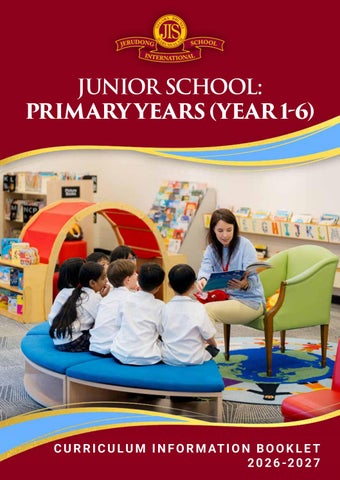
JUNIOR SCHOOL: PRIMARY YEARS (YEAR 1-6)
C U R R I C U L U M I N F O R M AT I O N B O O K L E T 2 0 2 6 -2 0 2 7
Welcome to
Jerudong Int School
ternational
iv / Jerudong International School
: Years 3-5 & JS Office : e-Learning Centre
: Maintenance
: Design & Technology
E ELC
J
K
: Year 6, Junior D&T,
P
PC
: Music
M
: Parents’ Coffee Shop
Science Laboratories
Years 4-8, Languages,
: Lecture Theatre
LEC
and Arts & Design
: Nursery - Year 2
: Health Centre
: Counsellors
D
C
: Science
& Exams Office
Laboratories, Business, Principal
Humanities,
T V
: Maths : Ugama
Uniform Shop
Shop : Stationery &
S
: Accounts, Computing,
R
Learning Support
English,
: Design & Technology
Q
: Middle Years Office
Centre : Drama
Arts
A
KEY TO MAIN CAMPUS AREAS
C
PC
Junior School Curriculum Information Booklet
Junior School Curriculum Information Booklet
Contents Important Contacts ...................................................................................................................................................
1
Welcome from the Executive Principal ..............................................................................................................
2
The Student Profile ....................................................................................................................................................
3
Head of Junior School ..............................................................................................................................................
4
Welcome to the Junior School ..............................................................................................................................
5
Year 1 - Year 6 ...............................................................................................................................................................
13
Keystage 1: Year 1 - Year 2 .......................................................................................................................................
14
Lower Keystage 2: Year 3 - Year 4 .........................................................................................................................
16
Upper Keystage 2: Year 5 - Year 6 .........................................................................................................................
18
Junior School Boarding ............................................................................................................................................
24
Enrolment Information .............................................................................................................................................
26
Jerudong International School / v
Junior School Curriculum Information Booklet
vi / Jerudong International School
Junior School Curriculum Information Booklet
Important Contacts Mailing Address: P.O. Box 1408 Bandar Seri Begawan BS8672, Brunei
Street Address: Jalan Universiti Kampong Tungku Bandar Seri Begawan BE2119, Brunei
admissions@jis.edu.bn or office@jis.edu.bn +673-241-1000 www.jerudonginternationalschool.com @JISBrunei
Executive Principal
Year 6 Coordinator
Nicholas Sheehan
Jamie Smith
Executive Principal’s Secretary
Head of Junior School Learning Support
Pui Yin Woo
Kirsty Cunningham
principal.secretary@jis.edu.bn
Head of Junior School
Junior School Office
Richard Hallam
Nabilah Sauni
juniorschool.office@jis.edu.bn
Kamaliah Azri
ext. 1101 ext. 1109
Deputy Head of Junior School: Early Years & Key Stage 1 Yvonne Crooks
Accounts Karen Yong
Deputy Head of Junior School: Key Stage 2
accounts@jis.edu.bn
ext. 1314
Wee Hui Tan
Stacey Hunter
Stationery and Uniform Shop Deputy Head of Junior School: Academics System & Development
Liza Sheriff
jis.shop@jis.edu.bn
ext. 5240/5244
Stu Burrows
Admissions Kindy Year Group Coordinator
Rebecca Dillon
Becci Grant
Kerima-Jo Rahman
ext. 1206
Farah Sabli
ext. 7100
Sil Suan Tan
ext. 1129
Reception Year Group Coordinator
admissions@jis.edu.bn
ext. 1205
Issy Mcnab
School Counsellors Year 1 Coordinator
Nadzirah Suhaimi
Abigail Knauf
Anth McKay
counsellor@jis.edu.bn
ext. 1211 ext. 2313
Year 2 Coordinator Ruth Smith
Year 3 Coordinator Sarah Winter
Year 4 Coordinator Caroline Brinkworth
Year 5 Coordinator Murray Thompson
Jerudong International School / 1
Junior School Curriculum Information Booklet
Executive Principal
A warm welcome to Jerudong International School (JIS) in Brunei.
understanding and a passion for learning. We believe in the power of collaboration and inclusivity and our curriculum is designed not only to challenge students to think critically but also to inspire them to
A vibrant, truly international community with students from over 45
become confident, creative, responsible and compassionate leaders
nationalities, aged 2 - 18 years old. As a community, we are committed
of tomorrow.
to creating an environment of excellence and holistic development, where every individual is encouraged to reach their full potential,
We are dedicated to developing well-rounded individuals who
both academically and personally. We are an academically selective
are not only academically proficient but also socially responsible,
school offering the British International School curriculum, and are
culturally aware and globally minded. Whether through our academic
very proud to be a Beacon Status School following our COBIS Patron’s
programmes, extracurricular activities, or pastoral care, we aim to
Accreditation. This means that parents can be safe in the knowledge
provide an enriching educational experience that prepares students
that when they choose to enrol their child in JIS, they will be receiving
for success in an everchanging world.
an outstanding, transformative education. We also appreciate the important role that parents play in guiding the We work hard to create a challenging and nurturing environment
educational progress of their children and work closely in partnership
that enables each child to flourish. Students consistently excel in
with our parents, to support us in reinforcing our values.
their examinations and go on to top universities around the world, including Oxbridge and the Russell Group of universities. We believe in
We warmly welcome you to visit us and see why Jerudong International
the traditional values of an independent school education but we also
School is a truly exceptional place to learn and grow.
embrace exciting innovative, new practices. At JIS, we are proud to uphold a strong ethos based on our values of Challenge, Respect and Inspire encouraging responsibility,
2 / Jerudong International School
Nicholas Sheehan EXECUTIVE PRINCIPAL
Junior School Curriculum Information Booklet
Jerudong International School / 3
Junior School Curriculum Information Booklet
Head of Junior School Our curriculum is shaped by a team of experienced subject coordinators who keep it current and grounded in good practice, working together to give children a consistent, progressive experience as they move through the school. We hold ourselves to high standards, and the calendar is full of events that bring extra richness and excitement to learning throughout the year. Children are assessed regularly, and parents receive reports during the year showing progress and attainment across subjects. In Early Years, parents can follow their child’s development through an ongoing Learning Journal on Seesaw, which documents progress through the EYFS framework. From Year 1 onward, children, teachers and parents build a digital portfolio together using the same platform, giving families an easy way to stay connected to their child’s learning. We also run Parents’ Evenings, Coffee Mornings and parent workshops throughout the year. Welcome to the Junior School at JIS, where your child is about to begin an important new chapter in their education. Every
Pastoral care is something we take great pride in, and parents play
member of our Junior School team is committed to helping your
a key role in making it work. Staff and families collaborate closely
child build a strong educational foundation alongside a genuine
to give every child a positive experience at school. We welcome
love of learning, setting them up for continued success in the
parents warmly and value the many ways they get involved.
Senior School and beyond. The pages that follow share more about what each year group’s Having been part of this community for almost a decade, I am
curriculum looks like, along with details on school routines and
delighted to take on this role and continue the work we have been
procedures. I hope this gives you a helpful picture, but nothing
building together. The world today’s children will grow into as
compares to visiting us in person to feel the real energy of our
adults will look very different from the one we know, shaped by
Junior School and see the learning happening day to day. Please
rapid technological change and challenges we cannot yet fully
come and see for yourself!
predict. Because of this, our Junior School curriculum focuses on developing creative thinkers and problem solvers: children who understand themselves and others, and who carry a broad toolkit of skills, knowledge and values they can apply to situations not yet imagined. This work runs right through our school, from Nursery to Year 6, in step with our wider school aims. JIS has long enjoyed a strong reputation that allows us to attract outstanding teachers. We look for staff who combine excellent teaching with genuine care for children’s wellbeing, since your child will spend most of their school day with their class teacher. They are also supported by a dedicated team of teaching assistants. Certain subjects, including ICT, Art, Drama, Physical Education, Design and Technology, Music and languages (along with Science in Years 5 and 6), are taught by specialist teachers, and we benefit from a strong EAL and Learning Support team as well. If you ever want to discuss your child’s education, please start by speaking with their class teacher.
4 / Jerudong International School
Richard Hallam HEAD OF JUNIOR SCHOOL
Junior School Curriculum Information Booklet
Welcome to the Junior School INTRODUCTION
Jerudong International School follows the British International School system. We are accredited as a COBIS, an IB World School and a HMC School. Our schooling goes from Nursery (2 years turning 3 years) through to the final school year which is Year 13. Our school year is from late August to early July. At present we have around 1700 students from 45 nationalities. Class sizes in the Junior School are usually a maximum of 20-22 children but this varies according to year level.
OUR CAMPUS
The School is situated on an extensive 120 acre single campus. The Junior School occupies one area of this campus so whilst the campus is extensive, it is not daunting for our Junior School children who are safe and secure in their area.
OUR TEACHERS
Our well qualified teachers are primarily from the UK. All employees of the School are safety checked and screened prior to employment. Each class in the Junior School has a main class teacher who is supported by a classroom assistant (this changes as children progress through the Junior School). In addition, the children are taught by a range of specialist teachers as they progress through the Junior School which helps them to prepare for the transition into the Middle Years of the Senior School.
ACADEMIC YEAR GROUP PLACEMENTS DATE OF BIRTH
1 Sept 2025
to
31 Aug 2026
1 Sept 2024
to
31 Aug 2025
1 Sept 2023
to
31 Aug 2024
1st Sept 2022
to
31st Aug 2023
1 Sept 2021
to
31 Aug 2022
1 Sept 2020
to
1st Sept 2019
to
1 Sept 2018
st
AUGUST 2026 - JULY 2027 AUGUST 2027 - JULY 2028 AUGUST 2028 - JULY 2029 Nursery
st
Nursery
Kindergarten
Nursery
Kindergarten
Reception
Kindergarten
Reception
Year 1
Reception
Year 1
Year 2
31 Aug 2021
Year 1
Year 2
Year 3
31st Aug 2020
Year 2
Year 3
Year 4
to
31 Aug 2019
Year 3
Year 4
Year 5
1 Sept 2017
to
31 Aug 2018
Year 4
Year 5
Year 6
1st Sept 2016
to
31st Aug 2017
Year 5
Year 6
1st Sept 2015
to
31st Aug 2016
Year 6
st st
st st
st st
st st
st st
st st
HOME SCHOOL PARTNERSHIP
Parents and teachers together play an important role in educating children and need to support each other in order for their child to be as successful as possible. We welcome parents into the school to help with specific events and to share their expertise to enhance children’s learning. We value good communication with parents and recognise the importance of keeping channels of communication open to ensure all students have a positive and successful experience during their time in the Junior School. Communication is regular and occurs in formal situations such as Parent Meetings and Parent-Teacher Consultations and during informal situations such as a brief chat at the end of the day. Teachers are happy to make an appointment to meet with parents if there are any specific concerns or questions concerning your child. Regular communication occurs between the School and parents on curriculum matters, forthcoming field trips and events. These will be found on the parent portal - FireFly or Seesaw. During the School year, there are also opportunities for parents and friends to come and see the school in action.
Jerudong International School / 5
Junior School Curriculum Information Booklet
ASSESSMENT AND REPORTING IN THE JUNIOR SCHOOL
The word assessment derives from the Latin verb assidere, which means ‘to sit with.’ This phrase illustrates our principal approach to assessment in the Junior School in that teachers work closely with children, guiding and supporting their learning in the moment. Twice a year, we administer more formal assessments to students in Years 3 to 6, and once a year for children in Year 2. The resulting information not only allows us to benchmark our performance against similar schools around the world, but to make decisions about the future of our curriculum: Are we spending enough time on this topic? Did that approach help children make progress? Our fundamental aim is to improve student outcomes, and we understand the significant and lasting role of parental support in this endeavour. Therefore, as part of our Parent Partnership Strategy, each year we provide: • three progress meetings with your child’s class teacher
• one progress report, published towards the end of the first term
• additional meetings or workshops with specialist teachers
• one attainment report, published at the end of the academic year
THE SCHOOL CALENDAR
The school calendar is posted on the school website: https://www.jerudonginternationalschool.com/school-life/calendar.
TERM DATES TERM 1
TERM 2
TERM 3
26 August - 11 December 2026
12 January - 19 March 2027
05 April - 09 July 2027
Mid-Term Break: 19-23 October
Mid-Term Break: 05 - 09 February
Mid-Term Break: 31 May - 07 June
End of Term Holiday:
End of Term Holiday:
End of School Holiday Starts:
12 December 2026 - 10 January 2027
20 March - 04 April 2027
10 July 2027
THE SCHOOL DAY
The School Day starts at 7.30am, Monday to Friday. We expect our children to be on site by 7.25am. For children in Years 3 to 6 there is a 7.25am bell which tells them to move upstairs towards their classrooms. Children from Nursery to Year 2 can enter their classrooms on the 7.30am bell. Our school day finishes at different times depending on the age of the children. • Nursery finish at 11.30am. • Kindergarten finish at 12.30pm. • Reception - Year 2 finish at 2.00pm. • Year 3 - Year 6 finish at 2.45pm. • Fridays only children from Nursery to Year 2 finish from 11.15am; Year 3 to Year 6 finish at 11.30am. Co-curricular activities can take place after school, Monday Thursday.
ATTENDANCE
The attendance register is taken each morning. If your child is late to school it is important that they visit the Junior School office in order to update the roll. If for any reason your child needs to be excused from lessons or other school activities, it is important that communication from home to the class teacher or Junior School office is sent via email or letter. If you wish to take your child out of school during the day, they will need to get an Exit Pass from the Junior School office.
6 / Jerudong International School
Junior School Curriculum Information Booklet
CO-CURRICULAR ACTIVITIES (CCA)
At JIS, we believe strongly in the education of the whole child and encourage them to make the most of all of the opportunities available to them. Although academic work is important, education is not just about acquiring paper qualifications. Co-curricular activities provide the experience of being a team member, of communicating in a variety of circumstances and of leading when that is appropriate. These are significant opportunities and they offer our students the chance to develop personal skills and qualities which will stand them in great stead throughout their lives. Co-curricular activities (CCA) offer students an opportunity to take part in a variety of activities. The promotion of essential physical and personal skills such as communication, cooperation and problem solving skills form the focus of the Co-Curricular Activities programme. All activities are designed to excite and enthuse students, encouraging them to willingly offer input, challenge their understanding and stretch their imagination. Each term students make their selections based on the wide range of activities on offer. Students who remain at school after lessons are asked to join the After School Care Club (careclub@jis.edu.bn) which is open from 2.00pm– 5.30pm Monday to Thursday, for which there is an extra charge. Here, there are a wide variety of opportunities for children to play with others, use the computers or do some cooking. To ensure the safety of all, students are supervised at all times. Students are expected to attend either the After School Care Club or Co-Curricular Activities when they are on the school premises. Students may use the library until 4:00pm. Junior School students should be picked up promptly at the end of the day or after a CCA or swimming lesson.
INSTRUMENTAL MUSIC TUITION
Students can enroll in the School’s Instrumental Music Programme. Students receive tuition in an instrument of their choice with a specialist music teacher. These lessons are scheduled during the school day. Individual and shared lessons are available. Parents are able to hire instruments from the Music faculty. Fees for this programme are additional to the tuition fees. For more information about this programme and the fee structure contact the Music Secretary or the Head of Music on 241 1000 (extension 5214/5220) or email music@jis.edu.bn.
ONLINE LEARNING PLATFORMS
Firefly is our online learning platform that brings together students, teachers and parents. Parents can be involved with their son or daughter’s learning. They can: • Check homework and timetables for their son or daughter. • Access their son / daughter’s School Report online. • Engage with their son or daughter’s learning. • Access a large amount of general information about the Houses and subjects. • Access a ‘Parent Information’ section with lots of useful information e.g. Menus etc. • Access the ‘Events’ to find out what is happening in the School
Parents can access the Firefly Platform from their child’s first day in school. Our help desk team are available to assist parents who wish to have support (help.desk@jis.edu.bn). Seesaw is an online digital portfolio that children, parents and teachers can access and record the struggles and successes of learning. Parents can see what their child has been doing in school with reflections from their teacher and/or your child: • Something they are proud of • Something that was hard to do that they figured out • Something they tried for the first time Parents can connect to Seesaw by either downloading the app and following the sign up instructions using the details sent from your child’s teacher or visit the website: web.seesaw.me/parents/ Year 5 & 6 use Google Classroom.
Jerudong International School / 7
Junior School Curriculum Information Booklet
DIGITAL LEARNING
The School campus has full WiFi access and all students have access to the School’s network. Students are given an account name and password for access. The School has an excellent website which provides information about the school and its curriculum. Once enrolled in the school, students have access to Firefly - a learning portal. This is also used by parents and teachers, with different permission levels. Parents can access personal information about their child as well as detailed information about the curriculum and life in school behind the log in. Students use chromebooks, desktop computers and other digital devices as part of their digital learning. Year 5 and 6 students are required to bring in their own Chromebook, fully charged and ready to use daily. Chromebooks are popular in schools due to their reliability, functionality, and value. Chromebooks fill a new space in technology; this space is between mobile options such as the iPad and the portable space anchored by traditional laptops. The Chromebook needs little, if any, maintenance and has an excellent battery which should last much more than a whole school day if fully charged. It is a web-based device so there is no need for downloading or installing software. The way a Chromebook operates reduces the need for technical support. Student work on the Chromebook automatically saves to the cloud and in particular the Google cloud. The minimum specification for Chromebooks are below:
Acer Chromebook • 4GB LPDDR 4 Memory
• Military grade Impact Resistance
• USB-C type power adaptor
• 32GB eMMC Storage
• Spill Resistant Keyboard (up to 330ml)
• Up to 12 hours battery life
• 11.6” non touch screen
• 180° Hinge
• 3 Year Warranty
Information on local purchasing deals can be found here: tinyurl.com/parent-information-chromebook. Any computer is a tool to enhance learning – it does not replace the curriculum, but is used to provide new opportunities for innovation. It will be up to each member of staff to determine how to incorporate Chromebooks into the curriculum. All teachers have participated in training sessions and will receive ongoing professional development. If you would like to learn more, here is a link to a Chromebooks User Guide: www. chromestory.com/chromebook-user-guide/
HOUSE SYSTEM AND STUDENT LEADERSHIP
There are four House groups in the Junior school; Red, Blue, Yellow and Green. The House system is in place to provide an avenue for competition and camaraderie amongst the students. On entering JIS, all students will be given a House colour. This colour stays with the children until they leave Junior school. A coloured T-shirt will be worn to school on occasions to support their House in sporting and non-sporting events at school. Siblings are placed in the same House upon enrolment. During the school year Polio Points are awarded for a variety of reasons in line with the whole school aims. These can be demonstrated in lessons and in wider opportunities including competitions, academic or personal achievement, sportsmanship, kindness and cooperation. At the end of the year the overall winning House is presented with the House Trophy. Students in the Junior School have the opportunity to nominate themselves and be voted in as House Captain or Deputy House Captain when they reach Year 6. The Year 6 House Captains are elected by the student body and represent the Junior School on the Whole School Student Council. This group, and the overall running of the House system, is coordinated by the appointed staff House Coordinator. Additional leadership opportunities in the Junior School include subject ambassadors and Junior School Council members.
THE POLIO POINTS REWARD SYSTEM (YEARS 1-6) This is a student-led initiative across the whole school once children leave Early Years.
Polio Points are earned by following the School Aims: Communication, Engagement, Resilience, Thinking, Leadership and Integration. A set of 6 polio points (one per school aim) is then used to purchase a polio vaccine. So, we want to encourage our students to do well and think of others. Children collecting three full sets of Polio Points are awarded a badge. Many children achieve more than one badge during the school year and all of our children improve the lives of other children around the world.
8 / Jerudong International School
Junior School Curriculum Information Booklet
CHARITY
The Junior School has an annual fundraising week. The money raised is for children with special needs in Brunei. The children are chosen in consultation with the Ministry of Education Special Needs Unit. This enables JIS’ Junior School Council to present children with equipment to help them with their learning needs. In Fundraising week, a range of activities are organised by the Junior School Student Council such as Guess the number of sweets in a jar, Coin Drop, Bake Sale, Launch a Teddy and Messy Day. We also encourage the children to do additional activities at home - ‘Dollar a Job’! Fundraising Week provides a great opportunity for our children to actively give something back to the wider Brunei community. During the school year, the Junior School Council are involved in visiting the children who receive the assistance too.
EXCURSIONS AND TRIPS
An integral part of the education in the Junior School is the range of field trips and excursions which students experience. These excursions broaden a student’s understanding of work that is being covered in class in a practical and enjoyable way. Residential visits begin in Year 4.
THE HEALTH CENTRE
JIS has a well equipped Health Centre with a team of Nurses led by the Head Nurse. As well as treating any child who has an accident or feels unwell during the school day, the Health Centre are also involved in the well being of children.
Illness or Accidents It is important that the emergency contact information given to the school is current. This allows us to make the necessary arrangements when children are taken ill during the day. The school should be informed of any disabilities or medical problems that are cause for concern. A list of children and relevant health issues is put on the school Intranet for whole school reference. Please let us know immediately if your child is unwell and inform us of any medical diagnosis that may result in the spread of an illness to other students or staff. If it is something that can be passed on to others, keep your child at home. If they are recovering from an illness and are not able to take part in Physical Education lessons, inform us by letter. In the event of a minor accident or sickness, children are taken to the nurse in the Health Centre and given first aid and made comfortable until they are able to return to class. They are given a note by the nurse detailing any action taken. If an injury causes us concern or hospital treatment is required we first seek the advice of the nurse and then make every effort to contact a parent or the listed emergency contact as soon as possible. Where this is not possible we will make arrangements to accompany and transport children to hospital and seek further medical advice. If appropriate the services of an ambulance will be used.
Medication No form of medication can be given during the day without consultation with the nurse. Staff are not allowed to give out medication or tablets with the exception of children who require inhalers to control their asthma. Instructions in this case need to be in writing to the class teacher with details of times and dosages. If medication other than this is required, parents are asked to see the nurse before school with instructions. The medication should be marked with the child’s name, class and time of administration.
Sun Safety Students must use sun protection (and insect repellant) on exposed skin if they are outside for an extended time. School hats are worn outside and students are encouraged to make use of available shade. The Health Centre have a supply of sunscreen for the children to use. All students must have a hat which they wear at break and lunchtimes. We operate a ‘No Hat, No Play’ policy for students wishing to play sports on the school fields.
Jerudong International School / 9
Junior School Curriculum Information Booklet
SCHOOL UNIFORM
Jerudong International School (JIS) believes that a clear uniform policy plays a valuable role in contributing to the school ethos. We expect all who attend JIS to have a high standard of appearance whilst wearing school uniform whether inside or outside of school. The purpose of this policy is to provide clear guidance to students, teachers, parents and other stakeholders about the expectations of the school with regard to uniform and appearance and the strategies used to maintain a high standard at all times. At any time that students wear school uniform they are representing the school and must wear the appropriate uniform in the appropriate manner. It is important that the school uniform is worn correctly. The uniform is available for purchase from the stationery and uniform shop.
Roles and Responsibilities • The Principal and School Academic Leadership Team are responsible for ensuring the policy is followed. • House Masters, House Mistresses, Tutors and class teachers (Junior school) are responsible for checking uniform daily. • School staff, including teaching and support staff, are responsible for ensuring that the policy and procedures are followed and consistently and fairly applied. • Parents and carers are responsible for ensuring that their son or daughter wears the correct uniform inside and outside of school. • Students are expected to take full responsibility for their own appearance and will be made fully aware of the school policy, procedures and expectations. The Deputy Head of School will judge if a student is inappropriately presented and may, after liaising with the relevant Head of School, contact the parents. Parents should check with the class teacher if they have any doubt about the suitability of items of clothing they intend to buy for students to wear in school.
Approved Uniform for Boys
Approved Uniform for Girls
Nursery - Year 2
Nursery - Year 2
Navy Blue or Maroon.
JIS Shirt
Navy Blue or Maroon Polo.
Shorts / Trousers
Navy Blue.
JIS Skort
Navy Blue Tartan.
Socks
White only.
Socks
JIS Polo Shirt
School Shoes Physical Education Uniform
Black leather (only for Reception to Year 2). Navy Blue or Maroon Polo Shirt Navy Blue Shorts or Sweatpants House Colour Team Shirt
School Shoes Physical Education Uniform
Year 3 - Year 6
White only. Black leather (only for Reception to Year 2). Navy Blue or Maroon Polo Shirt Navy Blue Shorts or Sweatpants House Colour Team Shirt
Year 3 - Year 6 JIS Blouse
JIS Shirt
White open neck.
Shorts / Trousers
Navy Blue.
JIS Skort / Skirt
Socks
White only.
Socks
White only.
School Shoes
Black leather.
School Shoes
Black leather.
Physical Education Uniform
JIS Maroon Dri-Fit T-Shirt (long / short sleeves) JIS Dri-Fit Shorts / Track Pants House Colour Team Shirt
Physical Education Uniform
White and collared. Navy Blue Tartan. Choice of TWO lengths
JIS Maroon Dri-Fit T-Shirt (long / short sleeves) JIS Dri-Fit Shorts / Track Pants House Colour Team Shirt
• Nail varnish should not be worn to school. • Boys hair should be above the collar on entry into Reception. • No jewellery is allowed except for ONE pair of small studs in ears, ONE bangle and ONE necklace. • The school uniform can be purchased at the school shop.
10 / Jerudong International School
Junior School Curriculum Information Booklet
SAFEGUARDING CHILDREN
The health, safety and well-being of every child at Jerudong International School is our prime concern. We listen to our students and take seriously what they tell us. Our aim is that children will enjoy their time as students in this school. We also want to work in partnership with our parents to help each child to achieve their full potential and make a positive contribution. The school has a Child Protection Policy in line with this for the safety of all. This Child Protection Policy is available to parents on our Firefly Parent Portal. Please be aware that we follow Bruneian laws and guidance with regard to child protection, which may be different to your home country. If you are at all worried about the welfare, health or safety of a child please speak to the school counsellors or the Head of Junior School. For any questions or concerns please contact counsellor@jis.edu.bn.
FOOD @ JIS
JIS is committed to providing the whole school community with a modern, healthy menu and dining experience. We are constantly working on ways we can improve the food offered in our school canteens. Our aims are always to focus on freshly prepared food with great variety that is both nutritious, delicious and attractive. Children in Early Years eat their snacks and lunch in their dedicated areas. Students in Years 1 & Year 2 eat their snacks in the classroom areas and join Year 3 for their lunches at the Junior School ‘Rainforest Canteen’. Students in Years 4 - 6 eat their snacks and lunch at the ‘Borneo Pasar Canteen’. We have two halal certified caterers - Serikandi and Grazestar who both operate in these canteens. They offer a varied and extensive range of items served from different kiosks. They can cater for any special diets and daily vegan / gluten-free and vegetarian hot meals are available. Parents can view the menus on the Firefly parent portal and can pre-order for their child. Children purchase food using credit on their campus wristband. Parents can add credit by paying cash to Accounts or by paying online. Parents can also set a daily limit for their child. The Firefly pages also have monthly updates of new items added to the menu. The School is committed to recycling / reusing and reducing waste and so we encourage parents to provide their children with a container to collect their lunch. Students will also bring their own water bottles and fill them using the many water fountains. Water jugs and beakers are also available in the Rainforest Canteen and Borneo Pasar Canteen.
PARENT ID PASSES AND CAR PASS
All parents are issued with a security ID Pass and also a car pass which allows them to access the school campus. Parents are required to wear their Parent Pass when on the school campus.
JUNIOR SCHOOL LIBRARY
Children will visit the Junior School Library as part of their school curriculum. However, JIS parents are welcome to register as Community Borrowers. This will allow parents to borrow books for their own personal enjoyment or/and to borrow additional books for their children. Parents are welcome to visit the library 7.30am - 8am each morning (Monday - Friday) and 3pm - 4pm (Monday - Thursday).
UGAMA
Ugama is the study of Islam. It is taught in the Malay language (Bahasa Melayu) and is compulsory for all Bruneian Muslim students in Years 2 - 6. • Year 1 (Ugama Short Programme): Starts in Term 2 only, every Wednesday from 2.15pm • Year 2 to Year 5 (Darjah Pra - Darjah 3): 2.00pm - 3.00pm (Monday to Thursday) and 2.45pm - 3.45pm (Friday). • Year 6 (Darjah 4): 3.15pm - 5.00pm (Monday to Thursday) and 2.45pm - 5.00pm (Friday). Please contact ugama@jis.edu.bn for more information.
Jerudong International School / 11
Junior School Curriculum Information Booklet
12 / Jerudong International School
Junior School Curriculum Information Booklet
Year 1 - Year 6
OVERVIEW
The Curriculum for Years 1 - 6 is based around 4 defined aspects and balances a core of knowledge with opportunities to apply, investigate and present through personalised learning. Threaded throughout our curriculum are learning habits and essential values that ensure we produce responsible and productive global citizens that will positively contribute to Brunei and the wider world in the years to come. At Jerudong International School, in addition to the class teacher, we have pioneered the use of an increasing number of specialist teachers as the students progress through the Junior School. This is part of our commitment to an enhanced curriculum. In the Junior School, we believe that every child deserves learning that is meaningful, progressive, and transformative. We are a community of curious, empowered learners, children and teachers alike, who share responsibility for learning that connects deeply to the world around us. Through a coherent, skills-rich curriculum that is consistent in its foundations and flexible in its expression, we inspire every child to think deeply, belong fully, and grow into who they are capable of becoming. At Jerudong International School, learning is about so much more than ticking off facts and skills. It’s how your child comes to understand themselves, the people around them, and the world they’re growing up in, because real learning changes how a child thinks, not just what they know. • We want your child to know why they’re learning what they’re learning, connected to real questions, real contexts, and who they’re becoming. • Children only think deeply and take risks once they feel safe, seen and genuinely valued, so we build that sense of belonging before anything else. • Your child and their teacher share ownership of the learning journey. Our teachers don’t just deliver knowledge; they create the conditions where curiosity and confidence can grow. • A clear, coherent curriculum gives every child the security of solid foundations, while still leaving room for genuine exploration and discovery.
Jerudong International School / 13
Junior School Curriculum Information Booklet
Keystage 1: Year 1 - Year 2 CURRICULUM INFORMATION
Teachers in Years 1 and 2 liaise closely with the staff of Early Years to ensure that they build on the prior learning as the children leave Early Years. Years 1 and 2 have recently adopted many of the play based learning principles from Early Years to ensure a successful transition as the children move through Key Stage 1. English and Maths lessons in Years 1 and 2 follow the latest English National Curriculum, with some adaptation to ensure they apply to JIS’s local context. This ensures that children are rigorously challenged and provides a progressive framework from which teachers plan the children’s learning.
English Synthetic phonics continues to be taught, introducing the children to graphemes and blends of increasing complexity. We aim for the children to become confident to use their phonetic knowledge and sight word vocabulary sounds in order to read and write with greater fluency and depth. In writing activities children begin to write captions, labels and simple sentences with emphasis on the use of full stops and capital letters. As they progress they learn to use nouns, adjectives and verbs, as well as connectives and a wider range of vocabulary related to the tasks. By the end of Year 2 they will be writing various text genres and beginning to join their handwriting. Spelling homework begins in Year 1 and continues into Year 2 with a list of appropriate words being sent home. During one to one and group guided reading activities children learn to apply and reinforce word-level skills. They identify and compare basic story elements and become aware of character and dialogue, as well as learning the differences between non-fiction and fiction texts, and the use of organisational features such as contents pages and indexes. As their reading progresses they will begin to identify inference (reading ‘between the lines’) and begin to understand the intent of the author.
Mathematics Most of the Mathematics work we do in Years 1 and 2 is based on practical activities. Lots of counting, sorting, adding and subtracting in order to establish and reinforce their concept of numerical value and their understanding of the number system. It is crucial for children to have a firm understanding of this before they can move onto harder concepts such as multiplication and division. Year 1 children are also introduced to a range of problem solving, measure, shape and data handling activities, such as telling the time to the hour/half past and naming and describing 2D/3D shapes. Mathematical vocabulary is introduced and continuously reinforced throughout each lesson. As the children progress, there will be greater expectation that they can demonstrate and apply their mathematical understanding using written methods. We expect all children to know at least their 2, 5 and 10 times tables by the end of Year 2.
Wider Curriculum The subjects of Science, History and Geography form the wider curriculum that children study. These feed into other areas of the children’s curriculum with links being made in English, Maths and specialist subjects such as DT and Music. Topics are planned and reviewed annually. In addition to the class teacher, children receive lessons by a specialist teacher in these subjects, and more information can be found on these in the following pages: • Art • Music
• English as an Additional Language and an Intensive Language Programme for those children who speak little English
• Computing
• Physical Education
• Design and Technology (Year 2)
• Swimming
• Languages (French, Malay, Bahasa Melayu and Chinese)
14 / Jerudong International School
Junior School Curriculum Information Booklet
TIMETABLE EXAMPLES Year 1 Monday
Tuesday
07.30 - 07.45
Wednesday
Thursday
Registration
Friday 07.30 - 08.25
Class Lesson
07.50 - 08.45
Class Lesson
Class Lesson
Class Lesson
Class Lesson
08.30 - 09.25
Class Lesson
08.50 - 09.45
Class Lesson
Music
Phys Ed
Class Lesson
09.25 - 09.45
BREAK
09.50 - 10.45
Music
10.50 - 11.45
Assembly
09.45 - 10.05
BREAK
10.10 - 11.05
Library
Phys Ed
Phys Ed
Class Lesson
11.10 - 11.55
Swimming
Language
Class Lesson
Language
11.55 - 12.45
LUNCH
12.45 - 13.00
Reading Time
13.05 - 14.00
Junior IT
Class Lesson
Class Lesson
Class Lesson
14.00 - 15.00
CCAs
CCAs
CCAs
CCAs
Wednesday
Thursday
* Lessons taught by Specialist Teachers
Year 2 Monday
Tuesday
07.30 - 07.45
Registration
Friday 07.30 - 08.25
Class Lesson
07.50 - 08.45
Class Lesson
Class Lesson
Class Lesson
Music
08.30 - 09.25
Phys Ed
08.50 - 09.45
Class Lesson
Language
Swimming
Art
09.25 - 09.45
BREAK
09.50 - 10.45
Class Lesson
10.50 - 11.45
Assembly
09.45 - 10.05
BREAK
10.10 - 11.05
Junior IT
Phys Ed
Language
Class Lesson
11.10 - 11.55
Design & Technology
Library
Class Lesson
Class Lesson
11.55 - 12.45
LUNCH
12.45 - 13.00
Reading Time
13.05 - 14.00
Class Lesson
Class Lesson
Class Lesson
Class Lesson
14.00 - 15.00
CCAs / Ugama
CCAs / Ugama
CCAs / Ugama
CCAs / Ugama
* Lessons taught by Specialist Teachers
Jerudong International School / 15
Junior School Curriculum Information Booklet
Lower Keystage 2: Year 3 - Year 4 CURRICULUM INFORMATION English
Across Years 3 and 4 the teaching of English continues to follow the Curriculum for England, building on prior learning in Key Stage 1. Reading becomes increasingly challenging, with children being exposed to a wider range of texts. The skills of comprehension and text analysis are further developed through reading in small groups, whole class discussion or individually with an adult. Phonic sessions may be used for those children who need further experience to cement their understanding. Writing develops in challenge, similarly to reading with greater expectations placed on the children, for example using a wider range of conjunctions, e.g. however, therefore. The use of punctuation is expected to be solidly embedded. Writing opportunities are identified in the wider breadth of curriculum subjects that the children experience. In Year 3 children begin Drama lessons to further develop their speaking and listening skills. These continue into Year 4 and beyond.
Mathematics Similar to English, Mathematics continues to progress from Key Stage 1 into Years 3 and 4. Children are expected to learn the times tables and should know up to 12 x 12 by the end of Year 4. Many of the lessons continue the practical nature of lessons in Key Stage 1 before children move into demonstrating their understanding in more abstract ways. The content of mathematics lessons follows a cyclical framework so that previous learning is revisited. Mathematics lessons are taught by the class teacher which ensures that effective lesson time is used and links identified to learning in other areas of the curriculum to give the mathematics learning genuine context. As well as English and Mathematics, we offer a broad range of subjects, including three languages, taught in world-class facilities. Specialist subject areas: • Art • Design and Technology (D&T) • Languages including Bahasa Melayu (1st language Malay), Malay Language (as a second language), French (for first language and second language speakers), Chinese, Urdu • English as an Additional Language and an Intensive Language Programme for those children who speak little English • Computing • Library • Performing Arts (Drama, Music) • Physical Education (PE) and Swimming More information can be found on pages 25-26.
Wider Curriculum Class teachers are also responsible for providing learning in the Humanities, Science and Personal, Social and Health Education (PSHE). Effective links to other areas of the curriculum and to the children’s interests are used to bring these areas of the curriculum to life. Children in Years 3 and 4 have access to the Junior School Science labs to conduct experiments to support their learning.
16 / Jerudong International School
Junior School Curriculum Information Booklet
TIMETABLE EXAMPLES Year 3 Monday
Tuesday
07.30 - 07.45
Wednesday
Thursday
Registration
Friday 07.30 - 08.25
Junior English
07.50 - 08.45
Junior English
Swimming
Class Lesson
Phys Ed
08.30 - 09.25
Class Lesson
08.50 - 09.45
Junior English
Class Lesson
Class Lesson
Class Lesson
09.25 - 09.45
BREAK
09.50 - 10.45
Design & Technology
10.50 - 11.45
Games
09.45 - 10.05
BREAK
10.10 - 11.05
Junior English
Junior English
Junior English
Class Lesson
11.10 - 11.55
Library
Class Lesson
Junior IT
Class Lesson
11.55 - 12.45
LUNCH
12.45 - 13.00
Reading Time
13.05 - 14.00
Art
Class Lesson
Class Lesson
Music
14.05 - 14.45
Assembly
Library / Ugama
Discovery Time
Games
14.45 - 15.10
Supervised Break
15.10 - 15.55
CCA 1
CCA 1
CCA 1
CCA 1
16.00 - 16.45
CCA 2
CCA 2
CCA 2
CCA 2
Wednesday
Thursday
* Lessons taught by Specialist Teachers
Year 4 Monday
Tuesday
07.30 - 07.45
Registration
Friday 07.30 - 08.25
Junior English
07.50 - 08.45
Class Lesson
Junior English
Art
Language
08.30 - 09.25
Games
08.50 - 09.45
Language
Class Lesson
Class Lesson
Junior English
09.25 - 09.45
BREAK
09.50 - 10.45
Class Lesson
10.50 - 11.45
Class Lesson
09.45 - 10.05
BREAK
10.10 - 11.05
Phys Ed
Junior IT
Swimming
Class Lesson
11.10 - 11.55
Class Lesson
Class Lesson
Class Lesson
Class Lesson
11.55 - 12.45
LUNCH
12.45 - 13.00
Reading Time
13.05 - 14.00
Junior English
Library
Music
Design & Technology
14.05 - 14.45
Library / Ugama
Assembly
Games
Discovery Time
14.45 - 15.10
Supervised Break
15.10 - 15.55
CCA 1
CCA 1
CCA 1
CCA 1
16.00 - 16.45
CCA 2
CCA 2
CCA 2
CCA 2
* Lessons taught by Specialist Teachers
Jerudong International School / 17
Junior School Curriculum Information Booklet
Upper Keystage 2: Year 5 - Year 6 CURRICULUM INFORMATION English
The progression through the Curriculum for England continues into Years 5 and 6 where expectations are at their highest. There is a demanding range of reading and writing genres and skills required. Children are exposed to a range of text types, including fiction and non-fiction, comics, online content and even classic authors such as Shakespeare. Children will write at length in various styles, including fiction and non-fiction. By the time the children leave Year 6 they are able to write a variety of entertaining texts; consider the intended audience and alter their writing appropriately and use a complex range of punctuation, grammar and vocabulary. Spelling is taught, rather than relying on memorising words for a test, so the children spell the vast majority of words correctly and can make educated attempts at spelling unknown words. Speaking and listening skills continue to be developed, through a variety of techniques, but substantially through Drama where the complexity and quality of performance is significant for children of this age.
Mathematics The content of the Year 5 and 6 curriculum continues to build on learning in previous years. Teachers follow the Curriculum for England content using a range of resources, from practical to abstract. Mathematics lessons are taught by the class teacher which ensures that effective lesson time is used and links identified to learning in other areas of the curriculum to give the mathematics learning genuine context. By the end of Year 6 children should be able to calculate using ‘long’ multiplication and division and begin to use algebraic equations. Children are well-prepared for Year 7 maths.
Wider Curriculum Class teachers are also responsible for providing learning in the Humanities and Personal, Social and Health Education (PSHE). Effective links to other areas of the curriculum and to the children’s interests are used to bring these areas of the curriculum to life.
Year 5 & 6 Chromebooks Each child in Year 5 and 6 is required to bring in their own Chromebook, fully charged and ready to use daily. Chromebooks are popular in schools due to their reliability, functionality, and value. Chromebooks fill a new space in technology; this space is between mobile options such as the iPad and the portable space anchored by traditional laptops. The Chromebook needs little, if any, maintenance and has an excellent battery which should last much more than a whole school day if fully charged. It is a web-based device so there is no need for downloading or installing software. The way a Chromebook operates reduces the need for technical support. Student work on the Chromebook automatically saves to the Cloud and in particular the Google cloud. Any computer is a tool to enhance learning – it does not replace the curriculum, but is used to provide new opportunities for innovation. It will be up to each member of staff to determine how to incorporate Chromebooks into the curriculum. All teachers have participated in training sessions and will receive ongoing professional development. If you would like to learn more, here is a link to a Chromebooks User Guide: www.chromestory.com/chromebook-userguide/
Learning Support English is taught to mainstream students by their classroom teacher. Students who need extra support will be taught by an ‘English as a Second Language’ (EAL) teacher for two extra lessons a week. Students who have no English will start JIS in our Intensive Language Programme (ILP), led by a specialist teacher who is aware of the needs of this type of student. (An additional charge is made for the ILP). We also have a Learning Support Department. Learning Support (LS) teachers assist students who have been identified as having additional learning needs.
18 / Jerudong International School
Junior School Curriculum Information Booklet
Science Our children’s scientific curiosity and enthusiasm is enhanced by the provision of specific Junior School science labs. These provide excellent facilities for the children to explore a range of scientific concepts. Years 5 and 6 receive specialist science lessons and the science topics are developed to link with learning in other curriculum areas. A range of learning approaches are used by staff when delivering our science curriculum and our local environment is used at any opportunity to make the children’s learning relevant to them. We endeavour to provide a rich, hands-on practical approach interspersed with discussion to promote further questions to be investigated. At every opportunity a cross curricular approach to science has been adopted with themes being developed across the Junior year groups. This has allowed the content to be more relevant to the children with links and connections being made at the child’s individual level. Students have been encouraged to find ways to answer their own questions, be it through an investigation, observation, survey or research and modify their approach as required. Our students can talk openly about what they are learning and how it relates to them and the world around them. They are interested in what they are doing and they enjoy hands on activities in laboratories that make them ‘feel like a scientist’. The School’s Outdoor Discovery Centre (ODC) is a place that offers all of our learners opportunities to achieve and develop confidence and self-esteem through the hands-on learning experiences gained in a natural environment. In our unique setting in Brunei, the establishment supports the development of a relationship between the learner and our surrounding natural world.
Humanities Humanities combines History and Geography learning around deep and challenging questions, leading to significantly deeper learning and the use of higher order thinking skills by the children. The children are also given the opportunity to apply learning from other subject areas too, for example English and Maths, during these subjects. The subjects covered are evaluated and altered during the year to reflect the children’s needs and interests.
Personal Social Health Education (PSHE) Our school believes in the core rights of a student; the right to be valued, the right to learn, the right to be safe. These rights are reinforced through our PSHE and House programme. In PSHE the curriculum is delivered through lessons, as a circle time focus or through philosophical discussion. The main topics across the school are: • Friendships—How to be a friend? • Self-Esteem—What am I good at? • Healthy Eating—What I need to eat to be healthy? • Environment—Looking after our world • E-Safety—Keeping safe on the internet
Thinking Skills We introduce our students to philosophy in the Junior School. Philosophy for Children (P4C) has a wide-reaching, positive impact on children’s cognitive, social and emotional development. Children are taught how to create their own philosophical questions. Working as a community of enquiry, they then discuss their ideas. Teachers support the children in their thinking, reasoning and questioning. P4C is about getting children to think and communicate well; to enable them to think better for themselves.
Jerudong International School / 19
Junior School Curriculum Information Booklet
TIMETABLE EXAMPLES Year 5 Monday
Tuesday
07.30 - 07.45
Wednesday
Thursday
Registration
Friday 07.30 - 08.25
Class Lesson
07.50 - 08.45
Class Lesson
Art
Junior English
Junior Science
08.30 - 09.25
Language
08.50 - 09.45
Design & Technology
Phys Ed
Games
Phys Ed
09.25 - 09.45
BREAK
09.50 - 10.45
Junior IT
10.50 - 11.45
Junior English
09.45 - 10.05
BREAK
10.10 - 11.05
Class Lesson
Class Lesson
Junior Science
Class Lesson
11.10 - 11.55
Junior English
Junior English
Class Lesson
Class Lesson
11.55 - 12.45
LUNCH
12.45 - 13.00
Reading Time
13.05 - 14.00
Music
Class Lesson
Class Lesson
Language
14.05 - 14.45
Games
Discovery Time
Assembly
Library / Ugama
14.45 - 15.10
Supervised Break
15.10 - 15.55
CCA 1
CCA 1
CCA 1
CCA 1
16.00 - 16.45
CCA 2
CCA 2
CCA 2
CCA 2
Wednesday
Thursday
* Lessons taught by Specialist Teachers
Year 6 Monday
Tuesday
07.30 - 07.45
Registration
Friday 07.30 - 08.25
Junior English
07.50 - 08.45
Junior English
Junior English
Games
Class Lesson
08.30 - 09.25
Class Lesson
08.50 - 09.45
Phys Ed
Class Lesson
Junior Science
Class Lesson
09.25 - 09.45
BREAK
09.50 - 10.45
Class Lesson
10.50 - 11.45
Art
09.45 - 10.05
BREAK
10.10 - 11.05
French
French
Class Lesson
Junior English
11.10 - 11.55
Design & Technology
Junior IT
Junior English
Phys Ed
11.55 - 12.45
LUNCH
12.45 - 13.00
Reading Time
13.05 - 14.00
Class Lesson
Music
Class Lesson
Junior Science
14.05 - 14.45
Modern Foreign Language
Drama
Modern Foreign Language
Assembly
14.45 - 15.10
Supervised Break
15.10 - 15.55
CCA 1
CCA 1 / Ugama
CCA 1
CCA 1
16.00 - 16.45
CCA 2
CCA 2 / Ugama
CCA 2
CCA 2
* Lessons taught by Specialist Teachers
20 / Jerudong International School
Junior School Curriculum Information Booklet
Homework Year Level
Homework Guidelines
Frequency
Year 3 - Year 5
Daily reading
Weekly
Bahasa Melayu Year 6
Daily reading
Weekly
SPECIALIST SUBJECTS Art (Years 1 - 6) In the Junior School at JIS every student from Year 1-6 attends Specialist Art lessons. The Junior Art programme provides an opportunity for each student to have hands-on experience in producing their art. Classes encourage critical and creative problem-solving skills and perceptual awareness. Students will explore basic art media and techniques, such as drawing, painting, collage, ceramics, printmaking and sculpture. Art criticism, aesthetics and Art history are also an integral part of class. The programme develops the foundational skills in design literacy, visual composition and creative expression.
Computing (Years 1 - 6) The subject of Computing brings together the key strands of computer science, digital literacy - including online safety - and information technology, and children develop their skills and understanding in these areas as they progress through the school.. The curriculum is designed to inspire creative thinking and to encourage the development of skills that will prove invaluable in the real world. It also allows our pupils to explore, observe, engage, solve problems and make exciting discoveries for themselves.
Design and Technology (Years 2 - 6) Design and Technology is all about the practical application of knowledge to solve problems through creation of physical products. Our curriculum in the Junior School at JIS starts the children on a journey of skill, knowledge and experience acquisition that will take them all the way to the Senior School and beyond. In each year the children will work on projects that focus on Food, Graphics, Products and Textiles. The projects are structured to allow children to develop appropriate practical skills but also to develop the subjects fundamental requirements of Analysis, Creativity and Communication. Providing opportunities for children to demonstrate their creativity has guided the development of each project so that every child will be able to develop their own individual designs at every stage and take home unique products of which they can be immensely proud.
Drama (Years 3 - 6) Drama in the Junior School centres around supporting all the students from Years 3 - 6 in developing as individuals both in performance but more importantly, as good group workers, as confident speakers and as individuals that can complete tasks and present ideas with a wide range of individuals. In Drama, all students will explore different genres of theatrical performance, developing their understanding of how stories can be told in different ways. Every student will be given the opportunity to perform lines by themselves in their own Year Group Production. Participation in Dramatic activity (both curricular and extracurricular) requires self control and discipline that will serve the student well in all aspects of their life, and help them develop a more positive, confident self image.
Music (Kindy - Year 6) Music is an integral component of the Junior School curriculum. All students sing and play a range of melodic and percussive classroom instruments. Classroom music allows each child the opportunity to succeed in music performance, irrespective of their prior experience. Students are exposed to all three streams of music: Performance, Listening, and Composing. The Music curriculum develops students’ confidence in themselves as they explore both creating and performing; enriches their appreciation of music and enables each student to experience the richness of cultural expression, both their own and others. Music and Drama lessons are timetabled into a Performing Arts afternoon every week in Years 3 - 6.
Jerudong International School / 21
Junior School Curriculum Information Booklet
Languages (Years 1 - 6) From Year 1 Bruneian children are able to study the Brunei Government Bahasa Melayu curriculum. This is for those children for whom Malay is their first language. In Years 1 and 2, for non-Bruneian children, we have a Cultural and Linguistic Awareness programme (CLA) where children spend 1 term each learning French, Malay and Chinese, and have two lessons a week. The purpose is to introduce them to basic vocabulary and to expose them to the different sounds of each of the languages, combined with learning about the accompanying ultures. From Year 3, non-Bruneian children choose a single language to study and have two lessons each week. For children for whom English is their second or third language, additional English classes may be required as their language option.
Physical Education At JIS it is recognised that PE needs to build on the children’s natural enthusiasm for movement by expressing and testing themselves in a variety of situations. It seeks to develop coordination, strength, stamina and skilfulness and to promote spatial awareness, intelligent reactions to situations and appreciation of physical excellence. It should lead to a sense of well-being, a greater understanding of health and fitness, a healthy life-style and a feeling of self-confidence. All children are encouraged to reach their full potential and to feel successful. Physical Education, Physical Literacy and Games at JIS are planned in line with the Perceptual Motor Programme (PMP): Nursery - Year 2, Real PE (Kindy - Year 6) and the UK National Curriculum requirements for the different Key Stages. We aim to provide a syllabus to match the ability of every child through our colour learning ladders, which also progress into secondary school.
Swimming Swimming is valued as an essential life skill and a compulsory part of our curriculum. Children in Nursery to Year 4 participate in a weekly swimming lesson and Years 5 and 6 children swim within their Physical Educational activity rotation. Children are initially encouraged to develop water confidence in a depth they are comfortable with and then gradually build on their skills development. We expect all children to swim if they are well enough to be in school. Along with curriculum swimming we also have a comprehensive after school ‘Learn to Swim’ programme which follows the UK’s ‘Swim England’ Stages. We have two competitive Squads and a more recreational squad for those that are more able and of appropriate age. To encourage those that do not want to swim in squads but are competent swimmers, we also run a Rookie Lifesaving Club.
22 / Jerudong International School
Junior School Curriculum Information Booklet
Jerudong International School / 23
Junior School Curriculum Information Booklet
Junior School Boarding
Situated in the heart of the School Boarding Community lie the two Junior School Boarding Houses. The Junior School Houses are a ‘home from home’ for children *ages 8-10 years old, in Years 3-6. The separate accommodation for girls and boys allows the children to take full advantage of all that the Jerudong International School curriculum and community has to offer. The Boarding Community has an outstanding team of Housemasters and Housemistresses who care for the Boarding students. As teachers within the School, they work closely with the Junior School teachers, health team and counsellors to help the children settle and feel at home in the Boarding Houses. We want your children to have a wonderful time growing up in our Boarding Homes.
Accommodation Each House has 8 bedrooms for two children. A member of staff sleeps in the House. Other members of staff are on duty as soon as your child returns from a busy day at school, to give them a warm welcome and listen to stories of their day! Each house has a large sitting room with comfortable sofas, a kitchen and dining area. A piano is also in each house so our young musicians can practise. Every afternoon, the children will be able to do their homework with the help and guidance of a teacher. This is usually Reading, Spelling and Maths. After dinner, there is a programme of activities for the children before showers, quiet time and bed! We don’t allow our little ones to have digital devices overnight and monitor carefully the use of devices in the Houses. The Junior Boarders can be weekly or full boarders. Weekly boarders arrive on Sunday evening and return home on Fridays. The full Boarders stay 7 days per week, enjoying a carefully planned weekend programme of activities appropriate for their age, and returning home for the school holidays. The Junior School Houses are in close proximity to the Senior School Houses - Osprey, Kingfisher, Eagle and Ibis, so they enjoy some of the same facilities. * Please check the age range for enrolment into Junior School Boarding with Admissions, as this is subject to change at the school’s discretion.
24 / Jerudong International School
Junior School Curriculum Information Booklet
Jerudong International School / 25
Junior School Curriculum Information Booklet
Enrolment Information ADMISSIONS POLICY
Jerudong International School is an academically selective school. Applicants not suited to the broad academic curriculum offered by the School are unlikely to be offered a place. Limited special needs support is available. Support is also given, where necessary, to pupils whose first language is not English. This may include the Intensive Language Programme. The academic year in JIS follows the British School system which starts late August and ends early July. The long holiday is taken in July and August. Consequently, students are admitted according to a child’s age in the period 1 September - 31 August. The School operates a policy of placing children in the year level according to their age and it is only in exceptional circumstances that a child would be permitted to be accelerated or held back from their year level.
APPLICATION PROCESS
The first stage in enrolling your child is to visit the Admissions section of the School website: www.jerudonginternationalschool.com To complete the application process for each child you need to fill out the online form on the school website. For the online application, you must have an electronic copy of: • your child’s latest school report
• the information page of your child’s passport
• a passport sized photograph
• both parents’ passport information page
• your child’s Bruneian identity card (IC) (if applicable)
• both parents Bruneian identity card (IC) (if applicable).
• your child’s birth certificate showing parents names
• B$200 Application Fee
It is important that all relevant questions are answered on the application form, particularly about the extent of your son or daughter’s tuition in an English medium school and information about any special learning needs that your child has (with accompanying reports and assessments). Before you submit the online application, please carefully read the terms and conditions of enrolment at Jerudong International School. There is a B$200 application fee to be paid when the application is submitted. A receipt will be issued for you to claim reimbursement of the application fee from your employer (if applicable). Overseas applicants can arrange a bank transfer or pay by credit card. Any questions? Email: admissions@jis.edu.bn
ASSESSMENT AND TESTING
We will do all we can to assist your child being as relaxed and comfortable as possible during the assessment process as we want to get to know them as much as possible and help them to show us what they are like.
ADMISSIONS PROCESS FOR NURSERY AND KINDERGARTEN
Your child will meet with a senior member of the Junior School who will discuss with you what level your child is presently at. Assessment is based on the UK Early Years Foundation programme. Parents are present at these assessments.
ADMISSIONS PROCESS FOR RECEPTION AND YEARS 1-2
Your child will meet with a senior member of the Junior School who will spend some time reading, writing and checking Maths in order to assess your child’s ability levels. Parents are present at the assessment.
26 / Jerudong International School
Junior School Curriculum Information Booklet
ADMISSIONS PROCESS FOR YEAR 3
1. Your child will need to sit an online multiple choice Cognitive Ability Test (CAT). The test is divided into three sections with a short break between each section. It takes about 1 hour in total (including breaks). Practice questions are included before each section. This online test is not a curriculum test. The children wear headphones and the text on screen is read aloud. It is actually a series of short tests designed to assess four different areas – • Verbal Reasoning Test – thinking with words • Quantitative (or Numerical) Reasoning Test – thinking with numbers • Non Verbal Reasoning Test – thinking with shapes • Spatial Ability Test – thinking with shape and space 2. The results of the online test will then be shown to the Vice Principal / Head of Junior School, together with your child’s most recent school report. At this stage, the Head of Junior School will decide if your child will progress to the next stage of the admissions process. 3. The final stage of the process is for your child to meet with a senior member of the Junior School who will spend some time with your child. Your child will be informally interviewed and will also be asked to do some reading, writing and maths. Parents are not present at the assessments for children in Year 3 and above but are welcome to wait in the Admissions Reception area adjacent to the assessment area.
ADMISSIONS PROCESS FOR YEARS 4, 5 AND 6
1. Your child will need to sit an online multiple choice Cognitive Ability Test (CAT). The test is divided into three sections with a short break between each section. It takes about 2 hours in total (including 2 breaks). Practice questions are included before each section. The children wear headphones and the text on screen is read aloud. This online test is not a curriculum test. It is actually a series of short tests designed to assess four different areas – • Verbal Reasoning Test – thinking with words • Quantitative (or Numerical) Reasoning Test – thinking with numbers • Non Verbal Reasoning Test – thinking with shapes • Spatial Ability Test – thinking with shape and space The reason for these tests is that we receive applications from children who have been educated in many different countries / curriculum across the world. This gives us a consistent way of comparing students from many different backgrounds. 2. In addition, your child will need to sit two online curriculum tests. They take approximately 40 minutes each but there is no time limit. a). a computer based Progress Test in Maths (PTM) online test b). a computer based Progress Test in English (PTE) online test If applying from overseas, it may be possible to arrange for these assessments to be completed at your child’s present school. 3. Depending on the computer test results, we may ask a specialist teacher to have a further assessment with your child. 4. The results of the online tests and any further assessment will then be shown to the Vice Principal / Head of Junior School, together with your child’s most recent school report. At this stage, the Head of Junior School will decide if your child will progress to the final stage. 5. The final stage of the process is to meet a senior member of the Junior School who will spend some time with your child. Your child will be informally interviewed and will also be asked to do some reading, writing and maths. Parents are not present at the assessments for children in Year 4 and above but are welcome to wait in the Admissions Reception area adjacent to the assessment area. A final decision will be made as soon as possible after assessments have been completed. The final decision is a collaboration between the person doing the assessment, the Head of Admissions and Marketing and / or the Senior Registrar and where appropriate, the Head of Learning Support. Where a child does not meet the entry levels required or is borderline, referral to the Principal can also occur.
Jerudong International School / 27
Junior School Curriculum Information Booklet
FINALISING THE ENROLMENT
You will be notified by the Registrar either at the end of the interview process or a few days later regarding the enrolment of your child. Successful applicants receive a formal letter of offer and an endorsed Student Pass* application (for non-Bruneian students). The offer letter is sent within the OpenApply online application system. Parents need to log into their parent account to accept the offer. Once accepted, parents will be sent further information about practical items such as uniform, stationery and starting school. Once this has been received and the School deposit paid, this formally completes the enrolment process. Please note that all enrolments into the Junior School are provisional for an academic term.
ARRANGING A TOUR
The Admissions staff are happy to show you the site at any time during school hours (8 am–2 pm, Monday to Thursday). Boarding House tours are available before 2 pm most days. Each tour takes approximately one hour. Please phone at least 24 hours in advance to make an appointment.
OPEN DAYS
JIS holds a number of Open mornings where parents and prospective students are warmly welcomed to visit. Please visit www.jerudonginternationalschool.com/admissions/open-days for more information and to register.
*STUDENT PASS / VISA
The Brunei Government requires all foreign students to have a Student Pass in order to study in Brunei. The form has to be endorsed by the school and countersigned by the Principal. The form is available from JIS Admissions Office. The application process for Boarding House students whose family resides outside of Brunei is handled by an agent retained by the school. The agent charges a fee in addition to the cost of the Student Pass. Students may not commence their studies at the school without a valid Student Pass. The Student Pass is in addition to a Dependent Pass. For any questions, please email visa@jis.edu.bn.
28 / Jerudong International School
Junior School Curriculum Information Booklet
The information in this Booklet is correct as at 29 September 2026. The School reserves the right to make changes where deemed necessary.
Jerudong International School / 29
Jerudong International School Jalan Universiti, Kampong Tungku, Bandar Seri Begawan, BE2119, Brunei Darussalam +673 241 1000
admissions@jis.edu.bn @JIS Brunei
W W W.JER U DONGINT ER N ATION A L S CHOOL.COM