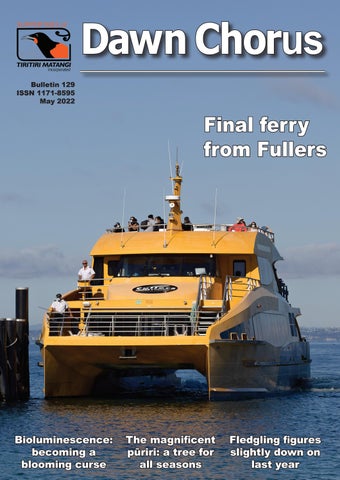
Dawn Chorus Chorus Bulletin 129 ISSN 1171-8595 May 2022
Final ferry from Fullers
Bioluminescence: becoming a blooming curse
The magnificent pūriri: a tree for all seasons
Fledgling figures slightly down on last year
Chairchat
Changes are afoot on Tiritiri So far, 2022 is proving to be a busy year for Tiritiri, with projects underway, a new ferry operator and new employees joining the team. First, we welcome Lyn Barnes as the new editor of Dawn Chorus magazine. It has not been easy to find a replacement for Jim Eagles. Former editor Simon Fordham will mentor Lyn through the change and we thank Simon for filling in for the February issue. On 1 April, a new operator began the ferry service to the Island. Explore Group, in conjunction with Ngāi Tai Ki Tāmaki, won the tender for the service to Tiritiri. The group took over the service from Fullers360. Explore brings on a new vessel, new staff and a different timetable but the service basically remains the same. We sadly bid farewell to Fullers360 and thank their staff for the time and the support, as well as the ideas, they gave. We wish them well for the future. We undertook an organisational structure review last year as a result of increasing demands on the society’s management and processes. The outcome was to employ some new staff and make some changes to existing roles. In April, Debbie Chapman took on a new position of operations manager, a role designed to manage staff employees, contractors, stakeholders and the increasingly complex operations of the society’s functions. The education team has been bolstered with the employment of Robyn Davies in a parttime role to take on the school bookings and administration. We said goodbye at the end of April to Annette de Raat, our longserving shop and guiding manager, who is taking a well-earned retirement. We welcome Kim Briggs in her place.
Tiritiri Titbits
New editor for Dawn Chorus Dr Lyn Barnes has spent decades working with the media in one form or another, from a small town newspaper to current affairs television in Australia. She also edited Cuisine magazine for five years and has worked with several other publications. Before retiring, Lyn spent a decade teaching journalism at AUT University. She moved back to the Whangapāraoa Peninsula in late 2020. Having done a brief stint as a ranger on Tiritiri before moving into the city, she is now pleased to be involved once again with the Island.
Foghorn roof safe again Over the last two years, many of the roofs on Tiritiri Matangi’s buildings have been replaced or painted as part of an ongoing maintenance programme. Some of these, such as the toilet blocks, have been funded by the Supporters. One roof that hadn’t been touched was the foghorn building, mainly because it is made of asbestos and some of the material was flaking off, making it too dangerous to paint and for volunteers to work in. The options were to remove the roof completely, using a specialist contractor, then rebuild an iron roof to replace it, or to encapsulate (seal) the roof with a specialised product. The latter option was selected because, not only was it cheaper, but asbestos roofs, when in good condition, are superior to steel in marine environments (they are highly durable, weatherproof and fireproof). Therefore, in February, Hank McMaster from Total Seal Roofing Waterproofing came over to completely encapsulate the roof with Noxyde, a DOC-approved product. This now renders the roof safe for volunteers and visitors for the next 20 years. Carl Hayson
Photo: Hank McMaster
Recent activities on the Island include a survey of the little spotted kiwi and the foghorn roof has been sealed. A major refurbishment of the lighthouse by the Supporters is now under way, which includes painting the interior and exterior. This is expected to take approximately three months. An upgrade of the shop manager’s accommodation and an extension to the museum building are in the plans for the next few months. Carl Hayson Cover photo: The final Fullers360 ferry pulls into the wharf on 31 March, taken by Janet Petricevich.
2
Dawn Chorus 129 May 2022
Tiritiri makes a splash in Germany
Patients at this German medical centre can enjoy this colourful Tiritiri Matangi digital mural while they wait.
It was a love of nature that saw architect and photographer Lucy Gauntlett (aka Lucy G) leave architecture to focus fulltime on her photographic art. Now her work is being sought from the other side of the world, as well as in Australasia.
The technique has taken Lucy 20 years to perfect, mainly through trial and error. The end result is one of Lucy’s favourites. “I love the depth of colour of the sea and the rocks of Tiri.” The German company found Lucy’s website online and asked for suggestions. She sent them a number of options, superimposed onto a 3D render, as above, so the owners could visualise the end result.
Photo: Lucy Gauntlett
A German medical centre recently bought one of Lucy’s wall mural “gigapans” created from around 60 images “digitally stitched together” to create the 7m x 4m mural. Or as Lucy explains it: “It involved taking multiple images in multiple rows rather than the usual single
Lucy’s speciality is generally printed glass kitchen splashbacks that use a single row of images to create a high resolution panorama. Her Tiritiri photos are a popular choice – she even has an artwork called Dawn Chorus. Her work is also in demand for medical and dental centres. A recent challenging commission was for a wall and ceiling backdrop for the Centre for Advanced MRI (CAMRI) at the University of Auckland, which needed to be backlit. Lyn Barnes
row, using a panoramic tripod head.” A row usually consists of 20 images but the added number of rows involved tilting the tripod to the sky first then working downwards three times.
www.tiritirimatangi.org.nz
Lucy Gauntlett's latest challenge involved backlighting her images for this MRI centre.
3
Haere Rā Fullers360
The end of an era: the final Fullers360 ferry delivers visitors to Tiritiri Matangi.
Jimbo presented a special gift basket to the Supporters and another to DOC in appreciation of the relationships. Emma Dunning gave a talk from DOC’s perspective and Ray Walter reflected on how positive their experience was working with Fullers360 while he and his wife, Barbara, were rangers. John Stewart, a former chairperson, also shared his feelings and experiences on the bond between the two organisations. Additionally, Fullers360 had prepared a commemorative biscuit for the occasion, which was well received. Photo: Gaye Hayson
After a number of years of providing a ferry service, and more, to Tiritiri Matangi, it was with sadness that, on 31 March, we farewelled the last scheduled service by Fullers360. A special ceremony was held in the Visitor Centre with Fullers represented by Jimbo, an outstanding member of the Fullers team who was responsible for building a special relationship with Tiritiri Supporters.
Photo: Luca Kornélia Kósa
A working relationship as long-lasting as this will be hard to forget and we will miss the staff and boat crews that have served us well. We wish the team all the best for the future. Carl Hayson
Left: Jimbo (as he prefers to be known), from Fullers, presented Ray and Barbara Walter with a gift basket The couple accepted on behalf of the Supporters. Photo: Luca Kornélia Kósa
4
Dawn Chorus 129 May 2022
Time to renew your membership? June is a big month for Supporter membership renewals. This has a historical background because, while original Supporter memberships ran for the calendar year, since 1 July 2011 they have run from 1 July to 30 June. As the membership grew this became a significant workload for the membership team, dealing with the largely manual processes that came with the previous membership system – cash and cheques to bank, internet banking to record, system batches to process, etc. Initial action was taken to spread the load, with membership periods changed to run for a year from the join date. Although this action certainly did help, more than half of our current 1470 memberships are due to be renewed on 30 June this year. The last few years have been very active for the membership team with the introduction of a new membership platform. Data from the old system was transferred in March 2020 and now, two years on, we are looking good, with a much more robust system. You will have noticed many changes and may have experienced some frustration at times – What is my membership number? Why have I just received this order confirmation? How can I access my membership information? And What is my username and password? Then on top of everything, by August 2021, NZ cheques were completely gone! This is the background, and it must be said that Tiritiri Supporters have been awesome in accepting these challenges. There has been a significant uptake on payment by credit card. This is the quickest and easiest method as the process is completely automatic and requires no intervention from the membership team. Internet banking continues to be used very effectively and members are great at providing their Member ID as a reference – this method is dependent on the membership team matching bank payments to the database, so it could take a few days to process your renewal. A few memberships are paid in the shop – this is the least immediate option as the information currently gets to the membership team courtesy of NZ Post, so expect a week or more before your membership renewal is processed. And finally, if none of these options work for you, please ask the membership team for help. If your membership is due for renewal over the next couple of months, there is no need to do anything until you receive a renewal reminder email or letter from the membership team. The reminder will include full instructions for paying your subscription. However, if any of your contact details have changed in the past year, please let us know before you renew. And if you have questions or problems during any stage of the renewal process, we will be happy to assist. Thank you! Rose, Jenny, Jan, Peter and Gill (membership@tiritirimatangi.org.nz)
Preliminary Notice of Annual General Meeting Notice is hereby given that the Annual General Meeting of the Supporters of Tiritiri Matangi will be held at 7.30pm, Monday 19 September 2022, in the Fickling Convention Centre, 546 Mt Albert Rd, Three Kings. Further details will be in the August issue of Dawn Chorus.
Call for nominations Nominations are sought for Chairperson, Secretary, Treasurer and up to nine committee members for the Supporters of Tiritiri Matangi to be elected at the Annual General Meeting. If you are keen to become further involved in the management of our outstanding organisation, do consider a role on the committee. Meetings are held every six weeks at a central location. Nominations (including a nominator and seconder) must be received in writing by the Secretary on or before 31 July, 2022. Send to PO Box 90-814, Victoria St West 1142, or secretary@tiritirimatangi. org.nz. Please include a photo and brief resume for inclusion in the August issue of Dawn Chorus. www.tiritirimatangi.org.nz
5
Fauna Notes
Fewer fledglings but they’re flourishing
Turutu: “back to looking stunning”.
Another breeding season is over and the time of reckoning for our bird populations has come round again. None of our closely monitored species has managed to repeat the high performance of 2020-21. Only one of our two takahē families managed to produce chicks, the number of kōkako fledglings is only half what it was last year, and hihi (stitchbird) fledgling numbers are down on the previous two seasons. Such fluctuations are normal, however, and should cause no concern. Takahē The two takahē families continue to do well. All the birds have now finished their autumn moult and are back to looking stunning. April was takahē awareness month, and the lighthouse family took their advocacy role very seriously, diligently showing up at 1pm every day to show off to their adoring fans,
6
Photo: Kay Milton
while the rangers shared interesting takahē facts and stories about their adventures. Not that they went unrewarded for their appearance, as food was provided in the form of specially-formulated takahē pellets.
the Auckland Zoo team. These will include taking blood samples from this season’s two chicks to determine their sex. Once this is known, the Recovery Group can make decisions on where and when they will move.
The three sub-adults (chicks from the 2020/21 season) – Moke, Pukunati and Kanorau Tīrama – are expected to head off to Burwood for tussock training camp before winter. This will get them used to the diet that will sustain them wherever they end up living. Their eventual destinations are not yet known, but Pukunati and Kanorau Tīrama will be released into the wild population and Moke will be matched with a partner at one of the managed breeding sites. As a son of Edge, his potential genetic contribution to the population is valuable and needs to be planned.
Kōkako
The annual health checks for all our takahē will happen in May with the usual help of
Sapphire and Pūtōrino’s fledgling is, as yet, unnamed and unsexed, having fledged
Only eight of our 18 male/female pairs bred successfully, producing a total of nine fledglings. One of these disappeared two days after fledging and another after one or two weeks. This left four female fledglings, two males and one whose sex is unknown. The females, with parents’ names in brackets, are Miro (Noel and Rehu), Koekoe (Apato and Koto), Dianella (Parininihi and Wairua), Wraith (Te Hari and Phantom). The males are Whistles (Waipapa and Shelly) and Awenga (Chatters and Te Rae).
Dawn Chorus 129 May 2022
A juvenile kōkako, still moulting in this photograph, has begun frequenting the Visitor Centre.
without being banded because the nest was inaccessible. S/he will be named if and when s/he is caught for banding. Meanwhile, this juvenile is entertaining visitors around the Visitor Centre, presenting some very rare photo opportunities – an unbanded kōkako on Tiritiri!
Hari has been seen in the area but appears to be keeping a low profile. Again, we shall be watching with interest to see whether this is a long-term arrangement or just a temporary affair.
Rakataura and Aquarius, who have been together for four seasons, were once again unsuccessful, as were Crown and Pureora, who have bred successfully in the past, but have now failed three years running. Sarang and Discovery and Hotu and Haeata were also unsuccessful, after producing four and two fledglings respectively in 2020-21. Such failures are often due to predation, but weather, disease and lack of food can also play a part.
While our hihi were late bloomers this breeding season, they still managed to produce 167 fledglings. Four of these missed being banded, but we will band them at a later date. Sixty-four females attempted breeding this season, a third of whom attempted a second nest after a successful first nest.
Tātākī, a young male, is still being seen with Erenora and Yindi, our female/female pair. We are watching this relationship with interest: will they remain a threesome, or will one of the birds eventually opt out and try elsewhere? Te Hari and Phantom have been together since 2010, so it was a shock when, at the end of February and with their fledgling still dependent on her parents, Phantom was found in their territory associating with her grandson, Wakei. Te
www.tiritirimatangi.org.nz
Hihi/stitchbird
The post-breeding survey happens near the end of every hihi breeding season. Across our team of three, we spent 40 hours surveying the whole island following hihi calls and spending time at the feeders to identify as many hihi as possible. This requires accurate reading of each bird’s unique combination of colour bands and PIT tags. As well as informing our knowledge of the population, this gives us a chance to see fledglings venturing further from their nests and forming social groups. This season we identified 193 hihi in total, 84 females and 109 males.
Photo: Jonathan Mower
Every year we carry out routine checks, by catching hihi at the feeders, to gauge the birds’ health and replace any lost or broken colour bands. One recent check turned up a male hihi who had broken a leg as a nestling during the 2020/21 breeding season. He had been given a PIT tag on his unbroken leg, but we had left his broken (right) leg unbanded to give it a chance to heal. When caught recently he was checked over, deemed very healthy, and also won us over as a very good-looking male hihi. He has now been given two colour bands on his healed leg to help distinguish him from other birds with similar coloured PIT tags. Tīeke/saddleback Tīeke haven’t had much of a mention in recent Fauna Notes, mainly because Covid-19 restrictions meant there was virtually no monitoring of nestboxes until December, by which time much of the action was over. This meant that we couldn’t collect the detailed information (number of eggs laid and hatched, number of chicks fledged), which we normally use to make comparisons with other seasons. However, it was possible to tell which boxes had been used and to make an educated guess at what had happened in each of them.
7
There were 21 nesting attempts by tīeke in boxes during the season, including one in an old kākāriki box. Of these, nine appear to have failed at egg stage and one at chick stage (there was a dead chick in the box). There was evidence that the remaining 11 could have been successful (complete and well-flattened nests, no dead chicks). It was also possible to estimate roughly when eggs had been laid and, in the absence of more detailed information, we measured this against likely success and failure (see table at right). We have not done this in previous years, when the emphasis was on banding chicks, but have had the impression, confirmed by this season’s results, that early nests tend to be more successful than late ones.
Above: Tīeke egg-laying dates measured against nesting outcomes.
Other wildlife
Photo: Alison Forbes
As usual, the annual bird transect survey took place during February and March. Unlike last year, when it was disrupted by Covid restrictions, we were able to complete the work by mid-March. The results will be reported in a future issue of Dawn Chorus. The total number of rifleman/titipounamu banded this season was 105, and there are still many unbanded birds being seen. The estimated population is now in the low to mid hundreds. Long-tailed cuckoos/koekoeā sometimes visit the Island in autumn. This year one was seen on 18 February. Two reef herons were observed several times on the west coast of the Island at the end of February. Two yellow admiral butterflies were seen feeding on a flowering koromiko bush on the weekend of 7-9 February.
Above: One of two yellow admiral butterflies seen on the Island in February.
Compiled by Kay Milton with contributions from Emma Dunning, Emma Gray, Morag Fordham and Simon Fordham.
SoTM Working Weekends Did you know that Queen’s Birthday and Labour weekends are SoTM volunteer working weekends? These are not only a great opportunity to contribute to the many work programmes on the Island, you will get to mix and socialise with others of like mind, particularly during the pot-luck dinner each evening. The comradeship is legendary! There is always time available to enjoy the Island, including a search for kiwi and tuatara after dinner. Tasks begin at 1pm on the day of arrival and continue through Sunday afternoon. On Mondays, task are optional (after the bunkhouse clean-up). The ferry fare is complimentary, as is the accommodation, courtesy of Explore and DOC. Now is the time to book for both Queen’s Birthday Weekend and Labour Weekend. To register your interest, email Kim: guiding@tiritirimatangi.org.nz Note: If working weekends are over-subscribed, participants will be selected and notified around four weeks beforehand.
8
Dawn Chorus 129 May 2022
How much are visitors willing to pay for a guided walk? During the summer of 2021/2022, the Visitor Engagement Subcommittee undertook a survey of visitors to Tiritiri to find out what visitors considered to be a “fair price” for the guided walk. Eighty-nine surveys were undertaken, with respondents being randomly selected on the ferry after leaving the Island in the afternoon. When asked what they considered to be a “fair price” for the walk, a large majority (87%) considered the current prices (i.e. $10 for adults and $2.50 for children) to be a fair price. Only 28 people responded to the question of “How much would be too much?” Of these, eight thought $15 would be too much, nine suggested $20 and eight said $30. One person suggested that current prices are too much for a family to pay.
“Very satisfied”. Only one person gave a rating as low as 7. All 50 said that they would recommend the guided walk to a friend. Many respondents made positive comments about the walk and their guides. The most frequent words they used were: “informative”, “knowledgeable”, “friendly” and “interesting”. Of the 39 people who did not do the guided walk, the large majority (31) said they did not do the walk because they wanted to spend the time on the Island by themselves.
Only two of the people surveyed said they did not know about the walk, one of whom said they would do it next time. Nobody made their decision based on the cost of the walk. Many of the respondents offered very positive comments about their visit to Tiritiri. These included: • An excellent experience. The bunkrooms were excellent. Volunteers and DOC very friendly. People waving goodbye from the wharf made us feel valued. • Great trip. Wo n d e r f u l experience. Bird life is amazing. If only all NZ was like this. • A great place to visit. • It was pretty perfect.
Of the 89 • Nothing respondents, negative to say 50 (56%) had – I love Tiri! done the guided walk. These 50 Above: Most people who visit Tiritiri Matangi prefer to take a guided walk and people were asked how • It's great just as considered the cost fair. Here, Peter Flynn escorts a group of visitors to the Island. satisfied they were it is. with the walk on a scale of 1 – 10 (with 1 = Others reported that they already knew the very dissatisfied, 10 = very satisfied). All 50 Island and/or New Zealand wildlife well, • It was a wonderful experience – we’ll do respondents rated their satisfaction level as or that they were accompanied by small the guided tour next time. 7 or above, with the majority (64%) being children. Toni Ashton
www.tiritirimatangi.org.nz
9
Red tides and nocturnal lightshows are on the increase Hundreds of Aucklanders have been flocking to beaches over summer to experience bioluminescence as waves move in and out but, as John Sibley writes, while the phenomenon amazes us, it’s no fun for our seabirds.
A red tide caused by billions of Noctiluca scintillans.
Often only noticed in the summer months around Tiritiri, when numbers reach astronomic proportions, marine dinoflagellates often cause a great deal of curiosity and questions from our visitors. The most noticeable of these dinoflagellates is Noctiluca scintillans. It is present in oceans worldwide and around our shores it can be found throughout the year, usually in smaller, easily overlooked numbers during the winter months.
exist, too. Their numbers in any one location vary with sea conditions (salinity, temperature, wind, water depth and especially nutrients boosted by human sewage). Often a breeze will pile up surface-dwelling populations into a “soup”
Photos: John Sibley
resembling gloopy, loose semolina. When this happens with Noctiluca scintillans, the result is a spectacular “red tide”. These pinkish slicks are sometimes seen close inshore under the wharf on Tiritiri when a summer westerly wind blows.
So what are dinoflagellates? The name is derived from the Greek dinos “whirling” and the Latin flagellum “whip, scourge”, referring to the two lashing threads that propel them through the water. They are usually considered to be a type of alga, which are an astonishingly diverse group of organisms. Dinoflagellates differ from most algae in many important ways. It is about as useful to describe dinoflagellates as “algae” as it is to describe the kōkako as just “animals”! Dinoflagellates are planktonic and mostly marine. However, a few freshwater species
10
Noctiluca with other dinoflagellate prey ingested.
Dawn Chorus 129 May 2022
As single-celled organisms go, Noctiluca is a giant, often attaining a diameter of a millimetre or more. The pink colour of the collective swarm is due to the presence of another tinier dinoflagellate called Pedinomonas noctilucae living within each Noctiluca cell. These endosymbiotic cells have been eaten by Noctiluca and maintained as if in a greenhouse environment where nutrients and protection are given in return for the food they produce by photosynthesis. This makes Noctiluca a producer – making its own food by photosynthesis. In tropical oceans they engulf and maintain a different photosynthetic partner, which gives them a green appearance.
Noctiluca is also strongly bioluminescent and can give beautiful evening lightshows as waves containing it break on the beach. The function of this bioluminescence is debated. It may deter predators, or it may attract other planktonic organisms it feeds on as some plankton are strongly attracted to light at night.
Yet other species of dinoflagellate are endosymbionts of other marine animals and play an important part in the biology of coral reefs. These are the algae, maintained within the bodies of the coral polyps, that die when sea temperatures rise above a critical level, causing the corals to bleach and die themselves.
Bioluminescence caused by Noctiluca.
Pretty strange so far, but it gets stranger. It so happens that Noctiluca is also an active predator of any living thing small enough for it to engulf and digest. A new term, mixotrophic, has been coined for these strange organisms that occupy two feeding (trophic) levels – they are capable of combining photosynthesis with ingestion of prey. Some of the organisms taken in endosymbiotically by certain dinoflagellates are foraminiferans and radiolarians. These organisms have chalky skeletons and play a vital role in the global biological carbon pump, taking large amounts of carbon out of the atmosphere, sequestering it and depositing it safely on ocean floors.
Above: Ceratium fusus – a dinofllagellate capable of both photosynthesis and predatory behaviour.
www.tiritirimatangi.org.nz
11
A planktonic crustacean surrounded by a frenzy of Ceratium fusus.
Other dinoflagellates are unpigmented predators on other protozoa, hunting them down and piercing them with a hollow “straw” to suck out their contents. A few forms are parasitic on fish (for example, Oodinium, which causes problems in domestic tropical fish tanks). Paralytic shellfish poisoning is caused by several species, and others are capable of poisoning bathing water, causing dog and human deaths. In the sea around Tiritiri two dinoflagellates dominate, Noctiluca (encouraged by high nutrient levels provided by Auckland’s sewage outfalls), and Ceratium fusus, another mixotroph which can also form subsurface “swarms” of impressive density off Tiritiri. C. fusus is very mobile and has a long, forward-driving flagellum (see photo on previous page) together with a shorter one in a groove around its “waist” which gives it stability by imparting a useful directional spin. Noctiluca has two short, stubby flagella – pretty useless for locomotion but they are probably involved in the production of deadly slime “nets” it uses to
12
ensnare anything edible around it. It reels these in periodically and dines at its leisure. Noctiluca is an important predator of the coastal marine environment where many of our seabirds find their food. In the same way it can also do considerable damage to
Fish larva.
commercial fish stocks, eating fish eggs and even newly-hatched fish larvae. The dense blanketing “red tides” block out vital sunlight that other more beneficial algae could use, and the smothering “goo” of the slick (made worse by the thick slime “nets” they exude) clogs the gills of filter-feeders. As they hit the shore and die they decompose and release toxic ammonia into the water, altogether
Noctiluca spinning its web of death.
bad news for every aspect of the marine environment. So it is pretty safe to say that the health of the Hauraki Gulf marine food web (upon which our little penguins, diving petrels and other birds that feed in coastal waters rely) is threatened by the current levels of human waste entering the sea, exacerbating these red tide events. We are currently monitoring the plankton situation weekly, which may give us some useful insights and forewarnings regarding the seasonal breeding success rates and the future survival prospects of our Tiritiri seabirds. Both C. fusus and Noctiluca are completely harmless to human swimmers who may come into contact with them while swimming off Tiritiri. Dawn Chorus 129 May 2022
The pūriri tree can produce food for birds all year with its berries (above left) and flowers (above right). It is also an excellent host plant for animals and plants (below right). The pūriri is a member of the mint family, as is pennyroyal (bottom right). Photos: Warren Brewer
Flora Notes
Pūriri: a tree for all seasons Pūriri (Vitex lucens) is one of the best trees to have growing on an island sanctuary. Warren Brewer explains how it provides both fruit and nectar over all seasons, so is especially useful when other sources are not available. When sources of food on Tiritiri are low, the pūriri comes to the rescue. In the farming era, two large pūriri trees enabled tūī, kererū and korimako (bellbirds) to stay over the winter months. The inclusion of lots of pūriri in the forest restoration planting on the Island has allowed these three species to increase their numbers. Pūriri is endemic, although restricted to the warmer upper half of the North Island. Its dark green, glossy compound leaves usually have five leaflets. The large, colourful flowers are displayed in loose clusters at the tips of branches. Their tubular shape is formed from two large petals. Colours vary from pale pink to a deep red. The fruit is a drupe about the size of a cherry, that usually ripens to a dark red. It has a bitter unpleasant taste. Māori made an infusion from boiled pūriri leaves to treat sores and sprains. Pūriri timber is hard and durable and Māori used it to make garden tools. Early European settlers made great use of pūriri timber for fence posts, railway sleepers, ship building and house blocks. A pūriri tree acts as a host to a number of animal and plant species. The large native pūriri moth (Aenetus virescens) has a long caterpillar stage which makes its home in the tree by excavating burrows. Epiphytic plants such as astelia settle on the tree’s long-spreading branches, often accompanied by ferns.
www.tiritirimatangi.org.nz
Vitex is a genus of over 250 species spread throughout the tropics and subtropics. Pūriri is one of a few temperate climate members. Pūriri was placed in the genus in 1826 as Vitex littoralis. It became Vitex lucens in 1897 after it was found that littoralis was earlier named for a Malayan species. Vitex belongs in the mint family, Lamiaceae, a large cosmopolitan group with more than 7000 species. It is renowned for its range of culinary herbs: mint, oregano, basil, rosemary, sage, lavender and thyme. Mint is in the genus Mentha and on Tiritiri the naturalised weed pennyroyal Mentha pulegium is well established. The family name Lamiaceae comes from Greek laimos “a throat”, referring to the shape made by the two petals in the flower. After the aromatic herbs are many shrubs, a few vines and some massive trees. Teak (Tectona grandis)
is native to South Asia. It is the most valuable of the tropical hardwoods, strong, durable and weathering well outdoors. Vitex comes from Latin viere, to plait and bind. Some species with fine branches are used in basket making. Lucens, Latin for shining, describes the handsome leaves.
Aenetus means praiseworthy, from Greek aineo to praise. Virescens means turning green. Mentha is Latin for mint. Pulegium is from Latin for a flea. In folklore sprigs of pennyroyal (above) were placed in bedding to deter fleas.
13
Tiri Kids,
by Stacey
The kererū is often heard before you can see it because the beat of its wings makes a distinctive sound as it flies from tree to tree. Kererū have a huge impact on the forest ecosystem because of the natural relationship they have with native trees by increasing the tree numbers through seed dispersal; this is called propagation. This is why they are one of New Zealand's keystone species. Find the route through the maze and answer the quiz. Have fun!
The kererū is a large bird, weighing on average 650g and measuring up to 510 mm from tail to beak. Kererū are only found in New Zealand which means they are endemic. They are slow breeders because they usually lay one egg a year, but if there is plenty of food available they might nest twice. Kererū stack sticks in the fork of a tree to make their nest. They can live up to 20 years. Kererū are essential for seed dispersal because they have the widest gape of all the fruit-eating birds, which allows them to swallow large berries such as karaka, miro, taraire and tawa. When the seeds in these berries pass through the gut of the kererū it makes them more likely to develop into plants, or 'germinate'. Moa also used to play this role but, of course, they are extinct.
Find the route through the maze to the karaka berries
Photos: Geoff Beals, Martin Sanders
The next time you notice a pile of bird droppings on the path, look up as there may be a kererū resting on a branch. Please remember to close your mouth as you look up!
14
1. 2. 3. 4. 5.
What is the average weight of a kererū? Are kererū endemic to New Zealand? How do kererū help with seed dispersal? What colour are kererū? How many eggs do kererū usually lay a year? Answers. 1 650g. 2 Yes. 3 They are able to eat large berries. 4 Green, purple and white. 5 They lay one.
helpful tip
Quiz
Dawn Chorus 129 May 2022
Supporters of Tiritiri Matangi
4-6 June Queen's Birthday Working Weekend 16-17 July Supporters’ Weekend
Mon 19 Sept Annual General Meeting (see page 5) 8-9 Oct Supporters’ Weekend
SoTM Committee Chairperson: Carl Hayson chairperson@tiritirimatangi.org.nz, 027 3397105 Secretary: Gloria Nash secretary@tiritirimatangi.org.nz Treasurer: Peter Lee treasurer@tiritirimatangi.org.nz Committee: Stacey Balich, Hester Cooper, Malcolm de Raat, Barry Fraser, Rachel Goddard, Val Lee, Jane Thompson, Ray Walter and Michael Watson Operations manager: Debbie Chapman Guiding and shop manager: Kim Briggs guiding@tiritirimatangi.org.nz, 09 476 0010 Membership: Rose Coveny membership@tiritirimatangi.org.nz Educator: Barbara Hughes-Cleland Assistant educator: Liz Maire educator@tiritirimatangi.org.nz Fundraiser: Juliet Hawkeswood fundraiser@tiritirimatangi.org.nz Social Media: Stacey Balich socialmedia@tiritirimatangi.org.nz Dawn Chorus editor: Lyn Barnes editor@tiritirimatangi.org.nz Island rangers: Emma Dunning and Talia Hochwimmer tiritirimatangi@doc.govt.nz, 09 476 0920
3-4 Sept Supporters’ Weekend
22-24 Oct Labour Day Working Weekend Supporters' Weekends are led by guides who show off the Island's special places. Reduced price on the ferry and half price in the bunkhouse. Children welcome. Working Weekends are a chance for members to give the Island a hand. Travel is free, as is accommodation in the bunkhouse. For both, book through guiding@tiritirimatangi.org.nz For the latest information on events, please visit the SoTM website
Photo: Geoff Beals
The Supporters of Tiritiri Matangi (SoTM) is a volunteer incorporated society working closely with the Department of Conservation to make the most of the wonderful conservation restoration project that is Tiritiri Matangi. Every year volunteers put thousands of hours into the project and raise funds through donations, guiding and our island-based gift shop. If you’d like to share in this exciting project, membership is just $25 for a single adult, family or corporate; $30 if you are overseas; and $13 for children or students. For further information see www. tiritirimatangi.org.nz or contact PO Box 90-814 Victoria St West, Auckland. Dawn Chorus, our magazine, is sent out to members every quarter.
Coming Events
Visiting Tiritiri Matangi Island for education or recreation Day trips: Weather permitting, Explore runs a return ferry service Wednesday to Sunday from Auckland Viaduct and the Gulf Harbour Marina. Bookings essential. Phone 0800 397 567 or visit https://www.exploregroup.co.nz/tiritiri-matangi-island/tiritirimatangi-island-ferry/. Call 09 916 2241 after 6.30am on the day to confirm the vessel is running. School and tertiary institution visits: The Tiritiri education programme covers from level 1 (5-year-olds), to level 13 (17-18-yearolds), to tertiary students. The focus in primary and secondary areas is on delivering the required Nature of Science and Living World objectives from the NZ Science Curriculum. At the senior biology level there are a number of NCEA Achievement Standards where support material and presentations are available. For senior students the Sustainability (EFS) Achievement Standards are available on the NZQA website. There is huge potential in that these standards relate directly to Tiritiri in various subject areas: science, economics, tourism, geography, religious education, marketing, health and physical education. The Island also provides a superb environment for creative writing, photography and art workshops. Tertiary
www.tiritirimatangi.org.nz
students have the opportunity to learn about the history of Tiritiri and tools of conservation as well as to familiarise themselves with population genetics, evolution and speciation. Groups wishing to visit should go to www.tiritirimatangi.org.nz/schoolvisits.htm or contact schoolbooking@tiritirimatangi.org.nz. Bookings are essential. Overnight visits: Camping is not permitted and there is limited bunkhouse accommodation at $20 a night for members ($40 for non-members). Bookings essential. For further information: www.doc.govt.nz/tiritiribunkhouse or ph: 09 379 6476. Supporters’ discount: Volunteers doing official SoTM work get free accommodation but this must be booked through the Guiding and Shop Manager at guiding@tiritirimatangi.org.nz or 09 476 0010. SoTM members visiting privately can get a 50% discount but must first book and pay on line. Then email aucklandvc@ doc.govt.nz giving the booking number and SoTM membership number (which is found on the address label of Dawn Chorus or on the email for your digital copy). DOC will then refund the discount to your credit card.
15
In print at last! Now you can knit one yourself! Ten years after the first of Kay Milton’s Tiritiri beanies appeared in the shop, she has produced a pattern book featuring 14 of the most popular designs. The book contains instructions for knitting the basic beanie, plus a chart and additional tips for each of the featured designs from the simplest (kiwi) to the most complex (pīwakawaka). It is lavishly illustrated with photos, not only of the beanies but also of some of the birds represented on them. “It has been a huge team effort,” says Kay (below right), “involving photographers, models, knitters, and experts in software and book design. It has taken more than three years to produce, mainly because those involved, who have given their services free of charge, have had many other commitments. I am deeply grateful to all of them.” The book costs $30 and is available from the Tiritiri Matangi shop. All proceeds from sales go to the Supporters of Tiritiri Matangi.
Online Shop at www.tiritirimatangi.org.nz or email shop@tiritirimatangi.org.nz
Supporters of Tiritiri Matangi wishes to acknowledge the generous support of its sponsors
Supporters of Tiritiri Matangi welcomes all types of donations, including bequests, which are used to further our work on the Island. If you are considering making a bequest and would like to find out more, please contact a member of the Committee.