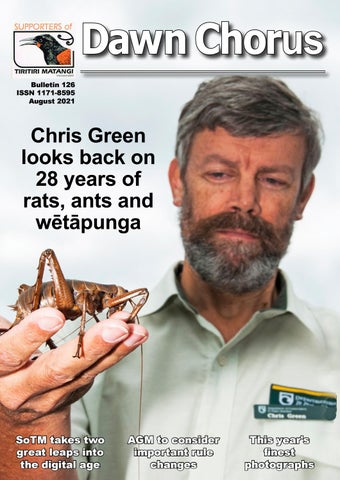
Dawn Chorus Bulletin 126 ISSN 1171-8595 August 2021
Chris Green looks back on 28 years of rats, ants and wētāpunga
SoTM takes two great leaps into the digital age
AGM to consider important rule changes
This year's finest photographs
Chairchat
Important changes to think about The global pandemic continues to affect everything we do but our volunteers are carrying on the good work regardless. Visitor numbers are well down, adversely affecting all the ferry services provided by Fullers360, and resulting in cutbacks to the service to the Island. This has put tremendous pressure on our educators, Barbara and Liz, and our guides, to fit schools in on one day instead of three. They have done an amazing job and deserve our thanks. We are making great progress on the IT front. After many years of hard work the membership team has got the new iMIS membership programme going, which is a huge advance. The website team has been working long hours to create an exciting new website which is nearly ready to go live. There is also a project to install a webcam camera which will give a live feed of the tui feeders at the Visitor Centre. The AGM is rapidly approaching and you will see in the agenda on page 15 that there are some important constitutional changes to be considered. These have been reviewed by the Committee and verified by our honorary solicitor Ian Haynes. For those who eye-roll at legal jargon, the simple intention is: •The new Rule 4 adds the word ‘families’. There are no other changes. •Rule 4(a) defines that membership rights commence from the date of approval by the Committee, apart from voting rights, which begin two months later. •Rule 7(c) allows notice of a General Meeting to be posted or emailed to members. •Rule 7(f) follows from Anne Rimmer’s motion last year and will allow the AGM to decide whether to keep the status quo of one vote per individual or family membership, or to allow a family to have two votes where there are two or more adults in the family. •Rule 9(a) (in addition to Rule 7(c)) provides for notices to be posted or emailed to members. I hope you all keep well this winter and I look forward to seeing you at our AGM or on Tiritiri in the near future. Carl Hayson
MEMBERSHIP TEAM: (from left) Rose Coveny, Malcolm de Raat, Jan Stretton, and Jenny Gill with a laptop loaded with iMIS. Photo / Malcolm de Raat
Tiritiri Titbits
SoTM takes two giant steps forward on the digital front SoTM has taken two big steps forward on the technological front over the past couple of weeks with the long-awaited new iMIS membership system finally up and running and a snazzy new website almost ready to go live. Migrating the Supporters’ membership system from the old Vega software to iMIS has been a long time coming and has taken a huge amount of work. It was started by Helen Bucksey and Tushar Sharma almost two years ago but ran into complex technical problems which for a time almost seemed insoluble. However, the membership team of Rose Coveny, Jenny Gill, Jan Stretton and Malcolm de Raat has been able to build on that early work and, showing huge tenacity, has finally succeeded in getting the new system working as we need it. iMIS now holds all SoTM’s membership data and shortly the old Vega system will have its data archived and will be switched off , along with what Malcolm describes as ‘its many foibles’. As Chair Carl Hayson notes, ‘Membership is often a thankless, unnoticed, job and can burn many volunteer hours but it is absolutely vital to the success of the organisation. The iMIS programme will give us hugely improved functionality and accessibility, with members being able to
log on directly into the database to update their information, renew subscriptions and make donations. ‘There are also options which will allow us to send a digital version of Dawn Chorus to those who want it that way – while still posting it out to those who prefer print – which will reduce the cost of producing and distributing the magazine. Ultimately a new online shop will be available, offering an extra stream of income.’ Carl says the arrival of iMIS is 'a big step up for the Supporters and we should congratulate all the team who have worked very hard on this and made it happen.’ Malcolm says the new system is proving itself capable of the big job that needs to be done ‘and as time permits we’ll be making use of its features and adding new capabilities.’ The new system will be phased in and as individual memberships come up for renewal the system will email out instructions on what to do. But, Malcolm adds, ‘If electronic and email processes aren’t your thing, never fear, we will still send out renewal letters via NZ Post.’ New website Some time this month the Tiritiri Matangi website will have changed for the fourth time. Team member Derek Tearne points
Cover photo of Chris Green, displaying the amazingly long feelers of a wētāpunga, by Simon Fordham.
2
Dawn Chorus 126 August 2021
NEW WEBSITE: This is an indication of what the new website looks like. At the top is an ever-changing video showing the ferry ride, the fauna and flora, the lighthouse and the bush. Underneath is a series of sections on visiting the Island, joining the Supporters, the online shop, the education programme and a lot more. out that the first website was launched onto the worldwide web not long after the first kōkako arrived on the Island. ‘But since then much has changed,’ he says. ‘On Tiritiri, the trees planted by volunteers have grown tall, new species have been translocated, new buildings have been erected and old ones restored. ‘The way people interact and communicate has also changed. Cellular telephones, still rare in the 1990s, have become smart phones, and are everywhere. When that first website was launched, personal internet accounts were unusual; now most people are connected to the internet and use it as a primary source of information. Our website has become one of our most important ways to provide information to potential visitors, support our education programmes, and encourage people to become involved in the project.’ Our current website has served us well for 10 years. It was built using a development platform called Adobe Business Catalyst, which was then one of the major commercial web development platforms, a good decision at the time. However, three years ago Adobe announced that it would turn this platform off forever in 2021. We decided to take the opportunity to redevelop the site using an open source platform called WordPress. There are currently over 450 million websites using this platform, making up over 30% of all websites worldwide, so it is unlikely to be turned off soon. So, in March 2020, SoTM brought together an in-house team made up of Tiritiri volunteers, who are also industry professionals, to begin the work of building a new website from the ground up. The team includes Mandy Herrick, Sarah Adams, Chris Hannent and Derek, with Helen Bucksey managing the project. Working closely with our educators, historians, naturalists, fundraisers, guides and shop people, they have come up with a site that is fresh and clean; a site which will appeal to a new generation of visitors, as well as serving SoTM’s needs; a site that works on any device, from a smart phone to a desktop computer. The ‘Visit’ section makes it easy for potential visitors to plan their day, or overnight stay.
www.tiritirimatangi.org.nz
The ‘Learn’ section focuses on our education programme but, while the focus is on school visits, there is also plenty here for the casual visitor. The ‘About’ section talks about the
project as a whole: what exactly is Tiritiri Matangi, what are our plans, what animals are here, who are we, how did this all start and where are we going? The ‘What’s on?’ section contains news
3
WEBSITE TEAM: Those involved in the project include (clockwise from top left) Mandy Herrick, Helen Bucksey, Sarah Adams and Derek Tearne, shown during a recent Zoom meeting. Photo / Helen Bucksey and events. ‘Get Involved’ is where potential volunteers, sponsors and donors can find out how to help. The new site integrates seamlessly with our membership and donation platforms. We also now have an on-line store, where people from anywhere in the world can buy Tiritiri-related goods from bird feeders to beanies. Throughout the site there are powerful images showcasing the flora, fauna, history and amazing volunteers that make the Island so magical. As Derek says, ‘Our new site will strengthen our online presence and allow us to grow, as new technologies and ways of interacting develop. We hope you like it.’
are selected for translocation. Programme manager Morag Fordham and her team of 17 trained volunteers locate kōkako nests, monitor the survival of fledglings and take feather samples at the time of banding to determine gender. Morag says the grant is particularly timely because, ‘in addition to the usual annual kōkako monitoring costs, this year we are planning two new developments.
Knowing that we have covered our essential costs means we can now focus on gaining funding for these initiatives.’ Foundation North has provided a further $21,000 towards the ongoing work of controlling weeds on the Island. It will be used to cover the cost of employing the specialist contractors whose work includes managing existing pest plant species and working towards their elimination; detecting new pest plant incursions and halting their spread; abseiling to control pest plants on cliff faces; managing the volunteer groups who assist with surveillance and data collection. The Island is continually under threat from introduced seeds which can travel to the Island on the water, be blown over by the wind, travel on people’s clothing, or be brought by birds. If left unchecked, would smother our native flora and risk destroying 30 years of re-forestation. Kiwis for Kiwi is giving $15,000 towards the cost of our work to maintain the genetic diversity of our little spotted kiwi population. Simon Fordham, chair of our Biodiversity and Research Subcommittee, says the money will be used to undertake the fiveyearly census of our kiwi, identify around
Tricky times for working bees Reduced ferry sailings and frequent cancellations have made it difficult to progress infrastructure projects in recent months. Ian Higgins reports that ‘unfortunately the Queen’s Birthday working weekend didn’t achieve much as the Sunday and Monday sailings were cancelled, meaning everyone had to leave again on the Saturday, which was a pity’. Grants for kōkako, kiwi and weed control Over the past few weeks SoTM has received grants totalling more than $50,000 towards its work, reports fundraiser Juliet Hawkeswood. The Chisholm Whitney Charitable Trust is providing $16,000 towards the kōkako monitoring programme which, Juliet said, is particularly exciting as it is the first time the Trust has supported the Island. The money will go towards the work of colour-banding nestlings so they can be individually identified and their parentage confirmed to ensure that the right birds
4
NEW HOMES FOR KORORĀ: Ellerslie School pupils Hayden Thorne and Finn Abbott break open an old penguin nesting box under the supervision of Ray Walter. They were part of a group from the school which had a marvellous time on the Island renovating one of the boxes as well as exploring the wildlife and visiting the Watchtower. The experience was summed up by Finn who said, ‘It was fun to be involved in a Tiritiri project with eight other students from my school. Replacing the penguin box was super exciting as we got to demolish the old one and mix mortar to put the new one in. We learnt a lot from Ray the Legend.' Photo / Stacey Balich Dawn Chorus 126 August 2021
10-12 new birds suitable for translocation and transport these to the Island.
Making our creeks more friendly to wildlife
Visitor Centre lease renewed SoTM has succeeded in renewing the Visitor Centre lease for another five years after working through the approval process for the last 12 months. DOC has kindly agreed to waive the usual processing fee of $3,425 (plus GST). However, SoTM will have to pay public notification costs of $1,337. The annual charge for the lease will be 7% of gross annual revenue and an annual management fee of $250, but these too have been waived until 1 July 2024. Skills survey Earlier this year SoTM sent out an invitation for members to take part in a skills survey, indicating areas in which they were prepared to help the society. The response has been heartening and enlightening, with over 300 responses. Many overseas members regretted they could not help physically but gave their support. Members offered a wide range of skills from building and ecological restoration to administration, design and IT. Other skills on offer included surveying, upholstery, archaeology, museum skills, guiding and visitor experience. SoTM welcomes all help, whether it is on the Island or from home. In today’s connected world, many types of work which assist our efforts can be done at home. If you have not yet completed the skills survey, your help is still welcome. Just visit the following link by typing it into your favourite browser: https://www.surveymonkey.com/r/SoTMSkills Marine protection Two new marine protection areas are to be established adjacent to Tiritiri as part of the Government’s recently announced measures to restore the health of the Hauraki Gulf. A new high protection zone will be created off the southeast coast of the Island. The rest of the adjacent waters will be included in a seafloor protection area. Chair Carl Hayson has welcomed these measures to ‘rejuvenate the depleted marine areas of the Hauraki Gulf. It is well established that the marine and terrestrial systems function symbiotically and to protect one and not the other doesn’t make sense. We have a variety of seabirds nesting on the Island, such as little penguins and diving petrels, that depend for their food on the surrounding waters. It is important for their future that this environment is protected.’
www.tiritirimatangi.org.nz
DAM BUILDERS: David Blaker and Virginia Nichol build a small dam across one of Tiritiri's many small creeks. They are part of a team of volunteer dam builders which has spent the past few weeks creating little pools in the Island's waterways to make them more friendly to wildlife. Project leader Rob Gouldstone says the idea for this arose from a workshop organised by Auckland Council and Watercare to help restore and improve native waterways by getting people to build mini-dams. On Tiritiri a few streams trickle through the gullies in the bush but often run dry during summer. The hope is that dams will create little pools behind them, and over time will also form small scour pits on the other side of the dam as well, providing the birds with more sources of water as well as creating potential habitat for some of our native eels and freshwater fish. During a big downpour the dams will also slow down the speed of the water so less erosion will occur. The dams being built are roughly 20cm high and up to 1m wide. Ideal placement, Rob says, ‘is where the bank has a bit of an overhang and small plants are present, creating shade, shelter and food for any water creatures that may already live in the stream or decide to take up residence. ‘We’ve been using fallen māhoe and kohekohe branches that are found in the area and only need to be trimmed to size to build the dam face. The logs are lodged into the bank a wee bit so they don’t get pushed away as water forms behind them.’ The work being done this winter is an initial trial and the effect will be evaluated over the next year to see if water retention is improved. ‘If the project is successful we will undertake more remediation work along other gullies in the bush in the future.’ Photo / Karin Gouldstone
5
PARTNERS: (from left) Hemirau Waretini (DOC senior ranger, Tāmaki Makaurau mainland), Stacey Balich, Mary-Ann Rowland, Herearoha Skipper (Ngāti Paoa Trust), Apanui Skipper (DOC iwi liaison), Barry Fraser, Emma Kearney (senior ranger, Auckland Inner Islands). Photo / Juliet Hawkeswood
Start of a new partnership between SoTM and iwi A Department of Conservation ‘reset’ on the Treaty of Waitangi is leading the way towards an exciting future for SoTM’s partnership with iwi, reports Juliet Hawkeswood. In late May, four representatives from the Supporters of Tiritiri Matangi – Stacey Balich, Barry Fraser, Mary-Ann Rowland and Juliet Hawkeswood – attended a two-day community workshop on Te Kaupapa a Te Papa Atawhai, run by the Department of Conservation (Te Papa Atawhai). Held at the Te Mahurehure Cultural Marae in Point Chevalier, the workshop’s purpose was to educate local conservation groups about changes to the way DOC is partnering with iwi on public conservation land and the implications of these changes for our work. The Director-General of Conservation, Lou Sanson, referred to these changes as ‘a reset’ brought about by a 2018 Supreme Court ruling. In a landmark case brought by Ngāi Tai ki Tāmaki, the Court ruled that DOC had not met the Crown’s obligations to Māori under Section 4 of the Conservation Act. In simple terms, DOC had not given effect to the principles of the Treaty of Waitangi. The Treaty principles most relevant to DOC’s work are: •Partnership: mutual good faith and reasonableness •Informed decision making •Active Protection •Redress and reconciliation For the Supporters of Tiritiri Matangi,
6
the most important of these is ‘informed decision making’, which means that we need to engage mana whenua to better understand their aspirations for the work that might happen here in the future. Getting to know iwi, hāpu and whānau personally will take time and persistence. However, attending the workshop was an excellent chance to meet face to face with iwi, establish our credibility and develop personal connections. Barry has good credentials in, and knowledge of, Te Ao Māori (the Māori world). Also, Ray Walter, while not present at the workshop, has had excellent relationships with iwi from the very beginning and has done a great deal to build trust. We are lucky to have their help. For any initiatives, we need to include iwi as soon as possible, asking for their perspectives and ideas before we spend time developing a new project. For existing projects, closer engagement will provide opportunities for enrichment. As the leader of the Education Advisory Group, Barry explains: ‘As part of our Growing Minds programme, we will target schools which have numbers of iwi rangatahi attending them. As we build our relationships with mana whenua, we will have more te reo and Māori cultural stories to tell and kaiako (teachers) to help with guide training.'
Iwi leaders at the workshop advised that initially we will be dealing with those tribes which have reached treaty settlement, for example, Te Kawerau ā Maki, Ngāti Paoa, Ngāti Manuhiri and Ngāi Tai ki Tāmaki. Others may have different priorities. However, all those who have mana whenua (historical and territorial rights over the land) in the Hauraki Gulf will, at the very least, need to be kept fully informed. That could mean around 16 iwi in total. Some attendees at the workshop were fearful of what this change may mean for the conservation work undertaken by their passionate community groups. Mary-Ann admitted that she, too, went to the hui feeling a little afraid that it might become more difficult to carry out the work we do on Tiritiri. However, all four of the SoTM attendees came away excited rather than fearful. As Mary-Ann put it: ‘By Sunday afternoon, I was inspired by the wonderful journey ahead of us, SoTM and the iwi working together. Knowing that it will take time but that we must make this journey feels inspiring and exciting. ‘Tiritiri is a remarkable leader in our conservation and restoration work. We now have the opportunity to continue this tradition in partnership with our iwi, acknowledging the value that this can bring to all.’ Dawn Chorus 126 August 2021
MAKING FRIENDS: (at left) Chris Green catches up with Greg the takahē, noting that 'as a regular visitor to the Island I had to keep in touch with the locals'; (at right) a pitfall trap in Bush 1 ready for clearance as part of his first study on Tiritiri on the impact of removing kiore. Photos / Anne Rimmer, Chris Green.
28 years of restoring the Island's invertebrates Department of Conservation entomologist Chris Green looks back on 28 years working on Tiritiri Matangi, including his work recording the impact of removing kiore, discovering and eradicating Argentine ants and re-introducing wētāpunga. Chris recently retired from his position as DOC's technical adviser, threats, though he will continue to be an honorary research associate with the department and definitely intends keeping up his connection with the Island. I joined DOC in 1987 and in 1993 heard about the plan to eradicate kiore rats from Tiritiri Matangi Island. At the time I had been doing some research on the Mercury Islands to look at the effects of rodent removal on invertebrates and thought Tiritiri would be a great study site where a more detailed study could be set up. So, in July 1993 a grid of invertebrate pitfall traps was installed in two remnant bush areas, Bush 1 and Bush 22. That initiated a long and successful association with the Island and, of course, the Supporters. In early 2000 I discovered Argentine ants near the then new wharf. As the only DOC entomologist north of Wellington I immediately knew that if anyone was going to do anything about them it would have to be me! That discovery elevated my relationship with the Supporters to a whole new level in working with volunteers during a 16-year battle which finally saw the pest declared eradicated in 2016. When the wētāpunga recovery programme started with captive-breeding at Butterfly Creek and then Auckland Zoo, one of the most obvious places to reintroduce them to was, of course, Tiritiri. Thus, in 2011 the first of these giant wētā were released to re-establish the species that, in
www.tiritirimatangi.org.nz
pre-European times, would have been widespread across Hauraki Gulf islands. Again, the Supporters, together with all the bird researchers on the Island with nest boxes, were crucial to verifying the rapid expansion of the wētāpunga population. Thus, for one reason or another, I have found good grounds to visit Tiritiri every month for over 25 years! In the early days it was exciting to see what the pitfall traps would turn up. There was concern that the rats had reduced the numbers of all larger invertebrates to such low levels that it would be difficult to detect
them. It was gratifying to see that the resident ground wētā species (Hemiandrus pallitarsus) as well as a large ground-based vagrant spider (Uliodon albopunctatus) were still present in good numbers. Over the first six years after rat eradication the numbers of ground wētā increased four-fold, as did all beetles that measured 5mm and above in length. The big vagrant spider increased threefold. Most invertebrate groups increased steadily but the El Nino event in the late 1990s gave numbers an added kick. It was also interesting to see what was not in the traps in the early years but ap-
SURVIVORS: Finding ground wētā still on the Island after kiore were removed was hugely encouraging. Photo / Chris Green
7
INVADERS: (at left) The yellow areas show the three places on Tiritiri where Argentine ants were found; (at right) Argentine ants swarming over the bait. Map / Department of Conservation, Photo / Chris Green peared years later. The New Zealand giant centipede (Cormocephalus rubriceps) took eight years to arrive in the trapping area but was a regular customer in the traps in subsequent years. Similarly, a variety of large flightless beetles took their time in appearing in the trap catch. It is likely these species had been reduced to such low levels by rat predation that they may have only been able to survive on the Island by living in habitats where the rats rarely visited, such as cliffs. My work on Tiritiri became a lot more arduous after discovering the burgeoning infestation of Argentine ants while innocently waiting for the ferry after clearing the pitfall traps in March 2000. Some rapid survey work indicated the ants were well established, with a distribution centred on the wharf. Rate of spread data from an Australian study indicated that they had probably been present on Tiritiri for two to three years. This put the construction of the new wharf in 1998 in the frame as the likely time of arrival. In the end about 11ha required
COMING BACK: A few years after kiore were removed giant centipede numbers increased to the point where they could once again provide food fo robins. Photo / John Sibley
8
treatment, just under 5% of Tiritiri. I was very fortunate that an ant bait had recently been formulated in Australia specifically targeting Argentine ants and Landcare Research were able to produce it under an experimental use permit to treat the Tiritiri infestation. We were convinced that, despite it being a new formulation, it was by far and away the most superior product to tackle eradication. However, it took 13 years to learn how best to use it, including the development of new techniques. Over that period, I had many volunteers that came to Tiritiri specifically to be part of the programme. With constant support from Ray and Barbara Walter in the early years, 10 years of assistance from Helen Lindsay and her weeds crew as contractors, as well as countless Supporters helping, the eradication programme was a battle I was determined to win. The last live Argentine ant was seen in 2013 but intensive monitoring was maintained for a further three years to make sure
it was, indeed, the last one, before declaring success. Annual surveillance has been maintained, with an Argentine ant detector dog being employed from 2020. Tiritiri remains free of Argentine ants but, as with rats and other pests, regular surveillance will be needed so that, if they do return, they can be detected early enough for a rapid removal. The Argentine ant programme had many ups and downs. There were several years when no Argentine ants were found and I was hopeful the end was in sight, only for hopes to be dashed when a remnant nest was detected the following year. That indicated the need for further refinements to improve detection and treatment methods. In contrast, the wētāpunga recovery programme was much less of a roller coaster ride and went from strength to strength, ever since the first wētā arrived on the Island during the first of several hugely popular public releases. There have been four translocations into separate bush areas over seven years up until June 2018. These have facilitated a gradual spread of wētāpunga over much of Tiritiri. Monitoring, using inked cards in tracking tunnels, has revealed the ongoing presence of adults as they range over the ground at night looking for mates and oviposition sites. In addition, wētāpunga have regularly turned up in nest boxes and reports by Supporters and Mhairi McCready have helped verify their spread. Many have been of juvenile wētā which have provided an excellent indication of which post-release generation has been detected. Wētāpunga have a three-year life cycle, so a rough measure of the age-class of detected wētā can help indicate the progresDawn Chorus 126 August 2021
WELCOME BACK: (at left) Chris Green introduces a wētāpunga to members of the Supporters; (at right) putting a big dollop of peanut butter on one of the wētāpunga tracking cards. Photos / Martin Sanders, Jim Eagles sion through the generations towards establishment. In addition to the nest box invasion reports, the visual sightings of adults by Supporters, especially by Karin Gouldstone, were also important. The translocation plan included at least one of the releases to be along a main track so the public could, one day in the future, be able to get a glimpse of New Zealand’s largest giant wētā. However, the sheer number of sightings from Wattle Valley have been beyond my wildest dreams. Surveys on Te Hauturu-o-Toi/Little Barrier Island, where the wētāpunga founders came from, indicated it was unusual to see wētāpunga outside during the day. These were usually mating pairs, often only a few metres above ground, although there may have been others higher up the trees and above our visual range. So, I did not have great expectations of this nocturnal insect being visible during the day. It has been a huge pleasure to know that the habitat in Wattle Valley, including the relatively low canopy, has provided the spectacle of giant wētā to so many visitors to Tiritiri. In addition to the above programmes, it has been a pleasure to have been a tutor in the Guide Days Out training programme. These have always been very enjoyable as they provide an opportunity to interpret and pass on knowledge of the many virtues of Tiritiri in an entomological sense. I am continually impressed with the level of interest in invertebrates and the high quality of questions I get from the Guides. Finally, a big thank you to all the Supporters who have assisted in my work and enjoyment of being associated with such a wonderful island. I hope to continue visiting Tiritiri to enjoy an ongoing connection.
www.tiritirimatangi.org.nz
IN THE SPOTLIGHT: A big wētāpunga poses for photographers on the edge of the Wattle Track. Photo / Jim Eagles
EDUCATING: Chris Green shares some of his knowledge of invertebrates on a Guides' Day Out. Photo / Martin Sanders
9
This year's finest photos
Of the takahē photo by Enzo Giordani (at left, top), that won the Fauna section of this year's Tiritiri Photo Competition, the judge commented, ‘Wow is the first thing that I say when I look at this image. The detail in the feathers and foot, exposure and interaction that has been caught here is stunning. Even managed a catchlight in each eye too. Superb image.’ 2nd – Aaron Skelton, singing fernbird (at left, middle). 3rd – Virginia Nicol, robin with giant centipede (left, bottom). Highly commended – Enzo Giordani, Te Rangi Pai the kōkako; Aaron Skelton, North Island saddleback; Kay Milton, two kōkako; Geoff Beals, kererū; Tony Petricevich, takahē. In the Flora section 1st place went to Carol Bates, with kōwhai flowers (immediate right, top). Of this the judge said, ‘I love the detail in the water droplets and the depth of field leaves no distractions. A good contrast with the green background and sharp as a tack.’ 2nd – Geoff Beals, harakeke (immediate right, bottom), described as, ‘Stunningly sharp with great detail and the orange/red colour really pops.’ 3rd – Carol Bates, nikau berries. Highly commended – Jonathan Mower, shadow fern. The Landscape/Seascape section was won by Sure Log with sunrise (far right, bottom). 2nd – Aaron Skelton, Tiritiri Wharf. 3rd – Geoff Beals, Hobbs Beach and pōhutukawa. Highly commended – Sure Log, lighthouse; Janet Petricevich, dawn lighthouse. The People section went to Jonathan Mower for Hector and Colin (far right, top). 2nd – Neil Davies, observing robin. 3rd – Martin Sanders, takahē chick vaccination. Highly commended – Martin Sanders, checking the penguin nest. The winner of the Under-16 section was Eli Warshof with emerald waters (far right, middle). 2nd – George Willans, robin. 3rd – Lucy Dean, kōkako.
10
Dawn Chorus 126 August 2021
www.tiritirimatangi.org.nz
11
HURRY UP: Youngsters Pukunati and Konotau Tīrama wait anxiously for big sister Te Marino to finish feeding. All three are leaving the Island to participate in the takahē breeding programme. Photo / Emma Dunning
Fauna Notes
Young takahē family off to help breeding plan So far, this winter has seemed colder than in recent years, and maybe a bit wetter too. The reduced ferry service has meant a reduction in visitors. But the hihi team has managed to get to the Island for fieldwork, there has been a steady flow of kōkako observations, and the takahē team are preparing for this year’s moves. Takahē It’s been an eventful few months for our takahē. As usual, the lighthouse family are often seen showing off to visitors around the lighthouse. But they have also been exploring the extent of their territory, being regularly sighted on the northern side of Coronary Hill and even near the Wattle Track shortcut. They are all healthy, and both Pukunati and Konorau Tīrama (last season’s chicks) are female. The northern family haven’t been without their adventures. Early in May Edge was spotted out of her territory and looking thin, and on closer inspection there was something wrong with her eye. Big thanks to all of those who helped out to get her to the vet at Auckland Zoo, and to the NZCCM team for their excellent care. It turned out she had a grass seed stuck in her eyelid (shown in the photo). Thankfully, she has made a full recovery and, after putting on some weight, was successfully reunited with her family four weeks later. Moke (Edge and Turutu’s chick from last season) is male. In August the annual translocations will take place. Te Marino, Anatori and Tussie’s daughter from 2019-20, is off to Cape Sanctuary, where she will play an important part in the breeding programme. Pukunati and Konorau Tīrama will be released in the Murchison Mountains, after a stint of tussock survival training. Moke will be staying on Tiritiri as a yearling helper.
12
Kōkako Last season’s fledglings have all been named and a list showing their band combinations is presented in the following table. Keep a lookout for them if you are visiting the Island. They will begin to look increasingly mature as the next breeding season approaches, Male fledgling Bands Tātākī RM-YG Ariki RM-GW Wakei WM-YY Haar GM-RJ Rēkohu RM-GW Riki RM-WY Te Kōkī RM-JW Honesty GM-YG
Female fledgling Minstrel Joy Hina Marihi Sunny Atarau Aroha Wai Ata Te Hia
Bands WM-JW WM-WY RM-JY RM-YW RM-YY WM-JY YG-GM GM-RW WM-YW
Key: G-green, J-jade (pale green), M-metal, R-red, W-white, Y-yellow. Bands are read top to bottom, starting with the bird's left leg. but some of them still have the small, mauve-tinted wattles that mark them out as youngsters, and they will look slightly browner than the adults until after their moult next summer. This is the time of year when young birds disperse around the Island, often forming groups and hanging out together for a while. Te Hia and Atarau have been seen together near the bottom of the firebreak, and Riki, Te Kōkī and Joy have been seen together uphill from the bunkhouse. Meanwhile, some changes in partnerships might be taking place. Skye, Ocarina’s partner in recent years, has been seen over several weeks with Bator, who, for most of last season, was hanging around with Dawn (though they did not try to nest). Dawn and Ocarina have not been seen recently, but it’s possible that a swap has occurred. Dawn Chorus 126 August 2021
RESEARCH SUBJECTS: (at left) a hihi sports a microchipped RFID bands designed to record visits to sugar feeders; (at right) the latest transect survey indicates that robin numbers have fallen sharply, though that indication needs to be viewed with caution pending further research. Photos / Alison Forbes, Simon Fordham As far as we know, there are around 57 kōkako on the Island at the moment (early July). There are 26 males, 30 females and one unbanded bird whose sex is unknown. Bird transect survey For several reasons, work on the transect survey was curtailed this year, but we did manage to complete over half the fieldwork. The table at the bottom of the page gives a summary of the population estimates for the 10 most commonly seen species. We calculate 95% confidence limits for each population estimate. For instance, the estimate for pōpokatea is 1935, and the lower and upper limits (not shown) are 1605 and 2265. There is a 95% chance that the actual population falls between these limits. It is important to recognise that some of the figures are known to be exaggerated. Hihi and toutouwai/robins tend to come towards someone walking through the bush and so are recorded more frequently than would otherwise be expected. We also know the estimates for kōkako are higher than the actual numbers on the Island. It is possible that the transect routes go through areas that kōkako favour, resulting in them being recorded more often. Nevertheless, the table shows some interesting trends. The tīeke 2021
2020
2019
1935
1663
1890
Tīeke/saddleback
664
807
1100
Toutouwai/robin
218
313
418
1621
1962
2297
68
71
64
Tūī
915
319
1336
Kākāriki/red-crowned parakeet
403
469
753
Hihi/stitchbird
443
655
685
Kererū/NZ pigeon
177
102
252
Pīwakawaka/fantail
168
266
363
Pōpokatea/whitehead
Korimako/bellbird Kōkako
www.tiritirimatangi.org.nz
estimate is 33% below the average for the previous four seasons and toutouwai/robin are down by 43%. If these declines are real, they could alert us to possible changes in the environment that might, for instance, affect the food supply for these species. Hihi At the beginning of July hihi researchers Debs Smith and Mhairi McCready took a mid-winter trip to Tiritiri in order to catch some adult hihi to take part in the latest RFID band trial. An RFID band houses a microchip, similar to those used in pets. This gives each hihi a unique number that can be recorded by a datalogger as they enter the sugar feeder cages. They caught 23 hihi and applied a new-sized RFID band with two colour bands to see if they perform better than previous trials. The hihi were quite reliant on the sugar feeders so it was a relatively easy job. The birds were in excellent condition, having moulted after the breeding season, and spending lots of time feeding ready for the next; the heaviest male weighed in at 55.5g! In addition to the 23 trial birds they also caught an unbanded first-year male who must have fledged from a natural nest this past season. While waiting for the right hihi to come to the feeders they also caught sparrows that were guzzling the sugar. We 2018 2017 don’t really want sparrows using the feeders as they are an additional disease vector. 1868 1794 Mhairi began a trial last year to try to train 931 1124 the sparrows to avoid the feeders. The basis was 427 366 that sparrows are fast learners and they are dif1515 2332 ficult to re-trap in the same trap, therefore catching them once in the feeders might be enough to 81 116 put them off. Every sparrow caught is given co375 630 lour bands so we can see if they do in fact revisit the feeders. If you see a colour-banded sparrow 427 365 inside a sugar feeder please let Mhairi know. 502 536 Compiled by Kay Milton with contributions 110 78 from Emma Dunning, Morag Fordham and 255 371 Mhairi McCready.
13
HANGEHANGE: (from left) Female flowers; male flowers; young leaves are a source of greens.
Photos / Warren Brewer
Flora Notes
Tiritiri's hangehange and its two rare varieties The attractive green hangehange shrub is common around the Island but there are two varieties of the species found only in very limited areas in the furthest north of New Zealand, writes Warren Brewer. Hangehange, an endemic bushy shrub to small tree, is widely dispersed on Tiritiri. It is distinguished by its lime-green, sharplypointed leaves. Hangehange belongs in the genus Geniostoma and has the species name ligustrifolium. Three varieties have been described. A variety (written as var.) is defined as ‘a rank subordinate to species in the taxonomic hierarchy. It is a morphological variant which may or may not have a clear geographical distribution. The variety of one author may be designated as a subspecies or form by another.’ Our hangehange is treated as Geniostoma ligustrifolium var.ligustrifolium. The two other varieties, G.ligustrifolium var.crassum and G.ligustrifolium var.majus, are both restricted to very small areas at the northern tip of the North Island. Hangehange can grow up to 4m tall with a trunk up to 5cm in diameter. It forms part of the understorey in coastal and lowland forest, starting from the Three Kings Islands then down the North Island to the top of the South Island. Its leaves can superficially resemble some species of the exotic privets, leading to the use of a common name, ‘New Zealand privet’. In early spring small green or greenish yellow flowers open, releasing a spicy scent. Their petals are fused at the base to make a saucer shape. Male and female flowers are on separate plants but look very similar. In male flowers the stamens are very short and alternate with the petal lobes. A stigma on top of a non-functional ovary looks rela-
14
tively large. The non-fertile stamens on female flowers are hidden beneath tufts of hair on petal surfaces. A few male flowers can have stigmas which are receptive to pollen and may form a few capsules. Plants with female flowers produce lots of capsules which are eaten by birds. The fleshy green covering of the fruit is a rich source of two yellow-pigmented carotenoids, lutein and zeaxanthin. On Tiritiri the male hihi forage preferentially for fruits containing these carotenoids during their annual moult following breeding to restore their yellow shoulder badge of feathers. The pigments are stored in the feather follicles. Māori used leafy branches of hangehange to wrap around root vegetables such as kumara to add flavour during steaming in a hangi oven. Crushed leaves were applied as a poultice on skin sores or itchy or broken skin.The young tender leaves of hangehange are edible, tasting like cooked peas or having a mild lettuce-like flavour. They get a mention in a foraging guide for walkers on the Te Araroa great walk as being ‘edible, good tasting and lettuce-like’. The distribution and description of the other two varieties are as follows: •var.crassum is a stunted scrambling shrub with very small thick leaves. It is found on the Surville Cliffs near North Cape growing on serpentine rocks (a soft rock mainly composed of hydrated magnesium silicate, usually dark green in colour but sometimes mottled or spotted like a serpent’s skin). The other two varieties cannot survive in this habitat.
•var.majus is situated even further north on the Three Kings. It has a tropicallooking form, growing as a shrub up to 2m tall. It has large thick leaves and its flowers have a sweet, not spicy, scent. The genus Geniostoma has about 25 species, dispersed across the Pacific, Australia, New Zealand, Madagascar, Mauritius and Malaysia. It belongs in the family Loganiaceae, which has 13 genera mainly spread through the tropics. The family name is from the genus Logania which has about 24 species of herbs, shrubs, trees and vines restricted to Australia. Logania honours James Logan (16471751) who was born and educated in Ireland of Scottish parents. He had a Quaker upbringing and after an early career as a schoolmaster travelled to America as secretary to William Penn (founder of the Province of Pennsylvania 1681). Through this association he became an American colonial statesman as well as a scholar. He corresponded with the botanist Linnaeus and the astronomer Edmund Halley. The genus Strychnos is also a family member. It has a pan-tropical distribution with many of its species having alkaloid poisons in their seeds or bark, notably strychnine and curare. Strychnos is a Greek name for a poisonous plant. Geniostoma means ‘hairy throat’, referring to hairs on the petals. Ligustrum is Latin for privet, a member of the olive family. Crassum means thick, dense, perhaps referring to the growth habit. Majus comes from Greek for larger, referring to its leaves. Dawn Chorus 126 August 2021
SoTM Annual General Meeting Monday 20th September 2021 7.30pm at Fickling Convention Centre, 546 Mt Albert Road, Three Kings. A quorum of 30 voting members is required, so we encourage members to attend the meeting. However, for those unable to attend, but who wish to observe the meeting, a Zoom Link will be available on the website from 13 September 2021.
Agenda
1 Apologies 2. Minutes of 2020 AGM (posted on the website) 3. Matters arising from the 2020 AGM minutes 4. Chairperson’s annual report (Carl Hayson) 5. Treasurer’s report and financial statements (Peter Lee) 6. Setting of Annual Subscription for 2021/2022 7. Election of officers 8. Election of committee 9. Motions for proposed changes to the Society’s Rules:
A That the part of Rule 4 from its commencement to the end of sub-paragraph (a) is revoked and replaced by the following provision: Membership shall be open to all persons, families, groups, bodies corporate, and others who wish to support the objects of the Society. There will be two classes of members (‘Members’): (a) Ordinary membership Any person or entity referred to above may apply to the Society for membership and, on such application being approved by the Committee, the applicant will become a Member of the Society, with membership benefits commencing immediately, apart from voting rights at a General Meeting which will not commence until two months after the date on which membership is approved. Membership will extend for 12 months from the date of approval. B
That Rule 7(c) is revoked and replaced by the following:
(c) Notice of a General Meeting may, if desired, be published in the Member Newsletter and the Member Newsletter must then be posted or emailed to Members at least 21 days prior to the date of such meeting. The notice must specify the date, time and place of the meeting, the type of meeting, and the business to be discussed. Notice of the meeting must also be posted on the Society’s website. C
That Rule 7(f) is revoked and replaced by the following provision:
(f) Voting shall be on a show of hands unless a ballot is called for by at least three Members. Where a vote is for the contested election of Officers, this shall be by ballot. On any vote in the case of family membership, where there are two or more adults on the membership, two adults of that family shall be entitled to one vote each. Where a family membership comprises only one adult, the members of that family shall be entitled to one vote only. A Member may exercise a proxy vote through another Member, or through the chairperson, and in either case the proxy in writing must be received by the Secretary not less than 24 hours before the date of commencement of the meeting. D
That Rule 9(a) is revoked and replaced by the following provision:
(a) The Rules of the Society may be altered, added to, or rescinded at any general meeting, provided always that such changes do not affect the exclusively charitable nature of the Society, nor give power to extend its operations beyond New Zealand. Notice setting out such alteration, addition, or rescission shall be given to Members in accordance with the provisions of Rule 9A of these Rules. E
That the following new Rule is added:
9A (a) Every member must inform the Society of the Member’s postal address and also, when a Member has one, of the Member’s email address. The Member must also inform the Society of any change in the Member’s addresses. (b) Any notice required to be given by the Society under these Rules may be given to a Member by post or by email to the postal or email address that the Member has provided to the Society, or, if desired in the case of General Meetings, in the manner set out in Rule 7(c) of these Rules. (c) The accidental omission to give notice of a meeting to, or non-receipt of notice of a meeting by, any Member shall not invalidate the proceedings of the meeting concerned. 10. Notices 11. General Business
Guest Speaker: Ingrid Visser, Marine Biologist and founder of the Orca Research Trust. A Member may exercise a proxy vote through another Member, or through the Chairperson, and, in either case, such proxies in writing must be in the hands of the Secretary not less than 24 hours before the time of commencement of the meeting.
www.tiritirimatangi.org.nz
15
The AGM of the Supporters of Tiritiri Matangi will be held at 7.30pm on 20 September in the Fickling Convention Centre
No election needed and the Committee is one short
There will be no need for an election at SoTM's AGM with the Chair, Secretary, Treasurer and eight Committee nominations all being elected unopposed. Two members of the outgoing Committee, Danielle Hefer and Ian Higgins, decided to step down, though Ian will stay on the Infrastructure Subcommittee. The remaining seven sitting Committee members have sought re-election and there is one new nominee in longstanding Supporter Val Lee. That means the Committee will be one fewer than the maximum of nine provided for in the Constitution but it will be free to co-opt another member as it deems appropriate. Chairperson Carl Hayson I have been engaged with the Tiritiri Project over 30 years and have built up considerable experience and knowledge from having been involved with many of the Committee's decision processes over that time. As current Chairperson, I want to use this knowledge to help grow the project and continue to make the Island an amazing place to visit and work for into the future.
Secretary Gloria Nash I am the current Secretary, having been in the role for six years. Visiting the Island on planting programmes and day trips in earlier years were highlights and encouraged me to become a member of SoTM. My former work as a Legal Executive has provided me with the appropriate secretarial experience and this, coupled with a lifelong interest in the outdoors, travel and conservation, combines well for this task.
Treasurer Peter Lee As Treasurer I have been able to bring my financial management skills to the fore, something that’s been particularly important as we navigate the impacts of Covid-19. A regular guide and working weekender, I’ve been involved with the Supporters for nearly 30 years, including two terms as chairperson, and my passion for this remarkable project remains undimmed. As well as the financial side, I’m committed to sustainability, and want to work towards us becoming more sustainable.
Committee (up tonine required) Stacey Balich Since joining the Main Committee last year I have been on a huge learning curve involving marketing, finding out about projects and partnerships, and getting to know more fabulous people. I am a Thursday guide, mainly of school groups, which I enjoy. Recently I have become chair of the Visitor Engagement Subcommittee, building on the fantastic foundation laid by Helen Bucksey. I am part of the social media team that promotes Tiritiri through Facebook and Instagram. I am involved with Barry Fraser in strengthening the partnership with tangata whenua. Outside of Tiritiri, I work on the Playcentre learning and development team, am on the South Auckland Forest & Bird Committee and I am in my last year of study for a Bachelors in Applied Science (Environment). I have enjoyed my time on the Committee and I would love to do another term. Hester Cooper Tiritiri is always the best possible reward for its members and volunteers. Assisting SoTM to meet the challenges which the pandemic has brought is a pleasure and a privilege. I continue to enjoy working in the area of biodiversity, looking for ways to include more Supporters in our projects which enhance and diversify the Island. This year we have been able to carry out monitoring programmes within the Pōhutukawa Project for both vegetation and birds, reptile monitoring and a new major project to survey habitats across the Island. Over the winter we have begun some remediation work in one area of bush to improve water retention, with the twin aims of improving freshwater habitat and increasing the water available to birds and other species. Challenges remain for the Main Committee as we navigate new waters with changes to our Island access and the associated income for the society.
16
Dawn Chorus 126 August 2021
Barry Fraser I have been honoured to have been a Committee member for the past five years, and I am excited by the challenges we face as we look ahead with so many variables to consider. The course of Covid-19 and its many complications particularly affecting our Growing Minds programme, as well as our rapidly changing relationship with DOC and iwi, will make for interesting times, and in both of these situations I feel I have much to offer. I look forward to working with Committee members as we navigate the future. We are kaitiaki of one of the most internationally significant and famous conservation examples on the planet, and we all need to work together to make sure it stays that way.
Val Lee I have been involved with Tiritiri since the early 1990s. Introduced by friends, I was immediately drawn to contributing to this amazing project. Initially taking part in some of the tree planting days, I have since volunteered on many of the working weekends and done a little work in the shop. More recently I have become a member of the kōkako monitoring team and am currently retraining as a guide. I have a lifelong interest in conservation and would welcome the opportunity to become further involved in the Tiritiri project.
Malcolm de Raat As for many of you, Tiritiri is my escape from my day job and I feel extremely privileged to be part of it all. I’ve been involved with Tiritiri for more than 10 years, as a guide, membership secretary, on many working weekends, various biodiversity projects and, for the last year, on the Main Committee and two subcommittees (Biodiversity and Infrastructure). I hope to once again use my skills and abilities to help the Supporters of Tiritiri Matangi turn exciting and ambitious plans into successful realities.
Jane Thompson This year has brought new challenges. Limited ferries during the week have meant the schools can only come on a Thursday, which has been a huge logistical challenge for the education team and guides. But we are still getting great feedback thanks to everyone’s efforts. We have put demonstration tracking tunnels with cards showing examples of prints in Wattle Valley and at Spaghetti Junction so the public are able to better understand how they work. New signage and other projects to improve the visitor experience are continuing and hopefully will be completed in the not too distant future or when visitor numbers increase.
Ray Walter I have been on the Committee since the inception of SoTM and I hope to continue in that role. I am still passionate about this wonderful island and I wish to carry on my work on its behalf. In particular, I have been a member of the Infrastructure Subcommittee for a number of years and would like to continue with that. I am deeply involved in the on-going effort to maintain and improve the track network and in the campaign to develop facilities which will allow us to tell the historical and nautical history of Tiritiri Matangi and, in particular, to put the wonderful Cuvier light on show to the public, and I do not want to stop now.
Michael Watson The Island has been a source of joy and inspiration throughout my life. Since my first landing with my grandparents as a child, the magic we discovered there has remained firmly etched in my memory. I returned as a volunteer guide eight years ago feeling inspired by the thousands of volunteers before me and finding my own life direction as a result. I received my Bachelors in Applied Science majoring in Biodiversity Management from UNITEC and worked as an ecologist for a couple of years. I then engaged with further study, completing my Masters in Education at AUT. I'm currently an intermediate teacher, where I support school communities to reach their own environmental goals. I'm standing for the Main Committee again and would be honoured to continue supporting all of you as we move forward with our mission.
www.tiritirimatangi.org.nz
17
Kia ora, Korimako / bellbirds have been on Tiritiri Matangi for as long as people have known the Island. Find a route through the maze and enjoy the 'true or false' quiz. Have fun, Stacey. Find a route through the maze to the pūriri and kōwhai.
1
Photo / Martin Sanders
2
The korimako is a member of the honeyeater family. They have a curved bill and a long tongue, frayed at the end like a brush, which is used to reach deeply into flowers and drink nectar. They feed on a mixture of nectar, fruit, and insects. The male bellbird, photo above, is a dark olive green, paler on underparts, with a glossy purple head. The female, photo to the right, has similar plumage but none of the purple gloss and has a narrow white stripe across the cheek from the bill.
3
Photo / Derek Tearne
True or False 1. Korimako were the subject of one of the first scientific studies on Tiritiri. A hide was built high in the big pūriri tree on the Kawerau Track to enable study of the birds in the canopy. 2. Their closest relative is the hihi/ stitchbird. 3. In 2010, 100 korimako were transferred from Tiritiri to Waiheke, Motuihe and Hamilton. One of the birds returned to Tiritiri within a few days. 4. A male captured in 2010 weighed 54 grams, possibly the heaviest ever recorded. 5. Korimako are thought to have been present both before and during the farming period. In 1969 a full survey found 50 birds.
4
Quiz Answers. 1 True. 2 False, the closest is the tūī. 3 True, the bird that returned was from Hamilton, considerably further away than the other two sites. 4 True. 5 False, the number was 24.
18
Dawn Chorus 126 August 2021
Supporters of Tiritiri Matangi
Coming Events
The Supporters of Tiritiri Matangi (SoTM) is a volunteer incorporated society working closely with the Department of Conservation to make the most of the wonderful conservation restoration project that is Tiritiri Matangi. Every year volunteers put thousands of hours into the project and raise funds through donations, guiding and our island-based gift shop. If you'd like to share in this exciting project, membership is just $25 for a single adult, family or corporate; $30 if you are overseas; and $13 for children or students. For further information see www. tiritirimatangi.org.nz or contact P O Box 90-814 Victoria St West, Auckland. Dawn Chorus, our magazine, is sent out to members every quarter.
4-5 September Supporters' Weekend (full) 20 September 7.30pm Annual General Meeting of Supporters of Tiritiri Matangi. In the Fickling Convention Centre, 546 Mt Albert Road. Guest speaker is Dr Ingrid Visser (shown with Nobby the Orca) founder and principal scientist with the Orca Research Trust.
SoTM Committee Chairperson: Carl Hayson chairperson@tiritirimatangi.org.nz, 027 3397105 Secretary: Gloria Nash secretary@tiritirimatangi.org.nz Treasurer: Peter Lee treasurer@tiritirimatangi.org.nz Committee: Stacey Balich, Hester Cooper, Barry Fraser, Dani Hefer, Ian Higgins, Malcolm de Raat, Jane Thompson, Ray Walter and Michael Watson. Acting guiding and shop manager: Annette de Raat guiding@tiritirimatangi.org.nz, 09 476 0010 Membership: Rose Coveny membership@tiritirimatangi.org.nz Educator: Barbara Hughes-Cleland Assistant educator: Liz Maire educator@tiritirimatangi.org.nz Fundraiser: Juliet Hawkeswood fundraiser@tiritirimatangi.org.nz Social Media: Stacey Balich socialmedia@tiritirimatangi.org.nz Dawn Chorus editor: Jim Eagles editor@tiritirimatangi.org.nz Island rangers: Hedley Timbs and Emma Dunning tiritirimatangi@doc.govt.nz, 09 476 0920
2-3 October Supporters’ Weekend (full) 23-25 October Labour Working Weekend 6 December 7.30pm Tiri Talk. Ray Walter on lighthouses and maritime history. At Unitec. (This venue may change, in which case email advice will be sent out nearer the time). Supporters’ Hosted Weekends are led by guides who show off the Island’s special places. Reduced price on the ferry and half price in the bunkhouse. Children welcome. Working Weekends are a chance for members to give the Island a hand. Travel is free, as is accommodation in the bunkhouse. Book through guiding@tiritirimatangi.org.nz
Visiting Tiritiri Matangi Island for education or recreation Day trips: Fullers360 runs a return ferry service every Thursday, Saturday and Sunday from Downtown Auckland and the Gulf Harbour Marina. Bookings are essential. Phone 09 367 9111 or visit www.fullers.co.nz/destinations/tiritiri-matangi-island/. Call 09 916 2241 after 6.30am on the day to confirm the vessel is running. School and tertiary institution visits: The Tiritiri education programme covers from level 1 (5-year-olds), to level 13 (17-18-yearolds), to tertiary students. The focus in primary and secondary areas is on delivering the required Nature of Science and Living World objectives from the NZ Science Curriculum. At the senior biology level there are a number of NCEA Achievement Standards where support material and presentations are available. For senior students the Sustainability (EFS) Achievement Standards are available on the NZQA website. There is huge potential in that these standards relate directly to Tiritiri in various subject areas: science, economics, tourism, geography, religious education, marketing, health and physical education. The Island also provides a superb environment for creative writing, photography and art workshops. Tertiary students have the opportunity to learn about the history of Tiritiri and tools of conservation as well as to familiarise
www.tiritirimatangi.org.nz
themselves with population genetics, evolution and speciation. Groups wishing to visit the Island should go to www.tiritirimatangi.org.nz/ schoolvisits.htm or contact schoolbooking@tiritirimatangi.org.nz. Bookings are essential. Overnight visits: Camping is not permitted but there is limited bunkhouse accommodation at $20 a night for members and $40 for non-members. Bookings are essential. For further information go to www.doc.govt.nz/tiritiribunkhouse or phone the Department of Conservation on 09 379 6476. Supporters’ discount: Volunteers who are undertaking official SoTM work get free accommodation but this must be booked through the Guiding and Shop Manager at guiding@ tiritirimatangi.org.nz or 09 476 0010. SoTM members visiting privately can get a 50% discount but must first book and pay on line. Then email aucklandvc@doc.govt.nz giving the booking number and SoTM membership number (which is found on the address label of Dawn Chorus or on the email for your digital copy). DOC will then refund the discount to your credit card.
19
The fabulous Tiritiri calendar for 2022 is now on sale It's a fantastic gift or a wonderful souvenir of happy times on beautiful Tiritiri Matangi. Buy it now from the Island shop for just $18 Or if you can't get to the Island we'll mail it to you - or family and friends - for $4.60 Go to our OnLine Shop at www.tiritirimatangi.org.nz/shop Email shop@tiritirimatangi.org.nz Or ring the shop at 09 476 0010 on days when the ferries are running (at the moment weekends and Thursdays, subject to the weather)
Supporters of Tiritiri Matangi wishes to acknowledge the generous support of its sponsors
Supporters of Tiritiri Matangi welcomes all types of donations, including bequests, which are used to further our work on the Island. If you are considering making a bequest and would like to find out more please contact a member of the committee.