EP Magazine 1
Vol. 22
WOMEN THAT ARE MAKING A DIFFERENCE IN AMERICA Victoria Mondloch
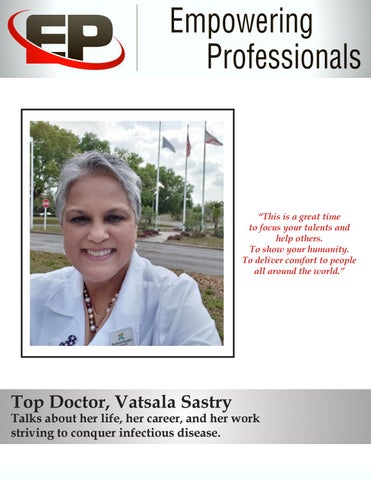
“This is a great time to focus your talents and help others. To show your humanity. To deliver comfort to people all around the world.”
Top Doctor, Vatsala Sastry
Talks about her life, her career, and her work PLUS to conquer infectious disease. striving A Feature on Dr. Karyne Messina: A psychoanalyst and author
EP Magazine 02
EP Magazine 03
Dr. Vatsala Sastry: a hero for our times Dr. Vatsala Sastry is a phenomenal resource for us all at a time when we are facing a global health crisis, and not just because she is an expert in Infectious Disease with nearly 30 years of practice achievements either. Certainly, her medical expertise is invaluable, and can guide us all in separating myths from facts and learning better self-care. Yet it is also because of who she is as a woman, the child of parents from a highly spiritual and intellectual country who were focused less on monetary issues than matters of the heart, the mind, and civic spirit. Her family took great pride in every grade, every achievement, and every opportunity to show kindness and respect to their fellow citizens. They taught young Vatsala and her older brother, Nerenda, who today is a cardiac surgeon, the significant value of developing your mental capacity and constant academic improvement. The family also emphasized the importance of hard work and routine chores, which help develop the mind and body. They stressed the significance of confidence and knowing you can learn all you want to know. Her parents taught her it was important to keep your home clean and organized (she jokingly says they were OCD) and to always schedule some sport or exercise, quality family time and personal joy into each day. These values shaped her character and set the course for her career as a community-focused physician, and they can also help us triumph in times of uncertainty and disconnectedness.
“My father, Sitaram Sastry, and mother, Narasu Sastry, spent their entire lives supporting us, advising us and educating us in every way. My father told me to think of myself like a coconut tree, always growing. To rise up and stand tall and straight. Remain elevated. Don’t depend on anyone but yourself. “ All of this, Dr. Sastry says, defined her life. Mr. Sastry also advised the future doctor not to get emotional abut problems, and to focus instead on the solution. He encouraged her to learn, read and figure things out on her own. He also taught young Vatsala the value of a good education and that the measure of one’s success would be about their achievements and the respect and honors they earned, as opposed to any dollar figure.
Fascinating things I learned from my parents that define me • • • • • • • • • • •
Always believe that you can do anything; don’t let any one thing or person put you down Be inquisitive, grow and learn Always focus on solutions only, not on the problems Cleanliness, home care, and work like cooking bring value to your days Do not stress over money, it is not a measure of success, your accomplishments are Respect family time, it is so precious Share whatever you may have with others. These include food, knowledge and experience. Respect our military, always honor servicepeople and repay them for keeping us safe and free Organization awareness: staying on top of things defines success Make time for daily exercise and sports. Never ignore your health You can always go farther if you believe you can
EP Magazine 04 Dr. Sastry was born in Bombay (now Mumbai) and spent the first few years of her life there. Her father, who moved to Mumbai, obtained his bachelor’s degree in Commerce (what they call Business in India), his master’s degree in Commerce and subsequently his Law degree and worked throughout the time. He believed tremendously in the United States of America, and in John Kennedy. He came to Baltimore, Maryland completed his MBA; and subsequently began working for Singer (the sewing machine company.) He retired as Global Knitting Products Manager of the company. He underwent extensive travels, back and forth between New York and Mumbai. This greatly enlightened the entire family. Before he completely retired, he initiated a company in Washington DC called ‘Schwartz tailoring’. His proudest achievement offered an unbelievable degree of education, travel, exposure, and joy to Mr. Sastry—and to everyone with whom he interacted. He worked very hard, moved his whole family to New York where Vatsala and her brother had the best growing-up experience ever.
Dr. Sastry grew up in New York, then in her early teens she travelled between Mumbai and New York. She finished her undergraduate degree at University of Tulsa, Tulsa Oklahoma in computer/electrical engineering. Subsequently she attended M.S. Ramaiah Medical School/Gandhi University Health Sciences and was awarded her medical degree in 1985. Her compulsory rotating internship was served at the same educational venue, followed by an internship in Grand Hospital/ Rush Pacific Darien Hospital in Chicago, Illinois. Subsequently she did her infectious disease fellowship at University of Pennsylvania, Perelman School of Medicine. It was the most transforming fellowship. The professors were incredible, educated the entire country about infectious diseases, and she was able to attend the Wharton School of Medicine, which is a specialist in viral infections as well. Most importantly Dr. Anthony Fauci, the Director of the National Institute of Allergy and Infectious Diseases and a member of the White House Coronavirus Task Force, was a frequent lecturer there, and enabled her to expand her knowledge of infectious disease even further. Eventually, Dr. Sastry became Board Certified in both Internal Medicine and Infectious Disease Medicine and remains at the forefront of her field through her memberships in various associations and professional societies, such as The Infectious Disease Society of America and the Hernando County Medical Society. You can read more about this and other distinctions in the pages of her resume.
EP Magazine 05
A Stellar Medical Career
After her fellowship, Dr. Sastry moved to Florida to join her husband, Dr. Ravi Shankar Rao, who was an Internal Medicine specialist and had begun a private practice in Brookville Florida. It was a fascinating experience since the three counties of Hernando, Citrus and Pasco had very little in the way of infectious disease resources—academics or education—available. The young doctor with her specialty knowledge spent a lot of time travelling between multiple hospitals there and received amazing support from the physicians, hospitals and patients she met. She initiated Infectious Disease work at the Health Department and worked there for nearly 12 years. This gave her an opportunity to work with HIV patients in the three counties, and to secure Ryan White funding for HIV services on their behalf. She took great care of the patients and many of them are still her patients today. Dr. Sastry also opened OPAT – the concept of outpatient infusion therapy centers, which had been initiated at the University of Pennsylvania, to help patients and reduce the length of hospital stays. It also helped stem the tide of leg and foot amputations in Diabetics and offered many other benefits. Dr. Sastry has received numerous honors for her work over the years—for research, excellence in practice, community leadership, infectious diseases, clinical drug trials and teaching, to name a few. She was further featured as a VIP Member of Who’s Who. She is a noted speaker for the Merck Pharmaceutical Panel and has been a member of several Advisory Boards since 2000. These Boards are run by pharmaceutical companies, regional or nationwide hospitals, and specialty institutes dedicated to cancer and infectious disease. She has long been recognized for a promise to take care of veterans, irrespective of their insurance benefits, and to meet the needs of all the people in Hernando County and surrounding areas. The doctor’s CV (curriculum vitae, a doctor’s version of a resume) is a full 22-pages long and we are proud to include a couple of those pages in this magazine.
EP Magazine 06
EP Magazine 07
EP Magazine 08
A Vital Resource for Learning and Treating Infectious Disease Dr. Sastry’s knowledge of infectious disease is thus unquestionable. At a time when the US, and the entire world, is dealing with a virus of pandemic proportions, there is no better ally you could have than Dr. Vatsala Sastry. She has diagnosed patients with infectious disease as a staff member and a department chair of Spring Hill and Oak Hill Hospitals. She has participated in research projects and published abstracts concerning infectious diseases, such as the Streptococcal, Cryptococcal and Pneumococcal varieties of Meningitis. She has diagnosed and treated various fungal and skin infections. She has spent time looking into Herpes, which many don’t realize actually has 9 different strains. She was there at the beginning of the HIV/AIDS crisis in the 1980’s and can look back with satisfaction realizing how many patients who presented with the infection have now gone on to live full lives and have children. Once a threat of epidemic proportions that resulted in thousands of deaths (on par with today’s COVID 19) HIV is now a very manageable condition.
“Everyone must recognize that the CDC and NIH are our allies. They want to solve puzzles and keep Americans healthy. They worked hard on TB, AIDS and other infectious threats of centuries past and they are working very hard now to slow the spread and discover a cure for Coronavirus. Perhaps there will be a vaccine one day, like what happened with Influenza and Polio.” Dr. Sastry stresses that almost every infectious disease is diagnosable, treatable and often reversible. Finding the answers is a matter of taking time to ask questions, do more scans and biopsies, and listen intently to the patient and his/her history. She does this with everyone she meets and admits to having a soft spot for police offers, veterans and those who work/worked in public service. It is also, she says, a matter of understanding our bodies, our biomes and our immune systems.
“The human body is a complex, fascinating and organized network of systems, each equipped with their own bacteria that helps those systems work. The bacteria inside our bodies is exclusive and exists in symbiosis with the bacteria outside of the body. This is what helps defend us against attacks.” For instance, there are aerobes in our lungs that help with the air we breathe and the CO2 outside. There are significant bacteria in the colon, so if we eat certain foods our GI system will process it. The Doctor mentions that keeping a balanced diet, and eating fermented foods like Kimchi and yoghurt, can keep us in good gut health. When we humans come across a bacterium that we are not equipped to handle, that is when auto immune imbalances and infectious diseases can occur. Therefore, total wellness is critical if we are to fight off any infectious disease.
EP Magazine 09
Infectious Diseases in History Infectious diseases have ravaged certain areas of the world and resulted in huge population changes since time immemorial. Going back there was The Black Plague. In the early 1700s, there was Smallpox. In the 1800’s, Cholera. As a toddler, Dr. Sastry saw how these struck the people of India, and it made an impression that sparked her interest in fighting disease one day. Then in the 1900’s Tuberculosis (TB)and The Spanish Flu took a number of lives. Of course, things were different then, there were no ventilators to put people on when their lungs failed, nor were there intravenous drug treatments. There was, however, a new focus on scientific analysis. Epidemiology emerged as a specialty. Doctors and pharmaceutical companies started to look closely at different plants and formulas, and numerous clinical trials took place between the 1930s and 60s. Vaccines were eventually developed and that greatly changed the number of citizens who died from diseases like TB, Hepatitis, Mumps/Measles, and Polio. As a child of the 60’s, Dr. Sastry noticed how these diseases impacted the people of India, especially since it is such a vibrant and dynamic country and it has large populations. India is also a tropical country and has limited resources (especially back then and when it comes to access to medications.) There were many fascinating points about early infectious disease. The government worked extremely hard in order to heal these large populations, and there were not many other options. Hence, they became very effective. For example, they discovered the BCG vaccine to prevent Tuberculosis, they gave multiple intramuscular injections to prevent rheumatic fever; and they educated the population on how to avoid getting Leprosy. These vaccines were lifesavers. The most important element was the manner in which the government took care of their citizens, regardless of monetary issues. Their goal was to prevent further spread of infections and damage to the public. This also was a reason behind the development of DOT, Directly Observed Therapy. It became one of the most famous methods of administering vaccinations and treatments, and still is today. The (American) CDC communicated very well with the DOT in India, into the 1980s, when HIV and TB became active in the US. They found the best option was to initiate DOT therapy. Things stayed pretty calm in the world of infectious diseases until HIV came along (in the late 70’s and early 80’s.) Then a whole new battle began.
“Sometimes a disease gets more or less attention because of its origin,” Dr. Sastry notes. “There are developing countries where things like rheumatic fever still kill people. There are African regions where viruses like Zika arise, but they don’t have the financial resources to look into it. Same in parts of Asia. Back when AIDS was first noticed, it was believed to have originated in Africa. When it hit America, it only existed in certain segments of the population that not everyone embraced. “
EP Magazine 10 The idea of origin and how it concerns us can sometimes hinder the rollout of treatment. Another disease people didn’t understand at first was the Hanta Virus. After a famous runner and then his family perished from the disease, people started to pay attention. They looked more closely at the Four Corners area of the US and interviewed people on the Reservations. Tribal ancestors had great insight about heavy rains (like monsoons) and how rats and other creatures behaved after the rain ended. This proved to be key in understanding how contact with this virus occurred, as well as for taking precautions and discovering treatments. Dr. Sastry also looks closely at people’s ancestry and environment when analyzing their condition. It has helped her identify cases of infectious disease with miraculous perception, such as the emergence of Leprosy in a young and active man in recent times. He had been experiencing neuropathy in his hand. He had scars there and the infected area seemed to be expanding. None of the antibiotics other doctors tried seemed to work. When Doctor Sastry took biopsies, the results were puzzling, because it wasn’t cancer. However, when she spent extra time discussing his wounds, she realized the young hiker had gotten bitten breaking up a fight between his dogs and another creature; that creature was an armadillo. Now armadillos have a special microbe that keeps them from contracting Leprosy from the environment around them. Once this was understood, the right treatment could be given, and the man recovered from Leprosy, a disease we had thought long conquered. Sr. Sastry’s intense level of caring, insight and brilliance create lasting relationships between her and her patients. The young man with those bites refuses to see any doctor but her ever since she solved the puzzle.
10 Infectious Diseases Dr. Sastry has Investigated & Lectured on • Skin and Soft Tissue Infections • Hepatitis C • Meningitis • HIV • Pneumonia, Influenza • Post-transplant infections • Tuberculosis, Leprosy • OPAT • ISDA guidelines • Fungal infections
EP Magazine 11
A New Threat Emerges in 2019 In late 2019, a new strain of SARS, SAR COV-2 was found in the city of Wu Han in China. It has since been named Corona Virus or COVID-19. It rapidly became an epidemic and spread to over 70 countries. One of those countries was Dr. Sastry’s ancestral home of India. Considering that India is the second most populous country in the world, it did not have as many cases as some other countries, and it was only at the end of March that they put the country in a lockdown situation. We asked Dr. Sastry if there was something that set India apart in this pandemic. She replied that India had several factors in its favor. The first was the tropical climate. Higher temperatures make it hard for many bacteria to survive. The diet is different as well and incorporates a lot of vegetables. People pick them and wash them with great care. They cook with a lot of onion, garlic, lemon, salt, and other substances that lessen the chance bacteria will survive. Also, every single citizen has a BCG vaccine in childhood. Currently in the US, they are doing intensive work on vaccines and suspect that an adjustment to the BCG vaccine could make it effective for the Coronavirus.
“People in India have a different lifestyle too. They don’t shake hands at meetings. These are all underlying benefits.” Dr. Sastry also says that she loves America, the greatest country in the world, and has the highest respect for Democracy and the Constitution. Regarding medicine and science, the US is one of the most advanced systems in the world. She notices a few interesting facts from India. There are benefits for this highly populated country. For example, the way the pharmaceutical companies and government hospitals are run. The have to offer free hospitalizations, and they employ a large number of physicians and medical personnel. The government gives mandatory vaccines. Medications given during the duration of the hospitals stay are usually also free of charge. In addition, the government oversees the advancement of pharmaceuticals. Pandemics, epidemics and endemics are closely monitored by the government. All in all, it is very efficient means for controlling the spread of illnesses. Dr Sastry personally believes we should all have broader access to care here too. It would be helpful for pandemic situations like with the Corona Virus. Corona Viruses are a family of viruses that can cause illness ranging from common cold symptoms to SARS (Severe Acute Respiratory Syndrome.) The disease that caused the 2019-20 pandemic is a new strain of the virus that has been called COVID-19. Symptoms can include coughing, fever, shortness of breath and GI (gastro-intestinal) issues. Since much information is available on the daily television news and at sites like CDC.gov we are not going to delve into this too much in this magazine. The statistics are saddening, and they keep changing each day.
EP Magazine 12 Dr. Sastry, does, however want to stress some things about any pandemic and the aggressive steps for survival. She wants us all to remember that the government is extremely vigilant and supportive when it comes to taking care of citizens. This is accomplished by several key steps:
Who Tackles a Disease Outbreak? •
CDC (Center for Disease Control) - they immediately start investigating any new illness
•
Public Health Divisions - who immediately start issuing directions to the public to help manage and control the illness
•
The NIH (National Health Institute) - who starts analyzing, doing extensive research into the illness, its roots and effects, and possible cures
•
Pharmaceutical companies – private industry organizations that work on and later provide treatments, including currently available medications to try
•
Private laboratories -- engaged in the creation of new treatments that might be necessary
•
Research companies – who investigate items that are required to take care of the population
•
Scientists - who immediately perform analysis of the disease processes and the outcomes
•
Hospitals - work extremely hard in providing care and establishing programs to help patients
•
Healthcare workers – doctors, nurses, technologists and others who work their hardest daily to monitor patients, deliver care and heal each and every patient
•
The Census Bureau - who can assist in performing extensive analysis of the numbers and the census of an illnesses
•
Transportation carries - such as EMS, ambulance, fire departments, airlifts and more – move patients to and from home and public places to direct care sites
• Military service -- we can and often do engage the military to oversee safety, curfews, airports, large metro areas, etc. Never forget we are the land of the free because of the brave Dr. Sastry emphasizes that it is always paramount to pay attention to any unusual changes in health, and to begin analyzing them. Government, companies and citizens work together to rapidly diagnose any disease, and to create vaccines that may keep them from spreading. Ensuring that the public is well informed is also key—podcasts, books, magazines, television/radio and other media are critical in order to provide information for everyone. And once progress is made, it is important to perform retro analysis of the illness and the pandemic. Dr. Sastry was featured in a special radio series (on Close Up Radio) during February and March. She spoke with Jim Master’s week after week, offering information to the public and helping them cope with this scary new outbreak. Next we will discuss some tips she shared and wants us all to keep in mind.
EP Magazine 13
10 Things to Remember in Relation to COVID-19 •
This is one of the deadliest pandemics ever noted in this time and age; the virus has been present for years.
•
We Scientists, Public Health, Infectious Diseases Physicians should fully educate the public on this disease
•
It will take continuous attention and teamwork by all (professionals, citizens) to get this under control; we will get there!
•
The American public and the rest of the world have been conscientious in attempting to control the spread
•
Strictly social distancing; maintaining a healthy home and work environment; wearing masks and gloves are all critical
•
During the pandemic, avoid group meetings; travel (planes, cruises, trains) till the pandemic is abated
• It is essential to self-quarantine if symptomatic; also seek help ASAP if any symptoms develop •
The US government has been extremely helpful in all ways, health-wise, economically and when it comes to disease containment
•
Maintain your mind, body and spirit in various ways to keep yourself healthy; help your immune system, not just now but always!
•
Offering immune globulin therapy from recovered persons is lifesaving for sick people.
EP Magazine 14
A Few Final Thoughts
“I was raised not to sit back, accept things, or cry about them. I learned to be strong, and to figure out solutions. I learned how to relax and reflect. Even with something as basic as a poor test score. You looked at what you missed and learned it better. I was smart. Confident. I always told myself to try again. My father was born poor and went from 0 to 1 million and everything he did he did with honor. This is what was in my genetics and my upbringing. I have now taught my children the same things about work, pride, and achievement.” What molded the doctor and her character are things she feels are essential for today’s era of uncertainty and rapid change. We can face whatever is thrown at us—from evolving technology to a scary medical diagnosis, as long as we are strong, determined, and positive. We can learn to find encouraging moments in the gravest situation--such as enjoying family time, doing an art project, or preparing a fresh meal while we are under quarantine. We are all part of a great global community, and we must take every opportunity to help and support one another. Vatsala Sastry is grateful that she could be of service to fellow citizens, to help cure infections. “I made it possible for veterans, surfers and politicians to overcome infections. So that they could live longer and get back to their work, hobbies, families and wonderful lives, “the Doctor says. In acknowledging this, she shows that she is as grateful for the opportunities as the patients are for her care and attention.
EP Magazine 15 She adds that while travelling, undergoing academic education, and dealing with wonderful people she has learned so much.
“I was transformed by meeting our dear veterans. What is so amazing about them is their profound sense of duty, discipline, loyalty as well as their ethics and teamwork. They do their duty no matter what, never worrying about the outcomes or stopped by doubts. They just focus on getting the right things done. For them it is not about the reward; their sense of duty drives them. Very few can perform the way a military veteran has. That is why I cherish all in service, respect them, and honor them. Specifically, the Native Americans and the ‘code talkers’ who did so much. We might not have been here post WW II without them.” Beyond the military, Vatsala Sastry has been blessed to learn from her children and the life experiences she shared with them. She has two sons, Advaith Rao, a chemical engineer employed by Dow is the eldest. The other is Aditya Rao, who has a master’s degree in cybersecurity and is also an amazing poet and writes in multiple languages including English, Spanish, Swedish, Arabic and Urdu. Below is a poem, “My Memorial”, that Aditya wrote after 9-11 events devasted the country. His words about goodness, pride, help and heroes are just as meaningful today, when the world has been impacted by a different scourge. Pray keep close those most ungodly hours— Eyes, blue skies blackened by bloodcurdling brume; Untimely estranged, twin star-crossed towers— Too those stars of ours who dared exhume From heart and home newfound spirits unspared From whole new hopes unheard of, unrenowned; From the helping hands of heroes who cared Enough—on our behalf— to hold their ground; Here or there; above, beyond, behind us; So, with each passing year, let’s do our part To preserve—with pride—that which must bind us, And which has defined us right from the start: Our mores immemorial, whose goal Of good immortalizes our true soul. Dr. Sastry is proud of both her sons, loving them for their sameness and their distinctions in the way only a parent can. She mentions the way they reflect values that her father instilled in her and that she passed on to them. About how we always should focus on solutions. About showing our strengths and our moral fiber in times of great challenge and changes.
“I love my husband and sons deeply. Aside from patients and my family, I cherish the team that I work with, many loyal physicians and an incredible office staff. It’s been a long and satisfying journey and its far from over.”
EP Magazine 16
Vatsala S. Sastry, M.D., PA
15435 Cortez Blvd. Brooksville, Florida 34613 (352) 799-2294 Office drvatsalasastry@yahoo.com
Education: Medical: M.S. Ramaiah Medical School – Bangalore University, Bangalore, India – 1981 – 1985 Four and a half years Medical School (Core Curriculum) 1985 – 1987 One and a half years Compulsory Rotating Internship
Postgraduate Training: 1987 – 1988 Internship in Internal Medicine Grant Hospital/ Rush Presbyterian St. Luke’s, Chicago, Ill 1988 (July – Nov) PGY 2 in Anesthesia. Loyola University, Chicago, Ill 1989 – Jan 1990 PGY 2 Internal Medicine Grant Hospital/ Rush Presbyterian St. Luke’s, Chicago, Ill
1990 – 1991 (Jan – Jan) PGY 3 Internal Medicine University of Health Sciences – Chicago Medical School, Chicago, Illinois
Fellowship: 1992 – 1993 Clinical Year – University of Pennsylvania, Philadelphia, PA 1993 – 1994 Research Year – University of Pennsylvania, Philadelphia, PA
Faculty Appointments: Clinical Assistant Professor of Medicine, 1996 – 2006 Division of Infectious Diseases, University of South Florida
Board Certification: Diplomat, American Board of Internal Medicine Diplomat, American Board of Infectious Diseases
EP Magazine 17
Commendation: (1) Named as a top notable leader in community for Infection Control. JACHO, 1997. (2) Award for outstanding poster presentation on Fungal Sepsis in ICU “Analysis of an Outbreak”. V. Sastry, M.D., ACP, Florida Chapter, Ft. Lauderdale, Fl September 1996. (3) Award for outstanding poster presentation on Emphysematous Pyelonephritis, An Understated Disease? V. Sastry, M.D., ACP, Florida Chapter, Sarasota, Fl. September 1997. (4) Lifetime member in Strathmore’s Who’s Who for Excellence in Profession of Infectious Diseases. (5) National Leadership Award, Honorary Co – Chairman, Physician’s Advisory Board, Republican Congressional Committee. (6) Award for most outstanding Clinical Professor for excellence in teaching. USF, Tampa, Fl. December 1, 2000. (7) VIP member in Strathmore’s Who’s Who for Excellence in Profession of Infectious Diseases. (8) Member National Speakers program, Merck Pharmaceuticals (9) Member National Speaker Program, Wyeth Pharmaceuticals (10) Speaker, Advanced Med; Treatment of Hepatitis C
Professional Societies: Member of Infectious Disease Society of America Member of American College of Physicians Member of American Association of Asian Physicians from South Asia Member of American Association of Physicians from India Member of Hernando Medical Society Lifetime member of Strathmore’s Who’s Who VIP Member, Strathmore’s Who’s Who
Current Postions:
(1) Attending Physician, Brooksville Regional Medical Center Spring Hill Regional Medical Center Oak Hill Regional Medical Center (2)
Director of Suncoast Infusion Centers of Hernando County
EP Magazine 18
Future Interests: (1) (2) (3) (4) (5) (6) (7)
Practice of Clinical Infectious Diseases. Practice of Infection Control, Hospital Epidemiology. Creation of a Home Antibiotic Network. Creation of a Computerized System for the Analysis of Surveillance Data. Creation and management of Infusion Centers. Assist local Veterans in improving living conditions, and empowering the workforce Assist youth in empowering themselves and gaining momentum in the workforce
Dr. Sastry has received other awards too numerous to mention here. In addition to her many positions and honors as a physician, Dr. Sastry is a noteworthy entrepreneur. She launched Infectious Disease practices in Hernando, Citrus and Pasco counties, and the opening Infusion Centers in the same areas. She introduced Continuing Care for underprivileged people with HIV. She was a teacher for the James Haley VA while maintaining private practice. She also has nonmedical business interests in the companies Imperial Granite and Sterling Development and Construction.
EP Magazine 19
Vatsala Sastry, MD Infectious Disease Specialist 15435 Cortez Blvd., Brookville FL 34613 Phone: (352) 279-2183 Email: drvatsalasastry@yahoo.com drvatsalasastry@outlook.com Website: www.drvatsalasastry.wordpress.com