EP Magazine 1
Vol. 22
WOMEN THAT ARE MAKING A DIFFERENCE IN AMERICA Victoria Mondloch
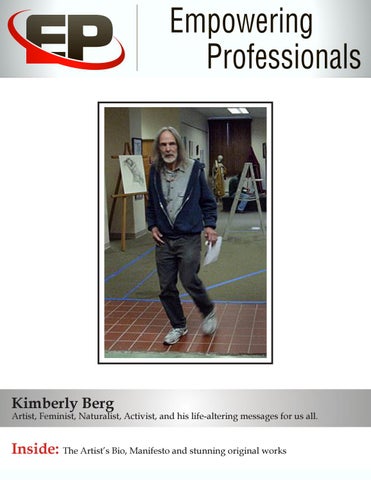
Kimberly Berg
Artist, Feminist, Naturalist, Activist, and his life-altering messages for us all.
PLUS A Feature The on Dr. Karyne Inside: Artist’s Bio,Messina: Manifesto and stunning original works A psychoanalyst and author
EP Magazine 02
EP Magazine 03 It’s not often you come across a man who proclaims himself a feminist, but then you don’t encounter men who were born with the name Kimberly that often either. Nor do you meet many self-taught artists who have had successful shows--both domestically and in Europe-- and were featured in Who’s Who. You also don’t come across many painters who engage in other arts, such as poetry and calligraphy. While artists may be known for living simply, they rarely have a self-built, one-room cabin set amid nature like Mr. Berg does. In just about every way, artist Kimberly Berg is a singular sensation: his stunning pastel pieces and philosophy about women and their roles in society stand alone as much as his birth name does. For many years this acclaimed artist had been following an invisible guiding hand. It led him to merge words and images, much the way Chinese artisans do, and to state some things about women as Goddesses (he prefers the genderless term The Beloved) that defied popular thinking. He is now on a mission to spread the word about women, their self-worth, their struggles, and how they should be respected as equals. Or perhaps they should even be honored above men, as they once were in ancient society, before patriarchy became the conventional way of life.
“Even before I became interested in the women’s movement and knew that I had a voice, I was creating images that were about woman’s need to be seen, heard, and recognized. It was back in the 90’s that I first painted images that were sympathetic to women in their struggles; images that reflected a time before patriarchy. I didn’t read books on that until around 1998 and #MeToo, well that was only a couple of years ago. But I had reflected women’s strength and power in all my works long before.” Perhaps his woman-focused philosophy was best expressed by what the Amsterdam Whitney wrote in their catalog. They are a modern art gallery situated in the Chelsea section of NYC, a hub of culture, and run by a woman. Their gallery had showings of some of Kimberly Berg’s work in February (the season of love) and March (Women’s History Month) in 2020. They wrote: “Kimberly Berg, a self-proclaimed Male Feminist, champions his female figures through an artistic exploration of women’s relationship to nature. Celebrating images of the female nude with mystic and sacred images such as the sun and mandalas, his female figures take on a monumental quality, radiating power and divinity.” Certainly, much of Berg’s respect for females emerged from his studies of ancient history when he was a history major in college. It may also have begun much earlier, with his relationship to his own sister and mother, and the lessons about powerful women he learned from poets like Emily Dickinson and Edna St. Vincent Millay.
Literature and his Young Life The man named Kimberly grew up in a country home in Wisconsin, where Kimberly Berg was very close to his family. Isolated from neighbors and the bustle of town, Kimberly and his sister, who was one year his junior, spent endless hours together playing and exploring their surrounding property. As a child, it didn’t occur to him that she was any different than he. And even the changes brought by puberty did not diminish or erode their close bond.
EP Magazine 04 When he was twelve, Kimberly was bed ridden for over a year with rheumatic fever. As Kimberly slowly regained his health, his mother faithfully sat by his bedside and read to him. Kimberly recalls with fondness hearing his mother reading classic tales such as The Call of the Wild by Jack London and intriguing selections from Reader’s Digest. As he listened, Kimberly discovered for the first time that gifted authors could weave words into an intimate expression of emotions--the human condition. For Kimberly it was an astonishing achievement that could be fully realized by the artful employment of the written word. Still confined to his bed, Kimberly became intrigued by literature as a form of art. He began reading other great works, all on his own. Famed novels such as Tom Sawyer and Treasure Island captivated his imagination and opened up for him a new world. Later his discovery of poetry drove him inward to another undiscovered landscape. Emily Dickinson and Edna St. Vincent Millay were admired by Kimberly for their lyrical poetry and wisdom—including the concept that false illusions can hinder our growth. In Millay’s poem Renascence, she describes her own perceived limitations and her eventual liberation from them, in cascades of lyrical brilliance: And all I saw from where I stood Was three long mountains and a wood. Over these things I could not see; These were the things that bounded me; And I could touch them with my hand, Almost, I thought, from where I stand. And all at once things seemed so small My breath came short, and scarce at all. Much like Millay herself, this poem helped Kimberly pursue his life without limits, never questioning the ability to realize his dreams.
“In poetry, words become alive. They may rise like mountains and rage like rivers. They awaken the soul. They open the heart. In reading great poets, I discovered my own voice,” Kimberly later said.
An artist who expresses with words and images is born At only fourteen, Kimberly won first prize in a national youth poetry contest for a sonnet. He’d written a piece entitled The Sands of Time. Ironically, when his father wanted him to show the poem to visiting relatives, Kimberly confessed that he hadn’t kept a copy of his award-winning work. Instead, much like the sands of time, the poem descended into oblivion. But Kimberly’s creative potential was just beginning to emerge.
EP Magazine 05 Kimberly continued to write poetry throughout his formative years. Upon graduating from the University of Wisconsin, he moved to New York City, with the naïve assumption that all artists achieve their success in the Big Apple. Later, he recognized this was a deceptive dream. Living in the East Village amid the counter-culture of the late 1960’s offered Kimberly much more than a creative opportunity. It was here that he witnessed the birth of the modern Feminist Movement. In the East Village, local activists who were intent on ending discrimination against women, forced their way through the door of the male only McSorley’s Pub. This audacious act sent ripples across St. Marks’s Place, the entire neighborhood and modern life across New York. As a man, Kimberly found himself questioning his own place in the movement. Similarly, he contemplated his own responsibility in doing what’s right. But Kimberly didn’t see himself as an agent of change at the time. Although he sympathized with the women and their cause, he remained on the sidelines. But he didn’t stay on the sidelines for long. Nor did he stay in New York City.
Living in Harmony with Nature After three years, Kimberly acknowledged that the frenetic atmosphere of city living stifled his creative spirit. Listening to his inner calling, he drastically changed his lifestyle. And the outcome of this decision changed everything. Together with his girlfriend, Kimberly moved from the bustling city to a oneroom cabin (that he built himself) nestled in the Adirondack forest. Living a Zen-inspired life of voluntary simplicity meant withdrawing from many of the conveniences of modern-day living. Nevertheless, he felt “what is less is more.” What he gained from this lifestyle certainly would prove to be more. With no electricity, no indoor plumbing, no phone and only a wood-burning stove fueled by trees he chopped down himself, Kimberly’s rustic cabin filled him with peace and nourished his soul. And slowly, poetry emerged from everywhere in the woods.
EP Magazine 06
EP Magazine 07 Kimberly gathered inspiration from all the natural wonders surrounding him. His intimate connection to nature opened him up to see beauty in even the most subtle of nature’s hidden surprises. A chance encounter with the skeleton of a snake draped over a tree stump showed that it glistened like the beads of a necklace in the morning light. Even the slow-moving events of the forest captured his attention, such as the gentle unfolding of undergrowth in Spring, or vibrant moss creeping in shadowy nooks. The simultaneous liveliness and peace of the forest delighted him. The animals and birds became a concerto of songs that awakened Kimberly’s creative spirit. All of these, and much more, found their way into his poetry. Perhaps without even noticing, Kimberly began to grow as an artist quite like the forest around him, with creative buds blossoming onto new branches. One such branch was calligraphy.
Calligraphy Naturally Came Next Berg said about the ancient art form of calligraphy “Words and images were both always important to me. As a poet, calligraphy which unites the words and how they look on paper... it naturally transitions to the visual. It was a long transition, but still, they all went together, all flowed one into the other.”
“I was unaware that this kind of evolution is exactly what the Chinese believe in. Writing and art have a natural progression, word to image, and there is a lot of significance in the appearance of the word.” As Berg’s art blossomed, he was entranced not just by the written word but also the beauty of its visual appearance on the page. Kimberly identified calligraphy as the nexus between the written word and his later attention to the visual image.
EP Magazine 08 He devoted himself to the art, and spent countless hours, months, years training his hand to form the fluid and rhythmic strokes. Calligraphy requires discipline, but also confidence, as any hesitation is easily revealed in an insecure stroke. In dedicating such attention to so precise a skill, Kimberly gained the confidence and facility to develop his artistic abilities even further. Upon mastering the ancient art of calligraphy, Kimberly progressed to the visual form. He began with pen and ink drawings that focused on Zen-inspired art. This style of art stresses a well-drawn line and emphasizes an economy of means where simplicity is an expression of purity.
[The Zen artist regards white spaces with the same consideration he gives the line itself.] This transcendent art abandons true-to-life perspective, and instead focuses on capturing the essence of reality and the state of being. In exploring the eternal nature of his subjects, Kimberly grew spiritually as well as artistically. He came to understand the Zen maxim: “Less is More.� It was reflected in all his choices, his lifestyle as well as the art he chose to create.
Transitioning to the Human Form Moving to charcoal, Kimberly was gratefully invited by a friend, who had just completed art school, to study drawing the human form. They worked together at her parent’s cottage by the lake. With no formal training, Kimberly initially doubted his ability to master the complexities involved in drawing the human figure.
EP Magazine 09 Kimberly and his friend shared endless hours drawing and discovering the human figure, often drawing deep into the night, with the moon shimmering over the silent lake. Perhaps it was poetry that crept into Kimberly’s human image, because his drawings expressed an emotional depth that seemed to transcend the limitations of mere paper and charcoal. Kimberly had come full circle. His art had become his poetry; his poetry had become his art. Throughout his life he had explored the human psyche, then drew the human form. Light and dark. Deep strokes and thin lines. With his artistic balance finally realized, a yin-and-yang in perfect harmony, he was ready to experiment with color. Like Dorothy when she landed in Oz, Kimberly opened the door to color and a whole new world emerged. It was then he first began to explore the colors, shades and various effects that can be achieved when an artist uses pastels.
The Marvels of Pastel Inspired by the work of French artist Edgar Degas, famous for his pastel depictions of movement, particularly the ballet dance, Kimberly pressed ahead in this challenging and often under-appreciated medium. Fleeting and delicate, pastels can perfectly capture the sensuous beauty of life before they become as precarious as the subject they depict.
EP Magazine 10 For Kimberly, pastels represented the embodiment of poetry in a visual art medium. With each stroke of a pastel stick, Kimberly knew he had finally found his home, his own personal gift of artistic expression. Before long, Kimberly was invited to display his art at a local Council of the Arts gallery. Ironically, while his art had not been globally accepted in it’s written form, it was embraced in it’s visual expression. What’s more, Kimberly learned that he had unknowingly followed the traditional Chinese pathway to artistic mastery.
Crowning Artistic Achievement Beginning in the eighth century, the Chinese identified poetry, calligraphy and painting as the ultimate forms of artistic expression. Known collectively as The Three Perfections, these complementary art forms create a lively interchange in the mind when displayed together. To show talent in all three demonstrates not only sincere discipline, but an innate and powerful creative ability as Berg did. A Chinese rule states that both the mastery of poetry followed by the mastery of calligraphy was essential before one was ready to become an artist. The Chinese regard painting as “silent poetry” and poetry as painting with sound. Kimberly’s unconscious attraction to all three, organic, pure and free of outside influence, reveals a deep and emotional interconnectedness to everything he creates. The artist known as Kimberly Berg recognized the importance of this opportunity and as his paintings grew in popularity and precision, he felt complete. His lovely pastel pieces centered on women, their bodies, their esthetic beauty, and their power. The transient nature of the pastel lent another element to the work, a glow that can be viewed as an aura or divine essence. He had fulfilled one artistic vision unknowingly and was now moving into another. He had reached a pinnacle few artists ever see.
Ova Moon
EP Magazine 11
Woman as Life Force and “The Beloved” Berg’s silent poetry (paintings) evolved over ten years to honor woman in multiple and significant expressions--from women as pregnant creators to a woman reclining in a forest in deep meditation. His pastel scenes represented all that a woman can and should be, all the power and mystery they possessed that merit honor and respect. This was another full circle and one that had roots in his early childhood relationships with his mother and sister. Berg’s portfolio includes women as goddesses, living in peaceful symbiosis with the Great Mother. His art honors women as life-giving embodiments of the divine. He replicates their powers, associated with the moon, wild animals, and aesthetic movements like dance and song. He puts a look of ecstasy upon their upturned faces. He places them among metaphysical landscapes. It was another conclusion Mr. Berg had reached unknowingly. He expressed a side of women that previously only had been discussed in ancient history and various schools of meditative thought. Then, in 1997, Kimberly read a book that confirmed the legitimacy of the art he had always felt inclined to create. The book made him aware of women’s Paleolithic roots and persuaded him to acknowledge that women deserve to be treated as equals. This mindset eventually put him as an artist at the frontlines of the Feminist movement. The title of the book was called When Drummers Were Women and it was written by Layne Redmond.
“I discovered for the first time how women were treated in the time before patriarchy. It was mind blowing. It changed many things, but it also reinforced others, my feelings about women’s natural grace and power. I realized the work I had been doing was involved in telling their story. As if some kind of guiding hand had been directing my interests and compelled my work to this place.”
When the Drummers Were Women This is the cover of the insightful book that affirmed Berg’s work and his ideas about women. It was written by Layne Redmond--an American drummer, frame drum expert and historian. Her book revealed the lost ancestral history of woman. She traces human history dating from the Late Paleolithic period (30,000 BC) when Cro-Magnon man first migrated into Europe (from Africa.)
EP Magazine 12
“I discovered that it is possible to understand things from pre-history, from a time before writing. Most think if something happened in a pre-literate time, we wouldn’t know of it later, but that’s just not true. Thanks to advances in modern archeology, we can understand much of pre-literate people, before language was written. This is essential for women to grasp. Prehistoric women were very different from today; they had power, control, and all the freedom and influence modern women are fighting for.” Reading When the Drummers Were Women marked a turning point for Kimberly. The realization that complex pre-patriarchal civilizations once existed before the time of the Greeks was an astonishing historical revelation. As a history major, he was surprised to learn that the first civil society existed as early as the Neolithic period. This meant that if human history were to be judged in terms of its entirety, we can say that the last 5,000 years of patriarchal culture represent only a small fraction of the total time of human history on earth! This counters the argument often made by men; that patriarchy has existed since the beginning of time, and there was never any alternative. After discovering the book and its message, Kimberly began to do further research. After reading a second book The Chalice and the Blade by Raine Eisler, he’d found it. This book confirmed the same historical and cultural information that had been presented in Layne’s Redmond’s authoritative work and sent his mind (and art) into new territory. The most important information about the Late Paleolithic (30,000-10,000 BC) and Neolithic (10,0003,500 BC) period is that women and men were treated as equals and women were also highly respected. Most important, people lived in peace amongst themselves and with their neighbors. Researchers have not found any record of destruction or warfare during that entire period—which lasted more than 20,000 years and encompassed a geographical region from Europe and into Asia.
EP Magazine 13 In Paleolithic times, men were absorbed in the art of creating the perfect flint spearhead while women were learning how to provide for all the needs of their children. For women, that meant finding and experimenting with medicinal plants; it meant learning how to forage for beneficial food-producing plants and how to adapt them to local growing conditions; it meant finding the right wheat germ, and the right strain of yeast and after, the invention of an oven which made it possible to bake the first loaf of bread. It also meant creating a loom to produce cloth out of plant fibers. This era also meant the formation of a loving female goddess religion that was faithfully observed for many thousands of years. For Paleolithic and Neolithic people, there was no arbitrary division between the sacred and the secular world. Everything created by the Great Mother Goddess was considered sacred-- this included the earth and everything on it. The Goddess did not live in some far-off place. She was considered accessible and present in everything she created-- from a flower, to a bird, to a mountain.
Disruption of the Goddess Era Beginning in 4300 BC, Redmond relates how violent, war-like, nomadic people from out of Asia called Kurgans devastated on horseback the settlements of the peaceful Goddess worshipping people. In 3100 BC Armenia successfully converted speech sounds into graphic symbols. This meant that the warrior groups were now able to easily turn the Goddess culture around by creating written laws engraved on pillars. These stele monuments defined the rules of a new literate, patriarchal society. It led to the eventual total subjugation of women. As a result of this cataclysmic change, the natural, peaceful order that had existed for tens of thousands of years descended into chaos, especially for women. Married women, for example, who traditionally lived together with their mother, sisters and children, were now required to live with their husband’s family. They lost all control over their life and contact with their extended family. Instead of a peaceful society, the new patriarchal society, dominated by men, was plagued by constant wars, ruthless conquest of neighbors and their lands. Today, thousands of years later, patriarchy still controls and diminishes and dominates women’s lives. Because nothing seems to have changed in the last 5,000 years of patriarchy, Kimberly has rejected the present status quo. He has proclaimed himself a male feminist, allied with the women who believe the way to move forward is through freedom, love and peace.
“There is no shame in the genuine sensitivity and aesthetics that women bring to the universe. I find it impressive, thought provoking, and extraordinary. That is why I aspire to create a world that embraces women and allows them the power and freedom to act on their own.”
EP Magazine 14
Voicing Change through Art “When I discovered the role that women had played during the Neolithic times, I became aware for the first time how profoundly respected they had been, and how demeaned they had become later under patriarchy. It became my mission to portray women’s natural intelligence, harmony, grace, beauty, and it has inspired me and influenced my art over the past 20 years.” Kimberly Berg turned to a powerful vehicle for spreading women’s message and driving social change: his art. Like the Chinese, he identified three perfections for achieving his ability to drive change. 1. He had become an artist. 2. He had become a feminist advocate. 3. He had become an activist. As men enjoy the benefits of a privileged gender, it is easiest for most contemporary men to simply carry on. But Kimberly Berg is not that kind of man. His initial acceptance of patriarchy and the subjugation of women unraveled with each page he read in Redmond’s ground-breaking book. Women’s rightful claim to an equal place in society overshadowed everything he had taken for granted regarding women’s social standing in contemporary society. In addition to the evidence cited in these books, and the art Kimberly Berg has created, we also have a huge trove of evidence left behind by artisans of the Paleolithic and Neolithic period. Their stunning art allows us today to make inferences about their cultural traditions and beliefs. This is especially true of the murals and statues which honored women’s spirituality and relationship to nature.
Kimberly insists “the lesson that we can and must learn from our ancestral sisters is that women were, and still are, eminently capable of creating a society that honors the sacred and is peaceful, inventive and delightfully vibrant.” Their voices still echo. Their drums still beat. All we have to do is listen.
EP Magazine 15
The Artist’s Manifesto If you browse Kimberly Berg’s website isisrising.net, you will be able to view even more of the stunning charcoal and pastel drawings of women than we are showcasing in this magazine. They appear as nude figures, goddesses, natural inspiration, life-giving forces and most revered subjects. There is also a section on the site called The Artist’s Manifesto, and the text below is excerpted from it.
“I believe that artists have an important role to play in changing the patriarchal way of life we live in. It is becoming increasingly clear that the patriarchal, social, political, military, religious and economic conditions that we presently live under are no longer workable or sustainable. It’s important that this be understood by today’s women who have lived in ways created and governed by men for that last 5000 years.” “As a male feminist advocate and artist, I believe we are at a significant turning point in human history. A monumental change is happening in regard to the status of women in the Western World and other parts of global society . . . they can now visualize themselves and act in new ways that are more aligned with their inherent birthright.” Kimberly believes artists can play an integral role in this historic transformation—by creating images that challenge women to examine their identity and become more aware of their power to make social changes. This can be achieved by creating art that inspires a new culture of peace and harmony, particularly, to what their ancestral sisters achieved in earlier times. Neolithic society lived with a social system that highly revered women and honored them for their sacred, life-creating ability. It was a time when people lived serenely and in harmony with nature and all of creation—the moon, the land and trees, and wild animals. This latest wave of the women’s movement, which includes #Me Too, coupled with those who cry out for ecological change to counter the way we have damaged our earth in the name of progress, are signs of a new era. We are called to return to the ancient way of life that places a premium on nature, spirituality, peace, which reflects woman as intelligent, erotic, lovely, honored and scared beings. Let us dance, sing, and embrace art as we enjoy their vibrant life once again. Kimberly continues to strive and create art that relates to these deep and mythic concerns of humankind-art that pleases, art that stimulates, art that sends a clear message that feminism is humanism.
EP Magazine 16
EP Magazine 17
EP Magazine 18
EP Magazine 19
The person who conducted interviews with Kimberly Berg and wrote or edited sections of this piece is a woman. She thinks Kimberly Berg is an awesome human being, a gifted artist, and a messenger to whom we should all pay better attention.
Kimberly (Moontree) Berg 489 East Road, Cadyville, NY 12918 E-mail: kdegas@artlover.com Website: isisrisng.net