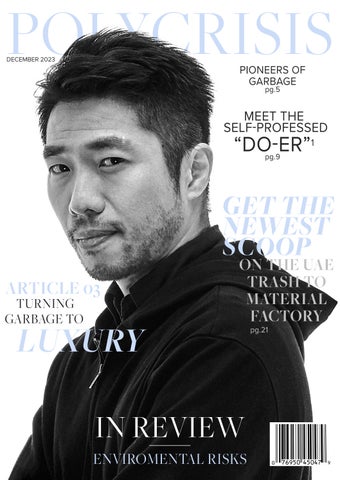
POLYCRISIS
DECEMBER 2023
PIONEERS OF GARBAGE pg.5
MEET THE SELF-PROFESSED
“DO-ER”1 pg.9
GET THE NEWEST SCOOP ARTICLE 03
TURNING GARBAGE TO
LUXURY
ON THE UAE TRASH TO MATERIAL FACTORY
IN REVIEW ENVIROMENTAL RISKS
pg.21
e d . 01
03
THE CRISIS
05
PASSIVE SYSTEMS FOR GARBAGE USE
Envi ron menta l Risks
EDITORS NOTES
Environmental risks
Throughout the article, editors
pose a substantial threat,
notes will appear in a light blue
accounting for nearly half of
sans serif font. These notes
the multiple global risks that
demonstrate critique on the topics of conversation.
the World Economic Forum
IMPACTS OF SOLID WASTE ON THE ENVIRONMENT
MARTIN PAWLEY INSPIRED PRACTICES
09
LUXURIOUS SYSTEMS FOR GARBAGE USE
MEET MINIWZ SOLUTIONS FOR UP-CYCLING MINIWIZ MATERIAL DATABASE TRASH COLLECTION & PROCESSING MINIWIZ IN THE DESIGN PROCESS REALITIES OF NORTH AMERICAN LOGISTICS
has identified as potential challenges to our planet. These environmental risks have the capacity to exert their influence over various timeframes, ranging from short-term disruptions to long-term crises.2 Within the complex network of challenges currently
21
THE NEW UAE FACTORY
23
EDITORS CRITIQUE
confronting our world, the
THE NEW MINIWIZ PLANT FOR UPCYCLING
THE CRISIS
climate crisis stands out as an unmistakable consequence of our human actions. Within this article, practices and theories will be critiqued on their methods of reducing methane emissions, which contribute directly to global warming, and natural resource depletion.
Lisa Goldapple, “Going Circular: Upcycling in Taiwan is Changing the Way We See Trash,” Topia, January 11, 2023, https:// worldoftopia.com/miniwiz-arthur-huang-upcycling-inteview/. 2 World Economic Forum, “Global Risks Report 2023,” World Economic Forum, 2023, https://www.weforum.org/publications/ global-risks-report-2023/in-full/1-global-risks-2023-today-s-crisis/. 1
figure 02
LUXURIOUS OR PASSIVE SOLUTIONS
POLYCRISIS IN ACTION The climate crisis can appear as an overwhelming issue, seeming too large to tackle all at once. Consequently, many do not see the urgency in changing our daily practices to help mitigate global warming. As such, within this month’s edition of environmental risks, this article will take a precise focus on the daily production of solid waste by the individual, known as garbage. This deep dive will create a dialogue on how we can use garbage as a resource to eliminate the need for natural resources specifically in the context of architecture and the building industry.
02
HUMAN IMPACT THE EFFECTS OF GARBAGE ON THE GLOBE Human activities significantly contribute to the excess waste accumulating in our landfills. This is primarily due to a culture of consumption and disposability, where single-use products and packaging are first choice for many due to their low costs. The over-reliance on non-biodegradable materials, such as plastics, enhances the situation, as these materials take centuries to decompose. Additionally, inadequate recycling and waste management practices mean that a substantial amount of potentially recyclable or compostable material ends up in landfills releasing large amounts of methane into the air. These behaviors not only lead to environmental degradation but also place strain on valuable resources, highlighting the urgent need for a shift towards more sustainable consumption and waste management practices. This places architecture at the center of the conversation demanding a better consideration for the resources the globe and societal functions can already provide. Rather than thinking of the next new product, we should think about what we already have, to create the next new product. This will place an end to the singular-use mindset the westernized
THE CRISIS
world has adopted.
3 4
figure 03
HUMAN INVOLVEMENT
Peaking at the highest of all time, “nearly 10.9 million tonnes of residential waste was generated across Canada in 2020”3
Government of Canada, “Record amount of residential waste in 2020, but more was diverted,” Statistics Canada, Last modified July 10, 2023, https://www.statcan.gc.ca/o1/en/plus/4045-record-amount-residential-waste-2020-more-was-diverted#. Government of Canada, “Municipal Solid Waste Management,” Last modified October 4, 2023, https://www.canada.ca/en/environment-climate-change/services/managing-reducing-waste/municipal-solid/waste-greenhouse-gases-canada-actions.html#
T
23 percent of national figure 04
The present moment demands the harnessing of innovative
methane emissions come from canadian landfills4
technological
solutions
to
counteract
the
detrimental
environmental effects created by human activity. This involves proactive strategies for climate change mitigation and the alleviation of pressures on finite natural resources. Embracing a Cradle-to-Cradle model facilitates an exploration into the principles of waste-utilizing architecture while directly addressing key concerns identified by the World Economic Forum, such as, failure to mitigate climate change, failure of climate change adaption and natural resource crises. Thus, this article will delve into two very different approaches of using garbage as a resource within architecture. The first section will look at a passive way of integrating garbage into daily architecture. However, the second section provides a more aggressive approach which will be examined to see the realities of adopting this mindset in a North American context.
04
THE PIONEER OF GARBAGE PASSIVE SYSTEMS OF GARBAGE USE
MARTIN PAWLEY
Although many deem that “waste [is] a modern global crisis”5, this crisis has been evident long before the 21st century. In 1975, Martin Pawley (Figure 7) addressed consumer behaviour which provoked the growing levels of garbage within our landfills. Meanwhile, he also addressed the resource scarcity that was impacting the construction industry and the current need for housing.6 As such, he combined both ideas, and “stated the goal of his research was to address shortages of housing by transforming consumer waste into building materials for low-cost construction”7, proposing the idea of Garbage Housing. Pioneering the idea, Martin Pawley revolutionized the architectural community by suggesting “a concept of ‘secondary use’, imagining that consumer products and packaging could attain a second life as building materials or other uses”8. Therefore, his book titled ‘Garbage Housing’ analyses two different case studies from his travels and research that utilize the principles of secondary use within the construction
The WOBO House Vs. Cornell Project in Chile The WOBO house (Figure 05) demonstrates the possibilities for innovative design long before mass technology took over the world. During his visit to Curacao in 1960, Alfred Heineken, the proprietor of Heineken beer, encountered homes constructed from recycled glass beer bottles, sparking a creative idea within him. Thus, “Heineken’s original brief called not so much for a bottle that could be used as a brick, but a brick that could hold beer”9. Heineken understood that he lacked the necessary design thinking required to follow through with his imaginative idea, consequently he sought out someone who could fill those gaps. During his return to the Netherlands Heineken found John Habraken, a Dutch architect, who was a “innovator in the field of housing”.10 After realizing that glass was not a far-fetched idea to use as a structural material, in 1963, the WOBO bottle was “the first mass production container ever designed from the outset for secondary use as a building component”.11 Preplanning allowed for the potential of secondary utilization to bridge the divide between limited resources and housing needs.
Ahmed K. Ali, “Architecture, Waste, and the Circular Economy,” The ARCC Journal for Architectural Research 18, no. 2 (2021): 1-3, https://doi.org/10.17831/enqarcc.v18i2.1130. Martin Pawley, Garbage Housing (London: Architectural Press, 1975), 11-13. 7 Curt Gambetta, “Throwaway Houses,” in The Assembly of Trash (New York: Routledge, 2019), 221. 8 Curt Gambetta, “Throwaway Houses,” 222. 5
6
figure 05
figure 06
Method of ‘Secondary Use’
figure 07
THE PASSIVE METHOD: USING WHAT YOU HAVE
Blending home and garbage togther On the other hand, the project carried out by twelve final year architecture students from Cornell University aimed to create housing from unmodified waste materials. The students were brought to Chile to help design and create emergency shelters that measured 25m2. Tasked with only using “retrieved supplies of bottles, cans, and other packing materials”12 the students initiated a design that could be replicated for six to ten thousand dwellings. Using the materials collected, students created barrel vaulted roofs using soft drink and beer cans sandwiched between larger paper material sheets (Figure 06), walls and joints made from steel cans and flooring made of glass bottles turned upside down. Although the structures were “lacking durability”13, the students’ mindset prompted the concept of secondary use by using unmodified materials. Martin Pawley, Garbage Housing, 26. Martin Pawley, Garbage Housing, 25. Martin Pawley, Garbage Housing, 23. Martin Pawley, Garbage Housing, 92-97. 13 Martin Pawley, Garbage Housing, 94. 9
10 11
12
I
n both scenarios the idea of secondary use came from the initial stages of design. This grass-roots approach seen in Chile and the preplanned design for the WOBO bottle demonstrate a passive application to waste management in architecture. Although, this may not seem entirely practical, there is no doubt that Pawley’s theory of secondary use is a concept created to help society.
06
PASSIVE SYSTEMS OF GARBAGE USE
PASSIVE SYSTEMS IN MODERN TIMES
14 15 16
Thesis by Nicholas Andrew Potovsky A Master of Architecture thesis titled ‘This Thesis is Garbage’ explores similar methods to Pawley for using garbage within architecture. Nicholas Potovsky explores the ways we can take “inspiration from global phenomena of informal cities and their unique relationship to waste materials and spaces,”14 providing alternative ways to propose developments in the affluent world.
figure 08
His thesis touches on a particular project in Montana by architect Doug Eichelberger (Figure 08) who states, “modern consumers use and discard huge quantities of trash that can be recovered and reused before shipment to landfills”15 hoping to use this to his advantage. Understanding that materials have a certain lifecycle in the construction industry, Potovsky looks to Eichelberger for inspiration on how we can prolong waste material lifecycle through
figure 09
methods of compression into structural bails. Eichelberger uses this method to create “load-bearing paper baled walls on baled plastic bottle foundation”16 (Fiure 09 & 10) which is displayed to the left in his project titled Trash Barn #1. Using this passive method eliminates the need for major technological strain in a fully digitized world to create innovative architecture.
figure 10
RESISTING THE NEED FOR NEW TECHNOLOGY
P
otovsky's approach acknowledges the material lifecycle limitations in the current AEC industry. It offers concrete examples of Pawley-inspired passive systems that can mitigate these limitations, showcasing a practical approach to addressing resource depletion in architecture without relying on the development of new technologies which often increase environmental strain.
Nicholas Potovszky, This Thesis is Garbage: Rethinking Waste, Empowering Communities, Experimenting with Informality for an Unsettling Future, A Thesis, Self-published, 2011. Doug Eichelberger, “Research Structure #1 (Trash Barn),” Eichelberger Architects, Eichelberger Architects, 2011, https://www.eichelbergerarchitects.com/materials1a.htm#. Doug Eichelberger, “Research Structure #1.”
PROLONGING LIFECYCLE THROUGH COMPRESSION 08 figure 11
LUXURIOUS SYSTEMS OF GARBAGE USE
MEET MINIWIZ Meet Miniwiz, a Taiwan based company that focuses on the upcycling of the trash to combat the current waste crisis that modern day consumerism has created. At the face of the company sits founder and CEO Arthur Huang (figure 13), an architect and structural engineer, working additionally with Jarvis Liu, cofounder, and alongside a team of engineers.17 Huang’s desire to bring luxury from trash sparked when him and Jarvis made “2.8million on their first upcycled product”18 from waste material realizing there was a market for their invention. Miniwiz designs machines to upcycle trash products making them into everyday goods and architectural products. With their backgrounds in architecture and engineering, Huang and Jarvis have created a multi-million-dollar company out of a resource most people deem unusable.19
“Persuading manufacturers to use recycled material and convincing consumers they are fit for purpose has its own problems” - Arthur Huang
figure 12: Nike Aero-Static Dome
MINIWIZ, “About,” Accessed October 14, 2023, https://www.miniwiz.com/about.php Nasreen Abdulla, “UAE: Factory that turns waste into building materials set to transform Emirates into a green powerhouse,” Khaleej Times, (2023), https://www.khaleejtimes.com/uae/environment/uae-factory-that-turns-waste-into-building-materials-set-to-transformemirates-into-a-green-powerho. 19 Alejandro Bahamon, INTERVIEW: Architect and Author Alejandro Bahamon on ‘REMATERIAL From Waste to Architecture’, By Bridgette Meinhold, INhabitat, February 17, 2014, https://inhabitat.com/book-review-rematerial-from-waste-to-architecture/ 20 Arthur Huang, “Upcycling vs. Recycling: What’s the Difference?,” Miniwiz, Miniwiz, May 11 2020, https://www.miniwiz.com/blog_detail.php?id=1. 17
18
A Future of Upcycling For Miniwiz, “instead of just mechanically transforming the material into a raw ingredient, upcycling changes the material into something better”20. Huang stated in an interview that this idea came to him when he was in Rome and noticed that “the ancient Romans used rubbish to construct their beautiful, classical buildings,”21 when seeing the cut away of a building. Taking this idea, all Miniwiz projects (Figure 12) figure 13
utilize to some capacity an upcycled product that they have created themselves. To support the idea of upcycling products, Huang stands for a circular economy to promote designers to do more
“WE’RE MAKING SEXY TRASH”
with trash. At Miniwiz, they can “upcycle your plastic fork or coffee lid into a flowerpot, using only a small amount of energy. The process only takes 2.5 minutes,”22 thus, they cannot comprehend how the public cannot see the possibilities of a circular economy. Miniwiz’s goals to create a circular economy depend heavily on the public’s cooperation, as such Huang has marketed worldwide that trash can become a luxurious product
I
t is quite evident that Miniwiz’s toughest critic is the public. Their
marketing strategies demonstrate the large buy in that is required from the public. Huang has participated in world
stating, “we’re making sexy trash”23, on multiple occasions.
tours preaching the sexiness of trash to
“Nobody wants to buy our materials, which is why we have to
convince the public to ‘care’. It is evident
diversify how we actually do business”24. Shifting the globe’s
we need to reduce our consumption for
perspective comes from understanding that the public does
climate change, but why is Huang so
not care about trash, or simply does not understand what it can do.25 So, for Miniwiz, their entire campaign is to show what trash can do for you. Many of their systems utilize the idea of social currency to create buy-in from the public, and so far, it seems to be working. For Miniwiz, the evidence of their philosophy lies in their work. “Miniwiz has designed, engineered, and built an estimated US$100 million worth of buildings and products made from trash to prove the circular economy is a possibility today.”26
adamant for luxury?
HOT TAKE
IS THIS JUST THE NEXT PYRAMID SCHEME ON THE MARKET?
21 Victoria Burrows, “Closing the Circle on Waste,” National Geographic, December 27, 2020, https://www.nationalgeographic.com/science/article/partner-content-closing-the-circle-on-waste 22 Bobbie Van Der List, “Doubling Down on Upcycling,” Strategy + Business, PWC Publication, April 1, 2020, https://www.strategy-business.com/article/Doubling-down-on-upcycling 23 Nelson Moura, “This Taiwanese start up aims to make trash sexy,” Yahoo News, 29 October, 2015, https://sg.news.yahoo.com/taiwanese-startup-aims-trash-sexy-111000502.html?guccounter=1&guce referrer=aHR0cHM6Ly93d3cuZ29vZ2xlLmNvbS8&guce_referrer_ sig=AQAAAE1yuiw6u8Cv94lnG7dExvjY8DLPI0xgDheSglApw3gjHUQpH6J44yP_VrYNtnNBzhoft8emZ12g-eUMF91FtSwvSDok1MzALIWlCbPzqseKKjR_ZWRBJaZHcnN6zD8EiECjs2IKOV4q2HPXNC6LfjWu0YBLoQlo2dyPIeB_azWG 24 Christine Tan, “CNBC Transcript: Arthur Huang Founder and CEO, Miniwiz,” CNBC, July 11, 2019, https://www.cnbc.com/2019/07/12/cnbc-transcript-arthur-huang-founder-and-ceo-miniwiz.html 25 Bobbie Van Der List, “Doubling Down on Upcycling.” 26 Bobbie Van Der List, “Doubling Down on Upcycling.”
10
LUXURIOUS SYSTEMS OF GARBAGE USE 27
PROVIDED SOLUTIONS FOR UPCYCLING AT MINIWIZ figure 14: Plastic Tiles Made from Trashpresso in Milan
F
or a practice that markets their products through their own architectural projects, it
is interesting that they do not offer architectural design services outside of their products. Is this a part of Huang’s marketing strategy to ensure only a niche selection of clients get chosen to maintain the luxurious façade they are aiming to create?
THAT IS, WE OFFER ENGINEERING SOLUTIONS TO TREAT THE MATERIAL AND DESIGN SOLUTIONS TO GIVE SHAPE TO THE PRODUCT27 - MINIWIZ
Bologna Business School, “A Dialogue with Arthur Huang,” University of Bologna Business School, June 24, 2016, https://www.bbs.unibo.eu/a-dialogue-with-arthur-huang/#gref
THREE WAYS ESG CONSULTING
ARCH. PRODUCTS
TECHNOLOGY MACHINE
Miniwiz provides Environmental,
Most notably known for their
Miniwiz’s Upcycling Technology
Social and Governance Circular
Circular
Architecture
solutions vary from large scale
Consulting Services to aid in creating
Products, Miniwiz specializes in
infrastructure to smaller scale
design and engineering solutions that
creating luxurious architectural
portable solutions. Their technology
help industry partners reach ESG and
products
of
Net-Zero carbon targets.28 Within this
range from textiles, wall panels,
(figure 16), which is a portable
category they provide six solutions
furniture,
upcycled
machine that converts trash into
to promote the adoption of a circular
building systems, fixtures, facade
materials for product use.30 Read
economy.
panels and even structural wall
more about Trashpresso in the
panels seen below (figure 15).29
following sections. Aside from
1. Trash Material Database Module:
All these products made within
their Trashpresso machine which,
Helps companies add their materials
the Miniwiz manufacturing plant,
anyone can buy at a secretive
to the Miniwiz database.
have been created by harvested
cost, Miniwiz also offers pop-
2. Healthcare Performance
waste
has
up technology to sell the idea of
Additives Module: Looks at Anti-
collected. These are catalogued in
upcycling for larger conglomerate
Microbial and non-VOC initiatives.
their material database which is
companies like Nike. From these
3. Life Cycle Assessment Analysis
explored in the next section.
pop-ups, they also offer upcycling
Module: Uses AI to measure
Miniwiz has incorporated all of
hubs that can be transported to
the impacts of a product on the
these products into their own
collect trash from public squares
surrounding environment.
architectural ventures and strongly
most notably in Europe and Asia.
4. Design & Engineering Simulation
encourages fellow architects to
Module: Uses software to simulate
adopt them as well, aiming of
material performance.
mitigate the burden on our natural
5. Test & Certification Module:
resources.
Upcycled
from
trash.
modular
materials
These
Miniwiz
focus
is
the
Trashpresso
Create a better understanding of the building requirements for upcycled products. 6. ESG Index Integration Module: Explores partnerships with larger companies. figure 15 28 MINIWIZ, “ESG Circular Consulting Services,” Accessed December 10, 2023, https://www.miniwiz.com/solution_list.php?id=5 29 MINIWIZ, “Circular Upcycled Architecture Products,” Accessed December 10, 2023, https://www.miniwiz.com/solution_list.php?id=7 30 MINIWIZ, “Upcycling Technology Machine,” Accessed December 10, 2023, https://www.miniwiz.com/solution_list.php?id=6
figure 16
12
LUXURIOUS SYSTEMS OF GARBAGE USE 31 32
figure 17
MATERIAL DATA BASE
Miniwiz’s material data base is a cloud asset that allows users from all over the world to access the data sets on materials that can be used to make upcycled products (figure 17).31 Aside from the origin of the upcycled material, the data base also logs any construction certification information to provide transparency for specifications in other architectural products. Miniwiz hopes that their data base can create a dialogue between scientists and AEC practitioners to show the feasibility of a circular economy. The data base also demonstrates the cost analysis between typical products on the market and the upcycled product. Playing into their luxury brand, Miniwiz says that “luxury is buying less at a lower cost”32 but rather investing in the product and vision. Miniwiz is also interested in logging materials found outside their own walls. They encourage practices to collaborate and share any information with them in exchange for an EGS service to see how the practice can best use their newly discovered product.
MINIWIZ, “MINIWIZ Manifesto_ 2019 – YouTube,” January 07, 2020, Video, 2:29, https://www.youtube.com/watch?v=0B5rOsVJ7Ag. Bobbie Van Der List, “Doubling Down on Upcycling.”
CLICK HERE TO ACCESS
Price comparison between materials Polli-Ber Brick Wall System33
175$ cubic foot figure 18
Typical Masonry Brick34
50$ cubic foot figure 19 33 34
T
he true complexities of the construction sector come to light when we examine Miniwiz's products. Exampled to the left, is the Polli-Ber Brick that allows for wall systems to be created without any adhesives or mortar and is manufactured fully from plastic bottles. However, does Miniwiz truly expect the average contractor to invest more than three times the typical price of materials to reduce the amount of trash in landfills? The simple answer, no, it is not economically feasible which places a roadblock in the Miniwiz mindset.
From the Source, “Miniwiz Polli-Ber Brick,” From the Source, Accessed December 11, 2023, https://ftsny.com/products/miniwiz-polli-ber-brick Home Guide, “How Much do Bricks cost?,” Home Guide, Accessed December 11, 2023, https://homeguide.com/costs/brick-prices
14
LUXURIOUS SYSTEMS OF GARBAGE USE
COLLECTING TRASH & figure 21
figure 22
figure 20
figure 23
External partners are imperititve for MINIWIZ to function The big question about Miniwiz, is how do they get their trash? From the original conception of the practice in 2005, garbage was collected by hand by Huang and Liu. As the practice began to grow in scale, there was a marked increase in interest from premium companies seeking to join this movement.35 Consequently, Miniwiz augmented its workforce to facilitate direct collection of waste materials. However, it became too large to depend on a grassroots initiatives and thus Huang looked towards creating partnerships with companies that demanded high intensity trash management programs. Beginning in 2017, Miniwiz provided “service base contracts for clients to go green for free”36 explained by Huang in an interview. This business plan for Huang made total sense as “companies already had allocated corporate social responsibility and waste management budgets”37 consequently Miniwiz was able to alleviate both at the same time. Therefore, Miniwiz often partnered with large scale infrastructure, like shopping malls and airports, for one-year contracts to bring their portable Trashpresso machine to collect the garbage directly at the source. An example of this
Lisa Goldapple, “Plastic bottle pavilions and urban-mined glasses, ‘Polli-Brick’ and ‘Eco-Morph’ and the waste that it slashes, upcycled film theatres and recycled plane wings, these are a few of my favourite things… made from trash,” Atlas of the Future, (2020), https://atlasofthefuture.org/project/miniwiz/ Bobbie Van Der List, “Doubling Down on Upcycling.” Bobbie Van Der List, “Doubling Down on Upcycling.” Bobbie Van Der List, “Doubling Down on Upcycling.” 39 MINIWIZ, “Miniwiz,” Trashpresso, Accessed December 12, 2023, https://trashpresso.com/about-miniwiz/ 40 TaiwanPlus, “How to build a brand new future from human waste?,#InnoMinds with Arthur Huang of MINIWIZ,” June 25, 2022, Video, 1:02:59, https://www.youtube.com/watch?v=SqqQZGtAOj8 35
36 37
38
& PROCESSING was at the Big City Shopping Mall in Taiwan, where Miniwiz
positive actions in betting the future globe. The social currency
erected their Trashpresso for a local artist to use the output
then allows the public to purchase smaller products made from
materials to create flowerpot molds.38 In addition to the at-
the trash they created. Removing the middleman allows Miniwiz
source collection possibilities, Miniwiz began partnering with
to capitalize on the trash collection process all whilst promoting
NGOs,39 in East Asia who focused on removing trash from the
luxury and societal benefit.
natural landscapes alleviating the need for disposal the NGOs often struggled with.40
ABOUT TRASHPRESSO figure 24
Published in a recent report, Miniwiz stated that “a lot of trash from Europe was shipped to China, India, Malaysia, and Thailand, after which it was dumped in China”.41 Therefore, for them it seemed like common sense to bring the trash collection and material processing right to the origin of the issue to reduce the carbon footprint of the travelling trash. In 2017, they created the Trashpresso to do just that (figure 21). Like its name, the Trashpresso “presses instead of burning”42 the materials it is fed. This ensures no VOCs are released into the environment which is a common issue in current waste management practices. Adding to the positive environmental features of the machine, the Trashpresso only uses “3 kilowatts of energy or in recent models is solar powered”.43 Currently the machine only engages with plastics. However, there are six additional Trashpressos in the works that will transform metals, papers, additional plastics, fabrics, yarn and provide opportunity to have a micro small-scale machine that can be installed within the home.44
HOT TAKE
WILL COMPANIES SEE PAST THE ENVIRONMENTAL FAÇADE AND REALIZE THAT THIS PROCESS ECONOMICALLY BENEFITS MINIWIZ MORE THAN THE OWNERS OF THE TRASH?
W
ith the growth of Miniwiz, the collection process has required contracts with
governments and NGOs introducing the topic of policy to the movement. Considering the urge for environmentally friendly design
Aside from the scientific nature of the machine, the
criticized by the public and city officials, could
Trashpresso also engages with the public (figure 23). When
this one-year service base contract incentivise
brought to the target site, it allows the public to use an AI
North American companies like Cadillac
app called Robin to track the trash they provide and collect “social currency”.45 This rewards the individual for their
Fairview to introduce a Trashpresso in their establishments?
Greenpeace Southeast Asia, “New Research exposes a crisis in the global trade of “recyclable” plastics,” Greenpeace, April 23, 2019, https://www.greenpeace.org/southeastasia/press/2426/new-research-exposes-acrisis-in-the-global-trade-of-recyclable-plastics/ 42 Bobbie Van Der List, “Doubling Down on Upcycling.” 43 Bobbie Van Der List, “Doubling Down on Upcycling.” 44 MINIWIZ, “What is Trashpresso: A Quick Introduction,” Trashpresso, Accessed December 12, 2023, https://trashpresso.com/trash-tech/ 45 Victoria Burrows, “Closing the Circle on Waste.” 41
16
LUXURIOUS SYSTEMS OF GARBAGE USE
Facade made of DVDs
figure 25
Facade made of Polli-Brick
figure 26
EcoARK Located in Taipei, Taiwan, EcoARK (figure 26), a nine-storey building “built from 1.5 million recycled plastic bottles”46 demonstrates the large-scale application of Miniwiz’s products. Built to withstand earthquakes and fires, EcoARK employs the Polli-Brick product creating “an exhibition hall during the 2010 Taipei International Flora Expo”47. For this project Arthur Huang was commissioned by Far Eastern Group as the Architect of the project thus developing the initial schematic design and following through to construction. Miniwiz engineers acted for structural, civil, and mechanical engineering requirements making EcoARK an in-house project for Miniwiz.48 The commission required that Huang utilize one of their PET products as FEG was one of the worlds “largest producers of PET products”49 and wanted to sway the perspective of the public. The bottles were collected from an NGO focused on PET and transformed in the Miniwiz studio.
Jackie Chan Stuntman Training Centre (JCSTC) For the JCSTC (figure 25), Miniwiz acted as the architect and engineer for the renovation project. Miniwiz focused its engineering consultancy for the structural changes to the roof, floor, and walls, and architectural for the interior scope and the façade renovation. Within the architectural scope, the client, Jackie Chan, a supporter of Huang, asked that Miniwiz “prioritize their trademark materials”50 at any point they could. This resulted in a façade made of recycled DVDs, collected by NGOs and processed by Trashpresso, and interior partitions from tires, additionally including a variety of Miniwiz’s upcycled furniture products. The participation for this project relied mostly on aesthetics allowing in house engineers to work in the background.
Lucy Wang, “Amazing building made from 1.5 million plastic bottles withstands fires and earthquakes,” Inhabitat, May 15, 2017, https://inhabitat.com/amazing-plastic-bottle-architecture-withstands-earthquakes-in-taipei/ Lucy Wang, “Amazing building made from 1.5 million plastic bottles,” Lisa Goldapple, “Plastic bottle pavilions and urban-mined glasses,” Lucy Wang, “Amazing building made from 1.5 million plastic bottles,” 50 MINIWIZ, “Jackie Chan Stuntman Training Center,” Accessed December 11, 2023, https://www.miniwiz.com/solution_detail.php?id=39. 46 47
48 49
MINIWIZ IN THE DESIGN PROCESS A multi-faceted practice Acknowledging the diverse range of services offered by Miniwiz, a detailed examination of four distinct projects will illustrate the company's depth of involvement in the design process. The following case studies showcase Miniwiz's role, ranging from consultant to engaging comprehensively in all aspects of design and construction.
SDTI E-Waste Recycling Facility
Sky Wing pavilion Thailand
In 2014, located in Taoyuan, Taiwan,
The Sky-Wing Bike Pavilion in Bangkok
Miniwiz worked closely with client Super
uses “recycled PET bottles to create
Dragon Technical Industries to “develop
inflatable sky-wings”52 offering cyclists
a new mechanical way of separating
shade (figure 28). This project was
materials found within e-waste”. The
formulated closer to a grass-roots
two companies worked under Taiwan’s
approach. Miniwiz themselves collected
Environmental
Agency
the plastic bottles within the community
who wanted to recover more precious
and erected the Trashpresso on the site
metals from the e-waste than the typical
of the pavilion for local collaboration.
chemical process could achieve. Once
They proceeded by designing the
a new method was discovered through
pavilion, engineering, and patenting
consultancy, SDTI hired Miniwiz to act
the structure for reconstruction and
as the architects to create a new campus
constructed the pavilion themselves.53
to provide better working conditions
This was Miniwiz’s first project in
for the factory workers. Again, the
Bangkok, thus a more local approach
client asked that Miniwiz showcase the
was taken.
51
Protection
discoveries they had made by creating
T
he catalogue of Miniwiz’s work demonstrates a wide variety of skills however, a lacking component in all their projects is the presence of other disciplines. Found on a review from a Junior Architecture Engineer employee, Miniwiz is “totally disorganized, not good time controlling and management system”.54 Could this be the reason why all projects are kept in house to protect reputation? Also, it is suspected that all client driven projects are IDPs due to the strong hold the client has over Miniwiz to protect their image and portray sustainable design.
modular shading systems from the recycled e-waste materials (figure 27).
figure 27
figure 28
MINIWIZ, “SDTI E-Waste Recycling Facility,” Accessed December 13, 2023, https://www.miniwiz.com/solution_detail.php?id=3&work=1 Rina Liu, “Global Sustainability Through Zero Waste,” Taiwan Panorama, 2022, https://www.taiwan-panorama.com/en/Articles/Details?Guid=319bbcd9-b94a-4b43-9dd73f406804674d&CatId=9&postname=Global%20Sustainability%20Through%20Zero%20Waste-Miniwiz%20Pushes%20the%20Circular%20Economy 53 Xiaozhi Research and Development, “Sky-Wing Bike Pavilion,” a+tec, Accessed December 13, 2023, https://archi-tec.com.tw/2020/09/sky-wing-bike-pavilion/ 54 Glassdoor, “Miniwiz Reviews,” Accessed December 14, 2023, https://www.glassdoor.com/Reviews/Miniwiz-Reviews-E1739093.htm 51
52
TOTALLY DISORGANIZED, NOT GOOD TIME CONTROLLING AND MANAGEMENT SYSTEM 18
LUXURIOUS SYSTEMS OF GARBAGE USE
THE REALITIES OF NORTH AMER LOGISTICS In an interview with Taiwan Plus, Arthur Huang was questioned on his practice of Miniwiz and the chosen location of Taiwan to execute his upcycling dreams. Huang exclaimed back that this was the easiest question to answer. To keep it short he said, “Taiwan allows for the fastest and lowest cost for innovation”55. Taiwan allowed him to experiment the most without a restricting number of policies. He also added that in Taiwan, there are “more engineers and less business owners”56 who were trying to push the limits for experimentation. Huang received his architectural degree at Harvard, already placing himself in a Westernized climate. However, he stated that “westernized points of view do not see the urgency”57 as much as people in East Asia. Hence, it was his plan to develop concrete strategies, then return to the United States to propose his ideas. To this date, Miniwiz has no projects
D
ue to North Americas stringent policies, it demonstrates the inability to bring such largescale practices like Miniwiz into westernized places. This consequently demonstrates another issue with the scalability of innovative technology. The required freeness to openly innovate demands a level of participation from a variety of governing bodies. In the case of Miniwiz, Canadian policy makers will not buy in to his financial gain.
in North America, demonstrating the disconnect between policy and culture.
55 56 57
HOT TAKE
LUXURY SELLS IN THE CONSUMERIST SOCIETY OF NORTH AMERICAN CITIES; THEREFORE, POLICY MUST BE THE REASON WHY MINIWIZ CANNOT BRANCH OUTWARDS IN A CANADIAN CONTEXT.
TaiwanPlus, “How to build a brand new future from human waste?,” TaiwanPlus, “How to build a brand new future from human waste?,” TaiwanPlus, “How to build a brand new future from human waste?,”
RICAN
WHY TAIWAN? figure 29
20
THE NEW UAE FACTORY Next Steps for Miniwiz
For the 2024 new year, Miniwiz announced a “factory that turns waste into building materials set to transform Emirates into a green powerhouse”58 at the Climate Future Week in Dubai. The plan is to “build an upcycling plant [that is able] to take some of the raw material locally and turn it into building material that we can sell in the UAE and around the world.”59 In addition, Huang stated that the new factory is set to be “built using sand from the UAE”60, taking inspiration from South African dwellings which used sandbags around the structure of the houses. Choosing the UAE as the location for the factory comes from its exponentially large plastic recycling market. “It is forecasted to reach 1.44 million tonnes by 2030”61 making it a prime location for Miniwiz to plant their roots. Huang says, “his factory would help the UAE become independent in several aspects”62 allowing them to be “self-sufficient in
UAE FACTORY
digesting its own trash”.63 The hope for Huang is that the UAE can recycle waste into building material and even “ship it to places, especially Africa”.64 However, Huang mentions that this factory will provide the UAE with possibilities of making “even higher end materials”.65 It cannot go without question that these higher end materials will not be the materials going to Africa. If all goes well, this new factory for Miniwiz directs them on
T
he developments of Miniwiz cannot help but have “financial gain” written all over them. The patenting of technology, and collection of info for databases demonstrate the true end goal for Huang running free in a place where innovation is celebrated. A comparison to Elon Musk begins to erupt seeing how a new technological advancement to help the environment becomes privatized and capitalised upon. Miniwiz demonstrates another step towards a future of rentism where “entrepreneurs, we are assured, will find new green technologies that will move us away from fossil fuel dependence without government intervention”66 but these high-tech green solutions are “only accessible to the rich”67 seen in the opening of a UAE factory.
HOT TAKE MINIWIZ PROPELS US INTO THE FUTURE OF RENTISM
a new route for their practice, allowing the possibility for further expansion in new locations.
Nasreen Abdulla, “UAE: Factory that turns waste into building materials,” Arthur Huang, “UAE: Factory that turns waste into building materials set to transform Emirates...,” Miniwiz, September 27, 2023, https://www.miniwiz.com/ news_detail.php?id=115 60 Gavin Gibbon, “Taiwan’s Miniwiz to build UAE upcycling plant,” AGBI, October 5, 2023, https://www.agbi.com/articles/uae-upcycling-plant-miniwiz/ 61 Gavin Gibbon, “Taiwan’s Miniwiz to build UAE upcycling plant,” 62 Nasreen Abdulla, “UAE: Factory that turns waste into building materials,”
Nasreen Abdulla, “UAE: Factory that turns waste into building materials,” Nasreen Abdulla, “UAE: Factory that turns waste into building materials,” Gavin Gibbon, “Taiwan’s Miniwiz to build UAE upcycling plant,” Peter Frase, Four Futures (London: Verso, 2016), 20. 67 Peter Frase, Four Futures.
58
63
59
64 65
66
HAS MINIWIZ LOST THEIR WAY?
GARBAGE: THE NEW RESOURCE OF CAPITALISM
T
figure 30
he opening of the new factory in the UAE demonstrates the truly exclusionary practice Miniwiz engages with. Miniwiz holds true to the idea of making trash luxurious seeking out the Emirates, one of the world’s most well-known luxurious destinations. However, it becomes questionable that a service intended to save the world only comes back to benefit Miniwiz and the client at stake. It is ironic that Miniwiz utilises sand, a natural resource, to create the factory when one of its pillars for a circular economy is our current state of scarcity in natural resources. In addition, it directly dismisses Miniwiz’s original intent for the Trashpresso, which brings the process to the source. Yet in this new condition, the carbon footprint of travelling trash will not be mitigated, but possibly increased depending on location. This step for Miniwiz is evidently financial, after going under the radar between 2021 and the 2023 announcement of the new upcycling 22 plant in the UAE.
LUXURIOUS OR PASSIVE SYSTEM The in-depth analysis of Miniwiz's practice highlights various elements that could potentially hinder the application of their methods within a North American setting. These limitations can be largely attributed to the concept of agency within the field of architecture. The concept of agency becomes
products due to extreme price increase for the upcycled
revealed when comparing the passive methods of
product. Secondly, the dependency on partnership for
Pawley and Potovsky to the luxurious provoking
the collection of trash. Miniwiz’s concept, although
ideas of Miniwiz. There is no doubt that both
challenged by the UAE factory, is to bring the process of
practices, be passive or luxury driven, intend to have
making upcycled product to the direct source of the trash.
the same goal of using garbage as a substitute for
Huang sells this idea through the trade-off of allowing
natural resources within the architectural practice.
the company to “go green for free”68. However, the City
However, the practicality and adoption of these
of Toronto, which relies on two private waste companies,
methods depends so heavily on the public, that the
Waste Management and GFL69, Huang may find that
idea of agency must be taken into consideration.
these multi-million-dollar corporations prioritize profit
Within the passive method, the agency lies within
over environmental sustainability. Consequently, any
the hands of the individual. It provokes simple
partnership aimed at enhancing eco-friendly practices
methods that do not depend heavily on technology
might impede the companies' productivity and would be
allowing the public to have their own initiatives to
dismissed.
A COMPARISON
combat the waste crisis. Conversely, the proposal
68 69
of Miniwiz places the agency within the practice,
Conversely, Miniwiz could gain entry through a client-
more specifically, the patented technology, thereby
initiated design that engages Miniwiz's services for the
requiring a buy-in from the public. It is not to say that
entirety of the project, as has been previously demonstrated.
the ideas of Miniwiz are invalid. They are extremely
In North America, numerous companies advocate for
innovative in the idea of bringing the process to the
sustainability; therefore, Huang's high-end design approach
source, however the support system of partnership
might appeal to a large corporation looking to promote
and policy required to activate this method becomes
its commitment to sustainable practices. Ultimately, the
challenging when stepping outside the current
practice of Miniwiz demonstrates a successful initiative
context of their practice.
in removing waste from our landfills and reducing the strain on natural sources, yet it is obvious that the end goal
There are primarily two main elements of the
for Huang is to create a fortune on his method. He is yet
Miniwiz practice that would be rejected within a
another expert on technology and climate change who has
North American context. It begins with the reality
been affected by the world's consumerism. Consequently,
that the main driver of design is economical reward,
pushing us towards a future of Rentism, while poorer
thus, it rejects Miniwiz’s creation of architectural
countries keep struggling with the waste crisis.
Bobbie Van Der List, “Doubling Down on Upcycling.” Klean Industries, “The World’s Top 15 Biggest Waste Management Companies,” March 17, 2021, https://kleanindustries.com/resources/market-analysis-research/biggest-waste-management-companies-worldwide/
BLENDING METHODS
A
way forward to combat this waste crisis and strain on our natural resources is to adopt the method of the pre-planned secondary use WOBO bottle. Creating a “luxurious looking” building product that also serves as a multi-purpose everyday item can meet corporate needs and give the public the agency to use it in various ways.
figure 31
EDITORS CRITIQUE
R M
24
Environmental risks pose a substantial threat, accounting for nearly half of the multitude of global risks that the World Economic Forum has identified as potential challenges to our
POLYCRISIS IN REVIEW
planet. These environmental
figure 32
risks have the capacity to exert their influence over various timeframes, ranging from short-term disruptions to long-term crises. Within the complex network of challenges currently confronting our world, the climate crisis stands out as an unmistakable consequence of our human actions. Within this article, practices and theories will be critiqued on their methods of reducing methane emissions, which contribute directly to global warming, and natural resource depletion.
DECEMBER 2023