Foundations of Design : REPRESENTATION, SEM1, 2017 M4 JOURNAL - FRAME vs FIELD Jiaao Wang
(881703) Gumji Kang + Studio Number:20
1
WEEK 9 READING: TITLE OF READING
Question 1: What are Durer’s rules for perspectival projection? (Maximum 100 words) According to Durer, the concept of perspective is seeing through, represented in “foreshortening”, which are the planar, transparent intersection of those rays that fall from eyes to the object they see, in a picture. First, all perpendiculars meet at the central point called vanishing point. Second, all parallels meet at a same vanishing point. Third, equal surfaces become smaller progressively when they recede in real space.
Question 2: Describe homogenous space? (Maximum 100 words)
Homogenous space is merely a calculated space, not a psychophysiological space. It is a space that possess lots of points that determine the object position.The content of their relation with other objects is no independent. The position is in relation to each other.
2
INVISIBLE CITY: Olivia
3
OLD QUAD ISOMETRIC
This old quad model was made by Rhino, representing the city where Maaro Polo visited in. In the old quad, I should imported many characters and ornaments to show what Macro Polo saw in this city.
4
OLD QUAD ISOMETRIC WITH NOTATIONS
In the story about the city, Olivia, Macro Polo didn’t mention his movement,so I didn’t show much about it, but indeed,, he had two perspectives. So I introduced a symbol I created to express the perspective of imagination (Perspective 2). I will talk about the placements and meanings of the symbols below.
5
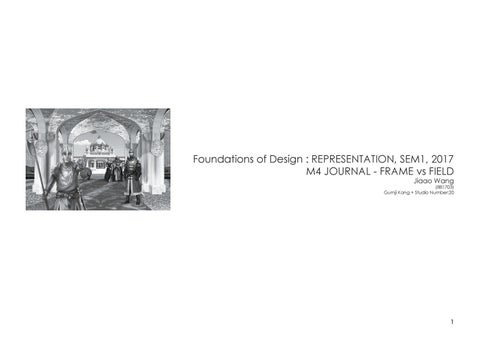
QUAD PERSPECTIVE 1 + 2 In this perspective, Marco Polo saw the prosperity of Olivia. I used a symmetrical perspective to show the scene in front of a filigree palace that was Marco Polo mentioned in the story.
In perspective 2, I wanted to express the scene of Marco Polo’s imagination. In this view, Marco Polo could imagine the poor people’s life. I planned to import a sitting woman, a beggar, and some rats on the ground, which were all short so the height of eyes from Marco Polo was adjested to be lower than the first perspective, to show more details on the ground.
6
PERSPECTIVE SCENE 1 + 2 The old quad was in front of a filigree palace and a large lawn. Marco Polo stood at the old quad and saw the palace in the distance.Also he came across a well-dressed noble (representing the wealthy people) who lived in the palace. He was wandering in the lawn with his wife, appreciating the peacock he raised. And then he was going to sit on the fringed cushion seats in quad for relaxation. There were many knights aound the noble, keeping him safe. Marco Polo was impressed by this prosperous scene until he realized this view was just a falsehood.Behind the wondeful scene, there was a giant contrast or gap between the wealthy and poor people, even filled with exploiting and bullying. he said “the city must not be confused with the words that describeit.” “Falsehood is never in word, it is in things.” In my opinion, Marco Polo realized that the extreme prosperity in Olivia must be based on unfairness. The wealthier nobles became, like what he saw in perspective 1, and the poorer normal people would be. So in perspective 2, I created an imagination scene of the poor people in Marco Polo’s brain. To show the poverty and the contrast to perspective 1, I made the ground totally dirty, without carpet. And the columns and roofs were filled with soot and grease. The backgrounds outside the quad were a shabby mill and some low houses. The poor people images were rendered by the mode called DIFFERENCE instead of MULTIPLY, to enlarge contrast to the noble. And two knights keeped these people away from the noble.
7
WEEK 4 READING: TITLE OF READING
Question 1: What is the difference between autographic and allographic practice? (Maximum 100 words) The main difference between autographic and allographicpractice is the the contact between the author and the art work. Like sculpture and painting, there is a direct contact between the art works and their authors. But allographic practice is reproducing the art works without direct contact, such as poems, music, and etc.
Question 2: Why do architects need new representational techniques? (Maximum 100 words) Traditional representation only can describe the stable and fixed objects but the wolrd today is filled with visible and invisible information, capital and subjects. It is not reducible to an artifact. So the architects in contemporary need new representational techniques that can describe time and change, shifting scales, mobile points of view, and multiple programs, to keep pace with the new world.
8
FINAL DRAWINGS Cities & signs 5: Olivia
Explanation for the axo drawing: After he got in the old quad, he stared at the front scene (perspective 1), which was prosperous, so his mood should be light.
Key Perspective1 Perspective2
There is a dash line for transition of time, linking perspective 1 and perspective 2, which means the time from he got perspective 1 to the time when he realized the prosperity he saw was based on exploiting and bullying. So in perspective 2, the imagination scene, his mood was very heavy.
Reality Imagination Light Mood Heavy Mood Transition of Time 0
1m
2.5m
5m
Movement Stare
Perspective 1
Perspective 2
Jiaao Wang, 881703
9