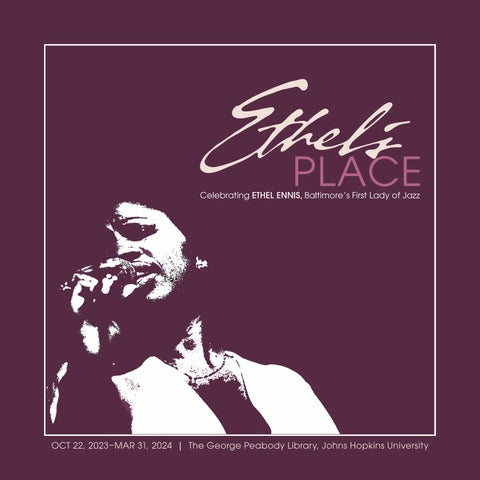
OCT 22, 2023 – MAR 31, 2024 | The George Peabody Library, Johns Hopkins University
Welcome to Ethel’s Place.
Devoted to Baltimore vocalist Ethel Ennis (1932 – 2019), this landmark exhibition explores each era of the singer’s remarkable life — including Ethel’s Place, the storied music club she owned with husband Earl Arnett. Featuring some 130 items drawn from the Johns Hopkins Sheridan Libraries’ Ethel Ennis and Earl Arnett Collection, the photographs, posters, unpublished written arrangements, audiovisual recordings, business records, and other materials on display trace how Ethel connected with local and international audiences through her artistry and personal philosophies, and consciously pioneered a musician’s career path deeply rooted in her hometown. Organized by the Sheridan Libraries in partnership with the Billie Holiday Center for Liberation Arts at the Krieger School of Arts and Sciences and the Jazz Studies Department at the Peabody Conservatory.
Photo © Sallie Kravetz
2
“Once you believe in yourself, can’t nobody beat you at what you want to do.” – Ethel Ennis
From West Baltimore to the World . . . and Back Again
Ethel Ennis, Arrabell Ennis, Andrew Ennis, Sr., Andrew Ennis, Jr., early 1940s, photo by E. Victor Wright.
Ethel Llewellyn Ennis was born to Andrew and Arrabell Ennis on the third floor of a North Calhoun Street rowhouse on November 28, 1932. Andrew Ennis worked for years as a barber, and Arrabell was a homemaker and church organist. Family life included a younger brother, Andrew Ennis, Jr., an aunt who was more like a sister, Charlotte Small, and Ennis’s maternal grandmother, Martha “Honey” Small. The family lived, worked, played, and worshipped in West Baltimore — residing for years at the Gilmor Homes in Sandtown-Winchester and attending services at Ames Memorial United Methodist Church on the corner of Baker Street and North Carey. Arrabell Ennis and Honey Small taught young Ethel to be a lady and equipped her to navigate a complex, segregated society. They encouraged disciplined study, required that she learn to sew and cook, and provided her with piano lessons beginning at age seven. Although she didn’t love piano lessons, they came in handy soon enough. At age 13, Ethel became the Sunday School accompanist at Ames. But she also absorbed a variety
of other musical experiences; many flavors of blues and jazz, recorded and live, were all around West Baltimore. Even though Honey disapproved of this “common” music, Ethel was drawn to it and started to perform as a pianist while a student at Frederick Douglass High School. Her first foray into the world of entertainment was with the all-male jazz group Riley’s Octet, led by Abraham Riley. One fateful evening, the band was offered a large tip to perform “Romance in the Dark,” a blues tune made popular by Lil Green. Ethel wasn’t accustomed to singing with the group, but she knew the song, having heard her downstairs neighbor play the record. Her enthusiastic rendering earned the tip for the group — and launched her career as a vocalist. Interested in other aspects of music making, Ethel co-wrote “Little Boy” with William Everhart from Dundalk; this song would later be covered by several artists across genres, sometimes with the title and lyrics altered to “Little Girl.” At age 17, she won a talent contest sponsored by the WAAM television station. She later performed with other local groups like the Tilters and the Jo Jo Jones Ensemble, and with local bassist Montell Poulson as a duo. Although she heeded the advice of her mother and 3
Hometown Sounds From work songs to the blues, ragtime to jazz, spirituals to gospel, not to mention classical, doo-wop, club music, and hip hop, Baltimore has always been a haven for African American musicians and music. By the 1930s, a musical landscape that included innovative artists, educators, business owners, and patrons was rich with opportunity for young talent — despite the strict segregationist policies that attempted to limit Black prospects and progress. In the Sandtown-Winchester neighborhood where she grew up, Ethel encountered many models of success to emulate. She attended schools named to honor African American creativity and achievement: Frances Ellen Harper Elementary (PS 111), Booker T. Washington Junior High School, (Old) Frederick Douglass High School, and the Cortez Peters Business School. She witnessed her mother’s skilled musicianship as a church organist; studied with pioneering music educator Lovey Husketh; and through her love of music, inspired her brother Andrew, proficient on both clarinet and tenor sax, who also became a professional musician. She was literally surrounded by Black music, with blues, jazz, and rhythm and blues recordings emanating from parties in the neighborhood, and live music wafting down from Pennsylvania Avenue. Ethel’s career as a performer began in church as a piano accompanist. Her first paid performances were on the outskirts of town or in Baltimore County, where age restrictions were less closely monitored. By the time she was 17, she was performing in small nightclubs like the Oasis on “The Block,” a stretch of East Baltimore Street known for its night life and adult entertainment; Club Orleans on Gay Street; and Pennsylvania Avenue notables Club Casino and the Red Fox Lounge. When Ethel declared Baltimore as her main base in the 1960s, she leveraged her renown to benefit local musical enterprises — especially, events that made music more accessible. She performed for a crowd of approximately 22,000 people at the first Baltimore City Fair at Hopkins Plaza in 1970, was a celebrated presence at AFRAM, the annual African American heritage festival that started in 1976, and headlined at the first Artscape outdoor arts festival in 1982, an event that she and Earl helped to plan. 4
“Why leave Baltimore? I’ve found happiness here . . . I have the strength to bloom where I was planted.”– Ethel Ennis
ABOVE, LEFT TO RIGHT:
Ethel performing on WAAM (Channel 13), August 1950, photo by O. Shattuck. Lullabys for Losers (1955), Jubilee Records, cover photo by Burt Goldblatt. Headshot © ATCO Records. PAGE 4, TOP TO BOTTOM:
Ethel with Louis Armstrong at Morgan State University, July 1958, photographer unknown. Ethel and Earl holding trophy given to Baltimore City from sister city Xiamen, China, September 1988, photo by C. B. Nieberding. Ethel at Artscape, Baltimore, circa 1980s, photo by James E. Lewis.
grandmother to consider a more reliable profession, graduating from Cortez Peters Business School in 1952, Ethel couldn’t resist the joy of music. Her regular appearances at the Red Fox Lounge on Pennsylvania Avenue and connection with the owner, George Fox, led to her first album Lullabys for Losers, released by Jubilee Records in 1955. In the 1950s, the path to a musical career for a beautiful young Black woman with a gorgeous voice was not broad or easy. Ethel spent months on the road, performing jazz standards in venues like the famed Apollo Theater in New York. She reaped the rewards of her dedication, recording two albums in two years on Capitol Records, A Change of Scenery (1957) and Have You Forgotten? (1958). But this life was also full of hazards. The repertoire
and the business demanded a compliant, sexy jazz singer stereotype — and Ethel was expected to conform. Perhaps in part to resist these pressures, she married rising-star Baltimore attorney Jacques Leeds in 1957, but it was an uneasy union that would last only a few years. 5
Ethel departs for Benny Goodman Orchestra tour, 1958, photographer unknown. PAGE 7: Ethel in a record-
ing studio, circa 1970s, photographer unknown.
6
For all of the magic worked by industry connections, it was the sheer force of her talent that got the attention of the celebrated Benny Goodman, bandleader and clarinetist, and Ethel joined his orchestra for their 1958 tour and World’s Fair performance in Brussels. The great fanfare and admiration with which she was received comes across in many write-ups of the tour in the local papers and in national publications like Ebony magazine. In the 1960s, Ethel’s prestige rose rapidly. She signed with well-known talent manager Gerard Purcell, who landed her a new multi-album contract with RCA Victor. In the span of two years, she
recorded four albums, This is Ethel Ennis (1964), Once Again... Ethel Ennis (1964), Eyes for You (1964), and My Kind of Waltz Time (1965). On these records, she gives superb renditions of big band jazz songs, Broadway tunes, and small group standards exactly in the style that commercial producers thought listeners wanted. But obedience to that model meant that she had little influence on song selection and arrangements. To promote the albums, she made the rounds of the national network television shows and gave a stellar performance at the Newport Jazz Festival in 1964. While they sold steadily, her RCA albums never produced a hit song.
7
Purcell and the label executives had their sights set on making Ethel a star, and that meant playing by the rules of “the game.” What did they think was “missing,” according to those rules? For some, the problem was her race or her physical features. For others, it was her refusal to give up everything else in life. To the dismay of the music business star machine, Ethel declined to alter her appearance, take every engagement, or attend all the parties where she could be seen by “the right people.” Realizing she did not want to “go against her grain for gain,” Ethel embarked on a journey of self-reflection. In 1967, Ethel Ennis married Baltimore Sun reporter Earl Arnett, a romantic partnership that was also deeply committed to the city they shared. She continued to perform and record — but now, on her own terms. She made regular appearances on Arthur Godfrey’s television show, lent her voice to local and national fundraising efforts, and put her pen to paper, writing new music. Her local work caught the eye of Republican politician and fellow Baltimorean Spiro Agnew, who had recently left the Governor’s office in Annapolis to join President Richard Nixon’s administration as Vice President. A long-time Ethel fan, he invited her to perform at the 1972 State Governor’s Ball with Frank Sinatra as the emcee. This invitation led to an even more prominent one: to perform the National Anthem at Nixon’s 1973 Presidential inauguration. Ethel, a lifelong Democrat, was initially hesitant to accept, but decided to use the opportunity to help heal the profound
8
American cultural and political divisions of the late 1960s and early 1970s. The team of Ethel and Earl was also busy with new musical ventures. They established their own Baltimore-based company, ENE Productions, through which they worked with songwriter Gladys Shelley to produce the eclectic album Ten Sides of Ethel Ennis (1973) — a chance for Ethel to sing rhythm & blues, soul, and playful pop instead of jazz standards and Broadway hits. In 1975, Ethel played the character “Ethel Earphone” in the Maryland Public Television pre-school program, Book, Look, and Listen. A partnership with the historic Maryland Inn in Annapolis yielded many years of regular performances and the album Ethel (Ethel Ennis Live at the Maryland Inn) (1980). The death of her beloved grandmother in 1977 was, for Ethel, a defining experience. Beyond the great grief, it confirmed for her the decision to live life on her own terms. Honey’s teachings formed the basis of what Ethel came to call “soft power”— listening to the inner voice to focus on what was artistically fulfilling and socially meaningful.
Ethel performing in Celebrity Flood Relief Telethon for Tropical Storm Agnes, 1972, photographer unknown.
9
A Cabaret in Midtown In the early 1980s, Ethel Ennis and Earl Arnett were poised to tackle a new venture — a performance space that would provide opportunities for Ethel and give local audiences access to musical talent across the spectrum. While researching possible venues, Earl connected with Philip Arnoult, founder of the Baltimore Theater Project, who suggested that his building — across the street from the Joseph Meyerhoff Symphony Hall in the Mount Royal district — might be ideal. So began the journey of Ethel’s Place. Ethel and Earl were not interested in creating a conventional nightclub. Rather, they wanted to build a meeting place where Baltimoreans from diverse backgrounds could come together for good food and great music. On New Year’s Eve, 1984, the doors opened for the first time. Upstairs, diners could enjoy classic Maryland fare and signature cocktails; downstairs, audiences could absorb top-notch performances in an intimate space. Ethel’s Place attracted visitors from up and down the East Coast who came to hear multigenre maestros like Wynton Marsalis and Charlie Byrd, as well as esteemed jazz vocalists like Betty Carter, Nancy Wilson, and Joe Williams. In 1985, Ethel’s Place hosted a New Year’s Eve program on PBS that was broadcast on stations around the country. Unfortunately, the venue struggled to generate enough capital to support its ambitious programming and was forced to close in 1988. Though short-lived, Ethel’s Place stands as a model for a creative city space where meaningful connections can be made through music.
10
“What I’d like to achieve in life is not for personal gain but to be me ... I consider myself happy, and I want to share this feeling.” – Ethel Ennis
LEFT TO RIGHT:
Ad for Ethel’s Place in Baltimore magazine, circa 1985. Ethel’s Place subscription brochure, 1987. BELOW: Ethel Ennis (1994), Hildner Productions, photo by Patrick Sandor.
In the 1980s, that “soft power” was expressed in an exciting and risky new enterprise: the launch of the cabaretrestaurant Ethel’s Place. Every element of Ethel’s Place reflected a community-oriented musical vision, from the headlining acts to the architectural design to the menu. The Ethel’s Place experience gave Ethel an expanded set of contacts and a renewed taste for experimentation. In the 1990s, she toured internationally, with trips to the Netherlands, Germany, and Turkey, and partnered with the Great American Music Ensemble on several performances at the John F. Kennedy Center in Washington, DC.
With longtime collaborators Paul Hildner and Marc Copland, she also recorded two unique projects — Ethel Ennis (1994) and If Women Ruled the World (1998), respectively. By the 2000s, Ethel was a seasoned professional — the recipient of many awards and a beloved local figure who was also an international ambassador of jazz. She released her last commercially available album featuring new music in 2005, based on a performance at the Montpelier Arts Center in Laurel, but kept on thrilling audiences into her 80s. As one of her fans said upon her passing on February 18, 2019, “With the death of Ethel Ennis, a big chunk of Baltimore’s heart has been lost as well.”
11
3
5
11
4
Ethel’s Baltimore
8. Piano teacher Studio of Lovey E. Husketh 425 N. Caroline St.
EARLY REFRAINS IN WEST BALTIMORE
FINDING HER VOICE IN THE CITY
19. Coppin State University 2500 W. North Ave. 20. Joseph Meyerhoff Symphony Hall 1212 Cathedral St.
1. Place of birth, 1932 Harlem Park, 525 N. Calhoun St.
9. Club Tijuana Pennsylvania Ave. and Clifton St.
2. Childhood home Gilmor Homes, 1619 Balmor Ct.
10. Red Fox Lounge Pennsylvania Ave. and Fulton St.
3. Elementary school Frances Ellen Harper School Carrollton Ave. and Riggs Ave.
11. McCulloh Delicatessen McCulloh St. and Wilson St. (post-performance dining)
23. An Die Musik 409 N. Charles St.
4. Junior high school Booker T. Washington Junior High School, McCulloh St. and Lafayette Ave.
12. Gamby’s Tavern 1502 –1504 Pennsylvania Ave.
24. AFRAM, 1980 Rash Field, Inner Harbor
13. Club Casino 1517 –1519 Pennsylvania Ave.
25. Baltimore City Fair, 1970 and others Hopkins Plz.
14. Club Orleans 715 N. Gay St.
26. Ethel’s Place, 1984 –1988 1225 Cathedral St.
6. Business school, 1950 – 1952 Cortez Peters Business School 1208 Eutaw Pl.
15. Sherrie’s Musical Bar and Lounge 3821 Pulaski Hwy.
27. Mondawmin Mall 2401 Liberty Heights Ave.
7. Family church Ames Memorial United Methodist Church, Baker St. and N. Carey St.
BECOMING BALTIMORE’S FIRST LADY
5. High school, Class of 1950 (Old) Frederick Douglass High School, Calhoun St. and Baker St.
7
12
18. Morgan State University 1700 E. Cold Spring Ln.
16. Fifth Regiment Armory 219 29th Division St. 17. Lyric Theater 140 W. Mt. Royal Ave.
21. Artscape, 1982 and others 1400 Cathedral St. 22. Creative Alliance 3134 Eastern Ave.
28. Johns Hopkins University 3400 N. Charles St. 29. Center Stage 700 N. Calvert St. 30. Sojourner-Douglass College 200 N. Central Ave.
10 18
28
9 14 27
PE N N
21 17 26
N IA
11
E.
7
V A
2
A LV
5
SY
19
10 9
13 3 SANDTOWNWINC HEST ER
1
4
16 6
14
20
12 23
29
15
8 30
25
22
24
13 13
First Lady of Jazz Over her lifetime, Ethel Ennis received numerous awards and accolades from organizations across the city and state. She was inducted into the Frederick Douglass High School Hall of Fame in 1973. Her long-time performing relationship with the United States Navy Band’s jazz ensemble, the Commodores, earned her honorary membership in the group in 1984. In recognition of her contributions to Baltimore, former Morgan State University president Earl S. Richardson declared April 17, 1985, “Ethel Ennis Day at MSU.” In 1996, she was inducted into the Maryland Women’s Hall of Fame. She received two honorary doctorates, one from the Maryland Institute College of Art in 1973 and the other from Johns Hopkins University in 2008. The Creative Alliance presented Ethel with a Lifetime Achievement Award at their 2013 Marquee Ball and she received a permanent star on the Maryland Public Television Walk of Fame in 2018.
“If I can wake up the people’s spirits, I’ll know my time on earth will have been worthwhile.” – Ethel Ennis ABOVE, LEFT TO RIGHT: Ethel in Druid Hill Park, Sunpapers, January 13, 1963, photo by Richard Stacks.
Ennis Anyone? (2005), Jazzmont Records, photo by Sallie Kravetz. PAGES 12 –13, ETHEL’S BALTIMORE MAP:
3. Frances Ellen Harper Elementary School, circa 1963. Maryland Department, Enoch Pratt Library. 4. Booker T. Washington Junior High School, circa 1948, photo by
14
Paul Henderson. Maryland Center for History and Culture. 5. Frederick Douglass High School, June 1952, photo by Paul Henderson. Maryland Center for History and Culture. 7. Ames Memorial United Methodist Church, circa 1948, photo by Paul Henderson. Maryland Center for History and Culture. 9. Tickets for events at Club Tijuana, 1960, Ennis/Arnett Collection.
10. Ethel performing in the Red Fox Lounge, Sepia magazine, December 1964, photo by Richard Sims. 11. McCulloh Delicatessen, April 1949, photo by Paul Henderson. Maryland Center for History and Culture. 13. Club Casino (?), circa August 1949, photo by Paul Henderson. Maryland Center for History and Culture.
14. Bus Green’s Band at Club Orleans, circa 1940s, photo by Geo W. Evans, Jr. Roy McCoy Photograph Collection, Arthur Friedheim Library. Colorized map artwork based on Welcome to Baltimore: Pictorial Map and Guide, by Baltimore: Edward A. Luzzie, published 1956. Sheridan Libraries. Artwork by Lisa Pupa, L Pupa Design.
Support for this exhibition and related programming has been provided in part by the Friends of the Johns Hopkins University Libraries, Inheritance Baltimore: Humanities and Arts Education for Black Liberation, and Robbye and Kevin Apperson.
Exhibition Curator
Special thanks to Earl Arnett for his generous encouragement, knowledge, and formative contributions to the Ethel Ennis and Earl Arnett Collection. Additional thanks to Jennie Chaplin, Jeneanne Collins, Charles Duggar, Andrew Ennis, Jr., Robert Ford, and Lonnie Liston Smith.
Gabrielle Dean, PhD, William Kurrelmeyer Curator of Rare Books and Manuscripts
Raynetta Wiggins Jackson, PhD, Curatorial Fellow for Africana Collections, Inheritance Baltimore Sheridan Libraries Tonika Berkley, Africana Archivist
Paul Espinosa, Curator, George Peabody Library Cameron Hanley, Digitization Specialist Jennifer Jarvis, Paper Conservator Laura McNulty, Conservation Fellow Mark Pollei, Joseph Ruzicka and Marie Ruzicka Feldmann Director of Conservation and Preservation Alessandro Scola, Senior Book Conservator Lena Warren, Book Conservator Inheritance Baltimore Brinae Ali, Performance Curator Jessica Douglas, Community Archives Fellow Xavier Walker, Community Archives Fellow Graphic Design Rodney Herring, Mosi Design Group Lisa Pupa, L Pupa Design
The extensive Ethel Ennis and Earl Arnett Collection documents the careers of Ethel Ennis (1932 – 2019) and Earl Arnett (b. 1940) through recordings, musical arrangements, photographs, artifacts, and other materials. For more information, please visit www.library.jhu.edu/collections/ IMAGE CREDIT: © Dean Alexander. Baltimore
magazine, 2011.
15
ETHEL LLEWELLYN ENNIS (1932 – 2019) possessed a luminous voice and a spirit that inspired audiences for almost seventy years. She was a captivating singer and performer, but she was also a songwriter, a dedicated community member, a sister, a wife, a friend, and an African American woman who pioneered her own path in the music business. From her hometown of Baltimore, Ethel crafted a life and career that centered love and personal expression over financial gain and celebrity acclaim. Drawing on the extensive Ethel Ennis and Earl Arnett Collection at the Johns Hopkins Sheridan Libraries, this exhibition celebrates the genius of Baltimore’s “First Lady of Jazz.” Through photographs, LPs, private audiovisual recordings, newspaper articles, books, posters, and numerous interviews, Ethel Ennis comes into view as a most unusual musical star — someone who invested her extraordinary talents in the place where she grew up, where she felt happiest, where she made music on her own terms, where she came home to, even after achieving conventional fame.
Baltimore was Ethel’s place. VISIT THE EXHIBITION
Oct 22, 2023 – Mar 31, 2024 The George Peabody Library 17 E. Mount Vernon Place Baltimore, Maryland 21202 Sunday, 11 AM to 5 PM Monday – Thursday, 10 AM to 5 PM For additional hours and holiday closures, please visit www.library.jhu.edu/gpl
JOIN THE CELEBRATION Opening reception Sunday, Oct 29, 4 – 6 PM
Featuring George “Doc” Manning, founding host of WEAA’s “In the Tradition” Vocalist Charénee Wade and the Peabody Jazz Ensemble For additional events at the Peabody Library and beyond, please visit www.library.jhu.edu/ethel-ennis
ABOVE: Photo © Dean Alexander. Baltimore
magazine, 2011.
© 2023 The Sheridan Libraries, Johns Hopkins University ISBN: 978-0-9979659-2-6 All rights reserved. Not intended for sale.
library.jhu.edu
FOLLOW THE SHERIDAN LIBRARIES @mselibrary, @jhugeorgepeabodylibrary @jhulibraries, @jhuspecialcollections @mselibrary