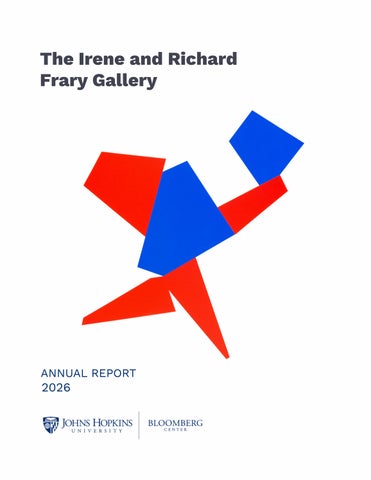
The Irene and Richard Frary Gallery
ANNUAL REPORT
2026
Cover image: Joel Shapiro, Toss-up, 2012 © 2026 Joel Shapiro/ Artists Rights Society (ARS), New York
Guests gather at the Irene and Richard Frary Gallery before GlobalWIN: Arts & Conversation on June 11, 2026.
TABLE OF CONTENTS Introduction
5
Exhibitions Ceremony October 29, 2025 - March 7, 2026 Artistic Generosity and the American Artist Abroad April 7 – June 13, 2026
9
Programming Art Truck Visitors
21
Marketing and Communications Digital Footprint Bloomberg Connects
25
Operations Student Engagement Staffing Facilities Security Budget
29
Looking Ahead Future Exhibitions Physical and Digital Archives Exhibition Committee
35
Conclusion
39
Appendices Ceremony Postcards Press Highlights List of Articles Articles in Full
41
INTRODUCTION In the two years since it opened, the Irene and Richard Frary Gallery at the Johns Hopkins University Bloomberg Center has assumed a prominence and significance —not only in the life of the Center but across the university—that is much greater than the Gallery’s thousand square feet might at first suggest. Building upon the foundational success of its inaugural year, the Frary Gallery’s second year of operation has yielded substantial growth and a thriving artistic program, establishing it as a hub for conversation and connection. In strikingly different ways, the two exhibitions described in this report extended the reach of the institution far beyond Washington, D.C., and Baltimore, demonstrating the prowess of the program and reflecting its ability to dive deep into new scholarship while elevating both emerging and canonically recognized artists. The Lindsay Adams show Ceremony prompted the university to participate, for the first time, in Art Basel Miami Beach. With Adams’ work represented at the fair, Johns Hopkins friends, trustees, alumni, and donors came together at a reception generously hosted by Chris and Pam Hoehn-Saric to celebrate Adams’ work, her exhibition at the Frary Gallery, and the arts at Johns Hopkins. The second exhibition, Artistic Generosity and the American Artist Abroad, presented in the spring in partnership with the Foundation for Art and Preservation in Embassies (FAPE), exemplifies the global reach of Johns Hopkins and was particularly salient in the geopolitical turbulence of our times. The show allowed us to attract many representatives of the diplomatic corps, as well as the arts community in Washington, D.C., to participate in programming that celebrated the importance of art and culture in bridging divides and to showcase Johns Hopkins’ scholarship and commitment to democracy. In conjunction with the exhibitions, related programming included artist talks, youth workshops, Peabody performances, and intimate luncheons with some of the art world’s most influential luminaries. Metrics reflect impressive growth across social media platforms and newsletter engagement, further cementing the crucial role of the Frary Gallery in arts and culture at the Hopkins Bloomberg Center, and across the university.
5
Looking ahead, the addition of a Frary Gallery Manager and expanded lead times to prepare exhibitions will allow the Gallery’s programming in fiscal year 2027 (July 2026 – June 2027) to be even more dynamic and reflective of its mission to encourage dialogue around art and democracy.
Lindsay Adams, Lotus Blossom (1968), 2025
Visitors explore Artistic Generosity and the American Artist Abroad, with Martin Puryear's Connecting (maquette) featured in the foreground.
7
EXHIBITIONS Ceremony October 29, 2025 – March 7, 2026
Ceremony: New Works by Lindsay Adams in Conversation with Objects from Johns Hopkins University Sheridan Libraries was curated by Claudia Watts, a researcher at the National Gallery of Art. The exhibition reflected upon histories of African American movement and mobility during the Jim Crow era through the work of D.C.-area native painter and writer Lindsay Adams. The show came at a pivotal moment in Adams' career, coinciding with the announcement of a commission for the Obama Presidential Center in Chicago. In this, her first solo show in Washington, D.C., Adams’ paintings were shown alongside pages from her personal notebook and historical objects primarily drawn from Special Collections at the Johns Hopkins Sheridan Libraries. Visitors were asked to think about how African American communities have refused to accept the spaces to which they have been confined and instead built their own— using ideas and social networks to take control of their lives during this especially difficult period in history, and through today. Together, art and archive celebrated and illuminated the ways in which African Americans have navigated their surroundings to cultivate spaces of safety, creativity, respite, and economic access. Accompanying programming included a performance by the Peabody Institute’s Graduate Jazz Ensemble, drawing inspiration from the central work of the exhibition: the large-scale diptych Kind of Blue (1959), inspired by jazz trumpeter Miles Davis’s seminal album. Additional programming included a soundscape curated by Sean Jones, the Richard and Elizabeth Case Chair of Jazz Studies at the Peabody Institute; a watercolor and journaling workshop led by Adams for 12 girls from Kramer Middle School in Washington, D.C.; and a panel conversation titled “In Living Memory,” exploring the importance of African American Archives with Adams, MacArthur Fellow and The New York Times best-selling author Jason Reynolds (who also lent a Langston Hughes postcard to the exhibition), and executive director of Afro Charities, Savannah Wood, moderated by curator Claudia Watts. The exhibition closed with a reception for friends and family in the Frary Gallery. Over the course of the exhibition, we welcomed over 2,000 visitors and special guests to the Gallery and led tours for several VIP and local groups. 9
Lindsay Adams, Kind of Blue (1959), 2024
Installation view of Ceremony, featuring Lindsay Adams' Solar Searching (right) and a vitrine containing items from the Special Collections at the Johns Hopkins Sheridan Libraries.
As part of the exhibition experience and in recognition of the way in which postcards sent from their travels captured the African American experience of moving through the country, visitors were invited to join the experience by contributing postcards of their own. One visitor left a note that said, “We went to war with Iran today, but I feel peace here.” This kind of intersection with global events reveals the essential role the Gallery can play as a place of both tranquil contemplation and critical thought. Thanks to a gift from Dan Weiss, director and CEO of the Philadelphia Art Museum, and former Distinguished Professor of Arts and Sciences at Johns Hopkins, and Senior Advisor to the Provost in the Office of the Arts, the university acquired the central painting in the exhibition, Kind of Blue (1959). The piece will be featured in the newly renovated Milton S. Eisenhower Library on the Homewood campus in Baltimore, set to open in the spring of 2027. The acquisition reinforces the university's commitment to elevate promising contemporary artists from the Baltimore and Washington, D.C., regions as part of its ongoing public art initiative. 11
Adams’ growing reputation as an artist of note and her presence at the Sean Kelly Gallery and PATRON Gallery booths at Art Basel Miami Beach in December 2025 inspired Johns Hopkins to host its first-ever event in conjunction with the fair. Pamela and Christopher Hoehn-Saric hosted a reception at their home where Weiss and Adams spoke about the impact and reach of the arts at Johns Hopkins. The following day, Weiss and Caitlin Berry, director of the Frary Gallery, led a tour of the fair.
Lindsay Adams works with a D.C. Kramer Middle School student during a painting workshop on Feb. 21, 2026.
Lindsay Adams, Where Can I Go to Frolic? (10), 2025
13
Artistic Generosity and the American Artist Abroad April 7 – June 13, 2026
For the spring show in the Frary Gallery. with an eye turned toward the 250th anniversary of the founding of the U.S., the Gallery partnered with the Foundation for Art and Preservation in Embassies (FAPE) to organize the exhibition Artistic Generosity and the American Artist Abroad. The show was curated by Jack Shear, FAPE board member and president of the Ellsworth Kelly Foundation and brought together works by celebrated American artists, drawn from FAPE’s collection and related works generously lent by institutions, foundations, galleries, and artists. We were able to secure our first significant loan from the Smithsonian Archives of American Art, which lent two photographs of Roy Lichtenstein’s mural in Mexico City and a preparatory drawing by Elyn Zimmerman for her monumental sculpture in Tunis. Through works from FAPE’s three core collections—Original Print, Photography, and Site-Specific—this exhibition honored the artists whose gifts and talent play a vital role in America’s soft diplomacy. Thanks to FAPE’s exceptional generosity, thousands of major works of American art enhance U.S. embassies, bridging cultures and fostering mutual understanding. Visitors to the exhibition experienced prints by American icons including Robert Rauschenberg and Sarah Sze, photographs by Carrie Mae Weems and Richard Benson, and extraordinary maquettes of monumental sculptures by Martin Puryear, Ellsworth Kelly, Joel Shapiro, and Frank Stella. The maquettes illustrated how commissioned artists collaborate with architects tasked with designing new embassies around the world to shape how American creativity is experienced in diplomatic settings. The prints and photographs are available to embassy personnel to curate their own collections, serving as a form of soft power and a conversation starter. The exhibition opened on April 21 with an intimate luncheon featuring a fireside chat between FAPE board member Darren Walker and curator Jack Shear on the power of art as a diplomatic tool. Many of FAPE’s board members and exhibiting artists were in attendance including, Jo Carole Lauder, Ann Gund, Don Gummer, and Naomi Antonakas, as well as the CEO of Christie’s, Bonnie Brennan, and curators and friends from the National Gallery of Art and other Washington, D.C., arts institutions. 15
Installation view of Avis Robinson's Eight Quilts in Artistic Generosity and the American Artist Abroad.
Carrie Mae Weems, Echoes for Marian, 2014.
Over the course of the exhibition’s ten-week run, we welcomed philanthropist David Rubenstein; student groups from the Department of Art as Applied to Medicine, the Peabody Institute Jazz and Hip Hop programs, and SAIS; the founder and CEO of the Brooklyn Rail and other journalists from the Washington City Paper and East City Art. The exhibition closed with a reception held jointly with FAPE and the Global Women’s Innovation Network (GlobalWIN),a bipartisan non-profit organization with the goal of connecting women in politics with women in innovation-driven fields. The evening featured a fireside chat between Cybele Bjorklund, executive director of the Hopkins Bloomberg Center, and Anne Helmreich, executive director of the Smithsonian Archives of American Art, moderated by BBC journalist Sumi Somaskanda. 17
Installation view featuring Frank Stella's The Symphony (1989) and Hanoi Star (2023) in Artistic Generosity and the American Artist Abroad.
Jack Shear, FAPE board member and president of the Ellsworth Kelly Foundation, and Darren Walker, FAPE vice president, participate in a conversation during the Artistic Generosity and the American Artist Abroad opening reception luncheon.
19
PROGRAMMING Art Truck
On July 11, 2026, the Gallery organized an intimate artist talk with Baltimore-based artist Edgar Reyes, one of the artists whose work had been included in last year’s exhibition Strong, Bright, Useful & True. The event was part of I’ll Meet You There, a city-wide public art project presented by two local arts organizations, Hamiltonian Artists and The Nicholson Project. Moderated by Harris Feinsod, the Ralph S. and Becky G. O’Connor Associate Professor of English at Johns Hopkins University, the conversation explored Reyes’ interdisciplinary practice and themes of migration, memory, identity, and belonging. The event continued the Gallery’s efforts to engage with artists previously exhibited there, and whose work forms part of the university’s art collection. The I’ll Meet You There project incorporates an art truck, which on this occasion was stationed outside the Hopkins Bloomberg Center and featured a video work by Reyes. The Washington, D.C., DowntownDC Business Improvement District, a private nonprofit place management organization that funds services that enhance people’s experiences in the downtown area, provided a tent and staff to support the event. Local artisanal ice-cream company Amano Real Fruit offered free popsicles to the approximately 35 guests who were present for the conversation. By extending programming beyond the Gallery walls and into the community, this program created an opportunity to strengthen partnerships with local arts and community organizations.
Guests enjoy popsicles beside the I'll Meet You There art truck.
21
Visitors
Despite the extended closure of the Gallery due to HVAC maintenance that shortened the spring exhibition, the Gallery welcomed over 3,500 guests in the past fiscal year (July 2025 to June 2026). In addition to its regular schedule, Gallery hours were often extended to allow visitors attending other gatherings in the building in the morning, evenings, and on weekends, to view exhibitions. In addition, we welcomed individuals who discovered the Gallery simply by walking by the building. One Yelp review from a visitor who found the Gallery in this way praised its accessibility—noting security staff were kind enough to swipe the visitor through to use the university's restrooms—small but telling evidence that the Gallery is drawing in casual, walk-up visitors alongside cultural insiders.
A visitor engages with works from Lindsay Adams' Where Can I Go to Frolic? Series (2025).
Frary Gallery director Caitlin Berry discusses Martin Puryear's Connecting (maquette) with students from the Department of Art as Applied to Medicine during a tour of Artistic Generosity and the American Artist Abroad.
23
MARKETING AND COMMUNICATIONS The Frary Gallery continues to lead communications and public outreach on arts and culture programming at the Hopkins Bloomberg Center. Through earned media outreach, newsletters, social media, and featured videos on our website, our communications and marketing team has highlighted the Gallery’s exhibitions, artists, and community engagement programs. An example is the promotion of Artistic Generosity and the American Artist Abroad, where our communications and marketing team produced and promoted a video interview with Hopkins faculty member Wendel Patrick, director of Hip Hop Studies at the Peabody Institute, sharing his response to a maquette of Martin Puryear's sculpture Connecting. In the video, Patrick reflects on the way his upbringing in a family posted overseas at U.S. embassies influenced his relationship with art. An ongoing artist interview series launched in May 2025 has included conversations with Jerrell Gibbs, Brandon Donahue-Shipp, Erin Fostel, Se Jong Cho, and Lindsay Adams and has earned more than 21,000 views and hundreds of engagements. To date, Frary Gallery content has generated more than half a million impressions across all social media platforms, garnering engagement from leading artists and arts institutions. The arts and culture newsletter, which is anchored by Frary Gallery content, has grown to 5,981 subscribers—a 71% increase from the previous fiscal year—with an open rate of 57.3% and click rate nearly double the industry standard. Digital Footprint
From August 2025 through July 2026, the Frary Gallery webpage sits in the top 10 most visited pages on the Hopkins Bloomberg Center website, ranking 7th overall. The majority of traffic to the page has come through a search engine (54%) and direct traffic (20%). The latter refers to people who directly typed the URL into the search bar or accessed it through a bookmark. The average daily visits to the Frary Gallery page since August 2025 is 16. Traffic to the Frary Gallery page peaked on February 4, 2026, with 273 page visits in one day, with the majority of traffic coming from the Johns Hopkins community. 25
Wendel Patrick, director of Hip-Hop Studies at the Peabody Institute, discusses Artistic Generosity and the American Artist Abroad in a Hopkins Bloomberg Center Instagram post.
Bloomberg Connects
Bloomberg Connects serves as a digital companion to the Frary Gallery, enabling both virtual exploration and enhanced onsite opportunities for visitors to engage with the art and exhibitions. This year, the app recorded more than 200 exhibit views across both current and past exhibitions, reflecting how engagement continues well after a show closes, including for Strong, Bright, Useful & True and Art and Graphic Design of the European Avant-Gardes. The app also hosts a standing page, About the Irene and Richard Frary Gallery, providing background on the Gallery and an audio overview of the arts and culture program at the Hopkins Bloomberg Center, voiced by Hopkins Bloomberg Center executive director Cybele Bjorklund. Current and recent exhibitions continue to benefit from rich digital content as well. For Ceremony, the app features a soundscape curated by Sean Jones, the
Richard and Elizabeth Case Chair of Jazz Studies at the Peabody Institute, now with 49 saves on Spotify, alongside a video tour of Lindsay's studio. For the Artistic Generosity and the American Artist Abroad exhibition, visitors can listen to a message from curator Jack Shear. FAPE generously provided much of the app content, offering rich background on the works featured in the show, including remarks from Don Gummer on his own work and from Evangelia Antonakos speaking about her father, artist Stephen Antonakos. This digital platform continues to allow the Gallery to share first-hand perspectives from its featured artists and curators, making exhibition content more accessible to a wider audience, and giving past exhibitions a continued life online, well beyond their closing dates.
Bloomberg Connects digital guide for Artistic Generosity and the American Artist Abroad, featuring interactive exhibition content and artwork highlights.
27
OPERATIONS Student Engagement
One of the Frary Gallery’s most rewarding achievements this year has been graduating its first class of student assistants and watching them carry forth the spirit of the Gallery into their professional lives—three of them had been with the gallery since we opened in 2024. The team of student assistants grew from three to nine to accommodate more demanding school schedules and second year internships. They greeted visitors, participated in the planning and installation of exhibitions, staffed related programs, and joined artist and curator guided tours. This note from graduating student Rafael I. Wexler illustrates the positive impact the Gallery is having on students during their time at Hopkins. Dear Caitlin, As I finish my master’s degree at the Johns Hopkins University School of Advanced International Studies, I wanted to write to thank you personally for giving me the opportunity to work as a Gallery assistant at the Irene and Richard Frary Gallery over the past two years. Working at the Gallery was one of the most special and memorable parts of my time at SAIS. I always looked forward to the time I spent there, whether helping prepare exhibitions, welcoming visitors, or simply being surrounded by the thoughtful programming you brought to the space. It provided a wonderful balance to my academic work and gave me a creative and reflective space during a very intense graduate experience. I’m especially grateful for your kindness and for the trust you placed in me as part of the Gallery team. You created such a warm and supportive environment, and it meant a lot to feel included in the Gallery’s work and community. I hope we can stay in touch, and I look forward to visiting the Gallery even after graduation. Since I will be remaining in D.C. for work, I will be sure to stop by and stay connected to the wonderful community you’ve built there. Thank you again for this opportunity and for everything I learned during my time working with you. It was truly a highlight of my experience at Johns Hopkins, and it is something I will always remember very fondly. With gratitude and very best wishes, Rafael Rafael I. Wexler Co-President, Jewish Students Association (JSA) Johns Hopkins University | School of Advanced International Studies M.A. in International Relations | Class of 2026
29
In addition to employing student assistants at the gallery, we collaborated with a class from the Johns Hopkins Advanced Academic Programs in Museum Studies, a graduate program that prepares working adults for museum and cultural heritage careers through applied, professional training. The 2025-2026 cohort visited the gallery for an in-person seminar in March 2026 and met with Caitlin Berry to discuss the mission and vision of the Gallery as well as some of its challenges, including the summer Gallery closure due to HVAC maintenance work. The students spent the remainder of their two weeks in D.C. visiting other arts and cultural institutions and developed proposals for ways in which the Frary Gallery could keep the idea of the space alive in the community during its HVAC upgrade closure. The experience was so positive that this partnership has been integrated into the curriculum, and the students will visit again in the spring of 2027 and imagine an exhibition in the gallery based on research in other locations. While these proposals are often not actionable due to other exhibition plans and timelines, this kind of interaction affords the students an opportunity to see behind the curtain of the operations of a gallery and think innovatively about potential activations and programs.
Crozier art handlers transport Avis Robinson's Eight Quilts during the deinstallation of Artistic Generosity and the American Artist Abroad.
Staffing
Perhaps the most consequential staffing development this year was hiring a Frary Gallery manager to work closely with the director on all exhibitions and programs related to the gallery and other arts and culture initiatives at the Hopkins Bloomberg Center. Ines Sanchez de Lozada, who previously served as the manager of the gallery at Bmore Art and earned an MA in Curatorial Practice from Maryland Institute College of Art was selected from a robust applicant pool of more than 200 candidates. She brings a unique understanding of both the university and community ecosystems through her work on the Hopkins acquisitions project in partnership with Bmore Art—the focus of the Gallery’s 2025 show, Strong, Bright, Useful & True. In her short time in the role, she has made a significant impact on the operations and workflow of the Gallery. Facilities
Since opening in 2024, the Frary Gallery has been monitoring the performance of its retrofitted HVAC system. After observing the system through two full years, it became clear that the extreme heat and cold typical of the D.C. area cause temperature and humidity levels to fall outside the ranges considered acceptable for artwork on loan from other institutions according to guidelines established by the American Alliance of Museums. These climate readings, recorded by specialized data loggers in the Gallery, are critical to the Standard Facilities Report that must be submitted alongside loan request letters to other institutions, and which must contain six months to one year of data depending on the requirements of the lender. This year we completed a facilities report which enabled us to secure two loans from the Archives of American Art for a relatively short, two-month period during the FAPE exhibition. However, more significant and longer-term loans would not be possible based on this data. For this reason, with financial support from building reserves, we launched a project to decouple the Gallery's HVAC system from that of the adjacent café to allow for tighter control of temperature and humidity levels. This work began in June and will conclude in September, in time to install the Gallery's fall exhibition. At the same time, we are exploring options to reinforce the ceiling to accommodate ceiling suspension for heavier works in future exhibitions. 31
Security
Given the increasingly high profile of the Gallery and the art within it, security remains a top priority for the Frary Gallery and the Hopkins Bloomberg Center. Security guards and engineers receive training specific to each exhibition. They are also trained and have the tools to remove security hardware from the display vitrines in the Gallery in the event that items need to be removed from the Gallery during an emergency. Six security cameras in the Gallery are monitored 24/7 by Hopkins security officers present in the building. In addition, student workers engage with guests and encourage them to comport themselves professionally in the space, respecting the art and other visitors.
Budget
The Gallery’s security, staffing, and facilities costs are met by institutional resources. The table below details expenditures related to the Gallery’s exhibitions. It does not include any full-time equivalent staff costs or expenses related to capital improvements. To ensure the excellence of the Gallery’s overall program, the university has invested over one million dollars to support personnel (Gallery director and Gallery manager) and the cost of overhauling the HVAC system to museum specifications. Also not included are the costs of the reception following the “In Living Memory” panel for Ceremony, which were covered by the university’s sesquicentennial celebration funds, and the costs of the closing reception for the FAPE exhibition, which were covered by the co-hosts, Global Women’s Innovation Network. CEREMONY: NEW WORKS BY LINDSAY ADAMS IN CONVERSATION WITH OBJECTS FROM JOHNS HOPKINS UNIVERSITY SHERIDAN LIBRARIES
Curator Fee + Travel Expenses Artist Honorarium + Travel Expenses Wall Demo + Construction Shipping + Installation Graphic Design + Printed Materials Programming + Receptions
$12,250 $6,381 $15,000 $19,590 $19,000 $23,898
TOTAL
$96,119
ARTISTIC GENEROSITY AND THE AMERICAN ARTIST ABROAD (FAPE)
Shipping + Installation Graphic Design + Printed Materials Programming + Receptions
$26,282 $13,155 $16,102
TOTAL
$55,539
OPERATIONAL COSTS
Student Workers Supplies and Materials
$6,000 $20,000
TOTAL
$26,000
GRAND TOTAL
$177,658
Note: The budget secured considerable savings on the cost of student workers thanks to the Federal Work Study financial aid program. 33
LOOKING AHEAD Future Exhibitions
Looking toward fall 2026, the Gallery has engaged Jeffrey Gibson's studio and Hauser & Wirth to bring the show A Real Love Thing, a jewel-box-sized survey of his work spanning sculpture, photography, prints, and beading, to the Frary Gallery. Gibson, of the Mississippi Band of Choctaw Indians and of Cherokee descent, is a multidisciplinary artist known for combining Indigenous and Western traditions across painting, installation, video, and performance. He was the first Indigenous artist with a solo exhibition at the American pavilion and represented the United States at the 2024 Venice Biennale. Drawing on abstraction and text-based work, the exhibition relays Gibson's message that beauty is a strategy and a manifestation of hope for the future and will highlight the essential role that compassion and wellness play in forging a healthy democracy. The exhibition will coincide with Gibson’s delivery of the Sam Gilliam Lecture at the Hopkins Bloomberg Center in November, and with events and programming at the Center marking the 35th anniversary of the Johns Hopkins Bloomberg School of Public Health’s Center for Indigenous Health. In spring 2027, Evelyn Hankins, former Chief Curator at the Hirshhorn Museum and Sculpture Garden, will curate an exhibition featuring Japanese-American artist Mika Tajima, whose sculptural, textile, and performance-based work draws on international political, social, and economic references and considers the relationship between humans and technology. Her work is held in public collections that include Los Angeles County Museum of Art, the San Francisco Museum of Modern Art, the Dallas Museum of Art, and the Hirshhorn Museum and Sculpture Garden. The second Frary Collection show curated by Philipp Penka, focusing on experimental photography and featuring material on loan from the JHU Archives and Special Collections, will follow in fall 2027. 35
2026-2028 Calendar
Fall 2026 Jeffrey Gibson Solo exhibition
Spring 2027 Mika Tajima Solo exhibition curated by Evelyn Hankins
Fall 2027 Photography from the Frary Collection curated by Philipp Penka
Spring 2028 JHU Newly Acquired works/sculptural group show
Fall 2028 Kate Capshaw Solo exhibition
Looking ahead to 2028, the Gallery may again work with the president’s office to exhibit new acquisitions to the university from Baltimore and D.C. based artists, reinforcing the university’s strong ties to the local creative community. In fall 2028 we are also exploring the possibility of a solo exhibition of portrait painter Kate Capshaw's work. Her portraits have drawn attention for their warmth, sensitivity, and attention to individual character, and her work has earned recognition through commissions at the Obama Presidential Center and the National Portrait Gallery. Her paintings have also been included in exhibitions at institutions such as the Pérez Art Museum Miami, further highlighting her growing prominence in the contemporary art world. Physical and Digital Archives
After two years of exhibitions, programs, and printed materials, the Gallery has begun working with Katie Carey, Hodson Curator of Johns Hopkins University Archives, to create both a digital and physical archive for the Gallery. This effort includes gathering materials such as catalogues, posters, important documents, visitor feedback forms, and anything that will articulate the most impactful points of the Gallery's history and legacy within the University. Exhibitions Committee
Since the Frary Gallery’s inception, there has been a desire to develop a small exhibitions committee to offer counsel on exhibitions and programs as well as provide and garner support for the Gallery from among their networks. Limitations on staffing prevented the Gallery from being able to manage a committee previously, but with the addition of a Frary Gallery manager, we plan to stand up the committee over the coming months, anticipating holding the inaugural meeting in spring 2027 and meeting twice annually.
37
CONCLUSION Taken together, the exhibitions, the programming, and the engagement with diverse audiences—ranging from local middle school to cultural leaders—all illustrate the Frary Gallery's value as something that extends beyond the traditional bounds of an art gallery. Exhibitions like Ceremony demonstrate the Gallery's ability to function as a space where art, scholarship, and community converge, drawing on expertise from across the university to spur discovery and dialogue. Artistic Generosity and the American Artist Abroad extended that reach outward, using art to underscore the university's role in international dialogue at a moment of national and institutional milestones. This reflects a broader conviction that democracy depends not only on facts and evidence to inform policy, but also on narratives that illuminate shared experience and help make sense of a complex world. This is why the Gallery, alongside Peabody performances, humanities events, and film series, is treated as a core tenet of the Hopkins Bloomberg Center’s democracy-focused programming. Positioned as one pillar of the Hopkins Bloomberg Center's mission to strengthen global democracy through discovery, education, dialogue, and public service, the Frary Gallery is ultimately a direct expression of the university’s civic role on Pennsylvania Avenue. We owe you both a great debt of gratitude for the vision and inspiration that made these accomplishments possible and the resulting impact we have had on individuals, communities, and institutions far beyond the walls of the university. Thank you.
39
APPENDIX A Ceremony Postcards Throughout the Ceremony exhibition, postcards embodied physical and conceptual modes of movement. Continuing this theme, visitors were invited to share their impressions of the exhibition on postcards provided in the gallery with the prompt "We hope you join the Ceremony and use these to share your thoughts and memories with us or loved ones."
41
APPENDIX B Press Highlights W Magazine featured Lindsay Adams in a studio visit profiling the artist at a pivotal moment in her career. The article highlighted Ceremony, curated by Claudia M. Watts, as Adams' first institutional solo exhibition. It emphasized the exhibition's integration of archival and ephemeral materials, developed through engagement with the Johns Hopkins Sheridan Libraries, to illuminate themes of Black migration, memory, and the interconnected histories of Black artistic and literary production. Washington City Paper included the Irene and Richard Frary Gallery in its weekly City Lights roundup of must-see arts experiences in Washington, D.C. The feature praised Ceremony, highlighting the dialogue between Adams’ paintings and archival materials from the Johns Hopkins Sheridan Libraries. The article noted how the exhibition connects themes of Black history, culture, and creative production through vibrant abstraction and historical ephemera. WAMU (88.5 FM) spotlighted Ceremony in a 3:55-minute radio feature that included commentary from arts reporter Darryl C.M., excerpts from his interview with Lindsay Adams, and selections from the exhibition soundscape curated by Sean Jones, the Richard and Elizabeth Case Chair of Jazz Studies at the Peabody Institute. Adams discussed Kind of Blue (1959), the first work she created at this scale, and how the process pushed her to create a more immersive experience inspired by the improvisational spirit of Miles Davis. The segment also highlighted the exhibition's more than 20 archival objects, including a Langston Hughes postcard loaned by Jason Reynolds, and positioned Ceremony as a unique opportunity to experience Adams' work in Washington, D.C., as her national profile continues to rise. 51st News featured Lindsay Adams in an interview that connected Ceremony to her deep roots in Washington, D.C., tracing her family's history in the city and the legacy of Black migration, self-determination, and cultural production that informs her practice. The article also included commentary from curator Jamal Gray, who underscored the importance of spaces like the Irene and Richard Frary Gallery in providing artists with opportunities to be seen, supported, and celebrated, reinforcing Washington, D.C.'s role as a vibrant center for contemporary artistic production.
43
Sugarcane Magazine published an in-depth feature on Ceremony, focusing on the collaboration between artist Lindsay Adams and curator Claudia M. Watts. The article examined Watts' curatorial approach to pairing contemporary artworks with historical materials to explore themes of movement, mobility, leisure, and Black cultural history. The feature also included installation photographs of the exhibition. East City Art published a comprehensive review of Artistic Generosity and the American Artist Abroad, situating the exhibition within the broader history of postwar cultural diplomacy, the Cold War, and the founding of the Foundation for Art and Preservation in Embassies (FAPE). The review highlighted how the exhibition illuminated the role of contemporary American art in fostering international dialogue and understanding. Featuring images and detailed discussions of at least nine individual artworks, the article offered readers an indepth look at key works in the exhibition while emphasizing the enduring importance of art as a tool of cultural exchange. Light Work Presents: Everything Is Connected, hosted by Folasade Ologundudu, featured a 31-minute conversation with artist Lindsay Adams and Frary Gallery director Caitlin Berry centered on Ceremony. The discussion explored Adams' research-driven practice and the influence of her background in international studies and anthropology on her approach to history, memory, and interconnected narratives. Berry reflected on her longstanding relationship with the artist and the collaborative curatorial vision, developed with guest curator Claudia M. Watts, that brought Adams' paintings into dialogue with archival materials while advancing the Frary Gallery's mission to foster conversation around art and democracy. See Great Art featured Artistic Generosity and the American Artist Abroad as an exploration of art's role in cultural diplomacy, highlighting the Foundation for Art and Preservation in Embassies' (FAPE) four decades of placing American art in U.S. embassies around the world. The article spotlighted works by artists including Martin Puryear, Sam Gilliam, Frank Stella, Joel Shapiro, and Carrie Mae Weems, and highlighted never-before-seen maquettes, photographs, and site-specific commissions. The feature emphasized how the exhibition demonstrated the power of art to foster international dialogue, mutual understanding, and cultural exchange.
Washington City Paper reviewed Artistic Generosity and the American Artist Abroad as a thoughtful and timely contribution to the national conversation surrounding the U.S.’s 250th anniversary. Rather than a celebratory or patriotic retrospective, the article highlighted the exhibition's exploration of cultural diplomacy and the ways American art has been used to foster international exchange through U.S. embassies. The review praised the exhibition's presentation of models, sketches, prints, and archival materials by artists including Martin Puryear, Carrie Mae Weems, Ellsworth Kelly, and Frank Stella, describing the exhibition as a "breath of fresh air" that reflected on how the U.S. aspires to be seen in an increasingly complex political moment. Antiques and The Arts Weekly featured Artistic Generosity and the American Artist Abroad, highlighting the exhibition's examination of how American art has been used to communicate ideas, values, and perspectives across national borders through diplomatic channels. The article emphasized the Frary Gallery's presentation of works from FAPE's collections as an opportunity for the public to engage with art typically encountered in embassy settings, while also underscoring the exhibition's focus on global exchange and the many international stories embedded within American art and artists' experiences. The Georgetowner placed the Irene and Richard Frary Gallery within the broader ecosystem of the Hopkins Bloomberg Center, highlighting how the Gallery complements the Center's mission of advancing dialogue, research, and public engagement. In a feature exploring the Center's arts programming, the article presented the Frary Gallery as a key cultural asset, noting its role in bringing museum-quality exhibitions into conversation with discussions of democracy, international exchange, and civic life. The coverage underscored how the Gallery enriches the Hopkins Bloomberg Center as a destination where the arts, scholarship, and public discourse intersect. Artsy profiled Lindsay Adams as a rising voice in contemporary abstraction, examining how her work engages themes of Black liberation, belonging, memory, and place. The feature highlighted Ceremony as Adams' first institutional solo exhibition and situated it alongside major career milestones, including her New York solo debut and commission for the Obama Presidential Center. Through an in-depth interview, Adams reflected on the intellectual foundations of her practice, drawing connections between history, Black geographies, and abstraction as a tool for imagining new possibilities and ways of being.
45
List of Articles Harper, D. S. (2025, September 19). Artist Lindsay Adams's paintings set liberation in motion. W Magazine. Rudig, S. (2025, November 7). Rocket and the road—the photographs of Brian Baker: City lights for Nov. 6–12. Washington City Paper. Murphy, D. (2025, December 4). Art, jazz, and history merge for Lindsay Adams' new exhibition, 'Ceremony'. WAMU. Akpan, E. (2025, December 11). Lindsay Adams is making art about Black migration and her D.C. roots. The 51st. Anodo, R. (2026, February 24). Lindsay Adams and Claudia M. Watts collaborate for Ceremony at the Irene and Richard Frary Gallery. Sugarcane. Rousseau, C. (2026, February 24). East City Art reviews: Artistic Generosity and the American Artist Abroad at Frary Gallery. East City Art. Ologundudu, F. (2026, March 1). Lindsay Adams & Caitlin Berry: in conversation with Folasade Ologundudu [Audio podcast episode]. In Everything Is Connected. Scott, C. (2026, March 24). Art as cultural diplomacy at Johns Hopkins University. See Great Art. Rudig, S. (2026, March 24). The Frary Gallery Explores American Idealism. Washington City Paper. Valluzzo, A. (2026, April 17). 'Artistic Generosity' explores cultural diplomacy via art. Antiques and the Arts Weekly. Selden, R. (2026, May 21). Orpheus concert, embassy art at Bloomberg Center. The Georgetowner. White, K. (2026, June 18). Rising artist Lindsay Adams captures Black liberation, wild abstraction. Artsy.
Artist Lindsay Adams’s Paintings Set Liberation in Motion By Daria Simone Harper | W Magazine | September 19, 2025
Photo by Lyndon French
“I think about the studio first as a sanctuary, as a laboratory, as a library,” the painter Lindsay Adams says. “I’m here to create and release, but I’m also here to learn.” On an unseasonably cool September day, I find the 34-year-old perched studiously at the desk in the middle of her Chicago art studio, working away on her laptop, surrounded by the many worlds she’s created through her works since she burst onto the art scene in 2022 with her debut solo exhibition Two Things Can Be True at Eaton DC.
47
The presentation featured her quiet and reflective portrait of Black women figures, still life, and floral oil paintings, establishing her singular voice as a painter. “I also think of the studio as a classroom and a study,” she adds of her practice. “Twenty minutes or 20 hours can both be equally important amounts of time in the space.” In the light-filled studio, Adams’s gestural strokes leap off of canvases featuring juicy golden yellows, and sumptuous reds. There are also greyscale drawings and works on paper with charcoal etchings that mimic the frenetic energy of improvisational jazz. This year, the artist became co-represented by Sean Kelly Gallery in Los Angeles and PATRON in Chicago. Her show Keep Your Wonder Moving at Sean Kelly ran from January 18 through March 8, 2025 and marked her West Coast debut, as well as her inaugural solo exhibition with the gallery. Widely praised, the show of 11 paintings epitomized Adams’ interrogation of abstraction in relation to imagination and personhood. Adams, who graduated from the School of the Art Institute of Chicago in May, says she wasn’t surprised by the fact that she evolved from representational to abstraction styles. “The thesis of my work has remained exactly the same,” she says. It has always been about her deep connection to understanding notions of space and freedom. On October 29, 2025, Adams will mount her first institutional solo show at the Irene and Richard Frary Gallery at the Johns Hopkins University Bloomberg Center in Washington, D.C. Ceremony, curated by Claudia M. Watts, features several of the artist’s paintings and works on paper. Those pieces will be presented alongside more than a dozen archival objects that contextualize threads of Black migration and mobility that emerge from Adams’s work. The inclusion of ephemeral material from both historical figures and undetermined individuals speaks to a crucial function of her practice: underscoring the interconnectedness of Black artistic and literary production, and liberation struggles. This dialogue with the archive is evident in the naming and conceptualization of much of Adams’s work, including her recent show all water has a perfect memory at PATRON. The title of the exhibition, which ran from April 10 through June 14, 2025, culled inspiration from Toni Morrison’s essay “The Site of Memory.” But that’s not the only major project she’s got on the horizon. In April 2025, Adams was commissioned to create a site-specific work to be installed at the forthcoming Obama Presidential Center in Chicago’s historic South Side neighborhood, joining a chorus of artists developing original works for the campus which will open to the public in 2026 (the artist commissions are curated by Virginia Shore, the curator of the Obama Presidential Center art commissions). Weary Blues, named after the famed Langston Hughes poem, exemplifies Adams’s commitment to working intentionally in a lineage of Black writers, scholars, and musicians.
“All of [my] work is not about joy. It’s about existing…and existing goes past that,” she says. “It comes with nuance and layers. Of course, there are moments of hope and transcendence, but there are also more sorrowful moments. This painting exists at the nexus of both.” The artwork—which will be translated from a 24 x 24-inch painting originally created in 2024 into silkscreen panels on fabric—is a stunning encapsulation of somberness that still manages to put forth gentle bright spots. In addition to the honor she feels contributing an installation to the Center, the artist expressed gratitude that the work will live in a place where people can come visit and spend time with it. The figures and floral-scapes Adams painted in years past, and certainly the abstractions she’s working on now, all stem from her persisting meditation on place and its connection to liberation. This prominent line of inquiry within Adams’ paintings is informed equally by her background in foreign relations, sociology, and cultural anthropology, as well as growing up in historic areas throughout Washington D.C. and Maryland. “I was always wanting to know what happened in a place. To know what existed, who existed. I always had a sense of presence,” she says. Adams received her Bachelor’s degree in International Studies and Spanish/LAIS (Latin and Iberian Studies) in 2012 from the University of Richmond in Virginia before pursuing her Master’s degree at SAIC. She received the New Artist Society Merit Award in 2023, and became a recipient of the Helen Frankenthaler Award in 2024. For Adams, the key to growth as an artist, scholar, and human is remembering that “legacy is impactful no matter the scale. The work is not just going to exist at the top of the monument. There’s being a monument and then there’s a movement.” Adams possesses an unwavering capacity to start conversation between constraint and possibility, dreaming and reality, and the seen and unseen. Her vision continues to make new meaning around what it means to exist limitlessly.
49
Rocket and the Road—The Photographs of Brian Baker: City Lights for Nov. 6–12 (Excerpt from full article) By Stephanie Rudig | Washington City Paper | November 7, 2025 Ongoing: Ceremony at the Irene and Richard Frary Gallery
The past and present collide in Ceremony, which primarily features paintings completed in the past year by D.C.-born artist Lindsay Adams. Exhibit curator Claudia M. Watts has selected archival objects from the Johns Hopkins Sheridan Library to complement the paintings, and these physical objects reinforce the musings on Black history and culture that reverberate through Adams’ work. The exhibit is anchored by the massive “Kind of Blue,” characteristic of the large scale that the artist is known for working in, but it is flanked on all sides by smaller pieces. Some are no bigger than record album sleeves, fitting for a display that takes inspiration and titles from Duke Ellington, Billie Holiday, and Miles Davis, and comes with a downloadable playlist. Adams’ paintings contain colors that seem to erupt and pulsate with life, and the edges show drips and splatters of color that have spilled over the borders as if their essence can’t be contained. Color serves as a connecting thread, with a postcard from Langston Hughes written in loopy green script (apparently his preferred color to write in) sitting beside “Errantry/Exodus,” a verdant painting with gestural lines. Pages from the artist’s journals hang on a wall, with some offering fragments of text that become titles, such as a series called “Where Can I Go Frolic?” These are spread throughout the gallery, each a gorgeous gem that evokes a vibrant imaginary topography and limitless landscapes. Ceremony runs through March 7 at the Irene and Richard Frary Gallery, 555 Pennsylvania Ave. NW. jhu.edu/arts-culture. Free. —Stephanie Rudig
Art, Jazz, and History Merge for Lindsay Adams' New Exhibition, 'Ceremony' By Darryl C. Murphy | WAMU | December 4, 2025
Artist Lindsay Adams. Photo Credit: Sloane Prince / Johns Hopkins University
Currently on display at the Johns Hopkins University Bloomberg Center in D.C. is a unique exhibition of work from artist and D.C. native Lindsay Adams. The show is called Ceremony and it incorporates Adam’s paintings with historic artifacts to offer a look at how Black people lived and defied social and structural limitations in the early to mid-20th century. The centerpiece of the show is titled Kind of Blue (1959) which refers to jazz legend Miles Davis’ album that pushed the boundaries of the genre. It’s Lindsay’s largest painting to date, totaling 6 feet by
51
14 feet and akin to its name, immerses the viewer in dominant layers of blue that allow flashes of hues of earthy red to pop. There’s also a painting called Lotus Blossom (1968) which refers to a jazz composition that was written by Billy Strayhorn and performed by D.C.’s own Duke Ellington. The painting looks floral and colorful with hues blooming out towards the frame. “There was this openness and this freedom that I was really letting in in a unique way that I know many expressionists have engaged with before,” says Adams. “But for me I was drawn to it in another way because I was like, ‘Oh, like jazz music was created in response to what was happening in the world.’ It was this creative refusal.” In addition to the artwork, exhibition curator Claudia M. Watts included more than 20 archival objects from the Johns Hopkins Sheridan Libraries that help to drive home the show’s theme. They include a handwritten travel itinerary from Billie Holiday and a postcard written by Langston Hughes that came from the collection of author and D.C. native Jason Reynolds. “I didn’t wanna just put things on the wall next to the artwork,” says Watts. “I wanted to be able to create some sort of connectivity to have a real conversation.” With jazz being such an integral part of the show, visitors can also listen to a playlist curated for the exhibition. Ceremony can be seen at the Johns Hopkins Bloomberg Center inside the Irene and Richard Frary Gallery through March 7. The gallery is free and open Tuesday through Friday from 11am to 6pm, and Saturday 11am to 5pm.
Lindsay Adams Is Making Art About Black Migration and Her D.C. Roots By Emma Akpan | The 51st | December 11, 2025 One fateful morning solidified Lindsay Adams’ deep appreciation of her hometown’s history and culture. As a pre-teen, she remembers her mother waking her up early to take a Black history bus tour, which stopped at local sites like the Mary McLeod Bethune Council House and the Carter G. Woodson house. The painter has deep roots in D.C. — her grandmother’s family has been here since the early 20th century — but before that day, she had never marveled at the city’s cultural history. Learning that Woodson had migrated from Virginia like her grandfather, she particularly reflected on how Southern Black transplants’ selfdetermination had shaped the culture of the city she knew. In the years since, Adams has paid closer attention to local architecture, stopping to read historic markers and research more about places like Alma Thomas’ Logan Circle home. “I look at things, both my work and the world around me, with a deep sense of empathy, of really wanting to understand what is happening around me,” says Adams. “I’ve always had the inexplicable desire to want to know and understand the history of a place.” Through her art, Adams focuses on geographic impermanence, the idea that no matter where you are in the world, you carry your roots with you. In “Ceremony,” her first institutional show, Adams explores the history of Black migration in the United States through ambitious, unrestrained abstract paintings. The exhibit is on display at the Irene and Richard Frary Gallery, near the U.S. Capitol, until March 7, 2026. Part of the John Hopkins University Bloomberg Center, the gallery’s exhibition is the first to feature a D.C. artist, pairing Adams’ new works with previously unseen objects from the archives of the university’s Sheridan Libraries. Adams holds the concept of “Ceremony” close to her heart. She left D.C. in 2022, and earlier this year, completed an MFA in painting and drawing at the School of the Art Institute of Chicago. She loves Chicago, she says — drawing parallels in the cities’ history and sense of community — but she credits her artistic formation to her upbringing in the District.
53
Growing up in D.C., she had access to dozens of museums, many of them for free. As a child and young adult, she loved visiting various Smithsonians and the Phillips Collection. She also took art classes and eventually attended the summer camp at the Corcoran School of Art and Design in 2000. Leaving her hometown showed her that “belonging is not rooted in geographical permanence, it comes from more of an ephemeral core and understanding the context,” Adams says — a guiding philosophy that bleeds through in her paintings. Her largest work in the show, Kind of Blue, is named for the 1959 Miles Davis album. The never-before-seen diptyque, replete with blue shades from deep sea to indigo and scatters of ochre, mimics the improvisation of Davis’ “All Blues.” The exhibit also includes paintings of flowers in saturated fuschias and greens, resembling lotuses and drawing the eye above and outside of the canvas. For “Ceremony,” Adams and curator Claudia Watts arranged these dreamlike paintings alongside archival materials that explore how Black Americans have created their own spaces through travel. It brings together documents such as the Green Book — a mid-20th century guide of safe spaces for African Americans driving through the South — and ephemera from trips to Europe, such as a letter Hazel Scott wrote to Billie Holiday from Cannes, France, and a 1954 Show magazine spread on Holiday’s successful European tour. The exhibit highlights how, despite racism’s hold on Black Americans’ opportunity, mobility has also been a source of power. As a rising star in the art world, Adams is often on the road. But the show at the Frary Gallery, along with work currently appearing in an exhibit at Hamiltonian Artists, have also given her reason to visit home. “There is conversation around whether D.C. is a good place for artists,” says Jamal Gray, a curator with Torrents, a project of CulturalDC focused on Black artistic innovation. He notes that the region can be a wonderful place for development, with grants from the DC Commission on Arts and the Maryland State Arts Council, but it often isn’t enough. “Artists have to go to New York, Los Angeles, or London to make a career in art making,” he explains. Gray has been part of efforts to change that, including the Umbrella Arts Fair, an annual fair run by USAN USAN. Adams (whom he asked to speak at this year’s fair) points to it as a place where D.C. artists are shown and supported, along with the Chela Mitchell Gallery, The Nicholson Project, and an artist residency in Southeast called Down Gallery, run by Maleke Glee and Quinci Baker.
With friends and peers keeping the heartbeat of the arts scene she grew up in, Adams will always be connected to the District. “Even though I’m not physically there, I’m there,” she says. “D.C. would never not continually be a part of my story. And I wouldn’t allow it not to be.” Correction: This article has been updated to reflect Adams’ current academic status, to remove incorrect information about an exhibition earlier this year in Los Angeles, and to correctly credit the team behind Down Gallery.
55
Lindsay Adams and Claudia M. Watts Collaborate for Ceremony at the Irene and Richard Frary Gallery By Rejoice Anodo | Sugarcane | February 24, 2026 The Irene and Richard Frary Gallery situated at the Johns Hopkins University Bloomberg Center in Washington, D.C. is named after Irene and Richard Frary, key players on the Hopkins’ advisory board. The gallery is currently managed by Inaugural Director of the Irene and Richard Frary Gallery Caitlin Berry, and started hosting exhibitions in 2024. As a public gallery with access to the university’s historical archives, it serves as the perfect spot to host Ceremony, displaying Lindsay Adams’ artworks alongside archival materials on African-American history, courtesy of the school’s Sheridan Libraries. The Washington, D.C., area is home to multiple museums and galleries that support the expression of Black art and African American history. Adams, a D.C. area native, admits that this has influenced her as an artist. “Growing up surrounded by so much cultural memory shaped how I understand place, history, and belonging, and being raised in a region rooted in movement and activism deepened my interest in liberation and imagination.” Adams became a full-time artist in 2022, though her personal journey as an artist began many years before then. She learned how to paint in high school. Encouraged by her teachers, she regularly participated in end-of-year exhibitions. She earned double degrees in International Studies and Spanish, with a minor in Studio Art, from the University of Richmond. Adams’ visual art comprises painting and drawing. Her abstract/monochromatic drawings are done with charcoal, ink, pen, graphite, and cold wax. The vivid burst of colors seen in her work is achieved with oil paint and oil pastels. She favors painting above other art media, followed closely by photography. Her artistic process is motivated by curiosity and the desire to explore ideas through color, gesture, and form. “Creating art allows me to move into spaces that language cannot always reach, and it gives me room to imagine and to push beyond what is familiar.” While creating, Adams favors a well-lit work environment. “Spaces with bright natural light, room to read and research, and enough surface area to lay out my palettes and materials. When I have that sense of clarity and openness, the work is able to unfold naturally.”
During her undergraduate studies, she developed a keen interest in history and anthropology, which strongly influenced her artistic voice. Over time, her visual representations of Black ancestral connections to land and place flourished with the use of flora and human figures. “As my work shifted toward abstraction,” Adams shared, “I realized that my interest in place was not only literal but psychological. My visual language grew. I became increasingly focused on imagination, expansion, and how far I could push color and line.” “In recent years, I have worked in parallel with research, studying collective histories, spatial refusal, and liberatory practice. I have continued to push color, gesture, and form in order to build worlds,” she added. She was introduced to the work of Black Washington artists Alma Thomas and Sam Gilliam of the Washington Color School during the early stages of her career, and it “opened my sense of what color, rhythm, and expansiveness could be, something that continues to move through my work.” Thomas and Gilliam, along with Monet, Jack Whitten, Howardena Pindell, and Helen Frankenthaler, are major influences of Adams’ art. Their approaches to color, material, and experimentation have shaped how she thinks about abstraction. She also draws inspiration from creatives outside the sphere of visual art. “I am guided by Black geographies, memory studies, and the historical research that grounds much of my practice. Literature is another major influence, especially writers who explore imagination, possibility, and the complexity of Black life. I also draw inspiration from the natural world, especially water and landscape, and from the quiet movements and gestures of everyday life that reveal how we inhabit place. All of these influences inform how I build color, line, and space in my work. Painting is also a form of meditation and release for me. It allows me to slow down, listen, and move through emotion and thought with intention, which keeps me connected to the core of my practice.” Speaking about Ceremony, Adams notes that it creates space for her to honor the gray areas in African-American history and hold Black memory with care. “The exhibition allows history to surface through color, gesture, and the archival fragments that move quietly through the work. Abstraction offers me latitude to imagine beyond what has been prescribed and to shape new ways of seeing and being.”
57
While Adams produced these stunning art pieces, Claudia Watts, the guest curator, ensured that the original copies of complementary archival history material from the Sheridan Libraries were displayed alongside them. Doing so provides visitors with an authentic viewing experience. These pieces were selected in accordance with Ceremony’s tripartite theme: travel (domestic and international), social mobility, and interiority and leisure, as experienced by the Black community. Watts started organizing small shows for friends in D.C. around 2016, though she did not consider herself a curator. “I knew I was on my way but not ready to give myself that title,” she said. However, she worked at the Anacostia Community Museum, part of the Smithsonian, where she met several curators she admired. From the Anacostia, where she worked on the museum’s revitalization project for two years, she transitioned into marketing, special projects, and strategic partnerships. Her career shifted in 2020, when she took on the role of Director of Culture at the Eaton Hotel in D.C. She met Adams at Eaton and curated her debut solo exhibition in 2022, titled Two Things Can Be True. They formed a close-knit friendship, with Watts describing Adams as “one of the most thoughtful human beings I know. Her work is rooted in deep research, and her studio practice is both rigorous and spiritual. She is empathetic and uses her intuition to excavate the nuances of life when others would rather skim the surface.” Watts’ remarks suggest that these qualities are reflected in her use of color and gesture. “I curated several small exhibitions and worked with the arts community to present programs in addition to other hotel-related responsibilities. Since 2017, I have also maintained a writing practice and continue to work as a freelance writer. In 2022, I decided to go back to school to get my MA in Art History. I graduated in 2024 and started working at the National Gallery of Art as a research assistant,” she added. According to Watts, Ceremony was inspired by two texts: Black Gathering: Art, Ecology, Ungiven Life by Sarah Jane Cervenak, and Sylvia Wynter’s essay The Ceremony Found: Towards the Autopoetic Turn/Overturn, Its Autonomy of Human Agency and Extraterritoriality of (Self-)Cognition, from which the title “Ceremony” was borrowed. “In Cervenak’s text, she uses various artworks and literary examples. Her framework seeks to dispel enlightenment ideologies that consign African American existence to perpetual ownership or an assumed givenness. Gathering, physically and conceptually, becomes an act not only of survival but of cultural preservation meant to withstand imposed forms of erasure. Essential to the reading are the ways in which community, in its many facets, can facilitate life beyond the
superstructures that inflict violence upon the other.” “In this sense, Ceremony is a fragmented collection of stories in which Adams’ canvases represent the gathering of ideas, moments, values, and desires. The archival materials are both symbols of the concepts with which Adams engages and remnants of real lives. Together they celebrate and illuminate the ways African Americans have navigated their surroundings in an effort to cultivate spaces of safety, creativity, respite, and economic access.” “Together,” says Watts, these stories, represented through archival objects and expressed with Adams’ painterly technique, demonstrate alternatives to a circumscribed identity and quality of life. They point toward a nascent consciousness of the intrinsic value we possess as people, despite any worldly restrictions or categorizations. It is in this spirit that we chose to invoke Sylvia Wynter’s essay The Ceremony Found: Towards the Autopoetic Turn/Overturn, Its Autonomy of Human Agency and Extraterritoriality of (Self-)Cognition.” “In this text, her words speak to the power of narrative and remind us that if certain mythologies exist to tell the world who we are, they also exist to keep us trapped within the status quo. For Wynter, the ceremony is where we find freedom by recognizing the many modes of human existence, bringing them into a nonhierarchical relation with one another, and remaking ourselves in that image. Our Ceremony offers entry into this line of thinking, the ideas and experiences presented are a testament to the transformative power of community,” she further explained. All the pieces exhibited at Ceremony are interconnected, embodying a multifaceted activist narrative of the Black experience, from entertainment and travel to interpersonal experiences. Watts provides illustrations based on the exhibited pieces to buttress this point. “When we think about Langston Hughes’ autobiography The Big Sea, he is traveling to find greater opportunity than what has been allowed in the United States.” “Another example is the impact the automobile had on Black life,” directing viewers to a studio portrait of a family posing in a car, as a fitting example. “It afforded greater opportunities for interpersonal connectivity and space for other communitydriven innovations because people could see their friends and family more often without the perils associated with walking down a dark back road, crossing through an unwelcoming neighborhood, riding on a dirty car, or being humiliated in a myriad of ways while on public transportation. Through abstraction, Lindsay’s work acknowledges this past while inviting people to reimagine the world around them.”
59
Watts selected the exhibited pieces after conversing with Adams about her creative process. Drawing on her personal observations of the artist’s studio practice, she developed a unifying theme that formed the basis of the show. She carried out subsequent research in the Sheridan Libraries Special Collection and was able to gather the necessary historical materials paired with Adams’ works. Based on her findings and eventual curation, the curator identified the show’s themes as movement and mobility, and their impact on the behavior of African Americans throughout history, with their refusal to accept allotted spaces, and crafting new spaces to dwell in. “Lindsay’s paintings embody this ethos while the archival objects represent these themes in the real lives of people, both those who were well known and those who remain unknown.” Kind of Blue (1959), named after African-American jazz artist Miles Davis, reflects Adams’ reverence for music with Black origins, for which she often names her paintings. She also seeks to embody the Black expatriate experience during the Jim Crow era. Solar Searching, a brilliant combination of reds, greens, and yellows, is paired with Billie Holiday’s travel itinerary and some postcards. Errantry/Exodus is reminiscent of the green ink Langston Hughes used for his signature, and serves as a response to his debut autobiographical novel, The Big Sea. Lotus Blossom (1968), named after Billy Strayhorn’s composition, which gained popularity after Duke Ellington’s performance, is paired with ephemera from some influential Black organizations, like the Improved Benevolent and Protective Order of the Elks of the World. Where can I go to frolic? a set of paintings noticeably smaller than other paintings resonates with the theme of leisure, a concept that was alienated from the Black experience during the Jim Crow era. These paintings, evocative of longing, are paired with postcards that allude to the same fact. Some paintings, deliberately left untitled and named as such, encourage individuality among viewers. Pictures of Adams’ notes, framed and placed alongside these pieces, invite gallery visitors to view the world as she does. So far, Adams’ latest exhibition has garnered significant recognition since its opening at the Hopkins Bloomberg Center from the D.C. art community. The archival materials, postcards, and telegrams were also made to create an interactive experience for visitors. The exhibition’s playlist, curated by Sean Jones, the Richard and Elizabeth Case Chair in Jazz Studies at the Peabody Institute of The Johns Hopkins University , consists of music from artists referenced in the exhibition, like Billie Holiday and Miles Davis, among others. Ceremony will be on display at the Irene and Richard Frary Gallery until March 7, 2026.
Lindsay Adams & Caitlin Berry: In Conversation with Folasade Ologundudu (Audio podcast episode) By Folasade Ologundudu | Everything Is Connected (Spotify) | March 1, 2026
On this episode I’m joined by Lindsay Adams and Caitlin Berry as we discuss Lindsay's latest exhibition at the Irene and Richard Frary Gallery at the Johns Hopkins University Bloomberg Center. Ceremony brings newly created paintings and drawings into conversation with archival materials and previously unseen ephemera from Johns Hopkins special collections. Lindsay reflects on how her background in international studies and anthropology shapes a multi-lens approach and attention to interconnected histories. Caitlin describes building a relationship with Adams over several years, Adams’ research-driven practice, and how guest curator Claudia Watts helped merge new paintings with library archives to support the gallery’s mission of dialogue around art and democracy. Ceremony is on view at the Irene and Richard Frary Gallery at the Johns Hopkins University Bloomberg Center through March 7, 2026.
61
Art as Cultural Diplomacy at Johns Hopkins University By Chadd Scott | See Great Art | April 2, 2026
Martin Puryear (American, 1941), 'Connecting' maquette, 2016. Stainless steel, wood, paint, 50 x 68¼ x 68 ¼ inches. Courtesy of the artist. © 2026 Martin Puryear, Photo: Ron Amstutz
This spring, Sam Gilliam, Ellsworth Kelly, Martin Puryear, Carrie Mae Weems, and other leading artists who have played a vital role in our nation’s cultural diplomacy efforts are among the artists represented in “Artistic Generosity and the American Artist Abroad” at the Irene and Richard Frary Gallery at the Johns Hopkins University Bloomberg Center in Washington, D.C. On view from April 7–June 13, 2026, the exhibition reflects four decades of artistic exchange through the efforts of the Foundation for Art and Preservation in Embassies (FAPE), a nonprofit, nonpartisan foundation providing permanent works of American art for U.S. embassies around the world.
“Artistic Generosity and the American Artist Abroad” features site-specific commissions, original prints, and photographs from FAPE’s collection, bringing together nearly 25 preeminent American artists across generations. The exhibition will present never-before-seen maquettes of Don Gummer’s Frontier for the U.S. Embassy in Moscow, Russia; and Frank Stella’s Hanoi Star for the new U.S. Embassy in Hanoi, Vietnam, which was the last public work the artist made before his death; as well as photographs of Roy Lichtenstein’s original installation of the Greene Street Mural from the Leo Castelli Gallery records at the Archives of American Art, Smithsonian Institution. Additionally, the exhibition will feature Sam Gilliam’s Cerebral (2022), a tondo on loan from the Sam Gilliam Foundation from the same period and in the same style as the large-scale painting Beautiful Man, acquired by FAPE for the lobby of the U.S. Department of State in 2022. The loan furthers the Center’s partnership with the Gilliam Foundation, which includes the commission of a site-specific work by the artist for the building’s atrium and an ongoing, sponsored artist lecture series. “As we mark FAPE’s 40th year of operations and our country’s 250th anniversary this year, we are pleased to open the doors to our program beyond diplomatic spaces and into classrooms, museums, and communities throughout the United States,” said Jack Shear, curator, FAPE board member, and president of the Ellsworth Kelly Foundation. “We are proud to celebrate the visionary artists whose generosity and talent are at the heart of our mission. Thanks to their exceptional support, thousands of major works of American art enhance U.S. embassies around the world, serving as silent ambassadors, bridging cultures, and fostering mutual understanding.” Other artists in FAPE’s collection include Stephen Antonakos, John Baldessari, Dawoud Bey, Ron Gorchov, Carmen Herrera, Rashid Johnson, Ilya and Emilia Kabakov, Sol LeWitt, Glenn Ligon, Elizabeth Murray, Odili Donald Odita, Robert Rauschenberg, Avis Collins Robinson, James Rosenquist, Ed Ruscha, Joel Shapiro, Cindy Sherman, Sarah Sze, Stanley Whitney, and Elyn Zimmerman. “Artists play a significant role in international dialogue,” said Caitlin Berry, director of the Irene and Richard Frary Gallery. “The exhibition considers how these works communicate meaning abroad, bringing together artists with a broad range of perspectives and means of expression. Collaborating with FAPE allows Frary Gallery visitors to experience American art as it is encountered beyond U.S. borders and reflects Johns Hopkins’ commitment to promoting global exchange of ideas and research.”
63
Drawing upon FAPE’s three core collections—Site-Specific, Original Print, and Photography—the exhibition traces FAPE’s history from its earliest site-specific projects, such as Joel Shapiro’s 40-foothigh Conjunction at the U.S. Embassy in Ottawa, Canada, to landmark installations like Martin Puryear’s Connecting at the U.S. Embassy in Beijing, China. The selection also highlights artists whose biographies reflect the global dimensions of American art, from Ellsworth Kelly, a World War II veteran who studied in Paris under the GI Bill, to first-generation American artists, such as Sarah Sze, and artists born abroad who now call the United States home. Additionally, in recognition of the 250th anniversary of the United States, a replica of the 1823 William J. Stone engraving of the Declaration of Independence, a gift from David M. Rubenstein, one for each embassy, will also be on view. “This exhibition highlights our efforts to explore art’s role in shaping society here and abroad,” said Cybele Bjorklund, executive director of the Hopkins Bloomberg Center. “At a moment when the United States marks its 250th anniversary and Johns Hopkins celebrates its sesquicentennial, the FAPE show underscores the importance of cultural diplomacy as an essential tool and calls out the critical role that art and artists play in advancing a dynamic, democratic, and open society.” “Artistic Generosity and the American Artist Abroad” is the fourth exhibition at the Irene and Richard Frary Gallery, which was inaugurated in October 2024. Reservations are requested, and admission to the gallery is free and open to the public. About the Foundation for Art and Preservation in Embassies The Foundation for Art and Preservation in Embassies (FAPE) is a nonprofit, non-partisan foundation dedicated to providing permanent works of American art for U.S. embassies around the world. For 40 years, FAPE has partnered with American artists whose works encourage cross-cultural understanding within the diplomatic community and the international public. All artworks commissioned or placed by FAPE are gifts, representing the generosity and patriotism of some of the United States’ greatest artists and donors. FAPE has raised more than $215 million in art and monetary contributions and works by more than 280 preeminent artists have been placed in over 140 countries. For more information, visit https://www.fapeculturaldipl.
'Artistic Generosity' Explores Cultural Diplomacy via Art By Andrea Valluzzo | Antiques and the Arts Weekly | April 17, 2026 | Print
65
The Frary Gallery Explores American Idealism By Stephanie Rudig | Washington City Paper | April 21, 2026
In Artistic Generosity and the American Artist Abroad, art created for diplomatic exchange proves to be more adept than our present international relations. Image Caption: Carrie Mae Weems (American, 1953), “Echoes For Marian,” 2014. Digital C-print, 71 ½ x 59 ½ inches. Gift of the artist with additional funding provided by Bank of America to the Foundation for Art and Preservation in Embassies Photography Collection © 2026 Carrie Mae Weems, Courtesy of the artist and Jack Shainman Gallery, NY The Foundation for Art and Preservation in Embassies is a public-private partnership with the State Department that commissions art for, or gifts art to, U.S. embassies around the globe. Artistic Generosity and the American Artist Abroad at the Irene and Richard Frary Gallery features prints from FAPE’s extensive collection, as well as models, draft sketches, and photo documentation for site-specific installations that would require an international flight to see in real life.
“The works, and FAPE’s commissioned pieces in particular, are designed to serve as a mood setter and backdrop to diplomatic meetings within the country’s embassies. Artistic Generosity and the American Artist Abroad, running through June 13, presents an aspirational vision of America, as well as situating the country itself as a work in progress, something that must be prototyped, constructed, and revised. The exhibit is one of many commemorations for the 250th anniversary of the signing of the Declaration of Independence happening this year, and it’s more meditative and thought-provoking than many of other, seemingly rah-rah, flag-waving events promise to be. As gifts to other nations, the works represent the United States as it wishes to be seen, or the ideals the country champions but often fails to live up to. In bringing together 25 American artists from FAPE’s collection, the show forms a microcosm of the global reach and influence of American artists and serves as a reminder of this country’s greatest export—its art. The preparatory works featured in Artistic Generosity are intriguing on their own, showing in many cases how prominent artists have thought through a particular setting or diplomatic relationship. Visitors are immediately greeted by a meticulous scale model of Martin Puryear’s sweeping metal arch that stands outside of the U.S. Embassy in Beijing, each tile of the stonework design lovingly rendered. Ellsworth Kelly was tapped to do an installation for the same embassy, and a model displays his color-blocked wall hangings back-to-back—one in red and yellow for China, the other in red and blue for the U.S. (The show is curated by Kelly’s widower and FAPE board member Jack Shear.) Behind Kelly’s work hangs several pieces that lean explicitly into Americana imagery. Photographer Carrie Mae Weems pays tribute to Black singer Marian Anderson, who performed on the steps of the Lincoln Memorial after being barred from singing at the Daughters of the American Revolution Constitution Hall in 1939. Weems’ selfportrait depicts the artist on the steps, back to the camera. A lithograph by James Rosenquist shows a kaleidoscopic refraction of the Stars and Stripes, and print by Ed Ruscha features an institutional column backed by streaks of red, white, and blue—both invoke the gleaming ideal of American industry and innovation. Despite the small size of the gallery, interesting pairings and conversations are set up among the works. Side-by-side water photographs present the American landscape as serene and placid (a view of the shoreline in Provincetown, Massachusetts, by Joel Meyerowitz) as well as wild and formidable (the crashing waves of “Hurricane” by Clifford Ross). A nook of the gallery is dedicated to works by Frank Stella, with a large-scale lithograph/screen print and a model of his sculpture of two interlocking stars inspired by the Vietnamese flag, set to be 67
installed in Hanoi in 2030. These face toward preparatory sketches for Sol LeWitt’s wall drawings, including a mural that features two radiating stars, for which the artist wrote detailed installation instructions to be carried out by others. Artifacts and archives of American life abound, most notably in a huge array of assemblages by Greek American artist Stephen Antonakos. Ephemera collected on Antonakos’ global travels has been catalogued by country; a series from his visits to Greece are hung here, featuring miniature soaps, maps, receipts, and wrappers. Avis Collins Robinson, who made textile hangings that function more like paintings, was commissioned to make a series of quilts for the U.S. embassy in Hanoi. Though she died in 2023 before the works were finished, her husband is overseeing their completion, with installation expected in 2030; one of her finished works hangs here. Next to the gallery entrance hangs a replica of the Declaration of Independence, laboriously created from an etching made between 1820 and 1823 by engraver William J. Stone, who was commissioned by President John Quincy Adams to make the facsimile because it was feared that the original document would deteriorate. Currently, it’s next to impossible to look at the various commemorations for America’s 250th anniversary such as this exhibit and not think about the ongoing warmongering, isolationism, and deterioration of diplomacy taking place just blocks away from the gallery. Though a display of such diplomacy feels almost like a relic, it’s a breath of fresh air to see these statecraft and cross-cultural connections that remain permanent gifts. Artistic Generosity and the American Artist Abroad runs through June 13 at the Irene and Richard Frary Gallery. Tuesday through Friday 11 a.m. to 6 p.m.; Saturday 11 a.m. to 5 p.m. washingtondc.jhu.edu. Free.
East City Art Reviews: Artistic Generosity and the American Artist Abroad at Frary Gallery By Claudia Rousseau | East City Art | May 14, 2026 In the decade or so following the end of World War II, Americans were tremendously buoyed by their victory in the war, a victory that had saved Europe from the Nazi regime and gave the comparatively young nation a new sense of itself. What can only be described as a widespread surge of patriotism in the country became evident in every aspect of society, including the arts. It can be seen in every medium, from the visual arts to dance, music—even nascent television. American themes and imagery were increasingly popular, while artists looked for specifically American sources for their work, including in American Indian arts and culture. The latter would culminate in the exhibition Indian Art of the United States at the New York Museum of Modern Art (MoMA) in 1949 that deeply affected the work of many.[1] It became increasingly important to find ways to project the cultural excellence of the United States overseas that was flourishing in its democratic system of government—of particular significance in countering Soviet propaganda during the Cold War. In August 1953 President Eisenhower established the United States Information Agency (USIA) with the mission of “telling America’s story.” Known as USIS (US Information Service) abroad, until 1999 the agency had offices in our embassies around the world, handling cultural exchanges of all kinds, libraries and media.[2] Also in 1953, MoMA formed an International Council to manage exhibitions of American visual art around the world. Ten years later this initiative would be formalized as the “Art in Embassies Program” at the Department of State that still operates today, creating rotating exhibitions of modern and contemporary art. [3] Finally, in 1986, four women came together to establish the Foundation for Art and Preservation in Embassies (FAPE). Their goal was, and is, to continue and increase the use of art in diplomacy, reflecting the ongoing belief that the visual arts are the best representation of American cultural attainment abroad. [4] Curated by Jack Shear, widower of Ellsworth Kelly, in collaboration with the staff of the Johns Hopkins University Bloomberg Center in Washington DC and many loaning participants, the exhibition Artistic Generosity and the American Artist Abroad is currently on view in the Frary Gallery at the Center. It is a fascinating
69
window on the activities of FAPE in bringing American art to US embassies around the world. FAPE is a private/public partnership with “Art in Embassies,” but commissions artists to create or receives works of art in painting, sculpture, prints and photographs for permanent installation in embassies as gifts, “serving as silent ambassadors, bridging cultures and fostering mutual understanding.”[5] In a time when there is so much division, suspicion and uncertainty, this sensitively installed exhibit recalls the importance of cultural diplomacy on the world stage. Entering the Gallery, the viewer is met with a large platform on which is a model made by Martin Puryear in 2016 of his 31 foot-high stainless steel sculpture, Connecting, commissioned by FAPE as a gift for the new US Embassy in Beijing. Installed in 2018, the arch is high enough to be seen by the public outside the Embassy compound. The shape of the arch, sweeping through space but grounded at each end, recalls the curves of Puryear’s line drawings, or the silhouette of his wood sculptures. His carved wooden figure was placed on the platform providing an idea of the scale of the actual work, and representing the Beijing public considering it. Not surprisingly, a number of works in the show have a color scheme of red, white and blue. Behind Puryear’s model (see the photo above) are four works, three (from left to right) are Ed Ruscha’s lithograph Column with Speed Lines (2003), James Rosenquist’s lithograph Stars and Stripes at the Speed of Light (2000) and Tina Barney’s photo Color Guard (2007) featuring three children in costume holding American flags. In between these are two black and white photos. On the left is Richard Benson’s exquisite 1972 (2013) framing of a portion of The Shaw Monument in the National Gallery of Art. The relief, by Augustus SaintGaudens, memorialized the 54th Massachusetts Volunteer Infantry Regiment, the first comprised of African Americans, commanded by Col. Robert Shaw in the Battle of Fort Wagner in 1863. His photo captures the sense of the sculpture, described as expressing “the ultimate unity of Black and White America.”[6] On the right is Carrie Mae Weems stunning 2014 photo Echoes For Marian acquired by FAPE for the Department of State. A tall Black woman in a black dress stands dramatically silhouetted on the steps of the Lincoln Memorial. The image and the title allude to Marian Anderson, the Black opera singer, who, denied performance at the DAR auditorium in 1939, sang on the steps of the Lincoln Memorial to over 75,000 people. Weems has made a series of prints related to Benson’s photo in a new installation at the National Gallery.[7]
To the left of this complex is Joel Grey’s large and evocative photograph The Statue of Liberty. The photographer is the same Joel Grey everyone knows as the Master of Ceremonies in Cabaret, a multitalented artist who compared photography to the theater, saying: [It’s] sort of like the stage—quick moments of a life that are gone the minute you take your own eyes away and the curtain comes down. The photo shows the famous monument in deep fog, seemingly isolated on the water as though its pedestal were floating. It was probably taken from the Staten Island ferry moving either toward the statue or moving away from it. Fittingly, perhaps in memory of the many Irish immigrants, it was gifted to the American Consulate in Belfast, and again in 2023 to our embassy in Ottawa, Canada. To the right is Ellsworth Kelly’s maquette for his Beijing Panels commissioned by FAPE for the new US Embassy in China in 2003. Made in that year is a model for the 18 foot high wall sculpture he designed including panels of red, white and blue to represent the United States. An opening permits viewing on the other side were Kelly made a similar arrangement in red and yellow, representing China. The simple design is elegant, controlled and understated. Nearby is Joel Shapiro’s companionably simple, but far more energetic screenprint in red, white and blue. It was a gift to FAPE’s print collection from the artist and Gemini G.E.L. There are models in the show for two massive sculptures also commissioned from this artist: one, Now, for the US Consulate in Guangzhou, China and another, Conjunction for the US Embassy in Ottawa, Canada. In 1989 Frank Stella donated his large lithograph The Symphony to FAPE in an edition large enough for a print to be given to every US Embassy in the world. The lithograph was the first in FAPE’s Original Print collection. The swirling colorful and layered forms are typical of Stella’s move in the ‘80s away from the geometric formalism of his previous work to one of exuberant color, pattern and curving shapes. Any evident relation of its title to the image is hard to see—there doesn’t seem to be anything musical in it. Yet the overall energy of the composition may have suggested a symphony of instruments playing together. Robert Rauschenberg was a long time believer in the social purpose of art, and its potential for cultural diplomacy. It led him to create, spending millions of his own money, the Rauschenberg Overseas Culture Exchange in 1984. Its stated intention was to promote world understanding through the visual arts. The undertaking involved working with local artists in ten countries, staging exhibitions, and extensive travel. It consumed nearly all of his energy through the early 90s.
71
1996 was the 10th anniversary of the founding of FAPE and Rauschenberg donated his lithograph Domicile to the program. The title refers to home—the United States —with images symbolic of its beauty, culture, industry and ordinary people. In the upper part are both older and newer architecture, ongoing construction, a person sitting on the front porch of a modest house, a rocket, car headlights and an American flag. Although small, the flag stands out remarkably over two huge American Beauty roses below it. When considering this collection it is perhaps striking that from the beginning FAPE was and is exclusively interested in contemporary American art in the apparent conviction that it best represents the country and its culture. In that aim, they have pursued the best artists, many big names and some not so big. This exhibition demonstrates that clearly and is definitely worth the trip. Artistic Generosity and the American Artist Abroad, April 7 – June 13, 2026, Frary Gallery, Johns Hopkins University Bloomberg Center, 555 Pennsylvania Ave., NW, Washington DC. Tues-Fri 11-6, Sat 11-5. Free. frarygallery@jhu.edu [1] See https://www.moma.org/calendar/exhibitions/2998 [2] In 1999 USIA was collapsed into Public Diplomacy at the Dept. of State. [3] For this history, see https://art.state.gov/aie-history/ [4] Ibid., Compare Sen. Thomas McIntyre’s (D) statement to Congress in1965 supporting the Art in Embassies program. [5] Brochure accompanying the exhibit. [6] Wall text in the exhibition. [7] https://www.nga.gov/stories/videos/carrie-mae-weems-and-54th-regiment
Orpheus Concert, Embassy Art at Bloomberg Center By Richard Selden | The Georgetowner | May 21, 2026
Orfeo, Orphée, Orpheus. The mythical musician, poet and prophet who descends into Hades to rescue his beloved Eurydice has long inspired writers, painters, sculptors, composers and choreographers, whether they translate his name from ancient Greek into Italian, French, English or another language. Spoiler: Eurydice doesn’t make it out and the lyre-plucking son of the Muse Calliope is later torn to pieces by Dionysus-crazed women. For a wide-ranging encounter with the Bard of Thracia’s musical legacy, descend into the Bloomberg Center’s 375-seat theater next Tuesday, May 26, for PostClassical Ensemble’s season-closing concert, “Orpheus: The Magic of the Arts.” During the program, guest-curated by Dorothy Kosinski, director emerita of the Phillips Collection, Ángel Gil-Ordóñez, the innovative chamber orchestra’s cofounder and music director, will conduct a 26-member ensemble. As usual, there will be a visual layer: projected images of works by, among others, sculptors Auguste Rodin and Isamu Noguchi, painters Jean-Baptiste-Camille Corot and Gustave Moreau and photographers Paul Nadar and George Platt Lynes.
73
The concert will open with “Che farò senza Euridice? (What will I do without Eurydice?)” from Christoph Willibald Gluck’s 1774 opera “Orfeo ed Euridice,” sung by Haitian American mezzo-soprano Jade Etienne, a recent master’s graduate of JHU’s Peabody Conservatory. Etienne will also sing part of “Der Abschied (The Farewell),” the wrenching finale of Gustav Mahler’s “Das Lied von der Erde (The Song of the Earth)” of 1908- 9, which, in Kosinski’s words, “transforms grief and trauma into paeans to nature, songs of praise of the wonders of creation.” Other Orpheus-linked musical excerpts: the can-can-like “Galop infernal” from the overture to Jacques Offenbach’s 1858 comic opera “Orphée aux enfers (Orpheus in the Underworld)”; and an arrangement for chamber orchestra of the “Good Friday Music” from Richard Wagner’s 1882 opera “Parsifal.” Stanley Staniski’s film of a new work by choreographer, dancer and actor Amber Mayberry, danced by Mayberry and Michael Burgos, will be screened. “Treading the Path” is set to the second movement of Beethoven’s Piano Concerto No. 4, associated with Orpheus’ taming of the Furies. PostClassical’s pianist Audrey Andrist will play the movement live; however, the size of the stage, smaller than that of the concert’s original venue, the Kennedy Center Terrace Theater, ruled out in-person dancing. Later on, Andrist will perform Philip Glass’s solo piano version of the “Orphée’s Return” section of his 1991 chamber opera “Orphée.” Glass based the work’s French libretto on the scenario of Jean Cocteau’s 1950 film “Orpheus,” the “mirror scene” of which will be screened. The concert will close with three episodes from Igor Stravinsky’s score for George Balanchine’s 1947 “Orpheus” ballet, with sets, costumes and props by Isamu Noguchi: “Orpheus weeps for Eurydice,” “The Bacchantes attack Orpheus” and “Orpheus Apotheosis.” A discussion with Gil-Ordóñez, Kosinski, Mayberry and JHU art history professor Stephen John Campbell will follow. The Johns Hopkins University Bloomberg Center occupies what was once the Newseum, a museum dedicated to journalism and the First Amendment which relocated to 555 Pennsylvania Ave. NW from Rosslyn, Virginia, in 2008. The massive building was acquired by JHU upon the Newseum’s closure at the end of 2019. (Like the Newseum, the Bloomberg Center displays part of the Berlin Wall, but just a chunk.)
After a four-year, $275-million reconstruction by Ennead Architects, SmithGroup and Rockwell Group, the Bloomberg Center opened in 2023 as the Baltimore-based university’s Washington, D.C., hub. The 10-story center, rated LEED Gold, houses JHU’s well-known Paul H. Nitze School of Advanced International Studies, its new School of Government and Policy and various specialized graduate programs. The facility also serves as a D.C. outpost for other Hopkins schools and units. Topping the original seven stories with a three-level conference facility, the center’s design prioritizes natural light and stunning views of central Washington. Along with a branch of JHU’s Sheridan Libraries and a Good Company Doughnuts & Café, its notable features include a spectacular atrium — with a stepped amphitheater and glass-enclosed “hanging” classrooms — and four site-specific works of art. Only Pakistani American artist Shahzia Sikander’s marvelous glass mosaic “Metaxu” (a Greek word meaning between, in between and similarly), adjacent to the seventh-floor café, is not readily accessible to the public. The three others: Brazilian artist Sandra Cinto’s “Let Freedom Ring,” a ceramic-tile mural on the second floor that visually represents the university’s mission; Sam Gilliam’s beveled-edge mixed-media painting “A Lovely Blue And !” in the atrium; and Ethiopian artist Elias Sime’s mindbogglingly expansive and intricate “reclaimed ewaste installation,” which enwraps the theater. More art: Through June 13, the center’s Irene and Richard Frary Gallery is presenting its fourth exhibition, “Artistic Generosity and the American Artist Abroad,” showing works by 35 artists from the collection of the Foundation for Art and Preservation in Embassies, plus related works loaned by others. Established in 1986 by Leonore Annenberg, Wendy W. Luers and Carol Price, spouses of former U.S. ambassadors, and Lee Kimche McGrath, the founding director, FAPE since 1999 has commissioned artists to create site-specific works for new U.S. embassies in collaboration with their architects, also acquiring art to place in embassies. Entering the gallery, one faces Martin Puryear’s maquette for “Connecting,” his 31foot-tall knobby steel loop at the U.S. Embassy in Beijing, which opened in 2008, designed by the San Francisco office of Skidmore, Owings & Merrill (a wooden figure about six inches high indicates the actual piece’s scale). Farther on is “Model for Beijing Panels” of 2003, from Ellsworth Kelly’s project for two relief paintings, likewise commissioned for that embassy.
75
Behind the Puryear is a wall of photographs — including “Echoes For Marian” of 2014, Carrie Mae Weems’s black-and-white tribute to Marian Anderson’s 1939 Easter Sunday concert at the Lincoln Memorial — hung “cheek-to-cheek” to encourage viewers to make connections. The foundation, which initiated its photography collection in 2013, holds photographs by 16 artists. Among the works from FAPE’s print collection, which began with Frank Stella’s 1989 donation of an edition of “The Symphony” large enough for a print to go to every U.S. embassy, are “Stars and Stripes at the Speed of Light” of 2000 by James Rosenquist and “Toss Up” of 2012 by Joel Shapiro. Also on view: maquettes for two of Shapiro’s signature sculptures: “Conjunction” of 1999, commissioned for the U.S. Embassy in Ottawa — FAPE’s first site-specific project — and “Now” of 2013, for the U.S. Consulate in Guangzhou. To be installed at the U.S. Embassy in Hanoi when the $1.2-billion campus, designed by the D.C.-based architecture firm Page, is completed in 2030 are Stella’s spiky white “Hanoi Star” of 2024, represented in the exhibition by a maquette (the original is at MoMA), and Avis Collins Robinson’s untitled 2025 quilt of interlocking, solidcolor rectangles (the actual quilt). From a recent addition to the U.S. Embassy in Athens are 20 of Stephen Antonakos’s 275 “Greek Travel Collages,” assemblages of objects that the artist said “found” him on trips to different parts of Greece. “Artistic Generosity” was curated by Ellsworth Kelly Foundation President Jack Shear, a FAPE board member (and Kelly’s widower). “We are hoping to encourage dialogue about art and democracy,” noted Caitlin Berry, who became the Frary Gallery’s inaugural director in 2024. “Arts & Democracy Events” is one of the headings for Bloomberg Center programming, nearly all of which, outside of coursework, is free. The center also hosts author talks, a Stories That Matter film series and a Sam Gilliam Lecture Series, which will present artist Coco Fusco on June 8 at 6:30 p.m. Besides PostClassical, the theater is a venue for Washington Performing Arts’ Hayes Piano Series and performances by Peabody faculty members, students and ensembles.
Rising Artist Lindsay Adams Captures Black Liberation, Wild Abstraction By Katie White | Artsy | June 18, 2026
Lindsay Adams. Photo by Erin Morgan Taylor. Courtesy of Sean Kelly Gallery.
“What does it mean to exist beyond containment?” artist Lindsay Adams wondered aloud while standing in her temporary studio at Silver Art Projects on the 28th floor of 4 World Trade Center in Lower Manhattan. “I’ve tried to let my work do that.”
77
It was the last day of her yearlong New York residency, and Adams was surrounded by her books, paints, papers, and more than a dozen paintings in various states of completion. Soon, Adams and her husband would pack everything up before heading home to Chicago. “I’m at this beautiful in-between moment,” said Adams. For the past few years, the artist, who is represented by Sean Kelly Gallery and PATRON Gallery, has been exploring a painterly language that contains both hints of figuration and pure gestural abstraction. Last year, she opened her first institutional solo exhibition, “Ceremony,” at the Johns Hopkins University Bloomberg Center in Washington, D.C. Earlier this spring, she opened “SOIL,” her New York solo debut at Sean Kelly Gallery, a follow-up to “Keep Your Wonder Moving,” her 2025 debut with the gallery in Los Angeles. In “SOIL,” Adams made the philosophical and compositional decision to paint all of her works on a ground of Lamp Black pigment, an intense noir hue. Rather than wholly painting over the ground, Adams allowed flickers of this black wash to rise to the surface, creating the effect of fertile ground from which her bursts of pinks, blues, and greens emerge. “It evolved into thinking about this black ground as a place of regeneration and of this unearthing of life,” she said. The centerpiece of that show, SOIL (Virginia Red Clay) (2026), is a monumental diptych measuring 7 feet high and 12 feet wide, marked by almost tidal sweeps of bright pinks, blood reds, and deep browns. Now, Adams is among 25 artists who will debut commissioned artwork for the Obama Presidential Center in Chicago, which opens this week. For the Center, Adams translated her 2024 oil painting Weary Blues, a brooding abstraction named after a famed Langston Hughes poem, into a series of screen panels installed in the café. “Weary Blues visually embodies my practice over the past six years or so,” said Adams. “It exists at this nexus of the representational floral and the abstract. The blues and the color in the work are so profound, and I thought that it would offer this space a sense of color and memory.” The setting seems a fitting one for Adams’s work, which grapples with the beauty and cruelty of history as well as what it means to belong to a place. The artist was born in Washington,
D.C., and earned her undergraduate degree from the University of Richmond in international studies, focusing on world politics and diplomacy. These socialscience and anthropological interests have shaped her approach to painting, and the artist maintains an active writing practice as well. “Having a professional career before graduate school gave me a different level of rigor in terms of how I looked at my practice and how I looked at where I wanted the legacy of my art to be,” said Adams, who earned an MFA in painting and drawing from the School of the Art Institute of Chicago in 2025. “In my graduate thesis, I wrote about belonging,” she explained. “I posit that belonging is not rooted in geographical permanence but in this ephemeral core that changes and shifts.” Adams’s evolving understanding of belonging and world-building is rooted in the Black American experience. Her research has explored various safe havens of Black leisure—those listed in the Green Book, an annual travel guide published from 1936 to 1966 by Victor H. Green that helped Black Americans navigate Jim Crow America, as well as historic African American beaches that existed along the East Coast and in the South. In her Silver Art Projects studio, photographs of James Baldwin and Josephine Baker are pinned to the walls. Adams noted that these Black artists, among others at that time, often moved abroad for the creative freedom they were denied in the U.S. “[They] moved to Paris. We can’t excuse systemic terrors, but people were creative,” Adams said of these artists’ adaptability. Adams thinks her global mindset comes from being raised in Washington, D.C. “It was this very beautiful place of cultural production and creativity and history,” she said. “I always had this draw to history. I wanted to know and understand the world beyond what was directly in front of me.” Her desire to make art rooted in liberation and limitlessness has informed her compositions in very specific ways through color, form, and installation. She often paints tondos, circular works of art popular in the Renaissance, and installs her works in multipiece arrangements that range from minimalist, plinthlike lines of 12-by-12-inch paintings to spread-out, almost musical arrangements.
79
“I’ve read a lot of Black feminist theories about refusal and placemaking,” Adams said. “When I really think about tools of refusal, I think about the scale and the compositions of my work as well. The tondos have no edge, you know, so it’s very disruptive in a sense, even though they have been an active part of the history of painting. To look at tondos from a lens of abstraction can be a little disorienting.” For Adams, her paintings are a negotiation of the world around her. Though she knows her keen sense of color may pull viewers in, she hopes they engage in a deeper conversation with the work as well. “My world has expanded, both theoretically and formally, over time. I’ve tapped into this freedom of mark and color that had been revealing itself, but I really kind of just let myself go and lean into it,” she said. She says these choices turn painting on its head: “I know the legacy of painting. I know the history of painting. Let’s get wild with it,” she said.
81
Johns Hopkins University Bloomberg Center 555 Pennsylvania Avenue NW Washington, D.C. 20001