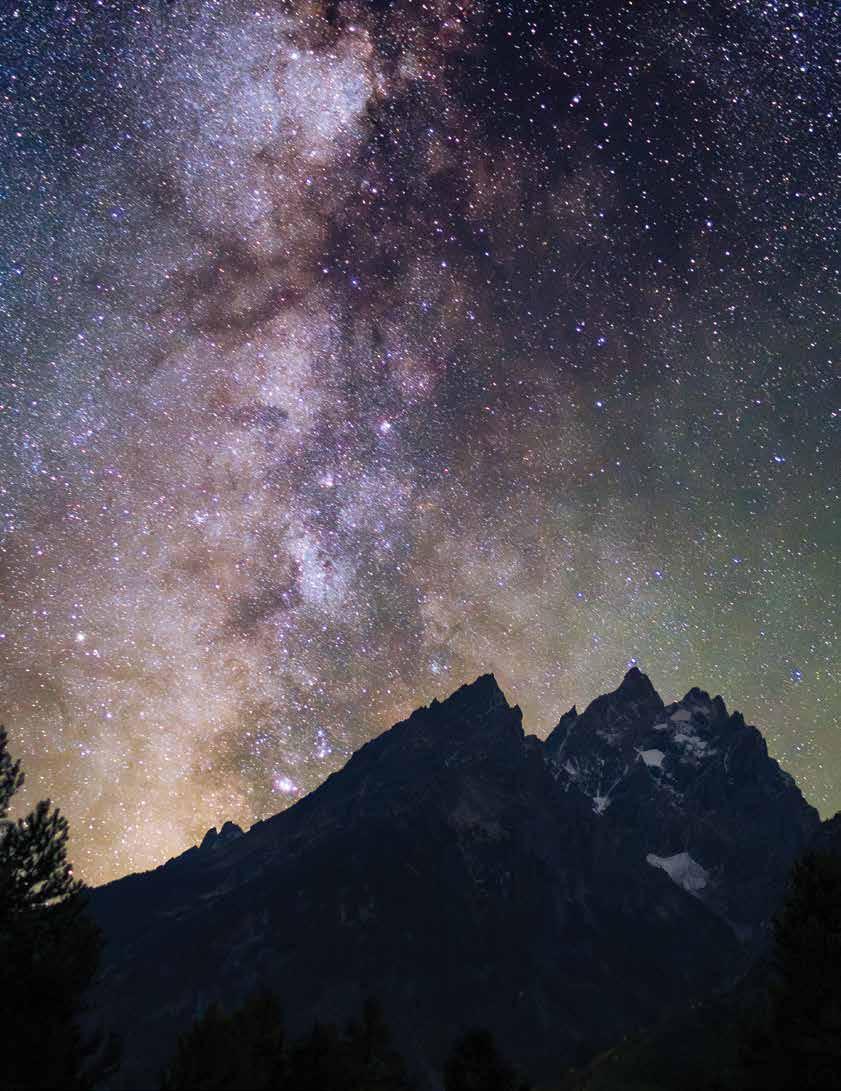
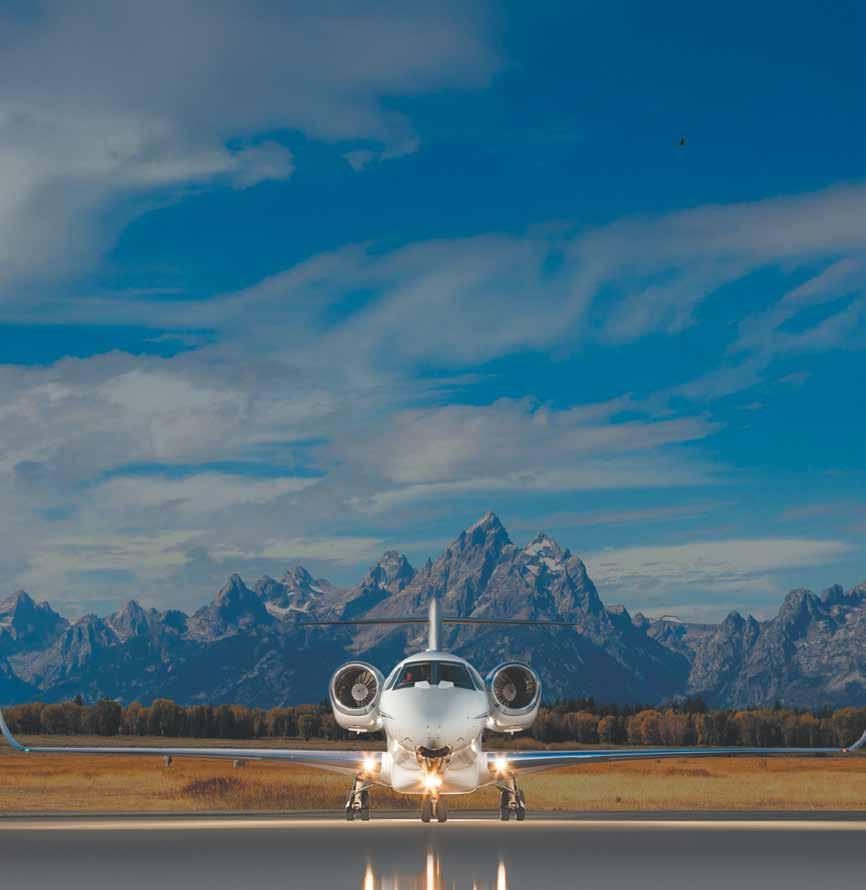
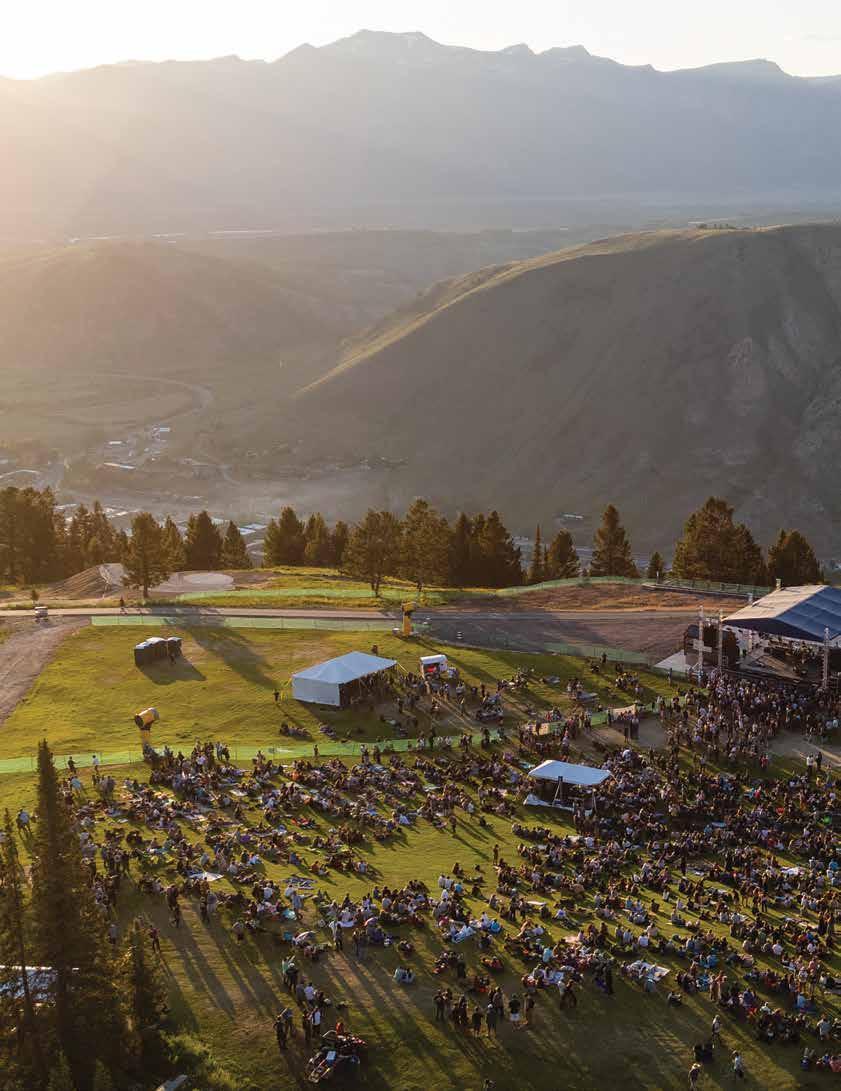
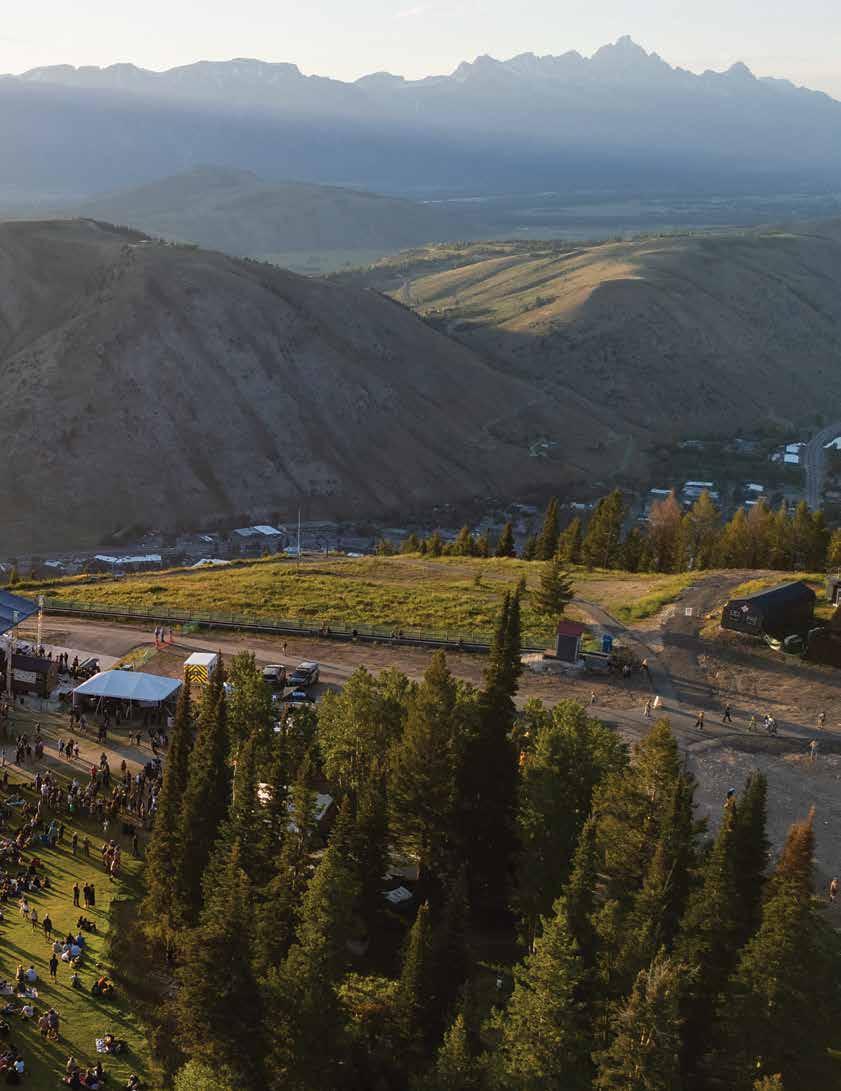
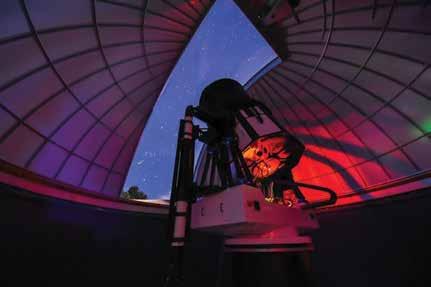
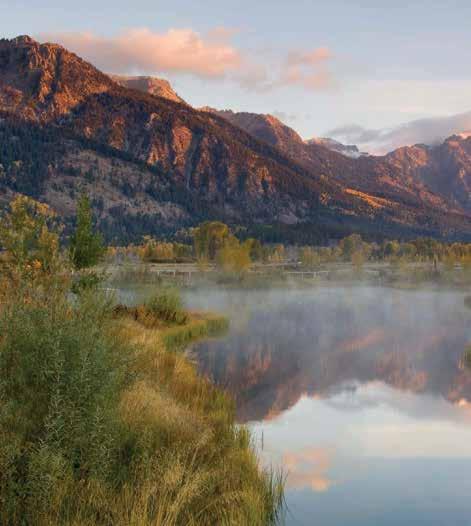
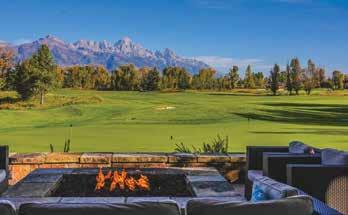
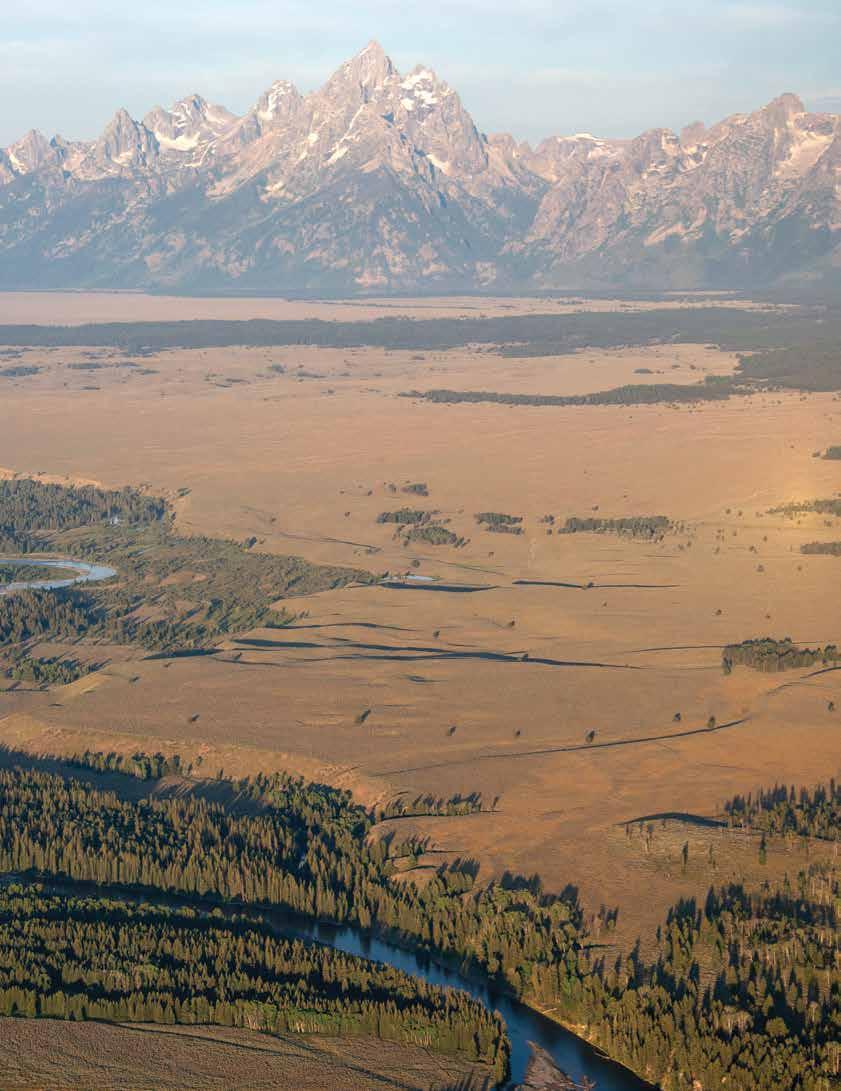
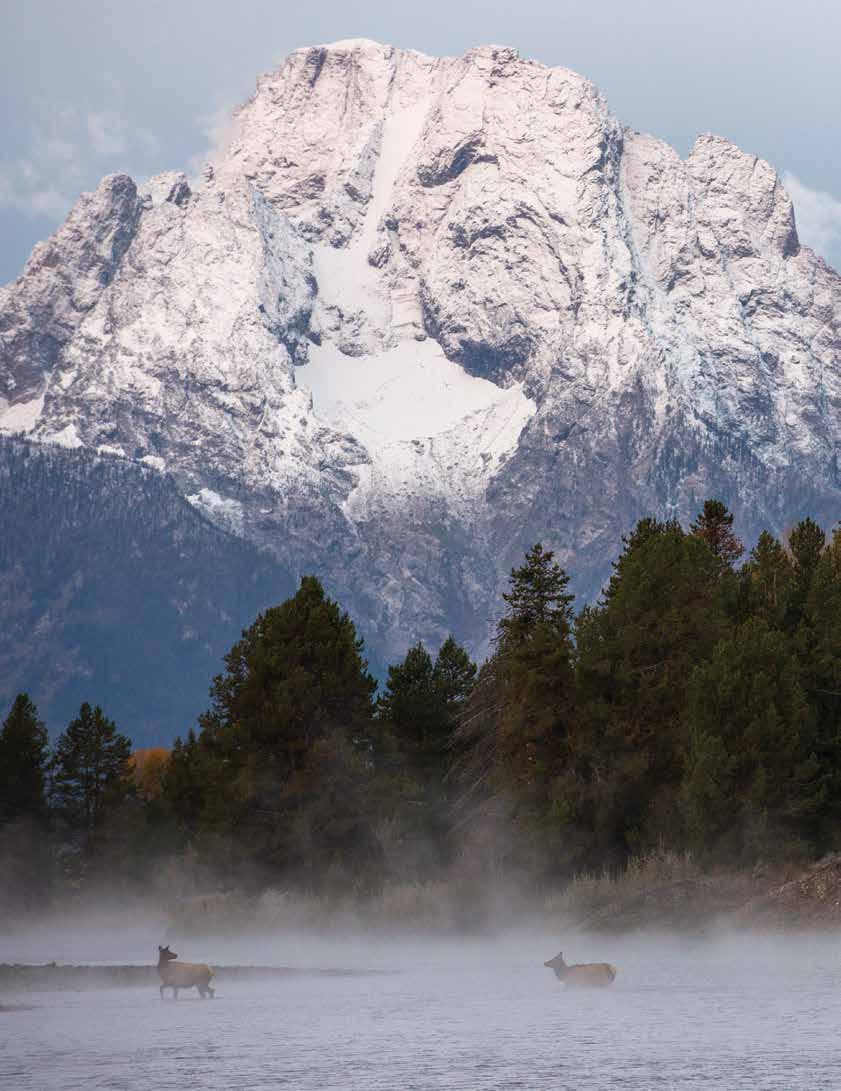
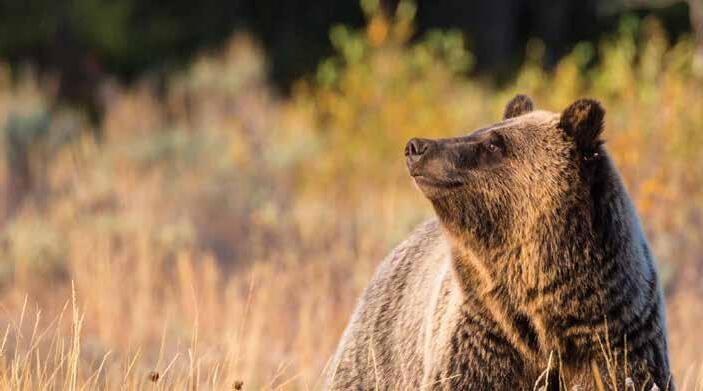
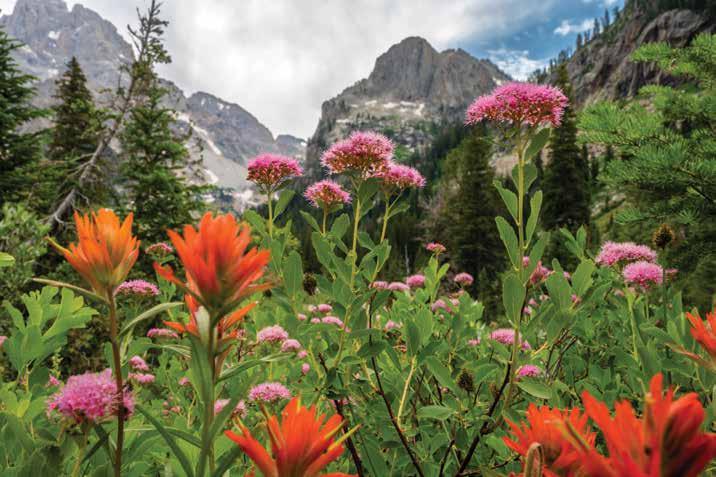
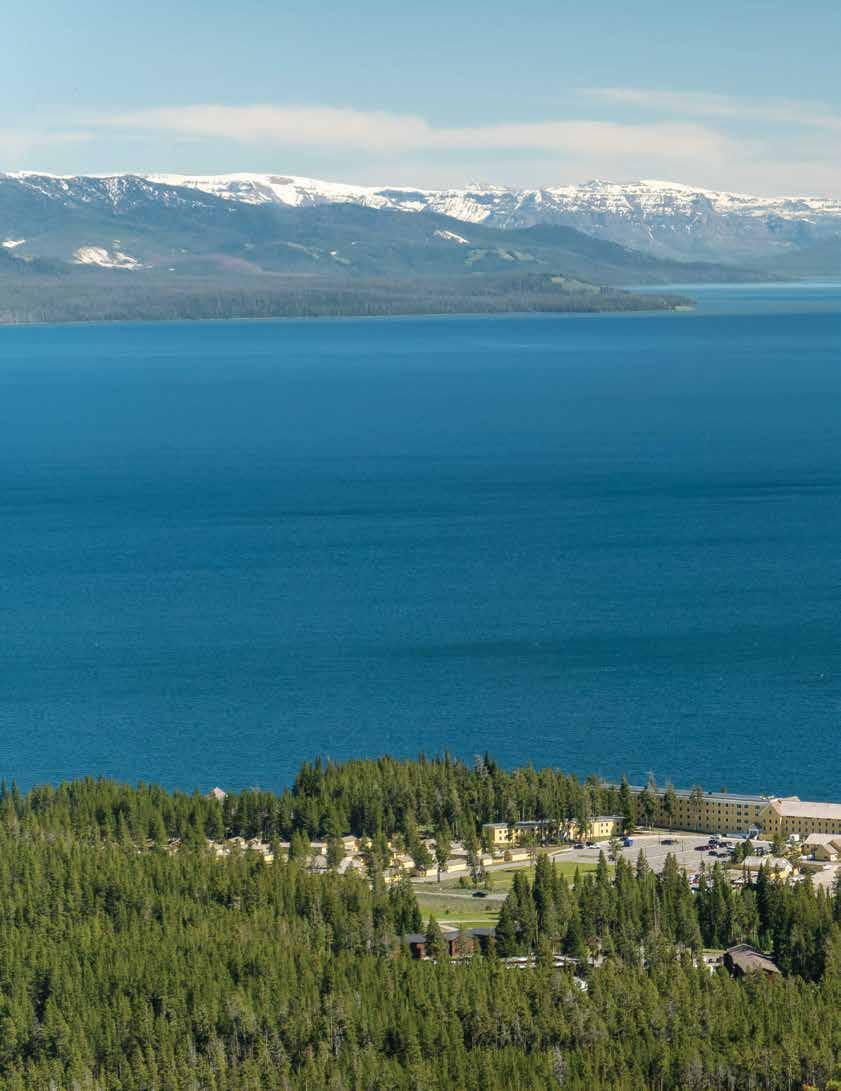
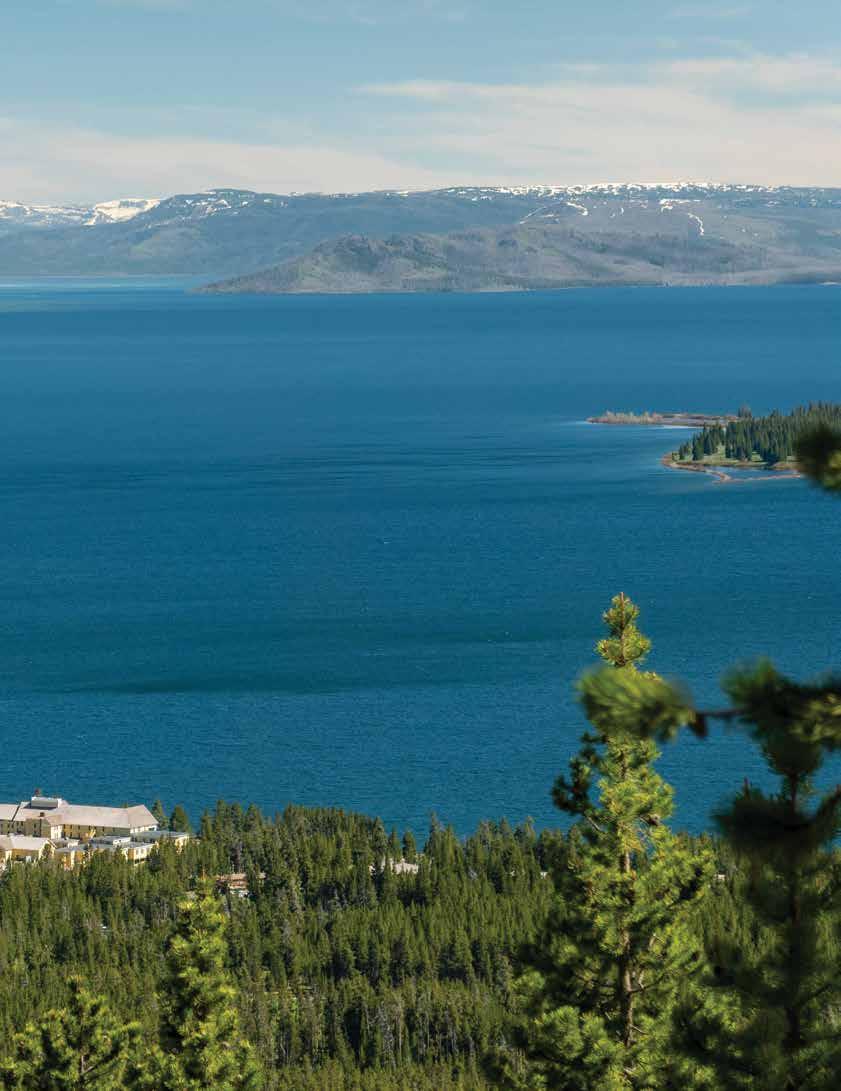
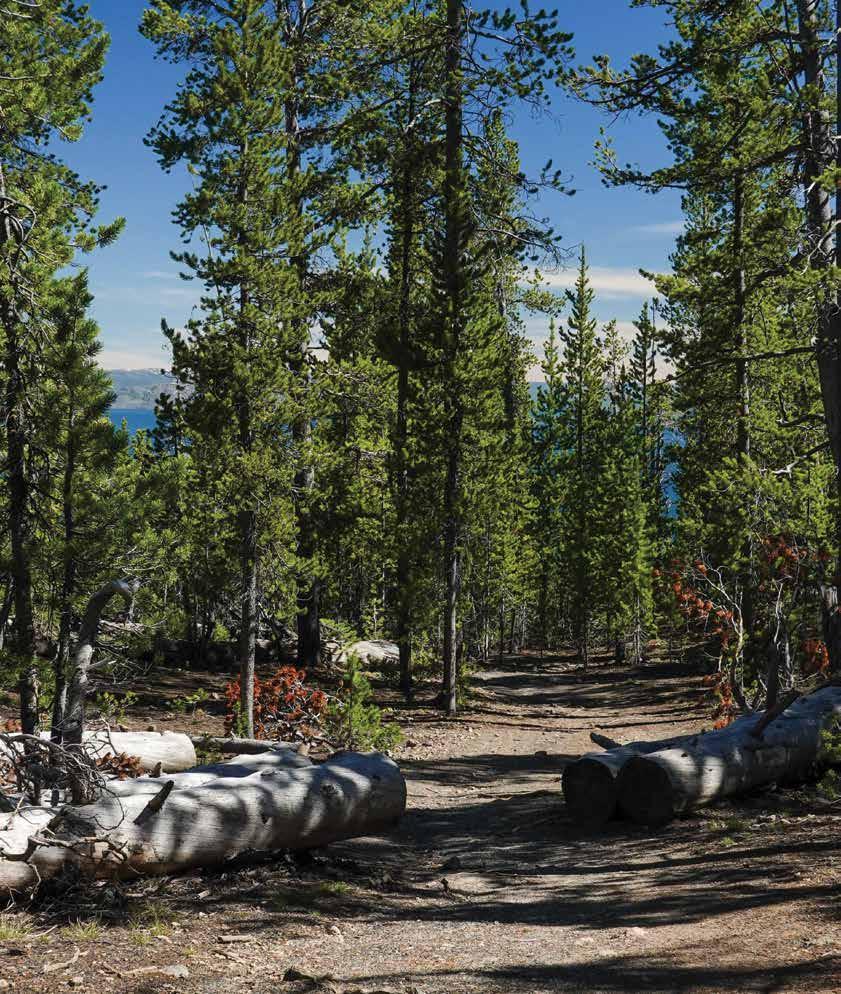
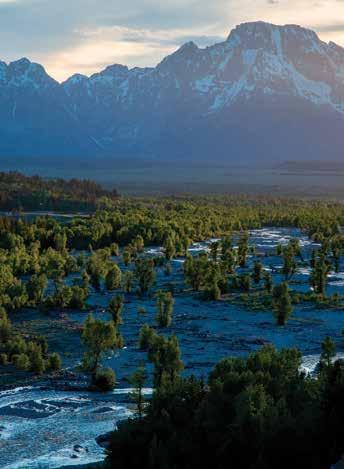
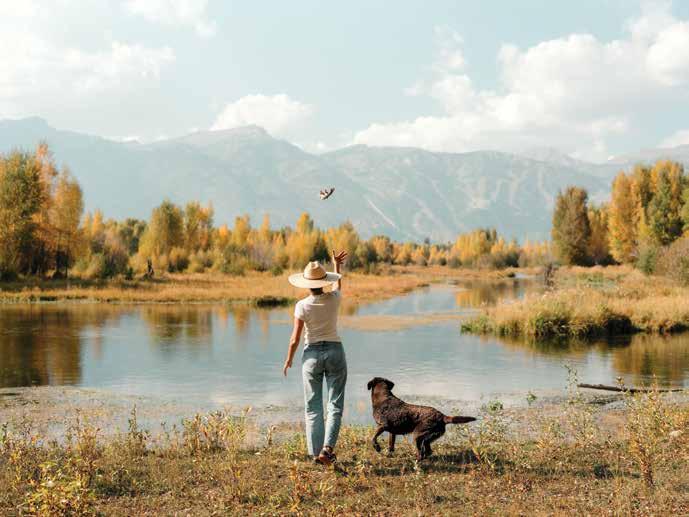
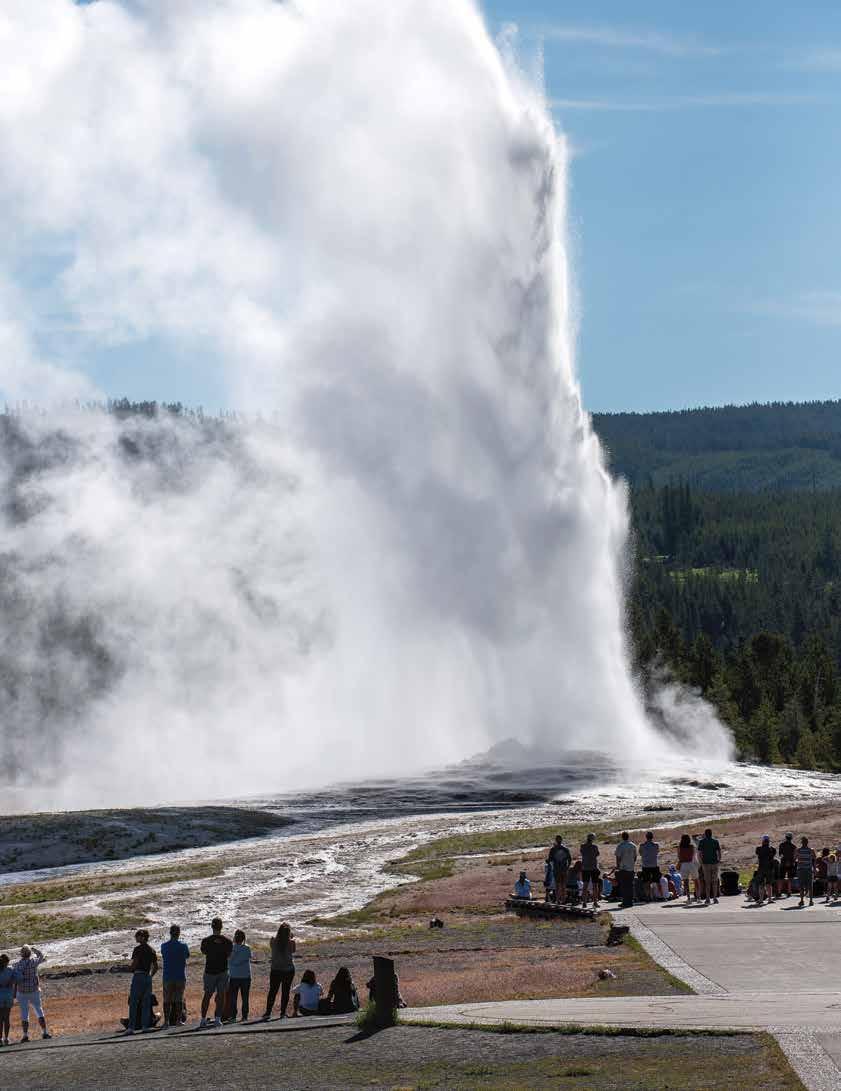
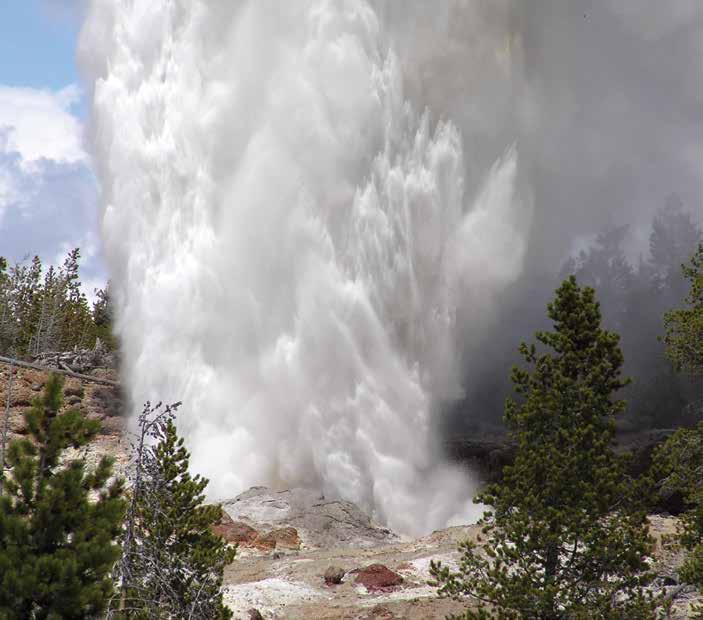
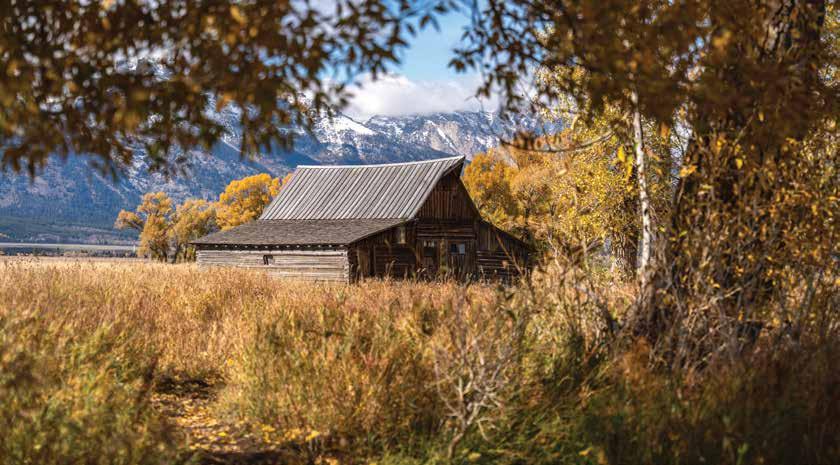
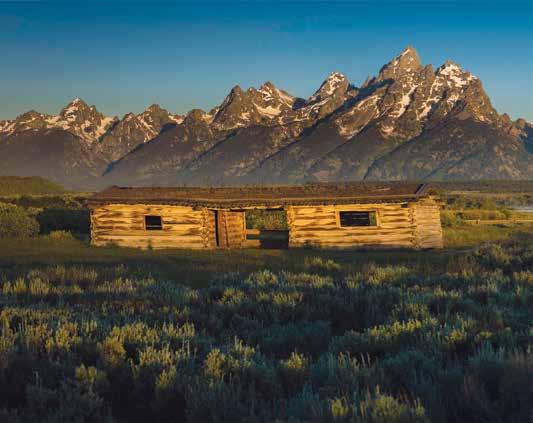
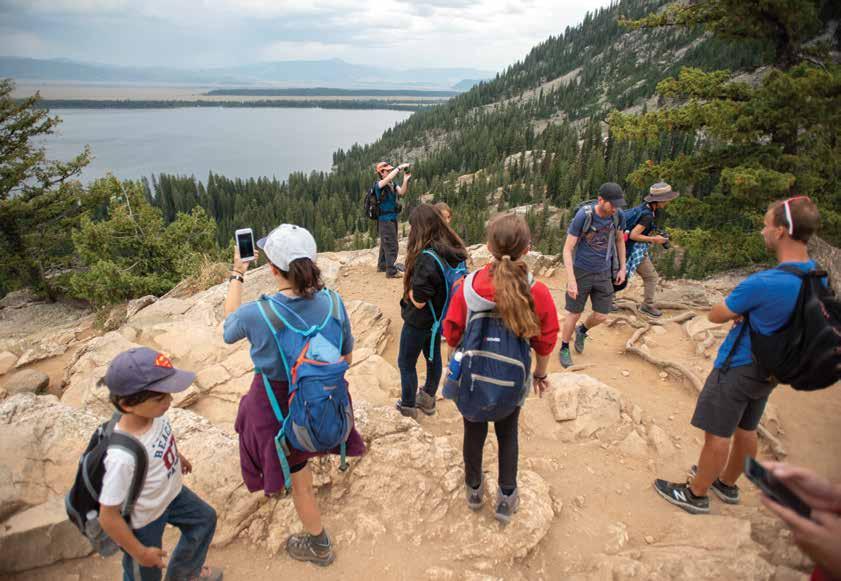
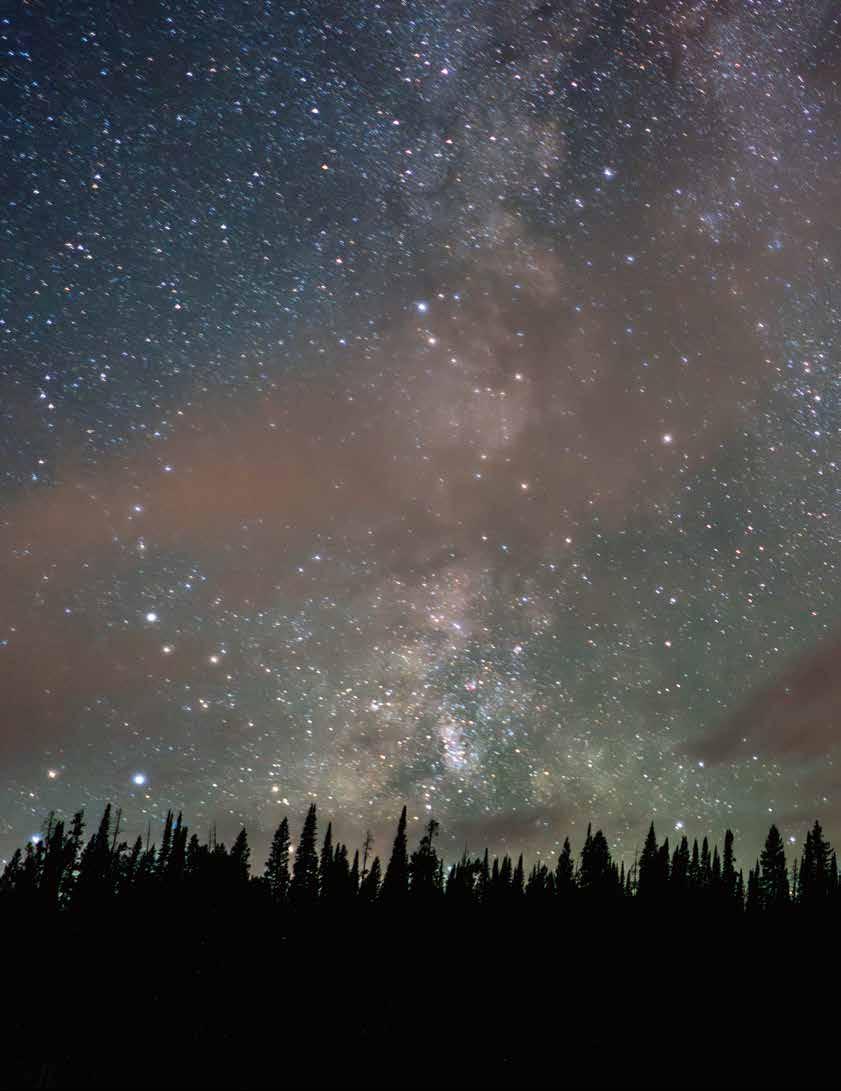
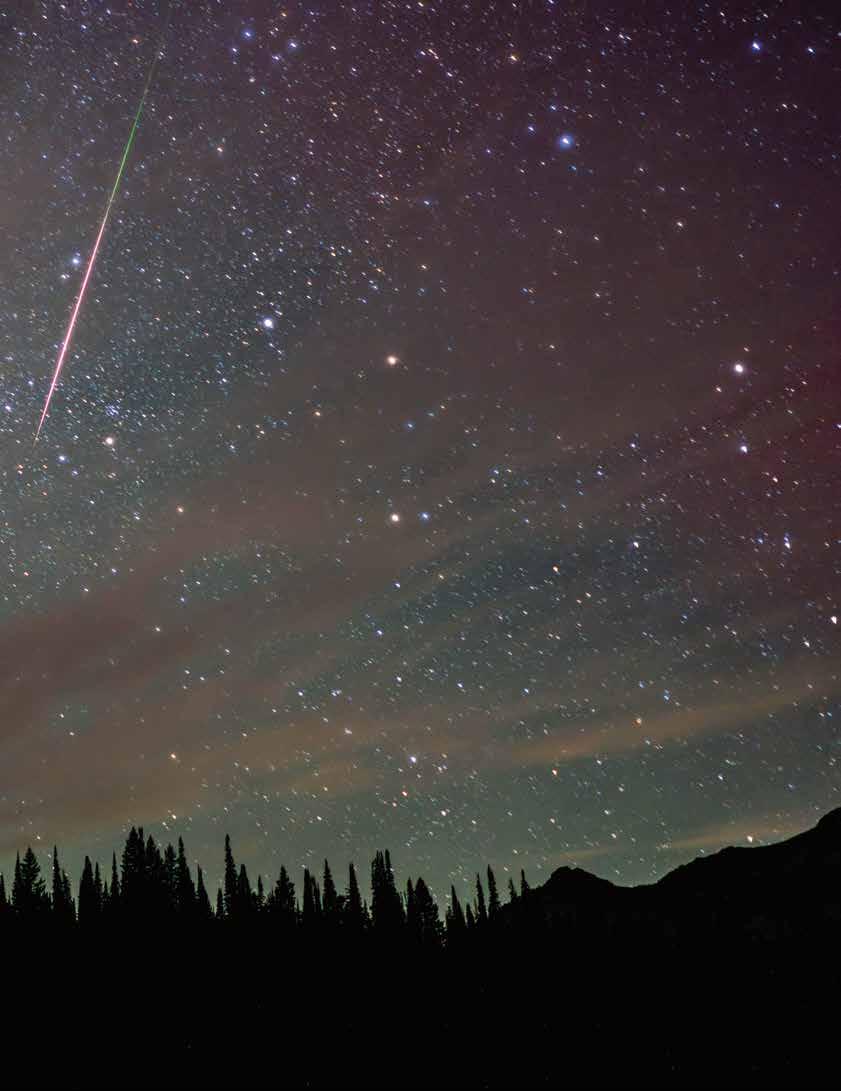
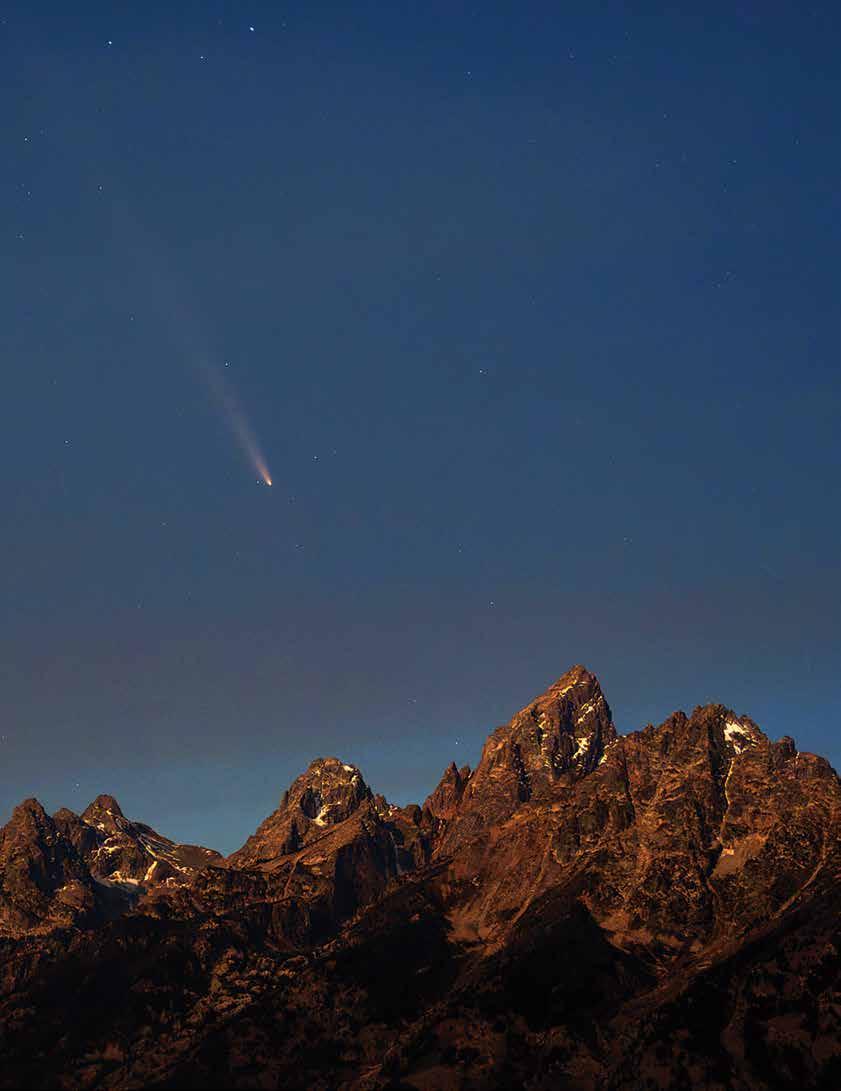
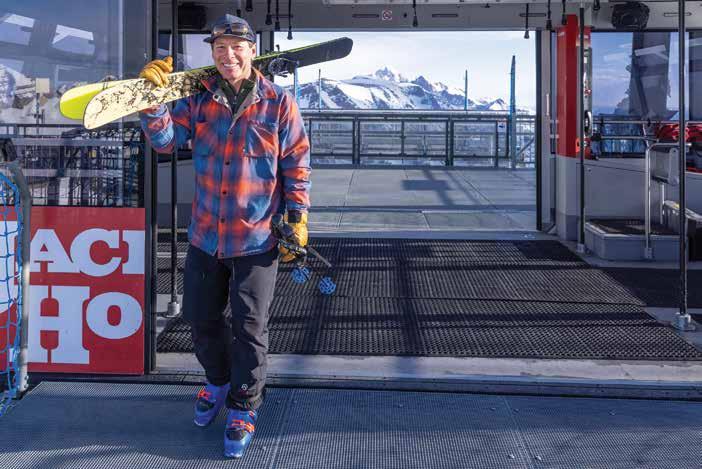
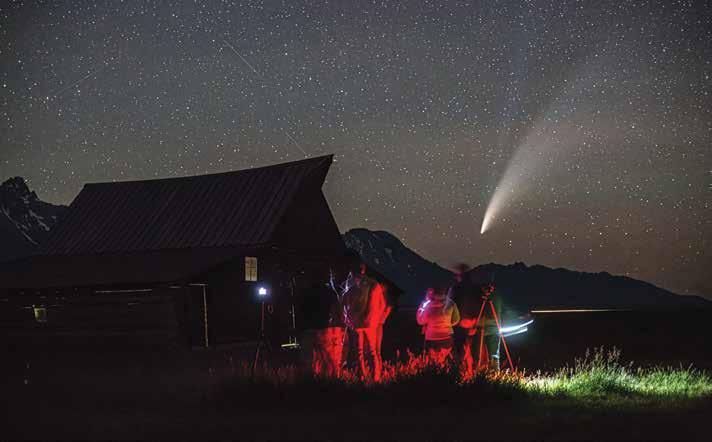
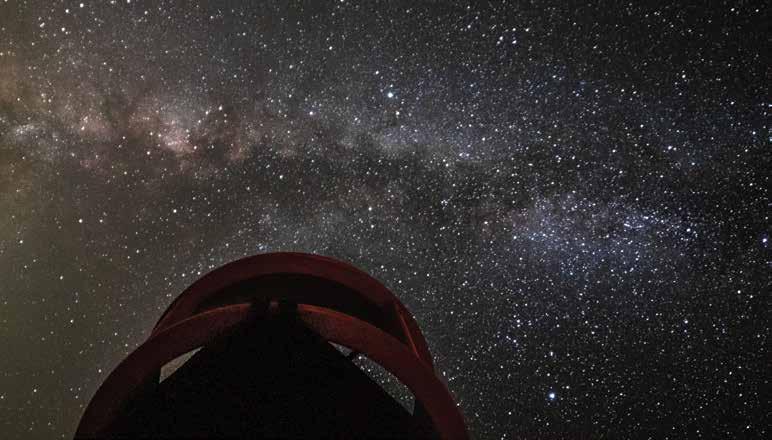
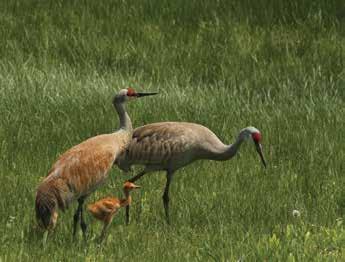
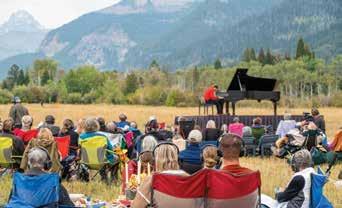
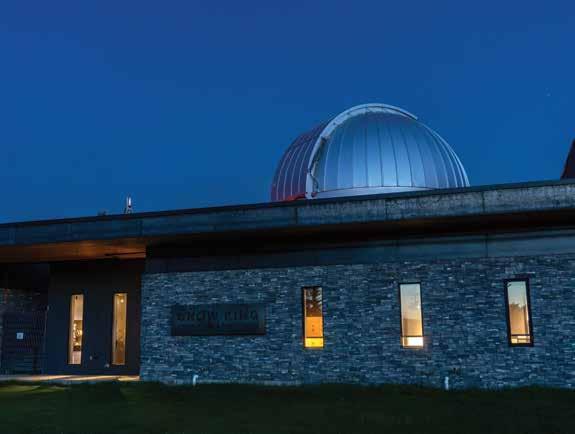
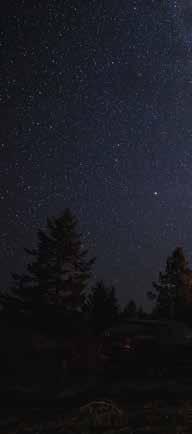
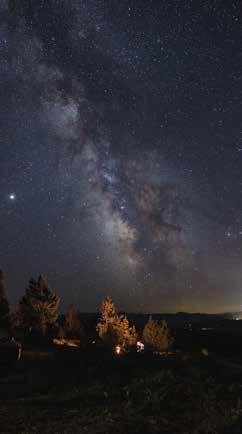
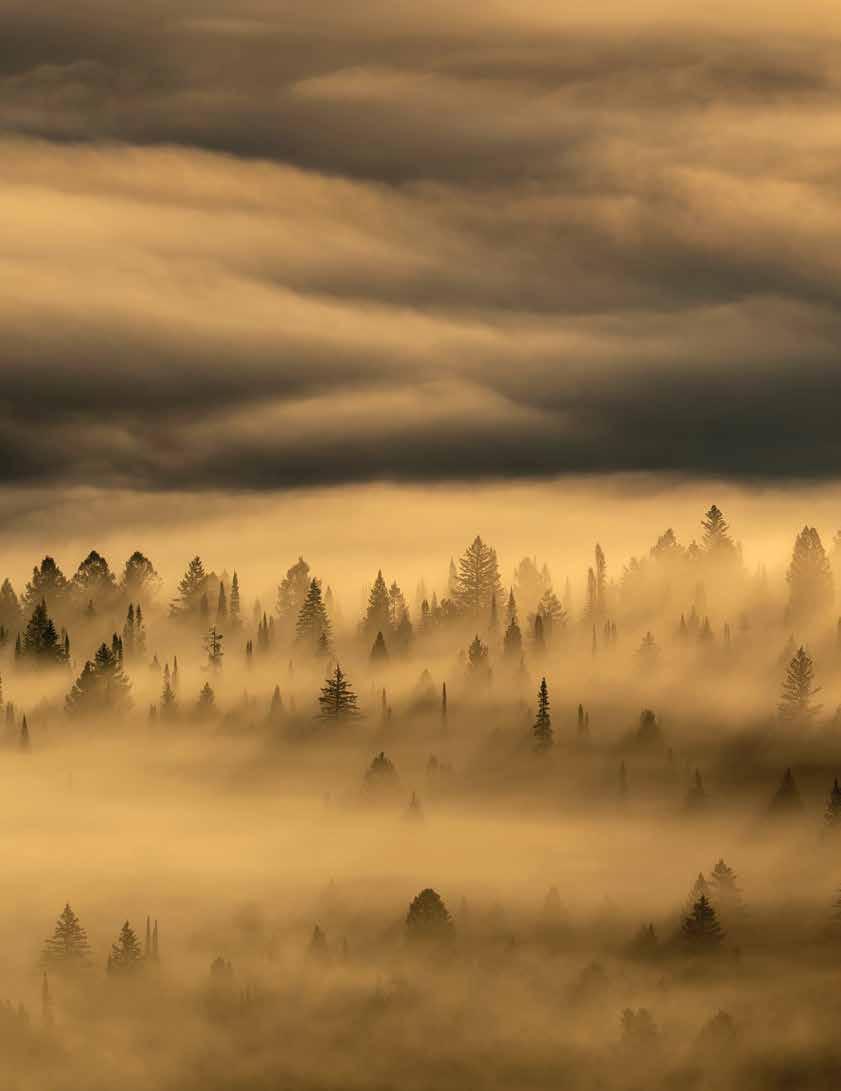
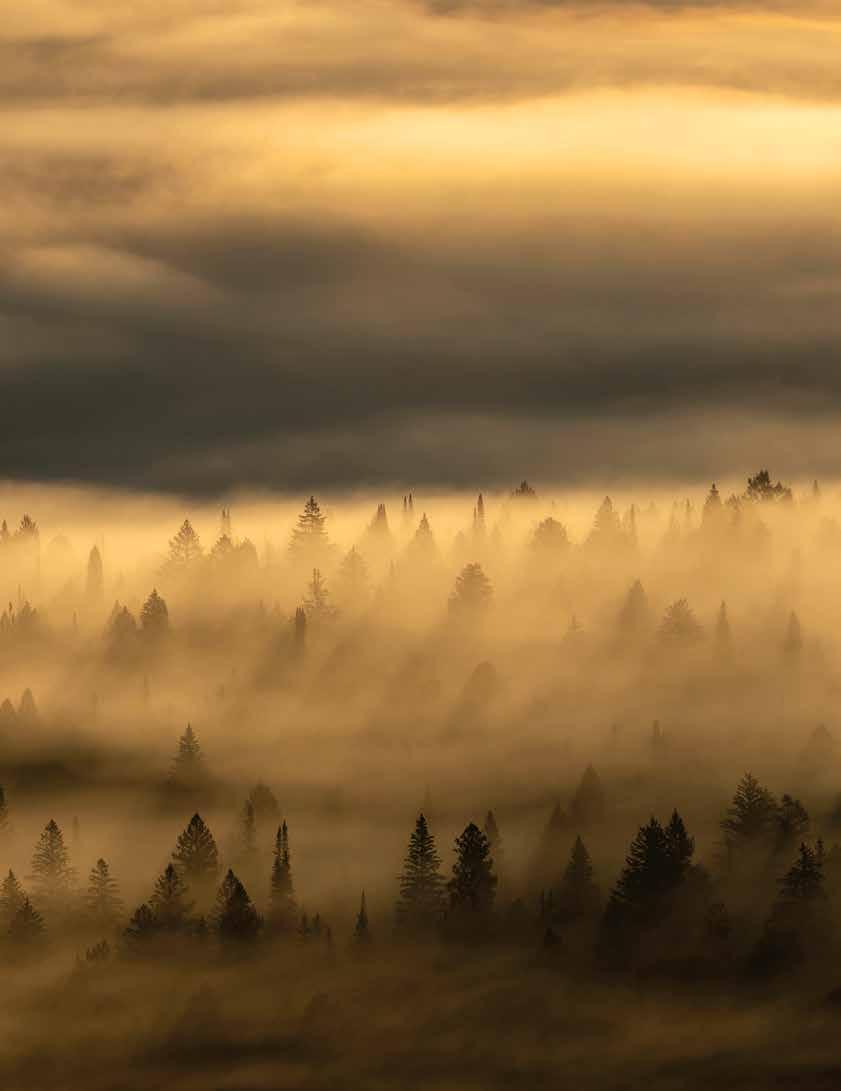
Last year, after a decade of behind-the-scenes work, Teton County and the Jackson Hole airport were officially certified as Dark Sky Places. This benefits both stargazers and area wildlife.
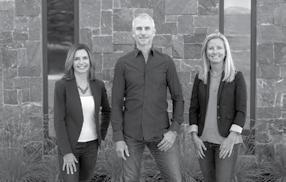
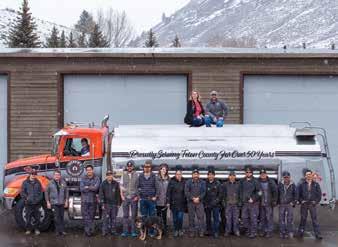
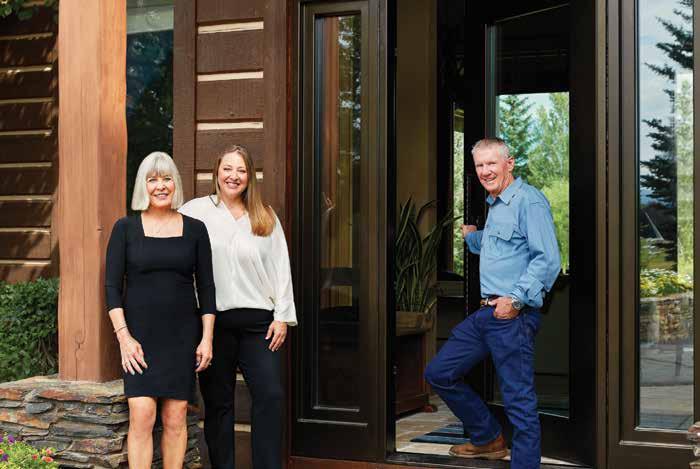
L to R : Jeremy Bradshaw, Aaron Hazel, Carrie Wild, Nealy Riley, Amber Blazina, Silas Thompson, Jenna Von Benedikt, Caleb Meyer, Doyle Hostetler
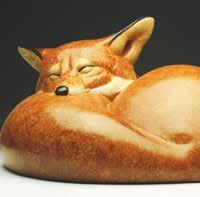
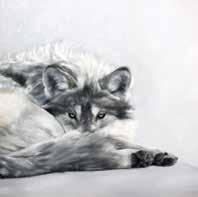
Oscar by Patricia A. Griffin
On The Edge
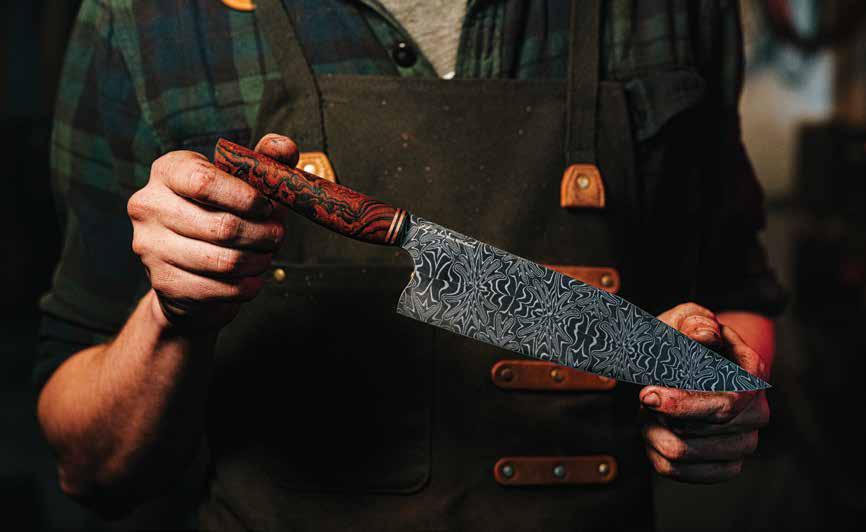
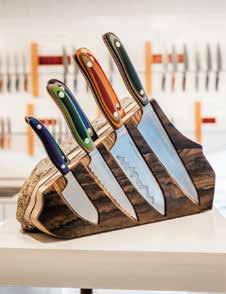
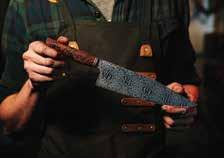
From the campfire to the kitchen, the performance of New West KnifeWorks blades exceeds their aesthetic; experience them at the New West KnifeWorks gallery and MTN MAN Toy Shop on the Town Square.
// BY SOFIA MCGULICK
Whether you’re cooking in a kitchen or over a fire, New West KnifeWorks designs and makes tools that elevate the experience. Founded 25 years ago by cook, outdoorsman, and Jackson Hole local, Corey Milligan, the brand’s goal was no less than to design and fabricate the world’s best knives … and for these knives to also be beautiful. Forbes magazine declared the knives “The Best Ever.”
“We combine traditional hand skill with cutting-edge technology. Every knife is built to perform, but also to be a work of art,” Milligan says. This is true for both the smallbatch kitchen knives that NWKW initially focused on and also for the outdoor knives we began to design and hand-finish more recently. “These are more than tools,” Milligan says. “They are a ticket to a lifetime of adventure for people who embrace the lifestyle and legacy of Jackson Hole—hunting,
camping, cooking over fire.”
Just as Milligan’s own experience as a cook informed the design of New West KnifeWorks’ kitchen knives, the design of the outdoor knives benefits from real-world experience. Milligan himself hunts and fishes, but the company also relies on the world-class hunting, guiding, and trapping community that calls Jackson Hole home. “Living in Jackson Hole, we get to design with and for some of the best guides and hunters in the world, and get their feedback,” Milligan says. “These knives aren’t just pretty or theoretical—they’re used hard, every season. Designed in Jackson, they’re proven in the wild.” A recent upgrade to the entire line of hunting-, fishing-, folding-, and pocketknives is blades made from MagnaCut steel, incredible for its balance of toughness, edge retention, and stain resistance.
PHOTO // ZACH MONTES
A visit to NWKW’s gallery and the justrelaunched MTN MAN Toy Shop brings together the company’s tools and the Jackson Hole lifestyle.
Mark Keathley • On the Horizon 54x48 • Oil
Gary Lynn Roberts
Under the Big Sky
50x66
Oil
Paul Dykman
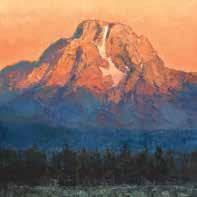
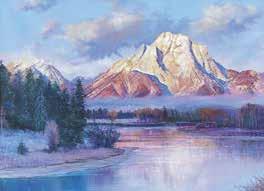
Mt. Moran Sunrise • 30x40 • Oil
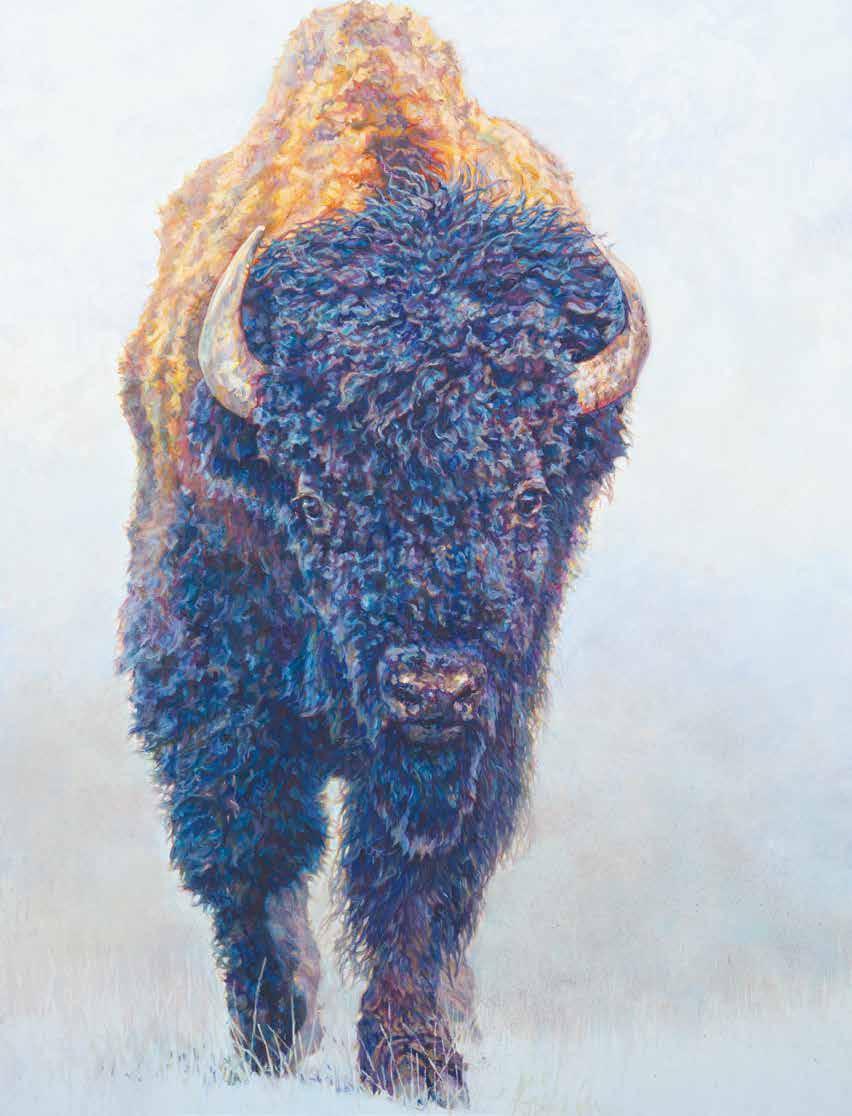
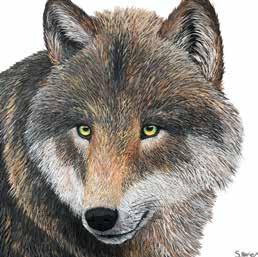
Shannon Marie • Steele • 30x30 • Acrylic
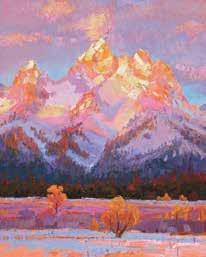
Trey McCarley • Ethereal Light • 60X48 • Oil
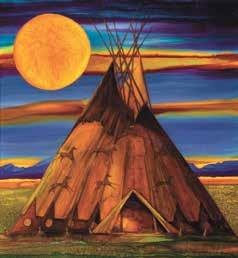
Nancy Dunlop Cawdrey • Prairie Moonlight 42x39 • French Dye on Silk
PURE. RARE. WILD.
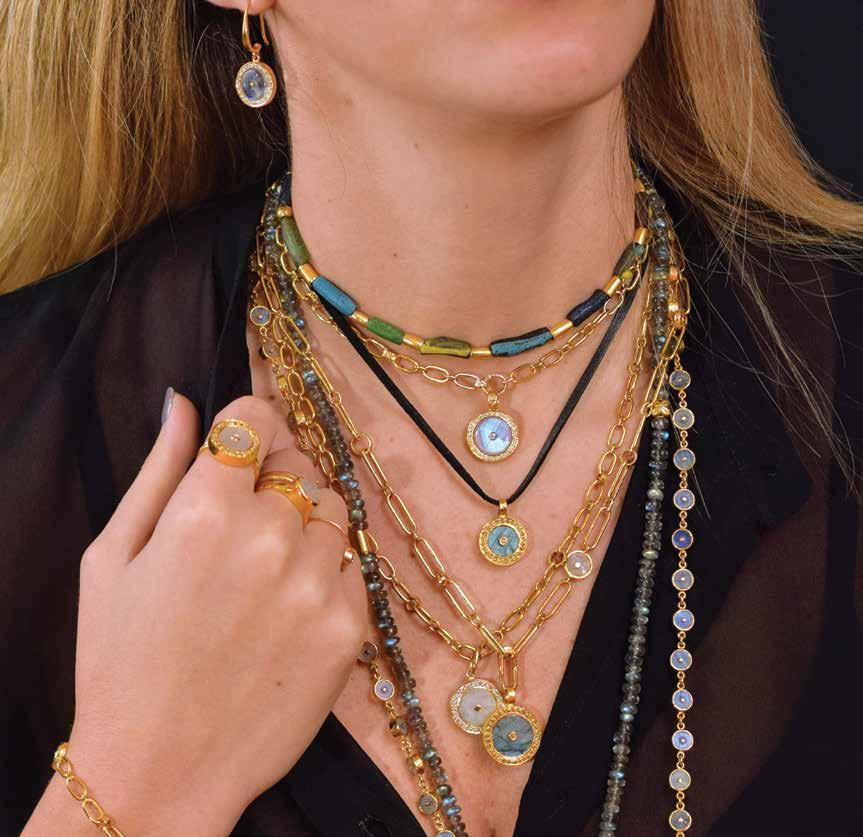
As an artist owned and operated gallery, Sonia is known for her magnificent Sun collection and one of a kind fine jewelry designs. The gallery complements Sonia's beautiful designs with an array of well curated Arts, Minerals, Crystals and one of a kind finds. Come on in! You will surely find ''what tickles your heart''
FEATURES
JACKSON HOLE
SUMMER 2026
ON THE COVER: This image was taken in Grand Teton National Park by Mikki Cavaroc, who saw the Milky Way for the first time in 2006. “I’ve been trying to capture its scale and enigmatic presence ever since,” says Cavaroc. “I love the challenge of capturing the immensity of space over familiar landmarks.” and @freeroamingphoto
104
ORIGIN STORY
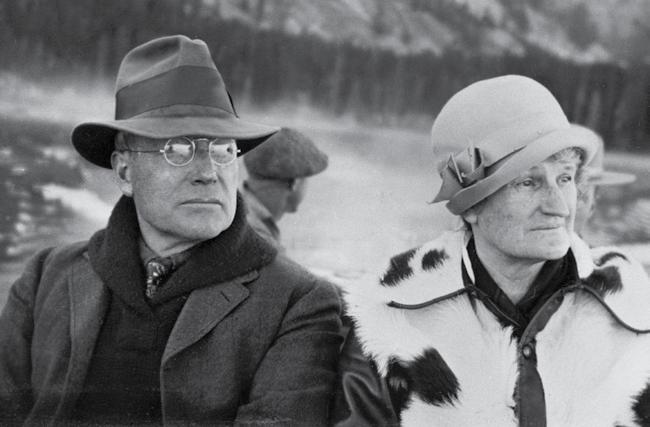
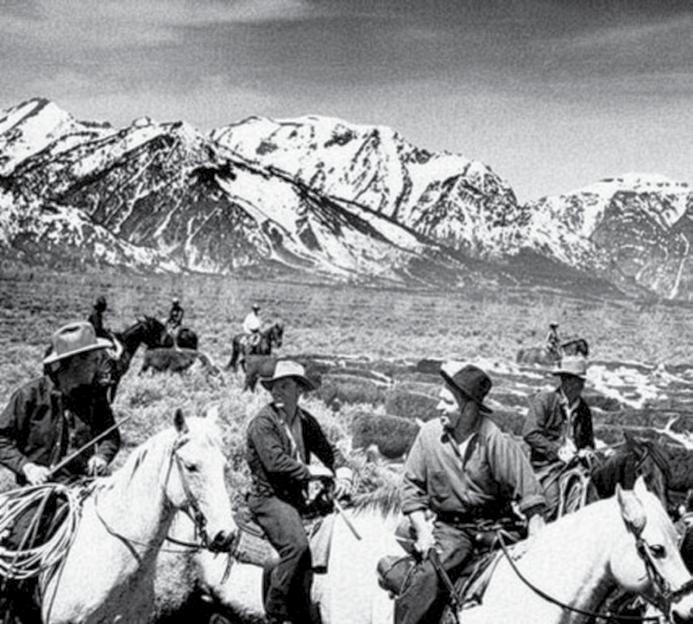
While the covert land-buying operation of Rockefeller’s Snake River Land Company was controversial in its day, it is now considered a remarkable feat of foresight and philanthropy.
// BY MIKE KOSHMRL
112
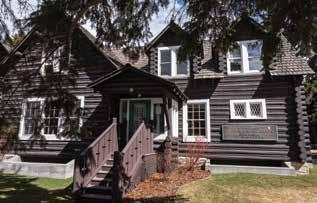
IS THERE A FUTURE FOR JACKSON’S PAST?
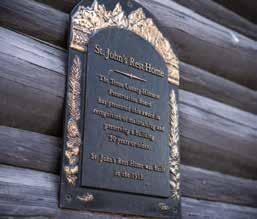
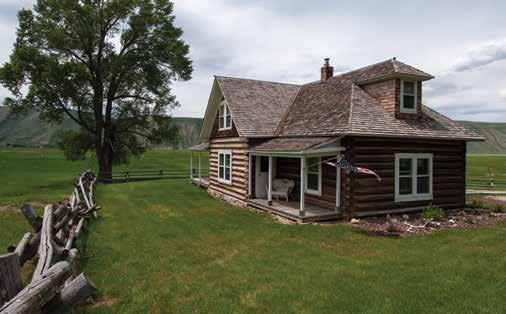
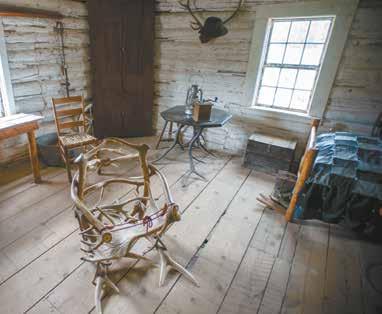
Jackson Hole’s historic buildings may lack the high-style architecture of other Western resort towns, but they authentically reflect the valley’s hardscrabble history.
// BY KATHERINE WONSON
120
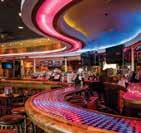
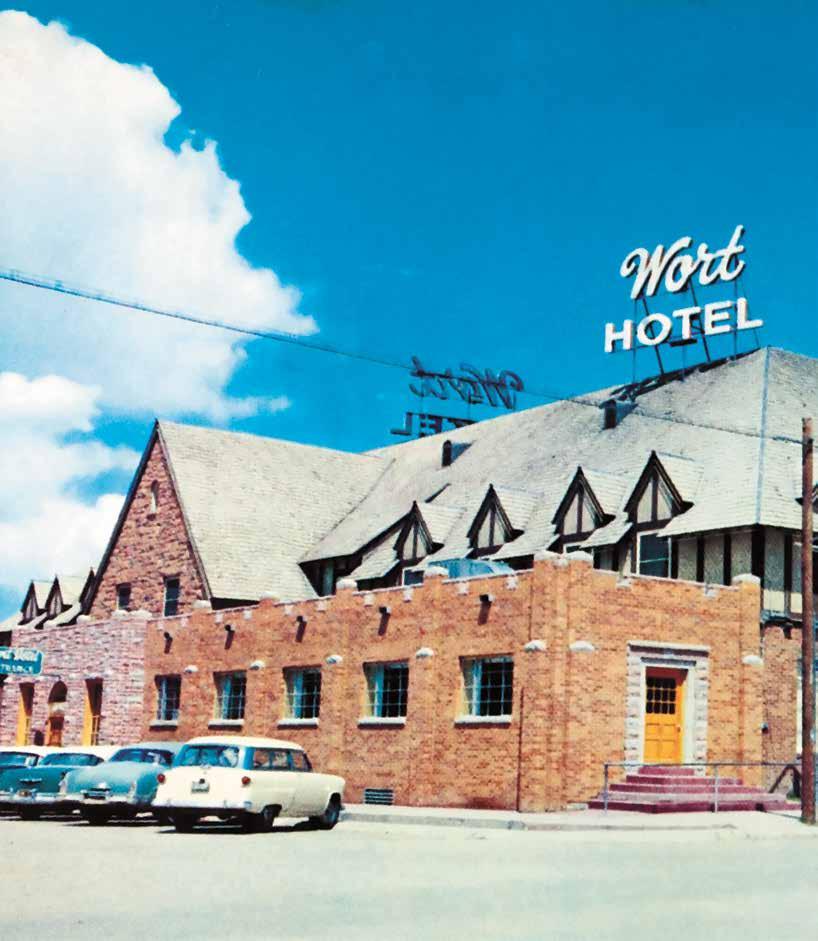
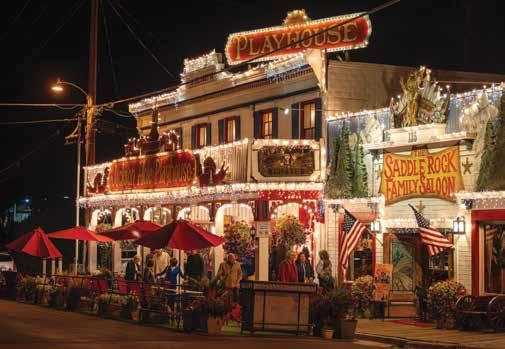
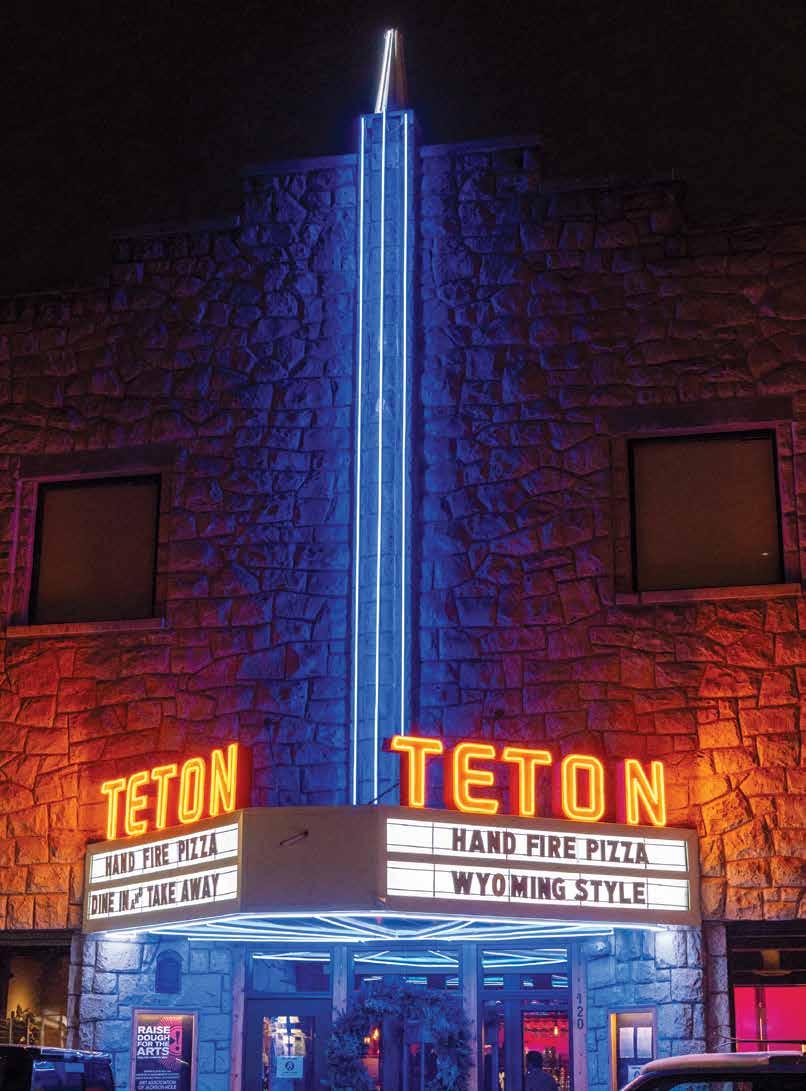
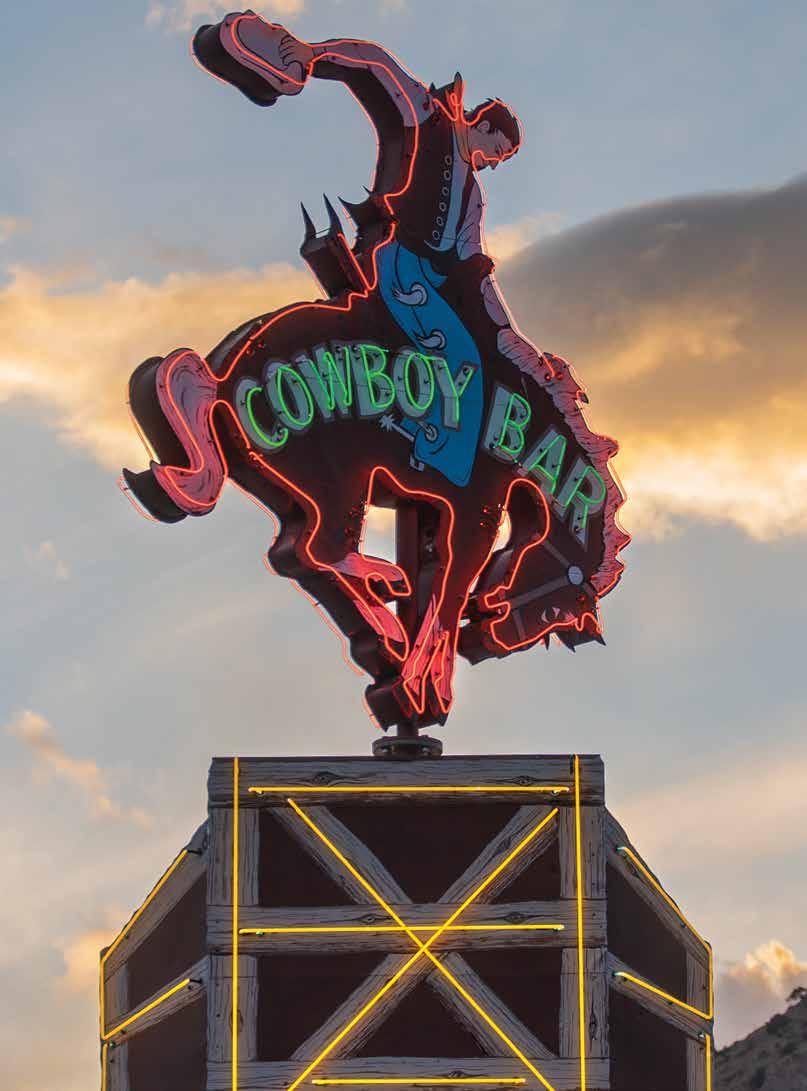
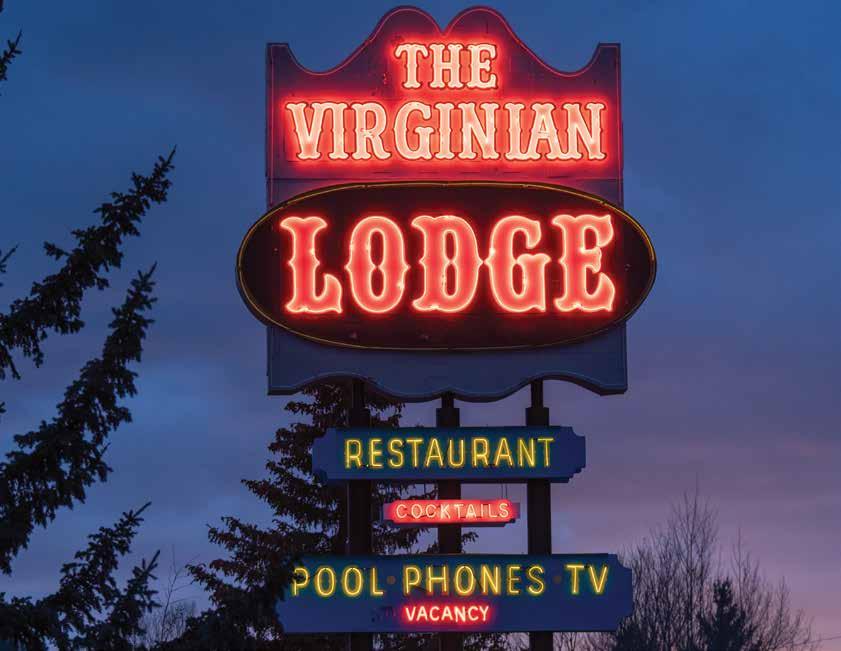
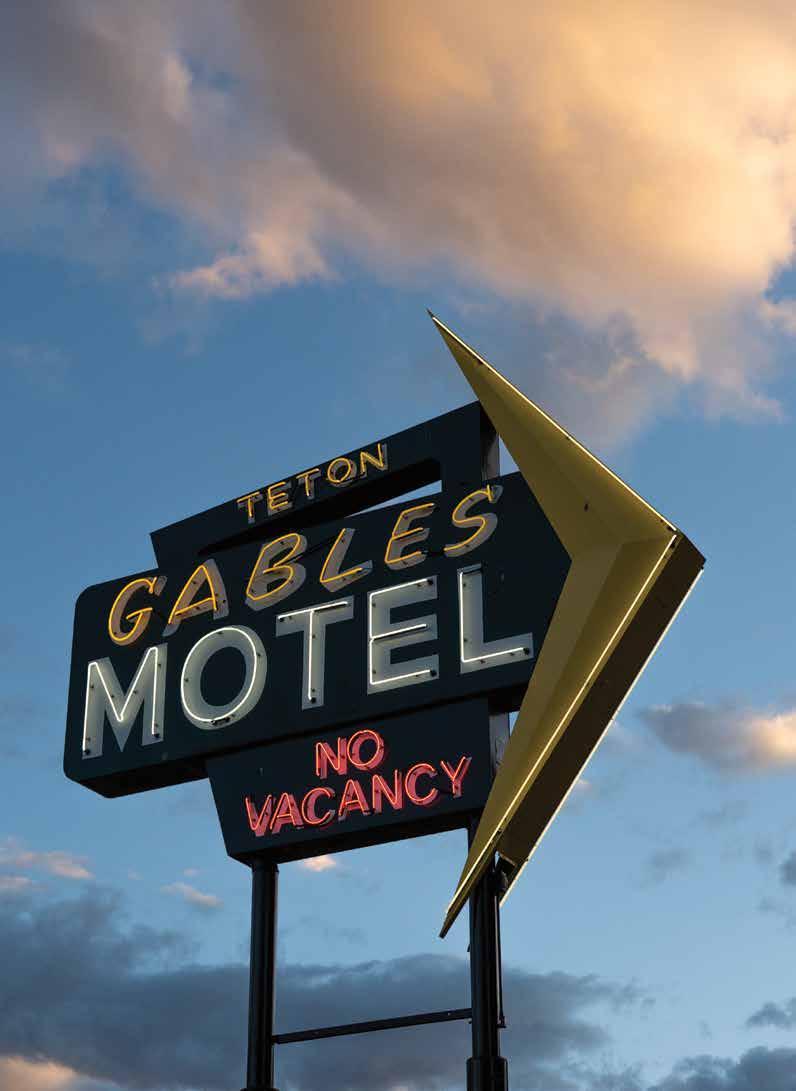
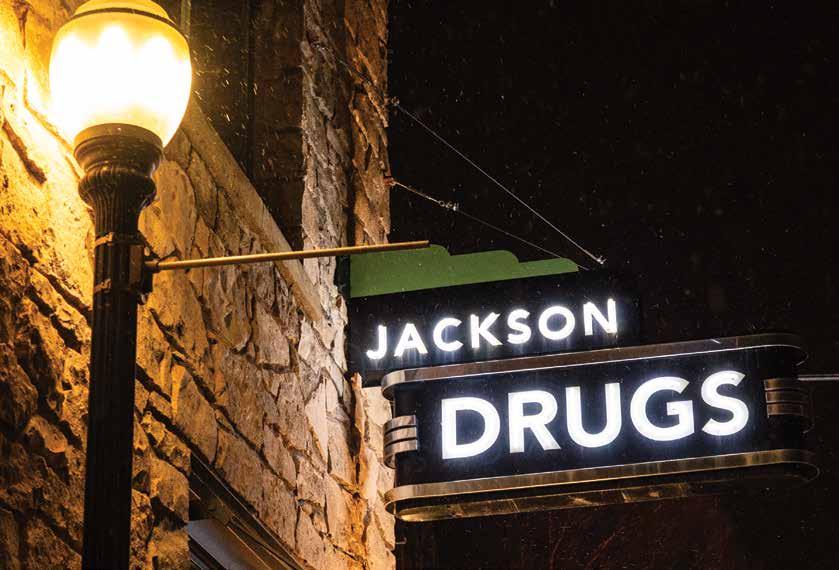
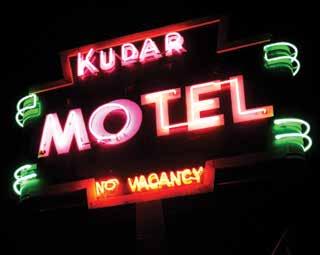
PHOTO GALLERY: NEON NOSTALGIA
A handful of Jackson businesses are still illuminated by historic neon-y signs.
// BY KATHERINE WONSON
126
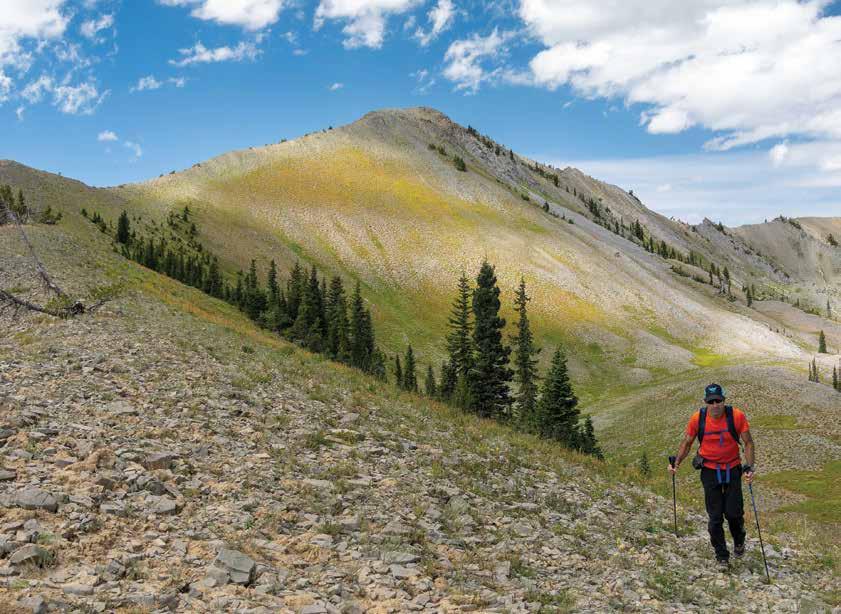
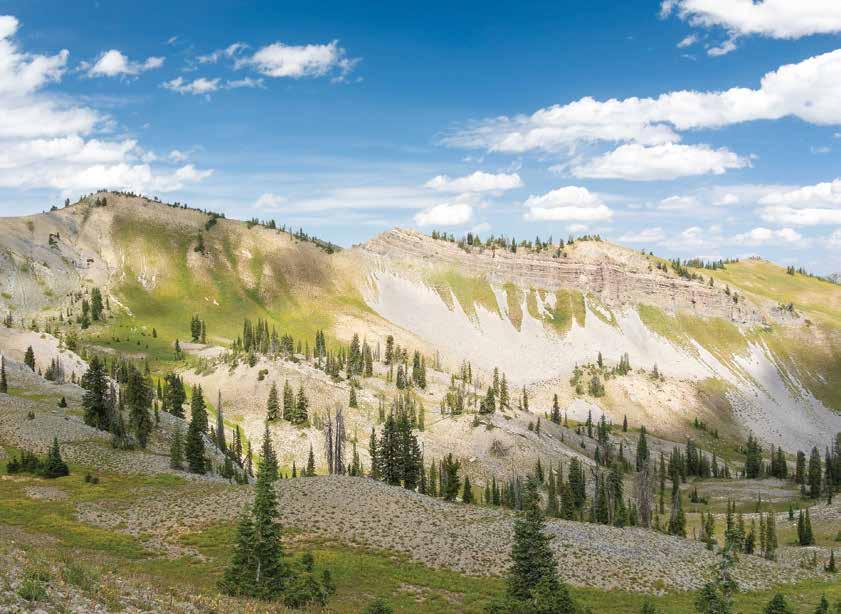
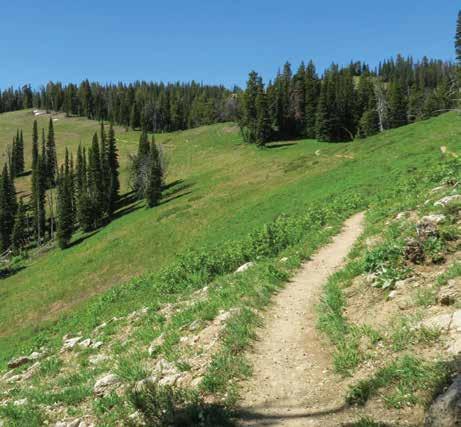
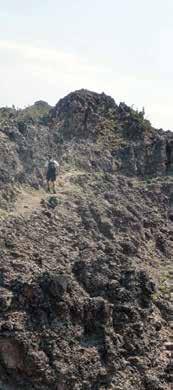
JACKSON HOLE’S HIDDEN RANGE
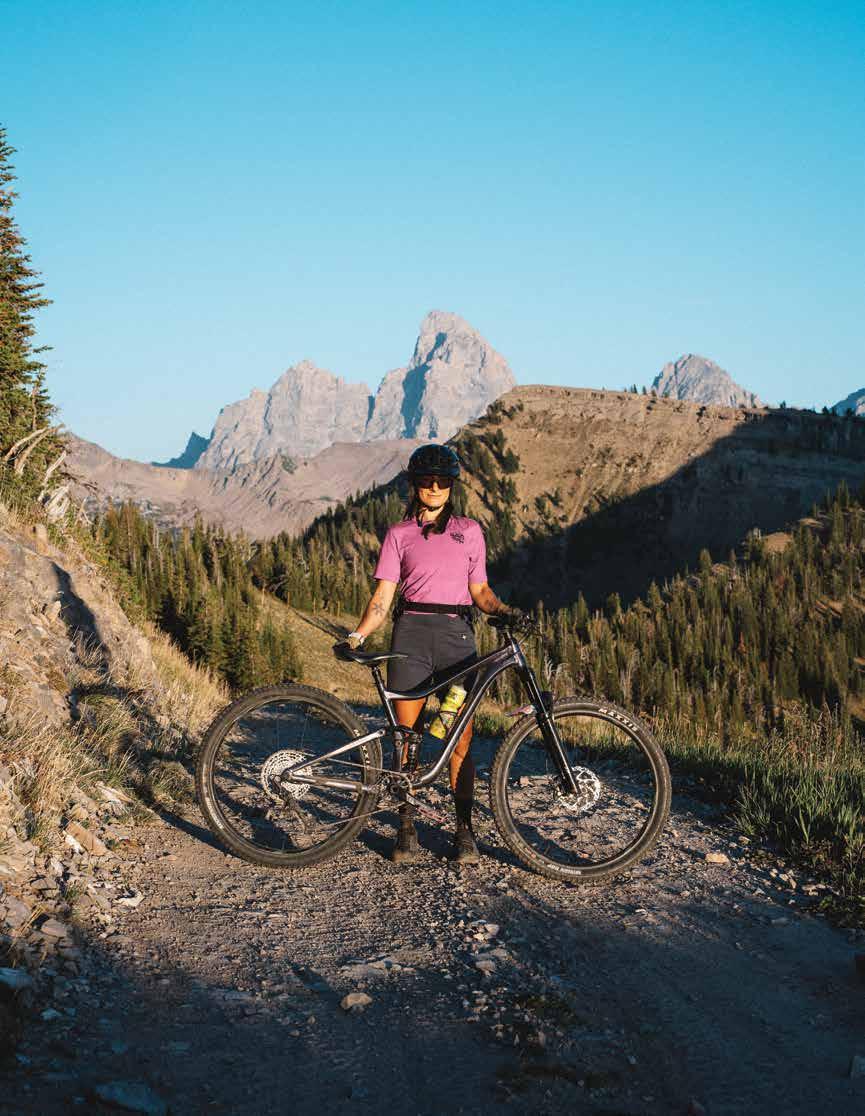
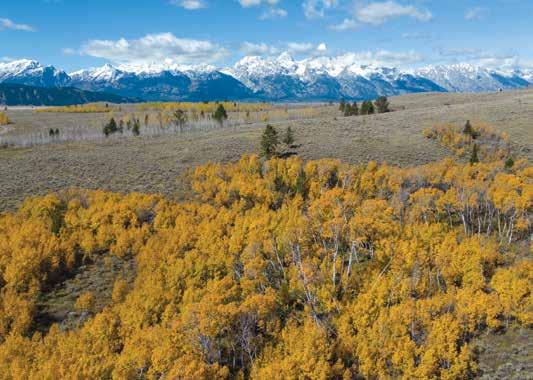
Starting in the southern part of the valley, the Snake River Mountains offer big terrain and quiet trails.
// BY DINA MISHEV
Immerse Yourself in Local Life
HOWDY
EDITOR'S LETTER
This issue of Jackson Hole magazine is bittersweet—editing it was a true highlight of the winter for me, but toward the end of the production cycle, Tim Sandlin, the magazine's longest-serving contributing writer and the heart of Jackson Hole's writing community for decades, passed away.
Tim's column, "As the Hole Deepens," ran in Jackson Hole magazine for 30 years; the final one ran in the Winter 2024 issue. At that time, Tim shared, “America has gotten so bizarre there is no place for exaggerated humor. The country is exaggerated without my help. I thank the owners, publishers, and editors of Jackson Hole magazine for putting up with my paranoid ramblings." An anthology of these columns is available at both of Jackson’s quality independent bookstores.
The year 2026 is my 28th year since first reading and meeting Tim (in addition to being a Jackson Hole magazine columnist, he was a supremely talented novelist—I recommend his GrosVont trilogy), 29th year of living in Jackson Hole, and 27th year writing about this valley. Still, in this issue I learned so many new things.
Early in my time in the valley, I was a volunteer at the Jackson Hole Historical Society and led free one-hour walking tours of downtown.
One of the “facts” I shared on each tour (which are still around today, although no longer free— adults are $12, students and 65-plus are $10; they’re at 10:30 a.m. daily June 3 through October 2 this year, and depart from History Jackson Hole) was that the neon sign of the Million Dollar Cowboy Bar was the valley’s first neon sign. I had learned this in my tour guide training. But, in researching this issue’s photo essay, “Neon Nostalgia,” p. 120, writer and historian Katherine Wonson learned that Jackson Drug installed a neon sign a full 14 years before the Cowboy did.
And then there’s writer Jim Mahaffie’s article for the Design Department, “Look to Local Plants,” p. 84. An avid hiker, of course I’m aware of and in awe of each summer’s wildflower bloom. But I never understood that it was possible—and also preferable for the sake of wildlife and the ecosystem—to use many of these in the flowerbeds at my house and in the planters on my deck. My husband doesn’t know it yet, but there are some landscaping projects on our schedule this summer.
The Hello Department (p. 42) profiles three locals whose stories capture the valley’s variety of experience: a wildlife photographer who grew up in Singapore, a farmer/educator who co-founded a hard cider company and teaches kids to cook, and a fifth-generation rodeo cowboy/outfitter.
You’ll also find our signature coverage of dining (p. 66), adventure (p. 94), and wellness (p. 90), plus a feature by environmental journalist Mike Koshmrl. “An Origin Story” (p. 104) revisits how Grand Teton National Park came to be. It’s hard to imagine now, but a century ago, the flats beneath the range were filled with ranches and tourist outposts.
As always, I and the rest of the amazing team behind Jackson Hole magazine hope you enjoy this issue as much as we enjoyed creating it.
— DINA MISHEV @JACKSONHOLEMAG
DEREK
STAL
Hoback Sports, Jackson Hole’s premier bike shop, has everything you need to explore the Tetons. With a vast selection of top-tier retail and rental bikes, plus an expert repair shop, every rider can tackle the valley with confidence.
Jackson Hole
As a newly minted Lander resident, cruising 3,000 vertical feet up the Sinks Canyon switchbacks—the change in altitude is like hitting the AC.
Rafting the whitewater section of the Snake River Canyon is great to do with friends, and you are guaranteed to get soaked every rapid.
Tubing Flat Creek—the shallower sections add some thrill to the adventure, while the float’s minimal equipment and shuttle demands make it an efficient water sport.
A long hike in the Tetons on a hot day is one of the best ways to earn a trip to the Victor Emporium for one of their famous huckleberry milkshakes.
I generally try not to cool off too much in the summer.
PUBLISHER
Adam Meyer
EDITOR
Dina Mishev
ART DIRECTOR
Elise Mahaffie
PHOTO EDITOR
Bradly J. Boner
COPY EDITOR
Bevin Wallace
CONTRIBUTING WRITERS
Molly Absolon Lila Edythe
Mike Koshmrl Jim Mahaffie
Tilli Rossetti Whitney Royster
Samantha Simma Maggie Theodora
Bevin Wallace Katherine Wonson
CONTRIBUTING PHOTOGRAPHERS
Natalie Behring Erin Burk
Michael Cassity Mikki Cavaroc
Ryan Dorgan Savannah Rose
Pearl Spurlock Kathryn Ziesig
ADVERTISING SALES
Alyson Klaczkiewicz
DIGITAL CAMPAIGN MANAGER
Tatum Mentzer
AD DESIGN & PRODUCTION
Sarah Wilson Luis F. Ortiz
Heather Haseltine Lydia Redzich
Chelsea Robinson
DISTRIBUTION
Jayann Carlisle
Oscar Garcia Perez
SUPing the Snake River Canyon (wearing a PFD). It is guaranteed I’ll fall off my board in the first 10 minutes, and then I just keep falling off.
Take a dip in a mountain lake. They’re everywhere in the Tetons so take your pick.
Just wait a bit. Once the sun drops behind the Tetons, temps drop 15 degrees, and it’s time to pull on a hoodie. We have so little hot weather, and no humidity. Embrace the heat!
Remove hat from head, dunk hat in creek, replace hat.
Ripping laps floating a short section of the Snake River on the BLM land south of Wilson. The kids and I all put life vests on, walk up the bank, and then float down to our blankets and chairs. Repeat until sufficiently cooled.
Kevin B. Olson, CEO P.O. Box 7445, Jackson, WY 83002 | 307/732-5900
(“Local Knowledge,” p. 28) spent way too much time in the Washington, D.C. area toiling in the trenches of freelance writing, copywriting, and journalism before he and his wife packed the car for the move west. He worked for the Washington Post, National Park Service, Wildlife Society, U.S. Capitol Visitors Center, and the Smithsonian, among others. Today, he lives in Teton Village—skiing, bike riding, keeping up with two daughters, and raising Bernese mountain dogs.
TILLI ROSSETTI (“Dark Skies,” p. 154) is a born and raised Jackson kid currently working toward an MFA in nonfiction creative writing at Columbia University. Specializing in nature writing, Tilli is passionate about the mountains, snow, and skiing, and in the summer enjoys the rivers and all water-based activities in and around the valley. In her writing she hopes to capture and preserve the beauty of the natural world, and to share the splendor of it with others.
ELISE MAHAFFIE
CONTRIBUTORS REMEMBERING
Journalist WHITNEY ROYSTER (“Choose Your Own Adventure: How to Find Housing in Jackson,” p. 94) moved to Jackson in 1993 and has worked as the environmental reporter for the Jackson Hole News and the Casper Star-Tribune. She has also shoveled snow off the roofs of condos and is pretty much totally awesome at charades. A graduate of the University of California Berkeley Graduate School of Journalism, she lives in town with her two kids.
TIM SANDLIN, who died at age 75 on March 29, was Jackson Hole’s most prolific author. Making his home here for roughly half a century, Sandlin not only wrote, but also mentored aspiring authors and founded the Jackson Hole Writers Conference, which he ran for four decades. Lit, his 14th book, was published Dec. 2; he also wrote at least 11 screenplays. He was Jackson Hole magazine’s longestserving contributor and will be greatly missed.
LOCAL LIFE
PEOPLE AND PLACES THAT ARE JACKSON HOLE
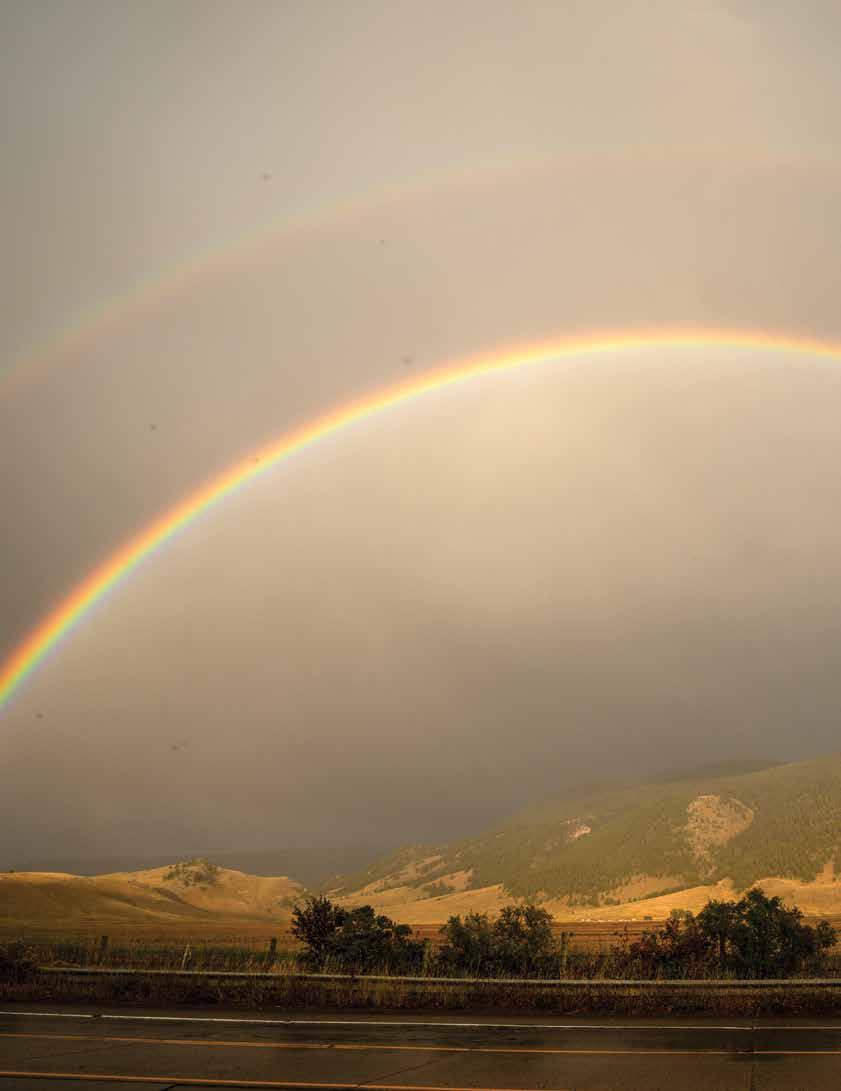
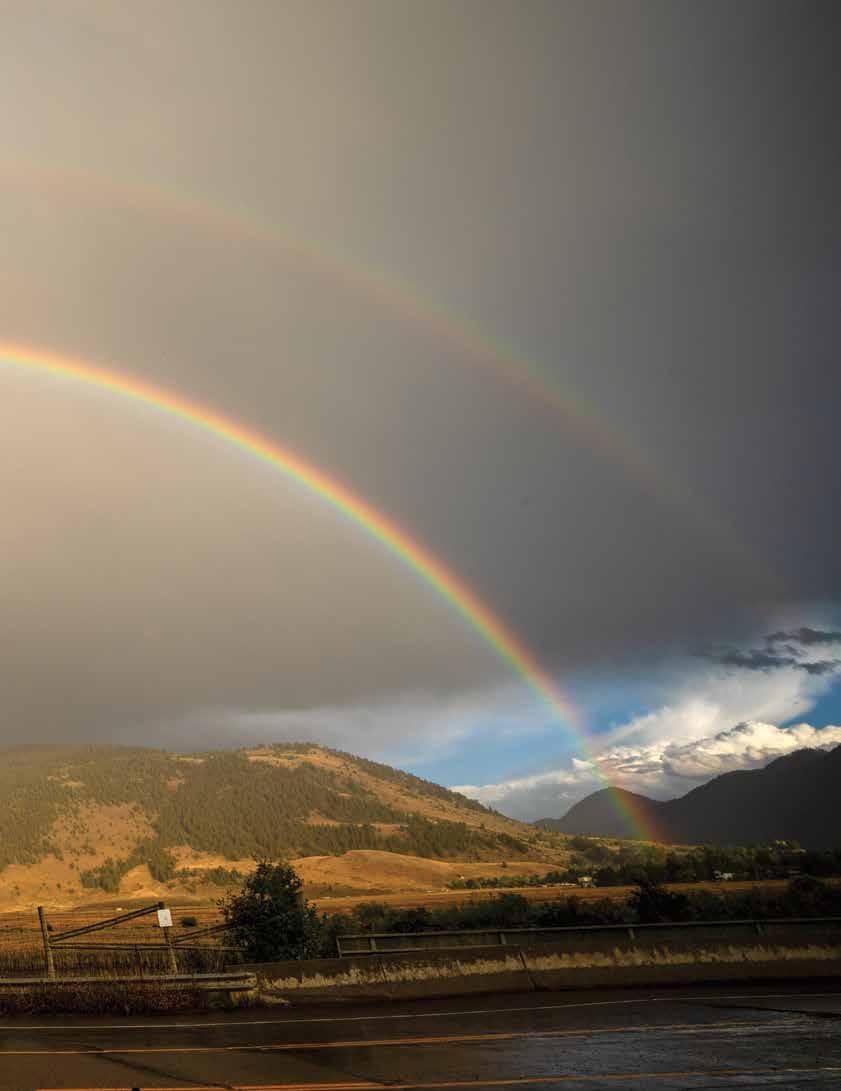
A DOUBLE RAINBOW spreads over the National Elk Refuge just north of Jackson, and between Grand Teton National Park and the Bridger-Teton National Forest. Double rainbows occur when light reflects off the same raindrops twice, producing a secondary rainbow (top) with the colors reversed.
LOCAL KNOWLEDGE
DougPierini
I don’t remember how we came up with the idea of breaking the tram record and do it as a fundraiser. People paid me, Mike, and Sparky per run, and we raised a bunch of money for Search and Rescue.” "
IN 2002, PIERINI, JHMR INSTRUCTOR MIKE JANSSEN, AND PATROLLER KIRK “SPARKY” SPRECKHALS SET A RECORD FOR THE MOST TRAMS SKIED IN A DAY. THEIR 26 TRAMS—MORE THAN 107,000 VERTICAL FEET OF DOWNHILL—BESTED THE 1969 RECORD OF 25 TRAMS AND STILL STANDS TODAY.
//BY JIM MAHAFFIE
When Doug Pierini took over as CEO of Jackson Hole Mountain Resort last summer, he came with more than 35 years of experience in the ski industry. Born in 1969, he grew up in Watchung, New Jersey, and skied at Plattekill Mountain, where his parents were part-time ski instructors, every weekend. He became an instructor there himself as a teenager to get a free ski pass.
JHMR was a homecoming of sorts for Pierini. He first visited in the early 1990s on a college ski trip from Rutgers. Shortly after graduation in 1993, he moved to the valley. He taught ski lessons and tuned skis at Pepi Stiegler Sports for several winters. In 1997, he became a supervisor at JHMR’s Mountain Sports School, a position he kept until 2003, when he left JHMR to become ski school director at Sierra-atTahoe in California.
In California, he started dating someone he had met at MSS. “We met in the locker room at Jackson and worked together as instructors, trainers, and managers,” Pierini says. They stayed in touch, and within a year of Pierini leaving JHMR, they were dating. In 2004, they married.
Over the next two decades, the Pierinis worked at more than a dozen ski resorts, from Okemo and Stowe in Vermont to Breckenridge in Colorado and Kirkwood in California. Pierini continued to move up in management while his wife, Leigh, is a trainer and examiner for PSIA’s Rocky Mountain region. By 2022, Pierini was vice president and COO for Vail Resorts’ Western region.
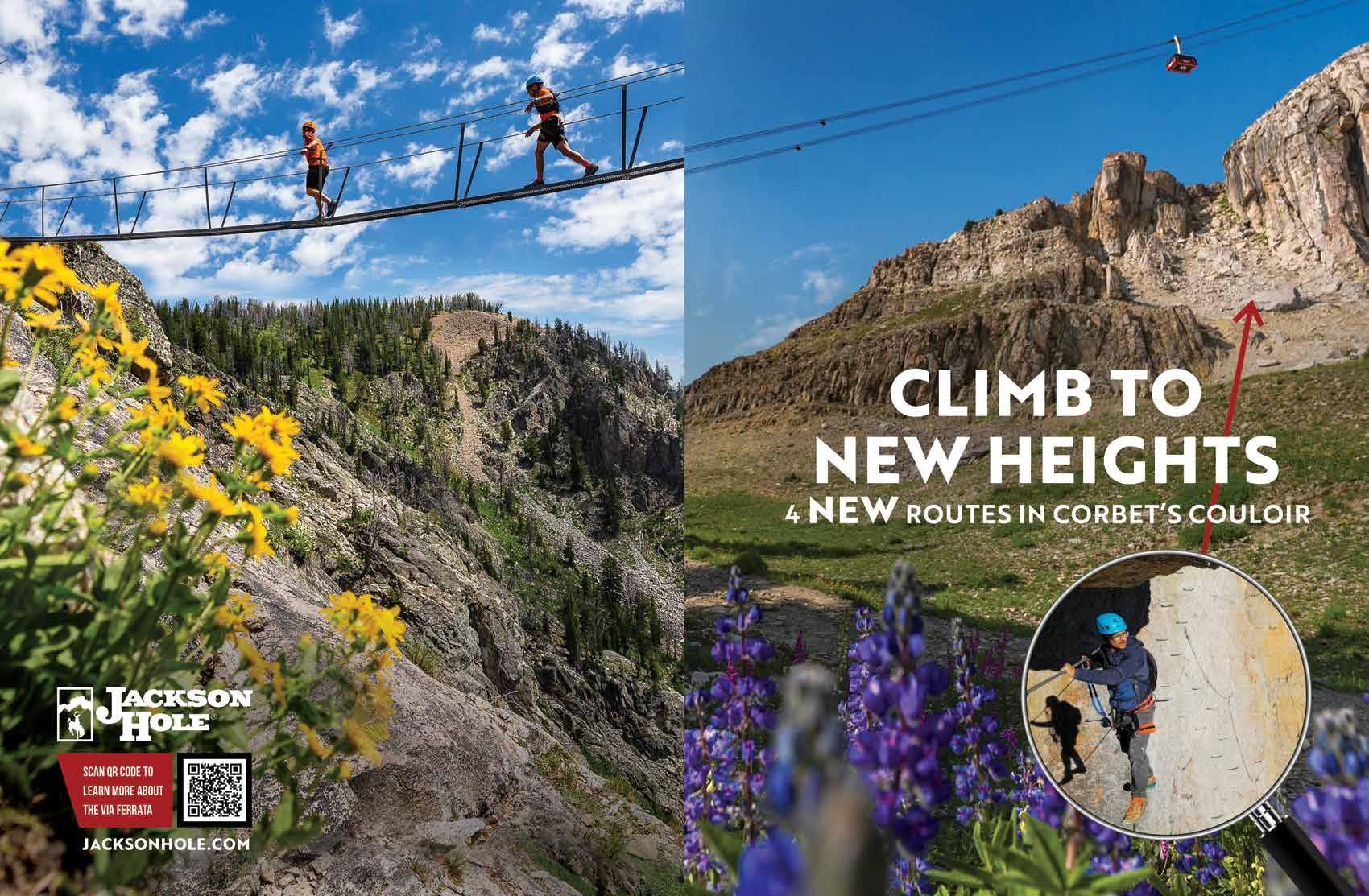
“Coming back to Jackson was like coming home,” he says. “We both have always loved it here.” Now, with a year under his skis at the helm of JHMR and two years of reacquainting himself with the valley, Pierini says his two kids are settling in and he and Leigh are rebuilding their roots, even if a lot has changed. “When I left, summertime was a ghost town in the Village. To see how far it’s come is impressive,” he says. “I love what summer has to offer in Jackson Hole. We’re constantly improving our summer trail systems and our food experience as well as additional activities for families and events.” Pierini is also proud of the new via ferrata route up the looker’s right side of Corbet’s Couloir. JH
ReadsGood
// BY JIM MAHAFFIE
MAKING A DIFFERENCE
The Exaltation of Parks
Steve Kemp
This book offers a deep dive into John D. Rockefeller, Jr., who was instrumental in the establishment of Grand Teton National Park, as well as the parks in Acadia, the Great Smoky Mountains, and Yosemite. The Grand Teton story is a fascinating look into amazing philanthropy, public-private partnership, and accomplishment (and partially covered in one of this issue's feature stories, on page 104), as well as the subterfuge and turbulence around its creation.
OUR WILDLIFE
Wild Wonders: The Untamed and Enigmatic Animals that Inhabit Yellowstone National Park
Julia Cook
See the awe-inspiring animals of Yellowstone through the lens of a passionate and extremely talented young naturalist. The photos are extraordinary, but so is the informative guide to 67 different creatures in the park, from grizzlies and elk to pikas and beavers. Wild Wonders is a great souvenir or gift for nature lovers, adventure seekers, and Yellowstone fans of any age.
WESTERN LIVING
Modern West
Chase Reynolds Ewald and Audrey Hall
This book explores 15 ski retreats, ranch compounds, cabins, and more across the Rockies, including several in Jackson Hole. Hall’s insightful photographs shine a light on each home’s design and architecture, while Ewald’s words tell the story of each site and the different realities of living, working, and playing in the contemporary West.
WOMEN
OF WYOMING
Women Shaping the West: Stories from Wyoming
Lindsay Linton Buk
Meet more than 25 Wyoming women whose lives, work, and personal stories are tributes to the spirit and soul of the American West. Every one of these trailblazing women have made an impact in the Cowboy State, shaping their communities, preserving traditions, and breaking new ground in politics, art, education, and business. JH
A Historic Jackson
Hole Barn
// BY KATHERINE WONSON
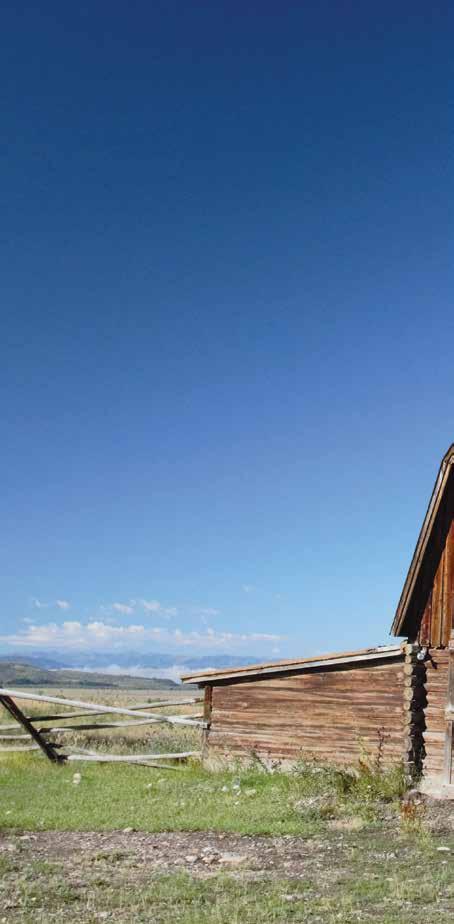
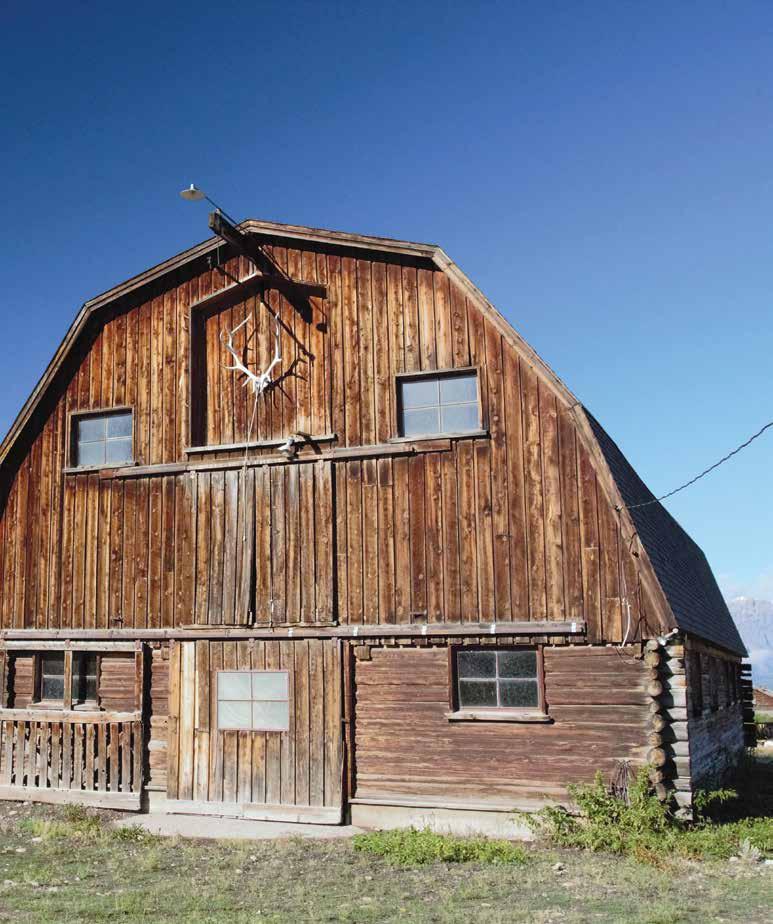
Every historic barn tells a story. The architectural details, materials, and placement of the barn can speak volumes about who built it, who lived there, and how Jackson Hole has changed since its construction. Every barn has a similar “anatomy” or set of components that help it function as an agricultural structure to house livestock and store feed, tack, and equipment.
The Hunter Hereford Barn, located east of Mormon Row in Grand Teton National Park, was built around 1947 by architect Eber Piers of Salt Lake City for Bill and Eileen Hunter, who owned one of Jackson’s early Ford dealerships. The couple had relocated to Jackson from Ogden, Utah, with the intention of building a hobby ranch. The August 23, 1951 issue of Jackson’s Hole Courier quoted the couple as saying they would spend the rest of their lives enjoying a wellearned vacation and raising Hereford cattle as a hobby on their ranch. Unfortunately, Bill died of a heart attack just one year into his ranching-retirement dream.
While the Hunters’ hobby ranch didn’t last long, its barn still stands today. Piers’s design was largely based on a barn in nearby Wilson (the Hardeman Barn, which still stands today on the campus of the nonprofit Teton Raptor Center) and was intended to blend rustic style seen on nearby Mormon Row with modern amenities such as electricity and plumbing. It featured a large dance-ready hayloft and log construction inspired by homesteading barns, and served as a movie set for the 1970 Western The Wild Country. It exemplifies the valley’s hobbyranch-era barns and is one of only a handful of historic barns remaining in Grand Teton National Park.
Winter Door and Summer Door
Just like people need different coats for the winter and summer, a barn needs two different door systems. Summer doors provide ventilation through their slatted, open-top construction. By contrast, in the freezing-cold months, winter doors provide greater insulation while still allowing light. This is done with the addition of a single window centered on the door. The Hunter Hereford Barn is one of the few historic barns in the valley that still retains both its summer and winter doors. Typically, once a historic barn is no longer being used for agriculture, ranch owners simply repair or replace just one of the doors and remove the other.
Interior Stairs
Unseen on the inside of the barn, stairs may seem like a given in a two-story barn, but in Teton County, that is far from the reality. During the homesteading era, barns used horizontal, nailed dimensional lumber attached to the walls as a makeshift ladder to reach the second story. By the 1920s, staircases were found in some valley barns, but the reason wasn’t what you would expect. Mel Annis, a local builder at the time, volunteered to provide the labor to upgrade a barn’s standard ladder to a staircase if the owner supplied the materials. This was to allow his wife, who needed stairs to reach the second story, to attend the traditional barn dance that took place after a barn was finished.
Gambrel Roof
The roof shape can indicate a lot about a barn’s history. The gambrel roof shape, with its unique double-sloped design, was commonly used in barn architecture because it created a large volume of space in the second story, allowing for greater hay storage without increasing the barn’s footprint. Though highly practical, the gambrel roof required experienced craftsmen and careful planning, luxuries most early-20thcentury homesteaders did not have. The use of a gambrel roof or windbreak Gothic roof signifies later and more sophisticated construction, often belonging to more established or wealthy ranchers.
Hay Loft Door and Hay Trolley
These tall doors allow for second-story storage of animal feed and ventilation and served as the entry point for loose hay into the barn. Ranchers lifted loose piles of hay with a hay fork hung from the hay trolley. These doors also allow for easy access to remove hay, though barns like this one have interior hay chutes that allow the rancher to simply push hay from the second story to the feeding troughs on the first (much like how we think of a laundry chute today).
Notch Corners
The way two walls are joined can be a telling detail. The saddle notch (or cope) corner is the most sophisticated of the log-notch types and signifies the involvement of experienced craftsmen such as the Nelson Brothers, who built this barn. It requires the use of log-building-specific tools and is a far cry from the simple V-notch found in the valley’s earliest buildings, which could be made with the precise use of an ax. JH
LOCAL LIFE John Simms
// BY JIM MAHAFFIE REED
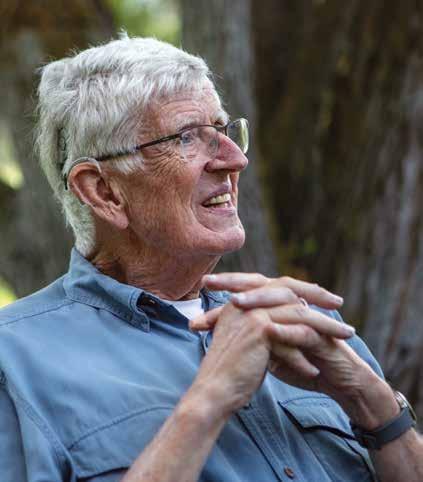
John Simms first arrived in Jackson Hole almost 60 years ago. Born in Jamestown, New York, in 1937, he grew up skiing Holiday Valley and Mohawk Mountain around Lake Erie and fishing small streams in the Adirondacks. In 1961, after two years in the Navy as a radarman, he and a friend stuffed John’s Jaguar XK120 convertible with gear and headed west. They first landed in Colorado, where Simms was a ski patroller and then patrol director at Arapahoe Basin and an avalanche forecaster at the recently opened Vail Ski Resort. Lured by the open frontier, Snake River fishing and rafting opportunities, and the skiing at the brand-new Jackson Hole Mountain Resort, Simms came to Jackson Hole in the mid-1960s.
His first job was working as a fishing guide on the Madison and Snake Rivers. (Since drift boats weren’t yet a thing, Simms guided with a yellow Navy-surplus rescue raft.) He was one of Jackson Hole’s first ski patrollers and also worked as a U.S. Forest Service snow ranger. At the new ski area, Simms and friend Charlie Sands were the first skiers to drop the gnarly couloir next to the very famous Corbet’s Couloir. (Neither has ever divulged the secret of who went
first.) Now named S&S Couloir in their honor, the line makes Corbet’s look easy and requires special permission from JHMR ski patrol to do.
Simms is not merely an outdoorsman, though. He’s an inventor and entrepreneur. A snow-science expert who pioneered evaluation and forecasting techniques to predict avalanches and who saw too many people die in avalanches, he invented tools that revolutionized backcountry safety: a collapsible avalanche shovel and ski poles that could be linked for use as an avalanche probe. These pieces of gear were the foundation of his company Life-Link International.
Then came Croakies. Tired of his sunglasses falling off, Simms cut up an old wetsuit and sewed the ends together like a Chinese finger trap that slid over sunglasses’ temple tips. Ski patrol buddies gave them their name, “Croakies.”
Next came Simms Fishing Products. In his early days as a fishing guide, wading shoes didn’t keep out sand and gravel. Simms designed neoprene cuffs, Gravel Guards, that did. These evolved into the first neoprene waders and, eventually, an entire line of fly-fishing gear, Simms Fishing Products, founded in 1980. Simms sold the company in 1993, but it still exists today—it’s now based in Bozeman, Montana—and the brand is a leader in high-end fishing gear around the world.
Simms says the through-line for all his inventions and innovations was not to make money but rather to make a difference in all the things he loved to do. And he certainly did: for his “exemplary achievements and contributions toward the excellence of winter sports,” including Life-Link, Simms was inducted into the Intermountain Ski Hall of Fame in Park City, Utah, in 2022.
Around the time he left the fly-fishing company that bears his name, Simms turned his creative spark toward making art, specifically creating large-scale geometric sculptures from metal. His first piece was a three-dimensional cube made from aircraft aluminum. It was mounted on bearings, and Simms went outside one morning to find it revolving in the wind. An edition of this cube, Imploding Cube, has been part of the Indianapolis Art Center’s permanent collection since 2000. Other Simms sculptures can be seen in Colorado, Oklahoma, and Washington State.
In Jackson, Simms is represented by Diehl Gallery. “All of his work is mathematically based, and much of it is kinetic,” says the gallery’s founder Mariam Diehl.
MY JACKSON HOLE LIFE
MAJOR BISON
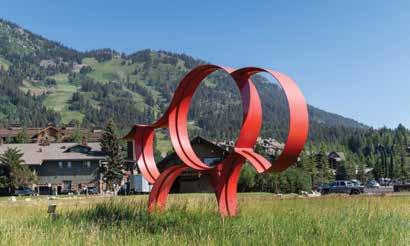
This is Simms’s favorite sculpture. “Because it was so large and heavy and strong, he says it was a great feeling to be able to climb and walk on it while working on it,” says his wife, Barbara. A 16-by-24-foot Major Bison—powder coated the same red as the JHMR tram—sits on McCollister Drive at the entrance to Teton Village. Gallerist Mariam Diehl says the sculpture is both monumental and intimate (and available in smaller sizes). “You feel the immense power of the animal, but also a quiet stillness that invites reflection. Collectors are initially drawn to the strength and symbolism of the bison, but what keeps them engaged is Simms’s use of the circle and geometric proportion.”
TO-DOS WITH VISITORS
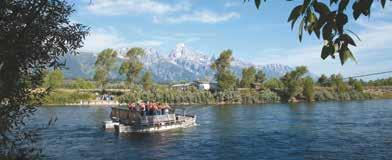
There are so many options in the valley, and so many of them are unique to Jackson Hole. I like to point them out to people—and not just in the mountains or on the river. It’s important to be aware of the environment and your stewardship of it. I really encourage people to hike. We take friends to Dornans, and I always suggest they walk down to Menor’s Ferry crossing (shown above) and get a feel for the Snake River.
FAVORITE DINING
We love to go to Dornans [in Grand Teton National Park] and their Chuckwagon sourdough breakfast. Dick and Tricia [Dornans’ owners] are friends. I’ve fished a lot with Dick. It’s almost a family place for us. We also love The Bird, which is just up the road from where we live and very accessible during the busy summer. Both spots are unique in Jackson—very unlike the superfine cuisine we would choose in town.
I seem to have a knack for appreciating the moment. I don’t think I’ve ever been bored.”
—JOHN SIMMS
LOCAL ROAD TRIP
One family tradition is going to Silver Gate, a tiny town in Montana just outside the northeast entrance to Yellowstone, in the spring. It’s a special time. All the red dogs [new bison calves] are out, bear cubs emerge with their mothers, you can see wolves, and everything’s fresh and blooming in the park.
FLY-FISHING ADVICE
Go to a shop and tell them you want to learn, and they’ll send you out on the river with a person who knows what they’re doing and can teach you. Fly-fishing is more than just waving a rod around. You need to learn to cast, watch the water, follow insects, and get some agility in rod handling. It’s pretty tough to learn on your own. JH
JOHN SHARES SOME HIGHLIGHTS FROM HIS JACKSON HOLE LIFE.
ALL YOU NEED
A Perfect Picnic LOCAL LIFE
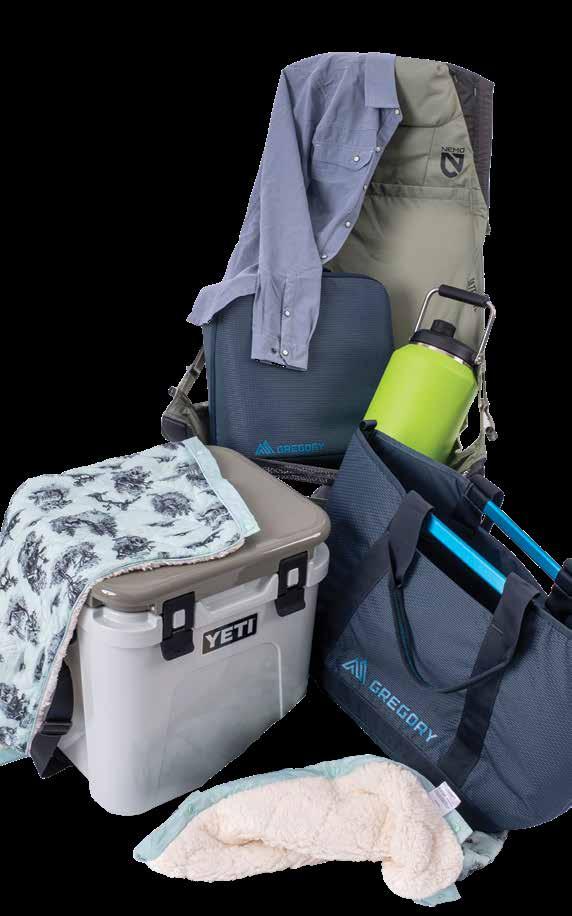
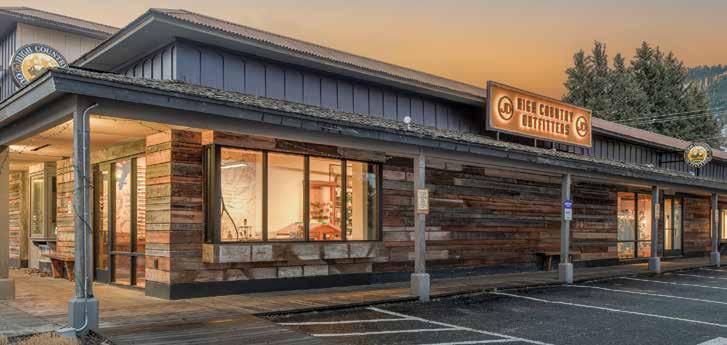
The Nemo Satellite Recliner is a great chair for sitting and eating around the fire-pit, and it really shines come dessert, when you can adjust it into a reclining mode via a pulley system built into the armrests, lie back, and do some stargazing. $200; available at JD High Country Outfitters, 160 W. Broadway Ave., Jackson
As perfect for the bike park as the picnic table, Stio’s Eddy button-down shirt is updated this summer with a softer, drapier fabric. Unchanged are its stretch, water-resistant finish, and Westerninspired good looks. $129; available at Stio Mountain Studio, 10 E. Broadway Ave., Jackson
Yeti’s One Gallon Jug keeps things cold (even when it’s hot outside) for 24 hours and has a smooth-pouring spout, an opening wide enough to fit ice, a magnetic cap, and a slide-proof base. $130; available at JD High Country Outfitters, 160 W. Broadway Ave., Jackson
It’s your choice—use Gregory’s 50-liter Alpaca Utility Tote to carry a blanket, chair, several bags of chips, and a couple of bottles of wine or enough firewood to feed a campfire for hours. The matching Kitchen Case is the piece of picnic gear you never knew you needed: it’s got pockets to organize and store plates, cutlery, cutting boards, utensils, and even spices. Tote, $120; Kitchen Case, $80; both available at REI, 974 W. Broadway Ave., Jackson
Yeti’s Roadie 24 2.0 Hard Cooler holds beer, wine, and grillables for a picnic for four; is pretty much indestructible; and has tie-down slots for attaching to a boat or truck bed. $250; available at Ace Hardware, 475 W. Broadway Ave., Jackson
Two great Jackson businesses come together in the Powder Puff x Persephone Stadium
Blanket collab. Water-resistant on the outside, backed with soft Sherpa lining, stuffed with Pimaloft Gold insulation, and featuring Persephone’s signature blue, it’s the ultimate outdoor blanket. $175; available at Persephone, 145 E. Broadway Ave., Jackson
Whether in the back- or frontcountry these will help you dine in style.
//
BY DINA MISHEV
BACKCOUNTRY
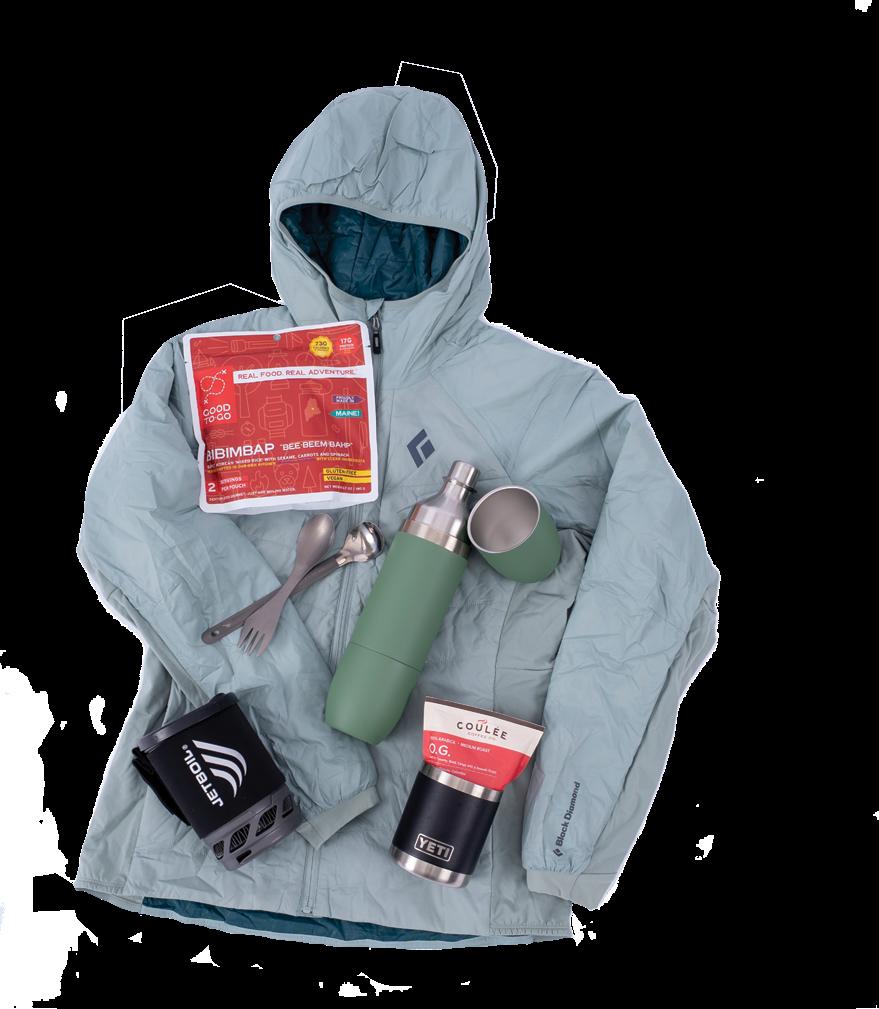
Yes, Black Diamond’s Solution 1.0 Hoody is built to send, but, with Primaloft Gold synthetic insulation, it’s also the perfect layer to put on to keep from getting chilled while stopped to enjoy a backcountry bite. $279; available at Black Diamond, 160 W. Pearl Ave., Jackson
Add an international flair to backcountry dining with dehydrated meals from small-batch producers Itacate (Latin-inspired), Stowaway Gourmet (Indian to Thai, Korean, and more), or Good to Go (the Bibimbap is delish). Prices vary; available at itacatefoods.com, stowawaygourmet. com, and goodto-go.com
Because everything, including wine, tastes better in the backcountry, High Camp Flasks’ Parkside Flask 750 is worth carrying the 25 ounces it weighs. Capable of holding an entire 750ml bottle—and keeping it chilled for 24 hours—it is lined with sommelier-grade steel to preserve flavor and comes with two magnetic tumblers. $120; available at highcampflasks.com
You only need one plastic spork to snap in the backcountry to swear forever allegiance to a titanium utensil. The Swedish brand Light My Fire makes a titanium spork with a polished surface that ensures it doesn’t taste metallic. Get every last bite out of your dehydrated meal pouch with Toaks’s long-handle titanium spoon Spork, $25; spoon, $13; both available at REI, 974 W. Broadway Ave., Jackson
Backcountry coffee need not be barbaric or basic. Couleé Coffee’s travel-ready, single-serve EcoPour filters are pre-filled with 14 grams of premium coffee, 100 percent compostable, and make café-quality pour-over coffee. The filters work equally well at home in the company’s automatic SWIRL system as they do over a coffee mug in the backcountry. Pick from Couleé’s coffees or buy empty filters to fill with your own. 20 filled filters are $28; available at couleecoffee.com
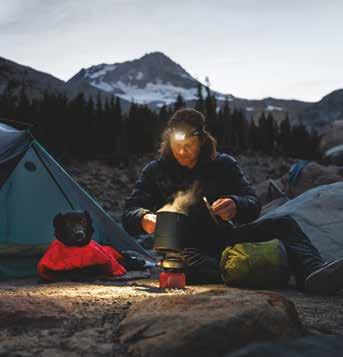
For dehydrated meals and coffee/tea, Jet Boil’s Micromo boils .8 liters of water in a little more than two minutes. The fuel canister and stove itself fit perfectly inside. $170; available at Teton Mountaineering, 170 N. Cache St., Jackson JH
LOCAL
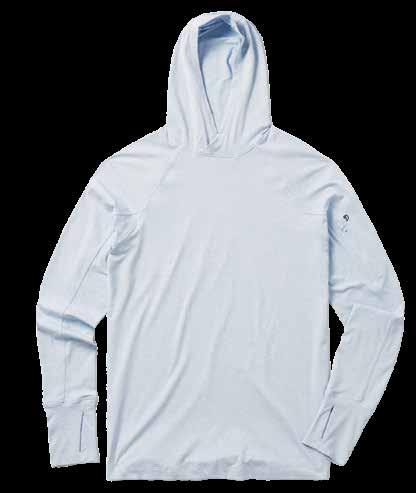
Sunshirts
// BY DINA MISHEV
1
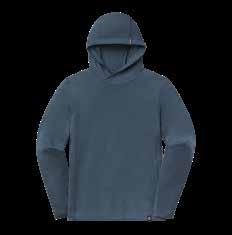
DUCKCAMP ROCKPORT HOODIE
WHAT IT IS
A lightweight UPF 50+ hoodie that, rather than overdoing it with unnecessary features, focuses on getting the important things—coverage and breathability—perfect.
STRENGTHS
The Brrr° fabric’s claim of “innovative micro-mineral cooling technology” sounds gimmicky until you’ve been sitting on your boat in the sun on a 80-degree day for hours and, amazingly, feel cool.
WEAKNESSES
To keep it smelling fresh, this top needed more frequent washing than most others.
BEST FOR
Anyone who says they get too hot in long sleeves; everyone on the hottest days.
DETAILS
WE TESTED THESE SO YOU DON’T HAVE TO.
$99; available at JD High Country Outfitters, 160 W. Broadway Ave., Jackson SALATHÉ
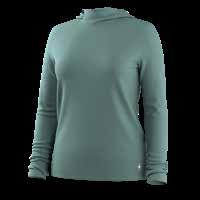
A new-this-season UPF 40+ hoodie made from 88% Merino wool and 12% recycled nylon.
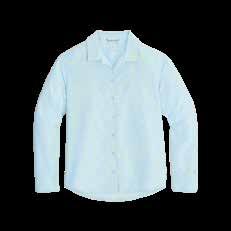
A snap-down, long-sleeve, lightas-air collared shirt with UPF 40+ sun protection and the brand’s proprietary Mosquito Protection Technology.
The ponytail hole in the hood of the women’s version is genius; although the fabric blend includes nylon, the layer closest to your skin is 100% soft Merino.
Wrinkle-resistant protection from the sun and mosquitoes? Yes, please! A bonus is that the antimosquito-ness is chemical-free and doesn’t wash or wear away.
While not as insulative as the Smartwool baselayers we wear in winter, it was warmer than the other tops tested.
Less of a problem with the men’s fit, but the women’s style is a little boxy.
Women with voluminous ponytails.
Anyone equally sensitive to the sun and mosquito bites.
$130; available at Teton Mountaineering, 170 N. Cache St., Jackson
$105; available at Skinny Skis, 65 W. Deloney Ave., Jackson
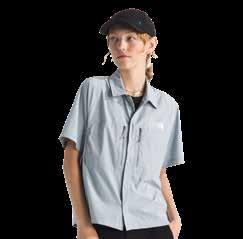
THE NORTH FACE LIGHTRANGE SHORT-SLEEVE 6
A medium-stretchy, fast-drying, lightweight hoodie that offers UPF 40+ and packs down to the size of a bagel sandwich.
A lightweight hoodie made from traceable alpaca fiber and a stretch blend with UPF 30+, a hatcompatible hood, and men’s and women’s fits.
Ummm, everything. Seriously. VESCENT HOODIE 4 5
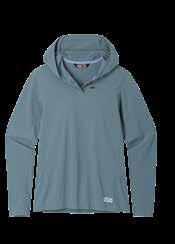
Stio’s proprietary Dot Air fabric has small ventilating holes that allow body heat out and breezes in. The stitched sunglass loop on the zippered chest pocket seems silly until you use it.
We wish there were thumb holes; the tops of our hands deserve sun protection, too.
Paka’s alpacas must be magical—the fabric is cashmere-soft, antimicrobial, and hard to snag.
With 40+ UPF, a water-repellent finish, anti-odor technology, and integrated venting, this short-sleeve shirt is as overachieving as it is suitable for both mountain and city adventures.
Days on the river—fly fishing, SUP-ing, rafting, floating.
At the time of writing, it only comes in two colors, navy and heather grey, and most sizes are out of stock. (We guess we’re not the only people who love this top.)
We’ll get back to you. If you’re not into shortsleeves, a long-sleeve version is available.
$129; available at Stio Mountain Studio, 10 E. Broadway Ave., Jackson
Taking on a multiday trip where weight is a premium—wear it all day, and, thanks to it being odor-resistant, all night.
Light packers who insist their clothes perform multiple duties.
$99; available at pakaapparel.com
$85 (women’s), $95 (men’s); available at JH Sports, 7720 Granite Loop Rd., Teton Village JH
PAKA SOL HOODIE
LOCAL LIFE
JACKSON HOLE ICON
// BY MAGGIE THEODORA
Jenny Lake Lodge
Some of the buildings here are more than a century old.
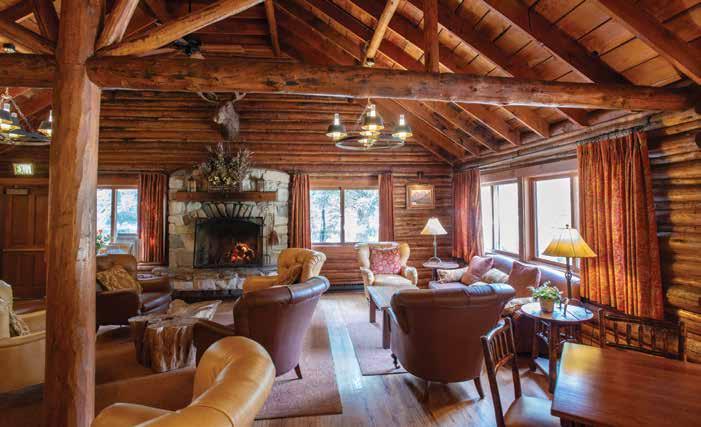
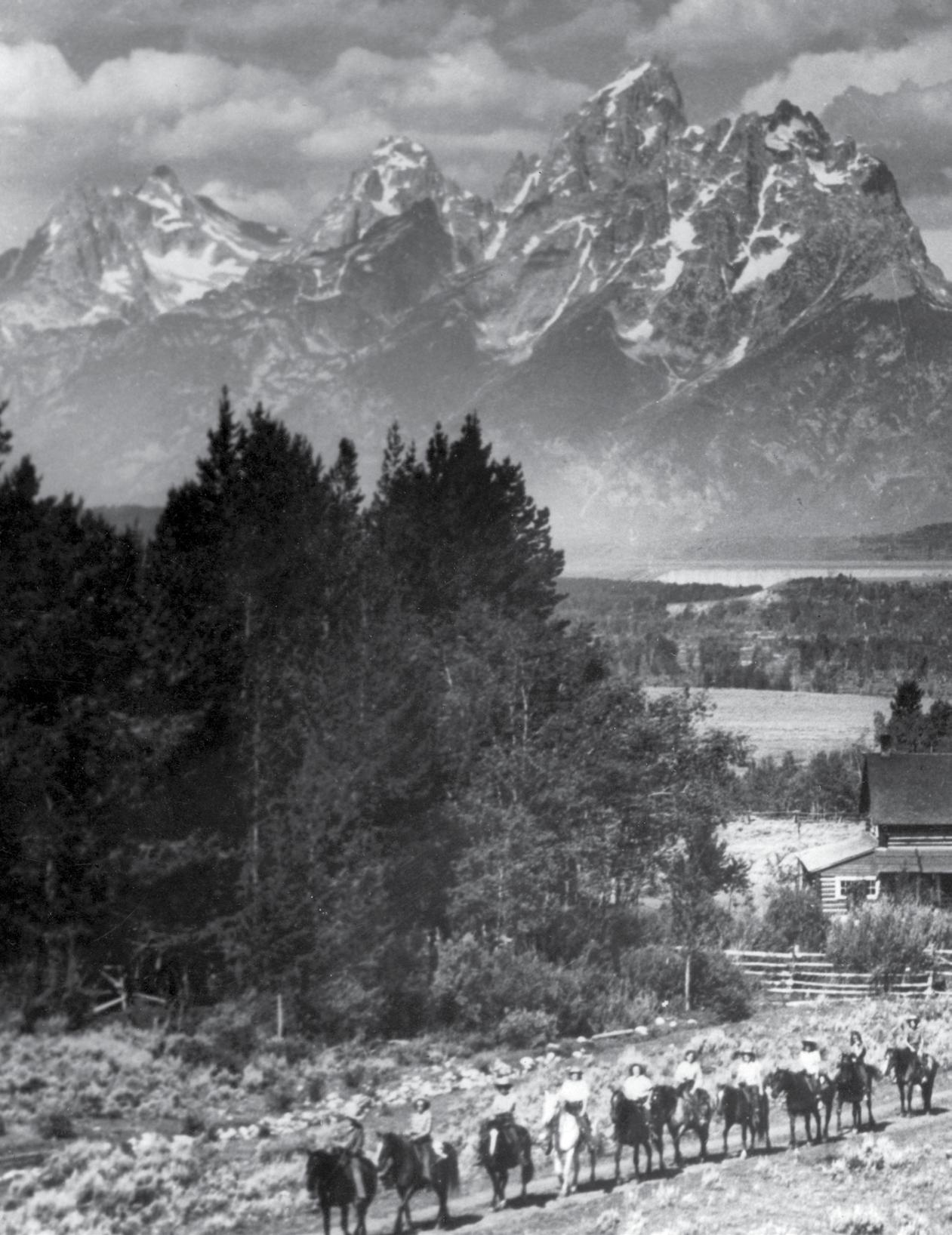
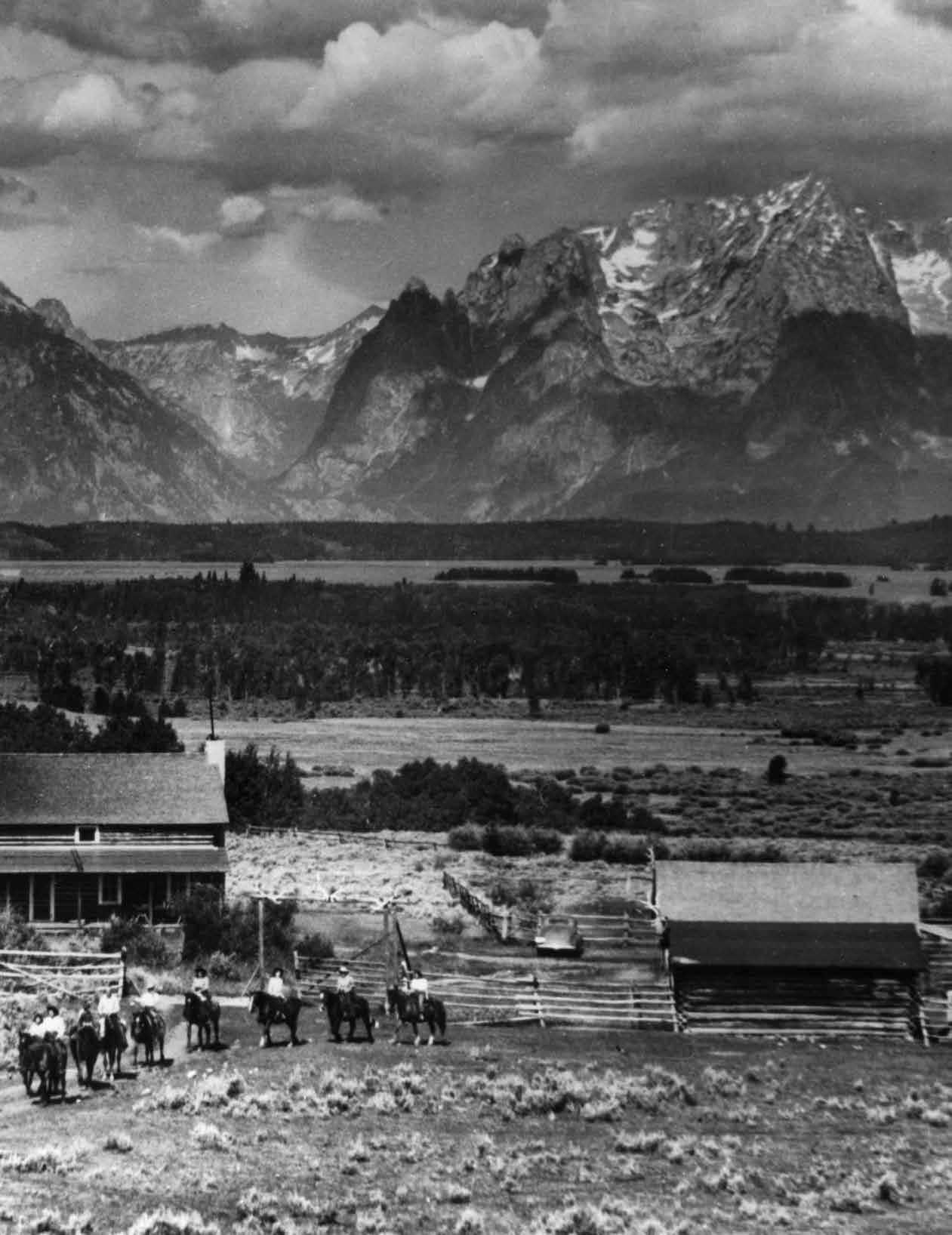
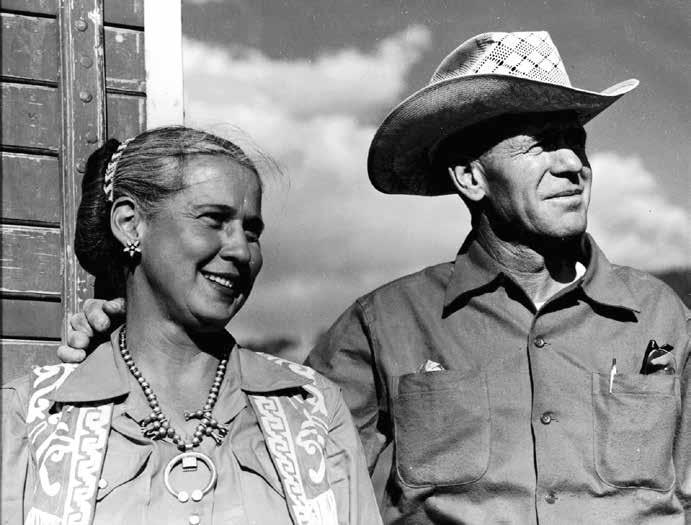
BUILT IN 1922 during the heyday of dude ranches in Jackson Hole, Jenny Lake Lodge predates the national park that today’s visitors come here to see. (Grand Teton National Park wasn’t founded until 1929 and was limited to the peaks themselves until an expansion in 1950.) Still, it was full of guests during its 10-week summer season. In 1923, the first year it welcomed guests, it wasn’t called Jenny Lake Lodge, but the Danny Ranch. Dudes came to the Danny from the East Coast to hike, climb mountains, fish, swim, and ride. Helping ranch founder Tony Grace with chores was also a popular pastime.
Grace established his residence on a 160-acre homestead east of String Lake in October 1922. He built a three-room 30-by-30foot log house, two large guest cabins, a barn, a storeroom, and an icehouse. In 1923, the ranch, which Grace named after the daughter of his financial backer, welcomed 23 guests. By 1928, enough additional cabins had been built to accommodate 54 guests.
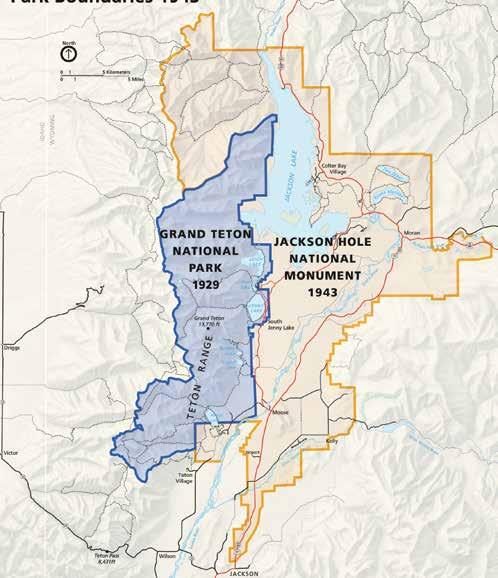
When Grand Teton National Park was established in 1929, Danny Ranch was right outside its eastern boundary. Talk had already been circulating for years about the expansion of Yellowstone National Park to include all of Jackson Hole. With the creation of GTNP, Grace became worried this would become reality. When, in 1930, John D. Rockefeller, Jr.’s Snake River Land Company (read more on page 104) offered Grace and his wife, Viola, $24,000 for the ranch, they took it. The following summer, the couple decamped from Jackson Hole for Montana.
The ranch buildings were leased for residential use for several years and, by 1934, were in poor condition. There was a fire in the main house in 1935. But, rather than being left to molder, the buildings were renovated and opened as Jenny Lake Ranch in the 1930s. The 30-by-30 log house Grace had built was rehabilitated and made part of a much larger main lodge, which, aside from a 1980s swapping of the dining room and sitting area, is the same main lodge today’s Jenny Lake Lodge guests know.
Jenny Lake Lodge officially opened in 1958. Grace was an honored guest at its opening banquet. While it has been updated and a handful of cabins added since, today’s Jenny Lake Lodge is very similar to the Jenny Lake Lodge of 1958. Ron Neville, the lodge’s general manager since 2019, says that the 1980s main lodge redo was the last major work done to the lodge. “There were four additional guest cabins added in the 1990s,” he says. Three of the guest cabins date from 1922.
Walk into the main lodge today—it is open to non-guests for breakfast (no reservations needed), lunch (reservations recommended), and a five-course dinner (reservations required) daily—and you can still see the walls of Grace’s 1922 log house. “It is amazing that Jenny Lake Lodge exists,” Neville says. “All of the other dude ranches around here were torn down, but here you can walk into the main lodge and see the Danny Ranch’s original main lodge.” Make reservations to stay or eat at Jenny Lake Lodge at gtlc.com/lodges/jennylake-lodge or by calling 307/543-3100. JH
Photo:LisaRomerein
SAVANNAH ROSE
PROFILE
Savannah Rose
HELLO
// BY EMILY COHEN
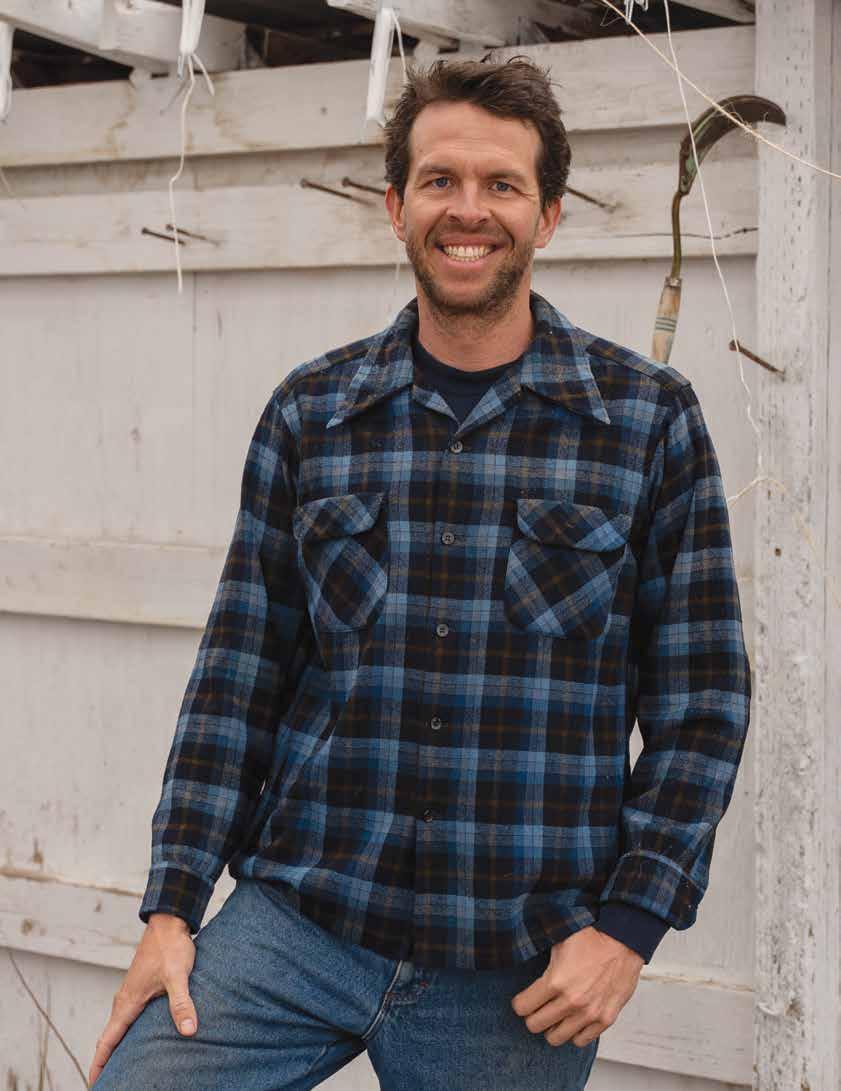
In the blue light of dawn, Savannah Rose hops into her stickered Subaru to search for wildlife. A group text with other wildlife photographers tips her off to where to try her luck. After a short drive, she’s trekking through the forest with her Nikon camera and a couple of lenses that span the length of her arm. She moves quietly. Listening. Watching the ground for tracks and the tops of trees for pygmy owls, she inhales deeply, her sense of smell so refined that she can detect when elk are near. She jokes that her parents called her “jungle baby.” These days, “mountain lady” may now be a more appropriate moniker.
Growing up in Singapore until she was 10—a parent was an executive with Coca-Cola—she saw Asian water monitors slide into rivers like small dinosaurs and flying lizards skim between trees. But it was after her family moved back to the States and visited Sheridan on summer vacations that she got interested in Western wildlife.
Rose filled sketchbooks with animals, teaching herself to translate fur and feathers into lines on a page. In 2017, seeking a fresh start, she moved to Jackson Hole to heal—and try making art professionally. Photography was her tool to gather reference material. “Some part of me realized I couldn’t do nature justice,” she says. “It’s already perfect. I’d rather try to capture it in its perfection.” So, she stopped trying to interpret wild animals and started photographing them instead.
In 2019, she set herself a quiet challenge: take a photo every single day. Or at least sit down and edit one. No skipping. “I was going up to Yellowstone a lot. I was going all over the place,” Rose says. “And I mean, most of the photos I took were bad. But that’s sort of the point of the process, isn’t it?”
Where Land, Lifestyle, and Legacy Meet.
Guiding buyers and sellers through Wyoming’s most significant estates and ranches with authenticity, storytelling, and trust.
For more than three decades, Latham Jenkins has connected people to place through thoughtful interpretation of Wyoming’s most remarkable properties. His work blends deep local insight with a global perspective, ensuring every transaction honors the land, its legacy, and the lifestyle it affords.
Recognized by RealTrends as Wyoming’s #1 individual broker in 2021 & 2024 and #2 in 2022 & 2023, Latham leads with integrity and results.
LOCAL LIFE
HELLO
SAVANNAH ROSE
Slowly, her eyes sharpened. She taught herself how to edit, watched a lot of YouTube tutorials. “I had to learn what I liked mostly by watching,” she says. Shallow depth of field. Eye-contact portraits. Moments of behavior. Scroll back far enough on her Instagram and you can see her apprenticeship in real time. Now, nearly 300,000 people follow her work. What began as a visual diary has become a full-time career.
and foxes looking for a mate. Spring is baby season. Rose says life for nature goes pretty fast. “The moose only have antlers for so long. The moose are only rutting for so long. When they shed, it’s off to the next thing, then the bighorn sheep are going to rut, and that’s only going to go on for so long.” If you miss these moments, it’s another whole year before the opportunity will come around again.
STEWARDSHIP TIPS
KEEP YOUR DISTANCE. Stay at least 25 yards from most wildlife and 100 yards from predators like bears and wolves (per National Park Service guidelines).
NEVER BAIT OR LURE ANIMALS.
Using food to attract wildlife alters behavior and can ultimately get animals killed.
CARRY BEAR SPRAY— AND KNOW HOW TO USE IT. If you’re in bear country, it’s not optional. Practice removing the safety clip and understand wind direction before you ever need it.
STAY ON ESTABLISHED TRAILS. Repeated off-trail travel tramples vegetation and can cause erosion.
RESPECT PRIVATE LAND AND CLOSURES. Seasonal area closures exist to protect wildlife—and your safety.
Images that look effortless are anything but. Wildlife photography, Rose says, is about luck and preparation. You study animal behavior. You learn migration routes, feeding habits, rut seasons. You memorize your camera’s settings until your hands move without thinking. Because when something finally happens, it happens fast.
“For example, let’s say a grizzly bear is coming right at you," she says. "You’ll have mental and physical reactions to that. You’ll be excited. But you only have, like, let’s say, 10 seconds before it comes past you. And you have to be thinking about, you know, what’s your ISO at? What is your shutter speed? What creatively do you want to do with the image? Are you cutting its ear off? Is it in a good composition? Is it in focus?”
Some shots take years to get. Her schedule follows the animals. Fall means moose rut. February is canine breeding season—following wolves
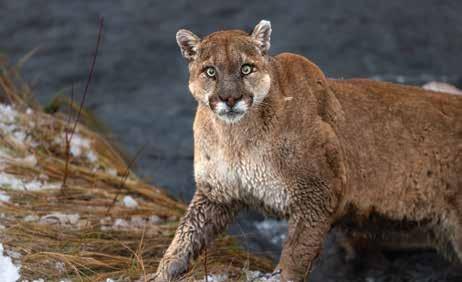
Unlike many wildlife photographers who specialize in one species, Rose chases variety. But her favorite animal to capture is the mountain lion. “They live their entire life in total secrecy,” she says. “They’re just like the ultimate prize. If you can get into the secret world that they have, you really made it.”
She has bushwhacked up hillsides until her legs shook. Been charged by a moose. Swarmed by yellow jackets. Once, a bear popped its jaws at her in warning, the sound sharp as breaking wood. Still, she keeps going back. Partly because photographing wild animals has remade her life. She talks about it plainly: time outside helped her quit drinking and smoking. Waking before dawn gave her a rhythm. Hiking miles every day strengthened her body and steadied her mind.
“The animals have given me everything,” she says. “They get me up early. They keep me active. They’ve given me clarity. Peace. Joy.” She remembers
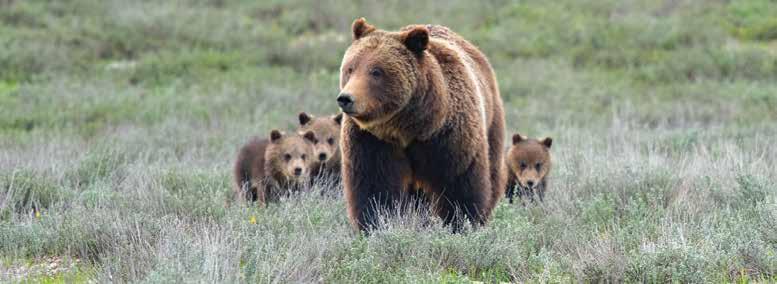
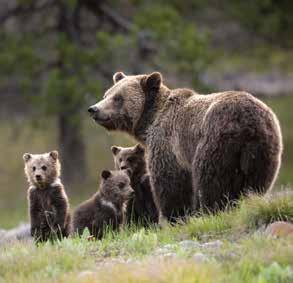
Rose says she has always been fascinated by the mystique of big cats—"the more elusive the better." Grizzly 793, known as "Blondie" by wildlife watchers, with three cubs.
a three-legged fox she once followed through the snow. “He doesn’t have the option to lie around and feel bad for himself,” she says. “He just hunts. He lives. Animals don’t dwell. They move forward.” Rose says she finds inspiration in that focus. “It’s something that grounds me, and it helps me when I am going through challenges as well.”
That ethic shaped her work and her business. These days, her income comes from a patchwork of prints, merchandise, magazine sales, sponsorships, and Etsy orders. (Her Etsy page, SavanahRoseWildlife, has a near-perfect five-star rating.) She licenses images to publications and conservation groups like the National Wildlife Federation and Audubon. Recently, she published her first children’s book, The True Tale of Buddy the Beaver, which she also illustrated along with her friend Cat Wood. She even sells images to Ranger Rick—the very magazine she once begged her mother to buy for her birthday. “It feels very full circle,” she says.
But she’s careful about what success means. To her, wildlife photography isn’t just art or business. It’s responsibility. “There’s a stewardship that comes along with wildlife photography,” Rose says. “We have to participate in conservation causes, whether that be fundraising or just spreading information, educating people.” She stops mid-sentence, lifts the camera. For a moment, everything else falls away. There is only breath and light, and an owl swooping into view. Click. JH
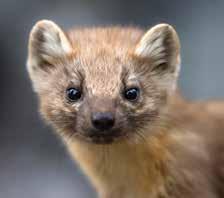
In addition to apex predators, Burgess photographs elusive smaller mammals like this pine marten.
SAVANNAH ROSE
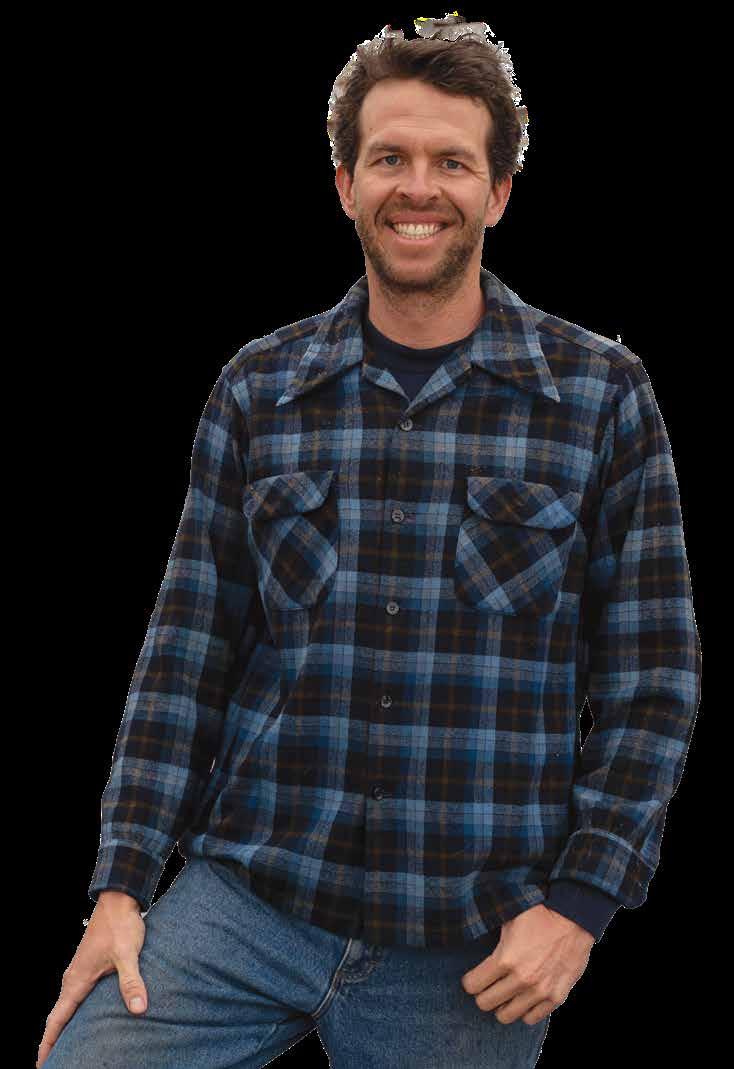
Ian
It sounds like the start of an intriguing piece of fiction: there was a kid in Jackson who had the chore of taking care of the family’s two llamas (Gannett and Lightning) and who grew up to encourage giving young kids knives, and founded a hard cider company that saves the lives of bears.
But this is Ian McGregor’s life—with the intervening years spent studying English and creative writing at Skidmore College, learning fermentation in California’s wine country, summers back in Jackson selling pies at the Saturday farmer’s market, working and teaching at a nonprofit farm in New York’s Hudson Valley, and marrying his college sweetheart. Oh, and reading journalist Michael Pollan’s seminal 2006 book The Omnivore’s Dilemma, which explores Americans’ complex relationship with food.
“That [book] set me on a sustainable-food angle for feeding myself,” says McGregor, who had started visiting apple orchards around Skidmore, which is in Saratoga Springs, New York. “I loved apple picking, something which there isn’t much of in Wyoming. I never realized how many different varieties of apples there are.”
After college, McGregor had the idea he wanted to be a winemaker and moved to northern California to learn about viticulture. “It was hard work, but I enjoyed the process of harvesting something from the land and turning it into something people could consume and enjoy,” he says. In California, he also worked at Front Porch Farm, a 110-acre organic and biodynamic farm in the Russian River Valley that grows over 200 varieties of veggies, annual and perennial cut flowers, blackberries, stone fruit, and wine grapes. “There, I learned everything about growing things that I couldn’t learn in the agriculturally inhospitable environment of Jackson,” he says.
McGregor also apprenticed on a farm on the opposite side of the country: Stone Barns in the lower Hudson Valley. Founded in 2004, Stone Barns
is a working four-season farm and hub for learning, creativity, and experimentation with an on-site Two-MichelinStar restaurant, Blue Hill at Stone Farms. In the apprenticeship program, McGregor focused on vegetable production and also teaching kids. Eighty thousand kids from the greater New York City area visit the farm annually. “We were just making kids weed the beets all day, and then they’d come back and be like, ‘I eat kale now!’ I witnessed
their transformation, and it lived inside of me,” he says.
Also inside him was a desire to return to Jackson. “I always knew I wanted to raise my family in Wyoming,” he says. McGregor and his wife, Blair Costello, moved to Jackson in 2014. The cider company and giving kids knives, including his own now-six-year-old daughter, Isla, grew out of McGregor’s attempts at figuring out how to make a living here.
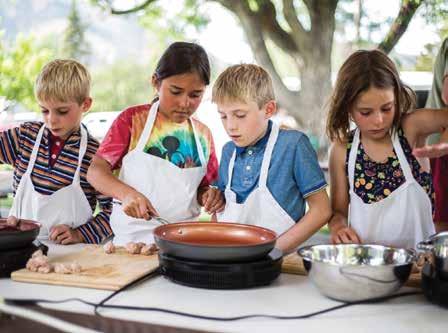
COOKING CLASSES FOR KIDS
“I think the slogan on our t-shirts for this summer’s camps is going to be ‘Give Kids Knives,’” McGregor says. “The best way to teach your kid to do something is to send them to someone else, and then they come back with new skills and maybe a small burn or cut, and you realize it’s not the end of the world.” This summer, McGregor and friend and Farmstead co-founder Orion Bellorado are offering seven sessions of a week-long in-person Farmstead Wyoming farming and cooking camp for kids ages 7–12. Kids pick vegetables from McGregor’s garden in South Park Ranches and learn to make everything from bread to yogurt, chocolate-beet cupcakes, and pan-fried dumplings. “It’s empowering for kids to be trusted in the kitchen,” McGregor says. “When we hand them a knife, it is often the very first time an adult has handed them something sharp. But 100 percent of the time, the kids have risen to the occasion. They take it seriously because we take them seriously.” Every camp ends with the Friday Feast, where kids make a meal for their families. $620 for a five-day session, which includes snacks and lunch; farmsteadwyo.com
During the school year, McGregor and Bellorado offer Zoom cooking classes for ages 6–13 (and, increasingly, their parents). Classes are 90 minutes on Wednesday nights; cover culinary skills including baking, sautéing, and knife techniques; and end with a kid-cooked dinner or dessert. $125 for five weeks; farmsteadwyo.com
RYAN DORGAN
LOCAL LIFE
HERE, IAN SHARES MORE OF HIS OWN STORY.
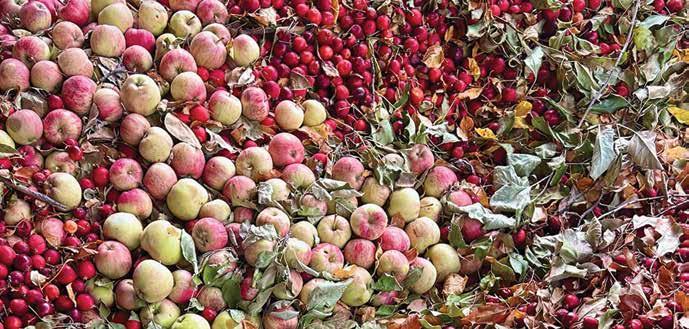
Back in Jackson, I reconnected with a friend, Orion Bellorado. We had done archery and Nordic skiing together in high school. (He was always a much better skier than I was. I was the morale booster—the one who helped people have a good time.) Summers during college, he and I sold pies, quiches, and vegetables at the Jackson Hole Farmer’s Market. He eventually turned that business into Roots Kitchen and Cannery. Back here in 2014, we wanted to figure out where all our experience with selling vegetables and pies could take us. We spotted crabapples everywhere, and we began to find some regular sweet apples, too. Orion already had a fruit press—he and his wife had randomly put one on their wedding registry, and someone actually bought it for them!—and, at a dinner party, we heard about bears coming into neighborhoods, where they could be in conflict with people, dogs, and cars, to eat crabapples and apples. Once bears become accustomed to humans, they are either sedated and relocated or, if there have been multiple incidents, killed.
I thought I was giving up my fermentation dreams when I moved back to Wyoming, but the abundance of crabapples and Orion’s story about wildlife conflicts got me excited to try making cider from local apples. Also, there were no cider makers in the whole state. Farmstead Cider is the first hard cider made in Wyoming since Prohibition.
We got a three-year grant from the Teton Conservation District to pick apples from private property around the valley—to reduce wildlife-and-human conflict—and turn them into cider.
Crabapples are a totally different beast to try to make cider out of, but a lot of my winemaking experience with barrelaging and different types of fermentation was designed to cope with the various bitterness and acidities of different types of grapes. And so, applying that to cider-making was a
good opportunity to say, “Hey, we can tame these crabapples a little bit.” Our ciders are all still very crabby, but we’re proud of that. We released our first cider in 2017.
When the Teton Conservation District grant expired in 2018, Farmstead was doing well enough to support itself. We can harvest about 50,000 pounds of sweet apples and hightannin crabapples during a season. For some companies, that is a little, but for us, we do everything by hand so it’s a lot. Our goal isn’t for Farmstead to get too big. I want to keep it small and local, so I have time to lean back into other things I’m passionate about in the food world.
I started teaching after-school cooking classes in 2014 for various local nonprofits, like Slow Food in the Tetons. (I was the president of its board for four years.) During Covid, these transitioned to Zoom. Since I love the idea of teaching kids to cook in their own kitchens, they’ve stayed online. In the summer, Orion and I do week-long farming and cooking camps for kids. [Read more about these camps on the prior page.] We hope to start adult cooking classes and camps in the future. The dream is to have a community garden that combines farming with education and cooking, but it’s so hard to find space. Maybe that is something that can come from this article. We need something that is public-facing enough where we could have an indoor kitchen, but then also have space for a garden, or at least the space to store what we grow. It’d be a combination of agriculture, culinary education, education, and having fun.
As a kid, this was never a life I envisioned for myself—I wanted to be a teacher until I realized I didn’t want to work inside—but it’s perfect. Some people let their lives dictate where they go. I just let the pinball bounce where it might, and this is where it ended up. It’s amazing how connected all the different bounces can be.
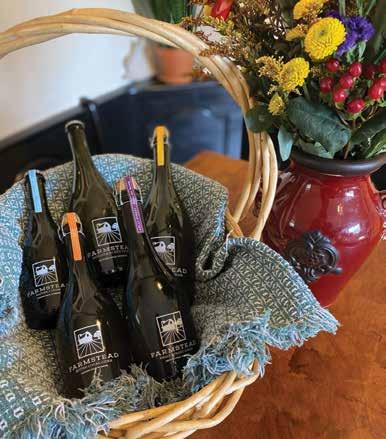
FARMSTEAD CIDER
Farmstead Cider’s Red Canyon Nan Cider won a 2022 Good Food Award in the annual competition that recognizes outstanding craft food producers and farmers nationwide.
Farmstead’s 2019 Kelly Street Cider, which is made entirely from apples harvested on Kelly Steet in East Jackson, won a 2021 Good Food Award. Rafter J Cider uses apples from the eponymous neighborhood south of downtown Jackson. About 75 percent of the apples Farmstead uses come from Teton County. The other 25 percent come from eastern Idaho and Lander, Wyoming.
In Lander, Farmstead harvests apples from the historic Ed Young Orchard, which was planted in Red Canyon in the 1880s and abandoned during Prohibition. The trees that survive today include rare and unnamed apple varieties. It is apples from this orchard that are used in the award-winning Red Canyon Nan. Find Farmstead Cider on tap at Local, Orsetto, Trio, and The Bird, and in bottles at Bin22, Creekside Market, Bodega, and Dornans in Moose. farmsteadwyo.com and @farmsteadcider JH
LOCAL LIFE
HELLO
BUSKIN “BUCK” WILSON
// BY JIM MAHAFFIE
BUSKIN "BUCK" WILSON
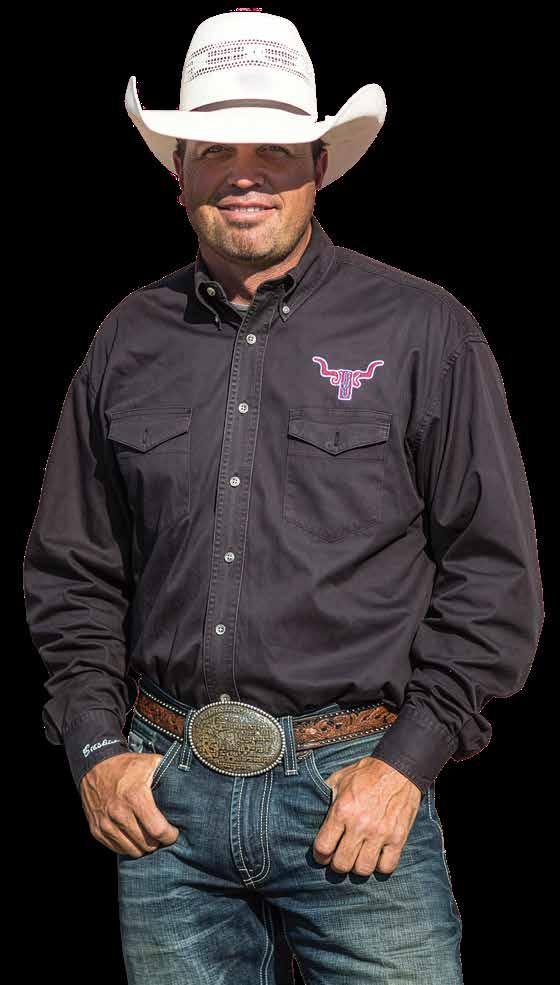
It doesn’t get more home-grown in Jackson Hole than Buskin Wilson. Six generations (and counting) of his family have called the valley their home. In 1890, Buck’s greatgreat-grandfather Sylvester Wilson brought his family over Teton Pass, where they began raising cattle. The Wilsons have carried on the ranch-life legacy ever since. Five generations ago, the family started outfitting. The most recent three generations have a strong rodeo tradition. And, yes, Wilson, the community just at the base of the eastern side of Teton Pass, takes its name from Buck’s family.
“It’s amazing and heartwarming to have so much history here. This valley and all the great people? Everything my family fought for and accomplished? It’s what holds my family in this place, and it’d be awful hard to leave,” says Buskin, whose name pays tribute to one of his dad’s favorite fishing spots, the Buskin River on Kodiak Island in Alaska.
Buck’s great-grandfather was the recipient of the first outfitter license of record ever issued in Jackson Hole (in 1911). Buck’s father, Philip Wilson, still has and uses this license. In 2003, Buck and his wife, Brandi, founded their own outfitting business, Hidden Basin Outfitters. From their two packin camps—both in the Bridger-Teton National Forest—they offer guided big game hunts for elk, deer, moose, bighorn sheep, mountain goats, and antelope.
“I was brought up ranching and hunting, and I wanted my own outfitting business since I was a kid,” Buck says. “I realized fast that I wasn’t going to have a big ranch here in Jackson, so we wanted our camps to be a way of having a ranch here.”
"
It was Buck’s grandfather Clark Wheeldon who brought a rodeo tradition to the family. He rode broncs in the valley’s first rodeos. Uncles Chet and Chancy rode bareback, saddle broncs, and bulls, and Chancy was one of the top saddle bronc competitors in the world in 1975. Buck, who was born in 1976, got his rodeo card in 1995 and, in 1997, finished a career-high 26th in the world bull riding rankings. The family doesn’t just compete, though. Buck’s dad, Philip, took over running the Jackson Hole Rodeo in 2010. Today, Philip, Buck, and his two brothers, Body and Brandon, run the rodeo, which is held every Wednesday and Saturday between Memorial Day and Labor Day.
Ranching, rodeo, and hunting run really deep in my family, and everyone ropes, rides, competes in horse and bull events, barrel races, and loves the life.”
—BUCK WILSON
Buck drives to and from Texas on regular bull-buying trips and found time on one long trip to answer some questions for us.
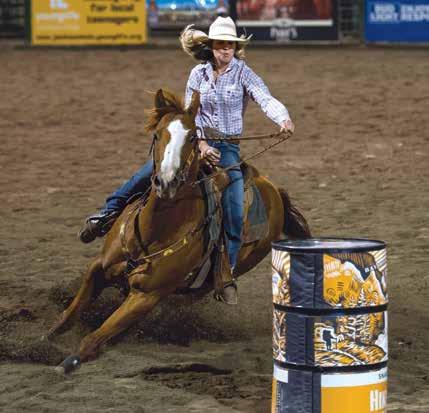
Barrel racing is one of the events at the Jackson Hole Rodeo. Buck's grandfather Clark Wheeldon was the first in the family to get into rodeo. Buck himself was a bull rider, and today, with his two brothers, he runs the Jackson Hole Rodeo.
LOCAL LIFE
HELLO BUSKIN "BUCK" WILSON
Q: What’s your favorite rodeo event to do?
BW: Bull riding—100 percent. There’s so much thrill, so much excitement. You need to figure out what you’re good at in rodeo. For me, it’s riding bulls. The adrenaline rush is unreal. You never know what’s going to happen, and it’s nobody’s fault but yours if you don’t win. Imagine seeing one of these giant 2,000-pound bulls and saying, “I’m going to get on and ride that.”
Q: What’s your favorite rodeo event to watch?
BW: Also bull riding, but I do love them all. Especially the rough stock events (bull riding, saddle bronc riding, and bareback riding). When you know what all it takes, you can appreciate it even more. I know how much these competitors work and how hard it is.
Q: You retired from traveling internationally and competing in 2006, but do you still ride bulls?
BW: I still get on a little bit. One of my dreams is to ride in a pro rodeo with my boys, and one of my sons still has a little more than a year before he can get his pro rodeo card.
Q: What do you do for the Jackson Hole Rodeo?
BW: I manage the bucking bulls. I rotate bulls in and out every season, because after a while they can quit bucking. We want to always have great bulls and great rides and great talent, so I’m continuously shopping bulls, usually in Texas, and then rolling them in and out of the rodeo. It takes about 80 bulls a season to run the show, and they cost around $4,000 a bull. We get two truckloads from Texas every year, and we also look for good bulls in Oklahoma, Missouri, and Arkansas.
Q: Your three kids all do rodeo, and your family hosts kids who rodeo and work every summer. What does rodeoing teach kids?
BW: We try and teach them more about Western lifestyles and our heritage. I see them gain a lot of self-confidence. The animal side of rodeo is great, and you can get a lot from raising a horse and being around horses. There are things you have to uphold being a cowboy, so they also learn respect for others, being polite, and saying “yessir” and “no sir.” Plus, if you don’t know God yet, you’ll get religion from the fear factor of getting on a bucking bronc or bull.
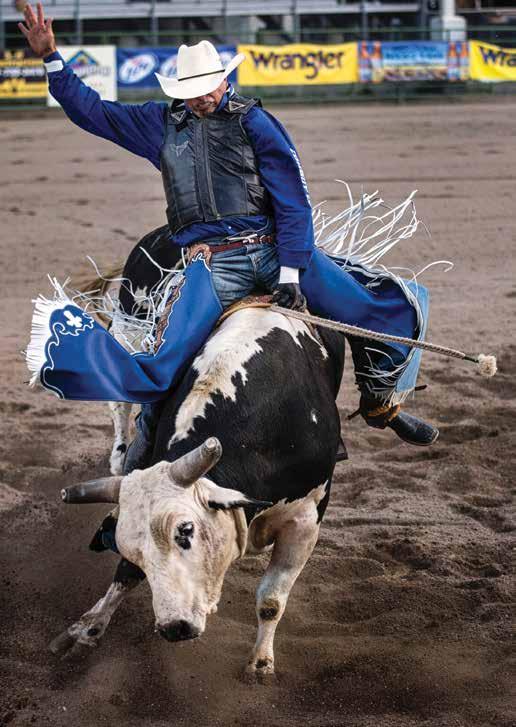
Buck Wilson competing in the Championship Bull Riding Horizon Series at the Teton County Fairgrounds.
A FEW RODEO EVENTS EXPLAINED
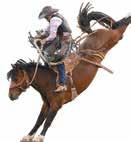
Professional rodeos typically feature seven core events that showcase traditional cowboy skills, including bull riding, bareback riding, saddle bronc riding, steer wrestling, tie-down roping, team roping, and barrel racing. You may see steer roping, breakaway roping, and mutton bustin’, too. Events are judged and timed.
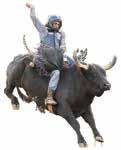
In bull riding, riders are randomly paired with a bull and then judged on their rhythm and control—but only if they remain mounted for at least eight seconds with one hand on the rope. If cowboys touch their rope, the bull, or their own body with their free hand, they are disqualified. The total score of a ride is determined by combining the bull and rider’s individual scores.
Barrel racing is a timed event. A horse and rider try to complete a cloverleaf pattern around three triangulated barrels. “You need a great horse and a great riding working together,” Wilson says. “They all have their great moments and skills.” A rider’s time depends on both the condition of their horse and also on their horsemanship.
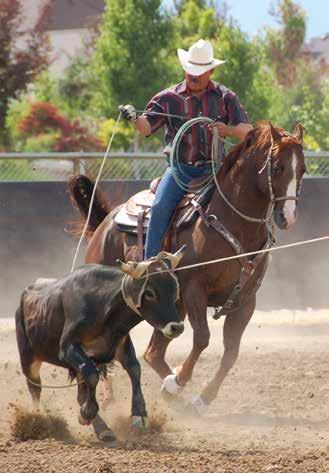
In calf roping, a rider ropes a calf, dismounts their horse, and then restrains the calf by tying three legs together in the fastest time possible. JH
Dubois
Friday Night Rodeos 2026
Friday Night Rodeos 2026
EVERY FRIDAY NIGHT AT 7:30 PM
Clarence Allison Memorial Arena, 5639 US Hwy 26, Dubois, WY.
JUNE • 5, 12, 19, 26
JULY • 3, 10, 17, 24, 31 & AUGUST • 7, 14, 21
JULY 4 - Saturday Rodeo starts at 5:00 pm
Gates open at 6:00 pm. General Admission only - No presold tickets. Cash at gate $20, Kids 6-12 $10, 5 and under Free. Rodeo Entries - Thursday evenings prior to Friday rodeo 7-8:00 pm only. Entry line 307-710-7080
Facebook page for all information and updates: @Duboisfridaynightrodeo
Any additional information, call 307-710-7080 or kbecker@dteworld.com
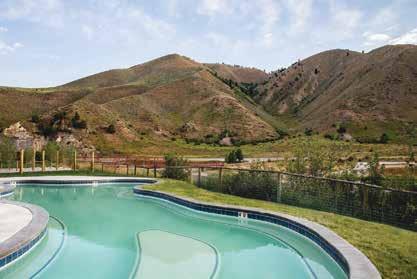
A NEW WELLNESS EXPERIENCE BY TRAILBORN
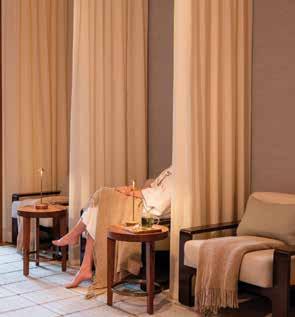
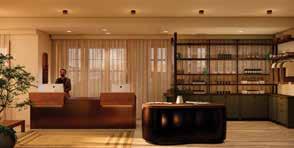
Even the most active adventurers know when it’s time to recharge. Your new spa and wellness experience features massage, beauty treatments, plus space and practices for recovery. Your body, and you, will be at your best pre-andpost excursion — reconnected to nature and yourself. Learn more and book your stay at trailborn.com/jackson-hole
A Centennial Birthday
// BY SAMANTHA SIMMA
The Triangle X Ranch has been in the same family for 100 years.
On a summer morning at Triangle X Ranch, the day begins the same way it has for generations: horses shifting in the corrals, the smell of coffee drifting from the main house, guests pulling on boots. By the time riders file out toward the sagebrush flats at the foot of the Tetons, the peaks already catching light, the rhythm of the place is established—steady, deliberate, and unchanged by design.
Triangle X Ranch, a guest ranch that, between late May and early October, hosts 80 guests per week, marks its 100th anniversary in 2026. This is a rare milestone not just in Jackson Hole, but in American tourism. It is the only dude ranch concession still operating inside a U.S. national park, and one of the few remaining guest ranches in the West that has stayed in the same family, on the same land, for a full century.
The story begins with John S. and Maytie Turner, who arrived in Jackson Hole from Utah in the early 1900s. On a fishing walk along the Snake River, John S. was taken by a meadow framed by aspen and pine. He knew it was the place to raise his family. He purchased a former homestead in July 1926, paying double the asking price for the homestead—an early expression of the fairness and self-reliance that would define the ranch’s culture. The Turners later expanded their holdings by purchasing additional acreage and leasing neighboring lands, laying the groundwork for what would become Triangle X Ranch.
LOCAL
John S. and Maytie raised five children—John C., Reid, Bert, Dorothy, and Marian—on the ranch. In those early years, Triangle X was very much a working cattle ranch, but hosting guests was part of its survival from the beginning. In the fall of 1927, the Turners welcomed their first big-game-hunting guests, who shared basement lodging with the family while permanent structures were still under construction.
“It was a tough place to make a living,” says John Turner, John S. and Maytie’s grandson, who is now in his 80s. “You spent the entire year preparing to survive winter—not just for your family, but for your livestock.” Electricity didn’t reach the ranch until 1953, when John the younger was 11 or 12. Before that, winters meant kerosene lamps, wood stoves, and isolation that could last months at a time. Cash was scarce, so, like many early valley residents, the Turners turned to guiding hunters, fishermen, and guests as a way to survive. “It was a way to share this magnificent valley,” John says, “and a way to pay the bills.”
As the ranch evolved into a full-scale dude ranch, it became a place where guests stayed for weeks. Days were filled with horseback riding, fishing, square
dances, and real ranch work—branding, haying, and tending livestock. In 1950, when Congress expanded Grand Teton National Park to include the Triangle X acreage, the ranch became an official National Park Service concessionaire, cementing its unique role within the park system.
Management of the ranch passed through multiple generations: from John S. and Maytie to their son John C. Turner, who raised three sons—Harold, Donald, and John—on the ranch.
were raised on the ranch and are now raising the fifth generation of Turners on the ranch—Robert has two children, Lucas has three. “When you have a good childhood,” Robert says, “you want to give your kids the same kind of memories.” His daughters work summer jobs cleaning cabins and serving meals.
Through decades of change in Jackson Hole, Triangle X remained deliberately resistant to reinvention. “The recipe was handed down,” Robert says. “We don’t want to change it too much, because it works.” That recipe— horses, land, family-style meals, and time—has proven remarkably durable. There is no Wi-Fi in the cabins. No televisions. No swimming pool. When guests once balked at that simplicity, the Turners held firm. Now, families seek it out. “It’s come full circle,” Robert says. “People want their kids unplugged. Here, they don’t have a choice, and that’s the gift.”
Guests today stay a full week, ride the same horse every day, and watch the same elk herd move through the area day after day. “They’re not seeing wildlife from the side of the road,” Robert says. “They’re watching calves hit the ground. Three days later, they’re watching them run.” Many guests themselves are fourth- and fifth-generation Triangle Xers. “What their grandparents
It was a tough place to make a living. You spent the entire year preparing to survive winter—not just for your family, but for your livestock.”
JOHN TURNER, GRANDSON OF THE TRIANGLE X'S FOUNDERS "
Those three brothers operated Triangle X as a family partnership through the mid-twentieth century, guiding the ranch through expansion, modernization, and growing national recognition. Today, Triangle X is co-managed by fourth-generation cousins Robert Turner, 53, and Lucas Turner, 46. Both
experienced in the 1940s, their kids are experiencing now,” he says.
Lucas Turner oversees the ranch’s horses, hay production, and guest riding program—no small task with nearly 180 horses in summer rotation. Each guest is matched carefully for safety and compatibility. “People don’t
Louise and John C. Turner took over the Triangle X from from John’s parents, John S. and Maytie Turner, who founded the ranch in 1926.
COURTESY PHOTO
expect horses to have personalities,” Lucas says. “By the end of the week, they know their horse. That connection changes people.”
One of the most enduring extensions of the ranch experience happens on the Snake River. While John Turner is often credited with building the float company, he’s quick to clarify that river trips have always been part of Triangle X. His grandfather (John S.) built handmade boats in the 1930s; John himself has guided on the river for more than six decades. While ranch guests are able to float the river, Triangle X Float Trips offers trips to the general public, too. “I just love the river,” he says. “To get people off the highway, even for two hours, and show them one of the most beautiful river corridors anywhere—that matters.”
If the ranch has a unifying theme across generations, it is stewardship. Kathryn Mapes Turner, 54 and fourth generation, describes growing up at
Triangle X as being “knitted into a network”—of family, land, and responsibility. “At the heart of the Triangle X story is a family in a place," she says. "A family that’s passionate about one specific place on the planet and has shared it with others for 100 years.”
As Triangle X celebrates its centennial, the Turners speak less about
celebration than continuity. “Most family businesses don’t make it past the second generation,” Robert says. “We’re in uncharted territory.” For John Turner, the pride comes from impact. “The satisfaction is knowing this place changed people’s lives, and helped them appreciate the outdoors, horses, wild places,” he says. JH
Escape in Style at this Mountain West Resort
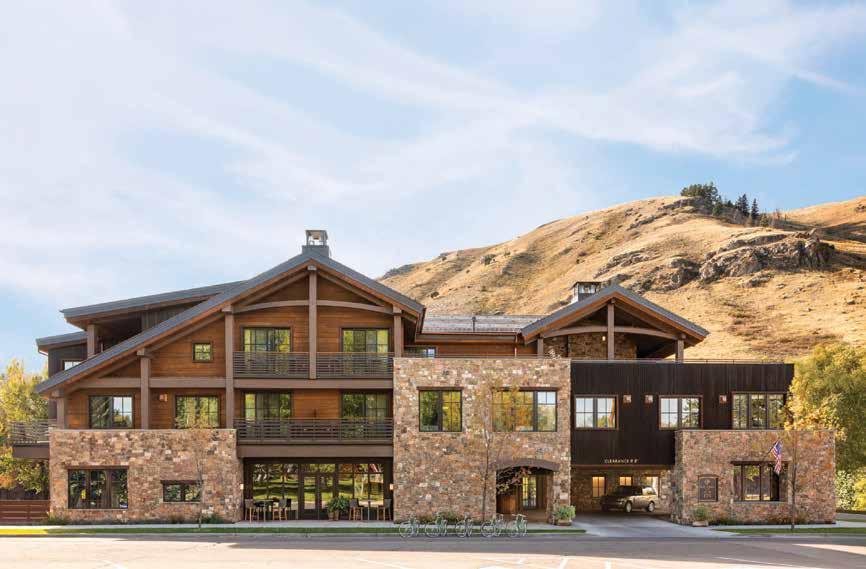
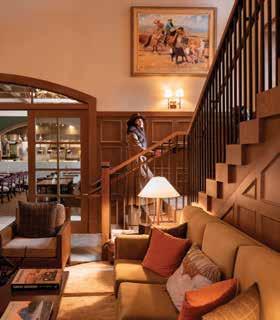
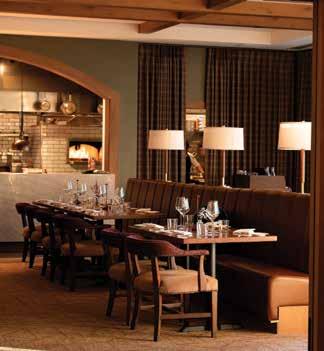
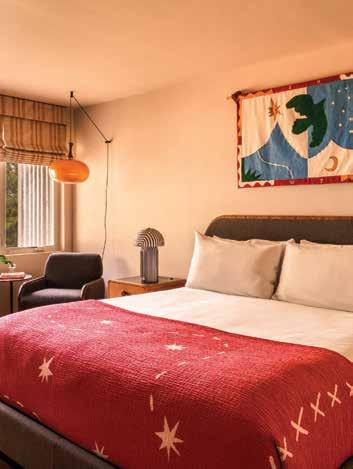
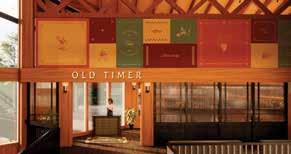
At Trailborn Jackson Hole, we’ve completely reimagined the historic hotel at the base of Snow King Mountain. This new resort, opening early summer, features an updated spa, Old Timer Bar & Restaurant, duckpin bowling and gaming at The Alley-Oop, and much more. We look forward to welcoming you back.
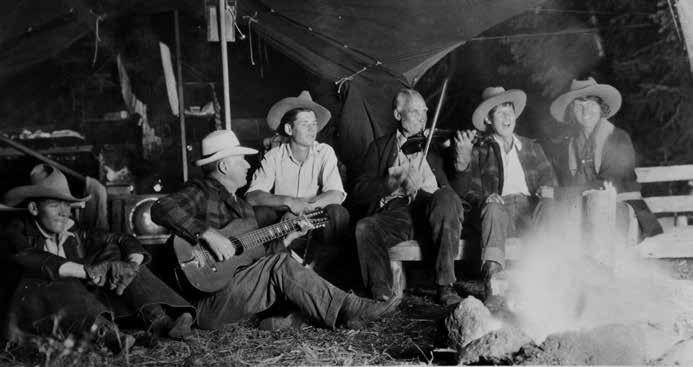
Louise Turner, second from right, singing with friends around the Triangle X campfire, circa 1930s.
PEAK
The factor that makes the Jackson Hole real estate market so unusual is the relative scarcity of private land. Ninety-seven percent of Teton County, Wyoming, is publicly owned—either national park, national forest, or wildlife refuge. This computes to just 75,000 privately held acres in a county spanning 2.5 million acres. The guaranteed open spaces and unobstructed views these surrounding public lands afford make the remaining private land a real treasure. Add the abundance of recreational opportunities found in and around the valley, and the quality of life one can enjoy in Jackson Hole is simply unbeatable.
Moreover, many of the properties featured here are secluded, scenic retreats located in the midst of prime wildlife habitat. Most existing and prospective property owners in Jackson Hole cherish this notion, and serve—or will serve—as stewards of nature.
One cannot put a dollar value on waking to the Teton skyline, skiing home for lunch, or listening to a trout stream gurgling through the backyard. In Jackson Hole, “living with nature” is not a fleeting, vicarious experience a person has while watching TV. Here it’s a fact of life, and we wouldn’t have it any other way.
ONE&ONLY MOONLIGHT BASIN | BIG SKY, MT
3,670-5,677 5-6 4-7
9,100,000
One&Only Private Homes offer a thoughtfully scaled mountain retreat designed to immerse residents in the beauty of Moonlight Basin. Created by Olson Kundig, the homes prioritize light, views, and connection to nature. The residences feature open living spaces framed by expansive glass, allowing mountain views and natural light to define the interiors. Located within One&Only Moonlight Basin resort, the homes provide access to world-class amenities, adventures, and the service that define the One&Only lifestyle.
THE BIG SKY REAL ESTATE COMPANY 406/995-6333 info@bigsky.com bigskyrealestate.com
TRIBUTARY BASECAMP CABIN
5,000 5
FEET
6,295,000 BEDROOMS
5.5
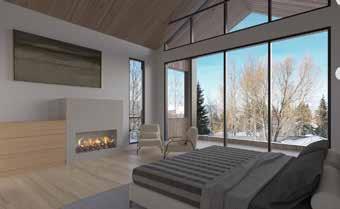
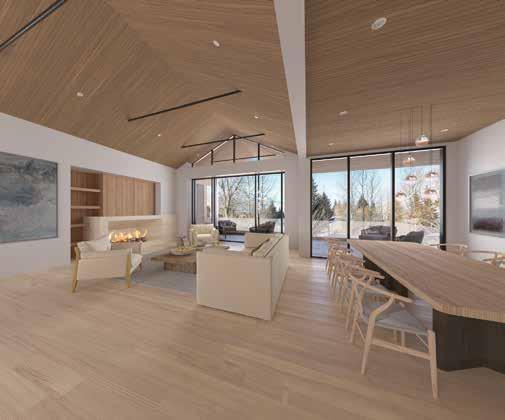
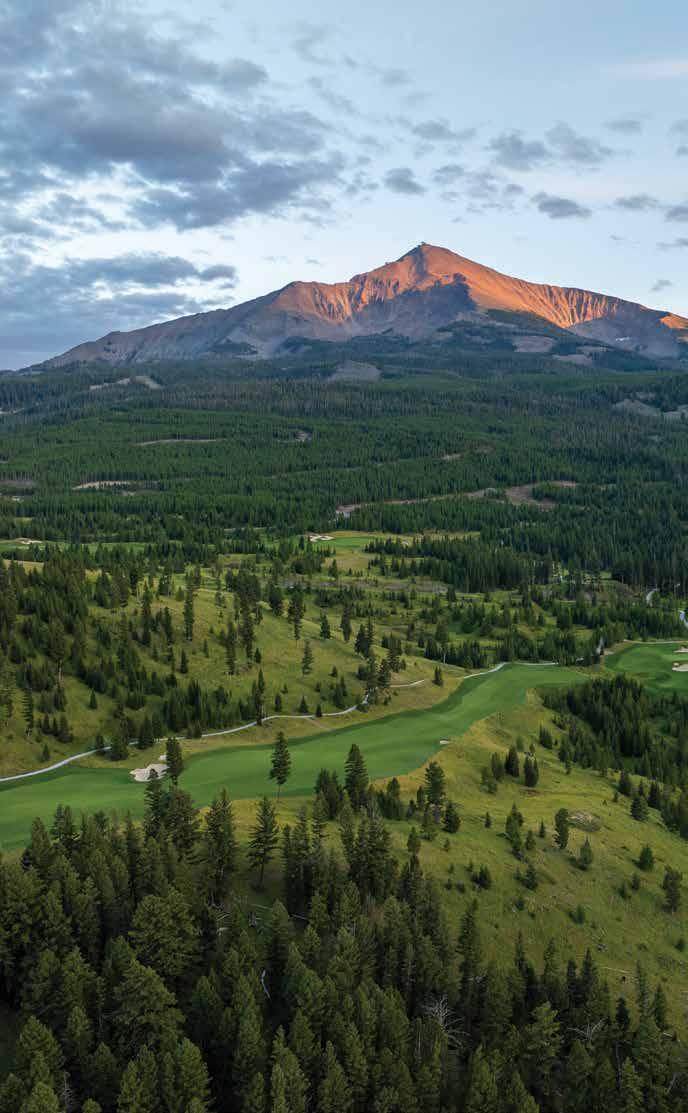
The Basecamp Cabin at Tributary is the ultimate mountain retreat, offering over 5,000 square feet of thoughtfully designed living space that seamlessly blends luxury and adventure. This five-bedroom, five-and-a-half-bath residence features vaulted ceilings, multiple fireplaces, expansive gathering areas, and a spacious two-level layout ideal for entertaining and unwinding. Set on 1.36 acres, the property captures breathtaking eastern views across the David McLay Kidd golf course toward the Tetons.
TRIBUTARY
Spain Short Director of Real Estate, Designated Broker 208/354-9660 sshort@tributaryidaho.com tributaryidaho.com
A BLANK CANVAS IN KELLY, WY
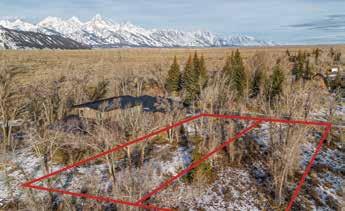
Rare opportunity to own a .34-acre double lot in the heart of Kelly, just steps from the Gros Ventre River and bordered by Grand Teton National Park parcels. Enjoy sweeping Teton Range views, abundant wildlife, and exceptional access to outdoor recreation. Nearby landmarks include Slide Lake, Mormon Row, the Moulton Barn, and Bridger-Teton National Forest. Located only 20 minutes from downtown Jackson, this property offers a rare chance to secure your piece of Wyoming wilderness.
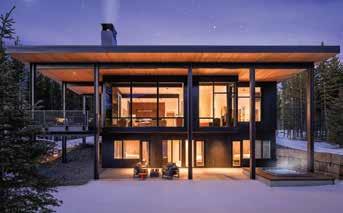
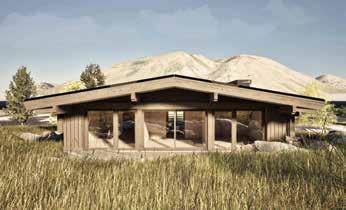
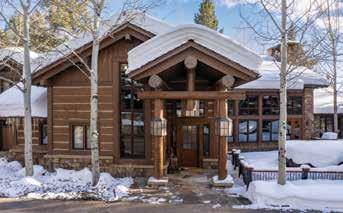
Located on coveted Lariat Loop in the Karns Hillside neighborhood and walking distance to the Town Square, this mountain-modern chalet offers a rare combination of refined craftsmanship and unbeatable access to nature. Just a short walk to Snow King’s year-round trail network— ideal for summer hikes and winter activities—this custom residence will be delivered by fall of 2026.
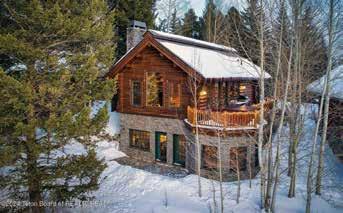
Nestled just 650 feet from Granite Ridge Tow, this home allows multi-generational groups to gather and connect in a thoughtfully designed fusion of space and location. Open-concept great room features vaulted ceilings, stone fireplace, and a generous kitchen with a bar for casual dining. From a spacious deck, watch skiers glide down the slopes as you relax in the spa or fire up the grill. Cozy upper-level sleeping loft offers peaceful nights, while private bedroom level includes the primary suite and a second bed and bath. Turnkey second home or investment just minutes from world-class skiing and iconic Grand Teton National Park.
LIVE WATER PROPERTIES JACKSON HOLE Latham Jenkins • 307/690-1642 latham@livewaterproperties.com livewaterjacksonhole.com
COMMANDING TETON VIEWS
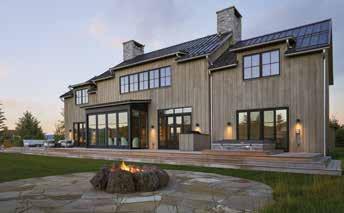
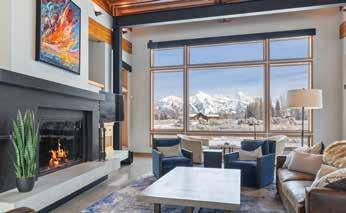
Designed to engage the mountainscape at every turn, this four-bedroom, four-bathroom residence is positioned to capture commanding Grand Teton views and welcome natural light through expansive south-facing glass. Open living spaces, wood ceilings, polished concrete floors, stone surfaces, and custom cherry cabinetry create a palette that feels grounded and refined. Originally designed by architect Bruce Hawtin as his dream home, it reflects a thoughtful balance of scale, light, and daily living in Jackson Hole.
HUFF VAUGHN SASSI
SWEEPING MOUNTAIN VIEWS
7987 GRANITE RIDGE
3,600 4 4
BEDROOMS
3,500,000
25-1820
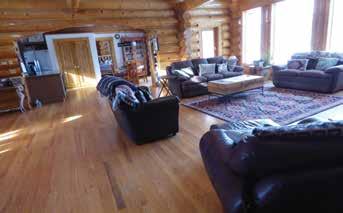
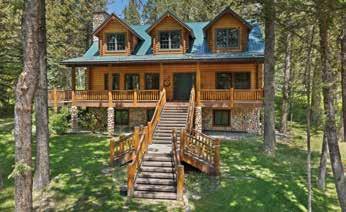
Blue skies and 360-degree views surround you from this 2.5 acre property, which allows horses and is close to the airport. Enjoy the warmth and comfort of a hand-peeledand-chinked log home. An open floor plan provides a comfortable place to relax and enjoy family gatherings. Four bedrooms and four baths, the primary bedroom is on the main level with an attached room to use as an office or to curl up in with a good book. An oversized three-car garage with a separate storage area provides space for seasonal items. This is an opportunity you don't want to miss!
KELLER WILLIAMS JACKSON HOLE Nancy Martino, CRS, GRI Associate Broker 307/690-1022 nancymartino@kw.com
MAIN AND GUEST HOME OVERLOOKING TETONS
7,302 5 5
23,950,000 24-2892
Located at the top of the coveted Granite Ridge subdivision, this custom estate home embodies the ski culture of Jackson Hole, featuring the easiest form of ski-in/ski-out available at Jackson Hole Mountain Resort. The groomed ski run slides directly past your private ski and gear room. Warm gathering places throughout to enjoy your morning coffee, a quick warmup, or aprés-ski festivities. The home features main level living with a remodeled chef’s kitchen, pantry, open concept dining and living, and expansive master suite with private office and terrace.
JACKSON HOLE SOTHEBY’S INT’L REALTY Rob DesLauriers • 307/413-3955 rob.deslauriers@jhsir.com robdeslauriers.com
LUXURY TOWNHOMES IN HEART OF TOWN
5,470 5 4.5
BEDROOMS
6,299,000
#26-344
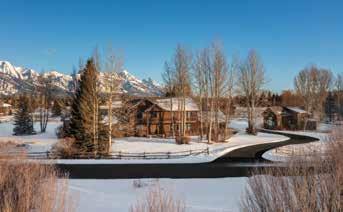
Just north of the Gros Ventre River corridor and across from the iconic Serenity Ranch sits this thoughtfully designed main and guest home. Four bedrooms and 3.5 baths in the main house, oversized three-car garage with elevated center bay plus a charming one bed, one bath guest house set on three scenic acres with reflecting pond and water feature. Exceptional Teton views and setting just minutes from town, skiing, and all of Jackson’s amenities, but with a removed, pastoral Western feel.
JACKSON HOLE SOTHEBY’S INTERNATIONAL REALTY
Barbara Allen, Associate Broker 307/413-3510 barbara.allen@jhsir.com jacksonholerealestateinfo.com
SQUARE FEET AT A GLANCE
3,120 3 3.5
BEDROOMS BATHS
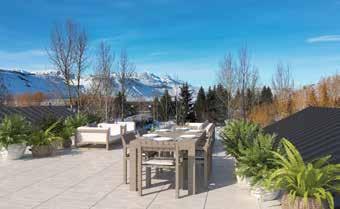
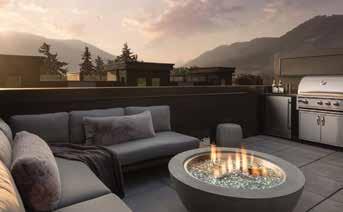
A stone’s throw from the Town Square, the Glenwood offers a mountain town retreat close to both cultural and outdoor activities. Three-bedroom luxury units with rooftop decks and the finest amenities. Please reach out for information about the second phase.
JACKSON HOLE SOTHEBY’S INTERNATIONAL REALTY
Bill Van Gelder, Associate Broker 307/201-8045 ext. 8045 allenvangelder@JHSIR.com jacksonholerealestateinfo.com
3,425 4 2 12,000,000 25-2256
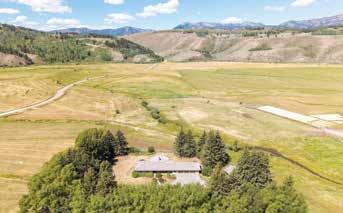
Available for the first time, this classic ranch home on 35 acres provides a rare opportunity to have a legacy property that affords flexibility for expansion. With Teton views, Spring Creek, open pasture land, and mature trees around the home providing shade and privacy, an owner can enjoy their slice of paradise just minutes from every convenience in the valley. The home features four bedrooms, additional finished basement, and detached guest house. With no conservation easement, HOA, or restrictive covenants, this is one of the most accessible larger-acreage opportunities in Jackson Hole.
JACKSON HOLE SOTHEBY’S INTERNATIONAL REALTY Des Jennings • 307/413-4945 des.jennings@jhsir.com
TETON WILDERNESS ESCAPE
4,308 4 4
This custom log home is located in Buffalo Valley and borders the Teton Wilderness. It has an open floor plan, spacious bedrooms, and a three-car detached garage. Allseason recreation with proximity to Grand Teton National Park, Turpin Meadow Ranch, and Buffalo Fork River.
Discover modern mountain living at Teton Landing, a new luxury neighborhood in East Jackson. Designed with clean architectural lines, natural materials, and expansive windows that frame sweeping Teton views, these homes embody the Jackson Hole lifestyle—adventurous yet refined. Just minutes from downtown, they allow residents to enjoy immediate access to nearby trails, world-class recreation, and peaceful mountain living. Please reach out for more information.
A one-of-a-kind legacy ranch situated on 56 acres at the base of the Big Hole Mountains overlooking the Teton Mountain Range comprised of three separately deeded parcels bordering National Forest land. In addition to the main residence, this unique offering features amenities such as a regulation tennis court, paddle tennis court and warming hut, trap and target range, pond, fire-pit, and a network of trails allowing for endless year-round recreational opportunities.
PRICE UPON REQUEST
JACKSON HOLE SOTHEBY’S INTERNATIONAL REALTY SPACKMANS & ASSOCIATES 914/588-2302 elizabeth.cheney@jhsir.com rockycreekranchidaho.com
ENJOY
ARTS, CULTURE, FOOD, AND DESIGN
// BY SAMANTHA SIMMA
DeckDining
Summer in Jackson Hole practically insists you eat outside, and there’s no shortage of restaurants to help you oblige.
THE CLOUDVEIL
Set above the bustle of Town Square, The Rooftop at The Cloudveil is both chic and relaxed—it has fire pits and armchairs and sofas instead of dining tables—and has one of downtown Jackson’s most interesting vantage points. Snow King is right there, looking close enough to touch, and then, from 6 to 6:10 p.m. Monday through Saturday, there’s the Town Square Shootout directly below. But you have to make sure The Rooftop, which offers table service, is open. An understandably popular venue for private parties, The Rooftop releases the dates it’s open to the public for the next month toward the end of the prior month.
Food and drinks are as lively and casual as the vibes: shareable mains and appetizers like tacos and pizzas, sloshies, and frosé. “An evening spent on The Rooftop celebrates the best of a summer evening in Jackson Hole,” says Kendra Alessandro, vice president of marketing and communications at Fine Dining Restaurant Group. Grab a cocktail and a quick bite before heading to a concert or dinner elsewhere. Or settle in for a longer evening. “For those interested in capturing the sun and also enjoying a full dinner, mid-evening is perfect,” Alessandro says. Later still, the kitchen closes, but the bar remains open and welcomes you to linger over a nightcap as the pink glow of sunset spreads across the valley.
Open at 5 p.m. select evenings (check @thebistroatjacksonhole); 112 Center St., Jackson; 307/739-1100, thebistrojacksonhole.com/rooftop
Whether you ride up the Bridger Gondola or hike the Wildflower Trail to The Deck at Jackson Hole Mountain Resort , an expansive stone terrace that seems to hang over the edge of the mountainside, it’s a great spot to soak in the views and refuel. Come on any Monday or Wednesday between 5:30 and 8 p.m., and you’ll also enjoy live music. From any of the couple dozen tables here, there are clear views of almost the entire expanse of Jackson Hole—cut by the Snake River—with the Gros Ventre mountains rising on the east side of the valley; on a clear day, you can even see beyond the Gros Ventres to the Wind River mountains. South, it’s the Snake River, Wyoming, and Salt River ranges. On hot afternoons, frozen cocktails are a popular choice to order via the QR-code menu. Pair these with flatbreads, sliders, lettuce wraps, or edamame. Fair warning: if you want to do one of the several hikes that start from the deck, do it before you nosh.
Open most days 11 a.m.–8 p.m. (check website for dates the deck closes at 4 p.m.); top of the Bridger Gondola at Jackson Hole Mountain Resort, Teton Village; 307/739-2675, jacksonhole.com/summeractivities/summer-the-deck
THE DECK AT JHMR
KAMPAI
Facing both the Gros Ventre mountains and Snow King and with views up Cache Creek, Kampai’s rooftop open-air patio offers a noticeably different experience than the restaurant’s multifloor main dining room. While the inside restaurant and patio share the same cocktail menu, the food menus diverge. Inspired by the Japanese izakaya tradition, the patio, for which reservations are recommended, leans into shared small plates, sashimi, and casual rolls. (Nigiri, a staple in the main restaurant, isn’t offered.) “The key feature of izakaya is a relaxed atmosphere, where guests are invited to linger over their drinks,” says general manager Dan Janjigian.
Open Tuesday–Saturday 5–9 p.m.; 175 Center St., Jackson; 307/201-5329, kampaijh.com
At the edge of Grand Teton National Park, Dornans Pizza & Pasta Co. has two decks—one adjacent to the main dining room and the second on the dining room’s roof—and both are super casual. The former is close enough to the Snake River for you to hear the moving river and passing rafters. The latter, limited to ages 21-plus, has what are arguably the best views of the Tetons in the valley, and you can also see the Gros Ventre mountains, Blacktail Butte, and Shadow Mountain. Both deck experiences start with ordering at the counter and have the same menu, with items the restaurant’s name alludes to: pastas and pizza. The pizzas are named after Teton peaks and include the Mount Owen (sun-dried tomato pesto and a four-cheese blend), the Static (mozzarella, BBQ sauce, chicken, smoked Gouda, red onions, cilantro), the Thor (mozzarella, marinara, Canadian bacon, pepperoni, Italian sausage, caramelized onions), and the Moran (roasted garlic cream sauce with chicken, spinach, diced tomatoes, and toasted pine nuts). Want to match pizzas with their namesake peaks? The napkins feature an outline of the Tetons with each summit named.
Perched at the very top of Snow King Mountain and reached by a 1.8-mile hike up 1,500 feet or a five-minute gondola ride, Aurora turns lunch and dinner into a summit experience, especially if you get one of the tables along the wall of windows. (While reservations are recommended, even with one, specific tables are first come-first served.) The restaurant has two main areas: a traditional inside space with four walls and also a space covered (or not) by a retractable roof. Both have views down onto the valley and out to the Tetons and Gros Ventres. “Most places when you’re talking about an outside experience with views, you’re subject to the weather, whether it’s rain or the hot July sun beating down on you,” says Aurora’s executive chef, Brandon Hicks. “At Aurora, we can roll back the roof and roll the windows up or down to keep diners comfortable without taking away the views.” An alumnus of the kitchen at New York’s Michelin-starred Picholine, Hicks says Aurora’s menu is fine dining but not alienating. "It’s approachable food,” he says. “There are refined options like yellowtail tartare and also a Wagyu burger.” There are 24 beers on tap and a seasonal cocktail and N/A program developed by food and beverage director Nicholas Berti, who hails from Florence, Italy.
Open daily 11 a.m.–10 p.m.; Top of Snow King Gondola, 100 E. Snow King Ave., Jackson; 307/284-4427, snowkingmountain.com/aurora JH
ENJOY
Jackson Hole
// BY SAMANTHA SIMMA
Buffalo Meat Company
Grill buffalo and elk here or ship it anywhere in the country.
Founded in 1947 by someone whose name has been lost to history, Jackson Hole Buffalo Meat Company is one of the valley’s longest-running food businesses—and one shaped as much by history as by intention. Before it was a butcher shop, it offered cold storage for local families at a time when refrigeration was rare in the remote Rockies. The business has operated in several locations over its eight decades—originally near today’s sheriff’s office in downtown, later on Gregory Lane, and for the past 25 years, in its current location in Smith’s Plaza.
Current owner Chris O’Blenness, a Jackson native, purchased the company in 2017 after a career in the farm-to-table world that took him from Wyoming to New York. Stepping into this role brought him home. Today, he runs the business alongside his brother, overseeing a model centered on native North American species—primarily bison and elk—and a supply chain defined by scarcity rather than volume. “There are about 500,000 bison in all of North America,” O’Blenness says. “If we processed them at the same rate we process beef cows, there would be no more bison in a few days.”
Jackson Hole Buffalo Meat Co. works with small farms and ranches across the West, helping sustain rural economies and ranching traditions in the process. In addition to sourcing from a limited network of producers, O’Blenness also raises buffalo himself at OK Ranch in Teton Valley, Idaho. All processing is done in-house, with cuts sold without fillers, blends, or added fats, but with some cooking advice: “Across all game meats, the biggest enemy is overcooking,” O’Blenness says. This is a guiding principle reflected in both how the meat is handled and how customers are encouraged to cook it. Open 10 a.m.–6 p.m. Monday–Friday; 1325 S. U.S. Highway 89; 307/733–4159, jhbuffalomeat.com
Ground in-house from 100 percent buffalo, Jackson Hole Buffalo Meat Company’s buffalo burger is lean and dense, with no added fat, helping patties hold their shape and release very little grease during cooking. Because the flavor of these is as close to tasting like beef as bison gets, it’s an accessible entry point for those new to game meat. “Buffalo is to beef as elk is to lamb,” O’Blenness explains. Cook to medium-rare to preserve both moisture and texture. The grind also works well for meatballs, but for those who go the burger route, O’Blenness recommends American cheese, a sesame or potato bun (not brioche), and simple toppings so as to not overpower the flavor of the meat. $25/lb.
A thick, bone-in ribeye aged for 28 days, the buffalo tomahawk is produced in limited quantities—a single rib rack yields only about five to six steaks, depending on size. Dry aging concentrates flavor and subtly alters the texture, creating added depth without masking the meat’s character. O’Blenness says it is a “meat adventurer’s holy grail,” combining rarity, size, and presentation in a single cut. He keeps seasoning minimal: salt, pepper, garlic salt, and flaky sea salt to finish. A green salad balances its scale. For sauce, try a huckleberry agrodolce, a recipe featured on the company’s website. $110/lb.
O’Blenness calls buffalo prime rib “a foolproof feast,” emphasizing that home cooks can handle it. A whole roast usually weighs 12 to 14 pounds, and O’Blenness portions it into smaller sections—usually 3 to 4 pounds, 5 to 6 pounds, and 7 to 8 pounds. Some of the prime rib comes from O’Blenness’s own small herd at OK Ranch, a 640-acre spread on the western side of the Tetons. The cut responds well to a reverse-sear method, producing even doneness from edge to center and a firm exterior crust. $75/lb.
Each elk T-bone includes both strip loin and a portion of tenderloin, offering two textures in a single steak. “It’s the distilled essence of the best parts of an elk,” O’Blenness says. And he says it’s also a good introduction to elk, which is denser in texture and more intensely flavored than buffalo. The elk sold here is actual Rocky Mountain elk. O’Blenness notes that farm-raised red deer and elk hybrids from New Zealand dominate many restaurant menus due to cost and supply (and are called “elk” on menus), while true Rocky Mountain elk is far more limited. He recommends simple seasoning—Mill Iron Ranch’s Chancey’s seasoning salt is sold in the shop—and finishing with a pan sauce rather than heavy marinades. $50/lb
Made from whole-muscle buffalo, the buffalo jerky is hand-sliced, dry-rubbed, and marinated for two days before it is slow-cooked for six hours. Unlike many other commercial jerkies, this one isn’t tumbled or soaked in liquid seasoning. “It’s just spices, salt, and buffalo,” O’Blenness says. The slices are cut relatively thick and finished to retain slight tenderness rather than a brittle snap. Shelf-stable and travel-ready, it reflects the company’s broader approach: minimal manipulation, straightforward ingredients, and processing done entirely in-house. The result is closer to steak than typical jerky—thicker cut, tender at the center, without the mealy texture often created by commercial processing. Price varies by type and package size. JH
COURTESY
COURTESY
COURTESY
COURTESY PHOTO
// BY SAMANTHA SIMMA
Chicken
At the Calico Bar, locals have loved this dish of seasoned dark meat cooked in a wood-fired pizza oven for more than two decades.
Some dishes build a reputation slowly, becoming part of the local dining rhythm not because they’re flashy, but because they’re consistently good. Bar Chicken—a generous plate of wood-fired chicken legs and thighs paired with artichoke hearts and dressed in a lemon vinaigrette—is one of those quiet classics that regulars have counted on since the mid-2000s.
“At least one person from my family is going to get the Bar Chicken every time we go to Calico,” says Jackson local Rachel Kunkle. “Sometimes I think it’s the reason we go to Calico. For me, it guarantees leftovers, and I even take the bones home and make bone broth out of them. It’s a circular feast where you get dinner for a night and lunch the next day.”
The dish first appeared around 2005. At that time, the restaurant ordered whole chickens, and there was an airline chicken breast entrée on the menu in Calico’s main dining
TASTE OF JACKSON HOLE
COURTESY PHOTO
room. This left the legs and thighs available. What started as a practical way to use the entire bird turned into something hungry locals began seeking out in Calico’s Bar on its own. (Bar Chicken is not on the menu in Calico’s main dining room.)
Even as Calico evolved and moved away from whole chickens, which happened around 2011, Bar Chicken stayed. “Locals love it—and we love our locals,” says Julie Broughten, Calico co-owner. “I do think there could be some uproar, petitions, or Calico boycotts if we removed it from the menu.”
Not only did Bar Chicken stay, but it stayed the same. “We marinate chicken legs and thighs in a mixture of olive oil, red pepper flakes, and other seasonings,” Broughten says. Next, the chicken is paired with artichoke hearts, and both are tossed in a lemony vinaigrette that brightens the dish and balances the richness of the dark meat. It’s cooked in a regular oven at 375 for 45 minutes and finished in the restaurant’s wood-fired pizza oven, where the temperature is approximately 600 degrees. “The high temperature of the wood-fired oven makes the skin nice and crispy,” Broughten says.
When it comes to pairing, the Bar Chicken is flexible. The lemon and slight heat make it easy to match with a crisp white wine—Broughten’s preference—but it also plays well with other beverages. A citrus-forward cocktail echoes the brightness of the vinaigrette. A light-bodied Italian red complements the char from the woodfired oven. Beer drinkers might lean toward a clean lager or a pale ale to cut through the richness.
Finally, Bar Chicken isn’t only delicious, but a good value. “We serve up a pound of chicken with a Calico house or Caesar salad for under 20 dollars,” Broughten says. Kunkle adds, “The whole bar menu at Calico is the bargain of the valley. But the Bar Chicken is not only a bargain—it’s also filling and delicious.” JH
ENJOY
Ben Roth’s Dandelion Blossom brightens visitors' days from just behind the front desk at Sage Living.
//PHOTOGRAPHY BY ERIN BURK
Healing
You don’t have to be a patient to peruse the art collection at St. John’s Health.
Agiant yellow dandelion mounted above the front desk at St. John’s Health’s Sage Living Center greets visitors as they enter the facility. Made from cut steel by Jackson artist Ben Roth, the dandelion brings to mind sunshine and summer. It’s a happy, positive piece, and the feeling it conveys is intentional. The dandelion was selected in 2019 by a committee of hospital staff, community members, and art professionals to help decorate the then-under-construction assisted-living center, which welcomed its first residents in 2021. But the artworks are not just decorative.
All the pieces on display at the Sage Living, as well as throughout the neighboring main hospital and medical office building, are carefully curated to promote wellness and healing. “We used evidencebased criteria to build St. John’s art collection,” says Carrie Geraci, the executive director of Jackson Hole Public Art, a nonprofit that has been working with St. John’s since 2016 to help tailor its collection to maximize art’s healing power.
“Studies have shown that soothing artwork—landscapes, verdant vegetation, wildlife, flowers, familiar scenes—help you enter a calm and relaxed state, versus looking at a painting that is of, say, a Western gun battle, which is iconography we may see in this community but that is not appropriate for a health center,” Geraci says. What is appropriate, according to Geraci, is art that helps support emotional, spiritual, and physical wellbeing.
Humans have expressed themselves artistically for as long as we’ve existed. Cave paintings and rock art dating back tens of thousands of years give evidence to art’s longstanding importance in our
//BY MOLLY ABSOLON
Art
lives, but that impact has been hard to measure in the past. Now studies from around the world, including research by the Cleveland Clinic, the World Health Organization, and Johns Hopkins University, provide data to back up what we’ve always known instinctively.
Art can help reduce loneliness, stress, and depression. Patients who have views of nature, rather than a blank wall, have been found to require less-potent painkillers and end up with shorter hospital stays. Art therapy has been shown to alleviate anxiety in cancer patients and help restore the human spirit.
With these findings in mind, St. John’s Health launched its Art and Healing Program in 2016 in collaboration with the St. John’s Health Foundation and Jackson Hole Public Art. Part of the program involved looking closely at the works exhibited on the hospital walls in an effort to foster a more welcoming, soothing environment for patients, staff, and visitors to the hospital.
“For many years, St. John’s accepted artwork as a form of donation, but not all art meets the art and healing criteria,” says Marcus Stouffer, St. John’s Health’s patient experience director. “If we receive art as a donation that isn’t appropriate, it may go to auction, so it still is a positive for the hospital.”
The hospital’s selection committee’s criteria include paintings and sculpture of healthy wildlife, calm landscapes, flowers, and familiar scenes. They look for works that capture the ethereal movements of wind, water, and air, or scenes that trigger positive memories and connections. Through the financial support and leadership of the hospital foundation, today the
ENJOY
hospital campus has an impressive permanent art collection that highlights local and regional artists, as well as several pieces on temporary loan.
You don’t have to be a patient to enjoy the collection. Visitors are welcome. The artwork is well signed and often includes an artist statement to help viewers learn more about the work’s history and the artist’s intentions. Sage Living has an illustrated pamphlet available at the reception desk that enables people to do a self-guided art walk through the facility. Most of the center’s residential neighborhoods are open throughout the day. Permission, which can be obtained at the reception desk, is required to enter Wildflower Way, Sage Living’s memory care unit.
Along Sage Living’s main corridor is Who Owns the Sky, a series of 15 paintings of birds (and one nest) by Jackson-
I created [Who Owns the Sky] specifically for Sage Living. It was my intention to create an installation filled with color, that would uplift spirits with the sense of delight and wonder that we experience when encountering birds.”
KATHRYN TURNER
based artist Katheryn Mapes Turner. Turner, whose family manages the Triangle X Ranch in Grand Teton National Park (read more about the Triangle X, which celebrates its 100th anniversary this year, on page 54), painted birds that would be familiar to residents—a raven, a Western tanager, a sandhill crane, and a magpie, among others. “I created [Who Owns the Sky] specifically for Sage Living,” Turner writes in her artist statement. “It was my intention to create an installation filled with color, that would uplift spirits with the sense of delight and wonder that we experience when encountering birds.”
In Sage Living’s Great Room, a line of silvery metal feathers created by Bland Hoke rises like smoke for roughly 20 feet above the chimney. As they float up toward the sky, the feathers leave viewers with a sense of freedom and lightness.
Elsewhere are two paintings by Kelly-based artist Wendall Field, Yurtian Kitchen and The Show Is About to Begin (shown at left). The former depicts open shelves in a kitchen, complete with ordinary objects like a clock, a roll of paper towels, and a wine bottle. The objects are painted in a primitive style with bright colors that trigger the sensation of a cozy, warm home. It's an image that might be comforting for residents displaced from their own homes due to illness or infirmity.
The Show Is About to Begin is of a scene in the Kelly yurt park, where 13 yurts rise beneath the shadow of the Tetons. Conjuring a typical summer day, the work invites a story. There’s someone riding a horse, while another sits in a hot tub. A dog basks in the sun, and a deer sits peacefully next
The hallway leading from Sage Living’s entryway to Heritage Hall’s great room is adorned by Katheryn Mapes Turner’s collection of bird portraits Who Owns The Sky.
Wendell Field’s painting The Show is About to Begin hangs in the dining room of Sage Living's memory care unit.
to a rabbit. You can see cabins, grazing bison, yurts, and a tipi; look closely to find details like an outhouse, fox, and a tiny moose. Nurse Mark Bergstrom says he has seen one nonverbal patient—it hangs in the memory-care unit—stare at it for long periods of time. What she is looking for or thinking, Bergstrom doesn’t know, but he believes the painting brings her joy.
Anecdotally, such emotional impacts are obvious and can be felt by anyone who comes into contact with St. John’s art program. The halls that exhibit thoughtful, brightly colored art feel welcoming and show a commitment to quality care. In contrast, the few hallways with blank beige walls feel sterile, cold, and disorienting.
“We recognize the void—the absence of art—almost more than we realize its power,” says Jackson painter Katy Ann Fox, who has 15 small-format paintings of houses and buildings permanently hanging in Sage Living and a handful of additional pieces on temporary exhibit in the main hospital building. “Without art, we feel panic and angst. Art takes the edge off,” she says.
Fox grew up hanging out with her grandmother at a nursing home, and she thought of that relationship when she submitted her proposal to the selection committee for Sage Living. She wanted images that invited stories and evoked memories, and the array of paintings she created does just that. JH Public Art’s Geraci says she’s seen caregivers use Fox’s paintings of houses to stimulate conversations with Sage Living residents about their lives and the homes they lived in before moving into the facility.
Amber Mouton, Sage Living’s lifeenrichment manager, says, “I can imagine myself as a resident, walking down the hall of one of our neighborhoods, and seeing Wyoming wildlife photography and snowy Wyoming scenes. That must feel comforting. A gentle reminder of where you are and what you know.” JH
There are more than 20 concerts on the summit of Snow King this summer, including De La Soul, Dylan Gossett, the Black Keys, GZA, Ghostface Killah, Raekwon, Shaggy, Too $hort, and Sofi Tukker.
// BY SAMANTHA SIMMA AND LILA EDYTHE // PHOTOGRAPHY BY BRADLY J. BONER
Concerts KING
The summit of Snow King might be the best concert venue in the country.
The first concerts on the summit of Snow King Mountain were held in July of 2022. Duane Betts & His Friends played two shows. The only bathrooms were porta-potties, speakers were suspended from forklifts, and the stage was barely big enough for the six musicians. If you wanted to sit, it was on disturbed dirt. Snow King’s development of its summit area was a work in progress. “The first year was basically sticks and rocks, and it was still great,” says Juniper Lopez, who estimates that, including Duane Betts in 2022, she’s been to about 20 concerts on the summit of Snow King.
“Then they rolled out the grass. Then a real stage. Then safety tents. It feels like they’re building an incredible product.”
In 2025, there were 15 King Concerts, which together featured 30 bands, including Modest Mouse, Primus, and Thievery Corporation. About 2,500 locals and visitors—the venue’s capacity—attended each show, hopping into an eight-passenger gondola cabin at the ski resort’s base area to be whisked 1,500 feet up to the summit. Disembarking five minutes later at 7,808-feet, they settled in with family and friends on blankets and in camp chairs on a purpose-designed sloping lawn. Hungry or thirsty? There was a collection of food trucks to choose from.
Tired of looking at the stage itself? Focus on the one of the valley’s best views of the Tetons that is its backdrop. A couple of years ago, as Cypress Hill was starting its first set and the Tetons were pink with alpenglow, a paraglider was doing loops a couple of hundred feet above the stage.
“The King is probably the most stunning concert venue in the U.S.,” says Julie Weinberger, who estimates she’s been to about one dozen concerts there, including (with her father who flew out from New York) Dark Star Orchestra three nights in a row in 2023.
This summer the schedule has more shows than in 2025—20 and counting (Snow King says it might add one or two more)—and is even more diverse, including De La Soul, Dylan Gossett, the Black Keys, Trampled by Turtles, GZA, Ghostface Killah, Raekwon, Shaggy, Too $hort, E-40, and Sofi Tukker. Along with additional shows, Snow King is adding eight more gondola cars to address past concert goers’ biggest complaint—that the wait to get down after concerts could be more than an hour. “This should get people down 30 percent faster than last year,” says Ryan Stanley, Snow King Mountain’s general manager.
“The variety of shows is just so eclectic,” says Lopez, who has attended concerts with her kids (ages 8 and 12), husband, and friends. “It’d be hard to find a genre that isn’t represented. I don’t think they miss anything.” Stanley, who confesses to most looking forward to the Black Keys, Shaggy, and Too $hort himself, says, “In 2025 we had the biggest lineup of nationally touring bands this valley has ever seen, and 2026 is even
JACKSON HOLE
TIPS FOR ENJOYING A CONCERT ON THE SUMMIT OF A MOUNTAIN
n Juniper Lopez packs for a King Concert the way she packs for a hike. “I always bring a backpack,” she says. “A blanket or a collapsible chair, extra layers, sunscreen, and then a beanie for later. You kind of have to cover all your bases.”
n King Concert goers can bring water and food, but not alcohol (bags are checked at the bottom).
n The temperature difference between when the opener starts and the headliner is playing their last songs can be 30-plus degrees; dress in layers.
n It’s not just the cold you have to worry about, though. “I don’t think people realize how hot it can be if you get up there early when the gondi opens. It can be 80 degrees, and there’s no shade,” Julie Weinberger says.
n Concert goers looking to elevate their evening can make reservations for an early dinner at Aurora, a fine-dining restaurant a couple of hundred feet from the concert lawn.
Many of this summer’s King Concerts are sold out. Snow King should announce the 2027 lineup in midJanuary, and tickets usually go on sale in late January; snowkingmountain. com/king-concerts
bigger.” Also, this summer the shows are more spread out between weekends and weekdays. “We’ve had some weekday shows in the past, but there are even more this summer,” Stanley says.
Stanley’s hope is that Snow King becomes as iconic of a concert venue as Red Rocks Amphitheatre, the worldrenowned, naturally formed open-air venue outside of Denver famous for its perfect acoustics, stunning scenery, and the massive 300-foot sandstone monoliths that surround it. Stanley says the goal is for Snow King to draw the same level of nationally touring acts as Red Rocks.
Because of its location, Snow King’s concert season can never be as long as Red Rocks’s. Outdoors at almost 8,000 feet on top of a mountain in Jackson, Wyoming, which gets about 10 feet of snow annually, weather dictates that King Concerts only be held between early June and late August. Any earlier, and the winter’s snow might not yet have melted. Any later, and musicians might freeze in an early-season snowstorm. The King is already pulling in many of the same acts as Red Rocks, though: Sofi Tukker, Trampled by Turtles, and the Black Keys have all performed there.
Because the King is still a relatively new venue, Stanley thinks word is only just starting to get out among musicians about how unique it is. “I think most [musicians] don’t know what it’s
like here until they get here,” he says. “But then they’re doing selfies with their families behind the stage with the Tetons in the background. I’m pretty sure they don’t do that at most other venues.” Stanley also says that quite a few of the bands that have already played at Snow King reach out about coming back. “That’s a positive indicator that they enjoy the experience, too.”
While Snow King might not yet have iconic concert venue status, it already might be the superior concert experience. “Red Rocks is 10,000 people, which is a very different experience than 2,500 people, and at Snow King you can go right to the front of the stage,” Stanley says. “Snow King is a general admission experience where the most stoked people are in the front row and there is no one telling them where they can stand, which, I think, for that reason, makes it a lot cooler of a venue.” Weinberger, who’s gone to about the same number conerts at Red Rocks as at the King (about 12), agrees. “It’s really nice to just put your blanket or chair anywhere,” she says. Also, “Red Rocks is much bigger and not in my backyard.”
Stanley says, “I heard a comment from a longtime local resident who said there are things that come along once every decade or two that really make life in this valley even better. The King Concert experience has been one of those changes.”
JH
Les Claypool of the funk/punk band Primus performs at a King Concert last summer.
Snow King's goal is for its summit concert venue to become as iconic as Colorado's Red Rocks Ampitheater.
Look to Local
Landscaping with native species can be beautiful and benefits local wildlife. // BY
JIM MAHAFFIE
A restrained palette of native trees, shrubs, and grasses offers structure, color, and texture through every season.
Plants
Spring and summer wildflowers put on quite a show here in the Tetons, and following our long monotone winters, it’s always amazing to see. Teton County is home to more than 1,200 species of native plants, with more than 250 of them commercially available at valley garden centers, so homeowners can bring this seasonal show to their homes.
“We love using native plants,” says Lizzie Needham, a landscape architect with HDLA, a land-planning and landscape architecture studio in Jackson. “They need less soil amendment, lower water usage, and less maintenance. They’re much better for wildlife and pollinators. The icing on the cake is that they match the ecology and character of the valley, too.”
“People are always asking us about native plants and flowers,” says Steve Deutsch, a co-founder of Teton Botanical Garden, a local nonprofit promoting native plant awareness and education. “We work with local master gardeners and public gardens, and encourage nurseries to focus on native plants, and the message is getting out.”
Needham says a key is to manage expectations with clients. “You may lose some plant material to browsing wildlife, like moose and elk. Your shrubs might get sacrificed or at least given a big haircut. It can be a whole different
People are always asking us about native plants and flowers. We work with local master gardeners and public gardens, and encourage nurseries to focus on native plants, and the message is getting out.”
STEVE DEUTSCH, CO-FOUNDER OF TETON BOTANICAL GARDEN
mindset than a garden in Cincinnati or Dallas.” She tells a story of planting for a client and having a mama moose and calf spend the winter on the property, chomping everything. “But they thought it was really cool having moose around for the winter.”
“Clients ask all the time about flowers and colors they see on a hike, or along a hillside,” says Katie Ziem, who runs Padmaveda Gardens. She has been designing landscapes around Jackson Hole for more than 22 years and has seen a big increase in interest in native plants. “People want to see wildflowers, and changing mindsets about gardens here is not that challenging,” she says.
“Tell your gardener what you like and ask what they can get for you,” says Ziem. For instance, lupine flowers are stunning, but she says what you get in garden centers is actually not a native but a hybrid version. “You can get native sticky geraniums in pink and white, as well as native coneflowers. There are native peonies, yarrow, and rose varieties, too.” It’s a balancing act for garden designers, as homeowners want to see colors, but also wildlife. “You always want to design with animals in mind. Put plants that won’t get eaten as much in front, like goldenrod, lilac, and ash leaf spirea.” Mule deer, elk, and moose like different plants and hang out in different places, and you can design gardens accordingly.
“Yellow balsamroot flowers are beautiful in spring but take years to bloom in a native landscape,” says Jen Hall of Porcupine Nursery. “People try to dig it up or start it from seed with no luck. But Indian blanket is a good substitute. And it’s native, too.”
“I love native plants in our yard,” says Cynthia Blankenship of Teton Village. “Years ago, we had a free plant audit done by Teton County Weed and Pest District. (This service is offered for home landscapes in the valley.) “They told us what was native and what was not. Since then, we’ve kept our grass footprint small and let native plants do their thing. My personal favorites are mule ears, serviceberries, and chokecherries. They’re attractive for us and for every kind of wildlife.”
NATIVE AMERICAN USES AND NATIVE PLANTS
For Arapaho, Crow, and Shoshone/Bannock people, food is medicine and medicine is food. Many modern drugs derive from chemical components of traditional native plant medicines. For instance, aspirin was originally derived from willow bark. Native Americans would pound a strip of willow bark into a soup or tea for the same anti-inflammatory effect. Today, Eastern Shoshone Tribal Health, on the Wind River Reservation in central Wyoming, provides culturally sensitive healthcare and is working on community wellness through a program called Good Health Wellness in Indian Country.
Mike Garvin, the community health educator in the schools around Fort Washakie on the Wind River Reservation, says the leafy greens of amaranth, which are loaded with vitamins, “kept our people alive when the buffalo disappeared.” Sego lily has edible bulbs, and Garvin says it is revered by Natives as a life plant. Sacajawea taught the Lewis and Clark expedition how to dig “wild carrots,” which were the nutritious roots of yampah. Garvin says that in the Shoshone language, yampah means “tastes good” or “woody taste.” “We never had gardens. We were hunter-gatherers and grazed all day. By the time you’re 9 or 10, you knew every plant you ate. I tell kids today, we were like squirrels.”
DALE HORCHNER
Native grasses, sedges, and forbs surround a habitat-restoration pond within an existing cottonwood grove.
FIND INSPIRATION
LOCAL GARDENS WITH NATIVE SPECIES
Located in Wilson, the Teton Raptor Center has a labeled Native Plant Garden installed around its headquarters building. TRC worked with the Teton Conservation District on the gardens and grows species like prairie smoke, littleleaf pussytoes, blue columbine, and kinnikinnick. “The garden is the last piece of our big renovation,” says Selena Humphreys, TRC operations director. “We’re a historic property, education is one of our pillars, and we wanted to preserve local diversity and showcase what you can do with native plants.” Ask about informal tours. The Center is located on Fish Creek, and Humphreys says the native garden “uses a ton less water.”
Working with the Teton Botanical Garden, Sage Living, a senior resident community on the St. John’s Health campus in East Jackson, has eight garden beds. While these vary year-to-year, one bed, which accommodates wheelchairs, is always dedicated to native pollinator species. The other seven are planted and maintained by residents and their families, who are assisted by Teton Botanical Garden volunteers and Sage Living staff.
Between 2000 and 2022 the National Museum of Wildlife Art partnered with the Nature Conservancy and Teton Botanical Gardens to plant gardens comprised entirely of native plants on museum grounds, including along its popular Sculpture Trail. The goals were to educate the public about the benefits of native plants and to rehabilitate a large burn scar from a 2019 wildfire that burned 90 acres of mostly cheatgrass, an invasive species,
just behind the museum. The accompanying Greater Yellowstone Botanical Audio Tour is free, available in English and Spanish, and includes 35 stops with information about native plant restoration, fire ecology, Indigenous and human use of plants, and the connection between plants and art. It is “an opportunity to educate people about the natural world and why native plants are so essential,” says Jane Lavino, the museum’s recently retired Sugden chief curator of education.
For a close look at native plant restoration efforts, head out to the Kelly Hayfields near Mormon Row in Grand Teton National Park. Here, early homesteaders planted smooth brome, a nonnative perennial grass they fed livestock and bailed for winter feed. The National Park Service has been gradually restoring these former smooth brome pastures— it’s done about 1,500 acres so far—to native sagebrush and grasslands, which have more value to moose, bison, elk, sage grouse, and other wildlife. There are still areas of nonnative hay, but it’s gradually being replaced with colorful native wildflowers, sage, bitterbrush, larkspur—plus more wildlife.
Teton Botanical Garden has built raised beds and walkable gardens of native plants at several schools in the area. These include Munger Mountain Elementary’s native pollinator plantings. Summit Innovations School has a large greenhouse plus native plant beds and trees. Jackson Hole Middle School gardens face the soccer fields, and teachers and students care for the plots and bring botany into the school curriculum. Outdoor gardens are open to the public.
RESOURCES
For homeowners interested in doing their own native plantings, look for seeds, seedlings, bareroot, and container plants at local nurseries. Find them at Porcupine Nursery in Jackson, MD Nursery and Landscaping in Driggs, and Trail Creek Nursery in Victor, among others.
The nonprofit Teton Botanical Garden is another good resource for information. Additional resources include Teton Conservation District’s Teton County Native Species List. The Teton County Wyoming Native Plant Gallery has photos of native species. The Wyoming Weed & Pest Council offers a list of trusted seed suppliers and guides to invasive-plant-management strategies and pesticides.
Teton County Weed & Pest District offers a free audit of valley yards and gardens, explaining what is native, nonnative, and invasive. JH
A field of blooming Helianthella uniflora, commonly known as "one-head sunflower," and lupine on Teton Pass.
tude
// BY BEVIN WALLACE
Adjustment Alti
Being at a high altitude like Jackson Hole’s can be hard. Here’s how to make it easier.
We all know the higher you go, the thinner the atmosphere becomes. We’ve seen photos of mountaineers on Everest with their oxygen masks, and we’ve probably heard stories or even experienced acute mountain sickness ourselves. Yet, although up to 25 percent of people experience AMS at elevations around 8,000 feet and up to 40 percent at 10,000 feet (less than the height at the top of Jackson Hole Mountain Resort’s tram), altitude sickness still isn’t very well understood. “High-altitude medicine doesn’t have the giant trials that you normally see for medicine we hang our hat on, and there is a significant amount of the pathophysiology that we don’t fully understand,” says Tobin Dennis, MD, medical advisor for Teton County Search & Rescue and an ER doctor at St. John’s Medical Center in Jackson. “Why do some people who are very fit and have been at altitude before and have had no problem, all of a sudden have very severe symptoms, when some people who are less fit and have not spent any time up can be doing the exact same trip and have no symptoms whatsoever? It’s very interesting, and someday we’ll probably know it, but we don’t know it now,” he says.
We do know that AMS is caused by rapidly going to a high altitude, where there is less available oxygen. As the brain and body struggle to cope with the reduced oxygen (hypoxia), we can experience symptoms like headaches, nausea, shortness of breath, and fatigue—not the way you want to start your trip to Jackson Hole. The good news is Jackson Hole, at 6,237 feet, is not a place that sees a lot of the life-threatening forms of altitude sickness: high-altitude pulmonary edema and high-altitude cerebral edema. “What we end up seeing is a lot of the acute mountain sickness, which is unpleasant, but it’s generally self-limiting and will take care of itself,” says Dennis. “The biggest thing is it can really ruin vacations.” To avoid that happening, especially if you’ve experienced altitude sickness symptoms in the past or have a comorbidity such as poor lung function or kidney disease, take the following precautions before and during your trip to Jackson Hole.
ENJOY
TAKE IT EASY AT FIRST
We know this is hard, but if you’re coming from a low elevation, don’t plan that hike in the Tetons for the first day of your trip. Your body needs time to adjust to the change in oxygen levels. “When you’re up at elevation and you’re starting to have symptoms, you don’t want to significantly exercise,” Dennis says. “The initial day or two, do your sightseeing around town and wait to do the bigger things until your body’s a little more acclimated to the elevation.” Jackson Hole is obviously
"
mention a vast assortment of gourmet restaurants and bakeries—to keep you occupied while you become acclimated, which Dennis says usually happens within 48 to 72 hours.
STAY HYDRATED (AND AVOID ALCOHOL)
Dennis says the evidence that hydration (and nutrition) specifically helps with AMS is anecdotal. There is little
Why do some people who are very fit and have been at altitude before and have had no problem, all of a sudden have very severe symptoms, when some people who are less fit and have not spent any time up can be doing the exact same trip and have no symptoms whatsoever? It’s very interesting, and someday we’ll probably know it, but we don’t know it now.”
TOBIN DENNIS, MD, MEDICAL ADVISOR FOR TETON COUNTY SEARCH & RESCUE AND AN ER DOCTOR AT ST. JOHN’S MEDICAL CENTER
a mecca for outdoor adventure, but it also has a historic downtown (complete with an antler-arched Town Square), the National Museum of Wildlife Art, over 25 art galleries, and the beloved Valley Bookstore—not to
evidence that consuming excessive amounts of water can prevent or treat AMS, and he cautions against hyponatremia and other issues associated with drinking too much water. However, staying hydrated in the mountains is still
crucial due to fluid losses from dry air and increased physical exertion (think breathing hard) at altitude, according to the University of Colorado Anschutz Medical Center. Dehydration can mimic and even worsen AMS, and proper hydration (with added electrolytes) will help counteract fluid loss, which can improve blood oxygen volume. To the extent that alcohol (and especially hangovers) causes dehydration, maybe save your visit to the Million Dollar Cowboy bar for later in the trip.
GET GOOD SLEEP
More important, according to Dennis, is the link between altitude sickness and sleep. “One of the main complaints of acute mountain sickness is inability to sleep,” he says. “And part of the reason people do poorly is that their sleep is so significantly disturbed.” Dennis recommends trying things like melatonin and Benadryl but cautions against other antihistamines and sleep aids. “The other ones can mess with your respiratory system a little, which actually causes more problems because you need to increase your respiratory rate to increase that oxygen,” he says. Also, where you sleep is important: if you’re coming to Jackson Hole for a multiday trip in the high country, you definitely want to sleep at relatively lower elevations for
the first few days, even if it means hiking up and then back down to sleep.
CONSIDER MEDICATION
Ibuprofen helps alleviate the symptoms of AMS, and some studies have shown it also helps reduce the inflammation that being at high altitudes can trigger. There are also prescription options, which might make sense for people who have underlying health issues and
are concerned about getting altitude sickness. “Things like acetazolamide [Diamox] can decrease symptom duration and severity, and it’s mainly used prophylactically. However, the majority of people wouldn’t need prophylaxis unless they’ve had previous episodes.” Depending on our health history and your adventure plans (i.e., you are heading straight from beach to plane to the top of the Paintbrush Divide), you might be a candidate. Talk to your doctor ahead of time to find out.
WHEN TO SEEK MEDICAL ATTENTION
Every summer, Dennis sees people with altitude sickness in the ER—an indication that, while AMS is often self-limiting, if unchecked, it can become serious and even life-threatening. If your headache or other symptoms don’t clear up within about three days, or if they get worse, you should see a doctor.
If you experience any of these signs of the more serious forms of altitude sickness, HAPE and HACE, go to urgent care or the ER immediately:
• Dizziness
• Confusion
• Clumsiness and/or difficulty walking
• Extreme shortness of breath
• Coughing
• Chest tightness
• Severe Headache JH
Blue Concierge Medical Care
Dr. Brent Blue
Dr. Brent Blue is a Board-Certified physician specializing in Family and Urgent Care Medicine. He is a long-term year-round resident of Teton County and is on the Board of Trustees of St. John’s Hospital in Jackson. His undergraduate degree is from Vanderbilt University and medical degree from the University of Louisville. His residency training was at the University of California, San Francisco where he also was an attending physician.
His practice is based in Wilson, Wyoming, for adults. Limited to thirty new patients.
Annual care includes a complete physical examination and basic laboratory work. Availability is 24/7 by phone and office visits by appointment (same day if necessary). House calls when appropriate.
For information or to set up an interview for joining the practice, call 307-733-7835.
ENJOY
CHOOSE YOUR OWN ADVENTURE
// BY WHITNEY ROYSTER
How do I FindHousing
HA HA! THAT'S HILARIOUS! in Jackson?
OBVIOUSLY!
I'm staying with one right now.
Do they have an extra wing or penthouse or castle?
ARE YOU FRIENDS WITH ANY BILLIONAIRES?
THAT'S A THING?
Pfft. Yes. You obviously just moved here.
NO. NOT THAT I KNOW OF.
Although this guy next to me just ordered a lot of bagels.
WE'RE GETTING SIDETRACKED. LET'S SAY NO.
Back to business. It's summer. That's bad.
HOW IS THE RECLINE IN YOUR CAR?
Wait, what? That sounds bad.
Fantastic. Good. Boom! Car!
IT IS BAD. TRY THIS.
Nannying or dog sitting. Actual feedback from a landlord.
People at work. Social media.
Word of mouth. No landlord wants to comb through 50 rental applications and return a bunch of phone calls and emails, each more heartbreaking than the rest. Work whatever relationships you have in town. Have people who know people vouch for you. Resist the urge to get a dog. If you do find a place that works for you, treat it like gold. As a tenant, *you* should call the plumber when the kitchen sink backs up. Be nice to your neighbors. Landlords love model tenants and abhor renters who don’t own a vacuum cleaner and can’t seem to take the trash out on time.
It hits different at 9,095’ Especially the first sip.
The best views in Jackson Hole await at The Deck. Ascend the Bridger gondola for sweeping vistas, live music, cocktails and shareable summer bites from Off-Piste—the perfect après-adventure setting.
Evening gondola access is included with your full-day Sightseeing Ticket; Summer Sightseeing Pass; or 2026-27 Winter Season Pass. Just want the view? Enjoy the Rendezvous Deck with an evening-only (after 5 p.m.) gondola ticket. Just $15. Scan for details.
SCAN CODE TO VIEW MENU AND HOURS
GALLERIES
Whether you’re passionate about plein-air, a serious collector of Western paintings by contemporary or deceased masters, or a casual art fan searching for a keepsake to remind you of your time spent here, in Jackson Hole you have the opportunity to enjoy art in a multitude of forms. Over the past two decades, Jackson Hole has grown to become one of the most heralded art centers of the West, popping off the tongues of aficionados alongside the likes of Santa Fe, Palo Alto, and Scottsdale. Begin by visiting some of the galleries highlighted here, which show the diversity of art available in the valley, from traditional wildlife and Western art to contemporary paintings and sculptures.
Downtown Driggs Association hosts the 15th Annual Driggs Plein Air Festival, July 26–August 1, featuring 75 national artists painting Teton Valley’s landscape. Highlights include the Opening Celebration with Aaron Ashton Gypsy Jazz Band (July 26), Grand Targhee Resort Paint Out (July 27), Downtown Driggs Quick Draw (July 28), Collectors Night & Artist Talk (July 30), Competition Judging and Awards Ceremony (July 31). An extended sale runs through September 30 at the Teton Valley Welcome Center.
60 S. MAIN STREET
208/918-5773
Gallery Wild, located in Jackson Hole, Wyoming, and Santa Fe, New Mexico, showcases contemporary fine art inspired by wildlife, open spaces, and conservation. Our collection features established and emerging artists who offer a variety of mediums including oil and acrylic paintings, bronze sculpture, mixed media, and photography. Gallery Wild’s mission is to inspire collectors and impassion others to help protect wildlife and wild places for future generations through the acquisition and enjoyment of fine art.
80 W. BROADWAY
307/203-2322 GALLERYWILD.COM
DOWNTOWN DRIGGS ASSOCIATION
GALLERY WILD
JC JEWELERS
Find your own piece of wearable art inspired by and created in our idyllic mountain town. Browse our stunning selection in our cozy historic cabin, or meet with our jewelers to create the handcrafted piece of your dreams.
Jackson Hole Jewelry Co. brings modern design to mountain luxury. Inspired by the rugged grace of the Tetons, our handcrafted fine jewelry blends mountain elegance with modern sophistication. Whether you’re marking a milestone or discovering something extraordinary, our downtown Jackson showroom welcomes you to experience luxury with heart and craftsmanship that endures.
On Jackson’s Town Square, New West KnifeWorks is a gallery of knife art. Discover custom knives, sculptural Rock Blocks, kitchen and steak knives, plus outdoor and exotic pocket knives. Explore the MTN MAN Toy Shop for adventureready gear. Each piece is made in the Tetons—functional, collectible, and built to last. The perfect gift or lasting memento of Jackson Hole.
132 N. CACHE STREET
307/733-5933
JCJEWELERS.COM
60 E. BROADWAY AVENUE
307/201-722
JACKSONHOLEJEWELRY.COM
Oden proudly offers authorized sales of prestigious designers such as Norquain, JB Star, Three Stories, and Vincent Peach. We are the authorized dealer of Omega watches in Wyoming. Founded by Lisa Knapp, Oden is a collaboration between Lisa and Dave Knapp, her husband and partner. The couple is renowned for their expertise in fine jewelry and watches.
Founded in 1987, the National Museum of Wildlife Art is a world-class museum and nonprofit located in Jackson Hole, Wyoming. The Museum’s collection boasts more than 5,000 artworks representing wild animals from around the world. Featuring work by prominent artists such as N.C. Wyeth, Georgia O’Keeffe, Andy Warhol, Bob Kuhn, Albert Bierstadt, and Carl Rungius— the Museum’s unsurpassed permanent collection chronicles much of the history of wildlife in art, from 2500 B.C.E. to the present. 105
2820 RUNGIUS ROAD
307/733-5771
WILDLIFEART.ORG
98 CENTER STREET
307/733-4193
NEWWESTKNIFEWORKS.COM
Specializing in Golden South Sea pearls and heirloom strands, Pearls by Shari brings the timeless elegance of pearls to the heart of the Tetons. With decades of experience, Shari Turpin curates each design with meticulous care. Located at 90 E. Broadway and voted Best Jewelry Store in Jackson Hole, the boutique offers an exceptional selection. Whether commemorating your time in Jackson or acquiring a one-of-a-kind design, explore one of the widest selections of high-quality pearls in the United States.
90 E. BROADWAY AVENUE 307/734-0553 PEARLSBYSHARI.COM
JACKSON HOLE JEWELRY CO.
NATIONAL MUSEUM OF WILDLIFE ART
ODEN WATCHES & JEWELRY
MTN MAN TOY SHOP
PEARLS BY SHARI
As an artist owned and operated, Sonia is known for her magnificent Sun collection and one-of-a-kind fine jewelry designs. The gallery complements Sonia’s beautiful designs with an array of well-curated arts, minerals, crystals, and one-of-a-kind finds.
Turner Fine Art is an uplifting space where creativity honors the natural world. Owner and artist Kathryn Mapes Turner features museum-quality works that capture the spirit of the West. Alongside Kathryn’s evocative artwork, the gallery showcases world-class wildlife- and nature-inspired art by a distinguished circle including Paul Rhymer, Gunnar Tryggmo, and Shanna Kunz. Discover a collection curated to celebrate the sublime beauty of nature and foster deep connection through creativity.
The West Lives On Gallery features fine art reflecting the rich heritage of the American West. Featuring Western, wildlife, and landscape art in our traditional and contemporary galleries, the West Lives On Gallery has been representing over 100 national and regional artists since 1998.
Come on in! you will surely find ‘’what tickles you heart.’’ 55 & 75 N.
36 E. BROADWAY AVENUE 307/200-6757
SONIATONKIN.COM
545 N. CACHE STREET 307/734-4444
TURNERFINEART.COM
SONIA TONKIN FINE JEWELRY
Fine Western & American Art
ENJOY
Healthy Being Cafe, Juicery, Market | 307/200-9006 | JACKSON
North Grille at Jackson Hole Golf & Tennis Club | 307/733-7788 | JACKSON
Traditional country club fare with patio and indoor dining and featuring unmatched Teton views.
Old Timer | 307/734-3187 | JACKSON
Your new après chalet. Toast with cocktails and dishes that range from raclette to steak frites.
Snake River Brewing Co. | 307/739-2337 | JACKSON
Jackson Hole’s neighborhood pub since 1994. Serving up 12 taps of award-winning beers and Westerninspired dishes seven days a week, 11 a.m.–10 p.m. with brunch from 8 a.m. to 11 a.m. Saturdays and Sundays. Wyomings oldest and most award winning craft brewery.
The Wort/Silver Dollar Bar & Grill | 307/732-3939 | JACKSON
Open for breakfast, lunch, dinner, and happy hour daily. Live music four nights a week.
Wild Sage | 307/733-2000 | JACKSON
Intimate dining with an innovative, seasonal menu, where French sensibility meets the mountain West. Serving breakfast and dinner.
Wind River Hotel & Casino | 307/856-3964 | RIVERTON
Discover signature cut steaks and succulent seafood inside Wind River Casino at the Red Will Restaurant.
FOUR SEASONS
Ascent Lounge | 307/732-5613 | TETON VILLAGE
This popular slopeside bar features creative bartenders and pan-Asian inspired plates. Relax by the wood-burning fireplace or outside on the heated patio.
The Handle Bar | 307/732-5156 | TETON VILLAGE
Grab a seat at our American pub and beer hall, featuring a wide selection of American and international beers, whiskeys, and provisions.
Steadfire Chophouse | 307/732-5620 | TETON VILLAGE
Enjoy panoramic views of Teton Village and Rendezvous Peak, a dynamic open kitchen, and a cozy setting at our inviting new chophouse that opens this summer.
GRAND TARGHEE
Powder Cache Bar & Grill | 307/353-2300 | GRAND TARGHEE RESORT
Full bar with craft cocktails, wine list, and Rocky Mountain fare.
Snorkels Café | 307/353-2300 | GRAND TARGHEE RESORT
Grab-and-go café with homemade breakfast, lunch, pastries, and coffee bar.
Trap Bar & Grill | 307/353-2300 | GRAND TARGHEE RESORT
A legendary Targhee bar with sports, live music, and our famous WYDAHO nachos.
JACKSON HOLE MOUNTAIN RESORT
Piste Mountain Bistro | 307/732-3177 | TOP OF BRIDGER GONDOLA
Enjoy Rocky Mountain cuisine at 9,095 feet. Book on Resy. Sightseeing ticket, evening gondola ticket, or 2026–2027 season pass required.
Tram Dock Kitchen & Bar | 307/739-2738 | TETON VILLAGE
Tram Dock offers outdoor seating on a comfortable patio, a menu to satisfy every appetite, and music and drinks at a four-sided bar.
Tin Can Cantina | BASE OF THE BRIDGER GONDOLA
Enjoy grab-and-go tacos and a margarita after spending your day riding the Bike Park or hiking.
SNOW KING MOUNTAIN
King's Grill | 307/201-KING | JACKSON
Classic American menu. Happy hour. Families welcome!
Snow King Café | 307/201-KING | JACKSON
Open for events only with sandwiches, burgers, beers, and kids meals.
Aurora Restaurant at Snow King Mountain Summit
TOP OF SNOW KING GONDOLA | JACKSON
Take a scenic gondola ride to enjoy elevated regional cuisine at the summit of Snow King Mountain. For an unforgettable experience, combine dinner here with stargazing at the Snow King Observatory & Planetarium.
Where appetite meets altitude.
Ride the Bridger Gondola to 9,095’, where Piste Mountain Bistro offers refined cuisine with sweeping views of the mountain and valley, set within a vibrant alpine atmosphere—a dining experience elevated in every sense. Reservations are highly recommended.
*Evening gondola access is included with your full-day Sightseeing Ticket; Summer Sightseeing Pass; 2026-27 Winter Season Pass; or Piste Mountain Bistro reservation. Skip dinner but still want the view? Enjoy Rendezvous Deck with an evening-only (after 5 p.m.) gondola ticket. Just $15. Scan for details.
John D. Rockefeller, Jr. spent the better part of two decades acquiring— albeit in secret—land at the eastern foot of the Tetons in Jackson Hole. His son later wrote that there were two reasons that moved his father to do this: 1. "The marvelous scenic beauty of the Teton Mountains and the lakes at their feet, which are seen at their best from the Jackson Hole Valley;" 2. "The fact that this valley is the natural and necessary feeding place for the game which inhabits Yellowstone Park and the surrounding region."
anOrigin
Story
Origin
// BY MIKE KOSHMRL
Story
THE COVERT LANDBUYING OPERATION OF JOHN D. ROCKEFELLER, JR. WAS CONTROVERSIAL IN ITS DAY. TODAY, IT IS CONSIDERED A REMARKABLE FEAT OF FORESIGHT AND PHILANTHROPY.
URING JOHN D. ROCKEFELLER, JR.’S JULY 1926 VISIT
to Jackson Hole, the world’s wealthiest man witnessed unsightly, poorly planned commercialism beginning to bear down on the Tetons. Telephone wires marred mountain views, and there were thrown-together dancehalls and touristy businesses encroaching on what’s now Grand Teton National Park. Without intervention, development seemed destined to overrun the stunning western Wyoming valley.
a little-known bluff about halfway between Moose and Moran on the east side of what’s now U.S. Highway 191.
Grand Teton National Park was established in 1929, and the adjacent Jackson Hole National Monument in 1943. John D. Rockefeller, Jr. purchased more than 32,000 acres and spent more than $1.4 million—over $1 billion in today's dollars—for the latter, which was later transferred to the National Park Service. The park and monument were joined into an enlarged GTNP in 1950.
The truly pivotal moment came while traveling north toward Yellowstone National Park. Rockefeller, the son of an oil baron, was accompanied by his wife, Abby, and three young children, Laurance, Winthrop, and David. The family was guided by Horace Albright, then-superintendent of Yellowstone National Park, who stopped the group at Hendrick Point,
"It’s a beautiful, beautiful view,” says Bob Righter, a renowned historian and Jackson Hole resident who authored the 1982 book Crucible for Conservation: The Struggle for Grand Teton National Park. “Rockefeller was entranced by it.” Taking in a sweeping vista that included the winding Snake River and 13,775-foot Grand Teton, the top employee at Yellowstone divulged his ambitions to save the valley. Rockefeller didn’t reveal his interest in the moment, but he, too, felt the valley needed to be protected.
That fall, Rockefeller asked for maps and cost estimates to purchase the properties that he had found particularly appalling during his summer vacation. A meeting that winter
Authorized Concessioner
RELIVE HISTORY
Today, there are still many relics of the Snake River Land Company and the bygone era when much of Jackson Hole was private land.
HERE ARE TWO
Grand Teton National Park superintendent Chip Jenkins says it’s worth a stop at Sheffield’s Restaurant in the Flagg Ranch area (located just south of the Yellowstone National Park boundary, on the John D. Rockefeller, Jr. Memorial Parkway). “If you go into the restaurant, on the wall is a map of the private property parcels from the 1920s—they’re the parcels that the Snake River Land Company started buying,” Jenkins says.
The Snake River Land Company headquarters office, built in 1927, is also still standing in the Moran area near that GTNP entrance. The facility was used by the Forest Service as the Buffalo Fork Ranger Station from 1978 until 1982. It was then used as National Park Service housing until 1992, when it was no longer deemed suitable for living. In 2006, it and two adjacent outbuildings were added to the National Register of Historic Places.
hatched an elaborate scheme for Rockefeller to attempt to purchase much of the private land in northern Teton County and donate it to the National Park Service.
What resulted from those deliberations 100 years ago is now Jackson Hole lore. The Snake River Land Company was formed and purchased ranches, lots, and even the entire town of Moran, which, at that time, was a sizeable community because of the recent construction of Jackson Lake dam. The source of the Snake River Land Company’s funds, Rockefeller’s fortune, was kept secret and concealed from the landowners selling off their property—a stealthiness that spurred great controversy when it came to light.
The ultimate reason for the acquisitions was also kept under wraps. Rockefeller donated the land purchased by the Snake River Land Company to the National Park Service. In 1943, President Franklin Roosevelt declared this donated land part of the Jackson Hole National Monument. Seven years after that, it was finally folded into Grand Teton National Park, which had been established in 1929, but, for its first 21 years of existence, only encompassed the high peaks themselves.
Albright’s persuasion, Rockefeller’s philanthropy, and the successful execution of a fraught plan changed
the entire arc of Jackson Hole history. On a morning drive down the highway in Grand Teton National Park the day he spoke with Jackson Hole magazine, GTNP superintendent Chip Jenkins saw about 75 elk and three moose. If not for the Snake River Land Company’s acquisitions, the same drive would have likely yielded much less wildlife and a whole lot more signs of humankind. “What you would see, driving along that road, is probably a combination of gas stations and housing developments,” Jenkins says. “The southern end of the Greater Yellowstone Ecosystem would not be what it is in 2026 if it were not for two groups of people.”
The first group is the obvious one: Albright, Rockefeller, and the Snake River Land Company employees who saw the deal through. “The other group of people who are unsung are the property owners who sold their property to Rockefeller,” Jenkins says. And, “There are property owners out there that continue to work with the National Park Service.” One of those landowners has been the state of Wyoming. Between 2012 and 2024, the State Office of Land and Investments sold 1,366 acres—more than two square miles—of land to the federal government for inclusion in Grand Teton National Park (see sidebar “Still Growing,” page 110). Jenkins
John D. and Abby Rockefeller on a boat ride across Jenny Lake on their 30th wedding anniversary in 1931.
also pointed to land trusts that have conserved ranchland near the park through easements and also sellers of smaller acreage, such as the Resor family, which has sold four 35-acre parcels to the Park Service along the southern boundary of Grand Teton National Park.
John D. Rockefeller, Jr., of course, started the trend. After its 1927 formation, the Snake River Land Company amassed more than 32,000 acres. Rockefeller’s philanthropy wasn’t restricted to Wyoming; his conservation legacy includes acquisitions in Yosemite and Great Smoky Mountains National Parks, among others. His remarkable generosity traces to deeply held religious beliefs, says Steve Kemp, a former Teton Park concession cook and Rockefeller biographer who published An Exaltation of Parks: John D. Rockefeller, Jr.’s Crusade to Save America’s Wonderlands in 2025. “They really, really believed in a sense of duty,” Kemp says of Rockefeller’s family. “They would say, ‘Well, our money came
JACKSON HOLE IS BEAR COUNTRY
KEEP FOOD AWAY FROM BEARS
- Store all food and scented items in a bear-resistant container, locked vehicle, hard sided camper, or building.
- Never leave attractants unattended - even the lunch in your backpack or the cooler in the back of the truck.
- Never feed bears. A fed bear is a dead bear.
What is an attractant?
Almost anything with a scent can attract bears, including human and pet food, trash, toiletries, grease or dirty grills, and bird seed.
Fearing a loss of grazing land, a group of armed local ranchers launched a protest in 1943, driving hundreds of cattle into the newly established Jackson Hole National Monument. As time passed, many of those who had opposed the creation and expansion of the park came to embrace the idea.
JACKSON HOLE
STILL GROWING
In the waning days of 2024, then-Grand Teton National Park employee Jeremy Barnum decamped from Moose on a race across the state. Jason Crowder, then-deputy director of the Office of State Lands and Investments, did the same, motoring off from Cheyenne. They met in the middle, in the town of Shoshoni, where they handed off paperwork and a deed needed to complete the $100-million sale of a 640-acre tract of land known as the Kelly Parcel by the State of Wyoming to the National Park Service.
More than a decade of planning, lobbying, and fundraising preceded the successful land transfer that grew Grand Teton National Park by one square mile. There were threats of putting the land to auction, and even a failed state bill that would have authorized a casino. Ultimately, however, the Rockefeller-inspired tradition of preserving open space in northern Jackson Hole prevailed.
There have been several instances of Teton Park stretching its boundaries or acquiring non-Park Service inholdings in modern times. For inclusion in the park, the state and federal government also transacted an 86-acre school trust parcel near the Snake River in 2012 and a 640-acre parcel in the Antelope Flats area in 2016.
There were also late handovers of Rockefeller-owned property. In 2007, the transfer by Rockefeller’s son Laurance S.—who had accompanied his father on the stop at Hedrick Point—of the last 1,106 acres of the family’s JY Ranch, a private retreat off the Moose-Wilson Road that included portions of the Phelps Lake shoreline, was finalized.
Now part of GTNP, the Laurance S. Rockefeller Preserve’s guiding document states that it “will become a place of physical and spiritual renewal, and to serve as a model for achieving balance between preservation of natural values and public use and to demonstrate that our citizens working in partnership with their government can achieve important goals. The Laurance S. Rockefeller Preserve is intended to inspire appreciation and reverence for the beauty and diversity of the natural world, to demonstrate the importance of protecting the land while providing public access, and to foster individual responsibility for conservation stewardship.”
“It trickled down,” says Steve Kemp, a Rockefeller biographer, about the elder Rockefeller’s philanthropy for conservation causes. “I’ve gotten to know some of the family members, and they’re still supporting the parks to a massive degree.”
Prior to deciding to sell a 640-acre parcel of Wyoming school trust land along Grand Teton National Park’s eastern boundary near Kelly (shown to the left), the State of Wyoming considered auctioning it.
from God, and we should use it in a way that he would approve of.’” Another motivation was that the fortune would cause the family ruin. John D. Rockefeller, Jr. was on the verge of becoming a billionaire (having what would be nearly $20 billion today) at the time of the 1929 market crash. “Their religious advisors told them that their fortune was getting so big that it would crush their family, eventually,” Kemp says.
Righter, the Teton Park scholar, uses the word “jubilant” to describe Rockefeller’s demeanor when the Jackson Hole National Monument was finally created nearly two decades after he had stood at Hedrick Point and became inspired to conserve a remarkable corner of the Rocky Mountains. But there’s ample evidence that he regretted the Snake River Land Company’s surreptitious tactics. The reason why he kept his name out of the dealings was so that sellers wouldn’t run up land values, knowing that the Rockefellers were buying. “I’ve often thought that it would have been better for Rockefeller to just come out and say, ‘I’m going to buy the land,’” Righter says. “Instead of a million and a half, it probably would have cost him $3 or $4 million, sure, but he could afford that, and he could have saved everybody a lot of stress.”
Kemp agrees: “He was very unhappy about the way things went,” he says. “It just about did him in.” By the time the deal was completed, Albright had resigned. Stephen Mather, the National Park Service director who supported the park-enlarging operation, had died. Rockefeller was left to absorb the criticism, which was at times intense. There’d been murmurs that big East Coast money was behind all the acquisitions and the Park Service would be the beneficiary, but Rockefeller didn’t announce his involvement until the spring of 1930. Early on, there was some support: Walter Perry, then editor/owner of the Jackson Hole Courier, came out as
BRADLY J. BONER
a park-extension supporter. But opposition really galvanized when a new newspaper, the Grand Teton, started publishing in Jackson. “It was for the specific purpose of railing against the creation of the national park,” Kemp says. “The people really felt they’d been deceived. They fought that thing for 24 years,” up to the enlargement of the national park.
The opposition orchestrated a memorable spectacle in the spring of 1943, when movie star Wallace Beery and a group of armed cowboys trailed 550 yearling cattle across the Jackson Hole National Monument to their summer range without a permit. “Like any effective advertising stunt, the ride accomplished its goal,” Righter wrote about the act of civil disobedience in Crucible for Conservation. “Time magazine picked up the story.” One of the participants in the publicity stunt was Clifford P. Hansen, then a Teton County commissioner who’d go on to become Wyoming’s governor and later a U.S. senator. “The federal government wisely ignored him at the time,” says Brad Mead, a grandson of Hansen who still runs cattle today in the Spring Gulch area.
Later in life, Hansen famously did an about-face on his stance on enlarging the national park. “As things developed, he always repeatedly said it was something he was wrong about,” Mead recalls. “He was glad that it ended up the way it did, and that they didn’t prevail.” Many other locals changed
“WELL, OUR MONEY CAME FROM GOD, AND WE SHOULD USE IT IN A WAY THAT HE WOULD APPROVE OF.”
THE ROCKEFELLER FAMILY ABOUT USING THEIR FORTUNE TO BUY LAND FOR CONSERVATION PURPOSES
their tune after 1950, when an act of Congress nearly tripled the size of Grand Teton National Park and established its current boundaries. “I think Cliff Hansen’s representative of most people,” Righter says. Residents “got rich,” he says, because of land prices and from the new, larger park facilitating a tourism-based economy.
There’s truth to the idea that the Snake River Land Company was devious. And it’s equally fair to argue that the National Park Service’s role, eliminating much of the private land in northern Jackson Hole, amounted to “federal government overreach,” Righter says. But there was an alternative: Rockefeller’s efforts could have easily fallen flat. Early Jackson Hole residents loved the valley, but the locals-know-best mentality and a desire to make a living off of the region’s beauty would have resulted in tourist shops, lodges, and subdivisions clear from Jackson to Moran. “If we made our own decisions in Grand Teton, we just wouldn’t have a park,” Righter says. “We would not have a park if it weren’t for these easterners. We’d have houses up and down the Snake River, there’s just no question about it.” JH
UNPLUG & UNWIND
As a nonprofit, our hot springs are an effort dedicated to conservation and sustainable relaxation. Every visit helps us give back to the land and community. astoriapark.org 307-201-5925
SHERVIN’S KEEPS JH ROLLING
respectful service
Locally owned and operated, the Shervin’s team is driven by a commitment to keeping our community moving forward.
Jackson Hole’s historic buildings may lack the high-style architecture of other Western resort towns, but they authentically reflect the valley’s hardscrabble history.
Standing beneath an elk-antlered arch on a corner of the Town Square in downtown Jackson looking out at the streetscape, the architecture of the surrounding historic buildings is not attention-grabbing.
Jackson lacks the ornate Victorian buildings that define many Western resort towns; much of its past survives quietly in modest buildings, log structures, and practical storefronts. And, taken together, these buildings trace the arc of a valley shaped by homesteaders, dude ranchers, conservationists, and tourism—and raise an increasingly urgent question: what happens to that history as Jackson continues to grow?
Archeological evidence shows Native Americans hunted and lived in this valley for more than 11,000 years before the first multi-family Euro-American settlers arrived in 1889—just a year before the U.S. Census Bureau declared the frontier closed. Jackson Hole was quite literally the final frontier, settled by enterprising homesteaders and Mormon ranchers undeterred by the inhospitable climate and topography. Poor soils, a short growing season, and limited access to markets meant most ranches were barely self-supporting. Early life in Jackson Hole was often hand-to-mouth survival.
Despite the hardships, a close-knit community emerged. Residents built a clubhouse for social gatherings, a church for worship, makeshift post offices to stay connected to the outside world, and schoolhouses. Prospects improved in 1908 when locals realized wrangling dudes was more profitable than wrangling cattle. Dude ranching was the valley’s first tourism cash cow, and that segment of the local economy only grew. In terms of the built envi-
ronment, this evolution resulted in a legacy of romanticized Old West-inspired architecture designed to fulfill the fantasies of every dude, national park family road tripper, and later skiers searching for their own version of the frontier.
“There was an authenticity that was shaped by necessity and perseverance, and it’s reflected in the original structures that still exist today,” says Latham Jenkins, a board member of the Teton Trust for Historic Places. “Those buildings tell the story of how people lived, built, and related to one another in a demanding environment. Preserving our original structures is about preserving who we are, what we value, and the character that shaped this place.” Nearly every era of Jackson’s history is reflected in a surviving building.
Built in 1911, today’s St. John’s Rectory originally served as both a church and lodging for ranchers who had to travel more than a day’s ride to attend services. One block north of the Square, it reflects settlers’ efforts to build community in stark contrast to the remote and lonely lives often found on their homesteads.
Evidence of Jackson’s early economic growth can be found in what is now the Jackson Hole Playhouse, built in 1923 as a Ford dealership. When the Wort Hotel opened just off the Square in 1941, it demonstrated the entrepreneurial gamble of John and Jess Wort, who sold their Grand Teton National Park tourism businesses to build an in-town
hotel—and casino—during the tail end of the Great Depression and Prohibition. A few blocks west, the Rawhide Motel, opened in 1964, captures the simple midcentury architecture of the postwar road-trip era, cementing Jackson’s identity as a gateway to the national parks.
Rather than long for the easily accessible and pretty architecture of its mountain-town peers, Jackson Hole can look at its utilitarian—and sometimes Disney-ified—versions of Old West design and see them for what they are: honest reflections of its past.
National Significance
National Historic Landmarks are historic properties that represent an outstanding aspect of American history and culture. They range from historic buildings to sites, structures, objects, and districts. There are about 2,600 across the country; two of these are in Jackson Hole.
That history carries weight beyond the valley. Jackson Hole’s buildings reflect national themes: the closing of the frontier, the rise of conservation, and the uniquely American phenomenon of dude ranching. “If you think of the National Register as a proxy for what buildings and designs have made America America, the fact that [buildings in Jackson Hole] are worthy of the National Register means they’re all a key ingredient to the Western settlement of the United States,” says John Holland, owner of the Coe Cabin.
Built around 1915 for Jackson’s first barber, Clarence Dow, and his wife, Martha, the cabin was painstakingly restored by Holland and listed in the National Register of Historic Places in 2024. “When you put all the buildings in a kaleidoscope together, it feels like it’s more important than just any one individual building. It’s a piece of American history, not just Jackson’s.”
More than 700 buildings in Teton County are listed in the National Register of Historic Places, and two have achieved the highest designation as National Historic Landmarks: Jackson Lake Lodge and Murie Ranch.
Among the 700 are the vernacular ramshackle cabins of the Bar BC Dude Ranch in Grand Teton National Park, which were added to the National Register of Historic Places in 1990. Built in 1912 by unskilled laborers for authorsturned-dude-ranchers Katharine Newlin and Struthers Burt, the ranch became the valley’s second dude ranch and a model for the industry that followed. During its peak years, as many as 50 guests spent summers there, including Ernest Hemingway, William Faulkner, and John D. Rockefeller, Jr. The Bar BC is known locally as the “mother of all dude ranches” because former Bar BC guests went on to establish their own ranches across the valley. The Bar BC effectively created the template for the region’s dude ranches.
BRADLY J. BONER
The building that is today the Jackson Hole Playhouse in downtown Jackson opened in the early 1900s as the valley's first car dealership.
Built in 1911, the St. John's Rectory was both a church and lodging for ranchers who lived outside of town.
BRADLY J. BONER
Its influence extended beyond tourism. When the Snake River Land Company began buying land at the base of the Tetons to expand Grand Teton National Park (read more about this on page 104), the Burts helped persuade neighboring ranch owners to support the idea and sell. (If you’re interested in learning more about the Bar BC, pick up Struthers Burt’s 1924 memoir, The Diary of a Dude Wrangler.) Similarly unassuming are the dozen low-slung log cabins at Murie Ranch in Moose. Built in the 1920s as the STS Ranch—one of the dude ranches founded by former Bar BC guests—the property was purchased in 1945 by two couples: Olaus and Mardy Murie and Adolph and Louise Murie. (Olaus and Adolph were half-brothers, and Mardy
“Whether
it’s an old log cabin or A-frame off an alley or a cabin repurposed for commercial use downtown, the program is making a difference by helping to retain the community’s heritage. And with the fast pace of redevelopment and demolition of older buildings throughout Town, every building that can be preserved is a small gift to the future.”
High-performance optics, fly fishing gear, and hunting tools built for your next pursuit.
PAUL ANTHONY, ABOUT THE TOWN OF JACKSON’S VOLUNTARY HISTORIC PRESERVATION PROGRAM
Historic Plaques
There are currently over 100 “plaqued” buildings in Teton County, most of which are publicly visible. The Teton County Historic Preservation Board launched the plaque program in 2000 to raise awareness of Jackson Hole’s heritage assets. “People love seeing the plaques on buildings, and often come
into the History Museum sharing their discoveries and are curious to learn more,” says Morgan Jaouen, executive director of History Jackson Hole, the nonprofit organization that oversees the Jackson Hole History Museum. “Many of these buildings are highlighted on our historic downtown walking tours.”
While in some U.S. cities with historic district designations, a plaque can signal legal protection of a historic property, in Jackson Hole, plaques are simply honorary. Any plaqued building could be demolished in the future (unless it is one of the buildings that has had a preservation easement voluntarily placed on it).
and Louise were half-sisters.) The Muries weren’t ranchers, but biologists and conservationists.
These cabins were the birthplace of the modern conservation movement and the site of meetings and debates that led to the creation of the Arctic National Wildlife Refuge and the passage of the landmark 1964 Wilderness Act. The Murie Residence was added to the National Register in 1990, the Murie Ranch in 1998, and the property was designated a National Historic Landmark in 2006.
Nationally significant buildings also stand within and close to the Town of Jackson. Early settlers Robert E. and Grace Miller built a cabin on their ranch in the late 1890s. Robert was the first supervisor of the Teton National Forest (now the Bridger-Teton National Forest). In 1914, the Millers sold their ranch to the U.S. government, and it was transferred to what would become the U.S. Fish & Wildlife Service as a component of the National Elk Refuge. Today, the house, which is listed on the National Register of Historic Places, is used as housing for refuge employees.
After selling their ranch, the couple moved into town and built what may have been the valley’s first trophy home on the corner of Broadway Avenue and Willow Street (although Willow Street didn’t exist at the time). Constructed around 1914 in the Colonial Revival style, the house stood apart from the valley’s vernacular architecture. With clapboard siding, corniced gables, and double-hung multipane windows, it reflected both the emergence of the Town of Jackson—incorporated the same year—and a broader shift from isolated homesteads to town life. It was also where Grace Miller lived when she was elected mayor in 1920 as part of the famous “Petticoat Rulers,” an all-female town government.
Preserving the Story
Acommon misconception is that historic preservation means placing buildings under glass and freezing them in time. In reality, preservation is about managing change. In Jackson Hole,
Robert and Grace Miller sold their ranch, which included this house, to the U.S. government, and it eventually became part of the National Elk Refuge.
The Teton County Historic Preservation Board launched the plaque program in 2000 to raise awareness of Jackson Hole’s heritage assets.
Restored between 1942 and 1949—with funding from John D. Rockefeller, Jr.—the Menor homestead includes a cabin, store, and outbuildings. In GTNP, today it is open for visitation.
preservationists argue that development and preservation are not mutually exclusive. Instead, new buildings can respond to the cues and character of the historic environment while meeting modern needs.
National recognition of Jackson’s frontier-era architecture dates back to 1942, when John D. Rockefeller, Jr. asked historic architect A.E. Kendrew— who worked on Colonial Williamsburg—to develop preservation plans for Menor’s ferry complex along the Snake River near Moose. Built in 1894, the ferry was run by brothers Bill and Holiday Menor, and then, starting in 1918, by Maud Noble. It was the only river crossing for 40 miles until 1927, when the State of Wyoming built a steel truss bridge less than one mile downstream. Noble sold her property in 1929, and the buildings fell into disrepair. By the early 1940s, they were viewed by most as a detraction from the so-called “natural” park.
Rockefeller disagreed. He believed the site told an essential part of the American story: the gritty reality of frontier life in Jackson Hole. After restoration was completed in 1949, Rockefeller hosted a public celebration there. Today, Menor’s store is open for visitation, with period furnishings and a general store to help bring the experience to life, and there is a replica ferry, a simple platform set on two pontoons.
IF YOU’RE INTO MOUNTAIN G.O.A.T.S...
THEY’RE AT THE JACKSON HOLE HISTORY MUSEUM.
TUES-SAT, 10A-5P 175 EAST BROADWAY AVE 307.733.2414
JACKSONHOLEHISTORY.ORG
You can protect the ecosystem and your health!
Clean and check your shoes, clothes, packs, gear, pets, vehicles, and yourself before and after exploring and stay on designated trails to prevent the spread of invasive species and tick bites.
HELPS... RECREATE RESPONSIBLY
More than eight decades after Rockefeller personally preserved that piece of Jackson Hole history, preservation of the valley’s built environment remains largely voluntary and dependent on the goodwill of property owners. That makes Jackson something of an anomaly among mountain towns—despite a 2022 Teton County visitor survey showing “unique character and feel” and “authentic history and culture” ranked fifth and seventh, respectively, among 20-plus reasons visitors come.
But locals and local groups are doing what they can. The Teton County Historic Preservation Board, founded in the late 1990s, established the historic-preservation program and demolition-delay ordinances intended to encourage alternatives to tearing down historic buildings. The historic-
preservation program offers incentives to owners who voluntarily protect historic properties; since its creation, 15 properties have joined. The demolition-delay ordinance was approved to help owners find preservation-friendly alternatives to demolition, but, to date, it has not saved a single building in place. Since 2018, the Town of Jackson has authorized 157 demolition permits for such structures.
Still, there are bright spots. In 2017, John and Shelley Holland purchased three historic cabins one block east of the Town Square. The couple says that rehabilitating one of these used as a restaurant for the prior 40 years, the Coe Cabin, was neither easy nor cost-effective. Despite the goal of keeping the cabin’s use the same—a restaurant— the rehabilitation required bringing the structure up to modern health, fire,
Preservation Easements
Preservation easements are the only non-governmental tool to save historic buildings in perpetuity. These limit changes to historic building features and require proactive maintenance. Legally binding, they are among the strongest tools in the preservation toolkit because, unlike regulations and legislation, they are not subject to shifting political will.
In 2020, the Teton Trust for Historic Places was founded as Wyoming’s second-ever preservation-easement organization and Teton County’s first. That same year, working with the Jackson Hole Land Trust, it placed three properties immediately east of the Town Square under historic easements. Since then, the Teton Trust for Historic Places has placed easements on four additional properties, including the Wort House, the Clymer Residence, and the Coe Cabins.
and life-safety codes. Over 18 months, the entire cabin was dismantled and each log labeled so it could be reassembled in the correct place, and the foundation, floor, roof, and windows were replaced. And, proving the point that preservation can be a dialogue between historic architecture and current needs, Dubbe Moulder Architects also designed a 600-square-foot unapologetically modern addition, allowing the historic cabin to remain largely intact while meeting contemporary needs.
Still, the Hollands say that if faced with the choice again, they would make the same decision. “It’s not just a building,” Holland says. “It’s the context of what this town used to be. A historic building doesn’t have to be a museum. It can be as vibrant, dynamic, and contemporary as something brand new— and sometimes even more so.”
Jackson Lake Lodge
Not all of Jackson Hole’s historically significant buildings are utilitarian. Jackson Lake Lodge—designated a National Historic Landmark in 2003—was Gilbert Stanley Underwood’s final commission for the National Park Service. Underwood is best known for the rustic “parkitecture” of lodges like the Old Faithful Inn in Yellowstone. But Jackson Lake Lodge, which opened in 1955, broke with that tradition. It was the first modern lodge built in a national park, marking the shift from rustic to reinforced concrete and steel. JH
In downtown Jackson, the 1915 Coe Cabin was restored over 18 months in the late 2010s and listed in the National Register of Historic Places in 2024. Its owners also placed a historic easement on it via the Teton Trust for Historic Places.
BRADLY J. BONER
Improving lives through
Now attached to Hand Fire Pizza, this sign was installed in 1941 to advertise the Teton Theater.
BRADLY J. BONER
A handful of Jackson businesses are still illuminated by historic neon-y signs.
// BY KATHERINE WONSON
Neon is the fifth most abundant element in the universe, but it does not exist on Earth. “It comes from the heavens into the atmosphere,” says Todd Matuszewicz, who’s been a neon “tube bender” since 1987 and is copresident of Save the Signs Colorado. “When we look at the pictures from the Hubble Space Telescope, we see those cloud nebulae. What you’re seeing is neon lights. So, when we hold a neon tube in our hands, or you see a neon sign, we are seeing our cosmic selves illuminated. Nothing in the world does that. And that’s why people love it.”
But Jackson has had a love-hate relationship with neon. For Matuszewicz, this is to be expected. According to him, “Neon is cyclical.” As Jackson Hole transitioned from a seasonal dude-ranch destination to a bustling ski and national park gateway community in the decades following World War II, tourismrelated business owners gravitated toward any visual marketing that outcompeted neighboring businesses. This competition for visitors’ eyeballs (and, consequently, dollars) coincided with the rise in popularity of neon sign technology; the first neon signs in the U.S. had gone up in 1923 at a car dealership in Los Angeles.
Neon arrived in Jackson in 1932, when Bruce Porter installed a neon sign on the first floor of the Gun Club, one of Jackson’s oldest commercial buildings, advertising his business inside, the Jackson Drug Company. Not everyone liked it. A letter to the editor in the July 14, 1938 Jackson’s Hole Courier asked, “Where is the end? How far is this sign business going to go?”
But, despite detractors, neon signs proliferated in Jackson Hole into the 1960s, with
greater and greater creativity, scale, and eyecatching colors. In the 1980s, however, either due to a change in taste or the sheer volume of “loud” signage, neon hit a tipping point. The Jackson Town Council passed an ordinance banning new neon signs.
As mid-century buildings and their signs were demolished or businesses closed, the Vegas Strip look of downtown Jackson quieted … but it hasn’t disappeared. Jackson still has a handful of neon signs, some of which are still actual neon, while others have been retrofitted with LED lights, something that is happening with increasing frequency across the country. Matuszewicz, who admittedly has a strong bias for neon, likens this to working with a cabinet maker (neon) or getting cabinets at Ikea (LED). “To make neon takes a level of skill. It still takes some skill to assemble an Ikea cabinet, but it’s not the same,” he says.
But, if the choice is between a former neon sign disappearing from Jackson’s streets or being retrofitted with LED lights, most people will pick the retrofit, which might lack the glow of actual neon, but still conjures the same feelings of nostalgia. This is reflected in planning regulations that provide certain exemptions for historic signs.
“We’ve been pretty flexible, especially with the old neon, iconic signs,” says Paul Anthony, director of the Town of Jackson’s planning and building department. “I think because of the loss of a lot of the signs over time, it’s at a point where people think they’re cute and they’re visually catching, but there are not so many of them that it’s gaudy.” Here’s a look at the history of some of Jackson’s neon and retrofitted signs.
COWBOY BAR
The illuminated façade of the Cowboy Bar was considered “the trifecta” in the midcentury sign preservation world because it once included neon (the bronco and stockade fence), incandescent (“Cowboy Bar”), and plastic (the marquee sign on either side of the overhang). The rotating bucking bronc, which was installed in 1946, was rumored to have originally been powered by a tractor engine, and the Cowboy Bar letters used to light up in sequence. The sign was painstakingly restored and retrofitted with LEDs in the spring of 2018 by Young Electric Sign Company of Idaho Falls, Idaho, and the work took nearly two months.
The Virginian Motel sign is a true neon sign. Dominating West Broadway Avenue since 1965, it uses a typeface common during Jackson’s neon heyday, giving a nod to the “best of the Old West” that tourists expected. By the 1990s, the sign was in bad shape, and it was easier to retrofit it with LED lights than to restore the original neon. But in 2023, the sign got its neon back thanks to Mick Whittaker of Sager Sign Arts in Idaho Falls, who has been servicing Jackson’s neon (and, more recently, LED) signs since the 1980s. Once Whittaker stripped the sign of its 1990s LEDs, he repainted it and then sent it to the closest neon studio, six hours away in Boise. There, tube benders redid the sign with neon. Whittaker didn’t want to risk shipping the sign, so it was hand-delivered back to Jackson. “Nothing compares to the vibrancy of classic neon,” says Stacey King Brogan, the Virginian Lodge’s general manager. “The LED Neon Flex that was installed in the ’90s was never able to do the design justice.”
THE VIRGINIAN MOTEL
BRADLY J. BONER
TETON GABLES MOTEL
A sign has likely stood sentinel over the intersection of Highway 22 and Broadway Avenue since 1954, when Guy Gettings built a one-story 16-unit motel building and a small service station behind the Last Frontier drive-in restaurant (today’s Cutty’s Bar and Grill). A new L-shaped two-story motel building was added in 1971, around the time when the motel changed ownership and name, to Gables Motel. “Neon tells the 100 years of history of our country,” Matuszewicz says. Study the Teton Gables sign, and you can see ghost housings that reveal it once advertised “Gettings Motel” in neon.
When Bruce Porter moved his drug store and soda fountain from the Gun Club to the northwest corner of the Town Square in 1937, he took his neon sign with him. When Porter first bought the sign, which was Jackson’s first neon sign, in 1932, it was likely an “enamel blank” that was then customized by a local neon sign artist. The stainless-steel details and simple, streamlined design make it one of Jackson’s most highstyle signs. The sign remained on the drugstore-soda fountain until 2001, when the building was sold. Thankfully, it wasn’t tossed but stashed in the building’s basement. In 2010, Robert Gill, Porter’s grandson, rediscovered the sign during an inspection that was part of the process of the family buying the building back. In 2018, siblings Jessica, Patrick, and Nikki Gill, Porter’s greatgrandchildren, hired Young Electric Sign Company of Idaho Falls to retrofit the sign. The Gills reinstalled the sign shortly after they reopened the space as a restaurant.
Sitting on Cache Street as you enter downtown Jackson from the north, the Kudar Motel features neon on both its sign and building. Because they could be seen from far and signaled welcome lodging, neon-highlighted buildings were common along tourist-traveled routes. The Kudar Auto Tourist Camp was constructed in 1934 and featured a simple, non-neon sign in its early years. It rebranded as the Kudar Log Cabin Lodge in 1940 and likely commissioned the sign still at the motel today before 1955, when its name was changed again, to Kudar Motel. We know the neon sign was commissioned before 1955 because today’s “Kudar Motel” sign has ghost housings—open holes that reveal editing. Once upon a time, these holes had neon tubes entering and/or exiting. Before this sign said “Kudar Motel” it said “Modern Motel.” The sign also features “bullnoses,” rounded pieces on either side of the sign that were a popular design feature in the 1950s and 60s. Bullnoses require a high level of skill because the glass must be bent in three dimensions. JH
JACKSON DRUGS KUDAR MOTEL
BRIAN HERBEL
Jackson Hole’s
Two-thirds of the way through a hike to a little-known peak southwest of Jackson Hole, my husband and I stop to rest. At 8,800 feet on the mountain’s eastern flank, a stand of gnarled whitebark pines makes the perfect place to hang the lightweight hammocks we carry in our daypacks. As I settle in, a Clark’s nutcracker industriously works the cones overhead, lu-
// STORY AND PHOTOGRAPHY BY DINA MISHEV
Hidden Range
pine scents the breeze, and a red-tailed hawk briefly pierces the silence. The whole day has tracked like this.
We left the Little Elk Creek Trailhead six hours earlier. Since then, we’ve hiked seven miles, stood on one summit with views of at least five other mountain ranges, and spotted six mountain goats. We’ve also seen exactly two other people—and they were back in the parking
lot. It’s a spectacular day in the Snake River Mountains, which isn’t unusual.
Overshadowed by the Tetons and the Gros Ventre Range, the Snake River Mountains—ancestral lands of several Native American tribes—straddle Wyoming and Idaho and span two national forests, the Bridger-Teton and Caribou-Targhee. Lacking in fame, they have their own appeal: uncrowded
trails; high meadows bright with cow parsnip, penstemon, lupine, monkshood, and Western cornflower; wildlife including mountain goats, moose, elk, and bald and golden eagles; more than 100 miles of hiking and horseback trails; and the 130,000-acre Palisades Wilderness Study Area.
There’s motorized access, too. One of the valley’s few trail systems for dirt
bikes and e-mountain bikes is here, though traditional mountain bikes—allowed on many hiking and horse trails—tend to gravitate toward newer purpose-built trails closer to Jackson and Wilson.
“The Snake River Mountains are just a spectacular range,” says Will Mook, executive director of the nonprofit Advocates for Multi-Use of Public Lands. “They don’t see nearly the use of the Tetons, but they’re just as rugged and beautiful.” Their beauty, though, is less obvious from the road.
At the range’s northern end, near Teton Pass and above Fall Creek Road south of Wilson, the Snakes are more rolling hills than dramatic peaks. But the mountains grow steeper and more imposing as you head south, their faces of Madison limestone and Bighorn dolomite rising sharply above deep canyons. Only one summit breaks 10,000 feet—Mount Baird, at 10,030—but nearly 20 peaks top 9,000. “The Snakes have a lot packed into a small area,” says mountain guide, historian, and author Tom Turiano, whose book Select Peaks of Greater Yellowstone: A Mountaineering History and Guide includes descriptions of four peaks in the range.
Part of the range’s appeal lies in its excess of wildflowers. Unlike nearby ranges, where grasses dominate meadows and nontreed hillsides, wildflowers here grow tall enough by mid-summer to obscure trails. Another part is its volatility. Steep V-shaped canyons are prone to landslides, and winter avalanches regularly uproot and rearrange entire stands of trees—nightmares for trail crews. But the chaos also shapes the landscape: Upper Palisades Lake, a striking swirl of turquoise and emerald water, exists in part because of a landslide.
And then there’s the sense of remoteness. One of the largest roadless areas within the 20-millionacre Greater Yellowstone Ecosystem lies in the Snakes. Yet it’s also possible to be just three miles from a trailhead and feel astonishingly far from civilization—like a certain writer napping in a hammock on the side of Sheep Creek Peak.
Below are a few ways to explore the range. But first, a warning: because the Snakes see relatively little use—and because heavy storms can erase sections of trail—maps don’t always reflect reality.
“Half of the ‘trails’ in the Snakes, there is no trail,” says a Forest Service trail crew member. “I’ve cut a trail one summer and come back the next year, and it’s totally gone.”
The hikes and horseback rides recommended here follow maintained trails. If you venture farther afield, bring a topo map—or call the Bridger-Teton (307/739-5400) or Caribou-Targhee (208/523-1412) ranger district for current conditions.
HIKES FOR HUMANS AND HORSES
Easy
It’s a toss-up what’s more surprising on the gently climbing trail to Mt. Elly, on the south side of Teton Pass: the wildflowers lining the path or the mountain bikers riding past in full body armor. Some of the valley’s most technical downhill routes drop from here.
Mt. Elly sits at the northern end of the Snake River Mountains in the Bridger-Teton National Forest and is one of the easiest hikes in the area with views of nearly every mountain range surrounding Jackson Hole. The steepest section comes in the first quarter mile from the parking lot. From the east end, a singletrack trail climbs south toward the summit. From the west end, a dirt service road heads the same direction but climbs more gradually—less scenic, but easier.
This trail is popular with mountain bikers. The rule is that mountain bikers yield to hikers on trails, but if you want to earn hiking karma points, it is usually easier for hikers to step off the trail than for mountain bikers to do the same.
START: The trailhead is at the top of Teton Pass.
DETAILS: Four miles round-trip with 800 feet of vertical gain.
The two-mile trail out to Mt. Elly is popular with hikers, mountain bikers, and horseback riders.
Medium
Even without any lakes, the first two miles of the Palisades Creek Trail—winding through a narrow rock-walled canyon—would be worth the trip. But the lakes are the real draw. Lower Palisades Lake lies about four miles from the trailhead and only 500 vertical feet higher. The switchbacks are so gentle you often don’t notice the climb. Continue around the far end of the lake, and you’ll reach willow-filled wetlands where moose are sometimes spotted. Upper Palisades Lake sits nearly three miles farther. Beyond the lower lake, the trail climbs gradually above Palisades Creek before dropping back to the canyon floor at the junction with Dry Creek. From there, it climbs about 600 feet to the upper lake, which sits in a dramatic alpine basin at roughly 7,200 feet. Nearly 300 feet deep in places, Upper Palisades glows emerald and turquoise beneath snaggled peaks.
START: Palisades Trailhead in Caribou-Targhee National Forest at the end of Palisades Creek Road, off Highway 26 between Irwin, Idaho, and the north end of Palisades Reservoir (about 75 minutes from Jackson).
DETAILS: It's 8.5 miles round-trip to Lower Palisades Lake; 14 miles to Upper Palisades Lake. About 500 feet or 1,700 feet of gain respectively. Widely considered the best horseback ride in the forest.
VACATION RENTAL MANAGEMENT SERVICES
Smart Locks
Improve security & enhance the guest experience.
Inspection Software
Stay up-to-date on ware and tear in your property.
Owner Portal
Stay informed & access real time reservation dara.
Dynamic Revenue Management
Channel Distribution
Perferred partnership with AirBnB, VRBO, Expedia, Booking.com & many more.
Sitting at just over 7,000 feet in elevation, Upper Palisades Lake is fed by springs and snowmelt; the Palisades Creek Trail is well maintained.
Hard
The North–South Fork Indian Creek Loop is classic Snake River Range terrain: stretches of great trail, sections hidden by wildflowers, a creek ford, big views, and very few people. Trail signs may be on posts, on the ground, or missing entirely—so bring a topo map.
From the North Fork Indian Creek Trailhead, you’ll ford the creek within the first mile. Continue upstream—stopping to snack on wild raspberries along the way—until you reach the Lake Basin Trail. Climb about 1,500 feet to the headwaters of the North Fork.
At the junction near the top, head toward Big Basin. The broad alpine valley lives up to its name; expect it to take at least an hour to cross to the far side. From there the trail climbs onto a ridge thousands of feet above the South Fork of Indian Creek before descending to the South Fork trailhead.
The two trailheads are close but not the same—about two miles apart on dirt roads—so leave a shuttle car or a bike if you want to avoid extra walking.
START: North and South Fork Indian Creek trailheads in Caribou-Targhee National Forest off Indian Creek Road, from Highway 26 between Swan Valley and Alpine.
DETAILS: About 20 miles with roughly 5,500 feet of ascent/ descent. A demanding hike or horseback ride with steep, loose sections.
Sleep in the
Snakes
BEST FOR HIKERS AND ANGLERS:
The first-come, first-served Palisades Creek Campground in the Caribou-Targhee National Forest sits near the trailhead for Lower and Upper Palisades Lakes. Set along Palisades Creek—open to fishing starting July 1—this 5,900-squarefoot campground has five single-family sites and two double sites, each with a picnic table and fire ring. Vault toilets are available, and drinking water is provided during the season. $17 single site, $34 double site
BEST FOR VIEWS OF THE SNAKE RIVER:
Bridger-Teton National Forest’s Wolf Creek Campground is the largest in the Snake River Canyon, with 20 sites perched on a hillside above the river. Each site includes a fire ring,
A Snake Circumnavigation
AROUND THE BLOCK
Circumnavigate the Snake River Range by car, motorcycle, or road bike on a 106-mile loop known by the local cycling community as “Around the Block.” It can be done in either direction, but cyclists starting in Jackson or Wilson often go counterclockwise, tackling the two biggest climbs—Teton Pass and Pine Creek Pass—early.
From Jackson, take Highway 22 to Wilson, climb Teton Pass, and descend into Teton Valley, Idaho. In the town of Victor (mile 25), at Teton Valley’s sole stoplight, rest and refuel at Victor Valley Market before turning left on Idaho Highway 31. Follow it over Pine Creek Pass and down to Swan Valley
The North-South Indian Creek Loop is a hard hike, but the rewards are big— expansive views and few people.
In the Caribou-Targhee National Forest, the Palisades Creek Campground offers easy access to the start of the Palisades Creek Trail.
picnic table, and food-storage locker. Vault toilets available. $20 per site
BEST FOR MOTORIZED USERS:
The Mosquito Creek Dispersed Camping Area sits near the Mosquito Creek Motorized Area in Bridger-Teton National Forest. About 10 primitive sites lie off Forest Service Road 30980. No facilities. Park and camp only on previously hardened surfaces. Free
All sites accommodate tents, RVs, and trailers unless noted. Camping is limited to 14 days within any 30-day period. After 14 days, campers must move at least five air miles away and cannot return to the same site for 30 days.
(mile 45), where the road ends at U.S. Highway 26 and the Rainey Creek Store sells hand-dipped ice cream.
Turn left on Highway 26 and continue past farmland and Palisades Reservoir to Alpine, Wyoming (mile 75). Turn left again on U.S. Highway 89 and follow the Snake River Canyon back toward Jackson. For a celebratory meal, stop at The Bird south of town or Streetfood in Wilson. Cyclists can pick up a nonmotorized pathway at Hoback Junction that leads to Jackson and Wilson.
DRIVING TIME: 2–3 hours
CYCLING TIME: 6–10 hours
NOTE: Much of the route lacks a shoulder.
On the eastern side of the Snakes, Wolf Creek Campground has views of the river the range takes its name from.
A SNAPSHOT OF THE SNAKES
TRAILHEADS 105 MILES OF TRAILS
54
NAMED PEAKS
NUMBER OF OTHER PEOPLE YOU CAN EXPECT TO RUN INTO IN AN HOUR .13
40
MILLION ACRES, INCLUDING THE SNAKE RIVER RANGE, PROMISED TO THE SHOSHONE IN AN 1863 TREATY
NUMBER OF TREES CLEARED FROM TRAILS IN THE RANGE IN 2024 296
PERCENTAGE OF USERS THAT RIDE HORSES 53
ELEVATION OF MT. BAIRD, THE HIGHEST PEAK IN THE RANGE 10,030’
ACRES IN THE PALISADES WILDERNESS STUDY AREA 130,000
FIRST YEAR A MAP INCLUDED THE NAME “SNAKE RIVER RANGE” 1873
PERCENTAGE OF USERS THAT ARE HIKERS 46
MILES OF DIRT-BIKING TRAILS AT MOSQUITO CREEK 15
Dirt Biking in the Snakes
“The trails in the Snakes are generally on the easy side and are short, but they have great view opportunities and are a great place to progress if you’re just getting into the sport,” says AMPL’s Mook. “I learned how to shift a dirt bike in Mosquito Creek.”
Four miles south of Wilson, the Mosquito Creek Motorized Area includes about 12 miles of trails for dirt biking and e-mountain bikes. “We’re incredibly appreciative that we’ve been able to collaborate with the Forest Service to help build and maintain these trails,” Mook says. “It’s a really fun area, and for folks looking to do an hour after work, it scratches the itch.” AMPL recently developed and built the Kickstart trail here. A mellow onemile loop, it’s designed for kids riding 50cc bikes to practice their skills. “The entire loop is within eyesight of the trailhead,” Mook says. Benches at the start are a good spot to speectate from.
About five miles farther south on Fall Creek Road, the Munger Mountain Recreation Area has 17 miles of singletrack trails open to dirt bikes and e-mountain bikes between July 1 and September 9. JH
Family Owned and Led Since 1929 So What?
Our mission is to create the greatest outdoor products and offer unique adventures. Crafted with quality, function, design, and sustainability through four generations since 1929.
Our owners, like today’s Jørgen Jørgensen, have always been avid outdoor-enthusiasts themselves, with a personal involvement in our products. Jørgen tests most of the products that Norrøna offers. He wants everyone to benefit from the strict quality standards he sets.
The third generation owner, Ole Jørgen Jørgensen, was one of the first to sponsor Norwegian climbing expeditions and was pioneering extreme user product development in the early 70s.
Since then, we have always tested our product’s in the toughest environments – to make the best functionality and durability.
We choose to maintain a team of 60 professional athlete ambassadors who provide us with continuous, honest, and rigorous feedback on all our products.
A family-owned company gives us flexibility to pursue innovations driven by passion, not profit.
We allow ourselves to prioritize quality over financial concerns, sometimes spending years on product testing.
We choose to spend money on genuine interactions. We have no chatbots, just real people answering your good questions.
We have almost 40 brand stores and offer repair of our products everywhere – which gives us a direct customer dialogue leading to more creativity, innovation and better solutions.
We dare to say that a four-generation legacy provides us with unique expertise and leadership. Important knowledge about – and an equally important commitment to – outdoor life and the outdoor business has been passed down through generations.
We choose to reinvest our surplus into things that we love – like Norrøna Adventure’s guided tours and new, spectacular lodges in Norway. Hopefully, you’ll love these things, too.
We choose a commitment to sustainability, regardless of costs.
Our family-owned structure ensures that we always leave an even better company for the next generation. We aim to be here. Forever. So, if you want to repair the Norrøna jacket you buy today in 40 years – you are more than welcome.
Experience Wyoming’s largest selection of New and Pre-Owned Airstreams. Located just 45 minutes south of Jackson.
EXPLORE
WILD AND MILD ADVENTURES
YELLOWSTONE HIKES
6Favorite
// BY DINA MISHEV
Yellowstone Hikes
Our local national park has something for every kind of hiker.
Many of Yellowstone’s best-known attractions, whether of the geothermal or wildlife variety, can be seen from a car or via a short walk. Still, hiking in the 2.2-million-acre park—which has more than 250 trails that together offer 1,000-plus miles of hiking— shouldn’t be missed. Here are six of our favorites, each of which offers a quintessentially Yellowstone experience.
YELLOWSTONE HIKES
1 A FOREST LOOP WITH LAKE VIEWS
The Elephant Back Mountain Trail, with its views of Yellowstone Lake, has been popular with park visitors since it was constructed in 1928. Today, the trail is one of the park’s highest priorities in terms of maintenance, so it’s almost always in great shape. Its location between Fishing Bridge and Lake Hotel means that it is also well-traveled, which might ease the minds of visitors nervous about heading into the wild.
Wealthy New York socialite Alice Morris recommended the construction of the Elephant Back Mountain Trail. In 1917, after several summers already spent exploring Yellowstone on horseback, Morris was invited by the newly formed National Park Service to undertake a study of the park’s existing trails and to suggest where future trails might be built. Morris woke every morning at 5 a.m. and, over the summer, covered 1,500 miles on horseback. The construction of a trail to the summit of Elephant Back Mountain was one of her suggestions.
The trail is a lollipop—the first and last several hundred yards form the “stick,” and the remainder is a loop that gently switchbacks about 800 feet up to a lookout on Elephant Back Mountain, which was named by the 1871 Hayden Expedition. The loop can be done in either direction, but the slope is less steep on the eastern side. (If you want a more gradual ascent, do the loop counterclockwise; if you want a more gradual descent, go clockwise.)
While much of this area of the park burned in the fires of 1988, the flames spared this trail, so you’re walking through a mature lodgepole pine forest up to the lookout. As the trail climbs, you’ll get periodic views through the forest to Yellowstone Lake. Go ahead and stop to enjoy these (and catch your breath), but know that the lookout at the top of the loop has the best views.
Yellowstone Lake dominates the view from the top, but a man-made structure, the Lake Hotel, is worth considering, too. Opened in 1891, the hotel is the oldest lodge in Yellowstone and in any U.S. national park. Designated a National Historic Landmark in 2015, its butter-yellow colonial revival-style exterior is hard to miss.
DETAILS: Four‑mile lollipop with 800 feet of elevation gain and loss.
BEST FOR: Visitors looking to experience Yellowstone a little more deeply than viewpoints and pull‑outs allow without venturing too far from other people.
WHAT TO KNOW: Although this is a busy trail, bear encounters are possible; always carry bear spray and know how to use it.
ALSO IN THE AREA: The Lake String Quartet plays free concerts five nights a week in July and August at the Lake Hotel.
FIND IT: The trailhead is about .7 mile south of Fishing Bridge; parking areas are on both sides of the road.
a
Through dedication and skill, he rose to become a lead carpenter and a respected framing contractor, building a reputation for integrity and quality that would become the foundation of his future.
The wait is over. A limited number of lots in the acclaimed Lucy Meadows Subdivision are now available. We invite you to experience the vision Every skyline
In 2014, that foundation solidified with the launch of his own company, 307 Builders. Named for the local area code, the company is a testament to Manny’s deep commitment to this community. His vision, however, stretched beyond building structures to building neighborhoods. He strategically transitioned from contractor to developer, successfully completing projects like a 16-unit apartment complex and several single-family homes, reinvesting every success back into the valley he calls home.
This brings us to his latest legacy-in-the-making: Lucy Meadows Subdivision.
Lucy Meadows is the culmination of Manny’s decades of experience—a thoughtfully planned community on 80 acres of pristine land, where the infrastructure is complete and the vision is clear. At the heart of the subdivision lies a beautiful pond, offering peaceful water views and unforgettable Teton Valley sunsets that bring neighbors together and create a truly special place to call home. It represents the 307 Builders philosophy: to create beautiful, valuable spaces that enhance our community.
A WATERFALL AND CANYON
YELLOWSTONE HIKES
Just south of Mammoth Hot Springs, famous for its alienlooking mineral terraces, is a trail into the second-deepest canyon in the park. The trail ends at the base of the 150-foottall Osprey Falls
The first three miles of this hike are flat on a former carriage road. Then you encounter a fork and this sign: “Caution trail is steep and narrow. Travel at your own risk.” From this point, it’s 800 vertical feet down into Sheepeater Canyon on a trail that is indeed steep and narrow, and sometimes also exposed. But, even if Osprey Falls wasn’t waiting at the end of the trail, the hike down into the dramatic Sheepeater Canyon is worth it for sure-footed hikers.
But Osprey Falls, about the ninth-tallest plunge waterfall in the park, does wait at the end of the trail. The last time I did this hike, my friend and I had the falls, which you can hear well before you see, all to ourselves. We spent 30 minutes enjoying a picnic lunch on flat rocks about 100 feet below the bottom of the falls.
DETAILS: Nine‑mile out and back hike with 800 feet of elevation loss and gain.
BEST FOR: Waterfall seekers unafraid of heights (the last mile of the trail is down a steep hillside).
WHAT TO KNOW: If you’re in Yellowstone with a bike, you can ride the three miles from the trailhead to where the Osprey Falls trail forks off from the former carriage road. Bicycles are not allowed in Sheepeater Canyon.
ALSO IN THE AREA: Link the hike to Osprey Falls with a hike to the 8,564 foot tall summit of Bunsen Peak in an 11 mile lollipop loop.
FIND IT: The Bunsen Peak/Osprey Falls trailhead is five miles south of Mammoth Hot Springs.
3 4
DETAILS: About six miles round trip with approximately 1,400 feet of elevation gain and loss.
BEST FOR: Hikers interested in fire lookouts and summit seekers who want the comfort of crowds.
WHAT TO KNOW: Grizzly bears frequent the area in the fall in search of whitebark pine nuts; carrying bear spray is a must, and it’s recommended to hike in groups of three or more people.
ALSO IN THE AREA: Hitting 8,859 feet above sea level, Dunraven Pass is the highest road in Yellowstone and offers easy stargazing if you don’t mind driving a mountain road at night.
FIND IT: The Mt. Washburn South Trailhead is at the top of Dunraven Pass, five miles north of Canyon Village; the Chittenden Road Trailhead is an additional five miles north and then 1.2 miles down a spur road.
HISTORIC FIRE LOOKOUT
A remnant of an extinct volcano, Mt. Washburn was literally cut in half by an eruption 631,000 years ago. Hiking to its 10,219-foot summit is one of the most popular day hikes in Yellowstone. Along the way, expect to see bighorn sheep, whitebark pine trees, and more than 50 species of wildflowers. From the summit on a clear day, views stretch for 20 to 50 miles and include the Tetons, the Grand Canyon of the Yellowstone, Yellowstone Lake, and Mt. Holmes, the tallest mountain in the Wyoming portion of the Gallatin Range.
An additional summit sight is one of only three active fire lookouts in Yellowstone. The current fire lookout was built between 1939 and 1941 as part of the New Deal. It replaced a 1921 lookout on the same site. Constructed of reinforced concrete, its design, which includes Art Deco elements, was a shift from the rustic architecture of the time that favored native stone and log. Today it is continuously staffed by firefighters from mid-June until the fire season ends.
There are two trails to Washburn’s summit, the Mt. Washburn South Trail and Chittenden Road-Mt. Washburn Trail. Both trails have about the same elevation gain and loss—1,400 feet—but the south trail is slightly longer (about 6.5 miles round-trip), which makes it the less-steep option. The round-trip hike starting at Chittenden Road is about 4.5 miles. Both trails follow former roads and are wide paths. The Chittenden Road trail does not have any switchbacks or shade; the south trail switchbacks up through meadows and whitebark pine forest. Bicycles are allowed on the Chittenden Road trail.
YELLOWSTONE HIKES
DINA MISHEV
HIKE TO A SUMMIT
Avalanche Peak is the tallest Yellowstone summit that can be reached via hiking on a maintained (albeit steep and sustained) trail. From the peak’s 10,574-foot-tall summit, you can see the Teton, Absaroka, Beartooth, Madison, and Gallatin mountains, and also Yellowstone Lake.
The climbing begins as soon as you cross the East Entrance Road from the trailhead parking lot and does not stop until you’re on the summit. Thankfully, the bottom half of the trail is heavily forested, protecting you from the scorching high-altitude sun. But few trees grow above 9,600 feet in Yellowstone, and once you’re at this elevation, you still have almost another 1,000 feet of ascent to go.
Once you’ve made it this high, though, you get your first great views of Yellowstone Lake, the largest freshwater lake above 7,000 feet in North America. Twenty miles long and fourteen miles wide (making it about 136 square miles), it has about 140 miles of shoreline. While this size is hard to comprehend from the lake’s shore, it punches you in the face from the summit of Avalanche Peak. The lake covers most of the foreground. It has islands in it! Return to the trailhead the same way you hiked up.
Open Mon–Sat 10–6 & Sun 11–5 515 W. Broadway | 307-739-9247 | tetontailsllc@gmail.com
SELF-SERVE DOG WASH Call or email to reserve your spot!
DETAILS: 4.2 mile round trip out and back with 2,100 feet of elevation gain and loss.
BEST FOR: Fit hikers who are comfortable on steep, loose trails.
WHAT TO KNOW: This is known grizzly country. Also, the trailhead is at about 8,400 feet; to lower the chances you’ll get altitude sickness, do not attempt this hike until you are acclimated to Jackson Hole’s elevation.
ALSO IN THE AREA: One mile west, the Sylvan Lake Picnic Area has six tables and a restroom. The lake is usually still and offers the opportunity to get photos of Top Notch Peak and its reflection.
FIND IT: The trail up to Avalanche Peak’s summit starts just across the East Entrance Road from Eleanor Lake, which is just to the west of the top of Sylvan Pass.
JOIN US IN MAKING STREAMS HEALTHIER, WATER CLEANER, AND FISHING BETTER IN THE UPPER SNAKE AND SALT RIVER WATERSHEDS, NOW AND FOR FUTURE GENERATIONS, IN ONE OF
THE LAST, B EST PLACES FOR CUTTHROAT TROUT
FOR MORE INFORMATION: LESLIE.STEEN@TU.ORG | 307-699-1022 WWW.TU.ORG/SNAKEHEADWATERS
YELLOWSTONE HIKES
5 5
A LITTLE-VISITED GEYSER BASIN 6
Located on the southwest side of Shoshone Lake, the Shoshone Geyser Basin has one of the highest concentrations of geysers in the world—more than 80 in less than 30 acres. (For comparison’s sake, 30 acres are equal to about 23 football fields, including end zones.) But you have to work to get here; the basin is only accessible by foot or canoe, and the foot version is a 22-mile round-trip hike. But, while it’s long, it is fairly flat.
The distance to Shoshone Geyser Basin keeps crowds away, but the first two miles of the hike are very crowded. Ninety-nine percent of people stop at Lone Star Geyser, though. It erupts up to 45 feet approximately every three hours. Past here, pick up the Shoshone Lake Trail, which stays close to the Firehole River.
After leaving the river, the trail heads into a lodgepole pine forest and through Shoshone Meadows, which can be boggy, and eventually drops down into the geyser basin, which does not have the safety boardwalks that frontcountry thermal areas do. In 1988, a hiker fell into a geyser here and died from the resulting burns, so be careful.
This basin’s main attraction is Minute Man Geyser. It’s not the tallest geyser in the area, but it spouts every one to three minutes. Taurus Geyser has erupted in the past, but today this deep blue pool with edges lined by orange-colored cyanobacteria and algae mostly just boils and splashes. Still, its contrasting colors are gorgeous. As you explore the basin, see if you notice any general differences between the east and west sides. Geysers on the eastern side of the basin are predominantly acidic, while those on the western side are almost entirely alkaline.
DETAILS: About 22 miles round trip with about 1,500 vertical feet of ascent/descent.
BEST FOR: Geyser gazers eager to experience the park’s thermal wonders as early explorers did.
WHAT TO KNOW: This can be a long day-hike or a backpacking trip; overnight permits are required.
ALSO IN THE AREA: Shoshone Lake is the secondlargest lake in Yellowstone and is believed to be the largest backcountry lake in the Lower 48 States.
FIND IT: The Lone Star Geyser Trailhead is 3.5 miles south of Old Faithful Overpass, just beyond Kepler Cascades Parking Lot.
A CHALLENGING RIDGELINE
The Sky Rim Trail is unlike any other trail in Yellowstone. Seven of its 20 miles are on a ridge that undulates between 9,000 and 9,800 feet, offering extensive alpine vistas.
The Sky Rim trail is also barely in Yellowstone. The ridge itself is on Yellowstone’s northwestern boundary. Or, more correctly, it is Yellowstone’s northwestern boundary. Walking this section, which stretches between Daly Pass and Big Horn Peak, you pass metal stakes delineating the edge of the park at regular intervals.
From the Daly Creek Trailhead north of West Yellowstone, Montana, it’s about five miles and 2,000 vertical feet up to Daly Pass, and then another mile or so to the Sky Rim ridge itself. Once on the ridge, head south, but make sure to look in all directions. The Gallatin and Absaroka Ranges are in front of you, but the Madisons— including the prominent Sphinx—are behind you.
Follow the ridge until a trail drops into Black Butte Creek, which eventually has a cut-off trail that will return you to the Daly Creek Trailhead.
Post hike, bike or Via Ferrata, keep the adventure going on the best deck in Teton Village.
11:30AM - 6PM
DETAILS: A 20-mile lollipop with 5,000 feet of ascent/descent; the “stick” part is two miles long.
BEST FOR: Fit hikers looking for a long day.
WHAT TO KNOW: There is no water available on the ridge itself; once on the ridge, neither is there protection from weather—do not do this hike if lightning and thunder are possible.
ALSO IN THE AREA: From the ridge, the 9,888-foot-tall summit of Big Horn Peak is only .3 miles off the Sky Rim trail.
FIND IT: The Daly Creek Trailhead is not in Yel lowstone, but 30 miles north of the town of West Yellowstone off U.S. Highway 191.
Tram Dock offers outdoor seating on a comfortable patio, music, drinks at the four-sided bar and a menu to satisfy every appetite —all with an authentic taste of Jackson Hole’s past and present. JACKSONHOLE.COM
Known|
// BY DINA MISHEV
Underappreciated
OLD FAITHFUL
Named by the Washburn Expedition of 1870, Old Faithful is Yellowstone National Park’s most famous geyser and one of the world’s best known. Spouting boiling water between about 90 and 185 feet high roughly every 91 minutes, it is neither the park’s largest geyser nor its most regular, but it is the largest geyser that erupts with some predictability. Yellowstone is home to more than 1,200 geysers (about 420 of which are active in any given year) and around 10,000 thermal features, and Old Faithful is the single most visited. During peak summer months, an estimated 2,000 people gather for each eruption, packed onto two-tiered bleachers, standing behind them, or sitting on the boardwalk at the front.
Despite the crowds, it is still worth seeing. To avoid some of the crush and get a different vantage point, watch an eruption from the end of the Old Faithful Observation Trail, or from the second-floor rooftop deck of the historic Old Faithful Inn. Book room 150 in the Inn’s Old House, and you can even watch eruptions from your window. Whenever you go, download the National Park Service’s Yellowstone–Geysers app, which includes geyser webcams and daily eruption predictions.
Old Faithful is about 95 miles from downtown Jackson, on the western side of Yellowstone Park’s lower loop road.
It’s likely these four Jackson Hole icons are already on your to-do list; make sure to check out each one’s lesser-known counterpart.
UND ERAPPRECIATED
For a few years in the early 1900s, New Zealand’s Waimangu Geyser hurled water as high as 1,600 feet, but it went dormant after a 1904 landslide altered the local water table. Since then, Yellowstone’s Steamboat Geyser, in Norris Geyser Basin, has held the title of tallest active geyser in the world. Its eruptions are wildly irregular—intervals have ranged from four days to nearly 50 years—but since 2018, it has been relatively active. In 2018 it erupted more than 30 times; in both 2019 and 2020, it erupted almost 50 times. After erupting only three times in 2025, it went off twice in early 2026. When Steamboat does erupt, the display is spectacular: water can shoot up to about 345 feet in the air for anywhere from 3 to 40 minutes.
Catching an eruption is largely a matter of luck, but Norris Geyser Basin is still a worthy stop. Norris is the hottest, most acidic, most changeable, and most
varied thermal area in Yellowstone. Several miles of trails radiate from the Norris Geyser Museum, which opened in 1930 as one of Yellowstone’s original museums. Designed by architect Herbert Maier in the rustic stone-and-log style now known as “parkitecture,” the museum has been on the National Register of Historic Places since 1983. The signed trails pass fumaroles, geysers, hot springs, colorful pools, boiling mud, and Echinus Geyser, the largest known acid-water geyser in the world. (Acid-water geysers are extremely rare, and Norris hosts most of the ones known to exist.) Green Dragon Spring, a sulfur-lined cave filled with emerald-green boiling water, is frequently cloaked in steam, making the opening look like it’s exhaling smoke. As a final bonus, Norris is surrounded by lush riparian meadows that often attract wildlife, adding another reason to linger.
Norris Geyser Basin is about 30 miles north of Old Faithful.
STEAMBOAT GEYSER AND NORRIS GEYSER BASIN
EXPLORE
MOULTON BARN
Built in stages between 1913 and 1938, the T.A. Moulton Barn in the Mormon Row Historic District of Grand Teton National Park might be the most photographed barn in the world. With the Tetons rising sharply behind, it makes a gorgeous image. Thanks to a multiyear, $5-million public-private partnership focused on preservation, rehabilitation, and new interpretive elements, the area is on its way to being more than just a backdrop for pretty pictures. The collaboration between Grand Teton National Park and the Grand Teton National Park Foundation is slated for completion in 2027 and will eventually share the history of the area and the lives of early white settlers through signage, audio and video tours, and experiences on the National Park Service mobile app. Additional parking will help accommodate the hundreds of visitors who arrive daily (expect to see construction of these improved parking and arrival areas and accessible pathways this summer).
“Preserving Mormon Row while improving how people experience it is one of the most important investments we can make in protecting both the historic structures and the stories they represent,” says Grand Teton National Park Foundation president Leslie Mattson.
Mormon Row is on Antelope Flats Road, off U.S. Highway 191/26/89, roughly a mile north of Moose Junction.
CUNNINGHAM CABIN
John and Margaret Cunningham homesteaded here and founded the Bar Flying U Ranch in the 1880s. Their cabin, built in 1888 using local logs and no nails or metal, is one of the oldest stillstanding homestead cabins in the valley. It’s an example of an Appalachian-style “double-pen” or “dog-trot” cabin—two rooms connected by a breezeway. The Cunninghams lived in the southern cabin and used the other as a blacksmith shop until 1895, when they finished their main house. After that, the structure became a barn and smithy. Invisible from the road, the cabin, like the Moulton Barn, offers the chance to photograph an old building with the Tetons as a backdrop. Here, you can frame the range
through the cabin’s windows or behind a buckrail fence. The cabin was added to the National Register of Historic Places in 1973.
It also has a more dramatic history. In the fall of 1892, two men from Montana approached Cunningham to buy hay. He allowed them to winter at the Bar Flying U. Rumors soon spread that these supposed wranglers were actually horse thieves. The following spring, four men—claiming to be a U.S. marshal and deputies—arrived from Idaho and shot the alleged thieves. The men’s guilt, the allegations, and the lawmen’s identities were never confirmed.
The Cunningham Cabin is off U.S. Highway 191/26/89, 12.8 miles north of Moose Junction and 6 miles south of Moran Junction. A short interpretive trail leads from the parking lot to the cabin.
EXPLORE
INSPIRATION POINT AND JENNY LAKE
Jenny Lake is one of Grand Teton National Park’s most visited sites. This glacial basin at the foot of the Teton Range was formed by retreating ice about 12,000 years ago and named for a Shoshone woman who lived in the valley in the late 1800s with her husband, trapper and guide Richard “Beaver Dick” Leigh. Both assisted early explorers mapping the range. Jenny and several of her children died during a smallpox outbreak in 1876. Today, the 423-acre lake is popular for its stillwater reflections of the range’s major peaks and its web of hiking trails.
Jenny Lake’s eastern shore has a developed campground, a small ranger station, a convenience store, bathrooms, and short interpretive trails. Its western shore is wilder and only accessible via a privately run shuttle boat across the lake or a two-mile hike. From the western boat dock, Hidden Falls—a 100foot cascade fed by snowmelt—is about a
half-mile hike with roughly 200 feet of elevation gain. Inspiration Point, at 7,200 feet, is another half mile and about 400 additional vertical feet. From Inspiration Point, views of Jenny Lake are indeed inspiring, but you can’t actually see the Tetons; instead, the vista opens east to the Gros Ventre Mountains and, on clear days, the distant Wind River Range, plus north toward Jackson Lake and the high peaks of Yellowstone.
A loop trail around Jenny Lake, including the one-mile detour to Inspiration Point, is 7.1 miles with about 1,040 feet of total elevation gain and loss. From the eastern lakeshore trail, you can see the Tetons’ Cathedral Group—both the peaks themselves and, when the water is calm, their reflection.
South Jenny Lake is off Teton Park Road, about seven miles north of the park’s Moose entrance station.
GRAND VIEW POINT AND TWO OCEAN LAKE
Although Grand View Point lies within Grand Teton National Park, it is not part of the Teton Range—which is why it really delivers on its name. About 10 miles east of the peaks, the 7,286-foot summit looks out on an expansive panorama of the entire range: Nez Perce, the Grand, Teewinot, Owen, Mt. Moran, and points north. Few other spots at similar elevation offer more sweeping views. You can also see Jackson, Emma Matilda, and Two Ocean Lakes and the Gros Ventre Range. Hike here early in summer, and you’ll cross hillsides bright with sunshine-yellow arrowleaf balsamroot.
Starting at the Grandview Point Trailhead, it’s a 2.6mile round-trip hike with about 740 feet of elevation gain. You can also start from Jackson Lake Lodge for a longer route that totals 5.8 miles round-trip with about 920 feet of elevation gain.
For an even longer outing, park at the Two Ocean Lake Trailhead and include Grand View Point as a spur on a loop around Two Ocean Lake. At 8.5 miles, this is
a substantial hike but well worth the effort. Despite its name, the lake does not drain into two oceans (unlike nearby Two Ocean Pass, where waters do ultimately split between the Atlantic and Pacific); Two Ocean Lake drains only into the Pacific. Along the lake’s northern shore, the Tetons dominate the western horizon. The trail occasionally passes through stands of pine and aspen, but is mostly open, with unobstructed views across the lake to the range. Both Grand View Point and Two Ocean Lake are prime bear habitat; carry bear spray and know how to use it.
To reach the Two Ocean Lake Trailhead, travel one mile north on the Park Road from the Moran entrance, turn northeast onto Pacific Creek Road for two miles, then north onto the dirt Two Ocean Lake Road for 2.5 miles to its end. For the Grandview Point Trailhead, drive two miles north from Jackson Lake Junction, turn east on an unmarked dirt road, and continue one mile to the end.
DINA MISHEV
NATIONAL MUSEUM OF WILDLIFE ART
Tucked into the hillside three miles north of Jackson’s Town Square, the National Museum of Wildlife Art blends so seamlessly into its setting that it’s easy to miss. The driveway is marked only by five bronze elk and an understated sign, and the building itself—clad in camouflaging Idaho quartzite and inspired by the ruins of Slains Castle in Aberdeenshire, Scotland—seems part of the landscape. But turn onto Rungius Drive and climb the hill, and you arrive at a national treasure. In 2008, Congress officially designated it the “National Museum of Wildlife Art of the United States,” and today, on the eve of its 40th anniversary, it remains the country’s only museum devoted entirely to wildlife art.
Founded in 1987, the 51,000-square-foot museum includes 14 galleries, a restaurant
(Palate), and a research library. Its permanent collection of more than 5,000 works spans roughly 4,500 years, from about 2500 BCE to the present, and reflects a broad definition of wildlife art. Canonical wildlife painters are well represented: Carl Rungius, Richard Friese, Wilhelm Kuhnert, and Bruno Liljefors all hang here. So do works by Rosa Bonheur—one of the few 19th-century women artists to achieve significant recognition in her lifetime, collected by Queen Victoria and the first woman awarded the Chevalier of the Légion d’Honneur—as well as Georgia O’Keeffe, Andy Warhol, and Pablo Picasso. Outside, an almost mile-long sculpture trail overlooking the National Elk Refuge is free to explore.
NATIVE AMERICAN ARTISTS AND ARTIFACTS
Humans have used the land that is now Grand Teton National Park for at least 11,000 years. Twenty-four Native American tribes—from the Apache Tribe of Oklahoma to the Eastern Shoshone and Northern Arapaho tribes of the Wind River Reservation in Wyoming, and the ShoshoneBannock Tribes of the Fort Hall Reservation in Idaho—maintain cultural ties to the park.
For four decades, Grand Teton was home to the Colter Bay Indian Arts Museum, which displayed the David T. Vernon Collection, a worldclass assemblage of art and artifacts from about 100 tribes. The museum closed in 2011 so that the collection—half of which had been on continuous display since 1972—could undergo conservation at the Western Archaeological Conservation Center in Arizona. That meticulous work was completed in 2020, but to ensure the collection’s long-term preservation, only about 100 items at a time are now displayed at the Craig Thomas Discovery and Visitor Center in Moose and the Colter Bay Visitor Center; the remainder is kept in storage.
Colter Bay also hosts the long-running Indigenous Arts and Cultural Demonstration Program. A partnership between the park and the Grand Teton Association, it brings Native artists for weeklong residencies from late May through mid-September to demonstrate, discuss, and sell their work. Guest artists work in a range of media, from beadwork to oil painting and photography.
The Craig Thomas Discovery and Visitor Center sits just before the Moose entrance to the park. The Colter Bay Visitor Center is in Colter Bay Village, six miles north of Jackson Lake Lodge. JH
RYAN DORGAN
// BY TILLI ROSSETTI
SKIES
Jackson Hole has some of the best stargazing in the country. Here’s how to best enjoy our night skies.
Because of increasing light pollution around the planet, you can’t see the Milky Way from most places. Researchers at Italy’s Light Pollution Science and Technology Institute found that two out of three Europeans and four out of five Americans cannot see the 100-billion-star galaxy to which our solar system belongs from their homes. Where can you see the Milky Way? Jackson Hole, Wyoming.
In April 2025, both Teton County and the Jackson Hole Airport were officially certified as Dark Sky Places by DarkSky International, an Arizona-based nonprofit that aims to reduce light pollution through encouraging the installation of environmentally friendly outdoor lighting. Both entities are the first of their kinds—an entire county and an airport—in the world to receive this designation, which was a decade in the works. In Wyoming, the only other Dark Sky Certified Place is Sinks Canyon State Park, outside of Lander. It received its certification in 2023.
Dr. Samuel Singer, who founded the Jackson-based nonprofit Wyoming Stargazing in 2012, spearheaded (with photographer Mikki Cavaroc) the Teton County certification.“This valley would not exist in the way it does today without the work of conservationists more than a century ago to preserve this land from development,” Singer says. “[These conservationists] couldn’t have possibly imagined that in 100 years, their efforts would be threatened by light pollution. Today we need to
Dark Sky certification isn’t just about looking at the stars. It makes our nighttime environment healthier for humans and wildlife.
protect the skies as much as the land. A Dark Sky designation continues the work they started.”
Dark Sky certification isn’t just about looking at the stars, though. It makes our nighttime environment healthier for humans and wildlife. Annually, DarkSky releases “State of Science,” a report that summarizes the current scientific consensus on artificial light at night and light pollution. The 2024 report, which was the most recent available at the time of this writing, reveals that scientists studied at least 160 species for effects of light pollution. It was found that light pollution is harmful to individual flora and fauna all the way up to entire populations. The harm can range from making finding food more difficult to reproduction, migration, and communication. Light pollution may even influence how species evolve. “So many studies have found that, with few exceptions, all landdwelling organisms require natural cycles of light and dark,” Singer says.
As far as humans go, studies show that light pollution disrupts our natural circadian rhythm by suppressing melatonin, the hormone that regulates sleep and supports immune function. Chronic nighttime light exposure is linked to insomnia, shorter and poorer-quality sleep, fatigue, and impaired daytime performance. These sleep disruptions increase risks of obesity, diabetes, cardiovascular disease, depression, and anxiety. Excessive artificial light can also strain eyes and elevate stress, undermining overall well-being. “We need darkness in order to be fully healthy,” Singer says.
But dark skies aren’t only about physical health. “For me, being able to look up and see the universe is a spiritual connection,” Singer says. It is also key to our innate curiosity. “We can’t wonder about the rest of the universe if we can’t see it,” Singer says.
Want to get out and experience Jackson Hole’s certified Dark Skies for yourself?
Comet Tsuchinshan-Atlas sets over the Teton Range in October, 2024.
WYOMING STARGAZING
Wyoming Stargazing of Teton Science Schools provides a wide variety of stargazing activities, from public events to private stargazing safaris. “We want people to be excited about looking up!” Singer says. On a Stargazing Safari, which can be private or a group with no more than 13 participants, you’re taken to a prime stargazing location in the flats of Grand Teton National Park. Here, Stargazing staff set up a large telescope and, over the course of a couple of hours, move it around to several different celestial sights. Unique to Wyoming Stargazing is its use of telescopes with mirrors between 20 and 22 inches in diameter. “A long time ago, we made the decision to use really big telescopes so we can see light from distant galaxies,” Singer says. “Other outfits use smaller tracking telescopes with built-in cameras, which take photos in real time, and you then look at the photos. We want the light from distant galaxies to actually fall upon the eyes of our guests, and that is the experience.” Private stargazing is $625 for up to two people and $250/person for a private group of 3–13; group stargazing tours are $175/person; add on a package of digital photos of the night sky you looked at for $165; wyomingstargazing.org
Requiring less planning, time, and money are the group's free stargazing nights at Rendezvous Park. These are held every clear Thursday night of the year, start an hour after sunset, and offer a similar experience to a Stargazing Safari. “But you just don’t get to see as much,” Singer says. Every first Saturday of the month—if it’s clear—Wyoming Stargazing partners with Camina Conmigo to offer a free stargazing night in Spanish, Avistamiento de Estrellas Gratis, also at Rendezvous Park. Free; 4270 River Springs Dr., Wilson; wyomingstargazing.org
Aspiring astrophotographers can book a completely custom astrophotography lesson, too. These can be at a private residence or at a location within Grand Teton National Park and do not require that you have your own long-exposure camera. Wyoming Stargazing provides a large tracking telescope and even a DSLR camera and tripod. If you have a newer iPhone, though, you can also learn how to use it to take photos of the night sky. $500 for one person; $250/person for 2–13 people; wyomingstargazing.org
ABOVE: Stargazers photograph a comet from the T.A. Moulton Barn in Grand Teton National Park.
RIGHT: Four out of five people in the U.S. can not see the Milky Way from their home; it can be seen in Jackson Hole.
RYAN DORGAN
Outdoor concert series featuring pianist Hunter Noack and inspiring landscapes across the American West. Join us at Six Springs Ranch for an evening of music set against the Teton Valley landscape. Following the performance, we’ll come together at 6:30 PM for Dinner at the Barn, including drinks, dinner, a live auction, and paddle raise.
*Please note that dinner tickets are sold separately June
Photo Credit: Tim Mayo
Photo Credit: Linda M. Swope
SNOW KING OBSERVATORY & PLANETARIUM
Above downtown Jackson, on the 7,807-foot summit of Snow King Mountain and reached by a five-minute gondola ride, the Snow King Observatory & Planetarium has a state-of-the-art 1.0-meter PlaneWave telescope. This telescope is one of the largest in the world dedicated primarily to public outreach. It’s so state-ofthe-art that it’s also used for research by scientists across the country and around the world. “There are nights that are just for research and other nights primarily for the public,” SKOP director Joe Zator says.
While the telescope is SKOP’s star, there are plenty of things to see here during the day, including an 8-meter 4K planetarium, a classroom theater that shows space-exploration videos, and a solar telescope. In the planetarium, about one dozen shows rotate throughout the day, including Forward to the Moon (about Artemis missions) and Cosmic Mashups: Gravity, Galaxies, and Supermassive Blackholes (about far-away galactic collisions). On select early evenings, there is a one-hour planetarium show that starts with one of a dozen short films and then moves into a star- or science-talk by a SKOP
astronomer. Think exploding galaxies, comets, or even flying through the solar system. Closed Tuesdays; 12–4 p.m., 5–8, and 9-10:30 p.m Wednesday–Monday; tickets from $55 for students and $70 for adults; children under 5 are free.
Once the sun sets, there are usually two experiences to choose from, both of which include telescope time. The first night experience starts with a show in the planetarium before moving up to the Observation Deck and
The Snow King Observatory & Planetarium has a state-of-the-art 1.0-meter PlaneWave telescope. This telescope is one of the largest in the world dedicated primarily to public outreach.
Telescope Dome. Here SKOP astronomers will point telescopes at different interesting things in the sky—in addition to the 1-meter telescope, there are smaller ones for use, too. The second night experience is dedicated to time on SKOP’s telescopes.
RIGHT: From Shadow Mountain in the BridgerTeton National Forest, you can see the glow of downtown Jackson's lights and also the Milky Way.
LEFT: The Snow King Observatory and Planetarium opened on the summit of Snow King Mountain in 2025.
ON YOUR OWN
A benefit of Jackson Hole’s low levels of light pollution is that you can pretty much walk outside anywhere in the valley, look up, and see thousands of stars. “On a moonless night, you could count about 5,000 stars in Jackson Hole’s sky,” Singer says. “Just staring up at that many stars is almost overwhelming. It is really hard, even for people who know the night sky, to pick out the constellations. I think the experience is something that is really moving. You don’t have to know anything. You don’t have to say anything. Just standing there looking up at that many stars is profound.” To minimize the limited light pollution we have, get outside the Town of Jackson itself to Teton Village, Kelly, Moran, Hoback, or Wilson. For the least light pollution of all, leave all of the residential areas behind and head into Grand Teton National Park or the Bridger-Teton National Forest
In either of these places, on a clear night,
the Inner Park Loop Road between Moose and Jackson Lake Junction are great, as are the pullouts heading north from Jackson Lake Junction toward Yellowstone. Also in GTNP, but in an area of the park accessed without having to pay the park entrance fee, is Mormon Row. This is a particuarly popular spot for astrophotographers—they get images of the night sky with the expanse of the Teton Range in the background and the famous Moulton Barn in the foreground.
In the Bridger-Teton National Forest, which is 10 times bigger than GTNP and includes three wilderness areas, one option is to drive out Gros Ventre Road. This road is just north of the small community of Kelly and heads east for 30-ish miles, getting more and more rugged the farther east it gets. A normal passenger car can easily make it to Lower Slide Lake, about three miles up the road. From here, the road becomes dirt; if you want an adventure, you can continue
y Sign up your kid for a Farmstead Wyoming cooking camp (p. 47).
y Go to the Jackson Hole Rodeo (p. 50).
y Take a walking tour of historic downtown Jackson with History Jackson Hole (p. 112).
y Check out the neon and retrofitted neon signs around downtown (p. 120).
y Soak in the views over fondue at the top of Snow King (p. 66).
y Do the free Greater Yellowstone Botanical Audio Tour at the National Museum of Wildlife Art (p. 84).
TETON VILLAGE
y Check out the John Simms sculpture Major Bison (p. 32).
GRAND TETON NATIONAL PARK
y Visit the National Historic Landmark Murie Ranch (p. 112).
y Take a Stargazing Safari with Wyoming Stargazing of Teton Science Schools (p. 154).
y Eat a pizza named for a Teton peak at Dornans (p. 66).
y Get breakfast at Jenny Lake Lodge (p. 40).
y Check out the Cunningham Cabin (p. 146).
WILSON
y Order the Bar Chicken at Calico (p. 74).
y Catch a free night of stargazing at R Park (p. 154).
CALENDAR
At the National Museum of Wildlife Art’s 39th annual Western Visions Show + Sale, enjoy the opportunity to meet and mingle with participating artists and maybe even add a new artwork to your collection. Western Visions is a highlight of the Fall Arts Festival and the museum’s largest annual fundraiser. Buy tickets at wildlifeartevents.org NATIONAL MUSEUM OF
SEPTEMBER
Events below are based on information as of mid-May 2026. Please check with organizers to make sure event details have not changed.
ONGOING
JACKSON HOLE RODEO
A long-standing Jackson tradition, the rodeo shows off Jackson’s cowboy culture. jhrodeo.com
JACKSON HOLE PARAGLIDING
Tour Teton Village from above. No experience is necessary to fly tandem with a professional pilot. jhparagliding.com
JACKSON HOLE PEOPLE’S MARKET
Browse fresh, local produce while enjoying prepared foods, music, and beer Wednesdays from June into September. tetonslowfood.org
NATIONAL MUSEUM OF WILDLIFE ART
This museum takes an expansive view of the wildlife art genre with its 5,000-plus-piece permanent collection. wildlifeart.org
MAY
15–25 OLD WEST DAYS
The 45th annual Old West Days celebrates Jackson’s rich history with live music, theatrical entertainment, arts and crafts, food, rodeo, and more. jacksonholechamber.com
JUNE
6 GRAND TETON HALF MARATHON & 5K
Take this unique opportunity to run a flat course at the base of the Tetons. vacationraces.com
13 PLEIN AIR FEST, ETC.
Plein air painters create works while the public can watch on the National Museum of Wildlife Art’s Sculpture Trail. Collectors bid on the artwork later in the afternoon. wildlifeart.org
25–27 JACKSON HOLE FOOD & WINE FESTIVAL
Celebrate food, wine, spirits, and brews at this three-day event. jhfoodandwine.com
JULY
04 GRAND TETON MUSIC FESTIVAL –AL AND JAYNE HILDE JR. PATRIOTIC POPS
Joins the GTMF Orchestra for a program of Independence Day favorites at the Center for the Arts Park in downtown Jackson. gtmf.org
18–26 TETON COUNTY FAIR
This is the ultimate slice of local life, with games, rides, 4-H competitions, and concerts. tetoncountyfair.com
24–26 61ST ANNUAL ART FAIR
JACKSON HOLE
This outdoor, juried art fair draws artists and artisans from across the country while raising money for the Art Association of Jackson Hole. On the Center for the Arts lawn. artassociation.org
AUGUST
1 RENDEZVOUS MOUNTAIN HILL CLIMB
This is one of the toughest mountain races out there, climbing 4,200 vertical feet from the base area to the 10,450-foot summit of Rendezvous Mountain. jacksonhole.com
14–16 61ST ANNUAL ART FAIR
JACKSON HOLE
This outdoor, juried art fair draws artists and artisans from across the country while raising money for the Art Association of Jackson Hole. On the Center for the Arts lawn. artassociation.org
SEPTEMBER
9–20 42ND ANNUAL JACKSON HOLE
FALL ARTS FESTIVAL
Free and ticketed events celebrate the valley’s art scene. jacksonholechamber.com
17 39TH ANNUAL WESTERN VISIONS SHOW + SALE
See Western Visions artworks at the National Museum of Wildlife Art from September 5–27. Meet artists and purchase works Sept. 17. wildlifeartevents.org
2026
july 2 - august 15
Music Director Sir Donald Runnicles
Renowned maestro. World-class musicians. Unforgettable music in the mountains.
EXPLORE
PARTING SHOT
THE MORNING SUN streams through trees and clouds during a temperature inversion on Teton Pass. An inversion occurs when a layer of warm air sits over a layer of colder, denser air near the ground. This acts like a "lid" that traps moisture near the surface, which results in colder temperatures closer to the ground and often results in fog.