1
|
INSIDE JYF
INSIDE JYF FALL 2023
from the
EXECUTIVE DIRECTOR
Autumn reveals the beauty of a new season with falling leaves and amber hues. Fall bestows a time to reflect on our blessings and share gratitude for the great things at JYF Museums. Behind these great things are many great people, working along the frontlines and behind the scenes. As the year ends, our special double issue of INSIDE JYF acknowledges the generous support of museum donors and the invaluable leadership of board members in the JamestownYorktown Foundation, Inc. 2023 Fiscal Year Annual Report. It also revisits the spectrum of donor-supported programs this past year to engage audiences, new and old, in the shared stories of early America. Turn back the pages and join us in celebrating four decades of Foods & Feasts of Colonial Virginia, an event that showcases cultural foodways and centuries-old cooking techniques. Take a close-up look at gourds and the crop’s uses for food, form and function. Discover new educational opportunities unfolding for Virginia educators with the launch of a new master teacher program that builds on the popular summer teacher institute to keep American history alive in the classroom. Travel back in time to the Diana Gabaldon appearance this fall that drew hundreds of “Outlander” fans and learn how she’s cast Yorktown as the setting for her 10th book. What a way to draw the curtains on our Reign & Rebellion special exhibition! Many more amazing events and exhibitions are on the horizon for 2024. We offer our sincerest appreciation for the enduring support of time and resources from countless people to preserve, strengthen and grow our world-class museums and educational programs. We invite you in joining the many others who support our mission by giving to the Annual Fund that sustains our museums through all seasons of the year. With warm gratitude,
Christy S. Coleman Executive Director
INSIDE JYF
MORGAN CULBERTSON EMILY MCCARTY TRACY PERKINS Editors JOAN HEIKENS JANET KANE CATHY FOX RAWLINS Production Management HOLLAND WINSLOW Designer
STAFF CONTRIBUTORS Alexis Becker Erin Koch Cindy Daniel Lianne Koch Constance Graham Lisa Lucas Katherine Egner Gruber Deana Ricks Jamie Helmick Meghan van Joosten Heather Hower WRITERS/PHOTOGRAPHERS Anne Marie Baker, Alexis Becker, Raeven Chatman, Abby Currier, Katie Ewell, Katherine Egner Gruber, Jamie Helmick, Heather Hower, Dexter Johnson, Janet Kane, Alicia Klimenko, Lisa Lucas, Emily McCarty, Samantha Pietrinferno, Abigail Schumann, Lee Ann Shelhorse, Sue Trettin, Meghan van Joosten, Ashley Woodland Enjoy INSIDE JYF? Support the museums by donating to the Jamestown-Yorktown Foundation, Inc. If you no longer wish to receive INSIDE JYF in print or would like to convert to digital, email insidejyf@jyf.virginia.gov or call (757) 253-4139.
INSIDE JYF Volume 4, No. 3 – printed October 2023 The Jamestown-Yorktown Foundation, an educational institution of the Commonwealth of Virginia accredited by the American Alliance of Museums, fosters through its museums—Jamestown Settlement and American Revolution Museum at Yorktown—an awareness and understanding of the early history, settlement, and development of the United States through the convergence of American Indian, European, and African cultures and the enduring legacies bequeathed to the nation.
JAMESTOWN-YORKTOWN FOUNDATION P.O. Box 1607, Williamsburg, VA 23187 (757) 253-4838
jyfmuseums.org
2
|
INSIDE JYF
table of CONTENTS About the Cover
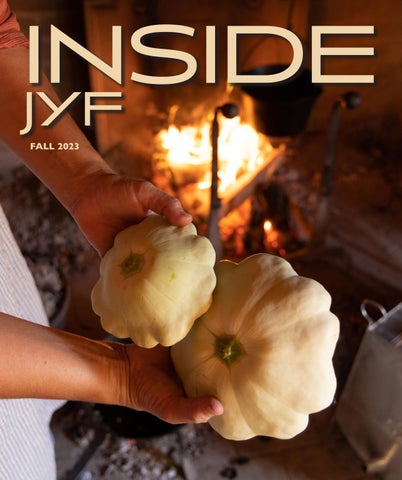
Jamestown-Yorktown Foundation photographer Dexter Johnson captured this image of Gretchen Johnson, supervisor of the Revolution-era farm at the American Revolution Museum at Yorktown, holding pattypan squash. This variety of squash originated in Indigenous North America and by the time of the American Revolution, they were commonly grown in Virginia. Gretchen Johnson and other interpreters often demonstrate seasonal uses for squash, pumpkins and gourds. Read about the origins of gourds, their harvest for beauty and function, and where they can be found in the museums’ gardens and grounds.
4
8
10
15
Diets of Sailors & Soldiers Discover foods that Jamestown sailors and Revolutionary War soldiers ate while on the move.
Director’s Series Wraps Second Season Conversations span archaeology, African cuisine and transracial adoption.
New Rank of Master Teacher JYF launches a new master teacher program as an essential history tool in Virginia classrooms.
JYFMUSEUMS.ORG
Reign & Rebellion Finale: ‘Outlander’ Author Wows Crowd
Diana Gabaldon welcomed fans at the American Revolution Museum at Yorktown this fall for an exclusive glimpse into her characters, books and a preview of her upcoming 10th novel set in Yorktown.
12
18
22
30
Holiday Shopping Bring history home for the holidays from JYF Museum Shops.
Staff Spotlight: Sam McGowan Learn how a longtime educator’s passion is rooted in Virginia Indian history and culture.
FY23 Annual Report Celebrate the contributions of donors and leaders to support the museums this past fiscal year.
|
3
4
|
INSIDE JYF
GOURDS GALORE Sprawling amid the summer and fall gardens and fields of the museums’ historical backdrops is a fruitful crop harvested for centuries for its beauty and function.
G
ourd birdhouses tower in the treeline of Jamestown Settlement’s Paspahegh Town, and gourd bowls and dippers nestle near a cooking fire. Gourd ladles, either strung along the waistline of a historical interpreter or tucked in a sling or pouch, serve as treasured tools. At the American Revolution Museum at Yorktown, long-handled dipper gourds are transformed for use around the Revolution-era farm kitchen and garden while bottle gourds are ideal for watering and storing beans and seeds. Dried and hollowed gourds make efficient water canteens. For centuries across the world, people have used gourds for everything from food and tools to decoration and musical instruments. The Indigenous, African and European people who converged in early Virginia had long histories of integrating gourds into their daily lives.
Gourds as tools and musical instruments Bottle gourds are native to Africa, where African peoples used a variety of calabash gourds for tools and musical instruments. With their hard and durable exterior and natural buoyancy when dried, gourds made excellent spoons, bowls, canteens and other tools such as fisherman’s floats and buoys. The Yoruba shekere, a West African percussion-style instrument, achieves its distinctive sound when a woven net of cowrie or other shells hit the outside of a dried gourd.
Gourd Birdhouses
A 20th-century spike fiddle in the collection of the Jamestown-Yorktown Foundation illustrates another West African use of gourds with a musical application. The spike fiddle features a hollow gourd body, over which a perforated animal skin has been stretched and secured with metal tacks. A wrought iron spike (hence the name) runs through the gourd, and the three strings are played with a bent tree branch bow. The spike fiddle in the
JYFMUSEUMS.ORG
collection probably originated in Senegal, where the tradition of fiddling was associated with the region’s Fulbe people.
Gourds used for social and religious ceremonies Indigenous peoples of the Eastern Woodland region also found purposeful uses for bottle or birdhouse gourds and additional species of the cucurbit family – acorn, crookneck, scallop and zucchini squashes plus pumpkins – for nourishment, entertainment and embellishment. Large bowl-shaped gourds also could serve as drums by stretching a hide over the cavity, filling it with water or drying it in the sun. Gourd rattles and drums were used in social and religious ceremonies and were often carried by religious leaders as a symbol of their status. In the museum’s Paspahegh Town, visitors can see how Indigenous peoples used gourds and offshoots for canteens, scrapers for shaping pottery, such as plates and bowls, spoons and ladles.
|
Gourds as symbols Today, Indigenous artisans continue to utilize gourds to paint or engrave images that share stories about their history and culture. The Jamestown-Yorktown Foundation recently acquired for its collection a gourd painted by Indigenous artist Deborah Wilkinson (Upper Mattaponi). The gourd honors the memory of her grandmother Gracie Belle Adams, who was a victim of a 1952 uninvestigated hit-and-run. A distinctive red handprint, a symbol used to advocate awareness of the high crime rate against Indigenous women, brings visibility to Missing and Murdered Indigenous Women USA (MMIW).
5
8
|
INSIDE JYF
GOURD GENUS Cucurbitaceae are the genus of fruit (not vegetable) that comprise the gourd family. Of the genus cucurbitaceae, cucurbita are the most associated with late summer and fall harvests, pumpkins and squashes, while cucumis (cucumbers) and lagenaria (bottle gourds) and luffa (loofahs) are easily recognizable. Once the fruit—or pepo—ripens on the vine and matures, it can be harvested either for food or dried. Once the exterior hardens, the gourd has a variety of uses. Cucurbits themselves are so old that their origin is uncertain. Their earliest fossil record comes from Asia during the Cretaceous period 145 to 66 million years ago. There are even references to cucurbits in the Hebrew Bible.
Gourd accounts connect continents English colonists encountered cucurbits in Tsenacommacah and beyond, recording some accounts of how they were used. John Smith noted that in Indigenous gardens, these fruits were planted amongst the corn crop, while William Strachey’s 1612 “A Dictionarie of the Indian Language” included an Algonquian word for gourd, mahawke. John White’s 16th-century watercolors illustrate Indigenous peoples utilizing gourds for a variety of purposes. In one example, “A cheife Herowans wyfe of Pomeoc….,” a woman carries a large, hollow calabash or bottleneck gourd while her daughter looks on. Of course, some of these gourds were not a new sight for English colonists in Virginia. In his 1588 volume “Brief and True Report of the New Found Land of Virginia,” Thomas Hariot reported his observation of “...Mellions,
and Gourdes...they are of the like formes as those kindes in England.” Pumpkins, however, are native to the Americas, something European explorers only introduced to Europeans after exploration and colonization. Pumpkins, or pumpions, were first mentioned in the English language in 1526, in the London-published “Grete Herball” by Peter Treveris. Over time, European colonists began using gourds as utilitarian items in their homes and farms, as seen in the re-created Revolution-era farm. Deep within the soil and among the climbing and fruited vines, gourds reflect the important stories about the shared, layered past from the convergence of cultures intertwined in early Virginia. —Several Jamestown-Yorktown Foundation curatorial and education team members contributed to this story.
A 40-Year Tradition
Foods & Feasts of Colonial Virginia Celebrates a Cultural Convergence of Food A bounty of sweet potatoes, corn, beans and squash, okra and finely selected ingredients for mincemeat pies. For 40 years, Foods & Feasts of Colonial Virginia has celebrated the fall harvest season and the cultural convergence of food. This Thanksgiving holiday tradition at Jamestown Settlement and the American Revolution Museum at Yorktown showcases recipes – or “receipts” – of 17th- and 18th-century America and explores centuries-old culinary practices and cooking techniques. This year’s special two-day event begins the Friday after Thanksgiving, November 24 and 25, and has drawn museum guests over the past four decades to rediscover how early Virginians prepared meals in clay pots and iron kettles, and preserved food by smoking and salt curing.
PUMPKIN PUDDING Stew a fine sweet pumpkin till soft and dry; rub it through a sieve, mix with the pulp six eggs quite light, a quarter of a pound of butter, half a pint of new milk, some pounded ginger and nutmeg, a wine glass of brandy, and sugar to your taste. Should it be too liquid, stew it a little drier, put a paste round the edges, and in the bottom of a shallow dish or plate – pour in the mixture, cut some thin bits of paste, twist them, and lay them across the top, and bake it nicely. — Mary Randolph “The Virginia Housewife,” 1824
The cornucopia of foodways features diverse dishes reflecting influences among the cultures in early Virginia, shared through generations of Indigenous peoples and tastes cultures brought with them from England and West Central Africa, some evolving into new dishes and forming a new “American” cuisine. At Jamestown Settlement, explore food harvested on land and at sea by Virginia’s English colonists and Powhatan Indians. At the American Revolution Museum at Yorktown, examine how Continental Army soldiers earned their rations and witness the farmers’ bounty of produce and proteins fresh from the fields transformed into stews, pies and breads. Try this 18th-century recipe for pumpkin pudding and other historical dishes at jyfmuseums.org/recipes.
DIETS OF SAILORS & SOLDIERS
Sailing across the Atlantic Ocean and marching during the Revolutionary War, Jamestown mariners and Revolutionary War soldiers faced challenges in sourcing and preparing food while on the move.
Jamestown sailors in the 17th century followed the route of Trade Winds in the Atlantic Ocean to reach Tsenacommacah to establish the first permanent English settlement. At that time, mariners had more than a century of transatlantic experience and knowledgeable captains knew that frequent stops during voyages to access fresh food was essential to the health of the ship’s company. While scurvy is a word frequently associated with ships and sailors, scarce accounts from the 1607 Jamestown expedition indicate that it may not have been a problem for English colonists.
By sailing the Trade Winds route, mariners were able pass through the Caribbean islands, where they had access to a variety of fresh fruits and vegetables. George Percy, one of the passengers, recorded the English traded for pineapples, plantains and sweet potatoes, all laden with vitamin C. Vitamin C is a building block in the body and without it, the afflicted will experience symptoms such as bleeding gums and grinding bones. To contract scurvy, an individual must go without vitamin C for about 60 to 90 days. An average 17th-century transatlantic voyage was about 90 days, thus within the timeframe for scurvy to develop. By following the route of the Trade Winds and a crew’s familiarity with the natural resources of the islands may have prevented scurvy from being a deadly mark in Jamestown history.
JYFMUSEUMS.ORG
|
11
For Continental Army soldiers, earthen kitchens were an integral part of military camp life and provided a safe and efficient way to cook for a multitude of people. Dried goods, such as beans, salted pork and hard tack, were dietary staples of enlisted soldiers. Sometimes, depending on the season and location, fresh vegetables or fruit might supplement their diets. Moving from place to place, military campaign to military campaign, soldiers could replicate an earthen kitchen to feed the mess of soldiers and officers. At the American Revolution Museum at Yorktown, the Continental Army encampment features a fully functional camp kitchen, based on a variety of sources from military regulations of the 18th century, narratives in soldier’s journals and archaeology. In Gloucester Point, located across the York River from the museum, an archaeological survey in 2005 exposed evidence of a British kitchen from the Siege at Yorktown. A mound of dirt, encircled with a trench for safety, features openings for individual cooking burners to boil water or cook meals for soldiers, typically one burner per tent. Historical interpreters show museum guests how food rations were allotted by the quartermaster, witness the disparity of foods available among enlisted and officers and understand the hardships soldiers endured all to often. — Ashley Woodland & Alicia Klimenko, historical interpreters on the Jamestown Settlement ships and in the Continental Army encampment, contributed to this story. “We drew a day’s rations of beef and flour – what was called a pound of each; the flour, perhaps, was not far from its nominal weight, but the beef was, as it always was, in such cases, and indeed in all others in the army, not more than three fourths of a pound, and that, at best, half bone. And how was it cooked? – Why, as it usually was when we had no cooking utensils with us, - that is, the flour was laid upon a flat rock and mixed up with cold water, then daubed upon a flat stone and scorched on one side, while the beef was broiling on a stick in the fire.” —Selections from “The Diary of Joseph Plum Martin,” 1830
10
|
INSIDE JYF
Praise for Director’s Series as the Second Season Wraps
2024 Season
JYF Executive Director Christy S. Coleman talks with David Givens, Jamestown Rediscovery Foundation's director of archaeology at Historic Jamestowne.
Jamestown Settlement’s popular Director’s Series with Christy S. Coleman, executive director of the JamestownYorktown Foundation, moved into the fall with a slate of three diverse and compelling conversations with topics ranging from archaeology and preservation to culinary history and transracial adoption. Now in its second year and sponsored by TowneBank, the Director’s Series has delivered exclusive insight to a variety of topics from the sold-out program in January with Bill Barker, who portrays Thomas Jefferson, to lively exchanges in the spring among Dr. Kimberly Gilmore, The History
Channel/A&E Networks chief historian, and American presidential historian Alexis Coe.
Stay tuned for the 2024 Director’s Series lineup. Want to see more from this past year’s series? View them again and again at jyfmuseums.org/ directorsseries.
Audience members have praised the series with comments such as “Wonderfully diverse,” “Loved this series!” and “Superb!” Nearly 700 people have joined the conversations in person and virtually this season. The Director’s Series resumed in September with David Givens, Jamestown Rediscovery Foundation's director of archaeology at Historic Jamestowne, who addressed climate
JYFMUSEUMS.ORG
|
11
challenges that Jamestown Island faces and his team's efforts to preserve and protect this site, which was listed last year as one of America's 11 Most Endangered Historic Places by the National Trust for Historic Preservation. He is a Jamestown Society Fellowship recipient and author of several works on Jamestown history, including his most recent book “Angela: Jamestown and the First Africans.” Michael W. Twitty, an African American and Jewish culinary historian and food writer, shared his recipe (see a favorite below) with audience members in October on how he connects his personal roots through food during. Twitty, a blogger at Afroculinaria.com, is an author of award-winning books – including 2023 National Jewish Book Award recipient “KosherSoul” and 2018 James Beard Foundation Book of the Year “The Cooking Gene,” which traces his food ancestry from Africa to America and from slavery to freedom. Beyond his work on television, he holds esteemed roles as a National Geographic Explorer and 2022 TIME 100 Next class member. The season finale features Susan Devan Harness on November 15. A cultural anthropologist, member of the Confederated Salish and Kootenai tribes and an American Indian transracial adoptee, Harness will share her journey to understanding the complexities and struggles of being an American Indian child adopted by a White couple living in the rural American West. Along with audience members, she will explore what sets American Indian interracial adoption apart from other types interracial/international adoption and the importance of understanding the difference. Having spoken to national and international audiences on American Indian transracial adoption reform, Harness is an award-winning author of “Bitterroot: A Salish Memoir of Transracial Adoption” and recently published her cultural anthropology research “Mixing Cultural Identities Through Transracial Adoption.” COWHORN OKRA SOUP 2 to 3 tbsp bacon drippings, lard, or vegetable or canola oil 2 medium yellow onions, sliced or chopped 3 tbsp flour 2 tbsp finely chopped herbs of your choice (bits of parsley, rosemary, basil, etc.) ½ tsp Kitchen Pepper (a special Twitty blend) Salt to taste 2 ½ quarts ham, beef, chicken, or vegetable broth ½ cup cooked crumbled bacon 3 ½ cups Roma tomatoes, chopped, or 29 oz. can, chopped, with juice ½ tsp crushed red pepper flakes 2 pounds okra, sliced into thin pieces 1 cup cooked Southern blue crab meat (optional) 2 cups cooked rice
Heat the bacon drippings, lard or oil in a Dutch oven until hot but not smoking. Dust the onions in the flour, add them to the pot with the heated oil, and sauté until translucent. Add the fresh herbs and Kitchen Pepper and salt and cook for 1 minute. Add broth and crumbled bacon and tomatoes. Cook for 1 hour on medium-low heat. This will create the stock for the soup. Add the rest of the ingredients except for the rice and cook for 30 minutes more. Ladle each serving over cooked rice in bowls. —From Michael W. Twitty’s “The Cooking Gene,” 2017
14
|
INSIDE JYF
REIGN & REBELLION GRAND FINALE
Draws a Sold-Out Crowd As a grand finale to the Reign & Rebellion special exhibition, “Outlander” author Diana Gabaldon charmed a crowd of 400-plus fans in a sold-out public appearance September 16 at the American Revolution Museum at Yorktown. The audience was captivated as Gabaldon, engaging and witty, took them through a whirlwind journey from her life as a scientist and academic professor to an international best-selling author whose novels have sold 50 million copies in 114 countries. They were transfixed as she read an excerpt from her upcoming and yet unpublished 10th novel set during the American Revolution in Yorktown. Gabaldon’s nine-volume historical fiction novels capture numerous ties to the Royal Stuarts reign and legacy as well as the American Revolution, and her appearance was one of 10 programs presented in connection with Reign & Rebellion since it debuted last November. She took insightful questions from the audience and afterward waited hours to greet eager fans and sign “Outlander” books and related merchandise from the museum shop. Fans of all ages attended the event, some
wearing kilts and dressed in Scottish fashion, reminiscent of the characters in the STARZ television series. The 1781 Café by Aromas even created a special themed menu for the evening event. Her visit was peppered with tours of area landmarks as well as Jamestown Settlement and the American Revolution Museum at Yorktown, where she interacted with historical interpreters and curators to examine material culture and collections for inspiration to weave into her next novel. As a prelude to Gabaldon’s appearance, a Reign & Rebellion inspired evening of time-hopping trivia held in July allowed “Outlander” fans to pit wits and compete for prizes, complete with a contest for the best “Outlander”-inspired outfits.
Sponsored by
JYFMUSEUMS.ORG
|
15
EXCLUSIVE MOMENTS Capture the spirit of Diana Gabaldon’s visit by viewing the full presentation, photo gallery and an exclusive interview about her 10th “Outlander” book, its ties to Yorktown and the upcoming 250th anniversary of the American Revolution: jyfmuseums.org/diana-gabaldon
Images courtesy of Jamestown-Yorktown Foundation/Dexter Johnson and Samantha Pietrinferno.
14
|
INSIDE JYF
Summer History Camps Reach Kids in Many Ways
A total of 159 children in pre-kindergarten to fifth grade enjoyed nearly a dozen Summer History Camp programs this year at Jamestown Settlement and the American Revolution Museum at Yorktown. Entrenched in fun themes about America’s past ranging from plants and animals to communication and clothing, children explored the museums’ outdoor living-history areas, took part in structured activities and made their own crafts. Some students learned about fashion of the 17th century and life of a tailor while others learned about the role animals played in the American Revolution. For museum educators, it was an opportunity to work with children in range of ages and abilities to ensure they feel welcome and engaged. They also helped reassure some parents whose children were new to summer camps. For one family, a first-time camper’s experience was a trial run for entering school this fall. The parent was concerned about the child’s sensory issues, and museum educators collaborated to ensure both the parent and the child felt welcome and secure while engaging in program activities. “This particular camper really thrived in camp,” said Abby Currier, Jamestown-Yorktown Foundation elementary education specialist. “They walked in confidently on their first day, even forgetting to say ‘bye’ to their parent. The camper interacted well with the rest of the campers and had an amazing time.” The parent was overjoyed, writing in their program evaluation: “This was my child’s first camp experience, and she absolutely loved it. She has a number of special needs and, honestly, I didn’t plan to leave her. However, Abby and all the staff were incredible and met every single need. I cannot say enough good things about this experience.” Summer camps will resume at both museums in June 2024.
Summer History Camps brought out the creativity and inspiration of young minds who learned about plants and animals and other aspects of America’s past.
Civic Season Programs Stir Creative Minds
During a special “Community and You” program at the American Revolution Museum at Yorktown on June 26 and July 4, visitors of all ages took influence from Oscar De Mejo’s American Revolution inspired paintings in the Jamestown-Yorktown Foundation collection and created gel print art based on their interpretation of liberty and De Mejo’s work. The art project was facilitated by Heather Mallak of Public Studio Design. In partnership with Made By Us, Civic Season education programs aim to celebrate and inform civic engagement among young Americans with the approach of the nation’s 250th anniversary in 2026.
JYFMUSEUMS.ORG
|
15
JYF Launches Master Teacher Program After completing popular summer teacher institutes at Jamestown Settlement and the American Revolution Museum at Yorktown, Virginia teachers are now eligible for a new master teacher program. Master teachers are envisioned to serve as “eyes in the classroom” to advise Jamestown-Yorktown Foundation educators on needs for student and teacher programming and resources, as well as serve as JYF ambassadors at educational conferences, in their own schools and regions and assist with opportunities for JYF teacher professional development. Three teachers were selected in August as master teachers. One of them is Paige Barlow, a Chesterfield fourth-grade teacher who participated in the 2021 and 2022 teacher institutes, which she attributes to transforming her lessons into “meaningful experiences that had students thinking critically about the origin of Virginia from multiple cultural perspectives.” Through the teacher institute programs, Barlow credits JYF with impacting her lessons “almost every day” as she applies the methodologies she learned throughout the year, allowing her students to become “active participants in their own learning.”
Paige Barlow, a new Jamestown-Yorktown Foundation master teacher, works with other teachers to build a yehakin at Jamestown Settlement.
The other two master teachers selected are Allison O’Connor of Loudon County and Laurie Robertson of Lynchburg City. The master teacher program is funded in part by the Brown Family Foundation and other private gifts. Read about this year’s Summer Teacher Institute in the Annual Report on page 7 and view highlights at jyfmuseums.org/teacherinstitute. —Anne Marie Baker, Teacher Programs Manager
"The Inauguration of Washington," Oscar De Mejo. Jamestown-Yorktown Foundation YG78.15.
PARTNERSHIPS
At 78 Units and Counting, JYF Blood Drives Save Lives
American Red Cross blood drives at JYF Museums generated 78 units of blood for the community this year. As part of the agency’s wellness program, JYF collaborates with the American Red Cross as a way for employees, volunteers and neighbors to save lives and give support to a cause that directly impacts the Greater Williamsburg community. Alternating blood drives between Jamestown Settlement and the American Revolution Museum at Yorktown is a great way to reach different segments of the community. Not only do employees and volunteers donate, but about half of the contributions this year have come from people in the community.
Every unit donated can help save up to three lives. Blood drives are competitive too. The American Red Cross sets benchmarks for total of units donated at each blood drive, and JYF has worked hard to exceed these each time this year. Employees also form teams and compete with other state organizations to see which group can give the most to support the community.
Why are blood donations so important?
Odds are that someone you know will need blood during your lifetime. In fact, every two seconds someone in America needs blood. Behind every blood donation is a personal story of an accident or trauma victim, cancer patient, transplant recipient, surgical candidate or a mother giving birth. JYF’s impact extends beyond the patient, multiplied by the effect it has on that person’s loved ones who are grateful for the blood donated and gift of time. The American Red Cross could not meet patient needs and touch many lives without support from organizations like JYF. Remember the American Red Cross slogan:
“The Need is Constant. The Gratification is Instant. Give Blood.” —Katie Ewell, Raeven Chatman and Sue Trettin, The JYF “Blood Brigade”
JYFMUSEUMS.ORG
|
JYF Wins Awards for Publications & Digital Communications Jamestown-Yorktown Foundation won accolades for its INSIDE JYF magazine, website and electronic newsletter from the National Federation of Press Women, after earning top awards for all three in the Virginia Professional Communicators juried communications contest. Board of Trustees member Del. Phillip A. Scott accepted on behalf of JYF during the Virginia awards ceremony this spring in Fredericksburg. INSIDE JYF is produced by a cross section of JYF professionals in development, marketing, retail and graphic design, along with curators and historians, educators, historical interpreters, digital media producers and human resources to present the meaningful work of JYF. Debuting in Spring 2021, the INSIDE JYF team has produced and published a total of nine issues. The redesign of the jyfmuseums.org website in December 2022 was honored for its new look and feel to make information about the agency and museums more streamlined and accessible for users, and the bimonthly History Uncovered marketing newsletter was recognized for its design and promotion of seasonal events and experiences at the museums.
Museums for All Program Reaches 2,600+ Visitors The Jamestown-Yorktown Foundation in partnership with Museums for All, a signature access program of the Institute of Museum and Library Services administered by the Association of Children’s Museums, offers free admission to those receiving food assistance (SNAP Benefits) in order to increase accessibility of high-quality museum learning resources and encourage people of all backgrounds to visit museums regularly and build a lifelong appreciation of museums.
Through September, more than 2,600 visitors accessed Jamestown Settlement and the American Revolution Museum at Yorktown through this program. Museums for All helps expand access to museums and raise public awareness about how museums in the U.S. are reaching their entire communities. More than 850 institutions participate in the initiative.
17
18
|
INSIDE JYF
EXCLUSIVE HANDMADE ORNAMENTS FROM ST. NICOLAS St. Nicolas specializes in bespoke, handmade decorations which are unique, beautiful and objects to treasure forever. Their small, London-based team is dedicated to creating fun, interesting and meaningful keepsakes for specialty and museum shops in the U.K. and around the world. For over 30 years, they have worked with a small Christian charity in Thailand that helps women in rural areas find work within their community, rather than having to leave home to work in a city. Some 300 skilled women work at home hand sewing their decorations; many have been part of the team for more than a decade. As the St. Nicolas business grew, and more innovative designs were needed, they began working with a partner in India and have had a
flourishing relationship with them for more than 20 years. These Indian decorations are made using the traditional method of zardozi embroidery. Zari (meaning gold) embroidery originated in Persia and reached India in the 12th century. This is a highly skilled technique that traditionally used gold wires and jewels to embellish courtly robes. Today, zardozi work is a rare and respected craft handed down from generation to generation and is recognized as one of the “Ancient Handicrafts” by the Government of India. The JYF Museum Shops feature a curated selection of more than 20 styles of St. Nicolas ornaments, including the three exclusive designs featured here: Queen Njinga, Pocahontas as Rebecca and the Susan Constant.
Discover Unique Finds at JYF Museum Shops
‘SEED TO PLATE, SOIL TO SKY: MODERN PLANT-BASED RECIPES USING NATIVE AMERICAN INGREDIENTS’ BY LOIS ELLEN FRANK This enriching cookbook celebrates eight important plants Native Americans introduced to the rest of the world: corn, beans, squash, chile, tomato, potato, vanilla and cacao—with more than 100 recipes. When these eight Native American plants crossed the ocean after 1492, the world’s cuisines were changed forever. In “Seed to Plate, Soil to Sky,” James Beard Award-winning author and chef Lois Ellen Frank introduces the splendor and importance of this Native culinary history and pairs it with delicious, modern, plant-based recipes using Native American ingredients. Along with Native American culinary advisor Walter Whitewater, “Seed to Plate, Soil to Sky,” shares nutritious, plant‑based recipes organized by each of the foundational ingredients in Native American cuisine as well as a necessary discussion of food sovereignty and sustainability. A delicious, enlightening celebration of Indigenous foods and Southwestern flavors, “Seed to Plate, Soil to Sky,” shares recipes for dishes such as Blue Corn Hotcakes with Prickly Pear Syrup, Three Sisters Stew, and Green Chile Enchilada Lasagna, as well as essential basics like Corn Masa, Red and Green Chile Sauces, and Cacao Spice Rub. The “Magic 8” ingredients share the page and plate—to create recipes that will transform your world.
'MESS YE NOT WITH ME' TAVERN MUG Our exclusive, extra-large tavern mug makes a bold statement. Like an early morning landscape, the rich, tonal reactive glaze makes each piece appear to subtly shift in color. Due to the nature of this glazing process, each mug will have slight variations that add to its beauty. Heavy yet balanced, the ceramic mug is microwave and dishwasher safe and has a 24- to 26-ounce capacity.
REPRODUCTION HAT PINS, DESIGNED BY OUR INTERPRETERS Inspired by the lapel and hat pins worn by men and women in the 18th century, these unique pins are designed and hand-decorated by historical interpreters in our Revolution-era farm at the American Revolution Museum at Yorktown. The decorations selected for each pin are either period appropriate (the painted ceramic, coral, stone or Job's tears which are grown on site) or related to our farm (chicken or pumpkin). The pins are offered in three lengths; most designs are one-of-a-kind.
OUTLANDER MERINO WOOL POCKET SCARF From Highland battlefields to misty moors, timeless standing stones to Fraser’s Ridge, the Official Outlander Tartan is the symbol of a love that travelled across time. From Patrick King Woollen Company of Port Hope, Ontario, Canada and Edinburgh, Scotland, this beautiful Merino wool fringed scarf with pockets, measures 10 inches wide and 62 inches long. Patrick King Woollen Company is a member of the Scottish Tartan Authority. All of their tartans are registered with The Scottish Tartan Registry. Patrick King Woollen Company addresses the welfare of sheep and the land they graze on, adhering to the Responsible Wool Standard. They work to ensure that their wool comes from farms that have a progressive approach to managing their land and practice holistic respect for animal welfare of the sheep.
20
|
Raising the Bar and Inspiring Minds, INSIDE JYF
Paid Internships Vital to Attract Top Talent
2023 Summer Interns – Jacob Chew, Rachel Cobb, Laura Holt, Jada Ross, Samantha Pietrinferno and Natalie Simpson – worked independently and collaboratively to move the needle at the Jamestown-Yorktown Foundation, inspiring coworkers and generating an intern-fueled social media series “JYF Museums Intern Stories” on social media channels.
I
nternships have been a long-standing graduation or earn class credit. The tradition at the Jamestown-Yorktown Human Resources and Professional Foundation. Development team along with agency JYF internships were offered previously leadership decided it was time for a change and shifted to paid internships as an unpaid or experiential in 2022. opportunity for students to learn job skills, explore various career paths, fulfill a degree requirement for
Paid internships are vital in breaking down barriers for students who may
not be able to work without pay and allows JYF to be more competitive in attracting top talent. Interns often provide fresh, creative perspectives, sharing new innovations in their fields and creating pipelines of inspiration between existing workers and the next generation’s workforce.
JYFMUSEUMS.ORG
Compensating them for their work shows that JYF values their contributions and elevates the entire program. Creating meaningful, real-world experiences would not be possible without collaboration among internal partners. This past summer, Development, Digital Media Services, Indigenous Peoples Initiative, Marketing & Public Relations and On-site Education created relevant experiences for interns that allowed their skills to shine through. Whether contributing to the donor database, revising intentional language in exhibition and education materials, creating social media campaigns and marketing content, developing school program activities or digitizing museum resources, each intern played a vital role in furthering our mission. While JYF still provides the opportunity of service and learning through volunteering, it is committed to continuing the growth of paid professional internships as part of its workforce. "If JYF wants to continue to attract the best, it should be active participants in developing the best," said Coy Mozingo, director of Human Resources and Professional Development. —Raeven Chatman, Human Resources Specialist of Recruitment & Lee Ann Shelhorse, Talent Acquisition Manager
|
21
SAMMY PIETRINFERNO JYF Museum Intern Stories
"Working at JYF this summer has left me with valuable connections, friendships and experiences to take with me as I officially graduate. I was able to explore my passions in a professional setting and felt like my opinions mattered in the office, which was very important to me." MARKETING AND PUBLIC RELATIONS INTERN
STAFF SPOTLIGHT
Sam McGowan
S
am McGowan’s passion for learning and teaching draws from his deep roots in Virginia Indian history and culture. A member of the Mattaponi Tribe, he began learning the rich history, stories, traditions and life skills of his people as told by tribal elders, instilling a lifelong commitment to education and preserving Indigenous culture.
Sam began traveling with his mother, Shirley “Little Dove” Custalow-McGowan, at an early age, demonstrating material culture and teaching the history of their people across the Commonwealth of Virginia and the Mid-Atlantic. When she later partnered with the JamestownYorktown Foundation to teach the history of the Mattaponi people, she often brought her children with her, and that is where Sam’s story with JYF begins. At 14, Sam took his first summer job as a historical interpreter in the then re-created Powhatan village. By interacting with museum visitors, he was able to share the history of his people and present-day stories of the Virginia Indian culture that still exists today. Sam grew up on the Mattaponi Indian Reservation, which dates to 1658 and is one of the country’s oldest, while the culture has lived in the region for over 15,000 years. For him, that is where the story of his people truly begins. “To understand who we are today, we have to understand who we were before European contact.” Carrying on a legacy that his grandfather, the late Chief Webster “Little Eagle” Custalow, tasked his mother with over 60 years ago is not something he takes lightly. It is ingrained in him as much as the many other traditions he carries. He credits his skills and knowledge to the generations before him who passed on their oral history and traditions to the next. A vivid storyteller and waterman, Sam has a knack for pulling on the ancestral strings that reach
beyond the Mattaponi and weaving in the teachings of his tribal elders, family and entire community, all of whom have shaped him in some way. Sam now serves as a cultural specialist with the Indigenous Peoples Initiative, work that is both meaningful and intentional to create a space for healing and progress to collaboration in keeping the legacy of Virginia Indian culture alive, past and present. —Lee Ann Shelhorse, Talent Acquisition Manager
JYFMUSEUMS.ORG
|
25
Godspeed Outreach Voyage Reaches Northern Neck and Eastern Shore
Jamestown Settlement’s Godspeed rounds the windward mark ahead of modern sailboats during the 28th Annual Hospice Turkey Shoot Regatta on the Rappahannock River in late September in Irvington, the Northern Neck of Virginia.
Jamestown Settlement’s Godspeed and crew sailed to Virginia’s Northern Neck and Eastern Shore in late September and early October for an outreach voyage to participate in the 28th Annual Hospice Turkey Shoot Regatta in Irvington and host 17th-century maritime education programs for students in Lancaster County and Onancock. During the Hospice Turkey Shoot Regatta, hosted by the Rappahannock River Yacht Club, the Godspeed volunteer crew competed with other vessels to place 4th in their fleet during the event race. As a floating classroom, the Godspeed was able to bring its maritime history to remote Virginia schools in the Chesapeake Bay region unable to travel to Jamestown Settlement. In Irvington, crew welcomed 85 students from Lancaster Elementary and Chesapeake Academy to take part in hands-on learning about what it was like to sail,
live on board and navigate a square-rigged ship in the 1600s. Once the ship reached Virginia’s Eastern Shore during a visit to Onancock, more than 100 students from three public schools and a homeschool group visited the ship to participate in education programs to learn the history of sailing, navigation, loading of cargo and trade during the early 17th century. While on the Eastern Shore, the crew also welcomed more than 1,000 visitors to tour the Godspeed’s main deck and learn about maritime history. During the voyage, with stops in Urbanna, Deltaville and Cape Charles, the crew took advantage of wind and weather conditions to take sail training opportunities and practice sailing and emergency drills. Outreach education voyages are supported through generous donations to the Jamestown-Yorktown Foundation, Inc. Annual Fund.
24
|
INSIDE JYF
NEW TRUSTEES & DIRECTORS JOIN JYF BOARDS The Jamestown-Yorktown Foundation welcomed seven new members in 2023 through gubernatorial appointments to the Board of Trustees and elections to the Inc. Board of Directors. Lawrence A. Bernert III is a principal and portfolio manager at Wilbanks, Smith and Thomas in Norfolk. He volunteers on the boards of the Norfolk Innovation Corridor and the Employees Retirement System of the City of Norfolk, where he chairs the system’s Investment Committee. He serves as a trustee and Investment Committee chair at Norfolk Academy and as board chair of the Children's Health Foundation that supports the Children’s Hospital of The King’s Daughters. He holds an MBA from the Darden School of Business at the University of Virginia, where he earned his undergraduate degree. Frances C. Bradford is a senior vice president on McGuireWoods Consulting’s Virginia government relations team and national education practice. She served in the education secretariat of Gov. Ralph Northam’s 2018-2022 administration as deputy secretary and then as secretary of education. Previously, she worked at William & Mary as director and then associate vice president for government relations. She is on the Virginia Network executive board and serves on the boards of the Science Museum of Virginia, Richmond Public Library Foundation and Virginia 21, and is an adjunct Virginia Commonwealth University faculty member. Julie Dime is the vice president of government affairs at the Virginia Hospital and Healthcare Association. She has more than 25 years of political, legislative and non-profit management experience, including government relations, campaign management, grassroots management, public speaking, fundraising, community outreach, strategic planning and legislative initiatives. Dime previously worked as the director of government affairs at the Williams Mullen law firm in Tyson’s Corner, and she is on the REAL LIFE Board of Directors. She holds a bachelor’s degree in government, summa cum laude, from Liberty University. William J. Longan, Jr. is a former director for SunTrust Bank’s Foundations and Endowment Practice. Longan is on the Flagler College Board of Trustees in St. Augustine, Fla., and is a member of the Society of the Cincinnati in the State of Virginia. He has served as an executive board member for the Heart of Virginia Council/Boy Scouts of America, president of the Kanawha Recreation Association and a board trustee for the Historic Richmond Foundation. He holds a bachelor’s degree in history from the University of North Carolina. Fred W. Palmore III is a Virginia native and a retired partner at the Troutman Pepper, LLC international law firm in Richmond, where he practiced for 40 years and was named among the “Best Lawyers in America” in four practice areas. A Vietnam War veteran, Palmore holds an undergraduate degree in American history from The College of William & Mary and a law degree from the University of Richmond School of Law. He serves on the William & Mary Alumni Association Board of Directors. B. Harrison Turnbull is founder and principal of Waverly Partners Consulting, LLC. A Richmond native who resides in Charlottesville, Turnbull has more than 40 years of general business, consulting, legal and executive management experience. He graduated from St. Christopher’s School and received his undergraduate degree from Washington & Lee University and MBA and J.D. degrees from the University of Virginia. He is a Virginia State Bar and Virginia Bar Association member and serves as the Society of the Cincinnati in the State of Virginia assistant treasurer. Victoria Vasques is the owner and chair of Tribal Tech, LLC, an American Indian, SBA 8(m), third-party verified, woman-owned small business, and its subsidiary, Cowan & Associates, Inc. She is Diegueño of the San Pasqual Band of Mission Indians, Valley Center, Calif., and former American Indian Woman of the Year. In her public service career, she served as assistant deputy secretary of the U.S. Department of Education Office of Indian Education. She holds a bachelor’s degree from California State University at Fullerton and teaching credentials from the University of California at Irvine.
BOARD NEWS
Landmark Moments for JYF Leaders
Norment Celebrates 32 Years, Emerson Dedicates Namesake Facility Two longtime leaders of the Jamestown-Yorktown Foundation celebrate important milestones. The Honorable Thomas K. Norment, Jr., chairman of the Board of Trustees and member of the Inc. Board of Directors, marks his 32nd year as a member steering the two history museums, taking part in their evolutions, expansions and national commemorations of American history. “In 1957, I came to Jamestown Festival Park for the first time as a grade school student,” Norment shared earlier this year to a group of employees, stressing the region’s historical significance. “Fifty years later, never would I have realized that I would experience some of the most defining moments of my life. It’s been a true honor.” Norment, who serves as the Senate Minority Leader and represents Virginia’s 3rd District, announced earlier this year that he would not seek re-election. He previously served as board chairman during America’s 400th Anniversary Commemoration of Jamestown. He held leadership roles during the American Evolution 2019 Commemoration and serves on the Virginia 250 American Revolution Commission. Emerson Dedicates Namesake Central Support Complex Surrounded by cheers from friends and family in an October ceremony, Philip G. Emerson, executive director emeritus of the Jamestown-Yorktown Foundation, unveiled the official sign to dedicate the Central Support Complex that bears his name.
In this 2019 JYF photo, Senator Thomas K. Norment, Jr. congratulates then Executive Director Philip G. Emerson for his 33 years of leadership, an honor symbolized with a bronze American eagle. The two worked closely together to transform the museums into national centers of learning and engagement.
“The Philip G. Emerson Central Support Complex” at 200 Hawks Nest Drive honors Emerson, who served as executive director for 33 years until his retirement in 2019 is the third executive director in the agency’s 66-year history. In his tenure, Emerson is credited with shaping Jamestown Settlement and the American Revolution Museum at Yorktown into world-class museums and leaders in education, through national reaccreditations and expansions of its collection and facilities. The museums served as a stage for national 400th-anniversary commemorations of American history in 2007 and 2019. He worked with the boards to execute long-range plans to transform the former commemorative sites into nationally acclaimed centers of learning and implement efficiencies, such as the innovative Central Support Complex that combined shared operations to one location between the two museums.
28
|
INSIDE JYF
2024 EXHIBITS & From exhibit openings to milestone events, there’s no shortage of excitement in the coming year at JYF Museums.
SPECIAL EXHIBITION Ruth E. Carter: Afrofuturism in Costume Design Crossing time and place is a new special exhibition to debut at Jamestown Settlement May 11 featuring the works of two-time Academy Award-winning costume designer Ruth E. Carter. Carter has defined generations through her designs in film and TV, creating powerful pieces for projects such as “Roots,” “Amistad,” “Malcom X,” “Selma,” “Do the Right Thing” and “Black Panther” and designing costumes for legends like Oprah Winfrey, Denzel Washington, Chadwick Boseman, Eddie Murphy, Angela Bassett and Forest Whitaker. From humble roots in Massachusetts with Virginia connections as a Hampton University graduate, Carter has helped bring Black history to life for almost 40 years and defined the style of the Afrofuturism movement. The traveling exhibit, organized by Ruth Carter Costume Design and curated by Julia Long, has been displayed at the North Carolina Museum of Art and currently at the Charles H. Wright Museum. Her art adds dimensionality, flair and culture to the characters she envisions, giving power to the incredible actors who wear her designs. Her vibrancy and attention to detail in costuming is integral to translating stories of race, politics and culture to the big screen. On display for six months through December 1, visitors can view more than 60 of Carter’s original garments while also glimpsing her immersive process, historical research and attention to detail in every project she brings to life.
Ruth E. Carter, Costume for Queen Ramonda in “Black Panther” (2018). Photo courtesy of Colin Gray and SCAD FASH Museum.
Fashioned in History As an accessory to the Ruth E. Carter exhibit, Jamestown Settlement will showcase the work of Jamestown-Yorktown Foundation historical tailors who dress its cast of interpreters depicting people living in early America, some based on period portraits and surviving garments on display in the museum’s gallery exhibits. On June 7-9, the museum will host its biannual gathering of historical clothing experts across the globe during a three-day Fashioned in History event to exchange authentic techniques to fashion ruff collars, buttons, bodices and breeches.
JYFMUSEUMS.ORG
|
27
EVENTS NOT TO MISS EXTENDED VIEW
CALL FOR ARTISTS
Black Artist Showcase Moves to Monthlong Display Jamestown Settlement’s annual Black Artist Showcase will be on extended view throughout February 2024, connecting the past and present through vivid intersections of contemporary art and 17thThe 2022 Black Artist Showcase featured "Ezra: century history. Reparations Groove," a linoleum cut by Steve
Prince (at right), as well as "The Calm," an acrylic Once limited to one weekend, the monthlong display will complement painting by S. Ross Browne. museum gallery exhibits, films and education programs on African and African American history in early Virginia and culminates February 24 with “After Angelo,” named for one of the first African women in Jamestown. This annual event reflects on the legacy of African diaspora by celebrating modern African American life and culture through performance, community conversation and art created by professional Virginia-based artists.
The theme for submissions is “the beauty of our lives,” which is open to interpretation however the artist desires. It is inspired by a passage from James Baldwin’s “The Fire Next Time,” published in 1963 as a call to action against racial injustice during the Emancipation Proclamation centennial. New and returning artists are invited to submit their work for consideration by December 15, 2023. Visit jyfmuseums. org/black-artist-showcase for details.
M I L E S T O N E A N N I V E R S A RY
Military Through the Ages Marks 40 Years
Shine up your armor and grab your epaulets to make ready for centuries of military history – all in one weekend – at Jamestown Settlement’s time-honored “Military Through the Ages” event on March 16 and 17, marking its milestone 40th anniversary. For four decades, ancient warriors, knights, sailors and soldiers have descended on museum grounds to present one of the most unique chronological displays of military history. What started as an event with a handful of military re-enactors in 1984 has grown to hundreds depicting military encounters from 500 B.C.E. all the way to modern-day soldiers with the Virginia Army National Guard.
The Old Dominion Air Squadron, Airman's Preservation Society, 1918, received the 2023 Military Through the Ages Re-enactor’s Choice Award for its representation of the 31st Aero Squadron at the 3rd Aviation Instructional Center at Issoudun, France, the primary flight training center for the U.S. Air Service in France and, at the time, the largest airfield complex in the world.
Visitors can interact with re-enactors in military encampments to learn how uniforms, weapons and tactics evolved through the ages. Military vehicles and equipment are on exhibit during the two-day event, complete with the sounds of patriotic music, rounds of artillery and the popular military parade and pass-in-review.
From tanks and trebuchets to flyovers and howitzer firings, each year has offered unexpected experiences. There’s no telling what’s in store for 2024. Make your battleplan for this year’s event at jyfmuseums.org/militarythroughtheages.
28
|
INSIDE JYF
calendar of EVENTS
Veterans Day Commemoration
NOVEMBER 11 AT AMERICAN REVOLUTION MUSEUM AT YORKTOWN, participate in a special ceremony to mark the service of military veterans, past and present. All veterans, active duty, reserve and retired military personnel and up to three direct family members can enjoy free admission at both museums.
Museum Store Sunday
NOVEMBER 26 AT JAMESTOWN SETTLEMENT & AMERICAN REVOLUTION MUSEUM AT YORKTOWN, start the holiday season with a special 20% discount on total in-store purchases at both museum shops. All sales support the educational mission of the Jamestown-Yorktown Foundation.
Foods & Feasts of Colonial Virginia
NOVEMBER 24-25 AT JAMESTOWN SETTLEMENT & AMERICAN REVOLUTION MUSEUM AT YORKTOWN, extend your Thanksgiving with a 40th anniversary event celebrating culinary practices and cooking techniques of 17th- and 18th-century Virginia. Museums closed Thanksgiving Day.
JYFMUSEUMS.ORG
|
Christmastide in Virginia
29
DECEMBER 16-31 AT JAMESTOWN SETTLEMENT & AMERICAN REVOLUTION MUSEUM AT YORKTOWN, join in holiday traditions of early Virginias through interpretive programs, cooking demonstrations and musical entertainment. Museums closed December 25.
African American Cultural Heritage Month THROUGHOUT FEBRUARY AT JAMESTOWN SETTLEMENT & AMERICAN REVOLUTION MUSEUM AT YORKTOWN, explore exhibits, films and programs that recount the experiences of Africans and African Americans in early America.
2024 Director’s Series
THROUGHOUT 2024, join Jamestown-Yorktown Foundation Executive Director Christy S. Coleman for the return of compelling conversations with prominent scholars and public figures that bring into view JYF’s mission to raise awareness and understanding of the shared legacies of American history. Sponsored by TowneBank.
MORE 2024 EVENTS & PROGRAMS Talking History Lecture • December 2 | Indigenous Arts Day • May 4 EXHIBIT DEBUT: Ruth E. Carter: Afrofuturism in Costume Design • May 11 | Jamestown Day • May 18 Museums open year-round 9 a.m. to 5 p.m. daily. Tours and ticket information available at jyfmusums.org/visit or (757) 253-4838. Check out the complete calendar at jyfmuseums.org/events.
ANNUAL REPORT FY23
JYFMUSEUMS.ORG
| 1
MISSION & LEADERSHIP MISSION The Jamestown-Yorktown Foundation, an educational institution of the Commonwealth of Virginia, shall foster through its museums—Jamestown Settlement and the American Revolution Museum at Yorktown—an understanding and awareness of the early history, settlement and development of the United States through the convergence of Virginia Indian, European and African cultures and the enduring legacies bequeathed to the nation. The Jamestown-Yorktown Foundation, Inc. was incorporated as a 501(c)3 nonprofit organization for charitable and educational purposes in support of the Foundation’s programs and its museums, Jamestown Settlement and the American Revolution Museum at Yorktown. The JYF, Inc. cultivates donors, expands funding, contributes to program development and stewards resources to strengthen the Foundation’s museums.
JYF LEADERSHIP THROUGH JUNE 30, 2023 JYF, Inc. Board of Directors Mr. Terry E. Hall, President Mrs. T. J. Cardwell, Vice President Mrs. Alexis N. Swann, Treasurer Mrs. Mari Ann Banks, Secretary The Honorable Thomas K. Norment, Jr., Trustee Chair Mrs. Sue H. Gerdelman, Immediate Past President Mrs. Carolyn S. Abbitt Ms. Bentley R. Andrews Mrs. Donna P. Chapman Ms. Helen Zadarlik Cousins Mr. R. Allan Finger Mr. B.K. Fulton MG, USA (Ret) Michael T. Harrison, Sr. Dr. James W. Rawles, Jr. Mr. David Stephens Mrs. Francis P. Sykes Mr. Thomas H. Tullidge, Jr. Ms. Adria Vanhoozier Dr. Karin A. Wulf
JYF Board of Trustees Senator Thomas K. Norment, Jr., Chairman Mrs. Sue H. Gerdelman, Vice Chairman Delegate Delores L. McQuinn, Treasurer Delegate Amanda E. Batten, Secretary
Mr. M. Kirkland Cox, Chairman Emeritus Mr. H. Benson Dendy III, Chairman Emeritus Delegate Kenneth Plum, Chairman Emeritus Mr. Terry E. Hall, JYF, Inc. President Mr. A. Marshall Acuff, Jr. Chief Stephen R. Adkins, Sr. Mrs. Anedra W. Bourne Ms. Jamie T. Burke Ms. Gloria Marrero Chambers Delegate Glenn R. Davis, Jr. Lieutenant Governor Winsome Earle-Sears Ms. Suzanne O. Flippo Delegate Hyland F. Fowler, Jr. Speaker C. Todd Gilbert Secretary Aimee Rogstad Guidera Senator Emmett W. Hanger, Jr. Delegate C.E. Hayes, Jr. Ms. Daun S. Hester Delegate M. Keith Hodges Mr. A.E. Dick Howard Senator Janet D. Howell Mr. Charles E. James, Sr. Professor Ervin L. Jordan, Jr. Ms. Connie R. Kincheloe Delegate Barry D. Knight Senator Mamie E. Locke
Senator L. Louise Lucas Senator T. Montgomery Mason Attorney General Jason S. Miyares Dr. Cassandra L. Newby-Alexander Delegate Phillip A. Scott Ms. Susan R. Swecker Mr. Fred D. Thompson, Jr. Delegate Luke E. Torian Mr. Jeffrey B. Trammell Delegate R. Lee Ware, Jr. Governor Glenn A. Youngkin
JYF Senior Staff Ms. Christy S. Coleman, Executive Director Dr. Mariruth Leftwich, Senior Director of Museum Operations and Education Dr. Juliet Machie, Deputy Director/Senior Director of Administration Mr. Coy M. Mozingo, Director, Human Resources and Professional Development Mrs. Melissa Thompson, Chief Development Officer Mrs. Glenda H. Turner, Senior Director of Marketing and Public Relations
2
|
INSIDE JYF
Financial Overview and Philanthropy Report Financial Overview: Fiscal Year Ending June 30, 2023
The Jamestown-Yorktown Foundation, Inc. (JYF, Inc.) is a 501(c)3 not-for-profit organization that coordinates private fundraising to benefit the programs of the Jamestown-Yorktown Foundation (JYF), an educational institution of the Commonwealth of Virginia that operates two history museums—Jamestown Settlement and the American Revolution Museum at Yorktown.
Philanthropy Report: July 1, 2022 through June 30, 2023
Private support ensures that JYF can carry out its mission as an educational institution. The JYF, Inc. gratefully acknowledges the individuals, corporations, agencies and foundations whose contributions are supporting our museums and programs. Information on the sources and uses of private funds is provided below.
Sources of Funds Raised Individuals Foundations & Organizations Corporations Local Government / Municipalities Total
Purpose of Funds Raised $1,043,504 Unrestricted $2,929,715 Operating $72,357 Indigenous Peoples Initiative Exhibitions $253,500 Religion and Cultural $4,299,076 Institutions Initiative Endowment Planned Giving Expectancies Other Total
$789,828 $421,166 $100,000 $175,837 $2,499,988 $102,607 $200,000 $9,650 $4,299,076
JYFMUSEUMS.ORG
| 3
4
|
INSIDE JYF
ANNUAL FUND OVERVIEW REPORT Preserving Knowledge, Engaging Visitors, and Inspiring Generations of Learners
At the Jamestown-Yorktown Foundation, we serve Virginia and the nation as a remarkable educational resource, teaching 17th- and 18th-century history through the convergence of three cultures and their enduring legacies. Across our two interactive museums, Jamestown Settlement and the American Revolution Museum at Yorktown, and through our digital offerings, JYF generates hundreds of unique opportunities to help bring history to life for visitors near and far. Those visiting on site enjoy daily hands-on history lessons from interpreters in the re-created living-history areas and interactive experiences in our permanent and special exhibition galleries. The redesigned JYF website, which launched in December 2022, and our social media channels ensure that visitors can continue connecting with our programs and offerings, even when they are no longer at our museums. Along with our daily offerings, JYF provides visitors and local audiences with ongoing public programming to further engage their curiosity and passion for history. Ongoing programming is made possible in part by support from Annual Fund donors, including members of The 1607 Society and The Revolutionaries.
Celebrating & Commemorating History All Year Long
Annual seasonal programs create special opportunities for visitors to dive deeper into learning about historical events and engaging arts and culture from the 17th century to the present of Virginia Indian, European and West Central African communities. These programs incorporate new learning and experiences as we welcome new and returning visitors each year. From July 2022 to June 2023, JYF welcomed over 58,000 visitors to celebrate and commemorate converging cultures and historic events during Liberty Celebration, First Africans Commemoration, Family Frights, Foods & Feasts of Colonial Virginia, Christmastide in Virginia, After Angelo, Military Through the Ages, Indigenous Arts Day, Jamestown Day, Juneteenth and Civic Season. These programs were made possible thanks to our annual fund donors and local partners, James City County and York County Arts Commission.
JYFMUSEUMS.ORG
| 5
Connecting Our Audience With Experts and Thought Leaders
The Director’s Series and Talking History Lecture Series provide visitors and local audiences opportunities to hear from regional and national scholars, experts and thought leaders on historical topics and our shared legacies. The dynamic first season of the Director’s Series concluded in 2022, following engaging conversations between JYF Executive Director Christy S. Coleman and Dr. Keisha Blain, Winona LaDuke and Shannon LaNier. The second season kicked off in 2023 with a sold-out engagement with Bill Barker, and lively interactions continued into the spring and fall with Dr. Kimberly Gilmore, Alexis Coe, David Givens and Michael Twitty. Susan Devan Harness will join the growing list of thought-provoking conversations shared with Christy and our audience in mid-November. Talking History Lecture Series continued to offer free public lectures that link storylines found in the museums’ exhibition galleries and share how these moments in America’s past influenced its progression to the present. In FY23, JYF hosted Marti Londal, James Cameron and Helen Casey-Rutland, Darci Tucker, Andrew Buckley, Beau Robbins and Cassandra Newby-Alexander with Sylvia Tabb Lee & the Rejoicing Singers in sharing their expertise with our community. TowneBank is the presenting sponsor of the 2023 season of the Director’s Series.
Indigenous Peoples Initiative
The Indigenous Peoples Initiative continues to lead work within JYF to strengthen communication and connection with Virginia tribal communities and give these tribes an active voice in how we tell their story across our museums and through our educational materials. Throughout the year, staff worked closely with tribal communities to create reciprocal educational programming that revives traditional skills and amplifies tribal history, as well as working with our museum colleagues to update interpretative and educational materials and identify collections items that better represent and amplify the history of Virginia tribes during the 17th and 18th centuries. This initiative has been made possible thanks to support from Linda Baker.
Thank You For Supporting JYF—We Couldn’t Do It Without You
In FY23, JYF, Inc.’s Annual Fund raised $827,958 in cash and in-kind gifts from 1,793 donors. The Annual Fund provides vital unrestricted support for artifact acquisitions and collections care, special exhibitions, living-history interpretation, curatorial services, public programs and events, volunteer recruitment and retention, maritime education, and museum educational programs, including on site, classroom outreach and virtual learning. Contributions to the Annual Fund advance JYF’s educational mission and its commitment to preserving and sharing American history to broad audiences by ensuring the delivery of core public and educational programs and daily museum operations.
6
|
INSIDE JYF
MUSEUM EDUCATION PROGRAMS
Students Return in Numbers
As the world rebounded from the effects of the pandemic during the 2022-2023 academic year, our museums steadily hummed with the sounds of student voices. Over the course of the past year, JYF provided our award-winning mission-driven and fact-based educational programming to 199,144 learners, a 78% increase over the 2021-2022 academic year and the highest number of students since 2019. To support this incredible increase in participation, JYF museum educators developed a self-guided tour option for schools, ensuring accessibility to our educational materials on site at the museums. This first year proved wildly successful, making the self-guided tours a permanent part of the JYF educational offerings and helping us meet our goal of providing an array of educational opportunities that best meet the needs of students and teachers.
A special thank you to our education donors, whose generous support enabled JYF to engage with 6,887 students from 38 under-resourced school districts throughout Virginia, greatly increasing access to our education programs by 250% over the previous academic year. This year, Carolyn Condon, the Camp family foundations and the Huston Foundation helped ensure all students in the Commonwealth have access to our award-winning education programs.
Partners in Education
Throughout the fiscal year, JYF furthered our partnerships with key regional school systems and educational organizations to support deeper learning and enrichment for students and teachers. Collaborating with The Bob and Marion Wilson Teacher Institute of Colonial Williamsburg, Christopher Newport University Teacher Workshop program, Hampton City Schools, James River Association, The Mariners, Museum, the National Institute of History and Democracy Pre-collegiate program and York County School Division, JYF dove into STEM topics through the lens of history, helped high school students generate digital educational resources for elementary learners, explored behind-the-scenes work that brings an exhibition to life and provided professional development to enhance the classroom experience.
JYFMUSEUMS.ORG
| 7
SUMMER TEACHER INSTITUTE: Creating Enriching Learning for Virginia’s Teachers JYF’s Summer Teacher Institute welcomes teachers from across Virginia to join our museum educators for a week of deep diving into the history of early America, with the program focus alternating each summer between our two museums— Jamestown Settlement and the American Revolution Museum at Yorktown. Since its relaunch in 2019, 77 teachers have attended, 19 of whom returned to participate in sessions at both museums. Each summer, teachers experience immersive learning and exploration through programs presented by interpreters, curators, and education staff, returning to the classroom in the fall armed with new historical knowledge and methodologies that enhance student learning. This past summer’s Teacher Institute at Jamestown Settlement was no exception. As the week-long program came to a close, one teacher shared, “Wow! This has been the best learning/ professional development experience I have ever had. I have learned so much, and I am excited to share my knowledge with my students.” Another stated, “The number of ideas I can take back is incredible.” Teacher Institute not only leaves an immediate impression, but a lasting impact on how “Without the Summer these teachers approach student learning. One of our new master teachers, who has Institutes, I would not be participated in the educator I am today. both museum The experiences challenged sessions, stated that me and gave me incredible the inquiry-based resources and skills to methodologies she transform my classroom learned have helped into a place where history is her grow not only in not just talked about, but teaching history, experienced.” but in other content —Master Teacher areas as well. Over the years, we have heard from numerous teachers that the teacher institutes have impacted their entire school, as they dispense the resources, both teaching objects and knowledge, received from the session. Thanks to donors who see the value in teacher professional development, JYF teacher programs will continue impacting hundreds of teachers and their students for years to come! — Anne Marie Baker,
Teacher Programs Manager
The Summer Teacher Institute is free for all participants, thanks to generous support in FY23 by the Jamestown-Yorktown Foundation, Inc. Annual Fund, the Abbitt Family Foundation, the Charles S. and Millicent P. Brown Family Foundation, Audrael and John Chiricotti, Randy and Shelby Hawthorne, and Wilma and Marc Sharp.
8 |
INSIDE JYF
Special Project Donors Fiscal Year 2023 (July 1, 2022-June 30, 2023) “Remember, remember the 5th of November” was heard through the galleries in 2022 as JYF launched its first dual-site special exhibition, “Reign & Rebellion.” The exhibition offered a unique look at 17th- and 18th-century history through the lens of the Stuart dynasty from November 5, 2022 to September 19, 2023. Along with the Jamestown-Yorktown Foundation’s collection of 17th- and 18th-century objects, the two-part special exhibition featured more than 125 artifacts on loan from more than 25 international and national institutions and private collections. These pieces wove a tapestry of personal stories and historical events that shed light on the struggles, rebellions and determination experienced across three converging cultures as well as the lasting impacts of the Stuart monarchy’s royal foothold in colonial Virginia. At both Jamestown Settlement and the American Revolution Museum at Yorktown, visitors were invited to not only discover more about this history but examine the ways its legacy continues to impact our lives today. “We’ve received overall very positive responses to this exhibition,” shared Curatorial Manager Katherine Egner Gruber. “We hope that this multilayered exhibition has shed light on the complex tapestry of Virginia history we are continue to weave together in our Commonwealth of its Stuart-era past.” Throughout the exhibition’s 10-month run, special programming enabled visitors to deepen their understanding of the prominent themes and historical connections through interactive escape room events, visual and performing art experiences and talks with the JYF curatorial team. Exhibition programming culminated with an exclusive and sold-out presentation and book signing with “Outlander” author Diana Gabaldon on September 16, 2023. A special thanks to our sponsors who made this groundbreaking double exhibition a reality.
"Reign & Rebellion" Presented by:
Additional Support for "Reign & Rebellion" provided by: The Richard S. Reynolds Foundation James D. & Pamela J. Penny • Sue H. Gerdelman
JYFMUSEUMS.ORG
| 9
SPECIAL PROJECT DONORS “Religion and Early America” In Fall 2022, JYF was awarded its largest private grant, $2.5 million, from the Lilly Endowment Inc. to implement a new initiative, “Religion and Early America.” Begun in 2021 with planning support for the Lilly Endowment, JYF is now working to bring these plans to fruition and enable visitors to explore the role of religion and belief systems, their importance and impact within and across cultures, within our galleries, interpretation and programs. We look forward to sharing our progress as we implement the initiative over the next five years.
Upcoming Exhibitions s one exhibition closes, more are preparing to open. Here’s a sneak peek at the exciting, dynamic exhibitions planned, A diving into new topics and themes, over the next few years. At Jamestown Settlement, JYF staff are busy preparing to host and implement a joint exhibition that explores historical clothing, to coincide with our popular, biannual clothing conference this spring. " Ruth E. Carter: Afrofuturism in Costume Design" traveling exhibition, opening May 2024, will be an exploration of the history and culture of African and African American clothing through the lens of historical and futuristic costume design by Academy Award-winning costume designer Ruth E. Carter. This exhibition will feature costumes from Carter’s film and television work, including Marvel’s Black Panther universe and "Roots," and collaboration with Carter’s exhibition team to incorporate JYF historical content, artifacts and our own historical clothing work into the exhibition. Bringing Carter’s exhibition to JYF also marks the first time it will be displayed in the Tidewater region and near Carter’s alma mater, Hampton University.
Ruth E. Carter, Costumes for Coming 2 America (2021).
Photo courtesy of Colin Gray and SCAD FASH Museum. At the American Revolution Museum at Yorktown, plans are underway for two upcoming exhibitions that will commemorate the 250th anniversary of the signing of the Declaration of Independence in 2026 and the enduring legacy of the themes of the American Revolution.
" Fresh Views" will invite 21st-century visitors to explore the ideals and values of the Revolution and what they mean to us today through the re-emergence of 18 original images in the Jamestown-Yorktown Foundation collection from artist Oscar De Mejo, created to commemorate the 1976 Bicentennial. "Give Me Liberty," opening July 2026, commemorates America’s 250th in Virginia, exploring the unique and essential people, events and historic locations that helped bring liberty and democracy to a nation. This joint exhibition between the Virginia Museum of History and Culture and the Virginia 250th Commemoration Commission will highlight the intricate and inspiring history of Virginia, which is America’s story.
10 |
INSIDE JYF
DONOR EVENTS & SPOTLIGHTS Donor Events Whether supporting JYF through The 1607 Society, The Revolutionaries monthly giving club or as a loyalty donor, we are honored by the nearly 2,000 individuals who ensure we have the resources needed to bring this important story of early America to life. In celebration of this support, JYF invited donors to join us at the museums for special events and receptions to experience the impact of their contributions firsthand. The past year’s festivities began in September 2022 with the rebranded Picnic on the Pier. JYF welcomed 224 donors and community members to enjoy Jamestown Settlement after hours, soaking up the sunset on the James River while enjoying tasty treats and colonial-era entertainment. Over 140 donors and sponsors joined us for exclusive receptions to launch the “Reign & Rebellion” special exhibition and the 2023 season of the Director’s Series with guest Bill Barker. At the exhibition opening reception in November, guests enjoyed early access and opportunities to delve behind-the-scenes with the JYF exhibition team as they explored the Jamestown Settlement portion of the exhibit. During the Director’s Series reception, Bill Barker and JYF Executive Director Christy Coleman engaged with members of The 1607 Society and Director’s Series season subscribers in advance of their public conversation at the Jamestown Settlement Robins Foundation Theater. In February 2023, JYF celebrated the relaunched monthly giving club, The Revolutionaries. Members enjoyed exhibition-themed cocktails and special evening access to “Reign & Rebellion.” The “History by the Pint” event, held at Virginia Beer Company in May 2023, invited current Revolutionaries members and those in the community to grab a pint and chat with friends and other history lovers while JYF Historical Tailor Samantha Bullat shared insights on the museums’ historical clothing worn by interpreters. Learn how to support JYF and receive your invitation to exclusive donor events and opportunities at jyfmuseums.org/support-jyf.
JYFMUSEUMS.ORG
| 11
DONOR SPOTLIGHT Barnes Family Foundation Planting the Seeds of Philanthropy “The lessons contained in the American Revolution Museum at Yorktown and the outstanding individuals who produce the constructive atmosphere are impeccable examples of what we hope to accomplish through philanthropy.” —Lee Barnes, Barnes Family Foundation The Barnes family—Lee, Christy, Matthew, Trey and Michael—journeyed to Yorktown, Virginia last year as part of their summer vacation. As avid history learners, they made a stop at the American Revolution Museum at Yorktown. What unfolded that day left quite an impact—on both the Barnes family and the Jamestown-Yorktown Foundation. During their visit to the Revolution-era farm, they met Greg Schneck, a now-retired historical interpreter, who led the family through the colorful summer garden while connecting 18th-century history and themes to the present day. That encounter exemplified the meaningful moments that happen each day at the museum, with one question or comment leading into a larger, meaningful conversation between visitors and interpreters. For Lee, Greg “inspired us with his unparalleled knowledge, insight and … discussion of American values, what our nation exemplifies and what it strives to become.” That exchange continued to resonate after the family ended their visit and returned home to North Carolina. Through the Barnes Family Foundation, they decided to make a gift in honor of Greg’s work. “Our mission is to support and reinforce the foundational structure of the individual,” said Lee. “We want our philanthropic work to benefit distinguished causes that promote, build and refine the individual skills which are necessary to attain a productive and fulfilling life. Greg wrote to us after he learned of the donation in his honor, and commented, ‘I will always tell the good, the bad and the ugly of history. I believe it all needs to be told, so we can learn from it… I believe a museum should make people think about, feel and comprehend what they’re being shown.,”
Join the Barnes Family Foundation and make an impact today by supporting the educational programming that inspires you at JYF. Contact the Development Office at (757) 253-4139 or giving@jyf.virginia.gov to learn more.
12
|
INSIDE JYF
DONOR SPOTLIGHT Michael Harrison From Mermaid Tavern to Board Member and Donor: JYF Connection Comes Full Circle When young Michael Harrison started his first job at the Mermaid Tavern at Jamestown Festival Park, which later became Jamestown Settlement, he had no idea that someday he would return to the place where his professional life began. Now, as a member of the Jamestown-Yorktown Foundation, Inc. Board of Directors, MG (Ret.) Harrison notes that it is the mission that keeps him coming back. After 34 years of serving in the military, Harrison takes a lot of pride in the Commonwealth of Virginia and shares that there is “nothing more important than understanding history.” “Many kids don’t know anything about Jamestown or Yorktown, and it is a story that needs to be told over and over again,” he stressed. As a member of the board and The 1607 Society, Harrison knows that having a place for people to engage with that history “does not come free,” so he gives to support the museums and ensure they sustain their professional appearance. “Donors are critical to telling the story of America – the good and the bad and no deviations,” he said. “If we don’t tell the story in a way that shows our enthusiasm, we cannot capture the imaginations of those visitors and schoolchildren.” Through his strong leadership and philanthropy, Harrison is helping JYF do just that.
DONOR SPOTLIGHT SarahJane Holzhauer 21 Years Strong: Sustained Support Enhances Connection to JYF It was finding a brochure on Williamsburg attractions while staying at a local motel that first brought SarahJane Holzhauer of Toledo, Ohio to the Jamestown-Yorktown Foundation’s museums. “As a history buff, I’ve always been visiting historical sites,” she said. “It was a natural choice.” Following her visit, she wanted to enhance her relationship with our museums. Along with additional visits, she has remained loyal to JYF from her home in Ohio through a yearly gift to the Annual Fund. SarahJane has faithfully given to JYF for 21 consecutive years, providing a source of sustainable support for the museums. “With the decline in the curriculums concerning history, someone needs to make sure future generations have a way of learning how our country has evolved,” she said. As a former educator, SarahJane wanted to do what she can to help by joining other donors stepping in to fill that role. Her dedicated support and recurring visits are an esteemed example of donor engagement that will now persist through her planned gift to the Mathews Legacy Society that included the museums in her will. “I like to support groups that bring history to life,” she said. “I want to help ensure that organizations like JYF can share America’s history.” No matter the size, yearly contributions to the JYF, Inc. Annual Fund provide dependable, sustained support to our museums, helping us meet our most pressing needs and deliver exceptional history education. To learn how you can join SarahJane and other loyalty donors, visit jyfmuseums.org/donate today.
JYFMUSEUMS.ORG
| 13
THE MATHEWS LEGACY SOCIETY Strengthening the Endowment
The Mathews Legacy Society The Mathews Legacy Society honors friends of the museums and recognizes those who have thoughtfully provided for the future of our museums by including the Jamestown-Yorktown Foundation, Inc. in their estate plans, like their predecessors and namesake of the society, Nick and Mary Mathews.
Strengthening the Endowment
The Jamestown-Yorktown Foundation, Inc. endowment was created in 1982 to ensure future fiscal stability by managing endowed assets that benefit the museums and educational programs. Expendable interest earnings support artifact acquisitions, special exhibition, planning and core public and education program areas, including the maritime education program, on-site and outreach education, distance learning and historical interpretation. As of June 30, 2023, those endowments amounted to $18,362,065.
Nick and Mary were natives of Greece who emigrated to the United States and earned their fortune through Nick’s Seafood Pavilion. Originally what started as a lunch counter eatery, over the years it transformed into a Yorktown landmark that earned national recognition, welcoming everyone from local residents and military to international celebrities. In 1972, Nick and Mary donated 23 acres overlooking the York River for what would become the Yorktown Victory Center and later the American Revolution Museum at Yorktown. Upon her death, Mary bequeathed nearly their entire estate to the Jamestown-Yorktown Foundation so that others would know “…the blessings of democracy that commenced in my native land Greece and later here” in Yorktown.
With their bequest, Nick and Mary Mathews are among JYF’s first and largest benefactors, leaving a legacy for generations of Americans. The American Revolution Museum at Yorktown was dedicated in their honor. Those joining The Mathews Legacy Society through their own planned gifts are supporting future generations with enduring investments in our mission to foster awareness and understanding of the early history, settlement and development of the United States.
Annual Luncheon In April, JYF welcomed 18 members to our annual Mathews Legacy Society luncheon. Joining them were Director of Maritime Operations Eric Speth, along with Executive Director Christy Coleman, Chief Development Officer Melissa Thompson and other members of the Development team. As everyone enjoyed spring fare from Aromas, Speth engaged members with a presentation on JYF’s renowned maritime program and upcoming ship preservation projects. These annual events offer Mathew Legacy Society members access to JYF senior leadership and opportunities to learn more about upcoming projects and plans underway.
14
|
INSIDE JYF
4 Points About Planned Giving JYF Shares Expert Advice from The Optimal Service Group of Wells Fargo Advisors
• Donations of all sizes make an impact at JYF museums. T here’s no minimum amount needed to make a planned gift. Some donors elect to make “blended gifts,” which give them the option to donate a smaller amount now – one that aligns with their budget – and later designate a larger gift in their will. A planned gift protects a donor’s assets during their lifetime while leaving behind a meaningful legacy.
• Donors can make changes to their planned gift at any time. M useum donors can always adjust a legacy gift, and JYF honors its donors and celebrates their generous intentions and commitments they make today. Everyone has changing life circumstances and adaptations in the future are inevitable. • There are many ways donors can make a planned gift to JYF,
benefitting the museums and themselves.
W hat a gift a legacy donation leaves – not only leading to transformative experiences for museum guests and schoolchildren but generating a tax benefit for donors. Bequests may offer tax benefits like reducing or eliminating long-term capital gains taxes and qualifying for current income tax deductions. Planned gift options range from listing JYF in wills and estate plans and donating appreciated stock to gifting a portion of life insurance plans and making an IRA donation.
• It’s easy to make a planned gift to JYF. R eady to make an impact and leave a legacy? Donors can reach out to the Development office and work with their attorney or financial planner to set aside a gift to support the museums for years to come.
jyfinclegacy.org
With a helping hand from supporters like you, we can serve incredible hands-on history all year long.
Support the Jamestown-Yorktown Foundation Today
jyfmuseums.org/support-jyf | (757) 253-4139
48
|
INSIDE JYF
jyfmuseums.org/privateevents