Park Ridge Past & Present:
Hodges Park
City Hall Originally constructed in the 1950s as the All American Life Casualty Company, this building is Park Ridge’s third city hall. The building was designed by local architect William McCaughey, who was responsible for a very large body of work in Park Ridge, ranging from the Pickwick Theater to Maine East High School to the current Park Ridge Library. The insurance company outgrew this building and in 1962 it was sold to the City of Park Ridge which took possession in 1966.
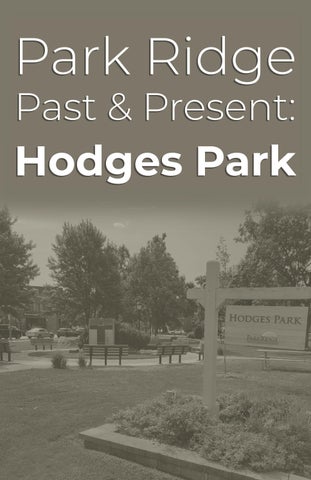
Hodges Park About 1873, when Park Ridge became a village, developer Leonard Hodges purchased land from Mancel Talcott, Jr. and Hodges laid out an area south of the railroad tracks, building homes on large lots. He donated a parcel to the village for use as a park. The park now bears his name and is situated in front of the current City Hall building.
Camp Fire Girls Fountain For a time, the park held a pile of rubble from the Chicago Fire and a bandshell, but they are long gone. Currently, the park holds the Camp Fire Girls fountain, located across from City Hall. A Camp Fire Girls fountain was initially installed in Hodges Park in 1926, but was replaced in 1966 with the current fountain, following the plan of local artist and sculptor Alfonso Iannelli. The 1966 fountain was renovated in 2007 and furnished with a ring of granite panels that mark historic milestones of Park Ridge history. The last marker, recognizing Hillary Rodham Clinton, was set in 2018.
Vine Street On the east side of Hodges Park is Vine Avenue, which winds all the way down to Higgins Road. Within walking distance, to your right, south of Hodges Park, are the next-door-neighbor homes of two of Park Ridge’s early mayors. 221 Vine Avenue was the home of Dr. Albert Buchheit, first mayor of the city of Park Ridge, who served a one-year term that began in 1910. During his term as Mayor, Buchheit signed ordinances to erect Park Ridge’s first public library, establishing a house address numbering system and installing fire alarm boxes on street corners. Buchheit’s home was actually built where city hall now stands but was moved in the 1950s. The house next door, at 225 Vine Avenue, was built in 1906 by Park Ridge’s fourth mayor, Albert Verity, who served from 1915 to 1917. His home was one of the first to have a telephone. Verity had a little “telephone room” near his front door and was happy to let his neighbors make use of it.
The Ridge Theater Walking back toward Hodges Park, one finds on the right the location of The Ridge Theater, at 203 Vine Street, across from Hodges Park, which opened in 1924 showing a silent film titled Her Night of Romance. The Ridge Theater offered an extravagant atmosphere and was an important social gathering place for residents. Though the films were silent, the theater was heated and had “washed air.” William Malone, the city’s second mayor, commissioned several buildings in Park Ridge including the Pickwick Theater which opened in 1928. The Ridge Theater was a competitor of Malone’s Pickwick, so Malone eventually bought The Ridge, and it went dark, closing in 1936. In 1956, the Ridge was converted to a Michael Kirby ice skating studio. The studio closed in 1973. Tenants came and went, but the condition of the building and its systems became badly deteriorated. The building was demolished in 1983, making way for today’s Ridge Square Condominiums.
Weyrauch’s Market Continuing the walk towards Hodges Park, one finds on the right 147 Vine, Weyrauch’s Market, the first commercial building south of the tracks. Now enclosed with brick, this building has been the home of many different establishments over the years including Bob Rowe’s Evening Pipe Shop and the Brickton Art Center. Today it is the DeVine Salon. The tiny little shop on the south side of the building has housed many businesses including a tiny doll house accessories shop, a candle store, and a computer repair business.
Buchheit Building Closer to Prospect (and the railroad crossing) is 137 Vine Avenue, commissioned by Albert Buchheit for his dental practice. Originally a one-story building, built circa 1916, it was expanded upward (in 1924) to accommodate residential apartments. In 1928, another addition was later added, expanding the Scharringhausen Pharmacy (and including a soda fountain). Many tenants have leased space in this building over the years. You can see the word BUCHHEIT on the end of the building facing the Metra tracks. The 1924 and 1928 additions were designed by the prominent Chicago architectural firm of Betts & Holcomb which designed the Des Plaines and Barrington’s Catlow movie theaters.
Railroad Depot In the 1860s, George Penny convinced the Chicago, Fond du Lac & St. Paul Railroad to make Pennyville (later Brickton) a stop so that the 5,000,000 bricks being manufactured here annually could be more easily transported into Chicago. The photo to the right is of the 1880s passenger depot at the Prospect Street crossing. Have you noticed that the commuter rail line uses a unique and rare left-hand main orientation, in which trains operate in the British manner of driving an automobile on the left side of the street?
Park Ridge Public Library The current library building opened in 1957 as Park Ridge had long outgrown the original 1913 Carnegie-funded Library building that still sits at 1 N Northwest Highway. The land was the site of Central School built in 1893, which operated until 1930 when it was destroyed by fire. It was decided not to replace the “central” school, but rather open the neighborhood schools that would better serve the growing populaton of Park Ridge. The Library was designed by William F. McCaughey and Charles Rowe. The residents of Park Ridge supported a major expansion of the building by a referendum passed in 1976. The two-story addition was designed by Charles Cedarholm. The library staff continually adapts its facilities to meet patron needs in the selection and growth of different collections, the availability of online access to materials, and programming. In 2024, there were 17,415 library card holders, 836,134 items were circulated, and 293,475 people visted the building.
Corner of Main & Prospect Returning across the tracks, on your right at the corner of Prospect & Main Street, across the street from Hodges Park, Leonard Hodges built a hotel as part of his development, so that visitors could come to Park Ridge and experience its rural character and be charmed enough to purchase a home in our growing community. Later the hotel became the Swedish Old People’s Home. The Fred Gillick family later claimed this corner for their real estate offices. A real estate firm is still found at the corner.
American Legion War Memorial At the Prospect & Courtland Avenue corner of Prospect Park is an American Legion Memorial honoring residents that have died in service. This monument serves as a focal point for Park Ridge’s Veterans Day and Memorial Day ceremonies.
Park Ridge Community Church Crossing Prospect and taking a left down Courtland Avenue, is the Park Ridge Community Church. This church community dates back to 1843. As part of his contribution to the Village of Park Ridge, Leonard Hodges provided land for the construction of a Congregational/Community Church. In 1925, the Community House, designed in a Gothic Style, was built to the south of the 1874 sanctuary. In 1951, the orignial Gothic sanctuary was replaced with the current Georgian building.
Gustave Fricke Home Now we are back in front of City Hall. Many years before the insurance company built their building, Dr. Gustave Fricke, who was the town doctor for many years, built a large home (next door to Dr. Buchheit’s home) on this site. His first home was across the street from the Town of Maine Cemetery. He moved in 1876 to this home which was eventually torn down. The round pharmacy building attached to Dr. Fricke’s home was relocated to a lot on Lake Street where it still sits today as part of a private residence.
Scan the QR code or visit the library’s website for a digital copy of this booklet. parkridgelibrary.org Keep an eye on the library’s online event calendar for more upcoming walking tours!
Presented in partnership by