Centre News SEPTEMBER 2019
The magazine of the Jewish Holocaust Centre, Melbourne, Australia
Building for the future
Registered by Australia Post. Publication No. VBH 7236
JHC Board Co-Presidents Vice-President Treasurer Secretary Executive Directors Non-Executive Directors
Pauline Rockman OAM & Sue Hampel OAM David Cohen Richard Michaels Elly Brooks Abram Goldberg OAM Helen Mahemoff Paul Kegen Allen Brostek Anita Frayman Phil Lewis Melanie Raleigh Mary Slade
JHC Foundation Chairperson Trustees
Helen Mahemoff Allen Brostek David Cohen Jeffrey Mahemoff AO Joey Borensztajn Nina Bassat AM
Director’s cut
4
Education 4
Australia becomes a full member of IHRA
7
Remember the Past – Build the Future: Taking the JHC building campaign to the community
8
Anatie Livnat Fanny Hoffman Soo Isaacs Sandy Saxon Gavan O’Connor
Saved by selfless acts of courage
10
Just Add Love
12
Connecting to eyewitnesses in sites of atrocity
14
Dr Anna Hirsh Phillip Maisel OAM
The penalties of survival
16
Julia Reichstein
Saving lives in the shadow of the SS
18
Robbie Simons
Loloush 20
Leora Harrison
A tree of life
22
Danielle Kamien
March of the Living 2019
24
Memories for a lifetime
26
New acquisitions
27
Seen around the Centre
28
Community news
30
Laura Etyngold Roy John Daniel Feldman Lena Fiszman Rae Silverstein Karen Miksad Georgina Alexander Lana Zuker Claire Jordaan Nargis Kurtaya Michael Stromenger
Centre News Editor Yiddish Editor
3
Lisa Phillips Jennifer Levitt Maxwell
Operations Operations Manager Finance Manager Special Projects & Bookkeeper Office Manager Volunteer Coordinator Administrative Support Officer Administrative Support Officer Operations Support Officer Operations Support Officer Austrian Intern Austrian Intern
Editor’s note
6
Development & Marketing Director of Marketing & Development Marketing Manager
3
Reflections on the 35th anniversary of the Jewish Holocaust Centre
Collections Senior Archivist Director of Testimonies Project Librarian & Information Manager Audio-Visual Producer
From the Presidents
Jayne Josem Evelyn Portek
Museum Senior Curator Curatorial Assistant
IN THIS ISSUE
5
Education Director of Education Educational Engagement Manager Education Officer Education Officer Education Officer
We consider the finest memorial to all victims of racist policies to be an educational program that aims to combat antisemitism, racism and prejudice in the community, and fosters understanding between people.
Federal Government supports JHC to expand its reach to every Victorian child
Office of the Museum Director Museum Director Executive Assistant
The Jewish Holocaust Centre is dedicated to the memory of the six million Jews murdered by the Nazis and their collaborators between 1933 and 1945.
Ruth Mushin Alex Dafner
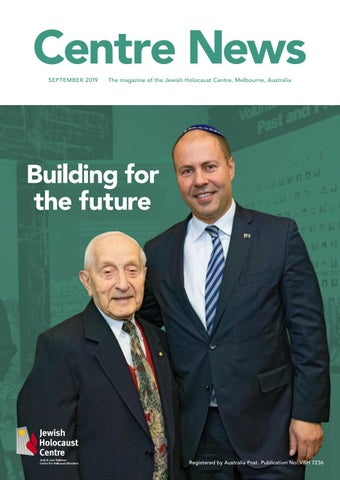
On the cover: (l-r) Abram Goldberg OAM & the Hon Josh Frydenberg MP Photo: Zina Sofer This publication has been designed and produced by Grin Creative / grincreative.com.au
13–15 Selwyn Street Elsternwick Vic 3185 Australia t: (03) 9528 1985 f: (03) 9528 3758 e: admin@jhc.org.au w: www.jhc.org.au
OPENING HOURS Mon–Thu: 10am–4pm Fri: 10am–3pm Sun & Public Hols: 12pm–4pm Closed on Saturdays, Jewish Holy Days and some public holidays
Disclaimer: The opinions expressed in Centre News are those of the authors and do not necessarily reflect those of the magazine editor or editorial committee. While Centre News welcomes ideas, articles, photos, poetry and letters, it reserves the right to accept or reject material. There is no automatic acceptance of submissions.
student has at least one, if not two, opportunities to visit the JHC museum and participate in our education programs to learn the vital lessons of the Holocaust – lessons about the dangers of racism and the value of democratic processes. In order to achieve the goal of reaching every Victorian school student we are rebuilding and enlarging our centre, commencing next year with a view to reopening in 2022. In the meantime we will find a temporary location and continue running a modified program. As well as increasing student numbers, this grant will ensure that we expand our programs to educate teachers, as well as key members of our community, including politicians at all levels, members of the police and armed forces, and many more citizens in pivotal decision-making roles. (Further details can be found on page 5 of Centre News.)
From the Presidents Pauline Rockman & Sue Hampel
T
wo events have occurred recently that will have a most profound impact on the Jewish Holocaust Centre (JHC). In April we were thrilled to announce that the JHC is the proud recipient of a $10 million grant from the Australian Government, and in June Australia was admitted as a full member to the International Holocaust Remembrance Alliance (IHRA) at Mondorf-les-Bains, Luxembourg. The Federal Government grant, announced by Treasurer the Hon Josh Frydenberg MP, will ensure that every Victorian school
Editor’s note Ruth Mushin
A
lthough we regularly feature articles by academics and other experts on the Holocaust, and keep you up to date with what is happening at the Jewish Holocaust Centre (JHC), I always feel that one of the most important tasks of Centre News is to tell the stories of Holocaust survivors. In this edition, the stars truly are the Holocaust survivors involved with the JHC. We feature the stories of volunteer guides Joe de Haan and Charles German, and introduce you to Jenny Chaenkel, a Melbourne survivor who has left a generous bequest to the
Australia’s admittance to full membership of the IHRA would not have happened without the on-going efforts over decades of several different Australian governments in pursuing and finally achieving this highly valuable outcome – placing Australia among the world leaders in Holocaust education. Prime Minister Scott Morrison and Foreign Minister Senator Marise Payne deserve special recognition for seeing this process through to a positive conclusion. ‘I think that it is very important for an organisation dealing with Holocaust education, remembrance and research to have the Australian people, through their government, joining the International Holocaust Remembrance Alliance (IHRA).’ These were the inspiring and most welcoming words from the honorary chair, Professor Yehuda Bauer, when we spoke to him after Australia’s acceptance into the IHRA. (You can read more about IHRA on page 7.) As Australians, we are all very proud to be doing this important work and we are mindful of the important legacy bequeathed to us by the Holocaust survivors who established and ran the JHC for many decades. L’shana tova! Pauline Rockman OAM and Sue Hampel OAM are co-presidents of the Jewish Holocaust Centre.
JHC. Julia Mayer features the stories of Sarah Saaroni and twins Stephanie Heller and Annetta Able in her article about Irris Makler’s wonderful book Just Add Love: Holocaust Survivors Share their Stories and Recipes. And we bring you the late Kitia Altman’s moving story ‘Loloush’ – one of ‘those who have no one to remember them’ she honours in her beautifully written book Memories of Ordinary People. Kitia was an important mentor in educating me about the Holocaust when I first became involved in the JHC, and one of her ‘causes’ was the recognition of the Righteous Among the Nations. I think Kitia would be proud to see the article about Alfred Rossner – a German whom she credits with helping to save her life and who himself paid for his courageous deeds with his life. German writer Hannah Miska, who was also mentored by Kitia when she lived in Melbourne and volunteered at the JHC, embarked on a voyage of discovery about Alfred Rossner after learning that he had been instrumental in saving Kitia’s life. I hope you enjoy these and the other articles in this edition of Centre News.
JHC Centre News
3
Director’s cut
Education
Jayne Josem
Lisa Phillips
T
he well-known quote from the movie Field of Dreams is: ‘If you build it, he will come.’ At the Jewish Holocaust Centre (JHC), however, the question we are currently asking ourselves is: ‘When they come, what will they learn, what will they remember and how can we make a difference to their lives?’ The message board at the JHC is always full of comments from students praising the experience and thanking survivors for sharing their stories. But what about the students who don’t leave inspiring messages? And those who manage to ignore the lessons or who just aren’t paying attention? What can we do to ensure we reach them? It is troubling to think that we might be missing the mark with some students, so we are now intent on exploring what more we could be doing. We are seeking feedback from students and teachers to better understand their thoughts about their visit and about Holocaust education in general. What did they respond well to? What resources do teachers need to help them teach this challenging subject? The Holocaust has so many lessons for visitors, but are we trying to teach too many concepts? We need to consider how to pique the visitors’ curiosity, how to reach different types of learners and how to ensure that students retain the most important lessons. Our educators and curators have their work cut out for them over the coming years, as we redevelop our permanent museum, design a museum for younger visitors and rethink our education programs. The book The Power of Moments suggests: ‘We all have defining moments in our lives – meaningful experiences that stand out in our memory.’ These moments shape our lives in ways that we cannot imagine. Recently the JHC received a powerful letter of apology from the principal of Hillview College, in the country town of Maryborough, relating to an incident that occurred during a school visit some years earlier, but had recently been brought to the school’s attention. The principal described the Holocaust as ’an event of such severity and vastness that it has no comparison in history’, emphasising the importance of Holocaust education and revealing that ‘my own visit to the Holocaust Centre as a teenager was life-changing’. We are committed to doing the behind-the-scenes work to ensure that we can continue to be the architects of these moments that matter, and we are extremely grateful for the government and community support of our work.
4
JHC Centre News
I have been bringing students each year for quite a number of years now and each year the girls cite this as one of the most profound and moving experiences that remain with them.
S
o began a thank you letter received in June, articulating the moving experience we witness each day at the Jewish Holocaust Centre (JHC). Our work is important and the passionate education team of survivors, volunteers and staff makes sure that we plant a seed of acceptance, and that students learn the dangers of hatred and prejudice each time we deliver a program. Behind the scenes we are working on developing new programs and ways we can continue to engage students using cutting edge technology and learning strategies. We know that students learn best when they are not passive listeners, but are actively involved in the learning process. As a result we have begun to change the way the students interact with the museum displays. We have been trialling the use of a ‘guided facilitation’, giving students a list of eight artefacts to discover in the museum. Then, with the help of a guide, they have the opportunity to explore the significance of the artefact within the broader story of the Holocaust We will be piloting our new virtual reality film of Szaja Chaskiel soon, as another way of engaging students in survivor testimony. During this trial phase we will explore how best to use this technology to ensure that the experience is meaningful and students are safely exposed to sites of atrocity. Educational research and practice have demonstrated that students’ level of engagement and conceptual understanding are deepened by asking questions. Our ‘Ask a Survivor’ project – focusing on the eighteen most common questions students ask after hearing survivor testimony – is also nearing its trial phase. The questions asked by students range from ‘do you hate Germans?’ to ‘why did you come to Australia?’ This project aims to replicate the experience of students or other visitors asking a survivor a question through creating a multimedia interface, enabling them to interact with the survivors who have been filmed answering these eighteen questions. They will be able to ask the same questions of a number of survivors. Although this will never be able to replicate fully the intimacy of a face-to-face conversation, we do hope that it creates a meaningful learning experience for students and other visitors.
Federal Government supports JHC to expand its reach to every Victorian child
I
n April, Treasurer Josh Frydenberg, along with the Minister for Education, Dan Tehan, jointly made the announcement that the Jewish Holocaust Centre (JHC) has been awarded an unprecedented $10 million grant by the Federal Government. This outstanding funding, which is unparalleled within the Jewish community, will enable to JHC to increase its facilities, resources and outreach to a level far exceeding any that our founders could ever have imagined when they established the Centre 35 years ago. ‘This extraordinary funding will enable us to further expand and resource our proposed redevelopment so that we can host more than double the number of students that we do currently, and deliver high-quality education programs to students, teachers, adult learners and professionals’ said Museum Director Jayne Josem. ‘This grant is a validation of the relevance of our mission, a powerful endorsement of the efforts and achievements of the Centre, and a recognition of the high standard of the programs already on offer and the potential of what can be achieved,’ she said. The funding will go primarily towards infrastructure expansion, as well as improvements to the current delivery of education programs – both to increase facilities and expand the JHC’s expert educational staff to levels that can manage the increase in student traffic. It will also involve exploring and delivering a range of cutting edge digital educational platforms, as well as collaborations with other like-minded organisations. Jayne Josem says the new funding, when added to the Capital Campaign target, will enable the JHC to create an expanded range of stimulating programs to engage students. ‘We will be
able to develop new resources for teachers to help them meet the challenges around this daunting subject, ensuring it is taught both accurately and safely. We will also be able to form partnerships with organisations that have resources for Holocaust education and work together to get these tools into classrooms.’ In announcing the grant, Josh Frydenberg said, ‘It’s incumbent on every Australian to learn about the Holocaust and say never again … The Holocaust Museum plays a vital role in educating the community at large about this terrible episode in world history and the importance of ensuring tolerance and respect for our fellow citizens.’ Helen Mahemoff, Co-Chair of the JHC Capital Campaign, stressed that these funds are additional to the $16 million currently being raised for the planned new building and will enable the JHC to create an incredible world-class facility with increased capacity and outreach. In particular, it creates the opportunity for all Victorian schoolchildren to attend the JHC’s education programs. The Co-chairs of the JHC capital campaign are currently working hard to raise the base funding needed to build the new facilities and is grateful to the wonderful donors who have already indicated that they will support the redevelopment. The fundraising efforts are ongoing (see Centre News page 8), and the transformational Morrison Government grant will help to further grow the vision of Holocaust survivors to teach the vital lessons of the Holocaust to future generations. (l-r) David Southwick MP, Dr Katie Allen MP, Phil Lewis, Dan Tehan MP, Helen Mahemoff, Josh Frydenberg MP, Senator David Van, Pauline Rockman OAM, Kate Ashmor, Tim Wilson MP and Jayne Josem
JHC Centre News
5
Reflections on the 35th anniversary of the
Jewish Holocaust Centre Elliot Perlman
Celebrating the JHC’s 35th anniversary
I
was 19 years old when I first came here having read in the Jewish News that our community, the Melbourne Jewish community, was taking the initiative to open its own Holocaust Centre.
Historically, the creation of communal institutions is something that we, Jews, have excelled at. As soon as we arrive somewhere, no matter how few of us there are, we start the process of organising and building institutions to make things easier for those that have arrived, and for those next to arrive. And we are always arriving somewhere because for thousands of years we have been continually fleeing somewhere, someone or some regime. The phenomenon that has led to our flight is that example of xenophobia par excellence; antisemitism. It’s a virus that no society can ever quite entirely rid itself of. It’s a societal illness that curiously, in its transmission and in its virulence, has nothing to do with us. We are not its cause. We are just the ones who suffer its consequences. It is its stubborn refusal to fade away, its ubiquity, and its quite astonishing capacity to mutate and adapt to its host circumstances that permits, for example, Jews to be seen simultaneously as seditious Bolsheviks and rapacious capitalists, that leads anti-Semitism to be not just an outstanding example of xenophobia, but, in fact, a unique phenomenon in the psychopathology of our species.
6
JHC Centre News
(l-r) Elliot Perlman, Sue Hampel OAM, Abram Goldberg OAM and Jayne Josem
And the most extreme example of antisemitism in Jewish history is the Holocaust, the systematic attempt by Nazi Germany and its allies to annihilate the Jewish people. It is to commemorate and to educate people about this event that this institution was created 35 years ago. So...35 years ago...It was before mobile phones or the internet but I rang around all my friends trying to find someone who would come with me to the opening. I could not find anyone of my 19 and 20-yearold contemporaries to come. And I had gone to Mount Scopus. Because of the work done by the staff and volunteers of this institution over the last 35 years, that would not happen today.
You have ensured that young people have a sense of connection to their ancestors and to what they suffered. It is a connection that would have them coming to the opening of a centre such as this today. It was an incredibly hot day. I felt humble amongst the community of survivors. I didn’t want anyone to think I was trying to co-opt my people’s tragedy for myself in some kind of self-indulgent adolescent way. And when I stood a few feet away from the survivor Adek Bialik when he collapsed in the hot sun and died, in a shocking example of tragic irony, I felt that maybe I shouldn’t have come, that perhaps this event belonged to an earlier generation. Why was I there, some 19-year-old interloper? My grandparents fled Poland and Russia before the Holocaust. They lost almost everybody they left behind but unlike so many Melbourne Jews of my generation, I didn’t have parents or grandparents who were survivors. I was there because I was brought up to consider the events of those years to be, not simply the most important in Jewish history, but the single most important gauge of the depths to which human beings can collectively sink and the heights to which they can individually climb. If you really want to study our species, you cannot do better than to study the Holocaust. Everything you need to know about humans you will find there; cruelty, savagery, the base uses of ingenious technology and of meticulous bureaucratic planning down to the tiniest detail for the sole purpose of mass murder, the sickening tendency of individuals to conform, the frighteningly limitless capacity for denial and for hypocrisy, but also the capacity for tenderness, kindness, bravery and the remarkable will to survive and recreate – it’s all there. And I had the compulsion then, as I had 30 years later when I wrote The Street Sweeper, to tell everyone what happened. Tell everyone what happened. That is what this institution does so remarkably well and what it has been doing every day for the last 35 years. I can’t get people to take a history degree majoring in the Holocaust. I can’t get them to take the time to read a book on the Holocaust but I can tell people to visit your remarkable centre and absorb its story and its message. We cannot save the 6 million but we can save their memory and in doing so make it that much less likely that anything like this will ever happen again to Jews, or to anyone else. The Jewish Holocaust Centre, its staff and its volunteers, have been doing this vital work for thirty five years and I cannot thank you enough for doing it and for being here. Thank you.
Elliot Perlman is the bestselling author of The Street Sweeper, Seven Types of Ambiguity, The Reasons I won’t Be Coming and Three Dollars. His work has been translated into numerous languages and published to international acclaim. The French literary journal, Lire, described him as ‘the classic of tomorrow’ and ‘one of 50 most important writers in the world’. His most recent work is a novel for children, The Adventures of Catvinkle. His new novel for adults, Maybe the Horse Will Talk, will be published in October.
Australian delegation with Lord Eric Pickles (centre)
Australia becomes a full member of IHRA
I
n June Australia was accepted as the 33rd full member of the International Holocaust Remembrance Alliance (IHRA) at Mondorf-les-Bains, Luxembourg.
IHRA was established at the Stockholm International Forum on the Holocaust in 2000, which brought together government and community leaders, officials and Holocaust survivors from over 40 countries with a shared commitment to Holocaust education, remembrance and research. The Australian Government first formally participated at a working meeting of the IHRA in Jerusalem in 2010. Now, with full member status, Australia joins members from Europe, the United States, Canada, Israel and Argentina. ‘We look forward to the enhanced opportunities to learn from IHRA members and to share our unique perspective on Holocaust education, research and remembrance,’ said head of the Australian delegation Lynette Wood, Australian Ambassador to Germany. Australia had had invaluable support from Senator Maryse Payne, Minister for Foreign Affairs; David Ritchie, former Australian Ambassador to Germany; Lord Eric Pickles and the English delegation; members of the Israeli delegation; the Executive Council of Australian Jewry; the Jewish Holocaust Centre Melbourne; and the Sydney Jewish Museum. Members of the Australian delegation are Dr Steven Cooke and Dr Donna-Lee Frieze (Deakin University), Professor Emerita Suzanne Rutland and Dr Avril Alba (University of Sydney), Pauline Rockman (Jewish Holocaust Centre Melbourne), Suzanne Hampel (Jewish Holocaust Centre and Monash University) and Dr Andre Oboler (La Trobe University and the Online Hate Prevention Institute). The IHRA has produced important working definitions of Holocaust denial and distortion and antisemitism, and strives to forge new paths in response to rising antisemitism, distortion of the past, exclusion and ignorance – issues that have become frighteningly more relevant in current times.
JHC Centre News
7
Remember the past
Build the future Taking the JHC building campaign to the community
T
he Jewish Holocaust Centre (JHC) is set to undergo the most significant redevelopment since its inception in 1984. Each year our visitor numbers have continued to grow. The Centre consistently attracts over 22,000 school students each year, with an ever-increasing demand for both our secondary and middle school programs. In addition, over 10,000 adult visitors attend and well over 100 events are held annually. These positive achievements mean our current premises are no longer adequate to accommodate our needs. Some four years ago, anticipating the growth in demand, we commenced planning a full redevelopment. Architects have been appointed, a town-planning permit has been received, and designs for both the updated Permanent Exhibition and a new Children’s Museum are well advanced. In addition, extended education programs are being developed aimed at ‘Keeping the Survivors’ Voices Alive’, in preparation for the inevitable time
8
JHC Centre News
when survivors are no longer able to meet with and speak to students. Documentation and planning for this project is well underway, as are our determined efforts to raise the capital funds required. Over the past 12 months, a small team of people led by Capital Campaign co-chairs, Helen Mahemoff and Phil Lewis, have been quietly and diligently meeting with potential major donors to secure funds to advance our plans for this vital project. Our fundraising efforts to date have now passed the $13 million mark and we are deeply grateful for the extraordinary support. However, there is much more work to do to meet our $16 million target. The recent announcement of the extraordinary Federal Government grant of $10 million has added the expectation of further increasing our facilities and outreach to serve vastly increased numbers of students, academics and other visitors and create a world-class
Holocaust centre. The aspiration of the Government is for the JHC to deliver resources over and above the scope of the original building project, so as to be able to educate every Victorian child (see report on page 5). In so doing, this does not diminish our need to meet our $16 million goal.) We shall be taking our building campaign Remember the Past – Build the Future to the wider community next month, calling on you to help us keep the survivors’ voices alive and be a part of history by supporting this unprecedented initiative to build a world-class museum. ‘As custodians of our survivors’ legacy, we have a responsibility to ensure that the JHC continues its essential work in education and remembrance. We have been heartened by the support to date but now ask the community at large to join in our efforts to
ensure that we can reach as many people as possible, to teach the lessons of the Holocaust and continue to foster the values of tolerance and understanding in the wider community,’ said Campaign co-chairs Phil Lewis and Helen Mahemoff. ‘We are very proud of the Centre’s history, its many initiatives and accomplishments, and are confident that the community will join with us in bringing this exciting development to fruition,’ they said. Please look out for further communication around our campaign in the coming weeks.
For more information and to support our campaign Remember the Past – Build the Future please contact Leora Harrison on 9528 1985 ext 119 or leorah@jhc.org.au or visit our website at jhc.org.au.
JHC Centre News
9
Saved by selfless acts of courage
Photo: Joe Lewit
Joe de Haan
Joe de Haan
I
am a Holocaust survivor and a volunteer guide at the Jewish Holocaust Centre, and on 12 October last year, I commenced my 97th year of life. The word ‘life’ is of considerable significance to me because, as a Jew who survived the genocide of his people, I have come to value and cherish life. Hitler and his collaborators earmarked me for death. My father, Michel de Haan, my stepmother, Clara, and my brother, Abraham, whom we called Appie, were not destined to enjoy the gift of life. They were deported from the Netherlands where we lived and murdered by the Nazis. My mother, Judith, perhaps mercifully, died before she too could be deported and murdered.
family was frightened by antisemitic rhetoric which we heard on the radio, and in cinemas we saw the terrible destruction of the synagogues in Germany and Austria on the eve of the war, and the bonfires of tens of thousands of Jewish books. The tenth of May 1940 is a date etched into my memory. The peace and quiet of that beautiful morning was suddenly shattered by the wailing of sirens. We were greeted with the noise of enemy aircraft heading in the direction of Schiphol Airport, from where occasional anti-aircraft gunfire could be heard. I was 17 years old. With the capitulation of the Netherlands to the forces of Nazi Germany, the persecution of the Dutch Jews soon followed.
Of the 140,000 Jews living in the Netherlands prior to the Holocaust, 80,000 lived in my birth city of Amsterdam. And of the country’s Jewish population, only an estimated 25% survived.
After my father and stepmother were taken – I was fortunately not on the deportation list – I became a fugitive. I initially stayed with a former colleague of my father, Mauritz Trompetter, until the Trompetter family fled to the province of Friesland in the north where they took refuge.
In the years leading to the invasion of Holland, every Jewish
I was alone.
10
JHC Centre News
The farmhands were about to start milking in the meadow opposite the farmhouse where I was hiding. They rushed over to the farm and knocked loudly on the window, alerting the farmer that they had seen Germans in the nearby village, and warning me to get out quickly. I literally ended up crawling through the darkness.
For many Jewish people, going into hiding seemed the only way to avoid being rounded up and deported, but it was not an easy thing to do. It was a matter of having complete trust in people who were often total strangers. Thank goodness there were still some very decent God-fearing Dutch people willing to help their Jewish fellow countrymen. It was certainly not without great risk to them, because such acts were severely punishable. Nevertheless, these courageous people helped whenever possible.
I had been saved, yet again, by brave, selfless people. Thirty minutes later, the Germans knocked on the farm door asking for Jozeph de Haan. They had been informed by the leader of the resistance, who had become a traitor, of the whereabouts of 15 Jewish people.
I was given the option of going into hiding in Friesland with the Trompetter family but I was even too scared to venture out into the streets and declined their offer. The family left everything behind, a lifetime of possessions. As I closed the house door behind them, I hoped it was all only a bad nightmare from which I would awaken in the morning. The reality was far bleaker. I was alone in the Trompetters’ home where I slept for a few nights. I never ventured out. How I survived those lonely days is hard to remember. Fortunately, I was taken in by Mr and Mrs Soeters and their three children who lived on the first floor of the apartment complex where I was staying. Mrs Soeters, a wonderful, courageous woman, was a member of the Salvation Army and an incredibly brave Christian who was not in the least intimidated by the Germans. After two months, the doorbell rang and two men from the underground – the Dutch resistance movement – arrived to collect some clothes for the Trompetter family who were hiding in north-east Friesland. I asked the men whether I could return with them to Friesland. They promised to fetch me. After two days of agonising tension they returned, and with my false identity card I became a fugitive in hiding – a non-Jew.
From farm to farm, and barn to barn, cared for by selfless Friesland farmers and evading the Germans time and again, I survived, together with a young Jewish friend, Appie Rijksman. I ended up on the farm of the Rosier family, working as a farmhand but never venturing out. I slept hidden under the eaves of the roof. I even learned to speak the Frisian language, which was initially impossible for me to understand.
“
Thirty minutes later, the Germans knocked on the farm door asking for Jozeph de Haan. They had been informed by the leader of the resistance, who had become a traitor, of the whereabouts of 15 Jewish people.
I was henceforth known as Willem Walvis. The journey northwards by train and ferry was traumatic. Fortunately I was not stopped to present my identity card. I was placed on a farm for six weeks, and transferred by the resistance yet again to another farm. I was given a bicycle and then cycled in the dark, following a member of the resistance to yet another refuge.
“
We were liberated by the Canadian forces on 14 April 1945. After five or six weeks I made my way back to Amsterdam, though I had no place to call home. On my return to Amsterdam I was shattered to discover that I was the only person from my immediate family to have survived. I learned later that my brother had perished in the Blechhammer concentration camp and that my father and his second wife, Clara, had died in Auschwitz. Slowly I began to start a new life for myself. Shortly after my return to Amsterdam, I met, and in 1947 married, my late wife, Cecilia de Wolff. She too was a Holocaust survivor. My wife had lost her parents and several other family members in the Holocaust. They all perished in Auschwitz.
We subsequently immigrated to South Africa and established a home and family in Cape Town. Several years ago, my son, Michael, a retired anaesthetist, nominated the Rosier family to be accorded the status of Righteous Among the Nations at Yad Vashem in Jerusalem for their selfless acts of courage. It is people like the Rosiers and others to whom so many of us owe our lives, and it is such people that enable me to continue to have faith in humankind.
The bravery of the people of Friesland who harboured Jews knew no bounds. Theirs were tremendous acts of courage. I was eventually placed on the Vermeulen family’s farm. Early one morning, late in the summer of 1943 around 4:00am, the Germans struck. They came in their trucks, rolling along the small country roads with their headlights switched off.
Joe de Haan is a Holocaust survivor and volunteer guide at the Jewish Holocaust Centre. This is an edited version of the witness testimony he provided at the United Nations Holocaust Memorial Day commemoration held in Melbourne in January 2019.
JHC Centre News
11
Sarah Saaroni OAM
Photo: David Mane
Just Add Love Julia Mayer
R
einvented, reconceptualised and recultivated often in vastly different places from their origins, food and its preparation tugs at our memories, drawing us back to our pasts while we reconnect in the present. As a primary marker of cultural heritage and identity, food extends beyond the basic need for survival to incorporate ideas of selfhood and aspirations for the future. For Australian journalist Irris Makler, food is deeply connected to family, traditions and unconditional love; a reminder of simpler times when one felt safe and secure. Makler’s latest book Just Add Love is the culmination of countless hours spent testing recipes and interviewing Holocaust survivors who arrived in Australia with little more than the memories of food eaten during their brief childhoods and the determination to create new lives. The end result is an extraordinary cookbook featuring the stories and recipes of 23 energetic grandmothers and two grandfathers who recall their painful pasts while making their favourite childhood food. Food is a healer and the kitchen is a space to commune with family and friends, so the spirit of the book is one of joy and humour.
12
JHC Centre News
Inspiration for the project initially came from Makler’s memories of her late grandmother Lea whose recipe for the ‘dark, fragrant and spicy’ honey cake - ‘the cake that said family to me’-had never been written down. Just as many of the grandmothers featured in this book recreated family recipes from memory which had disappeared with their relatives, Makler herself embarked on a mission to recreate her grandmother’s recipe. Her search would eventually lead her to Saba Feniger, the first voluntary curator at the Jewish Holocaust Centre (JHC). Saba’s honey cake came strikingly close to the one Irris remembers her grandmother baking when growing up in Sydney, and Saba’s story and recipes feature in the book. Just Add Love is very much an intergenerational story, where cooking is an enactment of family life before the grandmothers’ lives were irrevocably changed. The importance of including grandchildren, and even great grandchildren, stems from the quiet acknowledgement that as bearers of family traditions, they are now in possession of an unbroken link to their cultural heritage; a shared bond fused by love affirming their identity.
We learn that Sarah Saaroni, another grandmother who has been a long-time guide at the JHC, baked all her children’s wedding cakes, but it is her recipe for sauerkraut the way her mother made it in Lublin, Poland, which features in this book. ‘I remembered the taste and I tried to do the same. I used to watch her even though I wasn’t actively learning. But later, it came back to me,’ she says. For Sarah, who was the only survivor of her family, cooking has always been about reaffirming her identity which she disguised as a teenager during the war. When the Nazis returned to Lublin in 1942 after a two-year absence, Sarah’s family, who had relocated from the ghetto to a Polish farm, decided that it was too dangerous to remain there, and encouraged sixteen-year-old Sarah to adopt a new identity as a Christian. With a fake birth certificate, Sarah renamed Lidia Wornik was assigned to a cannery in Hamburg, Germany. Following the combined British-American air raid on Hamburg, which produced some of the largest firestorms of the war, Sarah and a friend sought refuge in a nearby farm. Six weeks later the police showed up, demanding Sarah’s true identity which she denied, though they confiscated her papers. Alone and on the run without any identification in Nazi Germany, Sarah travelled to Gotha where one of the workers at the Hamburg cannery had a relative. Unable to find the address upon her arrival, Sarah approached a local policeman for directions who promptly took her to the Gestapo where she finally confessed her true identity following three days of torture. One month later, Sarah and hundreds of other prisoners were marched to the railway station in Leipzig bound for the concentration camps in Poland. How Sarah managed to escape to another platform, then dodge the ticket collectors onboard a train she learned was heading to Dresden, and to ultimately change trains after the first stop to a smaller town, she simply puts down to instinct. Stephanie Heller and Annetta Able
Arriving in the small village of Grossrohrsdof, she assumed another identity, that of a Polish girl separated from her family. The locals believed her, with one mentioning that a bakery needed a worker, which is where she stayed until the Russian soldiers arrived. While Sarah never revealed her true identity to the German bakers, working in the bakery enabled her to subliminally reconnect with her family tradition of cooking while making plans for the future. Family time is precious and is recorded in this book with deep love and humour. Stephanie Heller has also spent many years volunteering at the JHC, and she and her identical twin sister Annetta Able, are exquisitely captured by photographer David Mane as energetic and resilient grandmothers who took heed of their own mother’s advice which they credit with their survival. ‘This is what she taught us: Be happy, there is always someone in a worse situation than you. Share. Give the bigger half to your sister,’ says Annetta. The text however reveals their story as being part of a grand human experiment led by the infamous Nazi doctor, Josef Mengele, at Auschwitz extermination camp. At nineteen years of age Annetta and Stephanie were older than most sets of twins at Auschwitz, however, Mengele had plans for them to be impregnated by a set of identical male twins to determine if twins could reproduce twins to rapidly increase the Aryan race. Stephanie and Annetta became violently ill from a blood transfusion in the lead-up to the assigned copulation experiment. With the approach of the Allied forces at the end of 1944, Mengele disappeared and the following January
Photo: David Mane
Auschwitz was emptied at the orders of the SS. The notorious ‘Death March’ from Auschwitz to Loslau left another 15, 000 dead as a result of exhaustion, starvation and execution. Stephanie and Annetta were relocated to a women’s camp near Berlin, returning to Prague after the Americans liberated their camp. Upon their return, they discovered both their parents had died in the Lodz Ghetto after being transported from Prague, and that their youngest sister Elizabeth had been killed in a mobile gas chamber, a method commonly employed at Chelmo extermination camp. After the war many of the featured grandmothers found their destination in a new country, where they went on to form new families and friends, passing down recipes through memory. The title Just Add Love suggests the recipes are a perfect recreation of their memories and that only love is the additional ingredient required. While love will not change the taste of the food, it certainly enhances our enjoyment, imprinting the experience on our taste buds. If in preserving these recipes Irris Makler has inspired others to search for their roots through food, the grandmothers and the two grandfathers have inspired us to live well. Love like food knows no boundaries.
Julia Mayer is an educator and journalist based in Canberra. Irris Makler’s book, Just Add Love: Holocaust Survivors Share their Stories and Recipes, published by Black Inc is available via www.justaddlove.net and bookstores.
JHC Centre News
13
Connecting to eyewitnesses in sites of atrocity Jayne Josem
R
ecently I had the opportunity to travel in Europe to countries that seem to be having great difficulty dealing with their past. Yet in each place, once I made an effort, I was able find the eyewitness voice attesting to the atrocities that happened there. It began in Warsaw where I visited an exhibition of documents from the ‘Oneg Shabbat’ archive titled ‘What we’ve been unable to shout to the world’. Within those documents, buried in milk cans during the war, are powerful pages of testimony from eyewitnesses to the destruction of Warsaw Jewry. This small, understated exhibition is less visited than the large POLIN Museum and will soon be also competing for attention with the proposed Warsaw Ghetto Museum. Leading Holocaust scholars have been critical of this Polish Government initiative as they fear it will present a distorted narrative, downplaying references to local collaboration in the mass murder of Jews. Meanwhile there is much irony in the fact that the modest ‘Oneg Shabbat’ exhibition, containing eyewitness evidence buried during the Holocaust, is now being concealed again amongst an array of Holocaust tourism offerings.
I visited the Ninth Fort Museum in Kaunas (formerly Kovno), Lithuania, set in the fort itself, a site where over 30,000 Jews were executed. I found it most confronting to see the handetched names of Jewish victims, scratched by the prisoners themselves, just before being murdered. Seeing the familiar name of Max Stern (not the one who volunteered at the Jewish Holocaust Centre) etched into the wall brought tears to my eyes. It screamed ‘I was here’ just before he was there no longer. All the personal stories and testimonies in the museum are dwarfed by the 32-metre-high Soviet-era monument designed by sculptor Alfonsas Vincentas Ambraziunas and erected on the murder site itself. The massive memorial speaks of the murder but fails to acknowledge Lithuania’s role in the crime. Seventy thousand Jews were murdered in Ponary, just outside Vilnius in Lithuania. At this mass killing site in a beautiful forest setting, the powerful moment for me took place inside its small museum. There I saw a replica of a page from a calendar on which Kazimierz Sakowicz, a Polish local who lived nearby, documented on a daily basis the mass murder he was shocked to be witnessing. He buried his observations in his garden and their discovery provided corroborating evidence Ninth Fort monument, Kaunas
14
JHC Centre News
of the atrocities committed on that site. Once again, the killers were mostly Lithuanians, under direction from Nazis. In Budapest, I visited two sites that I was aware of from the testimony of Melbourne survivor Susie Nozick. The House of Terror Museum tells the story of Hungary’s occupation by Nazis and the Soviets and the terror inflicted on the locals. There are large queues to enter. I knew that Susie and her mother were among thousands of Jews detained and tortured there by the Hungarian Arrow Cross. I searched and searched, but could not find this story represented there. From the museum I caught public transport instead of walking the 30 minutes in the rain to the Danube. Once there I watched tourists taking quick snaps of the Shoes on the Danube memorial. Poorly signed, it was distressing to overhear people’s misinterpretation of what the artwork represented. A small sign alluded to victims shot into the Danube, with no mention of Jews. I was aware of an app called ‘iWalk’, created by the USC Shoah Foundation, which enables the user to be guided through sites and to listen to clips of survivors talking about each site. With my heart in my mouth I listened to Susie Nozick describing how she was forced to walk, with a group of Jews, naked the two kilometres from the House of Terror to the Danube in freezing conditions – a journey I struggled to do in light spring rain. She then described how, with her mother, the Jews were lined up and shot into the freezing water by Arrow Cross militiamen. Susie, as it turns out, was not shot, but fell in and miraculously survived to tell the tale. Listening to her testimony was incredibly moving and informative, but sadly, it is not easily accessible to tourists. The potential for technology to disrupt these sites where history is being concealed, and bring the authentic testimony to life, offers hope, and is an area that is thankfully growing. Memorial to the Victims of the German Invasion, Budapest
Shoes on the Danube memorial, Budapest
Just as I was feeling overwhelmed by the burying of the truth about the fate of the Jews, and the complicity of locals in their mass murder, I came across the Memorial to the Victims of the German Invasion, the latest monument erected in Budapest by the Hungarian government. This memorial utterly fails to acknowledge the special case of the Jews as targeted victims, nor does it recognise the complicity of the Hungarians in the mass murder. Yet a makeshift, homemade counter-memorial proudly and precariously stands in front of it, clearly highlighting the reality the government is attempting to conceal. Made up of domestic items and laminated sheets with real stories of the victims, it illustrates everything the memorial is trying to cover up. Meanwhile another controversial Hungarian governmentsponsored museum project – the Museum of Fates – is progressing, with international scholars concerned that it is whitewashing the country’s role in the Holocaust. ‘There is a strong trend in Hungary today to present the destruction of Hungarian Jewry during the Holocaust as an exclusively German crime and, except for a small group of Hungarian thugs, to ignore the role and responsibility of the Hungarian authorities and society,’ wrote the director of Yad Vashem Libraries, Dr Robert Rozett. What did I learn on this trip? That while I was able to have powerful encounters with eyewitness testimony in difficult sites because I had done my research ahead of the trip, to most people they are concealed. Governments are trying to bury their complicity in the crimes of the Holocaust behind large monuments and new museums presenting sanitised displays, just as they tried to bury the evidence in pits all those years ago. The voices that speak to us from beyond the graves are well documented. Encountering them in the sites of atrocity is the challenge, and disruptive technologies such as iWalk might offer one solution.
Jayne Josem is JHC Museum Director.
JHC Centre News
15
The penalties of survival Anna Hirsh
“My name is Jenny Rosenthal-Chaenkel. I was born in 1922 in Lutzk, Eastern Poland, now Western Ukraine. I am a Holocaust survivor” Jenny Chaenkel’s beautiful smile hid her suffering. During the Holocaust in northwest Ukraine, she was assisted by both kind and opportunistic locals, but she lost her family, as well as her health. Her life in Melbourne was filled with good friends, but also sorrow, including the loss of her daughter ten years ago. Jenny died in Melbourne on 28 January 2018 at the age of 96. She generously contributed the largest bequest ever received by the Jewish Holocaust Centre (JHC) and her historical artefacts are now in the JHC Collection. Jenny joined a writing group in her later years. Her important memoir forms the basis of this narrative, and bears witness of her near-fatal encounters.
When war broke out, there were 17,500 Jews in the town of Lutzk, which had a population of 40,000. After firstly being occupied by the Soviets, Lutzk was invaded by the Germans in 1941. Lutzk’s Jews were forced into a ghetto.
Jenny Chaenkel
16
JHC Centre News
Ukrainians… our long-standing friendly neighbours, turned enemies overnight.
Jews who were not shot into pits were kept in terrible conditions with little food and medicine. Epidemics were rife, and Jenny Rosenthal contracted typhus, then spotted fever. Jenny had been training to become a nurse. Her parents, Lev and Ida, had arranged for her to get false papers through a doctor at the hospital where she was working. When the papers were ready, she hid in the doctor’s cellar. The next day she discovered that the Lutzk ghetto had been evacuated, with most Jews massacred. Her parents and brother Bezalel were spared, and her parents were devastated that she had squandered her chance to escape. For the next four months in the ghetto, they endured disease, starvation and forced labour. Shocking reports spread of ghetto liquidations and barbaric massacres of Jews in other towns. On 26 July 1942, the Lutzk ghetto was surrounded by Ukrainian collaborators and the remaining Jews were rounded up and assembled in the town square. Remarkably there wasn’t a single German in sight. With a last glimpse of her parents in the town square, Jenny and her brother slipped away and hid in a tiny cellar with 14 others. After 30 hours without food or water, they left the cellar and sought refuge with their neighbours, aware that betrayal was likely. At daybreak, Jenny returned to the ghetto, but her brother refused to come with her. This was the last time she saw him. She again hid in the cellar and overheard that there were only 50 Jews remaining in Lutzk. From afar I also saw two Ukrainian civilians, one of whom was the brother-in-law of our neighbour, who had threatened my brother and me with the Militia … His wife and sister-in-law shamelessly told me after the liberation that the Ukrainian people stood and watched as other Ukrainians … transported naked Jewish corpses in open wagons to the Jewish Cemetery … the Ukrainian onlookers called out every time they recognised someone they knew, and many of them applauded. Bezalel was betrayed by these neighbours, who also appropriated the Rosenthal family’s property and possessions. He was only fifteen years old. A mere child. But when he was led away to be shot, he was quiet, composed, and behaved with dignity. Although they knew ... I couldn’t even find out where he was buried. That information has haunted me for decades and still does. Jenny and a few others headed towards rural areas, exchanging some of their meagre possessions for food. A man paid a villager to transport him and his daughters to nearby Lublin. The peasant took the payment, then threatened the group that he would call the sheriff if they did not leave. At that time the immensity of the Jewish carnage had not yet sunk in and the Ukrainian Nationalist movement had not yet spread to the villages. The mass murder of the Jews was still in the whispering stage there. They fled for another village. When Jenny woke, her companions had left without her. She sought sanctuary in a nearby church where the priest advised her that Mass was in an hour.
I said that I didn’t come to Mass. I was Jewish and I came to see whether he could help me … I continued to tell him that he could help me by giving me the birth certificate of a deceased person and I would use it as far away from there as possible. I still had a wrist watch that I could give him, and if I survived I would pay him the rest. He retorted, and I quote: ‘You are Christ killers and therefore an accursed people. God threw you out of the Promised Land, dispersed you all over the world and has now started to destroy you. I can’t go against God’s will, but I will not turn you over to the authorities like your people turned over Jesus. So please leave this place and don’t ever desecrate another church with your presence.’ I never have, but for the second time that morning my emotional shock absorbers failed me. Jenny continued her exile avoiding roads and reached a cluster of farmhouses. She was directed to a poor Baptist family: a preacher, his wife and nine children, who were also hiding a Jewish teacher and young boy. After some weeks, Jenny was relocated to another family but, as she had nothing to barter, they would not shelter her. As she fled in the darkness she heard gunshots, and saw fire in the distance, realising that this was a final purge of Jews by the Banderas, the Ukrainian nationalist militia headed by Stepan Bandera. With feet wrapped in rags, she walked in the opposite direction and was given shelter in the hay-barn of a kind Baptist in the next village. It was now winter of 1942. Over the following months Jenny was hidden by various families and evaded purges by the Banderas. Once, she was put in contact with a Jewish shoemaker hiding with the Ukrainian underground, but he warned her not to join his group. None of the Jews who worked for ‘Bandera’ murderers survived. They all had been shot before the Soviets arrived. News of Soviet advances gave hope, but Jenny’s hiding place in a hay silo provided little protection from the lethally cold winter. After begging with frozen clothes and hair, she was allowed inside the house. Finally, the Soviets liberated the region, but Jenny was not yet free from danger as she was nearly shot by a Soviet State Security officer for not having papers. But then, freedom came. There is legend or myth if you like, that every person is born with two invisible attaché cases. One containing luck, the other misfortune. During the occupation, I had a non-stop run of luck bordering on miracles. No one could have been born with more luck than that. Judging by the events that followed my liberation, I must have used up all of it. Since that case became empty, the other must inevitably have opened. It goes without saying that I did survive the ordeal … The remaining question is: Did I pay too high a price for my survival?
Dr Anna Hirsh is Senior Archivist at the Jewish Holocaust Centre. If you are interested in leaving a bequest to the JHC or require further information please contact Leora Harrison on (03) 95989 1985 ext 119 or leorah@jhc.org.au.
JHC Centre News
17
Saving lives in the shadow of the SS Hannah Miska
A
lfred Rossner’s photo hung in the Jewish Holocaust Centre (JHC) museum – a man in a dark suit and a tie, with neat, curly hair and a friendly face, looking slightly to the right of the camera. It hung, together with others, in a corner dedicated to people who had helped Jews during the Holocaust. That was where Holocaust survivor, the late Kitia Altman, led me when she first showed me around the museum. Kitia pointed to the photo and said: ‘This is Alfred Rossner. I owe my life to the courage, intelligence and humanity of this man.’ Rossner, she added, had been the German manager of a factory in Upper Silesia, who had saved many Jews from deportation and certain death. Only years later, when Kitia asked me whether Rossner’s deeds had been recognised in Germany, did I begin to do some research. It turned out to be very difficult detective work as it seemed that, apart from Kitia, there were no living persons who knew him. My research, however, led me to the small town of Oelsnitz, in the southwest of Saxony, where Alfred Rossner was born. He grew up in the neighbouring town of Falkenstein but, apart from a memorial stone in the Falkenstein cemetery, there was no information about him. Over the next two years, I went into German and Polish archives, travelled to Upper Silesia in the southern part of Poland, ordered eyewitness accounts from Yad Vashem and from the Jewish Historical Institute in Warsaw, and tried to find family and friends of the Rossners. Eventually, I found a nephew and two nieces, the son of his best friend in Falkenstein, Karl Rölz, the family of Arie Ferleger, and the son of Lena Goldstein. All lived in Germany or Israel. However, through piecing together the puzzle of Rossner’s life, Kitia Altman remained my key witness. Alfred Rossner
Alfred Rossner was born in 1906, the oldest of three brothers. His father died in 1920, leaving his mother to raise the three boys on her own. She bought textiles, curtains and lace from Jewish textile makers in town, making a living by selling them at local markets. Falkenstein had a sizable Jewish community, and the Ferleger and Goldstein boys – Polish Jews – belonged to Alfred’s circle of friends. Lena Goldstein, the boys’ sister, was the love of Rossner’s life. With a left-leaning family and friends, Alfred became an active member of the socialist youth organisation Sozialistische Arbeiterjugend, and later became a follower of the Freidenkerbewegung (Freethinkers). He was an independent, atheist youth who learnt Esperanto, believing that people should not be divided by language.
18
JHC Centre News
In the 1920s, Alfred’s friend Arie Ferleger moved to Berlin with his family to escape the growing right-wing and antisemitic atmosphere in Falkenstein. Alfred, by then an accountant, joined the Ferleger textile company. He progressed quickly up the ranks, earned good money and enjoyed Berlin. However, the fruitful work relationship ended when the Ferlegers were thrown out of Germany in the so-called Polenaktion in October 1938. Arie then returned to his native town B dzin, in Upper Silesia, and again established a textile factory, but his luck was short-lived, as, in September 1939, the Germans occupied Poland. Soon after, they began to ‘Aryanise’ all profitable Jewish companies, and Arie Ferleger asked Alfred if he would run his company as a German Treuhänder (general manager).
employees, but also to spare two members of their families. Often he quarrelled with the Judenrat, the Jewish council, forced by the Nazis to nominate Jews for deportation. Rossner would not allow the Judenrat to touch ‘his Jews’. When Rossner realised what was happening in Auschwitz, he began to support the Jewish resistance – with money, by building hide-outs in the factory and by becoming actively involved in facilitating escapes. In August 1942, when there was a big selection on the sports grounds of B dzin, Rossner, together with some of his German masters – amongst them his friend Karl Rölz – tried to save as many of his employees as possible. Telling the SS that they were absolutely necessary employees, he literally pulled people out of the queues waiting to board the trains to Auschwitz. He did the same again in August 1943 when the Nazis decided to liquidate the ghetto. Rossner’s bold actions soon attracted the suspicion of the SS and, in autumn 1943, he was arrested by the Gestapo. Three months later, on 18 December 1943 – one day after his 37th birthday – he died in the Gestapo prison. He was beaten to death, leaving a grieving community of Jewish employees behind. The Nazis killed around 30,000 B dzin Jews. Only a few survived, some due to the efforts of Alfred Rossner, documented in remarkable eyewitness accounts. Lena Goldstein survived in the Vogtland, hidden by Rossner’s family, and Kitia Altman was convinced that Rossner’s humane treatment and respect were absolutely key to her survival.
Righteous Among the Nations certificate awarded to Alfred Rossner by Yad Vashem
As Alfred was a haemophiliac, he was not drafted into the Wehrmacht (armed forces), so he applied for the position and was successful. The SS had taken possession of the factory, but Rossner had considerable freedom to run it, as long as it was profitable. Although it had been manufacturing men’s and women’s clothing, he began to produce uniforms for the Wehrmacht in order to grow the business. Very quickly it became known that Rossner was very friendly towards Jews. On his daily rounds of the factory, he spoke with his Jewish employees and even learnt Yiddish. He employed a Jewish coachman for his one-horse buggy, as well as Jewish personal messenger – someone with grotesque physical features who, unprotected, would have fallen victim to the Nazi euthanasia program. Having a job was life-saving, and every Jew in B dzin wanted to work in the Rossner factory. In order to employ as many Jews as possible, Rossner continually looked for possibilities to grow his business. Eventually, with approximately 10,000 employees, the factory became the biggest employer in town. When the deportations to Auschwitz – only 50 kilometres from B dzin – began, Rossner arranged with the SS not only to protect his
Was Rossner a hero or just a normal human being, albeit one with an inner moral compass? Hero or not, there was one major difference between him and the majority of Germans: he did not look away, but had the will and the courage to help, for which he paid with his life. In the 1990s, Kitia Altman, together with other survivors, applied to Yad Vashem to honour Alfred Rossner as ‘Righteous Among the Nations’. The application was granted in 1995 and today, Rossner is one of only 627 Germans who have been awarded this honour. Rossner’s home town of Falkenstein only officially recognised his exceptional deeds in 2010, 67 years after his death, by erecting a memorial stone in his honour in the cemetery.
Dr Hannah Miska lives in Schliersee, Germany. From 2003 to 2010 she was a volunteer at the JHC in Melbourne. She is the author of a biographical novel about Alfred Rossner titled Der stille Handel. Alfred Rossner – Lebensretter im Schatten der SS, 2019 Mitteldeutscher Verlag, and So weit wie möglich weg von hier. Von Europa nach Melbourne – Holocaust-Überlebende erzählen, 2014 Mitteldeutscher Verlag, which tells the stories of 17 JHC Holocaust-survivor volunteers.
JHC Centre News
19
Loloush Kitia Altman
(l-r) Kitia Altman (left) with her parents and brother, Aronek
L
oloush had a smell, a very strong, pungent smell. When he left our home all the windows would be opened to rid the place of it. My mother, sadness in her voice, called it Armenleutegeruch – the smell of poor people. It was not just the dampness and water, trickling down the unpainted walls of the cellar where he lived; it was not just the unaired clothes and unwashed bodies – it was the compound smell of abject poverty.
His father was a latchen-macher – he made slippers with no heels and no back. Professionally, he was a whole rung below a shoemaker and socially at the very bottom of the scale. Loloush walked like a duck, wobbling from side to side. His large feet, encased in oversized slippers, clip-clapped on the cobblestone courtyard. Loloush was as pretty as a girl: he had smooth milky cheeks, blue almond-shaped eyes and blond silky hair. But still, there was ‘the smell’.
20
JHC Centre News
Loloush was effectively an orphan. His mother had died and he had been left in the care of his latchen-macher father. They lived in a cellar with damp walls and the only daylight came through a window below the level of the courtyard. There was an older sister but she was at work all day. Loloush and his father were helpless and alone. ‘That poor, nice little boy,’ my mother would sigh as she appointed herself in charge of his well-being. First, she ensured that the working sister sent him off to school in the morning. Then she made up a roster for Loloush’s hot dinners after school, starting with the well-off people who lived in the ‘front’ apartments of our building. From Sunday to Friday, Loloush was to eat a hot dinner after school with a different family. The same family was also to provide him with a piece of fruit and two slices of bread and
butter containing something like cheese, egg, herring or other nourishing addition for his supper. Saturday meals were to be provided for the whole family, that is, for three people, and were a joint effort of all the residents. Gentle and tactful as my mother was known to be, she was equally stubborn and demanding when it came to a good cause. She made unexpected visits to check on what Loloush was getting to eat and was not embarrassed to ask what he was taking home, often adding: ‘By the way, is there a spare pair of socks, or an old shirt or some wool to knit him a jumper in your spare time?’ Loloush got socks. He also got an extra shirt and a pair of trousers that fitted him.
“
Mine came in a glass, his in a big mug. He would drink his cocoa with great gusto, loudly sucking the air as well as the sweet, thick liquid. Sluurr..pp, one sip and a look of sheer bliss would appear on his pretty face. And the heat of his body. Then another slurp, and a look of embarrassment would cross his face, now flushed and pink. I sat there in close proximity to ‘the smell’, unforgiving and angry. Loloush stayed until my mother, with his supper neatly wrapped, came in and said, ‘Loloush, are you ready to go home now?’
Loloush walked like a duck, wobbling from side to side. His large feet, encased in oversized slippers, clip-clapped on the cobblestone courtyard. Loloush was as pretty as a girl: he had smooth milky cheeks, blue almond-shaped eyes and blond silky hair. But still, there was ‘the smell’.
When it came to our turn, Loloush stayed longer than anywhere else because he also did his homework in my room. We were both eight or nine years old. His odour made me sick and I was resentful and rude. At the dinner table I tried to sit as far away from him as possible, but my father noticed and changed the eating arrangements. From then on Pan e Pani ate their dinner earlier and when I came home from school, Loloush and I ate together, just the two of us at one end of the table. I had a strong suspicion that under the pretext of educating me – ‘you can’t look down on people who do not have your advantages’ – my father, a very fastidious man, was happy to escape ‘the smell’. He called the new arrangement a ‘lesson’, not a ‘punishment’, and there was no appeal on that decision. Loloush did not talk much, but he gazed around and took everything in with his blue almond-shaped eyes. His homework didn’t amount to much and certainly didn’t warrant him staying in my room till six in the evening in winter. However, my mother was adamant. He had to stay. Of course he had the afternoon hot cocoa with me.
“
Then one day Loloush came to say goodbye. Their shabby, damp possessions had been packed in a battered suitcase and in a few boxes tied with string. The latchen-making machine took up the place of honour. They were going to Palestine. A few years later, when life had turned into indescribable hell and the world as we knew it had ceased to exist, when all doors were closed to us except the one leading to death, my mother often remarked: ‘You see, Loloush and his father will survive. They were not tied up in business or burdened by commitments or bogged down by possessions.’ Just the latchen-making machine.
And I, an old woman now, writing these words as my eyes mist with tears, wish I could put my arms around Loloush, inhale ‘the smell’, kiss his two blue almond eyes and tell him how very beautiful he was.
The late Kitia Altman was a long-time volunteer guide at the Jewish Holocaust Centre. This story was first published in her book, Memories of Ordinary People, Makor Jewish Community Library, 2003.
Become a Partner in Remembrance The Jewish Holocaust Centre Foundation ensures the continued existence of the Centre and supports its important work. Funds raised through the Foundation are invested, with the earnings providing an ongoing source of income for the Centre to support its operations and programs into the future. For more information on how you can help support the Foundation and how your support will be recognised, please contact Helen Mahemoff, Chair of the Foundation on 0417 323 595 or email jhcfoundation@bigpond.com
Judy & Leon Goldman Centre for Holocaust Education
JHC Centre News
21
A tree of life Roxanne Lambert
K
urt Chaim Shmatmik – now Charles German – was born in August 1936 in Czernowitz (now Chernivtsi), the capital of the Romanian province of Bucovina. He was an only child. His mother was a milliner and his father traded horses and carriages. The family lived a traditional middle class Jewish life under Russian control until 1941, when the Soviets withdrew and the combined Nazi and Romanian forces, under Antonescu’s Fascist Iron Guard, took control. The lives of the Jews of Czernowitz changed forever when thousands were loaded onto cattle trucks and transported to the town of Ataki on the banks of the Dniester River. The Nazis had decided to deport Romanian Jews to Transnistria – the area between the Bug and Dniester rivers. Charles was only five years old and he and his family were to be deported to Moghilev. At the shoreline, the Jews were herded on to a wooden barge with the German soldiers yelling ‘schnell, schnell (hurry, hurry)’. The soldiers hit out at the many who were not quick enough to board, and they shot people at random. Many fell into the cold, raging waters and drowned. The barge was filled to capacity with standing room only and no one spoke. Fear and exhaustion took hold as people clutched their children and small bundles of possessions.
“
Charles German
When the barge reached the other side of the river, mayhem ensued as everyone was herded together to begin their forced march to Moghilev (now Mohyliv-Podil’s’kyi, Ukraine). It was freezing and wet and the mud was so deep that many lost their shoes and were forced to continue barefoot. In Moghilev, the Jews were herded into synagogues and schools, where they huddled together on freezing floors. Food was scarce and, every day at the same time, a cart would pull up to collect the dead and pile the bodies in unmarked graves. Charles was now six and this routine became normal for him. The Jews of Moghilev, just like those in other towns in Transnistria, survived by bartering their clothes and few valuables with Ukrainian peasants for food. By December 1942, it was bitterly cold and a typhus epidemic broke out. Charles’s mother fell ill
22
JHC Centre News
and was too weak to walk. Charles fed her apples, to which he attributed her recovery. However, he could never recall where these apples came from or how he obtained them, something that would continue to trouble him. Those who managed to survive that first winter began to have some hope of surviving, but in spring, soldiers began rounding up groups of people. Charles and his parents were sent to Scazinets (now Skazintsy, Ukraine) camp with a large group, assigned to build roads. Each morning the adults were taken to work and brought back at night, while the children remained in the camp surrounded by barbed wire, with guards stationed only metres apart. Somehow Charles managed to get to his parents at lunchtime and they would share their meagre rations with him. One day a German officer stopped them from feeding him and took him to a guard tower. ‘Come at midday every day and I will give you food,’ he told Charles. The officer continued to feed Charles for some time, but one day, when he went to the tower, the officer was not there. It was presumed that he was caught giving Charles food, and was shot for this act of humanity and kindness. Many people died from the harsh conditions, but Charles and his parents managed to survive. In autumn, when the highway was completed, those who remained of the original group were returned to Moghilev. In the spring of 1944, the Soviets liberated the camps of Transnistria, riding in with Russian-Mongolian soldiers on tiny ponies. Sadly this did not mean liberation for all, and Charles’s father was one of the many male survivors forcibly recruited into the Soviet Army to fight the Germans on the front lines. Charles – now nine years old – and his mother were left to find their way back to Czernowitz alone. They managed to walk and find rides with sympathetic Ukrainian peasants who fed them decorated, hardboiled Easter eggs – a luxury after they had only eaten potato peel and soup for four years.
three years. There were many DP camps set up by the Bricha, which provided accommodation and schooling. Charles had his first day of school in the DP camp and remembers the teachers treating the child survivors as precious objects. They taught Charles Hebrew and instilled in him his lifelong love of Israel. During his time in the DP camp, Charles was reunited with his father, but his parents’ marriage had broken down and his mother had remarried an Auschwitz survivor whose surname was German. Charles later took his name. In 1949, Charles’s stepfather obtained sponsorship for the family to come to Melbourne and join family in Kensington. They travelled on a Greek ship, the Cyrenia. When they arrived, Charles began school at the Kensington State School without a word of English. Later he studied at Footscray Technical School and went on to enjoy successful careers, as a repairer of knitting machines, and as a real estate agent. He married his beloved Luba and they had one daughter. He has been a volunteer guide at the Jewish Holocaust Centre since 1994 and is the longtime president of the Katzetler Farbund Association of Holocaust survivors.
Charles German in Italy after the war
In 1946, Charles and his mother were smuggled into Italy through Yugoslavia with the help of the Bricha, the underground organisation that assisted Jews to migrate illegally to Palestine. These men worked to help thousands of Jewish refugees reach Marseille and ports around Italy so that they could go on illegal boats to Palestine. Jews from the British Mandate of Palestine had been allowed to join the British army, and they wore a uniform with a Magen David on the sleeve, which heartened the European Jews. The Bricha managed to commandeer a fleet of trucks which picked up survivors and delivered them to the ports. Italian guards were heavily bribed in the process. It took Charles and his mother two weeks to walk though Yugoslavia to the Italian border. From there the Bricha moved them to a Displaced Person’s camp where they remained for
Despite having a fulfilling life in Melbourne, Charles always struggled with his childhood memories, and not having anyone to share them with. However, at a recent gathering, he found himself talking to two men of a similar age. Their names were Yaakov Haimov and Max Droukman and Charles was amazed to learn that they too came from Moghilev. All conversation around them then hushed as Yaakov proceeded to tell Charles that he credits his survival to stealing apples from the orchards surrounding Moghilev. Yaakov was the brave boy who had shared his precious apples with Charles, helping his mother to recover from typhus. These three child survivors had found each other and now share an immeasurable bond.
Roxanne Lambert is a volunteer at the Jewish Holocaust Centre.
JHC Centre News
23
March of the Living 2019 ‡ Australian MOTL group in Jerusalem
An experience of a lifetime, for a lifetime Esmond Kilov
T
he March of the Living (MOTL) is an emotionally draining and physically exhausting trip, but the passion, energy and love of the tour organisers and educators made the trip truly rewarding. We were accompanied by Jack Meister, living historian and survivor of Auschwitz. In Jack we were blessed to have a witness who each day lifted our spirits and ensured we kept our thoughts and emotions in perspective. His energy and love of life became an inspiration to all.
Photo: Yoav Lester
depravity of humanity during the Holocaust, would that not be a greater indictment on society? The contribution that could have been made in all spheres of life by the victims is unimaginable. Great minds that may have changed the face of the world were cut down too soon. What would the global Jewish landscape have been today? How different would the world have been? How would Israel have been today? So many questions, so few answers. ˆ (l-r) Peter Mohay and Esmond Kilov
The youngest in our group was 20 years of age and the oldest 91. We were taken out of our comfort zone, but while we each had our own questions and motives, the group soon unified, each helping the other to understand how humanity could become so dehumanised, providing support in our times of vulnerability on this journey.
We came home with more questions than answers. Perhaps this is as it should be for, if there were a logical explanation for the
24
JHC Centre News
Photo: Yoav Lester
The six million Jewish victims were individuals with their own history and aspirations but, if the enormity of the tragedy is ever to be grasped, it comes down to statistics. And, how ironic, for statistics were exactly what the Jews were to the Germans! A member of our group pointed out that if we were to mourn one day for each of the victims, it would take not 1,000 years, not 10,000 years, but 16,438 years to mourn the loss of those six million special souls.
My brother Jack and the smile that survived Auschwitz Adam Geha
W
Photo: Yoav Lester
ading senseless through the swamp of murders at Auschwitz and Birkenau. All heads bowed. All quiet. What happened to Jack’s older brother, I wonder? He was perhaps 14 or 15 when Jack was sent to Auschwitz. Would he also have survived had he been selected to join his brother? Did he too have Jack’s winning smile? Out, out, damned questions! These are questions without answers!
A dam Geha
From the depths of despair at a mass grave in Pilice, where the haunting cries of an old Polish woman unburdening herself for not being able to save those killed in front of her, to the killing fields of Plasjow, Auschwitz, Birkenau, Lublin, Lodz, Majdanek and Warsaw, we tried to understand the enormity of the barbaric acts. How could anyone survive the harsh conditions and torture, having one’s loved ones literally torn away, knowing certain death was imminent. And what of forgiveness? Can one forgive one of the greatest atrocities of all time? What about the bystanders who watched genocide being perpetrated? Maybe only those who were there and were directly affected can and should stand in judgement. On the positive side, MOTL awakens your soul to the rich religious and cultural heritage we have inherited. The visits to the ghettos of Cracow and Warsaw, the Polin Museum, Lublin Yeshiva and so many other places are but a small example of the depth of our roots and history. We took pride in attending the pre-Yom Hashoah service at the Cracow Concert Hall with thousands of fellow MOTL participants, and marched the next day in solidarity together with 10,000 participants from Auschwitz to Birkenau. Walking the streets of Warsaw, we listened to the heroic stories of the Warsaw uprising. Together with the other MOTL groups, we also took part in the aweinspiring Shabbat services at the Nozyk Shul in Warsaw.
Before he left for Auschwitz, Jack’s father told him to stay quiet and not trust anyone. He was just 12 years old, brimming with life and joy. ‘Did you have any friends Jack?’ someone asked. ‘No, there was no such thing as a friend at Auschwitz,’ he replied. ‘All you did back then was think about survival.’ Hard to imagine. Jack, a boy, so friendly and so friendless. Did his father have time to kiss him goodbye, I wonder. Did he at least remember to say ‘I love you son’? Out, out, damned questions! These are questions without answers! A flash of memory intrudes unbidden. I recall a service where a young boy spoke at his father’s funeral. After the eulogies had been delivered, the boy stood up and simply said in a heartbroken tone, ‘He was so nice.’ I cried then. Now Jack is showing us a photo taken of him at Auschwitz by the American soldier who liberated him. ‘Some people try to say I wasn’t there, but I know I was. I have the photo to prove it.’ You are proof enough Jack. We have seen and we have heard and we too shall bear witness. ‘Never, never forget me,’ Jack exhorts us in his parting speech – as if we ever could! Then comes that impossible, indomitable smile. How did that smile ever survive Auschwitz?
Arriving in Israel and reciting ‘Shehechiyanu’ at the Jaffa port lifted our spirits. After bearing witness in Poland for a week we truly appreciated the miracle that Israel is. How can one not be proud and stand in awe of all those who sacrificed so much for the establishment and preservation of our own State? And how can you not be overcome with emotion, davening at the Kotel?
I suddenly feel the ‘thing with feathers’ perch within my soul. And just as Emily Dickinson foresaw, ‘it sings the tune without the words and never stops – at all’.
Most importantly, we came to Israel from darkness that should never be repeated, and witnessed firsthand how the human spirit can triumph over evil. In a world where hate, antisemitism and racism have reared their ugly heads again, it is incumbent on each of us to live our lives morally and ethically, and to ensure that we continue to act as a light unto the nations, in peace and harmony.
I smile back at Jack, and I’m fairly sure that my hands join in the applause too. But the eyes are always more honest, and mine requite a tear or two. And so I whisper softly, ‘I will be your brother, Jack, and you must be mine. Together we are called to be brothers in arms.’
We saw it all. It took our breath away. What a privilege!
How we need any least sign that our dark age can break, our winter pass!
Esmond Kilov and Adam Geha were participants in the 2019 Adult March of the Living program.
JHC Centre News
25
Memories for a lifetime Michael Rose
C
oming back to Australia, my country of birth, had been a wish of mine for as long as I can remember, but it did not occur to me that it would be as an intern at Melbourne’s Jewish Holocaust Centre (JHC) until I came across the Austrian Service Abroad in 2015. After three years of being involved in their program, the time finally came to leave for Australia, but I found it hard to believe that it was actually going to happen until up to the moment I boarded the plane. Knowing that my predecessor, Julius Sevcik, would be in Melbourne to welcome me and show me around was reassuring. And, from the very beginning, everyone has made me feel welcome, especially volunteer coordinator Rae Silverstein, who has always taken great care of the Austrian interns. During my time at the JHC I have helped out in various different departments. Working with senior archivist, Anna Hirsh, on the ‘Sylvia and Rudolf Cherny’ collection, which tells the story of the Chernys’ early life and escape from Europe, setting up and planning the exhibition ‘Registered, Persecuted, Annihilated’ with then-curator, Jayne Josem, and working with the survivors have been among my most memorable experiences. Helping out with events, especially working with audio-visual producer, Robbie Simons, on setting up and coordinating the technical aspects, has taught me more than I ever expected to learn, and I feel grateful to have had this opportunity. I have also thoroughly enjoyed working in the testimonies department with Phillip Maisel, with whom it has been a privilege to spend every Thursday morning. Working with the education department has also been a great pleasure. Assisting middle school children taking part in the ‘Hide and Seek’ program has not only taught me patience, but has also given me the opportunity to work with staff on the education team. A huge bonus has been to hear the testimonies of Holocaust survivors, which have always been such a highlight of the school visits. During my internship, I was fortunate to be invited to Canberra by the Austrian Ambassador, His Excellency Dr Bernhard Zimburg, who had visited the JHC last year. It was a fantastic opportunity to meet some fellow Austrians, visit the Australian War Memorial and the National Gallery of Australia, and to experience the life of Australia’s national capital. Although my internship at the JHC has been an amazing experience, the passing of Holocaust survivor and long-time
26
JHC Centre News
(l-r) His Excellency Dr Bernhard Zimburg, Michael Rose and Dr Johannes Aigner
museum guide Moshe Fiszman has tinged my visit with sadness. Although I only knew Moshe for a relatively short time, the wisdom he passed on to me during the time we spent together and the times I had the opportunity to hear him speak to visitors will stay with me for the rest of my life. I write these lines with a heavy heart as I reflect on this last year and realise that it has come to an end. Taking on this opportunity and working at the JHC has been life-changing, and will be something I cherish for many years to come. I thank the JHC staff, volunteers and visitors for having been part of my journey.
Adam and Eugenia Fabinski Collection & Abraham and Bella Bergman Collection
Helen Golvan diary
New acquisitions
W
e are still receiving rare and historically powerful additions to the Centre’s collection. These are new additions from January – June 2019. We are so appreciative of these donations that enhance the historicism of the Holocaust, particularly with their Melbourne connections, which makes the Jewish Holocaust Centre (JHC) Collection unique. Thank you to our donors for your generosity, and to donors who have contributed funding to the archival processes. Donations of original Holocaust artefacts are always welcome, including the donation of originals where copies were previously donated to the Centre. We also ask for your assistance with the historical details – the crucial foundations to the documentation process. Please contact JHC Senior Archivist Dr Anna Hirsh to make an appointment: annah@jhc.org.au.
Farshad Seal Moradi Collection Three rare books, including Die Soldaten des Führers im Felde, Wedel and Hansen, Raumbild Verlag Otto Schönstein, Munich, 1939, 1940. The book contains stereoscopic photographs, with a foldout viewer, of images from the German invasion of Poland. The other two books are a 1942 English edition of Mein Kampf published in the UK, and Ashes in the Wind, which charts the destruction of Dutch Jewry. Donated by Farshad Seal Moradi.
Lily Skall Collection Lily (later Skall) and her brother Kurt Seiden, 1934
Jenny Chaenkel Collection A large collection of photographs, documents and other material which captures the life of Jenny Chaenkel. These original materials are evidence of Jenny’s life immediately after the Holocaust. Her written memoir is an important document in this collection. (You can find more details about Jenny’s life on page 20.) From the Estate of Jenny Chaenkel.
A collection of historical artefacts including letters, documents, false identification papers and photos belonging to Adam and Eugenia Fajgenblat (later Fabinski) from Czestochowa and Katowice in Poland, and papers and a memoir belonging to Abraham and Bella Bergman from Horodenka, western Ukraine. Donated by Suzanne Daskall.
Greg Dunne Collection A collection of letters from concentration camps including Auschwitz, an NSDAP membership badge, propaganda postcards and a coin from the Lodz Ghetto. From the Estate of Greg Dunne.
Megillat Esther scroll
Samuel Kolski Collection A beautiful Megillat Esther scroll with carved ivory spindle and handle has been donated. We are still confirming the exact provenance, but know that it was given to the Kolsky family by German friends. The scroll is said to have been rescued on Kristallnacht, possibly in Munich. Also donated was an identifier document belonging to Samuel Kolski from an unknown Displaced Persons’ camp. Samuel, along with his brother Abram (a long-time JHC volunteer), was from Lodz. During the Holocaust he was incarcerated in various camps including Auschwitz. Donated by Samuel’s son, Gadi Kolsky.
Helen and Peter Golvan Collection
Photographs and 13 letters written by Lily Skall in Vienna and Shanghai to her penfriend Emma Mae Dierks in Washington State, USA, from 1934 – 39. After Emma’s death, her daughter discovered the letters, and contacted Lily’s daughter Evie Katz. The letters chart how Lily’s life transformed from a young teenager to a mature young woman forced to flee her country. Lily’s initiative contributed to the family gaining visas to Shanghai, and her experiences are described in her memoir. Donated by Evie Katz.
A diary written by Helen Golvan (nee Feigenbaum) in 1945 – 46, is an important witness account of the Nazi occupation of Warsaw, and life in the Warsaw Ghetto. Two photographs, of Helen and Peter Golvan in the immediate post-war period have also been donated. Helen and Peter Golvan escaped from the ghetto and survived on false papers, but the rest of their families did not survive. The Golvans migrated to Australia in 1951. Donated by the Golvan family.
JHC Centre News
27
➊
➍
➋
Seen around the Centre ➌
28
➏
JHC Centre News
➎
➐
➑
➒
➓
➊ (l-r) Dr Anna Hirsh, Ruty Rubinshtein, Karin Tzakok, Evelyn Portek and Julia Reichstein ➋ (l-r) Prof Andrew Marcus, Simone Markus Dr Margaret Taft, Prof Christopher Browning, Anita Frayman and Elly Brooks ➌ (l-r) Phillip Maisel OAM and Henri Korn ➍ (l-r) Rae Silverstein, Tova Rubinstein and Lena Fiszman ➎ Ivan Jarny ➏ (l-r) Josh Burns MP, Mark Dreyfus MP, Tony Bourke MP, Abram Goldberg OAM and Jayne Josem
➐ (l-r) Tali Lavi, Dr Leah Kaminsky, Anna Ciddor and Suzy Zailn ➑ (l-r) Dr George Halasz and Moshe Lang ➒ Victorian Members of Parliament and community leaders with Irma Hanner and Jayne Josem (centre) ➓ Lisa Phillips and David Prince
JHC Centre News
29
Photo: Joseph Feil
Hide and Seek
Breaking new ground in Holocaust education
T
he Jewish Holocaust Centre (JHC) is delighted that Gandel Philanthropy has agreed to a three-year extension of the award-winning ‘Hide and Seek’ program for middle school children.
engaging and thought-provoking experience for young people … The program was age appropriate and the overall message was positive, encouraging students to feel empathy, take a stance and not allow such an event to happen again.’
Funded by Gandel Philanthropy since 2014, the program introduces students aged 10-14 to concepts of human rights, tolerance and social responsibility in an age-appropriate and innovative way. ‘These themes are an important part of Middle Years curricula, as students develop their sense of who they are in the world,’ said Lisa Phillips, JHC Director of Education. ‘Applying a “safely in safely out” approach adapted from Yad Vashem, students explore basic moral issues that underpin a multicultural, tolerant and democratic society at a suitable level for their stage of development,’ she said. The idea for this program developed out of the travelling ‘Anne Frank’ exhibition, hosted by the JHC in partnership with Gandel Philanthropy, which attracted a younger audience than typically had visited the JHC. Identifying a gap in suitable programs for the middle-school age group, the pilot ‘Hide and Seek’ program was developed with Gandel Philanthropy support, which has continued as the program has continued to grow. ‘The JHC draws upon its vast collection of survivor testimonies and artefacts enabling students to connect with primary source material such as identification cards, Jewish yellow stars, letters, photographs and books from the Holocaust period,’ Lisa Phillips said. Andree Buchanan, Year 7-10 Humanities Coordinator at Luther College said, ‘I have been organising excursions for Year 7 students over many years and Hide and Seek is the most powerful,
30
JHC Centre News
(l-r) Elisa Gray, Gary Gray and Ebony Erez
Mazal tov Gary Gray T he Jewish Holocaust Centre (JHC) is delighted to welcome Gary Gray to our 90th Birthday Club. Gary is a dedicated volunteer who has shared his testimony with hundreds of school students and other visitors to the Centre. We wish him Mazal tov!
(l-r) Shaynie, Steven, Gabe and Shelley Lewin
Keeping G memories alive
abe Lewin, a Year 8 Mount Scopus College student, chose to make a donation to the Jewish Holocaust Centre (JHC) in lieu of gifts for his bar mitzvah. Gabe made his choice as ‘the Holocaust is an important part of my family history. All of my great-grandparents are Holocaust survivors.’ One of Gabe’s earliest memories of learning about the Holocaust for the first time was in Grade 4, when he learnt about the Holocaust in class, and later performed at the Yom Hashoah commemoration in Melbourne.
“ Our family are always with
us and using these talleisim reminds us of this.
“
Gabe’s name was thoughtfully chosen by his parents, Steven and Shelley. Gabe’s full name is Gabe Sam Lewin and his Hebrew name is Aron. Sevek (Sam) Blum was Shelley’s maternal grandfather and Aron Swiderski was her paternal grandfather. Both were from Poland and survived Auschwitz. Szaja (Sam) Lewin, Steven’s paternal grandfather, was from Poland and fled to Russia before the war. Gabe’s bar mitzvah was held at Chabad Glen Eira on 8 September 2018. This day was made even more special as Gabe’s greatgrandfathers’ talleisim were draped on the bimah; they had also been used to create the chuppah for Gabe’s parent’s wedding. Shelley says, “Our family are always with us and using these talleisim reminds us of this.” Thank you Gabe and family for your beautiful gift. We wish you all Mazal tov and hope you celebrate many more simchas.
JHC Centre News
31
Moshe Fiszman An exceptional man (1921 — 2019) Michael Cohen
A
man with an indomitable spirit and will, Moshe Fiszman led a remarkable life. Born in Radom, Poland, in 1921, Moshe would have celebrated his 98th birthday in late November this year. Married for over 70 years, he and his wife Franka have been devoted and loving parents to their daughters, Anna and Lena. Moshe survived four years of unspeakable hardship during the Holocaust. While his older brother Shmuel Arja – older than him by six years – also survived the Shoah, his father, Ephraim Fiszl and his three sisters were murdered in August 1942 in the Treblinka extermination camp. His mother, mercifully perhaps, died two years before the outbreak of the war. When war broke out in September 1939, Moshe was living in Warsaw and served briefly with the Polish auxiliary force, too young to join the Polish army. With the capitulation of Poland to the German forces, he returned home to Radom which, a fortnight previously, had been occupied by Germany’s Wehrmacht. Subsequently, in March and April 1941, the Germans established two ghettos in Radom.
32
JHC Centre News
Conditions for the Fiszman family, and for other Radom Jews, deteriorated rapidly. Evicted from their home, they found lodgings with relatives but were evicted three more times. Moshe’s father, an observant Jew, was called upon to perform forced labour. Moshe managed to go in his stead. Beatings, insults and humiliation, said Moshe, were the order of the day. Attempts to bring bread home to his family were fruitless; police would find the bread and confiscate it. The Fiszman family was part of a selection which took place in August 1942. Moshe was selected to stand to one side; the remaining members of his family (other than his brother, who had fled to Russia) were earmarked for death. Moshe never saw his father and three sisters again. They were murdered some four days later. Among an extended family of around 200 people, only a handful survived. Moshe was subsequently incarcerated in the sub-camp of Majdanek, the Nazi extermination camp on the outskirts of the city of Lublin. There he was set to work as a forced laborer in a weapons’ factory.
Moshe subsequently spent time, after being hospitalised, in a Displaced Persons’ camp in Germany and another in Bari, Italy, where he met his future wife, Franciscka (Franka), a survivor of Plaszow, Birkenau, Bergen-Belsen, Venusberg and Mauthausen. In January 1949, having obtained travel permits, Moshe and Franka arrived in Melbourne where they rebuilt their fractured lives. Until his retirement in 2001, Moshe worked in the clothing industry. A man with a strong sense of justice, articulate and informed, Moshe was not afraid to speak his mind, especially when often interviewed by the media about issues related to contemporary incidents of antisemitism and pro-Nazi activities.
Photo: Perry Trotter
As a Holocaust survivor, he remained bitter and perplexed about what he perceived as the failure of the Allies to make a concerted effort to prevent the extermination of European Jews. At the same time, however, he recognised the selfless acts of kindness and decency that helped him and others to survive the unspeakable horrors they endured. One outstanding example relates to Moshe’s incarceration in Vaihingen. It was Moshe’s wish to place on record the selfless actions of Baroness Irmgard Von Neurath, a remarkable German woman of exceptional courage. The baroness had visited the Vaihingen camp and had shown Moshe tremendous kindness, feeding him secretly, assisting the Jewish prisoners in numerous ways and risking her life by interceding with the Nazi camp commander on behalf of the prisoners. She gave him hope when all hope had been lost. Moshe was to write:
In July 1944, at the height of summer, Moshe was taken on a sixday death march to Auschwitz-Birkenau, during which he was given neither food nor water. Selected ‘to live’, he spent a brief period in Birkenau, before being transported to Vaihingen, a camp in Wurttemberg. There, together with other prisoners, he was put to work to build a factory for the Messerschmitt aircraft manufacturing company. This involved carrying 50 kilo bags of cement on ladders 70 metres in length down a quarry. Moshe has said that in the space of five months, over 1,500 prisoners died from a combination of the unspeakable work conditions, maltreatment, disease and malnutrition. Moshe spent about nine months in Vaihingen, which he described as ‘hell on earth’, before being taken on a death march to Dachau in March 1945. On 26 April, 1945, two days prior to the liberation of Dachau by the American forces, he was taken on yet another death march, this time into the Tyrol mountains. Together with other prisoners, he was forced to lie for hours in the snow, about to be machined-gunned, finally to be liberated by the American 7th Army.
While we recall the horror and the suffering, the humiliation and the pain, let us spare a moment to recall the decency and humanity of others. If only more people had acted with such compassion, perhaps the suffering of countless men, women and children would never have occurred. Moshe’s great regret, despite concerted attempts, was the failure – through lack of documentation – of Yad Vashem to accord the Baroness the title of Righteous Among The Nations. She was, however, duly honoured on Moshe’s behalf, through her daughter, by the Jewish Holocaust Centre. His age and his frailty notwithstanding, Moshe was indefatigable in his role as a volunteer survivor guide at the Jewish Holocaust Centre where he gave testimony, over the years, to many thousands – if not tens of thousands – of school students, tertiary students and adults – over and above public presentations which he delivered. For Moshe, morality and democratic values were paramount. And his message of ‘never again’ was unequivocal. Moshe’s contribution to Holocaust education, placed on record through the posthumous award of an Order of Australia Medal, will be part of his enduring legacy. He was an exceptional man who will be sorely missed by all of us.
Dr Michael Cohen is the former Jewish Holocaust Centre Director of Community Relations and Research. This is an edited version of the eulogy he delivered at Moshe Fiszman’s funeral.
JHC Centre News
33
School visits 2018 Over 23,000 students from schools and universities across Victoria, as well as some from interstate and overseas, visited the Jewish Holocaust Centre last year. These are the schools that visited:
Aitken College Albert Park College Alexandra Secondary School Antonine College Assumption College Auburn High School Ava Maria College Avalon College Avila College Ballarat Clarendon College Ballarat Grammar School Ballarat Secondary College Balwyn High School Bayside P-12 College Bayswater Secondary College Beaconhills College Belmont High School Bendigo South East College Bentleigh West Primary School Berwick Secondary College Beth Rivka College Bialik College Billanook College Birchip P-12 School Blackburn High School Boort District School Boronia P-12 College Box Hill Secondary College Braybrook College Bright Secondary College Brighton Grammar Brighton Secondary College Broadford Secondary College Brunswick Secondary College Buckley Park College Carey Baptist Grammar Camberwell Girls Grammar Camberwell High School Canterbury Girls Secondary Carawatha College Caroline Chisholm College Cathedral College Wangaratta Catherin McAulay College Catholic Regional College Melton Caulfield Grammar Caulfield Junior College Chairo Christine College Charlton Secondary School Cheltenham East Primary Cheltenham Primary School Cheltenham Secondary College Chisholm Institute Clonard College Cobram Anglican College Coburg High School Copperfield College Cornish College Craigieburn Secondary College Cranbourne East Secondary Cranbourne Secondary School Croydon Community School CRC North Keilor Damascus College
34
JHC Centre News
Dandenong High School Daylesford Secondary De La Salle College Dimboola Memorial SC Donald High School Doncaster Secondary College Donvale Christian College Dromana Secondary College Drouin Secondary College East Doncaster Secondary Echuca College Eltham College Elisabeth Murdoch College Elwood College Emerald Secondary College Emmanuel College Echuca College Firbank College Fintona College Fitzroy High School FJC College Flinders Christian Community Fountain Gate Secondary College Frankston High School Gardenvale Primary School Geelong Baptist College Geelong Lutheran College Geelong North Secondary Genazzano FCJ College Gippsland Grammar Girton Grammar Gisborne Secondary College Gladstone Park Secondary Glenaeon School Gleneagles Secondary School Glenvale School Glen Waverley S C Good News Lutheran College Goulburn Valley Grammar Hallam Senior College Hawkesdale College Hazel Glen College Heathdale Christian College Heathmont College Highvale Secondary College Highview College Hillcrest Christian College Holy Rosary School Horsham College Huntingtower Ivanhoe Grammar John Paul College Kardinia Memorial School Kew High School Keysborough Secondary College Kilbreda College Kilvington Grammar School King David School Kings Christian College Kings College Warrnambool Kolbe College Koo Wee Rup Secondary Korowa Anglican Girls School
Kurunjang Secondary Kurnai College Kyabram P-12 College Lakeview Senior College Lalor North Secondary Lara Secondary College Lauriston Girls School Lavalla Christian College Leibler Yavneh College Lilydale High School Little Yarra Steiner School Loretto College Lowther Hall AGS Loyola College Lumineer Academy Luther College Lyndale Secondary College Mackillop College Macleod College Maffra Secondary College Manor Lakes College Marcellin College Marian College Ararat Marist Sion College Marsden High School Mater Christi College McClelland College McKinnon Primary School Melbourne Grammar School Melbourne Girls College Melbourne Montessori School Melbourne Rudolf Steiner School Melton Christian College Melton Secondary College Mentone Girls Secondary Mentone Grammar Mercy College MacKay Mercy Regional College Meridian School MET School Wagga Wagga Mirboo College Mitcham Girls High School MLC Moama Anglican Grammar Monbulk College Monivae College Mooroolbark College Mount Clear College Mount Erin College Mt Hira College Mount Lilydale Mercy College Mount Ridley P-12 Mount Scopus College Mount St Joseph’s College Mount Waverley Secondary Nagle College Naracoote High School Narre Warren South SC Nathalia Secondary Nazareth College Neerim District Secondary Newhaven College Northern Bay College Northern College Notre Dame College Nunawading Christian College Oakleigh Grammar Oakwood School Oberon High School Officer Secondary School Our Lady of Mercy College Our Lady of Sion College Oxley Christian College Pakenham Secondary College Padua College Rosebud Padua College Mornington Padua College Tyabb Parkdale Secondary College Pascoe Vale Girls College Peninsula Grammar School Penleigh and Essendon Grammar PLC Preshil Princes Hill Secondary College Reservoir High School Ringwood Secondary College Rochester Secondary College
Rosebud Secondary College Rosehill Secondary College Rossbourne High School Rutherglen High School Ruyton Girls School Sacre Coeur Sacred Heart Girls College Sacred Heart Primary School Salesian College Santa Maria College Scotch College St Aloysius College St Augustine’s College St Bede’s College St Bernard’s College St Bridget’s College St Catherine’s School St Helena Secondary College St John’s College St John’s Primary School St Joseph’s College St Leonard’s College St Mary MacKillop College St Mary College St Mary of the Angels St Peter’s College Seymour College Shepparton ACE College Sherbrooke Community School Siena College Somerville Secondary College Southern Cross Grammar Star of the Sea College Staughton College Strathcona BGGS Strathmore Secondary Sunbury College Sunshine College Surf Coast Secondary College Swan Hill College Swifts Creek P-12 School Swinburne Senior Secondary Sydney Road Community College Tarneit Senior College Templestowe College The Grange P-12 College The Knox School Timbarra P-9 College Timboon P-12 College Tintern Grammar Toorak College Trafalgar High School Trinity College University High Upper Yarra Secondary Upwey High School Urrbrae Agricultural High School Vermont Secondary College Victoria University Secondary Victory Lutheran College Viewbank College Wallan Secondary College Wanganui Park Secondary Warrnambool High School Warrandyte Secondary College Warragul Regional College Waverley Christian College Wellington Secondary College Werribee Secondary College Wesley College, Western Heights College Western Port Secondary College Whittlesea Secondary College Wonthaggi Secondary College Woodleigh College Wyndham Central School Xavier College Yarra Hills Secondary Yarra Valley Grammar Yarram Secondary College Yarrawonga College Yea secondary School Yeshiva College Yishun Town College Singapore
Mazal tov Engagement
To John Lamovie on the birth of his great-grandson Abraham Jedwab
To Kathy and Les Janovic on the bat mitzvah of their granddaughter Mia Stub
To Debbie and Leon Mandel on the engagement of their daughter Jenni Mandel to Jason Alman
To Tuvia Lipson on the birth of his great-granddaughter Lyla Zajonc
To Leah Kaplan and Barry Levy on the bat mitzvah of their granddaughters, Maddy Jacobs and Zoe Reizner
To Melissa and Richard Michaels on the birth of their daughter Noa Michaels
Marriage To Andy Factor on the marriage of his granddaughter Danielle Kaufman to Farrel Braver
Births To Anat and Peter Nadler on the birth of their grandson Hudson Nadler To Sharonna and David Brott on the birth of their granddaughter Elke Cox To Irma Hanner on the birth of her great-granddaughter Sia Hanner
To Michelle and Phil Rosen on the birth of their grandson Jordan Rosenberg
To Pauline Rockman OAM on the bat mitzvah of her granddaughter Lucia Bekinschtein
To Tammy and Trevor Roth on the birth of their grandson Romeo Jankie
To Malka and Sam Silver on the bat mitzvah of their granddaughter Ellie Poswell
To Eva and Allan Rutman on the birth of their granddaughter Zoe Rutman
Birthdays To Anne Katz on her 60th birthday
Bar/Bat Mitzvah
To Cesia Goldberg on her 90th birthday
To Melanie and Lior Attar on the bar mitzvah of their son Jem Attar
To Stan Marks OAM on his 90th birthday
To Juanita and Joe Bekinschtein on the bat mitzvah of their granddaughter Lucia Bekinschtein
Anniversary
To Jennifer Huppert and Bobby Guttman on the birth of their granddaughter Rosa Guttmann
To Louise and Anthony Cohen on the bar mitzvah of their grandson Benjamin Cohen
To Jenna and Paul Kegen, on the birth of their son Oliver Kegen
To Sharon and David Cohen on the bar mitzvah of their son Benjamin Cohen
To Gary Gray on his 90th birthday
To Sandra and Henri Korn on their 60th wedding anniversary
Condolences To Robyn and Ken Fetter on the death of their mother and mother-in law Myra Lewis To Lena Fiszman on the death of her father Moshe Fiszman OAM To the family of Pesia Helfenbaum on her death To Jack Kagan on the death of his father Leon Kagan
Phillip Maisel Testimonies Project The Jewish Holocaust Centre has over 1,300 video testimonies as well as over 200 audio testimonies in its collection. These provide eyewitness accounts of the horrors of the Holocaust, as well as glimpses into the vibrancy of pre-war Jewish life in Europe. The collection is widely used by researchers and students of oral history, the Holocaust and a variety of other disciplines. If you would like to give your testimony or know of someone who is interested in giving a testimony, contact Phillip Maisel. Phone (03) 9528 1985 or email testimonies@jhc.org.au
JHC Centre News
35
Estate gifts We acknowledge the Jewish Holocaust Centre and Foundation bequestors for their generosity and vision. May their memory be a blessing. Regina Adelfang Anonymous Erika Bence Elza Bernst Susan Blatman Gitla Borenstein Joseph Brown AO OBE Majer Ceprow Jenny Chaenkel Richard Charlupski Bertha Fekete Chaim Feldman John Fox Jakob Frenkiel Cecilia Freshman Romana Frey Sara Frucht
Walter Geismar Fania Gitein Samuel Gnieslaw Arnold Hacker Bessie Heiman Mendel Herszfeld Magda Horvat Sabina Jakubowicz Betty Janover Basia Kane Thea Kimla Lola Kiven Leslie Klemke Izabella Krol Eva Rivka Knox Pinek Krystal Nona Lee
Ivor Leiser Ruth Leiser Wilhelm Lermer Charlotte Lesser Kurt Lewinski Sara Liebmann Julek & Ada Lipski Abram Malewiak Janina Marcus Don Marejn Anna Mass Sonia Mrocki Victor Muntz Kalman & Elka Bajla Parasol Edith Peer Elizabeth Peer Lilian Renard
Gerda Rogers Beatrice & Rose Rosalky Hadasa Rosenbaum Shmuel Rosenkranz Szmul Rostkier Bencjan Rozencwajg Shmuel Rosenkranz Irene & Ignacy Rozental Leslie Sandy Joseph Scharf-Dauber Helen Sharp Otto Shelton Raymond Harry Schiller Marianne Singer Sara Smuzyk Owsiej Sokolski Mary Starr
Georgette Steinic Samuel Stopnik Berta Strom Sonia Suchodolski Geoffrey Tozer Josef Tyler Chana Annette Uberbayn Emanuel Wajnblum Kathe Weisselberg Ludvik Weisz Hannah Wiener Pinkus Wiener Sabina Winter Ludwik & Rita Winfield Chaya Ziskind Sofia Zitron
If you are interested in leaving a bequest to the JHC or require further information please contact Leora Harrison on (03) 9528 1985 ext 119 or leorah@jhc.org.au.
A FASHION HOUSE WITH TRUE FAMILY VALUES Designing style and elegance for Australian women for 50 years.
Proudly supporting Jewish Holocaust Centre www.fellahamilton.com.au
36
JHC Centre News
SUPPORT FOR HOLOCAUST SURVIVORS Jewish Care provides services and programs to support Holocaust survivors living independently in the community.* A range of supports are available including: • In-home and personal care • Therapies and medical program support • Dental and medical assistance • Medical aids and equipment • Restitution support *Services funded by the Claims Conference are subject to eligibility criteria. We will help you to determine your eligibility for any funded supports.
To find out more, contact our friendly Front Door team on 8517 5999, email info@jewishcare.org.au, or visit www.jewishcare.org.au/hssp
BRM PROJECTS WORKPLACES THAT WORK WELL
BRM are proud to be supporting JHC in their upcoming journey.
Address 125 Union St, Windsor Contact Phone: (03) 9521 1007 Email: contact@BRMprojects.com.au www.BRMprojects.com.au
JHC Centre News
37
38
JHC Centre News
Jewish Holocaust Centre_Full Page_270x185_2019_OL.indd 1
13/12/18 10:41 am
JHC Centre News
39
Fredman Malina ARCHITECTURE
Suite 3/115 Hawthorn Road Caulfield North, VIC 3161 P.O. BOX 2474 Caulfield Junction, VIC 3161
PLANNING
T F E W
03 9523 7611 03 9523 6460 fm@fredmal.com.au www.fredmal.com.au
With Compliments
Expertise in Residential, Commercial and Community Architecture and Planning
is proud to support the Jewish Holocaust Centre Phone: 03 9252 3800 | Level 4, 863 High Street Armadale VIC 3143
40
JHC Centre News
With Compliments
KATZ SILVER LAWYERS Suite 1, 71 Kooyong Road, Caulfield North 3161 Ph: 8508 8300 Fax: 8508 8399 E: enquiries@katzsilver.com.au Conveyancing, Wills and Estates, Leases, Commercial Law
• 8 Rabbis across Melbourne • 26 years experience
Bet-Olam is the Progressive, Conservative and wider Jewish community funeral service
• Not for profit, community owned
STILL AVAILABLE
SPRINGVALE PLOTS 7463/0319
IN JEWISH MEMORIAL GARDENS
• Pre-paid and pre-arranged options
www.jewishfunerals.org.au
24/7 - (03) 9883 6237
JHC Centre News
41
ַאן ענלעכע פָּאליטיק איז געװען אין פֿרַאנקרַײך ,װוּ דער װידערשטַאנד הָאט אױך ניט געװָאלט ַארויסהייבן די י ִידישע קרבנות צװישן דעם ַאלגעמײנעם פֿרַאנצױזישן פָֿאלק .דָאס הָאט געשַאפֿן ַא מין דיסָאנַאנץ פַֿאר סָאװעטישע י ִידן .פֿון אײן זַײט זַײנען זײ געװען דַאנקבַאר דער רױטער ַארמײ ,װָאס הָאט זײ גערַאטעװעט .פֿון דער ַאנדערער זַײט הָאבן זײ טַאקע געװָאלט ָאפּמערקן זײער אײגענע טרַאגעדיע ,און בפֿרט ָאפּצוהיטן דעם ָאנדענק פֿון זײערע אײגענע .דָאס הָאט גורם געװען ַא פּשרה צװישן י ִידישקײט מיט סָאװעטישקײט ,װי מען זעט, למשל ,אױף דעם דענקמָאל אין מינסקַ„ :א ליכטיקער ָאנדענק אױף אײניקע יָארן די פֿינף טױזנט י ִידן
קדושים װָאס זַײנען דערמָארדעט געװָארן דורך דיהענט פֿון די בלוטיקע שׂונאים פֿון דער מענטשהײט — די פַֿאשיסטיש־דַײטשישע מערדער תּליונים ,דעם ָ 14אדר .‟1942די געשיכטע פֿון די בַאמ ִיונגען פֿון סָאװעטישע י ִידן ָאפּצוהיטן דעם ָאנדענק פֿונעם חורבן ,װָאס װערט דערצײלט און ַאנַאליזירט אין זעלצערס בוך ,איז ַאלײן געפַֿאלן ַא קרבן פֿון דער קַאלטער מלחמה .די סָאװעטן הָאבן ניט געלָאזט קײן ספּעציעל ָארט פַֿארן י ִידישן חורבן אין דער הערָא ִישער געשיכטע פֿון סָאװעטישער גבֿורה ,בעת אין מערבֿ הָאט די געשיכטע פֿון י ִידישער עפֿנטלעכער ַאקטיװיטעט ניט געפַּאסט צו דעם סטערעָאטיפּ פֿון די דערשטיקטע „יִידן פֿון שװַײגן‟.
ווַאטיקַאן וועט ַאנטפּלעקן געהיימען חורבן־ַארכיוו פֿאָרווערטס :פֿון פֿון רות עלען־גרובער )י ִיט׳׳ַא( דער אינהַאלט פֿונעם געהיימען ווַאטיקַאנער ַארכיוו, ווָאס ַאנטהַאלט דָאקומענטן פַֿארבונדן מיטן קָאנטרָאווערסיַאלן פּויפּסט פִּיוס דעם 12טן ,וועט קומענדיקס יָאר ַאנטפּלעקט ווערן. פּויפּסט פּ ִיוס הָאט ַאמטירט פֿונעם 2טן מַארץ 1939 ביז זַײן טויט אין ָאקטָאבער .1958זַײנע בַאשלוסן בשעתן חורבן זענען שוין לַאנגע יָארן קריטיקירט געװָארן ,בפֿרט די טענה ַאז ער הָאט ניט גענוג געטָאן צו רַאטעװען די י ִידן .עד־היום זָאגט דער ווַאטיקַאן ַאז ער הָאט געַארבעט אויף ַא געהיימען אופֿן צו העלפֿן י ִידן. שוין צענדליקער יָארן װָאס היסטָאריקער בעטןַ ,אז דער ווַאטיקַאן זָאל פַֿארעפֿנטלעכן זַײנע געהיימע ַארכיוון ,מע זָאל קענען געהעריק אויספָֿארשן דעם ענין. מָאנטיק הָאט דער איצטיקער פּויפּסט פֿרַאנציס געמָאלדן פַֿארן פּערסָאנַאל פֿון די ווַאטיקַאנער ַארכיווןַ ,אז מע װעט ַאנטפּלעקן דעם אינהַאלט פֿונעם ביז ַאהער געהיימען ַארכיוו דעם 2טן מַארץ .2020 „די קַאטוילישע קירך שרעקט זיך נישט פַֿאר דער געשיכטע ‟,הָאט דער פּויפּסט פֿרַאנציס געזָאגט. דער ווַאטיקַאן הָאט לעצטנס איבערגעגעבןַ ,אז „קווַאליפֿיצירטע פָֿארשער‟ וועלן קענען זען די דָאקומענטן במשך פֿון פּ ִיוס גַאנצער קַאדענץ.
אין ַאן ַארטיקל אין דער ווַאטיקַאנס ָאפֿיציעלער צַײטונג הָאט דער בישָאף סערזשיָא פַּאגַאנָא ,ווָאס פֿירט ָאן מיט די ווַאטיקַאנער ַארכיוון געשריבןַ ,אז זַײנע קָאלעגעס ַארבעטן שוין זינט ,2006כּדי צוצוגרייטן די הונדערטער טויזנטער זַײטן .דערװַײל הָאט מען שוין צוגעגרייט זוכצעטלעך ,קַאטַאלָאגן און קָאמפּיוטער־בַאשרַײבונגען ,כּדי פָֿארשער זָאלן קענען גרינגער דורכבלעטערן די ריזיקע צָאל דָאקומענטן. יד־ושם הָאט בַאדַאנקט דעם ווַאטיקַאן פַֿארן בַאשלוס ,ווָאס „וועט דערמעגלעכן ַאן ָאביעקטיווע און עפֿנטלעכע פָֿארשונג און ַא פֿולשטענדיקע דיסקוסיע איבער די ַאלע ענינים פַֿארבונדן מיט דעם, ווָאס די קַאטוילישע קירך בכלל ,און דער ווַאטיקַאן בפֿרט ,הָאבן געטָאן בשעתן חורבן‟. דער ַאמעריקַאנער י ִידישע קָאמיטעט בעט שוין 30 יָאר לַאנגַ ,אז דער ווַאטיקַאן זָאל פַֿארעפֿנטלעכן דעם אינהַאלט פֿונעם ַארכיוו .רַאבַײ דייוויד רָאזען ,דער ָארגַאניזַאציעס דירעקטָאר פַֿאר צווישן־רעליגיעזע בַאצ ִיונגען ,הָאט איבערגעגעבןַ ,אז „פּויפּסט פֿרַאנציס בַאשלוס צו מַאכן די דָאזיקע מַאטעריַאלן צוטריטלעך פַֿאר פָֿארשער פֿון ַארום דער וועלט איז זייער וויכטיק פַֿאר די בַאצ ִיונגען צווישן י ִידן און קַאטָאליקן‟. צוזאַמענגעשטעלט דורך אַלעקס דאַפֿנער JHC Centre News
42
חורבן־דענקמעלער אין סָאװעטן־פַֿארבַאנד פֿאָרווערטס :פֿון מיכאל קרוטיקָאוו מען קָאן צו מָאל טרעפֿן ַא מײנונגַ ,אז די סָאװעטישע י ִידישקײט אין דער סָאװעטישער תּקופֿה .לרובֿ זַײנען מַאכט הָאט ניט דערלויבט י ִידן צו בױען דענקמעלער די דָאזיקע ַאקטיװיסטן געװען פּשוטע י ִידן פֿון ַא גַאנץ לזכּרון די קרבנות פֿונעם חורבן .און אױב מען הָאט יָאר ,װָאס הָאבן זיך ניצול געװָארן פֿונעם חורבן .נָאך טַאקע יָא דערלויבט ַאזַא מָאמומענט ,הָאט מען ניט דער מלחמה הָאבן זײ יעדעס יָאר בַאזוכט זײערע דערלָאזט דערמָאנעןַ ,אז די אומגעקומענע זַײנען הײמשטעט און שטעטלעך און ָארגַאניזירט הזכּרות געװען י ִידןַ .אנשטָאט דעם הָאט מען געמוזט זָאגן פַֿאר זײערע אומגעקומענע לַאנדסלַײט ,געװײנטלעך „סָאװעטישע ציװילע בירגער‟ .אין דער אמתן ,װי ַארום דעם יָארטָאג פֿון דער מַאסן־צעשיסונג .אױף עס דערװַײזט ד”ר ַארקַאדי זעלצער פֿון „יד־ושם‟ ,די פּריװַאטע פָֿאטָאס פֿון יענע זַאמלונגען זעט מען איז דער מצבֿ געװען ַא סך מער קָאמפּליצירט .זַײן צענדליקער מענטשן ,עלטערע און י ִינגערע ,װָאס נַײע פָֿארשונג דערצײלט די געשפַּאנטע און פֿלעגן קומען יעדעס יָאר צו פּרַאװען דעם יזכּור נָאך דרַאמַאטישע געשיכטע פֿונעם גערַאנגל צװישן י ִידן די אומגעברַאכטע י ִידןַ .א סך הָאבן געזַאמלט געלט און דער סָאװעטישער מַאכט איבערן ָאפּהיטן דעם און בַאשטעלט ַא מָאנומענט ,װָאס מען הָאט ָאנדענק נָאך זײערע אומגעקומען קרובֿים ,חבֿרים און אױפֿגעשטעלט ָאדער אױפֿן סַאמע ָארט פֿון דער שכנים .זַײן בוך מָאלט ַא בילד פֿון סָאװעטישן שחיטהָ ,אדער אױפֿן ָארטיקן בית־עולם. י ִידנטום ,װָאס איז װַײט פֿונעם מערבֿדיקן די ַאלגעמײנע סָאװעטישע פָּאליטיק לגבי ָאפּמערקן סטערעָאטיפּ פֿון „י ִידן פֿון שװַײגן‟. דעם ָאנדענק פֿון די קרבנות פֿונעם חורבן הָאט זיך זעלצער הָאט ַאנטדעקטַ ,אז אין סָאװעטן־פַֿארבַאנד געביטן מיט דער צַײט .בַאלד נָאך דער מלחמה ,אין זַײנען געװען העכער װי זיבן הונדערט מָאנומענטן ,די לעצטע יָארן פֿון סטַאלינס שליטה ביז ,1953הָאט װָאס הָאבן ַאזױ ָאדער ַאנדערש ָאפּגעמערקט דעם די סָאװעטישע פּרָאפַּאגַאנדע ניט בַאטָאנט דעם י ִידישן חורבן .ניט ַאלע פֿון זײ טרָאגן בפֿירושע פַֿארנעם פֿון די מענטשלעכע לַײדן און פַֿארלוסטן. סימנים פֿון י ִידישקײטַ ,אזעלכע װי אױפֿשריפֿטן אױף מען הָאט געפַֿײערט דעם נצחון און די גּבֿורה פֿונעם י ִידיש ָאדער העברע ִיש ,מגן־דודןָ ,אדער סתּם דָאס סָאװעטישן פָֿאלק ,ניט בַאװײנט די טױטע .פֿיר מָאל װָארט „י ִיד‟ .די דָאזיקע סימנים זַײנען צו מָאל הָאט מען ַאפֿילו בכּיװן פַֿארמינערט די ָאפֿיציעלע ָאפּגעמעקט געװָארן ,און צו מָאל װידער סטַאטיסטיק פֿון אומגעקומענע סָאװעטישע בירגער. ַארַײנגעשטעלט געווָארן .זעלצער רעכענט פַֿאר שפּעטער ,אין די 1970ער הָאט מען גענומען בױען „י ִידישע‟ יענע מָאנומענטן ,װָאס זַײנען געשַאפֿן ריזיקע מלהמה־מָאנומענטן ,װָאס הָאבן ָאפּגעמערקט געװָארן לױט דער איניציַאטיװ פֿון י ִידן .צו בַאקומען דעם סימבָאלישן כּלל־קרבן פֿונעם סָאװעטישן פָֿאלק. ַא דערלױבעניש אױף ַאזַא דענקמָאל איז קײן מָאל ניט קײן ספּעציעל ָארט פַֿאר י ִידן הָאבן די דָאזיקע געװען פּשוטָ ,אבער אין ַא סך פַֿאלן זַײנען י ִידן טַאקע מָאנומענטן ניט געהַאט. מצליח געװען ,ניצנדיק כּלערלײ מיטלען ,דער עיקר װי װַײט איז די דָאזיקע סָאװעטישע זכּרון־פָּאליטיק — פּערזענלעכע פַֿארבינדונגען מיט דער ָארטיקער געװען ַאנטיסעמיטיש? אװדאי הָאט ַאנטיסעמיטיזם מַאכט .אין אײניקע פַֿאלן זַײנען די ָארטיקע געשפּילט ַא היפּשע רָאלע אין ַא סך פַֿאלן ,װען די ַאדמיניסטרַאטָארן טַאקע געווען גרײט צו העלפֿן ,מַאכט הָאט בפֿירוש ניט דערלױבט י ִידישע סימנים בפֿרט װען מען הָאט ניט ַארַײנגעמישט די העכערע אױף די דענקמעלערָ .אבער דערצו דַארף מען נעמען אינסטַאנצן אין ק ִיעװ ,מינסק ָאדער מָאסקװעָ .אפֿט אין בַאטרַאכט נָאך ַא סיבה .היות װי דער הױפּט־ מָאל הָאט מען געדַארפֿט קומען צו ַא פּשרה און ניט שׂונא פֿון דער נַאציסטישער פּרָאפַּאגַאנדע איז געװען געמַאכט בולט דעם י ִידישן מהות פֿונעם דענקמָאל. דער „זשידָא־בָאלשעװיזם‟ ,הָאט די סָאװעטישע ַאזױ ָאדער ַאנדערש ,שַאצט זעלצער ָאפּ ,הָאבן זיך פּרָאפַּאגַאנדע דװקא ניט געװָאלט ספּעציעל עטלעכע צענדליקער טױזנטער סָאװעטישע י ִידן דערמָאנען די י ִידןַ .אנדערש װָאלט זי בעל־כּרחו בַאטײליקט אין די אונטערנעמונגען צו פַֿאראײביקן בַאשטעטיקט דעם נַאציסטישן טעזיס װעגן דער דעם ָאנדענק פֿון די חורבן־קרבנות .ער קומט צום קרובֿהשַאפֿט צװישן י ִידן און קָאמוניזם .דָאס װָאלט אױספֿירַ ,אז דָאס איז געװען די שטַארקסטע און געשטערט בַײם מָאביליזירן דָאס גַאנצע סָאװעטישע מַאסיווסטע עפֿנטלעכע מַאניפֿעסטַאציע פֿון פָֿאלק פַֿארן קַאמף קעגן דַײטשלַאנד. 43
JHC Centre News
SEPTEMBER 2019
The magazine of the Jewish Holocaust Centre, Melbourne, Australia
BETTY AND SHMUEL ROSENKRANZ ORATION SUNDAY 10 NOVEMBER 2019 KEYNOTE SPEAKER:
STEPHEN SMITH ‘THE COURAGE TO SPEAK: SURVIVOR TESTIMONY AS THE FINAL WORD ON THE HOLOCAUST’
Dr Stephen D. Smith is the Finci-Viterbi Endowed Executive Director of USC Shoah Foundation, and holds the UNESCO Chair on Genocide Education. He founded the UK Holocaust Centre in Nottinghamshire, England and co-founded the Aegis Trust for the prevention of crimes against humanity and genocide. Dr Smith has served as a producer on a number of
film and new media projects, including Dimensions in Testimony, and the VR project The Last Goodbye.
TIME:
In recognition of his work, Dr Smith has become a member of the Order of the British Empire and received the Interfaith Gold Medallion. He also holds two honorary doctorates, and lectures widely on issues relating to the history and collective response to the Holocaust, genocide and crimes against humanity.
St Kilda Town Hall
7:00pm VENUE:
99A Carlisle St, St Kilda, Victoria BOOKINGS:
jhc.org.au