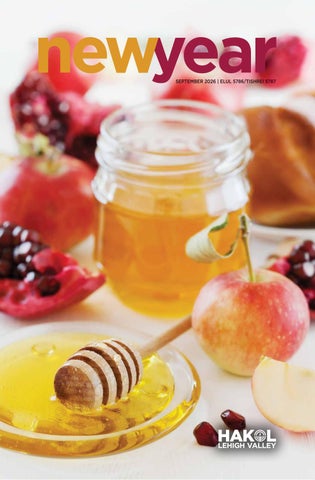
SEPTEMBER 2026 | ELUL 5786/TISHREI 5787
Reaffirming our choice to be Jewish at the High Holidays By Ariel Solomon Jewish Day School Director of Hebrew and Judaics
Choices are among the things we all have to make all the time. From the moment we open our eyes each morning through every day of our lives, we are choosing. Some decisions are made for us, but mostly, we choose almost everything, from what to eat to what to wear, to the bigger questions we sit with and debate over time. Free choice is woven into our Jewish belief itself, with generations of debate about what that freedom looks like in relation to G-d. This past summer, I traveled with the Lehigh Valley Partnership2Gather committee to the Yoav region in Israel. I met committee members from the Israeli side and learned about the projects the Jewish Federation of the Lehigh Valley supports there. We visited the Nova Music Festival site and Kibbutz Yad Mordechai and heard firsthand about the events of October 7, 2023. This trip felt different for me, maybe be-
cause it had been four years, the longest I’d gone without visiting, or maybe because it was my first time back since the Hamas attacks. But somewhere in our conversations with the committee members, something crystallized: the idea of choosing to be Jewish. Growing up in Israel, being Jewish is, in a sense, an easy choice. The option to practice—religiously, culturally, however you define it—is simply there. Jewish life runs through the education system, the military, the political landscape. Wherever you turn, the door is open. Here in the Diaspora, it’s different. To be Jewish in more than name, you have to reach for it. You choose to be part of a community: showing up, giving your time, your resources, your presence. Everyone does this differently, and to a different degree. But the common thread is the same: it’s an intentional choice. The Jewish High Holidays ask us to keep making choices, too. On Rosh Hashanah, we choose G-d as our king. An entire section
Rosh Hashanah and daily Beautiful centerpieces Fresh flowers Gift baskets Seasonal planters Green Plants
2102 W. Hamilton St., Allentown • 610.434.9587 • www.phoebefloral.com
of the prayers is devoted to declaring G-d sovereign and accepting his judgment. Later that day, during Tashlich, we choose to cast away our sins and start the year with a clean slate. In the lead-up to Yom Kippur, we add Selichot to our daily prayers—for Ashkenazi Jews, beginning the Saturday night before Rosh Hashanah, and for Sephardi Jews, from the start of the month of Elul. Taking part means choosing to stay up until midnight, or to wake before sunrise, a small sacrifice that asks something of us. On Yom Kippur itself, we choose to ask forgiveness from G-d and from the people around us. Admitting where we went wrong, facing someone directly and asking to be forgiven— that’s no small thing. It takes real courage to step outside our comfort zone. And on that same day, we ask G-d to choose us back, to claim us as his people. It’s a choice that runs in both directions. Then Sukkot arrives, and we choose to move outside, even when the weather has other plans, building a sukkah and making it our home for the week. And here at JDS, we’re making choices too. We
choose to build a program that’s engaging and meaningful, one that brings our students into the heart of the holidays and the values behind them. It starts with preparing for our annual Rosh Hashanah seder, where we learn about the symbolic foods and the blessings we say over them to usher in a sweet new year. It continues with the sound of the shofar, calling us toward a Cheshbon Nefesh, a real accounting of our actions this past year, and a chance to set intentions for the one ahead. Our older students will join a virtual Selichot tour, hearing the stories and traditions live from the Israeli city of Tzfat. Volunteers from our community will join us to build the sukkah, and our students will decorate it with their own artwork, then eat their meals and even hold some classes inside it, learning the mitzvot of the holiday, including how to shake the four species. Our community members will step into the role of Ushpizin, our special
guests, joining us for our annual community Sukkot dinner on October 1. Students will also learn about Simchat Torah and what it means to complete the Torah’s yearly cycle and begin again. On a more solemn note, we will pause to commemorate October 7, a heartbreaking new addition to our Jewish calendar, and yet another choice we make: to remember, together. Wishing you a happy Jewish holiday season, filled with good choices.
SHANA TOVA
FROM THE BOARD AND STAFF OF THE JEWISH FEDERATION OF THE LEHIGH VALLEY BILL MARKSON PRESIDENT
JERI ZIMMERMAN EXECUTIVE DIRECTOR
SHANAH TOVAH U’METUKAH L’SHANA TOVA
VALLEYINJURY.COM 2 SEPTEMBER 2026 | HAKOL LEHIGH VALLEY | NEW YEAR 5787
How to help kids get the most out of the High Holidays By Lauren Alexander JCC Jewish Education Coordinator
As the High Holidays approach, many of us begin thinking about apples and honey, hearing the shofar, gathering with family, and welcoming a new year. But for children, even big children (aka adults), the deeper meaning of these holidays can sometimes feel a little... vast. When we tell children this is the time to say, “I’m sorry” for my mistakes, they may wonder whether the holidays are all about what they did wrong and what was bad. The High Holidays actually have a much more hopeful story. We just need to tell it. Rosh Hashanah, the Jewish New Year, reminds us that every year is a brandnew beginning. We celebrate with sweet foods, hear the shofar, and take time to appreciate all that the past year has brought us and what we have learned from it. It’s a chance to pause, celebrate, and dream about the year ahead. Then comes Yom Kippur, a day centered on reflection, forgiveness, and growth.
While people often think of Yom Kippur as a solemn holiday, and it is, children can understand it in a simple and comforting way: Everyone makes mistakes, everyone can apologize, and everyone gets the chance to do better tomorrow. The High Holidays invite us to ask an important question: Who can I be this year? One of the best ways to help children with this is by questioning together. You don’t need to have all the answers. Just to be a present voice in the conversation. Here are a few conversation starters to try: • What are you really proud of from this past year? • Did anyone do something kind for you that you’ll always remember? • Is there anything you’d like to do differently this year? • What are you excited to learn or try in the new year? At the heart of the High Holidays is a message of forward momentum. They remind us that our mistakes don’t define us and are not to be dwelled on. We always have the opportunity to learn, grow, and forgive.
NEW YEAR 5787 | HAKOL LEHIGH VALLEY | SEPTEMBER 2026 3
FROM THE LEHIGH VALLEY CLERGY
STUDENT RABBI SAM ALLIE
Congregation Am Haskalah L’shanah tovah. We’re here, and our universe is another year older. My grandpa used to tell me how growing older himself made the High Holy Days feel real. He always felt the spiritual significance of this time, felt the power of God’s hand in his life, always did t’shuvah and gave tzedakah. But in his later years it became personal, pleading with each word, savoring each day. I loved hearing his words of Torah growing up. I saved them for a rainy day far, far in the future. But those words of wisdom didn’t wait for me to unfold them. Instead, just the other day they tumbled off my bookshelf, while I was working, no less. I’d been brainstorming themes for High Holy Days services this year, and my practical, neatly typed lists quickly turned into spiritual ones, to that pesky accounting-of-the-soul business (Papa’s wisdoms already at work). So there I was, not quite working, thinking about my past year, what I’m bringing into the new year, and what I’m leaving behind…and the big one this year: Lefty. Lefty is my left foot and half of my calf. My calf was full of cancer, diagnosed in early 2026. I spent months doing diagnostic tests, the uncertainty growing with each result as it led only to another test. Finally we reached an end point and two terrible options: prioritize saving my foot or prioritize time and quality of life. Friends, family, and colleagues surrounded me with love, and we thanked Lefty and told stories about him and said goodbye. I can’t quite tell you the depths of my grief for what was and what could have been. I also can’t tell you the extent of my joy and gratitude for my life each day since surgery. Each day my energy is increasing and my body is remembering what it feels like to enjoy movement, to revel in the
holy, Eternal Beingness that’s animating my body, animating all things. So, while considering the loss of Lefty as I move into the new year, Papa’s words fell down and bonked me on the head. The High Holy Days have always felt important to me too. I’m always carried away by the haunting melodies and joyous shofar blasts, but maybe now being carried away isn’t the point. This year my prayers to be inscribed in the Book of Life carry such weight I feel it in my chest, right where I strike for Vidui. They’re real in a physical sense, too powerful to stay abstract. Perhaps that’s why we fast, too, to tap into what’s too powerful to stay abstract. I don’t want to make abstract commitments to spiritual development. Life is too short and the impact of my being too real! Perhaps Papa’s point was meant to be taken in now, not later, that this life is an embodied one and that is precious. We all have deeply embodied experiences of being to tap into—the limits of our own physicality, finality beyond our grasp. When we tap into those experiences, which we can’t help but do sometimes, our rituals can hold us. Like a parent holding a crying child, they can’t necessarily fix us, but they can sit with us. The past year left many marks, taking some people, wounding others, and making a few very rich, or even richer. With the help of God, our rituals can hold us all, will hold us still. With the help of God, our bodies that experience limit and pain and loss also animate our rituals and seek out the divine. May our bodies find release in the coming holiday season, and may the coming year be nourished by our commitments for better.
RABBI YAACOV HALPERIN
Chabad of the Lehigh Valley As we enter the High Holi-
4 SEPTEMBER 2026 | HAKOL LEHIGH VALLEY | NEW YEAR 5787
days season, I offer a simple blessing: May this be a year in which we remember how wonderful it is to be Jewish. We are living in a time when hatred of Jews is, once again, painfully visible. We see it in the streets, on campuses, online, and in places where we once felt secure. But I don’t want our Judaism to be defined by antisemitism or by the people who hate us. We should not be Jewish because someone hates us. We should be Jewish because being Jewish is amazing. It is the gift of belonging to something thousands of years old and yet constantly renewed. It is Shabbat candles glowing in our homes, children learning their first Hebrew words, the sound of the shofar, a crowded table filled with family and friends, the laughter of a Jewish gathering, the wisdom of our Torah, and the simple joy of knowing that we are part of something larger than ourselves. Perhaps most importantly, we have each other. Our Jewish community is real people who show up. People who celebrate together, mourn together, support one another, and have one another’s backs. When the world feels frightening or divided, we can choose not to spend all our energy fighting those who oppose us. Instead, we can invest that energy in building something beautiful together. The High Holidays remind us that we always have the power to begin again—to look inward, to reconnect, to choose what we want to carry forward and what we want to leave behind. So this year, may we spend less time looking over our shoulders and more time looking at one another. May we be proudly, joyfully Jewish, not in reaction to hatred, but because we know the beauty of what we have been given. May we fill our homes, our synagogues, and our community with light. May that light be stronger than the darkness around us, not because darkness has disappeared, but because we have chosen what we will bring into the world. And may the sound of the shofar awaken within each of us a renewed sense of purpose, pride, connection, and joy. Shanah Tovah U’Metukah. May the coming year be a year of peace, strength, health, and Jewish joy. And may we continue
to bring more light into the world, together.
RABBI MOSHE KURTZ
Congregation Sons of Israel A friend of mine named Bradley introduced me to the Overton Window. It was a concept I had always sensed, but he, like a good teacher, provided me with the correct term. Most of us think of ourselves as open-minded, moderate, and centrist. We are open to new ideas and willing to engage with opposing views. Many of us can, therefore, appreciate the teaching of our sages recorded in Genesis Rabbah (69:2): Rabbi Hama bar Hanina began: “Iron sharpens iron” (Proverbs 27:17). Rabbi Hama bar Hanina said: (Just as) a knife is sharpened only on the side of its counterpart, so a Torah scholar is sharpened only by his counterpart. “Iron sharpens iron, and a man in the presence of another” (Proverbs 27:17). At the same time, we acknowledge that there are parameters and limits to the acceptable window of dialogue in which reasonable people can disagree. The Bible scholar Nechama Leibovitz once remarked that while the sages acknowledged that there are “70 faces to the Torah,” that still means that there are not 71. The “small” difference between all of us openminded, moderate, and centrist individuals is determining where we draw our lines. In the realm of Halacha, Jewish law, we have codes and commentaries. While there is always disagreement, the range of acceptable positions must be rooted in one of those texts. During the High Holidays, our synagogues will include those who pray daily and those who attend annually. We may find ourselves sitting next to an individual who shares views that are diametrically
opposed to our own. And they may even espouse opinions that exceed where we have chosen to demarcate our window of acceptable discourse. At the same time, by virtue of us sitting in those pews, we all share one thing in common. And that is that we have all come to seek refuge under the wings of God’s presence. To paraphrase a teaching I once read, our synagogues are not places where perfect people come to gather, but where imperfect people come to grow. This is encapsulated in the introduction to Kol Nidre in which we declare, Anu matirin l’hispalel im ha’avaryanim: We are prepared to sit even with sinners in our midst. I ask that we enter synagogue with this mindset and that we prepare to extend grace and understanding to our fellow person in the pews. And in that merit, may God reciprocate his patience and compassion upon us— and may we all merit to be inscribed and sealed in the Book of Good Life. Kesivah v’Chasimah Tovah.
RABBI MOSHE RE’EM Temple Beth El
Unlike most Jewish holidays that occur during a full moon, Rosh Hashanah falls when the moon is hidden and the sky is dark. In our liturgy we make reference to that fact by quoting Psalm 81: “Sound the shofar on our feast day, on the new moon, when it is hidden.” Jewish Kabbalah refers to Or Hozer, a light that we radiate back to G-d through the good that we do in the world. Perhaps there is a hidden message in the fact that the moon is hidden during Rosh Hashanah, the day on which the world was conceived. Perhaps the message is that the world appears to be in dark times and we are needed to bring light Clergy messages continues on page 5
Clergy messages Continued from page 4
back into the world through our good deeds. What does it take to redeem the world of evil? It takes human action. The message of the day is that the future of the world is in our hands. Rosh Hashanah is Yom Harat Olam, the day on which the world was conceived. Rabbi Lawrence Hoffman, the scholar of Jewish liturgy, has pointed out that, as a concept, “conception” surpasses birth. While birth is a completed process, conception is pregnant with possibilities. The fate of the world has not yet been determined. During the year 5787, let’s do our part to bring light back into the world. L’Shanna Tova!
RABBI ADRIENNE RUBIN Congregation Bnai Shalom
The Unetaneh Tokef prayer declares the awesome power and holiness of our High Holy Days. It imagines God as a heavenly judge, opening the Book of Life and decreeing the future of each of us in the coming year: who shall live and who shall die (and by what means), who shall be exalted and who shall be brought low, who shall become rich and who shall be impoverished. After this long list, though, the piyyut (liturgical poem) does not leave us powerless. Instead, it says, “Ut’shuvah,
ut’fillah utzedakah ma’avirin et roa hag’zerah.” T’shuvah (repentance or returning), t’fillah (prayer), and tzedakah (righteousness) can transform the harshness of our destiny. At the High Holy Days, we are shown a path forward. We often focus on t’shuvah and t’fillah, but those are just the beginning. Tzedakah, our commitment to others, must follow. We often think of tzedakah as charity, giving money to people in need or to causes we care about, but it’s much, much more. Tzedakah comes from the same root as tzedek, justice, and tzadikim, righteous people. Our Talmud tells us that tzedakah is equivalent to all the other mitzvot combined and that even a poor person who is sustained by receiving tzedakah from others must still perform tzedakah. (See Bava Batra 9 and Gittin 7b.) Tzedakah is not optional for us. It’s foundational. It’s not about having enough money to spare for others. Everyone participates, no matter how much or how little they have. Why is the mitzvah of tzedakah elevated to such an important role? One answer is in the language itself. Rather than “giving charity,” we “do” or “perform” tzedakah: “la’asot tzedakah.” Charity is a chance to choose generosity. Tzedakah is an obligation to act. Our Torah calls us to care for the poor and needy among us, the stranger, the widow, the orphan, not by choice but out of a righteous and just obligation. Maimonides tells us, “We are obligated to be careful with regard to the mitzvah of tzedakah to a greater extent than all (other) positive commandments, because tzedakah is an identifying mark for a righteous person, a descendant of Abraham, our
patriarch…. And Israel will only be redeemed through tzedakah” (Mishneh Torah, Gifts to the Poor, 10:1). The value of tzedakah to the person receiving it is easy to see. But tzedakah also transforms the person performing it. Research has connected charitable giving and volunteering with lower blood pressure, higher self-esteem, and greater happiness. Perhaps our Torah and our sages knew that the mitzvah of tzedakah does more than help someone else; it changes our lives for the better. And when we combine that with t’shuvah and t’fillah, something shifts. We look inward, then upward, then outward. We connect with ourselves, we search for meaning, and we commit ourselves to making our world a better place. Only then are we ready to leave behind the mistakes of the past year and move toward being the people we are called to be. L’shanah tovah tikateivu v’teichateimu. May we all be inscribed and sealed in the Book of Life for a good year.
RABBI MICHAEL SINGER
Congregation Brith Sholom This year the first day of Rosh Hashanah falls on Shabbat. When it does, I always find it a little disorienting, yet deeply meaningful. There is the tradition that we do not blow shofar on Shabbat, recite Avinu Malkeinu, or cast away our bread during Tashlikh. But Rosh Hashanah is the birthday
of the world (Hayom harat olam) and a celebration of God’s creation and majesty (Malchut), which echo many of the themes of Shabbat. The parallels continue, as both have a focus on actively remembering (“Remember the Shabbat day…”) and Zichronot (“God who remembers the covenant”) as well as redemption— Shabbat as a taste of the World to Come, and Rosh Hashanah (Shofarot) and its hope of the Messianic era. In many ways, when Rosh Hashanah falls on Shabbat, it is in its purest form, as we refrain from our own creative instincts to allow more space to appreciate God’s creation and dispel the myth of our human superiority and ownership of the earth. Shabbat, like Rosh Hashanah, is filled with joy, song, good food, family, friends, and community—a celebration of life. The story is told of Rabbi Simcha Bunem, who famously carried a piece of paper in each of his pockets. On one slip was written a quote from the Talmud (Sanhedrin 5)—“for my sake was the world created”—and on the other was written what Abraham declared—“I am but dust and ashes” (Genesis 18:27). There are times when we need to remind ourselves of our priceless worth as human beings, and there are times when we need to remember that we are made from dust and will return to the earth. Indeed, Shabbat and Rosh Hashanah often echo both of these important lessons. By its nature, Shabbat is a great equalizer and expression of radical freedom. Rich or poor, everyone merits a Shabbat to rest, re-soul, and celebrate life. It is the bane of tyrants and taskmasters, the celebration of God’s sovereignty, God’s creation and image, and therefore equality and human dignity: “for my sake was the world created.” It is a “palace
in time” that anyone who chooses to observe it may enter and delight. “This land was made for you and me….” There is, however, another side to this coin (or pocket), namely that we are not the Master of the Infinite in time and space. There is God as the Eternal One, while there is us as mere mortals, time-bound and fragile creatures. Too often we need this reminder because we take for granted the blessings God bestows, claim ownership over the earth, pursue our labors without thought of our higher calling, and forget just how precious each human life truly is. Shabbat and Rosh Hashanah therefore act together to shake us out of our pride and conceit and remind us of the power that is greater than ourselves. We are called to judgment, change, and repentance— teshuvah—and doing so are re-created and remade with new potential and possibilities. So, yes, it will feel strange not to hear the shofar, chant Avinu Malkeinu, or throw our bread at Tashlikh on the first day of Rosh Hashanah. But maybe, just maybe, it will feel more sacred and special because it is also our precious Shabbat—a taste of paradise filled with God’s holiness, love, and peace, where we can more deeply reflect on God’s sovereignty, memory, and hope for redemption. As we say in the special blessing of the day in the Amidah, “Praised are you, Sovereign of the Infinite, ruler of all the earth, who makes Shabbat, the people Israel, and the Day of Remembrance holy.” Amen! L’Shanah Tova Tikateivu v’Tikateimu! May you be inscribed and sealed for a happy, healthy, and sweet new year! Clergy messages continues on page 6
T H E L E H I G H VA L L E Y J E W I S H C L E R G Y G R O U P P R E S E N T S
COMMUNITY-WIDE SELICHOT SERVICES SATURDAY, SEPTEMBER 5, 2026 8:30 P.M. | TEMPLE BETH EL 1305 Springhouse Road, Allentown, PA 18104
• Havdalah followed by a dessert reception • Ira Kohler will present his story, the ethics of serving in war, and the connection to the High Holidays • Selichot services
Registration Required To Register, scan the QR code, or visit the link below, or call 610.435.3521.
bethelallentown.org/event/selichot-community-wide-event.html
Made possible through the generous support the Jewish Federation of the Lehigh Valley and the Lehigh Valley Jewish Clergy Group.
NEW YEAR 5787 | HAKOL LEHIGH VALLEY | SEPTEMBER 2026 5
Clergy messages Continued from page 5
CANTOR ELLEN SUSSMAN Shirat Shalom
As a Jewish community, we have experienced a very difficult year with all the antisemitism around us. It is a ferocious and disconcerting reappearance of the deadly virus. This certainly is a new experience for many of us, for here in America we have lived in a golden age where Jewish people did not directly experience the antisemitism of their parents and grandparents. We could live anywhere, go to any college and get ahead in life. We were afforded the capability to practice Judaism with joy and be free of the worry of what others might say or do. Unfortunately, times have changed and we must figure out how to handle this very disturbing turn of events. I recently watched a documentary on national public television about Hannah Arendt. All I knew about her was that she penned the phrase “the banality of evil,” meaning that ordinary people can be manipulated to participate in barbaric cruelty. It came out that she
was a Zionist and a proud Jew born 1906 in Germany to secular Jewish parents. She experienced the horrors of WWI and, for the first time in her life, terrible antisemitism from her classmates. These experiences began to shape her views of the world. At 18 years old she enrolled in the University of Marburg to study philosophy. The greatest philosopher of the time, Martin Heidegger, taught there and had a tremendous influence on her life and intellectual development. For her dissertation she studied the works of St. Augustine and his views on love. The theme of Hannah’s dissertation was that no one exists alone and we have an ethical responsibility to engage in neighborly love. We are all together in this world and we must care for one another. She also quoted from St. Augustine that when “Man was born, a beginning was made”—as long as babies are born, we have the opportunity to change the world. While she was at university, the world began to change. She was an eyewitness to the rise of Hitler and the oppression of the Jews, including being sent to a concentration camp and eventually escaping. Those dark days made her realize that her universalist view of the rights of man as a way to improve the world were not enough to protect the Jews. Though she was a secular Jew, the idea of Jewish peoplehood became central
to her. “If one is attacked as a Jew,” she wrote, “one must defend as a Jew, not as a German, not as a world citizen, not as an upholder of the rights of man….” She believed you cannot escape your Jewishness; so be Jewish. We can learn from her words and deeds as we begin our new year. In the face of antisemitism, we must be fiercely Jewish, support our local Jewish institutions, and participate fully in our tradition. We must be proud of who we are as Jews and encourage the same in our children and grandchildren. I pray for all of us to have a sweet and peaceful new year. From my entire family, Shana Tovah U’metukah.
RABBI SHOSHANAH TORNBERG Congregation Keneseth Israel
HaYom harat olam—This is the day of the world’s birth. Our machzor reminds us that this season of repentance is also a season of newness. With the new moon of Tishrei, we aim also to renew ourselves, much as we ask God to renew our days as of old. Just as the pregnant world, in its round imminence, becomes in this new year as fresh as a new child,
L’Shana Tova! HAPPY
Rosh Hashanah
so, too, do these days cause us to look backward at what is old. One name for the new year is Yom Ha-Zikaron (Day of Remembrance). One of the themes of the shofar service on Rosh Hashanah is Zichronot, remembrances. We hope that God remembers with mercy our deeds of kindness and justice. The Hebrew word for mercy, rachamim, comes from the word for womb, rechem. We pray that God may be pregnant with the mercy of a parent. A parent can see the best in you, even when you are showing your worst. Mercy is how God shows faith in us. We look fondly at our own remembrances of God’s acts of mercy in our lives, those times when God had faith in us. When did you get a second chance? When did you find a curious strength you did not know you could muster? When did you step out of yourself and notice a blessing that has been working in your life all along? We look at our people’s history. When have we been shown favor? When and where have we been led with wisdom? When were we brave? Thoughtful? Humble? When did we have the wherewithal to take a visionary risk? How did Torah show up in our lives and community? We think, too, about the history of humanity. Where have we risen to be the best of our kind? When have we shown the discernment to recognize both the wisdom of the new and the vibrancy of the old? When did we fill the world with a candle’s light in the face of darkness? When were self-centeredness and myopia eclipsed by a deep connection and cooperation in the human family? And, of course, we remember our own older days, so often peopled by those who no longer live. The Yizkor service of remembrance on Yom Kippur offers us the comforts and mercies of community in the face of such dear losses. All along, we have relied on rachamim. God’s mercy is a key salve for us on this day when all the world will
be judged. How is it possible that with all our faults, missteps, and failings that God would judge us with favor? Not just me. Not just you. But all of us. If God sat solely on the Throne of Judgement (Din), we could meet this season only with fear. Our world bears the wounds of humanity’s failings. But God sits, too, on a Throne of Mercy (Rachamim), bringing loving care to the harsh response our deeds sometimes deserve. The blast of the shofar is an old sound, hearkening to ancient Jewish life. And we hear it each year as a new call to wakefulness. Its blast touches deep within history and within the heart, and it’s also a clarion call to a new way forward. We stand on these days, Janus-like, looking both backward and forward. We regret and repent. We repair and recommit. We have sorrow for past losses, and hope we can become better people. It’s through mercy that we will find a way through. The God of Rachamim reminds us that we, too, made in the image of the Holy One, must be merciful with one another. In the polarized political climate that we inhabit, it can be hard to remember the skills of mercy, kindness, and benefit of the doubt. It can be hard to remember how to deeply listen, to see another’s humanity, and to accept the blessings that diversity brings. God shows faith in us. But, still, merciful as we try to be, it can be hard to have faith in one another. It can be hard to look back and remember the suffering and loss of the past. It can be hard to see forward with hope for a better world. And yet a century ago, Rav Abraham Isaac Kook taught: Ha-yashan yithadesh, ve-hehadash yitkadesh—May the old be renewed and the new be sanctified. May the gift of mercy— apple-honeyed in its sweetness—be a source of faith and hope in ourselves, in each other, in our human family, and in our loving connection to the Holy. L’Shanah Tovah U’Metukah.
of the Lehigh Valley
The Future of the Jewish Community in America of the Lehigh Valley with Bret Stephens
THURSDAY, SEPTEMBER 17, 2026 | 7:15 PM MILLER FORUM, MOYER of the Lehigh Valley HALL AT MUHLENBERG COLLEGE
Cost: $36 per person
BANK. BORROW. INVEST.
610.797.7440
6 SEPTEMBER 2026 | HAKOL LEHIGH VALLEY | NEW YEAR 5787
peoplefirst.com
Prior registration required. of theScan Lehigh Valley the QR code, or visit
jewishlehighvalley.regfox.com/ community-presentation-2027
JFS High Holidays tradition
Jewish Family Service is once again taking High Holidays programs to older adults across the Lehigh Valley. JFS board member and volunteer Howard Nathanson will make presentations at Moravian Hall Square, Traditions
of Hanover, Phoebe Allentown, Country Meadows Bethlehem and Allentown, and Tikvah House. These engaging and educational programs welcome Jewish residents and others who are interested in learning
more about Jewish traditions and the meaning of the High Holidays. If you or someone you know is interested in volunteering, contact Jennifer Oxfeld at volunteer@jfslv.org.
DO YOU NEED HELP WITH YOUR LEAVES? Volunteers will be raking leaves for older adults on November 15, 2026 If you are 65 or older, you can sign up for this service by emailing mailbox@jflv.org or call JFLV at 610-821-5500 of the Lehigh Valley
SHANA TOVA of the Lehigh Valley
of the Lehigh Valley
of the Lehigh Valley
1517 POND ROAD | ALLENTOWN, PA 610-395-4444 | www.childrens-healthcare.com
NEW YEAR 5787 | HAKOL LEHIGH VALLEY | SEPTEMBER 2026 7
High Holy Days Schedule of Services at area synagogues For questions about any of the following listings, to confirm that schedules have not changed, and to register to attend any services or events, contact the hosting synagogue using the information provided below.
_______________________
ALLENTOWN CHABAD OF THE LEHIGH VALLEY
Rabbi Yaacov Halperin, Chabad Lubavitch, 4457 Crackersport Road, 610-351-6511, ChabadLehighValley. com All are welcome regardless of affiliation, knowledge, or previous background. Traditional services are blended with contemporary messages in a friendly environment with Hebrew-English prayer books provided. There is no cost to attend and no membership fee. Kiddush buffet afterward; the suggested donation is $54 per seat. RSVP at office@ ChabadLehighValley.com. ROSH HASHANAH Friday, September 11 7 p.m. Evening service Saturday, September 12 9:30 a.m. Morning service 10:45 a.m. Children’s service followed by Kiddush 8 p.m. Evening service Sunday, September 13 9:30 a.m. Morning service 10:45 a.m. Children’s service 11:30 a.m. Shofar sounding followed by Kiddush 5 p.m. Tashlich and shofar sounding
service
7:20 p.m. Holiday ends
SHABBAT SHUVA Saturday, September 19 10 a.m. Morning service followed by Kiddush
CONGREGATION AM HASKALAH
YOM KIPPUR Sunday, September 20 6:44 p.m. Fast begins and light candles 7 p.m. Kol Nidrei service Monday, September 21 9:30 a.m. Morning service 11 a.m. Children’s service 11:45 a.m. Yizkor memorial service 5:15 p.m. Mincha service 6 p.m. Neilah closing service 7:41 p.m. Fast ends, followed by break fast SUKKOT Friday, September 25 6:30 p.m. Community dinner in the sukkah 6:36 p.m. Light candles Saturday, September 26 10 a.m. Morning service followed by Kiddush Sunday, September 27 10 a.m. Morning service SHEMINI ATZERET & SIMCHAT TORAH Friday, October 2 6:24 p.m. Candle lighting Saturday, October 3 10 a.m. Morning service 11:45 a.m. Yizkor memorial service 7:20 p.m. Evening service followed by Hakafot under the Stars Sunday, October 4 10 a.m. Morning service followed by Kiddush and hakafot
Student Rabbi Sam Allie and Rabbi Steve Nathan, Reconstructionist, AmHaskalahDirector@gmail.com Services are in-person at the JCC (except Tashlich) and live on Zoom. Free to attend and open to all. RSVP required at AmHaskalahDirector@ gmail.com; include any requests for accommodations or to get the Zoom link. ROSH HASHANAH Friday, September 11 6 p.m. Evening service with apples and honey Saturday, September 12 10 a.m. First-day service Sunday, September 13 10 a.m. Second-day service 1:30 p.m. Tashlich service and diary/ vegetarian potluck lunch at Cedar Creek Park Rose Garden pavilions on Honochick Drive YOM KIPPUR Sunday, September 20 7 p.m. Kol Nidrei service Monday, September 21 10 a.m. Morning service and Yizkor 1:30 p.m. Creative Avodah 6 p.m. Closing service 7:45 p.m. Break fast (free)
CONGREGATION KENESETH ISRAEL
Rabbi Shoshanah Tornberg, Reform, 2227 West Chew Street, 610-435-9074, kilv.org Families with children up to and
including fifth graders and their siblings are invited to celebrate Rosh Hashanah and Yom Kippur at the family services listed below. Registration required at kilv. org for all services. All are welcome. ROSH HASHANAH Friday, September 11 7:30 p.m. Evening service Saturday, September 12 9-10 a.m. Family service 10:30 a.m. Service 1:30 p.m. Tashlich and picnic Sunday, September 13 10:30 a.m. Rosh Hashanah hike YOM KIPPUR Sunday, September 20 10:30 a.m. Cemetery service 7:30 p.m. Kol Nidre service Monday, September 21 9-10 a.m. Family service 10:30 a.m. Service 12:30 p.m. Meditation service 2:30 p.m. Study session for all 4:05 p.m. Yizkor 5 p.m. Neilah/Havdalah
CONGREGATION SONS OF ISRAEL Rabbi Moshe Kurtz, Orthodox, 2715 Tilghman Street, 610-433-6089, sonsofisrael.net SELICHOS Saturday, September 5 1:01 a.m. Service ROSH HASHANAH Friday, September 11 6 a.m. Selichos/Shacharis 6:59 p.m. Candle lighting
7:05 p.m. Mincha 7:25 p.m. Maariv Saturday, September 12 8:30 a.m. Shacharis 6:50 p.m. Mincha 7:30 p.m. Maariv After 7:57 p.m. Candle lighting Sunday, September 13 8:30 a.m. Shacharis About 10:30 a.m. Shofar blowing 5 p.m. Tashlich at Rabbi Kurtz’s house 6:50 p.m. Mincha 7:55 p.m. Rosh Hashanah ends FAST OF GEDALIAH Monday, September 14 5:29 a.m. Fast begins 6:15 a.m. Selichos/Shacharis 7 p.m. Mincha/Maariv 7:43 p.m. Fast ends YOM KIPPUR Sunday, September 20 8 a.m. Selichos/Shacharis 2:30 p.m. Mincha 6:44 p.m. Candle lighting at home 6:50 p.m. Kol Nidrei service 7:02 p.m. Latest time to begin the fast (sunset) Monday, September 21 9 a.m. Shacharis 10:15 a.m. Sermon and Yizkor 5:30 p.m. Mincha 6:25 p.m. Neilah 7:35 p.m. Maariv 7:42 p.m. Fast ends SUKKOS Friday, September 25 6:35 p.m. Candle lighting 6:40 p.m. Mincha Saturday, September 26 9 a.m. Shacharis
Congregation Am Haskalah Reconstructing Judaism in the Lehigh Valley
Our Diversity is Our Strength.
We aspire to be as diverse as the Jewish people itself. ALL are welcome regardless of background, identity or ability. In person or online!
We ALL Enjoy Learning.
Our hybrid progressive religious education offers small class sizes and innovative teachers.
Affordable Dues.
We take pride in our values-based, fair-share dues structure, where we each contribute according to our means, without questions being asked.
You Can Come Home Again.
We are a small, warm, non-judgmental and supportive community. Experience Judaism in a way that makes sense and adds meaning to your life. RSVP to join us at any service or event!
Our 49th Year!
FREE High Holiday Services at the Allentown JCC & Online
9/11 7pm Erev Rosh Hashanah 9/12 10am Rosh Hashanah, Day 1 9/13 10am Rosh Hashanah, Day 2 & 1:30pm Streamside Tashlich & Potluck Lunch, @ Cedar Beach’s Rose Garden Pavilions on Honochick Drive 9/20 7pm Kol Nidrei 9/21 10am Yom Kippur Morning & 6pm Closing Service, with a FREE Community Break Fast
RSVP is REQUIRED
AmHaskalah.org • AmHaskalahDirector@gmail.com • (610) 435-3775
8 SEPTEMBER 2026 | HAKOL LEHIGH VALLEY | NEW YEAR 5787
High Holy Days Schedule of Services at area synagogues 6:30 p.m. Mincha 7:15 p.m. Maariv After 7:33 p.m. Candle lighting Sunday, September 27 9 a.m. Shacharis 6:35 p.m. Mincha 7:31 p.m. Yom Tov ends CHOL HAMOED SUKKOS Monday, September 28, to Thursday, October 1 6:30 a.m. Shacharis 6:35 p.m. Mincha/Maariv SH’MINI ATZERES & SIMCHAS TORAH Saturday, October 3 9 a.m. Shacharis About 10:15 a.m. Yizkor 6:25 p.m. Mincha 7:05 p.m. Maariv/hakafos After 7:22 p.m. Candle lighting Sunday, October 4 9 a.m. Shacharis After Mussaf. Mincha 7:20 p.m. Yom Tov ends 7:30 p.m. Maariv
TEMPLE BETH EL
Rabbi Moshe Re’em, Conservative, 1305 Springhouse Road, 610-435-3521, bethelallentown.org Services marked with an asterisk (*) are available for streaming as well as in person. Call the synagogue to register for services and to get streaming access. SELICHOT Saturday, September 5 8:30 p.m. Refreshments 9 p.m. Community-wide event 10 p.m. Service ROSH HASHANAH Friday, September 11 6:59 p.m. Light candles 7:15 p.m. Dedication of memorial plaques 8 p.m. Service Saturday, September 12 8:30 a.m. Full traditional Shacharit service* 9:45 a.m. Torah service and Musaf* 9:45 a.m.-noon. T’fillat Y’iladim (grades K-5) 9:45 a.m.-noon. Tween Talk (grades 6-8) 10:30 a.m.-noon. Shorashim (ages 0-4) 11 a.m.-noon. Teen Talk (grades 9-12)
7:57 p.m. Light candles 8 p.m. Ma’ariv service Sunday, September 13 8:30 a.m. Full traditional Shacharit service* 9:45 a.m. Torah service and Musaf* 10:30 a.m. Contemporary service Following those services. Tashlich Service at the Stream (Princeton Court site—enter the cul-de-sac and follow the paved pathway to the bridge) 4 p.m. Jewish Family Education Tashlich and shofar blowing (Covered Bridge Park) YOM KIPPUR Sunday, September 20 6:15 p.m. Kol Nidre service 6:44 p.m. Light candles Monday, September 21 8:30 a.m. Full traditional Shacharit* 9:45 a.m. Torah service, Yizkor, and Musaf* 9:45 a.m.-noon. T’fillat Y’iladim (grades K-5) 9:45 a.m.-noon. Tween Talk (grades 6-8) 10:30 a.m.-noon. Shorashim (ages 0-4) 11 a.m.-noon. Teen Talk (grades 9-12) 3:30 p.m. Yom Kippur study with Marcia Linebarger 3:30 p.m. Yom Kippur walking meditation with Rabbi Re’em 4:30 p.m. Mincha* 6:15 p.m. Ne’ilah* 6:15 p.m. Jewish Family Education program with Shari Spark 7:30 p.m. Ma’ariv and Havdalah* 7:45 p.m. Shofar blowing SUKKOT Friday, September 25 6 p.m. Services 6:36 p.m. Light candles Saturday, September 26 9:30 a.m. Services 10 a.m. School Shabbat 10:15 p.m. GPS with Dustin Nash 7:34 p.m. Light candles Sunday, September 27 9:30 a.m. Service HASHANA RABBAH Friday, October 2 7:30 a.m. Service SHEMINI ATZERET & SIMCHAT TORAH
Friday, October 2 6 p.m. Shemini Atzeret service 6:24 p.m. Light candles Saturday, October 3 9:30 a.m. Services 7:22 p.m. Light candles 7:30 p.m. Simchat Torah service Sunday, October 4 9 a.m. Simchat Torah service and family program honoring Stuart Horowitz as Chatan Torah and Jessica Volchko as Kallat B’reishit
7:34 p.m. Candle lighting Sunday, September 27 9 a.m. Morning service 7:32 p.m. Havdalah HOSHANAH RABBAH Friday, October 2 7:30 a.m. Morning service at Temple Beth El 6:23 p.m. Candle lighting
-------------------------------------------------------
BETHLEHEM CONGREGATION BRITH SHOLOM
Rabbi Michael Singer, Conservative, 1190 West Macada Road, 610-866-8009, info@brithsholom.net ROSH HASHANAH Friday, September 11 6:59 p.m. Candle lighting 7 p.m. Ma’ariv Saturday, September 12 9 a.m. Morning service 10 a.m. Children’s service 7:30 p.m. Afternoon/evening services 7:57 p.m. Candle lighting Sunday, September 13 9 a.m. Morning service 10 a.m. Children’s service 5:30 p.m. Tashlikh (Monocacy Creek, 395 Bridle Path Road) 7:56 p.m. Havdalah
SHEMINI ATZERET & SIMCHAT TORAH Saturday, October 3 9 a.m. Morning service 11 a.m. Yizkor 7 p.m. Simchat Torah celebration 7:22 p.m. Candle lighting Sunday, October 4 9 a.m. Morning service 7:21 p.m. Havdalah -------------------------------------------------------
EASTON CONGREGATION BNAI SHALOM
Rabbi Adrienne Rubin, Reform 1545 Bushkill Street, 610-258-5343, bnaishalomeaston.org Call the synagogue office regarding tickets and to preregister for the community family service, Yom Kippur Break-the-Fast, and the pre-Shabbat Dinner in the Sukkah. ROSH HASHANAH Friday, September 11
YOM KIPPUR Sunday, September 20 6 p.m. Mincha 6:43 p.m. Candle lighting 6:15 p.m. Kol Nidre service Monday, September 21 10 a.m. Morning service and Yizkor 5:30 p.m. Afternoon service 6:30 p.m. Ne’eilah service 7:42 p.m. Yom Kippur ends
7:30 p.m. Evening service Saturday, September 12 10 a.m. Morning service followed by Rosh Hashanah dairy/vegetarian luncheon 2:15-3:15 p.m. Community family service (must preregister) Sunday, September 13 10 a.m. Morning service 2:15-3:15 p.m. Tashlich (meet at the synagogue at 2:15 p.m.) YOM KIPPUR Sunday, September 20 7:30 p.m. Kol Nidre service Monday, September 21 10 a.m. Morning service 1 p.m. Yizkor service 2:15-3:15 p.m. Community family service (must preregister) 4:30 p.m. Afternoon and Ne’ilah service 7:40 p.m. Holiday ends, followed by Break-the-Fast (must purchase tickets in advance) SUKKOT Friday, September 25 6 p.m. Pizza in the Sukkah (must preregister) 7:30 p.m. Services SH’MINI ATZERET & SIMCHAT TORAH Friday, October 2 6:30 p.m. Sh’mini Atzeret service and Simchat Torah celebration Saturday, October 3 10 a.m. Morning service including Yizkor
of the Lehigh Valley
of the Lehigh Valley
SUKKOT Friday, September 25 5:30 p.m. Tot Shabbat 6 p.m. Pizza in the Hut and Ma’ariv 6:35 p.m. Candle lighting Saturday, September 26 9 a.m. Morning service
of the Lehigh Valley
CONGREGATION A B A SHALOM BNAI A CONGREG TION
of the Lehigh Valley
N I SH LOM
w w w.bn
ha
ais
COMMUNITY HIGH HOLY DAY FAMILY SERVICES
lo m
e a st o n.org
ROSH HASHANAH DAY 1
SATURDAY, SEPTEMBER 12, 2:15 PM
TASHLICH (ROSH HASHANAH DAY 2) SUNDAY, SEPTEMBER 13, 2:15 PM
YOM KIPPUR
MONDAY, SEPTEMBER 21, 2:15 PM
THERE IS NO COST TO ATTEND, BUT REGISTRATION IS REQUIRED. TO REGISTER, VISIT HTTPS://MY.LINKPOD.SITE/BNAI-SHALOM-HHD-FAMILY-SERVICES OR CALL 610-258-5343. NEW YEAR 5787 | HAKOL LEHIGH VALLEY | SEPTEMBER 2026 9
Apples to Apples 1
2
3
4
5
6
8
9
10
15
14 17
18
20
21
27
24 29
25 30
32
36
37
38
40
41
42
47
13
22
31
46
12
19
28
43
11
16
23 26
7
44
33
34
35
53
54
55
39
45 49
48
51
50 52
56
57
58
61
62
63
64
65
66
Across 1. Apt apple for Benny Goodman or Artie Shaw? 5. Word by David or Asaph 10. Apple to eat under the Arch of Titus? 14. End in ___ (stale-
59
60
mate) 15. Major heart part 16. On any occasion 17. Fitting apple for William Shatner or Leonard Nimoy? 19. Put up two fingers, perhaps 20. L.A.P.D. part
21. Grain bit 22. Gershon and Hecht 23. Like Jonathan to David 25. Appropriate apple for Joseph in Egypt or Daniel in Babylon? 26. Movie house 29. “How Can ___?” (Freddie Mercury) 31. Arabian Peninsula native 32. Israeli diplomat Abba 33. Highest grossing film franchise in history, for short 36. Apple that might describe Chanukah gelt? 40. B & O stop: Abbr. 41. Puts on 42. Dish out gazpacho, e.g. 43. David who wrote “The Verdict” 45. Jason of “The Muppets” (2011), and others 46. Assyrian or Babylonian apple? 49. Aseret Hadibrot parsha 51. Tavern salute 52. Tai preceder 53. Article on Mont Blanc 56. Rocker David Lee 57. Ideal apple for Rosh
Hashana? 61. “The Tourist” novelist Steinhauer 62. Cease to be separate 63. 613 or 770, e.g. 64. Apple served at a synagogue dinner? 65. Shalit of note 66. Apple of the 10th Commandment? Down 1. Slayer of Sisera, in older Bibles 2. “... ___ extra charge!” 3. Clearasil targets 4. It’s zed Down Under 5. Mango alternative 6. Ish 7. Nusach ___ 8. Army 1sts and 2nds 9. Fannie follower, in banks 10. Step down, in a way 11. Like most shofars 12. Fox of “Transformers” 13. Surrealist Max 18. Dormmate, affectionately 22. Kind of politics 23. Advance credit to 24. Apple eaten when the Israelites left Egypt? 25. Rice-a26. Machine parts 27. Sarah, Rivkah, Ra-
chel and Leah 28. Simba’s mate 30. Ladies 32. Music’s Brickell 33. Function 34. Carefully select 35. Manipulates 37. Bris assignment 38. Religious figure 39. Bird voiced by Gilbert Gottfried 43. Crucial work of Judaism 44. The Jewish Museum features it 45. Remained 46. Purchase made around the chagim 47. Dough 48. Dev who starred in 53-Down 50. “... ___ man with seven wives” 53. Creditor’s security 54. Grandson of Avraham 55. Agile 57. What you might do when seeing a bro 58. Lechem ___ 59. 0 60. Bakery selection
JEWISH FEDERATION OF THE LEHIGH VALLEY WOMEN’S PHILANTHROPY PRESENTS
“FROM WELLNESS TO WITNESS” Dessert Reception and Presentation Thursday, October 29, 2026 | 7:15 p.m. Chabad Lubavitch of the Lehigh Valley
Dr. Janet Bond Brill, the daughter-in-law of Edna Brill z”l, and an internationally recognized health author, shares Edna’s story of courage and sacrifice in her new book, “Little Edna’s War: A True Story of Resistance and Hope.” In her talk to our community, Bond Brill brings this harrowing, inspiring Holocaust story to life, with scene after gripping scene from Edna’s struggle to save others’ lives while managing to survive the unthinkable herself.
of the Lehigh Valley
Cost: $36 per person Book Cost (optional): $22 Kindly register by October 15.
Scan the QR code, visit the link below, or call 610.821.5500. Open to community members making a pledge to the 2027 Annual Campaign for Jewish Needs.
Women’s Philanthropy
jewishlehighvalley.regfox.com/little-ednas-war-community-presentation 10 SEPTEMBER 2026 | HAKOL LEHIGH VALLEY | NEW YEAR 5787
of the Lehigh Valley
Women’s Philanthropy
Honey Ginger Garlic Salmon By Sandi Teplitz Special to Hakol
COOK, LEARN, MEET: COOK,MALKA LEARN, MEET: THE THE MALKA FAMILY’S FAMILY’S TRADITIONAL TRADITIONAL HONEY CAKE
This delicious entrée is perfect for your Rosh Hashanah meal. It can be served with meat or dairy and is superb with matchstick carrots, white asparagus, and mashed potatoes. It pairs well with a crisp Chardonnay. Conclude the feast with a simple brownie and plant-based or dairy vanilla ice cream.
HONEY CAKE
1 large salmon fillet Olive oil Sea salt Black pepper 6 garlic cloves, grated 4-inch piece of ginger, grated Honey
SUNDAY, SEPTEMBER 27
Prep the salmon the day before by laying a 12-18inch Coho or Atlantic salmon filet on a foil-lined baking pan that’s been brushed with olive oil. Sprinkle on some sea salt and black pepper. In a large glass bowl, combine the garlic, ginger, and a generous pour of honey. Mix well with a spoon, cover the salmon with the mixture, wrap the pan tightly with plastic wrap, and refrigerate overnight. The next day, set an oven to 400 degrees, add a bit of olive oil on top of the salmon, and roast for about 20 minutes, basting occasionally. Remove from oven and serve immediately.
12:00 p.m. Lehigh Valley Time and SUNDAY, SEPTEMBER 27 AT 12:00 PM (LEHIGH VALLEY TIME) / 7:00 PM (ISRAEL TIME) 7:00 p.m. Israeli Time Join Partnership2Gether members from Yoav and Join Partnership2Gether members from Yoav and the LehighValley Valleyover over Zoom Zoom to the Lehigh towatch watchMazal Mazal and and ItzikMalka Malkamake make an an extra extra sweet Itzik sweetand andwarm warm honey honey in honor of the High Holidays.The recipe will be cakecake in honor of the High Holidays. ZOOM LINK The recipe will be provided to you. provided to you. Registration required. To register, scan the QR code or visit the link below.
jewishlehighvalley.regfox.com/ p2g-rosh-hashanah-cooking
Join us at Brith Sholom as we celebrate Sukkot
Followed by A great time with family and friends! *Pizza *Beer *Friends
Come fulfill the mitzvah of Shabbat with eating in the Sukkah FREE PIZZA! A menu of various pizzas and toppings to delight your palate and more.
To register, scan the QR code or visit https://www.brithsholom.net/form/ totshabbatformoct.2026jan.2027.html or call 6108668009
NEW YEAR 5787 | HAKOL LEHIGH VALLEY | SEPTEMBER 2026 11
L’Shana Tova!
HAPPY ROSH HASHANAH Weis Markets extends to you and your family a happy, healthy, and prosperous New Year!
4
4
49
U
49 lb
6
Bakery Fresh!
Plain or Raisin Round Challah Bread
2
Lipton Vegetable or Onion Soup & Dip Mix Selected 1.9 - 4.87 oz
3
lb
Fresh Kosher Chicken Leg Quarters
49
4
99
Gefen Honey 12 oz
2 for $
U
99
lb
Fresh Kosher Cut-up Chicken
Fresh Kosher Whole Chicken
69
U
4
Manischewitz Matzo Ball & Soup Mix 4.5 oz
2 for $
4
Manischewitz Egg Noodles 12 oz
weismarkets.com Prices through Sept 16, 2026. We reserve the right to limit quantities. Not responsible for typographical or pictorial errors.
5
99
Kedem Condord Grape Juice 64 oz
79
¢
Kedem Tea Biscuits
4.2 oz