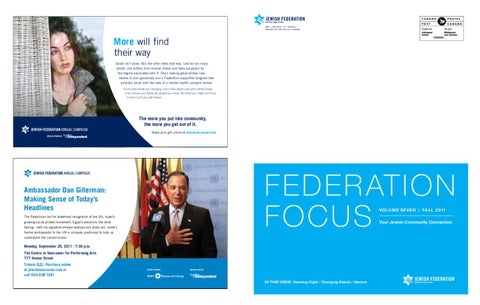
More will find their way Sarah isn’t alone. But she often feels that way. Like far too many adults, she suffers from mental illness and feels paralyzed by the stigma associated with it. She’s making great strides now, thanks to your generosity and a Federation-supported program that provides Sarah with the care of a mental health outreach worker. Community needs are changing. One in five adults lives with mental illness and chances are, these are people you know. But what you might not know is how much your gift means.
The more you put into community, the more you get out of it. Make your gift online at jewishvancouver.com
Ambassador Dan Gillerman: Making Sense of Today’s Headlines
Vo lu m e S e v e n | Fa ll 2 011
The Palestinian bid for statehood recognition at the UN, Israel’s
Your Jewish Community Connection
growing social protest movement, Egypt’s elections, the Arab Spring—with his signature shrewd analysis and sharp wit, Israel’s former ambassador to the UN is uniquely positioned to help us understand the current scene.
Monday, September 26, 2011 | 7:30 p.m. The Centre in Vancouver for Performing Arts 777 Homer Street Tickets $22. Purchase online at jewishvancouver.com or call 604.638.7281 In This Issue: Opening Night / Changing Needs / Seniors
F ed er at i o n Fo cus Welcome to Federation Focus, the quarterly supplement about your Jewish Federation, its partner agencies and their impact on Jewish life. Federation Focus keeps you informed and connected with important issues in our community, ensuring that everyone knows where to find a helping hand and where to extend one.
Ambassador’s Vancouver Visit Comes at Critical Time Ongoing seismic shifts among Israel’s neighbours are changing the landscape of the region with profound implications for the Jewish state. In addition to popular uprisings in Egypt, Libya and Syria, the Palestinian Authority is poised to ask the United Nations to ratify a unilateral declaration of independence for Palestine. Just six days after that anticipated event, former Israeli ambassador to the UN, Dan Gillerman will be in Vancouver to share his insights and perspective as keynote speaker at the Federation Annual Campaign Opening Night, September 26th.
The first person from the private sector ever nominated by Israel for the post, Ambassador Gillerman served at the UN from 2003 to 2008—which included the duration of the Second Lebanon War. He was instrumental in passing numerous resolutions in the General Assembly and Security Council, including the first successful Israeli resolutions ever adopted by the UN. As a testament to his leadership, his colleagues elected him a vice-president of the General Assembly in 2005, making Ambassador Gillerman the first Israeli representative to serve in
candor not often heard from diplomats. As he told Fox News shortly after massive Egyptian protests drove Hosni Mubarak from power, “People all over the Middle East are watching this and (the unrest) ... could have waves, which would spread to other Arab countries and other Arab regimes, and this could turn our neighbourhood into an even more volatile, more dangerous and unpredictable one.” The ambassador will share his thoughts on the fluid and evolving state of the Arab Spring and its potential impacts on Israel: What will be the effect of
Then there is the question of a new regime in Libya and, of course, the Palestinian push for a unilateral declaration of statehood and recognition by the UN. Although the United States has vowed to use its position on the Security Council to veto the Palestinian declaration, the measure appears to have support among many nations in the General Assembly. Though only symbolic, a vote of the larger body to ratify Palestinian statehood could have far-reaching implications for the peace process, and possibly generate new cycles of
Dan Gillerman, Former Israeli Ambassador to the UN
“ People all over the Middle East are watching this and (the unrest) ... could have waves, which would spread to other Arab countries and other Arab regimes, and this could turn our neighbourhood into an even more volatile, more dangerous and unpredictable one.” that position since Abba Eban 53 years earlier. With his experience at the forefront of international relations, having forged a path of diplomacy through several crises, Ambassador Gillerman brings a remarkable depth of knowledge and insightful analysis to discussion of the issues facing Israel and the rest of the Middle East. With his background as a successful businessman, he also brings a level of
Syrian unrest, particularly on Vancouver’s partnership region in the Upper Galilee Panhandle bordering Syria and Lebanon? Will Egypt’s upcoming elections bring moderates to power or push the country toward extremism? And will a postMubarak government be able and willing to prevent more Gaza-based militants from crossing through Egypt to stage attacks in Israel as recently happened near Eilat?
violence such as that begun by the attacks near Eilat. Ambassador Gillerman’s timely analysis will provide our community with expert insight, depth and the larger context necessary to understand the enormous changes underway in the Middle East. Tickets to the Federation Annual Campaign Opening Night on September 26th are available at jewishvancouver.com.
Vo lu m e S e v e n | Fa ll 2 011
Your Jewish Community Connection
Changing Community Needs Strain Resources
As the nature of our community changes, so too do its needs. Given our community’s diversity, there will always be vulnerable members, but this year more issues—many of them new—are demanding a response. More low-middle income families just can’t make ends meet. Their working
hours are being cut, and the increased cost of living is hitting them hard. For example, the high price of oil impacts the cost not only of driving a car, but also the growing and transporting food, making groceries more expensive. While many people manage to absorb these increased costs, more and more working families in
our community simply can’t. Unable to make ends meet anymore, they are seeking help from multiple Jewish Federation partner agencies. That aid can be anything from grocery vouchers and bus passes to employment counseling and program subsidies. Metro Vancouver’s lack of affordable housing will always be an issue for our most vulnerable, but prohibitively high housing costs are affecting the community in other ways. More Jewish families cannot afford to live near our community’s institutions, and are moving to outlying areas with limited Jewish resources. Their community connections are eroding, and they need new
programs to help keep them and their children connected to Jewish life. Seniors are a growing demographic, expected to increase from 15% to 25% of our community in the next ten years. More of them are going to need programs to help them age in their own homes safely and with dignity—and with their community connections intact. They need in-home services to help them with bathing, cooking and medical appointments, and they need out-of-home programs that keep them active and connected with other Jewish seniors. Those caring for seniors are always looking ahead, knowing that the seniors
they love will need different services six, 12 or 18 months from now than they need today. Addressing mental illness within our community is an important, long overlooked priority. One in five Canadian adults will struggle with significant mental health issues in their lifetime, yet only an estimated one-third of them will receive real help. According to a study by the Canadian Mental Health Association, many people report that “the suffering they experience on account of the stigma… was in fact much worse than the symptoms of their illness itself.” Perceptions are changing and progress, while slow, is being made.
The Federation Annual Campaign helps fund our community’s first and only mental health outreach worker at the Jewish Family Service Agency, but more resources are needed. Our community has always come together and risen to the challenge of supporting its vulnerable and pursuing its priorities. Jewish Federation and its partner agencies are working together to better understand the issues affecting our community and how best to allocate the dollars raised by our community in the Federation Annual Campaign. As needs shift and grow, so too will the responses to them—building a promising future on today’s strong foundation.
Growing Seniors Population Creates Need for More Services The rate at which our community’s population of seniors is growing means that more programs and services are needed so they can age in their own homes, and stay independent. Many of these resources are funded by the Federation Annual Campaign, and impact the lives of seniors like Bessie Wolfe. Bessie lights up a room with her laugh, she loves to crack jokes and flirt—and at 89, she is nowhere near ready to move into a nursing home. But she does need help, living alone in her Oakridgearea condominium. Bessie can no longer cook for herself nor bathe or dress herself alone. For years her daughter Essie, living nearby, did everything
for her mother—shopping, cleaning and making double portions of food at her place, then taking meals over to Bessie’s. But Essie has multiple sclerosis and became physically unable to continue looking after her mother every day. By her own admission, Essie was at her wit’s end, but wanted to protect her mother’s ability to live in her own home as long as possible. Then Bessie’s social worker told them about Federationfunded services available at the Jewish Family Service Agency (JFSA). Now, nine years later, a homecare worker comes to Bessie’s home to help her bathe and dress each morning and leaves meals for her. Bessie still does her own laundry and washes
her dishes. Another factor that helps keep Bessie active, social and engaged enough to maintain living on her own is her participation in the L’Chaim Adult Day Centre program at the JCCGV. JFSA director of senior services Joanne Haramia says that Bessie is one of 85 seniors the agency serves each month. Needs vary: someone with a heart condition may not be able to exert themselves to do housework; someone just released from the hospital may need a ride home and then short-term help while they recover, and others just need meals brought in a couple of times a month and stored in the freezer. Some seniors use a combination of services.
“Often it will take three or four components to keep people at home,” Haramia says. Rates vary depending on the type of care required and the financial means of the client. But the goal remains the same, according to Haramia: “To respect people’s dignity and right to selfdetermination,” in keeping, she adds, with the Jewish value of honouring one’s father and mother. Essie says that people sometimes ask her if she feels guilty for no longer being her mother’s caregiver, but she says it’s just the opposite. She feels “more confident that [Bessie] can stay in her place longer” because she is getting the necessary support that Essie could
no longer provide. As Essie says “I no longer have to be that everything. Now I’m not her caregiver any more. I’m her daughter again, which is what I want
for her last years.” That and to allow her mother to age as she wants to—with dignity, in her own home, with that infectious smile for years to come.
jewishvancouver.com