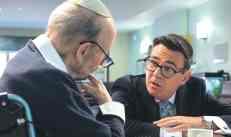
Andy Burnham praises Jewish Care as ‘gold standard’ See page 2

Terror group’s war against its own people P8
Andy Burnham praises Jewish Care as ‘gold standard’ See page 2
Terror group’s war against its own people P8


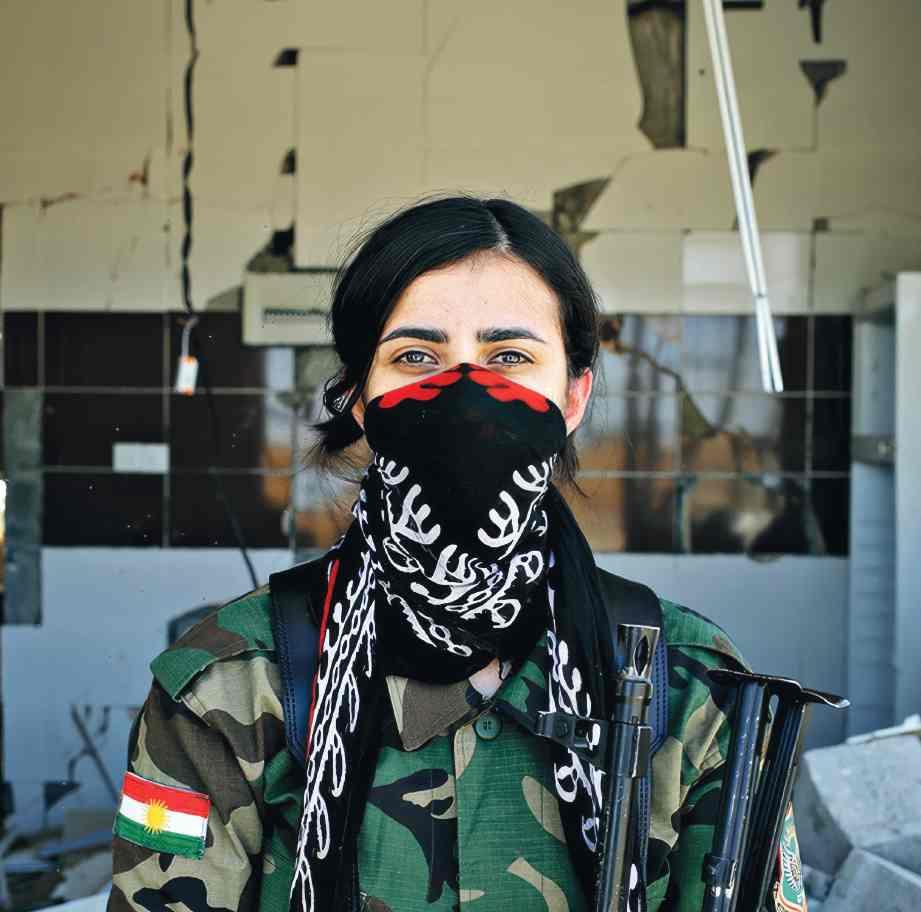

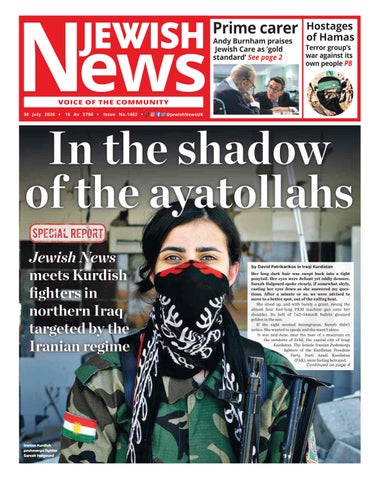
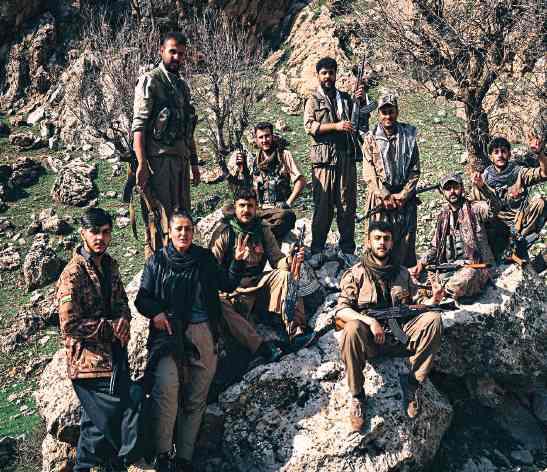
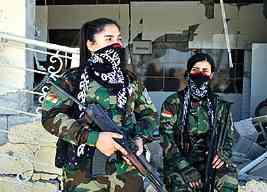
Her long dark hair was swept back into a tight ponytail. Her eyes were defiant yet oddly demure. Sarezh Halgourd spoke clearly, if somewhat shyly, casting her eyes down as she answered my questions. After a minute or so, we were advised to move to a better spot, out of the roiling heat.
She stood up, and with barely a grunt, swung the almost four foot-long PKM machine gun onto her shoulder. Its belt of 7.62×54mmR bullets gleamed golden in the sun.
If the sight seemed incongruous, Sarezh didn’t notice. She wanted to speak; and she wasn’t alone.



It was mid-June, near the base of a mountain on the outskirts of Erbil, the capital city of Iraqi Kurdistan. The female Iranian Peshmerga fighters of the Kurdistan Freedom Party, Parti Azadi Kurdistan (PAK), were feeling betrayed.
Continued on page 4
by Lee Harpin lee@jewishnews.co.uk
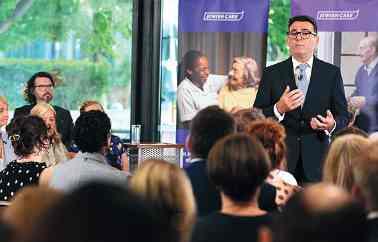
Prime Minister Andy Burnham hailed Jewish Care as offering the “gold standard” in social care as he used the charity’s north-west London premises as a platform to announce a sweeping pledge to address the sector’s long-standing challenges.
At a high-profile media event, flanked by Jewish Care Life president Lord Levy, president Steven Lewis, and Baroness Louise Casey, Burnham – whose father has Alzheimer’s – praised the organisation and the wider sector.
“I want to recognise all the good care organisations… and we are lucky to be in one,” he said.
Reflecting on his previous visit, he added: “I visited Jewish Care here as a member of parliament 13 years ago, and I remember thinking, ‘this is the gold standard – this is how it should be.’”
The PM later told Jewish News: “I came to Jewish Care in Golders Green today because it shows what good looks like. Whole person care. You know it when you see it.
“What this community understands, and what the system too often forgets, is that care is not a task list.
“It is knowing that the kosher meal matters, that Shabbat matters, that the challah delivered to someone’s door is not a nice extra but part of the care itself. Jewish Care’s Holocaust Survivors’ Centre is the only place of its kind. Those are people who lost everything once. This country should not be asking them, or their children, to lose all they have rebuilt to pay for care.”
He added: “I want to say plainly to the charities in this community: I know you have been carrying this system while Westminster looked away, and I know the last few years of
rising costs have been brutal.
“So, I have asked Baroness Casey to bring her review forward by a year, and to answer how we build a National Care Service in England: integrated with the NHS, preventative, person-centred, with home care wherever possible. Person-centred has to mean what it means here, care that fits someone’s faith, their language, their memories, not a service that flattens all that out. We are not waiting for the review on the workforce. I want the fair pay agreement turned into a career with training, security and progression. The 1,500 staff and 3,000 volunteers who make Jewish Care possible deserve that.”
Burnham also described it as a “major dereliction of public duty” that successive governments had failed to fix the crisis in social care.
He highlighted the work of Jewish Care’s “sister organisation The Fed,” recalling his familiarity with it from his time as Greater Manchester mayor.
During the event, the prime minister met with residents, including Dorothea Jacobs, 103, and Doreen Reindorp, 98, to learn about their experiences.
He looked particularly moved as he discussed life with an elderly male resident wearing a kippah.
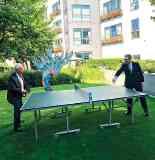
In footage later aired by ITV News, one resident was overheard expressing surprise there was “another one” in the PM’s role as he spoke with Burnham.
Jewish Care CEO Daniel Carmel-Brown later told Jewish News: “We were honoured to welcome the prime minister to Jewish Care as he set out his vision for the future of social care.
“Alongside addressing an audience of stakeholders, he took the time to meet residents and staff at our Otto Schiff care home, gaining firsthand insight into the lives of those who rely upon and deliver care every day.”
Baroness Casey, who is conducting an independent review of the social care system, spoke warmly about Jewish Care, describing it as a “privilege” to be inside the “impressive north west London site.”
Lord Levy told Jewish News that the presence of the prime minister and senior ministers was “not just a tribute to Jewish Care and what it has achieved and the care it gives, but it is a tribute to Anglo-Jewry and the way it has led in the social services, in day care other areas.”
Benjamin Netanyahu visited the White House on Tuesday for his first in-person talks with US President Donald Trump since the Iran war began in February, writes Adam Decker.
The Israeli prime minister and later described their meeting as “excellent” and “one of the best we’ve ever had.” The White House called the talks “productive and positive”. They took place behind closed doors in the Oval Office, with reporters not invited in and without a press conference afterwards.
Netanyahu entered the White House through a side entrance that was only partially visible to reporters, and left without fanfare some 90 minutes later. Held in the Oval Office with the leaders’ respective delegations, it was the eighth meeting between the leaders since Trump’s return to office in early 2025.
The sit-down came amid reported straining of ties between the two leaders, with Trump expressing his annoyance at Netanyahu just before the meeting, and with top US officials reportedly frustrated that none of Netanyahu’s predictions about how well the war would play out have come to fruition, as the conflict continues to fester without a clear end.
However, Netanyahu was quick to temper any suggestions that he and Trump were on bad terms, saying shortly after the meeting: “It was a meeting with full cooperation, with mutual sup-

port, with understanding on the joint goal that Iran won’t have nuclear weapons, and also other goals.” “It was one of the best conversations I’ve had with our friend, US President Trump,” Netanyahu insisted, and “an opportunity to exchange ideas, and also to coordinate on things that are important for the security and for the future of Israel.”
Photos released by Netanyahu’s office showed that US Secretary of State Marco Rubio, Defense Secretary Pete Hegseth, US Vice President JD Vance and Trump’s top Middle East envoy Steve Witkoff were all present in the Oval Office.
“Obviously, many important subjects were discussed,” Trump later wrote in a brief Truth Social post that included photos from the meeting with Netanyahu, which he described as “very good meeting”.
Finchley and Golders Green MP
Sarah Sackman has called for Barnet Council to remove Union Jack flags that have been hoisted on numerous public lampposts without permission in Temple Fortune and Golders Green.
The politician confirmed that she has received messages from residents describing the flags as “unsettling, intimidating and othering”.
tied to lamp posts since last September – well before the recent World Cup, and the visit by King Charles.
When council contractors began removing the flags, they were met with abuse, she said.
Sackman, recently reappointed as a justice minister in Andy Burnham’s government, noted that Union Jack and St George’s flags had been
Sackman also pointed out that while the far-right group Operation Raise the Colours had not claimed responsibility for the flags in Barnet, they have been linked to similar campaigns in Oxford and Essex. She said: “I have heard from many residents who are concerned about the presence of these flags.”
A new report from an international taskforce representing major Jewish communities has concluded that 2025 was the deadliest year for antisemitic attacks in the diaspora for more than 30 years.
The data, published by the J7 Large Communities’ Task Force Against Antisemitism, documents more than 23,000 attacks against Jews in J7 countries in 2025, which comprise more than 90% of diaspora Jews.
The J7 is made up of key Jewish communal groups from the UK, US, Australia, Canada, France, Germany and Argentina.
Among the insights in the report, it notes
that the countries who have seen the biggest percentage rise in antisemitic incidents since 2021 are Australia (270%), Germany (215%), the United States (131%) and France (124%). Germany has by far the highest rates of antisemitism on a per capita basis, with 69.80 incidents per 1,000 people during 2025. The report, which includes CST’s 2025 data, shows that while overall antisemitic incidents declined in some countries – the USA, Australia, Canada and France – in 2025, it rose in the UK, Argentina and Germany. Twenty people were killed in antisemitic attacks in 2025.
Green Party members could soon be debating whether the UK should scrap its designation of Iran’s Revolutionary Guard as a terrorist organisation and pursue “diplomatic normalisation” with Tehran, writes Lee Harpin.
A motion submitted for the party’s autumn conference urges the government to seek diplomatic engagement with Iran and calls on the Greens to campaign for the lifting of economic sanctions, which it argues “primarily harm civilians”.
The motion also states that the party would oppose “the proscription or designation of Iranian state institutions, including the Islamic Revolutionary Guard Corps (IRGC),” claiming such measures are “counterproductive, undermine diplomacy, close channels for engagement, and reduce opportunities for mediation and peacebuilding.”
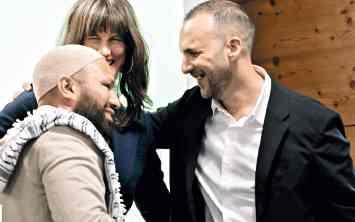
The proposal comes from Ashok Kumar, a reader in political economy at Birkbeck, University of London, who is a regular media defender of the Greens. Notably, the motion makes no reference to the IRGC’s activities in Britain, or to allegations linking the group to recent attacks on the UK’s Jewish community.


camp where a million people are starved has consequences.”
After the death of Yahya Sinwar, the Hamas leader behind the October 7 attacks, Kumar posted footage of Sinwar’s final moments alongside the names of Bhagat Singh, Patrice Lumumba, Steve Biko, and Che Guevara, in what appeared to be a tribute.
Kumar has previously drawn criticism for his social media posts about the war in Gaza. On 7 October 2023, he shared images from the Nova music festival, captioning them: “Sometimes partying on stolen land next to a concentration
The post, first reported by The Spectator, has since been deleted.
Subsequently, Kumar wrote that details of Sinwar’s autopsy “only steel-reinforce Sinwar’s stature as a martyr who fought and starved with his people.”
Labour MP David Taylor said:
“It is absolutely disgraceful that the Greens would even consider debating a motion like this.”
A Green Party spokesperson said: “Conference is still months away and although members have started to submit motions, not everything submitted ends up being discussed.”
Meanwhile, Hackney’s Greenled council has voted to begin the controversial process of ending its decades-long twinning agreement with the Israeli city of Haifa, despite furious opposition from Labour and Conservative groups.
The decision, which some councillors condemned as “divisive” and “performative,” will see the council move, in principle, towards formally terminating the 1968 twinning agreement and all municipal ties with Haifa.
The de-twinning process has begun before an equalities impact assessment has taen place – and will include a period of engagement with interested parties.


The Zionist dream for the creation of the State of Israel was finally fulfilled in 1948 - yet nearly eight decades on we continue to hold on dearly to the ‘Z’ word. Simon Sebag Montefiore and Anthony Julius have differing views on whether it’s time to move beyond a word which continues to evoke such passion and pride around the globe.

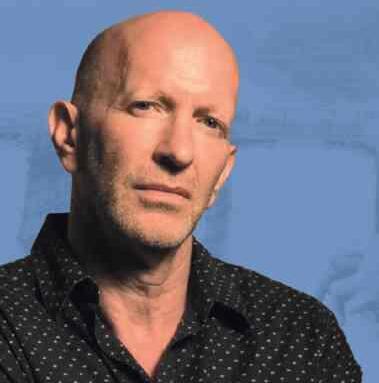

In this exclusive debate organised by Jewish News and a central London Synagogue, the pair will debate whether it is time to recognise that we’re living in a post-Zionist era or, at a time when the ‘Z’ word is both misunderstood and maligned globally, is it time to double down and hold the word closer than ever.
DATE: 5th October 2026
LOCATION: Central




Continued from page 1
“Trump’s deal exists only to solve the problem of the oil price,” Sarezh told me that morning, just days after the ink dried on the so-called Memorandum of Understanding between Iran and the US at Versailles.
“Our struggle against the Iranian regime continues. We will not stop fighting to return to our homeland.”
Standing back, wearing a patterned bandana over her mouth and carrying an AK-47, was Sharo Hawrami, who chipped in with her own thoughts. “The struggle against this violent regime will be successful. The Iranians will not stop, but neither will we.”
At the time, that sounded like defiance in the face of an impending détente between Iran and the US. Six weeks on, the words seem prophetic.
For years, Trump denounced his predecessor Barack Obama’s nuclear deal, the 2015 JCPOA, which, he correctly pointed out, did nothing to address Tehran’s murderous regional behaviour while also handing the Iranians billions of dollars in unfrozen assets and sanctions relief. Obviously, he said, this would be used for violent and nefarious purposes.
Trump withdrew from the deal in 2018. Well, guess what? The deal he was looking to make this June –and touting, inevitably, as a triumph – didn’t even survive the summer.
If the reporting is to be believed, Trump’s purported deal was an unequivocal capitulation to the Iranians.
It made a mockery of every criticism Trump ever levelled at President Barack Obama, and it laid bare as nonsense his endless boasts of being a master negotiator.
Even the supposed key point of the Versailles memorandum –resolving Iran’s nuclear programme – was left deliberately vague, deferred to a “final deal” the two sides were given 60 days to negotiate. That window was due to run to mid-August.
It didn’t make it past three
weeks. By early July, Tehran’s negotiators were still insisting they’d start charging tolls on the Strait of Hormuz once the interim period ended; Washington was still insisting this would never happen. It was, simply, yet more chaos.
To make matters worse, by committing to ending hostility “on all fronts”, the memorandum sought to hobble Israel by preventing it from dealing with the perennial threat on its border, Hezbollah.
Israel, which was never a party to the Versailles talks, made its view of that clause clear almost immediately: it had no intention of honouring commitments it hadn’t signed.
And there was the cash. Under the deal’s reported framework, Iran was set to gain phased access to roughly $24-25bn in frozen assets, with some estimates suggesting that figure could eventually exceed $100bn as sanctions were gradually lifted.
There was also a reported $300bn private-sector invest-
ment and reconstruction fund for Iran, though that money was to come from private investors rather than directly from the US government. Trump has since reimposed the very sanctions on Iranian oil he had only just lifted.
For that, at least, we can be grateful. I know what Tehran will do with the unfrozen billions it still hopes to receive, because just last month I was staring at the results with my own eyes.
Gas, the first major energy company operating in the region, suspended its operations after drone strikes on Erbil itself. Much of this has happened because negotiations bought the regime time to regroup.
Don’t be surprised: the mullahs respect nothing. This regime is not merely atavistic; it is sadistically medieval.
The Islamic Republic is not a conventional nation state, it’s not even a conventional autocratic state. It’s something far more dangerous, a revolutionary theocracy – and it is becoming more extreme.
The Islamic Republic’s founder, Ayatollah Ruhollah Khomeini, built the regime around the principle of perpetual revolution. Tehran will never stop trying to export its revolution abroad because its theological foundations demand that. It will never stop using proxies to project power and dominate the region because its geopolitical doctrine depends upon them – particularly its concept of “forward defence,” by which Iran fights abroad via proxies to prevent it having to fight at home.
It will never stop attacking Israel because, both ideologically and politically, it simply cannot. As a Persian Shia power in a predominantly Arab Sunni Middle East, confronting Israel gives the regime support among Arab populations and lessens its de facto regional isolation.
The mullahs do not respect women’s rights, civil rights, human rights or, ultimately, life itself. Their record over four decades makes that point bloodily irrefutable. They are, in the end, unreformable.
The residential compound of the PAK base is where these women used to sleep and bathe, not fight. But it didn’t stop the Iranians launching ballistic missiles at the site. What had been a grid of compact residences was now a wasteland of shredded concrete, shattered glass and blackened steel ribbons.
The walls were pockmarked with shrapnel. One of their comrades, the Peshmerga told me, was martyred. Three were wounded.
When it comes to lashing out violently at anyone who opposes them, whether in the mountains of Kurd-
istan or the streets of London, the Iranian regime is relentless.
Tehran has now renewed and intensified its drone and missile campaign against PAK, Komala and the other Iranian Kurdish opposition groups scattered across Iraqi Kurdistan. On 13 July, three drones hit a PAK camp near Erbil. Nine members of one branch of Komala were killed in a strike on 17 July.
Two days later, PAK accused Iranian forces of using white phosphorus munitions in a drone strike, citing eyewitness accounts, medical examinations of nine wounded Peshmerga fighters and the extensive fires the strike left behind. Dana
Any settlement or deal or treaty that assumes this regime can be moderated, reconciled, or transformed through concessions alone rests on a profound misunderstanding of what the Islamic Republic has repeatedly shown itself to be.
It took just three weeks for the Versailles memorandum to prove that misunderstanding.
The Peshmerga were right. The Islamic Republic cannot be reasoned with, only defeated.
On the ground in the Middle East, from the PAK compound to the tanker lanes of Hormuz, the message is clear. We should take heed: this war is far from over.
A police chief said he is “deeply sorry” over missed opportunities to potentially uncover the plot to attack a synagogue in Manchester, writes Adam Decker.
Jihad Al-Shamie, 35, was shot dead by police last year while he carried out his terrorist attack at the Heaton Park Hebrew Congregation Synagogue, in which two worshippers were killed.
But police had already seized his mobile phone containing details of his extremist mindset and terror-fixation, yet did not analyse the contents until after he launched the attack.
The apology came after details emerged with the sentencing of Al-Shamie’s friend and accomplice, Mohammad Bashir, 31, to life imprisonment last week at Manchester Crown Court for planning a separate terror attack with Al-Shamie on the UK’s Defence Academy.
After the hearing, Sir Stephen Watson, Chief Constable of Greater Manchester Police
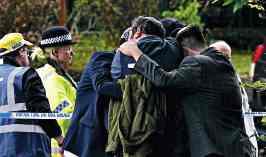
(GMP), said: “The conclusion of legal proceedings against Bashir means that the rules which prevent the sharing of information about live criminal cases are now lifted... It is factually the case that Al-Shamie had come to the notice of GMP in respect of two linked criminal alle-
gations... these allegations resulted in his being arrested on 13 February 2025 on suspicion of breaching a non-molestation order; and on 21 September 2025 on suspicion of rape.

“At the time of committing the attack at the Heaton Park Synagogue, Al-Shamie was on police bail.
In conducting an internal review, it became apparent that GMP had seized AlShamie’s mobile devices, at the point of each arrest.
“The significance of the data contents of these devices was substantial in respect of evidencing an extremist mindset.
“Regrettably, I can confirm the significance of the information stored on Al-Shamie’s devices was not realised as they had not been examined
before the attack took place... There can be little doubt the information contained within... would have inspired further investigative action.
“It is clear that our not having reviewed the data available to us prior to the attack constitutes a missed opportunity. I am disappointed at the prospect of adding to the distress of all of those a ected by the terrible events last October.
“For this, I am deeply sorry...I have already made direct contact with those personally a ected by Al-Shamie’s barbarism, together with representatives of our Jewish community, to apprise them of this development.
“I thank them for their continuing support.”
Sir Stephen said it was for the Independent O ce for Police Conduct (IOPC) and the coroner to determine the “impact” of police not reviewing the contents of Al-Shamie’s devices before the attack.
The government is understood to have considered whether to suspend its trade partnership agreement with Israel last year, as one of a range of possible responses to Israeli government policy.
As reported by Sky News, last August the Department for Business and Trade undertook an impact
assessment on whether to suspend the deal between the two countries.
Since Brexit, the UK has signed dozens of trade deals with di erent nations, including Israel. Under the Conservatives, the UK was also seeking to negotiate a further, free trade agreement with Israel.
However, the Labour government
suspended the latter talks last year, after then-Foreign Secretary David Lammy criticised Israeli actions in Gaza and condemned the Israeli finance minister’s calls for relocating Palestinians from the Strip.
The government did not inform Parliament at the time that it was considering suspending its current

trade partnership as well. Later in 2025, the trade minister at the time, Chris Bryant, told Parliament “exports to Israel support thousands of jobs in the UK”, subsequently responding to a written question saying that suspending the current trade agreement “risks unpredictable consequences and significant economic disruption for British businesses”.


























by Annabel Sinclair annabel@jewishnews.co.uk
Two people have been arrested after three Jews were injured when a BB gun was fired from a passing car in Salford in what police are treating as a religiously aggravated attack.
The incident happened at about 10pm on Monday last week on Leicester Road, where three adults suffered injuries after shots were fired from a moving vehicle.
Greater Manchester Police later arrested two suspects on suspicion of religiously aggravated common assault. A BB gun uses compressed air or springs to fire spherical projectiles.
The force confirmed the arrests in a statement, saying: “Officers have arrested two people in connection with a BB gun being fired at members of the Jewish community.
“At around 10pm on Monday 20 July on Leicester Road, Salford, three people suffered minor injuries after being shot with a BB gun from a passing vehicle.
“Following extensive CCTV inquiries, officers identified two suspects and arrested them on suspicion of religiously aggravated common assault.
“Threats to our communities will not be tolerated, and we’re continuing to enhance our security in Jewish communities across Greater
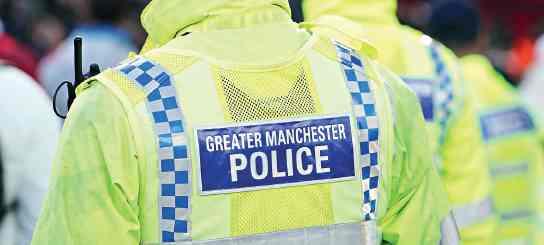
Manchester to help keep them safe on our streets.”
Police said inquiries remain ongoing and appealed for anyone with information to come forward.
The Campaign Against Antisemitism (CAA) said the victims were all Jewish adults and praised volunteers from Shomrim Greater Manchester for helping officers identify the vehicle involved by reviewing CCTV footage.
CAA director of investigations and enforcement Stephen Silverman said: “Last summer, in an unrelated incident, two men filmed themselves firing a water gun from their car at
British Jews feel abandoned, excluded and insecure following the lack of adequate institutional response to the rise in antisemitism after the 7 October 2023 attacks and the subsequent war in the Middle East, according to new research led by Professor Shani Orgad at the London School of Economics and Political Science (LSE).
The report, Listening to British Jews, is based on six focus groups involving 43 Jewish adults across the UK. Participants ranged in age from 18 to over 75, represented different Jewish denominations and political perspectives and included both those active in Jewish communal life and those who were not.
Across all focus groups, participants described a significant decline in trust in major British institutions, particularly the police, the education system, universities, the media and the legal system.
Many spoke of feeling unheard, dismissed or excluded by institutions they believed should protect them and treat them fairly.
The most severe incidents include the October 2025 Yom Kippur terrorist attack on Manchester’s Heaton Park Synagogue, killing two Jewish people and seriously injuring three others, the April 2026 Golders Green attack in which two men were stabbed, and several incidents of arson attacks and arson attempts on
community partners, have been assisting Greater Manchester Police with their investigation.
a Jewish passerby. Now it has escalated to real injuries from a BB gun. What will be next?
“While we thank Greater Manchester Police for their professionalism in apprehending suspects, our message to the government is that its extra spending on policing to protect British Jews is not the solution. Rampant extremism and Jew-hatred must be tackled at source, including the use of a conflict thousands of miles away to inflame hatred here in Britain.
“We are extremely grateful to the volunteers of Shomrim Greater Manchester for their remarkable

diligence, and we wish the victims a full and speedy recovery. Swift justice will be a first step to restoring deterrence for these sorts of crimes. But it is still no substitute for the political and societal leadership that we desperately need to confront the antisemitic and extremist ideologies plaguing this country, with Jews paying the highest cost.”
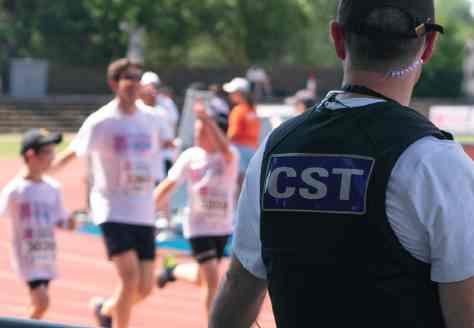
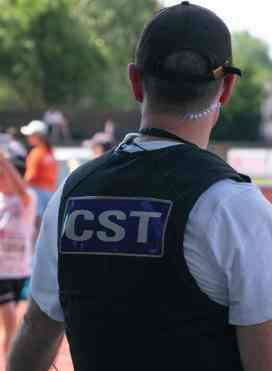
A Community Security Trust (CST) spokesperson said: “We are aware of this appalling incident targeting the Jewish community and, working with our local Jewish
“We thank Greater Manchester Police for their swift action in making arrests so quickly, which is exactly the kind of response that helps to build community confidence. CST will continue to work closely with the police and provide support to the Jewish community.” The arrests come a day after Greater Manchester Police Chief Constable Sir Stephen Watson apologised to the Jewish community over failings before last year’s Heaton Park Synagogue terror attack, admitting officers missed an opportunity to examine mobile phones belonging to attacker Jihad al-Shamie before he carried out the assault. The matter is now under investigation by the Independent Office for Police Conduct.
• Anyone with information is asked to contact Greater Manchester Police on 101 or via LiveChat, quoting log 3864 of 20 July 2026. Information can also be passed anonymously to Crimestoppers.
Jewish sites and organisations, including Hat-
The report also references physical assaults, attacks directed towards Jewish-owned or Jewish-associated property, threats, abusive behaviour and the distribution of massproduced antisemitic literature. It also details the pro-Palestinian marches that have taken place in many cities across the UK since 7

October 2023, when protesters have used antisemitic language and incited violence, which, according to report participants, were witnessed by police officers but not acted upon.
Examples cited included NHS doctor Dr Rahmeh Aladwan, who stood on Leeds’ streets, wearing a T-shirt emblazoned with the words “Anti-Semite Semite Club”, calling for Jewish communities to be “held accountable” for their Zionism; a protester delivering a blood libel speech; a protester who threw coffee over a Jewish participant, and keffiyehclad protesters shouting at an elderly Jewish man that he should be gassed.
When this last incident was reported to the police, a participant in the Leeds focus group said the police’s response was that “there’s no context, so it’s not a hate crime”.
The United States has imposed sanctions on a London-based senior Muslim Brotherhood official accused of helping raise money for organisations alleged to have supported Hamas, in a move that is likely to renew scrutiny of the group’s presence in Britain.
The US Treasury announced Mahmoud al-Abyari, an Egyptian-Austrian national who serves as secretary-general of the Muslim Brotherhood General Secretariat, has been placed under sanctions. The measures include an asset freeze and a travel ban.
According to the Treasury, al-Abyari helped
raise funds for two Turkish charities, Filistin Vakfi and Hayat Yolu, which Washington alleges collected money for Hamas following the 7 October 2023 terrorist attacks on Israel.
The sanctions were announced alongside measures targeting several other organisations also accused by the US of providing financial support to Hamas.
US treasury secretary Scott Bessent said: “The Trump administration will relentlessly pursue terrorists and those who finance them, whether operating [as] charities, businesses or underground financial networks.”
The Conservatives are understood to have rejected an application by former senior Jewish MP Grant Shapps – who previously held the position of party chair – to stand as a candidate for the next election.
The Spectator reported Shapps, the former MP for Welwyn Hatfield, who served as UK defence secretary from August 2023 until the general election in July 2024, is believed to have failed the party’s assessment for its seat selection process.

Asked about the report, Conservative leader Kemi Badenoch said that “you wouldn’t expect me to be commenting on anybody’s application for candidates and to be speculating about rumours”.
However, she added: “What I will say … is that we’re going to be announcing candidates shortly, and you will see that this is a very different party from the one that was removed from government in 2024.”

The attack on October 7, 2023 by Hamas on Israeli communities in the areas known as the Gaza envelope turned my life upside down and changed it forever, not to mention the lives of 2.3 million Palestinian residents of the Gaza Strip.
The homes in which I grew up, surrounded by citrus, fig, guava and olive trees, where I fed my grandmother’s chickens and ducks, where I flew homemade bamboo and paper kites, and where my cousins and I played PC video games that improved our English, were destroyed by Israeli airstrikes. The Gaza that I knew as a child was gone; and yet, it was already gone, long before October 7.
Hamas has been in control of the coastal enclave for almost two decades. Roughly twothirds of Gaza’s residents are under the age of thirty, and few would have any real memory of life before Hamas. I remember. I was born in 1990 and am old enough to have experienced a glimpse of hope for my people.
Hamas squandered that hope. During its reign, which continues, it destroyed the potential for the Palestinian people to pursue selfdetermination and self-fulfilment, to develop and, critically, to turn Gaza into a compelling case for Palestinian statehood.
I left the Gaza Strip in 2005 as a fifteenyear-old high school student on a United States cultural exchange programme designed to build bridges between the Arab and Muslim worlds and the American public after the 9/11 attacks. I was supposed to return a year later after finishing eleventh grade while living with an American host family.
However, six months after I arrived, Hamas won the Palestinian elections. Soon afterwards, while I was in Egypt preparing to cross back in, the group abducted Gilad Shalit, an Israeli soldier on the Israeli side of the border with Gaza, triggering a mini war and intensifying a blockade against the Strip that prevented me from returning home.
A year later, a nervous seventeen-year-old, I interviewed for political asylum in the United States. It was 14 June 2007, the day that Hamas seized control of the Gaza Strip and violently ejected the Palestinian Authority. The Hamas takeover launched multiple cycles of violence, which ultimately led to the horrendous massacre on October 7 and the ensuing war that annihilated Gaza.
I became the first Palestinian from Gaza to receive US asylum as a consequence of Hamas’s control of the Strip. This represented a tragic milestone, but seeking asylum regularly became the recourse of Palestinians forced to flee their homeland in Gaza and the Islamist menace that has championed violence and terror under the guise of resistance and fighting Israel and Zionism. Sadly, my entire immediate family remained behind in Gaza. I have not been able to visit the Strip
since Hamas took over and I received asylum, though I stood at its border on the Egyptian side in 2012 and flew over it in 2025, when I joined an airdrop of food led by Jordan and the United Arab Emirates and saw my home for the first time in twenty years.
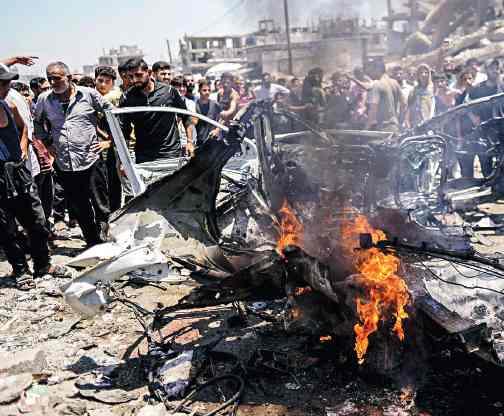
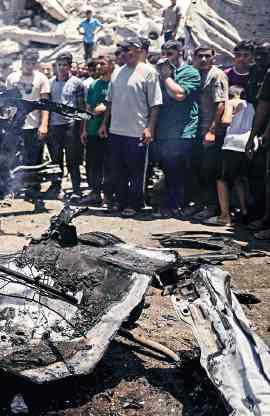
Throughout my time in the United States, I have been active in the cause of Palestine. I have engaged in Jewish/Israeli–Palestinian dialogue and in “pro-Palestine” activist groups and in humanitarian projects. After October 7, I became known for two reasons. First, I lost dozens of family members during the destruction of my two childhood homes: the house I grew up in with my family on one floor plus my father’s on the four floors above ours in the family building, and my mother’s family home, which was like a second home; both of these were central to my upbringing in Gaza. To this day, the Israeli military has not explained why the airstrikes occurred.
Second, I have been ferociously anti-Hamas, and so I have firmly opposed vocal elements of the Westernbased pro-Palestine camp that often justifies violence, promotes hate and refuses to endorse any rational discourse or pragmatic solution that could actually help the people of Gaza. These advocates claim to speak for me, my family and my people, but they know nothing about us, our history, our di erences, our interests and our hopes.
I have chosen to engage in work that advocates for reconciliation, tolerance and common ground as the only way forward for Palestinians and Israelis. My approach has drawn support but also suspicion, hate and threats of violence. A Palestinian who challenges the “conventional wisdom” and speaks out against Hamas, who renounces its narrative of armed resistance and promotes views that other Palestinians hold but are afraid to voice, is perceived as a heretic. But the truth is that my experience, and that of most Palestinians, does not fit the simplistic, black-andwhite understanding of the Israel and Palestine conflict held by many of those who speak on our behalf.
Since October 7 it has been horrifying to see Hamas apologists, presenting themselves as pro-Palestine, celebrate the group as a legitimate entity that supposedly represents the Palestinian people’s best interests and is somehow an organic expression of resistance on behalf of Palestinian grievances. Since its inception, Hamas has been deeply detrimental to Palestinian interests. Indeed, the group carefully timed the attacks of October 7 against the backdrop of its unpopularity in the Gaza Strip – mere months after yet another round of protests opposed to its rule. The attack was also part of a geopolitical chess game in which Hamas’s chief backer, supplier and instigator – the Islamic Republic of Iran – was seeking to block the normalisation of Israel’s relations

with Arab and Muslim countries like Saudi Arabia. Hamas’s eighteen years of repressive governance in Gaza had hit a dead end. The terror group was able to be neither a successful government nor an e ective force of armed resistance; the October 7 attack was a form of suicidal nihilism that the group hoped to use to shake up the status quo, ultimately choosing to sacrifice Gaza and its people in the process.
It was not because the Palestinian people were out of options that Hamas carried out the attack. It was in its own interests, and in those of its master in the Middle East, to stage a dramatic and bloody act to inflame the region. The so-called pro-Palestine movement did not recognise this, which is disturbing and demonstrative of the hopeless ignorance of many of the Palestinian people’s supposed allies.
Hamas is a moral stain on the Palestinian cause; those who genuinely support our national aspirations should have found it entirely unproblematic to condemn the group’s murders and rapes, its firing of rockets at civilians, and its Islamist ideology.
I was furious that a once-inageneration opportunity to drum up support for the Palestinian people was squandered on sloganeering and hollow activism. I heard nothing constructive, no desire or attempt to produce pragmatic policies and results for the Palestinian people. Instead of doubling down on the twostate solution and acknowledging that the Pal-
estinian people do not want the annihilation of Israel, but rather seek dignity, freedom and independence, activists in the Western world became drunk on the worst possible combination of extremism, oversimplification and maximalism. This toxic mix has been harmful to the lives and liberty of Palestinians and to the cause of the Palestinian people.
against both Gazans and Israelis.
Undeterred, I have decided to proceed with sharing my truth. I saw and experienced Hamas’s rise to power in Gaza and witnessed its tactics, strategies and manipulation of an entire people. For nearly two decades, a fascist Islamist terror organisation has been holding over 2 million Palestinians as hostages to its suicidal, nihilistic project.
Launching the most brutal single-day attack against the Jewish people since the Holocaust, and knowing the kind of devastating and deadly retaliation that this was going to elicit, was a deliberate, reckless endangerment of the Palestinian people: a betrayal.
The decision to launch the October 7 attack destroyed Palestinian lives and aspirations, but it was not the first such terrible choice.
It was a choice to reject the Oslo peace process and the 2000 Camp David proposal; it was a choice to squander the opportunity opened in 2005 by Israel’s withdrawal of settlements on a vanity resistance project that went nowhere for two decades; it was a choice after the 2006 elections to Islamise Palestinian society and waste opportunities to establish new civic and democratic life; it was a choice to antagonise moderates in Israel with suicide bombings, turning many of them against the peace process and helping the rise of the Israeli far right.
When I spoke out against these trends, I was attacked viciously. I realised that many in the so-called pro-Palestine movement are deeply anti-Palestinian, for they are only interested in platforming and embracing views and experiences that conform to their beliefs. That a Gazan like myself – who lost family members in the war, who is largely deaf in his left ear following an Israeli bombing in 2001 and who has been on the front lines of providing humanitarian support for Palestinians in Gaza – could be dismissed for sharing the “wrong views” was an alarming sign of the degradation of this Western-based activism.

genuine pro-Palestine advo-
the abandonment of polit-
Furthermore, large segments of the Arab and Palestinian communities in the diaspora became their own worst enemies, enforcing conformity and promulgating extreme positions. They remained silent lest they be called traitors, sellouts or Zionists. Speaking out against Hamas was somehow viewed as supporting Israel’s war on Gaza, endorsing the horrors experienced by Palestinian civilians or adopting Netanyahu’s and Israeli talking points, or as a betrayal of the Palestinian right to resist Israeli injustices. This simplistic reductionism was picked up by Hamas, which immediately registered the support for its actions in diaspora communities, particularly in the West and in the US, where political leverage matters most. The failure to call out Hamas weakened genuine pro-Palestine advocacy, which by default became associated with celebrations of October 7, finding excuses for Hamas’s heinous acts of terror, refusal to humanise Israeli victims of the attack (including hostages) and the abandonment of political aims that are actually achievable. Instead, a form of mass psychosis took hold of activists, academics, journalists, advocates, politicians and average individuals, all blinded to Hamas’s criminality
It was a choice to align the Palestinian people of Gaza with the likes of Hezbollah, Qatar, the Islamic Republic of Iran, the Muslim Brotherhood – failed ideologies and regional projects – just as previous generations of Palestinians aligned themselves with Saddam Hussein, the Soviet Union and Gamal Abdel-Nasser’s panArabism; it was a choice to keep Israeli hostages in Gaza for two years rather than surrendering them earlier to avert large-scale death and destruction and to save what could be saved of Gaza’s people and infrastructure.
I have never claimed to speak on behalf of Palestinians. No one can make this claim, for there is no single voice that can represent the diversity of Palestinian communities across the Middle East and the world. My account and my analysis are steeped in lived experience, connection to the land and extensive relationships with Palestinians in the Gaza Strip.
Still, the cautionary lessons and observations that I discuss will be acknowledged by many in the Gaza Strip, and by Palestinians elsewhere, who often keep quiet.
I share my story in the spirit of seeking justice for my people. This story details Hamas’s horrendous impact on the Palestinian people’s legitimate right to freedom and independence. I experienced the tragedy of seeing my homeland descend into chaos, a collapse that occurred in large part because of a group of jihadi fascists who destroyed the Palestinian national project. This is why I speak out against Hamas.

I experienced the tragedy of seeing my homeland descend occurred in large part because national project. This is why I Hamas. at
This is an edited extract from Ahmed Fouad Alkhatib’s Jewish Quarterly essay, Hamas and its two million hostages, out this week. He is a Gazan writer and a senior fellow at the Atlantic Council in Washington, DC. You can subscribe to Jewish Quarterly jewishquarterly.com

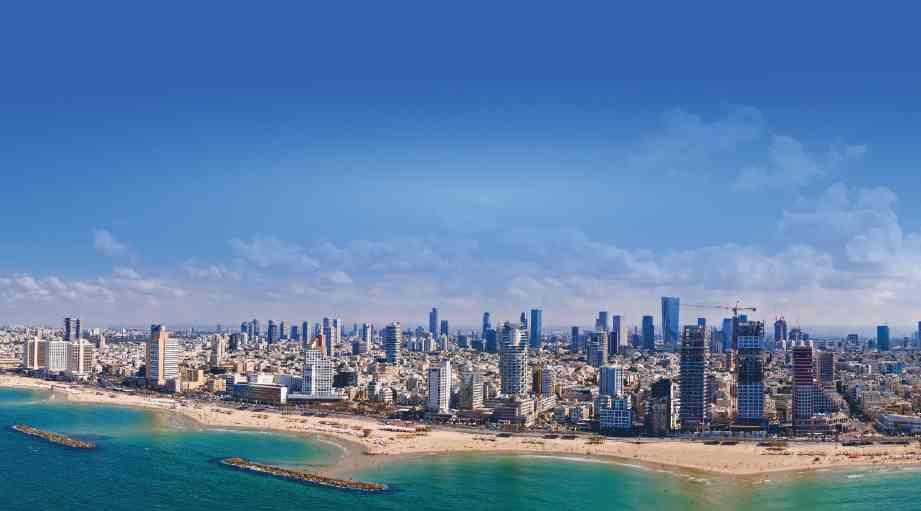
Secure your family's legacy in Israel. ICR—one of Israel’s leading real estate groups—is arriving in London for an exclusive event and private parlor meetings.
Whether you envision waking up to the eternal views of the Jerusalem mountains, enjoying resort-style living in North Tel Aviv, or residing just 50 steps from the sea in Bat Yam, we are bringing the opportunity directly to you.
This is a rare opportunity to gain priority access to Israel’s most prestigious developments.
Attendees will unlock unique benefits unavailable anywhere else.


1-on-1 VIP consultations with our senior real estate experts
Space for these private sessions is strictly limited. Discover the projects and secure your VIP consultation today.
RSVP to receive the event details and exact location:




We look forward to helping you open the door to your new home in Israel.


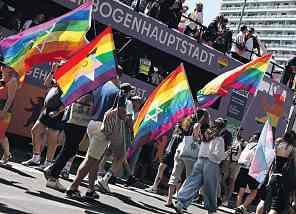
A Jewish LGBTQ+ organisation whose members marched at Berlin Pride before Saturday’s deadly Islamist terror attack has urged European leaders to confront violent extremism while rejecting attempts to blame entire communities, writes Annabel Sinclair.
Keshet Europe, which was holding its annual network summit in the German capital, issued the statement after one woman was killed and at least 29 people were injured when a man drove a rented van into crowds near the Christopher Street Day (CSD) celebrations before carrying out a knife attack.
German authorities later identified the suspect as 21-year-old Islamist
Abdul Ballout, a German citizen of Lebanese heritage. Police shot him dead on Sunday following a manhunt.
The attack took place on the same weekend that Keshet Europe had brought together Jewish LGBTQ+ activists from across the continent for its annual summit in Berlin. The organisation said: “Within hours of the tragedy, we had already witnessed attempts by politicians across the political spectrum to instrumentalise this attack for their own agendas. We reject this.”
Drawing on Jewish experience, it added: “As Jews, we know all too well the consequences of collective blame. We stand in solidarity with Muslim
communities, racialised people, migrants and asylum seekers, and reject any attempt to exploit this tragedy to fuel racism and anti-migrant rhetoric.”
At the same time, Keshet Europe said violent extremism must be tackled decisively. “We recognise that all forms of violent extremism and radicalisation pose a real threat to the safety of our communities and must be addressed with determination, while upholding human rights and rejecting collective blame.”
Calling for a united response, the organisation said: “These are not attacks on one community: they are attacks on democracy.”
•Daniel Sugarman, page 20
Rescue workers, first responders, survivors and family members of those who perished on 9/11 are among more than 21,000 signatories to a petition calling for New York Mayor Zohran Mamdani to be banned from the 25th anniversary memorial at Ground Zero in Manhattan, writes Michelle Rosenberg.
The rapidly growing campaign was launched by Brooklyn-born, Florida estate agent Giovanni Galante, whose
29-year-old wife, Grace Catherine Galante, was among the 2,977 people murdered by al Qaeda terrorists 25 years ago. The petition itself, “honouring the memory of those lost on September 11th with dignity”, states that family members of those murdered on 9/11 are writing “to express our concern regarding the potential inclusion of Zohran Mamdani in the 25th-year commemorative events” adding that
those concerns include “Mr Mamdani’s public positions, associations and responses to rhetoric that many perceive as hostile to these shared values”. These include: “a perceived reluctance to clearly and unequivocally condemn phrases such as “globalize the intifada,” which many interpret as endorsing or normalizing violence”; “support for, or associations with, individuals whose public statements or
records are viewed by concerned family members as...insu ciently critical of extremist ideologies”.
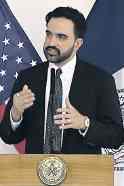
Speaking to journalists, a defiant Mamdani said he still planned to attend the ceremony, telling a news conference he “will proudly honour the families, the survivors, the first responders forever impacted by that horrific terror attack by standing alongside them at this year’s commemoration.”

















by Annabel Sinclair annabel@jewishnews.co.uk
Royal Holloway Students’ Union has suspended its Friends of Palestine society after widening an investigation into allegations that studentraised funds were donated to a group accused of links to Hezbollah.
The decision follows weeks of complaints by Royal Holloway student Brodie Mitchell, who alleges the society made multiple donations to Zayir UK, an unregistered organisation that says it supports humanitarian projects in Lebanon.
Mitchell alleges the group has links to Hezbollah, which is proscribed as a terrorist organisation in the UK.
In an email seen by Jewish News, the Students’ Union told Mitchell: “Given the new evidence you have provided, we have re-opened and widened the investigation into Friends of Palestine.” It added: “Whilst the investigation is ongoing, we have advised the group that all their activity will be suspended until we
have concluded the investigation and advised them of the outcome.”
The latest decision comes after the Students’ Union completed an initial investigation into Mitchell’s earlier complaint. In its findings, the Union said the Friends of Palestine committee for 2025-26 had “failed to follow the agreed procedures for
charity donations” and that it has “no knowledge” of the fundraising activity because the donation “fell outside of our financial processes”.
The Students’ Union also said it had informed both the university and the Charity Commission of its initial investigation and would cooperate with any appropriate authority if
• Tax-efficient investing before and after Aliyah
• Tax-efficient income after 10-year tax-free period
• Receive your entire pension pot tax-free
• Specialist portfolio management for Olim
• No Inheritance Tax (for non-UK-situated assets)
We are seasoned experts in providing long-term financial planning advice for those making Aliyah. Scan the QR code to read more
With investing, your capital is at risk. Tax treatments are subject to individual circumstances and are subject to change.
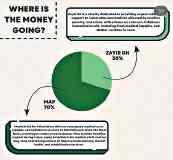
required. Mitchell claimed the society donated £1,820 from one fundraiser to Zayir UK. He also alleges that after raising £3,425.95 during a fundraising campaign on 4 January 2025, 30 percent of the proceeds were again allocated to the organisation.
Material seen by Jewish News includes screenshots of fundraising pages appearing to show Zayir UK listed as a beneficiary of the cam-
paign, alongside correspondence between Mitchell and the Students’ Union concerning the donations.
Mitchell also highlighted screenshots appearing to show Students’ Union officer accounts reacting positively to a Friends of Palestine social media post promoting the fundraiser, despite the union later stating there was “no evidence to suggest our officers knowingly engaged with a social media post in the way set out.”
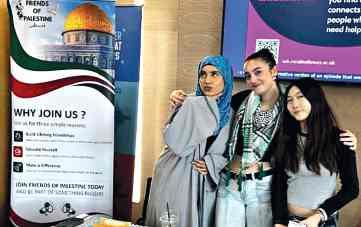
Other images supplied by Mitchell include a photograph that appears to show a woman he identifies as being associated with Zayir UK standing beside another woman wearing a Hezbollah-branded scarf at a charity event. A separate screenshot, which Mitchell says was later deleted, appears to show a social media account named Zayer Charity Association paying tribute to former Hezbollah leader Hassan Nasrallah.
The suspension does not amount to a finding of wrongdoing, and Friends of Palestine has not publicly responded to the allegations.
The Scout Association is investigating its UK Muslim Scout Fellowship (MSF) after an antisemitism complaint over a children’s art competition that featured controversial slogans and imagery linked to the Israel-Gaza conflict, writes Annabel Sinclair.
The complaint was submitted by the Henry Jackson Society (HJS), which alleged that children taking part in a “Paint for Gaza” challenge created artwork containing the slogan “From the river to the sea” and images which showed Israel replaced by a Palestinian flag.
A Scout Association spokesperson told The Jerusalem Post: “We have a robust process in place to ensure that matters of this nature are investigated thoroughly, impartially and fairly.”
The spokesperson added that the complaint remained at an early stage while the organisation established the relevant facts, saying that “we will provide a response to the complaint once we have reviewed the matter in line with our policies.”
According to the material shared online by the UK Muslim Scout Fellowship, the “Paint for Gaza” challenge was intended to encourage children to show “love and kindness toward children in Palestine”.
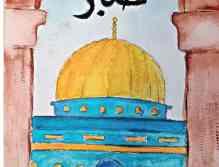
Entries featured drawings of the Dome of the Rock (incorrectly labeled as the ‘Al Aqsa Mosque’) on the Temple Mount and Palestinian flags. Others included the phrase “From the river to the sea” or maps in which Israel had been replaced by a Palestinian flag.
The complaint from the Henry Jackson Society noted that the ‘river to the sea’ slogan has been criminalised in Germany, as well as in parts of Australia, for its perceived eliminationist rhetoric towards the State of Israel.
Many Pro-Palestinian supporters say the slogan merely expresses support for Palestinian freedom.
In its complaint, HJS said: “Given the slogan’s highly inflammatory nature, we are deeply concerned that children’s artwork bearing it has been circulated by a Scoutaffiliated organisation.”
It added: “The Scouts Association has an important responsibility to ensure that all young people feel welcome and included, regardless of their background or faith.”
The Scout Association’s code of conduct states that it is politically neutral and opposes all forms of prejudice and discrimination. The art challenge was organised in partnership with Islamic Relief. Israel has designated Islamic Relief Worldwide an unlawful organisation, alleging links to Hamas. The charity has denied allegations that it supports terrorism.
In a statement to Jewish News, an Islamic Relief spokesperson said: “Islamic Relief supported a children’s activity encouraging compassion for civilians suffering in Gaza. It is not controversial for children and families to raise funds, express empathy or learn about humanitarian needs.
“We would urge commentators to use this drawing competition as a moment to reflect on the ongoing daily anguish of children in Gaza.”
A man arrested in connection with an attempted firebombing attack on a property connected to Iranian anti-regime media has admitted to arson, with sentencing to take place at the conclusion of the overall trial.
Appearing at the Old Bailey via video link from HMP Wandsworth, Oisin McGuinness, 21, of Watford, admitted to arson being reckless as to whether life was endangered, dangerous driving and possession of cocaine.
As reported by Court News UK, McGuinness, Nathan Dunn, 19, and a 16 year old boy are charged with arson with intent to endanger life. They were arrested after an incident outside the office of Volant Media, which owns the anti-regime Iran International TV station.
The prosecutor told the court that site security refused an entry request from two men, who subsequently went to the building’s rear, joined by a third person, and “produced what was determined to be a Molotov cocktail”, throwing it at the site – though it caused no damage to the actual building.
The court heard that the three males, all wearing balaclavas, then left by car. When a marked police vehicle requested the car stop soon afterwards, a 75 mph chase on 30mph roads ensued, leading to a crash, with the three accused subsequently arrested in or near the vehicle. Jerry cans and wicking were then found in the boot of the car, the court heard.
The three are due to stand trial in January.
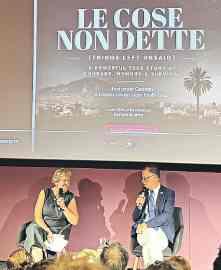
The story of Libya’s long-forgotten Jewish community has been brought to London audiences as a new documentary exploring persecution, survival and exile received its UK premiere, writes Annabel Sinclair.
Le Cose Non Dette (Things left Unsaid), directed by Italian-Libyan filmmaker Hamos Guetta, was screened at JW3 in an event organised by Harif, the UK Association of Jews from the Middle East and North Africa.
Founded in 2005, Harif works to preserve the history and heritage of Jewish communities from across the Middle East and North Africa, campaigns for recognition of Jewish refugees from Arab countries and raises awareness of communities that have largely disappeared from the region.
The 81-minute film follows the experiences of Libyan Jews under Colonel Muammar Gaddafi through the testimony of survivors and their families, focusing on
engineer Giulio Hassan and his wife Jasmine, whose lives were torn apart by imprisonment, persecution and eventual exile.
Speaking after the screening, Guetta explained that his own childhood memories of Libya inspired a lifelong search to understand the community’s history.
Reflecting on leaving Libya as a child and rebuilding life in Italy, he said: “We want to build our roots again.”
He told the audience that incomplete memories of his early years had driven him to document the stories of fellow Libyan Jews before they disappeared.
“One interview with Giulio, I did casually,” he said. “I met him in Rome… I began the point that there is a story, and I built it.”
Guetta said the film aimed not only to document individual experiences but also to help audiences understand the wider history of a community that lived in Libya for more than
2,000 years. “If you want to know the community, the story of the people and the sophisticated mentality, you have to hear also where all those come from.” The filmmaker also reflected on Britain’s place in Libyan Jewish history, describing 5 November as a date that carried both hope and tragedy.
He noted that the British victory at El Alamein in 1942 prevented plans to deport Libya’s Jews to Nazi extermination camps, but also criticised the British administration’s handling of the anti-Jewish pogrom in Tripoli on 5 November 1945. Asked whether the documentary could eventually become a feature film, Guetta said the true story itself remained the most important part of the project.
Judy Saphra, who organised the screening on behalf of Harif, said: “As Jews from Arab countries, we are doing our best to ensure our voices are heard by telling our story and sharing what we went through.”
Twelve Torah scrolls have been stolen from a synagogue near Paris in what Jewish leaders and local officials believe was a targeted antisemitic attack, writes Annabel Sinclair.
The burglary took place overnight on Sunday at the Grand Synagogue of Levallois, in the north-western suburbs of the French capital. Police have launched an investigation after two
intruders allegedly broke into the building and escaped with the scrolls. Rabbi Chalom Lellouche discovered the theft on Monday morning as he arrived to prepare for a barmitzvah celebration. He alerted the Jewish Community Protection Service (SPCJ), which searched the synagogue before contacting police.
The investigation remains ongoing, and no

arrests have been announced.
Levallois mayor Agnès Pottier-Dumas condemned the theft, saying the choice of what had been taken pointed to an antisemitic motive.
“It was with shock and anger that I learned this morning that the Jewish community of Levallois had been struck at what is most sacred and precious to it,” she said.
She added: “Whatever the motives of those who committed this sacrilegious act, which has profoundly shaken the Jewish community to its core, the antisemitic nature of this despicable crime must be denounced.” The mayor noted that the thieves appeared to have deliberately taken only Torah scrolls while leaving behind other items of greater financial value.

Archaeologists have uncovered rare charred wooden beams in Jerusalem believed to date to the Babylonian destruction of the First Temple in 586 BCE, in a discovery that researchers say could transform understanding of one of Jewish history’s defining moments, writes Annabel Sinclair.
The burnt timbers were unearthed during excavations by the Israel Antiquities Authority (IAA) and Tel Aviv University in the City of David, in the Jerusalem Walls National Park.
The discovery is considered highly unusual because well-preserved wood from the Iron Age is exceptionally rare in Israel.
Excavation director Efrat Bocher said: “The beams appear to have served as the roof of an inner courtyard in a building from the First Temple period.
:During the destruction, they collapsed onto the floor. We believe that the plaster cladding of the building’s walls, melted by the
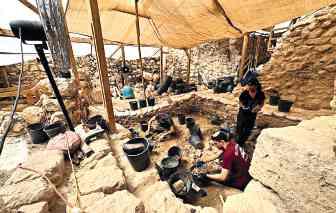
fire, covered the charred wooden beams, and ultimately enabled their exceptional preservation.”
Scientists say the find could also provide the most precise dating yet for the destruction of ancient Jerusalem.
Dr Johanna Regev, of the Israel Antiquities Authority, explained that the unusually large number
of growth rings preserved within the timber will allow researchers to date the wood with far greater accuracy than has previously been possible.
“It is very rare in Israel to find wood with such a large number of growth rings,” she said.
“Here, in the City of David, we found thick beams with
French authorities have vowed to restore a memorial connected to the wartime roundup and deportation of thousands of French Jews, after it was vandalised ahead of the country’s annual commemoration of the tragedy.
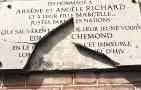
The plaque in Paris, dedicated to a couple – Arsene and Angele Richard – and their daughter Marcelle, as being Righteous Among the Nations for rescuing a thirteen year old Jewish boy, Edmond Rajchman, from the Vel d’Hiv roundup, was broken last week. The Paris police described the vandalism as “an unspeakable act” and said that “investigators are working to identify the perpetrator or perpetrators.”
The Vel d’Hiv roundup took place in July 1942, when Vichy French police arrested more than 13,000 Jewish men, women and children. 8,000 were confined to the Vélodrome d’Hiver in Paris, and subsequently deported to Auschwitz-Birkenau.
Alice Rufo, a Minister in the French government, said that “to attack the Righteous is to profane the entire universe.
“The plaque will be restored. Their memory remains intact. “
Jewish chess legend Judit Polgár has declined an invitation to become Hungary’s president, a largely ceremonial position that would have increased the visibility of one of the country’s most celebrated Jewish figures.

“I do not feel enough strength within me to take on the historic responsibility of uniting a divided nation, so I am unable to accept the request,” Polgar wrote.
Her comments came a day after Hungary’s newly elected prime minister, Peter Magyar, announced in a post on X that he planned to invite her to take the position until a new constitution takes e ect.
“Our country needs unity, peace and a president that all Hungarians can be proud of,”
Magyar wrote. “Judit Polgár’s name has been synonymous with talent and perseverance for decades.”
Magyar wrote in a subsequent post on Facebook that he respected Polgár’s decision to decline the nomination, adding that he was sorry if his “enthusiasm, born of joy and absolute trust, caused communication errors that contributed to the situation and the decision.”
Polgár, whose grandparents were Holocaust survivors and who became a grandmaster at the age of 15, at the time the youngest to attain the title, is widely considered the greatest female chess player in history. In 2019, she lit the ceremonial flame for the 15th European Maccabi Games, held in Budapest.
many rings, o ering significant research potential – with more growth rings enabling higher dating resolution. Until now, we could date finds within a range of hundreds of years. Now we can attain much greater precision, narrowing the dating range down to as little as 10 years.”
Researchers also believe Jerusalem’s returning inhabitants may have deliberately left the burnt remains untouched after the Babylonian exile as a permanent reminder of the city’s destruction.
Dr Yiftah Shalev, who codirects the excavation for the Israel Antiquities Authority alongside Professor Yuval Gadot of Tel Aviv University, said: “Preserving memory is a human need, seeking to preserve what once existed.
“Here we see it in its clearest form: a deliberate choice to leave ruins in place as a testament to the destruction and build the new layer over them.”
Friends of the Israel Defense Forces (FIDF) and Israel’s Ministry of Defence have signed an agreement to establish a new state-of-theart rehabilitation centre for IDF veterans living with moderate to severe traumatic brain injuries.
The charity has committed $10 million (£7.4 million) toward the $24 million, (nearly £18 million) project, which is expected to open by 2030.
The new centre comes as the country faces growing long-term rehabilitation needs since 7 October 2023, since which time more than 300 soldiers have sustained traumatic brain injuries. While advances in battlefield medicine have enabled more wounded soldiers to survive catastrophic injuries, many now face years of specialised rehabilitation.
FIDF chief executive Major General Nadav Padan said: “Our responsibility to Israel’s wounded veterans does not end when they leave the battlefield. Traumatic brain injuries are often described as invisible wounds because their e ects extend far beyond physical symptoms. Veterans living with severe brain injuries frequently face long-term neurological, cognitive, emotional and behavioural challenges that require sustained, specialised intervention.”
Located on Yitzhak Sadeh Street in Tel Aviv, the new 2,560-square-metre facility will replace Beit Marguza, an older rehabilitation centre established in Ja a in 1973.



GARY COHEN
n May 2022, the Church of England stood before Britain’s Jewish community and asked forgiveness – 800 years after the Synod of Oxford imposed discriminatory restrictions on England’s Jews, eventually leading to their expulsion in 1290, a service of repentance was held at Oxford’s Christ Church Cathedral.
Of course, there was no Church of England in 1222, but it accepted its inheritance of English Christianity’s long history of antiJewish theology and persecution.
Then Archbishop of Canterbury Justin Welby described the service as an opportunity to “remember, repent and rebuild”. He prayed that Christians would reject contemporary forms of anti-Judaism and antisemitism.
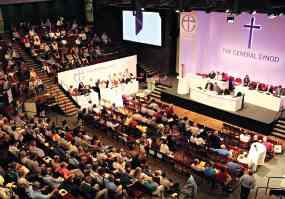
Four years later, the Church has reverted to type. On Monday 13 July, the General Synod voted overwhelmingly for a motion calling upon the Church to stand in solidarity with Palestinian Christians and to “hear” the Kairos II declarations as expressions of Palestinian lived experience.
The motion passed in all three houses – 25 bishops voted in favour. None voted against; 115 clergy supported the motion, 20 opposed it. Among the laity, 113 voted for, with 27 against.
The original motion called on the Church to “receive” the Kairos declarations. Following protests, including from Britain’s Jewish leadership, the word “receive” was replaced with “hear”. A deft display of semantic gymnastics.
The Synod was fully aware of the nature of the document. The Chief Rabbi publicly warned against it. The Board of Deputies circulated a detailed briefing setting out its antisemitic content.
The Archbishop of Canterbury acknowledged those concerns during the debate. Yet the General Synod knowingly voted to embrace a document steeped in Jew hatred. Its full title is A Moment of Truth: Faith in a Time of Genocide. It was issued in 2025 by

Kairos Palestine, an activist movement that describes itself as a Palestinian Christian ecumenical initiative. It follows the original Kairos Palestine document published in 2009.
Its authors present themselves as Palestinian Christian clergy and laypeople drawn from di erent church traditions. The Synod chose to treat its political theology as the “lived experience of Palestinian Christians”, granting one highly ideological group the authority to speak for an entire Christian community.
Kairos II declares that Palestinians are living through “genocide, ethnic cleansing and forced displacement”, all of which are highly inflammatory and contested accusations. It describes Israel’s war in Gaza as “the continuation of the Zionist project to seize all of Palestine, emptied of its Palestinian people”. It calls Zionism a system of apartheid, settler colonialism and arrogant Jewish supremacy. The description could have been written by Hamas itself.
The document does not attack Israeli government policy. The target is Zionism and the very existence of the Jewish state. The national movement of the Jewish people is presented not as a response to centuries of persecution, statelessness and mass murder, and the return of an indigenous people to its historical homeland, but as an inherently racist colonial enterprise.
Kairos II maintains that the massacre and atrocities of 7 October were “born out of decades of injustice, oppression and displacement”. It invokes “the right of a people under occupation to resist their occupier and oppressor”. It adds that this context “does not justify the killing or capture of civilians or war crimes”. An all too familiar approach: pay lip service to the mass slaughter of Jews, then explain why its victims brought it upon themselves.
The document calls upon churches to pressure governments to isolate Israel, impose sanctions, boycott it and ban arms exports. It calls for legal action against Israeli leaders and
demands reparations for what it calls genocide, the Nakba and settler colonialism. It calls upon churches to distinguish between “dialogue with Jews and dialogue with Zionism”, to “boycott dialogue with Zionist voices” it accuses of supporting “occupation, apartheid and the genocide of the Palestinian people”. Instead, it calls upon churches to amplify what it describes as “prophetic Jewish voices” that confront Zionism. Bottom line, Jews can participate in Christian-Jewish dialogue, provided they reject Zionism and renounce their support for a Jewish state. Except 90 per cent of British Jews support Israel’s right to exist as a Jewish state. In other words, they are Zionists. So, the Church of England is happy to embrace a document that excludes 90 per cent of Jews in the UK.
That is the opposite of interfaith engagement. The elimination of Israel is not stated in crude language, but through theology, euphemism and the language of liberation. In the briefing the Board of Deputies provided to Synod members, the Board made a distinction the Church was apparently determined to avoid. Criticism of Israeli policy is not antisemitic, but erasing Jewish history, denying Jewish indigeneity and treating Jewish national self-determination as uniquely illegitimate, is blatantly antisemitic. It warned that the document
Thank you for helping to make Jewish News the leading source of news and opinion for the UK Jewish community. Unlike other Jewish media, we do not charge for content. That won’t change. Because we are charity-owned and free, we rely on advertising to cover our costs. This vital lifeline, which has dropped in recent years, has fallen further due to coronavirus.
Today we’re asking for your invaluable help to continue putting our community first in everything we do. For as little as £5 a month you can help sustain the vital work we do in celebrating and standing up for Jewish life in Britain.
Jewish News holds our community together and keeps us connected. Like a synagogue, it’s where people turn to feel part of something bigger. It also proudly shows the rest of Britain the vibrancy and rich culture of modern Jewish life.
You can make a quick and easy one-off or monthly contribution of £5, £10, £20 or any other sum you’re comfortable with. 100% of your donation will help us continue celebrating our community, in all its dynamic diversity.
Support Jewish News by visiting our donor page at jewishnews.co.uk
essentially creates a divide between Jews the Church considered morally acceptable – the small minority – and those whose voices should be excluded, the majority. The Synod voted for the motion anyway.
This is not an isolated failure. The Church of England has form.
Christians are being persecuted for their faith across large parts of the Muslim world. Islamic terrorist organisations slaughter Christians in Nigeria. Christian converts are imprisoned in Iran. Pakistan’s blasphemy laws are used to terrorise Christians and other religious minorities. Ancient Christian communities in Iraq, Syria, Egypt and elsewhere in the Middle East and Africa have been devastated. In response, the Church of England passes empty motions of condemnation, but nothing tangible.
Against Israel, it campaigns. It calls for boycotts and divestment. Its bishops demand sanctions and trade embargoes. Its Synod promotes activist programmes and now votes to embrace engagement with a document calling for Israel’s isolation, punishment and ultimate dismantling as a Jewish state.
This is the height of hypocrisy, disingenuity, and cowardice. In short, it’s a disgrace.
The Church’s 2022 apology was supposed to mark a rejection of the Christian belief that the Church had the right to define Judaism for Jews. Apparently, that contrition had an expiry date.
The Church of England will condemn antisemitism in principle while legitimising and embracing it in practice.
A declining institution desperate for relevance, it appears to believe its salvation lies in the modern, socially acceptable version of the oldest hatred, for which it apologised just four years ago.
The Church of England is finding its way back to Jew hatred. And with no small irony, it believes that this time it is on the right side of history. One wonders when the next apology will be forthcoming.








largely moved online and one of my greatest challenges was learning how to build trust through computer screens rather than across meeting tables. Yet despite those circumstances, relations between Israel and the United Kingdom were flourishing.
Last week I concluded five years of service in the United Kingdom on behalf of the State of Israel, including as an acting ambassador for the last year. It is a moment for reflection, both personally and professionally.
When my family and I arrived in London in the summer of 2021, we thought we were beginning another diplomatic assignment. Looking back, these five years became something rather more significant.
Our daughters arrived barely able to speak English; they leave as confident young Londoners. Britain shaped an important chapter of our family life, just as it shaped my professional one. For that, and for the friendships and generosity we encountered along the way, we will always be grateful.
Professionally, I arrived during the

As political counsellor, I had the privilege of helping negotiate the Bilateral Roadmap to 2030, elevating our relationship to a Strategic Partnership. Ministerial visits resumed, cooperation expanded and there was genuine optimism about the future. It looked like a Golden Era of our relations.
I thought Covid would define my posting. I was wrong. The optimism of those early years gradually gave way to an entirely di erent mission: defending Israel’s legitimacy, its right to protect its citizens, and at times, its very right to exist. Diplomats often believe they are responsible for every rise and fall in bilateral relations. But history is often larger than diplomacy.
There are moments when events overtake every carefully prepared strategy, leaving diplomats, like everyone else, to respond rather than shape events. Such was the reality after
7 October 2023. The Hamas massacre fundamentally changed the course of my posting.
For Israelis, it was not simply another round of violence but a national trauma. Families were murdered in their homes, young people massacred at a music festival and children, women and men were taken hostage into Gaza. It was the deadliest day for the Jewish people since the Holocaust, shattering long-held assumptions about security.
Professionally, it transformed my role. Diplomacy had always been about patiently building relationships. After 7 October, I learned that it can also involve managing their deterioration while preserving the foundations needed to rebuild them in the future.
Defending Israel became a daily responsibility under circumstances none of us had imagined. Those experiences changed me, not only as a diplomat but as a person.
The attacks also exposed something deeply troubling within Britain. Israel became increasingly politicised, turning from a matter of foreign policy into an issue of domestic political contest.
The alarming rise in antisemitism after 7
October did not emerge from nowhere. Hamas did not create antisemitism; it emboldened those who had long concealed it. This is a lesson Britain cannot a ord to ignore.
Every government has a duty to protect all its citizens. No British Jew should feel compelled to hide a Star of David, avoid speaking Hebrew in public or question whether their child is safe at school or university because they are Jewish.
Israel stands with the Jewish community of the UK. For many, these di cult years have felt like a return to the antisemitism of old, the very hatred in response to which the State of Israel was established. We stand beside you in unwavering solidarity.
I wish for this remarkable country to flourish despite the challenges ahead, and my hope is that the next chapter of our bilateral relationship will once again be defined by advancing the innovation, security, prosperity and friendship that have long united our two nations.
Until then you will have the resolute, dedicated team at the embassy, who will continue to fight the good fight and hold the values of our beloved one and only Jewish state.



















New York City Mayor Zohran Mamdani has dominated headlines after pledging to arrest Benjamin Netanyahu should he visit New York for the United Nations General Assembly in September.
The comments were inflammatory and dangerous. But they were also legally meaningless. The far more serious warning came from across the Atlantic.
London Mayor Sadiq Khan labelled Netanyahu “a perpetrator of genocide” and said he would urge the British government to arrest the Israeli prime minister should he visit the United Kingdom. Unlike the United States, the UK is a founding member of the International Criminal Court and a State Party to the Rome Statute. That makes Khan’s comments far more consequential than Mamdani’s political theatre.
Mamdani and his team have mastered the art of commanding headlines. Every
statement, social media video and campaign pledge seems carefully calibrated to dominate the news cycle.
His latest proposal, however, unraveled almost immediately. A mayor whose responsibilities centre on municipal services and public safety cannot arrest a democratically elected foreign head of government enjoying diplomatic protections while attending an international gathering of 193 world leaders, including dozens of dictators and authoritarians who somehow escaped Mamdani’s selective moral scrutiny. That does not mean his rhetoric is harmless.
Words from the leader of one of the world’s greatest cities carry enormous weight. In today’s digital age, political statements ricochet across social media within seconds, often inflaming passions long before facts catch up.
Only days after Mamdani’s callous remarks, an observant Jew and an Asian man were stabbed in Manhattan’s Upper West Side by a crazed assailant who allegedly shouted “Allahu Akbar.” The NYPD classified the attack on the Jewish victim as a hate crime.

Legally, however, Mamdani’s pledge was always empty. The United States has never ratified the Rome Statute and does not recognise the jurisdiction of the ICC. As the US Department of Justice has long maintained, “a treaty cannot bind a nonconsenting country.” Accordingly, the ICC has no jurisdiction over Americans – or Israelis – and any attempt to exercise such authority is unlawful and an a ront to American sovereignty.
The ICC warrant itself also rests on increasingly shaky foundations. It was issued by former chief prosecutor Karim Khan just days before allegations of sexual misconduct against him became public.
Earlier this week, ICC member states voted overwhelmingly to remove Khan from o ce following his suspension.
One might have expected the backlash to Mamdani’s remarks to discourage other political leaders from embracing similar rhetoric.
Instead, Khan has chosen to follow the same script. Words from the leader of one of the world’s greatest cities carry enormous weight. In today’s digital age, political statements rico-
chet across social media within seconds.
The timing makes his comments all the more disturbing. Only days earlier, Khan visited London’s Nova Music Festival exhibition and urged visitors to remember “the horrors of that awful day” on October 7. Yet within a week he insisted he should be arrested if he visits Britain. “As a perpetrator of genocide,” Khan said, “I think he’s broken the law. And I think justice needs to happen, and that means him being brought to book.”
Unlike Mamdani’s remarks, these comments carry genuine diplomatic significance. Britain is legally bound by the Rome Statute and has long presented itself as a champion of the international legal order.
When the mayor of one of the world’s leading capitals publicly calls for the arrest of the democratically elected leader of a close ally, it lends credibility to an ICC process that many legal experts and democratic governments have questioned. Mamdani’s comments generated headlines. Sadiq Khan’s could shape policy. That is why London, not just New York, should be where the real alarm bells are ringing.

















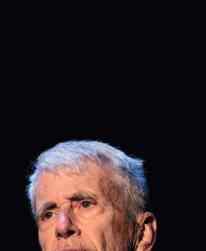
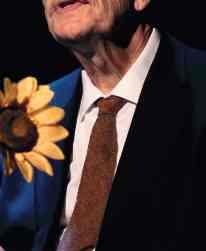


DANIEL SUGARMAN
DEPUTY EDITOR, JEWISH NEWS
Idon’t quite know how to say this, but it has happened again. A van has rammed into a group of people in Berlin, killing one person and injuring 17. Neighbours of the vehicle described it as polite and studious, mostly keeping to its garage, and driving from point A to point B without complaint when necessary. A former friend from driving school described it as quiet and reserved, and expressed astonishment that it would carry out such an attack. If this sounds like the plot of a Pixar movie dreamed up by someone o their face on fentanyl, I don’t blame you. But somehow, every time a terrorist decides to drive three tons of moving metal into a crowd, to murder and maim, a variety of publications see fit to deny the human agency of the person responsible, and focus on the machine used to carry out the attack.

This does not happen in other circumstances. When an Islamist screeches the takbīr as he brandishes a blade in a busy city square, papers do not lead on “Knife Stabs 16 in episode of butchery”. When a Neo-Nazi guns down schoolchildren in their classrooms with an AR-15, 14-word hate slogans gouged into its metal facets, the subsequent headlines do not read “Automatic Rifle fires 30 bullets, causing multiple casualties”. Only car rammings receive this sort of semipassive descriptor.
“A car plowed through a park during Berlin’s biggest LGBTQ Pride event, killing at least one person and injuring more than a dozen others”, ran a tweet from one of America’s most prominent newspapers. Another outlet went with “Berlin pride attack the latest in a decade of deadly German car-rammings”, making it sound like Mercedes, BMW and Audi models, radicalised after reading back issues of Auto Express, had globalised the inticarda
So what is the reason for this automobile exceptionalism? Many point to the fact that many, though not all, such attacks appear to
be carried out by Islamists – from Jerusalem to London to Stockholm to Barcelona to New Orleans. They posit that describing such attacks as carried out by cars is a way to avoid discussing a truth that is uncomfortable to those with liberal sensibilities.
I think that is likely to be true – it is painful to see the attempts that some people decided to go to in order to avoid naming the ideology behind the latest attack – attempts that they would correctly never make were the perpetrator to have been far right in his ideology. It surely can only be a matter of time until one of our most navel-gazing politicians – and it’s an indictment of our politics that I can think of three dozen who would fit the bill – looks at the pattern of ramming attacks in Western countries –considers the common denominator in most of them and reaches what to them will be the logical conclusion – banning vehicles from city centres.
But the truth is that vehicle attacks have become a key method of terror attack within the last few decades, and for simple reasons – cars or trucks are far easier to access than
most weapons, and no particular plan is needed beyond a desire to hurt those whom you view as your enemy. This has been seen repeatedly in Israel, which has experienced many such attacks over the last quarter of a century. And yet, too many news reports seem to neglect this 21st-century reality in favour of a vague descriptor focused on an object rather than its operator.
Perhaps the day will indeed come when an AI general assistant, radicalised by reading Anders Breivik’s manifesto or the verbal vomiting of Sayid Qutb, will hack into Waymo’s control systems, leading to such attacks where there is no human behind the wheel. But until then – and I would argue, even at that point – it is incumbent upon publications, including this one, to ensure that they do not fall into that trap, however well-meaning the impulse is to do so.
If we ignore ideologies behind such attacks, they do not disappear; they repeat themselves and people become deeply resentful at what they view as a reluctance to acknowledge reality. The victims of such attacks deserve more than that.
Thank you to our now former prime minister for pledging £250m to protect Britain’s Jews. I’m sorry to add a “but”, but simply building ever higher walls around our community risks creating a ghetto.
We want a Britain where those walls aren’t needed. Where attackers are punished under the law. Most of all, we want them to be deterred in the first place.
The deterrent lies upstream of policing: a sane, healthily irreverent British culture in which inciteful ideology is marginalised, not mainstreamed. Political extremists are not to be appeased but satirised.
The loss of that shared culture allows anti-Jewish racism to be indulged, alongside other dogmas about identity, race, gender and history.
Look what happens to British policing when Britain’s sanity filter goes AWOL. Last year, West Midlands Police was so ready to accept an absurd Islamist conspiracy theory about Maccabi Tel Aviv fans, that evidence was fabricated to support it. In Southampton, o cers handcu ed the wrong man, Henry Nowak, as he lay dying; the man who stabbed
him had told the police that Nowak had racially abused him – a complete lie.
How bizarre is all of this? Our civic institutions have lost confidence in the primacy of Britain’s cultural norms. As Dame Sara Khan recently observed, this has torn up Britain’s social contract.
We uncovered the nub of it while delivering anti-Jewish racism training for West Midlands Police – commissioned by the impressive new acting chief, Scott Green.
O cers repeatedly told our team that incidents regarded by the Jewish community as incitement often fell below the criminal threshold. Yet they understood the cumulative impact of so many ‘sub-threshold incidents’: a culture that produces the murder of Jews at Heaton Park and stabbings in Golders Green. Even ‘having a quiet word’ has become hard for a police o cer. The atmosphere is so febrile, so un-British.
How do we fix it? By bringing the country’s unwritten house rules back to the surface.
In a recent survey carried out for Fish & Chips – my new non-profit dedicated to the recipe of a Britishness for all – we found clear agreement about what those house rules are: common sense, fair play, politeness, respectful disagreement, pub banter, taking the mickey.
Satirising the swivel-eyed, the po-faced and the preachy. This is the soft culture that has successfully cohered all British citizens – immigrants very much included – and in so doing, gives us the confidence to reject extremism, be it from the far right or far left.
So imagine spending £250m celebrating that Britishness instead. Could it persuade young people to walk away from destructive ideologies, by giving them something life-a rming to walk towards? It won’t directly get them onto the property ladder, but it might revive other British virtues, highlighted in the survey, that will make it likely: hard work, resilience, wanting to get on in life.
It all depends on strengthening two cultural forces. The first is rational: Critical Thinking. When I ran the National Holocaust Museum, we made it central to our educational policy, because democracy depends on
facts, intellectual curiosity and debate. We should re-teach it to those who teach. Largely, they appear to have swapped it for identity politics.
The second is emotional. Behavioural science tells us humans are driven by social sway and use logic to post-rationalise it. In what may come as shocking news, those humans include police o cers, judges and policy makers. The sway we need is an inclusive Britishness that provides a shared instinct for moderation and resilience against fanatical ideology.
Rebuilding that culture won’t be easy. Is it too late? Well, in the sweep of British history, from Magna Carta to Only Fools and Horses, today’s culture wars are a brief interruption. So don’t be a plonker, Rodney. The policy makers will listen once we, the silent majority, find our voice. When we insist on the civilising virtues of queuing, self-deprecation and the urge to take the mickey out of un-British dogmas.
If we restate these house rules, and narrate them likeably, we can ensure the civic norms the majority of British citizens want to live in peace by – including the Jewish ones.
Let’s build a positive British narrative that coheres us. Not walls which separate and ghetto-ise us.
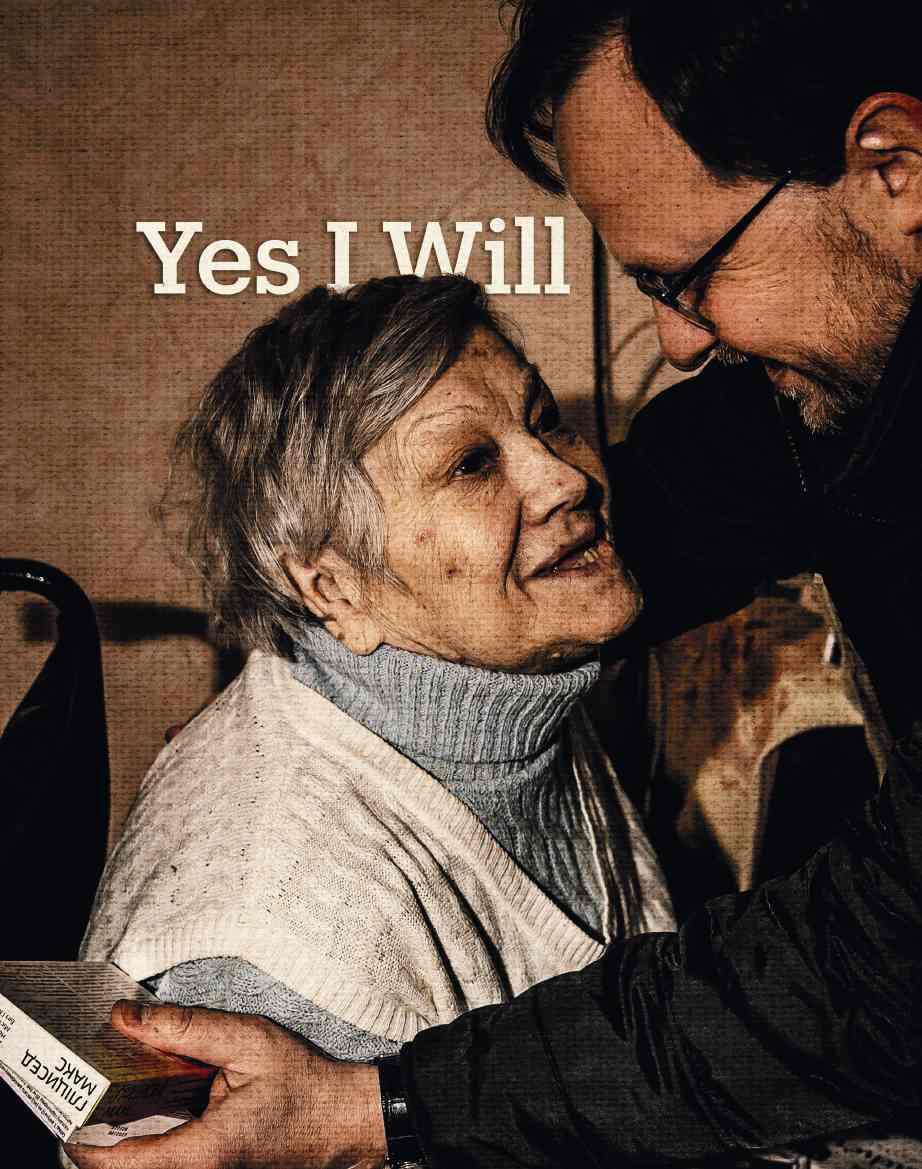

A record 530 young Jewish post-A-level students from 25 different schools across the UK descended on Budapest on 17 July for Aish UK’s fourth annual Shabbat. In just four years, the event has grown from a small trial into a firm fixture of the postschool interrailing calendar. Organiser Rabbi Rafi Stemmer said: “At a time when antisemitism has caused many young Jews to question or hide their Jewish identity, this weekend gave students the strength to live proudly as Jews, to reconnect to our global mission of lighting up the world.” The event included candles on Friday night, Shabbat kiddush at the Kazinczy shul, and a walking tour of Jewish Budapest.
Chief Rabbi Ephraim Mirvis joined more than 50 friends of Jewish Deaf Association member Miriam during celebrations to mark her 100th birthday, for a special event honouring her remarkable life. Miriam also received a card from His Majesty the King for her birthday on 7 July. The following day, JDA hosted a celebration at its Finchley centre to recognise her extraordinary 75year membership of the charity, having joined on the day JDA first opened its doors in 1951. Before he left, Miriam taught the Chief Rabbi how to sign “Happy Birthday” in British Sign Language.
The London School of Jewish Studies celebrated the achievements of 65 students at its annual graduation ceremony, attended by around 250 family members, friends and supporters at Hampstead Garden Suburb Synagogue. Graduates from LSJS’s BA and MA programmes in Jewish Education, together with its teacher training programmes, were recognised for their academic achievements and their commitment to shaping the future of Jewish education. Among those attending the ceremony were the Chief Rabbi Ephraim Mirvis, Rabbi Dr Raphael Zarum, Clare Harnden, deputy chief executive at South Farnham Educational Trust and adviser to the Department for Education, and Emma Hollis, head of the National Association of School Based Teacher Trainers.
The inaugural Young Jami Jewish Care (YJJC) Law Breakfast on 15 July raised vital funds for Jami, Jewish Care’s mental health service. Guests enjoyed a morning of networking, breakfast and discussion as they heard from Adam Rose, partner at Mishcon de Reya. Held at the offices of international firm Trowers & Hamlins in the City of London, the event brought together lawyers, trainees and other professionals from across the legal sector while supporting Jami’s essential work helping people whose mental illness, distress or trauma can make everyday life a struggle. Rose shared reflections on his distinguished legal career, including his work supporting British-connected hostage families.
5 SACKS MORASHA HOSTS SACKS AWARDS CEREMONY North Finchley Jewish Orthodox primary school Sacks Morasha welcomed Lady Sacks as guest of honour at their recent Sacks Awards ceremony for Year Six pupils. Launched in November 2025, the scheme champions Jewish values in honour of the late Chief Rabbi Lord Sacks. Gideon Reston, the school’s Head of Kodesh and award creator, said: “Some children may excel in volunteering and community service; others may shine through developing new skills or undertaking personal challenges and expeditions. What matters is that
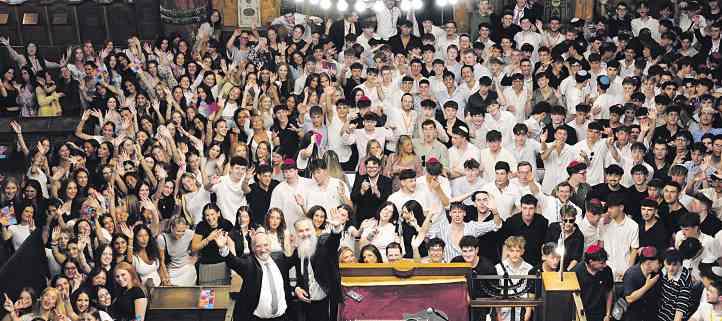
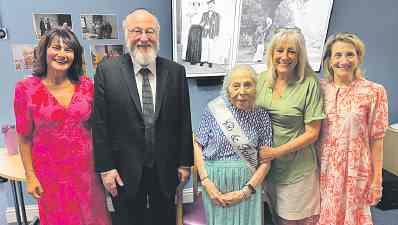

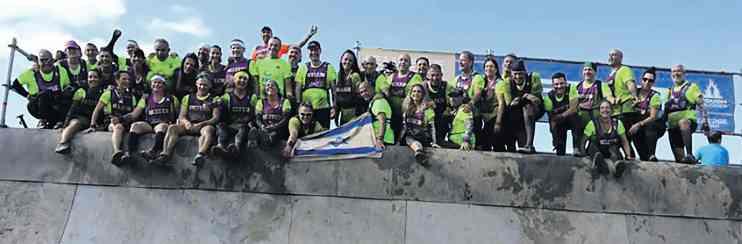
every child finds meaningful ways to provide evidence of their journey – whether through helping at home, leading tefillah in school, participating in lunchtime clubs, taking on leadership responsibilities, or documenting a family experience with a Jewish connection.”
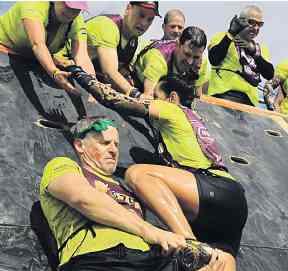

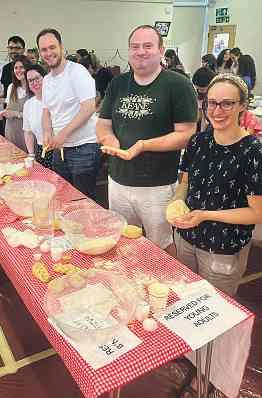
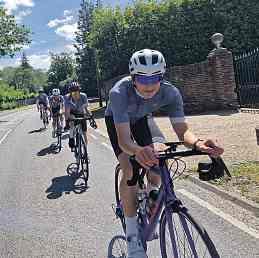
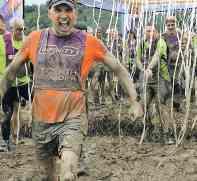
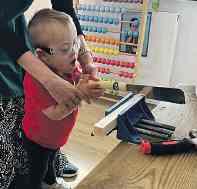
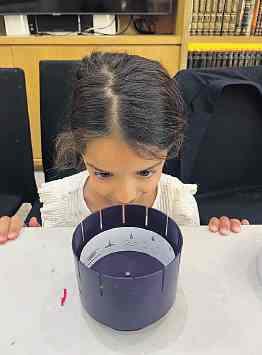

After months of training, a group of 45 Israeli senior executives flew to the UK for the 21km-long and 30 obstacle-strong “Tough Mudder Infinity” course challenge on Saturday, 4 July. In the past year the team has raised over $1.2m and over the last 11 years the team has raised more than $8m for purpose-built sterile educational and rehabilitation Kindergartens called the “Kindergartens of Dreams”, for young Israel children battling cancer, an initiative of the “Larger than Life” association. There are currently centres in Ramat Gan and Beer Sheva, with a third planned for Jerusalem and after that others in Israel’s north. Team member and father of three Avichai Knafo said: “The goal for which this wonderful team operates burns in my bones. After we found out that my son, Itay, had cancer, I realized how necessary the Kindergarten of Dreams is for families and children.”
7 VICTORIAN TOYS AT WEST HAMPSTEAD
An excited group of ten young children from Chabad in West Hampstead took part in an hour-long Victorian toy workshop with Emily Ben-Ze’ev from Emily’s Adventures in Wonderland. They made optical toys called ‘thaumotropes’ and played with pre-film animation devices ‘Zoetropes’ as well as marbles, Jacks, yo-yos, kaleidoscopes, cup and balls and hobby horses.
8 KISHARON LANGDON ROLLS OUT WOODWORK PROJECT
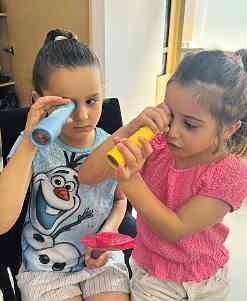
Kisharon Langdon is celebrating the success of an innovative woodwork project at its Tuffkid Nursery in northwest London for young children, including those with special educational needs and disabilities. To bring parents into the learning experience, the project, championing links between home and education, included an expert-led webinar, hands-on woodwork workshops and video observations of children’s learning. One participant said: “Seeing my child using tools safely and independently completely changed my perspective. It showed me how capable they are and how adaptable woodwork can be for every child.”
Barnet Shul welcomed 85 people of all ages for a challah bake on Wednesday 8th July, hosted by Rebbetzen Miri Lister. The evening brought together both seasoned bakers and those making challah for the first time, with two dedicated tables for the children and families taking part in the shul’s Bnei Mitzvah Programme and members of the Young Adults group. At the end of the session, everyone took their handmade challah to bake in their own kitchens at home, having celebrated Jewish tradition, friendship and community spirit.
10 HAND IN HAND TEENS RAISE OVER £45,000
On Sunday 5 July, 72 teenage boys aged 13-18 took on an ambitious bike ride challenge, raising £45,000 to support vulnerable Jewish children and families as part of Hand in Hand’s annual campaign. Participants chose between 65km, 85km and 120km routes, cycling in small groups with the support of 15 adult riders, 13 volunteer marshals and five support drivers. One rider said: “That ride was awesome! Every step of the way we were looked after, and the BBQ was amazing. I can’t wait to do it again next year.”
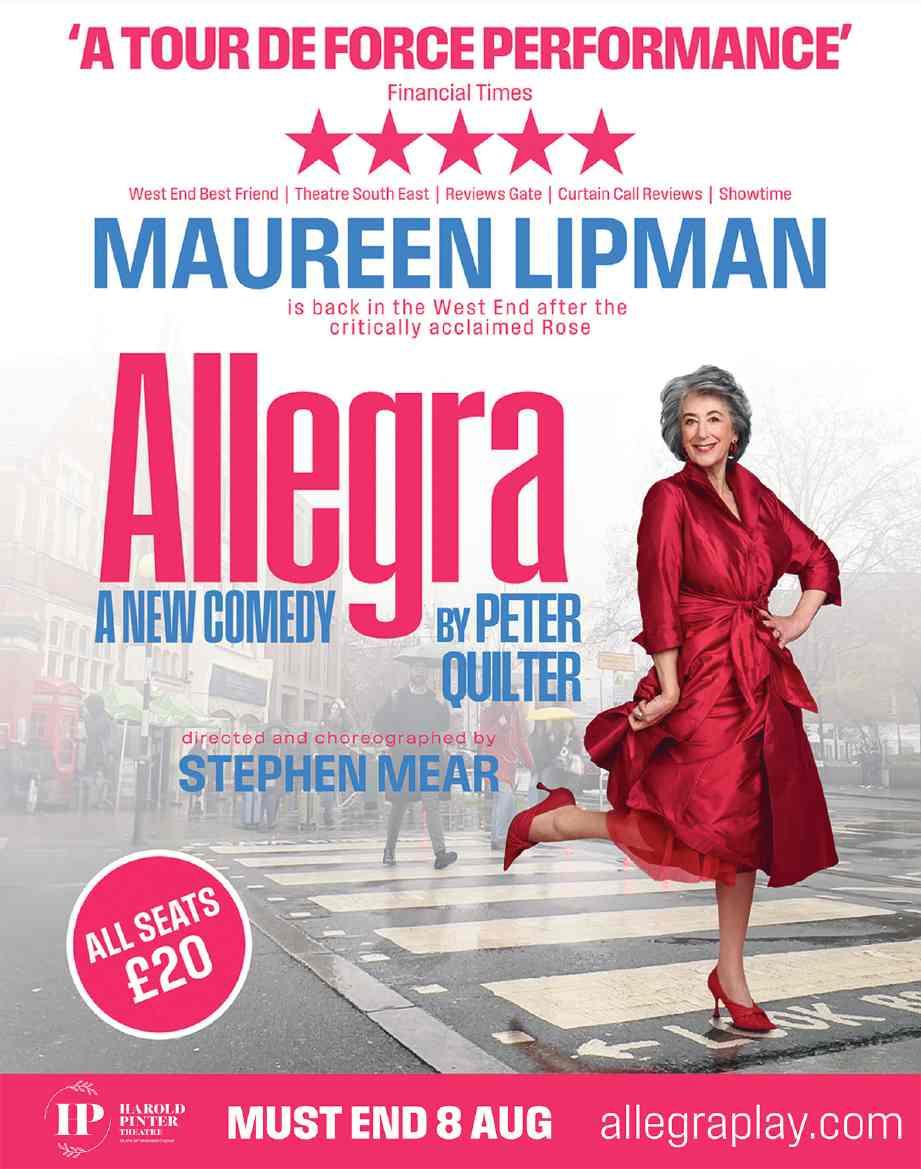
In a stately Hertfordshire house, Jewish refugees listened in on Germany’s top generals to help change the course of the Second World War. By Anthea Gerrie
Dozens of German generals imprisoned in the unlikely fivestar splendour of an English stately home were blithely unaware that their every conversation was being recorded. Beneath them, an army of Jewish refugees listened in as tongues were loosened by fine food and wine, passing the Nazis’ after-dinner secrets to British Intelligence.
You couldn’t make up this audacious sting, which shortened World War II by years and helped secure an Allied victory. Especially the part about the generals being not only being hosted at a level that raised Churchill’s eyebrows but taken on excursions to Simpsons in the Strand and other bastions of London high life. Yet this is the remarkable true story of Trent Park House, the former home of Sir Philip Sassoon, the Jewish socialite who did his bit for the war effort as an MP and Under-Secretary of State for Air but never lived to see how his Enfield home would do even more after his death.
Now, for the first time, this exquisite country pile has opened to the public as Trent Park House of Secrets – one of Britain’s most fascinating museums. It is a tale of two halves. A multi-million-pound investment has restored the grand public rooms, along with much of the furniture, artwork, lamps and 18th-century treasures that made the house Sassoon inherited from his parents in 1912 his home until his death in 1939. But it is an Upstairs, Downstairs story, because what happened in the basement after Sassoon died and the house was
requisitioned by the War Department is every bit as compelling as the spectacular salons where aristocracy and giants of the political and entertainment worlds once partied.
One feature which is not original is the secret door concealed within one of Sir Philip’s library bookcases at the end of the vast run of state rooms. Beyond it, in what was once the MP’s bedroom and later became a military office, is a spectacular model of the house, showing where the generals – 84 of them, along with another 22 German POW officers – slept, dined and caroused in gardens where even the trees, rose bushes and benches were bugged, as were the lighting fixtures, walls, skirting boards and even the billiards table inside the house.
The extraordinarily detailed surveillance operation was masterminded by Lt Col Thomas Kendrick but it was Captain Catherine Townshend who set it up, recruiting dozens of Jewish refugees – the most readily available source of German-speaking volunteers willing to spy on the enemy intent on destroying their families. In the new museum, two of those listeners tell their stories in their own words, while comedienne Helen Lederer, a trustee of the Trent Park Museum Trust, narrates the experiences of her grandfather Ernst.
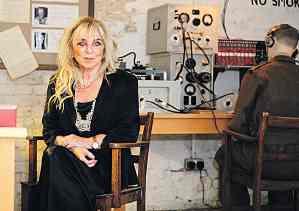
Museum director Dr Giuseppe Albano adds fascinating detail not found on the information panels as he leads me into the cavernous wine cellar once used by Sassoon to entertain everyone who was anyone in pre-war Britain, from Noël Coward and Charlie Chaplin to the Royal Family. Princesses Elizabeth and Margaret even came to play before they reached drinking age.
“The prisoners were also served fine wine with their meals, as it was thought it would loosen their lips,” says Dr Albano, explaining that Churchill raised his eyebrows at the cost of hosting POWs on
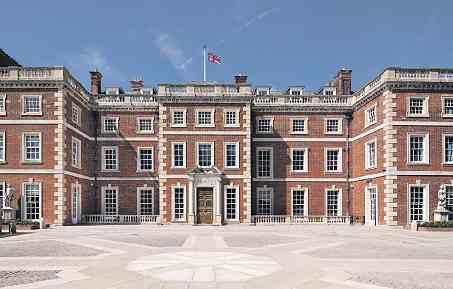
such a lavish scale.
They were further lulled by excursions outside the house –a move that beggars belief given they were locked up every night.
“They were so sure Hitler was going to win the war that they were relaxed and enjoying themselves, convinced their captors would soon become their captives,” he says.
There was even a fake aristocrat installed to play mine host. The so-called Lord Aberfaldy was actually Ian Munroe, a former bank clerk with amateur acting credentials. It was all part of the elaborate deception, as was the presence of Ernst Lederer, who mingled affably with the officers when not secretly listening to their conversations below stairs. The Germans had no idea the friendly old soldier was actually a Czech-Jewish refugee.
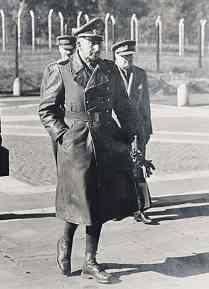
The intelligence gathered was extraordinary. It enabled Britain to bomb the factory where the prisoners revealed V2 rockets were being developed, uncover how the Wehrmacht communicated and, distressingly for the Jewish listeners in the basement, exposed officers’ knowledge of the concentration camps and the atrocities being committed within them.
If it seems shameful that British intelligence failed to pass details of these conversations to the Nuremberg prosecutors, historian Dr Helen Fry, who spent 25 years researching the operation for her book The Walls Have Ears, says the silence was justified.
“An even more dangerous Cold War had started, and British intelligence thought they might one day need to listen in to the Russians.”
Almost as fascinating as the wartime drama is the mystery of how the contents of Trent Park House survived for nearly 90 years after Sassoon’s death. The answer lies with relatives who owned even grander houses. Sassoon left most of his furniture and possessions to his sister Sybil, who married the Marquess of Cholmondeley. Their grandson is now chairman of the Trust that has restored the house and created the new museum.
“They had enough room to keep everything at Houghton Hall, their base in Norfolk,” says Dr Albano, describing what must surely rank as Britain’s grandest storage facility.
If you’ve reached online saturation when it comes to finding love, it might be time to explore other options, writes Debbie Collins
Dancing under a full moon wearing a white dress might seem like a drastic way to attract the attention of men, but historically this was one of the rituals of Tu B’Av, which we celebrated earlier this month – the start of the grape harvest and Judaism’s answer to Valentine’s Day.
Denise Phillips, founder of Date on a Plate, swaps out white dresses for white table linen, o ering a chance for people to meet at a dinner party – “far less pressure than a date in the wild”, she says.
This year, cookery writer and teacher Denise is celebrating a quarter century of hosting these intimate evenings. It’s a winning recipe: six men and six women cooking a kosher gourmet three-course meal together in the comfort of Denise’s Northwood home.
“I’m always on hand to ‘drop breadcrumbs’ and keep the conversation flowing beyond stilted ‘yes and no’ answers,” she says.
For those unable to travel to Northwood, Denise hosts a virtual version with breakout rooms in which to meet each person.
There have been many successful pairings. Lauren and Laurence Shenker met at DOAP six years ago and are now married and have a little girl called Mia. They explain: “We’ve been able to share wonderful travelling adventures, the perfect wedding and now we have our beautiful daughter.”
Jack Raymond says: “I loved learning to cook at DOAP while meeting new people but there was always something preventing me from committing. Then Sophia came along…” Sophia and Jack got married in 2023.
Anyone looking to book a single family member onto an event will receive a signed
Miriam ‘Mimi’ Kelaty in northwest London. I will admit that I went with an ‘I’ll stay for 20 minutes’ attitude.

After losing her husband and facing the challenge of raising three young children alone, Denise drew strength from combining her passions for cooking and matchmaking and DOAP was born.
Every guest is handpicked by Denise from a database of applicants ranging from 25-70, with dinners organised in 10-year age brackets.
After cooking and chatting, the guests are relaxed, and Denise seats them strategically for the meal – male/female, rotating the men during the evening, a chance to meet every lady.
If
From an email flyer Mimi circulates to the Jewish community far and wide, I noted it was free entry (just “bring a bottle”), with a very carefully vetted registration process and security on the door. This is her home, after all.
Mimi’s gatherings draw a crowd each time of between 150 and 200 people, focusing on di erent age groups.

Once past security and through to the garden, I was met with a fullystaged simcha. Beautifully laid tables on the lawn, topped with candles and floral centrepieces, plus delicious hors d’oeuvres being o ered to guests on arrival and a Mediterranean feast of Sephardi proportions, all catered for personally by Mimi.
Resplendent in a beautiful white dress, she explained why she hosts these gatherings with no financial gain. “I do it for the community,” she says. “This is my fourth gathering and because there’s no charge I think people feel relaxed, wanted, important. I have many messages afterwards from people saying how glad they are that they came. I’m not in this for the accolade. I just want to bring single people together with the help of my community. We have to pray for each other – that’s number one for me.”
Lisa launched Modern Day Matchmaking (MDM) last September, after experiencing the dating world themselves – set ups, blind dates, marriage (twice). Both holding down day jobs, they take time to get to know each applicant from their growing database, before making matches. “This isn’t a business. It’s about helping people find connections and meet new people through intentional matches,” says Lisa. Find out more on Instagram @MDM_matchmakingagency


came up with the idea due to concerns about the commubecause they couldn’t find
Chabad is revolutionising the way Jewish singles meet. Met @ Chabad is an app, but with a di erence – the focus is not on dating endlessly and meeting more people but on meeting the right person. New York-based Dassi Gansburg and Rabbi Beryl Frankel at Chabad Young Professionals International Network came up with the idea due to concerns about the community choosing to marry out because they couldn’t find anyone Jewish they wanted to marry and have kids with. Aimed at people aged 22-60, there is a strict vetting process with a Chabad rabbi before arranging small online speed dating sessions. “We personally reach out after dates, ensuring people are accountable about following up,” reassures Dassi. The numbers are certainly growing, with more than 20,000 expected at their online event on 9 August.
arranging small online speed reach out after dates, ensuring
numbers are certainly growing, with their online event on 9 August.
For a more traditional matchmaking service, north-London-based friends and







The part of the foot we forget
The 2026 World Cup has passed into history. Goals have been replayed, disappointments analysed and attention will turn to the next competition. Yet Parshat Eikev o ers a striking way of understanding what we witnessed.
The word eikev means ‘heel’. Rashi explains that it alludes to the commandments that people tend to tread upon with their heels – the small, easily neglected acts that seem less important than the great moments of religious life.
Football, too, is played with the foot. Yet when we think of football, we think of the spectacular: the perfect strike, the decisive penalty, the player lifting the trophy. We rarely think
of the heel. It is not glamorous. It does not usually score the goal. But without it, there is no balance, no movement and no ability to stand.
That is the Torah’s message. A life is not built only through its headline moments. It is built through the quiet disciplines that hold everything else together: keeping one’s word, showing gratitude, making time for prayer, speaking kindly when irritation would be easier, and doing what is right when no one is watching.
A football tournament may appear to be decided in a single moment, but that moment rests upon thousands of unseen hours: training sessions, repeated drills, sacrifices and small improvements.
The final kick does not create the player. It reveals the person who has been formed long before.
So too in Judaism. We often wait for inspiration, for a great spiritual experience, for the moment that will change us. Parshat Eikev tells us that transformation begins lower down, at the heel, with the duties we are tempted to overlook.
The World Cup eventually becomes history. Victories fade, defeats soften and new heroes emerge. What remains is the character formed along the way.
The Torah asks us not merely how we perform when the stadium is full, but how we live when no one is applauding. Greatness begins not with the trophy held above the head, but with the heel planted firmly on the ground.



BECCA FETTERMAN DIRECTOR OF YOUTH, THE MOVEMENT FOR PROGRESSIVE JUDAISM
Youth movements matter more than ever this summer
Being involved in a Jewish youth movement was the best thing I have ever done (don’t tell my husband).
From the age of 16, as an RSY-Netzer youth worker, I was already responsible for educating other children. I had to think about what I wanted them to learn and what I thought they should be questioning. When I was 21, I ran a camp with my best friend. We spent a lot of time working out how to create a community for 100-plus teenagers and how to inspire them.
In doing this, I took ownership of my Judaism in a way that I hadn’t done anywhere else in my life. By the time I got to university, I had already learned how to build community, lead services and really thought through my personal beliefs. These are just some of the gifts that growing up in a peer-led ideological youth movement gave me. At every interview
and throughout every job I have had, I have drawn on these experiences and responsibilities, but most importantly I am still best friends with all my camp crew.
Now, as an adult, having the opportunity to support youth movements once again is an absolute privilege. I see how tough life is for young people, with growing mental health needs and the pressures of social media. I also see how the school and university holidays can leave many without the routine, connection and sense of belonging they need.
This is why youth movements matter more than ever. Summer camp o ers two weeks away from social media in a welcoming environment designed to build self-esteem and community, where participants can talk openly and respectfully about the di cult things in life.
It is a powerful thing when young people
A stimulating series where our progressive rabbis consider Judaism in the face of 21stcentury issues
show us how to accept di erent opinions, have respectful conversations across di erences and challenge prejudice that wasn’t understood when I was a child.
Camps are a safe Jewish space where young people can feel relaxed to be openly and proudly Jewish. They are infused with Jewish education, prayer services and Shabbat activities. They inspire a curiosity and pride in Judaism. And of course, youth movements now, as always, are leading the community in Tikkun Olam – making the world a better place.
During the past year, two participants in youth movements embodied this pride and the value of youth empowerment through their actions.
A child in foster care planned and ran a session for every age group on LJY-Netzer’s summer camp to raise awareness of the foster care system. Another young person led a national campaign and petition to have antisemitism education included in the curriculum of all schools, appearing on the national news to highlight the issue.
These are just two recent examples of the incredible things that our youth community achieves. Camp has given them the confidence, knowledge, inspiration and sense of empowerment to take those values into the wider world. It is moments like these that inspire me to keep doing my job.

Suits from £79.50
Overcoats from £79.50
SUITS NOW FROM £69
SHORTS £20 EACH, 2 PAIRS FOR £30
10 Golders Green Road London NW11 8LL Opposite Cafe Nero
ROUSERS £20 EACH, 2 P T AIRS FOR £30, 28-48 INCH WAIST
SPORTS JACKETS AND BLAZERS FROM £39.50
CASUAL JACKETS FROM £29.50
KNITWEAR FROM £10 S
SHIRTS FROM £10
SHOES FROM £10
Open everyday & Sundays til 5:00pm
Raincoats from £49.50 We accept
POLO SHIRTS £15 EACH, 2 FOR £20











Top prices paid
Antique – Reproduction – Retro Furniture (any condition)
Epstein, Archie Shine, Hille, G Plan, etc.
Dining Suites, Lounges Suites, Bookcases, Desks, Cabinets, Mirrors, Lights, etc.
House clearances
Single items to complete homes
ANTIQUES - 8 CHURCH STREET NW8
07866 614 744 (ANYTIME) 0207 723 7415 (SHOP)


Furs, Jewellery, Old Costume Jewellery, Watches, Silver, Designer Bags, anything vintage. 01277 352560
Friendly Family Company established for 30 years
We clear houses, flats, sheds, garages etc. No job too big or too small! Rubbish cleared as part of a full clearance. We have a waste licence. We buy items including furniture bric a brac.
For a free quote please phone Dave on 07913405315 any time.


Confidential Bereavement Counselling for adults and children individually. Support Groups available. We offer in person, online and telephone counselling. Contact Jewish Bereavement Counselling Service in confidence. 0208 951 3881 enquiries@jbcs.org.uk | www.jbcs.org.uk
















































Project Lily is all about improving the Jewish community’s wellbeing. Why? Because wellbeing is inextricably linked to physical and mental health. We’re encouraging people to give their wellbeing a hug with good self-care.
For each day of August, we’ve suggested a self-care idea that’s really quick and simple.
Look out for one of our free Awesome August Hug! booklets in shops and papers.
Can’t find one? Just email us at info@projectlily.org.uk and we’ll send you a free PDF copy.
This August, give your wellbeing a hug - one small act of self-care at a time.
