
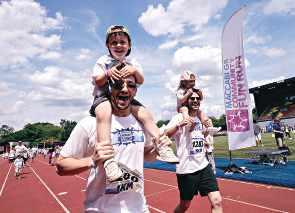
On your Maccs, get set... go !

Your diabetes wake-up call


DIABETES AWARENESS




Exclusive stats reveal scale of hidden Jewish health
Jewish people living with diabetes need better access to expert advice and greater support across Jewish communal life, according to a new survey published this week highlighting growing concern about the condition within the community, writes Annabel Sinclair.
Nearly three-quarters of respondents said more diabetes information and support is needed, with many pointing to the challenges of managing the condition at communal events and during Jewish festivals.
The findings come as Jewish Blind and Disabled (JBD) and Jewish News conclude
a month-long diabetes awareness campaign launched after research revealed that one in six British Jews over the age of 65 is living with diabetes – more than double the rate seen in the wider population.
Of the 111 people who have responded to the survey so far, 45 percent said they are living with Type 2 diabetes and a further 17 percent said they are pre-diabetic, meaning almost twothirds are directly a ected by the condition.
Family history also emerged as a significant theme. Nearly three in 10 respondents said a parent has Type 2 diabetes, while others reported grandparents and siblings living with the condition.
Asked whether there was a need for more local support and information around diabetes, 47 percent said “yes, definitely”, while a further 25 percent said “possibly”. More than six in 10 respondents said new community initiatives would be beneficial.
The survey revealed strong demand for practical guidance on preventing and managing diabetes, with respondents expressing particular interest in medical talks, healthy eating advice and lifestyle support.
Many also highlighted the role that communal life can play in supporting people living with the condition. One respondent wrote: “Why do our kiddushim and other Jewish


crisis
meetings not cater for diabetic attendees? Why do our shuls seem to lay on too many sweets and other tempting things, even for children?”
Another called for more discussion around “How communal spaces can support people with diabetes”, while a third highlighted “there seems to be a need for advice on how to cope over the Jewish holidays”. Accessibility and healthcare support were also themes.
Some respondents said diabetes information can be di cult to understand, particularly for people with learning disabilities or those newly diagnosed. Others felt support after diagnosis was inconsistent. One respondent wrote: Continued on page 3
Burnham feted by Labour’s grandees
Veteran Jewish Labour figures Jon Lansman and Baroness Margaret Hodge have become the latest prominent members of the party to voice their support for Andy Burnham, who is widely expected to become the next prime minister, writes Lee Harpin.
Speaking to Jewish News, Jon Lansman – a prominent figure on Labour’s left and once closely associated with Jeremy Corbyn before speaking out about antisemitism in the party – explained why he became a key supporter of Burnham during the latter’s push to return to Westminster politics last year.
He now praises Burnham’s ability to connect with Manchester’s sizable Jewish community during his tenure as mayor, as well as his success in winning over working-class voters in this month’s by-election.
“Andy Burnham is starting o in a good place in terms of relations with the Jewish community,” Lansman said. “His experience dealing with the community in Manchester –and the terrible attacks on Jews there – will be vital.
“He’s a better communicator, and Manchester is home to the second-largest Jewish community in the country. I have family there.
“I see no reason why he shouldn’t be able to reach the Jewish community across the country. He starts from a good place thanks to his Manchester experience.”
Lansman said that while he had been “open-minded” about a Starmer-led party at first, he ultimately felt the former lawyer lacked both political experience and clarity of message.
On foreign policy, Lansman added: “I’m not clear what Starmer’s position actually was. I know he had a distinctive desire – mainly in response to the antisemitism under Corbyn – to support Israel. But what does supporting Israel mean?”
Lansman, founder of Momentum and supporter of the progressive Jewish and Palestinian Standing Together grassroots group, said Burnham would also soon need to clarify his own position on the Middle East.
He said: “I think it would be alright if he left Israel-Palestine issues alone for a little while, but he is going to have to address foreign policy eventually. Obviously, domestic policy is the most urgent.
“As far as Israel, of course that gets more complicated. It’s not clear to me what Burnham thinks about Netanyahu and the current Israeli government.
“I would be very surprised if he
is not hostile to Ben Gvir, Smotrich and others.
I assume he is supportive of two states and a peace process that could lead to that outcome. That’s where I think he is.
“But I know that’s not where Israeli politics is – although I live in hope.”
In another sign of Burnham’s broad support from across the Labour Party, veteran Jewish peer Baroness Margaret Hodge also revealed she had been impressed by Burnham. “Andy’s been around for a long time,” she said. “He was an MP, he served as a cabinet minister in three di erent departments, and he has run a major city.
“I think he’s got an immense amount of experience.”
Hodge, formerly the Jewish Labour Movement’s parliamentary chair, added: “People have seen, from his work in Manchester and the Makerfield by-election, that he
has a real sense of empathy and can relate to people.”
Hodge also rejected the argument that Burnham should face a leadership contest to better test his policy ideas.
She told Channel 4 News: “I’ve thought about this, and on the whole, I think it’s better that we have a very quick process and decide on the leader of the Labour Party without delay.
“And let me tell you why: we’re in government, and it’s vital that we get on with the business of governing.”
Jewish Labour peer Luciana Berger also emerged as a vocal supporter (see panel, right).
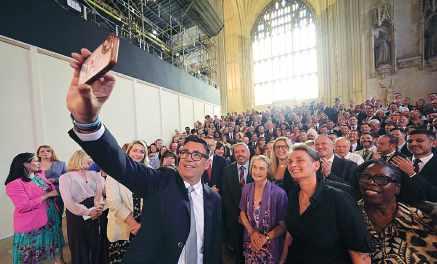
Burnham joined numerous Labour MPs and peers for a welcome photograph in Westminster Hall, standing in front of his colleagues on the stone stairs of the medieval hall.
He received a warm round of applause and was accompanied by deputy Labour leader Lucy Powell and Jessica Morden, chair of the Parliamentary Labour Party.
Senior ministers present included Chancellor Rachel Reeves, Energy Secretary Ed Miliband, and Chief Whip Jonathan Reynolds.
Former leadership rival Wes Streeting, who recently pledged his support for Burnham’s campaign, also attended, as did former defence minister Al Carns, who has previously indicated he might challenge for the leadership in the event of a contest.
Other prominent Labour figures in attendance included Angela Rayner, the former deputy prime minister.
BERGER IN SUPPORT OF BURNHAM
Jewish Labour peer Luciana Berger emerged as a vocal supporter of new Makerfield MP
Andy Burnham as he returned to Westminster.
She praised Burnham’s “very significant record as a politician both locally and nationally on several fronts”. Berger, who served as MP for Liverpool Wavertree before being made a peer by Keir Starmer in December 2024, reflected on her experience working alongside Burnham when both were members of Jeremy Corbyn’s shadow team.
“I’ve seen him up close and personal on the work he does,” Berger told Sky News. “I witnessed the relationships he built with Hillsborough families, and the impact he had in driving meaningful change.”
She also credited Burnham with delivering “real tangible changes” as Greater Manchester mayor, particularly regarding the NHS.
She said: “The fact that people are coalescing around this is indicative of the hope he brings and the vision he has set out in his campaign.”
Berger also reflected on Starmer’s legacy as Prime Minister, noting that he had made the party “safe” again for her to return after the challenges of rampant antisemitism under Corbyn.
However, she suggested that “politics is in a very di erent place” than when Starmer was elected in 2024, and stressed the need for “urgency” and “compassion” to deliver the change the country now needs.
Labour sources note that Berger has sometimes taken positions at odds with party peers on key issues.
Starmer rescued Labour’s relations with Jews

BY REBECCA FILER JLM NATIONAL SECRETARY
Back in 2020, when Sir Keir Starmer was elected as leader of the Labour Party, taking over from Jeremy Corbyn, the party had suffered one of its worst electoral defeats – partly due to the antisemitism crisis that had taken root and Corbyn’s inability to solve it.
The party that Keir Starmer inherited from Corbyn is a far cry from the one that it is today.
When I began as JLM staff in 2019, the BBC’s Panorama documentary into Labour antisemitism had aired, the Equality and Human Rights Commission had begun its investigation into the Labour Party, and Jews in the UK faced an existential choice at the ballot box in December of that year at the general election.
The Jewish community felt isolated and ignored by the o cial opposition and many of our members had resigned from the Labour Party. The country took notice of the turmoil and rejected Corbyn’s Labour.
When Keir Starmer became leader, the challenge in front of him was immense. Labour had a mountain to climb in order to return to government. And one of those challenges was the scourge of antisemitism that had infected our party. Keir recognised this as a moral challenge, a mission that he took seriously, using his first speech as leader to apologise to the Jewish community.
What came next was hard graft and real leadership. Keir talked about zero-tolerance for antisemitism and meant it. The Labour Party’s complaints process, which had been totally ine ective and misused, was reformed.
Comprehensive training on antisemitism
from JLM was brought in for Parliamentarians, sta , councillors and members. Antisemites were kicked out and local parties were given clear guidance about what was and wasn’t appropriate discussions.
Proper vetting procedures for candidates were introduced. Jewish members who had left returned – including Luciana Berger and Louise Ellman. This was wholesale reform that tackled the problem from the grassroots of the Labour Party to the very top.
It took time to rebuild the trust that was lost, but Jewish voters returned to Labour at the 2024 general election, with seats like Finchley & Golders Green, Hendon and Chipping Barnet changing hands. Looking back on the 2019 general election, JLM had scaled back campaigning to a minimum of seats where we wanted our Jewish MPs and allies to hold their constituencies.
In 2024, we had the joy of campaigning
around the country and seeing many of our members return to the doorstep once more.
At a time when the Jewish community in the UK has never felt more vulnerable, Keir Starmer and his Government has taken vital steps to tackle antisemitism.
Increasing funding for CST, setting out reforms to our policing, policies to tackle antisemitism in the NHS and the education sector, steps to deal with foreign state actors and a comprehensive social cohesion strategy.
The next prime minister will inherit these foundations. The Labour Party the new leader will take charge of is one that did not come about by chance. It took Keir Starmer’s zerotolerance policy, leadership and commitment to rid it of antisemitism.
The Jewish Labour Movement will hold to account all candidates who put themselves forward to ensure the Party does not go backwards. We owe Keir Starmer our thanks.
Selfie improvement? Burnham takes a picture with fellow Labour MPs
Luciana Berger
BMA endorses motion to redefine ‘antisemitism’
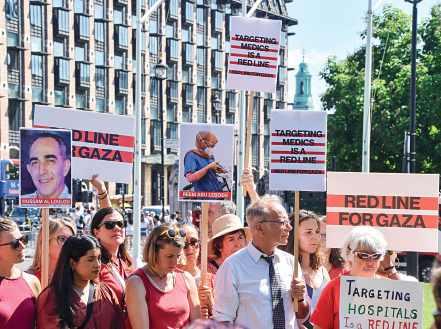
The British Medical Association has endorsed a motion e ectively rejecting the International Holocaust Remembrance Alliance definition of antisemitism, claiming it has had a “chilling e ect on legitimate political speech and professional expression of ethical concerns about Israel’s actions in Palestine”, writes Daniel Sugarman.
The motion, which was voted on by the conference on Tuesday, also included a “demand that NHS England and all NHS organisations conduct comprehensive risk assessments before implementing any speech-related policies”, as well as exhorting the organisation to “provide urgent guidance and support to members who face disciplinary action or professional detriment for expressing legitimate political view or ethical concerns about international conflicts, including Palestine/Israel”.
It also required the BMA, which
serves as a trade union for doctors and medical students, to “lobby the government and NHS England
to revoke the mandatory adoption of the IHRA definition across the NHS until proper safeguards, con-
Revealing the hidden diabetes health crisis
Continued from page 1
“When first diagnosed, I was provided with zero advice from the NHS (I was even using insulin incorrectly) and took several years before I saw an appropriate community nurse who guided me. Most of my information was gleaned from the internet.”
Concerns about the long-term consequences of diabetes also featured prominently, with respondents highlighting issues including sight loss, kidney disease and foot health.
Lisa Wimborne, chief executive of JBD, said: “These findings clearly highlight the growing need to better support people in our community who are living with, or at risk of, Type 2 diabetes.
“Respondents want clearer information, practical guidance and community-based support that reflects the modern realities of Jewish life.
Jewish leaders have expressed their solidarity with the Muslim community after a series of attacks across Edinburgh on Friday evening, describing the confrontations as “a stark reminder of the damage that prejudice and extremism can inflict” on communities.
The attacks, which took place on Friday evening over the course of an hour, began with two men being stabbed at 20:30 after leaving prayers at the city’s Broomfield Park Mosque. 45 minutes later, further to the north of the Scottish capital, other incidents followed, including the vandalising of a taxi at a petrol
“The survey is still open, and we would strongly encourage more people to take part so that we can build a fuller picture and ensure any future support truly meets the needs of our community.
“We will carefully review the results and explore how we can develop new services and initiatives that help people better manage their health and reduce the risk of diabetesrelated disability and sight loss.”
Rabbi Charley Baginksy and Rabbi Josh Levy, co-chief executives of Progressive Judaism, said: “We are proud to stand behind a campaign that encourages people to seek advice earlier, talk more openly and know that their community is beside them.”
Take part in the survey (until 30 June) at www.surveyhero.com/c/ apabx7uc apabx7uc
station and a man causing disruption at a supermarket connected to another petrol station nearby. The police subsequently made an arrest after three people were attacked on Leith Walk.
Timothy Lovat, chair of the Jewish Council of Scotland said the organisation was “deeply troubled by the violent attacks”, adding: “Our solidarity is with everyone a ected and with the wider Muslim community. Hatred directed at any community has no place in Scotland. We will not let acts like these define who we are.”

sultation processes, and clarity on implementation are established”.
Earlier this month, a review published by Lord Mann, the government’s independent advisor on antisemitism, found “routine ostracism” of Jewish sta and patients within the NHS.
His report noted that NHS England has formally adopted the IHRA definition, with he described as “the most prominent international standard of anti-Jewish racism”.
NHS England, he said, had also written to trusts asking that they also consider adopting it and that last year other Department of Health and Social Care executive agencies and arm’s length bodies had adopted it after being asked to by Wes Streeting, then the Secretary of State for Health and Social Care.
A number of doctors have lost their jobs and been reported to the


General Medical Council (GMC) and the Medical Practitioner Tribunal Service (MPTS) over the last few years due to a wide variety of comments about “Jewish supremacy” and conspiracy theories about Jews and Zionists in general.
The motion did not mention any specific doctors or cite any particular cases.
The motion also called on the BMA to “advocate for the protection of free speech in healthcare settings, ensuring that NHS sta can engage in legitimate political discourse and express ethical concerns without fear of professional reprisal”, and to work with other healthcare unions and professional bodies to challenge any attempts to use the IHRA definition to suppress legitimate debate about human rights violations, war crimes, or colonial practices in international conflicts”.

The BMA says the International Holocaust Remembrance Alliance definition conflicts with ‘legitimate political speech’
Keir Starmer and the Jewish complex relationship in a
Welcomed as a corrective to the dark days of Corbyn’s Labour Party, the prime minister leaves a complicated legacy, writes Lee Harpin
Departing Prime Minister Keir Starmer’s relationship with the UK’s Jewish community has been complex and, at times, difficult to assess.
This mirrored his increasingly fraught relationship with the wider UK electorate, yet was complicated further by his response to Israel and the war against Hamas in Gaza.
When Starmer became Labour leader in 2020, Jewish communal leaders welcomed him as a fresh start after years of turmoil under previous party leader Jeremy Corbyn.
In a joint statement shortly after his election, Board of Deputies then-president Marie van der Zyl, Jewish Leadership Council chair Jonathan Goldstein, Community Security Trust chair Gerald Ronson, and Jewish Labour Movement thenchair Mike Katz praised him: “Keir Starmer has already achieved in four days more than his predecessor in four years in addressing antisemitism within the Labour party.”
Starmer followed through, adopting the IHRA definition of antisemitism, suspending or expelling members and repeatedly stating his commitment.
In 2022, he told Jewish leaders: “When I became leader, my first promise was to rip out antisemitism from our party by its roots. I’m proud to say we’ve made huge strides in doing so.” JLC chair Keith Black noted “strong progress” and “strong action to match the strong words”.
Starmer’s personal link to the community was also clear through his wife, Victoria, whose father Bernard is from a Polish-Jewish family.
The couple raised their children with a strong sense of Jewish heritage, occasionally observing Shabbat Friday-night dinners and attending a Liberal synagogue.
Starmer has acknowledged conversations with Victoria and family helped shape his understanding of antisemitism, giving him a more personal perspective on the issue that had plagued Labour.
When a Labour Party annual conference clashed with the Jewish high holidays, Victoria joined other Jewish Labour colleagues in attending Rosh Hashanah services at shul in Liverpool.
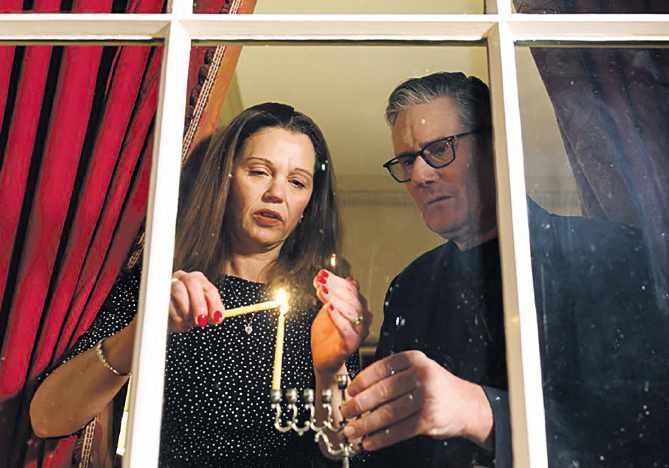
A memorable moment of Starmer’s engagement with the Jewish community came in December 2025, when he hosted a Chanukah celebration at Downing Street.
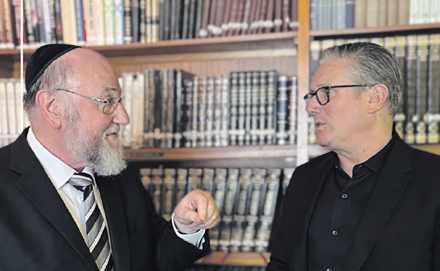
Starmer and the Chief Rabbi took part in the candle-lighting ceremony during the event, which was held in the wake of a major terror attack on a Jewish community in Sydney.
The prime minister openly praised Mirvis for “providing counsel” to him.
The July 2024 election results confirmed because of Starmer’s pledge to rid Labour of the stain of antisemitism that had flourished under Corbyn, some Jewish voters –though not all – felt confident enough to cast their votes for Labour again.
However, complications were always likely as long as Israel’s war in Gaza continued to result in the deaths of innocent Palestinians, hostages remained cruelly captured by Hamas terrorists and the continued impact of the horrific 7 October massacre understandably dragged a significant section of British Jews into an ultradefensive, pro-Israel stance.
Starmer’s early strong support for Israel’s right to defend itself after
the 7 Octobers attacks drew approval from many Jewish leaders, who valued his firm stance against Hamas and his efforts to combat rising antisemitism linked to the conflict.
But tensions emerged as the Gaza war dragged on. Starmer faced criticism for shifting toward calls for ceasefire and greater aid access.
Board of Deputies leaders, while often aligned with him on antisemitism, expressed concerns over aspects of his Middle East policy, with some communal figures warning distancing from Israel could carry risks.
Throughout his time in Downing Street, Starmer repeatedly found the UK’s national interest diverged from Israeli government positions.
On Gaza, he moved earlier than Israel wanted by calling for a ceasefire and ultimately recognising Palestinian statehood, arguing this served Britain’s long-term diplomatic goals in the Middle East.
Similarly, during the Israel-Iran war, Starmer made it clear the UK would not be drawn into direct conflict, stating: “This is not our war.”
He prioritised protecting British energy security, keeping the Strait of
Hormuz open and avoiding deeper entanglement – even when it meant declining requests from allies and drawing criticism from parts of the Jewish community who felt he was not supportive enough of Israel.
The biggest flashpoint came in September 2025 when Starmer announced the UK’s formal recognition of a Palestinian state, saying the move was “to revive the hope of peace and a two-state solution”.
The decision triggered sharp
backlash from major Jewish organisations. The Board of Deputies said there would be “deep dismay” across the community, arguing it rewarded Hamas and reduced pressure on them while hostages remained captive.
Chief Rabbi Mirvis strongly criticised the move, stating: “Our government has announced its intention to recognise a Palestinian State – even if terrorists remain in power and hostages remain captive in tunnels.
“This can only disincentivise Hamas from agreeing to a ceasefire. It therefore fundamentally undermines the cause of peace and security for Palestinians and Israelis alike.”
However, a smaller group of UK Jews, undoubtedly connected to the mainstream community, welcomed the decision.
A joint statement by Progressive Judaism co-leaders Rabbi Charlie Baginsky and Rabbi Josh Levy tried to hold both sides of the community’s pain, saying: “This moment is painful.”
They added: “With the trauma of October 7 still so raw, and the plight of the hostages an open wound, recognition feels like a reward for violence or a diminishment of their suffering… Terror must never be rewarded…
“At the same time, there are those who, through their pain, will welcome the principle of recognition: as a statement that peace must remain possible, and that the two-state solution remains the only sustainable path to peace, security and dignity for two peoples whose futures are bound together. As Jews we can hold these two voices at once.”
The Starmers lighting Chanukah candles in Downing Street
Keir Starmer in conversation with Chief Rabbi Ephraim Mirvis
Jewish community: time of turmoil
Starmer faced further scrutiny over his government’s handling of antisemitic terror attacks targeting the Jewish community in 2025 and 2026, including a deadly assault on a synagogue in Manchester.
Some Jewish leaders criticised the response as too slow and insu cient, arguing the attacks should have been foreseen given the sharp rise in incidents since October 2023.
Despite being critical of Starmer’s stance on Israel, Chief Rabbi Mirvis was often quick to praise the PM for his determination to tackle antisemitism at home, including his visit to Kenton United Synagogue in the days after it faced an arson attack.
Mirvis said: “Isn’t it really so encouraging that our prime minister came to a synagogue today?
“He spent one hour and twenty minutes here, more than his
schedule allowed, at a time in which we all know he is very preoccupied with many major issues.
“It’s a statement that our government wants to be seen to care, and places the security and well-being of our community as a priority.”
Starmer also faced pressure from community leaders to take a much tougher stance on pro-Palestine marches. However, as a former human rights lawyer, he stressed the need to balance security with civil liberties, which led to criticism from some in the Jewish community who felt his response was too cautious and failed to protect them adequately from repeated intimidation.
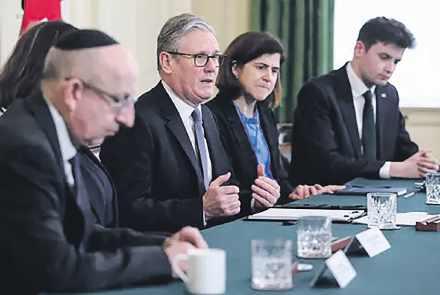
There was also praise for the PM’s decision to convene a high-profile summit at Downing Street in May, bringing together police, universities, businesses and community leaders
to tackle antisemitism, at which Starmer described rising antisemitism as “a crisis for all of us” and said every part of society had a responsibility to confront it.
Board of Deputies Phil Rosenberg said: “When he took on the leadership of the Labour Party the first thing Keir Starmer said he would do is ‘tear out the poison of antisemitism by its roots’. His subsequent actions were transformative within the party.”
During his time as Labour leader, Starmer also made himself regularly available to Jewish media outlets.
He gave frequent interviews to Jewish News and took part in several one-to-one conversations with other Jewish journalists.
Starmer’s likely successor, Andy Burnham, has an early track record of support for Israel – he was a member of Labour Friends of Israel and once
said Israel would be his first overseas visit as leader.
However, there are now fears in parts of the Jewish community that he could become even more critical of Israel than Starmer.
Burnham called for a Gaza ceasefire in late October 2023, months before Starmer shifted position, and he backed recognition of a Palestinian state in June 2025, well before the government’s move.
On other issues around Palestine, some fear he will be dragged further toward a more pro-Palestine position under pressure from the Left.
One Jewish Labour source even suggested communal leaders in
the north-west of the country had “regularly held Andy Burnham to lower standards than they have Keir Starmer, which is disappointing”.
However, communal figures who have praised Burnham’s relationship with the Manchester Jewish community dispute this claim of double standards.
As Starmer confirmed his resignation on Monday, the Board’s Rosenberg added in a post on X: “When the next prime minister comes to o ce, we at the Board of Deputies will continue to advocate for our community, press for a society free of hatred and prejudice, and a world of more security and peace. ”












UJS president Louis Danker (right) meets prime minister Sir Keir Starmer at the Downing Street Antisemitism Summit in May
Special Report / The Greens
Taking on the Green menace from within
A new group within the Greens is seeking to take on the antisemitism that threatens to engulf the party. DanielSugarman meets one of its members
In April 2024, a group of longstanding Jewish members of the Green Party, including former and current councillors, submitted a dossier to the leadership, outlining significant concerns relating to the movement’s direction of political travel.
The dossier noted concerning statements and actions by prominent Green Party politicians. It also highlighted an apparent shift in party policy in language and statements about Israel which contradicted the party’s own rules.
“There is grave concern that the GPEW [Green Party of England and Wales] is going in a direction that is no longer balanced and is resonating with people who really aren’t Green. This is leading to the feeling that, with growing evidence of newer members with problematic views about Jews, the GPEW is becoming an unsafe place for Jews,” the document concluded.
The dossier was sent on to a variety of senior people within the Green Party. While the compilers received a few responses, there was no discernible action taken.
Elise Benjamin was one of those who had compiled the document and put her name to it. She is currently working on a new report of Green Party candidates at the recent local election found to have made antisemitic comments on social media. Many of these have been sent to her by fellow Green Party members who are horrified by what they have seen.
How many? I ask. “Over 40.”
Last year, the direction of the party became undeniable. Its wild swing to the far-left, alongside a sharp rise in membership, had led to a surge in antisemitism.
In response, a group of Green Party members, Jewish and nonJewish, came together. They have since formed a new organisation, Greens Against Antisemitism.
It is not the same group as “Jewish Greens”, an official affiliate. Benjamin used to be on the Jewish Greens steering committee, but is no longer involved.
GAA has already submitted various complaints to the party over the conduct of certain members, whom it is believed have clearly and repeatedly breached party rules.
The group believes chances are high such members will therefore be subject to sanction, including suspension and possible expulsion.
Some such individuals, though far from all, are part of the recent wave of joiners – the Green’s membership has trebled in the past year,
now numbering approximately 230,000. The party’s leadership, including leader Zack Polanski, regularly points to that membership surge as evidence of its close identification with the zeitgeist but seem far less keen on identifying or addressing the problems caused.
The problems, however, are obvious. For example, while vetting at a membership level is something which few, if any political parties possess, the Greens fielded candidates at the local elections who had in some cases joined the party only weeks previously.
“We used to be very hot on
this,” Benjamin says. “We generally would not have candidates unless they had been members for a while.” Vetting “clearly didn’t happen everywhere”.
It’s not just about antisemitism. A firm owned by one candidate, for example, was fined for environmental vandalism after illegally burning waste to save money.
The party has a heavily decentralised officer structure with most staff working remotely, and its complaints process relies on volunteers. A party disciplinary panel does not sit other than on days that nominated members of a panel are available, which in practice can be difficult to organise.
There is another process, however – an emergency one, which involves members of the Greens’ national council.
“They can suspend and can expel, but obviously they need to be very, very clear on their grounds, because the party doesn’t want to face legal action”, she says.
It was this type of suspension or expulsion which Greens’ deputy leader Mothin Ali took exception to when he addressed a “Greens for Palestine” meeting.
As reported by The Times , he encouraged legal action against his own party over dismissal of local election candidates accused
of antisemitism, saying “what we need to do is we need to get some serious legal advice. We need to make sure that we are putting the party on notice straight away, and we need to start with some class action. Because it won’t be the end. They’re coming after more and more people.”
As pointed out in the original dossier, in the wake of 7 October 2023, Mothin Ali said “indigenous people have the right to fight back” and called for an end to “white supremacist European settler colonialism”. He subsequently claimed he had not been referring to Hamas’s actions, but to principles “enshrined in international law”.
Later in 2023, Ali said in a TikTok video that Rabbi Zechariah Deutsch, who was based in Leeds but who had answered an IDF callup as a reservist post-7 October, “went from England to Israel to kill women and children”.
The chaplain was subjected to an extended campaign of harassment in which his life and the lives of his family were threatened repeatedly; ultimately driving him into hiding. After Ali was elected deputy leader of the Greens, Deutsch said: “A man who wants to be a public figure should not incite division and cause harm.” When asked about this last year, Ali said: “I think anyone
who participates in a genocide is a danger and should be investigated by the police.”
The dossier also described Ali’s actions in connection to the 2024 Rochdale by-election, when the Labour candidate, Azhar Ali, was found to have told a meeting Israel had allowed the 7 October 2023 attack in order to “green light” its invasion of Gaza. Labour disassociated itself from Azhar Ali.
Per the dossier, Mothin Ali published a video about the byelection in which “he refers to Labour taking several days to take action against their candidate and that they only took action after the ‘Zionist lobby’ became involved.”
No action was taken. A year and a half later, Mothin Ali became codeputy leader of the party.
But Benjamin and others are determined to stay and fight. As she says “If there’s a bully at your school, it’s not for you to leave, it’s to try and get them to leave”.
Another key flashpoint is likely to be the party’s autumn conference. At its last conference, a group attempted to bring a motion equating Zionism with racism but the conference ran out of time
There is every indication it will re-submitted for the gathering in Brighton in early October, where it will be higher on the agenda.
Benjamin describes how a group of Jewish and non-Jewish members had “sent an email to the chief executive of the party and to the elected chair of the national executive, just before the conference, “outlining every single breach of policy” in the motion: “We’re still waiting for the promised detailed response.”
Despite everything, she thinks there is still hope.
“We are getting lots of people contact us,” she says
“It’s becoming increasingly obvious that lots of ordinary members who’ve been around a long time are uncomfortable with the direction of the party on this. Some are beginning to speak out.
“I’m seeing a trend, not just within the Greens, of younger people in their early to mid 20s who clearly don’t like the way that discussions around Israel-Palestine have turned into antisemitism. That’s a really good sign.”
Greens leader Zack Polanski with co-deputy leaders Mothin Ali and Rachel Millward
Elise Benjamin










Video struck from Oz nurses case
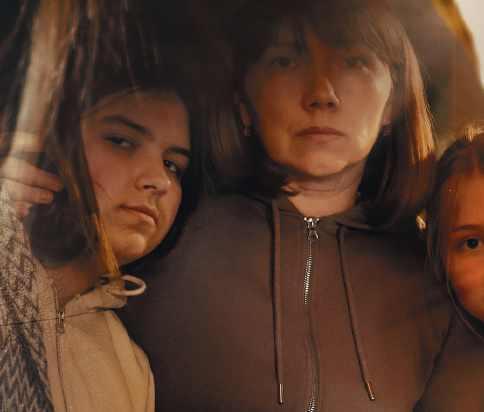
A judge has ruled that footage of two Australian nurses allegedly filmed making antisemitic comments on a video chat cannot be admitted as evidence in a trial regarding their conduct, appearing to accept their lawyer’s argument that being filmed without their consent amounted to an illegal invasion of their privacy, writes Daniel Sugarman.
Ahmad Nadir, 28 and Sarah Abu Lebdeh, 27, were allegedly filmed on Chatroulette, a video site where two screen users are randomly paired with each other. They were matched with Max Veifer, an Israeli content creator. They told Veifer that they worked in Bankstown hospital in Sydney.
The video footage allegedly shows that in response to Veifer telling Nadir his nationality, Nadir said he would be killed and sent to ‘Jahannam’ – hell. When Veifer questioned why he would be killed, Abu Lebdeh then joined the video, allegedly saying it was because the
rightful country was “Palestine”, not Veifers.
The video allegedly then went on to show Nadir saying that Veifer had no idea how many Israeli “dogs” had come to the hospital, claiming that he had sent them to hell.
It also allegedly showed Abu Lebdeh saying she would not treat Israelis and that she would kill them instead of treating them, with Nadir again joining in and reiterating that he would send Israelis to hell. Abu Lebdeh also reportedly said she wanted Veifer to remember her face when he died.
After Veifer subsequently published the alleged video in February 2025, the two nurses were suspended from the hospital for two years. Australian Prime Minister Anthony Albanese condemned the video as “sickening and shameful”, with the Health Minister for New South Wales saying at the time that they would never work in the NSW health system ever again. In February 2025, the co-chief exec-

utive of the Executive Council of Australian Jewry, Alex Ryvchin, said the video served as a “warning sign once again to all Australians about the evil that exists in our midst”.
Australia’s ABC reported that the two former nurses pleaded not guilty to using a carriage service to threaten, harass or offend. Abu Lebdeh also denies an additional charge of threatening violence against a group.
This month, ahead of the trial, lawyers for the accused argued that the footage had been obtained illegally and therefore violated New South Wales law. While the judge noted that the admissibility of such evidence depends on whether the desirability of admitting it outweighs the undesirability, most of the reasoning for refusing to allow the video to be used as evidence has reportedly been prevented from disclosure via a court order.
On Tuesday, the Australian Jewish Association posted a video of a headline showing that the video had been thrown out of evidence, along the words “Pretty crazy but this is Australia”.
The trial of Nadir and Abu Lebdeh is due to commence in late August. The case now reportedly rests on the willingness of Veifer himself to give evidence – with Nadir’s lawyer expressing the desire that the Israeli himself “should be charged in relation to the matter”.
POLICE PROBE UNION PRESIDENT’S COMMENTS
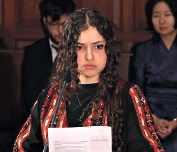
Police are assessing a complaint against the former president of the Oxford Union, who allegedly described Hamas as a “resistance group” and appeared to justify the terrorist group’s actions.
Following a report by UK Lawyers for Israel (UKLFI), Thames Valley Police confirmed it was examining alle-
Aliyah: building dreams and saving tax
• Tax-efficient investing before and after Aliyah
• Tax-efficient income after 10-year tax-free period
• Receive your entire pension pot tax-free
• Specialist portfolio management for Olim
• No Inheritance Tax (for non-UK-situated assets)
We are seasoned experts in providing long-term financial planning advice for those making Aliyah. Scan the QR code to read more
With investing, your capital is at risk. Tax treatments are subject to individual circumstances and are subject to change.
She also wrote: “I think the severity of resistance is often proportional to the severity of oppression.”
gations relating to Arwa Elrayess, 20. Elrayess, whose term ended on 20 June, reportedly wrote in a student WhatsApp group in September 2025: “Any resistance group will inevitably be deemed a ‘terrorist’ organisation by the West until they achieve their liberation (by which time, they’ll be lauded as heroes, as history has repeatedly proven).”
UKLFI said it has referred the matter to both Thames Valley Police and the Metropolitan Police.
Elrayess denied wrongdoing and has suggested that the complaint was an attempt to silence her views.
A spokesperson for Thames Valley Police said they were “continuing to assess this allegation and have been in discussion with Counter-Terrorism Policing South East.”

Ahmad Nadir and Sarah Abu Lebdeh
Arwa Elrayess
Travelodge will train staff on antisemitism
Travelodge is to introduce antisemitism training for sta after a “Free Palestine” message was discovered on a television in the room of an Orthodox Jewish guest at one of its London hotels, writes Annabel Sinclair.
It comes after New York tourist Sruly Fogel, 24, reported finding a message reading “Hi, welcome, Free Palestine” on a screen at Travelodge Manor House in Finsbury Park.
Despite an internal investigation, the hotel chain says it still doesn’t know how the message appeared.
Travelodge told Jewish News it had approached the Antisemitism Policy Trust and was discussing a training programme focused on antisemitism and cultural sensitivity.
The company said: “We are now very close to concluding a robust internal investigation, but unfortunately, it has not been possible to determine exactly how or when the message was put on this individual TV.
“However, our internal focus on our policy of zero tolerance to discrimination, including antisemitism, will continue, and we are currently in discussions with a leading organisation in the Jewish community to facilitate an appropriate training programme on cultural sensitivity and antisemitism.”

Travelodge said it had treated the incident seriously from the outset and had taken “immediate action” after becoming aware of the complaint.
The company also said chief executive Jo Boydell had apologised personally to Fogel, with the statement adding: “Our CEO has spoken with the guest to express our apologies for their experience.”
The hospitality chain added: “We have also been engaging closely with leaders and groups within the Jewish community to reiterate our absolute zero-tolerance stance on antisemitism and any form of discrimination and our commitment to ensuring that the Jewish com-
munity feels safe and welcome at all of our hotels.”
The incident was first reported by Jewish News after Fogel said he discovered the message while visiting London for a friend’s wedding. Shomrim reported the incident to police, describing it as bearing “all the hallmarks of targeted antisemitism”.
The Metropolitan Police has since confirmed o cers carried out a number of inquiries, including attending the hotel and speaking with the guest, but that the investigation has now been closed unless further information comes to light.
Responding to the outcome, the Campaign Against Antisemitism said: “It’s astonishing if both police and Travelodge investigations have been closed.
“There are only so many people with access to this equipment, and there is likely to be CCTV. It really can’t be that complicated.”
The organisation added that “the Jewish community deserves reassurance” over how the incident has been handled.
While the company’s investigation is nearing completion, it has not identified who was responsible for the message or how it came to appear on the television.
OFSTED BOSS IN UNREGISTERED SCHOOLS ALERT
The former chief inspector of Ofsted has warned thousands of children attending unregistered schools across the country increases the likelihood “segregation will increase, divisions will increase and extremism will increase.”
Sir Michael Wilshaw, who created Ofsted’s Illegal Schools Team in 2016 after directly seeing the issue in Birmingham, told ITV News “we know people who haven’t been vetted or had police checks are teaching stu that would not be allowed in mainstream schools”.
An investigation by ITV News identified unregistered schools operating in several communities, including the strictly-Orthodox. An individual named as “Moshi” – changed due to worries about being identified within his community – told the network most boys attending unregistered yeshivas are left illiterate and innumerate at the age of 16.
“They don’t learn any skills, nothing,” he told the programme. “No computers, no science, not even basic maths.
“These boys don’t know their timetables when they leave school at 16.
“They can do ABCs like little children, they don’t know what a paragraph means. It’s very painful to speak about it.”
Other former attendees of unregistered yeshivas told the news channel they struggle to communicate in English and have had a hard time finding work.









OVER 70 YEARS SUPPORTING THE COMMUNITY AND HELPING TO BUILD A HOMELAND

















Travelodge: Antisemitism training
‘I remain hopeful about future of Jewish life here in Britain’
When Louis Danker was elected president of the Union of Jewish Students with the highest voter turnout in the organisation’s history, he wanted to help write a new chapter for Jewish students, writes Annabel Sinclair.
His campaign was built around three words: “Proud. Diverse. United.”
Proud was about helping Jewish students reclaim ownership of their own story. Diverse was about ensuring UJS remained welcoming to students from every Jewish background and denomination. United was about standing together in the face of growing challenges.
Over the following year, he would address the prime minister at Downing Street, challenge universities over their handling of antisemitism, oversee UJS’s landmark Time for Change report, meet vice-chancellors and policymakers across the country and emerge as one of the leading young Jewish voices in Britain.
It was also a year in which British Jews faced some of their most serious security concerns in recent memory.
Yet when asked what he will remember most from his presidency, Danker does not mention Downing Street, ministers or reports.
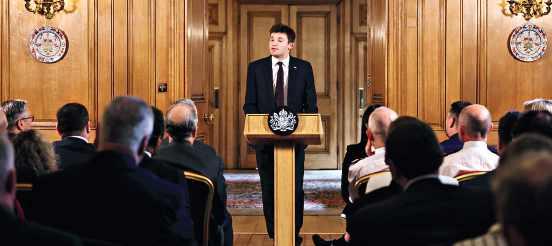
He talks about students – the one who turned up to a Friday night dinner for the first time; the committee member who spent hours organising events around exams; the Jewish Society that refused to shrink itself despite the pressure around it. “We need to be the ones writing our own story,” he tells Jewish News.
Throughout the year, UJS spent hours responding to incidents, supporting students, meeting university leaders and pushing institu-
tions to take antisemitism more seriously.
“I don’t think that these attacks have defined the year. And I don’t think that these attacks define the Jewish student experience,” he says.
Instead, he speaks about what he calls “Jewish pride and resilience”.
“Jewish life doesn’t exist in opposition to those who hate us,” he says.

Standing before prime minister Sir Keir Starmer and senior figures from government and civil society, Danker delivered a speech that resonated throughout the Jewish community.
“I think what resonated was the sense that the Jewish community, a minority group under attack in Britain, were not feeling the same level of support,” he says. “We need a mass movement of support.”
Yet despite the challenges of the past year, one thing has troubled him more than antisemitism itself. It is the growing suggestion that Jews no longer have a future in Britain.
He rejects that argument outright.
“There are thousands of young Jews who want to build a future here,” he says.
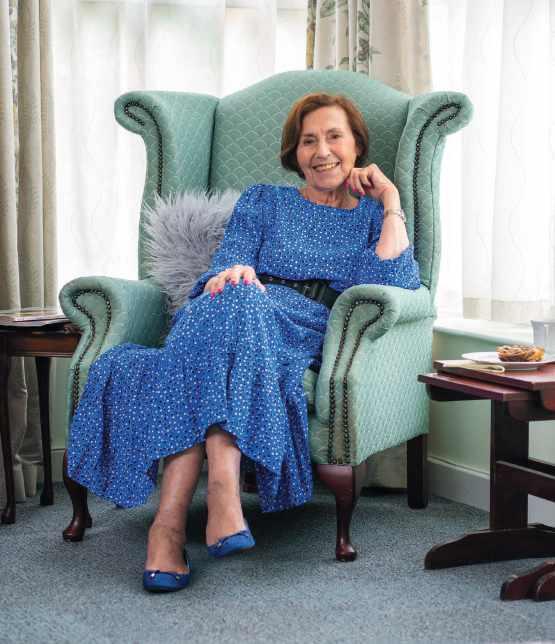

For Danker, one of the dangers facing the community is allowing antisemitism to become the only lens through which Jewish life is viewed. “We as a community talk a lot about the need to protect,” he says. “But we also need to think about what we’re protecting.”
The answer, he argues, is vibrant Jewish life, a belief that shaped some of UJS’s biggest initiatives this year such as Jewish Experience Week brought dozens of events to campuses across Britain, inviting students to engage with Jewish culture, traditions and community life.
“Regaining the definition of Jewish life on our terms has been a big theme of the year,” he says; the same thinking that informed comments he made at Limmud last December, where he pushed back against descriptions of university campuses as hostile territory for Jews.
Months later, he remains unapologetic. “I think Jewish life on campus is okay,” he says before pausing. “Sorry, it’s not okay. It’s great”.
That does not mean ignoring the reality of antisemitism. Far from it.
The Time for Change report laid bare the scale of the challenge facing many students. Yet Danker is equally wary of narratives that suggest Jewish students should avoid university life.
Parents regularly ask him which campuses their children should stay away from. His answer rarely changes: “What do they want to study and where do they want to live?”
A quote he heard during the year has stayed with him ever since: “Telling stories of our own decline only hastens it”.
The evidence, he argues, is visible on campuses across the country.
Under his leadership, UJS supported more than 900 Jewish Society events, carried out more than 300 campus visits, launched a Student Refugee Ambassador Programme and expanded its leadership programmes and sixthform outreach.
There were cultural festivals, educational programmes, Friday night dinners and social events across Britain and Ireland. Booze 4 Jews, UJS’s flagship student social, sold 1,200 tickets in just 21 minutes.
For Danker, those moments mattered just as much as meetings with ministers or university leaders. They represented the kind of Jewish life he believes is too often overlooked amid headlines about antisemitism and campus tensions.
He points to UJS’s leadership programmes and interfaith initiatives as examples of the kind of work he would like to see grow.
As he prepares to hand over to incoming president Raphi Leon, he is careful not to suggest what his successor’s priorities should be.
“Every president inherits di erent challenges. Every president leaves their own mark”.













He worries that constantly framing universities as safe or unsafe risks creates a self-fulfilling prophecy. “If we decide there are places that are no-go areas for Jewish students, they will become that.”
Long before Louis Danker became UJS president, his father Tony held the same role during the years surrounding the Oslo peace process.
Asked what advice stayed with him most, Danker does not hesitate. “The importance of building relationships. All the work we do is built on strong relationships,” he says – such as one of the defining public moments of his presidency at the Downing Street Antisemitism Summit following the Golders Green stabbings.
But he believes the role that UJS plays in developing future leaders has never been more important.
He rejects suggestions that Jews have no future in Britain and believes the next generation is already proving otherwise.
“The thing that gives me hope is that there are hundreds and hundreds of young Jews who are utterly driven and motivated to build exciting, dynamic Jewish life,” he says.
After a year spent at the centre of Jewish student life, that is ultimately the future Louis Danker believes is already being built.
With Prime Minister Sir Keir Starmer at the Downing Street Antisemitism Summit
Union of Jewish Students president Louis Danker speaking at 10 Downing Street

Rinder’s tribute as Jewish Care dinner raises £5.6m
by Annabel Sinclair annabel@jewishnews.co.uk
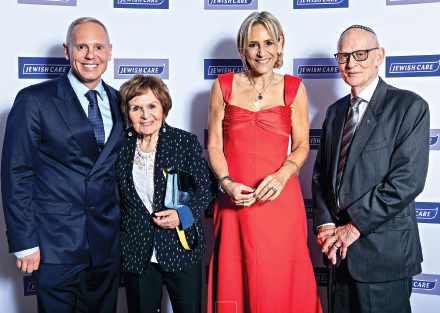
Rob Rinder paid an emotional tribute to the Jewish Care carer looking after his father as the charity raised a record-breaking £5.6m at its annual dinner.
Speaking at Grosvenor House, the broadcaster and barrister told 1,000 guests that “Walid looks after my dad like his own”, drawing one of the evening’s warmest responses.
The fundraiser, hosted by Rinder and former BBC presenter Emily Maitlis, also included the first public showcase of the charity’s new Sugar & Ronson Campus in Redbridge.
Rinder spoke movingly about his father David, who lives with dementia and is supported by Jewish Care, describing the di cult decision his family faced when they realised he could no longer be cared for at home.
“No family arrives at that moment lightly,” he said.
He told guests that Jewish Care
had given his family reassurance at one of the hardest periods of their lives. He said: “What I remember most in that first call to Jewish Care is how I felt when I put the phone down. Relief. Not because every-

body knew the road ahead, and that behind all the questions was a family trying to do the right thing by someone they loved.”
“The people caring for my dad were caring for us, too,” he said.
Opening the evening, Maitlis reminded guests that “tonight the stars of the show are Jewish Care’s clients – the 12,000 people whose lives are touched by the organisation every single week.”


thing had suddenly
thing had suddenly become simple, it absolutely hadn’t, but because for the first time in a long time, I felt we were no longer carrying this by ourselves.
“Somebody understood, some-
BADENOCH GETS WARM NORWOOD RECEPTION
Kemi Badenoch has spoken of her determination to ensure “never again” is a reality as she set her sights on tackling antisemitism and said she felt “vindicated” by the resignation of the defence secretary over military spending.
The Conservative leader received a rapturous reception from nearly 700 guests at her address to Norwood’s annual property lunch.
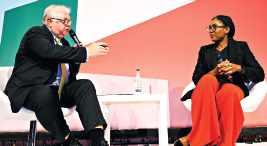
In conversation with LBC’s Nick Ferrari, Badenoch told guests: “If you had asked me on 6 October 2023 if there was an antisemitism problem in Britain I’d have said ‘not really’. For me, 8 October was a revelation and I suddenly saw monsters everywhere I didn’t know existed. The fact people came out protesting against Israel before any action in Palestine.
“The endless marches that became a cover for hate against Jews – we have to fight that.”
The Tory leader described an urgent need to counter the “naïve” belief that everyone coming to the country would contribute positively, saying “the fight against antisemitism is one of many fights facing the country”.
She acknowledged she hadn’t initially called for a ban on the Gaza marches but “by the time Rishi started speaking out, it was too late. We should ban the marches”.
Badenoch was asked about her decision to focus on defence spending at prime minister’s questions, hours before John Healey announced his resignation.
“It’s nice to be vindicated,” she said, before claiming Keir Starmer “doesn’t enjoy being PM because he thought the job was completely di erent. I think he thought it would be like being a vicar giving sermons. I don’t
think he thought about what he was going to deliver”.
But she didn’t just criticise Labour, insisting Reform were not “serious people” and leader Nigel Farage was far from the hardest worker.
Badenoch apologised to those in the room who had abandoned the Tories at the last election and urged them to focus on her record.
“We made a lot of mistakes in government. Those of us who didn’t like what was going on are now in charge. We are changing the policies, we are changing the people. We need those who have left our country to come back.”
The property lunch has raised more than £10m for the charity’s work with neurodivergent children and their families over a quarter of a century since its inception, becoming a staple in the industry calendar. The latest lunch is understood to have raised £510,000.
Lunch co-chair Ed Jackson put it simply: “Norwood helps people live their best lives. The conversations we have here today will help set the agenda for our industry, in terms of innovation and collaboration, for years to come.”
tion every single week.” and east ence that creating a place that felt
Lord Sugar spoke about the completed Redbridge campus, which will bring together residential care, dementia support, community services and mental health provision for the Jewish community in Essex and northeast London. He told the audience that creating a place that felt welcoming and familiar had always been his priority.
“You want to walk in and immediately think, they’ll be safe here, happy here, treated with dignity here.
“I wanted it to feel like a home. And the measure of success is seeing quality of life for the people who are going to be living there.”
Jewish Care Life President Lord Levy said the £5.6m raised would help the charity continue supporting 12,000 people whose lives it touches each week.
“We are deeply grateful to everyone who supported us at this year’s Annual Dinner, helping us raise such an incredible amount of £5.6m,” he said.
“At a time of real challenge for our community, these vital funds will help us continue providing lifechanging Jewish care and support to the 12,000 people whose lives we touch each week.”
“The truth is, giving to Jewish Care has always been very simple for me: you can see the di erence it makes – it’s just people helping people,” he said. “Choosing a care home for a loved one is one of the biggest decisions you have to make.

Rob Rinder, Janine Webber, Emily Maitlis and Jacques Weisser, Inset: Maitlis with Lord Sugar
Nick Ferrari and Kemi Badenoch
by Justin Cohen
justin@jewishnews.co.uk
The mental health crisis facing Israel’s veterans was the focus of Beit Halochem UK’s annual dinner amid warnings that the thousands of extra Israelis supported by the charity since 7 October are set to triple as a result of PTSD.
The numbers receiving therapy and rehabilitation at one of Beit Halochem’s five state-of-the-art centres around Israel have swelled from 20,000 to more than 70,000 because of injuries sustained in Gaza and Lebanon.
But the chief executive of the charity’s UK arm warned that the country had so far only seen the “tip of the iceberg” of the PTSD crisis.
Spencer Gelding said: “Beit Halochem and PTSD are among the most important things in Israel now because we are looking at an iceberg. We only see the tip...That ice-
Record £2m is raised to ease Israel’s spiralling PTSD crisis your legacy
berg is the trauma of Israel.”
A powerful appeal video told 500 guests at the Royal Lancaster Hotel about three veterans been helped by the charity over the last 32 months. Among them was Einav, who was overcome by depression after spending months cleaning possessions of soldiers who fell in battle before they were handed to family members.
She spoke of how no one had wanted to listen to her in her darkest days until she found Beit Halochem counsellors, who helped transform her life.
Also featured was Ido, who recalled lying in a “deep hole bleeding out” after an explosion in Gaza that claimed the lives of four of his comrades.
“Ever since then, people have asked me what’s changed since 7 October. I said before I felt more Israeli than Jewish, and now I feel more Jewish than Israeli. I stand here on behalf of my fellow vet-

erans to say thank you. Your support doesn’t just change lives, it saves them.”
In conversation with broadcaster Natasha Kaplinsky, Beit Halochem veteran Eytan FassbergYaffe described how, for a period after his service, he couldn’t “see a need to leave the house at all. Until Beit Halochem called”.
He said that “until the injury, I
knew there were Jews around the world, but never felt them. Now I’ve felt the warmth of communities around the world. This gives me hope; I know in my darkest days I’m truly not alone”.
The event raised more than £2m towards seven specialist PTSD clinics at the charity’s facility in Beer Sheva and to train competitors for the next Paralympics.
In a video message, President Isaac Herzog paid tribute to BHUK chair Andrew Wolfson: “There’s no one whose call has been stronger for than our veterans. Many of these brave veterans carry the mark of their sacrifice on their bodies. That is why it is so great that Beit Halochem acts on behalf of us all to support Israel’s veterans.”
Michaela Meyohas, who chaired the dinner with Katie Cutler, said: “Each facility is more than a rehab centre. It is a second home.
“When Israelis fell, they didn’t fall alone. They fell as part of us. This is not charity. This is the fabric of our people.”
More than £52m has been raised in total by the charity in 14 years, she said.
Trustee Orly Wolfson said: “Your strength and humanity inspire us all. Thank you for everything you’ve done and continue to do for our people and our homeland. You truly are our heroes.”
Anne Frank Trust now reaching 137k students
percent reported a better understanding of prejudice. More than four in five increased their confidence to challenge prejudice.

The Anne Frank Trust UK reached more than 137,000 young people across 272 schools during the last academic year, as new research found its programmes significantly improved participants’ understanding of antisemitism and confidence in challenging prejudice.


The findings were unveiled at a reception in the House of Commons, where MPs, Peers, Holocaust survivors, community leaders and supporters gathered for the launch of the charity’s latest impact report, Challenging Prejudice, Changing Attitudes
The independent evaluation found that 89.9 percent of participants improved their understanding of antisemitism after taking part in the Trust’s programmes, while 89.3
The Anne Frank Trust delivers workshops, peer education projects and ambassador programmes in schools across the UK.
Anne Frank Trust chief executive Dan Green said the findings highlighted both the scale of the challenge and the importance of education.
“At a time of rising hatred, increasing division and real pressure on community cohesion, it matters that we stand together across political divides, backgrounds, communities and perspectives,” he said.
“Every day, we see how education can break down prejudice before it takes hold.”
GOVERNMENT PLEDGES £1M FOR JEWISH MUSEUM
The Government has pledged £1m to support the future of Jewish Museum London, with Culture Secretary Lisa Nandy saying the investment was “not in a building, but in the stories, the connections and the understanding that are the basis of a cohesive society and the future of our country”.
The announcement came as Two Rooms by Jewish Museum London , an interim exhibition, was launched on 17 June.
The move marks the latest stage in the museum’s plans to establish a new permanent museum by 2030, following a challenging period between 2019 and 2024 during which it faced significant financial and organisational di culties.
Museum leaders say the institution has since stabilised its operations and retained its status as a National Portfolio Organisation funded by Arts Council England.
The Beit Halochem fundraiser will support rehabilitation centres
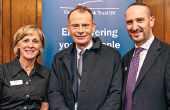
Andrew Marr (centre)
Father turns his daughter’s laughter into lasting tribute
A north London father who lost his one-yearold daughter to an exceptionally rare cancer has turned her laughter, artwork and memory into a charity song celebrating what he calls her “big little life”, writes Annabel Sinclair.
Big Little Life (Cece’s Song) was written by Ben Ziff in memory of his daughter Celine, who died in 2025, aged one year and 19 days after being diagnosed with an extrarenal rhabdoid tumour, a highly aggressive childhood cancer.
The song, which raises money for Noah’s Ark Children’s Hospice, features recordings of Celine’s laugh and is accompanied by artwork she helped create alongside her twin brother Jesse and older sister Luna.

For Ben and his wife, Sophia, the project was born out of a determination to ensure their daughter’s legacy would be defined by joy rather than loss.
“This is not a sad song, although it comes from a very sad story,” said Ben.
“There was so much joy in Celine’s life. She had a huge personality, she

demanded attention, and she made an enormous impact on all of us.
“As a family, we wanted to create something that captures who she really was.
“My only endeavour was not to become a victim of the grief. I wanted to tell Celine’s story and create something positive that celebrates her life and forms part of her legacy.
“I’m reaching the point where I feel so lucky and happy to have known her.”
Celine spent much of her short life receiving treatment at Great Ormond Street Hospital after being diagnosed with the rare condition, which affects only a tiny number of children worldwide.
The song was created with London-based singer-songwriter Bertie, who began working with Ben just weeks after Celine’s death. The pair spent six months writing and developing the track.
Bertie, who had recently experienced the loss of his own mother, said the project became deeply personal.
“When someone passes away, people often say, ‘If there is anything I can do, let me know.’ When Ben asked me to write a song about
Celine, I initially didn’t know whether I could do it.
“Working on this became a second process of grief after losing my mum. It was incredibly uplifting, and there were a lot of parallels between our experiences.
“From the beginning, we knew we didn’t want this to be a sad song. It needed to feel true to Celine and do something meaningful for her. I’m very proud of what we’ve created.”
The recording was produced by Ru Lemer and mastered at London’s Air Studios by Grammy-winning engineer John Webber. Ben, Bertie and Lemer all contribute vocals.
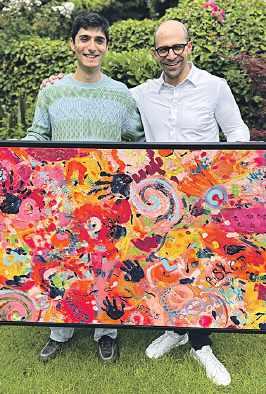
The cover artwork for the single comes from a painting created by Celine and her siblings. A video showing the children making the artwork appears alongside the song on Spotify.
The project is also expected to be the first in a series of initiatives honouring Celine’s memory, including future work with Camp Simcha, which supported the family during her illness.
Reflecting on his daughter’s impact, Ben said: “She was only with our family for one year
Woman killed husband, 84, who had dementia
A woman has been found guilty of murdering her husband, in a retrial held after the collapse of the original case due to a deadlocked jury.

Daryl Berman, 71, had been accused of killing David Berman, 84, on 13 March 2025, at the couple’s home in Butterstile Lane, Prestwich, Manchester. She had contacted the emergency services shortly before 2pm on that day to report that her husband was injured. He was pronounced dead at the scene later that afternoon.
As described by the Manchester Evening News, prosecutors said Berman deliberately stabbed her husband ‘for a reason known only to her’, while she insisted throughout both
trials that her husband’s injuries and death had been “accidental”.
Mr Berman’s death was not initially treated as suspicious. Only five days later, when a senior Home Office pathologist reviewed the case were the authorities alerted to the possibility of murder, with Dr Philip Lumb concluding that the chest wound showed “typical features of a homicide”, describing an accidental fall onto a knife as “very unlikely”. Mrs Berman was arrested that evening.
Mrs Berman told the emergency services that she had discovered her husband in the kitchen, after hearing what she believed was a fall in which he landed on the knife.
WJR LAUNCHES EMERGENCY AID
World Jewish Relief is launching a 36-hour emergency fundraising campaign to raise £500,000 for mental health support programmes in Israel and Ukraine, as both countries continue to grapple with the psychological impact of war.
The appeal, titled No Time to Wait, will run on 28 and 29 June and seeks to fund trauma care, therapy services, suicide prevention initiatives and specialist psychological support for people affected by conflict.
The charity said the need for mental health assistance has grown significantly following more than four years of war in Ukraine and the ongoing security crisis in Israel since the 7 October attacks.
In Ukraine, where millions continue to live under the threat of missile and drone strikes, World Jewish Relief said more than 10 million people are estimated to require humanitarian assistance. Around 1,000 Jewish homes have also been seriously damaged during the conflict.
Bertie and Ben with the artwork created by Celine and her brother and sister. INSET: Celine Ziff
Daryl Berman
The Jewish football eleven murdered in the Holocaust
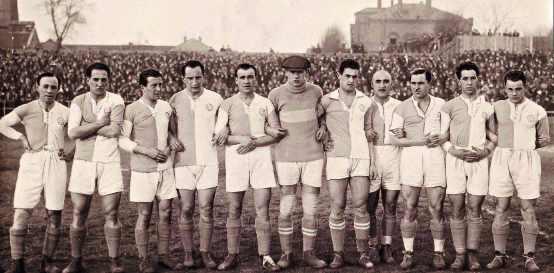
The first hat-trick from a Polish footballer in an international game was scored by Zygmunt Steuermann, writes Daniel Sugarman Newspapers rhapsodised about the skills of József Braun, who played as a forward for Hungary, then a footballing powerhouse. Max Scheuer shone in Vienna’s HaKoah team, a defender referred to as “an insurmountable wall”.
After a successful professional career, Arpad Weisz’s skill as a manager was such that he would become known throughout Italy as Il Mago – The Magician, the youngest coach ever to win Serie A.
These Jewish men, alongside seven others brimming with footballing talent, who made their mark on pitches and in newspaper reports across the continent, were all murdered in the Holocaust. Some were killed by Nazis in the death camps; others by many willing local accomplices across Europe. Most are barely remembered.
Now, however, the author David Bolchover has written a book which chronicles the stories of 11 – a football team’s worth – of these remarkably talented men.

Many of us, at one point or another, have laughed selfdeprecatingly at the supposed lack of Jewish sporting talent. I have done it, Bolchover has done it, and I suspect that many people reading this article will have done as well. “Hopefully, my book will play a role in stopping people laughing about it, because when people laugh about it, they’re laughing about the destruction of European Jews”, Bolchover says, frankly. “E ectively, they don’t know what they’re laughing at. They should be crying.
“Europe’s in denial; they cover up their denial with a very superficial form of memorialisation. The denial takes many forms – one is to give the impression that the Holocaust was perpetrated by this cadre of Nazis who took over Europe by force, and neglecting to mention the complicity of many Europeans.”
Given the work and the passion which has gone into creating the book, I wonder exactly what he is hoping readers will get from it.
“In a broader sense, it’s to restore the memory of what Jews contributed to football – how pivotal we are”, Bolchover says.


in the pub talking about how great Braun was; they changed their tune. These stories about how quick we can sink make you question the community around us, how when they come up with these words of support, really, do we trust them, after what has happened to us throughout history?”

“This is something that isn’t maybe understood enough. The Holocaust didn’t just account for six million Jews, it also shattered Jewish collective memory. There’s so much we don’t know about the Holocaust, but there’s also so much we don’t know about the world before that, and it’s up to us to restore that memory.”
Digging Deep, as the book is called, is Bolchover’s impressive contribution towards that restoration. But despite the fact that the book is very much about the past – 11 men, and the tidal wave of horror surging in their direction, ultimately sweeping them and millions of others away – it is also about the present.
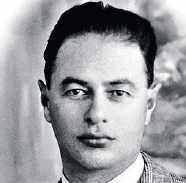
József Braun in particular was a generational talent, a supernova in a nation filled with footballing stars, described by Bolchover, without a trace of hyperbole, as “the greatest Jewish footballer of all time”. And as he tells me, “the last image we have of Braun, this unbelievable footballer, is of the Hungarian guards crouching over his lifeless body in the snow, wrenching out his gold teeth.
“Those guards, only a few years previously, were probably spending their evenings
Bolchover’s previous work, The Greatest Comeback, was on one particular footballing icon, Béla Guttmann, who survived Nazi torture in a slave labour camp during the Holocaust and went on to achieve glory with Benfica, winning back-to-back European cups with the Portuguese club. But Digging Deep covers 11 footballers, from a number of di erent nations, with a wide variety of languages and archival evidence to navigate. The book took him six years to complete, and it’s clear just how deeply writing it has a ected him – at points during our talk he describes the subjects of his book not simply as “the players”, but as “my players”.
The research, he says, “was a long e ort, and there were various strands to it.” There was the career research, which involved significant archival work – “match reports, interviews with the players,”. And then there was the research into how exactly they died, which he describes as “divided into two. You’ve got Western Europe, where things were very documented, ‘they were on transport number 36 and it left at 8:50am, it stopped at these stops, and it went to Auschwitz’, and you can work out whether they were gassed on arrival or went to a labour camp.
“But in Eastern Europe, the ‘Holocaust by Bullets’, when the Einsatzgruppen just went in and shot people, it’s impossible. I just tried to find any information I could.”
Another key element of the book is the idea Europe has barely scratched the surface of understanding what it did to the Jews. Even before the war, as the book details, the Football Associations of various Mitteleuropa countries were discriminating in a significant
way against Jews – something few, if any, FAs have ever apologised for.
“Somebody told me the other night that FIFA have never had anything on their website about the Holocaust or have marked memorial day in any way,” Bolchover says.
“My book is a mainstream book. The subject should be a mainstream subject.”
However, apart from being interested in people’s reaction to the book, he also wants to know their favourite players.
“I loved all my players, really”, he tells me. “I miss them all; finding out what happened to them in the end devastated me, but I had a couple of real favourites. I’ll be interested to find out from readers who they love the most.”
u Digging Deep (Biteback Publishing) is available for purchase online and in all good bookshops
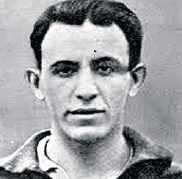
Above: Hakoah Vienna, champions of Austria 1924/5. Max Scheuer is standing on the far left. (Courtesy of the Jewish Museum Vienna). Left top: József Braun. Left bottom: Arpad Weisz
JN and JLC to launch J-HUB, the new home for Jewish life
A new platform showcasing the vibrancy of Jewish life under one digital roof – and encouraging participation in a plethora of activities – is set to be launched this autumn, writes Adam Decker.
Community events will be listed alongside job and volunteering opportunities, Jewish life-cycle resources and news feeds on the website, a joint venture between JN and the Jewish Leadership Council, which already has the support of nearly 50 communal organisations.
Moving the UK Jewish community ahead of other major global communities in terms of digital infrastructure, users will enjoy personalised home pages according to what interests them most and an AI chat bot function to help them navigate the latest communal activities, information and news from a variety of trusted sources.
In an unprecedented development for online connectivity in the Jewish community, the chat
bot will also be available to organisations as an embedded fixture on their websites too, enabling users to interact with J-HUB without leaving their website.
JLC chair Keith Black said: “The UK Jewish community remains one of the most vibrant in the world; an exemplar for others around the world and for other communities in the UK.
“But there is currently nowhere for British Jews and visitors from abroad to go to to find all these activities in the place. That’s where J-HUB comes in. We’ve been delighted with the response that the prospect of this vital resource has received over the last year.
“While users will be able to search for specific activities of interest, whether thematically, geographically or by life stage, they will also be introduced to many organisations and extensive content available across the community they may not already be familiar with.”
The latest key news stories from the UK, Israel and the Jewish world – provided by Jewish News and other trusted sources – will also be highlighted on the hub.
JN co-publishers Justin Cohen and Richard Ferrer said: “While it was the Covid emergency that first alerted us to the need for such a resource, and the early stages of the war that solidified that belief, it’s become increasingly clear that this will be a vital service. Just as JW3 brings the community together under one physical roof, a resource in the digital space is long overdue.”
J-HUB will also feature a directory of charities and organisations, with each having its own page and the ability to post activities on the site for free.
Access to community members will also of course be free to use, with account sign-in options to generate customised content.
Recruitment is currently under way for a project manager.
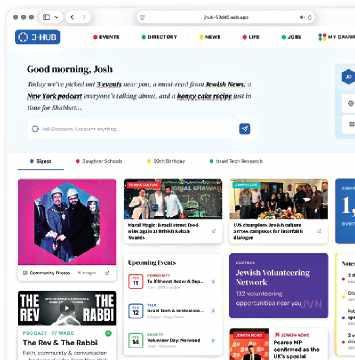


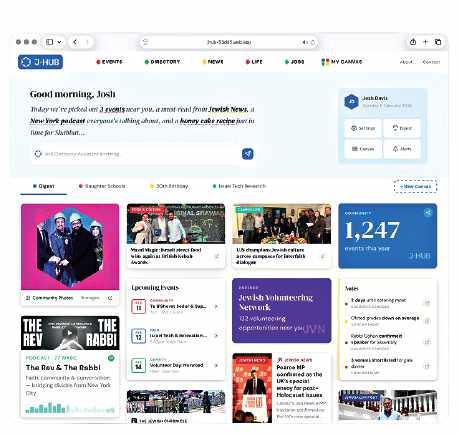
Users will be able to search for specific activities and be introduced to many organisations and extensive content across the community they may not already be familiar with
Bereaved Palestinian and Israeli are now ‘brothers’
Two bereaved fathers, one Israeli and one Palestinian, are using their friendship to campaign for peace between their two people.
Despite having fought for opposing sides as young men, Rami Elhanan and Bassam Aramin say they are now “family” and have dedicated their lives to building respect and understanding between their communities. The two men were in Dublin to speak at an event hosted by the charity Trocaire.
They have visited the country before, touring the island and sharing their stories last summer.
“I’m proud that he considers me a brother,” Elhanan says of Aramin.
The 76-year-old veteran of the Yom Kippur War described a man who, aged 17, was jailed for throwing hand grenades at Israeli jeeps.
Elhanan’s life changed “dramatically” following the death of his 14-year-old daughter in 1997.
Smadar Elhanan was killed by Palestinian suicide bombers while shopping for school books with friends in Jerusalem. The following year he was invited to a meeting
of bereaved Palestinian and Israeli parents, set up by The Parents Circle – Families Forum (PCFF), a joint IsraeliPalestinian organisation for bereaved families.
“I was very suspicious… I was very reluctant and cynical,” he said, but added that the meeting “changed my life, changed my mind, changed my attitude. I was 47 years old and, until today, I’m ashamed to admit it was the first time ever in my life I’d met Palestinians as human beings, not as workers in the streets, and not as terrorists, but as human beings who carry the same burden that I carry, who su er like I su er.”
He became involved in grassroots peace movements and met Aramin through the group Combatants for Peace in 2005.
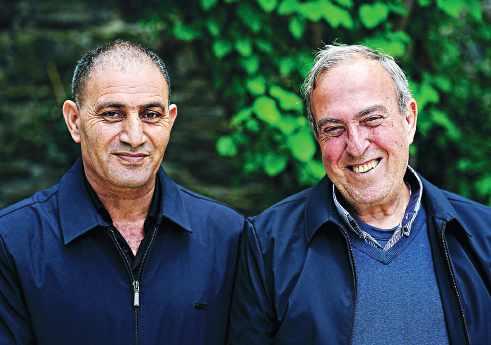
“He always said that I immediately fell in love with him the minute I met him, which is completely true,” Elhan said of Aramin.
That love was needed when, two years later, Aramin’s 10-year-old daughter, Abir, was shot by the Israeli military in East Jerusalem. “We ran to the hospital,” Elhanan
said: “We spent two days by her bed until she passed away and for me, it was like losing my daughter for the second time, I knew this girl.” Since then the men have cam-
paigned together, sharing their personal tragedies as a warning and their friendship as a symbol of hope.
“We proved that we can build a real partnership, we can live together all side by side,” Elhanan said.
They say mutual respect and understanding between their two peoples is what is needed to bring the brutal conflict to an end.
“One word is essential, without it nothing will happen; the word is respect,” said Elhanan.
They compare visiting Ireland to a football team’s home match, with Aramin saying people there “understand us, they’re very supportive”.
They say they use the peace that has been achieved in Northern Ireland as a story of hope.
“It’s not written anywhere that we’re going to continue killing each other forever,” Aramin said.
“It must end at one point, and I believe very soon.”
Bassam Aramin, left, whose 10-year-old daughter Abir was killed in 2007, with Rami Elhanan, whose 14-year-old daughter Smadar was killed by Palestinian suicide bombers in 1997








At Nova exhibit, victims became people again
Ididn’t rush to the Nova exhibition. I wasn’t there on opening day when dignitaries from the community arrived and other press gathered. I wasn’t among those who emerged in tears after seeing the footage of young Israelis running for their lives and I didn’t have photos of the rows of shoes those young Israelis left behind.
I didn’t rush to the exhibition because, in a sense, I had already been there. Since October 7, I have had a front-row seat.
Late on the night of October 10, I was listening to Raz Yadai Gantz, a 30-year-old DJ struggling to say the names of his dead friends. He cried so hard that he had to stop talking, apologising each time he did.
The apology made me cry, but he was the one who had spent the day attending funerals.
He was the one who had watched Hamas footage, searching for familiar faces among the murdered. That was my introduction to Nova.
Over the months that followed I sat in Cyprus at the Secret Forest retreat with survivors and bereaved families. Together they formed a picture of a day so devastating that by the time I finally walked through the doors of the exhibition in Shoreditch, I immediately recognised some of the faces on the wall – they were Raz’s friends.
Standing quietly among the visitors – all of them silent – was Ariel Borok. His sister Anita was murdered at Nova alongside her boyfriend. Like Raz and so many families searching desperately for answers on October 7, Ariel had been forced to scour Hamas

bodycam footage to discover what had happened to Anita.
For most people, October 7 was experienced thousands of miles from the horror through television and phone screens. For Ariel, it was a drive away. Ariel had been invited to join TV star and barrister Rob Rinder, former BBC controller and BAFTA chair Jane Lush, and writer and digital activist Hen Mazzig –for the discussion Does the Media Matter? As the conversation turned to media narratives and reporting failures, I kept thinking this was not an abstract debate for Areil.
It was his sister’s life.
Raymond Simonson, the chief executive of JW3, chaired the discussion with sensitivity “We’re going to start,” he said, “not with an idea, but with a person.”
What did Ariel want people to know about his sister?
“That she was 14 years younger than me. She was a beautiful young lady who loved life. She was a very good friend of mine despite the age di erence. We talked about everything. We spent time together, went into nature, ate, drank and celebrated life. That was Anita.”
Her name hung in the air. “She was murdered with her boyfriend,” said Ariel.
The question of media responsibility could not have been more pertinent. Rob Rinder recalled attending the Attitude Awards on the evening of October 7 wearing a prominent Magen David. Rather than being met with concern for what had happened, he found himself being asked about his political message. “Imagine,” he said, “the Twin Towers coming down and somebody asking, ‘What’s your political message?’”

Jane Lush acknowledged that the BBC’s refusal to describe Hamas as terrorists had deeply damaged trust with Britain’s Jewish community.
“I’ve told them that decision pretty much lost the Jewish community in one fell swoop,” she said.
Then Hen Mazzig spoke about watching footage from the massacre before much of the world had absorbed what had happened. A writer and digital activist with millions of followers across social media, he realised almost immediately that many people would not understand what Nova was.
“I started calling it a peace music festival,” he explained. “Those kids were celebrating peace.”
The phrase spread from social media to newspapers and eventually into speeches by world leaders, including President Joe Biden.
For Mazzig it demonstrated both the power and necessity of telling stories when others fail to do so. But
not everyone on the panel believed the media had got everything wrong.
“The BBC isn’t one thing,” said Rinder. “There’s the entertainment arm and then there’s the news bit.”
The real problem, he argued, was not institutional malice but a lack of diversity of opinion in newsrooms.
“For a long time the BBC has been a bastion, by virtue of where it recruits from and the type of conversations you can have, chiefly of the left,” he said. “What that has exposed is an intellectual monoculture.”
That, he suggested, explained many of the mistakes that had been made. When controversial moments occurred, there were too few people in the room willing or able to challenge prevailing assumptions.
Yet Rinder was equally clear that there were people within the BBC doing important work. “There are people at the BBC doing that,” he said, referring to journalists telling complex Jewish stories.
Support your Jewish community. Support your Jewish News
Thank you for helping to make Jewish News the leading source of news and opinion for the UK Jewish community. Unlike other Jewish media, we do not charge for content. That won’t change. Because we are charity-owned and free, we rely on advertising to cover our costs. This vital lifeline, which has dropped in recent years, has fallen further due to coronavirus.
Today we’re asking for your invaluable help to continue putting our community first in everything we do. For as little as £5 a month you can help sustain the vital work we do in celebrating and standing up for Jewish life in Britain.
Jewish News holds our community together and keeps us connected. Like a synagogue, it’s where people turn to feel part of something bigger. It also proudly shows the rest of Britain the vibrancy and rich culture of modern Jewish life.
You can make a quick and easy one-off or monthly contribution of £5, £10, £20 or any other sum you’re comfortable with. 100% of your donation will help us continue celebrating our community, in all its dynamic diversity.
Support Jewish News by visiting our donor page at jewishnews.co.uk
He pointed to programmes that had explored Jewish life with sensitivity and nuance, arguing that many within the corporation were genuinely trying to tell di cult stories with care and humanity.
As he spoke, I found myself glancing at Ariel. He listened throughout, but there were moments when he gently shook his head.
When his turn finally came again, he o ered perhaps the most important observation.
“The Nova exhibition is not important only for Jews,” he said. “It’s important for every human being. No matter if you’re Jewish, non-Jewish, Muslim or whatever. It was a shameful day for all humanity. Once you come here and you see all the truth, you cannot deny it.”
As the exhibition approaches the end of its London run, with talk of an extension, there is still time for those who have not visited to do so. I have been handing out leaflets on the Tube. When I do, it is Shoreditch I mention first. The area carries a certain cultural credibility that I like to think might tempt people to get as far as the entrance.
What I don’t tell them is that if they do – they will come face to face with the horror of a massacre supported by footage recorded by the perpetrators. They will see the belongings of young people who went to dance and never came home.
I thought about the media. It matters because the media determines whether victims become more than headlines. It shapes whether people thousands of miles away understand what happened or look away.
I have had that front-row seat since October 10 and can’t look away.



‘Maybe it was a mistake getting a Jewish company in to cater our hydration breaks!’


Zack Polanski and the fate of the useful idiot
Useful idiot. The phrase could not be more apt.
Zack Polanski has proved to be very useful to the extremists who have infiltrated the Greens. They can use his Judaism to deflect from allegations of antisemitism. They can use his identity as a gay man to hide a more conservative agenda. They can use his dopey, smiley, happy charm to deflect from their nasty extremism.
Idiot because while he was pushing their antizionist agenda – even though it has hurt his own family members – did he really think they wouldn’t turn on him?
The phrase ‘useful idiot’ or ‘useful innocent’ originated in Cold War politics and symbolises someone who is idealistic and manipulated by a political cause without realising it. Extremists often need to hide their full malign agenda, so they push the naïve foot soldier into spreading their message while they stay in the background, ready to reap the rewards.
KGB defector Yuri Bezmenov told in a famous 1984 interview how the USSR manipulated useful idiots to destabilise Western institutions before destroying those they had finished with. “Your leftists in the United States: all these professors and all these beautiful civil rights defenders: they are instrumental in the process of the subversion only to destabilise a nation,” he said.
“When their job is completed, they are not needed any more. They know too much.
“They think that they will come to power. That will never happen, of course. They will be lined up against the wall and shot.”
Zack Polanski might think he is winning. Thanks to him, the Greens have doubled their membership, won a number of councils and are poised to gain real political influence if the next election is tight.
He’s doubled and tripled down on his AsAJew status. He can barely utter a sentence without spitting out ‘the genocide’. He has constantly demanded the UK should end arms sales to Israel and investigate the country for war crimes. He has backed sporting and
cultural boycotts of Israeli football teams and supported the monitoring of UK-Israeli dual nationals who served in the IDF, saying they could be responsible for war crimes.
He didn’t even speak out against the Green party’s ‘Zionism is racism’ motion, even though it would mean labelling his own family – most of whom are Zionists and a few of whom made aliyah – racists.
But still it isn’t enough for those who are really in control. Et tu, Mothin Ali? Because, yes, it is Zack’s trusty deputy who is on manoeuvres. Who could have guessed?
According to an article in The Spectator, Mothin is backing a new, powerful Greens a liate called the Global Majority Greens (GMG), which has accused Polanski and other senior Greens in a new report of creating a “hierarchy of racism” with allegations of antisemitism taken more seriously than other complaints.
The report, to be presented at the Green Party AGM, accuses Zack of only “performing anti-racism” and condemns a “serious governance problem inseparable from institutional racism”. The problem is too many Muslim members have been suspended for antisem-
itism. Apparently, that is racist because it “demonises migrants and Muslims”.
And even though Zack has really done everything he possibly could to disassociate himself from his own previous Zionism, it is not enough. It never would be. Because Zionism isn’t the problem.
It was inevitable the Red/Green/Islamist alliance that now makes up the Greens would eventually break up. Their agendas are too separate, even if they can agree on hating Israel and the need for revolution. This glue won’t hold forever, as Jeremy Corbyn’s Your Party found when the far left fell out with conservative Islamists on the issue of trans rights.
So the battle for the Greens is on. We will see whether the party’s newfound popularity is genuinely the Zack e ect and how much it is sheer entryism from the hard left and Islamists.
Zack may fight this, but he is already bloodied by the growing scandals surrounding him. How much longer can he last?
You do have to wonder how he really thought a Jewish man with a history of Zionism could survive as leader of a party obsessed with Israel. Idiot.

NICOLE LAMPERT

After Trump’s Iran betrayal, what’s left for Netanyahu?
DANIEL SUGARMAN DEPUTY EDITOR, JEWISH NEWS
On 8 May, 1972, four members of the Black September Palestinian terrorist group hijacked Sabena Flight 571, a commercial flight between Vienna and Tel Aviv. The terrorists held the hostages in the plane on the runway at Lod airport, threatening to blow up the aircraft unless hundreds of convicted Palestinian terrorists were freed. The Israeli government opted to launch an operation involving a team from the country’s elite special forces unit, Sayeret Matkal. The unit commander was Ehud Barak; one of the unit’s team leaders was Benjamin Netanyahu.
Fast forward more than half a century, and Netanyahu, now Israel’s longest serving prime minister, addressed his country’s people on national television. Israel had just su ered what could be described as the largest geopolitical disaster in its history as US president Trump jettisoned yet another ally.

The Memorandum of Understanding he has signed with Iran will, in the short term, provide the theocratic dictatorship with an immediate major economic boost, by allowing them to sell their oil. In the long term, it could see the US lift all sanctions against the regime – and potentially leave Israel hamstrung in its continued attempts to counter Hezbollah in Lebanon.
You would not have heard any of this in Netanyahu’s speech. The Iranian regime’s nuclear capabilities had been dealt a severe blow, said the man who knows Tehran has repeatedly resuscitated its nuclear programme.
The joint US-Israel operation had severely weakened Iran and its proxies, said the leader who knows the memorandum includes $300bn “for the reconstruction and economic development of the Islamic Republic of Iran”. The only surprise in the speech was that a bolt of lightning did not descend to strike down the purveyor of such unmitigated horse-manure.
To be a successful politician in a democratic society, you need luck as well as skill. You need to be willing to keep rolling the dice in the hope you keep getting sixes. Eventually, however, everyone’s luck runs out.


Thu 16 Jul, 7.30pm


Few politicians have gambled as significantly as Netanyahu. But for Israel’s most accomplished political tightrope-walker, the strands of hemp are fraying. He was at the helm on 7 October; he is the architect of a political plan that has proved ruinous – opting to forsake Israel’s traditional bipartisan focus in Washington to throw in his lot with Trump.
The consequences of that decision are now obvious. With the Democratic party moving to an increasingly anti-Israel position, this has left him all but reliant on the goodwill of one of the most mercurial men on the planet.
Netanyahu decided to use that goodwill to launch a throw of the geopolitical dice –knocking out the Iranian regime, Israel’s bête noire in the region.
Despite Israel and America’s total military superiority, Trump has somehow contrived to lose the war with Iran he agreed to help start. Netanyahu is helplessly tied to a US president who has increasingly made it clear he is souring on their relationship.
There is not much that links Netanyahu to David Cameron. But somehow, when I look at Netanyahu now, I think back to what happened

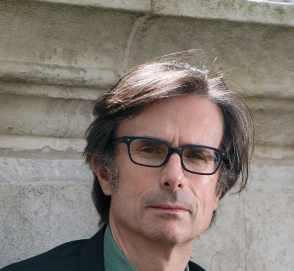


almost exactly a decade ago, when Cameron announced his intention to resign as UK prime minister and leader of the Conservative party.
His time in o ce was marked by a series of gambles, albeit not of a military nature, most memorably in granting in 2016 a referendum on whether the UK should remain in the EU or leave. The country voted to leave, as Cameron very much did not want. Less than a month later, he was gone as prime minister. He had rolled the dice one too many times.
Netanyahu will not follow a similar path of leaving with (relative) dignity. Like many politicians who have remained in power for too long, he has come to believe firmly the words attributed to Louis XIV – “L’etat, c’est moi”.
Last month, however, Hungarian voters turfed out another longstanding leader, Viktor Orban -– perhaps unsurprisingly, a good friend of Netanyahu – who had sought to mould a democratic state into his own image. Within the next few months, Israeli voters will have the opportunity to do the same to Bibi.
While he has defied his critics before, surely the time has come to raise the lights and lower the curtain on the Netanyahu show.

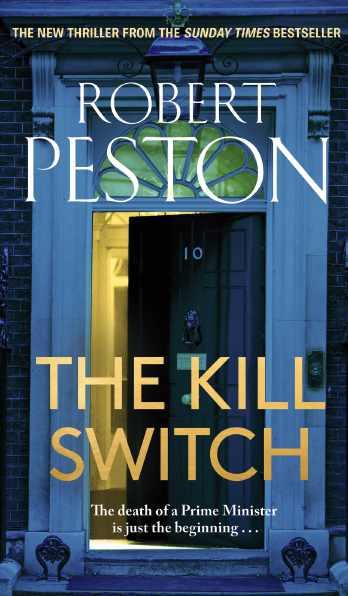


Antisemites are getting louder... but so are we

KEITH BLACK CHAIR, JEWISH LEADERSHIP COUNCIL
The relentless waves of antisemitism and anti-Zionism that flood our community daily no longer shock us. What once provoked disbelief is now, disturbingly, part of the ordinary fabric of British Jewish life.
Consider only recent weeks: disruption forcing the postponement of a Jewish cultural event at the British Museum; protesters hounding an Israeli property event in Edgware; Parliament preparing to debate the supposed influence of a “Zionist lobby” on British politics; and the National Association of Muslim Police describing the Israeli Defence Forces as a “Zionist terrorist group” on an o cial police.uk website.
These are merely a handful of the incidents that have crossed my desk as chair of the Jewish Leadership Council. Beyond them lie countless others, unreported or unremarked, each eroding, in small but cumulative ways,

the fabric of Jewish life in this country.
Yet that is not the whole story. I see something else emerging, something no less real, and perhaps more consequential. I see resilience taking root, and with it a new steel. I see an extraordinary, interwoven network of organisations and individuals collaborating strategically: fundraising, campaigning, innovating, and crucially, refusing to yield ground.
I see new institutions being founded, new leadership stepping forward and grassroots movements animated by strength, confidence and determination.
There remains, however, much work to be done. Anti-Zionism continues to permeate the cultural landscape, framing Israel as a uniquely malevolent force in global a airs. However Israel’s right to exist as a sovereign nation cannot be a subject of debate. It is a moral and political given that is beyond repudiation. None of this diminishes the reality of su ering in the Middle East. Many within our community continue to hope that a twostate solution might, however imperfectly, o er a path forward in a conflict that has defied resolution for generations.
There is also a clear recognition of the need to condemn violence wherever it occurs, including settler violence in the West Bank and the increasing rate of settlements.
Yet it remains equally necessary to acknowledge that durable peace will require a rejection of terror and absolutist rejectionism by Palestinians and their backers without which compromise is politically and psychologically untenable.
The singular focus on this conflict, among many global crises, and the readiness to hold diaspora Jewish communities collectively accountable for it point to a deeper and more troubling reality: that ancient patterns of antisemitism remain alive often, as David Hirsch describes, ‘dressed in the clothes of reason’.
These patterns are amplified, and accelerated, by the unrestrained reach of social media: largely unregulated, susceptible to manipulation, and shaped by malign actors, including states and individuals intent on sowing division. It is a force that not only threatens our community but corrodes the broader civic fabric of western civilisation.
And yet, despite all this our community
continues to flourish. Synagogues are fuller, Jewish life remains vibrant, and younger generations are actively seeking deeper engagement and connection. Our charities operate at a high level of excellence, and communal leaders and professionals demonstrate extraordinary commitment.
Certainly, there are challenges ahead. Economic pressures are intensifying, and communal resources are not immune to the broader financial strains facing the country.
Our government must increase its e orts to protect Jewish life and it must cease the relentless demonising of Israel.
At such a moment, our core values have never been more important: caring for others, investing in the next generation, and critically sustaining a belief in ourselves as a community that contributes to the common good. These principles must guide us as we navigate the current environment.
We must neither succumb to despair nor retreat from engagement. Instead, we must remain resolute, clear-eyed about the challenges, confident in our response, and planning, always, for better days ahead.
Take control of diabetes before it takes control
JASON STRELITZ HEALTH POLICY ADVISER
We all know we should eat a bit more healthily and do a bit more exercise. We all also know it’s easier said than done — especially in our community, where a love of food is stitched into our DNA. One more piece of challah, one more bagel, one more kneidel… I’ve heard myself say it more times than I care to admit.
There are many reasons — physical and mental — why a healthier diet and being more active matter. The current campaign by Jewish News and Jewish Blind & Disabled, focusing on Type 2 diabetes in our community, highlights one of the most important. Diabetes is a growing risk as we get older, but increasingly it affects younger people too, driven by lifestyle and the food environment around us.
As director of public health in Newham for many years, I worked closely with communities — particularly South Asian, African and Caribbean communities — where diabetes rates were significantly higher than the national average. My aim
was always to ensure people had the right information to manage their health. It is never about blame. We all lead complicated lives shaped by pressures outside our control. But with the right knowledge, insight and a non-judgemental approach that empowers rather than shames, people can take control and make changes that genuinely improve their lives.
Closer to home, the same message applies to our own Jewish community. As JBD has highlighted, diabetes is more common among Jewish people than in many other groups. That’s why their campaign is so timely and so welcome.
The most important step is simply knowing your risk. If you’re over 40, you’re entitled to periodic health checks from your GP. Alongside blood pressure and cholesterol, your GP will check your HbA1c — a measure of blood glucose. This tells you whether your levels are healthy, whether you’re at risk of developing diabetes, or
whether diabetes is already present.
The good news — and it really is good news — is that diabetes can often be substantially slowed or even reversed. Knowing your numbers shouldn’t be feared; it’s an opportunity to take control. If you need support, your GP can help, and there is excellent evidence-based advice from trusted sources like the NHS and Diabetes UK.
Prevention and early intervention have become increasingly important to policymakers, too. Getting prevention right is a classic win-win. First and foremost, it is best for people to identify risks early, take action and avoid the suffering that chronic illness can cause. But it is also better for our NHS, which is managing an unsustainable burden of preventable health conditions. That is why we are seeing greater investment in community diagnostics, more focus on identifying those at highest risk and better support to help people make
lasting lifestyle changes.
But the responsibility shouldn’t fall solely on individuals. We all know how hard it is to maintain a healthy diet when unhealthy options are everywhere. As a community, we pride ourselves on looking out for one another. So what more can we do to support each other on this journey?
Small changes to our shared food environments can make a huge difference — and they send a powerful message that we care about each other’s health. From kiddush to simchas, Friday nights to bagel lunches, offering a few more healthy options gives people real choice and control. And what could be more in keeping with our values than that?
Ultimately, the prize is something we all care deeply about: our own health and the health of those we love.
The consequences of diabetes are serious, from sight loss to disability and with a major contribution to cardiovascular disease and early death. But we now know how much of this can be prevented.
This is a moment to be bold. For ourselves, for our families and for our community, we can change the story on diabetes. Jewish Blind & Disabled are showing the way – and we should follow.
THE FUTURE OF MEDICINE
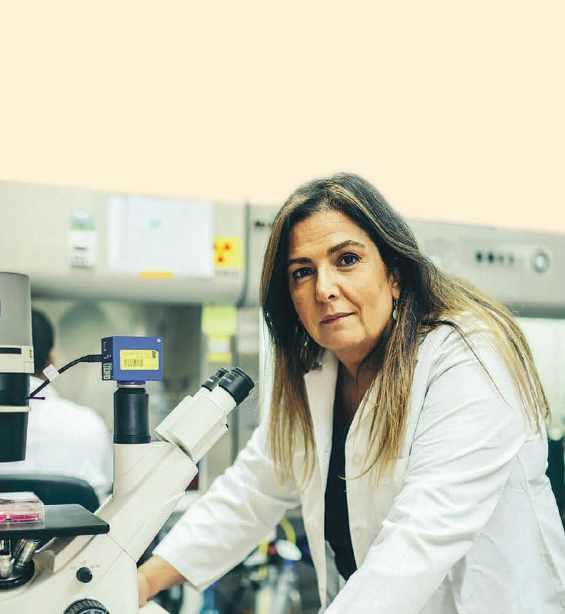

Invite you to meet PROFESSOR MARCELLE MACHLUF
Professor Marcelle Machluf is a pioneering voice and former Dean of the Faculty of Biotechnology and Food Engineering at the Technion, world-renowned scientist, cancer expert and founder of two biotech startups.
• Gain insight into the biotech industry, the intersection of academia, innovation and entrepreneurship.
• Explore the evolving role of women in science in Israel.
• Hear from a leader who proves how research can leap from the lab into real-world solutions.
DATE: Wednesday 1st July at 7:30pm
VENUE: St John’s Wood
To book please visit: TECHNIONUK.ORG/MM










Join us on a journey that will change the way you see Israel











1 BOKER TOV, EVERYONE!
The Israeli Recreational Centre, a new charity founded by Dr Michelle Reshef, has opened one of its first services: a Hebrew-speaking breakfast club for older Israelis living in the UK. The initiative was launched in response to many older people who have built their lives in the UK can becoming increasingly isolated as they age, particularly when language, culture, confidence, health, mobility or digital access become barriers to support. The opening session began with a discussion group, followed by a fallsprevention workshop, and ended with a quiz and a light lunch. Participants spoke Hebrew, shared experiences and enjoyed simply being together.
2 MENORAH HOSTS ISRAELI EMBASSY VISIT
A Menorah Synagogue hosted a visit of Daniela Grudsky (Chargé d’Affaires) and Efrat Perri (Director of Public Diplomacy) from the Israeli Embassy, their first visit to a Manchester Progressive synagogue. Pictured left to right: Rabbi Kath Vardi (Menorah), Marc Levy (Jewish Representative Council of Manchester), Cathy Knowles (Menorah), Daniela Grudsky (Chargé d’Affaires, Israeli Embassy), Efrat Perri (Director of Public Diplomacy, Israeli Embassy), Marissa Goldstone (Sha’arei Shalom), Rabbi Charley Baginsky (CoLead The Movement for Progressive Judaism), Eric Langer (Manchester Reform Synagogue).
3 FAMILIES WALK TO THE NORTH POLE FOR JDA
More than 50 people came together on Sunday 24 May for a family day out at Aldenham Country Park, as the Jewish Deaf Association family services hosted a special Winnie the Poohthemed walk through the Hundred Acre Wood. In 28º sunshine, families followed the trail to discover the muchloved characters’ houses and favourite places from the classic stories. The event raised more than £9k helping the charity continue its vital work supporting deaf and hard of hearing people across the UK.
4 EIGHTY-FIVE BOOKS FOR EIGHTY-FIVE YEARS OF PINNER SYNAGOGUE
In a celebration of Jewish Culture Month, and the forthcoming 85th anniversary of Pinner Synagogue, book-loving shul members gathered to discuss 85 of their favourite Jewish books. The bibliophiles’ inaugural meeting, organised by Doreen Samuels, began with a quiz, followed by readings from some of the titles chosen. Readers could also buy books from the ‘Bookshuk’ stall, an initiative created by synagogue member Merrill Dresner, who said: “This whole evening was fun, illuminating, enlightening and definitely worth repeating.”
5 PINNER KICKS OFF WORLD CUP WITH A CUPPA
Teamwork was the name of the ‘beautiful game’ as Pinner Shul’s weekly Chat and Share Cafe got into the World Cup spirit this week, despite the damp weather, with an English footballthemed lunch of traditional fish and chips – with tea! The shul’s Rabbi Kleiman said: “It was great to see so many members here this afternoon, all enjoying delicious food, delightful company, and wonderful atmosphere, which, on the subject of teams, would not be possible without the continued dedication of our amazing team of volunteers.”







From age one to 101: Maccabi
Chief Rabbi hails his ‘favourite event’ of the year as charities, families and fundraisers fill StoneX Stadium
A 101-year-old war veteran and toddlers taking part in their first community race were among thousands gathered on Sunday for the Maccabi GB Community Fun Run.
Held at StoneX Stadium, the annual event, powered by Charity Extra, brought together families, schools, charities and community organisations from across the country, turning one of the biggest dates in the Jewish communal calendar into a celebration of Jewish life, community and fundraising.
Among those taking part was Second World War veteran Mervyn Kersh, who completed the 1km route in support of AJEX, the Association of Jewish Ex-Servicemen and Women.
The sight of participants ranging from one to 101 years old was singled out by Chief Rabbi Sir Ephraim Mirvis as one of the reasons the event remains so special.
“The Maccabi GB Fun Run is my favourite event in the British Jewish calendar,” he told Jewish News.
“We’ll see today, Mervyn Kersh, at the age of 101, a veteran from the Second World War, together with tiny little kids, all participating in this one-kilometre event. It’s just amazing.
“We can be so proud to be Jewish, and our values are here to be seen.”
But the Fun Run was about far more than crossing a finish line. Participants took on a range of challenges throughout the day, from the family-friendly 1km event to the 5km walk, 5km run and 10km race. Away from the courses, families filled the stadium’s festival zone, with bouncy castles, inflatables, rides, arts and crafts and children’s activities, creating a carnival atmosphere. Performances from the Israeli Dance Institute, Vanessa Class School of Dance and the Rimon Jewish Primary School Choir kept crowds entertained, while kosher food vendors kept runners and spectators fuelled throughout the afternoon.
The annual event brought together 85 charities from across the community, including AJEX, Camp Simcha, Jewish Care, Jami, World Jewish Relief and Keshet UK. For many runners, the day marked the culmination of months of fundraising, while charities highlighted the impact of their work.
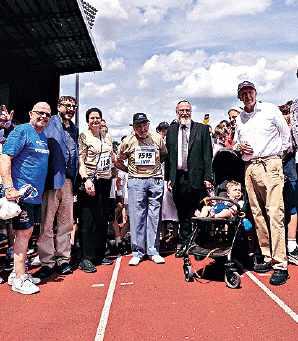
For Michael Wegier, chief executive of the Board of Deputies, the day represented something particularly important at a challenging time for the community.
“This is one of the flagship events of the British Jewish community,” he told Jewish News.
“It’s really important that people have come out in such big numbers for a positive event, a positive experience, and not because we have to, but because we want to.
“It’s shining a light on vibrant Jewish life in a way that is kind of undermined nowadays by all the antisemitism.”





charity brought 63 runners to the event
Among the largest teams was Camp Simcha, which supports Jewish families with seriously ill children. The charity brought 63 runners to the event and raised nearly £12,000.

One of them was Sofia Leigh, whose family has been supported by Camp Simcha for the past six years.
Her mother, Ilana, said: “Sofia did the Bat Mitzvah programme this year but missed out on the sponsored walk due to being on Camp Simcha Sibling Retreat. She desperately wanted to find another way to raise money for Camp Simcha after everything they’ve done for her, and so we decided to do the community fun run.



It was an honour to run



everything they’ve done for her, and so we decided to
It was an honour to run for Camp Simcha – their support for us has been immeasurable.”
support for us has been
family, Aryeh Hecht and
Another Camp Simcha family, Aryeh Hecht and daughters Lily-Rose and Naavah, also took part.
“We just wanted a chance to give back a little,” said mum Shaina. “We had the best time even in the heat!”
best time even in the heat!”
Jewish Care and Jami were
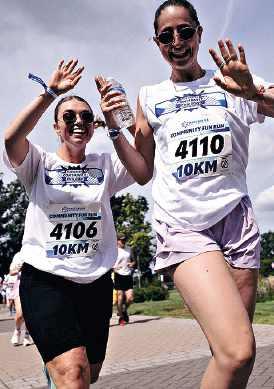

Fun Run unites generations
represented by 46 runners aged between three and 76. Among them was 11-year-old Georgia, who completed the 5km race as part of Jewish Care’s B’nei Mitzvah programme.
Meanwhile, Jonathan and Caroline raised more than £2,500 for Jewish Care after completing the 10km route.
“The level of care is exceptional,” Jonathan said. “From reception to the care teams, everyone is dedicated and a pleasure to speak with. I cannot think of a better place for my mum in the final stages of her life.”
Elsewhere, World Jewish Relief used the day to highlight its work supporting vulnerable communities overseas, including in Ukraine. Visitors were invited to write
messages of hope that will be delivered to children affected by the war, while the charity also raised awareness of its ongoing humanitarian programmes.
Keshet UK was also among the organisations represented at the event. Luke Levine, Keshet UK’s Head of Community Life, said the charity works to ensure LGBTQ+ Jews feel welcomed and included within communal life.
“Jewish people are becoming more and more diverse,” he said. “If you want people to stay, you have to have a place for them.”
Back at the AJEX stand, Mervyn Kersh’s daughter reflected on her father’s latest achievement. “It’s just one of the many things he does all the time,” she told Jewish News.
he does all the time,” she told





“You have to keep a leash on him.”
She added: “I’m so proud.”
Speaking after the event, Maccabi GB chief executive Ashley Lerner said the turnout had sent a powerful message.
“At a time when some may have expected our community to stay away, stay indoors or keep its head down, the Maccabi GB Community Fun Run proved the opposite,” he said.
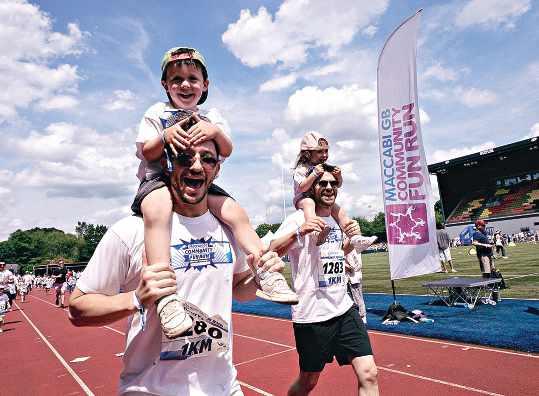

its head down, the Maccabi GB Community Fun community full of smiles.
“It was a day of fun, fundraising and a community full of smiles.
“I truly believe that together we showed what it means to be one Jewish community, moving, giving and celebrating together.”
giving and celebrating together.”
For thousands who spent Sunday at StoneX Stadium, the day was a reminder of the community at its best – coming together not because it had to, but because it wanted to.



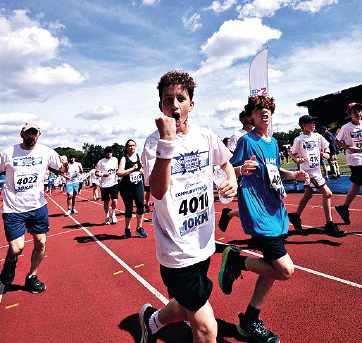














CRYPTEX GROUP are delighted to have partnered with Jewish News at the Maccabi Fun Run. Cryptex are here for all your security needs both commercial and residential. All surveys and quotations are free of charge. Contact us to discuss.
Security, Safety and Automation Specialists
Cryptex Security install, upgrade, integrate and maintain security systems
Jennifer Ashley Tepper made her devotion to composer Jonathan Larson clear long before she became one of the world’s foremost authorities on his work. For her bat mitzvah, the theatre-obsessed teenager chose to dress as the character Mimi from Rent and pose emerging from a pile of playbills.
Jonathan Larson’s name is forever linked with Rent, but a new generation discovered him through Andrew Garfield’s Oscar-nominated portrayal in Tick, Tick... BOOM!
“When the Rent cast recording came out, it changed my life,” recalls Tepper. “It hit me hard. It inspired me and showed me what new school theatre could be.”
Growing up in Boca Raton, Florida, she was what she cheerfully describes as “a theatre kid from birth”. Every Chanukah she asked for cast recordings and immersed herself in Broadway scores. Larson quickly became an obsession.
Jennifer Ashley Tepper spent a decade uncovering Jonathan Larson’s forgotten songs. Now the acclaimed O -Broadway show they inspired. By Brigit Grant his references to Judaism in
His story was as compelling as his music. The composer died suddenly from an undiagnosed aortic aneurysm at just 35, hours before Rent’ s first New York preview in January 1996.
Tepper has spent much of her professional life ensuring Larson’s story does not end there. We are speaking ahead of the European premiere of The Jonathan Larson Project, the acclaimed Off-Broadway musical she spent more than a decade developing from a concert of forgotten songs into a fully realised production. Now, under original
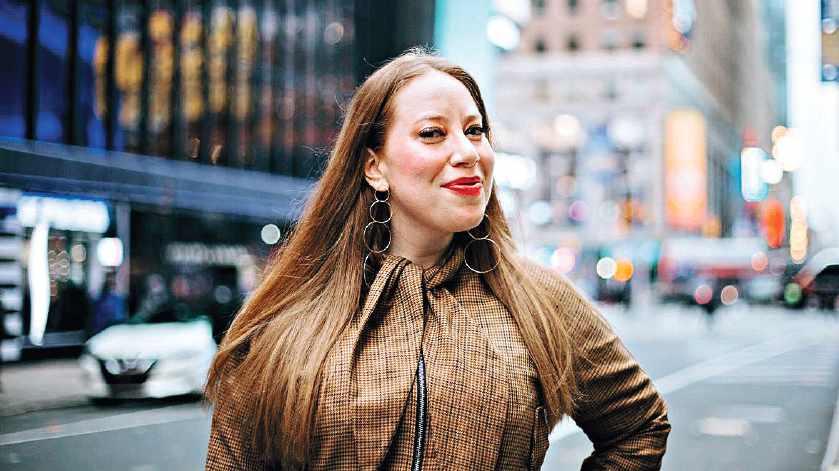



family, to Jonathan’s parents who were still with us, and to his sister Julie, about expanding it into a full evening.”
What followed was years of detective work and hours spent at the Library of Congress in Washington, where Larson’s papers, journals, cassette recordings and lyrics are housed.
director John Simpkins, it arrives at Southwark Playhouse on 9 July.
The production is the culmination of more than a decade’s work for Tepper, who has devoted years to uncovering and championing songs that might otherwise have remained unheard.
That is only one of the hats she wears. With New York zeal she reels off the others: creative and programming director of New York’s famed 54 Below, where she has curated or produced more than 8,000 shows; author of five theatre books, including producer on and off Broadway; and consultant on some of musical theatre’s biggest recent projects.
The seeds of The Jonathan Larson Project were planted in 2014 during a New York City Center production of Tick, Tick... BOOM! starring Lin-Manuel Miranda.
“I put together a miniature unheard Jonathan Larson concert for the lobby before the performance,” she recalls. “At that point I started talking to the Larson
“The songs he wrote and pounded out in his apartment and recorded on tape,” she says. “No one had remembered them or heard them.”
Across 18 years, Larson wrote around 200 songs for unproduced musicals, workshops, benefit concerts and personal projects. The deeper Tepper went into the archive, the more personal the project became. “I wasn’t only looking for songs. I was reading his journals and listening to him playing Billy Joel and Elton John covers because he loved them. You realise this was a person. Someone’s brother. Someone’s best friend.”
tragic, how unbelievably heartbreaking.”
Tepper’s expertise became so widely recognised that Lin-Manuel Miranda recruited her as a consultant on his film adaptation of Tick, Tick... BOOM!
“Andrew gave the most incredible performance,” she says. “I would talk to him about Jonathan and forget he was British.”
Tepper has also considered how Larson’s identity informed his work.

“There are at least a dozen references to Judaism in Rent,” she says. “Jonathan wasn’t deeply religious, but his faith was woven naturally into his characters and his outlook. The Jewish seeking out of social justice is at the heart of much of his work.”
For Tepper, The Jonathan Larson Project is about discovery rather than nostalgia.
“When Jonathan passed and Rent was his legacy, what an incredible legacy. But he could do more than that.
That sense of loss remains impossible for Tepper to ignore and hours before we spoke, Larson’s Seasons of Love was used during the Tony Awards in Memoriam tribute.
“Every time there’s anything like that, you just go, ‘Oh my God, millions of people love this song. It means so much to people.’ And he’s not here. How crazy, how
“This show gives audiences the chance to discover the wider body of work that almost disappeared with him.”
The Johnathan Larson Project is at Southwark Playhouse Borough from Thursday 9 July to Saturday 22 August 2026. southwarkplayhouse.co.uk
Jennifer Ashley Tepper – the Jonathan Larson authority and producer of the show
Andrew Garfield in Tick, Tick... BOOM!
Jonathan Larson
Jennifer and Lin-Manuel Miranda
In pod we trust
Louisa Walters puts podcast host Jodie Brandman in the hotseat to get a feel for who she’s talking to and why
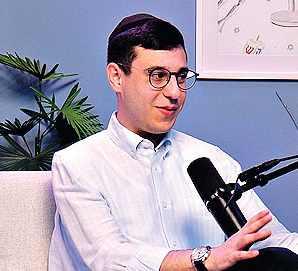
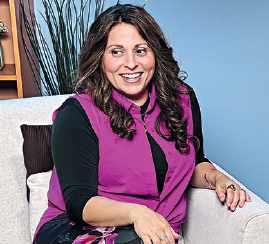

Interviewing a podcast host on Zoom is a bit like cooking for a chef. Surely I’m doing it all wrong and she should be the one asking the questions. But Jodie Brandman, host of What the Falafel, demonstrates immediately why she is so good at what she does –it felt like a chat with a friend and the conversation just flowed.

Jodie launched WTF (yes, that actually is the abbreviation!) nearly three years ago “because I wanted to find a space where it’s not just stereotypical Jews being presented on TV and not solely conversations around antisemitism and politics”. Indeed she has had diverse conversations with the likes of comedian Yechiel Jacobs, fitness coach Golan Horesh, matchmaker Aleeza ben Shalom and travel content creator Nicky Kelvin, ensuring inspiring stories and a good sprinkling of Jewish joy.
A former psychology student who then became a nutritionist, Jodie, 37, is into personal growth, health and wellbeing and loves to have conversations around having a better life. Her aim is to bring that into the Jewish sphere.
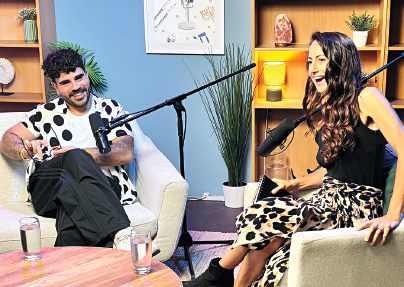
Jodie was already running a women’s health podcast when October 7 happened.
“Everything was shaken up for me, most especially my identity. I was always British and Jewish, but then everything flipped, and I felt I couldn’t just turn up on my podcast say, ‘today I’m eating carrots’.”
After a few negative comments on posts where she was
making challah on social media, she took off her Magen Dovid. “I was scared to be Jewish, but then I saw other content creators like Ben Reback and Zach Margs being really proud to be Jewish, and I thought, well, if it’s okay for them, maybe it is okay. I started watching Johnny Daniels as well, and he said we have to speak up.”
Jodie felt she wanted to be around more Jewish people and have more Jewish conversations. She set up an Instagram page as an outlet for her Jewish content and then her husband Joel, a graphic designer, suggested a podcast.
Jodie (who grew up in Bushey) and Joel live in Essex with their two boys, aged eight and three. She records the podcast at a studio in Finchley.
Over the past three years there have been many memorable moments. “While researching Dov Foreman I found a clip of him singing on YouTube when he was little. So I suggested a game of Guess the Singer and Song, and I played him the clip. He found it really funny and he told me he used to sing to raise money for charity. Every step of that interview he blew me away as a person – he is an amazing human being.”
She’s chatted to Romy Kosher, Josh Halmer and Ben Rebuck, and we can expect more food-related content as Jodie is a foodie. “I love learning about different cultures through food, and I’d love to understand more of the Sephardic traditions and Ethiopian foods. There’s a Jewish woman who’s got an Ethiopian restaurant in New York who I would love to have on the show.”
Risque comedian Candy Gigi was a tough gig. “Usually I can match people and their energies, but very early on in our chat I thought I can’t match this.
“However, what emerged was really interesting – she didn’t feel like she fit in at school, and she turned it around.
This is what I love – talking to people and finding out more.”
Jodie is always careful not to get too political, so when Hen Mazzig came on she steered the conversation to his background and the complexities of being a gay Mizrahi. “That was one of my earliest episodes, so I’d love to have him back. He did promise me that I could come over for his mum’s home cooking – I haven’t had that invite yet!
“I really enjoyed hanging out with Emma Kingston. Sometimes the conversation flows so well I feel like I’m their friend, and then I remember I’m not! We had a hilarious conversation about whether it’s bagel or beigel, and I still watch that clip because it’s so funny. It’s interesting to see the difference in people who are media trained and how they come across. I think Emma was a bit wary of being on a Jewish podcast – she’s experienced a bit of antisemitism and people making comments.”
Jodie is very spiritual and says she would love to get some rabbis and Kabbalistic teachers to come on. “I’m open to all conversations. If it feels right, then I go for it. If there are things that don’t feel quite right, it’s a no. I don’t ever want to take an interview just because someone has a big following or has been recommended. It has to feel aligned.
“That said, if Adam Sandler ever agreed to come on I’d feel like I’ve arrived.”
Jewish News has entered into an exclusive partnership agreement to lead the social media strategy and content distribution for the What the Falafel podcast. The partnership was facilitated by 8original, which serves as both the agency partner behind the collaboration and Jewish News’ social media partner, helping drive innovative audience growth and digital engagement initiatives
Jodie’s guests include (left, from top): author Dov Forman, matchmaker Aleeza ben Shalom, food influencer Ben Rebuk, writer Hen Mazzig
The Family Story Behind DROR
“We
Don’t Just Build Homes, We Build Lives”
What began as a mother and son partnership has evolved into one of Israel’s most comprehensive turnkey property services for international buyers. Dror guides clients from the very first conversation, through property selection, planning, construction and final delivery, handling every detail. PROMOTED
For many people the decision to buy in Israel, as a second home or part of an Aliyah, is both emotional and logistically complex. Regulations, cultural nuances, planning restrictions and the sheer intensity of the Israeli construction landscape can turn even the most exciting move into a nightmare. DROR was created to remove that friction.

A Partnership Built Over Years
Founder Yarin built his understanding of homes through years of working alongside his mother, Perri Hadar, a luxury interior designer.
Six years ago, Yarin started his own construction business and the two have worked together on several projects, both bringing their own expertise into a formidable partnership.
“My mother and I are always on the same page,” Yarin says. “She brings the creativity, I bring the technical side, and together we push each project further for our clients.”
Their dynamic became the foundation of the company. It’s rare to find a team that combines design instinct with construction expertise and even rarer to find it within a family that trusts each other completely.
A Realisation That Shifted the Business
As the years passed, Yarin noticed that clients were coming to them after they had already bought a property, worn down by bureaucracy and frustrated by processes. He realised the experience could change if the process began earlier.
“Once they saw how much easier the process became with Dror handling everything, they understood the true benefit of the service” he explains.
“I did not want anyone standing between us and the client,” he says. “I wanted to give them the full service.”
Dror became a company that guides clients from the very first step and would support them through every stage of planning, building and finishing, removing the cultural gap, the red tape and the uncertainty that comes when buying in Israel.
Understanding the Family Before the Floorplan
Every project begins with a conversation about the way a family actually lives: how many children they have, whether they love hosting, whether they prefer quiet spaces or whether they want to be near schools, synagogues or the sea.
“We start by understanding how the client lives,” Yarin says. “We take all of that and translate it into numbers. Location. Square meters. Layout.”
Then the property search begins, giving clients confidence that their home will work for their family, the renovation will fit the building’s limits and the investment is sound.
Navigating Israel’s Construction Culture
Anyone who has built in Israel knows that the process is not simple, with its fast pace direct communication and planning rules, it’s challenging even for Israelis.
“To build in Israel is crazy,” Yarin says with a smile. “Even for me it is hard, but I know how to deal with the people. My team are experts in the industry but for overseas clients, it is a completely different culture.”
Dror becomes their advocate, translator and representative on the ground, handling every conversation, approval and detail.
“When you come to us, you never need to go to anyone else,” he says. “Everything is under one roof.”
Building a Future in Israel
For those considering buying or building in Israel, Dror offers something rare. A partner who understands both the emotional weight of the decision and the technical complexity behind it. Dror exists to make that journey seamless.
As Yarin says, “We don’t just build homes. We build the life our clients imagine.”

THE 19-YEAR-OLD USING AI TO SOLVE THE MATHS PROBLEM
Tyler
Welby,
a former head boy of Immanuel College and the UK’s youngest school governor, has launched a GCSE maths platform
former head boy at Immanuel College, believed to be Britain’s youngest school governor, has launched an AI-powered platform to help tackle the UK’s growing GCSE maths crisis.
Tyler Welby, 19, founded MathaMentor after seeing firsthand, as both a student and a private tutor, the scale of the challenge facing schools. Nearly 42 percent of GCSE maths entries failed to achieve a standard pass (grade 4) last year.
“We’re at crisis point,” Welby tells Jewish News.
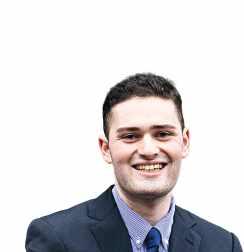
“Every year, around 175,000 students are finishing school without a GCSE maths pass. That’s having a huge impact on future opportunities.”
Welby wants to close that gap with MathaMentor,
which provides personalised support on a scale that traditional one-to-one tutoring cannot match.
MathaMentor creates a tailored learning journey for each student, adapting questions, explanations and support to their individual strengths and weaknesses, remaining aligned to GCSE exam board requirements.
Each pupil is assigned their own AI-powered learning avatar, while the platform’s teacher dashboard provides AI-generated insights into class performance, helping schools identify learning gaps earlier and target support more e ectively.


“MathaMentor is designed to work alongside classroom teaching rather than replace it,” explains Welby, who lives in Elstree. “It’s not just about helping the students. It’s also about helping teachers understand where they should be focusing their time and attention.”














The launch last week comes as the Government announced plans to increase its focus on artificial intelligence in education, with former prime minister Sir Keir Starmer unveiling the rollout of AI tutors to 450,000 children to help close attainment gaps.
“The conversation is no longer whether AI belongs in education,” says Welby. “The question now is how we use it responsibly and e ectively to improve outcomes for students. AI is the future of education.”
When Welby – who studied maths, history and politics A-levels – left Immanuel College, he remained in close contact with the former chair of the board of governors Daniel Levy, a prominent philanthropist and co-chairman of The Grove Hotel and Luxury Family Hotels. The pair regularly discussed education, technology and the growing role AI could play in classrooms. Those conversations eventually led to an unexpected invitation.
“Daniel has been an incredible mentor to me and he invited me back to become a governor,” says Welby. “I was initially quite hesitant because of my age, but it was an incredible opportunity.”
Welby joined the governing body, serving
on education and strategy committees while simultaneously studying for his History and International Relations degree at King’s College London and running his own tutoring business, Cloud 9 Tutoring.
It was through those experiences that the idea for MathaMentor began to take shape.
“I was sitting GCSEs not long ago and saw how many of my fellow students struggled with maths – there was a huge gap between students who could a ord regular one-to-one support and those who could not.
“I wanted to use AI to create something that could give every student personalised support, build their confidence and help them achieve the grades they are capable of.”
Welby assembled a team that included experienced GCSE maths teachers, educational psychologists and special educational needs specialists to help build the platform.
He is already in discussions with schools, tutoring providers and academies across the UK.
While MathaMentor is currently focused on GCSE maths, Welby says the technology has been built with a much bigger ambition in mind. “Our mission right now is to reduce the GCSE maths failure rate but the technology can be adapted for di erent age groups and di erent curricula.



“This may be bold but in five years’ time, I’d love to see MathaMentor being used in all schools around the world. There’s no reason why this couldn’t support students across di erent education systems globally.”
For now, however, his focus remains firmly on the challenge closer to home. “If we can help reduce that 42 percent failure rate and give more young people the confidence and qualifications they need to succeed, that would be a huge achievement.”
With Candice Krieger candicekrieger@googlemail.com
Welby
MathaMentor is designed to work alongside classroom teaching, not replace it
As an independent health insurance expert, I’m here to find the right policy for you, and help recommend the providers who offer the best cover at the most competitive premiums. Our FREE advice service covers individual, family and company policies. Whether you have an existing policy or not, let’s have a chat.

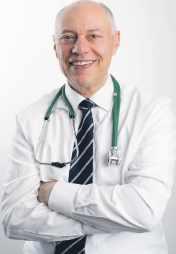
Trevor Gee
trevor.gee@patienthealth.co.uk www.patienthealth.co.uk






MAKING SENSE OF THE SEDRA

In our thought-provoking series, rabbis, rebbetzins and educators relate the week’s parsha to the way we live today Blessing we did not expect
RABBI BENJY MORGAN
OLAMI UK
of the Red Heifer. Even King Solomon, the wisest of men, said of it: “I thought I could become wise, but it remained beyond me.”
There are moments in history when the world seems to lose its moral bearings. We live in such a moment now.
We have seen violence celebrated, truth distorted and hatred dressed in the language of justice.
We have witnessed a troubling inability to distinguish between aggressor and victim, evil and good.
The noise is relentless. The certainties we once took for granted appear less certain than before.
It is precisely at such moments that we turn to Chukat. The parashah begins with one of the Torah’s great mysteries: the law
Judaism does not ask us to understand everything. It asks us to recognise that not everything can be understood. Faith is not the certainty that we possess all the answers. It is the courage to continue the journey even when answers elude us.
That is the lesson Moses and Aaron struggled with at the waters of Merivah. Faced with a frightened and angry people, they momentarily lost patience.
Leadership, the Torah teaches us, is not about control. It is about resilience: the ability to remain calm when others cannot.
Then, unexpectedly, comes
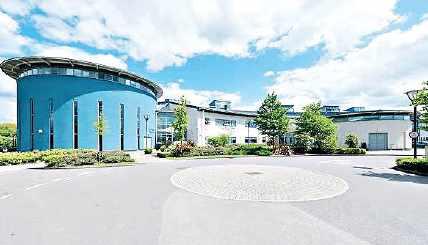
Our task is to build homes, schools, communities and futures
Balak. A pagan prophet, Bilaam, stood on a mountain intending to curse the Jewish people. Yet every curse becomes a blessing. How often in Jewish history has
this happened? Those who sought our destruction have inadvertently strengthened our identity. Those who tried to silence us have reminded us why our voice matters.
Bilaam looked down at the camp of Israel and uttered words we still say every morning: “How goodly are your tents, O Jacob, your dwelling places, O Israel.”
Others saw weakness. Bilaam saw something di erent: a people who carried hope through history. That remains our task today. To refuse despair. To answer hatred not with fear, but with faith.
To build homes, schools, communities and futures. To become, in an age of anger, a source of blessing.
The Jewish story has never been the story of power alone.
It is the story of a people who, even in di icult times, never stopped believing that light is stronger than darkness and that blessings can emerge from places we least expect.





Progressive Judaism
LEAP OF FAITH

RABBI MIRIAM BERGER FOUNDER DIRECTOR OF WELLSPRING
UK
It’s definitely not ‘only’ a game
Anyone who ever thought themselves brave enough to suggest to an irate or devastated football fan that they should keep things in perspective because “it’s only a game” is either naïve or uninitiated.
I made the remark as an innocent nineyear-old but the rebuke was such that never have I used the phrase again!
Every time I think I understand the finer details – from the offside rule to the hydration breaks – which enable me to be the most supportive mum of a football fan, more nuance comes into the equation to continue my education.
As England kicked o for their first game of the World Cup 2026 tournament, I was ready to be a full England fan.
It seemed easy. No clash of identities
against Croatia; however beautiful Dubrovnik is as a gorgeous city break it didn’t open up the timeless youth movement debate that an England versus Israel duel might have.
With some unexpected booing from the sofa in the first few minutes of the game, Harry Kane gets a penalty and this is where the education begins.
I realised however much my son the England fan wants England to win, the Arsenal fan in him loved the idea of Harry Kane (Tottenham’s former saviour) missing the goal.

I think the fact he managed to miss and then score was perhaps the perfect compromise outcome for this identity interplay.
These competing identities might be easy to see when it’s a question of team
game,
A stimulating series where our progressive rabbis consider Judaism in the face of 21stcentury issues
Israeli woman are attacked on the street.
are always falling foul of all the time.
shirts and chants from the football sidelines, but we are always falling foul of this phenomenon – it’s part of societal dynamics all the time.
When antisemitism is making us feel vulnerable, the concept of British Jewry feels unified and strong.

Yet so often it’s the way we divide ourselves into smaller and smaller component parts within the Jewish community that leaves us vulnerable and unable to represent ourselves as e ectively or as quickly as we might otherwise.
is making us feel
I sometimes worry that there is more prejudice against Jews who are ‘di erent’ from ourselves than even the prejudice which comes at us from the outside.
solidarity and vulner-
We stand alongside each other in our solidarity and vulnerability.
We take that prejudice for granted because it is so interwoven among us but how often do conversations happen which ‘other’ fellow Jews?
interdenominational
Reform Synagogue was as we all feel exposed
No one showed any interdenominational prejudice when a Reform Synagogue was on the receiving end of an arson attack, just as we all feel exposed and helpless when a Charedi man or an

The horror of a loved one having “gone frum” or having a rabbi from “the Reform” o ciating at their child’s wedding.
What are we doing? The hateful banter might be fine for the football fans.
We don’t need Arsenal and Spurs fans to say “let’s put our team a liations to one side for the good of the game” – but this tribalism within the tribalism is doing us no good.

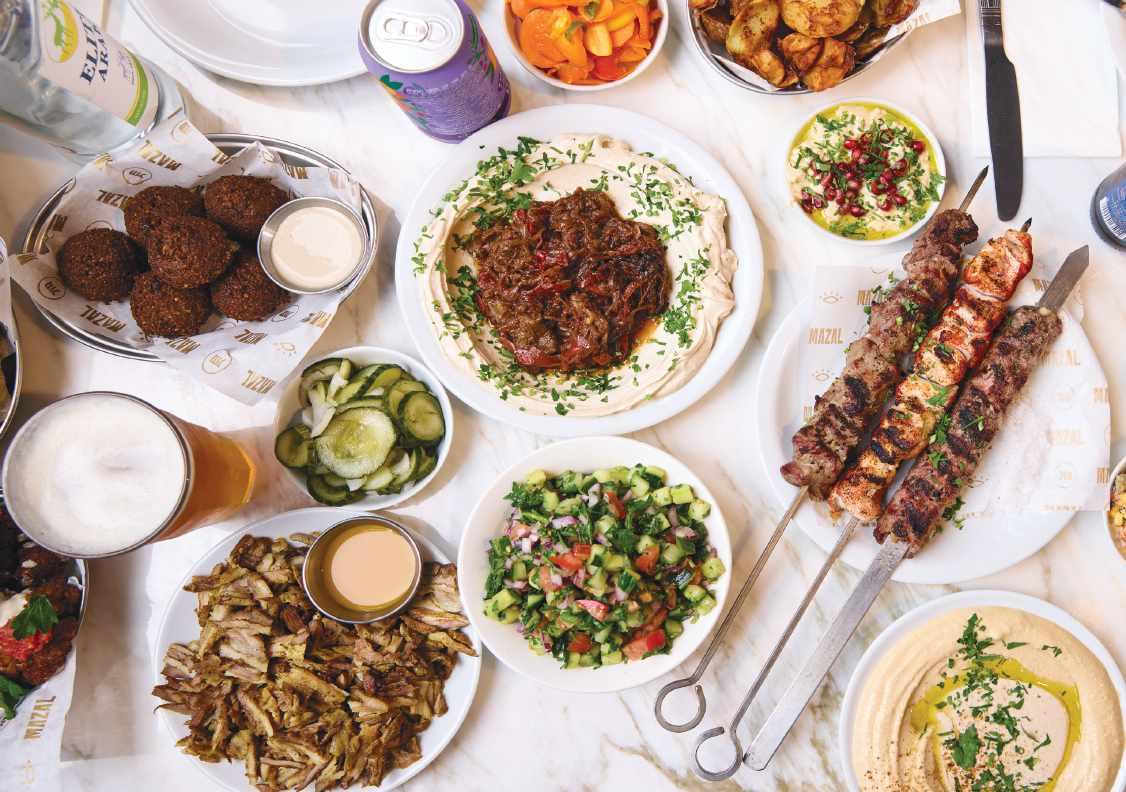





















































ANTIQUES
Top prices paid
Antique – Reproduction – Retro Furniture (any condition)
Epstein, Archie Shine, Hille, G Plan, etc.
Dining Suites, Lounges Suites, Bookcases, Desks, Cabinets, Mirrors, Lights, etc.
House clearances
Single items to complete homes
MARYLEBONE ANTIQUES - 8 CHURCH STREET NW8 8ED 07866 614 744 (ANYTIME) 0207 723 7415 (SHOP)
closed Sunday & Monday
STUART SHUSTER - e-mail - info@maryleboneantiques.co.uk
MAKE SURE YOU CONTACT US BEFORE SELLING


ARTICLES WANTED



Confidential Bereavement Counselling for adults and children individually. Support Groups available. We offer in person, online and telephone counselling. Contact Jewish Bereavement Counselling Service in confidence. 0208 951 3881 enquiries@jbcs.org.uk | www.jbcs.org.uk
Call our Legacy Team on 020 8922
or


Suits from £79.50
Overcoats from £79.50
SUITS NOW FROM £69
SHORTS £20 EACH, 2 PAIRS FOR £30
Friendly Family Company established for 30 years We clear houses, flats, sheds, garages etc. No job too big or too small! Rubbish cleared as part of a full clearance. We have a waste licence. We buy items including furniture bric a brac.
For a free quote please phone Dave on 07913405315 any time.



Furs, Jewellery, Old Costume Jewellery, Watches, Silver, Designer Bags, anything vintage. 01277 352560 10 Golders Green
eaving Your Legacy


ROUSERS £20 EACH, 2 P T AIRS FOR £30, 28-48 INCH WAIST
SPORTS JACKETS AND BLAZERS FROM £39.50
CASUAL JACKETS FROM £29.50
KNITWEAR FROM £10 S
SHIRTS FROM £10
SHOES FROM £10
Open everyday & Sundays til 5:00pm
Raincoats from £49.50 We accept
GO POLO SHIRTS £15 EACH, 2 FOR £20















EXCLUSIVE CRUISE & STAY HOLIDAYS ABOARD SEABOURN QUEST
Immersive Mediterranean itineraries and unhurried days ashore, with every detail arranged by The Cruise Line – the UK’s original luxury cruise specialist
WHY OUR CLIENTS LOVE SEABOURN
✓ Intimate all-suite ships, just 450-600 guests
✓ Spacious ocean-view suites, most with a veranda
✓ Longer stays & overnight calls in iconic ports
✓ Almost one crew member per guest
✓ Kosher meals on request (advance notice)
✓ Elegant, relaxed atmosphere – no formal dress code
Greece & Dalmatian Delights Jewels of the Dalmatian Coast Grecian Delights & Roman Gems
Athens ⟶ Dubrovnik 24 July • 7, 13 & 21 August 2026
FEATURED 2026 VOYAGES � 9-NIGHT FLY-CRUISES FROM
Dubrovnik ⟶ Dubrovnik 13 Jul 2026
Athens ⟶ Rome 23 October 2026
