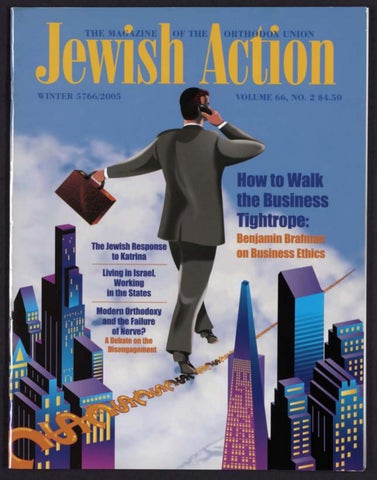
THE M A Q A m m
WINTER 5
OF THE
O R T W tiiiliN IO N :
VOLUME 66, NO. 2 -$4.50
TheJewish Response to Katrina Working inthe States
on Business Ethics
Vrbove, Slovakia 1848
Wt
Um / in!
i
m grw qe^ie la iu j riti,
W
in
S E E C IA t Ä
Herzog hiviK,VALUtV CHARDONNAVj
MM P I ■■ « R ß a H 1 .. n j « W L m M M J m m M
PH
53
M U W U IIIII i......... ■ } u| ■hb Ä
-c
|
H i ;V :; '
iififlllil
Jewish Action
W inter 5766/2005
Vol. 66, N o. 2
FEATURES 12
We Are All One”: The Jewish Response to Hurricane Katrina
Bayla Sheva Brenner ÔÈîi-" ■
BUSINESS ETHICS 20 How to Walk the Business Tightrope: Morality in the Workpla< 26 Ethics at Work 32
Personal and Financial Integrity and Halachah
J| Benjamin Brafman Aaron Levine D avid Hojda
page 12 'i i #
1
CONTROVERSY Did American Orthodox Jews Forsake Their Israeli Brothers? 38 M odern Orthodoxy and the Failure of Nerve? 39 A Rejoinder
Emanuel Feldman YosefBlau
page 38 1 Ü
ISRAEL 44 The Transatlantic Com m uter— Living in Israel, Working in the States 50
Dodi Tobin, Chaim I. Waxman O n and O ff the Beaten Track in .. .The Secret Synagogue of Ein Gedi Peter Abelow page 4 4
DEPARTMENTS 2
1 J Ä M
LE TTE R S
6 P R E SID E N T’S M ESSAG E O U Relief Funds: W here Do They Go? Stephen 10 C H AIRM AN ’S M ESSAG E 52 J U S T B E T W E E N US
Savitsky
A Modest Proposal for Transforming the Bar Mitzvah
YosefAdler and Yossi Prager 54 JE W ISH L IV IN G Appreciating G ods World—A Prerequisite for M itzvot 56 LEGAL-EASE
Abraham J. Twerski W hats the Truth a b o u t... “A Land Flowing with M ilk and Honey”? A ri Z. Zivotofsky
62 N E W T O © 64 KO SH ERKO PY Say Cheese! 68 TH E CHEF’S TABLE Classic Cuisine
Avrohom Gordimer Helen Nash
7 4 IN SID E TH E O U 79
H IG H LIG H TS OF R E C E N T O U E V E N TS BO O KS W hy M arry Jewish: Surprising Reasons for Jews to M arry Jews By Doron KornbluthReviewed by Jack Abram ow itz
Jewish A ction seeks to provide a forum for a diversity o f legitimate opinions within the spectrum o f Orthodox Judaism. Therefore, opinions expressed do not necessarily reflect the policy or opinion o f the Orthodox Union. Jewish Action is published by the Union of Orthodox Jewish Congregations of America 11 Broadway, New York, NY 10004 (2 1 2 )5 6 3 -4 0 0 0 Printed Quarterly - Winter, Spring, Summer, Fall, plus Special Passover issue. ISSN No. 0447-7049. Subscription: $12.00 per year; Canadian, $16.00; Overseas, $30.00. Periodicals postage paid at New York, NY and additional offices. POSTMASTER: Send address changes to Jewish Action, 11 Broadway, New York, NY 10004.
Winter 5765/2005 JEWISH ACTION
1
JewishAction THE MAGAZINE OF THE ORTHODOX UNION
http:/www.ou.org carmeln@ou.org
Editor Nechama Carmel
Literary Editor
Jews in Small-Town America | Just wanted to let you know how much my family and I enjoyed the summer issue of Jewish Action. The per sonal stories and reflections reminded me of the years I spent raising my chil dren in Fair Lawn, New Jersey, under the leadership of Rabbi Benjamin and Shevi Yudin. They are models of true religious life who deeply affected my children. I believe my children became better people and Jrum Jews as a result of growing up in our “small town.” My family and I developed tolerance and compassion for all people as a result of our Fair Lawn experiences. In addition, as expressed in so many of the stories in the magazine, we all benefited from liv ing in a caring shul community. We learned to help others in times of need, to share the semachot of our friends and neighbors and to work together for the community. These experiences have molded the lives of every member of my family and will stay with us regardless of where we live. We always look forward to receiv ing Jewish Action. Kudos for an especial ly wonderful edition! Doris Brandstatter Fair Lawn, New Jersey As a “west of the Hudson” O U board member, I was pleased to see space devoted to “out of town” in your summer issue. I particularly liked Daniel Alters article (“Life West of the Hudson”) because it provides a fairly balanced view of some of the advantages and disadvantages of living outside the New York area. Rabbi Alter points out that people who decide to live in smaller communi ties oftentimes do so to improve their 2 JEWISH ACTION
Winter 5766/2005
Jewish lives. Moving gives them the opportunity to be more involved in community matters and kiruv and enables their children to grow up in less hectic and competitive surroundings. I have also seen people move in the other direction, from “out of town” to New York, to improve their Jewish lives. They give up promising careers and community status to move to a place where they earn less and are just one of the crowd. But they want their children to have the best chinuch, and they want to live in an area with an Orthodox crit ical mass. W hat is key is basing a decision about where to live on Jewish values. Those who live in New York should stop for a moment and consider why they live there. I am sure most would come to the conclusion that it is a good place to live Jewishly. But thinking about it and reaching that conclusion may make them feel better when they are stuck on the Palisades on the way to a weeknight wedding in Monsey. This reminds me of something the Chofetz Chaim once said: “We all know that when a person ate a piece of manna, it tasted like whatever he was imagining at the time. W hat if he wasn’t thinking of anything while he was eat ing—how did it taste then?” The Chofetz Chaim paused and continued, “When a person doesn’t think, things have no taam [purpose].”"! Eli Genauer Seattle, Washington
D oing the D af | In “Doing the D af” (summer 2005), Yitzchok Adlerstein highlights several popular Daf Yomi web sites but seems to have missed the one ranked
Matis Greenblatt
Assistant Editor Dassi Zeidel
Kashrut Editor Rabbi Eliyahu Safran
Contributing Editors Rabbi Yitzchok Adlerstein, Dr. Judith Bleich, Rabbi Emanuel Feldman, Rabbi Hillel Goldberg, Rabbi Joseph Grunblatt, Rabbi Sol Roth, Rabbi Jacob J. Schacter, Rabbi Berel Wein
Design KZ Creative
Advertising Deborah Lieber (212) 6 1 3 -8 1 3 5
fax: (212) 6 1 3 -0 7 7 2
Subscriptions Eva Holczer
(212) 6 1 3 -8 1 3 7
Israel Representative Lisa Rubin
9 7 2 -0 5 4 -7 2 1 -1 9 6 8
Orthodox Union Jewish Action Commission Gerald M. Schreck, Chairman Joel M. Schreiber, Chairman Emeritus
President Stephen J. Savitsky
Chairman, Board of Directors Harvey Blitz
Vice Chairmen, Board of Directors Seymour J. Abrams Morry Weiss
Chairman, Board of Governors Martin Nachimson
Vice Chairman, Board of Governors Jay L Schottenstein
Executive Vice President Rabbi Dr.Tzvi Hersh Weinreb
Director of Communications and Marketing David Olivestone © Copyright 2005 by the Orthodox Union/ . .11 Broadway, NewYork, NY 10004. | Telephone (212) 563-4000 Periodicals Postage Paid, NewYork, NY and at additional mailing offices. Printed in Canada
Your seltzer savings will last a lifetime
pp|I
You love seltzer, but hate schlepping home heavy cases. You pay sale prices, but the cost adds up. W ith a seltzer and soda maker from Soda-Club®, you 'll enjoy fresh, great tasting seltzer and s o d a -a s fiz z y as you like i t - i n ju st seconds, w ith no clean -u p. Forget about those o ld-fash io ne d soda siphons w ith o n e -a n d -d o n e cartridges. S o da -C lub soda makers use a large A lco 2Je t carbonator tha t makes 110 liters o f seltzer before exchanging fo r a full one, con ve nien tly delivered to yo u r doorstep. Reusable carbonating bottles have a special fizz-p re se rvin g seal tha t keeps soda and seltzer fresh longer. Plus, all o f our sodamixes are both O il- and B a datz-certified. Perfect fo r Shabbos, as soda makers use no batteries or electricity. S o d a -C lu b makes a great g ift fo r yo u r entire family, and the other families on yo u r Hanukkah list. Hanukkah Special! Save$30 when you order a new seltzer and soda maker online' Shop sodaclub.com and e n te r prom otion code M IR ACLE.
Shop sodacltib.com or call 1-800-S0DACLUB
W h at’s
Fizz?
number one by Yahoo and Google when searching for “Daf Yomi,” and which has been around for over seven years: www.dafyomi.org. In fact, the web site name was included in the arti cles graphic depicting shaspod.com, because ShasPod acknowledges that its entire audio content, D af Yomi shiurim by Rabbi Dovid Grossman, comes from dafyomi.org. The article goes on to mention that e-daf.com also provides Rabbi Grossmans shiurim. Not surpris ingly, this is supplied via links to dafyomi.org as well. It took volunteers three years to encode the seven-and-a-half years worth of taped shiurim. Dafyomi.org is the only web site to date offering free English-audio shi urim on the entire Shas for both online streaming and download. There is no advertising, nor are there gimmicks or fees. Just as we share Rabbi Grossmans audio shiurim with e-daf.com, it shares its images with us, so you can learn the d a f with text and audio on either site. The purpose is to enable people to learn Hashems Torah, nothing else. Dafyomi.org offers audio downloads so you can take the shiurim with you on your MP3 player. Though not the same as a live shiur, which permits interac tion, people have used these shiurim over the years to learn all of Shas. Shiurim on Mishnah, parashah and holi days are recent additions. David Hirschom Webmaster o f Dafyomi.org Elizabeth, New Jersey
O f Brides and Grooms | In Ari Z. Zivotofsky s article “W hats the Truth a b o u t... a Chatan and Kallah Not Seeing Each Other before the Wedding?” (summer 2005), Rabbi Moshe Feinstein is reported to have dismissed the custom of a bride and groom not seeing each other as hav ing no basis. I had a different experi ence. W hen I was engaged, my kalkh> my parents, my future father-in-law, a”h, and I visited Rav Moshe. My father-in-law asked the rav about my not seeing my kallah before the wed ding. His response was that we should 4
JEWISH ACTION
Winter 5766/2005
Statement of Ownership, Management and Circulation Publication Title: Jewish Action. 2. Publication No. 005-239.3. Fiiing Date: October 1,2005.4. Issue Frequency: Quarterly. 5. No. of Issues Published Annually: Four and Passover Guide. 8. Annual Subscription Price: $12.00.7. Complete Mailing Address of Known Office of Publication: Orthodox Union, 1! Broadway, NY, NY, 10004.8. Complete Mailing Address of Headquarters or Genera! Business Office of Publisher: Same. 9. Full Names and Compiete MailingAddresses of Publisher, Editor and Managing Editor: Publisher: Orthodox Union, 11 Broadway, NY, NY, 10004. Editor: Nechama Carmel, 11 Broadway, NY, NY, 10004. Managing Editor: Eiiezer Edeiman, 11 Broadway, NY, NY, 10004.10. Owner: Orthodox Union, 11 Broadway, NY, NY, 10004.11. Known Bondholders, Mortgagees, and Other Security Holders Owning or Holding, 1 Percent or More of Total Amount of Bonds: None. 12. Tax Status {For completion by nonprofit organizations authorized to mail at nonprofit rates): The purpose, function, and nonprofit status of tills organization and the exempt status for federal income purposes has not changed during the preceding 12 months. 13. Publication Title: Jewish Action. 14. Issue Date for Circulation Data Below: June 6,2005. 15, Extent and nature of circulation:
Average No. Copies Each issue During Preceding 12 Months
No. Copies of Singe issue Published Nearest to Fiiing Date
a. b, U)
Tote! No. Copies {Net Press Run) 20, 747 20,274 Paid and/or Requested Circulation Paid/Requested Outside-Country Mall Subscriptions Stated on Form 3541 15,404 14,820 (2) Paid In-Country Subscriptions Stated on Form 3541 0 ,,0 (3) Sales Through Dealers and Carriers, Street Vendors, Counter Sales, and Other Non-USPS Paid Distribution 50 50 <4): Other Classes Paid Hirough the USPS 450 742 c, Total Paid and/or Requested Circulation {Sum of 15b. (1), (2), (3), and (4)] "15,904 f;, 15,612 d. Free Distribution by Mai! Outside Country as Stated on Form 3541 m 0 0 <2) in-Country as Stated on Form 3541 0 0 <3) Other Classes Mailed Through the USPS 0 0 e, Free Distribution Outside the Mail 1,897 2,115 f. Totai Free Distribution (Sum of 15d, and 15e.) 1,897 ■ 2,115 17,801 g. Total Distribution (Sum of 15c. and 15f.) ' 17* 727 ri. Copies Not Distributed 2,946 2,547 i, Totai {Sum of 15g. and h,} 20,274 j. Percent Paid and/or Requested Circulation (15e. divided by 15g. times 100} 88% 88% 16. Publication of Statement of Ownership required. Will be printed in the Winter f05 issue of this publication. 17. Signature and Title of Editor, Publisher, Business Manager, or Owner: Eiiezer Edeiman. Date: September 5,2005.
not see each other for a week before the wedding. Rav Moshe s exact words (or very close to them) were: “M ehr glatt oyb zei volt in gansen nisht gezehn, aber chatch a voch, ”which can be loosely translated as “[It would be] better if they didn’t see each other at all, but cer tainly for one week [before the wed ding].” I then asked if we could speak by phone, and he said that we could. Jacob Suslovich Brooklyn, New York
and the kallah attended the aujruf&nd helped serve the guests, including Rabbi Tendler, the chatan.
H ODS Advertisement
| An ad placed in the most recent edition of Jewish Action by the Halachic Organ Donor Society listed me among the rabbis who hold its organ donor card. I do indeed carry ver sion 2 of the HODS card, but when ordering the card I had stipulated that Rabbi Zivotofsky responds my name not be used for any publicity materials. (The difference between the I am unaware of any written opin versions concerns the halachic definition ion of Rav Moshe Feinstein on this of death.) topic. Thus, we can only deduce his I made this request of HODS opinion from anecdotal evidence, and I because I am disturbed by the idea of am therefore grateful to Mr. Suslovich having rank-and-file rabbanim inveigh for sharing his story. One more story is publicly on halachic issues of the great worth noting as it involves Rav Moshe s est magnitude. Yoreh yoreh semichah cer family. tifies that a rabbi has achieved a certain Rabbi Moshe Dovid Tendier mar ried Rav Moshe s daughter on a Tuesday maturity in his learning and in his abili ty to teach, but it does not confer posek night. The aufrufwas held in Rabbi Tendier s father s shul on the Shabbat status on the bearer, certainly not for immediately preceding the wedding. As matters of life and death. Rabbi Tendier described it to me last Rabbi Mordechai Torczyner July, this was in the days before caterers, Allentown, Pennsylvania
i
'/¿¿JjSgMtag. ,
■ W
■
Rill
H
lllii
■ 8® i
IS
1 ■
■Ml
■■■■
wmmt 1■
HSWifc
® ® it
Mi T ^ |£ -
■ 11 1 « r
CKK
|
““
t t f l B
ETHEXs Family of Kosher Prenatal Vitamins Now Available in Bottles.
1 5(Advanced-
NatalCare NatalCai ®SS¡H
iMsteissssi. jsitssBaf afeutis m «;
®>sii»testa{ » aft«suMfvi
NiitriNate | „ ultra
CbewaM» NatalCare m ‘A 'r :U !' "
:t
Renata! Multivitamin/ *! %ltimin8rai Oral Tabled
ETHEX, the nation’s leading provider of prenatal vitamins', introduces OU kosher certified Advanced NatalCare®, Advanced-RF NatalCare® and NiitriNate® Chewable tablets and OU-dairy kosher certified Ultra NatalCare® tablets in convenient botdes. The different formulations contain M B vitamins and minerals designed to help improve nutritional status before, during and after pregnancy. To be sure your patient is getting the prenatal vitamin formulation you both prefer, insist on ETHEX.
Please see accom panying brief prescribing inform ation. 'IMS Am erica, Retail & Provider Perspective MAT, D ecem ber 2004.
C O R P O R A T I O N
www.ethex.com
O U Relief Funds: Where Do They Go? By Stephen J. Savitsky
We at the O U find ourselves in a unique situation. The O U is a respect ed and trusted organization that the Jewish world looks toward whenever a crisis occurs. It is, therefore, our responsibility to take action when called upon. One of our most powerful tools is our web site, www.ou.org, which gives us access to hundreds of thousands of people from around the world. Whenever we launch an online appeal, we receive an outpouring of funds for the particular cause we have taken on. T ^ i e year 2005 will surely be remembered as a time when nature went wild and unleashed a series of natural disasters. I am referring to the aftermath of the tsunami, which devas tated parts of Asia; Hurricane Katrina, the storm that was one of the worst catastrophes in United States history, and the earthquake that claimed the lives of thousands in Pakistan and parts of India. Add to this the upheavals caused by the disengagement from Gush Katif and Northern Shomron, and we have a plethora of crises we have never before experienced in one year. Each disaster brings with it the necessity for relief efforts, and conse quently, the need to appeal to people of good heart to support these efforts. Here the Orthodox Union plays a sig nificant role. 6
JEWISH ACTION
Winter 5766/2005
The public can rest assured that money given to us fo r any cause w ill be disbursed w ith the same care and thorough ness that we have demonstrat ed over the lastfe w months. This opportunity comes with great responsibility, which we take very seriously. W hen we collect money for a cause, we deem it our obligation to dis pense it to the appropriate people in an appropriate manner. In the aftermath of Katrina and the disengagement from Gush Katif, both of which were followed by the establishment of O U relief funds, we received hundreds of requests for help
and suggestions for where to send the funds. But rather than impulsively respond, we took the approach that we have to act deliberately in order to responsibly serve as the emissary of the thousands of people who trust us to spend their money wisely and judi ciously. We must raise the money when the emotions are high but distribute it with objectivity. We have and will continue to have a fiduciary responsibility to the Jewish people. W hen there is great need, we have to ask ourselves a num ber of questions. Firstly, is there anoth er organization that is more suited to respond to the particular crisis? If so, then the O U will channel the funds to that organization. Secondly, is the par ticular request a legitimate one? In addition, we must ask another pivotal question: Do we allocate funds strictly to Jewish organizations or to the general relief effort as well? This question, which comes up often, arose again with regard to Katrina refugees. While we realized that our primary responsibility is to the Jewish popula tion forced to flee New Orleans, a part of me felt that we should contribute to the general disaster fund set up by the American Red Cross. Professor Richard Stone, immedi ate past chair of the O U s Institute for Public Affairs and a former New Orleans resident whose family still lives
ltaki ».Bem*
ooking to get married? Looking to I marry off your kids? Or, are you ju st looking for a great read and a good laugh? Look no further!
M
¡gggfj fllllli
The ultimate book on Finding Your Perfect Match. A complete guide to Shidduch dating, including instructions, anecdotes, stories, insights and lots of laughs
DC DESIGN / 732.901.4784
Guru. Hippy. Healer. Tycoon. Old City Jew.
Coming Back to Earth
«
■
M
l
If you haven’t yet read this hilarious and meaningful spiritual saga, you’re missing j the time of your life!
| DIRECTION FRO M _ -----------
mi and
O ther
iC n 'flL r L FASC1NATING J ewish TO W omen Both
Sarah
F orgotten
www.lchaimpublications.com
Finding Your Way in Relationships, Pa SiPersonal Growth
C h a y a F e u e r m a n , lc sw
* L’Chaim ‘^''Publicatio,
R a b b i S im c h a F e u e r m a n , l c sw
521 Fifth Avenue Suite 1740, New York, NY 10175
there, joined me in a meeting with the president of the American Red Cross, Marsha Johnson Evans. At the meet ing, which was sponsored by the Conference of Presidents, g Ms. Evans spoke to us about relief efforts and about the strong pro-Israel position the organization has taken by withholding contributions to the International Red Cross, which refuses to recognize Magen David Adorn. It seemed to us that we should contribute, to some extent, to an organization that has accomplished so much for so many people around the world and has shown support for Israel. While what we contributed to the Red Cross is only a very small percentage of that which we raised, it was important for us to show hakarat hatov. The vast majority of the money raised for our Hurricane Katrina Relief Fund, which is administered by the O U in conjunction with the Rabbinical Council of America and Yeshiva University’s Center for the Jewish Future, went to benefit the Jewish community. A committee with representatives from the three organizations is in charge of distributing the money. Professor Stone is one of the O U representatives on the committee. The committee allocated $20,000 to Margolin Hebrew Academy in Memphis, which has taken in twentyone New Orleans students, as well as an additional substan tial sum to a special discretionary fund to assist New Orleans residents now in Memphis. O U Executive Vice President Rabbi Dr. Tzvi Hersh Weinreb personally present-
call toll free Executive Offices: 98-60 Queens Boulevard, Forest Hills, NY 8
JEWISH ACTION
Winter 5766/2005
ed the checks during a visit to Memphis. We also took steps to bring ParnossahWorks, the O U ’s highly successful jobplacement program run in conjunction with FEGS (Federation Employment and Guidance Service, Inc.), to Memphis and Atlanta to benefit those who fled and are jobless. N ot forgetting about our Israeli brothers and sisters who were uprooted from their homes, we determined, with the help of Rabbi Hershel Billet, rav of the Young Israel of Woodmere in New York and a member of the O U Board, and Roy Spiewak, an O U vice president, that the money raised would go to a vaad established by former residents of Gush Katif. Headed by Rav Yigal Kaminetsky, the former chief rabbi of Gush Katif, the vaad provides us with a con tinually updated list of expenditures, accounting for every dollar spent. The money is awarded in a non-political fash ion, for humanitarian needs only, such as psychological serv ices, clothing, blankets, loans, job retraining and similar necessities. The relief efforts in Gush Katif are still ongoing, and it is a worthwhile cause for those who have not yet con tributed or who want to make an additional gift. For updat ed information on how the money is being distributed, $ check out our web site. We are proud of our deliberate, thoughtful approach to allocating funds as well as the trust placed in us by our constituents. While there were many individuals and organi zations with good intentions that raised funds to assist evac uees from both Hurricane Katrina and Gush Katif, many reacted too quickly and may have used their precious, limit ed funds in ways that were not to the best advantage of their beneficiaries. We call on all to be diligent when they have the responsibility of collecting community funds for special situ ations. The public can rest assured that the money given to the O U for any future cause will be disbursed with the same care and thoroughness that we have demonstrated over the last few months. That is our trust. Likewise, even as we’ve learned great lessons about how to galvanize the Jewish world to deal with crises, we are fully cognizant of the fact that these situations inevitably produce unscrupulous individuals who look for tragedy to enrich themselves. We will be tireless in making certain that only proper beneficiaries receive our help. That too, is our trust. My pledge to you as the president of the Orthodox Union is if, God forbid, such events do occur in the future, and O U assistance is needed, we will act on your behalf to raise the funds and to make certain that they go to the right people at the right time. May Hashem protect the Jewish people as a whole from harm, and may 2006 be a year of tranquility for all people throughout the world.
NO POSTAGE NECESSARY IF MAILED IN THE UNITED STATES
BUSINESS REPLY MAIL FIRST CLASS MAIL
PERMIT NO. 2703
NEW YORK, NY
POSTAGE WILL BE PAID BY ADDRESSEE JEWISH ACTION ORTHODOX UNION 11 BROADWAY N EW YORK, N Y 100 04 -1 3 0 3
.1111.
rf if
Yes# I'd like to subscribe to Jew ish Action 1 Year, 4 issues
2 Years, 8 Issue s
$ 1 2 . 0 0 for U S A
______$ 2 0 . 0 0 for U S A
______ $ 1 6 . 0 0 for C a n a d a
______$ 2 8 . 0 0 for C a n a d a
______$ 3 0 . 0 0 for overseas
______$ 5 5 . 0 0 for ove rse as
Nam e A d d re ss City
State
Telephone
^ Z ip C ountry
E -M a il For student: Sc h o o l Payment E nclosed
Year G ra d u a tin g V isa
M a ste rca rd
C a rd #
Lock in these lo w rates now ! 4 Issues
Exp. D a t e __________________________ Sign ature
Bonus! Subscribers to Jewish Action receive 10 % off on all ArtScroll books.
No Risk Offer! Subscription fee will be refunded Regular Cover price: $18.00 Subscription: (j? 12.00)
if cancelled after first issue.
T he New York Philharmonic O rchestra D r . m o r d e c h a i So b o l AND THE Y u y a l C h o ir
f r o m
Is r a e l
L i n c o l n C e n t e r ^ A v e r y f i s h e r H a l l A n e w Yo r k
Sunday
d ecem ber
18. 2 0 0 5
7:3 0 p m
TO RSVP O R FOR MORE INFORMATION LO G O N TO W W W . C A N T O R S W O R L D .C O M O R C A L L 718-851-3226 Cantors World is an independent, non-profit organization under the 501{c)3 code,
By Gerald M . Schreck
j ewish Action has always strived to present in-depth, important articles on topics of interest to the Orthodox world. Indeed, it is to the credit of Joel M. Schreiber, the previous chairman of the Jewish Action Commission, and to the Jewish Action staff, both past and present, that the magazine is cherished by thousands of readers in Orthodox homes throughout the world. As chairman one of my goals is to ensure we address topics that are on the front burner of contemporary Jewish life. In our last issue, we tackled the tuition crisis afflicting Jews across the country and raised some difficult ques tions about who should shoulder the burden of Jewish education. That very timely issue generated much interest, and we are still receiving requests from day schools and yeshivot around the 10 JEWISH ACTION
Winter 5766/2005
country for additional copies of the publication. In this issue, we focus on an equally timely matter in the age of Enron and other corporate scandals: Jewish business ethics. Drawing on his experience as a high-profile criminal defense lawyer, Benjamin Brafman con veys the sense of responsibility the yarmulke-wearing Jew has in the work place, reminding us that at every turn, there is an opportunity to make a kiddush Hashem. Building upon this idea, Rabbi Dr. Aaron Levine, a known expert in the field of Jewish business ethics, details some of the often disre garded halachot of the marketplace. Hurricane Katrina nearly destroyed a city and a Jewish communi ty that is more than 300 years old. In the aftermath of the hurricane, people are picking up the pieces, either trying to start over elsewhere or to rebuild their former lives in New Orleans. One unanticipated outcome of the devasta tion, which writer Bayla Sheva Brenner insists will not easily be forgotten, is the extraordinary acts of kindness, the chesed, that enveloped the Jewish refugees. In her thoroughly researched article, Brenner, senior writer in the O U Communications and Marketing
Department, very movingly describes the chesed of the Memphis Jewish com munity in particular and how it reached out to its traumatized Jewish brothers and sisters. Now that some months have passed, it is important to take the time to reflect on and analyze one of the most traumatic events in the history of the Jewish State. Did Religious Zionists in America react appropriately to the disengagement? Should they have done more? Rabbis Emanuel Feldman and Yosef Blau, who take strikingly different approaches, answer these and other crit ical questions in a stimulating debate about American Orthodox Jews and their response to the disengagement. Finally, our feature on people who live in Israel but commute to the States is sure to get some of our readers to reconsider aliyah. “The Transatlantic Commuter” by Dr. Dodi Tobin, a psy chologist, and Dr. Chaim I. Waxman, a professor of sociology, explores the growing phenomenon of “commuter olim and the impact such a lifestyle has on families. I hope you enjoy this thoughtprovoking, information-packed issue, and I invite all of you to send your comments to ja@ou.org. ©
m t M k fm
H
m
m
k
&
t
i
i
i V
n m ;^ ii|
m
■ k TOHgk, V P
I »
,
n
l
d
■SL ^ HHHHMb ■WÊ
Fite 2 0 0 6 O rt k o d o x LJntoa N a t tonal C onvcnUon w ill take place o v e rT k a n k sg iv in ^ W e e k e n d and wt I! t* Itefd once more at tke Renaissance H o t e l in Jerusalem .
Tkc
£oo4 C on vc niton
was one of t(ic most sougkt alter —and ta lke d ak o u t— events ol recent years.
W e expect tke £ C O O C o n v e n tio n to sell out rap id ly
To place your name on tke advanced reservations lis t please email conventi0n@0u.0r3, or c a ll Frank B u ckw e itr N a t io n a l C o n v e n tio n C o o rd in a to r, at 21£.<5l 3.8188.
By Bayk SheVaBrenner
,,z l í : JEWISH ACTION
■-'' r S ^ r r
i '
¡S
TT fTurricane Katrina, and the widet m spread havoc it wreaked, was not JL JL entirely unexpected. For years sci entists considered the possibility o f a major storm hitting the United States G ulf Coast, reporting that its ramifications could be devastating—particularly for the city o f New Orleans. “Its not i f it will happen, ’’ said Dr. Shea Penland, a coastal geologist at the University o f New Orleans. “Its when. ” On Monday, August 29, 2005, the dreaded “big one” finally hit. The cata strophic predictions proved to be eerily on the mark. In a matter of hours, peo ple lost their homes, possessions, liveli hoods and some, their lives. Entire com munities lay torn and shattered in miles of mud and water. In time, the saturated streets will dry; the demolished struc tures will again stand erect, and thou sands of people will slowly put their lives back together. And long after the media will have moved onto more timely top ics, it is the unpredicted outpouring of human kindness following the devasta tion that will have left a farther-reaching and more powerful impact on New Orleans’ Jewish evacuees than the fierce 175-mile-per-hour winds. Like many other evacuees, early that August morning, just hours before the storms onslaught, the Katz family, of Metairie (a New Orleans suburb), con sidered the quickest escape routes out of New Orleans: Highway 10 to Houston or Highway 55 to Memphis. They chose Memphis, expecting to stay for a few days and then return home. God had other plans. I cant sayfor sure, but it looks like we, along with the rest o f New Orleans, have lost everything that was in our homes.
Bayla Sheva Brenner, an award-winningjour nalist, is senior writer in the OU Communications and Marketing Department. Special thanks to Shimon Kaminetskyfor his invaluable assistance in researching this article.
Please, please, Im beggingyou, have me and my fam ily in your thoughts and prayers, and i f you can spare a moment, maybe say some Tehillim [Psalms]. A t this point we really have no idea what’s in store for us, or what were going to do next. It’s an incredibly devastating event, and I real ly appreciate all o f your support.
an Orthodox Jewish day school in Memphis, caught wind of the gathering and decided to show up. Without delay, he contacted the Jewish Family Service, the local Jewish federation and Jewish Community Center, among other major local Jewish organizations, as well as the shul rabbis, and brought them all along.
YU student ElyasafSchwartz surveys the damage to Beth Israel Congregation from the shuls bimah, which floated into the womens section. These are the words of Jordan Katz, the eighteen-year-old national president of the National Conference of Synagogue Youth (NCSY), in an e-mail sent to her NCSY friends shortly after her arrival in Memphis. Upon receiving news of the grow ing number of displaced families seeking refuge from Katrinas deluge, Jews throughout the country promptly mobi lized to provide assistance. Hearing that many of these families were heading their way, a number of Memphis fami lies arranged an impromptu meeting at Ari’s Grill, a local kosher eatery, to dis cuss what they could do to help. Shimon Kaminetsky, executive director of Margolin Hebrew Academy (MHA),
“The original group was overwhelmed,” he says. “We had representatives from about six agencies, identifying what they do and how they can be contacted. From there, the ball started rolling.”
MEMPHIS OPENS ITS ARMS Stories abound of Jewish families opening up their hearts and homes. After a week in a hotel, the Katz family accepted Irving and Eileen Cherny’s gen erous invitation to live in their home. “We never for a minute felt it was a bur den for them,” says Pam Katz, Jordan’s mother. “The kindness here has been endless.” She reports that many of the local doctors have seen patients without insurance and refuse to accept co-payWinter 5766/2005 JEWISH ACTION
13
moment on, we were carpools and that they were welcome to completely embraced by stay as long as they liked. They walked the community and around the house, went into the living made to feel like wel room, sat down on the couch and asked comed members/’ he if I was serious. They moved in the next says. “They saw to every morning.” detail of our daily needs.” ALLIANCE OF SUPPORT Amid festive When news of the hurricane’s dev Shabbat meals and con astation broke, the Orthodox Union genial conversation, New made an immediate appeal for funds on Orleans met Memphis. its web site and united fundraising The Savions savored the efforts with the Rabbinical Council of twenty-five-hour oasis of America (RCA) and Yeshiva University Rabbi Robert Shury a program coordinator in the OU peace with their new (YU). The O U also sent Rabbi Chaim Community and Synagogue Services Department, stands amidst friends, safe from the Neiditch, the director of NCSY’s the ruins o f New Orleans' Beth Israel Congregation; the shul had sudden turmoil and dis Southern Region, which is based in the only daily minyan within a 350-mile radius. placement. As soon as Atlanta, to Memphis on a fact-finding the Levines learned of the mission to determine the needs of the merits. Whether supplying needed infor awful conditions in Jewish evacuees. “There aren’t [any] mation or services, donating sukkot, which the Savions were currendy living, Jewish organizations for disaster relief in sefarim, school supplies or furniture, the they offered a ready alternative. “I told America,” says Rabbi Neiditch./‘So we community demonstrated no-holdsthem to look around our home to see if had to quickly put it all together. It was barred chesed in its quest to make indi they would be comfortable here,” says remarkable to watch everyone rise to the viduals and families feel at home. Levine. “I assured them that we would occasion and meet this community’s As Jewish evacuees flocked to arrange for the childrens schooling and needs on such short notice.” Rabbi Dr. Memphis (eventually totaling close to four hundred individuals), Kaminetsky and David Fleischhacker, executive director of Baron Hirsch Synagogue, an OU member shul in Memphis, spear headed the effort to get the evacuees accounted for and placed with familes for Shabbat, the first Shabbat since their unexpected displacement. Fleischhacker approached Joyce Levine, a congregant and longtime resident of the communi ty, and asked if she and her husband, Sidney, could host the Savions, a New Orleans family of five, for the Shabbat day meal. She eagerly acquiesced. The day before Katrina hit, Dr. Igal Savion, an Israeli reconstructive sur geon living in Metairie for the past two years, heard that the hurricane had turned monstrous and had begun a rapid advance toward New Orleans. He, his wife and their three children Executive Vice President o f the OU Rabbi Dr. Tzvi Hersh Weinreb presented Margolin Hebrew promptly headed to Memphis. Upon Academy leaders with a $20,000 checkfrom the Hurricane Katrina ReliefFund (ajoint appeal their arrival, they checked into a motel by the OU, the Rabbinical Council o f America and Yeshiva University's Centerfor the Jewish room in a seamy section of town. When Future). From left: Rabbi Yisroel ShijfofBeth Israel Congregation in New Orleans; Pace Cooper, Dr. Savion drove to Baron Hirsch to immediate pastpresident ofMHA; Rabbi David Israel o f Yeshiva University's CJF; Michael Stern, catch Minchah, he had no idea what president ofMHA; Rabbi Weinreb; Rabbi Nosson Schreiber, dean ofMHA and Shimon warmth awaited him. “From that Kaminetzky, executive director ofMHA. 14 JEWISH ACTION
Winter 5766/2005
Tzvi Hersh Weinreb, the O U s executive moment about how we were going to vice president, soon joined Rabbi fund it. The parents had tremendous Neiditch in Memphis. “I found a true issues they needed to contend with. I tragedy,” says Rabbi Weinreb. told them to let us worry about the chil During their stay, Rabbis Weinreb dren from 8:00 a.m. to 3:45 p.m. so and Neiditch sat in on a critical counsel that they could focus on their liveli ing session for the hurricane victims led hoods and their homes.” School admin by Dr. David Pelcovitz, professor of edu istrators at MFIA/FYOS report that cation and psychology at Yeshiva some of the students are integrating University’s Azrieli Graduate School of well, while others are experiencing more Jewish Education and Administration. difficulty. And seven of them are attend Dr. Pelcovitz, a trauma specialist who ing a Jewish school for the first time in has worked with people who lost family their lives. “This is not new for us,” says members on 9/11 and children who suf Kaminetsky. “For years, we’ve had stu fered from terrorist attacks in Israel, also dents coming with limited or no back met with teachers and rabbis of the ground. We carefully consider each stu Memphis community to help them bet dent’s needs and work with him.” ter understand the hurricane’s effects on The school initiated an afterthe children and their parents. school art Hass for children from New “Its one thing to read about [the Orleans to help them work through hurricane] and see it on television," says their difficult feelings. “I think it’s a Dr. Pelcovitz. “But to actually sit in a great route for emotional expression,” room with children who are suffering; says Dr. Norman Ickowitz, a hurricane its a difficult thing to see.” He urged refugee whose children currently attend parents to monitor their childrens media MHA. Before the hurricane hit, Dr. exposure. “There is strong evidence that Ickowitz, a psychologist, was on a fel children who watch television news after lowship in New Orleans with the a disaster, especially those directly United States Department of Veterans involved, are at a much greater risk for Affairs to study the effects of post-trau post-traumatic symptoms down the matic stress disorder. road,” he says. “I encouraged parents to On behalf of the OU, the RCA tell the children that if s fine to talk and Y®| Rabbi Weinreb presented about all their concerns, while reassuring MHA with a $20,000 grant to help the them that they are safe.” school provide for the new students. This marked the first disbursement of DAY SCHOOLS OPEN DOORS funds from the three organizations’ joint TO EVACUEES appeal. “Such a gesture speaks volumes Despite the dramatic upheaval in about the support of the OU, [the] the lives of the evacuees, parents had to RCA and YU to the resettlement of the prepare their children for the fastchildren from New Orleans,” says approaching school year. Offers to enroll Kaminetsky. the children free-of-charge came in According to Dr. Savion, his chil throughout the country. Responding to dren love their new teachers as well as the large concentration of observant the Jewish studies curriculum. “My fam Jewish evacuees taking refuge in ily and I are Israelis, and we have never Houston and Memphis, the Robert M. had direct exposure to a major Jewish Beren Academy in Houston and Torah religious community in the United Day School of Houston, as well as States,” he says. “To find an area in M HA and its high school, Feinstone which such a high percentage of mem Yeshiva of the South (FYOS), promptly bers are involved in Jewish life together took in many of the children. came as a wonderful discovery for us:’(’filT “Our response was ‘naaseh venishAlthough she misses her friends m a ^ says Kaminetsky. “We committed from the Country Day School (a private ourselves without even thinking for a secular school) back home, Jordan is rev-
Headed for Houston The 5,000 Jews who vacated New Orleans and went to Houston were also greeted with open arms. “Our community immediately mobilized to absorb the evac uees for as long as necessary," says Rabbi Barry Gelman, rav of United Orthodox Synagogue, an 0U member shul. “The head of every [local] Jewish agency convened and brainstormed to come up with all the areas of need that the evacuees are going to have, short-term, mid-term and long term.” Rabbi Gelman’s congregation ran a campaign to collect clothing, toys, food and sefarim and immediately set up a twinning program, linking local families with families that had just fled from New Orleans. Each family entered the Yamim Noraim feeling connected to another family within the com munity. “All Jewish families are being helped, no matter the affiliation,” says Rabbi Gelman. “We are distributing Target gift cards and gift certificates at clothing stores for yom tov. Most of those funds came from the 0U-RCA-YU fundraising efforts. ” In addi tion, the OU-RCA-YU partnership donated $5,000 to the Robert M. Beren Academy, a local day school. Before the country could catch its breath, the nation’s next hurricane, Rita, roared straight toward Houston. Not taking any chances, Rabbi Gelman and his family drove twelve hours to Dallas (which is nor mally a five-hour trip). “Just the other day, we were in the position to help others, and in a blink of an eye, we were refugees,” he says.
eling in her Torah studies at FYOS. “It’s great being in a Jewish school,” she says. “I knew a lot of people in Memphis through NCSY. It made the transition a lot easier not to have to completely re explain myself.” Learning of Jordan’s avid interest in the French language, the school arranged for a teacher to help her continue her studies. Jordan is now also actively involved in the Memphis NCSY chapter. “I’d like to help make it more outreach oriented, to try to get more public school kids involved,” she says. The chapter conducted an ice cream-eat ing contest and her sister’s team walked
Winter 5766/2005
JEWISH ACTION
15
Home for the Holidays It all started seven years ago, when Fountain View, a . retirement community in Monsey, New York, needed machzorim (High Holiday prayer books) for its newly formed con gregation. Rabbi Yeraehmiel Seplowitz, spiritual leader of the fledgling shul, learned through the RCA of a congregation that had just purchased new machzorim and was interested in donating its older ones free-of-charge. Rabbi Seplowitz promptly accepted the offer. Fast forward to October 2005. Fountain View congre gation purchased new machzorim for the upcoming Yamim Noraim in memory of Aaron Steinhart, the shuFs recently departed gabbai (layman responsible for the proper func tioning of a synagogue). The congregation looked for a prop
Rabbi Yisroel Shijfyformerly the rav ofBeth Israel Congregation in New Orleans; Jordan Katzy nationalpresident ofNCSYy and Rabbi Weinreb met up in Memphis whereJordan is now enrolled in Feinstone Yeshiva o f the South. Jordan and herfamily evacuated New Orleansjust before the storm. |The kindness here has been endless, ”saysJordans mother.; Pam.
er home for its old machzorim. Rabbi Seplowitz immediately thought of the New Orleans Jewish community and the dev astating losses it had just suffered. The OU included Fountain View’s machzorim offer on its web page listing donated services and items for Katrina
away satisfied winners and a few pints richer. Truth is, both the Memphis teens and their grateful New Orleans visitors walked away satisfied winners. Yet, the magnetic pull toward home persists. After settling into their temporary residences and absorbing the reality of their situation, some Jewish evacuees ventured back to New Orleans to assess the damage and bring back clothes and other salvageable items. “Trust me, you don’t want to be here,” Jordans father told his wife from their storm-torn neighborhood. He
victims. Shortly before Rosh Hashanah, the OU received a phone call from Edward Gothard, acting president of Beth Israel Congregation in New Orleans, requesting help in organizing Yom Kippur services for the community members who had returned to the area. Rabbi Daniel Rockoff, a pro gram coordinator in the OU Community and Synagogue Services Department, promptly contacted Rabbi Seplowitz to see if the prayer books were still available. During their phone conversation, Rabbi Seplowitz mentioned that the shul wanted to donate the machzorim in the memory of its
THEY CHOSE MEMPHIS. EXPECTING TO STAY FOR A FEW DAYS AND THEN RETURN HOME. GOD HAD OTHER PLANS.
departed gabbai. Rabbi Rockoff then informed him that one of the tragic casualties of Katrina was Meyer Lachoff, Beth Israel’s gabbai. They were both moved by the Divine hand, obviously at work here. Rabbi Seplowitz fedexed the machzorim with the fol
reported seeing people in boats navigating through flooded streets. Fortunately, the Katz home, standing on higher ground than most structures, had stayed clear of the rising water, “My friend and her family lived adjacent to the area of the canal and lost virtually everything,” says Pam, fighting back tears. “Were all dispersed now. One friend went to Atlanta, another to Baton Rouge. That’s really the hardest part. Everybody needs their friends at times like [these].” Yanked out of their daily routines, the New Orleans evacuees came face-to-face with what each of them truly value. “Initially, what I would get the most upset about was that I couldn’t go back to school or that I wouldn’t be able to see the families I used to see every Shabbat in shul and watch their kids grow up,” says Jordan. “Not being able to see the people that I normally see every day^like at the dry cleaners. I took them for granted. I didn’t realize they were all part of my life. I thought that finding out my house was okay would make me feel more settled inside. But it wasn’t having my clothes or my possessions that ultimately made me feel better. 16 JEWISH ACTION
Winter 5766/2005
lowing inscription: To our dear brothers and sisters in New Orleans: This year the shul of our retirement community purchased new prayer books in memory of our beloved gabbai, who passed away several months ago. We have learned that included in your tragedy was the loss of your gabbai. Please accept this gift from our congregation to yours, in memory of our gab bai, Mr. Aaron Steinhart, and your gabbai, Mr. Meyer Lachoff. May God bless this New Year with good health, prosperity and peace for all of Israel. Fountain View at College Road, Monsey, New York. While preparing the inscription, Rabbi Seplowitz noticed the original congregation’s name clearly imprinted in the machzorim. “That's when it hit me. That’s when I remem bered,” he said. “The congregation that originally shipped the books was from New Orleans! Like the members of Beth Israel, those prayer books were going home for the holidays.”
W hat was important was not my stuff. I have my things, so its a different per spective from someone who lost every thing. But the fact that I wasn’t comfort ed by having [my things] told me that there is something more important. I find that what’s really important is com munity.”
WEIGHING THE LOSSES Joel Brown and his wife, Natalie, longtime O U members, are hoping to revive a major component of that vital sense of community of which Jordan speaks. They ran the Kosher Gajun New York Deli & Grocery, a popular main stay of New Orleans’ Jewish population. Their invaluable establishment has pro vided kosher food for the entire city for the past eighteen years. Although many of their clients may not return, the Browns hope to reopen. While they work out the insurance and reconstruc tion details, the Browns plan to keep their children in MHA for the full school year.
The Browns (clockwise, from left): Joely Ruth, now 14, Natalie, Rebecca, now 6, and Sarah, now 10, at Ruth's Bat Mitzvah in December 2003. During his first return to Metairie, ten days after the hurricane, Brown stopped at ten gas stations along the way before he found one with gas. Once he
Joel Brown is working hard to reopen his kosher grocery store in Metairie, Louisiana, which was ravaged by Katrina. Jews throughout the Gulf Coast have shopped at Kosher Cajun New York Deli & Grocery. “They rely on us daily tofeed theirfamilfies]. ” arrived in town, he stopped to check on his store, unprepared for what “stood” before him. “My pole signs were smashed, shingles were bent and crum bled like twigs, with debris everywhere,” he recounts. “I went inside to find absolutely no electricity. The smell of 20,000 pounds of rotting food could have knocked me over. No power for ten days in one-hundred-degree weather; the musty stench of mold hung in the air.” He encountered a comparable catastro phe at his home. “The mold was grow ing up the walls and the hardwood floors buckled under me.” Each of his children had supplied him with a list of longed-for possessions. “I went from room to room; anything left on the floor was gone. The mold grew from floor to bed frame, up the sheets and onto the comforters. It’s truly amazing what water can do.” He quickly retrieved whatever items he could, locked up and left. “We drove back through the night feeling filthy from head to toe,” he says. “We couldn’t shake the smell from our bodies. I felt a tremendous sadness. My wife and I built this business from a small store of 900 square fe e t... [the store underwent] a major expansion six years ago. We added 3,500 square feet. We had a restaurant that seated one
hundred people in addition to a full gro cery.” Brown received a barrage of phone calls from vendors and customers throughout the world, worried about his
"NO POWER FOR TEN DAYS IN ONE-HUNDREDDEGREE WEATHER; THE MUSTY STENCH OF MOLD HUNG IN THE AIR." welfare. As he begins the lengthy insur ance claims process, the future remains uncertain. “We thank God that our family is safe and healthy.” The constant gestures of care con tinue to quell the evacuees’ gnawing feel ings of uprootedness. Rabbi Yisroel Shiff, formerly the rav of Beth Israel Congregation, an O U member shul in the Lakeview section of New Orleans, received an anonymous letter, written on notebook paper, with ten dollars enclosed. It read: “I know this isn’t a lot of money, but it’s what I saved from babysitting. I’m sending it to you, to let you know that I care.” Rabbi Shiff reports that a truckload of clothing, sent from the Jewish community of Queens, New York, fills the garage of what was Winter 5766/2005 JEWISH ACTION
17
his temporary home in Memphis. He also heard from an individual ready to send him a truckload of essential house hold items. “I expressed how very diffi cult it was to be on the receiving end of charity,” says Rabbi Shiff. “He replied: ‘We are all family, and this is what fami ly does for one another.’” The Shabbat morning before the hurricane, Rabbi Shiff celebrated the naming of his new daughter in shul, knowing he would be up late Motzei Shabbat nailing boards over the win dows of his home. “I was taken by sur-
zation, came to New Orleans to retrieve the body, along with those of other Jews who were killed by the “D p j m o jt V m n v hurricane, ensur ing that they be treated in accor dance with Jewish law. Rabbi Shiff arranged for We pick up your Shaimos (Sacred Books) Leider, who was “all year round” and bury them halachically joined by mem bers of the , for a nominal fee. National Guard and other ZAKA Good usable seforim picked up volunteers, to go to Beth Israel FREE OF CHARGE Congregation’s main sanctuary to retrieve seven onehundred-year-old Torah scrolls from the aron kodesh (holy ark). Leider PINTER'S 4408 14th Ave., Brooklyn, N Y 11219 trekked through four feet of toxic No doubt, the constant acts of floodwater and, upon opening the ark, kindness prove to be the most hearten burst into tears as he removed the ing outcome of this disaster. On the drenched scrolls: “It’s heartbreaking,” Monday before Yom Kippur, the O U says Rabbi Shiff. “Our synagogue had received an urgent call from Edward been an oasis of Torah on the Central Gothard, acting president of Beth Israel Gulf Coast with the only regular daily Congregation. The congregants who had minyan within a 350-mile radius.” returned to New Orleans expressed their need for proper Yom Kippur services. STARTING ANEW The O U promptly dispatched Each member of the New Orleans Rabbi Robert Shur, a program coordina Jewish community approached Rosh Hashanah and Yom Kippur with a fer- n tor in the O U Community and vor markedly different from previous Synagogue Services Department. YU years. “I have much more humility after supplied a sefer Torah and two students this experience,” says Dr. Ickowitz. “I’m to assist with the davening and layning. more aware that this is truly a new year. Yom Kippur services were held at the If God puts us where we are supposed to Comfort Inn Suites near New Orleans be, we just have to go from there.” He International Airport. readily concedes that he is better off After the Yamim Noraim, a letter than many. “I had a counseling session arrived at the O U offices: with a non-Jewish woman, a social More than the Red Cross, FEMA worker, living in a shelter with her two and State Farm Insurance, our community children.... I’m in a community where I needed to be together, in a traditional have a home, and my family is being minyan for Yom Kippur. Rabbi Shur, cared for. For this, I feel an enormous Menachem Butler and Elyasaf Schwartz amount of gratitude.” [YU students] were really great. Our serv-
SHAIMOS LGNIZAH
o o :n
roVro
W Hy WAIT?
( 718 ) 871-2260
Aboutforty-five people gathered in a hotel conference room near New Orleans International Airportfor Yom Kippur davening. The Torah was broughtfrom YU, and the Beth Israel Congregation sign was rescuedfrom theflooded shul building
prise when I arrived at shul [and] one of my congregants asked, ‘So, rabbi, are you planning to evacuate?’ I hadn’t yet heard that the storm’s path had switched dramatically and was headed straight at us.” At 5:00 on Sunday morning, the rabbi and his wife threw a few days’ worth of clothing into a bag, loaded the family into the car and headed for Memphis. The following day, the levee at the 1 7 ^ Street Canal ruptured, sub merging both the synagogue and the rabbi’s home in ten feet of water. In the aftermath of the storm, one of Rabbi Shiff’s elderly congregants died while being evacuated from a nursing home. Isaac Leider, a volunteer with ZAKA, the rescue and recovery organi 18 JEWISH ACTION
Winter 5766/2005
ices were beautiful and moving. Through our hugs and tears and prayers, you could feel the healing taking place and feel some peacefulness re-enter our lives. Wefeel a debt o f gratitude to them, and particularly to the OU, that has created a permanent bond and friendship. As they seek to alleviate their state of limbo, the evacuees have begun searching for job opportunities in Memphis and elsewhere, while others are looking into rebuilding their lives in New Orleans. “From the get-go, some families were considering relocating to Memphis,” says Kaminetsky. “We tried to find people work by matching them up with our bdalei batim, as well as coordinating with the Jewish Family Service, since it has experience finding employment for people. I’m pleased to say one gentleman got a job with FedEx, another with the United States Department of Veterans Affairs. In an effort to help the evacuees find employment, ParnossahWorks (www.pamossahworks.org), the O U s job-placement program run in conjunc tion with FEGS (Federation Employment and Guidance Service, Inc.), a non-profit health related and human service organization, contacted O U member synagogues in the Memphis area to coordinate a job-search effort. The program also worked closely with the Jewish Family Service of Memphis to effectively use the ParnossahWorks web site, expediting applications from the victims of Katrina interested in relocating to the New York metropolitan area. ParnossahWorks also reached out to the New Orleans evac uees who fled to Atlanta. “In the Unetaneh Tokef prayer on Rosh Hashanah, we say, £Who [will die] by fire and who by water/ and we won der when these things actually occur,” says Kaminetsky. “There is no way that one could have a mitzvah come to life more than when it happens in front of ones eyes. My wife and I attended a din ner the other night. I introduced her to one of the individuals from New Orleans. He told us that he got a job and plans to stay on in Memphis. He
said he feels he is finally landing on his feet and expressed how very grateful he is for what we did to help him. So, I schlepped a few beds, set him up with some meals, got his kids in school; what I did paled in comparison to what he went through.” Throughout her family’s ride up to Memphis, Jordan’s cell phone rang with call after call from people who were wor ried about her. “I said to my Mom, £I love being Jewish! We take care of each other. That’s what we do.’”
W A RN IN G : Accidental overdose o f iron-containing products is a leading cause o f fatal poisoning in children under 6. Keep this product out of reach of children. In case o f accidental overdose, call a doctor or poison control center immediately.
Advanced NatalCare® R x O n ly
Prenatal Vitamins
CO N TR A IN D ICA TIO N S: This product is contraindicated in patients with a known hypersensitivity to any of the ingredients.
W A R N IN G : Folic acid alone is improper therapy in the treatment or pernicious anemia and other megaloblastic anemias where vitamin B12 is deficient.
PRECAUTIONS: Folic acid in doses above 1,0 mg daily may obscure pernicious anemia in that hematologic remission can occur while neurological manifestations progress. ADVERSE REACTIONS: Allergic sensitization has been reported following both ora! and parenteral administration of folic acid.
H O W SUPPUED: N D C 5 81 77-350-26 bottle of 9 0 tablets. 84488
R x O n ly
Manufactured b y KV Pharmaceutical Co. for ETHEX Corporation $t. Louis, M O 6 3 0 4 4
02/04
Advanced-RF NatalCare
A
^renatc^ Multivitamin/Multiminerai Tablet
vy)
C O N T R A IN D IC A T IO N S: This product is contraindicated in
WHERE ARE THEY NOW? 1 Unable to find employment in the Memphis area, Dr. Savion returned with his family to Metairie. Rabbi Shiff has been offered a position as executive learning rabbi at Aish New York (a branch of Aish HaTorah, an internation al Jewish outreach program). As we go to press, Rabbi Shiff and his family plan to move to the New Jersey area. Dr. Ickowitz secured employment with the United States Department of Veterans Affairs in Memphis and just bought a home in the area. The Katz family plans to return to Metairie in January. “I’m going to miss the people of Memphis,” says Jordan, “but it’ll be good to be home.” Brown feels strongly committed to rebuilding his kosher food establishment in Metairie. He is back in New Orleans, busy with renovation plans for his busi ness, and contractors are now working to reconstruct his home. Brown’s wife and three daughters will remain in Memphis for the remainder of the school year. Brown says that throughout the neighborhoods in New Orleans, visible lines on the buildings clearly mark where the flood waters had once been. In some places, the atmosphere is “solemn ... there’s an odor in the air. There are no birds, no life,” he remarks, “Ash and dust cover the cars.” Yet, the indomitable human spirit and its won drous power of renewal prevails. ©
patients with a ngredients.
known
hypersensitivity to a n y
of the
W A R N IN G : Folic acid alone is improper therapy in the treatment of pernicious anemia ana anem ias where vitamin B ]2 is deficient.
other megaloblastic
PRECAU TIO NS: Folic acid in doses above 1.0 mg daily may obscure pernicious anemia in that hematologic remission can occur while neurological manifestations progress. H O W SUPPUED: N D C 5 8 1 7 7 4 5 8 - 2 6 bottle of 9 0 tablets. 84362
Manufactured b y KV Pharmaceutical Co. for ETHEX Corporation St. Louis, M O 6 3 0 4 4
02/04
NutriNate® Chewable Chew able Prenatal Multivitamin Tablet with Iron
R x O n ly C O N T R A IN D IC A T IO N S : NutriNate® C h e w a b le contra indicated in patients with known hypersensitivity to a ny of its ingredients. Also, all iron com pounds are contraindicated in patients with hemosiderosis, hemochromatosis, or hemolytic anemias. Pernicious anemia is a contraindication, a s folic acid m ay obscure Its signs and symptoms. W A R N IN G : Folic acid alone is improper therapy in the treatment of pernicious anemia ana anemias where Vitamin B 32 is deficient.
other megaloblastic
P R EC A U T IO N S: General: Folic acid in doses above 1.0 mg daily m ay obscure pernicious anemia in that hematologic remission can occur while neurological manifestations remain progressive.
A D V ER SE REA C T IO N S: Folic acid : Allergic sensitizations have been reported following both oral and parenteral administration of folic acid. F errou s fu m a ra te : Gastrointestinal disturbances janorexia, nausea, diarrhea, constipation) occur occasionally, but are usually mild, and subside with continuation of therapy ancf physician encouragement. Although the absolution of iron is best when taken between meals, occasional G.l. disturbances may be controlled giving NutriNate® C hew able shortly after meals.
H O W SU P P U E D : NutriNate® C hew able Tablets for oral administration are supplied as round, tan, mottled tablets, debossed " 3 5 1 " over bisect, on one side and debossed "E T H E X " on the other side, in bottles of 9 0 tablets (N D C 5 8 1 7 7 -3 5 1 -2 6 ). P4509 m m .. 06/04 Manufactured by K V Pharmaceutical Co. for ETHEX Corporation St. Louis, M O 6 3 0 4 4
Ultra NatalCare'” 9
,
®
d
Prenatal Multivitamin/Mineral Tablets
R x O n ly C O N T R A IN D IC A T IO N S: This product is contraindicated in satienfs with a ngredients.
known
hypersensitivity to a n y of the
W A R N IN G : Folic A cid alone is improper therapy in the treatment of pernicious anemia ana other megaloblastic anem ias where vitamin B 12 is deficient. Folic acid in doses above 1.0 mg daily may obscure pernicious anemia in that hem atologic remission can occur w hile neurological manifestations progress.
A D V ER SE REA C T IO N S: Allergic sensitization has been reported following both oral and parenteral administration of folic acid.
H O W SUPPUED: N D C 5 81 77-292-04 bottle of 1 00 tablets. 84368
Manufactured b y K V Pharmaceutical Co. for ETHEX Corporation St. Louis, M O 6 3 0 4 4
02/04
ETHEX C O R P O R A T I O N
\
Winter 5766/2005 JEWISH ACTION
19
n
m m m
A s a criminal defense lawyer who often represents ZJk celebrities in high-profile cases, the media does not JL jLonly cover my cases but also very often writes about me personally. As a result, the fact that I am an observant Jew often finds itself into many news stories, even though that information is never relevant to the case I am working on. Accordingly, I have to be very careful about what I say and how I say it, as despite my stature within the legal communi ty, to many I am still the “Jew” lawyer. If I win the case, it is
Mr. Brafman is the principal o f Brafman & Associates, PC. in M anhattan, which specializes in criminal law with an empha sis on white-collar criminal defense. He is a fellow o f the American College o f Trial Lawyers and in 1997 was selected by New York magazine as the cBest Criminal Defense Lawyer in New York. ” He was also the recipient o f the Outstanding Private Criminal Defense Practitioner Award for 2005from the New York State Bar Association. Mr.. Brafman is a frequent lecturer and panelist on criminal defense issues. He lives on Long Island, New York, with his wife; they have two children and several grandchildren and are active in a wide range o f charitable organizations. Mr. Brafman is a member o f Congregation Beth Sholom in Lawrence, New York, an OUmember shul.
important to all Jews. Regardless of whether I win or lose, however, I must act with grace and respect as my public state ments impact all Jews. For example, when the late Johnnie Cochran and I suc cessfully defended Puff Daddy, one of the world s best-known celebrity hip-hop stars, the stunning verdict, an acquittal on all counts, was announced in New York late on a Friday after noon, This was a fabulous professional victory for me, which I knew would be trumpeted by the media throughout the world. W ith Shabbat rapidly approaching, I left the court house where hundreds of reporters waited to discuss the ver dict. I was very conscious of the fact that every word I said would be quoted all over the world, but also well aware that it was already very late. I looked straight into dozens of cameras and said, “This is an amazing victory, and I am, of course, very happy for Puffy and his family, I know that following the Super Bowl, the winning quarterback generally announces that he is now going to Disneyland.’ Well, ladies and gentle men, this winning quarterback is going to synagogue— Shabbat is coming!” I then jumped into a waiting car and sped away. Since that episode, I have been told by hundreds of people that my winning the Puff Daddy case was an important shot in the arm for Jews everywhere, but my leav ing a press conference because “Shabbat is coming” turned a personal professional victory into a genuine kiddush Hashem. Winter 5766/2005 JEWISH ACTION
21
Perhaps my situation is unique since not many Orthodox Jews occupy high-profile jobs that are routinely cov ered by the media. Yet I recognize that what I do and how I do it are often a matter of public discussion and scrutiny, whether or not I like it. Accordingly, even minor encounters or seemingly inconsequential episodes in my profes sional life can take on extraordinary sig nificance. Thus, for example, some years ago I represented the principal defendant in a major trial, held in New York, that was receiving intense daily media cover-
behavior does affect others— not just our family members but also other Jews we have never met but nevertheless have a responsibility to. This holds true for all of us, not just those of us who make it into the press. Ones personal conduct as a Jew reflects on Jews throughout the world, as we are viewed as “one” people by non-Jews. As I noted during a recent symposium on business ethics in Borough Park, Brooklyn, before an audience of almost 2,000, when Jews were herded into the gas chambers in Auschwitz, there was one line for all Jews. Differences between various
this courtesy is announcing to the world, through his or her dress, “I am an observant Jew.” On the other hand, the boisterous behavior of a group of teenagers sporting yarmulkes can have a negative impact, as bystanders will ques tion whether religious kids always act in such an offensive and obnoxious man ner. In a world where anti-Semitism flourishes and where the State of Israel is increasingly isolated, we do not need to encourage more people to dislike us. M ore H onest— M ore Careful Those who openly display their
PEOPLE I DID NOT EVEN KNOW WOULD STOP ME ON THE STREET TO TELL ME HOW MY “ PUBLIC” ANNOUNCEMENT ABOUT NOT WORKING ON SHABBAT MADE IT MUCH EASIER FOR THEM TO EXPLAIN OBSERVANCE ISSUES TO THEIR EMPLOYERS. IT NEVER OCCURRED TO ME THAT MY KEEPING SHABBAT WOULD HELP OTHERS RESOLVE SENSITIVE ISSUES IN THEIR OWN PROFESSIONAL UVES.
age. One news article that dealt with trial scheduling issues included the observation that the trial would adjourn at two o’clock on Fridays because “lead counsel Ben Brafman, an observant Jew, had to be home before sundown.” To the average reader and even to those involved in the case, that passing obser vation was not significant. To some Orthodox Jews, however, it was far more important than I could have pos sibly imagined, as for months following the trial, people I did not even know would stop me on the street to tell me how my “public” announcement about not working on Shabbat made it much easier for them to explain observance issues to their own employers. To be perfectly candid, it never occurred to me that my keeping Shabbat would help others resolve sensitive issues in their own professional lives. Perhaps the point of this discus sion is exactly that. As Jews, our public 22
JEWISH ACTION
Winter 5766/2005
Jewish groups may, unfortunately, be devotion to God and Judaism have an real within the Jewish community but obligation to be more honest, more careto the non-Jewish world, we speak and fiiU more courteous and more prudent. A act with one voice and are all viewed as truly religious Jew must also be a lawthe same. abiding citizen and must act in a man A decision, therefore, to wear a ner consistent with what one would yarmulke in the workplace, for example, expect of a deeply religious person. He carries with it an extra measure of or she must remain aware at all times responsibility. Giving up one’s seat to an that when a religious Jew takes even a elderly person on a crowded subway is a rather ordinary act of kindness. W hen per The Call of Duty formed by a boy wear My father worked for the United States gov ing a yarmulke or a frum ernm ent for fifteen years as a physicist, specializ girl dressed modestly, ing in lasers and com puter mem ories. He made it however, such behavior a strict policy to never make a personal phone call can make a meaningful on governm ent-owned equipment. Since this was before the advent of the cell phone, he would actu statement about the ally leave his office, go to the close st available Jewish people as a payphone and slip in his own dime, undoubtedly whole. Even simple acts outside of com pany time. like holding a door open for someone can be a As told to Bayla Sheva Brenner, senior writer in the OU Communications and Marketing Department, by Sheldon kiddush Hashem when Shulman. the person exhibiting
slight misstep, it can be magnified beyond any measure of reasonableness. An unfortunate example of this is when the media highlights unsafe con ditions in an apartment building cited for hundreds of city housing code viola tions, and the “slumlord” is identified as an Orthodox Jew. Such a news story makes all Jews cringe, even when the landlord is not at fault, as in the case of tenant-created building code violations. Nevertheless, the damage is done, as the story hook that captures the media’s interest is the “rich” Jewish landlord who allows “poor” tenants to wallow in misery. We are vulnerable as a people. This truth makes it incumbent upon all of us to be better at what we do and more careful about how we do it. From Kollel to W all Street Thousands of young Jewish men and women spend several years engaged in full-time Torah study in yeshivot in the United States and in Israel, where they are exposed to the depth and rich ness of Judaism, but receive litde or no preparation for confronting the chal lenges of the “real” world. Young people must be prepared to face the prospect of paying taxes, applying for credit cards and living within a personal budget. Similarly, they must be prepared to con tend with the complicated application process required to obtain student loans, scholarships or research grants. These applications are generally submit-
Medical Ethics Ju st three months into his new jo b as a doctor at a New York medical center, Josh Abrams* faced a decision that would te st his integrity. A woman cam e in com plaining o f injuries from a car accident. Josh assisted the supervising doctor throughout the initial examination and, as he prepared to write up the diagnostic report, the doctor asked to speak with him privately. The doctor explained that the patient was suing the other party involved in the m ishap, and, when the case goes to court, he wanted Josh to represent the medical center with testim ony describing the extent of the plain t if f s injuries. He then instructed Josh to write an exaggerated report. Josh deduced that his su p e rviso r had a mutually “ beneficial” arrangem ent with the patient’s lawyers. Taken aback by the blatant dishonesty, and feeling the weight of this difficult dilemma, Josh decided he needed advice, and he need ed it quickly. That evening, Josh met with his rabbi and explained the situation. The rabbi informed him that the Torah clearly forbids perjury; Josh had to refuse the doctor’s directive to present false testim ony. As Josh had expected, he was fired. A month later, after he had gotten another position, Josh paid his rabbi another visit, this time thanking him for his valued advice. Josh shared how in retrospect he felt ve ry good about what had happened. He viewed it as a ve ry positive spiritual experience, an opportunity to do the right thing. As his rabbi put it, “ It was an expression o f his true s e lf.” Bayla Sheva Brenner is senior writer in the OU Communications and Marketing Departmerit. *N a m e h a s been changed.
that can ensue when state or federal laws are broken or when regulations affecting ordinary business commerce are ignored, even when the intent is not corrupt. But having good intentions or being ignorant of the law is not a legiti mate excuse for breaking the law, nor is it a valid defense in a court of law.
impact on the severity of the punish ment imposed, in most cases it does not help one escape prosecution or punish ment. In a case I am familiar with, a young couple needing a place to live applied for government-subsidized housing. To qualify for the housing,
ONE’S PERSONAL CONDUCT AS A JEW REFLECTS ON JEWS THROUGHOUT THE WORLD, AS WE ARE VIEWED AS “ ONE” PEOPLE. ted under oath, with severe sanctions imposed for inaccurate or false report ing. How to respond to official inquires, what information to provide, how to obtain assistance that one is legally enti tled to and how to refrain from apply ing for funding that one is not entitled to are all important issues that must be addressed from a legal as well as a Torah perspective. Ignorance Is N ot Bliss Many young people are simply not aware of the serious consequences
Bad Behavior for a G ood Cause There are some individuals who rationalize breaking the law for the sake of a mitzvah. From a halachic perspec tive, this is unacceptable; the Eighth of the Ten Commandments states “Thou shall not steal”; it does not state “Thou shall not steal— unless you think you have a really good reason From a purely legal standpoint, crime for a good reason can still lead to very severe consequences. While the motive behind a legal violation may, on rare occasion,
however, a salary cap had to be verified as such housing is intended for those who earn below a certain level of income. The husband, together with a sympathetic employer, arranged for some “off the books” compensation as part of his salary, thereby creating the false impression that the salary cap had not been exceeded. Because of his naivete, the husband felt this kind of legal infraction was “no big deal,” and the employer, who knew it was not right, really believed he was doing a great mitzvah. The number of compliWinter 5766/2005 JEWISH ACTION
23
cated legal issues that arose when this scheme was discovered was staggering. It led to criminal prosecution with severe consequences for both the husband and the employer. Moreover, it forced many other Jews into the terrible predicament of being required by law to testify against fellow Jews or risk prosecution themselves. A similar situation arises when an individual who does not qualify for his company s health care plan because of a pre-existing medical condition purpose ly conceals the condition from the insurer in order to fraudulently obtain health insurance. This is wrong, even if the deception is committed in order to deal with a catastrophic illness. Indeed, all who assist in carrying out this fraud, although acting for “humanitarian” rea-
tance or scholarship subsidies they would otherwise not be entided to. Is obtaining a good Jewish education for a Jewish child worth the risk of criminal prosecution? Obviously not. At the time the crime is committed, however, the focus is not on the potential conse quences or even on the halachic ramifi cations. It is on how to accomplish the objective at hand— how to skirt the rules, do the “mitzvah” and then ration alize the behavior so that it appears to be consistent with the principles that a religious organization is supposed to adhere to. The fact is that a lie for a good reason is still a lie. A crime 'com mitted to help oneself or someone else is still a crime— it is against the law and against halachah, exposing oneself to punishment in two worlds!
sons, may nevertheless face very serious consequences because of an insurance industryjJiat is generally unsympathet ic, and a rabid media that devours human-interest stories that contain an extra measure of irony or sadness. The “mitzvah” excuse often also carries over into the education arena. Thus, it is wrong for a private day school to encourage parents to provide inaccurate or even patently false finan cial information in order to permit stu dents to qualify for government assis-
H igh C ost o f O rthodox Life— T he Facts/The Excuse Related to this discussion is the real concern over the rising cost of maintaining a frum lifestyle. For the average Orthodox family, it seems that each year it becomes more and more expensive to sustain even a modest exis tence. First, there is the very high cost of a yeshivah education, an expense that can be overwhelming, especially with a large family. (Yeshivah tuition is also,
24
JEWISH ACTION
Winter 5766/2005
unfortunately, not tax deductible). Second, houses are generally more costly in frum areas since the demand to live in those places is high. Adding to these burdens is the high cost of kosher food. Simply put, being Orthodox involves a fairly expensive lifestyle even without extravagance. These staggering expenses that are unique to the Orthodox community can lead one to rationalize misconduct. Thus, for example, a parent struggling to make ends meet might say “I need to send my seven children to yeshivah, so what harm is there if I lie just a litde in order to obtain the credit line I need so that I can make this happen?” or “If I need a second off the books’ cash job in order to provide my family with basic needs, is it really such a big deal if I do
not include that extra income on my tax returns?” While the dishonesty is obvi ous, what is not obvious to many is the nightmare that will unfold when the misconduct is exposed and a criminal prosecution is pursued. T he G overnm ent Is N o t the Enem y Following the Holocaust, hun dreds of thousands of survivors devoted to their faith came to this country where they found true refuge. Most of these new citizens escaped from coun-
tries where the government was indeed the enemy, intent on murder, with Jews singled out for vicious brutality and death. As a result, many of the children of these immigrants were raised hearing extraordinary tales of what their parents had to do in order to survive. In some cases, passports and identity papers were forged or obtained though bribery, allow ing borders to be crossed and parents and children to be reunited. Under those cir cumstances, breaking the law was justi fied. This “survival” mentality is at least in part responsible for trivializing the obligation to stricdy comply with govern ment rules. But we must understand and make our children understand that in the United States, the government is not the enemy. The life of the Jew has improved over time. It has dramatically improved in this country, and our children need to understand that they no longer need to violate the rules in order to survive. Indeed, our persistence as a pious, respected and learned people is dependent on our living by rules—rules imposed by the Torah, rules imposed by society.
Looking Ahead You cannot be frum if you are not frum . It is that simple. You cannot be strictly observant yet pick the rules you live by. Torah Judasim does not allow for selective enforcement of halachah, nor does it permit the violation of secu lar laws. Day schools and yeshivot across the Orthodox spectrum must strive to address the ethical issues that our stu dents will confront in the world at large. In those institutions where secular sub jects are not emphasized, if taught at all, and where men and women are not at all prepared for entry into the work place, students must be made to under stand their basic obligations as citizens, employers, employees and homeowners. Even older students in kollels, for exam ple, must be given periodic lectures on laws regarding paying personal income taxes, buying a home, obtaining health insurance, borrowing money, applying for government assistance, et cetera. Religious and educational leaders must stress the importance of asking for pro fessional guidance when the need arises.
In those institutions where stu dents are taught secular studies and are, therefore, knowledgeable about govern ment regulations, we must still impress upon them that as Jews, their behavior in the public sector will speak for an entire people. It is also important that we emphasize the obligation of the Orthodox Jew in particular to behave properly at all times. It is not enough to be a good law-abiding citizen; we need to act with proper decorum, to be cour teous and kind, to be a mensch at home and on the street in order to make a kiddush Hashem. Finally, we must teach the next generation to be thankful that we live in a democracy in which all people are given extraordinary freedom and oppor tunity. We must be grateful to this great country that opened its arms to so many of our grandparents and greatgrandparents, providing refuge, security, freedom and tolerance and for helping all Jews practice their faith without fear, and with great pride. ©
Do the Right Thing Ten years ago, when a fire consum ed the Malden M ills factory, com pany president Aaron Feuerstein became fam ous for an act that positively affected thousands of people. Not only did Feuerstein, an O rthodox Jew, refuse to shut down his busi ness or move his operation overseas, he continued to pay the full salaries and benefits of 3,000 em ployees while the compa ny was being rebuilt. This act of kindness was extraordinary at a time of corporate downsizing and layoffs. Feuerstein said his actions were influenced by the lesson s he learned from studying the Talmud, specifically the words of Hillel: “ In a situation where there is no righteous person, try to be a righteous pe rso n .” “ I have a responsibility to the w orker,” Feuerstein told Parade M agazine in 1996, “ both blue-collar and white-collar. I have an equal responsibility to the community. It would have been unconscionable to put 3,000 people on the streets and deliver a deathblow to the cities of Lawrence and Methuen [M assachusetts]. Maybe on paper our com pany is w orthless to Wall Street, but I can tell you it's worth m ore.” Unfortunately, subsequent years brought Increasing debt, and In 2001 Malden Mills filed for bankruptcy. Many wondered if Feuersteln’s generosity— which cost millions o f dollars— may have helped bring about the downfall o f his company. However, when asked by C B S ’ 60 M inutes if, knowing how things turned out, he would have done the sam e thing, he responded, “Yes ’ it was the right thing to d o .” In addition to the widespread media coverage Feuerstein received, The Ethics Resource Center Fellows will formally present him with the sixth annual Stanley C. Pace Leadership in Ethics Award (which Is determ ined by a secret ballot) at their Ja nuary 2006 meeting. Malden M ills, which makes Polartec fleece, a state-of-the-art synthetic fabric used to make and Insulate clothing, had previously declared bankruptcy In 1981, but Feuerstein brought the com pany back. And between the first bankruptcy and the fire, Malden M ills’ revenues more than tripled. Fortune M agazine called Malden Mills the “ historically successful policy o f a genial manufacturing genius who might se rve as a model for eve ry man and woman in b u sin e s s.” “ In the long te rm ,” Feuerstein was reported as saying, “doing the right thing adds to the profitability o f the corpora tion.” Dassi
Zeidel is assistant editor
o f Jewish Action.
Winter 5766/2005 JEWISH ACTION
25
n the early 1940s, Rabbi Eliyahu HaKohen Dushnitzer, the mashgiach of the Lomza Yeshiva in Petach Tikvah, sought to sell an orchard he owned near Tel Aviv. O n his way to inspect the property with a prospective buyer, Rabbi Elya learned that the American buyer was not plan ning to settle in Israel and would there fore not personally manage the orchard. Rabbi Elya began discourag ing him from buying the property and cited Rav Yochanans dictum, “If some one wishes to lose his money, he should hire workers and not supervise them .”1The buyer was still interested, so when they arrived at the orchard, Rabbi Elya insisted on taking him
I
Dr. Levine is the Samson and Halina Bitensky Professor o f Economics at Yeshiva University. He is also the spiritual leader o f the Young Israel o f Avenue J in Brooklyn. Dr. Levine is the author o f the recently published Moral Issues of the Marketplace in Jewish Law (Brooklyn, 2005). 26
JEWISH ACTION
Winter 5766/2005
around to point out the property’s defects, invoking the Talmudic dictum, “Hearing is not the same as seeing.”2 The buyer was still interested. But when Rabbi Elya observed the buyer swallowing a few pills because of a heart condition, he simply refused to sell the property. Over the protests of the buyer, Rabbi Elya gently but firmly stated that owning the orchard would entail too much aggravation for an absentee owner who was also in such delicate health.3 Rabbi Elyas actions certainly reflected his conscientiousness about fulfilling the mitzvah of “love your neighbor as yourself” (Leviticus 19:18) even in his business transactions. But does halachah require this behavior? Does it require, for example, that all information be shared before a deal is concluded? Does it demand that a sell er probe the personal circumstances of a potential buyer to ensure that he will not be better off spending his money on something else?
D isclosin g Faults In a face-to-face transaction, ^ halachah requires that a seller point out all the flaws in a product,4 other than ^ those that are obvious.5To satisfy halachah, Rabbi Elya, however, only needed to point out the defects when the actual inspection took place. Rabbi Elya did much more. He made two dis closures of the defects: one on the way to the site, and a second during the actual inspection. If Rabbi Elyas con- ; duct represents the ideal, it would not suffice for a used-car salesperson to warn a customer that the vehicle he is interested in has a faulty break system and needs repair. Instead, he would be expected to add that the vehicle “in its present condition is a death trap.” O f course, this statement transforms a sales presentation of a car with a defect into that of a “death trap” that can be turned into a car. While halachah for bids a seller to exaggerate the benefits of his product, at the same time, it does not require him to disclose a
product s defects in a manner that effectively magnifies them.6 ,
was never thrust upon him, nor is he obligated to assume this role voluntari ly. Moreover, it is wrong for Stillwell to assume the role of counselor on his own initiative and say something like: “I think the lower end of the price range fits your pocketbook much bet ter.” This gratuitous comment decided ly invades the couples privacy. For all Stillwell knows, a wealthy grandmother could be paying for the set.8
(theft), unwittingly.10 The notion that educating oneself about the marketplace is not just an Are You Your “Buyers Keeper”? exercise in self-interest but must be W hat is apparent from Rabbi done for the benefit of the other Elyas conduct is that he put himself in expands significantly in consideration the prospective buyers shoes and of mekach ta'ut. This law says that if a reached the conclusion that the transaction turns out to dash the rea orchard was not a prudent investment sonable expectations of one of the par for him. Rabbi Elyas conduct raises the ties regarding a material matter, the question of whether it is the duty of a transaction can be cancelled by the dis seller to become a “buyers keeper” and appointed party. ijj|0 probe into his circumstances to ascer How Much is Too Much? An online clothing company tain if the purchase is in his best inter Another notable feature of Rabbi receives an order for a sweater in a specif est. In other words, how does lifriei Elyas transaction is that he was driven ic color, which it does not currently carry. iver, the prohibition against offering to share all the information on the Despite this, the company sends the cus someone ill-suited advice,7 apply tomer a sweater in the closest color it to*a salesperson? Consider the fol has to the one requested. The compa lowing scenario: ny is prepared to offer a refund and Ilan and Shalhevet Berkowitz, pay for the shipping i f the customer a newlywed kollel couple, go to complains. Stillwell's furniture store to shop for Even though the company is a dining room set. Stillwell knows prepared to make amends, because the couple personally and is well it deliberately did not fulfill the aware o f their meager income. He customer s expectations, it violated nonetheless, shows the couple a the prohibition against dashing $10,000 dining room set, the most the reasonable expectations of one expensive one in the store. When of the parties, mekach ta'ut. Shalhevet meekly asks whether a set According to Ramban, mekach in a lower price range is available, ta'ut is actually price fraud, Stillwell replies, “O f course, but the Consequently, it does not suffice exquisite set I ju st showed you puts for the ethical person to say to the cheaper ones to shame. Furniture himself, “If the error is discovered, is fo r life; I wouldn't skimp. orchard. Besides the duty to disclose Im prepared to reverse the transac Because Stillwell dissuades the defects, does halachah require the shar tion.” Even if the transaction is can couple from buying a cheaper set and, ing of all information? celled, because it was conducted with to boot, shames them into buying the Consider that halachah requires deception, it constitutes a violation of $10,000 set, he violates lifnei iver. one to make an investment in informa halachah. Before showing them anything, tion gathering just to avoid inadver Beyond the need to provide all Stillwell should have told the tently dashing the reasonable expecta the information that one is entitled to, Berkowitzes what the store had in tions of the other party. The laws of the Torah requires that the information terms of styles and asked them their ona'ah (price fraud) and mekach ta'ut be given in a forthright manner. Here, price range. As a salesperson this is his (transaction concluded in error) the various nuances of the prohibition duty to all customers. But suppose, demonstrate this. The law of ona'ah against misleading and creating (or fail without any initiation or prodding says that if a product is sold in a com ing to correct) a false impression, geneifrom Stillwell, the couple immediately petitive marketplace, the transaction p a t da'at, come into play Halachah, request to see the $10,000 set and may be overturned or the price terms however, does not demand that all without asking to see other sets, order adjusted if the price at which the deal information be shared. it. While it may be good business for was concluded diverged from the com Reuven places an order to buy Stillwell to offer to show the couple petitive norm. There is a market price one hundred shares of General Motors other sets before the purchase is made, and everyone is generally bound to it.9 stock at the market price. At the same he has no ethical duty to do so. The A seller must be aware of what the time Levi places an order to sell the couple never solicited Stillwells opin competitive norm is in order to avoid same number of shares of the same ion. Accordingly, the role of counselor violating price fraud, and hence gezel stock. Because the transaction is effectWinter 5766/2005 JEWISH ACTION
27
ed through the impersonal stock exchange, Reuven will be unknown to Completely Floored! Levi and vice versa. Moreover, the transaction will be effected without any When my wife and I first purchased our apartm ent in Israel a number of prior exchange of information between years before making our aliyah official and permanent, we decided to carpet Reuven and Levi. Perhaps we should one of the bedroom s. We visited a carpet store on Rechov Jaffa that was owned and operated by Persian Jew s. The old grandfather was still active in regard the transaction as unethical. the bu sin ess, and his son s and grandsons deferred to him with honor. We Why? Reuven and Levi implicitly com chose the carpet, and the store installed it efficiently and professionally two municate to each other no more than days later. I paid for the carpeting with an American check, and the matter was they harbor opposite expectations satisfied to e veryon e’s good feelings. regarding the price movement of the The following summer, upon our return visit to Jerusalem , we decided to stock, but say nothing about the data carpet a second bedroom. Satisfied with the service we had received the year and the analysis of the data that led to before from the carpet store on Rechov Jaffa, we trekked down there again. As I entered the store, the grandfather leaped out of his chair and excitedly said their different conclusions. to me, "Rabbi Wein, I have been searching for you for a whole year! Where Nevertheless, they have each fulfilled have you been? There is a problem with your check!" Abashed, I asked him their halachic responsibilities in this what problem there could be since my records indicated that the check had transaction. Consider that much time successfully cleared my account. He then reached into his wallet and took out and energy as well as many resources a small wad of bills wrapped in a rubber band; a piece of paper with my name are needed to arrive at investment deci written on it covered the money, "N o," he said, "the fault is mine. I recalculat sions, whether the decision is based on ed the cost of your carpeting a week after you left, and I realized I overcharged an experts advice or on ones intuition. you by seventy shekels. I have prayed to God that you would return to my store so that I could return the money to you. I have kept your money separate in my Predictions on matters such as domes wallet until today, and the Lord has heard my prayer since you have come to tic economic growth, the direction of my sto re ." interest rates, the prospects for General N eedless to say, there are carpet stores and there are carpet stores. I Motors relative to those of its competi am so im pressed till this day with this incident that I even hesitate to walk tors, both domestic and foreign, all go upon my carpets for I see in them an elem ent of holiness— of ethics and into the decision to buy or sell the Jewish values. It is in everyday life and comm erce that the holiness of Torah stock. Because obtaining and analyzing and its values should be m ost apparent and translated into practical behavior. the relevant information entails a sig The carpet store taught me that lesson. nificant cost, no one is entitled to a Rabbi Berel Wein is the director of Destiny Foundation, a media outreach organization. free ride. Accordingly, by putting in a He is also a Talmud lecturer at Ohr Somayach in Jerusalem and a columnist for The buy order, Reuven is saying much Jerusalem Post. He is the mara d’Atra of Beit Knesset Hanassi, Young Israel in Rechavia, Jerusalem. more than that he expects the price of the stock to rise; he is also communi cating that the data on which he made make the owners aware of the realproperty is for his overall plan. While his decision is in the public1? domain estate partners in his venture. Kramer bears no duty to volunteer this and Levi is free to get this information Accordingly, Kramer bears no duty to information, if he is directly asked this and seek an expert s opinion on volunteer what he intends to do with question he has two options. One is to whether it indicates buy or sell. the land or how important a particular respond. If Kramer chooses that Another example: option, he must respond in an open Eitan Kramer, the head o f a and forthright manner. But Kramer multi-billion dollar real estate devel has the right to refuse to answer as opment conglomerate, wants to build well. If he chooses to stonewall, the a Disneyland-like park in Seattle. M seller will probably conclude that Realizing that open entry into the 1 I I | | I Kramer has a very valuable project in real estate market would give away W hile the m arketplace poses mind, and he will increase his asking his entrepreneurial intent and enor price. By cloaking his true identity, mously bid up the value o f the desired unique challenges fo r the yirei Kramer is able to keep his idea, and parcels o f land, Kramer uses several o f Shamayim, it is precisely this the profits it would generate, to him his less-known subsidiaries to negoti setting th a t sets the stage j self. ate the real estate deals. With obscuri san ctifvim God's name Because the landowners have no ty thereby achieved, Kramer acquires right to demand to become partners in the parcels a t relatively low prices. Kramer s venture, they bear the onus Kramer has no ethical duty to to probe Kramer as best they can to 28
JEWISH ACTION
Winter 5766/2005
ascertain his intentions. Accordingly, when they are approached by an obscure corporation, the onus is upon them to grill the buyer with queries such as, “Are you aware of any entre preneurial plans for my land? Are you a principal or an agent? Are you an inde pendent company or a subsidiary of some other company?” Kramers agent may, of course, refuse to answer these questions. Doing so will signal the landowner to increase his asking price. If the landowners do not pursue these inquiries, it is at their own risk. Concealing his true identity does not make Kramer guilty of either deceiving or misleading the landowners. Rather, his strategy only makes it more diffi cult for them to pick up on informa tion that they are, in any case, not entitled to. Indeed, were halachah to demand that all information be shared, many transactions would be cancelled.
their self-interest. Moreover, there would be no incentive to invest in information gathering in the first place. Instead, free-riding conduct would be encouraged. Consequently, the notion that certain information does not have to be shared preserves economic incentives for society and promotes wealth creation and a higher standard of living. Preserving the integrity of a competitive marketplace enhances the economic well being of our fellow man and should therefore be regarded as a fulfillment of “love your neighbor as yourself.” N ot only does “love your neigh bor” apply in the marketplace, it can be fulfilled in this arena in an ideal fashion. According to Rambam, the highest form of charity is helping an individual get back on his feet and restoring his dignity (while keeping ones charity intent unknown).14 By offering a job to an individual in need
To illustrate: The owner of an apartment building instructs his man ager to raise rents across the board by 2 percent. May the manager raise the rents of all the tenants other than the poor by more than 2 percent? No. By taxing the rich and subsidizing the poor, the manager has arrogated for himself the role of a government. But the manager is not a government; he is only an agent. W hat he has done is hence a gross abuse of his authority. Business vs. Social Realm In the social realm, especially in the family circle, relationships are typi cally personal and enduring, while in the business world they are oftentimes impersonal and fleeting. In contrast to the social sphere, in the marketplace we often interact with non-Jews.^ ' Compounding this dichotomy is that business decisions, especially when made by executives of large multi-
The Extreme Business Makeover The matchmaking tab on the Sephardic Angel Fund’s web site (ww w.sephardicangelfund.org) is deceiving. You w on’t find the latest breakthrough techniques in Ocean Parkway shidduchim . Instead, you ’ll find a portal into a fascinating group that turns business savvy into life preservers for foundering b u sin e sse s. The matchmaking service attem pts to pair investors with clients. Think of it as the twenty-first century version of Ram bam ’s fam ous teaching that the highest form of tzedakah is providing a livelihood for som eone so that he will not need any handouts. SAF was started by young Jewish Syrians who cared for their community, and realized that they could contribute more than cash. By intervening before a business fails, they can prevent the adding of a new recipient to the communal dole list, and even turn disappointm ent into su cce ss. When a m anufacturer of plastic flowers looked like he would go under, a team of SAF volunteers stepped in. One observed that he could operate far more co st efficiently in a foreign plant, and found one that would manufacture for him. Another found a buyer for his existing inventory so he would not have to face a com plete write-off in dealing with his old inef ficiency. Taking note that this fellow might easily make other m istakes, a team studied his operation and put together a for mal business plan for him, capitalizing on their know-how. SAF now se rve s as a model for other com m unities to nip business problem s— so often the reason that people cut ethi cal corners— in the bud. Rabbi Yitzchok Adlerstein directs an educational outreach program for the Simon Wiesenthal Center in Los Angeles, and serves on the edito rial board o f Jew ish Action.
Wealth creation would be stymied. Each party would rely on the other for information. If cooperation were to replace competition it is likely that individuals would not end up pursuing the opportunities that best promote
or proposing a partnership with him, one can fulfill this highest form of charity. But, there are limits here. W hat is praiseworthy when done in the capacity of a principal is an abuse if done by an unauthorized agent.
national corporations, affect large numbers of people who are remote and anonymous. This dichotomy often cre ates a split personality: We perceive the humanity of those with whom we interact socially, but regard those peoWinter 5766/2005 JEWISH ACTION
29
The Candy Man Lazar Paskesz arrived in America with Old World attitudes in a new world reality. Lazer’s family was killed in the Nazi inferno, and Lazer cautiously approached the opportunity to begin anew. This would mean gainful employment for one whose entrepreneurial skills had yet to be tested and whose linguistic prowess was limited to Yiddish and Hungarian. Undeniably, this put a damper on his career choice, and the professions of engineer, architect, surgeon and scientist were eliminated in the first round. Ulti mately, he allowed his business sense to be guided by his sw eet tooth. Alas, the kosher food industry in America was in its infancy, and koshercertified candy did not exist— not that it mattered much to the kosher consum er of then. The accepted norm for kosher consum ers was to casually peruse the list of ingredients on a candy bar, and if the contents didn't include pig, the confec tioneries were summarily consum ed. Never mind hydrogenated shortenings to extend shelf life, diglycerides processed from animal fat or gelatin. H istory is a bit murky as to when people started worrying about treif ele ments in candy, but Lazer was concerned from the get-go. The man was obvious ly far less apprehensive about standard business norm s as he delivered his products one box at a time (shunning a hand-truck as a m odern invention), kept no records and did not have a warehouse per se, preferring vacant stores so that he would only have to pay short-term rent. These were ve ry humble beginnings and difficult years for the founder of the premier kosher candy com pany in the world, w hose line is so large that even the Paskesz Candy outlet in Borough Park, Brooklyn, cannot carry its full range of confectionaries. And yet, the meteoric rise of this company cannot be attrib uted to Lazer’s detail regarding P&L statem ents and accounts receivable. I learned Lazer’s key to succe ss from a form er Brooklyn resident rem inisc ing about his perennial visits to Paskesz Candy in the Crown Heights section of Brooklyn. Every week his Pirchei leader would send him to the small shop on Kingston Avenue to buy som e cookies for their Shabbat afternoon group. To the wonderm ent of this kid, Mr. Paskesz, who could afford neither a sin gle employee nor the rudim ents of any Mom and Pop operation— and who emp tied the shipping containers with his children and was the sole salesm an, distrib utor, retail clerk and bookkeeper— would always throw a couple more cookies onto the scale after he had weighed out Pirchei’s order. When asked why he did this, Lazer responded in all innocence, "A crooked scale is the worst sin of all, it’s even worse than dishonesty!" An award-winning author of twenty-seven books, Rabbi Hanoch Teller teaches in numerous Jerusalem yeshivot and seminaries, and is a tour guide of Yad Vashem.
pie affected by out business deccisions as mere statistics. From an ethics per spective, this dichotomy is very trou bling because the superficial and impersonal nature of business relation ships only encourages misconduct, especially the type that is not easily dis covered. The challenge for the Orthodox Jew in the business world is to remember at all times that the obli gation to love ones neighbor applies 30
JEWISH ACTION
Winter 5766/2005
not only in the social realm but in the business realm as well. W hat all this points to is a des perate need to bridge the gap between the social and business worlds. Effective moral education is key here. Parents and schools must work togeth er to provide young people with a solid moral education, one that stresses truth telling and provides training against selfishness and greed. (One effective
method of instilling the quality of self lessness in students is to require them to engage in weekly chesed activities such as visiting the elderly in a nursing home, preparing packages for the needy, et cetera.) It is not enough for parents to take the role of moral educa tor seriously; they must also spend quality time with, and instill a sense of gratitude within their children. This will hopefully prevent any unethical conduct later in life, as children will feel that submitting to such temptation is a betrayal of their parents.^ While the marketplace poses unique challenges for the yirei Shamayim, it is precisely this setting that sets the stage for sanctifying God s name on the highest level. Poignantly punctuating this point is the story of Rav Shimon ben Shetachs discovery of a precious jewel hanging around the neck of the donkey that he had just bought. Resisting the urgings of his students to keep the precious stone, Rav Shimon ben Shetach proclaimed, “I purchased a donkey; I didn’t pur chase a precious stone.” He then returned the necklace to the seller, an Ishmaelite, who exclaimed, “Blessed be the Lord, God of Shimon ben Shetach.^16 J Since the Ishmaelite despaired of ever getting his precious stone back, we can well understand the gratitude he felt toward Rav Shimon ben Shetach. But the gratitude should have inspired the Ishmaelite to bless Rav Shimon ben Shetach himself. Instead, he blessed the God of Rav Shimon ben Shetach. Addressing this issue, Rabbi Yerucham Levovitz, z ”l (Poland, 1875-1936) posits that the Ishmaelite was not only filled with a sense of gratitude, he was nonplused by Rav Shimon ben Shetachs conduct. W hat the Ishmaelite witnessed was no ordinary act of kind ness; it was the type of deed that made the tzelem Elokim (image of God) evi dent in Rav Shimon ben Shetach. The reaction of the Ishmaelite was in every way akin to the making of a blessing over a fruit, where we thank God for creating the “fruit of the tree.” W hat
we are saying is that we see the greatness of the Creator in the fruit that we are about to consume. So too, the Ishmaelite saw the greatness of the Creator in Rav Sh im on ben Shetach’s remarkable honesty. W In navigating the marketplace, the Orthodox Jew has extraordinary potential to make a kiddush Hashem. To do so, however, one must be guided by the integrity of Rav Shimon ben Shetach. ©
11hVIt*n
Notes 1. Bava M etzia 29b. 2. Mechilta, Exodus 19:9. 3. Paysach J. Krohn, The Maggid Speaks (New York, 1987), 66-71. 4. Shulchan Aruch, Choshen M ishpat 228:6. 5. Rabbi Binyamin Rabinovits-Teomim, Chukat M ishpat 16:1, beurim 2, n. 2. 6. See Aaron Levine, Case Studies in Jewish Business Ethics (New Jersey, 2000), 35-45, for the halachot regard ing a seller s right to put the best spin on his product as well as his duty to point out its defects. 7. Rambam, Yad, Rotzeach 12:14. 8. A variation of the case treated in the text is the instance where the item the buyer seeks is deleterious to his heath. For the treatment of this case and the issue of paternalism for the seller, see Case Studies, op. c % ; 1 1 4 143. 9. Leviticus 25:14; Shulchan Aruch, op. cit., 227:1-6. For various applications of the law of onaah to the mod ern marketplace, see Aaron Levine, “Onaah and the Operation of the Modern Marketplace, nJewish Law Annual 14 (Jerusalem, 2003): 225-258. 10. An onaah infraction violates both the prohibi tion against price fraud and the prohibition against gezel; see Bava M etzia 61a. 11. C f, Shulchan Aruch, op. cit., 232:10. 12. Ramban, Leviticus 25:14. 13. If the trader makes use of insider information, the trade violates American security laws. Besides violating dina demalchuta dina (the obligation to follow the laws of the land), insider trading entails halachic prohibitions. F o r; an analysis of insider trading from a halachic perspective* o see Case Studies, op. cit., 178-190. 14. Rambam, Yad, M atenot Aniyyim 10:7. 15. For a treatment of the extent of the Torahs pre scriptions for how interpersonal conduct applies to our interactions with non-Jews, see Aaron Levine, Moral Issues o f the Marketplace in Jewish Law (New York, 2005), xxiixxxi. 16. Deuteronomy Rabbah 3:3. 17. Rabbi Yerucham Levovitz, D aat Torah Parashat Bo, pp. 123-127; Da’a t Torah Parashat Metzora, pp. 130133.
abuse VI T I I I I 0
6
«
II hurts not to. I H
0
P
A
It feels better just to talk about it. That's why we're here. Our staff is made up of caring and sensitive individuals. Together, we can help you explore your options. We can refer you to recognized professionals for counseling, legal advice or help in finding a safe environment. We can also put you in touch with some very special Rabbis. But in order for us to reach out to you, you must first reach out to us.
C o n fid e n tial H otline
.883.2323 718.337.3700
888
( To IJ F r e e )
(NYC Area)
Do it for yourself. Do it for your children. ■
Task Fortins a 501(c)(3) Charitable organization.’
Winter 5766/2005 JEWISH ACTION
31
Personal and Financial Integrity and
r
l a
î a
c
h
a
h
B y D avid H ojda ... Frumkeit (loosely, “religiosity”) and goodness are neither quite the same nor opposed. We all know people who are absolute apikorsim (disbelievers) and whom we would nevertheless define as being “good“ by virtue o f their high moral standards. Conversely, we also unfortu nately know others whom we would surely designate as frum (observant)— they keep Shabbat and are scrupulous in their kashrut— but who are nevertheless ruth less or dishonest in personal and commer cial relations. That, o f course, hardly fits our conception o f goodness. Rabbi Aharon Lichtenstein, “Being Frum and Being Good: On the Relationship Between Religion and Morality,” By His Light: Character and Values in the Service o f God, ed. Reuven Ziegler, (New Jersey, 2003). 1^ As soon as one straysfrom the emet [truth], even by one letter, it is already sheker [false]. A nd one should not say, “It's only slightly sheker— after all, its mostly emet,” because it is not so! For, i f you Rabbi Hojda teaches courses in Jewish ethics for the Melton Foundation. He also teaches Jewish thought and is a translator and editor. He specializes in presenting intellectually chal lenging text-based classes on Jewish ideas to adults with limited backgrounds. Rabbi Hojda lives in Monsey, New York. 32
JEWISH ACTION
Winter 5766/2005
remove the aleph from the word emet, although it is only one letter, what you have caused is known as met [dead], Maharal, Netivot Olam, chap. 1. If you think that “business ethics” is only for businessmen and not about absolute obligation>consider the follow ing: Chaim, a tourist flying back to the United States from Israel, arrives at the airport at the last minute for the last flight to New York. He hires a porter to bring his luggage to the check-in area, where he will meet up with him to pay for the service. Chaim gets sidetracked along the way, having run into an old friend. W hen he eventually shows up at the designated area, the bags are there, but the porter has left, having told another passenger that he could not wait any longer; the porter expects Chaim to find him. If Chaim goes look ing for the porter, he’ll likely miss the flight. If he does not locate him now, he most probably will never see him again. He owes the porter twelve dollars; miss ing the flight will cost him several thou sand. W hats his obligation? I suppose that you’ve already guessed the answer: As many as five Torah prohibitions (and one positive commandment) are involved.2 Chaim
must give the worker his twelve dollars (that very day!)—-even if it means miss ing the flight.3 If the only seats available for the next day are in first class (and cost several thousand dollars more), so be it. As long as the added expense rep resents less than 20 percent of his assets,4 if Chaim considers hiniself a frum Jew, he has no choice but to suffer the financial loss. (Even if the porter had given up all hope of ever getting paid, Chaim’s obligation would remain.) I would imagine that, despite hav ing guessed the answer, you are shocked. Most of us would be— despite being vaguely aware that such commandments exist. Many of us would have boarded the plane reluctantly, chastising our selves for having been so callous as to value a conversation with an old friend more than being certain that the porter got his money. We would call it an ethi cal lapse, but would not consider our selves guilty of violating several Torahlevel transgressions. Others might not even feel the slightest pang of con science. Perhaps they might even have a chuckle over their “good mazal ” in hav ing “gotten away” with saving twelve bucks. Nevertheless, all would be certain that the Chofetz Chaim would have done things differently. Week after week, we dutifully read the parashah sheets sent home by our children’s schools, distributed in syna gogues or downloaded from the Internet. Often, the major theme of these lessons is the importance of good middot. Yet, the degree that most of us actually integrate these wonderful mid dot into our daily lives leaves quite a bit to be desired. One reason for this is that the focus is on “good m iddof rather than on bottom-line halachic obliga tion. We tend to view good character traits as non-binding ethical desiderata. This false impression is only reinforced when the lesson is accompanied by the
inevitable story about the tzaddik ready to walk twelve miles through the snow, barefoot, in order to apologize to some one whom he may have inadvertently offended. This type of literature definitely has a place. However, the modern, sophisticated individual will simply not be affected— not in a meaningful or practical way—by content he greatly admires but views as unrealistic and per sonally irrelevant. And, even if he were to become inspired, how could he possi bly expect to implement these ethical standards without being educated as to what is minimally expected, and what is not? In other words, sometimes you do have to miss that plane (even if you don t fancy yourself a tzaddik)— and sometimes you dont. We are educated to be able to confidently state what the Chofetz Chaim would have done, but often haven’t a clue as to what the Chofetz Chaim would have minimally expected from us. When facing an ethical dilemma, truly wanting to do what is right is not enough; we must be familiar with basic Torah principles so that we can properly weigh which of the choices is, in fact, the right one to make. When it comes to a milichig spoon falling into a fleishig pot, we recognize that the dilemma is halachic in nature; when the issue is one of interpersonal relations, we are often not aware that binding principles are at stake. O f course knowledge is no guar antee of ethical conduct. At the end of the day we must cultivate interpersonal sensitivity, strong character, uncompro mising values, absolute integrity and yirat Shamayim in addition to knowl edge. The books under review begin to meet that challenge for the modern reader. Most focus on the practical, some on the theoretical. Each presents a significant opportunity to help cultivate halachically informed moral virtue with in our children and ourselves. I will start with those that best lend themselves to the Shabbat table, which is, I believe, the forum where
these works can have the greatest poten tial impact. Rabbi Avrohom Ehrman, who grew up on Manhattan’s Upper West Side and went on to spend two decades learning in a kollel in Bnei Brak, was one of the first contemporaries to meet the need for such literature. Recognizing that many frum Jews are more aware of rabbinic hiddurim in the mitzvah of tzitzit than they are of interpersonal mitzvot, “which are mostly d ’Oraita [Biblical commandments],” he set.out to write a Kitzur Shulchan Aruch for mitzvot bein adam lechaveiro (interper sonal commandments). That Hebrew work, Halichot Olam: Kitzur Dinim Bein Adam Lechaveiro,5 has been pub lished in English as Journey to Virtue:
The Laws o f Interpersonal Relationships in Business, Home and Society,6 The English version is somewhat different than the Hebrew, omitting some of the lomdus and adding illustrative examples of the situations in question. Broad in scope, the major chapters of the book include “Love and Hate” (e.g., giving constructive criticism and accepting criticism, judging others favorably, and the prohibition against hating others); “Abuse and Conflict” (e.g., verbal abuse, using belittling nicknames, awakening a sleeping person, embarrassing others, when to give reproof, how not to bear grudges, the mitzvah to seek peace) and “Purity of Soul” (mockery and cyni cism, conceit, anger, crude speech, the effect of having a negative personality, self-aggrandizement at others’ expense, envy). Although Journey to Virtue could provide more halachic detail as well as contemporary responsa,7it is highly rec ommended as a one-volume introduc tion to these laws for the general reader. Another such work is Rabbi Tzvi Spitz’s three-volume Mishpatei HaTorah: Teshuvot Lesheeilot Actualiot Bedinei Mamonot Ubein Adam LechaveiroJ which is exceptionally pop ular in Eretz Yisrael. In 2001, it was abridged and translated into English as Cases in Monetary Halachah.9 This is a superb work: authoritative, informative, relevant and intriguing. My personal
copy of the Hebrew edition has been so well used that two of its volumes are falling apart. In the book, the reader is presented with a question and a brief answer, along with an explanation of the principles upon which the latter is based. The book covers some of the major halachic principles that govern interpersonal relations, particularly those that relate to monetary matters. Below are two questions taken from the book: • Reuven put a pot of meat on the stove to cook and then left for work, asking his neighbor to turn off the
W h e n it com es to a m ilichig spoon falling in to a fleishig p o t w e recognize th a t th e dilem m a is halachic in nature; w h en th e issue is one o f interpersonal relations, we are often n o t aware th a t b in d ing principles are at stake. flame in two hours. The neighbor agreed to take care of it, but then forgot to do so. As a result, the meat burned. Must the neighbor pay for the meat? • Shimon found a very old sefer in a genizah. Realizing that it was of great value, he sold it to a dealer for $500. It was subsequently discovered that the handwritten comments in the margins were those of one of the greatest rabbis of the sixteenth century, which increased the sefers value ten-fold. Shimon now claims that he was under paid and asks to be reimbursed for the true value or have the sefer returned to him, as he never would have sold it for such a low price had he known its actu al worth. W hat are Shimon’s rights? These questions will have every body at the Shabbat table guessing, including those who thought they knew a thing or two about Jewish law. Rather than immediately reading the answer, I believe that the best pedagogic tech nique would be to let everyone at the table give a shot at guessing what the Winter 5766/2005 JEWISH ACTION
33
halachah is. This way, the answer (and its attendant rationale) will be more meaningful and more likely to stick in everyone’s mind. Those who can handle the Hebrew would greatly benefit from reading that version as well. Although the material is excep tionally well-thought out and intelli gently presented, it is not intended as a substitute for the systematic study of Choshen Mishpat (which deals with monetary and interpersonal obligations) or to be used as a practical guide so that readers could pasken (determine the halachah) for themselves when con fronted with what appears to be an identical situation. One of the real strengths of Rabbi Spitz’s work is that he draws clear lines between behavior that is demanded by halachah and that which is recommended as an expression of “fear of Heaven.” Another strength is that Rabbi Spitz discusses alternative scenarios for the same case. For instance, in the example with the porter mentioned earlier, which appears in this book, the author also asks, W hat would happen if it was the porter who was delayed rather than Chaim? Mishpatei HaTorah actually has a fourth volume (Hebrew only), written in the same format as a study guide to Bava Kama* which is mostly about adjudicating damages by one party to another. Unlike the other volumes of Mishpatei HaTorah, however, this one is not intended for a general audience. Rabbi Spitz takes each sugya and con structs a series of modern-day cases that test the student’s ability to apply what he has learned to contemporary practi cal situations. While virtually unheard of in high-level yeshivah study, this technique was used by Rav Shlomo Zalman Auerbach, z ”l, as well. The edu cational benefits of this technique are enormous. For the advanced student, it not only tests his ability to apply his knowledge to the practical world but also reinforces the idea that the Torah he learns must be integrated into his day-to-day life. Such a work could have an even greater effect on the legions of students who find learning Gemara to 34
JEWISH ACTION
Winter 5766/2005
be boring and irrelevant. Note, for example, the cases that parallel the chapter in Bava Kama known as “The Ox that Gored the Cow”: • An individual sent a virus over the Internet and destroyed someone else s data. Is the sender financially responsible for the damage caused by the data loss? • A spiteful neighbor loosened the wheel of someone else s truck. The wheel fell off at a later point, causing the truck to crash into another vehicle. Both vehicles were damaged. Is he
T h is w o rk could have a great effect o n th e legions o f stu dents w ho find learning G em ara to be boring a n d irrelevant. responsible for all of the ensuing dam age? • A visitor to the zoo ignored the warning signs and tossed food to one of the monkeys, causing the animal to choke and die. Must he pay for a new monkey? Examples such as these not only make Gemara study more relevant and meaningful to students, it helps them to better respect and appreciate the nature of pesak halachah. Rabbi Yisroel Pinchos Bodner, of Lakewood, New Jersey, is the author of several works on practical halachah including Halachos ofM uktza and Halachos ofBrochos. His latest book, Halachos o f Other People’s Money^ is a clear, comprehensive and authoritative guide to several major areas of Jewish law including the prohibition against stealing and cheating; timely payment of wages and rentals and the mitzvah of return ing lost items. While it is narrower in scope than the books we have discussed so far, it explores each topic in great depth. The focus is
on contemporary application of these laws rather than on theory. Written for a general audience, Halachos o f Other Peoples Money is succinct and practical. Every pesak is accompanied by an explanatory footnote. One hopes that Rabbi Bodner will write similar works regarding other interpersonal com mandments.
Kosher Money: A Collection o f Insights and Laws Regarding Personal Property Obligations^ by Rabbi Yoel Schwartz,11 covers some of the same areas as the aforementioned book, com bining practical applications of the vari ous laws with inspirational insights and selections from traditional sources. The first half of the book is comprised of aggadah, the second halachah; both are presented in a highly readable and inter esting fashion, emphasizing modern-day applications. For instance, the chapter entitled “Taking Care to Avoid Causing Damage” discusses diverse issues such as parking ones car in a way that will endanger others, sitting in a public place with one’s legs extended into the aisle and littering in public places. (Regarding the latter issue, in the Land of Israel, an additional obligation is involved: preserving the beauty of the Land.) The volume is recommended for its lively style and eclectic compilation of aggadot and halachot. (Another exam ple: One who dresses up in khakis and stands at a hitchhiking post hoping that a passing motorist will mistake him for a soldier is a potential thief. Since the motorist was only willing to give a ride to soldiers, this impersonator is stealing the driver’s fuel.) The Jewish Ethicist: Everyday Ethics for Business and Life, by Asher Meir,12 is very different from any of the other works reviewed here. Smooth and sophisticated, it reads like something out of The New York Times. (I intend this both as a compliment and as criticism; more about that later.) In fact, The New York Times column “The Ethicist” was its model. This
Moral Reckoning In the observant Syrian community trust is a business essential. Where others look to in-house counsel to safeguard and secure agreements, many in the Syrian community get by on relying on honesty and integrity. They could not do business with out it. Sammy J. is not a small-time operator. He owns a chain of retail stores, spread across a good expanse of the United States. He is very focused and hands-on, but in a business of his size and scope, many tasks are necessarily delegated. When he switched accounts payable managers— Sammy contracts out for the service— signals got crossed, and one vendor was mistakenly addressed by both the old and the new services. Each service generated a unique number for the same check request; each issued a check. The sum was not trivial— in the neighborhood of $50,000. On the other hand, this particular vendor— Joey D.— provided so many large lots of goods in the course of a year, that neither Sammy nor his accountants would likely ever have noticed. Per haps more importantly, when Joey did notice a check he w asn’t quite expecting, he could easily have subconsciously tricked himself into not probing further. The two checks came with different transaction numbers; he knew Sammy to be a sharp and astute businessman. He could have convinced himself that the payments must have been accurate, and that the mistake was his own. Joey did not flinch. When Sammy turned up at a trade show he attended, Joey sought Sammy out, and told him, "You overpaid me by $ 5 0,000.” Joey then whipped out a checkbook and wrote out a check on the spot for the full amount. I am told that incidents like this would raise no eyebrows in the Syrian commu nity because they are commonplace. Rabbi Yitzchok Adlerstein directs an educational outreach program for the Simon Wiesenthal Center in Los Angeles, and serves on the editorial board of Jewish Action.
is what “The Ethicist” would sound like if he were a knowledgeable and com mitted Orthodox Jew. Rabbi Dr. Meir is an economist, trained at Harvard and M IT He writes a weekly business ethics column for The Jerusalem Post, and his lectures on Jewish law and ethics are highly popu lar. Unlike the authors mentioned here, Rabbi Meir s goal is to present ethical guidelines rather than “act as a substi tute for the ethical judgment of the reader by recommending an authorita tive guide to action.” O f course, some might see this as absolutely antithetical to the concept of halachah, which by its nature is authoritative. Contrast Rabbi Meir s approach with that of Rav Aharon Lichtenstein, who writes in By His Light, “Gods command takes prece dence, in every respect, over our moral sensibility and our conscientious objec tions.” Rabbi Meir would doubtless agree. But Rabbi Meir s language is understandably influenced by the fact that the book was written primarily for the general (i.e., not a halachically com mitted) audience. Nevertheless, his
opinions are derived from authoritative sources, and the halachah-committed individual will benefit from reading this work just as much as he who is merely curious about Judaisms ethical guide lines. Rabbi Meir discusses complicated issues concerning public policy, economic theory and technology. The answers are all quite interesting, as they touch upon important areas not addressed elsewhere: spying on employees, doing business with sweatshops and with indi viduals who violate tax laws, outsourc ing, stealing business plans and stealing from employees, for instance. Everyone would benefit from reading these brief responses. However, the halachically educated reader will doubtless be left wishing for a bit more substance. This is a unique and admirable book that would have been significantly more valuable had its seamless essays been supplemented with source material and detailed explanations (in the form of
non-intrusive endnotes) for those wish ing to explore the various topics in a deeper fashion. Compared to the other works reviewed here, Daniel Z. Feldmans recently expanded book, The Right and
the Good: Halakhah and Human Relations, 13 and Aaron Levines Moral Issues o f the Marketplace in Jewish Lawu are at the other end of the spec trum: highly detailed, highly demand ing and somewhat less practical in ori entation. Moral Issues o f the Marketplace is a massive work of scholarship that careful ly examines several major questions through the lenses of classical economic theory, American law and halachah. Some of the complex topics Dr. Levine, a professor of economics at Yeshiva University, addresses include truth telling in the context of labor negotia tions, the extent to which halachah allows certain types of competitive pres sure, post-employment restrictive covenants, marketing techniques related to telemarketing (e.g., the use of pres sure tactics), the right of employers to unilaterally change employees’ work conditions, parameters of halachically accept able commercial speech and aspects of property rights (including the teachers responsibility to maintain discipline versus the student s right to not have his property confiscated). While the topics themselves are important and fascinating, non-aca demic readers might become discour aged by the authors style, which can be quite demanding. Given the authors great expertise regarding the market place, one hopes Dr. Levine will pro duce a follow-up work that will limit itself to providing practical and clear guidelines for readers who simply wish to know what one should or should not do when confronted with dilemmas in the marketplace. Until that work appears, however, the reader intrigued Winter 5766/2005 JEWISH ACTION
35
Corporate Loyalty For seventeen years, a major retail outlet counted on Yossi for his IT consulting se rvice s. One Friday afternoon, Y o ssi’s manager called him into his office, closed the door and asked him to take a seat. He told Yossi that he was having a little financial problem and needed som e money. The manager told Yossi that he could make extra money by increasing his current hourly rate. “You can bring in a few extra people to work for you, paying them far less than your fee to the com pany and pocket the d iffe re n ce .” He then added, “And I’ll take a little cut from that as w e ll.” Trying to contain his shock, Yossi told him he would see what he could do. On his commute home, the disturbing scene rolled over and over again in Y o ssi’s head. He couldn’t believe that his manager was trying to extort money from him. “ Boy do we have tro u b le ,” he confided in his wife. “ How can I possibly extricate m yself from this situ ation ?” They decided to contact the police. The police directed Yossi to the state attorney general, who suggested he testify against the manager in court. He knew it would be a case of his word against that of the respected manager and opted for another way out. His father-in-law, an experienced lawyer, came up with a novel idea. “Tell him your wife w on’t give you the money and she wants to talk to him h e rse lf.” Yossi explained the plan to the police, who agreed to employ a policewoman to im personate Y o ssi’s wife. He met with the manager again and informed him that his wife, who controls the purse strings of the family, refuses to allow him access to the money unless she knows exactly what it’s for. Yossi explained that until his wife hears the request from the manager personally, she could ve ry well suspe ct he’s involved with another woman. “Alright, tell her to meet me in the parking lot of the Greensprings Golf Course at 4 :3 0 tom orrow afternoon,” said the manager. At 4:15 p.m. the next day, Yossi picked up the policewoman and they drove to the golf course together. As soon as the manager spotted them , he let him self into the backseat of Y o ssi’s car. His “w ife” turned around and asked him what this was all about. The manager calmly explained the schem e to her. Within seconds, a dozen detectives, waiting in an unmarked van, arrested him on the spot. Unfortunately, in the end, the manager only got probation. Yossi stopped receiving work from the company. Virtually all the em ployees thought he had tricked the manager and that the manager was the true victim. After seventeen loyal years of service to the company, Yossi, ostracized by his colleagues, left the com pany without any regrets. “ Had I gone along with my su p e rviso r's plan, it would be stealing money from the com pany,” he says. “As an observant Jew, I couldn’t agree to take even a penny under false pre te n se s.” Bayla Sheva Brenner is senior writer in the OU Communications and Marketing Depart ment.
by these questions and prepared to trek through this somewhat challenging vol ume willjxnd himself richly rewarded. The Right and the Good is a survey of conceptual inquiries (chakirotj on some of the important issues concerning interpersonal relations. Rabbi Feldman, a maggid shiur at Yeshiva University, addresses topics including emotional homicide, lying for the sake of peace, vengeance and grudges, judging others favorably, the obligation to forgive and concern for human dignity. Rather than serving as a practical 36
JEWISH ACTION
Winter 5766/2005
guide, which would first offer a straight forward conceptual introduction and then lay out halachic guidelines based upon majority opinions, Rabbi Feldmans book seems to be primarily directed at those who “delight in Brisker-style lomdus,” as one of the blurbs on the back of the book quite accurately states. In other words, the book is constructed along the lines of a yeshivah-style Talmudic discourse designed to quickly survey the relevant literature and highlight conceptual dif ferences between the many different
opinions. The language, however, is not that of the belt midrash but rather of academia. Those looking to research more fully the topics addressed will find a goldmine here; the list of sources spans fifty-five pages. Rabbi Feldman deals with important topics not covered with this kind of detail in any other English-language work. The patient reader, whether or not he happens to delight in “Brisker-style lomdus,” could learn a great deal from this book. • Finally, I would like to encourage readers to investigate some of the excel lent Hebrew sefarim that serve as detailed guides to Choshen Mishpat.
Shimru MishpaP. Shuyt Bedinei Mamonot: Beirurim Vechikrei Halachot Bedinim Hamitzuyim , by Rav Shlomo Zafrani,15 is similar to Mishpatei HaTorah in that it uses everyday, con temporary cases to demonstrate impor tant principles of monetary law to a general audience. Although its answers are more comprehensive than those of Mishpatei HaTorah, each is no more than a few pages long. Pitchei Choshen (eight volumes), by Rav Yaakov Yeshaya Blau,16 is a modern-day classic that pres ents basic laws of Choshen Mishpat and includes comprehensive footnotes on every page. Sefer Limud Lehalachot Bein Adam Lechaverio: Lo TisnehT and Lo Tikom Veto Tatur, by Rabbis Tzvi Weinberger and Baruch Chaifetz,18 are written as textbooks, skillfully guiding the reader through the relevant sources, which are quoted in their entirety and then carefully analyzed. Mishpat Tzedek: Nizikei Shecheinim (two volumes), by Rav Ilan Aish,1- clearly details the laws regarding property disputes between neighbors. Choshen Mishpat is not merely the Torahs version of secular civil law; it is our window into the very nature of God Himself, specifically His attribute of Justice. The Tur explains that “justice is the underpinning of society, and thus it is not only the key to the world s con tinued existence, it is also a prerequisite to proper Divine service. S&h Rav Avraham Yitzchak HaKohen Kook writes:
... The most basic and most effec tive way to achieve repentance, that which derives from the light o f Torah in the world, is intensive study in the part o f law having to do with commerce and all the statutes regarding man and his fellow man. ... This study rectifies all “offenses o f the heart 99to befound in life, establishes Divine righteousness on its enduring foun dation and removes the wound o f doubt and confusion from within the soul. We cannot even pretend to aspire to Godliness while neglecting to actively implement His vision of earthly justice and to integrate it into our very beings. Perhaps by moving these types of sefarim to the forefront of our Shabbat table discussions, we might also move the ideas they contain closer to the fore front of our consciousness and our daily practice. © N otes 1. While this review does not cover By His Light: Character and Values in the Service o f God, along with know ing the rules, which is what the halachic works in this review set out to teach, one needs inspiration as well. As a sophisticated discussion for the modern reader emphasizing “character and val ues in the service of God” (which is the subtitle of the book and what this review essay is about), this book is in a class unto itself. The sensitive reader cannot fail to be inspired and humbled by the idealism, thoughtfulness and intelligence that pervade this volume. O f particular note is the essay “Being Frum and Being Good: O n the Relationship Between Religion and Morality.” 2. See Leviticus 19; Deuteronomy 24 and Bava Metzia 111a. Bava Metzia states: One who withholds the wages o f a worker [potentially] violates thesefive pro hibitions and also a positive command ment: the negative commandments, “not to retain what is due your fellow99; “not to rob99; “not to retain [wages] o f an employee who is poor 9) “not to withhold wages overnight99; “the sun shall not set upon h im 9and the positive commandment, “on
ences in emphasis, tone and attitude are this day shallyou pay his hire.99 quite striking. However, if one is pre 3. Rabbi Tzvi Spitz, Cases in pared to take the flaws in Rabbi Silber s Monetary Halachah (Brooklyn, 2001), sefer into account, there is a great deal of 342 pages. valuable information here. An example 4. A Jew is obligated to forfeit up to 20 percent of his possessions in order would be the discussion regarding the prohibition against flattery. While both to fulfill a positive commandment and authors describe the prohibition, Rabbi up to 100 percent in order to avoid Silber also explores the thorny issue of actively transgressing a negative com granting honors to someone who is mandment. Although not paying ones married to a non-Jew. He quotes the worker involves several negative com famous responsum of Rav Moshe mandments, normally demanding the Feinstein, z"l, on this topic, which per highest level of sacrifice, many authori mits honoring such a person for his ties cap the obligation to avoid the pas sive avoidance of a transgression of com merits. 8. 1998. mandments at 20 percent. 9. See note 3. 5. 1986. 10. (Jerusalem, 2003), 223 pages. 6. (Brooklyn, 2002), 550 pages. 11. Trans. Daniel Weiss 7. Mishpatei Hashalom by Rabbi (Jerusalem, 2004), 145 pages Yitzchak Isaac Silber (2005), (Hebrew 12. (New Jersey, 2005), 295 only), also written as a Kitzur Shulchan Aruch for interpersonal mitzvot, provides pages. 13. (Brooklyn, 2005), 304 pages. slightly more detail, limited references 14. (Brooklyn, 2005),>612 pages. to contemporary responsa and more 15. Jerusalem, 2004. source material. (It does not, however,'* 16. Jerusalem, 1983-1996. cover as many topics as Rabbi Ehrmans 17. Tzefat, 1995 sefer.) However, while the physical pres 18. Tzefat, 2003. entation of Rabbi Silber s book is mod 19. Jerusalem, 2002. ern and well done, this reviewer found 20. From Journey to Virtue. the writing somewhat unclear. More 21. Orot Hateshuvah 13:5, 6. importantly, I suspect that readers of Translation adapted from Orot Hathis magazine might find that the Teshuvah by Alter B. Z. Metzger (New authors perspective lacks the breadth York, 1968). and depth one might hope for. See, for instance, the chapter on “Lo Tisneh. "While Rabbi Ehrman focuses An Ageless Lesson on how important it Several sum m ers back, Camp Shoresh, a kiruv is to not hate others camp of 350 children located in Frederick, Maryland, (and why the com eagerly se t out for its annual trip to Kings Dominion mandment to hate am usem ent park. Both the children and adults rev overtly rebellious eled in their fun-in-the-sun time together. Upon their Torah violators does return, a camp secretary noticed that som e of the children had been m isclassified as being younger not generally apply than they really were. Consequently, the camp under anymore), Rabbi paid the entrance fee by $112. Camp Shoresh had Silber spends much lost its largest donor that year and was facing seri time telling us to ous financial difficulties. N onetheless, the shortage whom the obligation of funds didn’t influence the camp director’s prompt decision to address the oversight and send a check to hate does apply. for the difference owed. While I am not quali fied to judge which Bayla Sheva Brenner is senior writer in the OU Communica author is standing on tions and Marketing Department firmer halachic ground, the differ Winter 5766/2005 JEWISH ACTION
37
By Em anuel Feldman
W
here was Modern Orthodox Jewry in the United States during the recent withdrawal/expulsion trauma in Israel? Here is a group that always identified itself emo tionally and ideologically with Religious Zionism, was inspired by the pioneers who settled the Land and castigated those who did not understand the devo tion of the settlers to Eretz Yisrael. It is thus perplexing that when the chips were down, the settlements threatened with closing and their residents with forced expulsion, not only did this American Orthodox community not growl angrily; it did not even offer a protesting meow. The flag-bearers of Modern Orthodoxy and Religious Zionism— the Rabbinical Council of America, repre senting one thousand Orthodox rabbis, and the Orthodox Union, representing hundreds of Orthodox synagogues— took no sides. In their separate pre withdrawal statements they offered boil erplate cliches that urged Israel to Rabbi Feldman, rabbi emeritus of Atlanta’s Congregation Beth Jacob, where he servedfor thirty-nine years, was editor ö/Tradition^r thirteen years. He is currently editor-in-chiefo f the Ariel English Rashi project, and his most recent book is Biblical Questions, Spiritual Journeys (New York, 2004). Rabbi Feldman resides in Jerusalem. 38
JEWISH ACTION
Winter 5766/2005
behave with sensitivity and honor toward the pioneers who originally set tled those parts of Eretz Yisrael if the evacuation occurs— a fine sentiment, as far as it goes. But not a single word was spoken about the morality of uprooting fellow Jews from their homes and liveli-
A rabbi removes a sefer Torah from a shul in the settlement ofBedolach. Thirty-eight shuls in Gush Katifwere dismantled during the dis^ engagement. Photo: www.sassontiram.com hoods, or about destroying communities and schools and yeshivot and cemeteries. The other national Orthodox organiza tions followed suit and were similarly ambivalent, or remained silent. Only
the National Council of Young Israel and the RCAs Israel Region unambigu ously denounced the withdrawal and its implications. And here and there were heard strong anti-withdrawal statements from individual Orthodox rabbis and synagogues, and from several ad hoc groups. That American Modern Orthodox Jews chose not to get involved in a debate about military strategy—will withdrawal enhance or dilute Israels security?— is understandable. W hat is difficult to understand is their unwill ingness to address the fundamental ide ology of Religious Zionism concerning the surrender of parts of the Holy Land to their enemies. And it completely defies understanding that there was offi cial silence in the face of the impending human tragedy about to befall the very communities with whom they were spiritual partners— a silence that was interpreted by Israeli authorities as acquiescence. W hat is exquisitely ironic is that the very organizations that were silent about the obvious consequences of the expulsions have now set up special funds to assist the Gaza refugees—who became refugees because of the very forced expulsions about which these organizations were silent. W hat happened? An unwillingness (continued on page 40)
By Y osef Blau
R
abbi Emanuel Feldman is angry with the Religious Zionist/Mod ern Orthodox community in America and with what he characterizes as its “failure of nerve.” He finds it diffi cult to understand its “unwillingness to address the fundamental ideology of Religious Zionism concerning the sur render of parts of the Holy Land to [its] enemies.8lt is clear to him that the dis engagement triggered a struggle for the soul of Israel and an assault on the very roots of Religious Zionism. Let me begin my response by placing it in the context of the relation ship of American Jewry to Israel. Studies indicate that young American Jews have minimal interest in Israel. The tradition al non-Orthodox Zionist youth move ments have almost disappeared from the American scene. The Reform move ment, which in its Pittsburgh Platform of 1885 had been staunchly antiZionist, reversed its stance after a long process of change. Now, while the movement is officially supportive of Israel, its membership is not that com mitted to the State; for example, few Reform Jews have ever visited Israel. (Paradoxically, because of its larger membership and greater organizational Rabbi Blau is mashgiach ruchani at Yeshiva University and president o f the Religious Zionists o f America.
skills, the Reform movement presently has the most representatives in the American delegation to the World Zionist Congress.) But whereas the majority of American Jews have little or no connec tion to Israel, the exception is Ortho doxy, where commitment to Israel is strong. Each year thousands of yeshivah
ManyAmericanReligiousZionistsmain tainthatonlythosewhoactualylivein Israelandwhoseownfuturesareat stakehavetherighttodeterminethe country’spolicies. high school graduates attend yeshivah or seminary in Israel. While the number of those making aliyah from North America is relatively small, North American olim tend to be Orthodox. True, the Chareidi world rejects the symbols of Israel; it does not display the Israeli flag and, at best, ignores Yom Ha atzmaut. Nevertheless, Chareidim, for the most part, are very supportive of Israel and of the settlements. Yet, despite the American Orthodox community’s commitment to Israel, for many, appreciation of Israel is
balanced by a feeling of being “at home” in America. The sentiment is that Israel is a wonderful place to learn Torah, but America is a country where one can live a fully observant life while maintaining a more comfortable lifestyle. Thus, while many young American Orthodox Jews spend a year or two studying in Israel, they usually return to the United States to further their Jewish or secular education or both, get married and set tle permanently in the States. The Religious Zionist/Modern Orthodox community is the only seg ment of the Orthodox world that views the emergence of the State of Israel as having profound religious significance. Its perspective contrasts with that of many non-Orthodox Jews, who either view Israel in purely secular terms or who want to transform it into a carbon copy of the American model, with full recognition of Reform and Conservative rabbis. At the same time, the Religious Zionist/Modern Orthodox perspective differs from that of some segments of the Right who accept the return to Israel but see no significance in having a state, and view the Israeli government as if it were no different than the American or Polish government. W hat is the essential ideology of Religious Zionism? There is a funda(continued on page 41) Winter 5766/2005 JEWISH ACTION
39
(continuedfrom page 38) taken care of and were then taken from their homes with only the clothes on their backs, and housed in cramped quarters in dormitories, hostels, kibbut zim and hotel rooms, and who, several months after the expulsion, know not what the morrow will bring. Granted, the situa tion is complex, and one eschews simplistic answers or condemna tions. However, the unmistakable impression is that in circumstances where courage and “Not a single word was spoken about the morality o f destroying vision were required, communities and schools. "Photo: www.sassontiram.com autopilot platitudes were able morality? A fear of offending the all that were heard. American government, which was pres One might have expected ambiva suring Israel unmercifully? Was too lence from extreme right-wing much naive trust placed in official assur Orthodox Jews, for whom any kind of ances that those evicted from their Zionism is a dirty word, and who homes would be lovingly taken care of always distanced themselves from Israeli (assurances that have been buried under affairs. One might have expected this of the rubble of business-as-usual bureau Conservative and Reform Jewry, whose cracy)? support of Israel in general is lukewarm These might be acceptable consid and who take their cues from the major erations in normal times with normal ity culture which, following the issues. But what was apparently not American media, was fully supportive of grasped was that before our very eyes a the withdrawal. And one was not sur struggle for the soul of Israel was taking prised that the Presidents Conference, with its secular orientation and its ties to the American government, fully sup ported the withdrawal. American Orthodoxy’s reactions were in stark contrast to the attitude of the Orthodox in Israel across the board— from knitted yarmulke to shtreimel—for whom the withdrawal and especially the expulsion touched a place, an assault on the very roots of raw nerve. To be sure, there were differ Religious Zionism, a moment which the ent motivations behind their strong secular Left in Israel saw as a golden objections: The Chareidi Jews saw it as opportunity to break the back of the further proof of the duplicity of secular entire culture ofyishuv Haaretz. (Israels Zionism, while the knitted yarmulkes, Haaretz newspaper during this period beyond their strategic objections, saw it was filled with classic anti-Religious as a betrayal of their goals of yishuv Zionist— bordering on anti-Jewish— Haaretz. But they were as one in oppos incitement.) Hovering above all this was ing the forced expulsions. A quarter the impending human disaster: the million Israelis of all stripes at the physical upheaval of nearly 10,000 Western Wall, and a quarter million Jewish pioneers— men, women and more in Tel Aviv, voiced their anguish children who were told they would be quite clearly. By contrast, several of Diaspora Jews to confront the demo cratically elected government of Israel, even when its actions are of question
planned protests in New York City drew less than twenty thousand Jews. Historians will wonder how it came about that in the year 2005, the Modern Orthodox/Religious Zionists in
Historianswillwonderhowitcameabout thatintheyear2005,ReligiousZionistsin Americablinkedandthenavertedtheir eyeswhenanexistentialthreattothevery coreoftheirownReligiousZionism loomedbeforethem. America—the very people who reli giously pray each Shabbat for the Jewish State as the “first flowering of our Redemption,” and for whom this prayer is the litmus-test of Jewish loyalty, and who were ideological soul mates of the expelled refugees— blinked and then averted their eyes when an existential threat to the very core of their own Religious Zionism loomed before them. It is not hyperbole to say that while the ideological earth was trembling beneath their feet, and an earthquake sundering the ground on which they stood, they
Theunmistakableimpressionisthatincir cumstanceswherecourageandvision wererequired,autopilotplatitudeswereall thatwereheard.
40
JEWISH ACTION
Winter 5766/2005
A resident ofShirat Hayam tears his shirt— the traditional sign o f mourning—before being evacuatedfrom his home in August2005. Photo: www.sassontiram.com were able only to offer pious sanctimo ny. Inevitably what comes to m i n d one hopes prematurely—are the words of T.S. Eliot, slightly altered: This is the way the [Religious Zionist] world ends Not with a bang but a whimper. 0
(continuedfrom page 39) the “American Orthodox community this approach: mental distinction between Religious ... did not even offer a protesting . . . I t has always been the Orthodox Zionism in Israel and that in America. meow. The flag-bearers of Modern Unions beliefthat any discussion o f Israeli Since the early seventies, the dominant Orthodoxy and Religious Zionism ... governmentpolicy or initiative from philosophy among Religious Zionists in took no sides.” Historically, American Jewish communities outside the country be Israel has been that of Rabbi Avraham Religious Zionists have always publicly handled sensitively and in a manner that Yitzchak HaKohen Kook, z ”l, as inter supported the Israeli government— does not weaken Israel's position or standpreted by his son, Rabbi Tzvi Yehuda whether or not they agree with its poli ing in the global community. Kook, z ”l. The formers thought encom cies— both for pragmatic reasons and as Once one segment of American passes an absolute commitment to Eretz a matter of principle. Many American Jewry demonstrates against the Israeli Yisrael Hasheleimah, with a strong Religious Zionists maintain that only government, others would respond in Messianic component. To Rav Tzvi those who actually live in Israel and kind. Before we advocate American Jews Yehuda, the States religious value is whose own futures are at stake have the demonstrating against the Israeli gov contingent on its being a vehicle to right to determine the country’s policies. ernment s policies, consider which poli reach this Messianic goal. Prior to the Furthermore, for the most part, cies most American Jews would like to Six-Day War, Religious Zionists in Israel American Religious Zionists believe that change. If American Jews were, in effect, were primarily political moder to vote on Israeli policies, since ates concerned with promoting the large majority does not share issues such as kashrut in the our perspective, Orthodoxy in armed forces, public shemirat Israel would invariably suffer. Shabbat and social welfare in the Rabbi Feldman is disturbed broad society. They were part of that not a “single word was spo every coalition led by the Labor ken about the morality of uproot Party, differing with party mem ing fellow Jews from their bers only on religious issues, and homes— ” But not all American supported agreements with the Religious Zionists share Rabbi Arab states that included territo Feldmans certainties. Concern rial compromises. In the afterabout the demographic reality, math of the Six-Day War, howev moral qualms about ruling over er, the movement shifted to the more than a million impoverished right of the political spectrum Palestinians as well as the advan and began focusing its energies tages of having a defined bound on settling the Biblical lands cap ary are all legitimate arguments tured by Israel during the war. for disengagement that Rabbi Religious Zionism/Modern Feldman does not acknowledge. Orthodoxy in America, on the Moreover, while American other hand, was influenced by Religious Zionists identify with Rabbi Yosef Dov Soloveitchik, and admire the religious setders, z% who saw the State as a source they did not endorse calls for reli of security for Jews but not as a gious soldiers to ignore orders. harbinger of the Messianic age. Additionally, American Religious In his view, the Jewish people are Zionists found it strange that rab more important than the Land. bis were offering guarantees that Territorial compromise is halachiGod will not allow the disengage In the aftermath o f the Six-Day War, the Religious Zionist cally acceptable if it promotes ment to happen. movement shifted to the right o f the political spectrum and security. Furthermore, all security beganfocusing its energies on settling the Biblical lands cap Rabbi Feldman also finds it decisions are to be determined by tured by Israel during the war Photo: Ilan Bruner, courtesy of ironic that the very organizations the government of Israel. This the Israel Government Press Office that were silent about the expul last point is one of the reasons sions are now assisting the Gaza the O U did not publicly protest the dis it is critical that the American govern refugees. But it is absurd to claim that engagement, although it did work ment view American Jewry as being only those who fully supported the behind the scenes to ensure that its con loyal to the State of Israel. The state refugees political cause have the right to cerns were articulated. ment of the OU, issued a few weeks assist them. There are no ideological criRabbi Feldman is disturbed that prior to the disengagement, reiterates (continued on page 43) Winter 5766/2005
JEWISH ACTION 41
A n O r t h o d o x U n io n C o m m u n it y Se r vic e for th o s e in t h e G reater N e w Y ork area
FILE T H IS AW AY!
As part of our mission to enhance Jewish life in every area, the OU Levaya Program substantially lowers the cost of a traditional, halachic levaya (funeral), while maintaining the highest level of adherence to halacha (Jewish law) THE OU LEVAYA PROGRAM:
ensures k vod ha-met^ mat the deceased is cared for in accordance with all the requirements—and is tendered all the honor and dignity— that the halacha requires. ^
ensures that the , mourners, are treated with all the sensitivity and cone to which they are entitled. One phone call to 1 .8 7 7 .L E V A Y A .O U
a ssu re s you of pressure-free and solicitous treatment
PARKSIDE MEMORIAL CHAPELS, INC.
Parkside M emorial Chapels is one o f the most reputable, independent Jewish funeral homes. Still Jewish fam ily owned arid operated9 it is committed to upholding our tra ditionsy and to treating everyone with dignity and respect.
F o r a n y fu rth e r inform ation o r if yo u h a v e a n y q u e s tio n s concerning th e Oil L e v a y a P ro g ra m , p le a s e c a ll i .8 7 7 . l e v a y a . o u
( 1 .8 7 7 .5 3 8 .2 9 2 6 ) ,
o r v isit o u r w e b s it e a t w w w .o u .o r g / p r o g r a m s /le v a y a .
(continuedfrom page 41) teria for who is permitted to help a Jew in need* Ironically, in Israel, a complaint frequently heard— that is the exact opposite of Rabbi Feldmans— accuses the non-religious supporters of the dis engagement of not providing enough
ThereisastruggleforthesoulofIsrael takingplace.However,thestruggleisnot primarilyaboutlandbutaboutthe JewishcharacteroftheState. assistance to those forced to live in hotel rooms. One does not have to oppose the governments decision in order to care about the pain and anguish of the families who were uprooted. Moreover, those who guaranteed that there would be no disengagement and told residents to make no preparations for the future bear much responsibility for the settlers’ present unfortunate plight. Rabbi Feldman contrasts the inac tion of the American Religious Zionists with what he describes as the united opposition of Orthodox Jewry in Israel, including Chareidim. This claim is spe cious. The Chareidi parties that joined the coalition, thereby making the disen gagement possible, more than balance the large number of Chareidim who par ticipated in the mass prayer rally at the Kotel. Rabbi Feldman is correct: There is a struggle for the soul of Israel taking place. However, the struggle is not pri marily about land but about the Jewish character of the State. Many secular Israelis define themselves as Israelis, not as Jews. They resent being restricted to religious marriage ceremonies and detest the limitations imposed upon them by the public observance of Shabbat and Jewish holidays. Many of them associate religion with a political agenda that they reject and a rabbinate that they do not respect. It is important to note that the secularization of Israeli society does not only impact Jews in Israel, it impacts all
of world Jewry. Jews who live in coun tries with small Jewish communities depend on Israel for obtaining qualified religious functionaries. Moreover, com mitment to Israel is an important part of their Jewish identity. Even in those countries with strong Jewish communities such as the United States, Israel plays a role in strengthening religious commitment. As alluded to earlier, many American Orthodox youth solidify their religious commitment during their year or years of study in Israel. And even nonOrthodox Jews rely on Israel for deep ening their connection to Judaism. A recent study of the members of Young Judea, a non-denominational Jewish youth group, found that those who had attended a year-long program in Israel were not only more supportive of Israel but were also more observant, more inclined to send their children to day school and less likely to intermarry. Perspective is needed. The future of world Jewry depends on broader issues than whether or not Israel should have retained Gaza. It depends, in large measure, on preserving Israel’s Jewish character. The split between Orthodox and non-Orthodox has been widened by starkly contrasting reactions to the disengagement. While it is natural after
A double mitzvah
A medical first...
saves lives...
protection for you
and
your loved ones
(a great fundraiser, too)
www.lifelinkMDCenter.com
a terrible disappointment to lash out against those who did not react with the same passion, unfortunately such a response will only succeed in dividing and weakening the Jewish people. ©
When was the last time you had a REALLVHOT cup of coffee or tea on Shabbos or Vomtou?
The Electric Pump PotTM Shabbos Kettle by Embee
• Large 4.7 Quart Capacity
• Safety loch for Pum p
• Enough for 23 average cups • 200° boiling hot yet cool to touch • Stainless Steel Interior • Low Energy use
• Brushed Stainless, Floral, or White finishes • Wedding, Kallah, House gift • Great for weekday 24/7 use • Available in 220V/ for Israel
The HOT new Shabbos item! A cclaim e d b y satisfied custom ers across the U SA a n d C a n a d a Great for Shabbos - Refillable on Vomtov (only)
Embee Products * Innovative Consumer Products Mailing Address: P O B 1515 Brookline, M A 02446 U SA V: 617.731.3320 F: 617.566.6870 E: mblechner @ aol.com For information or for fundraisers contact us!
Checked and Certified by the Institute for Science and Halacha in Bay it V 'C a n Verushalyaim U L Listed for Safety and Quality
J, « J. «
Winter 5766/2005 JEWISH ACTION
43
n p ^ T n til recently, evidence suggested I that an Americans success at aliyah depended upon his will ingness to disconnect from the United States. For example, olim who sold their homes in the United States were more likely to remain in Israel than those who held on to them “just in case.” Although this observation is still true, a new pattern has emerged indicating that having a foot in the United States may actually enable a successful move. Specifically, we refer to the growing phenomenon of American olim who continue to work in the United States. In case you doubt the prevalence of this phenomenon, try booking an El
A1 flight from the United States to Israel for a Thursday evening or from Israel to the United States on a Saturday or Sunday night, especially in business class. These flights are packed with reg ular commuters. While no precise fig-
Dr. Tobin is a psychologist in private practice in Beit Shemesh andJerusalem, and thefor mer director of social servicesfor Nefesh B'Nefesh.
ures of these commuters presently exist, a good guesstimate would be several hundred or possibly even several thou sand. While commuting from Israel to the United States is more common today, the idea is not entirely new. Moshe Schilit struggled with the deci
Dr. Waxman is a professor of sociology and Jewish studies at Rutgers University. This arti cle ispart o f a large-scale study on the phe nomenon o f American olim who commute. 44
JEWISH ACTION
Winter 5766/2005
Out of the approximately 3,000 American families who have made aliyah in the past ten years and have remained in Israel, perhaps as many as 30 percent have a family member commuting to work in the United States.
sion to commute after he and his wife, Shoshanna, made aliyah in 1986. A computer programmer, Moshe had originally planned to commute for no more than a year, after which he would begin a computer job in Israel that he had already accepted. Ultimately, his company in the United States made him an offer that the couple felt they could not refuse. Today, Moshe is still commuting—he is in the United States three weeks out of every month. “A lot of people thought it odd,” Shoshanna admits. “It was not common back then. We didn’t plan it this way ... but that’s the way it worked out.” Some olim, such as Lenny Solomon, the CEO of Shlock Rock, have no choice but to commute. Lenny’s work, by its very nature, takes him on tour around the United States and elsewhere. W hen he’s on tour, it’s a “travel marathon nightmare.” f<I perform in concerts all over the country ... doing musical outreach,” says Lenny, who lives with his wife,
Gillian, and their four girls in Beit Shemésh. “We spread Jewish awareness and pride through our music. If s infor mal Jewish education. The message is ‘Be cool; be Jewish. Stay involved; keep learning.’ To do that in Israel, I’d have to be fluent in Hebrew, which I’m not.” He realizes that unless he makes it “really big,” he’ll be commuting as he now does “at least until I’m fifty.... There’s no other option,” he says. “I am unable to recreate the profession I have in America here. I would have to work much more, with less satisfaction. It would be incredibly disappointing for me to have to become a Bar Mitzvah or wedding player. It might happen one day, but I’m hoping it won’t.” American olim are certainly not the only transnational commuters. However, the phenomenon of American olim who work in the United States appears to be unique. Evidence suggests that there is no other group of transna tional commuters who travel such a long distance and in such great num bers. O ut of the approximately 3,000 American families who have made aliyah in the past ten years and have remained in Israel, perhaps as many as 30 percent have a family member com muting to work in the United States. This trend is only possible because of recent technological developments, including improved airline services for business-class travelers, which make travel more tolerable; innovations in communications and the growing role of telecommuting. “Outsourcing has become more popular worldwide, so more companies are allowing people to do their jobs off-sitç,” says Daniella Slasky, the director of employment at Nefesh B’Nefesh, an organization that promotes North American aliyah. Gilad Weinberg1 is a recent oleh who has taken full advantage of this corporate trend. Gilad, who lives in Ramat Beit Shemesh with his wife, Batia, and their four children, began a “virtual relationship” with his company even before he made aliyah. For several months Gilad worked at home three days a week. When he and Batia
became serious about aliyah, he approached his supervisors with the fol lowing proposition: He would work at the office 25 percent of the time and at home 75 percent of the time. The company was willing to try it. Gilad currently travels to the United States about twice a month for three days and manages to participate in about 75 per cent of the company’s meetings. Commuting to a job in the United States can be advantageous to a new oleh family, ensuring steady income and sidestepping the stress of professionally “starting over.” “When you make aliyah, not only are you going through the trauma of immigration, but you are also unem ployed,” says Slasky. “The comfort of having a job that you can take with you is significant. For many commuters, the situation is only temporary, with the American job serving as a ‘bridge’ for six months or a year, ensuring the fami
ly an income until a job is found in Israel. “The fear of being unemployed is so strong,” Slasky adds, “that employ-
Commuting and telecommut ing allow thirty-somethingyear-old seasoned profes sionals to seriously consider aliyah. And so ensues an interesting cycle—Israel gains more citizens, but fewer employees. ment is often the critical factor in deter mining whether someone will actually make aliyah. So many people say to me, ‘The only way I’ll come is if I have a job.”’H: Professional growth is another motivation for commuting. Some com muters indicated that they are better
Lenny Solomon, who lives with his wife, Gillian, and theirfour daughters in Beit Shemesh, has no choice but to commute to the United Statesfor hisjob. Lenny is the CEO ofShlock Rock, a Jewish rock and roll band whose mission is to encourageJewish pride, identity and awareness. Winter 5766/2005
JEWISH ACTION 45
able to do what they were trained to do thing-year-old seasoned professionals to in a cultural environment that is famil seriously consider aliyah. And so ensues iar to them. In addition, because the an interesting cycle— Israel gains more United States is larger and more devel citizens, but fewer employees. oped, the potential for professional Physicians, in particular, are high growth is much greater here. Indeed, ly represented among commuter olim. evidence indicates that the desire for professional growth and development is one of the major reasons American olim “This is the sacrifice we give up on aliyah. It has been estimated have to make in order to live that in years past one-third or more of in Eretz Yisrael. But I want American olim have returned to live in my children to know that it’s the United States.2 However, in recent not normal for their father years, the rate of returning olim has to be away ten days every declined, and it is entirely possible that month. It’s not how it’s the commuting phenomenon is at least partly responsible for the decline. supposed to be.” Contemporary American olim are different from their American predeces According to Slasky, doctors choose to sors who arrived in the pre-state and commute because “the salary difference early-state years. Whereas the latter [between Israel and the United States] is tended to be young and single, todays significant, as opposed to other profes olim are mostly married with young sions where there is less of a gap.” children. In addition, in todays oleh Doctors who wish to practice in families, the heads of households have Israel must first obtain an Israeli med completed their education and bring ical license. Licensing includes examina with them several years of work experi tions and an unpaid internship, a ence. Todays olim are also unique in process that can take several months or regard to the occupations they choose, longer. For many American doctors, and it is this uniqueness which probably particularly those with experience, this accounts for the relatively large number may seem to be more trouble than it’s of commuters to the United States. worth, especially since doctors in Israel Overwhelmingly, the commuters are are held in lower esteem than their professionals— accountants, physicians, American counterparts. lawyers, computer specialists and other Debby Jotkowitz, a dermatologist high-tech professionals— and there is a at Hadassah University Medical Center greater demand for their services in the in Jerusalem, and her husband, Alan, a United States. Data from Israels Central senior physician in the Soroka Medical Bureau of Statistics (CBS), the 2000Center in Beer Sheva, decided to forgo 2001 National Jewish Population higher salaries and prestige for a higher Survey (NJPS) and the US Census ideal when they made aliyah in 2001. Bureau starkly demonstrate that there is “One of the goals of aliyah is to con a higher rate of professionals and man tribute to Israeli society, and that was agers among American olim than among most important to us,” says Alan. Jews who remain in the United States. “Practicing medicine in Israel also Among American olim, 82 percent of enabled us to integrate into Israeli cul those with known occupations are in ture in a way we couldn’t have done professional or managerial positions. otherwise.” These individuals are more likely to Modern travel has impacted the commute because their jobs are usually workplace so that even those with Israelflexible and do not require them to be based jobs may be spending more time available nine to five, Monday through traveling for work. Three years ago, Ari Friday. Thus, it seems that commuting Solomont, his wife, Sara Beth, and their and telecommuting allow thirty-some four children, moved from Boston to 46
JEWISH ACTION
Winter 5766/2005
Chashmonaim, a jlishuv situated mid way between Jerusalem and Tel Aviv. Ari, who had served as regional director of the New England Region of NCSY (National Conference of Synagogue Youth), the Orthodox Unions youth group, for ten years, was appointed international director of resource devel opment at Ner LeElef in Jerusalem, a position he loves but which requires him to travel to the United States for ten days each month. While not over joyed that Ari has to travel, Sara Beth feels that “this job is ... really him.’M The commuting phenomenon can also be viewed as having positive finan cial consequences for Israel. The com muters earn their money abroad and spend the bulk of it in Israel. But what of the impact of commuting upon the emotional well being of the marriage and family? The Schilits, who live in Beit Shemesh and have four children, three of whom were born after Moshe was already commuting, made a point of normalizing their situation from the outset. “Everybody creates their own, normal,’” says Shoshanna. “I recently read an article about husbands who cope with wives stricken with breast cancer. They said that the adjustment period is hard, and then they come to some kind of reality that they call th e new normal.’ This [commuting] is our new normal.’” “It’s a way of life. Period,” says Moshe. “Sometimes it’s easy, sometimes hard— [Our kids] know it’s our way of life and they don’t question it.” Shoshanna contends that main taining routine is essential. “We don’t stop school; we don’t stop homework; we don’t stop tests; we don’t stop bed time routine.... It’s normal for Abba to be in and out ... but we still do what we have to do.” Shoshanna is extremely positive about the benefits of her husband’s commute, which include material ease as well as being able to visit relatives overseas and to send their kids to sum mer camp in the United States. But Shoshanna, who is a commuting “veter an” of nineteen years, emphasizes that
getting used to this lifestyle takes time. For many new oleh families, simultane ously adjusting to a life in Israel and to a commuting arrangement is a real strain. O n the one hand, most women whose husbands commute to the United States don’t have to worry about spending money, and don’t have to work. This enables them to focus their energies on setting up a home, adjusting to a new culture and meeting the needs of their children. In addition, many couples report that when the com-
“The biggest challenge for me is knowing what my wife is facing,” says Ari. “W hat she is doing shouldn’t be done alone. She’s not a single mother.” Avi Silverman, a director of social services at Nefesh B’Nefesh, views com muting as “doable” but a “totally bedieved [ex post-facto] situation.” “I wouldn’t rule it out if it’s necessary, but you have to know all the permutations of what a marriage is going to be like,” he says. The recognition that many new olim are grappling with challenges aris
Ari Solomont, his wife, Sara Beth, and theirfour children movedfrom Boston to Chashmonaim threeyears ago. “A t night when the kids [all need] me at once, and Ari isnt around... that is probably the hardest thingfor me, ”admits Sara Beth. muters are home they are able to spend more “couple” time than they were prior to making aliyah. The commuters also tend to take active roles in regard to household chores and are highly engaged with their children. Still, many would be hard-pressed to deem the arrangement ideal. “This is the sacrifice we have to make in order to live in Eretz Yisrael,’|l|g affirms Sara Beth. “But I want my chil dren to know that it’s not normal for their father to be away ten days every month. It’s not how it’s supposed to be.”
ing from the commuting life has prompted the Nefesh B’Nefesh Social Services Department to set up a support group for commuter families. The group offers support, validation and assistance in coping with a range of issues that stem from the commuting lifestyle. “At night when the kids [all need] me at once, and Ari isn’t around, ... learning how to juggle— that is proba bly the hardest thing for me,” admits Sara Beth. Silverman observes that some of the women who come to the support
sessions express resentment about the commute and the challenges they are left to face alone. Silverman voices some of the sentiments he hears from some of the wives: “If [the commute] had been in five years and I was settled, it would be okay. But I’m not settled. I’m trying to get my kids settled; I don’t have a chevrah. I’m still figuring out where the supermarkets are while [my husband] is back in the [United States] where every thing is easy and familiar. He brought me here to deal with all of this alone?” These reactions are in line with studies of families in the United States who were forced to relocate because of the husband’s job. In the studies, the wives and children in these families were found to harbor anger about the move. How do the husbands feel about leaving? According to Silverman, some carry guilt that they have caused some thing akin to a “divorce” within the context of a perfectly good marriage. Their wives serve as “single parents” while they are gone— going to semachot alone, making Shabbat alone. The com muter spouse also has to deal with com ing in and out of his family’s life, a life that seems to be running smoothly without him. “How much do you [the wife] bring him into your life, how much do you keep him out of your life?” Silverman asks. “How much do the children accept him again, how much do they need to keep their dis tance because it hurts so much when he comes and goes? These are all serious questions.” 1 Commuting fathers may have to miss many special events in their chil dren’^ lives, including birthday parties and siyumim. And then there is the inherent loneliness the commuter feels while working in the United States. “I fill my days with volunteer work; I don’t have much time to pine away,”’ says Shoshanna. “Moshe is very busy too, but when he comes home [when in the States], he comes home to empty rooms.” Sara Beth concurs. “I can imagine it’s very lonely for [my husband]. He Winter 5766/2005 JEWISH ACTION
47
Wives serve as “single par ents” while their commuter husbands are gone—going to semachot alone, making Shabbat alone. The com muter spouse also has to deal with coming in and out of his family’s life, a life that seems to be running smoothly without him.
never knows where he will be sleeping ... he spends a lot of time in the car by himself [in the States], while his reality is here. That’s got to be hard.” For Ari, feeling lonely is a good sign. “If you start to like the fact that you are waking up alone, then it’s time to stop commuting.” Although commuter couples face significant challenges, several women report that the experience contributes to their personal growth. “We bought an apartment in Rechovot, and I fixed it up,” says Shoshanna. “I ran everything: I dealt with kablanim [contractors] and shiputzim [renovations]. All these were empowerment experiences.’” “Know where your bank account is and where your life insurance papers are and how to turn the gas on and off,” adds Sara Beth. “If those are things you’ve relied upon your husband for ... you figure it out. You have to find the inner strength.... You have to try to see the good. You can either be miserable and make everyone around you miser48
JEWISH ACTION
Winter 5766/2005
able or you can make the best of it. You have that choice. How do you want to live your life?” It seems obvious that in order to successfully navigate the demands of a commuting life in Israel, you need a solid marital foundation. In Moshe’s view, a strong marriage is so vital that he cautions, “If your wife is not sure about it or [is] questioning it, I would say, don’t even think about it. You’re going to fail.” And what of the impact of com muting on the children? “I think in the beginning everyone has a rocky time. They don’t know what it means that Abba is going away for a week or two weeks or even a month,” says Silverman, but “the kids get used to it. Kids are malleable. If they see that their parents are shalem [complete], kids can deal with it,” he says. “Once the parents bring in tension, it filters down.” Realistically, the full impact of commuting on these children will only be known in years to come. Unlike twenty years ago, when the Schilits spoke once a week at three dol lars a minute, the technological advances of today enable commuters to keep in constant contact with family members via telephone and e-mail. Ongoing contact no doubt lessens the feeling of abandonment amongst all family members. Shoshanna says that she and Moshe are in touch two or three times a day. “Moshe makes time to learn with the boys on the telephone, as often as needed.... We feel that the telephone is in place of the psychiatrist’s couch. We
don’t need counseling because we are communicating. We feel investing in the telephone calls is good for our mar riage, and good for our connection.’’ 0 Notes 1. Name has been changed. 2. Chaim I. Waxman, American Aliya: Portrait o f an Innovative Migration Movement (Detroit, 1989), 169-185;* Yinon Cohen and Yitchak Haberfeld, “The Number of Israeli Immigrants in the U.S. in 1990,” Demography 34, no. 2 (May 1997): 206.
Do w e have your e-mail address? If not, you're not getting the most out of the Orthodox Union. Sign up at w w w .ou.org,
or just send an e-mail saying "Sub scribe" to updates@ou.org, and we'll keep you in touch with updates, Israel alerts, kashrut info and Shabbat Shalom greetings.
How about an upgrade? $54 Membership • Official m em bership card good for
WHAT KIND OF OU MEMBER ARE YOU? N ow You Can Be a Card Carrying M em ber o f the Orthodox Union! The brand new OU Membership Card w ill bring you:
discounts at participating restaurants and m erchants (see www.ou.org for list) • One year subscription to Je w ish A ction • Com plim entary OU pocket calendar diary and 18 year Jew ish holiday calendar, upon request • Mem bership discounts at all OU program s • Eligibility to participate in the OU Mem ber’s insurance program s. • Other seasonal prom otions and discounts available exclusively to m em bers at ShopOU, our online store
$100 Sustaining Member • All of the above p l u s a subscription to Behind the Union Sym bol m agazine on the latest kashrut developm ents
$5 00 Platinum Member • All of the above p l u s a private Orthodox l/wKWy^.mVv^hip
newsletter, Leadership Briefing reporting on how your support helps
exclusive OU discounts at participating Your Name Will Be Here Judaica stores nationwide exclusive OU discounts at participating OU restaurants and other merchants preferred reservations and special rates at OU events and the ultimate reward of knowing that you are supporting vital OU programs around the world.
the Jew ish world • A cce ss to special platinum m em ber services hotline
$1000 Union Associate • All of the above, p l u s two tickets to the annual OU National Dinner and page in the National Dinner Journal • Your nam e listed on the OU Wall of Honor at OU Headquarters
Areyoua proud > > member of the '' Stephen J. Savitsky, P resident, O rthodox U n io n
$1800 Chai Associate • All of the above, p l u s com plim entary participation in the annual W ashington m ission • Preferred reservations for OU National Convention
Return your membership renewal today, online at www.ou.org, or call 212.613.8137
$ 5 0 0 0 Union Society • All of the above, p l u s invitations twice a year to exclusive private dinners with national and international Jew ish leaders
s n n i
O R T H O D O X U N IO N Doing M ore for You and Your Community
• Invitations to join on special “Union Society Experiences” • One day sponsorship of Daf Yomi program on www.ouradio.org
1 he secret Synagogue of Ein Ge By Peter Abelow
| h e Ein Gedi Nature Reserve, a desert oasis along the shores of the Dead Sea, is a popular destination for Israelis and tourists. Youth groups and families come here to hike in the region where David sought refuge from King Saul (I Samuel 24), to see the wildlife—primarily ibex and hyrax—and to splash in the pool underneath a refreshing waterfall, which flows all year round. Mr. Abelow is a licensed tour guide and the associate director ofKeshet: The Centerfor Educational Tourism in Israel. Keshet specializes in running inspiring and enjoyable tours of Israelfor congregations, schools andfamilies. Mr. Abelow can be reached at 972-54-3133712 or atpeter@keshetisrael.co.il. SO
JEWISH ACTION
Winter 5766/2005
But only a small percentage of the many visitors to Ein Gedi take advantage of a fascinating attraction of an entirely different nature, located a few hundred yards from the main Ein Gedi parking lot: the restoration of a Talmudic-period syna gogue. In the fall 2005 issue of Jewish Action, I wrote about the ancient syna gogues of the Galil. Although the primary focus of Jewish life shifted to the Galil after Bar Kochbas rebellion failed in 135 CE, evidence of the persistence of Jewish life in Judea, including the area surround ing Ein Gedi, during the MishnaicTalmudic (or Roman-Byzantine, 135-638 CE) periods, has been uncovered as well. We know from archaeological evi dence and historical records that an exten
A tent covers the magnifi cent mosaicfloor ofthe ancient synagogue at Ein Gedi, which isjust afew hundredyardsfrom the Nature Reserve. Photos: fack Hazut
sive Jewish community had thrived in Ein Gedi during the period of the Second Temple. Perfumes made from the indige nous balsam plants in Ein Gedi and near by Jericho via a secret process were famous throughout the ancient world. Josephus describes Cleopatra’s successful efforts to wrest control of this lucrative industry from King Herod and the king’s success in regaining control after the Egyptian monarch’s death. The Jewish community of Ein Gedi was destroyed and abandoned one hundred years later during the Great Revolt (66-70 ce). However, during the late-second or early-third century Ein Gedi was re-estab lished as a vibrant Jewish community. Eusebius, a fourth-century Roman writer,
describes Ein Gedi as a “very large Jewish village.” It was during this period that the community built a large synagogue to serve its religious needs. The Ein Gedi synagogue, which was destroyed in the sixth century, had a simple mosaic floor and, similar to the ancient synagogues in the Galil, was built facing Jerusalem. In the fourth century, and then again in the fifth, the synagogue was renovat ed. A new decorative mosaic covered the old, and this is what was discovered in the 1970s in the course of excavations at the site. The section of the mosaic opposite the bimah depicts three seven-branch menorahs. Unlike the synagogue floors in the Galil
Seating for Worship LAVI FURNITURE INDUSTRIES Seating that works with your aesthetics, worship function, and congregation’s body and soul. USA: 800-340-LAVI Fax:215-572-5572 Web: www.lavi.co.il Email: lavifurniture@yahoo.com Factory: Kibbutz Lavi, Lower Galilee 15267, Israel Tel: 972-4-6799400 Fax: 972-4-6799499 Email: fumiture@lavi.co.il
F 7 K LAVI FURNITURE NDUSTR ES
The mosaicfloor ofthe Ein Gedi synagogue depictsflowers and birds.
MADE IN ISRAEL
with their zodiac themes, the Ein Gedi synagogue floor portrays flowers and birds such as cranes, peacocks and possibly par torial theme of the Galil mosaics, lists the twelve Hebrew names tridges. The most fascinating section of the mosaic is along the of the zodiac and the twelve months of the Hebrew calendar. western aisle. It includes five different inscriptions, some in Today visitors can marvel at the ancient synagogue floor Hebrew and some in Aramaic, the vernacular of the time. One of and connect with the Jews who lived here centuries ago. A brief them credits the donors who contributed towards the renovations stop at the ancient shul can add a whole new dimension to a visit (some things haven’t changed!). Another inscription, eighteento Ein Gedi. © lines long, lays down the rules of accept able behavior for community members: Whoever causes dissension between a man and hisfellow, or speaks lashon hara [gossip] about hisfriend to the Gentiles, or steals an objectfrom hisfriend, or reveals the secrets o f the town, may He whose eyes look out over the entire earth and see all hidden things set His face against that person and his seed, and uproot him from under the heav ens. And let everyone say, Amen and Amen, Selah (my translation). (Researchers theorize that the phrase “secrets of the town” refers to the perfume industry!) One of the other inscriptions enu merates the thirteen generations between Adam and Yafet listed in the book of An inscription on the mosaicfloor ofthe Ein Gedi synagogue lists the generationsfrom Adam to the Bereishit. Another, reminiscent of the picchildren ofNoach. Winter 5766/2005 JEWISH ACTION
51
A Modest Proposal for Transforming the Bar Mitzvah By Yosef Adler and Yossi Prager
There are, however, children for hile communal leaders have whom preparing the parashah and then periodically sought to curb reading it publicly is a miserable experi ostentatious Bar Mitzvah ence. parties, there has been little discussionThis could be for a variety of rea sons: insufficient motivation, learning about the central feature of the Bar differences, poor preparation in elemen Mitzvah ritual in shul, the keriat tary school for accurate Hebrew reading haTorah. The communal silence belies or lack of musical inclination or talent. an unfortunate truth— that the cultural For these children, preparation for norm obliging all Bar Mitzvah boys to Torah reading over the course of a long read a full parashah is pedagogically year consistently highlights their weak unwise and can have devastating long nesses, undermining the self-confidence term emotional consequences. As rabbi and former gabbai rishon of a Modern Orthodox shul, we have T he cultural norm obliging all interacted with a wide range of Bar Mitzvah boys. Some embrace the task of Bar Mitzvah boys to read a full parashah is pedagogically preparing a full parashah with gusto and have gone on to become excellent baalei unwise and can have keriah. Others, less talented in the spe devastating long-term cific skills required for Torah reading, emotional consequences. have nonetheless struggled through and experienced a sense of satisfaction from their achievements— except when the and joy that we hope all children will positive emotions have been outweighed associate with Judaism. by conflict with parents. In truth, the downside of requir ing all Bar Mitzvah boys to read the Torah is no surprise to parents, some of Rabbi Adler is rabbi o f Congregation Rinat whom begin worrying about how their Yisrael and rosh hayeshivah o f Torah children will respond to the experience Academy of Bergen County in Teaneck, New Jersey. when their children are ten or eleven, if not younger. Mr. Prager is the executive director-North While our greatest concern is for America o f The AVI CHAT Foundation and a the Bar Mitzvah boy himself, the former gabbai rishon o f Congregation Rinat uneven quality of Bar Mitzvah per Yisrael in Teaneck, New Jersey. formances is also a challenge for shuls.
W
52
JEWISH ACTION
Winter 5766/2005
The Shulchan Aruch and Rema (Orach Chaim 142) clearly state that Torah reading must meet minimal standards, which some Bar Mitzvah boys do not meet. This puts the congregation in the uncomfortable position of either fre quently correcting a Bar Mitzvah boy while he is reading— causing public humiliation— or accepting a reading that is far from ideal and may not meet minimal halachic standards. So long as we expect all Bar Mitzvah boys, notwithstanding their differential skills, to read an entire parashah, we remain trapped in this dilemma. In fact, the situation perpetu ates itself, as children whose mistakes are not corrected at their Bar Mitzvahs gain confidence in their Torah reading and ask to layn (read from the Torah) again in subsequent years. Must it be this way? Definitely not. There is no halachic requirement that reaching the age of mitzvot be accompanied by Torah reading. In many Chareidi communities today most Bar Mitzvah boys read only maftir and the haftarah. Both basic halachah and the practice of these communities demonstrate that we are not bound by our current Bar Mitzvah approach. In fact, current thinking about Jewish education virtually demands that we make a change. More so than in the past, educators today increasingly
appreciate the wisdom of the Gras interpretation of “Chanoch lana’a r a lp i darko, Educate a child according to his way,” Mishlei 22:6. The Gra argues that all children have innate personality traits, and the educator s task is to ensure that these traits be used in a pos itive way. For example, an aggressive, even bloodthirsty, boy could either channel his inclinations toward a mitzvah like brit milah, a neutral career such as a butcher or (God forbid) murder. The Gra understands the verse in Mishlei as follows: Educators will fail in efforts to change personality traits (which he refers to as a child’s mazat)\ rather, good education depends on understanding each child and encour aging him to use his traits productively. Meiri offers a similar interpretation of the verse. In Masechet Avodah Zarah (19a), Rebbe expresses the view, “Ein adam lomeid Torah ela mimakom shelibo chafetz, A person only learns from a place his heart desires.” As Rashi explains, a student will be unable to focus on one subject in Torah if his true interest is in another. Taken together, these sources prove what is intuitive to any modern parent: Because children differ in per sonality and interest, they should be encouraged to undertake different activities. While all must achieve com mon basic standards of Jewish literacy, childrens individual inclinations and talents will draw them in greater meas ure to different areas of Torah study— Tanach, Talmud, machshavah (Jewish thought)— and to use different kinds of skills— intellectual, artistic, musical. For this reason, parents and teachers suggest different extracurricular activities and elective classes for different children. Only in the Bar Mitzvah ceremony do we impose upon all children a uniform requirement, even though there is no halachic basis for the practice. There is a further consideration. Children today are raised in an open, alluring, hedonistic society. None of us can take for granted that our children will follow our religious paths, and we
know that our best chance for success is to create positive associations with Torah umitzvot, including participation in shul. W ith the Bar Mitzvah being each boys most public and seminal reli gious life event, we should do all that we can to generate the affirming emo tions that will inspire our children to continue to grow in their Torah study and observance. W ith all this in mind— the con siderable leeway available in shaping the Bar Mitzvah requirements and the flaw in the current approach of requiring each child to read a full parashah—we propose the following: All children should be encouraged to undertake a significant mitzvah project in which they invest the kind of time that chil dren now spend preparing for their Torah reading. Torah reading would then become one among many options that might be selected by families, and children who select this option would be expected to meet the high standards described in the Shulchan Aruch. Schools should teach Torah reading skills so that all students understand what is involved, even though most will not read an entire parashah at their Bar Mitzvahs. (The ta’amei hamikra are also valuable aids for understanding the peshat [literal meaning] of the Torah.) Students who do not read at their Bar Mitzvahs may nonetheless choose over time to read in school on Mondays and Thursdays or prepare parts of parshiyot for a teen minyan. Other options for Bar Mitzvah projects might involve Torah study (e.g., a siyum on a part of Tanach, Mishnah or Gemara), davening (per haps an effort to enhance the tzibburs understanding or appreciation of tefillah), art (for the shul or yeshivah), chesed or tzedakah. We believe that the impact of the project should be of a public nature and give the child a sense of great satisfaction and inspiration about his achievement. All projects should include a Torah study compo nent to emphasize the centrality of Talmud Torah in our lives.
The project could culminate in a formal siyum at the Bar Mitzvah cele bration, based on Rav Moshe Feinsteins ruling (Orach Chaim 1:157) that the completion of any mitzvah extending over time is worthy of a siyum. To permit a siyum, the project should lead to a completion of some
For som e children, p rep ara tio n for T orah reading co n sistently highlights th e ir weaknesses, u n d e rm in in g th e self-confidence a n d jo y th a t w e h o p e all children will associate w ith Judaism . kind, even if the mitzvah involved is not primarily Torah study (e.g., raising funds to purchase an ambulance, build ing a wheelchair ramp for a bimah). Moving from a system in which all boys read a parashah to one that allows greater flexibility and creativity will require rabbinic leadership and, initially, courageous families. We call upon community rabbis and rabbinic associations to proactively explain the halachic options available to families and the benefits of enabling children to tailor their projects to their particular strengths. Given sufficient rabbinic encouragement that all options are equally worthy, there would almost cer tainly be some families who would be bold enough to break the mold. Over time, additional families would join in, until the culture has shifted and is it no longer a default assumption that boys layn at their Bar Mitzvahs. If this proposal sounds radical, it is only because we have not yet applied everything we know about good educa tion to the Bar Mitzvah ritual. We have no doubt that providing greater flexibil ity and more options, along with rab binic encouragement for children to aim and achieve high, will result in greater religious enthusiasm and com mitment. Winter 5766/2005 JEWISH ACTION
53
Appreciating Gods World A Prerequisite for M itzvot By A braham J. Twerski
“I think I am doing everything right: Shabbat, kashrut, tefillah, Daf Yomi, but I dont get a spiritual high. W hat am I doing wrong?” This is not an uncommon question. The Talmud Yerushalmi says that on Judgment Day everyone will be asked, “Did you enjoy and appreciate My world?” Proper enjoyment of the world is a mitzvah, as we acknowledge the grandeur of Gods creation. Indeed, Rambam says that the way to achieve love of God is to study His magnificent creations (Yesodei HaTorah 2:1-2). The incomparable wonders of the world— whether the macrocosm of super galax ies, the microcosm of molecular struc ture or the intricate design of a leaf— declare the awesome wisdom and majesty of God. A physician specializing in infertility once said, “I peered through a microscope at a tiny fertilized ovum. I realized that from this point on, all this single cell will receive is a variety of chemicals, from which it will fashion a full human being, with a liver Thefounder and medical director o f Gateway Rehabilitation Center in Aliquippa, Pennsylvania, Rabbi Twerski, MD, is one of the countrys leading experts on drug and alco hol rehabilitation. He is the author o f numer ous books including The Zeide Reb Mótele (New York, 2002) and Light at the End of the Tunnel (New York, 2003). His column is regularlyfeatured in Jewish Action. 54
JEWISH ACTION
Winter 5766/2005
only to read chapter 104 in the original. Similarly, the daily prayer of Shema, in which we accept the sovereignty of God, is preceded by several paragraphs lauding the grandeur of the heavenly bodies. Some people who pray regularly admit that their prayers lack fervor and their performance of mitzvot lacks that puts all chemical plants to shame enthusiasm. Think what it would be and a brain of 100 billion interconnect like if all the necessary nutrients were ing cells. It was then that I appreciated provided for us in tasteless food. We the infinite wisdom and omnipotence of could survive, but there would be no God',1,'*' pleasure in eating. Prayer, mitzvot and The Shulchan Aruch lists a num Torah study are indeed the nutrients of ber of berachot to be recited in apprecia the soul, but they are sometimes per tion of the marvels of creation, and I formed without “flavor.” King David have been fortunate to say them, as I was right. Appreciating the majesty of have seen the glaciers of Alaska, the God through His wondrous works is a snowcapped mountains of the Alps, a necessary prerequisite for prayer and display of the aurora borealis, the oasis Torah study. of Ein Gedi, the breathtaking Grand One does not have to be a world Canyon, the tropical forests of the traveler, astronomer or microscopist to Amazon, the mighty Niagra Falls, the appreciate Gods magnificent creations. When one recites the berachah for fruit, giant redwood trees in California, the “Borei peri haeitzf and reflects that a sunrise and sunset at the western and tiny seed disintegrates in the ground eastern shores of the Sea of Galilee and and produces a tree that will bear abun the birds and beasts of the jungles of dant fruit for many years, one can South Africa. appreciate the Divine grandeur. Chazal made it abundantly clear The unwillingness to stop and that both prayer and Torah study reflect on the wonder of Gods world require an appreciation of the majesty of reminds me of the story of a museum God, which, as Rambam says, can be visitor who was looking at artistic mas achieved by reflecting and meditating terpieces but complained that he saw on the miracle of nature. This idea is “only colors.” The museum guide evident in Psalms (19:8-9), where King removed the visitors glasses, which were David prefaces his praises of the Torah dirty, and wipecl them clean. Looking with “The heavens declare the glory of through clear lenses, the visitor could God, and the expanse of the sky tells of His handiwork” (19:2). Furthermore, in see the beauty of the paintings. If we take the time and make the 104:1, he says,: “Bless Hashem, O my effort to meditate adequately on the soul. Hashem, my God, You are very majesty.of God, our prayers, Torah great,” and then follows with a descrip study and performance of mitzvot will tion of nature so enrapturing that some be spiritually uplifting. © say it is worthwhile to learn Hebrew if
Advertisement
Help others be inscribed in the book of life. Get a free organ-donor card from the Halachic Organ Donor Society. Rabbi Moshe Tendier
f p f
Rabbi Arthur Jacobovitz
Rabbi Michael Berger
£ |
Rabbi Joei Levinson
Rabbi Nachum Rabinovich jj
Rabbi Joseph Polak Rabbi Adam Scheier
Rabbi Yehuda Sarna
f l
Rabbi Moshe Stern
Rabbi Aryeh Tuchman
H
Rabbi Jonathan Feldman H
Rabbi Benjamin Samuels
|
lü
Rabbi Morey Schwartz
|
| |
Rabbi Robert Hirt
Rabbi Ellis Bloch
Rabbi Ari Perl
Rabbi Marc Dratch
j
Rabbi Eugene Kwalwasser
Rabbi Michael Broyde
Rabbi Avi Orlow
Rabbi Ari Shames
Rabbi Jeffrey Kobrin
j
Rabbi Shlomo Riskin
f
Rabbi Benny Lau
Rabbi Seth Farber
Rabbi Jay Kelman
|
Rabbi Sol Tanenzapf
Rabbi Barry Gelman
Rabbi Yehoshua Granstein
Rabbi Gidon Rothstein
Rabbi Yair Silverman
Rabbi Yossi Poliak
Rabbi Michael Whitman
|
Rabbi Charles Rudansky
Rabbi Saul Solomon
Rabbi Chaim Casper
Rabbi Mark Wildes
Rabbi Mark Levin
I
Rabbi Charles Sheer
Rabbi Daniel Zucker Rabbi Ralph Genede
Rabbi Ariel Pikard
Rabbi Howard Cohen
Rabbi Meir Leibowitz Rabbi Howard Wolk
Rabbi Aaron Tirschweil
Rabbi Jeffrey Woolf
Rabbi Scot Berman
Rabbi Nettali Rothenberger
Rabbi Joseph Kanefsky
Rabbi Yosef Adler
Rabbi Tzvì Blanchard
|
HOD Society 1 JJ Organ Donor Card
HOD Society ! Organ Donor Card
j
HOD Society Organ Donor Card
SS
Rabbi Shear Yoshuv Cohen
Rabbi Daniel Sperber
Rabbi Maurice Latnm
MOD Society n Organ Donor Card *
HOD Society Organ Donor Card
HOD Society Organ Donor Card
HOD Society Organ Donor Card
Rabbi Aaron Adler
I
Rabbi Allen Schwartz
Rabbi Perry Tirschweil
HOO Society jO j Organ Donor Card
HOD Society I Organ Donor Card 1
Rabbi Nathaniel Helfgot
jP
Rabbi Binyamin Waifish
HOD Society K Organ Donor Card jpP
HOD Society Organ Donor Card
1
Rabbi Mayer Lichtenstein
NKU
|
I
HOD Society Organ Donor Card §
Rabbi Daniel Beller
Rabbi Joseph Radinsky
HOD Society Organ Donor Card Rabbi Yoel Bin-Nun
Rabbi Yossi Newfield
Rabbi Adam Mintz
I HOD Society I Organ Donor Card 1
Rabbi Yaacov Warhaftig
1
HOD Society | Organ Donor Card
J
HOD Society Organ Donor Card Rabbi Yuval Sherlow
§
HOD Society ||| Organ Donor Card
HOD Society Organ Donor Card |
HOD Society I Organ Donor Card S
HOD Society | Organ Donor Card *
Rabbi, Dr. Eugene Korn
Rabbi Dov Linzer
Rabbi Shlomo Aviner
Rabbi Marc Angel
K
I HOD Society ! Organ Donor Card §1 Rabbi Danny Trapper
' ^
HOD Society | K Organ Donor Card R y
HOD Society Organ Donor Card Rabbi Kenneth Brander
IS
HOD Society | Organ Donor Card 1
HOD Society ! Organ Donor Card
HOD Society | Organ Donor Card
Rabbi Saul Berman
Rabbi Haskel Lookstein
HOD Society 1 Organ Donor Card I
|
HOD Society j Organ Donor Card i
Actual Size
Join thousands of Rabbis and laypeople who now carry a HOD Society organ donor card. People who are waiting for organs are dying needlessly! You can help save their lives by donating organs to them when you no longer need them. Let's show the world that Jews, in addition to receiving organs, donate organs.
HOD
Register n ow on-line at www.hods.org or call 212-213-5087.
What's the Truth about “A L and Flowing w ith M ilk and H oney”? •••
B y A ri Z .
Zivotofiky
Misconception: In the Biblical phrase that praises the Land of Israel, “Eretz zavat chalav udevash, a land flowing with milk and honey,” the honey refers to bees honey, and the milk to cows milk. Fact: In the Bible, honey usually refers to date honey, not bee s honey. And the milk is as likely to be goat s milk as cows milk, or possibly even white wine. Background: The Land of Israel, which was promised by God to the Jewish people, is praised in various ways in the Bible. One of the most popular phrases is “Eretz zavat chalav udevash, ” which appears both in Chumash and Nach. This phrase is first used to high light the fertility of Israel as compared to Egypt (Exodus 3:8 and 17). Subsequendy, Korach refers to it cynically to describe Egypt (Numbers 16:13). In Isaiah the phrase is used to describe the condition of die Land after it reverts to its natural state following simultaneous invasions from the north and south (7:22). Devash, although not chalav, also appears in a list of the Seven Species (Shivah Minim) by which the Land is praised: “Eretz chitah, useorah, vegefen uteanah, verimon, eretz zayit shemen udevash, a land of wheat, barley, grapes, Rabbi Dr. Zivotofiky is on the faculty o f the Brain Science Program at Bar-Ilan University in Israel 56
JEWISH ACTION
Winter 5766/2005
figs, pomegranates, a land of olive oil and honey [dates]” (Deuteronomy 8:8). In Leviticus 2:11, Rashi offers proof that devash refers to date honey or any fruit extract, not bees honey. The pasuk states that no devash (honey) or se’or (leaven) may be placed on the altar. The following pasuk, however, states that there are times when these two items may be brought to the Beit Hamikdash, but not placed on the altar. W hen are devash and seor brought to the Beit Hamikdash? W hat could the Torah be referring to? Rashi explains that the seor must be alluding to the shtei halechem (loaves), brought on Shavuot, and devash must refer to bikkurim, the first fruits brought to the Beit Hamikdash annually. Thus, devash, in this context, refers to fruits or fruit extracts, explains Rashi (based on Torat Kohanim). Similarly, most commentators understand that the ambiguous term devash in the phrase “Eretz zavat chalav udevash” refers to date honey—a fruit extract. W hy does the Torah praise the Land for its date honey and not for its dates? This is most likely because dates in Eretz Yisrael are primarily valued for their abundance of honey. There are other places in Tanach where devash clearly refers to bees honey. In the Book of Judges, Shimshon extracts devash from a beehive (14:8). The devash mentioned in Psalms 19:11
is obviously bees honey as well because there is reference to a honeycomb. Similarly, the devash mentioned in Isaiah 7:22 is bees honey because wild bees are mentioned a few verses earlier. Rashi {Berachot 41 b, s.v. devash) notes that all Biblical devash is date honey. Sheeilot Uteshuvot Radvaz (962), on the other hand, suggests that devash in Tanach can refer to either date honey or bees honey, while in rabbinic litera ture, it is always bees honey. Thus, according to Radvaz, in the phrase “Eretz zavat chalav udevash” the image of flowing honey can be either that of honeycombs melting in the hot Medi terranean sun or, as most of the com mentators understand it, dates or figs dripping nectar. In fact, bees honey is quite popu lar in Jewish ritual life. In addition to the custom of dipping challah and apples in honey on the Jewish New Year, some have the custom of dipping the head of a sheep or cow in honey (Beit Yosef and Bach, OC 583). There is also the custom of eating honey on Shavuot (Kitzur Shulchan Aruch 103:7) since the Torah is compared to devash (see Song of Songs 4:11) and the tradi tion of having a young boy lick honeycovered letters before learning the Aleph Bet, an act expressing the hope that Torah learning be sweet to him. The permissibility of eating bees honey seems to fly in the face of a gen-
eral principle of kashrut: the product of a non-kosher animal is non-kosher (Mishnah, Bechorot 5b; Rambam, Maachalot Asurot, 1:5). Thus, for exam- I pie, camels milk, ostrich eggs and cat fish roe are not kosher. Yet bees honey is kosher. The Talmud {Bechorot 7b) offers two possible reasons for this: Either this is because of a Scriptural decree, based on Leviticus 11:21, which exempts honey from the general rule, or it is because the bee does not actually produce honey the way a camel pro duces milk. For something to be consid ered an animal product in halachah, it must be metabolized within the animal. The Talmud states that honey is not “produced” by the bee, it is simply nec tar taken from plants and regurgitated into the hive to be stored as food for the winter. Indeed, this Talmudic analysis coincides with contemporary science. The bee does not decompose food into base components and then “produce” honey. The ingested nectar is merely regurgitated by the bee after a minor chemical transformation takes place (enzymes in the bee s saliva act upon the nectar). The Shulchan Aruch (YD 81:8) rules that bee’s honey is kosher but does not provide a reason for the ruling. Rambam states that it is permissible because it is simply stored nectar, while Rosh and Ramban state that it is per missible because of a Scriptural decree. Other bee products, such as royal jelly (also known as bees milk), do raise kashrut concerns. Royal jelly, which is a glandular secretion, is produced as “royal” food for the developing queen bee. Since it is an authentic product of the bee, some authorities rule that it is not kosher. The Talmud (Ketubot 112a) states that “Eretz zavat chalav udevash”teaches us not only which fruits are native to the Land but also about the quality of the fruits. According to the Talmud, the Biblical phrase means “A land with [fruit] as fatty as milk and as sweet as honey.” Drawing upon this gemara, Targum Yonatan (Deuteronomy 27:3) interprets the phrase as “A land with
fruits as fatty as milk and [a land] that makes devash. ” So too, in the recitation of Viduy Ma aser (Deuteronomy 26:15), we request that God grant us “Eretz zavat chalav udevash, ” which the Mishnah interprets to be a request for tasty fruits (Maaser Sheni 5:13). This understanding of the phrase is consis tent with yet another gemara that states that, indeed, the Land produced mas sive peaches and grapes {Ketubot 111b112a). In the Bible, milk usually either refers to that of a goat or cow. (See Deuteronomy 32:14, Proverbs 27:27 and Isaiah 7:21-22.) Rav Reuven 14 Margolis offers a novel explanation of both the devash and the chalav in “Eretz zavat chalav udevash. ”He was troubled by several points: the inclusion of an animal product in a list of agricultural products; the juxtaposition of milk and honey, a combination found nowhere else in Tanach; the inclusion of date honey, the last of the Seven Species, and the absence of wine in the praise. He notes that a more usual pairing in Tanach is wine (grapes) and figs. His creative proposal is that devash refers not to date honey but to fig nectar. This suggestion is not so farfetched since both honey and fig nectar are the sweet products of a fruit, and, as explained above, oftentimes devash in the Bible refers to any fruit extract. Indeed Rashi identifies the honey in the phrase as both date and fig honey (Exodus 13:5). And chalav, Rav Margolis boldly sug gests, is white wine, not the product of an animals udder. Rav Margolis cites the Targum to Song of Songs 5:1, where chalav is translated as white wine, and demonstrates that in other contexts such a translation makes sense as well. Hence, to Rav Margolis, when stating “Eretz chalav udevash, ”the Torah is praising the Land of Israel as a land of grape and fig (products). Grapes and figs are also the first fruits of the Seven Species. Rav Margoliss interpretation is also consistent with the statement the spies made upon their return from the Land: “We arrived at the Land to which you sent us, and indeed it flows with
milk and honey, and this is its fruit.” Perhaps the reference to “milk and honey” was to the grapes and figs the Torah records the spies brought back with them. In Exodus 13:5, Rashi, drawing on a gemara, explains the phrase “Eretz zavat chalav udevash”in graphic detail. The Talmud (Megillah 6a) relates that Reish Lakish said: I saw the milk and honey flowing near Tzippori and it was 16 mil by 16 mil. ... Rabbah bar bar Chanah said in the name o f Rav Yochanan that he saw the milk and honey o f the entire Land o f Israel and it was twenty-two parsah long by six parsah wide. Commenting on this, Rashi (s.v. zavat chalav udevash) paints a picture of milk-laden goats eating lush dates that drip honey. The honey mixes with milk flowing from the goats and forms into a kind of stream. This is based on another Talmudic passage (Ketubot 11 lb) that states that Rami ben Yechezkel traveled to Bnei Brak, where he saw goats eating under fig trees. The fig honey dripped from the trees while milk dripped from the goats, and the two ingredients mingled. Noting this, he proclaimed that this is the “Eretz zavat chalav udevash. ”So too, Rav Yaakov ben Dostai reported walking from Lod to Ono in fig honey that was ankle-deep. Bee s honey or date honey; cow milks, goat s milk or white wine, the Torah praises the Land for the natural fertility that exists when the Jews dwell there. “Eretz chalav udevash” refers to the commingling of animal products and vegetation, of herders and farmers. The images conjured by “zavat chalav udevash” did not only serve to “con vince” the Jews of the goodness of the Land prior to their arrival, they are, in fact, reflective of the Lands product ivity. In the A1 Hamichyah prayer (Ashkenazic version), said many times daily, we beseech God to let us eat from the fruits of the Land and enjoy their goodness. May we all be privileged to do so! © Winter 5766/2005 JEWISH ACTION
57
Become a n informed KOSHER SHOPPER, subscribe to
T
S
A
S
M V
H
R
U
S
Y O U R S O U R C E FOR C UR RE N T K O S H E R F O O D & HEALTH I N F O R M A T I O N
AS A SUBSCRIBER TO KASHRUS YOU WILL LEARN: • Which are the mislabeled Kosher products in US, Israel, etc.— • Which are the US Kosher prod ucts recalled for health reasons— • Who's behind the "K", Pareve/ Dairy Clarifications— • Which products are Kosher even without a Kosher certification; and much, much more. 2 005 Kosher Supervision Guide Kosher Travel Tips
YOU WILL ALSO RECEIVE ANNUAL GUIDES: • Kosher Supervision Guide • Pesach Guide • Kosher Travel Guide
Yes\
would like a subscription to KASHRUS magazine Please check off appropriate boxes.
□ New DRenewal □ 2 yrs. /$33* (10 issues) □ 5 yrs. /$60* (25 issues)
□ 1 yr. /$ 18 (5 issues) □ 3 yrs. /$45* (15 issues) □ Sample issue @ $5
To Subscribe to KASHRUS Magazine You can:
*FREE 2005 Kosher supervision Guide AND Kosher Travel Tips with subscription of 2 years or more.
1. Call (718)336-8544
NAME
| ADDRESS
1 CITY
STATE
1 CC#
2. Fax order form to (718)336-8550
ZIP
EXR DATE
[ TEL. (H O M E )
3. M ail to: KASHRUS Magazine POB 204, Brooklyn NY 11204
(W ORK)
1_________________________
M
U
S
T
J
E
W
I
S
H
H
M
E
N otes 1. This is the literal translation of “zavat, ”from the root “zav, ”to flow. Targum Onkelos renders “zavat” (e.g., Exodus 3:8) “avdah,"a land that pro duces milk and honey. 2. See, e.g., Exodus 13:5, Leviticus 20:24, Numbers 13:27, Deuteronomy 26:9, Joshua 5:6 and Jeremiah 11:5; 32:22. 3. Rambam (Moreh Nevuchim 3:46) suggests that the Torah prohibits the use of honey on the altar because idolaters seasoned their sacrifices with honey. Note that this prohibition, though Temple-based, may have halachic impli cations even today. The halachah states that the wine used for Kiddush must be the type that was eligible to be used on the altar (Bava Batra 97a; SA O C 272:1). Rambam {Shabbat 29:14) explicitly excludes wine with honey in it, and this may include wine with added sugar, since sugar is derived from a cane, a sweet “fruit” product unknown in Biblical times. The Tishah B’Av kinnah “Lecha Hashem Hatzedakah”mentions that the Jews were ashamed of having offered fine flour with oil and honey to idols. This is based on Ezekiel 16:19: “My bread that I gave you— fine flour, oil and honey did I feed you—you placed it before them.” Rashi cites a midrash that says this refers to the manna (which was compared to honey cakes) that was placed before the Golden Calf in wor ship. But the midrashic explanation does not detract from the simple read ing of the verse, which indicates that honey was used by the Jews as an idola trous offering. 4. Explaining this verse, Rambam,®? Issurei Hamizbayach 5:1, simply writes devash, without clarification. The Mishnah Lemelech, ad loc., discusses whether devash in this context means specifically date honey or any fruit extract. 5. Rashi to Exodus 13:5 and to Deuteronomy 26:2, based on the Sifri, notes this. This is also clearly the under
standing of the Talmud in Berachot A lb. Targum Yonatan to Deuteronomy 8:8 translates devash as “dates that make honey.” 6. Cf. Deuteronomy 32:13. 7. In some editions, 527. 8. See, for example, the mishnah in Nedarim (6:9), which states that one who vows to abstain from eating devash is prohibited from eating bees honey but is permitted to eat date honey. So too, in modern Hebrew unspecified devash is bees honey. It seems that in the Mishnaic period, dates were not used primarily for their honey (Terumot 11:3). That Chazal sometimes treated plain Biblical devash as bees honey is seen in Torat Kohanim to Leviticus 11:34 (135 in Malbim): Bees honey is one of the “seven liquids” (Machshirim 6:4) because it is “honey” without an added descriptor, as opposed to date honey and other fruit extracts. 9* See Y. Lewy, M inhag Yisrael Torah 3, (1999), 193-194 for sources. 10. O f note is that when the Talmud (Bechorot 6b) queries the reason milk is kosher and is not considered eiver min hachai (something taken from a living creature), it cites the phrase “Eretz zavat chalav udevash” (Exodus 3:8). Yet, when discussing the permissi bility of eating bees honey it does not cite that phrase. We can assume that if the Gemara would have understood devash to be bees honey, it would have cited the phrase. Clearly the Talmud understood devash to mean something else. 11. The Torah Temimah (Leviticus 11:21, note 66) quotes several halachot that result from the fact that honey is just regurgitated nectar. These include Rishonim who said that but for the fact that the original plant taste is not detectable, the berachah on bees honey would be Ha’adamah, Rambams ruling that bees honey, like fruit juice, does not cause chimutz (leavening) and Shu”t Sha’a r Ephraims ruling that one who vows not to eat products of living crea tures may eat honey. Employing this logic, it can be observed that because the sweet syrup of
any fruit is called honey (Rashi, Leviticus 2:11), bees honey may actual ly be called honey because it is merely regurgitated fruit nectar. Hence all honey is fruit nectar, and bees honey is simply one example. 12. This is the position of the O U (The DafHakashrus 7 [Cheshvan 5759/November 1998]: 7-8) and the Star-K. Rabbi Eliezer Waldenberg (Tzitz Eliezer 11:59) permits eating royal jelly for a variety of reasons. Rabbi Moshe Sternbuch (Teshuvot Vehanhagot 4, ED:188, pp. 180-182), hesitatingly per mits it, but only for an ill person, and only if it will surely benefit him. 13. On Viduy Maaser, see Ari Zivotofsky, “Tax Filing Season— as Required by Halacha,”Jewish Observer 38, no. 4 (Nissan 5765/April 2005): 5054. 14. Hamikra Vehamesorah (Jerusalem, 5749), 62-64. First pub lished in Hahed 12, (Jerusalem, 5696). 15. In one of the places in the Chumash where this phrase appears, Rashi paints a similar picture but men tions figs and dates as sources for the honey. 16. See also 2 Kings 18:32; Josephus, War 4:468-469 and Pliny, Natural History 13:44-45 (Rackham ed. [1945]). The Lands fertility in Biblical times is attested to by archeological evi dence and ancient Egyptian texts (see S. D. Waterhouse, “A Land Flowing with Milk and Honey,” Andrews University Seminary Studies 1 [Michigan, 1963]: 152-166).
Is your son or daughter going away to college? The Orthodox Union cares about Jewish students! We will provide a subscription to Jewish Action free of charge to college students living away from home (in the USA).
To send a subscription, E-mail ja@ou.org or call 212-613-8137 Winter 5765/2005 JEWISH ACTION
59
T
T JLLike no other Vote in the world.
VOTER REGISTRATION FORM 2006 WZO C o n g r e s s o f th e J e w ish P e o p le Howto Register (Note: You may also register online at www.azm.org) 1. Please complete the form and sign your name where indicated. All Required Personal Information must be completed in full. Please print in clear block letters.
5. Replacement voting ballots cost an additional $10. If you move or change your e-mail address, please contact us at azmhelp@electionservicescorp.com
2. Payment must be made by credit card or personal check payable to: American Zionist Movement. Business checks and credit cards, cash or money orders can’t be accepted.
6. Learn more at www.azm.org. Problems, contact us at 1-888-657-8850 or e-mail us at azmhelp@electionservicescorp.com
3. A voting ballot will be sent with instructions. No ballots sent without completed forms or fees.
7. Please mail to American Zionist Movement, PO Box 216, Bohemia NY 11716.
4. Register only once; duplicates are discarded. No refunds should elections be cancelled.
Required Personal Information (Please print ¡n block letters) First Name:
Last Name:
Mailing Address:
Apt:
If mailing address is a PO Box, please provide residential address:
Required Signature
x
W
Application must be signed to be valid.
City
State
--- Zio
City
State
Zip
Registration Fee $7.00; or $5.00 for full-time students. Payment must be personal, by check or credit card. (Make checks payable to: American Zionist Movement. Or use your personal credit card):
I declare that I accept the Jerusalem Program (see below); I am Jewish; I will be at least 18 years of age by June 30,2006; my permanent residence is in the United States.
Required Six Digits of Your SSN
Name of college or university (required if you are a student) ! MasterCard Your billing address must match your mailing address.
Last six digits of your S S N ______ I ______ j______ J ______ |_______ [
X Signature (required if using credit card) E-mail Address or Phone Number (To contact you for confirmation or questions) □
I want to vote. Please DO NOT mail an election packet to me. Please send instructions to my e-mail address above.
t ------- — --------------------------- —
A C C O U n t#
----------------- ¿ -U —
— —
---------
E y d D stp
1
Jerusalem Program Zionism, the national liberation movement of the Jewish people, brought about the establishment of the State of Israel, and views a Jewish, Zionist, democratic and secure State of Israel to be the expression of the common responsibility of the Jewish people for its continuity and future.
The foundations of Zionism are: 1. The unity of the Jewish people, its bond to its historic homeland Eretz Yisrael, and the centrality of the State of Israel and Jerusalem, its capital, in the life of the nation.
exemplary society with a unique moral and spiritual character, marked by mutual respect for the multi-faceted Jewish people, rooted in the vision of the prophets, striving for peace and contributing to the betterment of the world.
4. Ensuring the future and the distinctiveness of the Jewish people by furthering Jewish, Hebrew and Zionist education, fostering spiritual and cultural values and teaching Hebrew as the national language.
2. Aliyah to Israel from all countries and the effective integration of all immigrants into Israeli Society.
5. Nurturing mutual Jewish responsibility, defending the rights of Jews as individuals and as a nation, representing the national Zionist interests of the Jewish people, and struggling against all manifestations of anti-Semitism.
3. Strengthening Israel as a Jewish, Zionist and democratic state and shaping it as an
6. Settling the country as an expression of practical Zionism.
Every four years, delegates to the World Zionist Congress meet to decide on the priorities of world Jewry and the funding that Jewish organizations will receive.
By voting for the Religious Zionist slate, 1 ^ you will ensure that the Orthodox i community worldwide receives its ^^^^*****i( 1 fair share of these funds. Over $1 billion ■ for Jewish education, aliyah and outreach is at stake Whether you daven in a shul or a shtiebel, whether or not you belong to any organization, your voice can be heard If you don't vote, other groups with very different values, interests, and priorities, will have greater representation, and consequently, greater influence. , !
There are tuio steps you must tahe: s t e p I:
Rem itter s f You can find registration forms online at www.votetorah.org, at your local synagogue, school, and other locations, or call 888.9votetorah.
STEP 2: V o te ' V Once you tovei^stered, you'll receiveiniotfiation on how to cast your vote.
Sponsoring Organizations: A M IT ■ Religious Zionists of America ■ Bnei Akiva ■ National Council of Young Israel P Orthodox Union ■ Poalei Agudat Israel ■ Rabbinical Council of America M Touro College P Yavneh Olami ■ Kollel Torah MiTzion |,| i ■ Tehilla ■ Yeshiva University
o k n o w m ore v o teto r a h .o n
Religious Zionist Slate • 7 Penn Plaza, Suite 205 • New York, NY 10001 • Tel: 888.9votetorah • info@votetorah.org • www.votetorah.org
All products are par eve unless indicated (D=Dairy or M=Meat). This list presents a sampling o f newly certified products posted on the OU web site over the pastfew months. See www.oukosher.org. PR O D U C TS ARE CERTIFIED ONLY W H E N BEARING TH E © SYMBOL. Ub Global
Bambu
Alphonso Mango Pulp Guava Pulp Red Papaya Pulp Tomato Paste Totapuri Mango Pulp
White Rum
SolDiosAnefo Tequila
SolDios Platinum/Blanco Tequila
Emek Cheese Light, Grated (chalav Yisrael) . . . . . D
Barkanit California Goat Cheese (chalav Yisrael) S .1 . M . | Kadurim Sheep Cheese (chalav Yisrael) ft . .| Tihan Goat Cheese (chalav Yisrael)....................... ¿
Voss
Kirkeby
Artesian Spring Water Sparkling Water
Danablu Cheese.......................................................... Feta Cheese . . . . . . . . . . . . . . . . . . . . . . . . . . . . .
W20
Tnuva Mebadrin
Cran-apple Uniquely Designed Water for Women Orange Tango Uniquely Designed Water for Women Tropical Uniquely Designed Water for Women
Creamy Soft Cheese 5% (chalav Yisrael). . . . . . . . Karlo Chocolate and Nougat Pudding (chalav Yisraelft. Karlo Shokomel Pudding (chalav Yisrael) . . . . . . . Karlo Vanilla Pudding (chalav Yisrael) . . . . . . . . . .
Otis Spunkmeyer Reduced Fat Value Zone & Chocolate Chip Cookie D o u g h ..................... D Sweet Discovery Reduced Fat Oatmeal Raisin Cookie D ou gh ............................ D Sweet Discovery Reduced Fat Sugar Cookie Dough. D Value Zone Reduced Fat Sugar Cookie D o u g h .. . D
BREAKFAST FOODS Kashi Organic Promise Autumn Wheat Cinnamon Harvest
CAKES, COOKIES & PASTRIES Sensible Edibles
BEVERAGES B aktat Apple Juice 100% Fruitmix Nectar Peach Flavored Drink Pomegranate Juice Sour Cherry Nectar
Honest Tea Assam Black Whole Leaf Tea Bags Black Forest Berry Decaf Ceylon Tea First Nation Peppermint Tea Gold Rush Tea Heavenly Honey Green Jiangxi Green Whole Leaf Tea Lori s Lemon Tea Moroccan Mint Green Whole Leaf Tea Bags Peach Oolong Tea Pearfect White Tea
Almond Croissant......................................................... D Apricot Danish. ........................................................... D Black Forest Cake......................................................... D Bundt Low Fat, Chocolate . . . . . . . . * . . . . . . . . . D Chocolate Chip Coffee Cake L o a f..................... . . D Chocolate Chip Coffee Cake M u ffin .......................D Chocolate Chunk Streusel L o a f................................D Chocolate Macadamia Nut C ookies.........................D Cinnamon Cigar D a n ish ................................ D Ginger C ookies............................................ . . . . . 1 D Lemon Chiffon C ak e....................... D Low-fat Deep Dish Apple M u ffin ........................... D Nonfat Carrot Cake w/Pineapple & Raisins Loaf. D Nonfat Carrot Pineapple Cake M uffin.................... D Nonfat Pumpkin Apple M u ffin ................................D Raspberry R ugelach......................... D Strawberry Shortcake . . . . . . . . . . . . . . . . . . . . . . D Vegan/Wheat Free Peach P ie ..................................... D Walnut Sweet Potato Pie..............................................D
CONDIMENTS & SPICES
FISH Ventisqueros Prime Smoked Salmon Smoked Trout Salmon
FROZEN FOODS Golden Blueberry Blintz Potato Blintz Lupitas Crepas de Mango. . . . . . . . . . . . . . . . " . Lupitas Texas Corn Fritters Vegetable Pancake Sweet Potato Pancake Zucchini Pancake
O ld FashionedKitchen Blueberry Blintz Potato Blintz Brunch Apple Creative Crepe Deli Potato,, Pancake Deli Southwestern Style Pancake Deli Zucchini Pancake Southwestern Style Pancake Vegetable Pancake Zucchini Pancake
Meykon
Dulkre
Apricot Flavored Drink Black Carrot Juice Concentrate Clear Orange Peel Fruitmix Nectar Peach Puree Sour Cherry Nectar Strawberry Juice Concentrate
Low Calorie Sweetener
FRUITS & VEGETABLE PRODUCTS
Sosalt
Green Peppers in Vinegar Hot Peppers in Vinegar
Iodized Sea Salt Natural Sea Salt
D elicia
DAIRY PRODUCTS
Powergranate
Ba'emek
Pomegranate Juice
Emek Cheese Grates (chalav Yisrael)....................... D
62
JEWISH ACTION
Winter 5766/2005
Comexa
Frozen Apricots Frozen Onions ' Frozen Peppers Frozen Zucchini
ÛÛÛÛ
BAKING PRODUCTS AG Com Pretzel Flour
fit.Q Q. ■ ÛÛ
ALCOHOLIC BEVERAGES
Mission Green Olives Green Olives Stuffed with Pepper Paste Pitted Green Olives Sliced Green Olives
Sanex Frozen Onions Frozen Peppers Frozen Sour Cherries Frozen Zucchini
Triolex Black Olives Green Olives Kalamata Olives Sliced Olives
ICES & ICE CREAM
Extra Virgin Olive Oil Pure Olive Oil Virgin Olive Oil
Lio Corn Oil Pure Olive Oil Virgin Olive Oil
Santagata Luigi Extra Virgin Olive Oil Pure Olive Oil Refined Olive Oil
Sesajal Avocado Oil Olive Oil Refined Safflower Oil Toasted Peanut
D reyer’s
Spack
Dibs Peanut Butter Ice C ream .................................. D Strawberry Sherbet.................. D
Organic High Oleic Safflower Oil Organic Rapeseed Oil Organic Safflower Oil
Fdy’s Dibs Peanut Butter Ice C ream .................................. D Strawberry Sherbet....................... D
V allD ’o li Olive Pomace Oil Refined Olive Oil
M ario’s Banana Ice Cherry Ice Cotton Candy Ice Lemon Ice Orange Ice Root Beer Ice Sour Apple Ice Watermelon Ice
Nestle Dibs Strawberry Ice Cream .. . .................................. D Scooby-Doo Push-Up Frozen S lu sh y...................... D
Nestle Country Creamery Brownie Fudge Sundae Ice Cream . . . ...................D Creamy Vanilla Ice C ream .........................................D Peanut Butter & Fudge Swirl Ice C rea m .............. D Toll House Chocolate Chip Ice Cream............. . . D Vanilla Fudge Ribbon Ice C ream ............................. D
JAMS & SYRUP Camp 100% Pure Maple Spread 100% Pure Maple Syrup with Cranberry Honey Maple Spread with Raspberry Pure Maple Syrup with Honey
Citadelle 100% Pure Maple Syrup with Cranberry Crystallized 100% Pure Maple Syrup Pure Maple Syrup 100% Pure Maple Syrup w/Cranberry Crystallized 100% Pure Maple Syrup Pure Maple Syrup
Zazio Apple Fruit Spread Apricot Jam Fruit Cocktail Nectar Mango Nectar Orange Marmalade Orange/Mango Nectar Peach Jam
PASTA M altagliati Bavettine Capellini Enriched Macaroni Product Fettuccine Filiini Pasta Spaghetti
PHARMACEUTICALS Maalox Maalox Max Suspension, Lemon Maalox Max Suspension, Cherry Maalox Max Suspension, Mint Maalox Max Suspension, Wild Berry Maalox Max Suspension, Vanilla Crème Maalox Regular Strength Suspension, Cherry Maalox Max Chewable Tablets, Lemon Maalox Max Chewable Assorted Tablets, (Lemon, Wild Berry, Orange) Maalox Max Chewable Tablets, Orange Maalox Regular Strength Suspension, Mint Maalox Antacid Barrier Chewable tablets, Cherry Maalox Antacid Barrier Chewable tablets, Mint Maalox Regular Strength Chewable tablets, Wild Berry Maalox Regular Strength Chewable tablets, Lemon
PIZZA Macabee Institutional pack 5” Pizza (pas Yisraely chalav Yisrael)..........................................D Low Carb 3 Cheese Pizza (pas Yisrael, chalav Yisrael)...................... D Macababies (pas Yisrael, chalav Yisrael)....................D Pizza Bagels Frozen (pas Yisrael, chalav Yisrael) . . . D Pizza French Bread Frozen (pas Yisrael, chalav Yisrael)...........................................D Pizza Frozen, lOoz. (pas Yisrael, chalav Yisrael) . . . D
SNACKS OILS
Sturgis
La Prensa
Apple Cinnamon Raisin Pretzels..............................D
THE LITTLE BREAD THAT GOES A LONG WAY! RUBSCHLAGER: the most reasonablypriced quality specialty bread available. Each L o a f . . .
♦ is one fu ll pound. ♦ m akes 43 h o rs d’oeuvres. ♦ provides LOTS o f snacks. Rye ♦ Pum pernickel ♦ Honey Whole Grain Q u a l i t y D r e a d s < § in c e 1913
B A K IN G C O R P O R A T I O N 3220 W E S T G R A N D A V E N U E • C H IC A G O , ILLINOIS 60651 (773)826-1245
Chocolate Hazelnut Coffee Pretzels.........................D Hot Buffalo W ing Pretzels......................................... D New York Deli Rye Pretzels .............................. D Traditional Pretzel-Mid S ize.......................................D Whole Wheat Pretzel.................................................. D
VEGETARIAN PRODUCTS M&M Veggie Burgers Spice Blend
Yves Veggie Cuisine Carb F it Veggie Burgers Veggie Chick’n Burgers Veggie Ground Round
Yves Veggie Cuisine/Food Service Bulk Jumbo Veggie Dogs Bulk Veggie Ground Round-Original Bulk Veggie Pizza Pepperoni Sliced Garden Patty Spice Blend Bulk Jumbo Veggie Dogs Bulk Veggie Ground Round-Original Bulk Veggie Pizza Pepperoni Sliced Garden Patty Spice Blend
Yves Veggie CuisinelUSA R etail Garden Vegetable Patties Jumbo Original Veggie Dogs The Good Breakfast Veggie Sausage Links The Good Deli Veggie Bologna Slices The Good Deli Veggie Turkey Slices The Good Ground Round Veggie Mexican Veggie Dogs Veggie Ground Round Italian Veggie Pizza Pepperoni Veggie Roast without the Beef
Winter 5766/2005 JEWISH ACTION
63
B y A vro h o m G ordim er
■ i egend has it that cheese was first discovered by accident. Thousands of years ago, an Arabian nomad was carry ing milk in a container made from the lining of an animals stomach. Upon reaching his destination, the nomad opened the container and noticed that the milk had hardened into something else— something we now call cheese. (The enzymatic properties of the stom ach lining must have interacted with the milk to produce cheese.) W hey to Go: H ow Cheese Is M ade Technically, cheese is broken down into two distinct categories: acidset cheese and rennet-set cheese. Acidset cheese (“soft cheese”) refers to cream cheese, cottage cheese, farmer cheese and other cheeses produced by adding bacterial cultures to milk. This results in the formation of soft cheese curds and whey. Rennet-set cheese (“hard cheese”) generally refers to cheeses such as cfteddar, mozzarella, provolone and hun dreds of other types. These cheeses are produced by adding rennet enzymes to milk, whereupon somewhat firm cheese Rabbi Gordimer is a rabbinic coordinator in the OU Kashrut Department. He specializes in the dairy industry, where he manages the kosher certification programsfor over 200 plants. 64
JEWISH ACTION
Winter 5766/2005
curds form, accompanied by liquid whey. All cheese production involves gathering the curds together and remov ing the whey. The curds are then either kept loose or molded tightly. Subsequently, they are processed in a multitude of ways. In addition to milk and rennet, various other ingredients are used in most cheese making. Cream (milk fat) and non-fat milk powder are often added to modify the product s fat ratio; vinegar may be added to adjust the pH of the milk prior to conversion into cheese, and additional cultures and enzymes are commonly added to achieve various flavors as well as to pre pare the milk for interacting with the rennet. All of these ingredients help explain how there can be over one thou sand varieties of cheese in the world today. Hard Facts about Hard Cheese While all hard cheeses include rennet, they vary greatly in how they are manufactured. Parmesan cheese is pro duced by adding rennet to scalding hot milk and then aging the cheese for over a year until it is quite firm. Mozzarella cheese is cooked and stretched in a large tub after it is formed, resulting in a unique elastic texture, ideal for pizza
and lasagna. Mozzarella and many other cheeses are brined, that is, submerged into a salt-water solution to protect the cheese from spoilage. Cheddar cheese is manufactured at cool temperatures and is often aged. Aside from creating a firm texture, aging provides for a uniquely sharp taste. The more cheese is aged, the more powerful its flavor. (Just compare sixmonth-old cheddar to its two-year-old counterpart; they are worlds apart in taste.) Nearly every country in the world has its own varieties of cheese, devel oped over hundreds, if not thousands, of years. Cheese connoisseurs regard European cheeses as the finest. France boasts Camembert; Switzerland has Swiss cheese (Emmentaler); England gave birth to cheddar, double Gloucester and Cheshire cheeses, and Greece is known for feta cheese. (America has not developed any cheeses of its own. American cheese is not pure cheese; rather it is a blend of alreadymade cheeses— mostly cheddar—which is melted, hardened and sliced. Think of the hot dog—a collection of various scraps of meat that is mixed together with added spices and molded into a new piece of meat; American cheese is the United States dairy industry’s equivalerit.)
Most Frequently Asked Questions about Kosher Cheese H ow is cheese made kosher? As with any food, all of the ingredients in the cheese as well as the equipment used during the manufacturing process must be kosher. However, a special prohibition makes kosher cer tification of cheese a bit more challenging: the ban on gevinat Akurn (“non-Jewish cheese”), which means that cheese made by non-Jewish companies and/or individuals is not kosher. W hat is the source for gevinat Akum? The Talmud (Avodah Zarah 29b, 35a-35b) states that the sages of the Mishnaic period for bade eating cheese manufactured by non-Jews. Although the Talmud offers various reasons for this prohibition, most halachic authorities main tain that the ban was made because of the use of rennet in cheese making. Since rennet was tradi tionally derived from the lining of a calf’s stom ach, Chazal forbade non-Jewish cheeses because of the likelihood that they contained rennet from calves that had not been slaughtered in accor dance with halachah. It is important to note that the prohibition against gevinat Akum is not at all related to the kosher regulations regarding milk {chalav stam and chalav Yisrael—unsupervised milk and milk under Jewish supervision). Those who consume chalav stam are fully bound to adhere to the pro hibition against eating gevinat Akum. Gevinat Akum is deemed non-kosher under all conditions, rendering the utensils and cook ware used in making and serving it non-kosher as well. Can the m iniscule am ounts o f rennet used in hard cheese render the product nonkosher? A product containing a minuscule amount of a non-kosher ingredient is often regarded as kosher, as the non-kosher substance is batel, or nullified. However* rennet used in hard cheese cannot be batel because of the halachic axiom that a non-kosher ingredient that gives a product its form—called a davar hamaamid— is never nullified ( Yoreh Deah 87:11). Even trace amounts of such an ingredient can affect the kosher status
of a product. Rennet is one of the most potent food enzymes, and it is therefore used in hard cheese in minute amounts; nevertheless, it can not be batel. Aren’t som e cheeses made from non-anim al derived rennet? In todays world of advanced food technol ogy, much of the rennet used is microbial, that is, artificial. Nevertheless, mainstream halachic literature posits that Chazal banned all cheese made by non-Jews, irrespective of the presence of animal rennet, as a precaution against the con sumption of actual non-kosher animal rennetbased cheese (Rambam, Hilchot Maachalot Asurot 3:14 and Shulchan Aruch ibid., 115:2). Thus, cheese made from artificial rennet (as well as Portuguese hard cheese made from thistleflower rennet) is not kosher when manufactured by non-Jews. It should be noted that the bulk of todays cheese manufactured in mainland Europe does contain animal rennet. Furthermore, lipase— an enzyme added to some cheeses to hasten the breakdown of fat and endow a more powerful flavor—is almost always animal-derived (lipase is extracted from the tongues of domesticated ani mals), although artificial lipase substitutes are becoming more widespread. Romano cheese is usually treated with goat, lamb or kid lipase, and blue cheese often contains calf lipase. Animal rennet and lipase can be kosher, however. If the kosher source animal is slaugh tered, de-veined, salted and processed according to kosher law, its rennet and lipase are fine for kosher use. (There is no halachic problem with using animal-derived enzymes in cheese [mixing meat and milk] since the amounts used are miniscule. Moreover, the enzymes are not cooked with the milk, and they are flavorless. Also, the davar hamaamid principle cited earlier only applies to non-kosher substances, and the enzymes are actually kosher.) Still, even cheese made with glatt kosher animal rennet and lipase is considered gevinat Akum when manufactured by non-Jews, as the sages created a general ban on such cheese. Winter 5766/2005
domestic and European hard-cheese plants are H ow does one make gevinat Yisrael? non-kosher when not doing special kosher cheese Some halachic authorities rule that to satis fy the gevinat Yisrael requirement, a Jewish person productions. These plants schedule kosher cam paigns sporadically in the midst of their normal must be present to supervise the cheese making and ensure that only kosher rennet is used; others non-kosher activity Thus, aside from supervising the cheese manufacturing process, the rabbinic hold that a Jewish person must personally add the rennet (similar to “bishul Yisrael ” and “pat field representatives often need to kosher (or Yisrael which are satisfied only if the Jewish per supervise the kashering of) each plant before son is actually involved with cooking or baking every kosher production. This can take days to the food). The O U follows both halachic opin complete, and it is not simple work. ions and insists that rabbinic field representatives The kashrut rules for cheese are among the supervise all kosher cheese productions and add most mysterious to the average kosher consumer. the rennet as well. Even otherwise scholarly and erudite members of In modern cheese facilities, rennet is often our community are often “in the dark” as to what not added manually. Rather, it is dosed into makes cheese kosher (and why they pay mote for cheese vats via automated rennet feeders. In such it!). It is hoped that the above discussion sheds cases, the rabbinic field representatives activate light and unravels some of the mystery. 0 the rennet feeders for each vat of cheese produced. To advertise in the spring/Pesach issue of Cheese made in Jewish-owned plants is automatically considered gevinat Yisrael thereby alleviating the need for full-time rabbinic supervi sion or involvement (Shach on Yoreh Contact: In the US Deborah Lieber Deah 115, s.k. 20).
Jewish Action
212-613-8135 •lieberd@ou.org
D oes gevinat Yisrael also apply to soft cheeses? This, too, is a point of dis pute. Some halachic authorities maintain that gevinat Yisrael applies to all cheeses. Others contend that only cheeses with rennet are subject to this rule. The O U and most of the other kosher certifying agencies adopt the latter position, and on site full-time supervision is thus not required for acid-set cheeses. (Of course, the ingredients and equip ment must be kosher nonetheless, and a reliable kosher symbol must be present on the package.) W hy is kosher hard cheese so expensive? The cost o f sending rabbinic field representatives to far-flung places to supervise hard-cheese pro duction for days on end is signifi cant. Kosher cheese manufacturers will naturally need to charge more for their products to cover the costs involved. Furthermore, nearly all Winter 5766/2005
" Is it kosher?* Ask th e
Ask us your kosher questions. You've got ihalos;we've got answers 212.613.8241
Kosher Hotline: WebbeRebbe:
,
kosherq@ou.org
Online product search: WWW.Oukosher.org/pioductS
\eepen your understanding of this unique and *special holiday through the original penetrating essays of Rabbi Yitzchok Hutner, one of the most brilliant and stimulating Torah thinkers of all time. His rich and revealing writings are an adventure of thought, mysticism, and piercing analysis. |
288pages/David Dov Publications
iscover the deeper meaning of Chanukah through this
illuminating,
enriching, historical, and
ideological retelling of the Chanukah story. You will find answers to difficult questions; you will understand the inner meaning of the Jewish/Greek conflict and find inspiration from the miraculous victory of the Maccabees. 240pages/DavidDov Publications
1
Available at all Judaica bookstores or from the
HHSü
ISRAEL BOOK SHOP
Distributors of ' Soncino Press, Judaica Press, & Metsudah Publications
501 Prospect Street, Lakewood, NJ 08701 • 888.536.7427 • 732.901.3009 • Fax 732.901.401 2
..'........ : .............., ...................................................................... ,;:'s M ry . .
'' A
By Helen Nash Here are a few o f my favorite, fairly hearty recipes for cold, wintry days.
c a rs iN e Chicken Soup with Shiitake Mushrooms 6 servings
This is a healthy, easy-to-prepare soup. Most of us have chicken stock on hand, and the other ingredients are easily available. 3/4 p o u n d fresh shiitake mushrooms 6 cups chicken stock_________________ _________
Helen Nash is the author of Kosher Cuisine (New Jersey, 1995) and Helen Nashs Kosher Kitchen (New Jersey, 2000). She lives in New York City.
68
JEWISH ACTION
Winter 5766/2005
6 scallions, including the green parts, cut into 3-irich pieces; cut the pieces into thick matchsticks 2 cloves garlic, crushed to a paste with 1 teaspoon salt 1-inch piece o f ginger, finely chopped 2 cups loosely packed baby spinach leaves Kosher salt Freshly ground black pepper Cut off mushroom stems and discard. Clean the caps with a damp paper towel, and thinly slice them. Pour the stock into a saucepan, and bring to a boil. Add the mush rooms and the remaining ingredients, except for the spinach. Boil for a few minutes, and season to taste. Add the spinach, bring to a boil, correct the seasoning, and serve.
Beef Stew 12-14 servings 6 pounds eye o f the rib cut into uniform cubes, about 1 1/2 to 2 inches, trimmed o f fa t 2 tablespoons flour 4 tablespoons olive oil 3 medium onions, finely chopped 6 cloves garlic, finely chopped 1 1/2 cups dry red wine A 35-ounce can o f peeled tomatoes (including liquid) coarsely chopped 1 tablespoon Worcestershire sauce* 2 tablespoons fresh thyme, plus extra for garnish 1 1/2 pounds pearl onions, blanched in boiling water 1 1/2 pounds peeled baby carrots Kosher salt Freshly ground black pepper Preheat oven to 350°. Pat meat dry with paper towels. Spread flour on a sheet of wax paper. Heat 3 tablespoons oil in a heavy skillet. Dip a few pieces of meat at a time into the flour, shake off any excess, and sear over medium-high heat, very lightly, turning with tongs. Remove with tongs and place in a large heavy saucepan with a cover. As you finish searing the meat, salt and pepper it lightly. Heat the remaining tablespoon of oil in the skillet. Add the chopped onions and garlic, and sauté for a few minutes. Add the onions and garlic to the meat along with the wine, tomatoes, Worcestershire sauce, thyme, pearl onions and car rots. Bring to a boil, covered, over medium heat. Transfer to the oven to cook for about 1 1/2 hours, or until the meat is tender but not falling apart. Season to taste, and serve garnished with the extra thyme. *Make sure to buy Worcestershire sauce that has an OU, not an OU-Fish.
Barley with Carrots, Onions and Parsley
T une in to O U R ad io fo r d aily p ra ctica l and m ean in gfu l F iv e M inute D iv rei T orah fea tu rin g O U m em b er sh u l rabbis fro m a cro ss N orth A m erica.
DAILY W EB TOPICS: Monday T efilah Tuesday H alach ic Q u estion s and A nsw ers Wednesday D ev elo p in g P o sitiv e M idot, P irk ei A vot Thursday W eekly S ed ra H igh ligh ts and Yamirn T ovim Friday Shabbat H alach a, H ashkafa o r T efilah
For more information, call 212-613-8290 or email lavendan@ou.org Take Five For Torah is a program o f the Department o f Community and Synagogue Services o f the Orthodox Union.
6-servings Barley is an underrated grain that I like to serve as an accompaniment to meat or poultry. 1 cup medium pearl barley Winter 5766/2005 JEWISH ACTION
69
G o ld P u re F o o d P ro d u cts C o., Inc.
1 B ro o k ly n R o a d , H e m p ste a d , N Y 1 1 5 5 0
Gold's other delicious products
serving for over 50 years
• Red H orseradish w ith Beets • W hite Pure A ll-N atural H orseradish • H o t Creamy Styje H orseradish • Sweet Beet H orseradish • C ocktail Sauce • Grated Garlic • N ew England, Barbeque Sauce • Borscht, Lo-Calorie Borscht, Russian Style Borscht or Schav • D uck Sauce (Sw eet & Sour,
HHi
H o t & Spicy or O riental Garlic) • Extra Chunky Salsa
I
I T V t »
(M ild & H ot)
OftSCtjT
• Saucy Rib or Saucy C hicken Sauce • K etchup w ith H orseradish
#|S|gf||t2
• Barbeque Sauce w ith horseradish • Steak Sauce w ith H orseradish • D eli M ustard • D ijon M ustard
*4174!
c o fia a ra s e i
4 iS i^ 8
2 tablespoons olive oil 2 medium carrots, peeled and finely chopped 1 medium onion, finely chopped 1 1/2 cups vegetable broth Kosher salt 1/2 cup loosely packed Italian parsley, finely chopped
Spaghetti in Meat Sauce 4 servings as a main course 6 servings as an appetizer This dish is equally appealing to children and adults. The sauce freezes very well and is good to have on hand.
Heat a medium heavy saucepan, add the barley, and stir with a wooden spoon until barley turns light brown and smells nutty. Transfer to a bowl. In the same saucepan heat the oil, add carrots and onion, and saute, covered, over medium-low heat, stirring from time to time until the vegetables are almost tender. Add barley and stock, and bring to a boil over high heat. Lower the heat and cook, covered, until barley is tender and liquid is absorbed, about 25 minutes. If liquid is absorbed and barley is not tender add a few tablespoons of boiling water and continue cooking. Season with salt, and stir in parsley. Note: You can finely chop both vegetables in a food processor fitted with a steel blade— quarter each vegetable, and chop it separately. mmmmmmmt.
««g p .
3 tablespoons olive oil 1 onion, finely chopped 4 cloves garlic, finely chopped 1 pound chopped meat, h a lf veal and h a lf beef, finely ground together 1/2 cup dry red wine 14-ounce can peeled Italian tomatoes, not drained 1 cup tightly packed basil leaves, coarsely chopped 1 cup loosely packed Italian parsley, coarsely chopped Kosher salt Freshly ground black pepper 1 pound spaghetti Heat oil in a medium saucepan until hot, add onion and garlic, and sauté over low heat until tender. Increase heat, add chopped meat and sauté, stirring until meat loses its red color. Add wine, and cook over high heat until almost dry.
j&sW e&aas|mmSM msme» p- J■ B Carrot Loaves
Yes, I'd like to subscribe to Jew ish Action 1 Year, 4 issues
2 Y ears, 8 Issues
______$ 1 2 . 0 0 fo r U S A
______$ 2 0 . 0 0 fo r U S A
______$ 1 6 .0 0 fo r C a n a d a
______$ 2 8 . 0 0 fo r C a n a d a
______$ 3 0 . 0 0 fo r o v e r s e a s
_____ $ 5 5 . 0 0 fo r o v e r s e a s
Nam e A d dre ss C ity
State
T e le p h o n e
Z ip C o u n try
E - M a il F o r student: S c h o o l P aym e n t E n c lo s e d
Y e ar G r a d u a t jn q V is a
M a ste rca rd
C ard # Exp. D a te
L o c k in t h e s e lo w ra te s n o w ! 4 Issues Regular Cover price: $18.00 Subscription: (jM 2«00)
S ig n a tu r e
Bonus! Subscribers to Jewish Action receive 10 % off on all ArtScroll books. N o R isk Offer! Subscription fee will be refunded if cancelled after first issue.
NO POSTAGE NECESSARY IF MAILED IN THE UNITED STATES
BUSINESS REPLY MAIL FIRST CLASS MAIL
PERMIT NO. 2703
NEW YORK, NY
POSTAGE WILL BE PAID BY ADDRESSEE JEWISH ACTION ORTHODOX UNION 11 BROADWAY NEW YORK, N Y 1 00 04-1303
i ll H i m H i Ii l l I
l „ l m l l . . l ! 4 l itti
.II.I..I.I
Add tomatoes and simmer, covered, for about a half-hour. Add basil, parsley, and season to taste with salt and pepper. Meanwhile bring 5 quarts of water to a rolling boil in a large covered pot. Add 2 tablespoons salt and all the pasta at once; stir well. Boil briskly, uncovered, for about 6 minutes, or until the pasta is al dente, tender but still firm to the bite. Pour into a colander and shake vigorously to drain well. Toss with the hot sauce, and season to taste.
Cappot Loaves 2 loaves, each serving 12, approximately Nutritious and not too sweet, this cake is moist and easy to prepare. It remains fresh for many days if refrigerated, and freezes well. 1 1/2 cups walnuts About 1 3/4 to 2 pounds carrots (3 cups tightly packed grated carrots) 314 cup vegetable oil plus some for greasing the pans 1 1/2 cups sugar 2 cups sifted unbleachedflour; plus some for dusting the pans 3/4 teaspoon baking powder 1/4 teaspoon baking soda 4 eggs, at room temperature 2 teaspoons ground cinnamon
O ur warmest wishes to you and your family during the Festival of Lights.
i SUPERMARKETS w ■” Stores located in NY, C T , M A , V T, N H an d PA. To fin d a lo catio n n ear you, please v isit w w w .pricechopper.com .
Preheat oven to 350°. Grease two 9 x 5-inch loaf pans. Dust evenly with hour— use Wondra flour if you have it as it coats the pans better. Invert pans and tap to shake off excess flour. Set aside. Coarsely chop walnuts in a food processor fitted with a steel blade, and set aside. Coarsely grate carrots in a food processor fitted with a medium grating attachment, and set aside. In a large bowl stir oil and sugar together, mixing with a wooden spoon for about 2 minutes, or until sugar is thor oughly mixed. Sift flour with baking powder and baking soda. Add small amounts of flour mixture and 1 egg at a time to the oil-sugar mixture, mixing well after each addition. Fold in walnuts, carrots and cinnamon. Divide batter equally between the two prepared pans. Bake in the center of the oven for 50-55 minutes, mak ing sure that the pans do not touch. Test with a cake tester in the center of each loaf; it should come out dry. Let loaves cool on a wire rack, and loosen the sides before unmolding. © Correction: The fall 2005 recipes were mistakenly subtitled “Recipes for Rosh Hashanah and Sukkot.” They were fall recipes and not in fact for specific holidays. Winter 5766/2005 JEWISH ACTION
73
O U Dedicates W all o f H o n o r
11*1 ■
MM wÈÊm^m.
This fall, the Orthodox Union welcomed its most generous supporters for the dedication of its Wall of Honor, which pays tribute to members of the O U s prestigious Union Society. New York Attorney General Eliot Spitzer was the guest speaker at the exclusive reception, held at O U national headquarters in New York. 1. The U nion Society W all o f H onor a t O U n ation al head quarters in N ew York. 2 . O U E xecutive Vice P resident R abbi D r. T zvi Hersh W einreb chats w ith O U H onorary President R abbi Joseph Karasick. 3 . R abbi W einreb talks to O U Senior Vice President
.M ich ael W im pfheim er a n d his wife, Susanne. 4. Israel C enter supporters H erbert a n d H adassah Lernen o f M ia m i Beachy share th eir thoughts w ith R abbi Karasick. 5.
O U P resident Stephen Savitsky welcomes A ttorn ey G eneral Spitzer.
6.
M r. S avitsky a n d R abbi W einreb fla n k A ttorn ey G eneral Spitzer.
7.
a n d 8. A ttorn ey G eneral S pitzer addresses the crowd.
mmm
Photos: Pat Cuomo
74 Winter 5766/2005 JEWISH ACTION
Winter 5766/2005 JEWISH ACTION
75
JLIC Program Endowed in Honor of Heshe and Harriet Seif One of the Orthodox Unions most admired initia tives received a new name this past September. The Jewish Learning Initiative on Campus (JLIC) program, now in its sixth year, was endowed in honor of Heshe and Harriet Seif. There are currently twelve schools in the United States participating in the ever-expanding Heshe and Harriet ’Seif Jewish Learning Initiative on Campus. Each campus hosts a young rabbi and his wife who provide an oasis of religious life for Orthodox students on campus while also reaching out to non-Orthodox students. A standing room only reception and buffet dinner in recognition of the Seifs, held at O U national headquarters in New York, featured the dedication of an elegant wall dis play highlighting the Seifs’ gift and listing the schools in the program. Yeshiva University President Richard Joel was the keynote speaker at the event. 1. M r. a n d M rs. S e if sta n d in fro n t o f the new J L IC w a ll display a t O U n ation al headquarters. This yea r N ew York U niversity, Rutgers U niversity a n d the U niversity o f F lorida jo in e d the p ro gram . 2 . O U P resident Stephen Savitsky, M r. Joel, M r. Seif, O U treasurer, a n d O U Executive Vice President R abbi D r. T zvi Hersh W einreb. 3 . M r. S e if shares a laugh w ith M r. Savitsky a n d M r. Joel. 4. E xecutive Vice C hairm an, Conference o f Presidents M alcolm I. H oenlein converses w ith M r. Seif. 5 . M a rtin Jacobs, O U vice presiden t a n d chairm an o f the O U s J L IC Com m ission, introduces the program . 6. M r. S e if a n d his son, R abbi Yehuda Seif, speaking w ith M r. Joel R abbi S e if a n d his wife, O rit, head up o f the J L IC chapter a t the U niversity o f Pennsylvania. 7. M r. a n d M rs. S e if are in trodu ced by R abbi Weinreb, who acknowledges the S eifs contribution to the J L IC program .
OU Pays Tribute to the Teichman Family On the eve of Hoshana Rabbah, O U leadership from the United States and Israel paid tribute to Sol and Ruth Teichman of Los Angeles, whose gift made possible the Teichman Family Youth Center at the Orthodox Unions Seymour J. Abrams O U Jerusalem World Center (Israel Center) in Jerusalem. O U President Stephen Savitsky, O U Executive Vice President Rabbi Dr. Tzvi Hersh Weinreb and Israel Center President Yitzchak Fund, along with more than one hun dred people, attended the event. 1. Joel Kahn an d D evorah Levene, graduates ofN E S T O (N ative English-Speaking Teen Olifn)> the Israel C enters English-speak in g teenage organization, present M r. Teichman w ith a collage o f activities a t the Youth Center. 2 . M r. Teichman, M r. Savitsky a n d M r. F und listen to guest speaker R abbi M ichael M elchior, deputy m inister in the Office o f the P rim e M inister, who em phasized the im portance o f Jewish u nity a n d the Israel C enters role in prom oting it. 3 .M r. Savitsky presents M r. Teichman w ith a plaque. Looking on are R abbi W einreb a n d M r. Fund. 4. R abbi M elchior; D afha Teichman, the Teichmans’granddaugh ter; R abbi M arvin H ier, dean a n d fou n der o f the Sim on W iesenthal Center in Los Angeles; D u bby Teichman, the Teichmans’son a n d M rs. Teichman listen to M r. Savitsky.
5. R abbi M elchior, D afna Teichman, M r. a n d M rs. Teichman a n d D u bby Teichman.
Photos courtesy o f the Israel Center
Winter 5766/2005 JEWISH ACTION I 77
TNUVA
V n tr o d u c e s
WÊm
WÈÈÈÊÊBÊÊÊSHMÈÊm
» 9 3 B»
Maiawah
Mushroom fimireLi*
Why Marry Jewish: Surprising Reasons for Jews to Marry Jews By Down Kornbluth Targum Press Michigan, 2003 181 pages Reviewed by Jack Abramowitz
someone quoting Rambam. (Would that it were that simple!) That’s why Doron Kornbluth is here to help. Kornbluth is an author whose works on modern Jewish thought may already be familiar to readers. In addition to articles he has authored, Kornbluth edited Jewish Matters and co-edited Jewish Women Speak aboutJewish Matters (with his wife, Sarah Tikvah Kornbluth). The genius behind Kornbluth’s approach here is that he does n’t try to appeal to any particular sense of Jewish community (which is unlikely to be successful), or worse, Jewish guilt (which is undoubtedly doomed to failure). Rather, he takes the approach of “what’s in it for me?” demonstrating the potential repercus sions intermarriage could have upon the intermarried themselves. An example of Kornbluth’s approach at work: An argument that could be pre sented by someone contemplating inter marriage is the very basic question, “What hy should anyone in todays difference does intermarriage make if nei society care about marrying ther partner is observant in their respective Jewish? Nowadays, a smoker faiths?” With a simple word-association marrying a non-smoker or a vegetarian quiz, Kornbluth shows how even Jews who marrying a carnivore is likely to raise more consider themselves unaffiliated may pos eyebrows than a Jew marrying a non-Jew. sess “innate negative reactions to much After all, isn’t anyone who refuses to inter Christian imagery.” The same imagery, of date, and potentially intermarry, elitist? Or course, may hold very positive connota worse,-aren’t they■racist! tions for their potential spouses. This exer Friends and relatives hoping to dis cise reveals some very strong, diametrically suade intermarriage may give a variety of opposed emotional reactions that a couple reasons: Jewish continuity; the prohibition might otherwise not discover until trig against marrying out of the faith, as out gered by some event later in life. Baptizing lined in Deuteronomy, chapter 7; what a child, for example, can be very distasteful would Bubby say?, et cetera. Unfortunately, even to an unaffiliated Jew, but it may not while these arguments may be quite com be a topic of conversation until the couple pelling to the giver, the average person con is expecting. templating intermarriage doesn’t really care This is by no means the only arrow about Jewish continuity; Deuteronomy, in Kornbluth’s quiver. In another section, chapter 7 or what Bubby would say, et he demonstrates the complicating factor cetera. Anyone seriously at risk of inter that the least religious time in most peo marriage is not likely to be swayed by ple’s lives typically coincides with the peak dating and courtship years. The result is Rabbi Abramowitz, MS Ed., is director of that while religious differences may not be nationalprogramsfor NCSY. a problem for young lovers, future events,
W
from births to deaths, often spark renewed religious zeal. This later-in-life discovery of spiritu ality is not a uniquely Jewish phenomenon. Neither is the inherent difficulty of a “mixed” marriage. Higher divorce rates are clearly documented in such cases, regard less of whether the couples are Jewish/ Christian, Hindu/Moslem or even Protestant/Catholic. Religion, which serves as a bond in some relationships, acts as a wedge in others. Rather than relying strictly upon Jewish sources to emphasize these points,
Kornbluth doesn't try to appeal to any particular sense of Jewish community or Jewish guilt. Rather, he demonstrates the potential repercussions intermar riage could have upon the intermarried themselves. however, Kornbluth brings copious support from secular studies and non-Jewish clergy. Again, this is a far more compelling approach for people on the verge of inter marriage. Remember: They already know that intermarriage is asur (prohibited); they don’t care. But in a society with an already staggering divorce rate, demonstrating that one is entering a demographic particularly susceptible to failed relationships may give one pause where traditional sources are ineffective. Throughout the book, several such tracks are taken, any of which may be more persuasive to a particular reader. Cumulatively, they present a particularly forceful argument. Perhaps the greatest coup is that Kornbluth is able to present his position (which also happens to be that of the Torah) in a manner that is non-threatening Winter 5766/2005
JEWISH ACTION 79
w n E No one impress *1
Market like the
g
W
Ê
È
M
B
m
B
M
»
Impressing rea
with out cutting edge, Den»* ^ scenes editoria» | | |
products - even l |
g g |
— Wé cover th e w ot
jew ish perspective - w e jjg y don t date Priw
M hh
th o u g h ts .
d e s i
Reaching the V'i
. tte s h
tre d ;o w a t f e o o .
So Jew ish h
c r ib r i
p lu s
1fo r Î ■ % e been
f1 l1j
■P a n e l
O n news
*
-
^ C i ¿«ti-1-800-99* ^ S S d th t^ to » • nece&is '%? of w o u ld 1 .cl strate S o n s id e r in g fcteé h is to r y ot it possj any Pope at that time to be th a t kind m p _
80
JEWISH ACTION
.iki..-.I........i...I.......I_____
Winter 5766/2005
and inoffensive. Not only is the book food for thought for even the most assimilated of Jews, it can also be given to non-Jewish partners without serious risk of offending them. (There are, of course, people who are offended by any divergent position, no matter how it is presented; one can’t do much in such instances. But the average rational person is not likely to be put off by this book.) Why Marry Jewish is one of the books I often present to teens graduating from the Orthodox Unions youth group, NCSY (National Conference of Synagogue Youth). The reaction of the following young woman, now a student at the university of her home state, is not uncommon; she was just kind enough to com mit it to writing: The hook you sent me [Why Marry Jewish] is excellent. I have this guy friend who wants to date me. I explained the whole religious thing and he went offabout how irrational that is and how hed love me and wouldn't “interfere”with my religion. I received the hook on Saturday and, o f all things, he read it. It was amazing; he understood afterwards. I have to say, it came at a perfect time. Its really good. I know you were hoping Fd never need it but it proved very useful. The last line of her note is very telling: I didn’t actually expect her to need it. While not from an Orthodox background, this is a girl from a home with strong Jewish values. Through her involvement in NCSY, she had also developed certain sensitivities to Torah. One would not have thought her seriously at risk of intermarriage. But the young man interested in dating her was apparently sincere and persistent. How does a modern Jew say no to an offer of honest affection? Why Marry Jewish not only presents the case to Jews who may need the facts, it can also convey the message to the non-Jewish significant other in terms that a young man or young woman in an already conflicted state may not be able to convey. One quibble that readers ofJewish Action might have with Why Marry Jewish is precisely the thing that makes it so effective with its intended audience: the scarcity of traditional Jewish sources; Even when presenting our position to non-believers, we still feel better when we know we are grounded in Torah. Some Biblical sources do surface in the appendix, but they are inter spersed among modern quotes from Dennis Prager and Joseph Telushkin, Herman Wouk and Reform Rabbi Janet Marder. Readers who desire more traditional resources will effectively be left to their own devices. In 1972, CBS ran a short-lived sitcom called Bridget Loves Bernie. The comical premise was a (stereotypical) Catholic girl married to a(n equally stereotypical) Jewish boy. A mere thirty years ago, that was considered a provocative premise, and the show actually offended some viewers’ sensibilities. Intermarriage was a scandalous concept, but even then it was a threat to Jewish conti nuity (as well as a violation of Deuteronomy, chapter 7 and an affront to Bubby). Nowadays, society accepts intermarriage as the norm and condemns those who oppose it. For too long we’ve been on the defensive when it comes to intermarriage. Why Marry Jewish gives those on the frontlines some much-needed ammunition to address this issue proactively. 0
with the help of the Department o Community and Synagogue Services
Let us do the work for you! Programming
• •
• •
Positive Jewish Parenting Workshops / Conferences Positive Jewish Marriage Workshops / Conferences Positive Jewish Dating Workshops / Conferences Adult Education Programming / Speakers Project Areivim Meet the Author /Book Signings Scholars-in-Residence Kashrut Seminars Safe Schools, Safe Shuls, Safe Homes Initiative www.Pamossahworks-ou.org - Employment Workshops Singles and Young Marrieds Programming Israel Missions Youth Manuals for every Parsha
Yemei Iyun / Kinus Teshuvah Marei Mekomot
Administration Professional Development Programs for Rabbis and Synagogue Leadership Volunteer and Lay Leadership Development Workshops Fundraising Workshops Model Constitution and Mission Statement Conflict Resolution and Mediation National Conference o f Synagogue Directors (NCSD) Security Resources Discounts on ArtScroll and OU Publications
O rthodox
OU Website - www.ou.org •
Website Development OU Website content delivered to your synagogue's home page Highlight your Synagogue and Community: - "Take Five for Torah" - Orthodox Communities Network - "Synagogue o f the Week" highlighted in our Shabbat Shalom newsletter 24 Hour Radio Programming www.ouradio.org Listings o f synagogues throughout the country
To help make your shut all it can be, contact Frank Buchweitz: frank@ou.org; 212.613.8118 or Rabbi Mayer Waxman: waxmanm@ou.org/ 212.613.8285.
U nion.D o in g M ore for You a n d Your
No Blackout Dates No Nonsense With the EL AL Matmid frequent flyer club, if s easier to accumulate points and more rewarding than ever. EL AL has the only frequent flyer dub with no blackout dates on flights to and from Israel. Plus, Matmid Q ub members can earn additional points toward free tickets and upgrades on EL AL with our many frequent flyer partners, including Delta and American Airlines® plus American Express Membership Rewards!“*For more information on how EL AL goes the extra mile, call (212) 852-0604 or (888) FLY EL AL.
*Other M atmid frequent flyer partners indude: Carlton Hotel (Tel Aviv), Dan Hotels, Fattal, Golden Tulip, Hilton, Holiday Inn, Inbal, Intercontinental, Le-M eridian, Starwood Hotels (indudes Sheraton, Westin, Four Points, St. Regis, Luxury Collection), Radisson SAS, Aeromexico, Qantas, South African Airways, Avis, Budget, Europcar, H ertz, Ofran Holiday Auto, Sixt-Rent-A-Car, Fly and Buy (duty free on board EL AL), Golf & Co., H. Stem Jewelers (Israel), The Jewish M useum (NYC), Make a Wish Foundation (Israel), TAL Limousine-Israel & Diners Q ub International.