h
WINTER 5758/1997 Volume 58, No* 2 $4.50 4v' ,
® PlONEERjS OF A REVOLUTION IN
IgJfS
Ir J ewish Girl|J |~ .£ M isreading the Fossils: |
The D ark Side of Evolutionary .B iology
l |j | A
l§j^HkOH
PM #
'
■
*.
w i %r ¿s*tp\t+ » *| 5>| ' *4®"*,2: I® ¡jp
n * ’ *■*
YOUTH & EDUCATION
t*
?X f
O rthodox Y outh ahd Substance A buse: P Shattering the M yths An elE A AltfkEAT ERE^O ftEEA U ome AMEa: 1 A ddict in ur H * A 'P arent' s True Story
f
. J
i t H i!
.. |1 Sign ^ 1 m
: HE^mG iEWlW tE^NS IN J EWISH SCH^OIS *^^' |P j|g g | U ■
¿ A i
3 ft& “J S D ?
M
i l ' * *- . W X ORTHODOX WRl ,iin lm - UUNION l
ACENTURYOF SERVICEANDCOMHUNITf .«Rfc-
r
v .
IJlP nzxnir i Yrr
m V**
■ V MI r
C illftl ffllfifli Il» 1
D V ititn .il
rfiflllu
Ml it’ ' ‘J . ‘ f t
a i i i o m
i a
Baron Herzog J CAU FORNÌ A CABERNET SAUVIGNON
Baro n H erzog | A I î FO I N i |
chardonnay
Baron H erzog:
Baron H erzog
! i it i ü
Baron herzo®
Baron Herzog îiVi SBü8G WmmÈIÊiê
■MM
[erusaJem
HEÍCffp
6 LETTERS TO THE EDITOR
14 PRESIDENT’S MESSAGE SOS: Save Our Students Mandell
I.Ganchrow,
6 8 POETRY
CONTENTS
Gathering Strength Esther Perel Ranells
WINTER 5758/1997 VOL 58 NO. 2
70 The Shochet
18 CENTENNIAL SPOTLIGHT From Habonim to NCSY 24 INSPIRATION Artists of Eternity: The Holistic Joy of Torah Judaism
Bert Minkin
Gut Shabbos Matis Greenblatt
72 BYTES & PCS Two for the Cyber-Road
Rabbi Matis Roberts
Rabbi Yitzchok Adlerstein
29 For Everything A Blessing Kenneth.
74 COMING OF AGE Confessions of a Bar Mitzvah Teacher
M.Prager,
32 COVER STORY Snapshots from Tanach
Ted Roberts
Rabbi Leibel Reznick
37 Tel Shiloh: Towards a Truer Reading of Tanach Yisrael Medad
41 Youth & Education Orthodox Youth and Substance Abuse: Shattering the Myths
•Kosher Food* 80 SLICE OF LIFE Serving Up Culinary History
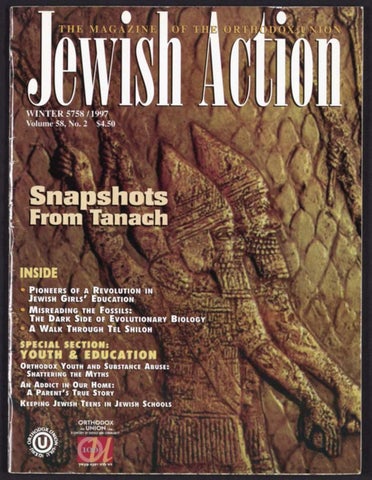
ABOUT THE COVER “Only the...shrieks o f terror and cries o f humiliation are left to the imagination,” writes Rabbi Leibel Reznick in his descrip tion o f an Assyrian stone relief depicting the destruction o f the Judean city o f Lachish. U tilizing computer colorization to highlight im ages on the stone facade, his article, “Snapshots from Tanach” sheds a photographer’s light on this tragic event in our Biblical history.
Eileen Goltz
84 KASHRUTH Fraudulent Claims! Rabbi Yaakov Luban
Dr. Benzion
45 An Addict in our Home: A Parent’s True Story Anonymous
50 Space, Place & Pace: Keeping Jewish Teens in Jewish Schools Dr. David Lazerson
52 STUDENT VOICE The Onus is On Us
8 6 BOOKS
56 EDUCATION Pioneers of a Revolution in Jewish Girls’ Education
The Authorized Version of the Code of Maimonides Reviewed by Dr. Gerald Blidstein
88
Dr. Gershon Kranzler
61 SCIENCE Misreading the Fossils: The Dark Side of Evolutionary Biology Professor Nathan Aviezer
Susan Jacobs
Pathways: Jews Who Return Reviewed by Rabbi Pinchas Stolper
93 JUST BETWEEN US A Parent’s Survey of the Yeshivah Landscape Jonathan J. Klein
54 ACHDUT, ACHDUS, WHATEVER First Aid for the Soul
67 JEWISH LIVING A Pure Light
96 Our December Dilemma
Nechama Preis
Rabbi Abraham J. Twerski, M.D.
Yocheved Lindenbaum
Jewish Action is published by the Union of Orthodox Jewish Congregations of America 333 Seventh A venue, N e w York, N Y 10001, (212) 563-4000 Printed Quarterly - Winter, Spring, Summer, and Fall. IS S N N o. 0 4 47-7049. Subscription: $12.00 per year; Canadian, $16.00, O verseas, $30.00. Second Class postage paid at N ew York, N Y and additional offices. POSTM ASTER: Send address changes to Jewish A ction, 333 Seventh A venue, N ew York, N Y 10001. ^
Jewish Action seeks to provide a forum for a diversity of legitimate opinions within the spectrum of Orthodox Judaism. Therefore, opinions expressed do not necessarily reflect the policy or opinion of the Orthodox Union. Jewish Action
1 2I
Vlith a Bank Hapoalim Foreign Currency Mortgage. You can now benefit from foreign currency real estate loans at most attractive terms. If you are a foreign resident, Bank Hapoalim offers financing for a second home, or any other residential property, bringing your dream of a home in Israel even closer. You can take a loan of up to 60 percent of the property's value, up to $500,000, at competitive rates for up to 15 years. If you prefer not to mortgage your property you can use foreign currency deposits or any otherfreely convertible assets as collateral. So if you're thinking of purchasing a home in Israel, it's much closer and easier than you might think. Find out more by visiting the Bank Hapoalim branch nearest you in Israel or our Investment Centers ©ARTA GALLERY LTD. JERUSALEM © CHAGALL ESTATE
YOUR HOME IN ISRAEL IS CLOSER THAN YOU THINK
for Tourists and Foreign Residents.
NEW! WORLD-CLASS PRIVATE BANKING IN ISRAEL
http://www.bankhapoalimxo.il
385 LLI OC
BHHKHRPBRUM T he B ank reserves the right to change the term s m entioned above at any tim e. C ustom ary business criteria w ill be applied by the B ank in considering requests fo r loans by foreign residents.
New York: 1177Avenue of the Americas, New York 10036, Tel: (212)-782-2000, Fax: (212)-782-2222 • San Francisco: 250 Montgomery Street, Suite 700, California 94104, Tel: (415)-989-9940, Fax: (415)-989-9948
HeadOffice: 50RothschildBlvd., TelAviv 66883, Israel, Tel: 972-3-5673333 Fax: 972-3-5607028 •LosAngeles • Chicago• Philadelphia •Miami • Toronto• Montreal • London • Manchester • Zurich • Geneva •Luxembourg Frankfurt •Berlin • BuenosAires • SaoPaulo •Rio deJaneiro • Caracas •Mexico City •Montevideo •Puntadel Este •Panama City • Santiago • CaymanIslands •Melbourne •HongKong. And334 branches ofthe group inIsrael.
If someone in Israel ever needs ■ to receive from the thousands of M e a ls -o n -W h e e ls delivered daily to shut-ins, hospital patients and their families ■ care for children suffering from cancer, including lodging and support services for them and their families at O r a n it H ou se , the only home in Israel for children with cancer B a stay in su m m e r cam p for children with cancer and developmental problems B a m b u la n ce s e rv ic e s to and from hospitals and health centers B to borrow one of thousands of pieces of m e d ic a l e q u ip m e n t f l support and arrangements for m e d ic a l t r e a tm e n ts outside of Israel B e m e rg e n cy b lo o d su p p ly for surgery B help from a network of over 7 ,5 0 0 c a rin g v o lu n te e e rs
Send your tax deductible contribution to:
EZER MIZION 2 7 7 2 Nqstrand Avenue • Brooklyn, N.Y. 11210 For more information, contact us at 718/253-8855;* fax 718/677-9595 • E-mail: ezer@aol.com
Piaget d’Or hearts Prices starting from $990
Exceptional character. An 18 carat yellow, pink or w hite gold heart is the keynote of this collection. Solid and refined for the pendant, set with fine stones or pavé with diamonds for the rings, d elic a te and slen d er fo r the b race let.
P lA G E l WATCHES AND JEWELLERY
JJ3
J E WE L E R S
Exclusive Importers TEL AVIV: “JB JEWELERS” 71 IBN GVIROL ST. GAN HA’IR, TEL: 03-5235577 JERUSALEM : “JB JEWELERS” 53 JAFFA ST. TEL:02-623485
LETTERS Torah Perspectives on Women’s Issues Rabbi Mayer Twersky, in his article “Torah Perspectives on W om en’s Iss u e s ” (Summer 1997), writes that “many actions are not labelled asur, and yet are absolutely halachically wrong and unacceptable.” They fall into the category of “behavior, [that] while not classified as asur, is impermissi ble.”-? At the same time, Rabbi Twersky recognizes that a proper understand ing of such fine distinctions is limited to a small group of Torah scholars: “only by virtue of constant, wideranging and in-depth study of halachah, both its principles and minutiae, can one become fully attuned to authentic halachic cate gories, thinking and methodology.” There is a practical outcome to this observation not included in Rabbi Twersky’s article: if a congregant approaches his rabbi and asks him if he is allowed to perform an action that the rabbi feels, unequivocally, is halachically “impermissible” or “wrong,” the rabbi must answer that it is forbidden. Put another way, it is asur to act in a way that is “halachi cally wrong.” While it is entirely natural that a rosh yeshivah like Rav Soloveitehik, zt”l, explaining to his talmidim the halachic rationale of his decisions, should distinguish between various kinds of forbidden behavior, the p ’sak to a layman, the halachic “bottom line,” must be that the behavior, what ever the source or level of its issur, is Correction The incidents referenced in m y article, “A M atter o f Trust,” (F all, 1997) occurred through 1995 at three Jewish Com m unity Centers in Toronto and at the Jew ish C om m unity C enter o f Greater W ashington M- not at their respective Federations. Readers inter ested in the details and chronology o f either affair m ay contact m e through this m agazin e for a list o f m edia sources. I regret the confusion and sin cerely hope that this clarification w ill correct any misunderstanding that may have inadvertently resulted.
D avid J. Schnall
forbidden. A well-known anecdote tells of a rabbi who, approached by a housewife with a kashrut question regarding a chicken, replied that while the Rambam would consider the chicken kosher, all other poskim, including the Shulchan Aruch, would not. The questioner’s conclusion was, unsurprisingly, that if the chick en was good enough for the Rambam, it was certainly good enough for her. I am reminded of an incident here in Israel nearly 20 years ago. An “innovative” teacher in a religious high school decided to teach parts of the New Testament to 10th grade girls. The staff and principal, pres sured by upset parents, turned to a distinguished rosh yeshivah who told them that while he could not find any specific article in th e Sh u 'lc h a n Aruch that would f o r b i d i t , t h e teacher’s actions w e r e t e r r i b l e b e c a u s e t h e y were, from a Jewish perspective, educationally damaging. The principal interpreted this (incorrectly, and to the dismay of the rosh yeshivah) to mean that what the teacher was doing was halachical ly permissible, and as for educational considerations, she and her staff were educators no less than the rabbi him self. Rabbi Jonathan Blass Neveh Tzuf, Israel «««It would be an act of presumption to correct Rabbi Mayer Twersky’s view of the shitot of his grandfather, the Rav. However, his statement of the Rav’s view of women’s tefillah groups (Summer 5757) could have been more comprehensive. When I was living in Boston in the early 1970s (and I regret I no longer remember the exact date or the others involved), I came one night for Minchah-Maariv at the Tolner Beit Midrash (the beit midrash of Rabbi Mayer Twersky’s father, Professor Rabbi Yitzchak Twersky). The Rav was also present. One of the rebbeim who worked at Maimonides, the school the Rav had founded and in which he was the absolute mora d ’atra, went up to the Rav and told him that some of the female high school students wished to have a collective davening of their own on the coming Thursday and wanted to read from the sefer Torah, calling each other up in
Goods, services and hotels advertised in Jewish Action are not certified or endorsed by the Orthodox Union unless the advertisement bears the OU emblem. Jewish Action •
6 •
Jewish Action
THE MAGAZINE OF THE ORTHODOX UNION http://www.ou.org
Editor Charlotte Friedland Literary Editor Matis Greenblatt Assistant Editor Elissa Epstein Editorial Intern Toby Schwarzman Contributing Editors Rabbi Yitzchok Adlerstein Dr. Judith Bleich Rabbi Emanuel Feldman Rabbi Hillel Goldberg, Ph.D. Rabbi Joseph Grunblatt Rabbi Sol Roth Rabbi Jacob J. Schacter Rabbi Berel Wein Marketing/Sales Director Carole Ruth Joy (407)279-0808 (212)613-8170 Advertising Sales Manager Deborah Lieber (212)613-8135 Fax (212) 613-8333 Advertising/Production Coordinators Penina Rosenzweig Leah Kalish Rachel Isaac West Coast Representative Susan Srebo (310) 777-0225 Israel Representative Lisa Rubin (972) 2 994-2969 Orthodox Union Publications Commission Joel M. Schreiber, Chairman Morton Landowne, Vice chairman President Mandell I. Ganchrow, M.D. Executive Vice President Rabbi Raphael B. Butler Senior Executive Rabbi Pinchas Stolper Chairman, Board of Directors Marcel Weber Chairman, Board of Governors Dr. Marcos D. Katz Honorary Presidents Sheldon Rudoff, Prof. Sidney Kwestel, Julius Berman, Joseph Karasick, Moses I. Feuerstein Honorary Chairmen of the Board Samuel L. Brennglass, Irving I. Stone Honorary Vice Presidents Dr. Bernard Lander, Marcus Rosenberg, Donald B. Butler, Jack M. Nagel, Bernard W. Levmore, Marvin J. Herskowitz, George B. Falk, Sanford Deutsch, Philip Fuchs, Elliott Stavsky, Gerald E. Feldhamer, Joseph Macy, Carmi Schwartz, Dr. William J. Schwartz Senior Vice Presidents Fred Ehrman, David Fund, Martin Nachimson, Joel M. Schreiber, Harvey Blitz, Jerry Gontownik, Howard I. Rhine Vice Presidents Michael C. Wimpfheimer, Dr. David Luchins, Larry Brown, Elliot Gibber, Mark I. Bane, Allen Fagin, Morton Landowne, Howard Tzvi Friedman, Prof. Richard B. Stone, Donald Press, Steven J. Savitsky, Avery E. Neumark Treasurer Avi Blumenfeld Financial Secretary Harvey Wolinetz Secretary Zev S. Berman National Associate Vice Presidents Henry I. Rothman, Emanuel J. Adler, Gary H. Torgow, Steven Spira, Dr. Steven Katz, Stanley Weinstein 1997 by die Union of Orthodox Jewish Congregations o f America. 333 Seventh Avenue, New York, New York 10001. Telephone (212) 5634000. Second Class Postage Paid, New York, N.Y. and at additional mailing offices.
Printed in the U.S.A.
6ENEVE '/S â 'û
ASHKENAZY ♦ BEN YEHUDA
LeSTRAD A collection 18k gold w ith diamonds.
ExclusiveImporters
JERUSALEM : “JB JEWELERS” 53 JAFFA ST. TEL: 02-6234585 TELAVIV: “JB JEWELERS” 7 1 IBN GVIROL ST. GAN HA’IR, TEL: 03-5235577 tax duty free pnces.
LETTERS the fashion of an aliyah. The question was about the saying of the brachot. The Rav said (and there are no quota tion marks because I do not claim to remember exact words) that there was no problem with their reading from the sefer Torah. On the contrary, it was a kavod to a sefer Torah for people to read it. However, as they were not a minyan, they could not say the brachot appropriate for reading the Torah in a minyan. The other rabbi said that the students understood that, but that they wished those who would be called up to have not said the individual birchat haTorah until they were called up. In response, the Rav said that that was improper since the brachah before Kriyat Shema was itself a birchat haTorah. He thus showed that he understood that the female students
would be davening together. It is hard to imagine a situation more 6imutarim atem la’asot” than this one. Hence, I suggest it to be of value in understanding the Rav’s view of women’s tefillah groups. Dr. Stephen Oren Chicago, Illinois «««I read your summer edition...[and] was interested by the number of articles addressing “women’s issues.” I was especially intrigued with the article “Torah Perspectives on Women’s Issues,” by Rabbi Mayer Twersky. Since the “issues” are basically raised by non-Jewish and assimilated Jewish women and the Orthodox platform would seek to clarify the realities for religious women, I was eager to see the finalization of arguments presented there. I was disappointed to find that Rabbi Twersky’s approach validated the argument by defining women’s role throughout the article as “supportive.”
S h e ’a r i m — -P rep a rin g L e a d e r s to T r a n s fo r m J e iv is h E d u c a tio n D rism ä I n s t i t u t e f o r J e w ish E d u c a t io n a n d B e it R a b b a n C e n t e r f o r R esearch in J EwisH E d u c a t io n
are pleased to announce the establishm ent o f
A n d p r o f e s s io n a l d e v e l o p m e n t :OR FUTURE DAY SCHOOL EDUCATÖRS
Sh e ’arim is designed to encourage exceptional youn g w om en and m en w h o are devoted to Jew ish learning to pursue careers in Jew ish education. F ellow s receive an $ 1 8 ,0 0 0 stipend to support their participation in a unique, year-long program w h ich integrates the study o f Jew ish texts and the ideas and practice o f education. F ellow s com m it to teaching in a day sch ool for the follow in g tw o years, w hile receiving on goin g profes sional support and training from the She’arim faculty. W e w elcom e inquiries from p oten tial applicants and other interested m em bers o f the com m unity.
F e l l o w s h i p c y c l e b e g in n in g S u m m e r 1 9 9 8 . A p p l ic a t io n s n o w a v a ila b le^
For further information c o n ta c t R u t h Fa g e n , A sso c ia te D irector 1 3 1 W est 8 6 th Street « N e w Y ork, N Y 1 0 0 2 4
Phone: (2 1 2 ) 5 9 5 - 0 3 0 7 «Fax: (2 1 2 ) 5 9 5 - 0 6 7 9 She’arim is funded by a major grant from the Mash Fam ily Foundation
Jewish Action •
8 •
Any attempt to afford more value to a “life characterized by modesty and selfeffacement” is going to be weak. Somehow I think that religious women could speak more in their own interest than Rabbi Twersky has done. To my mind, the whole concept of women having a supportive role is the mistaken analysis of the non-Jewish world. It’s also the crux of the argu ment against traditional values. Let’s not forget that it is a basic right of the Jewish wife to be supported by her hus band. Anything less is grounds for divorce, as stated in the Jewish ketubah. Since the Jewish model unifies rather than separates material and spiritual values, we can infer that this support is not meant to be one-sided, i.e., merely emotional or simply monetary. Through seeking pamassah, men are thrust into the activities of commerce, “traditionally” leaving the woman to a more refined atmosphere of protection from the grosser, outer world. I might add that the very sensitive atmosphere after the birth of a child, which is said to afford ruach haKodesh to a mother, is also given validation by this approach. This line of thinking may be obscured by our “modem” environs, but we are still teaching our young women the significance of the order of creation, which lists the more devel oped creatures being created last, with Chava as Hashem’s final product. I thought that this basic model for living affirmed the essential leadership role of women at the onset. The fact that Rabbi Akiva’s wife was responsible for his success really exemplifies a motiva tion so strong that it could lead and fashion other people’s lives. It may not be obvious to everyone that only a woman with strength of conviction could have gone down in history for having plucked such an unlikely candi date from obscurity and propelling him through 24 years of study through the force of her own devotion to principle. Absolutely none of the apparently “honorable mentions” concerning our matriarchs have any value unless their value as women is already understood. This is similar to learning the Oral Torah which deepens and qualifies one’s approach to the “Bible,” the writ ten text which can be easily discarded as lacking values both by uneducated Jews and modem Christians. The world in which women are arguing against oppression is a world where nothing is holy and little is understood;
A NEW STANDARD OF QUALITY FOR OBSERVANT FAMILIES IN MISHAB, with a record of building quality apartments throughout Israel for over 60 years, is proud to present its 4 newest residential communities. The homes in these communities feature the famous MISHAB attention to the special needs of observant families: succah porches, two sinks in the kitchen, Sabbath elevators, and more. All the apartments have a superb standard of finish and highest quality specifications.
Ml S H K AN
H A 'I R
In the heart of the city, just a few steps from King George and Ben-Yehuda St.; M IS H A B offers a luxurious building with 4, 5 room units and penthouses.
M IS H K E N O T F o re s t, w ith a h ig h ly
Be right in the center of things
religious institutions,
with this unbeatable location
community and
built to the highest standards.
commençai centers
Mishkan Ha'ir is also an excellent real-estate investment.
GILO
Located on a m ountainside overlooking the Jeru salem H ills near the G ilo d e v e lo p e d
in fra s tr u c tu re
of e d u c a tio n a l an d
and mall. Choose from 3&4 room garden
Within walking distance to the
apartments, 4 room
Great Synagogue & the Kotel.
duplexes and 5&6 room cottages.
MISHKENOT
M O D I ’ IN
M ISH KEN O T N ETANYA
Located m idway between Jerusalem and Tel Aviv, Modi'in is Israel's city of
Located in rapidly developing E a st Netanya, M IS H K E N O T N ET A N YA
the future. C h o o se from 3 ,4 or 5-room apartm ents with optional garden or
offers 3 ,4 and 5
succah porch,
room apartments
penthouses,
with optional garden
and 5&6 room
5 room penthouses
cottages.
and 6 room two-family cottages.
W feare also currently building 3 , 4,5 ,6 room apartments, garden apartments, penthouses, duplexes and cottages in
JERUSALEM (Givat Meso'ah, Bait Vagan) ■RISHONH'ZION I REHOVOTI GNAT SHMUEL SHOHAM1KFAR SABA 1ROSHHAAYINI HAIFA I KIRYAT SHMUEL
mmmmmu
■
PIRSUMACHER-
iMISHAB HOUSING CONSTRUCTION &DEVELOPMENTCO. LTD.
NEWYORK: Rabbi Winter a Fax. (718)380-5156 Out of N.Y.S. (1-800)848-6485
■
LONDON: Russell Cash Ltd. 32 Wigmore S t . a 0181-420-6422, Fax. 0181-420-6450 ■
JOHANNESBURG:Adelle a
■
TEL-AVIV: Shmuel Aron, 27 Lilienblum St. a 972-3-5164631, Fax. 972-3-5175074 ■
JERUSALEM: Zvi Morel, 1 Hagidem St. a 972-2-6254181, Fax. 972-2-6254188
6 40 -1 60 2, (or
WWW. MISHAB. CO. 1L. « W W W . TORANET. CO. IL.
netanya
a
9 7 2 -9 -8 8 4 6 5 4 4 )
LETTERS the role of women has been turned upside down. It has nothing to do with the Judaic tradition, and it is the burden of those who uphold it to have to bear the assumptions of the ignorant, and to educate them. While I appreciate Rabbi Twersky’s careful explanation regard ing halachic judgments, I would urge him and other Orthodox rabbis to take issue with “women’s issues,” although this could mean that they need to rethink their own point of view. Janet Houpt Toronto, Canada Rabbi Twersky responds: I thank Rabbi Blass, Dr. Oren and Ms. Houpt for taking the time to read my article and respond. Rabbi Blass reasons that since con stant, wide-ranging and in-depth study are necessary to interpret halachah, therefore, a rabbi responding to a query must answer that wrong behavior is asur. The premise, however, does not support Rabbi Blass’ conclusion. Interpretation or analysis of halachah indeed demands erudition. Receiving an unequivocal p ’sak in response to a query is not, however, an occasion for interpretation or analysis. In terms of Rabbi Blass’ example, when a congre gant is unequivocally instructed to refrain from a contemplated action, he is obligated to follow the clear, unam biguous directive. He must not over step his bounds and needlessly, of his own accord, seek to analyze (ofttimes tendentiously) the p ’sak. Unlike the rabbi in the proverbial, humorous anec dote recounted by Rabbi Blass, the Rav, zt’7, did not cite multiple opinions or equivocate at all in opposing women’s tefillah groups. On the other hand, he could not truthfully label as asur what the halachah classifies as wrong because that would distort the halachic system which clearly delineates two different categories of impermissible actions. Dr. Oren recounts a conversation in which the Rav did not object to female students davening together. It is true that for a brief period the Rav consent ed to such an educational venture. He felt that such an initiative in a clearly defined educational setting would not distort halachah and its values, as is done in communal women’s tefillah
groups. In other words, he consented only because he did not view such gath erings as equivalent to women’s tefillah groups. Nevertheless, he subsequently withdrew even this limited dispensation lest it be misconstrued as approval of women’s tefillah groups. The Rav’s fears were unfortunately well-founded. And thus, while Dr. Oren’s account pro vides an interesting historical footnote, it does not modify or shed additional light on the Rav’s consistent, unequivo cal opposition to women’s tefillah groups. Ms. Houpt was disappointed that I defined “women’s role throughout the article as ‘supportive.’” By contrast, she feels that the “whole concept of women having a supportive role is the mistaken analysis of the non-Jewish world.” She inadvertently errs on both counts. First of all, I wrote very plain ly (p. 25) that “To be sure, the feminine role is not monolithic and a woman does not act exclusively in a supporting capacity.” On the other hand, it is incontrovertible that the feminine role is also supportive, as evidenced in many Torah sources, amongst them the Talmudic teaching which I cited (ibid): “How do women merit a greater reward than men in the world to come? They catalyze their sons and husbands to study Torah, shepherd the former to school, and patiently await the latter, whom they have permitted to travel to study Torah in another city.” Having underscored the multidi mensional religious role of women, I chose to concentrate on the supportive dimension because it is much misun derstood and maligned. Ms. Houpt also confuses the vital ly important task of addressing women’s issues from a Torah perspec tive with the assimilationist acceptance of feminist axioms and values. I attempted the former, while categori cally rejecting the latter. Inter alia I wrote (p. 27): ...the Torah has delineat ed somewhat different tasks to the pro foundly differing genders. Feminism, by contrasty axiomatically asserts that men and women must be offered identi cal roles and opportunities... we must unabashedly and unequivocally teach that this feminist demand within the religious sphere is irreconcilable with Torah norms and values. The vast unbridgeable chasm that divides divine Torah norms and values from, l’havdil, their secular, feminist counterparts has generated and continues to fuel the pre Jewish Action •
10 •
sent crisis...the premise and many posi tions o f feminism are essentially incom patible with our mesorah (tradition). Orthodox Women: “Good News” or “Bad News”? As your readers can glean from your wonderful séries of articles (“Orthodox Women Today: The Good News”), more and more Orthodox women are not only working today, they’re working in a non-Jewish envi ronment. The challenges a woman con fronts in the broader business world are many, and are extremely trying: long work hours and conflicting moral codes are ‘just a couple of the many harsh tests. Last November, the Jewish Renaissance Center in New York City [an outreach program and education center for Jewish women] responded to the situation by creating ASHIR, an association of professional women ded icated to Torah ideals. ASHIR is composed of women ranging from top corporate executives to doctors and artists. Our immediate goal is to act as a support network. At our quarterly meetings, we draw on the advice of experts H-rabbinical authori ties and other helpful resources B i t o help us devise coping strategies for the challenges we face. But beyond this, we hope to accomplish many projects of great value to the Jewish world. Our mem bers represent a wealth of skills and an impressive pool of knowledge. Although the free time of any one member is very limited, working together will make it possible. Some of our current projects include a hot-line service for halachic and professional advice, developing methods of reaching out to unaffiliated co-workers* and a 1998 National Jewish Women’s Conference featuring national and international speakers, dedicated to exploring all aspects of life as a Jewish woman. The event will be widely pub licized to convey to the public the pos itive realities of Jewish womanhood. Leah Kohn Director, Jewish Renaissance Center New York City, New York «««Your summer edition cover article “Orthodox Women Today: The Good N e w s ” p i q u e d nay i n t e r e s t . Unfortunately, not too far into the [first profile] article, one wonders what “the good news” means exactly. We live in
Did you know tk a t today’s # 1 prescribed prenatal vitam in in tbe U .S.1 is also Kosk er Certified? if finding a prenatal vitam in tk a t’s kosker certified is im portant to you, ask your doctor akout P R E Ñ A T E U L T R A . E ack taklet provides 15 essential vitam ins and m inerals, including 9 0 mg of carkonyl iron, patented C itracaP calcium , 1 mg of folic acid, and keta carotene. All in a wkite, dye-free taklet. D o n ’t settle for a generic. T o k e sure you receive a kosker-certified product, ask for P R E Ñ A T E U L T R A ky nam e.
r
/
t
e
m
ï ë
U LTR A P R E N A T A L
V I T A M I N S
KOSHER CERTIFIED ©
*Carbonyl iron is designed to be safer tban tbe traditional types of iron used in iron supplem ents in tbe event of accidental ingestion by young children.
Iron-containing products should always be kept out of reach o f children.
©1997 Sanofi Pharmaceuticals, Inc.
Please see important product information on next page.
LETTERS R eference: 1. IM S America N ational Prescription Audit, July 1 9 9 7 . J PRENATE® ULTRA™ Tablets Rx BRIEF SUMMARY: Please see full prescribing information. Each tablet contains:
Elemental Iron (carbonyl iron)................... 90 mg Iodine (potassium iodide)
..............
......150 meg
Calcium (calcium citrate) ...................... 200 mg Copper (cupric oxide) ............................ Zinc (zinc oxide)
...............
.2 mg ...25 mg
Folic A c id ........................................................ 1mg Vitamin A* ...... ....................................270 0 IU Vitamin D3 (cholecalciferol)
........................ 400 IU
Vitamin E (dl-alpha tocopheryl acetate)........... 30 IU Vitamin C (ascorbic a c id )........ .......... ....... 120 mg Vitamin B1 (thiamine mononitrate)........ ......... 3 mg Vitamin B2 (riboflavin) ...... Vitamin B6 (pyridoxine HCI)
3.4 mg ............
20 mg
Vitamin B12 (cyanocobalamin) .................. .12 meg Niacinamide..................................................20 mg
Docusate Sodium ..................................50 mg *lnput as Vitamin A palmitate and beta carotene. INDICATIONS: PRENATE ULTRA is a multivitamin/ multimineral nutritional supplement for use in improving the nutritional status of women throughout pregnancy and in the postnatal period for both lactating and nonlactating mothers. PRENATE ULTRA can also be beneficial in improving the nutritional status of women prior to conception. CONTRAINDICATIONS: This product is contraindicated in patients with a known hypersensitivity to any of the ingredients.
WARNINGS. WARNING: Accidental overdose of iron-containing products is a leading cause of fatal poisoning in children under 6. Keep this product out of the reach of children. In case of accidental overdose, call a doctor or poison control center immediately. Folic acid alone is improper therapy in the treatment of pernicious anemia and other megaloblastic anemias where vitamin B12 is deficient. PRECAUTIONS: Folic acid in doses above 0.1 mg daily may obscure pernicious anemia in that hematologic - ^ remission can occur while neurological manifestations progress. ADVERSE REACTIONS: Allergic sensitization has been reported following both oral and parenteral administration of folic acid. Keep this and all drugs out of the reach of children.
a Jewish society which is very influ enced by the secular one around us. The feminist movement has finally per meated the Orthodox Jewish communi ty to the extent that even a flagship pub lication such as Jewish Action consid ers it “good news” when a woman with young children works 40-plus hours a week outside her home and then, when she finally returns, is involved in numerous communal organizations. Iam sure this woman has very high self-esteem. She holds a position in a reputable university. She probably commands a handsome salary, she does her work well and receives recognition both in the office and community! All the while, her children are being cared for by, at best, a relative and at worst, a non-Jewish homemaker (as is so com mon with working Jewish women today). To say that her family is her priority because she is “flexible” is mere ...lip service. Even feminists of the -60s have admitted the feminist movement went a little too far. While the strides achieved by women in the last few decades are laudable and women are making inroads into positions of authority and leadership like never before, this has all been at the expense of our children. ...’’Quality Time” is the biggest myth of our age. Sociologists and psychologists alike have recently found that a child thrives better with a mediocre full-time mother who is busy with her homemak ing than with a very part-time mother who spends precious little time squeezed between work and communal obligations with her offspring. This is not good news for the Jewish community. This is a tragedy. The future generation — our most pre cious commodity, our sweet, precious children are being left for someone else
to raise and teach and mold during their most impressionable years while their mothers are seeking their own self-ful fillment. For shame! ...This is not to denigrate those hard-working women who work because of absolutely no financial choice; nor is it to deny the tremendous impact of those special mothers who spend part of each day working at jobs or for their communities while their children are in school or sleeping... I think we all have to take a very hard look at what it means when we say our children are our priorities...Let us truly dedicate our lives towards the infi nite potential and development of these gifts bestowed on us by the Ribono Shel Olam. Rochel (Horowitz) Schwartz Southfield, Michigan Full-time Mother M.A., Columbia University Former teacher, administrator, Jewish organization officer «««The title on your cover(“Orthodox Women Today: The Good News”) was enough to let everyone know that the news was not good. Would there ever have been a similarly titled series on Jewish men? Once again we were told to “stay in our place.” No wonder more and more observant, committed Jewish women are eschewing the Orthodox label and philosophy. Renee S. Septimus Jamaica Estates, New York «««Congratulations on an excellent series of articles dealing with women’s issues. Rabbi Mayer Twersky’s lead article, Dr. Shkop’s essay and the inter views were all very positive in tone. Unfortunately, much of what is written today is negative and critical of Jewish women’s traditional roles. The varied individual statements Continued on page 90
y)
Kosher Certified \\ US Pat. No. 4,814,177 S ADDITIONAL PATENT PENDING
T he O rth o d ox C om m unity’s H o tel of Choice in Beverly H ills
scinofi
OU HEADQUARTERS WEST COAST CONV '96
M anufactured for Sanofi P harm aceu ticals, Inc. N ew York, NY 10016 by Mission P harm acal C o . San Antonio, TX 78296
W ithin walking distance of Five Orthodox Shuls, Museum of Tolerance, Rodeo Drive, Kosher Restaurants and BRUV
everly
Carlton
Hotel
W e s t O l y m p i c B l v d . B e v e r l y H i l l s , CA R E S E R V A T I O N S : (80 0 ) - 5 3 5 - 4 7 1 5
55-971609
Jewish Action •
12 •
poïosJíCfm
QiimMmlttsédocoM/Pmükm]
hJUQi
I\4po5ío4ssùíítrnw rI h\
ii;w d e ráiiÉe¿Of homemade style, delicious, shelf-stable, réady-to-serve cakes in convenient ng. âSt m
Gateaum (toutdecitron/Pi
MM»
Gateaumiirbi^
po/asA’fr«*r!
U $4ttetib I
iPOtÙSfit
P
R
E
S
I
D
E
N
T
’
S
M
E
S
S
A
G
E
S O S : Save Our Students! BY MANDELL I. GANCHROW, M.D. 31 universities throughout the United States. Another reality is that the overwhelming majority of Jewish stu dents on campus are not Orthodox and have little or no Jewish background. Our choices are clear: Either we abandon these two groups (or continue minimal programming) while complaining about assimilation and intermarriage; or we combat secularism by taking up the gauntlet and creat ing new and imaginative initiatives.
Y | lh e Talmud says, “Chayav bivno lelamdo Torah, u ’lelamdo amanut, Yyesh omrim a f I’hashiyto A bamayim, we are required to teach our children Torah, to teach them a profession and, some say, even to stay afloat in water.” As Jewish parents committed to raising our children according to our mesorah, it is eas ier to implement the Talmud’s mandate when our chil dren are young. We provide them with a Torah educa tion, cultivate their many interests and even teach them how to swim. It’s when they reach college age that fol lowing our mesorah becomes more difficult. Many of the college youth of today are in a spiritual crisis; Jewish students even more so. Even those students who have studied Torah through grade twelve leave home to attend secular universities. True, they have their Torah education. And they will certainly learn a profession. But what about “staying afloat?” How can we expect college youth to battle the waves of secularism that so often carry them far from safe shores? And if it’s difficult for our children, who have the benefit of extensive Torah education, how much more so for those students who lack Torah back grounds? The Orthodox community in general, and the Union in particular, must be more sensitive to this problem. We pay lip service to the epidemic of assimi lation among college age adults and yet, despite the many wonderful programs and services we offer the community, we have no fully developed college pro gram. My own narrow vision is perhaps due to the fact that all my family members and many of my friends attended Yeshiva, Stem or Touro Colleges, places of higher learning where I believe all Orthodox students preferably should spend their college years. As parents, we take a great gamble when we allow our children to attend secular universities where the university Weltanschauung often is antithetical to a Torah lifestyle. While a great many Orthodox students not only thrive, but also exert a positive religious influence on their peers, it is also sadly tme that the road to a secular diploma is strewn with broken commitments to Torah hashkafah and lifestyle. In an ideal world, institutions as wonderful as Yeshiva, Stem and Touro Colleges would have several undergraduate branches throughout the United States. But this is not an ideal world, and it is time our commu nity dealt pro-actively with the realities confronting our college youth. One of those realities is that the majority of yeshivah high school graduates in the United States enroll in secular universities or colleges. Studies indi cate that this group of students is concentrated mainly in
Orthodox Jews on Campus Those universities with large Orthodox student populations, such as the University of Pennsylvania and Columbia University, provide activities and facilities to meet many of the needs of Orthodox students. In other universities, however; Orthodox students often feel abandoned. My conversations with students from vari ous campuses revealed that many feel they receive no support from national Orthodox institutions. In addi tion, Orthodox students in commuter schools do not have the benefit of daily minyanim and dormitory facili ties that help forge camaraderie among campus collegiates. They also experience hostility from nonOrthodox campus groups, primarily on the issue of pluralism. As a first step, we must find a way to identify Orthodox college students on secular campuses, perhaps through the yeshivah high schools and NCSY. Knowing who they are can help us serve them by creating Orthodox programs for them. I propose that during the final months of high school, we contact these young people and inquire as to which colleges they will attend, then offer to train them to work on their respective cam puses on Orthodox Union kiruv initiatives. This will enable the Union to have a cadre of trained volunteers, who will work on key campuses under the leadership of our professional staff. Hillel - The Foundation for Jewish Campus Life, under the guidance of President and International Director Richard Joel, is, by definition, non-denominational. For Hillel, all Jewish groups are viewed not as a threat, but rather as an opportunity to broaden Jewish student horizons. Hillel is prepared to work with us on any campus program that will engender student interest in spirituality and religious observance. In order to win the battle for the hearts and minds of our collegiates, the Orthodox community must commit itself — in terms of time, expertise and money — to creating a cogent col lege outreach program. The Orthodox Union has limited involvement in college programs already in existence, such as Kiruv (which until recently was funded by Yeshiva University) and American Students for Active Pride (ASAP). The
Jewish Action
• 14*
I
ChongePoint m n n
«h i t w
• ■ ..22
Cent er for f o r e i g n C x c h a n g e
Foreign currency with no commissiolr^hkrges! Social Security & personal checks accepted • Authorized by the Bank of Israel Special rates for ChangePoint members • Reliable & quick service! Jerusalem: 33 Jaffa st. Tel: 02-6255572 ; 2 Ben-Yehuda st. Tel: 02-6240011 Tel Aviv: 106 Hayarkon st. Tel: 03-5245505 • Bnei Brak: 121 Akiva st. Tel: 03-5786616 Netanya: 7 Kikar Ha'azmaut st. Tel: 09-8844905 • Tiberias: 1 Hayarden st. Tel: o6-6716777
S. B A L T I N E S T E R M0 USSAIEFFJ EWEL L ERS
The i n t e r n a t i o n a l l y r e s p e c te d n a m e f o r f i n e j e w e l l e r y 40 Jaffa Rd; Zion Square, Jerusalem Tel: (02)6256646, 6244078 Fax: 972-2-6259212 Email: alon@trendline co.il
OU’s Shoresh Program, the college division of our suc cessful Pardes Project, now thrives on close to 120 cam puses throughout the U.S. and Canada. Extensive dis cussions with the leaders of these programs, as well as Hillel, indicate that with a proper commit ment on our part, we could develop a uni fied college outreach program. Non-Orthodox Jews on Campus The non-Orthodox Jewish students on campus are divided into two groups: those affiliated with Hillel, even if only for brief encounters during the year, and those who have never put a foot through its doorway. The Union must find avenues to reach these students, too. College outreach, for the Union, is a new endeavor. Through 40 years of trial and error in NCSY, we now know which outreach initiatives work for high school students. That same commitment to kiruv — both chizuk krovim and kiruv rechokim -ft must now be extended to college-aged youth. This will require a new division with professional leadership, as well as a commensurate budget. It is a monumental task, but it is long overdue. The college campus is our community’s last opportunity to interface with young people before they enter the “real world” and are subject to the tides of assimilation and intermarriage that are sweeping their peers out to sea. We must teach them the necessary survival skills to stay afloat. As a first effort, we should encourage each Union synagogue, especially those located near a col lege campus, to welcome college students through home hospitality and Shabbatonim. For example, college stu dents from the Chicago area have told me that they
would welcome Shabbatonim and programs that would be open to all Jewish students attending various univer sities in their metropolitan area. Citywide programs such as these should be replicated nationwide. Almost every college student has a com puter and an e-mail address; they all watch cable television and read the stu dent campus newspapers. The Union must allocate funds to reach students through these media. It behooves the Union to devel op a CD-ROM, video and audio-visual series for college students to explain the Torah view on sexuality, dating, intermar riage and other issues prominent in their lives. The Orthodox community has out standing men and women, such as those featured at.our conventions, who can share their wisdom and understanding with our youth through these presentations. A major contribution to Jewish campus life by Hillel was the creation of a one-year post-graduate internship on campus to serve the Jewish student body. It is an idea we should emulate. It is an opportunity to reach students through leaders who have been affected by the magic of NCSY, the benefits of yeshivah educa tion and the deep commitment fostered by study in Israel. In order to affect this new venture in the Union, individuals and foundations must first acknowledge the desperate need and then commit to underwrite such an initiative. The Union made a commitment to outreach and has excelled with high school students through NCSY. The time has come to take the next logical step and do the same for university students. §
E v e r y th in g y o u n e e d to k n o w f o r
SQ!fX^S. t h e n e x t 24 h o u r s — i n 4 m i n u t e s . TORAH STUDY
Add meaning to your daily routine with time reserved for Torah study. Luach & Limud is a pocket size monthly that gives you a Mishnah each day with a clear and simple English translation of the famous Mishnah commentary by Rabbi Pinchas Kehati.
V n r | Please send me my FREE trial issue of the new Luach & Limud. If l do not want to subscribe. I will write "cancel" on the bill. If l do subscribe, l will send $36 ($44 foreign) for a full one-year subscription. Either way, the first issue is mine to keep.
Name
Mishnah Commentary
Address
State
Send for a FREE trial issue today!
Mail To: O rthodox Union 333 7th Avenue N ew York, NY 10001
Zip
GENERALI
ASSICURAZIONI GENERALI S.p.A.
An Open Letter to the Families of Holocaust Victims n 1831, a group of Jewish m erchants in what is now Italy founded a new insurance company called Assicurazioni G enerali.
I
During the first months of 1832, it opened offices in the major cities of the Hapsburg Empire in C entral and Eastern Europe. Following the split-up of that Empire at the end of World War I, Generali continued its prominent role in the insurance industry in the newly independent countries which emerged.
During and after the dark years of World War II, Generali faced expropriations of its properties and the properties of its insureds. The racial laws of the Nazi and fascist era and the state action of Soviet-dominated regimes in Central and Eastern Europe severely damaged Generali's ability to do business there. The cold-war Communist regimes in Eastern Europe nationalized and expropriated all major businesses, seizing all of Generali’s insurance businesses there, including its offices, 184 buildings and 14 companies controlled by Generali. As a result, Generali today has very little information and few records regarding policies issued by its former branches in Central and Eastern Europe. Throughout the years, the company has had a long affiliation with the Jewish people. This relationship has been reflected in its history, from its founding of the Migdal insurance company in 1930’s Jewish Palestine, to its recent $320 million investment in Israel to assume the majority position in Migdal, today the leading insurer in the Jewish State. In reaffirming its historic commitment, Generali has also announced its decision to establish a fund of $12 million, to be administered by an independent committee in Israel, in honor of Generali policyholders who perished in the Holocaust. Fund monies will be given to organizations and public bodies dedicated to the etemalization of the memory of the Holocaust; to the assistance of Holocaust victims and their families through the provision of medical, psychological and other assistance; and may be applied by the inde pendent committee for discretionary payments to those who held Generali policies issued before World War II in Central and Eastern Europe or their loved ones who survived them. In addition, a Policy Information Center is being established to provide families of Holocaust victims with information in Generali’s possession about Generali policies which may have been issued to their loved ones during the pre-war era. Generali is in the process of computerizing whatever information it does have regarding policies held during the war. Specialists at the Policy Information Center will work with individu als to process their requests for information. A search of Generali’s archives in Trieste will be conducted and available policy data will be forwarded to the requesting families. Data from the archives will also be provided to Yad Vashem in Jerusalem to support its ongoing efforts to compile the names of all Holocaust victims. In response to Generali’s decision to take these steps, Knesset Members Rabbi Avraham Ravitz, Chairman of the Finance Committee; Michael Kleiner, Chairman of the Subcommittee on Insurance; and Avraham Hirschson, Subcommittee Chairman of the Committee for Restitution of Jewish Property, wrote to the company: “We wish to confirm as most praiseworthy the establishment by you of a fund in Israel in memory of the people insured by Generali who perished in the Hobcaust. We realize this to be a fulfillment of Generali's public obligation in memory of the Hobcaust victims... We wish to welcome Generali's presence in Israel as a most wekome contribution to Israel's economy...” If you would like to request an archival search on behalf of a relative who was insured by Generali in Central or Eastern Europe prior to or during World War II, call or write to the Policy Information Center at: 1-800-456-8174 Policy Information Center • 45 Rockefeller Plaza • Suite 2000 • New York, New York 10111-0100 In a recent visit to Israel, during meetings with President Weizman and Prime Minister Netanyahu, Generali Managing Director Gianfranco Gutty spoke of Generali feeling “committed to the memory of those of its insured in Central and East Europe who perished in the Holocaust.” The Information Center and the decision to set up the $12 million fund are an expression of that feeling.
Respectfully,
ASSICURAZIONI GENERALI This material is distributed by Chlopak, Leonard, Scbecbter and Associates, Inc., 1850 M Street, NW, Suite 550, Washington, D.C. 20036, on behalf of Assicurazioni Generali, S.p.A., Piazza Duca degli Abruzzi, n. 2,34132, Trieste, Italy. Additional information is available at the Department of Justice, Washington, D.C.
O R T H O D O X U N IO N 1191499t ACENTURYOFSERVICEANDCOMMUNITY
_ f c
CENTENNIAL SPOTLIGHT
In celebration o f the 100th anniversary o f the Orthodox Union, Jewish Action is privileged to present pages o f American Jewish history taken from our own vintage publications.
From Habonim to NCSY... Reaching Jewish youth was a clear imperative from the earliest days o f the Union. But while the general goal was agreed upon, honing effective techniques o f inreach and outreach took many years. When we view the enduring successes o f NCSY today, it is easy to overlook the trial and error that went into forming a youth organization with a national scope and worldwide impact. Pages from newsletters, “The Orthodox Union” (1938), “Jewish Action” (1959) and “Leadership Briefing” (1996) demonstrate turning points in OU kiruv history. Orthodox Union
NEW HABONIM CHAPTERS BEING ORGANIZED M
-
K V 5 ySS'
uiter Appointed Director of the National Y ou * O r g a n is m of the Orthodox Unton
Zcdck Talmud Tomb*
TV orobUntt Of ¡ ¡ ¡ E B I P0** S I
The cooperation of die j 4 ^ a l i S d principals of co^regattons jind Tatoud Torai« will be welcomed by Mt- *-««'•T f S e r t o guide his future activities Mr. U & S S | that the < * e ^ r e £
M B —
S i ||
iew*sh vcutit S B be continued is one of ill« serious and
study groups and other activities be found in this issue.
l l i
if «
ing contestaats. It is also urged that existing HABONIM
COBfttiy. •witi lilt tppoKli Of * e
MOSES E. I.HITER ¡tod with txie o»j Judaism by. 1»their loyalty m / and uader. cutcating standing »appreciation ‘ 0r o* g£ j precepts F *5
>ggg--■ ^
.
g e s t io n s
su g g e S
f o r
« - * • of
^ t T u o s e s 1 Leiter bas been designated 9 % D & Î '.!* the National Ha&mm
Union.
...— -------g-------
t h e
h X b q m m
of the HABONIM. which wth convene at as the E o m c t h A ^ m ^ National Convention of the Orthodox
1 same time
principles of <1* Top*
o r g a n iz a t io n
o f
c fhl rat pl tAe r s
"preliminary program OF
ORGANIZATION
I «* r S f o T if S T h r « :
activities Study Program 1 u 1 required of e m r HABONIM CHAPTER to bave Special Stud/ f u r fe * «
Si™ |f |S | «kriv-at ¡00. least ¡¡gg£%|fÌg§§ onu? a wees.—««
I 5. a B & g i l l i y M ' s ;
guSance of a competent teacher. 2 Reviews of Books of Jewu.h nnu.es. fj Tewisobn, Eeucbtwanger, ¿*«g; Ì l i bi d wSaphies of famous Jewish '% g £ S o n or. current even* of
j. Local and city-wide rallies and interdid> competition.
Incidental S ocial and A thletic A ctivities Those interested in tbe various sport sanies other games or hobbies, should form their respective teams, elubs and groups. Clubs baving eno^h able par-
llillllM li & to suit the members ot each club ani class accordingly.
T he M ore Popular and Common Gam es and H obbies X. Sport Team: Basketball, baseball, swimming. , dub;; Chess, checkers.
m*-* ■ 1**•m i, ¡¡¡¡1 f e |p l l S & T f S - f i i i S S ■* f t e u * painting, wood carving. (** W B Im i W m M m o -» -* 1 | mg. standards by enacting certain rules). « B & B » p j« » * Periodic and M ore D etailed Prom a b o n im
cha pter
5* S ^ b e ^ e tfe r the synagogue name or
I Ì members of the groups.
gram# W dl B e Sent to A ll Chapters
1 Studying of tbe I * « pertaining to thc
Communications « e mvited. g H g S g g
of appropriate songs for these ocea sioas.
the organization meeting.
Twelve
Special H oliday and F estival Program s
■ Jewish Action
and Amsterdam Avenue, New York, IN.
O R T H O D O X U N IO N 1898499$ ACENTURYOFSERVICEANDCOMMUNITY
CENTENNIAL SPOTLIGHT
y%ry&tläxr*st
1
ste-vw I m pmm HHHH '
S M
r f: e1 I
I #
1
I
,, youjmf xiv ,
r j
o
i "1 1
tCOSMI fOOO ^ot M lU TiW ll^ iH Ä f fPftAÄW H fAIfftM#
■
f ..
I of the Union, ite: R.G.A. is coop era ting closely to I ¿he guniti , P®** IfMf dUÉfiMB dì tite UlrfDtti J<*®t m%mT^m«mMMrnronth €mm& ggrtffl* sia«» Ite beeii A»DOf Iili« , a** :la id i br « ■ » ioiecu, expected » be* included* to ulti limata 88 m [the e x p a n d e d jbey s^ep ift ripK *te »«*db «I »unito K. »Mt* . ■• •■ youth program 1* the Torah JLeaderi t ó a r f t e l th c lu p P r ^ S c T h h will
announecd *? “few«!» « n * * “ ®? ^***“ 2
ç tttf iÿ ï & Gna c U » a
r '2 ^ tf2 £
A f l J W ' Cm»»]«* * V * g C Em«n«I |UribaM,. P ^ t o ot
s ? w « s j n r * » jwy.» ^ ÏL
CMWBta*»* *§■ ® 5*S,
«Httve it e g « p * aw fa* ” * ***
jà lF S f e æ
funeri. M t e ? mm mem sten*’
foco*of'd»e.e*pat»ded pm grm w iH be on intensive devek»tn«>t of * e Union'* youth v b . die Nattooal Conference of Synagpg^ Y<mthThe program » *»»S £ K * * ~
wUl fnnction Mnte «fejg j g g j f
,hc uoiC A J cmm Youth O wmus*i« i .
S
>
U
p«
"
^
voted » youth needs «te b ^ g eddea w .dk Commi**»"- A* rabbtaie atm
Denver and San Antonio To B od Coming Regional ConmnU°™ « “
^ . J i S 'r S S ®
a n io n i and leadership actiyiwa lor «mam pelale wltìi 2 % Ä with o n - to ^ " f difendaci b t t e l liW te 8pd fducj jura f ir m » r e mm IteayeS S t u d y HTDIlf# “ A
donai s a w « * uT* HCTf Sm ûj Q tm f Pr^rmm* u » &* P8g«
European Rabbis To Confer In London
M
“ i h f o r n a i *lCiJbm Ä
—•A'*sarts?i
pS i Dceetnbcr Ä S 14, t g« tÄ o * s bÄ «aJ» n ^ ntend by Dr. tarad -Brodub C toa Rabbi trf Britato.
,tion Rodlet Shotoin. of i î ' L '  J ^ Î Â S ô ! whkb Rabbi Ciwww» feJ T i S be addrened to tunnerm«»* «»* *« in Denver on J«»««? .f f àmH Oton Ho«L Th* of the «Mgiw» reewwrucpamton Southwest Regio« wtQ W * « * leader, and at Regional Ckmvenaon mSan Ant««®, Hebrew E d w i t ^ M i« « “ pfQÊtâfàfo a ^ Beth Metta«* Hagodol, ^ »* * * fjggtt The ewitaPeBoe prt^ram m atTexas on December 2547.___ g.Khu Manuel L » « w •"» Sain* peered to envisage sptmsonNp « Heading the planning 1far the two event* are Abe Satoww «1 Adeltnan are the respm tvew r- various educational and youth acand Moe M. t e ®J Dwver; J f j Ì ' Itimi leaden, will be host* t® lhe tivtiies, building of mikvaoth and Rocky Mountain» meet. pyWiimiteP mCliiermium ^ # Rocky Mountains Bout conclaves will feature work Levine of to t An«»»®. W I C A * » A te veportSqg much icttvit^ on i«« president for Southw et. Rabbinic «(tom «» such utpie* as i j a W * “ * Eisiopewi weœ h ite Wwœm m w f n(j I*» leaders of aw g ?^* “ 0* *® mmbt ration an‘d budged«. « « • ilitetei Jew te t e f t e dI ite d « area* involved are P"®U*P*) bership development, youth, adult w p . T ie te a r te l f t e m*m*m*« formulating the programs »nd dcvel- education and the congregational opine intensive rwnon-widc nawirt Jewish Action
• 19*
O R T H O D O X U N IO N 1MM99* ACENTURYOf SfKVKEAMDCOMMUNITY
CENTENNIAL SPOTLIGHT
O U LEADERSHIP BRIEFING
Rabbi Shlomo Asraf, a sabm who was formerly the Director of the O U /N C S Y Torah Center ana High Schools in Kharkov, Ukraine will be foe Director of N C SY in Isr<m . Countless families have benefited from Rabbi AsraPs educational and organizational skills and his intensive campaign to bring an appreciation ot Judaism to the Ukraine. Planning the new N C SY thrust has been a delicate task of combining Israeli lifestyle with the appeal ot American ways. (Who hasn’t noticed that anything that s fcmo baAmerica" • is more valuable to young Israelis?) Rabbi Asraf s initial effort for N C SY m Israel will be three-pronged: n Establish Turn Fnday Night into Shabbat” programs m Tel Aviv’s Dizengoff area. 2) Assemble and train a core group of 30 idealistic, religious Israeli youth who will serve as the volunteer advisory slait at events. | c 3) Organize a senes or nationwide Shabbatonim. Participants will enjoy a full range of N C SY activities, Israeli style, m addition to the activities above, plans include kibbutz seminars, a youth hotline and special publications A key to the success of N C SY m Israel will be enlisting the nearly 1,000 N C SY alumni, staff and
former shlicktm currently living in Israel, many of whom became teshuoah through N C SY . They wi be a resource of lay leadership, professionals and volunteers. Rabbi Pinchas Stolper, N C SY s founding director and present Senior Executive of the O U , has undertaken the task of creating N C SY in Israel as a sacred obligation. H e noted that if America has a proven method of waking up Jewish youth » T o r a h , must be shared. “The « E H r secularization of Israeli youth and their alienation from Judaism makes this venture crucial to the fiiture ot Israel and world Jewry.
For more information, contact National NCSY at 8 2 3 3 M __ .
Stats that Matter ccording to a study conduct«!
a
tby the Lilly Foundation to measure NCSY effectiveness over its 37-year history in the United States: • 77% of N C S Y “graduates” are Shomer Shabbat. . Of the NCSYers who came from totally non-observant homes, 33% are Shomer Shabbat today. W hat happened to the other 67% , the group from non observant homes who do not report current religious observance. Their answers may be the most encouraging of all! Most say t h | although they did not ^ e on ^ Jewish observances, NCSY gave them a deep awareness of their Jewishness and increased their commitment to the Jewish pepple, And they view Orthodoxy as a vibrant, meaningful way of h»e. In fo r t-
.
99% o f m a m ed W C S i . alumni are married to Jews.
€J
V /
Wouldn’t it be wonderful if we could see the same revival pfJewish commitment among Israeli youthNCSY has accepted the challenge!
Jewish Action •
20 •
R ozi & Mo rty D AVIS/D AVID O W ITZ
T h e V o ic e o f w is d o m W EVD 1050AM
JO U R N A L , HEBREW,
T orah
PU BLISH ED BY T H E
IN
K A SH R U TH
D iv is io n o f t h e O r t h o d o x U n i o n .
■Ml Please send me a subscription to Mesorah at:
E d it e d
by R abbi
M enachem G enack a n d
R a bbi H er sh el S c h ä c h t e r , r espec ted
the
m uch-
JO U R N A L IS DEVOTED T O P U B
LISHING THE SH IURIM A N D TEACHINGS OF
□ $12 for 2 issues ($15fo r Canadian and $22 foreign mail subscriptions; U .S. funds only). □ $20 for 4 issues ($26 fo r Canadian and $40 foreign mail subscriptions; U .S. funds only). N ame A ddress
R a b b i J o s e p h B . S o l o v e it c h ik , z ”l . E a c h of the
M e s o r a h e d it io n s a l so
in c l u d e s
H a l a c h ic a n a l y sis o f c o n t e m p o r a r y a n d c l a s s ic
K a s h r u t h iss u e s .
□ C h eck en closed payable to: Orthodox Union/Mesorah □ Please bill my: □ V isa □ M asterCard □ A m ex C a rd # __________________________________ E xp._______ S ig n atu r e
M eso r ah
has
been
h ig h l y
a c c l a im e d
W ITH IN TH E ENTIRE T O R A H C O M M UN ITY .
Please m ail to: O rth od ox U n io n /M eso ra h 333 Seventh A venue, N e w York, N Y 10001 or fax 2 1 2-564-9058.
I*he perfect gift to enjoy all year The quarterly magazine with a refreshing difference, devoted to exploring ideas, trends and people im portant to Jewish life today
L O C K IN TH ESE RATES NOW ! 8 Issu e s Regular C o v e r Price: Su bscription:
■ ■ ■ ■
4 Issu es Regular C o v e r Price: Subscription:
$18.00 $12.00
4 Issu es S t u d e n t R a t e Subscription:
$10.00
4 Issu es ( O v e r s e a s ) Regular C o v e r Price: Subscription:
8 Issu e s ( O v e r s e a s ) Regular C o v e r Price: Su bscription :
$35.00 $30.00
(In Canada, please add $1.00 per issue over U.S. Rate.)
$36.00 $20.00 $70.00 $55.00
W
M
e s o r a h m a g a z i n e is a
J r f e M ore reasons than you ever needed ^ ft to come to Israel w ith us... H elp celebrate The Orthodox Union Centennial. Enjoy Israel’s Fiftieth Anniversary Celebration. A perfect opportunity to review potential Yeshivot in Israel. V isit your child or grandchild studying in Israel this year. Children Studying in Israel receive com plim entary bed & breakfast staying in parents’ room . H elp support our positions on m atters o f vital importance to the survival o f our people. S a i/ B a t M itzvah celebrations available. Israeli breakfast buffet, shabbat m eals and gala dinner banquet included. Participate in high level m eetings w ith government officials and other hey policy m akers. A statem ent about the centrality o f Torah and Torah values in the
lives o f Jew s everywhere. Discussions w ith Israeli C h ie f Rabbinate and leading Torah personalities. Special programming and C M E credits available. D aily V IP guided tours and briefings, including: Yesha, Tel Aviv, G a lil, Hebron, and other historic and religious sites.
Orthodox Union Centennial
Con7
INTERSESSION WEEK - SUNDAY, JANUARY 25,1998 ■SUNDAY, FEBRUARY 1,1998
7 DAYS-6 NIGHTS
FIVE STAR JERUSALEM RENAISSANCE HOTEL INCLUDING ROUND TRIP AIRFARE ON EL-AI ONLY $1550. PER PERSON (JFK/NEWARK)
at the
GJ far Add-OnFans fro» olker dHts PUIS $50 PER PERSONREGISTRATIONFEE (MAXIMUM$100 PH FAMILY) EaHyAirivok/Late extenskws at MaddHkwddr (targe.
, -
S
s
M M
O i A
ywmimr*
Reserve now, Cal Frank Budniwlti at (212) 618*8188 SPECIAL S n iA G O M i DELEGATION PRICES AVAILABLE
INSPIRATIO N
Artists of Eternity: The Holistic Joy of T orah Judaism BY RABBI MAT IS ROBERTS
A s we celebrate the Hasmonean victory over the / \
Syrians, we often ignore a vital aspect of the x ^.ev en ts that preceded it. Hellenism was a success ful movement which made great inroads into the Jewish community of that time. There were many among our own people who felt that the light of Torah was, God for bid, overshadowed by the brilliant splendor of Greece! that what emanated from the “tents of Shem” was inferi or to the “beauty of Yafes.” In their eyes, the rules and strictures of Torah Judaism seemed dull and forbidding in comparison to the pagan humanism of the surrounding civilization. Only the miraculous events surrounding Chanukah were able to break the momentum of that insidious counterculture. What is most troubling about this fact is that the same perception is rampant in our own times. Now, as then, observant Jews have an image problem. People see us as a dour, humorless community — obsessively con cerned with the most minute details of religious ritual and unwilling to embrace the joys of the world around us: “As if God has nothing more important on His mind than whether you take the bones from the fish or the fish from the bones.” We try to counteract this; we try to be friend ly, outgoing, upbeat — but the severe image remains. Even when they admire us, they cannot get around that perception. Back in the ‘70s, humorist Ephraim Kishon rocked Israeli society with a column entitled “The Knitted Skullcap.” In it, he contended that religious Jews had raised and educated a generation that was far more serious and idealistic than their secular counterparts. After elaborating at length on his theme, he reached the conclusion that if tolerating these severe, humorless people in our midst is the price we must pay for their contribution to the nation, it is well worth it. And, in fact, we do concern ourselves with things like bones and fish; and with “Are my tefillin perfectly straight?” and “How much of my arm needs to be cov ered?” And we do, also, view this world with a great deal Rabbi Roberts is the mashgiach ruchani o fY eshiva in Queens, N ew York. H e is the author o f several volumes o f ArtScroll translation and commentary to M ishnayos as w ell as the ArtScroll Trei Asar, Volume 1.
of suspicion —- perhaps even fear. No less an authority than Mesilas Yeshorim describes it as a terrible place, filled with suffering and misfortune.1 Are our detractors right, then? Does our religion foster a narrow negativism, allowing us little pleasure in the blessings and beauty that permeate God’s creation? If so, how can we compete in a world where all of life’s pleasures are readily available to anyone who wishes to partake of them?
Creative Religion: Mirrored in the Arts Strange as it may seem, the answer lies in the realm of the creative arts. Consider the poet, the painter, the sculptor, the musician. What does his world consist of? It has all the same components as those of everyone else; yet he sees in it the energy that feeds his creative genius. Sorrow and joy, love and war, storms and sereni ty — all are sources for the artist’s inspiration. Why? Because the world, in his eyes, is a vast reservoir of potential — filled with the raw materials from which he creates beauty and meaning. What about us? Is our environment any less bountiful? Rav Chaim of Volozhin2 dwells on the wellknown mishndh in Sanhedrin- “M l of Israel have a share to the world-to-come.”3 What, exactly, does this mean? How does one have a share to anything? Rav Chaim explains that the world-to-come is not a preexisting reward reserved for those who earn it. Rather, the spiri tual bliss it offers is nothing more than the essence of our own good deeds come to fruition. We create our own por tion in that eternal world with our Torah and mitzvos. Thus, our share is not in the world-to-come itself, but rather in the opportunity to work towards it. In other words, this world is not merely the place where we earn our eternal reward; it is the very material from which we create it. Every possession, every event, every experience j |- they are nothing more than the lumps of clay from which we must fashion immortality. It is as if God were urging us, “Here, I have given you the entire world as your brush and palette. See what you can pro duce from it.” Thus, each bit of existence is to be embraced and cherished, just as the artist treasures his world for the resources it offers him. Indeed, the Gaon of
Jewish Action
• 24 •
A Experience The Difference H LEV Y E R U S H A LA Y IM — /« T H E VA L L - S U I T E ¡ H O T E L G IA TT K O SH ER under the strict Rabbinical Supervision of Rabbanuth Mehadrin Yerushalayim
Don’t Settle For lust a Hotel Room. Eniov a Suite For the Same Price
FEATURING: • 1 and 2 bedroom suites with living/dining rooms/kitchenettes • Large luxury penthouse available • Daily maid service • Color T.V./Cable in each room • Centrally located in thr heart of Jerusalem • Walking distance to Kotel and major sites • Newly renovated Health Club: Jacuzzi, Sauna m«n»^òftMòMò«òòAòòòòòòòòòòòò6òòòàòòòàAMóMòò6òAòòò6ò«òMòòóòMÌft6òaftòMòòòòòòaò«àòaMaòòaò^òMòòa6óa<ÌHMaàAMòòòòàAòòeb0AM6Aòòòòòò
v£..
When In Jerusalem Enjoy Our
|
EXCLUSIVE RESTAURANTS ; ‘Makom Ba’lev’ Dairy Cuisine ‘Keyad Hamelach’ Meat Cuisine I
...
mmmmmmMKmxmmmm m m . i
Lev Yemstialayim Reservations and Information; In NY: 1462 E: 27th S t Brooklyn, NY 11210 • Tel. 718-338-6537 Fax 718-951-9197 1-800-LEV-H0TEL /1-800-538-4683 In JERUSALEM: 18 King George St. • Tel. 02-530-0333 fax: 02-623-2432
Vilna, while on his deathbed, is said to have bemoaned his coming demise: “For only a kopek, I can buy tzitzis to put on my garment; can I do that after I’m gone?” True, after he’d be gone he would be rejoined with eternity. But he would no longer be able to create it.
tion. But if we devote our time and energy to the pursuit of qualities and endeavors that were never meant for us — no matter how laudable they may be — we will fail. Nor does God’s Divine Providence end with our initial creation. As stated by the Gemara,5 on every Rosh Hashanah He sets the parameters of our material attain ments for the coming year. This decree is not arbitrary; it is closely linked to our responsibility here on earth. If we were sent to deal with the trappings of wealth, He must clearly give us the wealth to do so. If our role requires that we grapple with poverty, that will, perforce, be our lot.6 Thus, as explained at length in Michtav Me ’Eliyahu,7 our possessions must be viewed as nothing more than “keilim” — the tools afforded us from Above to meet our obligations below. Whatever we need for our assignment here will be given to us;8 anything else is, at best, a need less distraction. And then there are life’s experiences. As Mesilas Yeshorim declares in the introduction, all of life consists of nothing but “nisyonosp spiritual challenges.9 Every situation can be dealt with properly or poorly. As such, each is a test of one’s moral fiber and every one of them is custom-tailored to serve a person’s specific purpose and responsibility. I cannot handle your challenges nor you mine, because my life has been programmed to meet the needs of my mission and to fit the conditions of my personality — just as is true with yours.
The Inner Roots of Immortality But wait a minute; aren’t we going a bit over board? After all, the true artist does not use only the ele ments around him. In order to tap his creative energy, he also turns resolutely inward, deep into his own heart and soul. In fact, he plummets the very depths of emotion, where only madmen and artists descend — and from where only artists return. There he extracts a fragment of the limitless expanse of human existence and brings it to the surface for all to experience and savor. And because his creative genius flows from within, it encompasses every facet of life and every aspect of the world he lives in. How can we compare this to religious activities, whose rituals require only limited deeds and do not nec essarily include any deep emotional expression? Nevertheless, if we study the Torah’s worldview more carefully, we will see that the analogy is perfectly apt. We are all familiar with the Sages’ statement that this world is a corridor to the next.4 What is less well-known is the degree to which that corridor is personalized for each individual. Every person was created with a partic ular objective, one which his entire being was tailored to serve. It is based upon the Divine plan for mankind and His world, in which each of us has a unique role to play. The saint and the scholar, the shtadlan and the philan thropist, the rabbi and the layman — each of them is led, by a combination of natural predisposition, upbringing* personal experiences, and countless other factors, to his particular form of spiritual endeavor. As explained by Rabbi Moshe Chaim Luzzato in Derech Hashem (2:3:1): The Highest Wisdom determined every possible quality that can be included within the limits o f the nature that man must have to fulfill his ultimate purpose. God then brought into existence all these qualities ... decree ing that they should be able to exist in man. In orderfo r [all of] these qualities to exist, it was necessary that individuals be divided into different sta tions in life. Each o f these stations is then a testfo r a par ticular individual ... The Highest Wisdom divided these challenges among the human race ... Every individual therefore has his own challenge in the battle with his yetzer hara. This is his assignment and responsibility in this world, and within its framework he must strive fo r suc cess. This concept applies equally to a person’s nature, his resources, and his circumstances. Everyone has his or her own combination of talents and limitations, virtues and flaws. That blend was given to each of us to serve our particular roles — our personal mission, if you will ¡|g|in the long march of history. By capitalizing on our strengths and contending with our weaknesses, we can each do our share to bring creation to its ultimate perfec
Purpose and Circumstance Given this perspective, we begin to appreciate the all-encompassing scope of our philosophy. All that occurs has a place in the flow of eternity, and every situ ation is governed by the Torah’s values. Difficult cir cumstances, for example, do not free us of our obliga tions, nor do they render us incapable qf discharging them. They merely redefine what those obligations are. Thus —las expressed by Rav Yisroel Salanter — if a per son is locked in a bathhouse before Yom Kippur, where he may not think about Torah or Heavenly matters, it does not mean that his Yom Kippur must go to waste. It rather indicates that his designated service for that Yom Kippur — as decreed clearly from Heaven — is to heed the pro hibition against entertaining holy thoughts in a bath house. The range of reactions that this faith demands is endless. To everything there is a season, and a time for every purpose under the Heavens (Koheles 2:1). Some situations call for an enthusiastic response; others require that we resist their lure and withdraw: A time to embrace, and a time to withdraw from embrace. Sometimes we need to gather resources and prepare for coming endeav ors. At other times, our challenge is to let go of that which has already become a part of our lives: A time to cast away stones and a time to gather stones together. In all of these cases, we do not merely make the most of a given situation. Rather, a proper response defines the true purpose for which the situation was given. Thus, there are ideals to pursue and evils to eradicate, alliances to build and enemies to battle, events to celebrate and
Jewish Action •
26 •
I||
In order to forge a better understanding of the interaction between halacha and secular law, the Orthodox Union is pleased to present
Jewish Law Online w w w . j l a w . c o m
Jewish Law' offers a wealth of information — much of which is exclusive in cyberspace to this website — on Halacha, Jewish issues and secular law. It includes scholarly articles from The Journal of Halacha and Contemporary Society opinion essays published in periodicals, legal briefs filed by leading Jewish organizations, as well as their press releases on matters of halacha and public policy But Jewish Law seeks to accomplish more. We have designed this site not only as a research center in order to learn and acquire knowledge, but also as a place for people to "meet" and communicate with each other for professional networking purposes.
The Orthodox Union invites you to utilize and contribute to “Jewish Law.” Recent Developments
J e w is h L aw O n lin e E X A M IN IN G HALACH A, JE W IS H ISSUES AND SECULAR LAW IRA KASDAN Editor
NATHAN DIAMENT Associate Edito r
ORTHODOX UNION
tragedies to mourn. And sometimes, the only possible ral of personal growth and development. With time, the reaction is the expression of our faith itself. elements of one’s faith become fully internalized, bring Harav Yechezkel Abramsky zt”l would often dis ing the unparalleled joy of body, heart and soul flowing in cuss his experiences during his years in Siberia. On one perfect harmony. Let us hear that joy described by one who had occasion, he was describing the bitter hardships he bore there and the arduous labor he was forced to perform. clearly “been there.” Life was so unbearable that when he awakened in the When a man's intellect merits to see the truth o f morning and recited the Modeh Ani prayer, he would God's existence, he is immediately filled with a feeling o f think to himself “What kind o f day awaits limitless joy. His soul is sweet to him, me? A day filled with beatings and humil and his imagination fuses with his intel iation! I f I would at least be able to learn lect to perceive the sweetness o f God. All ...PERSONAL Torah it would be acceptable. But under the pleasures o f the flesh withdraw and disappear; and his refined soul is such severe hardship, with no opportuni SPIRITUALITY ty to learn, what do I have to be thankful wrapped in holiness — as if he had shed IS N O T his coarse body and was floating in the fo r r heights oftheHeavens. When a person is “However, ” he recalled, “when I LIMITED TO came to the words ‘rabbah emunasecha’101 elevated into these realms o f sanctity, j i RELIGIOUS would be mollified. True, I could not learn new world is revealed before him. For it Torah nor perform mitzvos, and I suffered is possible fo r a person in this world to RITUAL; constantly. But one thing they could never become temporarily like an angel, to take away from me, my faith in the IT ENCOMPASSES bask in the light o f holiness. And all the Almighty. That alone sufficed to make EVERY M OM ENT pleasures o f this world are like nothing every additional day o f life worthwhile. compared to the bliss o f a person's A N D EVERY attachment to his Creator (Chazon Ish, And for that alone I expressed my thanks giving to Hashem for reuniting my body Emunah U'Bitachon, 1:9). FACET OF LIFE. and soul.” (Lekach Tov, Deuteronomy This, then, is our answer to the critics. Yes, our way of life requires us to focus on the endless 3:23) details of halachah. And, yes, it also demands that we Thus, when we recite the blessing of Modim in subordinate the pleasures of this world to our religious the Shemoneh Esrei, we thank God for our limitations as well as our strengths, for our difficulties as well as our commitments, and that we step very cautiously on the benefits. For all of these together form the musical notes treadmill of materialism. But, no, we do not thereby give for the magnificent symphony every life is meant to pro up the blessings and beauty of the world around us. We merely redefine those blessings, and, when necessary, duce — and enable each of us to carry out our specific delay much of our gratification — just as the artist sus purpose here in this world. Make it easier or more diffi pends the rewards for his labor until they can be bought cult, and something would be missing from the sum total of what we were sent to achieve. with the full force of his creative genius. But when they finally arrive, he — and we — achieve a level of fulfill ment that totally dwarfs any mundane pleasures. That of Toil and Triumph the creative artist will be savored for a lifetime; our By now it is clear that we, too, must turn inward delight remains with us for all eternity. § to find true spiritual expression. We must descend, in fact, to the deepest levels of our eternal soul, where the source and purpose of our specific identities are defined. Notes At that level, personal spirituality is not limited to reli 1. “For what is the life o f a person in this world; who is it that is truly gious ritual; it encompasses every moment and every happy and at peace in this w orld?... [Our lives are filled] with pain, dis facet of life. For all of the traits and circumstances that ease, suffering, and troubles” (Ch. 1). make one’s life unique also define the unique contribu 2. Ruach Chaim, preface to Avos. 3. 90a. tion he or she can make to eternity. Viewing them from 4. A ras4:16. that perspective empowers us to make the most of each 5. Beitzah 16a. situation. We see in whatever we face a feature of Divine 6. See Derech Hashem , ad loc, who elaborates on this theme. Providence, sent to trigger yet another component of our 7. Authored by Rabbi Eliyahu Dessler. See, for example, Vol. 2, essays entitled “Noach Ish Tzaddik” and “David HaMelech U’Binyan Bais eternal missions and to actualize yet another element of Hamikdash our souls. This awareness, coupled with serious commit 8. This assumes that a person has met the required level o f hishtadlus ment, enables us to tune in to the Torah’s timeless music. H - human endeavor toward his goals. The appropriate balance between Slowly but surely, we learn to appreciate its glorious hues faith and hishtadlus is obviously beyond the scope o f this article. 9. “For all aspects o f the world, whether good or bad, are tests for a per and colors on the canvas of our immortal souls. And we son. [This includes] poverty, from one side, and wealth, from the other start to experience the exhilarating fusion of self that ... tranquility, from one side, and afflictions, from the other, until he is comes when one’s life is aligned with the core and pur engaged in battle before [him] and behind” (Ch. 1). pose of one’s very existence. 10. Rabbah emunasecha: literally “great is Your trustworthiness;” loosely interpreted, “great is my faith in You.” This awareness sets in motion a continuous spi Jewish Action
• 28 •
INSPIRATION
For Everything a Blessing BY KENNETH M. PRAGER, M.D. T h en I was an elementary school student in i / V / yeshivah, my classmates and I used to find T T amusing a sign that was posted just outside the bathroom. It was an ancient Jewish blessing, com monly referred to as the asher yatzer benediction, that was supposed to be recited after one relieved oneself. For grade school children, there could be nothing more strange or ridiculous than to link the acts of micturition and defecation with holy words that mentioned God’s name. Blessings were reserved for prayers, for holy days, or for thanking God for food or for some act of deliverance, but surely not for a bodily function that evoked smirks and giggles. It took me several decades to realize the wis dom that lay behind this blessing that was composed by Abayei, a fourth-century Babylonian rabbi. Abayei’s blessing is contained in the Talmud. In fact, an entire tractate of Talmud, 125 pages in length, is devoted to brachot. On page 120 ( Brachot 60b) of the ancient text it is written: “Abayei said, when one comes out of a privy he should say: ‘Blessed is He who has formed man in wisdom and created in him many orifices and many cavities. It is obvious and known before Your throne of glory that if one of them were to be ruptured or one of them blocked, it would be impossible for a man to survive and stand before You. Blessed are You that heals all flesh and does wonders.” ’ An observant Jew is supposed to recite this blessing in Hebrew after each visit to the bathroom. We young yeshivah students were reminded of our obliga tion to recite this prayer by the signs that contained its text that were posted just outside the rest room doors. It is one thing, however, to post these signs and it is quite another to realistically expect preadolescents to have the maturity to realize the wisdom of and need for reciting a 1600-year-old blessing related to bodily functions. It was not until my second year of medical school that I first began to understand the appropriate ness of this short prayer. Pathophysiology brought home to me the terrible consequences of even minor aberrations in the structure and function of the human body. At the very least, I began to no longer take for Dr. P rager is a pulm onologist a t Columbia Presbyterian M edical Center in N ew York City. H e lives in Englewood, N ew Jersey.
granted the normalcy of my trips to the bathroom. Instead, I started to realize how many things had to operate just right for these minor interruptions of my daily routine to run smoothly. I thought of Abayei and his blessing. I recalled my days at yeshivah and remembered how silly that sign outside the bathroom had seemed. But after seeing patients whose lives revolved around their dialysis machines, and others with colostomies and urinary catheters, I realized how wise the rabbi had been. And then it happened: I began to recite Abayei’s brachah . At first I had to go back to my siddur to get the text right. With repetition | | | and there were many opportunities for a novice to get to know this blessing well 1 could recite it fluently and with sin cerity and understanding. Over the years, reciting the asher yatzar has become for me an opportunity to offer thanks not just for the proper functioning of my excretory organs, but for my overall good health. The text, after all, refers to catastrophic consequences of the rupture or obstruction of any bodily structure, not only those of the urinary or gastrointestinal tract. Could Abayei, for example, have foreseen that “blockage” of the “cavity,” or lumen, of the coronary artery would lead to the commonest cause of death in industrialized countries some 16 centuries later? I have often wondered if other people also yearn for some way to express gratitude for their good health. Physicians especially, who are exposed daily to the ravages that illness can wreak, must sometimes feel the need to express thanks for being well and thus well being. Perhaps a generic, nondenominational asher yatzar could be composed for those who want to ver balize their gratitude for being blessed with good health. There was one unforgettable patient whose story reinforced the truth and beauty of the asher yatzer for me forever. Josh was a 20-year-old student who sus tained an unstable fracture of his third and fourth cervi cal vertebrae in a motor vehicle crash. He nearly died from his injury and required emergency intubation and ventilatory support. He was initially totally quadripleg ic but for weak flexion of his right biceps. A long and difficult period of stabilization and rehabilitation followed. There were promising signs of neurological recovery over the first few months that
Jewish Action
• 29 •
came suddenly and unexpectedly: movement of a fin ger here, flexion of a toe there, return of sensation here, adduction of a muscle group there. With incredible courage, hard work, and an excellent physical therapist, Josh improved day by day. In time, and after what seemed like a miracle, he was able to walk slowly with a leg brace and a cane. But Josh continued to require intermittent catheterization. I knew only too well the problems and perils this young man would face for the rest of his life because of a neurogenic bladder. The urologists were very pessimistic about his chances for not requiring catheterization. They had not seen this occur after a spinal cord injury of this severity.
Then the impossible happened. I was there the day Josh no longer required a urinary catheter. I thought of Abayei’s asher yatzar prayer. Pointing out that I could not imagine a more meaningful scenario for its recitation, I suggested to Josh, who was also a yeshivah graduate, that he say the prayer. He agreed. As he recited the ancient brachah, tears welled in my eyes. Josh is my son. § This article fir s t appeared in the Journal o f the Am erican M edical VoL 227, no. 20, page 1589. Copyright 1997, Am erican M edical Association.
A ssociation, M ay 26, 1997 f |
In Response To A Potentially Critical Situation T h e Sefer
b n x nU7TJ
Y osheiv O hel Part £ 37 pages o f Halacha L'Maaseh (In English) addressing the traveller experienc in g delays on Erev Shabbat. P o in tin g o u t potential prob le m s both on Erev S h a b b a t an d S h abbat, their Halachic so lu tio n s and practical appli c a tio n s in a con tem porary scenario.
Part IX- i 12 p a g es o f in depth d isc u s sio n (In He brew) o f the Tal m u dic p rin ci ples and inter pretations from w hich the H a l a c h a L'Maaseh is de rived. Serves also as a com prehensiveglos sary o f the relevant sotuces to aid the accomplished scholar in researching the Halacha independently.
I n S forim S tores Everywhere • F or W holesale C all: 718*377*0047 F or I ndividual O rders S end C heck or M oney O rder for $12.50 to : H akol B 'sefer J udaica • P.O. Box 2 3 6 • W oodbourne, N Y 12788 O R Call: 1 »888»BOOKS* 18
Jewish Action
• 30 •
Jewish Action
T h e q u a r t e r l y m a g a z in e w it h a r e f r e s h in g DIFFERENCE, DEVOTED TO EXPLORING IDEAS, TRENDS AND PEOPLE IMPORTANT TO JEWISH LIFE TODAY.
Link up with a broad spectrum of writers on: ♦ C u r r e n t J e w is h I s s u e s ♦ H is t o r y ♦ T h e A r ts ♦ H a l a c h a h / J e w is h L iv in g ♦ B o o k s / S o f t w a r e R e v ie w s
Lock in these rates now! 4 ISSUES R e g u la r C o v e r P r i c e .......... $ 1 8 . 0 0 S u b s c r i p t io n ............................ $ 12 .0 0
4 ISSUES STUDENT RATE
ÉÊi YES, please enter
subscription to Jew ish Action.
S u b s c r ip t io n ........................... $ 10 .0 0
4 ISSUES (Overseas) R e g u la r C o v e r P r i c e .......... $ 3 5 . 0 0 S u b s c r i p t io n .............................$ 3 0 . 0 0
_____ $ 12.00 for 4 issues. _____ $20.00 for 8 issues. _____ $ 10.00 for students (4). _____ $30.00 for Overseas (4) In Canada, please add $1.00 per issue over U S. rate.
8 ISSUES
Name_____________________________________________________
R e g u la r C o v e r P r ic e ..........$ 3 6 .0 0 S u b s c r ip t io n ...........................$ 2 0 .0 0
Address City
State
8 ISSUES (Overseas)
Telephone
R e g u la r C o v e r P r ic e .......... $ 7 0 . 0 0 S u b s c r i p t io n .............................$ 5 5 . 0 0
Country
For Student: School □ Payment Enclosed
Zip Graduating
□ Visa
□ MasterCard
Card #
Bonus! S
u b s c r ib e r s
to
Jewish Action
RECEIVE 10% OFF ALL A r t S c r OLL BO O K S, A N D 10% OFF O N ALL C H A D I S H M E D IA “Teach Yourself Judaism” b o o k s a n d t a p e s .
Exp. Date
Signature
M ail to: Jewish Action, Orthodox Union 333 Seventh Avenue, New York, N Y 10001
No R isk O ffer! S u b s c r ip t io n f e e w ill b e r e f u n d e d if c a n c e le d a f t e r f i r s t is s u e .
A
Igjl
R Â B B I LEI B EL R E ^ N lC fC
“Fasten the chariot to the swift steed, O inhabitant o f Lachish (for the enemy approaches), (your idolatry) was the beginning o f sin f o r the people o f Zion.” (MICAH 1:13) J ewish Action
mighty Jerusalem. Lachish’s shameful prominence was he prophet Micah warns the inhabitants of the its tolerance of idolatry. I wish to present a few graphic city of Lachish to prepare their chariots for battle. details from these slabs, snapshots as it were, so that the The Assyrian emperor, Sennacherib, is planning reader may share in this tragic event. Some of the to capture and destroy the city. A few verses in Isaiah, images are of the actual stone. Others are images that Kings, and Chronicles allude in passing that the prophe are computer generated, enhanced, and colorized by the cy of doom was fulfilled. Lachish was captured and author. The colors are pigments of my imagination and destroyed. are by no means meant to be accurate; but, the images The horror of a tragedy cannot be conveyed in portrayed are real. mere words. The horrific dimension of the Nazi I wish to thank Professor David Ussishkin of Holocaust is emblazoned in our mind’s eye, not only Tel Aviv University for his kind permission to draw because of its scope and proximity in time, but also from his excellent work, The Conquest o f Lachish by because of the vivid and graphic images that were pho Sennacherib, Ms. Judith Dekel for her excellent art tographed arid filmed. The catastrophic sufferings of work, and Mr. Peter Katz for his technical assistance Israel’s past two-and-a-half millennia — the exiles, the and outstanding support. pogroms, and the persecutions have not been captured It is important for us to realize that a few words on film or canvas, and therefore, our perception lacks a in the Tanach can contain untold human misery. Each quality of reality. They are merely stories and legends battle took its toll in human lives and suffering — the that have been relegated to a quasi-fantasy state. The lives and sufferings of our ancestors. It is also notewor writings in the books of the Prophets are replete with thy that no tzitzis or tefillin are depicted in the stone admonitions and invasions, with great battles and con carvings. This surely was not an oversight on the part of quests. Sometimes the Children of Israel were the vic the engravers. This may be attributed to the fact that tors, and on other occasions, the victims. Our senses Lachish was a city of lack the ability to questionable religios visualize and appreci ity, as attested by the ate the magnitude and prophet Micah. the trauma of those events. Plate #1: The Battle. However, The left portion de there is one tragedy picts an Assyrian bat from our distant past, tering ram going up a from the time of King log-covered earthen Hezekiah, King of siege ramp. The bat Judah, that has been tering ram has a long captured for posterity wooden shaft with a by the conquering strong metal tip. The artisans. They graph machine was made of ically captured in segments that could stone the intensity of be assembled and the battle, the humili held together with ation of Israel’s de securing pins. The feat, and the subse material of the seg quent exile. The ments must have uniqueness of this been flammable. The primitive stone relief defenders of the city is not only its great gateway are throwing size — approximate flaming torches in an ly 81 feet in length attempt to bum the and 8 feet in height ram and set fire to the — but also its wooden logs. One of remarkable attention the occupants of the to detail. The series battering machine of 12 stone slabs, can be ‘seen pouring some partially des Plate #1 water with a longtroyed, was discov handled ladle over the front of the machine. The ered 150 years ago in the palace of the Assyrian king, Assyrians attempted to scale the wall by means of a Sennacherib. They depict Sennacherib’s triumphant ladder; but, the defenders have thrown the ladder over. conquest of the Judean city of Lachish. In the entire stone carving, seven battering rams The city of Lachish, 28 miles southwest of are depicted. This is an unusually large number of war Jerusalem, was a strong fortification, second only to
E
Jewish Action
m* 33'•
machinery, attesting to the strength of the fortification of Lachish. The center portion depicts the Lachish city gateway. Four Jewish defenders are stationed on the balcony above the gateway. The upper story is sur rounded by shields and the right side of the balcony extends past the gateway wall. The left side’s extension and its shield are missing. The tip of the battering ram can be seen piercing this left side of the balcony and its shield is falling below. The stones of the pierced bal cony can also be seen falling along with other stones from the city wall. The left Jewish defender, stationed in the bal cony, is wearing the typical soldier’s conical helmet. He is armed with a bow and arrow. The right Jewish defender, also wearing a conical helmet, is using a sling to hurl stones at the Assyrian enemy below. The two middle defenders are wearing the simple head scarf of the civilian Jew. The fringed ends of the scarf forms ear flaps. These two civilians were probably drafted into the defense effort. They are desperately throwing stones without the aid of a sling. A line of six barefoot Jewish captives are seen exiting the city gate. Though this occurred after the bat tle, the two scenes are interwoven in the diorama. The captives, four women and two male children, are shown, each carrying a sack with a few meager posses sions. The first two and last two in line are women. They are wearing a head covering with a long train in back. Their long dresses are slightly above their ankles. One of the women is carrying an earthen jug, probably filled with water. To the right, Assyrian archers are ascending the siege ramp, mounting an assault against another portion of the city wall.
Plate #3
Plate #3: Scene of Horror. To the left, a Jewish father,
carrying a sack containing his possessions, is walking with his two children. One can only guess what he is telling them as they hold onto their father as they pass the next scene of horror. In the center, four Assyrian archers are flaying two Israelite captive sol diers. Two archers hold each captive by the feet, indicating they are still alive, while the other two strip off the Israelite’s skin. To the right, another Assyrian archer leads two bareheaded Jewish captives. The cap tives have their hands raised in surrender as they approach the Assyrian emperor, Sennacherib, depicted later on. Plate #4
Plate #4: An Assyrian soldier stabs an
Israelite captive. Plate #5: Photograph of a segment of the
stone slab. Two Assyrians with crested hel mets impale the naked bodies of three Jewish victims. The bodies are left hanging to show what happens to those who try to escape.
Plate #2
Plate #5
Plate #2: The March. Passing through a vineyard out
side the city, a line of Jewish captives is being led toward the camp of Sennacherib (depicted later on). They are guarded by a lone Assyrian soldier carrying a shield and spear. The Israelite man leading the oxen is shown bareheaded. He probably was a soldier and his conical helmet was confiscated when he was captured. Notice the mother comforting one of her two infant sons in the wagon. These silent primitive depictions help visually portray the scene. Only the sounds, the tumul tuous shrieks of terror and cries of humiliation, are left to the imagination. Jewish A ction
• 34 m
lection of six swords. Along the top of the depiction are a grapevine and date tree. Along the bottom, a father and child lead a laden camel. This is a rare depiction of an Israelite camel. Plate # 8: Defeat. To the left, several bareheaded Jewish captives are prostrating themselves before the seated emperor, Sennacherib. Their hands are raised upwards as a sign of surrender and a plea for mercy. Several officers, wearing conical helmets, stand at attention. They are holding mace-like scepters in their hands, showing they are men of rank. In the center, the commander-in-chief presents his bow and arrow to the emperor, to show that his mission has successfully been Plate #6: An Assyrian chariot, part of Sennacherib’s accomplished. royal retinue. The star-like rosette design was the royal The emperor, Sennacherib, sits on his royal emblem of Assyria. throne and receives the symbolic arrows. The emperor’s face has been blotted out by some later palace official. Plate #7: Surrender. In the Standing behind the emperor upper left, the Israelite sol are two beardless eunuchs. diers atop a city tower have Each eunuch has a feathered laid down their spears and fan in the right hand and holds raise their hands in surrender. a folded scarf or towel in the Shown across the center of left hand. To the rear of the the depiction, Assyrian sol eunuchs is a diminutive repre diers carry off the spoils of sentation of part of the royal war. At the beginning of the tent. procession, to the right, a sol Along the top are two dier (partially missing) is grape vines and, to the right, a carrying the governor of fig tree. In the center is a Lachish’s scepter. Behind cuneiform inscription: Senn him, a soldier is carrying the acherib, king of all, king of governor’s official seat. Assyria, sitting on his royal(?) Behind him are three warPlate #7 throne, while the spoils from riors pulling a chariot captured in Lachish. According the city of Lachish passed before him.” to this computer-colorized depictipn, the chariot had a single curved rail that ran along the rear and left side of the chariot. There are no frills, on this vehicle and it was obviously built for speed. This is the only de piction of an ancient Israelite chariot discovered so far. The prophet Micah referred to this very chariot when he said “Fasten the chariot to the swift steed, O inhabitant of Lachish.” Rashi comments that the chariots of Lachish were constructed for speed. Behind the chariot, an Assyrian soldier carries high two shields captured from Lachish. After him is another soldier bearing a colJewish Action
• 35 •
Plate #9: (photo) Assyrian
warriors slinging stones. Plate #10: (photo)
¡■I
Sennacherib on his throne.
■
6m
x Plate #11: (photo) Assyrian
archers. The original stone slabs are now housed in the British Museum. A replica is on display in the Israel Plate #9Museum in Jerusalem. David Ussishkin’s book, The Conquest o f Lachish by Senna cherib, was published by Tel Aviv University Press.
m
Û
Own a piece of history! The author is making available Roman Empire coins dating back to the Judean era of the Tanaim and Amoraim (circa 200-400 CE). Send your request and a self-addressed stamped envelope to: Rabbi L. Reznick, 2 Treetop Lane, Monsey, New York 10952. Please enclose $5 to cover expenses. Checks should be made out to L. Reznick. §
HI
:v
&
L B
Plate #11
■WHN
ü — ü l ù v u /g klb n ili
E zra ■ 1
v ttf
k lir
H
m t g@ ni
1
m
■
I
1
P I
Ml
■
m
■ i§ Mm
■
mm
ill
■H
• 1 iiii Fui
■I P Ml ■
iff
I Mi
I
■i f Ü, ,/pi'
i
Plate #10 Jewish Action
• 36 •
ARCHEOLOGY
Tel Shiloh
Toward a Truer Reading of Tanach Visitors to Tel Shiloh retrace the steps o f no less than the High Priest Eli, Chana, Samuel the Prophet and Judah Maccabee. What more can you ask? The perhaps?
BY YISRAEL MEDAD
r | lh e children of the A t Shiloh...north o f re n e w e d tw oBet-El, east o f the road -A- decades-old com going up fro m B et-E l m unity of Shiloh, 45 to Shechem but south kilom eters (28 miles) (Ju dg e s north of Jerusalem , 21:19) often visit the ancient The “road” referred to Tel, *‘down the hill .” in the verse was the For them, Samuel the “ Way of the Patriarchs” : Prophet is conceived of the m ain north-south as a great-great-grandfa highway through the ther figure who walked middle of the country. the stone-paved floors When Abraham set out (uncovered in diggings for Jerusalem and when 15 years ago) together Joseph went looking for with priests who minis The view to the northwest o f Tel Shiloh, the horizon searched by the High his brothers in Dotan, tered at the M ishkan Priest Eli. this was the path they (Tabernacle) service. took through the hillConstruction patterns, pottery shards and implements country. If it passed close by Shiloh, where was its retrieved from the Tel are evidence of an almost 4,000exact location? year-old history buried in the ground. Standing at the northwest comer of the Tel, The Tel always attracts visitors, whether chil looking out towards the growing town of Eli, one sees a dren on a school walk, Jewish visitors from abroad or new, m odem highway. A few years ago it was still a dirt non-Jewish tourists attracted to its Biblical resonance. path, created when a new water line was laid. Before Some search for an indication of the s exact the paving, all traffic traveled the “Hill Plateau” road, a location, for which proof-positive still alludes us. For mile further to the west. That highway, known as the others, the Tel of Shiloh reveals additional mysteries Maaleh Levonah, [Levonah Ascent] rose over 300 and a brief tour readily provides stimulation for a truer meters from north to south, in three snake-curves. reading of various Tanach passages. Maaleh Levonah is the site of a M accabean vic tory over Appolonius as referred to in I Maccabees 3:10-13, according to esteem ed Israeli historian Yisrael Medad resides in Shiloh and has served as its mayor. Michael Avi-Yonah. Appolonius’ troops, quartered in Jewish Action
• 37 •
The Mishkan at Shiloh The Mishkan, used by the Children of Israel throughout the 40 years of desert travels and the 14 years of the campaign of the conquest of Canaan, was replaced by the semi-permanent Mishkan erected at Shiloh (Joshua 18). The structure was built, with stone foundations but with a tent-like roof. According to the Talmud (Zevachim 112), it remained in the portion of Ephraim for 369 years. Shiloh was destroyed by the Philistines following the battle at Even HaEzer, during which the Ark of the Covenant was captured and the two sons of Eli the High Priest were killed (I Samuel 4). It was at Shiloh that the Levitical cities were announced, and the rest of the Land of Israel was divided into tribal portions among the remaining seven tribes. (This was following the first land division at Gilgal.) Later, during the period of the Judges, Shiloh was the site where the tribes were reunited after the tribe of Benjamin had been shunned. The reunifica tion ceremony was timed with the annual festival, tra ditionally observed on the 15th of Av, when young girls would dance among the olive groves and grape vineyards, in hopes of finding a husband (Judges 21). At Shiloh, Chana came to pray for a son and it was to this Mishkan that Samuel was later brought to be taught the Torah. The prophet Achiyah was known as “the Shilonite.” A letter found among the Bar Kochba collection, mentions one Elazar, son of the Shilonite. The Jerusalem Talmud quotes Shmuel and Elon of Beit Shiloh (Taanit 4, 2); and the tractate Pesachim 118 notes a Shimon the Shilonite. Centuries after its destruction, the Talmud records in Yoma 39B that the scent of the incense of the altar at Shiloh still lingered. As the Talmud (Megillah 9B) records, the offered sacrifices defined as secondary (kalim) — which included shalmei-yachid, todah, bechor, m a’aser, beheimah and pesach — could be eaten anywhere in the vicinity of Shiloh, as long as one had an unin terrupted view of the Mishkan court. These were sac rifices brought by individuals. This included the m a’aser sheni offering as well. As the Midrashic literature indicates, it was Elkanah, father of the prophet Samuel, who reawak ened the mitzvah of pilgrimage among a backsliding populace. “Elkanah would ascend to Shiloh four times a year — three as commanded in the Torah and the fourth he assumed for himself as a voluntary act.” As the midrash relates, he would take his entire family, along with close relatives, and camp out in the middle of the town, thus drawing curious inquiries as to his intentions. This permitted him to persuade the inhab itants to join him on his journey to Shiloh. “To where are you going?” he was asked. “To the Lord’s House at Shiloh,” he would respond. “Come with me!” Each trek would utilize another approach to the city, and each year more and more people would join him. They would bring offer ings of first fruits, the omer and other communitysponsored sacrifices.
Shechem, were the first to be called in from outside Judea in the Selucid response to the revolt led by Judah. Their march, in 166, following the death of Matityahu, was planned to link up with Philipus’ units in Jerusalem. Judah Maccabee proved his worth as a military commander by utilizing the element of surprise. The M accabean forces were organized in guerilla units that struck at night, burning the enemy’s stores and transport vehicles. Looking today at the steep climb up from the Levonah valley along the twisting, snake-like path, one can imagine the heavily weighed-down Greek troops, wearily trudging towards the crest in a long, drawn-out line. And then, without warning, the M accabean fight ers come out of the cover of thick brush, slashing into the unsuspecting soldiers with a shower of arrows. (Judah apparently repeated this tactic in his later cam paign at Beit Choron.) At the battle’s end, Appolonius was dead, and his sword, along with other valuable mil itary supplies, was in Judah’s hands. The steep climb, too, is perhaps an indication that those who walked and traveled the “Way of the Patriarchs” several hundred years earlier, with less advanced modes of transportation, avoided this road. They were more likely to have followed the gentle and gradual elevation which is now an asphalt highway. Today, this road connects the communities of Eli and Shiloh. A traveler in those ancient days arriving from the north, accompanied by his heavily-burdened beast, would think twice before attempting to reach Jerusalem going up the steep hill of Levonah. Instead, we surmise, he turned to his left and walked almost effortlessly through the wadi that passes almost under the shadow of the Tel, which is now a new road. Not only that, but anyone approaching from the
“A house within the wall”: Dwelling units inside the 5-meter-wide city wall.
north could not mistake the Tel’s dominant, even formi dable, position overlooking the road. The Tel was not some out-of-the-way location, but a strategic site of importance on a main north-south artery for Eretz Yisrael commerce and pilgrimage. For her house was within the wall; and within
Jewish Action
• 38 •
Peculiar cuts in the parallel 25-meter-wide bedrock at the presumed Mishkan courtyard.
the wall she dwelt. (Joshua 2:15) Rachav, who saved Joshua’s two spies sent to gather intelligence about the defenses of Jericho, lived in the wall? Is that possible? At Tel Shiloh there is a similar wall. If we follow the westerly path around the Tel and then climb up towards the crest, one can then look into a portion of the main wall, now uncovered, which surrounded the Tel. Some 5 meters in width, and on the east reaching a height of 8 meters, the wall is indicative of massive earth works. It consisted of two “faces” which were filled in to create a mighty rampart. However, careful observation reveals that in many places the wall served additional needs in addi tion to protecting the inhabitants from external threats. Not only are there storage sites within, most probably for grains, but it is obvious that the wall was partially emptied out of its fill and rooms were formed. At times, perhaps when relative tranquility existed in the coun tryside, or maybe due to demographic pressures and lack of adequate housing, the wall was then utilized to provide extra living space. And so, a visit to Tel Shiloh provides an insight into a physical reality that the Biblical text takes for granted. A nd when Eli heard the noise o f the cry, he said, “What is the meaning o f this noise o f the multi tude?” (I Samuel 4:14)
If Eli was at the Mishkan and the noise he heard came from the city, where then was the Mishkan ? One lone survivor of the battle initiated by Chofni and Pinchas, sons of the High Priest Eli, makes his way back up into the hills of Ephraim from the site of Even HaEzer, near today’s town of Rosh HaAyin. The Children of Israel are defeated, E li’s sons are dead and the Ark of the Covenant is captured by the Philistine enemy. Less than a year later, it will be returned on the back of an ox-load wagon, but for the present, the result is a disaster. Tel Shiloh is surrounded on three sides — west, north and east — by naturally formed steep slopes, and the Tel is thus well-protected. At certain points, a glacis has been artificially created to make the approach extremely difficult. A glacis -tt- the Latin term for a bank — is formed with a special mixture of soil, slop ing down from a fortified position. Its purpose is to expose attackers to the arrows and slingshot missiles of the defenders. If water is poured on it, it becomes a very slippery mud mixture. The single runner, the future King Saul according to the midrash, would have entered the city from the south. It would be reasonable to presume that he would first make his way directly to Eli. Not only is he a father who must be told that his two sons are dead, but, as a national leader, he must cope with the infor mation that the Ark of the Covenant is no longer in Jewish possession. A strict scriptural reading indicates that the runner, of necessity, had to make his way through crowds who were giving full vent to their mourn ing and fear. W hy could he not proceed straight to Eli at the M ishkan? Indeed, where was the M ishkan, if not in Shiloh? A rcheologists have not located any sci entific evidence to pin point the location of the Mishkan. Nevertheless, if we combine the fact that the Biblical verses quoted may hint that the structure was not in the city proper, considered along with another on A section o f a 3,700-year-old site discovery, we may be Canaanite wall. able to identify another area which contained the Mishkan courtyard. To the north of the Tel, 100 meters outside the boundaries of the city wall, lies a fairly flat east-west plateau. It is delineated by two rows of bedrock, 25 meters equidistant from each other. The rock itself is,
Jewish A ction
• 39 •
A mosaic-tiled floor o f one o f two grape-press pits.
with the physical evidence, even to this day. A visit to Tel Shiloh not only introduces the vis itor to a better understanding o f Biblical times but o f other eras in Jewish history. Underground dwelling units and storerooms; a possible mikveh\ a Second Temple family burial plot; an olive-press; water cisterns and more, are all starting points to further explore his torical Jewish vistas. At Tel Shiloh, Joshua challenged the Children of Israel: “How long will you be slack to come and take possession of the Land?” (Joshua 18:3). That challenge has been m et today, as from the Tel one can see the hun dreds of houses of m odem Shiloh, Eli, Shvut Rachel and M aaleh Levonah which surround the Tel on all sides. The new communities have not cut themselves off from their past but instead draw inspiration from it for the present and future. § •
in places, marked by signs of deliberate stonecutting. There are holes, as if cut for poles, and larger rightangle cutaways, as if for larger support beams. Diggings throughout the country indicated that the amah, the cubit, which was the basic measurement of length, was some 48 centimeters. As noted in Exodus 27:12-13, the width of the courtyard was 50 cubits, or 25 meters! The correspond ing length was 100 cubits and the length of the two rows are at least that much. Putting two and two together, it would seem that the physical evidence at the Tel again indicates that the Mishkan was situated outside the city proper. Further reference to I Samuel 4, verse 13, tells us that Eli was anxiously watching for the return of the forces. He was prob ably as close as possible to the edge of the Tel but at the same time, by the entrance of the Mishkan. And if, as we suggest, the Mishkan was actually north of the city, the Biblical narrative is consistent Entrance to the Second Temple Period family crypt.
Become a
KETUBAH KETUBAH
¡§§§1
Ketubot Ly International Artists Internet
Toll
free:
Jewish Action
subscriber
G allerg:W W "W .Icetul> all.CO m
1 . 8 8 8 . KETUBAH
(5 3 8 . 8 2 2 4 )
(212) 613-8154
kalishl@ou.org Jewish Action
• 40 •
)
YOUTH & EDUCATION
Orthodox Youth and Substance Abuse: Shattering the Myths BY DR. BENZION TWERSKI
r | lh e tendency of our com m unity to -A. shower disgrace upon people who have personal experience with the problems of substance abuse ensures that those who could speak out must hide in secrecy and shame. As a psychologist who deals directly with those who suffer from this dis ease, I hope to accomplish several things with this article, not the least of which is to irritate the reader. After all, the prob lem is irritating; only we choose to ignore it while it festers. My aim is also to shatter the myths of denial that have only contributed to the spread, impact, and destructiveness o f the problem. It follows that once we turn the shamebased insensitivity into a state of openness. Orthodox organizations, kehillos and yeshivos at every level will examine the problem among their own. They can then extend unbri
dled caring and support to rectifying the situation in their locales. The Disease in Our Own Backyard Alcohol and drug abuse is a disease. It is a fatal illness that begins with casual or experimen tal use of a chemical for its mind-altering effects. It rapidly becomes an addiction, which involves loss of control over the substance or behavior, and eventually leads to selfdestructiveness. M ost experts in addiction con sider it a disease, thereby absolving the addict of responsibility for the addiction while leaving him totally responsible for his behavior. M isbeha vior and infractions of the law deserve punishment and discipline. Illness deserves treatment. The myth that Jews are immune to the diseases of addiction prevails, though it has been losing its cred-
Jewish Action
• 41 •
ibility. The textbooks on substance abuse still cite out dated references that Jews drink more alcohol per capi ta than any other identified ethnic group, yet have a remarkably low rate of alcoholism. Current experience of addiction professionals does not support this con tention. Drugs of abuse were once inaccessible to Orthodox Jews. Unfortunately, times have changed to our disadvantage. There was once a small number of yeshivah students who left the fold of mainstream Jewish educa tion. We have since witnessed the growth of Torah institutions focused on attending to the wayward, dropout, behavior problem students, many of whom have already been introduced to lifestyles that were never encountered by the Orthodox community. As lofty a goal as saving the wayward adolescents might be, it is also a huge undertaking that meets with less success than intended. One of the chief enemies is drugs. Academic discipline and the best of mechanchim are far too weak to counter addiction. No accurate surveys on Orthodox teen drug use exist. There are smatterings of numbers that appear in the media and attract attention for a few moments. These are not impressive to the scientist and are mis leading to the lay person. I have personally quoted such data, but only to prove that the problem exists and that the low numbers we imagine are wishful thinking. There are known hangouts in Orthodox neighborhoods (in both kosher and non-kosher establishments) where drug dealing is a known activity, and the dealers and customers are predominantly Orthodox youth. The problem is active in our backyard! Law enforcement can do little, since drug spots are portable, and arrests and convictions are not much of a deterrent. W hile we need to identify how this deteriora tion occurred, the rejection of these obvious facts deserves attention. I have spoken to many rabbonim and roshei yeshivah about suggestions to address the problem and have met with resistance. I have no thrill in treating Jewish addicts. I could utilize my skills and experience elsewhere. But I anguish for those whose existence is relegated to fantasy, whose cries for help are dismissed by our own leaders.
Is Marijuana Harmless? Marijuana, often considered a “soft” drug, can be found in too many yeshivos today. As a long-acting drug which is relatively inexpensive, it is rarely seen as a parallel to “hard” drugs which are more physically addictive. Yet, it is highly destructive to a great many body and brain functions. Its academic consequences Dr. Benzion Twerski is the staff psychologist at Substance Abuse Services at Elizabeth General Medical Center in Elizabeth, New Jersey. He is on the professional advisory boards ofJAADD (Jewish Association fo r Attention Deficit Disorder) and JACS (Jewish Alcoholicst Chemically dependent persons, and Significant others). He has written and published in a wide variety o f lay and profes sional periodicals, and lectures on addictive disorders in the Jewish population.
are devastating, and include poor concentration, impaired memory storage and retrieval, distractibility, and comprehension impairment. These are witnessed in falling grades and general disinterest. The retention in the body of THC, the active ingredient in marijuana, is quite long — up to six weeks and the impairments continue to be wreaked while even trace levels remain in the system, long after the “high” has dissipated. The bland attitude towards marijuana is com patible with the social acceptance of tobacco smoke. The scientific research is overwhelmingly conclusive that tobacco, in any form, is toxic, carcinogenic, and dangerous to several body systems. The studies on marijuana are similar, but the numbers must be multi plied by a factor of 25-30. The halachic ramifications of ingesting a dangerous chemical are obvious. I have no question about the impermissibility of tobacco or marijuana; but it is recognized poskim who must act upon this information and clarify the halachic details. From my files,*.
A 17-year-old yeshivah student is the topic o f a call to me from his rebbe. **M oishe f (name changed to protect anonymity) was constantly tired and inattentive, especially in the afternoon. His learning also sufferedf even in the shiur every morning. Moishe admitted he was smoking marijuana during recess or lunch break every day; but emphatically insisted he did not have a problem. On threat o f being expelled, he agreed to a consultation with me. M oishe defended his behavior, maintaining his learning was better when he was high. His fam ily was an average fm m family, and they were as helpless to control M oishe’s behavior as anyone else.
Hard Drugs and Our Children Cocaine, heroin, pills, and hallucinogenics have all commanded pages and hours in the popular media. Drug users may develop a preference for one or more particular drug(s), just as one can prefer certain foods or flavors. The distinction between the various drugs only matter to the treatment of overdose or to help identify the user. One drug is no less serious than any other. One former dealer admitted he once sold several thousand dollars of these drugs at wholesale price for a party that was attended by frum yeshivah boys and girls! Intravenous (IV) drug abuse is rising again in popularity, having lost some of its appeal with the out break of AIDS. The picture of the “bummy”-looking drug user sitting in the back alley with a needle in his arm is not the prototype addict. Many drug users dress well, hold jobs, socialize, and give the appearance of managing well. M any — particularly younger addicts — rate the label of “functional addicts,” having not met with terrible brain and body damage, yet. Some of these teens -SB even our religious ones“ excuse their behav ior by claiming to know adults who function well while “successfully controlling their addictions.” This is equivalent to being “a little bit pregnant.” Addiction is
Jewish Action
B 42 •
a progressive disease that only gets worse. It doesn’t stagnate or improve on its own. It is a fatal error to judge an addiction by the drug of choice, the route of ingestion, the dollar value or volume consumed, the frequency of use, or the degree of physical dependency. It should rather be seen in terms of the resulting dysfunction in all spheres (health, occupational or academic, financial, legal, social, family, mental, and spiritual). As it destroys the addict, it severely affects many others, including the immediate family, friends and co-workers. In th e/ram community, where family ties tend to be stronger, this impact is usually quite serious.
spiral of his/her life, but feels totally powerless to arrest it. Since denial of addiction is dominant, anybody and anything else is easily blamed. This tends to increase the suffering of family and other close ones. A long list of excuses to avoid change is common. Therapists are often amazed by the creative combination of genius and folly that generate the greatest excuses. Eventually “rock bottom” hits. Some addicts declare their powerlessness and enter treatment willing ly. Some are forced by circumstances, family, the courts, or employers to go for help. Others stick with their destructive illness to the bitter ends of homeless ness, poverty, divorce, unemployment, incarceration, disease, or death. Halachically, an addict qualifies as a L’chaim? choleh sheyaish bo sakanah (a sufferer of a life-threat It is easy to forget that alcohol is a drug. It is ening illness) for whom violating Shabbos may some legal, inexpensive, and sanctioned by all. Drinking has times be indicated. a role in nearly every simchah. The legal age for drink Those who wish to help addicts need to remem ing alcohol in most states is 21, and ber that enabling them to continue teens who use alcohol are in violation their addiction is tantamount to assist of state law, even if used as a ritual. ing in their murder. We need to be W hen alcohol is used for any mindalert, especially with regard to those THE MYTH altering effect, it is being abused. This asking us for money. Addicts have includes “Kiddush clubs” which discovered that soliciting tzedakah is THAT JEWS ARE essentially prom ote and legitim ize a successful technique to finance a excessive drinking in the name of drug habit. If a known addict comes IMMUNE TO kedushah. It is also against halachah to my door for tzedakah, stating that to reach the state of intoxication, and he has no food to eat, I offer food IS* THE DISEASE OF Purim and Simchas Torah are not not money (which could finance the A D D IC T IO N exceptions. next purchase of drugs that could kill him/her). Yet the family abandoned PREVAILS... by the addict often needs our help and From my files... support. The community should not “F e iv e r was about forsake husbands, wives, or children old when hebegan drinking. victimized by the addict/alcoholic who is unable to pro ents were divorced, and he vide for them. fo r different reasons. Hetook saw him at age 16, he was drinking heavily, a bottle o f strong liquor plus amounts From my files»•f day. He denied using drugs,was many “ Nosson”came uponhard other teens as his friends, wactively fo r money ran out, and heto finance using drugs. Feivel had alr $100-a-day habit of cocaine,H e began several medical problems as shuls in several from neighborhoods, telling about needing money fo r and The Experience of the Addict some, he told o f a relative w a chronic The alcoholic/addict submits to treatment after dition. He developed mastery o f o f “hitting rock bottom.” This connotes a state of affairs ring .” He soon was able to elicit donations o f in which he/she can no longer tolerate the addiction and $150 quite quickly. Had he been able to raise such becomes willing to change. This event is often cata money without spending it would have strophic, and may involve arrest, overdose, suicide soon become wealthier than most o f the people he attempts, major medical problems, job loss, financial bilked. When 1 met him, Nosson had not seen his fam ruin, family breakup, or other losses. The addict is gen ily in several years, and those who supported him sim erally unable to recognize the loss o f control, especial ply enabled him to continue his drug habits. ly because it crept up gradually. The disease of addic tion is the only one known to science where the denial W hat Came Before the Addiction? of its very existence is a hallmark symptom. People do not normally take medications they At this point, the loss of control is often obvi don’t need. If feeling “normal” somehow becomes ous to others, though it may not be clear that addiction intolerable, one seeks relief and will use medicine to is the culprit The classic sequence of events involves a help. Mind-altering drugs are invariably used to selfphase when the addict becomes aware of a downward medicate, not to find pleasure (despite die pleasurable Jewish Action
• 43 •
YOUTH & EDUCATION
H
y 22-year-old son David is tall, handsome, bright and charming. He is also an alcoholic and a drug
addict.
D avid was brought up in our Orthodox Jewish home in Queens, where he was active in Jewish causes. He dis covered an interest in drinking, as my wife and I learned recently, when he was ten years old. Over the next few years, he developed a growing affinity for alcohol and added marijuana and other drugs dur ing his last two years of yeshivah high school. When he stayed overnight with friends — ostensibly, to study — he was actually engaging in drugging and drink ing. David was eventually kicked out of two yeshivos. During his adolescence, we thought he suffered from personality disor ders, and sent him to a succession of psy chologists. David was able to fool them as well as he fooled us. Unfortunately, no school guidance counselor, teacher or psy chologist ever suggested to us the potential source of the problem. There is no more adept liar, we learned, than an alcoholic or drug addict; and yeshivah administrators and school psychologists often are not familiar with substance abuse or its occur rence in the Orthodox community. The relationship between my wife and m yself was often strained due to David, with each of us accusing the other of being responsible for his behavior. The anguish was sometimes unbearable. We tried to hide David’s problems from our other children and from our extended fam ily, without much success. After high school, David went to Israel to study in a yeshivah that dealt with troubled boys. David didn’t last past
experience of the “high”). Identifying the perceived condition that the addict medicates is most challenging, and this is where skillful group or individual therapy is critical. Commonly found are a plethora of emotional consequences of abuse (verbal, physical, sexual) and neglect, various problems in adjustment related to edu cational and academic problems, and underlying psyr chiatric and psychological problems.
adjust a program to his religious “needs” diverts atten tion from the real problem, a tendency common among addicts and a major handicap. There are several treat ment facilities in the New York environs as well as some in other locations that have Orthodox staff and can accommodate the frum patient. The prevailing attitude in addiction treatment is that the disease is a manifestation of spiritual deficit. The 12-step approach (Alcoholics Anonymous, and other groups) refers amply to God as we understand Him and to a “Higher Power” (with virtually no refer ence to any specific religion). Reconnecting a recover ing addict to a simple faith in God while allowing the pursuit of his own religious context is just what the addict needs to recover as a mentsch — and then he can learn more about being an ehrlicher Yid.
From my files... Binyomin was a young Chassidishe man with several children when I met him. He was sober fo r sev eral years after a 15 year addiction to alcohol and mar ijuana. Binyomin suffered from dyslexia, a reading dis ability, The yeshivah he attended did not identify the problem, seek evaluation, or offer any remedial help. He was disciplined fo r his inability to We Can Still Save the Future — read and study Chumash and Gemara If We Dare as expected. A t home, his parents To summarize, I urge that sev took the same harsh approach. eral goals be relentlessly pursued by Binyomin was persistently miserable THERE ARE and depressed, feeling his life was a us as individuals and as a communi KNOW N ty: failure. A t age 11, he discovered that Begin to discuss the problems a shot o f whiskey at a Kiddush made him fe e l better. For several years, he HAN GOUTS ^.WH ERE of addiction openly; in your commu nity, your family and your schools. continued sneaking drinks at home, at DRUG DEALERS We have tried to avoid the problem, every Kiddush in shul, eventually and in doing so, we have failed our stealing liquor bottles to hide in his A N D CUSTOMERS children. room. ARE A s years progressed, he mar Be alert for signs of alcohol/drug experim entation and ried. He could not drink at home, so PREDOM INANTLY use (see sidebar on page 48). he moved his alcohol use to a bar, and Refrain from denial, e.g., believing was introduced to smoking marijua ORTH O DO X na. This, too, left him feeling peace that “it cannot happen in my kehillah” (shul, yeshivah, family). It fu l and content, fo r awhile. YOUTH. is a contagious disease and contami His dam aged self-esteem nates w ithout respect for the returned to normal after years o f kehillah, shul, yeshivah or family. sobriety and therapy, but the time lost to addiction (that Address addiction as a disease, which requires developed to soothe a treatable, but ignored condition) treatment. Do not take it as rebellion or bad behavior, is irretrievable. with the focus on punishment. There are resources available to cope with the Finding Treatment problems of the addict and his/her family. (See listings Getting the addict into treatm ent involves in the sidebar on page 47) These should all be utilized, another major hurdle. W here should one go? There are even if you think there only may be a problem. hiany rehabilitation centers across the country that offer I often ask an addict seeking therapy a simple residential or inpatient treatment for a specified time question: Would you be willing to report the names of period, usually 28 days. Existing health insurance lim the dealers who sold you drugs to the law enforcement its this time. Day hospital and outpatient services are authorities? The addict’s answer may well reflect his or also available. her true level of motivation to recover. Likewise, the One of the most frequently-asked questions is: readiness of a community to pursue those who would W here can I find a Jewish treatment facility in the destroy it is a reflection of its level of caring about United States? The answer: You can’t, and don’t both every precious soul in that community. Allowing drug er. I believe an observant Jew should have religious activity to continue is tantamount to supporting it. If needs respected and accommodated in treatment. But our community has not accepted the disease enough to you or someone you know is aware of the names of dealers, report them to the police or the local office of support such a facility. We would probably not send our family members there, in order to protect our “secret.” the Drug Enforcem ent Agency. Our com m unity deserves protection — and we are the only ones who Also, the addict obviously cared much less about can provide it. § Yiddishkeit while using drugs; going out of our way to Jewish Action
• 44 •
Sukkos. Upon returning from the holiday recess, he see what Icould get from them, whether it was their was kicked out for reportedly smoking hashish. After money or their pity. The alcoholism almost killed me. reviewing the situation with my wife, I quickfy took a Physically, there were many times when I should have flight to Israel. Upon my arrival, David told me that he died o f alcohol poisoning or an overdose o f drugs. had only tried hashish once and was being thrown out Spiritually, I was bankrupt. It fe lt like there was noth as an example. I had no success in convincing the ing fo r me in life and that the only way to get through yeshivah administrators to accept him back. At the another miserable period o f time was to get drunk time, we were angry with them. Today, we have come enough or high enough till it would go away. This to understand that they were not the address for helping became harder and harder as time went on. boys like David. Alcoholism is truly a family disease. David’s We were given guidance by a Jerusalem rabbi, sickness was mirrored in our family: He was in a state Moshe Prager (real name), an unusual, personable, and of denial and we were in denial; he was suffering and dedicated Karliner Chassid from America who devotes we were suffering. Our nerves were raw and many a his life to helping boys like David. On his advice, night we cried ourselves to sleep. We went through all David applied and was accepted to a well-known baal the emotions of terror, shame, humiliation and disbelief. teshuvah yeshivah and I returned to But we never gave up, even at the the United States. After one month, worst moments. We were dogged; we David was asked to leave because the remembered the sweet child David had school was not equipped to deal with been, and we were determined that H O W CO U LD A people from religious backgrounds, somehow or other things would turn even though David had behaved rea out all right. YO U N G BOY sonably during his stay. At this point, David was sup D avid spent the next few FROM A RELIGIOUS, posedly attending a local college and months wandering around Jerusalem, living with friends near the school. He SUCCESSFUL, sleeping in school dorm itories, lived in a pigsty o f an apartment with friends’ houses and youth hostels. RESPECTED FAMILY other similar boys. He was complete Eventually, he volunteered to work in ly non-observant, confrontational and a non-religious kibbutz near Tiberius. irritable. He never disclosed to us how BECOME AN He told us drugs were forbidden there. he spent his time and constantly bad (He informed us later that he and ALCOH O LIC A N D A gered us for money. Eventually, we some other volunteers bypassed this found out he was supporting him self DRUG AD D ICT? restriction by going to Tiberius a few and his habit by gambling on sports nights a week to buy hashish.) We with bookies at the college. were very disappointed that David David intermittently attended was now totally non-observant. We group meetings at Tempo and was test did hope, however, that the hard physical work in the ed for drug use. I remember vividly one parent support banana fields would turn him around. group meeting when the group leader, a social worker, W hen David returned to America three years asked us how David was doing. I replied that he ago, we had to confront almost the worst nightmare a seemed to be behaving a little better. She then told the parent can face. David was in hell already; we were group that David had recently tested positive for about to join him there. cocaine. I started screaming at her. How dare she M y friend Robert was the first to make us fully announce that in front o f the entire group? I was total aware of the true scope o f David’s problems. He is a ly agitated. After all, how could a young boy from a well-respected religious therapist, some o f whose religious, successful, respected family become an alco patients suffer from alcoholism. His support and sage holic and a drug addict? advice helped us through many difficult nights. David With the help o f the dedicated professionals at asked to meet with him to discuss his problems. Tempo, we started to learn about the “disease” of addic Robert notified us that David had a raging drug tion. If 10 teenagers were to experiment with marijua problem and recommended that we speak to Barry na, nine o f them might enjoy it but would not develop Wilansky (real name), executive director o f the Tempo an incessant craving for it. The tenth, however, might Group in Woodmere, New York. Tempo provides out be genetically predisposed to develop a chemical patient services to alcoholics and drug addicts and also dependency. We learned that this disease is viewed like runs support groups for family members. diabetesl&pyou can learn to live with it, but there is no David agreed to attend weekly group meetings cure. at Tempo, while we were encouraged to join a family We learned o f the ability of human beings to support group. In a recent letter to his younger sister, develop addictions to a wide-ranging group of mood David described his feelings at that stage: When I used changing substances. Some o f them are socially accept to meet people, I would try and see i f they were like me, able, like alcohol, Valium, pain killers and sleeping a drug addict. I f people weren’t, I mostly attempted to pills. Keep in mind that substances like alcohol can Jewish Action
• 46 •
take years to build up to a level affecting daily func tioning. Other substances, such as crack, may take only a few months. W hat could we parents do? We learned at the group how to deal with a member of the family who is an addict. The addict continues to need the family, because eventually, no one else will assist him or her. Parents normally try to help and support their children; addicts require the opposite treatment. We learned about acting in ways that we previously thought would be hurtful, but were now actually acts of love and kind ness. The natural tendency to “enable” them financial ly and otherwise must be totally ended. For example, we could not allow ourselves to assist David with money to rent an apartment, because the money would go for drugs. Only when the addict hits rock-bottom is there a chance he will take stock of himself. Unfortunately, no one can define that bottom. One can only hope and pray they reach it before the dis ease kills them. We did learn, however, to seek out leverage to raise the bottom before tragedy struck. Six months after becom ing involved with Tempo, we were advised that outpatient treatment was not working for David. I will never forget the afternoon of October 3, 1995. At a family meeting with David and Barry Wilanksy, we told David that he had two choices — either immediately go to an alcohol and drug rehabilitation center, or leave the room and never see us again! We were tense and emotionally drained because
we didn’t know what answer to expect. It had taken us six months to reach this point. We weren’t bluffing: we meant every word and David knew it. We couldn’t enable him to continue his sense less existence and we had to make the hardest decision for a parent — before he killed himself. David agreed to go. The Tempo staff arranged for him to join an excellent program at a rehab center in the Midwest. Within two days he was on the plane. We concealed his journey from our friends and family with various concocted stories. His Bubby was especially agitated by his behavior and it was difficult to hide the situation from her. David later told us it took him six weeks at the rehab center to admit to himself that he was truly addicted. He stayed in the center for four months full time, one month in a volunteer work program and one month in a halfway house. He then decided to remain in the town, attending outpatient meetings and AA (Alcoholics Anonymous) groups. M any of the doctors in the center, which had been founded expressly for the treatment of health-care professionals, were themselves recovering alcoholics and/or addicts. Substance abuse cuts across all ethnic, religious and socioeconomic boundaries. During a family visit to the rehab center, David related his history of substance abuse in its entirety at a group meeting. The patients in the room included doc tors, lawyers, housewives, nurses, factory workers and
Resources These agencies can offer guidance and refer you to appropriate facilities and treatment centers.
O hr Ki Tov 4810 Beach 48th Street Brooklyn, NY 11224 (718) 946-4545
JACS (Jewish Alcoholics, Chemically dependent and Significant others) 426 W. 58th Street New York, NY 10019 (212) 397-4197
Counter Force (counseling/prevention services) (Torah Umesorah Program) 610 Ocean Parkway Brooklyn, NY 11230 (718) 854-7730
National Council on Alcoholism and Drug Dependency *local chapter*
Tempo (Treatment center mentioned in “An Addict in Our Home”) 112 Franklin Place Woodmere, NY 11598 (516) 546-9008
National Clearinghouse for Alcohol and Drug Abuse Information Room 10A56, Parklawn Building Rockville, MD 20857 Alcoholics Anonymous Narcotics Anonymous *consult local phone directory for intergroup office*
An excellent book to review the subject matter is Getting Tough on Gateway Drugs: A Guide for the Family by Robert L. Dupont, Jr., M.D., (American Psychiatric Press, 1984).
Jewish A ction
I 47 •
our son. W hen I asked the social worker why each vis iting family had been provided with a box of tissues, she told us they would be necessary. She was right. The tears flowed, first in choked sobs, then more freely, as each patient related in detail — to their family mem bers and the group — his or her history of substance abuse. This was all part of the recovery process. We learned that some alcoholics began at the age of ten,
others at the age of 55. One alcoholic explained that he started each day with a 12-pack of beer. Others spoke of taking enormous quantities of every imaginable pill. (We had never heard of most of them.) All described the trauma they had caused to themselves and their fam ilies. Other patients who had heard the stories in prior group meetings were assigned to interrupt if the patient prevaricated. As we sat among the group, David described his entire odyssey to us for the first time. We were requested not to interrupt until he fin ished. We learned that the fact that we had not realized that he had an alcohol and drug prob lem until years after it began was typical of most families of substance abusers. By the end of the session, the tissue boxes were empty. David came back for his first visit home a few months later. In a remarkable While other factors can cause many o f move, he visited all of our family and close friends and informed them of his addiction. To these symptoms, alert parents and educa our wonderment and gratitude, most of our tors should he aware that these signs are friends and family were understanding and typical o f substance abusers and they supportive. David’s openness about his afflic should investigate the situation. tion removed an enormous burden from our • Sudden changes in mood, attitudes, or vocabulary. shoulders. We didn’t have to be secretive and furtive about his whereabouts and behavior • Impulsive behavior. anymore. We could start to recover with • Sudden and continuing decline in attendance or per David. We finally were able to explain the sit formance at work or in school. uation to his Bubby, and though she found it difficult to comprehend, she was supportive. • Sudden and continuing resistance to discipline at In some ways, David is mature beyond home or in school. his years; he has learned to take one day at a • Impaired relationships with family members or time. In other ways, he gropes to understand friends. the world around him. Coming out of his drug• Unusual flares of temper. induced stupor, he has had to rediscover him self; and that includes his religion, his family • Increased amount and frequency of borrowing money and his community. Thank God, he has passed from family and friends. these self-examinations successfully. • Stealing from the home, at school, or in the work Two years later, David’s recovery con place. tinues. He attends college and was recently offered a position as a clinical assistant at the • Denies having a drug problem. treatment center he had attended. His estrange • Heightened secrecy about actions and possessions. ment from Jewish observance has lessened. In fact, he was asked by the local community to • Associating with a new group of friends, especially teach Bar M itzvah lessons and he instructs a with those who use drugs or exhibit similar lifestyles. group of five people in the intricacies of lain• Has physical symptoms of drug abuse, such as red ing the weekly Torah portion. Rabbi Prager of eyes, dilated pupils, constricted pupils, sleepiness, Jerusalem recently visited him and informed us chronic runny nose, scars or needle marks. that he was amazed at his progress. David’s story is not his alone. A 55• Keeping long hours away from home, especially at night and on weekends. year-old man from a large Orthodox communi ty recently enrolled in the treatment center. His • Neglectful of personal health and unexplained medical alcoholism and crack addiction had been exac symptoms such as weight loss and pallor. erbated by drinking at a weekly “Kiddush • Sudden and continuing change in appearance and Club” during the Shabbos services. manner of dress, especially when contrasting to family W hen I read the first draft of this arti patterns. cle to another couple — close friends of ours — they abruptly stopped me in the middle to call in their “y e s h i v i s h son. They suddenly
Signs of Drug Abuse
Jewish Action
• 48 •
realized that his intense interest in drinking at Purim spiritual growth necessary to counter-balance the addic and Pesach might mask a deeper problem. In the dis tive craving. cussion, he admitted that he drank up to half a bottle of The 12-step program stresses belief in a Higher whiskey at holidays or when he felt Power and tumiiig to God for help. tense, a total of perhaps 15 times. Working within a group of peers, this Having gone the course and having no approach guides the sufferer out of the illusions about addiction’s tenacity, I w asteland of addiction towards a ...IT T O O K HIM probed the young man, with his par plateau of spiritual serenity. W hen the ents’ permission. His drinking prob SIX WEEKS AT THE alcoholic and addict work with the lem turned out to be serious and he program assiduously, they are on the had already started taking drugs to sat road to recovery. REHAB CENTER isfy his cravings. For the rest of his life, David TO AD M IT TO Our community must realize will drink grape juice in place of wine that the curse of addiction can occur in for Kiddush. For the rest of his life, he HIMSELF THAT any family — even an Orthodox one will be wary of any medicine contain — and in any yeshivah. It happened ing a mood-changing ingredient. HE WAS TRULY in ours. I believe the road to recovery David continues to attend AA lies in recognizing the symptoms and meetings on a regular basis; his spon ADDICTED. dealing with them honestly, no matter sor and mentor is also a yeshivah the pain. Help is available. [See list on graduate. We thank God every day for page 47] David’s grappling with the disease of People tend to believe that addiction and his accomplishments, addicts can beat the disease if they are disciplined though the time lost has left its scars. enough. The otherwise successful professionals we met For the rest of his life, we wish David the bless during the family visit to the rehab center belie this ings of spiritual growth and continuing recovery. § seemingly logical point. As a general rule, if you can The author wishes to remain anonymous. Names and places men beat the craving yourself, you’re not truly addicted. tioned in this article are fictitious, except where noted. All else is The 12-step program of Alcoholics Anonymous and true. “D avid” reviewed the article and gave his permission fo r its Narcotics Anonymous directs the addict to the path of publication.
NeaTzit
Third Annual N E F E S H Conference N orth A m erican and In tern atio n al N etw ork O f O rthodox M ental H ealth Professionals
TheTzrrzrr forthe"ObservantManofthe 90's"
M ay 2 0 -2 4 ,1 9 9 8
Homowack Resort Hotel
From Roshei Yeshiva to businessmen, NeaTzit^ has become the Tzitzit of choice for the observant man of the 90's.
FEATURING: issues that confront today’s orthodox mental health professional, Rabbi mid educator including: • Treatment of major psychiatric disorders • Female life cycle issues • Defiant and/or religiously rebellious teens • Religious life of die developmental^ disabled and chronic mental patient • Grief and bereavement • Mental health issues in Jewish Education • MANY, MANY MORE
T he R ea so n : T h e fabric !
The 100% knit jersey cotton fabric is elastic which allows it to breathe like a T-shirt Engineered to ’sit' on the neck and snapped at the sides, it won't bunch or ride up Corner pockets are provided for safer easy washing.
FEATURING: exceptional Torah personalities including Rabbi
Also available in 100% woven wool.
Dovid Cohen, Rabbi Dr. Avraham Twerski, Rabbi Yaacov Weinberg, Rabbi Dr. Tzvi Hirsch Weinreb, and many others
T he R esult : Y ou ' ll L ook N eat and F eel M ore C o m fo rta ble !
FEATURING a special training track for advanced mental health professionals led by world known scholars and trainers including Donald Meichenbaum, Howard Markman, and Joseph Nicolosi
NeaDitP-so comfortable youll forget you're wearing it! Available at local Jewish bode stores Made in Israel U.S. patent #4912780 Israeli patent *92337
CALL FO R PAPERS Submit proposals to either of die conference co-chairmen: Rabbi Dr. Mordechai GHck 5800 Cavendish Blvd, Suite 401 Montreal, Quebec H4W 2T5
NeaTzit®
Distributed by 510 Quentin Road. Brooklyn. NY 11223
Rabbi Dr. Dovid Fox 215 S. La Cienga Blvd, Suite 202 Beverly Hills, California 90211
Phone, Fax & Credit Card orders
718-998-3083
For Information: NEFESH, POB 297-278, Brooklyn NY 11229-7278
Jewish A ction
• 49 •
YOUTH & EDUCATION
Space, Place & Pace: Keeping Jewish Teens in Jewish Schools The founder o f a yeshivahfor “at risk” teens speaks out on the “the system. "
BY DR. DAVID LAZERSON so, we have developed schools geared to students who here has been much discussion lately about the basically don’t need schools! unfortunate, growing problem of disenfranchised Many of our children simply do not fit this mold. Jewish teens: those kids you see hanging out on the Some require more individualization. They need work streets who have had some previous yeshivah background. sheets and homework sheets suited to them. Others need As the director of an “alternative” yeshivah high school, I a different approach entirely. The visual learner will be am painfully aware that it’s not at all uncommon for some lost in a Talmud class taught orally. In such a case, the students to have been kicked out of several yeshivos and rebbe will need to draw diagrams on the board and make Jewish day schools. (One of my current students must sure the student isn’t drowning in a sea of words. have the record, with a grand total of 16 different schools ling the Torah-honored principle of on his transcripts.) In our Miami school, we offer not only “chanoch lanaar al pi darko” warmth, Talmud and scuba diving, our (“Educate the child according to his formula includes three vital ingredients: way...”), we have changed the passage space, place and pace. Space to be them selves, a place where they can feel com WE HAVE PUSHED to read “al pi darkeinu,” according to our ways! This slight grammatical dif fortable, and an encouraging environ OUT COUNTLESS ference has created a demanding, sti ment to enable them to grow at their own fling system, where individual learning pace. NUMBERS OF styles are largely ignored. The student After spending the past 25 years with a special need, be it academic, involved in kiruv and education, includ PRECIOUS behavioral or emotional, will feel bored ing six in “inner-city” public schools, I and frustrated. Without meaningful have several thoughts about the trou NESHAMOS intervention, these students soon sink bling development of Jewish teens at into the dark, frightening reality of fail risk. First, I feel that the general yeshiv BECAUSE THEY ure. ah system has been far too inflexible. HAVE N O T Eventually, of course, classroom We have built institutions that cater to a and academic failure is internalized; the certain kind of student: the child who QUITE FIT students see themselves as worthless wants to learn and who doesn’t mind sit failures. For anyone, particularly a vul ting in one place for most of the day. INTO O U R nerable teenager, this is a tough pill to These students are bright, well-behaved, swallow, and it becomes very easy to usually highly motivated and, for the ALM IGH TY SYSTEM. spiral downward, out of control. For most part, they can learn with minimal them, the street scene offers at least direct teacher involvement. In this sys some positive reinforcement and peer acceptance. tem, the teacher functions as a guide. Rarely does the But it is not the youth who have failed. We have teacher have to “get down” and deal with problems. And failed them. We have pushed out countless numbers of precious neshamos because they have not quite fit into our Dr. David Lazerson is the founder and director of Beth Rafael — The
■
Alternative Yeshivah High School in Miami, Florida. He is the author of Skullcaps and Switchblades and Ammunition. He is also a recording artist and lecturer.
* Proverbs 22:6. “Educate the lad according to his [path] way, [so that] he w ill not swerve from it even in old age.”
Jewish Action
• 50 •
almighty system. With a little bit of sensitivity/awareness of Hatzolah and work as lifeguards in summer camps. training, for both administrators and teachers, this system There are lots of terrific routes to self-esteem! can and should be changed. We need to reach out to them with the true mes Secondly, and not necessarily in order of impor sage that God Almighty, in His infinite wisdom and kind tance, “TLC” goes a long way. After all this neglect, these ness, put them on this planet for a beneficial reason — and teens desperately need a positive role model: A rebbe with that they are good, important, and desperately needed. § whom they feel comfortable, someone to ~ open up to and share what’s really going on in their lives. Adults must reach out to them with an extra dose of caring. A heart-toheart over a slice of pizza, or a game of bas ketball, may go a lot further with these kids than a “blot Gemara.” They need to see S C H O O L OF S O C I A L W O R K and feel that they, too, are an important part of Klal Yisrael, even if they don’t grow up to be rabbis and teachers. In my opinion, our yeshivos need to implement the following: 1) Teacher training programs and in-ser vice courses that provide yeshivah teachers with practical methods for individualizing instruction, motivating students, and creat ing positive classroom environments. 2) Management programs to meet students’ special needs, such as resource rooms and self-contained classes. We need alternative considerations for some students too, such as extended time for tests, or graduating in five or six years instead of the usual four. 3) Physical education. Increase — and in some yeshivos, just plain allow — time for active games. One of my professors in my • Certificate in Jewish Communal Service special education doctoral program put it earned together with M.S.W. succinctly: The head can only take as much as the backside can sit! It’s a long day for • Innovative full- and part-time programs our children, and they need opportunities to of study move. 4) Practical, vocational and computer train • Internships throughout North America ing. We graduate far too many students and Israel from high school and post-high school who lack basic money-making skills. • Joint program with UJA-Federation of 5) After-school clubs, such as choir and New York sports teams. They might not get a solo or start in the All-Star game, but they’ll wear • No scheduled activities on the Sabbath the uniform and show up at practice.
WURZWEILER Committed to Jewish Communal Service? Wurzweiler School of Social Work is for you!
and major religious holidays
All kids need to feel good about themselves. Parents can help the situation by giving each of their children some opportunities where they can shine. Try giving them music lessons. I know, drums are loud, but they’re absolutely super for kids with any sort of attention deficit prob lem. Have them join Scouting. Throw a ball around together. Give them a pet of their own. (Even a saltwater tank with exot ic fish is good.) I have successfully taught CPR and lifeguarding to my teenage stu dents. Some of them are currently members
• Scholarships and loans available
FOR IN FO RM A TIO N , CON TACT:
Director of Admissions W urzweiler School of Social W ork Yeshiva University 2495 Amsterdam Avenue New York, NY 10033-3299 Phone: (212) 960-0810
Jewish A ction
• 51 •
Fax: (212) 960-0822
STUDENT VOICE
The Onus is On Us BY SUSAN JACOBS Women, most of these misconceptions have been dis am part of a generation which includes a large num pelled. However, I remain cognizant of the major dif ber o f baalei teshuvah, m yself among them. ferences o f outlook betw een Orthodox and nonAlthough I have made changes in my religious lifestyle, I remain affected by the issues which surround Orthodox Jews. The majority of American Jews misunderstand the community in which I grew up, including assimila Orthodoxy on some level. Mainstream Jewish publica tion, intermarriage and apostasy. Somewhat surprising tions often attack Orthodox Jews as being elitist and ly, I have found that these issues are not so important to condescending. This negative perception must be my college-aged peers who are m em bers of the addressed. American Orthodox community. One might consider I think one of the easiest — and possibly, the this apathy to be positive; these are not issues which most effective ways of addressing these perceptions impact the Orthodox community to a great extent, so is to use journalistic media as a forum for making they are not foremost in the minds of Orthodox adher Orthodoxy understandable to non-Orthodox Jews. This ents. can be accomplished, in part, by the Orthodox media But I don’t think that being div o rced # ^ or at broadening its appeal to include topics which are of least removed — from issues which concern the major more general interest. In addition, in order to open the ity of American Jews is positive at all. I ’m afraid that lines of communication, Orthodox writers should sub failing to address such matters in a manner that is both m it m ore articles to publications w hich are not consistent with Jewish tradition and relevant to a broad Orthodox. population of Jews will only allow the rift between Foremost among the issues the Orthodox com Orthodox and non-Orthodox Jews to widen. munity needs to address is the perception that Orthodox This lack of concern, and/or awareness, is Jews are monolithic in their political and halachic rather myopic. A friend of mine recently pointed out views. M ainstream American Jewry should be con that assimilation and related problems are not as foreign scious of the complexity and diversity of Orthodox life. to Orthodoxy as some would like to believe. W hen It is often noted by secular Jewish publications that young people have no emotional or spiritual connection Orthodox leaders haggle over what appear to be very to Judaism because religious observance is a rote activ fine details of Jewish observance. The secular commu ity without meaning or relevance, they begin to slowly nity needs to know why such differences of opinion drift from tradition and to assimilate. Although these exist, and that not all cases of disagreement are detri young people may grow up to marry Jews and remain mental to relationships within Orthodoxy. Although affiliated with Orthodoxy, they will transmit their own media exposure will probably not result in large num lack of enthusiasm for Jewish observance to their chil bers of secular Jews flocking to Orthodoxy, such atten dren. In a few generations, the rate of assimilation for tion may make Orthodoxy more palatable to the Jewish the descendants of “nominally Orthodox” Jews could community at large. parallel the current statistics for assimilation among O f course, making Orthodoxy more widely non-Orthodox Jews. understood will require more than a public relations Regardless of whether or not Orthodox Jews appeal. Some of the claims of non-Orthodox Jews are are affected by these issues, they still bear some respon not unfounded. Orthodox Jews have sometimes acted sibility in promoting awareness of concerns which in a manner which can be misinterpreted by nonaffect Jewry in general. Similarly, there is a need to Orthodox Jews. Orthodox Jews are perceived as promote awareness of Orthodoxy among non-Orthodox uncompromising because they are convinced that their Jews. It is incumbent upon each group to understand path to Judaism is the correct one. Those who are the other’s struggles. insensitive to the importance of preserving traditional Growing up in a com m unity w ithout an Judaism and observing halachah will always find fault Orthodox presence, I harbored certain misconceptions in this area. Orthodox Jews can either refuse to address about Orthodox Jews. Through my own religious such insensitivity, or attempt to explain the reasons growth, and now, as a student at Stem College for
1
Jewish Action
• 52 •
behind issues where there can be no compromise. The concern of Orthodox Jews should not be to prove that their position is the correct one, but to make Orthodox Judaism more accessi ble to non-Orthodox Jews. Orthodox Jews, as well, must take a less critical view of their less observant counterparts. The majority o f non-observant Jews today have never kept kosher or observed Shabbat according to Orthodox tradition. Their objections to such observance are usu ally based more on misinformation and inexperience than on philosophical dis agreement. However, non-Orthodox Jews are often religiously-minded, and very sincere in their struggles with Jewish ideas. These Jews are sensitive to condemnation from Orthodoxy, but are likely to be receptive to encourage ment and elucidation. I am deeply disturbed by the divisions in attitude among the mem bers of American Jewry. I hope that the future will provide opportunities for these differences to be addressed and alleviated. The survival of American Jewry depends on communication from
both sides. I urge all Orthodox Jews to strengthen their efforts in this endeavor. §
C hoose E c o n o P ^ H w fc ^ g * ° T -
j f a e r * *
§ 1 |§ |
n eed s. W hy?
reason: Call Israel for as little as
3
8
a m in u te! Rates valid in NY, NJ, CT, PA, MD, DE and Washington, D.C.
The house is clean, the table is set, A /O W isth e tim e to make Shabbos shine with:
No Minimum No Monthly Fees.
m
Pay just 38i a minute to Israel 3 p.m. to 7 a.m. weekdays and weekends all day. All other times pay just 5(K a minute!
C a n d le L it e s ™ beautiful, pure, clean burning flame
EconoOne D irect Dial International and
Domestic Lons Distance calling utilizing clear, fiber optic technology. Sign up with EconoOne and get the EconoWorld™ Global Calling Card FREE! Use it for toll-free access from 45 countries at remarkable savings. For example, a call from Israel to the U S. is just $1.07 a minute, 24 hours a day! ♦ No wax drip or buildup ♦ Fits all candlesticks ♦ Uses clear smokeless, odorless lamp oil, colored oil available ♦ Permanent reusable wick ♦ Easy, clean & safe ♦ 4 beautiful styles available ♦ Olive oil bulbs & wicks also available
To order call:
Hello World!
df
Call 24 hours a day
1 888 230-2626 ECONO -
-
______ phone
410 - 358-5713
ITU Code: SR Plan: 24P Jewish Action
• 53 •
INTERNATIONAL
ACHDUT, ACHDUS, WHATEVER
First Aid for the Soul
Jodi Sugar
BY N ECH AM A PREIS
Another article in our series highlighting and encouraging instances of mutual cooperation between diverse groups of Jews.
f | lh e first time Charles Rons heard Kiddush, he was lying in a hospital bed. Rons — who was 57 years old and stricken with a diabetes so severe it A destroyed his right leg — was lying in the Intensive Care Unit of Lenox Hill Hospital in Manhattan, growing increasingly terrorized by his own mortal ity, when a man carrying a bottle of grape juice and a small roll asked him if he wanted to hear Kiddush. At the time, Rons had no idea what Kiddush was. But for the next six months jlfifduring which he underwent three more unsuccessful operations to save his shattered leg — each Friday night and Shabbos afternoon, a volunteer from the Lenox Hill Bikur Cholim would recite the consoling words of the traditional Shabbos prayer. “The Kiddushes made me more aware of my heritage. It brought me back,” recalls Rons, who has since begun wearing a kippah and attending synagogue services. Established 10 years ago, the Lenox Hill Bikur Cholim provides a team of volunteers who spend every Friday night and Shabbos afternoon walking up and down the antiseptic corridors of the hospital, handing out yarmulkes, recit ing Kiddush, and alleviating some of the solitude that inevitably creeps upon the ill. In addition to the “Shabbos team,” Bikur Cholim, which has more than 50 volunteers, visits patients daily, makes physician referrals upon request, con ducts Bikur Cholim training for local high school students and extends offers for overnight stays for patients’ families at their three spacious Upper East Side apartments. At any one time, there are approximately 125-180 Jewish patients in the hospital. W hile health care professionals tend to their physical needs, Bikur Cholim volunteers cater to the emotional and spiritual needs. Since its foundation by Chava Rose, an Orthodox woman who lives on the Upper East Side, Bikur Cholim has succeeded in bringing numerous patients back to traditional Judaism. One woman who was in and out of the hospital for a period of two years ultimately kashered her kitchen. Yet, Rose insists that the goal of the Bikur Cholim transcends outreach. “All of Charles Rons’ adult life, he never felt connected to the Jewish community. After months of receiving a constant stream of Bikur Cholim visitors, he felt he had a whole community behind him.” It is this sense of community that the Bikur Cholim — which ser vices all Jews, regardless of ideology, affiliation or religious le v e l^ -. strives to achieve. “Our purpose is not to proselytize, but to relate to other Jews with acceptance, friendship and love,” says Rose, a fortyish ex-investment banker who gave up her career to become the non-salaried director of the Bikur Cholim. *names of patients used with permission Nechama Preis is a public relations associate at the Orthodox Union. Jewish Action
• 54 •
“W hen a rabbi walks into the room, the patient per life drop away because they are sharing something very ceives a religious individual. The rabbi is a representa deep and very meaningful,” said Rose. Reaching out, tive of religion and the person reacts to a religious uni however, is not always easy. Rose recalls walking into form; whereas when we walk into a room, they perceive a room eight years ago and giving her standard Bikur us as friendly visitors simi Cholim introduction: “Hello, lar to themselves. Everyone my name is Chava Rose. I’m has some opinion or experi from the Bikur Cholim of ence with religion, which Lenox Hill. Is this a good time they project onto the rabbi for a visit?’’ Glancing at or the cleric who walks into Chava’s headcovering and reli the room. Often the rabbi gious garb, the woman replied has to sort through that his in a rather hostile tone, “Well, tory,” said Rose. I’m Reform.” Rose persisted. Rose, who believes “I told her, ‘I ’m here to visit all that the hospital chaplain the Jewish patients. I don’t put and Bikur Cholim serve two labels on anyone. I just know distinct and significant roles that you’re a Jew and I’m a in relating to patients, Jew.!; I let her know I wasn’t stresses that the two depart judging her religious level, I ments work in unison. “The was expressing community.” chaplain and the volunteers Since then, the woman has sent complement each other.” Bikur Cholim a donation every W ith the m edia’s New Year. And it works the constant harping on the dis opposite way as well: During cord and conflict plaguing Pesach, some Reform American Jewry, one would teenagers were making their usual hospital rounds. The hardly suspect that there Chassidic patients were some exists a vibrant, flourishing, what taken aback; they were cross-denominational group not accustomed to seeing bare o f stockbrokers, house headed youngsters — wearing wives, financial consultants, Rolling Stones t-shirts and and university students — faded, tom jeans — handing ranging from Reconstruc Bikur Cholim director Chava Rose with Alex Saper out kosher VPesach cookies. tionist to Orthodox — who and Alexander Benaim, student volunteers who attend “W hen would Chassidim ever have made over 12,000 vis Dalton School. get to speak to clearly secular its to Jewish patients in the kids wearing jeans? It’s not in past year alone. Devoid of their world,” said Zella Goldfinger, a longtime volun the factionalism that characterizes modem Jewish life, teer. “They probably assume that these kids have none the singular group of volunteers ^ r a n g i n g in age from of the values they do, and yet, after the visit, this view 13 to 82 — serves as a non-ideological paradigm for point is broken down.” Jewish unity; a unity achieved by embracing individu Bikur Cholim — a mitzvah which the Torah als rather than institutions or movements. “W hen peo records was performed by God Him self — transforms ple feel someone is coming to visit them because they people’s lives mostly because it affects them at their are Jew ish, that touches them ,” says M endy weakest, most vulnerable points. During the long, Greenberger, a 45-year-old security tax advisor and a painful months when Rons was mourning the loss of his volunteer who has been leading the hospital Kiddush leg, the daily visitors from Bikur Cholim gave him recitals for the past six-and-a-half years. “Unaffiliated friendship, hope and optimism, the most cmcial ele Jews are often surprised when religious strangers reach ments in any recovery. But nowadays, one often finds out. But we try to demonstrate that this is what Judaism Rons maneuvering his wheelchair, with the graceful is really all about,” said Rose. ease of a teenager on roller blades, into the lobby of O f course, illness itself tends to unify the Lenox Hill Hospital. No, Rons is not there for out patients in remarkable ways. People who would never patient therapy. H e’s there as a Bikur Cholim volunteer, otherwise meet, and seem ^ at least externally ¡§ |f to to make some new, good friends. § have little in common, find themselves grappling with similar existential questions, depression, loneliness, Jewish Action would like to highlight m ore exam ples of boredom and terror. Inevitably, the barriers of class, m utual respect and productive activity, and we need your culture or religious denomination dissipate. “People help. Please w rite o r call us a t (212) 613-8147 to share come from all different backgrounds, but they are all your knowledge of such cooperative efforts. sharing experiences of suffering. The superficialities of Jewish Action
• 55 •
EDUCATION
Pioneers of a Revolution in Jewish Girls Education Through the blending o f their different backgrounds and their shared devotion to eternal Torah verities and Torah education, Sarah Schenirer, D r Leo Deutschlander and Dr. Judith Rosenbaum Grunfeld succeeded in meeting a dire threat to Jewish spiritual survival at a crucial juncture in our history.
BY DR. GERSHON KRANZLER At the time, the vast majority of s the tw entieth century O rthodox leadership was still began, even the most sanopposed to a formal Torah education x \ .g u in e visionary could not for women. Yet truly “revolution have anticipated the sequence of ary” leaders, like the saintly Chofetz miracles that would be responsible Chaim, recognized the need for sys for the renaissance o f Orthodox tematic schooling of the daughters Jewish life and learning. Not the of the Orthodox masses to fortify least was the renew al which them against the lures o f the occurred after the famous yeshivot Haskalah which were making seri gedolot and Chassidic courts of ous inroads into the once-solid pha Eastern Europe had gone up in lanx of the Torah culture of the flames and millions of its best had shtetlf That women were leaving perished in the gas chambers and the fold at a rapid pace, creating a death camps of the Holocaust. The dearth of God-fearing women to story of the growth of m en’s Torah build strong Jewish families, was a institutions is by now well known. source of agony to the Gerer Rebbe, Less well known are the origins of Sarah Schenirer who lamented: “I have thousands the revolution brought about in the and thousands o f talm idim, but 1920s by the seam stress,“ Sarah where can I find the right partners in life amongst the Schenirer, and other founders of the Bais Yaakov m ove girls in this country?” ment, who had a vision and the determination to make These leaders therefore supported Sarah it a reality. Schenirer in her objective of providing a solid Torah education for Jewish girls. She was assisted in her work Dr. Kranzler holds doctorates in philosophy and education from the University of Wurzburg and in sociology from Columbia University. by Dr. Leo Deutschlander and Dr. Judith Grunfeld (then He was a pioneer in the field o f Jewish day school education, serv Rosenbaum) and others who helped transform her mag ing as principal o f leading elementary and high schools fo r 25 years. nificent effort into the large, world-wide Bais Yaakov He was professor o f sociology at Towson University in Baltimore movement. She was able to attract such outstanding from 1966-86. The author o f the classic Williamsburg: A Jewish individuals because she was entirely free of self-inter Community in Transition; Williamsburg Memories; and Face of Faith, Dr. Kranzler’smost recent book is Hasidic Williamsburg:est. A Dr. Grunfeld writes that “in all the many years I Contemporary American Hasidic Community (Aronson, 1995). As worked with her, never did I see her search for any part o f Dr. Kranzler’s concern fo r Jewish education, he authored reward, material or spiritual, or for any self-glory.” many children’s books which achieved great popularity. Sarah Schenirer established her first class in the A / \
Photos (except of S. Schenirer) courtesy of Mesorah Publications, Ltd.
Jewish Action
• 56 •
were on this remote spot. Had it been a failure, it would small kitchen and dark rooms of her Cracow flat at have effectively meant an end to Sarah Schenirer’s Catachina No. 1, where she had sewn dresses for her dream. It would have resulted in the beginning of a pious, mostly Chassidic customers. M any of the daugh campaign o f derision from hostile, leftist-oriented ters of these women had been lost to Yiddishkeit because they had almost no Jewish education and little camps, only too ready to hail the rapid demise of this | ‘antiquated and narrow mind understanding of Torah val- | ed attempt to teach obsolete ues. As a result, they were | Judaic observances to twenti vulnerable to the lures of the eth century w om en.’ But outside world. They were Robov was instead a resound becom ing increasingly ing success. This was entire estranged from their parents ly due to the forcefulness of and brothers. Leo Deutschlander’s person D u rin g the F irst ality and his educational World War she sought refuge genius. I was there from the in Vienna, where she heard the first day to the last, drawn speeches of Rabbi M oshe there by his mysterious sum David Flesch, who opened her mons from Vienna, to be one eyes to the beauty and glory of of his assistants. ...The begin Jewish history. At the same ning was strange when four time, she sought to bring the w e s t e r n - tr a in e d teach ers inspiration of Chassidic life to joined up for the first time Jewish daughters, while des with the Chassidic world. perately hoping to communi But the last day revealed the cate her vision to them. triumph. ...It had been a great I n 19 2 4 , S a r a h — D r . Yit z c h a k B r e u e r experiment — presided over Schenirer approached Dr. i by that supreme builder of Deutschlander for help. He bridges betw een East and was a deeply pious, erudite West, Dr. Deutschlander. I believe that it was from that scholar of distinguished rabbinical lineage, who had moment that the foundations of this movement which been reared in the Hirschian tradition and schooled in had been shaky and fragile, became firm and secure.”2 the finest German universities. Thoroughly familiar Eventually, the Robov courses evolved into the with the ideas, philosophy and literature of the thinkers teachers’ training seminary. The young students contin and writers idolized by the masses, he was superbly ued studying in Frau Schenirer’s small flat, but in 1931 equipped to counter their challenges and open the eyes they finally moved into the simple, but what seemed to of his students to the superior values of Torah and the students, m agnificent six-story building at Yiddishkeit. His favorite message to his students was, Stanislawa 10 in “My daughter, do not collect in strange fields” (Ruth Cracow. It was, 2:8). In later years, many of Dr. Deutschlander’s stu in Dr. Grunfeld’s dents attested to the fact that his classes and lectures, words, the “apple especially those on Tehillim, had been an infinite source of Dr. D eutsch of inspiration and fervent piety. They became the very lander’s eye.” He motivation for their readiness to teach and direct new carried the full schools in Poland, Lithuania, Rumania, Czechoslovakia burden of raising and eventually in Israel. He had given them the tools, the funds for its methodology and basic hashkafah to cope with the construction, challenges they faced within and without the Jewish maintenance and communities they served. expansion until it In her essays and journal notes about the early was able to years of Bais Yaakov, Dr. Grunfeld describes a summer accommodate 120 in Robov. It was to this small village high in the students each Carpathian mountains that Dr. Deutschlander sum year. To accom moned the first 50 girls whom Sarah Schenirer had plish this, he trav already succeeded in attracting. “¿.Gripped by her ‘fire’ elled far from his [they] had committed themselves to be teachers in var Vienna home for ious towns in Poland. But their preparation had been months at a time. painfully insufficient. ...They were willing but not qual In Amerified; responsible, but hardly equipped for their task. ica, he rec e iv e d “In Robov...they were promised a recharging of Dr. Leo Deutschlander strong s u p p o rt their batteries, a fresh supply of knowledge. ...All eyes
Whenever the circumstances in the life of Jewish society change so profoundly that they threaten to jeopardize the all-embracing reign of the Torah, “legitimate revolu tionaries” appear on the his torical scene to solve the ten sions between God's word and the new circumstances.
Jewish A ction
• 57 •
“W ellsprings o f Torah.” from Rabbi Leo Jung, who There was also Rabbi organized the American Beth Eliezer Gershon Friedenson, Jaco b C om m ittee to help the editor of the Bais fund the burgeoning move Yaakov Journal that provid m ent. R abbi Jung rec a lle d ed much of the important that the major portion of the reading material for the stu building costs of the Cracow dents and supporters of Bais seminary were raised at a tea Yaakov.3 in h o n o r o f M rs . I s r a e l Tragically, Dr. Deutsch Zangwill. Among the guests lander died only a few were Mrs. Frieda Warburg m onths after Sarah (daughter of Jacob Schiff), Schenirer, at the age of 47. Mrs. Rebecca Kohut (author Both died childless. The and wife of the editor of the double tragedy o f their A ru c h H a s h a le m ), Mrs. deaths struck hard at the Cyrus Adler and Mrs. Sue fledgling movement. At the G olding. In the w ords o f time of their demise, there Rabbi Jung, “The Good Lord, were over 28,000 students in His inscrutable wisdom, in 219 Bais Yaakov schools bestowed the zechut (merit) in Poland, Lithuania and of that priceless achievement Judith Rosenbaum (later Grunfeld) on a fund-raising mission in A u stria. By 1939, th ere upon three Reform women, Amsterdam c.1929. were more than 38,000 stu one Conservative and one dents in 300 schools and Orthodox.” seminaries educated by Bais Yaakov. Their work was Dr. Deutschlander also supervised and helped carried forth by their associates and students, both develop the curricula and a superb staff including Judah b efo re and afte r the catacly sm ic ca ta stro p h e o f Orleans, (Mrs. Schenirer’s eventual successor after her our tim e. shocking, early death at the age of 52 in 1935) and A lexander Friedm an, author o f the ever popular Dr. Judith Grunfeld: “The Queen” From the first moment that they met on the heights of Robov, the simple seamstress from Cracow and the highly-educated daughter of two of the finest families of the Hungarian and German Orthodox elite recog nized that they shared common ideals. Soon Judith Rosenbaum returned to Germany to earn her doctorate in Frankfurt. Yet, deeply impressed by the vision and work of Sarah Schenirer, she intuitively sensed that Providence had brought them together for a task of his toric proportions. Their partnership was further enhanced by Dr. Leo Deutschlander, the third partner in this felicitous trio. It is not coincidental that both Judith Rosenbaum and Leo Deutschlander were products of Summer in Robov. the Hirschian legacy of Torah im Derech Eretz. W hen Judith Rosenbaum giving a shiur. Song and ruach welded the diverse individual students into Deutschlander passed away, the Goethe Society of one harmonious unit. Vienna, a non-Jewish institution, put their flag at halfmast to honor the memory o f one of its outstanding members who had made a name for himself in wider lit erary circles with his work, Goethe and the Bible. But both Deutschlander and Grunfeld’s message was that Torah values were superior to anything general culture could offer. They inculcated faith in the greatness of our heritage and provided the inner strength to resist the lures of enlightenment, humanism and rationalism. In 1932 Dr. Rosenbaum returned to Germany and married Dr. Isidore Grunfeld, a brilliant lawyer and talmid chacham, who later became famous as a writer and interpreter of Rabbi Samson Raphael Hirsch. The Jewish Action
• 58 •
Yet Dr. Grunfeld’s prominence during these years and the post-Holocaust period never affected the spirit she had acquired during the heady years she was privileged to work under Sarah Schenirer and Dr. Leo Deutschlander in Cracow. Throughout her career and even after her retirement, she continued to inspire new generations of Jewish youth, teachers and laymen through her lectures, speeches and writing. The vision of Bais Yaakov, which she had helped to formulate and translate into a reality, far outstripped the most opti mistic hopes of its three pioneers, and 5 Mis. Leo Deutsdander of Vienna is enrolling students for her talks on the subject never lost BOARDING SCHOOL their glow. FOR GIRLS Post-H o for the forthcoming term. locaust Bais Yaa The institute is conducted on strictly Orthodox lines and gives in kov Journals high struction in modem languages (in light some o f their association with University examin ations), Jewish subjects, literature, alum nae w ho by art, gymnastics and domestic sciences D ivine G race es with commercial subjects as alter caped or survived natives. Students enrolled at Vien nese colleges are accepted as boarders the horrors o f the and are assisted in their studies. co n cen tratio n , Enquiries from: Rabbi Dr. Leo cam ps and the har , 131 West 86th Street, New City; or from: row ing travails of Mrs. Leo Deutschlander, Vienna the D.P. cam ps. VII, Halbgasse 22. Telephone B 35-802, The faith and spirit they * Advertisement in "The Orthodox Union, ” bib ed from th e ir September, 1937 superb teachers at the Cracow Sem inary enabled them to hold fast to our rich Torah heritage and to later transm it it to their own students in the new centers o f O rthodox life the w orld over. §
THE BETH JACOB SCHOOL TEACHES THE FOLLOWING: JL—Pentateuch Torah,
,
w ith explanation b y R ashi a n d Hirsch. 2 . —The other Books of the Bible. To kn ow b y heart th e H ebrew te x t and translation o f 30 chapters o f Isiah an d Jeremiah, and 50 Psoltns and M egiloth.
3. —Prayers,— D aily, Sabbath an d holiday, an d explanations .
4.—Jewish History from the creation of the world to present day. 5. —Hebrew language and grammar. 6.—Jewish laws and customs.— D aily Jewish laws, Jewish Calendar, D u ties governing th e relationship betw een M a n and G o d , b etw een M an an d M a n . D u ties o f th e Jewish w om an. T h e general sp irit o f th e Torah.
literature: L u zzatto, T h e W a y o f th e Pious. Hirsch, G esam m elte Sckriften.
19 B rief e. I. Breuer, Judenproblem . Messiasspuren.
7.—Pedagogy.— E rzieh u n gs L ekre (H isto ry o f E ducation). A llgem eine S ch u l\u n d e (Principles o f Pedagogics >. Schul H ygiene (Social, School, Mental H ygien e)
8.
—Psychology.—
9.
—Polish Literature.—
S
H istory, G eography, — in accordance w ith th e Polish laws. G erm an and English.
10.
—Languages and Literature.—
11.—Gymnasium. 12. —Handwork.
1939 curriculum
couple was able to reach England through the efforts of Chief Rabbi Hertz and Rabbi Solomon Schonfeld. In 1934 Dr. Grunfeld became Headmistress of the Jewish Secondary School, a position she held for many years. In 1939, when the Nazi threat loomed on the horizon, the school was evacuated to the small village of Shefford, an hour’s train ride from London. Many Jewish refugee children from war-tom Europe were also brought to Shefford. In her book, Shefford: The Story o f a Jewish School Community in Evacuation 1939-1945, Dr. Grunfeld tells the inspiring story of the physical and spiritual survival and growth of young Jewish souls, many of them orphans, housed in a Christian village, though the inhabitants’ previous con tact with Jews was almost non-existent. W hile London was being bombed nightly, and many of the children’s parents and relatives lost their lives and possessions, they received a thorough Jewish education. This was possible, despite their makeshift facilities, largely due to Dr. Gm nfeld’s effective leadership and direction of all facets of the lives of the hundreds of children and adolescents in her care. It was during this time that she became known as “The Queen.”
For Further Reading Rebbetzin Grunfeld by M iriam Dansky, published by Mesorah Publications, Brooklyn, N.Y., 1994. Shefford by Judith Grunfeld, published by Soncino/Anchor Press, Tiptree, Essex, 1980. Saints and Sages, edited by Dr. Leo Jung, includes Sarah Schenirer and Dr. Leo (Shmuel) Deutschlander, Ktav, 1987.
NOTES 1. See article by Rabbi Mayer Twersky, “Torah Perspectives on Women’s Issues,” in Jewish Action, Summer, 1997. 2. Rebbetzin Grunfeld, Miriam Dansky, Mesorah Publications, Ltd., 1994, p.158. 3. The journals also contained a virtual gallery of the great young women who taught in and led their hundreds of ele mentary and high schools. Among them were those who wrote glorious pages of heroism, sacrificing their lives al kiddush Hashem. Many of them taught Torah to children in the vari ous infamous death camps and marched with their charges to their deaths. Unfortunately, only a few of these stories are pre served in the published memoirs of the fortunate survivors.
Jewish Action
• 59 •
Preparing for Our Second Century ORTHODOX UNION
WHO SAYS THE POWER OF
1 8 9 8 - 1 9 9 8 A CENTURY OF SERVICE AND COMMUNITY
THE TORAH COMMUNITY CAN'T CHANGE THE WORLD?
When You Belong to the Orthodox U nion, You M a ke the Pow er of Torah G row Your Membership, Friendship & Support will ; . .
• • • • • • • •
STEM the tide of assimilation and intermarriage. MAINTAIN extensive worldwide youth programs. HELP the deaf and developmental^ disabled. ^ C FIGHT for the security and safety of Israel. % DEFEND the rights of Jews everywhere. MAKE kosher food available world wide. HELP Russian speaking Jews return to their heritage. CREATE and strengthen Jewish families and communities Your Membership Package Includes ■ JEW ISH ACTION MAGAZINE Published quarterly, containing articles on Jewish Living and contemporary issues. ■ © DIRECTORY Listing of all © consumer products, plus vital Kashruth information. ■ PASSOVER KOSH ER © DIRECTORY A listing of © Kosher for Passover products and a guide to Passover observance. ■ 5758 P O C K ET CALENDAR DIARY Bound in leatherette, contains an expanded prayer section and other vital information. In addition, with your membership of $100 or more, the Orthodox Union will send you... ■ © CENTENNIAL COMMEMORATIVE JOURNAL A retrospective on 100 years of growth of the Orthodox Jewish community.
Y ES, count me in as a new member of the Orthodox Union □ □ □ O □ □ □ □
$1,800 $1,000 $500 $250 $180 $100 $72 $54
Chai Associate Union Associate Endowing Member Patron Member Donor Member Sustaining Member Supporting Member Basic Member
Please make checks payable to the Orthodox Union and return this form to:
Orthodox Union, 313 Seventh Avenue New York, N Y 10001-5072 212-613-8144 Fax:212-564-9058
Name A d d re«
City/State/Zip Phone: H om e
.Business
Your Synagogue Profession (s) _ J
You may use □ VISA □ Mastercard □ AMERICAN EXPRESS
Exp. Date: Signature:
SCIENCE
Misreading the Fossils: The Dark Side of Evolutionary Biology BY PROFESSOR NATHAN AVIEZER
veryone who deals extensively with Torah and precisely because of the unquestioned authority of these science will sooner or later be confronted with scientists that it often required decades to correct their the question of fossils, those relics of prehistoric errors. It has become clear in recent years that the rea animals and men. The common assumption is, of son for this shoddy work is that the evolutionists in course, that the scientific evidence regarding fossils is question were often motivated by subjective considera basically reliable and need not be seriously questioned tions such as national pride, professional by laymen. In other words, our job is to deal with jealousy and preconceived notions. these facts - not to cast doubt on their To establish my thesis, I quote only veracity. Other than those who from today's leading authorities reject out of hand the scien in evolutionary biology. This is tific enterprise, one natu a very important point because, rally assumes that the ill recent years, a plethora of fossil evidence and its books and articles criticizing interpretation have Darwin and evolutionary biol been presented by ogy has been published, writ serious scientists who ten prim arily by lawyers, were objective in their journalists, physicians and pursuit of knowledge other laymen in the field of and who used accepted evolutionary biology. No such standards of scientific books will be quoted in this arti rigor. cle. The sources presented here In actual fact, as we were all written by recognized experts in evolutionary biology in general and hominid paleon shall see, evolutionary scientology in particular - 9 Darwinists to a man. Moreover, fists have a dismal record when it the gross errors in fossil interpretation that will be comes to interpreting hominid fossils. Blunder after pointed out are no longer subjects of controversy. They blunder has been made in the course of “scientific are admitted by all — with acute embarrassment. work.” Moreover, these absurd interpretations of Before proceeding to the details, I wish to hominid fossils were not published by third-rate work emphasize that I am not suggesting that genuine ers, but rather, by world famous scientists. Indeed, it is hominid fossils do not exist or that everything ever writ Professor Aviezer, o f the Department of Physics, Bar-Ilan University, ten on the subject of prehistoric man is incorrect. W hat is the author of In the Beginning: Biblical Creation and Science I am pointing out here is that the interpretation of (Ktav, 1990), which has been translated into six languages. He has hominid fossils proposed by the leading authorities has developed a lecture series based on his research on creation and often been characterized by gross errors. Therefore, evolution.
E
Jewish Action
• 61 •
would probably not even be aware that sitting next to them was a member of a different species. How did this complete misrepresentation of Neanderthal M an come about? W hy did all the leading scientists misunderstand the facts for so long? These are the questions that we explore briefly in this article. More details can be found in the definitive treatise on the Neanderthals that has recently (1993) been pub lished by Professor Eric Trinkaus, probably the leading authority on Neanderthal Man.5 His book has been summarized in the issue of The New Scientist men tioned above. In relating the history of Neanderthal research, The New Scientist asks: “W hat did the Neanderthals do to acquire their reputation for brutality and stupidity?” Trinkaus explains that “Neanderthals have hardly ever been interpreted objectively. They have suffered a range of scientific abuse which can only be understood in its historical context.” The “villain” of our story was the worldrenowned scientist, Professor Marcellin Boule. In the early decades of the century, Boule was director of the Institute for Hum an Paleontology o f the fam ous Museum National d’Histoire Naturelle of France and editor of the major journal L ’Anthropologie. No one had more impressive scientific credentials in the field of prehistoric man than Marcellin Boule, “the doyen of human paleontology in France between the world wars.”6 He made Neanderthal Man his special field of expertise and after a long and detailed study, Boule pub lished his definitive monograph on the Neanderthals in the 1911-1913 issues of Annales de Paleontologie. Trinkaus points out that “the monograph was immedi ately a classic, a study of such thoroughness and merit that it established the paleontology of humans - pale oanthropology, as it would be called— as a scientific discipline.” 7 Unfortunately, this “classic m onograph” of Boule was wrong in every respect. As a leading author ity, Professor Niles Eldredge, explains in his 1982 book on hominid paleontology, appropriately entitled The M yths o f Human Evolution (p. 76): Every feature Boule stressed in his analysis can be shown to have no basis in fact... To Boule, the pre m ier French paleontologist o f his day, we owe the shambling brutish image o f the Neanderthals immortal ized in a thousand comic strips. Trinkaus has emphasized the same point in his book, The Neanderthals (pp. 175, 181): What is remarkable is that B oule’s monograph is astonishingly wrong in many o f its conclusions ... Boule reconstructed the vertebral colum n o f Neanderthals as much straighter [than it was], giving rise to a stooping posture and slouching gait, a fo r wardly thrust head and perpetually bent knees. The drawing in his monograph imprinted itself on the minds o f anthropologists everywhere. It was the perfect troglodyte: the brute, the savage. How did Professor Marcellin Boule, a leading
one need not be overly concerned if one were to read tomorrow that an eminent professor from an eminent university has just announced a new finding that appears to present serious problems. The examples in this article will clearly show that such a sci entific announcement should not cause the Torah Jew to lose any sleep. It often takes many years for the facts regarding hominid fossils to become clarified. Neanderthal Man: The Brute That Never Was A few introductory remarks are in order before we begin our discussion of Neanderthal Man, the pre historic man who immediately preceded M odem Man, whose scientific designation is Homo sapiens. The name “Neanderthal” derives from the valley near Dusseldorf, Germany, where the first fossil skull was discovered in 1856. Such fossils have since been dis covered throughout Europe, the Middle East and even farther afield, with hundreds of nearly-complete skele tons now available for study. Regarding their history, the Neanderthals first appeared about 200,000 years ago (the date is uncertain), and then for unknown reasons, they all abruptly disappeared from the fossil record about 40,000 years ago. Since that time, only M odem M an appears in the hominid fossil record, with the old est M odem Man fossil skeletons being physically iden tical in every respect to the skeletons of contemporary people. It is relevant to the Torah Jew to point out that there is no “family connection” at all between M odem M an and Neanderthal M an.1 As Professor Steven Stanley of Johns Hopkins University - a leading author ity — has emphasized, “Out of nowhere, [Modem Man] appeared in the fossil record with particular features that are utterly unpredictable on the basis of what pre ceded them.”2 The question that interests us here is the fol lowing: W hat did the Neanderthals look like? How would one characterize them? In a recent discussion of this question, the British journal The New Scientist points out: Those who rail at the conduct o f football hooli gans or rowdy parliamentarians often describe the objects o f their ire as “behaving no better than Neanderthals, ” thus conveying an image o f uncouth and uncivilized conduct. “Neanderthal” has become a convenient term o f abuse to describe all that is brutish and boorish.3 These assertions of The New Scientist are amply confirmed by Roget’s Thesaurus. In its list of synonyms for the adjective “Neanderthal,” one finds terms such as “savage, brutal, bestial, animal, troglodytic.”4 Indeed, the popular image of the Neanderthal is a coarse-featured, stooped-walking, long-armed brute, whom no one would want to meet in a dark alley. The fact is that this description of Neanderthal Man is completely and utterly false. Scientists now understand that Neanderthal Man looked remarkably sim ila r to M odem Man — so similar, in fact, that if a Neanderthal were to board a bus, his fellow passengers
Jewish Action •
62 •
scientist, come to make such gross errors? The expla nation lies in the extreme subjectivity with which Boule approached his study of Neanderthal Man. The com plete story is too long to relate here; I will merely sum marize the main points of this almost unbelievable episode. (See the Trinkaus book for more details.) Boule had a hated foreign rival, a well-known Swiss paleontologist nam ed Otto Hauser, “much despised by the French for his boorish personality and his habit of finding prize fossils on French territory ... Boule was to remain Hauser’s arch-enemy for life.”8 Moreover, Boule was intensely jeal ous of two French colleagues, G abriel de M ortillet and Leonce Manouvrier, who were professors at Boule’s rival institution, the Ecole d ’A nthropologie. Therefore, for Boule, “embarrassing de M ortillet was always a welcome outcome to a study.”9 In addition, Boule began his research with very definite precon ceived ideas about what the Neanderthals should look like. “He [Boule] was inclined to believe that Neanderthals had nothing to do with human ancestry, and his anatomical analysis succeeded in expelling these brutish forms from the human family tree.”10 The combination of national pride, professional jealousy and pre conceived notions led Boule to make an incredible series of errors. Trinkaus points out that “Boule did not deliberately and knowingly slant his results; it was only that he saw, readily, that which was agreeable and was oblivious to elements suggesting uncom fortable im plications.” 11 The results were inevitable. Worst of all was the effect of Boule’s gross ly erroneous work on his colleagues. Eldredge explains that “Boule’s authority was so close to absolute that his conclusions strongly affected paleontological thinking for several decades.” 12 Similarly, Trinkaus emphasizes that “His conclusions were to have a more lasting effect on the im age of Neanderthals than any previous work.”13
and jaw. This fossil was accepted as genuine by almost the entire scientific community, and was given the sci entific name Eoanthropus dawsoni (“Dawson’s dawn man”) in honor of its discoverer. (For more details, see The Piltdown ForgeryP) In fact, Piltdown M an was an outright fraud. W hat Dawson had done was to combine a contempo rary human skull with the jaw of a contemporary ape (an orangutan), both of which he stained to match the color of the Piltdown gravel pit. Dawson broke off the parts of the bone where the skull attaches to the jaw to hide the fact, otherwise obvious, that the (human) skull did not fit the (ape) jaw. Finally, he filed down the ape’s teeth a bit to make them look more human, and in various ways contrived to make the bones look ancient, as befits a prehistoric fossil. W hat is important here is not the fact that a fraud was perpetrated: every profession has its cheats. W hat is central to our discussion is the assessment of this fraudulent fossil by the leading members of the scien tific community. One would have thought that as soon as this jaw of an ape reached the hands of the profes sional anatomists, the game would be up. How could any skilled anatomist fail to recognize that the Piltdown jaw was identical in every respect to that of a modem orangutan, and that the Piltdown skull was identical in every respect to that of a contemporary man, without any indication of those features that characterize “prehis toric man?” Surely, Dawson’s fraud would be exposed by any of the leading scientists within a matter of min utes. But that is not what happened at all. In fact, this fraud remained undetected for 40 years! Piltdown Man created a sensation in the British paleontological community — England’s earliest prehistoric man — and was universally accepted as genuine. From 1912 until 1953, every scientific reference book and encyclo pedia informed its readers of the great importance of Piltdown Man in establishing the evolutionary history of M odem Man. We were told that unlike Neanderthal Man, who was nothing but a “savage brute” unrelated to M odem Man (as Professor Boule had so firmly estab lished in his famous monograph!), Piltdown Man (the “Dawn M an”) was our earliest direct ancestor, as was clearly proven by the very m odem appearance of his skull. The “trio of heroes” in the Piltdown farce were Sir Grafton Elliot Smith, Sir Arthur Keith and Sir Arthur Smith Woodward, variously characterized as “the great names of the British school of paleontology of the 1920’s and 1930’s,”16and “the three leading lights of British anthropology and paleontology.”17 Each man
ONE SHOULD NEVER UNDERESTIMATE THE POWER OF WISHFUL TH IN KIN G WHEN H O M IN ID FOSSILS ARE BEING EXAMINED...
Piltdow n M an: The Ape That Becam e A M an Professor Stephen J. Gould o f Harvard University, one of the world’s leading paleontologists* characterizes Piltdown Man as “surely the most famous and spectacular fraud o f 20th-century science.” 14 Briefly, the facts are as follows: In 1912, an amateur fossil collector named Charles Dawson announced that he had found in a Piltdown gravel pit, on the Sussex coast of England, parts of the fossil head of a prehistoric man, which quickly became widely known as Piltdown Man. Before his sudden death in 1916, Dawson “dis covered” a few more pieces of the Piltdown Man skull
Jewish Action
• 63 •
was a recognized world authority: the first two were the foremost British anatomists of their day and the third was an expert in hominid paleontology. Each man had been knighted by his monarch as a sign of the esteem accorded him by the scientific community. And each man was convinced that the Piltdown fossils were gen uine! “The great trio of British paleontologists found themselves in substantial agreement...the combined influence of Smith Woodward, Keith and Elliot Smith ensured that Piltdown Man became the standard by which other hominid fossils were to be measured.”18 How could such leading authorities have made such gross blunders? Once again, we shall find that having preconceived notions goes far to ensuring that one sees what one wants to see. It was quite obvious to any one who examined the Piltdown fos sils that the skull (which, we recall, belonged to a modem man) appeared much more human-like and much less ape-like than the jaw (which was, in fact, that of a m odem ape). To explain this anomaly, scientists invoked the principle of “mosaic evolution,” which asserts that differ ent parts of the body may evolve at different rates. However, which part of the body evolved first remained a matter of sharp debate. The British school of paleontology insisted that the brain (skull) of M odem Man should have evolved relatively rapidly, whereas the jaw should have evolved more slowly. Thus, according to the British school, it was expected that prehistoric man would at some early stage have a relatively m odem human-like skull while still sporting a relatively primitive ape-like jaw. W hen Piltdown Man displayed precisely these characteristics, he was welcomed with open arms by the British pale ontologists: “Proof positive at last that m an’s large brain had characterized his line from the earliest times.”19 And when one adds the happy fact that the “Dawn M an” was discovered in England itself, the joy of the British scientists knew no bounds. But there still remained one problem. If the British experts were right, then the basically human skull should display some clearly ape-like features, and similarly, the basically ape-like jaw should display some clearly human features. After all, piltdown Man was supposed to be a fossil in transition - hs on the way to becoming a completely M odem Man. And these expected - but completely non-existent.-^ features were exactly what each of the three leading British sci entists claimed to have seen in the Piltdown fossils! We illustrate this phenomenon by quoting the worldfamous anatomist Sir Grafton Elliot Smith, who noted that: The Piltdown skull, when properly reconstruct ed, is fo und to possess strongly simian [ape-like] pecu liarities. In respect to these features, it harmonizes
completely with the jaw, the simian features o f which have been exaggerated by most writers The out standing interest o f the Piltdown skull is the confirma tion it affords o f the view that in the evolution o f man, the brain led the way. 20 In other words, Britain’s leading anatomist was claiming that he was able to see distinctly human anatomical features in the jaw of a modem orangutan and distinctly ape-like anatomical features in the skull of a contemporary human being — when in fact, none o f these anatomical features really existed. It is clear that one should never underestimate the power of wish ful thinking when hominid fossils are being examined by scientists in the light of their strongly-held preconceived ideas. As P r o fe s s o r D o n a ld J o h a n s o n , a present-day authority on hom inid p a le o n to lo g y , w ry ly co m m en ts: “Anthropologists who deal with pre historic man tend to get very emo tionally involved with their fossils.”21
...A SCIENTIFIC ANNOUNCEM ENT SHOULD NOT CAUSE THE TORAH JEW TO LOSE ANY SLEEP.
H esperopithecus: The M an W ho W as a Pig The final fossil we will discuss was given the scientific designation of Hesperopithecus (“western anthro poid”) in order to emphasize that this was the first anthropoid fossil ever discovered in the W estern Hemisphere — in particular, in the United States, near Snake Creek, Nebraska. It will be the rare reader who has ever heard of Hesperopithecus because the history of this fossil has been shoved deep under the m g by almost all paleontologists. (An exception is Professor Stephen J. Gould of Harvard University, who has writ ten an amusing essay about the fossil.22) Its story has been carefully excised from scientific writings - and with good reason. O f all the blunders committed by evolutionary biologists during the 20th century in their various “scientific studies” of hominid fossils, none can compare with Hesperopithecus. Our story takes place in America in the 1920s, a decade marked by an ongoing battle between the cre ationists and the scientists. Nowadays, creationists are much more modest in their demands they merely insist that their views be taught in the schools side-byside with standard evolutionary theory. In the 1920s, however, their demands were considerably more farreaching; they insisted that only their ideas be taught. In fact, the creationists succeeded in passing laws in several states p^ in clu d in g Tennessee — making it a criminal offense to teach Darwin’s theory of evolution in the public schools. The opposition convinced a high school teacher in Tennessee, named John Scopes, to openly teach Darwin’s theory in order to challenge the law. The resulting Scopes trial became a national sen sation, pitting the foremost trial lawyer of the day, Clarence Darrow, against one of America’s leading cre ationists, William Jennings Bryan (who was very near-
Jewish Action
• 64 8
5
ly elected president of the United States). It is neces sary to understand this background and the mood of the country to properly appreciate the story of Hesperopithecus and its impact on scientific thinking. As with the hominid fossils discussed earlier, the “hero” of the Hesperopithecus episode was one of the nation’s leading evolutionary biologists — Henry Fairfield Osborn. And once again, we encounter a sci entist motivated by intense personal rivalry and preconceived notions, features which paved the way for yet another scientific disaster. Osborn was universally rec ognized as “a great paleontologist”23 and served as the director of the world-famous American M useum of Natural History, visited by almost every tourist who comes to New York. Professor Gould characterizes Osborn’s feelings for Bryan as “pure venom and con tempt ... For Osborn, Bryan was perverting both science and the highest notions of divinity.”24 Osborn hated Bryan with a passion, setting the stage for a vicious confrontation between the two men in the arena of “Science and Religion.” The highlights of the Osbom-Bryan confronta tion are as follows. (For full details, see Gould’s book, Bully fo r Brontosaurus.) On February 26, 1922, The New York Times published an article by Bryan attacking Darwin’s theory of evolution, which was soon followed by a reply by Osborn which defended the scientific principles of evolution and also pointed out that the concept of evolution was, in fact, completely compati ble with the Bible. To ridicule Bryan’s rejection of the fossil evidence, Osborn cited a passage from the Bible (Job 12:8): “Speak to the earth and it shall teach you.” Osborn was referring, of course, to the fossil evidence. In the very next month following this sharp exchange of articles in The New York Times, a geologist sent to Osborn a fossil tooth that he had discovered. Osborn quickly created a sensation by claiming that this was the first anthropoid fossil ever discovered in America. This claim was to lead to Osborn’s downfall. Gould describes the course of events: Osborn’s enthusiasm warmed as he studied the tooth and considered its implications. An American anthropoid would certainly be a coup fo r Osborn's argument that the earth spoke to Bryan in the language o f evolution... Therefore, Osborn's confidence increased, and he was soon ready to proclaim the momentous first discovery o f a direct human ancestor in America. Osborn named the fossil Hesperopithecus and presented it to the scientific world in a paper pub lished in the April 1922 issue o f the prestigious Proceedings of the National Acadeifiy of Sciences. Osborn was particularly exulted in the uncan nily happy coincidences o f both time and place. Not only was this fossil discovered at the very time that Bryan was denying the fossil evidence. The crowning irony was that Hesperopithecus had been found in Nebraska — Bryan's home state!, No fossil could have had a greater potential to embarrass Bryan; no fossil could have bettered Hesperopithecus fo r rhetorical
impact. Needless to say, the precious irony o f the situ ation was not lost on Osborn, who inserted the follow ing gloat o f triumph into his article fo r the staid Proceedings of the National Academy of Sciences: “It has been suggested humorously that the fo s sil should be named Bryanopithecus after the most dis tinguished primate that the State o f Nebraska has ever produced. It is certainly singular that I had advised William Jennings Bryan to consult a certain passage in the Book o f Job, “Speak to the earth and it shall teach you," and it is a remarkable coincidence that the first earth to speak on this subject is the sandy earth o f Snake Creek in western Nebraska."25 For several years after the discovery of Hesperopithecus in 1922, Osborn missed no opportuni ty to use the fossil to heap public abuse on Bryan. For example, on the eve of the Scopes trial in 1925, Osborn published a book devoted primarily to ridiculing Bryan and chose a biting parody of Job as his title: The Earth Speaks to Bryan. In addition to using Hesperopithecus to attack Bryan, Osborn publicized the prize fossil by commis sioning for his American M useum of Natural History, “a graphic reconstruction of a Hesperopithecus couple in a forest surrounded by other members of the Snake Creek fauna, prepared by the well-known scientific artist Amadee Forestier.”26 This reconstruction was a marvelous example of the life-like three-dimensional exhibits for which this museum is justly famous. Looking at a photograph of the well-known Hesperopithecus exhibit, one cannot help but be amazed by the many details of the physical appearance and the cultural behavior of this prehistoric man and woman that Osborn and “the well-known scientific artist” claimed to have deduced from a single tooth. Five years later, Osborn’s world collapsed. Additional fossil evidence discovered in the Snake Creek beds in Nebraska showed conclusively that the Hesperopithecus fossil was, in fact, the tooth of a pig! Osborn’s long-standing claim that Hesperopithecus was an anthropoid was officially retracted in an article pub lished in the December 16, 1927 issue of Science. As a comment on Osborn’s integrity, it should be noted that his name does not appear in the retraction article. Osborn had left to a colleague the embarrassing task of admitting publicly that their famous Hesperopithecus “prehistoric man” was really nothing but a pig. As Gould explains “Osborn simply shut up and never men tioned Hesperopithecus again in his numerous succeed ing articles on human ancestry.”27 Once again, we ask: How did this farce hap pen? Why were America’s leading hominid paleontol ogists so ready to accept the absurd idea that a single tooth — so worn that it could not even be properly iden tified as belonging to a pig — was sufficient to establish a new class of prehistoric men? To answer this question, one must be aware of the situation at that time in hominid paleontology. By the 1920s, hominid fossils had been found worldwide
Jewish Action
• 65 •
— everywhere but in America. England had Piltdown Man; France and Germany had Neanderthal Man, CroMagnon M an and Heidelberg Man; Asia had Java Man and Peking M an; A frica had A ustralopithecus. Hominid fossils were being discovered everywhere, except in America. The American paleontologists had been relegated to being mere spectators in the presti gious game of hominid paleontology. Therefore, when the Hesperopithecus fossil was discovered, they eager ly jum ped onto Osborn’s hominid bandwagon. It would have required considerably more scientific integrity than the American paleontologists could muster for them to have taken a more cautious stance. In spite of his unquestioned scientific talents, objectivity was not a strong feature in the character of Henry Fairfield Osborn. Among the results of this scientific fiasco was the fact that for five long years, a million visitors to the American Museum of National History were enthralled by the brilliantly executed reconstruction o f the Hesperopithecus prehistoric man and woman living in the Nebraskan forest. Few of these visitors would ever read the scientific literature which eventually revealed the truth about “the man who was really a pig.” This should be a sobering thought for anyone who enjoys visiting famous science museums in order to learn about “our prehistoric ancestors.” C onclusions In our account of hominid paleontology during the 20th century, we first encountered the gentle man who was described as a savage brute, we then moved on to the m odern orangutan who was m istaken for Piltdown Man, and finally, we met the pig who was misrepresented as a man. And all these almost unbe lievable mistakes were made by the most famous names in hominid paleontology: in France (Marcellin Boule); in England (Sir Grafton Elliot Smith, Sir Arthur Keith, Sir Arthur Smith Woodward); and in the United States (Henry Fairfield Osborn). Moreover, it should be emphasized that two of these gross misrepresentations remained universally accepted by the scientific commu nity for nearly half a century. P ro fe s s o r D a v id P ilb e a m o f H a rv a rd University, one of today’s leading authorities on human origins, has recently discussed this lamentable situation at length and made the following remarks: Our theories have often said fa r more about the theorists than they have about what actually happened ... Virtually all our theories about human origins were relatively unconstrained by fossil data ... The theories were fossil-free and in some cases even fo ssil-p ro o f... M any evolutionary schemes were in fa c t dominated by theoretical assumptions that were largely divorced from data derived from fossils.2* Has the situation improved in recent years? Currently, the origins of M odem M an are the subject of violent controversy in scientific circles, with the cham pions of the two competing theories — “out of Africa”
vs. “multi-regional” — each accusing the other of lack of scientific rigor. One can almost hear history repeat ing itself, leading one to wonder what future genera tions of scientists will think of current theories of hominid paleontology. In addition to their intrinsic interest, the exam ples of misinterpretation of hominid fossils discussed here carry an important message for the Torah Jew regarding the issue of “contradictions” between Torah and science. As a professional scientist for several decades, I greatly respect and value the scientific enter prise. Nevertheless, one must not lose sight of the fact that scientific research is performed by human beings, who are subject to the shortcomings of prejudice, pro fessional jealousy, and national pride, among others, that afflict us all. Indeed, the history of science has shown that subjective behavior has plagued some of the m ost fam ous scientists throughout their careers. Therefore, present-day “contradictions” between Torah and science may well melt away as new scientific understanding emerges. In fact, this has already hap pened in many scientific disciplines, including geology, cosmology and molecular biology, where the discover ies of the last few decades have led to a rapidly-grow ing convergence between Torah and science. § Notes 1. It is also relevant for the Torah Jew to compare the cultural achievements of M odem M an and Neanderthal Man. For such an analysis, see N. Aviezer, In the Beginning: Biblical Creation and Science (Ktav, Hoboken, 1990), pp. 94-102. 2. S.M. Stanley, The New Evolutionary Timetable (Basic Books, New York, 1981), p. 151. 3. B. Wood, The New Scientist, 3 July 1993, p. 38. 4. P.M. Roget, Thesaurus (1852; 4th edition, Harper & Row, New York, 1977), p. 702. 5. E. Trinkaus, The Neanderthals (Jonathan Cape, London, 1993). 6. Trinkaus, ibid., p. 181. 7. Trinkaus, ibid., p. 190. 8. Trinkaus, ibid., pp. 175, 181. 9. Trinkaus, ibid., p. 194. 10. Trinkaus, ibid., pp. 194-195. 11. Trinkaus, ibid., p. 194. 12. N. E ldredge, The Myths o f Human Evolution (C olum bia University Press, New York, 1982), p. 76. 13. Trinkaus, loc. cit., p. 190. 14. S.J. Gould, Hen's Teeth and Horse's Toes (W.W. Norton, New York, 1983), p. 202. 15. J.S. Weiner, The Piltdown Forgery (Oxford University Press, Oxford, 1955). 16. R. Lewin, Bones o f Contention (Penguin Books, London, 1987), p. 31. 17. S.J. Gould, The Panda's Thumb, (Penguin Books, London, 1980), p. 97. 18. + 19. Eldredge, loc, cit., p. 79. 20. Lewin, loc. cit., pp. 72, 73. 21. Lewin, ibid., p. 300. 22. S.J. Gould, Bully fo r Brontosaurus (Penguin Books, London, 1991), pp. 432-447. 23. + 24. Gould, ibid., p. 433. 25. Gould, ibid., pp. 434-436. 26. Gould, ibid, p. 444. 27. Gould, ibid, p. 442. 28. D. Pilbeam, in Major Trends in Evolution, ed. L.K. Konigson (Pergamon Press, London, 1980), pp. 262, 267.
Jewish A ction
• 66 •
JEW ISH LIVING
A Pure Light BY RABBI ABRAHAM J. TWERSKI, M.D. s the miracle of Chanukah has been a fertile source x V f o r so many homilies, it is difficult to find a teach ing that has not already been mentioned. Nevertheless, I believe there is one very powerful lesson, which, even if it has already been said, warrants repetition. There is no question that as Jews, many of us feel an obligation to preserve and perpetuate Judaism. There are sometimes, however, differences of opinion as to how to do so and at what cost. Chanukah may pro vide us with a guideline. It may be assumed that when the triumphant Maccabees reclaimed the Sanctuary, cleansed it from all pagan idols, and sought to restore the Divine service, they were faced with the lack of undefiled oil for the menorah. There is no question that the menorah was perhaps the most important symbol of the Divine pres ence in the Sanctuary, and that failure to light it would have been an extreme disappointment. The only vial of pure oil was enough for one night. We can assume that some of the Torah scholars made a cogent argument for invoking the halachah permitting the use of defiled oil when none other was available. Others may have dis agreed, and it was decided that the halachah permitting the use of impure oil did not apply in this case. As those lighting the menorah couldn’t have known the miracle that was about to take place, they kindled it with both joy and heavy hearts. Joy at the restoration of the service, and heavy hearts because of the expectation that the menorah would bum for only one day. It is important to realize that the entire deliber ation was based on the determination of the halachah. N ever was the possibility discussed o f waiving halachah in order to preserve the service of the meno rah. There is a parallel to this in the midrash which is discussed by Rabbi Chaim Shmuelvitz. On the day of the dedication of the Tabernacle, the two sons of Aaron, the High Priest, died performing the service. W hen Moses found out that Aaron did not partake of all the offerings, he reprimanded him for this dereliction. Aaron responded, “I thought it was the Divine com mand that we partake only of the offerings that are speA
The founder and medical director o f Gateway Rehabilitation Center inAliquippa, Pennsylvania , Dr. Twerski is one o f the country ’s lead ing experts on alcohol and drug rehabilitation. He is the author o f numerous books and his column is regularly featured in Jewish Action.
cial for the dedication, but not of the regular offerings.” Moses responded, “Yes, that is correct. The Divine instruction was indeed as you have said, but I was in error in conveying it to you.” Rabbi Shmuelvitz points out that Moses must have been presented with a difficult decision. Inasmuch as he was the sole intermediary from God to Israel, the entire authenticity of Torah rested upon the accuracy of his transmission. To admit that he had been in error on this one item might place the entire authenticity of Torah under a cloud of suspicion throughout eternity. If Moses had erred about this one thing, might he not have been wrong about others? Was it not possible that there were other inaccuracies in what Moses instmcted the Israelites? In order to preserve the authenticity of Torah, Moses might have said to Aaron, “W hat I have told you is what God instmcted me.” Moses decided in favor of telling the truth. His reasoning was, “M y obligation is to be truthful. Preservation of the authenticity of Torah for eternity is God’s responsibility, not mine. I must do what I know is right at this very moment, and that is to be truthful.” Yes, as Jews, we do have an obligation to pre serve Judaism. But we cannot fulfill this obligation at the cost of compromising what is right. The lesson of the oil is similar to that which we learn from Moses. Torah — and Judaism — have survived because Moses did what was correct. The miracle of Chanukah, where a tiny amount of oil lasted until additional pure oil could be procured, is yet another indication that if we are ded icated to truth and righteousness and seek to do what is pure and proper, the light of the menorah will remain eternal, and the vitality of Judaism will endure. Rabbi Yisroel of Salant said that the most diffi cult ulterior motive to overcome is one that is felt to be Vsheim shamayim, in the interest of God. Ulterior motives that are patently selfish are more easily set aside, but when one feels he is championing God’s cause, there may be great resistance to relinquishing one’s position. W hat could be a more noble cause than the greater glory of God and the survival of Judaism? How can one yield one’s position when so much is at stake? Some people are indeed very well intentioned, and in their zeal to preserve Judaism, they may feel it is necessary to m ake some com prom ises, even on halachah. Chanukah teaches us otherwise. Our oblig ation is to maintain adherence to Torah, and God will then take care of the future. §
Jewish Action
• 67 •
POETRY
Gathering Strength ofAdine Fine Art
BY ESTHER PEREL RANELLS
Jerusalem Reflected by Eve M enes
Gliding down the hill of Rechov Nissim I see my beloved mountains This one has more green, this one brown too In the middle, the bare one Shining with poured sunlight, yellow-white, Calm to my soul Balm for my hurriedness “Expand your horizons,” they beckon “Bring our peace into your home.” “Jerusalem — mountains enwrap it, and the Lord enwraps His nation.” I whisper back, “I try.” Your curves soften the straight edges of daily cares Your constancy reminds us of our ever-watchful Father Your pure air wafts over to us A rush of strength to keep going invades our downward-turning Spiralling us ever-upwards In spirit, in prayer, in how and what we do “Jerusalem — mountains enwrap it and the Lord enwraps His nation.” Sometimes tears flow Tears of happiness at your outward beauty And your gift of inward calm — a glimpse of serenity As we limp along our roller coaster lives Just a look A long, loving look An appreciative gaze Empowers me to face my challenges As I sit along the edge of my beloved mountains.
Jewish Action
• 68 •
1
Announcing the perfect sized airline.
TowecJéir A fleet of 17 Boeing 747's with non-stop service to Tel Aviv. Our own terminal at JFK for a level of service and security unmatched with shared gates. Paris Tel Aviv San Juan Miami Las Vegas Los Angeles San Francisco Athens Always the lo w e s t u n re stric te d fa res in the industry. Call your travel agent or Tower Air at 718-553-8500
500 ground personnel (perhaps our only excess) 25,000 hours of experience in every Tower cockpit. Glatt Kosher or Vegetarian meals. And a bi-lingual crew that speaks Hebrew and English. When you’re the perfect sized airline, nothing is overlooked. That’s control.
The Shochet BY BERT M INKIN I am thankful for Jewish laws that wisely entrust blades that must kill with one humane cut to pious people who take animal life compassionately and know that each time Torah mentions Kashrut it also says holy. I place my trust in laws that place razor-sharp steel in the gentle hands of the shochet.
Shabbos BY MATIS GREENBLATT Gut Shabbosl two words tossed off almost unconsciously Touching and arousing unused comers of the soul melting walls of individuality to join God’s people in subtly proclaiming the Creator’s process
Jewish Action
• 70 •
»JEWISH PRESSft ‘
I
JJ m
Ih a c lu M x z
Wo
jjewiiUMcvikjet N c J e w is h S h o u ld
He m e
H e W ith o u t It!
^Here are just a few reasons why The Jewish Press Is the largest circulating independent Jewish publication in the world: ♦The Jewish Press is a leader with behind-the-scenes Israeli news coverage. ♦W e are on the cutting edg e o f national and international Jewish news. ♦W e provide first hand inform ation on what's new in Kosher products - even before you find them on the shelf! ♦W e cover the w orld from a Jew ish perspective - w e give you information secular papers d o n 't d a re print. ♦W e carry articles written by erudite scholars on tim ely Torah thoughts.
O n
N e w s s ta n d s & B y S u b s c rip tio n
T e le p h o n e : 7 1 8 -3 3 0 -1 1 0 0 , O u t O f N ew
Y o rk S ta te :
F ax: 7 1 8 -3 3 0 -1 1 1 0 1 -8 0 0 -9 9 2 -1 6 0 0
( C a ll T o d a y F o r A F r e e S a m p le C o p y )
BYTES & PCs
Two for the Cyber-Road BY RABBI YITZCH O K ADLERSTEIN 4 4 T o in the Arm y and see the J w orld,” beckoned the old solicitation. These days, much of the world is available to us from our home computers. This column will explore two ways to expand our world of communication through the Internet, and how we can use it to bring the world of Torah to Jews on the sidelines. D agesh’s H ebrew E-M ail U tility Dagesh, probably the most w e ll-re c e iv e d H e b re w -E n g lish w ord p ro ce sso r on the m arket, has made it easy for us to send Hebrew and mixed language e-mail. Say you are kvelling over your third-grade daughter’s Hebrew composition, and want to pass it along to a large group of friends. Or you used one of those Torah Rabbi Adler stein is the director o f the Jewish Studies Institute o f the Yeshiva o f Los Angeles and a contributing editor o f Jewish Action.
$ 3 B a r D a n C D v e t. 5
\»J list $898 Sale
o
^3 A c c e n t E x p re s s
«1 (Heb/Engwordprocessor) g list $69 Sale $34.50
, Jew ish Law.com Jewish Law (http://w w w . jlaw.com/) was the brainchild of Ira Kasdan, an observant attorney who wished to make it easier for other observant lawyers to learn about the interface betw een halachah and secular law. Nathan Diament, who heads up the Orthodox U nion’s Institute for Public Affairs, came on as associate editor. Together, they created a site that was instantly inviting to Orthodox legal practi tioners. Within its pages, a lawyer can find out about recent legal developm ents that im pact upon halachah. S/he can consult a grow ing archive of articles on Jewish Law that have been culled from a variety of journals, study briefs filed over the years by Jewish defense groups, or read opinion
$449
list $79 S a le $55 A rtscroll's list $59 S a le $29
guage wordprocessors, like Word and Word Perfect. We will take a closer look a t it and available alter natives in our next column.
fi\Dagesh 2.1 CoMputer Manca ^ e k Judmc software... for LESS!
Ig ro s M o sh e
A le fB e t W o r d b o o k
databases we push all the time in this column, and you want to send some Hebrew-language text to a colleague. E-mail is the way to go, but you wonder how easily foreign language material negotiates the by ways of the Internet. Not very well at all, it turns out, at least not without an inter preter. Fortunately, the folks at Dagesh offer safe passage for all our Hebrew messages. If you copy Hebrew text to Dagesh, you can automatically send it as an e-mail message. The recipient will not have to own Dagesh to read it! All he need do is go to http://www. accentsoft.com/download/dleng.htm and avail himself of the free down load of Accent Multilingual Viewer. Your recipient will not be able to send Hebrew without purchasing his own full copy of Dagesh, but he will be able to read your messages. The new version of Dagesh, inci dentally, comes closer and closer to the power of the m ajor English lan
\fl BestsellingHeb/Eng y) wordprocessor 0 list $199 Sale $99
jEHANUKA-H SALE
|3 Artscroll's
SAVE! SAVE! SAVE!
| A lef to Tav 0 list $59 Sale $29 M i t z v a M a n (Te s )
|
A u th o r iz e d d e a le r fo r :
jew ish pac-man list $39 S ale $24 etc. Davka's
1- 800 - 95 -MAVEN
A le fB e t S c h o o lh o u s e
list $35 Sale $28 in NJ (732) 363-4941 fax: (732) 363-4237 w w w .c o m p u te rm a v e n .c o m prices valid thru 12/18 &/or while supplies last Jewish Action
• 72 •
pieces that have made it to print. If s/he is a local macher, involved with shaping comm unity policy, s/he can download statements made by major Orthodox organizations regarding recent legal develop ments. Here, for example, one could study the responses of both the OU and Agudah to the Supreme Court’s overturning of parts of the Religious Freedoms Restoration Act. A fascinating alphabetical directory can help one find case his tories relating to some 30 topics, ranging from autopsies to yarmulkes. There is more to come for this young site, including a national directory of halachicallyoriented attorneys; a collection of halachic forms like wills (already available) and other documents; a forum for reader discussion; and a solicitation of new scholarly mater ial from the readership. All of this sounds intrigu ing to both the legal professional
and the student o f halachah. Potentially, however, Jewish Law may cut a much wider path for itself. The Klausenberger Rebbe, z t”l, well known for his warmth towards all Jews, was asked for a good strategy to reach out to the non-practicing Jew. “Sit him down, give him a cup of tea, and ask him how he feels.” M ost of us realize that nothing substitutes for personal relationships in kiruv; an invitation to a Shabbat table remains the most form idable weapon in our war against assimilation. However, there are other ways to pique people’s interest in Judaism. Torah study remains one of the best. The steady growth of Torah classes in the boardroom, of Jewish Studies departments spring ing up in colleges and law schools, o f chavurot in the heterodox denominations ¡g- all these point to a w illingness o f many nonOrthodox Jews to reach back to tra
dition to find intellectual stimula tion and enlightenment. People are particularly eager to learn what our mesorah tells us about legal issues of the day. As many become disenchanted with the American justice system, they are ready to listen when told that the Torah has a different way of doing things. Also, the close relationship in halachah betw een law and morality — something the public believes is lacking in Western legal systems ¿jjShas not escaped the notice of people far from Torah observance. O f course, getting people to take the first step is never easy. Jewish Law can be a non-threaten ing portal into the orbit of Torah study. It is a site that you will want to casually recom m end to non observant computer addicts. You will hope that they linger long enough to take a taste, then come back and ask you for more. §
Hanukkah Specials? ; ¡Mss;
v,it
Developed bv
ms
3p É ok5r (Jewish Computer Cookbook
INTERACTIVE BAR/BAT MilZVAH CD-ROM
Created
iCD-ROM for Windows 95
¡Only $ 39.95 NEW! Navigating the Bible CD-ROM for Windows 95
Only $99 Every word of the Chumash and Hafta rot-complete with sound, on one CD-ROM! Also includes: * Helpful transliteration * Torah/Haftarah blessings * English translation * Autom atic calendar for calculating Bar/Bat Mitzvah dates and Torah readings Navigating the Bible is the perfect gift for anyone who wants to learn how to chant the Torah and Haftarot, from the budding Bar/Bat Mitzvah student to the interested adult*
By Judaica Multimedia
Encyclopaedia Judaica on CD-ROM
Only $469
i Great guide t o Kosher cooking, with hundreds ■of mouth-watering kosher recipes ** Speedy search fin d s any recipe in seco n d s ¡* A uto-scaling feature a d ju sts recipe i size fo r different qu antities i* Beautifully illustrated, with gorgeous ■ color p h oto s
ÏB )avk a
There's simply nothing th a t matches the world-famous Encyclopaedia Judaica, now on CD-ROM for Windows. Features 2 5 ,0 0 0 articles, multimedia gallery, ell yearbooks and decennials, and updated articles and more.
Jewish Action
• 73 •
CORPORATION
„
To onler, or to get a FREE copy of D avka's ALL-NEW software catalog c a ll
Toll-Free 1-800-621-8227 (773) 465-4070 * Fax (773) 262-9298 7074 N. Western Ave. Chicago, IL 60645 Email: Davkacorp@aol.com • Web: www.davka.com
C O M IN G OF AGE
Confessions of a Bar Mitzvah Teacher BY TED ROBERTS ou’ll pardon me if I overdo it, but I do like to like this.” write about my trials as a Bar M itzvah teacher. And he’s right. There’s no record whatsoever Consider it a therapeutic fringe benefit in lieu of of Elijah’s folks laying out corned beef and pastrami for the munificent wages that go to screenwriters, movie a flock of poor relatives. The performance on the moguls, and stubborn editors who would reject a story bimah, you know, is not a commandment, but a custom. from their own bubbe. It must have developed slowly, like the pickling of It’s not easy to be a Bar M itzvah teacher, you cucumbers. Some synagogue president thought it know. The profession demands patience, salesmanship, would be nice if his 13-year-old boychik 4 - upon attain a slight knowledge of Judaica, and a great love of ju s ing his maturity (and the right to take a kichel off the tice. “ X, since you have not improved your haftorah as oneg table without asking Mama) would come up to the you promised, I want you to repeat the first page five podium and beam at the crowd. “And since he’s up times on tape.” This was one of my high-tech innova there, why not say a few words; and since the Torah’s tions — the tape recorder. out...” So gradually, slowly, like those cucumbers “ Fi ve ’ shrieks X, who takes became esT tim Bar pickles, a simple calendar event became a cer M itzvah lessons from me and, on a less formal basis, emony: blessings, Torah, haftorah, dvar Torah. shrieking lessons from his mother. “W hat about my “Why couldn’t it be like the old days?” wail band practice?” he blares. some of my shortsighted students. “It’s your 13th birth “Do I look like John Phillip Sousa?” I reply. I day, and bingo, you’re a bar mitzvah. That’s it.” follow this ridiculous question with a three-minute I remind them that donors of fountain pens, biography of J. P. Sousa and his relationship to band cameras, watches, and CD players demand something practice; then a three-minute bio of me and my rela for their money. It’s a valuable lesson. A nice warm-up tionship to haftorahs. I explain that I don’t give a fig for the adult world. for band practice, chess club, choir, track, or the female Then I tell the sad story of Dan Hershelheiser, population of the 7th grade — which I also realize can one of my mythical students whose haftorah presenta be a dizzying distraction to a 12-year-old boy who’s got tion sounded like a Hebrew-speaking parrot. (I have a a 3-page haftorah to learn in a couple of months. Let head full of mythical students for any performance Sousa worry about band practice, I only worry about problem that may arise.) Dan was so bad, I tell my cur haftorahs. rent student, that the audience left at halftime, in the Also consider the home environment of most brief interval between the croaking of his haftorah and Bar M itzvah students. It’s basically unhealthy. There’s the speech. always flour fumes in the air from M am a’s constant Current student (eyes wide with fear): “They left?” baking for the Bar Mitzvah. She’s worried about a) the child’s performance, b) 220 raspberry tarts, and c) “Oh yes. M ost of ‘em just left. Do you think whether Aunt Hannah will bring her six married daugh any of ‘em sent him big packages in Bar M itzvah gift ters — with kids j-gf who love raspberry tarts. wrap? Think he got any camcorders, VCRs, Gucci She’s already making up a colossal bubbe loafers, from that crowd?” meise for uninvited friends and relatives. “What? You Then there’s Sammy Schlock a pseudonym never got the invitation? Are you still on Jackson jgpijbut a real student. His performance sunk steadily Street? Oh, dear, you moved in ‘72? D on’t worry, we’ll like a lead kneidel in a bowl of chicken soup. He was invite you to David’s wedding.” Papa goes around mut not doing his homework. I could tell. tering, “I ’ll bet even Elijah never had a Bar Mitzvah “Sammy, when I show up next Tuesday, I want you to hand me the following: a) a cuppa tea — with one slice of lemon and two Sweet ‘n Lows; b) a plate of Ted Roberts is a freelance humorist from Huntsville, Alabama. your M om ’s chocolate chip cookies; and c) most impor-
S
Jewish Action
• 74 •
tant, a perfect rendition of your haftorah.” The basketball Sammy has been dribbling during my speech hits his toe and rolls into the kitchen. His face turns the color of a Judean sunset. “By Tuesday? Out of the question!” And here follows that long list of adolescent activities beginning with band practice and ending with basketball. I make the “John Phillip Sousa” and ¡¡¡‘Pat Riley” speeches. The clumsy dribbler runs to his mother
like she’s the ref. This Jewish mother loves to build and fan the campfire of happiness for her son. Will she, too, shriek at me over the cruel, intellectual burden I’ve laid on her innocent boy? No. And you know why? Because I’ve got 50 years on Sammy, which means I ’m much better at manipulation. I ’ve already called Mama, explained the problem and prescribed the remedial torture. Ah, what it takes to be a Bar M itzvah teacher. §
How to Care for the Person Who Took Care of Everyone |o the elderly, the worst part of getting over an illness is the embarrassment of relying on strangers in a strange place. Being away from the security of family, friends, a lifetime of memories may be harder to bear than the illness itself. However, today’s advances in medicine have made home health care a viable alternative. As a home health caregiver, you can provide highly skilled care in a familiar, comfortable environment. Without disrupting the family routine. What’s more, you’ll be allowing people to recover with dignity. You can play a major role in providing the best of care by calling Staff Builders Home Health. EOE.
■
THE BEST OF CARE IN THE BEST OF ENVIRONMENTS
Call:
A Service of S ta ff B u ilders Home Health
1-800- T L C -CARE
TVii*n N m na»ty»
F in d th e p e r fe c t g ift...
T h e Y E SH im o f n e w a is now a c c e p tin g a p p lic a tio n s for E lu l 5 7 58. Shiurim with th e Rosh HaYeshiva Warm atm osphere Excellent Rebbeim
For any occasion, whatever your budget, you’ll find it at ZIONTALIS Judaica. You’ll love the wide selection, superb quality and value, and our friendly, personalized service.
Solid high school curriculum
# Custom Bar/Bat Mitzvah Sets $ Personalized Yarmulkas & Menorahs $ Talitot (Prayer Shawls) $ Tefillin $ Mezuzahs $ Fine Art Collectibles $ Judaic Crafts $ Goblets $ Software $ Educational Toys $ Books / M usic / Videos $ Seder Plates
• Wholesale / Retail • Shop by Mall/ Phone / Fax • Major Credit Cards • We Giftwrap and Ship Anywhere
Attractive, spacious dormitories A Mesivta for bochurim interested in serious learning and preparing for more advanced general studies.
2 9 WEST 3 5 thSTREET NEWYORK, NY10001
ZIONTALIS
“ly x P ü y } o r n o E y ' m n vwo
2 nd Floor Between 5th & 6th Aves.
1 -8 0 0 - 2 1 9 - 9 8 0 9 1 -2 1 2 -6 4 3 -8 8 6 3
195 Norton S treet, N ew Haven, C onnecticut 06511 Approved by State of Connecticut Department of Education
Manufacturers and Distributors of Quality Talitot & Judaica Since 1920 Bring in this ad for 10% OFF on many jtems. Good through 5/31/98
For applications call (203) 777-7199
Jewish Action
• 75 •
J O I N T H E R A N K S O F T H E IN F O R M E D , SU BSC R IBE TO
f
^
Your
A
S
Source
8
H
For
8
Current
Kosher
U
Food
B e n e f its *
5
*based
R
S
Information
F o r
Y o u :
upon the m aterial w hich appeared in the la st year o f K A SH R U S M agazine
Receive a Guide to t h e 5 0 4 Kosher S y m b o l s a n d K a s h r u s A g e n c i e s Learn w h ic h are t h e over 1 5 0 Mislabeled P r o d u c t s Sold Each Year S e e t h e 4 7 P a s s o v e r Kosher U p d a t e s
F or
D isco v er a b o u t _j_3 C o m m u n i t ie s in t h e 1997 K osher Travel Guide
51 P r o d u c t s No Longer Kosher Ce rtified Get Details a b o u t j_l_ FREE P u b lic a tio n s
15 Dairy P r o d u c t s W ere Sold W it h o u t Dairy D e s i g n a t i o n 2 5 6 R e c o m m e n d e d Alcoholic B e v e r a g e s 6 0 I n t e r e s t in g a rt i c l e s , f r o m " T h e S t a t e of K a sh r u s In T he Prison S y s t e m " t o " K o s h er on The World Wide W e b " P lu s o v e r 1 , 0 0 0 n e w k o s h e r p r o d u c t s d e b u t i n g in K A S H R U S M a g a z in e
To S u b scrib e: Call 1 -7 1 8 -3 3 6 -8 5 4 4
or fax to 1-718-336-8550 or use the coupon on the right S a tis fa c tio n G u a r a n te e d o r y o u ’l l r e c e i v e a P ro m p t R e fu n d !
Mail to:KASHRUS Magazine, POB 204, Brooklyn, NY 11204 Rates: $18 / yr. (5 issues) $33 / 2 yrs. (10 issues) $45 / 3 yrs. (15 issues) $60 / 5 yrs. (25 issues) 0
Please enter my subscription to KASHRUS Magazine for_year(s) .
A s a Special Bonus for subscriptions o f 2 or m ore years, sen d your "1997 Kosher Travel Guide" issue and "1998 Kosher Supervision Guide" issue.
[] Please enter a one year subscription to your monthly KASHRUS FAXletter (12 - 15 faxes/yr.) @ $30/year. [] I have no fax, please mail. [] Please send a sample issue of KASHRUS Magazine @ $5. Name_________________________________________________________ Address Fax#
UOW98
iPwiiiiai
S Q O M a y j u ï 't s
’a - * *
%%.
I G o ld s ' 3 0 0 M oyjuN& g | g i | § j %ik} V’ii»4TAi. M**U
tim i ■ D U CKSAU CE
DUCKSAUCE V.; ro:; G o ld s ' SQOMOyJÙNG fP^ORMN tWKS :
PUCKSAUCE
HIWI ^01*:
^/ -gjsv, I
I
i*
i m1
[
«
ISS
H
^S ¡ í é t
h
S s
taÉ y r a P P IhP
H
S
jRy&L
S ^ K jjaS jA
J
Gold's
Trythese other delicious
GOLD'S PRODUCTS: Red H o rse ra d ish w ith B eets W hite P ure A ll-N atural H orseradish H ot C ream y S ty le H o rse ra d ish C ocktail Sauce G ra te d Garlic Ita lia n , N e w England, P o ly n e sia n , M exican o r Texan Barbecue Sauce B orscht, Lo-Calorie B orscht, R ussian S ty le B orscht o r Schav Duck Sauce (S w e e t & Sour, H ot &
BRAISED TURKEY THIGHS WITH HORSERADISH-CRAHBERRY GRAVY 1 Cinnamon Stick 8 white cloves 2 allspice berries 8 peppercorns 1 tsp thyme 1 bay leal Seasoned flour 2 this, margarine
L d—
7P5TTE
1 C. whole cranberry sauce
wfal
'A C. prepared horseradish 1} A teaspoons sugar
H
b
^
1 'N
1 C chicken stock salt & pepper to taste 3 turkey thighs (14-16oz. each) boned rolled & tied (may substitute chicken)
He cinnamon, whole cloves, allspice, peppercorns, thyme and bay leaf in cheese cloth bag, Dredge turkey fillets in seasoned flour and brown well in large pan in melted margarine. Add cheesecloth bag & remaining ingredients, cover and cook at 350°F until tender (about 1 / hours). Remove cheesecloth bag. Serve turkey and gravy over noodles or spaetzles and accompany with dill-flavored carrots. Yield 6 servings.
Spicy, o r O rien ta l Garlic) E xtra Chunky S alsa (Mild and Hot) Dijon M u s ta rd o r M u s ta rd w ith H o rse ra d ish
SAUTEED VEGETABLES WITH GARLIC & HERBS Vi C tomato puree 2
Saucy Rib o r Saucy Chicken Sauce S oy Sauce K etchup w ith H o rse ra d ish H oney M u s ta rd Sauce Teriyaki Sauce W o rc e ste rsh ire Sauce B arbeque Sauce w ith H o rse ra d ish S te a k Sauce w ith H o rse ra d ish
tbls. Gold's prepared horseradish
%cup red wiae 12 'Atsp. sugar 1 tbls olive oil 1 tsp basil 'A tsp thyme
1 dove garlic, crushed 3 medium zu«hini, sli<ed into %inch rounds 2 cups sliced fresh mushrooms 2 cup cherry tomatoes
•T
i
Jh jfc* ? ffljf ^
j
9 L - ^ ---- 1 ,,/ ^ ., t, £*$M M •
In a small bowl, combine tomato puree, horseradish, wine and sugar. Set aside. In large saucepan, heat olive oil, basil, thyme and garlic until garlic is slightly browned. Add sliced zucchini and stir fry for 2 minutes. Add cherry tomatoes and reserved tomato puree mixture, stirring to coat vegetables. Cover, reduce heat and simmer for about 5 minutes. Yield: 6 servings.
H i soaMt
¡flfilijl
SLICE OF LIFE
Serving Up Culinary History BY EILEEN GOLTZ
s with all holidays, the family customs and traditions cele brated at Chanukah are as varied as the countries in which Jews have liv e d . T he g iv in g o f g ifts, fo r instance, is almost exclusively an American custom. In some Middle Eastern countries, the lighting of the candles and the retelling of the Chanukah story is the only celebra tion. For families with roots in Eastern Europe, the most exciting part of Chanukah for a child is receiving Chanukah gelt (money) and beating one’s brothers and sis-
ters at dreidel. In Israel, a popular custom is to-give candy to the chil dren after the menorah is lit. W hile fried foods that com: 'memorate the Chanukah miracle of the oil, such as latkes and sufganiyot, are the most popular festival foods, a lesser-known Chanukah tradition is to serve cheeses and other dairy dishes in honor of Judith, whose story is found in the Apocrypha. Through her bravery, (and her culinary craftiness with dairy foods!) she helped defeat the enemy. You might say a Greek gen-
■
FRO M O U R F A M IL Y T O Y O U R S Try all our (Q) endorsed beverages including old favorites like Tonic Water, Seltzer and our new Teas, Lemonades and Fruit Drinks. y/hîteRock^
THE LITTLE BREAD THAT GOES A LONG WAY! RUBSCHLAGER: the most reasonablypriced quality specialty bread available. Each Loaf... ♦ is one fuU pound.
♦ makes 43 hors d’oeuvres. ♦ p rovides LOTS o f sn a ck s. Rye ♦ Pumpernickel ♦ Honey Whole Grain
Q u ality D re a d s (Since 1913 RUBSCHLAGER. BAKING CORPORATION
3220WESTGRANDAVENUE•CHICAGO,ILLINOIS60651 (773)826-1245 Jewish Action
• 80 •
Thanks New York Times, Boston Qlobe, Cook's Magazine,
Chiclsen
In taste test after taste test, Empire Kosher chickens have been chosen as “thebest” time after time
EMPIRE
jsr& m all natural chicken froth Empire? -. >; IL k J* % .. * • ~ v ^ *”> • A h ti^ g tib ^ j£ t® |& n e T O e _ ’
”'■?* '-:---•
f
'• ! i
• Grown » Gold water processed for purity and healthfulness • Adheres to the strictest standards of Kashrus and quality
1p Better Tasting and Better for You, Every Time
ijT K EMPIRE KOSHER POULTRY, INC. • PO Box 165 River Road • Mifflintown, PA 17059 USA Toll-free Consumer Hotline: T80O367'4734 « e-mail: empire@acsworld.net * Web Site: http://w\v\v.empirekosher.►com
eral enjoyed her cooking so much, he lost his head over it. The recipes below are not as lethal as Judith’s menu. Your fami ly can relive culinary history and the only risk will be on the caloric battlefield. But let’s forget that for now — this is Chanukah and every one is entitled to enjoy a little “free dom.”
Contact your members with important news, weather closings, schedule changes, rehearsal reminders, or... well you get the idea. The affordable PhoneTree system can make all those calls for you! This two time Product of the Year is helping over ten thousand synagogues, churches and community groups nationwide. Find out how PhoneTree can help you! Get your FREE Report... Free Report:
1 800 951-8733
Synagogue Notification Systems
Bulgarian Beignets 4 c. flour 1 oz. yeast 3 c. lukewarm water pinch of salt oil for frying Syrup for dipping: 3 cups sugar 1 1/2 c. water juice of 1/2 a lemon 1 scant t. ground cinnamon Dissolve the yeast in 1 c. of water. After it bubbles, add it to the flour. Beat well and gradually add in the remaining water. Add the salt and keep beating until the dough is soft and smooth. Cover with a towel
ESTATE TAXES
CAN TAKE MOST OF WHAT É TAKES A LIFETIME TO MAKÉ. 9
N o-fry Doughnuts 1/4 c. warm water 1 package dry yeast 2 1/4 c. flour 2 T. sugar 1/3 c. margarine or butter 1 egg, beaten 1/3 c. milk 1 /2 1. salt butter flavored vegetable spray sugar cinnamon
asoiid fopédatìon? - ' ' ÉW v M Torah and middos a superior high school with years of proven success individual attention , 't
"
I The Orthodox Union’s Department of Development can help with a Charitable Remainder Trust.
and let rise for 1 hour. Put the 3 cups sugar, water and lemon juice in a sauce pan. Cook over a low flame for about 20 minutes, add cinnamon and stir well. Set aside. W hen the dough is risen, heat the oil in a deep fryer. Tear pieces of the dough about the size of golf ball and drop into the hot oil. Fry until golden brown and remove to drain on paper towels. After the beignets have drained, dip them in the syrup and let drip on wire rack for a few minutes and serve. Makes 15. (From Jewish Holiday Cakes by Hana Shaulov).
ilfoür daughter deserves the best j
A PROPERLY STRUCTURED TRUST WILL PROVIDE:
B
■ A current charitable income tax deduction based on the full value
*
of your securities ■ Elimination of the Capital Gains Tax that would result from a direct sale of your shares ■ An income stream for life based on the full value of your securities
p p | l mm i '/
J g f|g gt ?
*v.
A
1 ■ %
ooo
J t mb m
roa
r-r-%41
r
SCHOOL
F O R 6 I 1t t $
-
1 lk v a h
Name Address
% PO D HOP'' POD
I
H
MMHWMP •'
HIGH
765 Bias Sireer; Newdfiaven, Connecticut 06511
Phone
"
M a il to: ORTHODOX UNION Sheldon Fliegelman, Director of Development 333 Seventh Avenue, New York, NY 10001
Wanton-campus community iifstudenis and Just 90minulesfrom New Yprk City in the center of A p p l i c a t i o n s n o w a c c e p t e d f o r 5759 (1998^1999) a c a d e m i c y e a r .
Jewish Action
• 82 •
Combine yeast and water in a small bowl. Set aside. In another bowl combine the flour, sugar, and salt. Cut in the margarine until the mixture is crumbly. Add the yeast mixture, milk and egg to the flour mixture. Mix well, set aside and let rise for 30 to 45 minutes. Punch down and break the dough into about 25 pieces. Roll the pieces into balls and place them onto greased cookie sheets. Press the balls down and flatten them. Spray lightly with vegetable spray and lightly sprinkle with cinnamon and sugar. Bake at 400° until lightly golden (15 to 25 minutes depending on the size of the doughnuts). Rem ove im m ediately and serve. Cheese Latkes 16 oz. cottage cheese or ricotta cheese 4 large eggs 6 T. flour 2 T. butter or margarine, melted and cooled 2 T. sugar I t. vanilla butter, margarine, or oil for frying Place all the ingredients into a blender or food processor and blend until smooth. If necessary, scrape sides during the process ing. The batter will be very thin. Heat but ter on griddle and use about 2 T. of batter per latke. The latkes will not rise, but when the bottom is golden brown, turn once and cook briefly on the second side. Serve with jam , sour cream and brown sugar or apple sauce. Makes 20 to 25 latkes. Savory Cheese M eringues 1 c. sharp Cheddar cheese, grated 3 T. flour 1 /2 1. dry mustard 1/4 t. baking powder 3 egg whites 1/8 t. cream of tartar pinch of salt dash of cayenne pepper (optional) Preheat oven to 325°. In a small bowl, combine the cheese, flour, mustard, baking powder and cayenne pepper. S et aside. In a separate bowl, beat the egg whites with the cream of tartar and salt until they are stiff. Gently fold in the cheese mixture. Drop heaping teaspoons onto a greased and floured cookie sheet. Bake for 20 to 25 minutes or until they’re set. Remove from cookie sheet and cool on racks. These are a great snack or appetizer. §
Start a T radition • Campaign Planning • Feasibility Studies • Case Statements • Capital & Endowment Campaigns • Synagogue Program Development • Publicity & Public Relations • Constituency Building • Board Development • Matching Gift Programs • Foundation Grants • Corporate initiatives • Management Reviews
1st Place at the International Kosher Food Show in 1996
Pareve Ranch D ressing Pareve Caesar D ressing from Marcelle & David's " Really od" Salad Dressings G ~ 100% Dairy Free ~ No MSG
(0 ) Pareve
Fund-raising & Management Consultants
For the first time anywhere!! ILook for new flavors.
Availahlp soon!!! I
Ask for it today at your local kosher market.
3 4 5 V ic to r y B lv d . N e w R o c h e lle , N Y 1 0 8 0 4 T E L .; ( 9 1 4 ) 6 3 6 - 0 6 6 3 FA X: (9 1 4 ) 6 3 6 -5 0 6 3 E-M AIL: r s a 2 @ i c t t . n e t
| NOW AVAILABLE AT N.Y. A & P's 1
Info only:(8Q3) 763-9988
Innovative. Creative. Incredible.
From The EHL Consulting Group, one of the country's leading fund raising specialists, a proven
Endowment building Fund Raising Campaign Package
*/)lCKLE/RELISH PLATEfrom NES Porcelain. A delightful serving piece which carries words Shabbat Shalom in English and Hebrew. A lovely gift for anyone to add a touch of beauty to the table in every home. Made of the finest Lim oges porcelain with 24 karat gold, cobalt blue trim and a colorful Shabbat m otif by the artist. Special price of $52 including UPS shipping and handling Please indicate manner of payment. □ Check or Money order enclosed in the amount of$_________ Account # (all digits, please): □ Visa □ MasterCard
« Specifically designed for synagogues of all sizes. For further information, call
1 -8 8 8 -L C H A Y IM (1 - 8 8 8 - 5 2 4 - 2 9 4 6 )
© Eileen Goltz 1997 Jewish Action
; • 83 •
■
■
■
■
Signature (requiredifus;ingcredit card) TEL: Home ( Bus.(
¡^ P
i l mi IH )
.. SHIPPING INFORMATION: N u m b e r o f p la te s o rd e re d
Amexclusive im port b y N a m e GROSS ART LTD. A ddress P.O.Box297-167 Brooklyn NY 11229-7167
,
(7 1 8 )3 8 2 -6 1 7 5 Fax (718) 627-7332
S ta te
Z ip
KASHRUTH
Fraudulent Claims! How to be your own detective BY RABBI YAAKOV LUBAN
ere is an interesting question endorsed as long as they remain worth pondering. A super sealed in the original factory packag m a rk e t d isp la y s a larg e sig ning material. Once the seal is bro w hich reads: “Super Sale! Kosherken, the supervisory agency no Chickens M | Tzippor Tohor Brand longer guarantees the integrity of the — 19i/ lb.” product for the following reasons: Let us suppose that Tzippor Tohor is an OU-certified ■ ■ ■ ■ ■ ■ ■ ■ ■ ■ ■ I brand of chickens. The chickens are nicely wrapped in cellophane, and the label states “Tzippor Tohor Brand Chickens.” May a kosher consum er eat this product? Surprisingly, these chickens may in fact be treif (not kosher). But how can that be if they are an OUcertified kosher brand? Consider another scenario. Before Chanukah, you purchase a bottle of olive oil at your favorite Jewish book store or at your local synagogue. The label proudly dis plays an OU symbol. After Chanukah, you wish to use the left a) There is no way to know with cer over oil to prepare a salad dressing. tainty that the product came out of Is the oil kosher? Maybe not. How the original box on which the kosher is that possible? seal appeared, b) The product may Both of these cases reflect a have been processed on or with nonsituation which is becoming more and kosher utensils. For example, the more prevalent, and kosher con Tzippor Tohor chickens actually sumers need to be better educated to may have been kosher when they avoid dangerous pitfalls. The Tzippor were delivered to the supermarket, Tohor chickens and the olive oil may but if they were cut on a non-kosher be repackaged items, and as such, table with knives from the meat they are no longer certified. department, the kosher status would The fundamental principle be totally compromised. which must be understood is that The reader may wonder how kosher-certified materials are only one can tell if an item has been opened or repackaged. This is an extremely important question and Rabbi Luban is a Senior Rabbinic requires some sophistication. Here Coordinator in the Orthodox Union's are some rules to follow: Kashruth Department.
H
...KOSHER-CERTIFIED MATERIALS ARE ONLY ENDORSED AS LONG AS THEY REMAIN SEALED IN THE ORIGINAL FACTORY PACKAGING.
Jewish Action
• 84 •
1) Unless the store is under supervi sion, or the item doesn’t require hashgachah, never buy a product without the kosher symbol on the label. Don’t pay attention to the advertising claims. If the OU does not appear on the chicken, the Orthodox Union does not certify that bird. 2) If the store is not supervised, never purchase an item that is processed in the store, even if you originally saw the OU on the label. One cannot purchase kosher turkey roll or salami sliced in the deli department of a supermarket, even if the deli man took a sealed package and sliced it in the pres ence of the customer. 3) If the OU appears on a comput er-generated supermarket or gro‘ eery store label, you know some thing is not kosher. This is a par ticularly confusing area and some clarification about labels is neces sary. There are two types of super market labels. One is a printed supermarket brand label, and these are affixed in the factory. The other is a computer-generated supermarket brand label, and is placed on the wrapping of the product in the super market. A legitimate OU will only appear on a printed label which is used in a factory that is under super vision. If the OU is displayed on a supermarket brand computer-gener ated label, you can assume that the product was packed in the supermar ket and the OU is unauthorized. We have had a rash of prob lems with groceries, butcher shops
NCSY is y r o u d to announce the Fourth A nnuaf Essay Contest J o r the
JudithM. YefCin MemoriafSchofarship
ISS, NCSY’s jab u fo u s summer tour o f Israef, has been bringing Jewish teens to the Hofy Landfor over 25 years an d has p ro d u ced m any great NCSY headers. The Judith M . YefCin M e m o r ia f S c h o fa r s h iy w a s estabfished in memory of Judy Yeffin who h a d worked J o r severaf years on the ISSyroyram . Judy herseff made Afiyah one year a n d a haff bjore her trayic an d suddenyassiny. ^ NCSYn v
T
This m e r it-b a s e d sch ofarsh iy wiffyartiaffy yonsor two exceytionaf teenayersfrom North America to attend ISS. The candidates shoufd yosses outstandiny characteristics which w oufd make him or her a yositive rofe modelfo r other Jewish teens. This y a s t sum m er the schofarshiy was yiven to Marissa DishawofEfPaso, Texas, andPenina Kahn of Richmond, Viryinia, who reyresent everythiny the schofarshiy was meant to symbofize. The schofarshiy is awarded based on an essay contest. The essay (at feast 500 words), entitfed “Jewish Survivaf in the 21st Century, ” shoufd be submitted to the Nationaf Office o f NCSY no fater than A y r ifj 15, 1998. Winners o j the essay contest m ust f u f f i f f " affthe usuafrequirements foryarticiyation on ISS.
and even seforim stores that have taken the liberty of placing the OU on computer-generated labels of candies, nuts, appetizers, meat and poultry, olive oil and the like. When questioned, the proprietors generally claimed that they purchased OU-certified products in bulk containers and then repackaged the items in their own packaging material. (One such butcher recently gave himself away. He printed a kosher brand name on a computer-generated label, but the brand name on the plumba did not match.) Although there is generally no malicious intent to deceive and defraud the public, nonetheless, such use of the OU is illegal and unauthorized, and the proprietor should have put his own
name and endorsement on the label instead of the OU. 4) Be wary of labels that don’t indi cate the name, city and state address of the manufacturer or distributor. Legitimate labels that are affixed in the factory generally have this infor mation. Consumers are an important source of information. If you see repackaged products with an OU on the label, please call our office immediately at (212) 613-8241 and notify us. If you are not certain about the integrity of the logo, we recommend following the advice of the fire department. When in doubt, make sure to call. Better to be cer tain than sorry. We will be happy to talk to you. §
THIS DOCTOR MAKES HOUSE CALLS!!
k/lEZUZAH DOCTOF A uthorized
by Vaad
M ishm ereth
STaM
A dvice • Inspection • S canning • S a le s • Installation Mezuzo s , T efillin , S ifrei T orah , Megillas D id
you know tha t Halacha requires you check your m ezusos every 3
years?
CHECKING YOUR MEZUZOS IS JUST A PHONE CALL AWAY!
m ® |I® is i i^ l CALLi I® ® ® |I® ® ® ® !X! m® M O S H E G A N T Z, 71-18 169th St., Flushing, NY 11365 • SERVING THE TRI-STATE AREA
O rth o d o x U n io n Tours
Happy Chanukah to a ll o u r re a d e rs fro m Jew ish A ction M agazine
C a n a d ia n “R o c k ie s a n d th e W e s t
^
►
V an cou v er
► C algary
a h tf ^ 3 ahtf ►
I f you have any questions about ISSf o r the Summer 1998 or this syeciaf schofarshiy, yfease caff Beth Koesterich at (212) 613-8324.
y '■
► Victo ria
► Jasper
and the
►
► Ic e F ie ld s
► ►
y See the wonders of the Canadian West iri the comfort of an OU Kosher program with the world renowned lecturers and our warm hospitality. Call for our brochure and more information 1-888-O RTH -TO UR or 3 1 0 -3 8 5 -1 3 2 1 or fax us at 3 1 0 -3 8 5 -1 3 9 9 .
•
?
CALL NOW! SPACE IS LIMITED.
1 -888-O RTH -TO U R # Jewish Action
• 85 •
BOOKS
WP • omâ t> #*n «***% I
SM m h ii!,*!|iift
» » “ p-sìì’j# ^*% nè;*5i*p»aic
The Authorized Version of the Code of Maimonides: The B ook o f
ç m *.fwNT» ¡w
tw « k ; w’j ^ tsw^ m*f**f* A*
may the memory o f the righteous j ^ » '«üw m, Jj be a blessing” «I**jrvlfcî '*7fcirt47W"«^A» *^**a rw* '*v^(kjrw ‘iw i W hat is K now ledge a n d the B ook • w ^ ^ V T * * 1f*M V^osw» S»» *V found on the o f L ove # s -*« % i:i- r n s a *^-ïiA '» w a n * * * «•*■»Vm k »JM » pages betw een (M ishneh Torah: M adda, these two unique A h a va h ) •fyk?+ '~awf“' f ^isIS M aim onidean E d ited by % s4 »Si ^SSJ# ■*ç£î&U?i statem ents is a S hlom o Z alm an H avlin document of the yghF"»3<* »J^UCJC** .*«®f ‘#•»»3»'' fÎraCT5** ||j ||| T he O feq Institute greatest signifi .i'f-.SHS'i'TTS Jerusalem /E uclid, O hio 1997 cance for the texs • . ■ * .... tual study of ** ’»tèv .■ (Not available in bookstores. For R a m b a m ’ s '■¿T* ' * > ^ ' ^ K N ' purchase information, call: M ishneh Torah. **# . ^ . , v -**7*3 W -Î9 7 216-731-5565) Called by ¿ W - W * * ** ^ 5 '" s e w » 3 f * M aim onidean •»TMrsO«, ->*gf#i»s«ï REVIEWED BY D R tex tu al scholars I '• * '* 4 n s s u p i i i m I GERALD J. BLIDSTEIN sim ply “ the Oxford m anu 66 'T hisdisciple...left instructions ;V i script,” this docu L that this codex in its entirety ment is the only be placed in the keeping o f the beth copy of even part din forever that it not be sold or o f the M ishneh Page with the Rambam’s signature, “I, Moses, son o f Maimon... redeemed, nor should any single Torah for which we person ever take possession o f it. It have the Ram bam ’s instructs, it is to be deposited with should rather be kept available so own testimony. The manuscript the court, never to be sold, but to be that all scholars can correct their was written, then, in the Ram bam ’s available to scholars to correct their own versions against it, but not read lifetim e, and in his proximity. own version from it, released for from it regularly or copy from it. Hence the title of the volume before use (by section) only upon deposit Rather, anyone wishing to correct us: “the authorized version” The of a bond. Characteristically, it is his version should borrow the vol large part of this handsome volume not to be used for regular study or ume he needs from the beth din is just that: a facsimile edition of copying; as those familiar with the leaving a bond against its value the Oxford manuscript catalogued laws of lost objects will remember, with the beth din until he corrects as H untington 80, after Robert sustained study of a book (a strenu his own book and returns it...” H untington, who purchased it ous activity!) quickly wears it This dramatic will and tes sometime between 1671-1680 in down. And, indeed, the codex tament, very possibly written in Aleppo, Syria, and from whose retained its significance. As Dr. M aimonides’ own hand, is found at estate it was acquired by the Havlin shows in his introduction, the head of a unique manuscript of Bodleian Library at Oxford in 1693, Rishonim knew of this copy and the first two books of his M ishneh where it still remains. Needless to consulted it, especially on issues Torah. No less dramatic is the more say, the sight of the Ram bam ’s own concerning the correct writing of a laconic sentence and signature signature is a moving and remark sefer Torah. appended to this manuscript virtual able experienced for any who have The actual value o f the ly at its end: lived with Mishneh Torah and its Oxford manuscript is clear. It most “ Corrected against my own author. But the value of the manu likely represents the R am bam ’s book — I, M oses son o f Maimon, script is, of course, substantive as own -‘last word” as to the text of well as sentimental. M ishneh Torah, a work whose every A m usm ach o f Yeshiva University, Dr. The significance o f this word and sometimes, letter — Blidstein is a professor o f Jewish Thought codex is hinted at by the provisions was weighed. Frequently, knowl at Ben Gurion University o f the Negev. He o f the w ill o f R abbi E lazar ben edge of the text as the Rambam is the author o f several books, including Perahy reproduced above. After his wrote it (or corrected it) can lead to Prayer in M aim onidean H alakha and Honor Thy Father and Mother. death, the owner of the manuscript a better understanding of Ram bam ’s Jewish Action
• 86 •
*¥*•
id eas and even p ro d u ce s o lu I mentioned earlier the sig have the bimah in the center of the tio n s to lo n g -stan d in g cru x es in nificance of each word of Mishneh synagogue, a requirement generally Maimonidean study. Thus, it is not Torah and indeed of each letter. An based on M aim onides’ Laws of surprising that Rabbi Nahum example is in order. Let us look at Prayer 11:2, which stated that “one Rabinovitch printed this text in his the opening halachah of the Laws places a bimah in the center of the recent edition and commentary on of Prayer, where the Rambam gives s tru c tu re .” O ur m a n u sc rip t d id these books of Mishneh Torah. Dr. the scriptual-midrashic basis for his have that reading too, originally, but Havlin’s edition gives us the actual view that prayer is a commandment it has been replaced — by a hand m anuscript — we can see, for of the Torah. In our printed texts, identical with that of the original example, how the scribe positioned scribe’s, to the naked the c o rre c tio n s he in se rte d in eye, at least — with th e e a rlie r v e rs io n o f th e \ "fy* the phrase: “a bimah Introduction to M ishneh Torah, is placed in the including Ram bam ’s list of goue”, with no t fo u n d in the R a b in o v itc h mention of its posi *a *T y S j t h t ¿ ' f a t . n i t ' r b edition. tion. The reader o f M ishneh t ext * • s Mf ap tài Yet the Oxford Torah is easily seduced by the m anuscript has its Rambam’s flawless prose. It is diffi puzzles, too. When cult to imagine any other way of did the Rambam sign 'fy formulating these And and authorize it? Do the Ram bam , m oreover, w ould all the corrections in seem to have produced this flowing the manuscript pre prose effortlessly. The volum e date that authoriza before us preserves a different pic tion? It is hardly ture. We see the corrections entered likely that that is the »mmh m m fm p i mhth wn m m m into the Oxford manuscript itself, of case as to corrections PSfe pm rm 0*0 m m *12Itim&il *i#i ¥1 w course; some — Dr. Havlin surmis and glosses made in ¿to fm mw nipt m\ Atmtm rmm jhpffi es — made by the Rambam himself. different hands. But tm mmu *i*rmm ipn tf?mfpli r¥ml rfm urn* And Dr. Havlin has provided us the question rises F* ms *1*mmmmfm dsbsi mn w tfrmh h r with an introduction that surveys e v e n c o n c e r n ing Atari» im rm 12 tm %¥ ¿re* yfn 16 the history and significance of 29 of those additions made Mb» mnm irwêrtsmrhm hi? imn p» rm these textual cruxes, as well as a list in a hand very simi W%i?l nwrmP yfm,%ammmb #1 » n of the hundreds of erasures and cor lar to that o f the f m i s fmm fm *p mm mem im hmr mm rections that were entered into the fml mmm i mm ,rmn rm mm *w,p mm original scribe. m anuscripts through the genera mmw mm w Interestingly, the sig tions. nature precedes the “Will and Testament” in Maimonides’own hand But our volume contains prayer-text of the other manuscripts, too. Here are Rambam, found as an pages, all in Maiown including the Constantinople edi appendix to Sefer Ahavah. Why? hand, of earlier drafts of M ishneh tion, Deuteronomy 11:13 and its Was the codex deposited in the Torah in the very process of correc midrash are introduced with "IJ3KJU7, R am bam ’s own court after its tion and revision. Not only do we “ for it is said,” that is as a support owner’s death, or somewhere else? see how the Rambam labored over for the “traditional” understanding And, finally, is this m anuscript M ishneh Torah', we can also retrace iw r a u /n ’a n , of Exodus 23:25. Our indeed the Rambam’s last word on the very steps of his mental process manuscript has a change of but one the topics treated? There are some es. This is not a unique situation, to letter: “in to i, “and it is said,” that indications that Rambam revised be sure, as the different drafts of is, Deuteronom y 11:23 and its his opinions on certain questions M aimonides’ Commentary on the midrash are a new statement. The after he authorized this codex, but M ishnah afford a similar method traditional reading of Exodus 23:25 did not — uncharacteristically — ological possibility. But it is a rare stands on its own and needs no enter these revisions. One example experience to look over the proof. will do. Ram bam ’s shoulder, so to speak, as Sometimes our manuscript It is acknow ledged that he composes Mishneh Torah. All sheds new light on issues that Kedushah may be said with a we are given, of course, are the sparked vigorous debate many cen minyan only, and not by the individ changes as he makes them. We turies after the Rambam’s death. As ual praying alone. Does this rule must puzzle out for ourselves what is well known, one halachic expres apply even to the Kedushah said consideration moved the Rambam sion of the struggle against Reform before the m orning S h em a l in each case. was the demand that synagogues M aim onides ruled in M ishneh Jewish Action
1 87 •
no
Torah that it does, and that ruling appears in our manuscript, too. But Maimonides a n sw ered in a responsum that even an individual praying alone says that Kedushah. It w ould be sim ple to claim that the responsum in question pre-dates th e r u l i n g in M ishneh Torah, which would then be Rambam’s “last w ord.” But the Ram bam ’s son, R. Abraham, wrote that his father’s responsum was in fact written after Mishneh Torah, and that his father had changed his mind on the issue, at least halachah lemaaseh [in regard to practical halachic application]. One wonders why Maimonides, who made hun dreds of changes in the successive drafts of the Commentary to the Mishnah, did not enter the required change in the “authorized version” of Mishneh Torah. The manuscript can deepen questions even by virtue o f its graphic structure. A well-known and o s te n s ib ly M a im o n id e a n responsum indicated that a Torah scroll which is pasul [unfit] may be read in synagogue with a brachah; the laws of unfitness are truly rele vant, he claims, to fulfillment of the command to write the Scroll, not to its reading. This ruling does not appear in M ishneh Torah, which seems to adopt the opposite posi tion. Again, it could be claimed that the responsum reflects an earlier Maimonidean position, from which he retreated later in his life. Interestingly, the O xford m anu script contains, in its margins, a full copy of the responsum in question, copied out by no other than R. David Ben R. Joshua, a fifth-gener ation descendant of the Rambam. Was there a family tradition that the responsum was authentic and authoritative despite what was said in M ishneh orah? T Yet problems aside, these texts also reveal aspects of the
R am bam ’s religio-philosophical temperament and ideology. A nice exam ple is his w ording o f the blessing after cir cum cision, where he rules in the Code, as he insists in a responsum , that the blessing contains two com ponents. The sec ond component is a plea that God save us from damnation as a reward for our faithfulness to this mitzvah. The first component as phrased in the Rambam’s text reads: 1 1 6 u p b n TI b 'K "DU7 p “Living Lord, may you be our portion forev er,” a purely spiritual request. It is typical of Maimonides that the spir itual goal stands in d ep en d en tly and is prim ary. Jew ish scholarship has been given a fresh look at the M aim onidean text in recent decades. The original manuscripts of the Commentary to the Mishnah were published in the 1940s; edi tions of the early Constantinople and Rom e editions of M ishneh Torah then becam e available. Rabbi Joseph Kapah has completed projects o f m onum ental scope: fresh translations o f the entire Commentary to the M ishnah (as well as the Guide fo r the Perplexed) and an edition of Mishneh Torah based on Yemenite m anuscripts. The Ofeq Institute’s Authorized Version is a distinguished addition to this roster. §
IT IS A RARE EXPERIENCE TO LOOK OVER THE RAMBAM'S SHOULDER...AS HE COMPOSES M ISHNEH TORAH.
A 11 who labor in the .ZVMaimonidean vineyard will, I am sure, join in thankful congratu lations to Rabbi Abraham Shoshana, the distinguished and energetic scholar who heads the Ofeq Institute; to Albert D. Friedberg, who made it possible for the volume to appear in the “Friedberg Library” of Ofeq; as well, of course, to Dr. Shlomo Zalman Havlin, who edited and annotated the whole. — Gerald J. Jewish Action
• 88 •
Pathways: Jew s W ho R eturn By Richard H. Greenberg Jason Aronson, 1997 296 pages REVIEWED BY RABBI PIN C H A S STOLPER ike many Jews of his genera tion, Jack Caiman’s Yiddishkeit was a vague ethnic feeling and little more. He was Jewish in the same way that Italians are Italian. And then something hap pened that helped change the way he thought about his identity, ft occurred more than 20 years ago, while he was a 22-year-old graduate student at Harvard. It was his first extended stay outside the Bronx. He a c c o m p a n ie d his Gentile girlfriend to her parents’ house for Sunday dinner. The main course? Roast pork. “I ’d had pork in Chinese restaurants, but I ’d never had a bla tant, 100 percent, full-strength, pink plateful of pork on Sunday night,” he said. “I don’t remember if they said grace or not, ‘cause that’s the only thing I remember from that night. I felt like I ’d died. That m ade a big im pression on me, ‘cause I thought to myself, ‘How am I ever going to be a family with these people?” ’ Caiman never did become a family with these people. In fact, he went on to become an observant Jew, thanks in part to his tragi comic experience that fateful night. Caiman’s story of spiritual searching and rebirth is one of more than 30 inspirational tales featured in Richard Greenberg’s Pathways: Jews Who Return, published by Jason Aronson Inc. Pathways is an outreach book with a difference. It combines advocacy and factual reporting to produce a work that is both credible and accessible to a wide range of
B
Rabbi Pinchas Stolper is Senior Executive o f the Orthodox Union and National Director ofNCSY. '
Jews — from the m ost heavily assim ilated to “frum m ies”-frombirth whose spiritual batteries need a recharge. On one level, Pathways is journalism — a grassroots look at the baal teshuvah movement, a phe nomenon that may be unique in the history of Judaism. It is also, how ever, an unabashed tribute to the countless ways that God finds to re ignite the píntele Yid (the spark of Jewishness in every Jew) no matter how dormant it has become through assimilation. The core of the book is a compendium of first-person oral h isto rie s to ld by o n c e -se c u la r or m a r g i n a l l y r e l i g i o u s J e w s w h o cam e to e m b ra ce T orah Judaism as a viable and enriching w ay o f life . To h e lp p u t th e s e s to rie s in c o n text, Pathways includes an overview o f the baal teshuvah movement, which began to coalesce in the late 1960s and early 1970s. Each per son’s story of return is its own chapter. The nar rators represent a wide spectrum o f contem porary Jewry. They come from all walks of life — finance, show business, psy chology, law — and from all areas of the United States and beyond. Six are now rabbis and one is the wife of a rabbi. The list o f narrators includes a handful of recognizable nam es, such as Rabbi Shlomo Riskin, psychologist M iriam Adahan, syndicated film critic and author Michael M edved and musi cal performer M oshe Yess. Most, however, are “ordinary” people who accomplished an extraordinary feat — reconnecting with a heritage they were, at best, only dimly aware of. The interviewees were cho sen for their ability to tell their sto ries clearly and vividly and, in the process, to communicate the bene fits as well as the challenges of
adopting a religious lifestyle. W hat brought them back? An amazing diversity of factors. The catalyst, for example, may have been an outreach pro gram, a trip to Israel, the death of a parent, the birth of a child,, an inchoate yearning for spirituality and connection, the lessons of the Holocaust, an exposure to Shabbos or an encounter with a rabbi or other religious Jew. One man followed the lead of his psychotherapist whose roots were in traditional Judaism. For some, the appeal of Yiddishkeit was emotional. For oth ers it was intellectual. For many it was both. The transformation was rapid for some, but for many others, the process o f return was slow, incremental and complex. That process can also be turbulent. Returnees often find them selves living in two vastly different worlds that can be difficult to rec oncile — the religious realm they are now fervently embracing and the secular realm that has taken on dim inished im portance in their internal lives, but still dem ands their attention. Culture shock and confusion are commonplace, and so are conflicts with non observant friends and family members. But so is reconciliation. Pathways establishes its credibility by openly discussing the difficulties experienced by baalei teshuvah as well as their triumphs. We see portraits o f real people wrestling with doubt and social pressures, and ultimately holding their own — with the help of the Torah. In the process, we see lives that have been elevated, sanctified. Although Yiddishkeit is not a panacea, interviewees said it has brought stability and a heightened sense of purpose to their lives. It has made the very act of living a more vivid experience. As the wife o f one interviewee put it, her life was enjoyable and fulfilling before hand. But once she and her family pursued the path to the Torah, “it was like going from black and white to Technicolor.” § Jewish A ction
* 89 •
http://www.ou.org Your daily guide to the Jewish world. What's new? What happened? What needs to be done? Where can I find more information?
t t Minn n i miiwwiiiii
Links to Torah resources from leading Batei Midrash all across the world in print’ audio and video formats! Learn from Gedolim and ask them questions.
■ Torah Education Network ■ Orthodox Synagogue Network ■ Communications Center ■ Jewish Music Network ■ Political Action Network
Everything OU: NCSY, Pardes Project, Jewish Action magazine, IPA, Synagogue Services, Kashruth and membership information.
http://www.ou.org
NOT YOUR TYPICAL YjSSACHAR Middle-aged Ba’al Mishpacha, currendy employed in Kodesh. Accepted to two-year Kollel program with set Seder Limud and Bechinos. GOAL: To return to a higher level of Klei Kodesh/Avodas HaKlal. Seeking major commitment from an idealistic Zevulun to make it happen. Phone/Fax: (212)740-9245
Resume and references available]
LETTERS continued from page 12
were interesting and provided illumi nating glimpses into the lives of some talented women. My only criticism is that they should have been both longer and more substantive. Orthodox women today, both young and old, are in need of strong role models who can articulately and unapologetically say that, while God granted them the intel ligence and physical stamina to do many different things, they are still proud of their roles as wives and moth ers. The limelight is not the only place to be effective and creative. As one involved in the education of Jewish women, I appreciate the pos itive but modest stand taken in this issue of Jewish Action. Many groups today are proud of who they are. Today’s Jewish women must also con tinue to say “she’asani kirtzono,” with pride. Sima Jacoby Silver Spring, Maryland «««I’m writing this in response to your article in the summer issue entitled “Juggling Act.” This article followed an article by Rabbi Mayer Twersky which challenges the new “feminist” view of Orthodoxy and very plainly and articulately emphasizes the traditional role of the Jewish woman SP her true glory being found and expressed within the context of her home and family — as being the path to female enlighten ment and satisfaction. Why then was that article followed by a piece profil ing women whose accomplishments were those of worldly, public pur suits?... Don’t misunderstand me. These women are wonderful and I mean no disrespect to them, but why praise and hold up only women who are publicly (as well as privately) accomplished? Especially at a time when there is so much confusion and misunderstanding about the “validity” of a woman’s con tributions and the unique way in which we are able to serve Hashem. ...What about the woman I know in our former community [in the U.S.] who had a daughter with severe con genital deformities who constantly accompanied her daughter to undergo operations?... This woman was a bas tion of strength and an inspiration to those around her. She had not only this daughter but other children as well: a
two-year-old son, a one-year-old daughter and infant twins. With all this woman had going on, she still relished the mitzyah of hachnosas orchim and constantly had guests over for Shabbos. Or how about the agunah whose husband had left her with a one-yearold and a newborn? This woman not only took in needy Jewish children for pay during the day so as to be able to be home with her own kids while still pay ing the bills, but also went to school at night and had the strength to make calls for the chevra kadisha and make sheva brachos for a friend. She always looked nice and had a smile on her face. These women weren’t on the board of directors anywhere but they are more of the type of woman who typifies the strong Jewish female, in the traditional sense. They face adversity with bitochon and dignity. Their efforts — in good times and bad^~- are directed toward their homes and that is what makes them praiseworthy. As a Jewish woman, I look around me and am impressed not by academic credentials and major responsibilities at an office but by women who typify the tradition al strength and wisdom of the Jewish woman... Devorah Krulwich Jerusalem, Israel Fond Recollections of Nechama Leibowitz The remembrance of Nechama Leibowitz, a ”h, by Dr. Moshe Sokolow in the summer issue of Jewish Action brought back some fond recollections I have of this outstanding woman, whom I was privileged to have as a teacher. It was reported in the Jerusalem Post that, according to her will, the simple inscription on her tombstone read “Nec h a m a Le ib o wi tz, M or ah. ” [Nechama Leibowitz, a teacher ] The simplicity of this descrip tion is a reflection of her sincere and unusual modesty. Nevertheless, the one simple word “morah” really does cap ture the essence of her remarkable con tribution to the Jewish people. Perhaps one letter should have been added, an extra hey-mhamorah, to offer testimo ny that she was not only a morah, she was the morah, the teacher par excel lence. ...She would go gladly wherever there were people who wanted to study Torah. When she was already in her 70s...I recall her telling our class that next week she would be doing her “reserve duty.” The Israeli Army was Jewish Action
• 90 •
sending a helicopter to fly her to one of the remote bases in the Negev, in order to lecture to the soldiers there. ...On one occasion, I took note of posters in Tel Aviv announcing an upcoming lecture by Nechama Leibowitz on Akedat Yitzchak, the Torah reading for Rosh Hashanah. I wondered how many people would show up in Tel Aviv on a summer night to study a parshah of Chumash. To my surprise, the shul was mobbed by hun dreds of people who had come, most of them carrying a Tanach in hand, to learn with Nechama Leibowitz... Professor Leibowitz herself noted in one of her essays that teaching is not as simple as pouring from a full barrel into an empty one. It takes great talent to prepare a lesson that will engage the mind of the student and enable him or her to learn. Part of that talent is the ability to constantly challenge students, to raise the right questions, to point out the intriguing paradoxes. And nobody did that better than Nechama. At the end of her lecture notes, she almost always added additional questions to inspire further thinking and analysis. For dozens of years, suggested answers to these questions would arrive at her mailbox every week from all around Israel, and she would respond personal ly to each one of them. ...One very prominent feature of her work is her great love of Eretz Yisrael, and her appreciation of the spe cial relationship between Eretz Yisrael and the Jewish people. In this area, her philosophy could be seen in the way she lived as well as in her teaching. About 15 years ago, I called Nechama and invited her to come to America as the guest of Bat Torah Academy, and to honor us as a scholar-in-residence at any time convenient to her. I can still recall her exact response: “Ai choshevet she’ani a ’azov et ha’Aretz? Chas v ’shaloml K ’var alpayim shana bagolah. Maspikl” [“Do you think that I would ever leave Eretz Yisraell God forbid! We’ve been in the Diaspora for 2,000 years. Enough!”] On the other hand, Nechama could never turn down an opportunity to teach people who wanted to learn from her. So she added (in Hebrew), “Send your students to Israel, and I’ll teach them over here.” Nechama was a very private per son, and not much is known about her personal life. We do know, however, that she was never blessed with chil dren. In one of her essays...she writes about the two roles which are given to
LETTERS women. One, implied in the name Chava, is the woman’s role as a mother. The other role, implied by the name Isha, is the role that women perform as the partner of man in every other cre ative activity...Cteza/ tell us: “One who teaches Torah to his friend’s child is viewed as though he had given birth to that child.” So, in a very strong spiritu al sense, she fulfilled the role of Chava as well. And for that, all of us who had the privilege of learning from her, all of her spiritual descendants, are eternally indebted to her. Y’hi zichra baruch. Miriam S. Bak Principal, Bat Torah Academy Suffern, New York Ironic Twist on Yale Controversy I do not know if your readers appreciate the great irony that is con tained in your Summer 5757 issue. This issue begins with two letters by Rabbis Shelomoh Danziger and Moshe Eisemann, both warning young Rachel Wohlgelemter about the dangers of attending Yale University and fiercely criticizing her for invoking Rav Shimshon Raphael Hirsch in defending her decision to do so. Yet in the same issue, in your cover story on “Orthodox Women Today: The Good News,” appears a picture most likely taken at your [Orthodox Union] 1994 conven tion of an attractive woman with cov ered hair and a baby on her lap, study ing a page of sacred text intently (dare I say a page of Gemara!) The woman in the picture is my wife, Dr. Deena Cohen Zimmerman, M.D., M.Ph., who received her B.A. degree with honors in 1984 from none other than Yale University. May I assure both Rabbis Danziger and Eisemann and your read ers that the head covering is an every day part of her apparel and that her Torah study is also a quite regular part of her routine. As a former rebbe at a New Jersey yeshivah, I am all too aware of the potential dangers of today’s college campus for our Orthodox youth. More than once I have been terribly disap pointed when I encountered my own former students on campus while I was doing graduate work at Rutgers University. However, Ms. Wohlgelernter’s decision to attend Yale should be left to her and her parents, hopefully in consultation with a rav or mentor who knows her well enough to
realize whether she can withstand the challenges of the campus in the late 1990s. This decision should noi be made by me, Rabbi Danziger, Rabbi Eisemann or any other reader of this magazine. For Rabbi Eisemann and Rabbi Danziger to claim to know Rav Hirsch’s opinion in this case and to issue a blanket p ysak for Ms. Wohlgelemter seems to me to be at least as great a “travesty” (to use Rabbi Eisemann’s word) as for her to invoke
Rav Hirsch... Rabbi Samuel P. Zimmerman Nof Ayalon, Israel Disagrees on the “failure” of Zionism Reading Rabbi Jonathan Blass’ article entitled “June 1997” in the Summer 5757 volume of Jewish Action served to reinforce my impression that truly committed religious Zionist ideo logues are in spiritual turmoil, and are groping for answers in an era whose
Mozeson & Malinowski Advertising, LLC . (201)928-1818
It hurts
I
It hurts not to The Shalom Task Force National Hotline is endorsed by leading Rabbis.
Confidential Hotline
■
p
718.337.3700 Outside NYC (Toll Free)
1 .88 8.88 3.23 23 Do it for yourself. Do it for your children.
Jewish Action
. 91 .
LETTERS circumstances fly in the face of cher ished hopes and beliefs. Rav Kook, zt”l, firmly believed that the national revival of the Jewish people in its homeland would presage a spiritual return of Klal Yisrael to its roots. If we care, though, to leave the hallowed halls of the yeshivah and take a leisure ly stroll down Rechov Dizengoff on a Friday night, or the beaches and soccer stadiums Shabbat afternoon, the reality after a half century of Israel’s indepen dence tells a different story — as does the large expatriate community of yordim scattered throughout the golah, as do the territorial concessions that seem to be an unavoidable part of any conclusion of the “peace process”, as do the decisions of an Israeli Supreme Court hell-bent on “democratizing” the “arcane” rabbinical courts and their privileges and prerogatives. The list in this reality check goes on and on. I sorely disagree with those who speak of the failure of secular Zionism. It has succeeded all too well. The con temporary Israeli is the normalized Jew of Herzl’s vision, unencumbered with Diaspora baggage. If Israeli society is plagued by a variety of ills and short comings, then show me the modem industrial state that isn’t. Talmidei yeshivot hesder are an enormous source of pride to us, and rightly so, but I doubt that the vast majority of secular Israelis see them as a role model that they envy or care to emulate. The witch hunt called for by much of Israel’s press and intelligentsia in the wake of Rabin’s assassination by Yigal Amir was directed primarily at the dati-leumi camp, pointing to an undercurrent of antipathy and disdain of that segment of religious Jewry that we assume is able to command the respect of larger Israeli society. No, Rabbi Blass, new understand ings of Torah, new insights into the intrinsic spirituality of the physical world, re-analysis of the intrinsic link between Klal Yisrael and Eretz Yisrael are not going to reinvigorate the mass es of Israelis to a new Torah idealism. The dati-leumi camp has had its oppor tunity to guide and inspire, and has failed to create a mass movement of change. Perhaps, just perhaps, the Imrei Ernes, the Chazon Ish, the Brisker Rav and other Torah giants were not
mistaken in their reticence to embrace the Zionist movement and the State as manifestations of our Messianic hopes and aspirations. We are living, undoubtedly, in extraordinary times. To see the growth o f Israel* the m e t r o p o lis of Yerushalayim, the ingathering of Ethiopian and Russian Jewry, with all the attendant problems, the struggle to maintain a Jewish presence in the heartland of Eretz Yisrael, the flowering of mosdot haTorah, all point to the piv otal nature of this juncture in our histo ry. But let us be honest and realistic in our evaluation. We cannot, nor dare we attempt to clearly evaluate the meaning of all that we see transpiring around us with broad ideological brushstrokes. “In the footsteps of Mashiach HaEmes N e’ederes, the truth will be hidden.” Rabbi David M. Friedman Oceanside, New York Rabbi Blass responds: The most disturbing line in Rabbi Friedman’s reaction to my" article (Summer 1997) was his pessimistic and surprisingly unmoderated asser tion that “new understandings of Torah, new insights into the intrinsic spirituality of the physical world, re analysis of the intrinsic link between Klal Yisrael and Eretz Yisrael” are not going to inspire “masses of Israelis to a new Torah idealism.” Why not? Where does the fault lie? Is the pessimism in Rabbi Friedman’s letter based on the belief that there is, chas v ’shalom, something fundamentally unexciting about the Torah, no matter how well or deeply it is understood? Or, equally troubling, could he possibly feel that God has “unwisely” chosen a People unworthy of the Torah, incapable of appreciating its message regardless of how it is pre sented? Almost five million Jews have settled in the Land of Israel since the time of those rabbinic leaders, praised by Rabbi Friedman, who opposed Zionism. They have been brought here, in spite of claims to the contrary, not by Herzl or Ben Gurion, but by the God of Israel (with Herzl and others as His sometimes agents). Rabbi Friedman points to Shabbat soccer games, places of entertainment open in Tel Aviv on Friday night, and deci sions of the Israeli Supreme Court — but as signs of what? That God has Jewish Action
• 92 •
made a mistake? That Israelis are intrinsically “bad?” I fear that Rabbi Friedman has misread my article as a partisan, sec tarian defense of religious Zionists. It is not. Jewish return to an authentical ly Jewish national identity the Torah as understood and implemented on a national level -— is an ongoing process in which all elements of the Israeli population participate: Religious Zionists have emphasized, through a high-profile commitment to Jewish nationalism and a strengthen ing of Torah scholarship and obser vance, the correlation between Jewish faith and Jewish patriotism; Charedim present Torah study and a demanding standard of Torah observance as an irfdividual and communal ideal while having become, over the years, more actively involved in national decision making; Non-religious and anti-reli gious Jews are rejecting Torah as they have been made to see it through con tacts with the religious bureaucracy or as they have been taught it in the schools •-¡gj as clerical, spiritually limit ing and even idolatrous, as an artificial and arbitrary assortment of obligations and prohibitions or, just as bad, as a symbolism whose purpose is to rein force a general humanism they accept without need of symbols. That chal lenge forces religious Jews who take it seriously and non-religious Jews dis satisfied with the growing vacuum they sense in secular culture to a deep er and more inspiring Torah under standing. Rav Kook, as Rabbi Friedman has correctly written, saw the national revival of the Jewish People in its homeland as a first and necessary step of a spiritual return. This was not just wishful thinking. It was rooted in the knowledge of the sanctity of both the Jewish People and the Land of Israel, of the intrinsic and irrevocable link between the Torah and the Jewish national soul, and of the incapacity of the galut to sustain a full Jewish national and spiritual life. The painful question is why, 50 years after the gates of the Land of Israel have been miraculously thrown open, when Jewish national culture is rediscovering and reestablishing itself in the Jewish homeland, Jewish com munities committed to Torah choose to remain in a galut forced upon us by foreign oppressors thousands of years ago.§
JUST BETWEEN US
Readers are invited to use this forum to express personal views and address issues o f concern to fellow Jews.
A Parent’s Survey of the Yeshivah Landscape BY JO N A TH A N J. KLEIN A lthough my only son is just 11 years old, the problem / x o f where to educate him during his high school years has already begun to perplex me. My wife and I would like him to attend a yeshivah high school where he will be offered a challenging Talmudic education, where he will learn to think creatively and critically, where medi ocrity in limudei chol is as unacceptable as it is in limudei kodesh and where solid college preparation is viewed as vital, without compromising the inculcation of a passion for learning. As I survey the yeshivah landscape in search of the right institution, however, I despair. An initial note of hakarat hatov is in order. I rec ognize and acknowledge the monumental contributions that the yeshivot have made to the rebirth of Torah obser vance in the United States. They deserve perhaps the lion’s share of the credit for rescuing Orthodoxy in this country from what many in the 1950s thought was the brink of extinction. However, my purpose in taking up my pen is to lay bare a set of critical issues facing the yeshivah world today in the hope that it will stir those in positions of power to do something about them. The yeshivot are beset by some deep-seated problems which scream to be addressed, but which most people are afraid to mention, even in private. We are all in this together. There are those who feel that this is not their concern and tell me that it should not be mine either. There are yeshivot out there for par ents who, for a variety of reasons, are willing to pass up the opportunity to obtain the finest, most challenging limudei kodesh learning experiences that are to be had at the yeshivot whose faults I decry. They may view my concerns as irrelevant and other-worldly. That sentiment, however, is not one which we, as a community, can afford to harbor. Even when, im yirtzeh Hashem, we succeed in finding a suitable yeshivah high school for our son, nei ther I nor the rest of the Orthodox community will be exempt from dealing with these hard issues. Every one of us, including those parents who seek an educational setting for their sons where a differ ent hashkafah than mine — be it further to the left or fur ther to the right — is espoused, has a vital stake in the future of the mainstream yeshivot which I criticize. The reason is simple: these mosdei Torah are molding a sub stantial percentage of our future teachers in day schools and yeshivot of every stripe, as well as a large portion of the pool from which our daughters will draw their hus bands, the fathers of our grandchildren. In that very real sense, the yeshivot link us all. The path down which many potentially wonder ful yeshivot are traveling, I fear, is the Torah world’s ver
sion of the parade route of “the emperor’s new clothes.” As they are widely acclaimed as paradigms of Torahbased perfection, no one dares to question their methods and goals. The tragic truth is that these essential institu tions are planning their own near-term demise by fum ing out students who, in most cases, will be incapable of achieving a level of economic success which will enable them to support the yeshivot. The current benefactors of these yeshivot are, for the most part, people whose secular education, worldly experiences and work ethic enabled them to found and build successful businesses and professional practices. They did not get where they are today by learning all day and all night, expecting their wives to eke out a partial living and relying on someone else to foot the bill for clothing, housing and education for them and their grow ing families. Ironically, the qualities, credentials, experi ences and achievements which enable the baalei tzedakah to sustain the yeshivot are typically dismissed by the yeshivot as bitul Torah. Consequently, as the giants of tzedakah leave our worldly midst, many yeshiv ot will not be able to survive, certainly if they must rely on the tuition and charitable dollars which their alumni will not be able to afford to pay. It does not seem to matter where the yeshivah is located. It could be in any of the boroughs of New York City, in any of the 50 American states, or in Canada. It could even be in Eretz Yisrael. The gravamen of the problems that I perceive is the same in all places: far too many of todays’ yeshivot, even those with an otherwise acceptable hashkafah (to me), are consciously turning out young men who are less than fully cognizant, if not igno rant, of the world outside the be it midrash; boys who are immature and naive in the ways of the world, unskilled in any form of labor or remunerative endeavor and inca pable of discourse with, and vocally prejudiced against, other kinds of people with whom they are unfamiliar, be they Jew or Gentile. Such bochurim are ill-equipped to respond to the challenges to the Torah way of life which they will inevitably encounter. An increasing number of them are unprepared both for the marriages into which they will enter and for the children they will have to raise in a few short years; in all too many instances, they are unwilling to set their sights on a career which will enable them to put food on the table and contribute something to the Orthodox community, the Jewish community at large or general society. The roshei yeshivah and mashgichim ensure that their talmidim live a cloistered existence. In that envi ronment, where no outsiders are looking, they too often condone a sloppy physical appearance, which cannot
Jewish Action
• 93 •
help but negatively impact one’s academic frame of mind. The effect spills over to unkempt classrooms, messy dormitory rooms, unappetizing eating areas and unsavory bathrooms. As a result, menschlichkeit neces sarily suffers. There is no excuse for this. The same consider ations which cause the bochurim to wear black hats and black suits — to be respectfully attired in the presence of the Melech Malchei Hamelachim — should cause them to shave (or trim their beards) daily, do their laundry, make their beds, tuck in their shirts, shine their shoes and maybe even put on and straighten a tie. Things like this may seem trivial, but they sharpen one’s attention to detail in everything one does, including one’s Torah stud ies. Pride, self-worth and ruchniyut would improve with such attention to detail. The problem is one of self-disci pline. It is an easy one to fix and the roshei yeshivah and mashgichim have no reason not to make a concerted effort to make it happen. A far more serious problem is the emphasis placed by the roshei yeshivah on learning Gemara to the virtual exclusion of just about everything else. Notwithstanding the fact that this is the way it was “always done” in Europe, I humbly suggest that Gemara cannot be appreciated to its fullest or properly understood in its depth unless it is studied within the context in which it was recorded and with a full comprehension of its place in the rich, wide range of the Torah and the experiences of Am Yisrael applying its teachings throughout the mil lennia. Sadly, Tanach, Ivrit and Jewish history, some of the essential components of a well-rounded Jewish edu cation, are considered by too many yeshivot to be diver sions, at best, and a waste of time at worst. One wonders whether the European yeshivot would have eschewed these subjects had they had access to the wealth of sefarim and books which are available today, thanks to a veritable explosion of quantity and quality in the publica tion of Torah scholarship. As for secular education, it would be charitable to say that it is a low priority. It would also be mislead ing. In truth, in many quarters it is given no priority. It is offered grudgingly and apologetically, and sometimes not at all, while college education is openly disdained and actively discouraged. Those who make the move to col lege — usually on a part-time basis — are made to feel guilty about it. They risk ostracism and, God forbid, sec ond-class treatment by shadchanim. How do the yeshiv ot think that their alumni will ever be able to support themselves and their families with nothing more than a deficient high school secular education and no college education? It never ceases to amaze me that those who emerge from these yeshivot invariably turn to a frum physician, attorney, psychiatrist or family therapist when confronted with a personal crisis, ironically pointing to the abilities of these practitioners with pride, while sub scribing to a hashkafah which declares taboo the educa tional means with which to become one of these profes sionals. In that same vein, the yeshivot are happy to accept huge sums of money from, and bestow accolades upon, professionals and businessmen who have achieved the highest levels of financial success, yet would never
dream of allowing any of their own to pursue the paths of their benefactors. What personally pains me most is that talmidim are being encouraged, or even required, to live away from home and then being dissuaded from spending most Shabbatot and Yomim Tovim at home in the nurturing company of their parents and siblings. At a time in an impressionable adolescent’s life when parental influence and guidance are crucial to character development, it is as if the atmosphere of a frum home is viewed by the yeshivot as a corrupting force to be feared and avoided. If the roshei yeshivah honestly believe that the faith, beliefs and practices of their talmidim cannot withstand the challenges and temptations of exposure to the outside world — not even exposure to parents and siblings — then they are failing completely in their mission. An outgrowth of the wedge inadvertently being driven between the boys and their families is the sup planting of the boys’ respect for their parents, or for any one else for that matter, with the resultant belief in the omniscience and infallibility of the roshei yeshivah. We justly scoff at such preposterous notions when proffered by the leaders of other religions. It is shocking that such thoughts are allowed even to dance fleetingly through the heads of yeshivah students. The roshei yeshivah are absolutely entitled to the utmost respect and devotion of their talmidim, and they have earned it; but one must be careful not to cross the line between great respect and the attribution of infallibility to a human being. I am troubled by the fact that in many yeshivot learning is pushed relentlessly not only all day, but late into the night, six days a week, with little respite for fam ily, recreation or mental relief. A mind that is permitted regular pauses and breaths of fresh air, a little relief by way of diversion to other wholesome interests and the loving companionship of those closest to it will be sharp er and better focused than one which is under relentless pressure and exhausted from the rigors of constant learn ing. The frum world desperately needs to be honest with itself and acknowledge that not all yeshivah students are future rebbeim and talmidei chachamim. Tragically, we have reached a point where the masses, rather than the select few who have both the aptitude and the financial backing to afford it, learn for years while their wives, who are often barely out of their teens, struggle to support their growing households by teaching cheder. (It is, inci dentally, potentially devastating to the quality of elemen tary school level yeshivah education that these young women, themselves nearly always lacking in rigorous teacher training, are deemed qualified educators.) Yeshivot need to identify, cultivate and train the cream of their crop for our classrooms, batei midrash and pulpits, while educating all of their students for life as responsi ble husbands and fathers and productive citizens in the secular world outside the walls of the beit midrash. The kiddush Hashem which would flow from such an effort would be sweet indeed. It is truly disturbing to see too many yeshivah boys turn out to be adults who are so alien to the world in which they live that they treat it as the enemy. Government and its laws and regulations are, in their
Jewish Action
• 94 •
eyes, the personification of what they perceive to be the inferior goyishe kopf and the anti-Semitism of Eastern European despots of yesteryear, all rolled into one. To be sure, no one likes to pay taxes and everyone wants to minimize his financial burdens, but there is no excuse for treating federal, state and local revenue-raising authori ties as corrupt, evil anti-Semites from the old country enforcing a head tax on Jews. Yet many yeshivot, even if unintentionally, occa sionally seem to allow this mind set, leading to chillul Hashem which erupts on a grand scale whenever some one gets caught. The unfortunate fact is that these atti tudes exist, and roshei yeshivah and mashgichim, who should be setting their students’ moral and ethical com passes, cannot completely disclaim responsibility for it. One might stop at this point and say, “Wait a minute. The setting of the moral and ethical compass is the duty of the parents. One cannot expect the yeshivah to do what the parents could not or did not do.” One would be correct, were it not for the effect, described ear lier, of expunging parental influence. I am a realist. While I have generalized to an extent to make a point, I do recognize and readily acknowledge that there are notable, even stellar excep tions to every problem I see, on both the institutional and individual levels, and that the full panoply of flaws does
not prevail at every yeshivah and in every talmid. Still, it is important not to minimize or gloss over these defects, for they are ingrained and systemic. If even a significant minority of yeshivot and their talmidim are afflicted by the ills which disturb me so, we have a serious problem on our hands. If the f rum community persists in burying its col lective head in the sand, the far-reaching consequences of these problems may well devastate the future of yeshivah education and threaten the remarkable growth and stabil ity which Orthodox Judaism has been enjoying. The time has arrived for the leaders of our Torah institutions to acknowledge and address these problems forthrightly and with intellectual honesty. It is a task which can and must be accomplished. I therefore issue an invitation to the readers of this article to engage in a civil, constructive debate, in the pages of Jewish Action or in any other forum, on the sub jects which I have raised for the purpose and with the goal of effecting real change. I also encourage like-mind ed individuals to contact me through this magazine for the purpose of formulating a method to turn words into action. § Jonathan J. Klein is a father o f five who lives and practices law in Bridgeport, Connecticut.
ZIONTALIS OPENS JUDAIC GALLERY AT NEW MIDTOWN LOCATION
{pMij n”w
The Ziontalis Judaica store had been a landmark on New York’s Lower East Side since 1920. Even when Jews moved out and other retail stores closed, Ziontalis remained, relying on its successful wholesale business in talitot and Judaica.
by Rabbi Y H H enkin $28 plus $5 postage P.O.B. 35173 Jerusalem
phn
But this past May, the time for a move had arrived. Steven Yaroslawitz, the founder’s grandson and current owner, had observed that his contempo raries were eagerly searching for outstanding Judaica. Yearning to fill that need, he moved to midtown, at 29 West 35th Street, between 5th and 6th Avenues. The new location lovingly combines nearly 80 years of tradition with con temporary touches; Natural wood cabinets lend warmth to the bright, open showroom. Some wood display units are the same ones Yaroslawitz’ grandfa ther had used. Traditional black-striped talitot still sell well, while interest grows in bold colors and designs. Ziontalis also offers all kinds of increas ingly popular atarot, decorative talit collars. “We greatly respect our tradi tions,” Yaroslawitz says, “especially the tradition of helpful, friendly service that has always set Ziontalis apart.” Now, Yaroslawitz is fulfilling his dream of displaying the best in contem porary Judaic art. “I want items here that people won’t see in every other Judaica shop,” Yaroslawitz says. The result is Gallery 18 at Ziontalis which specializes in Judaic art, decorative pieces and ceremonial objects. The December show, “Chanukah Magic,” presents menorahs, dreidels, and morefrom contemporary masters like Laney Oxman, Zachary Oxman, and Katya Apekina. Other shows will follow every 6-8 weeks. Admission is free. Call 212-643-8863 for hours. Jewish Action
1 95 •
As one of America’s foremost synagogue architects, Levin/Brown has developed a systematic, integrated approach that will produce the ideal facility and environment for your congregation.
Is»
LEVIN/BROWN &ASSOCIATES, INC. Architecture¡Interior Design CREATORS OF THE TOTAL SYNAGOGUE ENVIRONMENT
Mark David Levin, AIA • Jay Ira Brown, AIA 15 Greenspring Valley Road Owings Mills, MD21117 1-800-296-9060
Our December Dilemma B Y Y O C H E V E D L IN D E N B A U M
s the Chanukah season approaches, we can always be sure to find a few articles in the media on the “December Dilemma.” For those who have intermarried, this season brings out their religious identity problems, presenting the problem of which holiday to celebrate. It is an exercise in compromise which represents the very core of their conflicts. I often find m yself yelling at the newspaper as I read these articles. Those of us who have enriched our homes with Torah-observant Judaism do not strug gle with this “dilemma.” Our religious identity is firmly rooted and we know which holiday we will be celebrating and when. Or, at least, that’s what we think. Unless we have chosen to live in completely insular Torah com munities, the non-Jewish holiday celebrations have a way of creeping into our homes and minds, presenting the observant community with its own version of the “December Dilemma.” In our very commercialized country, holiday displays are seen as soon as the pre vious holiday has ended. From store windows to food packaging to all types of media advertising, we are subjected to the colors, sounds, smells and various information on all types of holiday celebration. It is literally a continuous attack on our senses. Even if one bars television and radio from one’s home, it is impossible to make even an innocent trip to the super market without hearing Christmas music. My children hum these tunes without even knowing what they are singing. Sometimes, the effect of secular society is very subtle. For example, last summer, my son attended a lovely boys’ sleep-away camp. We were happy with the camp on every level; the learning and activities were imbued with a Torah spirit. Yet, there was a camp cheer, sung every time someone made a joke, to a tune that ended in “fa-la-la.” In other cases, the effect is not so subtle: last year, a rep utable kosher restaurant advertised a “Valentine’s Day special.” Ofttimes, what has become a standard practice is, in its essence, destructive to our value system. I believe that one of the mistakes that some of our day schools make is that they have a mid-winter vacation that coincides with the non-Jewish holidays. I know all the excuses: since business slows down, it is a very easy time for parents to take off from work and, therefore, a good time for a family vacation;
K
some of our students come from non-observant or less observant homes, and if they do not have the week off, the parents will take them out of yeshivah; many of our teachers are of other religions and must take off for their holiday, leaving us with V skeleton crew. All of these excuses are true, but all have solutions: the summer is also a slow business time, and most of America takes vacation in August; most parents, if educated, would probably accept the lack of winter vacation, especially when faced with a yeshivah school calendar that has plenty of vacation time; and although as a teacher, I know firsthand that dealing with a skeleton staff is not easy, this, too, can be dealt with. It could even present a special opportunity: December 25th could be a day used for all the alterna tive programming for which we mechanchim always wish we had “extra time,” such as yemei iyun. At the same time, we could try to fill our community syna gogues with programs of adult interest. We could also remind parents that for most of them, this is probably the only day during the year when they are off and their children are in school. There are endless possi bilities as to how this “quiet time” could be used by parents. There is no Orthodox educator who would opt to give Jewish children vacation during Christmas week; there are simply mechanchim who are choosing which battles they should fight with their school boards. They therefore continue to give Jewish chil dren a “Christian vacation” until it has simply become habit. Unfortunately, we still live in the Galus. Many of us are beholden to the calendar of the secular society in which we live. Should we not allow our children the luxury of the rhythms of the Jewish cal endar for at least as long as they remain within the walls of our yeshivos? The challenge of M odem Orthodoxy is to know which aspects of m odem soci ety are good for our souls, and which aspects must be rejected. We must imbue our children with respect for other people’s ways, yet also teach them how to respectfully reject some aspects of the outside world. The mezuzah on our door is not only for a mindless kiss as we pass in and out of our households, but rather, a clear demarcation that a God-fearing Jewish family lives here. We need to remember that there are some things that should never cross our communal and family thresholds. §
Jewish Action
• 96 K
W ordprocessors • H istory • Bible • Gam es • Tutors • Talm ud • H ebrew • C D -R om s • W ordprocessors
Bible • Games « Tutors • Talmud « Hebrew • CD-Roms • Wordprocessors • History Your S o u rce
Torah Educational Software Judaic
Softw are
Presents
M A STER DAF The Ultimate Interactive Multimedia Tool for Talmud Study
Perfect for«.. • D af Yomi Participant •M aggidShiur •A dvanced Student • Classroom Rebbe
•B eginning Student o f Talmud • Com m unity Rav •Bar M itzvah •A nyone who loves Torah!
NEW FEATURES FOR MESECHTA SHABBOS... • Complete M ishnah Berurah. •B uilt-in Aramaic/Hebrew to English Dictionary
Click on any word for instant translation
FEATURES... •CLEAR,« C O N CISE« W O R D BY W O R D audio translation and explanation in English! •C on sisten t., same outstanding Rebbe for the entire mesechta! •T zuras Hadaf. •A utom atically view references o f Tanach w ith R ashi, Shas, Rambam, Shulchan A ruch & M ishnah Berurah. •Includes English translation o f all Tanach. •C op y & Paste all texts to word processor! •A d d & Link your ow n typ o! notes, voice notes, pictures and flow charts! •Search capabilities and LIVE tech support.
M esechta Shabbos Special Introductory Price! Till January 8 th, 1998!
Look for additional M esechtos as they are released! 1
Endors^d&Tlecommendcd
I
by leading Rabbis and Educators- |
TEXTS INCLUDED: • Complete Mesechta audio on one CD Rom •All Shas Bavli •All Rashi and Tosafos •Complete Tanach in HEBREW & ENGLISH!
Also available from TES...—
d a g e sh 2 m» i The B est M ultilingual W ord Processor for W indows!
FEATURES... • Hebrew can be mixed w ith English and entered from right to left. • Spell check in Hebrew and/or English. •Com pose documents in over 30 languages, including Hebrew, Arabic, English, Russian and more! •Im port documents from popular programs including Word, Wordperfect and A m i Pro. •Im port graphics. •O n-line help in English, Hebrew and Russian. •R uns on W indows 95 or 3.1 Version 2.1
•Complete Mishnah Brurah •Rashi on all Tanach •Complete Rambam •Complete Shulchan Aruch
W ordPoint Regularly
$199
^Automatically translates any word, in any application, in Hebrew, English, French, German, Spanish, Italian, and soon Russian and Arabic—without switching back and forth between your application and an external program. All you have to do is to point with the mouse at the desired word. A small balloon will pop S OMUT up over the word, containing its translation.
The LargestSelection ofJewish Software Anywhere! 21
Main Street / Monsey,
NY/ Fax: 914-356-1343/ w
'And ye shall hallow the fiftieth year, and proclaim liberty throughout the land... it shall be a jubilee for you. ” {Leviticus)
A1JUBILEE FDR ISRAEL A JUBILEE FOR YOU r
THE OFFICIAL STATE OF ISRAEL 50TH ANNIVERSARY COMMEMORATIVE
Frontside
The State of Israel hminted this solid bronze commemorative to celebrate the fulfillment ofHerzl's dream with you. From Sepher Torah and Menorah to the Kotel and Knesset, from a dove to a computer chip, magnificent keepsake tells the story o f Israel with symbols of yesterday, today and tomorrow.
ONLY $14.95
The coins and medals of Israel. Souvenirs of our culture. Perfect as gifts. Remembered forever. To order or receive a FREE CATALOG:
CALL TODAY TOLL FREE 1-888-421-1866 Official Distributor of Israel Coins and Medals in the U.S.:
The Coin & Currency Institute P.O.Box 1057, Clifton, NJ 07014