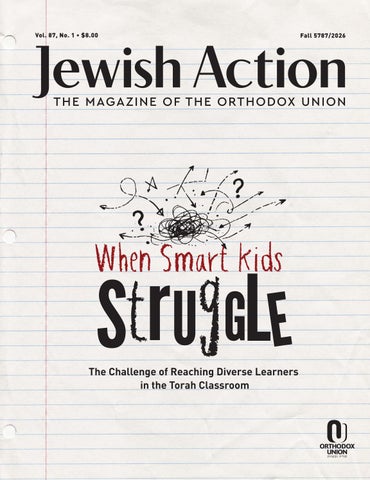
Vol. 87, No. 1 • $8.00
When Smart Kids
g StrU GLE
The Challenge of Reaching Diverse Learners in the Torah Classroom
Fall 5787/2026
Washable & Stretch
Unlined & Breathable
N E W YO R K hhh
ONLY AT ATICAMAN.COM
Fall 2026/5787 | Vol. 87, No. 1
INSIDE
BETWEEN US 80 JUST The Healing Power of Giving:
What does chesed have to do with brain health?
28
FEATURES
12 REFLECTIONS Twenty-Five Years After 9/11:
KOSHERKOPY
the Divide 18 Crossing How a Modern Orthodox ISRAEL
_________________________
18 60 LIFECYCLE The Final Journey
How end-of-life doulas are helping Orthodox families navigate life’s final journey with dignity, compassion and faith
STORY 28 COVER When Smart Kids Struggle
The Challenge of Reaching Diverse Learners in the Torah Classroom By Rachel Schwartzberg
36
A Matter of Focus: Inside the Mind of a Teen with ADHD By Leah B.
By Leah Lightman
65
PHOTO ESSAY The Artistry of the Tallit By David Olivestone
in Mitzvot 74 Wrapped A practical guide to the laws and
40 44 What Parents Are Saying What to Do When 49 Your Child Is Struggling
78 The Return of Techelet
56
DEPARTMENTS
What Educators Are Saying
By Amian Frost Kelemer
The View on the Ground A teacher’s perspective As told to Rachel Schwartzberg
59 By Sarah L.
Dear Mrs. Fructer
Jewish Life at Tel Aviv University
out the 88 Rounding Rosh Hashanah Table:
By Anne Neuberger
By Howard Blas
PHILANTHROPY 84 INSIDE Historic Gift Secures the Future of By Tiferet Schafler
A Call to Serve
community and a secular kibbutz forged an unlikely friendship in the aftermath of October 7
By Dr. Rachel Z. Goodman
customs of tallit and tzitzit By Rabbi Jack Abramowitz
Out of the Blue:
By Dr. Ari Greenspan
_________________________
2 MENSCH MANAGEMENT Era in Jewish Education 8 AByNew Rabbi Dr. Josh Joseph LETTERS
Exploring the customs and halachos of challah on Rosh Hashanah and beyond
90 LEGAL-EASE What’s the Truth about . . . Calling Shabbat Bread “Challah”?
By Rabbi Dr. Ari Z. Zivotofsky
CHEF’S TABLE 98 THE A Whole Lot of Challah By Naomi Ross
FROM OU PRESS 102 NEW The Koren Mesorat HaRav
Tehillim, the Rabbi Dr. Raymond Harari Edition _________________________
104 BOOKS G-d Spoke Once, I Heard
Twice: The Torah’s Lens on FiftyFour Fields of Human Knowledge By Rabbi Dr. Hillel Goldberg Reviewed by Rabbi Shalom Carmy
Is Responsible 106 AforWoman Everything: Jewish Women in Early Modern Europe
By Debra Kaplan and Elisheva Carlebach Reviewed by Rebbetzin Tzipora Weinberg
IN BRIEF 110 REVIEWS By Rabbi Gil Student
_________________________
Jewish Action is published by the Orthodox Union • 40 Rector Street, 4th Floor, New York, NY 10006, 212.563.4000. Printed Quarterly—Winter, Spring, Summer, Fall, plus Special Passover issue. ISSN No. 0447-7049. Periodical’s postage paid at New York, NY, and additional offices. POSTMASTER: Send address changes to Jewish Action, 40 Rector Street, New York, NY 10006. Jewish Action seeks to provide a forum for a diversity of legitimate opinions within the spectrum of Orthodox Judaism. Therefore, opinions expressed do not necessarily reflect the policy or opinion of the Orthodox Union.
IMPRESSIONS 112 LASTING Sirens in Shiloh: Pesach in Israel, 5786
By Dr. Stephen Glicksman
Cover Design: Simi Eisenbach Design & Branding
LETTERS
THE MAGAZINE OF THE ORTHODOX UNION THE MAGAZINE jewishaction.com OF THE ORTHODOX UNION jewishaction.com Editor in Chief
Nechama Carmel carmeln@ou.org Editor in Chief
Nechama Carmel
carmeln@ou.org Associate Editor
Sarah Dyckman
Assistant Editor
Sara Olson
Associate Digital Editor Rachelly Literary EditorEpstein Emeritus
Matis Greenblatt
Rabbinic Advisor Book Editor
Rabbi Yitzchak Breitowitz Rabbi Gil Student Book Editor Contributing Editors
Rabbi Eliyahu Krakowski Rabbi Yitzchok Adlerstein • Dr. Judith Bleich Rabbi Emanuel Feldman • Rabbi Hillel Goldberg Rabbi Sol Roth • Rabbi Jacob J. Schacter Contributing Editors Rabbi Berel Wein Rabbi Yitzchok Adlerstein • Moishe Bane • Dr. Judith Bleich Rabbi EmanuelEditorial Feldman • Rabbi Dr. Hillel Goldberg Committee David Olivestone • Rabbi Sol RothBinyamin • Rabbi Jacob J. Schacter Rabbi Dovid Bashevkin • Rabbi Ehrenkranz Rabbi Avrohom Gordimer • David Olivestone Editorial•Committee Gerald M. Schreck Rabbi Gil Student Moishe Bane •Rabbi Rabbi Dr. Dovid • Rabbi Yaakov Glasser TzviBashevkin Hersh Weinreb David Olivestone • Gerald M. Schreck • Dr. Rosalyn Sherman Design 14Minds Rebbetzin Dr. Adina Shmidman • Rabbi Dr. Tzvi Hersh Weinreb Advertising Sales Copy Editor
Joseph Jacobs Advertising • 201.591.1713 Hindy Mandel arosenfeld@josephjacobs.org
Design
Subscriptions 212.613.8140 Simi Eisenbach Design & Branding simirini@gmail.com ORTHODOX UNION
President
Advertising Sales Mark (Moishe) Bane Joseph Jacobs Advertising • 201.591.1713 arosenfeld@josephjacobs.org Chairman of the Board
Howard Tzvi Friedman
ORTHODOX UNION Vice Chairman of the Board Mordecai D. Katz
President Chairman, BoardR. ofAeder Governors Mitchel
Henry I. Rothman
Chairman, Board of Directors Vice Chairman, Board of Governors
OFF THE SHELF In Ann Diament Koffsky’s “What’s on the Shelf?” in the “Forty Years of Change” symposium (winter 2025), the writer mentions PJ Library and notes that it mails free Jewish children’s books (both Orthodox and non-Orthodox) to families. The goal of distributing Jewish children’s books may be lofty; however, as a Jewish educator who has studied the effects of media on children, I feel compelled to raise a concern about the PJ Library program and whether its offerings should be brought into Jewish homes. This is particularly concerning for families with limited Jewish education. PJ Library’s books do not always fit within my understanding of traditional Torah values. The organization may be well known in the Jewish community, but I personally question whether it should be part of an Orthodox Jewish home’s program of Jewish education. In fact, it is concerning that PJ Library is being promoted prominently on the packaging of a very well-respected kosher-for-Passover product (not an OU company). The PJ Library website proudly shows that the library includes books “with LGBTQIA+ family representation,” such as The Purim Superhero (with two fathers) and Heather Has Two Mommies. I was told by a family friend, who had signed up for PJ Library, that they were sent a book about a child with two moms and felt a need to throw it out. I first heard about PJ Library at a presentation it made to Jewish military chaplains. My first thought was “Who is screening and choosing the titles they send out?” I certainly was not willing to take the responsibility of promoting this program to families in my sphere of influence. Perhaps someone in the Orthodox world would be able to take on such a library program with a commitment to Torah values.
Yehuda Gerald M.Neuberger Schreck
Chairman, BoardProfessional of Directors Officer Executive Vice President/Chief
Allen I. Fagin Morris Smith
Rabbi Mark S. Weiner, Ed.D. Ramat Beit Shemesh, Israel
Chief Institutional Advancement Officer Chairman, Board of Governors
Arnold Gerson Henry Orlinsky
Senior Managing Director Rabbi Steven Vice Chairman, BoardWeil of Governors
Editor’s Note: Readers should consult with their rabbi regarding whether PJ Library books are appropriate for their homes.
Jerry Wolasky
Executive Vice President, Emeritus
Rabbi Dr. Tzvi Hersh Weinreb
Executive Vice President & Chief Operating Officer Rabbi Josh Joseph, Ed.D. Officer Chief Financial Officer/Chief Administrative
Shlomo Schwartz
Executive Vice President, Emeritus Chief Human Resources Officer Rabbi Dr. Tzvi Hersh Weinreb
Rabbi Lenny Bessler
Managing Director, Community Engagement Chief Information Officer
Rabbi Yaakov Glasser Samuel Davidovics
Director, Jewish Media, Publications Editorial Communications Chief Innovation and Officer
Rabbi DaveGilFelsenthal Rabbi Student
Director ofJewish Marketing andCommittee Communications Action
Gary Magder Dr. Rosalyn Sherman, Chair Gerald Schreck, Co-Chair JewishM. Action Committee Joel M. Schreiber, Chairman Emeritus Gerald M. Schreck, Chairman Joel M. Schreiber, Chairman Emeritus Copyright2018 2026bybythe the Orthodox Union ©©Copyright Orthodox Union 40 Rector 4th New Floor,York, NewNY York, NY 10006 Eleven Street, Broadway, 10004 Telephone212.563.4000 212.563.4000 • www.ou.org Telephone • www.ou.org
Facebook: Jewish Action Magazine Instagram: jewishaction_magazine Twitter: Jewish_Action Linkedln: Jewish Action
2
JEWISH ACTION Fall 5787/2026
CELEBRATING AMERICA 250 Kudos to you for the “Celebrating 250 Years of America: The Orthodox Jewish Experience” series (summer 2026). The wellresearched and well-crafted articles were filled with things I did not know before. From Nechama Carmel’s fascinating interview with Rabbi Yaakov Glasser to the terrific biographical articles, the summer issue was a joy to read. Special thanks to Dr. Jeanne Abrams, Rabbi Dr. Zev Eleff and Dr. Melissa Klapper who are blessed with a rare ability to make even turgid history so interesting. Dr. David Luchins Passaic, New Jersey THE PILGRIMS’ PRAYER I read with interest Rabbi Moshe Taub’s article, “The American Story in the Responsa: She’eilos from the New World” (summer 2026). Rabbi Taub claims that the Mayflower Pilgrims recited Psalm 107
SOME PLACES TEACH VALUES. HERE, YOU LIVE THEM.
At Yeshiva University, Torah is woven into every part of campus
life—from the classroom to the beit midrash, from Shabbat meals to lifelong friendships. Learn from the world’s leading Roshei
Yeshiva, Rabbis and Torah Scholars while preparing to lead with purpose wherever life takes you.
SHAPE YOUR FUTURE.
upon their safe arrival in the New World and “prayed” from a passage in Henry Ainsworth’s Bible commentary that cited Rambam’s criteria for reciting Birkas Hagomel. “Bradford and his fellow passengers took the Jewish law seriously.” However, there is no evidence that the Pilgrims recited Psalm 107 upon arrival, let alone Ainsworth’s gloss. Bradford’s own account of landfall, written at least a decade later, merely states that “they fell upon their knees and blessed the G-d of heaven.” The only other extant contemporary account simply notes, “It caused us to rejoice together, and praise G-d.” While Bradford cited Psalm 107 elsewhere, he did so in the context of imagining future generations quoting it in retrospect. Furthermore, while Bradford owned a copy of Ainsworth’s commentary, it is impossible to determine whether he had it on the Mayflower or acquired it later. Finally, the notion that the Pilgrims sought to emulate a Jewish prayer contradicts Puritan theology, which viewed Judaism as erroneous and despised extraBiblical liturgies. (For more information on this subject, see my article, “The Myth of the Judaic Puritans,” Lehrhaus, November 26, 2024.) Yisroel Benporat, Ph.D. Riverdale, New York LIVING WITH A DISABILITY Rachelly Eisenberger’s review of Michal Horowitz’s book, Abled: A Torah View on Living with a Disability, (summer 2026) was outstanding. While I also read the book—by this master Torah teacher—the personal and communal imperatives the reviewer raises are compelling. The dignity and depth of a life thoughtfully lived with a disability challenges us to rethink what it means to live a rich and meaningful life and what our real limitations are. Faigie Horowitz, MSM Lawrence, New York Thank you for publishing “Accessible to All” (summer 2026). As an autistic Jewish woman, I’m delighted to see more conversation and action around disability rights and accessibility in the Orthodox Jewish community. I especially appreciate the point Sharon Shapiro-Lacks makes in the article about how “chesed can be self-serving,” especially in the context of disability. Chesed is an extremely important Jewish value, but it is a big problem when disabled people are seen only as recipients of special help. Like everyone, disabled people sometimes need help, but we also need to be treated equitably and with dignity and to be involved in community leadership so we ensure that the Orthodox Jewish community’s buildings, programs and events are designed from the outset to be accessible. Chesed should not be paternalistic but rather integrated into a broader system of values that includes justice, respect, and the recognition that everyone is made in the image of G-d. Eliana Sisman Los Angeles, California DIGNITY IN DEATH I would like to commend Merri Ukraincik for her inspiring interview with Yael Davidowitz (“The Last Kindness,” summer 2026) and for highlighting the extraordinary work of Project Last Kindness in preventing Jewish cremation and restoring dignity to our departed brothers and sisters. 4
JEWISH ACTION Fall 5787/2026
Jewish Action Wins Five Rockower Awards Jewish Action won five Simon Rockower Awards for Excellence in Jewish Journalism for work that appeared in 2025. The prestigious awards, referred to as the “Jewish Pulitzers,” are sponsored by the American Jewish Press Association (AJPA), which holds a journalism competition for leading Jewish magazines and newspapers across the country. The entries are judged by a panel of judges with expertise in journalism, writing/reporting, editing, graphic design and cartooning in both Jewish and non-Jewish media. Winning articles included:
First Place
Wally Klatch, as told to Jewish Action Editorin-Chief Nechama Carmel, “My Journey with Dementia” (summer 2025)
Second Place
•R achel Schwartzberg, “When Dad Has Dementia” (summer 2025) •R achel Schwartzberg, “The Making of a Mezuzah” (spring 2025)
Honorable Mention
•S andy Eller, Judy Gruen, Merri Ukraincik, Rachel Schwartzberg and Carol Ungar, “Building a Community: Stories from the Ground Up” (fall 2025) •C arol Ungar; Debbie Rosen, as told to Toby Klein Greenwald; and Moti and Hana Sender, as told to Toby Klein Greenwald, “Twenty Years Later—Remembering the Uprooting of Gush Katif” (summer 2025)
MEET THE PEOPLE SHAPING THE WORLD. World-renowned thought leaders. Visionary innovators. Influential voices. Only at YU can you regularly engage with the people driving today’s biggest conversations and tomorrow’s opportunities.
SHAPE YOUR FUTURE.
As a ba’alas teshuvah of twenty-five years, I know firsthand the profound pain of seeing family members choose cremation rather than a proper Jewish burial. Fifteen years ago, while serving as part of the chevra kadisha, I took it upon myself to reach out to unaffiliated members of my own family. Through countless tefillos, extraordinary siyata dʼShmaya, and my offer to personally cover burial expenses, my uncle ultimately merited a proper Jewish burial. That experience opened my eyes to a painful reality: many Jews choose cremation not out of disregard, but because the cost of Jewish burial can be prohibitive and because they often lack knowledgeable family members and community advocates to guide them. In response, I have spent the last fourteen years developing The Meis Mitzvah Project, dedicated to providing completely free kosher Jewish burial for indigent Jews who would otherwise be cremated due to a lack of funds or family support. The generosity of dedicated donors enables us to vet each deceased individual to confirm Jewish status and financial need. Many of these Jews lie in city morgues, are found alone in rented apartments, or are even found on the streets, unidentified for weeks and sometimes months. When city officials believe they have identified a Jewish deceased person, they often contact The Meis Mitzvah Project. Upon proper verification, these precious neshamos are brought to
kevuras Yisrael and granted in death the dignity they may not have experienced in life. The Meis Mitzvah Project operates as a separate 501(c)(3) under the rabbinic guidance of Rabbi Elchonon Zohn of the National Association of Chevra Kadisha (NASCK). This sacred work is carried out in conjunction with my fulltime role assisting the chief rabbi of South Africa, Rabbi Dr. Warren Goldstein, in advancing The Shabbat Project throughout North America. I often reflect that my life mission has become helping Jews embrace the beauty and sanctity of Shabbos in this world, while helping ensure they merit the dignity of kevuras Yisrael and eternal kavod in the next. I am deeply grateful that Jewish Action has brought attention to this critical issue. Robin Meyerson Founder, The Meis Mitzvah Project Scottsdale, Arizona CORRECTION My article on Rabbi Herbert S. Goldstein, also known as “The Maverick Rabbi” (summer 2026), should have referred to the Yiddish-speaking rabbi who shared his pulpit at Congregation Kehilath Jeshurun as Rabbi Moshe Zevulun Margolies (hence, RaMaZ), not Rabbi Judah David Margolis. Rabbi Aaron I. Reichel, Esq. Kew Gardens, New York
מעשה אמהות סימן לבנים Discover Rachel and Leah as you’ve never seen them before.
Beneath the familiar stories of Rachel and Leah lies a deeper narrative - one that begins in Gan Eden and continues to this day...
Two Sisters,One Soul T HE SECR ET OF R ACHEL AND LE AH
Transliterations in the magazine are based on Sephardic pronunciation, unless an author is known to use Ashkenazic pronunciation. Thus, the inconsistencies in transliterations in the magazine are due to authors’ or interviewees’ preferences.
This magazine contains divrei Torah and should therefore be disposed of respectfully by either double-wrapping prior to disposal or placing in a recycling bin.
BY AV I TAL GA ST W IRT H
“An incredible journey into the depths of Toras Hashem and Nishmas Yisroel.” Rabbi Moshe Weinberger “A challenging and thought-provoking book” Rabbi Akiva Tatz “Fascinating, interesting, deep and comprehensive, yet easily understood.” Rabbi Zev Leff
AVAILABLE NOW ON AMAZON
AND COMING SOON TO A BOOKSTORE NEAR YOU.
6
JEWISH ACTION Fall 5787/2026
WE WANT TO HEAR FROM YOU! To send a letter to Jewish Action, e-mail ja@ou.org. Letters may be edited for clarity.
BE WHAT YOU BELIEVE.
At Yeshiva University, support for Israel isn’t something you have
to defend—it’s part of who we are. Join a community where Zionism is lived every day through shared values, meaningful experiences,
and a deep connection to the Jewish people and the State of Israel. Spend the best years of your life on a campus where you belong.
SHAPE YOUR FUTURE.
MENSCH MANAGEMENT
A New Era in Jewish Education
By Rabbi Dr. Josh Joseph
W
e are about to enter a new era in Jewish education. This is not hyperbole. For generations, the greatest barriers to Jewish education have been access, affordability and availability. Today, for the first time in decades, all three are beginning to shift. Through the Orthodox Union’s Teach Coalition, we have helped remove many of those barriers. We have secured government funding to help keep Jewish schools safe, expanded scholarship opportunities so more families can afford tuition, advanced legislation that enables schools to open and grow, strengthened STEM and other educational programs, and delivered millions of dollars in grants and reimbursements directly to Jewish day schools. As a result, Jewish education is becoming safer, more affordable and more accessible than ever before. At the same time, technological innovation is transforming the way Torah is taught and learned. Together, these developments 8
JEWISH ACTION Fall 5787/2026
present one of the most significant opportunities for Jewish continuity in decades. The question is whether we are prepared to seize it. For countless Jewish families, the decision not to send a child to a Jewish day school was never ideological. It was financial. They wanted a Jewish education but simply could not afford one. That reality may soon begin to change. On January 1, 2027, the Education Freedom Tax Credit is scheduled to take effect. While participation depends on state implementation, momentum continues to build as more states move toward joining the program. If fully realized, the legislation has the potential to dramatically reduce the cost of Jewish education for thousands of families. But legislation alone is not enough. Opportunity requires infrastructure. The new law relies on Scholarship Granting Organizations (SGOs) to receive and distribute scholarship funds. Recognizing both the promise and the complexity of this moment, the OU is partnering with Jewish Federations of North America and Prizmah to establish a national SGO, endorsed by Torah Umesorah and other leading national Jewish organizations. Rather than requiring every community to build its own system from scratch, we are creating an infrastructure that will allow Jewish day schools and yeshivot across the country to participate efficiently and effectively. For many families, Jewish education may soon move from aspiration to reality. The demand is already there. One of the most encouraging developments of the past few years has been the extraordinary growth of the Orthodox Union’s JSU (Jewish Student
Union) clubs. Prior to October 7, 2023, 304 clubs operated in public high schools across North America. Today, there are more than 515. The growth reflects something much deeper than expanded programming. Thousands of Jewish teenagers are searching for identity, meaning, community, and purpose. They are asking profound questions about who they are and where they belong. Every week, they voluntarily spend part of their lunch period discussing Torah, Israel, Jewish identity and ethics. If resources permitted, we could easily double that number again, opening more than 1,000 clubs nationwide. The question is not whether Jewish teenagers are interested. It is whether we are prepared to meet them where they are. The same transformation is taking place among adults. On June 6, 2027, hundreds of thousands of Jews around the world will celebrate the completion of another cycle of Daf Yomi. Not long ago, the idea of learning a page of Gemara every day was considered the province of a dedicated few. Today, it has become woven into the rhythm of Jewish life. Jews from every background, profession and stage of life have shown that consistent Torah learning is not reserved for scholars. It is attainable for anyone willing to commit. In addition, through apps like All Mishnah, All Halacha, All Parsha and Torat Imecha, daily learning is accessible to more Jews, through more channels. As Rabbi Moshe Hauer, zt”l, would ask: “What is your yomi?” What will you learn daily that will help transform your Rabbi Dr. Josh Joseph is OU executive vice president/chief operating officer.
THE
NAME
2026
YOU’VE
TRUSTED
FOR
OVER
40
YEARS!
WHOLESALE & RETAIL
Buy Direct. Save More. WE SPECIALIZE IN SERVING SYNAGOGUES, SCHOOLS, JCCS, HILLEL HOUSES, AND OTHER JEWISH ORGANIZATIONS — DEAL DIRECTLY WITH THE IMPORTER FOR BETTER PRICING AND SERVICE. CALL 800550-7230 FOR YOUR CUSTOM QUOTE.
YOUR LEADING & COMPLETE SOURCE FOR ALL SUKKOS NEEDS
LULAVIM
ESROGIM
HOSHANOS
SCHACH
SUKKAHS
ALL KOSHER CERTIFIED!
ESROGHEADQUARTERS.COM
800-550-7230
curiosity, your relationship to Torah, and your connection with Hashem? How will you participate in a growing transformation of “more Jews growing closer to Hashem through Torah”? Technology is accelerating that transformation. Recognizing this remarkable moment, the Orthodox Union has launched Ohrbit, an AI-powered Torah learning platform designed to make Torah study more personalized, accessible and uniquely engaging. Technology will never replace great teachers, but it can help every learner discover the right pace, the right material, and the encouragement to continue growing. For centuries, the dream of making Torah accessible to every Jew was constrained by geography, finances and limited educational resources. Today, many of those barriers are beginning to disappear. Nearly two thousand years ago, a Jewish leader confronted a very different educational challenge. The Gemara
credits Yehoshua ben Gamla with establishing the first universal Jewish educational system. He lived during one of the darkest periods in Jewish history, as Roman oppression intensified and the Beit Hamikdash stood on the brink of destruction. Rather than yielding to despair, he built institutions that would preserve Torah for generations. The Talmudic tradition presents a complex portrait of Yehoshua ben Gamla. Some sources view him as a visionary; others paint a more complicated picture. Yet perhaps that complexity is precisely the point. As Rabbi Tzvi Sinensky has suggested, his greatness may not have lain in personal perfection but in recognizing that Jewish education stood at a crossroads and refusing to wait for someone else to act. History often turns not on flawless leaders but on people who understand what the moment requires and step forward. Thank G-d, our generation faces the opposite challenge. We are not confronting the collapse of Jewish
education but the possibility of its unprecedented expansion. Will we encourage families who never imagined a Jewish day school education to take another look? Will we invite neighbors whose children attend public school to explore opportunities that may now be within reach? Will we strengthen our own commitment to lifelong Torah learning by embracing the extraordinary educational tools now available? Will we become ambassadors for Jewish education in our communities? Every generation has its defining challenge. Perhaps ours is not preserving Jewish education from extinction but ensuring that every Jew who seeks access to Torah can receive it. As we begin this new year—and, I believe, a new era in Jewish education— let us recognize the extraordinary opportunities before us. And let us do our part to ensure that every Jewish child, every Jewish family, and every Jewish soul has the opportunity to inherit the timeless gift of Torah.
Let's be friends Follow us on social media
ou.org/membership | jewishaction.com | Questions? ja@ou.org
10
JEWISH ACTION Fall 5787/2026
Heart.Works
Processing isn’t part of our process Heaven & Earth Unfiltered Raw Honey is organic, pure, and untouched—no processing, just nature’s sweetness at its best.
REFLECTIONS
25 YEARS AFTER 9/11:
A CALL TO SERVE
F
or many Americans, 9/11 changed us in profound ways. The images of planes being flown into buildings, of desperate people jumping from the Twin Towers are seared into our memory. Few can understand the hatred that led nineteen hijackers to intentionally take thousands of lives. 9/11 also transformed how we view public service. Firefighters, police officers, military personnel, intelligence professionals and emergency responders were no longer distant figures performing unseen jobs; they became real-life heroes. On that day, New York City lost 344 firefighters who gave their lives to save others. Amid the horror, we witnessed extraordinary acts of courage and selfless devotion. As a nation, and as individuals, we were deeply grateful for their sacrifices. That gratitude resonated deeply with me because gratitude has always been central to my family’s American story.
12
JEWISH ACTION Fall 5787/2026
By Anne Neuberger I am named for my greatgrandmother, who was murdered in Auschwitz along with most of her children and grandchildren. My maternal grandmother survived the Holocaust, bearing the tattooed number on her arm and a trauma that only fellow survivors could comprehend. My father and his parents fled Sovietoccupied Hungary after the 1956 revolution and eventually found refuge in the United States. In our home, America and its blessings were never taken for granted. It was the country that opened its doors when so many others closed theirs. It was the place where refugees became citizens, survivors rebuilt families, and devout Jews practiced their faith openly and proudly. For that reason, the Jewish obligation of hakarat hatov, recognizing and responding to goodness, has always shaped how I think about citizenship. The prophet Yirmiyahu articulated this responsibility centuries ago when he instructed the Jewish exiles in Babylon: “Seek the welfare of the city where I have exiled you, and pray to G-d on its behalf, for in its peace you shall have peace.” For generations, Jews recited those words as a vulnerable minority in the various countries in
which they lived. In America, however, we had the extraordinary opportunity not merely to pray for the welfare of the country but to help shape it. American Jews, including American Orthodox Jews, have done exactly that. Bringing with us values rooted in education, responsibility, family, tzedakah and community, we have helped strengthen every corner of American life. Jews, secular and religious, and their descendants have built businesses, advanced medicine and science, served in government, enriched the arts and created institutions that benefited the broader society. American Jews faced antisemitism in America and overcame it with determination and belief in the American dream. Indeed, many American cities have a hospital with “Mt Sinai” or “Jewish” in its name, because when Jewish doctors weren’t permitted to practice in existing hospitals, they responded by forming their own, some becoming the finest in the country. The American story is a story Jews understand well: people arriving from different lands, carrying different histories, yet joining together to build one nation. Few communities embody that story more fully than we do.
Years
OF SERVING THE COMMUNITY
Ari J. Zaltz, Esq.
R A M A P O S T. C O M
Emanuel Haas, Esq. ◊ WILLS & TRUSTS
◊ TAX PLANNING
◊ ELDER LAW
◊ MEDICAID PLANNING / APPLICATIONS
◊ PROBATE
◊ HIGH NET WORTH PLANNING
◊ TRUST ADMINISTRATION
◊ SPECIAL NEEDS PLANNING
◊ HALACHIC WILLS
◊ ASSET PROTECTION PLANNING
INFO@HAASZALTZ.COM | WWW.HAASZALTZ.COM
MONSEY
BROOKLYN
CEDARHURST
WESTCHESTER
LAKEWOOD
845.425.3900
718.412.5288
516.979.1060
914.222.8220
732.419.1918
Many of our grandparents and greatgrandparents came from shtetls in Eastern Europe, as well as cities and communities across South America, Western Europe, the Middle East, North Africa, the former Soviet Union and beyond. They brought with them diverse customs, traditions and life experiences, yet together they became part of a shared American story. That is why today’s rise in antisemitism is so painful. We feel unsettled by the hostility we see around us, and for many families, the fear is familiar. Yet a proper response to antisemitism is not withdrawal and retreat. It should be pride and purposeful engagement. The Book of Esther offers an enduring model. Facing a grave threat to the Jewish people, Esther did not counsel isolation. Instead, she instructed Mordechai: “Lech kenos et kol haYehudim—Go gather the Jews.” The answer to the challenge of external hatred was organization, prayer, unity and collective action. That lesson feels especially relevant today. Recently, candidates opposed to our community’s values won primary elections in heavily Jewish areas, in one case, by roughly 2,000 votes. The Jewish community barely showed up at the polls. Regardless of one’s political affiliation, the lesson is clear: Communities that engage shape outcomes. Communities that stay on the sidelines permit others to shape them.
Anne Neuberger is a distinguished fellow at Stanford University. She served as deputy national security adviser for cyber and emerging technology in the Biden Administration, from 2021 to 2025.
14
JEWISH ACTION Fall 5787/2026
At a moment when antisemitism is rising, American Orthodox Jews should not withdraw from the public square. We should enter it more fully.
Citizenship is not a spectator sport. If we care about the future of our communities, our country and America’s relationship with Israel, we must participate. We need more Orthodox Jews serving in public life. More Orthodox Jews running for office, serving on school boards, joining law enforcement, entering government, serving in the military and contributing to the institutions that make society function. It is not only the right thing to do; it is a profoundly fulfilling thing to do, as I learned during almost twenty years serving in the US intelligence community and the White House. And, while the days were often long and the work challenging, I felt blessed to contribute my skills to a country whose values of equality and freedom inspire all of us and allow us to thrive as proud Americans, and as proud Jews. With blessings come obligations. Beyond tragedy, the twenty-fifth anniversary of 9/11 should remind us of responsibility. It should recall those brave individuals who served, sacrificed and answered the call when their country needed them. Yirmiyahu taught us to seek the welfare of the society in which we live, and Esther taught us to act in moments of challenge. Generations of Jews fleeing Europe’s hatred taught us the exceptionalism of America’s freedoms. The generation of 9/11 taught us about the nobility of public service. Those lessons point in the same direction. At a moment when antisemitism is rising, American Orthodox Jews should not withdraw from the public square. We should enter it more fully. We should bring our deep-seated values, our talents and our traditions to the service of our country. With gratitude for what America has given us. With pride in what we contribute to America. And with the confidence to say, as Avraham Avinu did: Hineni. Here I am.
This Midwinter, Make Memories In Israel. Fares Worth Flying For!
Book now on the EL AL website, app or with your travel agent Terms and conditions apply
I CHOSE EXCELLENCE I CHOSE
TOURO VISIT US ONLINE: TOURO.EDU/EXCELLENCE
KAYLA OSTROV ’20 Touro’s Lander College for Women Guggenheim investments Senior Associate, Client Services
ISRAEL
Crossing the Divide How a Modern Orthodox community and a secular kibbutz forged an unlikely friendship in the aftermath of October 7 By Howard Blas
18
JEWISH ACTION Fall 5787/2026
W
hen Rabbi Joe Wolfson and his family arrived for Shabbat at Kibbutz Nir Am in the Gaza Envelope, with a plata (Shabbat warmer) and kumkum (hot-water thermos) in hand, their host and friend, Eyal Massad, was sitting on a stool watching YouTube videos. Despite living on a kibbutz whose members are not traditionally observant, forty-three-year-old Massad was determined to figure out how to disconnect the light bulb from his high-end refrigerator so his guests could fully and comfortably observe Shabbat. “My wife and I spent two hours next to the refrigerator watching videos, but the refrigerators were not like ours. We started to play around. I realized it needed a magnet and got it done!” Massad’s daughters showed similar sensitivity—and curiosity—in the questions they freely asked Rabbi Wolfson’s daughters about minutiae of Shabbat observance. “They are not religious but made a big effort to not do things [that are forbidden on] Shabbat, like watch TV or turn on lights, to make us feel more welcome,” recalls Mika Wolfson, Rabbi Wolfson’s eleven-year-old daughter. “They asked a lot of questions—‘isn’t it hard not to watch TV?’ It was hard for them to remember what we could and couldn’t do.” Unbeknownst to the Wolfsons, Massad had asked his daughters to stay off their phones and TV when the Wolfsons came for Shabbat—no small task for Israeli children who often receive their first phone in the first grade. The story of how a forty-year-old London-born JLIC rabbi (affectionately known as “Rabbi Joe”), his wife, Corinne Shmuel, and their large community of mostly Modern Orthodox Anglo olim in their twenties and thirties forged a deep and meaningful relationship with members of a secular kibbutz is one of pitching in during a moment of need, trust, hachnasat orchim, and a willingness to look beyond stereotypes. Yet the unlikely relationship speaks to more than a single kibbutz and a community in central
Kibbutz Nir Am, located just over a mile from the Gaza Strip and adjacent to Sderot. Seen here, a lookout on the kibbutz, with a hilltop trail with Gaza visible in the distance Fall 5787/2026 JEWISH ACTION
19
Visiting Kibbutz Nir Am for a day of volunteering that included painting miguniyot, portable bomb shelters
Israel. It offers a glimmer of hope for Israeli society as a whole, showing how biases can be overcome and bridges can be built across Israel’s religious and secular divide.
Anatomy of a Relationship Located just over a mile from the Gaza Strip and adjacent to Sderot, Nir Am, with a population of 800, was founded in 1943—mainly by immigrants from Bessarabia (modern-day Moldova). The kibbutz was attacked by Hamas terrorists on October 7, 2023. Miraculously, its security squad, with assistance from a small number of border police forces and the Israel Defense Forces’ (IDF) Golani Brigade soldiers, prevented casualties among the kibbutz members. Sadly, two soldiers died in the Battle of Nir Am. Like an estimated 200,000 to 250,000
other Israelis forced to evacuate border communities in the South and North following October 7, Nir Am’s residents were evacuated from their homes. They relocated to the Herods Tel Aviv hotel with barely the clothes on their backs, remaining in cramped quarters and eating all their meals in the hotel’s dining room for ten months. When Rabbi Wolfson, who made aliyah in 2022, heard that thousands of evacuees were relocating to Tel Aviv, he immediately mobilized his community to help. Rabbi Wolfson and Corinne run Tel Aviv’s Jewish Learning Initiative on Campus (JLIC TLV), a young professional community near Dizengoff Street composed of mostly Anglo professionals. A division of the Orthodox Union, JLIC creates warm communities for North American and Israeli students
Howard Blas is a social worker, special education teacher and inclusion specialist. He frequently leads Birthright Israel trips for people with disabilities and is the author of a recent book on b’nai mitzvah and disabilities. He recently made aliyah and lives in Tel Aviv. 20
JEWISH ACTION Fall 5787/2026
and young professionals, and offers a religious framework that includes Torah study, halachic and spiritual guidance from a resident rabbinic couple, Shabbat and yom tov meals, and regular social events. While JLIC was initially established to support students on college campuses, it has since expanded to include other young adults in Israel and has communities in Jerusalem, Herzliya, Givat Shmuel and Tel Aviv. In the weeks and months following October 7, the vibrant, energetic young JLIC community of Tel Aviv, which numbers around 450 members, became known for working with residents of the Gaza Envelope and the North who were living in Tel Aviv hotels. “In the early days, we hired ice cream trucks that went around to the Tel Aviv hotels,” says Rabbi Wolfson. “We looked for ways we could give.” “Over 200 messages a day were posted on the group’s WhatsApp,” says Kinneret Yitzchak, community engagement officer of JLIC TLV. The group helped with “anything from a bride needing a last-minute wedding
25 YEARS OF EXTRAORDINARY SUPPORT. ONE UNFORGETTABLE NIGHT CELEBRATING IT.
SILVER
STEEL
MARKS THE
DEFINES
STE R
L
OUR FAMILY.
G IN
HEART
A D AR W
CY EGA AWA L E
RD
ON
ANNIVERSARY.
OCTOBER 28, 2026 D I N N E R
6
P M
CIPRIANI WALL STREET N E W MR. GORDON SINGER & THE SINGER FAMILY FOUNDATION
Y O R K
ELANA & DANIEL LOWY
D I N N E R
C I T Y
RSVP
C O M M I T T E E
LISA BELZBERG | WENDY BELZBERG | SANDER GERBER | ELLIOT GIBBER |
RONNIE HIRSCH
M A L C O M H O E N L E I N | H O W A R D J O N A S | SAM & HO L LY ME R R I N | J O S H NA S H | G EO R G E R O H R | ST R AU S S Z E L N I C K
Over 200 messages a day were posted on the group’s WhatsApp. The group helped with ‘anything from a bride needing a lastminute wedding dress to someone needing to transport medical supplies from Miami to Israel.’
Rabbi Joe Wolfson and his wife, Corinne Shmuel, run JLIC TLV. Seen here, Rabbi Wolfson at a Chanukah party for evacuees
dress to someone needing to transport medical supplies from Miami to Israel.” Members of JLIC TLV approached staff in over seventy Tel Aviv hotels, explaining that they live nearby and are willing to help with whatever might be needed. They cooked meals for evacuees across five hotels. They also supported evacuees in other important ways, including running hundreds of activities such as carnivals and trips to theme parks for evacuee children across twenty-four hotels. Perhaps their most important initiative was a family match program, through which evacuees arriving in Tel Aviv were paired with local residents “who they could go for coffee with, ask ‘Who’s a good pediatrician?’ or learn where the nice parks are.” This program, says Rabbi Wolfson, “has the potential to change a country.” The volunteers kept going to hotels from October 7, 2023, until the last residents of Kiryat Shemona returned home in March 2025.
“Whenever we run a big event, I introduce myself and our community, and I say, we view you as guests in our city, and the only thing we ask from you is that when, please G-d, you return home, whether it be to Sderot or Kfar Aza or Kiryat Shemona, you invite us back.” Those words would eventually prove prophetic. In the early months of the relationship, while the residents were living in the Herods Tel Aviv hotel, expressions of gratitude flowed in both directions.
Rabbi Wolfson recalls seeing the street signs erected around Tel Aviv expressing appreciation. “There were these beautiful posters up on Ayalon and Rokach [a high-traffic intersection in Tel Aviv] and all the major roads in Tel Aviv, paid for by the municipality of Sderot, which said, ‘Halev beSderot, anachnu beTel Aviv, todah al ha’eiruach, yachad nenatze’ach—Our hearts are in Sderot. We are in Tel Aviv. Thank you for hosting us. Together we’ll win.’ Then there were other billboards, smaller ones on the more pedestrian streets, paid for by the Tel
“Orchim, Not Mefunim!” From the start, Rabbi Wolfson was intentional with his language, preferring to use the word orchim (guests) over mefunim (evacuees/ displaced). “Nobody wants to be referred to as an evacuee,” he explains. 22
JEWISH ACTION Fall 5787/2026
Sign at the kibbutz welcoming JLIC TLV to the community
AMBITIOUS WOMEN CHOOSE
TOURO
WHAT’S YOUR GOAL? At Touro’s Lander College for Women in Manhattan, you’re part of a welcoming community committed to making your professional dreams a reality. You’ll find an outstanding education, unwavering support, and personalized attention in an environment that’s in sync with your Jewish values. To learn more, contact Mrs. Sarah Klugmann at 212.520.4263 or sarah.klugmann@touro.edu
OPEN HOUSE OCT. 25 | 2 PM 227 West 60th St., NY, NY Marian Stoltz-Loike, Dean
lcw.touro.edu/openhouse
In the months following October 7, JLIC TLV volunteers ran hundreds of activities for evacuee children across twenty-four hotels.
Eventually, they were won over. They realized . . . that ‘even though they were religious, we could be friends.’ Aviv municipality, which stated, ‘Ein kamo babayit, aval beintayim targishu babayit—There’s nowhere like home, but in the meantime, feel at home.’” Over time, what began as organized volunteer efforts evolved into genuine personal relationships. When kibbutz members prepared to go home in August 2024, JLIC TLV went all out to host a goodbye party. The following month, the decision 24
JEWISH ACTION Fall 5787/2026
was made to twin the communities with one another. This was meant to be a mutual friendship with each side giving in their own way. JLIC TLV began making trips to the South to visit and the kibbutznikim offered their new friends the kibbutz-member discount at Michsaf (“Made of Silver”), the well-known kitchenware and cutlery factory located on the kibbutz. “Getting the discount, says in a sense, ‘we see you as family,’” observes Rabbi Wolfson. A few months later, members of the JLIC TLV community visited the kibbutz for a day of volunteering that included painting miguniyot (portable bomb shelters), running a carnival for children, hosting a barbecue, and gathering around a bonfire. Rabbi Wolfson recalls how poignant it was to see remnants from before October 7. “They had just returned home six weeks earlier, after being away for ten months. They were feeling very fragile. The previous year’s sukkahs were still up.”
Later that year, on Tu B’Shevat, JLIC TLV members returned to plant trees alongside kibbutz residents. For Massad, the planting was heavy with symbolism. “They planted 150 trees 100 meters from the gate where we were fighting for our lives. Now, they were helping us put down new roots.” Additional joint events followed, and the relationship continued to grow. Yet kibbutz member Chen Parchi Cohen, Nir Am’s head of resources and partnerships, admits that some kibbutz members were skeptical about the religious olim in the beginning. “A few of our older kibbutz members asked, ‘Are you sure you want to do this?’ They saw that they were religious and were worried about religious coercion.” Eventually, they were won over. They realized, says Parchi Cohen, that “even though they were religious, we could be friends.” Although Nir Am is not considered a religious kibbutz, it maintains a synagogue used each Shabbat for prayer
BUILD YOUR LIFE IN ISRAEL. BUILD YOUR FUTURE WITH YU. NEW! UNDERGRADUATE PROGRAM Our unique three-year undergraduate program offers a BBA degree in Global Business & Innovation, combining flexible online coursework with in-person Torah learning and student experiences in Jerusalem.
>> Prepare for Global
Career Success
>> Deepen Your
Torah Learning
>> Distinct Men’s and
Women’s Beit Midrash Learning
>> Experience Student
Life in Jerusalem
CLASSES BEGIN FALL 2027
Learn More at yu.edu/yui
On Tu B’Shevat, JLIC TLV members returned to Nir Am to plant trees alongside kibbutz residents.
services. Massad, who does not consider himself Shabbat observant, goes to synagogue when Rabbi Wolfson comes for Shabbat. When the kibbutz wanted to memorialize two soldiers who fell on October 7, kibbutz members decided to commission and dedicate a Sephardic sefer Torah. Members of the JLIC TLV community were invited to be part of the kibbutz’s hachnasat sefer Torah. Over time, Rabbi Wolfson found himself helping kibbutz members in surprising ways: koshering kitchens for Passover and arranging to sell their chametz. Throughout, Rabbi Wolfson has been careful not to focus on religious 26
JEWISH ACTION Fall 5787/2026
differences. “The fact that we are religious and they are a secular community—I would not say it is incidental—is never what we lead with. It comes back to the orchim element. I said this line time and time again: This isn’t chesed, this isn’t tzedakah; we have this tradition of hachnasat orchim. In our eyes, you are not evacuees, you are guests.” Then, in June 2025, the relationship came full circle. Ironically, while the communities in the Gaza Envelope were experiencing a relatively quiet period, residents of Central Israel found themselves coping with ongoing Iranian missile attacks. Members of Nir Am
started hearing about the challenges facing those living in Tel Aviv and other parts of the country, where residents were dealing with multiple azakot (sirens) each day and night, and the constant need to run to shelters. Now it was their turn to help. Kibbutz members graciously opened their homes to their Tel Aviv brothers and sisters. Later that year, in March 2026, during Operation Roaring Lion, when Iranian missiles targeted densely populated areas in Tel Aviv and Jerusalem, the kibbutz opened their homes again. During the ceasefire in May, Nir Am hosted sixty members of JLIC TLV for Shabbat. Parchi Cohen admits that in the days leading up to the visit, she was unsure what to expect. In the end, she says, the Shabbat exceeded expectations. Rabbi Wolfson and Corinne have already included the Massads and other kibbutz members on the guest list for her daughter’s bat mitzvah next year. Parchi Cohen says word of the friendship has spread to other kibbutzim, many of which are eager to cultivate similar relationships. “Other kibbutzim in the area are jealous,” she says. “They ask how they can create a similar friendship with another community.” Noam Roffman, a member of the kibbutz who spent October 7 as part of the kibbutz’s small kitat konenut (rapid response squad) fighting for many hours, saving many lives, and subsequently attended more than 100 funerals, shared what the friendship with the JLIC TLV community means to him. Thanking the volunteers for showing up in the aftermath of October 7, he said at a Chanukah party hosted by JLIC TLV, “. . . during that uncertainty, when the institutions we relied on seemed distant, you showed up . . . . You gave your time, your energy, and your hearts to help rebuild what was broken, not just the walls and the roads, but our spirit. “Your efforts helped restore faith in what is possible when we come together, not as strangers, but as one united community.” Today, members of JLIC TLV still receive the kibbutz-member discount at Nir Am’s factory.
BUILD YOUR LIFE IN ISRAEL. BUILD YOUR FUTURE WITH YU. NEW! UNDERGRADUATE PROGRAM Our unique three-year undergraduate program offers a BBA degree in Global Business & Innovation, combining flexible online coursework with in-person Torah learning and student experiences in Jerusalem.
>> Prepare for Global
Career Success
>> Deepen Your
Torah Learning
>> Distinct Men’s and
Women’s Beit Midrash Learning
>> Experience Student
Life in Jerusalem
APPLY TODAY! yu.edu/applyyui Classes begin January 2027
Learn More at yu.edu/yui
C OV E R S T O RY
When Smart Kids
g r t S U GLE The Challenge of Reaching Diverse Learners in the Torah Classroom By Rachel Schwartzberg
28
JEWISH ACTION Fall 5787/2026
Fall 5787/2026 JEWISH ACTION
29
This article is part of a Jewish Action series on accessibility. In this installment, we look at educational accessibility—creating Torah classrooms where every child can learn, grow and thrive. Our focus is on mainstream Torah classrooms and the broad range of learners they serve; the unique needs of students who require specialized educational settings are beyond the scope of this article.
S
hira’s son was in first grade when his teacher told her he would never learn to read Hebrew. She was devastated.
“It was the beginning of a rude awakening,” she says, describing her oldest son’s school experience. “In preschool, he seemed so bright, so precocious. And then suddenly school became endless frustration for him.” Shira didn’t understand why he was struggling so much to acquire basic skills, and most of his teachers—this was more than twelve years ago—didn’t recognize the red flags. Shira’s son was ultimately diagnosed with dyslexia, a learning disability that affects an individual’s ability to read, spell and process language. She feels that her son would have benefited tremendously if he had received earlier intervention. “I didn’t know then what I know now,” Shira says. When two of her other children showed similar struggles
Rachel Schwartzberg is a writer and editor who lives with her family in Memphis, Tennessee. 30
JEWISH ACTION Fall 5787/2026
in school, she felt better equipped to address their dyslexia sooner. Still, her children’s journeys through Jewish day school and yeshivah haven’t been easy. Learning disabilities, like dyslexia, affect 13 to 14 percent of students in the US, according to federal data. That means the student body at a typical Jewish day school likely includes children with a range of learning differences such as language processing disorders, auditory or visual processing disorders, and attention deficit disorders. Additionally, a growing number of children struggle with executive function challenges as well as anxiety or depression, which can also manifest as difficulties in the classroom. To make matters even more complex for educators and students alike, children with learning disabilities often have co-occurring conditions. Many of these children are every bit as intelligent as their peers, but because they process information differently, they often struggle to show what they know in a traditional classroom.
“Reaching diverse learners in a classroom has always been the hardest part of education,” says Richard Altabe, who recently retired after a more-than-forty-year career in Jewish education. “You have one teacher and twenty to twenty-five students. How can the teacher challenge the stronger students, challenge the middle students, and teach the weaker students all at the same time? And that is not even considering how to reach students who simply need to learn differently.” While addressing the needs of students with learning disabilities or diverse learning styles is difficult for any teacher, there are unique considerations in the Jewish day school classroom. For example, when children have languagebased learning disabilities, “They struggle with the language of their home, but it’s even harder in a second language,” says Altabe. “This is a big challenge for many of them in kodesh classes; the language of the Chumash and the way we break down the words and pesukim will be over their heads.”
“Hebrew is such an impediment for so many students. Forget Aramaic— that’s an even bigger impediment,” says Rabbi Pesach Sommer, who teaches Judaic studies at Ramaz Middle School in Manhattan. Despite the challenges, many limudei kodesh teachers are committed to making Torah lessons resonate for all their students. “There is a mindset specific to Judaic studies that Torah is universal, and therefore teachers feel a mission to reach kids as best they can,” says Altabe. There is often a willingness on the part of teachers to do whatever it takes to make sure students feel a strong connection to Torah. On the other hand, some schools are hesitant to deviate from traditional modes of teaching in kodesh classes, which precludes experimenting with newer methods that might better serve diverse learners. These schools are often more willing to adopt those methods in general studies classes. Devorah Pinkus, an educational consultant who works with schools and
It’s an obligation to help these children,
NOT A CHESED. It’s not okay to leave 10 to 20 percent of our children behind.
maintains a private practice in New Jersey, says that while “there are some schools that still insist on doing what worked thirty years ago, it’s definitely not the majority. Most are upping their game.” “The world is different today,” she adds. When today’s adults were in school, “you had to learn your teacher’s style and expectations. Essentially, you had to master the teacher more than the material. Now, it has to be more about the student. We know there are tools we can use to make sure every child feels successful in the classroom.” Altabe believes that the Jewish community continues to make progress in this regard, but it lags behind the field in general nationwide. “It’s a hurdle to get people to move past the notion that learning is fixed and based on IQ, and to understand the idea of growth potential for every child,” he says. “That’s a jump in thinking and we’ve been slow to adopt it.” In other words, he explains, it used to be widely accepted that the brighter Fall 5787/2026 JEWISH ACTION
31
student would catch on even if he was not engaged in class, and the weaker student wouldn’t understand the material, regardless. A growth mindset means every child has the capacity to learn and grow, and that translates into a responsibility to teach every student on their level, to help them reach their full potential. “It’s an obligation to help these children, not a chesed,” says Altabe. “It’s not okay to leave 10 to 20 percent of our children behind.”
Shayna’s Story
From a young age, Shayna was very aware that she was different from her peers in school because of her learning disabilities. “It was hard because my friends could read and I couldn’t,” says the fourteen-year-old. “I was definitely jealous, and I got upset about it sometimes.” Shayna was the only student with dyslexia in her class until middle school, and she felt like her elementary school teachers didn’t make helpful accommodations. “In my younger grades, I really can’t remember any time when I felt like the teachers understood me,” she says. “I hated when they told me I’m so smart and I should try harder. I was trying really hard, and they just made me feel worse that I wasn’t getting it.” More recently, Shayna is grateful to have some teachers who made real efforts to help her succeed in class. “Last year, my teacher assigned a reading test, and I told him I didn’t think I could do it,” she recalls. “He was very kind and modified the test, which really helped me do well.” Many Jewish day schools and yeshivahs do have support systems in place for students with learning differences, such as a resource room, a place where students who need extra help get specialized, small-group instruction and tutoring for a portion of the school day. For example, at Bnos Yisroel of Baltimore, Maryland—a K–12 institution—every division, starting from preschool, has its own 32
JEWISH ACTION Fall 5787/2026
special educator who works alongside a social worker and tutors. Students receive individualized support in the school’s Learning Center. The larger the division, the larger the support team. A special education coordinator oversees the program across all divisions. But what’s most innovative, shares Ahuvah Heyman, Ed.D., school director at Bnos Yisroel, is that she and the principal meet with every team in every division on a weekly basis. “This ensures that we’re addressing the needs of every student,” says Heyman. Usually around fourth grade, the school requires students who need academic help to undergo testing. This is done, explains Heyman, in order to distinguish between emotional and academic concerns—for example, between a child suffering from anxiety and therefore not performing well academically and a child with a language-processing disorder. After that point, says Heyman,
a student can’t be in the Learning Center unless she has an academic need. “This doesn’t mean the school is not assisting students with emotional challenges, but it does mean the school is attempting to address the core issues and not simply have students remain in the Learning Center when it’s not really necessary.” Heyman will sometimes recommend that parents obtain a neuropsychological evaluation for their child; the school tries to help find funding to cover some of the costs, which can range from $3,000 to over $5,000. “A good [neuropsychological evaluation] can completely change a child’s academic trajectory,” says Heyman. “And a lack of testing can make a miserable school experience for a child.” In addition to a resource room, schools should provide accommodations to students with learning challenges, such as extended
Students at Hebrew Academy of Long Beach (HALB) Elementary School located on Long Island, New York. Photo: Dovid Mittel
time for test taking, copies of class notes, preferential seating, or directions given orally and in writing. Sometimes modifications—a higher level of intervention that changes what a student is expected to learn—are in order, such as a reduced workload or modified tests. “Accommodations can range from limiting the number of questions a student has to answer on a test to translating a test from Hebrew to English just for that student,” says Heyman.
Beyond One-Size-Fits-All
So many kids would learn better and be happier if schools were better equipped for them. These kids spend so many years
FEELING STUCK.
For schools that need guidance in providing students with support, there are options. Torah Umesorah’s Diverse Learners Initiative (DLI), launched seven years ago, helps “create a system and culture in schools that supports all learners,” says R. Perlow, who oversees the program. “When we first began looking into this about eight years ago, we saw that the passion and the desire to help were there, but students were nevertheless being left behind. We needed a framework that could be put in place in any school.” The DLI program trains school leadership and student support staff to recognize and understand various learning disorders and intervention options. The goal is to help students, teachers, therapists and administrators collaborate to improve students’ skills and performance.
DLI was originally launched in the New York area, but the transition to virtual courses during the pandemic extended its reach, so it currently has schools across North America—including Mexico—as well as in Australia, South Africa, England and Israel. The schools range in size from small to large and represent a broad cross-section of the community. Once schools have a trained student support coordinator in place, they can opt to become DLI “Partner Schools.” These schools—about fifty to date—are paired with a coach who works closely with the student support coordinator to help them apply what they learned in the training to real-life case studies. DLI has been a game-changer at the large boys’ elementary school where Rabbi S. serves as the student support coordinator. Before the school began participating in DLI in 2025, “support for struggling students was addressed on an ad hoc basis and without a consistent system,” he says. Unfortunately, follow-up was even more inconsistent. As a result of the program, the school now has a deliberate process for identifying students who are struggling and developing targeted intervention plans. “The staff regularly meets to review students’ progress and ensure accountability,” says Rabbi S. “The program has helped us build a more organized, thoughtful and unified system for addressing the needs of our talmidim.”
“Torah tzivah lanu Moshe, morashah kehillat Yaakov— Moshe commanded us the Torah, an inheritance of the congregation of Yaakov” (Devarim 33:4). Every Jew has a share in Torah because Torah is an inheritance of the entire community, not a private possession of the few. The Torah belongs to us all.
Fall 5787/2026 JEWISH ACTION
33
Many of these children are every bit as intelligent as their peers but
THEY STRUGGLE TO SHOW WHAT THEY KNOW
in a traditional classroom.
Sometimes even schools that have systems in place for addressing the needs of diverse learners still struggle to meet every student’s individual needs. The Modern Orthodox elementary school that Ariella’s three sons attended (not part of the DLI program) has a student services coordinator, but the number of students is simply too great for one person to manage, and as a result, she felt her sons—who all have ADHD—didn’t get enough in the way of accommodation or support. “They can’t possibly make it work for everyone in a school with hundreds of kids,” she says, “and therefore students get lost.” Two of her sons are now in high school, where they have found a much more supportive environment for their learning needs. When her oldest son was in the lower grades, accommodations were “teacher by teacher. Some were truly amazing and went out of their way to help him succeed, and some just didn’t understand these kids at all. We were lucky that the assistant principal at the time intuitively understood ADHD, and he made his office a safe space for them. My older two sons spent a lot of time in his office.” Her youngest son is more inattentive than hyperactive, and Ariella has noticed that because he’s not disruptive, “the teachers are more willing to make accommodations for him,” she says. But some teachers can’t cope with his executive function challenges. “In second grade, his teacher was constantly frustrated with him,” she says. “He would be too slow to do his cutting, or whatever it was, so she would just take it and do it for him. It made him feel terrible.” Nonetheless, Ariella has noticed real change taking place in the school in recent years. “The school has evolved a lot in the five years between my oldest and my youngest.” Still, she wishes schools could create better environments where neurodiverse children like hers can thrive. “So many kids would learn better and be happier if schools were better equipped for them. These kids spend so many years feeling stuck,” she adds.
Can Learning Be Customized? As the principal of Hebrew Academy of Long Beach (HALB) Elementary School in New York until his retirement last year, Altabe was proud of several programs the school embraced to reach more diverse learners. HALB started a cohort based on an educational model known as Integrative Collaborative Learning, where a special education teacher co-teaches the class alongside a regular teacher. Altabe notes that this model allows children with more severe 34
JEWISH ACTION Fall 5787/2026
Continued on p. 38
A Matter of Focus:
Inside the Mind of a Teen with ADHD By Leah B.
“Y
ou have forty minutes for this test. You can begin,” says Mrs. A, my sixthgrade Chumash teacher. Flipping over my test, I quickly scan the first page before beginning. Big mistake. The sight of so much Hebrew gibberish hits me like a cloud of smoke, clogging my lungs, making it hard to breathe. I close my eyes. Breathe, just breathe. I inhale deeply, slowly look down at the paper, and force myself to block out everything except for the first few lines. After a few minutes, I’m writing away. I got this. No, I don’t. I’m only a few questions in, on the verge of remembering an answer when out of nowhere, Sarah, seated to my right, begins breathing heavily. The sound of her breathing pierces my eardrum. My first instinct is to tell her to be quiet, but I stop myself. Breathe, just breathe. I push myself to continue, but it’s no use. More than half of my brain is being used just trying to drown out Sarah’s breathing. I look up, annoyed, waiting for someone to shush Sarah, but everyone’s silently writing away. Don’t they hear it? Weird. How could they miss it?
36
JEWISH ACTION Fall 5787/2026
I’m back in the test, when the sounds of pencils scratching on paper threaten to make my head explode. Frustrated, I glance at the clock, only to see that ten minutes have already gone by. I didn’t even finish the first page yet! I’m beginning to lose patience. I flip through the test pages, checking to see how many questions there are. 43. Okay, okay, okay. Just start. I’m writing away again when Mrs. A’s voice rings out, “Half a period left.” Frantically, I begin reading question after question, writing answer after answer, and I manage to complete the first two pages, much to my own surprise. I glance at section three and read the instructions. Um. What? I read them again. And again. The instructions are in English, but they might as well be in Chinese. I begin breaking the instructions down into smaller pieces. Usually that helps. But I’m feeling so frantic, all those pieces start confusing me, and suddenly I’m lost. I skip to the next section and feel relieved when I see the instructions are clear—I just need to translate words from the pesukim. Within a few minutes, I fill out the section, and I’m beaming because studying paid off. But then I look down at the section below and
realize that that’s where I’m supposed to translate the words. Huh? “Ten minutes left,” Mrs. A announces. I look back at the previous section and realize I totally misunderstood the instructions. I stuff my knuckles in my mouth to stop myself from screaming. Breathe, just breathe. Okay. I got this. Wait—where did my pencil go? I look down at my messed-up test, and my frustration threatens to consume me. I had hurried through the first two pages, left one section blank since I didn’t understand what to do, translated words in the wrong section, still have an entire page of questions I didn’t get to, and I just lost my pencil. By now, there are two minutes left, and I’m seriously done. The ticking of the clock fills my mind, and I just know I’m going to cry. Breathe, just— The bell cuts me off. Ahhhhh! I clench my teeth. I can’t! I’m holding back tears. I studied so hard for this. I don’t understand. I knew it. What happened? The teacher comes around collecting all the tests. I quickly hand mine to her and run out of the room. I make it to the bathroom just in time. The second I step inside, I fall to the floor, sobbing.
Courtesy of Bnos Yisroel of Baltimore
Continued from p. 34
learning disorders to stay in mainstream classrooms. “In typical circumstances, the gap between those with learning disabilities and their peers grows with each grade,” he explains. “But with this program, we found the gaps between the special education students and the regular students actually decreased. This was a way we could help more students within our school.” HALB also adopted a blended learning model in classrooms, where groups of students rotate between working on computers and learning in small groups with a teacher or teaching
assistant. “In this way, each child is benefiting from the power of the small group and differentiated learning,” he explains. HALB uses an online learning platform called Lomdei, a limudei Kodesh educational digital tool focused on skill building. Currently in seventyfour schools across the US and Canada, Lomdei reaches roughly 8,500 students, offering a targeted, individualized learning experience for students, which can make a huge difference. A separate division of Lomdei offers professional development and coaching to train
Few ideas in the history of Judaism have greater power than this: the idea that Torah knowledge belongs to everyone; that everyone should have the chance to learn; that education should be universal; that everyone should be, if possible, literate in the laws, the history, and the faith of Judaism; that education is the highest form of dignity, and it should be accessible to all. . . . Excerpted from Rabbi Dr. Jonathan Sacks, “The Inheritance That Belongs to All,” in Covenant & Conversation: A Weekly Reading of the Jewish Bible—Deuteronomy: Renewal of the Sinai Covenant (New York: OU Press; Jerusalem: Maggid Books, 2019).
Judaic and general studies teachers to adopt new models of teaching to better reach all the students in their classroom. In a traditional classroom, for example, a third-grade teacher stands at the front of the room and the students sit at their desks with an open Chumash and worksheet. The teacher may believe the lesson went well, and she only finds out two weeks later when she gives a test that a handful of students didn’t understand the material at all. “This style of learning is mostly about frontal instruction and compliance,” explains Chani Richmond, Lomdei’s director of professional development and coaching. She and her team of fifteen coaches help implement innovative educational approaches, tailoring them to the needs and sensitivities of Jewish schools. In contrast, in a student-centered learning classroom, the students are divided into smaller groups, which rotate between “learning stations.” Some might be working with technology, such as Lomdei’s platform, to complete assignments while others may be using flashcards or learning with a partner, and a third group sits with the teacher. Continued on p. 42
38
JEWISH ACTION Fall 5787/2026
When you invest in education, you make a better product. Shira Hochheimer
Director of Data and Technology and General Studies Department chair, Women’s Institute of Torah Seminary and College Baltimore, Maryland
How to Help All Students
In order to have a quality classroom, you need to invest in quality teachers. If a teacher’s been in a school for ten or fifteen years, and she’s a quality teacher, she will continue to grow . . . . But [due to the inadequate salaries] we’re not able to keep the right teachers because it’s not sustainable to stay in the profession. The turnover rate is extreme in our schools. And this does not allow for development of mastery. If we believe that children are our future, then as a community, we need to invest in them. Shira Hochheimer
On Parental Involvement
Don’t assume that because your child is getting decent grades and the rebbi is writing nice comments that everything is fine. The parents who come to me in eighth grade because their kid can’t get into any high school are often completely shocked. This is because some schools—especially some rebbeim—don’t want to give bad grades. They don’t want to discourage their students. So the weak kid gets a B. And as a parent, you think, “Okay, maybe I’d rather my kid get A’s, but a B isn’t so bad.” Then it turns out your kid can’t read Hebrew and suddenly can’t get into a high school. Don’t assume everything is working because nobody is calling you into the principal’s office. Be a partner. Talk to your child. Notice whether your child can actually read. Speak to teachers and ask them to be honest. You need to be super alert and super involved. Because the sooner it [a learning challenge] is caught, the less damage is done. Rabbi Pesach Sommer Judaic studies teacher, Ramaz Middle School Manhattan, New York
40
JEWISH ACTION Fall 5787/2026
On Torah Without Impediments
What Educators Are Saying On Prevalence
Why are so many more kids diagnosed with learning differences nowadays? The real answer is because we’re better at [getting a diagnosis]. We’re identifying problems earlier, we have the tools to work with the problems, and if we can’t work with them, we have the resources and the connections to send children to get the help they need to be successful. Ahuvah Heyman, Ed.D. School director, Bnos Yisroel Baltimore, Maryland
Every child deserves the
opportunity to be successful in school. Ahuvah Heyman
We spend lots of years teaching our students Chumash, Mishnah, Gemara and halachah, but not really addressing the big G-d questions, soul questions . . . Kids have all these big questions and don’t usually get them answered. I started teaching a class to eighth graders where I answer some of these hashkafah questions. It’s once a week and not based on levels, and unlike Gemara class, everything is in English. I introduce my students to all sorts of sources: midrashim, Rav Kook, Rebbe Nachman. And what I find every single year is that there are kids who think they really dislike Torah learning. What they really don’t like is sitting in a classroom where they can’t do what other kids are doing. Once you remove the impediment of decoding and let them learn in their own language, they come out loving the class. Rabbi Pesach Sommer
TURN NOODLES INTO SOMETHING UNFORGETABLE
Continued from p. 38
Using Lomdei, an innovative online learning platform to master Chumash skills Courtesy of Lomdei
When it comes to students in a classroom,
WE KNOW THAT ONE SIZE DOESN’T FIT ALL.
“Now the teacher is sitting with six students at a time, and she can be reteaching, reviewing or enriching,” explains Richmond. “This is where the magic happens. We now have more opportunity for the teacher to hear from more students, to see who is understanding and who isn’t, and it’s all in real time. The students feel like their teacher truly understands them and the teachers can differentiate learning for their students, with adjusted expectations and different pacing, so everyone can learn.” Richmond acknowledges that it can be difficult for teachers to move away from frontal classroom instruction toward small groups and independent learning. “Blended learning is a mindset shift for teachers,” she says. However, most teachers genuinely appreciate the chance to work with the children in smaller groups. “We’ve gotten the feedback like, ‘I know my students better now,’” Richmond adds. “When it comes to students in a classroom, we know that one size doesn’t fit all. It doesn’t matter what subject is being taught or what grade. This is a way to better meet the educational and socialemotional needs of students.” When Richmond speaks about her work with principals in Jewish schools, their enthusiasm is nearly unanimous. “Schools want this training,” she says. “But the first question is always, ‘How much will it cost?’ If there’s no funding, they can’t make it happen.” The partnership of the Mayberg Foundation is helping to bridge the gap and bring Lomdei’s innovative services to more Jewish day schools across the country.
Finding Funds
Sample translation exercise | Courtesy of Lomdei
The question of where the funding will come from is a constant concern for schools when trying to accommodate diverse learners. Often, it is the deciding factor in whether a child receives the help he needs to succeed in school. States have vastly different regulations regarding the funding and services that are available for struggling students in private schools, Continued on p. 46
42
JEWISH ACTION Fall 5787/2026
EARN A MASTER’S IN BIOETHICS & HALACHA BUSINESS ETHICS & HALACHA Halakhic Foundations for Real-World Medical and Business Ethics Ȯ Taught by YU Roshei Yeshiva and Rabbonim Ȯ Fully online & synchronous — join from anywhere Ȯ Master’s and Certificate tracks Ȯ Programs are open to men and women
Now accepting applications! Learn more at yu.edu/riets
Ȯ Evening Classes, Part-Time Online Format
For more information: Rabbi Kalman Laufer kalman.laufer@yu.edu
“I recall every August as the summer would draw to a close, my happy, upbeat teenage daughter who has ADHD would become miserable and literally cry as she would get her school supplies ready. She dreaded school.”
“Learn everything you can about your child’s learning difficulty. You can’t afford to be ignorant.”
“At the beginning of every school year, I try to call the teachers and rebbeim and explain that my son, who has an IEP, needs more time when he takes a test. One day, my eleven-year-old son, Aaron, came home from yeshivah grinning from ear to ear. ‘How was your test?’ I asked. He said, ‘It was very good. At the beginning of the test, the teacher told me I can have more time if I need it.’ That reassurance gave him the menuchas hanefesh he needed to complete the test. And he did really well. There are simple accommodations teachers can do that make a huge difference.”
44
“My son, Simcha, an eighth grader with ADHD, gets extra time when he takes tests. When he was in the sixth grade, he had an amazing rebbi. One time when Simcha was taking a Gemara test, the rebbi realized he would need a different classroom where he could continue taking the test once the rest of the class had finished. The rebbi spent the next twenty minutes going from classroom to classroom to help Simcha find a room where he could concentrate undisturbed. Simcha remembers running up and down the stairs with his rebbi at his side, as they searched for the right spot. It’s been a while, but Simcha can’t forget what his rebbi did for him.”
What Parents Are Saying
“Every year, it’s the same thing. I speak to the rebbi and the teacher and explain that my son is wired differently. He has ADHD. They are all so surprised. It’s as if they never heard of the term before. Why aren’t schools educating their teachers about this? Why don’t rebbeim and teachers get basic training in dealing with students with learning differences?”
“My junior high school daughter, who has a hard time focusing due to her ADHD, had a Chumash teacher who was rigid and old-school and did not understand learning differences or the idea of rewarding effort. When I told her at parent-teacher conferences that my daughter had spent hours studying for a Chumash test with a tutor and nevertheless failed an exam, she quipped, ‘Well she must have not studied the right way.’ “That same year, though, my daughter’s Navi teacher went out of her way to accommodate and support my daughter. Every day, she would get the notes from one of the best note-takers in the class, make a copy and discreetly slip them into my daughter’s cubby so she would have what to study from. She did this Every. Single. Day. That was extraordinary dedication.”
JEWISH ACTION Fall 5787/2026
PLAY. Play.
NO
no
LIMITS. limits
Yeshiva of South Shore - Hewlett, NY
playgrounds
shade
shelter
site amenities
safety surfacing
athletic equipment
plus more
creating spaces that change everything
since 2010
Let's create a playground that's as unique as your vision. (732) 779-3591
SRPLAY.COM
INFO@SRPLAY.COM
Photo: Dovid Mittel/HALB
Continued from p. 42
and how they can be used. For schools in the US, Title I funding can sometimes assist with services to help struggling students; in Canada and other countries, there isn’t necessarily a similar opportunity. Notably, any public funding that is available can be used exclusively for general studies educational support and not for Judaic studies. Some states directly provide learning support services, such as tutors or therapists employed by the local Board of Education, to students in private schools who have an Individualized Education Program (IEP), a legally binding document that outlines the specialized instruction, supports and services a school must provide to help a student with a learning challenge succeed. Other states provide funding to the school to use to support children with IEPs. Under another model, states provide funding directly to the parents, to be used to support their child’s educational needs. Yet some states provide minimal or no funding for services, and the schools or parents must foot the bill.
46
JEWISH ACTION Fall 5787/2026
HALB was fortunate to be part of an initiative of the UJA-Federation of New York, which made a three-year commitment to helping fifteen local Jewish schools develop programs to address diverse learners. “Each school did something that worked for them,” says Altabe. “Those schools benefited tremendously.” In general, he says, funding is the absolute biggest challenge in implementing programs to support diverse learners in mainstream schools. When a school wants to introduce a new initiative and no public funding is available, parents often bristle at the notion that their hard-earned tuition dollars are being used to cover what they perceive to be extra help for another child. However, he has seen that on a local level, it is possible for a school to raise funds for a program, “if the concept is well developed and you can show the data that it works.” In many cases, the costs of supporting children with learning challenges fall squarely on their parents’ shoulders. “All the extra help and testing we’ve gotten for our children has cost
a fortune,” says Shira. For starters, she paid thousands of dollars for evaluations by a neuropsychologist— which were then repeated for each child every two to three years. “I wanted a more comprehensive evaluation than what’s done by the Board of Education,” she explains. “And I wanted someone who would tell me honestly if I needed to take my child out of Jewish day school to best help them, and not someone who would say, ‘It’ll be okay.’” But for Shira, in addition to the neuropsychological evaluation, there were the fees for learning specialists and private teachers who worked with her children before, during or after school—for both keriah and English reading—and occupational therapists, too, because children with dyslexia often have trouble with writing as well (known as dysgraphia). “Not all things are equal,” when it comes to the funding schools have available to them, says Pinkus. “In those places without resources, those who can afford to help their kids do. But for children whose parents cannot afford it, should there be nothing?”
THE HEART OF THE COMMUNITY
Nesheema Women’s Wellness Center A first-of-its-kind vision for women's wellness, connection, and community, centered around the kedushah and values that strengthen Jewish homes and families. Plans include a mikvah, spa, gym, daycare, café, shared workspaces, and gathering spaces designed to foster meaningful relationships, connection to Hashem, and personal growth.
In the mountains, there’s space between homes and closeness between people.
Let there be belonging. Let there be rhythm Let there be us.
Children running from porch to porch. Nature at your door. Kehilla at your center. This isn’t just where you live. It’s who you live with. And it's where you finally feel at home.
Let There Be… Mountain View by Shefa Living is a master-planned frum community in the beautiful Blue Ridge Mountains of North Carolina; for families ready to build a life of being, belonging and believing, grounded in peace, purpose, and connection. Kehilla encompassing 358 acres, with phase 1 sold out
shefaliving.com/learnmore
L
Shefa Living_Mishpacha Full_3.indd 1
E
T
T
H
E
R
E
First families moving in Summer 2026
B
E
Shul built, mikvah and yeshiva underway
S
H
Gorgeous homes and nature at your door
E
F
Walkable layout centered around community
A
7/1/26 1:32 PM
Ultimately, Altabe believes that the responsibility to fund programs and services for students with learning differences should belong to the community as a whole. “We have the imperative to educate our children,” he says, “so we must figure out both how to reach them and how to pay for it.”
Acting Out R. Perlow of Torah Umesorah says many schools reach out about bringing the DLI program to their schools because they are looking for help with students who present behavioral challenges in the classroom. While DLI isn’t designed to address behavior specifically, very often a child’s behavior is an indication of some underlying learning issue, she says. “Behavior is a child’s way of communicating,” she says. “If we look at the behavior only, we miss what’s going on underneath. We need to ask why they are doing what they are doing and how it is working for them in some way.” For example, acting out in class was Rabbi Yehuda Avner’s strategy to avoid reading out loud as a child. “I’d count the paragraphs and desks, and I’d prepare in advance what I was going to have to read,” he says. “If I didn’t manage to prepare, I’d say something stupid to get kicked out of class before my turn.” His experience as a student with dyslexia and ADHD inspired him to become a rebbi to help young people like him. He is now the director of student activities and a rebbi at Torah Academy of Bergen County (TABC), a boys’ high school in New Jersey. “When I was in school, reading English was hard. Hebrew was harder. Gemara—not a chance,” he says. “I could be in a higher-level shiur, but skills-wise, I was always toward the bottom. It’s hard to understand what it means to struggle like that if you never have.” Rabbi Avner developed his own system for breaking 48
JEWISH ACTION Fall 5787/2026
When I was in school, reading English was hard. Hebrew was harder. Gemara— not a chance. I could be in a higherlevel shiur, but skills-wise,
I WAS ALWAYS TOWARD THE BOTTOM.
down the Gemara, which he uses when he learns on his own and when he teaches. “It’s a note-taking system, with questions and bullets and indenting,” he explains. “It helps students follow along with the Gemara, so they can pronounce the words, punctuate, translate and understand.” A few years ago, Rabbi Avner approached the administration of TABC and suggested launching a keriah program. “I’m not a trained professional in the field of learning disabilities,” he says, “But I could see that there are many children struggling in this area.” He did research and found that very few yeshivah high schools in the area had Judaic studies learning centers. So he built a program, with reading assessments and small cohorts that met for six to eight weeks, and ran it for two years. While some students were approached and offered the opportunity to participate, it was entirely voluntary. “Just because a student doesn’t have an IEP, doesn’t mean they’re not struggling,” Rabbi Avner notes. The program was open to any student who felt he needed assistance with keriah. He notes that the program wasn’t very expensive for the school to run, relative to its impact. “There was no curriculum to buy,” he says. “I gave up one class I had been teaching to make time for it. I received some training, and we had a consultant on retainer to call for advice.” “In six weeks, we saw drastic improvements,” he says. “One sixteenyear-old had said his father was away for Shabbos sometimes, and his mother would ask his thirteen-year-old brother to say Kiddush for the family because he couldn’t do it. He came to me afterwards and said, ‘I made Kiddush for the first time.’ He was brimming with joy.” It can be very difficult for parents of a child who is struggling academically to know what is reasonable to expect from a teacher or school in terms of extra support and resources. And sometimes it is similarly hard for the school to determine how far their teachers and staff must stretch to teach one child. Continued on p. 50
WHAT TO DO WHEN YOUR CHILD
IS STRUGGLING By Amian Frost Kelemer
Remember that you are your child’s greatest advocate. If you suspect that your child is struggling academically or if you hear concerns from your child’s teacher, it’s your job to help them get the support they need. While the journey may feel overwhelming, taking it one step at a time can make all the difference. Pay attention: You know your child best. Notice changes in behavior, attitude or academic performance that may signal a need for support. Keep your child’s strengths front and center; they are often the key to future success. Build your team: Reach out to your child’s teachers, school professionals, trusted organizations and (when appropriate) a developmental pediatrician or psychiatrist, as well as parents who have walked this path before. Evaluate: Information is power. A comprehensive evaluation helps identify your child’s strengths and needs, and ensures that appropriate supports can be put in place. Understand the results: Take the time to read, learn and seek guidance on what the testing says about your child. Collaborate on a plan: Use the evaluation results to work with your team of professionals to create a plan tailored to your child’s unique needs. Document everything: Keep copies of evaluations, reports, emails and meeting notes. Good records help you track progress and advocate effectively. Implement, monitor and adjust: A plan is only effective if it is implemented consistently. Monitor
progress and adjust supports—whether accommodations, therapies, behavioral strategies or medication—as your child’s needs evolve. Communicate: Keep the lines of communication open and learn from one another. You may discover that a strategy—such as taking a music and movement break before tackling a demanding task—works well for your child at home. Share it with your child’s teacher and support professionals. Likewise, they may observe something important, such as difficulty following multi-step directions. Be receptive. Support your child: In the flurry of activity and concern, remember that your child is at the center of this journey and may need extra time, attention, empathy and understanding. Take care of yourself: Extend to yourself the same compassion you give to your child. Daven for clarity and siyata d’Shmaya, and remember that you are not alone. Celebrate every victory: Every success, no matter how small, is worth celebrating. Your child’s accomplishments may seem minor—the kinds of things others take for granted—such as putting a paper in the correct section of a notebook, remembering to write their name at the top of the page or following the rules of a game. Or the success may come outside the classroom: having a solo in a school choir, getting a part in the school play or holding their own on the basketball court. Recognizing and celebrating these moments builds your child’s confidence and pride. Hold on to your vision: A diagnosis is a tool, not a definition. Continue to see your child through the lens of possibility. Hashem entrusted this child to you. With the right supports, your child will flourish.
Amian Frost Kelemer has worked in Jewish education for over thirty years, starting out as the principal of a Sunday school for children with disabilities. She works for a family foundation focused on Jewish education, as well as for the Maryland State Department of Education’s Division of Special Education. Amian is a doctoral candidate in Leadership and Innovation at NYU Steinhardt, researching the ecosystem of support for Orthodox children with disabilities. Her favorite roles are mother, mother-in-law and savta. Fall 5787/2026 JEWISH ACTION
49
Photo: Dovid Mittel/HALB
Continued from p. 48
Be a True Partner
“P
artner with us,” says Ahuvah Heyman, Ed.D., school director of Bnos Yisroel of Baltimore, Maryland. “A child shouldn’t come and say, ‘My mother said I don’t have to do the homework,’ or ‘My mother said you’re not a good teacher.’ Be a partner!” “We teachers spend eight hours a day with your child; that means if we’re reaching out, trust us and partner with us. Help us help your child. Sometimes we meet with parents and say to them, ‘the regular classroom environment is not servicing the needs of your child. We have some solutions.’ And then there’s a conversation that has to happen. We start with learning support, pulling the child out of the classroom. But there are times when we have tried everything and we [need to recommend] medication. Partner with us. We are not in the business of medicating kids so that they behave in school. We’re in the business of enabling students to be successful in school. We have seen children’s lives changed because their parents listened, and we’ve seen the opposite where children turn around and say, ‘Why didn’t you help me? You saw me suffering. Why didn’t you help me?’”
50
JEWISH ACTION Fall 5787/2026
“A teacher’s job is to be well educated on the different ways to reach their students,” says Pinkus. “They need to be asking themselves, ‘What tools can I use so this student in front of me can learn and grow?’” By the same token, she says, “It shouldn’t be that a teacher sees symptoms of ADHD and doesn’t know what those symptoms indicate or how to try to reach that student so they can learn.” Nowadays, she adds, “it’s not okay for a teacher to say, ‘This isn’t my responsibility.’” Pinkus believes there are excellent resource room programs in many schools, but to be truly successful, they need to ensure there is followthrough on any education plans or interventions that have been put in place. “Schools beg parents to get evaluations and services for their children,” she notes. “But then what? They must make sure those services are rolling into the classroom so that they can help the child beyond each session.” Shayna felt like her tutors and therapists were not communicating with her teacher as much as they should have, and it made her resent even more all the extra services she received during and after school. “Having tutors and going to the Learning Center was very annoying,” she says. “I hated being pulled out of class and having
“Chanoch l’na’ar al pi darko, gam ki yazkin, lo yasur mimenah—Train a child in the way he should go, and when he is old, he will not depart from it” (Mishlei 22:6).
Photo: Dovid Mittel/HALB
after-school OT and reading tutoring. They were all supposed to talk to each other and to my classroom teacher and be coordinated, but somehow they could never help me with my homework the correct way.” In her work with individual schools, Pinkus helps improve their support systems for diverse learners, especially around assessments and tracking progress. “When resource rooms assess incoming students, they don’t have to rely solely on the teacher’s report. Then we can see measurable progress, which will ensure we’re putting the resources toward the right people for the right reasons.” Data from assessments can also result in more professional conversations with parents. Equipping a student support coordinator with the language and the data to explain the situation to a parent can be invaluable, says Perlow. “When parents hear, ‘The assessment shows your child had a weakness in phonemic awareness, let’s work on it,’ it tends to be a more productive conversation.” For frum parents, the decision about where to send their children to school is not usually made lightly, and sometimes there seem to be more pressing considerations than resource rooms or learning accommodations. Additionally, oftentimes, parents choose a school for their child before they even realize their child has learning differences. 52
JEWISH ACTION Fall 5787/2026
“As a parent, you have to weigh a lot of factors in deciding on a school,” says Ariella, whose children stuck it out at an elementary school that wasn’t especially accommodating to their needs. “There’s one school in the area that is supposedly better at differentiating learning for students, but it’s also known for other things that were not a good fit for our family.” For a variety of reasons, Shira kept her children with dyslexia at an elementary school she describes as “sometimes helpful and sometimes not. When the school saw how invested we were, and the team we’d gathered, they pretty much let us do what we wanted,” she says. In high school, however, her son switched schools when it became clear the school he was in wasn’t being thoughtful or intentional about accommodating him. Pinkus reminds parents that they are not meant to have all the answers about what is best for their child. “Your job is to ask the questions and push to get the answers,” she says. “Be proactive to make sure your child is getting the support they need to be the best person they can be.” In some situations, that involves confronting the difficult reality that a child might need more resources and support than their regular school can provide. “Sometimes a student’s challenges
Look Beneath the Surface Children, like adults, do well when they can. If a child is displaying challenging behavior, look beneath the behavior and ask what they are really trying to say. Even young children can sense when they are not being successful in school and develop defense mechanisms to protect themselves. “So when a child seems unmotivated, defiant or helpless,” says R. Perlow, who oversees Torah Umesorah’s Diverse Learners Initiative, “look carefully to see what might be difficult for them. Ask where they might need your support, and then do your best to support them.”
Courtesy of Bnos Yisroel of Baltimore
require a specialized program that a mainstream school will not be able to provide,” notes Altabe. And in such cases, Pinkus adds, it is best for the school to be honest about it as soon as possible. “It is better for a school to say they are not equipped,” she says, “than to pretend they are and waste the time and resources trying to accommodate a family and then realizing they can’t do it.” Of course, she adds, it’s not a decision to be made lightly, and she hopes the school’s administration seeks halachic guidance before making such a call, especially in a place where there isn’t another Jewish school that can meet the child’s needs. “It’s very painful for parents to be at that crossroads,” says Pinkus. “It’s heartbreaking for the school to say we’re not being successful at helping your child, and even more heartbreaking for the parents to hear.” Heyman, however, has seen children leave for a year or two, receive the support they need—for example, for dyslexia—and then reintegrate successfully when they return to a Jewish school.
No Child Left Behind The risk of not reaching all learners in the classroom is great, says Rabbi 54
JEWISH ACTION Fall 5787/2026
Be Your Child’s Cheerleader Parents play a tremendous role. When parents appreciate a child for who they are, and the child hears from them, “You can do great things, and we believe in you,” that child can thrive. Parents can say to their child, “I know school is not your thing, but let’s just get through this together.” Rabbi Yaakov Mintz, Educational director, Work At It
Yaakov Mintz, educational advocate at Work At It. The New York–based organization helps young people who haven’t found success in conventional education settings. “Difficulties tend to start for these children in elementary school,” he says. “But often, elementary schools will push kids along, to ‘get them through,’ so to speak. When they’re teens, we see the buildup of years of not finding success in school. They can’t keep it up in high school.” Founded in 2018, Work At It was part of the first cohort of
the OU Impact Accelerator. Each year, the program supports about 100 young people, ages sixteen to twenty-four, with strength discovery, alternative education opportunities, career guidance and job placement. Additionally, it offers workshops for students and professional development for educators. “These are talented, capable kids who haven’t been successful at school for various reasons,” explains Rabbi Mintz. “Some made it through school by slipping through the cracks and, after graduation, they’re at a loss as to what to do. Most have dropped out or were kicked out of school.” It’s very clear, says Rabbi Mintz, that “we have a significant population of children who don’t thrive in a structured school environment. If we can’t make a place for these children, we’re systematically excluding a portion of our communities from our educational system.” Unfortunately, Altabe says, some of these children abandon Judaism as well. “Many times, when the school system can’t handle a child, they end up in public school. The public school can reach them, and they can do well, but their Judaism falls by the wayside.” In another all-too-common scenario, he adds, “we keep the child in our schools, but we don’t educate them properly. The gap Continued on p. 58
בס״ד
“My Rosh Hashanah table would be empty without a food basket" – Rina, Bat Yam
Thousands of elderly people, widows, and families across Israel are waiting for a food basket this Rosh Hashanah, and every week of the year.
Yad Ezra V’Shulamit is Israel's Largest Food Distribution Network 62,000
food baskets requested for Rosh Hashanah
12,000
food baskets distributed every week of the year
Help us feed 350,000 people in Israel with dignity www.yadezra.net
feedisrael@yadezra.net
1 (866) 513-3969 | +972-2-540-0058
Scan to donate yadezra.net/ny26JA
The View on the Ground A teacher’s perspective, as told to Rachel Schwartzberg
I
’ve been teaching general studies in early elementary grades for eighteen years. Most of the time, I like being a teacher, but this past year was a rough one. My second-grade classroom, in a co-ed Orthodox Jewish day school in a small community, was like a game of Whac-a-Mole. One child would call out, and we would deal with them, then three more, each reacting to the other. One child had his shoes off, one was wandering around, another child took a book off the shelf to read, and one child had to draw while listening. There were lots of fidgets in the classroom, but they weren’t helping anyone focus; they were just distracting toys. It was a lot to manage at once. I’m lucky to have a co-teacher. We usually split up and work with small groups, but someone had to be dedicated to the students who have a real diagnosis. They process things more slowly and just need more time to get it. So for math lessons, I worked with three groups and my co-teacher had one group. There was a very wide range of needs in terms of both learning and focus: By April, some kids hadn’t finished Unit Three, and others had completed the entire curriculum. A lot of students have tutors or therapists during the school day. Last year, we had one student seeing a tutor twice a week; two met with social workers; one met with an occupational therapist; and two met with a speech language pathologist twice a week. We reached out and proactively asked to be connected with them to check in, so learning can be smooth and continuous for the child. There is not enough time in a dual curriculum day for struggling readers to get what they need. It’s not a lack of tools; it’s a lack of time. Some parents think there can be individual learning plans for each child. We can’t make that happen, but we still try as much as we can.
56
JEWISH ACTION Fall 5787/2026
We do an intake conference at the beginning of every year, meeting with each set of parents. If a student has had an official evaluation, the school gives that to us. Some parents will tell us their child is starting medication and ask us to communicate with them regularly on how the child is doing. Some parents are not interested in medication, regardless of what the evaluation recommends. And there are other children who have no evaluation, and the parents tell us their child has had trouble in class but that it’s because last year’s teacher didn’t like them. This past year, we had a student who spent the year trying to escape the classroom or hiding under a table. He didn’t want to do things that were hard for him, and he was very distracted. Our conversations with his parents didn’t help. We can’t tell parents what to do, we can only observe and suggest. They eventually did get him evaluated, but by the end of the school year they still hadn’t made an appointment with their pediatrician to discuss his diagnosis. The school had to decide what to do with a child like this, who didn’t learn anything all year. Repeating the grade isn’t helpful—it will be the same material and environment he couldn’t handle the first time around—but he isn’t prepared for the next grade either. The school administration often has unrealistic expectations of us. They want to make everyone happy to keep kids in school. We teachers know we can’t accommodate, but they say we will, anyway. And on a day-to-day basis, there is not much internal school support. For example, if I’m calling for help, but so are the first-grade teacher and the third-grade teacher, what happens? What if my student running screaming down the hallway isn’t as terrible as what’s going on in third grade right now? I just have to deal with it myself.
A Little Accommodation Goes a Long Way
W
hen Yehudis, a student in a New Jersey Jewish day school, knew she would have trouble taking notes in Jewish history class in ninth grade, she timidly approached her teacher, Mrs. K. She explained that since she has ADHD, it’s challenging for her to focus on what the teacher is saying while taking notes at the same time. She felt awkward asking friends for notes every time there was a quiz or test. Mrs. K. understood and contacted a student with good note-taking skills from the previous year. The following day she handed Yehudis a set of notes for the entire year. Provided with the right support and deeply appreciative of the teacher’s kindness, Yehudis did remarkably well in that Jewish history class the entire year. Similarly, Rivka, a tenth-grade student in a Bais Yaakov in Brooklyn, felt her Chumash class was unmanageable, as students were expected to read and translate out loud all the Rashis covered the previous week. When Rivka, who has a language-processing disorder, told Mrs. B., her Chumash teacher, that she found the requirement too challenging, Mrs. B. offered her an alternative. She would inconspicuously slip a note to Rivka at the beginning of every week with only two or three Rashis she would be responsible for. The lightened workload gave Rivka the confidence and motivation to succeed.
Often a student who is not good at Gemara will internalize not only that he’s not good at Gemara, but that he’s
NOT GOOD AT JUDAISM.
Continued from p. 54
grows over time between that child and their peers, until they feel like a loser.” These teens drop out of the system and often end up abandoning religion altogether. “So many of those stories start with failure in school, because they were not being reached in the classroom,” he says. As a veteran Jewish educator of more than twenty years, Rabbi Sommer has seen this over and over again. “Often a student who is not good at Gemara will internalize not only that he’s not good at Gemara, but that he’s not good at Judaism,” he says. His solution: Find other ways of defining success. “If a student can’t read, decode and connect to Gemara in that way, we need to find other ways to connect them to Torah, to text and to Judaism.” The student also needs to feel good about himself. “It could be being a gabbai,” he suggests. “It could be music. It could be classes that aren’t text-based.” At Bnos Yisroel, the mandate, Heyman says, is “to make every child feel successful.” She is therefore most concerned with answering these questions: When students finish school, will they be
58
JEWISH ACTION Fall 5787/2026
successful people? Do they feel good about themselves? Do they feel connected? Do they want to do better? “I don’t really care about grades that much, but you know what I care about?” she asks. “Effort. Put in effort and recognize your value.” Heyman’s priority, as she tells all her teachers, is to “find opportunities for each child to shine.”
Hope on the Horizon Shira is very relieved that her son with dyslexia has graduated from high school, and that that chapter is behind them. He’s headed to yeshivah in Israel and then to his top choice for college. “He’s seen successes, thank G-d,” she says. She’s holding her breath and hoping her daughter also finds a fresh start this year at a high school they intentionally chose for its supportive culture. “She’s so burnt out from years of bad experiences,” Shira explains. “I know the teachers work hard—harder than anyone else—and some really wanted to help, but they simply had no tools to work with.” While there’s no question that children
with learning differences struggle the most, Shira notes, “it’s a hard journey for parents, too. You have to wear so many hats: You are always looking for the best tutors or therapists, constantly advocating for your child with the school administration, and pushing your child to get their work done—when they often have to work twice as hard as their friends or siblings.” On top of everything else, she says, the experience is very isolating. “You’re looking to professionals for chizuk on some level, but for the psychologists, therapists, teachers and administrators, it’s all in a day’s work,” she says. “They’re not sensitive to the impact of their words or to the power those words have to give hope or to shatter it.” After advocating for her children’s education for so many years, Shira frequently gets calls from other Jewish moms whose children have been newly diagnosed with dyslexia. “I tell the moms, ‘Your kid is going to do amazing things, and they’re going to find their strengths. Just keep on going because, as hard as it feels, this is absolutely doable.’”
DEAR MRS. FRUCTER,
H
ow do you thank a teacher for literally saving your high school experience? How do you thank a teacher for believing in you and giving you the chance to succeed when so many others labeled you lazy or uncaring? How can I even begin to express the gratitude I feel? I don’t know that I can, but I’m going to try. I never had a teacher who understood me the way you do. You never assumed I was dumb or simply not trying. You recognized that there are things I can do and things I struggle with, but you chose to work with my strengths. When you noticed I was failing the weekly quizzes, you pulled me aside and asked if there was anything you could do to help. You offered to provide me with a set of notes. You suggested I move my seat closer to the board. You assured me that I could take extra time for tests in a quiet classroom down the hall. Whenever I face a challenge, I know I can count on you because I know you want me to succeed. You’ve shown me that you’ll do everything you can to make sure I have what I need to do well. That makes me determined to give it my all—to prove that your faith in me isn’t misplaced and that I care just as much about my success as you do. Mrs. Fructer, I will never forget you. There was a time when I thought I would be a high school dropout by the time I reached tenth grade. Thanks to you, I’ll be graduating this year.
YOUR STUDENT, SARAH L.
Mrs. Fructer is a resource room teacher in a girls’ high school in the New York area. The author is a high school senior.
Fall 5787/2026 JEWISH ACTION
59
LIFECYCLE
THE FINAL JOURNEY How end-of-life doulas are helping Orthodox families navigate life’s final journey with dignity, compassion and faith By Leah Lightman
60
JEWISH ACTION Fall 5787/2026
C
hanie Mandel believes no one should have to die the way her father did. Intubated against his wishes, he struggled against the breathing tube until hospital staff restrained his hands, causing them to bleed. Ten years later, Mandel watched her mother experience a peaceful petirah at home, surrounded by family, exactly as she had hoped. Mandel, from Brooklyn, New York, wants people to know that dying and death, contrary to popular belief, do not have to be frightening. In fact, she says, it can be among life’s most beautiful moments. This idea lies at the core of Mandel’s work as an end-of-life doula. Few in the Orthodox community have heard of an end-of-life doula. Part guide, part companion, part educator, an end-of-life doula accompanies a patient on life’s final journey, preparing individuals and their families for a death that can be infused with dignity, meaning and purpose. For Mandel, now in her sixties, this is not a job. It’s a mission. Mandel is determined to change the way people die. “Children are still being told to hide the truth from their parents and not tell them they’re dying, but that leaves so many unspoken words just hanging there, forever left unsaid,” she explains. “Most importantly, how can we honor a person’s end-of-life wishes if we don’t know what they are? One of a doula’s goals is to empower families to have conversations about these types of things.” Mandel believes these conversations need to happen before a family is thrown into chaos by sudden illness. She also hopes that as end-of-life doulas become the norm, they will help make death and dying less taboo.
Finding Meaning in Mortality “Why are we afraid to say the words death and dying? I think if we faced our fears and our mortality, we would actually be able to create a positive environment around death,” Mandel
asserts. “It’s not as if we never refer to death; we mention it in tefillah all the time.” She points, as an example, to the berachah of Modim in Shemoneh Esrei, which states: “We shall thank You . . . for Your miracles that are with us every day and for Your wonders and favors in every season: erev vavoker vetzaharayim.” She explains that this refers to the parts of the day, but it also refers to the stages of our lives: childhood (morning), middle age (afternoon) and old age (evening). If we’re talking about the times of the day, it makes sense that erev is mentioned first since our days start with evening. But why start with erev if we’re talking about the stages of our lives? Modim is all about gratitude, she notes. “When do we realize how much gratitude we need to have for every moment and every day? Usually in the erev, in the evening of our lives. That’s when we face our mortality. Accepting that we are finite beings brings us to true gratitude.” But Mandel believes that even younger people should face the fact that they are not going to be here forever. “Why don’t more of us really believe that death is a transition just like birth?”
From Birth to End of Life Mandel trained as a birth doula nearly thirty years ago. (“Doula” is a Greek word that means “to serve.”) She augmented her training with life coaching and subsequently enjoyed a career helping countless mothers give birth at several metropolitan New York hospitals. Unfortunately, she also experienced heartbreaking cases as a birth doula. Knafayim, an organization that provides practical and emotional support for Jewish couples experiencing perinatal and infant loss, reached out to Mandel several times to help mothers through labor and delivery, knowing their babies would be stillborn. These experiences deepened her commitment to supporting families through loss and inspired her to learn more. While researching the topic, she came across the work of Henry Fersko-Weiss, a licensed clinical social
Fall 5787/2026 JEWISH ACTION
61
An end-of-life doula, Chanie Mandel is determined to change the way people die. Courtesy of Chanie Mandel
are vast, and our community needs informed people who can help.”
Accepting that we are finite beings brings us to true gratitude. worker who has helped many people as they journey through the dying process and cofounded the International End of Life Doula Association (INELDA). FerskoWeiss, who is Jewish but not observant, trained Mandel as an end-of-life doula and later encouraged her to bring this work to the Orthodox Jewish community. Assisting with a birth and assisting with a death, says Mandel, who does not charge for her doula work, have much in common. “They’re both chasadim that give us an opportunity to witness the way Hashem runs the world. ‘Hashem natan veHashem lakach. G-d gives and He takes.’” Fersko-Weiss encouraged Mandel to write a curriculum for training end-of-life
Leah R. Lightman is a freelance writer living in Lawrence, New York, with her family.
62
JEWISH ACTION Fall 5787/2026
Preparing for Life’s Final Chapter
doulas that incorporated Torah hashkafah, making it appropriate for the Orthodox community. She subsequently developed her curriculum, “Soulful Passage.” Over the past three years, Mandel has launched what she calls “a grassroots movement,” training scores of women from around the world—including social workers, rebbetzins, members of the chevra kadisha, geriatric nurses, and others from all walks of life and countries including Madrid, Brazil, England and Eretz Yisrael. She recently taught a cohort of women in the United Kingdom to become end-of-life doulas and will be teaching her first cohort of men this fall. These doulas will enter homes, hospitals and hospices offering their services, some as a chesed, others for payment, but all of them driven by a desire to give people an opportunity to die with dignity. Still, Mandel is far from satisfied. “We need many more people doing this work. The end-of-life care needs
Mandel’s course is centered on a threephase model. The first phase takes place while the patient is still cognitively engaged and centers on meaning and planning. During this phase, the focus is on helping the patient express her wishes for the end of life. Would she like to die at home if possible? Who does she want to be present at the time of yetziat haneshamah? What music would she like played if she’s unresponsive and can’t choose? Who would she like to eulogize her at the funeral? Where does she want to be buried? “This gives patients a modicum of control over something they ultimately cannot control,” says Mandel. “It is also helpful for the family that carries out their loved one’s wishes because by doing so they feel connected to the niftar even when their loved one is no longer physically present.” Mandel generally encourages the writing of an ethical will, or legacy letter, a nonlegal document used to pass on personal values, life lessons, blessings, beliefs and hopes to future generations. Often shared with loved ones before death, an ethical will— known in Judaism as a tzava’ah—is found in Tanach where Yaakov Avinu blesses his sons. Writing a tzava’ah can be done at many points throughout one’s lifetime, such as upon becoming a parent, and revisited and updated as
needed. It can be handwritten, typed or recorded. “A person who took my course videoed her ninety-nine-year-old father, living in Madrid, sharing his advice on life,” Mandel says. “It was the beginning of his ethical will and will live on in their family for generations.” The process also encourages patients to reflect on the legacy they hope to leave behind: What do I mean to people? How have I made a difference in this world? A family member might interview a parent or grandparent, asking guiding questions such as: What are two or three qualities that define you? What are two of your proudest accomplishments? The responses can become the foundation for a scrapbook, essay or other keepsake. This is also the time to ensure that the family has a rav to consult. Most likely, she’eilot will arise, and a rav can guide the family through the finer points of Jewish law. Mandel recalls working with a family whose children were affiliated with different segments of the Orthodox world. “Because there are different ‘tracks’ within the frum world and often within one family,” Mandel explains, “it can lead to tension. Having a rav to guide the family through the finer points of end-of-life halachah diffuses the tension and leads to clarity.” Mandel makes it very clear that her role is that of a layperson, and she does not provide halachic or medical guidance. “The job description of a doula is a layperson who will always, always defer to the rav and the medical practitioner of the patient.” She does, however, frequently consult with Rabbi Dr. Shlomo Brody, executive director of Ematai, an organization dedicated to educating Jewish families about endof-life issues and halachah, and Rabbi Elchonon Zohn, founder and president of the National Association of Chevra
Kadisha (NASCK), when personal questions arise. She also stresses the importance of ensuring that the patient has prepared a halachic living will—a legal document that appoints a health care proxy and ensures that medical decisions are made in accordance with both civil law and halachah if a person becomes unable to communicate. Such a document can help prevent confusion or conflict among family members while ensuring that a patient’s care reflects his or her religious values. Much of Mandel’s training focuses on active listening and communication, encouraging patients to discuss regrets and any unfinished business. Unfortunately, not every story ends happily. One patient was estranged from her son and tried to make amends by reaching out to him. Unfortunately, he was not interested and wouldn’t come to see her. But she was comforted by the knowledge that she had tried. Mandel helped her process the rejection. “We talked about it, and she came to understand that her trying was all she could do and that had to be enough. It was sad, but we worked through it.”
Nearing the End The second phase is the active phase of death. The doula might massage the patient while appropriate music plays in the background. The family might sing favorite tefillot or songs. Perhaps passages from sefarim might be read aloud. “This is food for the neshamah,” says Mandel. “Music, reading—whatever helps the person along their journey nourishes the neshamah.” Other techniques include guided imagery. “One woman, hours from yetziat haneshamah, wished to daven at the Kotel one more time,” Mandel relates. “I described in vivid detail walking through Jerusalem, through Machane Yehuda,
This past March, Chanie Mandel presented “Soulful Passage: An End-of-Life Doula Training and Self-Exploration Journey” at an OU SPIRIT (Stimulating Program Initiative for Retirees that Inspires Thought) program. The OU SPIRIT Initiative, geared for Jewish retirees and seniors, offers inspiring weekly online educational programming. To date, the program has reached more than 10,000 individuals in countries around the world. To learn more about SPIRIT, visit https://www.ou.org/spirit/.
64
JEWISH ACTION Fall 5787/2026
down Yaffo Street, and through the Jewish Quarter, descending the steps to the Kotel Plaza, approaching the Kotel as the sun moved past its zenith, opening a siddur and davening Minchah. Tears were streaming down both our faces.” Although there is no medical intervention on the doula’s part, this is the stage when the doula can teach family members the signs that death is imminent. “It’s amazing what emerges at this time,” Mandel says. “A family arrived in Israel on time to spend the last day of their mother’s life with her because a doula called them after seeing the signs of imminent death.” When Mandel was in Israel with her very ill mother-in-law, she sensed the end was near. She reached out to family members on Thursday, so they could decide whether to travel to Israel. Everyone gathered and was present at her yetziat neshamah that Shabbat. Together, they buried her immediately after Shabbat. The entire process brought comfort to the nifteret and her family. “My dream is for there to be enough end-of-life doulas in every frum community to cover those days before petirah because that’s when it gets really intense and when the family really needs a doula around,” she says. Once a loved one has left this world, phase three begins, where the doula’s focus shifts to the family. How are they coping? Some people simply need someone to talk to, while others need a referral to a grief therapist. Recently, Mandel received a call about the adult children of a dying parent. Doctors had been telling them for weeks that death was imminent, and the family was in a frenzy. “Each child was under extreme stress for a different reason,” she recalls. “There was a lot of tension and fear.” She joined a Zoom call and spoke to each child separately, trying to help them find a way to cope. She ended the Zoom call, wondering whether she’d helped, whether they’d heard her, whether she’d accomplished anything at all. I hope Hashem gave me the right words, she thought. By the next morning, Mandel had her answer. A text arrived from one of the children: “Thank you. I slept for the first time in seven weeks.”
P H O T O E S S AY
THE ARTISTRY OF THE
TALLIT By David Olivestone
Silk and needle lace tallit, made in Italy in the late eighteenth or early nineteenth century, embellished with delicately stitched floral designs in ivory silk Photo © The Museum of Fine Arts, Houston; by Ramon Perez
Fall 5787/2026 JEWISH ACTION
65
A
t a planning meeting for the First Zionist Congress in Basel in 1897, the question of designing a flag for the nascent movement came up. One of the leaders, David Wolffsohn, asked, “Why do we have to search?” Holding up his tallit, he said, “Here is our national flag.” And so was born the flag of Israel, with the Magen David in the center and its two blue stripes on a white background that echo the stripes of the tallit. The mass production of tallitot (common usage: talleisim) began with the Industrial Revolution, when major tallit factories were established in Lodz and Bialystok, Polish cities that were centers of the textile trade. The industry flourished in America, too, until the second half of the twentieth century, when Israeli imports began to dominate the market. Legendary brands such as Wolozin and Munkatch faded away, although ZionTalis, the best-known brand of that era, is still in business. Recently, most production of Israeli tallitot has moved to India and China, such as at a company improbably called the Zhangjiagang Tallit Textile Co., Ltd. The only remaining large factory producing tallitot in Israel, which also has a chain of over forty retail stores, is Mishkan Hatchelet, founded by Shlomo Avrahami, an urbane entrepreneur who designs his products himself. Tallitot are woven on looms, today computerized, in a continuous length of cloth, with the stripes positioned at the appropriate points. The fabric is then bleached and cut into lengths according to size. The loose threads where the cuts were made are tied by hand into the familiar decorative knots that run up and down the sides of each tallit. Holes are made in the
David Olivestone is a contributing editor of Jewish Action. His previous articles in this series include the artistry of etrog boxes and of Shabbat lights.
66
JEWISH ACTION Fall 5787/2026
Tallitot are woven on looms in a continuous length of fabric. Courtesy of Mishkan Hatchelet
Vintage ad for ZionTalis Manufacturing Co., Inc. Courtesy of ZionTalis third-generation owner, Steven Yaroslawitz
Chabad tallitot feature a distinctive pattern of heavy black stripes. Courtesy of Mishkan Hatchelet
Tallitot may be woven with stripes in many different colors and patterns. Courtesy of Mishkan Hatchelet
corners for the tzitziyot to be inserted, and corner reinforcements, as well as the atarah (decorative strip around the collar), are sewn on. Most tallitot for Ashkenazim are woven with the familiar design of five bold black stripes, with the middle one being a little wider, sometimes very noticeably so. Some designs have slimmer white stripes interspersed among the black. Closer to the edge, another stripe of varying widths contains a cluster of thin or patterned stripes; there appears to be no end to the seemingly random variations the weavers can come up with. Many Sephardim, as well as some kohanim, prefer a tallit with more subtle white stripes, and some men like to wear an all-white tallit on the Yamim Noraim. Various Chassidic groups have their own traditions for the pattern of the stripes, usually based on a design
favored by one of the early rebbes. The origin of the stripes and the pattern of their layout on the tallit is lost in history. Textiles found in the Qumran caves dating from the second century ce, and figures on the frescoes of the third-century Dura-Europos synagogue both suggest that Jews wore striped robes similar to those worn by Roman senators. In that era, a man’s outer garment was basically a large woolen rectangle with an opening for the head. Since it had four corners, Jewish men added tzitzit to it in accordance with the Biblical command. That the stripes on the garment were originally blue was assuredly an allusion to the thread of the sky-blue techelet color in the tzitziyot. It was probably after the destruction of the Second Temple that the color of the stripes was changed to black, either so as not to be accused of replicating
The Tallit on the Yamim Tovim The tallit plays a special role on Rosh Hashanah, Yom Kippur and Sukkot, as well as on the other major festivals, when Birkat Kohanim (the blessing by the priests) is said in shuls all around the world. Because of the tradition to avoid looking at the kohanim, since in Temple times the Shechinah rested on their fingertips, the custom is to cover one’s head and face with the tallit. The custom is also to gather one’s children and grandchildren under the tallit, creating warm family memories that last a lifetime.
Fall 5787/2026 JEWISH ACTION
67
the priestly robes, which could no longer be worn, or possibly as an expression of mourning for the Temple. Over the centuries, as clothing styles evolved, men began to wear shaped, buttoned coats, which gave rise to the practice of wearing a tallit katan as a four-cornered undershirt all day. In the main, a tallit katan is made without any embellishments, although there are some examples, no doubt produced as gifts for special occasions, that boast magnificent fabrics. In the eighteenth century, tallitot decorated with elaborate embroidery also became prestigious gifts and were even viewed as status symbols in the synagogue.1 For Sephardim, including those in some European countries such as Italy, Turkey, Germany and Holland, the tradition was to wear tallitot made of silk. Many Sephardim still follow this custom today and wear a silk tallit as a shawl, hooking it into their elbows. Some specifically local tallit designs still survive. An Italian company, Talled di Seta, produces beautiful silk tallitot embroidered with ivory silk thread, and embellished with long knotted tassels. The traditional Yemenite tallit, called a shamla, is frequently made of black or colored wool. There are also many artisanal handweavers, both in Israel and other countries, who produce tallitot of extraordinary skill, following tradition or innovating new beauty of design. The choice of a tallit is governed by each individual’s taste and understanding of hiddur mitzvah (aesthetically enhancing the mitzvah). As Shlomo Avrahami says, “The preferred fabric for a tallit is pure lamb’s wool, and we use that for the highest levels of kashrut. But today there are no limits to the designs or colors that we can use.” In fact, many tallitot are now made of acrylics. Light and dark blues, greys, reds and yellows are just some of the colors
68
JEWISH ACTION Fall 5787/2026
Dutch mid-eighteenth-century silk tallit, its corners adorned with ornate metallic-thread brocade and floral embroidery Photo © Museum of Fine Arts, Boston, Jetskalina H. Phillips Fund
The origin of the stripes and the pattern of their layout on the tallit is lost in history.
A sumptuous eighteenthcentury silk damask tallit from Germany, with polychromepatterned brocaded silk appliqué and gilt metal-thread braid on the back and corners Courtesy of Sotheby’s, New York
that may be found in the stripes, which are configured in any pattern that the designer chooses, often with shiny metallic threads woven in. There are also popular options for more open weaves, which help prevent the tallit from slipping off the shoulders. But the principal opportunity for hiddur mitzvah is found in the atarah.2 The most common designs feature either an elegant white-on-white pattern of leaves and flowers, or the words of the berachah that is said before putting on the tallit. Many men replace it with a more decorative atarah. This may consist of several linked rows of stamped silver or gold squares, metallic threads in bold swirls, or needlepoint designs personalized for the user with a favorite pasuk or ornamental motif. Matching designs may also be applied to the four corner patches. “Spanier Arbet” is the term used to describe a particularly elaborate form of metallic ornamentation on the atarah and on the corners of the tallit that originated in Eastern Galicia in the first half of the nineteenth century and was highly prized. This technique involved braiding thick and heavy metallic cords that were artfully coiled into floral motifs. Though created through a much simpler production process today, this type of shimmering silver adornment remains popular in the Chassidic community. Wrapping oneself in a tallit can evoke transcendent emotions, as the wearer is enveloped, as it were, in a “robe of light.”3 It is, as former British Chief Rabbi Joseph H. Hertz wrote, “an outward expression of an inner thought,” inspiring and uplifting its wearers. The abounding creativity and care devoted to the design of the tallit is deeply woven into the fabric of Jewish life and has been a defining expression of hiddur mitzvah throughout the long arc of Jewish history.
Fall 5787/2026 JEWISH ACTION
69
Typical modern Ashkenazic woolen tallit with a pattern of five black stripes and a cluster of thinner stripes nearer the edge Courtesy of Ben’s Tallit Shop, Modi’in Illit, Israel
Early twentieth-century Ukrainian tallit with “Spanier Arbet” heavy metallic embroidery on the atarah and four corners Photo © Israel Museum, Jerusalem, by Mauro Maliani
70
JEWISH ACTION Fall 5787/2026
Wrapping oneself in a tallit can evoke transcendent emotions as the wearer is enveloped in a ‘robe of light.’
1920s postcard of a tallitot peddler, “Der Talleisim Hendler,” by Hayyim Goldberg Courtesy of William A. Rosenthall Judaica Collection, College of Charleston Libraries, Charleston, SC
“Turkish” tallit, early twentieth century. Heavier tallitot of this type are popular among various Chassidic groups. They are made from coarsely woven, unbleached wool imported from Tunisia, once part of the Ottoman Empire, hence the name Turkish. Photo © Israel Museum, Jerusalem, by Eli Posner
Fall 5787/2026 JEWISH ACTION
71
In Southern Yemen, Jewish men wore boldly striped tallitot, while those in Sana’a, the western mountain region of Yemen, and the Central Plateau, in the mountainous interior of the country, wore a tallit of refined black wool on Shabbat and yamim tovim. Courtesy of Sotheby’s, New York
Tallit katan that refusenik Yosef Mendelevich fashioned for himself from a scarf during his years of imprisonment in the Soviet Union. Still unfamiliar with the details of the halachah, he threaded the tzitziyot through the garment itself. Courtesy of the Wolfson Museum of Jewish Art, Hechal Shlomo, Jerusalem
Contemporary silk tallit, with tzitziyot knotted according to the Italian Jewish rite, embellished with graceful hand-knotted fringes Courtesy of Talled di Seta, Rome, Italy
72
JEWISH ACTION Fall 5787/2026
A member of the Beta Israel community of northern Ethiopia weaving a tallit on a traditional handloom. Weaving tallitot is a unique skill and spiritual tradition historically practiced by Ethiopian Jewish men. Courtesy of Dr. Ari Greenspan
Child-size tallit katan in luminous blue satin, richly embroidered with gold thread and decorated with scrolling floral motifs and pomegranates Courtesy of Musée d’Art et d’Histoire du Judaïsme, Paris. Photo © RMN-Grand Palais–mahJ / Gilles Berizzi
Notes 1. The Jewish Wardrobe, ed. Esther Juhasz (Jerusalem, 2012). 2. Several reasons are given in rabbinic sources for adding an atarah, among them that once one of the edges has been designated as the top, it should always be taken that way and not downgraded. Also, there is some disagreement among rabbinic sources if the main part of the tallit is that which covers the head, or the part that covers the torso, which is why some add a
decorated fabric strip around the middle of the tallit, in addition to the decorative top, as a compromise. See Daniel Sperber, Minhagei Yisrael, vol. 7 (Jerusalem, 1998), pp. 82–89. 3. Compare Tehillim 104:2. I am grateful to Sharon Lieberman Mintz of Sotheby’s New York; Professor Shalom Sabar of the Hebrew University; Gabriel Goldstein, senior consultant at the Yeshiva University Museum; Benjamin Garson of Ben’s Tallit Shop; Dora Piperno
of Talled di Seta; Johanna Diane of the Wolfson Museum of Jewish Art; Shloime Eichler; Rebbetzin Esther Krausz; Danny Levine; and Dr. Don Kristt for their help in preparing this article. I also thank the following staff members of various museums and libraries for their invaluable assistance in securing photographs: Tyler Mobley and Mary Jo Fairchild (Charleston); Carolyn Cruthirds (Boston); Christine Gervais and Marty Stein (Houston); Nicolas Feuillie (Paris); and Nili Luria (Jerusalem).
A Note About the Photographs Although we have illustrated manuscripts from as early as the thirteenth century that show men wearing a tallit, the oldest tallitot pictured here date no earlier than the 1700s. The lack of earlier examples is due to two factors: the rapid natural decay of organic fibers like wool and silk, due to moisture, mold and insects; and the fact that most men’s tallitot were buried with them.
Fall 5787/2026 JEWISH ACTION
73
Wrapped in
M I T Z VO T
A practical guide to the laws and customs of tallit and tzitzit
By Rabbi Jack Abramowitz
W
hen Noach lay uncovered in his tent, our ancestor Shem immediately took a garment and covered his father. Rashi (Bereishit 9:23) cites a midrash that in the merit of his zeal, Shem’s descendants—the Jewish people—would be given a special mitzvah involving their garments.
Two Types of Tallit This mitzvah is made explicit in Bamidbar 15:38: “Speak to the children of Israel and tell them to make for themselves fringes on the corners of their garments throughout their generations.” This is the obligation of tzitzit, which are typically worn on two types of garments: a cloak-like garment called the tallit gadol (commonly referred to as simply a “tallit”) and the undershirtlike tallit katan (typically referred to simply as “tzitzit”). The tallit gadol, today worn as a prayer shawl, is the optimal way to fulfill the obligation because it completely enwraps a person. At some point following the Talmudic era, cloaks fell out of style, so the tallit katan was introduced to facilitate fulfilling the mitzvah. Because of the ways in which they are worn, different berachot are recited when donning them: lehitatef batzitzit (“to enwrap in tzitzit”) on the Rabbi Jack Abramowitz is the editor of OU Torah and the author of twelve books including The Nach Yomi Companion (2023), The Complete Targum Onkelos (2022), and Ask Rabbi Jack (2020) all published by Kodesh Press. 74
JEWISH ACTION Fall 5787/2026
tallit gadol and al mitzvat tzitzit (“on the mitzvah of tzitzit”) on the tallit katan. One who will be putting on a tallit gadol later should not recite the berachah upon first donning his tallit katan, since the berachah recited on the tallit gadol will cover both. In the Ashkenazic tradition, a tallit gadol is typically worn by men after marriage, while in Sephardic and other communities, boys start wearing the tallit gadol at bar mitzvah. When speaking of tzitzit, the Torah says, “. . . and you will look upon it and you will remember all of G-d’s commandments” (Bamidbar 15:39). The Gemara (Menachot 43a) equates the obligation of visibility with daytime. The tallit gadol is therefore not worn at night, with two exceptions: a shliach tzibbur may wear a tallit at night for the honor of the tzibbur, and the congregants wear their tallitot on Yom Kippur, as we shall discuss more below. In neither case is this done specifically to fulfill the mitzvah of tzitzit at night.
The Materials of a Tallit The Gemara in Menachot (39b) records a dispute regarding whether a silk garment is obligated in tzitzit. Rav Nachman considers the obligation to be derabbanan, saying that only garments of wool or linen are obligated on the Biblical level, while Rava maintains that such a garment is obligated Biblically. This disagreement applies to any garment of a material other than wool and linen. The Shulchan Aruch rules like Rav Nachman, but the Rema rules like Rava. One might think that Ashkenazim, following the Rema, would treat any
material as Biblically obligated in tzitzit. In practice, however, later authorities— including the Mishnah Berurah and Rabbi Moshe Feinstein—recommend using wool specifically, so that the mitzvah is fulfilled on the Biblical level according to all opinions. The obligation of tzitzit only applies to a garment of woven fabric, excluding such materials as leather and rubber. Synthetic materials, like nylon and rayon, are the subject of dispute. There are several reasons tzitzit should not be placed on garments that are exempt from the mitzvah. Aside from failure to fulfill the mitzvah, one must avoid the possibility of reciting a berachah in vain. Additionally, wearing such a garment on Shabbat outside of an eruv would potentially violate the prohibition of hotza’ah (carrying). According to the Gemara, wool and linen may be used (separately) for tzitzit on garments of any material, except that wool strings may not be used on a linen garment, or vice versa, as this would violate the prohibition of shatnez. Other materials may be used for strings only on garments of those materials, such as cotton strings on a cotton garment. The Shulchan Aruch questions whether having some strings of wool or linen and others from the material of the garment is valid, rendering such a combination inadvisable. Later authorities, including the Rema, the Magen Avraham and the Mishnah Berurah recommend against the use of linen strings for a variety of reasons, in part to avoid an accidental violation of shatnez.
How to Make and Insert the Strings Tzitzit strings must be made and inserted into a garment for the sake of fulfilling the mitzvah. Even spinning the threads must be done with this intention. A number of threads are twisted together to form what’s called a string; a single thread would be invalid. One common practice is to use eight such threads in the string. According to many authorities, one must actually verbalize that they are spinning and twisting the threads for the sake of the mitzvah.
The Tallit and the Yamim Noraim There are some unique connections between the tallit and the Yamim Noraim. On Rosh Hashanah, during the Tashlich ceremony, many have a custom of shaking out the hems of their garments as a symbolic “casting away” of their sins. In a practice attributed to the Arizal, this is traditionally done using the corners of one’s tallit katan. Given that the stated purpose of tzitzit is to remind us of Hashem’s mitzvot, it seems appropriate to invoke such remembrance as we strive to discard our sins. As noted above, a tallit is typically only worn by day. On Yom Kippur, however, the custom is for a man to wear his tallit for the Maariv service, and then throughout the daytime services until Yom Kippur has ended. This custom is attributed to Rabbi Meir of Rothenburg, based upon the Yom Kippur recitations of G-d’s Thirteen Attributes of Mercy. The Talmud (Rosh Hashanah 17b) teaches that G-d wrapped Himself in a metaphorical tallit when He taught Moshe Rabbeinu these attributes. Finally, the combination of the tallit and the kittel—a white robe traditionally worn by men on Yom Kippur—carries additional symbolic meaning. Some consider this pairing to be a sign of our angelic status on Yom Kippur. Others see in it a reminder of our mortality, the garments resembling traditional funeral shrouds.
76
JEWISH ACTION Fall 5787/2026
There are many rabbinical opinions as to how the tzitziyot with techelet should be tied. Courtesy of the Ptil Tekhelet Association
Tzitzit strings must be spun by a Jew of at least bar or bat mitzvah age. There are different opinions regarding machine-spun threads. For those who permit them, the person operating the machine must state that the tzitzit are being made for the sake of the mitzvah. One takes four of these strings and passes them halfway through a hole in the corner of the tallit. The hole must be within three fingerbreadths of the corner, generally accepted to be about two and a half inches; it may not be closer to the corner than three-quarters of an inch. The strings are pulled even so that there are eight strings, four on each side. The strings must be long enough so that after they are wrapped and tied, the hanging part of the strings will be at least eight inches long. One string must be longer than the others, in order to wrap it around them. There are different customs regarding how many times the long string is wrapped around the other strings. The common Ashkenazic practice is to tie a double knot and wind the long string around the others seven, eight, eleven and thirteen times, each group of windings followed by a double knot. These windings are not Biblically mandated, but they are the optimal way to fulfill the mitzvah. If a string is too long, there is a practice not to trim it with a metal tool. Optimally, one should bite it, burn it or use a nonmetal implement. If one did use a metal utensil, the tzitzit remain valid. The one inserting the strings and tying
the knots must also declare that they are doing so for the sake of the mitzvah.
Tallit Miscellany The Beit Yosef cites an opinion that tzitzit should be threaded through two holes rather than one. In this way, both sides of the strings are on the same side of the garment, making their nature as four folded strings more apparent. In a number of communities, particularly Chassidic communities, this is indeed the practice when it comes to the tallit katan, which is a “private” garment. When it comes to the tallit gadol, however, due to its public nature, wearing it with two holes would be considered haughty. According to some Rishonim, tzitzit strings must be the same color as the tallit. For example, an orange tallit should have orange tzitzit. The Shulchan Aruch advocates for this approach, but the Rema confirms that Ashkenazic practice is to use white strings regardless of a garment’s color. The Mishnah Berurah says that one should wear a white tallit with white strings. The Torah commands that tzitzit strings include among them a string dyed a shade of blue called techelet. The secret to producing techelet was lost during the Byzantine era, though some are of the opinion that it has been rediscovered. Regardless, techelet and tzitzit are separate mitzvot, so the absence of the former does not preclude fulfilling the latter. There is a lot more to say about tallit and tzitzit—a fascinating topic for future study!
UTAH
LET US PLAN YOUR NEXT VACATION TO
YOUR DREAM TRIP, FULLY HANDLED SPECIAL PACKAGES FOR YESHIVA WEEK & PESACH!
CONCIERGE SERVICES FOR GROUPS OF 2-100 FAMILIES | SCHOOL TRIPS | SHUL RETREATS YESHIVOS & SEMINARIES | GROUP TRIPS SPECIALIZING IN SOUTHERN UTAH & THE REST OF THE WEST REAC HO TO RE UT IRONB NT R ESTAT IDGE E FOR LARG E GROU PS
CONCIERGE TRAVEL SERVICES
ITINERARY PLANNING
HOUSING & TRANSPORT
START PLANNING TODAY
CATERING
CONNECTIONS
Follow Us
WhatsApp Us
Visit Our Website
Email Us
@koshertravelutah koshertravelutah.com
ACTIVITY BOOKINGS
305-349-3688 koshertravelutah@gmail.com
OUT OF THE BLUE:
RETURN OF TECHELET
The tradition identifying the chilazon and the process of extracting its dye had been lost to the Jewish people. So how was this long-dormant mitzvah revived?
By Dr. Ari Greenspan
F
or more than a thousand years, the Torah’s most visually striking commandment was also one of its most elusive. The mitzvah—“that a thread of blue be placed among the fringes (tzitzit) worn on the corners of a four-cornered garment”—remained intact in practice yet incomplete. Jews continued to wear tzitzit, but without the blue thread, preserving only the white strands. The mitzvah was not forgotten, but it became dormant, awaiting rediscovery. Why blue? The blue thread, the petil techelet, serves as a reminder of higher truths: the sea, the sky and ultimately the Divine Throne. Beyond symbolism, however, it is a concrete halachic requirement: When techelet is available, one is obligated to include it in their tzitzit. From the time it was commanded at Sinai, this mitzvah was widely practiced. Fabrics dyed with traces of blue were found in the caves of Qumran. The blue dye was produced from a marine creature known as the chilazon, whose identity and
exact processing method were transmitted through tradition. However, around 1,300 years ago—likely during the upheavals of late antiquity and the early medieval period—the knowledge of the chilazon and the production of techelet were lost.
A Bold Attempt to Discover Techelet In the nineteenth century, a bold attempt was made to revive this lost commandment. The Radziner Rebbe, Rabbi Gershon Henoch Leiner, a brilliant scholar from the Izhbitzer chassidut, based in Lublin, Poland, undertook extensive research into the identity of the chilazon. Drawing on Talmudic sources and scientific inquiry, he concluded that the source was a type of cuttlefish. In the 1880s, he traveled from Poland to Italy to search the Bay of Naples in the Mediterranean Sea. With great difficulty, he succeeded in producing a blue dye and began distributing techelet to his followers. Despite his passion and scholarship, his identification of the chilazon was not widely accepted.
Dr. Ari Greenspan, a practicing dentist based in Jerusalem, is a co-founder of the Ptil Tekhelet Association. A mohel, shochet and sofer, he has worked for more than forty years collecting Jewish traditions and mesorot from far-flung Jewish communities in Africa and Asia, which he visits and supports.
78
JEWISH ACTION Fall 5787/2026
Most rabbinic authorities questioned both the species he identified and the chemical process used to create the dye, and the broader Jewish world did not adopt his techelet. But the quest and research did not end there. In the early twentieth century, Rabbi Isaac Herzog—later the first chief rabbi of Israel—devoted his doctoral thesis to the subject of techelet. His genius encompassed science, chemistry, history, secular scholarship and the breadth of Jewish literature. With rigorous academic methodology, he evaluated the Radziner’s claims and proposed an alternative candidate: His research indicated the Hexaplex trunculus snail, a predatory sea snail native to the Mediterranean Sea that seemed to fit the descriptions of Chazal and was used in antiquity. Although he himself had some doubt, due to misinformation he received on the permanence of the dye, his work laid the intellectual and scientific groundwork for future efforts.
The Quest Continues In the late 1980s, Rabbi Eliyahu Tavger, the current rabbinical advisor of Ptil Tekhelet, took up the challenge. Motivated to fulfill the mitzvah in practice, he began researching the Hexaplex trunculus in depth. He was soon joined by others
The Hexaplex trunculus, a predatory sea snail native to the Mediterranean Sea, is believed to be the long-lost chilazon. Courtesy of the Ptil Tekhelet Association
who shared both his curiosity and determination, including Joel Guberman, a co-founder and director of Ptil Tekhelet who is a pediatric occupational therapist, Baruch Sterman, a co-founder of Ptil Tekhelet who holds a doctorate in physics from the Hebrew University and a master’s in electrical engineering from Columbia University, and me. At Rabbi Tavger’s behest, we went searching for the snails. Together, we dove into the Mediterranean Sea to collect the snails believed to be the longlost chilazon. Through experimentation with other experts, we recreated the ancient dyeing process, including the crucial role of sunlight in producing the distinctive sky-blue color. With these breakthroughs, the possibility of renewing techelet became tangible. Out of these efforts emerged the nonprofit organization Ptil Tekhelet, dedicated to producing and distributing kosher techelet strings in accordance with halachic standards.
The mitzvah was not forgotten—it became dormant, awaiting rediscovery. Now that kosher techelet strings were being distributed, we needed to learn how to tie the techelet to our tzitzit. The Gemara describes chuliot, groups of windings on the strings, but different alternations of blue and white winding are understood from the Talmudic texts. In addition, different early rabbinic traditions of how many strings of techelet belong in each corner—one string, two, or half a string dyed blue—has resulted in many different
permutations of how to tie the tzitzit. Part of Ptil Tekhelet’s mission statement is to educate Jews about tzitzit and techelet. In the early years, the sum total of books on techelet could be counted on one hand. Today, there are hundreds of such articles and books. Despite opposition in the years after it was introduced, much of the Jewish world seems to be accepting the thread of blue, and it is stocked in most Judaica stores. So today, after more than a millennium, techelet has returned to Jewish life. While debate continues in some circles regarding its identification, thousands have embraced the opportunity to fulfill the mitzvah as it was originally intended. The story of techelet is not only about a commandment, but about loss and rediscovery, tradition and investigation, and the enduring desire to reconnect with the fullness of Torah observance.
Fall 5787/2026 JEWISH ACTION
79
Readers are invited to use this forum to express personal views and address issues of concern to fellow Jews. Send submissions to ja@ou.org.
The Healing Power of Giving: What does chesed have to do with brain health? By Dr. Rachel Z. Goodman
A
fter his wife passed away, Harry S., a retired accountant from Montreal, found himself facing a quiet he hadn’t known before. In his seventies and newly retired, his days had lost their structure. For decades, life had been organized around clients, family routines, and the steady partnership he shared with his wife. When she died, that rhythm disappeared almost overnight. Without work or shared daily life, he felt not only lonely but untethered, with long stretches of time that became difficult to navigate. He described the days as “blending into one another, with nothing really marking the time.” Gradually, he noticed changes in himself—low mood, difficulty concentrating, a kind of mental fog setting in. “I just didn’t feel like myself,” he said. His family noticed, too, gently urging him to get out more, to stay engaged, but watching as he became increasingly withdrawn. Looking for something to fill the hours, Harry began volunteering 80
JEWISH ACTION Fall 5787/2026
at a local kosher food bank and community kitchen, delivering meals to older Jewish adults living alone, many of them homebound, some of them Holocaust survivors. What began as a one-afternoon-a-week commitment gradually became part of his life. He came to know the people on his route. Over time, he found himself part of a small circle of steady, reliable volunteers. At a Chanukah gathering, he was asked to bring his guitar and play. It was a small moment, but it stayed with him. He was no longer simply filling time. He was part of something. As time passed, the change became visible. His mood lifted, his sense of purpose returned, and the fog began to clear. He was present again. Harry’s experience is not unusual. For many older adults, volunteering or engaging in ongoing chesed becomes a stabilizing force—not only socially but emotionally and cognitively as well. What does chesed have to do with brain health? Turns out quite a bit. Research has found
that older adults who remain socially and intellectually active tend to experience slower cognitive decline and better overall well-being. In one study, older adults who volunteered in elementary schools showed measurable improvements in memory and executive functioning over time, suggesting that the combined effects of social connection, cognitive challenge and purpose may be protective.¹ In another long-term study published in PLOS Medicine, volunteering was associated with a lower risk of cognitive decline and dementia compared to non-volunteers.² In my clinical work, I see this often. Older adults tend to do better when they continue to take on responsibilities that are meaningful to them. One of
Dr. Rachel Goodman is a clinical psychologist and neuropsychologist with more than twenty-five years of experience in mental health, brain health, and healthy aging.
V i s i t t h e pa r e n t s i n
חברון A family friendly
TOUR OF HEBRON
sure to be a highlight of your entire Israel vacation!
Round-trip coach bus to Kever Rachel, Maarat HaMachpela and modern Jewish Hebron neighborhoods. Let us know if your child is celebrating a Bar or Bat Mitzvah, or if you’re a returning visitor, so we can make the experience more meaningful. Sukkot & winter break dates are filling quickly - book now to secure your preferred date! nFund.org Visit Hebro ming to view upco es at d tour
TOURS:
HEBRONFUND.ORG
+972.52.431.7055 • OFFICE: 718.677.6886 • tour@hebronfund.org
Guided by Rav Simcha Hochbaum
my patients, after being diagnosed with mild cognitive impairment, continued serving on the board of an art museum. Drawing on a lifelong interest in art, she described mentoring younger colleagues and engaging with new material as restoring a sense of steadiness and focus in her life. Sophie R., now seventy, had been involved in chesed since early adulthood. Retirement left Sophie with more time— and one persistent question: Where could she still make a real difference? She was not looking to stay busy. She was looking for something that mattered. She became more deeply involved in the organizations she had long supported, taking on board roles that challenged her. One role involved evaluating student competitions. “I was looking for more human interaction,” she said, “and more cerebral activity.” She found both. What she described, without naming it directly, resembles what researchers call cognitive reserve—the way sustained mental engagement can build resilience over time. Her husband encouraged her involvement, aware that without it she would be more vulnerable to periods of depression that had surfaced in the past. Indeed, researchers have also found that late-life depression is itself a risk factor for cognitive decline and dementia;3 emotional well-being and cognitive health, in that sense, are closely intertwined. Even during difficult stretches, she persisted in her work. “That’s who I am,” she said simply. “No matter how I felt.” In later life, that sense of purpose often takes intergenerational form. A study published in Psychology and Aging found that grandparents who are actively involved with grandchildren tend to show better cognitive functioning, including memory and verbal fluency, and may experience slower decline over time.4 In many cases, the relationship itself provides structure— attention, language, memory and identity are strengthened through caring for and spending time with grandchildren. Those who do not have grandchildren or cannot
82
JEWISH ACTION Fall 5787/2026
be actively involved with them often find similar benefits in working with children in other settings. Mr. E., now ninety-two, will tell you without hesitation that the fifteen years he spent reading with children at a local elementary school were the most rewarding work of his life—more than any professional role he had held.
He was no longer simply filling time. He was part of something. His path to that classroom began unexpectedly. The idea came from a chance conversation with retired teachers during a trip with other retirees. Something in their suggestion took hold. He had retired at sixty-nine to care for his wife, her illnesses serious and compounding. With his children living out of town, he faced a simple choice— hire someone or step in himself. For Mr. E., there was no real choice at all. But caring for her did not consume every hour, and the idea of volunteering with children never left him. He approached the Hebrew Academy, within walking distance of his home, and began volunteering to teach reading to sevenyear-olds—children old enough to know their letters, young enough to be learning to read fluently. The school matched him one-on-one with students, and he followed the same children across two full years, from the beginning of second grade to the end of third. From age seventy to eighty-five, he showed up several times a week, without fail. What unfolded was more than reading instruction. He came to know the children—their rhythms, their struggles, what was happening at home. Some
confided in him. He listened, and when he heard something that concerned him, he brought it quietly to the teachers’ attention. One child made no progress for an entire year. When Mr. E. gently asked why, he learned that there were no books at home and the child did not have a library card. He brought this quietly to the teachers, a library card was arranged, and the following year the child began to read. “I really felt I was doing something worthwhile,” he reflected. “In some cases, I was doing something that nobody else did—or could.” The experience sustained him as well. “It kept me on the ball,” he said. During years increasingly defined by caring for his ailing wife, the children gave shape to his days. Each child required something different of him. He was always learning, always adapting, always needed. When his wife’s condition deteriorated, he stepped away to care for her full time. He looks back on those fifteen years with gratitude. He still hears from some of the families. One of them is mine. Notes 1. See systematic reviews examining the relationship between volunteering, social participation, and cognitive and emotional well-being in later life. Anna Keefer et al., “Does Voluntary Work Contribute to Cognitive Performance?” Journal of Multi-disciplinary Healthcare 16 (2023). 2. Griep, Y., et al., “Can volunteering in later life reduce the risk of dementia? A 5-year longitudinal study among volunteering and non-volunteering retired seniors,” PLOS ONE (2017); Carlson, M. C., et al., “Evidence for neurocognitive plasticity in at-risk older adults: The Experience Corps Program,” Journal of Gerontology: Medical Sciences (2009); and Stern, Y., “What is cognitive reserve?” Journal of the International Neuropsychological Society (2002). 3. Byers, A. L. & Yaffe, K., “Depression and risk of developing dementia,” Nature Reviews Neurology (2011); and Holmgren, S., et al., “Depression as a risk factor for dementia,” Translational Psychiatry (2020). 4. Chereches, F. S., et al., “Grandparental caregiving and cognitive functioning,” Psychology and Aging (2026).
INSIDE PHILANTHROPY
Over the past four years, Rabbi Eitan Phillips and his wife, Elana, have changed the landscape of Tel Aviv University by creating a vibrant Jewish life on campus. Seen here, Rabbi Phillips (on the right) learning with a student
Historic Gift Secures the Future of Jewish Life at Tel Aviv University How JLIC is building a Jewish home on one of Israel’s most secular campuses By Tiferet Schafler
W
hen the JLIC couple Rabbi Eitan and Elana Phillips arrived at Tel Aviv University four years ago, they were charged with an ambitious task: building the first formal Jewish infrastructure on campus from the ground up. Tel Aviv University (TAU), located in Ramat Aviv, had long carried a reputation as one of Israel’s most secular campuses. For religious as well as secular Jewish students searching for religious connection, there was little existing infrastructure or central location for Jewish life—no formal Shabbat life, no organized celebration of the yamim tovim, and little Torah learning on campus. That all began to change in 2022, when Dr. Monique Katz and her family gave the gift that launched the first JLIC (Jewish Learning Initiative on Campus) program at TAU. Now, after four years of growth, the Katz family has made 84
JEWISH ACTION Fall 5787/2026
a historic $6 million commitment to sustain and expand JLIC at TAU and Bar-Ilan. The gift—the largest single donor contribution in the history of the OU and JLIC—honors the memory and values of Dr. Monique Katz’s late husband, Dr. Mordecai D. Katz, z”l, a longtime leader in Jewish education and communal life. JLIC is the OU’s program that places rabbinic educator couples on campuses all over North America and Israel to strengthen Jewish life on college campuses. Couples on thirty-five campuses serve as mentors, teachers and role models to thousands of students. “This commitment represents more than support for any one program. It’s a vote of confidence in JLIC’s approach to campus life,” says Rabbi Josh Ross, Executive Director of JLIC. The donation will help JLIC at TAU deepen its reach and significantly expand its programming.
“Morty Katz, z”l, always taught me that if you want to help people grow, you must invest in their education,” says Rabbi Dr. Josh Joseph, OU Executive Vice President and COO. “With their groundbreaking gift to JLIC, the Katz family is fulfilling this very legacy, launching our efforts at Tel Aviv University and expanding our offerings at Bar-Ilan.” “JLIC supports the students, nurtures their development and allows them to flourish,” says Dr. Monique Katz. “This partnership equips the program with the necessary resources to do that work at the highest level.” Over the past four years, the Phillipses have changed the landscape Tiferet Schafler is a school psychologist for Nassau BOCES at SKA High School for Girls and Lev Chana Early Childhood Center, and an experienced freelance writer.
of TAU by creating a vibrant Jewish life on campus. “We have at least fifteen languages at our Shabbat table each week,” says Rabbi Phillips who, together with Elana, hosts students from all over the world on Shabbatot, sometimes up to sixty students at one time. “We are changing the face of the university by providing a Torah home away from home for hundreds.” In addition to Shabbat meals, JLIC at TAU offers ongoing Torah learning, like Thursday “Lunch and Learns” and weekly women’s chaburot. Other initiatives include the Israel Discussion Forum, which features engaging discussions and debates on “hot topics” in Jewish national life; and the Sacks Leadership Forum, where students study the Torah and thought of Rabbi Lord Jonathan Sacks. Perhaps the clearest measure of JLIC at TAU’s impact is found not in its programming, but in the individual Jewish journeys it has helped shape. One TAU student, Jack, arrived with little Jewish background and did not know how to read Hebrew. Through chavruta learning with Rabbi Phillips and JLIC events and Shabbatot, he slowly became more connected. At the end of the year, at age twenty-three, Jack celebrated a bar mitzvah, putting on tefillin surrounded by friends and family. Although Jack moved back to Canada after graduating, the events of October 7 led him to return to Israel. He eventually made aliyah and has remained deeply connected to Jewish life. JLIC at TAU is different from most JLIC campuses. In the US, JLIC often supports students coming from Orthodox backgrounds, who arrive on campus looking for a familiar religious environment. At TAU, Rabbi Phillips explains, most students arrive with far more varied Jewish backgrounds: Some are post-yeshivah or post-seminary students looking to continue learning while studying at university, while most are from Reform, traditional, secular or unaffiliated homes. And unlike other college campuses in the US, where students may have access to multiple Jewish organizations and communities on campus, JLIC at TAU is 86
JEWISH ACTION Fall 5787/2026
JLIC doesn’t just serve students, it creates community.
Dr. Mordecai D. Katz, z”l, was a longtime leader in Jewish education and communal life. Courtesy of the Katz family
the only resource for Jewish life available to students at TAU. This has resulted in JLIC at TAU becoming a central gathering place for students who might otherwise have remained in separate religious or social circles. The result is a uniquely diverse community, one in which Orthodox students are not only supported, but empowered to lead. Rabbi Phillips describes students who grew up going to yeshivah giving chaburot, welcoming others, and becoming ambassadors for Jewish life at the university. “Many people are often worried about Orthodox students coming to the university—but what I see now is those students helping to build the very community they would want to have here,” says Rabbi Phillips. “We offer the full spectrum of Jewish life here now at TAU, with daily minyanim and shuls all around the campus.” The program has thrived even under extraordinary pressure. JLIC at TAU was only in its second year when October 7 occurred. Rabbi Phillips served roughly 300 days of miluim, including service in Gaza. At times, he would come out of Gaza for twenty-four hours, return home in uniform, host
Shabbat and meals for students, and then return to military service, leaving Elana to care for their two children and students on her own. The program’s growth did not pause during the war; if anything, the need for it only became more important, as students looked for a sense of community and stability during trying times. The intensity of that period also brought home what JLIC at TAU has meant for the Phillips family themselves. It has not simply been a professional role, but a family mission. “My children have grown up witnessing firsthand what it looks like to live a life of shlichut, of sacrifice and service to our people,” says Rabbi Phillips. “They’ve grown up with people in their house from all across the religious spectrum, and they have seen how each of them has a place in our home.” For the Katz family, the gift represents an investment not only in a program, but in the future of Jewish life on campus, ensuring that students from around the world will continue to find a Torah home at a university where only a few short years ago such a home did not seem possible. “JLIC doesn’t just serve students, it creates community,” says Dr. Monique Katz.
Did someone say more? Subscribe to our monthly digital newsletter for:
Web-exclusive content
Gems from our archives
Monthly and special editions
Articles from around the web
www.jewishaction.com/newsletter
ou.org/membership | jewishaction.com | Questions? ja@ou.org
KOSHERKOPY
Rounding out the Rosh Hashanah Table:
Exploring the customs and halachos of challah on Rosh Hashanah and beyond Q: Why do people specifically make round challah for Rosh Hashanah? A: There are multiple reasons for the custom of making round challah for Rosh Hashanah. Round challah symbolizes the continuity of the year and the cycle of life. It also alludes to a verse in Yeshayahu (40:22), which declares that Hashem “sits upon the circle of the earth.” Additionally, since the central theme of Rosh Hashanah is Hashem’s sovereignty, round challah can represent His crown. Some even fashion their challah into the shape of a pomegranate, whose many seeds symbolize the taryag mitzvos. Q: Can sourdough challah be used on Rosh Hashanah, or does the sour taste conflict with the custom to avoid sour foods on Rosh Hashanah? A: Just as we dip challah in honey and eat other sweet foods on Rosh Hashanah because of their symbolic significance, it is customary to avoid bitter and vinegary foods on Rosh Hashanah and to surround oneself with simanim tovim (good omens) for a sweet new year (Shulchan Aruch, OC 583:1; Mishnah Berurah 583:5). Peninei Halachah (Days of Awe 3:12) summarizes the custom by noting that “Many refrain from cooking sour, salty or bitter foods, or from eating unripe fruits,” and describes 88
JEWISH ACTION Fall 5787/2026
it as the practice of “all Ashkenazim and many Sephardim.” Sourdough challah has a distinctly sour flavor derived from the fermentation process. Based on the Shulchan Aruch, sourdough challah would seem to be at odds with the custom observed at the Rosh Hashanah table, at least as a stringency. However, because this is a custom, the level of stringency varies by family and community practice. Some families are very careful about it; others avoid obviously sour dishes but do not extend the custom to bread. One should consult one’s rabbi to determine what is fitting for one’s family while remaining true to the spirit of the day. Q: How should hafrashas challah be performed with sourdough if some of the dough gets saved for a subsequent batch? A: If one bakes a large quantity of dough (the common practice is when five pounds of flour or more are used) of bread, cake, crackers or cookies made from one of the five grains, “challah” must be separated and burned. The rest of the dough becomes exempt from the obligation of hafrashas challah. The Shulchan Aruch (YD 324:11) discusses the following scenario: When separating challah from sourdough, a
halachic complication arises when a bit of the sourdough (which has already been exempted) is mixed into the next batch of dough (which still requires the separation of challah). Under normal circumstances, one cannot separate challah and exempt only part of the dough so that another berachah of hafrashas challah can be made on the remaining dough later or by somebody else. That would constitute a berachah she’einah tzerichah (an unnecessary berachah). To avoid this problem, before separating challah, it is preferable to remove the piece that will be used for the next batch of sourdough, and to have in mind that this piece will not be exempted when the challah is designated. This is permitted, since it does not result in the recitation of any additional berachos. Q: What is the custom of buying a new challah knife for Rosh Hashanah? A: On Rosh Hashanah, we use “simanim” (signs) to symbolize our prayers for the new year. Just like we eat an apple dipped in honey and other sweet foods to express our hopes for a sweet new year, there is also a custom to buy a new challah knife or have an old one sharpened, symbolizing the hope for abundant parnassah
(livelihood). This custom has Chassidic roots. The correlation between a knife and one’s livelihood can be found in the Rosh Hashanah tefillah Unesaneh Tokef, where we say, “vesachtoch kitzvah lechol beriyosecha—and You shall apportion [or cut] the fixed needs for all Your creatures.” Additionally, a teaching attributed to Rabbi Yitzchok Eizik of Zidichov explains that in Ashrei, the last letters of the words “posei’ach es yadecha—You open Your hand [and satisfy the desire of every living thing],” which refer to parnassah, spell out the root word “chatach” (ches, tof, chof), meaning “to cut.” Q: Is there a custom not to eat the end slices of the challah loaf? A: Rabbi Yaakov Kamenetsky said that he did not know of any source for this custom, and it would seem he was not concerned about it. This was also reportedly the view of Rabbi Chaim Kanievsky. However, the Minchas Yitzchak (9:8) writes that he personally was careful not to eat the ends of a loaf of bread because people say that doing so causes one to forget one’s Torah learning. Although he writes that he too does not know of any source for this custom, he advises that it nevertheless be observed. He quotes a Yerushalmi (Terumos 8:3), which says that when it comes to matters of sakanah (danger), one must be concerned about what people say, even if it appears to be without merit. He suggests that forgetting Torah knowledge might be comparable to a sakanah. Some have suggested that the source for this custom is the Gemara in Horiyos (13b), which lists ten things that can cause one to forget Torah learning. One of them is eating a loaf of bread that is not fully baked. It could be that in some communities, the loaves were crammed into the oven, causing the ends to remain underbaked. However, today the ends of the challah are often the crustiest part of the bread, and therefore this concern would seemingly not apply. Q: Is it true that one should wrap leftover challah before disposing of it in the garbage? A: This is actually related to the Torah prohibition of bal tashchis (wasteful
behavior). Many authorities maintain that this prohibition includes wasting food. Although the implication of the Rambam (Hilchos Melachim 6:10) is that wasting food is prohibited only on a rabbinic level, all agree that it is forbidden. Still, the Rambam writes that the prohibition applies only if one acts in a destructive manner. So long as the bread serves a purpose, it should not be wasted. If the bread is no longer usable, even if only because no one in the house would eat the rest, Rabbi Hershel Schachter rules that bal tashchis would no longer apply. However, it is still not appropriate to actively ruin food by placing it directly into the garbage. This would fall into the category of bizui ochlin (denigrating food). It is therefore preferable to place the bread in a plastic bag and then put it in the garbage. Q: Why do some people have the custom to throw challah pieces at the Shabbos table to the guests instead of passing them around? A: Rabbi Shimon Sofer writes in his sefer Hisorerus Teshuvah that his father, the Ksav Sofer, would cut the lechem mishneh (the two loaves of challah served on Shabbos) and then throw pieces of the challah to all the guests at the table. Rabbi Sofer questions this practice, noting that the halachah generally forbids throwing or showing disrespect to food, especially bread. He answers that a person’s table is compared to the mizbeach (altar) in the Beis Hamikdash. He cites many customs, such as having salt on the table, which are based on this association. The portion of a korban offered on the mizbeach was not placed gently upon it but rather tossed from the ramp into the pyre on top of the mizbeach. Since the challah symbolizes an offering, and the table represents the mizbeach, it is considered respectful to toss the challah onto the table, as a way of expressing the importance of this meal. Q: Why does the leader of the meal make an initial slice in the challah before saying the berachah of Hamotzi? A: The Shulchan Aruch (OC 167:1) writes that during the week, when reciting Hamotzi on a loaf of bread, one should make an initial incision in the loaf so that,
after the berachah is recited, the loaf can be quickly cut through, minimizing the delay between the recitation of the berachah and eating the bread. If you have ever sliced a thick-crusted sourdough loaf, you can easily relate to this halachah. However, the Shulchan Aruch writes that on Shabbos and yom tov, one should not pre-cut the bread, lest one cut too deep and lose out on the mitzvah of lechem mishneh, which requires that both loaves remain whole until after the berachah. Still, many posekim write that it is proper to make a mark on the loaf with a knife to indicate the place where one will cut after reciting the berachah. Q: Can a frozen challah be used for lechem mishneh? A: There is a disagreement among posekim as to whether a frozen challah that cannot be eaten at the moment may be used as the second loaf for lechem mishneh. The Shevet HaLevi (6:31) writes that this should be avoided if possible, since it is questionable whether bread that is currently inedible can be used for lechem mishneh. Rabbi Shlomo Zalman Auerbach (Shemiras Shabbos Kehilchasah 55:39) maintained that if one anticipates eating the bread when it defrosts later in the meal, it may be used. However, many posekim, including Minchas Yitzchak (9:42), Rabbi Ovadia Yosef (OC 8:32) and Tzitz Eliezer (14:28), held that a frozen challah may be used in any event. Minchas Yitzchak explains that since the bread is fully baked, and the thawing is something that happens on its own, the bread is viewed as being completely edible even while it is in a frozen state. This article is partially based on OU Kosher’s Halacha Yomis, a daily email containing brief halachic tidbits, as well as Daf Hakashrus, a monthly OU newsletter for kashrus professionals. Special thanks to Rabbi Eli Gersten, OU Kosher rabbinic coordinator responsible for recording OU pesak and policy. To sign up to receive Halacha Yomis, visit oukosher.org/halacha-yomis/, and to sign up to receive Daf Hakashrus, visit oukosher.org/blog/articles/daf-hakashruth/. Fall 5787/2026 JEWISH ACTION
89
LEGAL-EASE
W H AT ’ S T H E T R U T H A B O U T. . .
Calling Shabbat Bread “Challah”? By Rabbi Dr. Ari Z. Zivotofsky
MISCONCEPTION: Challah means special, braided bread for Shabbat and yom tov meals.
FACT: Because the word challah has two meanings, the two are often confused. In the original rabbinic usage, the term challah most commonly refers to the sanctified portion separated from dough and given to a kohen to be eaten in purity by him and his household. Today, because everyone is assumed to be ritually impure, that separated piece is disposed of respectfully, usually by burning it.1 The more recent usage of the word challah, prevalent in many Ashkenazic communities, refers to bread, usually braided, baked specially in honor of Shabbat. Thus, the original meaning of challah is a holy piece of dough that is forbidden for general consumption, while the more modern usage is bread specially prepared to be eaten by everyone on the holy Shabbat. Both meanings are still used.
Background: English has a variety of terms for specific types of bread, such as baguette, bagel, roll, muffin and hot dog bun. Hebrew likewise distinguishes among different forms of bread with words such as pita, lachmaniyah, challah and laffa, as well as the generic term lechem.2 Although today lechem, like pat, refers specifically to bread, in the Torah it can also denote food more generally (e.g., Bereishit 31:54; 43:25; Mishlei 6:8). In contemporary usage, the term challah commonly refers to the braided Rabbi Dr. Ari Z. Zivotofsky is a professor of neuroscience at Bar-Ilan University in Israel.
90
JEWISH ACTION Fall 5787/2026
loaves traditionally baked for Shabbat. Historically, however, the word carried a very different meaning. Long before it became associated with Shabbat bread, challah (pl. challot) appeared frequently in Biblical and rabbinic literature. In Biblical Hebrew, the term likely denoted a small, round loaf of bread, often in a priestly or sacrificial context.
Challah in Tanach The most well-known use of the word challah in the Torah is the priestly gift given as part of the first mitzvah that Jews were to observe upon entering the Land of Israel. Unlike most of the other Land-dependent mitzvot that began to be observed only after the fourteen years of conquest and settlement, the
beloved mitzvah to separate challah was applicable as soon as the Jews crossed the Jordan River, as it says (Bamidbar 15:18–20): “When you enter the Land . . . and when you eat of the ‘bread of the land’ (lechem) you shall separate an elevated gift (terumah) for G-d. You must separate the first portion of your kneading as a dough offering (challah) . . . .” In this context, challah refers to the piece given to the kohen. In rabbinic literature, the term came to denote not merely the designated portion itself, but the mitzvah of its separation. Chazal further broadened the scope of this obligation, extending its application beyond the boundaries of the Land of Israel, albeit with certain halachic modifications and leniencies. The word challah appears in other Biblical contexts, usually Templerelated, and often referring to a specific type of bread. At the inauguration of the kohanim in the desert, three varieties of unleavened bread were brought: 1. lechem matzot, 2. challot matzot mixed with olive oil, and 3. rekikei matzot anointed with olive oil (Shemot 29:2; cf. Vayikra 8:26). Likewise, upon completing a period of nezirut, a nazir was required to bring, among other offerings, challot kneaded with olive oil together with rekikei matzot spread with oil (Bamidbar 6:15, 19). The Mishnah (Menachot 3:6) refers to the two loaves offered on Shavuot simply as “shtei challot—two challot.”
“Challah” is also used to describe a type of “baked minchah” that consists of “unleavened loaves (challot) made of wheat mixed with olive oil” (Vayikra 2:4). Ibn Ezra (Shemot 29:2; Vayikra 2:4) suggests that the word challot in that context means either thick or round3 (loaves) because its root is the same as that of chalilah (cf. Sukkah 55b), which means to go round and round. Likewise, when the women celebrated with Miriam after the splitting of the Red Sea, they are described as following her with drums and mecholot (Shemot 15:20), understood to refer either to (circular) dancing4 or to a round instrument. Similarly, a chalil is a round hollow reed or flute. Rabbi Yaakov Tzvi Mecklenburg (HaKetav VehaKabbalah, Vayikra 8:26) says that the Aramaic translation of challah, kritzta, is, according to Mossaf HaAruch, derived from the Greek word for round,5 and that challah received its name because of its round shape. Similarly, he says, vesa’ar mitcholel (Yirmiyahu 23:19) refers to a whirling, circular storm, a cyclone. He further suggests that other words for bread, such as ugah6 and kikar, also stem from roots meaning round. After King David joyously brought the Ark to Jerusalem (Shmuel II 6:19), he distributed food, including a challat lechem, to all the people. How does the word challah modify lechem in this phrase? According to Metzudat Tzion, a complete loaf is called a challah. Radak notes that the parallel account in Divrei Hayamim I (16:3) uses the term kikar instead of challah. He explains that the loaves distributed by David were the size of a kikar but had the form of a challah. Challah is not only used to describe baked bread. The Mishnah (Uktzin 3:5) mentions challot chari’a, saffron loaves [they would preserve the raw spice, saffron, in loaves or piles, in ancient times] and (Shabbat 22:1; Uktzin 3:11) challot devash, honey “loaves,” i.e., honeycombs, likely because of
The practice of calling Shabbat bread ‘challah’ is at least several hundred years old. their round shape. In the case of honeycombs, the term may refer to the shape of the individual wax cells.
Challah as Shabbat Bread Every Friday in the Beit Hamikdash, the twelve showbreads were baked, and the next day were placed on the Shulchan [golden table] in the Kodesh. The following Shabbat, miraculously still fresh, they were eaten by the kohanim. Known as lechem hapanim (Shemot 25:30), they were called challot (Vayikra 24:5). In this context, challah refers to “Shabbat bread” of the kohanim. Calling Shabbat bread “challah” is at least several hundred years old. The Mishnah advises (Shabbat 2:7 [34a]): “A person must say three things in his home on Friday afternoon close to nightfall: Have you tithed [the produce]?; placed the eruv?; [now] light the Shabbat candles!” Following Maharam MiRotenburg, the Shulchan Aruch (OC 260:2), compiled in Tzefat in the sixteenth century, replaced the question about tithing, which was not very common in their milieu, with “Have you separated challah?” The Eshel Avraham (Buchacher, OC 260; see Mishnah Berurah 260:13) says that he has never seen or heard of anyone asking the challah question. He suggests that that’s7 because in his generation people referred to the bread baked in honor of Shabbat Kodesh as challah. The very name of the bread, he writes, served as a reminder to perform the mitzvah of separating challah, eliminating the possibility of forgetting. Saying “let’s bake challah,” or using similar phrases, was a good reminder
to separate challah. He further suggests that rabbis who advocate asking if challah was taken are likely from places where the Shabbat bread is not called challah. The Eshel Avraham was written by Rabbi Avraham David Wahrman of Buchach (1770–1840) in Galicia (western Ukraine), which was part of the Austrian Empire at the time. This suggests that, 200 years ago, Shabbat bread was called challah in Galicia but not necessarily in other regions. It has been suggested that the fifteenth-century Leket Yosher is the earliest source to use the term challah to refer to Shabbat bread (Hilchot Erev Shabbat 12): “I remember that on every Friday afternoon, they would make three thin challot made by kneading with eggs, oil, and a little bit of water...” However, it seems that this was merely a descriptive reference and not yet a unique name for Shabbat bread, because later in that section (25) it also refers to Shabbat bread simply as lechem or kikar and to thin challah on weekdays. Among English-speaking Jews, challah is today the most popular name for Shabbat bread, but it is not universal. The best-known modern exception is among South African Jews, who still use the term apparently once favored by Lithuanian Jews, kitka, which likely derives from a Slavic word for a braided ponytail and was adapted to describe the braided loaves used on Shabbat. Across prewar Europe, Shabbat bread was known by a variety of names. In addition to the popular “challah,” which was nearly universal
Fall 5787/2026 JEWISH ACTION
91
in Eastern Yiddish, and berches,8 which was popular in Western Yiddish, and kitka, several other terms were used, including dacher, koylasch9 and shtritzl.10 The Rema (OC 242:1) records, seemingly based on Bava Kama 82a,11 that there is a long-standing custom to bake Shabbat bread on Friday, and that this is done for kavod Shabbat. Furthermore, he suggests kneading enough dough to require separating challah, thus enabling one to fulfill the mitzvah of taking challah (MB 242:6; Shach, YD 324:25), a mitzvah primarily incumbent on women (Mishnah, Shabbat 2:6).12 Indeed, the mitzvah of taking challah has great merit and is listed as one of the three special commandments for women. Taking challah on Friday is viewed as a rectification of Chava’s primordial sin on the first Friday, which brought ruin upon the world and upon Adam, the “challah of the world”13 (see Y. Shabbat 2:6). However, the modern phenomenon of challah-baking events or groups gathering to separate challah for someone’s merit is a late twentiethcentury development. In recent years, these efforts have often been dedicated to IDF soldiers. The Biur Halachah (s.v. vehu; published in 1891 by the Chafetz Chaim) bemoans that in his day, some women had abandoned the practice of baking challah on Friday and instead bought bread from bakeries. Ohr LeTzion (2:47:1; published 5753/1992 by Rabbi Ben Tzion Abba Shaul in Israel) says there is nothing to condemn. The complaint of the Biur Halachah applied in his day when the choice was buying regular (nonShabbat) bread from the bakery or having special Shabbat bread baked at home. But today, when bakeries sell special Shabbat bread—challah—buying it from a bakery does not diminish kavod Shabbat.14 There are two main reasons offered for the custom of baking Shabbat bread at home: kavod Shabbat and separating challah.15 An example of where these two reasons diverge is a woman who
92
JEWISH ACTION Fall 5787/2026
has a small family and must choose either to bake fresh challah every week in quantities less than the shiur for separating challah (to fulfill kavod Shabbat by serving fresh challah) or to bake a large batch every few weeks and freeze the challah for use each week (thereby fulfilling the mitzvah of challah). Rabbi Shimon Baruch (Likrat Shabbat, 5761, pp. 47–48, chap. 4, n. 20) quotes opinions in both directions, though he notes (n. 1) that from a simple reading of the Rema, it seems that of the two reasons, the primary purpose of this custom is to fulfill kavod Shabbat. There are various explanations for why in many places Shabbat bread became known as challah. The Jewish Encyclopedia suggests16 that because the housewife would conscientiously separate challah specifically on Friday when making the fresh Shabbat bread, the bread itself came to be called challah. Others suggest that the name served as a reminder to separate challah. Alternatively, it is possible that the name challah is related to other Biblical usages of the word: a round loaf, a whole loaf, or the original “Shabbat bread” of the kohanim— lechem hapanim—which were called challot matzot. Calling the Shabbat bread “challah” may have deeper significance relating to the transition from the supernatural manna to the natural world and our ability to sanctify the natural. Chazal (Shabbat 117b) decreed that the Shabbat meals include two loaves of bread in commemoration of the double portion of manna received on Friday (Shemot 16:22).17 Rashi (Bereishit 2:3) says that this double portion of manna was the blessing G-d gave to Shabbat. The Tur (OC 271) and Tosafot (Pesachim 100b; s.v. she’ein; see Aruch HaShulchan, OC 271:22) explain that one of the reasons the bread is covered on top and bottom is because the manna was enclosed both top and bottom by dew (Yoma 75b, reconciling the seemingly contradictory verses of Shemot 16:14 and Bamidbar 11:9). When we look at the two Shabbat
breads resting between the challah tray and a cover, we are reminded of the miraculous manna that fell in the desert. Why did Chazal institute that the manna, which ceased falling just before the Jews entered the Land of Israel with Yehoshua, be commemorated every Shabbat? It may be that there was a “handover” to the mitzvah of challah when the manna stopped. The mitzvah of separating challah took effect as soon as the Jews crossed the Jordan River into the Land of Israel. In the desert, each day of the week, each person received one omer of manna (Shemot 16:16), which is a tenth of an ephah (Shemot 16:36). Precisely when the manna stopped falling, the Jews became obligated to separate challah from an omer of dough [estimated at between two and a half and five pounds of flour], the exact measure of manna each person received daily in the desert.18 What is the significance of relating the manna to challah? The mission, the destiny, of the Jewish nation is not to live a miraculous existence on manna in the desert, but to live as a holy nation in the physical world of the Land of Israel. This links the earthly bread, lechem min ha’aretz, of the Land of Israel, with the heavenly bread, lechem min hashamayim (Shemot 16:4), that sustained the Jewish people in the desert. On Shabbat, the two loaves of bread represent the double portion of manna and demonstrate that physical bread on Shabbat can be elevated to the level of the spiritual bread of the desert by performing mitzvot, i.e., hafrashat challah. By calling the Shabbat bread “challah,” we highlight the link between the manna and the mitzvah of separating challah. Notes 1. Because of this, the quantity separated today is much smaller. Previously, a private individual gave 1 24 of the dough and a commercial baker 1 48 (Mishnah, Challah 2:7). Today a kezayit (Rema, YD 322:5) or less (Shemirat Shabbat Kehilchatah 42:12, n. 48) is taken. 2. The Arabic cognate, laḥm, means meat. 3. Jastrow translates challah as “[rolled,
rounded] cake,” with cake referring to a baked flour-based food, not the modern connotation of sugar-laden dessert. The Even-Shoshan Dictionary also suggests, based on the root of chalal, the meaning round or hollow, but also includes the possibility that it relates to chilah, meaning to sweeten (as in Shemot Rabbah 43) and thus would be sweeter bread. BDB (Brown–Driver–Briggs Hebrew and English Lexicon) says it is ring-shaped bread, and HALOT (Hebrew and Aramaic Lexicon of the Old Testament) says it may be perforated loaves. 4. See also Y. Megillah 2:4, where cholah is a dance circle. 5. I have been unable to find a similarsounding Greek word that means round. 6. As part of the great machine-matzah controversy, it was argued (Mahari Assad, Shu”t Yehudah Ya’aleh, 157) that matzah should be round, as that is the meaning of ugot in ugot matzot (Shemot 12:39). On that controversy, see Ari Greenspan and Ari Zivotofsky, “Hand or Machine: Two Roads to Fulfilling the Mitzva of Matza,” Jewish Observer 37, no. 4 (April 2004). 7. P itchei Teshuvah, YD 323, s.v. bechu”l, quotes Knesset Yechezkel 23 that in the year 5487 [1727] when erev Pesach was Shabbat, he explained that the reason people nowadays usually don’t ask about challah is because outside of the Land of Israel, where separating challah is a rabbinic obligation, if one forgot to do so, there is a workaround even on Shabbat—a workaround not applicable when erev Pesach is Shabbat (quoted approvingly in Derushei HaTzlach 36:15 [pp. 243–44, 5762 ed.]). Minchat Yitzchak (6:46: intro) says that if that is the reason (and not as the Eshel Avraham says), then in the Land of Israel, where the mitzvah was originally Biblical and the workaround is not applicable, one should ask “Have you separated challah?” every Friday afternoon. Rabbi Shlomo Zalman Auerbach (Halichot Shlomo, Moadim: Pesach, 9:Orchot Halachah 1) suggests the reason it is not asked even in Israel is because the time to separate challah is during the dough stage, and immediately before candle lighting the dough is already baked, and the working assumption is that challah was taken at the proper time. This, he notes, would not apply to erev Pesach because with matzah, challah is taken not from the dough, but from the baked matzah.
8. Variously spelled barches, barhes or berches, with varying suggested reasons for that name. Some suggest it relates to a berachah being said over it, either when challah was separated or at the Shabbat table. Others say it was simply adopted from a similar-sounding German word for braided bread. Some pronounced it birshut because before reciting the berachah for others, the person first asked permission by saying birshut. Over 150 years ago, the following explanation was given: “The well-known Sabbath bread, called ‘Berches’ in Northern Germany and Poland, from berachah, because the Sabbath blessing is spoken over it . . . According to some, both names, the more Southern German “datscher” as well as the Northern German ‘berches,’ are based on the words of Proverbs 10:22: ‘Birkat Hashem hi ta’ashir—The blessing of the Lord makes rich.’ . . . To us, it seems to be related to the French tarte, English tart, Medieval Latin and Italian torta, meaning twisted, wound, braided, and thus describes the shape itself, as the word may have originally been called Tartche” (Abraham Tendlau, Sprichwörter und Redensarten Deutsch-Jüdischer Vorzeit [Proverbs and Idioms of the German-Jewish Past], 1860, p. 347, footnote; https://www. digitale-sammlungen.de/en/view/ bsb10570871?page=362,363). 9. The name koylasch was used by Rashi (commentary to Pesachim 48b, s.v. aval) to describe a kind of long, thin bread. 10. For details on the distribution of these various terms, see the linguistic maps in Language and Culture Atlas of Ashkenazic Jewry, vol. 3, pp. 29–30 and 350–61 (maps). 11. B ased on Darchei Moshe, OC 603:1 it seems that the Rema had a slightly different text than is standardly found in Bava Kama. The standard text says that Ezra made ten takanot; one was that women should arise early and bake bread, with no mention specifically of Friday, and that was how Rashi had it as well. The Rema seems to have had a version that said it was specifically on Friday. 12. B ased on the story of the wife of Rabbi Chanina ben Dosa (Ta’anit 24b–25a), it seems that the custom of baking challah on Friday in honor of Shabbat already existed in Talmudic times. However, that story does not provide evidence that they baked enough dough to fulfill the mitzvah of challah.
13. The reference to Adam as “challah” (see Bereishit Rabbah 14:1, 17:8 and many other places)—including in the context of baking challah on Friday (Magen Avraham 242:4)—is borrowed terminology and does not shed light on the meaning of the word challah. It is simply a metaphor: Just as challah is separated from the completed dough and becomes holy, so too Adam, created last, represents the culminating and sanctified element of Creation. Machatzit Hashekel (OC 242:4) offers a similar idea: just as the dough is completed by taking challah, so too the world was completed by the creation of Adam. Alternatively, Pnei Moshe (Y. Shabbat 2:6) suggests that G-d mixed soil and water and took the best part to make Adam, paralleling the making of dough and the taking of a portion as challah. 14. For an elaboration and other opinions, see the lengthy note 4 in Likrat Shabbat, chap. 4. 15. Some people offer a third reason: to make sure the bread is pat Yisrael, a worthy chumrah to have on Shabbat (Aruch HaShulchan, OC 242:45). 16. J ewish Encyclopedia, 1906, entry “Barches,” (written by Cyrus Adler and Kaufmann Kohler) https://jewishencyclopedia.com/ articles/2514-barches. 17. The obligation of three Shabbat meals is also linked to a pasuk about the manna (Shabbat 117b, based on Shemot 16:25). This miracle affected all Jews, which is why men and women are obligated in eating seudah shelishit. See Ari Z. Zivotofsky, “What’s the Truth about . . . Seudah Shelishit?” Jewish Action 72, no. 2 (winter 2011). 18. The textual basis for this is the pasuk that discusses the mitzvah of taking challah (Bamidbar 15:20), where the text refers to “reishit arisoteichem—the first of your dough.” Rashi asks: What does the phrase “your dough” mean? Does it mean that any size dough requires you to separate challah? He explains that “your dough” refers to a very specific measure, the quantity of manna each person received, an “omer per head” each day. The Mishnah states that the minimum amount required for challah equals 5 4 of a kav (Mishnah, Challah 2:6; cf. Ediyot 1:2), and Rav MiBartenura demonstrates how that is derived directly from the measure of an omer.
Fall 5787/2026 JEWISH ACTION
93
Benefactor Circle members are part of a devoted community of visionaries whose leadership and philanthropy make it possible for the OU to serve and uplift Jews at every stage of life. With heartfelt appreciation, we recognize the individuals whose generosity during Fiscal Year 2025–2026* reflects a deep commitment to this mission.
NEW LOOK
We are honored to celebrate all members of the Benefactor Circle—those listed by name and those who choose to remain anonymous—for the impact they create through their steadfast partnership. We invite you to join them in making a difference. To learn more about the OU Benefactor Circle or to become a member, please contact Chaya Schechter at Chaya. schechter@ou.org. *The listing below represents donors with payments received as of June 8, 2026.
$1,000,000 + Drs. Felix a”h and Miriam Glaubach Jewish National Fund - USA The Kohelet Foundation The Marcus Foundation Inc.
$500,000 - $999,999 The Jewish Federation of Greater Los Angeles Becky and Avi Katz Mordecai a”h and Monique Katz UJA-Federation of New York
$250,000 - $499,999 Dr. Shmuel and Evelyn Katz Mayberg Foundation Olami Launch World Mizrachi
$100,000 - $249,999 Aaron Family Andrew and Corey Morris-Singer Foundation Hyman a”h and Ann Arbesfeld The Associated Jewish Community Federation of Baltimore Irving and Melody Boime Dailygiving.org Diamond Foundation Gershon and Aviva Distenfeld Mitchell and Annette Eichen Jack and Harriet Feintuch Fieldgate Cares Foundation Foundation for Jewish Day Schools, Greater Philadelphia Jonathan Blair Frank and Tena Frank Elliot P. and Deborah Gibber Alan and Barbara Gindi Amir and Stacey Goldman Joseph and Ellen Goldstein Lance and Rivkie Hirt Jewish Federation of Broward County Jewish Federation of Greater Philadelphia
The Jewish Federation of Metropolitan Chicago The Jewish Federations of North America The Jewish Federation of Northern New Jersey Natalie and Davidi Jonas Dr. Ezra and Lauren Kest Edward and Inna Kholodenko Harry and Esther Lebovic Tim and Ria Levart Michael and Andrea Leven Marc Levine The Margaret and Daniel Loeb Foundation The Meyer and Idelle Weinstock Charitable Foundation Eitan and Debra Milgram Yehuda and Anne Neuberger Raphael and Rivka Egozi Nissel Ralla Klepak Foundation for Education in the Performing Arts Jeff Rubenstein Genie and Steve Savitsky Mark and Barbara Silber Daniel and Ellie Stone Moris and Lillian Tabacinic Drs. Yechiel and Suri Zagelbaum
$50,000 - $99,999 Raanan and Nicole Agus Martin and Barbara Ast Lewis and Lauri Barbanel Jeffrey Barr Bart Baum Phil and Connie Beinhaker The Cayre Family Charles Crane Family Foundation Crain-Maling Foundation Tzippy and Daniel Cohen The Conduit Foundation Isaac Dabah The Dan-Hytman Family Foundation Robert and Michelle Diener Grant and Jennifer Dinner Jonathan Ditinis Federation CJA Brett and Alana Fine Mark and Judy Frankel Ezra and Racheli Friedberg Bentzion Friedman
The George Weinberger Music Program Goldring Family Foundation Dr. Ephraim and Rita Greenfield Shaul and Tammy Greenwald Robyn and Shukie Grossman Moshe and Tira Gubin Hahn Family Foundation Klein, Jaffa, and Halpern Families Mitchell and Joleen Julis Suchy and Yocheved Klein The Hidden Sparks Fund Lior and Janet Hod Ed and Robyn Hoffman/Hoffman Catering Jack Haddad Thomas Hofstedter Jewish Community Federation of San Francisco Jewish Federation of Greater Atlanta Jewish Federation of St. Louis Howard and Debbie Jonas Warren and Debbie Kimel Jonathan and Mindy Kolatch L&D Charitable Foundation Joshua and Erica Legum Daniel and Elana Lowy Iris and Shalom Maidenbaum Chuck and Allegra Mamiye The Martin Silk Foundation Ezra and Lauren Merkin Sholom Meyer Minneapolis Jewish Federation Gabriel and Beth Nechamkin Gil and Shani Orbach Drs. Jay and Susan Pepose Gabe and Yaara Plotkin Ian and Carol Ratner George and Martha Rich Foundation George and Pamela Rohr Rose Community Foundation David and Adeena Rosen Jonathan and Nechama Rosenstein Eric and Gale a”h Rothner David and Gail a”h Rubin Moshe and Helen Sassover Bryan Schon Avi and Adina Schron Scott and Sharon Seligsohn The Shamah Family Les and Andi Silver Jonathan and Michelle Spetner The Staenberg Family Foundation Jeffrey and Sharona Weinberg Michael and Arianne Weinberger The Weiss Family, Cleveland, Ohio Jerry and Sora Wolasky Daniel and Alicia Yacoby Ben and Amanda Zussman David and Becky Zwillinger Barry Zyskind
$25,000 - $49,999 Aaron Laub Memorial Foundation Emanuel and Helen Adler Jeff Aeder Mitch and Lita Aeder Scott and Sally Alpert Lior and Drora Arussy Sue and Bill Auerbach Mark and Joanne Bane Saby and Rosi a”h Behar Dr. Moshe and Bryndie Benarroch Max and Elana Berlin Brian and Dafna Berman Judi and Jason Berman Yehudah and Faigie Bienstock The Blackman Foundation Maxx and Liraz Blank Nathan Bleeman Julie and Paul Candau Vivian and Daniel Chill Drs. Benjamin and Esther Chouake Jeff and Helena Cohen Combined Jewish Philanthropies Eli and Chasi Davis Dov and Tamar Deutsch Shimon and Chaya Eckstein Jeffrey and Shira Eisenberg Michael and Shelley Eizelman Linda and Michael Elman Jonathan and Ariella Eltes Ezra Erani Facts Education Solutions Seth and Nealy Fischer David and Abby Flamholz Matthew and Julia Fleisher Murray and Frimmit Forman Dr. Charles and Victoria Frankel Sheara Fredman Howard Tzvi and Chaya Friedman David and Kathleen Gamzeh Sheila Ganchrow Steven and Gail Gerzof Raymond and Elizabeth Gindi Yaacov and Monique Ginsburg Murray and Batsheva Goldberg Dan and Annie Goldish Jerry and Anne Gontownik Barnard a”h and Rachel Gottstein Seth and Orit Gribetz Ari and Estee Gross James and Amy a”h Haber Marc and Ruki Halpert Robert and Debbie Hartman Heitner Charitable Foundation The Herbert Smilowitz Foundation David and Lorraine Hoppenstein Charitable Fund of the Dallas Jewish Community Foundation Ira Waldbaum Family Foundation
J. Samuel Harwit and Manya Harwit-Aviv Charitable Trust Jay and Diane Zidell Charitable Foundation Jerry & Helen Stern Grandchildren’s Fund Jewish Federation and Family Services of Orange County Jewish Federation of San Antonio Dr. Julie and Rabbi Dr. Josh Joseph Chaim and Suri Kahn David and Michal Kahan Gershon and Chavie Kamenetsky Benyamin and Esti Kaminetzky Jack Albert Kassin Michael and Elissa Katz Laizer and Jessica Kornwasser Marc and Rena Kwestel Jon and Dina Leader Lisa and Michael Leffell Family Foundation Kenneth and Libby Lehmann Bruce and Cheryl Leon Eli and Raizy Levitin Shlomo and Racheli Lobell M. B. Glassman Foundation Lynn and Joel Mael Steven and Aliza Major The Mack Foundation Malcmacher & Meystel Families Elliott and Chavi Mandelbaum Mrs. Fegi Mauer Stephen and Eve Milstein Yale and Gail Miller Alan and Julie Minsk Steven and Sarah Morgan Mosaic United Jason and Jessica Muss Martin and Elizabeth Nachimson Sharona a”h and Irwin Nachimson Nathan and Louise Schwartz Tzedaka Fund Steven and Martine Newman NOF Foundation Inc Michael and Naomi Nudell Scott and Grace Offen Organization for Autism Research The Oved Family Ethan Penner David and Elana Pollack Moishe and Nicole Posner Heschel and Adinah Raskas Yaron and Lisa Reich Jason and Shani Reitberger Mel and Karen Rom Henry and Vivian Rosenberg Yossi and Simi Rosengarten Shawn and Karen Rosenthal Rowan Family Foundation, Inc. Rabbi Daniel and Elisheva Rubenstein Gabriela Saiewich Robert and Tamar Scharf Menachem and Rena Schnaidman Joe and Jessica Schwartz Michael and Roberta Seedman Dr. Allan Seidenfeld Yaakov and Sari Sheinfeld Meyer and Baila Silverberg Jeremy and Dahlia Simons Michael and Jessica Singer Silver Family Foundation Stephanie and David Sokol David Sonenstein Ed Sonshine Daniel and Diana Sragowicz Avi and Deena Stein Jonathan and Rachel Strauss David and Randi Sultan Adam and Tali Tantleff Elizabeth Walder Alan Wecker Richard and Diane Weinberg Dovid and Gila Weinstein Ari and Caroline Weisman Gary and Hildee Weiss Moshe and Dr. Ilana Wertenteil Joyce and Jeremy Wertheimer Howard and Batia Wiesenfeld Esther and Jerry Williams Daniel and Becky Wolf Shimon and Hennie Wolf Yaad Yisrael - Israel Destination Leon Zekaria
$18,000 - $24,999 Alexandre and Karen Abecassis Craig and Yael Ackermann Jonathan and Leah Adler Art Harris Foundation Ezra and Isaac Ashkenazi Beker Foundation Benjamin and Deena Berkowitz David and Shira Berkowitz Dennis and Debra Berman Rabbi Chaim Hagler and Ms. Andrea Bier Rabbi Glenn and Hennie Black B’nai Sholom and Beth El Foundation Jeffrey Brown Jon and Sima Burstein Elliot and Elana Chovev Comerica Wealth Management Dahan Family Philanthropies Yisroel Epstein Bari and Daniel Erber Dana Septimus and Joseph Feldman Sam and Jessica Farber Jeffrey and Sharon Fishman Isaac Franco Allen and Rachel Friedman David and Sara Gibber Joseph and Laura Goldman Stanley and Brenda Goldstein Ezra and Lilly Gontownik Nelson and Esther Goodman Gottesman Family Greater Miami Jewish Federation David and Shira Greenberg Dr. Alan and Miriam Greenspan Harvey Greenstein Adam and Claudine Grossman Yoseph and Yael Gurevich H and R Rothenberg Family Foundation Dr. Barry and Shira Hahn David and Ava Hamburger Harri Hoffmann Family Foundation Harvey L. Miller Family Foundation Harry Kramer Memorial Fund Steven Heller Joan and Peter Hoffman Michael Hofstedter Dr. Shalom and Lori Huberfeld Eli Jaffa Jewish Community Federation of Richmond Jewish Federation of Greater Houston Steven and Pesh Katz Ranon and Stacy Kent Etta Brandman Klaristenfeld and Harry Klaristenfeld Mitchell and Miriam Klausner Ethan Klingsberg David and Sara Knee Adir Koschitzky David and Sarena Koschitzky Kenneth and Bev Kraft Lawrence and Evelyn Kraut Ira and Sara Landsman Jack Landsmanas Jonathan and Shari Lauer Reuven and Rivky Levitin Shari and Nathan J Lindenbaum Liuna Community Foundation Vivian and David Luchins Jonathan Mael Dr. Menachem and Judy Marcus Yigal and Caryn Marcus Aaron and Lisa Martin Yaacov and Esther Mashiach Sholom Menora Michael and Aliza Mermelstein Daniel and Elana Miller Marshall and Jean Mizrahi Michael and Ellen Mondrow Michael and Michelle Nachmani Cal and Janine Nathan Avishai and Elisheva Neuman Isabelle and David Novak Ronie and Julie Ovadia Adam and Arielle Parkoff Harvey and Devorah Pava Gil and Melissa Perl Yossi Rabinowitz David Reichmann Roby Brachfeld c/o H.B.S Diamonds Inc RIK Enterprises
Eliyahu Rosenthal Marc and Alissa Rossman Idelle Rudman David and Diana Safier James and Fancy Saka Samis Foundation Sarah Shamah Foundation Bruce and Jill Schanzer Lisa and Jonathan Schechter Jonathan and Brigitte Schoen Cyrus and Sarra Schwartz Mauricio and Joan Schwarz Evgeniya Shakina Joseph Shamie Amos and Barbara Shamir Benjamin and Mor Shapiro Sharon Shapiro Joseph Chaim and Nina Shenker Tzvi Simpson Alex and Sandy Solomon Max and Irina Stesel Adam and Stephanie Summers Victor and Alice Tawil Gary and Malke Torgow Lizzy and Josh Trump Michael Vago Kirill and Mary Vorobeychik Marcus and Carole Weinstein Aryeh and Yael Wielgus Wilf Family Foundation Zevy and Sara Wolman Dr. Moshe and Rachel Yudkowsky Zalik Family Foundation Atta and Henry Zieleniec Uri and Effie Zisblatt Elie Zrihen
$10,000 - $17,999 Jason and Lisa Ablin Ronald and Shira Abrams Avi Adelsberg Daniel and Liora Adler Ari and Rebecca Adlerstein Zev and Tali Aeder AEG Contracting, Inc. Ahavas Yisroel Charity Fund Michael Aingorn Lorraine Allen and Rita Mae Allen Family Foundation All Set Travel Patrick and Leah Amar American Unity Fund Mark Applebaum Sol and Nicole Appleman Ateret Marjsn Richard and Maureen Axelbaum AYS Tzedakah Foundation Yaacov Azrad Bryan Badzin Rachel and Avrumi Bak Balanoff Foundation Yale and Ann Baron Gershon Bassman Jonathan and Beth Bennett Mordechai Bensalmon Abbey and Helene Berkowitz Barry and Erica Berkowitz Ashley and Lisa Berman Ben and Elizabeth Berman Yvonne Berman Saul and Leslie Bernstein Family Foundation Inc Carol Lasek and Howard Bienenfeld Michael Bixon Aaron and Eileen Bleeman Steven and Daniele Bleier Ian and Sarah Boczko Michael and Darlene Bokor Alyssa and Joseph Boris Yossi and Dalia Brandman Lee and Aliza Braverman Faigie Brecher David and Nancy Brent Keith and Lauren Breslauer & Family Yishai and Bluma Broner Joshua and Amy Buchsbayew Buckingham Pavilion Nursing and Rehabilitation Carol Hochberg 2019 Living Trust Center for Jewish Philanthropy of Greater Phoenix (CJP) Vanessa and Raymond Chalme
David and Tamara Charnowitz Jouky Chehebar Igor and Galina Chernizer Adam and Ilana Chill Donny and Freyda Cohen Uriel and Yael Cohen Gobbie and Shayna Cohn Eduardo Cojab David and Kathleen Colburn Contra Costa Jewish Community Center Converium Capital (USA) Inc. Ari and Yael Cukier Shlomo Dalezman Daniel and Vera Rubinstein Charitable Foundation The David and Barbara B. Hirschhorn Foundation, Inc. John Davison Charles and Naomi Ruth Deutsch Tabitha and Brian Dror Esty Edell Fred and Suzan Ehrman Josh Eisen Yechiel and Nechy Eisenstadt Noah and Lisa Elbogen David and Devora Elkouby Leon Elmaleh EMT Action Fund Benjamin and Yael Englander Danny and Binah Englander Ariela and Benito Esquenazi in Honor of the Mendel Balk Yachad Community Center The F&R Hauer Charitable Foundation Jeffrey and Robin Feit Gloria Feldman Alex Fenigstein David and Sharon Fishel Martin and Leora Fineberg Yoseph and Rachel Fox Yonatan and Michal Frankel Nancy and Eric Fremed Ernest and Regina Frenkel Akiva and Mimi Friend Mark and Tamara Friedman Joseph and Stephanie Gabbay Joshua Ganjei Mordechai and Zipporah Gasner David and Rachel Gerstley Efrem and Gila Gerszberg Eli and Shoshana Ghoori Gibson, Dunn & Crutcher IG Gindi Jack and Marjorie Gindi Jeffrey and Debbi Gindi The Gisela and Daniel Ades Foundation Jillian Gliksberg Zev Glina Brian and Gila Gluck Mark Goldberg Barry and Judy Goldgrab Mark and Anne Goldin Yonatan and Bellene Gontownik Aaron and Michele Gordon Tomas and Aviva Gorny Government of Ontario Elisha and Daniella Graff Daniel and Tova Green Rabbi Micah and Rivkie Greenland Philip and Aviva Greenland Seymour and Penny Greenstein Aryeh and Goldie Gross Ethan and Yael Gross Daniel and Chana Grove Carey Gruenbaum Jonathan Gunsburg Dr. Daniel and Tsipora Gurell Gustave & Carol Jacobs Center for Kashrut Education Abe and Ronit Gutnicki Moshe Hager Marc and Vivian Hammerman David and Chaya Tova Hartman Cheryl Haas Rabbi Moshe a”h and Mindi Hauer The Helen and Irving Spatz Foundation Joseph and Daniella Hellerstein Chaim and Ariella Herman Herrick, Feinstein LLP Steve and Raquel Herz Larry and Kimberly Ende Heyman Etta Hirsch Yisrael and Shira Hochberg Cathy and David Hoffman
Gordon and Molly Horwitz George Hofstedter Jason Ingber Fred Isaac Isaac H. Taylor Endowment Fund Mike and Nava Izak Michael and Batya Jacob The Jacoby Family Jacobson Jewish Community Foundation Jewish Children’s Adoption Network Jewish Community Center, ON Jewish Federation and Family Services Jewish Federation of Greater Kansas City Jewish Federation of South Palm Beach County Ruthy and Aaron Jungreis Jeffrey and Ellie Kagan Miriam Kahn Eliezer and Ilana Kanal George and Denise Karasick Joel and Darcie Kassewitz Barak Kaufman Joseph and Esther Kazarnovsky Gideon Keyson Karmela a”h and Jerry Klasner Nachum Klugman Dana and Jeffrey Korbman David and Cyndilee Kosloff Marcel and Esther Kremer Scott and Aviva Krieger Josh and Daniella Kuhl Steven and Danielle Kupferman Chana and Josh Kutin Aaron and Pamela Lauchheimer Adam and Dania Lauer Shloimy and Yita Lazar Mark and Eta Levenson Emily Levine Yitz Levinson Paul and Linda Lewis Richard and Leora Linhart Dovid Meir and Faige Loeb Josef Loeffler Joseph and Michelle London Lucius N Littauer Foundation The Lubin-Green Foundation The Lyn Stacie Getz Foundation Mordy Mandell Michelle Mankoff Daniel and Cindy Mann Joseph and Meryl Mark Alex Markowitz Yechiel and Malkie Mashiach Morris and Caroline Massel Eli Mechlovitz Shmuel and Pamela Melamed Pinchas and Michal Mikhli Mordechai and Tova Milch Joshua and Melissa Mitgang Samuel and Debbie Moed Maurice and Sharleen Moradof Gabriel and Tzivia Moreen Dr. Zev and Susan Munk Elliot and Cara Neumann Bernice Novick Daniel Laifer and Amanda Nussbaum Howard and Jaclyn Oppenheimer Russel and Charlene Orelowitz Drew and Careena Parker Hillel and Amanda Parness Prof. Martin Patt Allen and Miriam Pfeiffer Michael Pinewski Pepperdine University Israel and Nechama Polak Rabbi Yakov and Frumie Polatsek Mordechai and Aliza Polstein Moshe and Yaffa Popack Adir and Hindi Posy Michael Potack Yitzie and Nancy Pretter Drs. Nathan and Rachel Rabinovitch Dr. Steven and Belinda Raikin Jonathan and Anne Rand Adam and Ilana Rauzman Dr. Azriel and Ilana Rauzman
Shlomo and Jessica Ressler Alex and Rachel Rindner Todd Rones Lisa and Daniel Rosen David Rosengarten Aaron Rosenson James and Loren Rosenzweig Mark and Natalie Rosovsky Sean and Keri Ross Yechiel and Nomi Rotblat Joel and Lisa Rubinstein Eileen Ruby Andrew and Rachel Saka Judah and Bayla Samter David and Shira Sandel Peter Schack George and Irina Schaeffer Ilan and Diana Scharf Joshua a”h and Eileen Schein Kenny and Naomi Schiff Steven and Elisheva Schlam Marc and Ronnie Schlussel Jordan Schnitzer Naftali and Lauren Schuss Justin and Alyssa Schussheim Heshe and Harriet Seif Andrew and Stephani Serotta Asher and Cheryl Shafran Hyman and Liza Shamah Akiva and Allison Shapiro Robert and Mara Shlachter Myra Shulkes Aaron Siebzener Brian Siegel Helen and Gerald Silver Hillel and Saritte Silvera Barry and Joy Sklar Ivan and Marilyn Soclof Jared and Aliza Solomon Michael and Fran Sosnowik Dr. Ethan and Cheryl Speigler Jonathan and Anat Stein Estate of Melvin and Mirele Steinig Peter and Elizabeth Steinlauf Marvin and Debra Sternberg Daniel and Mira Stokar Ted and Linda Struhl Sullivan and Cromwell Elliot and Laurie Sutton Dr. Robert and Marilyn Rabhan Swedarsky Joshua and Beth Sydney Eli Tabaria Talk-N-Save B.Y. Stash Telecom Inc. Tell Construction and Projects, LLC Dr. and Mrs. Shimmy Tennenbaum Jonathan and Rachel Tiger Fred and Susan Toczek Tree of Knowledge Julius and Stephanie Trump Shlomo and Ronni Troodler Daniel Turkel UJA Federation of Greater Toronto Shuli and Marc Tropp Daniel and Zahavah Uretsky Holtzman Vogel Bonnie Vozar Charles and Rachel Wagner Samuel and Tami Wald Weil, Gotshal & Manges Barbara and Howard Weiner The Weininger Foundation Inc. Dr. Neal and Bonnie Weinreb Adam and Jodi Weinstein Mark and Lois Weintrub Lyle Weisman Shlomo and Blimy Weiss Marc and Cindy Weisskopf Ashi and Chava Weisstuch Wendy and Colin Smith Family Foundation George and Joni White Eli and Rhona Wilamowsky Aron Wolf Rabbi Shabsai and Debbie Wolfe Morris and Arielle Wolfson Zev a”h and Nechama Wolfson Jonathan Wornick
Meredith and Kenny Yager Alice Zekaria Alan and Lori Zekelman Alan and Lenore Zelinger Mark and Jessica Zitter Benzion and Shevy Zlotnick Abraham Zonana Shlomo and Ariela Zuller
$5,000 - $9,999 Ora and Maury Aaron Yisrael and Tamar Abisror Brian and Lynn Abrams Zev Abramson Leon and Sofia Achar Gershi and Aliza Adler ADM/ROI Andrew Albstein Leor and Evelyn Alon Charles and Myrna Alpert David Altbaum Jeremy and Rebecca Amster Eric N. and Heather Andron Oren Antebi Alanna Apfel Yakira and Jeremy Apfel Rabbi Shlomo and Miriam Appel Alan and Roberta Aronoff Arnold & Porter Jack and Regine Ashkenazie Prof Michael and Dr Daphna Atar Richard and Sharon Auman Avital Homes David Azar Natan and Tzippy Bane Shai and Lori Barnea Lowell and Lisa Baron Jonathan and Sara Barzideh Motti and Ahuva Basch Martin and Mayann Baumrind BeMore Giving Don and Miryam Benovitz Avi and Liba Benus Samuel and Deborah Beran Sabrina Bercovitch Daniel Berger Jack Berger Dr. and Mrs. Yitzhak and Ellen Berger Betzalel Berkman Ari Berkowitz Dorothy Berman Jordan Berman Craig and Jan Berne Avromi Bernstein Michael Betesh Steven Betesh Or and Tracy Bielak Daniel and Nina Bieler Leora and Jules Bienenfeld Marvin and Hadassah Bienenfeld Binah Charitable Foundation Donald and Aliza Bixon Elisha and Sara Blechner Yehuda and Roni Blinder Harvey and Judy Blitz Ben and Tamar Blumenthal David and Barbara Blumenthal Dean and Gale Blumenthal Doris Blumkin and Mark Blumkin a”h Jack and Staci Bodner Sandy and Shoshana Bodzin Tzvi and Sara Bogomilsky Enid and Harold H. Boxer Endowment David and Renee Braha Avrumi and Sarah Bram Chesky Braunstein Susan Braverman Igor and Olga Braylovskiy Denise Neiditch Breger Kevin Brown Jonah and Jo Bruck Yonah and Sonya Budd Yerachmiel and Bracha Caine Lorein Cassab Eddie Chabbott Daniel and Devorah Chefitz Josef Chehebar Chelm Family Foundation Isaac Chera Thechesedfund.com Gerald and Michelle Cohen Neil and Gloria Cohen
Yoni and Tzivia Cohen Ethan and Amy Corey Rick and Marcy Cornfeld Mark and Andrea Coronel Daniel and Avital Cutler David and Leah Cutler Jason and Rachel Cyrulnik Yosef Dancykier DAAT Charitable Foundation Erica and Michael Dachs Benjamin Dahan Eliana Dahan David and Renee Dalva David Daniel Shimon Danieli Anthony Daniels George and Lauren Danneman Susan Danziger David and Inez Myers Foundation Melvin David Deloitte & Touche Den Labor Law David and Debra Diamond Kayla Diamond Jared and Ilana Dinkes Dorothy Philips Michaud Charitable Trust Aaron and Evgenya Dragushan Sari and Shlomo Drazin Jared Dubin Robert and Shelley Dubin Dr. Caryn Borger and Mark Dunec Ezra and Adena Dyckman Amy and Myron Eagle Ari and Nechama Eckman Daniel Eckstein Eric and Yvette Edidin Leah Edidin Yossi Eisenberger Gary and Karen Eisenberg Jack and Bonnie Eizikovitz Joel and Marni Eizikovitz Judah and Nina Eizikovitz Dov and Nina Elman The Ember Foundation Alan and Rachel Engel Ari Erlichman Sherri Esformes Jeffrey and Linda Esses Lorne and Yaffa Factor Scott and Roberta Fretzin Yossi and Farrah Izsak Melvin Farber Seth and Zahava Farbman Paul and Lorraine Fein Dennis and Amy Feit Joseph and Sarah Felsen Jonty and Juli-Ann Felsher Brian Ferber Naftali and Pnina Fessel Hillel and Shani Feuerman Zev and Laurie Finkel Aryeh and Dorit Fischer Nussin and Pamela Fogel Mort Fertel Joseph and Raquel Franco Dovid and Adina Frankel Samuel and Aviva Francis Dr. Ben and Cara Freedman Jeeremy and Dana Frenkel Marc and Gitty Freund Daniel and Ariella Freundlich Irving and Rena Fuchs Rabbi Yitzchak and Debbie Fund Joey Gabay Paul and Diane Gallant Ehud Gaon Shai and Tova Gerson Risa and Zev Gewurz Nechemia and Dr. Chanie Ginsburg Sheldon and Fran Gittleson Robert and Leah Gladstein Ari and Abigail Glass Lenny Glass Elliot and Shoshana Gluck Yoel and Yehudit Goldberg Mr. and Mrs. Ernie Goldberger Diego and Sandy Goldfarb Michael and Rena Goldman Gadi and Shira Goldress Daniel and Tova Goldring Allen a”h and Shulamith Goldstein Mark and Audrey Goldstein Traci Goldstein
Myra Gondos Ben and Aviva Gonsher Hillel Gontownik Rafi and Alyson Goodman Daniel and Aviva Gordon Yehudah Gordon David and Naomi Graber Neil and Rachel Grafstein Noah and Nava Greenfield Morey and Eleanor Greenstein Bradley and Beryl Gross Heshy and Chaya Gross Noah and Rivka Gross David and Henna Grunblatt Solomon and Ahuva Gurwitz Steven and Jodi Halper Lee and Frumie Hanover George and Barbara Hanus Leon Harari Robert and Jan Hardcastle Steve Harris Alexander and Tova Hartman Rabbi Yechezkel Hartman HC Staffing and Payroll Solutions Yehuda and Joanne Faigie Hecht Bobby Hedaya Andrew and Terri Herenstein Chani and Daniel Herrmann Elias and Marcia Herschmann Ronald and Michelle Herzlinger Orin and Esther Hirschman Gary and Cheryl Hoberman Hoffberger Endowment Fund for Torah Education Adam and Sarah Hofstetter Michael Hollander Norma Holzer Akiva and Chana Horowitz Richard and Beverly Horowitz Dr. David and Barbara Hurwitz Jon Hurewitz Chaim Hyman I.Rice & Co., Inc. Jay and Yael Idler In Memory of Dovid Ben Reb Yosef Weinberg a”h In Memory of Stan Jaspan z”l Gilon and Barbara Irwin Rabbi Moshe and Devora Isenberg Benjamin and Yehudis Esther Israel Deborah Laub Israel Ovadiah and Leila Jacob Howard and Rosalyn Jacobson Vladimir Jaffe Nouri Jaradeh Norman Jemal Jewish Community Foundation of Greater Kansas City The Jewish Education Project - Board of Jewish Education Jewish Federation of Las Vegas Jewish Federation of Metropolitan Detroit Jewish Federation of Northeastern New York Jewish Legacy Charitable Foundation Jewish Women’s Foundation of South Palm Beach County JG Funding Corp Tzvi and Miriam Juskowicz Mark Kahan Alexandra and David Kahn Michael and Judith Kaiser Dr. Bernie and Melanie Kaminetsky John and Julie Kaplan Michael Kaplan George Kaplan Memorial Foundation Naftalie and Shirelle Kark Dr. Jodi Wenger and Stuart Karon Max and Nina Karpel Aaron Kasper Ari and Shari Katz Gary and Shelley Katz Jacob Katz Lance Katz Stuart and Carol Katz Steven and Marjorie Kellner Benjamin Kellogg Dov and Amy Kesselman Chaim and Bayla Kiffel Mitchell and Anne Kirschner Shmuel Klahr Elli and Ashley Klapper Benjamin and Samantha Klein Mayer and Esther Klein
Nancy I. Klein Reuven and Leah Klein Robert a”h and Ita Klein Daniel Klugman Jonathan and Marian Koblenzer Richard and Susan Kofkoff Jeffrey and Leeann Kole Jacob and Adina Konikoff Avi and Ravital Korn Samuel and Maxine Kosofsky Allen Koss Harry Kotler Maya Kovalsky David and Deborah Kramer Daniel and Rachel Kraus Rachel Kraut Kranzberg Foundation Kroll LLC Edy and Jacob Kupietzky Robert Kushner Ophir and Sharron Joan Laizerovich Joseph and Rena Landes Benzion Lasker Armand and Esther Lasky Eliot and Marilyn Lauer Pinchus and Deborah Schick Laufer Shlomo Lazar Robert and Jennifer Lebovits Danny Lebowitz In Memory of Judy Lefkovits Nathan Lefkovitz Hugo Leibovitch Gerald and Tsipi Lerman Ted and Razel Lerman Andrew Levin Tova and Seth Levine Reuven and Ilana Levinson Zachary Levovitz Adam Lewis Andrew and Leah Lewis Daniel Lewis Ilana Lewis Alexander and Sherry Libin Netanel and Aviva Lichtenstein Jason and Miriam Lieber Joe and Shira Lieberman Hylton and Leah Lightman Marc and Jean Lehmann Ari and Mindi Lind Erik and Connie Lindenauer Bradley Lipman Shabsa and Susan Lis Michael and Leslie Litwack Aaron and Aliza Loeb Jeremy and Tamar Lustman Matthew Luterman Elijah Magerman Lawrence and Milagro Magid Michael Mann Shimon Margoline Shari and Yaakov Markovitz Rena Krasnow and Robert Marx Shmuel and Talia Mashiach Leonard and Beatrice Mauskopf Pesach and Nancy Mehlman Moises Meichor Gershon and Tzipporah Meisel Tzachi and Elisheva Meisel Benay and Ira Meisels Adam and Francine Mermelstein Barbara Merzel-Osband Avi and Adina Metchik Avraham Metta Dror and Jennifer Michaelson Miller Families Avrum Miller David and Desi Miller Victor and Susan Mindlin Daniel and Jessica Minkoff Meyer and Lisa Mintz Etan and Valerie Mirwis and Family Dr. Daniel and Stephanie Mishkin Isaac and Laurie Mitrani Jonathan and Shoshana Mizrachi Randy and Rebecca Modell David and Jill Mogil Aryeh and Mirlana Morris Aaron and Rikki Moss David a”h and Candace Muhlrad Adam and Karen J. Myers David a”h and Naomi Myers Samson Nabozny Shulamis Nadler
Rabbi Yaakov and Sara Nagel Edward and Devorah Neiger Harry and Dorit Nelson Adam Nesenoff Ira Neuberg Zachary Neugut Moti and Shira Ninio Terry and Gail Novetsky Isaac and Etta Novick Mark and Rena Nussbaum Lee Omer Aaron and Ahuva Orlofsky Leslie and Josh Ostrin and Family Joe Oved Debra Panitch Ari and Cheryl Pearl Pearlstone Family Fund Inc Bella Picciotto Louis and Lynne Pillemer Shimshon and Naomi Pitterman Isaac and Bonnie Pollak David and Deborah Popper Dov and Naomi Prero Donald and Esther a”h Press David Prince Elliot and Risa Prince Mitchell and Katia Raab Isaac and Susan Rabinowicz Nachum and Chava Rabinowitz Meir and Sarah Raskas Michael and Arianne Rauchman Georgia Ravitz Anne Read Andrew Rechtschaffen Max and Susan Reichenthal Drs. Craig and Jackie Reiss Jacob Rekant Remark Foundation Lonnie Richardson Gail and Binyamin Rieder Ralph and Leah Rieder The Rita J and Stanley H Kaplan Family Foundation Michael Ritzer Dr. Jay and Marjorie Robinow Alberto Rodrigues Nathaniel and Devora Rogoff Ben Rogowski Donny and Arielle Rosenberg Jacob Rosenberg Marcos and Dalia Rosenberg Phillip Rosenberg Stuart and Susan Rosenblum David and Miriam Rosenwasser Yechiel and Margo Rosman Abie Rosow Brian and Naomi Ross Eli and Racheli Roth Henry and Golda Reena Rothman Michoel and Selina a”h Rovinsky Joshua and Alyse Rozenberg William Ruppel Ronald Rutman Shlomo and Tamar Rydzinski Rafi and Elimor Ryzman Joseph Sabbagh Milton and Shirley Sabin Zev and Shuly Safran Kenneth and Mindy Saibel Noam and Aliza Salamon Elusha Samuel Marvin and Roz Samuels Sapphire Wealth Advisory Group Adam and Dana Sasouness Avi and Cheryl Savitsky Schachter Family Trust Joseph Scharf Robert and Andrea Schechter Dr. Josef and Debra Schenker Joshua and Julie Schenker Yaniv and Michal Schiller Daniel and Rivka Schimel Arnold and Sheri Schlesinger Chana and Ezra Schneck Steven and Rhonda Schottenstein Debra Schreck Miki Jona and Shmuel Schreiber David and Ruthie Schwartz Joseph Schwartz Shlomo and Gitty Schwartz David and Debra Segal Mark Segal Ari and Shoshana Shabat
Sruly Shain Howard and Alissa Shams Mazyar K. Shamshoni Tamar and Aaron Sheffey David and Sima Sherman Neil Shore Shoresh Charitable Trust Dr. Michelle Levine and Mrs. Susan Shuster Kenneth and Bonnie Sicklick Moishe and Deena Siebzener Leigh and Sicily Silver Tuvia and Miriam Silverstein Mark and Jennifer Smith Mordecai and Vivienne Soloff Jacob and Yosepha Solomon S. Jan and Marsha Spector Jonathan and Dodi Spielman Gil and Elysa Stein The Steinberg Family Charitable Trust David Steiner Aaron Stern Gary Stern Rachelle and Zev Stern Tom Stern Yair Stern Jack S. and Ianna Sterenfeld Daniel and Joyce Straus Joseph and Diana Straus Moshael and Zahava Straus Josh Sultan Richard and Alison Sutton Swieca Children Foundation Kalman and Chaya Tabak Morris and Rachel Tabush Bruce and Michelle Taragin Maurice Tempelsman Joshua Ternyak Torah Community Fund Inc. Traditions Sam and Tzipi Tramiel Jonathan and Irit Tratt Jay and Peggy Umansky United Congregation Mesorah Steven and Murielle Uretsky Maria Vasiliki-Alkis Eliana Vidan Avner and Lisa Vider Ephraim and Aviva Vilenski Danny and Tirtza Vizel Avi and Aviva Vogel Adina Wagman Raphael and Nancy Warren David and Rachel Warschawski Jeremy and Annie Watman Chaim and Aviva Wealcatch Shmuel and Malki Wealcatch Janet Weinberg Lee and Liora Weinberg Rabbi Steven and Yael Weil Avrum and D’vorah Weinfeld Joshua and Ariel Weiner Tova and Howard Weiser Hadar and Naomi Weiss Howard and Rita Weiss The Wengrowsky Family Michael and Jennifer Wiederkehr Jeffrey and Rita Wilder Alan and Denise Wildes Robert Winter Zev Wolf James and Caryn Wolfe Lorne Wolfe Aaron and Ellen Wolfson Norman Wolk David Wolkinson Fran and David Woolf Herschel and Debbie Wrotslavsky Rafael Zakinov Ari Zaltz Ron and Sarah Zanger David and Nicole Zeff Cheryl and Marc Zeffren Maurice and Michelle Zekaria Ariel and Beth Zell Erez Zevulunov Ian Zive Danny and Dawn Zouber Yechiel and Aliza Zucker This list is updated regularly and the most up to date version can be found at OU.org/Benefactor. We apologize for any omissions. If you wish to be acknowledged or your name is listed incorrectly, please email Chaya Schechter at Chaya.Schechter@ou.org.
T H E C H E F ’ S TA B L E
A Whole Lot of Challah By Naomi Ross
A
ccording to Bereishit Rabbah, when Hashem wished to create man, he mixed some earth and water together to form a dough and shaped Adam. The Sages thus called him “the challah of the world,” a mixture of physical and spiritual formed by the “Hand” of G-d. After Adam and Chava sinned by eating the forbidden fruit, they brought death to the world, thereby spoiling the “challah.” Elevating the dough through the mitzvah of hafrashat challah (tithing the dough) is a special opportunity to rectify this sin. Come Tishrei, with prayers and hopes for bettering ourselves and mankind in the New Year, challah really takes center stage symbolically. Round challahs, representing the continuous cycle of life, are lovingly dipped in honey, an edible prayer toward sweet tidings in the hopeful year to come. The origin for the mitzvah of separating a portion of challah (or any bread) comes from the commandment in Bamidbar (Parashat Shelach) which commands a portion of dough to be tithed and given to the kohanim who served in the Beit Hamikdash. Our “reishit” (our first flow of sustenance) is given back to Hashem, an opportunity to reveal Hashem as the source for that outpouring of blessing. When we exhibit faith that Hashem will continually sustain us despite our
98
JEWISH ACTION Fall 5787/2026
sacrificing a portion of our food, we further invite blessing into our lives, as it says in Sefer Yechezkel (44:30), “You shall give to the kohen the first of your dough, that a blessing shall rest on your home.” Yechezkel refers not only to the outpouring of additional sustenance, but to the blessing of peace and harmony: the resting of the Divine presence on your home. Homemade challah for the holidays is definitely a special treat (even if baking is not your thing the rest of the year), the delicious aromas filling the house, a taste of the holiness of Shabbos. Challah-making also offers a unique opportunity to connect spiritually, taking advantage of the eit ratzon, an auspicious time to pray on behalf of others. Many women organize groups to bake challah in order to merit a positive change for someone else, whether as a segulah for meriting children, for a refuah or for parnassah. Challah is not a “magic pill” to get the desired results; rather, by engaging ourselves in the mitzvah which represents the restoration of life to the world and using it as a vehicle for prayer, Hashem will direct those merits toward restoring the life of an individual in need. May the delicious smells of challah fill your homes and may the mitzvah of hafrashat challah be a merit for peace among all of Klal Yisrael.
Round and Round: Tips for Shaping 1. Spiral (snake): The easiest and most ubiquitous round shape. Simply hold in place one end of a long strand of dough and then wrap the strand around itself like a spiral. For a more intricate look, braid the long strand first before wrapping it around. 2. Pull apart: Form small balls of dough (about 10–12). Place in concentric circles (leaving ½ inch in between each other) in a greased round baking pan. The balls will grow into each other during baking to form one round challah and easily pull apart after baked. 3. Challah & honey ring: Spray an ovenproof ramekin with nonstick spray and place on a parchment-lined baking sheet. Roll out a long strand of dough, fold in half and then twist into a twisted rope. Wrap the rope around the ramekin and pinch to seal. Brush with egg wash and bake. When completely cool, remove the ramekin and replace with a small bowl of honey. (This can also be shaped with balls of dough like the pull apart above.)
NAOMI ROSS is a cooking
instructor and food writer based in Woodmere, New York. She teaches classes throughout the country and writes articles connecting good cooking and Jewish inspiration. She is the author of The Giving Table (New York: Menucha Publishers, 2022).
Challah Yields 8 medium challahs Prep Time: 45–60 minutes plus rising time (3.5 hours) Cook Time: 25–35 minutes Difficulty: Worth the Wait Freezer Friendly There is nothing like sinking your hands into a large vat of dough and the rhythmic pushing and pulling of kneading dough. We each leave our own “ta’am” (taste) in the food we make, and it is an earthy process that grounds me each and every time. While I love to make my dough by hand, this recipe can also be made in a large-capacity electric mixer (like Bosch or Magic Mill). Chef’s Note Do ahead. Challah can be frozen for up to 3 months in zip-top freezer bags. Unbaked braided challahs can also be frozen: Freeze on baking sheets to set shape. Once frozen, wrap in plastic wrap and store in zip-top freezer bags. Thaw on baking sheet prior to baking. 4 cups warm water (2-ounce) bars fresh yeast (or 5 2 packets (¼ cup) active dry yeast) 1 tablespoon sugar, plus 2 cups sugar 1 (5-pound) bag bread (“highgluten”) flour 1½ tablespoons salt 5 large eggs 1¼ cups canola oil For egg wash: 1 large egg, lightly beaten Optional toppings: Sesame seeds, poppy seeds, bagel spice, zaatar, etc. Proof: Combine water, yeast and 1 tablespoon sugar in a medium bowl until yeast is dissolved. Let stand for 5–10 minutes (in a warm spot in your kitchen or even on the open door of a preheated 200°F oven!). The mixture will be bubbly and/or foamy (if nothing is happening after 20 minutes, something is wrong with your yeast; discard and start over). Mix dry: Place flour in a very large bowl and mix to blend. Reserve 2 cups
Challah
Photos: Baila Gluck
of the flour and set aside for later use. Stir in 2 cups sugar and salt to blend. Push the mixture to the sides of your bowl, creating a well in the center. Add wet: Pour the yeast mixture, 5 eggs and oil into the well. Mix with a long mixing spoon until you can no longer stir it. Knead: Continue to knead the dough by hand until it no longer sticks to the sides of the bowl, while slowly adding in small amounts of flour as needed from the reserved 2 cups. The dough should be smooth and elastic. If the dough is very sticky, add in some more flour. (Do not exceed using the 2 cups of reserved flour. If you have used up the 2 cups and the dough is still very sticky, add a little bit of oil.) Rise: Rub the top of the dough with oil to coat. Cover with a clean towel; rise for 2 hours, until the dough has doubled in bulk. Punch down, replace towel and rise for another 1½ hours. Punch the dough down again, and turn onto a lightly
floured surface. At this point, you can do the mitzvah of hafrashat challah. Shape: Preheat oven to 350°F degrees. Divide the dough into 8 portions (or as many loaves/rolls as you would like to make depending on the size). Shape or braid each portion as desired and place onto prepared baking sheets. Repeat with all remaining dough. Bake: Brush challahs with egg wash. Sprinkle with a topping if desired. Bake challahs 25–35 minutes until golden brown and challah sounds hollow when tapped on the bottom. Cool on wire racks. Chef’s Note Short on time with no time to wait for rising? Give your dough a slow-rise overnight in the refrigerator (cold temperatures retards the rate of rising). Chocolate Babka Variation Use one portion of challah dough for a delicious babka: Combine ½ cup Dutch cocoa, ½ cup sugar, ⅓ cup confectioner’s Fall 5787/2026 JEWISH ACTION
99
Don’t Forget the Honey! The month of Tishrei is a special time for hitchadshut (newness) . . . people wear new clothes, eat new fruit, etc. Why not enjoy a new honey to appreciate all the sweetness that is found in this world? Acacia Honey: Clean, light, pure and mildly sweet, this honey is known for its beautiful pale golden color and incredible clarity, the lightest tasting honey in the world. Its delicate taste makes it suitable for yogurt and drizzling. Blueberry Honey: Produced in New England and in Michigan, blueberry honey is taken from the tiny white flowers of the blueberry bush. It is typically light amber in color and has a slightly tangy flavor and blueberry aftertaste. Buckwheat Honey: A dark amber honey with a robust personality, buckwheat honey is strong in flavor and color like molasses. Buckwheat honey is also rich in iron and has been found to contain more antioxidant compounds than some lighter honeys. It’s great to cook with in sauces and entrees. Orange Blossom Honey: This honey is very sweet, a beautiful golden color, and tastes of subtle citrus notes. Floral, fruity and incredibly aromatic, it can add dimension to many foods, drinks and sauces, and it is particularly good for baking. Tupelo Honey: A Southern favorite from Georgia/Florida, it will never crystallize. This mono-floral honey has a greenish hue and a full-bodied taste with mellow, buttery undertones. It’s perfect for adding to tea, brushing pastries, or drizzling on toast. Lavender Honey: Purple flowers of lavender grow wild, blanketing the mountainsides on the border between Spain and Portugal during the month of May. Lavender honey is herbal magic, an aromatic and fruity honey with floral notes. It’s delicious with fruit, ice cream and baked goods, and it is an especially great addition to any cheese board.
sugar, and ⅓ cup chocolate chips in a small bowl. Mix to blend; set aside. Using floured rolling pin and surface, roll out dough into a very large rectangle (approximately 10x16 inches) to ⅛-¼inch thickness. Drizzle 1–2 tablespoons oil over dough, spreading a thin sheet of oil over the whole rolled out dough. Generously sprinkle chocolate mixture evenly over dough. Carefully roll up dough lengthwise, bend roll in half and twist. Place twisted roll in loaf or challah pan lined with parchment paper. Brush with egg wash. Sprinkle with streusel topping if desired. Bake for 25–35 minutes at 350°F degrees until top is nicely browned and filling is bubbling.
100
JEWISH ACTION Fall 5787/2026
Gluten-Free Oat Challah ields 2 large challahs, 4 mini challahs Y or 18 challah muffins Prep Time: 20–25 minutes plus rising time (30–60 minutes) Cook Time: 30–35 minutes for challahs/20 minutes for challah muffins Difficulty: Easy Peasy Gluten Free/Freezer Friendly Of all the foods my daughter had to give up when she was diagnosed with celiac disease, challah was the hardest. So many gluten-free products have been developed over the years that can simulate and replace gluten recipes . . . but the taste and texture of challah is hard to achieve. After over 10 years of trying different versions and tweaking, this is my humble attempt.
Chef’s Note Gluten-free “dough” is more of a batter. It will be too sticky to shape into a traditional braided loaf. For the braided challah “look,” use a greased silicone challah mold. Bake ⅔ of cooking time, then invert onto a parchment-lined baking sheet, brush with egg and finish baking to brown “braided” top. 1½ cups gluten-free oat flour 3 cups gluten-free all-purpose flour blend (like King Arthur or Bob’s Red Mill) 1½ teaspoons salt 1 teaspoon baking powder 2 teaspoons xantham gum ½ cup almond milk (or soy milk), warmed 1 teaspoon sugar 1 tablespoon yeast 5 eggs ½ cup oil 1 3 cup honey 1 cup seltzer 1 teaspoon apple cider vinegar For egg wash: 1 egg, beaten Opptional toppings: Sesame seeds, poppy seeds or bagel spice Grease 2 challah molds and line 2 loaf pans with parchment paper. If making muffins, grease muffin pan or insert paper muffin cups. Dry mix: In a large bowl, combine oat flour, gluten-free flour, salt, baking powder and xantham gum; whisk to blend. Set aside. Proof: In a small bowl, mix together almond or soy milk, sugar and yeast. Mix until blended and yeast is dissolved. Set aside for yeast to proof, approximately 5 minutes—mixture should look foamy. Wet mix: Meanwhile, combine the 5 eggs, oil, honey, seltzer and vinegar in the bowl of a stand mixer fitted with paddle attachment; mix until blended. Add proofed yeast mixture and mix to blend. Gradually add the dry mixture by the cupful to the wet mixture, beating on low speed. Scrape down the sides of the bowl. Mix at high speed for 3–5 minutes, until the dough becomes a very thick, sticky, and slightly gelatinous batter. Rise: Cover bowl with a clean towel; rise for 30–60 minutes.
Bake: Preheat your oven to 350°F. Scoop batter and transfer to prepared pans, filling to mold/pan or muffin cup capacity. Brush with egg wash; sprinkle with desired toppings. Bake challahs until golden brown and toothpick inserted comes out clean, about 30–35 minutes (or 20–22 minutes for challah muffins). Transfer to a rack to cool. *The berachah rishonah for this bread (of which ⅓ of the flour is oats [one of the Five Grains] and ⅔ is other grains such as rice or corn [not from the Five Grains] is Hamotzi, but to be able to bentch, one must eat 3 kezeitim (approximately the size of an 1 ½ eggs) of bread within a timespan of 3–4 minutes. If one uses a gluten-free flour made from wheat starch, it would be like regular bread.
Very Honey– Whole Wheat Challah Yields 8 medium challahs Prep Time: 45–60 minutes plus rising time (3.5 hours) Cook Time: 25–30 minutes Difficulty: Worth the Wait Freezer Friendly A healthier version, combining 50 percent white and 50 percent whole wheat flour gives this bread a much lighter feel combined with the earthy flavor of honey.
Proof: Combine water, yeast and 1 tablespoon sugar/honey in a medium bowl until yeast is dissolved. Let stand for 5–10 minutes (in a warm spot in your kitchen or even on the open door of a preheated 200°F oven!). The mixture will be bubbly and/or foamy (if nothing is happening after 20 minutes, something is wrong with your yeast; discard and start over). Mix dry: Place flours in a very large bowl and mix to blend. Reserve 2 cups of the flour and set aside for later use. Stir in ¼ cup sugar and salt to blend. Push the mixture to the sides of your bowl, creating a well in the center. Add wet: Pour the yeast mixture, 5 eggs, honey and oil into the well. Mix with a long mixing spoon until you can no longer stir it. Knead: Continue to knead the dough by hand until it no longer sticks to the sides of the bowl, while slowly adding in small amounts of flour as needed from the reserved 2 cups. The dough should be smooth and elastic. If the dough is very
sticky, add in some more flour. (Do not exceed using the 2 cups of reserved flour. If you have used up the 2 cups and the dough is still very sticky, add a little bit of oil.) Rise: Rub the top of the dough with oil to coat. Cover with a clean towel; rise for 2 hours, until the dough has doubled in bulk. Punch down, replace towel and rise for another 1½ hours. Punch the dough down again, and turn onto a lightly floured surface. At this point, you can do the mitzvah of hafrashat challah. Shape: Preheat oven to 350°F. Divide the dough into 8 portions (or as many loaves/rolls as you would like to make depending on the size). Shape or braid each portion as desired and place onto prepared baking sheets. Repeat with all remaining dough. Bake: Brush challahs with egg wash. Sprinkle with a topping. Bake challahs 25–35 minutes until golden brown and challah sounds hollow when tapped on the bottom. Cool on wire racks.
The above challah recipes first appeared in Naomi Ross’s The Giving Table (New York: Menucha Publishers, 2022).
Very Honey– Whole Wheat Challah
4¼ cups warm water (“wrist temperature”) 2 (2-ounce) bars fresh yeast (or 5 packets/¼ cup active dry yeast) 1 tablespoon honey or sugar 7½ cups high-gluten (bread) flour (about 2½ pounds) 7½ cups whole wheat flour (about 2½ pounds) ¼ cup sugar 1½ tablespoons salt 1¼ cup canola oil 1½ cup honey 5 eggs For egg wash: 1 egg, beaten, or 2 egg whites, beaten and mixed with 1 teaspoon honey (for a little extra sweetness) Optional toppings: Coarse or raw sugar, pumpkin seeds, rolled oats, etc. Fall 5787/2026 JEWISH ACTION 101
NEW FROM OU PRESS
The Koren Mesorat HaRav Tehillim, the Rabbi Dr. Raymond Harari Edition With commentary based on the teachings of Rabbi Joseph B. Soloveitchik, compiled and edited by Dr. Reuven Mohl OU Press and Koren Publishers, Jerusalem
S
efer Tehillim, the Book of Psalms, occupies an unparalleled position in the Jewish library. For millennia, it has served as the collective beating heart of the Jewish people—the repository of our deepest fears, our grandest hopes and our most intimate conversations with the Almighty. In times of national crisis or personal joy, it is to the poetry of King David that we instinctively turn. Now, readers have a profoundly enriching new lens through which to experience these timeless words with the publication of The Koren Mesorat HaRav Tehillim. To those who view Rabbi Joseph B. Soloveitchik (the Rav) primarily as the consummate Brisker Talmudist—the master of rigorous, analytical Halachah—a commentary on Tehillim might initially seem like an unexpected venue for his thought. However, as Rabbi Menachem Genack notes in the volume’s preface, the Rav was also a man of immense depth of religious feeling, an exemplar of the ne’im zemirot Yisrael (the “sweet singer of Israel”). The Rav’s philosophical worldview, which so brilliantly embraced the dialectical tensions of human existence, finds its perfect Biblical counterpart in the Book of Psalms. The Rav’s homo religious is mirrored in the emotional turbulence of King David. The editorial achievement of this volume lies in the masterful work of compiler and editor Dr. Reuven Mohl who has seamlessly stitched together a commentary from across the Rav’s vast corpus—including Halakhic Man, The Lonely Man of Faith, Worship of the Heart, Out of the Whirlwind, The Emergence of Ethical Man and numerous other published essays and lectures. The commentary breathes life into verses we have recited by rote for years. To understand the Rav’s approach to the very act of reciting Psalms, one need only look at his remarkable exposition on Psalm 131 (“Lord, my heart is not proud . . . like a weaned child is my soul within me”). Contrasting the intellectual assertiveness required for Talmud study with the emotional surrender necessary for prayer, the Rav notes: Prayer is an art, not just a mechanical performance. It is an attitude, a state of mind, a mood. It is a great and exciting
102
JEWISH ACTION Fall 5787/2026
experience, an adventure . . . . The adult, the proud mind, the independent thinker, the genius—none of them are admitted to the heikhal ha’tefillah, the palace of prayer. They do not know the art of prayer. Talmud Torah requires self-affirmation and self-appreciation, confidence in one’s ability to understand and judge, to discriminate and equate. Tefillah demands selfnegation, just the opposite approach. The mood that generates a desire for prayer is one of hopelessness and bankruptcy. To pray means to surrender one’s pride and self-confidence, to put aside any awareness of greatness, freedom, and independence. Prayer is for those who are simple, who are capable of complete surrender and of complete trust in the Holy One, whose “heart is not proud,” whose soul is like that of “a weaned child.” (p. 505) This contrast between the self-assured scholar and the dependent, vulnerable supplicant captures the essence of what it means to open a Sefer Tehillim. The physical presentation of the volume beautifully complements the majesty of its intellectual content. Set in the classic Koren Tanakh typeface alongside the masterful English translation by Rabbi Eli Cashdan, z”l, the layout is designed for both rigorous study and daily prayer. The volume is thoughtfully appended with a comprehensive bibliography and an index mapping the Rav’s works to specific Psalms, allowing scholars to easily trace the original context of the commentary. This edition is dedicated as the Rabbi Dr. Raymond Harari Edition, honoring the memory of a lifelong student of the Rav. As the touching dedication notes, Rabbi Dr. Harari lived comfortably with the dialectical worldview taught by his rebbi, embodying both Adam I (the purposeful builder of institutions) and Adam II (the inward seeker of the covenant). For the contemporary Jew, reading Tehillim can sometimes devolve into a rapid, mechanical recitation of ancient words. The Koren Mesorat HaRav Tehillim rescues us from the peril of overfamiliarity. It challenges us to pause, to think and to feel the existential weight of King David’s poetry. Whether one is crying out in a moment of personal distress, seeking comfort in the “shadow of His wings,” or singing joyous praises for national redemption, the Rav’s profound theological insights serve as the perfect guide. This volume is an indispensable addition to the modern Jewish library. It succeeds not only in preserving the legacy of one of the twentieth century’s greatest Jewish thinkers but also in elevating the recitation of Psalms into a deeply transformative encounter with the Master of the Universe.
HaHashgachah KeHilchatah: Shorshei HaKashrut HaTzibburit (KOSHER CERTIFICATION ACCORDING TO HALACHAH: THE FOUNDATIONS OF COMMUNAL KASHRUT)
By Rabbi Peretz Moncharsh A behind-the-scenes look at the halachic decisions of OU Kosher, the world’s premier kosher certification. Those seeking to understand the halachic guidelines underlying the OU symbol will find this book both informative and illuminating.
E L E VAT E Y O U R YA M I M N O R A I M Before Hashem You Shall Be Purified: Rabbi Joseph B. Soloveitchik on the Days of Awe (Expanded Edition) This volume is comprised of ten teshuvah derashot of Rabbi Soloveitchik which address the meaning of the Yamim Noraim with the Rav’s characteristic insight, depth, and creativity. Summarized and annotated by Dr. Lustiger.
Machzor Mesoras HaRav for Rosh Hashana and Yom Kippur These Hebrew-English machzorim contain a running commentary adapted by Dr. Arnold Lustiger from the teachings of Rabbi Joseph B. Soloveitchik.
Jonah: The Reluctant Prophet With compassionate insight and understanding, Dr. Erica Brown examines the story of the unwilling messenger and a prophet in both psychological and spiritual conflict.
Return: Daily Inspiration for the Days of Awe Dr. Erica Brown offers profound reflections for each day of the Yamim Noraim, guiding readers on a spiritual journey of renewal and introspection.
The Akeidah: The Epic Confrontation of Din and Rachamim Michael Kaiser presents an original and creative interpretation of the Akeidah, the haunting saga of faith which has intrigued the world for millennia.
Festivals of Faith: Reflections on the Jewish Holidays Experience Rabbi Norman Lamm’s eloquence and mastery of Jewish thought in this treasure trove of sermons for the yamim tovim.
Books of Jewish Thought that Educate, Inspire, Enrich and Enlighten
BOOKS
G-d Spoke Once, I Heard Twice:
The Torah’s Lens on Fifty-Four Fields of Human Knowledge
By Rabbi Dr. Hillel Goldberg Rowman & Littlefield Maryland, 2025 376 pages Reviewed by Rabbi Shalom Carmy
D
on’t be alarmed by a daunting subtitle. This one promises “fifty-four fields of human knowledge” (corresponding to the parashiyot in the Torah). Are there not already too many 400-page books offering the Torah perspective on everything? Are fiftyfour fields not more than most writers can illuminate, and much more than one reviewer can presume to judge? Better to judge the book by its author. My old classmate, Rabbi Dr. Hillel Goldberg, comes to you with a versatile record of literary and intellectual achievement. He has written scholarly books on Rabbi Yisrael Salanter and other modern Jewish figures, and he has also produced books on these and
104
JEWISH ACTION Fall 5787/2026
other matters that are accessible to non-academics. He has given us two lengthy and highly technical Hebrew tomes dealing with the Vilna Gaon’s analysis of mikvaot and halachic probabilities and has also made a career as editor of the Intermountain Jewish News. Rabbi Goldberg’s book is not one more attempt at a compendium of Judaism. Nor is it a work of sustained Torah exegesis. True, it contains thoughtful and thought-provoking insights on the Biblical readings, but often the insight will strike when you close the book and engage in further reflection. Rabbi Goldberg speaks from mainstream Orthodoxy even while communicating the lifetime study and musings of an individual. When appropriate, he presents something like a general survey of a subject. Frequently, though, his point of departure and destination is much more personal. It is a combination, I think, that is needed in our time and place. A few randomly selected examples may convey the range, style and value of Rabbi Goldberg’s accomplishment. Take the opening essay, “Science,” which looks like the typical scienceand-religion chapter. For the most part, it speaks of Darwinian evolution as it is preached in contemporary culture, and criticizes the tendency, at the popular and semi-popular level, to give Darwinism an ideological weight beyond its scientific warrant. At the end of most of these essays, Rabbi Goldberg appends a list of references. In this first
piece, the sources include sophisticated academic or scientific contributions together with more popular texts on the implications of biological theory; he also mentions important works of intellectual history. The result is that intelligent readers can see Rabbi Goldberg’s preparation for themselves and follow in his footsteps if so inclined. Rabbi Goldberg’s lists elsewhere in the volume are rarely this detailed. Some chapters have none, and many are limited to the sources that Rabbi Goldberg quotes. Where he does provide such a list, it helps avoid oversimplification, and it situates his thoughts in a broader cultural and religious context. Thus, for example, the section on Chukkat begins with thoughts on death associated with the commandments linked to the defilement of death and the “death by a kiss” of Miriam and her brothers. Rabbi Goldberg here meditates on what it means to approach the end of life. He then reflects on worldliness and asceticism, searching for a realistic balance between the two. The essay cites three earlier writers: the German-Jewish scholar Nahum N. Glatzer, contemplating the death of his mother at the age of 101; Maimonides in his famous discussion, in a pivotal chapter of the Guide, of the greatest individuals cleaving unto G-d; and the Rabbi Shalom Carmy teaches philosophy and Jewish studies at Yeshiva University. He is editor emeritus of Tradition and contributing editor at First Things.
late nineteenth-century Chassidic rebbe, Rav Tzadok HaKohen of Lublin. Though the final product is Rabbi Goldberg’s, each of these disparate thinkers has a role to play in the article. Often the connection to the parashah is not evident until midway through the essay. The header of the one on Balak is “Humor.” Most of it is taken up with a story about the author’s chair, and he feels the need to remind the reader that he will indeed connect it to the Torah subject. An important treatment of Yitro (“Sleuthing”) begins with an anecdote in which Rabbi Goldberg brings his own students to the home of his teacher, the venerable Rabbi Ben Zion Bruk. When Rabbi Bruk leaves the students’ questions unanswered, the moral is that not all questions have answers that can be delivered on the spot. Later in the essay, Rabbi Goldberg moves on to develop an insight about the Decalogue that is directly bound up with the Torah text.
Finally, let us examine the first three essays on Vayikra. The first takes up the general idea of sacrificial worship. Rabbi Goldberg emphasizes two points that are not always given prominence in such accounts. One is the very fact that human beings are attracted and fascinated by the idea of offering up an animal to G-d. The second is the degree to which the laws of sacrifice in the Torah are not merely about offering the blood of the animal but also about human beings eating a significant portion of the meat; as well as the prevalence of cereal sacrifices that do not involve meat at all. The sacrifices too have attracted various homiletical or allegorical interpretations. Rabbi Goldberg on Tzav (“Allegory”) produces quite a few such possibilities that are of inherent interest. However, he also raises the implicit question of what makes such approaches plausible when they are successful. One would suggest that here, as elsewhere
in this book, Rabbi Goldberg invites a more sustained reflection than is apparent on the surface. The essay on Shemini, “Eulogy,” refers to Aharon’s silence when two of his sons die. The essay is, in fact, a eulogy for Rabbi Dr. Yitzhak Twersky that was originally published in 1998. Rabbi Goldberg considers the silences that accompanied Rabbi Twersky’s varied work as a scholar, talmid chacham, Chassidic rebbe and son and son-in-law. He also adds some salient comments about Rabbi Twersky’s eloquent style of writing. The content is ostensibly distant from the specific details in the Torah, yet it suggests depths beyond a routine reading of the Torah. I was impressed by this essay when I read it thirty years ago. I am pleased to read it again and to end on this note my brief comments on a work that will no doubt offer knowledge and reflection to its readers.
“IF YOU REALLY CareD ? ABOUT ME, YOU WOULD...” A
Normal dating overture
C
Red flag
B
Proceed with caution
D
Maybe I should speak to someone?
THE
choice
IS YOURS.
Abuse can occur at any stage of life – To anyone, in any form. Shalom Task Force replaces heartache with hope.
Our trained advocates are standing by, waiting for your call.
We are here for you. You are not alone. And you don’t even have to say your name.
CONFIDENTIAL HOTLINE CALL. TEXT. WHATSAPP.
888.883.2323 Fall 5787/2026 JEWISH ACTION 105
A Woman Is Responsible for Everything: Jewish Women in Early Modern Europe
By Debra Kaplan and Elisheva Carlebach Princeton University Press Princeton, New Jersey, 2025 488 pages Reviewed by Rebbetzin Dr. Tzipora Weinberg
O
ver two thousand years ago, a Jewish woman wrote a book. In it, she documented the mundane alongside the miraculous, the particularity of her time, and her own role in effecting the salvation of her people. But she was not satisfied with the authorship of the work alone. Her expression to the Sages was direct, if not plaintive: Immortalize me for generations to come. Lest they be forgotten, record my words as part of the eternal canon.1 Between that time and the present, Jewish women have come and gone, but from the medieval period until modern times, their lives and deeds have largely eluded historical recollection. The Jewish historical project, which had its formal beginnings with the
106
JEWISH ACTION Fall 5787/2026
Wissenschaft des Judentums (a nineteenth-century movement based on the academic study of Judaism) focused on intellectual and religious history: These early writers drew their data and analyses from philosophical, legal and religious texts that generally elided the prevalence of women. Other than as occasional, exceptional examples—the names Glikl of Hameln and Doña Gracia Nasi loom large in the historical consciousness—Jewish women, and the lives they led, were essentially invisible. As such, not only were the lives of distinctive women buried in the sands of time, but the quotidian experiences of centuries of Jewish women were lost to history. Professors Debra Kaplan and Elisheva Carlebach have offered a pathbreaking corrective to this lacuna. Their book, A Woman Is Responsible for Everything: Jewish Women in Early Modern Europe, intervenes in the space of early modern history, ca. 1500–1800. The work presents a massive contribution, a joint labor of research spanning decades and continents. Thanks to Professors Kaplan and Carlebach, anyone even marginally interested in Jewish history can access the ways Ashkenazi Jewish women of the early modern period lived, died, argued, married, wrote, did business and nearly everything in between. The scope, sequence and survey of the period provided by the two historians amount to a reconstrual of women’s lives and roles, proving that women were active contributors in multiple spheres of Jewish life. The richness and depth of their portrayal make it an essential addition to every Jewish bookshelf. The book’s most obvious
accomplishment is the staggering array of sources incorporated within the volume. The sweep of archival documents referenced in the work represents a global endeavor, from those nestled in the Central Archives of the History of the Jewish People in Jerusalem to the Bodleian Library in Oxford; from archival institutes and museums in Frankfurt and Prague to archives in Worms, Hamburg, Mainz, Paris and Amsterdam. Professors Kaplan and Carlebach combed handwritten communal records created by officials and responsa literature representative of the social elite, but they prioritized documents and artifacts produced by women of the era, including personal letters and private ephemera such as laundry lists and recipes. To the reader’s delight, the book also includes depictions of items from a third category of finds: material objects and visual sources such as gravestone inscriptions and illuminated manuscripts. These furnish another layer of evidence, adding color and dimension to the extant textual documentation. The sheer volume and eclectic nature of these findings underpin the authors’ assessment of Jewish women’s lives in early modern Ashkenaz. The profiles of these women emerge from the records through numerous vignettes that offer a glimpse into their personalities and family
Rebbetzin Dr. Tzipora Weinberg is scholar in residence at the Walder Foundation, creator and host of the Veiled Reference podcast and rebbetzin at K'hal Lev Avos in North Woodmere, New York.
dynamics as well as their economic and communal clout. Women organized and administered charitable organizations in their communities. Women served formal roles within the synagogue, purchasing rights to various functions annually on Simchat Torah. They worked as midwives, not only birthing babies but also providing medicine to the sick and serving as reliable witnesses to the birth and lineage of their charges. In addition to their paid labor in cooking, cleaning, sewing and embroidery, they filled informal societal positions, often providing support as functions of their neighborly and familial relationships. They wielded economic power either born of their own work or gained through marriage, and inventories kept in rabbinic and communal texts reveal that women were often involved in the disposal and transfer of their possessions. Professors Kaplan and Carlebach explain that the advent of print in the sixteenth century led to a cultural explosion of literacy for Jewish women, who could now enter realms of religious, economic, intellectual and communal life in an unprecedented manner. Women’s participation in print culture existed at the level of actual authorship, as in the case of Glikl, Bella Perlhefter and Rivka Tiktiner. But it also enabled women to function in other parts of the literary process. Eight-year-old Mosquita, to whom Yaakov Heilprun dedicated his Yiddish version of Torat Hachatat, was able to translate one of Heilprun’s books “better than some men” would have; we learn that while her precociousness was unusual, her reading proficiency (in Mosquita’s case, this extended to reading and writing in Yiddish and Italian) was not. This turn to literacy impacted women at different societal levels, and more and more women expressed themselves as readers, writers, learners and teachers. Roza, a midwife from Groningen, the Netherlands, kept a record book documenting the births she facilitated. She began it with Hebrew and Yiddish prose, alluding to the Biblical Jewish midwives in Egypt through the chronogram “Ani Ha-ha-meyaledet” (“I am the, the midwife”), whose Hebrew
letters represent the year her career began. (The extra Hebrew letter hei was necessary for the calculation, resulting in the definite article appearing twice, a detail perhaps intended to reinforce her sense of self.) Roza also included her own prayer for the welfare of birthing women, that they deliver their babies easily “like an egg from a hen.” Beyond her midwifery and charitable deeds, and even her activities with converts, Leah Hindchen of Frankfurt’s contributions as darshanit and lamdanit, and her wide expertise in Chumash, Rashi and other mefarshim, were significant enough to be recorded. Modern readers will learn that the Bais Yaakov system did not invent the concept of women’s instruction in biur tefillah; Rivkah bat Shabtai Horowitz of Prague interpreted and expounded upon the machzor to other women in the sixteenth century. Nor did rebbetzins begin to field sensitive questions from constituents in recent years. Rebbetzin Shondlein (wife of Rav Israel Isserlein) and Rebbetzin Fromet (wife of Rav Yehuda Mehler) worked as partners to their husbands in the rabbinic process, enabling women to ask and receive answers to delicate halachic questions while preserving norms of modesty. These women were by no means unique, dwelling among many other similar women in societies that promoted and praised their contributions. The sources abound with Jewish Ashkenazic traditions for women now obsolete. Many will be surprised to learn that in some communities in early modern Ashkenaz, women’s daily attendance at synagogue for morning and evening prayers was normative and encouraged. As a matter of course, women received formal honors there such as sandeket; in Worms, the sandeket would hand out cookies to the celebrants at a brit (or almonds, if the brit occurred on Pesach). A preserved manuscript of the Birkat Hamazon text reveals a liturgical convention no longer in practice: The text contains a superscript in Yiddish directing women to omit the phrase “ve’al beritcha shechatamta bivsarenu—And for Your covenant (brit milah) which You have sealed in our flesh.” Today, of course,
this is a phrase women recite, regardless of the factual discrepancy. To signify the near-death experience endured during labor, a woman returning to synagogue after childbirth would wear shrouds over her clothing, which she would then remove. Another source describes the synagogue visit at the end of her lying-in period as Shabbat Yetziat HaYoledet, an occasion commemorated with a formal celebration, including the granting of an aliyah leTorah to her husband. Numerous traditions surrounded communal participation in the preparation of a bride on the eve of her wedding, including “kallah flechten,” a ceremony in which married women, beginning with the rebbetzin, would come to braid the hair of the bride and shower her with gifts. An entire genre of songs, known as “kallah lider,” served as the musical backdrop to this process. Yet the work represents not merely a catalog of these historical riches, but their careful curation by expert hands. The authors weave the discrete bits of information together thematically, beginning with the function of women’s lives as active members of their communities. Leading the reader by the hand, they do not merely introduce us to the gabbete Rivka Devorah, likened on her tombstone to the Biblical Abigail, but contextualize her life within the development of women’s Hevrot, sacred societies that formally addressed various individual and communal needs. In meeting Traune, Yetche and Dossia, we learn not only of their individual marital arrangements, obligations and quarrels, but of the ways that neighborly relationships influenced communal life and even rabbinic decisions. The book is organized from cradle to grave, concluding with the transcendent categories of spirituality and religious rituals. Connoisseurs of rabbinic literature will revel in the engaging exploration of rabbinic sources pertaining to women. A fascinating citation of Luchot HaEdut by Rav Yonasan Eybeschutz highlights the importance of women’s presence in communal records in one of the most famous rabbinic controversies of the Fall 5787/2026 JEWISH ACTION 107
Many will be surprised to learn that in some communities in early modern Ashkenaz, women’s daily attendance at synagogue for morning and evening prayers was normative and encouraged. As a matter of course, women received formal honors there. Seen here, a list of male gabba’im and mevorarim (top) and female gabbetes (center). Logbook of the Pinkas synagogue Prague, 1621 © Archives of the Jewish Museum in Prague, Pinkas synagogue collection
day. In response to Rav Yaakov Emden’s attack on his amulets, Rav Eybeschutz cites the pinkas (historical ledger) of the burial society of Metz, and the sharp decline in instances of maternal death in childbirth, as proof of his amulets’ efficacy. Utilizing their access to these rare archival materials, the authors reviewed the pinkas to assess whether the names of those women who died in childbirth were also listed there. From Rav Yaakov Emden’s exhortation in Birat Migdal Oz that girls be educated by proficient women and not men, the authors derive the prevalence and availability of such expert women. A she’eilah extended to Rav Yehuda Mehler on the possibility of shatnez conveys women’s commercial reach: At least one woman’s livelihood, in the trade of thread, led her to travel from country to country for more than twelve years. Another query to the same source is offered by the notable Reizshe, and it concerns the creation of an eruv between her home and that of her sonin-law; in seeking halachic resolutions, the conditions of her life become apparent, as does the extent of women’s 108
JEWISH ACTION Fall 5787/2026
privacy within multigenerational living spaces. Shu”t Yefeh Nof, a compilation of responsa by Rav Yitzchak Mi’Zia, lifts the veil covering the lives and practices of Jewish women in sixteenth-century Ashkenaz. The questions posed to him illuminate a variety of topics relevant to women, from the regional variation of bridal sums explicated in the ketubah to a woman’s illicit correspondence as constituting evidence of adultery, to monetary disputes with maidservants over laundry. One arguable point raised by the authors concerns the popularity of the Shtar Chatzi Chelek Zachar, a halachic contractual innovation enabling women to receive a portion of their father’s inheritance. The authors correlate the standardization of this practice with the dissemination of the contract in printed form. Yet the statement of Rav Moshe Isserles attesting to the popularity of the Shtar Chatzi Chelek Zachar “that is currently in practice” suggests that its use was already widespread at the time of the publication of his Mappah on Even Haezer. This, however, is precisely the type of debate that halachic
enthusiasts will gleefully explore. For those most attuned to the historiographical timbre, the distinguishing feature of this work lies in its analysis, namely its presentation of a new historical framework with which to assess Jewish life in the early modern period. Countering the paradigm of ghettoization and subsequent liberation, the authors situate women’s lives and deeds within the context of the early modern kehillah. As the kehillah and its internal mechanisms evolved, lay members became increasingly involved in recordkeeping and preservation, and references to ba’alei bayit abound in communal logs and documents. Their female counterparts, the ba’alot bayit, similarly appear in communal literature, and the book breaks new ground in documenting their various activities. In this way, the book brings women out of the ghetto of historiographical invisibility, clearly demonstrating the vibrant and productive presence of women in Jewish life. The most significant takeaway from the work is the totality of Jewish women’s achievements in their respective societies. Historians and conventional wisdom have long contended that women in early modern times were limited in their reach and influence, and other than several conspicuous stars, unworthy of note or recollection. This book upends that narrative once and for all, showing the myriad ways that women produced and thrived for centuries as a collective of talented individuals. In compiling, categorizing and considering early modern records with an eye toward the experiences of Jewish women, the authors—themselves greatly accomplished Jewish women—have answered the call that begs for their ancestors’ remembrance. In so doing, Professors Kaplan and Carlebach have masterfully restored not only one individual woman’s story, but those of a multitude of women, thus constituting the revival of an entire era. Notes 1. See Megillah 7a.
Reviews in Brief By Rabbi Gil Student
I Read This Over Shabbos: Reading Jewish History in the Parasha By Rabbi David Bashevkin Maggid Books Jerusalem, 2026 508 pages
R
abbi Dovid Bashevkin gravitates toward controversy. The founder of 18Forty and host of its flagship podcast, and a close friend and colleague of mine as well as a member of Jewish Action’s Editorial Committee, he has a keen feel for what deeply interests and profoundly concerns today’s Jews. He publicly explores the boundaries of Orthodox Jewish society and the beliefs and insecurities of many people through an extremely popular conversation about the Jewish community. One pillar of Rabbi Bashevkin’s thought is that the Jewish present can only be understood, and the Jewish future can only be built, based on an intimate knowledge of Jewish history. Someone who wants to add to scholarship writes a textbook. Rabbi Bashevkin wants to reach the broader
110
JEWISH ACTION Fall 5787/2026
public, so he wrote an engaging series of historical essays connected to the weekly parashah. Each essay uncovers fascinating historical episodes, often controversies, many of which reverberate today. These include debates over Rabbi Avraham Yitzchak HaKohen Kook’s speech at the inauguration of the Hebrew University, Rabbi Norman Lamm’s book Torah UMadda, the study of the plain meaning of the Torah, the Cleves Get, and much more. Rabbi Bashevkin shows the relevance of each historical episode to the parashah and to contemporary life. Using his characteristic personal anecdote and Chassidic Torah insight, as well as assorted historical pictures and documents, he makes the book light and welcoming. Each chapter ends with suggested Shabbat reading to explore the subject further. In Rabbi Bashevkin’s capable hands, Jewish history becomes Jewish guidance for the masses, Shabbat afternoon reading that will entertain, inform and inspire. As mentioned, I work closely with Rabbi Bashevkin and often disagree with him on minor and major issues. I also see up close how he manages to balance scholarship with accessibility, education with entertainment, and the personal with the communal. The ongoing challenge of adult education in this age of distraction is getting the broader public interested in complex ideas. I Read This Over Shabbos is a masterpiece of Jewish education that should be studied by the public for its insights and by educators for its methodology. This book is 18Forty at its best. It offers readers an inside view of the Orthodox community’s struggles over leadership,
philosophy and innovation as a way of seeing the messiness of successful community building.
You, G-d & Me: The Divine Importance of Interpersonal Relationships By Rabbi Allen Schwartz Mosaica Press Beit Shemesh, 2024 153 pages
T
oo many people think that Judaism primarily values ritual observance. In You, G-d & Me, Rabbi Allen Schwartz, rabbi of Congregation Ohab Zedek in Manhattan, argues at length that while the Torah values both ritual and interpersonal commandments, it considers the latter more important. Rabbi Schwartz proves his point in forty-two brief chapters, each grounded in specific Biblical passages. The first chapter asks: Why did the generation Rabbi Gil Student serves as OU director of Jewish Media, Publications and Editorial Communications.
of the Flood die while the generation of the Tower of Bavel suffered only dispersion? The former treated people poorly and were punished more harshly, while the latter rebelled against G-d and were allowed to live. Traveling across the Torah, Rabbi Schwartz adduces proof after proof for his simple yet counterintuitive thesis. One might think that proper interpersonal behavior is obvious and necessary for society to function. Why would religion need to teach those lessons, much less enforce them through Divine reward and punishment? There are many possible answers to this question, some of which go to the core of Revelation and its purpose. Rabbi Schwartz’s effort suggests a simple and profound reason: Without interpersonal commandments, we might think that ritual takes priority, that our obligations to our Creator override our obligations to our fellow human being. The Torah needed to clarify the opposite. As Rabbi Schwartz emphasizes, this does not minimize the importance of ritual commandments, which remain crucial. Nor does it translate directly into practice, which requires consultation with a rabbi. Rather, it informs our priorities so we maintain proper focus. A careful reader of this book will see that Rabbi Schwartz handles texts and sources with great expertise. He reads Torah together with the Sages and classical Jewish commentaries. And when he quotes these texts, he almost invariably includes a new insight. Rabbi Peretz Steinberg, as a young man, once visited Rabbi Eliezer Yehuda Finkel, rosh yeshivah of the Mir in Jerusalem. Rabbi Finkel was prepared to miss the nightly Maariv service in yeshivah in order to serve his guest, until the visiting student promised to remain, so the rabbi could show him hospitality after davening. Combining a statement of the Sages about Avraham leaving G-d’s presence to greet the three strangers (Bereishit 18:1) with a Rashi about G-d’s presence being stricter than prayer (Shemot 12:1), Rabbi Schwartz justifies Rabbi Finkel’s willingness to place hospitality above proper prayer. Throughout the book, new perspectives on classic texts are
interspersed among the arguments, offering a vibrant study of Jewish thought in pursuit of the main thesis. Like a master teacher imparting well-crafted lessons, Rabbi Schwartz effortlessly teaches us on Biblical, rabbinic, halachic and homiletical levels the religious importance of caring for others.
Benot Melachim: Inyanei Leidat HaBat BeHalachah UveAggadah By Rabbi Yechezkel Moskowitz 2023 518 pages
T
he birth of a child is among the most meaningful and joyous occasions of a person’s life. When the baby is a boy, everyone knows that the family arranges for the baby to be circumcised. The process is straightforward and expected. What about when a baby girl is born? Rabbi Yechezkel Moskowitz’s Benot Melachim manages to fill a lengthy volume discussing this topic which seemingly has little precedent. His method is familiar but adapted to this unusually sparse topic. The book begins with an approximately fiftypage halachic section on ten topics related to childbirth in general and specifically the birth of a daughter, beginning with the blessing recited over the joy of birth and continuing through the baby’s naming and a kiddush served in honor of the daughter. These sections push the boundary of related halachic issues and relevant opinions, presumably in order to maximize
the size of this section. The nature of such collections is to include a wide variety of opinions. Next there is an over-400-page section consisting of small quotations from a wide variety of texts, arranged by topic. For example, there are twenty-one pages of quotations about the Mi Shebeirach prayer recited during the baby’s naming. These passages address a variety of issues, of which the most contentious is whether to state that the parents should merit to raise the girl to “Torah” along with “chuppah u’ma’asim tovim.” The author quotes from responsa, correspondence and biographies to show the different practices. Rabbi Moskowitz is a Satmar chassid. While the book quotes rabbis from different communities, it contains many mystical practices even in the halachic section. Among them are two customs that were new to me: a mother’s refraining from eating chicken at her first meal after giving birth and the practice of hanging mystical names and Biblical verses to protect the mother and her newborn during the first few days after birth. The largest part of the book, over 200 pages, is devoted to naming a baby. This section is an organized collection of traditional and Chassidic sources about the significance of names and various questions that arise in choosing a name. Can you name after two people who had the same name? Can you give two names, one for each of two different Torah scholars? What if those scholars fought? Can you Hebraicize a Yiddish name? Given the author’s background, you should expect conservative answers. Rabbi Moskowitz quotes only one source about Hebraicizing a name: the Satmar Rav insisting that an Ashkenazi woman named Shoshanah should be called Raizel. Some people read books like this and either adopt the practices mentioned or respond negatively when the practices do not represent their experiences. I choose to appreciate the monumental effort to document communal practices and record them through exhaustive citation of sources. If you are confident in your own customs, you can appreciate the many different Jewish ways to mark the blessing of a newborn daughter. Fall 5787/2026 JEWISH ACTION 111
LASTING IMPRESSIONS
Sirens in Shiloh: Pesach in Israel, 5786 By Dr. Stephen Glicksman
“W
hat brings you to Israel?” Any other year, the response to that question, asked by an old acquaintance I bumped into at minyan one morning, would have been obvious. But I knew what he meant. He meant, “With sirens blaring and rockets overhead, what still brings you to Israel for Pesach?” So in my response, I included the details that I knew would answer his actual question: I was there to spend the chag with my daughter while her husband is in miluim (army reserve duty). “Ah,” my old friend replied, “That explains it.” In truth, with rockets from Iran and its proxies flying all over the country and the broader Middle East, having the opportunity to spend the chag in the Holy Land was not as simple as it might have been in the past. Between canceled flights, rescheduled flights, canceled rescheduled flights and rescheduled canceled flights, I was not confident we were going to make it at all. And yet, chasdei Hashem, we got there, and even while standing in the underground parking lot that became the makeshift shul so that we would not have to run to a shelter if the sirens went off during davening, I was elated to be there. My son-in-law has been in and out of Gaza since October 7. As a sign of how quickly things have been happening since that awful day, I never thought I would ever say, “Thank G-d, he’s in Gaza” when friends ask me how he’s doing. But despite the relative calm where he is, I still felt the weight of worry fly off my shoulders when we learned that he would be getting a break from his army duty for Seder night and even a few days of Chol Hamoed. We were able to spend quality time with the whole family. While we knew some other people who took the risk and flew to Israel to
112
JEWISH ACTION Fall 5787/2026
visit family during the war, tourism was definitely light and most places were closed. Tearing keriah on the stairs overlooking the closed-to-the public and inaccessible Kotel definitely took on an added meaning. Still, we tried to keep the trip as normal as possible. On one Chol Hamoed day, my wife, daughter, sonin-law and son decided to do something really touristy and go to Shiloh to visit the place where the mishkan stood for 369 years before the construction of the first Beit Hamikdash. When you walk into the ancient area of Shiloh, you see many excavation sites on your way to the mishkan platform: residential houses, the standard olive press, a system of hideout caves that Jews used during the rebellion against Rome, and various remnants of the colonizing forces that took control of our land at one time or another. It was a beautiful day in the Samarian Hills, and knowing that we were standing in the exact place where Yehoshua apportioned the land to the tribes, and kohanim brought sacrifices to Hashem on behalf of the Jewish people, was inspiring. To pour out our hearts to Hashem precisely where Chana poured out her heart to Hashem, pleading for a son and having her prayer answered, is an experience not soon forgotten and not to be taken for granted. And then, as happened often during our stay, our idyllic scene was interrupted. In unison, our phones blared and a notification in Hebrew, Arabic, English and Russian flashed on our screens, reading, “Alerts are expected in a few minutes. Find the best protection around. When receiving an alert, enter the protected space until further notice.” Within minutes, sirens blared as, we later learned, missiles were launched simultaneously from Iran, Lebanon and Yemen. We needed to find shelter, and
fast. But where could we run? We were standing in an archaeological excavation, an open field surrounded by ruins and placards. Then we remembered the placard that literally told us where to go for safety: the hideout system. So we ran back to those ancient caves and climbed down. (Someone had constructed a newish wooden ladder so tourists could enter the caves.) We waited for the sirens to stop: my soldier son-inlaw, my scientist daughter, my rabbi son, my wife and I sitting together in the same caves that Jews used two thousand years ago to hide from the Romans. As we sat in the ancient structure, listening to the barrage of booms as the Iron Dome intercepted the missiles overhead, I thought about the irony of the situation. For two thousand years, people have been trying to remove us from our land. For two thousand years, we have fought back. Sometimes we won and stayed; sometimes we lost only to return later. But return we did. Then, as quiet returned to the skies, our phones rang once again in unison with the “all clear” message. We emerged from our ancient refuge and back into the sunlight. A few days later, my son-in-law returned to his army post in Gaza. My daughter went back to her lab at the Weizmann Institute. And the American branch of our family, at least for a few more days before flying home, continued our own resistance by living our lives once again as free Jews in the land of our forefathers. Stephen Glicksman, Ph.D., is a licensed developmental psychologist and director of clinical innovation at Makor Care & Services Network. He also teaches at Yeshiva University.