OX UNION
A Rosh Hashana Tradition. A Year-Round Favorite.
A w ard
iW a
fc R Z Q p
| | \ \ lW ° G
(jab?i iiiS .
Baron Herzog wines consistently win gold and silver; ^ _ J|p |||^ £ £ ls 0ia£,• West Coast ‘SmTtie | o « Orange C o m ty J :m jfBeverage
•Riverside internarionai 1 TvSan Francisco • New Worl
ETHEX, the nation’s leading provider of prenatal vitamins1, introduces OU kosher certified A d van ced NatalCare® and N utriN ate® C hew able tablets and OU-dairy kosher certified U ltra NatalCare® and NatalCare® CFe 60 tablets. The different formulations contain vitamins and minerals designed to help improve nutritional status before, during and after pregnancy. To be sure your patient is getting the prenatal vitamin formulation you both prefer, insist on ETHEX. Please see accompanying full prescribing information. 'IMS Data, MAT Units, January 2003.
C O R P O R A T I O N
www.ethex.com
Fall 5764/2003 Vol. 64, No. 1
w
FEATURES
mmmmm
11
W hat Does Halachah Say About Organ Donation?
21
Jews o f Arab Countries: The Loss o f Ancestral Inheritance
32
Elul: A Time o f Love
34
Unorthodox Therapy: Should Your Therapist Be Orthodox?
Yitzchok A . B reitow itz Photo Essay
Yaakov D . H om nick
M ichelle E. Friedm an, Jerry Lob
A Special Section Commemorating The R avs One Hundreth B irthday an d Tenth Yahrtzeit 40
Reflections on a Life Jacob J. Schacter
45
The Rav as a Personal Rehhe K enneth Brander
49
Towards a Philosophy o f Halachah M ayer Twersky
page 21
ISRAEL 68
On and O ff the Beaten Track in.,.Tel Hazor Peter Abelow
DEPARTMENTS
WÈmÈÈÈÈÊÊÈÊÈmM
4 8 26
LETTERS PRESIDENT’S MESSAGE Torah in the Internet Age H arvey B litz PROFILE Standing Room Only: The Remarkable Career o f Cantor Yossele Rosenblatt D a vid Olivestone 64 JU ST BETW EEN US Choice and Commitment: An Uneasy Matrimony
page 40
Erica Brown
70 JEW ISH LIVING Absolute M orality Abraham J. Twerski 73 LEGAL-EASE W hat’s the Truth ab ou t. . . Schachii A ri Z . Zivotofsky 76 N E W TO © 81 THE CHEF’S TABLE New Flavors for the New Year Helen Nash BOOKS 84 Facing Current Challenges: Essays on Judaism by Yehudah Levi R eviewed by Yosef G avriel Bechhofer 88
page 68
Light at the End o f the Tunnel by Abraham J. Twerski R eviewed by Yaakov Kom reich
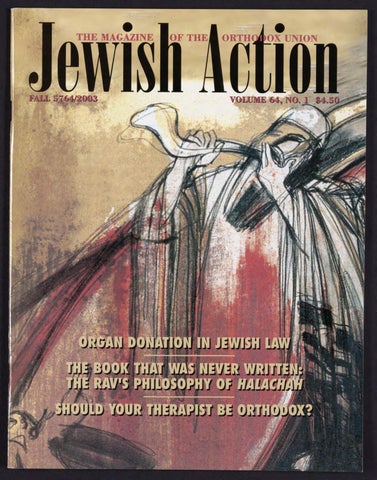
About the Cover
The New Year Sermon from a series of lithographs by Ferenc Flamm entitled " The Legends of the Baal Shem Tov." The fifteen litho graphs in "The Legends" are based on stories the Ba'al Shem T o y told of simple peasants, learned rabbis, shepards and angels. They provide the dramatis personae for Flamm's images, recreated as semi-abstracted fluid shapes in dream-like poses. Born in Budapest to parents who had been saved from the Holocaust by Raoul Wallenberg, Flamm studied at the Art College and the Hungardian Academy of Applied Art in Hungary.
Jewish Action seeks to provide a forum for a diversity o f legitimate opinions within the spectrum o f Orthodox Judaism. Therefore, opinions expressed do not necessarily reflect the policy or opinion o f the Orthodox Union. Jewish Action is published by the U nion o f Orthodox Jewish Congregations o f America 11 Broadway, N ew York, N Y 10004 (212) 563-4000 Printed Quarterly - W inter, Spring, Summer, Fall, plus Special Passover issue. ISSN N o. 0447-7049. Subscription: $12.00 per year; Canadian, $16.00; Overseas, $30.00. Periodicals postage paid at N ew York, N Y and additional offices. PO ST M A STE R : Send address changes to Jewish Action^ 11 Broadway, N ew York, N Y 10004.
2
Fall 5764/2003
JEWISH ACTION
mmm
MMPMWPI
M M H Bia
■1 -. .#* Jill
More and more Americans are demonstrating their Commitment to Israel by visiting Israel . Join the thousands of Americans who are reaffirming their deep concern and commitment to Israel - by going. Please complete the information below and mail it to us You may be one of the lucky winners of a free trip to Israel Please contact for more information about joining or organizing a mission to Israel.
0 1 ? ^
I SHALOM
H M H BM
Israel Ministry of Tourism ¡ M ill I plan to go Israel within;
3 months
6 months
9 months
12 months
In return for making your tourism pledge, you’ll receive exclusive resources to help you find - or plan - a great trip, AND gain access to unique tours, discounts, and special offers. You’ll also be entered to win a free trip! P le a se com plete the inform ation below, detach and m ail, or visit w w w .g oisrael.com /israelpled g e to register.
Name _ j Address C ity____ T e l_____ (Synagogue/Organization) I am a member of City______ __________________________________________________________________________ S ta te __________________________________
Complete and mail to: I care. And i’m Going, Yitzhak Rabin Way, 800 Second Avenue, New York, NY 10017
Jewish Action
THE MAGAZINE OF THE ORTHODOX ■ UNION
http:/www.ou.org carmeln<® o u . org
From Brooklyn to Brazil H As someone who travels to Eretz Yisrael several times a year, I always look forward to Rabbi Leibel Reznicks articles about what’s “new” in the Old City ofiferushalayim. Please prod him to write more articles. By the way, more than once I have seen frum tourists traipsing through the Old City with a copy of Jewish Action folded under their arm. Congratulations on your excellent, thought-provoking magazine. There is nothing like it for the Orthodox readership. Jerry Friedman Brooklyn, New York I read the spring issue of Jewish Action and was extremely impressed by the quality of the writing, the depth of the articles and, above all, the freedom of speech that is evi dent. I am very happy to be a subscriber. Ted Feder Sao Paulo, Brazil
Tzadi or Tzaddik? H I enjoyed Ari Zivotofsky s “W hat’s the Truth about... Tzadi?” (spring 2003). I have a nephew who attended the Stoliner Yeshiva in Borough Park, Brooklyn (where they translate every thing into Yiddish). W hen he was about four or five years old, he was taught the aleph-bais. When he learned the final letters, the rebbe taught the class ende mem and ende peh—and then, groisse tzaddik (lit. a big tzaddik)\ M oshe Garfinkel Philadelphia, Pennsylvania
H onoring the Ray H Congratulations on an outstand ing spring issue. The most exciting articles were those honoring the Rav. 4
Fall 5764/2003
JEWISH ACTION
In recent times, it has been a source of frustration to see our revered Rav co opted by unworthy individuals and groups. Celebrations of the Ravs yahrtzeit have served to advance initia tives and themes that were anathema to the Rav. W hether his acceptance of, and spectacular achievements in, secu lar studies warrant calling him the leader of Modern Orthodoxy is moot. The Rav saw himself as the heir of Reb Moshe, his father, and of the sem inal figure of the Torah world, his grandfather Reb Chaim. To claim that he was the patron saint of Modern Orthodoxy reduces the importance of the Rav, his innovative Talmudic analyses, his presentations of Jewish philosophical thought and his vital and dynamic leadership of the American Jewish community. Indeed, if anyone is to be considered the motivating force behind the Ravs interest in secular studies and, by extension, the father of Modern Orthodoxy, it is the Ravs maternal grandfather, Rabbi Elyahu Feinstein. Reb Elyas entire family was highly learned in all facets of contemporary culture. However, the family members did not see their success in secular studies or in business as being separate from their Torah lives. Rabbis Hershel Reichman and Haskel Lookstein have done a great service to the Orthodox world by describing an intellectual Torah giant who graced our generation with his learning as well as his understanding of the American milieu. There is no doubt that the Rav single-handedly saved hundreds of American Jewish young men from leaving Torah life. While we were students at Yeshiva College, some of my classmates and I " would wander around the campuses of New York University and Columbia University and speculate on what we
Editor Nechama Carmel Literary Editor Matis Greenblatt Assistant Editor Dassi Zeidel Kashrut Editor Rabbi Eliyahu Safran Intern Rena Ginsberg Contributing Editors Rabbi Yitzchok Adlerstein, Dr. Judith Bleich, Rabbi Emanuel Feldman, Rabbi Hillel Goldberg, Ph.D.y;-" Rabbi Joseph Grunblatt, Rabbi Sol Roth, Rabbi Jacob J. Schacter, Rabbi Berel Wein Director of Communications and Marketing David Olivestone Design Director Ed Hamway Design Advertising Director Deborah Lieber (212) 613-8135 fax: (212) 613-0772 Subscriptions Representative Harriet Bachmann (212) 613-8129 Israel Representative Lisa Rubin (056) 383-154 Orthodox Union Publications Commission Joel M. Schreiber, Chairman Morton Landowne, Vice Chairman President Harvey Blitz Executive Vice President Rabbi Dr. Tzvi Hersh Weinreb Chairman, Board of Directors Stephen J. Savitsky Vice Chairmen, Board of Directors Seymour Abrams Morry Weiss Chairman, Board of Governors Martin Nachimson Vice Chairman, Board of Governors Jay L. Schottenstein © Copyright 2003 by the Union o f Orthodox Jewish Congregations o f America. 11 Broadway, N ew York, N Y 10004. Telephone (212) 563-4000 Periodicals Postage Paid, N ew York, N Y and at additional mailing offices;
Printed in Canada
GALLERY
Awards of Distinction y srm itoi\^ W
Meticulously crafted hand carved
o îite it
> n iw Ôo Wortfûfy SPh^ UHI But
silver, brass, marble, and wood presentation
pieces are treasured works o f a rt
Them AU
ÿ&15
Custom Design Work Complete Art Personalized Service
m
t h e p er s o n v r
WHO SOWS SEEDS OF KINDNESS ENJOYS A PERPETUAL HARVEST
tor our ne 732-572-63931Fa: Lall
195
were missing. However, after several years of the Ravs shiurim and philoso phy lectures we found all the intellec tual excitement we needed. Regardless of where the Rav s intel lectual explorations took him, he was perpetually explicating a Talmudic sugya and justifying a difficult Rambam. He made it abundantly clear that he saw secular studies as the handmaiden of Torah. May our learning his Torah be a zechut for his holy neshamah. M orton J. Summer Monsey, New York
More on O rthodox Rescue H Regarding the debate between Efraim Zuroff and David Kranzler (“Orthodox Rescue Revisited,” spring 2003), I would like to relate the expe riences of my father, Rabbi Jack Tauber, z ”L>who served as director of immigration for the Vaad haHatzalah. As David Kranzler noted,
No Wax nMess... ThisShabbos!
With Messing CandleLites™ • Simply beautiful > Fits all candlesticks Permanent, reusable wick Easy, clean & safe Great gift idea Variety of shapes
Messing CandleLites'“
¿0-358-5713 6
Foil 5764/2003
JEWISH ACTION
not all those who were affiliated with the Vaad were ultra-Orthodox. My father s outlook was Centrist Orthodox. While his views towards Zionism were compatible with those of Mizrachi, he was closely aligned with the Zionist Revisionists, having served as the personal secretary to Ze’ev Jabotinsky and as the rabbi of Camp Betar. He related to me how the Vaad attempted to bring a simple man from Europe to the United States. The man was not a rabbi or a person of any standing, yet the Vaad worked tirelessly to try and rescue him. They secured an invitation for him to lecture at an American univer sity, falsified an educational back ground and teaching career in Europe and even provided a course syllabus for the Department of Immigration. Laurence Tauber New York, New York
Praise for Heroes H Adam Jessel’s article (“Unsung Heroes,” spring 2003) is a well-written and honest description of some of the people that I have worked with in my kiruv undertakings— men who have homosexual attractions yet still strive to follow the Torah with regard to their sexual expression. I have encoun tered individuals who were able to change their primary sexual orienta tion and get married. I also know someone who tried, with the help of a psychologist, to change his sexual ori entation but did not succeed. And I know a few individuals who do not wish to attempt to change their orien tation. Those who cannot, or will not, change admit that living a celibate life is a difficult challenge, yet they also feel that there are great spiritual bene fits. One person told me that living a celibate life has deepened his relation ships with his male friends as well as his relationship with Hashem. i “Unsung Heroes” serves as a reminder that we should respect and support those who are striving to fulfill
the Torah under difficult circumstances. Yosef Ben Shlomo Hakohen Jerusalem
Im portant Resource for
Olim H Jonathan Udren (“The New O lim ” spring 2003) failed to mention the Association of Americans and Canadians in Israel (AACI), the largest and oldest JEnglish-speaking immigrant association in Israel for aliyah and kelitah. For over fifty years, our expert keli tah staff has advised thousands of olim on everything from buying an apart ment to finding a job. O ur airport vol unteers meet new olim upon their arrival in Israel and guide them through the official processing. W hen the Treasury Department tried to implement a new law that ; would have amounted to double taxa tion for Americans and discouraged aliyah, AACI led the difficult but suc cessful fight against it. AACI has always fought and continues to fight for the rights of olim. W hen the first planeload of Nefesh B’Nefesh olim arrived, AACI helped process the olim at the airport and organized an information seminar for the group in Beit Shemesh/Jerusalem where many of them settled. For more information about our ser vices, call 972-2-561-1181, e-mail info@aaci.org.il or visit our web site at www.aaci.org.il. Marvin Silverman National Board President AACI Jerusalem
Correction: The spring issue of Jewish Action carried an ad for Bumble Bee tuna stating that Bumble Bee was the only national brand of canned tuna certified Kosher for Passover. Manischewitz Season tuna has also carried the OUP (Kosher for Passover) designa tion and has been sold nationally for many years.
Charlie's No Mayo Tuna Salad 7 oz. StarKist Flavor Fresh Pouch* Tuna (Chunk Light or Albacore)
small, roma tomato, diced 1/4
medium yellow onion, diced
1/2
rib celery, diced
1 tsp.
lemon juice
1/4 tsp.
lemon pepper
3 oz.
Italian no-fat dressing
¿am
1/16 cup fresh chopped basil 1/4tsp.
fresh garlic
1/16 tsp. white pepper Mix all together—refrigerate and enjoy
Fla vo r Fresh Pouch® Tuna
Fresher Tasting Kosher Tuna
Charlie's Tuna Bruschettà 1 7 oz. StarKist Flavor Fresh Pouch Tuna (Chunk Light or Albacore)
1 3 oz. jar marinated artichoke hearts, chopped (add more as desired) 2 3 oz. packages cream cheese, softened 8 slices Italian garlic bread, toasted In a small bowl mix tuna and artichokes with marinade from the artichokes. Spread the cream cheese evenly on the slices of bread. Top evenly with the tuna mixture. Serves 4.
Torah in the Internet Age
W
■ i " h e n one discusses technology today, the center of attention is often the Internet and the challenges and opportu nities it presents to the Orthodox com munity. The Internet threatens to bring sexually explicit, anti-Semitic and other objectionable material into Orthodox homes. Even if children do not deliber ately log onto prurient web sites, spam brings e-mails from the gutter into unsuspecting homes. To mitigate this threat, improved filtering technology to keep out material that should not be in an Orthodox home is continually being developed, and the OU is looking into making the best of this technology avail able to our community. But the challenges the Internet brings are more than matched by its opportuni ties. The Internet presents a myriad of ways for spreading Jewish knowledge 8
Fall 5764/2003 JEWISH ACTION
By Harvey B litz
and kedushah throughout the world. In contrast to some Orthodox organiza tions, the O U embraces these opportu nities and devotes much effort to the ongoing development of our web site, www.ou.org. Features such as the online Guide to Berachot (blessings); the weekly Shabbat Shalom e-mail section, which brings the feeling of the approaching Shabbat to over 25,000 subscribers each Thursday evening; pre-holiday shiurim; kashrut alerts and a special “Learn Torah”! section, make learning easily accessible for students on all levels. Jews throughout the world have embraced these opportunities for enrich ment. In April, with the approach of Passover, our web site received more than ten million hits for the first time. That month there were almost 350,000 separate visits to the web site. Even in the summer months we averaged 70,000 visits a week, and this number is likely to grow significandy with the approach of the Yamim Noraim. One of the recent successes of our web site was O U Executive Vice President Rabbi Dr. Tzvi Hersh Weinrebs live four-hour Tishah BAv webcast of the Kinot (elegies) of the day. The webcast of Rabbi Weinrebs brilliant commentary succeeded in bringing the spirit of the day into the homes and offices of those who could not be in the synagogue, as well as into synagogues that chose to supplement their own services. In response to the webcast, a corre spondent from Manchester, England, wrote, “Please pass my thanks to Rabbi Weinreb for an interesting, moving, meaningful few hours. Thanks to you
and to all concerned for making this available on the Internet.” And a young woman from Passaic, New Jersey, who was part of an audience the O U specifi cally had in mind when creating the pro gram, wrote the following: “I have tremendous hakarat hatov (appreciation) for the O U and Rabbi Weinreb for todays Kinot on your web site. It was very inspiring, especially for a mother who cannot attend shul” she wrote. The OU is planning to expand the web site and is considering establishing an online belt midrash program in which we could assemble and present shiurim from the worlds leading rosheiyeshivah, rabbanim and scholars. The program would bring Jewish knowledge and learning to every corner of the globe at any hour of the day, at the click of a mouse, thereby greatly enhancing the opportunities for adult Jewish education. We are in the early stages of consultation on the project, and are calling on the expertise of educators and technical spe cialists as we move ahead. Todays technology has made the world a smaller place. In the past, despite being a national organization, the OU lacked the ability to conduct ongoing national programming available simulta neously to everyone. Now—with the Tishah BAv program as the latest exam ple—the OU can serve its constituency by presenting programs that are truly national—even international—-in scope. To the fullest extent permissible by halachah, the OU will avail itself of technology and its benefits, while keep ing in mind the serious challenges it may, at times, present to our community. ®
F rom d o w n U n d e r To Yo u r H o l id a y T a b l e
aust"^ Jïî&f ft-
SELECTED AND IMPORTED BY ROYAL WINE CORE RAYONNE, Nj
mr.
Ljgf-“ j, jmm& < • *
r/i i « ^
‘
_
w w H Market
.j s s g g r ^M ak in g more
P
T eansh periodical
ilO ia u h * M
j w ill b e r* a s H a to v
Pres I fitO m i: * 4M-Ju .«* -
p u b l i c a c t io n >unds...that to s rm , C o m i n g to r e s e v e r a l fa c t*
»long o b se ssio n e g i a n c e , a s m* r n w e ll a r g u e s fct n se oi re sp o n s i rough, w h ic h P in th o th e r a s s u m p in c lu d in g -h is all ship., h is d e s ir e f§ id h is h a t r e d a p d •a ctio n s t o w a r d N a ro p e*
W h a t co u ld tl >ld a n d f o r t h r ig h t I a n a le r t fo r «lew Hit l a y b e fo re th.ei mild, h a v e b e e n -a
^
b
K fH
W ith OUT cutting eo»
HI ■ ^<B1 inform H** on «*| ■H on ■ shelf!I
ib rfh l ev€
» a t th e enue K
USfe r 1 6 .
im ito
" H ' s — - " ' “'“ !
r a e I, ; th e V s .o n a I
p to i Ih I s r a te l o f N o J e u > is b bOW ^
^
fesions f c th e
J]
■ ■ ■ Jewish Pres
HealthandMedicine
A iW h a t D o e s
Ai
— JtalachatrSay About
ORGAN DONATION? By Yitzchok A. Breitowitz
Transplant surgery is one of the wonders of modern medicine. Persons who, in the past, would have died because of the failure of their hearts, livers or kidneys can now have years added to their lives. Persons who would have been condemned to blind ness can now have the gift of sight. Horribly disfigured burn victims can begin the return to a normal and pro ductive life with the aid of skin grafts. The tragic death of one person can give life and hope to as many as eight people. At one time, heart transplant? surgery had such a low probability of success that Rav Moshe Feinstein ruled that removal of the diseased heart con stituted murder of the recipient^- it was more likely that the recipient would live longer with the bad heart than with its replacement! Today, with the development of improved surgical techniques and anti-rejection drugs, the prospects of at least some degree of success are quite high.2 In spite of the tremendous good that organ donation can accomplish, rela tively few people—Jews or non-Jews— sign up to be potential donors.3 A variety of reasons are given for their reluctance. Some do not want to con template their mortality. Others are Rabbi Breitowitz is the rabbi o f the Woodside Synagogue in Silver Springy Maryland, and an associate professor o f law at the University o f Maryland.
afraid their organs will be harvested prior to their deaths. There is also a fear that organ donors who have not yet died will not receive full medical treatment since there may be a greater benefit in their passing away. Still oth ers find the disfigurement and mutila tion of their bodies or those of their loved ones repugnant. Whatever the reason, there is an acute shortage of organs; the demand far outstrips the supply.4 Around fifteen people die each day waiting for a donated organ. Because of the great value Judaism places on the saving of a life— MHe who saves a single [Jewish] life is as if he'saved an entire world”3— it would appear that organ donation ought to be encouraged, provided the procedure does not otherwise entail violations of halachah. To the extent such donation is halachically permissible, the unease and discomfort the family might feel at the dissection of their loved ones body should be overridden by the value of pikuach nefesh (saving a life) and by contemplating the great spiri tual merit that would accrue to the nifiar (the deceased) whose generosity has enabled others to live.6 Conversely, to the extent halachah prohibits the choice, our feelings of sympathy for those in need of a transplant would simply be immaterial. The commands of God cannot be set aside because others or we perceive them as inhu mane or politically incorrect.
Organs and tissues can be removed at any one of four points— and each point has its own problems: 1. Removal of organs from persons clinically diag nosed as being brain dead but whose hearts are still beating; 2. Removal ofn organs from donors whose hearts have stopped beating; 3. Removal of organs and tissues from cadavers; 4. Removal of organs or organ parts from live donors. This article is designed solely to familiarize the reader with the general concepts that are relevant to the prob lem. In determining what to do in any of these situations one should consult his posek for halachic guidance.
I. Donations from Brain-Dead Donors T h e traditional legal definition of “death” was irreversible cessation of res piratory and circulatory functions, i.e., a person could not be declared dead until there was both cessation of breathing and circulation of blood as evidenced by the absence of a heartbeat and pulse.7 This definition would make transplants extremely difficult since organs deteriorate rapidly once they are cut off from a blood supply (warm ischemia). Accordingly, American law in all fifty states now rec ognizes the concept of “brain death” (called “brain-stem death” or “wholebrain death”), which means a person JEWISH ACTION
Fall 5764/2003
11
Fifteen peoples die each day a donated organ calfte declared dead if neurological tesH confirm total cessation of brain furStion (including a brain-stem func tion such as respiration) even if, as a result of mechanically supplied oxygen, the heart continues to beat and blood continues to circulate. (It must, of course, be emphasized that even under the brain-death criteria, persons who lack higher mental functioning, such as those in a coma or in a persistent vege tative state, are unequivocally alive and therefore, their organs cannot be used.) Whether halachah allows a determi nation of death to be made based on clinical brain-death criteria is a matter of sharp debate among posekim. Some analogize brain death to anatomical decapitation, which is unequivocally deemed “death”; others assert that while true destruction of the brain would be equivalent to death, clinical tests do not unequivocally establish such destruction; still others rule that as long as the heart is beating, the per son is alive irrespective of the brain, and a final group asserts that a braindead patient may have the status of a safek met— safek goses (possibly dead but possibly alive, though death is deemed certain and relatively immi nent). Although there may be no mitzvah to prolong the life of a goses, such a life cannot be terminated by affirma tive action such as the removal of a vital organ.8 Moreover, the brain-death standard itself has recently been ques tioned by some neurologists.9 Both the Israeli Chief Rabbinate and the Rabbinical Council of America have accepted brain-death criteria in allowing organ donation.10 Rabbi Dr. Moshe D. Tendler, in particular, has argued that this is also the position of his revered father-in-law, Rav Moshe.11 Many posekim, however, differ.12 Jewish Action is not the forum to fully explore the intricacies of this halachic debate. The issues are compli cated and the stakes are high. If brain 12
Fall 5764/2003
JEWISH ACTION
deatlj is not halachic death, removal of the c§Ians is murder. If brain death is haladBc death, failure to remove the orgarif could indirectly condemn peo ple wllo could otherwise be saved to die. This is the single most difficult problem in the organ donation process, and it is essential that one consult with his posek before making a decision to donate ones organs. Fortunately, in the long term this may be a diminishing problem. As superior methods of preserving organs are developed, removal could be deferred until cardiac death as well as cessation of brain function is estab lished. Moreover, the increased utiliza tion of artificial organs, possibilities of transgenic transplants (i.e., from ani mals) as well as stem cell research and therapeutic cloning may eliminate the need to rely on human donors and would not only resolve the brain-death quandary but would also greatly enhance the organ supply.
II. Donation from Non-Heart Beating Donors a medical standpoint, braindead donors whose hearts are beating due to mechanically supplied oxygen are optimal sources of organs because the organs are supplied with oxygenat ed blood, and thus they do not deteri orate even after the patient is declared “dead.” The vast majority of heart, liver and lung transplants are taken from clinically brain-dead donors. However, in order to partially alleviate the severe shortage of donors, some hospitals have developed protocols enabling organ removal from persons whose hearts have stopped beating. To date, NHBDs (non-heart beating donors) have been utilized for liver, lung and kidney transplants (although not for heart transplants). At first glance, the use of NHBDs seems
A jfroid all the halachic issues associated with IM n death. After all, if there is no heartbeat cSdrculation, there will be no respiratory aSivity (neither the brain nor the lungs can function unless they are supplied with blood). And, in the absence of both heartbeat and respiration, the donor would be deemed dead even under the strictest of halachic criteria. In reality, however, the use of NHBDs raises ethical and halachic issues of the first magnitude and essen tially involves a prearranged death. Donors who are not brain dead (although they may be in a coma or a vegetative state) are disconnected from life-support (pursuant to the terms of a living will or the family’s consent or both). In some cases, the physicians wait no more than two minutes, deter mine there is no spontaneous heartbeat or respiration, declare the patient dead and proceed to remove organs. Because of warm ischemia, typically no more than two to five minutes can elapse from the time life-support is discontin ued until the organs are harvested. There are two distinct halachic prob lems with this procedure. First, the withdrawal of life-support from a nonbrain-dead patient may in itself be an act of murder or at least a violation of the commandment, “Lo taamod al dam rayechaj “Do not stand idly by while your neighbor s blood is shed” (Lev. 19:16), and therefore neither a living will nor family consent could authorize such discontinuation.13 Second, even if one concedes that withdrawal or dis continuation of life-support may be halachically sanctioned as an “omission” rather than an affirmative act of mur der, the removal of organs within two minutes of disconnection would in itself be an act of murder.14 Cessation of respiration and heartbeat constitutes “death” only when that cessation is irre versible. If the patient is capable of hav ing breathing and heartbeat restored*>rv
WARNING: Accidental overdose of iron-containing products is a leading cause of fatal poisoning in children under 6. Keep this product out of the reach of children. In case of accidental overdose, call a doctor or poison control center immediately.
Ultra NatalCare® Prenatal Multivitamin/Mineral Tablets
Rx Only ©D CONTRAINDICATIONS: This product is contraindicated in patients with a known hypersensitivity to any of the ingredients. nproper therapy in the WARNING: Folic A cid alone is improi anem ia and other megaloblastic treatment of pernicious anem fl '■ n 2 is '' deficient. anem ias where vitamin PRECAUTIONS: Folic acid in doses above 0.1 mg daily may obscure pernicious anemicPin that hematologic remission can occur while neurological manifestations progress, ADVERSE REACTIONS: Allerg ic serfsÉzation has been reported following both oral an a parenteral administration of folic acid. HOW SUPPLIED: N D C 5 8 1 7 ^ 2 9 2 - Unit Dose Racks containing 10 tablets per card. P3679
r Manufactured by KV Pharmaceutical C o . fojf ; ETHEX Corporation St. Louis, M O 6 3 0 4 3
0 5 /0 1
Advanced NatalCare® Prenatal multivitamin/multimineral tablet combining 15 vitamins and minerals, including calcium and carbonyl irôh!
Rx Only © CONTRAINDICATIONS: This p ro d u ces contraindicated
Manischewilz. SUPPORTS ISRAELS RED CROSS.
in patients with a known hypersensitivity to an y of the ingredients.
WARNING: Folic acid alone is improper therapy in the treatment of pernicious anem ia a n a other megaloblastic anem ias w here vitamfri B^Viis deficient.
PRECAUTIONS: Folic acid in doses above 0.1 mg daily may obscure pernicious anemia in that hematologic remission can occur while neurological manifestations progress. HOW SUPPLIED: N D C 5 8 1 7 7 -3 5 0 -2 0 U nitDose Packs of 90's with each buster card containing 10 tablets per card. P3678 V lt 0 4 /0 1 Manufactured by KV Pharmaceutical C o . for ETHEX Corporation St. Lbuis, M O 6 3 0 4 3
NutriNate® Chewable * * ’C h ew ab le Prenatal Multivitamin Tablet with Iron
Rx Only © CONTRAINDICATIONS: This product js contraindicated jin patientsvwith a known hypersensitivity to an y of the ingredients.
WARNINGS: , Folic
a cid m ay partially correct the hematological dam age due to Vitamin B]o deficiency of pernicious anem ia, white the associated neurological d am ag e pro g re sse s. In rare, instances, allerg ic hypersensitivity nas been reported following administration of folic acid. ADVERSE REACTIONS: Allergic Sensitization has been reported following both oral an a parenteral administration of folic acid. HOW SUPPLIED: NutriNate® C hew able Tablets for pral administration are supplied as round, white mottled tablets, upper debosssed "3 5 1 " over bisect, lower debossed "ETHEX" in bottles of 9 0 tablets (N D C ¿8 1 7 7 -3 5 1 -2 6 ). P3676
t r Manufactured by KV Pharmaceutical C o . for ETHEX Corporation St. Louis, M O 6 3 0 4 3
This New Year w ill be more meaningful when you buy and enjoy Manischewitz* products, because a portion of your purchase w ill support ISRAEL’S RED CROSS. Make your holiday special by helping Manischewitz® contribute to this worthy cause.
0 4 /0 1
NatalCare® CFe 60 Prenatal Multivitariijr) Tablet with Ironi
Rx Only ©D CONTRAINDICATIONS: This product is contraindicated
visit website for details www.manischewitz.com
in patients with a known hypersensitivity to an y of the ingredients.
CAUTION:
Folic a c id m ay partially correct the hematological cfamage due to Vitamin. B^o deficiency of ernicious anem ia, v\ffi|fe the associated neurological am a g e pro g re sse s. In rare . in stan ces, allerg ic hypersensitivitynas been reported following administration of folic acid. ADVERSE REACTIONS: Allergic sensitization has been reported following both oral an a parenteral administration of folic acid. HOW SUPPLIED: N D C 58 17 7 -3 2 2 -2 0 UnitDose Packs of 90's with each blister card containing 10 tablets per card.
S
P3677
r ,, Manufactured by KV Pharmaceutical C o . for ETHEX Corporation St. Louis, M O 6 3 0 4 3
0 4 /0 1
American Red Magen David for Israel is exclusive authorized fundraising organization in the U.5. for Magen David Adorn, Israel’s National Medical, Ambulance, Blood and Disaster Service, equivalent to the Red Cross.www.armdi.org
COMMITTED TO SAVING LIVES IN ISRAEL. C
O
R
P
O
R
JEWISH ACTION
Fall 5764/2003
13
One 1
thelpatient is not dead even during the period of time he is not breathing. Since within two to three minutes there is still the possibility, albeit remote, of auto resuscitation (and certainly recon nection to life-support15), and within that time the brain stem has not yet been destroyed, removal of the organs might actually be an overt act of homi cide even according to those who regard brain-stem death as death. On the other hand, waiting until brain stem destruction is irreversible would render the organs useless. It thus appears to this writer that organ donation pursuant to the existing NHBD protocols is halachically prohib ited.16 (Note, however, that only three percent of transplants involve NHBDs.)
r
III. Donations from the Dead
^ a e rta in organs or body parts are retrievable from persons who are clearly dead under all halachic criteria, and there is no issue of retzichah (murder). These organs include skin and corneas. Generally, Jewish law prohibits dis section of corpses, autopsies or the removal of body parts.17 This is consid ered a desecration of the dead (nivul hamet), a violation of the positive mitzvah of burial and a source of anguish and humiliation to the soul of the departed, which will be unable to find repose.18 Nevertheless, like virtually all of the other restrictions of the Torah, these prohibitions yield when their vio lation can save a life (pikuach nefesh).19 General anatomical experimentation or “leaving ones body to science” does not qualify as pikuach nefesh even though information that could save a life in the long run might be obtained.20 At a minimum, there has to be a direct recipient. Although the Noda BYehudah implies that removal 14
Fall 5764/2003
JEWISH ACTION
isnot obligated to p u t oneself A l l but
of o r||h s would never be permitted unlesjPiere is a designated beneficiary at thd|time of the removal rather than someone who materializes at a later date, it has been convincingly argued that as long as the probability is strong that a choleh will receive the organ, it is immaterial whether he was specifi cally identified at the time of the removal or not.21 The key factor is that the organ be used for the choleh rather than for general experimenta tion or educational purposes.22 Assuming that pikuach nefesh will furnish the appropriate halachic justifi cation for organ removal, three issues remain to be considered: 1. Is there an obligation on a donor to authorize the removal of his organs after his death? After all, once a person is dead he is exempt from mitzvot. Does the family have an obligation to use organs with out the decedents consent? W hat about over his objection?23 2. Can organs be donated to nonJews?24 3. W hat is pikuach nefesh? Cornea transplants can prevent blindness but a person can live without sight. Similarly, skin grafts are not always essential for survival. In cases where the recipient can survive without the organ, would there not be a prohibition of nivul hamefi Posekim have generally been lenient in this regard, but each proposed use must be considered on its merits.25
IV. Live Donors ^ ) r g a n donations are not only from the dead or the near dead. Live donors can contribute as well. Since human beings can live with one kidney, one can donate his second kidney while alive. Moreover, because a liver can regenerate with as little as twenty percent of its original tissue, a live donor can con tribute parts of his liver as well.26 While
donations from live donors do not i|grolve issues of nivul hamet or potential retzichah, they too pose halachic issues. • Self-Endangerment: Even partial removal of an organ poses potentially serious risks and constitutes placing oneself into safek sakkanah (potential danger to life). This is true both because of the potential strain on the reduced capacity that is left and because of the risks associated with general anesthesia and surgery. As a general rule, the Torah does not permit a person to place himself into a situa tion of sakkanah. O n the other hand, the person who needs the organ is also in sakkanah and there is a mitzvah of lo ta’amod al dam rayecha. Indeed the risk to the patient if he doesn’t get an organ is likely to be much greater than that to the donor who provides one. Am I permitted, or even obligated, to put myself at mortal risk in order to potentially save the life of another? There is a machloket (controversy) " among the posekim regarding the mat ter. The Talmud Yerushalmi states that one is obligated to place himself in potential sakkanah in order to save someone who is presently in definite sakkanah but such a ruling is not explicitly cited in the more authorita tive Talmud Bavli. The posekim debate whether the Talmud Bavli would agree with the Talmud Yerushalmi s premise.27 The consensus appears to be that one is not obligated to put oneself in potential sakkanah to save another, but to do so is laudable and meritorious, particularly if the danger to the rescuer is relatively slight and commensurate to other risks that he commonly assumes (e.g., driving, fly ing, et cetera).28 Thus, live organ donations can never be compelled or demanded but only requested as an act of gemilut chassadim (loving kindness) and midat chassidut (piety) J 9 -
in sakkanah to J| a n o t h e r latm m le and meritorious! 1 • Informed Consent: Since one is not obligated to donate organs, they can be removed only with the persons consent. Obviously live organ removal cannot be sanctioned by someone who is mentally incompetent, comatose or in a persistent vegetative state. (Whether organs can be removed once there is a diagnosis of clinical brain death depends on whether halachah accepts “brain death” as “death.”) But this would also mean that even a consenting minor could not autho rize removal of his organs. Consider the case of an adolescent who needs a kidney transplant and the only suitable donor is a younger sibling who has not yet reached his Bar Mitzvah. Both the younger sibling and his parents want the removal of the extra kidney for transplantation.
Nevertheleslfcven the reality that this would pose msakkanah to the younger child and th || he could not be obligated to place himlelf in danger, some posekim would not allow the donation even if the minor consents.30 Nor could the parents consent on his behalf. The parents’ right to make medical decisions for their child is limited to decisions that benefit the child. A parent is not authorized to endanger one child in order to save another. This should not be confused with the well-known Ayala case. Ten years ago, a young woman needed a bone marrow transplant. There was no suitable donor in the registry nor were her parents compatible donors. The parents decided to try to conceive a child (even though this necessitated the reversal of a vasec
tomy) <§§ the chance that the child might ® the proper genetic match. Happily? that was the case; marrow was withdrawn from the baby shortly after birth and, over a decade later, both sis ters are doing fine. While ethicists debated the propriety of conceiving a child for the purpose of providing mar row to another child, Jewish law has no problem with the fact that there was an ulterior motive in conceiving the child. After all, baby Marissa was loved and cherished in her own right, and “using” her for a mitzvah only enhanced the familys joy. Nor is there any problem with the baby s inability to give consent. Consent is required only when the pro cedure in question carries risks of endangerment or severe pain; removal
find jobs I list jobs
online job bank www.outorg/jobs Accounting and Bookkeeping Business
,
In these tim es o f widespread
California «Job Listings
the Orthodox Union announces an On lin e J ob
Computers and Technology
Ba n k th at invites employers to po st openings and
Healthcare Office Assistant/Secretarial Miscellaneous Job Fair Information Job listings in Israel Job E-mail Lists and Sites Relocation Opportunities
jo b seekers to searchfo r poten tial employment. EMPLOYERS: This valuable resource is only as good as its input.
Please em ail any employment openings to M iriam G anz a tganzm@ ou.org call:212.613.8198
I fax 212.613.0786
B uild you r community through jo b offers on the O U network, JEWISH ACTION
Fall 5/64/2003
15
arent
isnot authorized to endanger one child in ordik to Wsave another. 1 m M i — m
ofjggrgans carries both risks, removal of bole marrow does not.31
V. Receiving Organs
I
If a Jew, God forbid, needs a vital organ, is he allowed to place himself on a recipient list and thereby be eligi ble to receive the necessary organ if a compatible donor is found? There are essentially two halachic issues: 1. deriv ing benefit from a cadaver; 2. being an accessory to, or the facilitator of, the illicit termination of life. • Benefit from a Cadaver: It is for bidden to derive benefit (hand ah) from a met?1 Nevertheless, it would appear that this rarely, if ever, would pose a significant halachic impedi ment. First, to the extent a transplant is necessary for pikuach nefesh, it is amply clear that the prohibition against hanaah would be superseded. Even corneal transplants have been validated because of the potential lifethreatening dangers of blindness even in one eye?^ Second, the late Rabbi Isser Yehuda Unterman, a former chief rabbi of Israel, ruled that since the derived benefit from the organ occurs when it is attached to a living body and begins to function, “benefit,” as such, is not derived from that which is dead but from tissue that is alive. Third, there are some views that per mit even direct benefit from a corpse that is of non-Jewish origin34 and, in the absence of evidence to the con trary, at least in the United States, one can assume that the organs received are from non-Jews.33 • Facilitating Murder: The second issue is more troubling. To the extent that one takes the position that clinical brain death is not halachic death and the removal of organs from a braindead donor is murder, is a patient allowed to receive the product of an 16
Fall 5764/2003 JEWISH ACTION
illicifim m oral act? Once again, while therm re dissenting voices, the majori ty offposekim have permitted such receipt.36 It is true that just as it is prohibited to kill, it is prohibited to indirectly cause the death of another.37 However, there is no causal link between putting ones name on an organ list and a donors death. Given the realities that the demand for organs outstrips the supply, and even if a given individual takes his name off the list, the organ will be removed anyway, a decision to participate does not cause or facilitate a death that would otherwise not occur.38 If the death will occur with or without a given recipient s participation, there is no exclusionary principle that would prohibit benefiting from the transgres sion after the fact.39 Although God is the ultimate source of all healing, we are commanded to do what we can to alleviate illness, misery and suffering.40 The concept that human intervention via new technolo gies somehow constitutes an impermissb ble usurpation of Divine prerogatives is foreign to the spirit of the Torah, which sees mankind as Gods collaborator in tikkun olam 41 Nevertheless, the license granted to man must be exercised pur suant to the limitations and conditions imposed by its Grantor. These limita tions can be ascertained only through the wisdom and guidance of our great posekim. May we have the wisdom to seek and follow their directives.© Notes 1. Iggerot Moshe YD II, no. 174. 2. While survival rates for organ transplants have risen dramatically, they vary from organ to organ. See <http://www.transweb.org> and <http://www.unos.org>. 3. According to a Gallup Poll, while eighty-five percent of Americans support organ donation, less than fifty percent would actually consent to donating a loved
(fill’s organs when given the opportunity. Afiiong Jews—of all affiliations—the percititage is even lower. 4. As of February 2002, there was a need for 79,523 major organs with approximately 23,000 organs available for transplantation. 5. Sanhedrin 37a. Our standard texts limit this to “Yisrael”—a Jewish soul—but see Shinui Nuschaot printed in the Vilna Mishnayot, which cites manuscripts in which the limitation to Yisrael does not appear. 6. Nor should techiyat hameitim be a concern. Certainly, if halachah permits the removal of organs, such removal cannot affect the donor’s ability to experience physical resurrection. Even if the body was buried intact, by the time of resurrection it will have decomposed. Moreover, the kedoshim who perished in the crematoria will undoubtedly experience the merit of resurrection. Techiyat hametim is a super natural phenomenon that does not depend on the physical body being preserved intact. But cf. Tzitz Eliezer XIII, no. 91 who suggests otherwise. 7. See my article, “The Brain Death Controversy in Jewish Law,” Jewish Action (spring 1992): 61 and an addendum in the summer 1992 issue: 78. 8. See Shulchan Aruch YD 339:1 and the Rema. Whether there is a mitzvah to prolong the life of a goses is a matter of dispute. All agree, however, that a goses cannot be affirmatively killed even to save the life of another. See Iggerot Moshe YD II, no. 174; Tzitz Eliezer X, no. 25 (25) and Minchat Yitzchok V, no. 7. 9. See K.G. Karakatsanis and J.N. Tsanakas, “A Critique on the Concept of Brain Death,” Issues o f Law and Medicine, 18 (fall 2002): 127. 10. See Yoel Jakobovits, “Brain Death and Heart Transplant: The Israeli Chief Rabbinate’s Directives,” Tradition 24 (summer 1989): 1-14. The RCA’s position can be found in Marc Angel, “The RCA Healthcare Proxy”, Jewish Action (spring 1992): 62, and in a document on the RCA web site. Many rahhanim who are members of the RCA, however, do not fol low this position.
NO POSTAGE NECESSARY IF MAILED IN THE UNITED STATES
BUSINESS REPLY MAIL FIRST CLASS MAIL
PERMIT NO. 2703
POSTAGE WILL BE PAID BY ADDRESSEE
JEW ISH ACTION
O r th o d o x u n io n 11 BROADWAY NEW YORK, NY 10004-1303
100041303
NEW YORK, NY
Yes, please enter my subscription to Jewish Action _______ $ 1 2 .0 0 for 4 issues
______ $ 2 0 .0 0 for 8 issues
________$ 1 0 .0 0 for students (4 issues)
______ $ 3 0 .0 0 for overseas (4 issues)
TH E ANTHROPIC P R W C IP IJ| W hat is it and W hy is it M eaningful to die Believing Jew?
/«,
N am e A d d ress C ity
State
Telephone For student: School THE SANDWICH GENERATION Coping & Caring . * INDIAN PERIL ■Seeking Out Israeli Youth in the jFar Hast
Payment Enclosed
Z ip Country
Y ear G radu atin g V isa
M astercard
C ard # E x d . Date
Signature
L o c k in th e s e lo w ra te s n o w !
Bonus! Subscribers to Jewish Action receive 10% off
4 Issues
on all ArtScroll books & 10% off on all Chadish M edia 'Teach Yourself Judaism" books and tapes.
Regular Cover price: $18.00 Subscription: $12.00
No R isk O ffer! Subscription fee will be refunded if cancelled after first issue.
Get Your Organ Donor Card Now! The Halachic Organ Donor Society Member: Rabbi Shear Yoshuv Cohen Chief Rabbi of Haifa
Blood Ty pe: A Pos
The Halachic Organ Donor Society
The Halachic Organ Donor Society Rabbi Yosef Adler it ion Rinat Ytsrael
Member: Rabbi Haskel Lookstein Congregation Kehilat Jeshurun HOD ID#: 1388 Blood T
Blood TVpe: A Pos
Make your last m itzvah, th e m ost im portant one. To register for a free HOD Sodety organ donor card, call 212-213-5087 or register on-line at www.hods.org. President:
Board:
Stephen Flatow
Dr.¡Rabbi Eddie Reichman Dr. Shimmie Schwartz Dr. Stu Greenstein Dr. Freddy Schwartz Dr. Harold Perl Mr. Michael Feldstein Ms. Dina Najman
Founder & Director: Robby Berman
COI/ **!«' (>lie ^3
:
^
\
v
;
V ^ 1
[rr«v9issiftl0 c&ssaiios oî-âutonomoôs breatìttea. »tilth« cw<fipoed fcythé .Mg’tsib o'li'jiii bierr cleats i wirteitan f ‘lui o w * siït&mft# iMrxreiy of di1 •irilatJs 'n t upiWi o» M i f .-ibi*1- »iSciiHr ( asari ji>1rs «m.ngs o' Ftsbbi Meste rtìraie-i,
i s lrrsvereiole cessatkm of heart own • jruw iO 'sJ't opt on ;ltyi/*eamly limits I'be cA4,«bi<if nt ( tt-o’mitg e< <raa“' Jon« < d egn 1c j'’bv “ ri.t* the omnOti o' 3 organs that may be recovered.
I
h
Transplant may commença only after a neurologist who is umwem that I om a potential organ donor confirms my medical condition matches tea offerta indicatoti , above. AH medicaiprocedures mast be done with utmost core, respect, and JS fc minimum damage to tee cadaver. Family Contactt ** * f* *l *H* * * * * * *
Phone: ** * - * * * - * * * *
Fam ily C o n ta ct
Rione: *
HI""1.
HOD S O C I E T Y The Halachic Organ Donor Society 5 East 37th Street - 10th Floor New York, NY 10016
□
Although God is the ultimate are hhmmanded tofdb we can to 4|| See <http://www.hods.org>. Rav Mollies responsa on the brain death issue are: IggerotMoshe YD II, nos. 164, 174; YD YU, no. 132 and Choshen Mishpat II, nos. 72-73. 12. See Jewish Action (spring 1982): 126131; Nishmat Avraham YD 339; (app. vol.), YD 339; J. David Bleich, Time ofDeath in Jewish Law (1991) and Journal ofHalacha and Contemporary Society 17 (spring 1989) (symposium including Rabbi Tendler s view,) 13. It is never halachically permitted to terminate life regardless of the patients wishes, his suffering or the qual ity of his existence. There are, however, some situations where there may be no religious obligation to prolong life. While retzichah is never allowed, there may be some leniency in not providing certain forms of medical intervention. This is a complicated and fact-sensitive area not susceptible to easy generaliza tion. See, for example, Nishmat Avraham, app.; YD 339, pp. 151-157 as well as Iggerot Moshe YD II, no. 174. To the extent halachah recognizes a distinction in limited circumstances between active retzichah and nonintervention, there is a further difficulty in ascertaining whether the withdrawal of life-support that a patient is already receiving qualifies as active retzichah or nonintervention. Rav Shlomo Zalman Auerbach’s pesak cited in note 16 suggests the former but the mat ter is far from settled. 14. Yet a third problem is that coolants and anticoagulants are injected into the patient’s body while he is still on life-support in order to keep his organs “fresh.” Such non-therapeutic invasion of a patient who is not even brain dead may hasten death. 15. In some cases of terminal illness, there may be no obligation to reconnect life-support once it is discontinued. But this is immaterial to the discussion in the text. The cessation of vital functions cannot be regard ed as irreversible as long as the functions could be restored by life-support even if there is no obligation to do so. If potential reversibility means the donor is alive, removal of organs would be overt homicide. 16. Rav Auerbach originally ruled that one may take a brain-dead patient off a res18
Fall 5764/2003
JEWISH ACTION
piratAmetermine there is cessation of the heartlllt and wait as little as thirty seconds, after ^f||ich the patient may be declared dead, jpe Assia 14 (Tevet 5755): n. 1-2, pp. 13-15. Subsequendy, he retracted this ruling and required a waiting period of five or six minutes following the cessation of cardiac activity before organs could be removed. Letter of Av 5753, cited in J. David Bleich, Contemporary Halakhic Problems 2, (New York, 1983), 348, n. 56. Note that even the first ruling permitted a short waiting period only because there was a clinical diagnosis of brain-stem death, which in and of itself would be a strong indicator of the permanent destruc tion of respiratory capacity. Where the dis connected patient is not brain dead, it is obvious that death could not occur until enough time elapsed that loss of function could never be restored. 17. Shulchan Aruch YD 349:1 and com mentaries. There is an argument whether these prohibitions apply to a non-Jewish cadaver. Compare Teshuvot Chatam Sofer YD, no. 336 with Rabbi Avraham Yitzchok Kook, Daat Kohen no. 199. See also Tzitz Eliezer X, chap. 9, no. 25; Ramban, Deut. 21:22 and discussion at note 34. 18. See discussion of these reasons in Nishmat Avraham YD 349:1 (1-2). 19. See Noda BYehudah II, YD no. 210; Chatam Sofer YD, no. 336; Chazon Ish, Oholot2232\ Iggerot Moshe, YD II, no. 174 and Yabia Omer III, YD, no. 23. Some, however, maintain that corpse dese cration is prohibited even to save a life since a dead person does not have an oblig ation to rescue another. See Binyan Tzion nos. 170-171. (Rabbi Yaakov Ettlinger would permit such removal if the donor gave his consent before death.) In any case, Rav Auerbach has indicated that the view of Binyan Tzion is not to be followed. See Nishmat Avraham YD 349, p. 264. 20. This is the famous ruling of the Noda BYehudah II, YD no. 210, who requires choleh Ifaneinu— xEzt the recipi ent be “in front of us»” 21. See Chazon Ish, Oholot2232\ also Rav Auerbach cited in Nishmat Avraham YD349:1 (2), p. 257.
j m2. For simplicity, I am assuming in the t^jfjb that the operative justification for rcjjnoval of organs is pikuach nefesh, and in the absence of pikuach nefesh, there might be prohibitions of desecration and violation of the duty of burial. The existence of these pro hibitions, even in the absence of pikuach nefesh, is not always clear-cut, particularly with respect to donating skin and corneas where, for a variety of reasons, choleh Ifaneinu may not be required. See the discus sion in Avraham Steinberg, Entsiklopedyah Hilchatit Refuit 2, (5751): 191-243. 23. It is conceptually difficult to say that a person is obligated to donate organs to save a life since at the time the organ will be used, the donor is dead and there fore exempt from mitzvot, although Iggerot Moshe YD II, no. 174 and Yabia Omer III YD, no. 23 apparently so rule. However, the family could have such an obligation. Such an obligation could exist even where the decedent did not give consent or even over his objection. Taken to an extreme, anyone would halachically have the right, and indeed the duty, to appropriate a corpse in order to obtain life-saving mate rials. Nevertheless, the Binyan Tzion, nos. 170-171, rules that because the laws gov erning kavod hamet are designed to protect the honor of the deceased, who does not have the obligation of pikuach nefesh, even pikuach nefesh cannot justify nivul unless the met consents. (But c£, Nishmat Avraham YD 349, p. 264, who quotes Rav Auerbach to the effect that we don’t follow the ruling of Binyan Tzion.) In any event, under the Uniform Anatomical Gift Act enacted by all fifty states, next-of-kin cannot authorize organ donation where the deceased objected. 24. Rabbi Tendler asserts that one is obligated to donate organs to save lives even if the probable recipient will be a non-Jew, since all mankind is created in the image of God. However, given the fact that nivul hamet is an issur deOraita that can only be set aside for pikuach nefesh and that pikuach nefesh of a nonJew does not authorize violations of Torah law, how could saving a non-Jew justify corpse desecration? A number of points
Ê1
source o f all healing, . • f/f illness, misery atiM suffering. might be wggested, none of which are conclusive! 1. If Jews don’t give to nonJews, there is a possibility that non-Jews won’t give to Jews and future Jewish lives will thereby be endangered. See Steinberg, Entsiklopedyah, 31: 2. There is a possibili ty that the recipient will be Jewish and even if that possibility is unlikely, the laws of pikuach nefesh are not limited by the principles of rov (assuming majority sta tus). See, e.g., Shulchan Aruch OH 329:2:3. Removal of internal organs may not constitute nivul hamet on a Torah level because, at least in some cases, the external appearance of the body remains intact; 4. From the perspective of the donor and his family, the actual desecra tion of the corpse is being done by the transplant surgeon and his team. The donor has no way of knowing who the transplant surgeon is and under Jewish law, could presume that he will be nonJewish, at least in the United States. A non-Jew does not have a prohibition of nivul hamet even towards a Jewish corpse. Accordingly, the only sin the family is committing is authorizing desecration, which may be a rabbinic prohibition Xamira I’akum) that can yield for the pikuach nefesh of even a non-Jew. All of these rationales are questionable and need further analysis. It should be noted that under the Uniform Anatomical Gift Act a donor can limit his donation to a specific individual or even to an ethnic or religious group though the latter is frowned upon in the organ donation community. 25. See SerideiAish II, no. 120 (original edi tion); II, no. 93 (new edition) (blindness is a lifethreatening condition that qualifies aspikuach nefesh) and ShevetMiyehudah, 313-323 (even blindness in one eye constitutes pikuach nefesh). 26. To a lesser degree, this is also true for lungs. 27. The Beit Yosef Choshen Mishpat 426, quotes the Talmud Yerushalmis ruling that one is obligated to expose oneself to possible danger in order to extricate another from cer tain danger. But this rule is not quoted by either the Shulchan Aruch or Rema. According to Serna and Pitchai Teshuvah the Talmud Bavlidisputes the Yerushalmis premise and
the halachah»Mows the Bavli. See also Teshuvot Radvaz, no. 627. Others permit (but don’t require)jplf-endangerment if the person to be rescued® a superior talmidchacham but prohibit such endangerment if the rescuer is greater. Pitchai Teshuvah YD 252:1 in the name of Teshuvot YadEliyahu, no. 43. Lehalachah; we permit altruistic volunteering regardless of the rescuer’s status but don’t compel it. See Iggerot Moshe YD II, no. 174 and Aruch Hashulchan CM421:4. 28. See Iggerot Moshe YD II, no. 174 and Yechava Daat III, no. 84. 29. One must differentiate, however, ; between organ donation and donation of blood or bone marrow. In the latter ' examples, there are no significant risks. As such the imperatives of lo ta’amod would seem to make such contribution mandatory, at least where the potential recipient is Jewish. Nevertheless, even here, there are a number of limiting fac tors: 1. One is not obligated to submit to general testing to have one’s name entered into a registry because there is no designated choleh lfaneinu\ 2. Even if there is a choleh Ifaneinu, one need not assume that one’s marrow or blood is suitable since the probability is that it is not; 3. Even if there is a choleh Ifaneinu, one is not obligated to forego significant financial loss (loss of employment) or more than twenty percent of one’s net worth to save another. Nevertheless, even with all these exclusions, donation of blood and marrow may sometimes be halachically required while donation of organs would never be. See Shevet Levi V, no. 219; Bleich, Contemporary Halakhic Problems 4, (New York, 1995), 285-287. But cf. Tzitz Eliezer XVI, no. 23. 30. See Rabbi Yitzchok Zilbershtein, Halachah URefhah4y(5745): 156-157. But see Rav Moshe Hirschler, Halachah URefuah 2, (5746): 126 who writes that an exception might exist where the recipient is someone who provides care and sustenance to the minor or incompetent, e.g., a parent. 31. See Bleich, Contemporary 4, pp. 301-309. But cf. Nishmat Avraham (app. vol.), CM 243:1. 32. Shulchan Aruch YD 349:1.
33. SA iet Miyehudah, 313-323. 34. sMLlchan Aruch YD 349:1 rules that the prohibition against benefit does apply to non-Jewish cadavers but Pitchai Teshuvah YD 349:1 suggests that the prohi bition is only rabbinic and, as such, can be waived even in cases of non-life threatening illness. See Iggerot Moshe YD I, no. 229 (6). The Gra in his commentary to YD 349:1 cites the view of Rashba that hanaah from a non-Jewish corpse is permitted. See also Mishnah LMelech HilchotAvel 14:21. 35. There are two other reasons why at least in some cases there may not be a prob lem of deriving benefit. First, the use of cadaver organs for transplantation might be considered “not in the ordinary manner of benefit” {shelo kederch hanaah) and, there fore may be permissible. See Teshuvot Radvaz II, no. 548 and Rabbi Tzvi Pesach Frank, Har Tzvi YD, no. 277. But see com ments of Rabbi Akiva Eiger, YD 349:1 and Iggerot Moshe YD I, no. 229 (3). See also Tzitz Eliezer XIV, no. 84. Second, in the case of skin grafts, some posekim rule that there is no issur hanaah at all. See Tosafot, Niddah 55a, s.v. Shema and Yabia OmerYD III, no. 23. Most, however, rule that deriv ing benefit from skin is prohibited. Ibid. 36. See Nishmat Avraham (app. vol.) YD 339, pp. 134-150. 37. See, e.g., Rambam, Hilchot Rotzeach 2:2. 38. Rav Auerbach rules, however, that one is permitted to be placed on a recipient list only in countries where a majority of the population is not Jewish. See Nishmat Avraham (app. vol.) YD 339, p. 134. 39. An analogy would be the permissibili ty of utilizing the scientific data derived from Nazi experimentation. Although the experi mentation itself was barbarous, once the evil act is done one is permitted to derive benefit from whatever useful good it might provide. Bleich, Contemporary 4, p. 231. 40. Baba Kama 85a. 41. See Rabbi Joseph B. Soloveitchik, “The Lonely Man of Faith,” Tradition 7, no. 2 (1965): 5-67. ^Readers interested in obtaining more comprehensive endnotes should contact the Jewish Action office. JEWISH ACTION
Fall 5764/2003
19
A n O r t h o d o x U n io n
C o m m u n it y S e r v ic e f o r t h o s e in t h e G r e a t e r N e w
you may s f ilili
information to use,
Y o rk a rea
As part o f our mission to enhance Jew ish life in every area, the OU Levaya Program substantially lowers the cost o f a traditional, halachic leva ya (funeral), while maintaining the highest level o f adherence to halacha (Jewish law) THE OU LEVAYA PROGRAM
ensures k 'v o d h a-m et, that the deceased is cared for in accordance with all the requirements—and is tendered all the honor and dignity— that the halacha requires. ensures that the a veilim , mourners, are treated w ith all the sensitivity and concern to which they are entitled.
Fixed price of $2,985 for a chapel service, or $2,685 for a graveside service, includes: hotza’ah (transportation from the place of death by the Chevra Kadisha), tahara (prepa ration of the deceased), tachrichim (burial garments), a pine aron (burial container), the use of a Parkside chapel for the funeral service, and conveyance to a New York metropolitan area cemetery. All the halachic aspects of the OU Levaya Program are provided by the Chevra Kadisha of the Va’ad Harabonim of Queens (in Brooklyn, tais performed by the Chevra Kadisha of the Va’ad Harabbanim of Flatbush), or by your own chevra. When necessary, arrangements can be made at additional cost for shmira, the use of other chapels, or for transfer to a cemetery in Israel.
■
PARKSIDE MEMORIAL CHAPELS, INC.
Parkside Memorial Chapels is one o f the most reputable, independent Jewish funeral homes. Still Jewish family owned and operated, it is committed to upholding our traditions, and to treating everyone with dignity and respect.
Fo r any further information or if you have any questions concerning the OU Levaya Program, please call 1 .8 7 7 .LEVAYA.OU (1 .8 7 7 .5 3 8 .2 9 2 6 ), or visit our website at www.ou.org/programs/levaya.
PhotoEssay
Jews of Arab Countries: t £)p I nss nf Ancestral Inheritance
^ e w s have lived in w h at are now A rab countries for m ore th an three th o u sa n d years, lo n g before the A rab conquests th a t began in the seventh century. In 1948, there were more than 870,000 Jews living in the M iddle East and N orth Africa. By 1958, ninetyseven percent o f Jews in Arab countries had emigrated due to hostile political, social and economic climates. T his photo essay, w hich is based on an exhibition at the Am erican Sephardi Federation in N ew York, offers a glimpse into the rich lives o f Jews w ho lived in two o f these coun tries, Iraq and Libya.
Jem of
Iraq
Jews came to Babylon— modern-day Iraq— in 586 BCE following the destruc tion of the First Temple and resided there continuously for more than 2,500 years. Babylon became the center of Jewish scholarship following the destruction of the Second Temple in 72 CE. The fortunes of Babylonian Jews The Jewish community in Iraq was one o f the oldest and largest in the Arab worldy numbering 135,000 in 1948. Howevery as a result o f anti-Jewish legislation and violence, the majority o f Iraqi Jews were airlifted to Israel in what became known as “Operation Ezra andNehemiah” (1948-1950).
waxe an wane un er successive dynasties following the Muslim conquest in the seventh century. Jews were oppressed during the latter JEWISH ACTION
Fall 5764/2003
21
Baghdad, June 1, 1941: A ll night long, we heard gunfire and shouting. . . .It v<went quiet before dawn. That morning my father went to the synagogue . . . . When he got back he told Mother what happened; Jewish homes were burned, daughters raped, homes looted. One syna gogue was burned down. As Father was talking, they burst into our house, broke down two doors, entered shouting, waving sticks. Father took us to the stairway lead ing to the roof. We started to climb, one after another, my mother after us, my father bringing up the rear. Suddenly, my mother heard a shot. She turned, and saw my father, dead. A policeman came. My mother started to cry, telling him, uThey killed my husband. ” He said: uHow do you want to die?” and bashed her head in with his gun. — From Rachel Neiman s English translation of Itamar Levin s Locked Doors: The Seizure o f Jewish Property in Arab Countries (Connecticut, 2001). _____________________________
days of the O ttom an Empire, and they welcomed the British conquest of Baghdad in 1917. Iraqi Jews enjoyed full freedom during the British Mandate. W hen Iraq became independent under British protection in 1932, the treatm ent of Jews changed radically. The teaching of Hebrew was prohibited in 1934, and the entry of Jewish students into high schools and universities was restricted. Over three hundred Jewish civil servants were dis missed between 1934 and 1936. Attacks on Jews and the bombing of Jewish insti tutions became frequent. Armed mobs attacked Jews and Jewish property in Baghdad during Shavuot 1941. One hundred and eighty Jews were killed, seven hundred were wounded. In 1948, the Jewish community of Iraq numbered 135,000; over 77,000 Jews (one-fourth of the population) lived in Baghdad. In September 1948, Jews were banned from import trade. In a show trial, Shafiq Ades, one of Baghdad s richest Jewish mer chants, was convicted of providing arms to Israel. He was fined heavily and hanged. Because of the anti-Jewish legislation 22
Fall 5764/2003
JEWISH ACTION
Jewish wedding in Baghdad\ circa 1930.
and violence, most of the Jewish popula tion fled. Jews were permitted to leave Iraq in 1948 as long as they left perma nently and renounced their citizenship. Every emigrant over the age of twenty was permitted to take the equivalent of eighty dollars as well as three summer outfits, three winter suits, a pair of shoes a blanket, underwear, socks, sheets, one wedding ring, one wristwatch and one thin bracelet. Assets remaining in Iraq were frozen. Between 1948 and 1950, over 120,000 Iraqi Jews were airlifted to Israel as part of “Operation Ezra and Nehemiah.” Rabbinical scholars in Baghdad\ 1910.
Jews lived continuously in Libya for more than two millennia, since the third century BCE, under Greek, Roman, Ottom an, Italian, British and Arab rule. In 1880, there were eleven rabbinic acad emies in Tripoli. In 1945, more than one hundred and thirty Jews were brutally killed and burned, and hundreds more were injured in a pogrom in Tripoli. Synagogues were burned, and four thousand Jews were left homeless. This was a defining moment for the Libyan Jewish community, and more than thirty thousand Jews emigrat ed to Israel between 1949 and 1951,
Airlift o f Iraqi Jews, “Operation Ezra and Nehemiah, * 1948-1950.
In 1945 there were more than 870,000 Jews living in the Arab world. Many of their communities dated back 2,500 years. Throughout 1947 and 1948 these Jews were subjected to continual pressure and persecution. There were arrtiJewish riots in Aden (where 82 Jews were killed), in Egypt (where 150 Jews were killed), in Syria (where Jewish emigration was forbidden), and in Iraq (where ‘Zionism’ was made a capital crime). Many Jews of the Arab world were thus driven to seek a refuge in the new State of Israel. Arriving in Israel destitute, they were absorbed into the society, and became an integral part of the State. A further 260,000 found refuge in Europe and the Americas.___________
*om
LEBANON
ÿtàïfiiïM ;
6,000
SYRIA 4,500
MOROCCO 260,000 TUNISIA 56,000
IRAQ 129,290
^Mediimmeèn. ALGERIA 14,000
ISRAEL
EGYPT 29,525
The transfer of populations on a massive scale, whether as a result of war or state craft, has been a constant feature of twentieth century history. In almost every case, those uprooted from one land were absorbed into the life and society of their new home. The movement of more than 580,000 Jewish refugees from the Arab lands to Israel, and of a similar number of Palestinian Arabs to Gaza, the West Bank, Jordan, Syria and Lebanon, was typical of such movements, although actually on a smaller scale than most of them. But whereas the uprooted Jews strove to become an inte gral part of Israeii life, the Palestinian Arabs remained, often as a deliberate act of policy by their host countries, isolated, neglected and aggrieved.
MartjMjitbertlSTS
YEMEN & ADEN 50,552 Arab states, showing number of Jews who sought refuge in Israel between 1948 and 1972 Israel between 1948 and 1967
ÎADEN
Map reprinted with permission from Sir Martin Gilbert, Atlas o f the Arab-Israeli Conflict; 7™ edition, (Routledge, 2002) ISBN: 0415281172 (PB) & ISBN: 0415281164 (HB). Visit www.taylorandfrancis.com for more information.
JEWISH ACTION
Foil 5764/2003
23
leaving only a few hundred in Benghazi and a few thousand in Tripoli. In 1969, Libya was overthrown by Muammar el-Qaddafi. The remaining Jews were expelled in 1970. Jewish prop erty was burned, confiscated or looted, and all debts to Jews were cancelled. E finita, Libya e finita. It is ended. Libya is gone . . . . Qaddafi destroyed the cemeteries. I would not return fo r all the gold in the world. —Saul Legziel, interview by Vivienne Roumani-Denn, tape recording, “The Last Jews of Libya,” <httn://sunsite.berkelev.edu/IewsoflLibva/>.
Jewish Populations in Arab Countries 1948
1976
Morocco
265,000
5,800
Algeria
140,000
0
Iraq
135,000
100
Tunisia
105,000
1,500
Egypt
100,000
200
Yemen
63,000
200
Libya
38,000
0
Syria
30,000
loo
Pogrom in Lybia: They went to the synagogue fir s t. . . . Then a t night we hearty] screaming, from every house, screaming, scream ing. . . . They arrive[d] a t our house . . . . They start ed knocking down the house; my broth er was pouring boiling oil on the Arabs so they . . . took a bomb and threw it at him . They took him to the hospital It was morning, we went out. You saw, there was a little boy, they gouged his eyes. . . and they killed his m other. . . . They went to another house, the house o f the mother-in-law o f my sister . . . they tied her dog to her hand so that he could eat her . . . . They killed the man and the woman and they threw them into the w ell. . . . I saw all o f them. I cannot fo rg e t. . . the vandalism, they took the money, the homes, they took everything o f the Jews. —Lydia, interview by Vivienne Roumani-Denn, tape recording, “The Last Jews of Libya,” <http://sunsite.berkeley.edu/Jewsoflibya/ >.
(Left to right) Rabbis Isahar Hakmon, Eliahu Raccha, Rahamim Adar, Yitzhak Buhabza, Zion Bitar and two unidentified rabbis sitting in a sukkah in Tripoli, Libya, circa 1926.
T ^eR i^tsof Jewish Refugees Resolution 242, adopted by the United Nations in 1967, declares that there should be “a just settlement of the refugee problem.” Resolution 242 makes no distinction between Palestinian Arab refugees and Jewish refugees from Arab countries. U Thant, the U.N. secretary general at the time, emphasized that all refugees, Arab and Jews, were entitled to a just settlement of their respective claims. “Israel is full of people, Jewish people, who lived in predominantly Arab coun tries, who came to Israel because they were made refugees in their own land.” — President Bill Clinton, July 2000
Children reading Tehillim in the Ghertan Region, Libya, circa 1943. For more inform ation on this traveling exhibit, please call 212-294-8350 ext. 9. JEWISH ACTION
Foil 5764/2003
25
Standing Room Only:
The Remarkable Career o f Cantor
/vosenblatt Yossele Rosenblatt (1882-1933). Photo: Irving Chidnoff
I
By David Olivestone
'
n an obituary for Cantor Josef Rosenblatt, whose seventieth yahrtzeit was observed this year, The New York Times noted, “He was so well known in this country that letters from Europe addressed to ‘Yossele Rosenblatt, America/ reached him promptly. No other chazzan has ever attained such nationwide pop ularity and fame among both Jewish and Gentile audiences as Yossele Rosenblatt, while remaining completely observant and retaining his position at the amud. There have been some who became world-famous, such as the celebrated tenor Richard Tucker, who also began his career as a cantor. Tucker, however, was not Orthodox, and once he became a star of the Metropolitan Opera, he led congregations only on the Yamim Noraim or on Pesach. Rosenblatt, on the other hand, despite having turned down offers to appear in the opera, rose to become a star of the entertainment world of the 1920s, all the while wearing his large black yarmulke and frock coat. He endeared him self to all who heard him, whether in person or in his recordings. His enormous popularity was evident even decades after his death. Yossele was born in 1882 in the Ukrainian shtetl Belaya Tserkov— the first boy in the family after nine girls.2 His
father, a Ruzhiner chassid who frequented the court of the Sadagora Rebbe, was himself a chazzan. Recognizing his young sons extraordinary talent, Yosseles father began to tour with his son to help supplement the family income. The father would daven as the chazzan, but it was the child prodigy, Yossele, whom the crowds came to hear. W hen he was eighteen and just married, Rosenblatt accepted his first permanent position in Munkacs, Hungary. His creative genius as a composer had already begun to bloom, and he soon found the atmosphere in Munkacs too confining. W hen the position of Oberkantor (chief cantor) in the more forward-looking city of Pressburg, Hungary, became available, Rosenblatt, still only eighteen years old, was chosen over fifty-six other candidates. Standing not much more than five feet tall, Rosenblatt was still a commanding figure with his heavy, dark beard and fastidious appearance. He possessed a magnificent tenor voice of great beauty and extraordinary range, with a remarkably agile falsetto. In addition, he had perfect pitch and could read the most difficult musical score at sight. The sweet timbre of his voice, the superb control he displayed4|$ particularly in coloratura passages— and his trademark “sob,” inspired his congregants and thrilled his concert audiences. And much of what he sang, and later recorded, Mr. Olivestone, director o f communications and marketing at was his own composition, significantly influenced in its the Orthodox Union, contributed several biographies o f famous tunefulness by his Chassidic background. chazzanim to the Encyclopaedia Judaica. He is the editor and His five years in Pressburg saw the composition and publi translator o f The NCSY Bencher. He can be reached at cation of 150 recitatives and choral pieces, and in 1905 the davido @ou. org. first of numerous phonograph recordings.3 But although he
26
Fall 5764/2003
JEWISH ACTION
was happy there, the demands of a growing family and of supporting several relatives whom he had taken into his home forced him to seek a better paying position. This he found in Hamburg, Germany, where he again won instant acclaim; he stayed there for another five years.
Photos and illustrations arefrom the collection o f David Olivestone
D this time, Rosenblatt’s fame had begun to reach the New World, both through his records and the accounts of travelers, including delegates to the 1909 Zionist Congress, which was held in Hamburg. In 191.1, the board of the First Hungarian Congregation Ohab Zedek, one of New Yorks premier synagogues whose chazzan had just resigned, invited him to daven for the congregation for two Shabbatot, paying all his travel expenses and guaranteeing him a substantial honorarium. Rosenblatt’s success at Ohab Zedek, which was then in Harlem and later, on Manhattan’s Upper West Side, was immediate, and he soon cabled his wife, telling her to bring the family to America. In New York his reputation quickly spread. Not only was Ohab Zedek packed to overflowing every time he davened (sometimes the police had be called in to control the crowds attempting to enter the synagogue), but Rosenblatt became the chazzan of choice for all of the city’s Jewish philanthropic and memorial events. In May 1917a crowd of 6,000 filled the Hippodrome Theater to raise funds for Jews suffering in Europe because of the war. Although there were many prominent speakers, it was Rosenblatt who was the draw, and an incredible $250,000 was raised. It was this event that brought Rosenblatt to the attention of The New York Times. “The cantor is a singer of natural powers and moving eloquence,” it reported. In a postscript that is remarkable for its insight into the Orthodox Judaism of that day, the Times noted that despite the fact that Rosenblatt sang “prayers and chants . . . the audience lis tened with uncovered heads.”4 The concert at the Hippodrome was the kick-off for a tour of thirty cities on behalf of the war relief campaign. Rosenblatt’s appearance in Chicago marked the next turn ing point in his career. An invited guest at that event was Cleofonte Campanini, general director of the Chicago Opera, who was so struck by Rosenblatt’s artistic ability that he visited him immediately after the concert and offered him $1,000 per performance if he would sing the role of Eleazar in Halevy’s opera La Juive. There is no doubt that Rosenblatt was tempted. Campanini carefully outlined a contract with terms that he believed would ensure that Rosenblatt would not have to compromise his Yiddishkeit in any way. He could retain his beard; he would not have to appear on Shabbat or Yom Tov; kosher food would be obtained for him; and if he was uncomfortable about appearing on stage with Gentile women, as Campanini seemed to think, it would be arranged that his co-stars would be Jewish sopranos such as
Alma Gluck or Rosa Raisa. In the end, however, Rosenblatt could not bring himself to agree. But not wishing to offend Campanini, he asked the president of Ohab Zedek, Moritz Newman, to provide the final answer. Newman wrote to Campanini that “ . . . the Rev. Rosenblatt’s sacred position in the synagogue does not permit him to enter the operatic stage.” The offer— and its refusal— caused a storm, with reporters from national newspapers, as well as the Jewish dailies and weeklies, vying to understand how Rosenblatt could turn down such an offer of fame and fortune. In an interview with the trade journal Musical America, Rosenblatt said: “The cantor of the past and the opera star of the future waged a fierce struggle within me.” He claimed that “sud denly a voice whispered into my ear, ‘Yossele, don’t do it!”’5 Now a celebrity, Rosenblatt was in demand everywhere. Appearing just a few weeks later on the steps of The New York Public Library for the War Savings Stamp Campaign, he sang “The Star Spangled Banner,” followed by “Keili, Keili,” at the conclusion of which Enrico Caruso, the great star of the opera, stepped forward and kissed him. Although the opera would be denied his talents, neither Rosenblatt nor his congregation saw any problem with his giving Jewish or secular music concerts. He aspired to be to the Jews “what John McCormack is to the Irish,” and was proud to be introduced as the “Jewish tenor,” rather than the Russian, German or Hungarian tenor. He rapidly learned some operatic arias and a repertoire of other ethnic songs, and in May 1918, gave his first recital at Carnegie Hall. The reviews in the New York papers,6 all of which recapped his refusal to sing with the Chicago Opera, were mostly ecstatic. ‘‘Jewish Tenor Triumphs in Concert,” trum peted the New York American, adding “Cantor Rosenblatt Reveals Voice of Exceptional Beauty, Evoking Thunderous Applause in Music Far from His Accustomed Field.” The Morning Telegraph
Rosenblatt's management company placed a fullpage ad in Musical Courier, December 12, 1918, reprinting reviews o f his first concert appear ance in Boston. JEWISH ACTION
Fall 5764/2003
27
W ith this in mind, he began an exhausting series of appearances in vaudeville, then the most popular form of entertainment in America. Typically, the program would include the showing of a silent movie and a newsreel as well as various performers such as singers, acrobats, comedians and child and animal acts. In order to distinguish his perfor mance from the others with their gaudy scenery, props and drum rolls, Rosenblatt, who was usually given top billing, insisted on appearing on a bare stage with all the auditorium lights on. He would sing a mix of sentimental songs such as “Keili, Keili” in Hebrew and Yiddish, “The Last Rose of Summer” in English, “Volga Boatmen” in Russian and “La Campana” in Italian. He was a sensation wherever he appeared throughout the country. Entertainers with whom he shared the bill were awed by this highly unusual “act.” A fellow performer in Cincinnati reported that when the can tor was finished singing, “without a nod or bow he turned towards the wings and walked . . . toward the stage door and out into the street.” Meanwhile, members of the audience were applauding madly and shouting for more. So great was the uproar that the manager had to lower the screen and show the newsreel in order to quiet them. O f course, some of the challenges Rosenblatt faced on tour were very different from those of other artists. Clearly finding kosher homes in which to eat was always a major priority. But he might, for example, be on a train on Purim, unable to reach a synagogue for Ma ariv or Shacharit, in which case he would read Megillat Esther for himself from his own klafiscxoW). Theater managers found themselves M J w t Rosenblatt was generous to a fault, and in 1922, explaining why the headliner would not be appearing in the Friday evening and Saturday shows, and his itinerary had to he agreed to invest in a dubious Yiddish newspaper venture. be drawn up in a way that he could be at Ohab Zedek for However much he earned, the business demanded more, and in January 1925 Rosenblatt was forced to declare bankruptcy.7 all the Jewish holidays. In 1926, Rosenblatt resigned from the shuh accepting an offer of $15,000 to daven in a So great was the public goodwill towards him that few ques Chicago auditorium just for the High Holidays. tioned his sincerity when he announced that he would In 1927, when Warner Brothers set about casting the first employ “the only gift left to me, of which nobody can deprive talking picture, The Jazz Singer, starring A1 Jolson, me— my voice,” to earn the money to pay back his creditors. Rosenblatt was the obvious choice to play Jolsons father, the elderly chazzan. Despite the proffered remuneration of $100,000, he refused the role because it would have entailed singing Kol Nidrei in a make-believe setting. Contrary to popular belief, he would not even agree to dub the singing voice of Warner Oland, the actor who did play the chazzanJ Yet Rosenblatt s fame was so great at this time that the pro ducers were determined to have him take some part in the movie and prevailed on him until he agreed to appear as himself, singing a Yiddish song, “Yahrtzeit Licht,” in a con cert setting.9 Despite his tiny role, “Cantor Rosenblatt” received star billing. W ith vaudeville in decline, and tiring of not having his own synagogue in which to daven, Rosenblatt became the chazzan of Congregation Anshe Sfard in Borough Park, Scenefrom the movie Dream of My People, showing Brooklyn, in 1927. But after the stock market crash of 1929, Rosenblatt in a boat on the Jordan River nearJericho. Anshe Sfard was unable to pay him. He eventually returned to Ohab Zedek (now in its new home on West 9 5 ^ Street),
said that his rendition of Verdis Questa o Quella “could scarcely have been excelled by any living tenor.” Some crit ics, however, were less enthusiastic about his ventures into operatic arias, but all were swept away by the vocal agility he displayed when singing pieces of chazzanut and Yiddish songs. From this point on, Rosenblatt was an integral part of the New York cultural scene, and the appearances of “Cantor Rosenblatt” were regularly listed in The New York Times together with those of other celebrated artists of the day. His bookings were handled by well-known managers, including the foremost impresario Sol Hurok, who promoted him in advertisements in the Musical Courier alongside other worldfamous artists such as Russian ballerina Anna Pavlova and Austrian pianist and composer Artur Schnabel. In order to fight off offers from other congregations, Ohab Zedek was now paying Rosenblatt the record salary of $10,000 a year; Rosenblatt was also earning huge concert fees and royalties from his records. But as his income grew, so did his philanthropy and his generosity to various members of his family whom, in addition to his own eight children, he helped support. The many Jewish organizations that asked for his help were not only treated to a benefit concert but often also received donations out of his own pocket. And his home saw a constant procession of those in need, who knew that he would never turn them away empty-handed.
28
Fall 5764/2003
JEWISH ACTION
Chazzanut—Learning to Enjoy It are perhaps the most often-heard pieces that he made popular. O f all the different types of Jewish music, chazzanut m sy be the most difficult to appreciate. In a sense, it is the Jewish equiv • G ershon S iro td (1874-1943) was one of the most alent of classical music. Just as classical music is an acquired taste, powerful and highly trained tenors of his time, with climactic chazzanut needs to be worked at to be understood. By becoming top notes and outstanding voice control. The only one of the more familiar with it, one can learn to enjoy it. great chazzanim of his era not to accept a position in America, At one time, before the advent of recordings and easy Sirota perished in the Warsaw Ghetto. You can hear the emo access to popular entertainment, a performance by a chazzan tional intensity of his dramatic tenor voice in the famous and his choir was the major form of entertainment for Jewish “Retzei” and in his rendition of “Unetaneh Tokef.” You can people. But somehow, the line between entertainment and also hear his extraordinary vocal agility in “Veshamru.” davening became blurred. Chazzanim started singing many elaborate pieces in shul that were composed for the concert + M ordechai H ershm an (i 888-1940), stage but were never really intended one of a line of great chazzanim to serve at to be used during davening Temple Beth-El in Borough Park, Brooklyn, During the first half of the twenti was a master of Yiddish folksong as well as eth century, chazzanut enjoyed what chazzanut. The elegance and warmth of his has become known as its golden age. singing and the power and sweetness of his While Rosenblatt was one of the first tenor voice are evident in such pieces as “Eilu of Europe’s great chazzanim to move Devarim,” “Umipnei Chata’enu” and “Tal.” to America, he was not the only chazzan of his time to do so. Scores K w a rtin (1874-1953) isbest known of highly talented chazzanim davened for his imdidon of “Tiber Rabbi Yishmael,” one of the in shuls in New York and other major most dramatic and moving pieces of chazzanut cities. Recordings and concerts pro ever written. The intensity of Kwartins phrasing liferated, and many of the most and delivery in such pieces as “Veal Yxlei Avadeeha” famous pieces of chazzanut were and “Uveyom Simdhat’chem,” make him veiy worth composed in that era. while listening to. Today, even those who tend to avoid shulswhere the chazzan gives lengthy • MosheKoussevitzky (1899-1966) is still performances can often sing or hum some Cover page o f sheet music for Rosenblatt's “Yehi Ratzon”for Shabbat Mevarchim remembered by many as the greatest chazzan of famous cantorial melodies such as Hachodesh (announcing the new month). the post-World War II era. He had a graceful and “Sheyibaneh Beit Hamikdash,” powerful lyric tenor with a phenomenal upper register with “Shehecheyanu” and “Retzei.” which he could do wonders. For sheer artistry, it is hard to beat You might like, therefore, to learn to appreciate chaz his “Hashem Malach,” “Esa Einai” or “Ledor Vador.” zanut outside of a shul setting, through recordings and con Koussevitzkys rendition of Israel Schorrs “Sheyibaneh Beit certs. There is a vast range of recordings by virtually all the Hamikdash” is his most famous recording. great chazzanim of the past century that you may sample to There are, of course, many more chazzanim to listen to. discover your preferences. Some of them may be easier to appreciate, such as Shmuel Listen to the music a few times before you decide if you Malavsky, Moishe Oysher, Leibele Waldman or Richard Tucker. really like it. See how it reflects your own understanding of If you would like to hear a live performance by some of the the words of the prayer. O r just enjoy it for the vocal leading chazzanim of our day, look for concerts by Chaim artistry of the performer. Remember that— as in any art Adler, Yitzchak Meir Helfgot, Joseph Malovany, Benzion Miller, form— not every piece is of the same quality, and you have Yaacov Motzen and Benjamin Muller, among others. to learn how to be discriminating. Since chazzanut Is a genuinely Jewish art form, there is a special Here are five of the greatest chazzanim of the twentieth satisfaction involved in enjoying it. You may also discover that— century, who have left us extensive recordings: through your enjoyment of the music—your familiarity with the words of the daveningwik be greatly enhanced. The rewards are • Yossele R osenblatt (1882-1933), described in this article, many and varied, so buy your first tapes or CDs—in Judaica was one of the most prolific composers and recording artists of stores or on the Web—and learn to appreciate the unique man cantorial music. To hear his range—both vocal and em otionalner in which generations of our people have chosen to speak to listen to his “Hineni,” “Geshem” or “Ata Yatzarta.” His “Shir the Almighty— in words and in song. Hamaalot,” “Rachem Na,” “Vehu Rachum” and “Kevakarat” JEWISH ACTION
Fall 5764/2003
29
the only congregation that could still afford him. Yet this, too, did not last, and his financial situation became acute. Then in 1933, he was offered a movie role that he could accept. The idea of the proposed production, Dream o f My People, was for Rosenblatt to sing his own compositions at the Biblical sites relevant to the words of those prayers. The movie was designed to show the Jews of America the Holy Land, with its sacred sites, newly built cities and settle ments. The producers felt they had a sure success on their hands; for Rosenblatt, visiting Eretz Yisrael was the realiza tion of a lifelong dream of his own. Besides working on the movie, Rosenblatt gave concerts and davened in the major shuts and yeshivot in Jerusalem, Tel Aviv and elsewhere, enchanting all who heard him. He spent Shabbat afternoons in the home of Rav Kook, the chief rabbi of what was then Palestine, who was deeply moved by his singing.10 Among those who attended one of his concerts was the great Hebrew poet, Chaim Nachman Bialik. Hearing Rosenblatt sing his famous “Shir Hamaalot,”11 Bialik pro posed that it become the national anthem of the Jewish people. Rosenblatt decided to undertake a European concert tour to raise funds that would enable him to settle in Eretz Yisrael, as he and his wife had determined to do. O n Shabbat, June 17, 1933, he davened at a “farewell” service held at the Hurva Synagogue in Jerusalem. The next day, after filming a scene at the Dead Sea, Rosenblatt suffered a sudden heart attack. Within a short while he died, at the tragically young age of fifty-one. More than 5,000 people attended his funeral on Har Hazetim, and scenes from the funeral were eventually included in the movie that he did not live to complete. Rav Kook gave the hesped, and two of Rosenblatt s most famous colleagues, Mordechai Hershman and Zavel Kwartin, sang.12 A few days later in New York, some 2,500 stunned and mournful devotees attended a memorial service in Carnegie Hall. Two hundred of Rosenblatt s fellow chazzanim assembled on the stage to sing his music and the Kel Malei Rachamim.13
1 Seventy years after his pass ing, Yossele Rosenblatt s impact on chazzanut, in particular, and Jewish music, in general, con tinues to be felt. Many of his pieces have become staples in the repertoires of Ashkenazic chazzanim and are regularly Poster announcing Rosenblatt’s death andfuner al in Jerusalem. The Chief Rabbinate calledfor everyone to leave work so they could give the proper honor due the |King o f Cantors. 1 30
Fall 5764/2003
JEWISH ACTION
Rosenblatt provided an endorse mentfor Sunshine Kosher Crackers and Cookies on the back cover o f the sheet music for his new arrangement o f < cKeili KeiliW(undated). When traveling; he writes, they are “a veritable lifesaver for me”and they are served in every Jewish home he visits. Below Rosenblatt’s signature are details o f the J kosher certification pro vided by the OU.
ê fÉ flg
S S
sung in shul services I and concerts. His npoiSSÜ lètèmii recordings have been repeated ly reissued, most recently on CD. And still the greatest compliment that can be paid to any aspiring chazzan is that he is “a second Yossele.” But there has been no second Yossele who has captured the hearts of the public quite the way he did. In shul he gave voice to the deepest feelings and yearnings of those who entrusted him as their shaliach tzibbur. On the concert stage and in the theater, he would bring down the house night after nig h t|p impressing his audiences as much with his Yiddishkeit as with his artistry. In both settings, Yossele Rosenblatt created a kiddush Hashem every time he sang. 0 Notes 1. The New York Times, 20 June 1933; 2. Rabbi Dr. Samu'el Rosenblatt, Yossele Rosenblatt (New York, 1954). Much of the information related here is taken from this book, which was written by Yosseles eldest son. I am grateful to Yosseles youngest (and only surviving) son, Ralph Rosenblatt, for providing me with additional details, and to his great-grandson, Rabbi Jonathan Rosenblatt of Riverdale, NY, who directed me to other sources. 3. For a discography see The Record Collector 20, nos. 6 and 7 (May, 1972). 4. The New York Times, 7 May 1917. 5. Musical America, 22 June 1918. 6. 20 May 1918. 7. The New York Times, 15 January 1925. 8. According to Kevin Brownlow, Behind the Mask o f Innocence (New York, 1990), 546, the voice was provided by tenor Joseph Diskay. 9. Samuel Rosenblatts biography is in error here, claiming that his father refused to be filmed for the movie at all. Clearly, the author had not actually seen the film when he wrote these words. 10. Simcha Raz, An AngelAmong Men (Jerusalem, 5763), 295-296. 11. There is some confusion as to whether this melody for “Shir Hamaalot,” which is probably the one most commonly sung in American homes, was composed by Rosenblatt or by another famous chazzan,, Pinchas Minkowsky. 12. The New York Times, 21 June 1933. 13. The New York Times, 28 June 1933.
I m e - v i i 1i
i h
m / ? e ,a '/s ? £ e <
iiS r S n h j
'
'
_
*.
:
•
^
7 o ( /a a >
/
^ rF O O D S H O W THAT HAS EVERYTHING. AND IT'S A LL KOSHER
K O SH ER FEST
.*»
2 m*
*v
mm
H 0
0
3
O ctober 28-29, 2003 Tues. 10:30 AM -5:30 PM
H H
I
Wed. 10:30 AM- 4:30 PM
|j |g
Jacob Javitz Center New York City
f
••
i k
Register Today! ww w .kosherfest.com or fax to: 708.344.4444
»1 - y ,
i* §
« y
lililliiiii|i|ll
I 3 SHOW S M I1 ~ | ■ INTERNATIONAL KOSHER FOOD & FOOD SERVICE TRADE SHOW . KOSHER FOOD INGREDIENT SHOW
Fax this form to (708) 344-4444 (if paying by credit card)
. FOOD EQUIPMENT & SUPPLY SHOW
,
Mail this form with payment to: KOSHERFEST 2003 P.0. Box 465 Brookfield, IL 605‘|§-0465^ Advance Registration Fee: $35.00 Payment and<tegistration must be received by October 1, 2 0 0 j: Customer Service (212) 868-2960 After October 1, 2003 Registration fee: $50.00
E-mail Address
Name of Company or Business Fax Number
Street Address City
State
Zip Code
PAYMENT METHOD (No Refujijj^> Amount D u e :______________ M $35 : # of registrants
Country
FD FS GB HE,,* HO HT
m. Total Amount Due
S o u rce C o p e : « J , . . ;
Please check dhè: made payable to Kosherfest (Federal Tax ID # 133619017) 0 Enclosedlém^-'chfe^fòV $. J D Charge my credit card as follows: O^yisa O MasterCard 0 Amex
Card Number
Exp. Date
Name of Cardholder
BUSINESS CARD OR PROOF OF TRADE INVOLVEMENT MUST BE ATTACHED
PleasepfiotWopyformfdradditional,registrants^
Assisted living - Cateter , -Camp CH ¡Chef CT M Chemist Consultant CO Equipment ËQ RB.. ■ ;. : ■ .■ ; v • ; Food Broker
CA:
Last Name
Telephone Number
Please check only one: AL
Registrants (No one under; 48 will be admitted) .
First Name
Primary B usiness C lassification
Signature
IM IN KS MA NU RÊ
RSSC SP SU W H. H l
Food Distributor ; , Food Service 5 Gift Baskets Health Food Hospital H o te P Ingredient Producer Ìmportèr/Exporter Institutional Kosher Supervision Manufacturer Nursing Home Retaiier Restaurant . School Specialty Store o, Supermarket Wholesaler Other
Elul: A Time of Love sort of culture has emerged, predominant at least in the yeshivah world, which defines the m onth of Elul as a time for cultivating trepida tion. W ith the Days of Awe looming, our earnest bachur (young man) is enjoined to begin quaking in his boots for a full month before Rosh Hashanah. He must be careful not to smile too brightly during that period, lest he be marked as the most frivolous brand of scoffer. In theory, these gathering clouds of dread should inspire our young friend to walk the long and winding road to sincere teshuvah (penitence). As for oldsters like ourselves, whose schedules are imposed upon us by the exigencies of fiscal obligation, we scrounge in our free moments for stimuli that enable us to hearken back to those fearsome precincts, the Eluls of our faded youth. In recent years, I have persistently promoted a grand heresy, backing it with the audacious claim that it is truer to the sources and long-term tra ditions of Elul. Namely, that Elul is primarily a time of love, that both in the language of opportunity and in the Rabbi Homnick is the author o f many books and essays on Jewish political and religious affairs. 32
Fall 5764/2003
JEWISH ACTION
Illusp'ation: Caryl Herzfeld
By Yaakov D. Homnick
language of obligation, it needs to be presented just that way It is a chance to achieve a deeper love of God. W ith that great opportunity comes the con comitant obligation to take steps to build the intellectual and emotional
I have persistently promoted a grand heresy. . . that Elul is primarily a time of love. foundation of that love. At the end of that road lies the real penitence, the poignant and puissant peregrination we call teshuvah.
The Talmud in Yoma (86b) differen tiates between penitence born of fear and penitence born of love. The dis tinction is that the fear-based version can only reduce an intentional sin (mayzid) to a sin of negligence (shogeg), while the love-based form not only eliminates the negative imprint of sin entirely, it converts it into a merit. Yes, amazingly, in the latter version, the per son emerges with a net gain, his ledger augmented by the overall experience. W ithout entering into this counter intuitive phenomenon of profiting from the sin/love/penitence axis, we are sharply arrested by the awareness that a teshuvah from fear does not extenuate; it merely attenuates. In other words, penitence from fear is a plea bargain, accepting a conviction for a lesser offense; only penitence born of love
restores a perpetrator to innocence! W hy would we not focus on the true repentance, the one that buries the sin under stepping-stones of ones dead self (to shamelessly steal a phrase)?
T
J L his is not to diminish the sig nificance of fear and awe, yirat Shamayim, in a full Jewish service of the Almighty. After all, even a begin ners knowledge of theology includes the idea that Abraham represents love and Isaac represents fear, and that the completeness of Jewish service is achieved by the merger of those two aspects by Jacob who “sits in both tents/5 Our concern, however, is to correctly identify the particular ideal associated with a full penitence and the trail that Elul blazes toward that goal. Indeed, the sources for demarking Elul as a month with outstanding spiri tual properties all bespeak love as its defining element. A ni Ledodi Vedodi Li, which is the acronym most widely quoted in halachic texts, is a quote from Song of Songs (6:3): “I am drawn to my lover, and my lover is drawn to
me.” This is hardly a vague point that requires supplementary elaboration. The classic halachic précis, Kitzur Shulchan Aruch, cites another acronym: E t Levavcha Veet Levav, which is taken from the verse: “And God will correct your heart and the heart of your off spring to love H im ...” (Deut. 30:6). The earliest source for treating Elul dif ferently than the rest of the year is in the RaN s commentary on the Talmud in Rosh Hashanak The fourteenth-century scholar explains that since Moshe went up Mount Sinai for forty days to ask God for forgiveness for the incident with the Golden Calf the thirty days of Elul plus the first ten days of Tishrei (through Yom Kippur) are a time of great closeness between God and the Jewish People. Once again, closeness and love are the themes. And how could it be otherwise? If complete penitence must be born of love, then certainly the original teshuvah of the nation as a whole must be founded in a spirit of love. It seems only natural, then, that the day of the giving of the second tablets (after that forty-day session) is con sidered a day of joy, like a wedding, as
elaborated in the last mishnah of Taanit. Additionally, the readings from the Prophets that accompany the Torah on the four Shabbatot in Elul are part of the “Seven of Consolation,” which are read after the ninth of Av to recreate a forward-looking and optimistic spirit in the Jewish heart after the mourning for the destroyed sanctuaries. Clearly, the appropriate approach to Elul is to build on the succor of the prophets5 visions for a bright future and to gen erate a passionate love-an intimacy with God, which mocks the momen tary illusion that is the basis of sin. True teshuvah is an inevitable byprod uct of that sense of belonging, of own ing a place in Gods court; a member of the palace guard must check his ple beian antics at the gate. As we recite daily in Elul, King David, the master of teshuvah, shows us the way, laying out the sentiment of love and closeness that opens the heart to Godliness (Psalms 27:4): “One thing I asked from God, that I seek, to dwell in the house of God all the days of my life, to gaze upon the delight of God and to contemplate in His palace.”
This Rosh Hashanah, do a M itzvah and earn points... This holiday season, your gift of $180 or more to Ya c h a d / O u r W ay, will entitle you to a voucher for 1,000 PowerMiles points that you can use with: Continental, Delta, Northwest, United or US Airways. So by doing a mitzvah, you’ll also be doing something for yourself. Young people and adults with disabilities face the same challenges we all face: education, social ization, marriage, family and home. Through Ya c h a d for the developmentally disabled, and O u r W ay for the hearing impaired, the National Jewish Council for Disabilities has con tinued to integrate and make available technology to assist challenged individuals in Jewish life.
^
Thisoffer lasts till November 30,2003, but the m itzvah lastsforever.
Yes please accept my gift for □$180 D Other: _ _ _ _ _ j
□ My check, in the amount indicated above, is enclosed. □ I wish to charge my contribution to the Orthodox Union to: □ VISA □ MasterCard □ AMEX □ Discover M ail to: O r t h o d o x U n i ON/Y a CFIAD, l l Broadway, 14th Floor, New York NY 10004 or visit our website at w w w .ou.org
Name Address Phone
Email Expiration date
Credit card number Signature
An agency of the Orthodox Union
JEWISH ACTION
Fall 5764/2003
33
Psychology
When a psychotherapist is needed, how im portant is it that he be Can we trust a non-religious therapist to not impose his own value system on the Isn t it possible that a therapist who is not intimately involved w ith the Orthodox lifestyle may misinterpret an Orthodox persons behavior? Can we be confident that an Orthodox therapist w ill necessarily understand a patient whose religious practice and outlook is quite different than his own, though they are both Orthodox? These are some o f the critical questions we raised with two practicing therapists, Drs. Jerry Lob and Michelle Friedman. Readers are encouraged to write in and tell us their own opinions.
By Michelle E. Friedman f eah, a thirty-five-year-old computerprogrammer and mother o f three little girls, suffersfrom recurrent major Idepression. She has been \treated, on and off, with psy chotherapy and antidepressant medications. Leah's husband struggles with a learning disorder and social difficulties. Leah feels overwhelmed by the pressures o f raising and helping to support herfamily. A t the same time, she desperately wants to becomepreg nant again as women in her community typically strivefor largefamilies. She also hopes to have a son. Recently, her middle daughter was diagnosed with speech prob lems. Symptoms o f depression crop up— Leah has lost weight, cant sleep andfinds it difficult to concentrate. Herformer psychia trist moved out o f town some time ago. Dr. Friedman is the director o f pastoral counseling at Yeshivat Chovevei Torah and an assistant professor o f clinical psy chiatry at The M ount Sinai Hospital and Medical Center in New York. 34
Fall 5764/2003 JEWISH ACTION
A ri is a twenty-three-year-old single Orthodox man finishing his senior year o f college. His father, a prom inent rabbi, is beloved by his community but discharges an explosive temper at home. A ri excels at learning and knows that his father expects him to enter the rabbinate. Ari, however, is drawn to secular studies and wants to go to graduate school. In addition, after breaking up with a young woman that his parents adored, he has become casually involved with a non-Jewish classmate. He feels guilty, miserable and wants help.
How should Leah, Ari or any obser vant individual in psychological pain choose a therapist? Leah works hard to balance her mental health and her ideals for religious and family fulfill ment. Her education, marriage and overall quality of life have been dimin ished by bouts of depression. W hen she recognizes the dismaying, familiar signs of a recurrence, she knows she needs to find a mental health profes sional. Leah wants someone who is competent and respectful. She thinks she may prefer a firum therapist so that (continued on page 36)
Would a non-religioustherapist understand the sompelling torses that motivate Leah to expand her family even though she slearly is at her limit with her surrent situation?
Should Your Therapist » Be Orthodox? I
By Jerry Lob ttle over ten years ago, during my internship in clini cal psychology, I worked with a Catholic woman in her 60s who, as a child, was terribly abused by her stepfather. The impact of the abuse on her life was devastating, yet until that moment she had not dis cussed it with anyone. She harbored a great deal of anger, hurt and sadness but felt unable to express those feelings. This inability to verbalize her emotions was partially due to an internal conflict Dr. Lob has a doctorate in clinical psy chology from ISPP in Chicago and semichah from Beth Medrash Govoha in Lakewood, New Jersey. A licensed clinical psychologist, he has a private practice in Chicago in individual, mar riage and fam ily psychotherapy. Dr. Lob writes and lectures on numerous topics including education, marriage, parent ing and relationships.
she was experiencing, which stemmed from her belief that her religion man dated that she forgive her tormentor. Her anger provoked guilt, and the stronger her rage, the stronger the guilt she felt for not forgiving. Round and round she went, stuck in a cycle of anger, guilt, sadness and despair. Frustrated, I remember wanting to shout at her, “But you dont have to for give him; he never asked for forgiveness. And even if he did, you still dont have to; its up to you.” One of the myriad blessings of Judaism is that one need not grant forgiveness without the guilty party asking for forgiveness first. And even then, one is not obligated to for give. Unfortunately, this is not the case in this womans belief system. It was dif
ficult for me to maintain my non-judgmental stance. I wondered: Could I help this woman if I felt that her belief was hurting her and getting in the way of her healing? Orthodox psychotherapists are often asked whether it is necessary for a thera pist to be Orthodox to be helpful to Orthodox clients. Sometimes, it is asked more bluntly: “Isn’t it spiritually danger ous to be seen by a non-Orthodox ther apist?^! am not a halachic authority, but I know that there are highly respect ed rabbis on both sides of the question as well as many who decide this issue on a case-by-case basis. From a therapists perspective, the ques tion is troubling. Can I only understand (continued on page 38)
Can I only understand! people who are similar to me? Can I only help those whose values I share? JEWISH ACTION
Fall 5764/2003
35
(continuedfrom page 34) she w ont have to spend her time explaining the culture of observant life. O n a deeper level, Leah feels pride in her capacity to bear and nurture children. She wants to help her hus band fulfill the mitzvah o fperu urevu. Would a non-religious therapist under stand the compelling forces that moti vate Leah to expand her family even though she clearly is at her limit with her current situation? O n the other hand, Leahs past experience of work ing with a non-observant therapist had certain benefits. The anonymity of that office felt liberating. She was less worried about the stigma of seeing a mental health professional. And curi ously, having to define terms and con cepts such as Shabbat and mikvah prompted her to reflect on her own religious experiences in ways that she found demanding yet enriching. ri is at a crucial life juncture, on the B 8 | l cusp of making serious choices H H a b o u t and J H r WKSKm relationships. A competent therapist would quickly realize that Ari needs to talk out his issues in a compassionate, non-judgmental environment. At least some part of Aris unhappiness stems from conflict with his father. The swirl of love, respect, anger and fear generates miserable anxiety. Ari needs to unravel this jumble of feelings and impulses. Would Aris choice of a non-frum ther apist bespeak a wish that such a person would encourage him to “do whatever feels right,” no matter what the reli gious consequences? Conversely, would the choice of a frum clinician indicate his wish for a more benevo lent parent? Is Ari s unconscious hope that such a therapist would chaperone him back to the right derech? Is it his fantasy that this ideal father would help him break up with his inappro priate girlfriend and resume full time yeshivah study? Or, would the pres ence of an observant therapist backfire, leading him towards further sabotage? 36
Fall 5764/2003
JEWISH ACTION
The question of how to select a ther apist comes my way frequently-—in panel discussions, consultations and casual conversations. Should mental health practitioner and patient be matched for religious commitment or other affiliations, such as gender or family background? Are there unique dangers if the therapist is not Jewish, let alone not religious? On the flip side, what potential problems lurk in the therapeutic match if therapist and client are both fiu m i Might they col lude in establishing treatment blind spots such as avoiding issues that raise religious conflict? Might the assump
For any therapy to be effective, it must include the exploration of deeply personal and sensitive topics— includ ing family dynamics, sexual life and idiosyncratic habits. Thus, a therapist is in a uniquely sensitive position to influence clients who will look towards him for advice, guidance and approval. The relationship between therapist and patient— the transference— places the therapist in a place of power. The patient constantly projects attitudes and feelings on to the therapist. He will alternatively react to the therapist lovingly or critically, while perceiving him as parent, confessor, desired
The history of psyis notorious for disdainful, depre catory altitudes towards faith and practice. ___ tion of mutual values inhibit the client from fully unburdening his heart or deter the therapist from asking poten tially provocative or intimate questions? . Stigma plays a role in the process of choosing a therapist. There is a huge advertisement, sponsored by a national advocacy organization for individuals with mental illness, painted on the side of a building near my office. The sign reads, f Depression is a flaw in chemistry, not character.” I instruct my patients to look at that billboard when they walk back to the subway. Both the organiza tion sponsoring the sign and I know that mental health encompasses far more than chemical activity at the brain/neu ron level. We also know how besmirched and ashamed people with depression and other emotional disorders often feel. They feel that their characters and their very souls are flawed. Such people need reassurance that their individual identi ties are far more complex and nuanced than the diagnostic moniker of “depres sive,” “schizophrenic” or “obsessive-com pulsive.” At the same time, brain chemistry is the currency through which we perceive our world, make moral choices and conduct relation ships.
romantic partner or friend. Some individuals may wish that their therapist would directly counsel them as to a specific course of action. The job of a therapist, however, is different than that of a rav, teacher or other lay advisor. The therapists job is to look for recurrent patterns and conflicts without projecting his own preferences and beliefs. He must explore the issues and conflicts that the patient brings up. While clinical discretion and tact determine the depth of that explo ration, nothing is off limits. Hopefully, insight paves the way for freer, more complete choice. Therapist and patient work together to define the compelling psychological constellations that regu larly crop up in the patients life. They look for early warning detectors, signs and symptoms of recurrent distress. Leah needs to anticipate and weather the inevitable storms of her mood dis order while leading the fullest life possi ble. Ari needs to work through his feel ings towards his father. His adult, reli gious decisions should be determined by far more than hostility and rebellion. Observant Jews have just cause to be concerned about therapists’ biases especially in matters of religion. The
II h u r ts „
Important Notice to Holocaust Survivors and Their Heirs If you are a Holocaust survivor or the heir of a Holocaust victim, you may have a legitimate unpaid Holocaust era life, education or dowry claim. You can file a claim through a Claim s Resolution Process set up by the International C o m m is s io n on H o lo c a u st E ra Insu rance C la im s (ICHEIC). The Com m ission consists of representatives of United States insurance regulators, five European insurance com panies and their subsidiaries, the State of Israel, worldwide Jewish and Holocaust survivor organizations and European regulators as Observers.
II h u r ls n b fY b . It feels better just to talk about it. That's why we're here. Our staff Is made up of caring and sensitive individuals. Together, we can help you explore your options. We can refer yo'u to recognized professionals for counseling, legal advice or help in finding a safe ^ environment. We can also —^ put yoii;jn touch witj&some very special Rabbis. But in order for us to reach o i l to you, you-friust first reach out to us.
8
8
.
8
8
3
.
The opportunity exists for you to receive payment if you submit a claim before S e p tem b er 30,2003.
2
3
2
3
The Claim s Resolution Process is a free service that provides individuals with a central source for information on, investigation into, and payment of these outstanding policies.
3
7
0
0
If you or som eone you know may be eligible Visit the website:
Confidential Hotline 8
ICHEIC has managed an extensive research effort to identify potential policyholders. In total, 450,000 nam es have been published representing more than 500,000 insurance policies. The list will be updated with new names in the coming weeks. However, these lists are unlikely to include all the names of Holocausf victims who had insurance policies during the relevant period. People should not be discouraged from filing claims simply because their name or the names of family members do not appear on any published lists. Anyone who believes he or she has a valid life, education or dowry policy is encouraged to present the claim to ICHEIC.
(Toll Fr ee) 7
1
8
.
3
3
7
.
(NYC
Do it for yourself. Do it for your children. **'Shalom'Tallfpr<^is a'50tfd)v^charitableVganizafion’.
www.icheic.org or call 1.800.957.3203 JEWISH ACTION
Fall 5764/2003
37
history of psychoanalysis is notorious for disdainful, deprecatory attitudes towards faith and practice. M any of the early psychoanalysts came from pious Jewish homes but abandoned Jewish traditions with a vengeance. Religious life based on non-scientific faith in a Creator was dismissed as primitive and obsolete. Insight and understanding were believe^to hold the cure for what was formerly^ understood to be the suffering of the soul. Cumbersome religious struc tures and oppressive authority were to disappear like dinosaurs. The last several decades, however, have w it nessed a shift in this attitude. Adherents of psychology recognize that even the most complete dissec tion of mental processes does not necessarily provide answers to the great questions of hum an life. The struggle for existential meaning and the mysteries of Creation and pur pose are still with us. At the same time, religiously devout therapists have demonstrated that psychologi cal tools and techniques can reduce hum an suffering and even pave the way for deeper religious experiences. My advice to Leah and Ari would
be to seek out a therapist with the best reputation for clinical excellence, com passion and respect for religious life. I encourage them to check out the thera pist’s professional credentials with referral sources they respect. I also encourage them to ask a potential psychiatrist/psychologist/social worker about his feelings regarding working with observant Jews. Consumers have every right to investigate relevant quali fications. Ultimately, they need to trust their gut reactions. How did Ari feel during the first consultation? Did the « therapist put him at ease? Did Ari feel that his confidentiality was protected? Did the therapist take a complete his tory, even asking about touchy subjects such as substance abuse or medical problems? Did the therapist answer | | Leah’s questions adequately? Did he give her a sense of direction as to what the next step of treatment should be? Did Leah feel understood? Did she feel that the person on the other side of the desk could help her? If most of the answers to these questions are “no;” I would urge Leah and Ari to look elsewhere for a thera pist. If the majority of the answers are “yes,” I feel satisfied that the thera
peutic matches have solid chances for positive results. In a community where there is an abundance of men tal health professionals, the question concerning whether the therapist should be observant should be deter mined by the comfort level of the client. The answer does not have much to do with psychiatric diagno sis. An individual grappling with schizophrenia or obsessive-compulsive disorder needs to talk about the expe rience of living with his particular affliction just as much as a high-level neurotic challenged by a crisis of faith does. Some people will not be able to work out their problems unless they are paired with an overtly frum thera pist. Others won’t feel a necessary freedom of exploration unless they perceive their therapist to be reli giously neutral or even non-Jewish. The bedrock of worthwhile treatment is the therapeutic alliance. When we look to establish other important matches such as marriages or business partnerships, we look for objective criteria. At the same time, we recognize that some incalculable part of any good shidduch is intuition and luck. After that, success depends on commitment and sustained work from both partners. ^
is significant with regard to a client’s need to be understood. And yet, the distinction is significant in other ways; there are circumstances when differing value systems, unlike different life experiences, do impact therapy.
much trouble.” Will a non-observant therapist be tempted to push for com promise when halachah does not allow it? Will he feel that the wife is being too rigid and self-centered, perhaps even provocative in her stance? Another example: a yeshivah boy who is struggling with an anxiety disorder seeks help. Will his attention to the details of halachah be perceived as being sympto matic of obsessive-compulsive disorder? Both of these situations should not pose a problem, and the implication of even presenting them in this article may be offensive. It is unprofession al— and unethical— for any therapist to be disrespectful of her clients’ values and to have an overt agenda to influ ence and change them. Obviously, a therapist should be chosen for both
J e rry Lob (continued from page 35) people who are similar to me? Can I only help those whose values I share? Is it unethical for me to treat non-Jews? What about non-Orthodox Jews or women? Doesn’t the Talmud tell us that men and women are from different nations (shades of Mars/Venus)? And once I go down this road, I must ask, how can I relate to sur vivors of childhood abuse, domestic vio lence or the Holocaust if I do not share their experiences? And yet, I know that to be an effective therapist I don’t need the complete understanding that comes from “being there.” It is not necessary for me to have gone through the same experiences to be helpful to one who is suffering. I realize that there is a distinction between having different life experi ences and having different value sys tems, but I’m not sure this distinction 38
Fall 5764/2003
JEWISH ACTION
onsider the following scenario: a couple is in therapy to learn more effective ways to communicate and resolve conflicts. They •rent argument, which is associated with family purity. The wife feels that her husband is too casual about some of the rabbinic injunctions, such as passing items to each other when she is a niddah\ the husband, however, feels that this aspect of the halachah is “just too
C
competence and integrity. The thera pist should understand and respect the fact that different values and beliefs need to be taken into account. If a cer tain clients values or beliefs “push but tons” in a particular therapist, she should either seek professional guid ance in the form of supervision or determine not to take on that client. For example, even an Orthodox thera pist who has a bias against those who practice their Orthodoxy differently than she does can cause damage to a client. It is important to differentiate between the therapist who clearly has an ax to grind and behaves in an unprofessional manner and one who is not fully aware of her own unresolved inner conflicts. Clients often struggle with issues that are “hot buttons” for therapists, and an observant therapist who has internal religious conflicts will need to sort out various issues in supervision so as not to project her own agenda on to the client. There are also more subtle dynamics in the client-therapist relationship. While there are a variety of forms of psychotherapy, the relationship that develops between therapist and client is often a powerful one, with the therapist taking on a parental role at times. This role is not necessarily a directive one, as advisor or teacher; it depends on the psychotherapy being used, which is a discussion beyond the scope of this arti cle. However, in very subtle, perhaps even unconscious ways, the client may begin to look to the therapist for approval and will often become quite adept at picking up nuances in his non verbal reactions. It is incredibly difficult for the therapist to be consistently nonjudgmental, and very often clients know the therapist s opinions even when they are not verbally expressed. It is in this vague, unspoken place that the values and beliefs of the thera pist may become an issue. This is not about integrity or competence, but about a deep connection that is often, though not always, formed in the thera peutic relationship. While it is true that this phenomenon may be more appar ent in psychodynamic psychotherapy, it
is present in most therapeutic contexts. To illustrate: an adolescent girl from an Orthodox home, struggling with her religious identity and her commitment to Jewish law, discusses her growing rela tionship with a boy in therapy. As the girl tells her story, she is also watching the therapist for signs of either approval or disapproval. From a secular perspec tive, the girls behavior can be considered developmentally appropriate, and some thing a therapist may feel like cheering.
non-Jewish therapist—with excellent results. This highly competent thera pist consults with rabbis in the com munity regarding Jewish questions, and has their complete trust. It is also important to note that at times the need for therapy is so vital that other considerations are secondary. When coping with major disorders such as schiz ophrenia, bipolar disorder or borderline personality disorder, the essential issue in choosing a therapist is competence. I
Even an Orthodox therapist who has a bias against those who practice their Orthodoxy dHterently than she does cause damage to a client. Yet, her behavior may be inappropriate for a girl from her particular family, and could be indicative of her “acting out.” A young person in conflict with her family may seek, and at times receive, approval and encouragement from a therapist in a most subde form. Some rabbis have expressed concern about this kind of subde approval because of the potential danger of a child moving further away from Torah. This is not to say that a non-Orthodox therapist s encourage ment is a problem all the time, or even in a majority of situations, but it is something to consider when choosing a therapist. Selecting a therapist who is not Orthodox becomes more of an issue if the purpose of therapy is directly related to religious con flicts. It is obviously less of a problem, or even no problem at all, when the issues have nothing to do with Judaism. For example, someone who is suffering from anxiety disorders or phobias and is being treated with cognitive/behavior therapy, should, without question, choose a thera pist with the most expertise in those areas. In addition, those who live in com munities without a large Jewish popu lation may not have the luxury of choosing an Orthodox therapist. I know of a respected yeshivah adminis trator in a small Jewish community who routinely sends his students to a
One last thought: for the past eighteen years I have been involved in counseling in the Orthodox Jewish community—at first, as a high school rebbi, later, as a Jewish outreach professional and, for the last ten years, as a therapist. I have found that when working with those who suffer from depression, there is often a component of the illness that centers on the client s rela tionship with God. Victor Frankl, a Holocaust survivor and author of Mans Searchfor Meaning, has taught the psychol ogy world about the human need for meaning in life and its role in depression. In our unique community, we can call it the need for a meaningful connection to God. At times one may have Unexpressed anger towards God, and at other times there are feelings of abandonment, confu sion, despair and great suffering. These feelings often manifest themselves as the inability to connect to God in a meaning ful way. And its the lack of connection to God and utter aloneness that deepens the depression. My clients have taught me that it can be healing for them to voice these feelings aloud to someone who shares their unique desire for Divine closeness. When ones pain is rooted in a lack of Divine connection, he warrants an Orthodox therapist who is comfortable traveling on the painful, rocky journey towards rap prochement with God. JEWISH ACTION
Fall 5764/2003
39
1 II I
InTribute In commemoration o f the Ravs one hundredth birthday and tenth yahrtzeit.
Reflections OR
a Life
RavJoseph B. Soloveitchik, z”l, (1903-1993). Photo courtesy of Department ofCommunications and PublicAffairs, Yeshiva University
By Jacobi. Schaefer
[RIETS].) After greeting the Rav, my father introduced me to him. The Rav bent over and caressed my cheek, at will never forget the first time I which point, one of the rabbis accom met the Rav, z t”l. I was six years panying him said to me, “Don’t wash old and lived half a block from Montefiore Medical Center in the your face for a week.” Bronx, where my parents and I often I was astounded because every day my mother would say, “Yankef Yosef’1, visited patients. One evening, as my did you wash your face today?” And father and I entered the hospital, we here was an adult—a rabbit-telling me noticed a tall man, surrounded by a not to wash my face for an entire week! large group of people. Recognizing the Ten years have elapsed since the man, my father whispered to me with Rav’s passing, and the “shriek of great excitement, “That’s the Rav. despair”1 that immediately follows That’s Rabbi Soloveitchik.” (My father death is absent. But the need to dis has the distinction of being the first cuss the Rav’s life, reflect upon his rabbi to receive semichah from the Rav achievements and describe the values at Yeshiva University’s Rabbi Isaac that he represented is more pressing Elchanan Theological Seminary than ever.2 O ur sense of loss has Rabbi Schacter is the dean o f the Rabbi grown with the passage of time as new Joseph B. Soloveitchik Institute in issues arise, and there is no one to Boston and a contributing editor o f guide us as clearly and as definitively Jewish Action. as the Rav did. How important it is
I
40
Fall 5764/2003
JEWISH ACTION
and how much more important it will become, with the passage of time, to convey what he was to a generation “asher lo yada et Yosef (Exodus 1:8), a generation that did not have the zechut to experience firsthand the Rav’s extraordinary qualities— his vibrancy and dynamism, his brilliance and lack of pretension, his radical intellectual honesty and demanding search for truth, his extraordinary power of selfrevelation and deep-seated sense of privacy, his unswerving commitment to the mesorah and intimate knowledge of and appreciation for the philosophi cal contributions of Western culture. But the task is daunting and the responsibility enormous. The Rav had very high standards. A sentence or a thought had to be formulated with clarity and precision. Only Rabbi Soloveitchik could appropriately memorialize Rabbi Soloveitchik.
he Rav was born in Pruzhin, Poland, on February 27, 1903, into one of the most learned and renowned rabbinic families in Europe at that time. The most telling and powerful description of his childhood is from an article the Rav wrote in the mid-1940s (although it was not published until over thirty years later). This description is not only about his childhood; it is about a set of values that shaped his entire life. Rambam, the Rav recalled, was the only friend he had during his child hood. Reb Moshe Soloveitchik, the Ravs father, would carefully analyze Rambam in the shiurim he delivered to his talmidim in Pruzhin. “The Rambam was a constant guest in our home,” wrote the Rav. I would strain my ears to catch my father's every word. In my young and impressionable mind, there developed a dual impression: First, that the Rambam was being attacked by enemies who wanted to hurt him, and second, that the Rambam's only defender was myfather,: / felt strongly that without myfather, who knows what would happen to the Rambam?It was as i f the Rambam himself were with us in the room, listening to my fathers words. The Rambam sat next to me on my bed. What did he look like?I don't know exactly. He seemed to look like an exceedingly handsome and goodfather. His name was also Moshejust like myfather. [When Reb Moshe defended the Rambam] the Rambam was comforted and smiled. I too was delighted and joined in the feeling o f joy in the room. I would jum p from my bed and run to my mother and cry out the good news: “Mother, Mother, the Rambam won. He beat the Rabad. Father helped him. Look how wonderful my father is!" B ut once in a great while my father did not succeed, and despite all his ejforts the enemies o f the Rambam defeated him. Their questions were as strong as iron. Although my father mus tered all his strength, he could not save the Rambam from his detractors. Salvation did not come for the Rambam. Deep in thought, my father would lean
T
his head on the palms o f his hands on the table. The students and I, and even the Rambam, waited in great tension for my father's words. But my father would raise his head and sadly state: “There is no answer. The words o f the Rambam are difficult. No one is capable o f resolv ing these questions." The shiur ended with no explanation. The students were sad, and even my father was depressed. A sense o f despair descended upon all o f us. I cried. Even the eyes o f the Rambam glistened with teardrops. With a broken heart, I would walk slowly to my mother and cry out to her: “Mother, Father cannot answer the Rambam. What w ill we do? He did not succeed today. "A nd my mother would tell me: “Don't worry. Father w illfin d an answer to the Rambam. I f he does not succeed, then when you grow up per haps you w illfin d an answer to the Rambam. Always remember, my son, the important thing about Torah is to study it in happiness and enthusiasm. As a child, the Rav was deeply influ enced by a number of people: his two grandfathers, Reb Chaim Brisker and Reb Elya Pruzhiner, both highly respected talmidei chachamim and manhigei Yisraeb, his uncle, Reb Velvel Brisker, “the Griz”; his Chabad melamed in Khaslavitch; his mother and, above all, his father. It is impossi ble to overstate the extent of his fathers influence. The Rav never learned in a yeshivah, and his father was his rebbe muvhak. The Rav lived in Pruzhin until 1910; he spent the next ten years in two small towns in W hite Russia (Raseyn and Khaslavitch) where his father served as rabbi. Around 1920, the family moved to Warsaw. e know little about the Ravs life over the next six years in Warsaw; we do know, how ever, that it was here where he studied political science at Warsaw’s Free Polish University and where he was first exposed to advanced secular stud ies in a systematic fashion.4 In the fall of 1926, at the age of
W
twenty-three, the Rav left Warsaw to study philosophy at the University of Berlin. Moving from the Torah-cen tered culture of his childhood and his
As new issues arise, there ino one to guide us as clearly and as definitively as the Rav did. family tradition to the secular metrop olis of Berlin was a significant step for the Rav. “You have no idea how enor mously difficult it was for me to move from the world of R. Hayyim to that of Berlin University,” the Rav once told a talmid. “Even my children can not appreciate it because they already found a paved road.”5 One can only imagine how difficult it must have been for him on those long, lonely winter nights in a foreign country. Again, we do not know much about the Ravs life in Berlin, but some informa tion is forthcoming from a little-known source. In 1994, a book of memoirs by Werner Silberstein, a German Jew who had known the Rav in Berlin, was pri vately published by his family. Silberstein writes: In the twenties I became acquainted with Joseph Dov Soloveitchik, a young man who had ju st arrived in Berlin from Warsaw. . . . It did not take long for us to become well-acquainted and then goodfriends. He often came to our house in Berlin, one o f the few where he was able to eat without hesitation, even on Pessach. In this connection I should like to relate an unforgettable episode. During a visit, a few days before Pessach, he replied to my wife Raya's invitation that he be our guest on Seder night: “Great, but could I ask to be present when you kasher the cooking stove?" JEWISH ACTION
Fall 5764/2003
41
Eastern European yeshivot, and “With pleasure, ”said Raya, “but with the request that you tell me quite honest- Maimonides School, a day school. Today, Maimonides School continues ly, i f something is not done correctly. I to flourish, but the Heichal was closed shall do it the way I learnt it from my when the Rav succeeded his father as Bobbe. ”Joseph Dov came at the rosh yeshivah of RIETS in 1941.13 appointed time for koshering the stove. The Rav was deeply involved in After a while he disappeared suddenly. kashrut supervision in Boston and in T)i, ” said Raya, “Ive obviously failed the test. ”B ut lo and behold, a little later the entire New England area. At one point, he took to the streets to pub a magnificent bunch o f flowers arrived, in acceptance o f our invitation to partic licly picket non-kosher butcher stores that had opened in Jewish neighbor ipate in our Seder.6 hoods.14 The Rav became embroiled t the University of Berlin, the Rav took his studies very seri- in bitter controversies against rabbis and kashrut organizations that did not 1 ously.7 But notwithstanding meet his standards. He ruffled many his emphasis on secular studies, the feathers, and an entire campaign was study of Torah (“ vehagita bo yomam orchestrated against him by Orthodox valaylah”) remained central to his life, and there is no doubt that he was fully and non-Orthodox Jews alike. The sit uation became so bad that in 1941 the engaged in the study of Torah Rav was brought up on charges of throughout his years in Berlin. The racketeering, fraud, corruption and tax Rav’s son, Dr. Haym Soloveitchik, evasion. The complaint Was brought recently published a sefer that includes a number of chiddushei Torah on many before the Massachusetts state attorney general, and an independent investiga difficult sugyot in Shas that the Rav tor was appointed to determine sent to his father during that time.8 whether the allegations were true. Two In the fall of 1930, while completing years later, the Rav was exonerated his studies at the university, the Rav from all of the charges.15 It was also moved to Vilna presumably to court his future wife, Tonya Lewit, who lived during this period of his life, in 1935, there. They were married the following that the Rav applied for the position of the Ashkenazi chief rabbi of Tel June and moved back to Berlin in the Aviv. After spending the summer in fall. The Rav finished his doctoral dis Israel seeking support for his candida sertation and was awarded his diploma cy, the Rav lost the vote to Rabbi at the end of the following year. Moshe Avigdor Amiel of Antwerp. In August 1932, the Rav and his O n January 31, 1941 (3 Shevat wife came with their newly born 5701), Reb Moshe Soloveitchik died daughter to the United States,9 They unexpectedly. Since 1929, he had been were supposed to go to the Hebrew the rosh yeshivah of RIETS. A few Theological College in Chicago, but months after Reb Moshe s passing (and when the institution could not afford after a complicated struggle), the Rav to pay the Ravs salary,10 the Ravs was invited to succeed his father. He father went to work to find his son a delivered his first shiur at RIETS on position.11 In December, the family May 13, 1941.16 moved to Boston where the Rav was he Rav already had some installed as head of that city’s eleven national exposure, but now he united Orthodox congregations.12 For had an opportunity to turn the next nine years, he immersed him his attention to the broader canvas of self in raising the standards of Jewish the American Orthodox community. education and kashrut in that city. He He began to write important articles. founded two schools: Heichal (“Ish HaHalakhah,” “The Halakhic Rabbeinu Chaim Halevi, a yeshivah M ind” and “UVikkashtem MiSham” gedolah modeled after the classical
A
T
42
Fall 5764/2003
JEWISH ACTION
were all written in the mid-1940s although the latter two were not pub lished until many years later.)17 Over the years, the Rav also published a number of other long articles, but he clearly made his greatest and most long-lasting impact through his Torah Shebeal Peh. It was also in the mid-1940s that the Rav moved from the Agudas Harabonim to the Rabbinical Council of America and from Agudas Yisrael to Mizrachi; over the next forty years, he had a powerful impact on both of these organizations. As the Ravs reputation grew, and as his talmidim began to take positions at the forefront of the Orthodox and general American Jewish community, his influence began to spread through out the country and beyond. He spent the following decades actively involved in teaching Torah and leading a com munity that constantly sought his advice. He began to slow his pace in the mid-1980s and was nifiar a little over ten years ago, on Choi HaMoed Pesach 5753.
The Ravs shtender. Photo courtesy o f the Rabbi Joseph B. Soloveitchik Institute
BECOMING A MEMBER OF THE OU HAS NEVER BEEN SOlE^ARilNG ¡¡»gg|
I w ant to help support the Orthodox Union in helping more people live an observant life, i i | ; | ENCLOSE» IS MY GIFT FOR; subscription to Jewish Actions pocket calendar diary; 10% discount on long-term care insurance through CNA; 10% discount on ArtScroll books ordered through OU.
all of the above, plus a 20% discount on all Hebrew language publications of Mosad Harav Kook ordered through OU; subscription to Behind the Union Symbol magazine on latest kashrut developments. m m
all of the above, plus subscription to Synagogue Trends magazine; coupon for 20% discount on ArtScroll publications ordered through the OU.
all of the above, plus a private quarterly newsletter from Rabbi Tzvi Hersh Weinreb on issues confronting the Jewish world; discount on Mosad Harav Kook publications rises to 30%.
all of the above, plus participation in a private quarterly conference call with the OU President and Executive Vice President on major issues; one specially selected book of great interest will be sent to donors at this level each year.
all of the above, plus $100 of ArtScroll publications as selected by donor; also two tickets to the annual OU National Dinner and page in National Dinner Journal.
all of the above, plus invitation to annual exclusive Washington mission (OU pays meals, local transportation).
all of the above, plus invitations twice a year to exclusive private dinners with national and international Jewish leaders.
NAME
PHONE
ADDRESS
CREDIT CARD NUMBER
CITY/STATE/ZIP
EXP DATE
SIGNATURE
E-MAIL ADDRESS
Orthodox Union • Development Department • Eleven Broadway • New York, New York 10004 212.613.8140 * FAX 212.613.0647 • www.ou.org
1S f i | » i i o . 3 . i f Das reine Denken und die Seinskonetituierung bei Hermann Cohen lnauöural-DI«8«rtatlon cur
Erlangung d ar Doktorwürde genehmigt von der
Philosophischen Fakultät der
Friedrich-Wilhelms»Universität zu Berlin.
Von
J o s e f S o lo w ie jc z y k Pruzana (Polen).
T i g d o r mtlndttohen PrOfung : 34. doit 1930. Ta g d ë r Prom otion: 10, December 1932.
The title pagefrom the Ravs doctoral dissertation from the University o f Berlin.
W hen I was six years old the Rav caressed my check. I have continued to feel that caress ever since— on my cheek, my heart and my mind. The Rav was my life-long role model. Although it is ten years since his pass ing, Klal Yisrael misses him greatly— his dazzling intellect, charismatic per sonality, spellbinding oratorical skills, charming sense of humor and over whelming fealty to the mesorah com bined with an openness to the best in the world around him. We miss his courage— the courage to do what was right even when it was not easy, and often it was not easy. The Rav played a major role in the revival and growth of Orthodoxy in America through his ability to present tradition in its most pristine form in a way that resonated with the modern American mind. May his memory be for a blessing. This article is an edited transcript o f a lecture delivered at a session in honor o f the tenth yahrtzeit and one hundredth birthday o f Rabbi Soloveitchik, held at the National Convention o f the Orthodox Union in December 2002. 44
Fall 5764/2003
JEWISH ACTION
Notes 1. This is a quote from Rabbi Joseph B. Soloveitchik, “A Tribute to the Rebbitzen of Talne,” Tradition 17:2 (spring 1978): 73. 2. For preliminary biographies of the Rav, see Aharon Lichtenstein, “R. Joseph Soloveitchik,” in Simon Noveck, ed., Great Jewish Thinkers o f the Twentieth Century (Clinton, 1963), 281-97; Aaron RakeffetRothkoff, The Rav: The World of Rabbi Joseph B. Soloveitchik vol. 1 (Hoboken, NJ, 1999), 21-78; Michael A. Bierman, “Editors Introduction,” Memories o f a Giant: Eulogies in Memory o f Rabbi Dr. Joseph B. Soloveitchik zt”l (Jerusalem, 2003), 19-43. A comprehensive biography of the Rav is a major scholarly desideratum. See Shlomo Pick, “The Rav: Biography and Bibliography,” B.D.D. 6 (winter 1998): 2744; idem., “The Rav: A Pressing Need for a Comprehensive Biography,” B.D.D. 10 (winter 2000): 37-57. 3. “UVikkashtem MiSham,” in Ish HaHalakhah— Galuy veNistar (Jerusalem, 1979), 230-32. The English translation is from The Rav, vol. 1, pp. 247-250. 4. See Jacob J. Schacter, “Facing the Truths of History,” The Torah U-Madda Journals (1998-1999): 222 and n. 97. 5. Walter Wurzburger, “Rabbi Joseph B. Soloveitchik as Posek of Post-Modern Orthodoxy,” Tradition 29:1 (fall 1994): 9; repr. in Marc D. Angel, Exploring the Thought o f Rabbi Joseph B. Soloveitchik (Hoboken, NJ, 1997), 8. 6. Werner Silberstein, My Wayfrom Berlin toJerusalem (Jerusalem, 1994), 24-26. My thanks to Mr. Michael Bierman for bringing this work to my attention. 7. A. Lichtenstein, “R. Joseph Soloveitchik,” 283-84; J. Schacter, “Facing the Truths of History,” 218-222. 8. See, for example, Iggerot haGrid Halevi (Jerusalem, 2001), 8, 90, 130, 141,161, 211,219,222,223,231,273. 9. For copies of the Rav and his wife’s “Declaration of Intent,” (the documents needed to become citizens of the United States), including photographs of both of them and the dates and places of their birth and marriage, see Shaul Shimon Deutsch, Larger Than Life: The Life and Times o f the Lubavitcher Rebbe, Rabbi Menachem Mendel Schneerson (New York, 1997), 280-81. 10. Oscar Z. Fasman, “After Fifty Years, an Optimist,” American Jewish History 69:2 (December 1979): 160.
viTL See Reb Moshes letter to Rabbi Yehuda Leib Forer of Holyoke, Massachusetts, in Mayer S. Abramowitz, Chachmei Yisrael of New England (Worcester, Ma., 1991), 98. Rabbi Forer was a talmidof Reb Moshe s father, Reb Chaim, and was known as the “Illuyof Pruzhin,” the town where Reb Moshe spent the first ten years of his marriage. Rabbi Forer was a close friend of Reb Moshe s; when the Boston communi ty held a memorial meeting for Reb Moshe shortly after he passed away in January, 1941, Rabbi Forer was one o f the speakers. See Hapardes 15:1 (April 1941): 6. 12. Jewish Advocate, 16 December 1932, 1. 13. For all the Ravs efforts in this field during the 1930s and early 1940s, see Seth Färber, An American Orthodox Dreamer: Rabbi Joseph B. Soloveitchik and Bostons Maimonides School (University Press of New England; forthcoming), chap. 2-3. 14. See, for example, Hapardes 12:1 (April 1938): 26 15. See the article by Rabbi Joseph Shubow in Hapardes 17:10 (January 1944): 23-27. To the best of my knowledge, this is the only time Hapardes published an article in English and one by a Conservative rabbi. For more on the dose relationship between the Rav and Rabbi Shubow, see The Rav, vol. II, 32-33; Seth Färber, “Reproach, Recognition and Respect: Rabbi Joseph B. Soloveitchik and Orthodoxy’s Mid-Century Attitude Toward Non-Orthodox Denominations,” AmericanJewish History 89:2 (June 2001): 193-214. 16. A report about the first shiur delivered by the Rav at RIETS can be found in Hapardes (June 1941): 11. Immediately following the story—in the same column of that publication-^ is a report of a kabbalat panim ten dered in honor of Reb Aharon Kotier, who arrived in New York in search of affidavits for his talmidim caught in Hitler’s inferno. That these two events—the Rav’s beginning to say shiur and Reb Aharon’s arrival in America—were reported on the same page in the same publication at the same time is no coincidence; together they represented the beginning of a new chapter in the history of Torah learning in America. 17. “Ish HaHalakhah,” Talpiyot 1:3-4 (1944): 651-735; The Halakhic Mind (New York, 1986); “UVikkashtem MiSham,” Hadarom 47 (5739): 1-83.
IBiil
hen most people think of Rav Joseph B. Soloveitchik, they tend to focus on his brilliance. I do not have the ability to expound on the Ravs intellectual greatness. However, as someone who, from age nineteen through twenty-three, was not only in the Rav s shiur but also was one o f his shamashim (assistants), I was blessed to be able to observe the Rav closely, spending more time with him than I did with my own parents. I got the position o f shamash because my chavruta, who was one of
W
Rabbi Brander is the senior rabbi o f the Boca Raton Synagogue and the dean o f the Community Kollel and the Weinbaum Yeshiva High School in Florida.
the Rav s shamashim,, was leaving Yeshiva University (YU) for medical school. He suggested me as someone who could take his place; soon after, the Ravs son, Dr. Haym Soloveitchik, asked me to serve as the Rav s shamash. Initially, I turned down the position. The thought o f being in the Rav s presence, on a daily basis for long peri ods o f time, was too intimidating. However, Rabbi Yosef Blau, the mashgiach o f YU, encouraged me to recon sider; listening to Rabbi Blau was one o f the best decisions o f my life. Rav Moshe Feinstein was fond of saying that the Rav was the melamed o f our time. In shiur, the Rav was at home with any sugya in Shas, any issue in halachah and any philosophical
idea. His philosophy of Judaism was often articulated with language found in Kant, Hegel, Kierkegaard and Cohen, but his ideas were predicated on the ideals found in Rambam and Ramban. He used all of his knowledge to be an effective teacher, and every shiur introduced us to another color in the tapestry o f Torah. I remember the Rav once explaining why hotza’ah (car rying on Shabbat) was categorized by Tosafot as a melachah geruah, an inferi or creative act Biblically forbidden on Shabbat (Shabbat 2a, s.v. yeziot haShabbat). While melachot forbidden on Shabbat are normally creative in nature, hotza’ah lacks a creative aspect. To explain the difficulty the rabbis had in classifying hotzaah, the JEWISH ACTION
Fall 5764/2003
45
slip pieces of paper to the Rav depict Rav drew an analogy to the ing the passage of time. The first day Communist party. He described how the system worked like a charm. I the Communist leaders tried to show handed the Rav a sheet indicating that how every type of workers’ union was two hours had passed, and he ended productive, but they had difficulty shiur. Everyone in the shiur was articulating the productivity of the shocked. The next day, however, after I transportation union. Unlike every other union that created a product, the signaled the Rav, he continued to teach. How does a twenty-year-old transportation union simply moved deal with the fact that the gadol hador goods from one location to another. Just as the union did not easily classify is not following his medically pre scribed time limit? All the students as being productive, hotzd ah, said the had their eyes fixed on me to see how Rav, did not easily classify as a forbid the situation would unfold. After den category of work. another forty-five minutes passed, I he Ravs clarity, charisma and rose, closed the Ravs Gemara and intellectual integrity made announced that shiur was over. The shiur exciting, and his class entire room became a gathering place for all room was quiet. The Rav turned to his students and said, “Even the types of people— from young semichah Satan doesn’t have as good an assistant students to veteran roshei yeshivah. as I do.” All the students laughed, and Immediately after Sukkot or during shiur was over. Rather than engage in the first week of Nisan, when YU was conversation, I walked silently with in session and other yeshivot were on the Rav to Morgenstern Dormitory. vacation, the Ravs shiur would be He asked me what was wrong. I told attended by many guests who just him that I had not ended the shiur of wanted to see and hear the Rav. my own accord. I was just following Often at the end of the shiur, there instructions. I would have loved to sit would be questions on what was in shiur for an extra hour. The Rav taught, and the Rav would answer responded, “Kenny, you know that them all. One time, a younger student when I wake up in the morning, I am asked a question. The Rav answered the question and ended shiur. As I was in pain, and in the afternoon many times I am in pain. But when I deliver leaving, the Rav asked me if I knew a shiur, I am pain free. You know bet where that particular student ate ter than the doctors. You know that lunch. I told him I thought at a when I am teaching I have no pain.” restaurant called Mc’Dovids. The Rav How true that statement was. Often indicated that he wanted to go there. the Rav entered shiur with blurred As we entered the place, the students vision, yet he would read the gemara, from MTA (YU’s high school), who Rambam and Rashi as if his sight were were playing pinball, recognized the fine. Sometimes he would ask me to Rav and froze. Even the non-Jewish open the Gemara to the d a f he was man flipping hamburgers behind the teaching. He would point to the counter, who knew who the Rav was, gemara as if he were reading the froze. The Rav went over to the stu gemara from the text, but I knew that dent, who was trying to digest his he wasn’t; he was reciting it by heart. hamburger, and indicated that he The next day in shiur, I decided I was would base the following days shiur not going to remind the Rav when to on the young mans question. stop. However, an hour-and-a-half into At one point, due to the Ravs the shiur, the Rav turned to me and health, his shiur had to be limited to two hours. During shiur, I typically sat asked how much time was left. The Rav had a reputation for being next to the Rav. I devised a technique tough in shiur. The demands he made to deal with the time limit. I would
T
46
Fall 5764/2003
JEWISH ACTION
on his talmidim were due to the love he had for them and to his commit ment to being the best melamed he could be. However, outside of shiur, his demeanor was welcoming and gen tle. I remember many times people left the Ravs apartment comforted, either
The Rav was a t home with any sugya in Shas, any issue in halachah aany philosophical idea. I because the Rav had a solution to their problems or simply because he had lis tened so intently. Hearing the pain of another Jew had an effect on the Rav. His meetings with people—whether it was with Menachem Begin or with a simple Jew— never became routine. After meeting with someone in distress, it would become harder for the Rav to walk, sleep and eat. Aware of how the Rav internalized the pain of others, we made sure not to schedule consecutive appointments. The Rav cared about everyone, including Mrs. O ’Shea, the Irish woman who cleaned his apart ment, and the security guard in the Morgenstern hallway. He was a regal person and treated everyone with respect. oward the end of his tenure at YU, one of us shamashim would sleep in the Ravs apartment every night. The Rav would always wake up early, but I remember once waking up around three o’clock in the morning and realizing that the Rav was not in his bed. He was sitting in his chair in the living room. I asked him what was wrong. Apparendy, that afternoon, some individuals had asked him a halachic question. He told them to return the
T
V\0\Nft a NaV'nt0 )VesWwa \earn oU
f Sirs an'
\j-,rg\n\a VesW",a
next day for the answer. The Rav said that he knew what the halachah was but that it would be heartbreaking for them. Therefore, he could not sleep. Mhere was a special camaraderie that the Rav shared with Rav Moshe,
T
Rav Yaakov Ruderman and the Lubavitcher Rebbe. Whenever Chabad came out with a new sefer, the Rebbe would send shelichim to the Rav to give him a copy. Rav Moshe, Rav Ruderman and the Rav would call one another before every chag. On Taanit Esther of 1986, when Rav Moshe was nifiar, the Rav was not feeling well. His family was con cerned and asked us shamashim not to inform the Rav of the petirah (death). The next morning, The New York Times that was normally delivered to the Ravs apart ment was somehow not received, and the radio next to his chair, which was always tuned to News Radio 88, was broken. We thought we had done a great job of shield ing the Rav from the news. I rarely spent time in the afternoon in the Ravs apartment. I was in Rav Hershel Schachter’s kollel, and there fore I was only in the apartment late at night and early in the morning. However, the week before Pesach, the Rav had one of the other shamashim
The Ravs classroom became a gathering place fo r all types o f people— from young semichah students to veteran roshei yeshivah. call the third-floor beit midrash and ask that I drive him to the airport. This was clearly not the norm. Until this day, every time I travel on a cer tain stretch of the Grand Central Parkway, I have a hard time steering
48
Fall 5764/2003
JEWISH ACTION
because I remember the Rav turning to me and saying, “Kenny, why didn’t you tell me that Rav Moshe Feinstein was nifiar?” At the time, I did not know what to say. Eventually as we got closer to the Eastern Airlines shuttle, I turned to him and said, “Atara [his daughter] told us not to tell you.” I thought we had done an incredible job of keeping this secret and wanted to understand where we had failed. “Rebbe, how did you find out?” I asked. He replied, “It was Rav Moshe s turn to call me to wish me a good Yom Tov, and there could only be one reason why he didn’t call.” When I got engaged, I wanted my kallah to meet with the Rav, so I asked his permission to bring her to the apart ment. He immediately said yes. Parkinson’s disease especially affected the Rav at night, and it was hard for him to walk. But when he heard that my kallah was at the door, he got out of his chair on his own, walked to the door, opened it and escorted her to the couch. Only after she sat did he take a seat. It was a tremendous berachah that the Rav attended our wedding. Under the chuppah, he had several memorable exchanges with us. Tragically, it was his last public event. Most people think that the Rav inherited Rav Chaim’s mind. The truth is that he also inherited Rav Chaim’s
heart. I would like to conclude with the idea Rav Ahron Soloveichik, zt% stated at his brother’s funeral. W hen the Beit Hamikdash was burning, the pirchei kehunah (younger priests) went to the rooftop to surrender the Temple keys to heaven. Rav Ahron explained that this was not an act of greatness but rather one of cowardice. Even when the Beit Hamikdash was burning, no one had the right to surrender. And it was that surrender that doomed the Jewish peo ple to a long and difficult galut. Over the past fifty years or so, many of us have had the zechut of being students of the Rav. His passing is not a time to surren der or abandon his calling but to recommit ourselves to be both the students and teach ers of his tradition. We must recommit our selves to embrace not a Torah shaped by modernity but a modernity that is shaped by Torah. May Hakadosh Baruch Hu strengthen us and give us the capacity to move from being students of the mesorah, students of moreinu verabbeinu haRav Yosef Dov Soloveitchik, to being teachers of his mesorah. Yehi zichro baruch. j j l This article is an edited transcript o f a lecture delivered at a session in honor o f the tenth yahrtzeit and one hundredth birth day o f Rabbi Soloveitchik, held at the National Convention o f the Orthodox Union in December, 2002.
Towards a Philosophy of H a la c h a h By Mayer Twersky
The Rev’s Unwritten work Rav Yosef Dov Soloveitchik, zt% concludes his philosophical mono graph, Halakhic M ind, on an exciting and tantalizing note. “O ut of the sources of Halakhah, a new world view awaits formulation.” This sen tence is exciting because it promises new vistas of thought— a comprehen sive philosophy of halachah. But it is also frustratingly and endlessly tanta lizing because the Rav, for whatever reason, never wrote the sequent vol ume on the philosophy of halachah. A careful review of the Ravs writings, however, can somewhat assuage our frustration. In his writings, the Rav— at times in a remarkably didactically conspicuous fashion— develops ele ments of the philosophy of halachah.l Scattered throughout the Ravs works we can discern paragraphs and even whole chapters of the book that was never written.2 This article seeks to clarify the concept of philosophy of halachah and then to gather and piece together some fragments of the book that was never written. Rabbi Twersky is a rosh yeshivah at the Rabbi Isaac Elchanan Theological Seminary.
I begin with a word of caution and a plea for forbearance. This article is not formally organized or rigorously struc tured. It is difficult to isolate specific elements of the Ravs thought. In his thought, content is inseparable from method, halachah from philosophy. His thought is rich and stimulating and, accordingly, sets ones mind rac ing with all sorts of associations. Consequently, even though I have the topic of the philosophy of halachah in mind, it seems inordinately difficult and, more importantly, entirely unde sirable, to streamline the presentation. Hence, the reader will— indulgently, I hope— encounter a variety of associa tions and tangential observations along the way. The occasion for this study is the recent posthumous publication of two wonderful volumes from the Rav: Worship o f the Heart (New Jersey, 2003), which incisively analyzes the concept of prayer while lyrically depicting the experience of prayer, and Out o f the W hirlwind (New Jersey,,], 2003)> which depicts the halachic approach to, and quintessential reli gious experience of, adversity, suffering and mourning. Exciting and enthralling in their own right, these volumes also under
score the remarkable creativity of the Ravs earliest published writings, Halakhic Man<> Halakhic M ind and “UVikkashtem MiSham.” For exam ple, the incisive analyses of mourning and rejoicing as well as the dialectical nature of the religious experience have already been anticipated in “UVikkashtem MiSham.” Similarly the profound dis cussion of time and the Jewish existen tialist philosophy of being and becom ing in O ut o f the W hirlwind echo the Ravs words in Halakhic Man. And, most importantly for our present pur poses, the Ravs pioneering thesis regarding the philosophy of halachah, first articulated in Halakhic M an, reverberates throughout both of these new volumes. To be sure, the Ravs elaboration and popularization of these seminal ideas are extremely valu able; nonetheless the singular, extraor dinary creativity of the Ravs earlier works is effectively highlighted. Equally remarkable is that these ear lier works were all pioneering essays written in the early 1940s, a time of unprecedented national tragedy and, for the Rav, personal tragedy as well. (The Ravs father, with whom he shared a remarkably close relationship, died in 1941.) One could ascribe bio graphical reasons for this paradoxical
JEWISH ACTION
Fall 5764/2003
49
symbiosis of tragedy and creativity. I believe, however, that the appropriate perspective is metaphysical, not simply biographical. From time immemorial whenever the identity o f the individual and community was shattered, man encountered God (e.g., the Paradisiacal man after his fall; Moses after the episode o f the golden calf). Religious experience is bom in crisis? God reveals H im selfto man in the wilderness . . . . N ot in a settled and flourishing land, but rather in the plains o f a great and awesome desert— a for saken land, the shadow o f death— does the Almighty appear with some o f the myriads o f the holy . . . . The Holy One, blessed is He, revealed him self to Adam when the latter had sunk in the miry p it o f the primordial sin, which separated him from his Creator, and he did not
This article seeks to... gather and piece together some fragments o f the book that was never written. anticipate divine revelation . . . . Initially God reveals H im self to man when evil triumphs in the world, at a time when the beauty o f life has been removed. . . . The word o f God initially comes at a time o f historical and meta physical desolation? The Rav s phenomenology of Divine revelation accounts for his own burst of creativity, as well. The publication of these volumes coincided with the tenth anniversary of the Rav s passing as well as the one hundredth anniversary of his birth. This convergence invites us to reflect on the corpus of the Rav s writings and philosophy in the context of his life and times. It is especially reward ing to reflect upon the Ravs attitude towards “modern” questions because this will provide insight into his entire literary oeuvre. 50
Fall 5764/2003
JEWISH ACTION
One might have anticipated that the Rav would have systematically addressed “modern” questions. He cer tainly possessed the “intellectual capi tal” to do so. He achieved “sovereign mastery” over all philosophic, scientific and humanistic knowledge.5 He seem ingly effortlessly employed modern Western vernacular. And yet, the Rav did not address some glaringly “mod ern” questions. He did not seek to rec oncile apparent contradictions between the dicta of modern science and Torah, such as the age of the world or the fossil record, and he did not respond to the heresies of Biblical criticism. My revered father, z t”l, observed and explained this distinctive feature of the Ravs writings: [There] is no attempt to demonstrate that traditional Judaism is completely congruent with philosophy (or any part o f it). This truly noteworthy feature is a result o f the fact that for the Rov there was nothing essentially problematic about the masorah; he did not feel com pelled to prove that Torah and philoso phy or science are compatible? Accordingly, the Rav undertook to actively exposit, rather than reactively defend, Judaism. This does not mean that he ignored all questions. O n the contrary, his non-apologetic stance not withstanding, he did respond to sever al challenges of the day. But the Rav responded only to those challenges to religion in general or to Judaism in particular that fell within the purview of his exposition of Yehadut. Thus, in Halakhic M ind, in his dis cussion of objectification within reli gious life, the Rav responds to the derisive critics of so-called “rabbinic legalism”7— critics who fail to grasp that halachah is the religious system par excellence of objectification and quantification of religious norms and experience. Similarly, in Halakhic Man, apropos of his phenomenology of religious experience, the Rav expos es the superficiality and distortion of the utilitarian conception of religion as a haven of tranquility.8 And in “Ma Dodech M idod,” the Ravs depiction of the conceptual, ideal world of halachic thought, which he analogizes to the ideal constructs of modern sci
entific thought, exposes the funda mental misunderstanding and misdirectedness of the attempts to historicize or psychologize halachah? As for the vexing questions involv ing the fossil record and the like, which pose external challenges and thus did not fall within the Rav s purview, I believe that we can trans pose an insight that the Rav was wont to share during his shiurim. W hen confronted with a question regarding his analysis, the Rav would immediate ly intuit whether the question repre sented a possible refutation of his explanation. W hen it did not, the Rav did not feel compelled to answer it in order to justify his interpretation. If the truth of his explanation was over whelmingly clear, questions were just that— questions, but not potential refutations. On such occasions the Rav would say, “Men shtarbt nishtfun a kasha’ (“One does not die from a question”). Similarly, the Rav was con vinced that if Jews understood Judaism— its way of life and philoso phy— any question would be just that, a question and no more. Accordingly, the Rav was preoccu pied with seminal, internal issues of Judaism and Jewish thought. Halakhic M an is a pioneering tour de force, which depicts the spirituality and tele ology of halachah. It opens a window into the spiritual world of halachic man. “UVikkashtem MiSham” describes the quest for deveikut with God. It is essentially a pietistic work with an emphasis on intuitive knowl edge and immediacy of religious expe rience, as opposed to discursive knowl edge and impersonal reason.10 Halakhic M ind is the most difficult and challenging of the Ravs writings. In this remarkable monograph, the Rav develops the idea that there is a philosophy of halachah and a method ology for reconstructing it. He thus revolutionizes Jewish thought with his assertion that “many concepts employed by science and philosophy are incompatible with religious theo retical schemes. Elementary concepts such as time, substance, causality and reality, in order to become eligible for religious knowledge, must be reviewed and reinterpreted. . . . To this end
If you can read this phrase, you can pray in Hebrew.
TheTransliterated ArtScroU / Seif Edition Machzor and Siddur AUfourvolumes are now available fo r the whole year, every day! -mWy\-va 4 T H E K O L N I D R t l S E R V I C E fr
*y ü
'YNanihKii __
voiljswear, consecrate,\
i r ? •,
rfealizethatthrou^hout.
■ As an artfem 'w ho b ^ tó v è ^ t 'to " ! the sanctification of my rÄouth Vom Kippur my tool is my mouth. Tohclp me Î& focus ^ ts J ço ro q W ^ t^ fo U o w in g ; i a ndtho seriousness; fM
11 ¡yy^yTMOSTCONGREGATIONS,'!Ht H d1H A r E A C H P E R S O N M A Y K I S S I H L T O R AH I CARS1ÈÇAI^UNR.I.^^|^9|,c;T ? ^H -yjp7VyisFIANKEDbÿtherabbiAND ml B&nWo SCROLLSARERETCIrKeS HL EC AO RK U3TO 1 TIH N.,CRLGAITO^LACHHOLDINGAIORAH._ /. ANQIHLKggPMlNLt) ,REOILDALOUORLSPPjyVLtóStVfcRALIIMtS.^M ,p^b v n jH
.Kan^D3 Vy
'prSlûbit upon-oiirsèlves ssmPconori OAIjONflM
Miÿôm klpùrim she-ovar ad yörii kipurim ze>u . ..
“nytó on5®? dì^P
n,m¿ms? nv nv
■ a BBjiS ^Tmh^ßpß^1 & ihè Omnipremta
-0 lD b
/
g
T
k % i $ t h e next^srn &ppur,, m ay it com* upon
Kul’hbn y’hon shoron,
They qll m il be permitted, • ,
s b ’vikiii, s h V is » , * . ; <y> ‘
* ^b’taybb um-vubolxii,1' H
v ’al äa-as hakQhol, ' '. I ‘ .f ; H H H | ^ d i Æ h tß a m r o u a i^ m e congfegatwp,
I
i l i
■ ■HBO^pm E H) I è Courpabovd ■ ,TXO tì-vi-èliivo'shel mato, IH
|
^
^ L jl
H jH H H j
abandom <
WmSmB^^SB rn I *
WM
andpur oath s
*■'
^
Y;- : ^
imho-a-vEöyonin^- \ 1HLi IJAzIaS &LLMLSKOLSITALI ALGJJO1EIRLL1IMLS LALHB E
|H
.
|
f1™H 1M
KOL NIDRAY, ve-e-soraÿ, usfi-vùày,
.
I H IH H i•*1111 ' B M B■i iIH lowiOiwy .our-iorohibitionssbaU not be vatid prohtbitu IH H I
■ msCRCYLi—-—Yt TilANSlTTERATEDUNEARMACHZOR
' T V J p ^ o n p / . a y e r V d / i f / i e ; ^ « ^ ' ^ 0^
i%idrWo^io nidray, Hj HR ' jLoar uows bhxdlmt be • ush-vu-o-sono }o sh.vu-os. ■
a n d m tó e
■^B Ü m atiH nrhispailâÿl
^X*
i
:
AL DA-AS hamqkôm
’ b’chul’W i-c h a r a t n o B ^ S H fBgm regarding them pH we regret them hempfort habo olaynu l’vt6vo,
'•
m«' m m machzor
,
MiySB’bTWrim^H -
^
I. '1 Äs!;--—
O R ZORU-A la-.tzadik, I r. I I u«. ^ u s h tjf s° m f& % h m § .nnipty n*7 ul-yishray layv simeho. I H H H ■ • I '» d riH fo r it^ u p ^ ^ p i^ m ^ ,g J ^ r w s s .
'^ ^ r e m r th e last YomWippur unM tbis Yçm W ppti;
ad yom kipurini
m £e,r emrtoN r j?
/H
vacharomay, v’kônomày.
.niyou o'
^‘orisecratiori&, Monamr
BBHM
r’kinuàaÿ, v’ôhinuyay,
vc$l? loath'
■equivalent ' propar
.God’s foi-giv Mietei ,ot yith You.I ' traosgrèssic ’ ' Aml’it Vo
IllllS i!
X3OOJC
fnuzedi t%. %i?li|y'j0H
with which he fayt& pressed .üByiddftycô^ . he merciful.'And hç-Y^a Lagonist bf’his' people..1
I blo^' Hu
ROSHHASHANAH
An Orthodox Onion Publication
Understand the Dots, Vowels and Cantillations CAN’T READ HEBREW YETI — IT’S FOR YOU!
Regular $*^T99
Special price only $25*49 each
Phrase-by-phrase transliteration arid translation. An ArtScroU commentary. Illuminating essays on every part of the prayers Clear instructions
THESE MACHZORIM HAVE IT ALL! They feature the crisp, clean, creative ArtScroll typeface and layout. The transliteration follows the O rthod ox Union’s phenomenally successful N C S Y formula. T h e translation is from, and the com m entary distills the best of, A rtS cro ll’s classic M achzor by Rabbi Nosson Scherm an. Introductory essays by Rabbi Benjamiri Yudin and Rabbi Nosson Scherm an exemplify their unique blend of scholarship and warmth. These are prayer books for every household and synagogue — especially those with open arms to people searching for their Jewish roots. W ith the Seif Edition Machzor in their hands, no guest will feel like a stranger in a shuh See them.Try them.You’ll want to have them. And you should! ORDER SUMMARY
MY NAME
QTY. ORDER UNITS
ADDRESS CITY
STATE
DAY PHONE
EVE. PHONE
ZIP
PRICE
ROSH H A SH A N A H M A CH ZO R :
REG .
S T A N D A R D M A C H Z O R (SMRA)
a w ? $25.49
L E A T H E R E D IT IO N : M A R O O N M A C H Z O R (SMRALM)
%tsas $42.49 $42.49
A L L IG A T O R M A C H Z O R (SMRALA)
E-MAIL ADDRESS
Y O M K IP P U R M A C H Z O R : S T A N D A R D M A C H Z O R (SMYA)
I METHOD OF PAYMENT □ CHECK ENCLOSED
$2 *97
$25.49
M A R O O N M A C H Z O R (SMYALM)
$4935
A L L IG A T O R M A C H Z O R (SMYAU)
$4 *93
$42.49 $42.49
$3*95
$25.49
M A R O O N S ID D U R (S55ALM)
$4*95
A L L IG A T O R S ID D U R (SSSALA)
$4 *95
$42.49 $42.49
$2*99
$25,49
M A R O O N S ID D U R (SSWALM)
$4*99
A L L IG A T O R S ID D U R (SSWALA)
$4 *95
$42.49 $42.49
L E A T H E R E D IT IO N :
CHARGE MY: □ VISA □ MC □ AMEX 0 DISCOVER
CARD NO.
S A B B A T H A N D F E S T IV A L S ID D U R : S T A N D A R D S ID D U R (SSSA)
EXP. DATE
TOTAL
NOW
SIGNATURE
L E A T H E R E D IT IO N :
NAME
W E E K D A Y S ID D U R :
ADDRESS
S T A N D A R D SIDDUR(SSW A)
CITY
STATE
DAY PHONE
EVE. PHONE
ZIP
E-MAIL ADDRESS You m ay p rovid e a d d itio n a l names a n d addresses o f recipients on a separate piece o f p a p e r as necessary.
L E A T H E R E D IT IO N :
ORDER TOTAL $ *SHIPPING AND HANDLING $ . TOTAL ENCLOSED $ ’
SHIPPING: $5.50 for first two books ordered, 50tf per book for each additional book, (maximum $10.00). For orders in the continental USA. Prices effective until 12/31/02. Gift cards sent on request. Send coupon with payment to: OU/NC5Y Publications / 11 Broadway / New York, NY 10004 Call 212-613-8226 to order, or fax your order to 212-613-0639 • Order online at our secure website: www.ou.org • Make checks in U.S. funds payable to Orthodox Union
there is only a single source from which a Jewish philosophical Weltanschauung could emerge; the objective order— the Halakhah. . . . Problems of freedom, causality, Godman relationship, creation, and nihility would be illuminated by halakhic principles. 11 Let us carefully clarify the Ravs revolutionary breakthrough regard ing the existence of a philosophy of halachah. Philosophy is the study of the assumptions, axioms and under lying principles of a particular sys tem or discipline. Thus, the philoso phy of science, for example, con cerns itself with the axioms and assumptions o f science. W hat m eta physical assumptions underlie the scientific endeavor? W hat defines a scientific theory? W hat characteris tics m ust it possess to be considered scientific? The laws of gravity and relativity belong to the dom ain of science. The assumption that the natural world is orderly and gov erned by physical laws accessible to m ans intellect and the insistence that a scientific theory be verifiable or refutable, belong to the dom ain o f the philosophy of science. General philosophy deals with basic questions regarding time, space, causality, et cetera— the basic, axiomatic categories of human thought and experience. W hat is time? Does it exist independently or is it just a descriptive category of measure ment— (e.g., is it an hours drive?) If time exists, is it homogenous or het erogeneous? Similarly, space, causality and other basic categories invite the same scrutiny. Religious philosophy investigates the assumptions, axioms and underlying principles of mans relationship with God. W hat relationship exists between God who is infinite, eternal and absolutely self-sufficient and man who is finite, mortal and dependent? The nature of religious experience and related issues are scrutinized. Halachah, according to the Rav, addresses the domains of both reli gious and general philosophy. First of all, halachic principles can illumine the nature of mans relationship with God. The second element of the Rav s 52
Fall 5764/2003
JEWISH ACTION
thesis is even more remarkable— basic philosophical ideas and religious expe riences regarding space, time and causality are objectified within halachah. Halachah, according to the Rav, is not simply a legal system but also an objectified philosophical system. W ithin halachah, fundamental philo sophical concepts and religious experi ences have been translated into halachic norms.1 The Ravs contribution can best be delineated and appreciated in the context of the history of Jewish thought. In the eleventh century Rabbeinu Bachya “redeemed” the idea o f “duties o f the heart” l§S-that is, the idea that halachah does not simply regulate activity and behav ior, but also that it regulates thought and emotion. This idea, however, its centrality notwithstanding, is not the same as the Ravs. Emphasizing comm andments such as bitachon, yirah and ahavah (trust, fear and love of God), all of which are “duties of the heart” and not “duties of the lim bs,” does not expose or presuppose a philosophy of halachah. A philosopher o f halachah systematically discovers— when pre sent— the philosophical axioms and religious realities, which are objecti fied w ithin these “duties of the heart.” The Rav did precisely this. W hile Rabbeinu Bachya, in his trailblazing work, defines the “duties of the heart” and emphasizes their cen trality, he does not analyze these comm andments in order to recon struct axioms and experiences of religious philosophy, as the Rav d id .14 Moreover, the Ravs philoso phy o f halachah is to be gleaned from “duties o f the limbs” as well. The great medieval Jewish philosophers such as Rabbi Yehudah Halevi and M aim onides constructed elaborate philosophical systems but did not systematically draw upon halachah as the prim ary source.15 Thus, to paraphrase the words of the Talmud, the Ravs lum inous pre decessors— Rabbeinu Bachya, Rabbi Yehudah Halevi and M aim onides— progenitors o f the exceedingly rich tradition o f Jewish thought—
allowed the philosophy o f halachah to remain hidden whereby the Rav m ight achieve greatness in this realm as well.1^
Defining Philosophy of
Halachah W hat is the philosophy of halachah and how is it to be derived? To under stand what the philosophy of halachah is, we must clarify what it is not. It is possible to derive philosophy from halachic sources without these philo sophical ideas qualifying as elements of the philosophy of halachah. In this context methodology is crucial. While some of the ensuing comments and distinctions may initially appear rather abstract, I hope that the subsequent examples of the philosophy of halachah will clarify thèse distinctions. The first crucial distinction is that the philosophy of halachah does not interpret halachah symbolically. Symbolic interpretation treats halachah as a symbol and penetrates its symbolic content. Consider, for exam ple, the commandment of eating korech. At first glance, it seems anti thetical to eat matzah, which is associ ated with redemption, with maror, which is associated with the bitterness of enslavement. And yet the mitzvah of korech mandates this. Perhaps this is because the Torah is hinting that redemption is not the reversal of suf fering but its culmination. In particu lar, the Exodus represented the culmi nation, rather than the mere cessation, of our experience in Egypt, whereby our national character was forged. According to Gods plan-^-implemented according to His inscrutable will— suffering leads to redemption. Accordingly, we are commanded to eat matzah with maror to signify that the suffering is actually an integral part of the process of redemption. This explanation develops a philoso phy of Divine providence out of halachic materials. Moreover, the methodology of symbolic interpreta tion employed, which greatly enhances our religious experience of m itzvot as well as our religious perspective in general, is undoubtedly valid and tra-
ditional. Nevertheless, this interpretation does not qualify as the philosophy of halachah; it is a philosophy o f halachic symbols. In a similar vein, kabbalistic interpretations which inter pret halachah mystically, do not reveal the philosophy of halachah. This mode of interpretation, as well, albeit tradi tional and sacred, does not reconstruct the philosophy of halachah. The phi losophy of halachah can only be recon structed by analyzing and conceptual izing the exoteric substance of halachah. According to the Rav, halachak substantively interpreted, is a source— veritably, the most authentic source—o f Jewish philosophy The Rav describes the method whereby the philosophy of halachah can be exposed as “reconstruction.” “. . . philosophy of religion performs an act of reconstruction. ”1712*.. the method of reconstruction . . . is of immense importance in the field of Jewish philosophy.’^«8 The underlying reasoning of this methodology is com pelling. In Judaism religious experi ence and belief are objectified. The Halakhah is no longer satisfied with the inner image, and it demands externalization and actual representa tions. The purely experiential search ends in action.19 ^ The Halakhah is distrustful o f the genuineness and depth o f our inner life, because o f its vagueness, transience, and volatility. Therefore, it has introduced, in the realm o f the experiential norm, concrete media through which a religious feeling manifests itself in the form o f a concrete act.2® Judaism insists that religious experi ence and belief be manifested in halachically prescribed forms. Consequently, reasons the Rav, the way to discover the religious experi ence and beliefs viz., the philosophy of halachah, is to retrace the objectifica tion process. The procedure is retro spective.21 In other words, the task of the philosopher of halachah is to reconstruct the experiences or axioms concretized within the practical halachah. Although the Rav is breaking the new and fertile ground of the philoso phy of halachah, the methodology is uncannily familiar. Elsewhere the Rav
describes Reb Chaims Talmudic methodology (derech halimud): Reb Chaim revealed the light within this tractate (i.e., KeilimJ; ^ made it shed its practical garb and introduced the concept in place o f the fact, the logi cal relationship in place o f the actual connection, ideal content in place o f con crete objects. . . . Just as he introduced a new interpretation to these disciplines, so too he probed and weighed and inter preted according to his method, the method o f conceptualization, all areas o f Torah. Everywhere he gazed and every topic that he touched was transformed into halakhic content, conceptual idea and abstract essence22 The Ravs method for reconstructing the philoso phy of halachah is essentially Reb Chaims derech halim ud2^
The “What” and the “Why” Question Before proceeding further, one final note of clarification is needed. The phi losophy of halachah does not entail philosophizing about halachah but rather analyzing and conceptualizing it. Philosophizing poses the “why” ques tion whereas conceptualizing poses the “what” question. In this respect the metaphysical thesis that the problem o f philosophy is . . . the “what”is correct. . . . A t this point many philosophers have blundered. The curse o f the “why”ques tion followed them relentlessly:24 Imagine a student questioning what he will study in an American history course. He is told that he will learn about the colonies, the struggle for independence, the Declaration of Independence, et cetera. The “what” question has given him insight into American history. A second student questions why he must take the course. Ultimately, the answer must be because the school board has mandat ed it. A sensitive teacher may rational ize the decision and explain that it is important for people to learn about their heritage, but the student will remain clueless about American histo ry. Whatever ideas or values emerge in the answer to his question, they are superimposed from without; they are not part of the discipline of American
history. We can now appreciate the Ravs rejection of the “why” method. It has already been made clear that philosophically the causalistic method [i.e., the “why”method] invariably leads to penetrative description. The enumera tion o f causes never exhausts the eidetic substance [the idea] itself. It discloses the “what has gone before” but never the “is” o f the subject matter2^ As soon as they had begun to interpret religious phenom ena causally, they negated their very object26 The only method open is the retrospective which explores the objective series for the sake o f excavating hidden strata underlying these objective forms.22 In other words, only the “what” question can lead to an understanding of the beliefs and experiences objecti fied within the halachic norm. “W hat” questions can help reconstruct the phi losophy of halachah concretized within halachah while “why” questions invite supra-halachic answers, which do not constitute the philosophy of halachah. Interestingly, Reb Chaims derech halim ud also insists on posing the “what” and disallowing the “why” question.
Halachah’s Conception of Time One of the most basic philosophical quandaries concerns time. Does time exist independently or is it merely a category of human thought? Physical bodies (a table, a tree) clearly exist even if no one is thinking about them. But does time also exist independent ly? Time certainly functions as a descriptive, cognitive category. The earth rotates on its axis once a day, it circles the sun once a year, et cetera, but does time exist in its own right even if we are not seeking to describe motion? Or is time merely a category of human thought? If time does exist independently, what is its nature? Is it purely mathematical? Quantitative time (in this context the terms quanti tative and mathematical are used inter changeably), although it “flows equably without relation to anything external,”28 does not “actually do any thing.”29 Quantitative time is “uni form, empty, and non-creative” and, as JEWISH ACTION
Fall 5764/2003
53
such, even though it exists indepen dently, it is meaningful only in a descriptive sense, as a unit of measure ment.30 “How old’ are you?” “How ‘long’ is the trip from the United States to Eretz Yisrael?” Accordingly, the basic units of time are linked to motion. Time is measured “by the rotation of the earth on its axis, and its revolution about the sun.”31 Quantitative time has no inherent qualities, hence its nomenclature. Or does time exist in a qualitative sense as well? According to this approach, time is not simply a “system of reference,”32 it exists mean ingfully in its own right, not simply in the descriptive sense of “how old,” “how long,” et cetera. Moreover, quali tative time is perceived as “pure dura tion.”33 According to halachah, the Rav explains, time undoubtedly exists in a qualitative as well as a quantitative sense. Moreover, halachah, as evi denced by the cardinal principle of kedushat hazeman (sanctity of time), operates with a unique understanding of qualitative time. Qualitative time is capable of heterogeneity. Time possess es distinctive qualities. “Time is not a mere void but a ‘reality.5 Religion ascribes to time attributes such as ‘holy,5 ‘profane,5 but these can be applied only to a substance.”34 The heterogeneity of time, viz., its division into sacred and profane, the subtle dis tinctions within sacred time between Shabbat and Yom Tov, et cetera, in the halachic system, allows the Rav to reconstruct halachatis unique qualita tive conception of time. But halachatis philosophy of time is even more resplendent. The halachic conception of time, which the Rav dis covers as the underpinning of teshuvah (repentance), is breathtakingly new and profound. Halachatis conception of teshuvah is epitomized within the following rab binic apothegm: “ Gedolah teshuvah shezdonot naasot lo kezechuyot.” (“Great is repentance, for deliberate sins are accounted to him as mer its”).33 For halachah, repentance con sists of not merely regretting past sins but of changing oneself. And to change oneself is to change the past. From a religious experiential perspec 54
Fall 5764/2003
JEWISH ACTION
tive, the past does not irretrievably slip away like sand in an hourglass. A per sons spiritual identity—his character, convictions and inclinations— in the present, is the composite of past influ ences and experiences. Thus, the past resonates and endures into the present. And thus to change oneself and reverse the direction of ones life is, in a reli gious sense, to change ones past. The factualness of the past (e.g., Reuben ate non-kosher food) is unalterable^ but its spiritual reality (e.gpReuben sinned and contaminated himself), which continues into the present, is malleable. O ur sages have expressed precisely this idea in their dictum that repentance can transform deliberate sins into merits. Moreover, by the same spiritual logic, the future is not something unborn; rather it is firmly rooted in ones present spiritual identi ty. Ones spiritual identity does not merely prognosticate the future; it encapsulates the future. Thus; in the halachic view, past, present and future coexist. And with the primordial power of teshuvah, one is sovereign over all elements of time. Halakhic man is engaged in self-cre ation, in creating a new “I. ”He does not regret an irretrievably lost past but a past still in existence, one that stretches into and interpenetrates with the present and future. . . . Halakhic man is con cerned with the image o f the past that is alive and active in the center o f his pre sent tempestuous and clamorous life and with a pulsating, throbbing Juture that has already been “created. ”36 The time consciousness of halachic man encompasses not only his own past but also the past of the Jewish people. Just as halachic mans individ ual past resonates and lives in the pre sent so does our collective, national past. W ithin halachic man, historical consciousness becomes personal con sciousness. The whole thrust o f the various com mandments o f remembrance setforth in the Torah—for example, the remem brance o f the Exodus, the remembrance (according to Nahmanides) o f the revela tion at M ount Sinai, . . . is directed toward the integration o f these ancient events into mans time consciousness. . . . The commandment to relate the story o f
the Exodus carries w ith it a unique halakhah: “In every generation a man must regard him selfas i f he came forth out o f Egypt. ” B ut how can a person regard him selfas one o f those who left Egypt. . .i f not by including him self in this ancient p a st. . . ? 32 The past lives into the present and future in another realm as well. Our mesorah is not simply a legacy or spiri tual heirloom; it, too, resonates and coAtinues into the present and future. Similarly, within the act of talmud Torah, the sages of all generations tran scend the boundaries of past and pre sent and are contemporaries. The masorah, the process o f transmis sion, symbolizes the Jewish people's out look regarding the beautiful and resplen dent phenomenon o f time. The chain o f tradition, begun millennia ago, will continue until the end o f all time. Time, in this conception, is not destructive, allconsuming, and it does not simply con sist o f fleeting, imperceptible moments. . . . The consciousness o f halakhic man, that master o f the received tradition, embraces the entire company o f the sages o f the masorah. He lives in their midst, discusses and argues questions o f Halakhah with them . . I38 Time possesses these remarkable qualities because Hashem created it not only as something transient but as something eternal as well. Transient time slips away and is forever lost. Eternal time is experienced and lives into the present and future. Judaism declares: There can be no eternity without time. On the contrary, everlasting life only reveals itself through the medium o f the experience o f time— the hour is transformed into infinity, the moment into eternity . . . . The fleeting, evanescent moment is transformed into eternity?** Enlightened by the Ravs remarkable reconstruction of halachatis philoso phy of time, we glimpse an exciting, holistic dimension of knowledge. Our sages teach that in creating the world, Hashem “looked into the Torah and created the world.”40 In other words, Torah is the blueprint for Creation. At first glance, this comment is quite puz zling. Torah is comprised of religious, not physical, laws and concepts. How could Torah serve as the blueprint for
NeaTzit
QUALITY and COMFORT MAKE THE DIFFERENCE
mn) la.,.»»» us
1 m a m a a / u t K r i ' w » - "¿SS JOINTHE 5 !s w « b e rg and
■ ^adbyR avO ,ad/a yosef.RavC.
RsKa
NOWYOU CANHAVE TH E O RIGIN AI NeaTzitAT THE PRICE OF THE IMITATIONS / RW6 Preshrunk Cotton T-shirt for winter and summer comfort
/ Of
% 0 1nified U lamb's Wool incredibly lightweight soft fabric, breathes
/ Patented Side
Snaps- holds back sides, prevents bunching up
/ tenser Peekete ■for safe washing of strings ✓ 100% Methlne longer and wear better
- our strings last
HalathltAdvantage snapped not sewn down at sides
What's in a name? T h e M esorah of H aG aon H aR av A hron S o lo v e ich ik zt"l The clarity of Torah and the splendor of Its values T h e Beis Medrash program at Y e s h iv a s Brisk is intellectually rigorous and designed to train talmidim to clearly understand the underlying principles of each sugya. Hashkafa shiurim reflect R a v A h ro n S oloveich ik’s world view through the prism o f T o ra h . T h e Smicha program covers m a n y basic areas o f halacha, studied in depth from their sources in the
gemara.
/ Mothers love It - Boys keep them on, your son will look neat with NeaTzit® /
BRISK
■ I
-Exclusive Rabbinic supervision of tying,
H a R a v Eliya h u Soloveichik provides his talmidim with a derech halimud in halacha and hashkafa and the opportunity to join the mesorah o f Brisk.
Y e s h iv a s B r is k with handies &shoulder straps
N. America Distributors Tiv Hahiddur: 201-867-8218 Greenfeld Bros: 718-633-8103
3000 W est Devon Avenue, Chicago, IL 60659 phone: (773) 274-1177 fax: (773) 274-6559 For admissions contact HaRav Asher Krupnick
A D V E R T IS E M E N T
Tivuch Shelly Levine Extends Horizons In Israel “Nearly two decades ago when I looked at Beit Shemesh and pre dicted that it would one day be the hottest spot in Israel for Englishspeaking newcomers, people thought I was pretty eccentric,” recalls Shelly Levine, CEO of Tivuch Shelly, Ltd. “Today, plenty of people are smiling, but no one is laughing any more.” As Levine built her cutting-edge real estate business over the years-—now with offices in three cities—she and her highly profes sional team have contributed significantly to the growth of prime communities encircling Jerusalem. “Maaleh Adumim was actually the place where I lived and which I started,” the dynamic businesswoman reflects. “Most of the 300 fam ilies in this knitted kippa community of Mitzpe Nevo came through me in one way or another.” Beit Shemesh was next, along with several neighborhoods such as Givat Sharett, on the border of Ramat Beit Shemesh. Other areas such as Efrat, Beit Horon and Har Homa have also been Tivuch Shelly ‘break-out” areas that grew meteorically in popularity and value. For those who want to know the “next rising star,” Levine has one word: Modi’in. Tivuch Shelly recendy made a strategic move into that city, which is between Jerusalem and Tel Aviv. “This is a beautiful place with everything going for it including great design and a wonderful location. Buying a home here today will provide one with tremendous value, God willing, in as little as five years. And the religious market is just starting to realize this golden opportunity.” For more information on Tivuch Shelly communities, contact Shelly Levine at tel: 972-2-566-2499, fax: 972-2-566-2488 or e-mail: sheUyUvine2000@yahoo.com.
ring Ohr Moshe to Kochav Yaakov
, new neighborhood in Kochav Yaakov ■Only a 10 minute drive from >£erushalayim
For more information
sJfN\de range of houses at the price of a small flat in Yerushalayim, with private garden quality construction ^W?pen-air environment ^Mortgages and government loans ^for those eligible
JEWISH ACTION
contact Tanya Tel: 0 2 -5 70 -5 711 Fax: 02-533-0548 1-800-21-20-21
t/iltiat bin@nibsg.co.it 8 Hashakod S t MotailiHt 90820
Fall 5764/2003
55
the universe? Upon reflection, it becomes clear that our sages are reveal ing that there exists a dazzling symme try between the spiritual and physical. The physical universe reflects aspects of the spiritual universe. This principle is especially pronounced in kabbalah, the Jewish mystical tradition. Accordingly, kabbalah metaphorically employs physical imagery in presenting spiritu al concepts. The Ravs remarkable philosophical exposition of halachic time, when Jux taposed with the teachings of modern physics regarding physical time, pro vides a splendid example of such holis tic symmetry. Dr. Paul Davies, a con temporary physicist, contrasts the con ventional, common sense understand ing of time with that of modern physics. The past we think o f as having slipped out o f existence, whereas the future is even more shadowy, its details still unform ed. . . . Obvious though this commonsense description may seem, it is seriously at odds with modern physics . . . . Physicists prefer to think o f time as laid out in its entirety— a timescape, analogous to a landscape— with all past and future events located there together. It is a notion sometimes referred to as block tirneA1 Dr. Davies reiterates this contrast. According to conventional wisdom, the present moment has special significance. It is all that is real. As the clock ticks, the moment passes and another comes into existence— a process that we call the flow o f time . . . . Researchers who think about such things, however, generally argue that we cannot single out a present moment as special. . . Objectively, past, present, and future must be equally real. A ll o f eternity is laid out in a fourdimensional block composed o f time and the three spatial dimensions. The imagery of a train traveling along tracks can help us understand modern physics’ notion of time and partially reconcile it with our everyday experience. W hen a train travels along tracks, there is movement and change. But the tracks are not moving, nor do they pass out of existence as the train advances. The tracks are the analogue to time. People and objects travel along
56
Fall 5764/2003 JEWISH ACTION
the timeline (or, to employ Dr. Davies coinage, the timescape). Undeniably, we age, but the past does not disappear or slip away; similarly, the future is not subsequently born. Instead past, pre sent and future coexist. Admittedly, we cannot travel back wards along the timescape.42 The time track is a one-way street. But that does not mean that the time of the past does not exist—just as if I travel in a southerly direction, the mass of land to the north still exists. The physical conception of tijne adumbrated above remarkably echoes the Rav s words, which resonate so clearly. Both—past and future— are alive; . . . From this perspective we nei ther perceive the past as “no more ” nor the future as “not yet” nor the present as “a fleeting moment. ”Rather past, pre sent, future merge and blend together. 43 O f course, there is no analogue in the physical world to the Ravs halachic-spiritual concept of changing or reliving the past in a real, spiritual sense. Some realities are exclusively spiritual. Nevertheless, this does not detract one iota from the exciting, holistic symmetry that we have glimpsed within the concept of time.
Halachic Concept of Causality In a similar manner, [viz., similar to the analysis o f time], all basic concepts o f reality should be subjected to reexamina tion [viz., from the perspective ofphilosophy o f religion]. Causality, space, quan tity, quality, necessity, etc., w ill then assume new meaning. If, for example, causality be analysed, it would be seen that neither the mechanistic causality o f science nor the sensate, teleological cau sation o f the humanistic sciences suffice for religion 44 The Ravs philosophical depiction of halachic time has very definite implica tions for the concept of causality. W ithin a universe where the past ceases to exist, mechanistic causality (i.e., causality that functions automatically as a machine) rules sovereign. Mechanistic causality is uni-directional. Past events cause present and future consequences.
The cause is always temporally antecedent to the effect. W ithin the halachic universe, however, where the past continues to exist and is malleable, mechanistic causality is dethroned. The future can influence and mold the past. Accordingly, the Rav explains, that “The law of causality, from this per spective, also assumes a new form. We do not have here the determinate order of a scientific, causal process . . . .The past by itself is indeterminate, a closed book . . . .The future transforms the thrust of the past. 4^
Halachic Gaacept of Free Will Free will is axiomatic to all of halachah. In the words of Maimonides: This doctrine is an important princi ple, the pillar o f the Torah and com m andm ent as it is said, “See, I set before you this day life and good, and death and evil, ”. . . . I f God had decreed that a person should be either righteous or wicked, or i f there were some force inherent in his nature which irresistibly drew him to a particular course, or to a special branch o f knowl edge, to special views or activities, as the foolish astrologers out o f their own fancy pretend, how could the Almighty have charged us through the prophets: “Do this and do not do that, improve your ways, do not follow your wicked impuls es, ” when, from the beginning o f his exis tence his destiny had already been decreed, or his innate constitution irre sistibly drew him to that from which he could not set him selffree? W hat room would there be for the whole o f the Torah? By what right or justice could God punish the wicked or reward the righteous?46 The centrality of free will within the philosophy of halachah, as Maimonides describes, is immediately apparent. Its remarkable scope and magnitude* however, are not as apparent. The Rav revisits the laws of teshuvah in order to reconstruct these features.47 The Rav begins his analysis by not ing that Maimonides, in Hilchot Teshuvah, provides two differing descriptions of teshuvah. In chapters
one and two, Maimonides speaks exclusively of repentance for sins in the realm of action— viz., doing some thing that the Torah prohibits or neglecting to do something that the Torah mandates. In this context he also lists different categories of sins and details what each necessitates in attaining atonement. If one repents for neglecting to fulfill a positive com mandment, complete, immediate atonement is granted. In all other cases, however, teshuvah as a source of atonement has to be supplemented— either with the Day of Atonement or with the Day of Atonement and suf fering or with the Day of Atonement, suffering and death, depending upon the severity of the transgression. Subsequent to this initial presenta tion of the mitzvah of teshuvah, Z Maimonides interpolates a discussion of free will. Revisiting the mitzvah of teshuvah in chapter seven, he offers a different description. Since every human being, as we have explained, has free will, a man should strive to repent and make verbal confes sion o f his sins and renounce them . . . Do not say that one need only repent o f sinful deeds such as fornication, robbery and theft. Just as a man needs to repent o f these sins involving acts, so he needs to investigate and repent o f any evil dispo sitions that he may have, such as a hot temper, hatred, jealousy, scoffing, eager pursuit o f wealth or honors, greediness in eating and so on. O f all these faults one should repent. . . . How exalted is the degree o f repentance!Just last night this [individual] was separatedfrom Hashem . . . . He cries aloud and it is not answered. . . He fulfills mitzvot and they are flung back in his face . . . . Today, the same individual [having repented] is closely attached to the Divine Presence. . . . He cries and is immediately answered. . . He fulfills mitzvot and they are accepted with pleasure and joy . . . . 48 The Rav notes that in these halachot, Maimonides predicates the mitzvah of teshuvah upon the principle of free will, expands the charter of teshuvah to include character traits and includes a stirring lyrical characteriza tion o f teshuvah that, inter alia, clearly
indicates immediate acceptance and atonement. In all of these respects, the presentation of the mitzvah of teshu vah in chapter seven differs from that of chapters one and two. The Rav accounts for these differ ences by invoking the Talmud’s dis tinction between teshuvah me ahavah (repentance out of love) and teshuvah meyirah (repentance out of fear).49 The impetus for teshuvah meyirah is fear of punishment or guilt. Such repentance, the Rav explains, does not represent a radical transformation of the sinner’s character. In sinning, man allows himself to succumb to an unsanctified instincbff&r physical pleasure, wealth, honor, et cetera. But man has other core instincts as well. Instinctively, we love ourselves and fear suffering and death. Moreover, the conscience that Hashem has imbedded within us arouses feelings of guilt when we sin. W hen a person repents from fear or guilt, it indicates that the balance between his various impulses has shifted. In repenting, he has sim ply responded to the healthier impuls es and instincts. The penitent meyirah does not act with complete free will; he is still a captive of impulses and instincts. His free will is limited; it manifests itself only in adjudicating between opposing instincts, in over coming a base instinct in favor of a noble one. By contrast the penitent meahavah transcends the level of instinctual behavior. His teshuvah arises out of love, not out of an innate albeit noble instinct. Moreover, in acting uninstinctively out of love rather than instinctively out of fear, the penitent meahavah is able to go beyond merely repenting for specific actions; instead he totally transforms his own personal ity. Unlike the penitent meyirah who has limited free will, the penitent mea havah discovers and exercises absolute free will. He does not merely balance or adjudicate innate impulses and instincts. Rather he forms his own instincts. M an has the capacity to legis late and determine the content o f the law o f cause and effect which operates within him. M an can be the architect o f his personality; with his own hands he
can form his character. . . The seal o f causality is indeed set upon life . . . but it is in the hands o f man [to determine the causes] and whither the law o f causality w ill lead him . . . .50 One who discovers and exercises absolute free will also masters his emo tions. This halachic philosophic prin ciple underlies many mitzvot. The whole concept 0/avelut, mourning, . . . is nurtured by a unique doctrine about man and his emotional world . . . . The Halakhah holds the view that mans mastery o f his emotional life is unqualified and that he is capable o f changing thought patterns, emotional structures and experiential motifs . . . M This concept of absolute free will that can shape and form anew the human personality is inextricably intertwined with halachah's concep tions of time and causality. As the Rav
...the Rav develops the idea that there is a philosophy o f halachah and a methodology for reconstructing it. explains in Halakhic Man: In this outlook we fin d contained the basic principle o f choice and free will. Choice forms the base o f creation. Now causality and creation are two irreconcil able antagonists. . . .But the above applies only i f the general law o f natural causality which prevails in the physical realm also operates in the world o f the sp irit. . . . But it [choice/creation] can be reconciled with the principle o f causality that is rooted in the type o f time consciousness we described earlier. When the future participates in the clar ification and elucidation o f the past— points out the way it is to take, defines its goals, and indicates the direction o f
JEWISH ACTION
Fall 5764/2003
57
its development— then man becomes a creator o f worlds. M an molds the image o f the past by infusing it with the future, by subjecting the “was” to the “will be. ”52 The Rav reconstructs halachatis conception of absolute free will. Such free will is unfettered by innate impulses and instincts and even acquired habits of the past because it is free to refine or replace them and to forge a new personality. Free will has the potential to be radically transfor mative. Accordingly, it not only can deter repeated transgressions, it can also correct character flaws. And since, when exercised to the fullest in the form of teshuvah me ahavah, it effects a radical character transformation and forges a new personality, it results in immediate atonement for all sins. The new “I” is not punished for the mis deeds of the former “I.” Such is the Ravs reconstruction of
In the halachic view, past, present and future the philosophy of halachah regarding free will. Halachah does not deny that man acts on instinct and impulse and experiences powerful emotions. But he is sovereign to forge these instincts and impulses. Likewise “The freedom to adopt and accept emotions or to reject and disown them is within the juris diction of man.”53 Careful study of the history of Jewish thought reveals ample precedent for the notion of forging and forming instincts and impulses. Let us briefly review two of these precedents and then reassess the Ravs novel contribution. The Torah prohibits coveting. It is prohibited to covet the wife, house or any possession of a fellow Jew. Coveting per se is prohibited; even if one does not act on that feeling. The eleventh century Biblical exegete and philosopher, Rabbi Avraham Ibn Ezra, records that many are confounded by how the Torah can legislate something
58
Fall 5764/2003 JEWISH ACTION
of this sort.5^ “How can there be a person who will not covet in his heart what is pleasing and desirable to his eyes?” To fully appreciate this question and Ibn Ezras answer, we need to rec ognize that coveting is an instinctive, emotional reaction. It is in no way premeditated. Thus, the question can be paraphrased as such: “How can the Torah prohibit an involuntary instinc tive reaction?” Ibn Ezra answers with a parable, which provides psychological insight. A poor, uneducated villager does not covet the king s daughter. Human nature is such that one does not covet that which is impossible to attain. Ibn Ezra analogizes: Similarly, every discerning person must know that a person does not fin d a beautiful wife or wealth because o f his wisdom and intelligence— only as Hashem apportions to him. . . . A nd for this reason a discerning person w ill not desire or covet. . . because he w ill recog nize that he cannot acquire with his strength, thoughts and strategies that which Hashem does not want to give him . . . . 55 Ibn Ezra explains that coveting is precluded by ones belief in Divine providence. Man is helpless— all illu sions of self-sufficiency and potency notwithstanding— to attain that which Hashem does not will him to have. But this represents a carefully thought out rational reaction. How does this prevent the immediate, instinctive reaction of coveting? Clearly, according to Ibn Ezra, the Torah believes that we are capable of internalizing belief in Divine provi dence to such an extent that this belief will condition our seemingly involun tary instinctive reactions. In one sense, instinctive reactions are involuntary. We do not always decide to feel or think a certain way. We just do. However, we can control the forming of instincts. For instance: Ibn Ezras example where internalizing belief in Divine providence conditions our “involuntary” instinctive reactions. This is the point that the Rav made in his depiction of free will. Free w ill does not have to interfere every time a man stands before some sort
o f decision . . . . Free will, i f a person knows how to exercise it appropriately can mold the form in which he w ill instinctively react when he arrives at a moment o f trial or test. With the force o f free will, man is prim ed to shape the religious dynamic that operates within him; his reactions become natural, a part o f his spiritual mechanism . . , . 56 The Sefer Hachinuch, a classic four teenth-century compilation of the sixhuridred-and-thirteen mitzvot, also assumes that internalizing belief in Divine providence can and must con dition our actions and even reactions. The Sefer Hachinuch explains that the Torah prohibits taking revenge not for ethical or moral reasons but for theo logical reasons. It is theologically wrong and therefore pernicious to seek revenge because man only suffers if Hashem decrees so. One s fellow man is never the ultimate cause of ones own suffering, and thus the desire for revenge is nonsensical. Again the Torah expects us to refrain not only from premeditated revenge but also instinctive revenge. Notice Sefer Hachinuch's emphasis on internaliza tion, which conditions even instinctive reactions. The reason fo r the mitzvah: that a person should know and internalize [yetain el lebo] that whatever happens to him, good or bad, is caused by Hashem . . . . Therefore when someone causes him distress or pain . . . he should not set his thoughts to take revenge because he is not the cause o f his bad p lig h t. . ...57,A There is, as evidenced above, prece dent in Jewish thought for the Ravs fundamental idea of forming instincts and thereby controlling even instinc tive behavior. Nevertheless these prece dents do not eclipse the Ravs original ity. We might say of the Rav regarding free will what he said of Maimonides regarding prayer: he redeemed the idea.58 Ibn Ezra and Sefer Hachinuch clearly assume that man possesses the capacity to curb innate instincts and even forge new ones but it is a latent assumption and applied in a narrow context. The Rav brought this idea to the surface, established it as the forma tive principle of the human personality
—
Yes!
i would like to help Ezras Torah's needy. Enclosed is my tax deductible contribution for: □ $18
□ $36
□ $50
□ $100
□ $180
□ $250
□ $360
□ $500
□ $1,000 □ $________ Method of payment:
□ Ch eck
□ Visa
□ A/E
□ M/C
Ac. #:________________________________ _ _ Exp. D a te :_________ _____________ Please contact me regarding establishing
F7RAS TO RAH I
an Ezras Torah Endowment Fund for a:
P lease use m y donation to:
□ Medical Emergency Fund
• H elp a y o u n g Choson-Kallah g e t m arried!
Please send me an Ezras Torah Halachic
□ Free Loan Fund
"W h a t g iv es u s su c ce ss in w a r? T h e sp ir itu a l fo rtresses o f T b ra h ."
Rabbi Yehoshuah ben Levi (Makos) F o r t h o u s a n d s o f y e a r s , t h e T b rah h a s k e p t A m
• G ive a Tbrafi sch olar i n ! ’ n e e d o f su rgery p e a c e o f m ind! o
Y isroel a liv e .
Keep the learning of Tbrah alive. D u e to f u r t h e r s e v e r e r e d u c t i o n s o f u p to 80% i n I s r a e li g o v e r n m e n t s u b s id ie s , Y esh iv a s a n d T b rah f a m i l i e s a r e t u r n in g t o u s w i t h e v e r - in c r e a s in g r e q u e s t s fo r a s s is t a n c e . W e c a n n o t l e t t h e m d o w n . E z r a s T b ra h now more than ever n e e d s y o u r h e l p . B e c o m e p a r t n e r s w i t h E z r a s T b ra h a n d s e n d i n y o u r
Pocket Calendar & Guide, for the current year, (checked below, contribution enclosed) □ Pocket-sized Hebrew Luach
• E n liv en th e liv e s o f a Tbrah fa m ily w it h .a Yom Tbv grant!
□ Pocket-sized English Luach
• H elp p rovid e a h b m e for a n e w ly w e d couple!
Name
• Endow^a F ree L oan F un d or M ed ical E m erg en cy F u n d U
□ Wall-sized Hebrew Luach
Tel. (/ . „ ) " : i \ £
City
g e n e r o u s c o n t r i b u t i o n to d a y !
j
,
:v j
Address State
Zip _
Please make check payable to:
IEZRAS TOM H I DEDICATED TO KEEPING
Ezras Torah is a tzedokkah fund endorsed by Gedolei Hatorah
Ezras Torah, 235 East Broadway, New York, NY 10002 (212) 227-8960
JA
—
orthodox union
issions trips
WITH ISR A ELII 1
1
UPCOMING OPPORTUNITIES with the OU Missions Department:
CHOOSE ONE & JOIN OS! |
Thanksgiving Week
I November 22 - 30,2003
# Chanukah In Israel
I December 20 - 28,2003
|
Winter Break in Israel I January 17 - 25,2004
EARLY REGISTRATION DISCOUNTS AVAILABLE!
212.613.8171 FAX 212.613.0629 phone
email richard@ou.org Israel Missions Orthodox Union 11 Broadway New York, NY 10004
visiTwww.ou.org
LET’S DO A SHUL MISSION Missions A Trips to Israel &
Individualized P rice Levels, H otels, A irlin es, G uides, Them es, VIP m eetings; Custom Designed for your sln d
we need to get back le t’s travel to g e th er
CONTACT US EARLY TO P U N YOUR NEXT GROUP VISIT TO ISRA EL!
JEWISH ACTION
Fall 5764/2003
59
and emphasized its revolutionary effect in all realms of human behavior. The Rav restored the idea of absolute free will, which can even transform impulses and instincts, to its central position and established it as a pillar in the edifice of halachic philosophy.
We might o f the Rav regarding free w ill what he
said of Maimonides regarding prayer: he redeemed the idea. God-Man Relationship “Problems of freedom, causality, God-man relationship, creation, and nihility would be illuminated by halakhic principles.”59 In this sentence in Halakhic Mind\ the Rav adds another element to his charter for the philosophy of halachah, viz., halachic principles can illuminate the God-man relationship. A search of the Rav s other writings will elaborate this cryptic, programmatic statement. Halachah singles out “seven names [of Hashem], which are prohibited to be erased.”60 According to Maimonides, Elokim and Elokei are enumerated separately.61 At first glance, this is incomprehensible because they do not appear to be two different names but rather different grammatical forms of the same name. Elokei is simply in the construct state, denoting Elokim (God) of, as in the phrase Elokei
60
Fall 5764/2003 JEWISH ACTION
Yisrael (God of Israel). The Rav offers an enthralling expla nation.62 Employing a name of Hashem in the construct state is, from a grammatical perspective, quite rou tine, but from a philosophical perspec tive, absolutely revolutionary. The con struct state expresses a sense of belong ing, of ownership. For instance, the phrase nichsei haish (the assets of the man), which is in the construct state, expresses the mans ownership of the assets* Is it not then impossible to place a name of Hashem in the con struct state? Hashem exists absolutely independently and is entirely self-suffi cient. How can one speak of Elokei? And, the Rav notes quoting Ibn Ezra, there is no construct state of the Tetragrammaton for precisely this rea son. And yet Hashems covenant with Avraham Avinu establishes this revolu tionary notion. “J will uphold My covenant between Me and you and your offspring after you, throughout their generations, as an everlasting covenant, to be a God to you and to your offspring after you.”63 There exists reciprocity between Hashem and the Jewish people. Just as we belong to Him, in His interaction with the world, He belongs to us! Accordingly, the Rav explains, Elokei is not simply a grammatical variant of Elokim; it is an independent name. Each name expresses an actional attribute of Hashem that we perceive. And thus Elokei certainly constitutes a separate name because it expresses the revolutionary philosophical-religious idea of reciprocity, which is not expressed by Elokim. Certainly this is one instance of halachic principles illuminating the God-man relationship. It is worth not ing that the Rav offered the above analysis in the halachic component of one of his celebrated yahrtzeit shiurim. This fact reiterates our earlier defini tion of philosophy of halachah and its methodology. Fortunately, the Rav s writings yield a second, closely related element of the God-man relationship within halachic philosophy.64 One of the most funda mental Torah concepts is that the Jewish people are Hashems chosen
nation. This axiomatic halachic con cept, the Rav explains, is predicated upon Hashems love of the Jewish peo ple. In a similar vein, this love is the dominant theme of the two blessings that we recite, morning and night, before the Shema. These blessings begin with the following phrases: “W ith an abundant love have you loved us Hashem” and “W ith an eter nal k>ve have You loved the House of Israel.” Thus, the Rav supplies another fun damental element of the halachic world view. The God-man relationship is reciprocal; the love is mutual. In conclusion, it should be noted that we have collected mere fragments of the philosophy of halachah. Indeed, the Ravs writings yield several addi tional elements of halachahs philo sophical system, but space constraints do not allow them to be included in the present forum. But even after that lacuna is filled, it will still be appropri ate to paraphrase the Kohen Gadol (high priest): there is much more in the unwritten book of the philosophy of halachah than I have presented to you. As for the rest— Hu yiftach lebeinu beTorato (May He open our hearts through His Torah). *This article was greatly enhanced by my mothers editorial suggestions. Notes 1. See, for instance, Out o f the Whirlwind' 9-10. “I would like to try in this presentation to interpret the halakhic terms and concepts that relate to mourn ing in philosophical. . . categories . . . . One cannot get a religious experience— that is, a Jewish religious experience— without utilizing the materials of Halakhah. There can be no philosophy of science or nature unless one is an expert in the field of physics, chemistry and biology, . . . . So, too, it is impossible for one to philosophize about Judaism and speak about its experiential universe without having the Halakhah at his fingertips.” And, ibid., 114 “What I have developed is more a philosophy of the Halakhah.” 2. Much of the material in our recon struction endeavor is culled from Halakhic Man. While the book provides significant
• : li U
O F A
G IA N T
E u lo g ie s in M em o ry o f R abbi Dr. Joseph B. S o lo v e itch ik z t" l
ORDER YOUR COPY TODAY! Name __________________________________ _______________________________ Address (No PO Boxes) ___ ________________________________________ C ity _______________________
E dited by M ichael A. B ierm an
State
Zip
Day P h o n e ______________
Evening
E-Mail Address M ETHOD OF PAYM ENT
Edited w ith great care and devotion, M em ories o f a Giant paints an intim ate picture o f the Rav, Rabbi r Joseph B. Soloveitchik, and personal perspectives | o f members of his fam ily, I as w e ll as ■devoted disciples.
□
Check enclosed
□
AM EX
□
Charge my: □
Visa
□
Master card
Discover
Card No.________________ _______________________________________
Exp.
D a t e ______________________________ Signature, SEND A G IFT TO
N a m e ___________ Address (No PO Boxes)
■■■■■■■
In addition to being a man of deep learning
C ity ________________________
State
Zip.
Day P h o n e _______________
Evening
E-Mail Address ORDER SUM M ARY
leaders of the Orthodox community, chronicle
QTY.
ORDER UNITS Memories o f a G iant
PRICE REG. $27.95
master pedagogue, but a caring, thoughtful and
A m ns
shed 2003 by Urim Publicatioi iabbi Joseph B. Solove'~ *“ ,i
Hardcover, 368 pages, $27.95. Pre-publication offer: $23.75. ISBN 965-7108-50-0.
NOW $23.75
Order Total
$
Shipping and Handling
$.
Total Enclosed
$.
Add $5.00 for shipping and handling for one book. For each additional book, add $2.50. Make checks payable to
Orthodox Union in U.S. funds. Please allow four to six w eeks H H H' o The Rabbi Soloveitchik Library, under the § tit a ■auspices of the Rabbi Joseph B. Soloveitchik / Institute (Rabbi Dr. Jacob J. Schacter, Dean) is p a collection of volumes designed to enhance The the understanding and appreciation of one aWTavsm,tfh,k of the 9reatest Torah giants of twentiethcentury Jewish life. a
for delivery. Prices effective until September 30, 2003. Gift card sent immediately upon request.
Send coupon w ith paym ent to:
Orthodox Union Publications 11 Broadway, New York, NY 10004 CALL 212.613.8226 or FAX 212.613.0639
(For any piskei halakhah in this book, please make sure to consult your rabbi.)
■ ■ ■ ■ ■ ■ ■ ■ ■ ■ ■ ■
■■■
or visit our website at www.ou.org
material for a volume on the philosophy of halachah, it was not intended to be, and is not, that volume. Instead Halakhic Man portrays the spiritual world of a halachic man, which while obviously overlapping with the philosophy of halachah,. is by no means identical. 3. Halakhic Mind, 3. 4. “UVikkashtem MiSham,” reprinted in Ish HaHalakhah Galuy veNistar (Jerusalem, 1979), 142. 5. The rich, suggestive phraseology in this sentence, as well as the phrase “intel lectual capital” used previously, are taken from my father’s incisive article “The Rov,” reprinted in Menachem Genack ed., Rabbi Joseph B. Soloveitchik: Man of Halacha, Man o f Faith (New Jersey, 1998). 6. Ibid., 29. 7.85. 8. 141-3. 9. Reprinted in Besod Hayachid Vehayachad (Jerusalem, 1976), 222. 10. In conversation, my father once described “UVikkashtem MiSham” as an outstanding work of “old-fashioned pietism,” which draws upon vast mod ern erudition with remarkable creativity and versatility. He intended “old-fash ioned” as a laudatory term, in the sense of being wholly steeped in tradition. My father indicated that ofttimes people who were overwhelmed by the Rav’s vast erudition drew erroneous conclusions regarding his engagement of modernity by failing to appreciate the traditional character of his thought. 11.46-47, 101. 12. Actually, in Halakhic Mind, “phi losophy of Halakhah” denotes a halachic philosophy of religious experience. The Rav, in speaking of the philosophy of halachah, is not referring to abstract philosophical or theological concepts but exclusively to philosophical or theo logical concepts that are experienced by halachic man. 13. The Rav, in “Reflections on the Amidah,” Worship o f the Heart, 44 if, metaphorically and suggestively applies the category of redemption to the world of ideas. The evocative imagery of redeeming an idea indicates that hitherto the idea was underappreciated. The idea was on peo ple’s radar screens, but inconspicuously so. To restore the idea to its rightful place is to redeem it from undue obscurity.
62
Fall 5764/2003 JEWISH ACTION
14. See the section on free will and the source cited in note 49. 15. An isolated instance of the philos ophy of halachah in Maimonides’ Guide for the Perplexed possibly occurs in part 1, ch. 59. Maimonides, having devel oped his doctrine of negative attributes, also reconstructs this doctrine from the halachah featured in Berachot 33b, which states that we are not allowed to add to the three epithets of gadol, gibbor and norah (great, valiant and awesome) in the opening blessing of our tefillah. The Talmud reasons that we are restrict ed from declaring the praise of Hashem. We only have dispensation for these three epithets because they appear in the Torah and because the Men of the Great Assembly instituted that they be included in tefillah. First of all, this is an isolated instance. It is not representative of Maimonides’ philosophical system as a whole. Second of all, even this example does not contribute to a philosophy of halachah that elucidates religious experience, which is the central focus of Halakhic Mind. 16. Vide Talmud Bavli, Chulin 7a. 17. Halakhic Mind, 71. 18. Ibid., 91. 19. Worship o f the Heart, 16. ^20. Ibid., 16-17. 21. Halakhic Mind, 75ff. 22«n“Ma Dodech Midod,” in Besod Hayachid Vehayachad, 227-228. 23. This remarkable congruence deserves further comment than is possible in the present forum. 24. Halakhic Mind, 86-87. See also Whirlwind, 44, “In a word, I am asking not why parah adumahV but what is parah adumah ?’ (The distinction between why’ and what?’ was introduced by Nachmanides in his commentary to Deut. m K M 25. Halakhic Mind, 98. 26. Ibid., 87. 27. Ibid., 98. 28. Isaac Newton, quoted in Paul Davies, About Time: Einsteins Unfinished Revolution (New York, 1996), 31. 29. Davies, ibid., 17. 30. Rav Joseph B. Soloveitchik, “Kodesh and Choi,” Gesher 3, no. 1 (1966): 14. 31. Ibid. 32. Halakhic Mind, 47. 33. Ibid.
34. Ibid. 35. Talmud Bavli, Yoma 86b. As indicat ed ad loc. and discussed below, this state ment refers to teshuvah meahavah. 36. Halakhic Man, 113-114. 37: Ibid., 118. 38. Ibid.,120. 39. Ibid., 118-1L9 40. Bereishit Rabba\,\. 41. All the quotations in this paragraph are from “That Mysterious Flow,” Scientific American(September 2002). I am indebted to Dr. Michael Kramer, shlita, for bringing this article to my atten tion. 42. Remarkably, some physicists believe in the possibility of traveling backwards in time. See, for example, Igor Novikov, The River o f Time (London, 1998). 43. Halakhic Man, 114. 44. Halakhic Mind, 50. 45. Halakhic Man, 114-5. 46. Hilchot Teshuvah 5: 3-4. 47. Pinchas Peli ed., Al Hateshuvah: Devarim Shebeal Peh (Jerusalem, 1975),/ 191 ff. 48. Halachot 1, 3, 7. 49. Talmud Bavli Yoma 86a. 50. Al Hateshuvah, 241-2. 5 L Whirlwind, 10, 3. 52. 116-7. 53- Whirlwind, 11. 54. Commentary to Shemot,20:14. It is curious that Ibn Ezra comments in Shemot and not in Devarim. According to our sages, there is a difference between “lo tachmod” in Shemot and “lo titaveh” in Devarim. The former prohibition is only violated if one seeks to obtain the object that he covets whereas the latter applies even if he takes no action whatsoever. Thus, Ibn Ezra’s comments seem to relate to “lo titaveh.” The Rav cites this passage from Ibn Ezra in Whirlwind, 11. 55. Commentary to Shemot, 20:14. 56. A l Hateshuvah, 242. 57. Mitzvah 241. 58. See n. 12. 59. Halakhic Mind, 101. 60. Rambam, Yesodei HaTorah 6:1. See Avodat Hamelech ad loc. 61. Ibid. 62. Shiurim Lezecher Aba Mori, vol. 2, pp. 174-175. See also “UVikkashtem MiSham,” 183. 63. Bereishit 17:7. 64. “UVikkashtem MiSham,” 121-4, n. 2.
T 02
Koshering vöJ Am erica's Kitchens One at a Time...
G
o
-
K
o
s
h
e
n
KOSHERING SER V IC ES O ve rw h e lm e d ? No tim e ? M oving? Going K o sh e r & keeping K o sh e r is e a s ie r than you m ight th in k . O u r purpose is to help you co n sid er, decide and ta k e ca re of e ve ryth in g in vo lve d . Call us! In stru c tio n s and hands-on d e m o n stratio n s a va ila b le fo r group se m in a rs and sch o o ls. We also o ffer full T o ivelin g s e rv ic e and acco m m o d ate co m m ercial situ a tio n s. We do it all and make it a pleasure!!
We Speak English, Russian, Hebrew, and Yiddish
Rabbi Sh oltiel Lebovic, Director 1
-8
8
8
-GO-KOSHER
V is it us at w w w .G o K o sh e r.o rg
N A T IO N W ID E S E R V IC E : New York T ri-S ta te • P h ila d e lp h ia • Florida C h i c a g o • C a l i f o r n i a • N e w E n g l a n d « D.C. a r e a « T o r o n t o • M o n t r e a l
JEWISH ACTION
Fall 5764/2003 63
Choice and Commitment: An Uneasy Matrimony By E rica Brown
N ator section of a supermarket, count the different types of orange juices available. In addition to multiple brands, you can buy juice from concentrate or a premi um brand, made from oranges straight from the grove. You can buy juice in sizes ranging from two quarts to two gallons as well as juice that is calcium enriched. Then there is juice with low pulp, no pulp and lots of pulp. Until you identify what kind of orange-juice drinker you are, you may get quite frosty as you face the bewildering array of choices. Just when you have deter mined your preferred brand, size and style of orange juice, a new product will appear that will once again place you in the throes of decision-making. These days, commitments to prod ucts as banal as orange juice or dish detergent change all of the time because items are always being improved. Sadly, this phenomenon has affected not only how we make rela tively unimportant decisions but also how we make life-altering ones. Because various forces in the market place want us to change our commit ments and continue making choices, Ms. Brown is the scholar-in-residence for the Jewish Federation o f Greater Washington and the director o f its Jewish Leadership Institute. She lives with her husband and four children in Silver Spring, Maryland. 64
Fall 5764/2003 JEWISH ACTION
we perhaps do more decision-making than ever before. We see this in the expanding number of choices con sumers can make but also in how often we, and those around us, change jobs, home locations and partners. Rabbi Jonathan Sacks has written cogently on the sea change in attitude to commit ment that globalization has wrought. Never before have we been faced with more choices, but never before have the great society-shaping institutions offered less guidance on why we should choose this way rather than that. The great metaphors o f our time— the supermar ket, cable and satellite television and the Internet—p u t before us a seemingly end less range o f options, each offering the great deal, the best buy, the highest speci fication, the lowest price. But consump tion is a poor candidate for salvation.1 The days when people retired from jobs they held for thirty-plus years are dwindling. Look around your office. How many people have worked with you for more than five years? How many of us live near friends weVe had for decades? Because of the dizzying pace of change, we find ourselves con stantly renegotiating relationships and areas of our lives that we thought were relatively stable. Times like these give particular color to Robert Brownings phrase, “Life s business being just the terrible choice.” The importance of stability and com mitment features prominently in the
writings of Rabbi Joseph B. Soloveitchik. Whether in his discus sions of the bond between husband and wife, the link between individual and community or the covenant between a human and the Divine, commitment is one of the Ravs enduring themes. In one of his essays, the Rav bemoans the loss of commitment to tradition among modern Jews. It seems that in this context, the Rav uses the term modern Jews to imply those who opt out of tradition, lured by the enticements of modernity. These Jews want religion to be simple and unde manding. But the Rav insists that reli gion is far from an arcadia; it does not present easy answers or a charmed spir itual existence. Instead, religion, he claims, presents us with complex per sonal and theological choices. While we hope these choices will guide us to commitments, more often than not we reside with the options themselves rather than with any conclusions. Perhaps something unique in our spe cific place in history has made commit ment an anomaly of our day. Jewish organizations are taking quite a blow from the changes in our style of decision-making. Charities are try ing harder to create personalized giv ing plans. And choosing a synagogue is beginning to resemble shopping in a grocery store. If you can have your orange juice customized, why cant your religion be customized as well?
Synagogues and Jewish institutions are bending to these market forces, trying hard to reach out to people with dif ferent kinds of programs. Since a daily commitment to talm ud Torah is often not enough of a motivator, classes are given snazzy titles to attract people. I recall with some embarrassment a series of classes on the Book of Esther that I once gave. A friend suggested I try a more attention-grabbing title for the class. It was during the Clinton intern crisis, and my friend suggested, “Is Monica Lewinsky the Modern-Day Esther?” Troubled by the weak atten dance of the class, I caved in to his idea. Never have I had so many eager attendees; those who could not attend shared their interest in the subject with me and asked if I would consider offering the class again at a different time. Those who did participate in the class were exposed to the same materi al I had been using week after week. They got a dose of yet another popular market phrase: bait and switch.
Theattempt to market Judaism can he an exhausting process and one that can come at the price o f authenticity. The attempt to market Judaism can be an exhausting process and one that can come at the price of authenticity. Institutions cannot always stay true to themselves when they are trying to be so much to so many and are almost always, not surprisingly, coming up short. The difficulty involved in making commitments may be best illustrated by the Jewish singles’ scene. Some sin gles are extremely selective in their choice of whom to date; choices are often based on how well someone fits into the romantic and practical barom eters by which they measure success in relationships. Having choices seems like much more fun than making com mitments. Not making a commitment leaves one’s options wide open, so open
in fact, that many singles spend more than a decade doubting whether they will ever be happily married with chil dren. As the years go by, that possibili ty can seem more and more remote. Choice is a privilege. Commitment requires work. It is no surprise then that everywhere we look people complain about “commitment issues;” It is only natural that we prefer the distance that choice offers to the effort that commit ment demands. Its like that old joke that traveled around Manhattan’s Upper West Side: How does a Jewish single woman get cockroaches out of her apartment? She asks them for a commit ment. In Exodus 24:7, the Israelites pro claimed that they would “observe and heed” (naaseh venishma) the demands of the Torah even though its contents had not yet been fully revealed to them. This unconditional commit ment has been analyzed by Bible com mentators for centuries. Rabbi Soloveitchik felt that this kind of behavior was out of character for the Jewish people. The Israelites, ...accepted a distinctive and demand ing national destiny for themselves and for their future generations, without prior deliberation and without subjecting the proposition to critical evaluation. Such unqualified, undiscriminating com mitments would seem rash and unwise in other spheres o f life. The Jews are not known to be a gullible people; they are often inclined to be skeptical and rebel lious; they are not easily persuaded? The Rav resolved this difficulty by suggesting that the human mind is composed of a deliberative side, which weighs the pros and cons of each deci sion, as well as a higher endowment, which allows man to supersede the intellect. The latter, he writes, is “the center of the spiritual personality and constitutes real identity.” This is not to suggest that human reason plays no role in our decision-making. Rational processes of analysis are key compo nents of decision-making; they are just not the only or the highest of man’s faculties. Our choice of a life partner or profession as well as our choice of a
Azure
I d e a s f o r the Jewi sh ' TJa t i o n
T h e thought-provoking essays, articles, and reviews in Azure. Ideasfor theJewish Nation probe the issues that are impacting Israel and the Jewish people: Israeli government policy, religion in public life, cultural trends in Israel and the Jewish world, Jewish philosophy and political thought, and Jewish and Zionist history.
“ The more I read Azure, the more I like its feistiness... Azureis stim ulating and informative.” -The Jerusalem Post
Subscribe Today! 4 issues for $26 Toll-free phone: 1-877-298-7300 Fax: 1-888-766-1506 E-mail: order@azure.org.il www.azure.org.il
JEWISH ACTION
Fall 5764/2003 65
T in e A r t by BARBARA M ENDES
house or car or any other expensive item might come after careful consid eration but it will not be the result of a purely rational decision. After all, there are probably multiple potential partners, jobs, homes or cars that fit the criteria on our wish lists. One friend confided in me that she knew she had met her life partner when she had to throw away the “list.” “He just didn’t fit anything on it.” Commitment follows from the com bination of a rational choice coupled with a “supra-rational chemistry,” which allows our choices to become uniquely personal. The very act of committing ourselves to our choices creates deeper self-knowledge. The Signed Lrm os • Posters* Greeting CM ds well-known expression, “A in simchah N E W Book EPIC PAINTINGS kehatarot hasefakot,” “There is no hap O n l in e S t o r e piness like the resolution of doubts,” p • F R E E O n l in e G r e e t in g C a r d s • teaches us that the resolution of doubts creates happiness because it removes us Catalogue from: Bárbara Mendes Prints • from a state of nagging and bewitch 10742 Burbank Blvd. No. Hollywood, CA 9 I6 0 I ing confusion about what to do. The pasuk speaks powerfully to the way w w w. Barbar aM en d es. o rg that commitment helps resolve deepseated ambiguities we have about the world and about ourselves. Rabbi Dovid Altschuler, the eighteenth-cen tury exegete and author of the M etzudat D avid and the M etzudat Tzion commentaries, uses this expres sion in his explication of Mishlei Any and all issues pertaining 15:30, “W hat brightens the eye, glad to your child with special needs dens the heart...” While other com mentators understand the brightening of the eye as being an aesthetic or intellectual response, Rabbi Altschuler understands it to be the resolution of Professional staff at N JC D /YA C H A D doubt. Commitment does not only will be available as the new school mean that we are losing an ability to year begins to address any issues choose. It may also mean that we are of concern to parents, teachers, gaining a deeper understanding of our students or agencies. values, our needs and ourselves. This Specialists will be manning the phones process of self-definition brightens the from 9 A.M . to 5 P.M. to discuss your eyes and gladdens the heart. issue and help you plan a solution. Market forces and the need to over Voice mail will accept messages ly customize our choices trap us in after hours. the Rav’s lower realm of decision making. We so often find ourselves You can also email your message to stuck there, weighing the pros and edhotline@ou.org. cons, with the hope that an everNJCD/YACHAD improving product will appear to Eleven Broadway, New York, N Y 10004 simplify our choices. Instead, we need
Special Education HOTLINE
66
Fall 5764/2003 JEWISH ACTION
to educate others and ourselves about the value of commitments that get to the very core of our identities and spiritual centers. Sometimes making a decision— even with all the ambiva lence involved— allows us to cut through the sticky tape of ambiguity and reach the margins of self-defini tion. We can always review our deci sions and commitments with the hindsight of experience, but if we stand at the edge of doubts gaping black hole, we will never get toThe
Sometimes making a decision— even with all the ambivalence involved—allows us to cut through the sticky tape o f ambiguity and reach the margins o f selfdefinition. point of earnest reflection. Once we hover in that upper realm of commit ment, other decisions become easier because they flow from a keener understanding of who we are. Rather than confuse us, this kind of higher decision-making helps each of us con firm and affirm our own identity. So the next time you visit the supermarket, take on the orange juice aisle with confidence and a strong sense of self. Be the decision-maker you always wanted to be. Find in your favorite brand a higher level of decision-making that helps you iden tify your spiritual core. As for me, r il take the calcium-enriched Tropicana (without pulp). Notes 1. The Dignity o f Difference: How to Avoid the Clash o f Civilizations (London, 2002), 40. 2. Rabbi Abraham R. Besdin, Reflections o f the Rav, vol. 1 (Jerusalem, 1979), 90.
YOUR KIND OF roiVTVl
l
I I TTF ° j P
Our "New Style" 5-room TOWNHOUSE CO TTAG ES Private entrance...Parking... Stone-faced exteriors...Garden$ or balconies PHASE 2 Townhouses starting... Choose your prime location now! FU LL FA CILITIES Shuls, schools, parks, shopping
NEW APARTM ENTS now being planned THRIVING WARM COMMUNITY Panorama o f green rolling hills.:, affordable prices... convenient payment term s... attractive area-mortgage incentives... grants
2 Family homes, 190 - 206 sq.m, built on up to 500 sq.m, of YOUR land, split-level, 61/2 rooms + attic
Limited number of units left! NOW UNDER CO N STRU CTIO N
Yifttt H SHEMESH
S e ttin g th e s ta n d a r d in th e R a m a t B e t S h e m e sh a r e a
a Exclusive information and Sales Office: TIVUCH SHELLY - Shelly Levine Tel: 972(0)2-566-2499 Fax: 972(0)2-566-2488 www.tivuchshelly.com Em ail: clc@ netvision.net.il
Part o f an ancient gateway to Hazor from the period o f King Solomon (tenth century B C E ).
of the largest and most important Galilean cities in Biblical times, Hazor is currently the site of some of Israels most impressive exca vations. Yet many visitors to the Galil drive right by, probably not even real izing what they are passing. Driving up Route 90 towards Kiryat Shemoneh, just beyond the town of Hatzor Hagalilit, one spots the first sign of something unusual. Breaking through the parched earth is a patch of greenery and pink, flowering oleander bushes— a sure sign of a natural spring. It was the proximity of this abun dant water source that undoubtedly drew the original Caananite residents, Mr. Abelow is a licensed tour guide and the associate director ofKeshet-the Center fo r Educational Tourism in Israel. Keshet specializes in fam ily and group tours that make Israel come alive “Jewishly. ”He can be reached at 011972-2-645-1865 or at peter@keshetisrael.co.il. 68
Fall 5764/2003 JEWISH ACTION
in the nineteenth century BCE, to build a fortified city on the adjacent hill. According to the Book of Joshua, Hazor was the leading kingdom of the region when Bnei Yisrael entered the land (11:11). The Navi also describes Joshuas victory over the alliance led by the king of Hazor: A nd all the cities o f those kings, and all the kings o f them, did Joshua take, and struck them with the edge o f the sword.\ and he completely destroyed them, as Moses the servant o f the Lord com manded. B ut as for the cities that stood still in their strength, Israel burned none o f them, save Hazor only; that did Joshua burn (11: 12-13). Evidence of destruction by fire has been unearthed at various places on the site. Hazor is one of the best examples of a tel in Israel today. (A tel is a man made mound where civilization has been built on top of civilization.) Over twenty different layers of ancient histo ry have been exposed at the site; ruins from various periods include temples,
fortifications and a large water system. The story of Hazor is still being written as archaeological teams returned in the summer of 2002 in search of a royal palace and royal archives. One of the most impressive remains uncovered by archaeologists is a tenthcentury BCE gateway. The gateway is similar in construction to gates unearthed in Megiddo and Gezer, cities that were built by King Solomon and mentioned in the Bible. A nd this is the manner o f the levy which King Solomon raised; to build the house o f the Lord, and his own house, and Millo, and the wall o f Jerusalem, and Hazor, and Megiddo, and Gezer (1 Kings 9:15). Stand in the ancient gateway. You can almost visualize the citys elders sitting there, just as they sat in the gateways of Hebron when Abraham negotiated for Me’arat Hamachpelah and in the gateways of Beit Lechem when Boaz assured his right to marry Ruth.
Another extraordinary ruin indicates that the residents of Biblical Hazor faced a classic problem: the need to build on high ground for defensive purposes without leaving the water souice outside the city walls, in the valley below. It appears that in the ninth century BCE during the reign of King Ahab, the residents came up with a solution: the creation of a magnifi cent water system that remains one of the marvels of ancient engineering. Today, Jewish visitors to the site can retrace the path of our forefathers, descending steps around the perimeter of a square, vertical shaft to a sloping tunnel. The tunnel leads to a natural aquifer, 130 feet below the surface of the town. Thus the residents of
ancient Hazor had access to water without leaving the security of the city. This amazing water system is fun for children, as the oppressive heat gives way to the cool dampness of an under ground tunnel; but it does involve going down— and then back up— approximately 150 steps. To fully appreciate Hazor, visit the museum, where the tale of the citys “layer cake” of time, spanning 1,500 years, is told very effectively. The museum is located a few hundred yards up the road from the tel and just inside the entrance to Kibbutz Ayelet Hashachar. In the museum, visitors can trace the path of Hazor s history from its origins through the periods of Kings Solomon and Ahab to its final
destruction during the time of the Hellenists (second and third centuries BC E ). Allow an hour to visit the site (especially if you intend to descend into the water system) and another twenty minutes for the museum. For families, especially those with children who have studied Navi, Hazor is a wonderful place to visit. ® The descent into the ancient water shaft, which was built during the time o f King Ahab (ninth century BCE). .......
*
_ -
A view of the ongoing excavations at Tel Hazor.
MÊÊ
Remains o f pillars from a large public building from the ¿¡¿0. Israelite p'eridd (seventh-ninth centuries, BCE).
ÜH
Absolute Morality By Abraham J Twerski H W h en our children enter this world, we are given a blessing that “we may raise them to Torah, marriage and good deeds.” This is the fervent hope of every parent, but in todays world of ever-changing mores, the challenge to realize this wish is greater than ever. As always, we should look to the Torah for guidance. “Do not per form the practice o f the land of Egypt in which you dwelled; and do not perform the practice o f the land of Canaan to which I bring you, and do not follow their tradi tions. Carry out My laws and safe guard My decrees to follow them ; I am your God. You shall observe My decrees and My laws, which man shall carry out and by which he shall live— I am G od” (Leviticus 18:3-5). In w hat way should we be different from the Egyptian or the The founder and medical director o f Gateway Rehabilitation Center in Aliquippa, Pennsylvania, Rabbi Twerski, M .D ., is one o f the countrys leading experts on drug and alcohol rehabilita tion. He is the author o f numerous books and his column is regularly featured in Jewish Action. His most recent books are The Zeide Reb Motele (New York, 2002) and Light at the End of the Tunnel (New York, 2003). 70
Fall 5764/2003 JEWISH ACTION
C anaanite, above what the Torah has already instructed us? There are various categories of mitzvot. Some are completely beyond understanding, such as the prohibi tion of combining linen with wool or the intermixing of meat and milk. There are other mitzvot, however, that are perfectly understandable, such as the prohibition against steal ing, murdering and lying. Obviously one who observes shatnes and kashrut is doing so because these are Divine commandments. However, one may abstain from stealing, killing or other obviously immoral acts not because the Torah prohibits them but because of the awareness that these acts are wrong. The problem with the latter is that standards of morality based on human logic are precarious. The human mind is capable of modifying morality to meet ones needs or desires. Degenerative sexual behavior is an example of how human intelligence can modify anything to comply with ones desires. The problem of teenage pregnancies is dealt with not by advo cating restraint but by providing high school students with methods to avoid it. In a similar vein, there was a time when human life was sacrosanct and
every effort was made to preserve it. But things are different nowadays. W ith the fear that Social Security will go broke and the realization that the greater part of Medicare is spent in the
In a relatively b rie f period o f tim e, the pen du lum has swung— w h at was once considered crim inal is now regarded as every wom ans right. last six months of people s lives, the state of Oregon, for example, has stopped funding certain medical pro cedures for people over eighty. “Death
A D V E R T IS E M E N T
Kiryat Ohr Moshe, in Kochav Yaakov:
...Your only real choice when it comes to Foreign Residents’ Mortgages in Israel ... and a great deal more
Your O wn Villa, Twenty M inutes fro m the Kotel It s happening! You can now own your own villa in Kochav Yaakov, the northern satellite community of Jerusalem. Kiryat Ohr Moshe, the newest neighborhood of Kochav Yaakov, offers quality living at a price you just cant refuse. Imagine visiting the Kotel with your chil dren and then relaxing in the comfort of your own living room only twenty minutes later! Fresh air, gardens, American-style living and a Torah atmosphere await you. Kochav Yaakov is an established community where all types of Jews live together harmoniously, personifying the idea o f “Ahavat Yisrael” Kochav Yaakov offers top-notch day care, nursery schools and separate schools for boys and girls. Additionally, it offers terrific shopping, eateries and many other businesses. This is your chance to live in a private two-story villa with a garden, just ten minutes from Jerusalem (only six miles away). Own a villa now, and ensure your family an inheritance in a Torah community, offering Americanstyle living in one of the friendliest communities around.
p
-1
I I
Kochav Yaakov: Torah, quality living and Ahavat Yisrael! Its good to be home!
Whenitcomestomortgages foroverseas investors, onlythe Bank ofJerusalemMORFOR"mortgagefeatures all ofthe following: I Mortgage specialists whose native language is F.nglish; I Peerless expertise in Israeli mortgage law; IA sterling reputation in real estate financing for over thirty-five years; IA special personal service branch in the heart of Jerusalem’s hotel district;
I I Custom-tailored loans with no additional collateral or guarantors; I Flexible payment terms and no prepayment penalties.
I I 1 I I I
Discover a comprehensive world of world-class international bankingservices including: Time deposits andvariabletermCDs in various currencies, foreign exchange, global securities and brokerage services, and foreign currency mortgages. If your standardscallfornothinglessthan100%discretion, pleasecontact Mr. Yossi Shonkopfat972-2-6774777.
I
1
BANK OFJERUSALEM Bank of Jerusalem Ltd. International Division
I
18 KEREN HAYESOD STREET
■ JERUSALEM 92149
I
PHONE 9 7 2 -2 -6 7 7 4 7 7 7
FAX 9 7 2 -2 -5 6 7 1 6 0 1
■
GENERAL OFFICE HOURS: SUNDAY - THURSDAY 8 : 30 AM - 4 PM CASHIER: 8 : 30 AM - 3 PM
JEWISH ACTION
Fall 5764/2003
71
SH A IM O S L G N 1 Z A H “D p i n n i i V D >i 3 “>i v z r a r o V r o W Hy WAIT? We pick up your Shaimos (Sacred Books) “all year round” and bury them halachically for a nominal fee. Good usable seforim picked up
FREE OF C H A R G E
(7 1 8 ) 8 7 1 - 2 2 6 0 PINTER’S 4408 14th Ave.. Brooklyn, NY 11219
M O T H E R S A N D FATHERS A L IG N E D SA V IN G KIDS
P m i DFIDR R A I E V
|A|W|A|R|E|n [e |S|S| rplTT
n I a I’p lv l
1 1-m l a s s a i ]
72
Fall 5764/2003 JEWISH ACTION
with dignity” is a euphemism for the increasing pressure to discontinue life-support. W hen the first incident of physi cian-assisted suicide occurred, there was an outpouring of outrage. Now, several states have legalized it. Similarly, several decades ago, abortion was looked upon as being tantamount to murder. Today, abortion is not only per missible in this country but it is funded by taxpayers’ money. In a relatively brief period of time, the pendulum has swung—what was once considered criminal is now regarded as every womans right. One might think that these changes are due to the coun try becoming more “enlightened,” but I believe that there is another reason. There hav$ been unprecedented medical and techno logical advances in the past several decades. Prior to widespread use of imm unization, antibiotics, corticos teroids and other “wonder drugs,” along with prenatal care and revolutionary surgical procedures, the average lifespan in the United States was in the forties. Infant m ortality was high. There could be no consideration of “zero population growth” because hum an beings were of great value to the country. Before the proliferation of countless labor-saving devices, hum an energy was needed to produce whatever was needed. Losing a potential resource was detrimental to society. However, im m unization essentially eradicated epi demic childhood diseases. Antibiotics brought the great killer, pneum onia, under control and closed every tuberculosis hospital in the country. More people began surviving into adulthood and living m uch longer. Suddenly, overpopulation became a concern. A bill was introduced into Congress to eliminate the tax exemp tion for more than two children. The hum an being is no longer a vital commodity; and while destroying a vital com m odity is bad, destroy^ ing a non-vital com m odity may not be so bad. To someone who believes in the inherent sanctity of human life and that it is riot merely a commodity to be evaluated according to the laws of supply and demand, ter minating a human life today represents the same evil that it did one hundred years ago. M an’s tam pering with morality threatens to destroy humanity. Hence, “Do not perform the practice of the land of Egypt in which you dwelled; and do not perform the practice of the land of Canaan to which I bring you.” The Torah states this because in these countries, morality was dictated by hum an intelligence. Then, as is tragically true today, legislatures and courts set moral values. Rather, “You shall observe My decrees and My laws, which man shall carry out and by which he shall live— I am G od.” This is the only assurance of life. We cannot escape the fact that our children are subject to environmental influences. However, we must teach them that the standards of ethics and morals we live by are eter nal and immutable.
NO POSTAGE N ECESSARY IF MAILED IN THE UNITED STATES
BUSINESS REPLY MAIL FIRST CLASS MAIL
PERMIT NO. 2703
POSTAGE WILL BE PAID BY AD D RESSEE
JEWISH ACTION ORTHODOX UNION 11 BROADWAY NEW YORK, NY 10004*1303
100041303
NEW YORK, NY
_ Y 8 S , please enter my subscription to Jew ish Action _____$12.00 for 4 issues
______ $20.00 for 8 issues
______ $10.00 for students (4 issues)
______ $30.00 for overseas (4 issues)
THE ANTHROPIC PRINCIPLE What is it AndWhy is it Meaningful*
tothe,Believingfewl-
Name Address State
City
Zip Country
Telephone
Year Graduating
For student: School T H F . S A N D W IC H G E N E R A T IO N
Coping&Caring| •#' SeeingOutIsraeliYouth'inthefarHast *IN D IA N P E R IJL
Visa
Payment Enclosed Card # Exp. Date.
_
Mastercard _
«
„Signature.
Lock in these low rates now!
B o n u s! Subscribers to Jewish Action receive 10% off
4 Is s u e s
on all ArtScroll books & 10% off on all Chadish Media 'Teach Yourself Judaism" books and tapes.
Regular Cover price: $18.00 Subscription: $12.00
N o R is k O ffe r! Subscription fee will be refunded if cancelled after first issue.
What’s the Truth about. . . Schach? By A ri Z. Zivotofsky
not visible through the schach (roof of the sukkah), the sukkah is invalid. Facts According to many opinions, ab initio, one should be able to see starlight through the schach. However, even if one is unable to see stars, the sukkah? is kosher according to most authorities. Background: A sukkah has two main components— the walls and the schach. Each of these has its own set of requirements regarding materials used, size and durability. Because a sukkah must be a tempo rary dwelling,1 there are certain guide lines governing its construction. For example, the rabbis banned the use of certain building materials for schach including boards that are four tefachim wide (about twelve inches), which were commonly used for roofs during the Talmudic period.2 To further distinguish a sukkah from a permanent edifice, the Talmud Yerushalmi says that the schach should Rabbi Dr. Zivotofiky is on the faculty o f the Brain Science Program at Bar-Ilan University in Israel.
not be so thick as to prevent one from seeing stars. The Shulchan Aruch (OC 631:3) does not follow this ruling and states that even if the schach is as thick as an ordinary roof, such that no stars are visible, it is kosher as long as it is made from appropriate materials. Despite the ruling of the Shulchan Aruch, the Mishnah Berurah (631:5) cites later authorities who require that some stars be visible through the schach. Nonetheless, the Mishnah Berurah (631:6) rules that a sukkah in which stars are not visible through the schach is kosher. The Mishnah Berurah also cites the Peri Megadim as saying that even according to those who require stars to be visible, if there is at least one spot in the schach where the stars can be seen, that suffices to make the entire sukkah acceptable. The Aruch HaShulchan (631:6) also recom mends this method of constructing a sukkah but states that, post facto, the sukkah would be acceptable even if it were not constructed in such a manner. A related issue concerns whether or not rain can penetrate the schach. The Tur (O C 631) and the Mishnah Berurah (631:6) quote Tosafot,3 who,
they claim, implies that if rain cannot penetrate the schach, it is a sign of per manence and hence, the schach is not kosher even post facto.4 Tosafot main tains that the sukkah must be con structed in such a manner that the walls could be potentially temporary or “flimsy.” Once the walls have that potential, they may even be made of bricks and cement. However, it is not enough for the schach—which, is the essence of the sukkah—to be potential ly temporary; it must truly be of a temporary nature. Schach that is impenetrable to rain is, by definition, permanent, and according to Rabbeinu Tam, invalid. The Mishnah Berurah views such thick schach as invalid and maintains that even an area of such schach measuring four tefachim wide and running the length of the sukkah would invalidate the entire sukkah. Rav Moshe Sternbuch {Moadim U ’zmanim 1:96) disagrees with the above and asserts that the sukkah is invalid only if the entire roof has such schach. According to him, even a small section of schach that rain can pene trate would validate the sukkah. Emphasizing his point, he cites Rav JEWISH ACTION
Fall 5764/2003
73
Chaim Volozhin s tradition of having thick schach throughout the sukkah, with the exception of a small section. This enabled Rav Chaim to fulfill the mitzvah of eating in a sukkah even when it was raining {Moadim U ’zmanim 8:1:06). The discussion of how much “thick schach” invalidates the sukkah is predi cated on Rabbeinu Tams position that if rain cannot penetrate the schach, the sukkah is invalid. While this position is accepted by the Levush and the Bach {O C 635), it is not cited by the Shulchan Aruclfi who rules quite clear ly (O C 631:3) that even if the schach is as “thick as [the roof on] a house” it is kosher. The Tur (near the beginning of OC 631) cites Rabbeinu Tams posi tion and then states (with seeming approval) that his father, the Rosh, did not cite Rabbeinu Tams position in his rulings.6 The Beit Yosef (O C 631) cites the Mordechai (Sukkah, chap. 1) as pointing out that Rashi seems to disagree with Rabbeinu Tam as well. Furthermore, the mishnah on Sukkah 22a7 seems to support the Rosh’s posi tion that rain-tight schach is valid. Incidentally, it seems that8 Rabbeinu Tam had a brother-in-law who did not agree with his ruling and constructed a rain-tight sukkah. This debate seems to have pitted many Rishonim against each other.9 However, most of the Acharonim felt that one should try to build a sukkah that is not watertight. Both the Mishnah Berurah and the Aruch HaShulchan rule that, post facto, one may use a sukkah that is impermeable to water and rely on the opinions that reject Rabbeinu Tams position. The reason many people believe that stars must be visible through schach and that rain cannot penetrate schach at all may be due to the immense pop ularity of the Kitzur Shulchan Aruch (Rav Ganzfried) and the Chayei Adam (Rav Danziger). These halachic works, written about 150 years ago, were widely studied by Eastern European Jews. The K itzur Shulchan Aruch (134:5) writes that, ab initio, one should be able to see stars through the 74
Fall 5764/2003 JEWISH ACTION
schach and, post facto, the schach is invalid if rain cannot penetrate it.10 Similarly, the Chayei Adam (147:18) rules that if no stars are visible the schach is valid, but preferably the schach should be sparse enough to see stars. He further rules that if heavy rain cannot penetrate the schach it is invalid because of the rabbinic decree against building a sukkah like a house (gezeirot bayit). There are thus two halachot regarding the thickness of the schach, one is related to stars, the other to rain, and both contain philosophical nuggets as well. Seeing the stars while in the sukkah emphasizes the ephemeral nature of existence and highlights the idea that we are sitting under G ods watchful eye. Similarly, the sukkah provides inadequate pro tection from the elements so that one realizes that just as the Jews in the desert relied on G ods protection from the elements, we must rely on that protection today. Philosophy aside, the requirement to see the stars was not accepted as bind ing by any authorities and is merely offered as a worthy suggestion. O n the other hand, while the Talmud and many early authorities did not rule out schach that is rainproof, it was deemed unfit by no less than the great Rabbeinu Tam and was therefore strongly opposed by later codifiers, Notes 1. This is in contradistinction to the opinion (offered by Rabbi Yehudah, Beit Shammai, Rebbi, etc.) in Sukkah 7b that a sukkah must be a dirat kevah, a permanent dwelling. The halachah does not agree with the opinion above but rather with that of Rabbi Akiva (in Sukkah 23a) and others who state that it must be a dirat aray, a temporary dwelling. 2. See Shulchan Aruch OC 629:18. Whether this decree includes thinner slats of wood that are bound together is subject to debate. See Rabbi Yeshai Koenigsberg, “The Canvas Succah/ Journal o f Halacha and Contemporary Society 15 (Sukkot 5761): 27-45, in particular: 44-45. 3. Tosafot, Sukkah 2a, s.v. ki avid. This is based on a gemara in Ta’anit 2a that views rainfall on Sukkot as a bad omen
since it prevents one from fulfilling the mitzvah of sukkah. Based on the gemara, Tosafot states that sukkot cannot be rain-sfe tight. The Pnei Yehoshuah, commenting on this Tosafot, has a problem with that logic. He argues that this gemara is not a proof that sukkot may not be rain resistant; it is merely that most sukkot are in actuali ty not watertight. 4. The Taz (OC629:21) writes that even though the verse (Deut. 16:13) expressjy sanctions using straw as schach, it is common to use branches and the like. This is because unlike branches or bam boo, straw that is packed tightly prevents rain from entering the sukkah. The Taz (OC635:2) then questions how a hollowed-out haystack may be a good sukkah since it is impermeable to rain. He con cludes that even according to Tosafot, a rainproof sukkah is only invalid rabbinically because of the concern that it will be confused with an ordinary permanent house, which would noj apply to a haystack. The Peri Megadim {Mishbetzet Zahav, 635:2) disagrees, claiming that Tosafot believed that such a sukkah was invalid even Biblically, and this seems to be how most understand the Tosafot. 5. See, however, Tur OC 629 (near the end) in the name of the Smak, who implies that the halachah of not using boards Fox schach is based on the reasoning of Rabbeinu Tam. Thus, according to the Smak, the Shulchan Aruch does follow the opinion of Rabbeinu Tam. See also Shaarey Tziyun 633:6. 6. In actuality, the Rosh cites this Rabbeinu Tam in siman 12. However, the Beit Yosef explains that when the Tur claims that the Rosh omits this halachah, he means that he omits it in its proper place, that is, in the mishnah in Sukkah 22a. 7. The mishnah implies that, a priori, one should be able to see the stars, but states that if one cannot, the sukkah is still kosher. According to Beit Hillel in the gemara, even if the suns rays do not pene trate the schach, it is still kosher. 8. See Hagahot Maimoniot, Hilchot Sukkah 5:9. 9. On the lenient side were Rashi, the Rosh, the Mordechai and Rabbeinu Tams brother-in-law, among others. 10. Rav Ovadiah Yosef rules similarly [as recorded by his son in Yalkut Yosef Moadim, (5748, p. 130)]. See the compre hensive discussion in Yabia Omer 4:49.
Y O U R SO U R C E FOR CURRENT K O SH ER FO O D & HEALTH IN FO R M A TIO N
AS A SUBSCRIBER TO KASHRUS YOU WILL LEARN: Which are the mislabeled Kosher products in US, Israel, etc.— Which are the US Kosher prod ucts recalled for health reasons— Who's behind the "K", Pareve/ Dairy Clarifications— Which products are Kosher even without a Kosher certification; and much, much more. 2003 Kosher Supervision Guide Kosher Travel Tips
Yes!
would like a subscription to KASHRUS magazine Please check off appropriate boxes.
□ New DRenewal □ 2 yrs. /$33* (10 issues) □ 5 yrs. /$60* (25 issues)
□ 1 yr. /$ 18 (5 issues) ; □ 3 yrs. /$45* (15 issues) □ Sample issue @ $5
*FREE 2003 Kosher supervision Guide ANDKosher Travel Tips withsubscription of 2years or more.
YOU WILL ALSO RECEIVE ANNUAL GUIDES: • Kosher Supervision G uide • Pesach Guide • Kosher Travel G uide To Subscribe to KASHRUS Magazine You can:
1. Call
NAM E
(718)336-8544 A D D RESS
2. Fax C IT Y
STATE
cc# T E L. (H O M E)
ZIP
EXR DATE
(W O RK)
order form to (718)336-8550
3. Mail to: KASHRUS Magazine POB 204, Brooklyn NY 11204
A ll products are pareve unless indicated (D =D airy or M =M eat). This list presents a sampling o f newly certified products posted on the O U web site over the past few months. See w w w .ou.org. PR O D U C TS ARE CERTIFIED ONLY W H EN BEARING TH E © SYMBOL.
ALCOHOL K ineret Cabernet Sauvignon Merlot Muscat Hamburg
BEANS F D PU SA Bean Adzuki Air Dried World Food Brokers Green Beans All Cuts
BEVERAGES B riar’s Birch Beer Diet Birch Beer Lemon Cream Soda Red Birch Beer
Sarsaparilla Soda
Kosher Organic Free Range Chicken...................... M Uncured Chicken Franks .......... ................M
Chase & Sanborn
CONFECTIONERY
Special Roast Coffee
Chock F ull O’N uts New York Classics Premium Coffees100% Colombian New York Classics Premium CoffeesDecaffeinated Upper West Side New York Classics Premium CoffeesLittle Italy Espresso
Greenwise Chocolate Soymilk Plain Soymilk Vanilla Soymilk
F lill Bros. Instant Coffee Instant Coffee-Cafe Instante
Kennesaw Grapefruit Juice Tangerine Juice
M istic Green Tea Lemon Black Tea Strawberry Punch
M JB Classic Roast Extra Fine Grind Premium Coffee Classic Roast Regular Grind Premium Coffee Decaffeinated Premium Coffee French Roast Premium Coffee Naturally Decaffeinated Premium Coffee
Eggo Eggo Buttery Syrup Eggo Lite Syrup Eggo Original Syrup French Toaster Stix, Cinnamon................................D French Toaster Stix, Original........................... .......D
Splenda B rand Low Calorie Sweetener Granular
COOKIES. CAKES &: PIES Keehler-Ready Crust Chocolate Pie Crusty.,..*..,............... .........................D Graham Cracker Pie Crust Reduced Fat Graham Cracker Pie Crust Shortbread Pie Crust
Lofthouse Apple Cinnamon Desserts Bars................................. D Caramel Toffee Chunk Thumbprint Cookies..........D Raspberry Almond Fudge Thumbprint Cookies D Zesty Lemon Thumbprint Cookies..........................D
O tis Spunkm eyer Banana School Muffin 2 oz....................................... D Orange School Muffin 2 oz....................................... D Double Chocolate Caramel Bar w/Snickers.............D
Toll House Toll House Candy Bars-Rich Brownie..................... D Toll House Candy Bars-Soft and Chewy Cookie;....D
S ilo ca fo fN ew Orleans, Inc, Whole Green Coffee
Superior
THE LITTLE BREAD THAT GOES A LONG WAY! RUBSCHLAGER: the most reasonablypriced quality specialty bread available. Each Loaf. . .
♦ is one full pound. ♦ makes 43 hors d’oeuvres. ♦ provides LOTS o f snacks. Rye 4 Pumpernickel 4 Honey Whole Grain
Quality Breads Since 1913
------ilillliWtlillilddii)-----
Colombian Supremo Coffee Decaffeinated House Blend Coffee House Blend Coffee Kona Blend Coffee Special Breakfast Coffee
Urban Processing
Fall 5764/2003 JEWISH ACTION
Stonyfield Farm Blackberry Nonfat Yogurt.......................................... D Key Lime Nonfat Yogurt............................................ D Strawberry Cheesecake Nonfat Yogurt................. ....D
DIETARY SUPPLEMENTS BREAD & CRACKERS Chez Gerard All Wheat Ciabatta Corn Batard White Flour Batard
Turnbull Dark Bread Crumbs Garlic Rounds Plain Melba Toast Plain Rounds
CHICKEN & MEAT Wise Kosher
76
G urman Boiled Sweetened Milk.............................................. D Condensed Sweetened Milk............... D
Cranberry Juice Concentrate
BAKING CORPORATION 3220 W EST GRAND AVENUE • CHICAGO, ILLINOIS 60651 (773) 826-1245
DAIRY PRODUCTS
Novartis M edical N utrition Div, Optifast 800 Heat & Serve Soup Creamy Vegetable.... ....... .................. .....................D Optifast 800 Heat & Serve Soup Potato Patch........D
EGG PRODUCTS Cutler’s Gold N ’Morn Cholesterol Free Pasteurized Egg Product
Fresh S ta rt Bright Morn Scrambled Egg Mix Early Morn Scrambled Egg Mix...............................D
(continued on page 80)
folade I t TheW ay
1-866-GEFILTE WWW.GEFILTEFISH.COM
EN JO Y O U R F U L L L IN E O F "GRANDMA'S" G E FIL T E F IS H ! S W E E T • L E S S S U G A R • SA L M O N • PIK E A N D W H IT E • H U N G A R IA N ST Y L E S U G A R F R E E S W E E T E N E D W ITH "SPLEN DA" « S U G A R F R E E • NO MATZOH M EAL LOW C H O L E S T E R O L • LO N G R O L L S FO R C A T E R IN G UNDER THE STRICT SUPERVISION OF T H E © AND RABBI CHAIM YAKOV HOROWITZ SHLITA RAV D'KHAL BAIS YISROEL, MONSEY & RABBI TOVIA WETENSTEIN SHLITA, BELZE DAYAN - MONSEY
AVAILABLE IN YOUR LOCAL SUPERMARKET
• CALL US FOR A FREE BOOKLET WITH GREAT RECIPES & IDEAS! '
Q u a lity . Selectio n . S a v in g s. E v e ry D ay.
We're your store for all your Kosher favorites. Visit any one of our convenient GIANT Food Stores or log onto www.giantpa.com
JEWISH ACTION
Fall 5764/2003 77
DUCKSAUCE
Gold Pure Food Products Co., Inc.
1 Brooklyn Road, Hempstead, NY 11550
Ked H orseradish w ith W hite Pure All-Natur: H orseradish H ot Cream y Style H o Sweet Beet Horseradis C ocktail Sauce Grated Garlic N ew England, Barbeqi Borscht, Lo-Calorie B< Russian Style Borschl D uck Sauce (Sweet & H o t & Spicy or O riental Garlic) (M ild & H barbecue sauce
Saucy Rib or Saucy Chic K etchup w ith Barbeque San w ith horsei Steak Sauce w D eli M ustard D ijon M ustan
*417^ k e e p m m im & l
COCKTAILSAUCE
Griddle King
Primegg Dried Egg Yolks Free Flowing Dried Whole Eggs
FISH
Jerseym aid
Shane
Old Fashioned Chocolate Chip Cookie Dough Ice Cream................................. ...............................D Old Fashioned Cookies & Cream Dough Ice Cream............................. ........D Old Fashioned Mint Chocolate Chip Ice Cream.... D Old Fashioned Real Strawberry Ice Cream..............D
Fluoride Toothpaste with Aloe Vera
Dom International
Lucerne
Gustavsen Gravad Lox North 49 Gravad Lox Norwegian Fjord Gravad Lox Norwegian Fjord Smoked Salmon
Chocolate Chip Ice Cream.........................................D French Vanilla Ice Cream.... ...................................... D Lowfat Mint Chocolate Chip Ice Cream................. D Mocha Fudge Almond Ice Cream.............................D Tin Roof Sundae Ice Cream.......................................D
Safeway Select
FRUIT
Emerald Crème Ice Cream........................................ D French Vanilla Ice Cream...........................................D
Kennesaw Fresh Cut Fruit Medley
Urban Processing Sweet & Moist Dried Cranberries Sweetened Dried Cranberries
Sunsweet Chopped Dates Dried Apples Dried Nectarines Fruitlings Cherry Berry Lemon Essence Pitted Prunes Orange Essence Pitted Prunes Pitted Prunes Ready to Serve Prunes Whole Stewed Prunes
NUTRITIONAL SUPPLEMENTS Navitco Evening Primrose Oil Flaxseed Oil Vitamin E 400 Oil
R esets Fine Foods Kosher Macaroni Salad Kosher Red Skinned Potato Salad Kosher White Cole Slaw Kosher Whole Potato Salad
SNACKS Golden Flake Cajun Hot Thin & Crispy Potato Chips Hot Thin & Crispy Potato Chips Mesquite» BBQ Dip Style Potato Chips Mrs. B s Hot Potato Chips No-Salt Thin & Crispy Potato Chips s SCO Dip Style Potato Chips Sour Cream & Onion Thin & Crispy Potato Chips..........................................
SOUPS NUTS M auna Loa Baking Pieces Maui Onion & Garlic Macadamias.......................... D Milk Chocolate Toffee Macadamias................... ......D Roasted & Salted Macadamias
W orld Food Brokers
Sun Volley Pecan Co. Fresh Shelled Pecans
Cream O f Celery Soup........ Cream O f Mushroom Soup. Cream of Potato Soup......... Tomato Soup Vegetarian Vegetable Soup
SPICES FD PU SA
OILS La M andrelle
Jalapeno Pepper Flakes No-salt Seasoning Blend Parsley Air Dried Peppercorns Pink Air Dried Red Peppers Ground & Crushed
Chocolate Marble Ice Cream................................. ,...D Rainbow Sherbet......................................................... D
Bottiglia Olio di Oliva OU Bottiglia Olio di Oliva OU Lattina Olio di Sansa OU Lattina Olio Extra Vergine OU
D ean Foods
Sole D ’abruzzo
F D PU SA
Asst. Pops, Orange, Cherry, Grape, Lime.................D Ice Cream Sandwich....................................................D Stick-Um-Up Sherbet..................................................D Twin Pops Banana............................................. D Twin Pops Rootbeer.....................................................D
Bottiglia Olio di Sansa Lattina Olio di Sansa
Bell Peppers Broccoli Beads Chili Peppers Del Monte Chunky Style Blend
D airy Glen
D reyer’s (sealed containers only) Aggies Blitz Ice Cream.................................................D Dawg’s Delight Ice Cream..........................................D Wooo Pig Sooie Scramble Ice Cream........................ D
Edys (sealed containers only) Cougar Crush Ice Cream............................................ D
PHARMACEUTICALS Ludens Berry Assortment Throat Drops....................... D Honey Lemon Throat Drops.................................... D Honey Licorice Throat Drops....................... D Ludens Cough Drop Honey Citrus withVitamin C Wild Cherry Throat Drops....................................... D
VEGETABLES
W orld Food Brokers Carrots All Cuts Peppers Red All Cuts Rutabagas All Cuts Turnips All Cuts
Key Food Wishes For Rosh Hashanah In the spirit of the New Year, we wish all the world peace, love and understanding now and throughout the year.
fu n a i o m m 1? 80
Fall 5764/2003 JEWISH ACTION
.D
Am erican Beauty
Apples All Cuts Golden Ripe Pineapple All Cuts Mango All Cuts
ICE CREAM & FROZEN DESSERTS
PASTA
ÖÖÖ
(continued from page 76)
New Flavors for the New Year By Helen Nash Some o f you m ay w a n t to welcome Rosh H ashanah w ith recipes th a t introduce new ingredients, spices andflavors. The follow ing recipes are sweet-tasting, nutritious a n d low in calories. In addition they m ay be prepared in advance a n d served a t room temperature.
Carrot Ginger Soup
O ic tn M SI Hiney and Mustard
This soup is good hot, cold or at room temperature. The ingredients are easily attainable, and you can garnish the dish with snipped chives or shredded or grated, steamed carrots.
4 servings
6 servings
2 tablespoons olive oil 1 medium onion, sliced 2 garlic cloves, quartered 4 medium carrots (about 2 pounds)— use 3 for the soup and the restfor garnish—peeled, thickly sliced 1 small Granny Smith (about 6 ounces) peeled, thickly sliced 1 inch piece o f fresh ginger, peeled and quartered 5 cups vegetable broth 2 tablespoons fresh lemon juice (approximately) Kosher salt Freshly ground white pepper Chives, snipped, or shredded or grated, steamed carrot In a medium saucepan with a cover, heat the oil. Add the onion, garlic, carrots, apple and ginger. Sautee for a few minutes. Add 4 1/2 cups of broth (reserve 1/2 cup). Bring to a boil. Reduce heat and cook, covered, until the carrots are tender (about 1/2 an hour). Cool. Puree in batches in blender until smooth. Return the soup to the pan. Adjust the consistency with the reserved 1/2 cup broth, and season to taste with lemon juice, salt and pepper. Garnish with chives or carrot Garnish: Peel the carrot, steam for 2-3 minutes, then grate, shred or cut into matchsticks. Ms. Nash is the author o f Kosher Cuisine {New Jersey, 1995) and Helen Nash s Kosher Kitchen (New Jersey, 2000). She lives in New York City.
This dish is best served at room temperature. It is moist, flavorful and well seasoned. 4 single skinless and boneless chicken breasts, medium size Marinade: 2 tablespoons Dijon mustard 1 1/2 tablespoons honey 1 inch piece o f fresh ginger, minced 11/2 tablespoons soy sauce 3 tablespoons orange juice 2 tablespoons dry white wine 1 tablespoon lemon juice Freshly ground black pepper Chives snipped, for garnish Place the chicken in a single layer in a glass or ceramic dish. In a small bowl, mix the marinade well and pour over the chicken. Cover and refrigerate for 3-4 hours, turning once. Preheat the broiler. Bring the chicken back to room temper ature. Line the rack of a broiler pan with aluminum foil, and place the chicken on it. Pour the marinade over the chicken. Broil the chicken close to the heat source (approximately 6 inches from it) for 5 minutes, turn over and broil for another 2-3 minutes. It should be lightly pink on the inside. To Serve: Cover with aluminum foil and let chicken rest for a minute. Slice chicken on a diagonal into medium slices. Spoon the accumulated juices over it, and garnish with chives. JEWISH ACTION
Fall 5764/2003
81
Glazed Salmon
Garnish: Remove the zest of an orange with a zester, place zest in a little saucepan with enough water to cover it. Bring to a boil, drain and pat dry.
2 servings This dish can be served at room temperature as well. 2 center-cut salmon fillets, approximately 2 inches wide, skinned Glaze: 1 tablespoon orange marmalade 1 teaspoon fresh ginger, minced 1 clove garlic, minced 2 tablespoons rice vinegar or white wine vinegar 2 tablespoons fresh lemon juice 2 tablespoons fresh orange juice 1 tablespoon olive oil Kosher salt Freshly ground black pepper Zest o f l navel orange as a garnish, optional
Preheat the broiler. Line the rack of a broiler pan with aluminum foil and oil it lightly. Place the fish on it; season it lightly with salt and pepper and spoon glaze over fish. Broil 6 inches from the heat source for 5-6 minutes on one side only or until the fish is slightly pink on the inside. Garnish with the reserved zest, if you’d like.
Pansnip Potato Puree 12 servings This is a nutritious dish with a pale pink color. It can be served with meat, poultry or fish.
Glaze: Combine all the ingredients except oil, salt and pepper in a non-reactive saucepan. Bring to a boil. Reduce the heat to low and let simmer, uncovered, until the sauce is reduced to half. Add the oil and season to taste with salt and pepper.
1112 pounds parsnips, peeled and sliced 11/4 pounds baking potatoes, (2 russetpotatoes), peeled and sliced 2 medium carrots, peeled and sliced 4 cloves garlic, peeled 1 tablespoon olive oil 1/2 to 3 /4 cups soymilk
...... 1.............................. tl........................................ ■i
-
mr j¡¡É P "
sffllt WSMlm m
¡■ I
Km M
warn
mm1
¡111 ■111
mm
■
■MM
jM M P
ibbm
■
■■ 9
—_ Í
1
■ I
I I
ÜS
iaffl
A SM ■
mmm
1 M I B HPjjlfe
m k ís s i s
I
■all — ■
■
¡¡11
mm■ I
ümm f a I m tm
\
|
J
mm
A :^ m ÜÉII. 3
Kosher salt Freshly ground white pepper Steam all the vegetables in a steamer for about 10 min utes, or until tender. Place into a food processor fitted with the steel blade. (You may have to do this in 2 batches if you have a small processor). Add the olive oil and the soymilk to make a smooth puree. Season to taste with salt and pep per. Keep warm in a double boiler or in the oven.
Zucchini Loaf 12 servings This cake is moist, light and nutritious. It also freezes very well. 1/4pound hazelnuts 2 cups unbleachedflour (Wondra flour for dusting loafpan is good) 1 teaspoon baking soda 3/4 teaspoon baking powder 1/4 teaspoon salt 3 /4 generous cup sugar 2 large eggs 1/2 cup vegetable oil
2 teaspoons orange zest 1/3 cup fresh orange juice 11/2 inches fresh ginger root, peeled, finely grated 1 teaspoon vanilla extract 1 medium zucchini (no more than 7-8 ounces) grated coarsely Toast the hazelnuts in a toaster oven or 350° oven for about 15 minutes or until the skins are blistered. W hile the nuts are still hot, rub them in a dishtowel to remove most of their skin (some skin will remain). Chop coarse ly in a food processor fitted with the steel blade and set aside. Grease 9x5-inch loaf pan with vegetable oil, and dust evenly with flour or W ondra flour. Preheat oven to 350°. Sift the flour, baking soda, baking powder and salt into a large bowl. Stir in the sugar. In another bowl, whisk together the eggs, oil, orange juice, zest, ginger and vanilla. Pour the wet ingredients into the flour and fold with a rubber spatula until just combined (don’t overmix). Fold in the zucchini and the hazelnuts. Spoon the batter into the prepared pan, and smooth the top. Bake in the center of the oven for about 60 minutes or until a cake tester inserted into the center of the cake comes out clean. Cool on a wire rack. Loosen the sides of the cake with a knife and invert onto a serving dish. 4 $
Books
Facing Current Challenges: Essays on Judaism By Yehudah Levi
H em ed Books, Inc. N ew York, 1998 502 pages
Reviewed by Yosef G avriel Bechhofer I once asked the principal of a yeshivah high school why the standard curriculum does not include the study of Jewish thought, such as excerpts from The Kuzari, Derech Hashem or Michtav MeEliyahu. He answered me quite candidly, saying that the study of such works is likely to provoke stu dents to raise significant questions that teachers are not necessarily equipped to answer satisfactorily. Better, he con tended, not to raise questions in stuRabbi Bechhofer is an editor at ArtScoll/Mesorah Publications. He is currently working on the Yad Avraham Mishnah series and lectures at Ohr Somayach in Monsey, New York. 84
Fall 5764/2003 JEWISH ACTION
dents’ minds than to raise questions that will remain unanswered. While we may be disappointed with the principals response, we cannot deny the reality of his concern. A stan dard yeshivah education generally does not equip a teacher with familiarity— let alone mastery—of Jewish thought. Systematic study of the great works (such as those cited previously) is a rarity. Often, the sum total of a yeshiv ah alumnus’ exposure to musar or machashavah is the collective wisdom contained in whatever shmuessen (lec tures) he has haphazardly attended over the years.1 If the educator is not educated, how can he educate others? Furthermore, can we consider a yeshivah alumnus adequately equipped to face the chal lenges of life if he lacks an understand ing of Jewish thought? His experiences may cause him to have questions, and others may raise questions to him. How can one be a fully functioning oved Hashem without having a solid grounding in Jewish thought? Indeed, it is the pursuit of such grounding that Rabbi Moshe Chaim Luzzatto demands of us when he opens Mesillat Yesharim with these words: “ Yesod hachassidut veshoresh haavodah hatemimah hu sheyitbarer veyitamet eitzel ha’adam mah chovato beyolamo— the foundation of piety and the root of perfection in the service of God lies in a man’s coming to see clearly, and to recognize as a truth, the nature of his duty in the world.” Clearly, both teacher and student need a curriculum for the study of Jewish thought, which is exactly what Dr. Yehudah Levi’s book Facing Current Challenges provides. Dr. Levi is
ideally,’perhaps uniquely, suited to provide a framework for thoughtful analysis of the issues that a Jew faces in the world. Heir to the Torah im Derech Eretz tradition of his GermanJewish forebears, Dr. Levi was educat ed in the profound approach to Talmud and Jewish thought that was the hallmark of Rabbi Yitzchak Hutner’s Yeshiva Rabbi Chaim Berlin. He is also an accomplished scientist and academician. Dr. Levi’s works pos sess a remarkable breadth and depth. (I make extensive use of his other books as well.) Dr. Levi has taught for many years, also serving for some time as rector at the Jerusalem College of Technology, popularly known as Machon Lev. Facing Current Challenges consists of lec tures that he gave to his students there. Dr. Levi obviously prepared extensively for the lectures, as they are rich in sources and extensively footnoted. Unlike Facing Current Challenges, other compilations of Jewish thought2 that are useful to educators consist of excerpted material from classic sources or summations with extensive refer ences. Facing Current Challenges, how ever, preserves the flavor of Dr. Levi’s lectures, enabling the reader to follow the logical and methodical develop ment of his themes.3 Occasionally, Dr. Levi presents information that is so novel a reader may doubt its accuracy— that is, until he checks the reference in the back of the book. For example, we read that the Chazon Ish, zt% said, “History and world events do much to instruct the wise man on his way, and on the basis of the chronicles of the past he establishes the foundation of his wis-
dom” (225). We would not expect this statement from the Chazon Ish, who was generally opposed to learning sec ular studies. More often, however, one will read the essays and emerge more educated in a broad array of issues, from “Zionism: A Torah Perspective” and “Kahanism” to “Organ Transplants”? and “Ecological Problems.” A vast gamut of issues is presented by Dr. Levi in this work: issues concerning the land of Israel and the State; the rela tionship between Jews and Gentiles; family and sexuality; the interface of Torah, medicine and science and the role of Aggadah and kabbalah in Judaism, to mention a few. It will be evident to any reader that Dr. Levi believes that the perspectives he presents are the authentic views of Chazal, the Rishonim and the Acharonim. To be sure, he admits that there are other views, but he explains— respectfully and politely— why they do not reflect mainstream Jewish thought throughout the ages. Not surprisingly, Dr. Levi s views are influenced by his exposure to the Hirschian philosophy of Torah im Derech Eretz, by his experience in the Lithuanian yeshivah world and by his scientific training. Here, for example, are his views on Zionism: What is Zionism? Some define Zionism as a love o f Zion— on first sight quite a reasonable definition. It does not, however, f i t the normal use o f the word. I f love o f Zion made one a Zionist, the extreme anti-Zionist Neturei Karta, who loved Zion to the point that they refused to leave Jerusalem even during the War o f Independence, would be the greatest Zionists o f all. Few, however, would clas sify them as such. It follows that this is not the accepted use o f the word (9). O n the topic of nationalism, he notes: Nationalism, in general, is evil because it turns the nation into an end in itself. Judaism, however, is different; it has a higher purpose— to bring redemption to the world and actually rid it o f national ism. The nationalism calledfor by the
Torah— Torah nationalism— is sec ondary. While the Torah confirms the importance o f Jewish nationhood, it val ues it notfor its own sake, but because o f Israels exalted mission (7). Secular Zionists, on the other hand, in a resolution adopted at the Tenth World Zionist Congress (Switzerland, 1911), divorced themselves from Torah, proclaiming, “Zionism has nothing to do with religion.” It is, therefore, a nationalism that is not rooted in Torah. What, then, is Religious Zionism? Is the term an oxy moron? The author continues: W hat about religious Zionism? There are many views as to what it signifies. Based on the simple meaning o f the words, it is Zionism . . . that favors reli gion and sees in it an important supple ment to Zionism. It follows that the reli gious Zionist w ill wish to strengthen
A standard yeshivah education generally does not equip a teacher with familiarity with Jewish thought. religion in the nation, because he sees this as being o f benefit, even great bene fit, to the nation. Even so, as long as he is a Zionist according to the meaning o f the term as analyzed above, he w ill view the nation as the supreme value (10). After noting the incompatibility of this stance with Torah-true Judaism, Dr. Levi writes: In the religious Zionist camp there are also many who view the Torah, rather than the nation, as the supreme value. When they see themselves as Zionists, they use the term Zionism to mean something entirely differentfrom the accepted meaning. Such usage turns the term into an obstruction to effective communication; beyond this, it may compromise the clarity o f thought o f those who use it {11).
Dr. Levi surmises that this need for clarity led Rabbi Joseph B. Soloveitchik to say, “We do not believe in ‘Zionism plus religion or ‘religious Zionism.5 For us there is only one special noun— Torah” (12). Dr. Levi surveys the problems facing Religious Zionists as a result of the inherent contradiction between Zionism and Torah. These problems include succumbing to the idolization of secular Zionist “heroes,” separating from heretical organizations such as the World Zionist Organization and failing to maintain good relations with religious anti-Zionists. He then states: I believe every Torah-true Jew must take pains to free him selfo f these errors [problems noted above]. Then, he will no longer be a Zionist— not a general Zionist, nor even a religious Zionist. He w ill be a lover o f Israel, o f the Land o f Israel, even an excellent citizen o f the State o f Israel. He w ill be engaged in the state's advancement and in straightening its path, involved with its economy and politics, and w ill take pains to awaken it to its purpose. A “Zionist, ” however, he w ill not be (14). The above will not sit well with those who identify with Religious Zionism nor with those who reject involvement in advancing the State. But the books greatest strength is that it irritates the reader by challenging his preconceived positions.4 Dr. Levi did not make these assertions in a declara tive, bombastic fashion. In the course of the three essays in which he formu lates his perspective on the Land, State and society of Israel, he carefully musters evidence, like the good scien tist that he is, from Rabbis Avraham Yitzchak HaKohen Kook, Yosef Chaim Sonnenfeld, Moshe Avigdor Amiel, Eliyahu Meir Bloch as well as Achad Ha am to prove his theses. While a reader may want to disagree with Dr. Levi, he may have to do a lot of think ing in order to effectively do so. Similarly, Dr. Levis treatment of secular studies will provoke both those who feel that such subjects should be afforded less significance as well as those who feel they should be accordJEWISH ACTION
Fall 5764/2003
85
ed greater weight. He writes: To sum up our findings on the Torah's attitude toward secular studies, we must first be aware that a simplistic approach w ill not suffice. We cannot dispose o f the whole issue with a simple “yes”or “no”; instead, we must ascertain precisely what is in question in each case. Generally speaking, the Torah's attitude toward the study o f natural science is definitely posi tive. On the other hand it is negative, or at least reserved, toward study o f the humanities based on non-Torah sources. As we have seen, this distinction is based on the difference in the methods used to formulate principles in these disciplines: whereas man was given senses to help him reveal the laws o f nature and to test his findings, he has no equivalent faculty enabling him to test his conclusions in the area o f the humanities.5 Thus there is no reliable source o f knowledge in this area other than that which God reveals to man— the Torah given on M ount Sinai (221). Again, however, this staterhent is backed by cogent arguments and copi ous references. If the reader wants to take issue with it, he will first have to engage in research and careful analysis.6 One flaw in the book is Dr. Levi s occasional tendency to advance opin ions in areas in which one does not necessarily have the right to do so. A good example of this is his handling of Divine providence. As Dr. Levi notes: “...We find in the writings of the early authorities that only righteous individ uals, each according to his degree of righteousness, merit special Divine Providence” (304). This is not the cur rent perspective on Divine providence, which follows the thought of the Baal Shem Tov. A scholar of Chassidut, Rabbi J. Immanuel Schochet once told me that the greatest revolution that the Baal Shem Tov succeeded in bringing about was in the area of hashgachahpratit (Divine providence). Unlike the earlier authorities, the Baal Shem Tov promoted the idea that every individual is worthy of Divine providence. ^ As the Rebbe Reb Bunim of Parshischah put it, anyone who does not believe that when a per 86
Fall 5764/2003 JEWISH ACTION
son draws a stick out of the sand, God dictates where each particle of sand falls into the hole, denies Divine prov idence. Dr. Levi, however, proposes to rec oncile the above two schools of thought: This contradiction is readily resolv able. Everything that happens is, in fact, an act o f God, but God's course o f action is also governed by His desire to rule the world according to the deterministic and statistical laws o f nature. Generally, these laws, rather than an individual's rights and needs, determine these acts o f God. However, occasionally such rights and needs do influence the course o f events; when they do, this is referred to as hashgachah peratith. Divine Providence does in fact control everything. “Every blade o f grass has an angel standing over it,
Dr. Levi presents information that is so novel a reader may doubt its accuracy. telling i t |Grow."' However, the special providence, hashgachah peratith in the narrow sense, is reservedfor righteous people; only they merit a personal rela tionship on the part o f God (ibid.). I do not dispute the rational charac ter of Dr. Levi s suggestion. I think it has much merit. But I do not know m i ya'aleh lanu haShamaymah—who will go up to Heaven for us to ascer tain if God acts accordingly? By con trast, in Rabbi Shaul Yisraelis Perakim beMachashevet Yisrael (see note 2), on this topic as on all others, the author presents sources that speak for them selves— from Tanach and Chazal to Rambam and the Ba'al HaTanya—and provides explanations and a lucid sum mation. Quoting extensively from sources is really not possible in a work such as Dr. Levi s. It would perhaps have been better to acknowledge the
great debate and leave it unresolved. In his book, Rabbi Yisraeli does not attempt to reconcile a theological conundrum that may be beyond human resolution. But this is a relatively minor quibble with a major contribution to machashavah and machashavah educa tion. Dr. Levi’s work is a wonderful addition to a school curriculum, a powerful tool for teachers, educators and rabbis and a good way for anyone to broaden the horizons of his avodat Hashem. Notes 1. In 1908, there was a fascinating debate between the renowned historian Rabbi Yitzchak Isaac Halevi and Rabbi Avraham Yitzchak HaKohen Kook on incorporating the study of machashavah into the curriculum of a yeshivah that the latter intended to found in Jaffa. Rabbi Halevi was stridently opposed to any adul teration of the traditional Shas and posekim-b&seA course of study while Rav Kook felt that the times made an expand ed focus essential. See Iggerot Rav Yitzchak Isaac Halevi 80-80a and Iggerot HaRa’ayah 1:146, 149. 2. Including Rabbi Shaul Yisraeli s Perakim beMachashevet Yisrael (Pardes Chana, 1975) and Rabbi Aryeh Kaplans Handbook of Jewish Thought (New York, 1979). 3. There is a slight, yet perceptible, stilt edness in the flow of the language that, I believe, is because the book is 1 translation of the original work, which appeared in Hebrew. (The Hebrew version bears the haskamot of Rabbis Ovadiah Yosef and Zalman Nechemiah Goldberg.) 4. It is worthwhile to remember that a pearl is formed in response to an irritation; an oyster secretes a thing of beauty around a piece of sand that irritates it. Often, it is irritation that makes us think and accom plish things. A good machashavah educa tion will challenge and “irritate” students. 5. Dr. Levi is generally skeptical of the humanities and the social sciences includ ing, particularly, psychology (which he treats, tellingly, not in the section on “Torah im Derech Eretz”but in his power ful section on “The Individual and His Soul,” which focuses on the drives and inclinations with which people must con tend). He makes an exception for the study of history.
6. Of course, not everyone agrees with faith in his metaphysicalfreedom and poten Derech Eretz approach. It is tantalizing to Dr. Levi’s perspective. In an essay entitled tial—all are cardinal components o f tradi reflect on how they approach the gap “Torah and General Culture: Confluence tionalJewish thought.... How then can one between the particular perspective they and Culture,” Rabbi Aharon Lichtenstein^ question the value o f precisely thosefields champion and the dominant “Torah-only” rosh yeshivah of Yeshivat Har Etzion, takes which are directly concerned with probing school. Rabbi Lichtenstein: Advocates of a very different view. [The essay was pub humanity? Torah u-Madda can certainly stake no lished in Jacob J. Schacter, Judaisms; But cannot sources for religious inspira exclusive claims. It would not only be impu Encounter with Other Cultures: Rejection or tion be found in Torah? dent butfoolish to impugn a course which Integration (New Jersey, 1997); see also An account o f Rabbi Akiva's spiritual has produced most gedolei Yisrael and has Avodah Mailing List 3:107 at www.aishodyssey could no doubt eclipse Augustine's. in turn been championed by them. Neither, das.org.] In the essay, Rabbi Lichtenstein But his confessions have been discreetly however, should exclusionary contentions be argues that the madda that complements muted. The rigors o f John Stuart Mill's edu made by its opponents. While Torah uTorah includes the humanities as well: cation— and possibly, their repercussions— Madda is not every one's cup o f tea, it cer And yet at bottom, the notion that are not without parallel in our history. But tainly deserves a place as part o f our collec Shakespeare is less meaningful than Boyle; what corresponds to hisfascinating tive spiritualfare. Racine irrelevant but Lavoisier invaluable, Autobiography? Or to the passionate Dr. Levi: I cannot conclude without remains very strange doctrine indeed. Apologia Vita Sue o f his contemporary, John addressing the sharp contrast between what ...To those who extol chemistry because it Henry Cardinal Newman? Our Johnsons we have learned here, concerning the cen bespeaks the glory o f the Ribbono Shel have no Boswells. trality of the Torah ‘im derekh eretz princi Olam but dismiss Shakespeare because he To be sure, Rabbi Lichtensteins argu ple, and what we see in theyeshiva world... only ushers us into the Globe Theater, one ments are impassioned and eloquent. I I have heardfrom several great Torah schol must answer, first, that great literature often cannot speak for Dr. Levi, but I imagine ars that this opposition is a temporary offers us a truer and richer view o f the that he would argue that in the absence of injunction (bora ath sha’ahj. In time of essence— the “inscape, " to use Hopkins' solid and conclusive evidence from Chazal emergency, it is indeed sometimes necessary to word—o f even physical reality.. ..Can any and other classic sources, Rabbi Lichtensteins deviate from the Torah's demands in order to one doubt that appreciation o f God'sflora is position cannot be considered normative. save the Torah itself. . . . This was especially enhanced by Wordsworth's description o f “a It is well beyond the scope of this important after the terrible Holocaust that crowd! A host, o f golden daffodils;/ Beside review to contrast Rabbi Lichtensteins visited European Jewry. the lake, beneath the trees,/Fluttering and Torah Umadda with Dr. Levi’s Torah im Rabbi Lichtenstein presents his approach dancing in the breeze?" J ..... Whether impelled by demonicforce or S till J e w i s h F a m ily O w n e d incandescent aspiration, great literature, from the fairy tale to the epic, plumbs a n d I n d e p e n d e n t ly O p e r a t e d uncharted existential and experiential depths which are both its wellsprings and its sub jects. ... Hence, far from diverting attention from the contemplation o f God's majestic cos mos, the study o f great literature focuses upon ME MO R I A L C H A P E L S , I NC. a manifestation, albeit indirect, o f His won drous creation at its apex.... To the extent that the humanities focus upon man, they deal not only with a segment o f divine cre Provider of the ation, but with its pinnacle.... In reading great writers, we can confront the human spirit doubly, as creation and as creator.* But how does this approach comple ment Torah? The dignity o f man is not the exclusive evaya uneral rogram legacy o f Cicero and Pico della Mirandola. It is a central theme in Jewish thought, past and present. Deeply rooted in Scripture, G raves and I nterments in Israel copiously asserted by Chazal, unequivocally assumed by rishonim, religious humanism is a primary and persistent mark o f a Torah Weltanschauung. Man's inherent dignity and call toll free sanctity, so radically asserted through the concept 0/tzelem Elokim; his hegemony and stewardship with respect to nature, concern Éxecutive Offices: 98-60 Queens Boulevard, Forest Hills, NY for his spiritual and physical well-being;
PARKS IDE
m
L
F P IN NEW YORK
JEWISH ACTION
Fall 5764/2003 87
on the book jacket as an “inspirational as a viable option to the normative schools of thought (“Torah-only” and, presumably, story” (with the emphasis on inspira Torah im Derech Eretz). Dr. Levi, on the tion). That should come as no surprise other hand, presents his approach as the to readers of Rabbi Twerski s previous normative school of thought. He therefore books. Those books, which seem to presents the phenomenon of mass adher form their own genre of popular ence to “Torah-only” as a deviation that Anglo-Jewish literature, relate Torah requires explanation. insights to daily living in an easy-to7. In this book, Dr. Levi, for the most read format. part, does not deal with Chassidism or This book is a contemporary morali Chassidic philosophy as distinct from gen ty tale, based on the fictional story of eral Jewish thought. ^ Alan Silverman, a fifty-four-year-old workaholic head of a successful law firm. An irreligious Jew who belongs, to an Orthodox synagogue, Silverman is jarred into re-examining his mostly empty spiritual life when he learns Light at the that he is suffering from nonEnd o f the Tunnel Hodgkins lymphoma. To his surprise, Silverman finds new By Abraham J. Twerski meaning in the words of his rabbis High Holiday sermons and accepts the rabbi s invitation to visit his sukkah. Silverman then signs up to attend the rabbis class in Rabbi Moshe Chaim Luzzatto s Mesillat Yesharim. This allows Rabbi Twerski to devote much of the first half of the book to illumi nating Rabbi Luzzattos approach to the fundamentals of Jewish belief. Rabbi Twerski also provides Silverman with a strong Jewish family back ground, helping the lawyer relate the rabbi’s lessons to his personal experi ences and early memories. Silverman soon realizes that his career-centered life, devoted to the pursuit of material wealth and professional status, has Shaar Press been empty of meaning. New York, 2003 Troubled by questions of faith, 205 pages Silverman is then referred by his rabbi Reviewed by Yaakov Kornreich to a Chassidic master who explains the kabbalistic teachings about life-afterWhile Rabbi Dr. Abraham Twerski s death and reincarnation. Once again, Light at the End o f the Tunnel is writ Rabbi Twerski demonstrates his unique ten in the form of a novella (too long ability to relate sophisticated Torah to be a short story and too short to be insights to the problems of contempo a true novel), it is accurately described rary living in clear, simple language. At the beginning of the story, Mr. Kornreich has been an Anglo few ish Silverman is in denial and deeply journalist for thirty-five years. He is a resents his medical condition. “The past editor o f Young Israels Viewpoint magazine and a past managing editor o f light at the end of the tunnel” that he so desperately seeks is a cure that Jewish Life ¿zWJewish Action. He is would allow him to continue living his president ofY.K. Services, L td , in life as before. But his spiritual search Brooklyn, New York. 88
Fall 5 7 6 4 / 2 0 0 3
JEWISH ACTION
leads him to an appreciation of the light of Torah, which teaches him how to accept his disease and how to get much more out of the time he has left. Eventually, Silverman sees his illness as a wake-up call and realizes that the true purpose of his life is to allow his neshamah to achieve spiritual perfec tion through m itzvot and gemilat chassadim. This spiritual reawakening also provides him with newfound joy and meaning in his personal relationships. During the two-and-a-half years fol lowing his diagnosis, as Silverman pur sues newly discovered spiritual goals, he and his wife grow closer to one another through sharing acts of chessed
This is not a novel in the conventional sense. and playing a more active role in their community’s religious life. He also learns to savor the approaching Jewish milestones in the lives of his children and grandchildren. As the story ends, Silvermans medical prognosis is uncer tain, but he has accepted his fate and learned to appreciate every remaining moment of his life. W hile I found the book to be enjoyable and effective in conveying its inspirational message, a caveat for the prospective reader is in order. This is not a novel in the con ventional sense. Rabbi Twerski pro vides only enough detail to satisfy the demands of his inspirational message which, rather than the story, is param ount. Eventually, we do get to know Silverman fairly well, but the other characters remain sketchy. The wealth of descriptive detail, which one would expect from a work of fiction of this length, is missing. Moreover, this book is not for readers looking for light enter tainm ent. However, those who have enjoyed Rabbi Twerski’s earlier inspirational books will not be dis app o in ted .^ ^
S v e r y d a y r e d p e s f o r sfea.4 fa m ily d in n e rs can be f o u n d a4 reynoldski4chens.com
Reyno/dsjjjj)™4 4 % 4 h e
k)a.y you d o ¡4
The most nonstop flights to Israel. The most flexible frequent flyer program. Not to mention our state-of-the-art equipment.
Shana Tova and Peace for the N ew Year.