BY INQUIRY ONLY
SIMULATED CONTENT SHOWN




SIMULATED CONTENT SHOWN
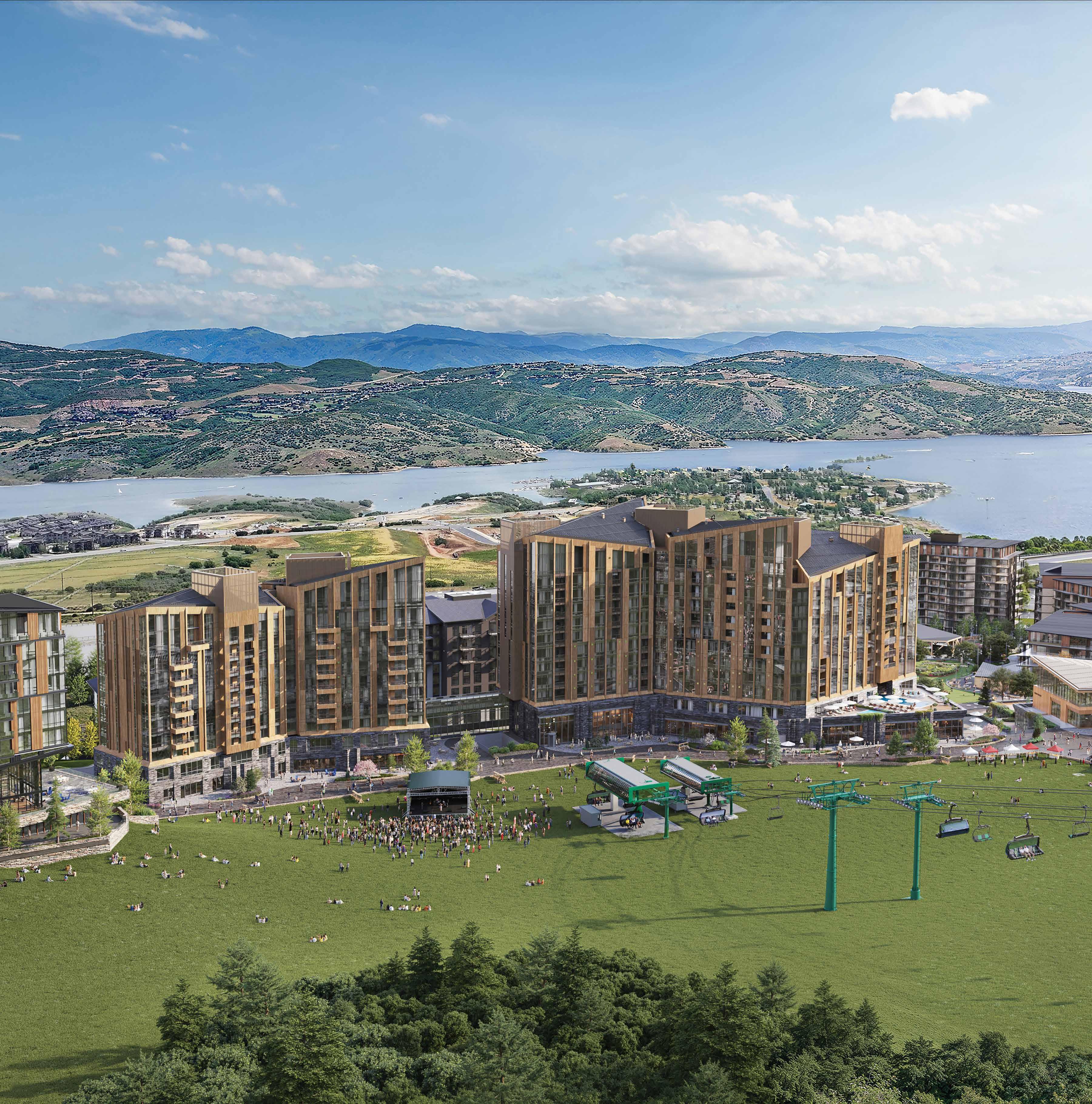
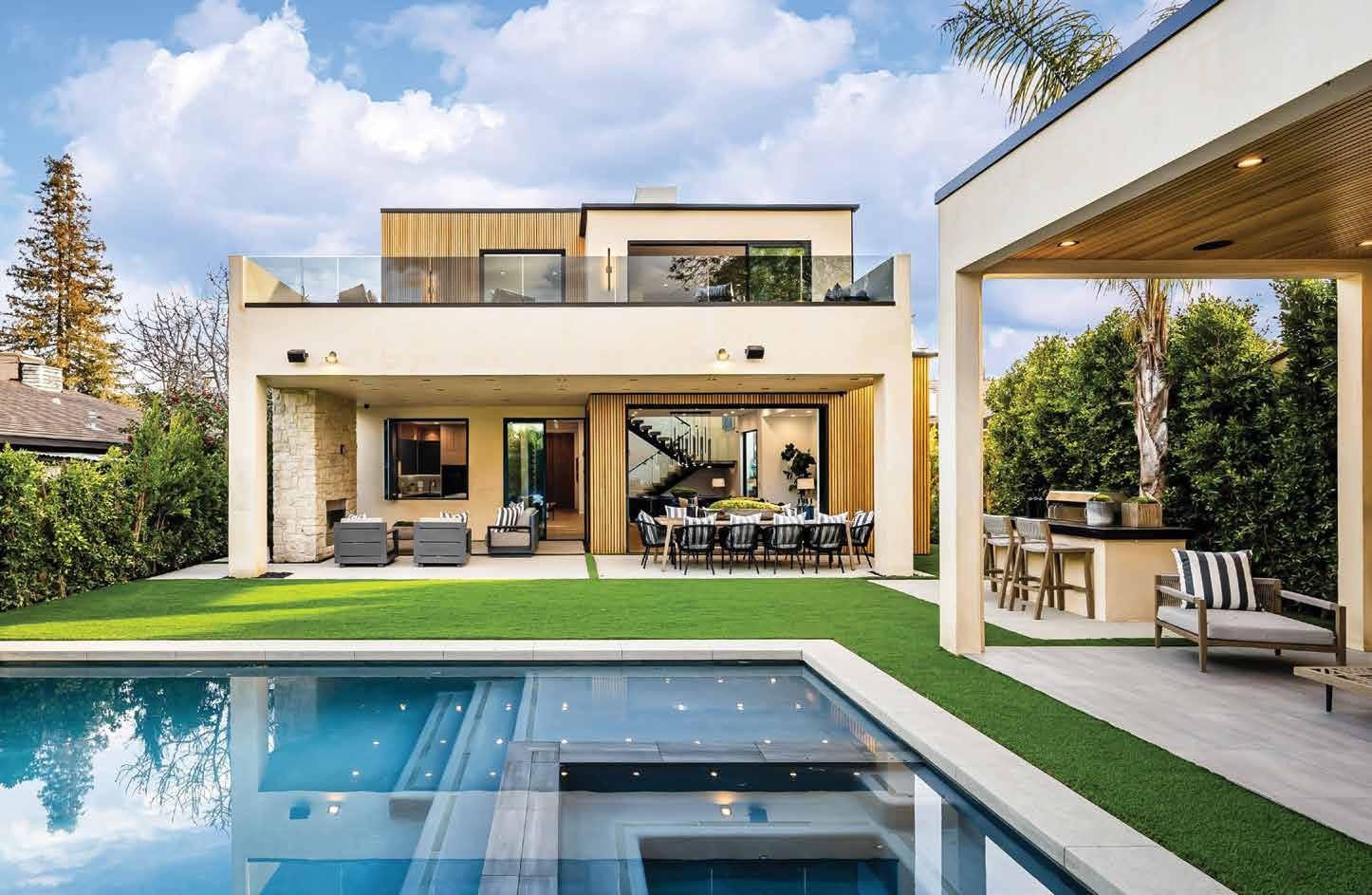
Welcome to Four Seasons Private Residences Deer Valley, a world-class mountain resort at the heart of North America’s most exciting new alpine destination, Deer Valley ® East Village. The property features 123 ski-in/ski-out residences and a collection of exclusive amenities, with eight penthouses sitting at the pinnacle of the two towers.
Envisioned by world-renowned architect ODA and realized by Extell Development Company, the residences are perfected by Four Seasons service to create a truly legendary lifestyle.
One- to Six-Bedroom Mountainside Condominium Residences from $3,750,000
Madrid’s

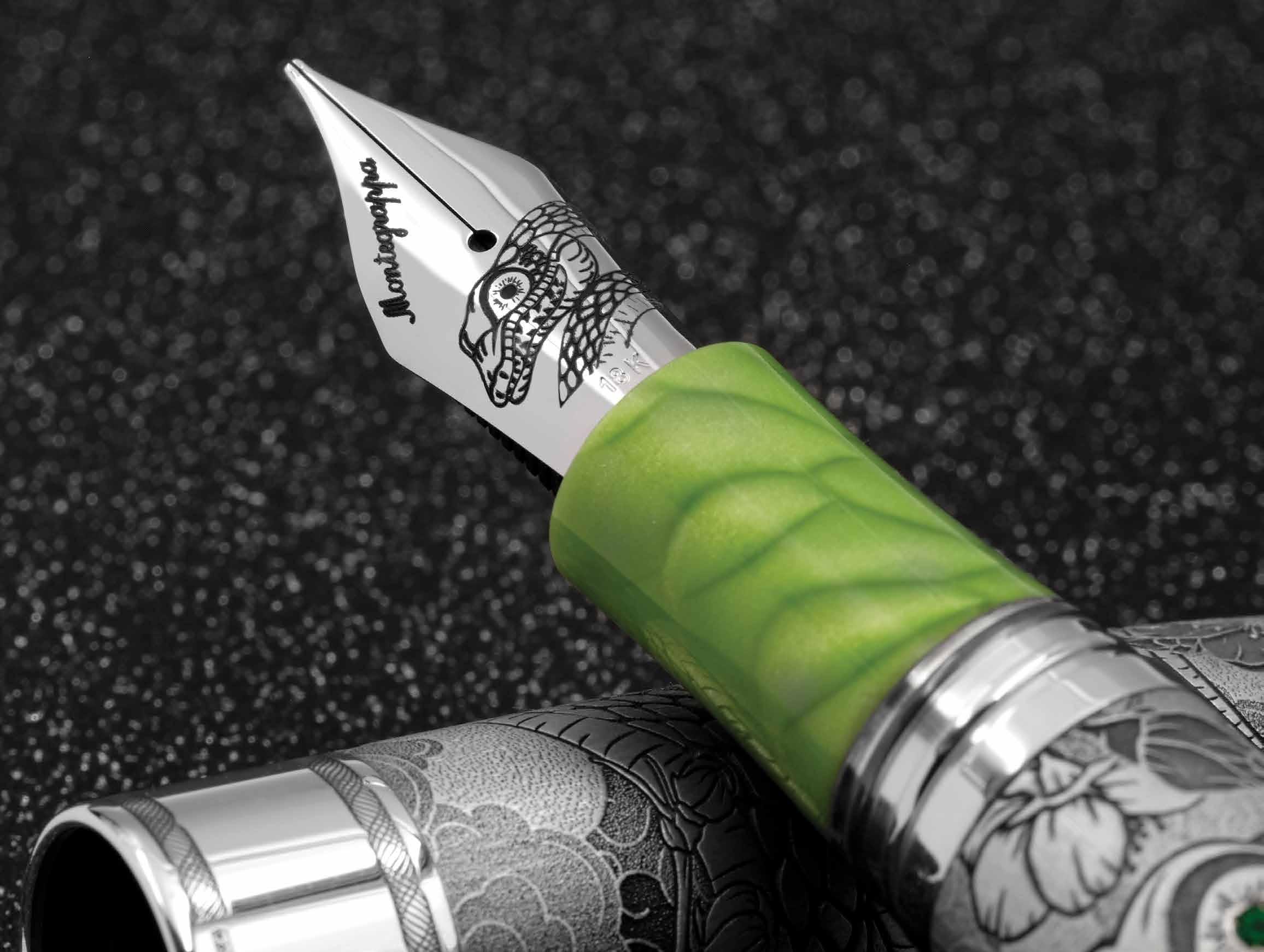
With Exquisite Italian Craftsmanship, Montegrappa Elevates the Art of the Fountain Pen
Want an Objective Opinion of Your Company’s Offerings? Head to the Pub!
These Innovative and Elegant Timepieces Made Their Stunning Debut During Geneva’s Best Watch Week
The All-Terrain Rolls-Royce Cullinan is Inspired by a Yachting Way of Life 44
A Powerful Hybrid You Might Finally be Interested in Buying. And it Comes with Audi’s RS Badge.
46
The Financial Reality of the Average American
How to Keep Your Emotions from Hijacking Your Reasoning Brain
92 FROM FORMULA 1 TO THE FAIRWAY
McLaren’s Bold Pursuit of Precision in Golf
Listing all of the “Must Attend” luxury events in the coming months
hoper Saves Travelers
Valuable Time by Making Helicopter Flights More Accessible

50 MALDIVES MOMENTS
Five Unique Resorts that Showcase the Authentic Hospitality and Culture of This Pristine Paradise
56 TAKING THE PLUNGE
Embracing the Nordic Wellness Rituals of Cold Bathing and Saunas
60 COUP DE COEUR
Parisian Designer Oscar Lucien Ono, Inspired by History and Craftsmanship, Redefines French Luxury
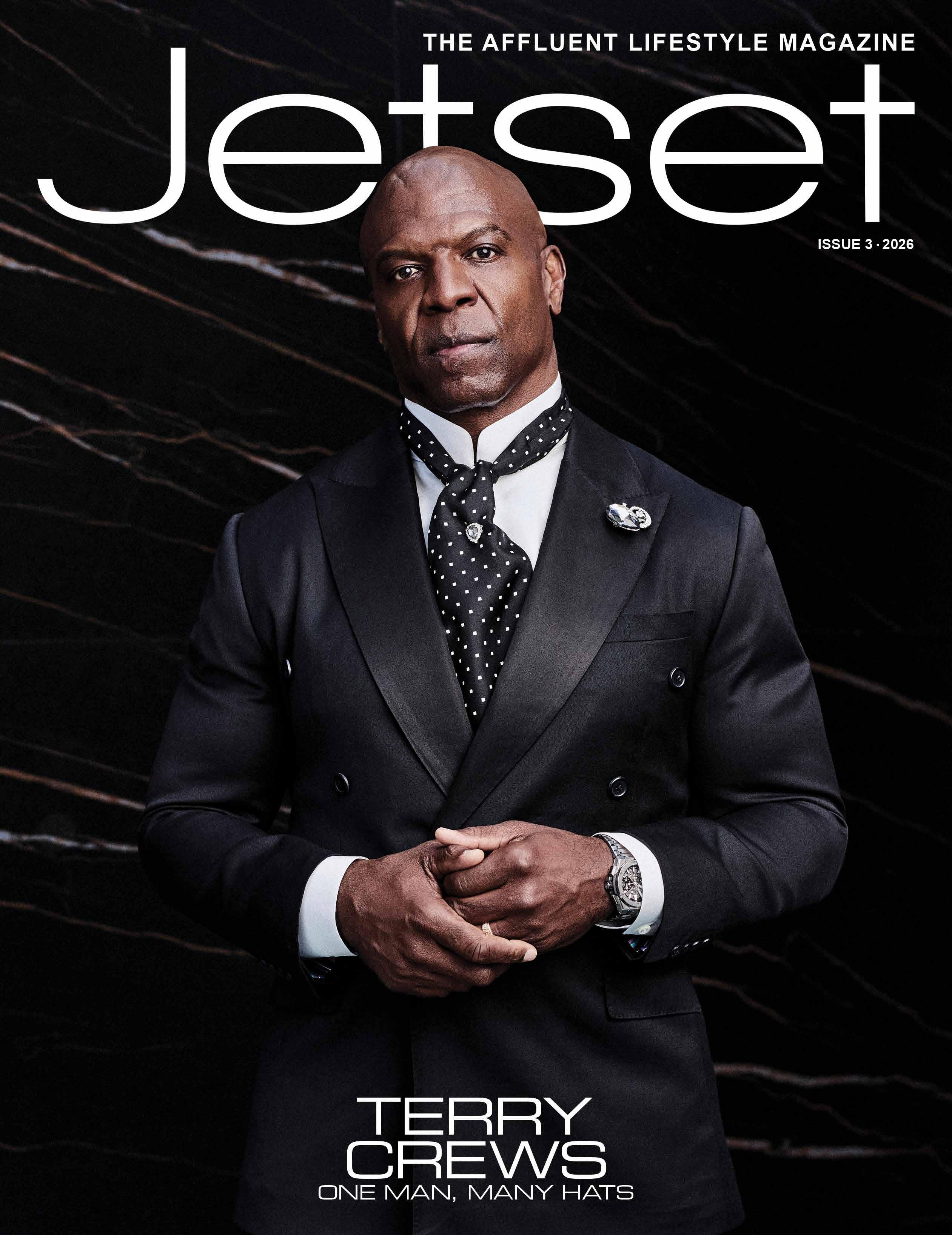
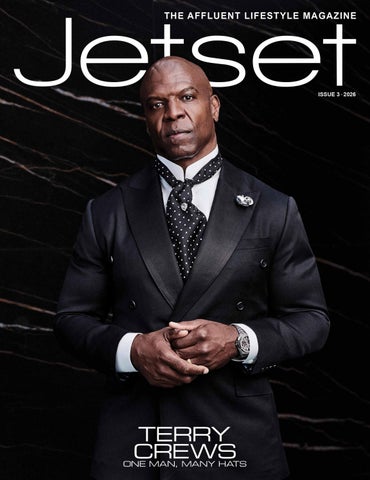
66 ONE MAN, MANY HATS
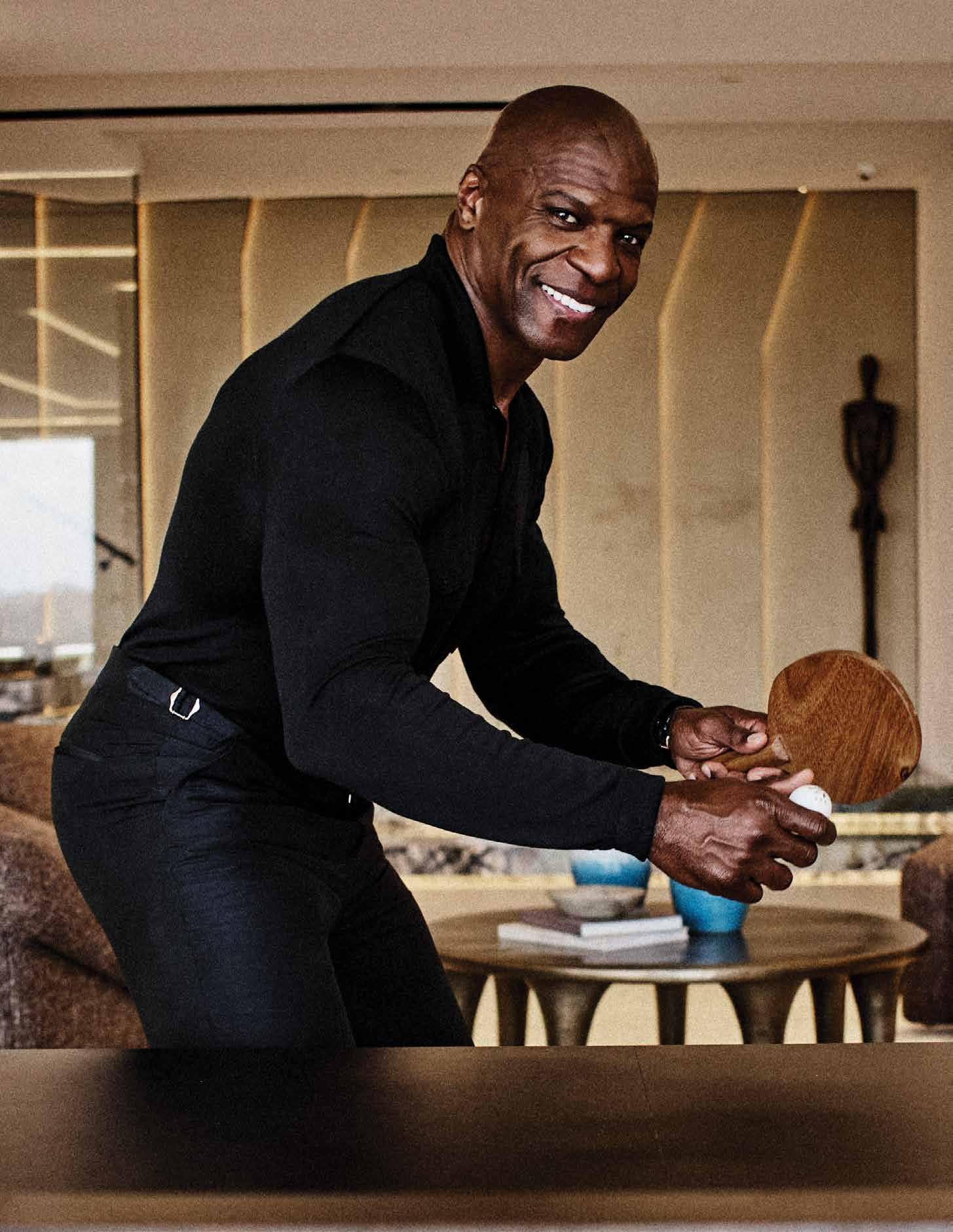
Through His Multi-Faceted Career, Terry Crews Has Discovered the Secrets of a Purpose-Filled Life
72 DESERT HAVEN
Greater Palm Springs is The Ultimate Oasis for Rest, Relaxation and Recreation
76 THE WASATCH ASCENDS
Utah’s Breathtaking Mountain Range Takes Quiet Luxury to New Heights
82 ASIAN ADVENTURES
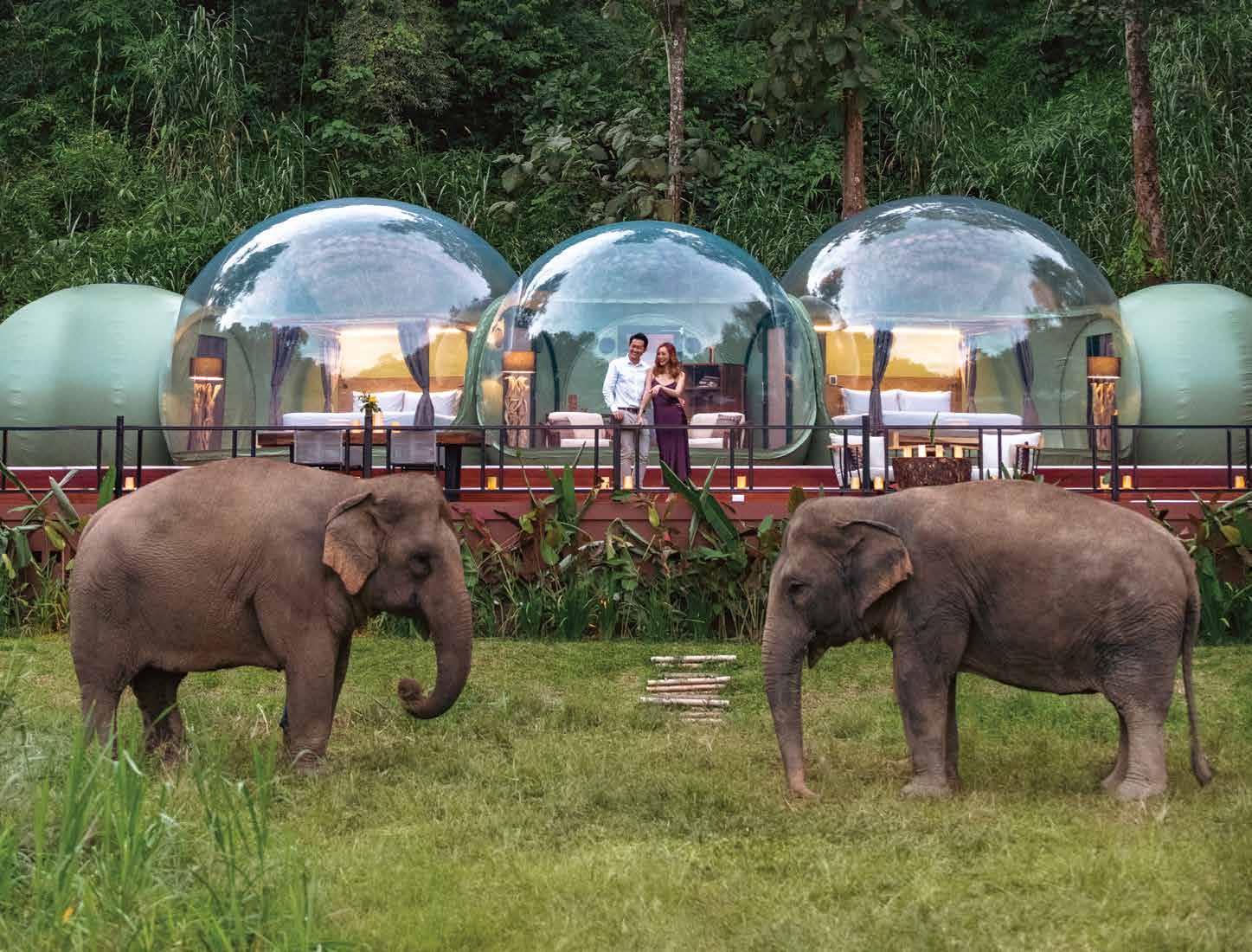
Experience Thailand’s Vibrant Culture from City to Sea to Jungle in Nine Luxurious Nights
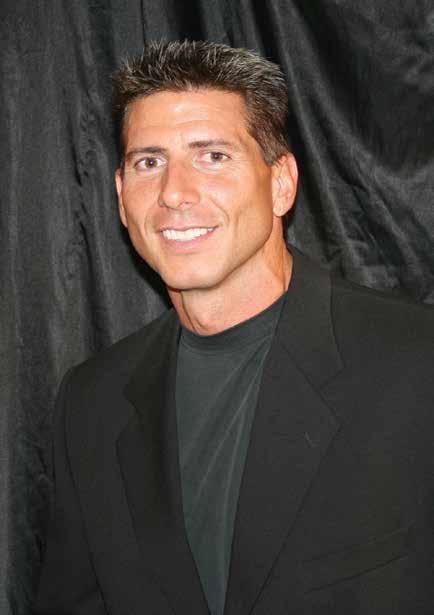
The lessons we learn from the sum of our past experiences can play a big role in helping us chart our course for the future. You’ll see this philosophy in action in our cover story about Terry Crews. He shares what he’s learned through his long, successful career as an actor, TV host and former NFL player and how these life lessons are helping him stay focused on what comes next.
As always, we also bring you the latest innovations in the aviation world. You’ll learn how Advanced Air Mobility (AAM) vehicles, including electric and hybrid-electric personal craft and air taxis, are aiming to truly revolutionize air travel. We also show you how the ridesharing concept is taking to the skies with hoper, a helicopter service, and Eye in The Sky, a platform that matches travelers with empty seats on private flights.
If you’re in the market for a new vehicle, we have two options you’ll definitely want to take a look at. One is the new Rolls-Royce Cullinan series, a quartet of all-terrain vehicles with designs inspired by the yachting way of life. The other is a powerful hybrid, the Audi RS 5. Here’s just one spec to pique your interest: it can go from 0-62 mph in 3.6 seconds. It very well may change your mind about hybrids.
We also bring you more exciting news from the automotive world. McLaren, known for its luxury sports cars and legendary F1 racing history, has now ventured into the field of golf. The company’s new venture, McLaren Golf, is now introducing two lines of irons produced with the company’s trademark precision engineering.
Where will your travels take you this year? We’ve got some great suggestions for you, from a city-to-sea-to-jungle journey through Thailand to a visit to the pristine paradise of the Maldives. If you’re an oenophile, you won’t want to miss our feature on five global destinations that blend culture and history to produce exceptional wines. And what would a trip be without some spectacular shopping? We introduce you to Las Rozas Village in Madrid, a shopping haven that is taking VIP perks to a whole new level.
Inspiring you to move forward with purpose and excitement is what this issue is all about. Enjoy the journey.
With warm regards,
Darrin Austin CEO/Publisher, Jetset Magazine
CEO/PUBLISHER CFO
Creative Director Editor-in-Chief VP of Business Development VP of Operations VP of Strategic Partnerships
Executive Assistant/Office Manager
Executive Administrator
Art & Design
DARRIN AUSTIN
PATRICIA JOHNSON
TOBY THOMPSON
TAMI AUSTIN
GREG FAHLMAN
TIANNA KAYE
CHRISTA LEBAR
THERESA JONES
CHRISTINA MORENO
ERIN SUWWAN
National Account Executives
JULIE OSTEN
SI SI PENALOZA
DAN SHARPE
MICHAEL SKJAERRIS
EXECUTIVE EDITORS
DR. JOHN DEMARTINI
DAYMOND JOHN
ROBERT KIYOSAKI
BARRY LABOV
KEN McELROY
EDITORS
Automotive Editor Luxury Custom Content Editor Copy Editor/Writer Contributing Writers
MATT CHAPPELL
SI SI PENALOZA
KAREN BROST
MIGUEL COSTA
MICHAEL CROLEY
JILLIAN DARA
AMY HIGGINS
LESLIE K. HUGHES
ANNABEL ILLINGWORTH
JASON MURRAY
ALEXANDRA OWENS
J.R. PATTERSON
SIMON ROBERTS
ANNIE STOPAK
JESSE WINTER
DIGITAL
PR/Marketing Manager
Campaign Manager
Creative Strategy Manager
Web Development Specialist Videographer
CARSON LEATHERS
JENNIFER KRAYBILL
JAMES LEARY
PETER TALAVERA
COLLIN PAPE
Editorial Inquiries: editor@jetsetmag.com
Advertising Inquiries: sales@jetsetmag.com
Jetset Magazine Corporate
877.538.5738 JetsetMag.com
Member of



BY JESSE WINTER
For dreamers raised on Hollywood films and science-fiction novels, the future has meant fast hovercraft soaring through the skies. In fiction, humans navigate vast cityscapes, no longer confined by gravity with flight made effortless through technological advancement. Such imaginary worlds have inspired aviation and aerospace leaders to rethink what’s possible.
Advanced Air Mobility (AAM) vehicles— electric and hybrid-electric personal craft and air taxis—represent what could well be a revolution in travel and transportation. These sophisticated, highly maneuverable aircraft may not directly resemble the machines in The Jetsons or Blade Runner, but they are sleek, technologically ambitious efforts to reshape personal, urban and regional travel. A class of aircraft primed to fulfill a role much like the flying cars of science fiction.


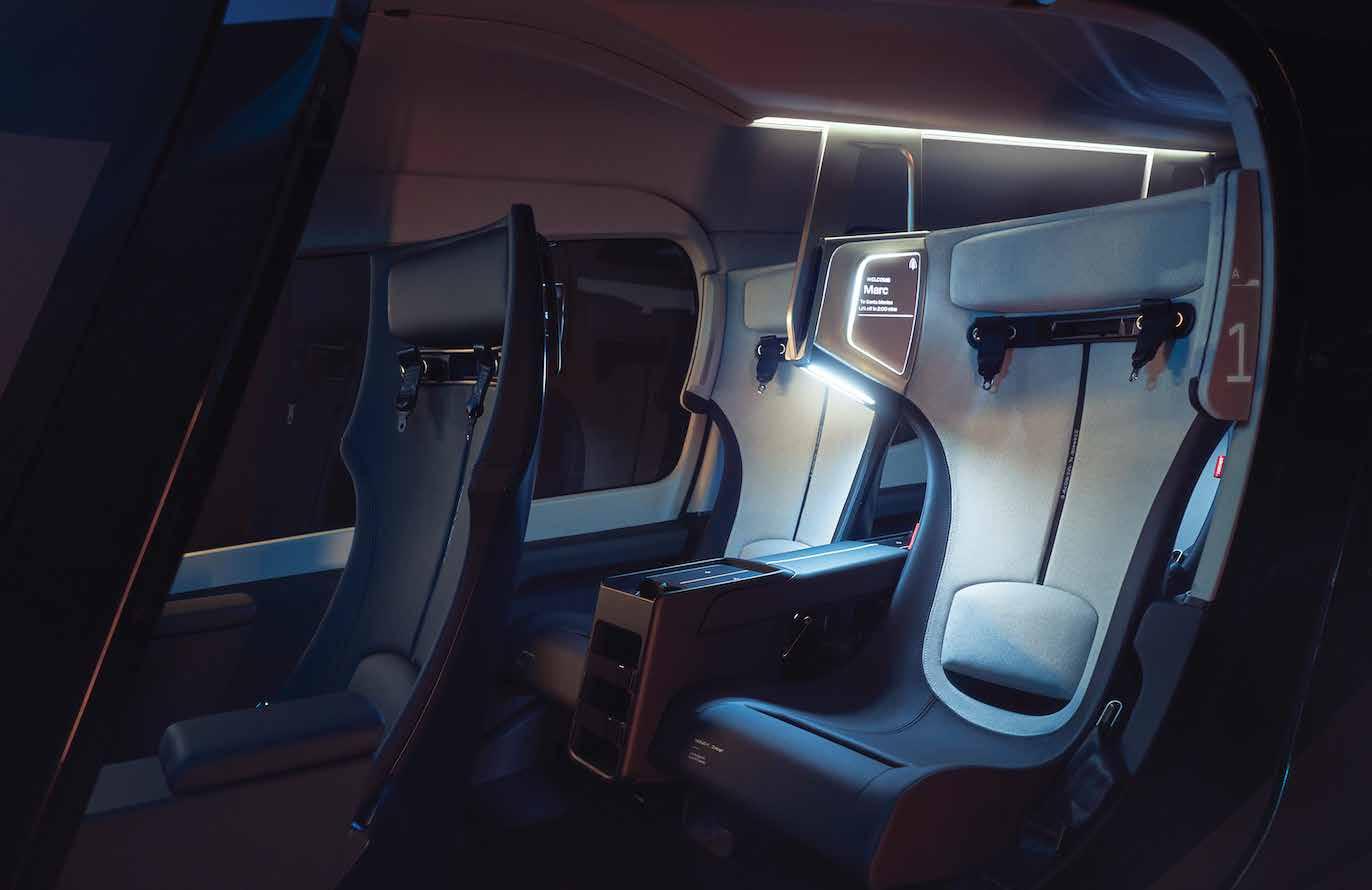
Today, companies like Archer Aviation and its Midnight eVTOL “flying taxi” aim to deliver that future into today’s world. In March 2026, the federal government launched a three-year program creating the conditions for leading eVTOL (electric vertical take-off and landing aircraft) developers like Archer Aviation to test their aircraft in more than 26 U.S. states. The goal of this program, the Department of Transportation says, is to assess real world environments for urban air taxi networks. Archer’s Midnight is designed to carry four passengers and one pilot for distances of 20–50 miles before recharging, ultimately connecting major urban centers and regional routes.
Archer and its competitors will use the federal program to test their designs and work toward
securing FAA certification, a crucial step for starting commercial operations and developing the necessary infrastructure to support AAM aircraft like eVTOLs. These flying taxis promise connectivity with minimal noise pollution, making them suitable for densely populated spaces with noise restrictions. Additionally, air taxis are being positioned to serve VIPs looking to save time when traveling between regional locations, offering an alternative to private jet travel, chartered helicopters, and luxury car services.
Today, the emerging air taxi and eVTOL market is rife with competition, with companies burning through money while still in the developmental stages. The prospect of a potential transportation revolution has many
firms vying for a piece of the action, with some proposing innovative approaches to air taxis and urban air mobility aircraft, including hybridelectric versions of eVTOLs. Enter PLANA, a company set on developing a hybrid-electric VTOL (vertical take-off and landing) aircraft to rival the purely electric eVTOLs being developed by the larger eVTOL sector.
PLANA’s aircraft will carry six passengers and a pilot on routes of about 350 miles, such as San Jose to Reno or New York to Boston. The hybrid approach is meant to overcome electric-only range limits and address what PLANA Executive Chairman Philippe Bouissou calls “the missing middle.” Specifically, “journeys under roughly 500 miles that today remain stubbornly inefficient—too slow, congested and unreliable on the ground, yet scarce, painful and costly by air,” he said. The goal is to connect areas that are difficult to navigate due to heavy traffic and long car journeys but too inefficient for airplanes or small jets.



Missions will include regional and urban transport that also serve a range of customers, including VIP clientele. Bouissou said PLANA’s aircraft will be ideal for passengers seeking a weekend escape, a resort run, a second-home hop or a same-day business trip. Critically, the aircraft will be quieter than helicopters with their louder noise signatures, making its reduced noise perfect for ferrying passengers to business and event destinations as well as remote properties and private facilities.
Aircraft safety is designed around redundancy, meaning that if one of the powerplants fails, the other engines can continue operating the aircraft. PLANA’s aircraft will also feature advanced flight
control software, AI-based systems that predict maintenance needs and mechanisms to ensure aerodynamic stability. “Safety is the foundation of everything we do,” Bouissou said.
PLANA has been testing the aerodynamics and flight control systems of a large sub-scale
prototype since 2023, as the company continues to develop its aircraft. “We are not racing for headlines; we are building for real-world deployment,” Bouissou said. He noted that the quieter operations and extended range of PLANA’s aircraft will make a practical difference, as the new aircraft is being designed to use existing flight infrastructure.



“For the luxury and private aviation world, pointto-point access and time reclaimed become a natural extension of what people already value,” Bouissou said. “It’s about redefining what a regional movement can feel like.”
Air taxis could change how groups travel, while the “flying car” targets individual flight. eVTOL technology has already produced personal recreational flying vehicles—a modest label for what is surely an exhilarating experience. Examples ready for early adoption include Jetson’s Jetson One and Pivotal’s Helix. These
ultra-light vehicles don’t require a pilot’s license and cost in the low six figures. They can reach about 63 mph while operating hundreds of feet above the ground. Nimble and quick, they resemble flying jet skis and are ideal for weekend flying. Unlike larger air taxis, some ultra-light eVTOLs have been delivered to customers and are already flying.
Companies like London-based AltoVolo are aiming to build a hybrid-electric VTOL aircraft closer to the classic flying car concept. AltoVolo’s Sigma will have a 500-mile range, a cruise speed near 220 mph, and seating for
three. The company says Sigma will be about 80 percent quieter than helicopters, making it suitable for residential areas. Its flight ceiling will be around 10,000 feet, a height close to current helicopter altitudes. Moreover, safety is a core design focus, with thrust vectoring stability built into Sigma’s open-rotor design as well as a ballistic parachute ready to deploy in the event of an emergency.
AltoVolo founder and CEO William Wood told Jetset the Sigma uses advanced technology to give customers “the luxury of time” through a versatile aircraft. He likens the interior to a hypercar from elite luxury brands; the cockpit emphasizes ergonomics, styling, and functionality, with flight directed by a threeaxis joystick placed near the center of gravity for intuitive control. AltoVolo plans Light Sport Aircraft (LSA) certification, separate certification for potential commercial use and simulator-based owner training. The company lists a “launch edition” for Q1 2029 with a price around £860,000.
“The Sigma fulfills that dream we’ve all had of being able to fly,” Wood said. “Not on an airliner, but actually to fly ourselves.”

BY ROBIN CATALANO
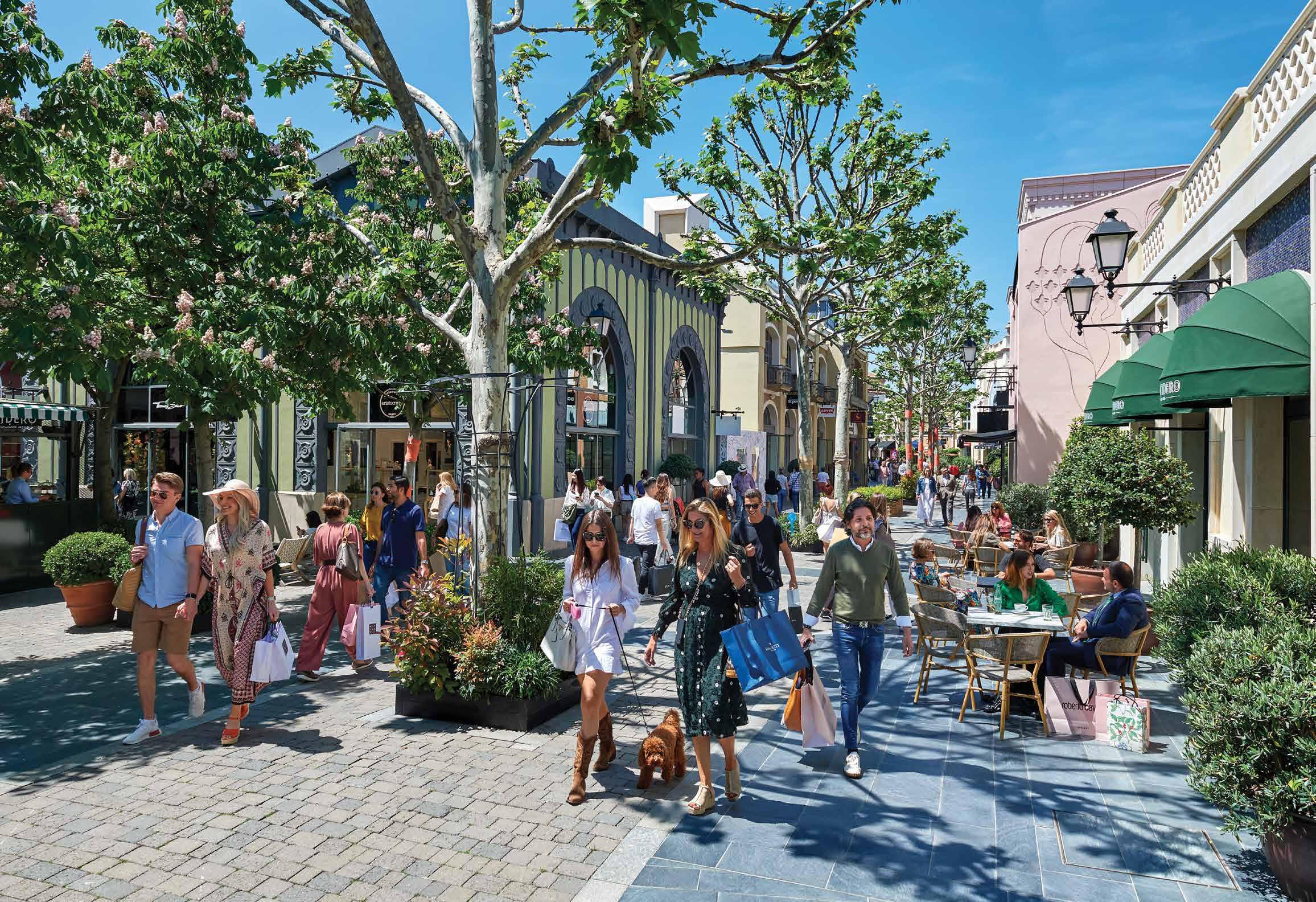
In Madrid, one of Europe’s rising fashion capitals, traditional wisdom holds that the Salamanca neighborhood—the “Golden Mile” of style, with brands like Versace, Carolina Herrera, Kenzo, Chopard, and Adolfo Domínguez—is the place to spend and be seen. But 30 minutes outside the downtown, a luxury boutique village meets art space makes it even easier to take a deep dive into Spanish retail therapy and culture.
Las Rozas Village, currently celebrating its 25th anniversary, is home to more than 100 boutiques, many the same as you’d find in Salamanca, plus pop-ups from trending design houses. Over the next two years, Las Rozas will complete a major expansion that will include additional luxury clothing, accessories, fragrance, and jewelry shops, plus new global dining concepts.
Part of the London-based Bicester Collection, which owns twelve open-air shopping villages in Europe, China, and North America, Las Rozas is filled with pastel-hued storefronts that pay homage to Spanish colonial architecture. Stores include European designers like Balmain, Breitling, Carolina Hererra, Montblanc, Isabel Marant, Gucci, Prada, Valentino, and Karl Lagerfeld, plus iconic American labels such as Michael Kors and Marc Jacobs. A number of exceptional Spanish brands fill out the roster, Balenciaga, Purificación García, Silbon, Adolfo Domínguez, and edgy Madrid-based jewelry maker Aristocrazy among them.
Take a break from browsing for a meal or snack. Choose from quick-serve kiosks or sit-down outposts of the Madrid mainstays, from Joselito’s, which focuses on gourmet Iberian products to Mentidero Sal y Brasas, a
mind-meld of two of Mentidero’s downtown restaurants, serving traditional grilled items with Andalusian flavors, and the elegant yet accessible haute cuisine of Cristina Oria, the “Ina Garten” of Madrid. The latter even has a shop for picking up table- and barware inspired by the namesake Spanish chef/entrepreneur.
Las Rozas distinguishes itself through VIP extras and services, which are founded on the hospitality methods of a five-star hotel. “Our main objective is always to encourage customers to return,” says Asunción Múgica, deputy PR and communications director of the village. “If they have a good experience, not just in shopping, but also enjoying breakfast or lunch, or discovering something a little bit cultural, they will want to come back and maybe tell friends.”
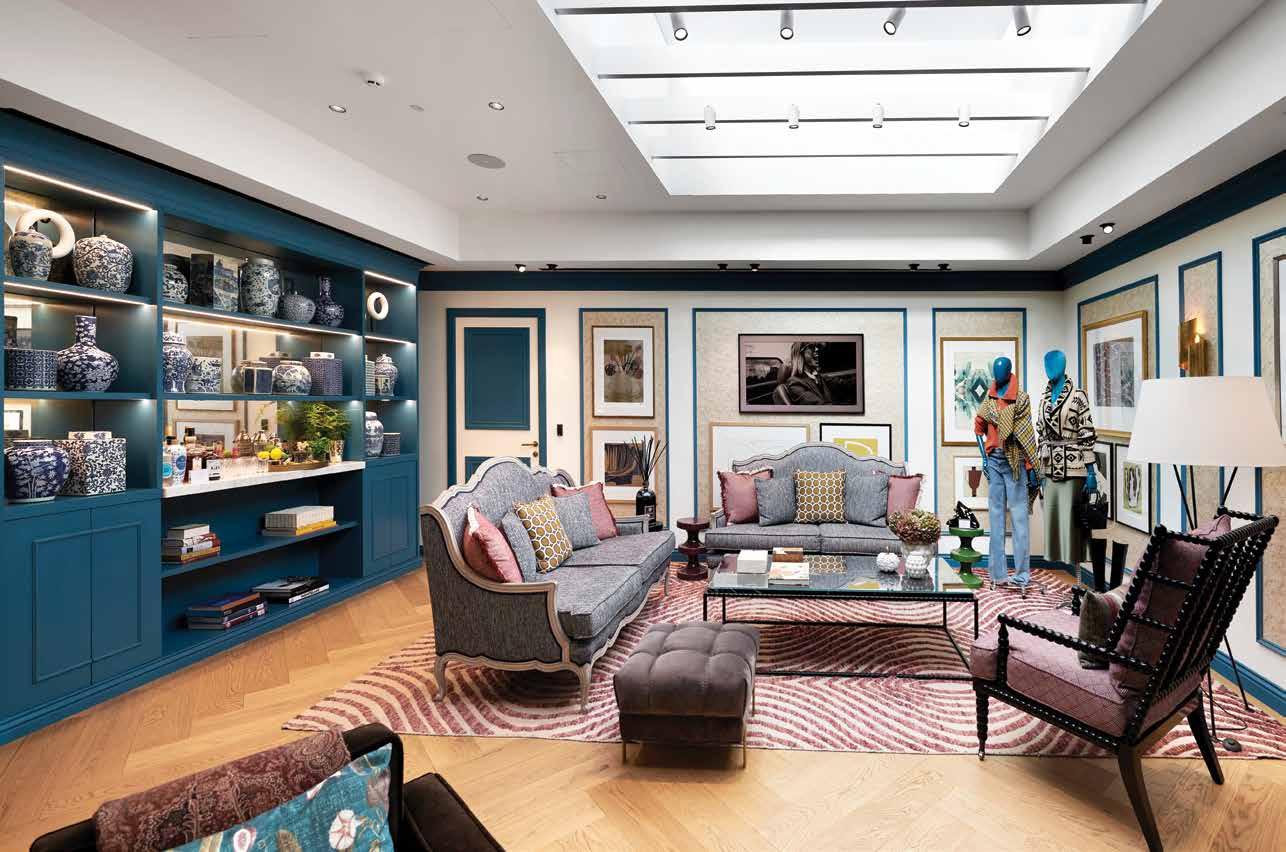
The list of VIP experiences is impressive. For example, download the Las Rozas app and scan your purchases. Each one counts toward a higher level of membership. Reach the highest level and you’re eligible for visits to The Apartment, an invitation-only space featuring a plush, design-forward salon, where you can relax over coffee and snacks. (There’s plenty of room for shopping-weary plus-ones to park themselves with a laptop while you commence the search for your next great wardrobe crush.) You can also use the Hands-Free Shopping service on the Las Rozas app to have your purchases delivered for pickup at The Apartment’s reception desk.
Enlist a Las Rozas personal shopper for color analysis, or to select items to fill out your closet. “First-time visitors often enjoy walking through the boutiques with us—it’s a great way to discover new brands, explore the village, and get expert guidance along the way,” says Personal Shopping Manager Alberto Vidal. For loyal
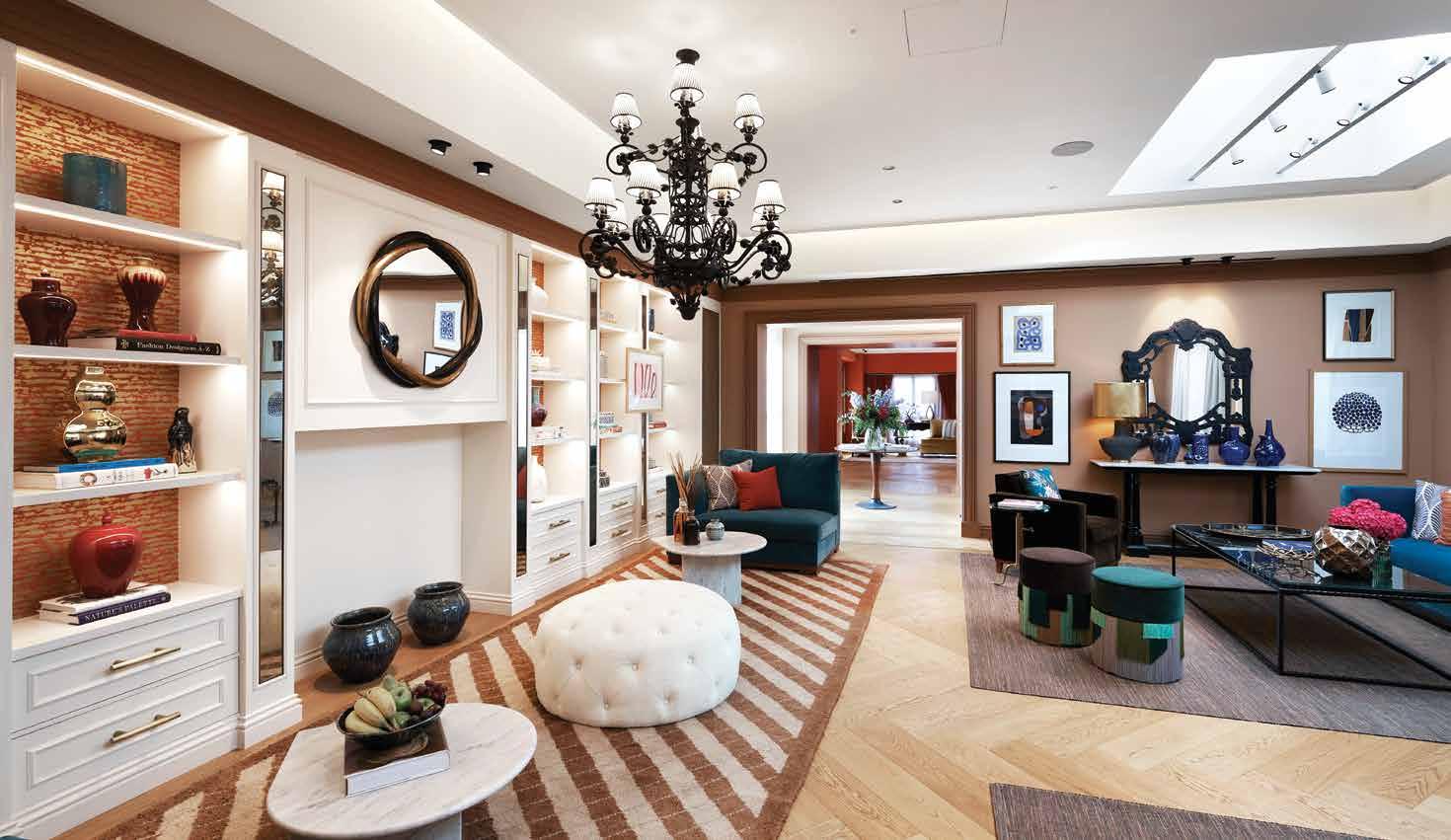
clients whose style and preferences are known among the Las Rozas team, shoppers curate a selection in advance and deliver them to The Apartment for try-on in a private fitting room.
According to Vidal, “Some [guests] arrive with specific brands in mind, while others look for inspiration based on an occasion, season, or desired style. Our role is to adapt to each request and offer expert recommendations that reflect their personality and needs.”
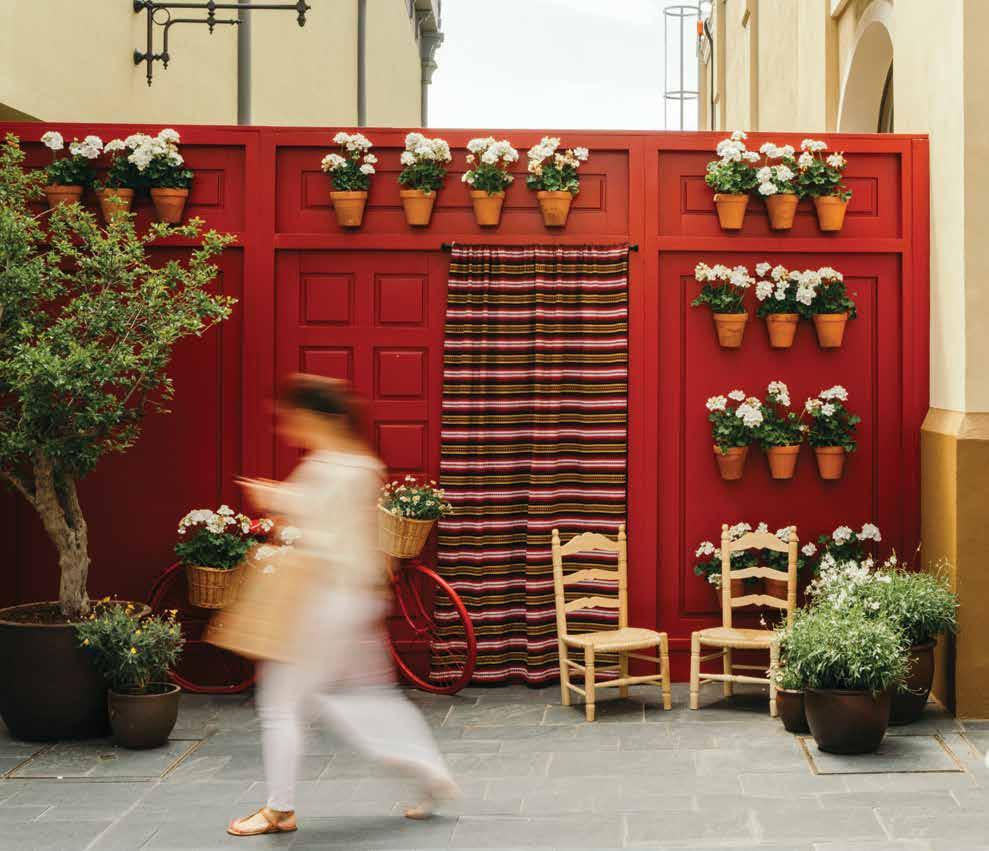
Around the Las Rozas property, art takes the spotlight in rotating installations articulated in three “chapters” per year. In 2025, the exhibits focused on the theme of craftsmanship, in ceramics, textiles, and wood. One installation included hand-dyed silks; another highlighted the botijo, a clay water jug that been crafted by hand in Spain since the Bronze Age.
After an exhibit wraps, the art spaces are dressed up for holidays and seasonal events, including Christmas and Dia de Muertos (in honor of the village’s Mexican staff members). In addition, Las Rozas supports projects that foster dialogue between fashion and art at Madrid’s superb ThyssenBornemisza Museum. Fancy a viewing? Ask the Las Rozas concierge desk to verify exhibit hours and arrange a ride.
With its roster of tony boutiques and VIP perks, Las Rozas has carved out a distinct position in Madrid’s luxury retail landscape. Beyond its status as a shopper’s paradise, Bicester’s Madrid-based village reflects a broader shift in how luxury retailers are reimagining the shopping experience, proving that premium retail therapy extends well beyond traditional style borders.
BY LAYNE RANDOLPH
Some destinations stay with you because they’re beautiful. The rare ones stay with you because you can feel them. In wine, we call that sense of place; the way soil, climate, and human tradition leave a signature you can taste. Travel has its own version—the moment a region stops being scenery and becomes something intimate.
When wine is part of an ancient route— layered with trade paths, monasteries, ports, and pilgrimage roads—the sense of place becomes the kind you don’t forget. These destinations aren’t just wine trips. They’re inspirational, educational, and delicious cultural immersions.
Here are five places where culture and history add depth, and you can taste it in the wine.
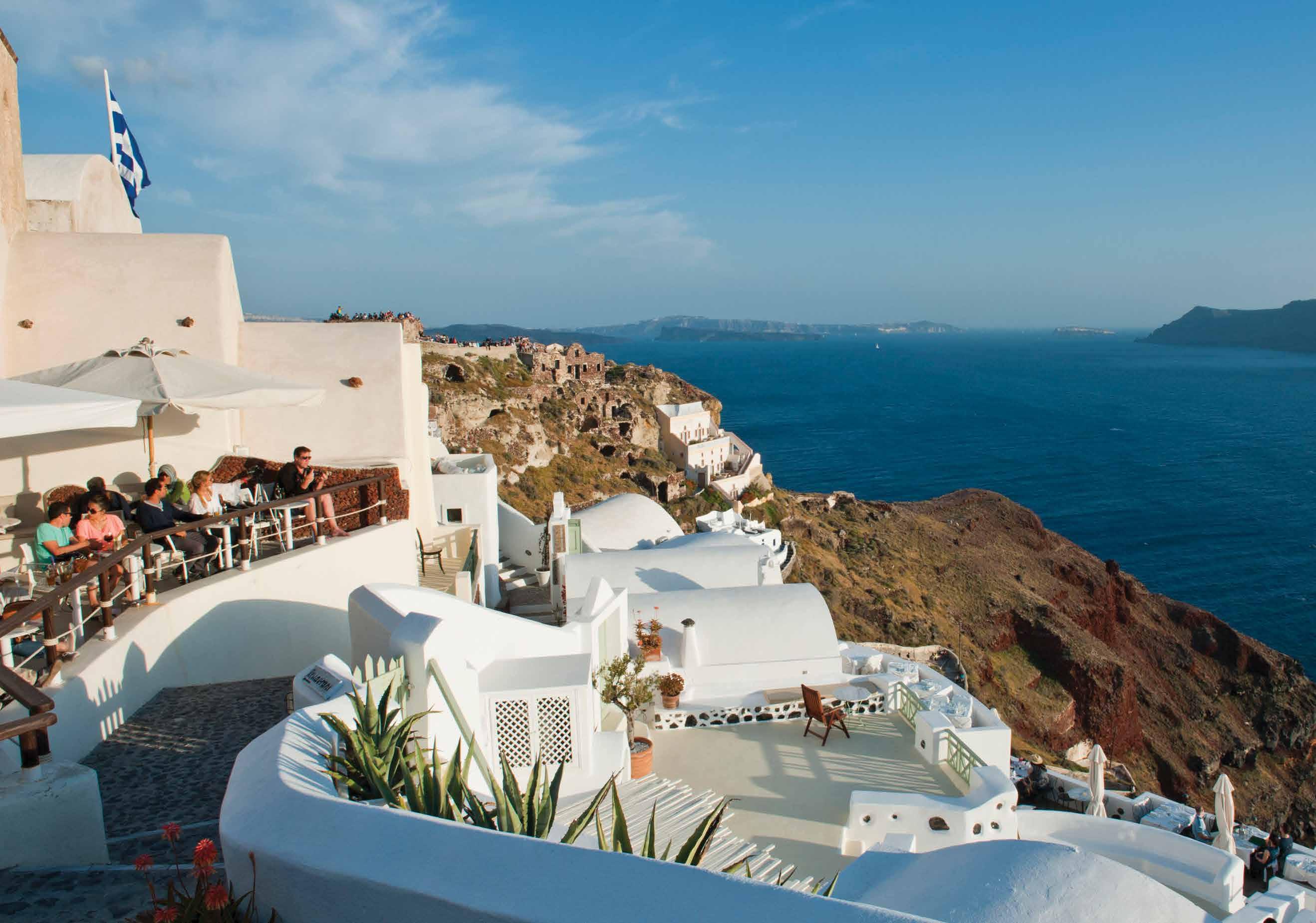
Santorini, Greece
Assyrtiko is the island’s signature wine because it thrives in conditions that are brutally simple: volcanic ground, fierce sun, relentless wind. The vines are trained into kouloura—wreathlike baskets—woven low to the earth so the
fruit grows sheltered inside the ring, protected from Aegean gusts and the heat that can scorch anything raised too high.
In the glass, Assyrtiko is typically lemon-lime and grapefruit pith, with saline, oyster-shell minerality and bracing acidity that stays bright even in the heat.
To see how literally the island buries its wine history into the landscape, go underground. The Koutsogiannopoulos Wine Museum occupies a natural cave about eight meters below ground and roughly 300 meters long—an extended volcanic corridor that feels like a time capsule carved by necessity.
Canaves Ena, part of the family-run Canaves Collection and a member of Small Luxury Hotels of the World, is an 18-suite cliffside hideaway in Oia with an infinity-pool sunset perch and an on-site restaurant (Adami) beside the pool—luxury that feels carved into Santorini rather than placed on top of it. Following a design transformation from its original 17th-century wine caves, the newly reimagined Canaves Ena comprises 18 suites carved into the cliff above the caldera.
Franciacorta, Italy
Franciacorta is Italy’s metodo classico heartland: bubbles made the slow way, with the second fermentation in bottle and time doing the heavy lifting. The permitted grapes are tightly defined—Chardonnay and/or Pinot Nero, with Pinot Bianco allowed up to 50 percent and Erbamat up to 10 percent—and the region’s rules make patience part of the identity.
In the glass, Franciacorta tends to read dry, taut, and quietly luxurious—lemon peel, green apple, and white flowers, with a fine line of almond and brioche from time on lees, finishing clean and mineral.
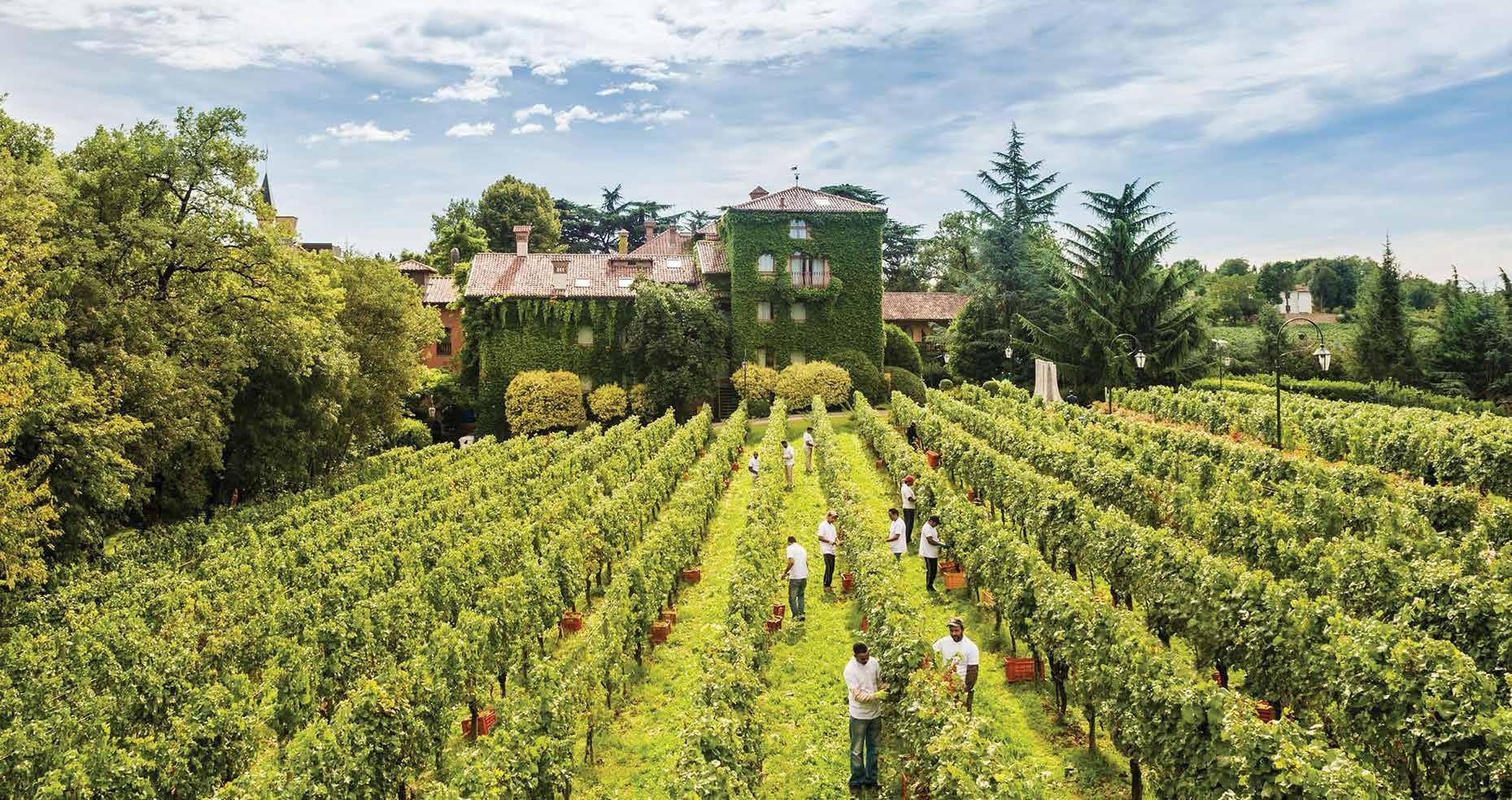
The name is often traced to “francae curtes”—small medieval communities, frequently linked to Benedictine monastic landholdings, where exemptions from certain taxes/duties were granted in exchange for cultivating and teaching viticulture. Francae Curtes gave the region its name, “la Franciacorta,” not to be confused with the sparkling wine, “il Franciacorta.”
The cultural layer is quieter than Venice’s drama or Santorini’s geology, but it’s there in the landscape: noble villas, religious architecture, and the long agricultural rhythm of northern Italy near Lake Iseo.
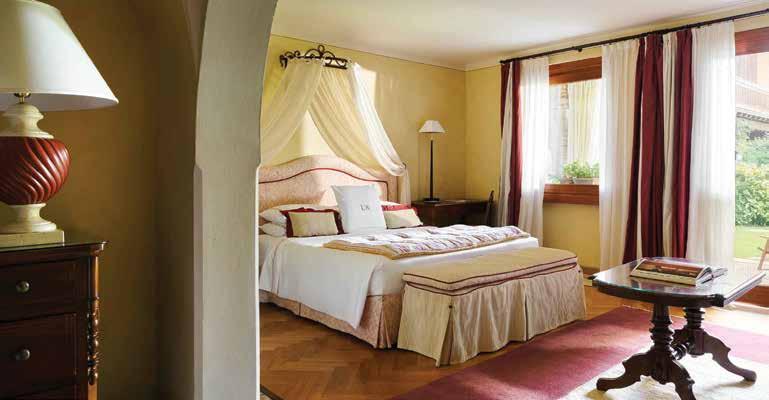
If you want a stay that matches Franciacorta’s sense of cultivated calm, stay at L’Albereta Relais & Châteaux in Erbusco’s Franciacorta hills. The Franciacorta Consortium describes
L’Albereta as the region’s only 5-star hotel, set in a late-19th-century neo-Renaissance residence on Bellavista Hill. Wellness is a core pillar here, thanks to the Chenot Espace—a substantial medical spa setup (treatments, hydro-areas, pools, sauna/ steam, fitness) that makes the stay feel as restorative as it is beautiful.
For centuries, the city’s wealth depended on trade routes and luxury goods, and wine moved through that same ecosystem— imported, curated, poured as diplomacy. Even the glass matters; Murano’s refinement helped make wine something seen as much as consumed, tying color and clarity to the experience of taste.
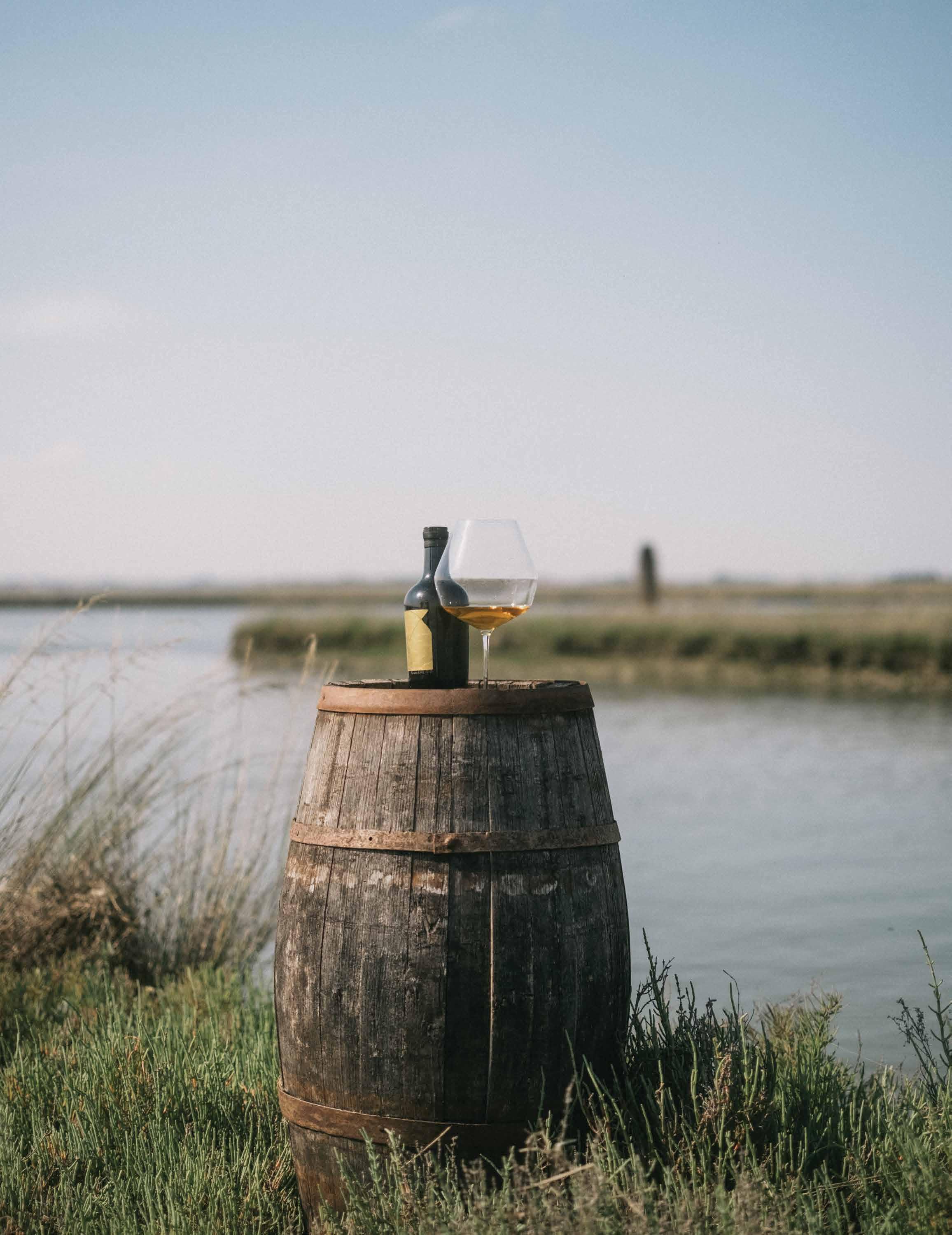
After the catastrophic Acqua Alta, flood of 1966, vineyards and gardens were destroyed, and Venice’s vineyards were largely wiped out. Decades later, a near-lost local grape returned. Gianluca Bisol, of the Bisol family prosecco dynasty, found Dorona vines surviving on Torcello and replanted them on Mazzorbo Island. The vines produced their first harvest in 2010, and the project became Venissa.
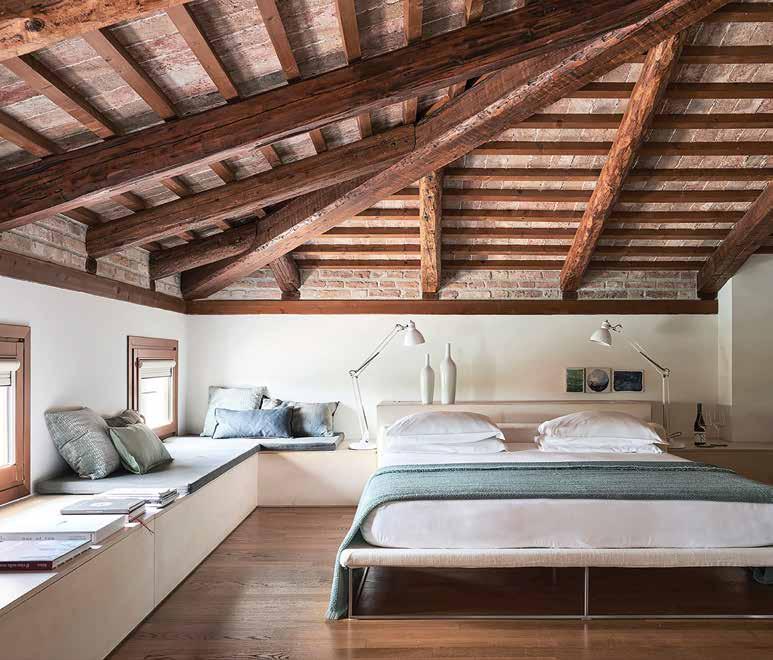
Luca Carnevali of Venissa explained that Dorona matters because the lagoon is “hostile to vines”—salty air, salty humidity, salty soil, and shallow roots—yet Dorona adapted over centuries to survive. The result is amber-gold and skin-contact textured. It tastes of honey, peach, chamomile tea, and orange zest, with a sea-breeze salinity, poured from a Murano glass bottle with gold-leaf labeling, a nod to Venice.
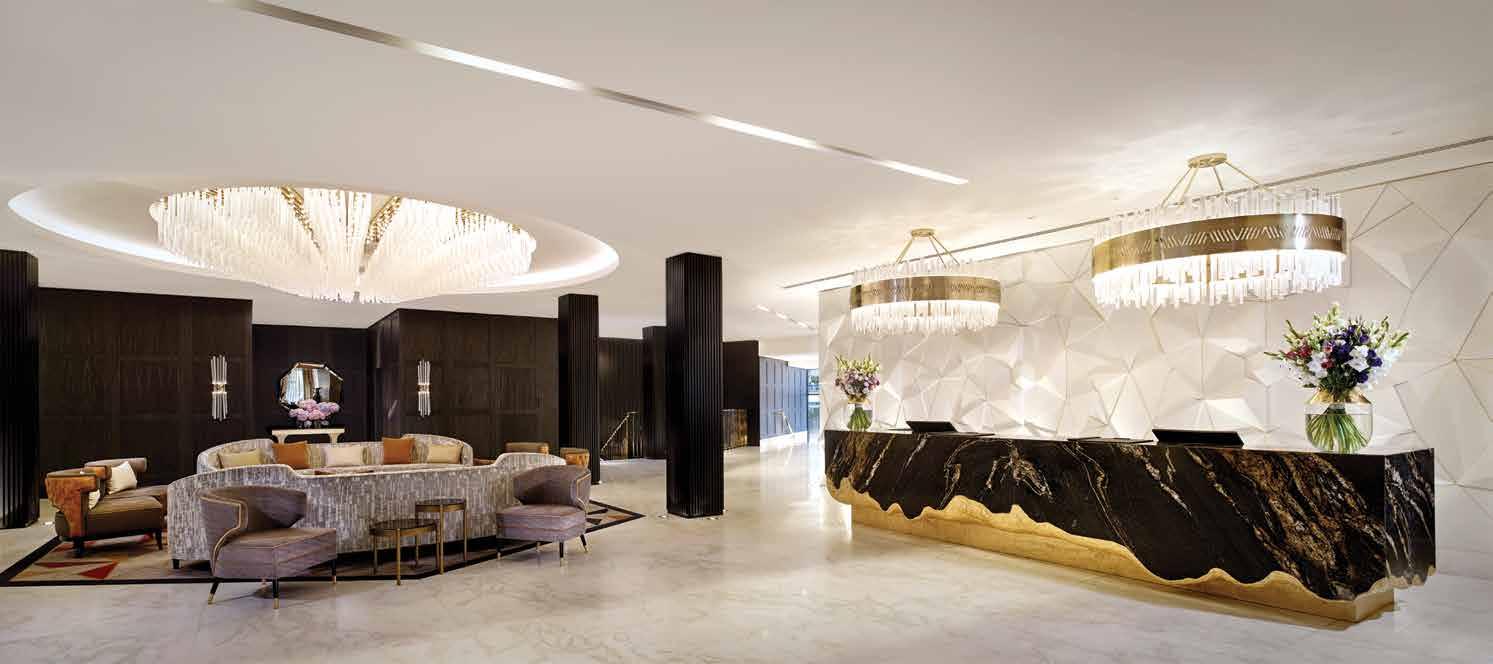
Set inside a walled medieval vineyard on Mazzorbo, Venissa is also a boutique wine resort, and its restaurant holds both a Michelin Star and a Michelin Green Star, with chefs Chiara Pavan and Francesco Brutto cooking “cucina ambientale” rooted in lagoon ingredients and the estate’s gardens. You can sleep overlooking the walled garden and lagoon landscape, then taste its flavors at the source.
Vayots Dzor, Armenia
Armenia’s wine story is old enough to feel mythic—and specific enough to be proven with carbon dating and chemical evidence. In Vayots Dzor, in what is now known as the Areni-1 cave, researchers uncovered what has been described as the oldest known winery: a wine press, fermentation and storage vessels, drinking cups, and grape remains dated to roughly 4100–4000 BCE.
The signature grape is a deep red Areni, which lent its name to the cave discovery that found traces of its millennia-old DNA amongst the world’s oldest winery. Areni is typically sour cherry/cranberry with medium-plus acidity and a peppery, savory lift; it is an indigenous variety increasingly central to Armenia’s modern revival.
And the revival isn’t only agricultural. Over the past decade, Yerevan’s Saryan Street has become an informal “Wine Street,” with wine bars and bottle shops that signal a capital-city appetite for Armenian bottles.
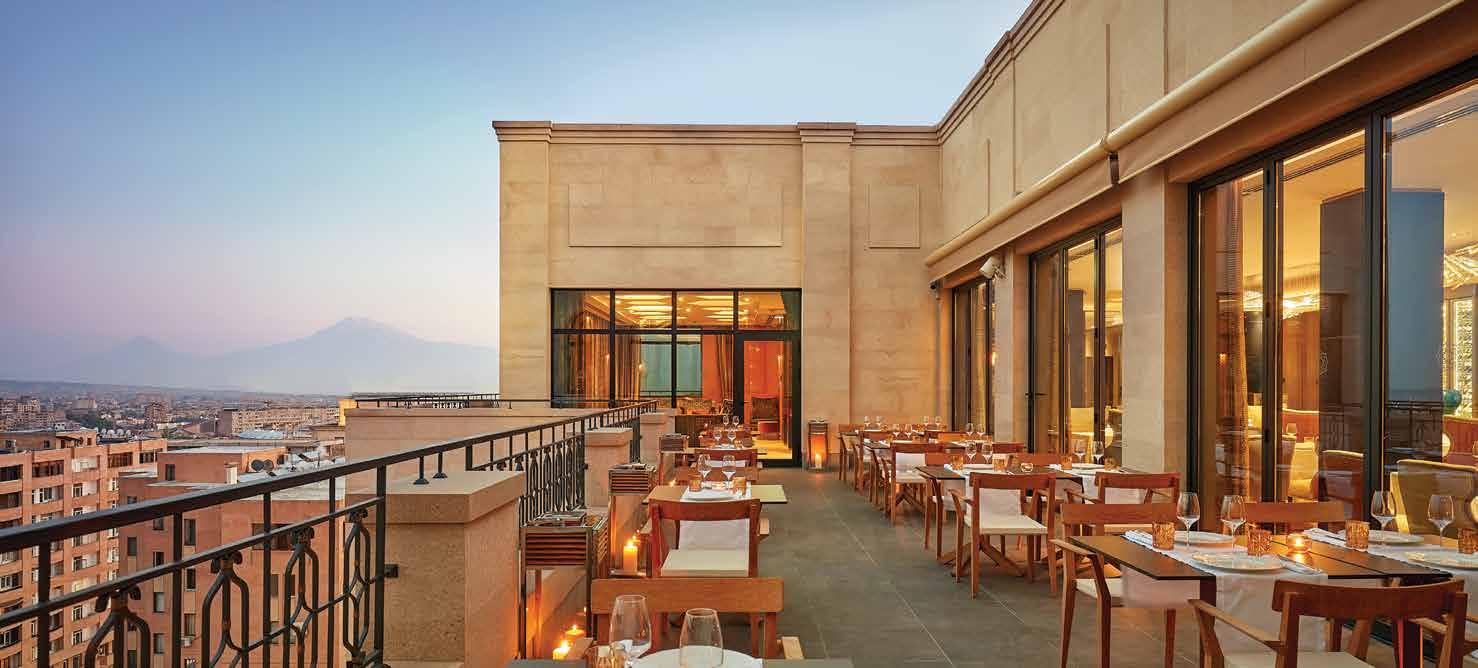
For a luxe base in the city, The Alexander, a Luxury Collection Hotel, delivers the polished reset, with spa offerings and an indoor pool to contrast with your trip into canyon country. The contrast is the point—capital refinement first, then Vayots Dzor’s stone steps and cave air, where wine stops being a lifestyle accessory and becomes a physical record of wine’s ancient history.
The Douro is often cited as the world’s first officially demarcated wine region, dating to 1756, when borders, classifications, and regulations turned an extreme growing environment into something manageable for merchants and shippers—and, eventually, for travelers and consumers.
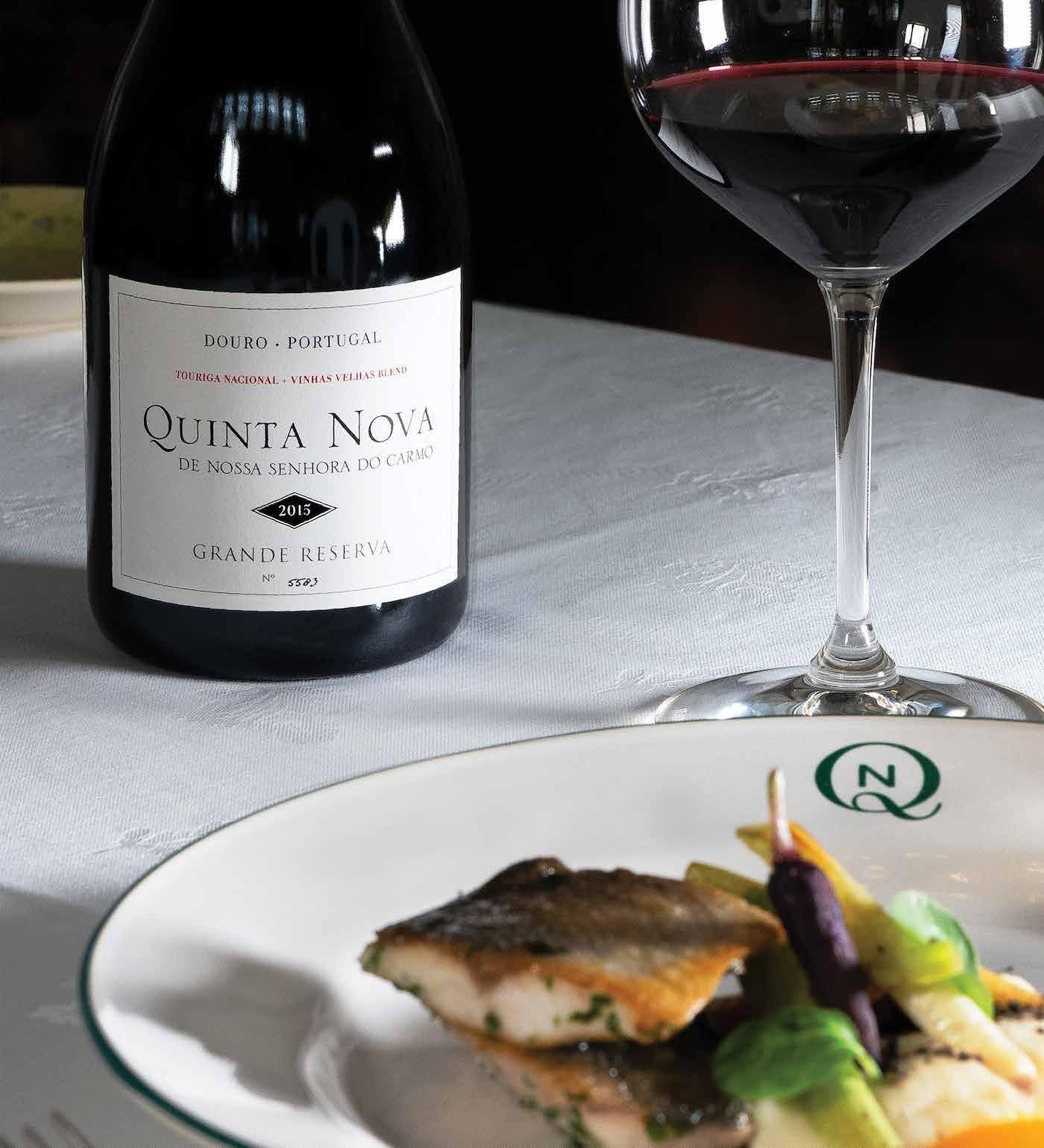
For a stay that makes history tangible, Quinta Nova de Nossa Senhora do Carmo is a strong
anchor. The estate, owned by the Portuguese Royal Family until 1725, holds an original wine cellar dating to 1764 and a manor house with a 1795 chapel tying its identity to the early demarcation era. The chapel story is pure Douro: built near the Douro River to protect rabelo boatmen navigating dangerous stretches, it stands as a reminder that the wine routes were once dependent on risky river travel.
Port remains the region’s calling card—sweet, plush, and fruit-driven, often reading as red berry and plum, with a warm finish of chocolate and spice—but Quinta Nova has also built a serious modern identity in Douro still wines. Since 2005, the estate has pursued “classic Douro wines” by working across 41 plots and leaning into micro-terroir, and in 2010 it created the Atelier do Vinho, a small-scale “microwinery” designed to vinify tiny parcels and experiment with maturation and extraction— producing fresh whites and structured reds that extend well beyond fortified wine.
“Quinta Nova” is a Relais & Châteaux Winery House with 11 rooms overlooking the river and terraced vineyards. Dinner often centers on the on-site restaurant led by Chef André Carvalho, where the point is to linger—estate wines close at hand, a “casual chic” ease, and a dining room that treats the valley as part of the décor.
BY JOEY SKLADANY
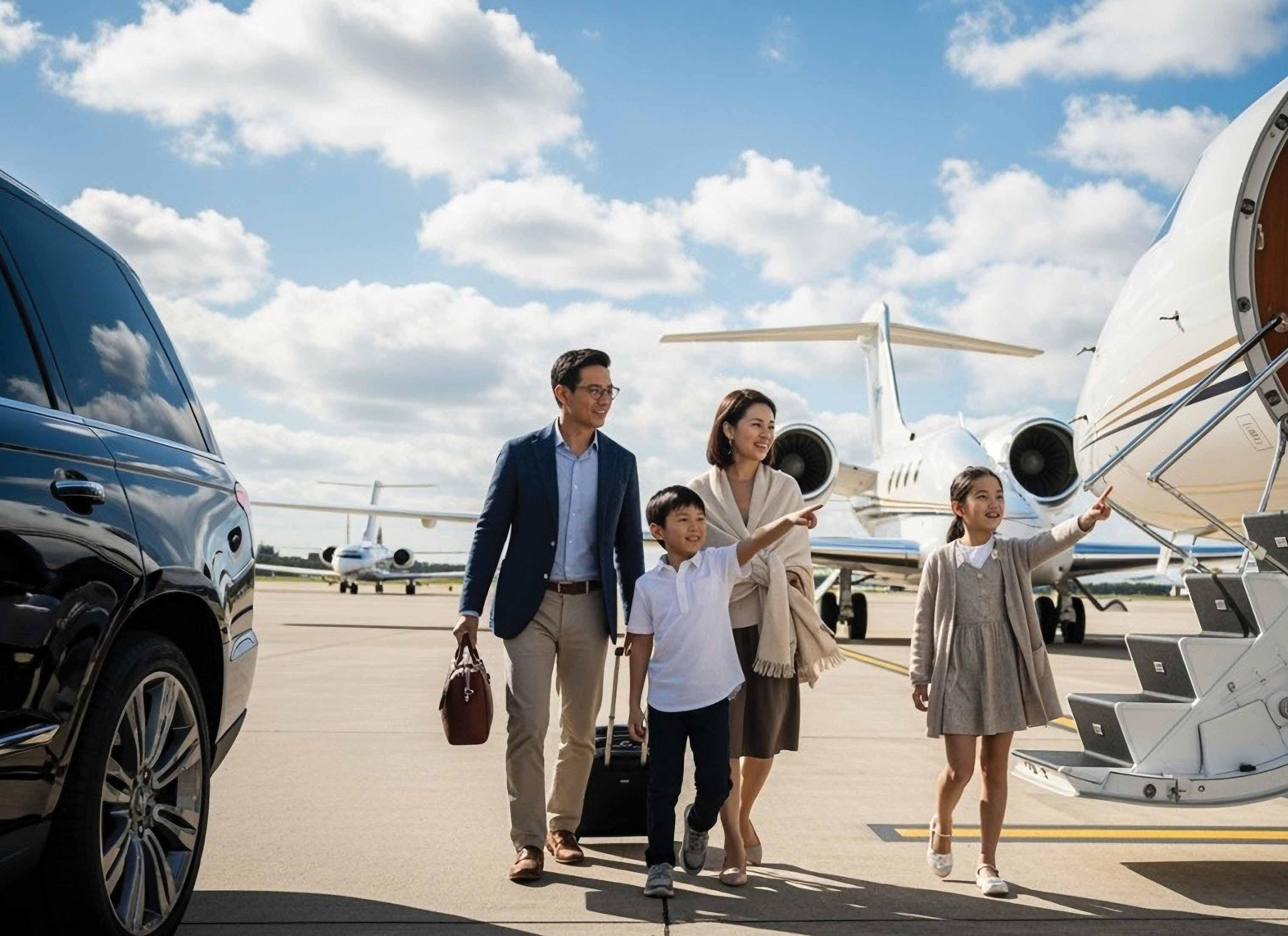
When it comes to flying, nothing rivals the comfort and convenience of private aviation. After all, practically anything is an upgrade from long TSA lines, run-of-themill airport lounges, and the lackluster on-board “amenities” touted by commercial airlines.
Though budget, plane availability, and access to owners, operators and existing flights already making the trip can often make this luxury seemingly unattainable, Eye In The Sky has streamlined the process of finding private flights with a business model and tool that is equal parts state-of-the-art and simplified.
Much like popular ridesharing and home rental companies such as Uber and Airbnb, Eye In The Sky connects existing supply with realtime demand.
Through the platform, which is mutually beneficial for operators and flyers, empty seats on scheduled routes are listed by Hosts so that members can find an upscale alternative to mainstream carriers. Best of all, Eye In The Sky doesn’t take a share or percentage of any trip. Instead, the service charges a nominal membership fee to connect plane owners and operators to potential travelers. This not only offsets operation and fuel costs for each journey, but also provides consumers the opportunity to travel privately for significantly less than a typical fare.
Memberships are invitation-only to ensure a dynamic and professional network. In order to join, Hosts (aircraft owners, operators, charter customers, or brokers) and Flyers (those looking to purchase a seat or empty leg) must receive a direct invite from Eye In The Sky or submit an application on the company website,

www.eyeinthesky.com, and subsequently pass all biometrics and background verification before gaining access to the platform.
A $10 verification fee is required upfront, as well as the completion of a biometric verification and background check process to ensure safety. If the applicant passes and is subsequently accepted, membership dues are only $65/month to use the platform and interact with an alreadyrobust community.
Eye In The Sky’s search and contact tools could also not be easier to navigate. Hosts post upcoming flight information with purchasable vacancies. The Flyer then logs in and searches their desired route. All flights within 100 miles of the selected departure and arrival airports will populate, often providing multiple options to choose from. Flyers can then review aircraft details, seat
Eye In The Sky has also proven to be a unique networking opportunity, as many members have formed business relationships and friendships after meeting and flying together.
pricing, departure windows, and any provided amenities before moving forward.
Should they decide if an open seat (or seats) is a fit, the user sends a message to the Host, requests a reservation, confirms flight information, and pays. The Host then provides plane and FBO info prior to boarding and the Flyer is officially ready for take off. This quick process cuts out a third party to open direct communication and to ultimately prevent astronomically high service charges.
If they can’t find what they’re looking for within the posted flights, Flyers can also utilize Eye In The Sky’s proprietary Flight Interest feature. This service allows members to create an interest post detailing specific requests and journeys, which becomes searchable and forms a group chat within the interest itself on the platform. It’s an effective way to find other travelers who may want to charter an entire plane and, ultimately, split the cost. Or, for Hosts looking to fly from (or near/around) the posted interest destination and date, a flight can be created to accommodate the posted demand.
The benefits of using Eye In The Sky speak for themselves. For jet owners and operators, full flights curb operating fees, increase yield, and improve efficiency. For travelers, private aviation becomes more accessible and allows for
them to avoid the common snafus associated with major airlines. From a sustainability standpoint, emissions are more justified when they’re the result of full flights—a whopping 42 percent (approximately 84,000 flights per month) fly completely empty in North America alone as they pick up charters or make their way back to a home hangar.
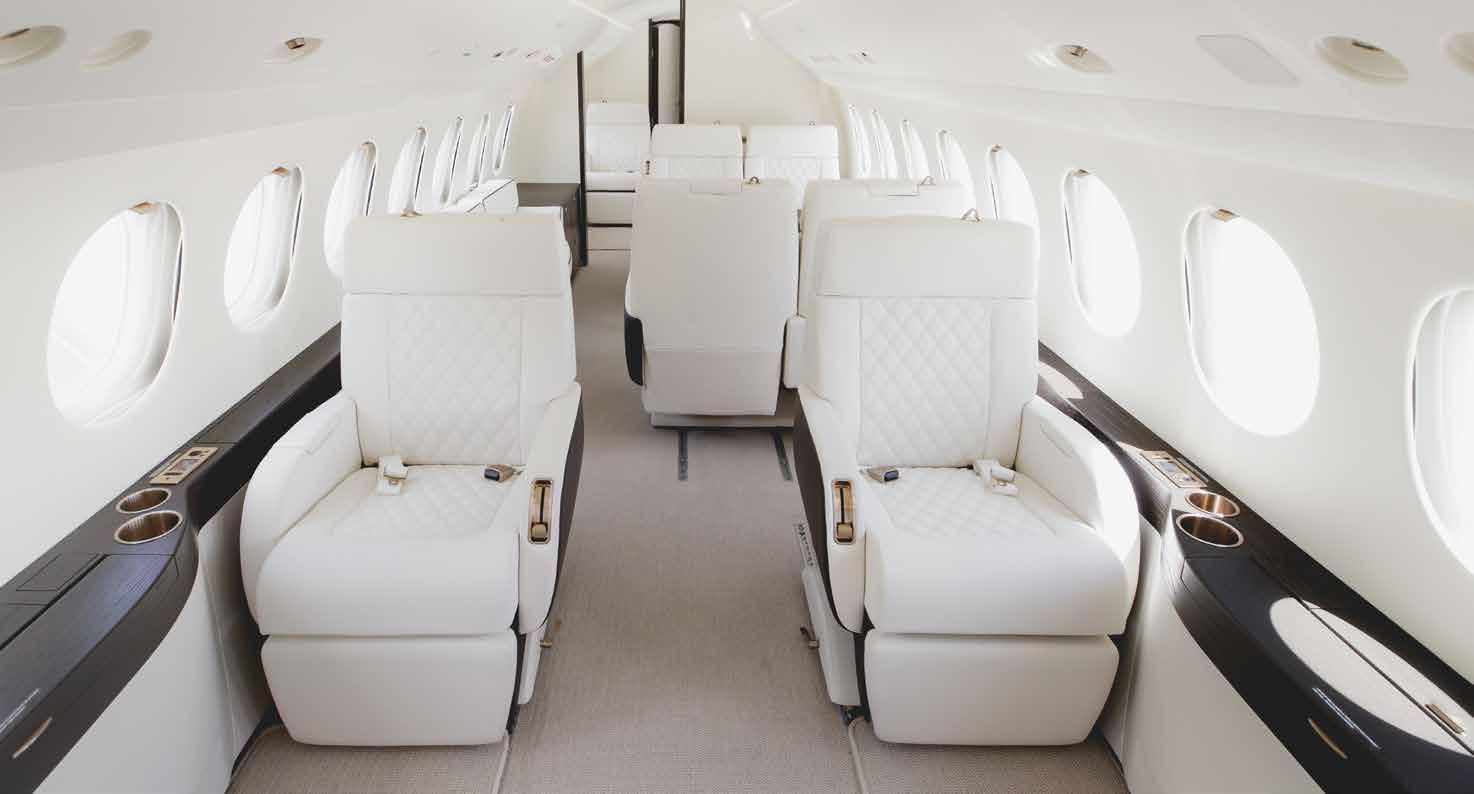
In-flight privacy is also never compromised. Most private jet models ensure spacious seats with more than enough room to stretch legs, sleep, and do work. Hosts also have the option to not fill a plane entirely, should they want or need the extra space to accommodate specific demands.
Eye In The Sky has also proven to be a unique networking opportunity, as many members have formed business relationships and friendships after meeting and flying together.
As commercial carriers roll back long-standing perks and make the flying experience less enjoyable, Eye In The Sky provides a muchneeded, efficient alternative to conventional modes of travel. Whether it’s slashing costs for plane owners or enabling access to private air travel at a lower entry point, Eye In The Sky supports everyone by fostering a living ecosystem within the private aviation industry.

BY KRIS REDDAWAY, MANAGING DIRECTOR CITIZENS PRIVATE WEALTH
For families whose wealth is often entrepreneurial in origin, conversations with their advisory teams often center around businesses built over decades, legacy assets meant to endure, and the freedom to live life on their own terms. Lately, however, a new variable has entered many of those conversations, which is the resurgence of state-level wealth tax proposals—typically aimed at imposing annual taxes on net worth above certain high thresholds.
Whether or not these proposals ultimately pass, they are influencing behavior. Ultra-highnet-worth families are reassessing not just
their portfolios, but where and how they live, travel and hold wealth. Tax uncertainty alone is enough to prompt a thoughtful review.
The question needs to go beyond “What will the law be?” Instead, it’s “If the landscape shifts, are you positioned to adapt without disrupting your life?”
That distinction matters.
One of the first areas to examine is liquidity. Many ultra-high-net-worth families have significant wealth tied up in privately held
businesses, concentrated equity positions, investment real estate or other illiquid assets.
If a wealth tax were enacted at the state level, it could require liquidity on an annual basis. The key is ensuring that capital is available without forcing the sale of a prized asset or triggering unnecessary tax consequences.
Preparation might include reassessing credit facilities, repositioning certain holdings, or intentionally building liquidity buffers. The goal is to maintain flexibility. No one wants to make a rushed decision about selling a legacy property, business interest or prized collection because of a short-term policy change.

“The key is ensuring that capital is available without forcing the sale of a prized asset or triggering unnecessary tax consequences.”
For many ultra-high-net-worth individuals, “home” is not singular. It may include a primary residence, multiple secondary properties and significant time spent across state lines. In that context, residency is not just personal, it becomes strategic.
In recent months, the “where” of wealth has become just as debated as the “how much.” This includes reviewing statutory residency rules, documentation and the practical realities of how and where they live.
Mobility is a great privilege, but mobility without planning can create unintended and unexpected exposure. And trust domicile is equally important. Many families have multigenerational structures in place, often established years ago. In a shifting regulatory environment, it is worth revisiting whether those structures are still aligned with today’s goals. Certain jurisdictions may offer more flexibility or favorable treatment depending on your broader objectives.
However, these decisions should never be made hastily or solely for tax purposes. The right plan reflects how you genuinely want to live—where you want to spend time, deepen relationships, support causes that matter to you and shape your legacy across generations.
A significant portion of ultra-high-net-worth wealth today is entrepreneurial in origin. Founders and early investors often hold large positions in privately held businesses. When a liquidity event, like a sale, merger or public offering, is on the horizon, the window for

planning can close quickly. The most effective strategies are implemented well before a transaction occurs.
If a family is contemplating a potential change in residency, or considering transferring shares into irrevocable trust vehicles, those decisions generally need to be addressed in advance of a liquidity event.
Exit planning is not only about tax efficiency. It is about aligning a financial milestone with lifestyle goals. Many founders view a transaction as a transition point—an opportunity to redefine how they allocate time, where they spend it and what their next chapter looks like. Thoughtful structuring before the event allows the financial outcome to support that vision.
For many ultra-high-net-worth families, lifestyle assets aren’t luxuries in the abstract— they’re deeply personal. The jet that makes a global schedule possible. The yacht that brings generations together each summer. The residence that feels like home, even if there are several of them. In addition to being financial assets, these often carry emotional weight, too. In today’s environment, the planning surrounding those assets requires even greater coordination and foresight.
That doesn’t mean disrupting what brings joy. It means making sure those assets are structured in a way that protects flexibility. Families may benefit from periodically revisiting how lifestyle
holdings are titled, where ownership entities are domiciled and how those structures integrate with broader estate and trust planning.
When planning is done well, it safeguards what matters most and allows families to enjoy their assets without second-guessing the structure behind them.
When headlines start circulating about new tax proposals, the instinct is to wait and to see what happens—to hold off until there’s certainty. That is an understandable reaction, but the strongest decisions aren’t made in reaction to a deadline. They’re made from a place of clarity.
At Citizens Private Wealth, that broader perspective and looking beyond a single policy cycle is central to how families are guided through periods of uncertainty. If a proposal ultimately goes nowhere, you’re more organized and intentional than you were before. If it moves forward, you’re not scrambling.
Tax policy will continue to evolve. That’s simply part of managing significant wealth in today’s world. But mobility, geography and liquidity have always shaped how ultra-highnet-worth individuals and families live. What’s changed is how interconnected those elements have become.
Those who navigate this environment most effectively aren’t necessarily the ones who act the fastest. They’re the ones who act early, long before external pressure forces a decision.

With Exquisite Italian Craftsmanship, Montegrappa Elevates the Art of the Fountain Pen
BY J.R. PATTERSON
There are objects that perform a single function, and there are objects whose function is singular. That distinction matters, particularly for objects designed to last a lifetime. Too often, the objects we acquire are interchangeable, expendable, designed to be discarded. When value lies in function alone, disposal is inevitable. A nondescript ballpoint, purchased in a rush at an airport kiosk, performs a function: ink meets paper, thought becomes legible. The bad pen is its own small but persistent misery: skipping, blotting, failing you at precisely the moment when a thought needs capturing. When that failure occurs, in the bin it goes. A good pen, by contrast, like a sturdy suitcase or a pair of rugged boots, is there for the long haul. A pen from Montegrappa Writing Instruments (available at
select dealers, including Abel Richard stores in Beverly Hills, Miami, Dubai, Singapore, and, from May 2026, London and New York) belongs in this class: a simple object that becomes an extension of the self through its quality and endurance.
One needs only a single glance at a Montegrappa pen to realize such an object cannot be separated from the artisans that made it.
Founded in 1912 in Bassano del Grappa, Italy, Montegrappa belongs to a European tradition that still values the making of things by hand. That it is Italy’s oldest (and continual—even two world wars did not interrupt its practices) manufacturer of fine writing instruments might alone tempt one toward reverence, but age, in luxury, is never sufficient. What matters is not simply survival, but continuity of intention. That doctrine begins in the workshop, with tools and processes of creation not smoothed


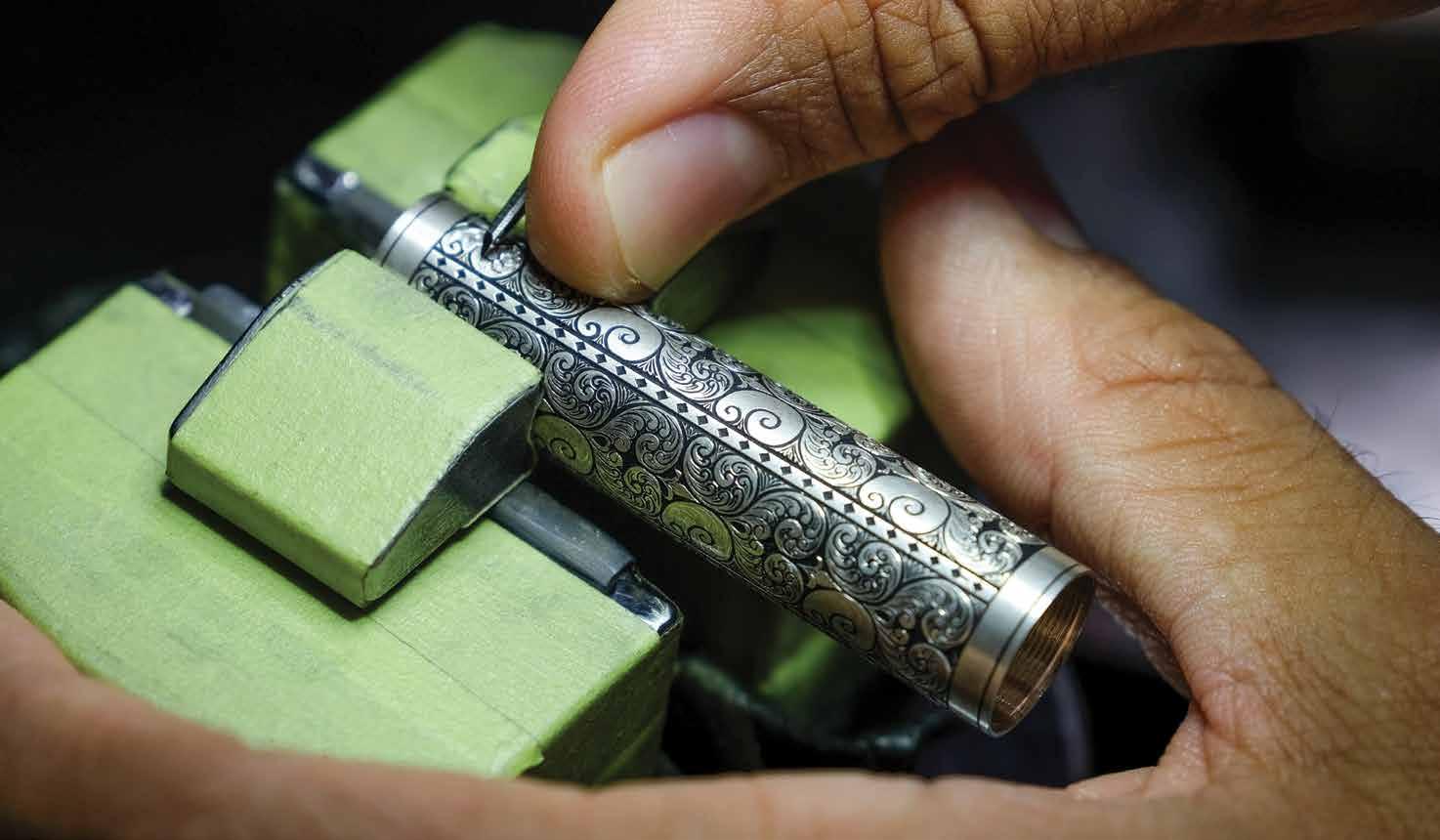
by mass production. Montegrappa’s artisans spend years refining their skills: hand-turning resin, metal engraving, hand painting artwork on a tubular medium, setting of precious stones. Each component is one part of a sequence of actions performed by individual artisans that may take anywhere from a week to upwards of six months to complete. In a world saturated with things that are infinitely replicable, such integrity of craft can feel almost radical.
Montegrappa CEO Giuseppe Aquila, whose choice of fountain pen alters between the gold-trimmed Extra 1930 and the carbon fiber Automobili Lamborghini 60° with titanium trim, says that “the role of the pen has changed, bringing us closer to the real values of life.” That is to say, as a piece of crafted art, these pens remind us that even the simplest acts—placing ink on paper—are embedded in a network of relations between people and materials, a broader history of making and using. To use such a pen is to enter into this network, accepting in the process that the value of an object lies not only in what it does, but in how it situates us within the world.
A product such as Montegrappa is the result of knowing the aesthetic dimension of an object is not separate from its function; it shapes the experience of use. Any prolific letter writer can tell you that to hold a well-made pen is to naturally alter your gestures: the hand adjusts, the grip refines itself, the movement becomes more deliberate. Thus, the object influences the writer, and demonstrates that the Montegrappa pen is not merely a tool, but a means of expressing the self. Collectors, of course, understand this instinctively. For them, a Montegrappa pen is not merely a possession but a point of entry into a broader world of
connoisseurship. There are models inspired by literary figures, by historical moments, by the grand, operatic sweep of Italian architecture. Montegrappa pens do not merely commemorate motifs, they also interpret, with bespoke, tell-us-and-we-will-build-it options (the list of materials is endless and exotic: wood, marble, mammoth ivory, gold, platinum). In this, Montegrappa operates less as a manufacturer and more as a curator of tactile memory.
A Montegrappa pen, given as a gift, perhaps, arrives already freighted with intention: it says that writing matters, that thought deserves a utensil commensurate with its importance. When Aquila suggests that we are entering a “golden era for fountain pens,” he invokes the passage of time, suggesting that to give or to receive such an object is to acknowledge that even in an age of ephemeral,

frictionless communication, there remains a place for objects that endure, that insist on friction. “Each time we set pen to paper,” says Aquila, “We are saying that some gestures are worth making beautifully.” In this sense, the Montegrappa pen is not an anachronism, but a proposition: that in the midst of a culture of disappearance, there remain objects that insist on presence, on duration, on the enduring significance of the human hand.
There, of course, lies is its spirit of purpose. A Montegrappa pen is art, but also a thing of action, meant to be carried in a pocket, drawn out in moments of inspiration, and used and cherished in a place far from where it was made. It is a tool, certainly, but also a reminder: that some acts are worth doing with care, are worth keeping. And that the simple gesture of writing, repeated over time, can give shape to a life.

These Innovative and Elegant Timepieces Made Their Stunning Debut During Geneva’s Best Watch Week
BY ANNIE STOPAKS

This past spring, Geneva, Switzerland was brimming with watch enthusiasts for the annual Watches and Wonders show. Press and patrons piled into the Palexpo convention center mid-April to witness some of the most beautiful timepieces of the decade. With 65 total exhibiting brands and 11 new names joining the roster, it was one of the largest shows to date, and the watches did not disappoint. This year, the event carried a distinctly more intriguing allure.
Sleek, slender, and smart design stole the show. A shift towards refined elegance was apparent in understated silhouettes, heritage elements, and quality over quantity. Art and storytelling were woven into the value of each watch, creating an environment where shoppers could lean in and listen. After all, who doesn’t want a watch with a captivating history? Although deep blue and green hues widened eyes, the soft and neutral tones reinforced the calming opulence that was practically inescapable. There was no question that collectors left the show stunned, savoring the hidden novelty of the watch world.
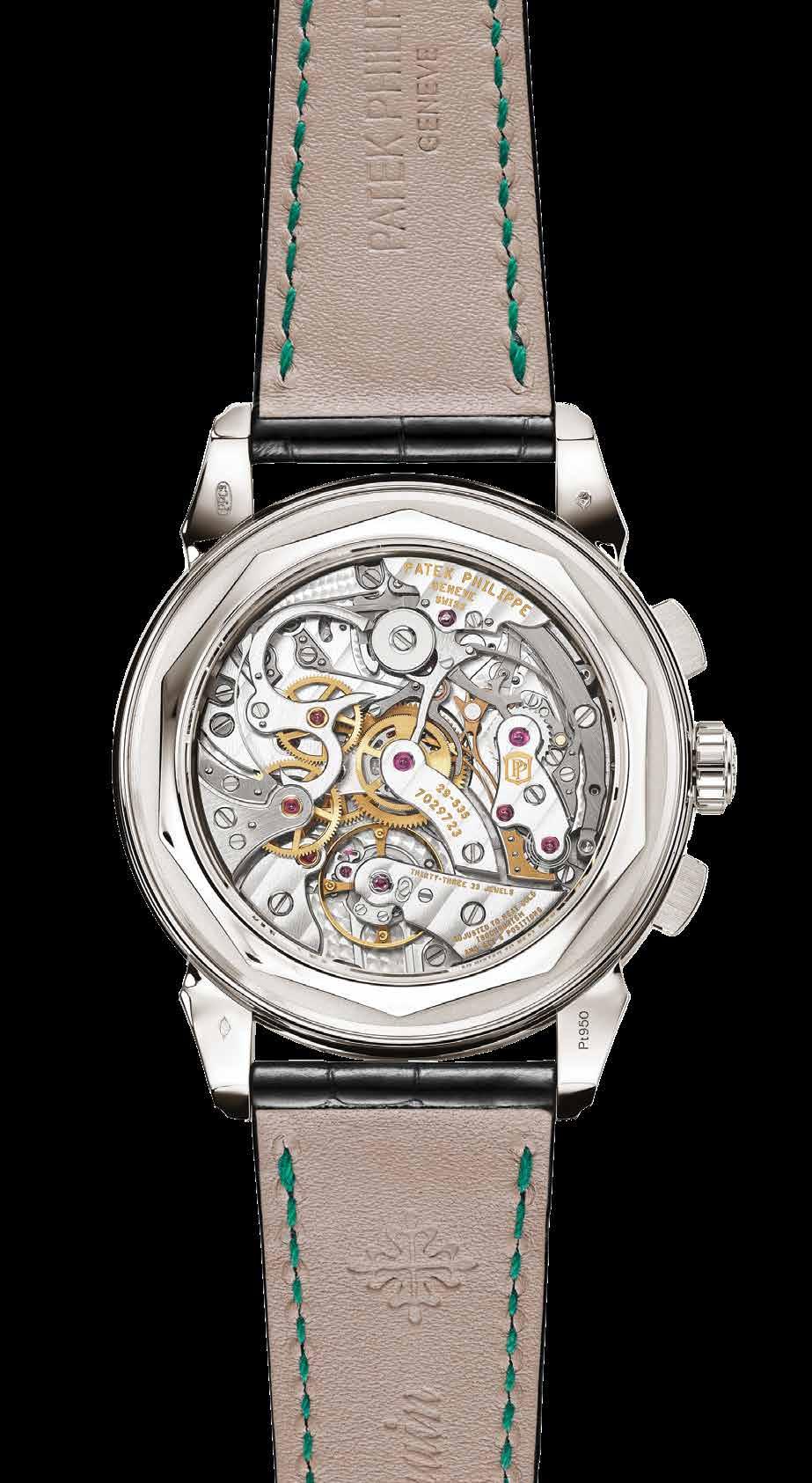
Several strong debuts were made by legendary brands like Patek Philippe, Rolex, Cartier, and TAG Heuer. Patek Philippe in particular caught attention for the 50th anniversary of Nautilus, with a limited edition collection reimagined with a sunburst blue dial that was incredibly elegant, setting a new standard in ultra-thin watchmaking. The brand also showcased 20 new models, including highly complicated pieces. Jewelry watches and gemstones had a strong presence this year as well, especially from maisons like Piaget and Bvlgari. There were fewer watches this year overall, but the detailed renditions and high value of luxury items gave the impression that “less is absolutely more.”
Among the newcomers was luxury house Bianchet, who was praised for the sporty elegance and mathematical beauty of the recently-debuted Ultrafino collection. The independent Swiss watchmaker, founded in 2017, is relatively young in the world of watches but by no means playing it small. The brand unveiled UltraFino “Maserati,” a limited edition watch that fuses luxury automotive with
technical prowess. Drawing from the speed of the supercar, the watch is equipped with a flying flat tourbillon and trimmed in fresh aqua blue like the Maserati MCPURA. The “Rotondo,” also in the Ultrafino line, has the same skeleton movement like the “Maserati” but includes the option of carbon as well as a titanium bracelet. “Rotondo” boasts a clean bezel and sharp edges, which is perhaps a more elegant and timeless look for Bianchet as the maison rarely plays it safe when it comes to design.
Another newcomer to the show this year was Audemars Piguet. The brand holds over 150 years in the watch business and deserves excellent recognition as such. The seasoned brand stole attention with the Royal Oak collection due to its intelligent use of highhorology and impressive material. Two options in the collection include the “Mini Quartz” watch—a 23mm well-suited for petite wrists— crafted of 18-karat pink gold with a black onyx dial and the “Self Winding” watch, ornamented in 18-karat yellow gold complete with a brilliant green malachite dial. Another notable mention is
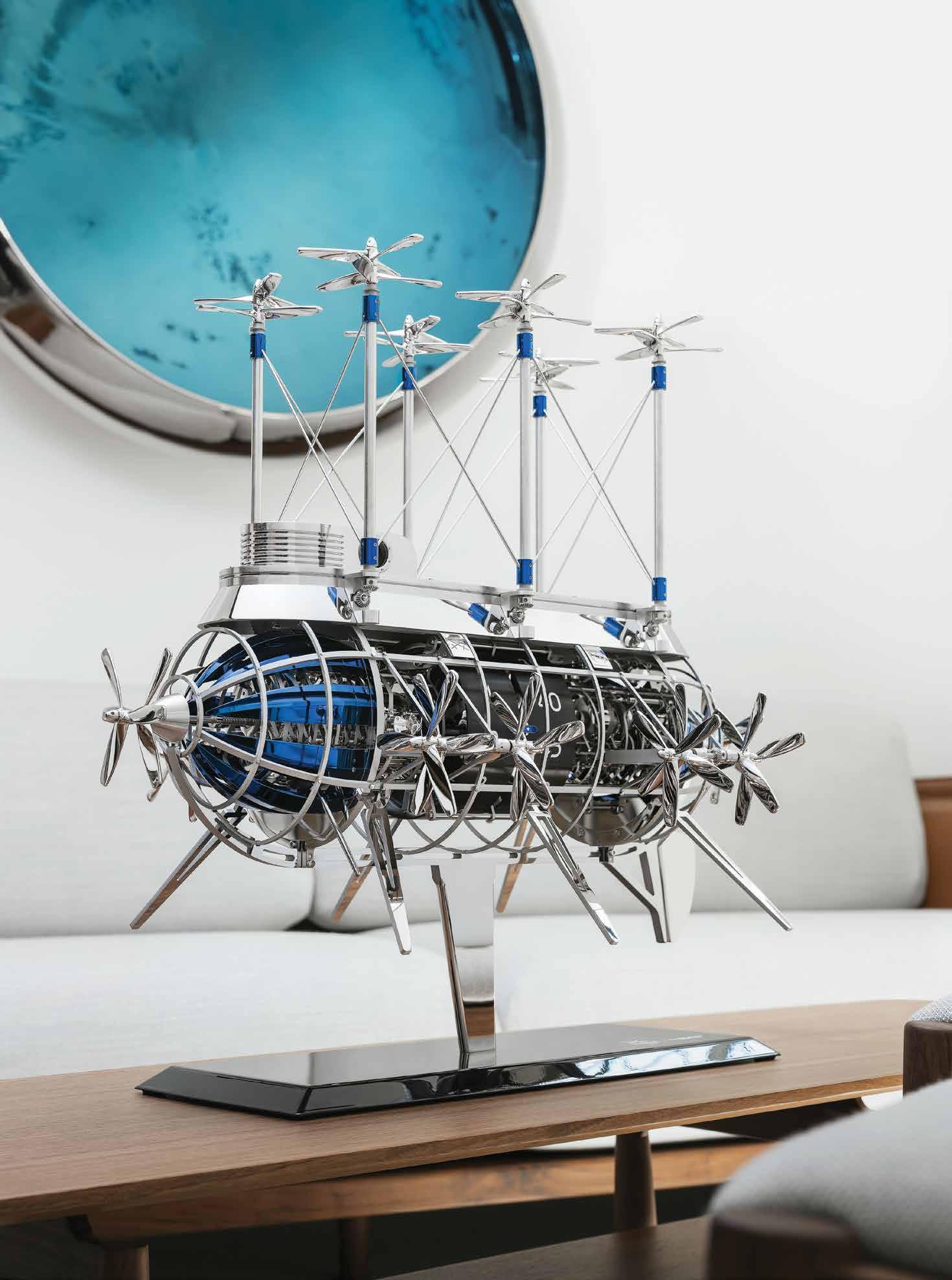
the “Jumping Hour” in the Neo Frame Inspired by Art Deco watchmaking from the mid-1600s, the numbers leap every hour and the minutes drag instead of using continuous hands. It’s a modern take on a wrist watch, exuding history and charm much like the brand itself.
L’Epée 1839 is perhaps best known for its heritage, revered all the way back to the date in its name. Although the brand began in 1839 selling carriage clocks (portable pieces to keep time on long journeys), L’Epée is best known today for creating complex table clocks. Near the center of the booth stood the La Regatta Métiers d’Art collection. In all its grandeur, the set was presented as statement art rather than traditional clocks—a surprising twist. Métiers d’Art was inspired by a racing skiff gliding across water. In the name of competitive rowing,
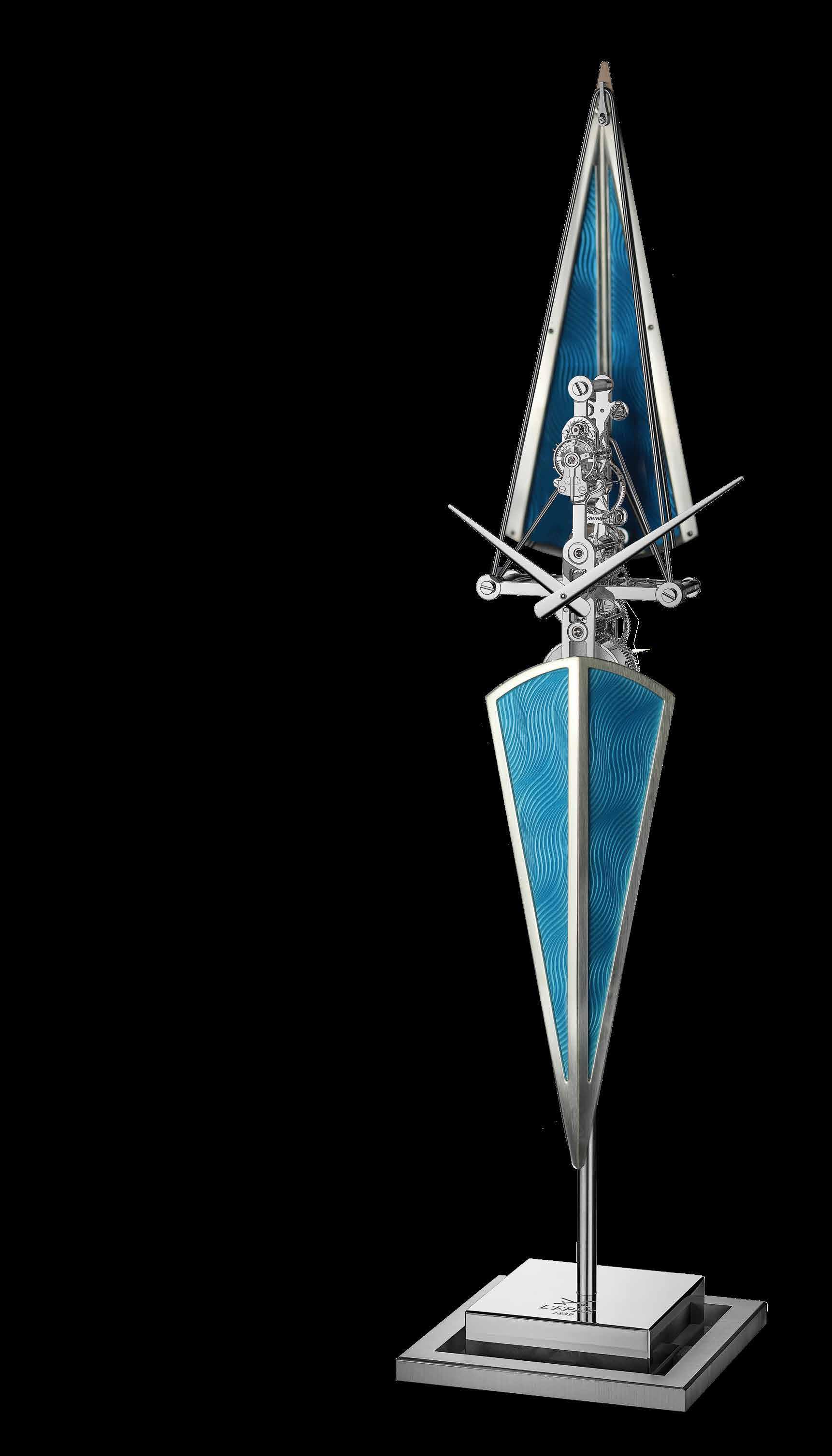
each clock was unique, crafted with remarkable “Grand Feu” enameling work and burned in a kiln at high temperatures. Not only did the display reinforce the emotional rhythm of rowing, it told a compelling narrative that bonded the collector to the piece for years to come.
Sinn Spezialuhren, another first-timer to Watches and Wonders, is a brilliant German designer who had its beginnings in the early 1960s. The brand is best known for highlytechnical pilot and diver watches that are engineered for the elements. The “308 Hunting Watch,” crafted of smooth stainless steel, has functionality and style unlike anything else in its class. This version includes not only antifog mode but an exceptional moonlight display that indicates peak brightness each evening. Also in a stainless steel

bracelet with a green dial, the “903 ST II G” is perhaps a less clean and minimal option from the brand, but it is legible in the dark and is a classic navigation chronograph that functions like a stop watch. The “936 S” is a chronograph as well but the case features a scratch-resistant duo of stainless steel and titanium for ultimate durability. Visually speaking, this version has the most luxe design, making it well suited for city dwellers and outdoorsy types alike.
IWC Schaffhausen is arguably one of the most respected leaders in luxury watchmaking for many reasons—mainly its intelligent Swiss engineering. Back in 1985, the brand was the first to create a synchronized perpetual calendar operated by a single crown. Today, nearly 41 years later, the brand has a single-crown perpetual calendar, but it also moves backwards and forwards. IWC’s “Perpetual Calendar Proset” cultivated attention at the show for its ability to reverse time, all the way back to the year 2000. The “Pilot’s Venturer Vertical Drive” retains the same futuristic element yet includes space travel in an exceptionally unique watch. Accented with the same deep blue gradient as the “Proset,” it has a rotating bezel without a crown allowing all adjustments to be made while wearing a space suit. Not only is it technically sound, it’s beautifully finished in sapphire glass and white rubber for a refined yet sport-forward aesthetic.
Two more returning watch brands include Patek Philippe and Bvlgari. Both have created exceptional reputations in high horology and



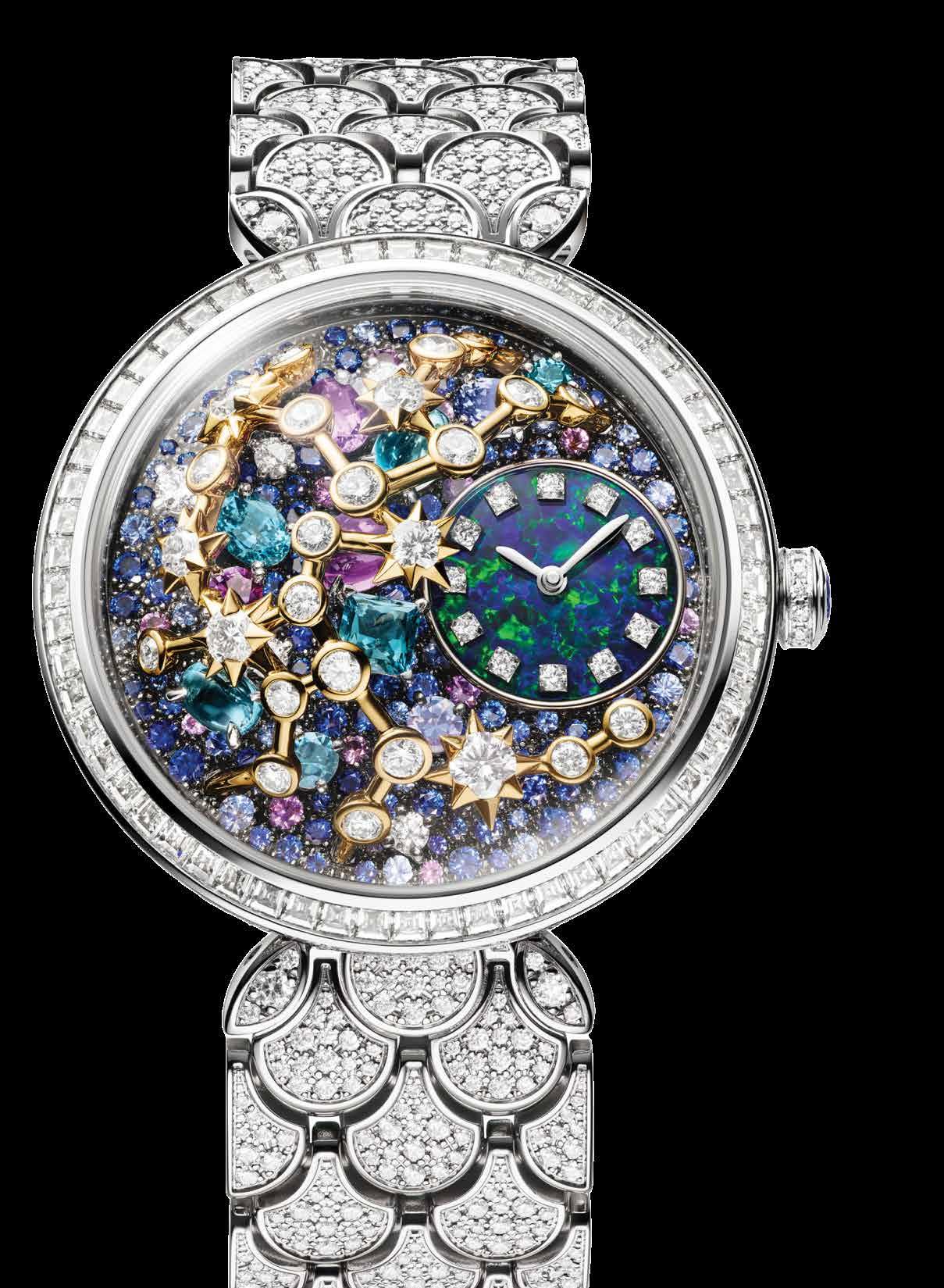
kept this achievement going throughout the show. Patek Philippe was a clear stand out among attendees for new releases in the Complications and Grand Complications collections, like the “Celestial” watch, which features a sunrise and sunset indicator to sync with the sun and moon phases and “The Crow And The Fox” watch, a storybook rendition of La Fontaine’s book. Designed by Louis Cottier in 1958, the brilliant automation includes the fox moving a paw or jaw with each tick. This wristwatch is a historical delight with an eclectic twist, finished in a rose gold case and a brown “Matara” dial.
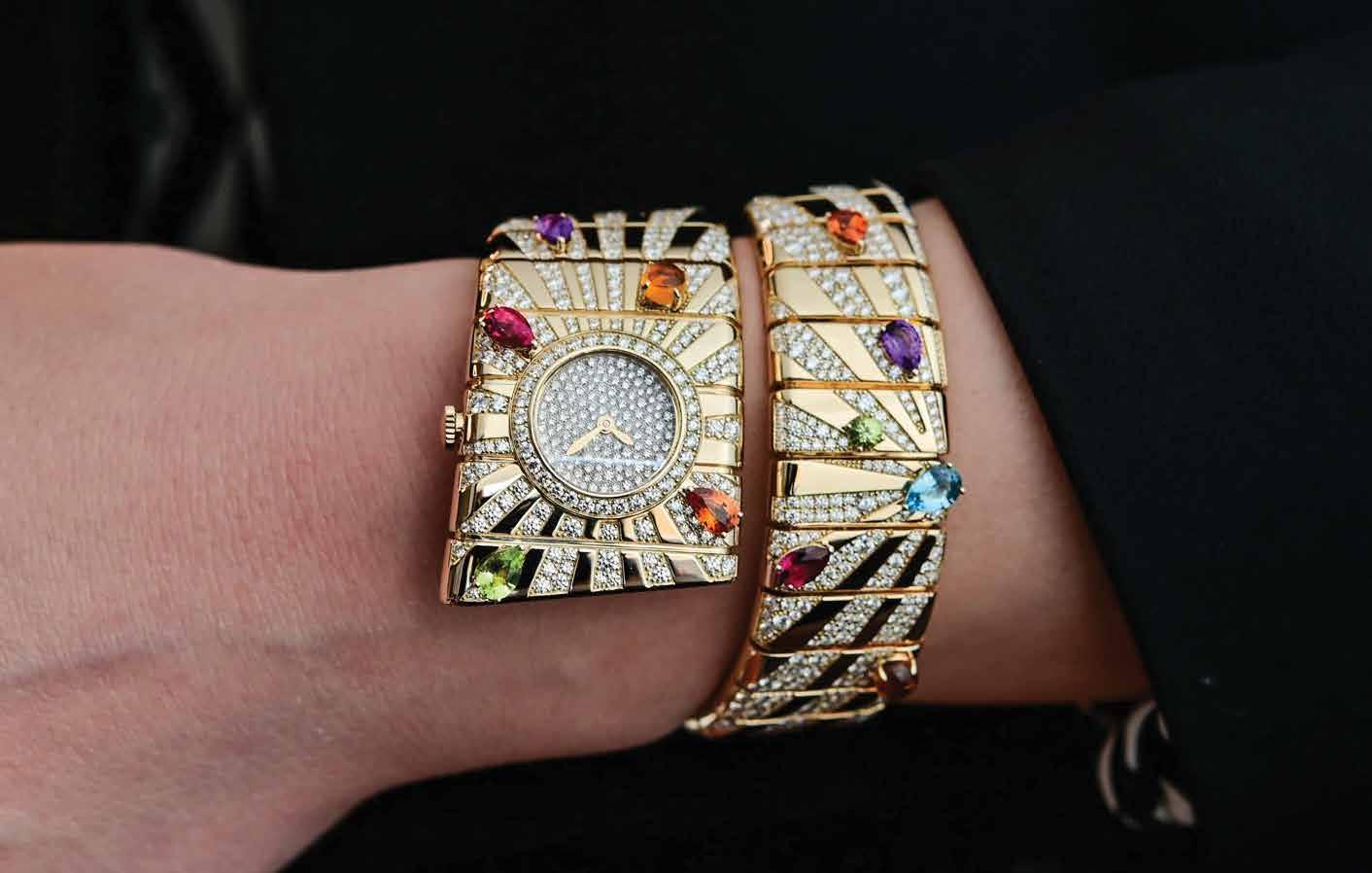
Bvlgari was dripping in decadence, as per usual. The powerhouse brand blended history and fashion with notoriously-thin watchmaking. The “Maglia Milanese Monete” includes a hidden Roman coin in beautiful rose gold on a mesh bracelet. This style is similar to its predecessor “Monete Catene” which includes the same coin yet sparkles a little more boldly with a dual curb chain bracelet. “Tubogas Manchette,” an eighties-inspired watch, boasts a brilliant yellow gold wrapping cuff adorned in gemstones. With almost 12 carats of diamonds, you almost forget it includes a petite circular watch dial, which gives this glamorous piece a fresh dose of functionality. There’s no doubt in our minds that these collector’s items will be heirlooms for many years to come. The ability to move time is not only praised for its high innovation but it’s also quite remarkable—we now hold the power in our fingertips to shift time. The emotional effect of these watches was undeniable, given the narratives and stories created around them. The unique identity that these watches elicit brings a sense of free-spiritedness and adventure. It serves as a reminder that elite watchmaking and easeful wearability can live together harmoniously.


BY FELICITY CARTER
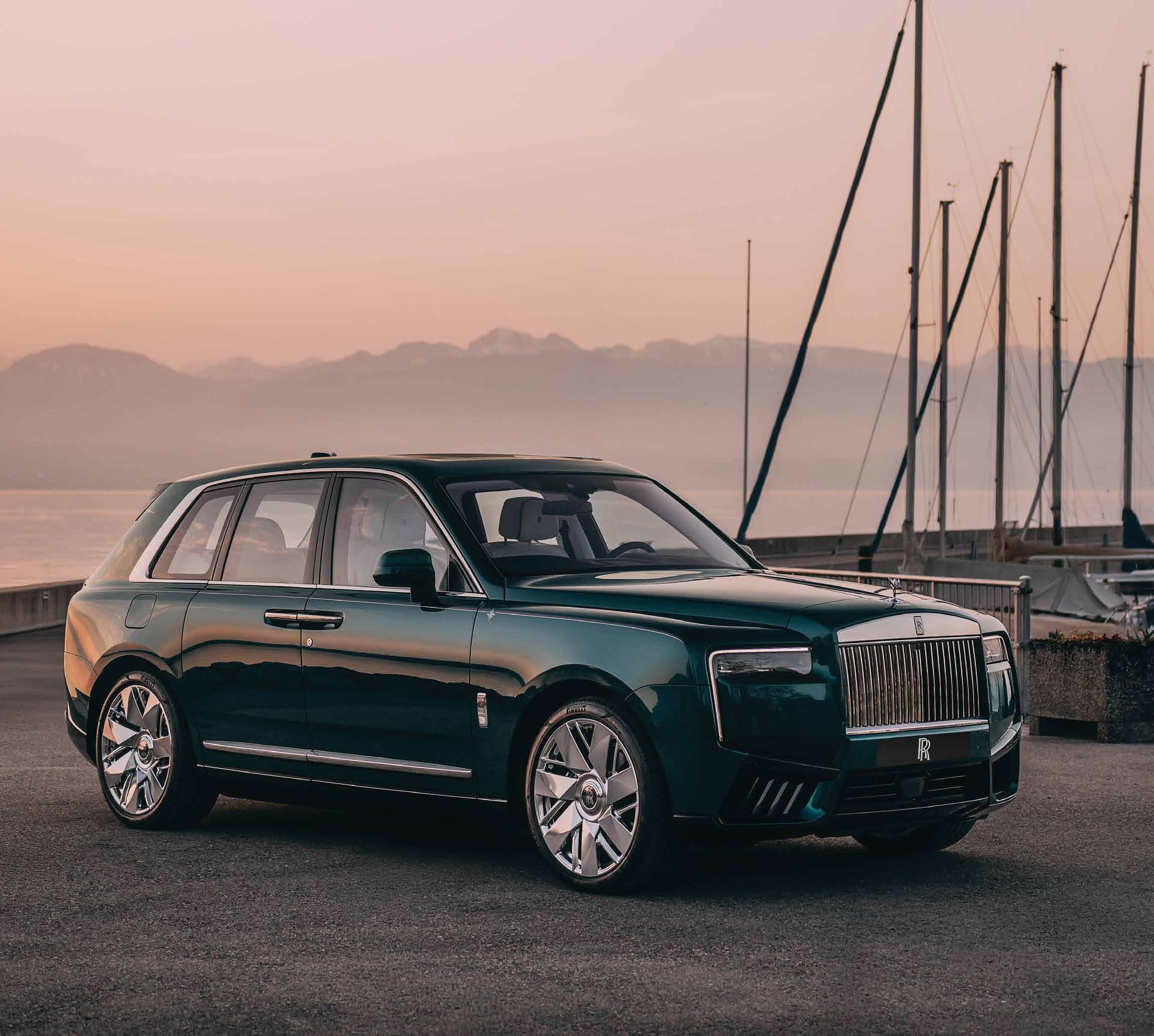
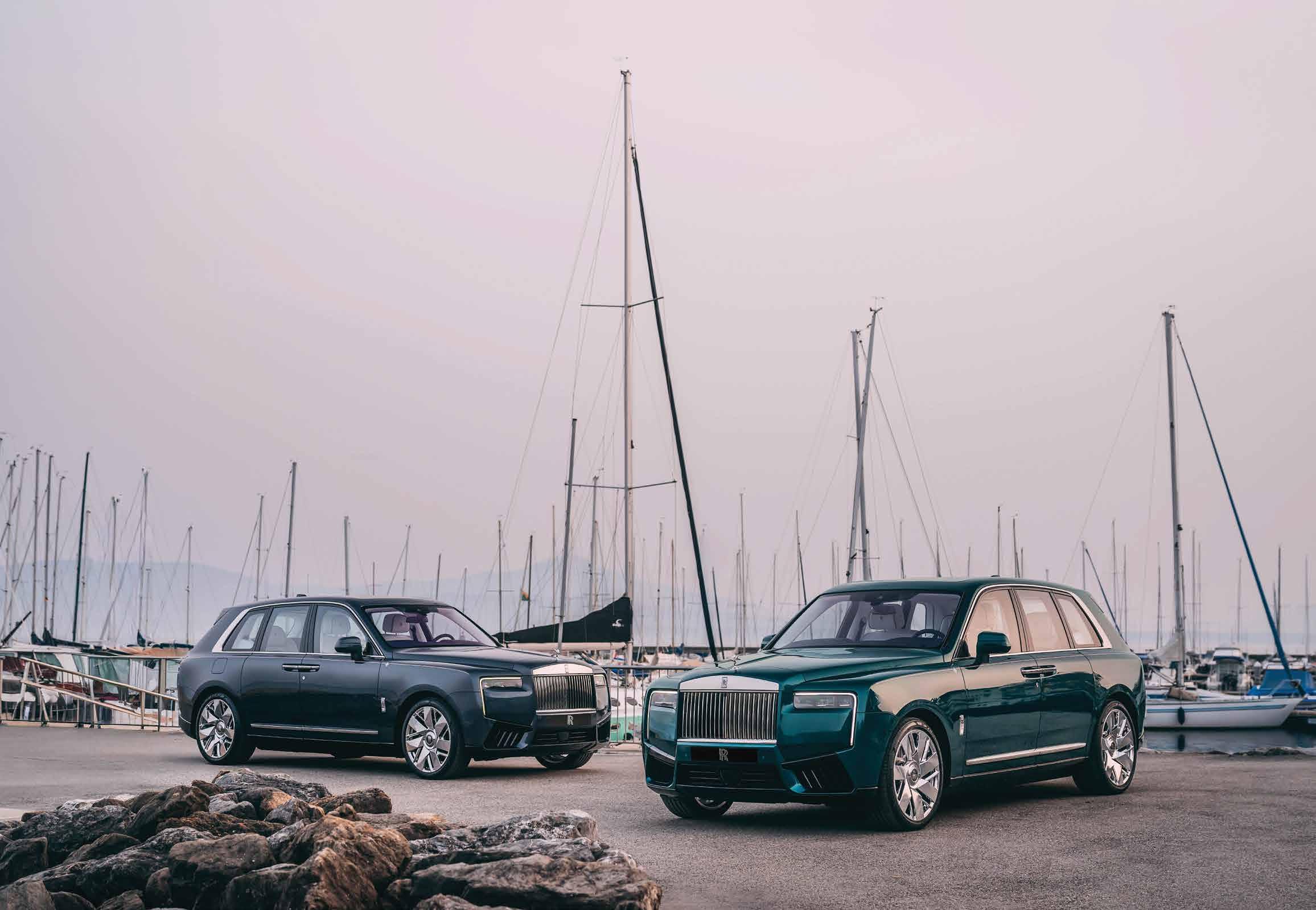
Aquartet of bespoke commissions developed by Rolls-Royce Motor Cars has joined its creative family, as we see the new Cullinan motor cars draw inspiration from yachting culture. Each of the Cullinan models is thoughtfully aligned with one of the cardinal points of the compass, with exterior finishes and coachline details that reflect their orientation. These were developed within the bespoke studio at Goodwood in West Sussex, England, where the cars are designed and built by hand.
The yachting references are carried through material craft. Expect open-pore teak, famously associated with decks, appearing in the interior, including the rear waterfall and center console,
while a compass motif made from more than 40 individual pieces of veneer anchors the rear cabin, reinforcing the directional theme. Across the fascia, Rolls-Royce artisans developed a painted composition that nods to the wake of a tender. This process took two months of experimentation with pigment, lacquer and application technique. Overhead, the starlight headliner has been mapped to Mediterranean wind patterns, highlighting, quite literally, the context that underpins this project. It provides one of the most expansive surfaces within the bespoke interior.
The Cullinan is an all-terrain model and is the one that the brand says best matches how many of their clients travel between city
residences, coastal properties and yachts. It is this relationship, and the link with the world of yachting that goes back more than a century. Charles Rolls served aboard his family’s schooner-rigged steam yacht, called the Santa Maria, before the formation of the marque, and references drawn from yacht construction and proportion have continued to show up across later Rolls-Royce designs, including coach built commissions that were inspired by classic racing vessels.
Marking 120 years since the original partnership between Charles Rolls and Henry Royce, the Cullinan pays homage to the tradition of custom commissions at Rolls-Royce Motor Cars. It highlights the maritime lifestyles many of
“Teak introduces an authentic feel and look. This connects the occupants to a maritime feeling through touch and scent.”

its clients enjoy, from the blue waters of the Bahamas to the Capri coast.
According to Nicholas Ryan, Head of RollsRoyce Motor Cars Private Office New York, “This Cullinan commission uses materials, proportions, and spatial flow that translate from yachts. Particularly the teak, open finishes, and lines inspired by a nautical horizon create a calming environment.”
We see the maritime theme shown most visibly through the painted fascia artwork, where each commission offers its own hand-finished interpretation of a tender’s wake moving across water. Describing the inspiration, Ryan adds, “The wake captures movement, direction, and purpose—core to yachting. This gave our artisans a way to create the fluid, hand-painted compositions that feel alive. They are entirely unique within each commission.”
Material selection reinforces that continuity between land and sea, in particular, the teak. Ryan explains, “This connects the occupants to a maritime feeling through touch and scent. Teak also reinforces our craftsmanship and durability. Teak is synonymous with both yachts and luxury.”
Symbolism also plays a role within the interior, and at the heart of it is the marquetry compass motif that’s positioned within the rear waterfall,
offering a directional reference that can be seen across all four commissions. “Clients are increasingly looking for a narrative-driven design, he says. “Symbolism like the compass conveys direction, identity, and journey. This makes a commission more personal and emotional.”
Such references often come directly from conversations with the clients themselves, “Some clients arrive with a yacht vision in their mind, while others have a maritime concept. That is what Private Office does, draw the
inspiration from each individual client into a design creation. It’s a place where we can get to know the client and what they really are looking for in their Rolls-Royce commission.” Today, it connects with taste and culture with many owners seeing their cars as part of a wider design world that incorporates architecture, aviation, and marine environments. Ryan explains, “That is the real reason we have created Private Offices around the world. Every week, I sit with a client and designer to talk about their likes and dislikes, their inspiration, and ideas. Our clients inspire us to greatness in the design of every commission.”
“It’s an inspirational experience,” Ryan states. “From the bespoke lounges of our Rolls-Royce Motor Cars dealers to our new Private Office New York, this experience, design inspiration, has become the real ‘product’ that only RollsRoyce can offer our clients.” That approach appears across markets, too. Ryan imparts, “I would say Rolls-Royce clients approach bespoke uniquely for ultra-high-end automobiles. For them, the bespoke process is often more important than taking delivery of the commission. It’s the experience, the journey that is unique.”
In that context, the Cullinan shows just how much inspiration still comes from the maritime world, even 120 years later. “The connection to yachting is a common inspiration,” Ryan says. “We have interpreted this before and will for sure again. Our clients are inspired by excellence where they see it. On their wrist, necks, in the air or on the water.”


A Powerful Hybrid You Might Finally be Interested in Buying. And it Comes with Audi’s RS Badge.
BY MATT CHAPPELL
There’s a conversation happening in high-performance motoring right now, and it goes something like this: can a hybrid really be a proper driver’s car? The purists say no. The engineers say watch this space. And Audi are very much saying yes, with the all new RS 5.
The new RS 5 is Audi Sport’s first-ever plug-in hybrid. Before you reach for the next page, hear this: 0-62mph in 3.6 seconds. 639PS. A top speed of 177mph (with the Sport pack). A world-first electro-mechanical torque vectoring system that redistributes torque between the rear wheels every five milliseconds. This is not a hybrid that apologizes. This is a hybrid that goes hunting.
Audi has serious heritage. Its celebrated Quattro four-wheel drive was born in rally racing in the 1980s, terrorizing stages and rewriting the playbook. The German marque has conquered Le Mans, dominated DTM and now, from 2026, got itself busy in Formula 1 building a works team. The RS badge has always been the distilled essence of this racing pedigree, road-legal and
barely contained. The RS 5 carries all of that— and then adds something genuinely new.
Under the bonnet, a twin-turbo 2.9-liter V6 produces 510PS alone. The electric motor bolts on another 130kW. Together, it whacks out 639PS and 825Nm of torque—enough to embarrass a lot of cars wearing far more exotic badges. But this is also an Audi that will quietly charge overnight and whisk you into the city on electric power the following morning without destroying your neighbor’s sleep. It’s the sort of car that can wear many hats. More on this later.
Where it gets very interesting is what’s happening at the rear. Audi calls it Dynamic Torque Control, and it’s a world-first in a production car. A small but extraordinarily clever electric motor shuffles torque between the left and right rear wheels almost instantaneously. We’re talking 15 milliseconds. Nine tenths quicker than you can blink. The result is a car that turns in with a scalpel’s precision, rotates through corners with composure and, if you choose the right mode, will drift around corners with smooth satisfaction.

Yes, there’s a “drift” mode. Audi calls it RS Torque Rear mode and obviously it should be used only on a closed circuit. A large chunk of torque is generously given to the outside rear wheel, which makes the car feel particularly playful. What’s more, you can record your drifts, too, with the Audi driving experience function. It also gives you track data, like accelerator and brake pedal use, oversteer, understeer and lateral, longitudinal, and overall acceleration. On world-famous racetracks, too, if you want.
The RS sport suspension has twin-valve dampers, which essentially means you can take the RS 5 on the morning commute or go feral on an alpine road, and it will adapt to whichever situation you throw it in accordingly. Wider bodywork than the standard A5 gives it the muscular, planted stance you’d expect, along with matte oval tailpipes for the RS sport exhaust. A checkered-flag daytime running light signature leaves you in no doubt at what you’re looking at.
Inside, it’s every bit the modern Audi. Curved panoramic displays, a 14.5-inch touchscreen, deliciously crafted interiors. Plus, there’s even a “boost button” on the steering wheel which deploys full power for ten seconds flat for overtakes, or simply the theater. If ever there was a tell Audi are now in Formula 1, this might be it. Now you, too, can channel your inner-Hülkenberg
The competition is fierce, of course. You’ve got the BMW M3 Competition to think about. The Mercedes-AMG C63. The Alfa Romeo Giulia Quadrifoglio. All significant bruisers. For the RS 5, there’s the Saloon and the Avant to choose from, with European sales opening in Q1 2026 and deliveries expected in the summer. We’re still waiting on details for a US release date to be announced at the time of writing, and if the grapevine is anything to go by, it may not include the Avant but we don’t know. Then again, when has that ever stopped you?


BY KELLIE SPEED
When hoper launched in the Greek isles in 2024, their mission was clear: make helicopter travel more accessible between the islands. As they continue to grow, they have expanded their business platform to now include France, Italy, Switzerland, and the United States.
hoper’s online marketplace for “vertical mobility” connects vetted operators with travelers seeking either shared flights or private charters.
“On certain routes where there are predictable transfer patterns, we layer in a shared seat structure that makes helicopter travel bookable in the same way you’d book an airline ticket,” said Demitris Memos, hoper’s CEO and founder. “It works in Greece because the geography is perfect for it: short distances between islands, high seasonal demand, and genuinely poor alternatives. A four-hour ferry becomes a 35-minute flight.”
Memos says launching an American platform comes with different challenges, but their business model hasn’t changed. “What changes
is the use case,” he said. “In Greece, we’re solving an island connectivity problem. In the U.S., the opportunity is shaped by urban congestion and high-value leisure corridors— think JFK to Manhattan, or New York to the Hamptons. The underlying mission though is identical: help people reclaim their time by making vertical mobility accessible.”
Offering cost savings to the consumer while also helping travelers reclaim lost time due to travel delays has always been at the forefront of hoper’s business plan. “Accessibility is our core mission: making helicopter travel bookable and available at scale, for the first time,” Memos said. “Affordability is what makes that accessibility real. We are positioning travel with hoper as a practical, everyday choice, not a luxury reserved for the few.”
With seats costing as low as $130 for a shared flight, hoper works much like a micro-airline with cost savings passed onto the traveler. “By aggregating demand across multiple passengers on the same route, we’re able to distribute the cost of the aircraft across seats,” Memos said. “That’s what unlocks the price point. We also benefit from route density. The more routes and


When asked which age group hoper is targeting, Memos said they focus more on why they are traveling rather than who is traveling. “What unites them is a shared set of values: they value their time; they appreciate well-designed experiences and they’re open to rethinking how they travel,” he said. “That cuts across generations entirely. Whether it’s a couple islandhopping in Greece or someone heading out to the Hamptons for the weekend, the common thread is a preference for efficiency and experience.”
hoper’s shared seat model has also expanded the way consumers view helicopter travel. For those who may have considered it reserved exclusively for high-net worth travelers, hoper’s affordability has proven to be a game changer.
“That’s naturally drawing in a broader and younger audience, and we see that shift accelerating as the network grows and awareness builds,” Memos said. “2026 is a significant year for us across several fronts. In Greece, we’ve expanded our shared flight network to 15 destinations and more than 50 routes. We’re launching into Italy with private flights operating from Cannes, Nice and Monaco to Milan, Florence, Portofino and Turin.”
Within the United States, hoper operates helicopter sightseeing in Los Angeles and is planning to introduce full operations out of New York, including both private flights and shared flight service between JFK and Manhattan in September, timed around the U.S. Open Tennis Championships.
Memos says hoper’s expansion strategy focuses on regions where geography and congestion make traditional transport genuinely inefficient, and where a strong culture of premium travel is already in place. “In Greece, island geography made the case obvious,” he said. “Connections that would take hours by ferry take under 45 minutes by air. In the south of France, it’s the combination of luxury leisure corridors and congested coastal roads. In the US, it is dense urban demand paired with high-value leisure destinations with New York to the Hamptons being a clear example. We’re looking for places where the time saving is most tangible and immediate.”
In recent years, helicopter travel has gained popularity in the United States as travelers seek options for faster transit. “America already has a strong appetite for premium, time-efficient travel,” Memos noted. “People instinctively understand the value of reclaiming time, especially in corridors like New York where ground transport has become increasingly unpredictable.
Awareness of vertical mobility is growing fast, and legislation is catching up. The U.S. Congress introduced the Aviation Innovation and Global Competitiveness Act in February 2026, specifically to accelerate FAA certification
of eVTOLs (electric Vertical Takeoff and Landing aircraft), bringing vertical mobility into mainstream conversation.”
Memos believes America has also ideally positioned itself as the home where the next generation of aircraft is being built. “Many of the eVTOL companies that will define the future of short-haul aerial travel are American, and that concentration of innovation is creating an ecosystem of investment, infrastructure, and public awareness,” he said. “We expect passengers to be traveling in flying taxis by 2028 to 2030, and we’re laying the groundwork for that now. What hoper is doing today is bridging the gap between today’s helicopters and tomorrow’s electric aircraft. By the time eVTOLs are certified and ready to scale, the behavior will already be there. And we intend to be the platform that carries it forward.”
Flyhoper.com


BY JOEY SKLADANY
Atrip to the Maldives is a commitment. Often flanked by 20-plus hours of air travel from the West Coast, part of its undeniable allure is the excitement one experiences while trekking great distances to get there.
At the same time, a step off any transpacific flight will have most travelers say, “it better be worth it.” And rightfully so—there is a lot of time, effort, and money put into this type of demanding bucket list vacation.
Though there is no shortage of well-known, often sterile luxury chains with the overwater bungalows synonymous with the region, there is also the unique option to diversify a visit with stops at multiple properties, often making the journey even more worthwhile.
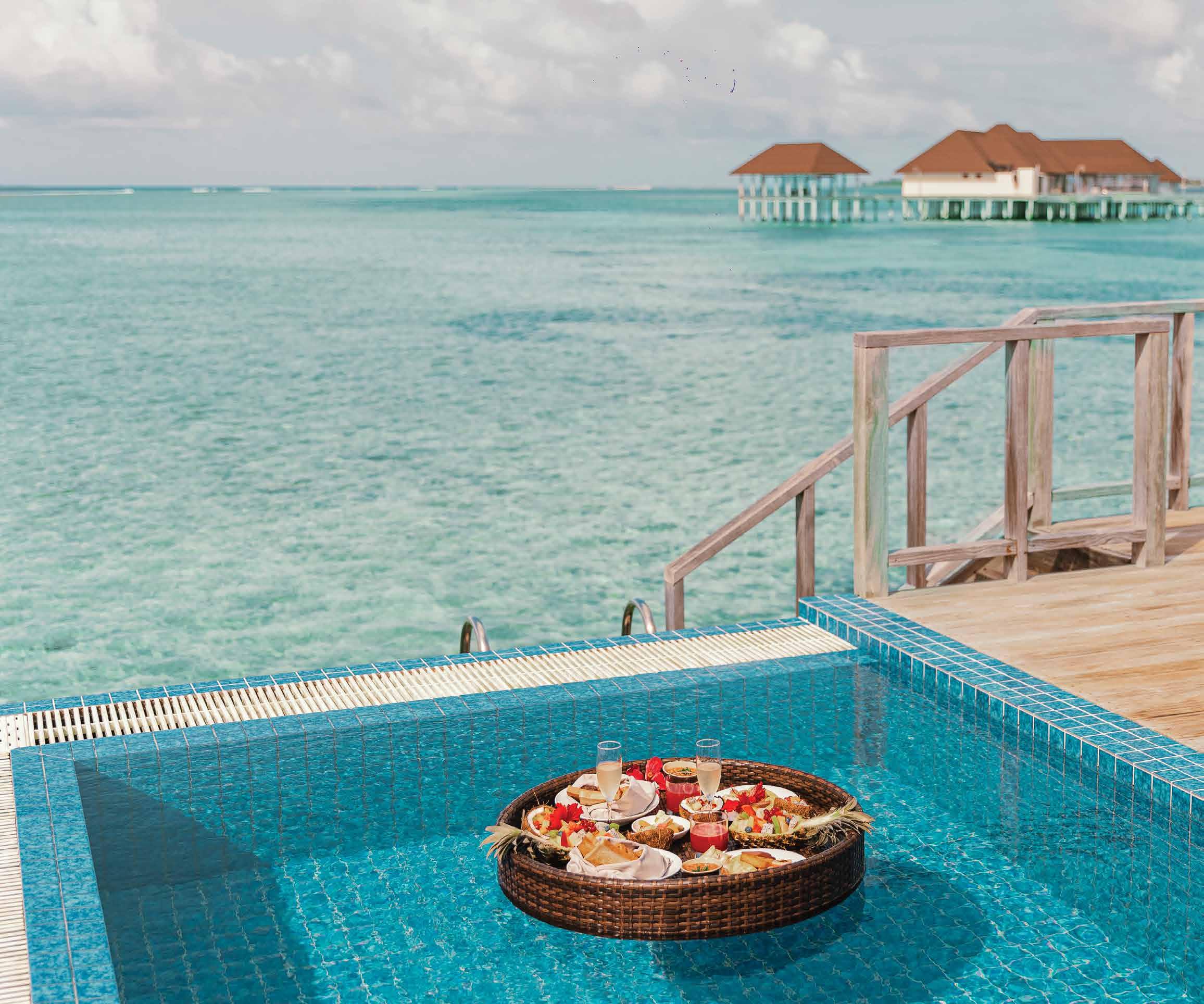
Maldivian-owned and operated Sun Siyam Resorts not only offers five distinct hotels with different looks and feels, but also different vantage points. Best of all, they’re connected via the islands’ robust network of seaplanes and boats for quick and easy transfers.
“We’ve built a portfolio that caters to different mindsets and moments,” explains CEO Deepak Booneady. “The decision to open multiple properties was a strategic one, driven by the idea of offering something unique for every type of traveler while keeping our core values consistent.”
Those in search of sand and sun will find solace at one (or all!) of Sun Siyam’s resorts, deeply rooted in local traditions and hospitality. This is their story and a guide to what to consider if customization and variety are priorities in planning your next big adventure.


Sun Siyam Founder and Chairman Ahmed Siyam Ohamaed started his business with only $900 and a dream.
“At that time, tourism in the Maldives was still in its infancy, yet he saw its potential not only as a business opportunity but as a way to uplift communities and introduce our islands’ beauty and culture to global travelers,” shares Booneady.
This commitment to preserving local authenticity stems from Ohamaed’s upbringing. He grew up on a small island where his father served as community chief. As part of this leadership role and an extension of Maldivians’ trademark generosity, he welcomed visitors whole-heartedly, went above and beyond to
care for neighbors, and aimed to establish a true sense of belonging for anyone in his inner circle.
When Sun Siyam Vilu Reef opened in 1998, it was Ohamaed’s goal to model and integrate these admirable practices and traits into the resort’s ethos, where guests would “arrive as visitors and leave as family.”
No matter the resort, Sun Siyam has made an effort to preserve its Maldivian culture across its entire portfolio.
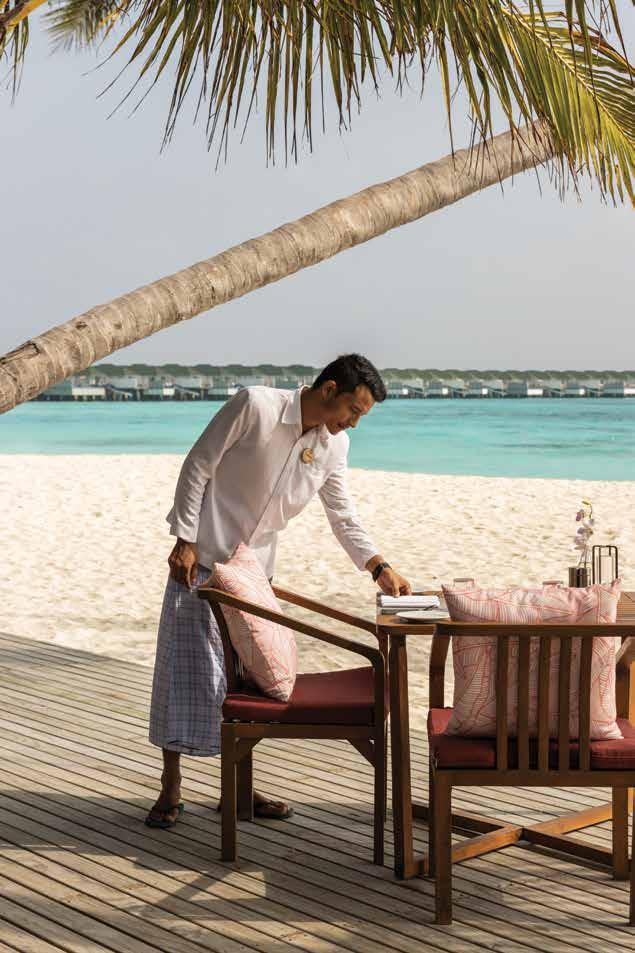
“Maldivian culture is not an afterthought, it is our soul,” shares Booneady. “From the very beginning, Mr. Siyam’s vision was to build something that goes beyond luxury, something that honors where we come from. Every detail, from our architecture to our cuisine and rituals,
reflects our heritage and tells the story of the Maldives through experiences that feel genuine and heartfelt,” he adds.
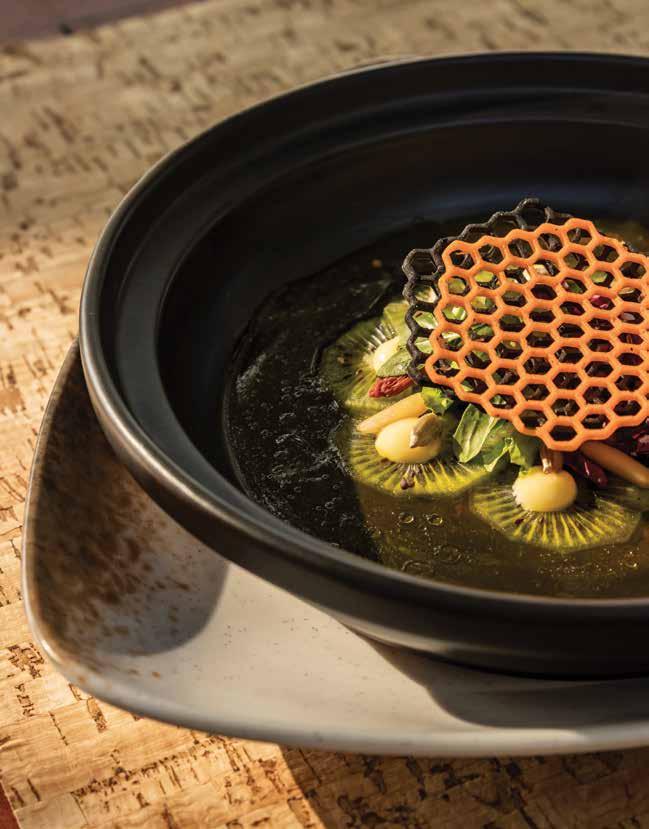
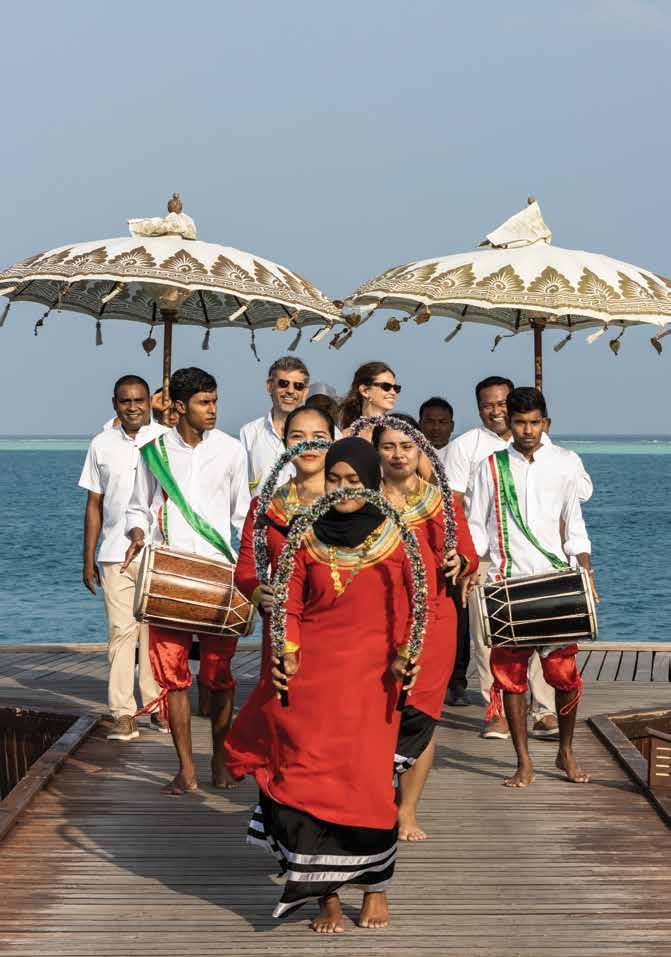
Rooms, for example, are fitted with locally sourced coconut palm timber, thatched palm leaves, and hardwood. Buffets brim with offshore fish, especially tuna, and are complemented with rice and Indian-influenced curries. Events include cooking classes, craft workshops, and Bodo Beru drum performances, scheduled to contextualize a stay beyond the postcard-worthy beauty that is always a guarantee.
Sun Siyam’s hundreds of employees are also the company’s beating heart, as the brand intentionally hires those who were born and raised in the area to represent their respective home villages.
“We are not just a hospitality brand operating in the Maldives, we are a Maldivian-born company that embodies the destination,” says Booneady. “Every decision, from design to guest experience, is guided by a deep sense of place and purpose. While many international brands bring their global standards to the islands, we bring the islands themselves, their warmth, generosity, and natural rhythm to life for our guests.”
To categorize and streamline their range of accommodations, Sun Siyam Resorts have created The House of Siyam with Luxury, Prive, and Lifestyle tiers. Luxury includes Iru Fushi, Prive includes Iru Veli and Vilu Reef, while Lifestyle includes World and Olhuveli.
Not only do these resorts vary in overall vibe and size, but also location so that guests can enjoy more nuanced experiences with different




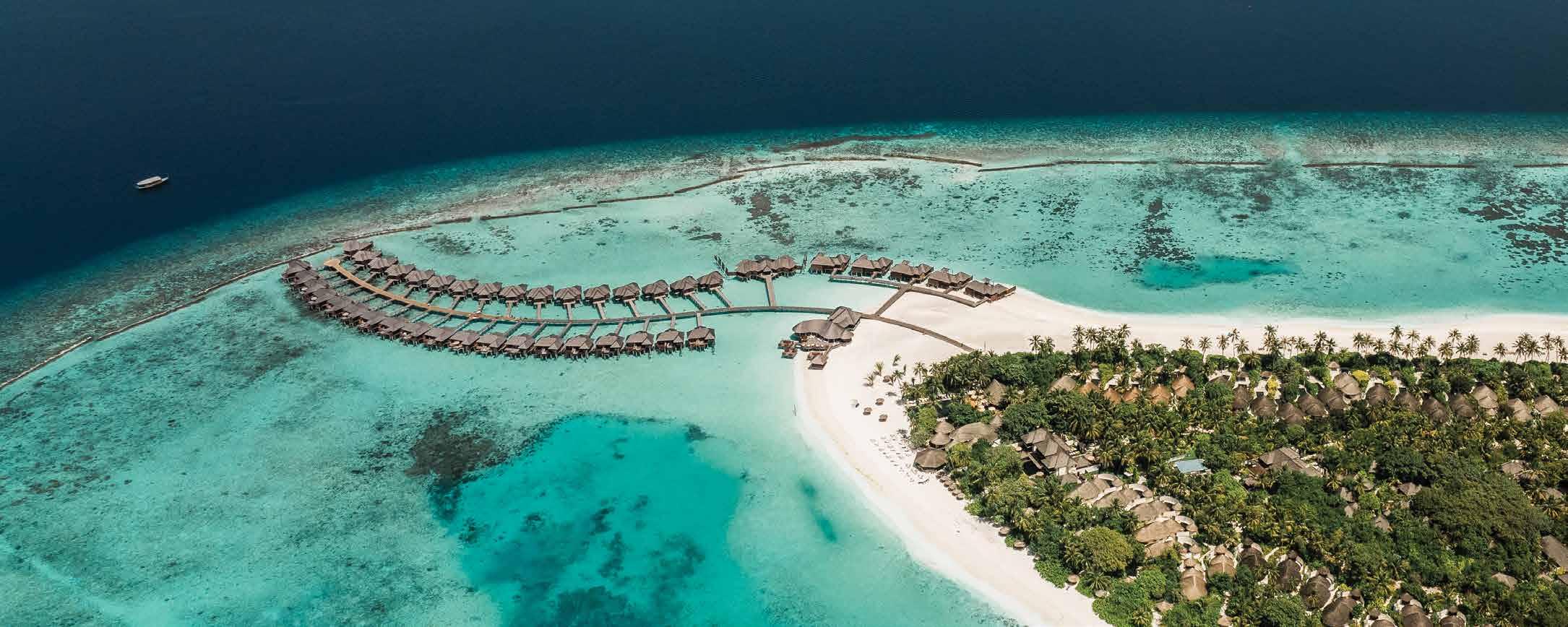
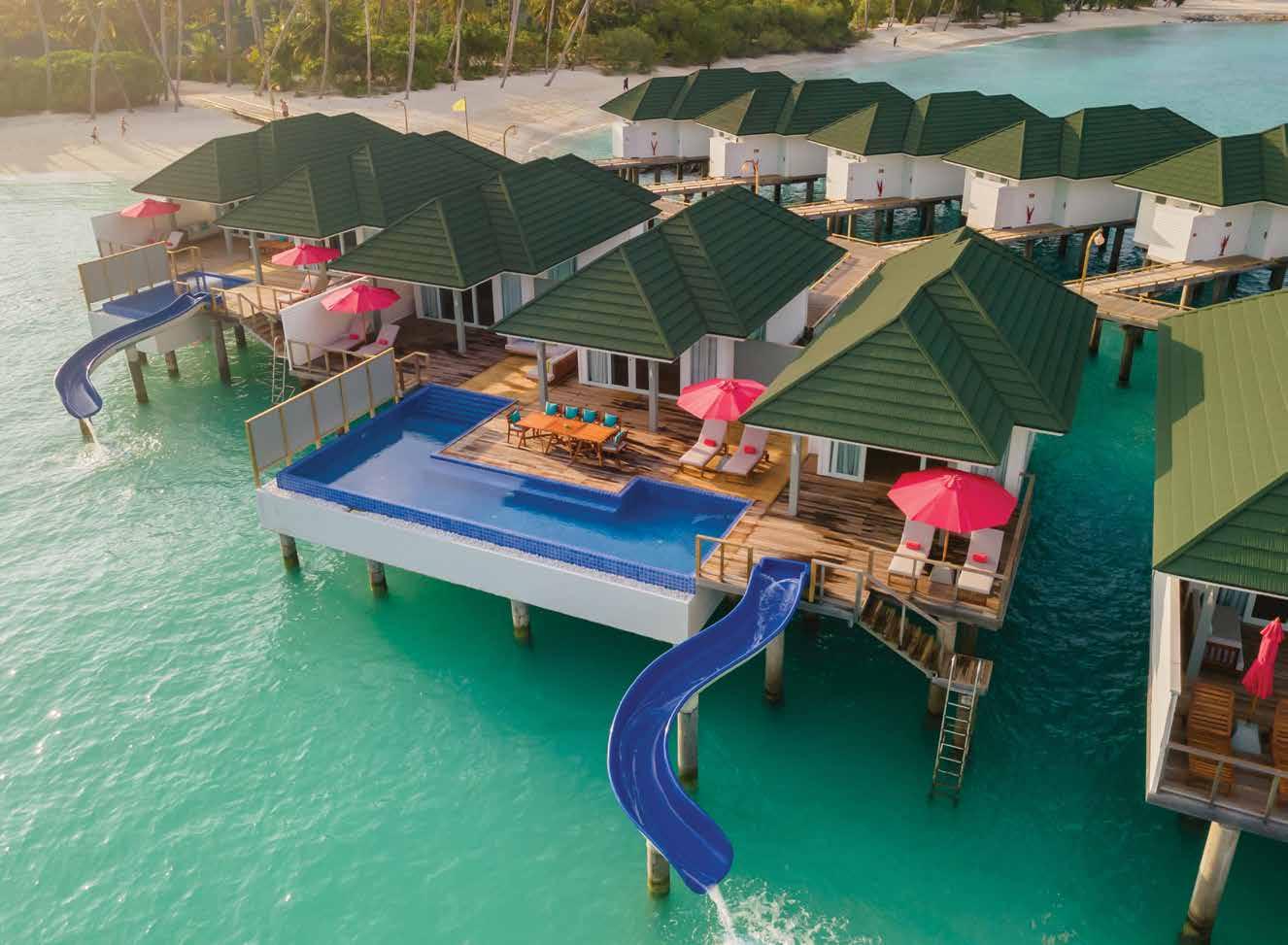
rooms, staff, meals, and even bedroom views. This is particularly valuable for those traveling with families and who long for a combination of the high-energy activities found at the World and Olhuveli resorts and the tranquil seclusion at Iru Veli and Vilu Reef. It’s also ideal for those who tend to go stir-crazy during extended stays or those who want to get the most bang for their buck after dedicating weeks to a muchneeded holiday.
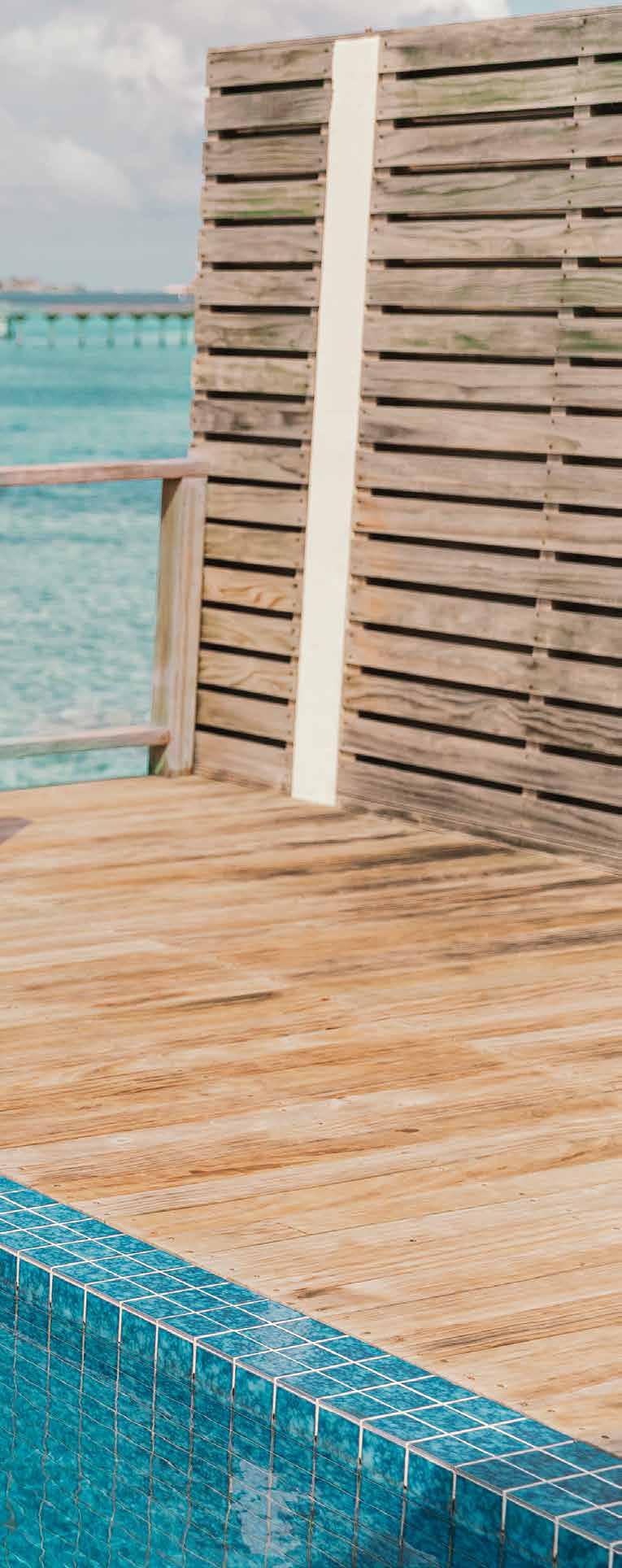
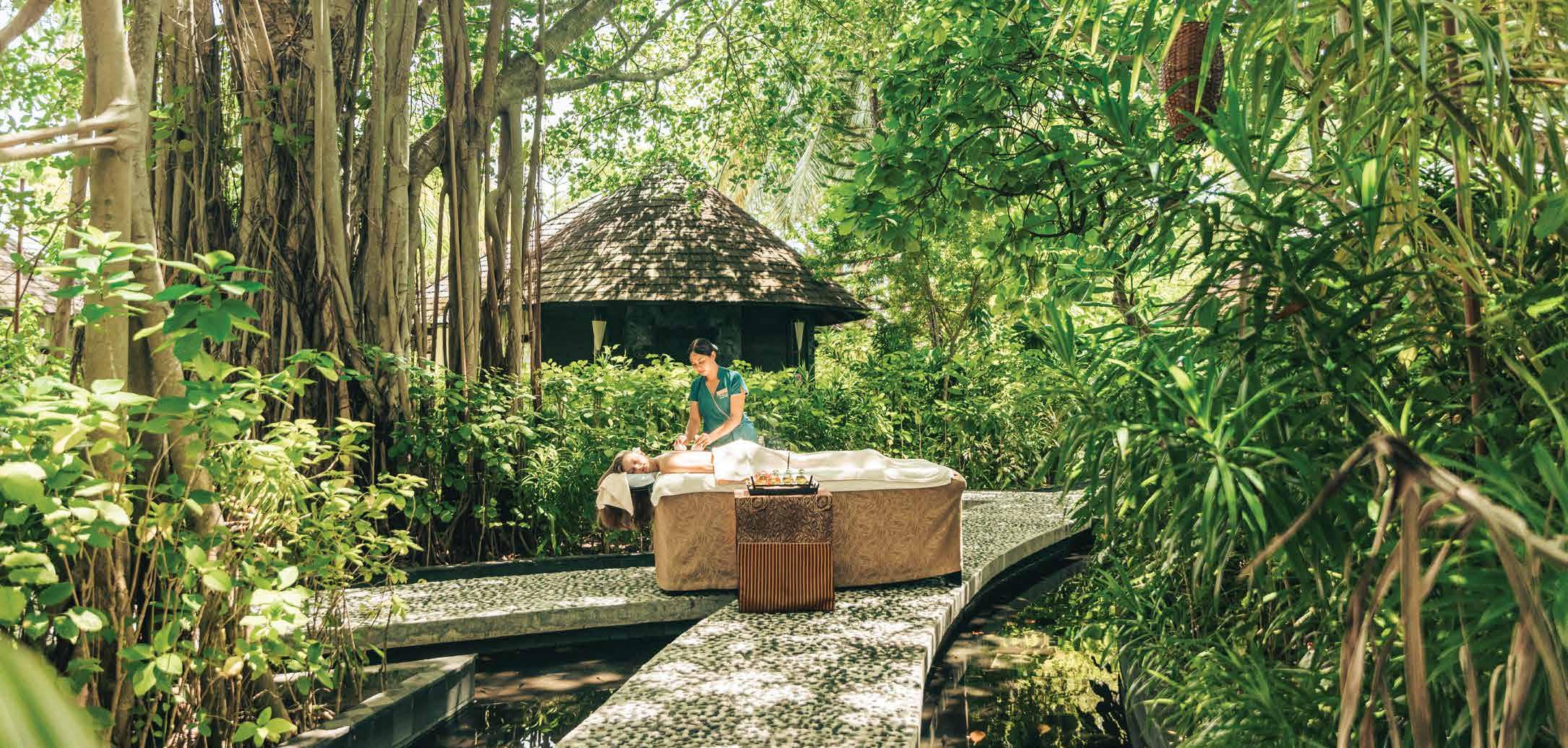
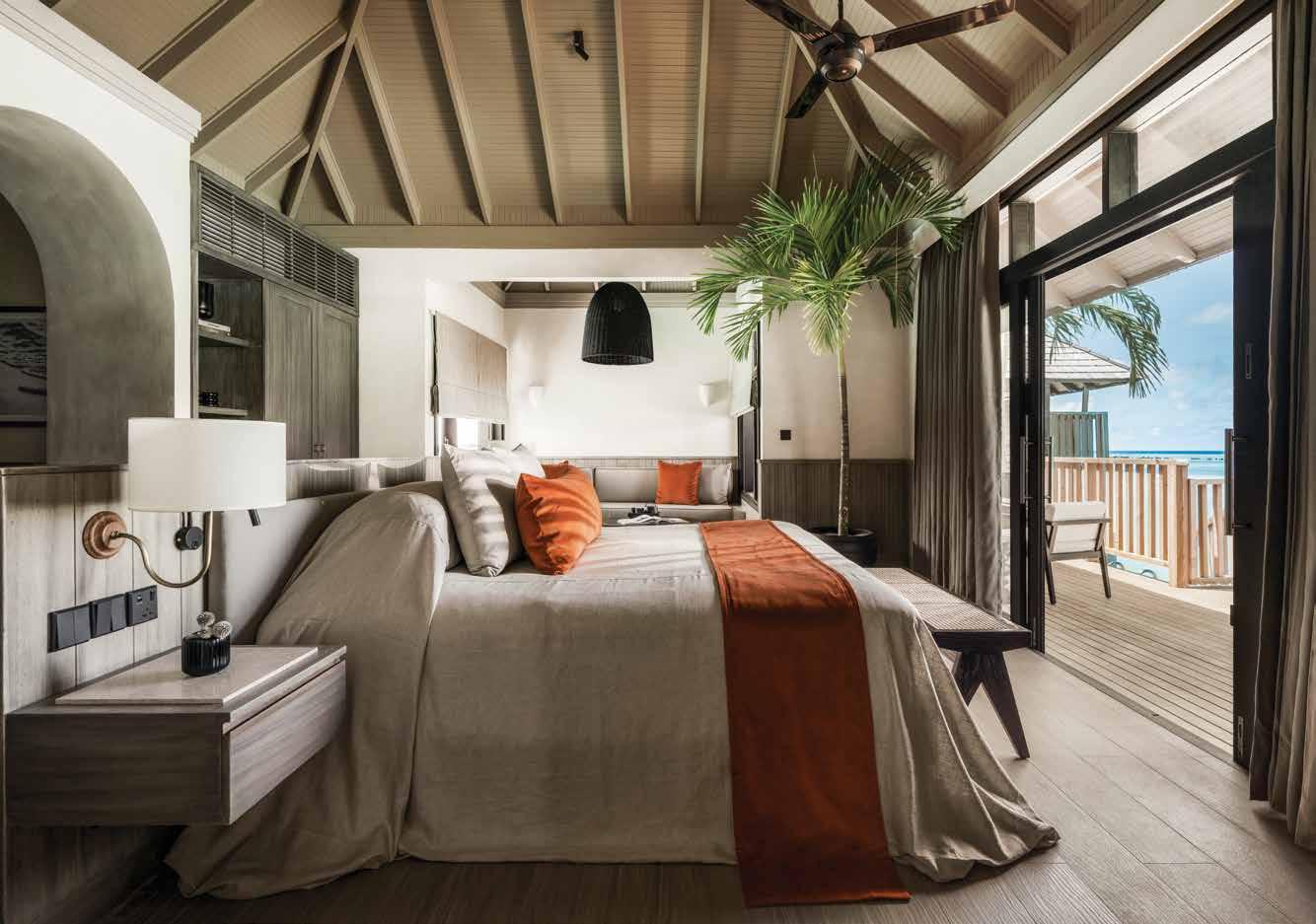
That said, Sun Siyam Iru Fushi sits pretty as the portfolio’s crown jewel, touting the over-thetop luxuries most commonly associated with exotic beach locales. Aside from oversized villas, suites with outdoor bathrooms and nearly 1,000 square feet of butler-serviced space, many lodgings open to private beach access from dipping pools and plush gardens. Cuisine is also elevated through multiple on-site restaurants, including Italian, Indian, and Thai-influenced fare. The award-winning spa is canopied by tropical foliage and designed to feel as if you’ve stepped inside of an enchanted forest with native birds, fish-teeming ponds, and treatment rooms themed around flora and fauna.
There is something to be said about sticking to tried-and-true hotels, at least for consistency’s sake. But if the rare opportunity to jet long and far to the Indian Ocean presents itself, it’s also wise to be adventurous, expand literal sun-drenched horizons, and consider island hopping. After all, it may be a wanderluster’s one and only moment to take full advantage of this pocket of the globe.
Sun Siyam removes the inconvenience of grueling transfers while also ensuring that each of its one-of-a-kind properties maintains the five-star hospitality that greets guests on day one. Their only expectation is for travelers to form core memories around the enchanting turquoise paradise that will forever define the Maldives.

BY LAYNE RANDOLPH
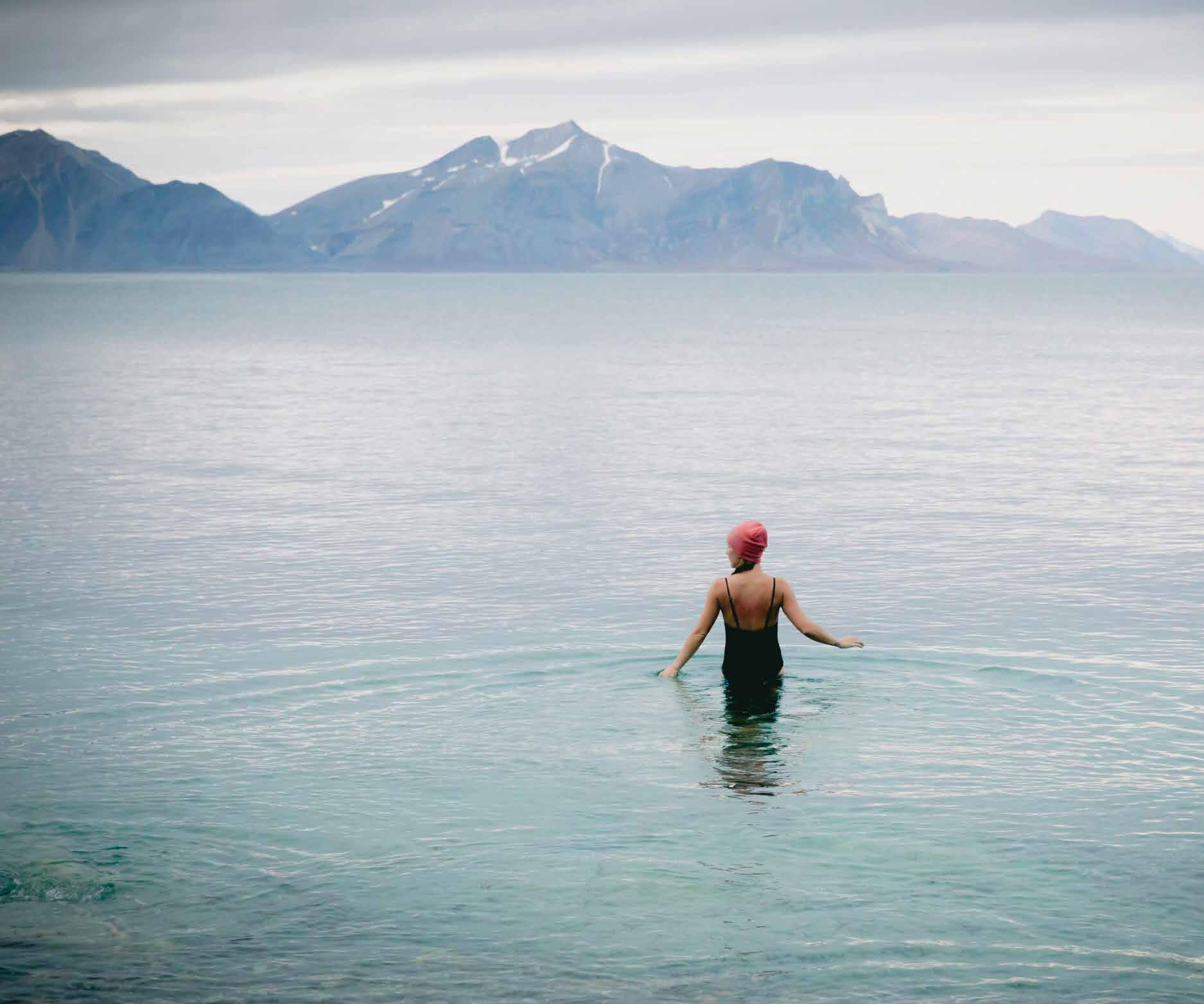
The first day of cold bathing was scheduled before dawn, and it was snowing. Many assumed, surely, this won’t happen today—not with a forecast low of 26°F, wind gusts up to 35 mph, and a “feels like” of 5°F. They were wrong.
Then came the second surprise: clothing was discouraged—and on day one, first-timers arrived in swimsuits like sane, responsible adults. The veterans seemed to think stripping down in a blizzard was a small detail. After the first plunge, the newbies shed the extra layer, too.
The cold bathing took place in Helsingborg, Sweden, on the Øresund Strait—the stretch of water separating Sweden from Denmark. Denmark’s Kronborg Castle sits on the facing shore—the inspiration for Shakespeare’s “Elsinore” in Hamlet. Kallis, Helsingborg’s northern cold-bathing spot, is where many take a first “dip,” as Mia Jansson, a dipping expert extraordinaire, calls cold bathing.
Mia describes the sensory effect after plunging in near-freezing water as “champagne bubbles on your skin.” She’s been dipping for fifteen years
and claims, “I haven’t had a cold since I started.” Jansson helps newcomers overcome the initial dip jitters and explains that alternating cold baths with sauna use is like “exercising your arteries.”
The moment before a cold plunge is all about internal negotiation, and it quickly becomes clear that much of the experience depends on mental discipline. A common strategy is a mantra—something steady to hold onto when instinct argues for retreat.
The initial shock of the frigid water is tempered by the jolt of walking naked, with
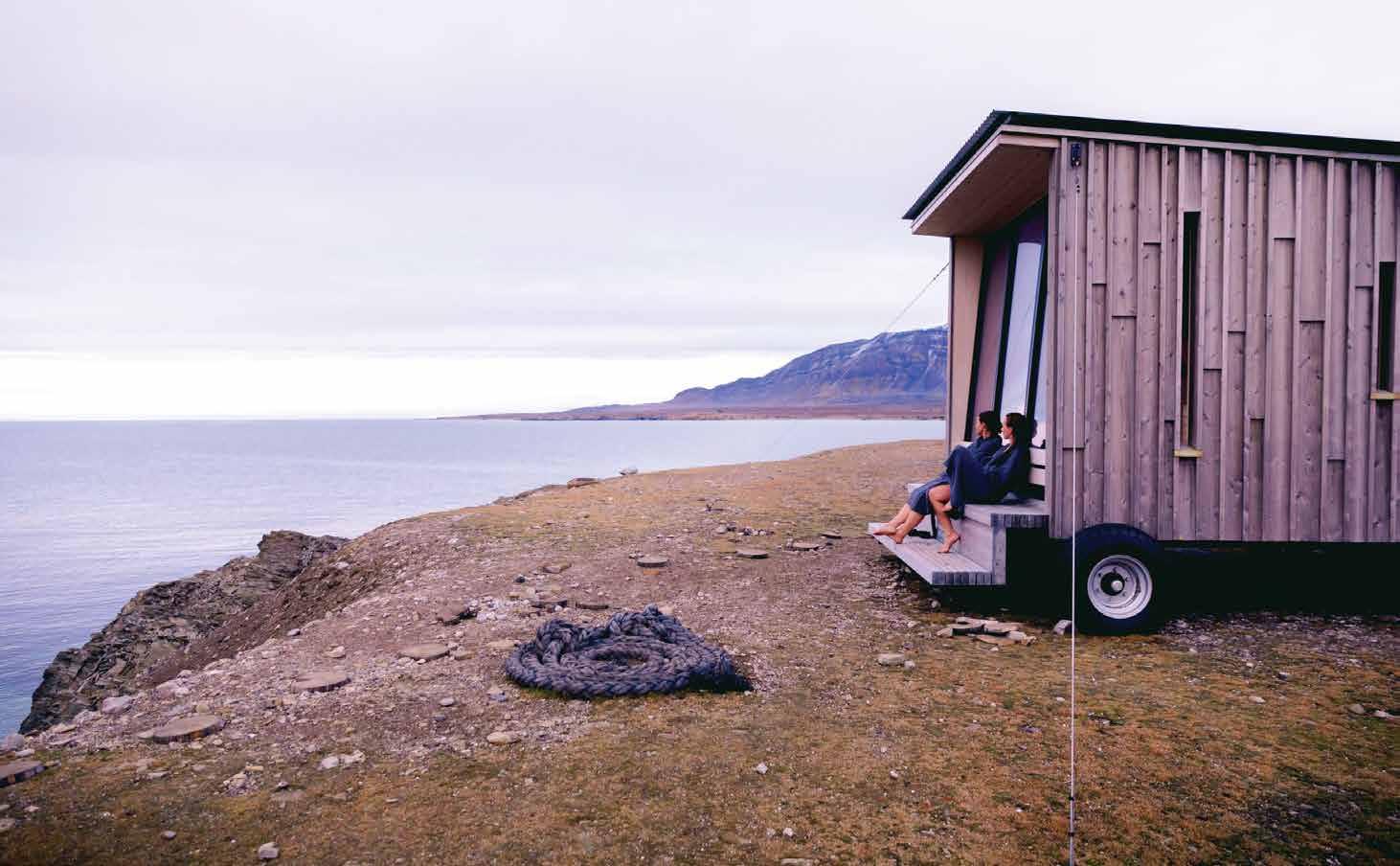
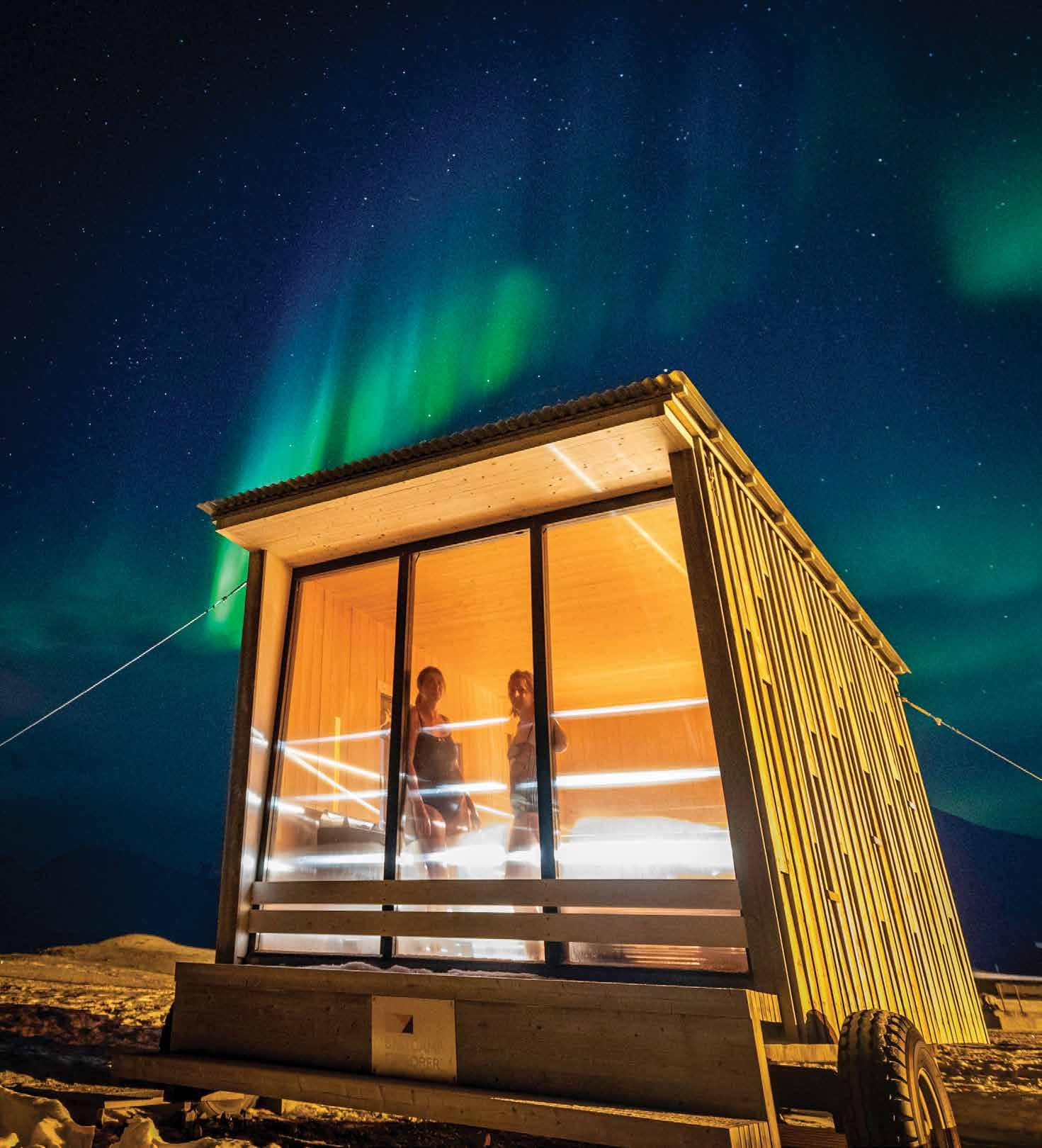
only a towel, through gusty winds and snow from the sauna to the ladder that descends past snow-covered rocks into the sea. It helps that the varied shades of gray in all directions—sky, sea, and buildings—impart a meditative calm to the experience.
Helsingborg didn’t invent cold bathing, but it has been part of the city’s identity for generations. The roots of this tradition go back to the city’s original health tourism spot, Ramlösa Brunnspark, whose mineral spring opened in 1707, and to the coastline’s long history of cold bathhouses and winter swimming.
The city celebrates its winter wellness heritage with an annual Cold-Bathing Week (“Kallbadsveckan”) in February. Its elevated bathhouses and piers, built for dipping, show that for those looking for the real experience, it’s here.
In the North, winter isn’t endured—it’s turned into pleasure: heat, cold, and community, designed for maximum wellness.
In the North, winter isn’t endured— it’s turned into pleasure: heat, cold, and community, designed for maximum wellness.
In Helsingborg’s bathhouses, there are separate saunas and dressing rooms for men and women, and “no swimsuits” is encouraged and sometimes required. Kallis offers a comforting combo of lavender-scented sea salt and hammam towels upon arrival. Some wear towels in the sauna or to the platform above the ladder to the sea. Most cold-bathing facilities have saunas, and the sauna is the precursor to the plunge—it’s the Scandinavian workaround.
A steamy sauna prepares the body for the cold, once-unthinkable plunge so that the freezing Øresund Strait begins to sound . . . enticing. In this part of the world, it’s all about contrast— heat and ice, shock and calm—arranged in a feel-good ritual, one that happens to have wellness benefits.
Evidence on cold immersion is still evolving, but anecdotal reports, like Mia’s, suggest positive effects on stress, well-being, and inflammatory markers. Regular sauna use is linked to lower risks of cardiovascular disease and overall mortality, but it’s not a cure-all. Studies are limited, and there are risks (cold shock/heart strain) for some individuals.
But the mental effect can be immediate: the sense of achievement, the quiet confidence that comes from doing the thing that looked impossible in the dark. After cold bathing before dawn—even in snow—the day has a different texture. There’s a bounce in the step. Cold, but alive.
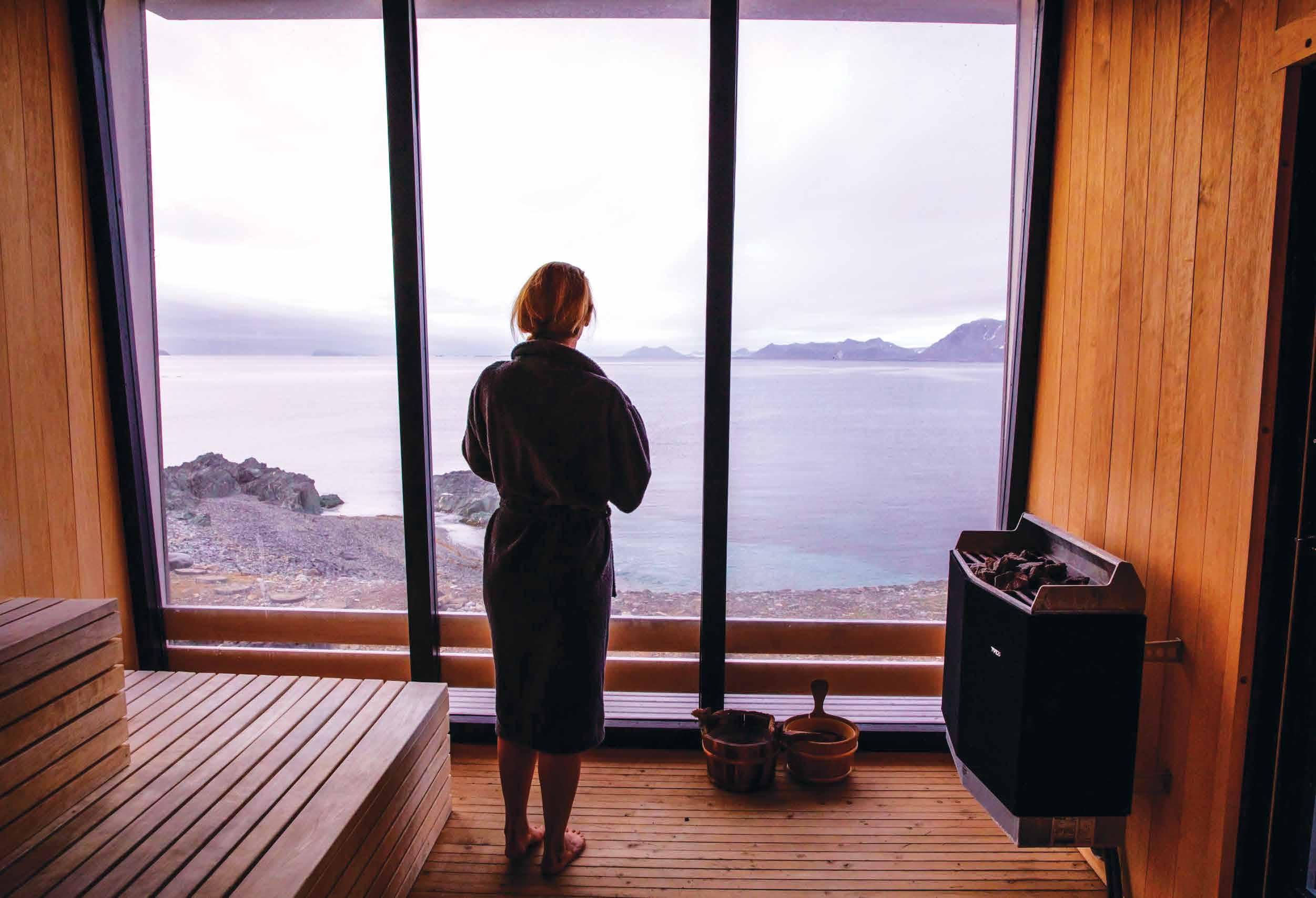
Still a relatively niche sauna practice outside European resorts and wellness centers, Aufguss is loosely translated from German as “infused water,” but it also involves rhythmic towel movements to circulate heat and sometimes includes a performance ritual that makes you forget you’re sitting in a pool of your own sweat.
It begins with a trained Aufgussmeister placing ice balls infused with essential oils onto hot stones, releasing waves of scented steam in a sauna that can reach around 90°C (about 195°F). As the steam rises, the Aufgussers wave towels to conduct the heat through the room in deliberate, sweeping motions set to music. The ritual typically ends with a cold plunge, completing the hot–cold contrast cycle.
The Aufguss was led by Denmark’s six-time world champion, Aufgussmeister Lay Pang Ong, better known as “Pang,” a trainer to sauna
masters worldwide, along with a well-trained group of Aufgussers.
The interactive performance covered their interpretation of variations in sauna/coldbathing experiences in Scandinavia, from Norway to Finland. In Denmark, the dip occurs before the sauna, and rosemary-infused snowballs are melted over the coals as the room warms. Sweden was softer, with an infusion of lavender and pine that evoked Swedish forests, and small oak branches dipped in water were held overhead to create a gentle “rain” effect.
Norway is known for its extreme cold bathing, with groups like Up Norway leading Arctic plunges near the North Pole, experiences bordering on extreme sport. The Aufguss visit to Norway brought a sense of the wilderness with the Aufgussers gently slapping guests arms and legs with the wet oak branches.
Finland is the hotbed of sauna practice, with a population of about 5.5 million and roughly
3.3 million saunas. For the Finnish experience, the heat and steam rose, and the Aufgussers increased their towel-waving and slapped soft birch branches against guests’ arms and backs with slightly greater vigor.
The final day of the winter wellness excursion took place at the Järnvägsmännens Pier: no frills, just diehard locals taking the plunge sans sauna, walking to the water in their bathrobes and flip flops, doing the dip, then standing around chit-chatting with friends who have done the same for years. There’s even a nearby coffee shop, Cafe 1886, that offers half-price coffee to the “white robes” who stop in after bathing.
That’s the trick the North plays. It doesn’t convince anyone that winter is warm. It convinces them they’re stronger than they thought—and that pleasure can be engineered, one deliberate plunge at a time.
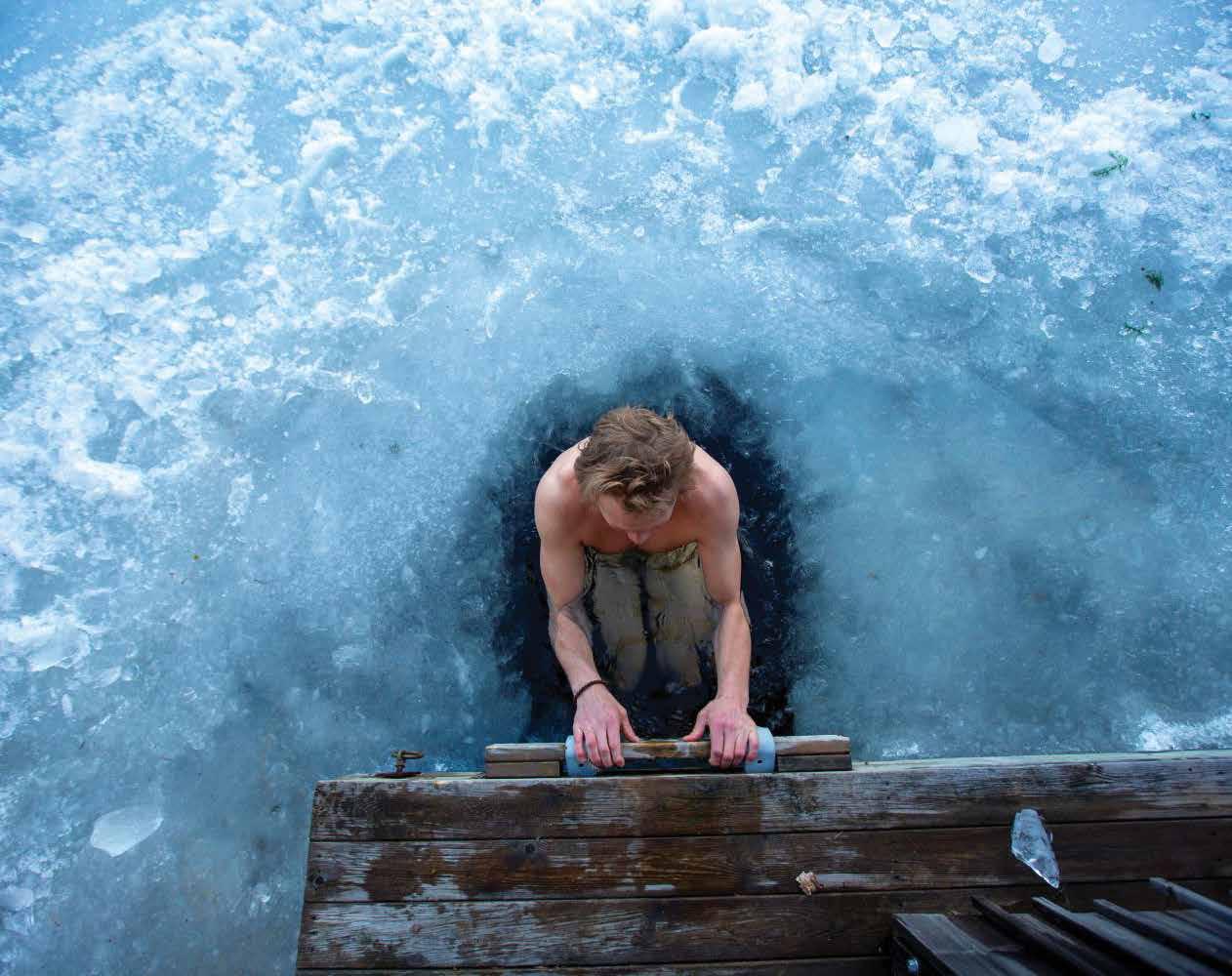
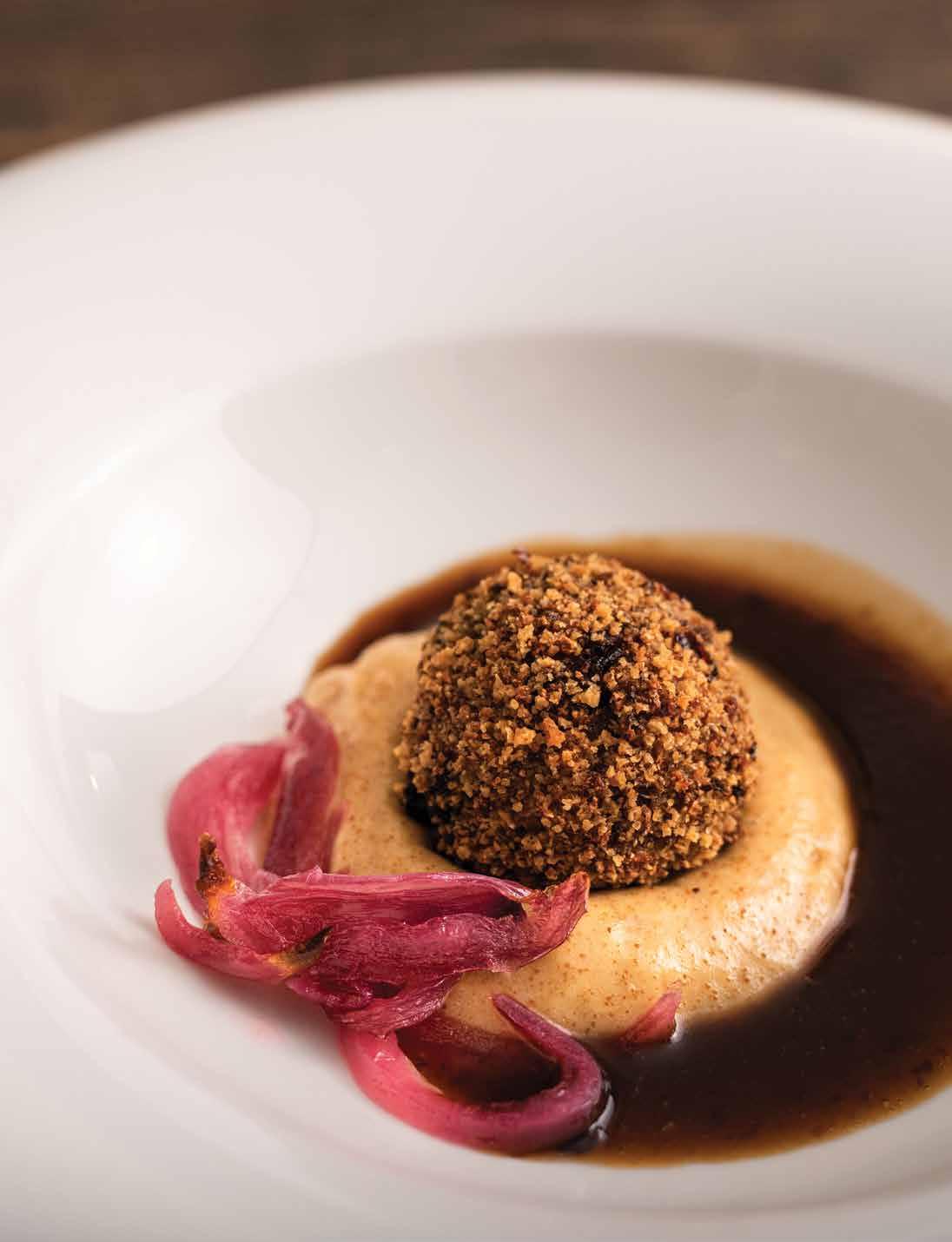
1. START SHORT; DON’T MACHO IT
Early dips can be simple: get in the water, lower to the chin, stand up, move quickly up the ladder, wrap a towel around, and move briskly to the sauna on numb, prickly needle feet. With repetition, time naturally increases.
2. SAUNA FIRST
It’s not a rule, but it’s a darn good idea. The dip/ sweat works well precisely because each makes the other appealing.
3. DON’T DO IT ALONE FOR THE FIRST TIME
Use a guide like Mia for reassurance and conviviality. Control your breathing before you enter; cold shock is real.
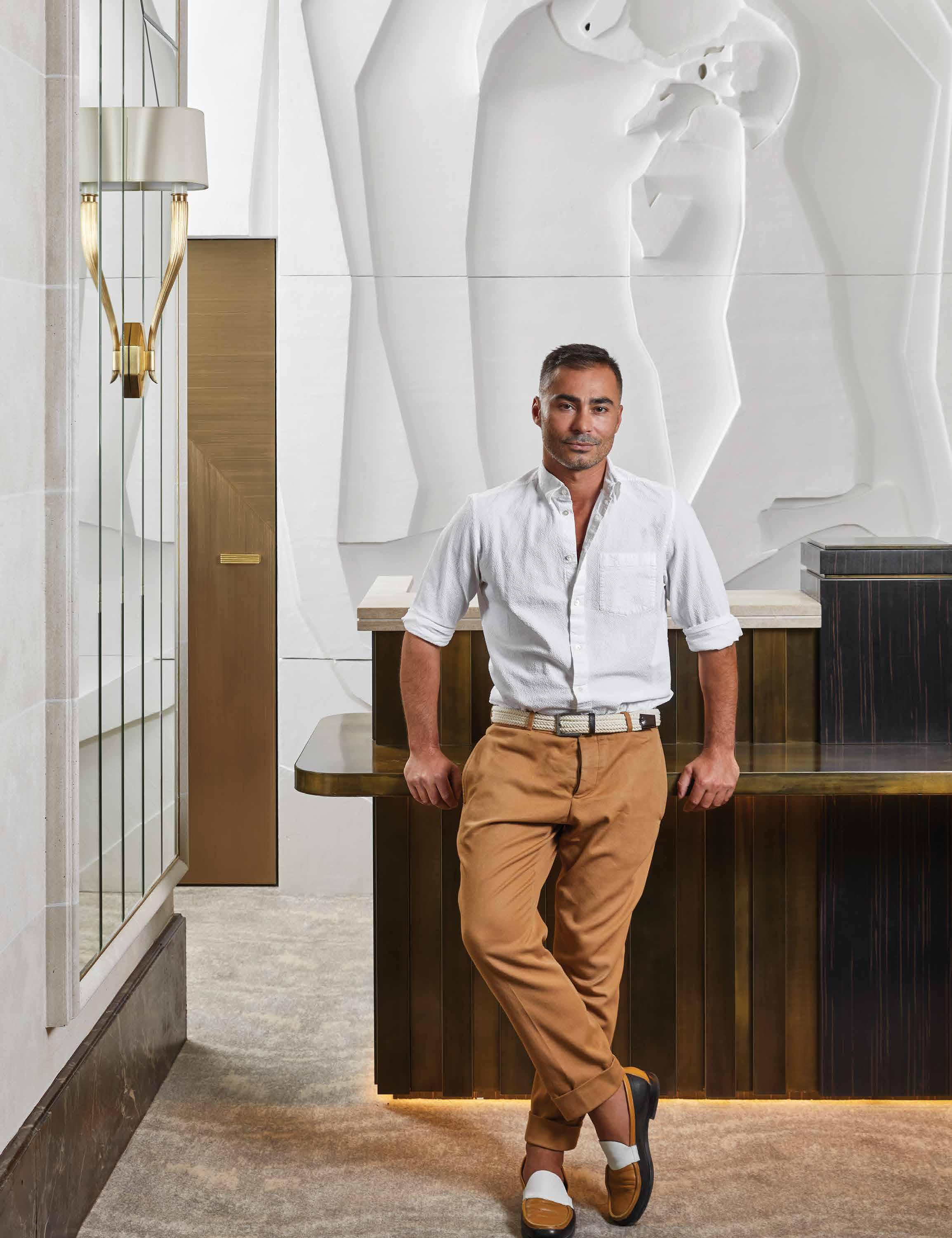
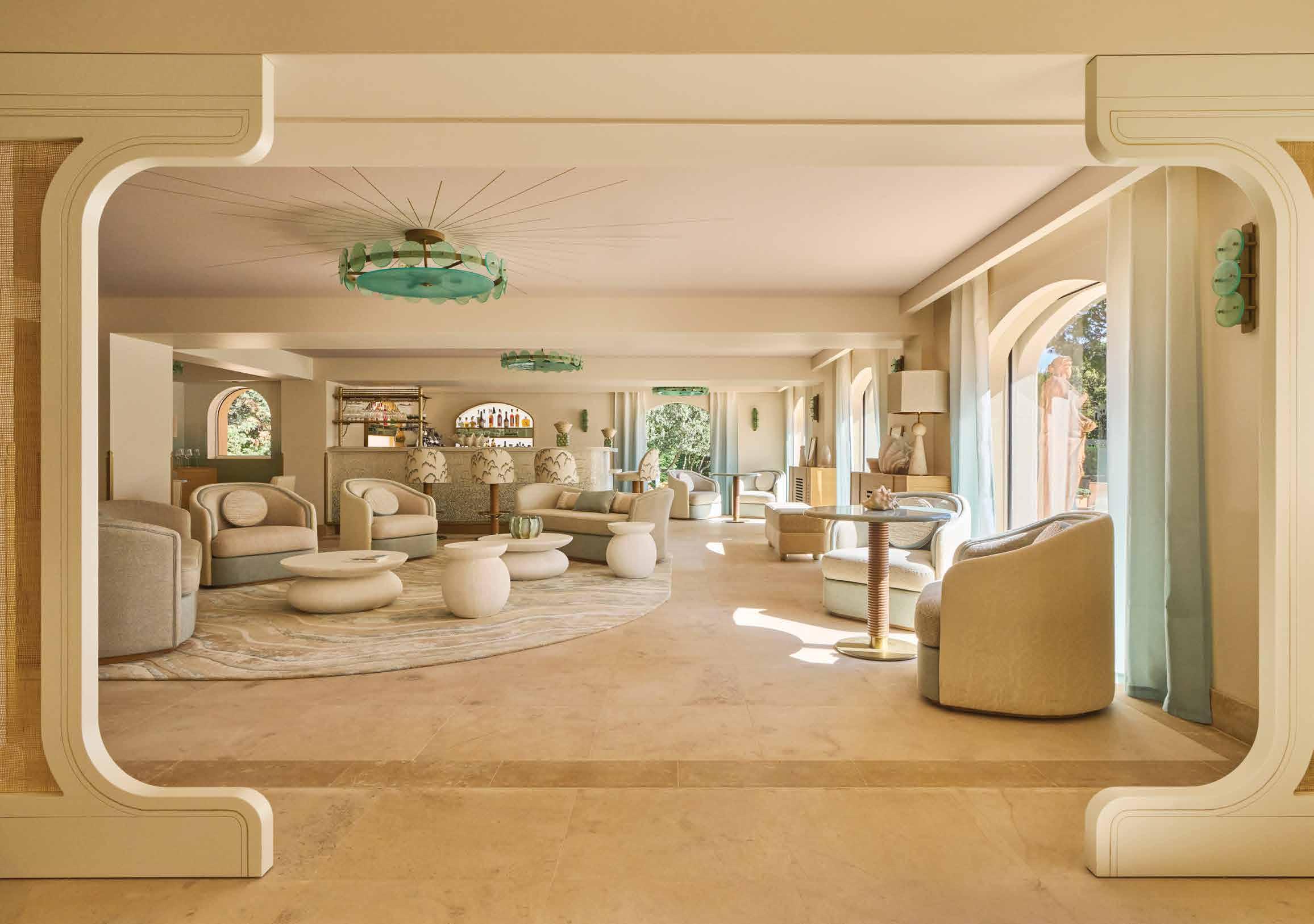
BY ROBIN CATALANO
Few cities in the world confer the instant stamp-ofapproval chic of Paris. Having absorbed a lifetime of its stylish influences, native son Oscar Lucien Ono is reframing the narrative of what defines French luxury, with residential and hospitality design projects that blur the borders of fine art, architecture, and classic design. “True design, for me, balances story, craftsmanship, and emotion over fleeting trends,” Ono says.
Ono studied art history and got his leather loafer-clad feet wet in the design world in London. In 2014, he founded interior architecture and design firm Maison Numéro 20 in the Saint-Germain-des-Prés neighborhood of Paris. The number 20 is a reference to numerology, where it is associated with balance and harmony, a philosophy that guides Ono’s work.
Ono gravitates toward place-based inspiration where history and craftsmanship collide—the Maison de Victor Hugo, Musée d’Orsay, and Versailles are among his favorites. But he also frequents antiques shops and flea markets, like the ones in the Saint-Ouen-sur-Seine neighborhood in Paris or El Rastro in Madrid, where past and present are in continual dialogue, and one-of-a-kind items add instant provenance and character to his spaces.
“I’m most drawn to the design languages of the 1930s and the 1970s,” Ono says, pointing to the earlier decade’s emphasis on sculptural elegance and precision, and the bold expression of the latter. “These periods inspire my work because they balance heritage and creativity in a way that feels very relevant to contemporary life.”
He approaches his projects as narratives, telling stories through material, texture, and light. Bespoke pieces and classic French craftsmanship take center stage. He sources from regions with deep artisanal traditions, such as the Vosges and Lyon in France, for furniture and silk, respectively, and the island of Murano in Italy for glass. Modern artisanal metalworkers, ceramicists, and plaster specialists round out Ono’s roster of collaborators.
Maison Numéro 20 has tackled everything from five-star modernist hotels to a plush, fanciful champagne bar; a soothing Balearic Islands getaway inspired by the sky; and sleek luxury apartments where art from a disparate range of time periods seamlessly cohabitates with polished, reflective surfaces and cozy upholstery.
Not far from Billionaire’s Bay in the Cap d’Antibes, Villa Miraé, a 35-room hotel under the Relais & Châteaux umbrella, evokes the easy, sun-soaked glamour of the French Riviera. Inside its gardendraped, blush exterior, the interiors suggest softness and serenity, like a long exhale come to visual life. Shades of cream, blue, and seafoam dominate. In homage to the sun itself, Ono brought in subtle warmth through natural textures and the interplay of light and shadow.
Dox restaurant and bar, overlooking the Rhine River in the Hyatt Düsseldorf, trades muted luxury for big, bold, extravagant interiors.
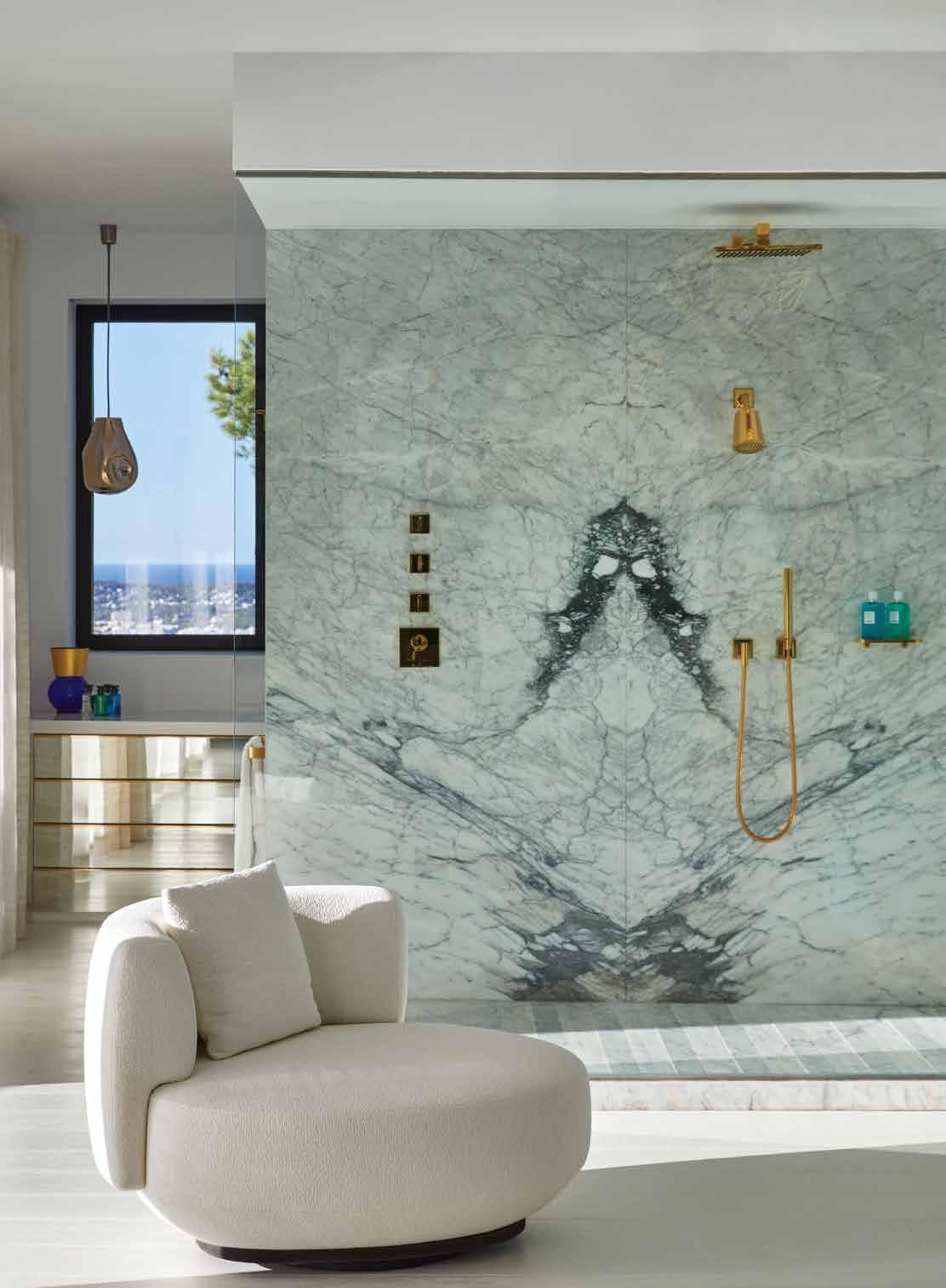
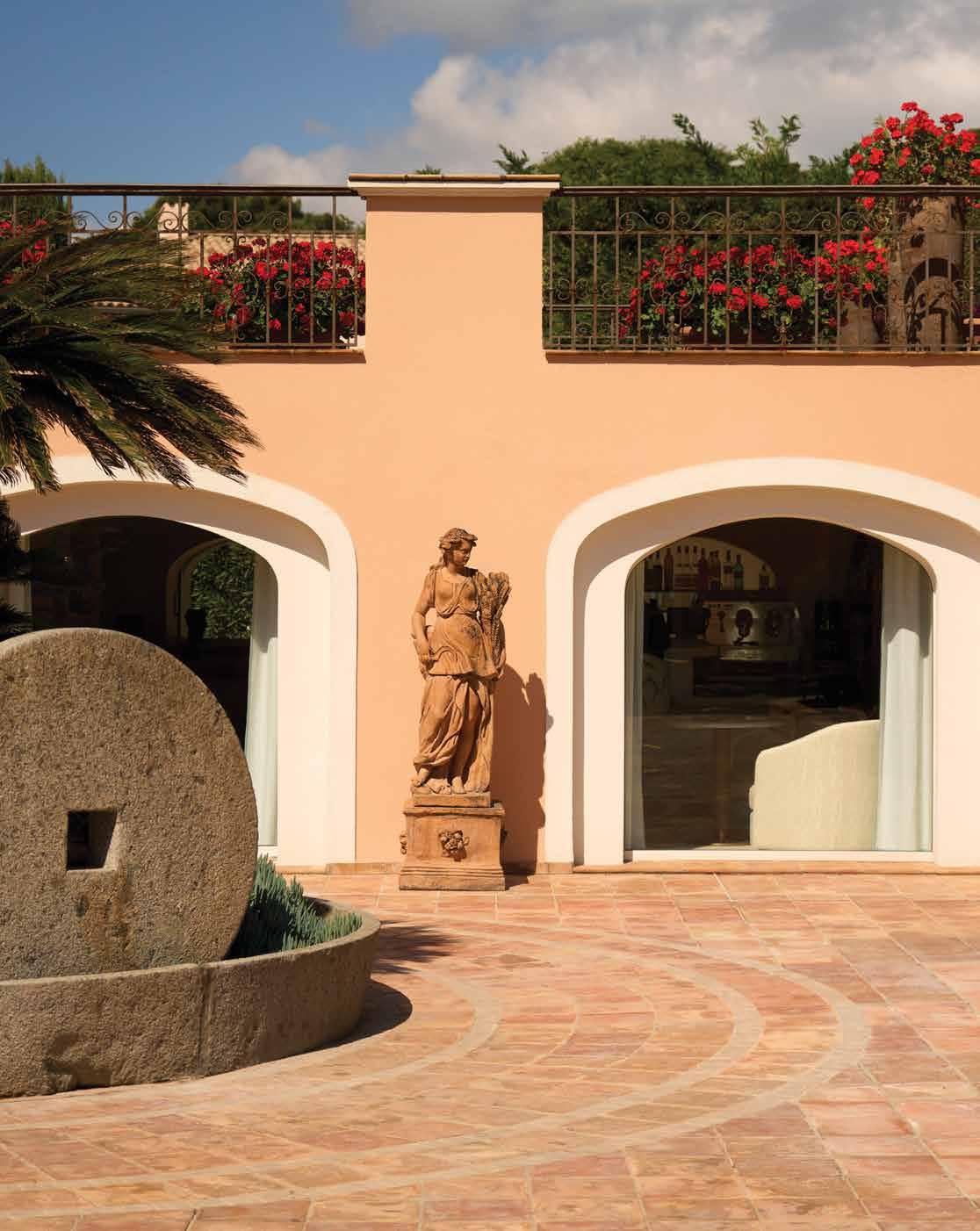
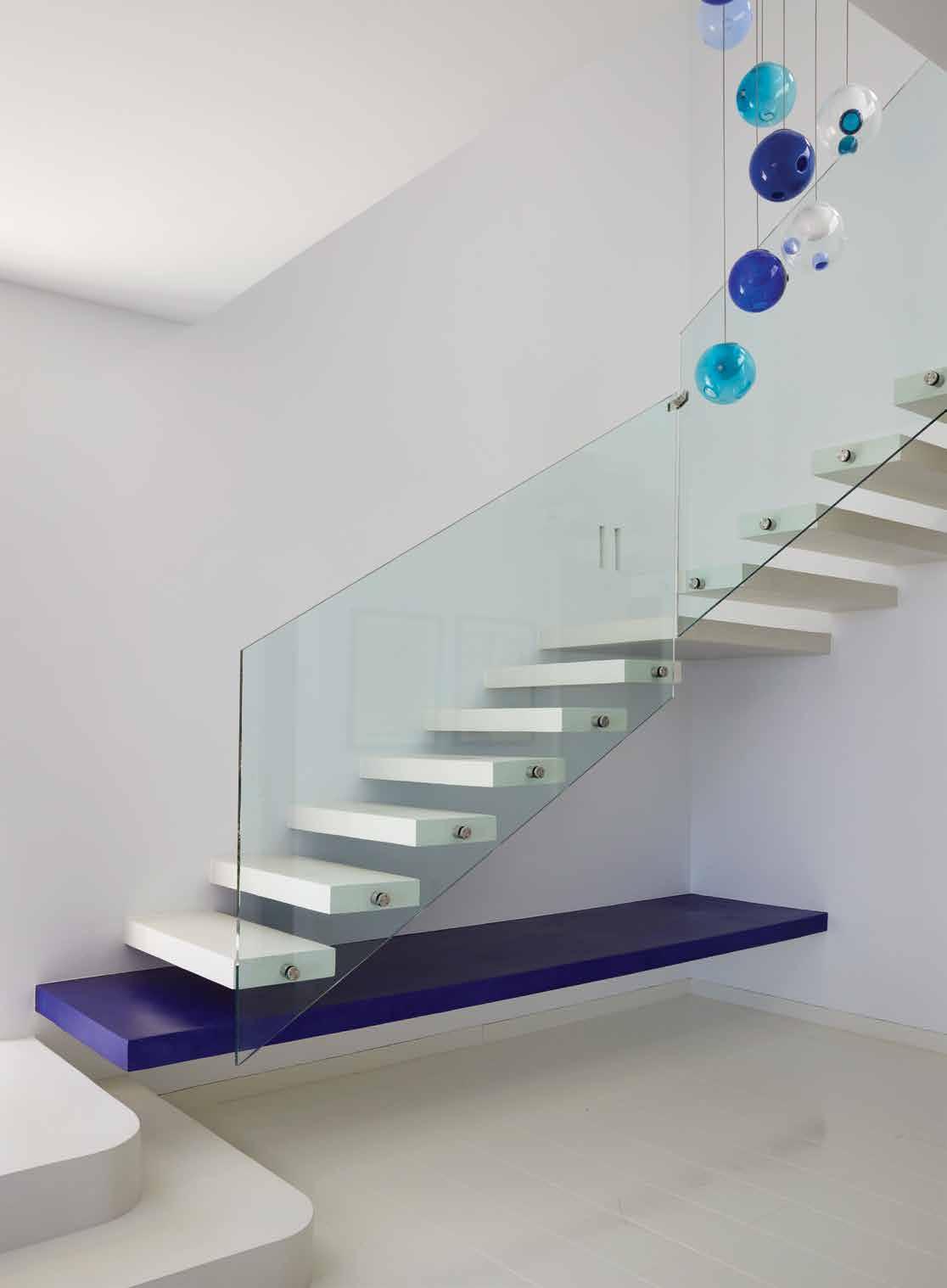
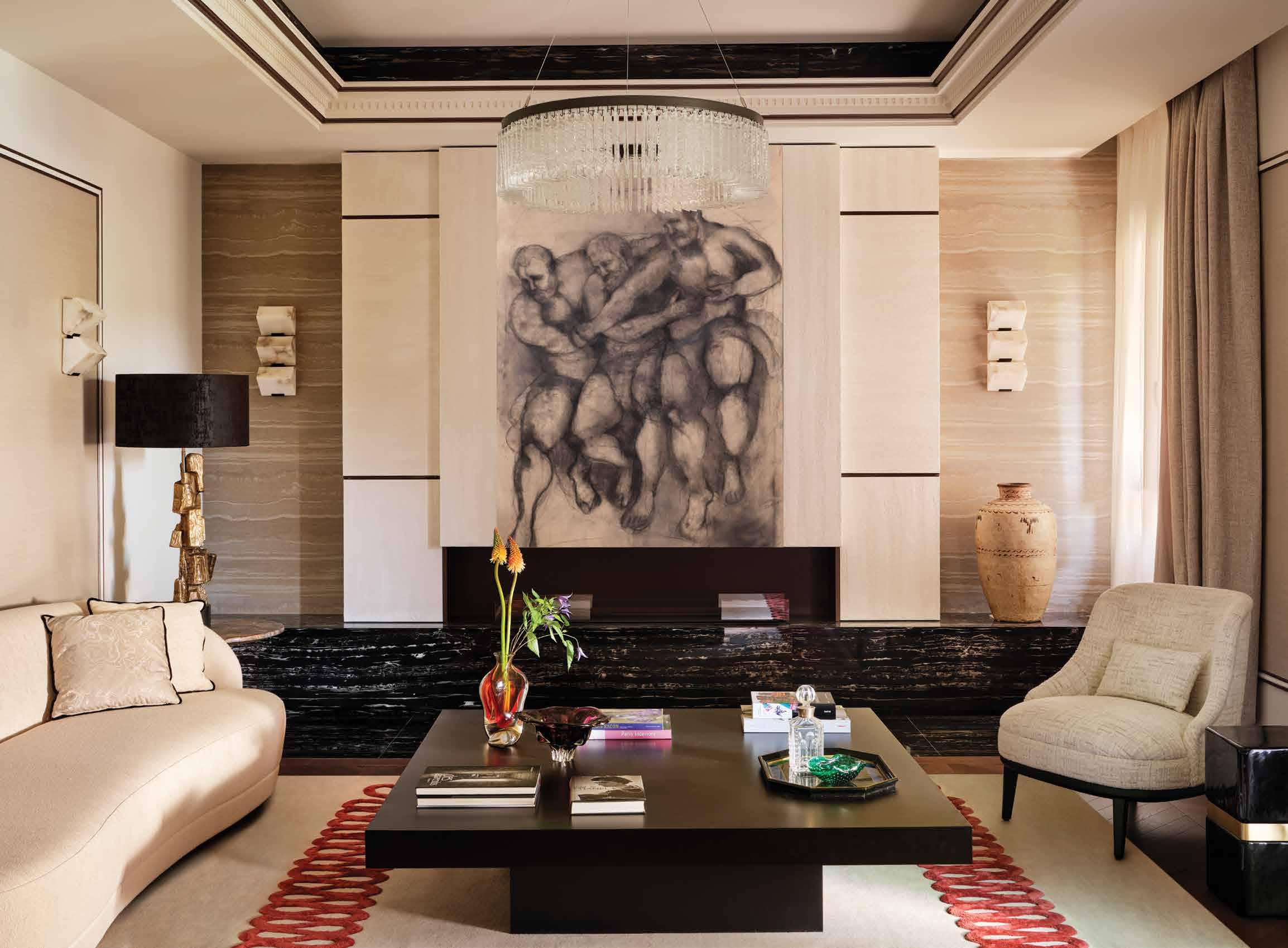
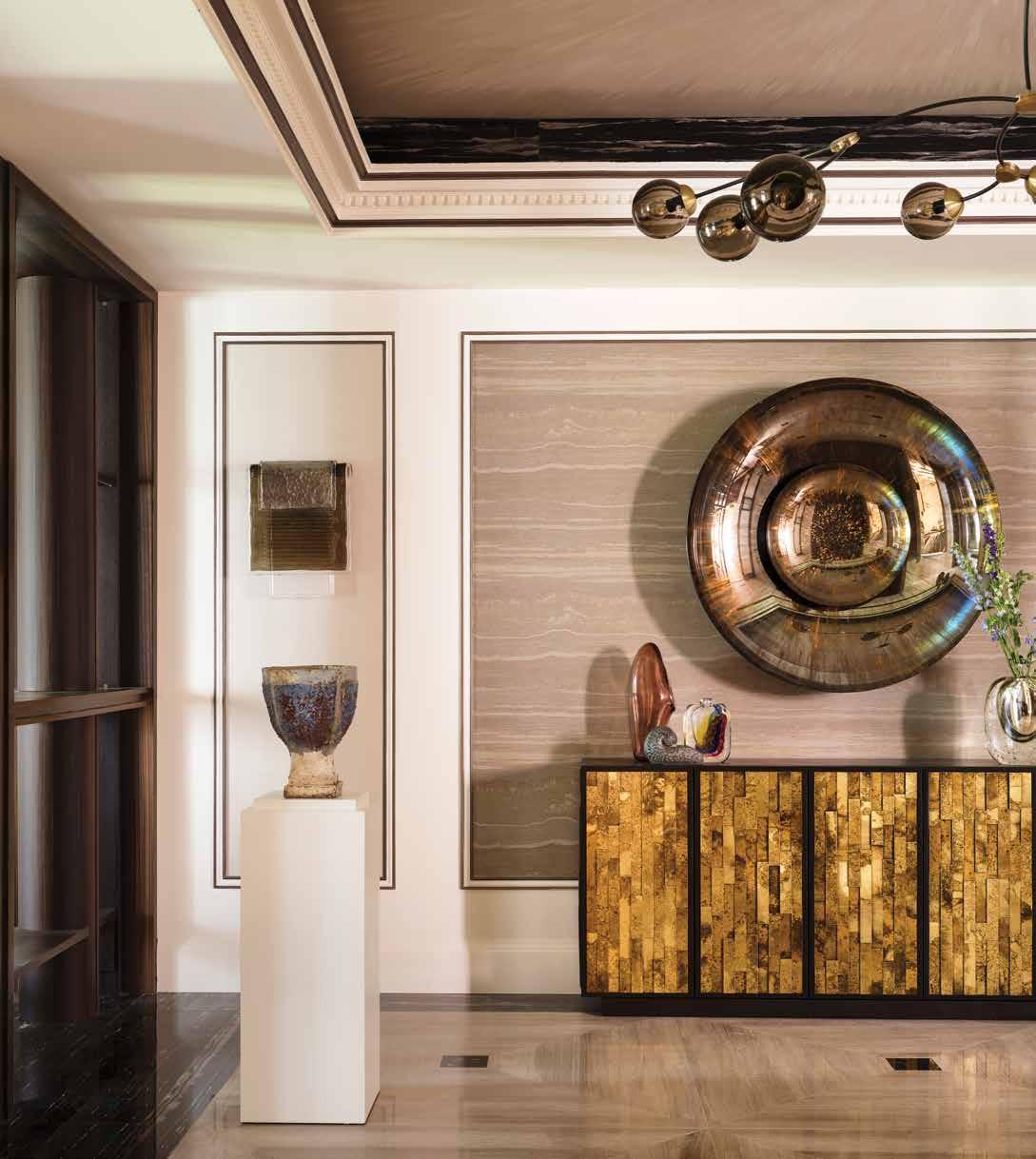
“It’s a project where craftsmanship and identity come together in a very direct way,” Ono says of the dark, polished woods, sculptural molding and trims, brass fixtures, and warm amber lighting that conjure the atmosphere of a vintage ocean liner.
In the cabaret club Paradis Latin, Ono continues the legacy of French legend Gustave Eiffel, who originally conceived of the structure as one of the great theaters of Paris’s Latin Quarter. Because the space “carries within it layers of cultural memory,” according to Ono, he has married its many original architectural elements, like arches and wall carvings, with exuberant, go-for-broke décor. The result is a slinky, moody lounge drenched in Belle Epoque colors like bloodred and gold and accented with textural wallpapers and glass mosaics depicting tropical birds and an elegant, bare-breasted performer with a halo of brunette locks.
At April’s Salone del Mobile Milano (Milan Furniture Fair), Maison Numéro 20 was tapped to create an immersive conceptual space. The primary challenge: creating something that felt both personal and universally welcoming. The result is “Aurea, an Architectural Fiction,” an imaginary hotel designed as a narrative. A theatrically draped entrance leads to an Oriental-influenced suite with silk panels depicting exotic flora and fauna. Past a “cabinet of curiosities” featuring mother-of-pearl surfaces to evoke the galaxies lay an intimate Art Deco smoking bar, and an indoor garden suffused in copper hues and soft textures. “The project guides visitors through a carefully curated sequence of moments, using
light, materials, and spatial composition to evoke a sense of discovery and connection,” Ono shares.
Ono frequently starts with the project concept. But sometimes, a random item calls to the designer and his team, especially “when we experience a true coup de coeur for a piece, often discovered at flea markets.” Instead of waiting for the project, they make an informed-impulse purchase, instinctively knowing that these time travelers will find their place eventually. Ono reports that these very objects can occasionally go on to inspire the entire narrative or atmosphere of a space.
Antiques and flea market finds are a crucial part of Maison Numéro 20’s commitment to sustainability, which prioritizes local craftsmanship, natural materials, and pieces that can withstand the test of time. He notes that by respecting the original structure when renovating a building, “we minimize the environmental impact while maintaining high aesthetic standards, creating spaces that are both beautiful and responsible.”
Ono summarizes, “Sustainability, for us, is about longevity, craftsmanship, and stories that endure.”
Whether creating a memorable backdrop for a white-tablecloth restaurant or decking out a Madrid penthouse, Ono achieves something far more elusive than good taste: he distills the essence of what makes lasting, quality design. It’s not a formula or a mood board or a viral TikTok trend, but a conversation between past and present, the found and the made, the grand gesture and the intimate detail. Ono returns again and again to the same ineffable quality that has made French chic the gold standard: the sense that beauty is never accidental—it is simply, inevitably, the way things ought to be.
Perfectly located in the heart of Houston. With over 60 global luxury brands, local boutiques, and fine dining, featuring
HERMÈS DIOR CARTIER
HARRY WINSTON
PATEK PHILIPPE AT DE BOULLE
DOLCE & GABBANA
VAN CLEEF & ARPELS
LORO PIANA
CAROLINA HERRERA LOEWE PUCCI
ALTUZARRA
STEFANO RICCI
BRUNELLO CUCINELLI
ZIMMERMANN BRIONI
ADAM LIPPES
MAISON FRANCIS KURKDJIAN L’AGENCE
BIOLOGIQUE RECHERCHE HÄSTENS
LOVESHACKFANCY
MOREAU PARIS OPERA GALLERY
STEAK 48 LE COLONIAL AZUMI MAD
BARI RISTORANTE TOULOUSE
LITTLE HEN
OJO DE AGUA AMORINO

THE POST OAK HOTEL AT UPTOWN HOUSTON
Experience Texas’ only Forbes Five-Star Hotel and Spa. Enjoy true Southern hospitality with exclusive Shop & Stay packages and complimentary roundtrip transportation to River Oaks District. Learn more at ThePostOakHotel.com.
Through His Multi-Faceted Career, Terry Crews Has Discovered the Secrets of a Purpose-Filled Life
BY KLAUDIA BALOGH PHOTOGRAPHY BY LEIGH KEILY
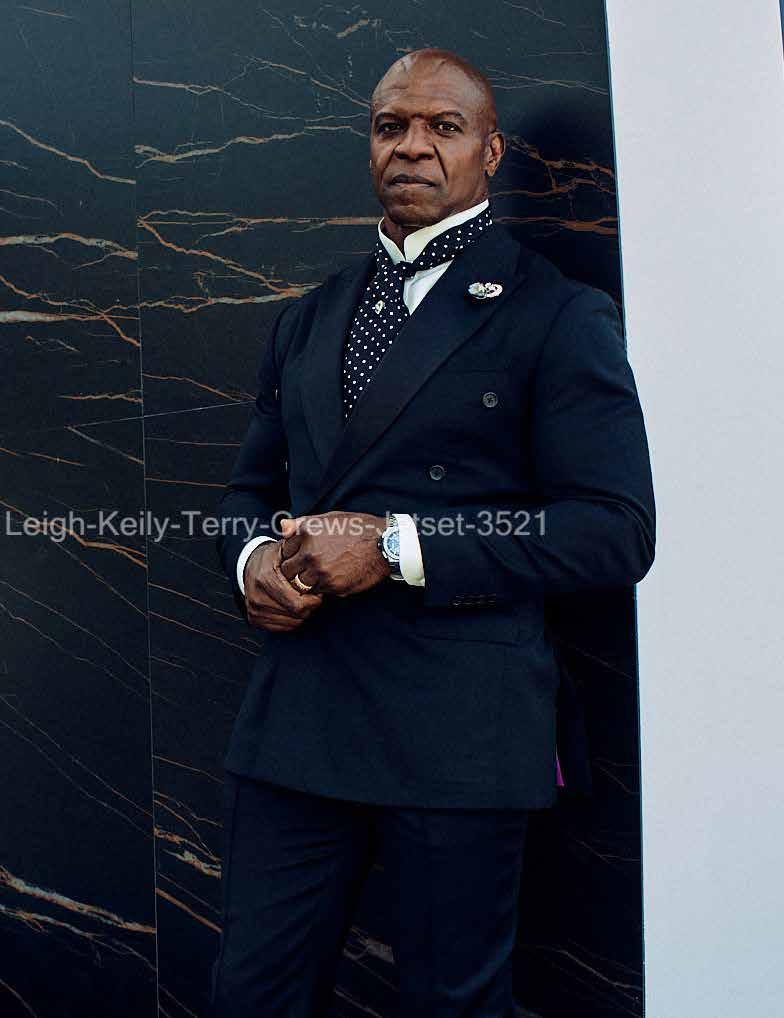
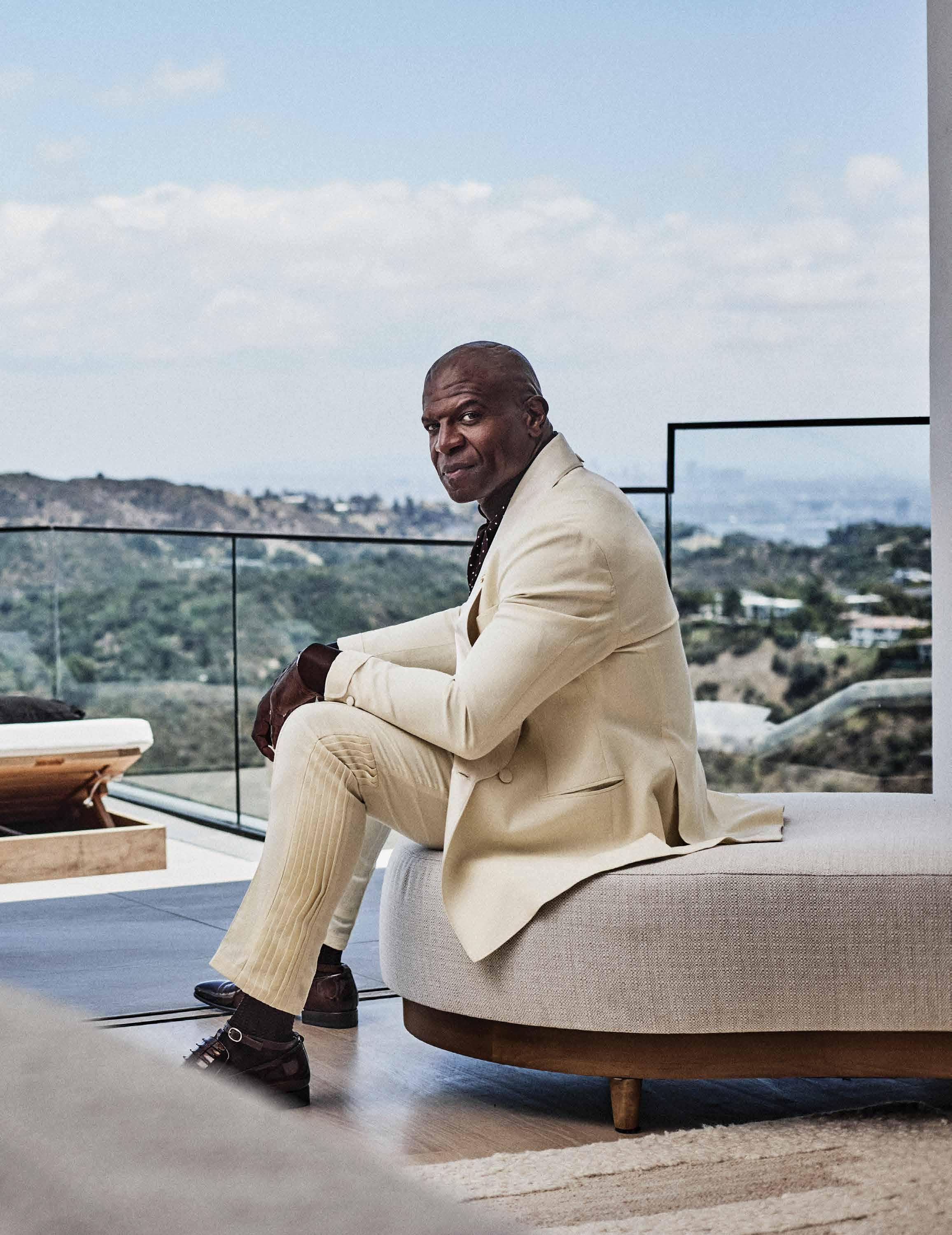
Terry Crews loves a good competition, but not for the reasons one would think. Across years of hosting Americans’ favorite TV shows, including “America’s Got Talent,” a YouTube series “Crews Control,” and a new cooking series “100 Cooks” to premiere in June, Crews has watched thousands of contestants walk out under the lights and lay everything on the line. And he has come away convinced that what keeps him saying yes to these projects is not the act of competition or rivalry. “I study what makes the difference between people who win and people who don’t,” he says.
What genuinely lights him up is each contestant’s creativity, their willingness to do their craft at their best in a way no one else would dare. Whether it’s the singer who finds an arrangement no one expects or the home cook who turns a family recipe into something unrepeatable. “The more creative you are,” he says, “the more you’ll win.” And he loves taking in what it looks like when people pour everything they have into something that sets them on fire.
That conviction in creativity and discipline made him one of the most expansive talents in American entertainment: NFL defensive end, actor, franchise comedy anchor, talk-show host, children’s book author, furniture designer, painter, and advocate. From the outside, the sheer stacking of skills can look like a man who just took every offer. But Crews is intentional about how he wears each hat. “When I’m doing AGT, that’s all I’m doing,” he says. “When I’m painting a painting, I’m 100 percent into that. By focusing on one thing at a time, you could do so many things. There’s no reason to limit yourself.” His picture book, Terry’s Many Hats, distills that whole philosophy, and he wrote it, he says, for the seven-yearold turning the pages and the parent reading it to them. And he says that having a variety of skills would come in handy for generations to come. “You’re going to have to reinvent yourself probably once or twice in your life,” he admits.
Crews speaks to that next generation with the authority of a man who was raised beneath every ceiling imaginable. He grew up in Flint, Michigan, a city he described as ”dying in slow motion.” With the auto industry collapsing, a crack epidemic taking hold of the streets, domestic violence crippling his own home, the only way for him was out. And it had to be much like a rocket leaves a launchpad, because there was no plan B waiting to catch him.
The first time he reached for a football scholarship, they told him no. He came back and asked again. Somewhere in that refusal to accept a first no as final came the determination to live by the distinction of knowing the difference between losing and accepting defeat. “No was negotiable,” he remembers. He lost plenty along the way, and he is the first to say so, but losing and accepting defeat were never the same to him. “If you can’t run, walk,” he says. “If you can’t walk,
crawl. If you can’t crawl, scoot.” There were long stretches, he concedes with a laugh, when he was doing a great deal of scooting. The speed was never the point, but rather that he refused to stop moving forward.
That same never-ending hustle eventually came with a cost. Success at the altitude he has reached does not arrive without a ledger, and the currency is hardly financial. “You don’t get time back,” he says, recalling missed recitals, dinners in distant cities, and ordinary weeknight memories his now-adult children carry, and he does not. “There were times when my kids were like, ‘Hey, you weren’t there for this. You weren’t there for that,’” he remembers. “And it hurts.”
For years, he stayed late because he felt he needed to prove something to the room, to the industry, to the version of himself that had clawed out of Flint with nothing to lean on but momentum. He sees it differently now. “I remember I could have gone home,” he says. “But I stayed in order to prove how loyal I was. And now, thinking back on it, I should have gone home.”
What that cost taught him was the difference between drive and depletion, and the hard-won art of reclaiming his own balance after years of pushing past his limits. He reaches for an easy-to-relate analogy from the gym to explain it. “You don’t know how much you’re overdoing it until you overdo it.” At the very top, “when you are in the top 3 percent in the world at what you do,” as he puts it, the margin between commitment and excess narrows to a razor’s edge, and, Crews admits, he crossed it more than once before he learned to feel where the line was. The man who built a career on the principle of never stopping has spent his fifties learning the equally demanding discipline of knowing when to stop. “You have to learn how to apologize,” he says.
Through all the ambition, the absence, the long seasons in faraway places, the one constant was Rebecca, his wife of 37 years, who covered the ground he could not cover and kept a home whole for him to return to. When Crews speaks of legacy, he wants no monetary treasures, but only one thing. “I want them to interview my wife, Rebecca,” he says, “and ask her ‘what was he like?’ and I want her to tell everyone in the world that he loved me better than anybody ever could.”
He knows the weight of that sentence because he has lived the unglamorous version of it and found it more than enough. Before the franchises and the cover shoots, before Hollywood knew what to make of him, there was an evening in a small Los Angeles duplex when he and Rebecca had nothing the world would have recognized as success. “We were so broke that I had a pizza night for the girls,” he remembers, “and all we had was flour to make dough, spaghetti sauce, and we threw some cheese on top.” He found a Blockbuster coupon, rented a video, and the four of them sat together in a space that was, in his own words, beautiful and special, “because we
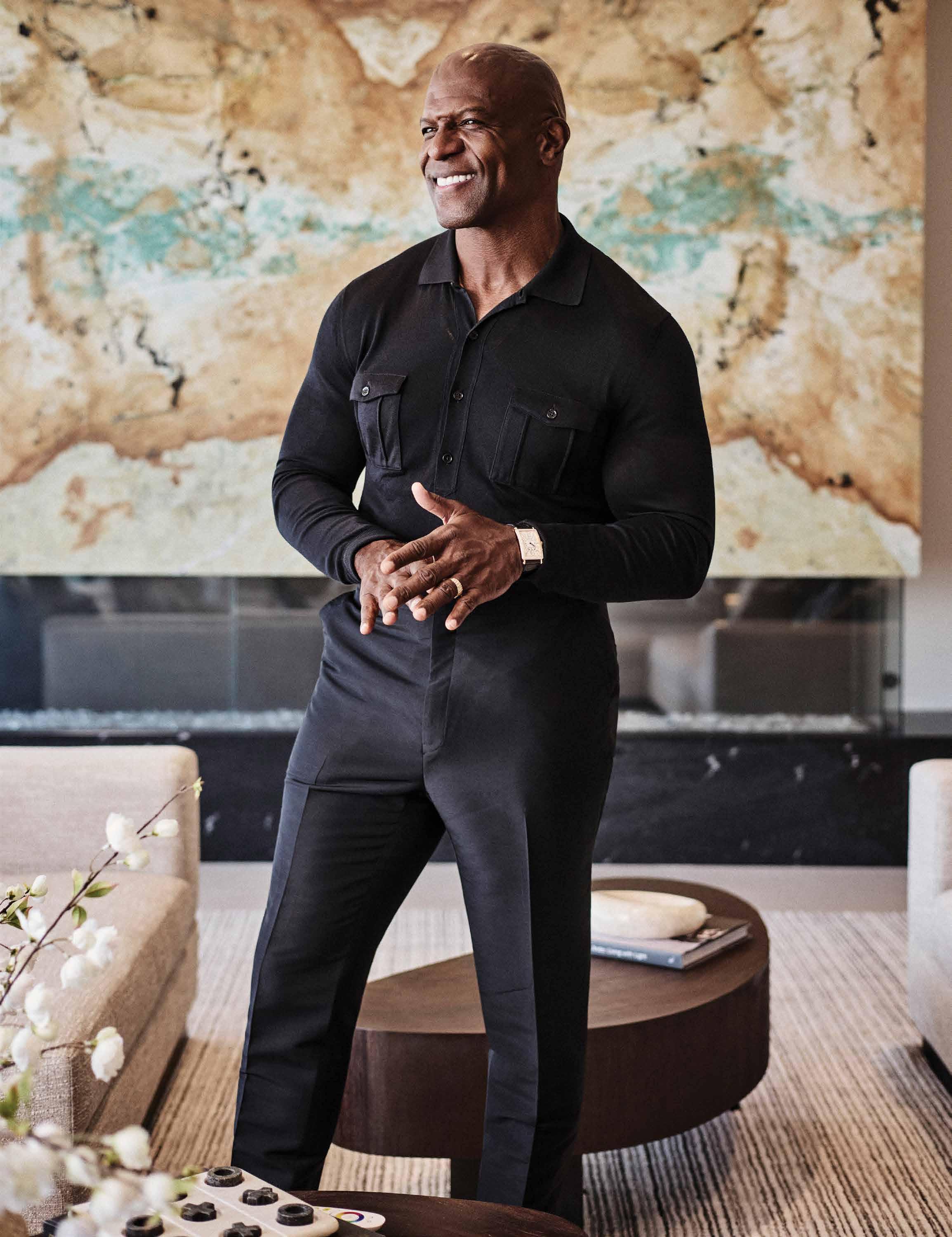
just loved, we just had each other.” Then, with his voice rising at the memory, he says, “It was like being in Monaco.” Though since then, they have done the yachts, the finest restaurants, and celebrated vacations along the Côte d’Azur, yet none of it has come close. If all of it vanished tomorrow—the fame, the money, the success—he was unequivocal about what he would do. He would find his way back to that moment with his wife and children and say, “Here we are again. Let’s do it again.”
It is in that conviction that Crews points to one word he says defines his lifestyle. “It’s called eudaimonic,” he says. The ancient Greek idea describes a life of fulfillment earned through purpose, one that comes at a cost. It’s the feeling, he says, of watching Michael Jordan lift a championship trophy with tears in his eyes. It’s when you know that “the purpose has been fulfilled. And it cost you. And it hurts,” he says, before adding, “I have a purpose-filled life.” This is the engine beneath the many hats, the fulfillment that comes from having spent everything to earn the trophy, far more than the trophy itself. It is also why he surrounds himself with people who have climbed even higher than he has, studying them the way he studies the talent on his stages and returning to his own work inspired.
Protecting a life with such deliberate direction requires structure, and Crews has built his around boundaries he now makes a priority. The realization that he had spent decades overdoing it eventually formed into a daily practice. The younger Terry Crews ran on a fear of missing out. The Crews today knows the value of a sacred morning. “I’ve learned how to say no,” he admits. “As long as I have my priorities straight, I won’t miss anything.” His mornings now belong to no one else. He wakes up around 4:30 or 5 a.m., and nothing is scheduled until 10 a.m. “My mornings are hallowed ground,” he says, describing movement, journaling, writing down goals, charting where he wants to go, and sitting honestly with the question of who he still wants to be. “If you don’t have a vision,” he says, “you’re done.”
At 58, Terry Crews is still envisioning things he wants that he cannot yet name, still discovering what is within him. The curiosity that carried him out of Flint—through football, through Hollywood, through AGT, through his YouTube series “Crews Control” and now into Food Network’s “100 Cooks, “a sprawling new competition that pits a hundred home cooks against one another— has been the fuel of his success. Every morning, he comes back to the same question of who he wants to become. Everything else, gladly, is a hat. Watch him keep adding to the collection.
Structural Engineer: E. Avico, Inc.
Tel: (310) 657-6576 • E-mail: avico1@aol.com
For pricing, availability, and private showings of Vantage, please contact: Leeor Arshadnia
Tel: (310) 999-1112 • E-mail: leeor@adonisdesign.co

If you can’t run, walk. If you can’t walk, crawl. If you can’t crawl, scoot.” “
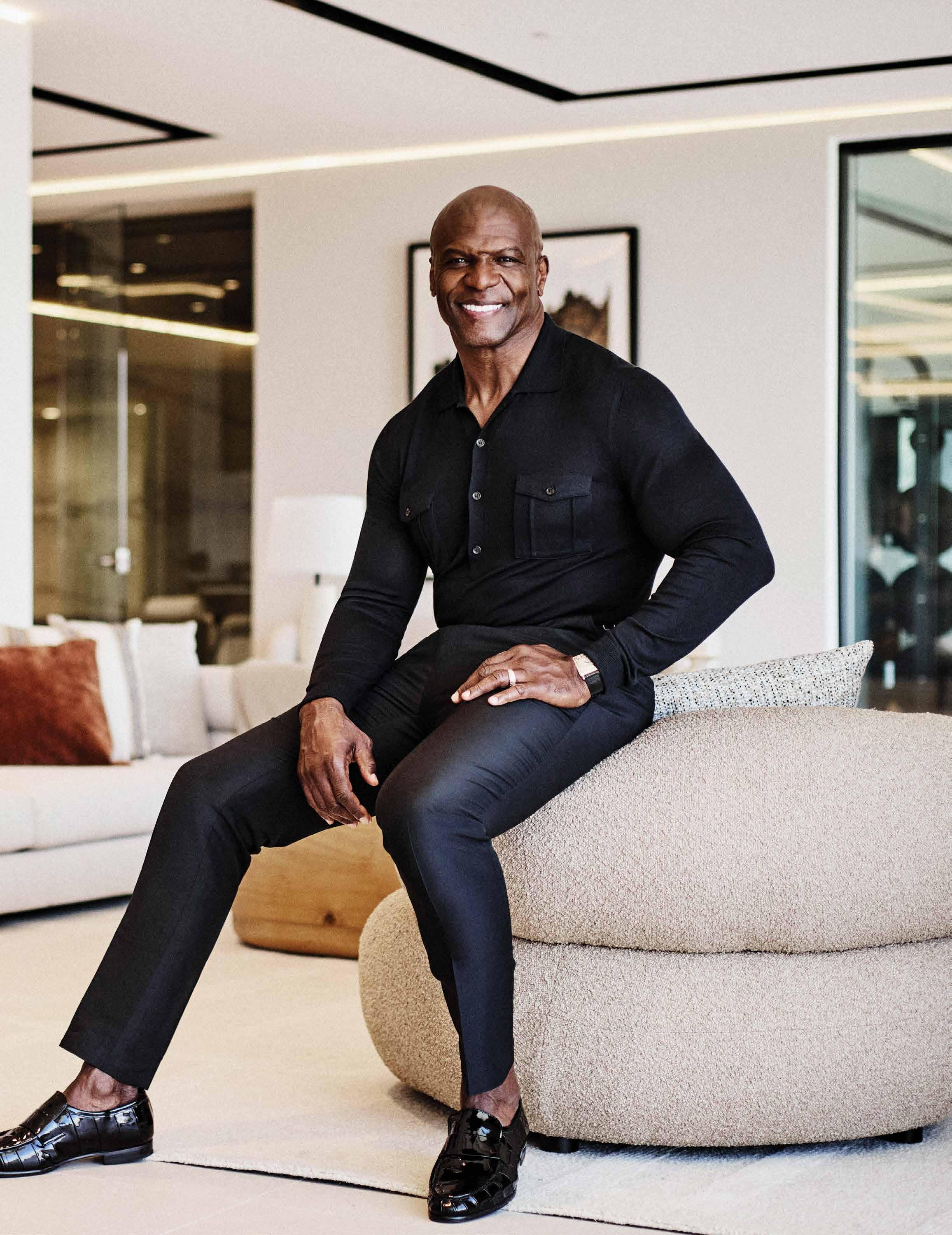
BY TOBY THOMPSON
When someone mentions “Palm Springs,” what comes to mind? Do you think of the legendary getaway for Hollywood icons? The picturesque desert and mountain landscape? Midcentury modern architecture to the max? Or maybe a golfer’s paradise? All of these are absolutely accurate, but Greater Palm Springs is so much more. In fact, it encompasses nine destinations—Palm Springs, Desert Hot Springs, Cathedral City, Rancho Mirage, Palm Desert, Indian Wells, La Quinta, Indio and Coachella—each with its own personality.
It’s easy to get to this dream SoCal destination. Palm Springs International Airport (PSP) offers nonstop service from more than 30 cities across the U.S. and Canada. It’s also just a two-hour drive from Los Angeles and San Diego.
When planning your trip, you’ll need to find a great place to stay as you explore all that Greater Palm Springs has to offer. I highly recommend the Renaissance Esmeralda Resort & Spa in Indian Wells where you can take in the scenic mountain and desert views right from your private balcony. After that, you may want to relax in a cabana near the pool’s sandy beach or get in a quick workout at the 24/7 fitness center. Or maybe you’ll opt to grab a refreshing drink at the H2O Pool Bar or dine on some delicious cuisine at the Seven Olive Modern Gastropub, CAVA, The Place, or Glo Sushi.

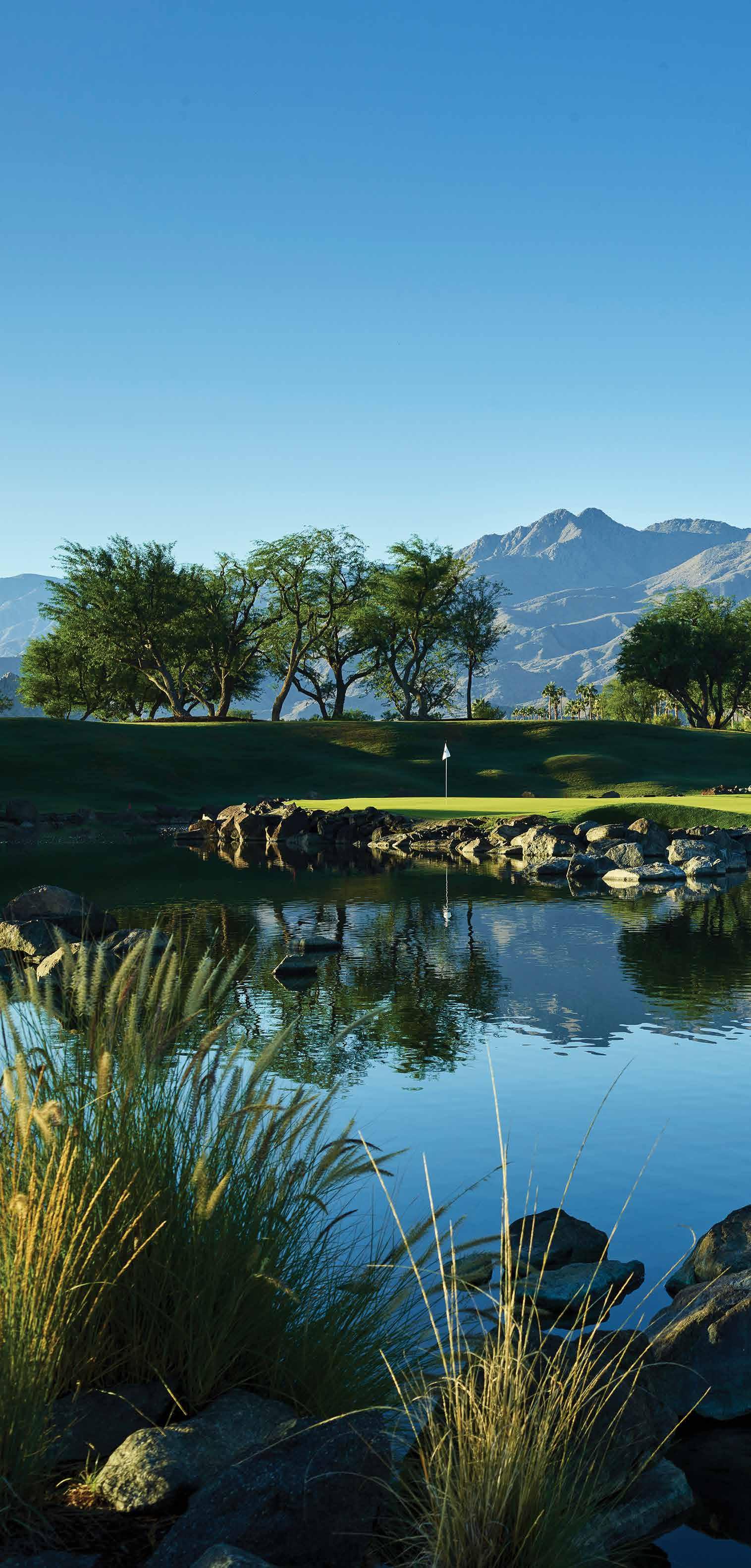

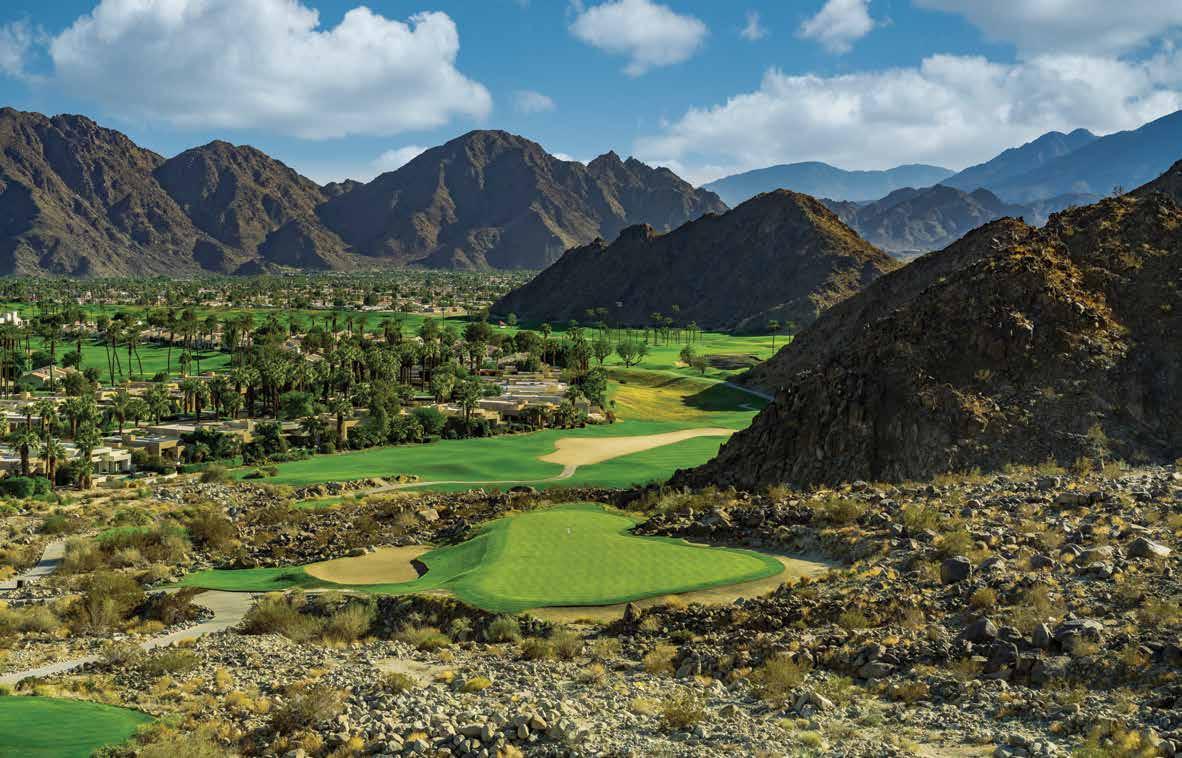
Whatever you choose to do, make sure you save time to visit the resort’s Spa Esmeralda where you can indulge in your choice of soothing activities such as wellness therapies, facials, massages, body treatments, bath rituals and couples’ massages. After all, getaways were made for relaxation, and this is definitely a great place to start.
If golf is your game, you will think you’ve gone to the proverbial golfer’s heaven when you visit Greater Palm Springs, especially when you set your sights on PGA WEST in La Quinta. It is definitely a bucket list golf destination with five public courses offering 90 holes of incredible golf. The Pete Dye Stadium Course is famous for its Hole #17, also known as Alcatraz, because it’s surrounded by boulders and water. The Pete Dye Dunes course offers the challenges of wellguarded greens and railroad tie-wrapped water hazards and the Pete Dye Mountain Course is known for its bunkers, rock formations and elevated tee boxes. All three of these courses are fresh off a multi-million-dollar restoration. Two other golfing greats are also represented at PGA WEST. The Nicklaus Tournament Course delivers plenty of challenges, including not just one, but two island greens. The Greg Norman Course, not surprisingly, is inspired by Australia’s Outback.
As though that wasn’t enough to get your competitive juices flowing, you can even learn to make some serious improvements to your game by booking an appointment at The Performance Lab at PGA WEST. If it’s putting you’d like to improve, the lab’s Zen Green Stage replicates real-world course contours so you can learn how to master them. How’s your swing? The lab’s GEARS 3D Motion Capture technology stands ready to analyze your force and motion and give you feedback on ways you can improve your swing and, ultimately, your game.
I recently had the pleasure of playing in the ProAm for the American Express Golf Tournament held at the Pete Dye Stadium Course at PGA WEST. The January tournament

is the highlight of the PGA Tour’s West Coast swing. It attracts top golfers to compete on these challenging courses and a large fan base who come to watch their favorite pros in action and to enjoy the phenomenal hospitality at the specially designated fan zones. The tournament includes The American Express Concert Series and this year, it featured two Grammynominated bands, OneRepublic and Old Dominion. The tournament is also dedicated to giving back to the community. Since it began in 1960, it has contributed more than $67 million to non-profits in the Coachella Valley.
Greater Palm Springs is blessed with more than 300 days of sunshine each year, so it’s easy to see why it’s a haven for golfers, wellness aficionados and outdoor adventurers. One popular activity is the Palm Springs Aerial
Tramway. It boasts the world’s largest rotating tram car, offering riders spectacular panoramic views of the Coachella Valley below as it transports them over two-and-a-half miles along the cliffs of Chino Canyon to an elevation of more than 8,500 feet. At the top, riders can access more than 50 miles of hiking trails.
Those who crave art and culture won’t be disappointed, either. There are plenty of excellent museums to explore, including the Palm Springs Art Museum, the Palm Springs Air Museum, the Living Desert Zoo and Garden, and the Children’s Discovery Museum of the Desert. And if you should find yourself in Palm Springs on a Thursday any time of the year, you won’t want to miss VillageFest. It’s when Palm Canyon Drive in downtown Palm Springs is closed to traffic so visitors can enjoy the arts,

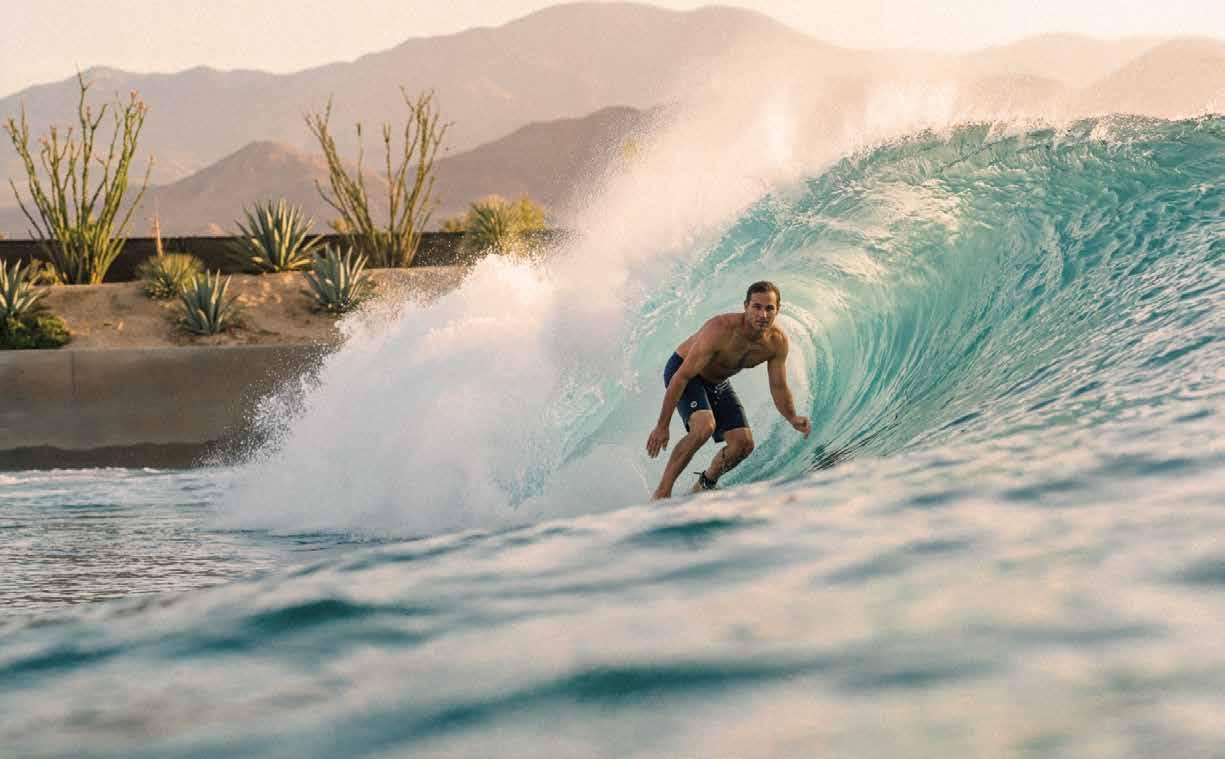
crafts, food and entertainment offered by more than 180 vendors.
In the future, there will also be something you wouldn’t expect to find in the desert—the largest wave pool in the U.S. A private resort real estate development firm, Meriwether Companies, is partnering with Thermal Beach Club to develop a world-class, 48-chamber surf lagoon for members of Coral Mountain Desert Club, a master-planned community now under construction in La Quinta. At the heart of the club will also be an 18-hole golf course, marking David McLay Kidd’s first-ever desert golf links. While the wave basin and new course are not anticipated to open until 2028, but it sounds like the destination will be worth the wait.
Whether you decide to golf, hike, or head to the spa or any of Greater Palm Springs’ many other
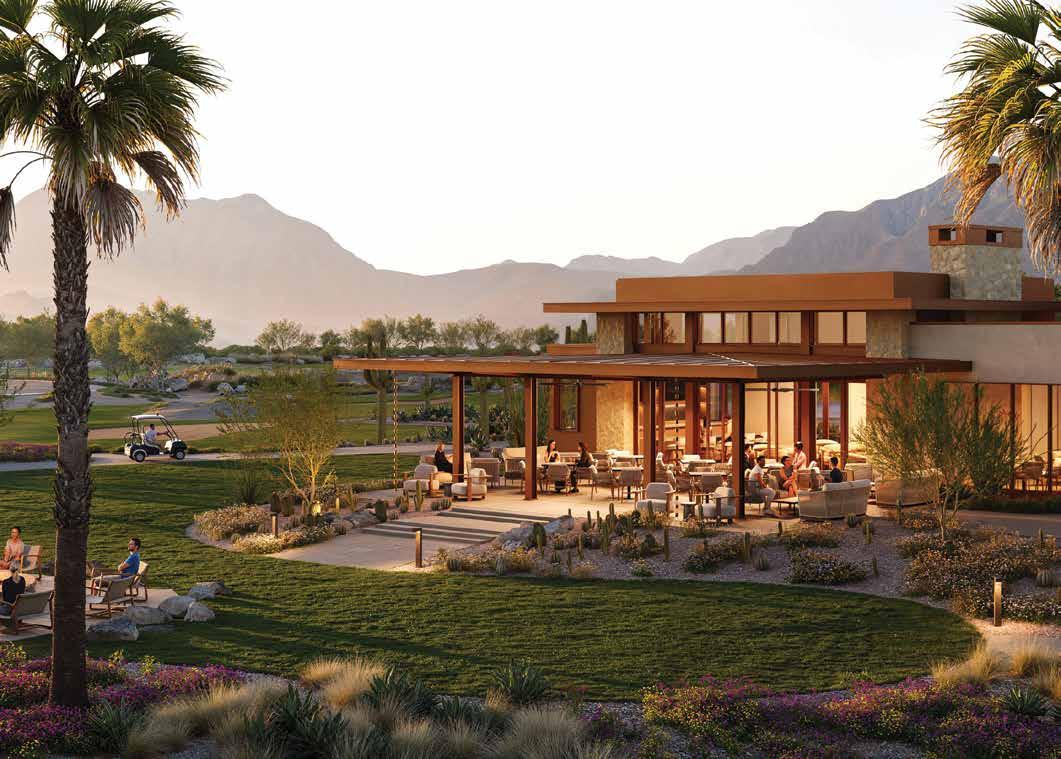
attractions, you’re sure to work up an appetite. You’ll have no shortage of dining options. Here are a few of my top picks:
Mole, located at The Shops on El Paseo in Palm Desert, specializes in creative dishes made from scratch that reflect the authentic flavors of Mexico. Be sure to save room for some Prickly Pear Flan, Tres Leches, or the tempting House Made-to-Order Churros.
Morgan’s In The Desert is the signature dining venue at the La Quinta Resort and Club, so you know you’ll be in for a special experience. Don’t miss the Farmer’s Market Soup inspired by the bounty of the Coachella Valley and be sure to check out the Seafood Ice Bar for some Oysters on the Half Shell or the Seafood Tower Platinum stacked with Smoked

Hamachi, Oysters, Baja Shrimp and Snow Crab Claws.
It’s hard to imagine a trip to Greater Palm Springs without taking in some of its classic, vintage desert vibes. DSRT Club in Old Town La Quinta began life as The Desert Club in the late 1930s and enjoyed the height of its popularity in the 1940s and 1950s. Now the new owners, inspired by this era, have created a fine dining establishment that brings back the nostalgic, “swanky” vibe of the original club.
If you’re looking for a place to escape to where you can rest, relax and rejuvenate, I highly recommend Greater Palm Springs. After spending a few days here, I can see why local tourism officials use the mantra “Find Your Oasis.” I certainly did. Learn more at Visitgreaterpalmsprings.com.

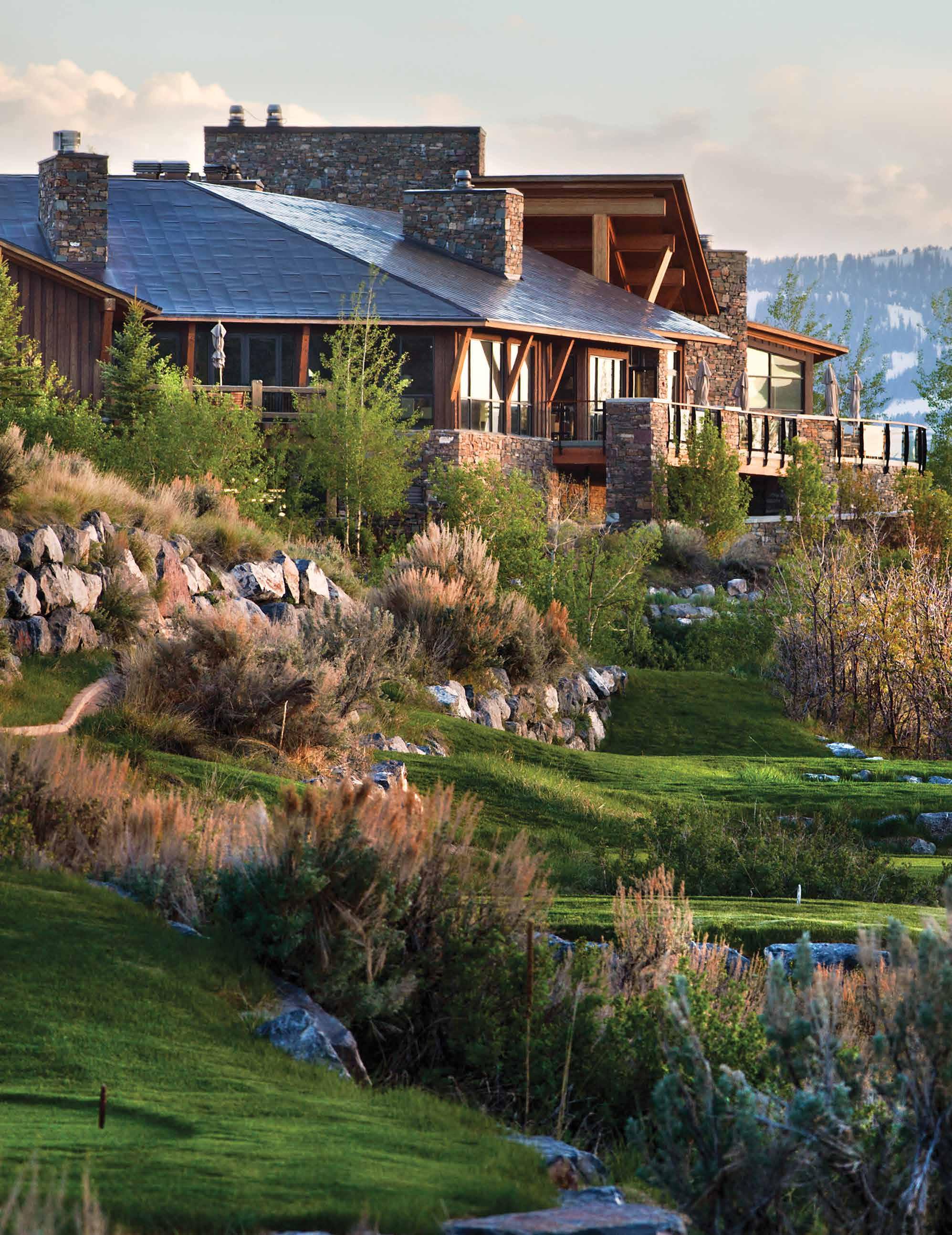

BY SI SI PENALOZA
In the modern geography of American wealth, the Wasatch has emerged as an upper atmosphere—where luxury rises, thins, and eventually turns private. Promontory looms like a meticulously engineered kingdom of alpine privilege—Dye and Nicklaus designed fairways, clubhouses, and equestrian lifestyle calibrated with Swiss precision. Yet even Promontory real estate is beginning to look positively porous compared with what’s arriving nearby. An hour north, hidden in the mountains, Wasatch Peaks Ranch is the inevitable establishment escalation—Utah’s formidable answer to Yellowstone Club, designed with even greater discretion. The project spans thousands of acres of private terrain and will ultimately cap at roughly 450 member families.
In other words, the luxury ecosystem has stratified like a robust Bordeaux: carefully, expensively, and in layers. Promontory for the visibly affluent; Wasatch Peaks Ranch for the discreetly dynastic. Over the ridge at Francis Gate, strategists are playing the 2034 Olympic long game—and Austin Draper of Drapers Complete Homes is building its architectural vanguard. Meet the antidote to the membership economy. No velvet rope. No six-figure club initiation quietly stapled to the deed. Think Park City without the scene. Andermatt without the smug. A little Succession—but with better natural light.
Calling one of Draper’s builds simply a house feels like calling a Birkin a handbag. He hasn’t merely built residences; he’s minted architectural currency. Minimalism here behaves less like aesthetic choice and more like doctrine: glass walls rising toward the Wasatch light, stone grounding the structure to the valley floor, timber warming the geometry, so the whole composition reads equal parts sanctuary and stage. A glass wine cellar, uplit bottles shimmering like a
constellation. A sauna to exhale the day’s pretensions. A cold plunge to remind you the body is gloriously, shockingly alive.
Open space, panoramic lots, zero allegiance to resort-town conventions. The savvy aren’t following the lifts—they’re following the light, doubling down on space over status, vision over volume. Fewer chalet clichés, more clarity of form—long-term livability within proximity of great alpine sports. Less HOA, more horizon. Think clean rooflines, intelligent and intuitive materials, site-specific concepts. Draper’s ambitious work reflects a mountain idiom that doesn’t merely blend in, it rethinks the terrain altogether. This is where space, silence, and design ambition still have room to breathe.
In a design-driven migration to Draper’s builds, buyers venturing into the Wasatch’s unbranded backcountry are finding a new genre of alpine architecture is taking shape—slower, smarter, and sharper by design. Fixtures curated as if by a gallerist with an expensive fetish for faucets. And literal yards of counter space to stage your own version of The Bear, minus the cortisol spikes.
Draper’s interiors in Francis feature the celebrated repertoire of Trisha Coffman, a designer who approaches space the way a virtuoso editor approaches text—distilling essential gestures: warm woods against cooler stone, textured plaster catching mountain light. Her intellect has earned national attention; The New York Times recently profiled her T.Haus design firm, a rare nod in a publication not easily impressed. She brings her signature stealth-wealth sensibility—Mountainhead with the volume-turned-down—evidence of a designer bringing her A-game to the Wasatch.
From the terraces of Draper’s collection of four custom homes, views sweep toward Sundance Mountain, where the Wasatch gathers around the sheer mass of Mount Timpanogos. Opening buzz on the brand new Inn at Sundance Mountain Resort is seismic—63 ski-in, ski-out rooms set among the pines at base village. The building straddles the North Fork creek so the water runs beneath a wooden bridge linking two wings, while rooms open through broad windows toward the ridgeline or Provo Canyon. Inside, the design leans into Sundance’s signature language—reclaimed timber, wool textures, Western art—while the practical rituals of skiing unfold with quiet efficiency: ski valet, fireside lounges, and a boot room steps from the lift.
Morning arrives quietly at The Inn at Sundance, carrying the aura of a debut season: staff moving with the attentiveness reserved for the opening chapter of a hotel’s life. Downstairs, breakfast
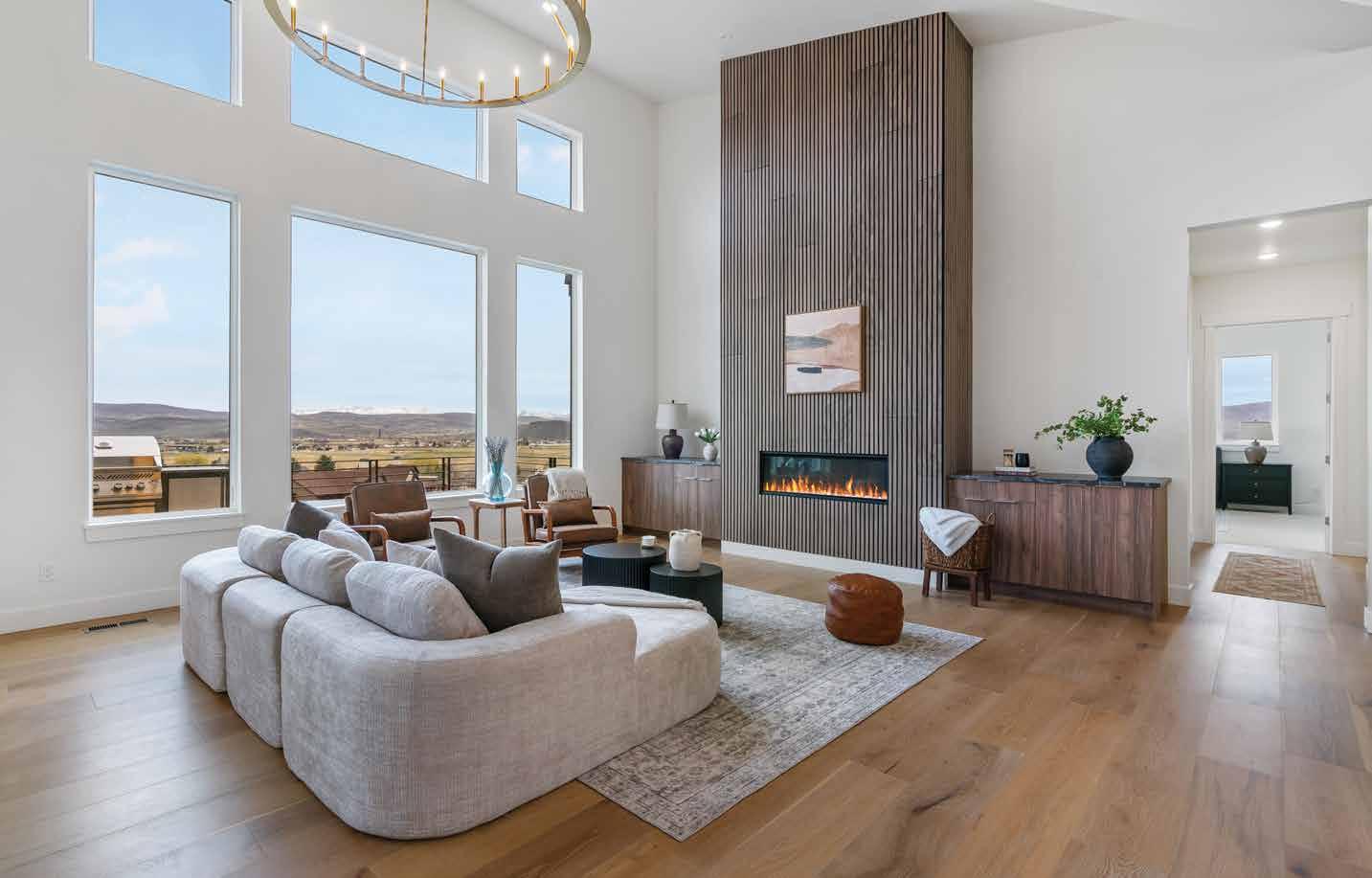
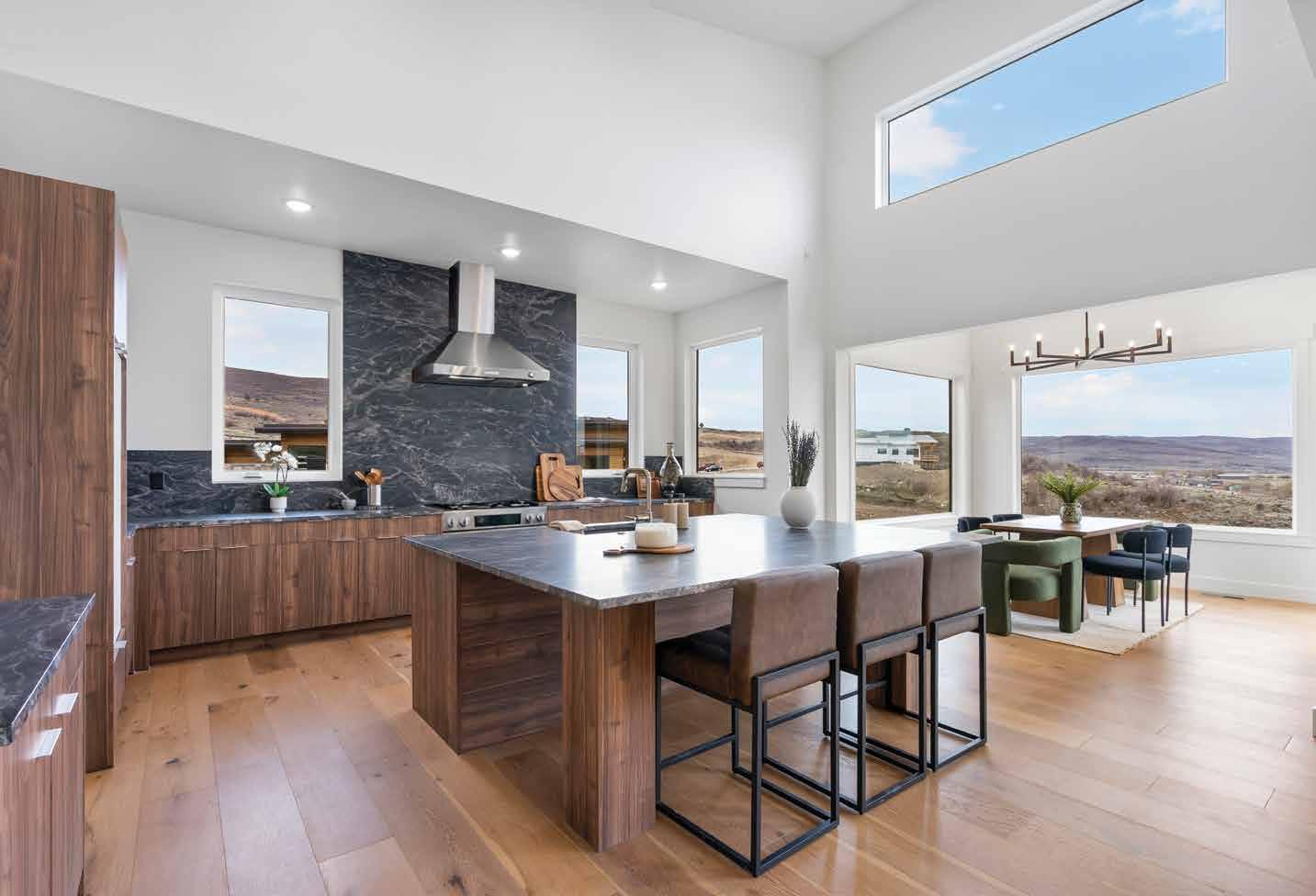
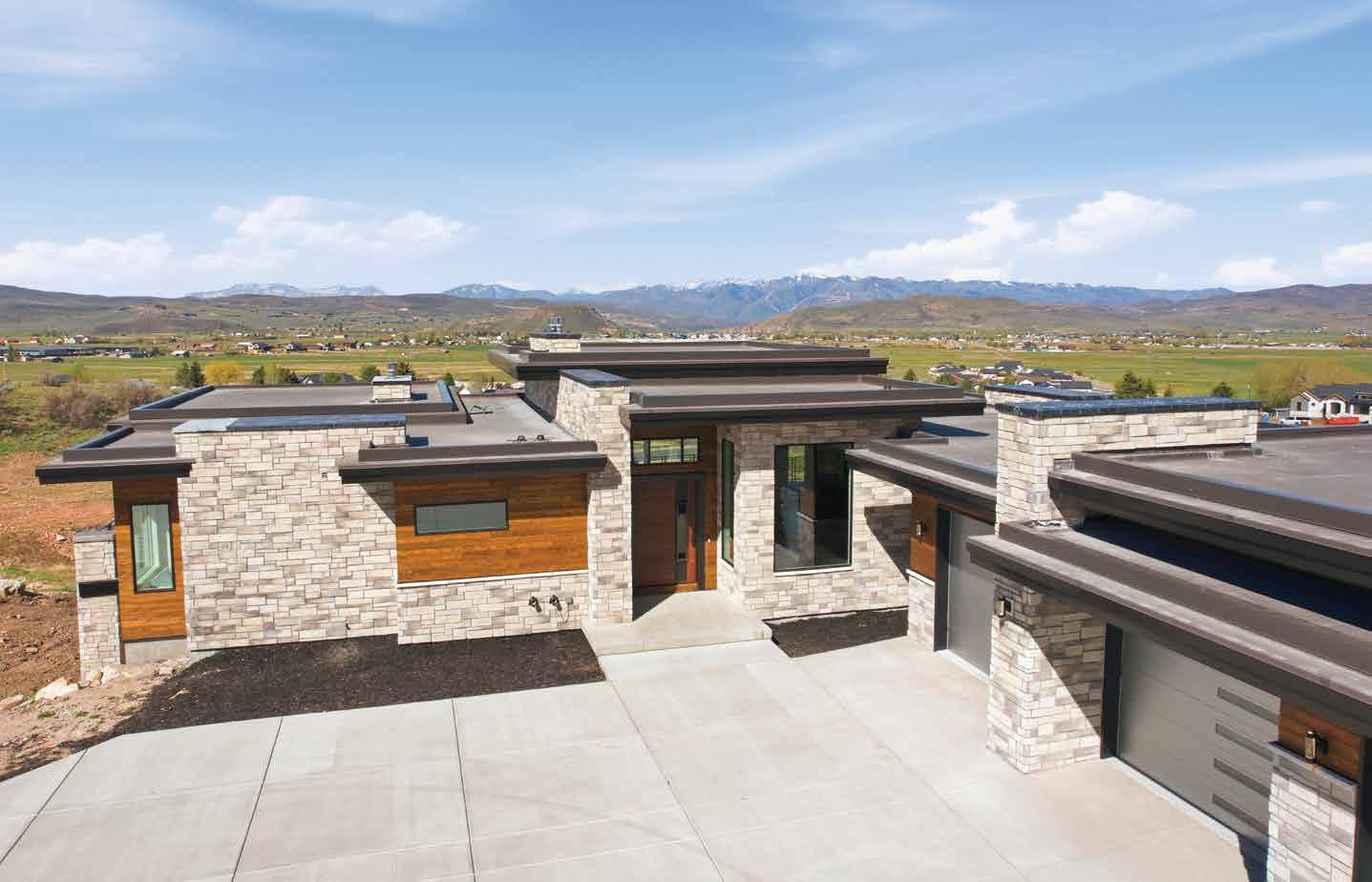
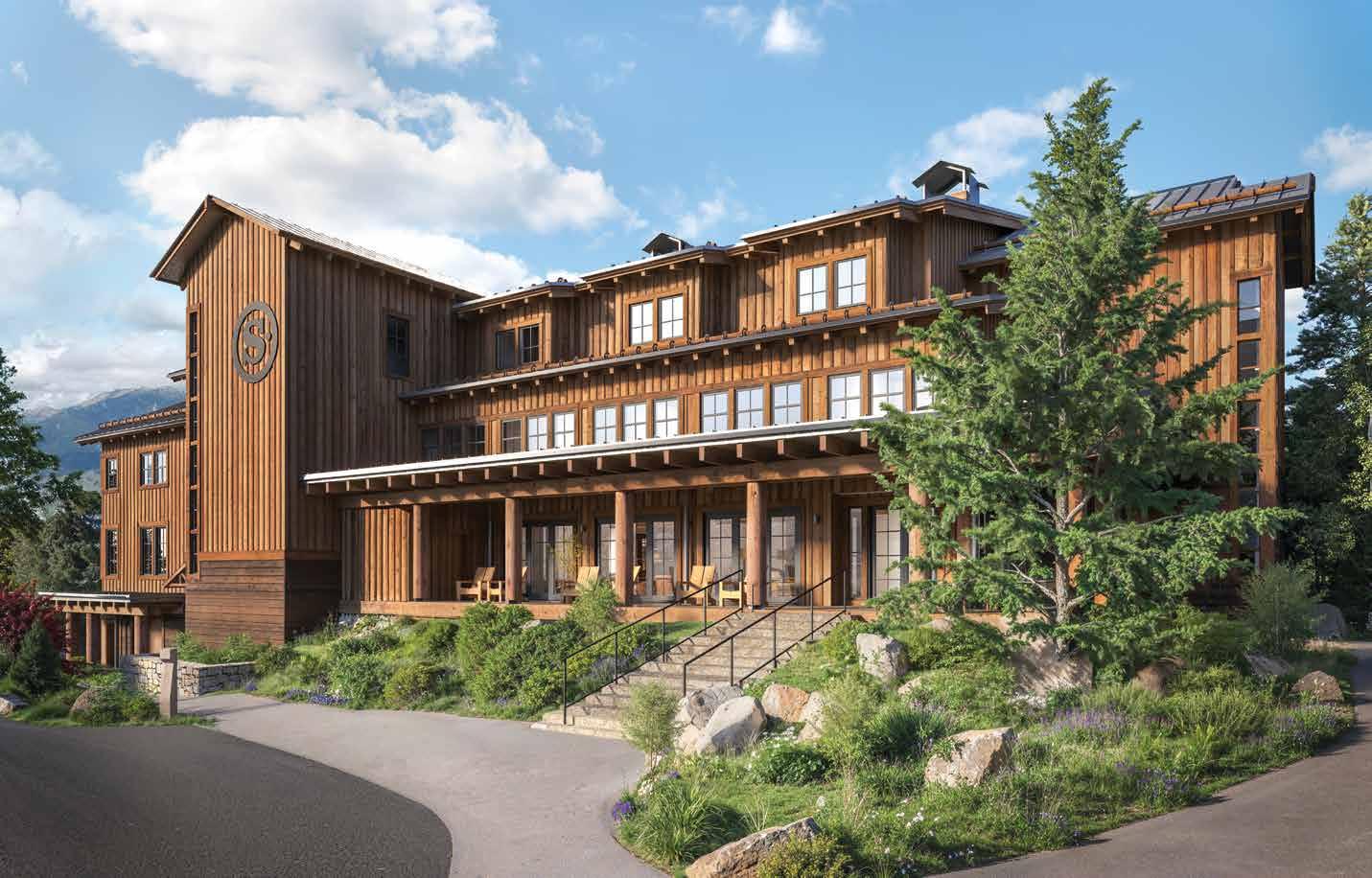
unfolds in the Living Room—the sort of meal meant to fortify and impress. After a brisk hike or bracing ski, lunch at The Foundry Grill overdelivers on flavorful recovery proteins. By evening, the center of gravity shifts to The Tree Room, the mountain’s legendary dining room—open since the early 1970s and anchored by a massive conifer trunk rising through the room, a reminder that Sundance has always insisted on building with the land rather than over it. A number of the Navajo textiles date back more than a century, some incorporating yarn sourced from Civil War uniforms—history, quite literally, woven into the room. The menu leans into mountain refinement: bison short rib, wagyu cheek, dishes that feel both elemental and exacting, alongside a wine list assembled with the same quiet seriousness. Joyce Farms duck is a triumph, its skin shattering delicately against meat that remains impossibly tender.
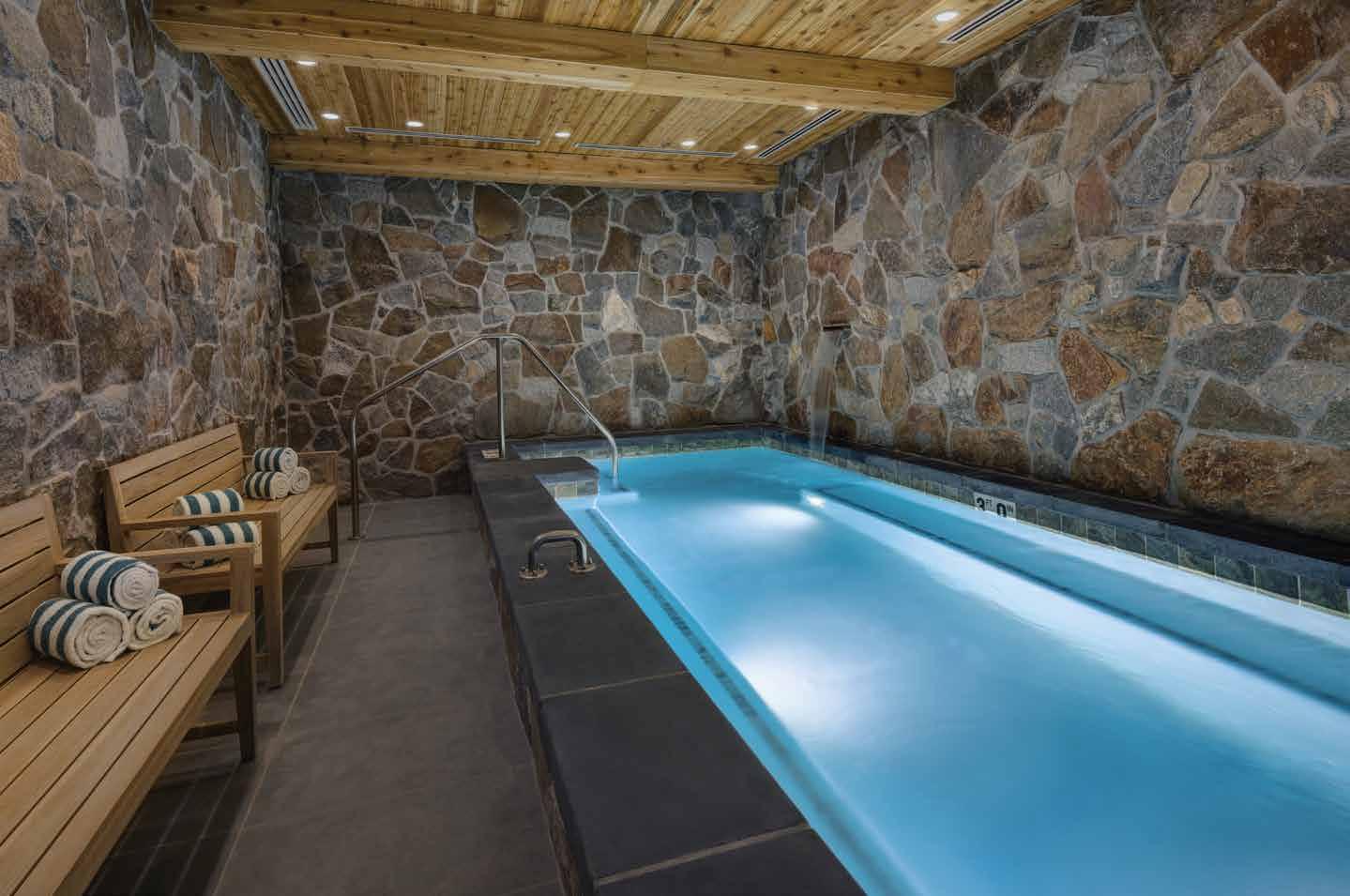
The Sundance Mountain Resort Spa draws guests into a different register altogether—a signature mountain herbal massage worked slowly into tired legs after a day on the slopes, the kind of unhurried ritual that makes the outside world feel theoretical.
Like the global elite, Promontory adrenaline junkies are drawn to Alta’s alpine doctrine. In summer Albion Basin opens into wide bowls of lupine and Indian paintbrush, trails wandering upward through glacial granite until the air grows thin and clear enough to taste. Winter is what made Alta mythic, monastic in its devotion to skiing—no snowboards, no spectacle, just steep fall-line terrain and a culture where powder is less a condition than a creed. Lexi Dowdall—alpine artist and Alta Ski Area’s Communications Manager—skis with the
assurance of someone who knows exactly where the story deepens. Dowdall guides us from the rolling, sunlit confidence of Albion’s blues into the steeper, contemplative cadences off Collins, where black diamonds cut cleanly through Alta’s cathedral of snow. Her pacing feels like a director’s cut: traverses evolve into transitions, vistas arrive on cue, and the Wasatch reveals itself in cinematic increments. High Rustler less a proving ground than a rite, the long fall lines a study in rhythm and restraint.
And then, just as deftly, the register changes. Inside Collins Grill, ski boots are traded—almost ceremonially—for plush slippers, and the body, still tuned to the mountain’s tempo, begins to recalibrate. Lamb meatballs—rich, spiced, and unapologetically indulgent—give way to elk curry, fragrant and quietly incendiary. It’s here,

in slippers and that suspended state between exertion and indulgence, that Alta reveals another facet of its luxury—not ostentation but the exact right note, held just long enough.
Checking into Snowpine Lodge feels both modern and steeped in Alta’s long memory. Directly against the mountain with true ski-in, ski-out access, the atmosphere inside is equal parts alpine club and boutique hotel: exposed beams, fireplaces burning low through the afternoon, and rooms dressed in soft wool and airy bedding. Downstairs, Swen’s restaurant hums with the relief of skiers fresh off Alta’s famous steeps; steaks arrive with alpine authority—perfectly seared, deeply marbled, conjured from fire and mountain air.
Beneath Swen’s, Stillwell Spa hides a hydrotherapy grotto carved into old stone foundations. It feels less like a spa and more like a private exhale—an interlude composed in stone, steam, and soft light. You enter as if slipping behind the curtain of the mountain itself: timber beams overhead, a living mural in slow motion. The therapist’s work borders on the uncanny—finding tension where you didn’t know it lived, smoothing, restoring, refining. Time loosens. Muscles remember themselves.
In 1968, when Robert Redford bought the land that would become Sundance Mountain Resort, he wasn’t building a resort so much as preserving a feeling. Development deferring to landscape, culture coexisting with quiet. Decades later, that ethos echoes across the Wasatch: roughly 60 percent of Promontory’s 6,400 acres is designated as open space. From the studied discretion of Wasatch Peaks Ranch, to Draper’s architectural clarity in Francis to the enduring purity of Alta, the most compelling addresses reframe the idea of arrival itself.
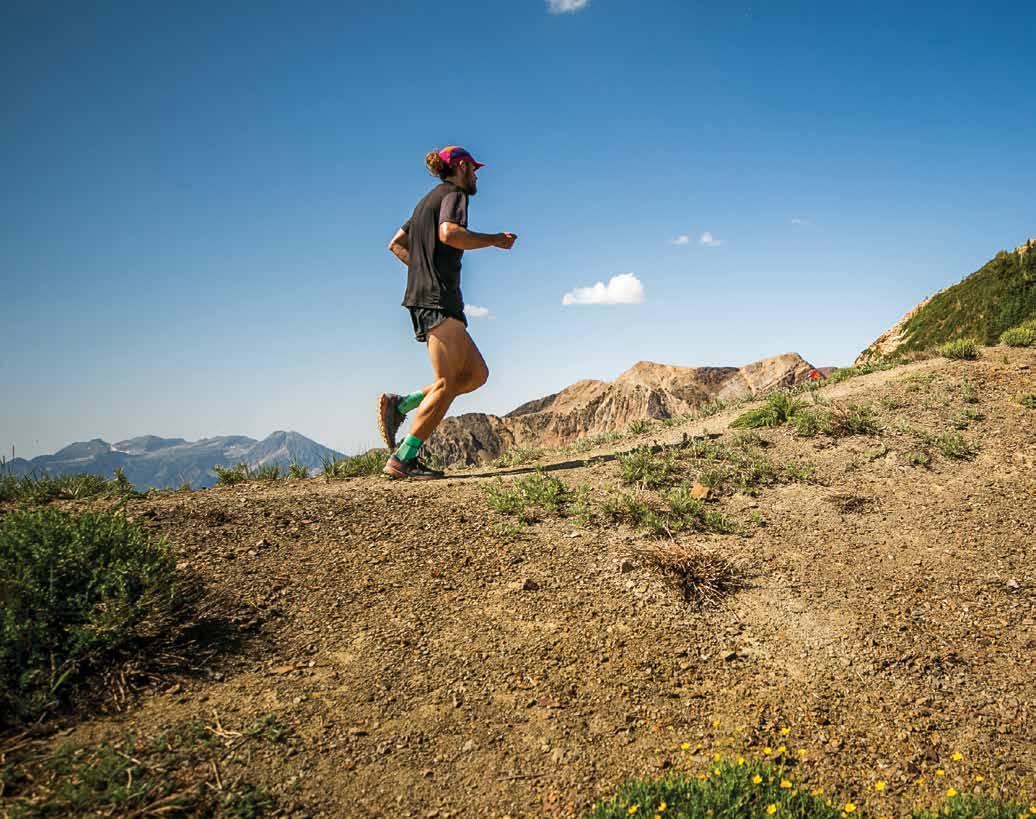

BY STACEY LASTOE
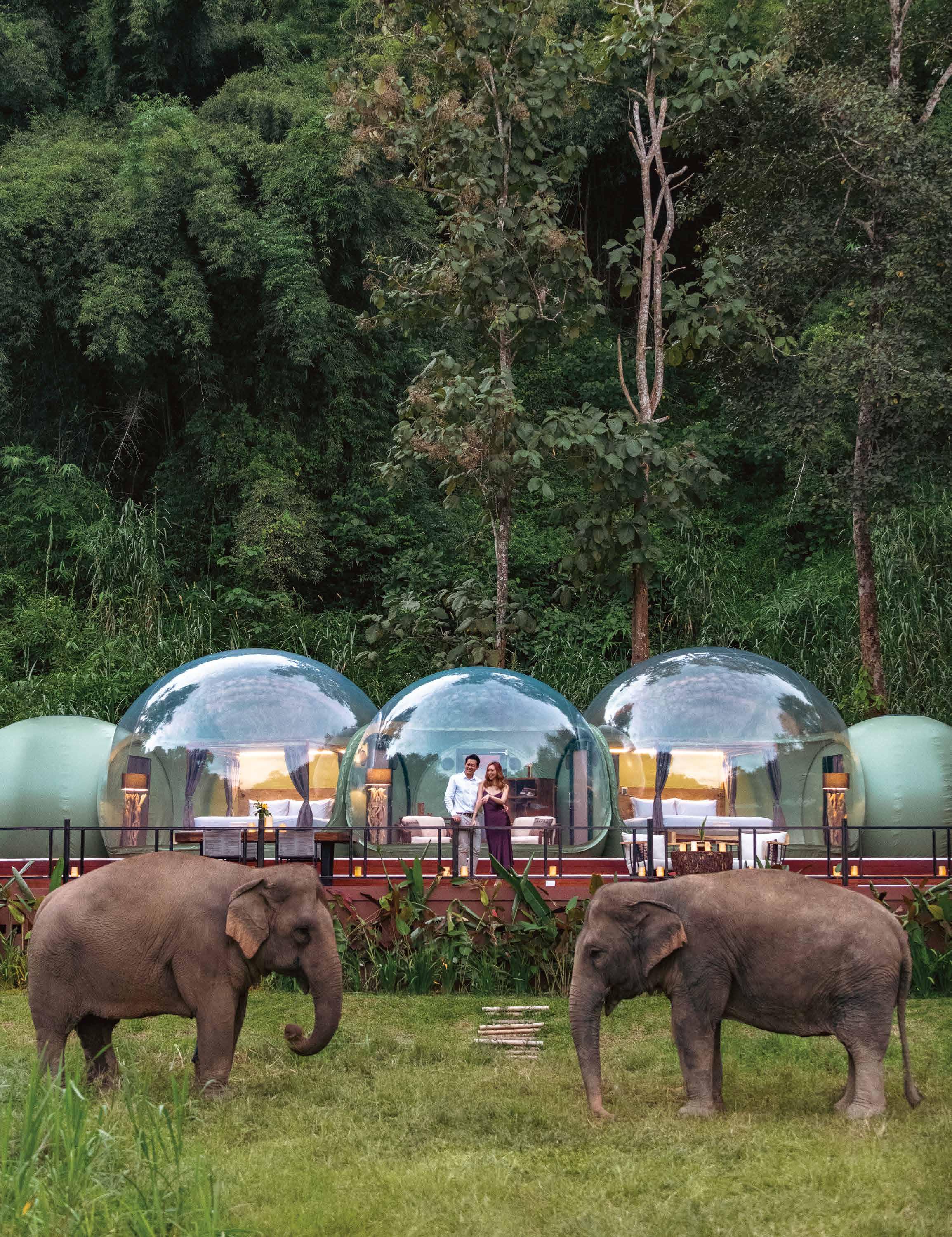

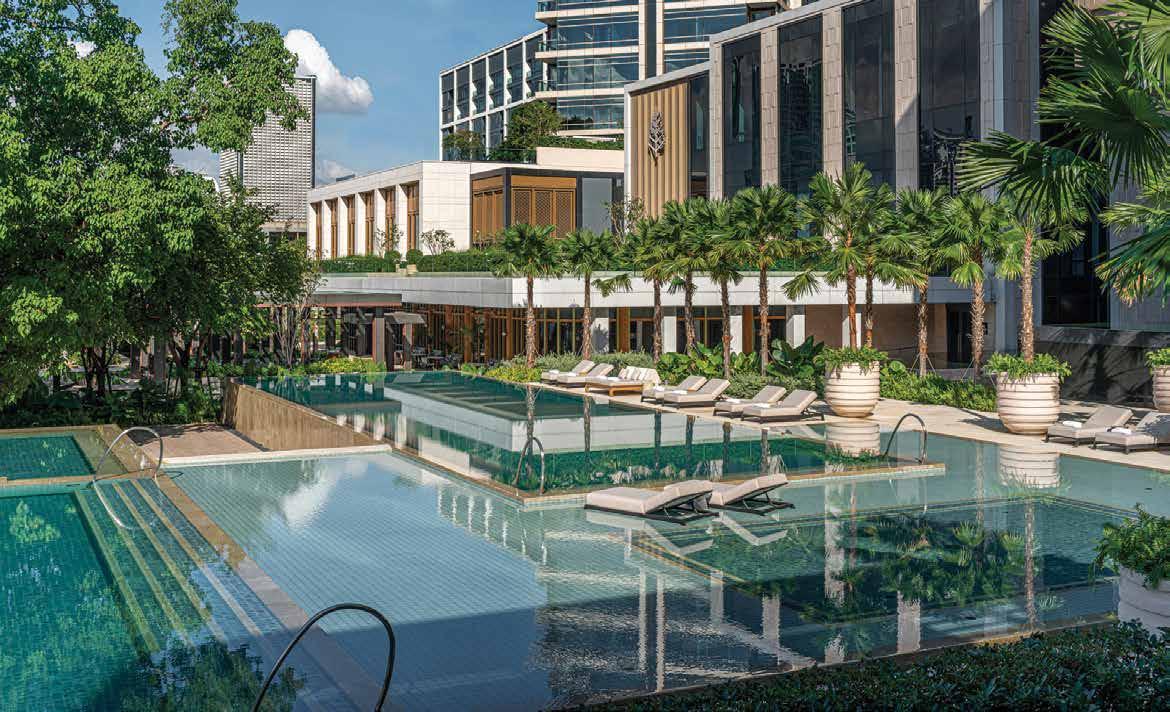
It’s a heady experience, landing in Thailand for the first time. Between the thrumming jet lag and intensely heightened senses, it can take a moment to get oriented.
This Southeast Asian country, which recently enjoyed some fresh attention thanks to White Lotus’ latest season, rewards the foodobsessed traveler as much as the temple-chasing one. It appeals to lovers of big, kinetic cities and those in search of the perfect beach. A masterclass in hospitality, Thailand also attracts travelers who refuse to sacrifice luxury while embarking on various adventures throughout the country.
That’s the thing about traveling in Thailand: In roughly 10 days, you can check into a polished riverside hotel in the center of one of the world’s most chaotic cities, fly south to unwind in a capacious villa overlooking the Andaman Sea, and finish the trip glamping with elephants in the jungle. Nine nights is a good amount of time to get a taste of the region, and the stops described below offer three distinct experiences, all in one trip.
Thailand’s capital city is where most travelers will arrive from the United States or Europe. Bangkok traffic can be brutal, but private transfers, often with cool towels and cold water waiting, arranged through your hotel, make moving through the city far more pleasant. With so much to see, you’ll want to plan for a three-night stay so you can fit in a temple tour, at least one tasting menu, and some shopping.
Amy Siegal, New York-based luxury travel advisor at Valerie Wilson Travel, regularly arranges travel itineraries in Thailand for people who want access above all else. That typically rules out group tours, which Siegal describes as “less agile.” “The same way that I curate a whole itinerary, a guide will curate the day,” Siegal says.
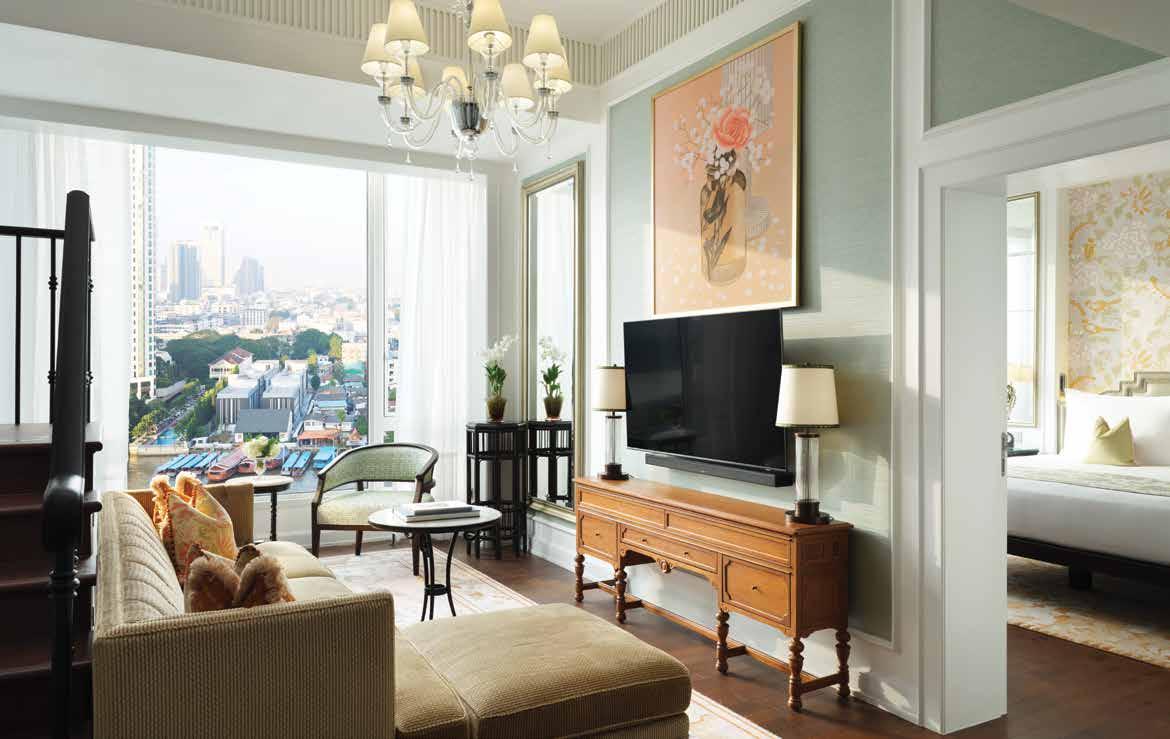
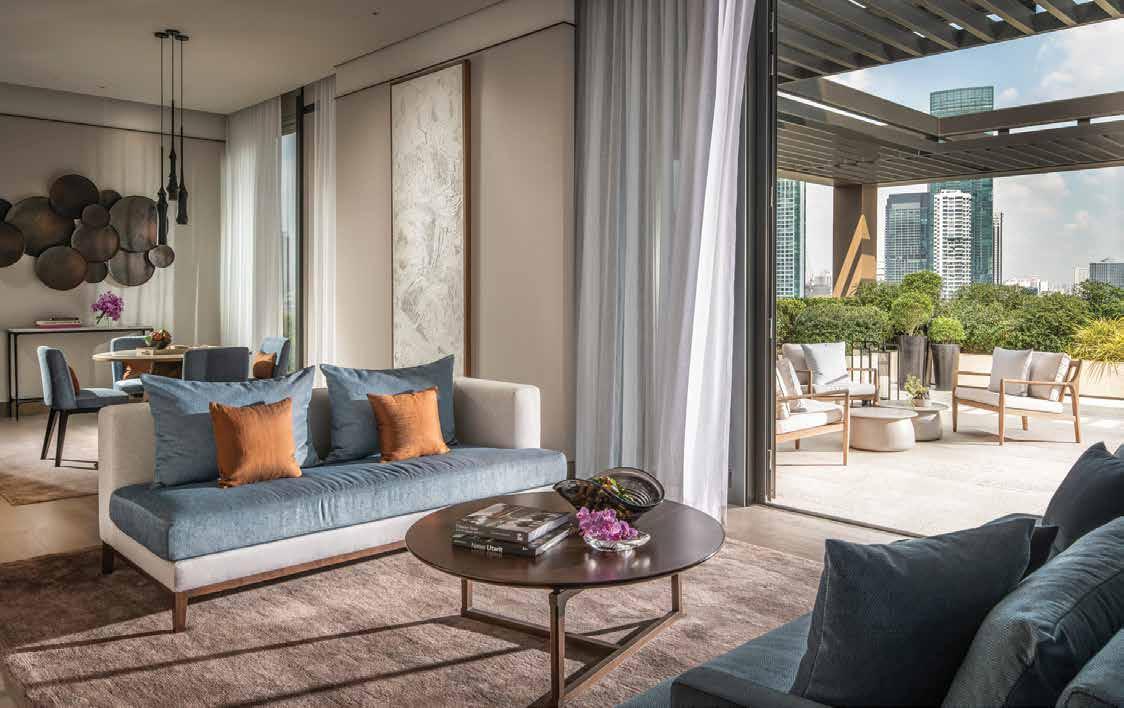
Getting set up on a bespoke outing, whether it’s to do a street food tasting around Chinatown, visit the historic sites, or explore the arts scene, puts you “with an expert who knows everything,” and knows “how to get into the small corners, where to go for the best. . . everything,” explains Siegal.
With a private driver, you can make spontaneous but savvy decisions like stopping at the Chatuchak Weekend Market for all manner of goods and wares from artisanal throw pillow casings to funky t-shirts. Fuel up with fresh coconut water from a coconut the size of your head or taste the difference in a Thai iced tea from Thailand (hint: more tannic, slightly less sweet, every bit as glorious as the stuff from your favorite Thai restaurant).
Getting on the water in Bangkok is nonnegotiable. Riding a long-tail boat through the klongs (canals) will show you a city of contrasts: old wooden homes, temples tucked into neighborhoods—a more traditional side of Bangkok that feels far removed from its traffic-choked streets.
Bangkok’s food scene is prized, with nearly 200 restaurants recognized by the Michelin Guide and multiple spots on the World’s 50 Best Restaurants list. But it’s not just Thai cuisine that shines. At Le Normandie by Anne-Sophie Pic, a two-Michelin-starred restaurant inside the Mandarin Oriental, refined French cooking takes center stage, while Gaa offers a more playful, contemporary take on Indian cuisine.
For a distinct dining experience, book a table at Jim Thompson, a Thai Restaurant, part of a leafy compound that also includes the Jim Thompson House Museum and lush gardens. Thompson, an American architect, former intelligence officer (OSS), and entrepreneur who revitalized the Thai silk industry, is an important part of Thailand’s history, and visiting his former residence offers a deeper look into one of the country’s fascinating cultural figures.
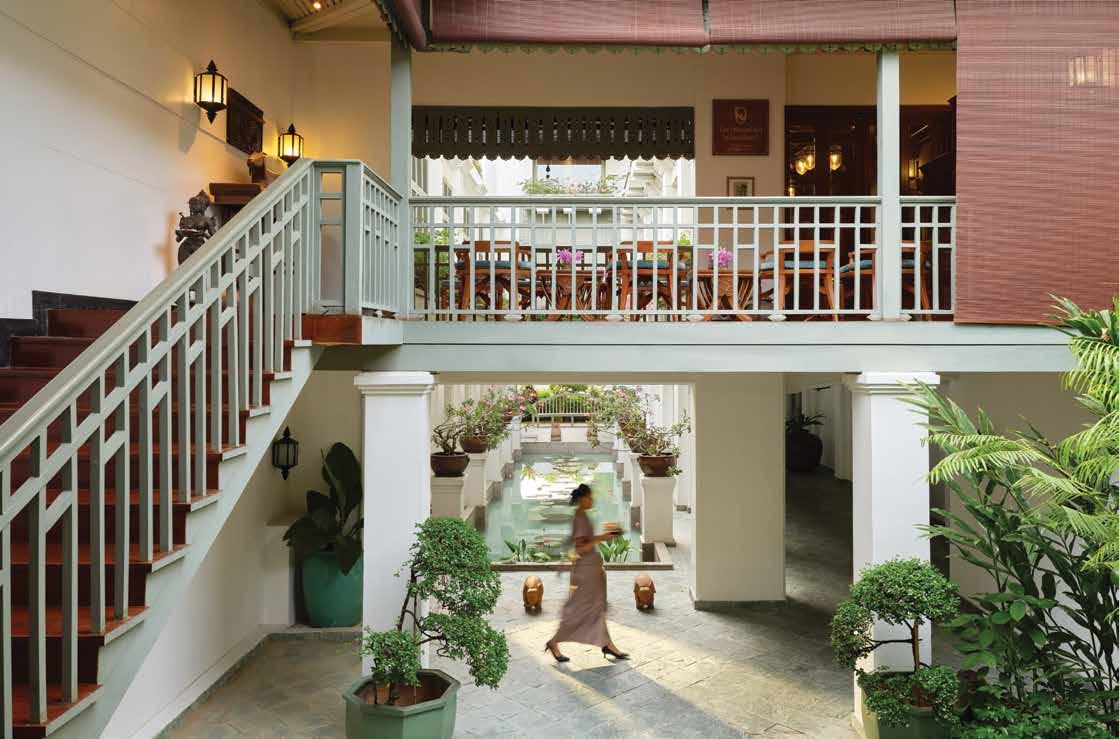
Bangkok’s grand dame celebrates 150 years this year with an 18-month long celebration that commenced late last year. But even if your visit doesn’t overlap with any of the “Unfolding Legacies” celebrations and special events, a stay at the city’s oldest hotel is celebratory in and of itself. Rooms and suites, smartly updated, lean into floral design elements, and many have balcony views of the Chao Phraya river. Service is refined and punctilious.
Set along the Chao Phraya, the hotel is a true respite amid Bangkok’s chaotic urban scene. Cascading gardens, tranquil courtyards, and three distinct pools are all framed by immersive architecture and a Thai art collection. Put your jet lag to good use with a nightcap at BKK Social Club, which was ranked Thailand’s #1 bar (and recently named one of the World’s 50 Best). A visit to the Bangkok Spa and Urban Wellness Centre is also a must after a day exploring the steamy town.
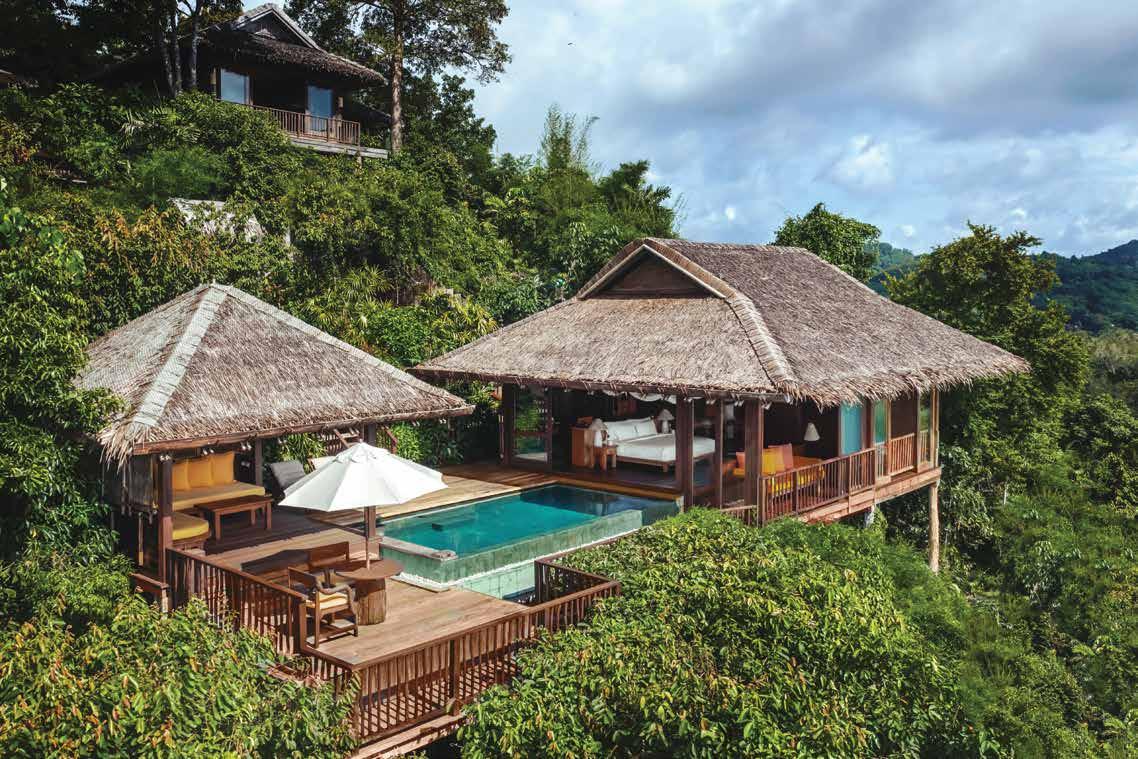
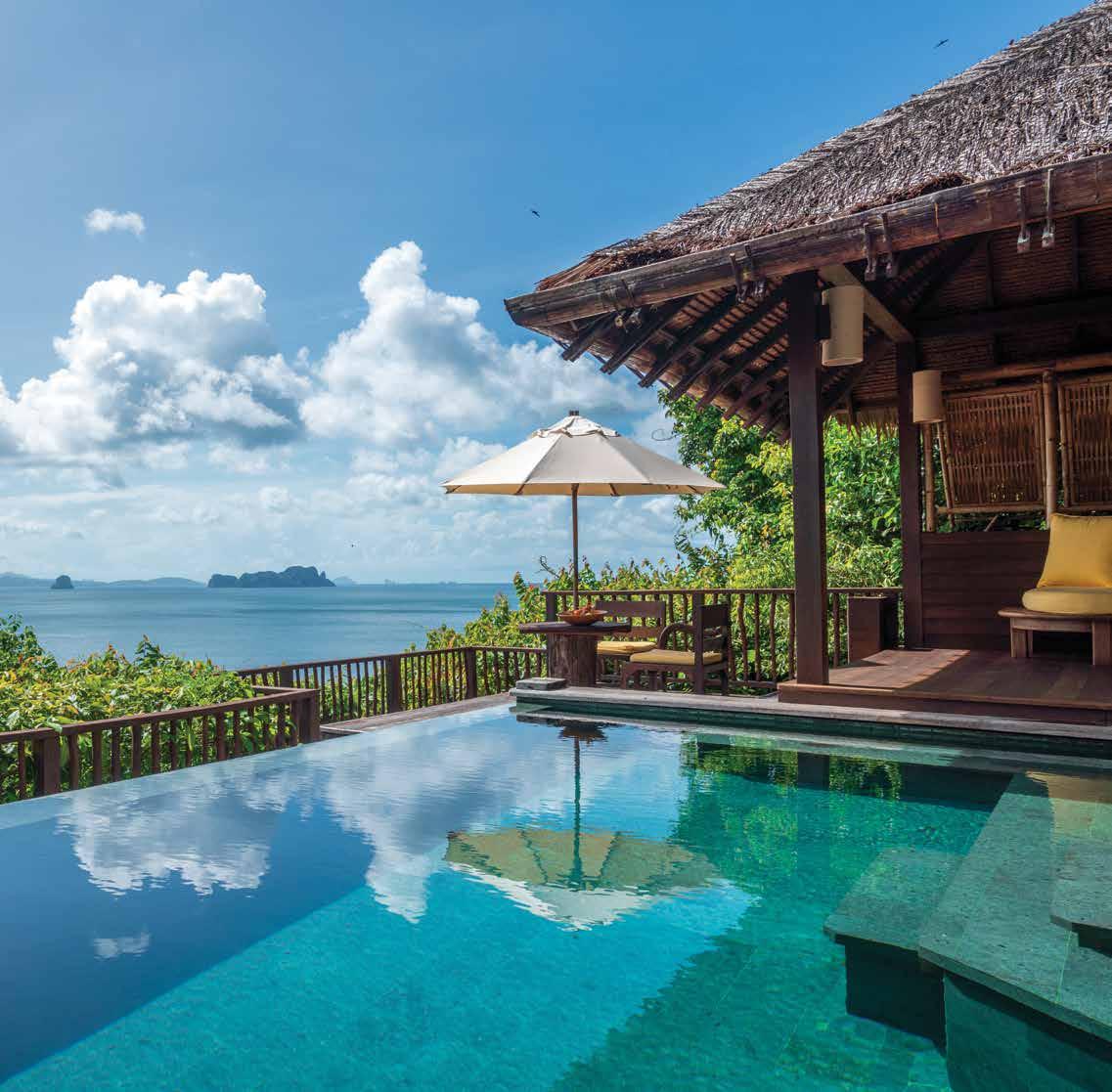
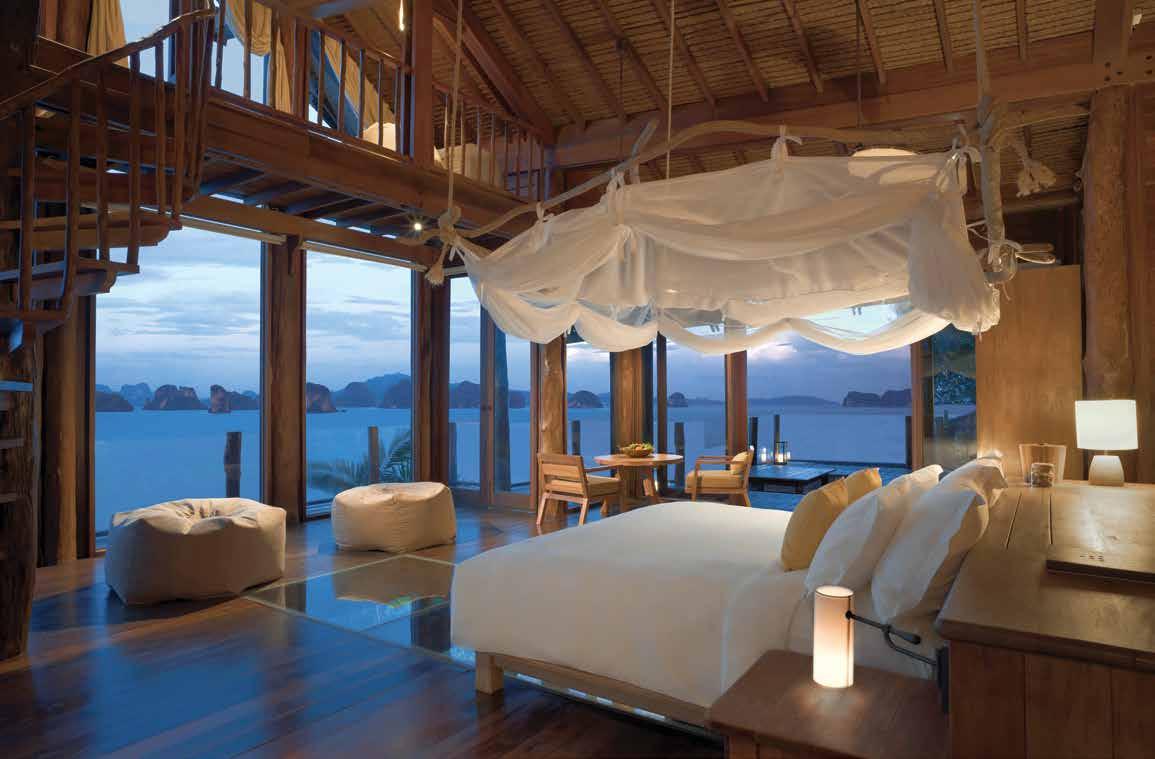
There are over 1,400 islands in Thailand, and some of them welcome millions of visitors each year.
The islands of Koh Yao Noi and Koh Yao Yai offer a chill alternative to the busier beach destinations like Phuket and Krabi. Luxury resorts on either island encourage zen relaxation as you move from your villa’s private pool to the spa to a midday nap in a king-sized bed fitted with high-thread-count linens. Definitely reserve a day for a boat ride to see the island’s monkeys and take a dip in the warm sea.
Located in the stunning Phang Nga Bay, this resort is a favorite among honeymooners and couples celebrating milestone anniversaries and birthdays. Villas, complete with a pristine swimming pool, have everything you might need, but for everything else, your GEM (Guest Experience Maker) is at your assistance.
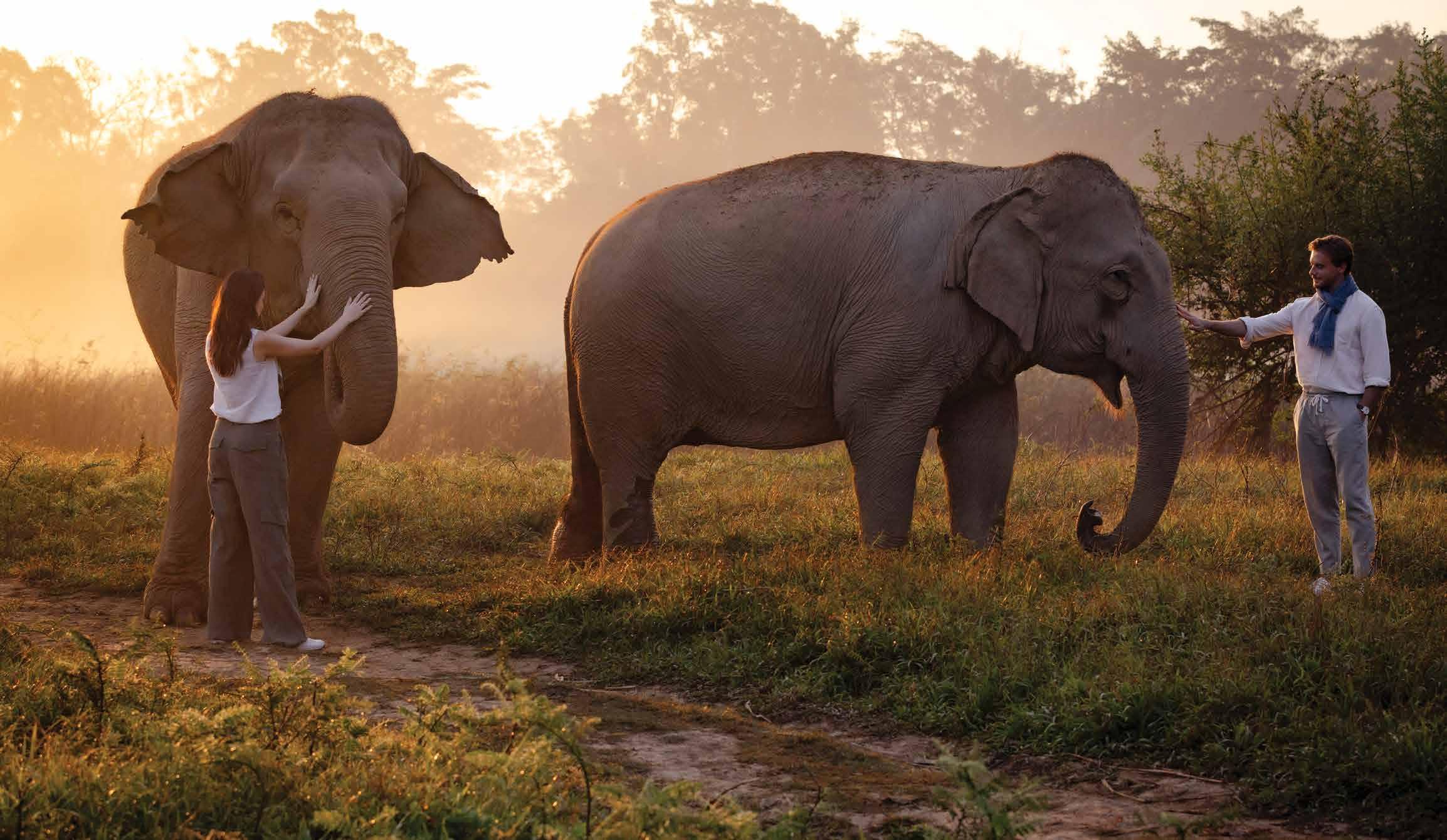
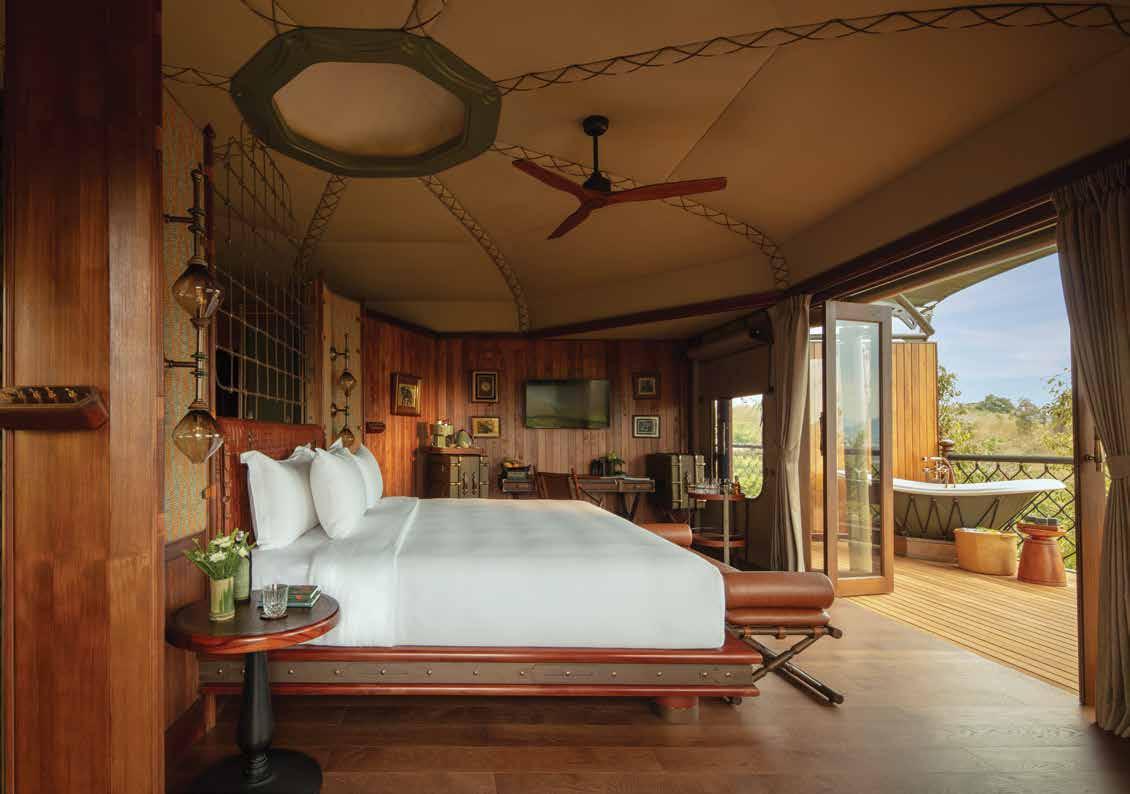
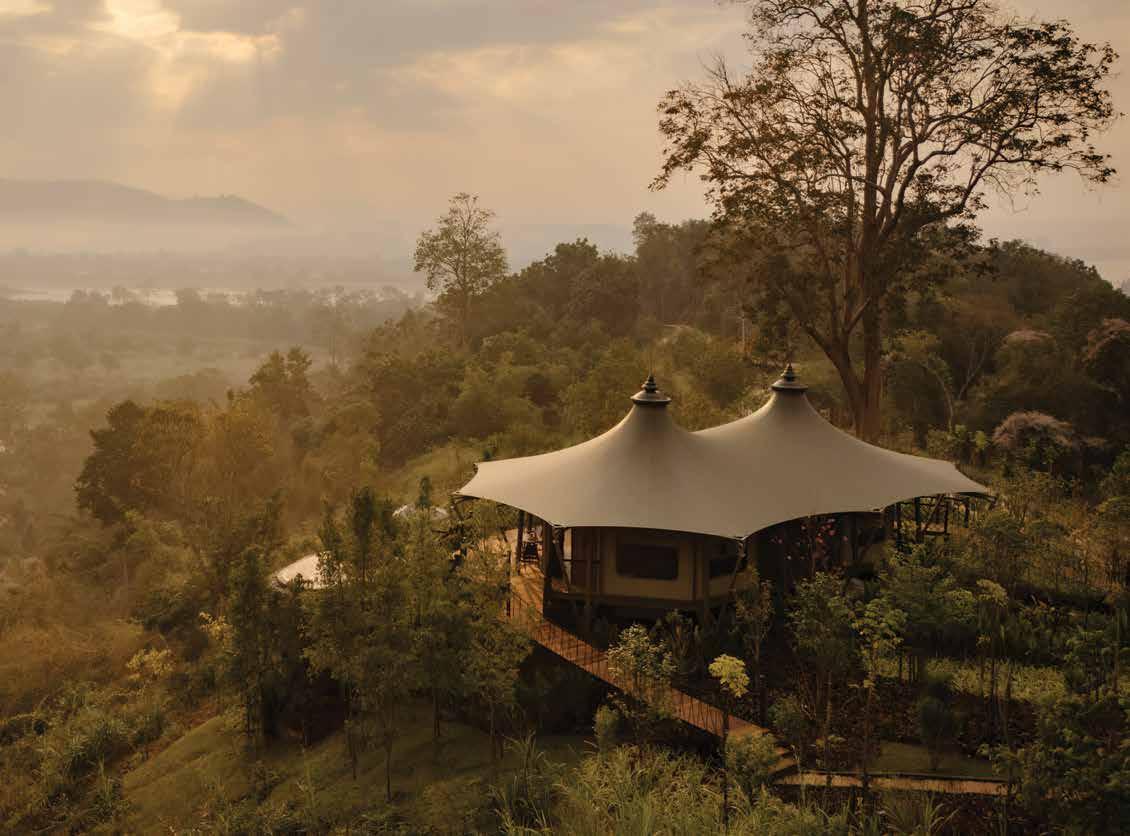
Anantara Koh Yao Yai
A 30-minute speed boat ride whisks travelers from Phuket to Yao Yai, a tranquil island, where dramatic limestone karsts rising out of jade-colored water have the effect of immediately transporting you to a magical place. There’s nothing much to do besides eat delicious traditional Southern Thai fare at Pakarang, cool off at the spa with the skin soothing sun soother, and take a dip in your villa’s private pool.
Following a relaxing three days at one of Thailand’s less-trodden islands, it’s time to fly north to the city of Chiang Rai to see the elephants. Anantara Golden Triangle’s Explorer Tent, a somewhat recent addition to the property, comes with views of Laos, Myanmar, and the Mekong River (from your perch in the heated plunge pool), a cocktail making setup, and handcrafted Thai furnishings.
While guests staying in the Explorer Tent can still participate in the resort’s top activity, Walking with Giants, an even better finale to a multi-night stay here is sleeping with the stars in a bubble tent. Dinner is essentially room service: You order a set menu (Thai or other) in advance and once you’ve settled into the bubble sanctuary, staff members will be by to set up your dinner table, returning to retrieve everything once you’ve finished.
Wake with the sun—the bubble tent has no blackout curtains—and, if you’re lucky, watch the elephants as they partake in their morning routine of grooming, stretching and scratching as you sip coffee.
Anantara, along with Four Seasons Golden Triangle, provides sanctuary for 20 rescued elephants through the Golden Triangle Asian Elephant Foundation and supports local mahout (elephant caretaker) livelihoods and reforestation. For many travelers to Thailand, it stands as the highlight of the whole trip.
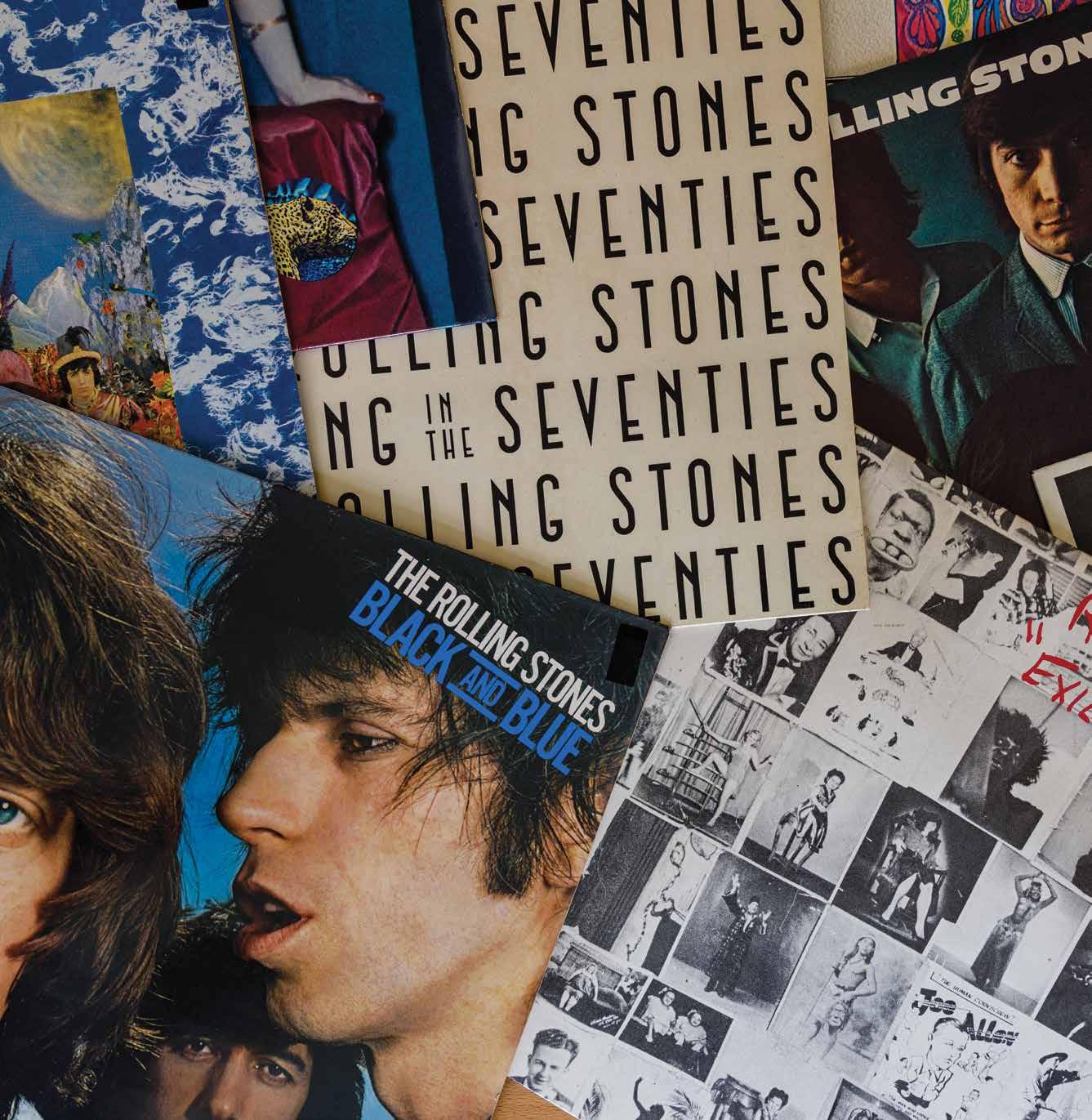
Head to the Pub!
BY BARRY LABOV
The Rolling Stones were key players in the 1960s British Invasion. Along with The Beatles and scores of other bands, they electrified audiences in the UK before making their mark in the U.S. and dominating the music charts.
Back then, the Stones would routinely get into disagreements with each other, often about their songwriting. Truth is when they were founded, they were a cover band—they performed their own versions of classic “blues” songs. They were not considered serious songwriters, like their competitors and archrivals, The Beatles.
In fact, leaders Mick Jagger and Keith Richards approached The Beatles’ John Lennon and Paul McCartney to inquire if there were any songs
they’d be happy to give to the Stones. Lennon offered up the song “I Wanna Be Your Man,” and the Stones turned it into a hit, spurring them on to write their own tunes. (Side note: Lennon later admitted he thought “I Wanna Be Your Man” was, in his words, “trash,” which is why, when The Beatles recorded it later, their weakest singer, Ringo Starr, sang it.)
Ok, now back to the fighting Rolling Stones. These hard-headed, opinionated bandmates decided they needed an independent third party to decide which original songs were worth recording and which were not. So, one of them said, “Lads, it’s off to the pub.”
They grabbed their guitars, strolled down the street, and stepped into a pub where a
local band was playing. As soon as the famous Stones sauntered in, the music stopped, and they were received like royalty, quickly ushered onto the stage with a standing ovation. They performed three of their songs—the very ones they had been arguing over. To their surprise, the song they were sure would be a hit fell flat. And another song that was a source of disagreement because some members felt the bass player was playing the wrong notes, was loved. That song, “I Can’t Get No Satisfaction,” went on to be one of their biggest hits. From then on, the Stones often relied on “pedestrian ears” (average people) to help identify the magic and genius in their songs.
Myopia is very real in the business world. Many of us are far too close to see the beauty in what we do or make, but if you ask an independent party to share their opinion, prepare to be surprised. At first, the iconic motorcycle brand Harley-Davidson didn’t fully appreciate the roaring sound their engines made until a foreign competitor attempted to imitate it. Brilliantly, their leaders trademarked Harley’s thunder, and, to this day, it’s the brand’s recognizable “calling card” as its motorcycles approach you on the road.
Perfection is not interesting or differentiating. The “wrong notes” that the Rolling Stones’ bassist was playing may have been “incorrect,” but they had an allure. It would’ve been a mistake to delete them in favor of “proper notes.” Copper rod producer SDI LaFarga uses recycled copper (instead of pure ore mined from the earth) to manufacture many of its products, and for years, it charged a lower price for them. It wasn’t until the company realized how highly customers valued the sustainability of its products that it began pricing them for their true value.
Don’t confuse superiority with differentiation. In the late 1960s, NASA was focused on landing a man on the moon, but first, they needed to “market” the astronauts to gain support and funding. Rather than focusing on who was the best pilot or had the highest education, they shared more personal aspects, like the astronauts’ families, hobbies, and hometowns, which truly made a difference and resonated with the world.
We’re all too close to see what we’re doing that is unique or distinctive. It’s a smart move to invite others to view your brand and product from their standpoint. They just might discover something brilliant that you had considered eliminating. We all need to visit our pub for inspiration.



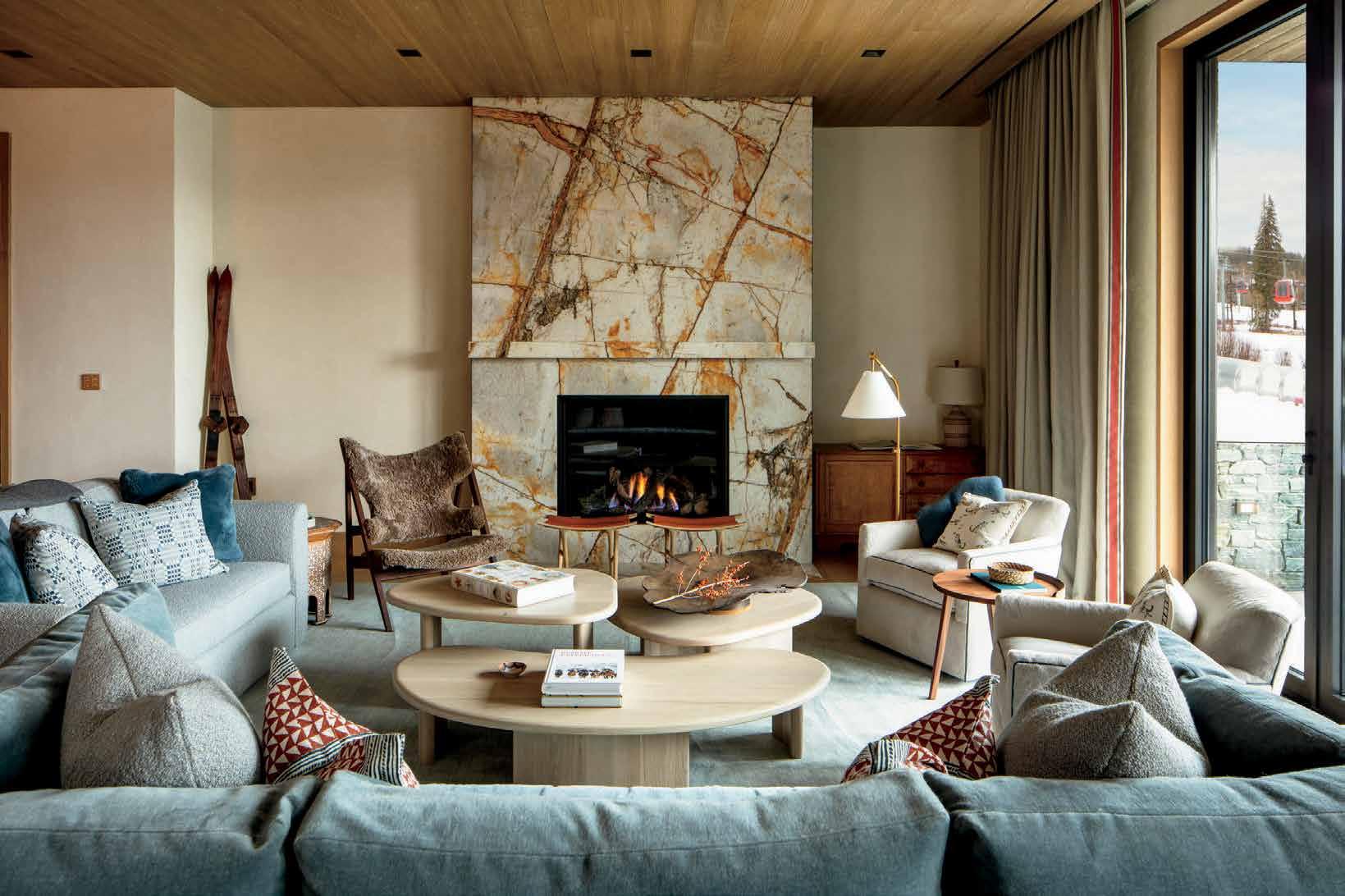

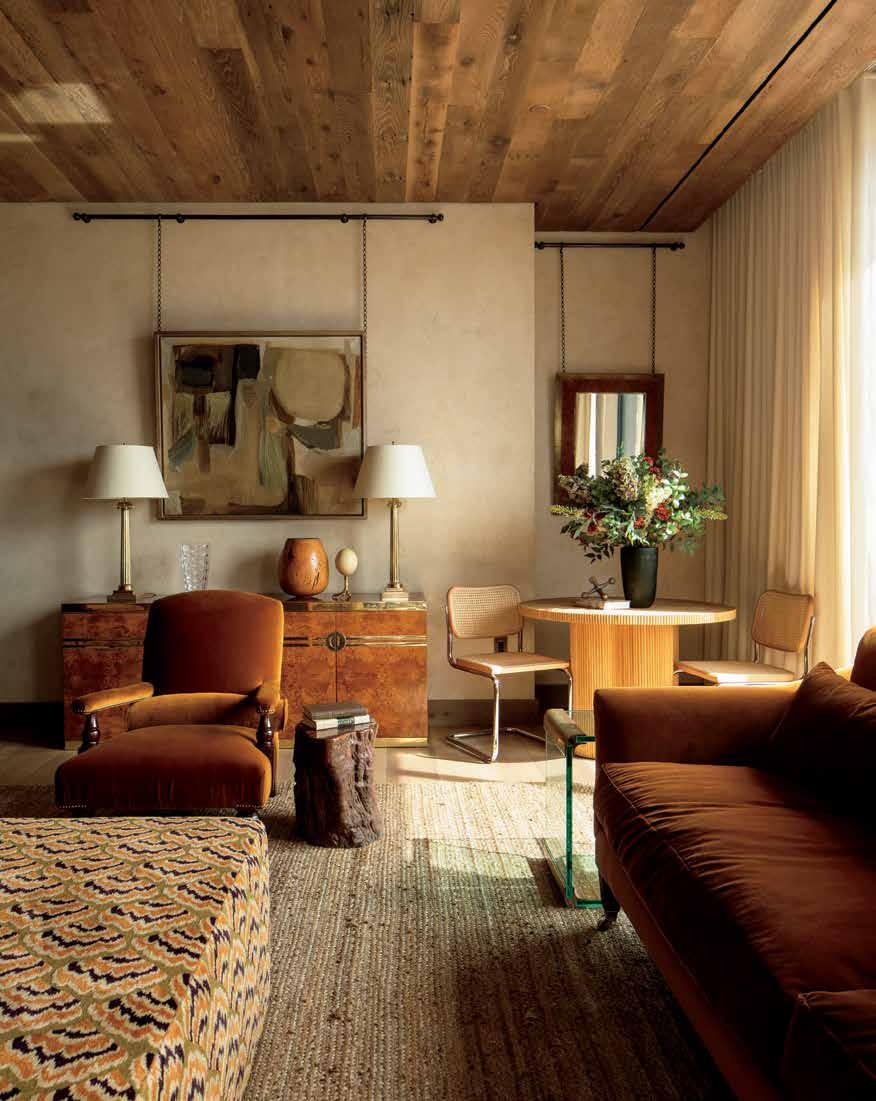
BY KEN MCELROY

Everybody talks about the shrinking middle class, luxury real estate, and rising home prices. But what does the average American actually look like financially? The answer is surprisingly complicated.
Depending on which statistic you look at, Americans are either doing better than ever or falling further behind. The truth is that both stories can be true at the same time. Homeowners are sitting on record levels of equity. Retirement accounts have grown substantially over the last decade. Yet many households feel one unexpected expense away from financial trouble.
One of the clearest warning signs is the personal savings rate. Before the pandemic, Americans typically saved between 7 percent and 8 percent of their disposable income. During COVID, government stimulus, reduced travel, and limited spending opportunities caused savings to surge to historic levels. Today, that trend has reversed.
The savings rate has fallen to roughly 2.6 percent. Housing, insurance, utilities, healthcare, childcare, and food have all increased significantly over the last several years. When every major expense rises at the same time, even households with decent incomes can struggle to build savings.
Perhaps the most concerning statistic relates to how little financial cushion many Americans have. Recent surveys show that roughly 42 percent of Americans have less than $1,000 saved for emergencies, and nearly 40 percent say they would struggle to cover an unexpected $400 expense without borrowing money or selling something.
Think about that for a moment. A car repair. A trip to the emergency room. A broken appliance. A sudden home repair. For millions of households, those events can quickly become financial crises. This helps explain why so many Americans feel financially stressed despite a relatively healthy job market. The issue is not always income. The issue is that many families have very little margin for error.
The danger is that when emergencies occur, households often turn to high-interest credit cards, personal loans, or retirement accounts to bridge the gap. What starts as a temporary setback can quickly become a long-term financial burden.
Housing gets most of the attention, but transportation may be becoming one of the largest financial burdens facing middle-class families. Auto loan balances have now climbed
above $1.6 trillion nationally, making vehicle debt one of the largest categories of consumer borrowing in America.
The average new car payment is now over $740 per month, while the average used car payment is around $525 per month. For households with two vehicles, that can easily mean $1,500 to $2,000 per month before even considering fuel, insurance, maintenance, registration, and repairs.
The bigger issue is that vehicle prices have risen much faster than incomes over the last several years. Many consumers are financing larger balances over longer periods of time just to keep monthly payments manageable. This raises an important question: Have cars become too expensive for the average American, or have Americans simply become accustomed to buying more vehicle than they can comfortably afford?
Surveys consistently show that most Americans believe they need at least $1 million to retire comfortably, with many estimating they need closer to $1.5 million or more.
The problem is that reality looks very different. The median retirement savings for households approaching retirement is often only a fraction of that amount. Americans between ages 55 and 64 have median retirement savings of

roughly $185,000, while many households have significantly less.
This creates a difficult math problem.
People are living longer than previous generations, traditional pensions have largely disappeared, and Social Security was never
designed to be someone’s only source of retirement income. The question is no longer whether people are saving for retirement. The question is whether they are saving enough.
Despite all the concerns about savings and debt, there is another side to the story that often gets overlooked.
Many Americans do not have large cash reserves sitting in bank accounts. What they do have are assets. Over the last decade, homeowners have benefited from significant appreciation in home values. Retirement accounts have grown alongside one of the strongest stock market runs in history. Many households have quietly accumulated substantial wealth without necessarily feeling wealthy.
In many ways, a large portion of America has become asset rich but cash poor. They have wealth on paper, but limited liquidity available for everyday emergencies and expenses.
The biggest financial divide in America may no longer be income. It may be ownership.
Over the last fifteen years, assets, including homes, stocks, real estate investments, and retirement accounts, have generally appreciated much faster than wages. As a result, Americans who owned assets often saw their net worth rise substantially. Those who did not own assets experienced a very different reality.
Many renters faced rising housing costs without benefiting from home appreciation. Many households focused on paying bills rather than investing. Others accumulated debt while asset prices moved further out of reach.
Today, two families can earn similar incomes and have completely different financial outcomes. One owns a home, contributes to retirement accounts, and benefits from appreciating assets.
The other rents, carries debt, and owns very few assets. The difference between those two households can grow larger every year. One of the defining financial stories of the next decade may be the gap between those who own appreciating assets and those who do not.
The average American is not broke. But they are not nearly as financially secure as many people assume. Savings rates are low. Debt levels are high. Retirement concerns are real.
At the same time, many households have built substantial wealth through homeownership, retirement accounts, and long-term investing.
The question is not whether Americans are rich or poor. The question is how much of their financial future depends on owning assets. Because for millions of households, the difference between financial security and financial stress may simply come down to ownership.

The average American is not broke. But they are not nearly as financially secure as many people assume. Savings rates are low. Debt levels are high. Retirement concerns are real.

BY DR. JOHN DEMARTINI
Balancing your perceptions and emotions can help you regain control, think more clearly and reasonably and master your mental faculties and life.
You’ve probably had a moment in your life where you experienced a powerful emotional reaction that didn’t allow your reasoning mind to remain in control, and you felt hijacked by your perception and its resultant emotion.
According to Nobel Laureate Daniel Kahneman, you have two types of thinking:
You have a rapid Systems One thinking where you are in survival mode and react quickly to emergencies where you don’t have time to think. This could be when a car’s about to hit you, or something suddenly startles you. In other words, you react before you think.
Then you have Systems Two thinking, where you take the time to reason, think, break things down, and decide how you’re going to respond. In this case, you think before you react.
Systems One thinking is predominantly governed by a subcortical area of the brain called the amygdala. It assigns an emotional charge to events that you experience and makes you either impulsively seek them or instinctually avoid them.
Any time you are highly infatuated with something, or highly resentful towards something, those highly polarized emotional states tend to occupy space and time in your mind. You may have intrusive thoughts. Find it difficult to sleep. Difficult to focus. Difficult to concentrate. These reactions are not random. They are based on how you are perceiving an event in that moment.
Your ratios of perception determine whether you’re in Systems One or Systems Two thinking.
If you have a balanced ratio of perception, you tend to move into Systems Two thinking and become more reasonable. But if you have a highly imbalanced ratio of perception, you tend to go into Systems One, where you’re more reactive, impulsive and instinctual in
your responses. This is what’s called amygdala hijacking. It has hijacked you from reason.
If you can bring those perceptions back into balance, you are able to calm yourself down and move your blood flow up into the medial prefrontal cortex, where Systems Two thinking occurs. Now you can think before you react.
The neurons in your lower subcortical regions tend to be larger and faster to fulfill their role in survival. You’ll tend to react first and then think about how you reacted afterwards.
But if you train yourself to change the ratios of your perceptions in advance, and you begin to see both sides of an event, you can avoid being hijacked. You’ll know how to bring yourself back into reason before the more extreme emotional reaction takes over. This is training that martial artists often develop, and it’s something that any individual can begin to master.
The moment you begin to polarize your perception to one side or the other, the more
your amygdala comes online. It is preparing you for what you perceive as prey, which you want to capture so you don’t starve, or a predator, which you want to escape so you don’t get eaten. And the more extreme the imbalance, the more intense the hijacking reaction tends to be.
Any time you have an imbalanced ratio of perception, whether it’s infatuation or resentment, you tend to be run by it. You assign a positive or negative charge to what you’re perceiving. You feel an impulse to seek or an instinct to avoid, and it occupies space and time in your mind. In those moments, the impulses and instincts to seek or avoid can override your reasoning mind. You may feel out of control, ungoverned, and caught in what Aristotle described as the passions or affections.
The word passion comes from the root “passio,” which relates to suffering. Because when you’re highly infatuated or highly resentful, you may find yourself wanting to change yourself into
someone else, or change someone else into you. And that tends to be futile and often leads to frustration. So, these emotional extremes are part of survival, but they’re not necessarily the states that allow you to thrive.
Systems Two thinking is more associated with thriving. It’s where you can set objectives, plan strategically, execute those plans, and embrace both the positives and the negatives in the pursuit of something meaningful. It’s more about finding the mean between the pairs of opposites. If you can balance your ratios of perception, you can begin to activate that level of thinking.
That’s part of the reason I developed the Demartini Method, which I present in my signature Breakthrough Experience program. It’s a series of quality questions that you can ask yourself to help bring those imbalanced perceptions back into balance. For example, if you’re perceiving only the positives, you
can ask, “What are the downsides to what I’m perceiving?” so you can begin to bring your awareness into balance.
Your intuition innately does this. You might meet a very attractive individual and feel that impulse, that immediate reaction that says, “I want that.” But at the same time, there’s often another voice that says, “Just slow down. Don’t rush. It might be too good to be true.” That intuition is attempting to reveal the side of the equation that your impulses are overlooking. When you begin to see both sides, you tend to become more centered. You’re less reactive, and more able to be present and be your authentic self.
Now, instead of waiting for time and aging to do that, you can begin to ask quality questions that help you do it in the moment. That’s essentially what the Demartini Method is. It’s a series of very precise questions that help you become conscious of what you’re currently unconscious of.
Any time you have an imbalanced ratio of perception, whether it’s infatuation or resentment, you tend to be run by it.
As you begin to ask those questions and honestly answer them, you are more likely to begin to see both sides simultaneously. When you do that, Systems Two thinking comes online and the amygdala hijacking subsides. You’re able to respond more objectively and reasonably. Instead of reacting emotionally, you begin to see both sides and you can respond from a more balanced, objective state.
If you ask questions that help you equilibrate your mind, you begin to liberate yourself from those intrusive thoughts and emotional reactions. And when that happens, you begin to feel more centered, self-governed, and empowered.
When you bring those perceptions back into balance, you begin to govern your life from within. And that’s why I’ve said for many years, when the voice and the vision on the inside become louder than the opinions on the outside, you begin to master your life. You move from being a victim of your history to being a master of your destiny.
As William James said many years ago, one of the greatest discoveries is that human beings can alter their lives by altering the perceptions and attitudes of their mind. You have that capacity. When you begin to ask quality questions and bring your perceptions into balance, you can take command of your life and move from being a victim of your history to a master of your destiny!
Dr John Demartini is the Founder and CEO of the Demartini Institute, human behavior specialist, international bestselling author, educator, and consultant.

BY SIMON ROBERTS
The name McLaren evokes a variety of meanings and emotions. For some, it brings thoughts of Bruce McLaren, whose life was cut way too short in a tragic crash in 1970, and his illustrious “British” motorsports racing legacy. (But to be fair, McLaren was from New Zealand, and the company is currently owned by the government of Abu Dhabi after being sold by the Kingdom of Bahrain. Sorry, Brits.) For others, it may be the 700+HP cars that have made the name McLaren a byword in the exclusive collector supercar market. The name also evokes McLaren’s history of an obsessive engineering-driven approach to motorsport. This data, details, then development approach has made McLaren one of the most successful teams in the history of F1, second only to a pretty little Italian company called Ferrari.
If you were to compare these two car companies with classic European actresses, Ferrari would be Sophia Loren, who was idolized for her stunning Italian beauty and tremendous acting talents. McLaren would be Hedy Lamarr, who was also lauded for her remarkable stage and screen talent, but who, in another remarkable

feat, also managed to invent a frequencyhopping radio guidance system for torpedoes in 1941. While the navy didn’t use her invention, it later became the basis for “frequency-hopping” spread spectrum technology that is foundational for modern systems such as Bluetooth, GPS, and Wi-Fi. So Lamarr was a lot more than a pretty face. She was endlessly curious, driven to understand the details that make things work. Likewise, McLaren is a lot more than just a maker of pretty things that go very, very, fast. Their engineers are driven by digging deep into the minutiae that is revealed in data. They are inspired to invent efficiency, speed, and advantage in everything they do.
Once a company has become one of the legendary powerhouses of motorsport, the next challenge becomes determining where to go from there. For McLaren, the answer was to pursue something familiar, though slightly outside its traditional racing line. The executives made the decision to create their own golf irons division, McLaren Golf.
It is no secret that the golf industry has turned to motorsports for guidance on aerodynamics,

speed, and materials usage in the past, so it is not a big leap for McLaren to launch their own golf club manufacturing venture. That said, they entered the golf space with a hugely consequential, but basic question: “If there were no constraints, no legacy processes, no material limitations—what could a golf club become?” This question has been answered in the form of two lines of irons that are produced with a process called Metal Injection Molding (MIM). MIM is a highly specialized and rare manufacturing process that is costly and highly complex, which is exactly why the company seems right at home with it. The automaker’s engineers believe that this process allows them to control the composition and distribution of weight in such a precise way that they can control performance and design to a level not available in traditional forging or casting.
According to McLaren Automotive’s Chief Commercial Officer, Henrik Wilhelmsmeyer, McLaren Golf “translates the precision and performance mindset that defines our brand into a new, relevant context. It’s a strategic extension of McLaren—designed for those who value performance, craftsmanship and purpose.” With that philosophy and input from U.S. Open champion, Olympic gold medalist, 13-time PGA Tour winner, and 11-time European Tour winner Justin Rose, McLaren’s first two iron designs, the Series 1, and Series 3 are a modern take on some predetermined ideas about what tour blades and a player’s distance iron are, and who should play them.
The Series 1 is a blade style iron that challenges the idea that blades lack forgiveness. The design features a clean topline and classic muscleback look at address that belie the technology hidden inside. McLaren has used proprietary metals and precision engineering to create a forgiving blade that does not sacrifice the workability that top players demand. The engineers didn’t take long to lean on their motorsports roots by borrowing their honeycomb-inspired pattern, McLaren Structural Mesh, from their supercars to improve strength and rigidity while removing weight from the clubface of the Series 1. This weight savings from the clubface is then pushed lower and farther back to add stability, while allowing for the retention of the classic blade look, feel, and sound. According to McLaren, “We made this iron for the golfer who wants complete command of trajectory, spin and shape—and expects their equipment to respond without hesitation.”


The Series 3 is a performance system in the form of a players’ distance iron that combines multiple technologies in what McLaren calls “a powerful engine” built around its Metal Injection Molded frame. These cavity-back irons feature design that is reassuring at address and also incorporates improved speed, control, and forgiveness. The Series 3 utilizes the same McLaren Structural Mesh in the Series 1 to give the engineers freedom to move weight to the perimeter of the club. This combination of internal weight systems and carbon fiber elements creates a low center of gravity and added stability on imperfect shots. The Series 3 includes a carbon fiber “bonnet” on the back of the face, while the aerodynamic heel-cut sole is not only functionally crucial to the club’s speed and stability, but also serves as an aesthetic nod to McLaren’s motorsport design history.
With their debut irons expected to begin shipping in May, McLaren is eyeing a podium finish in short order. McLaren’s Head of Engineering Ryan Badgero has boldly stated, “Our technology and manufacturing efficiencies, with both Series 1 and Series 3, allow us to start strong and immediately compete with industry front runners.” That level of confidence from a debutant expanding into a new market would seem overconfident, but from a company with a championship pedigree like McLaren, that seems more like a plan than marketing hype. Confidence driven by competence is at its core. McLaren’s own words—“Our past has taught us tenths become titles and greatness hides in fractions. Now we’re taking the finest engineering margins to a new track.”—serve as a harbinger of McLaren Golf’s intentions for the future of the game.

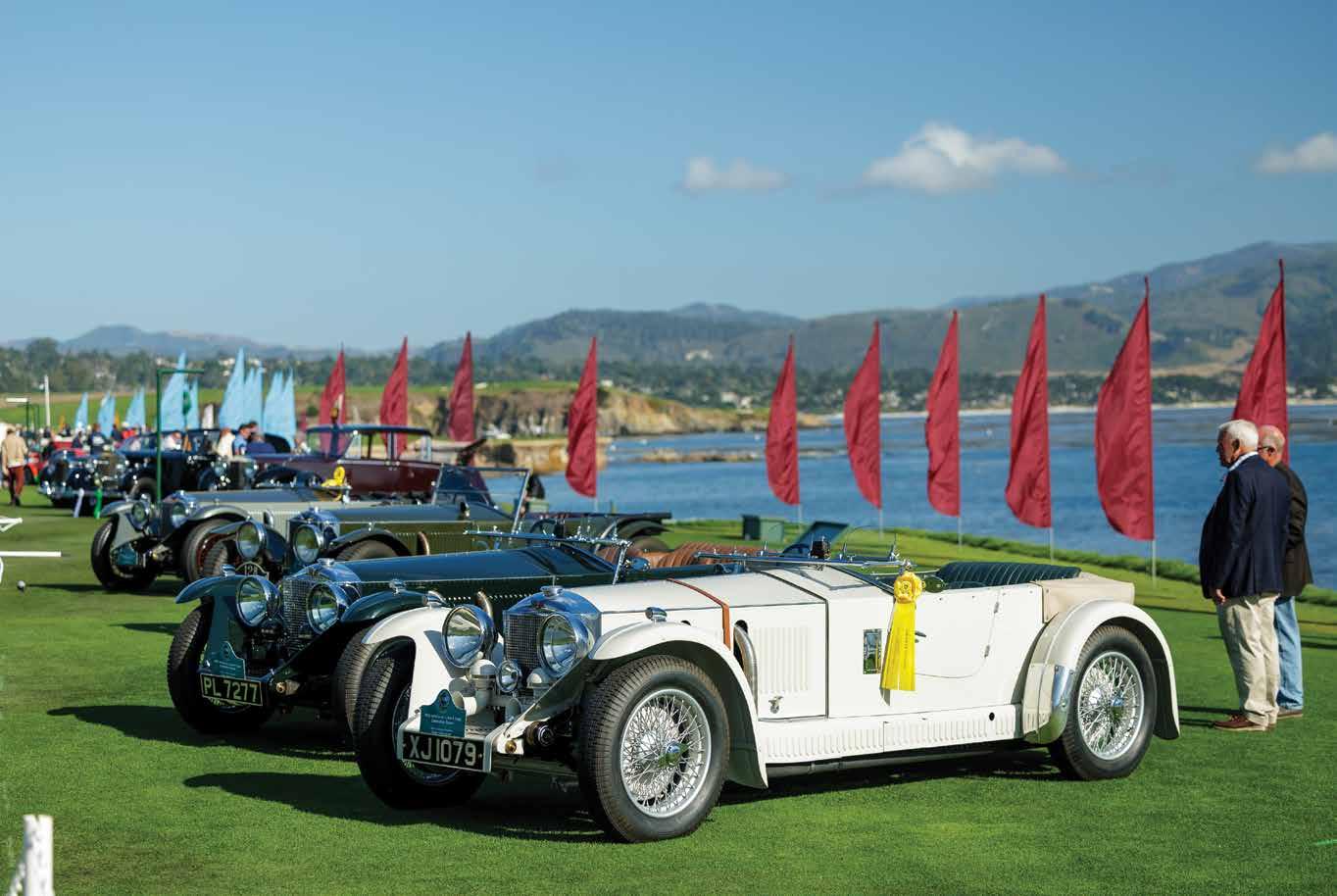
JULY 30 - AUGUST 2
Sydney, Australia
Held at the Sydney Showground in Sydney Olympic Park, the Sydney Boat Show is the place to discover the latest and greatest in boating and accessories. On display will be the newest in trailer boats, lifestyle gear, fishing essentials, and marine tech. Attendees will have the opportunity to chat with industry leaders, get hands-on with the latest innovations, and soak up the energy of an event made for everyone who loves fun on the water.
AUGUST 16, 2026
D’ELEGANCE
Pebble Beach, California
As the flagship of Pebble Beach Automotive Week, the Pebble Beach Concours d’Elegance is the world’s premier celebration of the automobile and the ultimate event for car enthusiasts. Each year, the finest collector cars gather on the 18th fairway of Pebble Beach Golf Links to compete to be named Best of Show. As part of this year’s 75th celebration, four noteworthy cars designed by Duesenberg, Packard, Cadillac and Pierce-Arrow for the 1933 Chicago World’s Fair will be on display.
SEPTEMBER 8 - 13
Cannes, France
Held in the heart of the French Riviera, the Cannes Yachting Festival is Europe’s leading
in-water boat show. It showcases an eclectic range of more than 700 boats, measuring from 5 to 55 meters, across the Vieux Port and Port Canto sites. They will include sailboats and motorboats, monohulls and multihulls, rigid-hull and RIB models, both new and pre-owned. A wide selection of equipment suppliers, service companies and toys will also be presented.
Las Vegas, Nevada
Barrett-Jackson, The World’s Greatest Collector Car Auctions, will return to Las Vegas for a 2026 Fall Auction at the Las Vegas Convention Center. This is an exciting automotive lifestyle event that draws collector car enthusiasts from around the world. Visitors can view hundreds of collectible
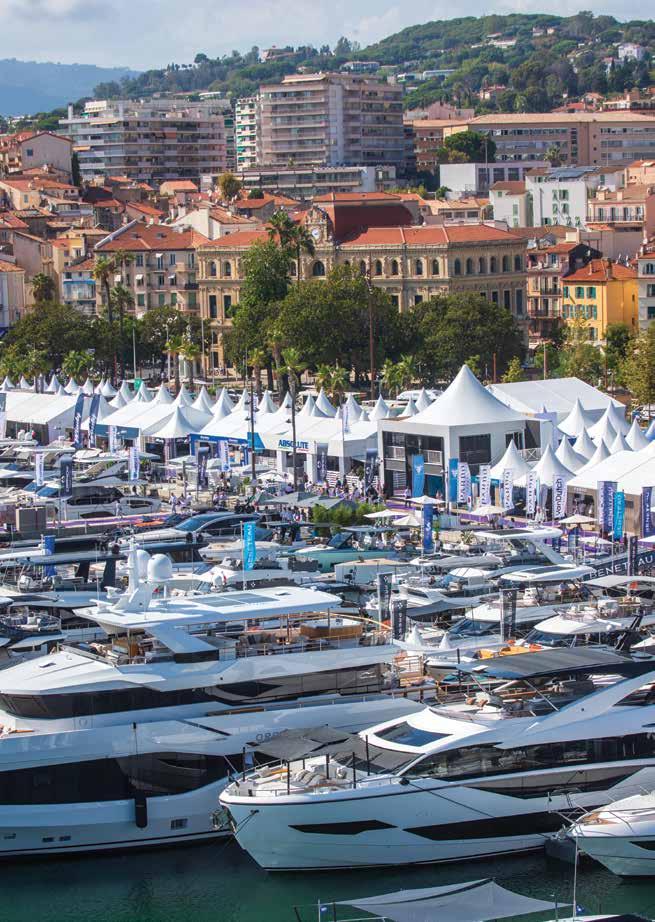
vehicles and authentic automobilia items, visit the Exhibitor Marketplace and enjoy a variety of dining options. The Fontainebleau Las Vegas will serve as the official host hotel.
Port Hercule, Monaco
Celebrating its 35th anniversary this year, the Monaco Yacht Show is the “can’t miss” annual event for superyachting. It’s when Port Hercule will be transformed into a showcase for the latest and most highly anticipated superyachts. The show serves as a unique platform for discovering, comparing, and bringing yacht purchase or charter projects to fruition. Each year, leading shipyards and brokers present over 120 superyachts and approximately 60 luxury tenders, offering a comprehensive view of industry trends and innovations.