Current College Board Guidelines for Students with Learning Disabilities
The presence of a professional evaluation does not necessarily mean that a student is eligible for testing accommodations. Documentation to support the need for requested accommodations on the PSAT, SAT, or ACT must:
1. state the specific disability, as diagnosed;
2. be current (the evaluation must be completed within three years of the PSAT/SAT date);
3. provide completed educational, developmental, and relevant medical history;
4. describe the comprehensive testing and techniques that were used to arrive at the diagnosis, including evaluation date(s) and test results with subtest scores for all tests;
5. describe the functional limitations (i.e., the limitations to learning impacted due to the diagnosed disability);
6. describe the specific adjustments requested and state why the disability qualifies the student for such adjustments on the PSAT/SAT/ACT;
7. and establish the professional credentials of the evaluator, including information about license or certification and area of specialization.
ELIGIBILITY FOR CO-CURRICULARS AND ATHLETICS
Co-curricular activities are integral to the total education program and are designed to provide opportunities for student growth in areas not normally addressed in the academic program. All students are strongly encouraged to take advantage of these opportunities.
However, students and their parents should be mindful that participation in certain co-curricular activities and sports is time-consuming and could be detrimental to the academic progress of some individuals. Therefore, participation in co-curricular activities, including athletics, is closely monitored. A student failing more than two subjects (reviewed quarterly) may become ineligible to participate in these activities.
The State of Louisiana requires that student athletes have a complete physical examination. According to the Louisiana High School Athletic Association Handbook (Section 16 — Medical Examination): “In order to be eligible for practice or participation in all interscholastic athletic contests, a student must receive and pass a medical exam prior to the sport season or at least once every 365 days by a physician licensed to practice medicine. A medical exam form must be on file in the school office of every student who practices or participates in interscholastic athletics during that school year.”
The physical examination may be conducted by the student’s or family’s personal physician. Jesuit’s team physicians are available to conduct physical examinations at no cost to the student and his family on Athletic Physical Day. Physical examination and
other forms that are used by Jesuit are posted online at jesuitnola.org/athletics-forms.
If a student intends to try out for a sports team, or participate in athletics, he and his parents must read and sign the following:
• the athletic participation/parental permission form;
• the medical history form;
• the substance abuse form;
• the football “informed consent” form.
Completed forms must be turned in to either the coach of the respective team or to the athletic director’s office.
ELIGIBILITY FOR OFFICES
Only those students who have good records for conduct and scholarship are eligible for class offices and offices in co-curricular organizations. A good scholarship record is ordinarily understood as a passing grade in all subjects with a grade point average of at least 2.0 on the report card immediately prior to elections. (A higher standard may be applicable for holding offices that place extraordinary demands on a student’s time.) In the event that a student should meet these requirements, be elected to office, and then fail to comply with them, he could forfeit the office for the remainder of the academic year.
SUMMER SESSION
Only students eligible to return to Jesuit will be accepted into Jesuit’s summer session. Students must attend the Jesuit summer session for any course whose grade is marked “NC” (Not Completed) on the final report card. Students may attend the summer session for no more than two credits. No new credits can be earned in the Jesuit summer session. Students who receive an F on the summer session’s final report card must withdraw from Jesuit.
In terms of a student’s transcript, the courses a student takes in the summer session are officially recorded as “NC.” The student is allowed to continue his course work in order to demonstrate sufficient mastery of the material so that he may finally be awarded credit for the course(s). Failure to master the material by the end of the summer session will result in failure of the course, denial of credit for the course, and withdrawal from Jesuit.
Although students are encouraged to take enrichment courses during the summer, credits in these courses may not be applied toward graduation unless specific approval in writing has been granted by the principal. Students cannot take courses in the summer in order to reduce the number of courses carried in the regular school term.
With permission of the summer session principal, Jesuit students may audit Jesuit summer session classes. Students who audit are subject to the same fees, attendance requirements, and conduct regulations as all other summer session students. Summer courses may be taken at other institutions for the sake of enrichment. However, any course taken for credit towards graduation must first be approved in writing by the principal or the academic assistant principal. If such a course is approved, Jesuit may require the student to take its own proficiency exam.
COMPUTER USE POLICY
The computer services provided by Jesuit—including but not limited to Microsoft 365 apps, Canvas, e-mail, and Zoom—are available to all currently enrolled students of the school. The purpose of the labs is to allow students the opportunity to use the efficiency and versatility of today’s technology in pursuit of the academic objectives and goals of the school. With this in mind, specific rules and regulations outlined for acceptable computer usage have been drawn to ensure the intent and integrity of the system as well as the fairness of judgment if these terms are violated. The following outlines acceptable and impermissible usage policies.
Computer-related resources are to be used solely to advance and ensure the mission of education, research, and community service of Jesuit High School. Usage of the computers should be school-related only, such as class assignments, teacher assignments, homework, research, or any school-related task assigned by an administrator or faculty member.
Jesuit e-mail accounts should be limited to academic or school-sponsored extracurricular activities.
Students are permitted to use the programs provided over the network or on the workstations. Access of other folders and files without authorization of the network administrator is prohibited.
Computer usage to pursue any illegal, unauthorized, immoral, unethical, damaging, corrupt, or fraudulent activities is strictly prohibited.
Physical abuse of computer equipment (hardware or software) will not be tolerated. Any act of abuse will result in immediate forfeiture of computer privileges for the academic year, as well as additional disciplinary action.
Student use of faculty computer workstations and faculty equipment in departmental offices, the faculty computer lab, and other restricted areas is prohibited.
Students must respect the security and integrity of the computers, the computer network system, and Jesuit’s website. Installation and transfer of software, shareware, freeware, or any other types of application programs or files without authorized permission is forbidden and will result in disciplinary action.
COMPUTER USE OUTSIDE OF JESUIT HIGH SCHOOL
Jesuit encourages parents to learn about various social media websites and to discuss with their sons the risks of displaying personal and sensitive information, as well as inappropriate material, anywhere on the Internet.
Students who create, copy, or forward inappropriate or morally offensive material directed at Jesuit and/or its faculty, staff, and students, in effect, jeopardize the good or safety of the school. This constitutes a major offense. Students whose personal websites contain inappropriate material will be subject to disciplinary action. Hacking, or attempting to hack, Jesuit’s website or social media accounts constitutes a major offense.
Inappropriate material includes any writings or images that are determined to be detrimental to the common good, or which are morally offensive according to the teachings of the Roman Catholic Church and, thus, harmful or offensive to members of the Jesuit community. The prefect of discipline determines the seriousness of the offense and the appropriate consequence.
REMOTE LEARNING POLICIES FOR SCHOOL CLOSURES
In the event of school closure due to inclement weather, power outages, or other emergencies, the school may continue academic and operational functions remotely. The policies listed here provide students and faculty with basic expectations that may be adjusted to meet the unique challenges of a given closure.
ASYNCHRONOUS LEARNING
These procedures are designed to minimize the negative impact on learning due to school closure.
Device Readiness
Students are responsible for obtaining and using a device that is fully functional for academic work. They must also have reliable access to the Internet for all required Student Portal applications.
General Guidelines
Students will have access to teacher assignments on the Canvas calendar by 9 a.m. each asynchronous learning day. They are responsible for checking the Canvas calendar daily for new assignments and updates, completing all posted assignments by their specified deadlines, submitting work as designated by the teacher (if required), and monitoring Canvas or school email for important updates.
All assignment due dates and times will be clearly posted. Students are expected to meet these deadlines unless prior arrangements have been made with individual teachers. Students should use Canvas messaging or school email to communicate with teachers regarding assignments or clarifications.
SYNCHRONOUS LEARNING
These procedures are designed to minimize the negative impact on learning due to school closure through real-time instruction and interaction.
Device Readiness
Students are responsible for obtaining and using a device that is fully functional for video conferencing and academic work. They must also have reliable access to the Internet for all required Student Portal applications.
General Guidelines
Students will access their academic classes via Zoom through their Canvas class home
page. Classes will meet according to the schedule posted in Canvas and on the Student Portal.
The virtual learning schedule includes 30-minute classes with a 5-minute break between classes and two 10-minute extended breaks.
The schedule is as follows:
8:00 AM – 8:30 AM First Period
8:35 AM – 9:05 AM Second Period
9:10 AM – 9:40 AM Third Period
9:40 AM – 9:50 AM BREAK
9:50 AM – 10:20 AM Fourth Period
10:25 AM – 10:55 AM Fifth Period
10:55 AM – 11:05 AM BREAK
11:05 AM – 11:35 AM Sixth Period
11:40 AM – 12:10 PM Seventh Period
Students must follow school uniform standards during all virtual classes and adhere to school grooming standards. An appropriate background or use of a virtual background is required.
Student conduct must adhere to all expectations outlined in the Jesuit Bulletin, including respectful participation and communication, appropriate use of chat and video features, and active engagement in class activities.
Students’ cameras must be turned on during attendance taking. They should be prepared to turn cameras on when requested by teachers for participation or assessment purposes and must remain visible and engaged throughout the class period.
Regular attendance policies apply to synchronous learning sessions. Students must log in on time and remain for the entire class period.
AI RESPONSIBLE USE POLICY
The following information outlines Jesuit High School’s policies to ensure the proper use of AI in the school community.
ACADEMIC INTEGRITY POLICY: AI ASSISTANCE
• Assignments: Teachers are responsible for clarifying appropriate uses of AI tools. Teachers will post an AI policy for their course on the course’s Canvas homepage. Teachers have the discretion to restrict or allow the use of AI tools on the various types of assignments for their courses. Although the general policies for citations and plagiarism listed below apply in all circumstances, individual courses at Jesuit could implement unique AI policies that give further clarity to students. It is a student’s responsibility to conform to
expectations for each course. Students must appropriately acknowledge the use of AI tools in their work. In the absence of teacher approval and oversight, the use of AI is not permitted to assist with the completion of school assignments.
• Bias & Critical Thinking: Teachers and students must critically evaluate AI-generated content for potential biases or inaccuracies—including results that do not reflect the teachings of the Catholic Church—and understand the limitations of AI and the importance of cross-referencing with trusted sources.
• Citations: Any AI-generated content used or relied upon in assignments must be appropriately cited; its use must be disclosed and explained. As part of the disclosure, students may choose to cite their use of an AI system using MLA Style for Generative AI or another citation form specified by their teacher.
º MLA Style - Generative AI
• Plagiarism: Using or relying upon AI for assignments without teacher approval or without proper citation or especially passing on AI-generated content or ideas as one’s own is considered plagiarism under the school’s policies.
AI TOOLS & SYSTEMS
• AI Output Review: Always review and critically assess outputs from AI tools before submission or dissemination. Administrators, teachers, staff, and students should never rely solely on AI-generated content without review.
• Bias and Misinformation: Be aware that AI-generated content may possess biases or inaccuracies. Always verify AI-produced results using trusted sources before considering them in academic work.
• Safety & Respect: Users must not use AI tools to create or propagate harmful, misleading, or inappropriate content.
• Transparency: Any use of AI tools for homework assignments, presentations, projects, research, or any graded assignment must be approved by a teacher and appropriately declared and cited, as noted above.
• Usage: Misuse or malicious use of AI technologies will lead to disciplinary action. Nothing in this policy shall be construed to alter, limit, or otherwise change Jesuit’s authority or discretion to discipline students or staff under any other policies and procedures.
PRIVACY POLICY: AI & DATA COLLECTION
• Third-Party AI Tools: The school’s approved list of AI tools should always be consulted and adhered to.
• Personal Information: Administrators, teachers, staff, and students should
never input personal, sensitive, or confidential data into any AI system without prior authorization, whether or not such data is associated with Jesuit High School.
GRADUATION
In order to receive a Jesuit diploma, all graduating seniors are required to participate in the Baccalaureate Mass, the graduation rehearsal, and the graduation ceremony. In order to graduate on stage, all seniors are required to participate in the Baccalaureate Mass and the graduation rehearsal.
Only seniors who have successfully completed all required course work and community service will be eligible to participate in the graduation ceremony. Seniors who have not met the academic requirements will receive their Jesuit diploma upon completion of course work in the summer session.
The highest diploma that a Jesuit student can earn recognizes that he has successfully completed five years at Jesuit in a curricular program that has advanced him beyond the normal requirements for graduation from the school. To receive this diploma, students must be enrolled in one of two accelerated programs and take accelerated courses in each of the following areas:
(1) the student’s program must include 5 years of English; 4-5 years of mathematics; 4-5 years of Latin; 3 years of French, Greek, or Spanish; and 4 years of science; or, (2) the student’s program must include 4-5 years of English; 4 years each of mathematics, science, social studies, and the same foreign language, as well as three additional courses from these four disciplines.
Students who do not meet either set of specific requirements do not receive this diploma.
The student’s cumulative quality point ratio based on semester averages for all credit courses prescribed in his four-year high school curriculum determines the type of recognition to be given on his diploma. (Students earn credit in courses taken in addition to the prescribed curriculum, but the quality points earned in these extra courses are not included in the prescribed core-curriculum GPA calculation, though they are part of the total curriculum GPA.)
All graduates who achieve the requisite grade point average will merit the following distinctions: summa cum laude (4.0 or above), magna cum laude (3.5-3.9), or cum laude (3.0-3.4).
Only those seniors who have successfully completed all the required courses, including all courses scheduled in the senior year, are eligible to graduate.
CLASS VALEDICTORIAN
A senior who has enrolled in Program I for not fewer than four years (grades 9-12), has earned a minimum of 27.25 credits at Jesuit High School, has taken all Honors or AP classes available to him within his curriculum, and has earned a minimum A average for all courses in all semesters will receive The Principal’s Award for Excellence
in Scholarship. The Valedictorian will be determined from this group. However, in the case of multiple students achieving this honor, the valedictorian will be determined by calculating the sum of all numerical semester grades in the special prescribed core curriculum for grades 9-12 (8 semesters). The student from this group with the highest
point total of eight semesters of high school grades will be named valedictorian. In the case of a tie among these students, those individuals will be honored as co-valedictorians.
If a candidate for valedictory honors commits a major offense in his senior year, he may forfeit his opportunity to be the valedictory speaker at the graduation ceremony. The principal, in consultation with the assistant principal and the prefect of discipline, will make the ultimate determination in these matters.
CONDUCT OF STUDENTS
Jesuit High School believes that each student is unique and that each has special talents to develop in himself and to use for others. The school strives to assist in the development of these talents in young men who will be capable of exercising responsible freedom. The student is in the process of becoming a “man for others,” a person who will learn to fulfill his obligations to God, his neighbor, and to himself.
Jesuit seeks to develop the potential of a student through the spiritual, academic, cultural, social, and physical opportunities afforded him. To achieve this end, the school must be able to rely upon the student to foster its spirit and advance its purpose and goals; therefore, Jesuit should be the school of the student’s choice.
The following regulations are set down as guides to the student as he develops his potential, learns to order his life, and acquires a sense of cooperation with, and respect for, those with whom he must live and work. The disciplinary procedures noted herein are not exclusively a system of punishments for guilt incurred; rather, they are learning experiences that create healthy attitudes.
Disciplinary sanctions are used not only to maintain proper order, but also to educate developing adolescents who are striving for the goal of self-discipline. The student’s careful study of these regulations and his earnest efforts to fulfill them will help to create the spirit which Jesuit desires.
REGISTRATION AND AGREEMENT TO COMPLY WITH RULES
Since the following rules are not intended to be comprehensive, they presuppose goodwill and good judgment on the part of the student and his parents in all circumstances. The registration of a student is considered an agreement on the part of the student and of his parents or guardian that he will read and be conversant with the school regulations and that he will comply with them, earnestly endeavoring to attain the goals of Jesuit High School. Attendance records and discipline violations are internal records only. These records are not a component of a student’s official transcript; they are only released to parents and students.
ATTENDANCE
Regular attendance at school and diligent application to study are essential to a student’s success at Jesuit. Parents are requested to cooperate with the school in both areas.
ABSENCE FROM SCHOOL OR CLASS
A student has a serious obligation to report to all of his classes. Absences for whatever reason do not excuse a student from preparing his class work. Any absence not authorized by the school administration for school-related activities is ordinarily considered unexcused.
Unforeseen Absence
A parent or guardian must call Attendance at (504) 483-3954 before 8:30 a.m. that day with:
• Their full name and relationship to the student
• The student’s full name
• The reason for the absence
• A phone number where they can be reached
A student who has been absent must:
• Report to the Discipline Office before homeroom and fill out an absence form.
• Turn in a signed parent or guardian note with the reason for the absence. A doctor’s note is also acceptable.
Absent from a majority of classes due to illness or unexcused absence:
Student will not be allowed to participate in or attend any co-curricular event or practice that day.
Excessive Absences:
• The school reserves the right to refuse credit to a student absent more than 5 days in a semester.
• If a student is absent from any course more than 5 days in one quarter, he may be required to attend a Saturday Study Hall.
Failure to attend a scheduled class:
The student must report to the discipline office immediately and must provide the reason for the absence.
Absent from school or class without a valid reason:
The student may receive a “zero” for all work in the classes he missed.
Students are responsible for material covered during their absence.
• The teacher is not obligated to teach the student privately, but the student cannot be denied the opportunity to complete assignments and tests for credit.
• The student is encouraged to do the work he will miss prior to the absence.
Dishonesty with regard to absences and tardies:
• Disciplinary action will be taken.
• The standard consequence for dishonesty with respect to attendance is a Saturday Penance Hall.
• The student may receive a grade of zero for all work in classes he missed.
• The prefect of discipline will be the ultimate judge in all attendance matters.
Late for School or Class
Tardiness is ordinarily not excused and will likely result in a PH. To avoid receiving more than one PH, a student is responsible for:
1. Having a parent call the attendance line: (504) 483-3954.
2. Filling out a tardy form in the Discipline Office upon arrival to campus.
3. Turning in a parent note to the Discipline Office. A doctor’s note is also acceptable. If the student drove himself to school, the note is due the next day before homeroom.
Arriving after 4th period
• A student is expected to be in school at least by the beginning of fourth period; otherwise, he will not be allowed to attend classes for the rest of that day.
• Exceptions may be granted in cases of medical appointments, etc., in this case, a doctor’s note is required.
• The prefect of discipline will determine if a student is permitted to attend school after the start of fourth period if other circumstances apply.
LEAVING CAMPUS/EXIT VISAS
Leaving campus during the school day:
Requires permission of the prefect of discipline, an exit visa, and a parent or guardian note.
Illness at school:
Students will not be released without verbal (phone) permission from his parent or guardian and an exit visa from the discipline office. Students must then turn in a parent note the following school day before homeroom.
Appointments during school hours:
• If possible, appointments should be scheduled outside of school hours.
• A note from a parent or guardian must be provided before school.
• An exit visa must be completed.
• Upon returning to school, the student must report to discipline office before returning to class.
• Driver’s licenses must be obtained outside of school hours.
• Students cannot be absent from class in order to complete any part of their service project requirement.
Free periods at the end of the school day:
• Students may leave the campus unless there is a Mass, pep rally, or assembly.
• Students must sign out in the discipline office prior to leaving campus.
Visiting other schools during the school day: Requires the permission of the prefect of discipline at Jesuit and the principal of the other school.
PLANNED ABSENCES OF A FULL SCHOOL DAY OR MORE
• Obtain a foreseen absence form from discipline office five school days in advance with a note from the parent or guardian containing an explanation for the absence.
• Have all teachers sign the foreseen absence form.
• Should a teacher feel it is not in the best interest of the student to be absent, the teacher will indicate this on the foreseen absence form.
• After teacher signatures obtained, a parent or guardian must sign the fully completed form and return the form to discipline office before the absence.
• Failure to follow this procedure could result in a grade of “zero” for work missed.
• College visits should be treated as any other foreseen absence
EXAM WEEK
Students should not be in the hallways during exam periods or between exam periods. Students may remain in the Commons, Resource Center, or the yard. Upon arrival to campus, students are required to place their cellphones in the off mode in their lockers. No phones may be used anywhere on campus until both exam periods are over. Students may not leave campus until they have completed exams for the day. A foreseen absence for an exam must be approved by the academic assistant principal.
EMERGENCY CLOSING
Jesuit High School typically follows the lead of the Archdiocese of New Orleans which decides if and when to close schools in connection with emergencies. When the Archdiocese of New Orleans announces that all Catholic schools in the New Orleans area are closed, Jesuit High School will also be closed.
An official announcement concerning dismissal or emergency closing of Jesuit will be made as soon as possible on the school’s website. Additionally, closings of Jesuit and schools in the archdiocese will be announced on local television and radio stations and their websites.
Important Note:
If evacuation (or dismissal) occurs due to an approaching weather system, students must take all their school books with them. If storm damage prohibits returning to the metro area, check the school’s website for the latest information. For the duration of the displacement from the metro area, students must check the school’s website and Canvas to obtain work for all of their classes.
PHONES/MESSAGES
Students are allowed to use only the phone located in the discipline office. Office phones are reserved for school business only. Except in cases of emergency, messages will not be delivered to students during the school day.
FORGOTTEN ITEMS
Please do not bring forgotten items (lunches, projects, books, etc.) to school if a student fails to bring such items with him. This is an opportunity for students to take responsibility for their actions and to learn from this by accepting the consequences for forgetting important items at home. Items brought to the switchboard will remain there for a student to collect on his own without any notification from the school.
PERFECT ATTENDANCE AWARD
The Perfect Attendance Award is given to students who have been present for all classes during their entire career at Jesuit. Students who have been absent (excused or unexcused), tardy to school, or have exited school prior to the end of the school day will not be eligible to receive the Perfect Attendance Award.
ATTENDANCE AT SENIOR RING MASS
Seniors who do not attend Ring Mass will not receive a holiday on the Monday following Ring Mass.
THANKSGIVING DRIVE
Students attend a prayer service the day before Thanksgiving. The school day begins at 7:50 a.m. and ends at 9 a.m.
STUDENT CONDUCT
THE DRESS CODE
The following dress code will be applicable to every Jesuit student at all school events. These activities include, but are not limited to, summer camps, service projects, etc. The prefect of discipline will be the ultimate judge in matters regarding dress. If a student is lacking any uniform item, he may often borrow an item from the discipline office before school.
Hair
• Hair must be neat, clean, properly combed hair of moderate length and style.
• Hair, when fully extended, may not touch the shirt collar, eyebrows, or ears.
• Hair may not be longer than 3 inches from scalp or cut any lower than a quarter of an inch.
• The use of style gels, creams, or hair coloring is prohibited.
• Extremes of any kind, such as wedge cuts, perms, shaving of the head, flattops, twists, braids, or other extreme or faddish haircuts will not be allowed.
• Wigs are not permitted.
• The face must be clean-shaven.
Jewelry, Headwear, and Tattoos
• Neck chains, earrings, etc., are not acceptable at school or school functions.
• Students may wear: one religious bracelet, medical alert bracelets, and an appropriate watch.
• Smart watches are not to be worn in school.
• No hats, visors, or other headwear are permitted.
• Permanent or temporary tattoos are not acceptable.
Uniform Shirt and Pants
Students are required to wear complete uniforms on all school days while on campus.
The school uniform consists of the following:
1. Uncuffed, unpleated, neat, and clean dress khaki pants, worn around the natural waist
• Students are not permitted to wear 100% cotton pants or shorts.
• Jesuit recommends Dickies (or comparable) brand khaki pants and shirts that are available at many stores.
2. Clean, neat, short or long-sleeved khaki shirts, tucked in and the belt visible
3. The official Jesuit Blue Jay patch, sewn on the left sleeve with the top of the patch ¼ inch below the shoulder seam
4. A school-issued nametag, worn over the top right pocket
5. A khaki web belt
6. A student may wear a plain white t-shirt under his khaki shirt
Do not wear:
• Undershirts that extend beyond the khaki shirtsleeve
• Any shirts of any type worn over the khaki shirt
Shoes and Socks
• Completely black dress socks (no brands, designs, or colored heels should be visible)
• Smooth-soled, plain black, military shoes, shined, in good condition and properly worn
• Heels must be less than 1½ inches thick and soles less than 1 inch thick
• Shoes such as Doc Martens are not permitted
Missing school shoes
If school shoes cannot be worn temporarily (repaired, lost, etc.):
• Other dress shoes should be worn
• A parent’s note should be provided to the discipline office
• Athletic shoes are not appropriate for school wear
Jackets and Pullovers
The only imprints allowed on any outerwear are Jesuit High School of New Orleans imprinted items.
Jackets - (Garments that open all the way down the front)
• Must be Jesuit High School of New Orleans imprinted or be solid blue, black, white, or gray without a logo.
• Denim, military or poncho style, hunting, leather, suede, or similar materials are NOT permitted.
• Nametags must be worn on shirt under the jacket.
Pullovers - (Garments that are pulled over the head)
• Must be issued by Jesuit High School of New Orleans.
• Nametags must be worn on the pullover in the usual position.
Medical Allowances for Uniforms
• If for medical reasons a student is unable to wear long uniform pants or uniform shoes, he must bring a note signed by his parent or guardian to the discipline office.
• The medical allowance authorizes a student to wear uncuffed, unpleated, neat, and clean dress khaki shorts or an alternative pair of clean, black shoes as recommended by a doctor.
HARASSMENT/BULLYING
Everyone deserves to be treated with dignity and respect. If a student is harassed or bullied, or is a witness to the harassment or bullying of a fellow student, he should report it to the prefect of discipline, who will be in charge of investigating. Any student, parent, or legal guardian who witnesses bullying or has good reason to believe bullying is taking place, may report the situation to the prefect of discipline, who will be in charge of investigating.
Harassment is considered a major offense. There are disciplinary sanctions outlined in this Bulletin which will be imposed on those students who bully or harass others. Bullying is defined as a pattern of gestures (including but not limited to obscene gestures); written, electronic, or verbal communications, including but not limited to threatening harm, taunting, malicious teasing, or spreading untrue rumors; physical acts, including but not limited to hitting, kicking, pushing, tripping, choking, damaging personal property, or unauthorized use of personal property; and repeatedly and purposefully shunning from activities. Bullying includes the definition of bullying set forth in La. R.S. § 17:416.14.
SCHOOL FUNCTIONS
• Gentlemanly conduct is expected of Jesuit students at all times.
• Vulgar, profane, or abusive language or disrespectful or discourteous behavior will not be tolerated either on or off campus (especially at athletic contests, pep rallies, dances, and other school activities).
• Students who violate this policy will be subject to disciplinary actions.
• Applicable dress code regulations are enforced at all school functions.
School Dances
Jesuit sponsors dances for the enjoyment and social growth of the students.
• Dates must be girls who are currently enrolled in high school.
• Appropriate behavior and dress are always expected of each student.
• Specific regulations for particular dances — especially time of arrival and departure — will be announced by the prefect of discipline.
• Students must arrive by lock-in-time and remain until the dance is over.
• 8th, 9th, and, 10th grade students are not allowed to travel to or leave any dance in a limousine or a bus.
ALCOHOL AND DRUGS
Jesuit acknowledges that alcohol and drug use is common in society and among adolescents. Young people who use these substances are being adversely affected spiritually, intellectually, emotionally, physically, and socially, and are not acquiring the skills needed to cope with life as adults. Therefore, it is beneficial to both the school and the community at large that Jesuit encourage its students, through education, prevention, and intervention, to remain alcohol and drug free and to learn to solve their problems constructively.
Jesuit does not tolerate the possession, consumption, or distribution of alcoholic beverages or drugs by students on campus or at any school-related activity, nor does it allow a student judged to be under the influence of alcohol or drugs to attend school or school-related functions.
Drug paraphernalia is prohibited on campus and at all school-related functions.
• All vaping substances will be tested and confiscated.
• This includes but is not limited to Electronic Nicotine Delivery Systems such as vaporizers or electronic cigarettes which contain Cannabis, THC, CBD, or any controlled substance.
Such activity on the part of the student is a grave violation of school policy and will result in immediate and serious disciplinary action.
STUDENT HEALTH AND WELLNESS DEVELOPMENT
Student Health and Wellness Development is designed to help students whose behaviors seem to indicate family, academic, emotional, or social problems that, left unchecked, could lead to negative consequences such as substance abuse.
Jesuit has instituted a school-based program that has as its principal goals substance abuse education, the prevention of substance abuse, intervention in situations where substance abuse occurs (but school disciplinary policy has not been compromised), and follow-up support for students who are at some point in the recovery process.
As a condition of continued enrollment, Jesuit may require a professional drug and alcohol assessment. This assessment may include drug testing and follow-up meetings with a certified drug and alcohol professional and with Jesuit personnel. Parents will be notified if such an assessment is deemed necessary.
Student Health and Wellness Development aims to address the needs of high-risk students and to offer the student and his family resources either before the student becomes entrenched in his problems or before he renders himself liable to discipline at Jesuit due to inappropriate behaviors.
Student Health and Wellness Development’s emphasis on help and support makes it different in focus and intent from the discipline policy at Jesuit. However, Student Health and Wellness Development is in no way intended to diminish the school discipline policy.
Students and parents are expected to be familiar with the school discipline policy as stated in this Bulletin, and students remain subject to such a policy if an assessment is required and/or during participation in the Student Health and Wellness Development
Goodwill and a desire to help students who may be making unhealthy choices in their lives must be presumed on the part of all involved in this program.
The Health and Wellness Process
The Health and Wellness Process will be headed by the Wellness Counselor (WC) in communication with the grade-level counselor.
Purpose
The purpose of the Health and Wellness Process is to identify and to serve students who may be at risk for any reason, including substance abuse and related issues.
Referrals
A parent, teacher, administrator, or counselor may refer a student to Student Health and Wellness Development. If the student shows signs of alcohol or drug use, or if the student seems to be experiencing emotional, social, or academic difficulties, the referring parent, teacher, administrator, or counselor will make the referral to the student’s grade-level counselor or the WC.
All referrals will be kept in strictest confidence. A student may refer himself through a counselor or through the WC. The WC coordinates the following process:
1. The WC conducts an initial interview and screening process with the student.
This process may include a student interview, the use of screening tools, and possible drug testing, if appropriate. It should be understood that the student may not be abusing any substance, but instead, may be experiencing family, academic, emotional, or social problems which may or may not be related to substance abuse. If not related to substance abuse, counseling and consultation with parents will take a different course from drug-use assessment and/or any such follow-up.
2. The WC will consult with the student’s grade-level counselor to determine the most appropriate action to be taken. In certain situations, the WC, the student’s grade-level counselor, and the other Jesuit counselors may convene to determine an appropriate course of action. When deemed necessary, the student will be referred by the WC to a certified drug and alcohol professional employed by an outside agency predetermined by Jesuit High School. This professional will conduct an extensive assessment of the student and will recommend a particular course of action to address any drug or alcohol issues that exist. The recommended course of action will be presented to the WC, who will create a contract based on the professional’s recommendation. Both the student and his parent(s) or guardian must sign the contract. It may be necessary in the contract to update the principal and other administrators on the nature and severity of the student’s problem, the course of action recommended, and ongoing compliance.
3. The recommended courses of action may include, but are not limited to, the following: further substance abuse assessment, possible initial and subsequent ongoing follow-up drug and/or alcohol testing until graduation from Jesuit, participation in group or individual counseling sessions, participation in drug and alcohol educational substance abuse programs, participation in an outpatient program, or inpatient treatment at a hospital serving substance abuse patients.
4. Continued enrollment at Jesuit may be contingent on following the individual’s outlined plan and the commitment and the maintenance of a drug-free life. A second positive result on a follow-up drug or alcohol test administered by, or on behalf of, Jesuit will result in immediate expulsion. Refusal of any drug test will be considered a positive test result. Avoiding drug testing by cutting hair below the prescribed level or attempting to alter test results by using any substance will also be considered a positive result.
5. Jesuit will incur the costs of the initial and any necessary follow-up drug tests. Jesuit will also incur the cost of the assessment conducted by the certified drug and alcohol professional. However, the student may be expected to incur the costs of interim drug testing and therapeutic interventions recommended by the outside certified professional.
TOBACCO PRODUCTS
The use or possession of tobacco products, vapes, or e-cigs is not allowed while on campus, at any school functions, or while traveling to or from Jesuit High School.
MEDICATIONS
All prescription medicines and over-the-counter medications (e.g., Tylenol, Advil, aspirin, etc.) must be registered with and dispensed from the prefect of discipline’s office.
STUDENT LOCKERS AND SUPPLIES
• Each student is assigned a locker for his personal use.
• Lockers must be locked at all times with a combination lock. Available for purchase only from the Blue Jay Shop.
• Tampering with or entering another student’s locker is considered a serious offense subject to disciplinary action. A student whose locker has been tampered with should report the incident to the prefect of discipline.
• Students are responsible for the contents and orderliness of their locker. Damage to any locker by any student will result in the student paying the cost of repairs.
• The school reserves the right to enter and inspect by any means any lockers, book bags, etc., at any time.
• Possession of another student’s property without permission of that student may be regarded as theft, and the offending student will be subject to disciplinary action.
• To prevent loss of personal property, students should have their names clearly marked on all books and personal items.
• Students should not leave their personal belongings unattended anywhere on campus.
• Lost property should be reported to the discipline office.
• Drug paraphernalia of any type is prohibited.
• Vapes, e-cigs, or any paraphernalia associated with vaping or e-cigs is prohibited.
• All items which could be considered dangerous, including but not limited to, and by way of example only, fireworks or other explosive devices, pocket knives, or weapons of any type.
CELLPHONES AND SMART DEVICES
• Students are not allowed to bring to school electronic devices, such as smart watches, iPads, laptops, or recording devices.
• Upon arrival to campus students are required to place their cellphones in the off mode in their lockers.
• Students may retrieve their cellphones and turn them on once they leave the school building at the end of the school day.
• A student may never use his phone in the school building.
THE CAMPUS
• Courtesy and respect require that the campus be kept clean and free of litter.
• All signs, notices, or posters must be approved by prefect of discipline before they may be displayed in the school.
• Defacing, marking, or damaging school property will be subject to disciplinary action.
• Students are not allowed in the classrooms, offices, gymnasium, Resource Center, physical education building, and auditorium without the presence of a supervisor.
• Students may only enter and exit campus via the courtyard, Madonna Della Strada main entrance, or the Roussel Building main entrance.
• Within 30 minutes before the warning bell and 30 minutes after dismissal bell, students should only cross Banks Street using the bridge or the crosswalk at Carrollton Avenue. Students crossing Banks Street at any other location risk injury to themselves and others, and they will also face disciplinary action.
• Until 7:15am, a student may not go to his locker or loiter in a hallway.
• If a teacher or substitute is not present for a scheduled class, students should remain in the class area while one of them reports the situation to the discipline office.
• Students should not sit on desktops, tables, windowsills, or bookshelves.
• During free periods, students may be in the Resource Center, Student Commons, or in the yard.
• During school hours there should be no loitering or studying in the corridors or on the front steps, gym steps, or outer perimeter of the school.
• No food or drink is to be consumed in any area other than the cafeteria, the Student Commons, and the yard. Chewing gum is not allowed at any time
• Students may not order food and/or have food delivered to campus during school hours.
PICK-UP / DROP-OFF / PARKING / ENTERING BUILDING
Students are to be picked up and dropped off on Solomon Street. They may be picked up and dropped off on Banks Street next to Will Clark Field. Students are not to be picked up or dropped off on Carrollton Avenue or any other portion of Banks Street.
The Solomon Street gates are open from 6 a.m. to 4 p.m. Students not working with co-curricular teams should not be dropped off prior to 6 a.m. and should be picked up by 5 p.m.
After school, students should wait for rides either in the schoolyard or on Banks Street (next to Will Clark Field) but not on Carrollton Avenue or another portion of Banks Street.
Student are not allowed to park on school property without a permit from the prefect of discipline. City ordinances must be observed when parking on the street. Private driveways are not to be blocked or encroached upon. This is a matter of
courtesy. Problems that occur while waiting for rides or while traveling home should be reported to the prefect of discipline on the day they occur or on the following morning. Due to the possibility of vandalism and theft in the area, students who drive need to be aware of their surroundings and exercise caution when walking to and from their cars. Loitering in the neighborhood, in cars, or in the vicinity of parked cars is not permitted.
VISITORS
Visitors may park in the Banks Street Lot and enter the building using the main entrance. Once a visitor has entered, he/she must present a proper ID to the receptionist. Normal working hours are from 7 a.m. to 4 p.m.
MORNING ASSEMBLY
Students should form straight lines at morning assembly, place their backpack on the ground directly in front of their feet, be attentive to speakers and not participate in any side discussions. Hats or other headwear are not permitted during prayer and no food or drink may be consumed during assembly.
THE CAFETERIA, COMMONS, AND CAFE
It is the responsibility of the students to keep the campus clean and orderly at all times. Students who plan to eat lunch in the cafeteria should enter the line near the elevator. Students who bring their lunch may eat in the cafeteria provided they enter through the regular line. At most eight students may sit at a round table in the cafeteria or commons. During lunch, students may only go to their lockers or loiter in a hallway during the first five minutes of lunch and the last five minutes of lunch.
CHAPEL SERVICES
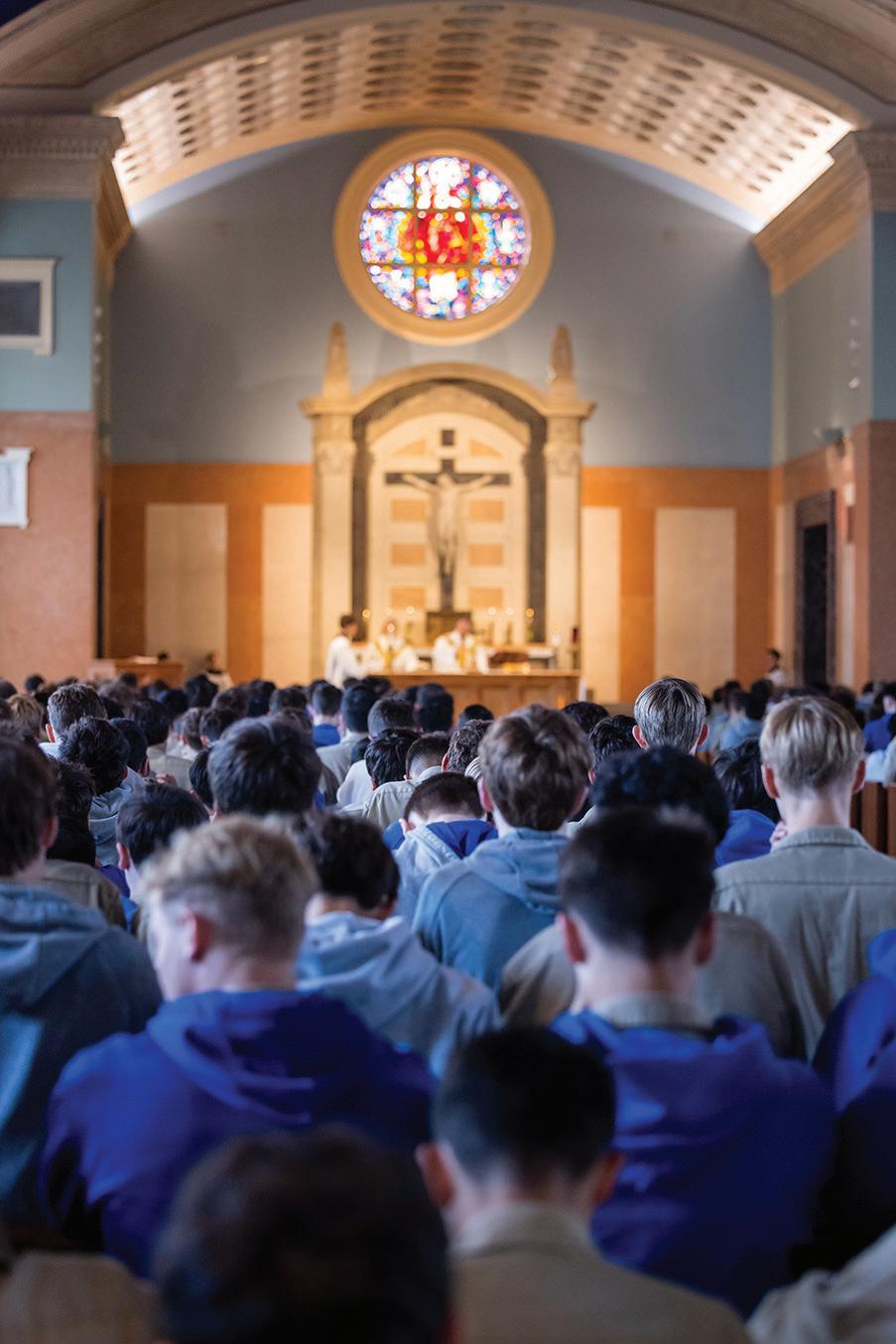
The Jesuit community fosters its sense of identity, among other ways, through common worship at least once a month in the Chapel of the North American Martyrs. For everyone to prepare properly for the celebration of Mass, Students are expected to enter and leave the chapel quietly and to preserve a spirit of silence during Mass.
HEALTH & PHYSICAL EDUCATION
A note written by a parent or guardian to the prefect of discipline is required for a student to be excused from participating in the physical activity of the Health and Physical Education class.
Even with a note, the student must have his complete gym uniform, report to, and remain with the class during the Health and Physical Education period. For long periods of non-participation, a doctor’s certificate is necessary.
Students in transit between the school building and the physical education facilities must cross Banks Street using the bridge. Students crossing Banks Street at any other
location risk injury to themselves and others, and they will also face disciplinary action.
ELEVATORS
Use of the elevators in the school building is restricted and requires a special permit from the discipline office.
SCHOOL DISCIPLINE AND SANCTIONS
CLASSROOM DISCIPLINE
Teachers and librarians are responsible for discipline in their appropriate areas. Students must comply with whatever regulations or disciplinary measures that the teachers or librarians impose. Faculty and staff members must always be addressed in a polite and respectful manner.
Please be aware that all discipline policies apply during home/online learning.
ACADEMIC DISHONESTY
Cheating is morally wrong and is considered a serious offense at Jesuit. Cheating is the improper acquisition or distribution of information pertinent to a homework assignment, quiz, test, exam, or any graded assignment.
Testing procedures
• Testing procedures must be observed as preventive measures.
• During a quiz, test, or exam, a student may not have in his possession, or in the vicinity of his desk, any books, notebooks, phone, or materials proscribed by the teacher or proctor.
• Making any audible sounds, looking in any direction, or communicating in any way with others without permission could be construed as a violation of testing procedures.
The following examples are the most noteworthy violations of the above:
1. Open notebooks, texts, or other course-related material during a quiz, test, or exam without the explicit permission of the teacher or proctor.
2. Concealed notes during a quiz, test, or exam.
3. Communication with another person (verbal or nonverbal) during a quiz, test, or exam without the explicit permission of the teacher or proctor.
4. Use of unauthorized test aids such as calculators, electronic devices, tables, formulas, etc. during a quiz, test, or exam.
5. Copying of homework assignments or the lending of an assignment to another who copies the assignment.
6. Plagiarism or any representation of another’s work as one’s own including the representation of Artificial Intelligence as one’s own.
7. Gaining an unfair advantage over a classmate by asking other students about the content of assessments taken earlier.
Repercussions
• A grade of “zero” for the work in question will be given if the student has committed academic dishonesty.
• Violating testing procedures may result in a grade of “zero” for the work in question.
• Ordinarily, a first offense or strike will also be punishable by a Saturday Penance Hall.
• Additional offenses may merit more serious penalties, which may include suspension or dismissal.
• The prefect of discipline will determine the appropriate punishment.
• A record of cheating offenses and violations will be maintained in the student’s file. Parents or guardians will be notified in each case.
PENANCE HALL
Typically, students involved in misconduct will be assigned to serve specified amounts of time in Penance Hall. Penance Hall is usually served at 7 a.m. or 3 p.m. the day after a Penance Hall is written but a student may opt to serve the same day a Penance Hall is written. If a student owes multiple hours of Penance Hall, he must serve one Penance Hall per day until he completes his assigned time. A student may opt to serve both before and after school on the same day. A student who is assigned Penance Hall repeatedly for the same offense or a similar offense may be subject to more serious disciplinary action.
More than 5 Penance Hall notices in a quarter: May merit a Saturday Penance Hall.
A third consecutive or a total of four such accumulations may result in suspension.
Co-curricular practices, games, and/or performances are not valid reasons for not reporting to Penance Hall.
The prefect of discipline determines the seriousness of the offense and the appropriate consequence.
Ordinarily, one to three detentions of one hour per day in Penance Hall will be given for the following violations:
1. Failure to report to the office prior to going to classes on the day of return to school after absence or at the time of late arrival to school.
2. Failure to bring a note from a parent or guardian explaining any unforeseen absence or the foreseen departure campus during school.
3. Failure to complete paperwork upon return for absences, exits, tardies, etc.
4. Unexcused late arrival to school or late arrival to class.
5. Violations of the dress code.
6. Cutting into the cafeteria line.
7. Using the elevator without permission.
8. Failure to report to a teacher when required.
9. Eating in any area other than the cafeteria, the Commons, or school yard, or gum-chewing anywhere on campus at any time.
10. Failure to bring acceptable notes (for both before and after school Penance Halls) explaining absences. Notes from a teacher, parent, or guardian must be turned in to the discipline office the following school day before homeroom.
11. The standard consequence for missing both opportunities to serve Penance Hall is two additional hours of Penance Hall.
12. Improper cellphone usage or possession.
Jesuit reserves the right to impose more extensive discipline (which may include Saturday Penance Hall) for any of the foregoing offenses depending on the nature and circumstances of the offense(s) or any combination thereof.
MAJOR OFFENSES
The following serious offenses may merit stricter punishment and/or render a student liable to receive multiple Penance Halls, all-day Saturday Penance Hall, being sent home, suspension, or expulsion from Jesuit High School.
A student committing a major offense may also forfeit various privileges, including, but not limited to, attendance at dances, class events, co-curricular events, and other school events.
The prefect of discipline determines the seriousness of an offense and whether or not to refer the offense to the principal for ultimate determination of punishment should the possible punishment include expulsion.
1. Leaving campus without the permission of school officials, which includes going to cars during the school day.
2. Unexcused absence from class or school.
3. Theft of or tampering with another student’s locker or belongings.
4. Presenting someone else’s ID to purchase food items.
5. Vandalism or damage to property owned by the school, a teacher, or another student including the forcing open of locked doors.
6. Repeated violations of school rules after warnings.
7. Repeated instances of academic dishonesty (cheating/violation of testing procedures).
8. Instances of dishonesty (lying, forgery, etc.).
9. Failure to comply with the terms of a disciplinary probation.
10. Use or possession of tobacco products while on campus at any time, at any school functions, or while traveling to or from Jesuit High School.
11. Disrespect, defiance of, or direct confrontation with school authorities.
12. Possession, dissemination, or use of alcohol, drugs, or drug paraphernalia on campus or at any school-related function. This includes vapes and vape paraphernalia.
13. Being under the influence of drugs or alcohol on campus or at any schoolrelated function.
14. Use or possession of weapons on campus.
15. Activities outside of school which involve unlawful and/or immoral behavior.
16. Inappropriate computer use, including hacking, or attempting to hack, Jesuit’s website or social media accounts.
17. Harassment (intimidation, humiliation, any physical or verbal abuse) or any type of damaging statements or behavior made to others. This includes acts of racism and any language or behavior that is rooted in bigotry, prejudice, or hate.
18. Accepting any form of payment for services that involve misconduct. This includes (but is not limited to) academic dishonesty, theft, contraband, etc.
19. Generally, fighting or any conduct, on campus or off campus, which jeopardizes the good or safety of the school or the student’s fellow students, is detrimental to the common good, or which is morally offensive according to the teachings of the Roman Catholic Church and, thus, harmful or offensive to members of the school community.
STUDENTS SENT HOME
In circumstances when warnings, counseling, and referral to the prefect of discipline have proven ineffective, a student may be sent home. The student may not return to school until his parents or guardians have had a conference with the prefect of discipline and with any teacher or school official who may have been involved in a given situation.
STUDENT SUSPENSION
Suspension is a serious sanction imposed upon a student. It is intended to serve as a warning to the student that further violations of school regulations may result in dismissal.
The period of suspension may constitute one, two, or three days. During the period of suspension, the student does not attend classes, nor participates in any school activities. During each day of the suspension, the student will work on assignments with the intention of keeping him abreast of class work that he is missing. The student will serve his suspension in a manner determined by the prefect of discipline.
A second suspension is regarded as sufficient grounds for expulsion.
STUDENT PROBATION
A student will be placed on probation following a suspension. Serious misconduct by a student who is on probation (or the discovery of misconduct that took place prior to probation), including, by way of example only, those offenses listed herein as “Major Offenses,” constitutes grounds for expulsion. Ordinarily a student will not be placed in a second probationary status.
STUDENT EXPULSION
A student is subject to expulsion as a result of:
• a second suspension.
• failure to comply with the terms of a probation.
• defiance of or direct confrontation with school authorities.
• possession, dissemination, or use of drugs or alcohol on campus or at any school-related function.
• theft or other serious moral offenses.
• activities outside the school which involve unlawful behavior.
• any off-campus conduct which is harmful to the good or safety of the school community.
• any conduct which jeopardizes the good or safety of the school or community, or which is morally offensive according to the teachings of the Roman Catholic Church and, thus, harmful or offensive to members of the school community.
Prior to the sanction of expulsion being imposed, a student will have the right to an informal hearing to be conducted by the prefect of discipline.
Following this informal hearing, the prefect of discipline shall report to the principal the results of the hearing and his recommendation as to the guilt or innocence of the student of the charge(s) of which he is accused and any recommendation as to punishment.
THE DISCIPLINE BOARD
The principal may convene a Discipline Board to be comprised of any combination of faculty members, students, and/or administrators to assist in a determination of and to make a recommendation of the appropriate punishment.
The convening of the Discipline Board is within the sole discretion of the principal; and, further, the principal is not bound by any recommendation of the Discipline Board.
The principal shall make the final decision as to any guilt of the accused student and any punishment imposed.
LOCATION SCHOOL FOUNDED
Arizona
Brophy College Preparatory 1928
California Verbum Dei High School 2005
Loyola High School of Los Angeles 1865
Xavier College Preparatory High School 2006
Jesuit High School - Sacramento 1963
Cristo Rey High School 2006
St. Ignatius College Preparatory 1855
Bellarmine College Preparatory 1851
Colorado Regis Jesuit High School 1877
Connecticut
Arrupe Jesuit High School 2003
Fairfield College Preparatory School 1942
District of Columbia Gonzaga College High School 1821
Florida
Belen Jesuit Preparatory School 1854
Jesuit High School - Tampa 1899
Illinois Saint Ignatius College Prep 1870
Cristo Rey Jesuit High School 1996
Christ the King Jesuit College Preparatory School 2008
Loyola Academy 1909
Indiana Brebeuf Jesuit Preparatory School 1962
Louisiana Jesuit High School of New Orleans 1847
Maine
Maryland
Cheverus High School 1917
Cristo Rey Jesuit High School 2007
Georgetown Preparatory School 1789
Loyola Blakefield 1852
Massachusetts Boston College High School 1863
Michigan University of Detroit Jesuit High School and Academy 1877
Minnesota
Missouri
Loyola High School 1993
Cristo Rey Jesuit High School - Twin Cities 2007
Rockhurst High School 1910
St. Louis University High School 1818
De Smet Jesuit High School 1967
Nebraska Creighton Preparatory School 1878
New Jersey
Saint Peter’s Preparatory School 1872
New York Fordham Preparatory School 1841
Canisius High School 1870
Xavier High School 1847
Loyola School 1900
Regis High School 1914
McQuaid Jesuit 1954
Ohio
St. Xavier High School 1831
St. Ignatius High School 1866
Walsh Jesuit High School 1965
St. John’s Jesuit High School and Academy 1965
Oregon Jesuit High School - Portland 1956
LOCATION SCHOOL FOUNDED
Pennsylvania
South Dakota
St. Joseph’s Preparatory School 1851
Scranton Preparatory School 1944
Red Cloud High School 1888
Texas Jesuit College Preparatory School 1942
Washington
Strake Jesuit College Preparatory 1961
Seattle Preparatory School 1891
Gonzaga Preparatory School 1887
Bellarmine Preparatory School 1928
Wisconsin Marquette Univeristy High School 1857
Canada Loyola High School 1896
St. Bonaventure’s College 1999
St. Paul’s High School 1926
Puerto Rico
Colegio San Ignacio de Loyola 1952
ASSOCIATION OF JESUIT COLLEGES AND UNIVERSITIES
STATE COLLEGE/UNIVERSITY CITY
Alabama Spring Hill College Mobile
California
Loyola-Marymount University Los Angeles
Santa Clara University Santa Clara
University of San Francisco San Francisco
Colorado Regis University Denver
Connecticut
Fairfield University Fairfield
District of Columbia Georgetown University Washington, D.C.
Illinois
Louisiana
Maryland
Massachusetts
Loyola University of Chicago Chicago
Loyola University of New Orleans New Orleans
Loyola College Baltimore
Boston College Boston
College of Holy Cross Worcester
Michigan University of Detroit Mercy Detroit
Missouri
Nebraska
New Jersey
New York
Rockhurst University Kansas City
Saint Louis University Saint Louis
Creighton University Omaha
St. Peter’s College Jersey City
Canisius College Buffalo
Fordham University New York City
LeMoyne College Syracuse
Ohio John Carroll University Cleveland
Pennsylvania
Washington
Xavier University Cincinnati
St. Joseph’s University Philadelphia
University of Scranton Scranton
Gonzaga University Spokane
Seattle University Seattle
Wisconsin Marquette University Milwaukee