5 minute read

How Cashless Payments Increase Laundromat Revenue and Efficiency
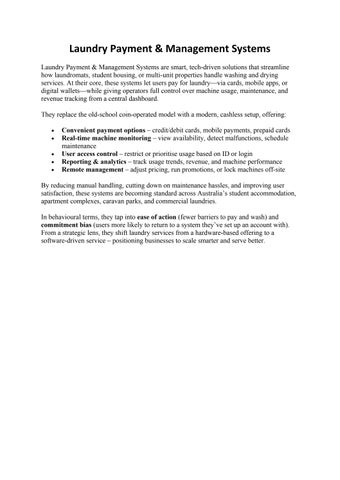
Cashless payments are no longer a “nice-to-have” in laundromats. They’re one of the clearest ways operators lift revenue, smooth out daily operations, and reduce the small frictions that quietly bleed profit. In simple terms: when paying becomes easier, people spend more, machines get used more often, and owners spend less time dealing with cash headaches.
Anyone who’s owned or managed a laundromat knows this feeling. You can have spotless machines and a great location, yet still watch customers walk out because they don’t have the right coins. That moment is where revenue disappears — and where cashless systems quietly earn their keep.
Why are laundromats moving away from coins and notes?
The short answer is behaviour. People don’t like friction, and coins are pure friction.
Australian consumers are already well past the tipping point on cash. According to the Reserve Bank of Australia, cash use has been declining steadily for years as contactless cards and mobile wallets become the default way to pay. When customers step into a laundromat, they bring those habits with them.
From a practical point of view, cash creates work:
Emptying coin boxes
Counting and reconciling takings
Bank runs
Jammed coin mechanisms
Lost revenue from theft or vandalism
Cashless systems remove most of this in one hit. That’s not theory — it’s operational reality for operators who’ve already made the switch.
How do cashless payments actually increase revenue?
This is where behavioural science earns its stripes.
When customers don’t feel the “pain of paying” — digging for coins, watching them disappear — they’re more willing to spend. Tap-and-go feels lighter, faster, almost invisible. That small psychological shift often leads to higher average spend per visit.
Laundromat owners consistently report a few patterns after installing cashless payments:
Customers choose higher-priced wash cycles more often
Add-on services (extra rinse, premium dryers) see higher uptake
Fewer abandoned visits due to payment issues
This aligns neatly with friction cost theory. Remove barriers, and behaviour changes. Robert Cialdini would call this a blend of ease and commitment — once someone starts a transaction, they’re more likely to continue.
What does this mean for operational efficiency?
Revenue is only half the story. Efficiency is where cashless systems really stretch their legs.
Without cash in the machines, owners regain hours each week. No more manual collection schedules. No more guessing whether yesterday was busy or quiet. Everything is tracked digitally, in real time.
That visibility allows operators to:
Adjust pricing based on demand
Identify underperforming machines early
Schedule maintenance before breakdowns cost revenue
Spot peak times and optimise machine availability
Anyone who’s run a laundromat knows how valuable this is. Instead of running the business by gut feel, you run it by data.
Does cashless reduce downtime and maintenance issues?
Yes — and often more than expected.
Coin acceptors are one of the most failure-prone parts of a machine. They jam, misread coins, and wear out. Each fault creates downtime, frustrated customers, and repair costs.
Cashless readers eliminate that entire failure point. Machines stay available longer, queues move faster, and customer satisfaction improves without adding staff or floor space.
From a Mark Ritson-style strategic lens, this improves the experience layer of your brand. You’re not just selling clean clothes — you’re selling reliability and ease.
What about customer trust and adoption?
There’s often a worry that older customers won’t adapt. In practice, resistance is usually short-lived.
Social proof does the heavy lifting. Once a few regulars start tapping their phone or card, others follow. Clear signage, simple instructions, and visible success reduce uncertainty fast.
Trust also improves when customers can see prices clearly and get digital receipts or app confirmations. Transparency builds confidence, which in turn builds repeat visits.
This taps directly into Cialdini’s social proof and authority principles: if the system looks modern and widely used, people assume it’s safe.
Are cashless systems safer than cash?
From a risk perspective, absolutely.
Less cash on-site means:
Lower theft risk
Reduced vandalism incentives
Fewer insurance concerns
For owners, that translates into peace of mind and fewer “what if” scenarios. It also simplifies compliance and accounting — especially helpful for multi-site operators.
Can cashless help future-proof a laundromat?
This is the part many operators underestimate.
Cashless platforms aren’t just payment tools. They’re infrastructure. Once installed, they open doors to:
Remote pricing changes
Loyalty programs
Usage analytics across locations
Easier upgrades as technology evolves
As consumer expectations continue to shift, laundromats that feel stuck in the past will struggle. Those that feel effortless will quietly win.
There’s a lesson here from behavioural economics: people don’t compare experiences within a category — they compare them across life. If tapping to pay works everywhere else, customers expect it to work here too.
Common concerns owners raise — and what actually happens
“The setup cost worries me.”Most operators recover costs through increased usage and spend. The uplift isn’t dramatic overnight, but it’s steady.
“What if the internet goes down?”Modern systems are built with redundancy and offline safeguards. Downtime is rare and usually shorter than cash-related failures.
“Will I lose customers who prefer cash?”Some operators keep one cash option initially. Over time, cash use tends to fade naturally as habits change.
FAQs
Do cashless laundromats earn more per customer?In most cases, yes. Reduced friction leads to higher average spend and more frequent usage.
Is cashless suitable for small suburban laundromats?Especially. Smaller sites benefit most from reduced labour and maintenance demands.
Do customers trust app-based payments?When the system is clear and reliable, trust builds quickly through repeated use.
A quiet shift that compounds over time
Cashless payments don’t feel revolutionary day one. They feel… calm. Less mess. Fewer problems. Smoother days.
But over months, the effects compound. Higher revenue per visit. Better data. Fewer headaches. A business that runs with less effort and more predictability.
For laundromat owners thinking long-term, that’s the real efficiency gain — and why more operators are now exploring modern cashless payment systems for laundromats as part of how they future-proof their sites.