5 minute read

Customer Behaviour Trends in a Cashless Economy

Why are so many everyday transactions—laundry loads included—quietly shifting to cash-free payments across Australia? The short answer: customer behaviour is changing faster than most businesses can keep up, and convenience is winning by a mile.

This article unpacks the key behavioural trends shaping our cashless economy, why small operators (like local laundromats) are feeling the shift most sharply, and what it means for the future of customer expectations.

What’s actually driving Australia’s shift to cashless habits?

Tap-and-go has become the default for most Aussies. Anyone who’s tried paying with coins lately knows the awkward pause it creates. Consumers now expect seamless, low-effort transactions—and that expectation spills into every industry, including self-service businesses.

In behavioural science terms, this is a classic friction cost issue. When paying is easy, customers say yes. When it’s clunky, they walk away. I’ve spoken with laundromat owners who’ve said they literally watched customers abandon a wash because they didn’t have coins. That’s the kind of moment that shapes long-term behaviour.

How does a cashless economy reshape customer expectations?

A cashless customer expects at least three things:

  • Speed

  • Certainty

  • Control over the process

We see this in supermarkets, petrol stations and even local cafés that rely on fast, repeatable transactions. Behavioural researchers like Adam Ferrier have shown that humans default to the option requiring the least effort, and card payments consistently remove more effort than cash.

So when someone walks into a laundromat and sees a coin-only machine, their brain codes it as “work”. They know they’ll need change, and that small cognitive barrier encourages them to delay the task—sometimes indefinitely.

Are businesses feeling pressure to keep up with payment trends?

Absolutely—and most of that pressure is social. Cialdini describes social proof as one of the strongest persuasive forces we face. When every café, gym and vending machine is cashless, customers assume all service spaces should follow.

In the last year, I’ve chatted with operators across regional NSW and suburban Brisbane. Many said they resisted upgrading for years, assuming customers “didn’t mind using coins”. But as card terminals appeared in competing venues, the comparison effect made coin-only laundromats look outdated—even if the wash quality was exceptional.

Once a consumer labels an experience as old-fashioned, it’s incredibly difficult to shift that perception without visible, behavioural cues of modernisation.

Do cashless payments change how people behave inside self-service venues?

They do—and often in positive ways. A few subtle but powerful behavioural shifts tend to show up:

1. Customers spend more per visit

When people aren’t counting coins, they’re more likely to run an extra cycle, buy a detergent pod or choose a warm wash rather than cold. Card payments reduce the “pain of paying”, a phenomenon behavioural researchers have documented for decades.

2. They’re more likely to return

Consistency builds habits, and habits build loyalty. If a customer knows they can tap their card and be out the door within seconds, the experience becomes repeatable—and therefore sticky.

3. They feel safer

Many Australian consumers—especially women doing evening laundry—report preferring cashless venues because they don’t need to carry cash or fumble for coins. That small safety signal shapes future choice.

How does touch-free tech influence customer trust?

Trust is a huge factor here. Cialdini’s authority principle suggests customers lean toward businesses that appear competent and up-to-date. Payment tech is one of the most visible signs of operational reliability.

When an eftpos laundromat upgrades to modern, tap-and-go systems, the customer interprets it as:

  • This place is maintained

  • The machines will work

  • If something goes wrong, someone is accountable

In a market where many laundromats are unattended, these perceptions matter more than we realise.

Are cashless trends different in regional Australia?

Yes—and no. Regional towns often hold onto cash slightly longer, usually because of older demographics and slower technology rollout. But even there, the momentum is shifting.

A small-biz owner I spoke with in country Victoria said the turning point wasn’t customer demand—it was the local bakery going cashless. Once that happened, locals accepted the norm almost overnight. Behaviour spreads socially, and once a community sees critical mass, resistance drops.

The Reserve Bank of Australia has confirmed a long-term decline in cash usage, with digital payments now dominating daily transactions. For businesses, this isn’t a trend—it’s the new baseline.Reserve Bank of Australia Payments Data

Will coins disappear from laundromats completely?

Maybe not entirely, but the direction is clear. Consumers are forming expectations across every category, not just laundry. What they experience at Woolies or Coles becomes the benchmark everywhere else.

And once behaviours change at scale, the laggards feel it first—usually through fewer repeat customers, quieter off-peak hours and lower basket sizes.

Cashless isn’t about technology. It’s about reducing friction, building trust and matching the invisible standards customers already use to filter their choices.

FAQ

Do customers really prefer cashless laundromats?

Most do. They want fast, predictable transactions and dislike the hassle of sourcing coins. Many operators report more repeat visits after going cashless.

Are cashless payments more expensive for business owners?

There are fees, but many owners say the higher spend per customer offsets the cost. It also reduces theft risk, cash handling time and machine damage.

Is card payment reliable in rural areas?

Yes—where connectivity is decent. Many modern systems include offline modes so transactions still process even if the signal drops.

In the end, the shift to a cashless economy isn’t about technology trends—it’s about human behaviour. People gravitate toward the easiest option, and cash simply isn’t it anymore. The operators who adapt early tend to be the ones who stay relevant the longest, especially in service spaces where convenience quietly drives every choice.

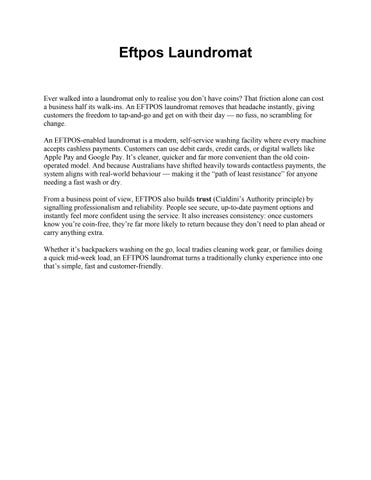
Some laundromat owners are finding that upgrading their setup—especially if they’re moving toward an eftpos laundromat model—helps them meet customers where their habits already are.

This article is from: