
1 Executive Summary
I am pleased to report that the quality of water supplied during 2012 was to an exceptionally high standard. The treated water supplied was 99.99% compliant (2011: 99.81%), with all physical, chemical and bacteriological standards under the Water (Jersey) Law 1972. This represents our best ever year, with only 2 analyses of treated water out of 15,321 taken failing to comply with the regulatory limits.
The water quality monitoring programme and parameters analysed during the year were in accordance with a programme approved by the States of Jersey Planning & Environment department, as required by the Water (Jersey) Law 1972. The programme closely follows the requirements set out in the Water Supply (Water Quality) Regulations 2000 for England & Wales and the quality standards are the same. Monitoring and surveillance of the treated water we supply to our customers is undertaken on a continuous basis.
As well as monitoring treated water quality, Jersey Water has an extensive programme of raw water quality monitoring, at the streams, reservoirs and throughout the treatment processes. This programme, together with on-line quality monitoring equipment installed at the treatment works, allows our operating staff to select and optimise the most suitable water to be taken for treatment. The bacteriological compliance of water leaving the treatment works was 100% and there were no herbicides or pesticides detected in the treated water supplied. With rainfall levels in the first three months of the year being well below average levels, there were no samples of treated water with nitrates greater than 50 mg/l. However, many stream sources did exceed 50 mg/l, but the Company was able to maintain nitrates in treated water below this level through careful selection and blending of waters.
Jersey Water has dispensations for nitrates under the Water (Jersey) Law 1972, which allow 33% of samples to exceed the statutory 50 mg/l limit, but not to exceed 70 mg/l. There are no known risks to health with bacteriologically safe water for nitrates below 100 mg/l. The current five year old dispensation expires in December 2013 and the Company shall be seeking its renewal during 2013.
The bacteriological compliance of water leaving the treatment works was 100% and there were no herbicides or pesticides detected in the treated water supplied.
There is a close relationship between the application of agricultural fertiliser to the land, the timing and volume of rainfall and the level of nitrates in surface waters. Jersey Water is almost entirely dependent on these surface waters for its water resources. The Company takes steps to manage concentrations of nitrates in treated water to the extent that it can do so by the careful selection of water for treatment and blending of raw water sources. However, as the underlying levels of nitrates in raw water sources are outside of the Company’s control there will be a continuing reliance on dispensations from the limits governing nitrate concentrations for the foreseeable future.
The average daily demand for water supplied by Jersey Water was 19.2 ML, with a total of 7,015 million litres of treated water supplied to its customers in 2012. The tables in this report show the results of the treated water monitoring programme carried out in 2012. The tables show the maximum, mean and minimum concentration of the particular parameter.
Howard N Snowden Managing Director & Engineer
2 The Water Quality Monitoring Team
Jersey Water has long realised the importance of water quality monitoring as a useful tool in the production of good clean water for supply. To this end the Company has a modern laboratory situated at the Millbrook Depot, St Lawrence.
The Laboratory Manager, David Mayman, has been employed by the Company for over 28 years and is a Chartered Chemist and member of the Royal Society of Chemistry.
Sarah Gavey is the assistant manager and has been with the Company for over 18 years and the laboratory technician is Nora Treanor, who has a wealth of experience from her previous roles in agriculture, the dairy and other laboratories.
The three samplers of the department, Keith Quemard, Bob Langford and Matthew Parkin have continued to provide an excellent service to the laboratory and when attending consumer queries
3 Raw Water Quality
The majority of water supplied by Jersey Water is derived from surface water resources, with streams across the Island either feeding directly into or pumped to 6 large storage reservoirs. A small volume of ground water is abstracted from the sand aquifer located in southern part of St Ouen’s Bay area.
For operational and monitoring purposes Jersey Water takes samples of water from streams and reservoirs. This enables our operational staff to select the most suitable waters to be taken for treatment.
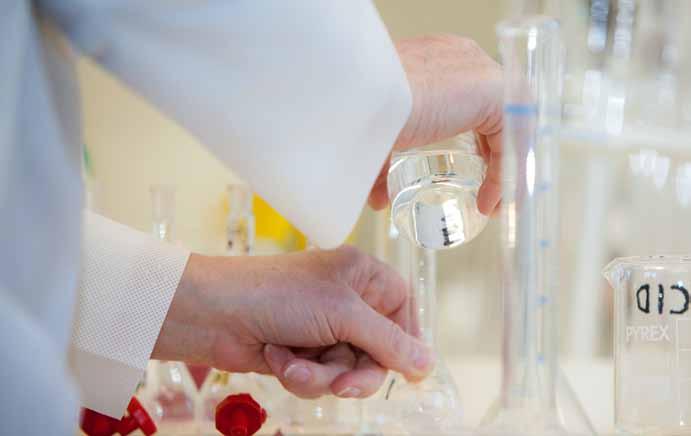
Analysis is carried out for physical, bacteriological and chemical parameters. In 2012 our results showed that out of 5226 analyses for herbicides and pesticides in the stream courses 33 were above the 0.1 µg/l limit compared to 15 in 2011.
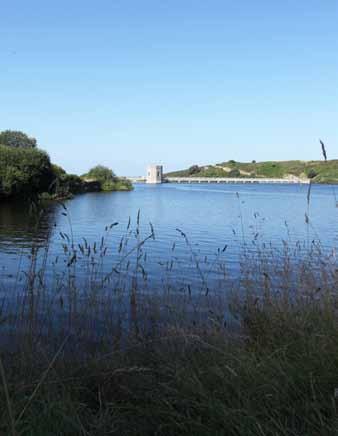
The majority of water supplied by Jersey Water is derived from surface water resources, with streams across the Island either feeding directly into or pumped to 6 large storage reservoirs.
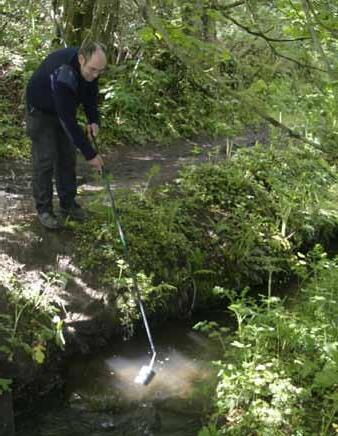
Collecting water sample from a stream source
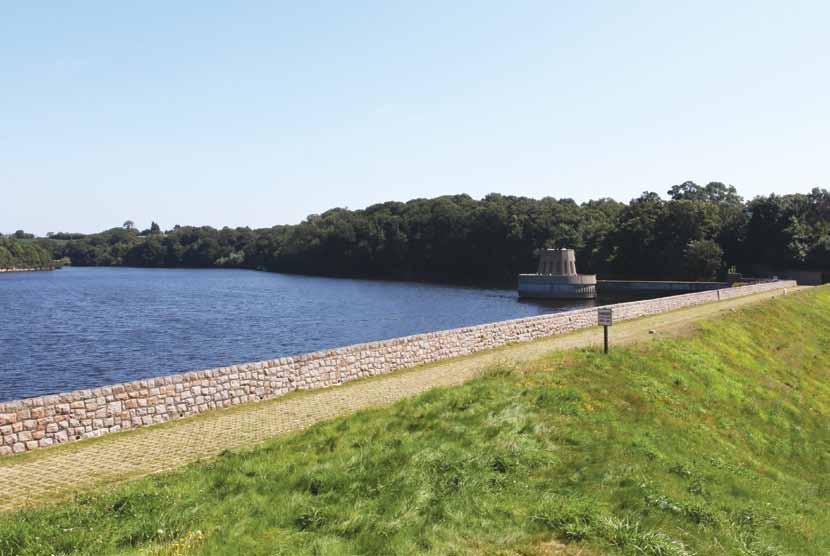
Val de la Mare Reservoir
4 Treatment Works and Service Reservoir Performance
Treatment of the raw water is undertaken at two treatment works, located at Handois, St Lawrence and Augrès, Trinity. Both these works have identical treatment processes, which include chemically assisted clarification, followed by filtration using a combination of sand and anthracite.
Disinfection of the treated water ensures that any remaining bacteria present in the water are killed before it passes into the distribution network and to customers premises. A combination of chlorine and ammonia is used to effect the disinfection process and a relatively long retention time in holding tanks is allowed to optimise the process, which is also time dependant. The amount of chlorine and ammonia added to the treated water is very small and is continuously monitored to ensure levels are within acceptable aesthetic levels. The disinfection process also ensures that the highest bacteriological standards are maintained up to the customers tap.
There were 2 non-compliant analyses detected in 2012 out of the 15,321 analyses taken for compliance purposes, giving a percentage compliance of 99.99% - our best ever result. The following table shows the percentage compliance in treated water for 2012 and the previous four years.
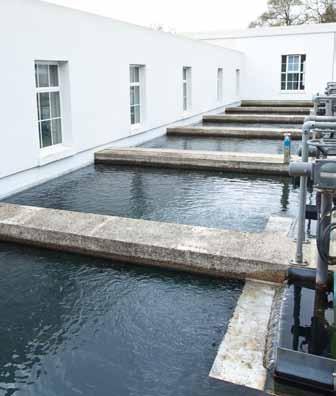
Handois Treatment Works
The water quality regulations require two types of monitoring to be undertaken, these are designated as “check” and “audit” monitoring. Check monitoring is carried out on a frequent basis to ensure the treatment processes are operating as expected and the water in the distribution system is of an acceptable standard, whereas the audit monitoring is used to investigate the quality of water more thoroughly.
The 2012 results of the check monitoring of treated water leaving the treatment works, their respective Maximum Allowable Concentrations and compliance levels are shown in the following tables. The results from the audit monitoring programme can be found in the appendix.
Check Monitoring: Handois WTW
Check Monitoring: Augrès WTW
In order to ensure adequate treated water is available to meet peak demand periods and exceptional summer time demand, treated water storage reservoirs are provided within the distribution system. The total storage capacity of the reservoirs is 18 ML, which just below the average daily demand of 19.2 ML. Jersey Water has two service reservoirs, strategically located on high ground at Westmount Road, St Helier and Les Platons, Trinity.
The 2012 results of the check monitoring of treated water leaving the water storage reservoirs, their respective Maximum Allowable Concentrations and compliance levels are shown in the following tables. The results from the audit monitoring programme can be found in the appendix.
Check Monitoring: Les Platons Service Reservoir, East Compartment
5 Water Quality in the Distribution System
Sampling of water throughout the distribution network is undertaken in accordance with a programme to ensure the water we supply meets physical, bacteriological and chemical standards.
During 2012, 1404 samples of water were taken and the following tables show the results of the check and audit monitoring programme together with the compliance levels.
Check Monitoring: Supply Zone
Audit Monitoring: Supply Zone
1 The value of 25 µg Pb/l is valid until immediately before 25th December 2013, reducing to 10 µg Pb/l on and after 25th December 2013. 2 Detected pesticide - 41 other pesticides analysed for and not detected.
6 Water Quality Complaints
During 2012 we received 46 complaints and queries from customers relating to water quality. An Inspector is dispatched to every reported complaint to take a sample of water and make on the spot assessment of the customer’s complaint. Samples of water taken from customers taps are, where appropriate, given a full physical, bacteriological and chemical analysis and the results are sent to the customer, with a narrative explaining the results.
The following table shows a breakdown of the type of complaint or query received and the analytical compliance level. One sample proved positive for coliforms which was negative on resampling.
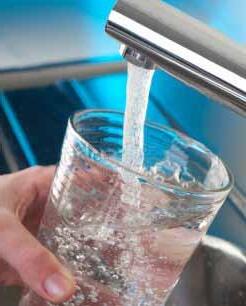
The majority of complaints are due to discolouration of water, resulting from old corroded steel or cast iron pipes, some of which are privately owned and not the responsibility of Jersey Water.
An extensive programme of replacing old pipe work and service connections within the distribution system is in progress, unfortunately the work required in this area does produce disrupt water supplies and may cause discolouration of water for very small periods. In 2012, some 2.1 km of treated water mains were replaced with pipe work made of modern lined materials. Customers are always advised in advance of the planned works to be carried out, which results in improvements to the infrastructure supplying them with water and we are grateful for their cooperation
The Planning & Environment department are responsible for the administration of the Water (Jersey) Law 1972 and their officers make quarterly inspections of analytical results of samples derived from customer water quality complaints.
An extensive programme of replacing old pipe work and service connections within the distribution system is in progress
Every reported complaint is investigated and samples of water are taken
7 New Water Mains
When new and replacement treated water mains are laid, a rigorous programme is undertaken to ensure that they are sterilised before being brought into service. Disinfection and flushing of the main is undertaken, followed by a programme of sampling and analysis of water within the pipes. The sampling programme requires three samples to be taken, with each sample taken at least 24 hours apart, with all three samples being subject to a full physical and bacteriological analysis to ensure the water main is sterile and fit for service.
In 2012 some 147 samples were taken from new and replacement treated water mains.
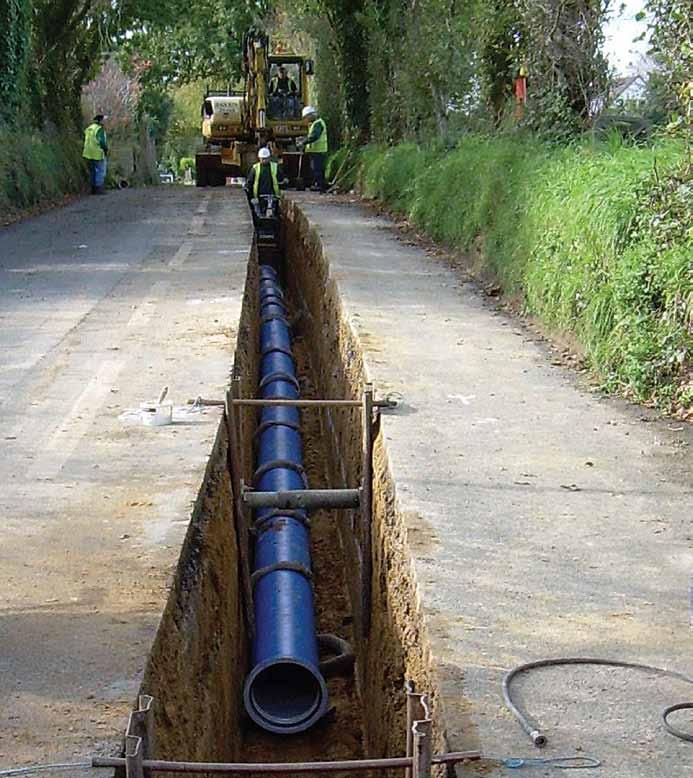
Installation of new 150mm diameter treated water pipework
8 Appendices
Appendix A
Audit Monitoring: Handois TW
B Audit Monitoring: Augrés TW
Audit Monitoring: Les Platons Service Reservoir, East Compartment Substances and parameters
Audit Monitoring: Les Platons Service Reservoir, West Compartment
and parameters
E Audit Monitoring: Westmount Service Reservoir
1 Detected pesticide - none detected, 43 pesticides analysed for.