
I am pleased to report that the quality of water supplied during 2014 was to an exceptionally high standard. The treated water supplied was 99.99% compliant, with all physical, chemical and bacteriological standards under the Water (Jersey) Law 1972 (2013: 99.84%). This represents our best ever year, of the 12,126 analyses of treated water taken during the year, only one was outside of the regulatory quality parameter but posed no threat to health as levels were well within limits of safety.
The water quality monitoring programme and parameters analysed during the year were in accordance with a programme approved by the States of Jersey Planning & Environment Department, as required by the Water (Jersey) Law 1972. Jersey Water continued to use a risk assessmentbased monitoring programme for 2014. This approach is in line with the developing Water Safety Plan, where potential risks are evaluated and, where necessary, contingency plans put in place to alleviate such risks.
The bacteriological compliance of water leaving the treatment works was 100% and there were no herbicides or pesticides detected in the treated water supplied.
Throughout 2014, nitrates in the treated water supply complied with the regulatory limit of 50mg/l. This was in contrast to 2013, when there were twenty two instances where the levels increased to a maximum of 58.2mg/l. The maximum concentration of nitrates in treated water during 2014 was 46.9mg/l.
Jersey Water has dispensations for nitrates under the Water (Jersey) Law 1972, which allows for a maximum concentration of 65mg/l and places additional restrictions on the number of samples exceeding the 50mg/l limit. The dispensation expires on 31 December 2016.
During 2014, the Environment Department of the States of Jersey established a Nitrate Working Group comprising representatives from Jersey Water, the Environment Department, The Public Health Department, the Farming Community and the Royal Jersey Agricultural & Horticultural Society. The objective of the Nitrate Working Group is to identify the means by which nitrates in raw water sources can be reduced such that both the public and private water supplies have nitrates concentrations within the 50mg/l limit. The work of the group to date is promising and it is encouraging to see all stakeholders working together to resolve this island-wide issue. The challenge remains for the recommendations of the Nitrate Working Group to be implemented and achieve the required results.
At the end of 2013, the regulatory limit for concentrations of lead in supply reduced from 25µg/l to 10µg/l. Lead in treated water is primarily caused by the historic use of lead pipework inside customer properties and for supply pipes. Regulatory testing of water supplied by the Company during 2014, which is measured from the stop tap, was fully compliant with the new lead limit. To ensure the ongoing regulatory compliance and reduce the potential effects arising from lead pipework within private properties, the Company will consider and, if appropriate, implement additional treatment measures during 2015.
The tables on the following pages show the results from the 12,126 regulatory analyses taken in the year.
Howard N Snowden Managing Director & Engineer
Treated water supply in 2014 was 99.99% compliant
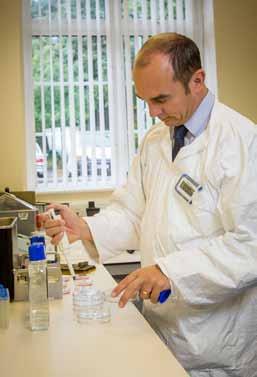
Monitoring and analysis of the water supplied by Jersey Water is the responsibility of the laboratory team who are based in our water quality monitoring laboratory at Millbrook Depot, St Lawrence.
Our Laboratory Manager, David Mayman is a Chartered Chemist and a Member of the Royal Society of Chemistry and Royal Society for Public Health. David has over 30 years experience in water supply quality and during 2014 was ably supported by assistant manager Sarah Le Sueur and laboratory technician Nora Treanor. Nora decided to take early retirement at the end of 2014 and her replacement, Adam Dallas-Chapman, joined the company as Environment Technician in December 2014.
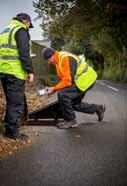
Three water quality samplers, Keith Quemard, Bob Langford and Matthew Parkin take all water quality samples and continue to provide an excellent service when attending consumer premises following contacts and enquiries.
12,126 regulatory analyses were taken in 2014
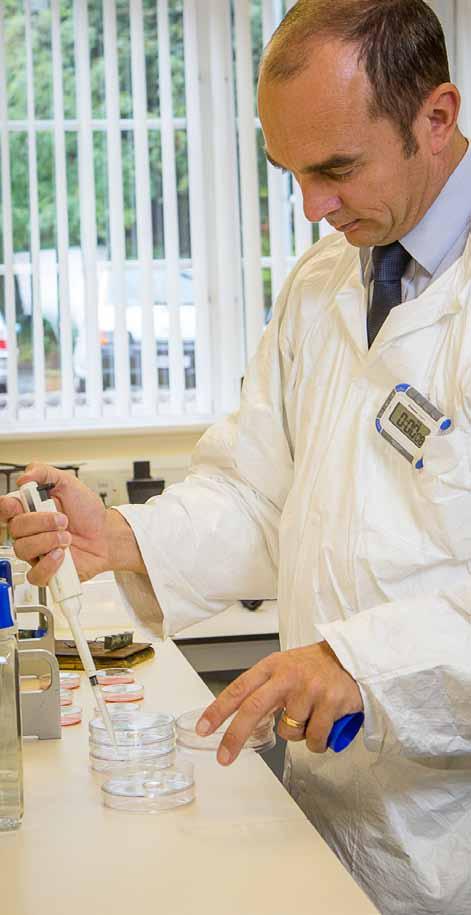
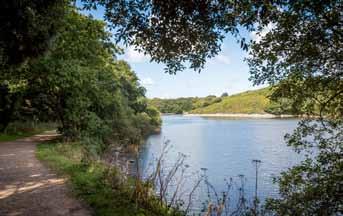
For operational and monitoring purposes Jersey Water takes samples of water from streams and reservoirs. This enables our operational staff to select the most suitable waters to be taken for treatment.
Analysis is carried out in the Jersey Water laboratory for physical, bacteriological and chemical parameters with samples being sent to our consulting analysts in the UK for pesticide analysis. In 2014, our results showed that out of 6,027 analyses for herbicides and pesticides in the stream courses, 15 were above the 0.1 µg/l limit compared to 45 in 2013.
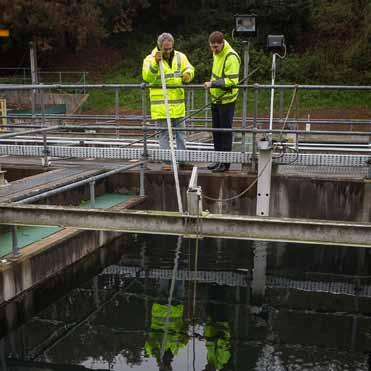

Jersey Water utilised a risk assessment-based monitoring programme for 2014. This approach is in line with the Company’s Water Safety Plan, where potential risks are evaluated and water quality testing is designed to manage the risks.
We examine samples from supply points (comprising our two treatment works and three service reservoirs) and the supply zone for compliance purposes at regular intervals throughout the year.
The company is required to undertake two kinds of regulatory water quality monitoring - check and audit monitoring.
Check monitoring is more frequent and is designed to ensure the treatment works are operating as expected and that the water in distribution is suitable for supply. Audit monitoring is used to investigate the quality of the water more thoroughly.
Only one non-compliant analysis was identified in regulatory samples taken during 2014, out of 12,126 analyses taken for compliance purposes. This gives a percentage compliance of 99.99%, an increase from the 99.84% in 2013 when there were 22 instances of non-compliance all caused by nitrate levels in excess of the 50mg/l limit. Water quality in 2014 was the best ever recorded by Jersey Water.
The single incidence of non-compliance with regulatory parameters in 2014 was due to the identification of a single coliform found in a sample taken at Les Platons East Service Reservoir. Upon investigation no further instances were identified and repeat samples were clear.
All of the tests for nitrates in 2014 were below the regulatory limit, the highest recorded value being 46.9 mg NO3/l. This is in contrast to 2013 when there were 22 instances of non compliance due to nitrates with the highest level recorded in supply of 58.2mg/l. The graphs below show the compliance with nitrate limits over the years and during 2014.
Nitrate concentrations in raw water sources are mainly dependent on the volume and timing of the application of fertiliser during the potato growing season and of rainfall in the winter and summer months; factors over which we have no control. Jersey Water therefore has a dispensation for nitrates under the Water (Jersey) Law 1972, which expires on 31 December 2016, with the following parameters:
The percentage of regulatory samples above the MAC (50mg/l) must not exceed 33%;
Regulatory samples must not exceed the maximum allowable concentration (50mg/l) for six months of the calendar year;
No regulatory sample shall exceed 65 mg/l;
No more than 15% of regulatory samples shall exceed 55 mg/l; and
No more than 33% of regulatory samples shall fail to satisfy the formula [nitrate]/50 + [nitrite]/3 <1, where the square brackets signify the concentrations in mg/l for nitrate (NO3) and nitrite (NO2) respectively.
Jersey Water operates two treatment works located at Handois, St Lawrence and Augrès, Trinity. Both treatment works have identical treatment processes, which use a chemically-assisted primary treatment system, using aluminium sulphate, followed by dual media rapid gravity filtration using sand and anthracite.
Disinfection of the treated water ensures that any remaining bacteria present in the water are neutralised before it passes into the distribution network and to customers premises. A combination of chlorine and ammonia is used to effect the disinfection process and a relatively long retention time in holding tanks further optimises the process.
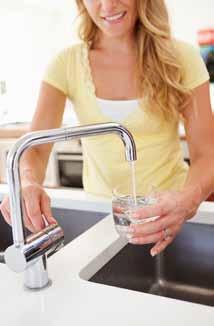
The amount of chlorine and ammonia added to the treated water is very small and is continuously monitored to ensure levels are within acceptable aesthetic levels. The disinfection process also ensures that the highest bacteriological standards are maintained up to the customers tap.
During 2014, the Company commissioned the ultraviolet (UV) treatment plant at Handois Water Treatment Works which had been installed in 2013. The UV plant acts as a primary disinfectant to protect against organisms including Cryptosporidium. Plans for a UV plant at Augrès Water Treatment Works were completed and the plant was installed early in 2015.
Sampling of water throughout the distribution network is undertaken in accordance with a risk assessed programme to ensure the water we supply meets physical, bacteriological and chemical standards.
During 2014, 453 water samples were taken from all parts of the distribution system and analysed for physical, bacteriological and chemical standards.
1 The regulations specify that the ratio according to the following formula must not exceed 1, [nitrate]/50 + [nitrite]/3, where the square brackets signify the
for nitrate (NO3) and nitrite (NO2) respectively. Reduced number of samples due to two of the nitrate results being
in
Audit Monitoring : Supply Zone
Metering water quality
water resources
operating infrastructure & equiptment
1 Detected pesticide - 39 other pesticides analysed for and not detected.
mains extensions and distribution network
In 2014 Jersey Water adopted the method used by the water companies in England and Wales for recording consumer contacts and enquiries regarding water quality. Every contact is recorded and categorised (whether or not there is an issue or a callout is required) and included in the table below.
The majority of customer contact is due to discolouration of the water resulting from old corroded steel and unlined cast iron pipes, some of which were from privately owned pipe work which is not the responsibility of Jersey Water.
Bacteriological and chemical samples were taken at the premises where the consumer had suspected the water supply to be causing illness. Examinations showed no indications that the water supply was to blame.
The Planning & Environment department are responsible for the administration of the Water (Jersey) Law 1972 and their officers make quarterly visits to our laboratory to examine analytical results of samples derived from water quality contacts and enquiries from our customers.
“In 2014 Jersey Water adopted the method used by the water companies in England and Wales for recording consumer contacts and enquiries regarding water quality.”
“During 2014, the Company commissioned the ultraviolet (UV) treatment plant at Handois Water Treatment Works which had been installed in 2013.”
“During 2014, 453 water samples were taken from all parts of the distribution system.”
“Throughout 2014, nitrates in the treated water supply complied with the regulatory limit of 50mg/l.”
1 Detected pesticide - 38 other pesticides analysed for and not detected.
“Disinfection of the treated water ensures that any remaining bacteria present in the water are killed before it passes into the distribution network and to customers premises.”
“The amount of chlorine and ammonia added to the treated water is very small and is continuously monitored to ensure levels are within acceptable aesthetic levels.”
Mulcaster House, Westmount Road, St. Helier, Jersey, JE1 1DG
T: 01534 707300 F: 01534 707400
Mulcaster House, Westmount Road, St. Helier, Jersey, JE1 1DG
E: customerservices@jerseywater.je www.jerseywater.je
T: 01534 707300 F: 01534 707400
Jersey Water is the trading name of The Jersey New Waterworks Company Limited.
E: customerservices@jerseywater.je www.jerseywater.je
Jersey Water is the trading name of