
Directors, Officers and Advisers
Directors
Non-Executive
Kevin Keen MBA, FCCA, FCMA, FCMI, CDir Chairman
Anthony Cooke BA(Hons) Econ, CEnv, FCIWEM, HIWater, FRSA Senior Independent Director
Mary Curtis MA, Chartered FCIPD, MIoD
Stephen Marie FICWCI, MBIFM, ACIOB
Peter Yates BSc, FCA
Executive
Howard Snowden EurIng, BSc (Eng), MSc, CEng, FICE, FIMechE, FIET, MIWater Managing Director and Engineer
Helier Smith BA(Hons), FCA, CDir, MIWater, FCMI Finance Director
Secretary
Margaret Howard MSc, ACIB, ACIS
Independent Auditors
PricewaterhouseCoopers CI LLP 37 Esplanade
St Helier Jersey
JE1 4XA
Registered Office
Mulcaster House Westmount Road
St Helier
Jersey
JE1 1DG
Board of Directors
Kevin Keen MBA, FCCA, FCMA, FCMI, CDir
Kevin Keen was appointed to the Board in May 2007 as a Non-Executive Director. Mr Keen is Chief Executive of Jersey Post Group and was previously Managing Director of Jersey Dairy and before that a Divisional Managing Director and Finance Director of Le Riche Group. Mr Keen became a Chartered Director in 2012 and a Fellow of the Chartered Management Institute in 2012.
Mr Keen holds the position of Chairman of the Company, chairs the Nomination Committee and is a member of the Remuneration Committee.
Howard Snowden EurIng, BSc(Eng), MSc, CEng, FICE, FIMechE, FIET, MIWater
Howard Snowden joined the Company in 1992 as Senior Engineer and became Managing Director in May 2000. Mr Snowden has worked in the water industry since 1970 for a number of companies including Yorkshire Water Authority (the forerunner to Yorkshire Water Plc). He is a Fellow of the Institution of Civil Engineers, the Institution of Mechanical Engineers, the Institution of Engineering and Technology and a member of the British Dam Society and is a Panel Supervising Engineer under the Reservoirs Act 1975.
Tony Cooke BA (Hons) Econ, CEnv, FCIWEM, HIWater, FRSA
Tony Cooke became a Non-Executive Director of the Company in June 2008. Mr Cooke is an economist by background and he is the former Managing Director of Bournemouth & West Hampshire Water Plc. He has previously held a number of Chief Executive and senior management roles in the United Kingdom and internationally. Mr Cooke is a Trustee of Utilities and Service Industries Training Limited, a Trustee of a Pension Fund and an independent utilities consultant.
Mr Cooke holds the position of Senior Independent Director and is a member of the Audit and Nomination Committees.
Mary Curtis MA, Chartered FCIPD, MIoD
Mary Curtis joined the Board as a Non-Executive Director in June 2008. Mrs Curtis is a Fellow of the Chartered Institute of Personnel & Development and is a Director of a privately owned consultancy business, Calmera Business Consultancy. She formerly worked in London before moving to Jersey in the roles of Offshore Island Regional Human Resources Manager at Deloitte & Touche and then Director of Human Resources at Mourant du Feu & Jeune (now Mourant Ozannes).
Mrs Curtis is a member of both the Remuneration Committee and the Nomination Committee.
Stephen Marie FICWCI, MBIFM, ACIOB
Stephen Marie became a Non-Executive Director of the Company in 2002. Mr Marie is the Managing Director of ComProp (CI) Limited, a Channel Island commercial property development company and in 2012 was appointed as a Non-Executive Director to the Property Board of Fox International Property Holdings Limited (Fox Group).
Mr Marie has been involved, at both senior executive and director levels, in the property industry for a number of years. He is a Fellow of the Institute of Clerks of Works and Construction Inspectorate of Great Britain Inc., a member of the Institute of Facilities Management and an associate of the Chartered Institute of Building.
Mr Marie chairs the Remuneration Committee and is a member of the Nomination Committee.
Helier Smith BA (Hons), FCA, CDir, MIWater, FCMI
Helier Smith was appointed to the Board as Finance Director in October 2003 after joining the Company in 2002. He was previously employed by KPMG in the UK and Jersey where he worked for eleven years in the manufacturing, distribution and finance sectors. Mr Smith qualified as a Chartered Director in 2010. He became a Fellow of the Chartered Management Institute in 2012.
Peter Yates BSc, FCA
Peter Yates was appointed to the Board in May 2009. Mr Yates, a Chartered Accountant, was previously a partner of PricewaterhouseCoopers working in the United Kingdom and Jersey for over 31 years. He is a Non-Executive Director and Chairman of the Audit Committee of Invesco Leveraged High Yield Fund plc and also a Non-Executive Director of Bathroom Brands Limited.
Mr Yates chairs the Audit Committee and is a member of the Nomination Committee.
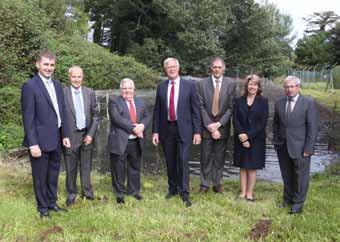
From left to right: Helier Smith, Stephen Marie, Tony Cooke, Peter Yates, Howard Snowden, Mary Curtis, Kevin Keen
Chairman’s Statement
The 130th year of trading for the Company was an eventful one. Having begun 2012 deeply concerned about the lack of rainfall over the winter, Jersey ended up being ‘treated’ to one of the wettest years on record. Although the financial impact of this unusual weather and the increased number of meters in service was a slight reduction in operating profits. It is now very clear that Jersey’s rainfall is becoming even more unpredictable and given our limited storage facilities even more precious. It confirms the wisdom of the Board’s strategy of managing water resources prudently. The principal element of this strategy is the roll out of metering across the island which encourages consumers to conserve water and greatly assists our leakage reduction efforts. In 2012 we installed 3,700 meters which means around 65% of connections are now metered and we are still on target to complete this major project in 2015. In all other respects 2012 was a very good year, quality was excellent, leakage was further reduced, our tariff increases were kept below inflation for the 10th year in succession, we achieved silver standard for Investors in People and finally we were delighted to commemorate our 130th anniversary through the distribution of £130,000 to twenty Island charities.
I have previously advised shareholders of the change in the Company’s income profile arising from the installation of water meters; away from a fixed income model to one increasingly dependent on the demand for water. This change is evident during 2012 where the impact of metering on consumption and the wet weather meant that the overall demand for water in the year was down by 1.9% on 2011, causing turnover to dip by 0.9% despite a 2.5% tariff increase in April. Turnover was also adversely affected by 0.8% as a result of the continuing reduction in demand for new water connections from property developers.
We were delighted to commemorate our 130th anniversary through the distribution of £130,000 to twenty Island charities.
The decrease in turnover was partially offset by lower costs in the year leading to an overall reduction in operating profit before exceptional items of 2% on the prior year.
The Company is reporting a profit before tax of £4,486,000, some £475,000 lower than in 2011. The decrease being due to the lower operating profit before exceptional items, the £130,000 charge for the 130th Anniversary Fund and the fewer profits on the sale of fixed assets of £320,000, offset by a small reduction in financing charges.
During the year, the Directors declared and paid an interim dividend for 2012 of 6.3 pence per share (‘pps’).
The Directors are proposing a final dividend of the year of 12.09pps for shareholders to consider and approve at the Annual General Meeting. The combined dividend for 2012 is 18.39pps, representing an increase of 3% over the 2011 dividend of 17.85pps.
The Company’s capital programme continued in 2012 with the investment in capital works totalling £2,905,000 (2011: £5,574,000). The focus during the year was on the continued installation of meters and the renewal of old mains. We are very pleased with the progress of our metering programme which at the moment is ahead of schedule and under budget. This puts us in a strong position before we start working in St Helier where the congestion of utilities in the roadway is expected to slow the rate of installation.
One benefit of the weather patterns during the year was that there were no incidents of nitrates in supply exceeding the statutory limit of 50mg/l and we did not therefore need to make use of the dispensations under the law permitting up to a third of samples to be between 50mg/l and 70mg/l.
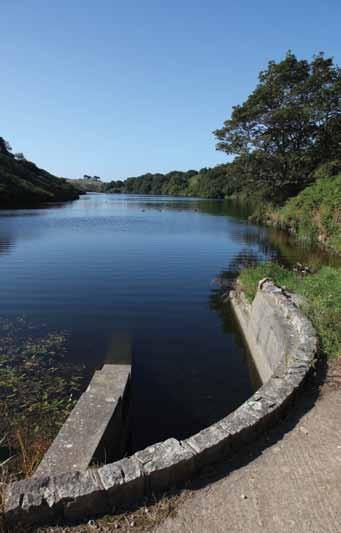
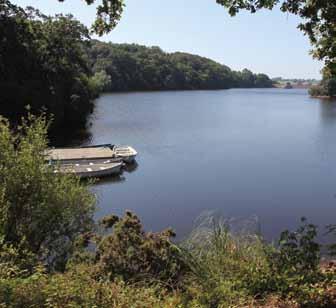
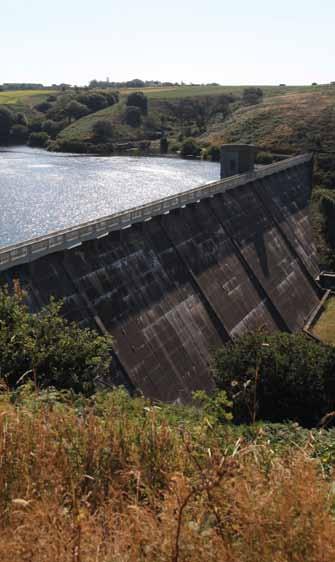
Val de la Mare Reservoir
The dispensations are due to expire in 2013 when the Company will be applying for them to be renewed. The wetter weather during the 2013 planting season has meant that nitrates in supply have exceeded the 50mg/l on five occasions so far this year to date demonstrating that the dispensations continue to be necessary. Although the Board is advised that even at the levels experienced there is no known risk to our customers, we continue to work closely with the Environment Department on the management of nitrates. However, until a permanent solution is found to reduce the level of the pollutant in catchments areas, the Company will continue to be reliant on the dispensations. The absence of high levels of nitrates in supply contributed to the excellent quality of water supplied in 2012. During the year 99.99% of samples met the water quality parameters of the Water (Jersey) Law 1972. This represents just 2 out of the 15,321 samples taken not meeting the specification. It should be noted that due to the very high margins for safety neither of two samples presented any risk to health. Jersey Water continues to invest in treatment processes to enhance the quality of water supplied. In 2013, we plan to install ultra-violet (UV) disinfection equipment at Handois Water Treatment Works to further enhance protection against water borne viruses and bacteria.
The focus during the year was on the continued
installation
of meters and the renewal of old mains. We are very
pleased with the progress of our metering programme which at the moment is ahead of schedule and under budget.
As I reported in last year’s accounts, one of our long serving Non-Executive Directors and the Company’s Deputy Chairman, Mr Carl Hinault, retired after 13 years on the Board at the AGM in 2012. I would take this opportunity to again record our gratitude to Carl for his hard work and wise counsel over such a long period. The Directors will be proposing at the forthcoming AGM that his vacancy be filled by Mr Stephen Kay. Mr Kay is the Managing Director of Cambridge Water Plc. He also holds a number of non-executive appointments, namely: Chairman of Iceni Waters Ltd, Trustee of the Water Companies Pension Scheme, Chairman of the Water UK Technical Standards Board and Chairman of the Water Regulations Advisory Service. He is a Chartered Engineer who has spent his career in the water industry both in the UK and internationally. I am sure that he will make a fine addition to your Board.
At this year’s AGM it will be the turn of Peter Yates and Howard Snowden to retire by rotation and seek re-election, having completed 3 years since their last election. Stephen Marie, will also retire by rotation and having served 11 years on the Board, shall seek re-election for a further term of one year.
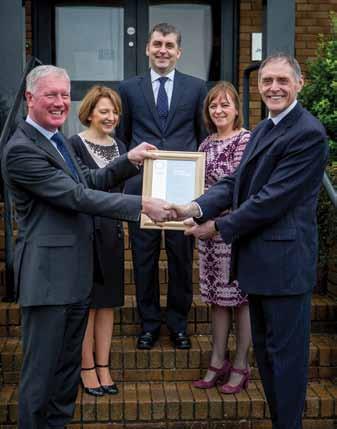
I am very pleased to report that the Company was awarded the Investors in People (IIP) Silver Award during the year. The Board and Management Team at Jersey Water are well aware of the vital role that all staff play in the success of the organisation. Schemes such as Investors in People help us to continually improve and ensure that Jersey Water remains a great place to work. On behalf of the Board and shareholders I should like to thank all the staff at Jersey Water for their contribution in 2012.
Kevin Keen 27 February 2013
Investors in People Presentation 2012
Business Review
About Jersey Water
Jersey Water is the sole supplier of treated mains water to the Island of Jersey, supplying approximately 37,000 homes and businesses across the Island. In 2012, the Company’s two water treatment works supplied 7,015Ml (2011: 7,152Ml) through its 580 km network of treated water mains.
Stream Abstraction Point
Raw Water Storage Reservoir
Laboratory Operations
Raw Water Storage Tank
Treated Water Storage Reservoir
Ground Water Resource
Headquarters
Desalination Plant
Water Treatment Plant
Water resources
The Company has six raw water storage reservoirs, with a combined capacity of 2,687Ml (approximately 120 days average use) fed from the surrounding catchment areas and remote pumped abstraction sources. Substantially all of the Company’s resources are derived from surface waters which are rainfall dependent. The Company operates an extensive raw water pumping network that allows the transfer of water between reservoirs so as to maximise the yield available from the catchment areas and reduce water resources lost to sea. The Company owns a 6Ml/d reverse osmosis desalination plant capable of providing approximately one third of daily demand. The plant is maintained in standby mode, ready at short notice in the event of water resource shortages.
Water Resource Management Plan
Jersey Water’s plan for meeting the future demand for water is set out in its Water Resource Management Plan. The plan, which is updated every 5 years, is a 25 year projection of demand for water in Jersey incorporating the latest estimates of the effects of climate change, population growth and demographic change. The plan also sets out how the Company plans to meet any shortfalls in the supply demand balance.
The most recent plan, which was completed in 2010, indicates that over the next 25 years, demand will increase by 15% whilst at the same time water available for use will decrease by 11%. The resulting shortfall will be just over a quarter (26%) of the Island’s predicted daily demand, equating to 6.5 million litres per day in 25 years’ time.
In order to ensure that the Company will be able to meet this shortfall, it has implemented a number of initiatives to increase water available for use and to reduce demand including the Island wide metering programme which is designed to reduce the non-essential discretionary use of water and reduce leakage.
Regulation
The supply of water in Jersey is regulated by the States of Jersey through various laws and regulations. The Water (Jersey) Law 1972 sets out the service standards by which the Company must operate, the way in which it may charge for water and the minimum standards of the quality of the water that it must supply. The Company’s impact on the environment is controlled through the Reservoirs (Jersey) Law 1996, the Water Resources (Jersey) Law 2007 and the Water Pollution (Jersey) Law 2000. The Company is also subject to other relevant legislation including the Companies (Jersey) Law 1991 and the Competition (Jersey) Law 2005.
La Hague
Tesson
Pont Marquet
Le Mourier
Les Platons
WESTMOUNT
Mont Gavey
St. Catherine
Fern Valley Grands Vaux Queen's Valley Valleé des Vaux
Treatment Works
Dannemarche
Val de la Mare
Grève de Lecq
Les Blanche Banques Boreholes
Treated Water Reservoir Headquarters
Handois Reservoir & Treatment Works
Millbrook Reservoir & Laboratory
Desalination Plant Augrès
Financial Performance Turnover
The Company generated a turnover for the year of £14,609,000 (2011: £14,811,000). The decrease of £202,000 or 1.4% on the prior year arose primarily due to a reduction of £132,000 in water related turnover and of £113,000 in rechargeable works income. Other income increased by £43,000.
Water related turnover reduced by 1%, from £13,973,000 in 2011 to £13,841,000 in the year. This was in spite of a tariff increase of 2.5% in April 2012. The transition to metering has increased the variability of income and its dependence on the weather. The significant rainfall experienced in 2012, particularly during the spring and summer months, meant that overall demand for water was 1.9% lower than the prior year.
Metered water income increased by £946,000 to £9,497,000 (2011: £8,551,000). The increase of over 11% was after taking account of the reduction in overall demand for the year described above and was due to the combined effects of the 2.5% tariff increase in April, the addition of 349 new connections in the year and installation of over 3,700 meters on previously unmeasured supplies.
Unmeasured water income reduced by £1,079,000; from £4,853,000 to £3,774,000 as a result of the transition to metering. The Island wide metering programme means that unmeasured income will reduce to below an estimated 10% of turnover by the end of 2015. Unmeasured charges now represent 27.3% of water related turnover.
Rechargeable works income has decreased by £113,000 (24%) to £356,000 (2011: £469,000). The reduction in the year arises from the reduced demand for new water connections following the downturn in the construction sector in Jersey. In 2012, the Company made 349 connections to the network, compared with 492 in the prior year.
Operating expenditure
Operating costs for the year fell by 1% to £9,849,000 (2011: £9,953,000). Non recurring expenditure in 2011 relating, in part, to the operation of the desalination plant meant a reduction in expenditure in 2012 of £340,000. Fewer new water connection installations in 2012, discussed above, resulted in savings in the year of £83,000.
The savings were offset by the planned increase of £224,000 in depreciation charges for the year corresponding to metering, mains renewals, the 2011 lining of Val de la Mare dam and other elements of the capital programme. In addition, one off costs totalling £107,000 relating to staff changes were incurred during the year.
Aside from the changes referred to above, underlying operating costs remained broadly in line with the prior year. Increases in power costs were offset by reductions in expenditure on contractors, advisory services, materials and staff costs.
Operating profit before exceptional items
Jersey Water generated an operating profit before exceptional items of £4,760,000, this was £98,000 (2%) lower than 2011. The reduction was due to the lower turnover in the year countered by reduced operating costs. Operating margins remained broadly in line with the previous year at 32.6% (2011: 32.8%).
Queen’s Valley Reservoir
Metering is substantially complete in the Northern and Western Parishes
Profit on disposal of fixed assets
During the year the Company disposed of 3 freehold properties and other assets generating profits on sale of £598,000 (2011: £918,000) and proceeds of £714,000 (2011: £1,275,000).
Net finance costs
Net finance costs for the year totalled £742,000, a reduction of £73,000 on the prior year. A reduction of £19,000 in net interest payable was coupled with an increase of £54,000 in net finance income arising from the FRS 17 valuation of the defined benefit pension scheme.
Profit before taxation
The Company generated a profit before tax of £4,486,000, a reduction of £475,000 or 9.6% on the prior year. The bulk of the reduction is attributable to reduced profit on the sale of fixed assets (£320,000) and the charitable contribution of £130,000 associated with the Company’s 130th Anniversary Fund.
Income tax
The charge for tax for 2012 totals £789,000 compared with £380,000 in 2011. The increase of £409,000 is primarily due to higher levels of capital expenditure deductible for tax purposes in the prior year.
Equity dividends
The Directors are proposing a final dividend for 2012 of 12.09 pence per share on the Ordinary and ‘A’ Ordinary shares. Dividends paid and proposed in respect of 2012 total 18.39 pence per share, an increase of 3% on 2011.
Financial Position
Cash flow
Cash balances at the end of 2012 were £2,653,000 (2011: £1,397,000). There was an increase in cash in the year of £1,256,000 in contrast to a decrease of £255,000 in 2011. The change in cash flows was due to a combination of the reduction in cash outflows associated with the higher level of capital expenditure in the previous year, reduced net operating cash flows (from changes in working capital balances) and lower proceeds on sale of fixed assets.
Capital expenditure
Capital expenditure during the year totalled £2,905,000 (2011: £5,574,000), the difference being mainly due to the expenditure in 2011 on the lining of the dam at Val de la Mare. The graph below provides an analysis of the expenditure in 2012 by type.
Capital expenditure by type
Investment properties
In 2012, the Company undertook an internal valuation of its investment properties reflecting the changes in the Jersey residential property market since the external valuation was completed in December 2010. The internal valuation valued the two properties at £1,241,000, a reduction of £94,000 on the previous valuation.
Loans and borrowing
Loans and borrowing at 31 December 2012 remained unchanged at £20,282,000 (2011: £20,282,000).
An increase in cash at bank from £1,397,000 to £2,653,000 meant that net debt reduced to £17,629,000 (2011: £18,885,000).
Defined benefit pension scheme
The FRS17 valuation of the defined benefit pension scheme as at the year end indicated a net deficit of £385,000 (2011: £307,000). Higher than expected returns on scheme investments resulted in a positive actuarial variance of £1,235,000. However, changes in the assumptions used in the valuation resulted in an increase in present value of scheme liabilities of £1,523,000.
The Company completed its triennial actuarial valuation of the defined benefit section of the pension plan as at 1 January 2012. The results of the valuation indicate an actuarial deficit on the scheme of £538,000. The Company has indicated that it will make additional contributions of £50,000 pa over the next 7 years to reduce the deficit.
Connections, Metering and Charges
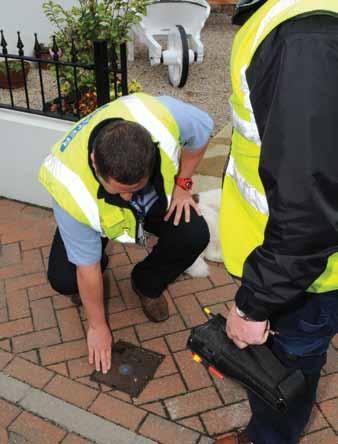
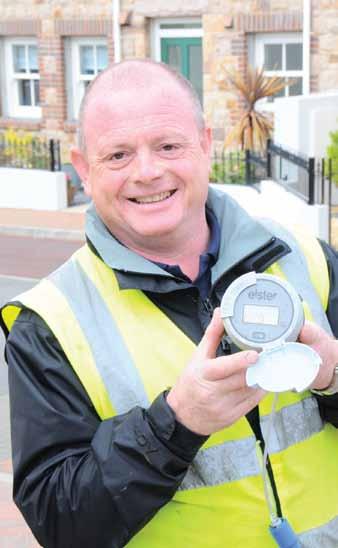
During 2012, Jersey Water fitted over 3,700 (2011: 3,200) meters to existing connections as part of the Company’s Island wide metering project. By the end of the year approximately 65% (2011: 55%) of connections are metered. Metering is now substantially complete in the Northern and Western Parishes. The focus of the Company’s metering programme in 2013 will be in St Clement, Grouville and parts of St Helier.
The Company installed 349 new water connections in 2012 a 29% reduction on the previous year; a result of reduced building activity in the Island.
Metering programme as of December 2012










In April 2012, the Company announced an increase in water charges of 2.5%; the tenth consecutive year of below RPI price increases for the Company. Subsequent to the year end the Company has announced tariff increases for 2013 of 2.0%, once again below the rate of inflation. In addition, with effect from April 2013, the Company has introduced changes to its standing charge (previously £20 per annum) with the introduction of tiered pricing structure ranging from £20.52 to £125.05 per annum dependent on the size of the meter installed. Approximately 94% of metered connections will be charged on the lowest tier.
Over 3,700 water meters were installed in 2012
Water Supply and Demand
The annual demand for water in 2012 was 7,015 million litres, 1.9% lower than in 2011 and 3.6% below the 5 year average. The reduction in demand was as a result of the combined effect of the exceptionally wet year, the continuing universal metering policy and other demand management measures including mains renewal, leakage detection and pressure management.
The annual rainfall for 2012 was 22% above the ten year average at 1,089mm (2011: 773mm) and was the ninth wettest year since the Company’s records began in 1865. The first three months of the year were exceptionally dry with rainfall for the quarter less than 50% of the average. In contrast, from April onwards rainfall for the rest of the year, with the exception of May, was consistently well above the long term average.
The Company started 2012 with reservoirs at 80% capacity. The heavy rains in December 2011 meant that reservoirs quickly filled to capacity by mid-January. The effects of the dry first quarter on reservoir levels were soon compensated by the rainfall from April. From mid-June reservoir levels were well above the long term average and, for the first time, did not fall below 80% during the whole year. Reservoirs were full at the end of 2012.
In 2012, seven water companies in the United Kingdom announced water restrictions following the dry first quarter, severely depleted water resources and the prospects of a drier than normal spring and summer. In March and April 2012, Jersey Water advised of the potential need for restrictions in Jersey and the operation of the Company’s desalination plant in the event of continuing dry weather. However, the exceptional rainfall in the year from April meant that neither proved necessary.
Water Quality
The quality of water supplied during 2012 was to an exceptionally high standard. The treated water supplied was 99.99% (2011: 99.81%) compliant with all physical, chemical and bacteriological standards under the Water (Jersey) Law 1972. The legal water quality standards in Jersey mirror those of England and Wales.
The bacteriological compliance of water leaving the treatment works was 100% and there were no herbicides or pesticides detected in the treated water supplied.
With rainfall levels in the first three months of the year being well below average levels, there were no samples of treated water with nitrates greater than 50 mg/l. However, many stream sources did exceed 50 mg/l, but the Company was able to maintain nitrates in treated water below this level through careful selection and blending of waters.
Jersey Water has dispensations for nitrates under the Water (Jersey) Law 1972, which allow 33% of samples to exceed the statutory 50 mg/l limit, but not to exceed 70 mg/l. There are no known risks to health with bacteriologically safe water for nitrates below 100 mg/l. The current five year old dispensation expires in December 2013 and the Company shall be seeking its renewal during 2013.
There is a close relationship between the application of agricultural fertiliser to the land, the timing and volume of rainfall and the level of nitrates in surface waters.
Jersey Water is almost entirely dependent on these surface waters for its water resources. The Company takes steps to manage concentrations of nitrates in treated water to the extent that it can do so by the careful selection of water for treatment and blending of raw water sources. However, the underlying levels of nitrates in raw water sources are outside of the Company’s control.
Water in store and rainfall in 2012
There will be a continuing reliance on dispensations from the limits governing nitrate concentrations until such time as effective catchment management is introduced and the diffuse pollution is reduced.
During the year the Company’s Water Regulations Enforcement Officer carried out 560 inspections to customer premises to inspect and advise on correct plumbing installations to ensure compliance with the Water Fittings Byelaws.
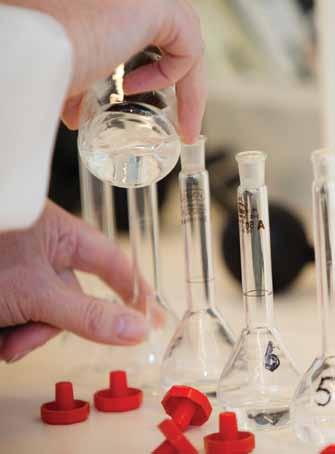
The Company has adopted a new approach to the statutory treated water monitoring programme for 2013 which was approved by the Environment Minister in 2012. With assistance from the Company’s Water Quality Consultant, Professor John Fawell MBE, the Environment Department and Public Health Department, the programme has been amended to adopt a risk based approach; monitoring only those quality parameters that need to be monitored.
It is understood that water quality monitoring requirements in future EU Directives will prescribe a similar ‘risk based’ approach dependant on each type of water source.
During the year Water Safety Plans were completed for all the reservoir catchment areas for the sources used by Jersey Water. This work entailed walking all the catchment areas and streams to map and identify any pollution risks to water resources.
Mains Network
Main laying works during 2012 concentrated around the renewal of old unlined cast iron and galvanised iron mains, which were approaching the end of their useful life. Approximately 2.1km of mains were renewed, together with all the associated service connections to properties. In addition, approximately 0.6km of old water mains were abandoned by transferring service connections to an adjacent water main, negating the need for renewal.
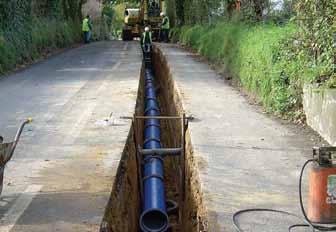
The renewal and rationalisation of water mains enables connections to be prepared for the universal metering programme facilitating the subsequent fitting of meters. It also provides the opportunity to install more strategically placed isolation valves, permitting more targeted and localised shut-offs in the event of planned maintenance or bursts.
The Company installed just under 1.5km (2011: 2km) of new mains supplying new housing developments. This type of work was again on a much smaller scale than previous years, due to the down-turn in the property market.
Leakage levels during 2012 continued their downward trend and fell by approximately 4.5% to 3.35Ml/d (2011: 3.51Ml/d). When compared against the 22 UK water companies, Jersey Water’s leakage rates are the fifth lowest. The continuing improvements in leakage are evidence of the beneficial effects of the Company’s metering and mains renewal programme. Experience is showing that between 25% and 33% of this leakage is occurring on customer pipework.
In 2012, there were 21 burst mains, slightly higher than the five year average of 19. The frequency of burst mains is also one of the lowest recorded by water companies in the British Isles. This is mainly due to favourable ground conditions in Jersey, demand management measures and renewal rate of old water mains.
In 2012, Jersey Water commissioned a new link main and two sets of pressure reducing valves near Gorey, allowing the area to be supplied by the high level Les Platons gravity system and the abandoning of a booster pumping station.
15,321 quality samples were taken during 2012
The Company renewed 2.1km of mains in 2012
Treatment & Processing
During the year, the Reverse Osmosis (RO) membranes at the Desalination Plant were removed and new membranes fitted to the front end of the process. The arrangement of the membranes means all must be removed from their pressure tubes to allow work on any of them. This is the first time since the plant was commissioned in 1999 that the membranes have needed attention.
In 2012, the Company began the process of determining the scope of works and costs associated with a potential future increase in the output capacity of the Desalination Plant. Desalination RO technology has advanced considerably since the plant at La Rosière was designed in 1997. Upgrading the plant would also result in a sizeable reduction to the energy requirement. The scoping works included the operation of a small pilot plant, to assess the performance of a ‘new’ high performance multi-layer filtration media. The results of the trial provided useful information, but the efficacy of the trial media was not remarkably different to the dual media (sand and anthracite) already in use at the plant.
At Augrès Water Treatment Works (‘WTW’), the chlorination and ammoniation systems, used to disinfect the filtered water were replaced during the year. This equipment is vital for ensuring bacteriological standards of the treated water and since the equipment controls the dosing of chlorine and ammonia, replacement is normally undertaken every ten years. The new control equipment incorporates improved safety devices for liquid chlorine and ammonia.
At the end of the year, a new additional pump was installed at Grands Vaux Reservoir Pumping Station. This new, smaller capacity pump will enable more efficient control of raw water supply to Augrès WTW during the winter months, when demands are lower.
The improvement to the rapid gravity filters and filter back-wash system at Handois WTW, which was started in 2011 was completed in 2012 as planned.
Employees
At the end of 2012, the Company employed 79 permanent staff, of which 2 work part time. Staff turnover for 2012 was 2.5% (2011: 1.2%) and the sickness absence rate was 4% (2011: 4%).
One of the Company’s key priorities is to provide a safe working environment for staff, contractors, customers and the general public. During the year there was only one Time Lost accident reported in accordance with the Reporting of Injuries, Diseases and Dangerous Occurrences Regulations 1995 (RIDDOR), one less than in 2011.
During 2012, the Company completed a revision of its health & safety policy and its health & safety training requirements and introduced an updated and more user friendly risk assessment procedure.
In 2012, two staff received long service awards; Howard Snowden who has completed twenty years and Stephen Stokes who has worked for the Company for thirty years. The average service of employees is 15 years and the average age of employees is 46.
In 2012, 22 staff previously subject to Union represented collective bargaining agreements were transferred to individual employment contracts demonstrating the strong working relationship that the Company has with its staff.
The Company was awarded the Investors in People - Silver Award during the year. The award was achieved after the implementation and development of a number of staff initiatives over the past few years including the rollout of the employee competency framework and an updated appraisal and development process in 2012.
The Company actively promotes the training and development of staff at all levels within the business and currently supports a number of employees working towards formal qualifications. During the year the Finance Director, Helier Smith, was awarded a scholarship to attend the ‘High Potentials Leadership Program’ at Harvard Business School, by Utilities and Service Industries Training Limited (USIT), a UK charity providing grants and bursaries for education and training for the utilities industries.
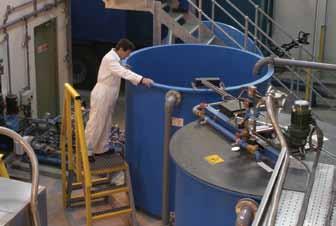
Handois Wash Water Recovery Plant
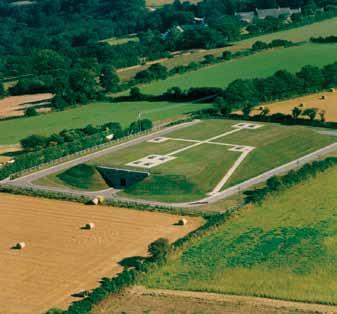
Aerial view of Les Platons service reservoir
Community and Environment
In 2012, the Company celebrated the 130th anniversary of its incorporation in 1882. To mark the event, the Company established a 130th Anniversary Fund of £130,000. The purpose of the fund was to provide grants of up to £10,000 to Jersey charities, to support initiatives that benefit the Island community. The Judging Panel was chaired by Jersey Water’s recently retired Director, Mr Carl Hinault. The fund received a total of 91 applications for funding totalling over £780,000. In November, the Company announced the 20 winners at a reception held at the Hotel de France. Jersey Water continues to work closely with the charities. The 130th Anniversary Fund has been selected as a finalist for the Water Industry Achievement Awards 2013, Community Project of the Year.
The 130th Anniversary was also commemorated with the publication of a book detailing the Company’s 130 year history and illustrated with many previously unpublished photographs. An e-book version is available on the Company website.
The Company supported the ‘Jersey Trees for Life’ project to re-open the Arboretum at Val de la Mare Reservoir. The Jersey Water grounds maintenance team assisted the many volunteers to re-open footpaths and make them safe for public access. The event was marked by the Lieutenant Governor, Sir John McColl KCB CBE DSO and Lady McColl carrying out the official opening ceremony in June 2012.
Jersey Water supports the Jersey Fresh Water Angling Association whose members are able to use the Company’s main reservoirs for fishing. The Company operates a trout hatchery from which reservoir stocks are maintained. Trout are normally hatched from imported eggs, but in 2012 Jersey Water staff successfully reared trout from locally harvested eggs, the first time this has been achieved for many years.
Jersey Water’s Social Club is an active fundraiser for charity.
In 2012, the staff raised £1,000 for The Teenage Cancer Trust, through their sponsored “Butt Push”. A metric tonne water butt was pushed from West Park to St Aubin’s by fund raising staff selling reusable bottles for charity.
In 2012, the Company helped clients of the Jersey Employment Trust, Project Trident, Workwise and Advance to Work scheme gain valuable work experience through work placements and paid employment. In 2013, the Company’s involvement with the Back to Work and Advance to Work schemes will be enhanced with further work experience opportunities being made available.
The David Norman Bursary Award for local students has been very successful and in 2012, Mr Jordan Todd, the Company’s first bursary student, graduated from Plymouth University with a BSc in Environmental Science. As well as the financial support, the bursary programme also includes paid work-place experience for the students during the summer holiday period.

130th Anniversary Fund - Supporting local Jersey charities and initiatives
Principal risks and uncertainties
Jersey Water’s operations are subject to a number of risks and uncertainties that could either individually or in combination impact on the Company’s operations, performance and future prospects. The risks and uncertainties described below are those that the Directors believe to be the most pertinent in terms of the Company’s performance.
The Company has risk management processes to identify and document business risks and the steps taken by the Company to mitigate them; these are described below.
Unknown risks and those that the Directors believe are less significant may also have a material impact on the operations and performance of the Company. Risk management processes described on the next two pages are designed to manage and mitigate (rather than to eliminate) the risks described.
Risk Type Risk Description
Strategic risks Climate change
There is increasing evidence that the climate is changing from the traditional pattern to one where there is less predictability, increased volatility and where extremes of weather are more commonplace.
There is the risk that changes in weather patterns could lead to prolonged periods of dry weather, seriously disrupting the ability of the Company to meet the demand for water.
Population growth
Water quality
Operational risks
Nitrates
The Company’s WRMP is modelled on population growth assumptions produced by the States of Jersey. There is the risk that actual population growth may be in excess of published assumptions leading to insufficient water resources and the potential need to increase the capacity of the Company’s infrastructure to meet the demand.
Water resources in Jersey are almost entirely derived from rainfall collected as stream water run-off from catchment area land. The quality of untreated water resources can vary and is vulnerable to the presence of chemical pollution and bacteriological organisms in the catchment areas.
There is the risk that the Company supplies water not meeting the quality parameters of the Water (Jersey) Law 1972.
Jersey Water has dispensations for nitrates under the Water (Jersey) Law 1972, which allow 33% of samples to exceed the statutory 50 mg/l limit, but not to exceed 70 mg/l. There are no known risks to health with bacteriologically safe water for nitrates below 100 mg/l. The current five year old dispensation expires in December 2013. There is the risk that dispensations may not be renewed on an on-going basis resulting in the potential for Jersey Water supplying water that does not meet quality requirements and the need for expensive de-nitrification processes and equipment.
Risk Management
The Company has a 25 year Water Resource Management Plan (WRMP) that models potential water resource requirements using various climate change, population and other assumptions.
The plan, which is updated every five years, sets out the way in which the Company expects to meet the projected demand. The existing plan (2010) describes the likely steps to increase resources (either through storage or desalination) and reduce demand (through metering and demand management) to maintain an adequate security of supply.
The Company’s WRMP is reviewed every five years. Population growth is a key assumption which is subject to detailed review.
The quality of water produced is the Company’s primary concern. End to end systems and processes are in place to manage water quality; from the selection and blending of water taken for treatment to the regular sampling of water supplied by the Company to test for compliance.
The Company regularly updates its processes and procedures to enhance the quality of water supplied and to ensure compliance with industry best practice.
Concentrations of nitrates in untreated water of over 50mg/l arise as a result of the diffuse pollution of catchment areas from the application of agricultural fertilisers. The pollution is outside of the Company’s control.
The Company has a close working relationship with the States of Jersey Environment Department who are investigating potential catchment management options to reduce nitrate pollution. The Company is also in close dialogue with the States of Jersey Department of Health.
Operational risks Water resources
Inability to supply water
The Company’s reservoirs have sufficient capacity to store approximately 120 days’ average demand for water.
The relatively low reservoir storage capacity coupled with the reliance of the Island on rainfall means that water resources in Jersey are particularly susceptible to periods of drought.
Jersey Water’s ability to meet the need of customers is dependent on the operation of its network of pumps, pipes and operational sites.
There is the risk that the supply of water can be interrupted by equipment failure or the loss of power to key operational sites.
Reservoir & Dam safety
Health & Safety
Safety
The ownership and management of six impounding reservoirs brings the associated safety risks associated with dam safety.
Whilst the risk of dam failure is extremely low, the impact of such a failure could be significant with the consequential impact on the Company.
The nature of the Company’s operations exposes it to a wide range of hazards which could result in an accident leading to the death or injury of a member of staff, contractor or the general public.
Interest rate risk
Credit risk
The Company’s funding structure exposes it to the volatility of interest rates (specifically Bank of England base rates) and the positive and negative impact that can have on cash flow and profitability.
The Company grants credit terms to domestic and commercial customers for the services it provides. It is therefore exposed to the risk of accounts receivable not being recovered.
Liquidity risk
There is the risk that the Company will have insufficient funds to meet its obligations as they fall due.
Risk Management
The Company manages its water resources prudently, ensuring that reservoirs are filled quickly in periods of rainfall and kept topped up. In addition, the Company maintains a standby 6Ml/d reverse osmosis desalination plant in case additional resources are required.
The Company has an active programme of measures to reduce the demand for water including the Island wide metering of all connections, pressure reduction, leakage control and mains renewal.
Jersey Water’s operational network incorporates many features to ensure operational resilience, including duty/ standby equipment and standby on-site power generation. There are contingency measures in place to mitigate the effect of interruptions in supply.
The Company has an active programme of works designed to maintain and improve operational resilience; limiting the incidence of interruptions in supply.
Jersey Water’s dams and reservoirs are subject to regulation under the Reservoirs (Jersey) Law 1996.
Dams and reservoirs are regularly inspected by specially qualified Company staff and by independent Reservoir Inspecting Engineers.
All reservoirs are subject to frequent maintenance and all recommendations for improvements to dam safety are implemented by the Company.
The health & safety of staff, contractors and the general public underpins all of the activities of the Company. Extensive health & safety policies and procedures are in place to reduce the risk of accidents.
The Company is supported by external advisors to ensure that the approach to health & safety remains in line with industry best practice.
The Company manages interest rate risk by limiting its exposure to variable interest rates using fixed interest borrowing and an interest rate swap.
At 31 December 2012, 77% (2011:77%) of debt was either on a fixed interest basis or protected from fluctuations in interest rates.
Accounts receivable comprise a high volume of relatively low value balances. The concentration of credit risk in any one customer is therefore limited.
The Company has procedures in place to manage accounts receivable and alleviate the risk of non-payment.
The Company has a number of long term bank loans, the maturity of these are monitored and renewed where required.
Jersey Water plans for and monitors cash flow ensuring that expenditure is funded from income or existing credit facilities. The Company maintains undrawn overdraft facilities in order to provide short term flexibility in funding options.
Corporate Governance
Compliance with the UK Corporate Governance Code June 2010
(‘the Code’)
The Company has adopted the principles of good corporate governance and best practice set out in the UK Corporate Governance Code June 2010 (‘the Code’). The Board is of the opinion that, throughout the year under review, the Company has been in compliance with the Main Principles of the Code.
Directors and the Board
The Board
The Board comprises seven Directors, two of whom are Executive and five of whom are Non-Executive Directors. The Board meets regularly, normally 8-10 times each year and for ad hoc meetings as and when required.
The role of the Board is to set the overall operating strategy, approve detailed operating plans and budgets, monitor performance against plans and oversee the activities of the Executive Directors. The Board has delegated the day to day operation of the Company and execution of strategic plans to the Executive Directors.
The Board is supplied with regular timely management information through which it can monitor the performance, activities and financial position of the Company and on which decisions can be based.
Meetings and Committee membership
During the year, the Board met eight times. Details of Board meeting attendance, Committee membership and Committee meeting attendance are provided in the table below.
Director independence
The Board considers all of the Non-Executive Directors to be independent in character and judgement. In determining independence, the Board considers the specific circumstances of each Director. The Board has determined that notwithstanding his length of service on the Board exceeding nine years (one of the criteria for independence set down in the Code), Mr Marie remains independent in character and judgement. The size of the Company and the role of Mr Marie on the board relative to his other personal and professional interests means that in the opinion of the Board, independence has been maintained despite his length of service. The Board has therefore concluded that Tony Cooke, Mary Curtis, Stephen Marie and Peter Yates shall be deemed independent.
Mr Keen, as Chairman of the Company, was considered independent on appointment and, in accordance with the Code, is not subject to the independence test thereafter.
Performance evaluation
In order to ensure that the Board continues to operate effectively, it has developed and implemented a process of performance evaluation. The process measures the performance of the Board as a whole against a set of predefined targets and of individual Directors by way of self and peer appraisal. The results of the performance assessments and appraisals are fed back to the individual Directors and the Board as a whole (as appropriate) and action taken accordingly. A similar approach is adopted to assess the performance of the Audit, Remuneration and Nomination Committees.
Other significant commitments
The Board has a process in place for reviewing the other significant commitments of Non-Executive Directors and their impact on the ability of the Non-Executive to discharge their duties to the Company.
During the year, the Chairman continued his full time role as Chief Executive of the Jersey Post Group. The Board has considered the impact of this role on the time commitments of the Chairman and is satisfied that he is still fully able to discharge his duties.
Reappointment
Except where a Director is appointed to fill a casual vacancy, all Directors are appointed by the Shareholders at the Annual General Meeting. One third of the Directors, or where the number of Directors is not a multiple of three, the number nearest to one third, retire by rotation (based upon length of service) and, where eligible, seek re-election each year. No Director may serve a term of longer than three years without seeking re-election. The Company has adopted a policy of requiring Non-Executive Directors who have served on the Board for nine years or more to retire from the Board and seek re-election on an annual basis. Directors appointed to fill a casual vacancy must seek formal appointment by the Shareholders at the next Annual General Meeting.
Relations with shareholders
The Company is in regular contact with its majority and controlling shareholder, the States of Jersey. Details of contact with and the views of the States of Jersey are passed on to the whole Board as necessary.
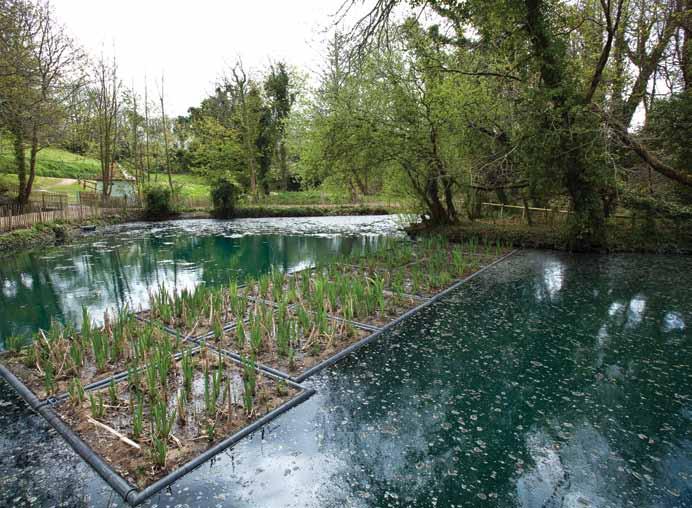
Handois Water Treatment Works - settlement lagoons
Audit Committee
The Audit Committee currently comprises Peter Yates (Chairman) and Tony Cooke. Carl Hinault was a member of the Audit Committee until he retired as a Director of the Company on 20 April 2012. The auditors, PricewaterhouseCoopers CI LLP, and the Executive Directors, Howard Snowden and Helier Smith, also attend the meetings by invitation.
The terms of reference of the Audit Committee require it to meet at least twice per annum. Additional meetings may be called where deemed necessary. The Committee is charged by the Board with the following main responsibilities:
• To monitor and oversee the integrity of the financial statements of the Company and any formal announcements relating to the Company’s financial performance. The Committee is briefed on changes to reporting requirements and provided with information on any accounting or reporting issues that arise. The Audit Committee reviews in detail the financial statements before making a recommendation to the Board as to whether or not they should be formally approved.
• To review and monitor the operation and effectiveness of the Company’s internal financial and other controls and make recommendations for improvement where necessary. During the year, the Committee continued its process of risk assessment and evaluation of effectiveness of the systems of internal control.
• To oversee the external audit process and manage the relationship with the external auditors. The Committee formally considers the performance and independence of the external auditors on a regular basis taking into consideration all applicable professional and regulatory requirements. The Committee also has procedures in place to protect auditor independence and control the extent to which the auditors may be retained for non-audit services and the basis upon which such services are purchased.
• To make recommendations to the Board as to the re-election and remuneration of the auditors at the Annual General Meetings based upon its assessment of the performance of the auditors and giving due regard to their continued independence and any other regulatory or professional requirements.
• The Committee regularly assesses the need for an internal audit function and has determined that the establishment of such a function is, at the present time, not cost effective.
Remuneration Committee
The Remuneration Committee comprises Stephen Marie (Chairman), Mary Curtis and Kevin Keen. The Executive Directors, Howard Snowden and Helier Smith, may also attend the meeting by invitation. No Director plays any role in the determination of their own remuneration.
The terms of reference of the Remuneration Committee allow it to meet as and when necessary to:
• Review and determine the level of remuneration of Executive Directors.
• Review and determine the level of remuneration of the Senior Management Team.
• Review periodically the terms and conditions of employment of the Executive Directors and Senior Management Team.
• Make recommendations to the Board on the Company’s overall framework of salaried staff remuneration and costs.
• Review and make recommendations to the Board concerning the remuneration of the Chairman (subject to approval by shareholders at the Annual General Meeting).
Val de la Mare Reservoir
Nomination Committee
The Nomination Committee comprises Kevin Keen (Chairman), Tony Cooke, Mary Curtis, Stephen Marie and Peter Yates. Carl Hinault was a member of the Audit Committee until he retired as a Director of the Company on 20 April 2012. The Executive Directors, Howard Snowden and Helier Smith, may also attend the meeting by invitation. It is primarily responsible for the selection and appointment of the Company’s Executive and Non-Executive Directors as and when required.
The other duties of the Committee include:
• Making recommendations to the Board as to the re-election of Directors under the ‘retirement by rotation’ provisions in the Company’s Articles of Association whilst giving due regard to their performance and ability to continue to contribute to the Board in the light of the knowledge, skills and experience required.
• Reviewing and making recommendations to the Board as to the succession planning for Executive and Non-Executive Directors.
• Regularly reviewing the structure, size and composition including the balance of skills and attributes required of the Board compared to its current position and making recommendations to the Board with regard to any changes.
• Keeping under review the leadership needs of the organisation, both Executive and Non-Executive, including succession plans, with a view to ensuring the continued ability of the organisation to operate effectively.
When selecting candidates for potential appointment as a Non-Executive Director, the Committee evaluates the needs of the Company and identifies the necessary skills and experience required by candidates for consideration. The Nomination Committee makes recommendations to the Board taking into account the performance of the candidates at interview, their skills and experience and their ability to meet the specific needs of the Company. Consideration is given to the use of external recruitment consultants and open advertising in the recruitment process. However, this is weighed against the cost of doing so and the specialist needs of the Company as a water supplier. The Nomination Committee sought advice from external recruitment consultants in respect of the proposed appointment of a Non-Executive Director to fill the vacancy created by the retirement of Mr Hinault in 2012.
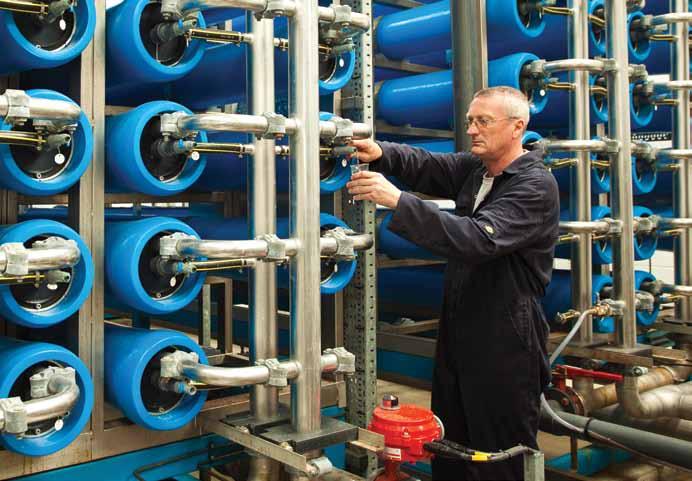
La Rosière - Desalination Plant
Internal controls
The Board is responsible for ensuring that there are effective systems of internal control in place to reduce the risk of misstatement or loss and to ensure that business objectives are met. These systems are designed to manage and mitigate (rather than to eliminate) the risk of failure to achieve business objectives and can only provide reasonable and not absolute assurance against material misstatement or loss.
The Company has developed and adopted a corporate and operational risk register detailing and risk grading the significant risks faced by the Company. Alongside the register is a process through which the significant risks faced by the business are identified and evaluated on a regular basis and the controls operating over those risks assessed to ensure that they are adequate.
The process of risk assessment and reviewing the effectiveness of the systems of internal control is regularly reviewed by the Audit Committee, accords with Turnbull guidance and has been in place for the whole of the year, up to and including the date on which the financial statements were approved.
Controls adopted by the Board (or its Committees) to ensure the effectiveness of the systems of internal control include the following:
• The review of the corporate and operational risk register maintained and updated by the Company and of the status of any actions arising from their regular review.
• The receipt of confirmation from Senior Management of the proper operation of controls throughout the period of the review.
• The review and approval during the year of terms of reference of sub committees.
• The review and approval during the year of the schedule of matters specifically reserved for its attention.
• The review of reports received from the Audit Committee concerning the findings of the external auditors on the financial statements of the Company and the systems of internal control.
Directors’ responsibilities
The Directors are responsible for preparing the Annual Report and the financial statements in accordance with applicable law and regulations.
Jersey Company Law requires the Directors to prepare financial statements for each financial period in accordance with generally accepted accounting principles. The financial statements of the Company are required by law to give a true and fair view of the state of affairs of the Company and of the profit or loss of the Company for that period.
In preparing these financial statements, the Directors should:
• select suitable accounting policies and then apply them consistently;
• make judgments and estimates that are reasonable and prudent;
• specify which generally accepted accounting principles have been adopted in their preparation; and
• prepare the financial statements on the going concern basis unless it is inappropriate to presume that the Company will continue in business.
The Directors are responsible for keeping accounting records which are sufficient to show and explain its transactions and are such as to disclose with reasonable accuracy at any time the financial position of the Company and enable them to ensure that the financial statements prepared by the Company comply with the requirements of the Companies (Jersey) Law 1991. They are also responsible for safeguarding the assets of the Company and hence for taking reasonable steps for the prevention and detection of fraud and other irregularities.
The Directors are responsible for the maintenance and integrity of the corporate and financial information included on the Company’s website. Legislation in Jersey governing the preparation and dissemination of financial statements may differ from legislation in other jurisdictions.
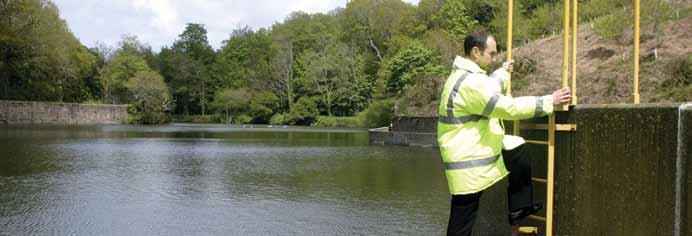
Millbrook Reservoir
Directors’ Report
The Directors of the Company present the financial statements for the year ended 31 December 2012.
Activities of the Company
The Company was incorporated in 1882. The principal activities of the Company are the collection, treatment and supply of water for commercial and domestic use throughout the Island. The Company has adopted ‘Jersey Water’ as its trading name.
Review of business and future developments
A review of the Company’s business during the year and an indication of the likely future development of the business are provided in the business review on pages 6 to 15.
Dividends
Ordinary and ‘A’ ordinary shares
are shown net of 20% tax
Preference shares
In 2012 the Company paid dividends on preference shares totalling £381,000 (2011: £381,000).
Directors
Changes in Directors
The Directors of the Company on the date the financial statements were approved are detailed on page 2. All Directors were Directors of the Company throughout the year ended 31 December 2012. Mr Carl Hinault retired from the Board on 20 April 2012.
In accordance with the provisions of Article 49 of the Company’s Articles of Association, Mr Peter Yates, Mr Howard Snowden and Mr Stephen Marie will retire at the forthcoming Annual General Meeting, and being eligible, offer themselves for re-election.
The Directors also recommend the election of Mr Stephen Kay as a Non-Executive Director of the Company. Mr Kay is a Chartered Engineer and the Managing Director of Cambridge Water Plc and holds a number of non-executive appointments. He is Chairman of Iceni Waters Ltd, Trustee of the Water Companies Pension Scheme, Chairman of the Water UK Technical Standards Board and Chairman of the Water Regulations Advisory Service.
As described on page 17, the Board has undertaken a formal assessment of its performance and that of the individual Directors, including structured meetings between the Directors being assessed and the Chairman. Following this review, the Chairman has confirmed that the Directors standing for re-election at the Annual General Meeting continue to perform effectively and demonstrate commitment to their roles.
Directors’ interests
Particulars of the holdings of Directors, including family and beneficial interests, in the share capital of the Company as at 31 December 2012 are:
There have been no subsequent changes in Directors’ interests up to the date of approval of the financial statements.
Insurance of Directors and Officers of the Company
The Company maintains an insurance policy on behalf of all Directors and Officers of the Company against liability arising from neglect, breach of duty and breach of trust in relation to their activities as Directors & Officers of the Company.
Significant shareholdings
Set out below are details of significant shareholdings (3% or more) in each class of share of the Company as at 27 February 2013.
Independent Auditors
A resolution to re-appoint PricewaterhouseCoopers CI LLP as the Company’s auditor will be proposed at the forthcoming Annual General Meeting.
By Order of the Board
Margaret Howard Company Secretary
27 February 2013
Independent Auditors’ Report
to the members of The Jersey New Waterworks Company Limited
We have audited the financial statements of The Jersey New Waterworks Company Limited for the year ended 31 December 2012 which comprise the balance sheet as at 31 December 2012, the profit and loss account, the statement of total recognised gains and losses, the cash flow statement and the related notes. The financial reporting framework that has been applied in their preparation is applicable law and United Kingdom Accounting Standards.
Respective responsibilities of directors and auditors
As explained more fully in the Directors’ Responsibilities Statement set out on page 20 the directors are responsible for the preparation of the financial statements and for being satisfied that they give a true and fair view. Our responsibility is to audit and express an opinion on the financial statements in accordance with applicable law and International Standards on Auditing (UK and Ireland). Those standards require us to comply with the Auditing Practices Board’s Ethical Standards for Auditors.
This report, including the opinion, has been prepared for and only for the Company’s members as a body in accordance with Article 113A of the Companies (Jersey) Law 1991 and for no other purpose. We do not, in giving this opinion, accept or assume responsibility for any other purpose or to any other person to whom this report is shown or into whose hands it may come save where expressly agreed by our prior consent in writing.
Scope of the audit of the financial statements
An audit involves obtaining evidence about the amounts and disclosures in the financial statements sufficient to give reasonable assurance that the financial statements are free from material misstatement, whether caused by fraud or error. This includes an assessment of: whether the accounting policies are appropriate to the Company’s circumstances and have been consistently applied and adequately disclosed; the reasonableness of significant accounting estimates made by the directors; and the overall presentation of the financial statements. In addition, we read all the financial and non-financial information in the annual report & financial statements to identify material inconsistencies with the audited financial statements. If we become aware of any apparent material misstatements or inconsistencies we consider the implications for our report.
Opinion on financial statements
In our opinion the financial statements:
• give a true and fair view of the state of the Company’s affairs as at 31 December 2012 and of its profit and cash flows for the year then ended;
• have been properly prepared in accordance with United Kingdom Accounting Standards; and
• have been properly prepared in accordance with the requirements of the Companies (Jersey) Law 1991.
Opinion on other matters
In our opinion the information given in the Directors’ Report for the financial year for which financial statements are prepared is consistent with the financial statements.
Matters on which we are required to report by exception
We have nothing to report in respect of the following matters where the Companies (Jersey) Law 1991 requires us to report to you if, in our opinion:
• proper accounting records have not been kept; or
• the financial statements are not in agreement with the accounting records; or
• we have not received all the information and explanations we require for our audit.
Mark James
For and on behalf of PricewaterhouseCoopers CI LLP Chartered Accountants
Jersey, Channel Islands
27 February 2013
Balance Sheet
31 December 2012
The financial statements on pages 24 to 42 were approved by the Board of Directors on 27 February 2013 and were signed on its behalf by:
Kevin Keen Chairman
Profit and Loss Account
For the year ended 31 December 2012
There is no material difference between the reported profit for 2012 and 2011 and the profit prepared on the historical cost basis.
The results for the current and prior year all relate to continuing operations.
Statement of Total Recognised Gains and Losses
For the year ended 31 December 2012
Cash Flow Statement
For the year ended 31 December 2012
Notes to the Financial Statements
1 Accounting policies
The following statements outline the main accounting policies applied in the preparation of the financial statements.
The Company has adopted a new format for the profit and loss account and relevant supporting notes for the financial statements for the year ended 31 December 2012. Comparative figures in the profit and loss account have been reclassified for the purposes of consistency and comparability.
Basis of accounting
The financial statements are prepared under the historical cost convention as modified for the revaluation of investment properties and in accordance with United Kingdom Accounting Standards.
Going concern
The Company’s business activities, together with the factors likely to affect its future development, performance and position and a summary of the financial position of the Company, its cash flows, liquidity position and borrowing facilities are described in the Business Review Section on pages 6 to 15 and in notes 6 and 21. The Company has a wide and varied customer base within Jersey, steady demand for its products and services and a stable and well established treatment and distribution network. The Directors have a reasonable expectation that the Company has adequate resources to continue in operational existence for the foreseeable future and have therefore selected the going concern basis in preparing the financial statements.
Turnover
Turnover represents the total value of water charges together with minor contracts and rental income. Income from minor contracts is recognised within turnover upon completion of the contracted works. Income arising on minor contracts to be provided in the future is treated as deferred income.
Water charges
Water charges are billed either as a fixed rate (in advance) or as a metered charge (in arrears). Both fixed rate and metered water income is recognised for the year up to 31 December.
Stocks of water
In accordance with normal water industry practice, no value is placed on stocks of water held within reservoirs, treatment works or the mains network.
Stock and work in
progress
Stock and work in progress is valued at the lower of cost and net realisable value.
Fixed assets and depreciation
Fixed assets under construction are recognised within ‘Uncompleted Works’ until such time as they are first brought into use. At this point the asset is transferred to ‘Property and Completed Works’ and depreciation commences. Subsequent qualifying expenditure is transferred directly to ‘Property and Completed Works’. Depreciation is charged on a straight line basis in accordance with the rates of depreciation set out below for each major asset type. No depreciation is provided on freehold land.
Asset type Depreciation period
Investment property
Certain of the Company’s properties originally acquired for business purposes, or otherwise used within the business, are no longer so used and are now held for investment purposes. These properties are treated as investment properties and accounted for in accordance with Statement of Standard Accounting Practice 19, Accounting for Investment Properties, and are included in the balance sheet at open market value. The surplus or deficit on revaluation is taken to the revaluation reserve. No depreciation is provided in respect of freehold investment property.
Interest rate swaps
Net interest payable or receivable under interest rate swap contracts entered into to hedge the interest rate risk exposure on borrowings is recognised in the profit and loss account within Interest Payable or Interest Receivable as appropriate. Accrued net amounts payable or receivable are carried in the balance sheet within Accruals and deferred income and Accrued income and other debtors respectively. No carrying value is recognised for interest rate swap contracts entered into to hedge the interest rate risk exposure on borrowings.
Deferred taxation
Deferred taxation is calculated on a full provision basis in accordance with Financial Reporting Standard 19 ‘Deferred Taxation’. As required by the standard, no provision is made for deferred tax in respect of expenditure on which all of the conditions for retaining tax allowances have been met. Deferred tax balances are not discounted to reflect the time value of money .
Retirement benefits
The Company values its liability in respect of defined retirement benefits in accordance with FRS 17 and following the projected unit cost method of calculation.
Fixed assets
Any surplus or deficit in the defined benefit plan, being the difference between the value of the plan assets and the present value of the plan liabilities, is recognised in the balance sheet as an asset or liability to the extent that any surplus is recoverable through future reduced contributions or that, conversely, any deficit reflects a legal or constructive obligation. The defined benefit asset or liability is shown net of any related deferred tax liability or asset.
Cash at Bank and liquid resources
Included within liquid resources in the cash flow statement are cash balances held on fixed deposit for a term of one month or greater. These items are included within Bank and Cash in the balance sheet.
Included within fixed assets is £101,000 (2011: £138,000) relating to internal labour costs capitalised in the year. At 31 December 2012 capital commitments contracted for amounted to £11,000 (2011: £154,000).
Market value of freehold investment properties
The Company owns two freehold residential investment properties.
The freehold investment properties were valued in 2010 by an external valuer, CB Richard Ellis Limited, on the basis of open market value in accordance with the requirements of the RICS Appraisal and Valuation Standards. The properties, which had a combined net book value of £21,000, were revalued as at 31 December 2010 at £1,335,000.
In 2012, having considered changes in the residential property market since the external valuation was completed in December 2010, the Directors have undertaken an internal valuation of the properties and revalued them to £1,241,000, a reduction of £94,000 on the previous valuation.
Factors affecting tax charge for year
The tax assessed for the year is lower than the standard rate of Jersey income tax (20%) applicable to utility companies. The differences are explained below:
The Company has a rolling overdraft facility with HSBC Bank plc. Unconditional guarantees have been given by the States of Jersey for the repayment of the principal and interest on loans up to a maximum of £16.2m taken out to fund the Company’s capital works programme.
The Company intends to refinance the £6,000,000 loan which falls due in 2013.
Deferred taxation
Pensions
The Company operates two formal pension schemes; a defined contribution scheme and a defined benefit scheme. There are also certain past employees whose pension or pension supplements, which are of a defined benefit nature, have not been funded by the Company’s present or previous pension agreements (the ‘unfunded scheme’). Where applicable, the liability of the Company in respect of the unfunded scheme is included within the disclosure below relating to the defined benefit section. The defined benefit section of the scheme was closed to new entrants with effect from 1 January 2003.
The defined contribution scheme and defined benefit scheme are both sections of The Jersey Water Pension Plan.
Defined contribution section
The defined contribution section of the plan was opened to new members on 1 May 2003. Employer contributions during the period to 31 December 2012 totalled £70,000 (2011: £62,000).
Defined benefit section and unfunded scheme
The full FRS17 actuarial valuation as at 31 December 2012 shows a net deficit of £385,000 compared to a deficit of £307,000 at 31 December 2011.
The major assumptions used by the actuary were:
The post-retirement mortality assumptions allow for expected increases in longevity.
The overall expected rate of return is based on the weighted average return of each class of asset at the start of each accounting period.
Analysis of amounts recognised in the profit and loss account
Current service costs, past service cost and curtailments are included within operating expenditure in the profit and loss account. Expected returns on pension plan assets and interest on pension plan liabilities are shown net within other finance income in the profit and loss account.
Analysis of amounts recognised in the statement of total recognised gains and losses
Actuarial
History of experience gains and losses
Funding of the defined benefit pension scheme
The actual funding of the defined benefit pension scheme is determined by the triennial actuarial valuation and this differs from the amount that is required to be charged to the profit and loss account under Financial Reporting Standard 17. During the year, the Company made scheduled retirement benefit contributions into the defined benefit scheme totalling £300,000 (2011: £730,000).
Following the results of the latest actuarial valuation as at 1 January 2012, the contribution rate for 2012, 2013 and 2014 was set at 12.6% of Pensionable Salaries plus a fixed contribution of £50,000 per annum to reduce the scheme deficit.
9 Share capital
a) Equity share capital
Authorised, issued & fully paid up
‘A’ Ordinary shares
1 Bonus issue
On 10 June 2011 the Company capitalised the sum of £4,347,000 from reserves and applied the sum in paying up in full 2,268,000 ordinary shares of £1 each and 2,079,000 ‘A’ ordinary shares of £1 each allotted and distributed, credited as fully paid, to the existing holders of ordinary and ‘A’ ordinary shares at the rate of 9 shares for every existing share held.
Ordinary and ‘A’ ordinary shares carry no right to fixed income and rank after preference shares and other liabilities. Each ordinary share carries one vote in the event of a poll. Each ‘A’ ordinary share, whilst in the ownership of the States of Jersey, entitles the holder to such additional votes at a poll as brings the total number of votes attaching to the ‘A’ ordinary shares to twice the number of votes cast in respect of all other shares.
b) Non-equity preference share capital
Preference shares bear interest at the rates indicated above and rank, in the order listed, above ordinary and ‘A’ ordinary equity shares in the event of winding up.
Upon a poll, every holder of a preference share present at a general meeting in person or by proxy shall have one vote only for all the preference shares held by the holder, irrespective of the number and class of such preference shares.
Reserves
relating to pension plan recognised in the statement of total recognised gains and losses
Reconciliation of movement in equity shareholders’ funds
Charitable contributions
During the year, to mark Jersey Water’s 130th Anniversary, the Company granted awards totalling £130,000 to 20 local charities (2011: £nil).
In October 2011, the Company entered into an interest rate swap contract with HSBC Bank plc in order to hedge against the interest rate risk exposure of the Company on the loan of £5,250,000 maturing in 2021. The interest rate swap contract has a nominal value of £5,250,000 and also matures in 2021.
Non-equity dividends
dividends on non-equity shares recognised in the year
Equity dividends
and ‘A’
1 As described in note 9, the Company undertook a capital reorganisation in 2011 as a result of which the number of equity shares in issue increased by a factor of twenty. Accordingly, dividends declared and proposed since the capital reorganisation have reduced to take the increase in shares into account. The dividend has been restated (from 224 pence per share) to reflect the number of shares in issue since the capital reorganisation. 1
The proposed final dividend is subject to approval by shareholders at the Annual General Meeting and has not been included as a liability in the financial statements.
Earnings per ordinary share
Earnings per ordinary share of £0.38 (2011: £0.47) is based on earnings of £3,697,000 (2011: £4,581,000), being the profit available for distribution to equity shareholders and 9,660,000 (2011: 9,660,000) ordinary and ‘A’ ordinary shares of £0.5 in issue.
Reconciliation of operating profit to net cash flow from operating activities
Analysis of changes in net debt
During the year the Company made pension contributions of £16,000 in respect of Mr Snowden and £11,000 in respect of Mr Smith.
Related party transactions
The Company has identified the following material related party transactions:
The States of Jersey is the Company’s majority and controlling shareholder. Jersey Electricity Plc is majority owned and controlled by the States of Jersey. JT Group Limited and Jersey Post International Limited are both wholly owned by the States of Jersey. All transactions are undertaken on an arm’s length basis.
In addition to the transactions included above with the States of Jersey, the Company made payments of income tax, social security, GST, water resource licence fees and other statutory payments.
The Company leases the site of the La Rosière Desalination Plant from the States of Jersey on a 99 year lease ending in 2067. Under the terms of the lease, the rental, which for 2012 was £25,000 (2011: £25,000) (included in the above table), increases every five years in line with the movement on the Jersey Retail Price Index.
Ultimate controlling party
The ultimate controlling party of The Jersey New Waterworks Company Limited is the States of Jersey.
Five Year Summary
Financial statistics & ratios
Operational statistics
1 Relevant figures have been restated to show the effect of the prior year adjustment made in 2009
2 Equity dividends and the calculation of dividend cover exclude the special dividend paid in 2010
3 Comparatives have been restated to reflect the bonus dividend and share subdivision in 2011
4 Gearing = Debt (including preference share capital) / equity shareholders’ funds