THE MAGAZINE OF THE NEW JERSEY JAZZ SOCIETY
OCTOBER 2026 VOLUME 54 ISSUE 09
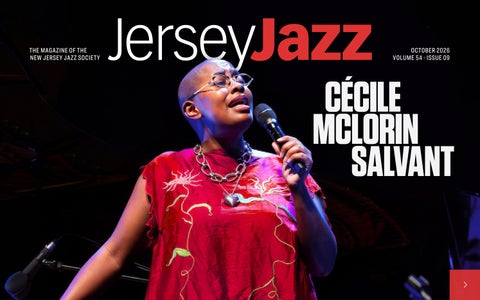
CÉCILE MCLORIN SALVANT
IN THIS ISSUE ARTICLES/REVIEWS 09
O N T H E COVER _ Cécile McLorin Salvant. Photo by Nada Zgank
NJJS.ORG
Jersey Jazz LIVE!: Ted Chubb Quintet
13
Jazz History: Jimmy Heath
20
Jazz Night in Chatham: Mike Davis and The New Wonders
25
Jazz at McCarter: Cecile McLorin Salvant
32
Jazz Education: Abraham Burton
38
Rising Star: Myles Ellington Twitty
42
Jazz at Birdland: Gabrielle Stravelli
44
Big Band in the Sky
48
Other Views
COLUMNS 03
All That’s Jazz
05
Editor’s Choice
53
Not Without You
CLARIFICATION: Although vibraphonist Joe Locke was influenced and inspired by alto saxophonist Jackie McLean, he never performed with McLean, as incorrectly indicated in the September 2026 Jersey Jazz interview with Locke.
JERSEY JAZZ
OCTOBER 2026
02
ALL THAT’S JAZZ BY CY DNE Y HA LPIN
P
lease join us Sunday, October 4 for a very special Jersey Jazz LIVE! Event: The 2026 Juried Scholarship Competition Winners Showcase. This concert will feature the six winners alongside industry professionals in a joyous celebration of talent that proves jazz is alive and well, and that the next generation of musicians is a fine one! Once again, saxophonist and educator Don Braden will be the Music Director for this event. Jersey Jazz LIVE! Is held at Madison Community Arts Center, 10 Kings Road, Madison, NJ. There is FREE street parking. $15 NJJS Members, $20 Non-Members, $5 Child/Student w/ID. Doors open at 2:30 p.m. LIVE! events are well attended, please plan accordingly. For advance ticket sales: Events.ticketleap.com/tickets/new-jersey-jazz-society/jerseyjazz-live-2026-njjs-scholarshipwinners-showcase-200216411
NJJS.ORG
The Competition produced 15 student entries, with the category breakdown as follows: Instrumental Performance–7, Vocal Performance–5, Original Composition–3. The entries breakdown by college was: William Paterson University–7, Princeton–4, Rutgers–1, Montclair State University–1, Michigan State University–2. The Competition awarded a $1000 and a $500 prize in all three categories: Jazz Performance, Jazz Vocal Performance, and Jazz Composition. In the Instrumental Performance category the $1,000 winner is pianist Jasper Zimmerman from Princeton University and the $500 winner is guitarist Sally Shupe from William Paterson University. In the Vocal Performance category the $1,000 winner is Allison Jiang from Princeton, and the $500 winner is Kyra Cioffi from WPU. In the Composition category the $1,000 winner is Nicholas Thorpe
from Rutgers University and the $500 winner is Simon Bahadoran from WPU. Congratulations to the winners! Congratulations to department heads Mitch Butler (WPU), Rudresh Mahanthappa (Princeton), Conrad Herwig (Rutgers) and voice teacher Michelle Lordi (Princeton) for supporting this program and encouraging their students to participate. For more detailed information on the winners, please see the archived June issue: njjs.org/magazine/june-2026/ So many life skills are developed through the discipline of music. Thank you and congratulations to ALL the teachers and mentors of these winners and applicants for your dedication and training. The art of jazz takes a village, and each of you has a vital role in the personal and professional lives of these fine young musicians. This competition was judged by our prestigious panel of professional musicians, educators and
industry leaders comprised of: » Don Braden: World class tenor saxophonist, flutist, composer and educator » Champian Fulton: Pianist, vocalist, bandleader, sidewoman, and educator » Ted Chubb: Princeton University Lecturer of Music—Jazz Trumpet, composer, educator, and arts administrator » Jason Olaine: Vice President of Programming, Jazz at Lincoln Center Our deepest gratitude to judges Don, Ted, Champian, and Jason for their dedication and expertise, and for their input and advice as we continue to nurture and shape this competition. We’re exceedingly grateful to Nan Hughes Poole for her generous multiyear donations in support of this initiative, and to NJJS Board Members Cynthia Feketie, Cydney Halpin, Mike Katz, James Pansulla, and Jackie Wetcher
JERSEY JAZZ
OCTOBER 2026
03
ALL THAT’S JAZZ for their additional generous support of this Competition. And thank you to all the NJJS members and non-members who’ve donated to this initiative. If you’d like to make a donation to further support and expand the 2027 competition prizes, you can do so at njjs.org via the red “Donate” button on the homepage, or by check payable to NJJS, 382 Springfield Ave., Suite 217, Summit, NJ 07091. Please note “Scholarship.” Don’t hesitate to contact me at pres@njjs.org if you have any questions.
S
ave the dates: The November 5th LIVE! concert will present trumpeter, composer, educator Ted Chubb leading a quintet of amazing cats featuring music from his latest album Live at the Sanctuary. Please see page 09 for more information about this event. Our 2025 programming will conclude on December 6 with our NJJS Annual Meeting featuring the 2025
NJJS.ORG
Downbeat Magazine Critics’ Poll Rising Star Female Vocalist of The Year, April Varner. An afternoon with Varner is the perfect “gift” to give yourself and friends for the holidays! Admission is $15 members / $20 non-members / $5 Student/Child. Doors open at 2:30 p.m., concerts begin at 3:00 p.m. Refreshments are available for purchase. Madison Community Arts Center, 10 Kings Road, Madison, NJ. Free street parking is available. We look forward to seeing you this fall at Jersey Jazz LIVE! performances. Please join me and my fellow Board members in welcoming Luke Dicianni to Jersey Jazz LIVE! as our NEW videographer. We’re delighted he’s “come aboard” to capture the magic of our LIVE! programming. Be sure to say hello and welcome him to the NJJS community. Dicianni is a student under the tutelage of Professor Raymond Kalas, Assistant Professor at Commu-
nity College of Morris, a mentor who clearly recognizes and shepherds young talent, as part of the amazing Design & Media Studies program there. We thank him for steering his best students toward NJJS.
C
ongratulations to NJJS fan favorite pianist and vocalist Champian Fulton and saxophonist Klas Lindquist on their marriage. The nuptials took place August 15th in Sweden with friends and family in attendance, along with beautiful weather. The Board and I wish them every happiness and lots of fantastic music!
I
n celebration of America’s 250th anniversary, Mike Davis and the New Wonders will be performing The Jazz Night in Chatham concert Thursday, October 22, at an event hosted by the Chatham Historical Society. Please see page 20 for more complete information about this event.
D
o you have any jazz CDs, records or books you no longer enjoy that you’d like to donate to NJJS? All proceeds generated from the sale of generously donated items goes directly to supporting NJJS programming. On August 15, the sales of gently used, past donations generated $1,650 at the NJJS booth at the Montclair Jazz Festival! The New Jersey Jazz Society is qualified as a tax-exempt cultural organization under Section 501(c)(3) of the Internal Revenue Code, Federal ID 23-7229339. All donations are tax deductible to the extent allowed by law. Please contact board members Jay Dougherty—info@njjs.org—or James Pansulla—jazzeducation@njjs.org—to arrange for donation pickup/delivery.
The falling leaves drift past my window, the autumn leaves of red and gold… —Johnny Mercer
JERSEY JAZZ
OCTOBER 2026
04
EDITOR’S CHOICE BY SA NFO RD JOS EPHSON
Jazz Book Bliss at the Montclair Public Library
T
he late Peter Bodge was an educator, teaching art in middle and high schools in California and Massachusetts. He was also a passionate jazz fan, taught himself to play the drums, instructed adults about jazz history, and created linoleum prints of some of his jazz heroes such as Billie Holiday, Duke Ellington. Bodge also collected books about jazz, and, in 2025 he donated 600 of them to the Montclair Public Library to create The Peter Bodge & Seeds Artists Jazz Library. His connection to Montclair was through his daughter, who moved there with her family nearly 20 years ago. Seeds Artists is a Brooklyn-based nonprofit that supports the arts. For many years, Bodge hosted monthly listening sessions at the
NJJS.ORG
Montclair Library and created artwork for local events. Seven of his jazz portraits are on display at the National Museum of American History in Washington, DC. When I recently visited the Montclair Library, Kenneth French, Head of Collections and Material Services and overseer of the jazz collection, told me that about 150 more books have been added to those donated by Bodge, bringing the total to about 750. (On a personal note, I’m pleased to report that my book, Jeru’s Journey: The Life and Music of Gerry
Mulligan, is among the additions.) The library is also receiving donations of jazz albums, and there are plans to add state-of-the-art listening rooms as part of the Montclair libraries’ upcoming renovations, made possible by $36.6 million in tax credits for major modernization awarded through the New Jersey Economic Development Authority (NJEDA) Cultural and Arts Facilities Expansion Program. On October 12, 2025, the Jazz Library was officially launched with a reception and live concert featuring tenor saxophonist James Brandon Lewis. Unfortunately, Bodge passed away a month earlier (September 5) at the age of 87. Some of the jazz books now available at the Montclair Public Library.
T
he New Jersey Association of Jazz Education (NJAJE) has released the list of student musicians in the 2026-27 All-State Jazz Ensemble and Jazz Choir, and the two saxophonists performing as part of the opening act at NJJS’ Jersey Jazz LIVE! concert on November 1—Newark Academy students Jay Thatte and Noah Tamiso— are once again members of this orchestra, Thatte for the second straight year, and Tamiso for the third consecutive year (See page 09). Six other student musicians from 2025-26 returned to the band for this season. They are: baritone saxophonist Eli Wunder, Ridgewood High School; trumpeters Lucas Comesana, Princeton High School and Connor Li, Livingston High School; trombonist Hayden Moon, Millburn High School; bass trombonist Ace Leigh, Cherokee High School; and drummer Vir Mehrotra, West Windsor-Plainsboro South. Like Tamiso, this is Comesana’s third year with the band.
JERSEY JAZZ
OCTOBER 2026
05
ABOUT NJJS
F
ounded in 1972, The New Jersey Jazz Society has diligently maintained its mission to promote and preserve America’s great art form—jazz. To accomplish our mission, we produce a monthly magazine, Jersey Jazz; sponsor live jazz events; and provide scholarships to New Jersey college students studying jazz. Through our outreach program Generations of Jazz, we provide interactive programs focused on the history of jazz. The Society is run by a board of directors who meet monthly to conduct Society business. NJJS membership is comprised of jazz devotees from all parts of the state, the country and the world.
MEMBER BENEFITS
JOIN NJJS
You become an integral part of the NJJS community, and the history and future of jazz
Family/Individual $45 (Family includes to 2 Adults and 2 children under 18 years of age) Family/Individual 3-Year $115 Musician Member $45 / 3-Year $90 (one time only, renewal at standard basic membership level.) Youth $15 - For people under 21 years of age. Date of Birth Required. Give-A-Gift $25 - Members in good standing may purchase unlimited gift memberships. Applies to New Memberships only. Fan $75 - $99 Jazzer $100 - $249 Sideman $250 - $499 Bandleader $500+ Corporate Membership $1000
Access to 11 Digital Issues of our Award Winning Jersey Jazz Magazine — Featuring Articles, Interviews, Reviews, Events and More Discounts to our Jersey Jazz LIVE! Sunday Concerts Discounts at NJJS Sponsored Concerts & Events. MUSICIAN MEMBERS
FREE Listing on NJJS.org “Musicians List” with Individual Website Link FREE Gig Advertising in our Monthly eBlast THE RECORD BIN
Visit www.njjs.org or email info@njjs.org for more information on our programs and services NJJS.ORG
A collection of used CD’s & LP’s available at reduced prices at specific events and through mail order njjs.org/shop
Members at Bandleader level and above and Corporate Memberships receive special benefits. Please contact Membership@njjs.org for details. The New Jersey Jazz Society is qualified as a tax exempt cultural organization under section 501(c)(3) of the Internal Revenue Code, Federal ID 23-7229339. Your contribution is tax-deductible to the full extent allowed by law. For more Information or to join, visit www.njjs.org
JERSEY JAZZ
OCTOBER 2026
06
Magazine of the New Jersey Jazz Society VO LU M E 54 • I SSUE 09
NJJS org
Editorial Staff
New Jersey Jazz Society, Officers 2026
EDITOR
PRESIDENT
Sanford Josephson, editor@njjs.org
Cydney Halpin, pres@njjs.org
ART DIRECTOR
EXECUTIVE VP
Michael Bessire, art@njjs.org
vicepresident@njjs.org
CONTRIBUTING EDITORS
TREASURER
Joe Lang, Andrew Schinder, Jay Sweet
Mike Katz, treasurer@njjs.org
CONTRIBUTING PHOTOGRAPHERS
VP, MEMBERSHIP
Jeffrey Dean, Jane Kratchovil, Bruce Dean Lindstrom, Adriana Mateo, Frank Young, Nada Zgank WEBMASTER
Christine Vaindirlis
membership@njjs.org
VP, PUBLICITY
Sanford Josephson, sanford.josephson@gmail.com
VP, MUSIC PROGRAMMING
WEBSITE DESIGN
music@njjs.org
Prism Digital
RECORDING SECRETARY
Irene Miller CO -FOUNDER
Jack Stine
IMMEDIATE PAST PRESIDENT
Advertising Jersey Jazz (ISSN 07405928) is published monthly for members of The New Jersey Jazz Society
382 Springfield Ave., Suite 217, Summit, NJ 07901 973-229-0543 • info@njjs.org Membership fee is $45/year. All material in Jersey Jazz, except where another copyright holder is explicitly acknowledged, is copyright ©New Jersey Jazz Society 2026. All rights reserved. Use of this material is strictly prohibited without the written consent of the NJJS.
NJJS.ORG
Mike Katz
DIRECTOR OF ADVERTISING
Cydney Halpin, advertising@njjs.org ADVERTISING RATES
Full Page: 135, Half Page: 90, 1/3 Page: $60, 1/4 Page: $30 $
$
For reservations, technical information and deadlines contact advertising@njjs.org or visit njjs.org/Magazine/Advertise. Make a payment online at njjs.org/advertise via the red Submit Payment button, or via check made payable to NJJS, 382 Springfield Ave., Suite 217, Summit, NJ 07901.
DIRECTORS
Jay Dougherty, Cynthia Feketie, Paul Flexner, Pete Grice, Carrie Jackson, Caryl Anne McBride, Robert McGee, James Pansulla, Stew Schiffer, Elliott Tyson, Jackie Wetcher ADVISORS
Don Braden, Mariel Bildsten, Ted Chubb, Al Kuehn, Jason Olaine
JERSEY JAZZ
OCTOBER 2026
07
JerseyJazz LIVE! NJJS SCHOLARSHIP WINNERS SUNDAY, OCTOBER 4 3 : 00 P M
Madison Community Arts Center 10 KINGS ROAD, MADISON, NJ FREE STREET PARKING ON KINGS ROAD $
15 MEMBERS | $20 NON-MEMBERS $
Made possible by funds from the New Jersey State Council on the Arts, a partner agency of The National Endowment for the Arts.
5 CHILD/STUDENTS (WITH VALID I.D.)
JERSEY JAZZ LIVE! Ted Chubb Quintet to Showcase Tunes from Live at the Statuary
“A Seasoned Hard Bop Quintet Whose Interpretive Mastery May Well Now Earn Them a Place Among the Leading Voices of the Style”
NJJS.ORG
I
n 2020, trumpeter Ted Chubb and his wife, Rachel Ryl, purchased The Statuary, a former sculpture factory in Jersey City, and converted it into a jazz club. Five years later, Chubb’s quintet recorded an album, Live at the Statuary, which was released in May of this year by Circle 9 Records On Sunday afternoon, November 1, Chubb and his band will be playing tunes from that album at the New Jersey Jazz Society’s Jersey Jazz LIVE! concert at the Madison Community Arts Center. Three members of his quintet—alto saxophonist Bruce Williams, pianist Oscar Perez, and bassist Tom DeCarlo—were on the recording. Drummer Carmen Intorre will be on drums, subbing for Jerome Jennings. “Carmen,” said Chubb, “has played many times with my band; it’ll be great to have him. I’m really happy to have my working band with me. These guys are really busy, and it’s hard to get them all at one time.”
JERSEY JAZZ
OCTOBER 2026
09
JERSEY JAZZ LIVE! Jazz Weekly’s George W. Harris, pointing out Kenny Dorham’s influence on Chubb, called the album a “sleek bopper of a set ... The horns harmonize with hipness on the rubato of ‘Empty Hearts’ with Williams bluesy and strong on a rich read of (John Lewis’) ‘Django.’” The international digital media outlet, Couleurs Jazz, described Chubb’s band as “a seasoned hard bop quintet, thoroughly at home in the idiom, whose interpretive mastery may well now earn them a place among the leading voices of the style.” And, AllAboutJazz’s Jack Bowers wrote that, “This is wall-to-
wall hard bop jazz wherein Chubb and his frontline partner, alto saxophonist Bruce Williams, tread an undeviating straight-ahead path, one that their audience seems to appreciate.” According to Chubb, “a lot of the tunes were actually written a few years ago when I was living abroad (in Switzerland where Ryl worked for a Swiss company). “I wish we had more access (to trains) here,” he said. “In Switzerland, you can get from every little kind of village corner of that country to any other part of it by train, on time and efficiently. I was kind of bouncing around from city to city to
Bruce Williams playing John Lewis’ “Django” with drummer Jerome Jennings and Ted Chubb at St. Paul’s Chapel in New York City.
“ I JUST STARTED MY SIXTH FALL AT PRINCETON.
IT’S REALLY A GREAT DEPARTMENT.”
NJJS.ORG
meet musicians there, to play and to get to know as many other folks as possible. It was really an inspiring experience.” All of the album’s tracks except “Django” and Harold Arlen’s “Out of This World,” are Chubb originals. Chubb returned to the U.S. in 2018, but he traveled back to Switzerland this June “to record a new record with a great drummer from Austria, Peter Primus Frosch, and bassist Giorgos Antonios from Greece. Both are longtime residents of Switzerland. I played with both often when I was living in Luzern. I brought New Jersey saxophonist Anthony Ware with me to be a part of the project as well.” (Tenor saxophonist Ware was a Jersey Jazz Rising Star in January 2023). In addition to being a working musician, Chubb spends a lot of time as an educator. “I just started my sixth fall at Princeton,” he said. “It’s really a great department with fan-
JERSEY JAZZ
OCTOBER 2026
10
JERSEY JAZZ LIVE! tastic colleagues and a great director, Rudresh Mahanthappa. The students are really interesting to work with. Most of them are predominantly non-music majors. They are studying all different kinds of things—international business, IT, and physics. But they are smart and really talented. The goal is a little bit different (from a typical jazz studies program) because it’s just about developing their creativity, helping them find a way for the music to have a role in their lives. How do you balance that with these very competitive academic environments they’re in? They find a way to integrate into the music in a very similar way that students do in conservatories but without the stress and pressure of the conservatory environment. (Two of this year’s NJJS scholarship recipients are from Princeton: pianist Jasper Zimmerman, $1,000 for Instrumental Performance, and Allison
NJJS.ORG
Ted Chubb’s album, Live at the Statuary, was released in May.
Jiang, $1,000 for Vocal Performance). Chubb also spent 14 years on the faculty at Jazz House Kids. From 20002004, he was Vice President of Education. “I’m still on the Advisory Board,” he said. “I do some booking and curation for them and some curriculum consulting. We put together a curriculum along with the Max Roach family.
Alvester Garnett is the Artist-in-Residence around Max Roach’s music. It debuted in five high schools and middle schools in Brooklyn this spring. We just built a curriculum around the 10 major jazz cities across the U.S., going through the history of those cities (Chicago, Detroit, DC, Houston, Kansas City, Los Angeles, New York, New Orleans, Philadelphia, Pittsburgh). As for the future of jazz, “There are so many young folks, who I worked with at Jazz House, who are on the scene now and doing well. Thinking about the trumpet, I think of Wallace Roney, Jr. and Andrew Wagner. One of things for me that is really gratifying now that I’ve moved on from that position is that many of the folks that work there and are teaching were students that I worked with when they were 12 or 13 years old. I’ve watched them grow and come together, taking charge of the community
and doing it with so much passion.” The 45-year-old Chubb grew up in Ashtabula, Ohio, before studying at Ohio State. He moved to New Jersey in 2003 to study with trumpeter/educator William B. Fielder at Rutgers, earning his Master of Music degree there. A key learning laboratory for him, though, was Cecil’s, the jazz club in West Orange that closed in 2012. “Cecil’s,” he said, “is where I met my entire community that became my professional life. I met (tenor saxophonist) Mike Lee there. He was one of the first people who brought me into the scene. We had a band together for many years. I met Bruce Williams there. I played in the Monday night big band there. I met (trumpeters) Nathan Eklund and Freddie Hendrix, playing with them every single week in the big band. Cecil (drummer/owner Cecil Brooks III) was the person who gave me my
JERSEY JAZZ
OCTOBER 2026
11
JERSEY JAZZ LIVE! first gig in the New York-New Jersey area. I met Oscar (Perez) at Cecil’s. It really was kind of a home for me because it was such a wonderful scene.” In addition to Kenny Dorham, Chubb said he was influenced by a long list of trumpet greats including Art Farmer, Booker Little, Blue Mitchell, Chet Baker, Harry “Sweets” Edison, and Tom Harrell. “I really enjoy discovering all of the great voices and perspectives on the instrument,” he said. Circling back to The Statuary, Chubb said, “I have packed shows
there all the time—people of all ages, all backgrounds, presenting world class music.” Highlights last month were a collaboration with the Festival of New Trumpet Music (FONT) featuring trumpeters Diego Hedez, Pete Rodriguez, and Adam O’Farrill and a 50th Birthday Bash for trombonist Doug Beavers, leading his Afro-Latin Sextet. At JJL, the Ted Chubb Quintet will be preceded by a Rising Stars opening act featuring a group led by Newark Academy tenor saxophonist Jay Thatte, co-winner of this year’s
“ CECIL’S IS WHERE I MET MY
ENTIRE COMMUNITY THAT BECAME MY PROFESSIONAL LIFE.” NJJS.ORG
and Tamiso are members of the 20262027 New Jersey All-State Jazz Ensemble.—SANFORD JOSEPHSON
Jay Thatte
Gerry Mulligan Challenge, sponsored by the Gerry and Franca Mulligan Foundation; and an Honorable Mention Outstanding Soloist awardee (as a freshman) at the 2025 Jazz at Lincoln Center Essentially Ellington competition. Other NA band members with Thatte, a Livingston, NJ, resident, will be alto saxophonist Noah Tamiso (Madison), pianist Sayuj Sharma (Jersey City), and drummer Ishaan Alur (Florham Park). Thatte
: The Madison Community Arts Center is located at 10 Kings Road in Madison, NJ. The Jersey Jazz LIVE! concerts begin at 3 p.m. Admission is $15 for NJJS members and $20 for non-members. Student admission is $5 with valid ID. There will be light refreshments for purchase. To order tickets in advance, log onto Events. ticketleap.com/tickets/new-jersey-jazz-society/jersey-jazz-liveted-chubb-live-at-the-sanctuary : Funding for Jersey Jazz Live! has been made possible, in part, by funds from Morris Arts through the New Jersey State Council on the Arts/Department of State, a partner agency of The National Endowment for the Arts, and the Summit Foundation.
JERSEY JAZZ
OCTOBER 2026
12
JAZZ HISTORY Tenor Saxophonist Jimmy Heath, a Jazz Giant Inspired and Mentored by Dizzy Gillespie “He Was a Master Storyteller and Humorist Who Shared Himself and His Music Without Reserve” BY SA N FO RD JOS EPHSO N
J
immy Heath often talked about all the jazz giants he worked with—Dizzy Gillespie, John Coltrane, and Miles Davis, to name a few. But, in 2003, Heath was named a Jazz Master by the National Endowment for the Arts, propelling him into that same legendary stratosphere. Interviewed by the NEA after he won the award, Heath recalled the moment he realized he wanted to become a jazz musician. “When I was 15 or
NJJS.ORG
16,”he said, “I went to hear the Glenn Miller band. When they put the blue lights on the saxophone section and they played ‘Serenade in Blue’, I was in heaven. And, I said, ‘That’s what I want to do, and that’s where I want to be, on the stage playing beautiful music.’” In an article by the jazz writer, Ted Panken, Heath described Dizzy Gillespie as “my Duke Ellington. He is the master musician who was my mentor and was accessible to me through-
JERSEY JAZZ
OCTOBER 2026
13
JAZZ HISTORY
Heath and Benny Golson played together at the 92nd Street Y’s Jazz in July festival in July 2017.
NJJS.ORG
out my life. From the time I first met him, I asked questions, and he’d give me something I could use musically.” Heath, who would have turned 100 years old on October 25, was born in Philadelphia and died at the age of 93 on January 19, 2020, at his home in Loganville, GA. He was the middle brother in a trio of outstanding jazz musicians. His older brother, bassist Percy Heath, Jr. died in 2005 at the age of 81. His younger brother, the hard bop drummer, Albert “Tootie” Heath, died in April of 2024 at the age of 88. In the late 1940s, Jimmy Heath led a jazz band in Philadelphia that included Coltrane and Benny Golson. At 22, he moved to New York City, joining Percy in Gillespie’s big band. He also played in Gillespie’s sextet, and both brothers performed with bebop trumpeter Howard McGhee. Reminiscing about those years in a 1991 interview with Newsday,
he said, “Man, you cannot imagine what those years were like unless you were actually there. Ideas were bouncing off everywhere at every jam session. You couldn’t wait to hear whatever Bird or Dizzy were doing and how it could inspire you in whatever it was you were doing.” He acquired the nickname, “Little Bird” because of his small physique and his playing, which was influenced by Parker. To separate himself from comparisons to Parker, he changed from alto to tenor sax in 1950 and was part of Miles Davis’ band in the early ‘50s. Later in the decade, he co-led a quintet with trumpeter Kenny Dorham and also began to devote more time to composing and arranging. Heath’s first album as a leader, The Thumper, released by Riverside in 1960, featured Nat Adderley on trumpet, Curtis Fuller on trombone, Wynton Kelly on piano,
JERSEY JAZZ
OCTOBER 2026
14
JAZZ HISTORY and Paul Chambers on bass. It was followed in 1961 by the Decca album, The Quota, which featured Freddie Hubbard on trumpet. Writing about a 2012 reissue of The Thumper for AllMusic, Scott Yanow said, “The hard bop tenor saxophonist is in superior form, contributing five originals, jamming with an all-star sextet and taking two standards as ballad features. The excellent session of late ‘50s straight-ahead jazz is uplifted above the normal level by Heath’s writing.”
AllMusic’s Stephen Cook wrote this about The Quota: “Heath mixes it up stylistically with elements of both East Coast jazz and West Coast jazz, showing his flexibility amidst the music’s healthy, bi-coastal rivalry of the late-’50s and early-’60s. The Quota’s strong material, tight arrangements, and thoughtful solos help make this Heath title one of the better hard bop releases available and a must for any jazz collection.” In the 1970s, Heath formed the Heath Brothers Quartet with his
“ HE WAS A MASTER OF THE
SAXOPHONE AND ALL ASPECTS OF WRITING AND ARRANGING.” NJJS.ORG
The Heath Brothers, from left, Jimmy, Percy, and Albert
brothers and pianist Stanley Cowell. It later expanded to a septet with guitarist Tony Purrone and Heath’s son, James Mtume, on percussion. The Heath Brothers’ first album, Marchin’ On, was released on Strata-East Records in 1976, the same year that Heath premiered a longform piece called “The Afro-American Suite of Evolution.” The New York Times’ John S. Wilson called it “an illustrative survey for which Mr. Heath showed his versatility by
composing segments that caught the spirit of the various periods.” In his autobiography, I Walked with Giants (Temple University Press: 2010), written with Joseph McLaren, Heath talked about his quartet and the album, Marchin’ On. “It was a time of transition in the jazz world,” he said. “I was trying to evolve and create music that was acceptable to the generation of the ‘60s and ‘70s. In fact, I’ve been told by certain people that they started
JERSEY JAZZ
OCTOBER 2026
15
listening to jazz as a result of what the Heath Brothers were recording.” After Purrone and Mtume joined the band, the 1980 album Live at the Public Theater, was nominated for a Grammy Award. Among the tracks on that album, is a Jimmy Heath original, “Sassy Samba”, dedicated to Sarah Vaughan. The Heath Brothers broke up in the mid-1980s when Percy Heath joined the Modern Jazz Quartet. In 1986, Jimmy Heath took over as head of the relatively new jazz program at Queens College. He spent 10 years there, helping to start a master’s degree course of study. He also shared his expertise with students at William Paterson University and the Stanford Jazz Workshop and received another Grammy nomination in 1993 for his Polygram Records album, Little Man, Big Horn. Pianist Jeb Patton was a student
NJJS.ORG
Heath leading rehearsal for a big band concert at the Kennedy Center, honoring his 90th birthday. Musicians pictured are: bassist David Wong; drummer Evan Sherman; saxophonists, from left, Bobby Lavelle, Mark Gross, Antonio Hart, Mike Lee, and Gary Smulyan; trombonists, from left, Steve Davis, John Mosca, and Jason Jackson. Trumpeters, Freddie Hendrix, left, and Frank Green.
of Heath’s at Queens College and then spent 22 years as his pianist. Shortly after Heath passed away, Patton thanked him, “for everything you’ve given us. I’ll never forget your smile, the voice of your saxophone, your love of family, your never-ending musical quest—on stage, backstage, at the piano, behind your computer, even
on the airplane and most of all—your wide open arms, so supportive of musicians from all walks of life.” In May 2022, Queens College celebrated Heath’s life, music, and legacy at a special concert. Under the direction of Heath’s protege, alto saxophonist Antonio Hart, a QC Jazz Studies professor, an all-star col-
lection of jazz artists performed, including alto saxophonist Mark Gross, trumpeter Jon Faddis, pianist Emmet Cohen, baritone saxophonist Gary Smulyan, and drummers Evan Sherman and Dennis Mackrel. The day before the concert, James Edward Heath Way was unveiled at 114th Street and 34th Avenue in Corona where Heath lived most of his life. Queens College President Frank Wu called the concert a “wonderful tribute to an iconic musician, composer, educator and mentor. His cultural and educational contributions will continue to thrive through the establishment of the Jimmy Heath Scholarship Fund at Queens College to help support students in their quest to become a part of the next generation of great musical artists.” At William Paterson, Heath was an Artist in Residence for its Summer Jazz Workshop, and he performed as
JERSEY JAZZ
OCTOBER 2026
16
PHOTO BY ADR IANA MATEO
JAZZ HISTORY
a guest soloist with the William Paterson Jazz Orchestra. David Demsey, retired Coordinator of Jazz Studies at WPU, said Heath “was magic with the students. Working with the young and less experienced high school students, he seemed to have a radar that
could instantly know their level and give them information and inspiration to help them get to the next level.” With more advanced college students, Demsey added, “he found a way to push them, challenge them, while always being upbeat, pos-
Heath with Melissa Aldana and Jeb Patton.
NJJS.ORG
itive, inspiring and often hilarious. For them, his stories about his childhood friends—John Coltrane, Benny Golson—and his times with Monk, Dizzy Gillespie, having Charlie Parker as a guest soloist with his big band, serve as priceless connectors to the essence of jazz history.” DownBeat’s Bill Milkowski wrote this about Heath when he received the NEA Jazz Master Award: “Beloved by his bop-era colleagues as well as generations of disciples, veteran saxophonist-composer-arranger Jimmy Heath is an active octogenarian on the scene, still swinging after all these years. At age 83, the NEA Jazz Master (Class of ’03) is blowing potent lines on both tenor and soprano saxophones, as evidenced by the Heath Brothers’ Endurance LP with Albert “Tootie” Heath on drums, David Wong on bass and Jeb Patton on piano.”
In 2006, Heath released a big band album on the Planet Arts label called Turn Up the Heath. JazzTimes’ Owen Cordle pointed out that, “Big band albums by Jimmy Heath are rare. In his 60-year career there have been only a few. This album, recorded at sessions in 2004 and 2006, is his masterpiece as an arranger. You can hear the influence of his bebop roots.” Ten years later, Heath brought a big band to the Blue Note Jazz Club in New York to celebrate his 90th birthday. DownBeat’s Milkowski covered it. “When saxophone legend Jimmy Heath appeared at the Blue Note in New York City on March 9 in celebration of his 90th birthday,” he wrote, “it was hard to say which was better: his wonderful performance with a 17-piece big band on stage or his equally compelling warmup behind the scenes. “The man is a walking encyclope-
JERSEY JAZZ
OCTOBER 2026
17
PHOTO BY JE FF REY DEAN
JAZZ HISTORY
JAZZ HISTORY dia of jazz history (well documented in his excellent 2010 autobiography, I Walked with Giants), and his memory is still tack-sharp. So those gathered backstage got to hear tales of how Johnny Hodges and Ben Webster used to quiz a young Heath on the lyrics to various jazz standards, of playing alongside John Coltrane in Dizzy Gillespie’s big band (‘After the gig, all the chicks would walk right past me and Trane and go right for Paul Gonzalves, because he was so damn handsome!’) and of sharing the stage with the likes of Coleman Hawkins and Charlie Parker. This was just an appetizer before the banquet of music Heath laid out with his dynamic big band.” There were also 90th birthday big band concerts at the Kennedy Center and Jazz at Lincoln Center. Tenor saxophonist Mike Lee played in both of those bands and
recalled that Heath “was a passionate, kind, and thoughtful man. He was a master of the saxophone and all aspects of writing and arranging. He was a master storyteller and humorist who shared himself and his music without reserve.” Jimmy Heath’s last album, Love Letter, was released in September 2020, eight months after his death. In a review, DownBeat’s Suzanne Lorge pointed out that it was his only album consisting entirely of ballads, “a selective complement of lesser-known pieces and time-honored standards. Heath reveals a refined emotionality that bebop hubbub seldom allows. Take his long, mournful tenor solo on ‘Don’t Explain,’ one of the album’s two nods to Billie Holiday, or the disarming lilt of his soprano on ‘Inside Your Heart.’ Reflective moments like these define the album.”
Upcoming Events You'll Love
Jazz at Lincoln Center Orchestra with Wynton Marsalis
In her long-awaited McCarter debut
Mariza
Across a career spanning more than two decades, Mariza has embraced that legacy and transformed it into a universal language, honoring the emotional depth of fado while bringing its timeless artistry to audiences around the world.
This performance is part of Wynton Marsalis’ final season as Artistic Director of Jazz at Lincoln Center and Music Director of the Jazz at Lincoln Center Orchestra, and his final tour in those roles.
Thu, Oct 29 at 7:30PM
Sun, Feb 7 at 6:00PM
Thursday Happy Hour
MEDIA SPONSOR: WRTI
EXPLORE THE SEASON AND BUY TICKETS
Cécile McLorin Salvant
In Princeton, NJ.
A winner of the prestigious Thelonious Monk International Jazz Competition at age 21 and a three-time GRAMMY Award recipient, she brings a singular clarity and curiosity to everything she sings.
Sun, Nov 1 at 6:00PM MEDIA SPONSOR: WRTI
WXPN WELCOMES
Rufus Wainwright Wanted: Judy Garland with Princeton Playhouse Sinfonia led by Solon Snider Sway and Ruth Ochs
Praised as “the greatest songwriter on the planet,” by Sir Elton John, Rufus Wainwright joins the Princeton Playhouse Sinfonia for a special one-night-only engagement performing selections from his albums Rufus does Judy at Carnegie Hall and Want One, Want Two, and beyond.
Thu, Nov 19 at 7:30PM Thursday Happy Hour Mariza.
NJJS.ORG
JERSEY JAZZ
OCTOBER 2026
18
mccarter.org @McCarterTheatre
JAZZ NIGHT IN CHATHAM Mike Davis and The New Wonders: ‘No Particular Theme— Just A Lot of Hot Jazz’
I
n the spring of 2011, multireedist Jay Rattman performed his final recital for his Master of Music degree at Manhattan School of Music. His guest for the performance was a band called Drew Nugent and the Midnight Society, specializing in the music of the 1920s and ‘30s. “The school’s program,” Rattman recalled,” tended more toward modern jazz, and I love a lot of that sort of thing, too, but my contrarian nature impelled me to go the opposite direction. Everyone who came had a great time.”
NJJS.ORG
One of those enjoying himself in the audience was trumpeter Mike Davis. an MSM student. “I had never heard early jazz performed without some gimmick,” Davis said. “It blew my mind, an epiphany.” Fifteen years later, Davis’ New Wonders septet specializes in the traditional jazz of such artists as Louis Armstrong, Bix Beiderbecke, and Sidney Bechet. He will bring that music to Chatham, NJ’s Stanley Center on Thursday, October 22, to celebrate America’s 250th anniversary. And, Rattman will
JERSEY JAZZ
OCTOBER 2026
20
PHOTO BY JANE K RATC HOV IL
“The 250th Anniversary is a Good Excuse to Have a Party”
JAZZ NIGHT IN CHATHAM be on bass saxophone. “The 250th anniversary is a good excuse to have a party,” Davis said. “There’s no particular theme. I’m just going to try to keep it fun—a lot of hot jazz, not too heavy or esoteric, not too much of a history lesson.” Davis’ latest album, Steppin’ Out, was released in 2024 by Turtle Bay Records, and, in a review for AllAboutJazz, Jack Bowers wrote that The New Wonders “carry forward a storied tradition that dates at least as far back as the Original Dixieland Jazz Band in the early 1920s.” Although the music is old, the age of the audiences, Davis said, is often dependent on the venue. “If it’s a noon show at a smoky old Elks Lodge, with two crummy domestic beers on tap, you’re not going to see too many young people,” he pointed out. “But you can put the same band, playing the same music, in
NJJS.ORG
The New Wonders’ latest album is Steppin’ Out, which, according to AllAboutJazz, carries forward “a storied tradition.”
a cool looking venue at night in a cool neighborhood on the Lower East Side or in Bushwick (Brooklyn) where young people already are, and they’re intrigued. Over and over, I have people asking, ‘What is this?’ We say it’s jazz, and they say, ‘I don’t like jazz but I like this.’
It happens all the time because there’s so much energy and variety.” Davis also cited a recent Bix Beiderbecke festival in Davenport, Iowa (Beiderbecke’s birthplace). “There was a large contingent of young people there from either St. Louis or Chicago because of bands like Andy Sherman and the Chicago Cellar Boys and T.J. Muller and Miss Jubilee from St. Louis. If you go see the Cellar Boys on a Tuesday night at the Green Mill in Chicago or you see T.J. at the Tick Tock Tavern in St. Louis, those places are cool.” In New York City, one of the coolest places to hear traditional jazz is Mona’s, on Avenue B near Tompkins Square Park. Mona’s has offered live jazz on Tuesday nights since 2007. Now, the music begins at 9 p.m. “It used to be a jam session, starting at 11, with people sitting in with the house band,” Davis
said. “Now, it’s more of a gig, a performance live streamed with a few invited guests and then it switches to a house pianist with anybody sitting in after midnight. It’s really important for young musicians and people interested in this style to have a place to stick their head in.” For around 15 years, the 35-yearold Davis has been playing at St. Maizie’s in the Williamsburg section of Brooklyn. He described it as “a place that gets a lot of first dates. A lot of young people aren’t sure what to make of the band, but they’re there, and they’re hearing it. I know there are also a lot of places in Bushwick where musicians younger than I am are playing at.” When he’s not leading The New Wonders, Davis works as a sideman with such bands as Vince Giordano and the Nighthawks, David Ostwald’s Louis Armstrong Eternity
JERSEY JAZZ
OCTOBER 2026
21
JAZZ NIGHT IN CHATHAM Band, and the Lovestruck Balladeers. The New Wonders band in Chatham, in addition to Rattman, will feature Dan Levinson on reeds, Sam Chess on trombone, Gavin Rice on banjo, Dalton Ridenhour on piano, and Andrew Millar on drums. Growing up in Seattle, Davis studied with trumpeter Jerry Oram, “a great, great instrumentalist who encouraged me to keep raising the bar, to never let any-
thing slide. He first introduced me to the music of Red Nichols, but it didn’t quite stick at that age.” While at the Manhattan School of Music, Davis studied with legendary trumpet teacher Laurie Frink. “She was on the faculty of multiple music schools,” Davis recalled. “She had such an incredible playing career with Gerry Mulligan, Machito, and Benny Goodman, on Broadway and in the New York studios. At that time,
“ WHILE AT THE MANHATTAN
SCHOOL OF MUSIC, DAVIS STUDIED WITH LEGENDARY TRUMPET TEACHER LAURIE FRINK.”
Bass saxophonist Jay Rattman’s Manhattan School of Music recital, performing traditional jazz from the ‘20s ad ‘30s, was “an epiphany” for Mike Davis.
JERSEY JAZZ
OCTOBER 2026
22
JAZZ NIGHT IN CHATHAM she was mostly famous as a teacher, a diagnostician. I have a very unusual embouchure—the shape of your teeth inside your mouth, the shape of your jaw. Mine looked pretty weird, and other teachers told me, ‘If you study with me, I’m going to start you over.’ Laurie said, ‘Don’t worry about it. We can work around it.’ Davis’ first album, the self-produced The New Wonders, was recorded about 10 years ago. It was purchased by Turtle Bay Records and reissued in 2023. Reviewing it for Jersey Jazz, Joe Lang described the band’s music as “vintage jazz played with spirit of the age by musicians who understand the genre of jazz that they are addressing.” A typical set by The New Wonders is likely to include such recognizable tunes as Spencer Williams’ “Everybody Loves My Baby”, and Walter Donaldson’s “My Blue Heav-
NJJS.ORG
en.” But listeners shouldn’t be surprised to hear other more obscure songs like Paul Whiteman’s “Flamin’ Mamie” or Harry Woods’ “Poor Papa (He’s Got Nuthin’ at All).” Bass saxophonist Rattman was amazed that his senior recital had such an impact on Mike Davis, but added that, “I’m glad it did because he’s long since become one of my very favorite musicians to play with in this idiom.” —SANFORD JOSEPHSON : The Jazz Night in Chatham concert will be presented from 7-9 p.m. on October 22 and is hosted by the Chatham Historical Society. The Stanley Center is located at 94 Fairmount Ave. in Chatham. To order tickets, log onto: Events.ticketleap.com/ tickets/chatham-historicalsociety/jazz-night-in-chatham.
JERSEY JAZZ
OCTOBER 2026
VERONICA SWIFT Thursday, October 15 Click on the QR code to purchase tickets or visit grunincenter.org For the complete performance schedule, visit grunincenter.org. Grunin Center Box Office Hours Thursday-Friday Noon-5:00pm by phone only 732-255-0500 College Drive ✦ Toms River, NJ
23
Contact the Box Office four weeks prior to any show to arrange for disability and accessibility services.
Niladri Kumaar The Space Between the Notes Fri, Nov 6 @ 7:30PM
nov 6 – 22 christian mcbride jesse cook gregory porter
Miles @ 100 with Jon Faddis & Friends Celebrating Kind of Blue and Birth of the Cool Nov 12 @ 7:30PM Gregory Porter with special guest Madeleine Peyroux Fri, Nov 13 @ 8PM Jesse Cook Forever Live Sat, Nov 14 @ 8PM Bruce Hornsby with Christian McBride One on One Sun, Nov 15 @ 3PM
charles lloyd
ben vereen
New Jersey Symphony Rachmaninoff’s Symphonic Dances with Christian McBride and Eric Jacobsen Nov 19 @ 1:30PM Sun, Nov 22 @ 2PM
Charles Lloyd Quartet with Bill Frisell, Larry Grenadier & Kweku Sumbry Sat, Nov 21 @ 3PM Ben Vereen’s 80th Birthday Concert with Karrin Allyson, Shoshana Bean, Melba Moore, Stephanie Pope, Brian Stokes Mitchell, Lillias White & more Sat, Nov 21 @ 8PM Wallace Roney Jr. Quartet Dorthaan’s Place Jazz Brunch Sun, Nov 22 @ 11:30AM & 1:30PM Sarah Vaughan International Jazz Vocal Competition Sun, Nov 22 @ 3PM The American Song series at NJPAC is presented, in part, through the generous support of the Blanche and Irving Laurie Foundation, the David S. Steiner and Sylvia Steiner Charitable Trust, the Joan and Allen Bildner Family Fund, the Smart Family Foundation/David S. Stone, Esq., Stone & Magnanini
@NJPAC • njpac.org • 1.888.MY.NJPAC • 1 Center St., Newark
JAZZ AT McCARTER
T
Cécile McLorin Salvant’s Latest Album Showcases Musical Theater Classics and Jazz Standards “To Me It’s All Music. I Love Mixing in Very Old Things with Newer Things” BY AND RE W SCHI ND E R
NJJS.ORG
he past decade or so has seen an explosion of young, exciting jazz vocalists who touch and excite young music fans while also honoring the traditions established by their musical ancestors. In addition to typical jazz fans, this group of singers attracts a demographic that may not automatically gravitate towards jazz, but whose merging of the old and the new many young music enthusiasts find irresistible. Cécile McLorin Salvant is among this vocal generation’s superstars. Since the early 2010s, Salvant has captivated both jazz and general audiences with her unique interpretation of the jazz canon, as well as her successful forays into contemporary sounds. She will bring her talents to the McCarter Theatre in Princeton on November 1. Joined by her small ensemble, the show promises to be a top-tier evening of musical showmanship.
JERSEY JAZZ
OCTOBER 2026
25
JAZZ AT McCARTER Salvant is always prolific, but over the past two years she has truly broadened her scope of musical themes and sonic motifs explored on her albums. Last year, Salvant released Oh, Snap (Nonesuch, 2025), a thoroughly contemporary collection of music. Continuing the melodic pathways forged on previous album Ghost Song (Nonesuch, 2022), Oh Snap strays from the standards and straight-ahead numbers often interpreted by jazz vocalists. In fact, most of the album, which includes mainly Salvant originals, consists of electronic pop and indie dance numbers. Salvant often trades vocal acrobatics for studio wizardry and audio effects. In fact, she initially constructed much of the album on her own, using tried-and-true tools such as audio workstations, GarageBand and LogicPro. To finish the album, she later collaborated with
NJJS.ORG
longtime musical partners Sullivan Fortner (piano/keyboards), Yasushi Nakamura (bass), and Kyle Poole (drums) on most tracks, with cameos by fellow vocalists June McDoom, Kate Davis, and Keita Ogawa. Despite it being thoroughly non-traditional, the album is immensely captivating. Songs such as the folky ballad “Take This Stone,” the electro-rhythmic “Second Guessing,” and the whimsical pop opus title track offer a new aspect to Salvant’s catalog and persona. “[Oh Snap] was the most fun I had making an album!” she said in an email interview. “There was something really exciting about just playing with GarageBand at first and seeing what would come of it. Making music I could dance to alone in my room.” This past summer, Salvant released With Every Breath I Take
Sullivan Fortner and Cécile McLorin Salvant at the 2025 Newport Jazz Festival.
JERSEY JAZZ
OCTOBER 2026
26
JAZZ AT McCARTER (Nonesuch, 2026). In many ways, this new album is the polar opposite of Oh Snap. It is Salvant’s first orchestral album, a deeply traditional collection showcasing Salvant’s interpretations of beloved musical theater classics, as well as standards in the jazz, international and early American idioms (along with one Salvant original). Salvant recorded the album in the Netherlands with the Metropole Orkest, a Dutch jazz and pop ensemble led by conductor Jules Buckley. The arrangements, supervised by composer/ bandleader Darcy James Argue, are gorgeous. While Oh Snap displayed Salvant’s vocals augmented and manipulated by studio technology, With Every Breath I Take fully embraces Salvant’s natural vocal range. Consisting solely of ballads, the particular strength of With Every Breath I Take is Salvant’s ability to capture the emotional power of the
NJJS.ORG
McLorin Salvant’s latest Nonesuch album, With Every Breath I Take, showcases musical theater classics and jazz standards.
album’s selections with her vocal brilliance, without losing any of the lyrical genius of the songs. On the new album, Salvant interprets two revered masterpieces by Broadway master Stephen Sondheim (“Send in the Clowns” from A Little Night Music and “Being Alive” from Com-
pany), as well as “Barbara Song” from Kurt Weill and Bertolt Brecht’s The Threepenny Opera and the album’s title track from Cy Coleman and David Zippel’s Tony Award-winning musical City of Angels. Sondheim and Brecht, notably, are among musical theater’s most legendary lyricists, and Salvant’s performance of these songs showcases not just the exquisite music, but the words as well. The two Sondheim selections are among the composer’s most performed works, as well as two of his songs with the most emotional heft (and their intensity is not diminished by the songs being performed outside of their theatrical context). Salvant hits the marks on these songs in spectacular fashion, by combining pure vocal proficiency with the passion the pieces require. Salvant also pays tribute to the golden age of jazz with her covers of Duke
Ellington’s “Sophisticated Lady” and Billy Strayhorn’s “Lush Life.” The latter, the album’s closer, consists largely of a duet with Fortner, with the Metropole Orkest humming in the background. Like with the Broadway selections, Salvant expertly handles the melancholy ambience created by the jazz classic. To a casual listener, releasing the two aforementioned albums in rapid succession that seem to seesaw between two worlds so profoundly different may seem curious, or even unfocused. To Salvant, however, both albums stem from each other naturally, and may be seen even as companion pieces. “I try to follow my intuition when I make music,” she said. “I love music from many different eras. And I love contrasts. I don’t like to feel obligated to continue along a trajectory just for the sake
JERSEY JAZZ
OCTOBER 2026
27
JAZZ AT McCARTER of it. I like to explore things without giving myself too many parameters as it relates to genres or eras.” Regarding the choice to record with a full orchestra for the first time, “I prefer to think of these things as ideas rather than decisions,” she noted. “If anything, the decision comes after the idea. The idea comes from years of listening to many different kinds of music, of imagining things, of recollections and dreams. I must have been in a hotel room in the middle of a conversation when
the idea came to me, but I don’t know precisely where it came from other than that. I don’t know if I have a type of band I prefer actually!” The 37-year-old Salvant was born and raised in Miami. Her mother, of French-Guadeloupean heritage, founded a local bilingual French-English school. Her Haitian father practiced medicine. She grew up in a French-speaking household, immersed in the music of her parents’ respective heritages, as well as the classical music canon. She began tak-
“ I LOVE MUSIC FROM
MANY DIFFERENT ERAS. AND I LOVE CONTRASTS.” NJJS.ORG
Cécile McLorin Salvant’s debut album on Mack Avenue, WomanChild, featured pianist Aaron Diehl as the main accompanist
ing classical piano lessons at age four, and started singing in a local choir a few years later. But during her childhood she never aspired to become a professional musician. When she was 18, Salvant began studying at the Darius Milhaud Conservatory in Aixen-Provence, France. She focused on political science and law, while also taking classical voice lessons. She encountered jazz vocals almost as a lark. While her mother of-
ten played jazz music in their house, she was by no means a jazz enthusiast and focused her singing efforts on the Baroque style. It was Salvant’s mother who noticed an advertisement for jazz singing classes and encouraged her daughter to enroll. Salvant did, although she still neglected to take jazz seriously at first. The teacher, Jean-François Bonnel, a renowned saxophone and clarinet musician, became enamored with Salvant’s
JERSEY JAZZ
OCTOBER 2026
28
JAZZ AT McCARTER talent and persuaded her to pursue jazz. She ultimately relented, and, to Salvant, Bonnel became not just a vocal teacher, but a mentor and de facto jazz history professor. They ultimately formed a band (with Bonnel on piano) and toured Europe. Nevertheless, it took an American jazz competition to truly give Salvant’s nascent singing career a true shot in the arm. At age 21, she won the 2010 Thelonious Monk International Jazz Vocal Competition. The prize included a recording contract with Mack Avenue Records, and in 2013 she released her debut leader album, WomanChild, featuring pianist Aaron Diehl as main accompanist. The album was well-received by both critics and audiences, topping the DownBeat Magazine Critics Poll for vocals and nominated for a Grammy for Best Jazz Vocal Album. Thereafter, Salvant began a spec-
NJJS.ORG
“ AT AGE 21, SHE WON THE THELONIOUS MONK
INTERNATIONAL VOCAL COMPETITION.”
tacular run of critically and commercially successful recordings. Each of For One to Love (Mack Avenue, 2015), Dreams and Daggers (Mack Avenue, 2017), and The Window (Mack Avenue, 2018) won Grammy Awards for Best Jazz Vocal Album, among other accolades. On Dreams and Daggers, recorded live at the Village Vanguard, she paired with Fortner for the first time on one of her leader albums (they first performed together live in December 2015), representing the commencement of a strong musical partnership that continues today. Over the past decade, Salvant
and Fortner rose to the top of their respective crafts together, with Salvant jazz vocal royalty and Fortner among the most decorated contemporary jazz pianists, winning his own Grammy Award in 2025 for his celebrated leader album Southern Nights. (Fortner was the January 2026 Jersey Jazz cover story). During the 2020s, Salvant began to expand her repertoire beyond that of a mere “jazz singer,” incorporating experimental tones, chamber music, and contemporary pop sounds, while also continuing to honor American musical history through
covers of jazz standards and Great American Songbook selections, as well as lesser-known choices from the Black American tradition. Ghost Song, which begins with a sparkling cover of Kate Bush’s alt-pop classic “Wuthering Heights,” is the most prominent example of this evolution, but Salvant dismisses any notion that her focus is changing. “I don’t really see any of it as a progression,” she said. “To me it’s all music. I love mixing in very old things with newer things. Even in Ghost Song there are some songs that are over a century old!”
JERSEY JAZZ
OCTOBER 2026
29
JAZZ AT McCARTER Having grown up in a French-speaking household, Salvant has, throughout her career, incorporated French songs during live performances, but her album Mélusine (Nonesuch, 2023) marked the first time she honored her upbringing on record. With Salvant singing primarily in French, in addition to Haitian Kreyòl, and Occitan, it is a fascinating album. Salvant is inspired by a French legend about a woman who turns into a half-serpent … but only on Saturdays. She continues to perform French-language songs, including a wonderful cover of Michel Legrand’s “Les Parapluies de Cherbourg” (aka “The Umbrellas of Cherbourg,” from the French film classic of the same name) on the new album. “I think there is probably the same imperceptible shift I feel when I speak those languages,” she said. “But truly imperceptible. When I
sing in a language I don’t speak it’s a different story. I do a word-forword translation, sometimes getting into the etymology of the words in order to feel comfortable with each sound of the song. But I rarely sing in a language I don’t speak!” Salvant continues to tour relentlessly, with various appearances in the New York area through the remainder of 2026 and into 2027. An avid visual artist in addition to music, she is currently working on an animated feature film. If her track record in music is any indication, the film promises to be at the same time alluring, pleasurable—and brilliant. : The McCarter Theatre is located at 91 University Place in Princeton. The Cecile McLorin Salvant concert begins at 6 p.m. For more information, or to order tickets, log onto mccarter.org or call (609) 258-2787.
NJJS.ORG
JERSEY JAZZ
OCTOBER 2026
30
JerseyJazz LIVE! TED CHUBB
Live at the Sanctuary SUN DAY, N OV E M B E R 1 3 :0 0 PM
Madison Community Arts Center 10 KINGS ROAD, MADISON, NJ FREE STREET PARKING ON KINGS ROAD $
15 MEMBERS | $20 NON-MEMBERS $
Made possible by funds from the New Jersey State Council on the Arts, a partner agency of The National Endowment for the Arts.
5 CHILD/STUDENTS (WITH VALID I.D.)
JAZZ EDUCATION Abraham Burton: ‘You Have to Learn from Experience—and from People Who Have that Experience’ “I don’t have one template. I have to get to know the student” BY JAY SW E E T
O
ver the course of his career, Abraham Burton has established himself as one of the most respected saxophonists of his generation, earning a reputation for a powerful, deeply expressive sound rooted in the jazz tradition while remaining distinctly his own. His work alongside many of the music’s leading figures has placed him within a lineage of musicians who value both individuality and a deep understanding of the tradition. Equally important, Burton has carried those experiences into his work as an ed-
NJJS.ORG
ucator, connecting what he learned on the bandstand with what he now passes on to younger musicians. For Burton, music education began long before he entered a classroom. It started in his family’s Greenwich Village apartment, where his father transformed Saturday mornings into extended listening sessions. Burton’s parents were not musicians. His family came to the United States from Central America—primarily Belize, with roots on his father’s side in Honduras—and Burton was the first member of his
JERSEY JAZZ
OCTOBER 2026
32
JAZZ EDUCATION family born in the United States. His father held a “regular job”, while his mother remained at home to raise the family. Yet music was always present. “Every Saturday morning, my dad—early in the morning, I’m talking like five o’clock—would just play music,” Burton recalled. “He had speakers all over, in every corner of the room. That was really the first surround sound I ever heard.” Burton heard Stevie Wonder, Gladys Knight, Grover Washington Jr., Gene Ammons, Charlie Parker, country music, and punta, the vibrant music connected to his family’s Central American heritage. “It was such a wide range of music and textures,” he said. “I just fell in love with music by listening to that. We heard everything, so, I became a music lover.” His older brother, a serious drummer, helped deepen that interest. At approximately eight years old, Bur-
NJJS.ORG
ton attended his first jazz concert, featuring Art Blakey and Pepper Adams. Growing up in Greenwich Village also placed him near an extraordinary community of musicians. Max Roach was around regularly, as was Dizzy Gillespie, who Burton remembers as accessible and welcoming to young players. “We were just around the music from the time I was about 11 years old,” he said. Burton grew up alongside drummers Eric McPherson and Nasheet Waits. The three knew one another before music became central to their lives, and they eventually practiced together in a basement studio owned by Nasheet’s father, drummer Freddie Waits. Although Burton became known for his powerful tenor saxophone voice, the saxophone was not his first choice. “I actually wanted to play the cello,” he said. “I remember going to school and
Burton was mentored by alto saxophonist Jackie McLean at the University of Hartford’s Hartt School of Music.
saying, ‘I want to play the cello.’ The teacher kind of looked at me, looked at the shelf, grabbed a saxophone, and said, ‘Here you go.’ I was cool with it. I said, ‘Okay, whatever.’” The assigned alto saxophone immediately felt natural. Burton remembers picking it up and, without prior instruction, working out the theme from the television program The Odd Couple. “It was like magic,” he said. “I started messing around with it, and I was just able to play it. Everyone
was saying, ‘Oh, you play saxophone!’ I said, ‘This is the first time I’m ever putting this instrument in my mouth.’ Something clicked. The way the horn was structured and the tuning—everything just felt right.” Formal private instruction was not immediately available. His early practice routine could be summarized in a few words: “Get in the basement and shed.” Burton gathered information wherever he could. He and his friends also searched record stores for albums
JERSEY JAZZ
OCTOBER 2026
33
JAZZ EDUCATION by musicians whose names they heard from their elders. This curiosity led Burton to Sonny Stitt, Charles Mingus, John Coltrane, and countless others. One particularly transformative encounter came when McPherson called and insisted that Burton hear a record by musicians who were “doing what we do.” It was John Coltrane’s live recording of A Love Supreme. “I had never heard anything like that,” Burton remembered. “To be honest, I didn’t even like it, but I couldn’t stop listening to it. I felt vulnerable listening to it. I didn’t understand what I was hearing, but I wanted to hear it.” His real education, however, came through direct contact with the musicians who lived and worked in the city and who created and advanced the jazz tradition. He absorbed lessons from Jimmy Heath, Benny Golson, Jackie McLean, Max Roach, Billy Higgins, Michael Carvin, and
NJJS.ORG
Arthur Taylor. Many of his most valuable teachers were drummers. “I learned so much about music from drummers,” he recalled. “The things we learned were really about music—not necessarily theory, but music, musicality, and musicianship.” At 12, Burton regularly accompanied McPherson to drum lessons with Carvin. Even when the specific instruction was directed toward a drummer, Burton listened carefully. What stayed with him was not simply technical information, but Carvin’s intensity and sense of urgency. “It was never, ‘Oh, this is great. You sound great,’” Burton explained. “I don’t think I ever heard that. It was, ‘You better get your stuff together. That wasn’t good enough. You’re satisfied with that?’ They were constantly pushing the envelope. They took it very seriously.” Burton was 14 when he received a
The Rutgers Mingus Big Band, led by Abraham Burton, will perform at the New Brunswick Performing Arts Center on Sunday, October 18.
telephone call from saxophonist René McLean, inviting him and McPherson to attend a rehearsal. Burton initially suspected that McPherson was playing a joke on him. He soon realized that the call was genuine, and he attended a rehearsal featuring René’s father, alto saxophone master Jackie McLean. Burton recognized McLean after hearing only a few notes. “As soon as he blew his horn, I turned to Eric and said, ‘That’s Jackie McLean. I know that sound!’”
Afterward, Burton introduced himself and began enthusiastically naming McLean’s recordings. The encounter initiated a relationship that lasted until McLean’s death. Burton received McLean’s phone number and called him regularly, sometimes playing exercises over the telephone. “He was very nice to me,” Burton said. “I know I used to call and bother him. I would call him and just play for him on the phone. But that’s how those guys were. They could smell when you wanted it.” McLean began sending Burton exercises to learn. After nearly two years of these informal telephone lessons, he encouraged the young saxophonist to attend the Hartt School at the University of Hartford in Connecticut. “I thought, ‘Why am I going to leave New York to go to school?’” Burton recalled. “Then I said, ‘Wait a minute—I can hang out with Jack-
JERSEY JAZZ
OCTOBER 2026
34
JAZZ EDUCATION ie McLean.’ I have absolutely no regrets. I siphoned so much material, and I’m not just talking about music. It was being around him.” Through McLean, Burton also connected with drummer Arthur Taylor, who became one of the most important figures in his life. After Burton sat in with McLean at the Village Vanguard, Taylor expressed
Alto saxophonist Kristin Field, a former student of Burton’s at Rutgers: “He inspires you to get inside of the music.”
NJJS.ORG
an interest in mentoring him. “Arthur Taylor was probably the greatest teacher I ever had,” Burton said. “He really taught me about music, and he really taught me about life.” Their first private rehearsal became one of Burton’s defining educational experiences. Hoping to impress the veteran drummer, Burton selected “Tune Up” and planned to demon-
strate his command of the demanding harmonic substitutions associated with Coltrane’s “Countdown.” Burton played the melody, began his solo, and within four measures Taylor struck the snare drum and stopped him. They tried again, with the same result. “He put his sticks down and said, ‘You can put your horn away,’” Burton recalled. Instead of sending him home, Taylor brought Burton into the living room. For the next three hours, they listened to Sarah Vaughan, Nat King Cole, and other great vocalists and instrumentalists. “He was teaching me about music,” Burton said. “Nobody could play faster than me, harder than me, or louder than me. I was ready. But that’s not what music is all about. That was one of the greatest days of learning about music I ever had.” The lesson was not a rejection of technique. It was a demand that technique serve lyri-
cism, musical dialogue, and feeling. Burton carries these principles and his own unique education into his own work as an educator at Rutgers University’s Mason Gross School of the Arts and at the Jackie McLean Institute of Jazz at the University of Hartford, as well as with organizations such as Jazz House Kids. He respects the information offered through contemporary jazz education, but believes certain essential elements cannot be obtained from a textbook. “In school, you get a lot of the tangibles,” he said. “It’s all those little things you can’t learn from a book that you have to learn from experience—and from people who have that experience.” One of Burton’s former students, alto saxophonist Kristin Field, was featured as the Rising Star in the March 2026 issue of Jersey Jazz. Burton, she said, “is incredible, a joy to work with. He inspires
JERSEY JAZZ
OCTOBER 2026
35
JAZZ EDUCATION you to get inside of the music.” There is no single method which Burton imposes upon every student. He considers the individual’s abilities, personality, goals, and current musical development. “I don’t have one template,” he explained. “I have to get to know the student. I have to think about where they are musically, and I have to make an assessment of where they’re trying to go, because not everybody is trying to go to the same place.” He also encourages students to study the past without becoming trapped by imitation. “The reason I talk about the past is not for you to play like that,” he explained. “But if you study that music and do your homework, you’re going to find that it’s a gold mine. Look at the ideas, how they constructed their statements, and the vocabulary. Some of that is going to rub off on you, and you’ll be able to utilize it effectively.”
For Burton, technical command remains essential, but it is only one part of developing an artistic identity. “You can’t articulate or express yourself if you can’t get around your instrument,” he said. “That’s definitely part of it. But don’t leave out the other stuff. The other stuff is very important.” That “other stuff—musicality, sound, musical integrity, individuality, history, and human connection— forms the center of Burton’s teaching and playing philosophy. His education occurred in classrooms, but also in basements, record stores, apartments, phone calls, clubs, rehearsals, and conversations with masters. In essence he believes his responsibility is not simply to distribute information. It is about keeping that living chain of tradition and experience intact while passing forward a truthful assessment, thus keeping the tradition of the music honest and forward moving.
NJJS.ORG
JERSEY JAZZ
OCTOBER 2026
36
RISING STAR Trumpeter Myles Ellington Twitty: ‘An Exceptional Young Man, and a Great Talent on His Instrument’ “The First Solo I Ever Learned was ‘Freddie the Freeloader.’ I Had it Written Out, and I Would Play Along with it Every Day” BY SA NFO RD JOS EPH SON
NJJS.ORG
Mike Wade. I remember seeing him play there a handful of times. He was really a big influence on my sound. He really ushered me onto the scene.” Twitty is currently earning his Jazz Studies Master of Music in Performance degree at Montclair State University’s John J. Cali School of Music. He received his Bachelor of Music in Jazz Studies from the University of Cincinnati-College Conservatory of Music in 2022, the same year he and other CCM jazz studies students were invited to participate in Jazz at Lincoln Center’s
PHOTO BY FRANK YOU NG
T
he Greenwich was a popular jazz club in the Walnut Hills section of Cincinnati for many years. It closed in 2019, but 26-year-old trumpeter Myles Ellington Twitty remembers going there several times with his father, trombonist/educator Terry Twitty. “The first time I went there with my dad, we heard the William Mennefield piano trio. When I heard them play live, I said to myself, ‘I don’t know what they’re doing, but I want to do that.’ One of my earliest mentors, after my dad, was a trumpet player named
JERSEY JAZZ
OCTOBER 2026
38
Jack Rudin Jazz Championship. The CCM Hard Bop Combo performed in JALC’s Rose Hall. CCM Associate Professor of Music Dr. Sergio Pamies arranged three Horace Silver compositions into a medley, and that was one of the tunes the combo performed. “I had played at Dizzy’s with Jazz House Kids,” Twitty said, “but I’d never done a performance in Rose Hall. It was really a cool experience. I wasn’t super interested in winning. I just wanted to get good feedback.” He did, however, receive an Honorable Mention Trumpet Soloist award. “I went up there and shook Wynton’s hand, and he gave me some really quick feedback, which was really nice.” And, JALC trumpeter Marcus Printup “told me some things he wanted me to work on and invited me to be his teaching assistant at the Jazz at Lincoln Center Summer Jazz Academy.” Twitty’s decision to pursue his graduate degree at Montclair State was
NJJS.ORG
The Gentle Revolutionary band, from left: Phillip Tipton, Cadence Okuwobi, Dan Karslberg, Josh Kline, Twitty, Chaya Jones, and Justin Dawson
an easy choice. “I’ve been coming out to New Jersey every summer since 2018,” he said. “The Jazz House Kids Summer Workshop is held at MSU, and I’d already developed a lot of relationships out here, and I wanted to make them even stronger. I felt comfortable in the community and felt I had support out here. My initial connection to Jazz House Kids was (trumpeter) Ted Chubb (See article on Chubb on page 09). He and Mike Wade played in a big band together. Mike had been telling me about Jazz House Kids for years. He put me in contact with Ted
who helped me with getting out here. So, I owe a lot to Mike Wade and Ted.” Chubb described Twitty as “an exceptional young man and a great talent on his instrument. What impresses me even more is his passion for education and drive to give back to his community in Cincinnati as well as here in New Jersey. As a young professional, he had already made a sizable impact on his city, even developing his own jazz camp focused around the legendary saxophonist Frank Foster. There are few young musicians I have met that are focused
as deeply on sustaining the cultural legacy of this music as Myles is.” Twitty knew many of the MSU faculty members from his time at JHK. The drummer Alvester Garnett was his combo director. “I also knew (alto saxophonist) Bruce Williams, (tenor saxophonist) Mike Lee, (baritone saxophonist) Jason Marshall, and (trumpeter) Nathan Eklund.” The Frank B. Foster Summer Jazz Camp in Cincinnati was Twitty’s idea, but the Cincinnati-based nonprofit, JazzAlive!, helped him make it a reality. “I love Cincinnati, and I wanted to give some of the younger players a little bit of a taste of the East Coast,” he said. “I remember my first experience with the Jazz House Kids Summer Workshop. That was my first time coming out here and that really opened my ears to a new way of playing that was possible. My goal was to give as many students in Cincinnati that experience as early as possible.”
JERSEY JAZZ
OCTOBER 2026
39
PHOTO BY FRANK YOU NG
RISING STAR
The arranger/composer/saxophonist Frank Foster was from Cincinnati but was better known outside his hometown. “I asked Bruce Williams if he ever heard of somebody named Frank Foster, and he said, ‘You talkin’ about Fos?’ He was a huge mentor for Bruce, and hearing the way he talked about him was really exciting. But it was also disheartening to hear how he’s talked about so much more outside of Cincinnati. So, I said, ‘We got to shine a light on him and his legacy.’ There are musicians in Cincinnati who couldn’t tell you anything about Frank Foster other than he played with Count Basie. He should be a hometown hero.” The first Frank B. Foster Summer Jazz Camp, for high school students, was held this past June, under Twitty’s direction. There were daily combo classes, jazz theory/improvisation classes, and jazz history sessions. The special guest facul-
NJJS.ORG
ty member was Bruce Williams. Williams has known Twitty “for several years as a student and a rising professional. Myles has developed into a real player and a skilled educator. Myles Twitty is a bright new voice on the jazz trumpet scene.” According to Laura Gentry, President of Jazz Alive!, Twitty “has the ability to lead, to step forward and manifest ideas until they become reality. He’s really good working with kids. He helps them with their skill sets. He does an amazing job with them.”
Jazz Alive! is a 501c3 nonprofit organization, founded in 2003 by three jazz musicians who were graduates of CCM—saxophonists Gordon Brisker and Joseph Gaudio and clarinetist Donald Carr. Among its activities are a school jazz program, a jazz for seniors program, and the presentation of jazz concerts throughout the Cincinnati area. In 2019, when Twitty was entering his sophomore year at CCM, Gentry contacted him and asked if he’d like to go to France as a delegate for the Sister City Cincinnati-Nancy Jazz Initiative. “It was myself; another peer of mine (singer-songwriter/keyboardist Jenna Reel); two elders in the community, tenor saxophonist Rick VanMatre and vocalist Kathy Wade; Laura and a translator. We went to Nancy, France, and worked at a couple of schools there with people who were my age. We learned music together, and ended up doing a couple of shows together.”
In June, Twitty released his first album as a leader, Gentle Revolutionary. It contained two of his compositions— the title track and “Shoeshinin’ at the Roseland”, along with well-known selections such as Herbie Hancock’s “Maiden Voyage”, Abel Meeropol’s “Strange Fruit”, Jimmy Van Heusen’s “Polka Dots and Moonbeams”, and the African-American spiritual, “Wade in the Water.” The album, he said, “features some of my peers—saxophonist Josh Kline, pianist Dan Karlsberg, bassist Justin Dawson, drummer Philip Tipton, and vocalist Chaya Jones. On one track (‘Gentle Revolutionary’), it features a student of mine, (16-yearold) Cadence Okuwobi, on bass.” Twitty started playing the trumpet at age six, learning at home from his father. “The first solo I ever learned,” he said, “was ‘Freddie the Freeloader’ from Miles Davis’ Kind of Blue album. I had it written out, and I would just play along with it every day.”
JERSEY JAZZ
OCTOBER 2026
40
PHOTO BY FRANK YOU NG
RISING STAR
JAZZ AT BIRDLAND Gabrielle Stravelli: Some Unique Approaches to the Great American Songbook BY JO E L A NG
I
n the second performance of her September Saturday, 5:30 p.m month-long residency at Birdland, vocalist Gabrielle Stravelli was joined by Josh Richman on piano, Pat O’Leary on bass, and Finn Wiest on drums for a scintillating set that demonstrated why she is among the finest jazz singers currently performing. Stravelli focused on songs from the Great American Songbook created by many of the most significant contributors to that genre. Her opener was “It’s You or No One” by Jules Styne and Sammy Cahn. “Indian Summer” was written as a piano pierce by Victor Herbert in 1919 with the lyrics added by Al Dubin 20 years later.
Unearthing rare verses to wellknown songs is a passion for Stravelli, and she amazed even the most fanatical Songbook enthusiasts with her opening for “Too Close for Comfort”—a verse that was not even sung by Sammy Davis Jr. in the original cast of Mr. Wonderful, the show by Jerry Bock, George David Weiss and Larry Holofcener. While doing research for a show about songs by Italian-American songwriters, she came across a rarity by Frankie Laine (born Francesco Paolo LoVecchio), “It Only Happens Once,” a lovely ballad. Next up were some tunes written by women: “Can’t We Be Friends,” music by Kay Swift; paired with “A Fine Romance,” lyrics by Dorothy
JERSEY JAZZ
OCTOBER 2026
42
JAZZ AT BIRDLAND Fields;” “I Wished on the Moon,” lyrics by Dorothy Parker; and “Pick Yourself Up,” another Fields lyric. Truman Capote was known for his prose, but he did provide lyrics for House of Flower, a Broadway musical with music by Harold Arlen and words by Capote and Arlen. From this show, Stravelli chose “A Sleepin’ Bee,” Stravelli believes the Great American Songbook is not limited to songwriters of the past but includes many current artists. One for whom she has a particular affection is Willie Nelson. In 2018, she did a set at Birdland including songs from Nelson’s catalog, some written by him and some written by others. Once performed by Nelson, they had his unique stamp on them. A year later, she recorded Pick Up My Pieces: Gabrielle Stravelli Sings Willie Nelson, an exceptional album on the Big Modern Music label with O’Leary and Richman as part of her support. It set the Nelson material in a jazz context.
NJJS.ORG
“ SHE HAS AN INNATE JAZZ SENSITIVITY THAT
ENABLES HER TO MAKE EACH SONG HER OWN.”
On this occasion, she gave the audience at Birdland a taste of her creativity and that of O’Leary, who did the charts, with three selections from the album. The well-chosen “Karma Medley” (“Little Old Fashioned Karma”/”Blame It on the Times”/”Nobody Slides, My Friend) was followed by her reimagining of “Good Hearted Woman,” a song about a woman married to a man who lives a wild life but is always accepted back by her. It was written by Nelson and Waylon Jennings, which she sang as a ballad from the woman’s perspective. The final Nelson song was Ed and Patsy Bruce’s “Mamas Don’t Let Your Babies Grow
Up to Be Cowboys,” a song recorded by Nelson and Jennings that Stravelli turns into a bebop ride, bringing the audience at Birdland to its feet. She closed with “There’s No You” with music by Hal Hopper and words by Tom Adair, best remembered for his collaborations with Matt Dennis.” Then, she returned to the Arlen catalog with a rousing rendition of “That Old Black Magic,” lyrics by Johnny Mercer, just the kind of swinger that aptly brought the evening to an end. Stravelli and her trio gave those present a full taste of how jazz can be musically satisfying and wonderfully entertaining. She has an innate jazz
sensitivity that enables her to make each song her own. Her vocal range is impressive and her intelligence shines through in her reading of lyrics and her informative between songs commentary. Richman is simply one of the finest accompanists around and a fine jazz player as well. O’Leary was solid on bass and is a superb arranger. Wiest provided strong support with just the right accents at the right times. Each time Stravelli takes the stage, she offers up sets that cover a wide range of material, selected with unfailing good taste and performed with equally good taste and superior musicianship.
JERSEY JAZZ
OCTOBER 2026
43
BIG BAND IN THE SKY Guitarist Gene Bertoncini: Blending Classical Precision with Jazz Improvisation
“His Playing is Defined by Clarity, Grace, and a Deep Melodic Sensibility”
G
uitarist Gene Bertoncini, who passed away August 29, 2026, at the age of 89, gave his last major performance in December 2025 with bassist Ron Carter at the Greenwich Village club, Mezzrow. In anticipation of that performance, Carter posted this on Facebook: “Gene Bertoncini has long been recognized as one of the most refined voices in jazz guitar—a musician who bridges classical discipline with the improvisational heart of jazz. Often referred to as the ‘Segovia of jazz,’ his playing is defined by clarity, grace, and a deep melodic sensibility.” Writing in The New York Times
NJJS.ORG
a few days after Bertoncini’s death, Will Friedwald also pointed out that the guitarist’s performances and arrangements “blurred the line between jazz and classical music.” In a 2008 review of a Bertoncini gig at New York’s Le Madeleine restaurant, The Times’ Ben Ratliff praised his ability to mix jazz standards by Billy Strayhorn and Bill Evans with an aria by Puccini. Bertoncini was born in April 1937 in the Bronx. When he was 12 and his brother, Renny, an accordionist, was 15, they were regulars on NBC Radio’s The Horn and Hardart Children’s Hour. While performing
JERSEY JAZZ
OCTOBER 2026
44
BIG BAND IN THE SKY there, Gene met jazz guitarist Johnny Smith, who became his first mentor. He later studied classical technique with British guitarist Julian Bream. While studying architecture at Notre Dame, Bertoncini played in big bands in his free time. In the middle of a performance by a dance band led by Richard Maltby, he hit a wrong note and blamed the error on not practicing enough. So, he decided to commit full-time to the guitar and forget about architecture. Bertoncini’s first major post-college job was with a band led by drummer Buddy Rich. Reflecting on that, he said, “Buddy really liked the way I played rhythm with him. He liked that he didn’t have to tell me anything. I was able to lock into the beat with him, which was amazing, because he was such a dominant force.” Throughout his career, Bertoncini played with such giants as pianist
NJJS.ORG
Ahmad Jamal, trumpeter Clark Terry, and fellow guitarist Bucky Pizzarelli, who he considered a mentor. Pizzarelli’s son, guitarist/vocalist John Pizzarelli once said, “They share the same love of harmony and melody, but each in his own style.” In the 1960s and early ‘70s, Bertoncini was a regular on Johnny Carson’s Tonight Show until it moved from New York to Los Angeles in 1972. He also accompanied such vocalists as Tony Bennett, Lena Horne, and Nancy Wilson. In addition to performing, Bertoncini was a music educator, teaching at the Eastman School of Music in Rochester, NY, William Paterson University in Wayne, NJ, and the New England Conservatory of Music in Boston. Among his guitar proteges were Roni Ben-Hur, Peter Bernstein, and Paul Meyers. In November 2024, Bertoncini and Ben-Hur performed together in
“ ALL OF US WHO KNEW AND LOVED
GENE BERTONCINI PROBABLY KNEW THAT HE WAS ‘NUMERO UNO’.”
a Jazz Foundation of America concert entitled “Gene Bertoncini and Friends” at the National Jazz Museum in Harlem. They reprised some of the tunes they had recorded together on the 2008 Motema Records album, Smile. Reviewing that album for AllAboutJazz, J. Hunter wrote, “The tunes themselves become secondary to experiencing the entrancing sound that comes from the multi-layered dialogue between Ben-Hur’s hollow-body electric and Bertoncini’s nylon-string acoustic. 5 stars!” Upon learning of Bertoncini’s death,
Paul Meyers, on Facebook, said, “All of us who knew and loved Gene Bertoncini probably knew that he was ‘Numero Uno.’ Thank you for everything Gino; your inspiration will go on and on.” Berklee College of Music guitar professor Freddie Bryant, also on Facebook, called Bertoncini “a great mentor and friend, loved by so many. His music has moved and touched countless people, audiences, fans, and musicians over his 89 years on this planet.” Bertoncini is survived by his niece, Nina Collins, and his nephew, Paul Bertoncini.
JERSEY JAZZ
OCTOBER 2026
45
Cassandra Wilson: ‘Soul is in Short Supply as a Result of her Passing’
She Performed in Wynton Marsalis’ Pulitzer Prize-Winning ‘Blood on the Fields’
I
n 1997, Wynton Marsalis’ oratorio, Blood on the Fields, won the Pulitzer Prize for Music, the first time it was ever awarded to a jazz composition. The work, which chronicled the history of slavery and what came after it in the United States, was presented by an orchestra and choir that included three vocal soloists: Miles Griffith, Jon Hendricks, and Cassandra Wilson. Wilson, who passed away on September 2, 2026, at the age of 70, was described by Marsalis (on Facebook) as having “a great voice: luminous, intense, intelligent, and moving. She was proud of her Mississippi artistic heritage, and she made them proud.
NJJS.ORG
With one intentioned note, she could put grits and gravy on an unfriendly table, put lace curtains up in a juke joint, and stained glass windows in a storefront church. Soul is in short supply as a result of her passing.” Jazz at Lincoln Center trumpeter Marcus Printup (also on Facebook), recalled being part of that Blood on the Fields experience. “I had the honor of recording and touring with Ms. Wilson in 1996 and 1997 for Wynton Marsalis’ Pulitzer Prize-winning jazz oratorio,” he said. “Cassandra was always soulful, cool, and relaxed. She made you feel important and relevant by the way she’d look at you with those big beau-
tiful and sincere eyes! What a beautiful soul and one-of-a- kind talent.” Cassandra Marie Fowlkes was born in December, 1955, in Jackson, MS. Schools in Mississippi were strictly segregated when she was growing up, but in high school she earned the role of Dorothy in an integrated production of The Wizard of Oz.” She also created a folk trio
with two white male classmates who shared her admiration of Bob Dylan and Joni Mitchell. In a 1997 interview with The Oxford American, she said, “We’d just get together and play music. So, the exchange that occurred during those years was eye-opening and important to my way of thinking about music and its boundaries.” After moving to New Orleans, she recorded her first album, Tropical Breeze, in 1979 with a local band called Jasmine. From 1985-1992, she released eight albums. Seven of them were on the Munich, Germany-based label, JMT. According to Will Friedwald and Adam Bernstein, writing in The New York Times on the day of Wilson’s death, the albums “feature a mix of original compositions plus the occasional jazz standard like ‘I Wished on the Moon’ and a haunting reading of Leonard Bernstein’s ‘Some Other Time’.” One of the JMT albums, Blue
JERSEY JAZZ
OCTOBER 2026
46
PHOTO BY BRUCE DEAN L INDSTROM
IN THIS ISSUE
BIG BAND IN THE SKY Skies, recorded in 1988, featured 10 standards backed by a rhythm section of pianist Mulgrew Miller, bassist Lonnie Plaxico, and drummer Terri Lyne Carrington. Prior to this album, Wilson was closely associated with an avant-garde jazz collective led by saxophonist Steve Coleman. In a review for AllMusic, Thomas Jurek pointed out that Blue Skies represented a step in a different direction. “The program,” he wrote, “is pure standard fare, from ‘Polka Dots and Moonbeams’ and ‘Shall We Dance?’ to the title track and Rodgers & Hart’s ‘I Didn’t Know It What Time It Was.’ This cut is the most startling break from the rest in that it is much more forceful and hard-swinging than other readings, and showcases for the first time Wilson’s tremendous individuality as a vocalist.” After the success of Blue Skies, Wilson was invited to open for Miles
NJJS.ORG
Davis at the Chicago JVC Jazz Festival in 1989. And in 1993 she was signed by Blue Note Records. “The floodgates opened,” Friedwald and Bernstein wrote, “and her status as a major star of the jazz world was cemented.” Wilson was nominated for four Grammy Awards and won twice—in 1997, Best Jazz Vocal Performance for Blue Note’s New Moon Daughter, and in 2009, Best Jazz Vocal Album for another Blue Note recording, Loverly. In 2022, she was named a National Endowment for the Arts Jazz Master. In a statement released after her death, the NEA pointed out that, “Wilson used her distinctive voice and fascinating arrangements of standards, in not just jazz, but blues, country, and folk as well, to create a body of work that expanded the definition of jazz. “Wilson recorded more than 20 releases as a leader and has been featured on recordings by musicians such
“ WILSON WAS NOMINATED
FOR FOUR GRAMMY AWARDS AND WON TWICE.” as Terence Blanchard, Bill Frisell, Charlie Haden, Angelique Kidjo, and Luther Vandross, and earned critical acclaim for her performance on Wynton Marsalis’ Pulitzer Prize-winning Blood on the Fields album.” Trumpeter Blanchard, in a Facebook post, recalled appearing with Wilson on an episode called “All on a Mardi Gras Day” on the HBO series, Treme. “It was set six months after Katrina,” Blanchard said, “the first Mardi Gras the city got back. The director was at my house for a party.
Cassandra was, too., and he told me he had a party scene for me in the show. I said I’d do it if she would—figuring she never would. She said, ‘sure.’ “Then, on the set, the prop guy asks what we wanted to drink. I say vodka. Cassandra says white wine. He says, ‘Apple juice, orange juice, or water.’ The director came up behind him: ‘Man, I got you.’ So, I had my vodka, and she had her white wine. A cool day celebrating Mardi Gras.” No cause of death was provided. Wilson was survived by her son, Jeris.
JERSEY JAZZ
OCTOBER 2026
47
OTHER VIEWS BY JOE L A N G
Jazz at Lincoln Center has accumulated a catalog of music by iconic jazz composers arranged for big bands and makes them available to high school jazz bands from 63 countries for its annual Essentially Ellington competition. The schools submit recordings of their bands to JALC, and the best of them are invited to New York City for the on-site finals. Each year, new selections are added to the JALC catalog and recorded by The Jazz at Lincoln Center Orchestra. For the coming year, the band recorded 12 new pieces, eight of which are found on Essential Ellington 2027 (Blue Engine Records. These selections include four selections from the world of Ellingtonia, “Midnight in Paris,” “Portrait of the Lion,” “Vagabonds” and “Warm Valley;” and four composed by Wynton Marsalis, “Continuous,” Mendizorrotza Swing,” “Shanghai Skyline” and “We
NJJS.ORG
the People.” The JALCO is led and conducted by Chris Crenshaw. The charts are well-conceived and swinging, and the execution by the band is superlative. This collection gives fine examples of the challenging material offered to high school bands and why the level of competition is so high at the annual finals. (The tracks on this album can be streamed on most major streaming platforms) Trumpeter Todd Stoll, who has been the Vice President of Education at Jazz at Lincoln Center since 2011, is also the Director of the Springfield Symphony Jazz Orchestra, founded in 2019 in Springfield, Ohio, and including musicians from Ohio and neighboring states. The band has just released its first album Royalty: The Music of Duke Ellington and Count Basie (T2 Music), a collection of 12 tunes associated with the El-
lington and Basie orchestras. The recording has guest appearances by vocalists Kurt Elling and Ekep Nkwelle and drummer Jeff Hamilton. The songs from the world of Ellingtonia are “Second Line,” “Sepia Panorama,” Billy Strayhorn’s “My Little Brown Book,” “Chinoiserie” and “Banquet Scene.” From the Basie catalog are “No Moon at All,” recorded with Joe Williams and sung here by Elling; “Easin’ It;” “You Turned the Tables on Me,” a song that Basie recorded with Sarah Vaughan and done here by Nkwelle; “Shiny Stockings;” “Flight of the Foo Birds;” “Every Day I Have the Blues,” vocal by Elling; and “Who Me.” The music on Royalty is swinging with the ensemble playing tight and the soloists full of spirit and creativity. The orchestra captures the spirit of the Ellington and Basie bands, but lend its own personality to the execution. Available as a download at amazon.com
A five-string electric viola /violin is not a typical instrument found in a jazz context, but that is exactly what leader Jimbo Ross plays on Beyond the Groove (Bodacious Records – 1009). With support from guitarist Joe Gaeta, pianist Stuart Elster, bassist Peter Marshall, and drummer Ron Wagner, Ross swings his way through a baker’s dozen jazz classics, which includes Dizzy Gillespie’s “Groovin’
JERSEY JAZZ
OCTOBER 2026
48
OTHER VIEWS High” and “Night in Tunisia,” Thelonious Monk’s “In Walked Bud,” “BaLue Bolivar Ba-Lues Are” and ‘I Mean You,” among others. The sound of Ross’s viola/violin is totally welcoming. He takes full advantage of the extended range available with the added fifth string and gives ample solo space to Gaeta and Elster, who are nicely creative. The entire package grabs you from the first notes, and you will be digging the music through the full program. bodaciousrecords.com If you would like to have some music playing as the trick or treaters come to your front door, you should check out Halloween Tales (self-Produced) by saxophonist Michael Blake. Aided by pianist Gary Versace, bassist Ben Allison ,and drummer Michael Sarin, Blake addresses a nine-song program of tunes appropriate for the holiday. The selections include “Halloween
NJJS.ORG
Theme;” two Duke Ellington compositions, “Stalking Monster” and “Anatomy of a Murder;” “Great Pumpkin Waltz” and “Breathless” from It’s a Great Pumpkin Charlie Brown;” “Transylvanian Lullaby” from Young Frankenstein; “Sally’s Song” from A Nightmare Before Christmas; “Witchcraft” and Blake’s “The Creep.” Blake has provided arrangements that capture the aura manifested by Halloween. Halloween Tales is simply a fun listening experience. michaelblake.bandcamp.com/album/halloween-tales The estate of Oscar Peterson is being celebrated by his family through the release of previously unreleased performances. World Tour (Three Lions Records) is a four-CD and limited edition six-LP set of a series of live performances from 1969-1996. Disc One contains nine solo performances by Peterson from the Montreux-De-
“ THE ESTATE OF OSCAR PETERSON
IS BEING CELEBRATED BY HIS FAMILY THROUGH PREVIOUSLY UNRELEASED PERFORMANCES.” troit Jazz Festival on August 30, 1980 and two from Sao Paulo, Brazil on April 23, 1996. Disc Two contains Peterson’s Trio with Sam Jones on bass and Bobby Durham on drums for 10 tracks from Basel, Switzerland, on November 8, 1969. Disc Three contains the balance of the Basel concert with trombonist Butch Watanabe added on three of the four tracks, plus seven selections by Peterson’s Trio with Michael Donato on bass and
Louis Hayes on drums from Auckland, New Zealand, on April 12, 1972. Disc Four is taken from a Toronto, Canada Television show in September, 1980. On this disc, there is one solo track by Peterson, one solo track by guitarist Joe Pass, four duo tracks by Peterson and Pass, two tracks by pianist Mary Lou Williams with bassist Ray Brown and drummer Bobby Durham, and four trio tracks with Peterson, Brown and Durham plus Dizzy
JERSEY JAZZ
OCTOBER 2026
49
OTHER VIEWS Gillespie on trumpet for two tracks. The program is mostly Great American Songbook standards with eight Peterson originals sprinkled throughout the performances, plus a few jazz tunes. Peterson’ genius and eclecticism are always apparent. Particularly noteworthy are two extended medleys of Ellingtonia, one on Disc One and the other on Disc Four. This set presents an excellent overview of Peterson’s approaches during the period covered by these magic performances. mackavenue.com Since he appeared on the scene more than 40 years ago, Benny Green has been recognized as a premier jazz pianist. His live performances generally possess an excitement and spontaneity that gives them an added dimension. On Renovation (Sunnyside – 1817) Green is presented as a solo artist. The
NJJS.ORG
program contains two selections from the Piedmont Piano Company in Oakland, CA, on December 18, 20025, and 11 from Dizzy’ Club in New York City on April 18, 2026. Green plays “This Here” by Bobby Timmons, “HiFly” by Randy Weston, “Two Sleepy People,” “Blues for Junior” by Ray Brown, and “The Night We Called It a Day,” plus eight Green originals. Green’s imagination and fluency are ever present, making it impossible to sit still while listening. If you are a piano enthusiast, Renovation is a must have. sunnysiderecords.com Monk Live in Paris, 1967 - Volume Two (Rhythm-A-Ning Entertainment - 0001) is the second of a proposed series of live performances by Thelonious Monk to be made available by the Monk estate. Many of the performances have been previously released as unauthorized bootleg
recordings; however, this series will be carefully remastered to capture the best possible sound for each recording. Monk often supplemented his basic quartet of himself on piano, Charlie Rouse on tenor sax, Larry Gales on bass and Ben Riley on drums with occasional guests. On this 1967 recording, Phil Woods is on alto sax, Johnny Griffin is on tenor sax, Jimmy Cleveland is on trombone while
Clark Terry and Ray Copeland are present on trumpet for “Blue Monk and “Epistrophy.” Those familiar with the Monk output are well aware that his approach to the same tune could vary widely from performance to performance, thus making each recording unique and interesting in its own way. The selections here are all familiar Monk tunes, but are always given fresh new life each time that he plays them. He was one of the true geniuses of jazz and this is a nice sampling of why this designation is valid. Available on vinyl and as a download at amazon.com The music and style of Django Reinhardt’s gypsy jazz has many adherents. Among the most exciting is Olli Soikkeli, a guitarist born in Finland but residing in New York City since 2014. On Comeback (self-produced), Soikkeli is joined by rhythm guitar-
JERSEY JAZZ
OCTOBER 2026
50
OTHER VIEWS ist Nousche Rosenberg and bassist Matheus Nicolaiewsky to play a nine-tune program that includes Lennie Tristano’s “Lennie’s Pennies,” Antonio Carlos Jobim’s “O Grande Amor,” and Django Reinhardt’s “Place de Brouckère”, and “Black and White,.” “ Soikkeli’s concept for the album was to take songs not usually done in the gypsy jazz style or lesser played tunes of that genre. The title, Comeback, marked Soikkeli’s return to gypsy jazz after several years of exploring other jazz styles. One of the areas to which he had given attention was Latin music, especially bossa nova. Bringing songs from that world into the gypsy jazz camp was a natural transition for him. The empathy among the three players is amazing, especially considering that Rosenberg and Nicolaiewsky had never played together previously. As a bonus, Stochelo Rosenberg
NJJS.ORG
and Paulus Schafer each give some exciting solo guitar interludes on one tune each. Soikkeli’s remarkable acumen on his guitar shines through on every selection. ollisoikkeli.com More Sweet Songs (self-produced) is the third album from the Cosmo Alleycats, a band from San Francisco that plays classic small group swing. The band includes vocalist Emily Day, pianist Andrew Hall, bassist Steve Height, and drummer Mike Burns with contributions on several tracks by reedmen Pete Cornell and Johnny Bones and trumpeter Konstantins Jameljanovs. The program includes standards such as “Keepin’ Out of Mischief,” “I Can’t Believe That You’re in Love with Me,” “Foolin’ Myself,” and “What Can I Say After I Say I’m Sorry,” among others. There are also three nifty Day originals, “There’s a Little
Spot,” “Maybe I Do” and “Love Keeps Passing You By.” Day’s vocals are the centerpiece of the performances. She has a warm voice and jazz-influenced phrasing perfectly suited to the material. Her bandmates provide swinging support. The sounds on More Sweet Sounds are sweet indeed! Available as a download at cosmoalleycats.bandcamp.com Too often tribute albums of vocalists find the singer trying to channel the work of the honoree. This is not the case with A Live Musical Tribute to Peggy Lee (Outrageous8 Records) by Angela O’Neill and the Outrageous 8. The Los Angeles-based band includes vocalist O’Neill, musical director and tenor saxophonist Sam Morgan, alto saxophonist Dennis Mitcheltree, baritone saxophonist/ flautist Richard Walker, trumpeter/ flugelhornist Paul Litteral, trom-
bonist Harry Smallenburg, pianist Ricky Davis, bassist Bill Bodine, and drummer Tony Pia. Al Timss adds a vocal on “Mean to Me.” This live recording from The Velvet Martini Lounge at Vitello’s Restaurant in Studio City opens with “Outrageous A’ Train,” an instrumental with a chart by Smallenburg. Then O’Neill takes the vocal spotlight on such songs as “I’m a Woman,” “Hallelujah I Love Him So,” “It’s a Good Day,” and “I’m Beginning to See the Light.” She is a belter as opposed to Lee’s understated approach. It works well with the swinging charts by Smallenburg, Davis, Dan West, and Bob Eberhart that are executed with precision. outrageous8.com The Art of Vocalese by Janis Siegel is a delightful exploration of the vocal style that puts words to jazz tunes and solos. Ben Sidran’s informative
JERSEY JAZZ
OCTOBER 2026
51
OTHER VIEWS
liner notes give a complete picture of the development of this vocal technique and its primary practitioners. Siegel was a charter member of the iconic group, Manhattan Transfer, a group known for the many vocalese pieces in their repertoire. For this album, Siegel has a band including John di Martino on piano and keyboards, Lonnie Plaxico on bass, and Vince Cherico on drums with occa-
sional contributions from guitarists Frank Vignola and Ed Cherry, tenor saxophonist Wayne Escoffery, and percussionist Bobby Sanabria. The tunes include “Barbados (Back to Barbados)” by Charlie Parker, lyrics by Jon Hendricks and Dave Lambert; “It’s Sand, Man” by Edward A. Lewis, lyrics by Hendricks and Lambert; “Bye Bye Blackbird,” Miles Davis version, lyrics by Hendricks; “In the Presence & Absence of Each Other” by Claus Ogerman, lyrics by Siegel; “Unsquare Dance” by Dave Brubeck, lyrics by Larry Kerchner; and “Down for Double,” by Freddie Green, lyrics by Hendricks. The entire package gives a glimpse of the eclecticism of vocalese as it is applied to a broad range of tunes. This album is best enjoyed by listening carefully to the vocals to appreciate the artistry involved in creating the lyrics. originarts.com
NJJS.ORG
JERSEY JAZZ
OCTOBER 2026
52
JERSEY JAZZ
OCTOBER 2026
52
NOT WITHOUT YOU! Your membership is vital to NJJS’s mission to promote and preserve America’s great art form— JAZZ!
THANK YOU and welcome
to all who have recently joined or renewed their memberships. We can’t do what we do without you!
NJJS org
NEW MEMBERS Ellington L. Brown ROCKAWAY, NJ
RENEWAL MEMBERS Ellen Krueger CHATHAM, NJ
Ginny Llobell
MAPLEWOOD, NJ
Sheryl Manfreda BERKELEY HEIGHTS
Edward Salomon MILLBURN, NJ