THE MAGAZINE OF THE NEW JERSEY JAZZ SOCIETY
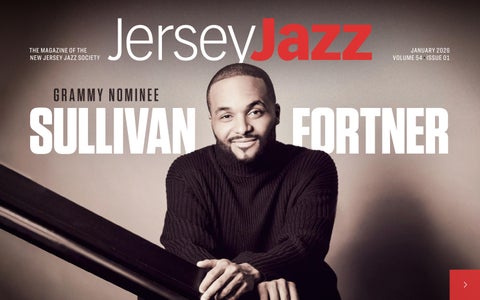
GRAMMY NOMINEE
SULLIVAN
JANUARY 2026 VOLUME 54 ISSUE 01
FORTNER
IN THIS ISSUE ARTICLES/REVIEWS 07
10
Grammy Nominee: Sullivan Fortner
17
Jazz at the Morris Museum: Thaddeus Exposé
22
Rising Star: Kate Kortum
27 30
ON THE COVER _ Sullivan Fortner
NJJS.ORG
Jersey Jazz LIVE!: Louis Armstrong’s Early Life & Music
North Carolina Jazz Festival: Brandi Disterheft Music at SOPAC: Melba Moore
37
Other Views
40
Big Band in the Sky: Gordon Goodwin
COLUMNS 03
Editor’s Choice
35
From the Crow’s Nest
CORRECTIONS: The wrong pronoun was used to describe bassist Ian Kenselaar in the December 2025 article on Julius Tolentino. Also, Kenselaar has been a member of JD Allen’s trio since 2018. Harvie S is the bassist who plays with pianist Alan Broadbent. His first name was misspelled twice in an article on Broadbent in the December issue. Hyuna Park is the pianist who will be playing at Martin Pizzarelli’s January 11th concert celebrating Bucky Pizzarelli’s 100th birthday. Her first name was misspelled in a December preview of the concert. In the “Pelote’s Place” column in the December issue, the correct title tune of Jennifer Leitham’s album is “Future Christmas”.
JERSEY JAZZ
JANUARY 2026
02
EDITOR’S CHOICE BY SA NFO RD JOS EPHSON
Nat Adderley, Jr. Completes His Journey Back to Jazz
N
at Adderley, Jr. spent 25 years as the Music Director for rhythm and blues singer Luther Vandross, but after Vandross passed away in 2005, Adderley, Jr., the son of trumpeter Nat Adderley and nephew of alto saxophonist Julian “Cannonball” Adderley, returned to his roots as a jazz pianist, mixing hard bop with R&B. When I interviewed Nat, Jr. in August 2023 to preview his September performances at the West Orange and Middlesex County jazz festivals, he informed me that, after 18 years as a jazz pianist, he was “in the studio” working on his first album as a leader. “My experience in the studio,” he told me, “is in R&B, but I am going to go ahead and do this like jazz musicians usually do, and pop and R&B
NJJS.ORG
musicians do not. I like how jazz musicians do it. They play their tunes live for awhile before going to record them.” Two-plus years later, in October 2025, Adderley self-released the album, Took So Long, and, at presstime, it was Number 2 on the JazzWeek chart following four consecutive weeks at Number 1. DownBeat’s Joshua Myers called it “a near perfect mixture of standard jazz tunes and popular musical mainstays.” When the album started climbing on the JW chart, Adderley said, “I was shocked. I just went into the studio and played what I’ve been doing in live performances, what I used to do years ago in Maplewood.” Around 15 years ago, Adderley had a regular gig at a restaurant called Cent’Anni on High-
land Place in Maplewood. In an article posted on Patch.com in April 2010, Joel Dana Stern wrote, “Best known for his work with Luther Vandross, Adderley and his trio mostly leave the R&B behind and stick to jazz standards and covers of works by the likes of Herbie Hancock and Chick Corea.” The title track of Took So Long was composed by Adderley. That’s combined with jazz standards and popular songs such as Bronislaw Kaper’s “Green Dolphin Street” and “Invitation”; Dizzy Gillespie’s “Con Alma”; Burton Lane’s “Old Devil Moon”; Carol King’s “You Make Me Feel Like a Natural Woman (also recorded by Aretha Franklin); “People Make the World Go Round” (recorded by the Stylistics); Stevie Wonder’s “You and I We Can Conquer the World”, “Superstar” (written by Leon Russell for The Carpenters but memorably recorded by Vandross); and “Don’t Explain”, written by Arthur Herzog, Jr. and Billie Holiday.
Myers, reminding his DownBeat readers that, “There once was a moment where jazz was indeed popular music,” added, “It is simply cool to hear once again how interpretations of sounds made famous by Stevie Wonder, The Stylistics, The Carpenters, Luther Vandross, and Aretha Franklin beautifully coexist alongside those written by Billie Holiday and Dizzy Gillespie. Masters of the piano trio format have gamely plumbed these associations before. But in the hands of Nat Adderley, Jr., we get yet another fresh look.” Took So Long was selected as WBGO Radio’s “New Day, New Play” album for the week of October 27-31, with a track from the recording played each morning at 8:20 a.m. The station’s Gary Walker pointed out that, “There are reimagined standards, an original, and a fabulous recollection of his dear friend Luther Vandross on ‘Superstar’ ... It might have taken so long, but it has been well worth it.” Amen.
JERSEY JAZZ
JANUARY 2026
03
ABOUT NJJS
F
ounded in 1972, The New Jersey Jazz Society has diligently maintained its mission to promote and preserve America’s great art form—jazz. To accomplish our mission, we produce a monthly magazine, Jersey Jazz; sponsor live jazz events; and provide scholarships to New Jersey college students studying jazz. Through our outreach program Generations of Jazz, we provide interactive programs focused on the history of jazz. The Society is run by a board of directors who meet monthly to conduct Society business. NJJS membership is comprised of jazz devotees from all parts of the state, the country and the world.
MEMBER BENEFITS
JOIN NJJS
You become an integral part of the NJJS community, and the history and future of jazz
Family/Individual $45 (Family includes to 2 Adults and 2 children under 18 years of age) Family/Individual 3-Year $115 Musician Member $45 / 3-Year $90 (one time only, renewal at standard basic membership level.) Youth $15 - For people under 21 years of age. Date of Birth Required. Give-A-Gift $25 - Members in good standing may purchase unlimited gift memberships. Applies to New Memberships only. Fan $75 - $99 Jazzer $100 - $249 Sideman $250 - $499 Bandleader $500+ Corporate Membership $1000
Access to 11 Digital Issues of our Award Winning Jersey Jazz Magazine — Featuring Articles, Interviews, Reviews, Events and More Discounts to our Jersey Jazz LIVE! Sunday Concerts Discounts at NJJS Sponsored Concerts & Events. MUSICIAN MEMBERS
FREE Listing on NJJS.org “Musicians List” with Individual Website Link FREE Gig Advertising in our Monthly eBlast THE RECORD BIN
Visit www.njjs.org or email info@njjs.org for more information on our programs and services NJJS.ORG
A collection of used CD’s & LP’s available at reduced prices at specific events and through mail order njjs.org/shop
Members at Bandleader level and above and Corporate Memberships receive special benefits. Please contact Membership@njjs.org for details. The New Jersey Jazz Society is qualified as a tax exempt cultural organization under section 501(c)(3) of the Internal Revenue Code, Federal ID 23-7229339. Your contribution is tax-deductible to the full extent allowed by law. For more Information or to join, visit www.njjs.org
JERSEY JAZZ
JANUARY 2026
04
Magazine of the New Jersey Jazz Society VO LU M E 54 • I SSUE 01
NJJS org
Editorial Staff
New Jersey Jazz Society, Officers 2026
EDITOR
PRESIDENT
Sanford Josephson, editor@njjs.org
Cydney Halpin, pres@njjs.org
ART DIRECTOR
EXECUTIVE VP
Michael Bessire, art@njjs.org CONTRIBUTING EDITORS
Elizabeth Kavlakian, vicepresident@njjs.org
Bill Crow, Joe Lang, Vincent Pelote, Ricky Riccardi, Andrew Schinder, Jay Sweet
Mike Katz, treasurer@njjs.org
CONTRIBUTING PHOTOGRAPHERS
membership@njjs.org
Fresco Allessandro, Margherita Andreani, Jim Bourne, William P. Gottlieb, Melanie Mor WEBMASTER
TREASURER
VP, MEMBERSHIP
VP, PUBLICITY
Sanford Josephson, sanford.josephson@gmail.com
VP, MUSIC PROGRAMMING
Christine Vaindirlis
music@njjs.org
WEBSITE DESIGN
RECORDING SECRETARY
Prism Digital
Irene Miller CO -FOUNDER
Jack Stine
Advertising Jersey Jazz (ISSN 07405928) is published monthly for members of The New Jersey Jazz Society
382 Springfield Ave., Suite 217, Summit, NJ 07901 973-229-0543 • info@njjs.org Membership fee is $45/year. All material in Jersey Jazz, except where another copyright holder is explicitly acknowledged, is copyright ©New Jersey Jazz Society 2026. All rights reserved. Use of this material is strictly prohibited without the written consent of the NJJS.
NJJS.ORG
IMMEDIATE PAST PRESIDENT
Mike Katz
DIRECTOR OF ADVERTISING
Cydney Halpin, advertising@njjs.org ADVERTISING RATES
Full Page: 135, Half Page: 90, 1/3 Page: $60, 1/4 Page: $30 $
$
For reservations, technical information and deadlines contact advertising@njjs.org or visit njjs.org/Magazine/Advertise. Make a payment online at njjs.org/advertise via the red Submit Payment button, or via check made payable to NJJS, 382 Springfield Ave., Suite 217, Summit, NJ 07901.
DIRECTORS
Jay Dougherty, Cynthia Feketie, Paul Flexner, Pete Grice, Carrie Jackson, Caryl Anne McBride, Robert McGee, James Pansulla, Stew Schiffer, Elliott Tyson, Jackie Wetcher ADVISORS
Don Braden, Mariel Bildsten, Ted Chubb, Al Kuehn, Jason Olaine
JERSEY JAZZ
JANUARY 2026
05
JerseyJazz LIVE!
JULIUS TOLENTINO THE NEXT WAVE and
SUNDAY, JANUARY 4 3:00 PM
Madison Community Arts Center 10 KINGS ROAD, MADISON, NJ FREE STREET PARKING ON KINGS ROAD $
15 MEMBERS | $20 NON-MEMBERS $
Made possible by funds from the New Jersey State Council on the Arts, a partner agency of The National Endowment for the Arts.
5 CHILD/STUDENTS (WITH VALID I.D.)
JERSEY JAZZ LIVE! A Black History Month Celebration of Louis Armstrong’s Early Life and Music His Hot Five Band Changed the Shape of Jazz to Come with Its Groundbreaking Series of Recordings Made Between 1925 and 1928.
L
Cover photo from Stomp Off, Let’s Go. From left, trombonist Honore Dutrey, drummer Baby Dodds, cornetist Joe “King” Oliver (kneeling), Louis Armstrong on slide cornet, pianist Lillian Hardin Armstrong, banjoist Bill Johnson, and clarinetist Johnny Dodds.
NJJS.ORG
ast year was full of new milestones regarding the life and music created by Louis Armstrong during the early part of his life, and I’m personally thankful to be in the middle of all the action. In February, Centennial, a deluxe boxed set by Archeophone Records, collecting all of Armstrong’s earliest recordings with King Oliver’s Creole Jazz Band, won two Grammy Awards for Best Historic Album and Best Album Notes. That same week, the third and final book in my Armstrong trilogy, Stomp Off, Let’s Go: The Early Years of Louis Armstrong,
was published by Oxford University Press to enthusiastic reviews. In the summer, the Louis Armstrong House Museum—where I serve as Director of Research Collections—became the recipient of an incredible treasure trove of materials that originally belonged to Louis’ second wife, pianist and composer Lillian Hardin Armstrong. Included in the collection were reel-to-reel tapes of Lil reading from her unpublished— and unfinished—autobiography, sheet music, photographs, letters, and more artifacts that will allow future generations to learn more about this
JERSEY JAZZ
JANUARY 2026
07
PHOTO COU RT ESY O F TH E NEW ORL EANS JAZZ C LUB CO LLECTI ON OF T HE LOUI SIANA STATE MUSE UM
BY RI CKY RI CCARD I
JERSEY JAZZ LIVE!
NJJS.ORG
of Stomp Off, Let’s Go on hand and will be happy to sign them for anyone who would like to purchase one.
Louis Armstrong’s Hot Five. From left, clarinetist Johnny Dodds, Louis Armstrong, guitarist Johnny St. Cyr, trombonist Kid Ory, and Lillian Hardin Armstrong.
phenomenal trumpeter Summer Camargo. I’ll provide new information I learned about Armstrong’s upbringing in New Orleans while researching Stomp Off, Let’s Go. There’ll be a tribute to his mentor, King Oliver, and I’ll share some of the rare audio and photographs found in Lil Hardin
Armstrong’s recently discovered collection. I’ll be sure to play some of the most famous recorded moments from the Hot Five and Seven series, and then Summer Camargo and I will do our best to illustrate just how vital and fresh this music remains, with a short set of live duets. I’ll also have copies
The Madison Community Arts Center is located at 10 Kings Road in Madison, NJ. The Jersey Jazz LIVE! concerts begin at 3 p.m. Admission is $15 for NJJS members and $20 for non-members. Student admission is $5 with valid ID. There will be light refreshments for purchase. To order tickets in advance, log onto ticketleap.events/tickets/newjersey-jazz-society/jersey-jazz-livericky-riccardi-talks-early-pops : Funding for Jersey Jazz Live! has been made possible, in part, by funds from Morris Arts through the New Jersey State Council on the Arts/Department of State, a partner agency of The National Endowment for the Arts. Additional funding has been provided by The Summit Foundation.
JERSEY JAZZ
JANUARY 2026
08
PHOTO COU RT ESY O F TH E LOUIS ARMST RO NG H OUSE MUSE UM.
pioneering female figure in jazz. Finally, November marked the 100th anniversary of the first recording session of the Hot Five, Armstrong’s studio band that changed the shape of jazz to come with its groundbreaking series of recordings made between 1925 and 1928. The Armstrong House celebrated this centennial with multiple programs, including a listening session, a tribute to Lil Hardin, and a live concert with an all-star band in which I was assigned the piano chair. All of the above—and more—will be part of a presentation I’ll have the honor of making on Sunday, February 1, about the early years of Louis Armstrong at the New Jersey Jazz Society’s Jersey Jazz LIVE! concert, honoring Black History Month, at the Madison (NJ) Community Arts Center. In addition to a multimedia-filled presentation, I’ll also be manning the piano to perform duets of Armstrong-related songs with the
GRAMMY NOMINEE
S
Pianist Sullivan Fortner’s Musical Roots Began in Church Winning the Larry J. Bell Award Was “Definitely a Shocker for Me. I Did Not Know I Was Being Considered” BY JAY SW E E T
NJJS.ORG
ullivan Fortner is one of the most sought-after jazz pianists on the scene today. Last year was monumental for him, marked by the release of, Southern Nights (Artwork Records), nominated for a Grammy Award for Best Jazz Instrumental Album. There were appearances on Theo Croker and Sullivan Fortner – Play (ACT Music , Kurt Elling & Sullivan Fortner – Wildflowers Vol. 1 (Edition Records), and Lauren Henderson’s Sonidos (Brontosaurus Records). In addition, Fortner was named the first-ever jazz recipient of the Larry J. Bell Jazz Artist Award, established by The Gilmore Foundation and accompanied by a $300,000 prize. Despite this extraordinary run of success, the pianist remained cool and unassuming as he reflected on the year. Our discussion began with Southern Nights. “The Village Vanguard asked me to do a week, and it happened to fall
over the Fourth of July. They wanted me to put together a special band. The problem was, I didn’t really know how to put bands together, so I was thinking, ‘How do I do this?’ I just kind of went at it instinctively. Earlier that year I had run into bassist Peter Washington, and I said, ‘Look, man, I’ve got this week at the Vanguard. Are you free?’ He said, ‘Yeah, I’m free. I’d love to.’ So, I thought, great --bass player covered. Then I had to figure out the drums. I started throwing some names around, and finally I said, ‘You know what, I’ll just bite the bullet and call Marcus Gilmore.’ He picked up and said, ‘Yeah, man, I’m in town. I’m not doing anything. Of course, I’ll play it.’ That was a huge relief. Then I got nervous, especially when Marcus mentioned that he had never played with Peter, and that they’d never even met. So literally, the first night of that week was the first time they
JERSEY JAZZ
JANUARY 2026
10
GRAMMY NOMINEE four hours, and we were done. Everything was basically two takes, and most of what made the record was either the first or second take. We laid it down, then went back and played the Vanguard that night. The record is really just a snapshot of that week. “Overall, I wanted the week and the recording to feel relaxed. I chose tunes that were familiar enough that we didn’t need charts, or could at least take our eyes off the page. That’s how I like to work. I don’t really enjoy playing sheet music. Part
“ AS A BANDLEADER
ROY (HARGROVE) WAS ONE OF THE BEST.” NJJS.ORG
Fortner, center, with drummer Kayvon Gordon, left, and bassist Tyrone Allen, right.
of that is because I’m not the greatest sight-reader, but more importantly, every band I’ve learned from or been part of learned everything by ear. There was never any sheet music. For some reason, that approach brings a different kind of life to the music.” As for the recording with Theo Croker ,“We’ve known each other forever. We were actually roommates at Oberlin when we were students. We’d been talking for a long
time about recording just the two of us, so he reached out and said, ‘Man, I think now’s the time.’ The first day we recorded standards and a few covers, but it just didn’t click. It wasn’t inspiring. Theo finally said, ‘Man, let’s just go home.’ So, we did.” “The next day he said, ‘Let’s just play free. We’ll make up some rules, some little devices.’ You play slow, I’ll play fast. We’ll pick a key and move around it.’ We came up with little
JERSEY JAZZ
JANUARY 2026
11
PHOTO BY JI M BOU R NE
ever played together. We hit the first few notes, and immediately I thought, ‘Okay, ts going to be really good.’ “By Wednesday night,” he continued, “I started thinking about recording. I wanted to record live at the Vanguard, but with that short notice they wouldn’t allow it. So, I started calling around to see if any studios were open. Sear Sound Studios had an opening that Saturday morning, around 11 a.m. I booked it, and the band came in. We just played what we had been playing all week. One session, about
GRAMMY NOMINEE games for ourselves. We recorded about 20 tracks in roughly two hours. What came out of it felt very honest. It felt like us. And more than that, it honored where we came from, not just who we are now. I think the industry sometimes puts musicians into boxes: ‘This is what you sound like, so this must be all you do.’ This project pushed against that. It honored the people we studied with—like Gary Bartz, Wendell Logan, Dan Wall, and Marcus Belgrave—that whole lineage we were raised in musically.” Fortner recalled how quickly the Kurt Elling project came together. “Wildflowers came about through a call from Kurt Elling’s manager, describing how Kurt wanted to start a duo series with piano players. I was asked, ‘Would you be interested?’ I was like, ‘Yeah, absolutely. I’ve never played with Kurt Elling. “That sounds fun.’ Then Kurt wrote to me and sent
NJJS.ORG
Fortner’s album, Southern Nights, with bassist Peter Washington and drummer Marcus Gilmore, has received a Grammy nomination for Best Jazz Instrumental Album.
a list of about 30 songs. So, I learned as much as I could, sent him the list of what I had ready, and we narrowed it down to five or six tunes. One highlight was playing the Fred Hersch tune ‘Valentine.’ I studied with Fred on and off for about five or six years.”
One of the biggest surprises of Fortner’s year and one of his most enduring achievements was winning the prestigious Larry J. Bell Jazz Artist Award. “That was definitely a shocker for me. I did not know I was being considered.” The news came via a phone call from his agent while Fortner was on tour with his trio earlier in the spring. The award is presented every year to classical pianists, and this was the first year it was presented to a jazz artist. “They said I had been nominated and that they’d been scrutinizing my playing, along with others, for about two years,” Fortner said. His reaction was equal parts disbelief and composure. He was “Shocked. I have a lot of questions, like, ‘why me?’ I still have those questions. But I’m definitely very honored to have been chosen.” Growing up in New Orleans, Fortner was first inspired by the music
of the church, “which surprises a lot of people,” he said. “I have a cousin who had a high school band called the Mid-City Jazz Ramblers. A lot of the guys in that band went on to do serious things in jazz, and others branched off into completely different styles. For me, being around that band was my real introduction. “At church there was a guy named Ronald Markham who was really the turning point for me. One day at choir rehearsal he got on the Hammond organ and started playing Bach. I was like, ‘What is that? ‘He said, ‘That’s classical music.’ Then he said, ‘This is jazz,’ and suddenly he sounded exactly like Jimmy Smith. Then he started playing Latin music, jumping through all these styles. I asked him, ‘Man, how did you learn to play all of this?’ He said, ‘You need to apply to NOCA— the New Orleans Center for Creative Arts.’ When I finally did, I got
JERSEY JAZZ
JANUARY 2026
12
in, and I couldn’t play a scale. I didn’t know any arpeggios. I knew nothing about classical music, nothing about jazz. All I knew was church, and yet, somehow, I got accepted. My entire training up to that point was gospel.” “That’s when I really started studying classical and jazz. The head of the bands and the jazz department was Clyde Kerr Jr., who had taught Nicholas Payton, Irvin Mayfield, and so many others. I was in classes with Troy ‘Trombone Shorty’ Andrews. Jon Batiste and I were practicing together. That was the community. And honestly? I hated jazz. I absolutely hated it. I thought it was too long, too complicated. “The very first tune I had to learn for performance class was ‘Giant Steps,’ and I had to learn it in five minutes. We played it as a ballad because I didn’t know how to improvise. I just played the chords really slow-
NJJS.ORG
ly. I was 12 or 13 years old. A couple of years later, Mr. Kerr handed me an album and said, ‘This is Erroll Garner’s Concert by the Sea. If you don’t like jazz after this, maybe you shouldn’t be playing.’ I listened, and I fell in love. I don’t know what it was about that record, but it completely changed my perspective. I’ve been
chasing that feeling ever since.” When it came time for college, Fortner initially planned to study pre-med. “I remember having a really heated conversation with my dad after I graduated from high school. He told me, ‘You’re not going to make it by playing music. You won’t be able to make a living. If you become a doctor,
Fortner, receiving his Larry J. Bell Jazz Artist Award.
you’ll always have a job.’ Out of dozens of conversations, only a few people encouraged him to pursue music. “One was my mom. The other was a woman I’ll never forget, Veronica Downs Dorsey, who had known me since fourth grade and said, ‘You’ve been playing music for as long as I’ve known you. You’re supposed to be playing.’” Eventually, they convinced his father to let him apply to music school. “So, I sent in a video of me playing ‘The Flintstones’ theme to both Oberlin and Berklee. Berklee wait-listed me. Oberlin accepted me, with a partial scholarship. Looking back, it ended up being one of the best decisions I’ve ever made in my life. “I promised my dad that if I pursued music seriously, I would at least earn a master’s degree, so if everything else fell apart, I could teach high school. That felt like a responsible plan. So, I went to New York and never really left.
JERSEY JAZZ
JANUARY 2026
13
PHOTO BY MEL ANIE MOR
GRAMMY NOMINEE
GRAMMY NOMINEE I started my master’s at the Manhattan School of Music in the fall of 2008. By the spring of 2009, I was already on my first European tour with Stefon Harris & Blackout. I stayed with that band for about a year and a half.” The next major chapter was working with trumpeter Roy Hargrove. “Literally right after I landed back in New York from that tour, Roy’s manager called and said that Jon Batiste had double-booked himself with Cassandra Wilson and couldn’t do a month of touring. He
“ I’VE GOT A NEW
asked if I could fill in. We started in Minneapolis, then went to Japan a week or two later; and for several years I was the pianist in his group. “As a bandleader, Roy was one of the best I’ve ever worked with. I learned an enormous amount from him. He didn’t talk much and rarely explained things verbally. There was no sheet music, everything was learned by ear. Roy would get behind the piano and play the tune for me first. Once I had it, he’d say, ‘You got it? Good,’ and then move to the drums.
TRIO ALBUM COMING OUT— ACTUALLY, MAYBE TWO.” NJJS.ORG
Roy could play drums a little, but he preferred to sing the drum parts. While he was singing the drum part, I’d teach the bass player. Once the rhythm section had it together, he’d move on to Justin Robinson on saxophone. That’s how we learned every tune. “As a person, Roy was very quiet. He didn’t like big crowds, except when it was time to play music. His main way of communicating with me was through music. He was incredibly
intelligent and always reading something, but he was 100 percent about music. I honestly believe that without music, he wouldn’t have been here as long as he was. I witnessed moments when he could barely stand. Yet somehow, when it was time to perform, something clicked. He found the strength to blow. No matter how sick he was or how his chops felt, he was always musical. Whatever he played lifted the band. Nobody played a bal-
JERSEY JAZZ
JANUARY 2026
14
GRAMMY NOMINEE lad like him. The flugelhorn—what he did with that sound—was something truly special. Roy never told us song titles, and he often changed them anyway, so we learned to recognize tunes by the count-off alone. I think about Roy every day and about the lessons I learned in that band.” Another key association along the way was with Paul Simon. “That came through percussionist Jamie Haddad, who called me and said, ‘Paul’s trying to do a special project with younger musicians, reimagining some of his older songs, songs he liked, but that never really took off the way he’d hoped.’ Apparently, Paul had heard something I played and wanted to know if I’d be interested.” After meeting with Simon, Fortner collaborated on three songs for the 2018 Legacy Records album, In the Blue Light. “The last time I saw him,” said Fortner, “was last year. We
worked on something together then, too. He’s really kind, very honest. If he likes something, he’ll tell you. If he doesn’t, he’ll tell you that, too, and explain why. Then, we’ll sit, literally, for eight hours if we need to, until it gets to where he’s satisfied.” Looking ahead, Fortner is energized by what’s next. “I’ve got a new trio album coming out --actually, maybe two.. It’s the same drummer and bass player I’ve been working with for the past four years—Kayvon Gordon on drums and Tyrone Allen on bass. One is a studio album, kind of a continuation of the solo record I released in 2023, Solo Game. The other is a live album recorded at the Village Vanguard. That one will probably come out in October.” As Fortner continues to balance deep tradition with fearless creativity, one thing is clear: His story is still unfolding, and his music is gaining momentum.
NJJS.ORG
JERSEY JAZZ
JANUARY 2026
15
New JerseyJazz Society The New Jersey Jazz Society is pleased to announce the
2026 JURIED SCHOLARSHIP COMPETITION This competition will award three $1000 prizes and three $500 prizes in three categories: Jazz Instrumental Performance, Jazz Vocal Performance, and Jazz Composition. The competition is open to all New Jersey college students currently enrolled in a college undergraduate music program, as well as to New Jersey residents currently enrolled in an out-of-state college undergraduate program. Proof of residency required. Along with the cash award, winners will receive guidance, mentorship and the opportunity to perform with an industry professional, and coverage in Jersey Jazz. SUBMISSION DEADLINE: Friday, March 27, 2026, 11:59 PM Eastern Time
Visit NJJS.org/Competition for details. This competition is generously supported by N A N H U G H E S P O O L E , C Y N T H I A F E K E T I E , M I C H A E L A . K AT Z , and JA C K I E W E TC H E R
JAZZ AT THE MORRIS MUSEUM Bassist/Vocalist Thaddeus Exposé Celebrates the Music and History of New Orleans “When You Hear Music from New Orleans, You Know Exactly Where It Came From” BY ANDRE W SCHI NDE R
T
he City of New Orleans, obviously, holds a mythical status in the world of jazz. The genre (or at least the form with which listeners are familiar) was invented and developed there, and every jazz musician—from the swingiest to the most avant-garde—holds at least some debt to the bygone inhabitants of the Big Easy. However, while the city is rightfully revered for its place in jazz history, its musicians tell a more complicated story. Many of NOLA’s
NJJS.ORG
most famous denizens—including Louis Armstrong, Sidney Bechet and Wynton Marsalis—all ultimately left the city. This inevitable exodus of New Orleans’ most notable musicians therefore begs the question: What is a jazz mecca without its most famous musicians? Is it merely a jazz museum, a place for music tourists to check the box before returning to the more cutting-edge jazz scenes of New York or Chicago? Is there a place for New Orleans in today’s jazz idiom?
JERSEY JAZZ
JANUARY 2026
17
JAZZ AT THE MORRIS MUSEUM Bassist/vocalist Thaddeus Exposé left New Orleans as well. Born and raised there, he has spent the past two decades living in Whippany, NJ, during which time he has been teaching music in the Newark Public School District. As a music teacher, Exposé (Thaddeus Exposé is, magnificently, his birth name) won the prestigious Barry Manilow Music Teacher Award in 2022, given by the Manilow Music Project, where he and his students were awarded grant money for new instruments and facilities. At age 63, Exposé is two years from retirement. He never intended to be a teacher, but he rose to the occasion and, as evidenced by the Manilow grants, touched dozens of lives. Still, while Exposé has flourished in North Jersey, New Orleans has remained part of his core. Exposé’s music is firmly rooted in the Crescent City, and, upon retirement, he
NJJS.ORG
plans to re-dedicate his life to recording and performing. Exposé will be performing bass and vocals at the Morris Museum in Morristown, NJ, on February 7 during his fifth annual Mardi Gras celebration. He’ll be leading a large band including Wallace Roney, Jr. (trumpet), Evan Christopher (clarinet), Marty Eigen (saxophone), Peter Lin (trombone), Bernard Elliott (piano), Gordon Lane (drums), and Ayana Lowe (vocals). It promises to be a rousing, energetic celebration of jazz’s history, and the city that birthed Exposé, who is excited about the performance -- especially the opportunity to share his origins with North Jersey music fans. “I’m happy I came from New Orleans,” said Exposé. “It has so much to offer. Not only the food, the atmosphere, the weather is good, but the music is just extraordinary. There’s such diversity of styles of music. You
Exposé, receiving the Barry Manilow Music Teacher Award.
walk down Frenchmen Street or Bourbon Street, you might hear some blues, you might hear some fusion music, you hear some New Orleans music, you may hear some straightahead jazz, you may hear some funk, you may hear some Cajun music. “So, it has a variety of different music. I love New York, too, but New
Orleans—You know, when you hear music from New Orleans, you know exactly where it came from. It is the only style of music that, you know, is considered New Orleans music.” Exposé’s father worked in a warehouse, but at home, he had several hobbies. He was excellent in math. He liked to fix cars. And he played the
JERSEY JAZZ
JANUARY 2026
18
JAZZ AT THE MORRIS MUSEUM
Clarinetist Evan Christopher (left), and trumpeter Wallace Roney, Jr., will be in Exposé’s band at the Morris Museum.
guitar. His father would play along with those classic soul/funk cuts of the 1960s and 1970s—the Temptations, the Bar-Kays, the Ohio Players. But while Exposé loved the guitar, what spoke to him were the basslines. “There are two things I got from my parents that I learned,” he said. “I learned a work ethic from my fa-
NJJS.ORG
ther, and I learned how to love and treat people from my mother and my grandmother. Those are the things that I got growing up with a family.” Exposé didn’t have formal music lessons at first, but he picked up the bass quickly, and by eighth grade he had joined a band that won second place in his school’s
talent show. Consistent with the then-current soul/funk groups that were inspiring him, Exposé initially played electric bass. “During that time, if you went to the prom, you had a band playing, not a DJ,” he recalled. “You had all these bands then, and I wanted to be a part of that.” He was in a band, but couldn’t read music. Like so many young people growing up in New Orleans, his family could not afford music lessons. Ultimately, a member of Exposé’s church congregation, who was also involved with music, recommended that he attend Xavier University, which had a strong music program. Exposé was a bit skeptical at first as to the prospect of attending college, but another local musician, guitarist Carl LeBlanc, convinced him otherwise. “He said, ‘Do you have to go to school to become a doctor?’ I said, ‘Yeah.’ Well, there you have it. So, he
answered that question. After that, it was the pursuit of music full force.” A Xavier professor introduced Exposé to New Orleans-based bassist Walter Payton (father of trumpeter Nicholas), who helped formalize Exposé’s playing. Shortly thereafter, Exposé relocated to Chicago (“on a wing and a prayer”), with Nicholas Payton soon to follow. “Chicago is where I really developed and got it together, but New Orleans was the start,” Exposé said. “I got pretty good and then one day I just hired Nicholas to come up to do a gig with me, and that’s how I really got started.” In Chicago, Exposé went the more straight-ahead route and switched to upright bass, which has since become his specialty and preference (though he will play both electric and acoustic bass during his Morris Museum gig). “I play the instrument that most
JERSEY JAZZ
JANUARY 2026
19
JAZZ AT THE MORRIS MUSEUM people fear, that most people run away from because of its size,” Exposé said. “The bass provides the foundation that holds the music together. A bass can make or break the music, its low sound holds everything together.” While in Chicago, Exposé also began teaching music. He ultimately earned a Bachelor’s Degree in Music Education from Northeastern Illinois University, and then, upon relocating to New Jersey, a Master’s Degree in Music from William Paterson University. While he was far away from New Orleans, Exposé remained spiritually close to the city of his upbringing.
“ I LOVE PULLING
“This is why I’m doing the performance at the Morris Museum,” he explained. “Because of the culture that I’ve invested myself in, that I’ve been around all my life. It’s the music, it’s the second line [New Orleans brass parade], it’s the New Orleans Indians. There’s no other place that can provide that type of culture.” In one story, Exposé described dancing in a “neutral ground” (i.e., a median dividing traffic lanes in a boulevard) back in New Orleans. “In New Orleans the neutral grounds are wide with trees, where you can hang out. “It was on Claiborne Avenue,” he
THE PEOPLE IN BECAUSE MUSIC IS HEALING.” NJJS.ORG
began. “On one side of Claiborne Avenue, you have Tremé, where Congo Square was created. Congo Square is an area where people danced, where you were only allowed to dance and express yourself, while being Black, only on Sundays. Any other day, you did not have that opportunity. During the late 1800s and early 1900s, artists and dancers would all meet in the same area, but only on Sundays. I played music in that area. “But not only that,” he continued. “I wanted to be a ‘bucket man.’ Buck-
et men were dancers, they dressed up in outfits based on age groups, and they would dance in the street. I always wanted to be a part of that. But coming from a Christian family, my mother wouldn’t let me. But my cousins were able to dress, and we called them ‘New Orleans Indians.’ They all wore elaborate crowns of feathers, and each neighborhood was a different color. You come out during Mardi Gras Day and St. Joseph’s Night, and dress in your color. “[Saxophonist] Donald Harrison’s father was a Chief, and Donald became a Chief as well. He lived right across the street from me. Anyway, this is all part of the culture that allows me to do what I’m doing right now.” With regard to singing, Exposé explained that, “I’m a bass man, and I really didn’t start singing New Orleans songs until maybe 10 years ago. I was on a Mardi Gras gig with somebody, who was singing, and I thought ‘This
JERSEY JAZZ
JANUARY 2026
20
JAZZ AT THE MORRIS MUSEUM is so wrong!’ So, the next year came around I started building my repertoire. “You want to let the audience know,” he emphasized, “that this is New Orleans music. I was in a brass band once, and [pianist/vocalist] Jon Batiste was there. He played ‘Bourbon Street Parade.’ And when you play that song, it makes you want to dance. You can’t help but move to that music. The syncopated rhythm in the music makes you want to move your body.” “So, all the songs that we play, when you sing those type of songs, you can’t help but to get up and want to dance. So, when I do my performances, I bring some umbrellas, I bring my tambourine. Everybody loves to get something and everybody wants to be involved with audience participation. I love pulling the people in, because music is healing.” As far as New Orleans’ place in the modern jazz idiom, Exposé would argue that New Orleans is as vital as ever.
NJJS.ORG
“First of all,” he began. “It’s a myth that when you go down to New Orleans, you think all you’re going to hear is New Orleans music. When you get down there, you realize that it’s such a variety of different styles, you can’t categorize New Orleans. You can incorporate the New Orleans feel with the modern music that you have now.” In the coming years, and certainly upon his retirement from the Newark School District, Exposé intends to continue to perform gigs and ultimately record his proper debut album. Rest assured, it will be a tribute his birthplace—and the birthplace, and home of the continued resilience of jazz. : The Morris Museum is located at 6 Normandy Heights Road in Morristown, NJ. The Thaddeus Exposé Mardi Gras concert begins at 7:30 p.m. on Saturday, February 7. For more information or to order tickets, log onto morrismuseum.org or call (973) 971-3700.
JERSEY JAZZ
JANUARY 2026
21
join us
for an all-new season!
For the complete performance schedule, visit grunincenter.org. Grunin Center Box Office Hours Tuesday-Friday Noon-5:00pm by phone only 732-255-0500 College Drive ✦ Toms River, NJ Contact the Box Office four weeks prior to any show to arrange for disability and accessibility services.
RISING STAR Sarah Vaughan Winner Kate Kortum: ‘You Can Be Silly and Playful with Words’ “She’s Able to Tell a Story Through Her Music, and It Makes Everyone Around Her Want to Stop and Listen”
G
rowing up in Houston, Texas, Kate Kortum shared a computer with her five siblings. “Somehow, the Ella Fitzgerald recording of ‘How High the Moon’ from her Live in Berlin album ended up on the computer,” she recalled. “I had no idea you could sing like that. I heard that and became obsessed.” Despite her fixation on Fitzgerald, Kortum didn’t start singing right away at Houston’s High School for the Performing and Visual Arts. Instead, she
NJJS.ORG
joined the jazz band as a saxophonist and flutist. “I was never very good at the saxophone and flute,” she said. “I loved playing them, but I wasn’t anything special. I was in the lower level of the jazz bands. So, I went to Norman Sneed, the Jazz Director, and said, ‘I want to sing in the band. I think I would be much more use there than playing saxophone. Mr. Sneed really encouraged me to follow that. He didn’t want me to keep doing something that I didn’t feel passionate about.”
JERSEY JAZZ
JANUARY 2026
22
PHOTO BY MARG HE RITA ANDR EANI
BY SANFORD JOS E P HSON
RISING STAR “Some of the songs that Bessie Smith recorded,” Kortum said, “you don’t hear recorded again very often. So, I heard ‘Easy Come Easy Go Blues’ and felt like there wasn’t another song that captured that vibe. It wasn’t quite a 12-bar blues, but it captured the essence and feeling of the blues. And, it’s silly and playful, one of my favorite things in music and jazz. One of the reasons I picked singing over playing instruments is because you can be silly and playful with words in a way that affects the audience more than playing an instrument. “’You Are There’”, she continued, “is a Dave Frishberg song, which I haven’t seen for a really long time. It’s
Kate Kortum receives her award at NJPAC.
one of the first ballads I heard that I felt very personally connected to. It’s written in a way that’s so stream of consciousness storytelling. For the first time, I tried to write a little bit, so I wrote an intro and an outro with
“ I JUST FELT LIKE IT (THE FROST SCHOOL) WAS A FIT.” NJJS.ORG
that song. It’s one of my favorites to do because people don’t know it, and when they hear it, it seems like it was part of the Great American Songbook.” Kortum selected “What a Little Moonlight Can Do” for the opposite reason. “I picked that because so many people have recorded it. It’s such a behemoth—one of those songs you hear a lot of vocalists do. But it’s such a challenge to perform it and execute it well. I’ve always been fas-
JERSEY JAZZ
JANUARY 2026
23
PHOTO BY FR ESCO AL ESSAND RO
Evidently, it was the right decision. Last month, Kortum won the 14th annual Sarah Vaughan International Jazz Vocal Competition, part of the New Jersey Performing Arts Center’s TD James Moody Jazz Festival. (The 23-year-old Kortum had applied three times before, but this was the first time she made the Top Five). For the Sarah Vaughan finals, held on Sunday, November 23, at NJPAC, Kortum’s song selections were: “Easy Come Easy Go Blues”, recorded in the 1920s by Bessie Smith; “You Are There”, a Dave Frishberg composition; and “What a Little Moonlight Can Do,” a standard written by Harry M. Wood for the 1934 British film, Road House.
RISING STAR
“ SHE’S GOT THIS WARM,
CENTERED SOUND WITH AMAZING FACILITY AND AGILITY.” cinated by all the different versions— Anita (O’Day), Nancy (Wilson)—so I wanted to take my approach to it.” In her last year of high school, Kortum took some classical vocal lessons. For college, she chose the University of Miami’s Frost School of Music because “I just felt like it was a fit, and I knew some of the undergrads there from camps I had done. I didn’t think I was quite ready for New York yet. Frost did some really good things foundationally for me.” When she first arrived there,
NJJS.ORG
though, “I got thrown into the ringer. I’d never sung in a choir before. I had never taken a jazz vocal lesson.” Her first instructor was vocalist/keyboardist Charlie Christenson. a teaching assistant. “I feel like he taught me how to use notation software and arranging techniques. In one year of lessons, he really flipped me upside down.” Christenson, now Associate Professor, Voice Department, at the Berklee College of Music, recalled that Kortum arrived at Frost “fully formed musically: a mature sense of
JERSEY JAZZ
JANUARY 2026
24
RISING STAR style, a great ear for the sound and language of jazz. She’s got this warm, centered sound with amazing facility and agility; and, inside this seemingly laid-back, bright-eyed freshman was just a total killer of a musician. So, her win at the Sarah Vaughan competition feels less like a surprise and more like the natural next chapter.” The four years at Frost, Kortum said, prepped her, “and then I really had the bug to go to New
York.” That meant studying for her Master’s Degree at Juilliard, which she received in the spring of 2025. At Juilliard, pianist Donald Vega, Kortum’s small ensemble teacher, “took me under his wing.” Vega described Kortum as, “an exceptional talent. She was so fun to teach because she approached the music with curiosity and fearlessness, but also with the seriousness needed to perform at the highest levels.
“ FAVORITE COMPOSERS?
‘JOHNNY MANDEL AND HOAGY CARMICHAEL IN TERMS OF THE GREAT AMERICAN SONGBOOK.’” NJJS.ORG
And, when you hear her sing—look out. She’s able to tell a story through her music, and it makes everyone around her want to stop and listen.” Kortum has released two albums on the Bandstand Presents label: Good Woman (2023) and Wild Woman (2025). The recordings include such standards as Cole Porter’s “What is This Thing Called Love?” and the Gershwins’ “The Man I Love”. A goal in both albums was to sing songs written by men with a female perspective. “The first album,” she said, “touches on taking those songs and poking at them a little bit through interpretation and arrangement. The second album focuses more on emotions that maybe the men writing those songs for women weren’t touching on.” After Kortum’s early exposure to Ella Fitzgerald, she discovered Carmen McRae. “I must have lis-
Kate Kortum’s latest album, Wild Woman, continues her goal of singing songs written by men with a female perspective.
tened to her Great American Songbook album at least 1,000 times when I was in high school. Shortly after that, Nancy Wilson and Sarah Vaughan made their way into my stream. Also, for someone more modern, I think Cecile McLorin Salvant was a really big inspiration to me.” As for favorite composers? “Johnny Mandel and Hoagy Carmichael in terms of the Great American Songbook. Obviously, Duke Ellington, who wrote some of the most revered
JERSEY JAZZ
JANUARY 2026
25
RISING STAR jazz songs.” And, she also includes the previously mentioned Frishberg in that list. “He had kind of a funny style of writing—very driven, very silly. He wrote for Schoolhouse Rock. That shows in his writing.” In addition to her own recordings, Kortum was featured recently on So Many Memories, an album released by Loren Schoenberg and His Jazz Orchestra on Turtle Bay Records. It features music recorded by vibraphonist Red Norvo from charts written by Eddie Sauter. Eleven of the songs were originally sung by Mildred Bailey, Norvo’s wife. Reviewing the album in the December Jersey Jazz, Joe Lang praised Kortum for capturing “the way that Bailey paid attention to the lyrics that she sang.” The title track, he added, “receives a well-deserved revival with Kortum at her best.” Kortum was a featured vocalist with Jazz at Lincoln Center’s Big
NJJS.ORG
Band Holidays concerts in December, and she will be performing at JALC’s Unity Jazz Festival, as part of the Sunhouse Singers, on January 9th at Dizzy’s Club. Later this month—January 30 and 31—Kortum will be joining pianist Luther Allison in a show featuring Duke Ellington’s “secret works” at JALC’s The Appel Room. “It will be a big production with strings, and horns, and other singers,” she said. I first saw Kate Kortum perform last May in Wayne, NJ, as part of the Big Swingin’ Big Band co-led by pianist Caelan Cardello and trumpeter Jonny Gittings. After hearing her sing the Nat King Cole hit, “The Late Late Show”, Hoagy Carmichael and Johnny Mercer’s “Skylark”, and Lionel Hampton’s “My Little Red Top”, I described her on njjs.org as a “brilliant young vocalist who energized the audience.” That, I realize now, was an understatement.
JERSEY JAZZ
JANUARY 2026
26
An Intimate Jazz Club Experience at Sea March 12 – 22, 2026 Jazz. Ocean. One Unforgettable Journey.
Our cruise for 2026 features some of the great legends of jazz! •
Allan Vaché – Clarinet
•
Ken Peplowski – Tenor Sax
•
Terry Myers – Tenor Sax
•
Davy Jones – Cornet
•
John Allred – Trombone
•
Warren Vaché – Trumpet
•
Dave Bennett – Clarinet
•
James Chirillo – Guitar
•
Ted Rosenthal – Piano
•
Chris Rottmayer – Piano
•
Mark Shane – Piano
•
Danny Coots – Drums
•
Yve Evans – Vocals
•
Banu Gibson – Vocals
•
Phil Flanigan – Bass
•
Eddie Metz – Drums
•
Charlie Silva – Bass
Step aboard JazzFest at Sea for a 10-night Caribbean escape aboard the luxurious MSC Divina. Experience Traditional, Classic, Chicago and Swing Jazz performed by worldclass artists—nighttime and afternoons—in a private intimate jazz club setting for just 250 guests. This rare setting offers moments of totally unrehearsed magic you won’t find anywhere else. This is also an opportunity for our guests who are amateur musicians to bring your instrument and jam in your own JazzFest Jammer sessions. Cabins are limited and going fast — reserve your spot now for the ultimate jazz experience at sea. Check us out online at
www.JazzFestatSea.com
Call us at 1-800-654-8090 for additional information!
NORTH CAROLINA JAZZ FESTIVAL
Bassist/Vocalist Brandi Disterheft: One of 14 ‘Weekend All-Stars’ Who Will Mix and Match “From Traditional Jazz to a Little Bit More in the Swing Era ... It’s Very Exciting to See the Collaborations”
A
bout 15 years ago, bassist Brandi Disterheft left her native Canada and moved to New York to study with Ron Carter. “I heard that Mr. Carter was not only a world-renowned performer, but also one of the top teachers,” she said. Disterheft was already a veteran bassist, but Carter, she pointed out, “Really defined my sound.” The 45-year old Disterheft began playing bass when she was 13. After graduating from Humber Col-
NJJS.ORG
lege in Toronto, she also began to sing. She will be one of 14 jazz musicians who will be part of the North Carolina Jazz Festival’s “Weekend All-Stars” on Friday and Saturday, February 6 and 7. On those two evenings, there are about 14 different combinations of musicians playing 30- to-45 minute sets, and Disterheft, who participated in 2024, explained that, “Each person gets a chance to lead.” Among the other jazz artists performing are pianist Ehud Ashe-
JERSEY JAZZ
JANUARY 2026
27
NORTH CAROLINA JAZZ FESTIVAL
Reedist/vocalist Chloe Feoranzo and pianist Ehud Asherie are among the other Weekend All-Stars.
rie, reedist/vocalist Chloe Feoranzo, drummer Kevin Dorn, and clarinetist/ tenor saxophonist Ken Peplowski. In addition to her lessons with Ron Carter, Disterheft, throughout her career, has teamed up with an impressive list of jazz legends
NJJS.ORG
including pianists Hank Jones and Harold Mabern and tenor saxophonist George Coleman. In 2007, she won Canada’s JUNO Award for her first album, Debut, on the Superfran Records label. In a review for AllAboutJazz, Raul d’Gama
Rose called it “a truly remarkable achievement. The album has nine original compositions that are not just original, but appear to have come from a voice so distinctive that one can safely say, ‘You’ve never heard anything like this before.’ Rarely has a musician been so fearless on his or her first record as leader. Disterheft has pulled out the stops. She has composed music in various challenging and complex meters, written arrangements using tonal colorations to match, and pushed her musicians into interpreting her work on the cutting edge of their own abilities.” Two years later, Disterheft appeared on Pleased to Meet You, a Justin Time Records album featuring the dual pianos of Hank Jones and Oliver Jones (no relation). AllAboutJazz’s d’Gama Rose, reviewing the album, described Disterheft as “a princess of the bass
violin. She plays with great sensitivity and also with confident majesty on all her tracks.” Recalling that recording, Disterheft remembered that Hank Jones “was very, very kind.” She recalled going on the road with Mabern in Canada “for one of my albums. In Canada, you have to wake up very early because the flights are so sprawled out. You know, today, the younger generation gives you a bit of attitude regarding early flights. But at 3:55 a.m., Harold Mabern was all showered up and in suit and tie and ready to go.” Disterheft’s opportunity to play with Coleman came in 2020 on her Justin Time album, Surfboard. Philip Booth of JazzTimes wrote of Disterheft’s “inspired playing, distinguished by a beautifully wood tone and a knack for placing notes in the perfect center of any groove at hand—both characteristics doubtless
JERSEY JAZZ
JANUARY 2026
28
NORTH CAROLINA JAZZ FESTIVAL informed by her extensive studies with Ron Carter.” A performance of Victor Young’s “My Foolish Heart,” he said, was “distinguished by an extended, brawny, smoky turn by tenor saxophonist George Coleman (at age 85).” Disterheft calls Coleman, “wonderful. He has this concept for a ballad, something of another level.” Growing up in Vancouver, Disterheft was greatly influenced by her mother, a Chicago-born pianist who, in the 1960s, opened for such artists as The Supremes and Antonio Carlos Jobim, and by a Los Angeles-based aunt who sang in Disney movies and with Sergio Mendes and keyboardist Clare Fischer. Her bass heroes, in addition to Carter, are Don Thompson, Rodney Whitaker, and Ray Brown. She studied with Thompson at Humber College and described him as “virtuosic and melodic on the bass.” As
NJJS.ORG
for Ray Brown, “I grew up with Oscar Peterson,” adding that because “my mother transcribed Bill Evans for years, I heard a lot of Scott LaFaro.” Last April, Disterheft was part of the Jazz at Lincoln Center Future of Jazz Orchestra that performed at the Family Concert, “Who is Gerry Mulli-
Disterheft’s 2020 album, Surfboard, featured tenor saxophonist George Coleman as a guest artist.
gan?” The other bassist in the orchestra was 97-year-old Bill Crow, who played with Mulligan. “You could hear his big sound,” Disterleft said. “I’m known for having a big sound, but he played next to me, and I said, ‘Wow!’.” Disterheft has a new album coming out later this year, giving her the opportunity to play with another jazz legend—88-year-old drummer Louis Hayes. She’s probably going to call it, Game, Set, Match, dedicated, she said, to all the tennis players “who commit to being a champion.” The North Carolina Jazz Festival, Disterheft added, “is very special in that its quite diverse programming goes from the traditional jazz to a little bit more in the swing era, and it’s very exciting to see the collaborations.” After the Festival, she said, her trio will be appearing on February 19 at New York’s Mezzrow. Prior to the Weekend All-Stars,
the North Carolina Jazz Festival will open on Thursday evening, February 5, with performances by pianist Noel Freidline and vocalist Maria Howell; saxophonist Benny Hill; and a jam session led by multireedist Adrian Cunningham. The complete roster of the Weekend All-Stars, in addition to Disterheft, Asherie, Feoranzo, Dorn, and Peplowski, is: bassist Herman Burney, Cunningham, trombonists Wycliffe Gordon and Dion Tucker, trumpeters Bruce Harris and Ben Polcer, guitarist Nate Najar, vibraphonist/drummer Chuck Redd, and violinist Jonathan Russell.—SANFORD JOSEPHSON : The North Carolina Jazz Festival is held at the Hotel Ballast, 301 North Water St., in Wilmington, NC. All concerts begin at 7:30 p.m. For more information or to order tickets, log onto ncjazzfestival.org or call (910) 399-6536.
JERSEY JAZZ
JANUARY 2026
29
MUSIC AT SOPAC From Hair to From Broadway With Love—A Blend of Melba Moore’s Greatest Hits “I Want to Include Some of the Milestones of My Theater Career, and Maybe One or Two Songs I Never Really Get to Do”
T
o say that vocalist Melba Moore came from a musical family would be a huge understatement. Her father was bandleader Teddy Hill, who also managed the Harlem jazz club, Minton’s Playhouse; her stepfather was pianist/vocalist/composer Clement Moorman; and her mother, Bonnie Davis, was a rhythm & blues singer. “It’s in my genes,” she said. “At 10, I was taking piano lessons, and jazz music was all around. I was thinking, ‘Maybe I want to do that,’ but I knew that my piano playing would never be as good as my singing.”
NJJS.ORG
30
MUSIC AT SOPAC clair State, earning a Music Education degree. Then, she joined the cast of the Broadway musical, Hair, eventually succeeding Diane Keaton in the lead role of Sheila, to become the show’s first Black leading lady. Getting the roles in Hair, she recalled, “was special. It was my first Broadway experience. I didn’t have any background in theater. But, I went on to get a Tony Award in my second Broadway show, Purlie.” The Tony was Best Performance by a Featured Actress for her portrayal of Lutiebell, a role she reprised in 1981 for a
“ MELBA MOORE STILL HAS
THOSE INCREDIBLE VOCALS! WHAT A VOICE!.” NJJS.ORG
Melba Moore’s father, Teddy Hill managed Minton’s Playhouse in Harlem. From left: Thelonious Monk, Howard McGhee, Roy Eldridge, and Hill.
television adaptation on Showtime. In April 1970, The New York Times’ Louis Calta reported that Purlie’s producer, Philip Rose, told him he was looking for an actress in the role of Lutiebelle. “So, when Melba came to see me at the office,” he said, “ I really wasn’t interested. But, after talking to her, I was impressed with her personality and gave her a script with instructions to come back and read for me in a couple of days.” Rose then had Moore do a reading with veteran actor, Moses Gunn. After five lines of dia-
logue, he said, “Right then and there, I made the decision to engage her.” Moore’s career has included several movie and TV roles and a variety of recording projects. She received three Grammy nominations: in 1971 for Best New Artist; in 1977, Best R&B Vocal Performance-Female for “Lean on Me” from the Buddha album, This is It; and in 1986 for Best Rock Performance-Female for the title track of the Capitol album, Read My Lips. In 1995, Moore returned to Broadway in the role of Fantine in
JERSEY JAZZ
JANUARY 2026
31
PHOTO F ROM T HE WILL IAM P. GOTTLIE B CO L L ECT I O N .
The 80-year-old Moore, who will be performing Sunday night, February 1, at the South Orange Performing Arts Center, was born in New York City, but when her mother married Moorman, the family moved from Harlem to Newark. Moore’s singing talents resulted in acceptance to Newark Arts High School, which she remembers as “an incredible pleasure. It was like going to a private school. The quality of the attention you got was exquisite. And I got to major in music! You felt special.” After high school, she attended Mont-
MUSIC AT SOPAC Les Miserables. In 2003, she was featured in the movie, The Fighting Temptations, which starred Cuba Gooding, Jr. and Beyonce Knowles. Last summer, Moore repeated her show, From Broadway, With Love, which she introduced in 2024, at New York’s 54 Below. It included “The Age of Aquarius” from Hair, “Purlie” and “I Got Love” from Purlie, “I Dreamed A Dream” from Les Miserables, and American Songbook standards such as Cole Porter’s “I Concentrate on You” and Harold Arlen and Ted Koehler’s “Stormy Weather”. In Broadway World review, Sharon Ellman wrote that, “Melba Moore still has those incredible vocals! What a voice! ... The mesmerized house gave a continued standing ovation ... Truly an amazing and talented lady!” Digital Journal’s Markos Papadatos called Moore’s 54 Below performance, “superb. She commanded the stage well, and the
NJJS.ORG
Jazz Drummer Greg Bufford: ‘Melba is a Legend’ In December 2023, jazz drummer Greg Bufford was performing in a production of Lady Day at Emerson’s Bar and Grill at the Vanguard Theater in Montclair, NJ. After that show closed, Lady Day Music Director Darnell White, who also played pianist Jimmy Powers in the show, asked Bufford if he wanted to do Melba Moore’s July 2024 show at New York’s 54 Below. “I didn’t even have to think about it, I was in,” Bufford recalled. “Melba is a legend. We rehearsed a few times. Mel-
ba is somewhat of a perfectionist, which meant ... things had to be right. Melba’s show was pretty much about her life in show business. She didn’t say a lot about growing up in a musical family, but I did my research—it would take volumes. “Being a music history buff, I was so delighted hearing stories about various shows like the original production of Hair or Purlie, other artists she worked with—and on top of that, Melba is such a great storyteller. “I remember in one of the rehearsals we were doing some of her dance hits like ‘You Stepped into My Life.’ I was having so much fun playing that song. I kind of said to myself, ‘Melba’s the Queen of Disco,’ but I guess I said it out loud; and Melba replied (laughing), ‘No, that’s Donna Summer, who was in Hair with me.’ I said, ‘I had no idea. Why don’t you put it in the show?’, and she did. “Melba’s show was full of little gems like that—great songs, costumes, and amazing singing. I found myself sitting there every night thinking: ‘How is it possible someone could do that amount of incredible work in one lifetime?’
JERSEY JAZZ
JANUARY 2026
32
MUSIC AT SOPAC
Sarasota FESTIVAL
audience knew that they were in the presence of a living musical legend.” In November, Moore independently published her memoir, This Is It - Marvelous ... And Getting Better, co-written with Kevin Taylor. Reviewing it for nj.com, Ande Richards wrote that it “highlights her musical and theatrical careers
while offering insight into her personal journey of trials and triumphs.” The SOPAC concert, Moore said, “will be a combination of things. I want to include some of the milestones of my theater career, and maybe one or two songs I never really get to do.” One song she will undoubtedly perform is the aforementioned “Stormy Weather”, so closely associated with Lena Horne, one of Moore’s heroes. “Her beauty, her power, her strength, her talent—She came along at a time when Blacks were not afforded an opportunity. There were others: Pearl Bailey, Diahann Carroll. I could think of so many, each one of them so individual.” And, Moore also wants to remind the SOPAC audience that, “I’m a Jersey girl.” Although she’s never performed at the South Orange venue, she’s right at home. Her high school is seven miles away, her college, 10. —sj
NJJS.ORG
JERSEY JAZZ
JANUARY 2026
33
March 9 - 14, 2026
The 46 Annual Sarasota Jazz Festival th
John Pizzarelli, Arturo Sandoval, Terell Stafford, Sammy Figueroa, Danny Sinoff, Allison Nash, Plus much more! For tickets and information scan or click www.sarasotajazzfestival.com
JerseyJazz LIVE!
RICKY RICCARDI TALKS EARLY POPS
along with trumpeter Summer Camargo
S U NDAY, FE B RUARY 1 3 :0 0 PM
Madison Community Arts Center 10 KINGS ROAD, MADISON, NJ FREE STREET PARKING ON KINGS ROAD $
15 MEMBERS | $20 NON-MEMBERS $
Made possible by funds from the New Jersey State Council on the Arts, a partner agency of The National Endowment for the Arts.
5 CHILD/STUDENTS (WITH VALID I.D.)
FROM THE CROW’S NEST BY B I L L CROW
W
hen I first moved to New York in 1950, I was introduced to Dave Lambert, and we became good friends. He got a call from Rudi Blesh, who was doing a recording project with Mary Lou Williams. She had written a couple of tunes with lyrics, and she was having trouble finding a vocal group that could sing what she had written. Rudi thought they might do better if the vocal group was made up of singers who played instruments, thinking that they might be able to follow the parts better. Dave hired me, trumpeter Norma Carson and her husband, tenor man Bob Newman. We got together in a Manhattan recording studio and our four voices man-
Bill Crow is a freelance musician and writer. His books include Jazz Anecdotes, Jazz Anecdotes: Second Time Around, and From Birdland to Broadway. This column is reprinted with permission from Allegro, the monthly magazine of AFM Local 802.
NJJS.ORG
aged to record both tunes, “Cloudy,” and “Walkin’.” They were released as a 78 RPM record, and later they were included in a CD collection. Several years later I was a member of the Marian McPartland Trio, and Marian was a good friend of Mary Lou. On our job at the Hickory House, Mary Lou often sat in on piano with me and Joe Morello, and we became good musical friends.
A
lso, when I first came to live in New York, Birdland had just opened, and Charlie Parker was playing there, with Bud Powell on piano. One night I was sitting in the peanut gallery, and I noticed that the man sitting next to me was Art Tatum, who was listening to Bud. When Parker’s band left the stand for a break, Al Haig, who was in the house band, invited Art to sit in, and Art did. When he slid onto the piano bench, he sat
down on his own left hand and left it there for the whole set, playing just with his right hand. I was amazed!
J
on Sotiropoulos posted this on Facebook: “Nat King Cole was an enormously popular crooner, earning $4,500 a week in Las Vegas in 1956. He headlined at the whites-only Thunderbird Hotel, where he wasn’t allowed to venture beyond the showroom and the cook’s resting area behind the kitchen. Cole’s road manager was given a room in the hotel because he was white, but the high-paid feature attraction had to find other accommodations. He regularly stayed in a rooming house on the West Side. “Frank Sinatra was a great fan of Cole’s. While performing at the Sands, Sinatra noticed that Cole almost always ate his dinner alone in his dressing room. Sinatra asked his valet, a
JERSEY JAZZ
JANUARY 2026
35
FROM THE CROW’S NEST Black man named George, to find out why. George explained the facts to Frank. ‘Coloreds aren’t allowed in the dining room at the Sands.’ “Sinatra was enraged. He told the maitre d’ and the waitresses that if it ever happened again, he’d see that everyone was fired. The next night, Sinatra invited Cole to dinner, making his guest the first Black man to sit down and eat in the the Garden Room at the Sands.”
A
l Cohn once told me about a bunch of musicians who usually hung out at Jim and Andy’s bar on West 48th Street. One day they all decided to have a ball game. They gathered equipment and headed for one of the ball fields in Central Park. Al said that Zoot Sims was playing right field, and when a fly was hit in his direction, Zoot ran back and caught the fly with his right
NJJS.ORG
hand. As he did that, his cap flew off, and he caught the cap with his left hand before it hit the ground.
J
im and Andy’s bar was on the ground floor of the building that housed the A & R recording studio on the second floor. A & R had installed a direct phone line to the bar, since so many musicians hung out there. One evening the phone rang, and someone at A & R asked Jim if there was a trombone player there. Jim called the request down the bar, and one guy responded. When he got to the phone, the caller said, “We need a bass trombone player.” The trombone player replied, “I don’t play the bass trombone.” The caller said, “That’s okay, we’ll call Carrol’s and rent you one.” The trombone player answered, “Okay, and you might as well rent me a saxophone too. I don’t play that either.”
O
ne night at the old Half Note, Zoot was subbing for Clark Terry in the Terry/Brookmeyer quintet. Rashaan Roland Kirk came to sit in, and he unpacked his tenor sax and two other reed instruments that he called a manzello and a stritch. He also hung a police whistle around his neck. He planted his feet firmly on the tiny spot allotted to him on the Half Note’s bandstand, and Bob gave him the first solo. He played a couple of choruses on his tenor, and he then added the manzello and then the stritch on the next choruses, playing all three instruments at once. He sounded like a big band sax section. Kirk finished his choruses with a piercing scream on his police whistle. As Brookmeyer prepared to take the next chorus, he muttered to Zoot, “How the hell am I supposed to follow THAT?”
JERSEY JAZZ
JANUARY 2026
36
SandySasso.com for more Sandy info
OTHER VIEWS BY JOE L A N G
One thing has been changing quite a bit. Many new albums are coming out as downloads only and, in some cases, are only available for streaming; so the link at the end of each review will indicate how it is available if there is no hard copy. The Jazz at Lincoln Center Orchestra plays much original music composed by members of the band. Everything Changes is a three-part composition by trombonist Vincent Gardner that he describes as a “bopera.” It is a musical expression of the emergence of bebop; the influences of Alberto Socarras, Mario Bauza and Chano Pozo on Dizzy Gillespie, who integrated bebop and Latin sounds; and the final product of the bop revolution. The piece is only 22 minutes long, but there is a lot of excitement and superb musicianship packed into the performance. In addition to
NJJS.ORG
the regular band members, Ashley Pezzotti sings the descriptive lyrics mixed with some impressive scat interludes . Streaming only at jazz. org/watch-listen-discover/blue-engine-records/everything-changes It is wonderful to see dreams come true. Saxophonist James Dandefer had the concept of organizing a big band, the Vancouver Jazz Orchestra, including top players from the Vancouver area as a registered charity that would perform concerts and record albums. In this undertaking, he was assisted by Cory Weeds, the guiding light behind the Cellar Music Group. Between them, they have produced their initial album, Vancouver Jazz Orchestra Meets Brian Charette (Cellar Music – 052925), an exciting 10-song program of nine originals composed and/or arranged by local talent and Herbie Hancock’s “The
Sorcerer.” The ensemble playing is tight and the soloists outstanding. Organist Brian Charette gives the band a unique voice adding a special dimension to its sound. Kudos to James Dandefer for his vision and Cory Weeds for his technical and organizational skills, making Dandefer’s dream a reality. cellarlive.com Tenor saxophonist Grant Stewart has been a mainstay on the Big Apple jazz scene for about 35 years. Next Spring (Cellar Music – 110224) is his latest album among more than 20 as a leader. His partners in this undertaking are pianist Tardo Hammer, bassist Paul Sikivie and drummer Phil Stewart. They masterfully explore four standards, “Kiss & Run,” “I Know That You Know,” “I Won’t Dance” and “There’s No You;” plus five jazz tunes, Marvin Jenkins’ “Next Spring,” Wayne Shorter’s “Nefertiti,” Barry Harris’ tribute
to Tommy Flanagan, “Father Flanagan,” Bob Mover’s “May in June” and Thelonious Monk’s “Introspection.” Stewart is a big-toned player at home and convincing at any tempo and a master of improvisation. Whether accompanying or soloing, Hammer always fill your ears with welcome sounds. Sikivie adds just the right notes to complement his steady pulse, and Stewart establishes the time
JERSEY JAZZ
JANUARY 2026
37
OTHER VIEWS with the precision of a digital watch. You will contentedly listen to Next Spring all year round. cellarlive.com
the combo achieves that exact result. Home will find a happy home in your music collection. caprirecords.com
Denver-based Keith Oxman is a tenor saxophonist with wonderful tone and imagination. He’s a fine composer and a noted educator. Home (Capri -74117) is a 13-tune program with 11 Oxman originals and two standards, “Serenata” and “Home.” He is abetted by trumpeter Derek Banach, guitarist Clint Dadian, bassist Bill McCrossen, and drummer Todd Reid. Oxman’s liner notes detail the inspirations for each selection—his parents and a variety of friends and colleagues. One thing obvious from the first track is that Oxman is blessed with a gift for melody. It is rare that an album consisting of mostly original material feels comfortable to the ears with the first listening. The combination of Oxman’s melodies with the keen musicianship of
How About You? (self-produced) is a nine-tune album by bassist Jeff Dingler. His mates on the program are guitarist Tom Dempsey and drummer Joe Brown Jr. The interplay between Dingler and Dempsey demonstrates musical empathy at the highest level. They address such tunes as “How About You,” “I Let a Song Go Out of My Heart,” and Charlie Parker’s “Dewey Square,” plus Brown’s “Joevial.” The music flows nicely, effective for attentive listening or as background music. Often a group led by a bassist ends up with the leader relegated mostly to a support position. In this case, Dingler’s bass is prominent throughout as out-front as Dempsey’s guitar. It is hard not to hit the repeat button after listening to this music.
NJJS.ORG
This music is available for streaming at most major streaming platforms. Originally known primarily as a Django Reinhardt inspired guitarist, Maplewood, NJ-based Stephane Wrembel has expanded his musical horizons. On Django New Orleans II: Hors-serié (Water Is Life – XXI) Wrembel’s band blends elements of gypsy jazz and Dixieland with his own originality for a 10-song program that is eclectic and imaginative. The other players on the project are guitarist Dion Berado, violinist Adrien Chevalier, reedman Nick Driscoll, trumpeter Joe Boga, sousaphonist Steven Duffy, drummer/ pandeiroist Scott Kettner, and washboardist/percussionist David Langlois. A friend, Francisco Romero, challenged Wrembel to record this album of eight selected songs, plus two originals based on themes suggested by his friend, who offered to finance the album. The result
is an interesting mix with Sarah King contributing vocals on four selections, “Libertango,” La vie en rose,” “Waters of March” and “Nature Boy.” Wrembel sings two Serge Gainsbourg songs, “La Javanaise,” on which his vocal is backed by King and Adrien David, and “Le poinconneur des Lilas.” The instrumental selections are “La foule,” “Theme from Karl-Bertil Jonssons julafton, a Swedish animated short; and the two Wrembel originals, “Holden Caulfield,” a portrait of the main protagonist of The Catcher in the Rye, and “Ménage à trois,” a selection that “explores the mystery of love in a triangular relationship.” The eclecticism of this collection should be evident. stephanewrembel.com Pianist Chris Rottmayer has released his sixth album, Playing Favorites (Pilars Jazz), one that features vocals by Kelsey Wallner on six tracks, “Everything Happens to Me,” “One
JERSEY JAZZ
JANUARY 2026
38
OTHER VIEWS Note Samba,” “Velho Piano,” “On the Street Where You Live,” two Wallner originals, “I’m Too Sweet” and “Love Ain’t Free,” plus a take on “Never Will I Marry” that opens with an extended wordless vocal. Rottmayer, accompanied by bassist Clark Sommers and drummer Mark Endres, is a fine straight-ahead jazz pianist who also fits smoothly into the role of accompanist to Wallner’s vocals. Wallner vocalizes with a hip jazziness appropriate to the material. The instrumental tracks are Kenny Barron’s “Voyage,” Cedar Walton’s “Firm Roots, “Tom Harrell’s “Sail Away”, and Ivan Lins “Love Dance.” All in all, this collection has a relaxed feeling that makes the title Playing Favorites an appropriate choice. chrisrottmayer.bandcamp.com Songbook (Artwork Records) is a dream come to fruition for pianist Kenny Barron. It’s a collection of vocal
NJJS.ORG
recordings of original compositions by Barron with lyrics provided by a long-time collaborator, Janice Jarrett. There are 13 tracks sung by eight different vocalists, three by Cecile McLorin Salvant; two each by Jean Baylor, Ekeo Nkwelle, and Tyreek McDole; and single tracks by Ann Hampton Callaway, Kurt Elling, Kavita Shah, and Catherine Russell, who wrote the lyrics for her selection, “Minor Blues Redux.”
The tunes are melodic, and Jarrett’s lyrics are nicely crafted to fit seamlessly with Barron’s compositions. The vocalists treat the words with respect and understanding. Songbook brings a special life to the material, with the marvelous pianism of Barron always supportive of the variety of voices. The support from bassist Kiyoshi Kitagawa and drummer Johnathan Blake is spot-on. This is a very different addition to the magnificent catalog of music that Barron has recorded since his initial recording as a sideman in 1961. artwork.orche.store Talk to Your Tomatoes (150 Music – 17) has a title that is taken from the song of the same title with wry lyrics by vocalist Stevie Holland, one of 10 tracks on the album. The music for the song was composed by Gary William Friedman who arranged and orchestrated the program. The musical
backgrounds are mixed with a basic combo of pianist Matthew Sheens, bassist Matt Aranoff, drummer Jef Davis, guitarist Ben Monder, and alto saxophonist Chet Doxas. There are occasional contributions from trumpeter/flugelhornist Sam Hoyt, trombonist Mike Fahie and a nine-piece string section. The selections include standards such as “On a Clear Day,” “’Round Midnight,” “Pure Imagination” and “East of the Sun (and West of the Moon);” a couple of pop tunes, Joni Mitchell’s “Help Me” and James Taylor’s “Blossom;” plus four songs by Friedman, one with lyrics by Will Holt and three with words by Holland. Holland’s vocals are strong in the jazz-influenced pop vein. She has a deft knack for bringing the words to life in a way that is uniquely hers. Friedman’s arrangements provide a comfortable musical bed for Holland’s vocalizing. stevieholland.com
JERSEY JAZZ
JANUARY 2026
39
BIG BAND IN THE SKY Gordon Goodwin: Founder of The Big Phat Band, Blending Swing with Pop, Rock, and R&B “A Truly Extraordinary Artist—an Exceptional Musician, a Brilliant Composer and Arranger”
O
ne of Gordon Goodwin’s heroes was Quincy Jones. In an interview last August with Jazz Times’ Shaun Brady, Goodwin said: “There was a guy that started off in big bands, had all that success with Count Basie and Sinatra, and then had a second part of his career where he was the preeminent pop music producer of our day. I remember thinking, ‘What if I could write music that came out of the values of the traditional big bands, but record it like you would a pop record?’
NJJS.ORG
Once again, this is something that would be offensive to other big band leaders, but if you listen to Quincy’s records, that’s what he does.” Goodwin passed away on December 8, 2024, in Los Angeles just three weeks before his 71st birthday. Cause of death was complications from pancreatic cancer. A saxophonist, pianist, bandleader, composer, and arranger, he founded The Big Phat Band, an 18-member orchestra of Los Angeles-based jazz musicians, in 1999. According to DownBeat’s
Michael J. West, the band “gained remarkable popularity for its combination of classic swing and contemporary jazz-funk fusion, a sound it applied to pop, rock, and R&B covers.” In 1978, after graduating from California State Universi-
ty, Northridge, where he was a music major, Goodwin, was hired to play with drummer Louie Bellson’s big band. He also worked during the day as a pianist at Disneyland, eventually writing for The Mouseketeers TV show and, in the
JERSEY JAZZ
JANUARY 2026
40
BIG BAND IN THE SKY 1990s, serving as Music Director and pianist for Johnny Mathis. The Big Phat Band’s first album, Swingin’ For The Fences, was released on the Silverline label in 2001. Reviewing it for AllAboutJazz, Jack Bowers wrote: “The hard–hitting Big Phat Band not only swings for the fences on skipper Gordon Goodwin’s dynamic new album, it slams almost every fastball or curve thrown its way well beyond the fence and out of the park.” The album received two Grammy nominations. Nine more albums followed, highlighted by 2014’s Telarc recording, Life In The Bubble, which won a Grammy Award for Best Large Jazz Ensemble Album. Goodwin also composed and arranged for more than 80 movies and television programs including Disney Pixar’s The Incredibles, Ratatouille, and The Lion King. Throughout his
career, Goodwin won four Grammys and was nominated 25 times. Trumpeter Arturo Sandoval collaborated often with Goodwin. On the day of Goodwin’s death, he posted a tribute on Facebook. “Today,” he wrote, “the music world loses a truly extraordinary artist—an exceptional musician, a brilliant composer and arranger, and a creative force whose voice was unmistakable from the very first measure ... I can honestly say I was a big fan of his remarkable talent.” Trombonist Rick Ayres, also on Facebook, called Goodwin “A true giant of modern big band music, whose sound shaped generations of musicians ... His charts challenged us, inspired us, and became part of our musical DNA.” Goodwin is survived by his wife, Vangie Gunn-Goodwin; his mother, Alice; four children, Madison, Garett, Trevor, and Garrison; and two stepchildren, Levi and Aria.
NJJS.ORG
JERSEY JAZZ
JANUARY 2026
41