7 minute read
Community wellbeing

Participation | A community with a sense of belonging, trust, and inclusion where all Islanders, no matter their backgrounds, actively participate in building relationships that respect community and individual values.
the Island's current perceived and relative needs.
Advertisement
Jersey benefits from a significant number of charities, social enterprises, and community groups - which together underpin a strong civil society. We estimate that the hours volunteered by Islanders alone represents the equivalent of over 3,500 full time jobs in the economy, which is worth more than £100 million to the Island (PwCAnalysis , 2022).
What is our current position?
According to Maslow’s Hierarchy of Needs, individuals progress from basic needs to emotional needsand this is where the nurturing of strong community wellbeing becomes so important. Strong communities are more cohesive and connected. Without strong community wellbeing, the bonds between people, places and systems start to erode. This is particularly difficult when social and economic inequalities increase.
Strong community wellbeing can be defined as a feeling of health, happiness, prosperity and a sense of belonging, trust, and inclusion between people. We believe that strong communities and wellbeing are in and of themselves the same, without one, you can’t have the other.
However, we also recognise that by its nature, the meaning of a strong community and wellbeing is subjective to Islanders' feelings. For this reason, we have relied heavily on the results from our survey to assess
We are fortunate to live on an Island with a strong sense of place and community. The Island was rated 3.1 out of 5 by Islanders in terms of the strength of its community. Notably, those not from Jersey, living in Jersey, ranked the Island slightly higher for a sense of community than those born in Jersey.
By the nature of its geography, the Island lends itself well to having an active lifestyle, mirroring this in having approximately 150 sports clubs and associations. These clubs and societies are vital to nurturing the Island's wellbeing. Despite these opportunities, our findings suggest that few Islanders meet the 150 minutes of exercise recommended per-week; with those on low incomes doing less than half the recommended amount, and highincome Islander only doing two thirds.
Further, there are other underlying trends and issues that face Islanders. Voter turnout in Jersey is among the lowest of any European electorate (JerseyBetterLifeIndex, 2021. This matters, as it is emblematic of a much larger problem. A strong community is one that works toward shared causes, and where people feel represented by institutions and decision makers. Judging from the Island's low voter turnout figures, this is not the case in Jersey.
The Island also struggles with the extent of hate crime and discrimination. 23% of survey respondents had experienced discrimination. This is perhaps why Islanders' views towards multiculturalism are somewhat mixed. Only 15.21% of respondents felt that multiculturalism is good for the Island - scoring 2.63 out of 5 overall. Similarly, feelings towards Jersey’s openness to different cultures, religions and nationalities scored 2.83 out of 5 - again representing a relatively tepid response.
These issues of community cohesion are just some of the many ways in which a strong community ties in with individuals' wellbeing. Specifically, wellbeing demands Islanders to be content with their mental health, body, social network, life satisfaction, life purpose, community, and their ability to manage stress.
Yet, Islanders' wellbeing appears to be in decline. The average anxiety level reported was 2.25 out of 5. This can in part be explained by lifestyle changes which have led to a growing number of Islanders suffering from increasing health challenges - but also the toll of modern life on Islanders.
The widespread issues of wellbeing and mental health are mirrored in the demands that third sector organisations are seeing in Jersey.
What are the top challenges?
The largest challenges facing perceived and relative community wellbeing in Jersey fall into three areas, namely:
1. Wellbeing inequalities
2. Exclusion & isolation
3. The gap between physical and mental health / awareness and services.
None of these challenges should be seen in isolation, but rather as a symbiotic relationship where changes in one affects the others.
The inequalities in Islanders' wellbeing is mainly driven by differences in income and education. We found that as Islanders' income increased, so too did their feelings of happiness, worthwhileness, and life satisfaction. Similarly, their levels of anxiety and experiences of discrimination also decreased. If we are to improve community wellbeing, it will be vital that the root causes of these wellbeing inequalities are addressed - most notably through education and income.
These challenges are made worse by increasingly recognised levels of exclusion and isolation. Mind Jersey, the Island's principal mental health charity, estimates that they only reach 40% of Islanders who need support. As a result, Islanders are falling out of the system of public, private and third sector support services, further exacerbating issues of isolation as people stay at home. Those who are least represented in the Island's social safety net provided by the Government and the third sector appear to be the Island's minorities, whether ethnic or those in the LGBTQ+ community.
Finally, stakeholder feedback suggests that the growing recognition of the Island's mental health needs are not yet being recognised in the services being offered. More is needed to bridge the service gap between people’s physical needs and mental health needs. This will demand a more coordinated approach to bridge statutory health provision with mental health support to ensure equal treatment of both.
How is the third sector helping?
The role of the third sector in supporting the Island's community wellbeing is broadeffectively being a by-product of almost everything they do. These organisations deliver a stronger community and individual wellbeing by providing representation to those who need it; by improving learning outcomes; creating forums for stronger community connections; and by meeting Islanders' wellbeing needs through advice and counselling to name a few.
Examples of this include Liberate, the Channel Islands’ equality and diversity charity which effectively empowers the voiceless by advocating for the needs of minority groups. Similarly, the third sector plays a vital role in nurturing the Island's civil society through community sports clubs; neighbourhood associations (e.g. FirstTowerCommunity Association) ; and religious organisations.
Yet, despite these efforts, anecdotally the Island's community is fraying. Mind Jersey alone has seen a significant jump in demand for its services, most of whom come from low-income families often on income support.
While some of the causes driving these challenges to community wellbeing are largely beyond the control of the third sector, instead being driven by much larger socio-economic trends affecting not just Jersey but the global economy - their role is increasingly integral as the gatekeepers of community wellbeing.
What is the trend?
On balance, the trend moving forward is positive. The Covid-19 pandemic and successive lockdowns only proved to show the resilience of our Island's community. As life normalises, we are seeing a renewal of community events and as such connections.
Going forward, there is significant investment planned for the Island's sporting and social infrastructure, all of which underpins a vibrant community and individual wellbeing.
In terms of the relationship between social cohesion and mental health, there is increasing recognition and awareness of the problems Islanders face. This has and will continue to lead to greater provision or services and more proactive effort to empower the Island's voiceless.
Despite this, there are headwinds which will negatively impact the Island's wellbeing. This includes very significant socio-economic trends, much of which is beyond the control of the Jersey Government or the third sector. This includes jobs automation, long-term inflationary pressures,20 and the geopolitical decoupling of the global economythe disruption from which is likely to impact some Islanders negatively.
Our Island's community wellbeing is intrinsically linked to the basic universal needs being met through housing, safety, and health. The outlook for which is mixed, but on balance is worsening.
Most notably is the growing complexity of individual wellbeing cases reported by charities. This means that cases are staying active
20 Long-term inflationary pressures are likely to rise as the global population ages, causing an imbalance between labour demand for longer, which in itself is causing bed blocking throughout the system as described in Housing & Homelessness deep dive. Anecdotally, mental health cases are becoming more complex as a result of housing affordability; a lack of carers and care packages; the indirect effects of Brexit leading to staff shortages, which are all resulting in a higher workload for those who remain - to name a few. Together, these are causing a spike in mental health issues.
Over the longer term, the Island's ageing population will put an increasing strain on the third sector, public sector and individual finances and resources. These will undoubtedly have mixed effects on the community wellbeing - but on balance is likely to throw-up more challenges than opportunities.
Box 6:
Case study: Time use case study by income
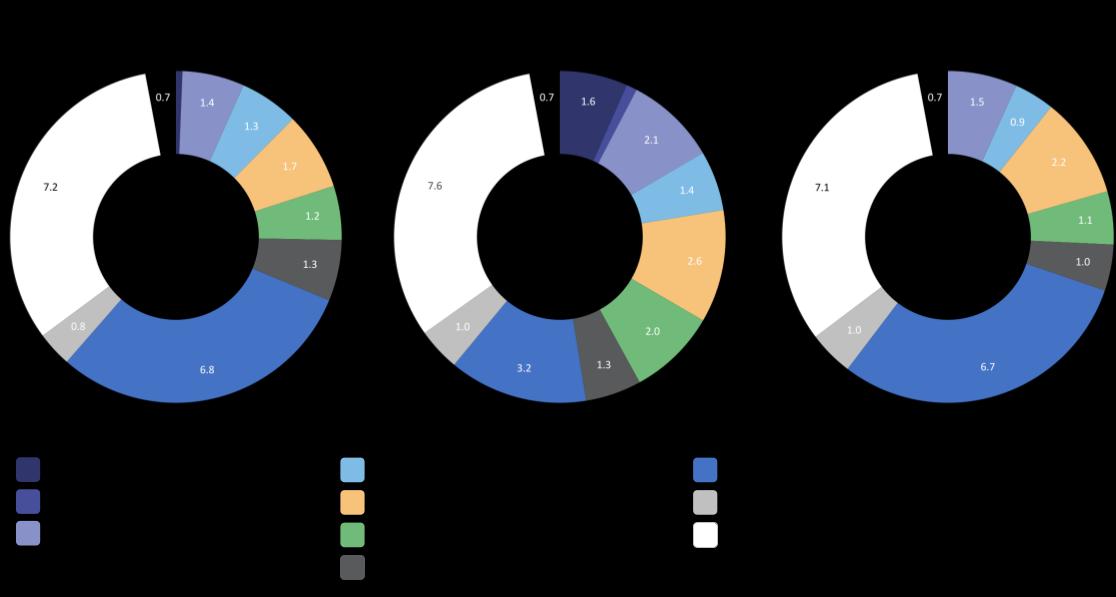
Outlined below are three time use case studies based on Islanders on high, medium and low income, based on our survey results. Only respondents who are full time employed have been considered. The distribution of time is an average for any 24-hour day in a 7-day week. This includes the weekend. The wellbeing score is the mean score derived from the four self-reported measures, namely happiness, worthwhileness, life satisfaction and anxiety. Our findings suggest that higher income Islanders have the highest wellbeing, with low- income Islanders having the lowest. The most notable difference in time use is in hours engaged in sport.
a. High income earners showed the highest score for wellbeing, considering that wellbeing is the overall score of happiness, life satisfaction, worthwhileness, and anxiety.
b. Middle income earners showed the middle score for wellbeing, considering that wellbeing is the overall score of happiness, life satisfaction, worthwhileness, and anxiety.
c. Low-income earners showed the lowest score for wellbeing, considering that wellbeing is the overall score of happiness, life satisfaction, worthwhileness, and anxiety. This sample of respondents spend the highest amount of time on activities relating to personal care such as health and hygiene, but they sleep the least number of hours.
Box 7:
Case study: Time use data by level of anxiety
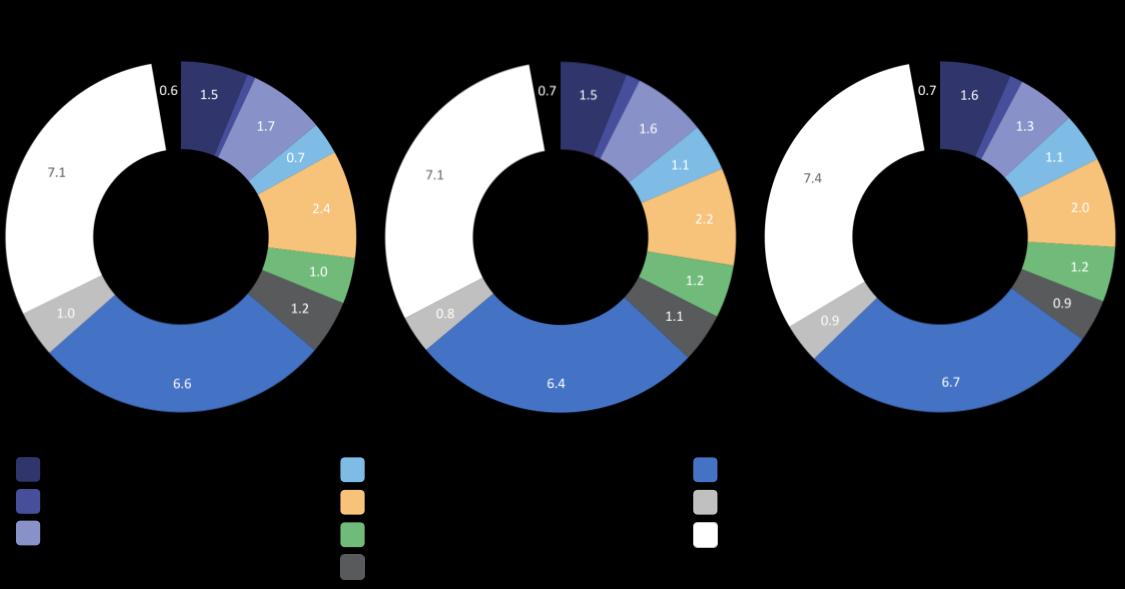
Outlined below are three time use case studies based on Islanders with selfreported high, medium, and low levels of anxiety. Only respondents who are full time employed have been considered. The distribution of time is an average for any 24-hour day in a 7-day week. This includes the weekend. The wellbeing score is the mean score derived from the three self-reported measures, namely happiness, worthwhileness, and life satisfaction. Our findings suggest that respondents with high levels of anxiety have the lowest wellbeing score, with respondents with low levels of anxiety having the highest wellbeing score.
d. Islanders that confirmed high levels of anxiety showed the lowest score for wellbeing, considering that wellbeing is the overall score of happiness, life satisfaction and worthwhileness of life.
e. Islanders that confirmed medium levels of anxiety showed the middle score for wellbeing, considering that wellbeing is the overall score of happiness, life satisfaction and worthwhileness of life.
f. Islanders that confirmed low levels of anxiety showed the highest score for wellbeing, considering that wellbeing is the overall score of happiness, life satisfaction and worthwhileness of life.
