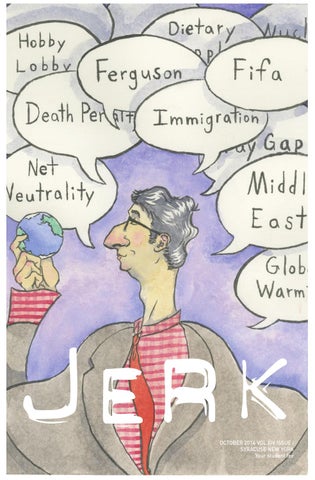
OCTOBER 2014 VOL XIV ISSUE I SYRACUSE NEW YORK Your student fee
CONTENTS OCTOBER 2014 HEALTHY COMPETITION? 16 FAT CHANCE.
The dangerous combination of ideal body image, social media, and fitness tracking devices makes it easier than ever to quantify health and compete with other fitness freaks.
5 6 7 10
FROM THE EDITOR FEEDBACK PEEPS CLICKBATE
TOO CLOSE TO HOME 23 Michael Brown's death sparks conversation in Syracuse about local injustices. Frustrated residents and students open up about police brutality and experiencing racism and question why we aren't living in a post–racial America.
MOD SQUAD 34 This season, designers like Saint Laurent and Louis Vuitton showed pieces that challenged the prim and preppy looks of the 70s with a fresh take on youthful boldness. We're throwing on our platforms and celebrating the attitude of Generation Now.
2 10.14
•
JERK
Cover Designed by Maia Henderson Illustrated by Ryan Brondolo
8
JERK THIS What you should hit up and bitch about this month.
9
BACKDROP Climate Change Garden
11
TOTALLY UNSCIENTIFIC POLL Leif Erikson Day
12
SEX Ticket to Ride
13
FRAMED Crazy Eights
19
20
21
BITCH OPINIONS 14
18
ARRESTING DEVELOPMENTS Bystanders take their raw footage of police officers’ abuse of power to the Internet, calling for action. COMP(ART) MENTALIZED Learning to separate troubled artists’ actions from their work is a feat in its own right.
EAT, SLAY, LOVE Save the whales! But don't forget about the chickens. NOT MY BOSS’S BUSINESS The consequences of the Hobby Lobby decision and what we should do about it. GRIN AND BARE IT We strip down the complicated issue of ass-naked programming.
NOISE ARTS & MUSIC 44
THIS JUST IN The late–night host who's setting the new standard.
48
MORNING HAZE How to beat that horrible hangover.
54
REWIND Monty Python
55
ALTRUIST YouTubers
56
AMPLIFIED Riley Mahan
57
SYNAPSE Left Undead
58
DISCOVERSYR
SMUT FEATURES 26
A LEAGUE OF THEIR OWN The teams working to turn robots vs. human tournaments into a reality by 2050.
Boxcar Press
60
SPEAKEASY Robert Wysocki
30
JUST BEE-LIEVE The operation that's strengthening the population one queen at a time.
61
Rest in sweets, Cupcake.
62
STRIPPED A normcore shoe for everyone.
CLOSET CASE Socks—they do more than keep your feet warm.
GAWK FASHION 42
OBITCHUARY
63
FORM AND FUNCTION Apple Picking
JERK
•
10.14 3
Michelle van Dalen EDITOR
Kelley Rowland MANAGING EDITOR
Maia Henderson CREATIVE DIRECTOR
EDITORIAL
Heather Rounds ASST. FEATURES EDITOR Susanna Heller ARTS AND MUSIC EDITOR Collin Gordinier OPINIONS EDITOR Eric King ASST. OPINIONS EDITOR Erin G. Kelly STYLE EDITOR Leigh Miller ASST. STYLE EDITOR Lauren Yobs F.O.B. EDITOR Ryan Harper RESEARCH EDITOR Rebecca Shafer COPY EDITOR Gigi Antonelle COPY EDITOR Kimberlee Bochek FACT CHECKER Michaela Quigley FACT CHECKER Rachel Lockhart FRESHMAN INTERN Chazz Inniss FRESHMAN INTERN Jacob Gedetsis FEATURES EDITOR
WEB
Laura Cohen WEB EDITOR Cori Rosen ASST. WEB EDITOR Haley Schluter ASST. WEB EDITOR Vanessa Salman WEB DESIGNER Megan Bednarczyk
DESIGN
Abby Legge Hannah O'Connell, Kristie Cordon, Kitty Caissy, Adam Jameson, Max Redinger DESIGN DIRECTOR DESIGNERS
ART
Adrian Hatch Katrina Ragland STAFF PHOTOGRAPHER Allen Chiu, Kelli Mosher, Sam Maller ILLUSTRATORS Ryan Brondolo, Dylan Cownie, Christina Mastrull, Hannah Moore ILLUSTRATION DIRECTOR
PHOTOGRAPHY DIRECTOR
PUBLIC RELATIONS
Kaitlynn Cooney Carrie Eager, Kelsey Chipman, Hanna Bird, Dean Carney PR DESIGNER Elizabeth Ching COMMUNICATIONS DIRECTOR PR REPRESENTATIVES
DIGITAL DIRECTOR
BUSINESS
Maria Ingaglio Anna Goodell AD REPRESENTATIVE Marisa Stark AD REPRESENTATIVE Sara Spelfogel PUBLISHER
AD DIRECTOR
MULTIMEDIA
Jacob Pirogovsky ASST. MULTIMEDIA EDITOR Steven Sphor ASST. MULTIMEDIA EDITOR John Pflieger SOCIAL EDITOR Jensen Cannon SOCIAL EDITOR Aidan Meyer MULTIMEDIA EDITOR
CONTRIBUTORS
Rahima Nasa, Linda Gorman, Chris Unkenholz, Kait Hobson, Julia Naftulin, Tess Kornfeld, Elisha Hahm, Paige Carlotti, Sarah Schuster, Gabriela Riccardi, Meg Zukin, Becca Greenblatt, Hugh Ferguson, Nora Horvath, Kelsey Burke, Anael Colunga, Drew McClain, Julie Sabo, Nina Bracey, Lung Ung, Rina MatsunoKankhetr, Bobby Davison
Melissa Chessher ADVISER
Through its content, Jerk is dedicated to enhancing insight through communication by providing an informal platform for the freedom of expression. The writing contained within this publication expresses the opinions of the individual writers. The ideas presented in this publication do not necessarily reflect the opinions of the Jerk Editorial Board. Furthermore, Jerk will not be held responsible for the individual opinions expressed within. Submissions, suggestions, and opinions are welcomed and may be printed without contacting the writer. Jerk reserves the right to edit or refuse submissions at the discretion of its editors. Jerk Magazine is published monthly during the Syracuse University academic year. All contents of the publication are copyright 2014 by their respective creators. No content may be reproduced without the expressed written consent of the Jerk Editorial Board.
4 10.14
•
JERK
LETTER FROM THE EDITOR
HOUSE OF CARDS Throwback to the year 2000: I crafted my mom a letter on a piece of computer paper in my impressive 6-year-old cursive. Naturally, the text overlaid the shell of a turtle, who apparently “stil [sic] has to learn to swim,” which explains the shamefully thin, hovering stream of water running across the page. Look through the box on the floor of the laundry room closet at my home in Florida, and you’ll find more of the same: handwritten notes to my mom telling her that “I hope you are going to have a nice sleep 2night” and “U R 2 sweet 2 B 4gotten”— both creepy—and thanking her for everything, “expecialy [sic] the fountain pen you bought me today.” It’s the little things. Fourteen years later I still write people cards, though more often store-bought than homemade. I slip the cards in envelopes, seal them shut, slap stamps on them, and send them on their way. No feeling matches that of opening your mailbox and holding a manifestation of someone’s time, care, and thoughtfulness in your hands. In this issue, we give you an inside look into Boxcar Press (page 58), where people and machines create both paper and non-paper products alike that give the term “handmade” a whole new meaning. As you mature and your style changes, your letters might lack the handdrawn dinosaurs and glitter-glue edges of your youth—but the power of written communication remains intact. This year, I try my hand at writing a whole new kind of letter: one to all of you. Keep on Jerking,
JERK
•
10.14 5
FEEDBACK We missed us too! Thanks for taking a break from your internships you won’t shut up about to send us a little summertime love, hate, and nostalgic longings. Keep up the midterm procrastination and check out our newly redesigned website, jerkmagazine.net. Ra Ra Riot (Instagram) @rarariot (Instagram) #tbt dec 2006 when we were in @jerkmagazine #syracuse @mathieusantos @miloalexander @tennismanswharf
SHOW US SOME LOVE Jerk Magazine 126 Schine Student Center Syracuse, NY 13244 @jerkmagazine jerk@jerkmagazine.net jerkmagazine.net
Chrissy Ost (Facebook), in response to our Mayfest video you guys didn’t show castle or euclid. so this is like a third of mayfest. although euclid was pretty disappointing this year. @KatieWalpole (Twitter)
I miss Mayfest... “@jerkmagazine: Mayfast, die young cuse students do it well. bit.ly/RNkX1L @GirlCodeMvment, (Twitter) Thank you so much @jerkmagazine for this honor-we are proud to be called #LadyCrusadersOfTheYear!
FOLLOW, DON’T LEAD
6 10.14
•
JERK
facebook.com/jerkmagazine
@jerkmagazine
instagram.com/jerkmagazine
vimeo.com/jerkmagazine
Jerk contributors MEG ZUKIN / SOPHOMORE / "Eat, Slay, Love" Like all the other times I’ve worked with Jerk, I had some minor deadline issues. Procrastination is in my blood. I channeled my Californian roots by doing a “liberal fruitcake-y” piece on animal rights but definitely still think that PETA is on one.
HUGH FERGUSON / GRAD / "This Just In" Before I started working for Jerk, I was at my regular two cups of coffee a day. Now that I've finished a feature article, I'm up to four cups a day. Since I'm joining staff as Noise Editor, I guess coffee is just going to become my primary source of energy.
LINDA GORMAN / SENIOR / "A League of Their Own" While researching this story, I managed to get myself lost in three different cities on two continents. I've developed a newfound appreciation for the kindness of strangers. Many thanks to the good-natured grad students who helped me get where I was going. In all sincerity, you guys rock.
DREW MCCLAIN / JUNIOR / model, "Mod Squad" I had a great shooting experience with Jerk compared to past modeling gigs I’ve done. Leigh, the fashion editor, and I really saw eye to eye on the concept and I felt like I was really able to express myself both artistically and as an individual. Amazing things to come.
JERK
•
10.14 7
JERK THIS
FRIGHTMARE FARMS Every weekend in October The only event this month scarier than midterms.
LAST REGIONAL CENTRAL NEW YORK MARKET Oct. 14 You can finally put your money where your Buy Local bumper sticker is.
COCKAPELLA AT HENDRICKS CHAPEL
FREE SPEECH WEEK Oct. 20—26 Zip it: Swearing at the professor will only seem like a good idea this week.
AMY POEHLER'S YES, PLEASE Oct. 28 A title that matches our reactions.
•
JERK
Oct. 3 Directly related to an increase in local gluten allergies and Birkenstock purchases.
JANE THE VIRGIN
HIT BITCH
Oct. 18 Testee, testee, 1, 2, 3.
8 10.14
TRADER JOE'S OPENING
Oct. 7 The CW is only good for re-runs of Whose Line.
AARON CARTER AT THE WESTCOTT THEATER Oct. 26 Riding Nick's coattails for 17 years too many.
BLACK TUESDAY Oct. 29 The crash responsible for decades of board gameinduced family tension.
HALL–"OH SHIT PARENTS ARE COMING"–WEEKEND Oct. 30 From the schedulers that brought you student tours during Mayfest.
Climate Change Garden Oaks, pines, maples, firs, and hemlocks line the front lawn of the Life Sciences Complex. The arrangement, better known as the Climate Change Garden, is more than aesthetic landscaping—it’s the site of a biology experiment that monitors climate change in Central New York. Biology professors Doug Frank and Jason Fridley spearheaded the garden, which was completed last fall. The two took advantage of the Life Sciences landscaping delay and created a space to test a variety of trees’ reactions to Syracuse's eastern climate. SUNY-ESF professor Donald Leopold helped them decide which types of trees they should plant. “Essentially, we’re trying to imagine a Central New York that in the future may be represented by plants that are adapted to warmer or dryer places,” Fridley says. “These plants could even evolve outside of the United States but eventually take over here.” The Climate Change Garden consists of three blocks and more than 30 different types of trees. The trees in the garden originate from places around the globe with different climates: dry, warm, or cold. Some species even hail from Europe and Asia.
BACKDROP BACKDROP
Syracuse University faculty members investigate which plants survive best garden of its kind in the country. By Julia Naftulin
Photo by Kelli Mosher
So far, data has been collected on tree size and leaf chlorophyll content. The majority of data—including the trees' water usage, root growth patterns, and food production—will be collected after the winter, since the trees will remain dormant during those months. Fridley predicts that the southern tree species will lag behind the northern species as they grow. Next fall semester, students can take the first lab-based biology course centered around the garden. Fridley says students enrolled in the class will collect data about the effects of climate on the different species planted in the garden. The professors raised almost $18,000 for the research project through the crowdsourcing program ’CuseFunder, granting biology students access to highend equipment like growth tracking devices, webcams, and probes that measure the trees’ pulses. “I think the garden is a great example of a Syracuse University-ESF collaboration," Leopold says. “Plus, it’s an opportunity to bring students outside for lessons and make research connections.” JM
JERK
•
10.14 9
CLICKBATE CLICKBATE CLICKBATE
X
What We're Getting Off To On The Web This Month
JERKMAGAZINE.NET
Just when you think you've seen it all, we throw you for a loop. Head over to jerkmagazine.net to check out our newly designed website.
#SaveCuse
10 Things October is Good for in 'Cuse
Campus administration's beloved investigative journalists, I'm Schmacked—responsible for the riveting #SaveCuse testimonial—serve as an inspiration for our video response to the dire situation. Head over to our website to see Jerk's take on our poor, fallen university.
Juice Jam has come and gone, midterms are approaching, and the only warm, carefree month of the school year has passed. But don’t hibernate during the upcoming months. We've got you covered online with reasons why October doesn't have to suck.
WHILE YOU'RE CLICKING AROUND...
Casey Neistat
NYT Minus Context 1
The Internet crown belongs to filmmaker and person whose life you wished you had, Casey Neistat. He instantly sets the precedent for quality content on every new social media platform he joins. Prepare to sit on your couch all day: You’ll vicariously live through this deli dishwasher turned Snapchat journalist, Instagram badass, and YouTube hit from here on out.
The Twitter equivalent of walking around the corner and stumbling into the middle of a conversation. You would do a double take if you just heard, “Aspirations: marijuana and vaginas.” This profile takes The New York Times articles from 1 throughout the day and turns them into awkward online run-ins that leave you wondering why “I’ve only recently become a baller."
casey.nyc
10 10.14
•
JERK
twitter.com/nytminuscontext
TOTALLYUNSCIENTIFIC UNSCIENTIFICPOLL POLL TOTALLY
HINGA DINGA DURGIN! Happy Leif Erikson Day! Students at Bird Library took a break from feeling bitter about having school on Columbus Day to answer some questions about the lesser–known white guy who stumbled upon America.
DO YOU KNOW WHAT LEIF ERIKSON DAY IS? a) Yes. (20%) b) No. (20%) c) Who? (60%)
20%
60%
20%
YOU’VE DISCOVERED A NEW LAND: NOW WHAT? a) Become mayor on Foursquare/Swarm. (12%) b) Name shit after yourself. (20%) c) Respect—and not exploit—the indigenous people. (30%) d) Turn around. (38%)
38%
14%
22%
22%
42%
WHERE IS ERIKSON FROM? a) Minnesota—Even this Viking wouldn’t be able to help them win a Super Bowl. (14%) b) Iceland—Bringing you incomprehensible Of Monsters and Men lyrics since 2010. (22%) c) Bikini Bottom—Let’s be honest, Spongebob is the only reason you know who Leif Erikson is. (42%) d) Scotland—The gingers traded in their souls for a great sense of direction. (22%) (correct answer B)
72% WHAT IS LEIF ERIKSON FAMOUS FOR? a) Being the first ever ESF student. Graduated magna cum landscape architecture. (72%) b) Being a heavy metal drummer. “Hey guys, you should really check our new SoundCloud.” (8%) c) Being an extra on HIMYM. Marshall’s long-lost cousin. (8%) d) Being that other guy who isn’t Christopher Columbus. (12%)
8% 8%
JERK
•
12%
10.14 10.14 11
SEX
ticket to ride FRIDAY NIGHT LIGHTS
ROUGH RIDER
TRUCKED
CAPE COITUS
GOWN AND DIRTY
12 10.14
•
JERK
Our readers took a drive down memory lane in the shaggin’ wagon while channeling their inner horny teenage selves to tell us about their craziest car sex. At the tender age of 16, I drove to a lookout with a boy after our high school football game. We hopped in the backseat and I proceeded to give him a handjob. Since I had just gotten my license, I didn’t realize that I left my headlights on. My car's battery died during the steamy foreplay and my parents had to come to the rescue.
I ran into my high school crush at a bar back home. He asked me if I wanted to go to our friend’s car—not even his own—where we proceeded to make my wildest dreams come true. Later we realized we were parked on the most popular street in my town. I woke up the next day with a bump on my head and bruises to my body and ego. The sex was worth it.
After a half day at school, my hookup and I drove to what we thought was a deserted parking lot. Just as things were heating up, a loud metal clinking sound interrupted us. I stuck my head out the door to investigate, only to see a tow truck preparing to take my car for being parked in a permitonly lot, with no pass. Thank God for tinted windows.
I was doing the dirty in the Impala parked outside of my family's rental house on the Cape. My head ended up hitting the horn mid–fuck. It woke up half the house.
Last semester when my date offered to drive me home I was touched by his generosity. I decided road head would make a fitting reward. We got pulled over and he was arrested for driving while drunk. It was the night before his graduation—hopefully he made the ceremony.
BITCH FRAMED
Crazy Eights Anael Colunga senior, sculpting major "I decided to make this octopus while watching Planet Earth with some friends. We realized that the octopus is a very intriguing animal, so I wanted to make it into a functional sculpture. I originally made the sculpture out of wax and coated it in a ceramic shell to make a mold of it. Then I melted the wax out of the shell and poured in liquid metal. Once it dried, it took the form of this 42-pound coffee table octopus."
To showcase your work on "Framed," email art@jerkmagazine.net. JERK
•
10.14 13
BITCH
S T N E M P O L E V E D G IN
ARREST
Thanks to the large scope of social media, viral videos help keep authority figures in check. By Elisha Hahm
Eric Garner gasps for air as a New York Police Department officer locks the 400-pound asthmatic man in a chokehold—a practice banned by the NYPD in 1993. He eventually tumbles to the concrete sidewalk as fellow officers pile on top of him, ignoring his cries: “I can’t breathe.” Witnesses say Garner was breaking up a fight when he caught police officers’ attention on the day of his death. But the 43-year-old Staten Island resident had been on the police department's radar for quite some time. The New York Times reported that Garner had been arrested more than 30 times for selling single, untaxed cigarettes and pocketing the money. Police officers were sent to investigate the matter after receiving complaints about the sale of loose cigarettes, with one complaint that specifically identified “a man named Eric.” Despite his criminal history, helpless bystanders who watched the father of six succumb to unconsciousness say that Garner simply wanted to know why he was being harassed—and eventually paid for 14 10.14
•
JERK
Illustrations by Adrian Hatch
that question with his life. Ramsey Orta, the man who shot the video that later went viral on YouTube, and another witness say that the police attacked Garner without probable cause. “They jumped him and they were choking him. He was foaming at the mouth,” Orta told The NY Daily News. “And that’s it, he was done.The cops were saying, ‘No, he’s OK, he’s OK.’ He wasn’t OK.” So how does the suspicion of selling untaxed cigarettes suddenly escalate into a full-blown death sentence? Police departments and politicians claim that these are isolated events and that police violence is not the norm. But we know that people are more outraged than ever with local law enforcement. The National Police Misconduct Statistics and Reporting Project recorded that 1,575 officers were involved in reported excessive force complaints in 2012. More than half of these were involved with cases of physical uses of force, including complaints such as fist strikes, throws, chokeholds, and baton strikes.
BITCH
Bystanders film, publicize, and spread evidence of police brutality incidents across social media platforms like wildfire. Passersby touting smartphones can become videographers and film police officers with a tap of a finger, making them whistleblowers in their own right. Social media is the new gatekeeper of breaking news, with Facebook leading the way as the top news source. Almost two-thirds of U.S. adults use the site, and half of those users get news there—amounting to 30 percent of the general online population. From funny and cute to completely unjust and horrifying, the content shared through social media has no filter. The story of Garner, an unarmed black man who died after a scuffle with the local police, may sound pretty familiar to people by now. What made this particular incident so outstanding was the viral spread of videos documenting what really went down. In July, 51-year-old Marlene Pinnock was walking on the side of the highway near Los Angeles when a California Highway Patrol Officer pulled over and ordered her to stop. When she refused to comply, the officer pinned Marlene to the ground and punched her 15 times in the head. One man pulled over to record the incident with his smartphone. Social media news outlets quickly picked it up. The officer is now on forced administrative time off and might be charged with a felony. None of that was guaranteed to happen had someone not taped the incident and shared it. Police in the L.A. area have one of the worst records concerning instances like this. In 1991, Police beat L.A. man Rodney King nearly to death after a high-speed car chase. Footage of this horrific incident mixed with the acquittal of the officers in question sparked outrage in the minority race communities of L.A., starting the 1992 Los Angeles Riots. Fifty-three died, more than 11,000 were arrested. Another more recent and widely publicized case of police brutality was the death of Michael Brown. On Aug. 9 Darren Wilson
shot the unarmed black teenager on a street in Ferguson, Mo. The aftermath of his death sparked outrage from protestors and an onslaught of FBI and grand jury investigations. The teenager was surrendering. The coroner confirmed that, at the time of his death, his hands were in the air to show he was unarmed. But still, Ferguson authorities claim that Brown had attacked the officer in his car and tried to take his gun. Since Brown’s death, several eyewitnesses have come forward to describe what they saw take place. They went as far as recording eyewitness interviews and protests on smartphones shortly after the shooting and posting them on Twitter. One user, @TheePharoah, even live-tweeted the killing, writing “I just saw someone die OMFG.” But not all instances of police brutality come with witness accounts and national news coverage. These cases are not isolated occurrences. They expose incidents that occur every day in our society, usually with no witnesses to record it. The videos people share on Facebook, YouTube, and Twitter give a voice to those without power and demand accountability from those abusing their power. Social media enables people to strive for change. In fact, the city of Chicago is implementing a new policy that will make public any completed investigation of police misconduct instead of the incidents being treated as personnel matters. Although this policy has yet to turn national, it brings hope that there will be transparency within police departments, which currently have a reputation for keeping a strict code of silence. Social media has transformed into a powerful tool of public awareness and although it can’t stop police brutality on its own, it certainly helps keep the police force in check. It also prompts people to care about what’s going on in their world, to hold each other accountable for their actions, and to make the changes necessary to create safe, and just, communities.JM JERK
•
10.14 15
E
YC H T AL
OMPET ITI
CHANC T E FA
ON
?
H
BITCH
The most recent fitness trend is competitive health, but tuning others out and focusing on oneself is the best approach for well-being. By Paige Carlotti At the start of her sudden death round at the Illinois High School Mathletes State Championship, Cady Herron had an epiphany. While staring into her female competitor's dark brown eyes lined with begging-to-be-trimmed brows, she suddenly understood that comparing herself to her competitor wouldn't help her win. If only the real world had taken notes on this iconic scene before it experienced its own pandemonium. The recent wave of new media combined with the obesity epidemic has pitted us against one another, ultimately compromising our mental health. In 2012, eight years after the release of Mean Girls, the Centers for Disease Control and Prevention announced that 35 percent of American adults were obese. To quell this epidemic, Americans turned to what they know best: technology. Some of the tools provided online, however, are easily misused. They were designed for users to challenge their own success, but the reality is, it’s not enough to do your best in today’s competitive culture: you must do better than your neighbor’s best, too. Certain online communities are intended to motivate people to achieve their fitness goals, but with the advent of “thinspiration” blogs and trending hashtags, we blur 16 10.14
•
JERK
the lines between helping and harming. These sites have adverse effects: they fuel a false sense of what “healthy” looks like. At the most extreme level people have even established pro-anorexia and bulimia blogs. “Thin Intentions” is a website that presents a compilation of 58 tips on how to be anorexic, like “Ice or gum are good food substitutes. Celery works too if you’re really hungry.” While avoiding these dark corners of the web sounds like a no-brainer, their harmful nature is less obvious to impressionable users like those who are predisposed to eating disorders. In some cases, these websites can serve as triggers for their unhealthy attitudes and behaviors. When these consumers see images of girls showing off their jutting hip bones and protruding collarbones above captions like “#cleaneating” and “#fitlife,” they are more likely to blame themselves when they realize that they don’t look anything like those stick figures. Despite their ridiculous suggestions, thinspo sites receive approximately 500,000 unique visitors each year. In fact, research conducted at Rowan University in 2011 found that thinspiration and new media reinforce girls' eating disorders. While online communities don't cause the problem directly, they do
BITCH
exacerbate it. Furthermore, a 2010 study concluded that even when people with no predisposition to eating disorders looked at thinspo sites they ate an average of 3,000 calories less than their average intake the following week. Men are guilty of this, too. Many of us have scrolled through our Insta feed and stumbled upon a shirtless mirror pic of some tool flexing his recently lathered biceps, a photo that's often accompanied by an aerial shot of that gag-worthy protein shake he whipped up this morning. Spare me. However, when men striving for that G.I. Joe bod see those pictures, it is only human nature for them to want to push themselves even harder at the gym—even if they don’t need to. A year ago this month the Twitterverse celebrated #FatShamingWeek, a period devoted to posting as many abusive and derogatory 140-character declarations as possible to criticize overweight women and inspire them to drop the pounds. As if we need another reminder that our boobs don’t sit as high as Kate Upton’s or our torsos aren’t toned quite like Beyoncé’s. Now a simple hashtag search will reveal all of our insecurities in a single feed. While watching your figure is nothing to be ashamed of, social media has the power to drive people to turn their New Year’s resolutions into rivalries. Social media encourages comparison and creates toxic environments by flooding our feeds with photos of unrealistic body types and unattainable standards. The “quantified self movement” has its own pitfalls: It perpetuates society’s obsession with the numbers game. These trendy new wearable tech accessories allow people to fixate on numbers that are intended to be a point of reference. Devices like Jawbone UPs and Fitbit trackers monitor everything: steps taken, calories burned,
heart rate, and even sleep quality. And for people already possessed by food, weight, and calories, having access to this data can intensify their focus and lead to unhealthy behaviors. The digits provide convenient data for comparisons. Although not yet formally recognized by the Diagnostic and Statistical Manual of Mental Disorders (DSM), there is actually a name for this. Orthorexia nervosa literally translates to “fixation on righteous eating,” and according to the National Eating Disorder Association is defined as an unhealthy obsession with otherwise healthy eating. Orthorexia appears to be motivated by health, but beneath the surface can lie the compulsion for complete control, the desire to be thin, and the use of food to create identity. Being repeatedly exposed to content that promotes healthy eating can intensify the obsession and bring it to the forefront of one’s brain. Health needs to be holistic. Just because there is a gap between your thighs and you’ve mastered the perfect ratio of kale to avocado for your morning smoothie doesn’t mean you’re taking care of your mind. With obesity and social media's popularity on the rise, it has suddenly become trendy to broadcast how you’re avoiding obesity like the plague. One can only hope that competitive health will exist only as a fleeting trend, just like those Shake Weights and hideous Skechers Shape-ups did. It's only a matter of time before people realize the harmful repercussions of accounts like @youdidnoteatthat, and choose to disregard them completely. The bottom line is, we all need to take a page from Cady Heron’s (burn) book and understand that “calling somebody else fat won’t make you any skinnier.” Looking at pictures of perfectly toned bods and chia seeds won’t motivate you to make a change; it will only drive you nuts. JM JERK
•
10.14 17
BITCH
comp(art)mentalized
Conscious consumers should separate art from artist and recognize talent despite controversial behavior. By Sarah Schuster
Illustration by Hannah Moore
Sexual predators can write heartwarming screenplays. Men who punch women convincingly sing about love. R. Kelly sang about having sex with a 15-year-old and then proceeded to marry her. “Bad” people—the rude, the misogynistic, the criminal—can make popular, awardwinning, and even critically acclaimed art. As those who put the“consumer” in consumerism, this leaves us in a tricky position. Knowing what we know, we have the power to choose. Do we turn down Chris Brown on the radio as a sign of respect to those who have experienced domestic violence? Reject Woody Allen’s body of works to show we don’t stand for sexual abuse? We could, but u n f o r t u n a t e l y, that’s not how art works. In his New York Times opinion piece, Charles McGrath explains that the goodness in art and the goodness in people encompass different aspects of what we consider “good.” McGrath writes, “In the case of the artist, badness or goodness is a moral quality or judgment; in the case of his art, goodness and badness are terms of aesthetic merit, to which morality does not apply.” We should be able to enjoy art created by someone we don't respect. Douglas Druick, curator of European paintings at the Art Institute of Chicago, said of Edgar Degas— known for painting ballerinas and hating 18 10.14
•
JERK
Jews—“I love Degas the artist, but I wouldn’t cross the street to meet Degas the man.” While an artist’s work can stand on its own, it should not be used to defend their actions. When behavior ventures from quirky to illegal or completely despicable, “But they made so many great movies,” just doesn’t fly. In January, Allen won the Lifetime Achievement Award at the Golden Globes. A month later, his adopted daughter, Dylan Farrow, wrote an open letter to The New York Times detailing the sexual abuse she experienced as a child. People used this accusation, along with other questionable aspects of Allen’s personal life, to critique the Hollywood Foreign Press for giving him an award. But, it is not the Foreign Press’s job to judge morality. As members of society, it can be ours. Let’s talk about child abuse. Let’s talk about power in Hollywood. Let’s talk about domestic violence. We read Dickens, but don’t discuss how he essentially banished his wife and created a miserable household for his children. We romanticize T.S. Eliot without acknowledging his anti-Semitism. In 50 years, people will still watch Woody Allen movies. We can’t stop bad people from making things we enjoy, but we can use their notoriety to discuss the relevant issues their actions represent. JM
BITCH
Eat,
Slay,Love
When it comes to animals' lives, no species should be valued more than another. By Meg Zukin
Illustration by Dylan Cownie
Which came first —the chicken or the polar bear? Even though humans have been eating wildlife since the real Paleo days, lately the media has voiced extreme concern over endangered and exotic animals. The documentary Blackfish grabbed the attention of slacktivists worldwide. Texas cheerleader Kendall Jones sparked controversy after posting pictures of herself with animals she hunted while on a safari, including a leopard and a nearly endangered species of lion. Ordinary Holly Housewives turned into PETA personnel overnight. Several celebrities have taken a public stance against animal cruelty. Aaron Paul, star of AMC’s Breaking Bad, tweeted on July 31, “Dear @SeaWorld, You are terrible. Sincerely, Everyone who actually cares about living creatures. Release your slaves.” But the same argument should be made for cattle and chickens living in slaughterhouses. They too are slaves, and often live in horrific conditions before being sent off to packaging plants to be sold at Tops. At the grocery store, unrecognizable slabs of meat are labeled “steak” and “hamburger patties” instead of “cow.” Euphemisms like those exist to justify and mask Western culture's regular slaughter of barnyard animals. It is often assumed that buying and eating something “free-range” or “cage-free” means the chicken lived a happy-go-lucky life and could spread its wings in the Hundred Acre Wood. But oftentimes the fine print states that the chicken was only able to see the sun for an hour a day. Just see the sun. Amber Canavan, a SUNY-ESF student
and president of the Syracuse Animal Rights Organization, thinks that campaigns like the one launched against SeaWorld will actually fortify the future of animal advocacy. “I think it’s a great bridge for people to start thinking compassionately about these charismatic, smart animals in captivity,” Canavan says. “From there, it is an easy leap to accept that other animals such as chickens and pigs deserve freedom as well.” From January to May 2014, 3.7 billion animals were slaughtered for human consumption. By the end of the year that number will probably climb to somewhere around nine billion animals—the annual average since 2001. This in comparison to the six endangered Saimaa ringed seals killed this year, seems outrageous. The discrepancy is sickening. Valuing the lives of a certain species over others' highlights our desensitization toward the animals we eat. The phrase “animal rights” triggers humans to think of lions, tigers, and bears, oh my! Not the chicken parm they had for dinner yesterday. And that’s not right. JM JERK
•
10.14 19
BITCH
Not My Boss’s Business Supreme Court Justice Ruth Bader Ginsburg called the Hobby Lobby ruling a minefield. We totally agree.
By Laura Cohen Illustration by Dylan Cownie
This summer, five men decided how important it is for women to have access to birth control. Not one of these men has a uterus. They don’t understand the scary possibility of getting pregnant if they’re not physically, mentally, or fiscally prepared for it. Yet in Burwell v. Hobby Lobby, these members of the Supreme Court gave loosely held for-profit businesses the right to deny employees legally mandated coverage for contraception because of their CEOs’ personal objections. This puts women at risk for serious health complications. According to a statement released by Planned Parenthood after the decision, 99 percent of sexually active women have used birth control in their lives. Using oral contraceptives for five or more years can reduce a woman's risk of developing ovarian cancer by 50 percent—a disease that affects 1 in 71 women. Betty DeFazio, director of Community Affairs and Public Policy at Planned Parenthood's Central and Western New York branch, says that women across the United 20 10.14
•
JERK
States are appalled by the decision. “Birth control is prevention,” DeFazio says. “It’s an economically smart investment for health care.” Every dollar spent on family planning services saves approximately four dollars on other Medicaid expenses, such as those related to pregnancy. The Affordable Care Act saved women across the country $483 million in birth control prescription costs in its first year. DeFazio says that the Hobby Lobby verdict takes away decision-making power from the individual. The ruling instead hands this right to bosses, who should not be entitled to discriminate against their employees. Even President Barack Obama’s Twitter account threw shade at the court’s majority with “Throwback to last week when a woman—not her boss—made her own decisions about her health care. #TBT.” The solution is simple: Members of Congress must come together and pass legislation that stands with women and their right to affordable health care. Various pieces of legislation nicknamed “Boss Bills” aim to undo the Hobby Lobby decision and require employers to share information about their insurance plans. Without further action, the consequences from the ruling will spiral out of control—some elected officials are even working to repeal the entire birth control mandate of the ACA that currently benefits 30 million women. Women’s health issues are too often pushed to the side, but we can’t just let that continue to happen—especially not when the force behind it consists of the kind of people who believe in things like “abortion pills.” Take a seat, Green family. JM
BITCH
GRIN & BARE IT The overabundance of nudity on reality television and our use of the Full Monty as entertainment shows that Americans can't separate the naked from the erotic. By Gabriela Riccardi Illustration by Hannah Moore Reality television: It’s unscripted, unfiltered, and now totally undressed. A simple scroll through today’s TV guide reveals a new surge in bared-down broadcast with titles like Naked and Afraid, Dating Naked, and Buying Naked. Simply put, we’re straddling the center of a flesh phenomenon. “Whenever any new technology comes out, the first thing that people figure out how to do is show naked people,” says Professor Bob Thompson, director of the Bleier Center for Television and Popular Culture. “What’s amazing to me is how long it’s taken for reality TV to discover this basic appeal.” And boy has it discovered. With a new surge of television that lets it all hang out, we may think that America is moving toward the nude nonchalance of other contemporary Western cultures. We probably won’t ever find flagrante channels nestled between the early evening news as in many European countries, but maybe a wave of change is coming. Perhaps we're even heading into an era of new body acceptance—one where no figure needs to be shamed or covered— except by Federal Communications Commission-sanctioned censoring. Programs like this that tout going back to basics are promising. On Naked and Afraid, the Discovery Channel smash that set off our out-in-the-open reality trend, contestants make their way through the wild without the shirts on their backs, and the quest for survival definitely outweighs matters of self-
conscious modesty. TLC’s new Buying Naked follows real estate in the buff, blasé nudist communities. But one glance at the taut, tight frames that contestants sport on reality show sensation Dating Naked, arguably the biggest player in this game, is enough to dash our hopes for disrobed enlightenment. Because these shows are grounded in trotted-out reality tropes—competitive dating, being deposited into the woods to survive—it’s the nudity that injects them with erotic excitement. The only conclusion is that American culture still fetishizes bodies, especially naked ones. We’re tuning in to be turned on. But there’s a reason that naked reality television and its hot, fit stars won’t last as lowbrow audience arousal, either: it’s uncomfortable. The stars fidget on camera. They avert offending eyes. There’s even the occasional accidental boner. The viewer drawn in by provocative pixilaton can only endure so many cringes before flipping to the next channel. Since this new brand of reality TV delivers neither a convincing casualness with the unclothed body nor total titillation, its appeal remains. As with every new reality iteration about dating, real estate, or survival of the fittest, viewers will soon lose interest and a new unscripted gimmick will have to be found. But this time, show producers may find that they’ve stripped their options down to nothing. JM JERK
•
10.14 21
SMUT
22 10.14
•
JERK
SMUT
Too Close
To Home
The recent events in Ferguson draw parallels to the Syracuse area. Members of the Syracuse University community travel to Ferguson and give their input on the country's racial divide. By Rahima Nasa
At 12:01 p.m. on Aug. 9, Officer Darren Wilson fired six bullets into unarmed 18-year-old Michael Brown. Brown died shortly after, and black Americans across the country received another harsh reminder of the glaring reality they face on a daily basis. Men including Trayvon Martin, Sean Bell, and Eric Garner add to the list of those who have been robbed of their lives because of institutional racism and police officers’ abuse of power. For residents of Ferguson, Mo., as well as many others across the country, Brown’s death was the last straw. His murder sparked widespread protests through the city and across the nation by those who experience and witness similar injustices in their own communities. Police force and racial profiling are not distinctive of Ferguson, but instead they reflect trends evident in a number of American cities—even in Syracuse. “It was a pretty powerful experience to be on the ground where Mike Brown lost his life,” says Sherri Williams, a Ph.D. candidate for mass communications, shortly after the 14-hour drive home from Ferguson. “It was very revealing to see that lost life in a very enclosed and populated neighborhood. Those bullets could have hit anyone.” Williams traveled to Ferguson with five other Syracuse University students as part of the Black Lives Matter Ride. Black Lives Matter is a national advocacy campaign geared toward improving justice within the JERK
•
10.14 23
SMUT African American community. Many people from the Tri-State area organized for buses to drive to Ferguson so people could march in solidarity with the city’s residents and other supporters of the cause. When Williams noticed nobody from the Central New York area planned to attend, she decided to arrange the trip herself. “I wanted to go to Ferguson because while I was watching the news, I continued to be reminded of how people of color, how working class people, how non-white people have continued to be brutalized and ostracized in the U.S.,” Williams says. As a resident of Syracuse, Williams has seen this injustice before. In 2009, the Onondaga County Justice Center admitted Chuniece Patterson, a 21-year-old African American woman who was three months pregnant. On her second evening in jail, Patterson complained to the jail staff about severe abdominal pain—complaints that the jail staff ignored. When Patterson was found unconscious in her cell, she was taken to University Hospital. She and her unborn child died shortly thereafter. Doctors discovered that she had suffered an ectopic pregnancy. According to a University Hospital doctor, an ultrasound would have detected the problem and an operation could have saved her life. Onondaga County later admitted negligence regarding her death and agreed to pay $385,000 to Patterson’s mother. A similar incident also occurred in the county jail 13 years earlier with the death of Lucinda Batts. “Police brutality is a problem across the country,” Williams says. “Whenever it comes to people being policed by the authority and when people are in custody by the authority, the power and imbalance is out of the hands of the citizens.” This summer, Alonzo Grant, a Syracuse resident, called the police to break up a dispute near his home between his daughter and another woman. By the time the police arrived, Grant’s daughter had already left. Although Grant told the officers that the dispute had 24 10.14
•
JERK
ended, one of the officers flung Grant over the railing of his stairs and put him in a chokehold while another officer punched him multiple times. The police accused Grant of resisting arrest. Grant sustained a concussion, a broken nose, and a cut lip. He spent a night in the county jail for disorderly conduct, resisting arrest, and harassing police officers. Grant had no criminal record prior to his arrest. “Black life and black men are traditionally associated with criminal activity. That kind of framing and shifting of the narrative is done often to remove focus from statesanctioned violence on people of color,” Williams says. Following Brown’s death, news outlets published articles highlighting Brown’s alleged criminal record in an attempt to justify the actions committed by Officer Wilson. The most notable includes The New York Times’s article published the day of Brown’s funeral. John Eligon’s article claims that Brown “was no angel.” The article sparked a social media campaign, marked by the hashtag #IfTheyGunnedMeDown, in which black Americans posted two pictures alongside each other: one that portrays them negatively and the other positively. Captions asked which photo media outlets would use in a case where police had gunned them down. “If Mike Brown did have any criminal record in the past, it didn’t have anything to do with what happened on Aug. 9—as if to say that this person’s life is less valuable in order to take away from the issues surrounding his death,” Williams says. “What has been done in this country is take the focus off of state-sanctioned violence against people of color, and shroud the victim in stereotypes and negativity to detract from that person and their humanity and their life.” Conservatives in the media argue that instead of focusing on this instance of white-officer-killing-a-black-man, more focus should be put on black-on-black
SMUT violence. Nikeeta Slade, a graduate student at SU who visited Ferguson with Williams, is frustrated with hearing this reductive rhetoric. “This thing called black-on-black violence and police brutality are two different sides of the same coin,” Slade says. “The same forces often times give rise to the conditions that black-on-black violence occurs in.” Slade says Ferguson and Syracuse both lack economic investment in communities of color. Slade observes that heavy policing and camera surveillance are more common in predominantly black neighborhoods than their counterparts. Authorities survey Syracuse’s South Side more heavily than the upper-middle-class white neighborhoods like Fayetteville and Dewitt. This type of system reinforces racial stereotypes of people of color and does not attack the root of the problem, Slade explains. “Cities and governments aren’t investing in school and decent paying jobs. This is what causes communities to deteriorate and this is where violence stems from,” Slade says. The issue of perpetuating negative stereotypes of black men is evident in the email alerts students receive from the Department of Public Safety. Often times, these emails offer a vague description of suspects. These descriptions rarely move beyond skin color, height, and type of clothing. The vague nature of these descriptions, sent out to all SU students, perpetuates an idea that equates blackness with criminality. “That’s exactly what led to Mike Brown getting shot: the idea that black people basically don’t have the right to exist in their community or society at large,” Slade adds.These same injustices exist in schools, which hinders the possibility of a positive educational environment for black students. On the first day of classes, more than 50 students gathered on the steps of Hendricks Chapel in solidarity with Brown. During the event, students discussed the urgency to focus on local instances of
police brutality instead of waiting for an incident to make it onto national news. Marcelle Haddix, director of English Education Programs at SU’s School of Education, attended the silent march. Haddix has experienced more instances of racism here than in any other city she has lived in. In a particularly disturbing case, one of her son’s classmates refused to play with him because he is black. Another marker of Syracuse’s racial divide lies in the SU campus’s isolation from the city. Haddix recalls that she felt very welcomed on the campuses of the local colleges that she grew up next to, but notes that the seamless border-crossing of those communities doesn’t exist on our campus. “Syracuse University is on the border of the South Side and East Side and young people feel like they can’t move beyond the spaces that have been carved out for them,” Haddix says. “A school space is supposed to be an inviting, safe space where you can learn and not be criminalized.” The lack of quality schools and educational resources has plagued lowincome communities of color for decades. Many of these schools are reallocating a significant amount of resources that should be spent on creating a more inviting learning environment for students. “Choosing to criminalize and see these students as unworthy of investing in has led many young people to internalize the idea that they are not worth it,” Haddix says. She suggests that to target this greater national issue of violence and police injustice, a stronger focus needs to be put on the roots of what causes these injustices to happen. Haddix stresses the importance of complete and total support from everyone in face of these injustices. “Regardless of your background, we must realize this affects all of us,” Haddix says. "It is important for everyone to take on these issues and take them on as a collective, as a whole of humanity.” JM JERK
•
10.14 25
SMUT
26 10.14
•
JERK
SMUT
A LEAGUE OF THEIR OWN The student-built robots that compete in the annual RoboCup competition lack height, agility, and grace compared to World Cup players, but their motor skills may reach human level by 2050. By Linda Gorman
The referee stands at midfield, holding a stopwatch in one hand and a whistle in the other as the final seconds on the clock tick away. A crowd of about 50 people stand pressed up against the white fence along the edge of the pitch, with cameras and phones in hand ready to record. Several kids fill the front row, gripping the barrier and leaning over for a better look. After two minutes spent lumbering past midfield up to the penalty mark, the Taiwanese robot
finally gets in position to shoot. This will be its final chance to score. The opposing goalie, a robot named “THOR” by its creators at University of Pennsylvania and University of California, Los Angeles, stands centered in between the goal posts waiting for the final shot. Both robots stand about as tall as an 8-year-old child. The Taiwanese robot is all white and silver, light, and delicate. UPenn’s robot looks sturdier and is made of shiny, JERK
•
10.14 27
SMUT black metal plates locked together insectstyle. THOR has looked strong throughout this week’s competition in Joao Pessoa, Brazil, where his team won its first three matches without sacrificing a single goal. But today, UPenn master’s student and robotics team member Larry Abraham is less confident. The robot from the National Taiwanese University of Science and Technology, “HuroEvolution,” is lighter and faster on its feet. “This was expected to be a good game,” Abraham says. With just a few minutes left to go, the score stands at 2 to 1, advantage UPenn. Time is running short, and the white robot is taking its sweet time with NTUST’s final chance to equalize. “Forty-five seconds,” the referee calls out. Slowly, HuroEvolution maneuvers around the ball to get the right angle to shoot. In some ways, RoboCup's soccer tournament resembles a similarly named competition that took place a week earlier on the other side of Brazil. The energy of the audience. The dedication of the coaches and crew. The diversity of teams and fans from across the world, united by a common passion: the pride at stake. Of course, there are a couple of key differences. The RoboCup field spans the length of two adjacent parking spots. Two to five players make up each team, and teams represent universities with strong computer science and mechanical engineering departments rather than countries, like in the FIFA World Cup. And then there are the players themselves: some of the world’s most sophisticated bots, ranging from twofoot-tall bots to highly customized, humansized machines like UPenn’s goalie who blocked HuroEvolution's shot and won UPenn this year's RoboCup trophy for the team. RoboCup is an international robotics competition, held at a different location every year.Teams compete in five categories based on size and technical specifications. This year’s competition brought together 28 10.14
•
JERK
over 100 teams from more than 40 countries. The first RoboCup took place in Nagoya, Japan, in 1997, under the direction of University of Osaka professor Minoru Asada. Asada started the competition with a lofty goal: for the RoboCup champions to be able to beat the winners of the FIFA World Cup by the year 2050. While studying abroad in Japan last semester, I visited Asada’s lab at Osaka University. Associate professor Hiroki Mori went over the lab’s main areas of research. Asada’s multidisciplinary team focuses on artificial intelligence and machine learning. The lab’s best-known creation is robot baby Affeto. The reason for making childlike robots is simple: If robots look like children, people will treat them like children—speaking slowly and gesturing for emphasis. German Ph.D. student Lars Schillinger showed me an iCub, a friendly looking robot about the size of a 2-year-old capable of showing expression with red LCD eyebrows and a mouth. Schillinger slowly stacked three colored cups inside of each other as the robot watched, explaining his actions as he went. The robot clumsily repeated the action, frowning adorably whenever it made a mistake. A trophy from last year’s RoboCup occupies an important place on a shelf in the lab. The team from Osaka University took home first place in the adult-sized humanoid division, the same competition in which UPenn’s THOR was entered this year. The Asada lab team won a narrow victory against the same Taiwanese team that UPenn’s team faced off against in Brazil this summer. For Mori, the RoboCup has a special significance. He saw the first ever RoboCup in Nagoya when he was 15. “That’s how I became interested in robotics,” Mori says. There’s a long history of robotics in Japan. The island nation produces and employs more industrial robots than any
other country on earth. According to data from the International Robotics Federation, Japan employs over 300,000 units of industrial robots, making it the world’s most automated country. Outside of manufacturing centers, the Japanese penchant for automation is reflected in the ubiquity of the vending machines at every street corner, dispensing everything from museum entry tickets to hot coffee to restaurant orders to beer—no ID required. Robots also hold a prominent place in Japanese pop culture. A 14-meter model of a giant fighting robot looks across Tokyo harbor, drawing millions of visitors each year. Astro Boy, widely regarded as the first-ever anime at the time of its 1952 launch, features a friendly crime-fighting boy robot. Scholars like Heather Knight and Naho Kitano have argued that the traditional Shinto belief in animism, that all things animate and inanimate have a spirit, contributes to Japan’s fascination with robots particularly in the consumer sphere. According to SU Computer Science Program Director Dr. Jae Oh, U.S. military goals have motivated U.S. robotics research. “In Asia and other places, people have been more interested in creating robots that can actually live and breathe with human beings,” Oh says. U.S. robotics focuses more around creating teams of robots to work together like a “platoon,” as compared to Asia’s focus on one superrobot that performs multiple functions. Eight U.S. teams made it to this year’s competition in Brazil. “Getting involved is a huge investment in money and time,” UPenn advisor Dr. Daniel Lee says. Abraham mentions that some programs in the U.S. focus more energy on the DARPA challenge, a department of defensesponsored competition that deals with disaster relief. Unlike in the RoboCup, schools actually get paid for competing in the DARPA challenge. Lee uses a sports analogy for comparison: RoboCup is the Olympics, while DARPA is the NFL.
Many U.S. teams may choose to go to competitions closer to home, Oh suggests. Over the past few years teams from SU have gone to local and regional competitions including Micromouse, a robotic mouse maze race, and the ION Robotic Lawnmower competition. As you might have guessed from the tortoise-like pace of the humanoid division final, the robot Lionel Messi is a long way off from Asada’s end goal. According the Abraham, the biggest challenge teams in the adult-sized humanoid division face is walking quickly, without falling down—not exactly the stuff of sci-fi legends. Handlers have to stand behind the robots in case they fall over to make sure no damage is done to technology worth roughly the same as a small suburban home. That said, Lee says the competition has come a long way since he first became involved in 2002. He compares the early matches to 5-year-old soccer. “Half the kids don’t even pay attention to the game,” Lee says. “Every now and then someone will get the ball but they’re not sure what direction they’re supposed to kick it in.” Now, he says RoboCup teams have advanced to 11-year-old soccer. The robots know to go after the ball, and they have some sense of how to coordinate as a team. Lee admits that beating a human team is still a long way off. But maybe not as far as you might think. “If you think about what the world was like 30 years ago, 40 years ago, we didn’t even have computers at that time. We didn’t have cell phones or smartphones,” Lee says. “The pace of technological innovation is incredible right now.” In 1997, the year RoboCup was created, chess-playing robot Deep Blue beat world champion Garry Kasparof in six consecutive matches. In 2011, IBM’s Watson computer competed against Ken Jennings in Jeopardy and came away with a $1 million victory. I, for one, am more than ready to see a robot bend it like Beckham. JM JERK
•
10.14 29
SMUT
30 10.14
•
JERK
SMUT
A WORLD Local beekeeper aims to save the environmentally essential species one hive at a time. By Christian Unkenholz
Bees are weird. There’s no getting around that. They make up a community dedicated to one anointed queen solely because she ate something known as “the queen jelly.” Despite these eccentricities, bees are vital to the earth’s ecosystem. They pollinate roughly 80 percent of the flowering plants in the world. They give us honey, a substance whose presence sweetens some of our favorite drinks and foods. But as a species, bees are dying. This may be due to pollution or climate change. Scientists can’t
Photos by Sam Maller
quite agree. Either way, Johnston’s Honey Bee Farm strives to solve this problem. Created in 1991 by Michael Johnston, a 1977 graduate of SUNY-ESF, Johnston’s Honey Bee Farm oversees roughly 200 beehives in 11 different locations around the area. It runs a candle-making operation, organizes queen bee breeding activities, and sells its delicious honey at a roadside stand. Johnston got into the beekeeping business because it was a natural extension of his other endeavors JERK
•
10.14 31
SMUT
A honey bee wanders around the frame of a hive at Johnston's Honey Bee Farm in Eaton.
in the field of environmental science. He started beekeeping in California before moving back to his home state of New York. While bees are a relatively resilient insect, it’s tough breeding them in the lessthan-ideal conditions of Central New York. When winter hits, bees spend their time in a sort of hibernation huddle to ward off the freezing temperature which often kills many in the hive. Bees also face the threat of external parasites known as the tracheal mite, as well as the ominously named Varroa destructor parasite. Johnston’s bee farm practices patience in face of these problems, slowly breeding their bees to be more resistant to the cold and the mites, by carefully identifying stronger queens. Johnston sees this as a more sustainable way to fix the challenges of beekeeping rather than using chemicals, like other bee farms do. According to Johnston, no two days are alike when tending to bees. He constantly 32 10.14
•
JERK
changes his routine to accommodate the bees’ schedule. Johnston spends much of his time harvesting the honey by neutralizing the bees with a smoker, scraping away the honeycomb structures with a heated knife, and then using an extractor that uses centrifugal force to get the honey from the hive. The honey then travels down to a storage tank for collection. As expected, there are good days and bad days at bee farms. In one of his earlier experiences at a California bee farm, Johnston was stung around 200 times. Yet his passion for the insects, their peculiar social structures, and their significance to the overall ecosystem persists in spite of any setbacks. Johnston stresses the importance of good soil, good plants, and happy bees for the success of his farm. The charm of Johnston’s Honey Bee Farm lies in their unique approach toward keeping one of Earth’s most important insects happy. JM
SMUT
"THE CHARM OF JOHNSTON’S HONEY BEE FARM LIES IN THEIR UNIQUE APPROACH TOWARD KEEPING ONE OF EARTH’S MOST IMPORTANT INSECTS HAPPY."
Johnston’s produces honey made from their bees who live in more than 10 locations in the region.
Michael Johnston scrapes raw honey off of a sheet from a hive.
JERK
•
10.14 33
GAWK
DREW Blazer: Zara $119; Turtleneck: Zara $40; Pants: PacSun, Bullhead Denim Co. $50. JULIE Tank: American Apparel $26; Jumper: Urban Outfitters, Sparkle & Fade $59; Shoes: Nasty Gal,
10.14 $155. JERK Jeffrey34 Campbell NINA Coat: Nasty Gal $138; •
Dress: Nordstrom, Wayf $68; Shoes: Zara $119.
GAWK
mod
squad Swing into fall with 70s-inspired looks— sporty sweaters, structured leather, and sleek silhouettes.
Stylist: Leigh Miller Assistant Stylist: Lauren Yobs Photographer: Allen Chiu Hair and Makeup Artist: Lung Ung Models: Drew McClain, Julie Sabo, Nina Bracey
JERK
•
10.14 35
GAWK
10.14Nasty JERK NINA 36 Sweater: Gal $48; Skirt: Zara $60. •
JULIE Top: Nasty Gal $24; Skirt: Zara $80.
GAWK
JERK
•
10.14 37
DREW Cardigan: Urban Outfitters, Your Neighbors $59; Pants: PacSun, Bullhead Denim Co. $50.
GAWK
NINA Dress: Nasty Gal $68. JULIE Jacket: Nasty Gal
10.14 JERK $128; NINA 38 T-shirt: Sweater: Nordstrom, Nasty Gal $48; Topshop Skirt: $16; Zara Skirt: $60.Urban •
Outfitters, JULIE Top:Silence Nasty Gal + Noise $24; $59. Skirt: Zara $80.
GAWK
JERK
•
10.14 39
GAWK
10.14 JERK JULIE40 Jacket: Zara $149; •
Dress: Nordstrom, ASTR $66.
GAWK
NINA Top: Equipment $218; Skirt: Nordstrom, ASTR $58. DREW Cardigan: Urban Outfitters,
• 10.14 JERK 41 CPO $54; Pants: PacSun,
Bullhead Denim Co. $50.
founds tos ore con shionis Normc s to a s nd fa by step ta is n e k io Ta ba fash otwear. is fall. fo th l a n re o e h ncti everyw h this fu look wit get the
W E N THE MAL R O N 2 1 1. CHUKKA BOOTS Birkenstock Dundee, $175
2. ATHLETIC SLIDES Unisex Adidas Adilette Slide, $30
Brands that do it best: Clarks, Hawkings, Birkenstock, J. Crew Pair it with: Skinny khakis + oversized denim button-down What it says about you: "Supported arches, supported mind."
Brands that do it best: Adidas, Nike, OOFOS Pair it with: White tube socks + mid-calf length skirt + cropped sweatshirt What it says about you: "Fall temp, summer 'tude."
42 10.14
•
JERK
STRIPPED
4
3 3. SUEDE SNEAKERS New Balance for J. Crew 620 Sneaker, $80
4. ALL WHITE SNEAKERS Nike Match Supreme, $60
Brands that do it best: New Balance, Vans, Nike for J. Crew Pair it with: Distressed acidwash mom jeans + white tee + baseball hat + oversized jacket What it says about you: "I rock these because they're cool, not because they're 'in'."
Brands that do it best: Superga, Keds, Lacoste, Converse Pair it with: Gray sweatpants + gray sweatshirt—the Groutfit 2.0 What it says about you: "I keep it simple, not sloppy, with a fresh pair of kicks."
JERK
•
10.14 43
John Oliver: This Just In Resetting the media’s agenda, one week at a time. By Hugh T. Ferguson
Illustration by Ryan Brondolo
Leave it to John Oliver to address the madness of student loan debt in this country. Donning a navy suit, a gingham button-down, and his signature grin, funny man Oliver took to Last Week Tonight to give his audience an across-the-pond take on this spiraling problem. “Essentially student debt is like HPV,” Oliver said. "If you go to college you’re almost certainly going to get it, and if you do, it will follow you for the rest of your life.” This facetiously funny approach to serious issues defines Oliver’s reign as the latest late–night comedy king.
44 10.14 • JERK
JERK
•
10.14 45
NOISE Prior to his stint on Last Week Tonight, Oliver’s sarcastic perspective became a regular stipend of Jon Stewart’s fake political news show, The Daily Show. His inherent wit and caricature of the American media attested to his talent, but it wasn’t until Stewart took the summer of 2013 off to film Rosewater that audiences could really get a taste of Oliver’s style. His hosting gig was such a success that by the end of the summer, fans were torn. With Stewart slated to return, Oliver would no longer have a principal voice in the weekly news cycle. HBO eased the conflicting sentiment toward Stewart’s return when the network announced that Oliver would be creating his own distinct, satirical, political show. Oliver started his career as a stand-up comic in England, but quickly transitioned his skills to fit the comedic television market in the United States, as both a writer and correspondent for The Daily Show. He reported at places like the Republican National Convention; interviewed ambassadors, politicians and lobbyists; and also used his merciless droll to comment on British news and the American media. Oliver’s self-deprecating demure and ability to use his European upbringing to engage with an American audience made him a fan favorite. Harriet Brown, associate professor at the S.I. Newhouse School of Public Communications' Magazine Department, finds his foreign take on late-night comedy refreshing. “He is a bit of an outsider and I think the outsider's perspective is always a little bit more full," Brown says. However, when Stewart took his sabbatical from The Daily Show Oliver aimed to keep expectations low. He told fans that his primary goal was to “not destroy the machine” that Stewart had created. He began his first solo show by addressing the transition: “Let’s all acknowledge that this is weird, this looks weird, it feels weird, it even sounds weird. It sounds weird to me and this is my actual voice,” Oliver said. Then, a reassuring letter from Stewart invaded 46 10.14
•
JERK
the screen, telling Oliver he’d do great. “Besides, no big news stories ever break out over the summer,” Stewart wrote. After the comedic disclaimers, the screen cut to a clip addressing the National Security Association Scandal and the show got rolling. Oliver delved right in, delivering the sardonic tone that audiences have come to expect. He took advantage of fresh material, such as the recurring segments of the New York Mayoral race and the introduction to Carlos Danger—aka Anthony Weiner—the decisions by the Supreme Court on DOMA, the Voting Rights Act, and the arrival of the royal baby. By the end, Oliver hadn’t destroyed Stewart’s machine, but rather ran it with the same poise and candor that audiences had come to love. Even Brown is impressed. “He’s better than Jon Stewart,” Brown says. Upon Stewart’s return at the end of the summer, The Daily Show resumed as normal and Oliver soon departed to begin developing his own form of political satire. It was time for Oliver to craft his own voice and distinguish his political satire from the likes of Saturday Night Live, The Colbert Report, and The Daily Show. Similarities can be found between all of those shows and Oliver’s comedic tendencies. Saturday Night Live’s“Weekend Update” and their mocking of presidential debates and candidates parallel his take on serious political issues. But while SNL is an iconic American satire known for covering a range of cultural issues, many political stories, particularly international news, go unnoted. On Stephen Colbert’s show The Colbert Report, Colbert assumes the role of a mock conservative character and can present ideas through the guise of his character without having to align himself with a specific ideology. With the construction of this character, he unsettles conservatives and liberals alike. On The Daily Show, Stewart’s trademark is the spin of the typical seriousness of the news desk. Stewart has been a trailblazer in the media
NOISE and shown his influence and connection to the public by confronting partisan media outlets. On one of his most infamous appearances on CNN’s Crossfire, Stewart challenged the host’s portrayal of the news and ultimately got the show canceled—CNN later revamped and renewed the series. Stewart also led the countermovement to Glenn Beck of Fox News with his “Rally to Restore Sanity” in Washington, D.C. Stewart drew a crowd of over 250,000 people with over four million streaming the event online, spreading a message meant to promote reasoned discussion and counteract extremist political movements. Unlike Stewart, Oliver doesn't reprimand the 24-hour news cycle. He counteracts it by assembling news stories of the week and releasing them at once for an audience to watch at its own pace. In this era of endless regurgitation there is such a saturation of media vying for attention, but Last Week Tonight offers a remedy: Each week, Oliver gives viewers a manageable portion of in-depth news to absorb, living up to its slogan, “Breaking news, on a weekly basis.” Last Week Tonight gives a more in– depth analysis of issues, free of commercial breaks. Segments can go up to 15 minutes and delve into the nuances of complicated issues that do not get thoroughly addressed within the 24-hour news cycle. Professor Shana Gadarian, an assistant professor of citizenship and public affairs at the Maxwell School, is a fan of political satire. She believes Oliver succeeds at what he does because “he has more time over the course of the week to figure out what they are going to focus on and the long rants are amazing for explaining complicated issues to people.” Oliver’s unique segments and unfiltered speech have captivated audiences on a range of issues, from the coverage of India’s presidential election, to the corruption of FIFA, to Russia sending Geckos into space, to Uganda’s anti-gay policy. Yet the most salient issue that initially gained Oliver praise was his coverage of net neutrality. Oliver
exposed the industries’ ploy: “The cable companies have figured out the great truth about America. If you want to do something evil, put it inside something boring.” Oliver exposed the absurdity that a former lobbyist for the cable company is now the chief regulator of the Federal Communications Commission and, through his wit, made FCC Chairman Thomas Wheeler memorable by calling him a dingo. According to Oliver, letting the cable companies make the rules of the Internet is “the equivalent of needing a babysitter and hiring a dingo.” Oliver created a call to action to viewers to go to the FCC’s website and comment about the fears of an Internet compromised by the cable industry. Viewers responded and their engagement crashed the FCC’s site, bringing national attention to the issue along with the hysterical response from the FCC chairman saying, “I am not a dingo.” When it comes to his success, the numbers say it all. In the initial telecast on April 27 over one million viewers tuned in to the show. The premiere drew in a larger audience than HBO’s Emmy-winning comedy Veep and was comparable to The Daily Show’s cultivated audience of 1.5 million. After each week’s show, Oliver’s segments are featured on websites including Huffington Post, Buzzfeed, and The Daily Beast. The show has gained the attention of The Guardian, Rolling Stone, and The New York Times. With this media praise, Last Week Tonight has amassed over 600,000 subscribers on YouTube in the span of six months. Out of Last Week Tonight’s 30 YouTube uploads, 24 have received over one million views and the top video alone has seen nearly eight million. Oliver has confronted the rise of the 24-hour news cycle and incessant breaking news coverage by reforming it. As opposed to just ragging on what happened last week, he reflects on how those past weeks will shape our future. In this age of media based globalization, a humorous take on serious problems is necessary and refreshing.JM JERK
•
10.14 47
Not only did the Princeton Review rank us as the number one party school in the nation, but for the first time ever we made Playboy's list, too. From hangover mishaps to a statistical breakdown on alcohol consumption, you'll soon be a master at hangover survival. Evade the misconceptions on what will rid you of that throbbing headache with this go–to guide for post–drinking mornings.
TALES FROM THE BOTTLE I WAS TRAVELING BACK TO SCHOOL AFTER A WEEKEND of heavy drinking with my friends from home. We had all finally hit the big 2–1 and wanted to celebrate together. I ended up going a little too hard and woke up the next morning with a ridiculous hangover, which forced me to puke in the bathroom at the back of the Greyhound bus as it barreled down the highway back to ‘Cuse. Then I endured the real walk of shame: making my way back to my seat after every passenger onboard had just listened to my Red Bull vodkas coming back up for 30 minutes straight. Turn down for Greyhound?
DURING MY SOPHOMORE YEAR AT 'CUSE, I MADE THE wise decision to take a belly dancing class on Fridays. More often than not, my Thirsty Thursdays wound up getting the best of me, and I found myself running out of class halfway through to vomit. To make it worse, there was always at least 20 minutes left in class so I had to go back and shake it post–puke.
I WAS 18 YEARS OLD AND VACATIONING IN THE Bahamas with my two best friends and an 18+ drinking age. What more could a girl ask for? If you’ve ever found yourself hungover from a night of mixed drinks and tequila shots, you know the pain that I woke up in the next morning. Lucky me, I was scheduled to have breakfast with my friends and their entire family. Somehow I mustered up the energy to dress myself and walk to breakfast, as sweat dripped down my ghostly white face. This was the one time being a girl really came in handy because I had “severe period cramps” that morning. After gagging my way through breakfast, my friend decided that it was the perfect moment to take a group photo. I hobbled myself over to the group and attempted to flash a smile, but with the click of the camera I turned my head and spewed vomit like Old Faithful. Five years later, and the smell of tequila still turns my stomach.
HANGOVER CURES FROM ONE TO BLACKOUT
1.
2.
3.
Drink a little water before bed: You gotta rehydrate to dehydrate.
A banana and some Advil: potassium, ibuprofen, and maybe some sunglasses.
SLEEP. WAKE UP. EAT. DRINK WATER. SLEEP. WAKE UP. EAT.
4.
5.
6.
Exercise: We know the thought of the treadmill is sickening, but so is the thought of dealing with a day-long hangover. Exercise and excess hydration will help you sweat out the alcohol. We suggest extra deodorant.
More drinking: We know you have it in you for one last drink. A post-drinking beverage will help ease your body back into a functional mode. Plus, a Bloody Mary has vegetables and vitamins. We think.
Pickle juice: Maybe it’s all the vinegar, or maybe it’s the realization that this isn’t the type of juice that comes with a bendy straw, but drinking pickle juice is believed to cure even the nastiest hangover in many countries around the world.
7.
Blackout.
The Rocky Diet: All you need for this are some raw eggs and a blender. The cure is supposed to restore your strength with muchneeded proteins, fats, and whatever else kind of magic that this slimefest apparently contains. We suggest adding hot sauce. Lots of hot sauce.
Wasabi Bath: As much as a third of toxic body waste is cleared through the skin. So doesn't it suddenly make complete sense to soak in a tub of toxin-purging wasabi? Don’t dismiss the hot stuff as a mere smear on your sustainable sushi. Turns out that at the root of this go-to miracle tonic’s power, wasabi—which is actually a member of the cabbage family—has the ability to increase blood circulation through the organs and promote oxygenation of the cellular tissue, helping to clear cells of metabolic waste. When infused into the bath, wasabi’s stimulating nature has been known to help ease a hangover.
50
IN SCOTTISH LORE, “HAIR OF THE DOG” ISN’T a cure for hangovers, it’s a cure for rabies. That’s right. Some believe that if a rabid dog bites you, you can stick hair from its tail into the wound, and you’ll be fine. This, of course, is some WebMD-grade nonsense, which would most certainly result in death if attempted. Nonetheless, when the idea of “like cures like” was applied to the morning after, the world gained another excuse to day drink. Now, consuming alcohol is a popular way to combat alcohol withdrawal: what most experience as a hangover. If it’s nausea that’s got you down on two knees hugging the toilet, drinking more will make it worse, dummy. However, if it's a headache that's got you down, then drinking more will raise your blood sugar, and ease your post–party depression. Everyone reacts differently, though, so it’s hard to tell what actually works. But, hey, when the only thing you can remember about last night is that you didn't study for your 8:00 a.m. midterm, you’ll try anything.
IN 2013, OMAHA, NEBRASKA, WAS FOUND TO BE THE MOST HUNGOVER CITY IN THE COUNTRY.
The average American who consumes alcohol claims to drink 217 DPY (drinks per year), but actually has 819.
Men are THREE TIMES as likely to have sex to cure a hangover.
Women are 40 PERCENT more likely to drunk dial an ex.
The highest
A study found that 20—23 PERCENT of people don’t get hangovers.
survived BAC:
0.914%
The longest recorded hangover lasted four weeks, following a four-day,
60-pint
drinking scenario.
Due to "absenteeism" and "poor job performance" caused by hangovers experienced by employees, U.S. companies are losing $148 BILLION every year.
51
THIS OR THAT? CLEAR OR DARK LIQUOR?
SHOTS! FIRST OR LATER?
TYLENOL OR ASPIRIN
Clear Liquor. Dark liquors contain congeners that are byproducts of fermentation; these toxins lead to more severe hangovers. Dark liquors such as red wine, whiskey, and bourbon contain more congeners than clear liquors like vodka, gin, and white wine.
First. “Beer before liquor, never been sicker; liquor before beer, you’re in the clear” isn’t just a catchy turn of phrase—it’s real advice. If you plan on drinking beer— which you do—it’s best to drink liquor before. The carbonation in beer increases the rate of absorption of alcohol, which will really mess with your head.
Aspirin. Taking Tylenol—which contains acetaminophen— in combination with drinking can do severe damage to your liver after it has been hard at work. Aspirin is the non-caffeinated safe alternative that should be taken before bed and in the morning.
BLACK COFFEE AND BURNT TOAST, OR EGGS AND FRUIT?
Eggs and fruit. Breakfast is the most important meal of the day. There’s a myth that the carbon on burnt toast will help filter the toxins out of our body, but the carbon on burnt toast isn’t the same as the active charcoal—a product of carbon that is used to treat poisonings. It won’t do anything but leave a bad taste in your mouth. The caffeine in black coffee will wake you up but it will dehydrate you more and only make you crash later.
FATTY FOODS: BEFORE OR AFTER?
Before. While you may not want to look bloated in your bodycon dress at DKE, it’s a good idea to scarf down a burger before you head out. Eating fatty food can slow the absorption of alcohol by coating the lining of your stomach. It may take longer for the effects of alcohol to set in, but it will save you an upset stomach in the morning. But, eating fatty foods in the morning will only further irritate your stomach.
52
DID YOU KNOW alcohol is a diuretic that drains your body of fluids so your organs steal the fluids in your brain? The reason for your pounding headache is because your brain is actually shrinking.
5 EPISODE
0308 EPISODE
GET A HEALTHY HEAD START: Eggs contain the amino acid cysteine that helps break down alcohol. Fruit juices help give you energy and bananas replenish your potassium for necessary brain function.
DISASTROUS COMBOS FROM YOUR FAVORITE TV FRIENDS Workaholics: “Real Time” (Blake, Adam, and Ders) Beer + Shitty day at work + Bitchy boss’s number on speed dial
0212
New Girl: “Cabin” (Nick) Absinthe + Rifles + Desire to prove masculinity
EPISODE
How I Met Your Mother: “No Tomorrow” (Ted) St. Patrick’s Day + A stranger’s girlfriend and open bar tab + Said stranger’s fist to your face
EPISODE
It’s Always Sunny In Philadelphia: “Underage Drinking: A National Concern” (Dee) Underage kids at the bar + Prom + Unfulfilled high school dreams
EPISODE
Parks and Recreation: “The Fight” (Leslie and Ann) Kahlua-style snake juice + “The Douche” + First-ever fight with a friend
0312 0103 0313
53
REWIND
MONTY PYTHON By Nora Horvath Illustration By Ryan Brondolo Forty-five years ago this month, Monty Python’s Flying Circus premiered on the British Broadcasting Corporation, beginning its 45-episode run from 1969 to 1974. This summer, the original five Monty Pythons—Michael Palin, John Cleese, Terry Gilliam, Terry Jones, and Eric Idle—reunited to celebrate classic material in a ten-night event at the London O2 Arena. The show embodies postmodernism, which aims to challenge what people take as “truth" and celebrate the contradiction and bizarreness of real life. In sketches, this manifested as skeptical interpretations of culture, literature, and politics. Their skits are built on iconoclasm, an aspect of comedy later adopted by many shows. Flying Circus’s first episode featured a skit that rates famous deaths and debuted the word “Whizzo.“ While traditional sketch comedy consisted of a climax, punchline, and a beginning, middle, and end, Flying Circus skits lacked a clear timeline. Instead, the actors ran with a joke and when they felt its time had passed, ended the scene. South Park co-creators Matt Stone and
FLASH
REVIEWS 54 10.14 • JERK
Trey Parker suggested the reunion. Flying Circus’s influence on their show remains evident today. Before switching to computer animation, South Park featured paper cutout animation in its first episode, “Cartman Gets an Anal Probe,” reminiscent of Terry Gilliam’s cutouts in Flying Circus, which opened and closed with Gilliam’s cartoons and featured them between sketches. In 1999, in tribute to Flying Circus’s 30th anniversary, Stone and Parker produced the “Dead Friend Sketch,” a parody of the iconic “Dead Parrot Sketch.” This summer, Saturday Night Live creator and producer Lorne Michaels told Time Out that the Monty Python crew acted as the “gold standard of smart comedy.” SNL weaves wit into every skit from Debby Downer to Target Lady. Although the Monty Python men no longer create new content together, their impact stretches farther than comedy. In 2007, UK Gold viewers voted the show as the most influential comedy series ever. One real-world example of its influence: the word “spam,” as in an unsolicited e-mail. You can thank Monty Python for that. JM
Artists
Albums
OK Go We Were Promised Jetpacks The Ting Tings
Hungry Ghosts "I Won't Let You Down" "Safety in Numbers" Unravelling Super Critical "Wrong Club"
Songs
Release Date Oct. 14 Oct. 14 Oct. 20
Rating
ALTRUIST
By Eric King
THE DEAL: After the advent of the online video-sharing site in 2005, teenagers—sorry—Internet users have seen a swell in vlogging, or video blogging. Everyone has something to share, and with YouTube, they can do so at almost no cost and with very little effort. Some of their channels were so entertaining that they garnered thousands of followers. Enter: the YouTube celebrity. Now, with fans numbering in the millions, the special breed of people known as “YouTubers” literally make a living by filming themselves in their bedroom—usually with all their clothes on. THE ISSUE: People don’t take YouTube seriously. Uneducated web surfers still think it is a place for cat videos and kids at state fairs abusing the word “apparently.” Few people recognize the phenomenon surrounding this celebrity culture. The fame and following of these content creators is the best-kept secret in entertainment. Many deem the lamestream media the only honorable and legitimate way to communicate and share information. The only thing YouTube gave this world was Justin Bieber. THE (big) ISSUE: Today, success is treated as a formula, and people tend to follow that formula out of fear of failure. They go to school, ace their SAT, get into a stellar college, go to graduate school, get a job, spouse, house, car, dog, kid, etc. To think that teenage British twins Jack and Finn Harries could start a successful travel website after a year or so of vlogging is absurd.
THE DEFENSE: But it happened. New media is proving to be an effective way to distribute information. Celebs, politicians, and other “important people” know that to reach their audiences, they can do so on Twitter, Facebook, Instagram, and yes, even YouTube. YouTubers are innovators, using the springboard of online video profiles to advance their careers. Tyler Oakley, a YouTuber based out of Los Angeles, raised more than $500,000 for The Trevor Project, an organization that provides crisis intervention and suicide prevention to LGBT youths. World-renowned author John Green wrote two popular books, Looking for Alaska and The Fault In Our Stars, before making his YouTube channel. His channel launched him into international fame and gave his book, The Fault in Our Stars, the attention to be made into a major motion picture. Or take Michelle Phan. Her YouTube channel started as a haven for young ladies looking to master the smoky eye, but her tutorials brought in such a following that Lancôme made her its official video makeup artist. She also launched her own makeup line, Em-Cosmetics. This past February, President Obama invited leading YouTube content creators to a White House roundtable to discuss how the government could better connect with the “YouTube generation.” That’s right. The people who create “My Drunk Kitchen” videos now influence the farthest reaches of the United States government. Remember that the next time you’re surfing for cheek contouring tutorials. JM JERK
•
10.14 55
RILEY MAHAN
AMPLIFIED
Where she's from
What she plays
SYRACUSE, NEW YORK
UKELELE, GUITAR, AND PIANO
By Kelsey Burke
Started writing
FALL 2013
Sounds like
INDIE MEETS SOUL MEETS HAWAIIAN
Photo by Katy Beals
What she Jerks to: It’s always changing. Ingrid Michaelson, Joss Stone, Janis Joplin. Janis is so inspiring. When did you start singing and acting? I got into singing because when I was little, I was extremely shy—I still am sometimes, but I’m getting better—and I had a terrible stutter. When you sing you don’t stutter. It’s so freeing. It has given me an excuse to not be shy. When I sing, I feel most alive. Which do you prefer: music or acting? I would love to do Broadway, but I also want to travel. There’s something about showing your talent on the street that is so adventurous, and adventure is just as important as making it to me.
Favorite songs to cover? I love to add a bubbly sprinkle to old stuff like Al Green, James Brown, Sam Cooke, and Muddy Waters. What inspires you? Drawing. Also, it sounds so bad, but being sad inspires me too. I think I write my best songs when I’m feeling down. I just take that and I put it toward something good. I do something with my sadness instead of letting unresolved feelings fester. You’re on The Voice. Who would you want to be your coach? Christina, I think. I want her to teach me to be a diva. If CeeLo was still on the show, I’d have a hard time choosing though. JM
To see more of Riley's interview and listen to her music, check out our video on jerkmagazine.net 56 10.14 • JERK
SYNAPSE
Left Undead This fall the undead are back, unearthing their gore and exposing audiences to palpable suspense. As the weather grows gloomy and seasonal colors begin to fade, these creatures will continue to torment the living and entertain audiences in television, books, and video games.
TELEVISION: The Walking Dead The struggle for post-apocalyptic survival returns Oct. 12 on AMC’s drama. Ex-police officer Rick Grimes continues to lead his group through their perilous misadventures. Get ready to find out who the hell Gareth is, what the hell happened to Beth, and what the hell kind of answer awaits Abe’s cliffhanging question, “Find out what?” We hope it’ll be bloody amazing.
GAME: The Evil Within The U.S. rendition of Japan’s Psycho Break follows Detective Sebastian Castellanos on his journey of survival. After a violent injury-induced “nap,” Castellanos awakens in an unhinged world among the dead. Shinji Mikami revealed plans for this latest RPG—role-playing game—in 2012. Prepare for an ominous and horrifying adventure that’s all under your and your controller’s command starting Oct. 14.
BOOK: The Lesser Dead Christopher Buehlman manages to spin a tale of pale-faced, canine-toothed bloodsuckers not at all reminiscent of Stephenie Meyer’s Twilight trilogy in this 1970s-based novel, out Oct. 7. Vampire Joey Peacock preys on New York City’s mortals only to realize that another branch of his kind lurks in the subways. Just try to get over Peacock’s vanilla name.
FILM: Dracula Untold Out Oct. 17, the prequel to Bram Stoker’s novel Dracula reveals how the title character transforms from family man into vampire. Director Gary Shore incorporates mythology and history so fluidly that you’ll wonder why you ever stopped believing in the undead. Watch as Drac morphs from human to Count between bouts of killings and embraces. Check your pulse throughout—your heart just might stop, too. JERK
•
10.14 57
DISCOVERSYR
BOXCAR PRESS Putting ink to paper never looked so nice. By Kaitlyn Hobson
The Delavan Center on Fayette Street incites nostalgia with its 19th century charm, inspiring the artists who create within its brick walls. The center is home to Boxcar Press, the largest letterpress shop in the country. Through the production of custom invitations, stationary, and printing plates, Boxcar aims to transform the world one letterpress creation at a time. The shop started with Harold Kyle's love for printed proses. Kyle first used letterpress to print his then–girlfriend's poetry. Since then, Kyle and Debbie Urbanski's passion led them to open Boxcar Press.Two children and 70 employees later, the now–married couple has transformed their dream of a “world where presses were coddled instead 58 10.14 • JERK
Photos by Sam Maller
of scrapped, and letterpress was everywhere, in the trees and in our hair,” into the largest letterpress invitation collection in the world. Boxcar also produces letter plates for 10,000 printers globally and donates extra paper and envelopes to art programs in the Syracuse area. The company supports the environment too. Purchase a platemaking order of $100 or more, and Boxcar Press plants a tree through American Forest. Visitors and potential clients enter through the main office and are greeted by jean-wearing, sneaker–clad graphic designers. A curved wall filled with Boxcar’s letterpress designs, invitations, and notes inspires customers as they first
Tim Sharpe operates a 50–year–old letterpress.
Collection of ink color samples.
Analog printing facilities humming with Boxcar's 13 types of presses.
enter the office to begin the client production process. A lime green wall and origami streamers accent the employee cubicles as natural light pours in through the warehouse windows, a welcome change from the studio's original location: a windowless basement. Wandering through the 25,000–square– foot maze of inventory rooms and production offices leads to the heart of Boxcar: an enormous workshop where antique letterpress machines create a symphony of whooshes and chugs. The machines' energetic rhythm fills the room where Boxcar's team of passionate creators attend to the 70–year–old presses. When marketing manager Erica
Henriksen began working at Boxcar two years ago, she was surprised by how much money some of the clients spend on invitations. “High–end invitations can run between $10 and $20 each, but we make the most beautiful wedding invitations in the world,” Henriksen says. “Once you discover letterpress invitations, they set a new standard.” Although letterpress seems uncommon in the age of digital printing, Boxcar Press ensures that it will not become a lost art. Their success proves that once you experience the feel of cotton paper and your fingers trace the intricate, romantic impressions left by the press, you’ll never have eyes for Hallmark again. JM JERK
•
10.14 59
SPEAKEASY
Lava Man Syracuse University Professor Robert Wysocki takes molten lava to a new kind of heat.
By Tess Kornfeld Photography by Kelli Mosher
What inspired you to start the lava project? I was teaching in Las Vegas and I would see Mount Lassen on the drive to the family farm. My wife is an artist, but she would just be like, “Yeah, it’s beautiful.” I would stop every time, get out of the car, and look. I got back in the car one time and she was like, “What’s the deal?” And I said, “To me, that is sublime. You can’t photograph it, you can’t videotape it. How do you translate nature at that level and move it into the gallery and into some other form?” And she said, “You make your own.” What was it like the first time you poured lava? It was like leaning into a volcano. You feel the heat off of it. It’s right in your gut, it’s like that. You feel alive because your body senses [it], like this is really much more powerful than I am. Now, what do you really want to do with it? What I want to do is recreate. I want to create my own volcano. I want to create my own glacier, my own earthquake vault. But I want to put them in buildings and I want to at least bring them into the physical.
60 10.14 • JERK
One of our goals is to create a lava flow long enough to reach from Comstock Art to the Manley parking lot. I’d love to hear the phone call, “I am here in the Manley Field parking lot. It is on fire.” What is the most bizarre project you’ve been involved in? In the spring of 1991, I met this young artist, Matthew Barney. He asked me to be in a series of videos. I was dressed up as an iconic football player from the Oakland Raiders named Jim Otto. The video started in a walk-in freezer. I was on my back on a skateboard-like device. He stood on my chest naked with climbing equipment on. He squatted on my chest and took an ice climbing screw and inserted it up his ass. He had a string from that and he put it into his mouth. That thing went viral in the art world. You recently cooked a steak over lava. How did it taste? I love red meat, and it was the best steak I've ever had. I was shocked. Is there a future for lava in the kitchen? I'll say yes because I don't like to say no.JM
OBITCHUARY
THE CUPCAKE CAUSE OF DEATH: TREND EATING
Your First Birthday – 2014 By Becca Greenblatt Illustration by Bobby Davison
For a long time it seemed impossible, but now we know it was inevitable all along: the death of our beloved dessert staple—Cupcake. He was found on the floor of an abandoned Crumbs Bake Shop in New York City. He was simple. He was delicious. But do you know what he wasn’t? Trendy. Exciting. Innovative. So now we bow our heads in memory of the treat that played a consistent role in our misguided childhoods. He grew up homemade in suburban kitchens, but quickly moved on to urban boutique bakeries: Crumbs, Magnolia, Georgetown Cupcakes, and Sprinkles. All of a sudden reality television hosted hour blocks of programming dedicated to the shops he called home. People still argue whether Cupcake imploded under the pressure of fame or whether his frosting helped mask his crumbling, aging figure for years. New dessert trends like Donut Ice Cream Sandwich, Milk and Cookie Shots, and Lollipop Passion Goblet quickly took his place. In the constantly changing era of dessert fads, it was simply—if I may be blunt— unacceptable to be caught with Cupcake while those around you noshed on frozen
s’mores. Now, the streets of trendy SoHo are littered with fashionistas sporting combat boots, colorful flannels, massive shades, flash tats, and the newest decadent dessert creation. It’s not about which dessert has been around the longest. It’s about the next unheard of, excessive, dreamlike cuisine that young eaters can Instagram and tweet out to their barrage of eager followers. New, cutting-edge creations trump all else. People aren’t looking for status quo; they’re looking for Momofuku Milk Bars and patties made of ramen. No one in this 21st century food blogging, food trucking, eating-for-theInsta-obsessed culture is above these everchanging food fads. This past summer, Crumbs closed 22 of its locations and sent Cupcake into critical condition. The company was Cupcake’s biggest advocate, starting on the Upper West Side of Manhattan in 2003 and quickly expanding to stores in over 10 states. Crumbs was legendary, and so was Cupcake. The future of the company is unknown, but we do know one thing: Cupcake is dead, only to be remembered by the back of Betty Crocker boxes and Wegmans bakery display cases. JM JERK
•
10.14 61
CLOSET CASE
SOCK IT TO ME
Whether exotic, fancy, or knitted by Grandma, socks mean more than just warm feet and dirty laundry. After walking in their owners' shoes, these pairs have a few stories to tell. Photos by Rina Matsuno-Kankhetr
“I get some weird looks because I like to tuck my sweatpants into my socks. I look like such a tool when I wear them, but I love it. People are always like, 'Dude, your sock game is on point!' I’m also very territorial over my socks. You can’t borrow them and just lose them. You have to respect the socks."
“I have about 70 pairs of socks. My mom started my collection about 10 years ago when she gave me my first pair. They’re blue with orange and green dinosaurs. She has multiple sclerosis, and the socks became a thing the two of us always shared. They’re a reminder of what an inspiration she is to me."
“I had to start dressing up for work, so for fun I started matching my socks to whatever shirt I was wearing; It's subtle fashion. I even made a sock Instagram account—Sockcessful*. It started as a joke, but then it wasn't. The same way that you look at food on Instagram, I look at socks."
—Trusha Bhatt
—Matthew Bunis
—William Landsberg
*For more on Sockcessful, check out the article on jerkmagazine.net. 62 10.14 • JERK
How To Dress For Apple Picking
FORM&FUNCTION
Trendy shades: Sunrays won’t keep you from spotting the perfect apple.
Perfume: Spritz the barnyard smells away.
Mophie: You’re going to need GPS to navigate the orchard.
Large handbag: Apples are free when you stuff them in your purse.
Elastic waistband pants: Expect your waistline to triple due to doughnut and cider intake.
PHOTOGRAPHER: Rina Matsuno-Kankhetr STYLIST: Leigh Miller MODEL: Caroline Koller
JERK
•
10.14 63
66 10.14 • JERK