MOMENTS J. Scarborough
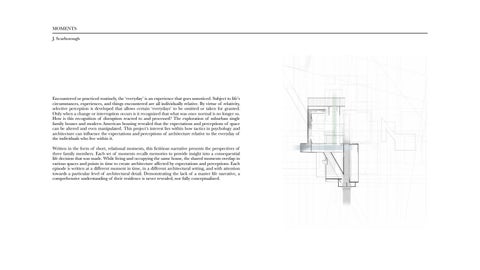
Encountered or practiced routinely, the ‘everyday’ is an experience that goes unnoticed. Subject to life’s circumstances, experiences, and things encountered are all individually relative. By virtue of relativity, selective perception is developed that allows certain ‘everydays’ to be omitted or taken for granted. Only when a change or interruption occurs is it recognized that what was once normal is no longer so. How is this recognition of disruption reacted to and processed? The exploration of suburban single family houses and modern American housing revealed that the expectations and perceptions of space can be altered and even manipulated. This project’s interest lies within how tactics in psychology and architecture can influence the expectations and perceptions of architecture relative to the everyday of the individuals who live within it. Written in the form of short, relational moments, this fictitious narrative presents the perspectives of three family members. Each set of moments recalls memories to provide insight into a consequential life decision that was made. While living and occupying the same house, the shared moments overlap in various spaces and points in time to create architecture affected by expectations and perceptions. Each episode is written at a different moment in time, in a different architectural setting, and with attention towards a particular level of architectural detail. Demonstrating the lack of a master life narrative, a comprehensive understanding of their residence is never revealed, nor fully conceptualized.
LIFE BEGINS
THE GOLDEN LEAF
A DEEP BREATH
This was a neighborhood comfortable to get lost in; the houses felt expensive yet relateable, comfortably large yards, and the occasional couple walking their family dog along the tree-lawns. I have pictured this moment for as long and I could remember—my first home. We passed a small park where a few children were running, we curved down the driveway, passing under two beautiful maple trees, and arrived at the house with a red door.
The bench has cracks in its wood and there are uneven divots on the arms where the iron has been repainted. The trees in the park are young, replacing the old that have been deemed a risk, should one fall in the wrong direction. The one exception is standing overhead as I sit here. I suppose its place at the tip of the triangle-shaped park gave it enough clearance not to be a threat. Most of the leaves have fallen; the green grass showing through, it’s color slightly dull as the sun is obstructed by gray overcast clouds, holding the sky.
Her head is resting against the window, stationary, as the rest of the world flashes by. The moment she settles in to any mode of transportation, she is sound asleep. The road begins to curve as we enter the neighborhood, and she sits up straight. Prim and proper, with picturesque gardens, unattached garages sheltering high-end cars, and perfectly kept tree-lawns I felt myself sit up a little, too. The houses are a mixture of styles that somehow work together to fulfill the dream of everyone that lives here. The land each house occupies is generous—enough to forget that you have neighbors, but close enough to be reminded you most certainly do.
The front had a traditional entrance with slate stones to guide our way, but the driveway led to a quiet patio that overlooked the yard. I could see our life echoing in front of me: picnics in the soft grassy yard, colorful birthday parties in the living room, pancakes flipping in the kitchen on Saturdays, teaching our children to ride bikes up the driveway, and cozy winters in front of the fire place. Excited to begin this life, I smiled, squeezed his hand, and turned the key.
Hearing laughter, my gaze moves from the tree branches above to across the park. Delighted, a little girl scurries to her parents, holding a golden yellow leaf high. Her father scoops her up as her mother pushes a stroller, carefully avoiding the large cracks in the slate sidewalk. Now, high on her fathers shoulders, she holds the leaf like a flag, waving it as they flank the park, walking towards the house with a red front door. I cherish the innocence she carries through the door, into a house, once a home, filled with love, but equally with the sorrow. Her leaf, once held high, is taken from her small hands, and is left pinned under the door knocker, as the family disappears inside.
I stopped midway up the stone path, taking in what is our foreseeable future: commitment, excitement, responsibility, and passion. Everything I knew, but didn’t expect so suddenly. With a deep breath, and the return of a smile, I followed her through the red door.
PRIVATE LIFE
THIS IS NOT HOME
It was the kind of window that always seemed to reveal more of what was happening in the outside world than anything else. Outside, the trees gently danced with the breeze, the sky a soft blue, and flowers reached for the sky. It had a way of making you feel like the only person in the world. Glimpses of private lives, the trees as thirsty houseplants, and the stepping stones an ally—my apartment window is a pitiful improvement.
Entranced, I take a deep breath, expecting a refreshing rush of air through my lungs, but I am left aggrieved. Outside, old trees, stones perfectly placed, choreographed flowers, are all background to the lives of those too busy to recognize their cries for release. I hear laughter from the kitchen, followed by a scold, and a summon directed towards me. Wishing I was on the outside looking in, a thought flashes through my mind—this is not home, this is somewhere I have ended up.
WE MADE IT A HOME
IF I LEFT
The guilt to hold on to every piece eats me away. These items have been in the family for generations—how could I be the one to break the lineage? I look around my house and I barely see anything that is ours, even though it all is technically. There are scattered pieces hiding in plain sight: the enamel table that served countless purposes when we first moved in, the lamp in the living room that, for the longest time, had no where to sit but on the floor just like us, and the beautiful oriental rug that we found at the flea market (surely a fake). We have this house; we filled it with memories and made it a home.
The chair I read in on Sunday mornings sits quietly in the living room; the bed I sleep in is upstairs, antique but comfortable; the griddle where I make breakfast (sometimes for dinner) is set out on the counter, a notso-subtle ask by the kids. Everything is free to move, to be rearranged, and are adaptable to change. Every day, the contents of this house stares at me, cruelly mocking, you couldn’t take me, you do not own me. If I left, I would only take myself.
INITIALS
SOMETHING MISSING
AGAIN
I looked past the cacophony of the morning’s excitement, met with a soft smile and a wink. Set delicately within the branches of the tree, I felt the room grow still. The small box was wrapped in a paper that didn’t match the rest—a creamy background with watercolored holly leaves, berries, and a bow that was a deep emerald green. I carefully removed the wrappings to find inside a delicate bracelet. There were three silver letters threaded through a white band, the clasp holding the bracelet together hanging gently. Overwhelmed with love and bewilderment, I was embraced with affection that made the world stand still. I am noticed, I am considered, I am loved.
Snow softly falling outside, a gift from the season on this eve, a slight breeze of frigid air tickled my toes as the back door closed with a click. Turning to see who entered, my heart fell, not disappointed by her, but I had hoped it was someone else, him. It didn’t matter the season or the weather, I could always see the soft glow of light from the narrow garage windows. I should have learned by now not to get my hopes up. Seeing the excitement fall from my face, she gave me a hug that whispered, me too, but out loud, she rationalized the importance of a snowblower over our family tradition and dusted a cookie with red sprinkles.
Turning around, the mature hand that tapped my shoulder was paired with a soft smile. She handed me a small box wrapped in paper with a bow. I did not need to be reminded that I fell short on my end, again. Watching her walk towards the house, I saw her daughter, my wife, through the window. She is laughing in the kitchen, her eyes creasing at the sides, hair in a messy pony tail, carefully rolling cookie dough, with two pairs of small hands helping to decorate. Feeling ashamed, only for a moment, irritation returned as my attention shifted towards the snowblower I was failing to fix.
If my memory serves me, the bracelet is in a box on the top shelf of my closet. I haven’t seen it in years.
FORGETTING HOW TO TALK
WITHIN THE WALLS
It does not matter what starts the arguments, but they never end reasonably, and always result in footsteps walking away. There is never a point to these disputes, ridiculous accusations, and blame where it isn’t warranted, causing more harm than good. I tell myself that it’s okay, that words can never hurt. The room feels small and large at the same time. I cannot hide, and yet I cannot stand tall enough. When did we forget how to talk to one another? How is walking away a solution? I hope we are the only witnesses to these moments of heartbreak.
The windows in my room look through the trees, like your vision when split above and below water. The ceiling is tall, but only so because of the slight angle and the shadows from the sun. Despite being a newer house, the hardwood floors are easily influenced to hold my secrets. My favorite part is the closet, but not because of its capacity for clothing. Rather, there is a depth that is allowed by a breach in the wall. I hear laughter and crying, love and hate, truths and lies. I am an uninvited audience to the life of my family.
ENOUGH
STRANGELY ENOUGH
ENOUGH IS ENOUGH
How does one come to realize that, for ten years, they were unhappy. All the birthdays, holidays, graduations, nights reading stories as your child fell asleep in your arms, coming home to your favorite dinner on the table, your dog wagging its tail when you wake up in the morning, and soft smiles from across the room silently saying, “I love you,” must not have been enough.
I saw that you were unhappy. All the birthdays, holidays, graduations, nights you missed reading me stories to help me fall asleep, coming home to your dinner cold on the table, our dog wagging its tail by the door, waiting for you to come inside, and the smiles when you finally did must not have been enough.
I did not even realize that, for ten years, I was unhappy. All the birthdays, holidays, nights reading stories as the children fell asleep, coming home to dinner on the table, my dog wagging its tail asking for breakfast, and glances from across the room were enough.
The trips and projects that occupied your evenings and weekends; the unacknowledged birthdays and holidays are forgiven with a smile; the encouragement and excitement in the pursuit of new opportunities, everyone who loves you must not have been enough. Your reasons for leaving are not reasons at all.
Trips and projects occupied your time when I wanted it. The birthdays and holidays always felt distant; when the arguing stopped I tried to give encouragement and provide my excitement in support of your new pursuits. My love must not have been enough. Strangely enough, I understand your reasons for leaving.
The trips and projects that occupied my evenings and weekends got me out of the house. I have never been good at remembering birthdays and holidays— you know that. The encouragement and excitement in pursuit of new opportunities never felt genuine. Everyone who loves me must not have thought that I was enough. I didn’t know that I was leaving, but I did it anyway.