8 minute read
from SEO FOR DOCTORS
by Jems William
What Is SEO for Doctors?
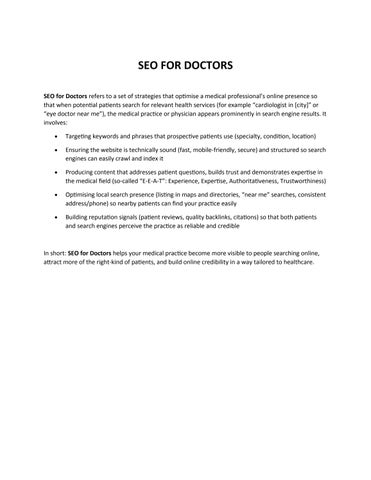
Why do some medical practices attract a steady flow of patients while others struggle to get seen online? The quick answer is this. SEO for doctors helps your clinic appear in the exact moments patients are searching for symptoms, treatments, and local providers. It works by improving your visibility on Google and helping your practice earn trust before a patient ever picks up the phone.
That is the simple version. The deeper story is where things get interesting because healthcare search behaviour is loaded with emotion, hesitation, and what behavioural psychologists call loss aversion. People want reassurance, clarity, and a sense that they are choosing wisely. Strong search visibility gives them that feeling long before a consultation.
Below is the full guide written in a clear, Australian voice so you can understand how SEO for doctors genuinely works, how it influences patient behaviour, and what a modern practice needs to compete in 2025.
What Is SEO for Doctors in Plain Terms?
SEO for doctors is the process of helping medical clinics show up higher in Google searches for relevant terms like cardiologist near me or skin check in Brisbane. It involves improving your website structure, content, local listings, online reputation, and patient engagement signals.
In practical terms, it means your clinic becomes easier to find and easier to trust.
Anyone who has watched patients explore health information online knows how often they bounce between symptom checkers, reviews, and clinic bios. If your practice shows up consistently through these touchpoints, you sit in what Cialdini calls the consistency zone. Patients feel more comfortable choosing you because you kept showing up as the reliable option.
Why Do Patients Search for Doctors This Way?
Think about how Aussies behave when something feels off in their body. Few book an appointment straight away. They search their symptoms first. They look up the nearest clinic. They read reviews. They check fees. They ask mates. The online search journey is part reassurance, part research.
SEO supports this journey in three key ways.
It places your clinic in front of patients earlier in their decision process.
It builds familiarity through multiple online appearances.
It reinforces authority through helpful and credible information.
There is a reason Google’s own research shows that health searches remain one of the top categories globally. People want answers long before they want appointments.
What Does SEO for Doctors Actually Include?
Most medical practices only see SEO as keywords, but the field has grown well beyond that. A complete doctor SEO strategy will usually include the following elements.
1. Technical optimisation
This covers the behind the scenes foundation of your website. For example:
Fast page load speed
Clean site structure
Mobile responsiveness
Accessible design for all patients
Technical improvements help Google crawl your site efficiently and reduce friction for users. If your site feels slow or confusing, patients simply leave.
2. Content that answers real patient questions
Medical content works best when it answers relatable questions in plain language. Think examples like:
How do I know if I need a cardiologist?
What happens during a skin check?
Is physiotherapy covered by Medicare?
These are the exact queries people type into Google. The clinic that answers these questions with clarity and empathy often wins the click.
3. Local SEO for doctors
Since most patients search locally, your visibility in Google Maps matters as much as your website.
Local SEO includes:
Optimising your Google Business Profile
Earning consistent ratings and patient reviews
Adding accurate opening hours, services, and photos
Building citations across local directories
It is a trust layer that sits between your content and your clinic door.
4. Reputation signals and patient sentiment
Cialdini’s social proof principle is powerful in healthcare. People feel safer choosing a doctor trusted by others. Your online reputation can quietly influence every part of your search performance.
Common elements:
Google reviews
Health directory reviews
Local word-of-mouth comments online
Mentions of your clinic across the web
Google sees this as evidence that you provide a legitimate and helpful service.
5. On-page optimisation
This includes the basic but essential elements like headings, keywords, meta descriptions, and accessible formatting. While it sounds technical, the goal is simple. Help search engines understand what each page is about so the right patients find you.
6. Backlinks from reputable health sources
Links from trusted sites signal that your content is reliable. This is especially valuable for doctors because health content falls under what Google calls Your Money or Your Life categories. High credibility reduces risk for the reader and for Google.
7. User engagement and patient behaviour patterns
Search engines track how users interact with your site. For example:
Do patients stay on the page?
Do they read multiple pages?
Do they visit again?
Do they find information quickly?
Better engagement usually leads to higher rankings because the system sees your clinic as helpful.
Why Does SEO Matter for Australian Doctors?
The Australian healthcare landscape has specific quirks. Bulk billing availability changes by suburb. Wait times differ. Large medical groups compete heavily for visibility. Independent clinics often rely on reputation. And patients are more informed than ever.
A strong SEO approach acts as a stabiliser in this environment. It gives your practice a predictable flow of patient interest rather than relying solely on walk-ins, referrals, or word-of-mouth.
A few reasons it works especially well here:
Australians prefer clear, no-nonsense information.
Local search behaviour is high for healthcare.
Patients often compare several clinics before booking.
Search results influence trust more than ads in this category.
If you offer genuinely helpful content, it builds rapport. That is the liking principle in action.
What Keywords Do Patients Usually Search?
Keyword research for doctors is unique because it blends symptoms, specialties, and local intent. A few common patterns include:
Condition based searches, like knee pain treatment.
Specialty based searches, like dermatologist Gold Coast.
Location based searches, like GP near Carlton.
Treatment based searches, like sleep apnoea assessment.
If your website addresses these patterns naturally, you become part of the patient’s journey from the very start.
How Long Does SEO for Doctors Take to Work?
Most clinics start noticing movement within three months and stronger gains around six to twelve months. Medical competition varies by suburb, so a busy CBD area might take longer than a regional town.
What does speed things up is consistency. Adding regular content, improving your Google Business Profile, and earning reviews signals ongoing care for your online presence. Search engines reward that.
Anyone who has stuck with SEO over time has seen compounding effects. Each improvement lets the next one land more effectively. It is similar to long term patient care. Small, consistent steps build the bigger outcome.
Can Doctors Handle SEO Themselves?
Some can, especially those who enjoy writing or have tech skills. But most clinics find it time-consuming. It is not difficult, but it requires regular attention.
Common tasks that doctors often outsource include:
Technical optimisation
Content writing
Review management
Keyword strategy
Local SEO monitoring
Doctors who do manage some of it themselves usually stick to content updates or FAQs, since these naturally fit their expertise.
What Should a Doctor Avoid in SEO?
There are a few traps that slow down progress.
Publishing overly clinical content. Patients prefer plain language.
Using duplicated medical explanations from other sites.
Ignoring local listings.
Forgetting mobile readers. Many patients search on their phones while sitting in the car or waiting room.
Writing content for the algorithm instead of the person.
The best performing clinics keep their content human.
What Does Google Consider High Quality for Medical Content?
Google leans heavily on E E A T signals for health information. That means:
Experience. Have you treated this condition?
Expertise. Are you qualified in this medical area?
Authority. Are you recognised through citations, reviews, or publications?
Trust. Is your content accurate and updated?
One helpful resource outlining health information standards is the Australian Government’s Health Information Quality Framework, available here: Health Information Quality Standards.
Real Example From an Australian Clinic
A small Adelaide physiotherapy practice once shared that before improving their SEO, patients often arrived confused about the difference between a physio appointment and a remedial massage. After launching a series of simple FAQ pages and adding structured treatment descriptions, they saw less confusion and more readiness to commit to treatment.
Their Google rankings improved at the same time. The behavioural trigger was clarity. Patients felt they knew what to expect.
FAQ
Do doctors really need SEO if they already have referrals?
Yes. Referrals remain strong, but patients still search your name online before booking. Good SEO reinforces trust.
Is SEO safe for medical information?
Yes. As long as your content is reviewed, accurate, and in line with Australian health standards.
Will SEO replace word-of-mouth?
No. It complements it by making your practice visible to people who do not yet know you.
A Quiet Reflection to End
SEO for doctors is less about tactics and more about helping people feel informed and confident during uncertain moments. Clinics that communicate clearly and consistently tend to build long term patient loyalty. Over time, trust becomes the strongest ranking signal of all.
If you would like to explore more about SEO for doctors, you can read additional detail here: SEO for Doctors.


