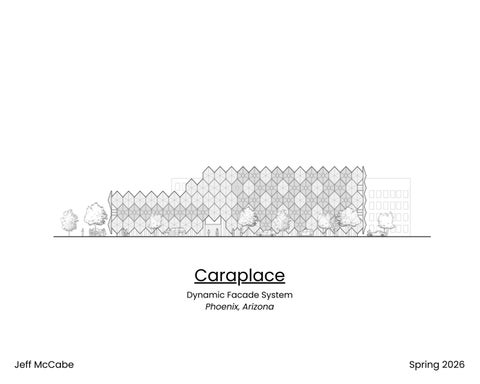
Caraplace Dynamic Facade System Phoenix, Arizona
Jeff McCabe
Spring 2026
Context Tasked with creating a facade for a building in Arizona, my group opted to use biomimicry to borrow characteristics of desert animals to create an adaptive facade system. By extracting the carapace, where the project got its name, of a desert turtle, stretching it out, and wrapping it around the exterior walls, we established an enclosure with a distinct aesthetic.
Because the climate in Arizona is dry and hot, we needed to create a methodology for blocking direct sunlight while allowing indirect light to enter. The facade is made up of cell modules, as seen below. Each cell is either kinetic or static: kinetic cells break out into 6 fins that are able to rotate about a rod, while static cells are simply convex units. The rotating fins could target the sun as it passes through the sky, creating an energy efficient solution.
Each cell is connected to a hexagonal steel frame, which is connected to the building with long steel tiebacks. This ensures that the facade remains stable during windy conditions. Although the supporting structure would need to be extensive in order to hold up the frame and the cells, these tiebacks would also act as a pergola above residential units. – Steel Tiebacks – Steel Frame
Solar Calculations - Grasshopper I developed a Grasshopper script that uses the Galapagos plugin’s evolutionary solver to determine the optimal orientation for a panel during a given time period. The script tests many angles of rotation and uses the Incident Radiation of the fin’s surface, provided through the Ladybug plugin, to find the fin angle that provides the minimum sun coverage. This puts the fin as parallel as possible to the sun’s rays, which we then add a 90 degree rotation, putting the fin perpendicular to the sun’s rays. The reason why I didn’t solve for maximum Incident Radiation initially was because it would leave the fins fully closed, allowing no light in at all. By positioning the fins perpendicularly to the sun’s rays, the direct light is still blocked, but diffused light is able to come in under the rotated fin.
Using this ideology, we can create any of these 3 conditions in the building’s interior simply by adjusting the fins to certain angles. Furthermore, we can have a mix of the conditions within any cell. For example, a kinetic cell has 6 fins, so 3 could be open and 3 could be closed, creating a unique lighting that was curated to the users’ liking.
GALAPAGOS EVOLUTIONA
INPUTS
CALCULATIONS
CREATE SUN ENVIRONMENT
RY SOLVER
SOLAR TESTING
For example, below is a study of the upper leftmost fin of a south facing cell. The time frame is 12PM-1PM on the summer solstice (June 21). Fig. 1 is the orientation that receives the least sunlight, shown by the blue fragments in the fin’s surface. This was derived through 10 evolutions of the Galapagos solver, and represents a fin that is parallel to the sun. Fig. 2 is the fin after a 90 degree rotation. As seen in the top view in fig. 3, the fin acts as an overhang. This makes a lot of sense, as the southern sun is directly above the facade, so by turning to this precise direction, the above sun is blocked. It is clear in fig. 2 that plenty of non-direct light can still enter the facade through the gap.
fig 1
fig 2
fig 3
This process was applied to each set of kinetic cells on each cardinal direction. The results revealed the mathematically optimized orientation of any given fin at any given time.
East Facade Below are the three conditions on an east facing wall, the view being that of the Sun. The abstract form is able to distort itself to perfectly allow or block light from entering the space. If one room is showing a movie and requires darkness, the facade can be set to the closed position. If a room has a lot of plants that need sunlight, the cells can be set to open. Because the program informs the facade orientation, the exterior walls will always be changing and moving throughout the day.
Full Script