JEFFERSON MOSS-MAGEE REHABILITATION
Summer | 2026
9 Years After a Rare Spinal Cord Stroke, Mary Salisbury Reunites With Her Rehab Team Mary reflects on the full-circle moment at an annual fundraising event and how far she’s come since her injury. By Jessica Lopez
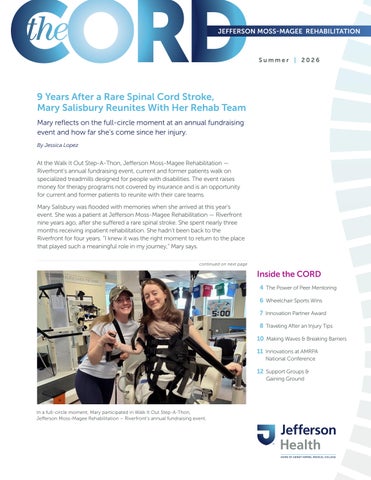
At the Walk It Out Step-A-Thon, Jefferson Moss-Magee Rehabilitation — Riverfront’s annual fundraising event, current and former patients walk on specialized treadmills designed for people with disabilities. The event raises money for therapy programs not covered by insurance and is an opportunity for current and former patients to reunite with their care teams. Mary Salisbury was flooded with memories when she arrived at this year’s event. She was a patient at Jefferson Moss-Magee Rehabilitation — Riverfront nine years ago, after she suffered a rare spinal stroke. She spent nearly three months receiving inpatient rehabilitation. She hadn’t been back to the Riverfront for four years. “I knew it was the right moment to return to the place that played such a meaningful role in my journey,” Mary says. continued on next page
Inside the CORD 4 The Power of Peer Mentoring 6 Wheelchair Sports Wins 7 Innovation Partner Award 8 Traveling After an Injury Tips 10 Making Waves & Breaking Barriers 11 Innovations at AMRPA National Conference
12 Support Groups & Gaining Ground
In a full-circle moment, Mary participated in Walk It Out Step-A-Thon, Jefferson Moss-Magee Rehabilitation – Riverfront’s annual fundraising event.
Patient Success Stories
The night everything changed On July 10, 2017, Mary was getting ready for bed. She had just graduated from Temple University about a month and a half prior. When she climbed into bed, she felt a crack in her neck and then felt pain and numbness radiate down her arms. “I figured I pinched a nerve or something,” Mary remembers. “I didn’t think it was anything that serious. Luckily, one of my roommates was home at the time. She helped me get to Thomas Jefferson University Hospital’s (TJUH) emergency room.” At the hospital, things kept progressing and Mary started having trouble walking. After MRI testing, she was diagnosed with a spinal cord stroke. “I had never even heard of a spinal cord stroke before,” she recalls. “I learned they only account for one percent of strokes. People generally equate strokes with the brain, but they can happen to the spine, too.” Mary and her partner Tyler have not let her injury stop them from enjoying travel.
The spinal cord stroke left Mary with a spinal cord injury, which affected the right side of her body more than her left side. She lost her ability to walk and the use of her dominant right hand and arm.
“
I had never even heard of a spinal cord stroke before. I learned they only account for 1% of strokes. – Mary Salisbury
“I had just started a new job and was excited for this chapter in my life, so I felt like my whole world was flipped upside down,” Mary remembers. “After three weeks at TJUH running test after test, I was told I would be sent to Jefferson Moss-Magee Rehabilitation Hospital – Center City and be on the spinal cord injury floor.”
Healing physically and mentally Mary worked with occupational, recreational, and physical therapists during her inpatient treatment at Jefferson Moss-Magee Rehabilitation Hospital – Center City.
2
On a typical day, she focused on building core and arm strength through occupational therapy, working toward regaining independence in self-care and daily activities. She would then participate in physical therapy, engaging in exercises such as walking on specialized treadmills, using leg stimulation bikes, and practicing transfers. On some days, she also met with recreational therapists to play games designed to build strength and coordination, or to explore assistive technologies.
“
Every spinal cord injury or stroke is completely different, and everyone recovers at their own pace. Anything is still possible if you learn to adapt and have the right people in your corner supporting you. – Mary Salisbury
“A major turning point in my rehab journey was when my occupational therapist adapted my makeup,” Mary says. “She showed me how to open products with my mouth and apply everything with my left hand. It was something so simple, but it helped me start feeling like myself again.” Mary says learning to use her left hand for everything was incredibly challenging, but has given her a lot of independence back. “I did a lot of art therapy with Julie Nolan, and that really helped me develop fine motor skills again in my left hand,” Mary says. “I focused mainly on painting. One of my pieces was in their Art Heals event in 2018.” Mary fondly remembers working with facility dogs in occupational and physical therapy. “It was especially healing because I missed my dog and didn’t see her for several months.”
They attended her therapy sessions throughout her treatment, which inspired Caroline to study and become an occupational therapist herself. When Mary started thinking about reentering the workforce after a few years of focusing on rehab, she decided to go to graduate school. Her vocational counselor at Jefferson Moss-Magee Rehabilitation helped her navigate the disability resources office and research scholarships. Mary also joined the board of the United Spinal Association Greater Philadelphia Chapter. “I made connections with other people with disabilities, and it helped build my professional skills before applying for jobs,” she says.
Life lately and advice for others
Mary also found inspiration online in peer support groups. “I found girls who also use wheelchairs and saw them living their lives normally. That gave me a lot of hope.”
Mary looks back at her spinal cord injury journey with a lot of pride. “I used to think, how am I ever going to go into a meeting in a wheelchair or go on a date in a wheelchair? Now I just say, ‘Why can’t I?’” she says.
Mary’s family has been a steadfast support throughout her journey. “My mom, dad and sisters Caroline and Grace were there for me every step of the way,” Mary says.
In a full-circle moment, after completing graduate school, Mary applied for a communications position at Jefferson Health, where she’s been working for nearly four years.
3
Mary also started dating. She met her partner, Tyler, in 2022, and last year he proposed. “He never treated or saw me any differently and has always been really supportive,” Mary says. For anyone just beginning healing from a spinal cord injury, Mary stresses resisting comparing your journey to anyone else’s. “Every spinal cord injury or stroke is completely different, and everyone recovers at their own pace,” she explains. “Anything is still possible if you learn to adapt and have the right people in your corner supporting you.” “I would get shy about asking friends, strangers or even coworkers for help, but know that people generally want to be nice and helpful – and everyone needs a little help sometimes!”
Patient Success Stories
The Power of
Peer Mentoring By Rebecca Levenberg
In 2010, I was run over by a truck while riding my bicycle to work in a city bike lane. My left leg was crushed by the truck’s tires. I had broken ribs, a fractured pelvis, and extreme blood loss. The trauma surgeons at Jefferson Health saved my life, but they had to amputate my leg above the knee. I also suffered from PTSD, anxiety, and depression. Each night I relived the accident. The world was suddenly a dangerous place, and I had no idea how to move forward in it. Two months later, I was transferred to Jefferson Moss-Magee Rehabilitation Hospital — Center City for inpatient rehabilitation. There I met my first amputee. Rob was assigned to be my peer mentor. He was about my age and also had an above-the-knee amputation. He stopped in one night to meet me and answer any questions I had. Rebecca and her peer mentor Rob in 2024.
4
I had none. I was riddled with pain from a limb that didn’t exist. My body was a mess of incisions and sutures. I was overwhelmed and panicked by wound care.
Rebecca early in her journey of adapting to life as an amputee.
The old me would have wanted to know Rob, but this new me didn’t have the energy. I could barely get through a day. How could I live like this for the rest of my life? I’m sure Rob sensed my ambivalence. My parents were there too and they did have questions. They asked about his prosthetic socket, the fitting process, and the modifications he used at home. They asked about travel, family, and relationships. Rob stayed for almost two hours that night. He shared his knowledge and experiences. But, even now, I don’t remember a single thing he said. What I do remember is this: Rob came to visit me in the evening – after going to work and the gym. That’s what stuck with me: Rob goes to work. Rob goes to the gym. It was a vision that gave me hope. Over the next year, I was fitted with my first prosthesis. I learned to walk again – first with crutches, then with a cane, and finally with my prosthesis. It was challenging, but the second year brought even more independence. I joined an amputation support group. I returned to work part-time and went back to the gym – like Rob!
The following year, I decided to become a peer mentor. I signed up for training, where I learned the responsibilities, the importance of listening, and different ways to provide support for new amputees and their families. I quickly realized that being a peer mentor is unpredictable – just like living with amputation. Every patient and family is different. Some ask questions. Some tell stories. Some want to see my prosthesis, share their goals, and talk about the future. Others are silent and shell-shocked, like I was. I learned that peer mentoring isn’t always about imparting knowledge. It’s about meeting people where they are – and being who you are. Now, more than a decade later, I’ve switched careers. I coordinate the amputation support program at Jefferson Moss-Magee Rehabilitation Hospital — Center City, where I did my own rehabilitation. I facilitate our monthly
“
support group and match patients and families with peer mentors. When I train new mentors for our program, I teach about listening, asking questions, sharing knowledge, demonstrating skills, and giving tips. But their most common question is, “What can I say that’ll make a difference?” So, I tell them about Rob – my peer mentor and my “first” amputee. I tell them how just by showing up, he gave me hope and a vision of what’s possible. That’s the power of peer mentoring.
Interested in Peer Mentoring?
Each night I relived the accident. The world was suddenly a dangerous place, and I had no idea how to move forward in it.
Give hope. Gain support. Learn how to become a peer mentor or connect with someone who has firsthand experience navigating recovery and rehabilitation. Contact details are available on the last page of this newsletter.
– Rebecca Levenberg
5
Jefferson Moss-Magee Rehabilitation
Celebrates Wheelchair Sports wins This spring the Jefferson Moss-Magee Rehabilitation wheelchair sports program celebrated several wins, including the Eagles wheelchair rugby team making history with their first ever Division III national championship at the U.S. Wheelchair Rugby Association’s national tournament. This event was held at the Olympic and Paralympic Training Center in Birmingham, Ala.
The Jefferson Moss-Magee Sixers wheelchair basketball team wrapped up their season at the national tournament in Monroe, La., delivering their best run ever, reaching the Division III championship game. This season has been filled with incredible milestones and achievements for both teams. Thanks to all who have supported the program and helped make this success possible.
6
Debra Hollander Gift Supports the Future of Wheelchair Sports Jefferson Health and the Magee Rehabilitation Hospital Foundation have announced a generous $600,000 gift from philanthropist and longtime supporter Debra Hollander. The gift will establish the Hollander Endowment Fund for Wheelchair Sports to provide ongoing support for wheelchair sports programs at Jefferson MossMagee Rehabilitation. Wheelchair sports help people with disabilities stay active, build confidence, develop skills, and connect with a supportive community. Wheelchair sports offer far more than athletic competitions. Through teamwork, physical activity, and shared experiences, participants gain independence, strengthen social connections, and discover new possibilities for recreation and personal growth.
Hollander has served on the Magee Rehabilitation Hospital Foundation Board since 2014 and has been a dedicated supporter of Jefferson Health for many years. This gift will give life-changing opportunities to many future generations of athletes.
Learn about the Wheelchair Sports Program JeffersonHealth.org/ wheelchair-sports
Pictured (l to r): Natasha Brown, Dyann Roth, Dr. Alberto Esquenazi, and Mark Chilutti
Jefferson Moss-Magee Rehabilitation Receives Innovation Partner Award Jefferson Moss-Magee Rehabilitation was recently presented with the Innovation Partner Award from Inglis. Inglis helps people with disabilities to live independently in the community and in their residential nursing facility, Inglis House. This award highlights Jefferson Moss-Magee Rehabilitation’s leadership in delivering innovative, peoplecentered care. “Inglis is proud to partner with Jefferson Moss-Magee Rehabilitation to support people at critical moments in their journey,” said Dyann Roth, President and CEO of Inglis. “Together, we’re helping people move forward with the care, tools, and
7
support they need to live as independently as possible.” The award also reflects a longstanding and impactful partnership between the two organizations. Together they focus on improving outcomes for individuals with disabilities through coordinated care, expanded access to accessible housing, assistive technology, and community-based support. The award was presented at Inglis’ annual BASH fundraiser, which brings together regional partners and supporters to advance its mission of empowering people with disabilities.
Traveling After An Injury Tips Part 2
We hope you enjoyed part one of Traveling After An Injury in our last issue. This time our travelers share tips for booking hotels, air travel, cruises, and other fun adventures. Mark lives with a spinal cord injury and Rebecca has a lower limb amputation. They each share tips based on their experience and disabilities.
Mark’s Top Travel Tips 1
I find great relaxation and enjoyment floating in the middle of an ocean on a very large cruise ship. My wife and I have been on more than 15 cruises and love the access ships provide. We only sail on newer and larger ships since they are built with accessibility in mind and accommodation is consistent within the fleet.
2
4
Newer cruise ships offer great accessibility
Book early, up to two years
My top tip is to book early as even the large ships have a limited number of accessible rooms. It might sound crazy, but we book up to two years ahead of time to get exactly what we want. By doing that, we also often get the best price. An accessible cabin gives you a roll-in shower and other bathroom features. I love having a balcony where I can open and close the door on my own.
Many of the newest ships also have doors that open with your room key or the push of a button. The same goes for bathrooms around the ship. Show venues have prime seating spots available for guests with disabilities.
3
Leave plenty of time
We usually fly to Florida a day ahead and stay at a hotel close to the port. We find an accessible taxi or shuttle company to get us to the hotel and then to the port the next day. When we return, we take accessible transportation provided by the cruise company back to the airport.
8
Don’t be afraid to fly
If you haven’t flown before, watch videos online to put your mind at ease. You will have assistance to transfer out of your wheelchair into a skinny “aisle chair” to take you to your seat. You will be the first one on and the last one off the plane, so plan bathroom breaks and eating and drinking that day. I take my wheelchair cushion onto the plane and sit on it during the flight for extra protection. This also keeps it safe. Don’t let stories of damaged chairs scare you. While it can happen, airline employees are trained to deal with our chairs and they take pride in handling them correctly. There’s something special about boarding a ship that makes me completely relaxed and I strongly encourage you to try it!
Rebecca’s Take on Travel and Accommodations I view travel as both energizing and challenging. Since my amputation 15 years ago, I’ve become an “adaptive traveler,” learning what I need to make a trip the best it can be.
1
Be flexible
For many amputees, including me, mobility can change from day to day. Some days, I can walk longer distances in relative comfort. On other days, I’m unable to wear my prosthesis at all, or I need to take frequent breaks due to discomfort or pain. Be flexible based on how you feel.
2
Check disability services beforehand
On any mode of transport, check disability services. Airports offer wheelchairs and escorts to help with long hallways, waiting in line, and making flight connections. Trains may also help with special seating or luggage. In new cities I enjoy trying public transportation, including trams, buses, and subways, so I download the related app, or use Google Maps, for accessibility information.
3
About the Authors
Break trips into segments
I’m uncomfortable sitting in the car for more than 1-2 hours at a time, so I schedule frequent rest stops. Mapping and direction apps help find suitable locations along the route. Rest stops are generally accessible and large shopping centers are great too. For a fun twist, plan rest stops around your interests or hobbies. I love to discover local cafés and bookstores on the road.
4
Know what you need and ask for it
Accessibility means different things to each of us, so think about what you need to be comfortable, safe, and independent in a new environment – that might mean a roll-in shower, a grab bar, or a certain height bed. Call ahead to confirm they have what you need, and if it’s not there when you arrive, speak up.
5
Vacation rentals can offer comforts of home
When searching for a vacation rental, I scrutinize the photos, read the descriptions, and message the owner with questions – mostly about stairs and bathrooms. In addition to my amputation, I have digestive issues, so I love having a kitchen where I can keep my own food.
6
Pace yourself
I alternate strenuous activities, like a tour or museum, with more leisurely ones, like people-watching at a sidewalk café. I can’t do everything (really, no one can!), so it’s important to prioritize. Let that be your guide. Follow your passions and focus your energy.
7
Leave space for possibility
The best adventures often happen when we’re least expecting them. Be curious. Talk with locals. Wander. No matter how big the trip is, we remember the small moments most.
9
Mark Chilutti has lived with a T5 spinal cord injury for 29 years and uses a manual wheelchair for mobility. While his favorite type of travel is cruising, he has traveled the world in a variety of ways. He has been on staff at Jefferson Moss-Magee Rehabilitation Hospital — Center City for 25 years and raises funds for important programs and services. Rebecca Levenberg has lived with an aboveknee amputation for 15 years. She walks with a prosthesis during the day and uses crutches at night. She loves international travel, local road trips, and walks around the block. Rebecca is the author of The Adaptive Traveler’s Guidebook. She coordinates the Amputation Support Program at Jefferson Moss-Magee Rehabilitation Hospital — Center City.
Making Waves & Breaking Barriers Jefferson colleagues volunteer at the annual They Will Surf Again event helping individuals with disabilities experience the joy of surfing. On Sunday, Aug. 2, at Baker Avenue Beach in Wildwood, N.J., Jefferson doctors, therapists, nurses, and staff helped persons with disabilities of all ages ride the waves at They Will Surf Again – a free, one-day event that provides the opportunity to surf and enjoy a day at the beach. Since 2012, Jefferson Moss-Magee Rehabilitation has served as the presenting sponsor of They Will Surf Again, the flagship program of Life Rolls On, a nonprofit organization that serves as a resource and advocate for people affected by spinal cord injury and other disabilities.
Jefferson in the community Jefferson Moss-Magee Rehabilitation has sent more than 1,000 volunteers to They Will Surf Again, and this year’s volunteer corps, along with other volunteers, helped persons with disabilities navigate the beach using specialized beach wheelchairs, get in and out of wetsuits, and ride the waves with assistance from volunteers in the water. “We’re incredibly thankful to have Jefferson Moss-Magee Rehabilitation as a sponsor and to provide so many volunteers who are trained to assist our surfers,” said Jesse Billauer, founder of Life Rolls On and an adaptive surfing
10
world champion. “To have actual therapists and rehab clinicians who are trained to properly interact with and assist persons with disabilities working alongside our other volunteers who surf and are comfortable in the water means proper techniques are used. That assures safety, comfort, and dignity for the surfers.”
Innovation and accessibility But hands-on expertise wasn’t all that Jefferson Moss-Magee Rehabilitation brought to the event. Jefferson Moss-Magee Rehabilitation partnered with local surfboard shaper and New Jersey middle school teacher Luke Alvarez to create surfboards specifically designed for surfers with disabilities. Developed with input from Jefferson Moss-Magee Rehabilitation therapists and surfers who participated in They Will Surf Again events, the boards featured large dimensions that made them exceptionally stable and capable
Jefferson Health Rehabilitation Experts Share Innovations at AMRPA National Conference
• Volunteers work with a surfer during They Will Surf Again event in Wildwood, N.J. • Inset photo: Some of the adaptive surfboards created for They Will Surf Again surfers.
of supporting the weight of two riders, a surfer, and a volunteer, when necessary. The decks also featured thick padding for comfort and grip, as well as attachment points for adjustable hand straps. Before retiring, Mr. Alvarez used the boards to teach his students at Carusi Middle School in Cherry Hill, N.J., about the importance of accessibility and inclusion. Students, including some with disabilities, designed inspirational artwork that was laminated onto the boards. These unique surfboards became one-ofa-kind works of art and symbols of inclusiveness. As such, they have been displayed at institutions including the Philadelphia Museum of Art and the New Jersey Surfing Hall of Fame. Thank you to all who volunteered and helped make this year’s event a success, demonstrating Jefferson’s commitment to compassion, inclusion, and improving lives.
Rehabilitation professionals from Jefferson Moss-Magee Rehabilitation, Jefferson Health, and Lehigh Valley Health Network, part of Jefferson Health, were recognized for their expertise at the American Medical Rehabilitation Providers Association (AMRPA) 2025 Fall Educational Conference and Expo, held in Philadelphia. Through educational sessions and research poster presentations, team members shared innovative approaches to patient care, workforce development, quality improvement, and interdisciplinary collaboration. Jefferson representatives delivered 12 educational presentations and presented nine research and quality improvement posters on topics ranging from rehabilitation outcomes and care coordination to emerging technologies and operational excellence. Their contributions reflected a shared commitment to advancing rehabilitation medicine and improving patient outcomes.
As part of the conference, Jefferson Moss-Magee Rehabilitation Hospital–Center City also hosted rehabilitation professionals from across the country for a networking reception at its Creative Arts Center, highlighting Jefferson’s innovative programs and patientcentered approach to care. The strong presence of Jefferson Health rehabilitation professionals at AMRPA 2025 underscores the organization’s leadership in rehabilitation research, education, and clinical excellence. We congratulate all presenters and authors for contributing to important conversations that help shape the future of rehabilitation care.
By the numbers • 636 conference attendees • 1 2 educational presentations by Jefferson Health teams • 9 poster presentations • M ore than 50 Jefferson Health presenters and co-authors represented
Rehabilitation professionals from Jefferson Moss-Magee Rehabilitation, Jefferson Health, and Lehigh Valley Health Network, part of Jefferson Health, shared their expertise at AMRPA’s 2025 Fall Educational Conference and Expo in Philadelphia.
11
Support Groups For dates and details, contact the individuals listed below or visit JeffersonHealth.org/Rehab
Jefferson Moss-Magee Rehabilitation Hospital – Center City Support and PEER Mentoring Groups Amputee Peer Mentoring Rebecca.Levenberg@jefferson.edu 215-587-3411
MS Healthy Living Colleen.McAllister@jefferson.edu 215-218-3900
Amputation Support Group Rebecca.Levenberg@jefferson.edu 215-587-3411
SCI Family Peer Support Group Ruth.Black@jefferson.edu 215-587-3030
Aphasia Support Group Sarah.Lantz@jefferson.edu 215-218-3900
SCI Peer Mentoring Marie.Protesto@jefferson.edu 215-587-3174 Keira.Aviles-Rivera@jefferson.edu 215-587-3174
Brain Injury Peer Mentoring Keira.Aviles-Rivera@jefferson.edu 215-587-3411 Brain Injury Support Group for Patients and Families Keira.Aviles-Rivera@jefferson.edu 215-587-3411
SCI Resource & Support Group Marie.Protesto@jefferson.edu 215-587-3174 Southeast Dystonia Support Group Andrew.Stuart@jefferson.edu 215-218-3908
Stroke Patient and Family Support Group Vilma.Mazziol@jefferson.edu 215-587-3024 Stroke Peer Mentoring Keira.Aviles-Rivera@jefferson.edu 215-587-3411 Wendkos Stroke Club Fritz.Louisjean@jefferson.edu 215-587-3180 Young Adult SCI Social Group Katie.Eckert@jefferson.edu 215-218-3911 Colleen.McAllister@jefferson.edu 215-218-3900
Jefferson Moss-Magee Rehabilitation – Elkins Park Support Groups Amputation Abilities Support Group Anne.Wieland@jefferson.edu 215-663-6405
MS Support Groups – Elkins Park Barbara Cohen, 215-317-3441
Talking Book Club – Aphasia Center Nikki.Benson-Watlington@jefferson.edu or 215-663-6344
Spinal Cord Injury Patient/Family Support Group – Elkins Park Marni.Nutkowitz@jefferson.edu 215-663-6271
Brain Injury Support Group – Elkins Park Rachel.Cataldi@jefferson.edu 215-456-9560
Caregivers Support Group – Elkins Park Marni.Nutkowitz@jefferson.edu 215-663-6271
Young Empowerment Survivors Support Group (YESS) for Stroke and Non-traumatic Brain Injury Survivors Melissa.Meyers@jefferson.edu 215-884-9050
Gaining Ground Helps Clients Build Strength Gaining Ground is a “boot camp” that provides an intensive, personalized approach to neurological recovery. Trainers and therapists create an individualized exercise program to help each participant increase function. Clients meet three times a week, five hours per day, for one-on-one training and education.
Upcoming sessions
Interested? Questions?
• Sept. 14-Oct. 8 • Oct. 19-Nov. 12
Contact Liz Watson at Elizabeth.Watson3@jefferson.edu or call 215-218-3913.
For additional information, including patient testimonials, photos and videos, visit: JeffersonHealth.org/Rehab
JH42111