CREATIVITY CORE CURRICULUM Annual Summary // 2025–2026
// CONTENTS
Why Focus on Creativity?
04
"My contention is that
Creativity Core Curriculum Components
06
creativity now is as
5 Years of Assessment Data
08
important in education
Diversity, Equity, and Inclusion
18
as literacy, and we
Research and Achievements
20
should treat it with
Creativity Intensive Course Spotlight
26
the same status.”
Creative Making Workshop Spotlight #1
30
—Sir Ken Robinson
Special Events 34 Creative Making Workshop Spotlight #2
38
Steering Committee & Staff
42
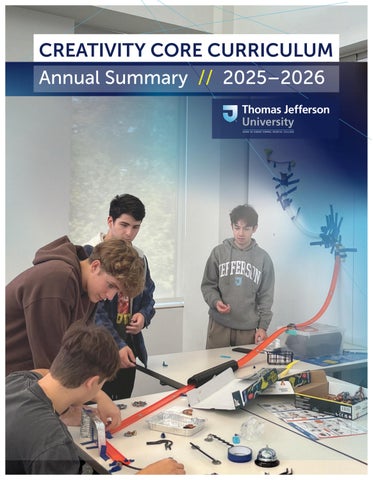
Cover: In the Creative Making Workshop Creating a Rube Goldberg Machine, instructor Catalin Florea, a research scientist at Lockhead Martin Space, leads students in exploring entertaining mechanisms for accomplishing simple tasks in a team environment.
Why Focus on Creativity?
The Fabric Workshop and Museum has been teaching artists the screenprinting process for over 40 years. Students explore monoprinting and blockprinting techniques to create a series of original prints in the Creative Making Workshop: Print Mash-Up with the Fabric Workshop & Museum.
THE MISSION of Jefferson’s Creativity Core Curriculum is to cultivate a confident and flexible student mindset through learning opportunities that explore individual and collaborative creative aptitude and equip students to yield novel and valuable results.
The future belongs to people who can imagine what doesn’t yet exist, connect ideas across disciplines, and turn insight into meaningful action.
Since its launch in 2020, Thomas Jefferson University’s Creativity Core Curriculum has reimagined the role of creativity in higher education. In a
In the Creative Making Workshop, Drum it Out!, students experience musical
world shaped by artificial intelligence, rapid technological change, and
improvisation as a tool to build self-confidence, trust, and communication skills.
increasingly complex global challenges, creativity is an essential human capability. At Jefferson, we believe creativity is fundamental to every discipline and every profession. Whether advancing healthcare, designing sustainable communities, leading organizations, or crafting compelling communication, the ability to ask bold questions, embrace ambiguity, and generate original solutions is critical to meaningful progress.
The Creativity Core Curriculum encourages students to develop these skills through experiences that foster curiosity, creative confidence, collaboration, and resilience. Rather than preparing students for a single path, it equips them to navigate continual change, discover new opportunities, and make a lasting impact. By cultivating creative capacity alongside disciplinary expertise, Jefferson empowers graduates to lead with imagination, adapt with Students learn about the fascinating history of fragrance and the mechanisms of the sense of smell before creating a
confidence, and shape a future that is more desirable and human-centered.
custom scent in the Creative Making Workshop: Experimenting with Scents: Creating a Fragrance.
thomas jefferson university
//
creativity core curriculum
5
Creativity Core Curriculum Components
1
CREATIVE MAKING WORKSHOPS: These workshops offer students discreet experiences that provide the opportunity, materials, guidance and time
Numbers for 2025–26
NEW CREATIVE MAKING WORKSHOPS
PARTNERSHIPS
Every year, the Creativity Core Curriculum staff work
The Creative Making Workshops are conducted by
to bring fresh Creative Making Workshop opportunities
instructors who possess expertise in diverse fields. In
to our students. Here are the new additions for the
addition to Jefferson affiliated instructors, the workshop
2025–26 academic year:
program engages attorneys, physicians, educators, business owners, artists, designers, musicians,
to experiment in a risk-free environment in absence of expectations and deadlines and in a context outside their discipline. Undergraduate students at our East Falls campus complete two individual workshops while pursuing their degree. Each workshop is 3–5 hours in length. The Creativity
128 Creative Making Workshops
Core Curriculum delivered a total of 124 workshops on a wide
2
Every undergraduate major on the East Falls campus requires a course that includes creativity content and skills development within a disciplinary context.
3
performers, and other creatives. Our instructor pool
Creativity of Cosmetics
includes talent from around the world. This year, we
•
Who We Are: Immigration in the U.S.
collaborated with the following cultural institutions,
•
A Creative Nutrition Guide for Menstrual Health
organizations, and businesses:
•
Fencing Fundamentals: Where Precision Meets Play
diversity of topics across fall '24 and spring '25.
CREATIVITY INTENSIVE COURSES:
More Than Skin Deep: The Chemistry and
•
50 Creativity Intensive Course Sections
•
The Power of Self-Hypnosis
•
A Guide to Eating for Well-Being in College
•
Gyotaku: A Traditional Japanese Process Bridging Art with Marine Science
•
1,765
Futurecurrent – Shifting Climate Timelines in the Year 2180
Students Served
•
Animal ACTivists of Philly
•
Anna B Wellness
•
The Clay Studio
•
The Dhody Institute
•
Eastern State Penitentiary Historic Site
•
Electric Cheetah Tattoos
•
The Fabric Workshop & Museum
•
Historic RittenhouseTown
•
Holocaust Awareness Museum and Education Center (HAMEC)
•
Holus Mediterranea
•
James Turrell’s “Skyspace”
•
Philadelphia Beekeepers Guild
•
Philadelphia Jazz Tap Ensemble
•
Philadelphia School of Circus Arts
•
The Random Tea Room
•
Shofuso Japanese House
•
StudioTEKA Design, LLC
the world, they explore how transformative ideas about living
•
Urasenke Tea School
a meaningful life can be applied far from their original contexts
•
Wild Hand
PHILOSOPHIES OF THE GOOD LIFE: This course exists within the Hallmarks Core. All Jefferson students take a common senior-year course that marks the completion of their liberal arts education. By reading, discussing and writing about the works of key thinkers from across centuries and around
23 Philosophies of the Good Life Sections
to guide them as ethical professionals, engaged citizens and inspired individuals. In the Creative Making Workshop, Fencing Fundamentals: Where Precision Meets Play, students discover why fencing is known as “physical chess” as they explore this elegant and adrenaline-filled sport.
thomas jefferson university
//
creativity core curriculum
7
5 YEARS OF ASSESSMENT DATA
TABLE A: CREATIVITY INTENSIVE COURSE AGGREGATE RESULTS (FL ‘22–SP ‘26)
To prepare our students for today’s rapidly changing world, institutions of higher education
% “very much so”
need to offer expanded learning experiences beyond those of the majors, to help prime students
OBJECTIVE
for the broad and shifting needs of the workforce. The mission of the Creativity Core Curriculum
and “moderately so” aggregate
% Clear
% Developing
Understanding
Understanding
74.3%
13.8%
73.1%
12.7%
77.7%
12.5%
62.9%
13.5%
is designed to do just that: to cultivate a confident and flexible student mindset through learning opportunities that explore individual and collaborative creative aptitude and equip students to yield Objective 2: Create value by producing novel output
novel and valuable results.
relevant to professional and real-world endeavors. (6.3% missing)
85.8% (47.4% very much so)
These learning opportunities are aligned across the undergraduate curriculum at three points; •
a Creativity Intensive (CI) course within each student’s major
•
a Creative Making Workshop experience
•
the Philosophies of the Good Life Hallmarks Capstone
Objective 3: Devise effective strategies for individual and/or collaborative creative production. (7.9% missing)
83.6 (46.3% very much so)
Collection of both direct and indirect assessments across these points illustrates how Jefferson students have been meeting the outcomes and overall goal of the Creativity Core Curriculum. Objective 4: Engage empathetic and critical thinking skills when framing opportunities and solving problems.
We began assessing the Creativity Intensive courses in fall 2022 mainly through a survey that offers
(7.9% missing)
84.5% (45.6% very much so)
self-reporting growth through a Likert scale accompanied by open-ended questions, which assess student understanding of the outcomes. Table A shows aggregate results over the past 4 years
The workshop facilitated creative thinking.
(N=458). The results are overwhelmingly positive, though it should be noted that many faculty
(additional open-ended question)
n/a
do not “assign a grade” to the survey and therefor participation is limited in some courses. Participation numbers have grown over the 4 years, from 62 in ‘22-’23 to 119 in ‘25-’26, but are still primarily from DECF 102, PSYC 322 and EXCX 330 of the aligned courses.
Assessment of the Philosophies of the Good Life Hallmarks Capstone (PHIL 499) aligned learning outcome is the most recent, beginning in AY 24-25. This learning outcome: Formulate new insights
In fall 2023 an additional question was added regarding whether the workshop facilitated a new
through unexpected connections across disciplines, perspectives and contexts, is aligned with the
interest or hobby. Close to 33% (32.94) of students answered yes to this question. This shows a
Hallmarks outcome: Apply cross-cultural knowledge appropriately when considering real-world
significant positive interest in advancing creative aptitude and curiosity.
problems and is assessed through direct assessment using student work throughout the course. The results are slightly below the target level of 3.0 at 2.69. The Hallmarks program is revisiting how
Additionally, direct assessments are being tested in DECF102 through alignments with the course
the outcome, Apply cross-cultural knowledge appropriately when considering real-world problems
outcomes. This can lead to additional direct assessments through the HelioCampus assessment
will be assessed as reviewers showed divergence in how they scored some PHIL 499 artifacts,
management platform across other courses, potentially easing the process and expanding direct
suggesting some inconsistency in how the outcome maps to the course. A potential solution to this
assessment opportunities across the CI designated courses.
for the Creativity Core Curriculum could be to align our outcome directly to appropriate assessments via HelioCampus, once the software is being more readily used.
thomas jefferson university
//
creativity core curriculum
9
Our most significant assessment is in our Creative Making Workshops and
novel ideas”, the number of students that disagreed or strongly disagreed with
assesses the outcomes: 1) Embrace complexity and risk with a flexible and
this fell by almost 4% (3.9%), with an average of 53 students per year shifting
open mindset and 2 ) Activate creative aptitude through personal reflection
towards some greater form of agreement.
and examination of biases about creativity. For the same outcome, we also have a series of 4 questions that align This assessment has been ongoing since 2021 and is done primarily through
with fixed mindset (Table C). For these, we saw an average of 3.5% increase
pre and post workshop surveys developed by Richard W. Hass, PhD, based on
in disagreement between pre and post surveys over the past 5 years. For the
research he and his co-authors call “BACS” or “beliefs about creativity scales.”
statement, “You are either creative or you are not. Even trying
These surveys look at fixed verses growth mindsets and are the culmination of
hard, you cannot change much.” there was an average increase
scales developed by Dweck (for intelligence) and Karwowski (for creativity).
in disagreement of 4.2% between pre and post surveys, with the
According to Dr. Hass, “Multiple studies have shown that the scales measure
greatest being 6.4 % this past year. Post survey data also showed
two separate, but correlated constructs. The first is fixed creative mindset—
that roughly 50% or more of Jefferson students disagreed with this
the belief that creativity is not amenable to learning or practice, and you either
statement after completing a Creative Making Corkshop.
‘have it or you don’t.’ Growth creative mindset is the belief that creativity can be cultivated. Though some people might have more or less to begin with,
The second outcome aligned with the Creative Making
growth mindset describes beliefs that one can always get better with
Workshops is: Activate creative aptitude through personal
practice.” (Hass, et al., 2016, 2018, 2021)
reflection and examination of biases about creativity. This has been assessed through a series of 5 questions since AY 21-22,
The Creativity Core Curriculum has been looking at this data for the past
the 5th question having been added in the spring of 2023
5 years and has measured a consistent increase in growth mindset as well as a
(Table D). These questions look at an understanding and
decrease in fixed mindset, annually. For the six questions that align with
appreciation of creative aptitude and somewhat lean toward
the outcome: Embrace complexity and risk with a flexible and open
growth mindset, as well. Here we saw an average increase of
mindset that reflect growth mindset (Table B), we have seen an average
4.5% between pre and post surveys for students that agree or
increase of 7.2% in students “agreeing” or “strongly agreeing” between the
strongly agree. For the statement, “I can always increase my level
pre and post surveys. For the statement, “I feel that I am good at coming
of creativity through practice.” We saw an average increase of
up with novel ideas”, we saw an average increase of 10.5% agree/
Dr. Jeffrey Ashley, Professor of Chemistry,
7.1%, with close to 70% (69.6%) of students agreeing or strongly agreeing
strongly agree between the pre and post surveys, with the highest
simultaneously invites students to explore
with the statement in post workshop surveys. For the statement, “Creativity
fish anatomy and the historical print-making
increase being 15.2% in AY21-22 and 12% increase this past academic year. When looking at the number of students, the average increase per year
process of gyotaku, used by Japanese anglers
can be enhanced when diverse thoughts, perspectives and/or experiences
to record fish landings.
are represented” we saw an average 5.85% increase in students that agree/
was 110 students in the shift toward agree or strongly agree for the same
strongly agree, with an almost 9% (8.9%) increase in strongly agree,
question. Complementary to that, we have seen a decrease in the number
reinforcing students respect for the transdisciplinary nature of these
of students that disagreed with these statements, potentially moving toward
workshops. Table D shows a breakdown of the questions with aggregated
more mid-level (somewhat agree/disagree or neither) or higher levels of
data, as specified, for each year, and the overall aggregated percent over
agreement. For the same statement, “I feel that I am good at coming up with
the past 5 years.
thomas jefferson university
//
creativity core curriculum
11
TABLE B: GROWTH MINDSET DATA All figures shown as a combined percentage of “agree” and “strongly agree” responses. Total pre-survey responses = 6,165. Total post-survey responses = 5,562.
OBJECTIVE
I feel that I am good at coming up with novel ideas.
FL’21–SP’22
PRE
POST
34.5%
49.7%
43.8%
∆
FL’22–SP’23
PRE
POST
+15.2%
40.6%
40.9%
56.3%
+12.5%
38.4%
56%
67.1%
+11.1%
58.5%
70.6%
72.9%
72.8%
∆
FL’23–SP’24
PRE
POST
+0.3%
34.3%
46.7%
46.5%
+8.1%
43.8%
53.2%
58.3%
+5.1%
+12.1%
55.1%
60.4%
77.7%
+4.8%
66.5%
77.2%
+4.4%
64.4%
FL’24–SP’25
∆
PRE
POST
+12.4%
36%
48.5%
54.4%
+10.6%
44%
55%
63.5%
+8.5%
+5.3%
57.1%
68.4%
68.5%
+2.0%
70.9%
66.9%
+2.5%
68.9%
∆
FL’25–SP’26
∆
∆ average (all 5 years)
PRE
POST
+12.5%
32.1%
45.8%
+13.7%
+10.8%
52.8%
+8.8%
45.7%
53.4%
+7.7%
+9.5%
57.1%
63.2%
+6.1%
55.4%
62.1%
+6.7%
+7.5%
+11.3%
58.7%
65.9%
+7.2%
57.9%
66.6%
+8.7%
+8.9%
74.7%
+3.8%
72.2%
74.8%
+2.6%
69.2%
70.8%
+1.6%
+3.0%
73.5%
+4.6%
72%
74.2%
+2.2%
72.6%
73.6%
+1.0%
+2.9%
+6.6%
+7.1%
I have a knack for further developing the ideas of others.
I have confidence in my ability to solve problems creatively.
Being creative gives me an extra edge in my classes.
Being creative will help me excel at my future job.
Being creative will help me be successful in school.
AVERAGE OVERALL +10.0%
DIFFERENCE FOR GROWTH
+3.9%
+8.5%
+6.6%
MINDSET SECTION
TOTAL NUMBER SURVEYED
1,090
923
1,062
960
1,232
1,164
thomas jefferson university
1,269
//
1,110
creativity core curriculum
1,512
1,405
13
TABLE C: FIXED MINDSET DATA All figures shown as a combined percentage of “disagree” and “strongly disagree” responses. Total pre-survey responses = 6,165. Total post-survey responses = 5,562.
OBJECTIVE
FL’21–SP’22
PRE
POST
45.3%
51.5%
46.1%
∆
FL’22–SP’23
PRE
POST
+6.2%
49.1%
51.5%
52.1%
+6.0%
48.1%
15%
21.5%
+6.5%
15.2%
17%
+1.8%
∆
FL’23–SP’24
PRE
POST
+2.4%
46.2%
52.6%
52.4%
+4.3%
47.2%
16.4%
19.9%
+3.5%
15.3%
18.2%
+2.9%
FL’24–SP’25
∆
PRE
POST
+6.4%
50.1%
51.9%
50.4%
+3.2%
51.9%
14.8%
18%
+3.2%
14.8%
18.5%
+3.7%
∆
FL’25–SP’26
∆
∆ average (all 5 years)
PRE
POST
+1.8%
47.7%
49.3%
+1.6%
+3.7%
53.2%
+1.3%
43.1%
49.5%
+6.4%
+4.2%
15.9%
18.8%
+2.9%
12.8%
15.9%
+3.1%
+3.8%
16.2%
16.6%
+0.4%
14.9%
17.3%
+2.4%
+2.2%
+3.4%
+3.5%
Some people are creative, others are not, and no practice can change it..
You are either creative or you are not. Even trying hard you cannot change much..
Creativity can be developed, but one is or is not a truly creative person..
A truly creative talent is innate and constant throughout one’s entire life.
AVERAGE OVERALL +5.1%
DIFFERENCE FOR FIXED
+3.3%
+4.1%
+1.6%
MINDSET SECTION
TOTAL NUMBER SURVEYED
1,090
923
1,062
960
1,232
1,164
1,269
1,110
1,512
1,405
Note that this figure is now displaying the total change in “disagree” + “strongly disagree,” and it is a desired outcome for this figure to increase when measuring change in fixed mindset.
thomas jefferson university
//
creativity core curriculum
15
TABLE D: CREATIVE APTITUDE DATA All figures shown as a combined percentage of “agree” and “strongly agree” responses. Total pre-survey responses = 6,165. Total post-survey responses = 5,562.
OBJECTIVE
FL’21–SP’22
PRE
POST
48.3%
51.5%
61.7%
∆
FL’22–SP’23
PRE
POST
+3.2%
46.4%
44.7%
69.6%
+7.9%
59.9%
61.4%
70.5%
+9.1%
71.3%
72.9%
n/a
n/a
∆
FL’23–SP’24
PRE
POST
-1.7%
46.8%
51.6%
63.5%
+3.6%
62.3%
59.7%
62.9%
+3.2%
+1.6%
68.7%
69.0%
n/a
83%
86.7%
FL’24–SP’25
∆
PRE
POST
+4.8%
47.3%
52.3%
67%
+4.7%
64.6%
61.8%
70.9%
+9.1%
+0.3%
72.2%
75.1%
+3.7%
84.1%
90.2%
∆
FL’25–SP’26
∆
∆ average (all 5 years)
PRE
POST
+5.0%
47.4%
49.2%
+1.8%
+2.6%
69.1%
+4.5%
64.8%
67.9%
+3.1%
+4.8%
64.9%
73.4%
+8.5%
64.9%
70.5%
+5.6%
+7.1%
+2.9%
72.3%
75.7%
+3.4%
72.2%
73.7%
+1.5%
+1.9%
+6.1%
80.3%
86.1%
+5.8%
77.8%
83.6%
+5.8%
+5.4%
Effort and hard work are more important than talent when creating something new.
Perseverence and trying hard are the best ways to develop and expand one’s creative capabilities.
I can always increase my level of creativity through practice.
Everyone can create something great at some point if he or she is given appropriate conditions.
Creativity can be enhanced when diverse thoughts, perspectives and/or experiences are represented.
AVERAGE OVERALL +5.5%
DIFFERENCE FOR CREATIVE
+1.8%
+5.5%
+5.4%
+3.6%
APTITUDE SECTION
TOTAL NUMBER SURVEYED
1,090
923
1,062
960
1,232
1,164
thomas jefferson university
1,269
//
1,110
creativity core curriculum
17
DEI DESIGNATED CREATIVE MAKING WORKSHOPS
STUDENT SATISFACTION DATA FOR SPRING ‘26 Average figures shown. Scale of 1-5 (1=Extremely Dissatisfied/Unlikely, 2=Somewhat Dissatisfied/Unlikely, 3=Neither Satisfied/Likely
Local Holocaust Survivors and their Artifacts
•
Bringing Your Perspective to Protest
•
The Mane Talk: A Walkthrough on Black/African
•
Revolutionary Voices
American Hair
•
Both/And Thinking: A Key to Solving Today’s Social
Re c
om
m
en
t Su pp En ort vi ive ro nm en
y er iv el D
St ru ct ur e
ng th Le
In st ru ct or
t on te n C
•
d
nor Dissatisfied/Unlikely, 4=Somewhat Satisfied/Likely, 5=Extremely Satisfied/Likely)
4.7 4.8 4.1 4.7 4.6 4.7 4.5
Additionally, the Creativity Core Curriculum reviews student satisfaction data about the Creative Making Workshop component of the curriculum. From the first semester’s offering in Fall ‘20, these
•
of Buying Homeless Signs
•
•
Introduction to Feng Shui: History, Principles
When Witnessing Microaggressions: How Not to be a Bystander but be an Ally
•
Eastern State Penitentiary and Prisons Today
•
Building on the Promise of Hope
•
The Spirit World of Matcha
•
Street Activism: Know Your Rights and Avoid Arrest
•
K-Drama and Kaleidoscopic Writing
•
Rediscovering the Almost Lost Folk Art of
•
Who We Are: Immigration in the U.S.
•
Gyotaku: A Traditional Japanese Process Bridging Art
Papercutting
•
The Story of the Blues
which the workshop provides a supportive environment for self-expression and exploration. Stu-
•
Beyond Male and Female
dents also note the likelihood that they would recommend this workshop to a peer.
•
(Un)natural Bodies
instruction, length, structure of content, mode of delivery (virtual or in-person), and the degree to
Dilemmas
and Practice
scores have been and remain very high. Above are representative scores for the most recent semester, Spring ‘26. Students provide feedback about the quality of the workshop’s content,
Signs of Humanity: Lessons from Three Decades
with Marine Science
•
Futurecurrent–Shifting Climate Timelines in Year 2180
DIVERSITY, EQUITY, & INCLUSION Jefferson is dedicated to fostering an environment in which everyone feels a true sense of belonging. The Creativity Core Curriculum is structured to support a culture where all individuals are respected. At least 20% of all Creative Making Workshops focus on subject matter that highlights the value of unique perspectives in the following ways:
• Represent interests and views of non-dominant cultures and people and/or • Directly encourage thinking and behaviors that support the valuation of diversity, equity, and The Spirit World of Matcha is a Creative Making Workshop that immerses students in the history and ceremony of matcha.
inclusion
Buddhist monks from the Chan sect combine matcha, used for its caffeine, with meditation. This workshop is taught by representatives of the Japan America Society of Greater Philadelphia and the Urasenka Tea School.
thomas jefferson university
//
creativity core curriculum
19
RESEARCH AND ACHIEVEMENTS Industrial Design Professor Eric Schneider shares a multi-year collaboration with
CONFERENCE PRESENTATIONS AND WORKSHOPS
Easterseals of Southeastern Pennsylvania that involves the creation of customized assistive technology. This
Creativity in Health Accelerator: Representatives from the Creativity Core
interdisciplinary initiative pairs design
Curriculum steering committee, Professors Jason Crook and Maribeth
therapy students.
students with physical and occupational
Kradel-Weitzel, delivered a day-long intensive experience to members of the Sidney Kimmel Medical College Department of Medicine with partnership from Dr. Gregory Kane. Participants explored how to analyze and prioritize healthcare opportunities while activating personal and collaborative creativity in a healthcare context. Part of the experience involved engagement with faculty in graphic and visual communication design, industrial design, and textile design to explore exciting creative opportunities at the intersection of design and health. Emerson College Workshops: Emerson College invited Prof. Maribeth Kradel-Weitzel to deliver multiple workshops on the topic of creativity to help launch their Creativity@Emerson initiative. Kradel-Weitzel provided two interactive student-focused workshops titled “The Creativity Question” that explored the importance of framing and awareness to assumptions and bias in creative work. She also provided a faculty lecture addressing the implementation of a creativity-focused curriculum in higher education.
Director of the Creativity Core Curriculum, Professor Maribeth Kradel-Weitzel delivers an interactive workshop to Emerson College students. Here, she shares information about creativity within the context of AI and emerging technologies.
thomas jefferson university
//
creativity core curriculum
21
Cristo Rey High School Workshops: Over the course of
Society for the Neuroscience of Creativity
the academic year, the entire junior-level class of the
Mainstage Presentation
Philadelphia charter school Cristo Rey visited the Jefferson
DiDonato, S., Kradel-Weitzel, M., & Saladeen, K.
East Falls campus as part of their Grad@Grad program.
(2026, June). Creating Connection: Co-Creating
Prof. Maribeth Kradel-Weitzel engaged the students in
Trauma-Informed Neuroarts with Youth. Invited
interactive exploration of their own understanding of
presentation at the Society for the Neuroscience of
creativity and its relevance to their lives. She then employed a series of activities that support the development of
Cristo Rey students experiment with a playful rapid prototyping exercise within the context of a team challenge.
Creativity Annual Conference: Liberty to Create, Philadelphia, PA.
individual creative confidence. Society for the Neuroscience of Creativity Poster Presentation Kradel-Weitzel, M. (2026, June). The Creativity Question. Poster presentation at the Society for the Neuroscience of Creativity Annual Conference: Liberty to Create, Philadelphia, PA.
thomas jefferson university
//
creativity core curriculum
23
ARTICLES Centrone, W., DiDonato, S., Kradel-Weitzel, M. & Werkmeister Rozas, L. (2026). “Using Design Principles and Aesthetic Intelligence to Foster Deeper Meaning for Children in Residential Homes: A Case Study of Mascot Co-Creation in Perú.” Journal of Design, Business & Society (under review)
Kradel-Weitzel, M. (2026, March 10). “Creativity is not a Department: Rethinking Language and Leadership.” Public Servants. https://www.publicservants.com/in-service/creativity-is-not-a-department (Invited essay).
Balkiewicz, S., & Ashley, J. T. F. (2025). “Incorporating the Pedagogy of Play through Gyotaku in an Undergraduate Oceanography Course.” Current: The Journal of Marine Education, 40(3), 51–61. https://doi.org/10.5334/cjme.133
Kradel-Weitzel, M & Scott, D. (2025). “Utilizing Assessment Results to Demonstrate the Case for Creativity-Focused Education.” Assessment Update, 37(5), 6–14. https://doi.org/10.1002/au.30603
RESEARCH AND GRANTS Renée Fleming Neuroarts Investigator Awards (2025)—Creating Connection: A Neuroarts Approach to Youth Healing and Expression: (PI: Dr. Stephen DiDonato and artist Raheem “King Saladeen” Johnson, Co-I: Megan Gannon and Maribeth Kradel-Weitzel in collaboration with students and faculty at The Grayson School) This grant explored the question: The aim of this innovative project is to understand how youth engagement in a trauma-informed collective arts project can support self-awareness, connection, and empowerment. The work focused on enhancing the neuroarts field through the development of a trauma-informed collective arts project that was co-created with youth and inclusive of their perspectives on how collective arts can support youth social and emotional well-being. Jefferson Seed Grant with MATER (2026)—From Recovery to Resilience: A Participatory Nutrition Education Model for Mothers and Children Affected by Substance Abuse: (PI: Prof. Maribeth Kradel-Weitzel, Co-I: Dr. Kim McLaughlin) This grant will employ a multi-modal designed activity and research study for the purpose of studying the efficacy of a unique model for nutritional education in a residential care facility for mothers and children affected by substance abuse.
Creativity Intensive Course Spotlight: Finding and Shaping
How do you personally define
Opportunities (DECF 102) with
Over the years, I’ve come to think
I’ve redesigned parts of the course to
College of Business Professor
of creativity as the ability to notice
create more space for observation,
opportunities that others might
exploration, and iteration before
overlook and connect ideas in
students commit to a solution.
meaningful ways. For me, it’s less
Instead of relying only on their own
about sudden inspiration and more
perspective, they learn to consider
about curiosity, observation,
opportunities through the eyes of
experimentation, and continuous
customers, organizations, partners,
refinement. I don’t think creativity
suppliers, investors, and other
helping students realize that creativity isn’t
requires artistic talent or extraordi-
stakeholders. They also explore
just about having great ideas—it’s about
nary imagination. Instead, it grows
multiple possible directions rather
through asking thoughtful
than pursuing the first promising
questions, trying different
idea. That shift often changes not
and shaping them into solutions that are
approaches, learning from failure,
only the solution but how they frame
meaningful, practical, and valuable.
and improving ideas over time.
the opportunity itself.
Chae Mi Lim
For me, the course is really about
learning a process for finding opportunities
creativity?
That’s why I believe creativity is a skill that anyone can develop with
I’ve also incorporated AI to help
practice and the right environment.
students bring their ideas to life through visualizations and prototypes
What is your Creativity Intensive
How have you evolved your course
that many could not otherwise create
because of its inclusion as a
because of limited design or
Creativity Intensive course?
technical experience. I emphasize
As I’ve continued to teach the course,
that AI supports execution, while
course about?
they learn to observe, ask questions,
I’ve become much more intention-
students remain responsible for the
The course is called Finding and
generate ideas, and explore different
al about slowing down the creative
creative thinking and decision
Shaping Opportunity (DECF 102),
possibilities. For me, the course is
process. I noticed that students often
making behind their ideas. One of
and it’s an interdisciplinary course
really about helping students realize
jump from identifying an opportunity
the most rewarding parts of teaching
that brings together students from
that creativity isn’t just about
to proposing the first solution that
the course is seeing students
business, design, and engineering. At
having great ideas—it’s about learning
comes to mind. Those ideas may
realize that creativity isn’t simply
its core, it’s about helping students
a process for finding opportunities
seem creative at first, but they’re
about generating unusual ideas—it’s
see opportunities where others see
and shaping them into solutions
often based on familiar assumptions
about developing thoughtful
everyday problems. Rather than
that are meaningful, practical,
or overlook important real-world
solutions that are both original and
looking for a single “right” answer,
and valuable.
constraints.
capable of creating real value.
thomas jefferson university
//
creativity core curriculum
27
Campus Claim demonstrates how students transformed an everyday campus problem into a user-centered digital solution. DECF 102 student team members: Corey Abod, Helen Caba, George Siozos, Michelle Steele
What new takeaways do you think
of thinking and often challenges assumptions they didn’t
students in your course are getting
even realize they had. Those conversations frequently lead
that relate to creativity?
to stronger, more creative solutions than they would have
I hope students leave the course with
developed on their own.
a much broader understanding of
PCF demonstrates how students reframed a healthcare challenge
creativity. Many begin the semester
In what ways is creativity important in other aspects of
thinking creativity is about coming
your work?
up with the most original or uncon-
Creativity extends well beyond this course and shapes many
ventional idea. By the end, they
aspects of my work. One area is curriculum development,
realize that creativity starts with
where I’m continually rethinking courses, assignments, and
curiosity, asking better questions,
learning experiences to better prepare students for a rapidly
and looking at opportunities from
changing technological and professional landscape. I enjoy
perspectives they may never have
exploring new ways to help students develop creativity, crit-
considered before.
ical thinking, and problem-solving skills through authentic, hands-on learning experiences.
into a practical financing solution that improves access to prosthetic devices. DECF 102 student team members: Darnell Abdula, Jet Breckenridge, Christopher Kennedy
Mon-E-Go demonstrates how students transformed a common source of
They also discover that the most creative solution isn’t always the
Creativity also plays an important role in my research, where
most complicated or unexpected
asking new questions and connecting ideas across different
one. Often, it’s the one that thought-
fields often leads to the most meaningful insights. One of
fully balances originality with
my current research projects explores how generative AI in-
real-world needs and constraints.
fluences creativity and creative self-efficacy. Studying these
Just as importantly, I hope they
questions has encouraged me to think more deeply about
become more confident navigating
how creativity develops and how educators can design
uncertainty and refining ideas over
learning environments that help students cultivate it.
time instead of searching for the
Whether I’m teaching, developing curriculum, or conduct-
“perfect” solution.
ing research, creativity continually challenges me to look
anxiety into an engaging mobile experience that helps first-time tax filers
beyond familiar approaches and keep improving what I do.
learn and complete the filing process. DECF 102 atudent team members: Alex Bates, Michael Cancelliere, Christopher Cervino, Gavin Dunlop
I also think the interdisciplinary nature of the course plays an important role. Working with classmates from business, design, and engineering exposes students to different ways
thomas jefferson university
//
creativity core curriculum
29
Creative Making Workshop Spotlight: Local Holocaust
the Holocaust. She hid Jews in her
What do your students learn
Survivors and their Artifacts
fishing boat and took them to safety
about creativity from taking your
with Lise Marlowe,
from Denmark to Sweden. The
workshop?
Danish people saved 98% of the
The creativity challenge is for
Education Director of the
Jewish population in 3 weeks time.
students to think of ways to
She was also the Editor of a major
continue sharing the stories of
Holocaust Awareness Museum
resistance newspaper called Land og
survivors when they are gone. How
and Education Center
Folk. Sadly, some of my family who
will educators continue to use the
were from Russia were murdered in
stories in a creative way to keep the
the Holocaust.
interest for future generations? What types of technology will be needed
What is your Creative Making
to preserve these important stories?
Workshop about?
What do they think will work for their
Students understand that they are the
In the creative workshop, called
generation and future generations
last generation to meet a survivor. For
“Local Holocaust survivors and their
to keep Holocaust education in the
artifacts,” students learn about local
spotlight and continue to create
Philadelphia Holocaust survivor
empathy for the victims?
many of the students in the class, this is the first time they’ve ever met a
stories and the artifacts that we
Holocaust survivor.
have on display in our museum that connect to their stories. Students
Marlowe with her former sixth grade student and
are given background information
current Jefferson student, Reilly Krysztoforski.
on survivors that our museum works with and then have a virtual visit in the classroom with a survivor who What is the focus of your professional work?
shares their story. Students also ask
I am a retired 6th grade teacher from Cheltenham School District and
questions to the survivor to enrich
currently the Education Director of the Holocaust Awareness Museum and
the experience. Students understand
Education Center in Elkins Park. We are America’s first Holocaust museum.
that they are the last generation to
Our mission is to bring Holocaust survivors to schools to speak. Last year, our
meet a survivor. For many of the
museum reached over 20,000 students and adults with in person and virtual
students in the class, this is the
programming. My great grandmother, Victoria Madsen, who was from
first time they’ve ever met a
Denmark, was part of the Danish Resistance Movement and rescued Jews in
Holocaust survivor.
thomas jefferson university
//
creativity core curriculum
31
An image from Marlow’s presentation which encourages students to select an artifact as the inspiration for methods of storytelling that will keep the history of the Holocaust alive.
What has been a personal highlight for you relative to teaching a Creative Making Workshop? A highlight for me was when a former 6th grade student that I taught, who is a current Jefferson University student, took my workshop. I thought he was saying “hello” when he walked into the classroom, but stated that he was taking the workshop because he Artifacts on display at the Holocaust Awareness Museum and Education Center (HAMEC) in Elkins Park, PA.
saw that I was the teacher and wanted to learn more about the Holocaust from his 6th grade experience. When I start the workshop, I ask each student if they had Holocaust education in their High School and what was their interest in taking the class. So many students state that they want to enrich what they learned when they were younger or want to know the truth about this history. The highlight they state at the end of the workshop is that they are so grateful to have
Artifacts on display at the Holocaust Awareness Museum and Education Center (HAMEC) in Elkins Park, PA.
Marlow’s Danish great-grandmother, pictured above, saved Jews in the Holocaust. The little boy on right is Marlow’s grandfather, later a member of the Danish Navy, who fought against the Nazis.
had the opportunity to hear a survivor story and engage with them directly.
thomas jefferson university
//
creativity core curriculum
33
SPECIAL EVENTS Faculty Panel Discussion: Creativity for Utopian Futures (October 22, 2025) The Creativity Core Curriculum works with a unique theme
Jefferson faculty from diverse fields, including professors from Marketing
every year. For the 2025–26 Academic Year, that theme was
& Management, Biology, Visual Communication Design and Architecture,
“Creativity for Utopian Futures.”
shared how their work shapes bold visions for a better future, followed by an interactive discussion and Q&A. Participants included:
2025–’26 Theme Description: Now is the time to dream
•
Dr. Yang Yang, PhD: assistant professor, architecture
•
Prof. Beth Shirrell, MFA: associate professor and program director, graphic design and visual communication
ambitiously and collaborate to imagine futures worth striving for. Human creativity is key to envisioning just, sustainable, and inspiring possibilities for the benefit of
•
Dr. Jeffrey Klemens, PhD: associate professor, biology
•
Dr. Thomas Schrand, PhD: associate dean for general education
•
Prof. Jason Crook, MBA: assistant teaching professor, marketing and management
generations to come. This year’s theme, “Creativity for Utopian Futures” examines how transformative thinking
Keynote Presentation and Workshop—Vanessa Keith, Principal at Studioteka Design, LLC (March 25, 2026)
can spark new approaches to global challenges that
In her presentation, Future Shock: Climate, Cities & the Power of Imagination, impact us all.
renowned architect and urban designer, Vanessa Keith explores the questions, “What will the world look like in the next century? Is climate optimism even possible?” Keith’s presentation offered a resounding “yes” to these questions and showed how imagination and innovation can reinvent our collective future for the better. Her keynote sparked curiosity and invited the audience to imagine bold solutions to our biggest global challenges and to become the innovators who build them.
Keith also offered an intimate workshop to a small group of fortunate Jefferson students as part of the Creativity Core Curriculum’s Creative Making Workshop offerings. Her workshop, titled Futurecurrent—Shifting Climate Timelines in Year 2180, invited students to step into the world of Year 2180 where human ingenuity, grit and perseverance have taken on the climate crisis and (almost!) won. By engaging with a virtual reality environment inspired by Keith’s book, 2100-A Dystopian Utopia: The City After Climate Change, students experimented with visual storytelling to express their ideas of empowerment for a positive climate future.
thomas jefferson university
//
creativity core curriculum
35
Fourth Annual Creativity Fair (April 17, 2026)
Everyone has a unique vision of what a perfect utopia would look like. At the “Votes for
In celebration of the United Nations World Creativity & Innovation Day,
Utopia” station, students lined up to respond to
Jefferson’s Creativity Core Curriculum hosted its fourth annual Creativity Fair,
thought-provoking “yes or no” questions about the role of creativity in their personal vision
open to the entire Jefferson community. Interactive stations featured a vari-
Creativity exists in all disciplines! We asked students at the 2026 Creativity Fair to name a professor who most helped them grow their creative skills. They mentioned:
of utopia.
ety of physical and mental challenges connected to the theme of Creativity Questions and responses included:
for Utopian Futures. Stations included a collaborative mural-making activity
•
focused on creating a vision for an ideal neighborhood, a data visualization
Would unlimited resources make people more creative?
experience that asked students reflective questions about their version of
(yes=52, no=34)
•
utopia, a writing activity that invited students to create vision letters for their
Does your dream utopia include artificial intelligence?
future selves, and more!
(yes=17, no=65)
•
Would people lose creative drive in a utopian society? (yes=39, no=40)
•
In your version of utopia, do you work? (yes=59, no=20)
•
Would guaranteed basic needs (housing, food, income) increase creative risk-taking? (yes=72, no=8)
Radika Baskar (College of Architecture, Design & Engineering) Eric Bellin (College of Architecture, Design & Engineering) Anne Bower (College of Life Sciences) Jenna Cain (College of Architecture, Design & Engineering) Catherine Carter (College of Life Sciences) Paul Coleman (College of Health Professions) Tony Croasdale (College of Architecture, Design & Engineering) Ivano D’Angella (College of Architecture, Design & Engineering) Peng Du (College of Architecture, Design & Engineering) Clay Gruber (College of Architecture, Design & Engineering) Julian Harris (College of Life Sciences) David Harrop (College of Architecture, Design & Engineering) Andrew Hart (College of Architecture, Design & Engineering)
After voting, students were invited to express gratitude for their current situation by noting
Dustin Hill (College of Humanities & Sciences)
something that is already part of their life that
Anne Meejung Kim (College of Humanities & Sciences)
they would keep in their utopian vision. Many students noted a desire to retain cherished
Jeff Klemens (College of Life Sciences)
relationships with family and friends.
Maribeth Kradel-Weitzel (College of Architecture, Design & Engineering)
In this photo, students are writing letters
Ryan Long (College of Humanities & Sciences)
to themselves to be opened 5, 10 or 15 years in the future. The letters provide an
Yao Lu (College of Architecture, Design & Engineering)
opportunity to reflect on future goals and
Kathryn Mickle (College of Life Sciences)
aspirations related to things like happiness, success, prosperity, skills, mental health,
John Milligan (College of Life Sciences)
relationships with people, family life, etc.
Marilisa Navarro (College of Humanities & Sciences) David O’Brien (College of Humanities & Sciences) Grace Ong Yan (College of Architecture, Design & Engineering) Jenna Rieder (College of Humanities & Sciences) Lauren Ruelens (College of Humanities & Sciences) Dana Scott (College of Fashion and Textiles)
Led by the PA Fibershed student club, students participated in a fabric upcycling
Marlena Washington (College of Life Sciences)
activity and gave a new life to materials
Marcia Weiss (College of Fashion & Textiles)
that previously had another purpose.
thomas jefferson university
//
creativity core curriculum
37
Creative Making Workshop Spotlight: The Art of Magic with Renowned Magician Paul Draper One of his teaching hallmarks is applying an analytical, anthropological lens to demonstrate how human belief, perception, and storytelling intersect.
Every semester since Fall 2022,
“energetic”, and “highly passionate
and documentaries, including for the
to demonstrate how human belief,
anthropologist, mentalist, and
about his subject”.
History Channel, and his private gigs
perception, and storytelling inter-
include a performance for Hollywood
sect. Rather than simply entertaining
award-winning magician Paul Draper
Illustration: R. Black
has conducted his Creative Making
The success of his workshop is surely
director J.J. Abrams and guests.
audiences with mysterious effects,
Workshop titled “The Art of Magic:
rooted in Draper’s professional
Amongst his recent scholarly honors
he frames his performances within
Uncovering the World of Surprise,
career, which bridges the worlds
are election into the leadership of the
broader discussions, and in doing so,
Astonishment, and Wonder”. This
of academic anthropology and
London-based Magic Circle (one of
turns a traditional magic show into an
multi-dimensional workshop con-
professional performance. He’s a
the oldest magical societies in
opportunity for intellectual engage-
sists of three components: a short
seasoned lecturer, and his audiences
the world), and publication of a
ment as well as entertainment.
history of magic; the social, cultural,
range from Fortune 500 companies
co-authored article for the journal
and ethical aspects of magic; and the
to universities (including, in March
Anthropology of Consciousness
In many ways, Draper’s methodology
practice of magic—the most expe-
2026, Computer Science and
(November 2025), which examines
represents a convergence of science
riential portion—in which Draper
Technology students at the University
deception techniques used by
and art: anthropology provides the
teaches students various magic tricks
of Cambridge). He also leads
tricksters in the realm of disinforma-
tools to analyze human belief and
and illusions (using numbers, cards,
hospital team-building geared
tion and magical entertainment.
culture, while magic and mentalism
coins, and rings), which they then
towards elevating patient care.
discuss and demystify together. His
provide a dramatic way to actively Draper’s interdisciplinary approach to
illustrate those ideas. Through his
workshop has consistently garnered
In addition to being a former house
magic and mentalism blends cultural
performances, lectures, scholarship,
high praise by students, who describe
magician at Las Vegas’s Venetian
insight with theatrical skill, and one
and Creative Making Workshop, Paul
its instructor in glowing terms:
Hotel and Casino, Draper has
of his teaching hallmarks is applying
Draper demonstrates that illusion can
“engaging”, “charismatic”, “entertaining”,
appeared in over a dozen TV shows
an analytical, anthropological lens
do more than amaze — it can also
thomas jefferson university
//
creativity core curriculum
39
in performance, such as Orientalism
What are students saying about this workshop?
in magic, as well as surprising figures in the history of the art. For example,
“I liked that magic was connected to working in a hospital or a
the first magician to headline on the
healthcare setting, which corresponded to many of the majors
Las Vegas Strip was a woman, and
in the meeting.”
the first American-born professional magician was the Black son of an
“He was a very entertaining and enjoyable lecturer, I learned a lot more
enslaved man, after whom a city is
on not just the subject matter but overall. My understanding and
now named.
appreciation of magic has grown and I appreciate efforts of celebrating magic, creativity, culture and diversity.”
These examples help frame conversations about cultural relativism, cul-
“I really liked how he was able to explain to us how magic was used
tural appreciation, cultural appropri-
throughout history and how certain aspects of magic are still used
ation, imperialism, and globalization.
throughout many professions and throughout the world. I also really
My role is less to lecture and more
loved how he showed us the tricks; it was very entertaining!”
to facilitate discussion. I try to create a “guide on the side” environment
“Paul is great. He knows his stuff and is very impressive. It was really
reveal important truths about how
early medical-magical practices,
From there, the conversation ex-
rather than a “sage on the stage,” en-
cool that he is a magician and an anthropologist. We got the fun and
people think, believe, and interpret
references to magic found in ancient
pands into broader cultural and
couraging students to reflect on how
the academic.”
the world.
texts such as the Upanishads, the
ethical questions surrounding magic
these issues should be understood
Bible, the Westcar Papyrus, and writ-
as an art form. We discuss topics
both historically and moving forward.
Draper describes his workshop in
ings from temple magicians in Egypt
such as the historical use of animals
this way: I begin by asking students
and Rome. Throughout this section
in magic and the ethical treatment of
The final portion of the workshop is
about their majors and areas of study
I mix in demonstrations and invite
animals in entertainment. Rather than
the hands-on component. Students
so that I can connect the material
students to think critically about what
leading students toward a particular
learn several practical magical effects
“He not only performed cool tricks but taught us valuable lessons and
to their interests. For example, for
they are seeing and to attempt to
answer, I invite them to explore their
they can perform themselves, along
history about magic that I was unfamiliar with. Overall, I had a great
students studying architecture, fash-
discover methods themselves.
own views, since their generation will
with resources for continuing to
time and think Paul is a great teacher and magician!”
shape the future of the art.
study the art. This section reinforces
ion, nursing, or pre-med, we discuss
“I enjoyed that we learned both modern and historical magic, along with getting to practice our own tricks. The instructor’s personal experiences made it feel more relatable.”
the earlier discussions by allowing
“I really enjoyed how engaging and interactive the workshop was. The
We also consider questions of privi-
them to experience the process of
demonstrations made the concepts easy to understand, and I especially
secret. Students reflect on what it
lege and access in magic, including
learning and performing magic first-
appreciated learning about techniques like misdirection and audience
psychology, and performance. I also
means to know how something
who historically has been allowed
hand.
engagement, which made the session feel unique and memorable.”
explore the historical relationship be-
works versus experiencing wonder,
to participate and how the internet
tween magic and medicine, which in-
and we briefly discuss the respon-
is helping democratize the craft.
cludes discussions of shamanism and
sibilities that come with learning
Through a series of video examples,
traditional healers, “sucking doctors,”
magical methods.
we explore cross-cultural influence
how those disciplines intersect with
We also examine the ethics of magic
magic through areas such as stage
and the experience of learning a
design, costume, illusion engineering,
thomas jefferson university
//
creativity core curriculum
41
Looking Ahead... The ‘26–27 theme is: Creativity and Play!
Creativity Core Curriculum Staff Director: Maribeth Kradel-Weitzel Creative Making Workshops Coordinator: Michael Brody Creativity Intensive Course Coordinator: Jenna Rieder Assessment Coordinator: Dana Scott
At the heart of invention lies a
creativity is the most
Administrative Assistant: Yoo-Hyun Oak
willingness to imagine and play. Play invites us to take risks, explore
Creativity Core Curriculum Steering Committee
uncertainty, and approach the world
Michael Brody
with wonder. It can relieve stress,
Jason Crook
and create space for unexpected
Susan Frosten
discovery. The ‘26–27 theme,
Carol Hermann
“Creativity and Play,” considers how
creativity, there would
Barbara Kimmelman
play fuels discovery and helps
Maribeth Kradel-Weitzel (chair)
individuals and communities thrive.
Yoo-Hyun Oak (administrative)
important human resource of all. Without
Catherine Carter
strengthen human connection,
“There is no doubt that
be no progress, and we would be forever repeating
Jenna Rieder Dana Scott
the same patterns.”
Meriel Tulante Megan Voeller
design and illustration: Maribeth Kradel-Weitzel jefferson.edu/creativity instagram: jefferson_creativity email: creativity@jefferson.edu
thomas jefferson university
—Edward De Bono
jefferson.edu/creativity