JEFFERSON MOSS-MAGEE REHABILITATION
Fall | 2023
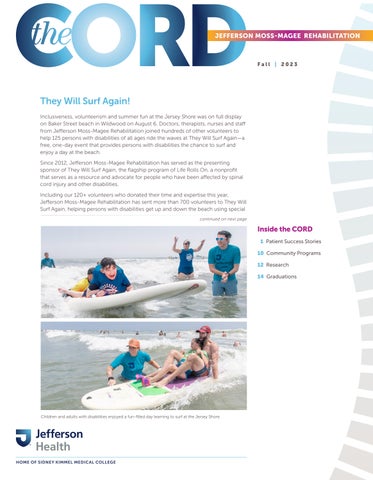
They Will Surf Again! Inclusiveness, volunteerism and summer fun at the Jersey Shore was on full display on Baker Street beach in Wildwood on August 6. Doctors, therapists, nurses and staff from Jefferson Moss-Magee Rehabilitation joined hundreds of other volunteers to help 125 persons with disabilities of all ages ride the waves at They Will Surf Again—a free, one-day event that provides persons with disabilities the chance to surf and enjoy a day at the beach. Since 2012, Jefferson Moss-Magee Rehabilitation has served as the presenting sponsor of They Will Surf Again, the flagship program of Life Rolls On, a nonprofit that serves as a resource and advocate for people who have been affected by spinal cord injury and other disabilities. Including our 120+ volunteers who donated their time and expertise this year, Jefferson Moss-Magee Rehabilitation has sent more than 700 volunteers to They Will Surf Again, helping persons with disabilities get up and down the beach using special continued on next page
Inside the CORD 1 Patient Success Stories 10 Community Programs 12 Research 14 Graduations
Children and adults with disabilities enjoyed a fun-filled day learning to surf at the Jersey Shore.
HOME OF SIDNEY KIMMEL MEDICAL COLLEGE
Patient Success Stories
We’re incredibly thankful to have Jefferson MossMagee Rehabilitation as a sponsor and to provide so many volunteers who are trained to assist our surfers
beach wheelchairs, get in and out of wet-suits and assist surfers in the water as they ride the waves. “We’re incredibly thankful to have Jefferson Moss-Magee Rehabilitation as a sponsor and to provide so many volunteers who are trained to assist our surfers,” says Jesse Billauer, founder of Life Rolls On and an adaptive surfing world champion. “To have actual therapists and rehab specialists, who are trained to properly interact with and assist persons with disabilities, intermingled with our other volunteers, who surf and are comfortable in the water, means proper techniques are used. That assures safety, comfort and dignity for the surfers.”
But hands-on expertise isn’t all that Jefferson Moss-Magee Rehabilitation brings to They Will Surf Again. Since 2015, they have partnered with local surfboard shaper and NJ middle school teacher Luke Alvarez -- owner of Generic Brand Surfboards -- to create surfboards designed specifically for surfers with disabilities. Working with input from therapists and surfers who have participated in They Will Surf Again events, the boards have large proportions, making them extremely stable and capable of carrying the weight of two riders (a surfer and volunteer) when necessary. The board decks feature thick pads for comfort and grip and attachment points for adjustable hand straps.
More than 120 volunteers shared their expertise at They Will Surf Again this past summer.
Alvarez has also used the boards to teach his students at Carusi Middle School in Cherry Hill, NJ, about the importance of accessibility and inclusiveness. Students — some of whom have disabilities themselves — designed the inspirational artwork laminated onto the boards. These unique surfboards are one-of-a kind works of art and symbols of inclusiveness and have been displayed at institutions, such as Philadelphia Museum of Art and the New Jersey Surfing Hall of Fame.
The surfboards used at this event have larger proportions enabling both the new surfer and a volunteer to share the board if needed. Pictured on the surfboard is Pennsylvania Sen. Christine Tartaglione.
2
3
Patient Success Stories Focusing On Possibility: Tyrone Smith’s Journey of Rehabilitation Two and a half years ago, Tyrone Smith was an entrepreneur working two jobs to start his own business. His life changed during his time as a truck driver when he was in a rollover car accident that left him with paralysis in all four limbs. Following his time at Cooper University Hospital after the accident, he was transferred to a facility to receive comprehensive care while he was on a ventilator 24/7. His family decided on a long-term acute care hospital in Marlton, NJ, where Tyrone stayed until he could breathe independently and doctors could remove his life support. After a few months at home, his mother, Quessie Herbert, noticed his progress halted. “I was concerned he was losing ground and valuable time in his recovery,” says Herbert. “He was motivated to get his life back, but I saw his physical condition deteriorating.” With help from the Workers’ Compensation Nurse Navigator at Jefferson Moss-Magee Rehabilitation Hospital, Herbert sought additional care and found that Tyrone was eligible for a specialty program addressing workers’ compensation cases. As part of that support, patients like Tyrone receive a Comprehensive Outpatient Evaluation where a multidisciplinary rehabilitation team performs complete medical examinations.
recommendations and a plan of care. “When I started therapy, it was a turning point,” Tyrone says. “When I first arrived, I was a train wreck. I wasn’t eating. I felt like I would be paralyzed for the rest of my life, but I started working on my strength and moving my arms.” While in rehab, Tyrone was friendly and motivated; the staff loved working with him. With support from the team, he made progress mentally and physically. “This place embodies one-on-one, all-encompassing support,” Herbert says. “They showed Tyrone that he did not have a situation with no hope. The last thing that anyone going from a life of wholeness to one of dependency needs is to feel alone or like no one cares. I loved that everyone at Jefferson Moss-Magee Rehabilitation, from the nurses and staff to the doctors and therapists, gave him hope. They showed him what could be.”
After his in rehab, Tyrone’s mother and stepfather helped support his recovery by ensuring they had all of the necessary equipment and continued his rehabilitation with the techniques she learned from the staff. But due to the COVID-19 pandemic, he struggled to find additional outpatient care. To receive care and begin the next phase of his life, Tyrone moved to Inglis House, a specialized skilled nursing long-term care community in Philadelphia. At Inglis house, he has found peers, receives constant support from friends and family and thrives on positive affirmations. He continues to receive outpatient therapy at Jefferson Moss-Magee Rehabilitation “It’s good for me, mentally, to know I can get better,” Tyrone says. “Slow motion is better than no motion.” Due to his commitment and “pushing it to the limit,” Tyrone has made
Art therapy motivated and inspired Tyrone during his time at Magee-Moss Rehabilitation.
meaningful strides in moving his arms and legs. While the prognosis of his ability to walk again is uncertain, Tyrone uses that uncertainty to stay motivated. “I don’t know what is to come. It’s untold, and there is beauty in that,” Tyrone says. “I am giving it all I have, and I aspire to inspire others to do the same because you can’t count yourself out at the end of the day. If you have the power to make it happen, do it.”
This team produces a Comprehensive Outpatient Evaluation Report, which addresses the injured worker’s overall rehabilitation status and any questions from the insurer. The report provides up-to-date information on the patient’s needs. It also includes detailed
The Comprehensive Outpatient Evaluation addresses the injured workers’ overall rehabilitation status. 5
Patient Success Stories ‘I’m Not Defined by My Body Parts’ Candice’s Healing Journey Following the Loss of Four Limbs When Candice Davis tested positive for COVID in August 2021, she had assumed she would get over it quickly, like so many others. But, with each passing day, her health worsened and it became increasingly difficult to breathe. “It felt like my heart was skipping beats,” Candice recalls. “When I got to the hospital, I was told I was going into heart failure and I needed to be on a ventilator.” Candice had been leading a vibrant life. Her Instagram page was plastered with photos of her 29-year-old self with her trademark smile, working out at the gym and posing with friends. Candice was a flight attendant with aspirations of becoming a nurse, and eventually a mom. But COVID took a devastating toll on her previously healthy body. Two years later, her healing journey continues as she learns to navigate life as a quadruple amputee. “People just don’t understand how COVID can affect people systemically,” says Caili Loaec, Candice’s physical therapist at Jefferson Moss-Magee Rehabilitation. “Her injuries shed a light
on the impact COVID has had on so many people’s lives.” Candice was put in a medicallyinduced coma for six weeks while an extracorporeal membrane oxygenation machine, commonly known as ECMO, processed her blood to remove the carbon dioxide and then sent oxygenfilled blood back into the tissues in the body. This method took the strain off her heart and lungs and it was her best chance at survival. The treatment saved Candice’s life, but significantly reduced blood flow to her limbs -- which caused gangrene to set in. When she regained consciousness, her mother told Candice the heartbreaking news. “She said, ‘They have to cut off your limbs in order for you to survive,’” Candice recalls. “I said, ‘Just do it. I want to live.’” Both arms were amputated below the elbow. Her left leg was amputated below the knee and her right foot was partially amputated. Fortunately, doctors were able to keep the right leg intact. Candice was also diagnosed with transverse myelitis, inflammation of part
of the spinal cord. With the amputation of four limbs and a spinal cord condition that significantly weakened her body, Candice faced a daunting recovery, which led her to Jefferson Moss-Magee Rehabilitation’s South Philadelphia outpatient facility. “She’s learning to live in a new body. She’s learning to use multiple devices. She’s learning how to experience the world in a power wheelchair,” explains Cate Furman, senior occupational therapist. “It requires an overwhelming amount of effort.” The road to independence is everevolving. Candice undergoes intensive outpatient occupational and physical therapy sessions three times a week. At the start, Candice was fully dependent on her caretakers for all aspects of life, including feeding, dressing and bathing. Her therapists say she’s been highly motivated since day one, eager to get to back to living her best life. “You can’t devote one month to the right arm and the next month to the left arm. It’s all happening at the same time and you’re constantly making decisions
The unwavering support of her family helped her through the difficult times.
on what to prioritize,” Cate explains. “Candice talks about what she needs to make her life easier week-to-week and that’s how we decide what to focus on during our sessions.” Candice has made tremendous gains in a year’s time. In occupational therapy, she’s learned how to care for herself independently with and without prostheses. Physical therapy strengthens her body so she can complete tasks, such as going from a sitting position to standing and then walking with prostheses on all four limbs. “When our team started working with Candice last summer, she could not use her arms to bear her body weight. So we looked for creative ways for her to stand upright without using her arms to pull herself up,” explains Caili. “Since she has gotten so much stronger and experienced, Candice is using her upper extremity prosthetics. We have incorporated the use of one or both devices when standing and walking. For example, it doesn’t matter if you can walk across your kitchen if you can’t feed yourself when you get there.”
Candice went from a young woman living her best life to someone grappling with the loss of limbs and learning how to function with a disability.
6
Candice relies on a power wheelchair for her main mode of transportation. She decides what prosthetic devices she wants to use, which are kept with
her wheelchair, depending on the situation. These battery-powered devices are controlled by electrical signals generated by muscles in the residual limb. When the muscle contracts, electrodes sitting on the skin inside the sockets detect these signals, which triggers movement to correspond with what the user intends, such as grasping patterns in a hand, wrist rotators and elbow angles. “My care team here helps me figure everything out and they have become family to me,” Candice says proudly. “I can walk with a walker. I can transfer myself to the commode or a chair. I can feed myself. I am learning how to do everyday tasks like folding clothes. I can do my make-up. I didn’t think I would be able to do that ever again.” Every day presents challenges for Candice. She recently invited her care team to her house, where they looked for opportunities to help her be more independent. “The smallest thing for us in therapy has a huge impact on her life,” Caili says. ‘Seeing her work hard day to day, week to week, month after month, really shows there is no limit to what she can achieve.” Each physical gain further boosts
7
Candice’s confidence. After her therapy, it’s not uncommon for her to travel a few blocks in her power wheelchair to go shopping by herself. “I have so much admiration for Candice. She is really positive and always working towards a goal,” says Cate. “She can also be vulnerable and honest about grieving a life that was abruptly stolen from you and being in a body that you don’t recognize.” When Candice sees photos of her former self, she admits, it can be hard not to cry. But she also knows getting stuck looking back at what she lost won’t help her move forward. “I’ve changed the narrative about thinking of my body parts as ‘me.’ I am still the same Candice without my limbs,” she shares. “My full-time job now is working towards self-sufficiency. My care team never says, ‘No we can’t do that. That’s never going to happen.’ I really need that because I want to keep getting stronger.”
Checking In Jim Isenberg Q&A For nearly six years, Jim Isenberg has
possible, despite significant physical
recently caught up with the couple
Moss-Magee Rehabilitation was very
been living with a spinal cord injury that
limitations as a result of his injury. His
about their lives two years later.
important in helping me make the most
left him paralyzed from the neck down.
team was comprised of doctors, nurses,
Jim was in Australia on business in
physical therapist, occupational
December 2017 and he visited the
therapist, speech therapist, and many
beach when he had some downtime.
others who specialize in treating
While wading just offshore, a wave
neurological and spinal cord injuries.
JIM: As you might guess, life for a
knocked into him and slammed his
They collectively mapped a detailed
person like me with a high level spinal
head in the sand bank. The force
care plan to help Jim regain as much
cord injury, along with life for my wife,
caused a complete spinal cord injury at
function and independence as possible.
is far from easy. Fortunately, I have daily
Q: You underwent intensive outpatient therapy for three years preceding the move to D.C. How did that experience help your recovery?
the third cervical vertebra. His injury
This involved strengthening his
support with nursing care. It is great
JIM: The intensive weekly sessions
was so severe it required him to be on a
muscles, stimulating nerves throughout
that Pauline can be close to her job.
provided consistency in my care which
ventilator in intensive care for months
his body, working to improve his
And it is very important for me to be
led to improvements in my
before he was transferred by medical
speech and ability to eat, and
able to work with collaborators on
independence. When I was discharged
transport to Jefferson Moss-Magee
incorporating innovative technology
math and physics research projects. But
from inpatient care, I transitioned to the
into almost every aspect of his daily life.
it is never easy.
Day Rehab Program, which involved
Jim’s life was fully focused on his
As I often tell people, as a consequence
A renowned mathematician and college
recovery. He was a dedicated regular at
of my spinal cord injury, 80 percent of
professor, who had completed over 150
the Riverfront outpatient facility until
my ability to navigate life is gone, so the
marathons, Jim was determined to
July 2021, when he and his wife,
important thing is to focus on the
regain as much independence as
Pauline, moved to Washington D.C. We
remaining 20 percent. Jefferson
Rehabilitation Hospital in Center City Philadelphia.
Q: It’s been six years since your spinal cord injury. What is life like for you both now?
Jim Isenberg, wife Pauline Kennedy, and friend at The John F. Kennedy Center for the Performing Arts where they attended an opera.
of that 20 percent. Pauline is crucial to that as we continue life together.
physical, occupational therapy, speech therapy and other support five days a week. We also had excellent trips into the community, like visiting various Philadelphia museums, restaurants, and shopping. After Day Rehab, I continued with outpatient physical therapy,
Jim catching up with former classmates from Princeton University during their 50th class reunion.
occupational therapy, speech therapy
It took a while for me to get the hang of
physics conferences in Germany, Austria
and art therapy. Several times a week, I
it. The first time I went outside using the
and Long Island, NY. I attended the
got on the locomotor treadmill that
power wheelchair myself was a very big
conferences in Europe virtually, and with
allowed me to walk in a harness with
deal. I traveled around the block with my
Pauline’s help, I attended the conference
body weight supports. I miss working
therapist and wife by my side. After
in-person in Long Island.
with everyone very much.
everything I had been through, I was very
Q: What has been most beneficial in your recovery?
excited to reach this new level of independence. Since then, I took many trips around the city. I found that it is
JIM: Learning to use the power
helpful to continue to set goals. Just last
wheelchair was a turning point for me.
month, I took my power wheelchair for a
For the first two months after my injury, I
three-to-four-mile trip along the C&O
was pretty much confined to my bed at
Canal with my wife and nurse.
the hospital in Australia. The most exciting part of my day was when my
Q: Have you started working again?
bed was rolled outside to look at the sun.
JIM: I have not been teaching, but I do
When I arrived at rehab, I was finally able to be put in a wheelchair and wheeled into physical therapy and occupational therapy. A month or two after my arrival, my physical therapist, along with others, allowed me to start practicing how to control a power wheelchair using my chin.
spend many hours a week working on math and physics research projects. It helps enormously to have collaborators working with me on Zoom as well as having them come to visit. During the last three years, eight of my papers have been published in scientific and mathematical journals. I have helped organize a number of math and 9
Jim and Pauline say it’s important to continue to find ways to connect as a couple and strengthen the relationship. They enjoy listening to podcasts and going on outings together, including attending MLB baseball games, touring museums in the D.C. area, and going on “walks/ wheelings” along the paths in and around the city. For couples in which one spouse is recovering from a spinal cord, Jim’s advice is to be “patient with each other and continue to show that you both love each other.”
Community Programs From Adversity to Triumph: Nobuhiro Hayashi’s Journey of Rediscovering Joy through Wheelchair Sports Sports have always been a significant part of Nobuhiro “Jonathan” Hayashi’s life. Originally from Japan, Jonathan moved to the United States at age 13 and found fulfillment and a sense of community through sports like baseball, softball, soccer, volleyball, skiing, swimming and golf. Even as an adult in dental school, Jonathan managed to stay involved in sports, which brought him immense joy.
work as a pediatric dentist. But as his hand problems started affecting his ability to work, he sought medical help. Following an MRI, he was referred to a neurosurgeon and underwent surgery in late 2017. After enduring two weeks of post-operative appointments filled with pain, loss of sensation and a sense of despair, he was transferred to Jefferson Moss-Magee Rehabilitation Hospital in Center City Philadelphia.
Unforeseen Detours
Through an intensive daily rehabilitation program, Jonathan regained the ability to walk and move his right hand in a matter of weeks.
In 2017, Jonathan’s life took an unexpected turn, forcing him to take a prolonged break from sports and, eventually, his career. He experienced sharp shoulder pains, nausea and a decline in strength in his right hand over the course of a few months. Finally, he was diagnosed with an ependymoma, a rare tumor that grew within his spinal cord. Initially, Jonathan brushed off his hand issues, as he had grown accustomed to neck, shoulder and back pain from his
“I feel very fortunate that Jefferson Moss-Magee Rehabilitation—one of only a few rehab hospitals in the nation that has a dedicated floor for spinal injury patients—is right in my backyard,” he said. “I am forever grateful to everyone here, from the doctors, nurses and therapists to the kitchen staff.” His family was also a significant source of support for him during this difficult
The Wheelchair Sports Program rekindled Jonathan’s passion for competitive sports.
time. “I really wouldn’t have had any motivation to live, let alone go through rehab, if I didn’t have my wife and kids.” Despite progressing in outpatient rehabilitation, Jonathan faced a new challenge: neuropathic leg pain. This setback led to a realization that his recovery would be more complex than anticipated, with a significant amount of time spent in a wheelchair. Although initially disheartened by this reality, Jonathan worked to embrace his new normal.
Rediscovering Joy During this time, Jonathan discovered the Wheelchair Sports Program, thanks to a timely newsletter just before the onset of the COVID-19 pandemic. After a few initial setbacks, he finally participated in basketball pick-up games in the summer of 2022. Rekindling his passion for sports fueled a desire to explore other activities. The program now organizes tennis practices, with plans for a ski outing next year.
“Being united with the Wheelchair Sports Program has been a lifesaver for me. I didn’t think I would ever play sports again,” he said. “I have rediscovered joy by playing wheelchair sports. I’m not thinking about my pain while playing and I love that I can sweat again.” “When Jon first came to our program he didn’t know what to expect, and had never played a sport post-injury, or from a wheelchair,” says Community Program Coordinator Keith Newerla. “It has been exciting to see how far he has progressed in such a short period of time. His
I am forever grateful to everyone, from the doctors, nurses and therapists to the kitchen staff. mobility may have changed, but his competitive juices have stayed the same. That was evident when he participated in his first wheelchair tennis tournament this summer and he won his division.” Learning how to play sports in this new way is a challenge for Jonathan, but one he wholeheartedly accepts. “There are still days when I feel immobilized by my pain, but far less than before. Playing sports again has something to do with it, but having the support and love from my wife and my kids has made a huge impact. As I came to terms with my ‘new normal,’ I realized I needed to focus on what I can do and not what I cannot do anymore,” says Jonathan. “Staying positive and staying away from negative thoughts is so important.”
When Jonathan plays basketball and tennis, he stops thinking about his pain.
10
11
Research We Investigate, Collaborate and Share Knowledge Presentations
Research
How Can Medical Homes Help My Patients? The Experience of Three Domestic Non-Veteran SCI Centers James Wilson, DO Savitri Goud, MD Marci Ruediger, PT, MS Mendel Kupfer, MD Presented at 2023 ASCIP (Academy of SCI Professionals) in San Diego, Sept, 2023
Non-Invasive Electrical and Magnetic Neuromodulation in Persons with Chronic Spinal Cord Injury (RISES-T 2.0)
2023 Edwards, D.J. “Innovating rehabilitation robotics through research”, Rehabilitation Medicine Society of Australia and New Zealand, 6th Annual Scientific Meeting, Hobart, TAS, Australia. 2022 Edwards, D.J. “Intensive gait training in chronic incomplete spinal cord injury using robot-assisted exoskeletons: rational, outcomes, and interpretation of a RCT”. 12th World Congress for Neurorehabilitation, Vienna, Austria, virtual (December).
Publications Edwards, D.J., Forrest, G., Cortes, M. et al. Walking improvement in chronic incomplete spinal cord injury with exoskeleton robotic training (WISE): a randomized controlled trial. Spinal Cord 60, 522–532 (2022). https://doi. org/10.1038/s41393-022-00751-8 Activation of MAP2K signaling by genetic engineering or HF-rTMS promotes corticospinal axon sprouting and functional regeneration. protection.outlook.com Canori A, Hiremath, Schmidt-Read M, et al; Potential of social engagement for overcoming barriers to physical activity in individuals with spinal cord injury; Journal of Rehabilitation and Assistive Technologies Engineering; accepted June 2023 Solinsky R, Schmidt-Read M, Nash M, et al, Patient Perceptions and Clinical Assessments of Cardiometabolic Disease after Subacute Spinal Cord Injury – submitted June 2023
1.
Are you an adult aged 18 to 55?
2.
Have you had a spinal cord injury at least 1 year ago?
3.
4.
Are you able to commit to arranging reliable transportation and caregiver assistance as needed for study visits several times a week over a 6-month period? Can you get to Thomas Jefferson University in center city Philadelphia (130 S. 9th Street, Philadelphia, PA 19107)?
For more information, contact the Raphael Center for Neurorestoration by email at CenterNR@jefferson.edu or by phone at 215-503-4042 Temple University Study on Use of Smartphones to Improve Physical Activity Levels of Individuals with Spinal Cord Injury The purpose of this study is to help individuals with spinal cord injury improve their physical activity levels in the community.
Time Commitment: 24 weeks (~6 months). Number of visits: A research team member will meet with you four times at your home or via a video conference meeting software. Testing: A smartphone-based physical activity monitor system that will measure your physical activity in the community. You will also be required to answer questions related to your physical activity on a regular basis. Compensation: Participants can receive up to $20 per month for six months of the study and $40 for interviews and equipment return. If interested, please contact: Shivayogi Hiremath, PhD, at Shiv.Hiremath@temple.edu Noninvasive Brain Stimulation Therapy in Subacute Human Spinal Cord Injury: a Translational Study Sponsor: Pennsylvania Department of Health, Spinal Cord Injury Research PI: Dylan J. Edwards, PhD Contact: Sapna Kumar MSE sapna.kumar@jefferson.edu
If you are an individual with spinal cord injury, you may be eligible to participate if you:
Bedside Telerehabilitation Early After CNS Injury
• are between 18 and 75 years of age
Sponsor: TR Care, Inc.
• are at least 6 months post-injury and medically stable
PI: Dylan J. Edwards, PhD
• use a manual or power wheelchair in the community
sapna.kumar@jefferson.edu
Get Support at Magee! All support groups are currently meeting virtually, via Zoom. For dates and details, contact the individuals listed or visit JeffersonHealth.org/MageeSupportGroups. • Amputee Peer Mentoring: Rebecca.Levenberg@jefferson.edu or 215-587-3205
• SCI Resource & Support Group: Marie.Protesto@jefferson.edu or 215-587-3174
• Amputation Support Group: Rebecca.Levenberg@jefferson.edu or 215-587-3411
• Stroke Family Care Group: Sonya.Dibeler@jefferson.edu or 215-587-3411
• Aphasia Support Group: Svjetlana.vitor@jefferson.edu or 215-218-3909 Sarah.Lantz@jefferson.edu Sarah.Troy@jefferson.edu
• Stroke Peer Mentoring: Sonya.Dibeler@jefferson.edu or 215-587-3411 Rebecca.Levenberg@jefferson.edu or 215-587-3411
• Brain Injury Family Care Group: Sonya.Dibeler@jefferson.edu or 215-587-3411
• Wendekos Stroke Club: Fritz.Louisjean@jefferson.edu or 215-587-3180
•B rain Injury Peer Mentoring: Sonya.Dibeler@jefferson.edu or 215-587-3411 Rebecca.Levenberg@jefferson.edu or 215-587-3411
• Young Adult SCI Social Group: The group meets virtually every other week and in-person for a community outing six times a year. Katie.Eckert@jefferson.edu or 215-218-3911 Colleen.McAllister@jefferson.edu or 215-218-3900
• MS Healthy Living: Colleen.McAllister@jefferson.edu or 215-218-3900 • SCI Family Peer Support Group: Ruth.Black@jefferson.edu or 215-587-3030
• Young Adult Brain Injury Social Group: Keith.Newerla@jefferson.edu or 215-587-3412
• SCI Peer Mentoring: Marie.Protesto@jefferson.edu or 215-587-3174 Keira.Aviles-Rivera@jefferson.edu or 215-587-3174
Contact: Sapna Kumar MSE
• use your upper arms for exercise • are able to use a smartphone and a smartwatch independently • are interested in starting an exercise program • do not have health conditions that medically restrict you from physical activity.
12
13
Gaining Ground Gaining Ground Program Increases Strength and Endurance
Congratulations on your graduations! Adolescent Patients at Jefferson Moss-Magee Rehabilitation Pursue Educational Dreams Springtime is a special time for teenagers and young adults in school looking forward to their prom and/or their commencement ceremony. While at Jefferson Moss-Magee Rehabilitation, Adolescent and Young Adult Program Coordinator Vilma Mazziol assists all students in staying connected with their schooling and vocational plans.
Below are patients who recently graduated from high school/college. We are proud of each of these graduates and all that they have achieved!
Daniel Gaines
Kareem Rutledge Jr.
Nicholas Frantz
Gavin Birl
Arizona State University
Rowan College of South Jersey
Danville Area High School
Cape Henlopen High School
Recovery following a neurological injury does not follow a set timeframe and is different for each person. It may be a long, slow process, and is often about more than just walking. Recovery is about regaining function and improving your overall quality of life. Gaining Ground is a four-week specialized exercise program specifically tailored to the individual with a focus on improving function while taking into account the client’s goals and abilities. The program includes an evaluation by a physical therapist and a fitness assessment by an activity-based trainer, a customized exercise prescription program and one-on-one training. Participants use a variety of specialized equipment, including:
Boden Miller
Sadie Lambert
Brian Dawkins
Ariana Eddins
Conestoga High School
Alexandria (VA) City High School
Achievement Cyber Charter High School
Ridley High School
14
•
electrical stimulation cycles
•
the Lokomat
•
robotic exoskeletons
•
standing frames
•
weight training equipment
•
adapted cardio equipment.
Gaining Ground offers one-on-one sessions with a therapist and trainer, as well as self-paced group sessions, art and music therapy, massage therapy, recreation therapy and various educational topics.
Positive results may include:
first-come, first-serve basis. Contact us at eric.beck@jefferson.edu for information on program cost.
•
Improved health and well being
•
Increase in central nervous system activity
•
Increased bowel and bladder sensation
•
October 16-November 9, 2023
•
Increased muscle mass
•
February 26-March 21, 2024
•
Increased function below the level of injury
•
April 8- May 2, 2024
•
Improved posture and trunk control
•
Decreased pain
•
Decreased medication use.
Don’t miss out on the action! Upcoming sessions:
For additional information, including more patient testimonials, photos and videos, please visit our website: Neurological Injury Recovery Program | Philadelphia Rehabilitation (MageeRehab.org/Gaining-Ground)
Previous participants report: “The one to one training helped me get more function out of my right arm which helped me with transfers.” “The group sessions were a great work out, and we all motivated each other.” “The weight lifting was great – I was able to go up 10 pounds on my weights by the end of the program. The increased strength allowed me to stand more easily.” “I would do the program every session if I was able to!” Gaining Ground is a private pay program and is not covered by insurance. Please note that participant slots are limited and on a 15
Interested? Questions? Contact Liz Watson at Elizabeth.Watson3@jefferson.edu or 215-218-3913.
Jefferson Moss-Magee Rehabilitation Address Service Requested
Non-Profit Organization U.S. Postage PAID Philadelphia, PA Permit No. 2269
1513 Race Street Philadelphia, PA 19102-1177 1-800-96-MAGEE JeffersonHealth.org/Rehab
Our New Name Magee Rehabilitation Hospital and MossRehab have come together under the umbrella of Jefferson Health as Jefferson Moss-Magee Rehabilitation, which includes our six inpatient locations and more than 40 outpatient rehab sites across the Philadelphia region and South Jersey. Collectively, we are the largest and highest ranked provider of acute inpatient and outpatient physical and cognitive rehabilitation in the Philadelphia region. Notably, our two flagship inpatient locations in Elkins Park, PA and Center City Philadelphia, are both nationally ranked by U.S. News & World Report, with Elkins Park holding the highest rank in Pennsylvania. Together and with the experienced clinicians at Jefferson Health, we help individuals with the most complex rehabilitation needs recover from injury and illness and return to their best possible way of life.
MOSSREHAB and
M A G E E R E H A B I L I TAT I O N H O S P I TA L CS 24-0268