What is a Neurologist Specialist? Neurology Exercise Treatments.
A specialist is a medical doctor that focuses on treating diseases of the nerves. The nervous system is constructed from 2 parts: the central and also peripheral nervous system. It consists of the mind and also spinal cord. Health problems, conditions, and injuries that involve the nervous system commonly call for a neurologist administration and therapy. Before they can exercise, neurologists need to: - graduate from clinical school - complete an internship - obtain three years of training in a neurology residency program What does a specialist do?
Specialists manage and also deal with neurological conditions, or problems with the nerve system. Symptoms that frequently call for a specialist consist of: - control problems - muscle weak point - a change in feeling - complication. - lightheadedness. Individuals that are having problems with their detects, such as touch, vision, or odor, may also require to see a specialist. Issues with detects are in some cases triggered by nervous system problems. Specialists additionally see people with - seizure problems, such as epilepsy. - stroke. - multiple sclerosis. - neuromuscular disorders, such as myasthenia gravis. - infections of the nerves, consisting of encephalitis, meningitis, or brain abscesses. - neurodegenerative problems, such as Lou Gehrig's condition and also Alzheimer's disease. - spinal cord problems, including inflammatory and also autoimmune disorders. - migraines, such as collection headaches, as well as migraine headache. Specialist subspecialties. Since the nerve system is intricate, a specialist may focus on a particular location. They'll do a fellowship in that area after residency training. Subspecialties have progressed to narrow a doctor's focus. There are many subspecialties. Some examples include:. - migraine medicine.
- neuromuscular medicine. - neurocritical treatment. - neuro-oncology. - senior citizen neurology. - free disorders. - vascular (stroke care). - youngster neurology. - treatment neuroradiology. - epilepsy. Mental Health In Emphasis. For Mental Wellness Recognition month, sign up with Taraji P. Henson, Jewel, Michelle Williams, and more in a sincere discussion to bring the state of mental health and wellness in emphasis. Typical Neurological Treatments Throughout your very first consultation with a neurologist, they'll likely execute a physical examination and also a neurological examination. A neurological examination will evaluate muscle toughness, reflexes, as well as control. Because different conditions can have comparable signs and symptoms, your specialist may need much more examining to make a diagnosis. Neurologists might recommend a variety of treatments to help diagnose or treat a problem. These treatments may consist of:. Lumbar puncture. Your neurologist may utilize a lumbar puncture to examine your spinal liquid. They might suggest the procedure if they believe your symptoms are caused by a trouble in your nerves that can be detected in your back liquid. The procedure entails putting a needle right into the back after numbing it as well as taking an example of spine liquid. Tensilon examination.
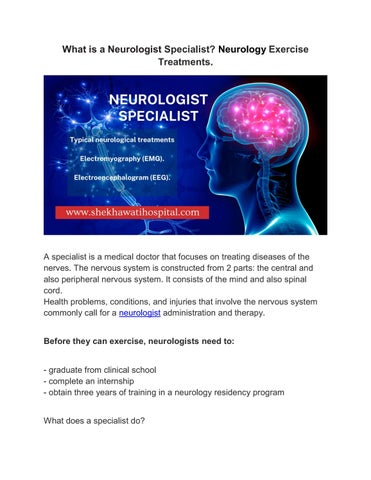
This treatment can help your neurologist detect myasthenia gravis. In this examination, your physician injects you with a medication called Tensilon. After that they observe exactly how it impacts your muscle movements. Electromyography (EMG). An EMG measures electric activity in between your mind or spinal cord to an outer nerve. This nerve is found in your limbs, and also is in charge of muscular tissue control throughout times of movement and also remainder. EMGs can assist your neurologist detect spine illness along with general muscle or nerve dysfunction. Throughout this examination, your neurologist-technician inserts small electrodes right into your muscle mass to assist action task during periods of motion as well as rest. Such task is taped by a machine attached to the electrodes with a series of cables, which might be somewhat uneasy. Oftentimes, a specialist will certainly purchase a nerve transmission velocity (NCV) research along with an EMG. While an EMG determines muscle mass task, an NCV examines the capacity of your nerves to send the needed signals that regulate these muscular tissues. If your neurologist recommends both tests, you'll likely do the EMG first. During an NCV test, electrodes are taped over the exact same muscle mass that you had EMG electrodes in previously. Two collections of electrodes are made use of right here-- one sends tiny pulses in an effort to boost your nerves, while the various other collection determines the outcomes. In all, the ordinary EMG/NCV combination test might take about a hr or longerTrusted Resource to complete. You'll want to avoid any type of energizers, such as high levels of caffeine and pure nicotine, numerous hrs prior to your examination, otherwise these substances may change your results.
Your specialist might likewise ask that you do not take any type of bloodthinning medications or nonsteroidal anti-inflammatory drugs (NSAIDs) for 24 hoursTrusted Resource ahead of the EMG. Best Neurology Hospital in Jaipur Electroencephalogram (EEG). With electrodes put on your scalp, an EEG determines electric task in the brain. It's used to help identify problems of the brain, consisting of inflammation, growths, as well as injuries, as well as seizures and also psychological conditions. Unlike an EMG, an EEG doesn't normally create any type of discomfort. Before the test, a technician puts electrodes around the scalp that look like tiny cups. As little charges in the brain are measured with the electrodes, the technician will create changes in the environment to gauge mind signals, such as various illumination or noises. Like an EMG, you'll need to prevent stimulants the day before the test. You can also expect the EEG to take an hourTrusted Resource. Sometimes the examination is done while you're resting. Various other examinations. Specialists may make use of various other sorts of tests, too. Although they might not perform the test, they may purchase it, evaluate it, and also interpret the outcomes. To make a medical diagnosis, a neurologist may make use of imaging examinations such as:. - computed tomography, or CT check. - magnetic resonance imaging, or MRI check. - positron exhaust tomography, or pet dog check.
Other diagnostic treatments consist of sleep studies as well as angiography. Angiography identifies obstructions in the capillary going to the brain.
Contact Us: GPSH is committed to provide quality services and medical care to each and every citizen. (+91) 141-2232211 info@shekhawatihospital.com A/2, Opposite "Time Square", Central Spine, Vidhyadhar Nagar, Jaipur Tag: Best Neurology Hospital in Jaipur Orthopedic hospital in Jaipur