CLASSIC MARQUE
October 2026
CELEBRATING 75 YEARS OF THE C-TYPE (1951) THE OFFICIAL MONTHLY MAGAZINE OF THE JAGUAR DRIVERS CLUB OF SA THE OFFICIAL MONTHLY MAGAZINE OF THE JAGUAR DRIVERS CLUB OF SA
PAGE 1
Sponsor - Lou Guthry Motors
2005 Jaguar XKR 4.2-S 4.2L V8 S/C
2010 Jaguar XFR 5L V8 Supercharged
Australian delivered Final Edition ‘White Badge’ is the ultimate and most desirable development of the X100 series. Built in very limited numbers, Jaguar announced only 15 would be officially imported into Australia – 9 convertibles and only 6 coupes.
Immaculate Jaguar XFR 5L V8 Supercharged with full service history, log book, all relevant owner manuals and spare key. Finished in Ultimate Black with Warm Charcoal trim and travelled 87,765km, this car is in excellent condition inside and out.
SNJ042
118,635 km
$54,990
SNJ050
87,765 km
$53,990
2006 Jaguar XJ6 X350 SWB 3L V6 Petrol
1973 Jaguar XJ12 Series 1 5.3L V12
Very well maintained Jaguar X350 XJ6 SWB 3 litre petrol with full service history, log book, all relevant owner manuals and spare key. Excellent condition inside and out, these luxurious saloons were the first of the modern aluminium bodied Jaguars.
Australian delivered 1973 SWB, one of only 720 right hand drive SWB XJ12 Series 1 cars built. Mechanically sound, the ride is first class and the body benefits from an earlier rust prevention treatment. Very hard to find in this condition, any test welcome. SNJ053 542,167 mi* $24,990
SNJ030
111,465 km
$27,990
43 PAGE 2
THE OFFICIAL MONTHLY MAGAZINE OF THE JAGUAR DRIVERS CLUB OF SA
Club Torque - President’s Report For October 2026 Following the AGM last month, it is a pleasure to welcome three new members to the Executive Committee: Hugh Guthrie as Vice President, Peter Thomas as an Executive Committee member and Logbook Officer, and Mark Dunlop as Compact Register Secretary. Other positions remain unchanged, except that Tim White has been appointed to the casual vacancy of Treasurer. The Secretary position did not receive any nominations, but the Executive can make a 12‑month casual appointment. With technology (and training provided), it is not an onerous task, but it would relieve me of additional load if someone were willing to step forward. I ask that you please give this your consideration. October brings the Club’s premier public event, our SA Jag Day, where we showcase the many beautiful models of cars in the Club. The day requires significant planning and the contribution of a dedicated team of volunteers. To grow the pool of trained Traffic Marshals — essential for the safe manoeuvring of vehicles around Wigley Reserve — we will be holding a training session, run by an Officer from SAPOL, at this month’s General Meeting on Tuesday 6th October. I hope many will attend and help share the responsibility carried by those who have undertaken this task for many years. Being President and attending as many meetings and events as possible to chat with members is one of the great pleasures of the role. Any Club member is welcome to attend any Register’s events by booking through the Events link on our website, and I encourage you to participate whenever you are able.
The recent joint run with the Barossa Valley Historical Vehicle Club (BVHVC), organised by Trevor Norley, was a wonderful opportunity to share our love of special cars and enjoy a drive through beautiful countryside with members of another Club that is also celebrating 50 years. Another such event will be organised in the future. The Club has been invited to present a display of up to 10 cars at the BP Adelaide Grand Final on 28th and 29th November in Victoria Park. A call will go out for those interested, with the bonus of two free general‑admission entries to the event. Cars may be left overnight, with security provided. Lastly, I would love to hear from members with young families to discuss ideas for Club activities and events that suit their phase of life and age group. In its early years, the Club catered well for young families, and it remains an important aim to better support this sector of our membership. If you would like to join this discussion, please contact me on 0407 727 459 or moira.lugg@gmail. com. If you are willing to update your TidyHQ profile with your date of birth (DD‑MM‑YYYY), or at least the year of your birth (01‑01‑YYYY), it would help us identify the Club’s ‘next generation’ of members for targeted notices. Warm regards Moira Lugg President
November General Meeting Change of Date JDCSA November General Meeting that would normally be held on the 4th of November has been brought forward to the 27th of October as the venue is unavailable due to Melbourne Cup events.
CONTENTS
(Feature Articles) Jaguar Stories
9, 11
The 1946ers Club Escape
12
Ladies’ Luncheon
13
Eden Valley Lunch Run
14-17
E, F & GT Run to Mt Pleasant 18-19 Dolly Parton’s E-Type
20
A Lost Supercar Story (XJ220)
21
Peter Davey’s Mk II
22-25
The Story of Our Mark II
26-27
Technical: Restoring Leather
29-31
Formula E - Fortescue Zero
32
Mk 2 at Goodwood Revival
33
75 Years of The C-Type
34-39
On This Day
40-43
UK Jaguar Magazines
44-45
JDCSA Classified Adverts
46-47
Auctions
49-55
Register Reports
56-57
2026 AGM Minutes
58-59
September 2026 GM Minutes
60
JDCSA Club Directory 2026
61
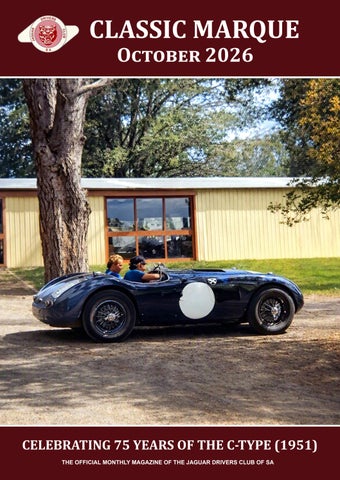
Front Cover: A moment from about 50 years ago — Gavin Sandford‑Morgan in his Ecurie Ecosse C‑Type at Birdwood Mill, with David Siedel enjoying the ride.
Rear Cover: 2027 JDCSA Club Calendar
THE OFFICIAL MONTHLY MAGAZINE OF THE JAGUAR DRIVERS CLUB OF SA
https://www.facebook.com/ groups/453009102006257
PAGE 3
DEC
NOV
OCT
Events Calendar 2026
PAGE 4
TUESDAY 6th OCTOBER 2026
JDCSA General & Meeting at the ‘The Junction”, 470 Anzac Highway.
SUNDAY 11th OCTOBER 2026
Compact Register Barossa Valley Run: 9.15am - 3.00pm
SUNDAY 11th OCTOBER 2026
Rotary Strathalbyn Auto Swap Meet - Strathalbyn oval complex: 6.30am Gates open 5.30 am for sellers - 6.30 am for buyers (Public admission $5/adult ). More info goto: Rotary Strathalbyn Auto Swap Meet XK 7, 8 & 9 Register Border Run Hamilton:
TUESDAY 13-17th OCTOBER 2026
Meals available from 6:00pm. SAPOL will conduct Traffic Marshal training at 7:30 before our meeting, More details & register via TidyHq JDCSA October General & Meeting Meet at Adelaide Entertainment Centre. Travel to Barossa Valley Tanunda, Choc Factory Coffee stop. Run through Barossa Valley with Lunch at Salters Kitchen, Saltram Winery. More details & register via TidyHq Compact Register Barossa Valley Run
This event is being organised by the Victorian Register. Please contact Steve Weeks for details.
WEDNESDAY 14th OCTOBER 2026
XJ, MkX, 420G Register Meeting : 6.00pm - 8.30pm
THURSDAY 15th OCTOBER 2026
XJ, MkX, 420G Register Lunch Run: 10.30am - 3.00pm
SUNDAY 18th OCTOBER 2026
Bay To Birdwood: Registrations Closed. Historic vehicles from early 1900s to 31 Dec 1996.
SUNDAY OCTOBER 25th
SA JAG DAY - Wigley Reserve, Glenelg: 10am to 2.30pm
TUESDAY 27th OCTOBER 2026
JDCSA November General & Meeting at the ‘The Junction”, 470 Anzac Highway.
NOVEMBER 6th - 9th 2026
SS, Mk IV & Mk V Border Run to Corryong Victoria
FRIDAY 6th NOVEMBER 2026
Climb to the Eagle 2025: 7.00am - 2.30pm Registrations open Now!
WEDNESDAY 11th NOVEMBER 2026
XJ, MkX, 420G Register Meeting & Auction Night: 6.00pm - 8.30pm
SUNDAY 15th NOVEMBER 2026
E, F & GT Register Christmas Lunch - Serafino Wines: 10.00am - 3.00pm
SUNDAY 15th NOVEMBER 2026
Yankalilla Motor Show: 9.30am to 2.30 pm. Registrations open Now!
THURSDAY 19th NOVEMBER 2026
Jaguar Ladies Register - Lunch at Mosaic Hotel, West Lakes.
SUNDAY 22nd NOVEMBER 2026
Compact Register Christmas Lunch Run: 12.00pm - 3.00pm
THURSDAY 26th NOVEMBER 2026
Multivalve Register Christmas Lunch Run: 10.00am - 4.00pm
SUNDAY 29th NOVEMBER 2026
XK 7 8 & 9 Register Mystery Christmas Lunch: 11.00am - 3.00pm
SUNDAY 13th DECEMBER 2026
XJ, MkX, 420G Register Christmas Dinner & Show 2026: 5.30pm - 11.00pm
Come and join our monthly meeting. Meet at the Bartley Hotel. More details & register via TidyHq XJ, MkX, 420G October Register Meeting Join us for a beautiful drive down to Strathalbyn and on to Ashbourne for lunch at The Greenman Inn. More details & register via TidyHq Lunch run to the Greenman Inn https://baytobirdwood.history.sa.gov.au/
Enjoy a magnificent display of 150+ Jaguar and Daimler cars ranging in ages from the mid 1930s to present day. CATS and CANS Food Drive is on again! (See advert page 6) The meeting starts at 7.30pm with meals available from 6:00pm. Date moved due to clash with Melbourne Cup. Please add the date to your calendar.
The event has been organised by Nik Cirakovic, Secretary, SS, MkIV & MkV Register, Jaguar Car Club of Victoria. Please contact Graham on 0490 074 671 for more details. Victoria Park Grandstand to Hahndorf via Eagle on the Hill and then to Nuriootpa for Lunch. Registrations open Now! Close strictly on Friday 9th October. Climb to Eagle Come and join our monthly meeting. Meet at the Bartley Hotel. More details & register via TidyHq XJ, MkX, 420G Register - Auction Night The cost of the lunch is $50.00 per person. There will be a short car run beforehand with a possible morning tea stop on the way. (Bookings close 5th November and limited). More details & register via TidyHq E, F & GT Register Christmas Lunch
Yankalilla Show grounds. All proceeds support Yankalilla district Lions Community Projects. Entrant Ticket Price: Vehicle $15.00 (includes 1 passenger) Yankalilla Motor Show More details will be provided closer to the event. Please add the date to your calendar. Tricia Clarke, Register Secretary - 0422 128 066
Christmas Lunch get together will be held at the Totness Hotel, Mount Pleasant.. Details & register via TidyHq Compact Register - Christmas Lunch Meeting at the Marion Hotel for a 10:00am start for a planned cruise through the countryside with a pitstop for coffee followed by lunch at a new venue. More details & register via TidyHq Multivalve Register Christmas Lunch Run Hi all, we will be parking our cars in a central (secure) location & taken by bus to a Christmas Lunch venue. Please put the date in your diaries. More details & register via TidyHq XK 7 8 & 9 Register Mystery Christmas Lunch Glenelg Golf Club. Three-course dinner and Famous Christmas Floor Show. $70.00 per person. More details & register via TidyHq XJ, MkX, 420G Register Christmas Dinner & Show THE OFFICIAL MONTHLY MAGAZINE OF THE JAGUAR DRIVERS CLUB OF SA
Club Torque - Editor’s Column (Graham) From an editorial perspective, September always proves to be a busy month. While preparing the October CM edition, the 2027 Club Calendar also needed to be finalised. Fortunately, Noel Schmidt came to my rescue with a selection of excellent images and templates that made the process far easier. Several backgrounds were subtly adjusted to
enhance the overall presentation, and the finished calendar will be ready for initial distribution on SA Jag Day.
For those interested, the new Jaguar will be released on 6 OCTOBER. (New York time).
My thanks to all members who supplied photographs and to those who kindly agreed to have their cars included. Thank you also to everyone who contributed stories and images for this edition — your support is greatly appreciated.
I hope all members have their cars ready for Jag Day. It’s a wonderful venue, and if you’ve never displayed your car before, consider giving it a try — it’s only one day a year, and it’s always a highlight of our calendar. See you there.
Vale Robyn Welch Dear Members, It is with great sadness that we farewell one of our long‑standing members, Robyn Welch, who passed away on 5 September. Robyn faced cancer with remarkable courage for more than twenty years, yet throughout that time she remained an enthusiastic and joyful presence within our Club. Always smiling, always offering friendship, Robyn had a rare gift for making those around her feel happy — a kindness she shared generously and without hesitation. Robyn and her husband Robert were regular attendees at Multivalve, E, F & GT Register events as well as General Meetings, and Robyn was a familiar and much‑loved face at the Ladies’ Luncheons.
Her funeral service was held on Thursday 24 September at Centennial Park, and it was heartening to see so many Club members present to honour her life. Robyn was the beloved wife of Robert; mother to Richard, Hamish, Lachlan, Haley, Louise, Andrew and Georgina; and a proud Grandma to eleven beautiful grandchildren. Val and I had the privilege of delivering a gift basket to Robyn and Robert only days before she passed. Even then, her positivity and grace were extraordinary. A truly exceptional woman, Robyn will be deeply missed by all who knew her. Steve Weeks Welfare Officer
New Members NOTICE BOARD The following application for membership has been lodged with the Membership Secretary and are listed in accordance with clause 5.4 (b) of the Constitution. If there are no objections, membership will be ratified one month from this October 2026 Classic Marque magazine: ◊ Melissa & Craig Davis: ▪ 1966 Jaguar Mk II 3.4L Sedan ◊ Ray Graham: ▪ 1980 Landrover 3.5L V8 Wagon ◊ Stephen & Mandy Perry: ▪ 1976 Jaguar XJ6 S2 4.2L Sedan ◊ Paul Odgers: ▪ 1995 Jaguar Sovereign 4.0L Sedan ◊ Arman Barari & Parisa Parvizi: ▪ 1989 Jaguar XJ40 3.6L Sedan
The following applications listed in the September 2026 Classic Marque magazine have been accepted: ◊ Barry & Marlene Pearson: 2006 S-Type 3L Sedan ◊ Mark & Karen Haggar: 1999 Jaguar XJ8 3.2L Sedan ◊ Simon Heaney: TBA ◊ Brett Sandercock: 2000 Jaguar XKR 4L Coupe ◊ Richard Bromhead & Wendy Maynard: ▪ 1994 Jaguar X300 3.2L Sedan ◊ Toby Gilbert & Niamh Devlin: ▪ 1993 Jaguar XJ-S 4L Convertible ◊ Phillip Westbury & Kerry Green: ▪ 1988 Jaguar XJ40 4.2L Sedan We hope you will take advantage of the benefits available, and that you will contribute in your own way to make this a better club for everyone. I particularly ask that Register Secretaries and current members make these new members welcome at meetings and functions. Daphne Charman Membership Secretary
THE OFFICIAL MONTHLY MAGAZINE OF THE JAGUAR DRIVERS CLUB OF SA
PAGE 5
Sponsor - SNG Barratt
PAGE 6
THE OFFICIAL MONTHLY MAGAZINE OF THE JAGUAR DRIVERS CLUB OF SA
Upcoming Event: SA Jag Day - 25th October
THE OFFICIAL MONTHLY MAGAZINE OF THE JAGUAR DRIVERS CLUB OF SA
PAGE 7
Sponsor - Classic & Sports Cars Boutique
PAGE 8
THE OFFICIAL MONTHLY MAGAZINE OF THE JAGUAR DRIVERS CLUB OF SA
Jaguar Type 01: New York Launch - 6th October Jaguar is preparing to unveil the Type 01, the first model of its long‑awaited electric‑only rebirth, nearly two years after the debut of its polarising concept car. JLR has now confirmed that the production‑ready Type 01 will be launched in New York on 6 October, with chief commercial officer Leonard Hoornik promising a “very, very special” reveal, though details remain under wraps.
Jaguar has reiterated its commitment to an all‑electric future. CEO PB Balaji said the performance targets set for Jaguar’s new era “can be delivered only through an electric drivetrain,” underscoring the strategic importance of the Type 01.
The choice of a U.S. venue — following the concept’s unveiling in Miami last year — signals Jaguar’s continued belief that America will remain a key market for its new electric GT, despite recent rollbacks in U.S. emissions policy and mixed reactions to the brand’s relaunch.
JLR says the naming has three key elements: the “Type” prefix links it to predecessors such as the E‑Type and F‑Type; the “0” signifies its zero‑emissions powertrain; and the “1” marks it as the first Jaguar of a new era.
The Type 01 is scheduled to reach the market in the first half of 2027, ending an 18‑month gap in Jaguar production following the retirement of the F‑Pace in late 2024. Editor: Information sourced from "AutoCar".
UK: Jaguar Tops Brand Loyalty Survey A new JudgeService survey has found Jaguar owners to be among the most brand‑loyal in the market. The research looked at buyers who made an initial enquiry with one franchised dealer but ultimately purchased their car from a different retailer. What the survey actually measured: JudgeService looked at 5,000 car buyers who did this: ▪ They made an initial enquiry with a franchised dealer (e.g., Jaguar, BMW). ▪ They did not buy from that dealer. ▪ They went to a different dealer instead. ▪ JudgeService then checked whether they stayed with the same brand or switched brands. Among customers shopping for Jaguar, 79% still bought a Jaguar even after
switching dealers — a level of loyalty unmatched by any other marque in the study. JudgeService notes that this behaviour highlights a key distinction: buyers may change dealers, but they often remain committed to the brand itself. Many Jaguar customers are willing to search across the wider retailer network to find the right vehicle or a better deal, rather than defaulting to their nearest showroom. Other strong performers included BMW (60%), Volkswagen (58%), Lotus (50%) and Audi (47%). What makes Jaguar’s result particularly striking is that Jaguar hasn’t sold any new cars since late 2024 while its factories are retooled for the forthcoming all‑electric range.
So Jaguar buyers in 2025–26 were almost entirely pre-owned car buyers. Despite this, Jaguar owners are continuing to choose used Jaguars rather than moving to rival premium brands, underscoring the strength of the marque’s appeal even during a product‑line hiatus.
.
Editor: Information for this story sourced from "Motor Trade News".
JLR & Volkswagen Announce Major Workforce Reductions Jaguar Land Rover has announced plans to cut around 4,000 jobs — roughly 10% of its global workforce — as part of a major restructuring effort aimed at saving £1.7 billion (Au$3.22 billion) over the next two years. The company is facing mounting pressure from cheaper Chinese competitors, the impact of a recent cyberattack, and new U.S. tariffs that have increased costs for imported vehicles.
CEO PB Balaji said the automotive sector is confronting “technological change amidst intense competition and ongoing geo‑political uncertainty,” adding that the company will support affected employees “with care, fairness, and respect.” The announcement adds further strain to Britain’s automotive industry. Prime Minister Andy Burnham faces another challenge following recent cost‑cutting moves at Aston Martin and Bentley.
However, the pressures are not limited to British manufacturers. German automaker Volkswagen recently revealed plans to eliminate an additional 50,000 jobs as part of a sweeping transformation plan, citing tariff pressures and fierce competition from Chinese brands.
.
Editor: Information sourced from "CNBC".
THE OFFICIAL MONTHLY MAGAZINE OF THE JAGUAR DRIVERS CLUB OF SA
PAGE 9
Sponsor - Shannons
PAGE 10
THE OFFICIAL MONTHLY MAGAZINE OF THE JAGUAR DRIVERS CLUB OF SA
Ex John Lyons Jaguar X120 Heads to Auction This 1953 Jaguar XK120 RHD roadster, supplied new to John Lyons — son of Jaguar founder William Lyons — headed to auction in September. Believed to have been exhibited at the Earls Court Motor Show, the car was subsequently sold to John via a Jaguar supplier.
John Lyons already owned an XK120 which he raced, and it is possible he intended to do the same with this example. Tragically, he was killed in a motor accident en route to Le Mans in 1955, having owned the car for just over 12 months.
Little is known about the car’s early history after John’s estate sold it, until it resurfaced in 2004 when purchased by a collector. That owner was fortunate to discuss the XK120 with Norman Dewis, who remembered it well. When John bought the car, he took it to Jaguar’s development department, where Dewis was in charge. John reportedly said, “I’m going to race this car — could you look at some of the modifications you did for the car that achieved 132 mph on the Jabbeke highway in 1949?” Dewis recalled that the team made extensive changes to the engine and differential and prepared the car for racing, though he did not detail the exact modifications. The car shows 68,000 miles and has recently had its suspension refurbished. H&H Classics offered the ex‑John Lyons XK120 at their 23 September auction with an estimate of £180,000– £220,000. It did not meet reserve and is now offered for sale.
.
Editor: Information sourced from "H&H Classics"
Waymo Jaguar I-Pace coming to Singapore Driverless taxis are on their way to Singapore, with Waymo set to launch autonomous ride hailing services from 2028. The first vehicles will arrive on Singapore roads within the coming months. The initial fleet will consist of Jaguar I Pace SUVs — the electric crossover that has long served as Waymo’s workhorse in the US, where more than 2,000 units have been converted into autonomous taxis. Fleet numbers for Singapore have not yet been disclosed.
Waymo highlights strong safety results from its US operations, including major reductions in serious injury crashes and cyclist collisions. The service is also expected to improve first and last mile connectivity. Waymo currently operates in 15 US cities. Singapore will be Waymo’s second market in Asia, with commercial services planned for Tokyo in 2027. The company also established a South Korean subsidiary in July, though no timeline
has been announced for operations there. As for Malaysia, it has yet to feature in Waymo’s plans, though other robotaxi services were reported last year to be eyeing both Singapore and Malaysia. Whether anything eventuates there remains to be seen — but Singapore’s 2028 rollout means the region’s first proper taste of a Waymo will be just across the Causeway. Editor: Information sourced from "Paultan.org" and "Waymo".
The Jaguar I Pace vehicles will initially be operated by trained AV specialists while the system learns local road and weather conditions. Testing will begin around Labrador and HarbourFront, with all operational staff hired locally. Singapore transport minister Jeffrey Siow, says the number of autonomous vehicles in passenger service will grow from 16 today to several hundred within two years, supported by new jobs in fleet management, remote operation and maintenance. Existing trials by Grab and ComfortDelGro have already carried 20,000 passengers, with overwhelmingly positive feedback.
.
Waymo Co-CEO Tekedra Mawakana (left) and Singapore Transport Minister Jeffrey Siow pose in front of a Jaguar I-Pace self-driving robotaxi in Singapore (18 Sept. 2026). Photo: Waymo.
THE OFFICIAL MONTHLY MAGAZINE OF THE JAGUAR DRIVERS CLUB OF SA
PAGE 11
The 1946ers Enjoy a Country Club Escape
PAGE 12
THE OFFICIAL MONTHLY MAGAZINE OF THE JAGUAR DRIVERS CLUB OF SA
Ladies’ Luncheon at the Alma Tavern On Thursday 17th September, twenty‑four ladies enjoyed a lovely afternoon at the Alma Tavern, Norwood. The friendliness of the staff and the service we received were excellent. Apologies were received from Valerie Clayton, Sue White, Sandy Mack, Suzanne Jarvis, Jan Franklin, Ange Nicklin, Liz Beaver and Lesley Clarke.
Two new members were welcomed and presented with a Register brooch. Welcome again to Christine Pyman and Rose Siciliano — we hope you enjoy meeting new friends and participating in many of the Club’s events in the future. Our next and final event for the year will be on Thursday 19th November.
I have booked the Mosaic Hotel at West Lakes, and details will be published on TidyHQ in the coming weeks. Tricia Clarke Register Secretary 0422 128 066 triciaclarke_1@hotmail.com
THE OFFICIAL MONTHLY MAGAZINE OF THE JAGUAR DRIVERS CLUB OF SA
PAGE 13
The Eden Valley Lunch Run Sunday 20th September was a pleasant morning, with sunshine coming and going, but looking promising for what turned out to be a very good day.
Background A little background helps explain how a group of enthusiastic Jaguar drivers found themselves heading to a familiar destination without knowing quite how we were going to get there. It really began in April 1993, when my wife Vesper, our eleven‑year‑old son Craig, and I arrived in Eden Valley, having just purchased the Eden Valley General Store, where we were to remain for the next nine years. Talk about a sea change — overnight we became postal workers, bankers, newsagents and sheep farmers (the store came with twelve sheep in the back paddock). We owned a 1923 Model T Ford and a 1949 Ford Prefect, both housed in the two garages on the property. Running a seven‑day‑a‑week business didn’t leave much time to drive them. However, after settling in, we followed the example of the previous owners and closed at 1:00 pm on Sundays when we realised it cost more to stay open than we made in sales. This gave me the chance to drive one of our cars. It soon became a routine.
PAGE 14
Then one Sunday, a car followed me back to the store — driven by Dudley Rogasch, a long‑time member of the Barossa Valley Historical Vehicle Club (BVHVC). I joined the club, and I am now a member of more than twenty years. At a recent BVHVC meeting, Andrew Porter was planning the Eden Valley Run. I spoke with Bob and Daff, and one phone call later our Jaguar Drivers Club was joining the event.
Back to Krispy Kreme At Bolivar: I enlisted my family to help, with my grandson handing out bottles of water and my granddaughter walking around with a basket of sweets. My thanks also to Heather Buck, who became our photographer for the day. Our convoy left Bolivar right on time and duly arrived at Kroemers Crossing in Tanunda, adjacent to Pirathon Cellar Door, where we rendezvoused with a delightful assortment of Barossa classic and vintage cars. I could then relax as Andrew and Anne‑Marie from the BVHVC took the reins for the next stage. Our briefing was short, as the wind in Tanunda decided to really test us. The run sheet was comprehensive and took us through charming countryside, past
great examples of dry‑stone walling, and through historical towns — Sedan, Cambrai and Mount Pleasant — each full of stories. By the time we arrived in Eden Valley, the wind had subsided and we were greeted by glorious sunshine. The Eden Valley Hotel is now owned by the former chef‑manager of the legendary restaurant 1812, which for many years hosted overseas guests, celebrities, and helped put Tanunda on the gourmet map. The hotel has been extensively renovated and bears little resemblance to the place where my family once enjoyed a regular Thursday evening meal. We had a good meal and a lot of fun. It was wonderful to see members of both clubs mixing, sharing stories and laughing together. On behalf of the Jaguar Drivers Club, I would like to thank our Barossa friends for hosting us and making us so welcome. Trevor Norley Thank you very much Trevor and all the organisers at BVHVC together with Heather Buck and Chris Pearson for the photos.
THE OFFICIAL MONTHLY MAGAZINE OF THE JAGUAR DRIVERS CLUB OF SA
The Eden Valley Lunch Run
THE OFFICIAL MONTHLY MAGAZINE OF THE JAGUAR DRIVERS CLUB OF SA
PAGE 15
The Eden Valley Lunch Run - Members Perspective An early start from Bolivar saw the convoy of Jaguars head to Kroemer’s Crossing to rendezvous with an eclectic collection of vehicles from the Barossa Valley Historic Car Club. A howling gale greeted us, threatening to shower some very special machinery with falling gum tree branches as more than thirty cars set off for the run. Leaving Tanunda, we travelled through Angaston, Sedan and Cambrai before heading into the Angas Valley, where both driver and machine had the opportunity to test their brakes while enjoying some magnificent scenery. From there it was an easy cruise through Mount Pleasant, with the little Austin Mini ahead of me marking every gear change with a small puff of smoke. We arrived at the Eden Valley Hotel a few minutes ahead of schedule, much to the surprise of the manager. The journey from Tanunda to Eden Valley added 105 kilometres to the odometer. With around sixty people in attendance, meals were served promptly, and I heard no complaints. The main street was lined with an impressive variety of vehicles, ranging from the aforementioned Mini to a Porsche Boxster, alongside a healthy contingent of Jaguars. It was a pleasure to mix with members of the Barossa Valley Historic Car Club, who proved to be a friendly and
PAGE 16
welcoming group. Conversation continued long after lunch, before people dispersed to visit the local gallery, browse the antique shop, or simply make their way home. Overall, it was an enjoyable day of motoring, good company and beautiful countryside — a fine showcase of both the cars Chris Pearson Editor: Thank you very much Chris. Well chosen words.
THE OFFICIAL MONTHLY MAGAZINE OF THE JAGUAR DRIVERS CLUB OF SA
The Eden Valley Lunch Run (cont)
THE OFFICIAL MONTHLY MAGAZINE OF THE JAGUAR DRIVERS CLUB OF SA
PAGE 17
E, F & GT Register – A Spectacular Run to Mt Pleasant There was a real sense of anticipation as members gathered at the Feathers Hotel car park at 9:45am on a beautifully sunny Friday morning. With the event fully booked, twenty‑nine enthusiastic participants set off in convoy — a magnificent line‑up of Jaguars winding their way through the hills.
roads, the sort that remind you why these cars were built. Coffee at Mighty Coffee Roasters was a welcome pause, and the large car park made it easy for everyone to pull in and enjoy the sunshine. The coffee lived up to its name — strong, smooth and very well received.
To anyone watching from the roadside, it must have looked like a rolling showcase of elegance and heritage.
From Lobethal we continued towards Mt Pleasant via Tungkillo, covering almost a total of 60 kilometres of scenic countryside before arriving at the Totness Inn Hotel for lunch.
The run to Lobethal took us along some wonderfully twisty and undulating
Recently renovated and under new ownership, the hotel proved an excellent choice. The meals were generous and well prepared, and the atmosphere relaxed and sociable. The men, naturally, talked cars; the women, equally naturally, talked about far more important matters. After lunch, Noel Schmidt rallied a few drivers for an impromptu photo shoot, arranging the cars in front of the hotel. It was a worthwhile exercise — the resulting photographs captured the spirit of the day perfectly. All told, it was a fabulous outing: great company, great weather, no mechanical dramas, and plenty of laughs. Days like this remind us why Register events are such a highlight of the club calendar. Our next Register gathering is the Christmas Lunch at Serafino Wines, McLaren Vale on Sunday 15 November. If you haven’t booked yet, please be aware that numbers are limited — early booking is strongly recommended. Regards Bruce Davis Mobile: +61 (0)400 872 438 Email: davisbj007@gmail.com
PAGE 18
THE OFFICIAL MONTHLY MAGAZINE OF THE JAGUAR DRIVERS CLUB OF SA
E, F & GT Register – A Spectacular Run to Mt Pleasant
THE OFFICIAL MONTHLY MAGAZINE OF THE JAGUAR DRIVERS CLUB OF SA
PAGE 19
Dolly Parton’s Long‑Loved E‑Type and Its Road to Adelaide It’s hard to imagine a more glamorous beginning for a car than this one. Dolly Parton’s British Racing Green Jaguar E‑Type — known as the XKE in North America — rolled out of the showroom brand new, purchased by Dolly herself. For roughly a decade, it was part of her personal motoring story, a fitting companion for a woman whose life has always been defined by style and individuality. Her E‑Type was a Series 3, the final evolution of Jaguar’s legendary design — the same model Enzo Ferrari once called “the most beautiful car ever made.” Dolly’s example was no exception: elegant, distinctive, and unmistakably hers. After its years in Tennessee, the Jaguar’s journey took an unexpected turn. It crossed oceans to Adelaide, South Australia, where a local restaurateur commissioned a meticulous, ground‑up restoration by a Victorian concours specialist. The car was refinished in Old English White and converted to right‑hand drive, the work executed with such precision that the car’s authenticity and character remained untouched. Its next custodian was Jeremy Cordeaux — the celebrated radio broadcaster and lifelong enthusiast of British motoring. For Jeremy, the car’s provenance and charm were irresistible. When our Club visited Jeremy’s garage just over three years ago, he spoke fondly of his early days in radio, recalling how, as a young office boy, he admired the
Jeremy Cordeaux with his beautifully restored 5.3 Litre Series 3 V12 E-Type
cars driven by media personalities. He remembered seeing Digby Wolfe behind the wheel of a white E‑Type — a moment that sparked a lifelong fascination. John Laws, he noted, drove a red one. Jeremy’s own collecting began much later. He arrived in Adelaide in a Volvo, too busy building his career to indulge his automotive passions. But as the years passed, the collection grew — and, as with all collections, each car came with its own story. He admitted that some purchases were made on impulse, prompting a few knowing smiles among Club members. And then there’s the Jaguar. Today, the once‑American, once Dolly owned Series 3 E‑Type lives a new chapter in Adelaide
— restored, admired, and carrying with it a story that spans continents, owners, and eras. A car with star power, rebuilt with passion, and now proudly housed within one of South Australia’s most distinguished private collections. Footnote: Jeremy Cordeaux has been named Best Talk Show Host in the World three times and inducted into the Australian Commercial Radio Hall of Fame. In 2003, he was made a Knight of the Order of St John (KStJ) for services to broadcasting and the community, and in 2006, appointed a Member of the Order of Australia (AM). Editor: Special thank you to Jeremy Cordeaux for arranging the photographs at short notice.
In memory of Dolly Parton - this E‑Type continues her story. As the world farewells a legend, her car remains - a graceful echo of the woman.
PAGE 20
THE OFFICIAL MONTHLY MAGAZINE OF THE JAGUAR DRIVERS CLUB OF SA
The Cardiff XJ220 - A “Lost Supercar” Story A remarkable case of a supercar hidden, forgotten, and rediscovered by liquidators. Delivery and Immediate Storage In June 1993, Marlborough Carpets — a flooring business on Penarth Road, Cardiff — took delivery of a brand‑new Jaguar XJ220, finished in silver and showing just 11 miles on the odometer. At the time, the XJ220 was the world’s fastest production car and carried a price of £400,000, a figure far removed from the realities of Britain’s recession‑hit economy. Rather than register or drive the car, the directors decided to treat it as an investment. The XJ220 was pushed into a small backroom inside the premises, and a brick wall was built across the entrance to ensure it remained untouched. From that moment, the car effectively disappeared. A Decade in Isolation For nearly ten years, the XJ220 sat sealed in its hidden room. Staff came and went, customers browsed carpets and flooring samples, and daily business continued — all unaware that a rare Jaguar supercar was entombed just metres away. With no ventilation, no movement, and no maintenance, the car slowly deteriorated. ▪ Tyres sagged under their own weight. ▪ Fluids settled and aged. ▪ Dust accumulated across the bodywork. It remained unregistered, unseen, and untouched — a supercar frozen in time. Liquidation and Discovery (2002–03) The story resurfaced only when Marlborough Carpets entered liquidation in 2002. Deloitte & Touche, appointed as liquidators, noticed an unusual line item in the company’s accounts: “Jaguar XJ220 — new, unregistered.” Initially sceptical, they were told by the directors that the car was real — but inaccessible. To realize the asset, the liquidators authorised the removal of the brick wall. Behind it, they found the XJ220 exactly as described:
▪ Silver, right‑hand drive ▪ Unregistered ▪ Ultra‑low mileage (reported as 11 miles in early documents, ▪ Stored in complete isolation for almost a decade The discovery attracted immediate attention. A hidden supercar behind a wall was a story that travelled quickly. Auction at Bloxham (June 2003) The car was consigned to Dovebid, an international auction house, and offered for sale on 20 June 2003 at the former XJ220 factory in Bloxham — a fitting venue for such an unusual find. Interest came from around the world: Australia, Japan, France, Holland, and the United States. The car’s condition was unique: essentially “delivery mileage,” but with the risks associated with long‑term static storage. When bidding concluded, the hammer fell at £105,000 — a dramatic loss compared with its original £400,000 purchase price. The buyer chose to remain anonymous, and the car disappeared from public record after the sale. Why the Investment Failed The directors had hoped the XJ220 would appreciate in value. Instead, the early‑1990s supercar boom collapsed, and XJ220 prices fell sharply.
Had the same £400,000 been invested in the FTSE 100, it would have grown to around £720,000 by 2003. Property would have performed even better. The XJ220, however, became a depreciating asset hidden behind a wall — a symbol of the era’s speculative optimism and its eventual crash. In defense of the Cardiff XJ220, this happened quite a bit in the late '80s and early 90s, though not perhaps to this extreme. Testarossas were a favourite for storing away by speculators, which is why the market is now flooded with extremely low-mileage Testarossas, Countaches and the like. Legacy of the Cardiff XJ220 The Marlborough Carpets XJ220 remains one of the most unusual stories in Jaguar history. Not a barn find. Not a scrapyard rescue. But a deliberately entombed supercar, hidden by its owners and rediscovered only because the business collapsed. Its whereabouts today remain unknown, adding a final layer of mystery to one of the strangest XJ220 tales ever recorded. Editor: Information for this story sourced from "The Jaguar Drivers club of Queensland - a story by Fergus Ross", "BBC News" and "PistonHeads".
THE OFFICIAL MONTHLY MAGAZINE OF THE JAGUAR DRIVERS CLUB OF SA
PAGE 21
Peter Davey’s Mark II Restoration Journey Where the Obsession Began
My fascination with the Jaguar Mark II began at just thirteen. Each morning, while waiting for the bus to Adelaide Boys High School on Henley Beach Road, a Mark II would regularly pull up at the lights. The driver looked every bit the doctor on his way to the RAH, and the sound of that car pulling away was unforgettable. In 1963, surrounded by AP5 Valiants, EJ Holdens and Austins, the Mark II Jaguar stood out like a visiting aristocrat. That early memory stayed with me as I moved from school into a fitter and turner apprenticeship at Chrysler Australia at Keswick.
Early Motoring Years
I desperately wanted a car, but my father insisted it be new and sensible. So, I saved, and in 1968 purchased a rally proven Hillman Hunter 1725cc in Old Spice through the Chrysler Employer’s Purchase Scheme. It was a good car, but my mates were driving V8 GS/GT Falcons and VC Valiants. Inevitably, I upgraded to a 1969 XT Falcon — not a GT, but a faithful servant, despite an overheating episode on our honeymoon trip to the Victorian snowfields.
Finally, a Jaguar of My Own Over the years I progressed to toolmaker and later into Chrysler’s Purchasing Department. As the company shifted in the early eighties — big engines fading, Mitsubishi arriving — I was offered a role in Industrial Relations or a package.
Peters Mark II - LH side sill repairs. (Note temporary bracing)
I chose the latter, and in 1976 I finally had the means to fulfil my long held dream: purchasing a Jaguar. It was a 1960 Mark II 3.8 litre automatic with just 17,000 miles on the clock, bought from a local Adelaide owner. Later, the Jaguar Daimler Heritage Trust certificate revealed it was originally delivered to Brysons Australia in December 1960, with Cross TV Centre Pty Ltd of Sydney as the first owner. So, I only know of three owners, there may have been more though but the true mileage was likely to be closer to 117,000 not 17,000.
Peters Mark II - RHF guard bottom repair.
PAGE 22
Family Life Takes Over My wife Sharon and I enjoyed the car for several years, but as our family grew to four children, practicality won out. The Jaguar was retired to the garage while we moved through a 1976 XC Falcon wagon and then a 1990 Nissan Patrol. Still, between 1976 and 1994 I kept the Mark II maintained and drove it regularly, joining the JDCSA in 2001. During this period, I overhauled the starter motor and generator, and “permanently borrowed” a Scientific Publications Mark II Workshop Manual from the local library — an invaluable companion.
Peters Mark II - Rust repair panels
THE OFFICIAL MONTHLY MAGAZINE OF THE JAGUAR DRIVERS CLUB OF SA
Peter Davey’s Mark II Restoration Journey (cont) The lower nine inches of all doors, the outer LH sill, radiator surround, boot lid, wheel spat areas and rear wheel arches all required repair. Minus Paints stripped the doors, and over several years I hand stripped the body and sourced repair panels from Classic Panels NSW. This was all before smartphones and YouTube, so magazines such as Practical Classics, Car Restorer, Car Mechanics and Thoroughbred & Classic Cars became essential guides. I also taught myself MIG welding for 16 gauge sheet metal, having only used stick and gas welding previously.
Strengthening the Structure and Interior
Rust Spots discovered under the paint
The Long Restoration Journey (1994–2011) In 1994 I decided to tackle the engine and transmission. Using a small hoist, I lifted the entire assembly out through the top — a nerve wracking experience given the weight involved. The engine and DG automatic transmission were separated and stripped. Southcotts Pty Ltd and BM & MC Automotive Engineers re-ground the crankshaft journals, fitted new sleeves and re honed the block. JP Pistons re grooved the pistons and supplied new rings, while Geoff Mockford at Jag Spares provided seals and bearings. The cylinder head was badly corroded around the water outlets, so Coultard
Welding repaired it and fitted new valve guides. Sovereign Auto supplied and fitted a stainless exhaust system and refurbished the original fuel pump in 2003. In 2005 OG Speed Shop overhauled the twin SU carburettors, and Allan Smith’s Vehicle Trimming refurbished the seats and trim boards. The fuel tank was cleaned using my old “stone gravel and shake” method.
Battling Rust and Rebuilding the Body Engine re-assembly was carried out by myself and with the Jaguar running well, attention turned to rust — and there was plenty of it.
A news paper dated 3 July 1960 found in the sun-visor.
The interior was removed and I carefully braced the internal structure of the sedan with RHS beams and welded them in place. Areas to be cut out were marked and the new replacement panels were referenced for size and then I worked methodically around the car, cutting, welding and etch priming each section — mostly on weekends while raising four high school aged children. The boot lid was particularly challenging due to its factory lead loading, but with research, a few sticks of lead and a tub of lard, I achieved a satisfying result.
Preparing for Paint: Returning to Jaguar Cream
The car had been repainted white at some stage, but the Heritage Certificate listed the original colour as Cream. I found remnants under the taillight assembly and rear seat floor, which BASF scanned to produce an accurate colour match.
Rust Spots under the paint (RH Guard damage reworked).
THE OFFICIAL MONTHLY MAGAZINE OF THE JAGUAR DRIVERS CLUB OF SA
PAGE 23
Peter Davey’s Mark II Restoration Journey (cont) lid may need revisiting, but overall, I was pleased with the result.
Chrome and Finishing Touches Chromatec Electroplating restored the rear bumper, plugging the old towbar hole so I could fit the correct disc brake badge. The front bumper remained serviceable.
Putting It All Back Together (2012– 2013)
Peter's Mark II in final stages of preparation prior to painting.
Finally, in 2011, after years of rust repair, the car was fully etch primed, filled, sanded and delivered to John Allott’s paint shop for Jaguar Cream acrylic topcoats.
Bringing the Cabin Back to Life While the car was away, Allan Smith completed the seats, trim boards, console, carpets and headlining. During refurbishment of the sun-visors he discovered they were padded with old newspapers — including a clipping from the London Pictorial dated 3 July 1960, just months before the car’s build date of 9 December 1960.
Using advice from Jag Lovers forums and veneer supplied by Otto Timber, I rubbed the timber down with wire wool and white spirits and allowed it to dry. Any small nicks were filled with matching filler. Missing areas were delicately filled with new veneer and following repairs, the woodwork was re-stained and a coat of sealer applied and rubbed down with 1200 grade wet and dry. This process was repeated a few times and then a final polish. The glove-box
New windscreen rubbers, quarter light seals and chrome mouldings were sourced from SC Parts UK, with additional materials from Scotts Auto Rubber Supplies. Power Brakes manufactured new brake hoses, Fitch The Rubber Man supplied window felts, and Adelaide Seat Belt Specialists provided new belts. Allan Smith fitted the carpets and a period correct boot mat in 2013. I never intended a concours restoration — just a clean, reliable Jaguar with most work done by my own hands.
Post Restoration Mechanical Work (2014–2026) 2014: Classic & Sportscar Boutique removed the front suspension, engine and transmission, replaced welch plugs, tuned the carburettors and renewed suspension mounts.
Installing the headliner was straightforward thanks to Allan’s guidance. The hoops and hooks were all numbered beforehand as they are all different. Re-installation was just a matter feeding the hoops through the hood lining and hooking them back into their respective holes. Stretching the lining from the centre outwards to the sides then the front and back sections, removing wrinkles as I went, then stapled edges to the fibre strips around the body apertures. Timber work was another matter. With little woodworking experience beyond a primary school cutting board, I decided to tackle it myself. PAGE 24
The Mark II in the paint shop for its final coat.
THE OFFICIAL MONTHLY MAGAZINE OF THE JAGUAR DRIVERS CLUB OF SA
Peter Davey’s Mark II Restoration Journey (cont) 2016–2020: Sports Car Centre replaced ball joints, bump stops, wishbone bushes, front shock absorbers (Boge), re cored the radiator, installed an electric fan and replaced rear radius rod bushes.
Solving the Transmission Troubles 2023: The DG automatic transmission had become noisy and increasingly expensive to repair. A reputable shop quoted $8–9K — if parts could be sourced. Evan Spartalis at Sports Car Centre suggested fitting a BW66 transmission from a Series 3 XJ6, complete with bell housing and flywheel. I purchased the unit and researched the necessary modifications: XJ6 rear mount, speedo drive, selector plate, and a custom kickdown cable bracket. JDCSA member Andrew Costi had done a similar conversion, allowing me to photograph and replicate his bracket. Classic Boutique supplied the mount, insulators and a reduction drive starter motor. Stepney Auto undertook the installation, shortening the tailshaft by 75mm with Hardy Spicer supplying a new yoke and universal joint. Tailshaft
alignment required fine tuning, with Geoff Mockford assisting.
deteriorated. A & A Engineering re moulded, balanced and re etched it.
A Lingering Timing Issue
However, the miss persisted, and after discussions with club members I switched to electronic ignition via Auto Sparks (Road & Track Vic). They refurbished the distributor and fitted the module. Debate arose over copper core leads versus silicon, but I retained copper leads and fitted NGK BPR5ES resistor plugs.
2025–2026: This led me to inspect the harmonic balancer, which had
Following Geoff Mockford’s advice, I installed a manual choke to reduce carbon build up on the plugs and also stopped adding Valve Saver to the fuel. The car has run beautifully ever since. Next on the list: new front disc rotors.
Looking Back on the Journey
My biggest regret? Not buying a Chrysler RT Charger when I worked at Chrysler — they were around $3,800 new and today fetch $100–150K. Between 2013 and 2023 I also restored a 1953 Bedford K Model truck, but that’s a story for another issue. My thanks go to all JDCSA members who have offered advice and assistance throughout my ownership journey. By Peter Davey JDCSA Member #3436 Editor: Thank you for the comprehensive story, Peter. It’s a great reminder that persistence eventually pays off!
THE OFFICIAL MONTHLY MAGAZINE OF THE JAGUAR DRIVERS CLUB OF SA
PAGE 25
Making Its Mark – The Story of Our Mark II Editor: Andrew and Julia Dalton live in Tasmania and are members of our club. They own a 1958 3.4 Mark 1 manual named "Fox", whose story appeared in Classic Marque, November 2024. This new chapter introduces their 1959 Mark II, affectionately named "Miss Moneypenny" — a nod to the money spent making her beautiful again.
A Queensland Life Before We Found Her This is the story of our 2.4 Mark II auto. It has come a long way from when it first rolled out of the factory in 1959. It’s an Australian delivered car and spent most of its life in Queensland before it was bought by ex JCCT member Steve Chater. We purchased the car from Steve in 2022 because I liked the colour, but it wasn’t in the best shape, to be honest. It wouldn’t start when we went to view it. Something wrong with the petrol, said Steve, so no test run prior to the sale. It had rust in the lower doors, tired interior, and the paint had seen better days. It was what one would call an emotional buy; you see, I sold my beloved Mark 1 in October 2019 and still had a bad case of seller’s remorse. I loved the fact that it was Cotswold Blue just like Fox. It was a Fox look-alike, don’t worry it’s not a Mark 1, it will do!
Arrival in Launceston and a Change of Direction The car was put on the back of a tilt tray and brought to Launceston where it just sat in the garage. The engine was sweet though when Andrew finally got it going. But where to go from here? The DG auto box was not our cup of tea, so let’s make it into a driver’s car. Don’t
PAGE 26
worry about matching numbers. Make the car for us. It’s not Fox, it never will be Fox. Fox is gone, right? Well, no. I found her again, like a year later, but that story has already been told ?
A New Heart and a New Purpose We happened to have a souped up 3.8 engine out of a Mark II that used to belong to ex JCCT member Wayne Double sitting on an engine stand in our garage gathering dust. Let’s pop that in buttoned up to a straight 4 speed all synchro moss box that was also sitting in the garage. Nice! A clutch pedal was sourced from Martin Wilson, and we already had the clutch, pressure plate etc. Kevin Pitt repaired the rusty doors, and then came the fun bit, stripping out the car. Oh yes, everything came off and the
shell was ferried to the panel beater for a paint.
The Long Reassembly: Time, Cost and Patience Reassembling these cars is time consuming, expensive, and well, challenging. The costs add up. Full stainless exhaust, new door cards, soundproofing, carpet and underlay, under dash, B and C pillars, back parcel shelf and don’t forget a new headlining. We also had to recover the centre console with matching leather with pleasing results. A new chrome gear lever was put on with a new leather boot and wooden gear knob. I had a nice (so I thought until it cracked) black ball type gear knob as fitted to all synchro boxes, but that went in the bin after a few gear changes. A Jaguar legend that sits in the
THE OFFICIAL MONTHLY MAGAZINE OF THE JAGUAR DRIVERS CLUB OF SA
Making It’s Mark – The Story of Our Mark II (Cont) black bakerlite steering wheel casing was sourced to replace the auto one. The steering wheel was fitted from an S-Type we once owned. I like the red cover and the wheel is mint under it. The wood was surprisingly good, so we left that well alone but changed the speedo. Another bonus was that it came with a green flocked complete toolbox. Green is normally for a Mark 1, but as it is a 1959, I guess that’s what it got. We have a black flocked toolbox too, just for good measure. Under the Bonnet: Cooling, Rubbers and Running Gear Under the bonnet, apart from the engine exchange we bought a new radiator shroud, 12 blade fan, S-Type radiator, which was professionally flushed, and powder coated the Coopers air filter housing. New front and back screen rubbers were next, along with a new windscreen (we left that job to the pros.) All new body rubbers, bailey channels and weather strips for the doors went on, and so did some Gaz Shockers. A better grille was sourced as the old one was dented, and all new light lenses too, except for the Fograngers, which are original. Loads of clips and pop rivets, a side mirror, heater tap, hoses and a nice little brass overflow tank for the radiator with new caps.
The diff was changed to a limited slip 3.54 taken from a MK10 auto put into the 4HA housing. It was set up correctly by a mechanic, so it works beautifully. It dropped the revs nicely for highway driving.
Suspension, Steering and Interior Touches We fitted a thicker sway bar, heavier front springs to accommodate the bigger engine, new steering box, horn kit (geez they are a nightmare to fit). Better bumpers, not new, but better. Nicer boot mat with all tools in boot. All suspension rubbers, engine mounts, bushes etc. The original seats in this car are ok. The seats have a nice patina, so I just gave them a clean and a regular feed.
my shoulders. Maybe another Mark 1 will come along one day and claim them.
Would We Do It Again? Absolutely. Would we do it again? Absolutely, although I won’t lie, there were times when I wanted to give up and sell it for the best price we could get. Thankfully, those days were few and far between. We’re happy with the result. So, what’s next for the Daltons? "Fox" has had a little spruce up and is awaiting further spa treatment (what girl doesn’t like a good pampering?) so keep a look out for her in the coming months when she is back on the road.
Julz.
The Final Push to Rego Have I forgot something? Probably, but forgive me as you kind of go numb over the cost. Don’t forget, Andrew did all the refitting bar the front and back windows. I sourced the parts online and searching in boxes for one of those “I’m sure we’ve got one somewhere,” parts, so the savings on labour here was huge. I will confess some parts went AWOL after purchase. I am yet to find a piece of body chrome that is lost. It must be in a cupboard. Time for registration after the fitment of new tyres all round. The number plate VDU 881 (Mike Hawthorn) was on the grey Mark 1 we used to own. Now they are on the Mark II. Probably not correct, says all Mark 1 enthusiasts, but I shrug
Editor: Thank you once again Julia & Andrew for another intriguing story. Until next time.
THE OFFICIAL MONTHLY MAGAZINE OF THE JAGUAR DRIVERS CLUB OF SA
PAGE 27
Sponsors
PAGE 28
THE OFFICIAL MONTHLY MAGAZINE OF THE JAGUAR DRIVERS CLUB OF SA
Technical: New Leather For A Few Hundred Dollars A Practical Guide to Restoring Aged Leather Seats with the Leatherique System For many of us who care for older British interiors, leather preservation becomes part of the long‑term relationship we have with our cars. Regular cleaning and conditioning keeps the seats comfortable, but eventually the decades catch up and a full restoration becomes unavoidable. When that moment arrives, the Leatherique system offers a proven, workshop‑friendly method to return tired leather to its original colour, suppleness and character — without losing the patina that makes an older interior so special. This article outlines the complete restoration process, based on hands‑on experience using the full Leatherique range. It is written for club members who may be considering tackling their own seats, whether for a concours finish or simply to refresh a well‑loved interior.
Choosing the Right Products Leatherique supplied the full suite of materials required: Rejuvenator Oil, Prestine Clean, Crack Filler, and a colour‑matched dye prepared from a clean sample of the original leather. The accuracy of the colour match is critical, especially for vehicles retaining factory trim. Members should note that the final protective step uses a canuba‑based wax. A product such as Mothers is ideal, as it contains no silicone and produces a soft sheen rather than a modern gloss.
You need plenty of room to spread the seats out.
Stripping the Old Dye The first major task is removing the original dye. Leatherique recommends xylene as the solvent, and while it requires care, it is highly effective.
This is the Leatherique range of products used to restore aging leather; the final step is to polish with mothers car polish.
Preparing the Workspace Removing seats from a classic car is always a surprise — they seem to triple in size once they’re out of the cabin. Ensure you have ample space, good ventilation, and a clean surface to work on. A full set of seats may occupy your garage for several weeks, so plan accordingly.
The solvent was proficient at removing the old dye and 50 years of cleaning materials and other junk.
THE OFFICIAL MONTHLY MAGAZINE OF THE JAGUAR DRIVERS CLUB OF SA
PAGE 29
Technical: New Leather For A Few Hundred Dollars Two methods work well:
▪ Solvent‑and‑rag rubbing for lighter areas ▪ Solvent‑soak and blunt scraping for heavy, stubborn dye layers
Holding the scraper at a right angle to the leather prevents accidental cuts. Piping, pleats and stitching require patience, as dye tends to accumulate in folds over decades of use. Once stripped, the leather will return to its natural brown tone — a reminder of just how much colour has been applied over the years.
Crack Filling and Surface Preparation Older leather often shows both patina and cracking. Patina is part of the charm; cracks are not. Leatherique Crack Filler, tinted with a few drops of the matched dye, allows cracks to be filled cleanly. Apply the filler with a flat plastic spatula and allow it to dry. After a couple of days, sand the repaired areas with fine wet‑and‑dry paper. The goal is a smooth, even surface with a light “key” to help the dye bond.
Small cracks disappear as the leather takes on its original shape – larger cracks need to be filled using flexible crack filler. The old dye has almost gone.
Re‑Nourishing the Leather With the dye removed, the leather will feel dry and thirsty. Multiple applications of Leatherique Rejuvenator Oil are essential. Allow each coat to soak in fully before applying the next. This step cannot be rushed; the oil needs time to penetrate and restore flexibility.
Crack filler being used to fill an unwanted hole.
Applying the New Dye Leatherique dye behaves like a true dye — thin, fluid, and designed to soak into the leather rather than sit on top of it. Use a small brush for stitching and piping, and a padded lint‑free cloth for the main surfaces. Apply long, even strokes and allow each coat to air‑dry naturally. Minor streaks will disappear with subsequent coats. The leather glistens after the application of rejuvenator oil. The oil will soak into and thus soften and preserve the leather.
PAGE 30
Two to three coats usually produce a rich, even finish. If a section is unsatisfactory, it can be stripped and re‑done; the system is forgiving and allows correction.
THE OFFICIAL MONTHLY MAGAZINE OF THE JAGUAR DRIVERS CLUB OF SA
Technical: New Leather For A Few Hundred Dollars Final Thoughts A full Leatherique restoration is not a quick weekend job. It requires patience, space, and a willingness to let each stage dry and cure properly. But the results speak for themselves: refreshed leather, original colour restored, cracks eliminated, and the gentle patina of age preserved. For club members considering the task, the verdict is simple — YES, it’s worth doing. Whether you’re maintaining originality or refurbishing mismatched seats from a donor vehicle, the Leatherique system delivers a finish that respects the heritage of our classic interiors.
Using a fine brush to make certain the dye penetrates the stitching in the pleats and piping.
Finishing and Curing Once the dyeing is complete, allow the seats to cure for several months before cleaning. A light application of canuba wax will provide a soft, period‑correct sheen. After a year, a fresh treatment with Rejuvenator Oil will keep the leather supple and ensure the restoration lasts.
Outcome: Proper preparation determines final quality. When done correctly, seats appear dramatically refreshed while retaining authentic age and character.
Technical Notes & Best Practice Freshly re-done seat ready to be fitted to the car
Time investment: ▪ Expect several weeks for a full set of seats due to drying and curing cycles. ▪ Colour changes: Restoring to original colour is straightforward; changing colour requires addressing door trims, parcel shelves, and other leather components. ▪ Patina Vs cracks: Patina will remain (and is desirable). Cracks can be eliminated with proper filling. ▪ Safety: Work in a ventilated area; xylene fumes are strong. Editor: This story draws on an article previously published in Classic Marque, written by Bruce Duncan and based on his own experience restoring leather using the Leatherique system.
The same seats now in the car
THE OFFICIAL MONTHLY MAGAZINE OF THE JAGUAR DRIVERS CLUB OF SA
PAGE 31
Australian Owned Team Will Race With Jaguar Powertrain Making history as the first Australian owned outfit to compete in the ABB FIA Formula E World Championship, Fortescue Zero will join the grid from the start of the 2026/27 season, subject to FEO and FIA approval. This marks far more than Fortescue’s first foray into motorsport. From its origins within Williams Racing (as Williams Advanced Engineering) to its evolution into a high performance engineering
business at the forefront of electrification — and as the Official PIT BOOST* supplier to Formula E — Fortescue has long operated at the cutting edge of sustainable technology. To lay the groundwork for this new chapter, Fortescue has acquired the Penske Formula E operation and will compete using a Jaguar GEN4 powertrain.
Building on Jaguar’s successful customer supply relationship with the Paysafe Envision Formula E Team, the GEN4 era will feature six Jaguar powered cars on the grid, all eligible to score points for Jaguar in the ABB FIA Formula E Manufacturers’ World Championship. Gus Pichot, Fortescue Growth and Energy CEO, said: “At Fortescue it’s in our DNA to go to the extreme, push the limits and go further and faster than our competitors. For us, motorsport is more than a chance to take home a championship trophy — it’s a platform to develop, test and refine the next great technologies that will transform industries beyond racing.”
.
Season 13 and the start of the GEN4 era are scheduled to begin in Jeddah, Saudi Arabia, on Friday 18 December 2026. *Footnote: PIT BOOST is a mandatory mid-race pit stop in Formula E that allows cars to receive an energy increase through a 30-second 600kW boost in the pit lane. The technology is provided by Fortescue Zero, which has been a key partner in the development of this feature.
Australian owned Fortescue Zero to enter Formulae E using Jaguar GEN4 powertrains.
Jaguar Gen 4 Race Car: 0-100 Km/h in 1.8 seconds. While the BB FIA Formula E World Championship is little more than a decade old, its on track technology has evolved at a remarkable pace. The new GEN4 car has been described as a “quantum leap” in electric racing, with Formula E CEO Jeff Dodds noting that it represents “over a decade of progress, innovation and ambition in electric racing.” Motorsport media have highlighted its potential to elevate both respect and viewership for the championship. The GEN4 era will mark a seismic step forward in performance, with maximum power increasing from 350 kW to 600 kW, the introduction of permanent active all wheel drive, and regenerative capability rising to 700kW.
differential, cooling system, drive shafts and electrical harnesses, together with bespoke Jaguar software and controls. In addition, the perimeter expands to include development of new front and
.
rear brake by wire systems and DC/DC converter technology. Editor: Information for this story sourced from Formula E Website and Jaguar Racing.
For Jaguar, GEN4 offers its broadest technical scope yet. The manufacturer perimeter now covers the design and integration of the motor, inverter, gearbox, rear suspension, active rear PAGE 32
THE OFFICIAL MONTHLY MAGAZINE OF THE JAGUAR DRIVERS CLUB OF SA
Jaguar To Race Classic Mk2 At 2026 Goodwood Revival There will be a special Jaguar presence at this year’s Goodwood Revival, with Jaguar TCS Racing driver António Félix da Costa joining well‑known motoring presenter Chris Harris to share a beautifully prepared 1963 Jaguar Mk2 in the St Mary’s Trophy Races. The car has been readied by the craftsmen at Jaguar Classic Works, and its appearance promises to be one of the talking points of the weekend. For da Costa, fresh from helping secure Jaguar TCS Racing’s 2026 Formula E Teams’ World Championship, the Revival offers a rare chance to step out of cutting‑edge electric machinery and into a piece of Jaguar’s living history. Harris, meanwhile, has long admired the Mk2 and relishes the opportunity to race one in anger on the Goodwood Motor Circuit. The pair will split duties across the weekend: da Costa takes Friday practice and the opening race, while Harris handles Saturday practice and Sunday’s
concluding leg. It’s a format that has become a Revival favourite, pairing professional racers with well‑known
enthusiasts in cars that shaped the golden era of touring‑car competition. Their entry is a timely reminder of Jaguar’s long and varied motorsport story — from rallying and touring‑car success to seven wins at Le Mans and, most recently, championship honours in Formula E. The Mk2 remains one of the most recognisable symbols of that heritage: elegant, capable, and unmistakably Jaguar. António Félix da Costa. “I’ve watched the Revival for years, so getting the chance to take part for the first time is something special. The Mk2 is full of character and an important part of Jaguar’s story. Sharing the drive with Chris is a real privilege.” Chris Harris. "The Mk2 is an iconic Jaguar, and racing one in the St Mary’s Trophy is a gift. Doing it alongside António makes it even more exciting. I’m intrigued to see how we get on.” With a championship‑winning driver, a respected Jaguar enthusiast, and one of the marque’s most beloved saloons, this Mk2 entry is set to be a highlight of the 2026 Revival — and a celebration of the spirit that continues to define Jaguar.
.
Editor: Information for this story sourced from Jaguar Racing.
THE OFFICIAL MONTHLY MAGAZINE OF THE JAGUAR DRIVERS CLUB OF SA
PAGE 33
Celebrating 75 Years of The C-Type (1951-2026) The C-Type (officially called the Jaguar XK120-C) was built specifically for motor racing and sold from 1951 to 1953. The “C” stood for “competition”. The C-Type was successful in racing, most notably at the Le Mans 24 hours race, which it won twice.
XK120 The XK120 was fast and it could handle. This was reinforced in 1950 when three road going alloy-bodied models were entered in the Le Mans 24-hour event. Although the teams were private, they received factory support; it seems Jaguar was keen to see what the cars could do in this most demanding of races without officially having its name associated, just in case it all went badly wrong. In the event, it didn’t. Although one car failed to finish, and the other two came in 12th and 15th, the car that dropped out, namely the Jaguar of Johnson/Hadley, was catching the leading car with less than 3 hours to go. The clutch finally let go, after the drivers had been using ‘engine-breaking’ to slow the car due to a lack of brakes. William Heynes, Jaguar’s Chief Engineer, and Service Manager ‘Lofty’ England were at Le Mans — and were impressed by what they’d seen given that the XK120’s were up against purpose built sports cars and racing prototypes.
The space frame chassis designed by Heynes was built from lightweight multi-tubular triangulated sections. Heynes was also responsible for the Disc Brake joint development with Dunlop in 1952 and later pioneered and introduced the system onto all Jaguars.
They left resolved to fix the brake problems that had troubled all three cars through the race and returned to Coventry convinced that, with development, an outright racer could be made of the XK120. “We felt that our standard mechanical components, put into a lighter chassis with a decent aerodynamic body would do the deal,” Heynes commented later. “Nobody was using aerodynamics.”
1951. Leslie Johnson and Clemente Biondetti’s XKC 001 outside Browns Lane headquarters. The 3 cars were finished only a few days before they were due to leave for Le Mans.
PAGE 34
C-Type Conception The car combined the running gear of the contemporary, road-proven XK120, with a lightweight tubular frame designed by Heynes, and an aerodynamic aluminium body, jointly developed by Heynes, R J (Bob) Knight and later by aircraft engineer and automotive aerodynamist Malcolm Sayer. A total of 53 C-Types were built, 43 of which were sold to private owners, mainly in the US.
William (Bill) Heynes, Jaguar’s Chief Engineer and visionary behind the revolutionary C-Type.
THE OFFICIAL MONTHLY MAGAZINE OF THE JAGUAR DRIVERS CLUB OF SA
Celebrating 75 Years of The C-Type (cont)
24 Hours of Le Mans race in 1951. Peter Whitehead crosses the line in C-Type XKC 003 for an historic win. His Co-driver was Peter Walker.
The C-Types used the road-going XK120’s 3.4-litre twin cam straight 6 engine which produced between 160 and 180 bhp. The C-Type engines were initially tuned to produce around 205 bhp. The early C-Types were fitted with SU carburettors and drum brakes. Later C-Types, produced from mid-1953, were more powerful, using triple twinchoke Weber carburettors and high-lift camshafts. They were also lighter, and braking performance was improved by using disc brakes on all four wheels.
The aerodynamic body was made of aluminium in a class of open-top, twoseat sports cars. It was devoid of roadgoing items such as carpets, weather equipment and exterior door handles. According to the Jaguar Heritage Registry, the cars were produced between May 1951, starting with XKC 001, and ending in August 1953 with XKC 054. The original alloy body was marked with the prefix K (e.g., K1037).
Le Mans 1951 The 1951 Le Mans cars were finished just a few days before the three cars
were due to leave for France — being driven there, rather than transported. Up until that point, everything had been a closely-guarded secret; everyone expected Jaguar to just rock up with XK120s at Le Mans. But now, the lithe aluminium feline was revealed to the public. It was clearly a much smoother evolution of the XK120 shape, with the low-set trademark Jaguar grille further reinforcing the family resemblance. They must have looked extraordinary prowling along the roads from Coventry to Le Mans. Driving the three cars for the race were Leslie Johnson and Clemente Biondetti (XKC 001), Stirling Moss and Jack Fairman (XKC 002), and Peter Walker and Peter Whitehead (XKC 003). Despite the Jaguars holding first, second and third after four hours, Biondetti in XKC 001 dropped out with oil pressure issues and was followed by Moss around midnight, despite him setting a new lap record and at one point being twelve miles ahead of the second-placed car.
The first competitive outing for the disc-brake was this C-Type in the April 1952 Mille Miglia with Stirling Moss driving and Norman Dewis, then chief development engineer, navigating.
Walker and Whitehead’s XKC 003 didn’t fracture an oil feed pipe as its siblings had done and romped to victory with Whitehead at the wheel. It was an amazing achievement for cars that, just six months previously, had only existed on paper and in the minds of their design and engineering teams.
THE OFFICIAL MONTHLY MAGAZINE OF THE JAGUAR DRIVERS CLUB OF SA
PAGE 35
Celebrating 75 Years of The C-Type (cont) Also, a privately entered XK120, owned by Robert Lawrie, co-driven by Ivan Waller, also completed the race and finished a creditable 11th. This was the last XK120 to race at LeMans.
Le Mans 1952 In 1952, Jaguar, worried by a report about the speed of the Mercedes-Benz 300SLs that would run at Le Mans, modified the C-Type’s aerodynamics to increase the top speed. However, the consequent rearrangement of the cooling system made the cars vulnerable to overheating, and all three retired from the race. The Peter Whitehead-Ian Stewart and Tony Rolt/Duncan Hamilton cars blew head gaskets, and the Stirling MossPeter Walker car, the only one not overheating having had a full-sized radiator hurriedly fitted, lost oil pressure after a mechanical breakage. After the previous year it was an utter disaster and in hindsight an unnecessary one as the Mercedes turned out to be not nearly as fast as feared. The Jaguars of the previous year could have easily outpaced them. Testing by Norman Dewis at MIRA after the race proved that the overheating was caused more by the revisions to the cooling system than by the altered aerodynamics: the water pump pulley was undersized, so it was spinning too fast and causing cavitation; also, the header tank was in front of the
The ill-fated 1952 long-nose, long-tail C-Type Le Mans car at the Jaguar factory.
passenger-side bulkhead, far from the radiator, and the tubing diameter was too small at 7/8 inch. With the pump pulley was enlarged, and the tubing increased to 1 1/4 inch, the problem was eliminated. However, the main drawback of the new body shape was that it reduced downforce on the tail to the extent that it caused lift and directional instability at speeds over 120 mph (193 km/h) on the Mulsanne Straight. These cars had chassis numbers XKC 001, 002 and 011. The first two were dismantled at the factory, and the third survives in normal C-Type form.
Le Mans 1953 In 1953, C-Types won again, and also placed second and fourth. Based on the 1951 cars, the 1953 cars were upgraded and adopted thinner aluminium bodywork, revised electrical components and rubber fuel tank bags, leading to the unofficial designation of ‘lightweight C-Types’. Indeed, they were around 50Kg lighter than their predecessors. However, the most significant change to the cars was the switch to Dunlop disc brakes, the only vehicles in the race to use disc brakes. The original twin H8 sand-cast SU carburettors were replaced by three DCO3 40mm Webers, which helped boost power to 220 bhp (164 kW). The team that went to Le Mans was the same as in 1952: Stirling Moss and Peter Walker (Car 17), Tony Rolt and Duncan Hamilton (Car 18), and Peter Whitehead and Ian Stewart (car 19). It was almost as if Jaguar wanted to prove that the previous year’s ignominious failure had been nothing more than an unfortunate fluke. However, with a total of 69 entrants representing 19 different marques, Jaguar was going to have its work cut out to ensure success, even with its modified machines. The works cars were supported by a standard production-body car entered by the ‘new’ Belgian Ecurie Francorchamps team.
In 1952, the C-Type achieved the first ever win for a disc-braked car at the Reims Grand Prix.
PAGE 36
Things didn’t get off to a good start, with the infamous incident of Hamilton and
THE OFFICIAL MONTHLY MAGAZINE OF THE JAGUAR DRIVERS CLUB OF SA
Celebrating 75 Years of The C-Type (cont)
Jaguar’s works C-Type racing team before the start of the 1953 Le Mans 24 Hours, in what would turn out to be the C-Type’s greatest ontrack moments. Car 19, the Peter Whitehead and Ian Stewart drove a very conservative and reliable race to finish 4th in their 3.4 litre car. Moss and Peter Walker were in car 17 and Duncan Hamilton and Tony Rolt in car 18. Car 19, the Peter Whitehead and Ian Stewart drove a very conservative and reliable race to finish 4th.
Rolt being disqualified. Their car had been on track at the same time as another C-Type which had the same racing number (the spare car being used as a precaution to qualify Norman Dewis, the Jaguar test driver, as a reserve), and a protest raised by the Ferrari team. Sir William Lyon, agreed to pay the ACO fine, and ‘Lofty’ England successfully pleaded his case to the official that no intention to cheat had been meant and it was an honest mistake and so they were reinstated. But Hamilton’s account of the affair has become one of the great motor racing legends: Devastated by their disqualification, he and Rolt had gone into the city for the night to drown their sorrows at a local bar (allegedly) before the pair had found out they were driving after all, leading to the urban legend of Hamilton starting one of the world’s greatest and toughest motorsport events while somewhat inebriated. Even without alcohol being a factor, the two had hardly got a restful night’s sleep to relax them for what lay ahead. What actually transpired, however, was one of the greatest Jaguar moments of all time. Despite initial rough running from all three cars, originally believed to be
spark plugs, but eventually turning out to be fuel filters, Hamilton and Rolt had soon built up a commanding lead. At one stage the windscreen on the leading Jaguar had been smashed by a bird-strike, and as result Rolt and Hamilton were suffering from wind buffering, but the pair kept up the pace nevertheless, with an average speed of well over 105 mph. Duncan Hamilton and Tony Rolt won the race at 105.85 mph (170.35 km/h) – the first time Le Mans had been won at an average of over 100 miles per hour. The Moss/Walker car was second with the Whitehead/Stuart car coming fourth (297) behind a Cunningham Chrysler 5.5L V8. Ninth was the privately entered C-Type, entered by Belgian motor racing team Ecurie Francorchamps for Roger Laurent and Charles de Tornaco, in their standard production C-Type. Disc brakes were novel in 1953, and Jaguar’s win, partly due to their superiority, set off a scramble to include discs in production cars. The three celebrity 1953 Le Mans Cars were sold to Ecurie Ecosse and continued to notch up success in production races.
Le Mans 1954 Although Jaguar entered three 3.4 litre D-Types for 1954, the C-Type was not completely finished and Belgian Ecurie Francorchamps were back again. Although not as fast as the D-Types, the C-Type had proven reliability, and like the D-type, it had disc brakes. Briggs Cunningham, an American sportsman and entrepreneur, tried to secure the new Dunlop disc brakes for his cars, however, Jaguar used its contract-right to veto the deal and would not allow Dunlop to supply anyone else with disc brakes, including other British teams like Aston Martin and Bristol. The race was narrowly won by a 5.0 litre V12 Ferrari, just ahead of Duncan Hamilton and Tony Rolt in their 3.4 litre D-Type. It was reported as a thriller right to the end, producing the closest finish for the race since 1933. Although the two other D-Type’s suffered mechanical problems, the Belgian 3.4L C-Type of Roger Laurent and Jacques Swaters had run like clockwork and finished 4th. This was the last C-Type to race at Le Mans 24 hour race.
THE OFFICIAL MONTHLY MAGAZINE OF THE JAGUAR DRIVERS CLUB OF SA
PAGE 37
Celebrating 75 Years of The C-Type (cont) they were common on most popular brand cars.
Value
When new, the car sold for about US$6,000, approximately twice the price of an XK120. A C-Type once owned and raced by Phil Hill sold at an American auction in August 2009 for US$2,530,000 and another C-type was sold at the Pebble Beach auction in 2012 for US$3,725,000. In May 2016 an unrestored C-Type that raced at Le Mans sold for £5,715,580, and in August 2015, an ex-Ecurie Ecosse Lightweight C-type, chassis XKC052 and the second of only three works lightweights, driven by Peter Whitehead and Ian Stewart to fourth at the 1953 Le Mans 24 Hours, fetched US$13.2 million (£8.4 million) at auction in California. British racing driver Duncan Hamilton, centre, poses alongside his co-driver Tony Rolt and their wives, in their winning Jaguar, after winning the Le Mans 24 race in 1953. Hamilton finished with a smashed windscreen and broken nose after he hit a bird at 150 mph on the Mulsanne straight.
Legacy The C-type was an important car for Jaguar for many reasons, not least of which because it was the first Jaguar styled by design legend and aerodynamicist Malcolm Sayer, who joined Jaguar in early 1951.
As noted, the C-Type is also honoured for the development and use of disc brakes. Moss’s disc-equipped C-type was the first car ever to race with this now-common technology, at the Easter races in March 1951 at the UK’s famous Goodwood circuit. The improvement in stopping power was dramatic.
Sayer would go on to design the D-type, the XKSS and the famous E-type. Echoes of his designs can easily be spotted on today’s models.
The C-Type directly impacted on Jaguar’s road cars, and by 1958 the disc brakes were available on all production models. It would be two decades before
Editor: The information and photographs for this story were gathered from the Jaguar Daimler Heritage Trust and several other publications, including UK Classic Jaguar Magazine.
Malcolm Sayer, a mathematician and aerodynamicist by training, used complex longhand calculations to form his shapes in the days before computer aided design. While the cars he created were beautiful, (the Museum of Modern Art has an E-type in its collection) he thought of himself as a scientist instead of a stylist. To watch the video about his achievements goto: Malcolm Sayer 1953 Le Mans. As usual, Stirling Moss was lightning-quick out of the blocks and led the cars away. However, a misfire after only 20 laps to replace a clogged fuel filter dropped the car down to 21st. By morning they were 4th and back in the race following an epic drive through the field. Moss and Peter Walker eventually finished a creditable second.
PAGE 38
Aerodynamic Wizard
THE OFFICIAL MONTHLY MAGAZINE OF THE JAGUAR DRIVERS CLUB OF SA
A Story about a South Australian C-Type Ecurie Ecosse, in their distinctive moody mid‑blue C‑Types, achieved an extraordinary 59 podium finishes with the seven chassis they campaigned. Among them was KSF 181, which claimed a class win in the 1953 1000 km of Nürburgring, driven by Ian Stewart and Roy Salvadori. KSF 181 continued to enjoy considerable success before eventually making its way to Adelaide, purchased in England by Gavin Sandford‑Morgan, a pioneer of post‑war motorcar restoration in Australia. In 1972, Gavin and several friends took over the 1850s Birdwood Mill, rapidly expanding both the museum and its collection. During this period, Gavin was often seen driving KSF 181 around the Birdwood grounds — a sight fondly remembered by many JDCSA members.
A moment from about 50 years ago — Gavin Sandford‑Morgan in his Ecurie Ecosse C‑Type KSF 181 at Birdwood Mill, with Life Member David Siedel enjoying the ride.
The car was later sold to John Blanden, a major figure in Australian motorsport for nearly fifty years and a former President and Life Member of the Sporting Car Club of South Australia. After spending many years in South Australia, KSF 181 was sold to UK collector Ian Fisken. Ian’s son Gregor travelled to Adelaide in 2000 to purchase the car, air‑freighted it home, and immediately entered it in the Goodwood Revival. As Scots, the Fiskens regarded it as a privilege to own and run such a legendary machine — the very car that had triumphed at the Nürburgring in 1953. The Ecurie Ecosse C‑Type, KSF 181, became the centrepiece of Ian and Vivian’s remarkable collection of historic racing cars.
Val Weeks in the ex Gavin-Sandford-Morgan, John Blanden Ecurie Ecosse C-Type Jaguar. This one-stripe C-Type was known as a Lance-corporal so the pit crew could easily identify the three C-Types known as Corporal (2-stripes) and Sergeant (3-Stripes).
Ian passed away in November 2025, and today the C‑Type remains in the care of his family. After spending many years in South Aust., KSF 181 was sold to UK collector Ian Fisken
THE OFFICIAL MONTHLY MAGAZINE OF THE JAGUAR DRIVERS CLUB OF SA
PAGE 39
Keeping Jaguar Memories Alive - On this Day (October) On 8th October 1928, Swallow Coachbuilding Company moved from Blackpool to Foleshill. While Jaguar might be closely associated with Coventry, its roots lie 145 miles north to Blackpool. And there the company would have remained if it hadn't been for William Lyons' foresight 98 years ago to move his young business, to the city. By 1926, just four years after moving in, the Blackpool factory was already too small to keep up with demand. They found a much larger facility to the north of the town, the extra room allowing Lyons to pursue his next ambition — coach-building. The catalyst for this was the Austin 7. Although it was robust and reliable, the young businessman was certain he could improve it aesthetically. The result was the Austin 7 Swallow; its good looks led to a leading dealer, Henlys of London, placing an order of 20 examples a week. Lyons grasped at the opportunity but although production was increased to 12 cars a week, it was clear the second Blackpool site wasn't big enough. There was another issue, too. The seaside town was hardly a hot bed of automotive talent, and Lyons was finding it hard to employ staff with the requisite skillset. His solution was to move again, only this time to the heart of British car manufacturing, with major manufacturers such as Austin, Morris and Rover in the vicinity.
This fabulous 1929 image of the Foleshill factory shows bodies for the Austin 7 Swallows being handcrafted before mounting them onto the chassis. Notice the narrow rail lines down the centre, a relic from when the site was a WWI munitions factory.
Lyons found a former World War One munitions factory in the north Coventry suburb of Foleshill. The owners had initially wanted to sell, but Lyons convinced them to lease the site. The lease was signed on 8 October 1928. The factory had lain unused since 1919, so conditions during those first few months were reputedly tough. Despite the issues, the larger premises and access to a skilled workforce allowed the company to grow and it didn't take long before Lyons was designing bodies for other chassis,
such as from Fiat, Morris and Standard. However, in 1935, he began to design his own cars under the SS brand. Because of the company's later, longer and more famous association with the factory on Browns Lane, a few miles from Coventry centre (where it moved in 1951), it is often forgotten that the first Jaguars, including the Mk V and early XK 120s, were produced at the Foleshill factory, forever cementing its importance in the company's history.
The official launch of the XK8 occurred on 2nd of October 1996 (UK) and 3rd of October 1996 (US), preceded by a ride-and-drive event in France for the UK and European press, and similar events on the East and West Coast for the American press. Based on Motor Magazine reports, the XK8 lived up to expectations in virtually every respect and, with good availability worldwide at launch, sales were impressive right from the start. Geoff Lawson's styling received wide praise, the car handled well, and the new V8 engine was smooth and torquey. It was introduced to replace the aging Jaguar XJS and marked a significant step forward in design and technology for Jaguar. 28 years after launch, the XK8 remains highly regarded, and a few early engine issues aside, it has also proved to be very durable. PAGE 40
.
.
An impressive assembly of XK8 convertibles and coupes at Homestead Raceway, Florida, during the October 1996 U.S. XK8 ride-and-drive press event for the new XK8.
THE OFFICIAL MONTHLY MAGAZINE OF THE JAGUAR DRIVERS CLUB OF SA
Keeping Jaguar Memories Alive - On this Day (October) In October 1938, Jaguar unveiled a striking SS 100 Fixed‑Head Coupé at the Earls Court Motor Show — a one‑off design personally conceived by the 37‑year‑old William Lyons. With its curved roofline, flowing wings and elegant proportions, the car clearly echoed the European styling influences of the era, most notably the Bugatti Atlantic. Its connection to the XK 120 Coupé that would follow more than a decade later is unmistakable. Built on a 3½‑litre chassis (#39088) and finished in gunmetal grey with a red interior, the Coupé was as dramatic as it was beautiful. Yet beauty came at a cost. Entry through the small doors was awkward, and the driving position — a compromise forced by the low roofline — made long journeys a challenge. At £595, it was the most expensive SS model ever produced. The car found its first home immediately. Purchased at the show by Leo March as a 17th‑birthday gift for his son Gordon, the Coupé — soon affectionately known as the Grey Lady — remained with him until the mid 1940s when he sold it for almost double her original price in order to raise money to start his first business. It then passed through several owners before being discovered in a derelict state in New York by collector Robert Danny. Jaguar unveiled the C‑X75 at the Paris Motor Show on 2 October 2010 — a dramatic hybrid‑electric concept created in partnership with the Williams Formula One team. The two‑seat supercar delivered an extraordinary 778 hp from four electric
The one-off SS100 FHC was first displayed at Earl's Court 13th-22nd October 1938
Its fortunes changed dramatically in the mid‑Seventies when it returned to the UK for a full restoration. A decade later, in 1987, the Grey Lady crossed the Atlantic once more, earning the Lord Montague Award for the most significant British car at that year’s Pebble Beach Concours d’Elegance. In 1995, the Coupé was sold at auction to a Dutch collector, where it remained for many years. It resurfaced in London in 2015, offered for sale, still presented motors, each driving a wheel. Instead of a conventional engine, the batteries were charged by two diesel‑fed micro gas turbines, giving the C‑X75 one of the most ambitious powertrains ever attempted by a major manufacturer. The concept quickly drew international acclaim,
in its original gunmetal metallic with red interior. Since then, the car has disappeared once again into private ownership — most likely still in Europe or the UK — cherished quietly by a collector who has kept it off the public circuit. Today, the Grey Lady stands as a reminder of Lyons’ early ambition to blend artistry with performance, a vision that would shape Jaguar’s identity for generations.
.
winning the 2010 Louis Vuitton Classic Concept Award. Christian Philippsen, founder of the award, praised Jaguar’s design director Ian Callum and his team for creating “not only a beautiful design and mouth‑watering technology, but also a true Jaguar, projecting the brand’s DNA into the future without an ounce of nostalgia.” In May 2011 Jaguar announced plans for a limited production run of 250 cars, but the project was cancelled in December 2012 amid global economic pressures. Even so, development continued far enough for five fully engineered prototypes to be completed in 2013. The C‑X75 reached a wider audience in 2015 when it appeared in the James Bond film Spectre. Though it never entered production, the C‑X75 remains one of Jaguar’s boldest statements — a vision of electrified performance that arrived years ahead of its time.
THE OFFICIAL MONTHLY MAGAZINE OF THE JAGUAR DRIVERS CLUB OF SA
.
PAGE 41
Keeping Jaguar Memories Alive - On this Day (October) The XK120 was launched at Earls Court on the 27th of October 1948. The display car was the first prototype, chassis number 660001. It looked almost identical to the production cars except that the straight outer pillars of its windscreen were curved on the production version. The sports car caused a sensation, which persuaded Sir William Lyons to put it into production. The first 242 cars were wood-framed open 2-seater bodies with aluminium panels. Production switched to the heavier all-steel in early 1950. The XK120 was ultimately available in three body styles, all two-seaters and available either as an open 2-seater (OTS); a fixed head coupé (FHC) from 1951; and a drophead coupé (DHC) from 1953.
.
The XK120s went on to become very successful in racing and rallying and won numerous events including the 1951 & 1952 Alpine Rally.
The very first XK 120 (#660001) at Earl's Court 27th of October 1948. being examined by Charles Hornburg, Jaguar's west coast importer in the US.
On the 18th October 1950, the Mark VII was launched at the British International Motor Show as the successor to the Jaguar Mark V. When the Mk VII replaced the Mk V, suddenly the Jaguar saloon had an entirely new 'face', and a number of owners mourned the departure of the big upright radiator grille, sweeping wings and running boards. Nevertheless, there had to be progress and the new all-enveloping bodywork of the Mk VII was essential both to provide more room internally and to give a more aerodynamically efficient shape externally. Moreover, almost all other manufacturers had already adopted the streamline approach (in America 10 or even 15 years previous), so the Mk V was, for all its grace, outdated.
When unveiled on the 18th of October 1950, the Mk VII, was totally modern and radically different from the Mk V it supplanted. Jaguar promotional photo.
.
The twin-cam engined Mk VIIs were successful in touring car racing and won the Monte Carlo Rally.
The 4.2 litre E-Type was launched on the 21st of October 1964 at the British International Motor Show Earls Court. The 4.2 litre model had a lot more going for it than just the extra capacity that a bore increase of 5.07mm brought. There was a more conventional brake servo which gave more responsive braking, an extremely good 4-speed gearbox and wider and more comfortable seats. The glass headlamp covers were retained as well, so that it was impossible to tell the new model from the old apart from the discreet '4.2' badge on the rear hatch/ boot lid. As weight was only marginally greater, performance was every bit as good as the 3.8's and probably better, thanks to the 4.2 engine's greater torque. With refinements such as its all-synchromesh gearbox, the 4.2 E-Type's corrected many of the original 3.8 litre model's short comings. PAGE 42
.
This illustration from a North American sales brochure shows the 4.2 litre E-Type in roadster and coupe forms.
THE OFFICIAL MONTHLY MAGAZINE OF THE JAGUAR DRIVERS CLUB OF SA
Keeping Jaguar Memories Alive - On this Day (October) The Jaguar XJ6 (XJ40) was officially unveiled on 8 October 1986 at the British International Motor Show, NEC Birmingham. The model marked the arrival of an all‑new, second generation of the XJ to replace the Series III, although both ranges were sold concurrently until the Series III V12 was discontinued in 1992. The launch attracted major publicity across newspapers and television — a far cry from the quieter introductions of the Series II and III. Retired Jaguar founder Sir William Lyons had acted in a consultative role during the XJ40’s early development and was shown the final prototype shortly before his death in 1985. He was said to have approved of the design, making the XJ40 widely regarded as the last Jaguar to bear his influence. Development of the XJ40 had been lengthy — around seven years — and by the time it reached production, the car was already facing strong competition from BMW and Mercedes‑Benz. Nevertheless, it represented a major technical leap for Jaguar, with improved build quality and modernised engineering. Following Ford’s takeover of Jaguar in 1990,
.
the XJ40 was succeeded by the X300, which retained its predecessor’s platform but was extensively revised in almost every area.
The XJ40 was made available to the press ahead of the car's unveiling where the journalist test drove the cars over a demanding 4 hour route through the Scottish Highlands.
In October 1985, Jaguar won the prestigious Bathurst 1000 motor race. Three TWR XJS Jaguars were brought out of retirement for the James-Hardie 1000. The cars were clearly the class of the field, qualifying in 1st, 2nd and 6th. Walkinshaw and Percy dominated most of the race, only losing the lead to the Goss/Hahne car during pit stops. Goss and Hahne (car #10) had to battle a broken seat, held loosely in place by straps and cable ties for well over 100 laps. They sat in second most of the way until a split oil line late in the race cost the Walkinshaw/Percy car 3 laps and any chance of victory. Goss/Hahne won the “Great Race” while Walkinshaw finished to make a Jaguar 1–3 victory with Walkinshaw following Goss across the finish line in a formation finish. The cars were entered in the 1986 Bathurst 1000, but ultimately did not race due to a lack of funding from Jaguar Rover Australia.
.
The XJ220 concept car was finished in the early hours of 18 October 1988 and shown to the world that very day at the British International Motor Show in Birmingham. The concept XJ220 was developed as a V12 quad-cam mid engined 4-wheel drive that complied with FIA Group B regulations. It was designed by an informal group of Jaguar employees working in their spare time. Its positive reception prompted Jaguar to put the car into production. Approximately 281 deposits of £50,000 each were taken.
Jaguar were unable to develop the XJ220 inhouse and Jaguar's board made the decision that subject to contractual agreement, TWR and JaguarSport would be responsible for the XJ220. JaguarSport formed a new company, Project XJ220 Ltd., specifically to develop and build the XJ220. This Concept XJ220, V12 quad-cam 4WD was shown to the world at the 1988 British
.
International Motor Show (at Birmingham) on October 19th 1988,
THE OFFICIAL MONTHLY MAGAZINE OF THE JAGUAR DRIVERS CLUB OF SA
PAGE 43
UK Magazine - Jaguar World (October 2026) ◊ Celebrating 75 years since Delivery of the MkVII saloon. Delivery of the first cars from 1951 introduced the fastest, best-handling and most sophisticated full-size saloon then available, with an advanced twin-cam engine and soon to be available with new automatic transmission or overdrive. Its success was crucial to the very survival of the marque in the new and competitive post-war environment.
The October 2026 edition of Jaguar World includes the following feature stories: ◊ X350 XJ6 Vs S-TYPE V6? On the face of it, there are many similarities between the X350 XJ6 and the S-TYPE V6. The XJ6 offered the same engine as the S-TYPE but it was faster courtesy of its aluminium body, and at the same sort of price. Were both necessary and ultimately, which one was best?
◊ Daimler Sovereign Series 3. Having covered a documented 8,000 miles, this largely original 1979 Daimler Sovereign has been left in remarkable condition. We look at the history of this unique car. It is like travelling back to the past!
PAGE 44
◊ XJ-S Jubilee. Guy Salmon, owner of several dealerships in the UK, was no stranger to special edition cars. During the 1980s, he created a series of very special XJ-S's. This is their story.
◊ 1990 D-Type Replica. Not only is this D-type replica an exact copy of the real thing, but its image is based on a genuine car – XKD513 – that finished third at Le Mans in 1957. The result is a highly desirable recreation of an important car finished in French Racing Blue.
◊ Buying an E-Type Series 1. Mention buying a Jaguar E-Type and odds are the discussion will turn to which version would be the better investment – coupé or roadster? We reckon it’s best to ignore those comments and make up your own mind. What you need to know.
◊ Workshop: XJ X351 Rear Discs and Pads. They follow a Jaguar specialist replacing the discs and pads on the rear of an XJ X351. They were interested to know more, especially considering there’s an electronic hand brake fitted.
◊ Finishing Lines: Jaguar wins 1951 RAC Tourist Trophy By September 1951, Jaguar was no longer simply a promising British sports-car manufacturer with its revolutionary new C-Type winning Le-Mans. Now at Dundrod, Northern Ireland, it had the opportunity to prove that victory was no fluke. The RAC Tourist Trophy on September 15 was the perfect test.
.
THE OFFICIAL MONTHLY MAGAZINE OF THE JAGUAR DRIVERS CLUB OF SA
UK Magazine - Octane (October 2026) The October 2026 edition of Octane includes a 11 page feature on the TWR Supercat: -
A carbon body and a supercharged V12 bring this very special Jaguar XJ-S into the modern era. One of their journalists drives the TWR Supercat. As a driving experience it's on the raw side. The layers of insulation you find in modern cars aren't there, so there's constant commotion. It's an enjoyably occupying and positive car to drive. You probably guessed as much by looking at it. Many restomods try to dial this down, be more civil. This one chooses not to. There's enough comfort in it to cope with a long-haul road trip, and the 100-litre fuel tank can keep up with the V12's prodigious thirst, but the Supercat wants to show you a good time, all the time.
kind of borderline obnoxious personality. It's loud, proud of what it is and wears its heart on its sleeve. It's a car that's pretty much guaranteed to antagonise fans of the XJ-S, while simultaneously helping to reinforce their residual values by boosting the XJ-S's profile. About time, too. For so long Jaguar's back story has been about one car: the E-type. The Supercat helps ease the XJ-S — the car that was meant to replace it but never had its dash or glamour — out of the E-type's shadow. It's done that by reimagining the XJ-S as something extravagant, something bold and brutal. As an '80s icon that never was. (You can read the full story in Octane Magazine).
.
These days a V12 XJ-S can be yours for £10,000-£15,000. That's the cheap bit of TWR's package. Its work will set you back £395,000. Plus VAT. Plus options. In other words, it's similar money to Lamborghini's flagship Revuelto. It also has the same
UK Magazine - Classic Cars (September 2026) The September 2026 edition of Classic Cars includes a 17 page feature on two 1960s icons: -
Jaguar built around 7800 E‑type roadsters up to 1964 and a similar number of fixed‑head coupés, but most were exported. By 1964, 6885 roadsters were left‑hand drive and only 942 right‑hand drive, so although the E‑type became a global icon, it was still a rare, head‑turning sight on British roads in 1963. Triumph’s Spitfire lived at the opposite end of the market. Canley had a genuine mass‑market success, producing 45,753 MkI Spitfires up to 1965 and another 37,409 MkIIs by 1967. The Spitfire quickly became part of Britain’s motoring landscape and stayed there for years as the model was refreshed and stretched well beyond its natural lifespan, finally ending in 1980. It was Triumph’s last link to its glory years, when the company offered sports cars of every size — the Spitfire alongside six generations of TR, the Stag, and a full saloon range. Even that breadth couldn’t save the marque, which faded under British Leyland and was discontinued in 1984.
BL also ran Jaguar, but the E‑type’s impact proved far more enduring. Arriving after a run of successful, motorsport proven models, it eclipsed them all for visual drama. Every Jaguar sports car since has been judged against it, making its influence impossible to overstate. Today, these two 1960s sports cars have come full circle. Both dipped into banger territory before the classic‑car movement rescued them. The E‑type soared in value twice — in the late Eighties and again in the 2010s — and now sits at a more sustainable level. Spitfire owners smile knowingly: their car always offered similar fun without the drama.
.
Parked outside a country pub or heading for the beach, both still capture the carefree spirit of 1963 — and can do the same in 2026. (You can read the full feature in Classic Cars).
THE OFFICIAL MONTHLY MAGAZINE OF THE JAGUAR DRIVERS CLUB OF SA
PAGE 45
JDCSA Classified Adverts Adverts are free for a three month period (and then removed if not sold before hand).
FOR SALE: Jaguar 3.8 Engine ◊ Fitted with a Jaguar 420 head, complete with manifolds, 2 x 2”SU carburetors & air filter assembly.
◊ The engine is complete with starter motor, water pump and distributor.
◊ The engine is currently fitted to a Mark 2 so it can be heard running”.
PRICE: Offers Considered. Please call Steve on 0414 952 416 (Engine shown in photo -example only)
FOR SALE 2005 S-Type 3.0 litre Luxury model Silver, in Very Good Condition inside and out. 194,000kms Service and maintenance history for the last 15 years
PRICE: $8,500. Any serious offer will be considered if it goes to a good home. Contact Henry Elliott 0428 359 508
FOR SALE: 1966 DAIMLER 2.5L V8 SALOON ◊ Imported to Australia and first registered in 1967. ◊ Opulent Silver Blue. Travelled 61,116 miles since new. ◊ Original engine & running gear. Engine starts and runs. ◊ Vehicle not registered or ready for street running. ◊ Maintenance manuals, detailed parts listing and other paperwork provided with vehicle. ◊ Owned by current owner for 12 years before which it had been off the road since 1992 in dry storage.
PAGE 46
◊ During my ownership, restoration work has been
undertaken on the electrical system, engine bay, brakes and exhaust. ◊ New tyres with inner tubes. New parts on hand for heater repairs and sundry items.
PRICE: $11,500 (Negotiable) Please contact John – 0418 826 243
THE OFFICIAL MONTHLY MAGAZINE OF THE JAGUAR DRIVERS CLUB OF SA
JDCSA Classified Adverts Adverts are free for a three month period (and then removed if not sold before hand).
FOR SALE 1965 Mark 10 4.2 Litre (118,806 miles)
◊ Ex Carl Lindner car. Carl did quite a lot of work on the engine when he had it. Regular maintenance. Vehicle runs well. ◊ The car is in good condition, external finish is excellent. Internal leather is showing wear commensurate with age. A new radio is fitted and front seat, seat-belts are fitted. ◊ One petrol tank has a rust problem and kept permanently full. ◊ The car is in garaged in Renmark and any interested member is welcome to get in touch.
PRICE: $20,000 Please contact John Angove: 0438 391232 Email: john.angove@angove.com.au
FOR SALE 2002 X308 Sovereign (150,00Km)
◊ The car is a gold colour (but really is beige) with bone leather upholstery. No rust, beautifully maintained. ◊ Sole owner from new (purchased 15/2/2002) and serviced entirely by Solitaire, Adelaide. New tyres. ◊ The car has been garaged all its life, accident-free. The only mechanical problems have been replacing the radiator hoses, brake discs. Driver’s seat re-upholstered. ◊ I am 88 years old and encouraged by my children to sell the car. I would like to see the Jaguar go to a good home.
PRICE: $19,000 Please contact Trevor Stratton: 0419819122
THE OFFICIAL MONTHLY MAGAZINE OF THE JAGUAR DRIVERS CLUB OF SA
PAGE 47
Cars & Coffee
Cars and Coffee on the River now held at Mary Ann Reserve. All vehicles, bikes etc welcome.
LOGBOOK SNIPPETS
PAGE 48
Did you know?
It is a Conditional Registration legal requirement to keep any expired logbook for five (5) years from the date of cancellation
Tip
Keep your expired logbook in the glovebox of your vehicle together with your current logbook (or in safe storage)
THE OFFICIAL MONTHLY MAGAZINE OF THE JAGUAR DRIVERS CLUB OF SA
Australia : Burns & Co Auction Results (1 Sept) Burns & Co Muscle, Classic & Collectable car auction results. Buyers premium not incl. (Provided for information only).
1985 XJ6 S3 Sovereign 4.2 litre auto. Deceased estate. Well kept. Owner’s handbook/wallet. 263,412 Km. (VIC). Sold $9,000
1974 XJ6 Series II 4.2L auto. One family ownership. Well-kept and maintained. Great opportunity. 44,650 Miles. (VIC). Sold $5,750
1983 XJ6 Series 3 Vanden Plas 4.2 litre auto. Deceased estate. Well kept. Owner’s handbook. 156,913 Km. (VIC) . Sold $9,100
1958 Mark 1 2.4 Litre manual saloon. Well-presented example. 32,059 miles. (VIC). Sold $11,500
1962 Mark II 3.4 Litre auto saloon. Large amount of receipts dating back over 40 years. 56,252 miles. (VIC). Sold $20,250
1981 Aston Martin S4 ‘Oscar India’ 5.3 Litre V8 auto. Deceased estate. Early UK restoration to resemble 007 car. Sold $157,750
THE OFFICIAL MONTHLY MAGAZINE OF THE JAGUAR DRIVERS CLUB OF SA
PAGE 49
UK: Iconic Classic Sale at CarFest Silverstone There two-day Classic Sale at CarFest, Silverstone Circuit took place on 29th and 30th August
1976 XJC 4.2-Litre Coupé. Early restoration. Fine example. Continues to present well. Sold £16,875 (Au$32,150).
1975 XJC 4.2 Litre Coupé. 25 years of diligent ownership with only two previous owners. 35,426 miles. Sold £26,200 (Au$49,800).
1964 Daimler SP250 'Dart' C-Spec. Attractive example. Two-owners. Matching hardtop. 81,639 miles. Sold £19,125 (Au$36,400).
1964 Daimler SP250 'Dart' C-Spec. Comprehensive restoration. 20 years of careful ownership. Sold £31,500 (Au$59,900).
1967 Daimler 2.5 V8. Beautifully presented. Original service book together& history file. 40,000 miles. Sold for: £9,000 (Au$17,250).
1967 Mark II 3.8 Litre Manual O/D. Power steering and air conditioning fitted. 93,199km. Sold £17,800 (Au$33,900).
1971 E-Type Series 3 V12 Manual Coupé. Recommissioned by marque specialists. 27,408 miles. Sold £41,062 (Au$78,000).
1974 E-Type S3 V12 Roadster. Comprehensively restored. Singlefamily-owned. Matching hard top. Sold £77,625 (Au$147,500).
PAGE 50
THE OFFICIAL MONTHLY MAGAZINE OF THE JAGUAR DRIVERS CLUB OF SA
UK: Iconic Classic Sale at CarFest Silverstone There two-day Classic Sale at CarFest, Silverstone Circuit took place on 29th and 30th August
1970 E-Type Series 2 Roadster. (LHD). Fastidious US restoration prior to returning to the UK in 2019. Sold for an undisclosed sum.
1974 E-Type Series 3 V12 Manual Roadster. One owner. Highly original. 32,804 miles. Sold for an undisclosed sum.
1987 Daimler XJ40 3.6 litre. Elegant. Low mileage (41,100 Miles) with extensive documented history. Sold £7,875 (Au$15,000).
2007 XJR (X358). Cherished by its long-term owner. 48,556 miles. Supplied with original service book. Sold £21,375 (Au$40,700).
1995 XJS 6.0-Litre V12 XJS convertible. Converted from left to righthand drive. 87,388 miles. Sold £15,750 (Au$30,000).
1997 XK8 (X100) Convertible. Beautifully presented. Singlefamily-ownership. 26,642 miles. Sold £12,937 (Au$24,600).
1966 E-Type Series I 4.2 Litre. Unfinished roadster project. Imported from the USA. Sold for an undisclosed sum.
Jaguar Silk Cut Racing Team Illuminated Sign. Modern light-box. Measuring 120cm x 60cm. Sold £156 (Au$300).
THE OFFICIAL MONTHLY MAGAZINE OF THE JAGUAR DRIVERS CLUB OF SA
PAGE 51
UK: Bonhams - Goodwood Revival Auction Goodwood Revival Collectors' Motor Cars and Automobilia (206 Lots - 19 September 2026)
Anthony Pritchard: The Jaguar D-Type limited edition 2015. No. 250 of 250 with slip-case. 420 pages. Sold £2,816 (Au$5,400).
1959 XK150 3.4-Litre Drophead Coupé. Bare metal restoration. Sensibly updated - 5sp gearbox. Sold £51,750 (Au$98,500).
1932 Jaguar SS1 2½-Litre Coupé. One of the earliest surviving SS1 Coupés. Matching Numbers. Sold £52,900 (Au$100,500).
1936 SS Jaguar 2½-Litre Sports Saloon. Weslake developed overhead-valve. Older restoration. Sold £10,350 (Au$19,700).
1955 XK140 Drophead Coupé. Professionally restored in the 1990s Engine rebuilt in 2013. 5sp gearbox. Sold £90,850 (Au$173,000).
1949 Mark V 3½-Litre Saloon. Extensive history file spanning over 20 years. Sold for £10,925 (Au$20,800).
1957 Mark 8 Saloon. Complete body-off restoration between 2008 and 2015 including mechanical upgrade. £9,775 (Au$18,600).
1935 Jaguar SS90 Roadster. Coachwork by SS Cars Ltd (# 249489). 1 of 23 SS90 roadsters built. Sold £103,500 (197,000).
PAGE 52
THE OFFICIAL MONTHLY MAGAZINE OF THE JAGUAR DRIVERS CLUB OF SA
UK: Historics Auctioneers - Ascot Racecourse Historics Auctioneers - Pace of Autumn Ascot Racecourse Classic Auction. (96 lots - 12 September)
1960 Daimler SP250 ‘Dart’. O/D, rack & pinion steering, telescopic dampers. Large amount of spares. Sold £22,880 (Au$43,500).
1963 Daimler SP250 ‘Dart’ C-Spec. Extensively restored and upgrades. Large amount of spares. Sold £26,312 (Au$50,000).
1968 Jaguar 240. Owned for the last 20 years. Significant expenditure in recent years. Sold £10,010 (Au$19,000).
1973 E-Type S3 5.3 litre V12 Coupe. In current ownership for 40 years. Dry stored for circa 20 years. Sold £20,020 (Au$38,200).
1959 Jaguar XK150S Fixed Head Coupé 3.8 litre Coupe. Fully restored with matching numbers. Sold £77,792 (Au$148,000).
1964 Mark. II 2.4 litre. Extensive previous restoration totalling over £70,000. Fabulous condition. Sold £17,446 (Au$33,200).
1974 E-Type Series 3 Auto Roadster (21st of 50 Commemorative Edition). 39,207 miles. Sold for an undisclosed sum.
1973 E-Type S 3 Manual Roadster. Meticulously maintained since an early restoration. 29,500 miles. Sold £46,904 (Au$89,250).
THE OFFICIAL MONTHLY MAGAZINE OF THE JAGUAR DRIVERS CLUB OF SA
PAGE 53
UK: H & H Classic Auctions - Kelham Hall H & H Kelham Hall 19th Century Stately Home, Nottinghamshire Auction (253 Lots - 23rd September 2026)
1962 E-Type Series I 3.8 Coupé. Un-restored. Subject to a top-to-toe mechanical overhaul. 37,000 miles. Sold £78,750 (Au$149,900).
1953 XK120 FHC. Subject to a £150,000 restoration. Up-rated 5-speed gearbox, disc brakes etc. Sold £72,250 (Au$137,500).
1986 XJ-SC 5.3 Litre V12. Subject to much expense in 2025. Great condition. Low mileage (52,800 miles). Sold £5,906 (Au$11,300).
2004 XJ X350 Super V8 S/C 400bhp engine & extended leather. Service book & history file. 106,000 miles. Sold £5,625 (Au$10,700).
1965 E-Type 4.2 Manual Coupé. Complete engine rebuild and partial restoration in 2015. Sold £69,188 (Au$131,700).
1962/1990 D-Type replica. Registered as 1962 3.8 Coupe with bored 4.5 litre engine. Fibreglass body. Sold £38,813 (Au$73,850).
1962 E-Type Series I 3.8 Coupé. Recent 4,000 hour restoration (£85,145). Excellent example. Sold £79,750 (Au$151,700).
1971 E-Type V12 automatic roadster. Factory paint finish in Bahama Yellow. 71,000 miles. £56,250 (Au$107,000).
PAGE 54
THE OFFICIAL MONTHLY MAGAZINE OF THE JAGUAR DRIVERS CLUB OF SA
UK: H & H Classic Auctions - Kelham Hall H & H Kelham Hall 19th Century Stately Home, Nottinghamshire Auction (253 Lots - 23rd September 2026)
1950 XK120 Roadster. Ten year specialist restoration completed in 2006. (Only 2,300 miles since). Sold £67,000 (Au$127,500).
1953 XK120 Roadster. Supplied new to John Lyons, son of William Lyons. Not Sold (Estimate £180,000 - £220,000). See page 11.
1964 E-Type Series 1 4.2 Coupé. Six miles since a comprehensive restoration. Showroom condition. Sold £73,125 (Au$139,000).
1959 XK150 S 3.8 Litre Drophead Coupe. Subject to a £200,000 restoration between 2017 and 2022. Sold £145,000 (Au$276,000)
1965 Mark II 3.8-litre manual O/D Saloon. Early restoration. Engine rattle (possibly big-ends). Sold £5,625 (Au$10,700).
1984 Daimler Double Six ‘TWR’. V12 engine rebuilt 5 years ago. History file over the last 33 years. Sold for an undisclosed sum.
1962 Mark II 3.8 Original Coombs Demonstrator. Often run by John Coombs. Not Sold (Estimate £130,000 - £160,000).
1974 E-Type V12 Manual Roadster. One owner. Supplied with history file. 33,000 miles. Sold for an undisclosed sum..
THE OFFICIAL MONTHLY MAGAZINE OF THE JAGUAR DRIVERS CLUB OF SA
PAGE 55
Multivalve Register Minutes (September) 3. New Compact Register Secretary, Mark Dunlop, gave a talk about the restoration of his Mk2 at the August general meeting. A good presentation, interesting and informative.
Multivalve
4. SA Jag Day is on Sunday 25th October. Details on TidyHQ. 5. The next general meeting is on Tuesday 6th October at The Junction in Camden Park. SAPOL will conduct marshal training at 7:30 just before the meeting.
Multivalve Register meet 4th Thursday of the odd Calendar month or as advised. Minutes of meeting held at The Kensi Hotel, Regent Street, Kensington, Thursday 24th of September 2026. Present: David Brewer, Peter & Heather Buck, Walter & Beryl Bullock, Fred Butcher, John Castle, Bob & Daphne Charman, Lesley Clarke, Graham Franklin, Hugh & Lusia Guthrie, Jim & Arcadia Komaromi, Judy Langdon & Ray Smithers, Julian & Moira Lugg, Bob & Sandy Mack, Graeme & Betty Moore, Greg Nettheim, Josephine Orford, Ron & Claire Palmer, Kim Palmer & Joe Spano, Michael Pringle, David Roach & Dexter Pascua, Steve Schubert, Margaret Thomas. Apologies: Cecilia Schubert, Tom & Marj Brindle, Peter & Tricia Clarke, Noel Perry. New Members/Visitors: Greg Nettheim was welcomed to his first meeting of the Register. Greg joined the JDCSA in January this year and drives a 2001 S-type. Minutes Of Previous Meeting: Accepted with no matters arising. Welfare: ▪ David Bicknell: improving following his recent stroke but will be in the RAH for some time yet. ▪ David Cocker: A celebration of his life is being held at the Café Mannum on 22nd October. ▪ Robyn Welch: Funeral held today at Centennial Park. A good turnout of Club members. ▪ John Castle also later reported that Ray & Barbara Offe are both not too well. Club Business: 1. A new Executive Committee has been appointed following the recent AGM but the Club still needs a Secretary. 2. The Annual Presentation Lunch was very successful. It will be an evening function in 2027. PAGE 56
Register Business: 1. Peter Buck was re-elected as Register Secretary, surprisingly unopposed…..! 2. A minimum number of members is needed at Multivalve register meetings in order to keep holding them at The Kensi in a separate room at no charge. 3. A successful lunch run was held in August to The Alma Hotel in Willunga, with a good turnout of members from all Registers. 4. The Multivalve Christmas run is limited to 40 in number this year and will be held on Thursday 26th November. 5. The next XJ Register meeting is on Wednesday 24th October at the Bartley Tavern in West Lakes, 6:00pm for dinner, 7:30 for the meeting. 6. The XJ Register has also organised a lunch run on the 15th October to the Greenman Inn in Ashbourne, which has recently been refurbished. Details for both on TidyHQ. All members and their families welcome. Car Talk: ▪ Greg Nettheim: 2001 S-type, 69,000kms on the clock, bought for $6,000. ▪ Julian Lugg: Took the XK120 on the Eden Valley run at the weekend. The car performed well although the strong winds were a nuisance on an open car. ▪ Daff Charman: XF going well. ▪ Bob Charman: All the other cars are going well. Recommended keeping up the little maintenance jobs in the Jags, although try not to get the little straw stuck in the ignition if you use RP7! ▪ Graham Franklin: Nothing to report. ▪ David Roach: X300 going well but the odometer backlight is very dull and can’t be read at night. Advised to ask how to fix this on the Club Facebook page. ▪ Fred Butcher: A good run at the weekend to Canberra for the Daimler nationals. Took the XJ6 Series 1 on the 46ers run last weekend to Clare. Both cars ran well.
▪ Jim Komaromi: 2007 S-type, nothing to report, no problems. ▪ Bob Mack: Had a recent problem with the rear door locks, but they seem fine now – no idea why! ▪ Ray Smithers: Jags all resting at the moment. The Volvo running beautifully. ▪ Walter Bullock: Nothing to report, Jag resting too! ▪ Graeme Moore: Took the XJS on the Eden Valley run on Sunday, ran well. Has been quoted $650 to re-do the headlining. ▪ David Brewer: 2010 5-litre XK going well. ▪ Ron Palmer: 2014 XF, 97,000kms on the clock, recently had a new set of Michelin tyres. Going well. ▪ Jo Orford: XKR sitting in the garage looking lovely. ▪ Michael Pringle: 2018 XE, great car. Struggled to get the GPS maps updated and is getting Apple CarPlay instead. ▪ Hugh Guthrie: 1998 XK8 convertible. Having difficulty with the door locks – will get them fixed once he has been able to sell a body part! ▪ Margaret Thomas: Kia going very nicely. ▪ Steve Schubert: 1960 XK had an engine rebuild and the car is now ready for the run to Hamilton with the XK Register. ▪ Lesley Clarke: Nothing to report. ▪ John Clarke: 1993 S-type, tyres probably going down but it still makes him smile. ▪ Joe Spano: Has an Alfa and sees a lot of Jags in his rear-view mirror. ▪ Peter Buck: Fail safe engine mode kept lighting up intermittently, cruise control wouldn’t work and the brake lights stayed on each time. Changing the battery did not help. Don Tyrell checked it with his code reader and fixed some of the issues identified (thanks Don!). Key fob has not been used for a long time but has programmed the seats and now, when the fob is doubleclicked, the seats remain in position when locking and unlocking the door! Hopefully now no more “Fail Safe Engine Mode” errors lighting up. Any Other Business: Graham Franklin reported that the Club calendars will be available on Jag Day. Next Meeting Date: Christmas lunch run, Thursday 26th November. Peter Buck Register Secretary
THE OFFICIAL MONTHLY MAGAZINE OF THE JAGUAR DRIVERS CLUB OF SA
XJ, Mk10, 420G - Register Minutes (September) XJ , Mk 10 & 420G Register
2. Thursday 17th September – Ladies
▪ Trevor Elburn: Charlie looking at his
3. This year’s XJ Mk10 420G Xmas
▪ Don & Toni Heartfield: XJ6 - Fixing
Register lunch at the Alma Hotel
Dinner has changed to a Sunday night because the Glenelg Golf Course itself are holding an event on the Saturday. The date will be Sun 13th December, 2026. Tickets now on sale for $70 per person.
4. 20th September, 2026. Scenic Drive
The XJ, Mk10 & 420G Register meet the second Wednesday of each month. Minutes of meeting held at 7.30pm on Wednesday 9th September 2026, at the Bartley Hotel, West Lakes Shore. Present: Steve Attard & Deborah Vartesi, David & Margaret Bicknell, Tom & Marj Brindle, Don Bursill, Andrew & Margaret Byles, Don & Elaine Cardone, Bob & Daphne Charman, Alan, Lurraine and Ken Davis, Trevor Elburn, Don & Toni Heartfield, Darryl & Fay Leyton, Moira & Julian Lugg, Louis Marafioti, Graeme & Betty Moore, Paul Moore, David & Angela Nicklin, Trevor Norley, Bryan O’Shaughnessy, Borys & Elaine Potiuch, Charlie & Mary Saliba, Evan Spartalis, David Taddeo and Don Tyrrell. Apologies: Michael Pringle & Jo Orford, Peter & Heather Buck, Ray & Barb Offe, Jonathon & Carolyn Harry, Gary Monrad & Oggi Stojanovich Monrad. Previous Minutes: Acceptance of minutes: Proposed & approved by Don Tyrrell, Seconded by Alan Davis. Raffle Tonight: Tonight’s Lucky Square winner was Louis Marafioti. General Business:
1. Our Register was pleased to have
our Club President Moira Lugg and her husband and Ex President Julian Lugg with us tonight. Moira was asked to preside over the election of this year’s Register Secretary when Bob stood down. Daphne nominated Bob Charman for the position and guess what – Bob Charman was elected again unopposed!
and Lunch to Eden Valley joining with the Barossa Valley Historical Car Club. This was organised by Trevor Norley in conjunction with Andrew Porter of the Barossa club. Now sold out.
5. Thursday 24th Sept. Multi Valve Meeting at the Kensington Hotel.
6. Thursday 15th October, 2026. Scenic
drive through Adelaide Hills with lunch at the German Inn Hotel, Ashbourne. This has been organised by Don Tyrrell.
7. Sunday 25th October, SA Jag Day at Wigley Reserve, Glenelg.
8. Wednesday 11th November.
XJ Register Meeting at the Bartley Hotel – Auction Night. Come along and bid for items so that we can add to our register coffers.
9. Tonight, is a special occasion where
we acknowledge the birthdays of members, Lurraine Davis and David Nicklin. Celebrated in the normal fashion.
Car Talk:
▪ Steve Attard & Deborah Vartesi:
2006 S Type. thermostat.
▪ Darryl & Fay Leyton: N.T.R. ▪ Julian & Moira Lugg: Took the
black XK120 coupe to a coffee and cars meet. Found a 1979 XJ Barn Find.
▪ Louis & Nella Marafioti: N.T.R. ▪ Graeme & Betty Moore: XJS needs
head lining replaced. Local man to do it.
▪ Paul Moore: X300 boot to be
resprayed. Supplied with information about a business that can help.
▪ David & Angela Nicklin: XJ8 going well. Second hand bumper bought for $1100. Insurance paid $2000. XJ6 Ser1 fuel pumps to be replaced by Charlie.
▪ Evan Spartalis: N.T.R. ▪ Trevor Norley: XJ6 Ser3 going well.
Using it more. X Type over 263k on the clock and all is good.
▪ Bryan O’Shaughnessy: XJS
transmission oil leak – booked in. Replaced grill from the USA for nothing.
▪ Borys & Elaine Potiuch: All going
well. The XJ still needs a little work, such as the engine, paintwork and interior!
▪ Charlie & Mary Saliba: All cars going well.
Black 420G has rust problem above rear window.
▪ David Taddeo: 420g upholstery need
▪ David & Margaret Bicknell: N.T.R.
▪ Don Tyrrell: Jaguar XJ358 had slight
▪ Don Bursill: Replaced wheel bearing on XJ12. Has hydraulic leak (High pressure hose)
▪ Bob & Daff Charman: S Type had the head lining replaced. Looks Great. Also replaced wheel bearing on the rear. Fixed small battery problem on the XJ and Big Red, well, as usual all is good as new.
some work.
wind noise. New rubbers and all is okay.
Meeting Closed: At 8.30pm members invited to stay for coffee.
and
Next meeting Date: To be held on Wednesday 14th October, 2026 at the Bartley Tavern, West Lakes Shore. See you all there.
▪ Andrew & Margaret Byles: N.T.R. ▪ Alan & Lurraine Davis: X Type is
Bob Charman XJ Register Secretary
going well.
THE OFFICIAL MONTHLY MAGAZINE OF THE JAGUAR DRIVERS CLUB OF SA
PAGE 57
Minutes of the JDCSA Inc. 2026 Annual General Meeting Minutes of the JDCSA Annual General Meeting held on Tuesday, 1st of September 2026 at The Junction, 470 Anzac Highway, Camden Park, SA 5038. 1. Welcome: The President, Moira Lugg, welcomed members to the 2026–27 Annual General Meeting. The President advised that the meeting would be conducted in accordance with the agenda and then to be handed over to the Returning Officer for the elections of the Executive Committee. 2. Present: 56 members eligible to vote were present. 3. Apologies: Apologies were received from: Bruce Davis, Steve Weeks, Val Weeks, Barry Kitts, Matthew Beard, Di Adamson, Roger Adamson, Roland Donders, Don Tamblyn, Richard Bromhead, Stan Grafton, David Rogers, Angela Rogers, Geoff Mockford and Andrea Hider. 4. Acceptance of Minutes of the AGM 2025 The minutes of the 2025 Annual General Meeting had been published in Classic Marque. Michael Pringle proposed a motion seeking to amend the 2025 AGM minutes to include a statement he made during the previous AGM. The motion was seconded by Jo Orford. The President explained that meeting minutes are not intended to be verbatim transcripts but are a record of decisions, actions and significant outcomes. The requirements for incorporated associations as detailed in the Act were also discussed. The proposed amendment was put to the meeting by a show of hands, and the motion was not carried. The minutes therefore remain unchanged. 5. Annual Report by President – Moira Lugg The President presented her annual report, covering the first year of her twoyear elected term. She thanked the Executive Committee for the collegiate manner in which members had worked together to progress the Club's strategic objectives. Key achievements and activities: The President reported that a number of initiatives arising from the 2025 Member PAGE 58
Survey and Strategic Action Plan had progressed. ▪ General Meetings: General Meetings have become more social and interactive through: • Round-table seating for both meals and meetings. • The introduction of supper following meetings. • Displaying Jaguar vehicles in the Stable Room. These changes have been well received and will continue. ▪ SA Jag Day: SA Jag Day 2025 was reported as a successful event despite threatening weather. The President acknowledged the work of Suzanne Jarvis, Peter Thomas and the volunteers who supported the event. ▪ Christmas Meeting: The Christmas meeting was also successful, with bingo, carols and a sing-along supported by Suzanne's choir.
▪ Register Activities:
Register Secretaries were thanked for providing a wide range of car runs and social activities.
The Registers remain an important part of the Club's social and technical support network, particularly given the Club's membership of more than 500 members covering a wide range of Jaguar models and ages. ▪ Strategic Plan – Succession Planning Succession planning remains an important strategic objective. A loosely structured younger members group has been established following discussions with a focus group to determine what younger members want from their Club membership. Initiatives include: • Increasing technical content at meetings and in Classic Marque. • Expanding technical material through online articles and social media. • Providing shorter, less timeintensive activities, such as Coffee and Cars-style events. The shorter activities have proven successful and will continue. The Executive is also working to identify second-in-command or
backup people for key Club positions so that knowledge and experience can be transferred and the Club's operations maintained. This remains a work in progress.
▪ Awards and Recognition
The President noted the success of the Annual Awards Presentation, including recognition of: • Daphne Charman • Phil Prior • Dave Burton • Trevor Norley Membership milestones of 10, 20, 30, 40 and 50 years were also recognised. Phil and Sue Prior were awarded Life Membership in recognition of their substantial contribution to the Club over many years. The President thanked Phil Prior and Peter Holland, who had formally retired from the Executive, for their contribution, wisdom and enthusiasm. Once all the Executive positions are finalsied further thanks will be expressed. The President also expressed her appreciation for the opportunity to serve the Club, of which she has been a member for 53 years. President's Annual Report was noted.
6. Annual Report by Treasurer – Tim White Tim White presented the financial report for the year ended 30 June 2026. Financial position: • Operating loss for the financial year: $980.26 • Total cash assets: $120,428 • Long-term liabilities: Nil The Treasurer reported that the Executive, both past and present, had continued to manage the Club's finances prudently and maintain sufficient reserves. The Club's financial objective remains to maintain at least two years of operating funds, together with provision for medium-term financial risks. The current reserves provide a buffer against potential membership fee increases arising from rapidly increasing costs.
THE OFFICIAL MONTHLY MAGAZINE OF THE JAGUAR DRIVERS CLUB OF SA
Minutes of the JDCSA Inc. 2026 Annual General Meeting Membership and income At 30 June 2026: • 537 paying members were recorded. • Membership fee income was slightly below budget. • Approximately 65 members had not renewed at the end of June. • Approximately 30 members remained unresponsive, representing approximately $2,100 in outstanding membership income. Daphne Charman has continued following up outstanding renewals. Expenditure: Some expenditure increased above inflation during the year. The Club has, however, been able to reduce the cost of areas including storage and magazine production for the following financial year. Major event expenditure remained within budget. Financial ratios The Club continues to work towards the financial objective of: • Approximately 30–40% of membership fees being allocated to administration; and • Approximately 60–70% being returned to members through benefits and activities. One grant was received during the year from the City of Holdfast Bay for SA Jag Day. Treasurer's Annual Report received. 7. Annual Report by Membership Secretary – Daphne Charman Daphne reported that the Club had experienced a very good year for membership. Six new memberships had been received for the October magazine period, together with a new young family joining the Club. Membership numbers continue to grow and new memberships are helping to offset members lost through the normal annual turnover. Membership Secretary's Annual Report was noted. 8. Election of Executive Committee Peter Clarke was appointed by the Executive as Returning Officer for the AGM.
Peter thanked the 2025–26 Committee, Register Secretaries, Club Services and Club Representatives for their contribution during the year. Particular acknowledgement was given to the retirement of: • Peter Holland from the Executive Committee; and • Phil Prior as Compact Register Secretary. Phil will continue to contribute to the Club through his webmaster and Facebook responsibilities.
◊ President
Moira Lugg continues as President for the second year of her existing two-year term.
◊ Vice President
Nomination: Hugh Guthrie There being no other nominations, Hugh Guthrie was declared elected Vice President for 2026– 27.
◊ Secretary
Nomination: Hugh Guthrie As Hugh Guthrie was elected Vice President, the Secretary position remains vacant. The Club continues to seek a member willing to undertake the Secretary role. The Executive may subsequently fill the position as a casual vacancy.
◊ Treasurer
No nomination was received for Treasurer. The Executive may subsequently fill the position as a casual vacancy. Tim White has offered to fill the casual vacancy for 2026–27. This is to be approved by Executive at the next meeting.
◊ Ordinary Committee Members
Daphne Charman continues as one of the Ordinary Committee Member for another 12 months. Following the retirement of Peter Holland, Peter Thomas was nominated. There being no further nominations, Peter Thomas will fill the second position of Ordinary Committee Member for 2026–27. ◊ Register Secretaries The Returning Officer advised that not all Register Secretaries had been
formally confirmed at the time of the AGM. Phil Prior has handed the Compact Register Secretary role to Mark Dunlop. The Register Secretaries positions: • SS, Mk IV & Mk V: Currently Graham Franklin, to be determined at next meeting. • XK, Mk VII, VIII & IX: Steve Weeks, re-elected by the Register for 2026-27 • XJ, Mk 10 & 420G: Currently Bob Charman, election to be held on 9th Sept meeting • Multi-Valve: Currently Peter Buck, election to be held at next meeting • E, F & GT: Bruce Davis, re-elected by Register for 2026-27 • Jaguar Ladies Register: Currently Tricia Clarke, election to held at next meeting. • Compact Register: Mark Dunlop elected by Register for 2026-27 The Register Secretaries form part of the Committee in accordance with the Club's governance arrangements. 9. Introduction of the 2026–27 Committee The President confirmed that Bruce Davis and Steve Weeks had been reelected by their respective Registers, and that all Ex-Officio Club Services and Club Representatives had agreed to continue in their respective roles. The President advised that the Executive would work to fill the outstanding Secretary position, with the intention that the position could be filled as a casual vacancy for the remainder of the year and then formally considered at the next AGM. 10. Meeting Close The President thanked members for their attendance and participation and expressed her hope for a successful 2026–27 year for the Jaguar Drivers Club of South Australia. The meeting closed at 8:04 pm and supper was made available.
THE OFFICIAL MONTHLY MAGAZINE OF THE JAGUAR DRIVERS CLUB OF SA
PAGE 59
JDCSA September 2026 General Meeting Minutes Minutes of the JDCSA General Meeting held on Tuesday, 1st September 2026 at The Junction, Anzac Highway. Chair: Moira Lugg Welcome and Open Meeting The meeting was opened at 7:30 pm with the President welcoming members and advised that the General Meeting would be brief, as it would be followed by the Annual General Meeting. Register Secretaries and Ex-Officio members were asked to keep their reports brief and limit them to essential information. Apologies: Apologies as recorded for the Annual General Meeting. New Members and Visitors: No new members or visitors were present. Welfare – Steve Weeks: In Steve Week’s absence, the President advised members that three long-standing members had recently passed away: Barbara Mayman, a founding member, Norman Heaney and David Crocker. Members were also advised that Robin Welch was not travelling well and has been sent a Club welfare gift basket. The meeting acknowledged the loss of the three members and the ongoing welfare support being provided to members. Minutes of the Previous Meeting: No amendments to the previous General Meeting minutes were raised and the minutes were accepted as a correct and accurate record. Business Arising: No separate business arising was raised. President's Report – Moira Lugg: ◊ Member Guidelines: The new Member Guidelines had been published in Classic Marque. The Guidelines consolidate requirements and expectations contained in various Club policies and regulations, with the intention of ensuring that new members are aware of their responsibilities and the standards expected of Club members. ◊ SA Jag Day: Planning for SA Jag Day is progressing. Di Adamson would welcome additional volunteers to assist with the event. Members were encouraged to take SA Jag Day flyers and distribute them to potential participants and Register members. ◊ Regalia: The regalia order form is now ready to be placed on the Club's new website. ◊ Traffic Marshal Training: SAPOL will conduct traffic marshal training at the October General Meeting. Members who indicated through the previous member survey that they were interested in becoming traffic marshals were encouraged to participate. The training PAGE 60
will increase the number of qualified volunteers available to assist at events such as SA Jag Day and All British Day and provide an opportunity for existing marshals to reduce their involvement if they wish. ◊ All British Day: Members were advised that registrations for All British Day open on 1 October. Leaflets were available at the meeting. ◊ Awards Follow-up: The President presented Phil Prior with his Life Membership certificate, which had inadvertently overlooked at the Annual Awards event. His Life Membership badge and other recognition had already been presented. The President's Award for 2026 was presented to Dave Burton in recognition of his long-standing and consistent contribution to the Club, including event marshalling, assistance with the Club lock-up, representation of the Club and processing a significant proportion of the Club's logbooks for many years. The Editor's Award for the best article in Classic Marque was presented to Trevor Norley for his humorous article concerning an X-Type Jaguar. The awards were warmly acknowledged by members. Vice President's Report – Tim White: No report was presented. Secretary's Report: Correspondence received included: Federation annual general meeting minutes and Victorian club magazine which was passed onto Tom Brindle for the Club Library. Editor and Events Coordinator's Report – Graham Franklin: The meeting noted that promotional material for SA Jag Day and All British Day was available to members. Federation of Historic Motoring Clubs Representative – John Goddard: John reported on a matter raised at a recent Federation meeting concerning personalised number plates. Personalised plates have a fiveyear continuation requirement. A Federation delegate had allowed the continuation to lapse and subsequently lost the plates, reportedly after only a short period of nonpayment. Members with personalised plates were therefore reminded to monitor their five-year renewal/continuation requirements and ensure payments are made on time. Register Reports: ▪ Multi-Valve Register – Peter Buck: Peter reported on recent and forthcoming Multi-Valve Register activities. A recent event at a new venue in Willunga was
very successful, with good weather and members attending from four different Registers. The Alma Hotel, Willunga was considered a suitable venue, offering good parking and reasonable prices. The future of the Register's meetings at The Kensi was discussed. A minimum of 30 attendees is required for the room to be reserved exclusively. Members have been contacted to establish whether there is sufficient interest to continue holding four meetings each year. The next proposed meeting is 24 September, with a Christmas lunch to follow later in the year. Peter also acknowledged the contribution of his wife Heather in preparing Register reports and photographs for Classic Marque. Peter took the opportunity to publicly acknowledge the significant contribution made by Steve Weeks as Welfare Officer, particularly his efforts to visit and assist members and deliver welfare packages when required. The meeting supported the recognition of Steve's commitment and generosity. ▪ Ladies Social Register – Tricia Clarke Tricia reported strong and continuing growth in the Jaguar Ladies Social Register. The Register commenced in February 2021 and now has approximately 200 women on its invitation list, with 40– 45 regular attendees and approximately 20–30 attending individual events. Events during the year have included visits or meals at the Kensington Hotel, Torrens Arms Hotel, Kingswood, The Holdfast Hotel, Glenelg, Morphett Arms Hotel and Cummins House at Novar Gardens The next event was scheduled for 18 September at 12.30 pm at the Alma Tavern. Tricia encouraged members to advise their partners about the Jaguar Ladies Social Register and encouraged both established and newer members to participate. She noted that the events provide an opportunity for members' partners to meet other Club members and become more comfortable participating in Club activities. All events require booking through TidyHQ, with assistance available to members experiencing booking difficulties. General or New Business: No further general business was raised. The President declared the General Meeting closed at 7.45 pm.
THE OFFICIAL MONTHLY MAGAZINE OF THE JAGUAR DRIVERS CLUB OF SA
JDCSA - Club Directory 2025/2026 Club Postal Address: PO Box 6020, Halifax Street, Adelaide SA 5000
Monthly Meetings: 1st Tuesday of the month (Feb - Dec) 7.30pm at “The Junction”, 470 Anzac Highway, Camden Park. (Near the Morphettville Racecourse). Members can choose to have a meal from 6.00pm prior to the meeting.
Club Web Site / Email Web: www.jdcsa.com.au Email: hello@jdcsa.tidymail.co
Your Committee President: Moira Lugg Mobile: 0407 727 459 president@jdcsa.tidymail.co
A/G Treasurer: Tim White. Mobile: 0419 809 021. E: thqadmin@jdcsa.tidymail.co
Vice President: Hugh Guthrie Mobile: 0419 819 794 vicepresident@jdcsa.tidymail.co
Secretary: Vacant
Membership Secretary: Daphne Charman. Phone: (08) 8248 4111 Mobile: 0404 999 200 membership@jdcsa.tidymail.co Committee Member: Peter Thomas 0438 861 922 E: logbookofficer@jdcsa.tidymail.co
Register Secretaries/Committee Members SS, Mk IV, & Mk V - Meet TBA Graham Franklin: (0490 074 671 E: ssregister@jdcsa.tidymail.co XK & MK 7, 8, 9 - Meet TBA Steve Weeks: 0414 952 416 E: xk789register@jdcsa.tidymail.co Mk 1, 2, S Type, 420 (Compact) Meet TBA Mark Dunlop: 0418 835 958 E: compactregister@jdcsa.tidymail.co
XJ, 420G, & MK X Meet 2nd Wednesday of each month. Bob Charman: 0421 482 007 E: xjregister@jdcsa.tidymail.co Multi-Valve Meet 4th Thursday of the odd Calendar month or as advised. Peter Buck: 0421 061 883 E: multivalveregister@jdcsa.tidymail.co
Jaguar Ladies Register: Meet 3rd Thursday every 2nd month or as advised. Tricia Clarke: 0422 128 066 jaguarladiesregister@jdcsa.tidymail.co E, F & GT Register: Meet bi-monthly or as advised. Bruce Davis: 0400 872 438 E: efgtregister@jdcsa.tidymail.co
Club Services/Club Representatives Editor/Events Coordinator: Graham Franklin. Mobile: 0490 074 671 Email: editor@jdcsa.tidymail.co Librarian: Tom Brindle. Phone (08) 8387 0051. E: librarian@ jdcsa.tidymail.co Marque Sports Car Association (MSCA): Club Representative: Barry Kitts: 0412 114 109 All British Day: Club Representative: Fred Butcher: 0428 272 863 Federation of Historic Motoring Clubs (FHMCSA): Club Representative: John Goddard: 0435 107 854 Welfare Officer Steve Weeks: 0414 952 416 Email: hello@jdcsa.tidymail.co
Technical Officer: Geoff Mockford Phone: (08) 8332 3366. M: 0438 768 770 info@classicsportscar.com.au spares@classicsportscar.com.au Public Officer: Moira Lugg Mobile: 0407 727 459 E: publicofficer.@jdcsa.tidymail.co Archives: Peter Holland, Dave Burton, Graham Franklin Email: hello@jdcsa.tidymail.co TidyHQ Administrator: Tim White. Mobile: 0419 809 021. E: thqadmin@ jdcsa.tidymail.co Web Master: Phil Prior/Tim White Phil Prior. Mobile: 0402 670 654. Tim White. Mobile: 0419 809 021. webmanager@jdcsa.tidymail.co
Logbook Compliance Officer: Peter Thomas - Phone: 0438 861 922 E: logbookofficer@jdcsa.tidymail.co To obtain MR334 Application Forms • Peter Thomas - 0438 861 922 • Geoff Mockford: 0438 768 770 • Evan Spartalis: 0408 827 919 • Tim White: 0419 809 021 To Renew or Obtain a Logbook • Peter Thomas - 0438 861 922 • David Burton: 0417 566 225 • Philip Prior: 0402 670 654 • Peter Holland: 0408 810 884 • Peter Buck: 0421 061 883 • Steve Weeks: 0414 952 416 • Graham Franklin: 0490 074 671 • Bruce Davis: 0400 872 438 • Tim White: 0419 809 021
THE OFFICIAL MONTHLY MAGAZINE OF THE JAGUAR DRIVERS CLUB OF SA
PAGE 61
AR D N E L CA B U L AY C D 7 2 G 0 A 2 J ) A S EE R T F A ( E E BL TH A L I A V EA B L L I W