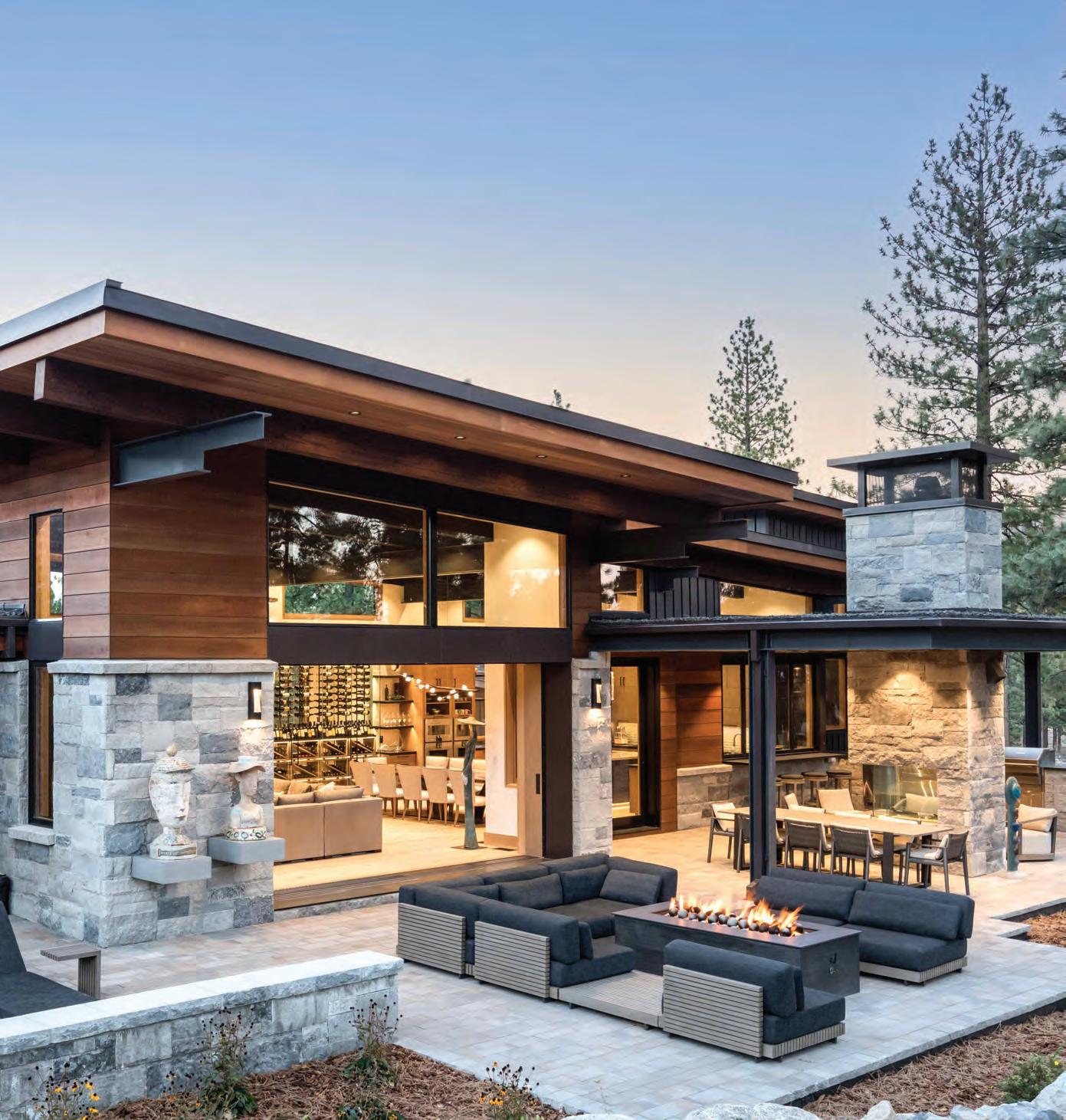
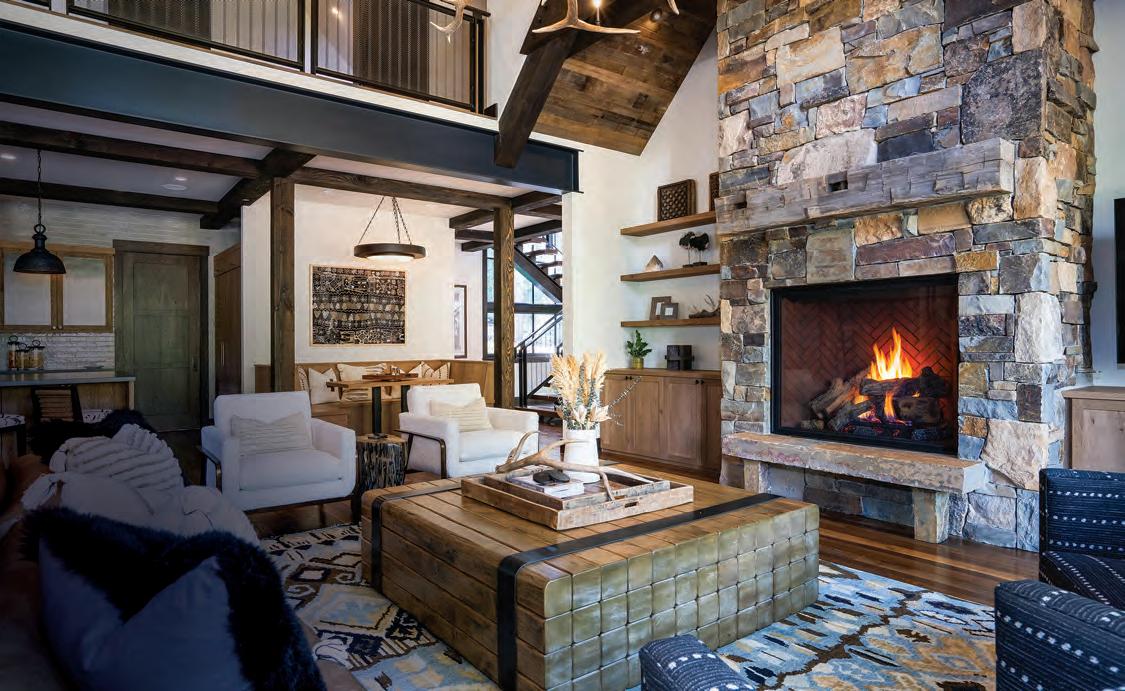
SPECIALIZING IN ELEVATED / ROOFTOP POOL & SPA INSTALLATIONS
LIGHTWEIGHT & DURABLE
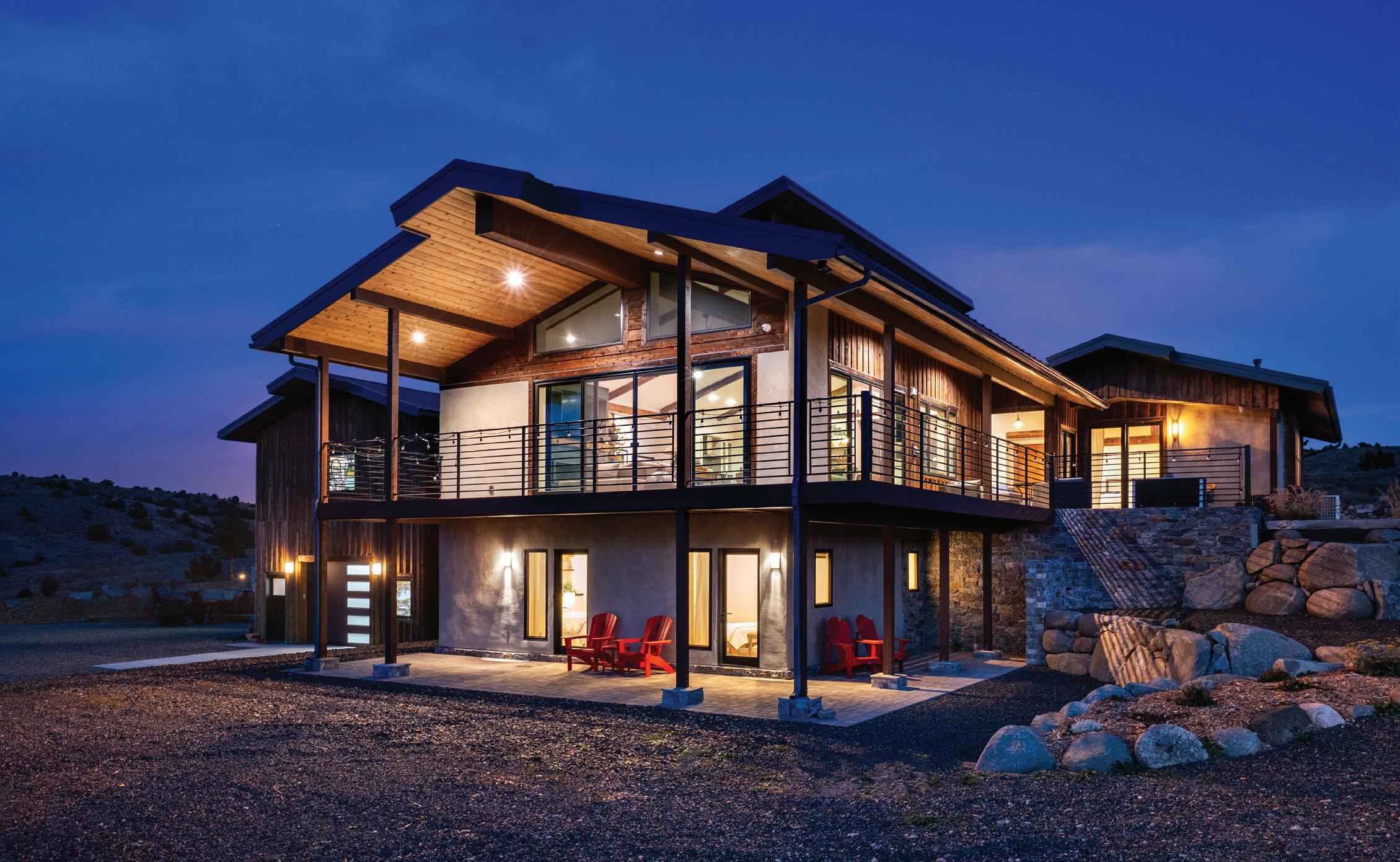
Builder: Bluegreen Landscape Architecture
Photographer: Jason Dewey Photography
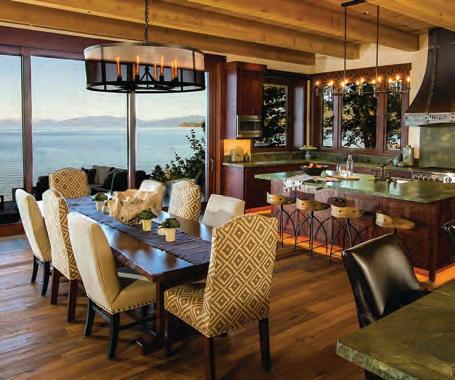
Sandy Shores
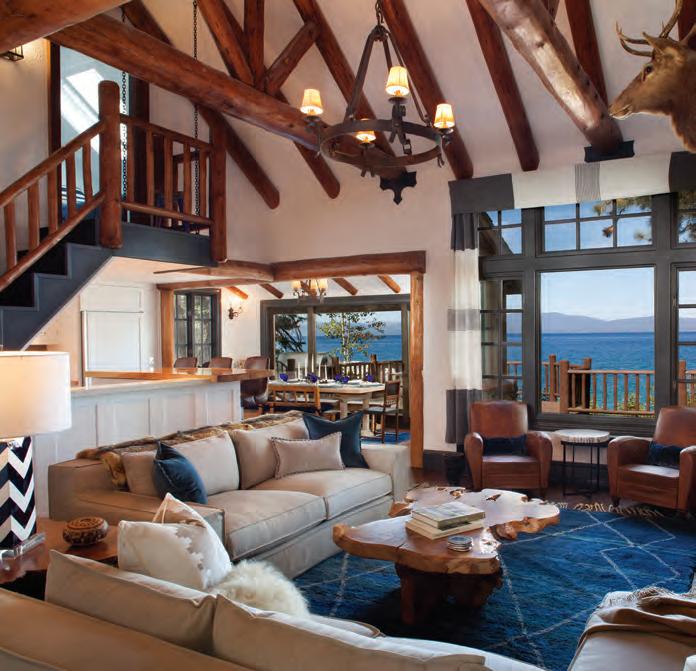
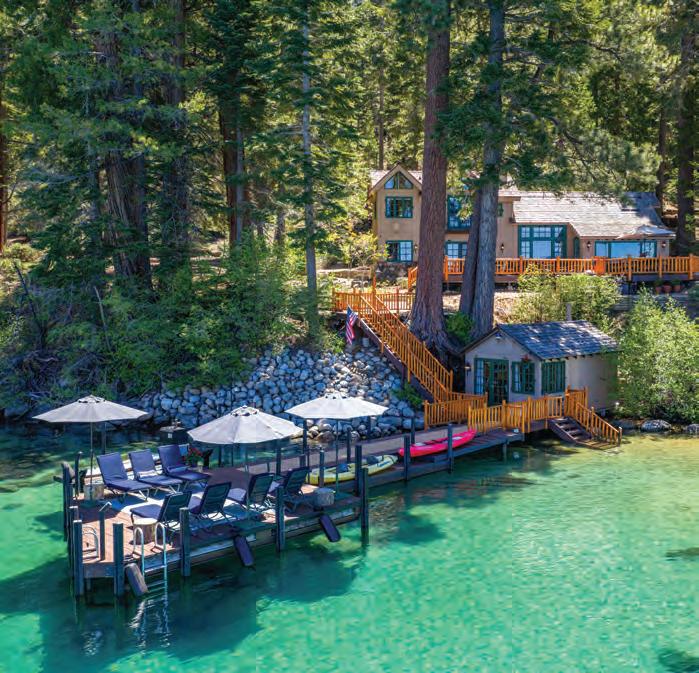
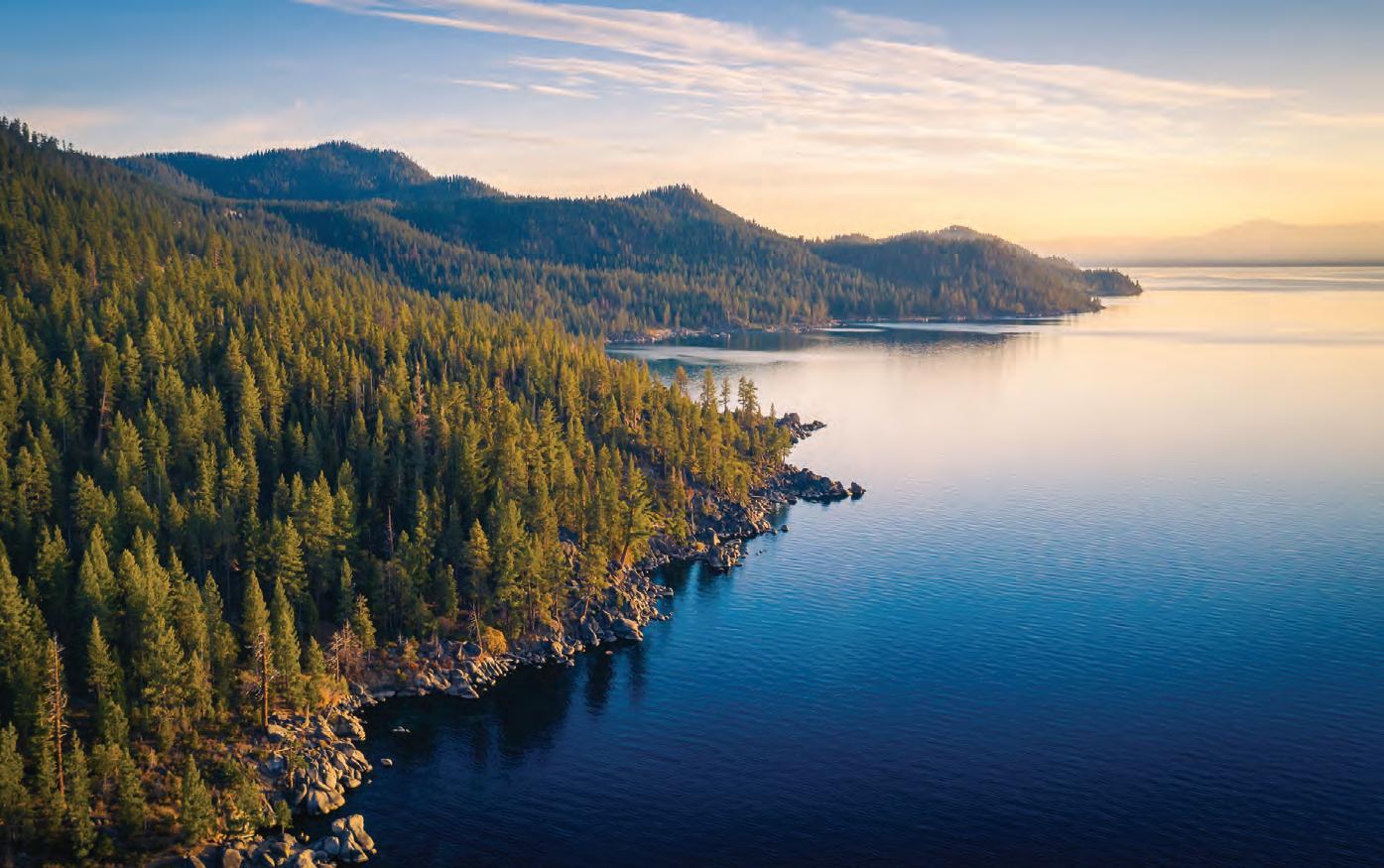
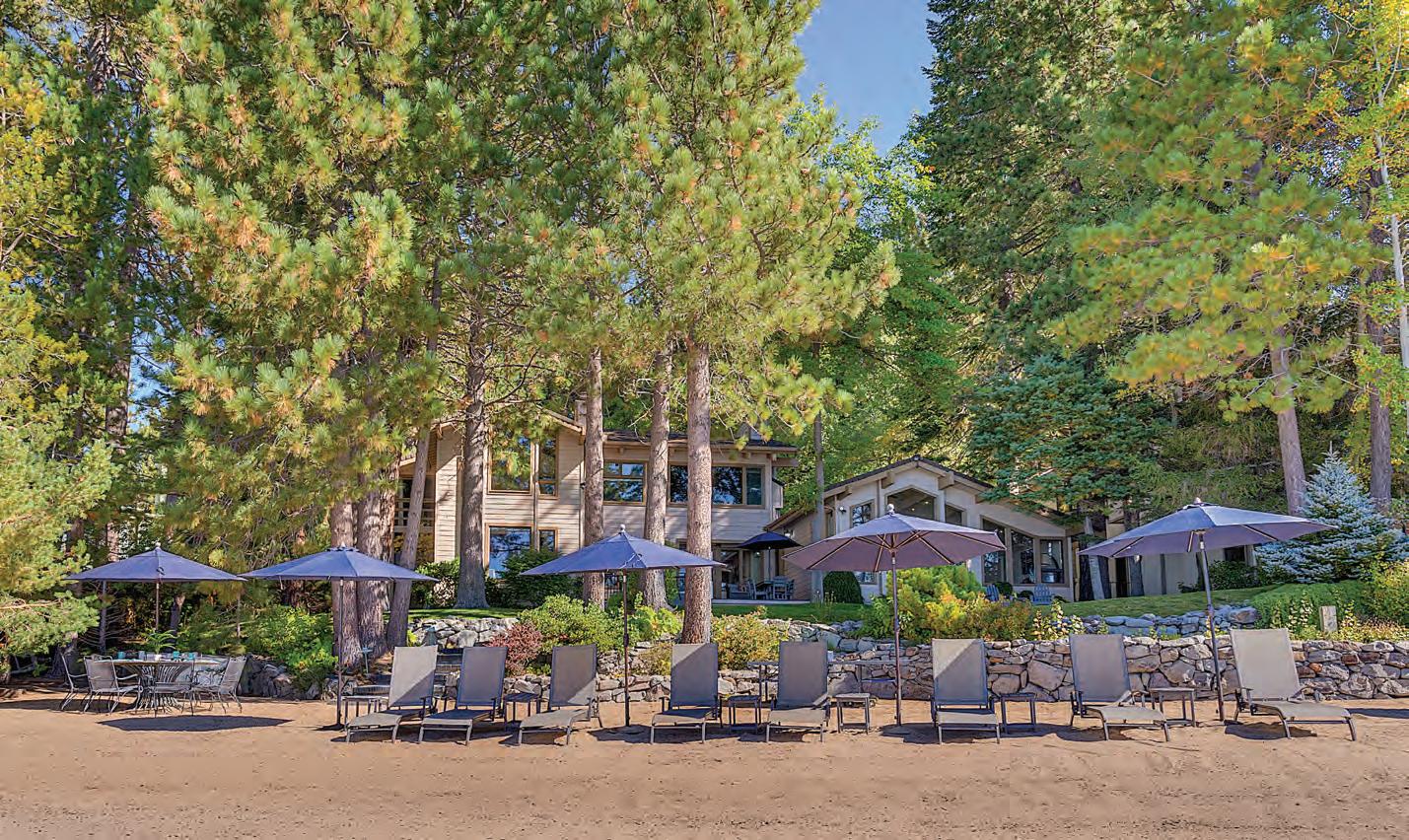
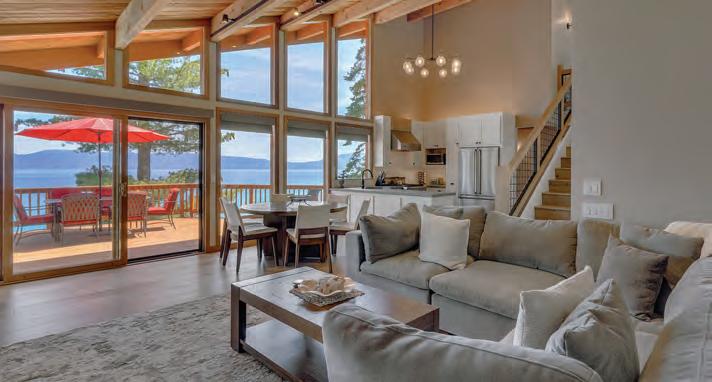
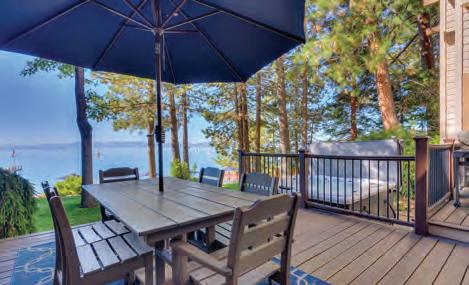
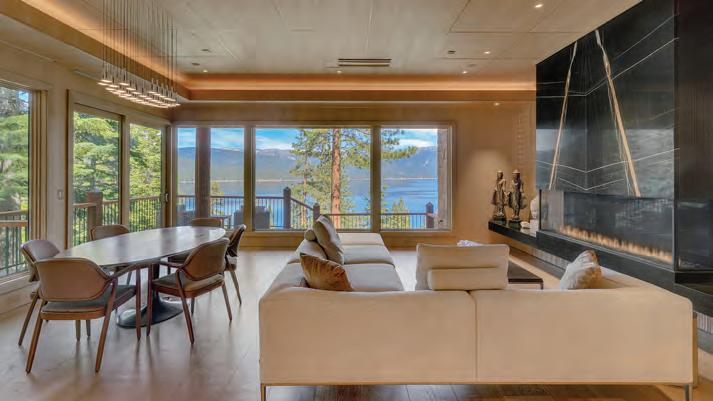
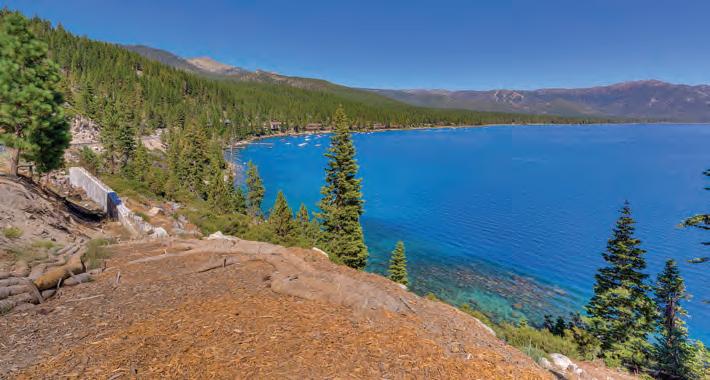
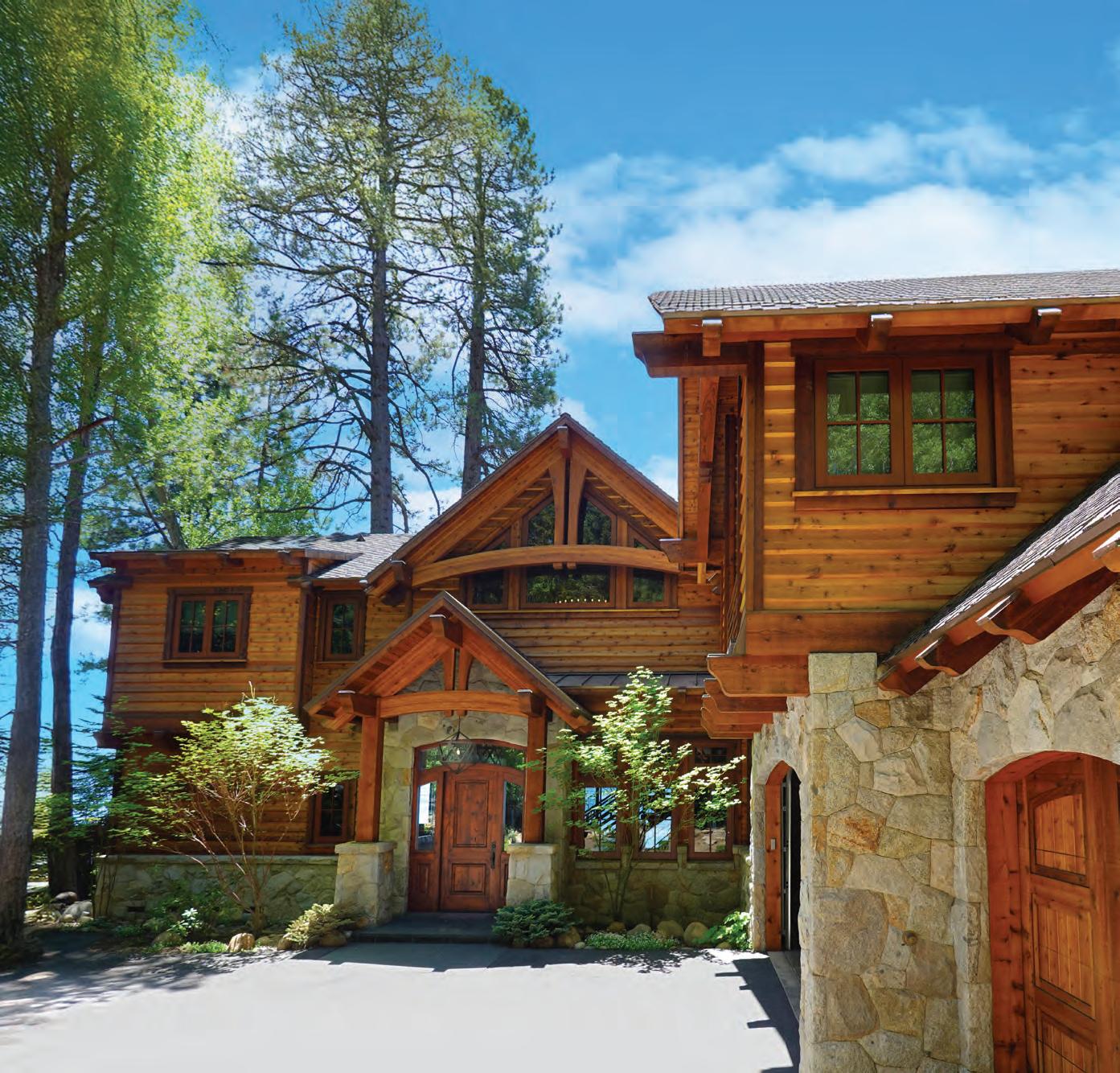
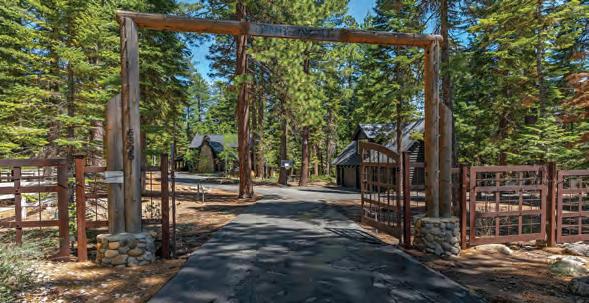
Situated along the prestigious Lakeshore Boulevard in Incline Village, Sandy Shores welcomes you with well-manicured grounds and towering pines behind a decorative wrought-iron front gate. Set on 1.85 acres with 106 feet of lake frontage, a sandy beach, breathtaking crystal-blue views, and two private buoys, this exceptional lakefront property embodies the essence of picturesque waterfront living.
1011 Lakeshore Boulevard, Incline Village, Nevada
6 Bedrooms | 5.5 Baths | 4,530 Square Feet
$47,500,000
Since 2004, the Dietz Group has sold over $1.68 billion in Lake Tahoe real estate, including 94 lakefront homes totaling over $983 million in Tahoe lakefront sales in both California and Nevada.
4176 Ferguson Avenue | Lakefront
Carnelian Bay, CA - $16,900,000
5 bedrooms, 5 baths, 4,280 square feet
8781 Lakeside Drive | Lakefront Rubicon Bay, CA - $7,600,000
4 bedrooms, 4.5 baths, 2,128 square feet
2338 Overlook Place Northstar, CA - $4,795,000
Stillwater Cove #47 | Lakefront Community Crystal Bay, NV - $10,995,000 4 bedrooms, 4.5 baths, 4,020 square feet
447 Lakeshore Boulevard | Lakefront Lot Incline Village, NV - $5,000,000 1.19 acres, canvas to build & design
Scan for all featured listings:
RUBICON BAY - TAHOE CITY - INCLINE VILLAGE
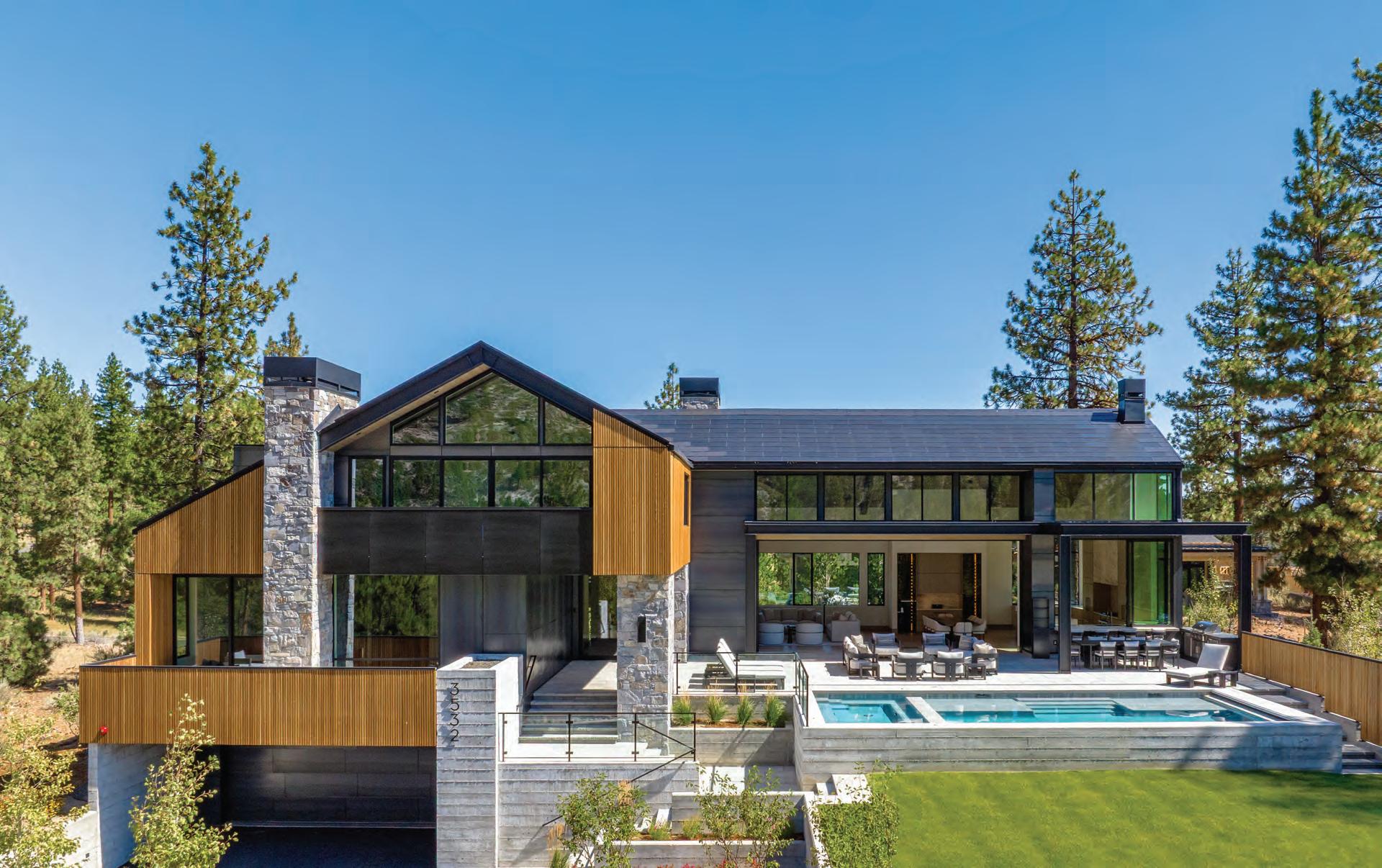
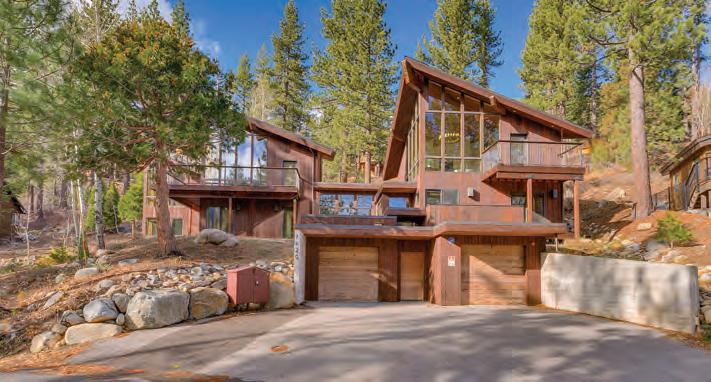
Nestled at the highest elevation in Glenhaven, this private residence o ers a rare combination of modern design, natural beauty, and sweeping views of downtown Reno. Thoughtfully planned, this home embraces the landscape, creating a serene retreat just minutes from city life.
Reno’s newest and most exciting luxury community. An exclusive enclave of just 24 expansive homesites with privacy and views, all just moments away from city life. Please be in touch to schedule your private tour to explore our homesites, completed homes, or Buy & Build packages. ONE OF A KIND. ONE OF 24.
Trusted Guidance for Life’s Most Important Decisions
Buying or selling a home is more than a transaction. It’s a defining moment. At Chase International, we guide you with integrity, expertise, and compassion so you can move forward with clarity and confidence. With deep market expertise and unwavering commitment, we deliver results that matter, so you can chase what matters most.
Start your next chapter. Visit: chaseinternational.com or call 775 690 1444
96
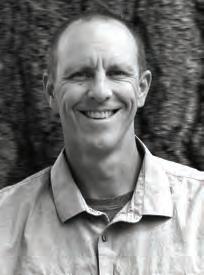
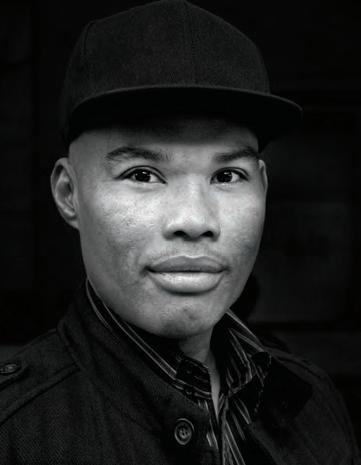
Following His Calling
A Buddhist monk’s artistic odyssey from rural Vietnam to globetrotting photographer
Written by Michael Rohm
108
Forest Fungi Fever
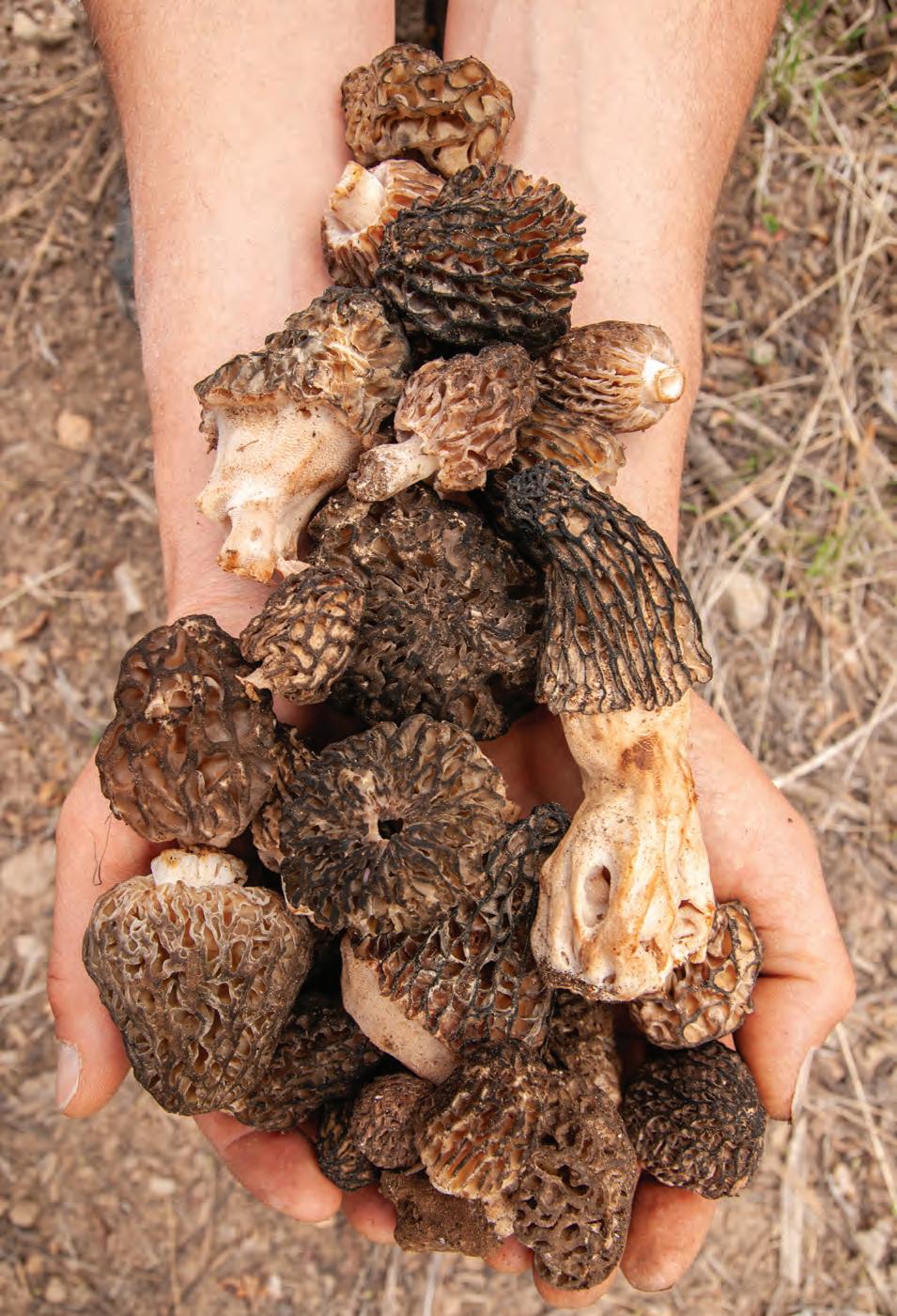
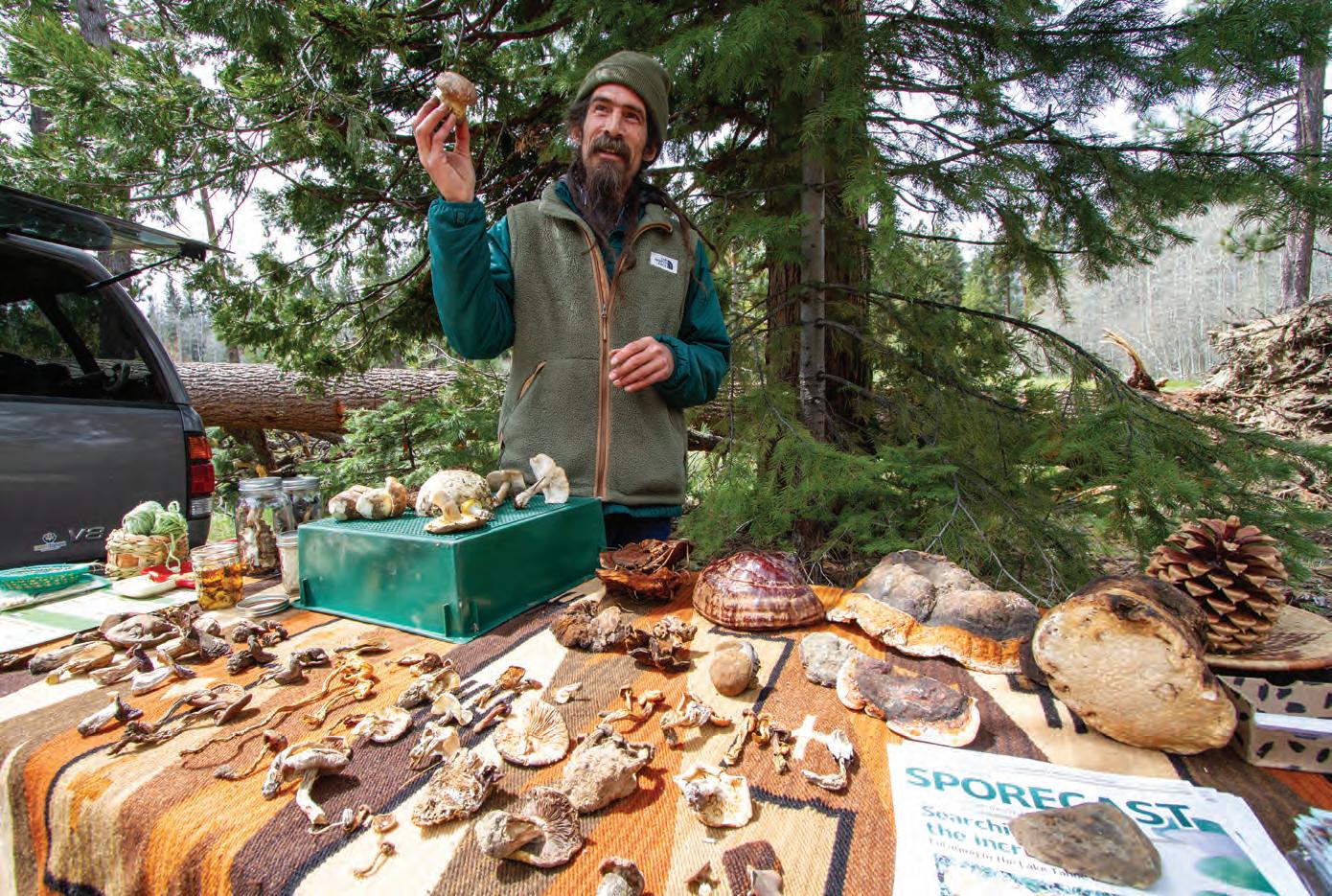
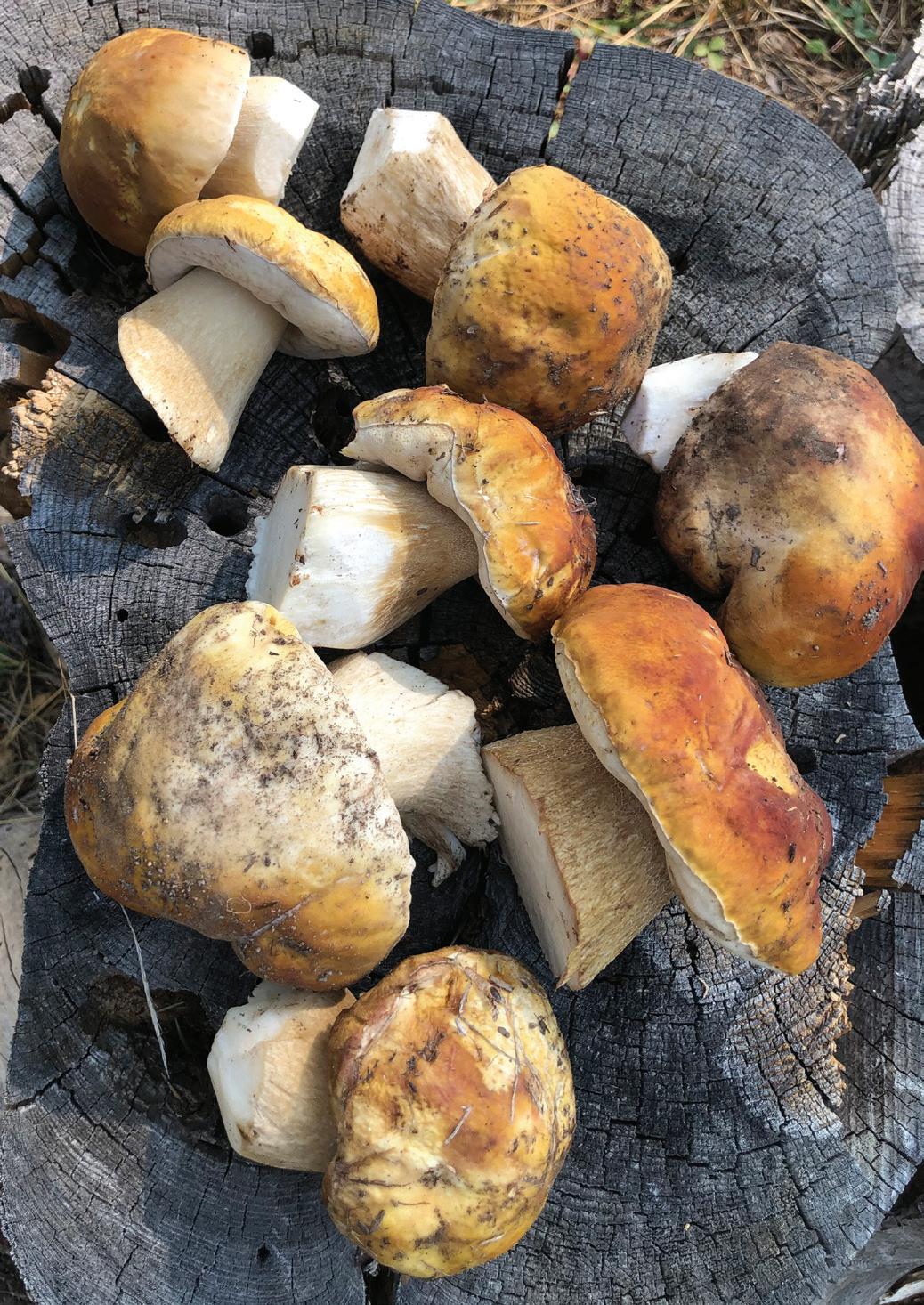
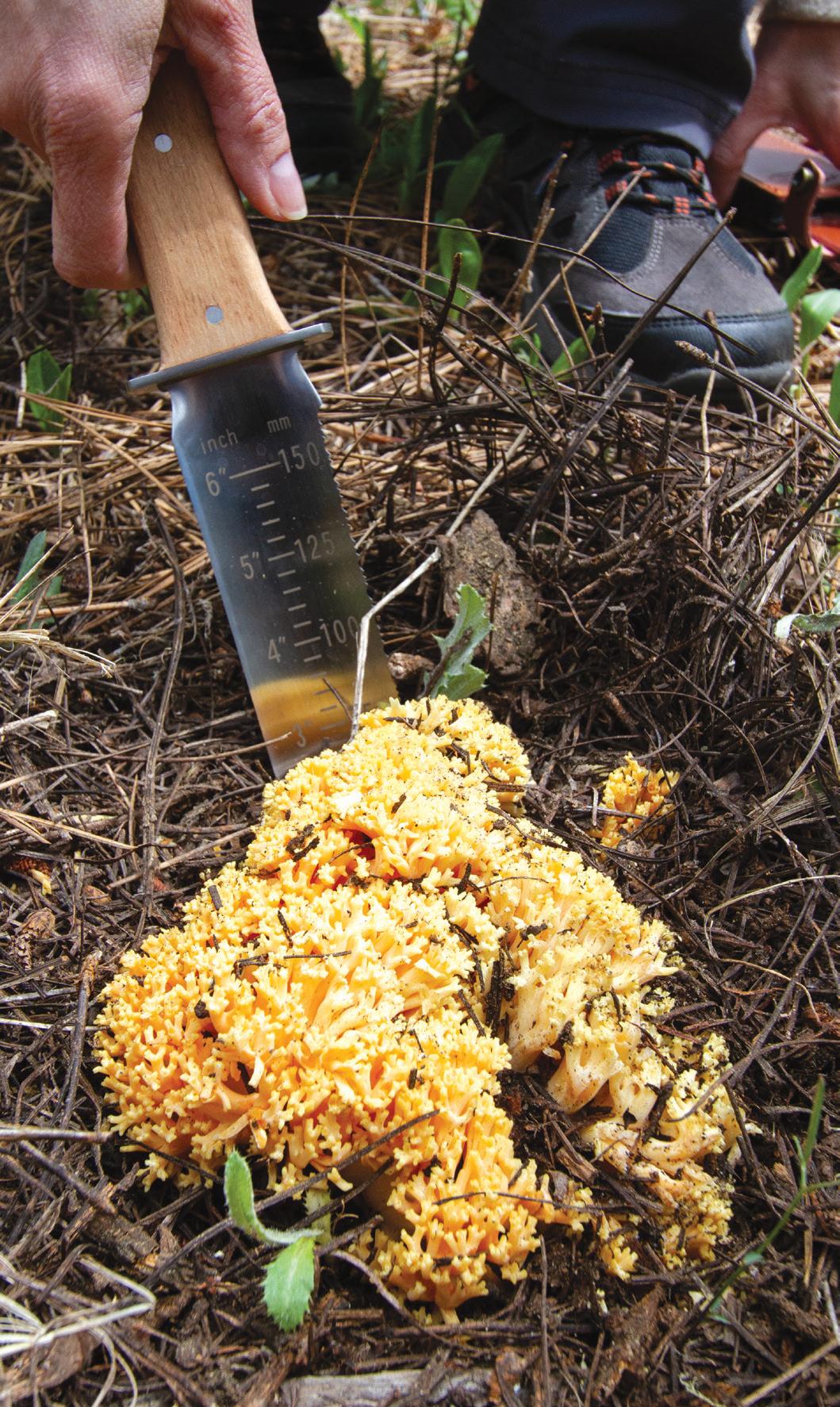
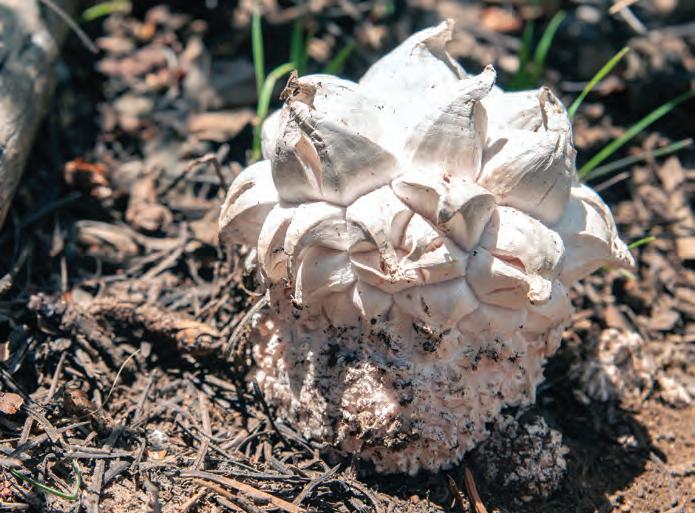
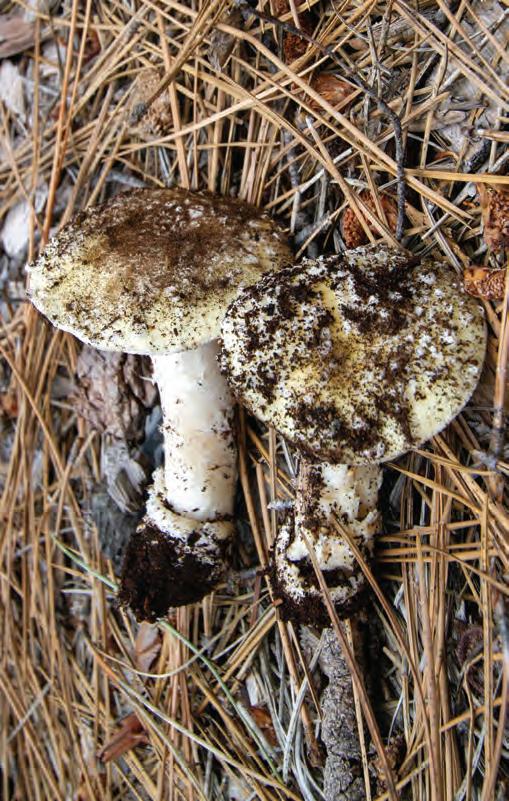
Delicious wild eats and the thrill of the find inspire a growing community of mushroom foragers at Lake Tahoe
Written by Seth Lightcap
118
The Long Return
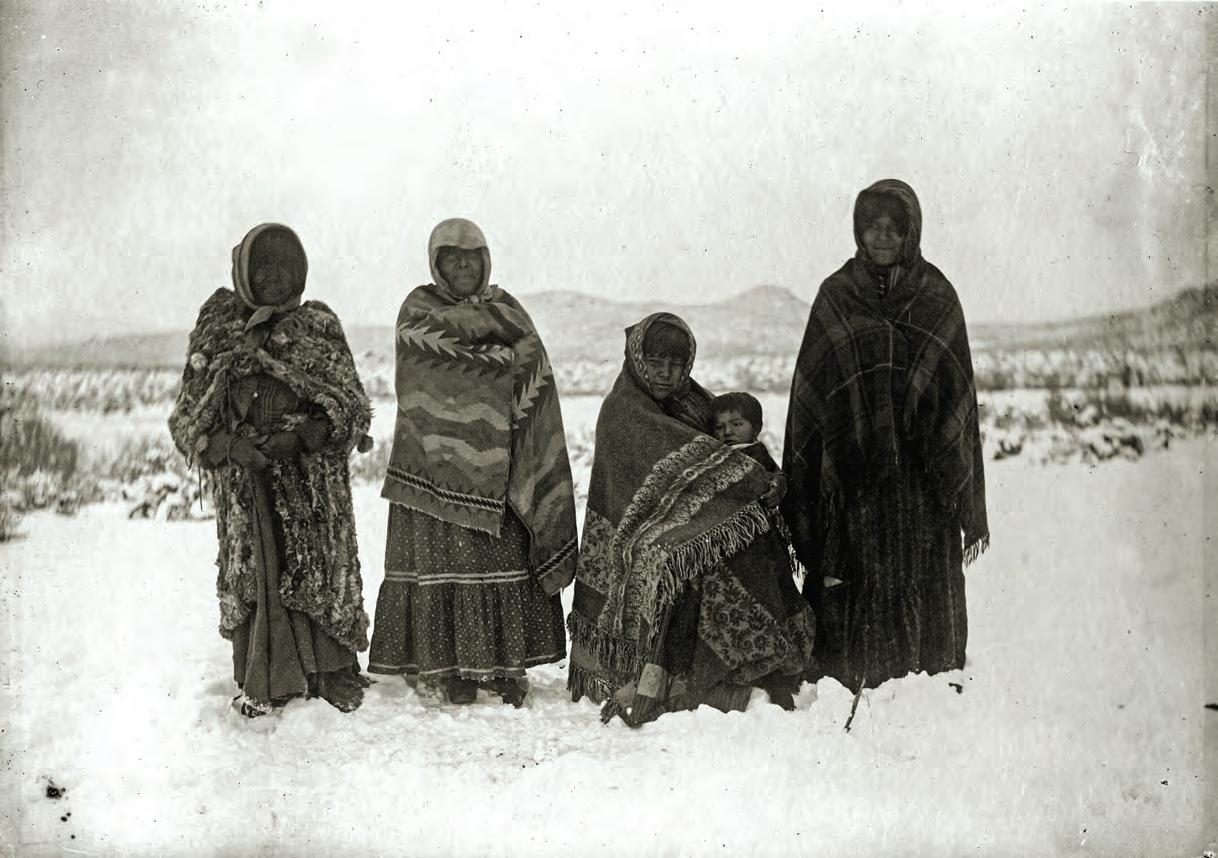
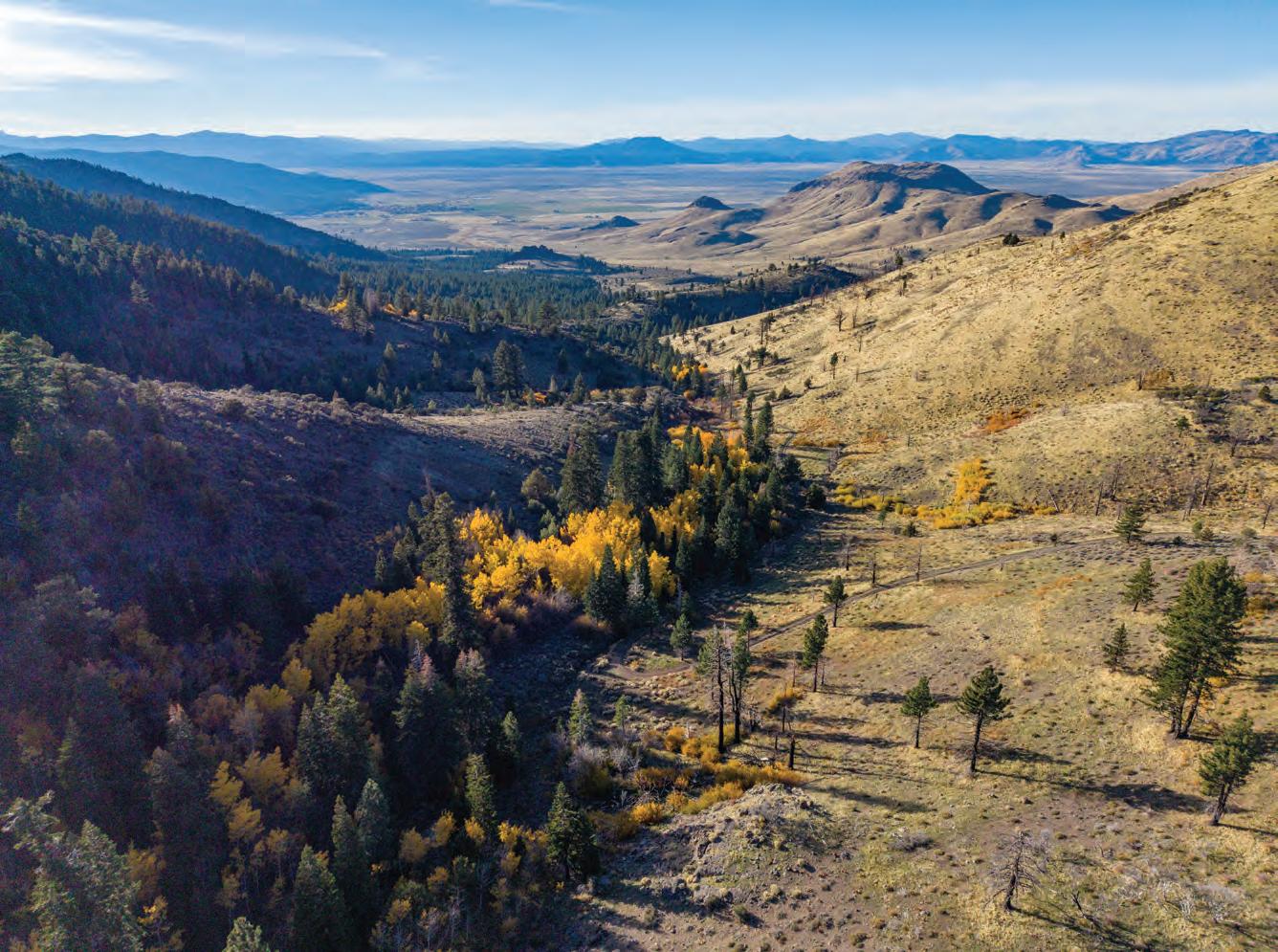
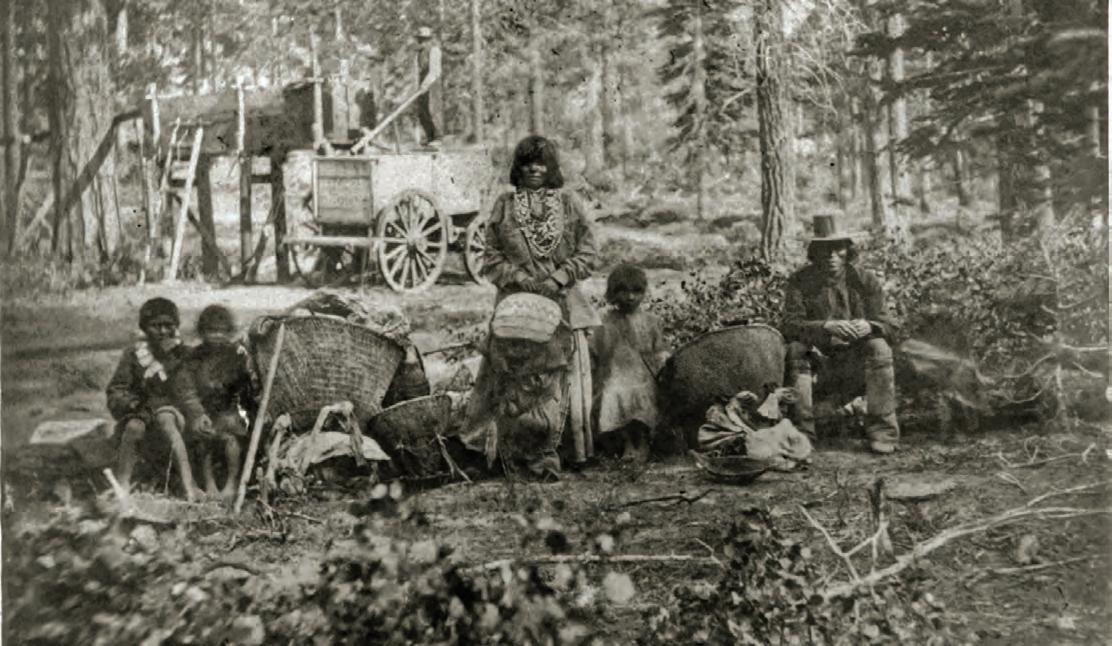
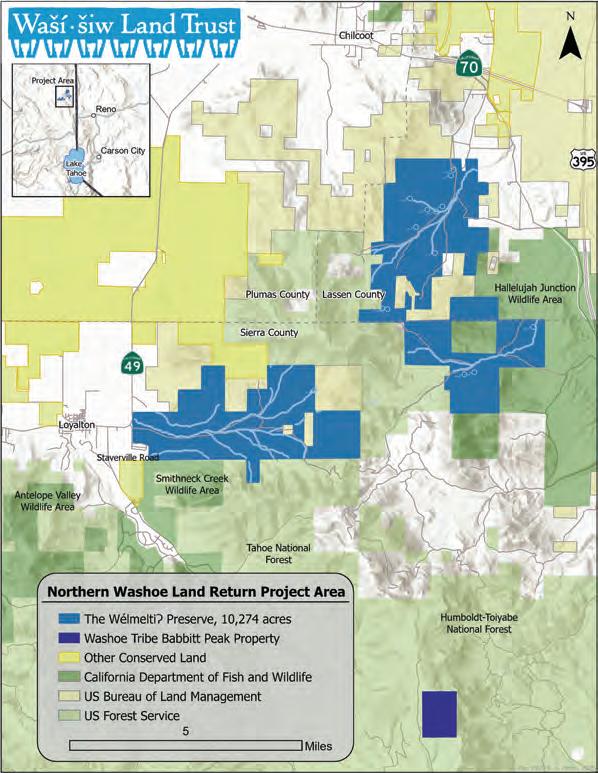
The original stewards of the greater Lake Tahoe region, the Washoe are celebrating a groundbreaking reacquisition of former territory
Written by Matthew Renda
148
Through the Lens
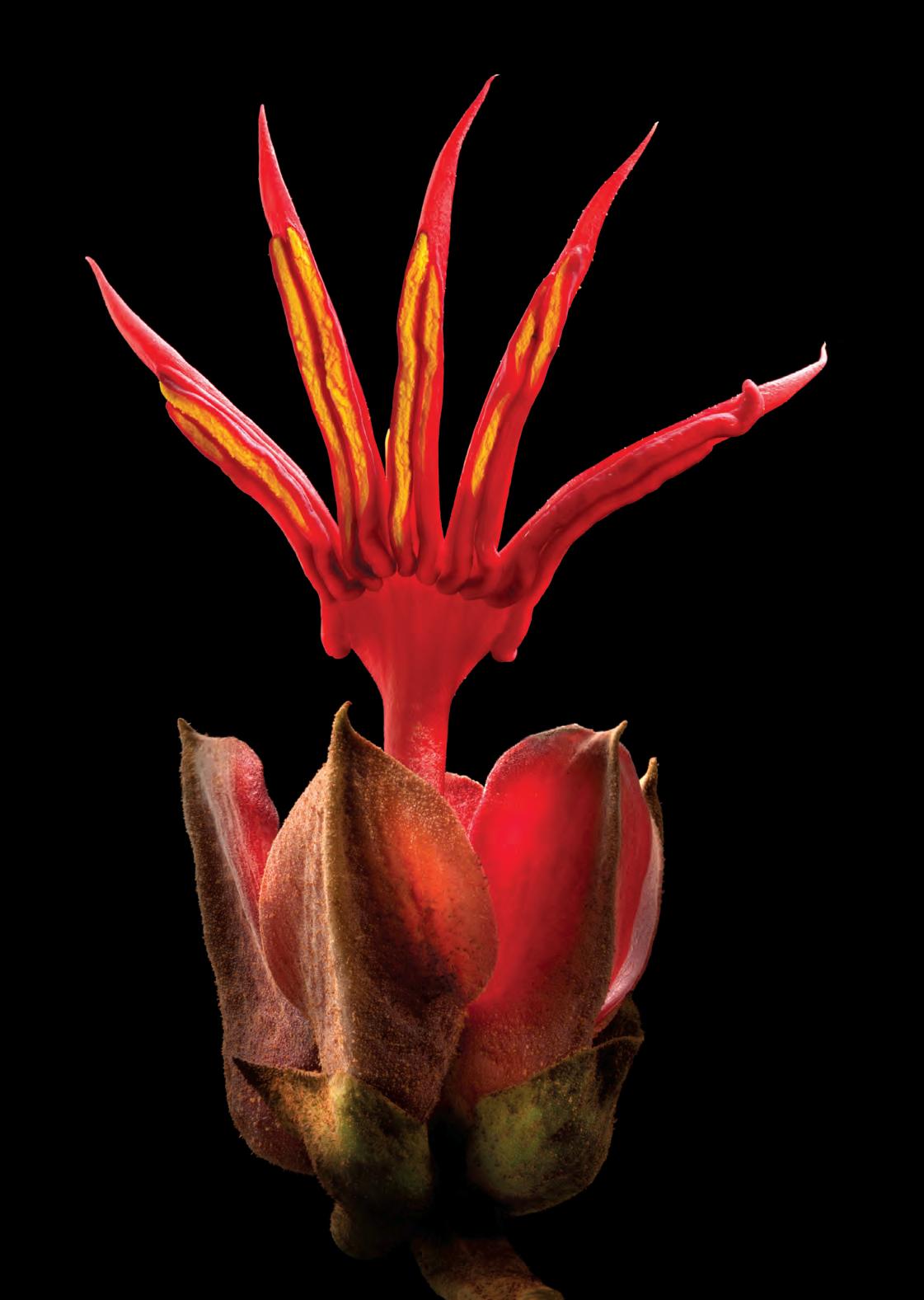
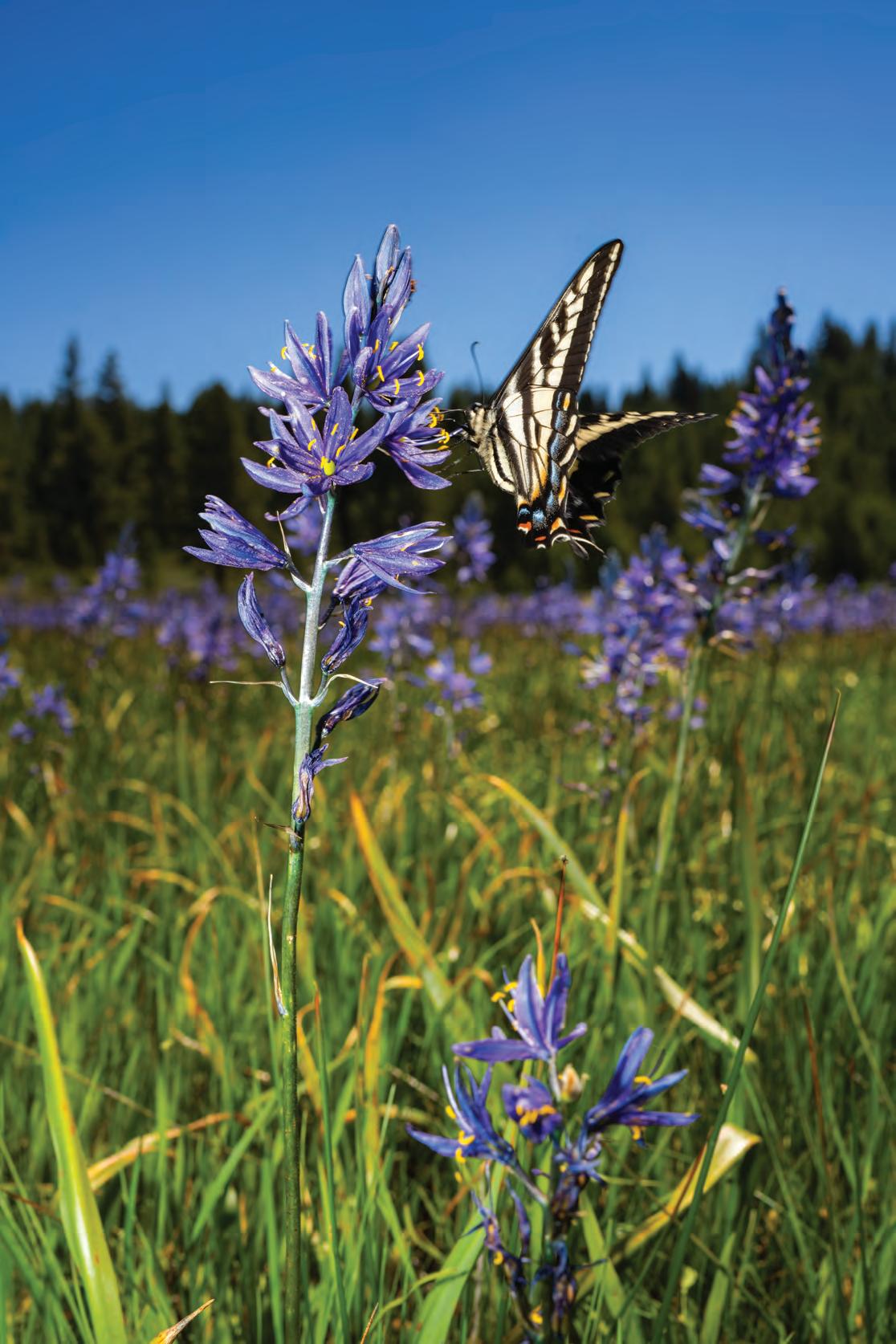
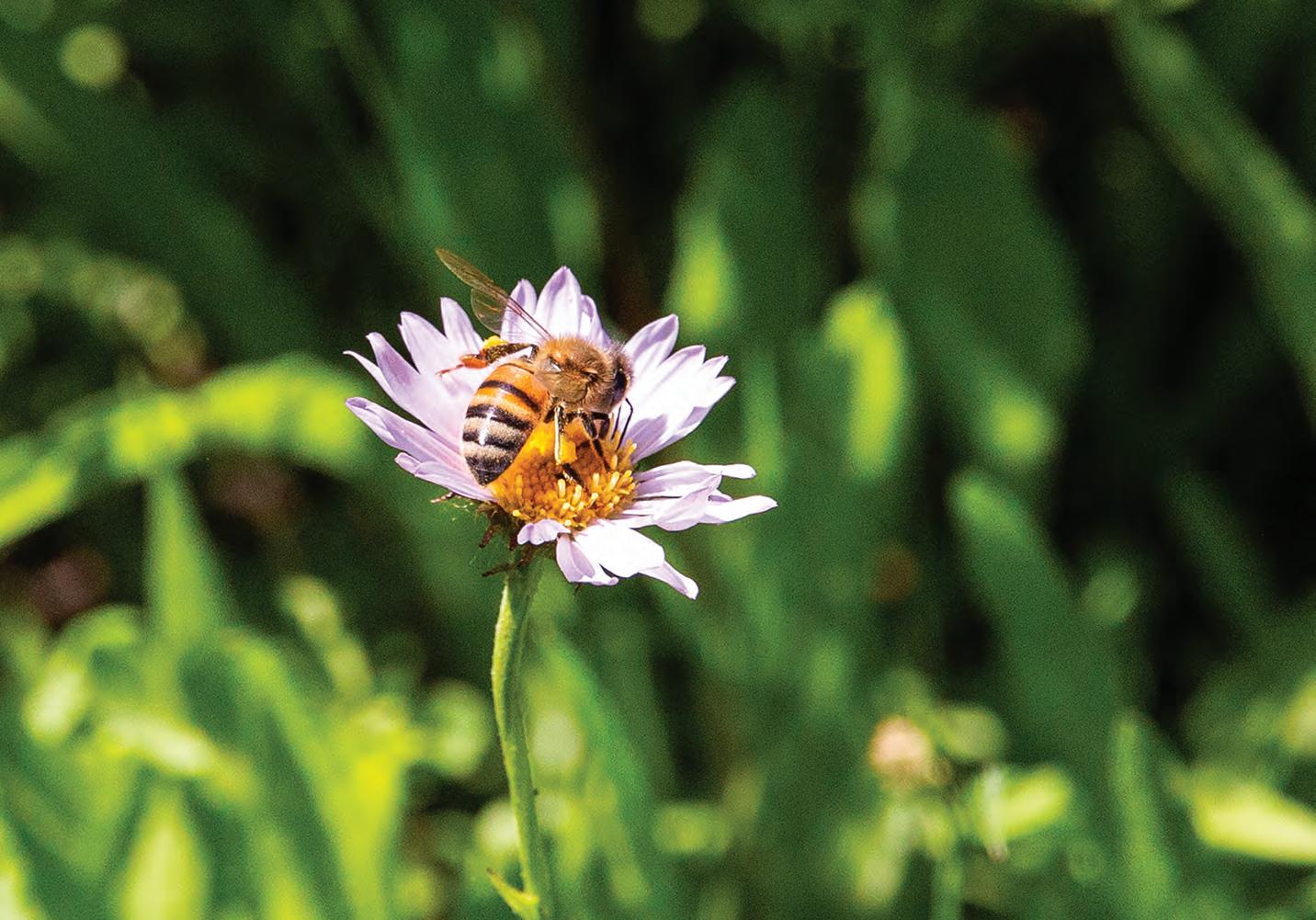
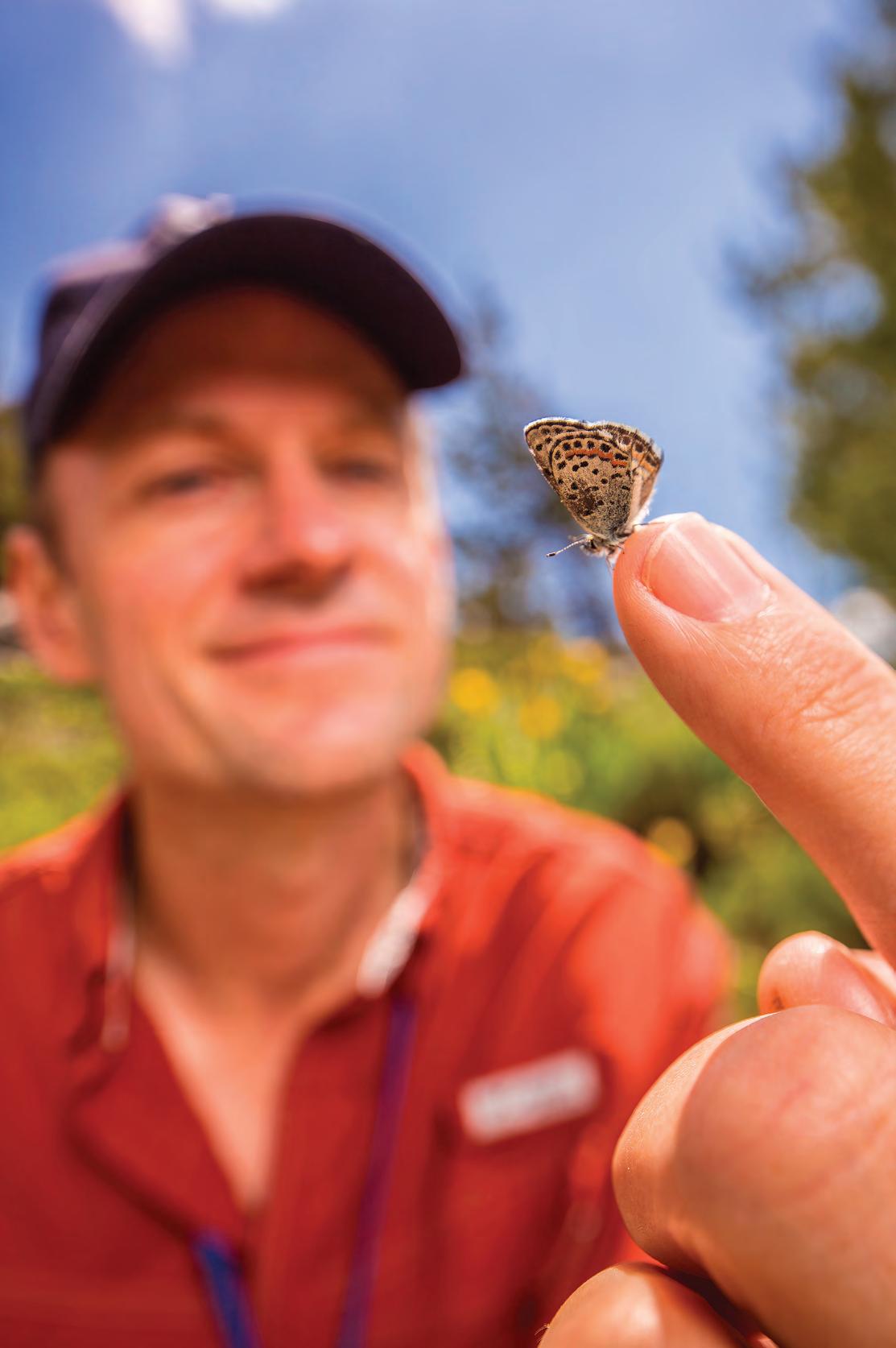
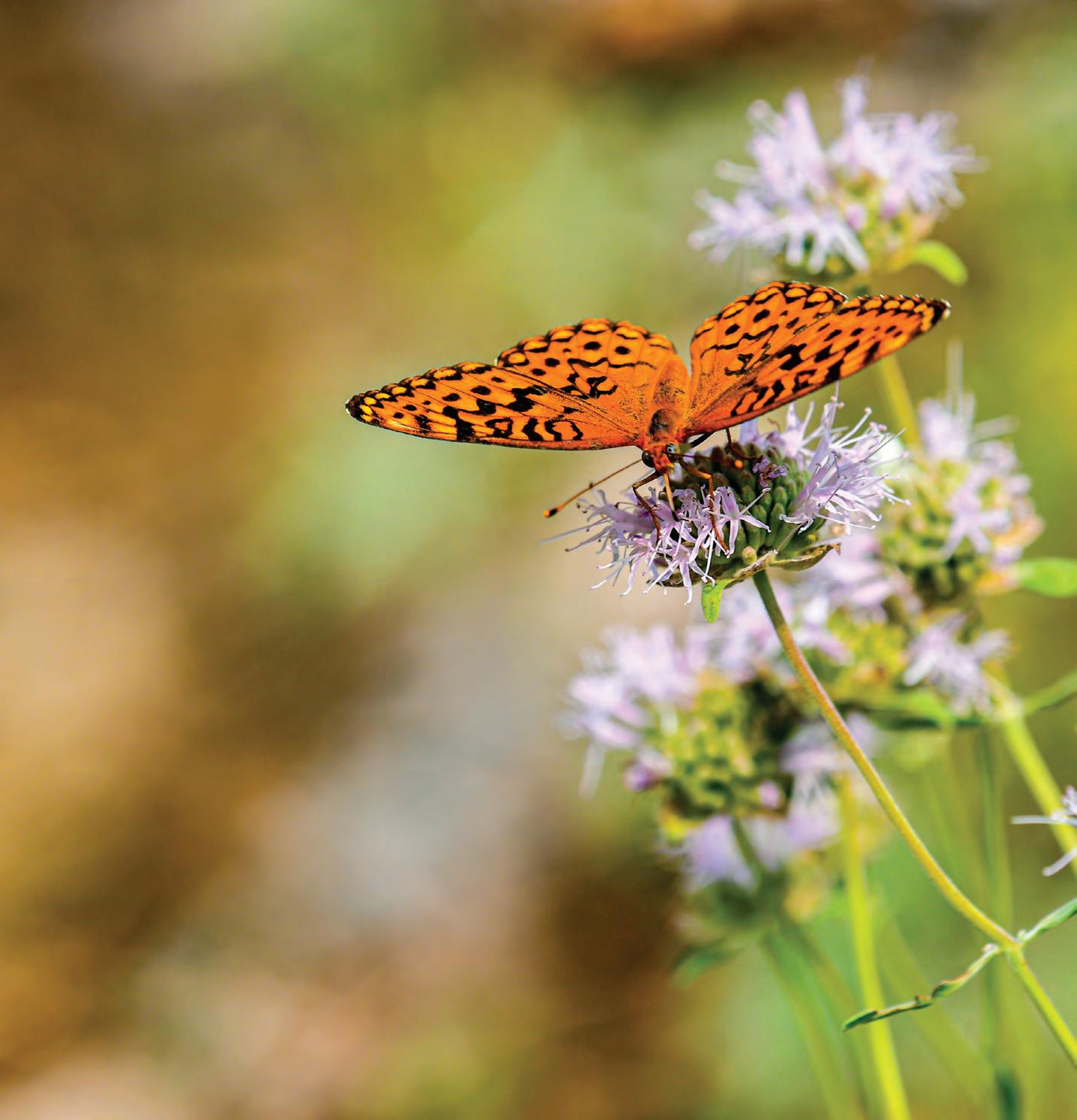
Insects of the winged variety abound at Lake Tahoe come summer. The most attractive of these flying creatures tend to attract Tahoe’s keen-eyed photographers, who recognize a photogenic subject when they see it.
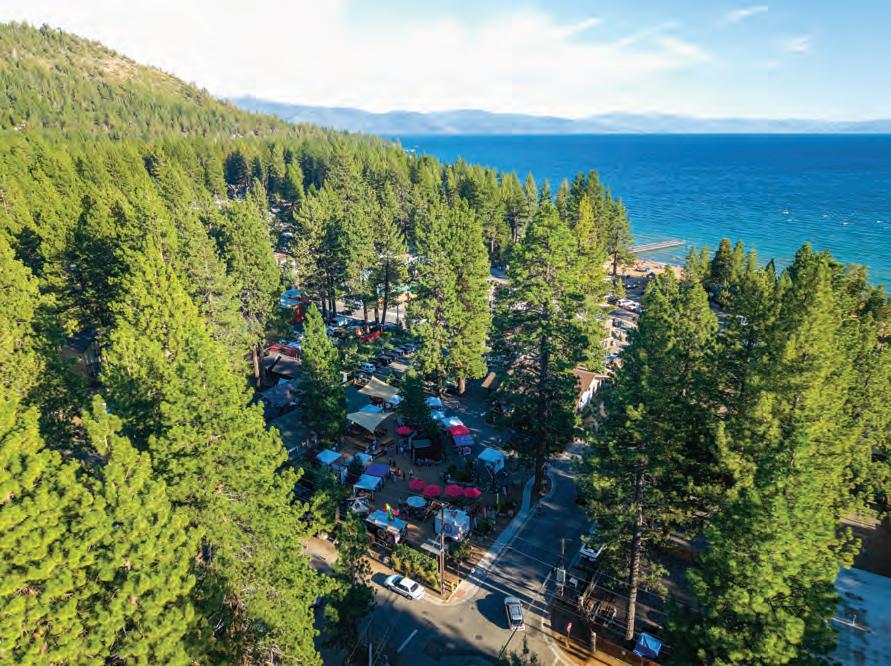
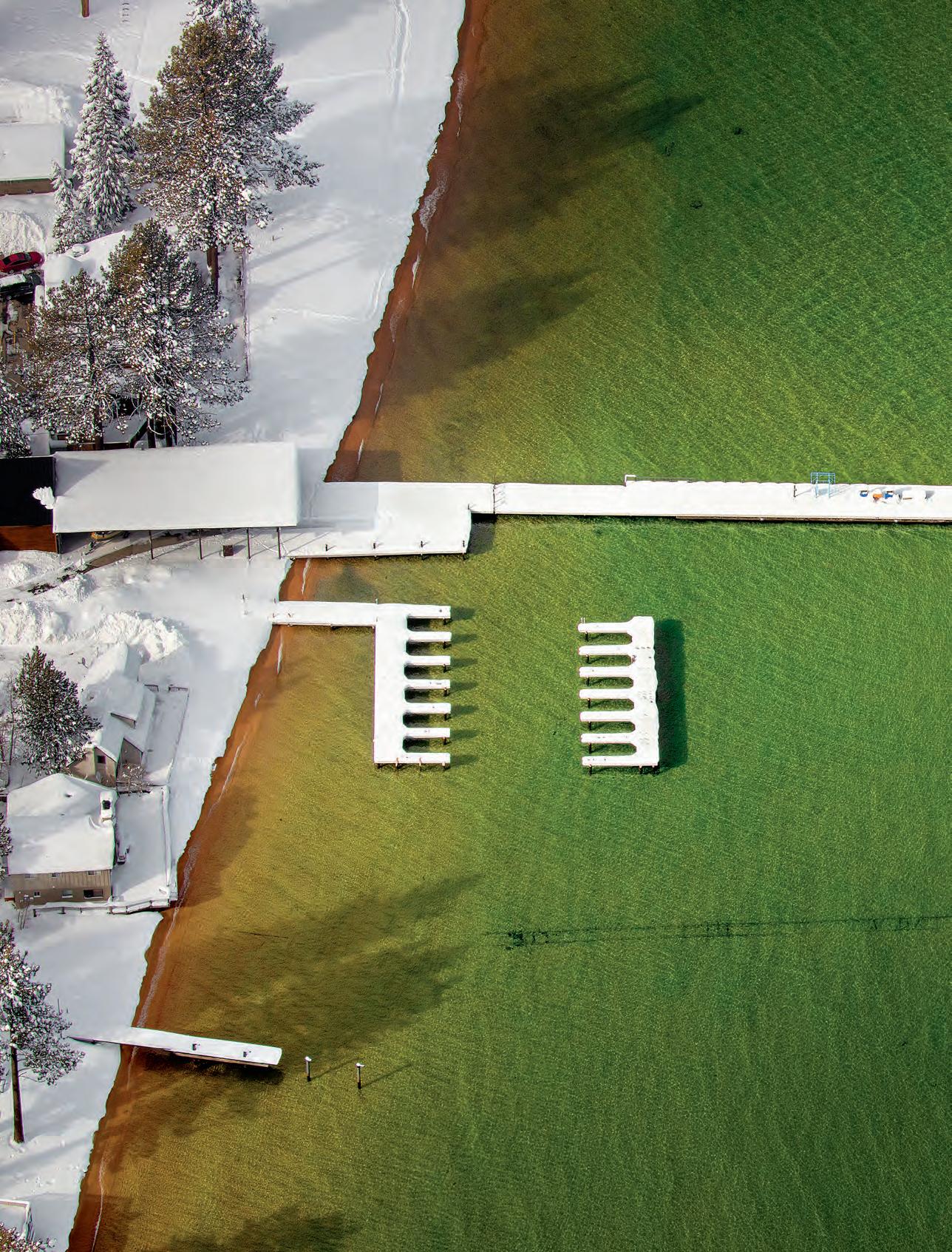
Lake Tahoe’s South Shore from above, photo by joSon
ON THE COVER:
Summer fun in the crystal-clear shallows of Zephyr Cove Beach, photo by joSon
E levate your life.
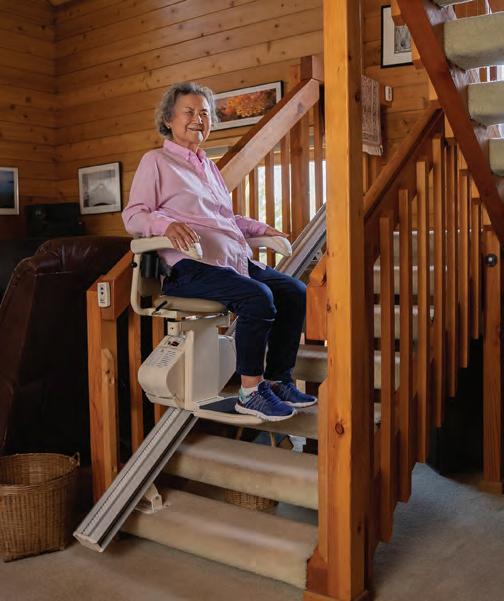
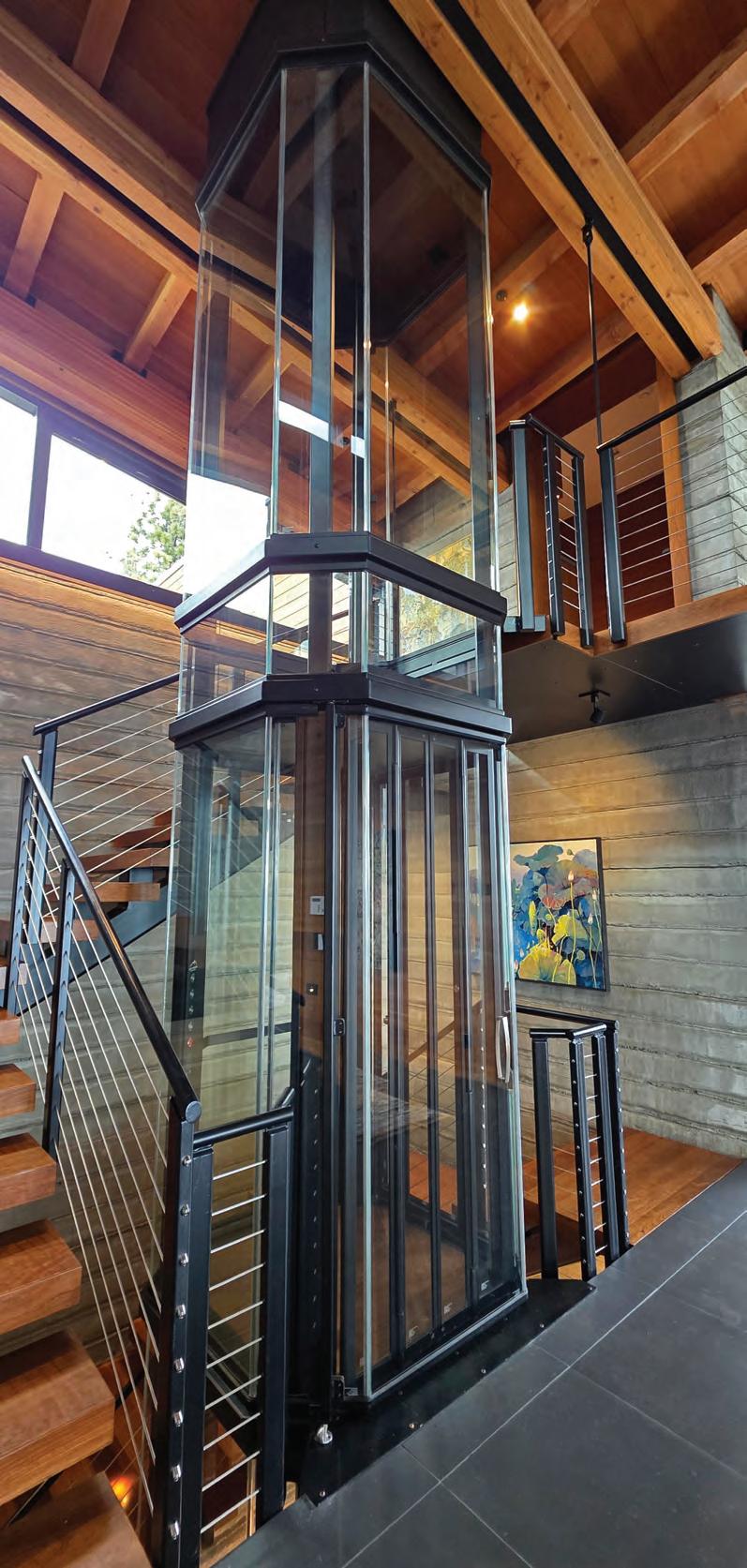
We can find you the stair chair or lift that will best suit your living envrironment with multiple levels, regardless of your budget.
All of us at Summit Elevator are here to address your needs and bring you the upmost in service with any installation you desire.
VOLUME 28 • ISSUE 3
YOUR YEAR-ROUND ADVENTURE EXPERTS
PUBLISHER Clayton Humphries
EDITOR-IN-CHIEF Sylas Wright
ART DIRECTOR Anna Dingman
COPY EDITOR Kevin MacMillan
VERTISING DESIGN Matt Cameron
ADVERTISING SALES Jared Swanson
ACCOUNTING Owen Raisch
CONTRIBUTING EDITORS
Kayla Anderson, Alison Bender, Julie Brown Davis, David Bunker, Dick Dorworth, Jeremy Evans, Kurt Gensheimer, Tim Hauserman, Claire Hewitt-Demeyer, Mike Higdon, Adam Jensen, Ann Johnson, Brennan Lagasse, Celeste Leon, Seth Lightcap, Kevin MacMillan, Kyle Magin, David Masello, Ryan Miller, Andrew Pridgen, Matthew Renda, Chase Reynolds Ewald, Susan D. Rock, Kaleb M. Roedel, Michael Rohm, Ryan Salm
CONTRIBUTING PHOTOGRAPHERS
Matt Bansak, Abe Blair, Anthony Cupaiuolo, Megan Delehanty, Jeff Dow, Paul Dyer, Keoki Flagg, Mike Higdon, Bronwyn Huddleson, Wendy Hudnall, joSon, Blake Kessler, Sean Lefrak, Seth Lightcap, Ming Poon, Ryan Salm, Kim Hunter Steed, Brian Walker, Tom Zikas
TAHOE QUARTERLY
924 Incline Way, Suite L | Incline Village, NV 89451 T (775) 298-2690 E info@tahoequarterly.com
Subscribers: If the Postal Service alerts us that your magazine is undeliverable, we have no further obligation unless we receive a corrected address within two years. Views expressed herein are those of the authors and advertisers and do not necessarily reflect those of the ownership or management of the magazine. The magazine accepts freelance contributions. Please email us if you have ideas to contribute. Those submitting manuscripts, photographs, artwork or other material to Tahoe Quarterly for consideration should not send originals. Unsolicited manuscripts, photographs and other submitted materials must be accompanied by a self-addressed envelope postage paid. JD Publishing, Inc. accepts no responsibility for loss or damage to unsolicited materials. #TahoeQuarterly
@TahoeQuarterly
facebook.com/TahoeQuarterly x.com/TahoeQuaterly
youtube.com/TahoeQuarterly
A Lake Full of Life Lessons
SOMEHOW, IN ONLY 7 years of life, my son has already become an expert on all things. No need for helpful advice from Dad. Or Mom. Or anyone else, for that matter. He knows it already. It’s a terrible mentality to have, I tell him (as if he’s going to listen). Life is full of lessons to be learned, and it’s in your best interest to soak in every one of them. This is true whether entering second grade or middle age, whether stuck in a classroom or adventuring in the wild, where a know-it-all attitude could get you hurt—or worse.
While harping on this point one morning, a light bulb flickered on. I had a freshly edited TQ article that was both relevant to my message and compelling enough to hold his attention. Written by Kayla Anderson (see page 62), it’s about a grown adult who received a valuable education while recreating on Lake Tahoe. I offered to read it aloud.
Lukewarm to the idea, he was gripped with curiosity after the first sentence. How was this lone kayaker, bucked into the rowdy chop of Crystal Bay and unable to climb back in, going to survive her ordeal? Call it fate, divine intervention, pure luck—whatever the explanation, it wasn’t her time to go.
Our subject kept the story close to her vest for nearly a decade before she decided to share it with TQ and its tens of thousands of readers.
She admits she made bad decisions that day because she didn’t know better, and that the incident could have been avoided had she taken proper measures before heading out on the water. She opted to come forward with the details, as embarrassing as they are in hindsight, because the lessons she learned that day could save someone’s life.
I thought I caught a glimpse of understanding in my son’s eyes—though it could have just been allergies from all the pine pollen. There’s no way to be sure.
Following this near tragedy is another tale of adventure, complete with similar elements of danger (see page 70). While recovering from shoulder surgery last summer, Tahoe-based snowboarder Claire Hewitt-Demeyer decided to turn her downtime into a positive mission: She would circumnavigate Lake Tahoe by pedal-powered kayak, stopping at beaches to clean up trash left behind by careless (and shamelessly disrespectful) humans.
The endeavor required training, and during one session, a critical pin in her kayak’s pedal drive snapped, leaving her bobbing powerlessly in open water 6 miles offshore. Fortunately, before
losing her one bar of service, she managed to text her boyfriend. He came to her rescue and the story continued happily, but it was another example of how a joyous Tahoe outing can turn quickly.
B eautiful, yes, but Tahoe is also a giant body of water that demands the utmost respect—a point that cannot be overstressed as revelers take to the lake for another summer of fun.
While the aforementioned stories share similarities, the rest of the issue varies widely.
Tim Hauserman leads things off with a review of local author Priya Hutner’s new book, Chasing Nirvana: A Seeker’s Story of Love, Loss, and Liberation (see page 58).
A winning entry in the 20th Annual National Indie Excellence Awards, the deeply personal memoir provides a peek into Hutner’s previous life, in which she worked her way up to become CEO of a Florida ashram led by a brash guru. After 30 years in the cult, she had an epiphany that prompted her to leave, which she did under “traumatic and harrowing circumstances.” Hutner fled to Truckee, where she became a journalist and co-founder of the Tahoe Literary Festival.
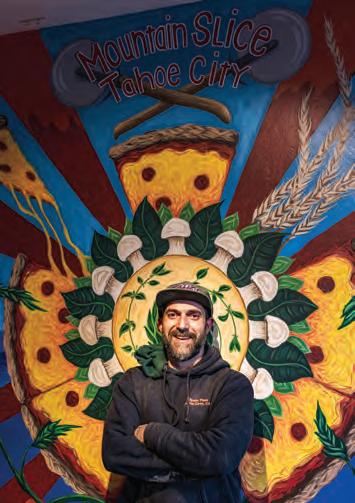
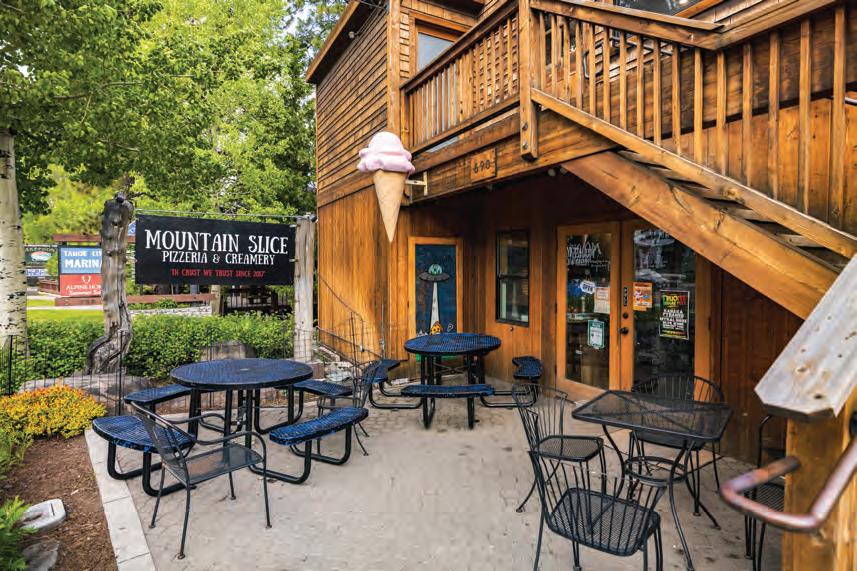
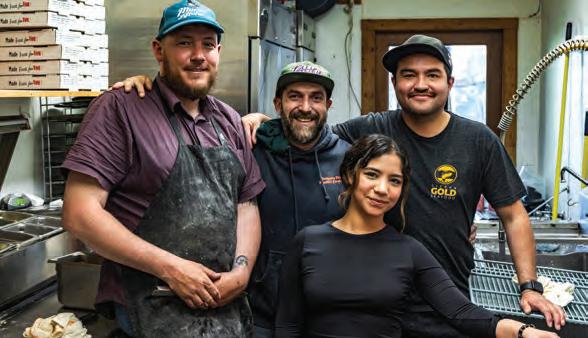
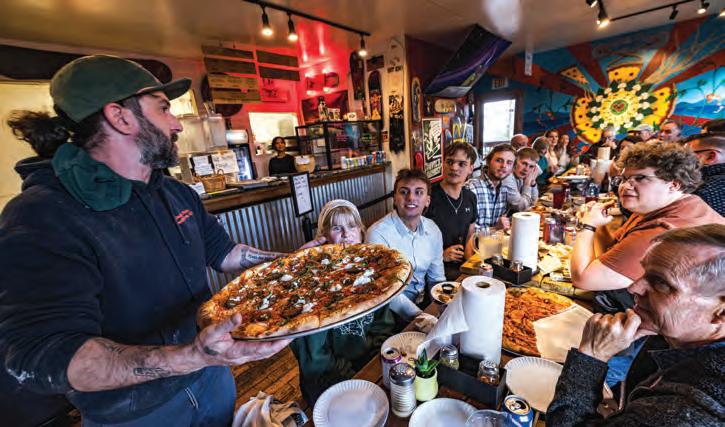
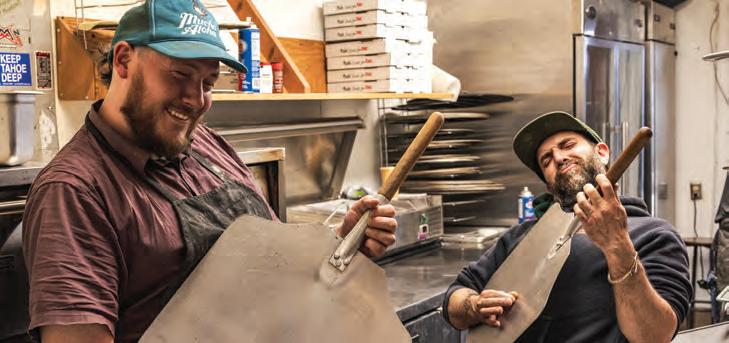
Longtime TQ contributor Alison Bender explores the growing trend of designing fire-resistant homes in the Tahoe region (see page 84). First-time TQ contributor Celeste Leon shares knowledge about the Sierra Foothills AVA, a designated wine-growing region with a fascinating history (see page 130). And Andrew Pridgen vouches for a couple of quality locales on Tahoe’s North Shore— one that mixes fancy drinks in a chic setting (Gaviota, page 136) and another that features New York-style pizza that sells out by word of mouth (Mountain Slice, page 144).
And that’s not even mentioning what stands out as the heart of every issue—the features department.
Michael Rohm pens a must-read piece about a Buddhist monk—and TQ contributor—named joSon, who left the safety of his temple in Vietnam to discover his photographic calling on the shores of Lake Tahoe (see page 96). Seth Lightcap takes readers into the underground community of mushroom foragers at Lake Tahoe (see page 108). And Matthew Renda recounts the plight of Tahoe’s original stewards, the Washoe, who are celebrating a groundbreaking reacquisition of their ancestral lands with a 10,000-plus-acre purchase (see page 118).
All in all, it adds up to another fine issue that readers are sure to enjoy—while maybe even learning a few lessons along the way.
Sylas Wright Editor
WE CAN AND WILL. TOGETHER.
As Nevada’s most comprehensive not-for-profit integrated academic health system, Renown Health and University of Nevada, Reno School of Medicine are confronting critical health challenges with innovation and solutions to help everyone realize their best health. We’re training tomorrow’s healthcare leaders and supporting groundbreaking research and discovery – all while Renown continues to expand our broad network of services, facilities and exceptional care. At Renown, we’re committed to redefining healthcare to create a healthier future for us all. renown.org/together
The Magic of a Tahoe Summer
THERE’S A REASON people dream about summer in Lake Tahoe all year long.
Maybe it’s the endless blue water stretching to the horizon. Maybe it’s the long days that somehow never feel long enough. Or maybe it’s the simple fact that when summer arrives in Tahoe, life seems to slow down just enough for us to remember what matters most.
The season brings its traditions. Beautiful wooden boats return to the shoreline for the Lake Tahoe Concours d’Elegance. Crowds gather for the American Century Championship. Beaches fill, docks come alive and the lake becomes the center of it all.
But the magic of Tahoe summer isn’t found in any single event. It’s found in early mornings on glassy water, afternoons spent exploring and evenings that linger long after the sun disappears behind the Sierra. It’s family gathered around a dinner table, kids squeezing every last minute from the day and friends reconnecting under a sky that never seems quite dark enough.
These moments are fleeting. Before we know it, autumn will arrive, the boats will come out of the water and another Tahoe summer will become a collection of memories.
Until then, soak it in. Take the extra boat ride. Stay for the sunset. Gather with family and friends. Enjoy every long day and warm evening this remarkable place has to offer.
B ecause while every season in Tahoe has its appeal, summer reminds us why so many of us chose to call this place home.
See you on the lake.
Clayton Humphries Publisher
Summer Events on Tap
ONGOING
July 11–August 9
CLASSICAL TAHOE classicaltahoe.org
Now in its 15th season, Classical Tahoe brings together America’s leading classical musicians for a four-week festival that delights audiences with its superb musicians, intimate outdoor pavilion, educational programs and majestic Lake Tahoe settings. The festival—held on the campus of the University of Nevada, Reno at Lake Tahoe in Incline Village—begins with the Classical Tahoe Gala on July 11 and continues with the Brubeck Jazz Summit from July 12–17, and Classical Tahoe Orchestra & Chamber Music performances from July 19–August 9. Check out the event website for a full schedule of performances.
Through August 6
TRUCKEE THURSDAYS
truckeethursdays.com
Truckee Thursdays returns this summer with a full schedule of events, each held from 5–8:30 p.m. in historic downtown Truckee. Presented by the Truckee Downtown Merchants Association, the free weekly festival features artisan vendors, live music, a food court, beer garden and kids activities. Truckee Thursdays also offers free shuttle services, with routes from Prosser, Donner Lake, Glenshire, Tahoe Donner, Sierra Meadows and Northstar. Return buses depart from the Downtown Mobility Hub every 25–40 minutes, with the last buses leaving shortly after 9 p.m.
Through August 23
LAKE TAHOE SHAKESPEARE FESTIVAL
laketahoeshakespeare.com
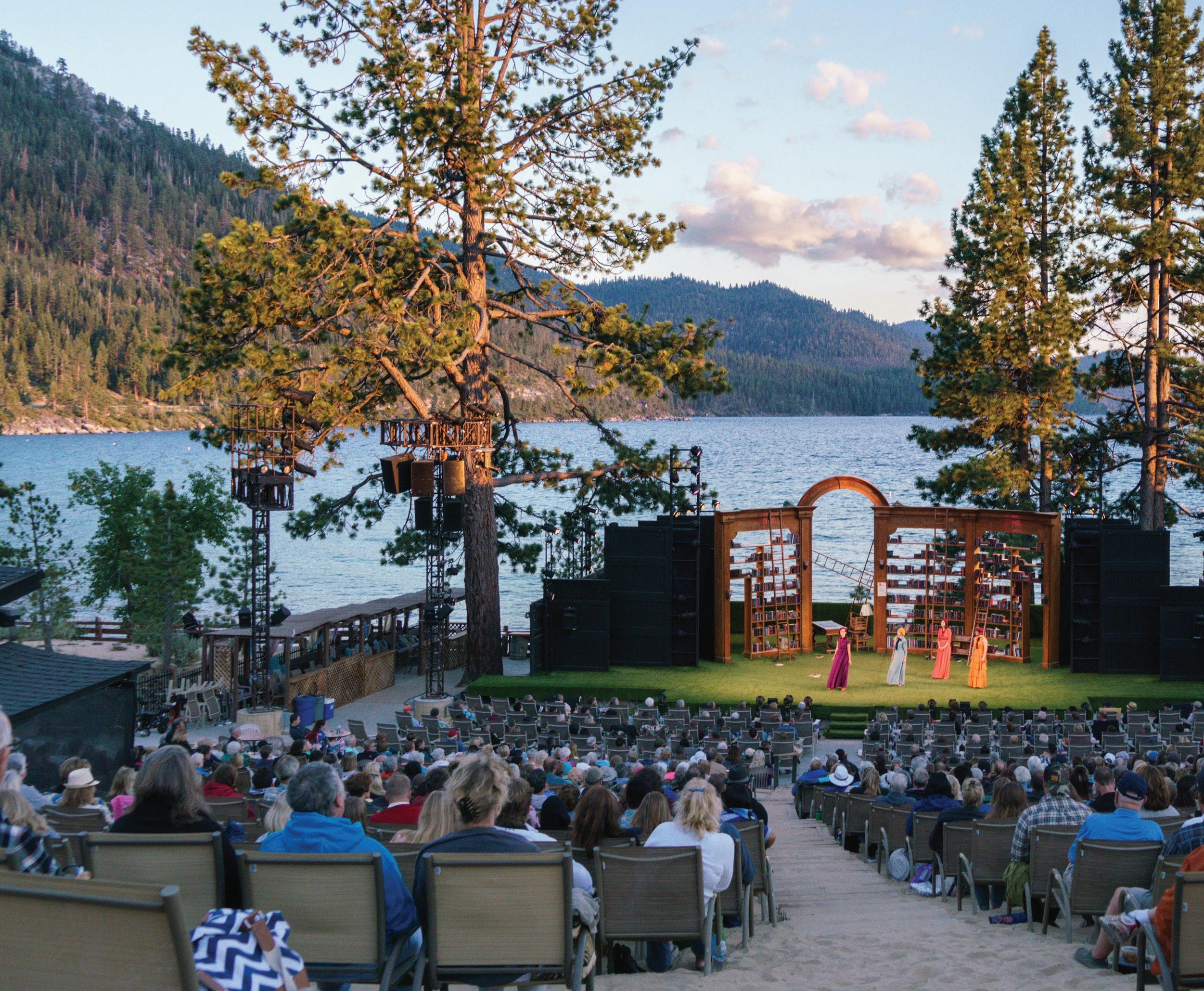
Tahoe’s acclaimed Shakespeare Festival is back for the 54th year with an entertaining schedule of productions at Sand Harbor’s Warren Edward Trepp Jr. Stage. This year’s festival features Shakespeare’s timeless tragedy Macbeth and The Heart of Robin Hood, an adventurous reimagining of the legendary tale that takes place deep in the Sherwood Forest. In addition, the Showcase Series features Billy Nation’s “A Tribute to Billy Joel” (July 6); Keith Anderson (July 14); The Doo Wop Project (July 20); Super Diamond’s “The Neil Diamond
FROM TOP: World-class musicians perform in a past Classical Tahoe event in Incline Village, courtesy photo | Truckee Thursdays, photo by Michelle Erskine, courtesy Truckee Downtown Merchants Association
Tribute” (July 29); The Concert: A Tribute to ABBA (August 10); and Sheila E. and The E-Train (August 17) among the signature performances. Meanwhile, the Partner Series includes the Reno Philharmonic Orchestra’s “Decades: Back to the ’80s” (July 13); Sierra Nevada Ballet’s “Coppélia” (July 27); Reno Jazz Orchestra’s “Trekkin’ Tahoe: A Jazz/Rock Odyssey” (July 28); Reno Philharmonic Orchestra’s “Summer Breeze: Yacht Rock Classics” (August 3); and Reno Jazz Orchestra’s “A Tribute to George Benson” (August 24).
Through August 26
MUSIC IN THE PARK tdrpd.org
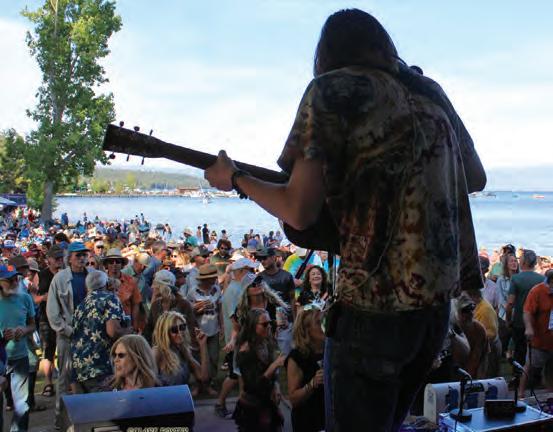
This free family-friendly concert series returns to the outdoor Truckee River Regional Park “Salty” Gebhardt Amphitheater each Wednesday evening this summer from 6:30–8:30 p.m. After kicking off in June, the series continues through the heart of the summer with Sonido Sueno (July 1), Blues Monsters (July 8), Broken Compass Bluegrass (July 15), Down the Rabbit Hole (July 22), Dead Winter Carpenters (July 29), Pressing Strings (August 5), Beatles Flashback (August 12), Matt Axton (August 19), and Déjà vu (August 26). Guests may bring their own picnics, blankets and low-back chairs. Pets and smoking are not allowed.
Through September 6
MUSIC ON THE BEACH tahoeeventscalendar.com
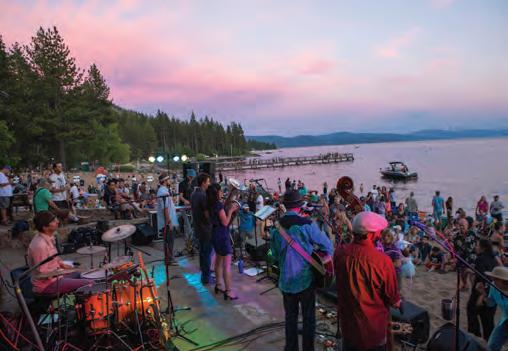
The free Music on the Beach concert series returns to the Kings Beach State Recreation Area for the 20th year with a full lineup of live music every Friday throughout the summer (excluding July 3 and August 7) from 6:30–8:30 p.m. Find food from local vendors as well as beer from Alibi Ale Works and wine from Truckee River Winery, plus non-alcoholic beverages.
Thanks to support from the North Tahoe Community Alliance, the Lake Tahoe Bicycle Coalition will offer free, secure bike valet. The series kicks off in mid-June and continues with the following acts in July and beyond: Moody Cat (July 10), Sol Peligro (July 17), Wolf Jett (July 24), Caltucky (July 31), Blü Egyptian (August 14), Sneaky Creatures (August 21), Everyday Outlaw (August 28), and The Sextones (September 4).
Through September 6 CONCERTS AT COMMONS BEACH
concertsatcommonsbeach.com
This free summer concert series features live music every Sunday at Commons Beach through September 6, along with free shuttle service from Olympic Valley and the West Shore in partnership with Palisades Tahoe and TNT-TMA. Free bike valet service will also return this summer through the Lake Tahoe Bicycle Coalition. Guests are welcome to bring picnics, blankets and low-back chairs, while local food and drink vendors sell beer, wine, soft drinks, sushi, barbecue foods, ice cream and more. Live performances, which take place from 4–7 p.m., kick off
in mid-June and continue through the summer with the Moga Family Band (July 12), Big Blue Guitarmageddon (July 19), Poor Man’s Whiskey (July 26), Broken Compass (August 2), New Monsoon (August 9), Boot Juice (August 16), Scott Pemberton O Theory (August 23), The Allmond Brothers Band (August 30), and Blues Monsters and Friends (September 6).
Through September 19 LAKE TAHOE SUMMER CONCERT SERIES caesars.com
Held at the Lake Tahoe Amphitheatre at Caesars Republic (formerly Harveys), this all-ages concert series returns with a slate of shows this summer. Following The Black Keys in June, performances continue with Rascal Flatts (July 10), Eric Church (July 15–16), Koe Wetzel and Ole 60 (July 24), Lauren Daigle (July 25), Tedeschi Trucks Band and Lukas Nelson (August 9), Ty Myers, Brent Cobb and Benny G (August 22), Train, Barenaked Ladies and Matt Nathanson (August 25), The Red Clay Strays, Dylan Gossett and Sweet Talk (September 4), Jack Johnson (September 6), and Bailey Zimmerman (September 19).
Boot Juice, left, and Broken Compass are scheduled to perform at Concerts at Commons Beach, photos by Clare Foster, courtesy TCDA
JULY
July 8–12 AMERICAN CENTURY
CHAMPIONSHIP
americancenturychampionship.com
In one of the most anticipated Tahoe events of the summer, the 37th annual American Century Celebrity Golf Championship hits the links at Edgewood Tahoe on the South Shore for a week of competitions and shenanigans in July. Stephen Curry, Jason Kelce, Jerry Rice, Charles Barkley, Ray Romano, Larry the Cable Guy and Tony Romo headline this year’s star-studded field of more than 80 sports and entertainment stars competing for their share of a $600,000 prize purse in the 54-hole tournament. Daily tickets and patron badge season passes are available online.
July
11
TRUCKEE BREWFEST
truckeeoptimistclub.com
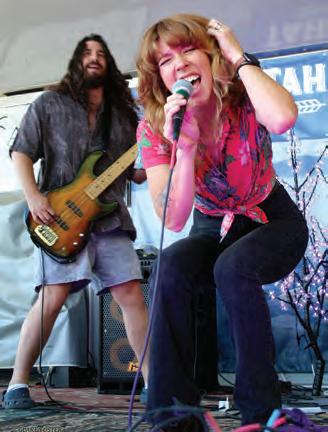
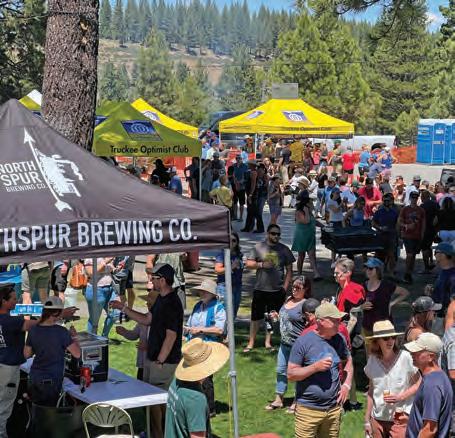
The annual Truckee Brewfest returns for the 19th year in July, featuring live music and craft brews from local and regional brewing companies, as well as unique beers from local homebrew clubs (and even some wine). A major fundraiser for the Truckee Optimist Club, the event is held at Truckee River Regional Park from 1–5 p.m. Matt Axton Music headlines the live music, with Dead Kampers and Carnival Dogs warming things up, while food is available from MogRog and Casa Baeza. Free bike valet is available courtesy of the Truckee Trails Foundation.
Truckee Brewfest is a major fundraiser for the Truckee Optimist Club, courtesy photos
DESIGN TAILORED TO YOUR MOUNTAIN LIFESTYLE.
TRUCKEE-TAHOE & BEYOND CUSTOM HOME DESIGN altitudedesignco.com alt.designtruckee
July 21–24
LAKE TAHOE DANCE FESTIVAL laketahoedancecollective.org
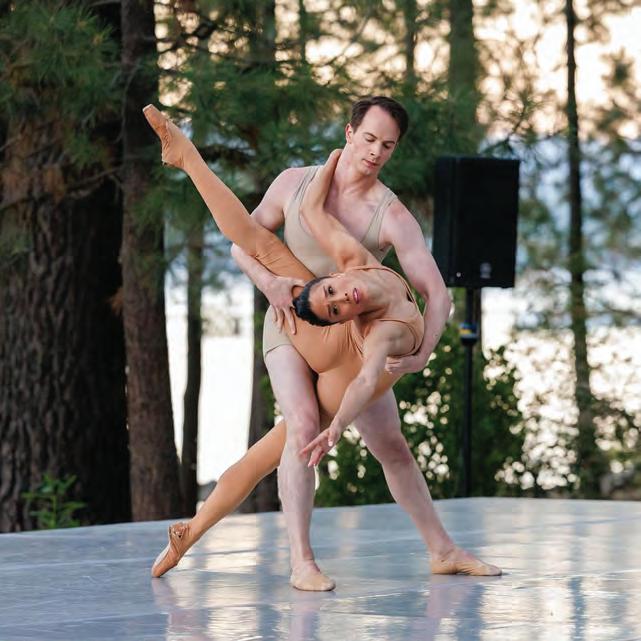
On the 14th anniversary of its summer festival, Lake Tahoe Dance Collective kicks off with an opening night gala in Incline Village on July 21, followed by Kings Beach Community Night on July 22, Tahoe City Community Night on July 23 and a closing night gala in Tahoe City on July 24. Featured artists include Indiana Woodward, Daniel Ulbright, Tayor Stanley and Adrian Danchig-Waring of New York City Ballet, Lia Cirio and Paul Craig of Boston Ballet, and Melody Walsh of Houston Ballet. Tickets and more information about the artists are available on the Lake Tahoe Dance Collective website.
Dancers perform in the outdoors at a past Lake Tahoe Dance Festival, courtesy photo
AUGUST
August 7–8
CONCOURS
laketahoeconcours.com
The 52nd annual Concours d’Elegance returns to Obexer’s Boat Company in Homewood for two days in August, this year featuring a Marque Class celebrating Riva boats. The event is touted as the most prestigious wooden and classic boat show in North America, with over 70 of the world’s finest boats on display. The boat show takes place from 10 a.m.–4:30 p.m. on Friday and 9 a.m.–4:30 on Saturday. In addition to the show, the Concours includes social events (reservations required) such as an awards barbecue, opening-night gala dinner and dance, men’s grill and ladies’ luncheon. Tickets may be purchased on the event website.
August 29
TAHOE BREWFEST tahoebrewfest.com
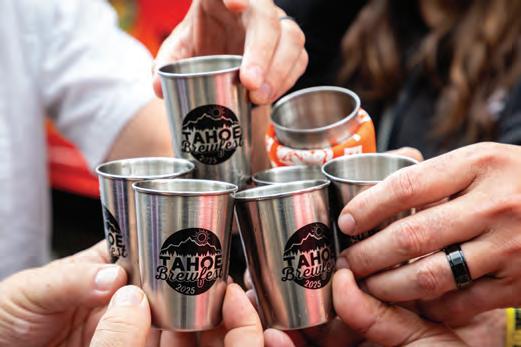
Returning to Ski Run Boulevard for the ninth year, Tahoe Brewfest is a celebration of South Lake Tahoe’s special mountain culture, featuring beer, crafts and community in a festive setting in the heart of town. General admission tickets include a 5-ounce commemorative cup and grant unlimited 5-ounce samples from over 40 brewing companies, including local and regional staples from the Bay Area to Reno and beyond. The event, which takes place from 1–5 p.m., is family-friendly (excluding pets) and open to all ages, with food, live music, games for kids and shopping among the offerings. On-site parking is limited, and attendees are encouraged to carpool, bike, walk or use the free bike valet service or new Lake Link service to get to and from the venue. Tickets may be purchased on the event website.
Tasty samples at Tahoe Brewfest, photo by Hannah Pence, courtesy Tahoe Brewfest
Breaking Free
Truckee author writes a deeply personal memoir about her escape from the grips of an oppressive ashram community
Written by Tim Hauserman
A TRUCKEE RESIDENT for the past 13 years, Priya Hutner has done her part to enrich the area’s literary and culinary communities. In addition to creating delicious concoctions through her catering business, The Seasoned Sage, Hutner co-founded the annual Tahoe Literary Festival and Truckee Lit Crawl and has written hundreds of articles for local publications, mostly Tahoe Weekly (Tahoe Guide)
She is now promoting her new book, Chasing Nirvana: A Seeker’s Story of Love, Loss, and Liberation, which details her escape from a Florida ashram led by a tough-talking female guru from New York. Published by She Writes Press and distributed by Simon & Schuster in March 2026, the page-turning memoir has received rave reviews by a wide range of authors, artists and fans of Hutner’s work.
Life in a Cult
When Hutner was a young teenager, her parents joined a growing New York spiritual community led by a guru known as Ma, who predominantly drew from Hindu and Tibetan Buddhist philosophy.
At first, she had little interest in the spiritual teachings or the community’s strict lifestyle, which included celibacy, abstinence from alcohol and a vegetarian diet. Instead, she was excited by the prospect of leaving her home in the Philadelphia suburbs and living in New York City.
Her mother and brother later moved to Florida, where Ma had established an ashram with a small group of students. Hutner eventually followed to give birth to her son. She then returned to New York and, after several years, moved back to Florida with her two young children.
“Priya Hutner’s Chasing Nirvana is raw, courageous and profoundly relatable for anyone who’s ever lost themselves in the promise of enlightenment,” Canadian actress and author Sarah Edmondson, a cult-recovery advocate who co-hosts the “A Little Bit Culty” podcast, writes on Hutner’s website. “Her story shines a light on the seductive power of charismatic leaders and the universal longing to belong.”
“Priya is one of the most courageous people I know,” writes famed American folk singer Arlo Guthrie, a friend of Hutner’s going back to her days in the ashram. “The journey of a real seeker isn’t for the faint of heart. As Priya makes clear in her story, you have to have courage to go beyond the mundane comfort of the familiar, on a road that leads to places you’ve never been. She went there her way, and that’s what makes her journey an inspiration to others.”
It was during this period that her search for deeper meaning and purpose intensified. Drawn to the spiritual path, she became increasingly devoted to Ma’s teachings. She experienced expanded states of consciousness, and her spiritual awakening became a central focus.
“I wanted a deeper meaning for my life. I wanted to be enlightened, a better person and a different person,” says Hutner, who spent years working her way up to become CEO of the ashram.
In addition to seeking enlightenment, the ashram took care of people who were dying of AIDS and other illnesses, as well as those who lacked food or housing.
“ There were some really important lessons that were learned,” says Hutner, who was especially impacted by serving the dying, which reminded her that “our time here is limited and fragile.”
THIS PAGE: Truckee’s Priya Hutner is the author of Chasing Nirvana: A Seeker’s Story of Love, Loss, and Liberation OPPOSITE PAGE: Chasing Nirvana is available at Word After Word Books in Truckee, courtesy photos
“Ma was an outrageous being who didn’t hold back,” Hutner adds. “She swore like a sailor. We find teachers who suit us. I thought Ma’s outrageousness was awesome. I still have a little New York left in me. There were times I was mortified later taking her out into the world, though. There were some really embarrassing moments.”
Hutner understood that her position in the upper echelon of the ashram management gave her the privilege of closer contact with the guru, and to speak with her more frankly—although Ma still had the last words, and those words were often harsh. Hutner was a gatekeeper, and people went through her to be with the guru.
“People wanted what Ma offered. They longed to be free from their pain and suffering. They wanted to belong,” she says. “Thousands were helped, and many were hurt, with verbal and emotional abuse and manipulation and more.”
Eventually, Hutner realized, “I wasn’t growing as a human and I saw things that I didn’t think were OK. The fracturing was slow. I looked around the room and realized nobody was enlightened. Something broke in me. I had an awakening through a series of dreams, and witnessing Ma’s increasingly erratic behavior, it led to an epiphany that made me realize it was time for me to leave.”
Starting Anew
Leaving wasn’t easy, though. In addition to her own involvement with the ashram, her mother was a longtime close confidant of Ma’s, and leaving Ma was in some ways also leaving her mother.
But after more than 30 years in the Kashi Ashram (which still exists, although Ma has since died), she packed everything in her car and escaped under “traumatic and harrowing circumstances.”
“I left my community, my family and my guru. I had to reinvent my life and had no idea what I was going to do,” says Hutner, who was 40 at the time. “I was
Priya Hutner’s Chasing Nirvana is raw, courageous and profoundly relatable for anyone who’s ever lost themselves in the promise of enlightenment.”
— Sarah Edmondson, Canadian actress and author
CEO of the ashram. I was in charge of the community. I was entrenched.”
After leaving the group, Hutner moved in with her Sikh boyfriend, who ran a kundalini yoga ashram. They talked about building a home together in Truckee, where her younger son lived and ski leased a place. Truckee felt like home.
The relationship eventually ended, and she made the move on her own. One of the first people she met in Truckee was Karen Terrey, a local writing coach and current Nevada County Poet Laureate.
“She introduced me to a lot of people,” Hutner says. “She is a great networker.”
Hutner needed to make a living and wasn’t sure at first how to do it. She had a knack for cooking and writing, though, and was hired at Tahoe Weekly (later Tahoe Guide) published by Katherine Hill, serving as both the entertainment and food editor.
“ That job helped me become a better writer,” Hutner says.
In 2014, Hutner established The Seasoned Sage and worked as a private chef, initially preparing healthy meals for
individual clients before expanding the business into a successful catering company, which she still runs with her son. She also teaches yoga, meditation and breath work.
Cathartic Endeavor
As soon as Hutner left the ashram, she knew she wanted to write the story of her experience, which she had documented in her journals. But the need to make a living put the book on the back burner for years.
Finally, she was ready and began to focus on the book. At first, she realized she was writing from anger, so she worked to change her tone and focus on making it a spiritual adventure story that reads like a novel.
She kept writing, sent it to an editor in Los Angeles and started querying agents and publishers.
“ To me, writing a book was cathartic, but it brought up a lot of stuff,” Hutner says. “Memoir is the past, but who wants to live in the past? Many stories didn’t make it into the book, but in the end, the body of work was compelling. I told my truth.”
The publishing process, she found, was less cathartic than writing and a much more difficult endeavor. It involved hard work and the frustration of rejections. Since the book published, she’s remained busy with speaking engagements and publicity.
“I am trying to pace myself,” Hutner says. “It has been interesting seeing how many people relate to the story, even though they were never in a cult but were in an abusive relationship or hooked into something. I wanted the story to be relatable.”
An Advocate for Writers
The challenge of writing the book led Hutner to want to help others who are interested in the craft.
“It was important to me to be an advocate for writers, particularly for emerging writers,” she says. “As I got deeper into the publishing world, I felt there was a way for me to support others.”
Hutner teamed up with Hill, the Tahoe Guide publisher, and co-founded the Tahoe Literary Festival, an annual fall event in Tahoe City that brings together readers and writers for workshops, panel discussions and readings. It has quickly grown into a much-anticipated event while helping connect the small but vibrant Tahoe writing community. Now in its third year, the event—scheduled for October 9 and 10— draws authors and participants from across the country.
The festival has since expanded to include the Truckee Literary Crawl—aka the Truckee Lit Crawl—which features short author readings and Q-and-A sessions. This past April, over 60 authors read at venues throughout downtown Truckee.
Hutner says what made the processes of writing the book and creating the literary festival more worthwhile is the people she’s met along the way.
“It is the most amazing experience. The festival and writing and publishing a book has led to so much expansion and new experiences,” she says. “I’ve learned a lot about the publishing world. I’ve met many new and wonderful people. It’s led me to realize how I will curate my next book and how I can help other writers.”
Chasing Nirvana is available at Word After Word Books in Truckee and can also be ordered through bookstores or purchased on Amazon. Learn more about the Tahoe Literary Festival and Truckee Lit Crawl at tahoelitfest.com. Follow Hutner on Instagram, @priyahutner, or priyahutner.com.
Tim Hauserman is an author and a nearly lifelong Tahoe resident. He appreciates Priya Hutner’s contributions to the area’s small writing community and commends her for taking on the challenge of writing such a personal book.
Save of a Lifetime
Unaware of the dangers on Lake Tahoe, a new resident finds herself in a dire situation after trying to paddle across windswept open water
Written by Kayla Anderson
FAR FROM SHORE on a windy afternoon, Janelle Hibler was paddling toward Speedboat Beach after a fun visit to the Hyatt when a large wave slammed into her kayak, tossing her into the frigid water of Lake Tahoe.
No big deal, she thought: “I’ll just climb right back in.”
She tried to lift herself out of the water and into the vessel, but she could not. She tried again. Then again, and again.
A Quintessential Tahoe Day
It was June 2017, and Janelle had just moved to North Lake Tahoe from Ohio after her husband, who goes by “J.,” was hired as a dermatologist at a local practice.
“I legitimately couldn’t drag myself back into my kayak,” she says. “Each time I tried, the waves would crash into me, toppling me back over.”
Hours passed as Janelle clung to the side of her kayak, screaming at passing boats, praying that someone would hear her desperate pleas and come to her rescue. To no avail.
She remembers the feeling of “absolute panic” when the sun disappeared behind the horizon, then wonder as she watched the full moon rise slowly over the lake.
As she drifted in and out of consciousness, her kayak long gone as she bobbed in the open water, she felt a strange sense of peace.
“ The panic was subsiding,” she says. “I was just … floating, staring up at that full moon rising higher over the East Shore. I had been begging and pleading to my mom, to God, to the universe, to save me.
“ They must have heard me.”
Soon after moving into their new home, the Hiblers bought what Janelle calls “The Tahoe Starter Kit,” complete with snowshoes, skis, stand-up paddleboards and kayaks.
Admittedly, their ambitions exceeded their knowledge of Lake Tahoe and its potential hazards.
“I don’t hail from the Great Lakes part of Ohio,” says Janelle. “My Ohio had shallow man-made lakes that you could almost stand up in. Nighttime boating, mostly to the bars dotted around the lake, was a commonplace summertime activity.”
The first outing on their new kayaks, the couple got a small taste of Tahoe’s
volatile side when they encountered windy conditions on a return trip from Gar Woods in Carnelian Bay. But while paddling through the chop was a bit stressful, the couple didn’t think much of it.
“We just looked at it as one of those crazy adventures we always have,” Janelle says.
Her second outing was on July 8, 2017. J. was out of town at the Monterey Grand Prix as Janelle set out to enjoy what was a quintessential Tahoe day—sunny, warm, the feel of summer in the air.
In no rush, Janelle spent the morning shopping in Kings Beach, buying souvenirs for friends back home and a pair of cutoff jean shorts at the thrift store. Then she loaded up her kayak, packed her purse with a water bottle, sun hat, sunscreen, button-up shirt and headphones and drove to Speedboat Beach.
I legitimately couldn’t drag myself back into my kayak. Each time I tried, the waves would crash into me, toppling me back over.”
— Janelle Hibler
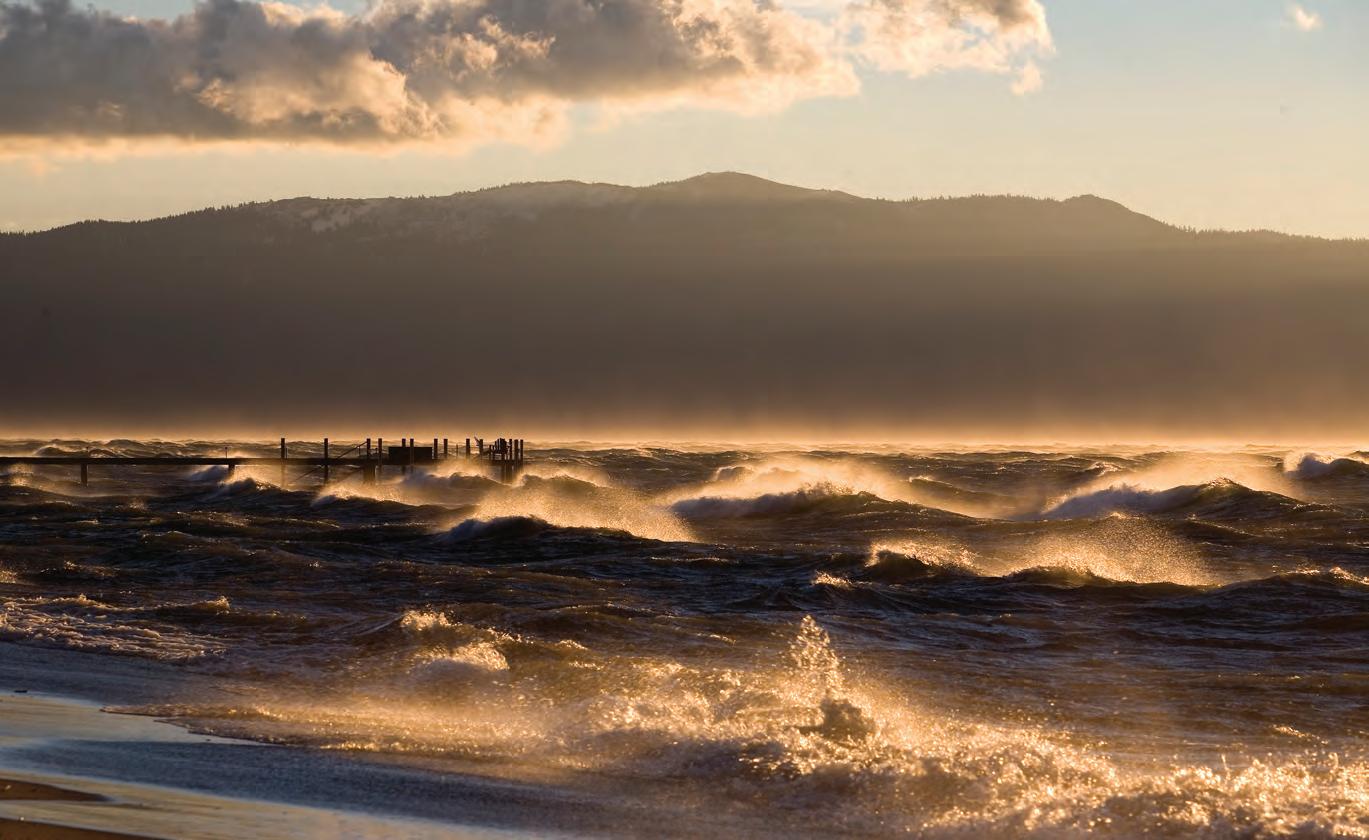
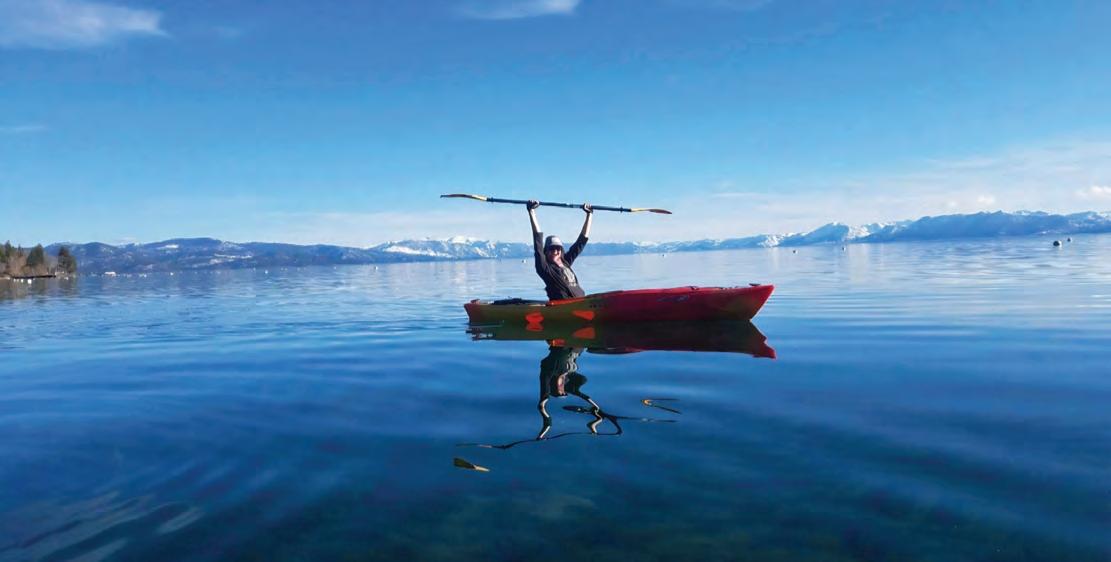
OPPOSITE PAGE FROM TOP: Janelle and J. Hibler celebrate their fourth wedding anniversary with a tour of Thunderbird Lodge in September 2018, courtesy photo | Wind and waves are common on Lake Tahoe on summer afternoons, presenting dangers for people recreating on the water, photo by Ryan Salm | After making certain that the weather conditions were favorable, Janelle Hibler gets back out on Tahoe after the 2017 incident, courtesy photo
She spent the next hour or so paddling in calm waters around Crystal Bay and over to the Hyatt Regency Lake Tahoe in Incline Village, where she arrived to find a festive scene. She pulled her kayak onto the beach and joined the crowd.
After enjoying a couple of drinks and socializing for a bit, she started to feel hungry and decided to head home. It was 4 p.m. when she hopped back in her kayak, donning nothing more than a bikini, her new jean shorts and Chaco sandals, and shoved off into a strong wind that had picked up that afternoon.
“On the way home, I was paddling and thinking, ‘Do I want Mexican, sushi or pizza?’” Janelle recalls.
Bliss to Panic
Longing for dinner and a shower, Janelle decided she’d take the most direct route
My brain was getting fuzzy. Coherent thoughts were fading. My praying to my dead mom and God became almost crazed.”
— Janelle Hibler
home—a beeline straight across the heart of Crystal Bay.
“ The fateful decisions kept stacking up,” she admits, reflecting on the choices she made that would soon put her in peril.
The farther Janelle paddled out, the more turbulent the lake became. The next thing she knew, she was splashing into the cold water of Lake Tahoe, unable to remount her kayak.
B etween screams for help, Janelle tried to kick and pull her kayak toward the distant shore. But she only drifted farther from it. She tried to muscle her body out of the water and back into the kayak. But her efforts were fruitless against the combined power of the wind and water.
“I finally accepted defeat and resolved
to call 911 for help,” says Janelle. “I knew a water rescue would be costly, but it didn’t matter.”
Only she couldn’t find her phone. She tore through her bag, chucking her water bottle, sun hat, button-up shirt, purse— even her car keys—into the depths of Tahoe. Still, no phone.
She managed to grab the used life jacket she had acquired the day before and put it on. Exhausted and battered, she let go of her kayak.
After hours of battling against the waves and fading light, still hollering at every passing boat—“Why was no one hearing and coming to rescue me!?”— Janelle began to give up hope.
Not a particularly religious person, she
found herself fervently confessing every sin, asking for forgiveness, repeating the Lord’s Prayer. If this was it—and surely it was—she hoped and prayed it wasn’t too late to find religion and begged her mother, who had died five years earlier, to help save her.
At some point between the sun setting and the moon rising, “My brain was getting fuzzy,” Janelle says. “Coherent thoughts were fading. My praying to my dead mom and God became almost crazed.”
Serendipity
Nick Wright, an athletic trainer living in the Sacramento area at the time, arrived in Crystal Bay that evening on vacation with his family, who rented a house just a few doors down from Janelle and J.
On a whim, several members of the family decided to take advantage of the bright moonlight with a nighttime boat ride.
“Mind you,” says Janelle, “this ain’t Ohio. Nighttime boating isn’t a thing on Tahoe. The mother and aunt of the family were strongly against it.”
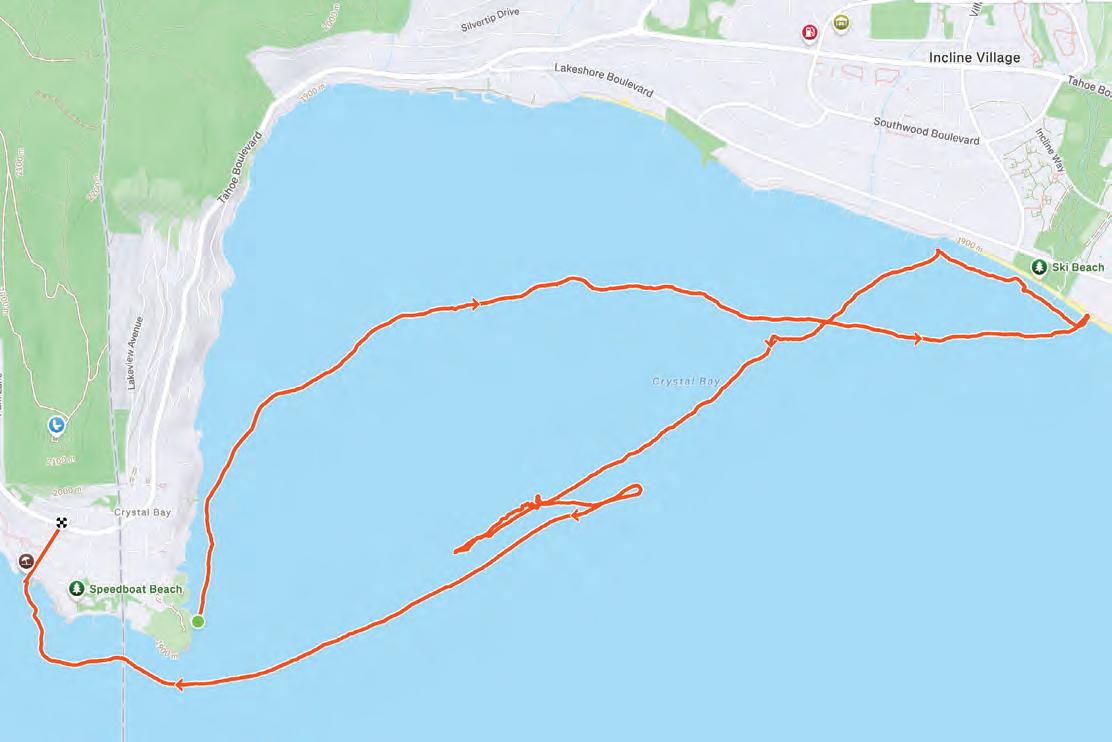
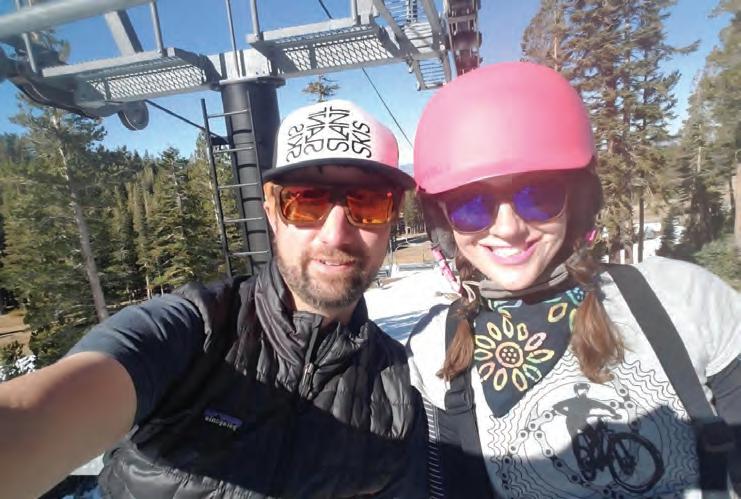
OPPOSITE PAGE: Janelle Hibler’s Strava activity documented the route of her July 8, 2017, kayak outing. After choosing an ill-fated direct route across Crystal Bay on her return trip, she capsized in rough conditions. The zig-zagging track in the middle of the bay captures hours spent fighting wind, waves and frigid water before being rescued THIS PAGE: Janelle and J. enjoy an early-season day at Mt. Rose Ski Tahoe in October 2017, courtesy photos
Navigating Lake Tahoe by moonlight, the family noticed something on the water that they initially thought was a bird.
“We thought that maybe it’d fly away as we approached it,” Wright recalls, “but the figure stayed in the water. And then when the boat was practically right on top of her, we realized it was a person. We looped back around, killed the engine, saw Janelle in the water and she said, ‘I need help, please.’”
Wright’s wife, Heather, and his cousin reached down and grabbed Janelle—whose lips were blue—pulled her into the boat and immediately began warming her up with towels and blankets.
In her semi-conscious state, she was still crying out for help.
“She was in the Crystal Bay area, really far from shore,” Wright says. “She was fully hypothermic but fairly coherent. She told us where her kayak was, told us to call her husband and gave us his phone number.”
Which was strange, says Janelle, because normally she would have had to
look up the number. But on that night, and in her dire state, the digits were somehow seared into her memory.
“ They found me around 9:30 p.m., after four-plus hours of floating in the deepest depths of Tahoe,” says Janelle. “I have flashes of memory from when our fates collided. Suddenly, I’m on a boat. Then, nothing. I’m trying to tell them about my kayak. Then, nothing. I’m being carried like a dead body, one person carrying my arms and another my legs. Then, nothing. I’m in a bed in a strange room in clothes not my own. Then, nothing.”
Back at the rental house, the family got Janelle out of her wet clothes and made homemade heat packs to place on her pulse points.
“We gave her some food but didn’t know where the nearest facility was to get her to,” says Wright. “I remember one emergency services number we called said it’d be at least a half hour to get there. So, we just concentrated on getting her body temperature up.”
‘I’m Cold, I’m Cold, I’m Cold’
J. was at the racetrack in Monterey with a friend when he received a call from an unfamiliar number. He let it go to voicemail.
“But then they left a voicemail, and something told me to check it,” he recalls, pausing for a moment before continuing with a shaky voice. “The message said, ‘You don’t know me, but my name is Nick and we have your wife. She’s here in a boat and she’s really cold, but she’s warming up.’”
J. was shocked and confused. A sense of dread washed over him.
“I told my friend, ‘Something serious happened to Janelle and I have to go.’ I packed up and went really fast back to Tahoe,” says J. “Nick and I called each other every 15 minutes for updates. I asked Nick to put Janelle on the phone and she just kept saying, ‘I’m cold, I’m cold, I’m cold— on the kayak.’”
J. arrived in record time during the night to find his wife bundled up, slowly starting to come around under the care of strangers who had just saved her life. She could barely speak above a whisper after hours of screaming. She was dazed and beaten up. But she was alive.
“It’s so hard to think about Janelle being gone and how very close she came,” says J., reflecting on the traumatic experience. “The image of her being out there, and after seeing her all bruised up from her hanging onto the kayak for so long, the kayak banging on her skin … that hits me so hard, thinking of her hanging on for dear life.”
When Janelle felt strong enough, she was brought out to the couch in the living room, where she noticed a pair of sandals drying by a fireplace that looked identical to her own.
“Oddly, I would have sworn that I kicked them off,” she says. “They were so heavy, and I remember thinking that
Janelle Hibler on the Tahoe Rim Trail in July 2018, courtesy photo
they were dragging me down. I thought I remembered kicking them off my feet. Apparently not.”
Then the family dog waltzed in—a “sweet, fluffy goldendoodle, I think,” says Janelle, who commented: “Aww, what a cute pup.”
“Don’t you remember her?” asked one of the family. “That’s Dixie. She was on the boat with us when we found you.”
Janelle couldn’t believe what she’d heard.
“I swear the proverbial record scratched and skidded to a stop,” she says. “Dixie Rose was my mom’s DJ name when she was a radio DJ all those years ago. It was undeniable that my mom showed up. Dixie was there, all right.”
The Power of Hindsight
At sunrise, Janelle and J. reached out to an acquaintance with a boat to help them scan the shoreline, hoping they might find some
We thought that maybe it’d fly away as we approached it, but the figure stayed in the water. And then when the boat was practically right on top of her, we realized it was a person. We looped back around, killed the engine, saw Janelle in the water and she said, ‘I need help, please.’” — Nick Wright
of her lost belongings. After failing to find anything, they arranged to meet Wright that afternoon to retrieve Janelle’s kayak, which the family had also rescued the night before.
“Upon opening that sealed well (in the kayak), we all broke into tears,” says Janelle.
There in front of them were all the items she had packed in the kayak and thought she lost—purse, keys, even her phone.
“I would have sworn under oath that I
had thrown it all astray, that my phone was not with me,” says Janelle. “I dug for it when I wanted to make a 911 call. Alas, it was with me the whole time.”
Janelle soon made another discovery: The old, faded, tattered life vest she was gifted the day before had a whistle strapped to its chest.
“All those hours out on the water, clinging to my kayak and my very life, I had my phone and a whistle the whole time,” she says.
Fortunately, a full moon lit up Lake Tahoe that night, lulling a visiting family out for an ill-advised nighttime boat ride.
“We didn’t make a great decision going out on the boat that night,” says Wright, “but we went directly to Janelle and had the supplies to get her temperature up and take care of her. We’re lucky it was a positive result and that her body responded well to the treatment we gave her.”
For nearly a decade, Janelle was reluctant to tell the story of her harrowing ordeal on Lake Tahoe.
She’s well aware of the mistakes she made by not being properly prepared or educated, and that others will surely cast judgment. She knows now what she should have known then, and she wants to help educate others about the potential dangers of recreating on Lake Tahoe. It might just save a life.
“If sharing this story helps even one person check the wind, wear the life vest, hug the shoreline, rethink that extra drink, or understand that conditions change quickly and predictably here, then the embarrassment of telling it is worth it.”
Now every July 8, Janelle celebrates being alive.
Relax
Kayla Anderson is a 20-year North Lake Tahoe resident and watersports aficionado who has had her own harrowing experiences on Lake Tahoe. She is honored Janelle shared her story with her and hopes it encourages people to check the weather conditions every time they go out on the lake. Tahoe Quarterly Editor Sylas Wright contributed to this story.
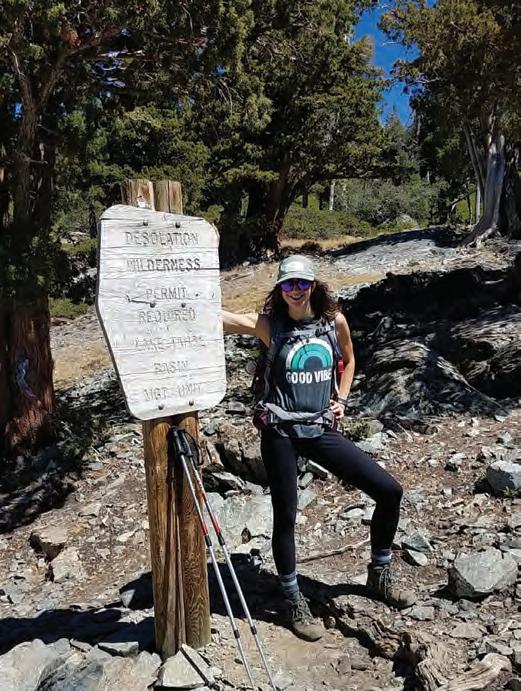
Janelle Hibler in Desolation Wilderness, courtesy photo
72 Miles of Healing
While recovering from an injury, a snowboarder finds purpose on the water with a trash-collecting paddle around Lake Tahoe
Written by Claire Hewitt-Demeyer
Photographed
by
Matt Bansak
THE IMPACT CAME out of nowhere. One moment, I was sitting at a stoplight after a dawn patrol splitboard mission up Jakes Peak, still buzzing from the kind of morning that fills your soul. The next moment, my blissful mood was shattered as a Hummer slammed into the back of my car.
Just like that, the rhythm of my life—movement, mountains, momentum— screeched to a halt.
What followed was a blur of diagnoses: a broken collarbone, a concussion and shoulder damage that would require surgery. On May 21, 2025, Dr. Kyle Swanson at Barton Hospital repaired my rotator cuff and biceps tendon. I would have to wait at least seven months before snowboarding again.
For someone who measures time in sunrises, vertical feet and long days in the mountains, that kind of stillness felt suffocating. But if the mountains have taught me anything, it’s this: When the conditions change, you adapt.
Rewriting the Line
Tahoe has been my home for years. The lake and surrounding mountains have shaped the way I approach life, teaching resilience, perspective and deep respect for wild places.
When I was forced to slow down, I didn’t want to sit still and count the days until winter returned. I needed a purpose.
About a month into healing, an idea began to form. What if I could take something that had always been on my bucket list—circumnavigating Lake Tahoe—and turn it into something bigger
Tahoe gives so much to all of us: adventure, peace, escape, identity. Yet people still leave pieces of themselves behind along its shoreline. The more I trained, the more it felt like a mission to protect this place.”
than myself? The plan was simple in theory: kayak all 72 miles, stopping at beaches to pick up trash along the way. Because every piece of litter left behind eventually finds its way into the water. And Tahoe’s famed clarity isn’t guaranteed forever. This was bigger than recovery.
A Different Kind of Training
Recovery has a way of humbling you.
Two months post-surgery, I couldn’t lift more than 5 pounds. A traditional paddle kayak wasn’t an option, so I had to adapt. Thanks to the generosity of Kyle Shaffer, who lent me his pedal-powered Hobie, I could circumnavigate the lake without compromising my healing.
Training became less about performance and more about patience. Five-mile days slowly turned into 10, weight added to the kayak little by little.
Every time I landed on a beach, I picked up trash. Plastic bottles tucked into the sand. Food wrappers tangled in rocks. Debris of all sorts that would otherwise end up in the lake.
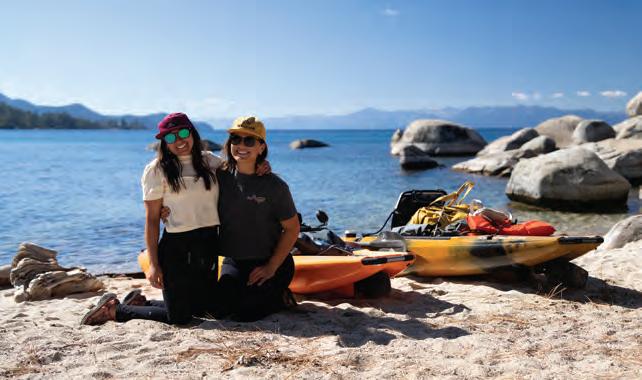
FROM LEFT: Author Claire Hewitt-Demeyer, left, and Quinn Randall prepare to depart on a 72-mile circumnavigation of Lake Tahoe from Hidden Beach, cleaning shorelines and turning awareness into action | Four days and 67 miles into the journey, Hewitt-Demeyer and Randall paddle through a boulder-studded stretch near Crystal Bay
Tahoe gives so much to all of us: adventure, peace, escape, identity. Yet people still leave pieces of themselves behind along its shoreline. The more I trained, the more it felt like a mission to protect this place.
When Things Get Real
About three weeks before the expedition, Lake Tahoe humbled me in a different way. I was 6 miles offshore, training alone, when my kayak suddenly malfunctioned. A critical pin in the pedal drive (my only source of movement) had snapped. No paddle. No swimming allowed because of my shoulder. One bar of service.
For the first time since the accident, fear hit hard. It was a reminder of how quickly things can shift, how vulnerable we are when we step into the unknown. I managed to get a message out
before losing service. My boyfriend, Kyle Johnston, dropped everything to come find me, navigating open water and vague directions until he spotted me drifting alone. Luckily, the water was calm and the weather was warm. Had conditions changed, the situation could have become far more serious.
That day didn’t stop me, but it made me respect the lake in a whole new way.
Building Something Bigger
As training continued, I started building the heart of the project.
I reached out to companies and friends for support, not knowing what to expect. The response blew me away: gear, encouragement, shared excitement. People believed in this wild little idea even while I was still figuring it out myself.
More importantly, I partnered with
Clean Up The Lake, a nonprofit dedicated to preserving Tahoe’s fragile ecosystem. With their help, the logistics fell into place: camping permits, route planning, cleanup coordination and a rare opportunity to camp in Emerald Bay after the season had closed. Huge shoutout to the Forest Service for making that happen. Without that stop, day two would have turned into a brutal 25-mile push my recovering body couldn’t handle.
We also launched a fundraiser supporting Clean Up The Lake’s ongoing efforts—because this was never just about kayaking around a lake.
The Push
Four months after surgery, it was time. My shoulder was still healing. I couldn’t swim. I was still restricted to light weights. But somewhere between
Just four months after shoulder surgery, Claire Hewitt-Demeyer set out to circumnavigate Lake Tahoe by pedal kayak
the endless training laps, the fear and the setbacks, I started believing I could actually do this.
October 5 was the latest I could push before the weather turned. The week before, Tahoe had a big wind event that rattled me. Was I strong enough?
I’d planned for a solo expedition. Then, at a wedding in Oregon two weeks before launch, my friend Quinn Randall lit up at the idea. Without hesitation, she booked a plane ticket.
Launch Day
That morning at Hidden Beach, my stomach was full of nerves. Standing on the shoreline, looking across the massive stretch of blue ahead, felt overwhelming.
Quinn went straight from her morning flight to a taxi to Incline Village, rolling in ready. Her energy was exactly what I needed.
At 11:15 a.m., we pushed off and started pedaling south. That first moment gliding away from the beach felt surreal. Three months earlier I could barely move my shoulder. Now I was setting off on a four-day circumnavigation of Lake Tahoe.
The lake graced us with smooth water. We pedaled hard for 7 miles until we reached Skunk Harbor for our first cleanup. I set a 15-minute timer so we could still navigate the remaining 11 miles to Zephyr Cove. We collected 22 pieces of litter and hopped back in to chase daylight.
The sun had just dipped behind the mountains when we reached Zephyr Cove. Our bodies were wrecked, yet we were overwhelmed with joy. We’d gathered 59 pieces of trash weighing 3 pounds.
Friends greeted us with shrimp and marinara, a true delight after hours of paddling. They also prepared some warm
food and started a fire as we set up camp. There’s something about ending a long, exhausting day with people who show up for you.
Day Two: The Crux
We woke long before sunrise, rushing to get on the water before the weather turned. The goal: 15 miles from Zephyr Cove to Emerald Bay. Forecasts called for strong afternoon east winds, the worst possible direction. Gusts would slam into us sideways, with real potential to flip our kayaks far from shore.
We left fully bundled, breath visible on the glassy water.
Two hours in, our trash-grabber tool fell into the lake. We watched it spin into the depths and settle on the sandy bottom about 7 feet down. We glanced at each other and knew we couldn’t leave it. That would go against everything we were kayaking for.
EAST SHORE TRAIL EXPANSION IS HERE
One of the most iconic trails in Tahoe needs your support. Help us build the next phase of the Tahoe East Shore Trail from Sand Harbor to Spooner Summit by purchasing an engraved trout plaque or by adding your name to our donor wall. Scenic vista points will also be available. Secure your spot today by emailing info@tahoefund.org .
Without hesitation, Quinn launched herself in for a proper morning cold plunge. Seconds later, she burst back grinning like a lake mermaid, holding the grabber overhead.
One more piece of trash not left behind. We reached Baldwin Beach at 1 p.m., made lunch to warm up and swept the shoreline. In 20 minutes, we collected 106 pieces of litter. Then the wind picked up. We made a mad dash back to the kayaks.
Whitecaps started building. Strong east winds slammed into us sideways. The lake went from calm to chaotic.
Suddenly, I was out there, unable to swim, still healing, pushing through one of the most demanding moments of my life. You stop thinking about the distance. You just focus on the next stroke. The next breath.
S omehow, we made it the final 5 miles to Emerald Bay, weary and humbled by how quickly the lake can turn. Our voices were stripped from shouting against the wind for an hour and a half.
Camping in Emerald Bay after the crowds had disappeared felt like stepping into another world. Alpenglow lit up the surrounding peaks. Silence settled across the bay. I sat completely exhausted, staring at the water, realizing this project had become so much more than recovery. It was healing in motion.
Layne Howard and Anisa Kastle joined us that night to camp, and Kyle brought dinner by boat. A true dream come true.
Joy in the Middle
On day three, we left at sunrise so we could stop at Fannette Island and have breakfast at the iconic tea house. Quinn surprised me with birthday decorations, turning an already meaningful expedition into one of the most meaningful birthdays of my life.
Fresh off surgery, 32 miles into a 72-mile mission, celebrating another year of life. It felt surreal.
We pushed on another 17 miles to our next base camp in Tahoe City. This time the lake gave us a break with calm water and sunshine—the kind of conditions that remind why Tahoe steals people’s hearts. By the end of the day, we’d reached the 50-mile mark and collected another 92 pieces of trash.
Claire Hewitt-Demeyer and Quinn Randall completed a 72-mile circumnavigation of Lake Tahoe in four days, removing 13 pounds of litter from the shoreline and helping raise awareness about keeping Tahoe clean
The Final Push
By the fourth day, exhaustion had fully set in. But we could feel the finish line pulling us forward.
We launched from Tahoe City at 6:40 a.m. The lake feels different in those early hours. Quiet. Still. Forecasts called for stronger winds in the afternoon. We had 22 miles to go, our biggest day yet.
As we rounded the final corner back toward Hidden Beach, emotion hit. The moment our kayaks touched the sand, we shouted with joy, hopped out and jumped into the freezing lake fully clothed, laughing, tired, overwhelmed with gratitude.
I couldn’t have done it without Quinn by my side, without Clean Up The Lake, without the sponsors, without the friends who brought warm meals after long days on the water, and without Tahoe itself.
We had done it.
In all, we collected 253 pieces of trash, roughly 13 pounds removed from the shoreline.
On paper, it might not seem like much. But this journey was never about the numbers. It was about awareness. About intention. About showing that even when you’re sidelined, you can still create something worthwhile.
The journey reminded me that healing isn’t just physical. It’s mental, emotional and deeply tied to purpose. Setbacks don’t have to stop you.
Lake Tahoe has given me so much. This was my way of giving a little back. And maybe, just maybe, it will inspire someone else to do the same. Because you don’t have to do something massive to make a difference.
A professional snowboarder based in South Lake Tahoe, Claire Hewitt-Demeyer thrives on “type 2 fun” and brings an infectious energy to every mission. Follow her journey and explore her media and film accomplishments at clairehewittdemeyer.com
Concert Sponsor: Red Wolf Lakeside Lodge
June 26 The
Concert Sponsor: Incline Storage
July 10 Moody Cat
Concert Sponsor: Las Panchitas
July 17
Concert Sponsor: Old Brockway Golf Course
July 24 Wolf Jett
Concert Sponsor: Boys & Girls Club of North Lake Tahoe
July 31
Concert Sponsor: Hennessey Heating & Air
August 14
Concert Sponsor: Tahoe Rental Company
August 21
Concert Sponsor: Alpen Lily Web Studio
August 28
Concert Sponsor: Plumas Bank
September 4
Concert Sponsor: LT Marketing
WE ARE COMMITTED to building a successful, sustainable future for North Lake Tahoe that includes community vitality, economic health, and destination stewardship.
Funding
Helping preserve Lake Tahoe for generations to come
Legacy Among the Trees
A
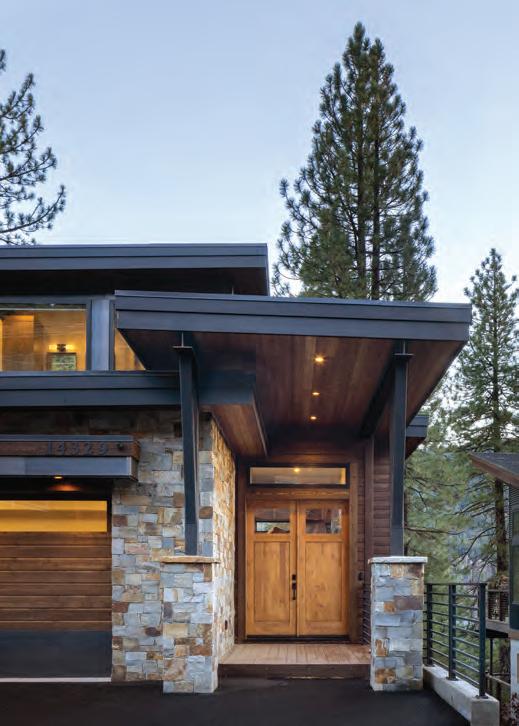
Donner Lake home was designed to bring a multigenerational family together
Written by Ann Johnson
Photographed
by
Paul Dyer
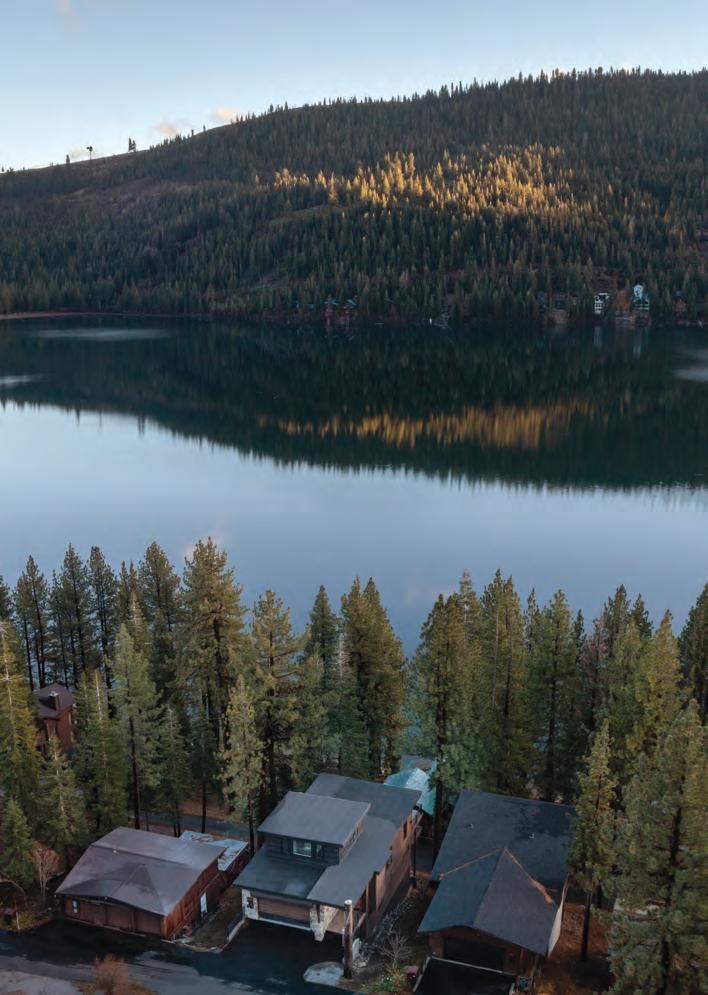
AFTER FALLING IN love with Donner Lake, a Bay Area resident set out to build a home that reflected the beauty and charm of the location while also creating a legacy she could one day pass on to her adult children. With those parameters in mind, the prospective homeowner began searching for lots and ultimately chose a site on the
north side of the lake that offered views of Donner Lake through the treetops. She hired Ben King of Truckee’s Ben King Construction to oversee the project.
R ather than working with a dedicated architect, King designed the floor plan and consulted with Truckee engineering company AMB DEC, Inc. when needed. When deciding upon the architectural style and blueprint for her abode, the owner leaned into King’s expertise.
“Ben is such a master builder,” she says. “I don’t remember giving him that much direction because I trust him so completely. He has such a great eye for things and came up with the idea that we approved of. When you talk with him about what you want to do for the house, he can build it with that in mind.”
Spanning just over 2,500 square feet, the resulting home is appointed with four spacious bedrooms and three and a half
baths, with a wood-and-stone exterior designed to complement the surrounding landscape.
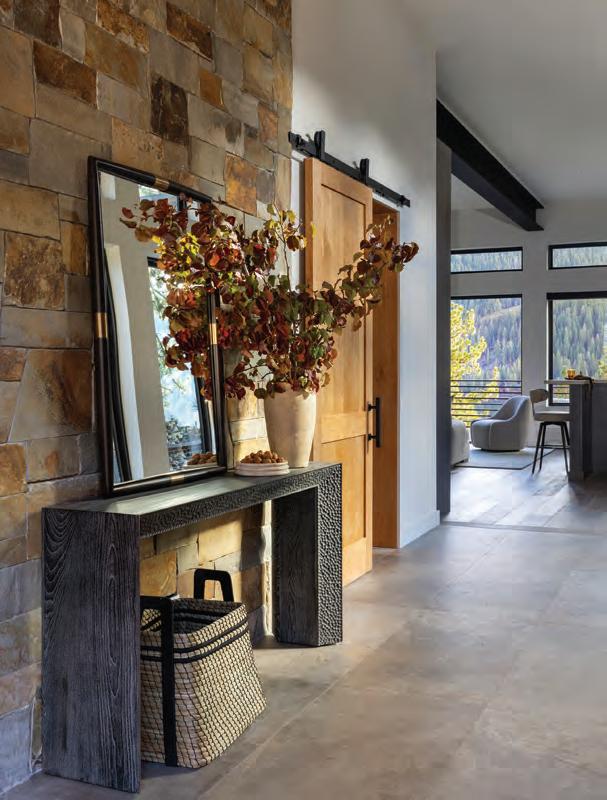
“It really stands out on the street, and when you open the door, you can see the same stones that are on the outside in the entry wall,” the owner says. This visual continuity seamlessly ushers guests into the three-story house, which is nestled among towering trees and built to showcase views of Donner Lake and Schallenberger Ridge beyond.
With an extended family that loves skiing and gathering to watch football games together, the owner wanted to create
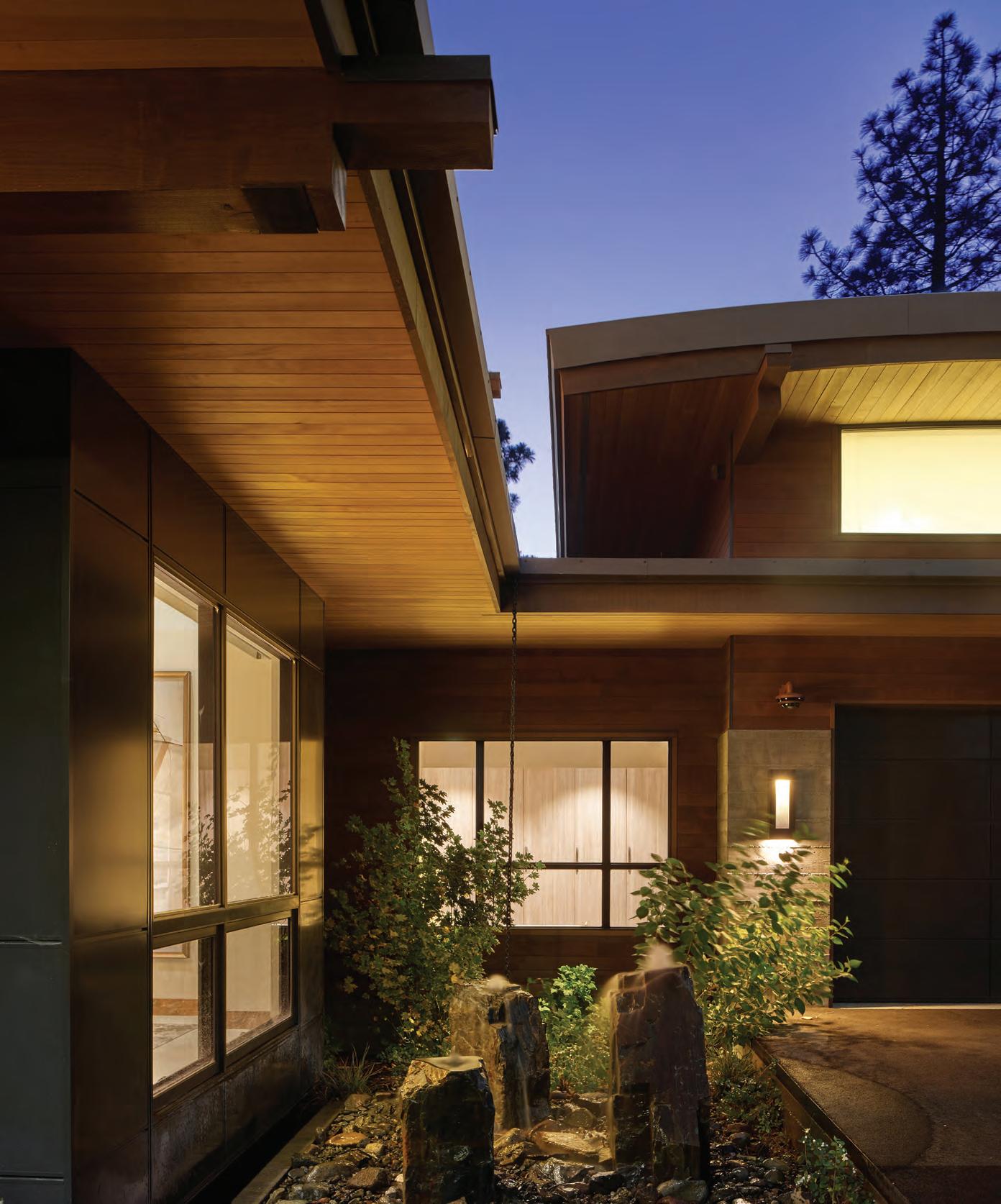
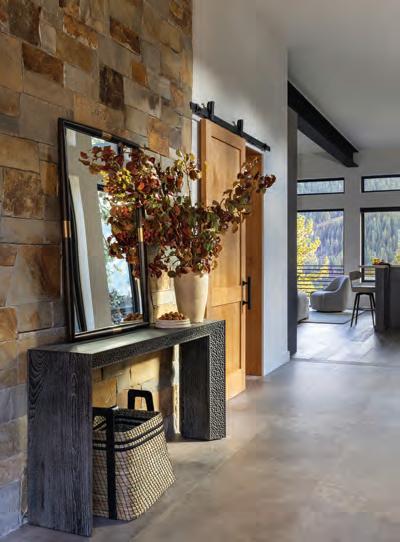
OPPOSITE PAGE: The home features an open-concept flow connecting the kitchen, dining and living area, all framed by a stunning lake view THIS PAGE FROM TOP: An aerial view shows the house’s proximity to the north shore of Donner Lake | Designed to embrace its surroundings, the home balances contemporary architecture with the warmth and authenticity of natural materials | The entry showcases the mix of materials in this modern mountain retreat
HOME DESIGN
a year-round retreat where guests could relax. And it was equally important to build a house that truly felt like a home.
“I want people to be able to put their feet up and go, ‘Ahhh,’” the owner says. “The goal is just for people to come in and feel comfortable.”
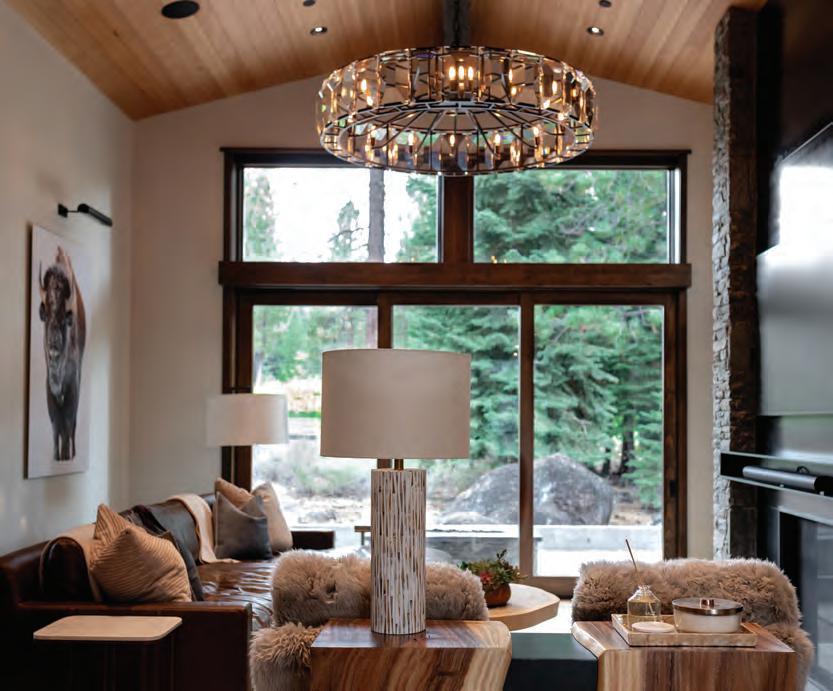
The owner had previously collaborated on a home with Casey Howard, principal designer at Casey Howard Interior Design in Danville, so she recruited her firm to design the interiors. She opted for a distinct look, choosing a more subdued palette that would empower the tree-covered mountains and lake to be the stars of the show.
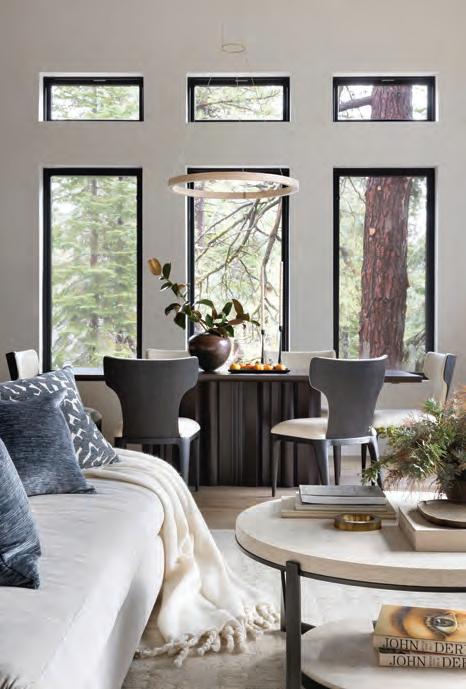
“ This home feels organic and modern, with a quiet warmth layered throughout the space,” Howard says. “There’s intentionally very little color, because the design is focused on the views and
FROM
TOP: Thoughtful textures and forest views abound throughout the interior
| The kitchen anchors the home with strong architectural lines and organic warmth
creating a seamless connection to the outdoors. There’s not a lot of art for that reason as well. [The owner] really wanted the home to feel immersive, surrounded by the woods and the lake.”
That understated design decision helps the home feel rooted in its surroundings, while a second-story deck serves as a natural extension into nature.
“ The home embraces its mountain surroundings while introducing touches of exposed industrial character throughout,” Howard says.
The living room, dining room, kitchen and bar area all flow together in an open-concept floor plan, ensuring ample space to entertain without being segmented into separate areas.
“ The living space is the most spectacular part,” the owner says. “That’s where the life of the house is.”
Large glass windows in the living area serve as an ever-changing art canvas, showcasing the transition from snow-capped peaks to clear blue skies, depending on the time of year.
“Every floor of the home has the sense of being in a tree house,” Howard says. “You come in on an elevated level and can go downstairs or upstairs from there. But on the main level, you’re already in the trees, which creates such an amazing feel.”
White European oak hardwood floors and neutral walls in the main living space create an aesthetic that feels both “livable and light,” Howard says. The area was designed with warm woods, leathers and durable area rugs to toe the line between sophisticated and down-to-earth. Exposed steel ceiling beams give the living space a structured, industrial look, while boucle chairs add softness.
“I describe the furniture as classically comfortable,” the owner says.
Every ripple and stunning view depends on the actions we take each day. From what we buy to how we travel, small choices can help protect this lake we love.
Whether you live here or visit, you are part of Tahoe’s story. Scan the code and learn how you can help.
keeptahoeblue.org
@keeptahoeblue
#KeepTahoeBlue is not just a sticker — it is a way of living and the mission of a nonprofit organization that keeps this place wild, blue and breathtaking.
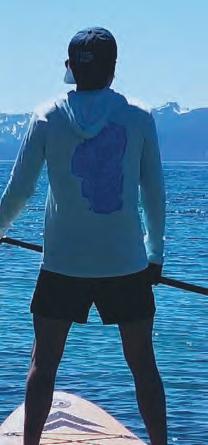
Sun Shirts Lifestyle Shots by Katy Jo Caringer
Protecting Lake Tahoe Since 1957
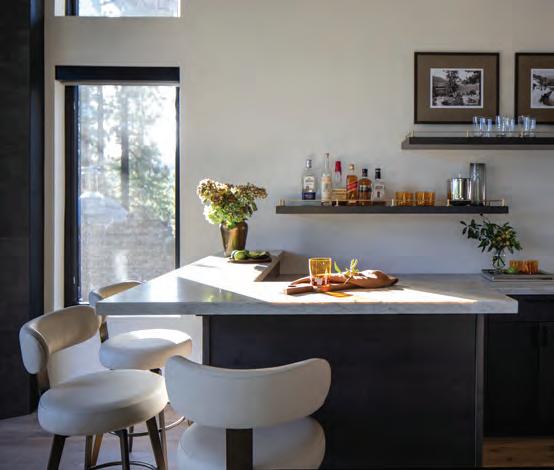
Historic Donner Lake photographs bring a sense of place and story to the home bar
The kitchen features alder cabinets, Dacor appliances and a waterfall island made of Perla Venata quartzite. Four bar stools provide space for people to gather, and a nearby bar makes it easy to mix a cocktail. Located just steps away, the floor-to-ceiling fireplace features tiles designed to mimic oxidized metal.
On the other side of the room, a floating steel-and-wood staircase leads to the upper level, which is devoted entirely to the primary suite. Glass windows provide views of the lake, while a corner sitting nook offers a peaceful spot to drink coffee and soak up the sunshine at the start of the day. The layout of the room strikes just the right balance between cozy and charming.
The primary bathroom features double sinks, a walk-in glass shower and sizable glass windows with tranquil views of the mature pines and firs outside.
Two other en suite bedrooms are located on the lower level, including a larger one that functions as a secondary primary suite. The lower level also houses a bunk room and half bath, which was
designed with the owner’s grandkids in mind.
“Ultimately, I want to put a TV and games in the bunk room corner so the kids can play and watch TV while the grownups are upstairs,” she says. “It’s nice to have those separate areas where people can all be together, but doing a separate thing. You don’t have to worry about the noise it could make.”
Outside, the sizable second-story deck holds a round coffee table, sectional sofa, dining table and chairs, allowing plenty of room for guests to gather.
“We’re a college football family, so during the season, we have a TV that we can pull out and turn,” the owner says. “So we can be in the living room area with a sliding glass door open, and we can turn on the TV and be outside watching football. There’s a great sense of community inside and outside, which I
really like. It’s like one big room. When the weather permits, it’s wonderful to go sit out there.”
Dotted with cozy entertaining spaces throughout, the expertly designed home fulfills the owner’s goal of creating her own private sanctuary at Donner Lake, as well as a treasured family retreat for generations to come.
Ann Johnson is a Los Angeles-based home writer and editor.
CLOCKWISE FROM TOP LEFT: A quiet sanctuary wrapped in soft linens and framed by a peaceful lake view | A study in contrast, a bathroom features bold structural steel balanced by soft materials and a restrained palette | A playful retreat reserved for the grandkids
Michael Kessler
Trial by Wildfire
Tahoe-area homes are increasingly designed, built and maintained around the threat of fire
Written by Alison Bender
AROUND LAKE TAHOE, high-end homes have long been inspired by the landscape. But as the West grows hotter and drier and the risks of wildfire rise, homeowners, architects and builders are rethinking mountain design, resulting in homes that no longer simply complement their surroundings, but are also able to survive them.
Ever-Present Danger
In 2025 alone, California lost more than 16,500 structures to wildfires, while Nevada saw more than 395,000 acres burn. South Lake Tahoe residents are still haunted by the memory of the 2021 Caldor Fire, which destroyed some 1,000 buildings and burned into the Tahoe Basin before it
was finally extinguished (thanks in part to defensible space efforts by homeowners in the Basin).
Alison Edelstein and her husband Geoff bought their property in Martis Camp in 2007, the same year the Angora Fire tore through South Lake Tahoe and destroyed about 280 structures.
Fire is a natural occurrence, and it will happen, it’s just where and when. When it comes to fire, we are all in it together.”
— Alison Edelstein
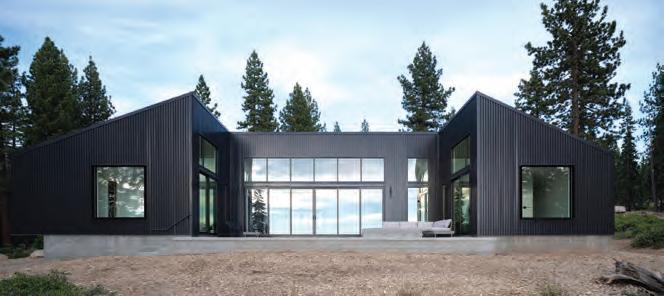
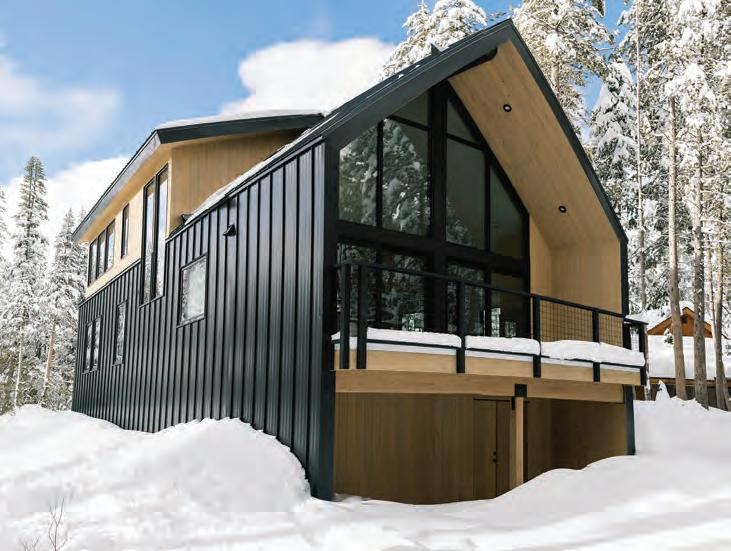
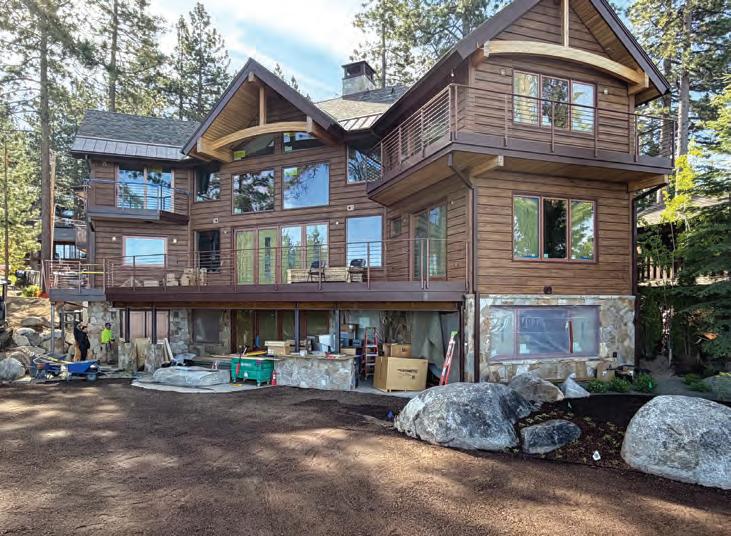
FROMT LEFT: A Truckee home designed by architect Gordon Magnin was built with fire-resistant materials at the request of its owner, who is a retired fire chief, photo by Patrick Brennan | A Meyers home built by Sierra Sustainable Builders features siding composed of corrugated metal, concrete, solid timbers, fire-treated plywood for the eave soffits, and cementitious fascia and trim, photo by Mark Steinlein
“ The house was designed with fire in mind,” she says.
Designed by Truckee architect Greg Faulkner, the Edelstein home is a contemporary five-bedroom made primarily of glass, concrete and corten steel. It’s built to withstand Tahoe’s extremes. And while individual homeowners can do their part to improve fire resilience, communities are safest when everyone does their part.
“Fire is a natural occurrence, and it will happen, it’s just where and when,” Edelstein says. “When it comes to fire, we are all in it together.”
Designed to Endure
For new builds, architect Tara Sypriano of Truckee’s Hedda Inc. says streamlining the architecture can have a big impact.
“Simpler forms generally perform better in wildfire conditions,” she says. “Fewer corners, fewer roof intersections and fewer transitions reduce the places where embers can accumulate.”
Simpler forms generally perform better in wildfire conditions. Fewer corners, fewer roof intersections and fewer transitions reduce the places where embers can accumulate.” — Tara Sypriano, architect, Hedda Inc.
During a wildfire, wind-driven embers, which can travel more than a mile, are the leading cause of home ignition. Roofs are especially vulnerable.
Sypriano says homeowners often request complex rooflines, layered massing, deep shadow gaps and heavily articulated exterior detailing. “While visually compelling, these conditions can also create pockets where embers and debris collect,” she says. “The more transitions, gaps, corners and collection points a home has, the more opportunities there are for ember intrusion.”
Architect Gordon Magnin of Reno’s Magnin Architecture minimizes openings
such as attic and crawlspace vents, where embers can blow into the home.
“Rain gutters can accumulate debris, which acts as kindling,” he says. “These openings/gutters have provisions for screens, but it is even better if they can be minimized or reduced.”
Enclosing soffits and eaves can also help reduce a home’s vulnerability to wildfire, in addition to simplified forms.
“ That does not mean architecture needs to feel overly minimal or utilitarian, but simplicity and restraint often lead to both stronger design and better long-term performance,” Sypriano says.
Materials That Make a Difference
Cory Hannaford of South Lake Tahoe’s Sierra Sustainable Builders says fire resilience is a growing priority. “This is more frequently something our clients bring up early on,” he says.
Exterior materials must meet strict fire safety standards, with concrete,
stone and steel among the most durable noncombustible options.
For decks, which can gather embers easily, Hannaford recommends steel framing paired with concrete decking products.
While wood is inherently more flammable than stone or steel, some species and treatments perform
significantly better than others. Heavy timber, for example, tends to char rather than burn. Western red cedar has a class B fire retardant rating. Meanwhile, Douglas fir, a softwood staple of Lake Tahoe building in the 1970s and ’80s, is highly flammable.
“ There are also some amazing coatings/additives for paints and stains that show a great deal of promise, making materials they are applied to nearly fireproof,” Hannaford says. “But they do require reapplication every few years.”
For sheathing, Hannaford uses products like drywall, DensShield (a fiberglass mat gypsum panel) or FlameBlock (a wood panel coated with Pyrotite). Products like fiber cement boards
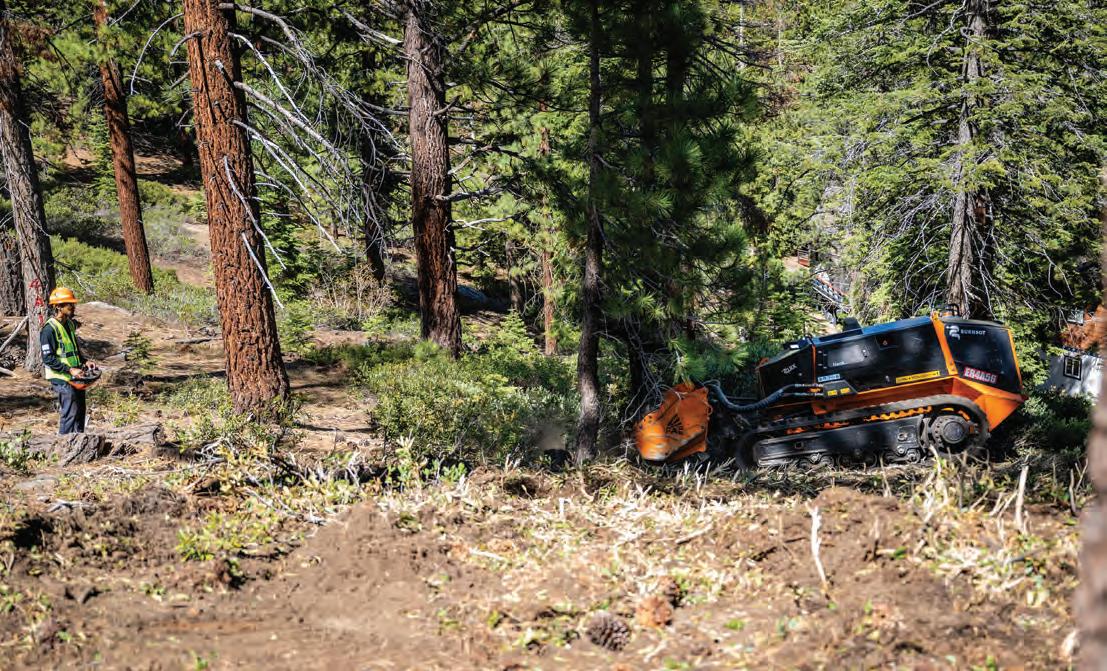
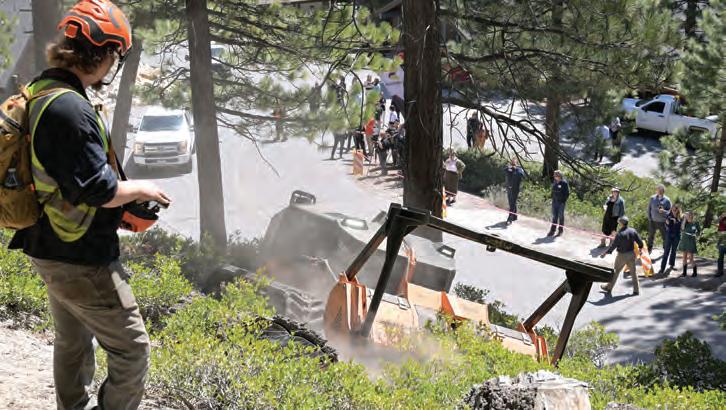
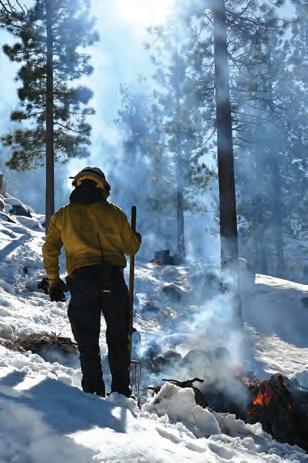
A BurnBot remotely operated masticator machine removes vegetation in a Tahoe neighborhood as part of the Tahoe Fund’s Fire Smart Community Pilot program, photos by Jeff Freeman, courtesy Tahoe Fund
mimic the look and feel of Tahoe-style wooden siding but add a superior level of fire protection.
“We are currently completing two homes that are great examples of this,” Hannaford says. “One is a lakefront home in Skyland [in Zephyr Cove], where the entire exterior is a cementitious log siding product that looks like a traditional Tahoe home but is a fireproof material requiring little to no maintenance.”
The other home, in Kirkwood, incorporates metal siding, metal roofing, steel-framed decks and cement decking boards. “This home is considered to be in a high fire danger area and is certified as a fire-hardened home,” Hannaford says.
Magnin is also a proponent of noncombustible finishes. “We have a project in construction right now on the West Shore that is all concrete, steel and tempered glass,” he says. While
fire resistance was not one of the home’s original top priorities, he adds, “It has come up in subsequent conversations, and we are very well protected.”
Defensible Space
Protecting a property from wildfire means more than building a fire-safe home; it also requires careful management of the surrounding landscape.
“It starts with the vegetation around your home,” says Amy Berry, CEO of the nonprofit Tahoe Fund. “Really try your best to clear any bushes and low vegetation 5 feet from the structure.”
Last summer, the Tahoe Fund, which supports area environmental projects, launched the Fire Smart Community Pilot program. The pilot began with Incline Village’s Tyrolian Village (identified as high-risk) and quickly expanded to five more neighborhoods, implementing fuels
mitigation, defensible space and homehardening measures
“You can change the outcome of wildfire in your community by doing your part, and encouraging your neighbors to do the same,” Berry says. “Get a defensible space inspection from your fire department and get to work.”
Edelstein agrees. “We can keep our house safe, but if a neighboring community doesn’t clear, we will burn anyway.”
Within the 5-foot zone, nonflammable hardscaping, such as gravel or pavers, are recommended. Beyond that, native and adapted plants are good choices; ensuring they are irrigated makes them less susceptible to ignition.
“Landscape design should be considered part of the resilience strategy, not something separate from the architecture,” Sypriano says. “Fire resilience is rarely one singular feature. It comes from
HOME DESIGN
many small decisions working together as a system.”
Magnin often includes sprinkler systems both inside and out. “Landscape and roof sprinkler systems are becoming more common,” he says. “There are even water cannon options for exterior protection.”
Remodels and Maintenance
For existing homes, simple upgrades can make a big difference, such as installing fine mesh over vents and eaves, and clearing firewood away from the home. Larger improvements include replacing wooden roofs and decks, installing fire-resistant siding and upgrading to double-pane tempered windows.
Designing and building a fire-resilient home is only part of wildfire protection.
“One of the biggest misconceptions is that fire resilience is achieved once construction is complete,” Sypriano says. “In reality, resilience is heavily tied to long-term maintenance. Even a well-designed home becomes vulnerable if roof valleys collect debris, vents are not regularly cleaned, or surrounding vegetation becomes dry and stressed over time.”
Defensible space also needs to be constantly maintained. Edelstein’s home in Martis Camp gets yearly assessments and clearings. “We view it as an annual process
to keep the house safe, have fire breaks behind the house and plenty of defensible space,” she says. “And, I’m perfectly happy to live with a more organic landscape and not bring plants that are flammable too close to the house.”
Edelstein knows the dangers well. Although she and her husband live part-time in Truckee, their primary residence is in L.A.’s Pacific Palisades, where an estimated 6,800 structures were lost to wildfire last year. Edelstein says roughly 70 percent of her neighborhood was destroyed. While her home survived, it was filled with toxic
black ash; the contamination forced them to discard every soft item in the house.
She advises homeowners to plan ahead: Know evacuation routes, identify safe zones and decide in advance what to grab during an emergency. “Don’t think it won’t happen to you,” she says.
Wildfire in the Sierra Nevada is both expected and unpredictable. For those lucky enough to live in or around the Tahoe Basin, preparing homes and properties for fire is part of the responsibility of living in the mountains.
B erry believes the lesson is clear.
“It really does take a village to ensure everyone is safe from fire,” she says.
Reno writer Alison Bender is a strong proponent of home hardening and defensible space, particularly after she was evacuated for almost a week during the 2024 Davis Fire.
FROM TOP: A Serene Lakes home designed by Tara Sypriano of Hedda Inc. lacks eaves and overhangs, leaving fewer places for embers to get caught during a potential wildfire, photo by Ruthanne Zouboukos | A Tahoe home built by Sierra Sustainable Builders is constructed with fire-safe concrete log siding by EverLog Systems. In addition to siding, the Montana-based company sells concrete logs and timbers that offer the look and texture of natural wood, photo courtesy Cory Hannaford
Ahhhhh… Oxygen!
Imagine how you’ll feel tomorrow after sleeping in your oxygenated room tonight.™
Altitude Control Technology’s award-winning oxygenation system lowers your effective altitude by as much as 7,000 feet. Eliminate the insomnia, fatigue, and headaches associated with altitude and instead wake refreshed and ready to enjoy your mountain home. Let ACT upgrade your room’s oxygen content. Now you can control your room’s
from anywhere with an internet connection, and set preferred levels before you even arrive.
New Goals Set for More Resilient Forests
Written by Thea Schwartz
Editor’s note: This article originally appeared in the Spring 2026 issue of Tahoe In Depth and was provided courtesy of TRPA. To subscribe to the publication, visit tahoeindepth.org.
WHEN TAHOE LOCAL and University of California, Davis Research Ecologist
Hugh Safford returned to his Meyers home after evacuating during the 2021 Caldor Fire, he was struck by what he saw.
The fire had scorched more than 220,000 acres, roughly 10,000 within the Tahoe Basin, yet no permanent residences or lives were lost in South Lake Tahoe. For a community that had been surrounded by flames, it was extraordinary. For Safford, it was also a phenomenon worth studying.
Word quickly spread that Tahoe’s outcome was not just a streak of luck. It reflected years of fuel reduction work, home hardening and coordinated efforts by the Tahoe Fire and Fuels Team.
Safford’s observations led to a detailed study of the burned area to better understand how forest management improved forest health and helped save Tahoe communities.
The research confirmed the effectiveness of forest fuel reduction treatments in reducing fire severity and tree mortality during the Caldor Fire. Specifically, trees in treated areas were three times more likely to survive than those in untreated areas, and fire behavior was less severe, with lower flames and reduced
damage where Tahoe Fire and Fuels Team partners had previously completed forest treatments.
Safford and co-author Saba Saberi called it “another fuel treatment success story for the Western U.S.,” while also underscoring the increasing urgency of proactive forest and fuel management.
E arlier this year, the Tahoe Regional Planning Agency and Lake Tahoe Environmental Improvement Program partners updated Tahoe’s forest health goals to do just that. The new goals, or threshold standards, call for accelerating the pace and scale of forest treatments to make our communities safer and our forests more resilient in the face of a growing wildfire threat.
Fire has long shaped Sierra Nevada forests. Historically, frequent low-intensity burns occurring every decade or two at Tahoe’s lower elevations kept fuels in check and maintained open, diverse forests. And for millennia, the Washoe Tribe used cultural burning to maintain ecosystem health.
The new standards recognize fire as a fundamental ecological process. With new targets for forest structure and fire behavior, the standards provide a framework for evaluating how forest management projects and fire events contribute to long-term resilience and help prevent catastrophic wildfires.
Science Drives Policies in the Tahoe Basin
The Tahoe Science Advisory Council is an independent body that provides sciencebased guidance to support decision-making in the Lake Tahoe region. As part of the forest and fire threshold update process, council scientists evaluated the new forest health measures and offered suggestions for improvement before the standards were adopted into TRPA’s Regional Plan.
In its peer review, the council called the changes an important, sciencebased step forward and a long-overdue
modernization of the region’s forest management framework.
As Council Program Officer
Robert Larsen explains, “The reviewers found that threshold updates are consistent with current practices and reflect the primary drivers of forest health and wildfire risk, while encouraging TRPA to expand efforts to track other benefits such as biodiversity, old growth and carbon storage.”
This scientific compass underpins how forest treatments are planned and implemented through the Lake Tahoe Environmental Improvement Program and the Tahoe Fire and Fuels Team’s work.
FROM LEFT: A prescribed burn in Sugar Pine State Park, photo by Rich Adams, courtesy TRPA | New forest health threshold standards at Tahoe will address the growing risks posed by forests that are overly dense and uniform in age and size—conditions that increase vulnerability to wildfire, drought and disease, photo courtesy TRPA
Crews will continue to work directly with landowners to remove hazardous trees and create defensible space around homes and neighborhoods, while increased prescribed burns and landscape-scale treatment initiatives, such as Lake Tahoe West, will add to the collective efforts to increase safety and build Tahoe’s resilience to drought, insects and wildfire.
“ The work that Basin partners are doing to protect human lives and infrastructure and mitigate fire severity is also perfectly parallel with ecological restoration in these forests,” Safford says.
Looking Forward
Today, the Basin faces hotter, drier conditions and continued wildfire risk. But the science-driven policies, collaborative partnerships and expanded forest health projects underway across the region offer hope. They represent proactive fire management and ecological restoration rooted in history and informed by the best available science.
Tahoe’s landscape has been shaped by human activity over the past 150 years. Looking ahead, we’re focused on restoring balance, reducing risk and cultivating a forest prepared for the future.
Thea Schwartz is the communications specialist at TRPA.
FOOTPRINTS OF THE PAST
TAHOE’S HISTORY IS visible in many ways. In burned areas, stump holes wide enough to resemble a dinosaur footprint date back to the Comstock Era, when more than 60 percent of Tahoe’s forests were logged to supply timber to silver mines across the Sierra. The trees were taken, but their deep-rooted bases remained underground.
More than a century later, fires like Caldor ignited those old stumps. The hollowed-out cavities left behind are reminders of Tahoe’s layered history of logging, decades of fire suppression and today’s changing fire behavior.
FROM TOP: A forested hillside in D.L. Bliss State Park | Tahoe Douglas Fire Protection District completes forest fuel treatments on Tahoe’s East Shore |
A Tahoe dog cautiously approaches a stump hole, photos courtesy TRPA
Following His Calling
A Buddhist monk’s artistic odyssey from rural Vietnam to globetrotting photographer
Written by Michael Rohm • Photographed by joSon
It is perhaps
too obvious to assert that great photographers capture meaning inside their photographs. It is less obvious, I think, to suggest that the best ones capture meaning outside their photographs, too—their life a lens in permanent focus, an open shutter forever swallowing light. joSon, a distinguished photographer whose images of flowers and nature express the Buddhist values he spent his adolescence in Vietnam practicing, is among the latter group: His entire existence is art; the pictures are just the proof.
“ The force that through the green fuse drives the flower drives my green age,” wrote the famed Welsh poet Dylan Thomas. It will no doubt please joSon to know that I blew past my deadline for this magazine because I was busy—no, busy is entirely the wrong word; rather, I was lost—meditating on flowers, which are at best tangential to my assignment, as a firefighter meditating on combustion is tangential to dousing the flame.
“Flowers are the missing words in our vocabulary,” joSon says on a recent phone call.
His accent reflects the years he spent in the Philippines, Vietnam and California, but his voice contains some fourth, unnamable quality that—forgive me—sways like the blooms he has spent his life photographing.
“Our language is very limited,” he continues, “but flowers are a language of their own, and we use them to express how we feel.”
How joSon feels about flowers contains, like Whitman, multitudes. There is almost nothing he will not do to communicate with—and for—his muse. The day we speak, he is preparing to drive more than 700 miles from his home in San Francisco to Death Valley in search of the rare Oenothera californica eurekensis, commonly called the evening primrose. He has heard from a local contact that the flower—which grows only on the remote slopes of the Eureka Valley Sand Dunes within the national park, and only blooms when conditions are perfect—is in fact in bloom.
“ They’re supposed to last another week,” he says. “But a storm just came in, so who knows? Nothing is guaranteed.”
Impermanence is a core philosophy of Buddhism, and it is a lesson joSon has learned at each stage of his itinerant life. As a child of mixed race living with his single mother in the Philippines, joSon felt unmoored. Though he never met his father, an African American soldier who was killed in Vietnam during the end of the war, joSon felt drawn to the country where the man fought and died—the same country where his maternal grandmother lived. In 1983, when he was 10 years old, joSon traveled there to spend a summer with her.
“I spent a great deal of time at a Buddhist temple helping my grandmother, who was a regular volunteer there,” he says. “That summer turned into a lifetime of introspection and self-discovery.”
Nearing the end of his trip, joSon convinced his mother to let him remain at the temple, which had an educational program for boys.
“When I was introduced to Buddhism, I felt at peace and at home in the temple,” he recalls. “I told my mom, ‘I don’t want to go back to the Philippines. I want to become a Buddhist monk.’”
Refuge From an Unforgiving World
The temple offered more than just a way to understand the world— it also offered protection from it.
“ The world is an unforgiving place,” joSon says. “Given my multiethnic background, I often felt ostracized as a young child in the Philippines, and the outside world in general. Life was challenging for me. In the temple, people don’t judge you; they accept you for who you are.”
In Buddhist tradition, boys can study and work in the temple until they turn 18, at which age their master makes the crucial decision: stay and become a monk or be released back into the world.
For eight years, joSon slept on the floor, forsook most material goods and studied under his master. When he was not studying, he worked in the gardens, watering, weeding and tending to the flowers and plants. Crucially, he also discovered an old film camera, which the monks used sparingly to document historical art pieces displayed throughout the temple.
“It was a valuable thing for the temple,” joSon says of the alluring device. “They don’t like people touching it—I convinced them to let me use the precious device.”
Observing his preternatural skill, the monks assigned him to be the caretaker of the camera, and their sole photographer. He was allotted one roll of film per month: 36 frames.
“It was my job to make sure that roll of film would last at least a month,” he says. “It’s expensive to buy. Every picture has to have a reason and a purpose. I believe this was the beginning of my learning to process the world through the lens of a camera.”
By his late teens, joSon had settled into a rhythm: student, photographer, gardener and mentor to the younger cohort of boys, whom he would teach art and literature. Becoming a monk was his path; the temple, his home. He planned never to leave.
When he turned 18, his master informed him that he could
remain in the temple for three more years, but he would not be a monk. His path, the master said with kindness, was elsewhere.
“ They told me I don’t have to be in the temple to do good work,” joSon remembers. “They told me I could do better work somewhere else.”
Still, the news was devastating.
“I was shocked,” he admits. “On one hand, you feel your foundation is gone. On the other, you know that life has already chosen the journey for you; you are just living.”
In his last three years before turning 21, joSon absorbed these final lessons: “Home is never a building. Your temple is inside you. When you leave, you don’t really leave.”
When he turned 21, joSon packed his meager belongings, bid farewell to his family of the last 11 years, and left. But he didn’t really leave.
‘How Am I Going to Survive?’
Back home in the Philippines, joSon was adrift. His mother, a doctor, encouraged him to study science, which he did listlessly. In the summers, he would return to Vietnam and the old temple, now just a tourist on a path that was no longer his.
His birth country wasn’t his, either. “The Philippines never felt like home to me,” joSon says.
After three difficult, dislocated years, he decided to pursue a fresh start in California, where he had relatives. His family in Sacramento hosted him until he could enroll in the community college in San Jose, home to a large Vietnamese population, whose culture always felt more closely aligned with his own. In San Jose, joSon rented a cheap room, made new friends and began his classes—the first tentative steps on a new American path that stretched, however dim and uncertain, before him.
And then he visited Lake Tahoe.
Within six months of landing in Sacramento, joSon felt a powerful new force leading him away from what was supposed to be an exciting chapter in the Bay Area.
“When I first saw Tahoe, I thought, ‘This is the most beautiful thing ever,’” he says. The next thought was, “Why would I live anywhere else?”
PREVIOUS SPREAD: Shoreline of South Lake Tahoe THIS SPREAD FROM LEFT: joSon portrait, photo by Holger Keifel | The claw-like flower of Chiranthodendron pentadactylon, aka the monkey’s hand tree
He transferred to Lake Tahoe Community College, where he began a two-year degree in hotel and restaurant management. The college, he soon discovered, also offered photography classes, which he hoped might provide a small reprieve from what would likely be a tedious education, followed by a demanding career in service and hospitality.
joSon says there was one question that drove every decision in this early chapter of adulthood: “How am I going to survive?” The answer, he believed, was to find a practical career. “Growing up, I thought art was for the rich: people who have time to sit and dream. Poor people cannot afford that. Art was the last thing in my mind.”
While living as an artist was out of the question, he thought learning to take better pictures might offer some small consolation for the grind of adulthood. As he did as a boy in the temple, joSon sought out the keeper of the camera and lodged a formal request.
“joSon walked into my life,” recalls Pat Leonard-Heffner, who has taught photography at Lake Tahoe Community College for
almost 50 years. “He walked up to me and told me he wanted to borrow a camera. ‘If you take my class,’” she remembers telling him, “‘you can borrow a camera.’”
He agreed and signed up for Photography 1. Then Photography 2, followed by Photography 3. He enrolled in Landscape Photography. He joined a class trip to Death Valley, launching what would become a lifelong love affair with the national park. He worked as a lab aid in the darkroom. He missed nothing.
“He took every class that we had,” Leonard-Heffner says. “I was impressed right away. He was great at pretty much everything—and really driven.”
As driven toward photography as he was away from a career in hospitality.
“Photography became my life very quickly,” says joSon, whose images now grace magazine covers and hang in galleries and private collections around the world. “The community college helped me to discover who I am. It helped me to think bigger and see beyond my limited space. A couple teachers told me I can be the person I want to be. They gave me courage to dream.”
FROM LEFT: The Upper Truckee Marsh from above |
A snow-covered Lake Tahoe Golf Course
Drawn to the Lens—Again
Lake Tahoe Community College gave him the courage to dream, but his Buddhist upbringing in Vietnam gave him the wisdom to look.
Scott Lankford, author of the national award-winning book Tahoe Beneath the Surface, remembers rubbing shoulders with joSon among the literati of San Francisco, where the burgeoning photographer had returned to study fine art and launch a career as an artist. The writer was initially skeptical.
“I think I was slightly condescending,” he admits with a chuckle. “Lots of people are photographers. But every time I turned around, he was on a cover somewhere.”
What Lankford admired most in joSon’s art—what I admire most—is the transcendent quality evident in his attention to detail. The way his art understands, rather than merely depicts.
“His photos have this timeless quality of teaching you how to see something in that spiritual light of enlightenment,” Lankford muses. “That sounds like a big statement, but I really think the best of his photos are quite astonishingly exactly that way. There’s a depth to joSon’s images that transcends time, and I think that comes from his training as a Buddhist monk.”
When it comes to describing his own art, joSon is less comfortable than his admirers, though he has learned to navigate publicity as his career has grown. When asked about his relationship to being in front of the camera, he admits that his least favorite assignment in Photography 1 was taking self-portraits.
“ The camera was a way for me to hide,” he says. “In my earlier work, I hardly ever wanted to do interviews or talk about my photography. I’m much more open now.”
Though you will not find his face in his work, he insists they are selfportraits all the same. When he created his first book, a stunning, sensual gallery of flowers in bloom titled joSon: Intimate Portrait of Nature—which began as a class assignment while working toward his master’s degree at San Francisco’s Academy of Art University—he sought to capture more than literal forms.
The photographs, he says, “are not just of flowers; they are portraits of ourselves. Through them, we learn more about ourselves. That’s why I photograph them so close and detailed. It is our self-reflection.”
The explanation is as explicit as
joSon is likely to get about the meaning and purpose of his art. For deeper understanding, one is invited into a closer study of his faith.
“Buddhist philosophy says plants deserve the same respect,” he says. “‘Save the environment’ is a modern expression, but protecting and preserving the world around us is a fundamental element of Buddhism.
“I use my photography as a way to inspire people and show them how beautiful the world is,” he adds. “In a way, I’m a propagandist for nature.”
His most recent propaganda for nature is a project tentatively titled “From Above Lake Tahoe, Looking Down.”
“People come to Lake Tahoe, but they don’t really understand it,” he says. “[I want] people to see from a bird’s-eye view how vulnerable the lake is: the smoke, the burn scars. I want to show that Lake Tahoe is more than just Emerald Bay; it is also an endangered ecosystem.”
Though he is done shooting for the project, joSon says he is still retouching his photos and connecting with publishers, with plans to send a proposal in the coming months. It is one of many projects he is juggling.
“I get bored really quickly,” he says. “If I’m not pushing myself, I become bored.”
Blossoming Talent
“From Above Lake Tahoe, Looking Down” is not the first time joSon has dangled from an airplane for a picture—and it likely won’t be the last (“He sees something beautiful and he stops worrying,” Lankford says)—but the photographer cannot resist the quiet, deliberate study of his first love.
“I told myself years ago, ‘I’m done with flowers,’ and here I am working on part two of Intimate Portrait of Nature,” joSon says.
Among a certain breed of photographer, degree of difficulty is one of the main criteria for a great picture. While joSon is no stranger to discomfort and danger, it is not a prerequisite to his process. He is just as likely to rummage through a compost bin as he is to drive overnight to Death Valley. Beauty, he insists, is not hard to find. It may be in your trash can right now as you read this.
“We live in a world where everything is thrown away so fast,” he says. “Even the most beautiful things.”
He recounts a recent wedding he attended with a friend, where bouquets that so gracefully adorned the tables early that evening were tossed on the curb by nightfall. He finds the same negligence in neighborhoods, cemeteries and home improvement stores. Whenever he can rescue a flower, he will. His studio, he explains, has at times been so full of plants that people will drop theirs off, assuming he’s a plant rescue.
“We throw them away when we have no value for them anymore,” he says. “I still find beauty in them.”
The rescued flowers fill the pages of “Recycled Beauty,” a chapter in his forthcoming book. He is shooting on film to reclaim what he calls “slow photography.”
OPPOSITE PAGE: joSon’s book, joSon: Intimate Portrait of Nature, began as a class assignment at San Francisco’s Academy of Art University THIS PAGE FROM TOP: Bird-of-paradise | Spider chrysanthemum | Iris
“I am using a 4x5 camera, and the film is hand-developed by me using analog processes that connect me back to my days in the temple,” he explains.
Leonard-Heffner and Lankford are unsurprised by his return to flower portraiture—though he never really left it.
“Flowers have been throughout his career his signature,” Lankford says. “He speaks their language.”
Leonard-Heffner remembers the young artist photographing flowers tirelessly, even early in his academic career at Lake Tahoe Community College. But more than the subject in front of the camera, she remembers the man behind it, whose painstaking process allowed no room for mediocrity.
“I’ve seen him start projects and go back until it was absolutely right,” she says. “It’s not good enough for him to just go through the process. He would refine many times.”
The lifelong teacher cannot resist a floral metaphor of her own when reflecting with pride on the artistic arc of one of her brightest pupils.
“ That’s the thing about teaching,” she muses. “We spread seeds of knowledge around and we really don’t know which ones are going to take root and become so much more than what you could have imagined. I always knew he would be successful, but I never dreamed he would be creating the work he is now.”
Memories of Beauty
As a writer raised by Christian parents, it can be tempting to look for the secret meaning hidden in the text. Signs and wonders reveal divine inspiration. Around every corner waits a new cryptic message, like clues in a cosmic caper. Life is not a passage as much as an endless investigation, for which death is both the final mystery and the final answer.
An hour on the phone with joSon soothes a lifetime of feverish eschatology.
“Life is not a choice that you make,” he says. “It is a journey.”
He proceeds to explain about his earliest experiences with flowers—not the philosophical or religious thesis undergirding his passion, for which I keep artlessly probing—but the memories of beauty that remain with him all these years later.
“When I was young, in the temple behind my room, there was a garden with a big magnolia tree,” he begins. “Every evening, we’re supposed to close the windows to keep the mosquitoes out. But when the flowers are in bloom, the smell of it is like perfume through the whole garden, and I open the window and lie there in my mosquito net taking in the flower, a sweet, vanilla smell.”
No matter how hard the day was, or how much work there was to do, the smell of the blossoming magnolia tree through his window at night melted away any lingering stress or unhappiness.
D ecades later, the artist, who splits his time between San Francisco and Tahoe, will occasionally find himself driving late at night in the East Bay, with his windows down, and the scent of magnolias that grow throughout Berkeley and Oakland will fill his car like a physical presence.
“It brings me way back to the temple, and I remember everything,” he says. “The senses bring back memories. The mind becomes a blueprint.”
I ask Lankford to share memories of his favorite flower, and the loquacious author pauses for the first time in the call and reflects on the question.
“My mother loved lilies of the valley,” he says after a long moment. “She’s passed away now. Of the things of hers I kept, one of them is a glass plate that has lilies of the valley engraved in it.”
Leonard-Heffner is also reminded of her mother, who had nine children and used to cope with the responsibility by tending to her lilacs in the garden.
“We always had lilacs,” she recalls. From inside her home, she peers out the window and says her own lilacs are in bloom as we speak. They grace her sidewalk, and when she enters or exits the
FROM LEFT: A craggy peak near Sierra-at-Tahoe | Tahoe Keys from above
house this time of year, she is transported back to her childhood, and her mother out in the garden.
“ The smell of a lilac brings me back to all that,” she says. “It communicates a lot of things when you smell them.”
‘Super Happy’
I can relate. Growing up in Canby, Oregon, where the phrase “The Garden Spot” is engraved just below the population count on a sign at the edge of town, I was surrounded by the sight and smell of flowers.
In the summer, I would ride my bike to Swan Island Dahlia, a local farm less than a mile from my childhood home, where Mount Hood can be seen looming above row after colorful row of dahlias. My aunt visited from Upstate New York one August, and we all went to the nearby farm as a family, where she loved the flowers so much that she ordered bulbs to be shipped across the country to put in her own sprawling garden.
William Carlos Williams wrote, “Oh strong-ridged and deeply hollowed nose of mine! what will you not be smelling?” and I think of a young joSon, curled in his mosquito net, windows flung open, drunk on the perfume of the magnolia tree.
I t hink of joSon as a young man, forced to leave the temple in Vietnam to follow his own path, and I am reminded of what Mary Oliver wrote in her poem, In Blackwater Woods
“You must be able to do three things: to love what is mortal; to hold it against your bones knowing your own life depends on it; and, when the time comes to let it go, to let it go.”
I think of joSon now, a successful artist in his 50s, still giving it all for a flower. A few days after our call, I received an email from him, just back from his hunt in Death Valley for the rare evening primrose.
“I was able to find the rare flower I was looking for. I’ve been trying to find and photograph it for at least seven years, and this is the first time I’ve ever seen the plant or its blooms [in] over two decades of photographing the park. So, I’m super happy.”
I am, too.
Find more of joSon's work on his website, joSonstudio.com, and follow him on Instagram, @joSonphoto
Michael Rohm is a writer and musician based in Portland, Oregon. He looks forward to reliving a part of his childhood this summer when the dahlias bloom.
The rare Eureka Dunes evening primrose
Forest Fungi Fever
A heaping handful of morels found in the Tahoe National Forest, photo by Seth Lightcap
Delicious wild eats and the thrill of the find inspire a growing community of mushroom foragers at Lake Tahoe
Written by Seth Lightcap
would have thought $100 bills were sprouting up from the dirt and pine needles. The joy in An Hoang’s smile is palpable.
On a sunny, cool day in April 2026, Hoang has just found a large cluster of wild morel mushrooms in the forest near Fallen Leaf Lake. Treasured for their meaty texture and rich, earthy flavor, morels are one of the most coveted yet hard-tofind edible mushrooms native to the Sierra Nevada.
Hoang’s discovery comes in the final minutes of a guided edible mushroom hunt led by Luis Rubio, a naturalist from South Lake Tahoe. Rubio offers free wild mushroom foraging experiences to the public every spring and fall through his organization, Amongst The Trees.
As Hoang uses a knife to carefully harvest the mushrooms, more squeals of excitement ring out through the forest. Rubio and the dozen-plus fledgling foragers he’s guiding that day have come across a patch of morels, known as a flush. Within a few minutes, almost everyone in the group has a couple of morels in their collection baskets.
Rubio couldn’t have scripted a better finish to the foray. For a few in the group, the morels are the first edible mushrooms they’ve ever found. Which, for Rubio, means mission accomplished. Both Amongst The Trees and the nearly 8,000-member Lake Tahoe Community Mushroom Group that Rubio founded on Facebook are dedicated to helping people safely find edible mushrooms in the Sierra.
The forests surrounding Lake Tahoe are home to hundreds of mushroom species, but only about 50 have been confirmed as edible. The vast majority contain toxins that are harmful, if not fatal, if ingested. Despite the danger, local interest in wild mushroom foraging has surged in recent years. As the snow melts in the spring or the rain comes in the fall, more people than ever are on the hunt for these delicacies of the forest.
Community courses, social media and online resources have made it easier to confidently identify edible varieties and avoid deadly ones, contributing to foraging’s newfound popularity. A few of the wild mushrooms found in Tahoe are also world-renowned for their flavor. So, for a mushroom lover or foodie who likes to hike, foraging is the perfect hobby.
The tricky part is finding the fungi and accurately identifying them as safe. Motivation and luck might land you a few, but collecting solid harvests season after season takes practice and education. The first step is to learn the basics of mushroom ecology and the life cycles of the varieties you’re most interested in eating.
Fruiting a New Foraging Community
Historically, fungi were classified as plants because most grew out of the ground and produced mushrooms that resembled strange flowers. With the adoption of the five-kingdom system of life in 1969, fungi became their own kingdom as scientists realized they were genetically more closely related to animals than plants. Plants meet their carbon needs through photosynthesis, while fungi obtain carbon from the environment, just as humans obtain carbon from food.
Where fungi source their carbon from the environment further defines them. Saprotrophic fungi break down organic matter, such as dead wood or decaying leaves, to meet their nutritional needs. Mycorrhizal fungi form symbiotic relationships with living tree and plant species to obtain nutrients. In a mycorrhizal association, the fungus colonizes the host plant’s root tissue and supplies it with water and minerals in exchange for sugars and lipids that the plant produces through photosynthesis.
Fungi also differ from plants in that they lack roots. The working body of a fungus is a structure called mycelium that resembles a woven network of thin threads. The threads, known as hyphae, are responsible for digesting nutrients, decomposing organic matter and producing the mushrooms, which serve as the reproductive fruit that distributes spores.
Native Americans were the first to identify edible mushrooms and understand that mycelial-level saprotrophic and mycorrhizal interactions with the environment determine where mushrooms are found. Here in Tahoe, morel and puffball mushrooms have been part of the Washoe’s seasonal
diet for thousands of years. Washoe tribal foragers passed down knowledge of these mushrooms’ most suitable habitats and growing conditions over generations.
When Rubio created the Lake Tahoe Community Mushroom Group in 2018, his goal was to build a public forum for exchanging information about mushroom ecology and foraging tips like a native tribe. Within a year, the group had 1,000 members. By the end of the COVID pandemic, it had 5,000.
Now clocking in at almost 8,000 members, the group is a thriving resource for both experienced and aspiring local foragers. Most of the content is shared photos of successful harvests and requests for help identifying mushrooms. Details about specific locations are rarely shared, but for a culture that has traditionally been very secretive, any public attention to the pastime is too much for some.
“I got a lot of pushback the first year I created the group, and I still get people who message me saying what I’m doing is wrong,” says Rubio. “But I don’t agree with the mentality that if you show anybody else your spot, you won’t ever find anything there again. For me, that’s never been true. The more I walk, the more I find.”
Rubio, who works as a freeride ski coach in the winter, led free public foraging trips through the Facebook group for several years before founding his organization to expand the type of experiences he offered. In the spring of 2026, Amongst The Trees hosted six group hunts, a free online presentation about Lake Tahoe’s edible mushrooms, and other events focused on foraging native plants and gardening.
FROM LEFT: Luis Rubio starts a foray with a presentation on local edible mushrooms | Morels fruit in forested areas that were recently disturbed | Snowbank mushrooms, aka “false morels,” are edible if thoroughly cooked, photos by Seth Lightcap
The Mighty Tasty Morel
Much of what Rubio teaches in his presentations and events focuses on introducing people to the most easily identifiable edible mushrooms and the environmental factors that dictate where they fruit.
“You can wander for a long, long time and not find anything if you don’t know what to look for,” he says.
Morchella mushrooms, better known as morels, are what most Sierra foragers hunt for in the spring. Morels’ rich and earthy umami flavor pairs perfectly with almost any seasoning, and their meaty texture makes them a delight to eat, even for those who don’t love mushrooms.
Thankfully, morels are some of the easiest wild edible mushrooms to identify. The eight primary Morchella species found in the Tahoe region all look similar, with a distinctly honeycombed cap and hollow body. The species differ in color, size and the shape of their caps. Morels fruit only in spring, just after the snow melts, and their ideal habitat is burn scars and forested land recently disturbed by activities that stir up the soil. They especially like burn zones because the soil is so nutrient-rich.
“Morels can be very prolific, but people tend to rely on their old spots, and after three to four years, they won’t find them there anymore,” says Rubio.
Controlled-burn areas, freshly logged forest and landscaped grounds can be ideal habitats for morels.
“I know people who rake their property every fall, and they get morels in the backyard every spring,” says Rubio.
Morels are unique in that they employ both mycorrhizal and saprotrophic strategies. Some species form symbiotic relationships with pine and oak trees, while other species digest decaying leaves and pine needles. This makes them slightly trickier to find, as they do not associate with just one tree species.
The secret to spotting them is to train your eye to pick out the soft brown or blonde hue and smoothly rounded contours of their caps, says Rubio.
Until you develop such spotting skills, be ready to endlessly scan the forest floor, yet find nothing. Picking out the unique contours of a morel cap from a visually chaotic mess of forest debris is a practiced skill, but for each mile walked, observation skills improve.
Keen-eyed foragers might also come across a “false morel” species that’s native to the Tahoe region. Snowbank mushrooms, or Maublancomyces montanus (formerly Gyromitra montana), have brain-like wrinkled caps that vaguely resemble true morels. False morels found in other regions often contain dangerous amounts of toxins, but
Maublancomyces montanus can be eaten if properly identified and thoroughly cooked.
The Delicious and Precious Little Pig
Longtime locals Rita and Craig Nelson have been foraging for wild mushrooms on Tahoe’s West Shore for decades.
The couple learned to forage from Silvano Achiro, an Italian immigrant who moved to Tahoe in 1964 and started a garbage collection company that would later become Tahoe Truckee Sierra Disposal.
Achiro had been foraging on the West Shore for 40 years by the time the Nelsons met him walking in the woods with a huge burlap sack full of mushrooms. They became fast friends, and Achiro taught them how to find king bolete (Boletus edulis), a mushroom called porcini in Italian—the “little pig.” Porcini are highly prized in Italy, and many consider them one of the most delicious mushrooms in the world.
As Craig Nelson tells it, Silvano would take his family from Italy out mushroom hunting when they visited. “One day,” he says, “we found so many porcini that his aunt, who
THIS PAGE: Luis Rubio shares insight on how to find edible mushrooms during an Amongst The Trees outing in South Lake Tahoe, photo by Seth Lightcap OPPOSITE PAGE FROM TOP:
Chunky king bolete mushrooms found on Tahoe’s West Shore, photo by Rita Nelson | Agaricus moronii is a delicious edible that tastes like a portobello mushroom, photo by Seth Lightcap
did not speak any English, knelt down and kissed the ground. She could not believe how many we were finding.”
Bolete mushrooms are aptly named in Italian, as their sturdy appearance with a plump white stem and a bulbous brown cap resembles a little piglet. The Sierra is home to multiple bolete species, some that fruit in spring and others in fall.
Achiro and the Nelsons primarily foraged in the fall for king bolete, which, like the related spring king bolete (Boletus rex-veris), is mycorrhizal with Tahoe conifers and found in mature forests near creeks.
“I like softball-sized boletes,” says Nelson. “The big ones rot quicker and get more worms. But the worms aren’t a problem if you dry them. Cut your mushrooms into halfinch-thick slices and place them on a drying rack. The worms will drop out as they dry.”
Finding a bolete takes a trained eye, as they tend to sprout up under a thick layer of loose dirt and pine needles. The growing mushroom, or cluster of mushrooms, will push up the forest debris, forming a slightly raised bump. The bump, known as a “shrump,” is often the only sign that a potentially huge mushroom exists there. So, unlike morels
that have a visible fruiting body to look for, boletes require patient scanning of the forest floor for level inconsistencies.
Though well-hidden, boletes often recur in the same areas every year, making the hunt for them slightly less daunting.
“If you find a bolete, you can be pretty confident you will find one or more there every single year,” says Rubio. “Even in dry years where you’re not finding anything else, boletes will keep popping up in the same spots.”
Coral, Oysters and Puffballs, Oh My!
Of the approximately 50 edible mushroom species that fruit in the Tahoe Basin, only about 15 are commonly eaten. Beyond boletes and morels, experienced foragers are on the lookout for chanterelle, chicken of the woods, coral, giant sawgill, hedgehog, oyster, moron cap, pine woodwax, sculpted puffball, shaggy mane, slippery jack and yellow robe mushrooms.
Moron caps (Agaricus moronii) are regarded for their taste and have a flavor similar to that of portobello mushrooms. They are typically hidden beneath a shrump in shady forested areas with thick pine duff.
Corals also form a shrump, but look nothing like a traditional mushroom. They resemble a loofah sponge and taste similar to cauliflower.
Chicken of the woods, oysters and puffballs are three uniquely edible saprotrophic fungi. Chicken of the woods is a bright orange and yellow bracketed fungus that fruits on pine tree stumps after rainstorms in the late summer and fall. When properly cooked, it’s thought to taste like chicken.
Oysters are fan-shaped mushrooms that fruit in bracketed clusters on downed logs or standing dead aspen and cottonwood trees. They are prized for their delicate, slightly sweet flavor and velvety texture.
Sculpted puffballs look like textured snowballs sprouting from the earth. They may be covered in pyramid-shaped spikes or have raised flat warts on their outer surface. Young and firm puffballs have a mild, nutty flavor that readily absorbs any seasonings you cook them in.
While most people can eat all these mushrooms without gastrointestinal distress, it’s important to test your body’s reaction to a new mushroom before eating a lot of it, says Taye
Bright, a Sebastopol-based mycologist who offers courses on Sierra mushrooms and guided foraging experiences through the Berkeley-based organization Fork In The Path.
“Just because a mushroom is supposedly edible doesn’t mean it’s edible to you, because we all have our own unique body chemistry, our own allergens and our own unique digestive microbiomes,” says Bright. “We are an ecosystem within ourselves, and that ecosystem will determine whether that mushroom sits well in our body.”
Bright, who’s working with colleagues on the first-ever comprehensive Sierra Nevada mushroom guidebook, is quick to admit there’s still plenty to be learned about what makes certain mushrooms toxic.
“For a lot of mushrooms,” he says, “we don’t fully understand the chemistry behind what makes them toxic, but we have enough evidence that we know they make people sick. Only the really toxic, deadly ones like death caps have been fully studied.”
A fact that may come as a surprise is that most wild edible mushrooms contain toxins that must be destroyed by cooking before ingesting. Only a few mushrooms found in Tahoe can be eaten raw, and only in small amounts.
Cook Wild Mushrooms Like You Mean
It “It’s a good practice to basically cook the crap out of any wild mushroom you want to eat,” says Bright.
This advice is especially critical for morels.
“The toxic compounds within morels, the hydrozines, are very heat-sensitive; they volatilize and become inert once they are cooked, but they can make you very, very ill if you eat them raw,” says Bright.
Sautéing morels in butter or oil over medium-high heat for seven to nine minutes is long enough to destroy the toxins. Frying morels in 340-degree oil for two minutes per side or boiling them for 10 minutes will also ensure they are fully cooked.
Parboiling wild mushrooms for 10 minutes before sautéing them for another seven to nine minutes in oil and seasoning is another safe way to ensure the mushrooms are digestible.
For fresh porcini, it’s recommended to dry-sauté them over medium heat for 15 to 20 minutes until the water evaporates and they begin to turn golden. Then, add butter or oil and sauté for another five to 10 minutes.
FROM LEFT: Coral fungi grow under thick pine debris and have a mild, peppery taste | Sierran puffballs have a spongy texture and a mild, nutty taste, photos by Seth Lightcap
Nelson, the porcini aficionado, recommends feasting on them soon after they are found.
“Porcini are best fresh,” he says. “Try to cook them the same day you pick them because they don’t keep; they go bad really quickly, even in the refrigerator. That’s why it’s so hard to find them in a grocery store.”
If you can’t eat all the wild mushrooms you find before they go bad, drying them is a good option. The drying process does not destroy all the undesirable compounds, though. Dried wild mushrooms need to be rehydrated and cooked thoroughly, just like fresh mushrooms, to be safe.
No Fancy Gear Needed
Picking up a new hobby is usually a costly endeavor. Not mushroom foraging. The financial barrier to entry is virtually zero. The only semi-required equipment beyond hiking shoes is a mesh bag or woven basket and a medium-sized folding knife.
Foragers use mesh bags or woven baskets because porous containers allow microscopic spores to fall to the ground as they walk, helping the mushrooms regenerate. But collecting in a cute basket is not critical. By the time a mushroom is fruiting and big enough to find, it will have already released most of its spores.
The preferred way to harvest a wild mushroom is to slice it off at the base of the stem with a knife. Leaving the mushroom “stump” in the earth is thought to protect and
preserve the mycelium layer from which the mushroom fruited. A sharp folding knife works well for this task.
Studies have shown that harvesting mushrooms does not affect future generations. But like apples on an apple tree, the mushroom is the fungus’s reproductive fruit.
“If you come across a morel patch and you harvest every single one, you are not harming that population of morels,” says Bright. “But I would consider leaving a couple of small ones, and only taking the mature ones, out of understanding and respect for the organism.”
Spring 2026 was a standout season for morel foraging in the Tahoe region, as the usually elusive fungus started fruiting after the heat wave in late March and continued through the rains in early June—an earlier and longer season than usual.
“Historically, snowmelt is more of a slow, gradual process, and the moisture takes its time moving across the landscape,” says Bright. “But more and more with big heat waves and the weather getting hot really fast, the snow almost sublimates. It goes straight from snow to water vapor, and that's really changing the spring snowmelt mushrooms. They are fruiting earlier and earlier.”
Identify Twice, Eat Once
The importance of properly identifying any wild mushrooms before eating cannot be overstated. This was evident in spring 2026, as California experienced an unprecedented outbreak of severe illness and deaths from people accidentally picking and eating poisonous wild mushrooms.
These cases were attributed to an unusually prolific bloom of death cap and western destroying angel mushrooms in the Bay Area and North Coast. Both species contain highly toxic peptides that do not break down even after cooking, boiling, freezing or drying. Several of the victims misidentified these as Asian paddy-straw mushrooms or young puffballs, two safely edible mushrooms that look similar.
Death caps have not been found in Tahoe yet, but a few instances of western destroying angels have. The most common toxic mushrooms found in Tahoe are Amanita muscaria, which is the red-and-white-spotted “Super Mario” mushroom, and Amanita pantherinoides, which is similar in appearance but white with yellow spots. While not often fatal to humans if ingested, both species can be deadly to dogs.
One approach to navigating the dangers of
misidentification is to cross-reference what you find with photos of edible species right there in the forest. If the mushroom doesn’t look exactly like the photo, don’t even bring it home.
Confidence in identifying edible species comes with experience and learning from experts, so don’t hesitate to tap into online resources like Rubio’s Facebook group to doublecheck what you’ve found.
B ecause no wild mushroom feast is worth dying for, and as the old Czech adage goes: “Every mushroom is edible—but some only once.”
Seth Lightcap is a a writer and photographer based in Olympic Valley.
The poisonous Amanita pantherinoides killed several Tahoe dogs in the spring of 2026, photo by Seth Lightcap
The Long Return
The original stewards of the greater Lake Tahoe region, the Washoe are celebrating a groundbreaking reacquisition of former territory
Written by Matthew Renda
After more than a century of fighting to claw back its ancestral grounds one small chunk at a time, the Washoe Tribe of Nevada and California tripled its land base in one historic swoop.
The 10,274-acre WélmeltiɁ Preserve, located about 37 miles north of Truckee, spans from Long Valley in the east to Sierra Valley in the west and features varied terrain from sagebrush and grasslands to conifer forests and mountain meadows. The land is
dotted with aspen groves, juniper and pinyon pine, riven by natural springs and perennial creeks, and rich with wildlife, including pronghorn, mule deer, mountain lion and gray wolf.
The purchase of this vast and ecologically significant property marks a major triumph for the Washoe, as it represents both a culmination of a long process of reacquisition and the beginning of a new chapter as the tribe seeks to regain a portion of its sovereign land.
Ancestral Origins
Lake Tahoe is the center of the spiritual and geographical homelands of the Washoe Tribe (Wašišiw).
According to one tradition, the tribe’s people were brought to Lake Tahoe by the coyote (géwe), and once settled, they were
ordained by nenťúšu, a primordial maternal power, as caretakers of the region. That region was generally acknowledged to extend as far north as Honey Lake, south to Sonora Pass, eastward to the Pine Nut Mountains and the Virginia Range, and west all the way to the Sierra Crest.
Generally, the borders of tribal lands pre-contact were porous, if not entirely imaginary, as the Washoe people often extended their nomadic movement beyond these strict geographic markers, intermingling with other area tribes such as the Paiute, Shoshone, Maidu and Miwok.
Regardless, Lake Tahoe was not only at the geographical center of the tribal lands but also at the center of the Washoe’s sustainable seasonal migrations, as they descended to the lower-elevation
FROM LEFT: Members of the Washoe tribe on the Dressler Ranch in Carson Valley, circa 1900, photo courtesy Frederick H. Dressler Collection, University of Nevada, Reno, Special Collections Department | The varied terrain of the WélmeltiɁ Preserve from a bird’s-eye view, photo by Elizabeth Carmel
valleys during the winters and spent their summers hunting and gathering at the shores of the enormous alpine lake.
“ Tahoe” is an anglicization of the first two syllables of the Washoe phrase “Da ow a ga,” which means “edge of the lake.” “Da ow,” meaning simply “the lake,” was changed to “Tahoe,” as it was easier to pronounce for the settlers. The name was contested for nearly a century—the lake was alternatively called Lake Bigler, after California’s third governor—before culminating in its official designation in 1945.
While Tahoe’s geographical and spiritual centrality has nourished the Washoe people since time immemorial, it remains a cruel irony that the tribe’s proximity to the lake is also what led to the swift totality of its dispossession.
Shunted Aside
The Washoe’s territory contained the principal overland routes into California, with Sonora Pass, Carson Pass and Donner Pass being the most notable, so the tribe was shunted aside as settlers arrived beginning in the 1850s.
In 1859, prospectors discovered the Comstock Lode, the richest silver strike in U.S. history, which was also on Washoe lands.
The Comstock’s voracious appetite for timber meant the plunder of pinyon pine forests upon which the Washoe relied, and within a decade of the silver strike, the region’s native inhabitants were pushed off nearly every piece of land they had used for millennia.
Unlike many other Great Basin tribes that retained a land base into the twentieth century, the Washoe received no treaty and were granted no reservation.
By the early twentieth century, the Washoe were a scattered people with no land base and no formal governance structure. Yet they maintained their connections to their culture and language while cleaving to the landscape.
The process of inexorable dispossession did not begin to
All lands that Washoe people gained were always hard-fought. We were never just given lands. … We were never given an original reservation base just for Washoe people.”
— Serrell Smokey, Washoe Tribal Chairman
reverse until 1917, when an act of Congress set aside small colonies in and near Carson City.
Since then, however, the tribe has slowly and steadily been reclaiming its ancestral lands, culminating earlier this year with the purchase of the WélmeltiɁ Preserve in the northern reaches of Washoe territory.
The name WélmeltiɁ carries particular weight, as it refers to the northern regional group, whose homelands lie closer to Sierra Valley. Until the recent purchase, most of the land reacquisitions have taken place in the southern and eastern parts of the tribe’s historical range.
Washoe Tribal Chairman Serrell Smokey, who helped steer the acquisition on behalf of the Washoe, says the achievement is just the latest milestone in a century of tenacious persistence.
“All lands that Washoe people gained were always hardfought,” he says. “We were never just given lands. … We were never given an original reservation base just for Washoe people.”
Land Back
The more than 10,000 acres of ecologically significant land, formerly known as the Loyalton Ranch, is the largest tribal Land Back purchase in the Sierra Nevada and the third largest in California.
Helen Fillmore, board president of the Waší·šiw Land Trust, says she immediately recognized the purchase as historic for the Washoe people.
“It was the first time for me in a really long time that I felt this true sense of agency that our tribe finally had over our own homelands,” she says.
The purchase was made possible by the Washoe’s creation of the Waší·šiw Land Trust in 2025 as a federally chartered nonprofit under Section 17 of its tribal charter, a unique piece of institutional engineering. This structure allows the tribe, which operates in both Nevada and California, to move seamlessly across state borders without having to register in either state. It also allows for more effective fundraising, according to Smokey.
“ The reality right now is that people are less willing to give money to tribes,” he says.
Fillmore says the tribe has fielded public skepticism rooted in a fear that it intends to develop the land rather than conserve it.
“ There’s a lot of fear that comes about when tribes acquire land, where everybody immediately goes, ‘Oh, they’re going to develop it, they’re going to build a casino there,’” Fillmore says. “But our tribal
We’re so often faced over generations with these stories of loss—loss of land, loss of resources, loss of habitat. Now, the narrative is falling more into our favor in a way that it hasn’t over the last two centuries.” — Helen Fillmore, Waší šiw Land Trust
land planning codes have some of the strongest environmental protections that I’ve seen in terms of not being able to change it once it goes into a conservation status.”
Once the Washoe created the mechanism for the land transfer, they partnered with organizations that brought decades of private fundraising experience to the task of buying a large property in a region where real estate prices remain stubbornly high.
“Land purchases in our homelands are extremely expensive,” Fillmore says.
So in 2019, the Washoe began working with the Feather River Land Trust and the Northern Sierra Partnership as they explored acquisition possibilities in Sierra Valley. The three organizations collaborated to secure state grants and private fundraising to cinch the deal.
“We really did just work as a single team on this,” says Lucy Blake, president of the Northern Sierra Partnership. “But people who wanted to fund the effort wanted to fund it because of the tribe. It’s very important to understand that the tribe was the driver of the project.”
Blake says the partnership raised approximately $6.9 million to purchase the property and cover associated costs, with the largest single piece coming from the California Wildlife Conservation
Board, which provided a $5.5 million grant. The Waší·šiw Land Trust is currently fundraising to create an endowment to help cover annual property taxes.
While challenges remain, the Washoe are in celebratory mode, as other tribes have asked about their specific approach and the California Natural Resources Agency has expressed interest in turning the approach into a statewide toolkit for tribal land acquisitions.
“It is kind of groundbreaking,” Smokey says. “There is a new way to do things, and it’s because we’re creating them.”
Fillmore is more cautious about using terms like model and template, but she says the Land Back purchase undoubtedly fosters a general sense of optimism and possibility.
“We’re so often faced over generations with these stories of loss—loss of land, loss of resources, loss of habitat,” she says. “Now, the narrative is falling more into our favor in a way that it hasn’t over the last two centuries.”
Piece by Piece
The WélmeltiɁ Preserve purchase tripled the amount of land under Washoe control within its ancestral territory.
B oth Smokey and Fillmore see it as the culmination of a process that began in the late 1800s and early 1900s and a
FROM LEFT: Mule deer are among the abundant wildlife on the WélmeltiɁ Preserve, photo by Mario Nonaka | A wild rose on the property, photo by Lucy Blake | Vegetation lines a drainage on the WélmeltiɁ Preserve, photo by Elizabeth Carmel
reaffirmation of a principle Smokey returns to often: The Washoe were never simply given their land back, and instead had to fight to reacquire it piece by piece.
The federal government did distribute land to individual Washoe members under the Dawes Act of 1887, but the allotments were discrete parcels of barren ground with little access to water. The more valuable lands, including the pinyon pine forests of the Pine Nut Mountains, were given to non-natives.
“It was meant to separate us as a people into individual ownership,” Smokey says. “It was meant to break up the tribe.”
The Washoe did not procure a collective land base until three decades later.
In 1917, an act of Congress established the tribe’s first communally held land: 156 acres in Carson City and 40 donated acres at Dresslerville, near Gardnerville.
The tribe’s long fight for legal recognition of its own distinct homelands began in 1948, when the Washoe started preparing a case for the Indian Claims Commission, a federal body created two years earlier to adjudicate tribal land claims.
Filed in 1951, the Washoe’s case sought compensation for
millions of acres taken without payment. The most important figure in this process was Richard Barrington, a WélmeltiɁ elder who had earned an education and started a logging mill.
“[He] became such a significant advocate, testifying on behalf of Washoe people about our cultural uses, the extent of our homelands and their importance and value,” Fillmore says.
But Barrington and the Washoe were at a disadvantage: Their homelands straddled the state line, so the tribe, already small and under-resourced relative to their Great Basin neighbors, had to pursue claims in Nevada and California.
Their larger neighbors also advanced competing claims across territory where boundaries were notoriously blurry and difficult to delineate.
“Everybody had to prove where their people truly came from,” Smokey says.
The Washoe did prove it. Largely through Barrington’s advocacy and the testimony of expert witnesses, they won the commission’s recognition of their territorial boundaries.
Thus, the legal description of the Washoe’s homelands is still acknowledged today, reaching from Honey Lake south to
Pass, and from the Pine Nut Mountains and Virginia Range west to the Sierra Crest.
“It’s not just handwritten, ‘This is us.’ It was proven that our people were here this whole time,” Smokey says.
But the victory was partial.
When the claim finally settled in 1970, the tribe received about $5 million. The 1.5 million acres were valued at 1860s prices, meaning most of the money was used to help establish the Washoe’s first institutions, from housing to health care, and was not used to purchase actual land.
Nevertheless, the Washoe now had a legally established territory within which they could continue the slow work of
From elders all the way to the youth, they all said the same thing: They didn’t want to see a whole bunch of buildings all over the place, the land being torn up. So that was an easy choice for us. The people want conservation. They want to restore the land.”
— Serrell Smokey, Washoe Tribal Chairman
reacquisition—work that had already started and would continue piecemeal for decades.
The tribe had bought a 95-acre ranch in Carson Valley in 1938 and 1940, raising hogs, sheep and dairy cattle on it. In 1970—the same year the claim settled—a separate act of Congress granted 80 acres in Alpine County to the Washoe families who had long lived there, establishing the Woodfords Community, the tribe’s only community on the California side.
In the decades since, the tribe has added stray parcels across its homelands, some of which were used for ranching, while others were set aside expressly for conservation and cultural use. While each acquisition was a small reversal of the larger loss, none has approached the scale of what the tribe took on this year.
Stewards of the Land
Before the historic land purchase, Smokey visited the WélmeltiɁ Preserve with his fellow people. His first trip was with tribal elders, and subsequent ones were with the youth and young adults, and on all occasions, he asked the prospective inheritors what they would like to see done with the property.
“We truly wanted to see what the people wanted to do with this land,” the chairman says. “From elders all the way to the youth, they all said the same thing: They didn’t want to see a whole bunch of buildings all over the place, the land being torn up. So that was
Sonora
A Washoe family at Lake Tahoe, circa 1866, photo courtesy Library of Congress Prints and Photographs Division
an easy choice for us. The people want conservation. They want to restore the land.”
Fillmore says the tribe is no stranger to land stewardship, pointing to the decades of experience assisting the U.S. Forest Service in managing Meeks Meadow (also known as Máyala Wáta), one of the largest forest meadows in the Tahoe Basin.
In fact, Meeks Bay on Tahoe’s West Shore is the site of the largest Washoe presence within the Basin itself. The Washoe have operated Meeks Bay Resort, with its campground, cabins, a general store and beach, under a special-use permit since 1998.
In late 2023, the Forest Service selected the tribe through a competitive bid to continue running the resort for another 20 years, with a possible 10-year extension, meaning tribal presence is guaranteed through 2043 and possibly beyond.
On the ecological side, the tribe signed a stewardship agreement in 2019 to lead the restoration of Meeks Meadow, where conifers have grown in dense stands and encroached on the meadow, raising fire danger.
“We’ve been putting huge knowledge and effort into stewarding our homelands without the agency that ownership provides,” Fillmore says.
The Forest Service itself acknowledges that before European
settlement, low-intensity fires routinely ignited by Washoe land managers maintained the meadow system that forest has since overtaken.
Acting as stewards of the land is a practice the tribe built into its governance long before the broader American conservation movement existed, Smokey says. The Washoe’s self-governance compact with the federal government included forestry from the moment it was implemented, with the tribe writing it in as a nod to its historical landscape management and because it was what the people demanded.
It goes even further back, as the Washoe captains—or tribal leaders—journeyed to Washington, D.C., in the late nineteenth century to advocate before Congress for the protection of pinyon forests being stripped to build the Comstock mines.
As Smokey recounts the story, those captains told the lawmakers the pine nut was “like our mother’s milk” and that the Washoe could not survive without it.
Smokey says the current conservation efforts at the WélmeltiɁ Preserve are an extension of those historical efforts.
“We’re just doing it in a little different manner. But we’re doing the same thing that our ancestors did just over 100 years ago,” he says.
The fire-mitigation project at Meeks Meadow and the history of advocacy for the pinyon forests both remain pertinent to the contemporary project, as the WélmeltiɁ Preserve was severely damaged by the 2020 Loyalton Fire.
“ The upper part of (the preserve) has some beautiful forest land that, if the Washoe people had been managing it for the last 200 years, probably would not have burned down,” Blake says. “The Washoe were very active stewards of the land, using cultural fire to maintain the health of the forest. A lot of the forests of 200 years ago were much more resilient to wildfire than the forests today.”
Smokey says this fire and the aftermath are central to the tribe’s vision of restoration and preservation. Many of the pinyon pines that are of enormous ecological and spiritual significance to the Washoe burned. Protecting the remnant population while planting new trees will be a multigenerational project that forms the centerpiece of the tribe’s conservation project.
“One hundred and fifty years down the road, I would love
FROM TOP: Large rock outcrops on the WélmeltiɁ Preserve, photo by Elizabeth Carmel | A map of the 10,274-acre property
to see the reforestation of the singleleaf pinyon pine,” he says.
The tribe will also pursue the restoration of wildlife, including rabbits and groundhogs, and restore watersheds both for the health of the land and to help the small fish population that still clings to the creeks.
But foremost among all these goals is to give the Washoe a sense of connection to their ancient land—to a specific place of ownership and belonging.
“It’s all about having Washoe people on the lands, especially our youth out there doing the work with their own hands, so they can be a part of what our ancestors did for thousands of years,” Smokey says.
The Road Ahead
There is something unmistakably triumphal in conversations with Fillmore and Smokey. Securing the WélmeltiɁ Preserve is a great victory, no doubt, a symbol that resonates beyond the bare fact of acquiring the land.
But both Smokey and Fillmore express confidence that the purchase was not a glorious ending so much as a hopeful beginning.
“We’re going to do good things, and I’m all for pushing boundaries,” Smokey says. “If the land trust wants to jump right in there and get more, then I’m all for it.”
The Waší·šiw Land Trust is already evaluating additional parcels. There is a nearby property whose intact plant diversity, undisturbed for three decades since its last fire, could provide seed stock for restoring the burned ground on the WélmeltiɁ Preserve.
The land trust is also eyeing a smaller developed parcel closer to the preserve that could serve as a field headquarters, or a place to store equipment and cut travel times from Carson Valley.
But the long-range vision remains trained on the spiritual and geographic center of the Washoe lands—Lake Tahoe.
Smokey says the tribe is tracking federal legislation currently pending in Congress that would make it easier for tribes to purchase federally owned land. The stakes are highest at Tahoe, where more than 90 percent of the land within the Basin is owned by the federal government.
Fillmore says the trust is eager to engage in conversations with some of the large private landowners in the Basin, some of whom have held their land for generations and may be more inclined to see it held by the tribe rather than developed.
“If they want to keep the land in conservation status but have it owned by the tribe, those are conversations we’re definitely willing to have,” she says.
Hurdles remain, of course, not the least of which is Tahoe’s high cost of real estate. The Waší·šiw Land Trust still needs an executive director and must finish fundraising for the endowment attached to the WélmeltiɁ Preserve.
But Blake is confident the hurdles can be overcome. Given time, she says, and with the support of regional conservation partners, a renewed Washoe land base in the Tahoe Basin is genuinely feasible.
“We see this as a collaboration that will go on for a number of years as the Waší·šiw Land Trust gets off the ground,” Blake says.
Irrespective of the long-term plans, Fillmore is content to bask in the here and now, at least for a moment.
She talks of conversations with board members and elders, many of whom remember a hardscrabble childhood, where families couldn’t afford to keep the lights on, and food often ran short. Now, those same board members are discussing how to manage million-dollar endowments.
A phrase spoken to her by a friend, a member of a different native tribe, has stuck with her: “We’re the first generation that isn’t just trying to survive.”
Instead, the Washoe people are discovering what it means to thrive.
Dry Eye Clinic
Luxury Eyewear
Elevated Eye Care
Matthew Renda is a Santa Cruz-based journalist and former Tahoe resident.
By
Eat, Drink & Be Merry!
Our partners at Brimm’s Catering have curated an awesome array of amazing eats and drinks for our 2026 season. We invite you to arrive early and delight in the deliciousness at Shakespeare’s Kitchen – our onsite, al fresco restaurant. Everything is made fresh to accommodate each order! Shakespeare’s Kitchen is open from 5:30 p.m. to 7:20 p.m. and re-opens at intermission.
William Shakespeare | Directed by Sara Bruner
By David Farr | Directed by Jaclyn Miller
Towering Tragedy
Wine Country Without the Glitz
Friendly vibes and time-tested excellence highlight the Sierra Foothills AVA, which flies under the radar in a state famous for its wine
Written by Celeste Leon
AN EASY DAY trip from Lake Tahoe, the Sierra Foothills holds its own as one of the most diverse and historic wine regions in California. And yet, this closeto-home gem receives little fanfare, often bypassed by wine lovers headed to more prestigious locations.
But that’s not a bad thing. Because while the region may lack the renown of Napa or Sonoma, it also lacks the crowds and the costs, exuding a charm all its own.
The undulating foothills of the Sierra are full of colorful, down-to-earth people and dotted with wineries, many of which have been family owned for generations. The area’s winemaking history stretches back to the California Gold Rush, and its
FROM LEFT: Dating to 1869, the Grandpère Vineyard in the Shenandoah Valley produces grapes vinified by Scott Harvey Wines, which is renowned for its old-vine zin, photo courtesy Scott Harvey Wine Company | The historic Sobon Estate vineyard is located in the town of Plymouth in Amador County, photo by Shannon Landis, courtesy Amador Wine Heritage District
winemakers, once perhaps apologetic for the area’s rusticity, now delight in it.
“There is some cool energy in the Sierra Foothills,” says Chris Barkman, co-owner and sommelier of Uncorked Tahoe. “It’s like Sonoma 70 years ago.”
This is the story of the Sierra Foothills AVA, where folks who enjoy a slower pace go to enjoy quality wine poured with a friendly smile.
Designated Wine Country
An American Viticultural Area (AVA) is a federally recognized grape-growing region in the United States. Such regions must have well-defined boundaries and be clearly differentiated from neighboring areas in ways significant to winegrowing, such as climate, elevation and soil.
AVA applications are approved by the Alcohol and Tobacco Tax and Trade
Bureau, which regulates the production, taxation, labeling and advertising of wine to comply with federal laws.
There are 277 AVAs spread across 34 U.S. states. Not surprisingly, California has the lion’s share with 154.
The designation is relatively new to the wine industry, with Augusta, Missouri, becoming the first recognized region in 1980. The Sierra Foothills AVA was established in 1987 with 33 wineries and now has over 200. There are also smaller “nested” AVAs within the Sierra Foothills, such as California Shenandoah Valley and Fiddletown in Amador County.
Among all the designated regions in the state, the Sierra Foothills AVA is the third largest, trailing only the Central Coast and North Coast AVAs in acreage. It spans 170 miles from Yuba County in the north to Mariposa County in the south and comprises
eight counties: Calaveras, El Dorado, Nevada, Placer, Amador, Yuba, Tuolumne and Mariposa. The latter two are the smallest, with only 11 wineries combined.
Of the Sierra Foothills AVA’s 2.6 million acres, however, only about 5,700 acres are devoted to grapes, representing just 1.3 percent of the state’s total. That’s because there are fewer acres under vine than in other regions; the bucolic rolling hills contain more oak, pine and chaparral than vines. Much of the area is remote, with appellations widely scattered.
The Sierra Foothills AVA produces the highest-elevation grapes in California, with vineyards up to 3,500 feet, while its Mediterranean climate with hot days and cool nights creates wines of exceptional character, zippy acidity and bursting aromas, reflecting the land’s biodiversity.
The region is also known for its myriad wine varieties, including chardonnay, sauvignon blanc, chenin blanc, viognier and sémillon among whites, the latter being one of the most age-worthy. Common red wines include cabernet sauvignon, cabernet franc, merlot, syrah, barbera, tempranillo, sangiovese, petite sirah, grenache and Rhône blends.
And this is just a partial list, as there are more than 150 grape varieties across the
If you come to Amador, the wineries and the people make it special. There is an absence of glitz that you find in other areas. Chances are you can meet the winemaker in the tasting room.” — Leon Sobon, Sobon Estate
region, with some single vineyards growing 20 to 30 different types.
But there is one variety that stands out as the undisputed king of the Sierra Foothills: zinfandel.
With more than 2,500 acres, zinfandel accounts for over one-third of all grapes planted and is vinified in different styles, from playful and lighter with notes of peppery spice to fruit-forward and jammy with a palate of ripe raspberry and blackberry, to full-bodied and high in alcohol. Late-harvest zinfandel also makes a wonderful dessert wine.
Rich With History
Immigrants from Germany, Italy, Spain and France, among other countries, came to the Sierra Foothills for the California Gold Rush beginning in 1848. As far back
as 1853, these settlers grew mission grapes and made wine in their basements and backyard cellars for thirsty miners.
In 1856, a Swiss immigrant named Adam Uhlinger arrived in the Shenandoah Valley and established Amador County’s first winery in Pigeon Creek, north of what is now Fiddletown.
Italian immigrant Enrico D’Agostini bought the Uhlinger estate in 1911, and the D’Agostini Winery operated into the mid-1980s before the family sold the estate. Leon and Shirley Sobon then purchased the historic property in 1989 for their 30th wedding anniversary.
Designated as a California Historical Landmark, the Sobon Estate is now managed by three generations of family, including Leon’s sons, Robert and Paul Sobon, and his grandson, Austin.
“If you come to Amador, the wineries and the people make it special,” says the amiable Leon, who is now in his 90s. “There is an absence of glitz that you find in other areas. Chances are you can meet the winemaker in the tasting room.”
Vines of Lore
No discussion of the Sierra Foothills AVA would be complete without the history of old vines, and both Fiddletown and the Shenandoah Valley claim ownership of the state’s oldest producing zinfandel vines.
In Fiddletown, the 38-acre, dryfarmed Rinaldi vineyard most likely dates to 1865. Rombauer Vineyards in Napa Valley and Amador’s Terre Rouge and Easton Wines use these vines to make their old-vine zins.
Leon and Shirley Sobon bought Amador County’s historic D’Agostini Winery in 1989, photo courtesy Sobon Estate
In Shenandoah Valley, the Grandpère Vineyard dates to 1869. This zinfandel vineyard expanded during Prohibition and still produces grapes vinified by Macchia Wines in Lodi and Amador County’s Andis Wines, Vino Noceto Winery and Scott Harvey Wines, which is renowned for its old-vine zin, appropriately named “1869.”
Old vines are magnificent—romantic
even—and have stood the test of time. These gnarled vines are head-trained, meaning they often resemble small trees. They grow independently, without a trellis system, on roots that stretch 15 to 30 feet deep to draw essential nutrients, minerals and water. Small berries of limited yield produce elegant, well-structured and intensely flavored wines.
Most of the region’s earliest wineries did not survive after the Gold Rush due to the exodus of prospectors, Prohibition and economic recessions. Fortunately, many vineyards were abandoned rather than ripped out, leading to a resurgence in the 1960s and ’70s.
During this time, Bob Trinchero, winemaker at his family’s Sutter Home
FROM LEFT: Leon and Kenneth Sobon bottle wine in 1982, seven years before the Sobon family bought the D’Agostini Winery | The Sobons with their first family crush, circa 1978, photos courtesy Sobon Estate
HELPFUL LINKS
PLACER WINE TRAIL: placerwine.com
EXPLORE ELDORADO WINES: eldoradowines.org
AMADOR WINE COUNTY: amadorwine.com
Winery in Napa Valley, first tasted a zinfandel from Amador County. “The wine dazzled me,” he would later say, “with a huge bouquet of ripe, spicy blackberry fruit. … It was really one of the finest wines I have ever tasted.”
Sutter Home went on to release an Amador County zinfandel in 1971, which established its potential as a superb wine and Amador County as the place to make it. The following year, Trinchero famously invented a white zinfandel, which quickly sold out and became the best-selling wine of its time.
The sassy and full-bodied style of the Sierra Foothills zinfandel continues to this day.
Recommended Visits
The Coopers are another multigenerational Amador County family. In 1958, Hank and Ruth Cooper purchased a Shenandoah ranch with walnuts and prunes. When their son Dick Cooper took over in the 1970s, he decided to replace the prunes with barbera grapes. Dick died in 2021, and all four of his daughters now manage Cooper Vineyards.
They grow 17 grape varieties on the property, but barbera is their flagship wine.
Not only did it help put Amador County on the map for barbera, but its 2021 vintage won the coveted Red Sweepstake award in the 2024 San Francisco Chronicle Wine Competition.
“We are a small community here and grow beautiful grapes,” says Jeri Cooper Swift, one of the four sister owners who grew up on the Cooper Ranch. “We have a lot of pride in the work we do and the grapes we grow, and that is expressed in the wines we produce.”
CLOCKWISE FROM TOP: Sunrise at the Grandpère Vineyards, which is known for its old vines dating to 1869, photo courtesy Scott Harvey Wine Company | Head-trained barbera at Cooper Vineyards in Amador County | Vines grow on trellises at Cooper Vineyards, photos courtesy Cooper Vineyards
Barkman from Uncorked Tahoe, who sources wines from around the world, says his favorite winery in the Sierra Foothills AVA is Forlorn Hope, which farms organically. Their tasting room is in downtown Napa, but they use grapes from their estate vineyard at 2,000 feet in Calaveras County outside of Murphys.
“They produce European-style wines, a skin contact rosé from pinot gris, vermentino, mondeuse and trousseau, which is indigenous to Jura, France,” says Barkman. “Numerous customers come into Uncorked to request Forlorn Hope. Their wines are phenomenal, mindfully farmed, extremely balanced and always sell out.”
Barkman also recommends Conduit | Divergent Vine in El Dorado County.
“Their wines are fun and soulful,” he says, “and they produce hard ciders, too.”
A small family-owned winery that farms organically, Divergent Vine offers “experiences,” personal tours and tastings led by winemaker Aaron Bryan himself, with a unique option for entry into their expansive game room and arcade.
El Dorado County wineries can be reached in about an hour by car from South Lake Tahoe. The towns of Plymouth and Sutter Creek in Amador County are about two hours from Tahoe’s South Shore. And Placer County wineries in Auburn, Grass Valley and Newcastle are about an hour from Truckee.
Indeed, the Sierra Foothills AVA is a place to enjoy wine on the slower side. Happily, the wineries in this under-theradar region offer an enjoyable experience for oenophiles of all stripes. Cheers!
Celeste Leon is a published novelist and wine steward at Grocery Outlet in Truckee. She earned her Level 3 Award in Wine from WSET (Wine and Spirit Education Trust), the largest provider of qualifications for wine and spirits in the world. Leon has completed 14 wine classes to earn her Wine Studies Certificate of Achievement in spring 2027.
A Higher Bar for Tahoe
With help from talented friends, a restaurateur and his partner create a chic new hangout with a personality all its own
Written by Andrew Pridgen
IF YOU HAVEN’T seen or heard of Gaviota yet, don’t worry, you’re not alone. Like everything else about Incline Village’s hidden-in-plain-sight speakeasy, when people eventually stumble upon it, the place feels accidental, if not inevitable.
Look a little closer, though, and you’ll discover it’s all very much by design. The result: a safe, dark, cozy respite that locals and tourists alike are discovering, and adopting, as their new Tahoe place— comfortable in the irony that it, quite intentionally, isn’t much like anything Tahoe’s ever seen or done at all.
Discovered Space
After helming Big Water Grille for decades, Incline restaurateur John Cheney was looking for something a little more low-key to juxtapose with his panoramic view-laden upmarket drink and dinner spot near Diamond Peak.
He found it in opening Gus’ Open Pit BBQ in the Raley’s shopping center in 2014. Cheney, who was raised in Lompoc in the heart of California’s Central Coast, grew up mastering the art of Santa Mariastyle barbecue, cooking over an open flame using the local native red oak as fuel, and garnishing the tri-tip with pinquito beans and garlic bread. Simple as it sounds, it’s a tough meal to replicate—even on its home turf, as red oak continues to disappear—but he felt that Incline and Lake Tahoe had a hankering for something a little different off the grill. And he was right: Gus’ was an instant hit.
But seven years later Cheney decided to sell it to focus his energy solely on
Big Water Grille. The new owners ditched the Santa Maria-style concept and turned Gus’ into a spot called Nevada Jane, but that didn’t quite take. Eventually, the building’s owner called up Cheney, who still held the lease in his name, and asked him to step back in.
Cheney and his partner, Jennifer Tiexiera, who was raised in Incline and now splits time between Tahoe and Los Angeles as a documentary filmmaker, director and producer, brought Gus’ back into the fold in 2023, and for three years they kicked around ideas on what could go in the multi-level restaurant’s underutilized downstairs dining area.
“It was just wasted space with catering equipment, a couch, a couple leather chairs, and I was walking through there with my dad one day and he said, ‘Why don’t you knock that down and extend the restaurant?’ That’s when the lightbulb went off,” Cheney says.
“I love the man, but John is a total
OPPOSITE PAGE CLOCKWISE FROM TOP LEFT: Gaviota co-owners John Cheney and Jennifer Tiexiera, courtesy photo | A couple of tasty cocktails ready to serve, photo by Ryan Salm | Bar manager Tess McFarland mixes a beverage, photo by Ryan Salm THIS PAGE FROM TOP: The stylish interior of Gaviota, courtesy photo
| A door to Gaviota is partially hidden behind red curtains, photo by Ryan Salm | Another unassuming gateway into the cocktail bar, photo by Ryan Salm
hoarder,” Tiexiera says with a laugh, adding that the area “was really his, quote, unquote, ‘office,’ which was his hoarding space.”
You’d never know it now.
So how did a space filled with piles of junk transform into the funky, jazzy finished product it is today? Turns out, a lot of talent and a lot of help.
A Key Player in the Making
Several decades ago, Niko DeMaria, then a student at Parsons School of Design in Los Angeles, would mount one of his Harleys when the urge hit him and point it north toward the Sierra Nevada.
It was then that he caught his first glimpse of Lake Tahoe. And that, he says, was it.
Now, he splits time between New York and his adopted home of Incline Village, where he and his wife are gradually stitching themselves into the Tahoe town’s varied fabric.
Among their friends, Cheney and Tiexiera came to him last year pitching an idea of a found speakeasy in the basement of a barbecue joint.
The restaurant designer and artist didn’t blink. After all, he’d gotten used to running into creative types with outsized ideas living anonymously among the evergreens and curlicue streets of Incline, where such talents are not unusual. (It is the place where David Coverdale’s wife once opened a pole-dancing studio next to the post office and Gene Simmons decamped from his longtime Beverly Hills home to seek respite from the
“earthquakes, fires and pandemics every year.”)
Perhaps more unusual is that DeMaria has discovered a similar cohort of busy artists, chefs, bartenders, builders and designers beneath the pine needle canopy to collaborate with.
‘For the Locals’
After deciding to turn the wasted space below Gus’ into a stylish speakeasy, Cheney and Tiexiera went back and forth on a list of things they wanted and hadn’t experienced before in a Tahoe bar—as well as some familiar things that they couldn’t leave out. For Tiexiera, it always came back to the music.
FROM TOP: Gaviota is concealed inside Gus’ Open Pit BBQ | The cocktail bar features various seating options throughout | Bartender Chantel Whitlaw shows a new customer some of her favorite drinks, photos by Ryan Salm
“I’m a huge jazz fanatic,” she says. “I had a mom who listened to a bunch of jazz and we could see Tony Bennett at Harrah’s in South Lake, or go down there and see The Manhattan Transfer, along with all these obscure musicians.”
But in Incline specifically, it was mostly about the singer-songwriter, like Luke Stevenson, whose permanent weekend gig at the Lone Eagle Grille went away with the restaurant’s closure in 2025.
“We didn’t have anything,” Tiexiera says. “We wanted to have a place for all these different musicians. We wanted a place we could go hide out in. It’s for the locals.”
Soon, word of the concept spread to their multitalented group of friends, neighbors and acquaintances in Tahoe. Something completely different was brewing right underneath Gus’ secondfloor dining room, and folks wanted in.
“Oh, big time,” Cheney recalls of his inner circle’s enthusiasm for the project—and how the assemblage of a local Avengers-like team of artists, technicians and hospitality veterans came together in the process. “Kevin Holm, he was involved. He did all the lighting and the audio as well. The Tiffany pendant [lights] that are above the bar, those are 100 percent Jen. She would text me an idea. I’d show Pam [Aaron of Sierra Verde Home Design], and she’d give us samples.”
As the ad hoc group project started to take shape, Cheney reached out for design help from DeMaria, who was just finishing a restaurant redesign project (a TexMex-themed bar on the East Coast called Tejanos) and happened to be looking for his next thing.
He had but one question: “I just asked John in the very beginning, ‘We’re not going Tahoe, are we?’” He said, ‘No.’”
Along with the answer he wanted to hear, DeMaria says Cheney gave him, along with the others he brought on board, a long
creative leash from the get-go. His directive from the start was: “This is more speakeasy, so you can do anything you want. You can walk into a different world.”
A Cosmic Swirl of Genres
The prospect of doing something unlike anything in Tahoe in Tahoe became sort of a rally cry for the group. Not that there’s anything wrong with the Tahoe aesthetic: “Warm woods, stone, lake views, local art,” DeMaria says.
But, he adds: “It’s been done.”
Cheney and Tiexiera agreed and knew that the found space below Gus’ was begging to try on something new. It doesn’t look out onto anything (unless a Bank of America parking lot counts), and Incline had just lost a couple of its favorite watering holes—Rookies in the same shopping center and The Local across the street. The town was ready for something to come in and bring a good bar energy with some fresh flourishes.
And flourish it did.
Cheney, Tiexiera, DeMaria and Aaron began exchanging texts filled with ideas. Nothing seemed too out there or too incongruous, and everyone’s voice and influence managed to find its way to the final product.
“ The poster [at the bar] is from the first time I saw The Cure, my favorite band of all time,” Cheney says of the many disparate and funky elements—pop-goth, ’90s boho chic, Amsterdam, jazz, a piano bar and even nautical—coming together to produce a cosmic swirl of genres that somehow combine to make it all work in one space.
“Above the piano, the chandelier, Pam and Niko and I were sold on a circular, kind of like a wheel—Jen completely vetoed it.”
The bar’s interior, as DeMaria describes it, is something of “a casbah.” It indeed feels walled off from the rest of the world, highlighted with splashes of dark blues and reds and some of the most forgiving lighting this side of your car’s dashboard
Expert bartenders mix unique premium cocktails at Gaviota, photo by Ryan Salm
at night. There are plenty of dark corners for private conversation, and a piano and room for a DJ in the center for when live entertainment turns it up a notch on weekends.
And all of it, Tiexiera says, is both made for and attributable to “so many incredible artists and insanely talented people that find their way there,” she says of Incline. “I think people go up there for the sacred place of it.”
‘It’s a Vibe’
The filmmaker gave one recent example of how the Incline—and now Gaviota—orbit seemingly follows her everywhere.
She’s currently wrapping up directing duties on a feature-length documentary about the life of kickboxer Benny “The Jet” Urquidez, produced by Fisher Stevens and Keanu Reeves, and she was recently trying to track down Duff McKagan of
Guns N’ Roses and Velvet Revolver, who trained with Urquidez after he got sober. Tiexiera reached out to McKagan’s manager to possibly meet up and the manager said he lived in Tahoe, not L.A. She asked him where in Tahoe and he said Incline Village. She revealed she was raised in Incline and owns Gaviota.
“He says, ‘My wife and I go there all the time. She’s singing there this weekend,” says Tiexiera, pausing for a moment before pivoting to what Incline’s reputation has become—and who really is there making the town go. “We get distracted that it’s a billionaire playground. We forget there are a lot of people who are artists and artisans and make art for a living.”
But along with honoring Incline’s artsy side, Gaviota doesn’t skimp on a little Nevada-style guilty pleasure, too. Perhaps most surprising in its unobtrusiveness is the bar’s installation of video gambling machines. They’re there for those who want to partake—and perhaps the only signal that you’re in Nevada or Tahoe instead of Tribeca or Silver Lake—but they, too, seem to blend right in with the moody and intoxicating mixtape of styles.
Maybe it’s the fact that Gaviota achieved something completely different,
The final step of mixology: the pour, photo by Ryan Salm
or maybe it’s the live music, impromptu sing-alongs, or even the buzzy “you never know just who might show up” feel that buoys this newly sought-after destination. Whatever it is, it’s working.
“ The speakeasy, it’s nice. I like the vibe over there,” Rachel Specter, general manager of Alibi Ale Works in Incline, says of her favorite after-work spot. “It’s a beautiful space and everyone’s nice. It’s loud and dark in there. It’s a vibe. It’s definitely a needed aspect. … It’s also cozy, and you can get a little gossip, the local tea.”
B eyond the local tea, Gaviota has also garnered praise for its food, which includes the entire Gus’ menu plus oysters, sushi hand rolls and its signature Sicilian sashimi, as well as its cocktail program, which changes seasonally. During the winter, the menu was movie-themed. Tiexiera says her favorite was “Whose motorcycle is this?” a mezcal-based drink that was “obviously a cute little pull from Pulp Fiction.”
Indeed, the always-changing, cleverly themed approach to the drinks is part of the fun. That, and they each come with a Nevada-sized kick on top of everything else. One sip and it’ll make you forget that you’re next to The Potlatch gift shop and Pak Mail and reset your biases about anything that could be described as artisanal. Two sips and you’ll blend right into the tactile wallpaper or melt with the oversized cushions.
A Place for New Memories
In the day-to-day, the bar’s key ingredients—mystery, whimsy, hard work and the magic that comes from being charming—are attributable to the veteran and personality-laden crew, Cheney says.
“My staff, the bartenders, they’re more than bartenders, they’re scientists,”
he says. “My bar director, Tess McFarland, ages drinks in oak barrels. She’s in the kitchen making syrups and all these creations that are beyond. … We have about five bartenders that all have different followings, and they bring different things to the table that attract different people. I’m always really impressed.”
But even if drinking isn’t your main objective, there is something special for everyone to be found at a space Cheney feels has already taken on a life of its own in just a little more than a year of business.
And he’s right. The fact that sad recollections of bars lost on the same block are being replaced with new memories made nightly at Gaviota is a testament to the place that seems to be finding its own way, the right way.
“ The locals definitely support us,” Cheney says, noting that in April and May, during the height of shoulder season, the
bar somehow stayed flush with Incline revelers. “In fact, last night it was quiet. We were in there having fun. There were maybe like eight people. And all of a sudden, these great locals showed up, 15 to 20 people. They were meeting there to celebrate someone’s birthday and brought in a birthday cake. We went from a chill night to a raging night.”
A chill night to a raging night by the
shores of the lake courtesy of a crew of locals trying on something completely different for size. That part of Gaviota’s mission—being the bar that set out to be nothing like Tahoe had ever seen—happily, has failed.
Andrew Pridgen stepped into Gaviota this winter and three sips later had summoned enough liquid courage, once more, to ask Incline Village if it could ever love him back.
Gaviota bartenders hard at work on a busy Saturday night in Incline Village, photo by Ryan Salm
A Slice of Life
In a destination known more for scenic lake views than New York-style pizza, a popular spot in the heart of Tahoe City has earned a reputation for churning out quality pies
Written by Andrew Pridgen
Photographed by Ryan Salm
YOU WANT TO bite into a classic burger with Lake Tahoe in the backdrop for a foodie pic to post? No problem. A secret burrito spot tucked away from the trail of tourists? Sure. How about some cozy upmarket dining in front of a plate glass window that delivers a serene, “let’s forget about everything else going on” respite for a moment?
Yep, Tahoe’s got you.
How about grabbing a great New Yorkstyle slice on the cheap?
Nope. Nothing here. Sorry. Or is there?
For the last nine years, Alex Hunt and his loyal crew at Mountain Slice Pizza and Creamery in Tahoe City have been slowly building a reputation, focusing on locals first.
It’s the place to grab a whole pie or a quick slice for lunch. It’s the spot where you run into friends picking up at the counter, where teens congregate after practice or when meeting up on weekends. And visitors stumble upon it when they’re trying to grab a snack before meandering around
a little bit more, looking at their phones for answers about the place to be.
A Delicious, Down-to-Earth Joint on Tahoe’s North Shore
Mountain Slice is, at least on the surface, a typical grab-and-go and a wholly satisfying, easy-on-the-wallet excursion. Daily specials and a drink run $10 or less. They don’t advertise. They don’t really do social media. But word of mouth is so prevalent, even the most local locals swear by it.
At least that’s the case on a recent Saturday, when Hunt and his crew are checking through some last-minute morning prep for their daily noon opening.
“Ah, God,” Hunt says, pausing midthought as he looks out the restaurant’s back door. “The bear got into our trash last night.”
FROM TOP: Alex Hunt is the owner of Mountain Slice Pizza and Creamery | Mountain Slice features a unique selection of pies, including a thick-crust Detroit-style pizza | The Tahoe City restaurant offers indoor and outdoor seating
As the restaurant owner steps out to investigate the scene, he calls out to his crew: “F--king bears. The big one got into it last night. What were we doing? Oh, that’s right, we were doing game night.”
B ears, bros, tourists and teens—it seems everyone is welcome, or at least highly tolerated, at Mountain Slice. And that may be part of the explanation why, on busy winter and summer weekends, especially, a line spills out the door and onto the sidewalk paralleling Tahoe City’s main thoroughfare.
“In every high season, summer and winter, we sell out every single day,” says Hunt, 40. “Pre-orders, house pies— especially in the summer—by 3 or 4 o’clock, all 180 pizzas are spoken for.”
The pizza selling out, to Hunt’s surprise, isn’t a buzzkill for patrons but more of a community rallying cry, something he’s never seen during his
decades in the restaurant business.
“I have a microphone, we have 50 people in line, and I get on and go, ‘Hey guys, heads up: we’ve got six doughs left and I can’t guarantee there’ll be slices. And if you haven’t pre-ordered, we can’t take any more orders.’ And people … clap.”
He says it’s that kind of community spirit and praise from patrons—even if they’ve come for a slice and left emptyhanded—that feeds him and his crew, constantly. “When they’re leaving, they say, ‘Man, that’s so good for you guys, we’ll make sure we get it earlier next time,’” he says. “It’s so cool. The support is super rad.”
Roundabout Path to Pizza
That Mountain Slice even exists at all in 2026 feels something like a miracle.
Hunt, whose resume reads like a connect-the-dots of cross-country moves and random chance encounters mixed with
after a busy night at Mountain Slice | “Pizza, Party, Shred” is an apt motto for both Mountain Slice and Tahoe City in general
“did-that-really-happen?” opportunities, says his varied background is what gave him the audacity to spin up an old-school East Coast-style pizza window on Tahoe’s North Shore in a time of private equity takeovers and shrinking affordability.
Hunt grew up in New Jersey before his family relocated to San Diego when he was a teen. It was in San Diego, not the East Coast, where he first got a gig spinning pizzas in a small New York-style slice shop.
After high school, he went on to Sonoma State University and studied music, discovering snowboarding and Tahoe on weekends along the way. After graduation, he decided to return to the East Coast. He worked as the last lead engineer for guitar-making icon Les Paul and then somehow landed a job at Fox News. There, he worked as an audio technician and desk correspondent. And, “I did a lot of political research for stories,” he says.
CLOCKWISE FROM TOP: With a reputation for quality, Mountain Slice sells out of pizza every day during peak season | Nick Koenig, Alex Hunt, Diego Mosqueira and Noemi Convoy gather for a quick photo
As a jack of all trades at Fox, Hunt did everything from mic’ing up the hosts to sitting in as the studio drummer for Mike Huckabee’s weekend talk show. “I played on live TV for 4 million people,” he says. “There’s some sweet videos of me online playing in my early 20s, and I just look like a deer in the headlights.”
But the Fox gig was a burnout one, says Hunt, who soon left New York once more for San Diego. There, he did some freelance work with local news stations, managed a branch of the legendary Southern California brewpub chain Pizza Port and sat in with a “post-rock instrumental” band called Thieves of the American Dream.
After finishing a string of shows on the road with the band, he was driving along Interstate 80 toward his home when he decided on a whim to stay in the Tahoe area for an evening. He sent a message to his old college roommate, who happened to be working night operations at Sugar Bowl. Hunt joined his buddy for a shift. They hung out all night and “drove cats and snowmobiles and it was super cool.”
One night led to two. Two led to a week. And, well, you know how every old Tahoe story goes.
After working for Sugar Bowl and Tahoe Treetop Adventure Parks, along with some itinerant sound work for local bands and DJs around Tahoe and Truckee, Hunt started slinging pizzas for hungry concertgoers at an IYKYK (“if you know,
you know”) underground Truckee venue known as the “wormhole” as a little side hustle. “People started to find out I was cooking pizza there, and they’d come just to eat pie,” he says, with a laugh. “They could see I was dedicated—I’m covered in pizza tattoos. I’d have a full little restaurant serving pizzas, and they’d line up and the wheels started turning, so I put together a business plan.”
Eventually, a small spot became available in Tahoe City, and, with the help of some veteran local restaurateurs as backers, he took the plunge.
“Pizza had always been my thing,” Hunt says. “My mom has it framed at home: In fourth grade, there was this worksheet assignment where it says, ‘In the
space below, draw a picture of what you want to do when you grow up.’ And I drew two stick figures on either side of a table with thought bubbles. One says, ‘What’ll you have?’ And the other goes, ‘A slice of pepperoni.’”
In nine years, he’s managed to grow the business to take over the spot next door—the former home of Tahoe City Sushi—and, at the same time, nurture an outsized reputation as the place in Tahoe to have a good, asterisk-free slice: It’s not just a spot that’s good for Tahoe. It’s a pizza joint that’s good, period.
Passing the Taste Test
I can attest. A longtime lamenter of all things pizza in Tahoe, I must admit that there are a handful of local stalwarts that are still worth a visit.
There are also a few that have sadly come and gone.
Peluso’s Apizza, which rolled out New Haven-style slices in the early 2000s from a Kings Beach window and later as a small counter next to Sierra Meadows in Truckee, is now a memory. Nu Yalk Pizza used to be as critical a stop in Reno as Costco and Trader Joe’s, but now is also in the distant rearview.
FROM TOP: Mountain Slice owner Alex Hunt delivers one of his specialty pies as a gift to a private party that rented out the restaurant | Nick Koenig, left, and Alex Hunt show that there’s always time to have fun during a shift at Mountain Slice
About five years ago, while walking around Tahoe City amid the aimless masses, I spotted a line coming from Mountain Slice. I wasn’t thinking about pizza at all. But then, suddenly, there it was.
The crust had all the right attributes: bendable but substantial enough to carry the weight of the cheese and a handful of toppings. Hearty, yet still thin enough to feel like the real deal. A crispy chew with just enough char. The first bite was, of course, 20 degrees too hot and burned the roof of my mouth. Perfection. A found pizza paradise in the most unlikely of places.
Now, Mountain Slice is the main attraction when dipping through Tahoe City. No matter the time of day, if they’re open—and not out of dough—I’m stopping. And that seems to be the gospel truth for many.
“We try to make it feel how Tahoe used to be,” Hunt says. “That cool mountain
vibe; that cool alternative sports vibe—skate decks and snowboards and music and all the things on the wall. It doesn’t feel like pretentious Tahoe. We still have locals. We still have people that want that Tahoe aesthetic.”
But throwback doesn’t necessarily mean nostalgia, nor does it do the whole Mountain Slice experience justice.
To Hunt and his crew’s credit, the energy in and around the space does harken back to a time when dirtbags roamed the land, when a cheap slice or two and a PBR tallboy meant lunch and dinner and maybe even breakfast the next morning.
And while you don’t see many dirty dreadlocked groms hitchhiking to spots like Mountain Slice anymore, on a recent visit, I managed to grab two pieces of pep and sit on the curb next to some real-deal Tahoe City teens. They looked at me funny as I folded my slices in half, then did the
same as soon as it registered that my way was a much speedier, and not quite as messy, pizza delivery system.
Glad I could be of service.
But the brief, wordless encounter also made me realize that these quiet interludes are what make Tahoe Tahoe. Just one of a thousand unspoken traditions we lament the passage of, it was a moment to recognize that it all hasn’t been signed over just yet. You just need to know where to look. You need the right folks in place to keep it going. And, of course, a tasty slice and a cold fountain drink to wash it down helps a whole bunch, too.
“I’m in a tinderbox building that was built in the ’50s,” Hunt says. “It’s got that little vibe about it. Our pizza matches that, too.”
Andrew Pridgen would much rather eat pizza on the curb facing away from the lake than do pretty much anything else. If you see him, go grab a slice, sit down and say hi.
CAMERA-FRIENDLY
LOVE ’EM OR HATE ’EM, insects of the winged variety abound at Lake Tahoe come summer. While some of these flying creatures can be a nuisance—think mosquitoes, deer flies and the like—others are both beneficial to the landscape and beautiful to observe—like butterflies, honey bees and even dragonflies. The latter tend to attract Tahoe’s keen-eyed photographers, who recognize a photogenic subject when they see it. The following pages are proof.
by KIM HUNTER STEED
Known for its target-like eyespots and orange markings, the common buckeye is indeed a common sight in the Tahoe region during the summer
Photo
THROUGH THE LENS
Photo by BLAKE KESSLER
While shooting the annual bloom of camas lilies in Sagehen Meadows, Blake Kessler noticed an equally stunning photo subject: a western tiger swallowtail moving among the blossoms
Photo by BRONWYN HUDDLESON
A western honey bee perches on an aster flower along the Warren Lake Trail in late summer
Photo by SEAN LEFRAK
A colorful flame skimmer dragonfly rests on buckbrush buds
Photo by JEFF DOW
Matt Forister, a biology professor at the University of Nevada, Reno, with a lilac-bordered copper butterfly
THROUGH THE LENS
Photo by MEGAN DELEHANTY
A fritillary butterfly enjoys the nectar from coyote mint near Serene Lakes
PHOTOGRAPHER BIOS
Kim Hunter Steed is an internationally recognized photographer who specializes in capturing the spirit of the American West. She strives to create images that tell a story and evoke emotion in the viewer. @visionsofthewildwest
Blake Kessler is a photographer, videographer and drone pilot based in Truckee. His work focuses on the landscapes, wildlife and outdoor experiences of the Sierra Nevada and the American West. blakekessler.com, @bkcontent
Bronwyn Huddleson is a Truckee-based photographer whose work explores the connection between people, place and nature. Inspired by sustainability, travel and human connection, she creates imagery that celebrates wild landscapes and diverse communities. bronwynhuddleson.com, @bronwyn_photog
Sean Lefrak is a 25-year Tahoe local with 15 years behind the lens, primarily as a sports photographer. Whether he’s capturing a high-energy snowboard session, a milestone graduation or a combination of the two, he thrives on bringing Tahoe’s vibrant energy and stories to life. @seanlefrak, @lefrakphotography
Jeff Dow is the owner and creative director of one of Northern Nevada’s leading photography and video production studios. A graduate of the Brooks Institute of Photography, he has spent more than two decades producing award-winning visual content for national brands, corporations, tourism organizations and businesses throughout the United States. jeffdow.com, @jeffdow_photography
Truckee-based photographer Megan Delehanty captures compelling visual stories of global and local adventures, from scaling the world’s “Seven Summits” to exploring her Sierra backyard. Her dynamic work spans breathtaking landscapes, diverse wildlife and intimate macro photography. megandelehanty.com, @megan.delehanty
ocial cene�
Celebrating the Best of Tahoe at Ridgeline Gallery
Photography by Scott Thompson
RIDGELINE GALLERY IN downtown Truckee hosted Tahoe Quarterly’s Best of Tahoe issue release party on April 30. The gathering featured lite bites, drinks and good company, along with amazing art throughout the welcoming space owned by Piper Johnson and Douglas DeVore.
CLOCKWISE FROM TOP: Spring blossoms line the walkway in front of Ridgeline Gallery in downtown Truckee | Ridgeline Gallery co-owner Piper Johnson and TQ Publisher Clayton Humphries with the cover of the Best of Tahoe issue | Photographer Keoki Flagg and Gallery Keoki sales associate Emily Hara take a moment to gather for a photo | Truckee-based interior designer Elisa DiNallo shows off her ad in TQ’s Mountain Home issue | Hors d’oeuvres ready to be consumed | TQ’s 2026 Best of Tahoe issue, with the cover shot by Scott Thompson | Observing fine art by Douglas DeVore, co-owner of Ridgeline Gallery | Author and TQ contributing writer Kayla Anderson flashes a friendly smile at the issue release party
ELEVATED.
Let’s redefine your summer travels.
WITH WESTAIR CHARTER, OUR FLEET TAKES YOU FARTHER —
ADVENTURE, MADE EASIER.
LAND CLOSER TO YOUR DESTINATION.
ARRIVE SOONER. MAXIMIZE SUMMER.
Ad Index
AGAN CONSULTING LAKE TAHOE
Holding Steady
THE LATEST Lake Tahoe Clarity Report, released on June 9, found that the lake’s annual average clarity was 69.2 feet in 2025, which was 7 feet clearer than the 2024 average of 62.3 feet. Don’t get too excited, though. The UC Davis report states that, despite the increase from the previous year, Lake Tahoe’s famed clarity has not significantly improved or declined in recent years, but has plateaued, likely due to the trend of relatively low clarity during the summer.
Under the Lake Tahoe Environmental Improvement Program, California, Nevada and more than 80 public and private organizations are working to restore lake clarity to its historic 97.4 feet, which was the average level between 1967 and 1971. We leave you with some parting knowledge of the year-to-year readings dating to 1968.
LAKE TAHOE CLARITY AVERAGES, 1968–2026
— Stats provided by the UC Davis Tahoe Environmental
photos by Brandon Berry, courtesy UC Davis TERC
FOR KIDS.
Every day, Renown Children’s Hospital is determined to go above and beyond for the children of northern Nevada. As the area’s only children’s hospital, we offer more pediatric providers, specialists, care teams, services and treatment options than anyone in the region – along with the only children’s ER and only level II pediatric trauma center. It’s all part of our never-ending commitment to provide your kids and ours with nothing less than truly exceptional care.