JCPRD Public Art Plan
Prepared by Via Partnership and SWT Design September 2021 Section Title — Johnson County Parks and Recreation District Public Art Plan
1
Contents
Executive Summary
2
Introduction
7
The JCPRD Public Art Program: Vision, Goals and Strategies
11
Public Art Opportunities – Five Year Outlook
13
Project Types
14
Public Art Opportunities
15
Engaging Audiences, Artists and Partners
26
Communications
27
Building the Public Art Ecosystem
28
Engaging Audiences
29
Community Partnerships
30
Administrative Recommendations
32
Planning for Public Art
33
Criteria for Evaluating Potential Public Art Opportunities
36
Standard Commissioning Process for Permanent and Temporary Public Art Projects
38
Developing the Artist Pool
44
Criteria for Review
45
Collection Management
47
Roles and Responsibilities
52
Resources
56
Strategies for Private Funding Opportunities
58
Overarching Fundraising Approach
59
Fundraising Tactics
60
The Role of Funders in Decision-making
61
Donor Recognition
61
Appendices
62
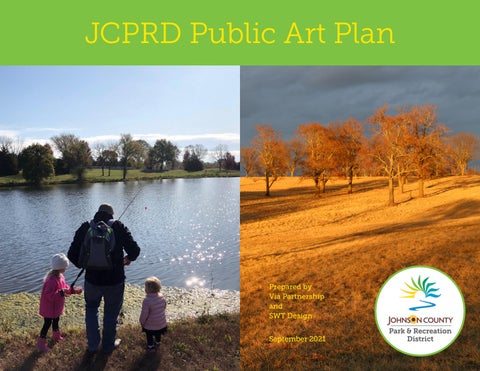
Cover: Left to right: Mildale Farm and Shawnee Mission Park
Contents – Johnson County Parks and Recreation District Public Art Plan
1
Executive Summary
Section Title — Johnson County Parks and Recreation District Public Art Plan
2
In 2019, recognizing the growing role that art and culture plays in their mission, as well in as the way people experience parks, the Johnson County Parks and Recreation District (JCPRD) launched a Public Art Program to serve their many parks, trails, facilities, green spaces, and recreational spaces. As a first step in launching this new program, JCPRD recognized the need to have a plan that charts a course for how the Public Art Program can best serve this unique organization’s mission and the residents of Johnson County. The JCPRD Public Art Plan was developed through a six-month process that engaged community members, the Public Art Committee (PAC), a Public Art Plan Core Team comprised of community stakeholders, and an Internal Committee comprised of JCPRD staff from divisions across the agency that will have a role in the successful implementation of the plan. This plan is meant to be a valuable and often-consulted tool for the JCPRD staff, JCPRD Board, and the Public Art Committee. It establishes a vision, goals, and strategies to guide this new program. The plan also provides a roadmap to guide the program’s work, including a set of recommended public art opportunities and administrative tools and processes to help get the work done.
Inspiring a Deeper Connection to Place The JCPRD Public Art Plan advances the vision that public art in JCPRD parks, trails and facilities will inspire a deeper connection to place through interactive, immersive, and inclusive experiences. The JCPRD Public Art Program will accomplish this vision through projects and programs that: Celebrate Place: Tell stories that are unique to the ecology, history, or culture of Johnson County and its landscape. Cultivate Community: Create opportunities to draw both new and returning parks visitors, building awareness and enthusiasm for JCPRD’s role in land stewardship and placemaking. Support Creativity: Invite artists to create new works of art based on local research and community engagement, with varied opportunities for a broad range of artists.
Public Art Opportunities: A Five-Year Outlook The JCPRD Public Art Plan outlines a series of public art opportunities – including a mix of permanent commissions, temporary installations, artist residencies, artist-led workshops, and exhibitions – that will help the Public Art Program realize its vision of inspiring a deeper connection to place through interactive, immersive, and inclusive public art experiences.
Page two: Meadowbrook Park
Executive Summary – Johnson County Parks and Recreation District Public Art Plan
3
Meadowbrook Park Public Art Project
Potawatomi Trail Commemorative Artwork
In April 2021, the Public Art Program began the process of commissioning a site-specific, permanent work of art for Meadowbrook Park that contributes to the overall identity of the park as a place to experience art and nature.
A commemorative artwork or memorial developed in collaboration with the Potawatomi Nation to mark the Potawatomi Trail of Death in Heritage Park, and/or other programming to connect visitors with this history.
Okun Fieldhouse Mural
Artist-Designed Habitats
A mural on the south façade of the Okun Fieldhouse that tells Johnson County’s “water stories” by highlighting and celebrating the natural setting of the nearby Mill Creek and the presence of the Streamway Trail.
Inventive bee boxes, bird boxes and other interventions created by local artists, architects, designers, or makers and installed by the Natural Resources Team.
Art + Natural Resources Residency Water Stories A series of public art projects at critical nodes along the Streamway Parks and in parks that have lakes or ponds, that celebrate the role of water in shaping Johnson County’s ecology, culture, and history.
Works of art and artist-led workshops that raise awareness of JCPRD’s land restoration work and help people connect to it in new ways, created by artists in residence who have spent time immersed in a park and learning from the Natural Resources staff.
Big Bull Creek Park Integrated Art
JCPRD Park Posters
An integrated artwork or functional element that draws the attention of the visitor to the surrounding landscape and/or aids in the interpretation and understanding of existing or planned habitat restoration.
A series of posters featuring JCPRD parks designed by regional artists and illustrators, exhibited in places throughout the County and available for sale, with proceeds to benefit The Parks and Recreation Foundation of Johnson County.
Theatre in the Park Temporary Public Art Installation An annual temporary public art project or projects that add a fun, interactive, and magical component to this much-loved community tradition.
Executive Summary – Johnson County Parks and Recreation District Public Art Plan
4
Bringing the Art to Life
A Roadmap for Implementation
To broaden the reach of its work, the Public Art Program should be proactive in its communications and develop a range of programs for the public and target audiences. In addition, the Public Art Program should play a leading role in supporting the growth of a healthy and vibrant public art ecosystem in Johnson County and the Kansas City Metropolitan area.
In 2019, the JCPRD Board adopted a Public Art Policy that established the JCPRD Public Art Program, which is now the mechanism through which all JCPRD’s public art activities take place. The policy also established the Public Art Committee and an annual funding mechanism that dedicates one half of one percent of the Capital Improvement Budget to public art. The JCPRD Public Art Plan provides administrative recommendations that build on the 2019 Public Art Policy, filling in gaps where needed, or fleshing out processes and review criteria as called for in the policy.
The Meadowbrook Park Artist Selection Committee meets to discuss goals for the upcoming public art project.
Planning for Public Art JCPRD should thoughtfully plan for public art, both through an Annual Public Art Work Plan process and by developing specific plans for each new public art commission. In addition, the Public Art Program staff should engage with park planning staff to ensure that public art is being considered and opportunities identified at the planning or early design phases of park and facilities capital projects. During the process of developing the Annual Public Art Work Plan, many ideas for projects will come forward, in addition to those in this plan. The Public Art Committee will prioritize these ideas using criteria related to the project’s location, content, potential experience for visitors, and resources, and make a recommendation as to the best projects to pursue each year.
Commissioning Processes The Standard Public Art Commissioning Process will serve as a starting point for how to commission public art projects. Variations to this process are outlined to use for smaller-budget temporary projects, artist residencies, and stand-alone artist-led workshops and exhibitions.
Executive Summary – Johnson County Parks and Recreation District Public Art Plan
5
The Commissioning Process offers two main methods for developing the artist pool, an Open Call and an Invitational. The plan describes details about each method that should be taken into consideration when selecting a method for each project.
Criteria for Review Commissioning artwork and accepting donations and loans requires careful review and consideration by the Public Art Committee (PAC), Artist Selection Committees, and JCPRD staff, prior to recommendations being made to the JCPRD Board (ASC). The plan outlines criteria for evaluating artist candidates at the qualifications stage, for technical review of concept proposals and designs, and for aesthetic review of concept proposals and designs.
Collection Management The JCPRD Public Art Collection includes all works of art owned or commissioned by JCPRD. Projects should be properly documented and JCPRD should undertake routine maintenance and conservation to preserve the Public Art Collection in the best possible condition as a public asset. JCPRD should not remove an artwork from display, re-site an artwork, or de-accession an artwork, without undertaking a thorough review by the Public Art Committee and JCPRD Board. This plan outlines these processes where the existing Public Art Policy is not specific.
Resources The success of the Public Art Program and its ability to commission new work and engage the public is shaped by its resources, including funding and staffing. The Public Art Program should work to leverage its Percent for Art funding and, within five years, evaluate Percent for Art to determine if it meets the funding needs for the Public Art Program. Over time, consideration should also be given to contracting with consultants or bringing on a part- or full-time public art project manager to oversee this work.
Strategies for Private Funding Opportunities The Public Art Program has an opportunity to leverage its committed funds to raise additional funding and grow partnerships in the community to support its work. The Public Art Program benefits from its partnership with The Park and Recreation Foundation of Johnson County (TPRFJC) to develop and execute fundraising and partnership strategies and from TPRFJC’s ability to receive charitable donations. Fundraising and partnerships can include a mix of grants, individual and corporate donors, sponsorships, fundraising events, planned giving, and in-kind contributions.
Roles and Responsibilities
Conclusion
The JCPRD Board, Public Art Committee, Artist Selection Committees and JCPRD staff all play important roles in the success of the Public Art Program. The plan outlines their responsibilities related to public art.
The JCPRD Public Art Plan charts an exciting future for public art in JCPRD’s Parks and Facilities, creating a path for staff and the Public Art Committee to thoughtfully plan for and advance JCPRD’s investments in public art. Using this plan as a guide, JCPRD can build a collection that affirms the fundamental role that the arts play by celebrating place, cultivating community, and supporting creativity.
Executive Summary – Johnson County Parks and Recreation District Public Art Plan
6
Introduction
Mildale Farm
Section Title — Johnson County Parks and Recreation District Public Art Plan
7
Arts, culture, and creative activities are becoming a growing part of the way people enjoy parks and recreational spaces across the world. From sculptures and traveling exhibitions that draw visitors to parks, to unique artist-designed play spaces, to artists who engage the public in thinking about the importance of land and water conservation issues – parks have become a place to experience a rich and diverse array of creative work. In the past year and half, the COVID-19 pandemic has made many indoor spaces and activities inaccessible and changed the way people socialize and gather. Parks have enjoyed increased visitorship, as people discover or re-discover the value of outdoor spaces, natural environments, and activities and hobbies such as hiking, birdwatching, and more. This is an excellent time for the Johnson County Park and Recreation District (JCPRD) to make the most of this increased interest in both parks and arts and culture and create a plan for the way public art and creative activities are integrated into its spaces. Located in the Kansas City metropolitan area, JCPRD is a unique community asset that, through its parks, trails, and facilities, provides unprecedented access to greenspace and recreational opportunities for residents and is actively preserving the exceptional landscape and heritage of the community. Created by the Kansas State Legislature in 1955, JCPRD now manages and maintains fourteen regional and community parks, four linear streamway parks, two golf courses, two field houses, an activity center, and an event venue. Each year, JCPRD records more than 8 million park visitors and more than 2 million recreation participations in more than 4,000 programs.
Introduction – Johnson County Parks and Recreation District Public Art Plan
Recognizing the growing role that art and culture play in their work, JCPRD added a Culture Division in 2018. This division is charged with strengthening and expanding the quality and breadth of cultural programs, events, and offerings to meet the needs of Johnson County. The division has five major focus areas – Fine and Performing Arts, Hospitality and Facility Rentals, Johnson County Museum, Theatre in the Park, and Public Art. The Public Art Program was established in 2019 by the JCPRD Board and is funded through one half of one percent of the Capital Improvement Program. The Johnson County Arts & Heritage Center serves as the hub for the division. JCPRD staff and the newly appointed Public Art Committee (PAC) recognized the need for a plan to help guide the program. The consulting firm Via Partnership, working with SWT Design, was brought on board in the fall of 2020 to facilitate the development of a public art plan. Throughout the planning process, the consultants worked closely with the JCPRD Superintendent of Culture, Susan Mong; the Public Art Committee; a Public Art Plan Core Team comprised of community stakeholders; and an Internal Committee comprised of JCPRD staff from divisions across the agency that will have a role in the successful implementation of the plan. The consultants also conducted extensive research and solicited community members for their thoughts on directions for public art in JCPRD parks, trails, and facilities.
Public Art Plan Core Team Early in the planning process, staff helped organize a Public Art Plan Core Team made up of representatives from the PAC, as well as representatives from local art organizations, regional municipal public art agencies, and artists. The Core Team was organized to inform the planning process, create a shared basis of understanding of Public Art
8
Program activities, share ideas for hoped-for impacts of public art, and to learn more about opportunities for and obstacles to achieving those impacts. The Core Team met with the consulting team at the beginning of the planning process, met to review findings and recommendations, and reviewed the draft plan.
Public Art Plan Internal Committee In addition to the Core Team, staff helped convene an Internal Committee of JCPRD staff to review and provide input into the plan and planning process. This group met early on to learn about and provide feedback on the planning process, including community engagement strategies, and to share thoughts on how public art can support other JCPRD goals and initiatives. The Internal Committee also reviewed and provided feedback on the draft plan.
Research The team’s research focused on reviewing the existing Public Art Policy and guidelines specific to gifts of artwork; reviewing JCPRD planning documents including the 2015 Legacy Plan and individual park, trail and facility plans; and touring the parks and trail systems. The team also reviewed the collections of other public art programs in Johnson County to understand the broader context of the program.
Interviews The consulting team interviewed a variety of key stakeholders, identified in collaboration with staff and the PAC. The consulting team interviewed JCPRD staff; artists; and representatives from arts, community, educational and business organizations.
Introduction – Johnson County Parks and Recreation District Public Art Plan
Questionnaire A questionnaire was launched on January 15, 2021 and received responses through February 28, 2021. The questions were designed to help the consultants and JCPRD better understand the public’s view on public art, how public art could have an impact in JCPRD parks, trails and facilities, and what locations are of most interest for future public art opportunities. The questionnaire asked questions related to people’s familiarity and relationship to JCPRD parks, trails, and facilities, as well as their preferences for public art. The questionnaire received 1,042 responses, of which 481 were partial.
Roundtables The consulting team hosted four roundtable discussions with artists, organizations involved with supporting public art in the region, and people interested in ecological art projects. The purpose of the roundtables was to introduce the program and planning process to different stakeholders, to learn about hoped-for impacts of public art in JCPRD parks and facilities, to generate discussions about potential partnerships, and to discuss the role of the JCPRD Public Art Program in the greater public art ecosystem of the region.
Meadowbrook Car Show The consultants set up a ‘pop-up’ activation at the Meadowbrook Car Show in Meadowbrook Park on April 11, 2021, designed to gather input and generate discussion about the types of public art that people would like to see in JCPRD parks and facilities. Participants could share their vision, place dots on images of artwork, and mark maps to share their ideas. Artist Marcianne Wagner-Heaton provided inspiration with live chalk art adjacent to the display area. 9
Meadowbrook Park Public Art Project While not originally conceived of as part of the engagement and research process to inform this public art plan, the launching of the selection process for the Meadowbrook Park Public Art Project in April of 2021 allowed the consultants, staff, PAC, and Artist Selection Committee (ASC) to ‘test’ the processes outlined in this plan. Feedback throughout the artist selection process helped to refine the recommendations in this plan.
Visitors to Meadowbrook Park and the Meadowbrook Park Car Show share their ideas for public art at JCPRD parks, trails and facilities.
Introduction – Johnson County Parks and Recreation District Public Art Plan
10
The JCPRD Public Art Program: Vision, Goals and Strategies
Shawnee Mission Park
Section Title — Johnson County Parks and Recreation District Public Art Plan
11
The vision, goals, and strategies of the JCPRD Public Art Program are designed to provide thoughtful focus to the program so that, with time, public art becomes an integral and meaningful part of how people experience JCPRD parks, trails, and facilities.
The JCPRD Public Art Program vision.
Public art in JCPRD parks, trails and facilities will inspire a deeper connection to place through interactive, immersive, and inclusive experiences.
The JCPRD Public Art Program will achieve its vision through projects and programs that support three goals.
Celebrate Place
Cultivate Community
Support Creativity
Tell stories that are unique to the ecology, history, or culture of Johnson County and its landscape.
Create opportunities to draw both new and returning parks visitors, building awareness and enthusiasm for JCPRD’s role in land stewardship and placemaking.
Invite artists to create new works of art based on local research and community engagement, with varied opportunities for a broad range of artists.
The JCPRD Public Art Program will employ these strategies to achieve its goals.
1 Commission a series of public art projects that reveal and draw deeper connections to the ecology and natural systems in JCPRD parks, specifically, and in Johnson County, in general.
1 Develop opportunities for artists to work closely with Natural Resources staff to develop projects that engage visitors in JCPRD’s efforts to restore and preserve Johnson County’s ecological systems.
1 Create opportunities for people to make art and engage in creativity in JCPRD parks through artist-led workshops and activities.
2 Commission a series of public art projects along streamway trails that reveal and celebrate the role of water in shaping Johnson County’s ecology, culture, and history.
2 Commission artists to collaborate on the design of functional elements of parks that reveal or respond to unique aspects of the site, in conjunction with new capital construction projects.
3 Commission site-specific artworks in parks that reveal new narratives about the evolving relationship between people and land.
3 Develop works of art that build the identity and strengthen people’s connections to individual parks and the park systems.
The JCPRD Public Art Program: Vision, Goals and Strategies – Johnson County Parks and Recreation District Public Art Plan
2 Create opportunities to hire local artists and artists new to public art, across all project types. 3 Play a role as a leader and convener with peer public art programs in Johnson County and the KC area to promote best practices, celebrate the region’s public art, and support public art practice.
12
Public Art Opportunities Five Year Outlook
Section Title — Johnson County Parks and Recreation District Public Art Plan
Meadowbrook Park
13
This section introduces and describes five project types that the JCPRD Public Art Program should focus on and identifies specific project opportunities that can occur in the next five years.
Project Types A mix of permanent commissions, temporary installations, artist residencies, artist-led workshops, and exhibitions will help the JCPRD Public Art Program realize its vision of inspiring a deeper connection to place through interactive, immersive, and inclusive public art experiences. Focusing on these five project types will create a variety of ways for both the public and artists to engage with the program and help achieve the program’s goals of celebrating place, cultivating community, and supporting creativity.
Temporary Public Art Installations Temporary installations, like permanent public art commissions, will be site-specific installations that respond to the unique aspects of the sites at which they are placed. Temporary artworks can be one-time projects or can be commissioned as part of an ongoing series. The duration of these project can range from an ephemeral, event-based artwork to an installation on display up to two years. Temporary public art installations can offer a way to commission work that responds in the moment to community needs and interests.
Permanent Public Art Commissions Permanent public artworks will be newly commissioned works of art, occasionally developed in conjunction with park capital projects. Artworks will be site-specific, with artists creating work that responds to the unique aspects of each site. For each permanent work commissioned, the program will develop location-specific goals that will ensure the artwork reflects the program’s desires around siting, connecting to community, and audience engagement. Permanent commissions can also be activated on an ongoing basis, with events, programs, or educational activities that create opportunities for the community or other artists to engage with the artwork long after it is installed.
RE:site, Nested Hive, Eastway Regional Recreation Center, Mecklenburg County, NC. Image: Merge Studios
Public Art Opportunities Five Year Outlook – Johnson County Parks and Recreation District Public Art Plan
14
Artist Residencies In an artist residency, a selected artist is given time and space to immerse themselves in a park environment, conduct research, and/or engage the community. Based on their experiences during this immersion, research, and engagement, the artist develops and executes a project, which could take the form of a temporary public art project, a workshop or series of workshops, and/or an exhibition. Studio space can be made available to the artist and artists could be given access to JCPRD staff, data, and collections to help inform their work.
Artist-Led Workshops Artist-led workshops are interactive experiences led by artists for the public or specific groups in park spaces and natural areas. These workshops would complement the fine arts programming currently
Papermaking workshop led by artist Megan Singleton. Image courtesy of the artist.
offered at the Johnson County Arts & Heritage Center and at JCPRD community centers but differs in that they are located in park settings. They can be structured as a class, a guided art-making experience or a participatory art project and can provide a way for regional artists to share their expertise with interested participants. Artist-led workshops encourage creative activity and art-making within parks, helping achieve the program’s goals of supporting creativity and cultivating community. Workshops can relate to a permanent or temporary public art project or artist residency and could also result in an exhibition.
Exhibitions Curated exhibitions, inspired by the Public Art Program, can feature a single artist or multiple artists and can take place outdoors or inside facilities. These could take place in the exhibition space at the Johnson County Arts & Heritage Center, managed by the Fine Arts Coordinator, or in other JCPRD parks or facilities. Exhibitions can relate to a permanent commission, temporary installation, residency, or workshop and/or can be a way for the program to create opportunities for a broader pool of artists. This should be planned in coordination with the Fine Arts Coordinator.
Public Art Opportunities The following pages describe specific project opportunities identified through the planning process. These opportunities span the five project types listed above and together present a robust and ambitious way for the program to dig into its work and begin to achieve its vision. Goals, process and timing considerations, and action steps are provided for each opportunity.
Public Art Opportunities Five Year Outlook – Johnson County Parks and Recreation District Public Art Plan
15
Meadowbrook Park
Meadowbrook Park Meadowbrook Park opened in 2019. The park includes 80 acres of green space and many features including a large central green, the Treeline Adventure destination playground, a smaller Grove playground with musical instruments and climbing nets, the Grand Pavilion, 3 shelters, tennis courts, pickleball courts, Meadowbrook Hill, outdoor fitness equipment, paved trails, three ponds, and the Meadowbrook Park Clubhouse, which includes an early childhood development center. In April 2021, the JCPRD Public Art Program began the process of selecting an artist for a site-specific, permanent public art project at Meadowbrook Park. The project will be sited at a location to be agreed upon with the selected artist, in the northern section of the park, away from the more congested and highly used areas of the park but within view of these areas.
Project Goals
Process Considerations
• S upport the overarching goals for the Public Art Program by creating an artwork that inspires a deeper connection to place and creates an interactive, immersive, and inclusive experience.
• Artist is being selected based on a competitive proposal process.
•C omplement the park design and relate to the ecology, history, or culture of the park or surrounding community. •C ontribute to the overall identity of Meadowbrook Park as a place to experience art and nature.
• Concept proposals will be on view in the Meadowbrook Park Clubhouse for public comment.
Timing Considerations • Final artist selection and concept approval is anticipated for the fall of 2021. • Project is slated for installation in the summer of 2022.
•C omplement park uses and not impede on the use of open space. •A ppeal to a broad audience of users, including people of all ages, through a work that is accessible and inviting. •W ork at a human scale – appeal to people who are on-foot in the park.
Public Art Opportunities Five Year Outlook – Johnson County Parks and Recreation District Public Art Plan
16
Erik Burke, Reflecting on Our Impressions, commissioned by Basin Street Properties, Living Stones Church, Sierra Arts, and the City of Reno, NV. Image: Erik Burke
Okun Fieldhouse Mural The Okun Fieldhouse, located within the Mid-America West Sports Complex, hosts a wide variety of adult and youth basketball and volleyball leagues, tournaments, camps, and special events. The south façade of the fieldhouse is also the backdrop for the adjacent baseball/softball fields and is highly visible from the Mill Creek Streamway Trail as well as from arriving vehicles. This approximately 25' x 180' wall would be a good location for a mural that addresses multiple user groups.
Project Goals
Timing Considerations
•B ring visual interest and beauty to the blank façade.
• There are no external projects driving the timing of this project.
•T ell one of Johnson County’s “water stories” by highlighting and celebrating the natural setting of the nearby Mill Creek and the presence of the Streamway Trail.
• Timing for executing the mural will be driven, in part, by weather.
Process Considerations • Consider limiting to regional artists. • S elect an artist based on a competitive proposal process.
Action Steps • Seek grant funding to supplement funding from the Percent for Art Fund. • Once funding is secure, incorporate into annual work plan. • Appoint Artist Selection Committee. • Develop a project plan.
Public Art Opportunities Five Year Outlook – Johnson County Parks and Recreation District Public Art Plan
17
Left to right: Jann Rosen-Queralt, Suckahanna Rain Garden, Powhatan Spring Park, Arlington, VA. Image courtesy of the artist; Betsy Damon, Homage to Living Systems, Chinook Bend Natural Area, Carnation, WA. Image: Betsy Damon
Water Stories Water Stories are a series of public art projects, primarily focused in Streamway Parks and parks that have lakes or ponds, that celebrate the role of water in shaping Johnson County’s ecology, culture, and history. These could include projects sited at trailheads and other trail access points, at other key nodes along the trails, or adjacent to the water.
Project Goals
Process Considerations
•R eveal and celebrate the role of water in shaping Johnson County’s culture and history. •C reate works that can be appreciated individually or as a series. • P rovide visual interest and discovery along the trails.
• Trails that go through residential areas should engage neighbors in the artist selection process.
Timing Considerations •D epending on the scale of projects, Water Stories projects can be commissioned yearly or every other year.
Public Art Opportunities Five Year Outlook – Johnson County Parks and Recreation District Public Art Plan
Action Steps • Map critical nodes in watersheds – in parks and adjacent to trails or along trail corridors – to prioritize locations to tell the story of water, flooding, and climate resilience. • Add priority projects to the annual work plan.
18
Tom Bierlein, Variations on Becoming, Franconia Sculpture Park, Franconia, MN. Image: Tom Bierlein.
Big Bull Creek Park Integrated Art The largest park in the system, Big Bull Creek Park focuses on nature-based learning, play, and restoration. The park is organized around three core habitat areas: prairie, savannah, and forest. The first phase of the park has been completed and includes a park maintenance facility and police substation, a nature play area, disc golf, trails, and a campground. Future phases may include additional pavilions, nature playgrounds, outdoor classrooms, and trails. The park also has a distinctive grain silo at the Weber Farm overlook area. With this park’s focus on nature-based learning and habitat restoration, JCPRD should consider a permanent public art project that engages visitors in the landscape. The work could take the form of an integrated artwork that draws visitors’ attention to the surrounding landscape and/or aids in the interpretation and understanding of existing or planned habitat restoration. Or an artist could be commissioned to incorporate art that highlights the natural features of the park into functional elements, such as the nature play area, a shelter, an outdoor classroom, or a pavilion.
Project Goals • E ngage visitors through a work that draws attention to or provides a unique connection to the landscape. •C reate opportunities for the observation of seasonal changes to the landscape and an appreciation of the land, water, and habitat restoration at the park.
Timing Considerations • F uture Capital Improvement Plan (CIP) projects may allow for integration of artwork into other park projects. •T he artist should be given a long lead time in developing their design. •T he fall/winter and early spring are particularly active seasons for restoration work which would be beneficial for the artist to witness as they are developing a design concept.
Process Considerations •A n artist should be selected based on qualifications and given sufficient lead time
Public Art Opportunities Five Year Outlook – Johnson County Parks and Recreation District Public Art Plan
to develop a concept design. This will allow the artist to work collaboratively with the design team, if applicable, to see the park at different times of the year, to learn about the ecology and restoration work in the park, and to learn more about how it is used. • The selected artist could also be required to do some public programming or temporary projects as part of their design development process. • Ideally, an artist would coordinate with natural resources staff to appropriately time their visit and have access to relevant information for their design development process. • An artist could choose to engage with a particular core habitat or all three.
Action Steps • Incorporate into annual work plan. • Appoint an Artist Selection Committee. • Develop a project plan.
19
Potawatomi Trail of Death marker, Heritage Park.
Potawatomi Commemorative Artwork Heritage Park is located on a portion of the Potawatomi Trail of Death, the pathway that was used for the forced removal of the Potawatomi Indians from north central Indiana to eastern Kansas in the fall of 1838. A stone marker was erected by JCPRD near Heritage Lake. There is an opportunity to further commemorate this history in collaboration with the Potawatomi with an artist-designed memorial or commemorative artwork, and/or other programming to connect visitors with this history. The first step will be to develop a relationship with the Potawatomi Nation and the Potawatomi Trail of Death Association to learn about their interests and priorities. Their concerns and plans around commemoration of the Trail of Death should determine the direction for the project. There may also be an opportunity to do other programming with the Potawatomi, such as a performance or exhibition, in lieu of or in addition to a permanent commemorative artwork.
Project Goals
Process Considerations
•A ppropriately commemorate the Trail of Death and how its legacy impacts the present.
• Artist or artists selected to create work should have a background that connects them to this history.
• S upport the Potawatomi Nation in their efforts to tell this story.
Action Steps
Timing Considerations •D eveloping a relationship with the Potawatomi and defining the project goals and scope should take place during the period of this 5-year work plan.
• Reach out to the Potawatomi Nation to learn more about their commemoration efforts, their goals, and their ideas. • Consider a temporary exhibition, performance, or event as a starting place for collaboration.
•A ny permanent commemorative artwork would take place beyond 2026.
Public Art Opportunities Five Year Outlook – Johnson County Parks and Recreation District Public Art Plan
20
David Buckley Borden with designers from Sasaki (Nicholas Barrera, Aubrey Fan, Kelly Farrell, Marlee Gleiberman, Jay Northoff, Felipe Palacio, Lucca Townsend), Sasaki Pollinator Residency, Watertown, MA. Image: David Buckley Borden
Artist-Designed Habitats The Natural Resources team at JCPRD installs bee boxes, bird houses and other interventions in JCPRD parks to supplement natural habitats. The Natural Resources team intends to install 8 – 10 bee boxes along the Mill Creek Valley streamway over the next few years and has identified sites in other parks as well. These boxes could be inventively designed by local artists, architects, designers, or makers, drawing attention to the importance of pollinators and of providing nesting areas for solitary bees. This could be a model for other artist-designed habitats projects.
Project Goals • Provide nesting space for bees. •R aise awareness of the presence and importance of pollinators in the parks. •R aise awareness of the importance of protecting and providing habitats for bees. • E ngage local artists, architects, designers, and makers.
Timing Considerations •C onsider as an annual or bi-annual competition.
• Consider structuring a competition that invites submittals to include qualifications and 1 – 2 images of a concept design for a bee box. Parameters for the design would be a part of the Call for Submissions. • Award up to four artists to execute their designs. Consider using an Artist Selection Committee to select 3, and award one as a “people’s choice.” • When installed, accompanying signage should be installed that explains their function and acknowledges the artist.
•T iming should coincide with optimal time, seasonally, to install bee boxes.
Action Steps
Process Considerations
• Appoint an Artist Selection Committee.
• E ligibility should be limited to regional artists, architects, designers, and makers.
• Consult with Artist Selection Committee and Natural Resources staff to develop project plan.
• Put into annual work plan.
• Develop and issue Call for Submissions. Public Art Opportunities Five Year Outlook – Johnson County Parks and Recreation District Public Art Plan
21
Karen McCoy and special guests Wes Jackson, Bill Vitek, Aubrey Streit Krug, The Walk that Connects, 2017 Prairie Fest Artist, The Land Institute, Salina, KS. Image: Scott Seirer
Art+Natural Resources Residency The Natural Resources staff at JCPRD does a tremendous amount of work in JCPRD parks on land restoration – restoring prairies, woodlands and other habitats that have been disturbed through agriculture and other previous land use, as well as by invasive species. Much of this work happens quietly through the hard work of staff and volunteers and is not widely known or understood by the public. An artist, working closely with the Natural Resources staff, could be engaged to develop public-facing projects to raise awareness of this work and help people connect to it in new ways. In the first 4 – 5 years, residents would focus on land restoration. Future years could shift focus, depending on the results of the residency and the work being done in parks. As this work happens in many parks in the system, the residency could focus on different parks from year to year, but the focus should remain on parks that have larger visitorship. Currently a considerable amount of prairie restoration work is taking place at Shawnee Mission and Big Bull Parks and woodland restoration at Shawnee Mission and Ernie Miller Parks.
Project Goals
Process Considerations
•C reate interactive, artistic experiences that allow park visitors to learn about the land restoration and the ecology and natural systems that make up the JCPRD parks.
• Residencies could be structured to invite artists to explore a specific topic related to land restoration (invasive species, prescribed burns, seed collection, etc.), or could be left open.
• P rovide a platform for artists to create new, engaging art projects that grow out of an exploration of the work of the Natural Resources team, the process of land restoration, and the ecology and natural systems of JCPRD parks. • S upport the growth and development of regional artists.
Timing Considerations •C onversations with the Natural Resources staff should determine the best timing for engaging an artist as it relates to their work with land restoration. •T he first year or two of residencies should launch with shorter-term engagements.
Public Art Opportunities Five Year Outlook – Johnson County Parks and Recreation District Public Art Plan
• Artists should be selected based on a strong artistic practice and body of work, plus an interview to determine if they will be a good fit working with the Natural Resources staff. • During the selection process, artists can be asked to provide thoughts on how they would approach their research and engagement process, and the type of work they would like to create but would not provide a full concept proposal. • The Call for Artists should clearly outline expected outcomes and outputs.
Action Steps • Put into annual work plan. • Appoint an Artist Selection Committee. • Consult with Natural Resources staff to develop project plan. • Develop and issue call for artists. 22
Forest Park Posters. Image: Used with permission. ©2021, The Firecracker Press. St. Louis, MO.
JCPRD Park Posters Posters celebrating parks, park wonders, and scenic places have a long tradition. During the Great Depression, the Works Progress Administration developed National Parksthemed posters to promote the expanding system of parks being developed through the Civilian Conservation Corps. More recently, local park systems, conservation groups, and communities have commissioned artists to create collectable posters using both retro and contemporary styles that celebrate getting out into nature. The JCPRD Public Art Program, working with The Parks and Recreation Foundation of Johnson County, should commission a series of posters of JCPRD parks from regional artists and illustrators. Posters could feature a single park, or for larger parks could celebrate places within JCPRD parks. Posters could be exhibited in places throughout the County, and could be available for sale, with proceeds to benefit JCPRD.
Project Goals
Process Considerations
•C elebrate JCPRD parks and the special places within them.
• Consider a partnership with American Institute of Graphic Arts – AIGA KC.
•R aise awareness of which parks are part of the JCPRD system.
• Consider selecting artists based on portfolios and commissioning posters. Or selection could be structured as a design competition.
• P rovide opportunities to commission and showcase regional artists and illustrators. • Raise funds to support JCPRD.
Timing Considerations •T here are no external factors driving the timing of this opportunity.
Public Art Opportunities Five Year Outlook – Johnson County Parks and Recreation District Public Art Plan
Action Steps • Research comparable projects for further information on process and budget. • Meet with The Parks and Recreation Foundation of Johnson County to develop strategy for utilizing posters as a fundraising tool. • Contact AIGA KC and/or others as possible partners. • Put into annual work plan. 23
Left to right: Aurora Robson, Gypsy Moths, Rockland Center for Contemporary Art, Nyack, NY. Image: Marshall Coles; Mark Reigelman II, Upriver Downriver, Louisville, KY. Image: Mark Reigelman II
Theatre in the Park Temporary Public Art Installation The Theatre in the Park is located on 10 acres in the northeast corner of Shawnee Mission Park. Each summer, Theatre in the Park presents five popular Broadway-style musicals, with casts featuring actors from the surrounding community. The season culminates with Evening in the Park, an annual, free summertime party in Shawnee Mission Park featuring live music and a movie. As an added feature to Theatre in the Park, the Public Art Program could commission a temporary public art project or projects that add a fun, interactive, and magical component to this much-loved community tradition. The project(s) could be unveiled during the Theatre in the Park season and could be commissioned to last for multiple weeks. Locations could be chosen to be accessible to all park visitors.
Project Goals
Process Considerations
• E ngage visitors to Shawnee Mission Park and Theatre in the Park attendees with work that is fun, interactive and/or participatory.
• Restrict eligibility to regional artists.
•C reate a sense of magic in the park and around Theatre in the Park. • P rovide opportunities for local and regional artists.
• Select finalists based on qualifications. Invite finalists to develop site-specific concept proposals. • Consider starting small and growing program.
Action Steps • Put into annual work plan.
Timing Considerations •A rtists should be selected at least 6 months in advance to be able to design, fabricate and install their work.
• Appoint an Artist Selection Committee. • Develop project plan.
•T iming should consider CIP Americans with Disabilities Act (ADA) projects and timelines as appropriate.
Public Art Opportunities Five Year Outlook – Johnson County Parks and Recreation District Public Art Plan
24
Monitor Capital Projects and Engage with Planning Several parks will be undergoing planning processes or may be launching the design for a second or third phase of development in the coming five years. The JCPRD Public Art Program should monitor these projects and, when launched, engage with the planning and/or design processes to identify and begin planning for future public art projects. These parks include, but are not limited to: • Ernie Miller Nature Center Renovation • Theatre in the Park Master Plan and Renovation • Big Bull Creek Park Phase 2 • Lexington Lake Park Phase 2 • Cedar Niles and Stoneridge development • Camp Branch Park
Big Bull Park
Public Art Opportunities Five Year Outlook – Johnson County Parks and Recreation District Public Art Plan
25
Engaging Audiences, Artists and Partners
Section Title — Johnson County Parks and Recreation District Public Art Plan
26
The success of a Public Art Program is built on its ability to share the value of its work with the public and engage audiences, artists, and other partners. This section offers guidance on communications, messaging, and identity for the program, as well as for individual projects. It recommends specific ways the program can engage audiences in learning about its work. Also outlined here are ways the program can partner with other organizations, develop projects and programs that support artists, and collaboratively support the growth of public art in the region.
• E ncourage people to get involved by participating in programs and volunteering for the Public Art Committee or an Artist Selection Committee. •D raw attention to JCPRD as an innovator and place to experience art in nature. •D evelop JCPRD’s reputation as a desirable partner organization for high-quality public art projects and programming.
Message and Identity
Communications The projects, programs and Public Art Collection should be a well-known asset that fosters community pride in the park system. Through an effective communications strategy, JCPRD should: • Raise the public profile of the Public Art Program, its projects and programs, and the Public Art Collection. • Encourage people to visit parks and facilities and experience the art projects. • Reinforce the connections that artists are making to the ecology, history, and culture of Johnson County and its landscape through their projects. • Build awareness and enthusiasm for JCPRD’s role in natural resource stewardship and placemaking. • Celebrate and raise the profile of the artists who develop public art projects for the Public Art Program. • Inform people about the process used to select artists and works of art for JCPRD parks and facilities.
The JCPRD Public Art Program should create and maintain an enhanced program identity. As part of creating an identity, consideration should be given to creating a name for the program that is memorable and accessible, and clearly connects the program to JCPRD. The identity should be used consistently in all program materials and traditional and social media. This applies to print materials, press releases, website, social media, and artwork identification labels. When developing materials, the JCPRD Public Art Program should also consider developing key messages that are reinforced through all communications channels. Key messages can accomplish the following: •R elate projects back to the vision and goals of the Public Art Program. •C elebrate the talents of commissioned artists. • P romote the role that the community has played in the selection of the artist and other aspects of the project. •B uild awareness of the art-making process and how public resources are being used. • E ncourage people to visit the art and experience it for themselves.
Page 26: Mildale Farm
Engaging Audiences, Artists and Partners – Johnson County Parks and Recreation District Public Art Plan
27
A Public Catalog of the Collection
Building the Public Art Ecosystem
As the collection grows, a full inventory of the collection, including high-quality images and descriptions, should be accessible via the JCPRD website. Print brochures and posters about the collection and specific works in the collection can also be a resource that is distributed at JCPRD parks and facilities and shared with people interested in the program. Excerpts from the catalog can also be adapted and shared on social media to highlight specific pieces of the collection and direct visitors to the website. Efforts should be made to collaborate, where it makes sense, to reflect a larger regional public art collection.
Through its commissions, programs, partnerships, and communications, JCPRD can play a role in supporting the growth of a healthy and vibrant public art ecosystem in Johnson County and the Kansas City Metropolitan Area.
Project-Specific Communications Strategy The Superintendent of Culture should work with JCPRD communications staff to develop a communications strategy for each public art project that includes messaging opportunities from the commissioning process through unveiling the artwork. This would ideally happen concurrent with the project plan development. The strategy should identify target audiences, messages, and vehicles for communication, as well as a timeline linked to the public art project milestones. Furthermore, project communication strategies should synergize with other division’s strategies where appropriate. The communications strategy can also be a tool to identify strategies for stakeholder engagement and community involvement during the commissioning process.
The public art ecosystem encompasses the wide range of individuals, businesses, and organizations essential for creating and producing public art. This can include artists, arts administrators, curators, fabricators, designers, public agencies, arts organizations, developers, educators, critics, funders, and collaborating organizations. JCPRD should consider how it can support the ecosystem through its own projects and programs and should look for opportunities to partner with other organizations with similar goals whenever possible.
Supporting Local Artists The JCPRD Public Art Program can create opportunities and resources specifically to support local artists. •T hrough commissioning a diverse range of projects, the Public Art Program can craft public art opportunities specifically for artists who work at different scales, in different media, in different genres, and/or have different levels of experience. •O n occasion, the Public Art Program may restrict eligibility for certain projects to local or regional artists. • F or some opportunities, the Public Art Program might take the lead or play a more active role in fabrication and installation, opening the door to artists with less experience managing those tasks.
Engaging Audiences, Artists and Partners – Johnson County Parks and Recreation District Public Art Plan
28
• The Public Art Program can initiate or partner with other organizations to develop lectures, workshops, seminars, tours and other educational programs specifically for artists who are interested in learning more about public art practice. • The Public Art Program should consider engaging local artists as paid ‘mentees’ or assistants to artists who are commissioned by the Program for large-scale public art projects. • The Public Art Program should look for ways to facilitate access for artists to contractors, facilitators, professional services, and other partners they may need to successfully implement projects.
Developing a Regional Network The JCPRD Public Art Program should take a leadership role in convening regional public art commissioning entities and supporting organizations as part of a broader network. This could begin as a periodic regional meet-up or forum and could grow into developing shared resources or joint programs. Photography workshop in Rosewell, GA. Image: fisheyeconnect.com
Engaging Audiences The Public Art Program has an opportunity to continuously engage audiences. The five project types – permanent public art, temporary public art, residencies, artist-led workshops and exhibitions – create opportunities to invite interaction and participation in different ways, as well as to build on each other to create different access points to the stories, ideas and processes that the works of art explore.
Public Programs There are opportunities through the commissioning process to invite the public to learn about the public art process, meet artists, and celebrate the completed installations. In addition, the Public Art Program should look for opportunities to invite the public to participate in programs that engage with the artwork or artist in different ways and that are interactive. Artist-led workshops can be a way to engage audiences in permanent or temporary public art installations or residencies, by inviting artists to lead a hands-on activity that relates directly to their project. Likewise, related exhibitions can be a way to extend the reach of these projects. Exhibitions could feature other work by an artist doing a public art project, or include research, sketches, renderings, or documentation of fabrication to show the art-making process. Other artists, including performing artists such as dancers, musicians, poets, and playwrights can be engaged to create work in response to works in the Public Art Collection for public performance. And, finally, the public can be encouraged to develop their own ideas for using works in the collection as inspiration for programs, and work with JCPRD staff, if desired, to help develop and promote them.
Engaging Audiences, Artists and Partners – Johnson County Parks and Recreation District Public Art Plan
29
Educational Partnerships
Community Partnerships
JCPRD can work with local school districts, the Johnson County Community College system, and other educational partners to develop curriculum materials centered on works in the Public Art Collection. Materials could include lesson plans that address a full range of subjects and could be aligned with state teaching standards. Educator workshops could encourage the use of the curriculum.
JCPRD should cultivate partnerships within JCPRD and externally with local and regional nonprofits, educational institutions, regional partners, and others to develop both public art projects and programs designed to engage people more deeply with the Public Art Collection.
Students can also be engaged in unique ways for specific projects. Student journalists can interview artists or write about their work. Students can be involved with project documentation during and after installation or be invited to create works of art that are inspired by works in the collection. And artists can be encouraged to engage with students during their project development processes. The Public Art Program can also work with educational partners to help build the public art ecosystem, as described above, through partnerships that teach and explore the process of creating public art.
Online and Virtual Engagement There are also opportunities to engage audiences online with specific projects and with the collection and program. Some public programs may be appropriate for online formats. Social media can create ways for people to engage on a regular basis with the program and share their experiences with public art in JCPRD parks and spaces.
Project Partnerships The JCPRD Public Art Program should look for opportunities to partner on specific public art opportunities. When partnering on a project, JCPRD should: • S eek out partnerships where there is strong alignment on the goals for the project. •C onsider what resources, expertise, access, audiences, or other opportunities the partnership brings that complement and add to what JCPRD brings to the project. •C learly outline the responsibilities for each partner in terms of funding and staffing resources, role in the commissioning process, participation in communications and outreach, and other important tasks related to the project’s success. Depending on the partnership and the project or program, the Public Art Program’s s role may be to lead, partner or advise. Some partnerships will result in projects that are led by the JCPRD Public Art Program. Others will be projects for which responsibility is shared between the partners. And finally, there may be instances in which community groups, organizations, or colleagues may approach JCPRD with ideas for projects that do not directly align with the Public Art Program’s vision and goals,
Engaging Audiences, Artists and Partners – Johnson County Parks and Recreation District Public Art Plan
30
or for which JCPRD does not have the staff capacity to undertake. For these projects, JCPRD can offer technical advice or guidance on best practices, while not assuming the role of partner or leader.
Programmatic Partnerships Partnership programs should focus on activities that: • Expose the community to selected artists such as studio tours, lectures, workshops, or exhibitions. • Engage people more directly in the works of art that make up the Public Art Collection, such as artist-led engagements, collaborative projects and programs that use the artwork as inspiration, artist-led or artist/staff joint tours, and curriculum materials.
Maria Ogedengbe, Missouri GOURDen Project, Kansas City, MO. Image: Maria Ogedengbe
Engaging Audiences, Artists and Partners – Johnson County Parks and Recreation District Public Art Plan
31
Administrative Recommendations
John Lewis Barkley Plaza
Section Title — Johnson County Parks and Recreation District Public Art Plan
32
In 2019 the JCPRD Board adopted a Public Art Policy, the first for JCPRD, that establishes the JCPRD Public Art Program. The policy calls for the new Public Art Program to be administered by the JCPRD Culture Division under the direction of the Superintendent of Culture in partnership with the Planning and Development Manager, and under the supervision of the Executive Director. The policy also calls for the establishment of a Public Art Committee to provide oversight of the program and to make recommendations regarding new public art commissions and acquisitions to the JCPRD Board.
Planning for Public Art
The JCPRD Public Art Program is now the mechanism through which all JCPRD’s public art activities take place. Any new public art commissions, donations or loans follow the guidelines and procedures outlined by the Public Art Program, including review of the project by the Public Art Committee.
Each year the Public Art Program staff and Public Art Committee should develop an Annual Public Art Work Plan and Budget.
The policy also created an annual funding mechanism through the Capital Projects budget. Starting in FY20, one-half of one percent (.5%) of the annual Capital Improvement Plan budget is dedicated to public art. The following Administrative recommendations build on the 2019 policy, filling in gaps where needed, or fleshing out processes and review criteria as called for in the policy.
JCPRD should thoughtfully plan for public art, both through an Annual Public Art Work Plan process and by developing specific plans for each new public art commission. In addition, the Public Art Program staff should engage with park planning staff to ensure that public art is being considered and opportunities identified at the planning or early design phases of park and facilities capital projects.
Annual Public Art Work Plan and Budget
The Work Plan should list projects that are expected to begin in the coming fiscal year, projects that are carrying over from previous fiscal years, projections for the following four fiscal years, and special projects such as coordination with planning processes. For projects beginning in the coming fiscal year, the Work Plan should provide the project location, a brief description, the budget and anticipated timeline. It should also indicate how projects will be resourced, in terms of funding and staffing, and indicate any internal and external partnerships necessary for the successful completion of the project. The Budget should include anticipated income and expenditures for the coming fiscal year and projections for the following four fiscal years including the annual percent for art allocation (broken into the Public Art Project Fund and Maintenance Fund), other JCPRD funding sources, and funds raised. It should indicate funds that have rolled over from previous years, and anticipated funds for the following four fiscal years.
Administrative Recommendations – Johnson County Parks and Recreation District Public Art Plan
33
To develop the Annual Public Art Work Plan and Budget:
Public Art Work Plan and Budget Process
A The Superintendent of Culture will collect information regarding potential public art opportunities, as well as program opportunities and conservation needs, consulting the Public Art Plan and other relevant planning documents; and meeting with JCPRD staff, including the Planning and Development department, Natural Resources staff, the Development Director, and Johnson County Museum staff as well as potential community partners.
Creating an Annual Public Art Work Plan and Budget
Superintendent of Culture collects information regarding potential public art opportunities, as well as program opportunities and conservation needs.
B The Superintendent of Culture will present information gathered to the Public Art Committee for discussion. The PAC should use the criteria for evaluating opportunities (Page 37) as a guide for determining which projects to pursue.
Public Art Committee discusses and evaluates public art opportunties, program opportunities and conservation needs.
C The Superintendent of Culture will then draft a Work Plan and Budget for PAC review and approval.
Superintendent of Culture drafts Work Plan and Budget.
D Once approved by the PAC, the Work Plan will be presented to the Executive Director and JCPRD Board as an information item and the Budget will be presented to the Executive Director and JCPRD Board for approval.
Public Art Committee reviews and approves Work Plan and Budget.
Superintendent of Culture presents the Work Plan as an information item and Budget for approval to the JCPRD Board and Executive Director.
Key JCPRD Board Public Art Committee Superintendent of Culture
Administrative Recommendations – Johnson County Parks and Recreation District Public Art Plan
34
Project Plans JCPRD should undertake careful planning for each public art project that it implements to ensure that all projects are well conceived. This planning should include identifying the opportunity; finding project partners; understanding potential hurdles with permissions, permitting or construction; establishing realistic budgets and timelines; and communicating with project partners at an early stage about the intent and scope of the project. For each public art project, JCPRD should adopt a project plan, which is a foundational document that guides the planning and execution of a project. A project plan should set out the basic framework of a project, including: • A description of the project’s location and other information regarding the proposed siting. • The project’s expected lifespan, if temporary. • The project goals and how the project relates to the overall vision for public art in JCPRD parks and facilities. • Evaluation criteria against which the artist selection and concept proposal can be evaluated. • The budget and funding sources. • The project schedule. • Artist Selection Committee members. • Internal and external stakeholders. • The artist’s scope of work. • The artist solicitation method and artist selection method. • A community engagement strategy. • Potential partners and needed agreements. Administrative Recommendations – Johnson County Parks and Recreation District Public Art Plan
Project plans should be developed by the Superintendent of Culture with input from project partners and the Public Art Committee. Other JCPRD staff, in particular the Planning and Development department, Natural Resources staff, and Johnson County Museum staff, can provide important information that informs the context of the project. In most cases, the Artist Selection Committee for the project should be selected prior to developing a full project plan. The Artist Selection Committee can then provide input into the project plan, especially focusing on the project goals. Projects Plans are approved by the PAC and presented to the JCPRD Board as an information item.
JCPRD Plans and Other Regional Plans In the coming years JCPRD will be updating the 2015 Legacy Plan. The Legacy plan is system-wide strategic plan that provides the JCPRD Board and staff with a comprehensive framework for managing the JCPRD system. The 2015 Legacy Plan was developed prior to the creation of the Culture Division and the establishment of the Public Art Program. The Superintendent of Culture and the PAC should be engaged in the development of future Legacy Plans to ensure that consideration of art, public art and other cultural activities is integrated into the larger framework that guides the work of JCPRD. The Public Art Program should also track and look for ways to connect with and support other system-wide JCPRD Plans, such as the Natural Resources Plan, and larger regional civic planning efforts that JCPRD is engaged with, such as the Climate Action Plan (CAP) developed by the Mid-America Regional Council (MARC), which is supported by JCPRD. The Superintendent of Culture and the PAC should also be engaged in planning initiatives where there are potential opportunities for 35
public art. This could include conceptual plans developed by the JCPRD Planning and Development department that look at specific parks, trails and facilities, or more detailed design processes for capital projects. For these plans, the Superintendent of Culture can work with the planners and/or design team to identify and include public art recommendations in the plan.
Holly Young-Kincannon and Joseph Drummond Kincannon, Blackbird, Austin, TX. Image: Kincannon Studios, LLC
Criteria for Evaluating Potential Public Art Opportunities During the process of developing the Annual Public Art Work Plan, many ideas for projects will come forward. The projects described in this Public Art Master Plan can be a starting point for discussion, but other ideas may arise from conversations with Planning and Development staff, Natural Resources staff, through the work of the History in the Parks initiative, and from ideas generated by other JCPRD or community partners. The Public Art Committee will prioritize these ideas and make a recommendation as to the best projects to pursue each year. The following criteria provides some key questions that the PAC should ask when evaluating opportunities. While these questions can be applied to each specific opportunity, they do not all necessarily carry the same weight or pertain to every project. These questions also frame a way to look at the body of public art projects that are being developed each year and, over time, ensure that there is a diversity of locations, artistic approaches, artists, and audiences that are engaged.
Location 1 Does the site provide an opportunity to reach a broad and diverse audience? 2 Is the site a place where multiple programmatic uses, ecologies, or trails intersect? 3 Does the site offer good visibility and/or sight lines? 4 Would artwork at this site complement park use? 5 Is there a capital project at the site that could allow for site integration and/or leveraging of resources?
Administrative Recommendations – Johnson County Parks and Recreation District Public Art Plan
36
6 Does the site offer an opportunity to bring art to a part of the Johnson County where JCPRD has not already had art projects or programming? 7 Does the site create an opportunity to forge a partnership that will strengthen the outcomes of the project? 8 Does the site pose any concerns around environmental impact? 9 Does the site pose any concerns around ADA accessibility?
Content 1 Does the project provide an opportunity to tell a story about that place? To reveal something new? Or bring to light something that is not readily accessible? 2 Does the project provide an opportunity to tell the story of the county at-large? 3 Does the project provide an opportunity to connect its story to a larger idea, network, system, or place? 4 Does the project provide an opportunity to enhance or promote the enjoyment of the natural environment?
Experience 1 Could the artwork be experienced intimately? On foot or by bike? Or by kayak or boat? 2 Is there the potential to create a work that could be interactive or experienced from multiple vantage points? 3 Does the artwork contribute to a sense of discovery within the park? 4 Are there opportunities for activation or programming to happen in conjunction with the artwork?
Resources 1 Are there sufficient resources to commission an artwork at the site that would be of an appropriate quality, durability, and scale for the site? 2 Is there sufficient staff time to be able to manage the commissioning process, programming, and other related activities around the project? 3 Are their opportunities to leverage resources through grants, partnerships, volunteers, etc.?
5 Does the content of the work provide an opportunity to forge a partnership that will strengthen the outcomes of the project?
4 Would a significant portion of the project budget be consumed by site work, engineering/utility needs (whether due to siting or complexity of the work)?
6 Does the project provide an opportunity for a new artist or voice to engage in the public realm?
5 Is there an opportunity to leverage resources by integrating the work into a capital project or other park improvement project?
Administrative Recommendations – Johnson County Parks and Recreation District Public Art Plan
37
Standard Commissioning Process for Permanent and Temporary Public Art Projects The JCPRD Public Art Policy outlines the key roles that the staff, JCPRD Board, PAC and Artist Selection Committees play in artist selection. The following builds on the policy by outlining, step by step, the standard process for JCPRD to use when commissioning temporary public art projects with budgets greater than $5000 and permanent public art projects. New public art projects will, with rare exceptions, be site-specific commissions where an artist is selected to develop a project for JCPRD that is informed by the context of the site. The Standard Public Art Commissioning Process will serve as a starting point for how to commission artwork, with the exact details outlined in each project plan. Variations to this process should be used for smaller-budget temporary projects, artist residencies, and stand-alone artist-led workshops and exhibitions. Those variations are described next.
Step 1: Convene an Artist Selection Committee and Develop a Project Plan Once a project has been initiated, the Public Art Committee establishes an Artist Selection Committee specifically for that project. The Superintendent of Culture, with input from the Artist Selection Committee, develops a Public Art project plan, described above. This plan includes its goals, location, timeline, and budget; the artist selection process and community engagement process; and a list of internal and external stakeholders. The project plan is approved by the Public Art Committee and presented to the JCPRD Board.
Step 2: Develop the Artist Pool Based upon the approved project plan, the Superintendent of Culture develops and issues a Request for Qualifications (RFQ). Artist qualifications can include a cover letter from the artist expressing their interest in the project, a resume, and examples from the artist’s portfolio with a corresponding description of each project. The RFQ can be an Open Call, where any artist can apply who meets project eligibility, or an Invitational, where the RFQ is only sent to a short list of artists. Methods for developing the artist pool are described further below.
Step 3: Select the Finalists The Artist Selection Committee reviews artist qualifications based on criteria outlined in the approved Project Plan and selects 3 – 5 finalists.
Administrative Recommendations – Johnson County Parks and Recreation District Public Art Plan
38
Step 4: Select the Final Artist and Concept At the finalist stage, there are two options for selecting the artist. The Artist Selection Committee can interview finalists and select an artist based on qualifications and an interview. Or the Committee can ask finalists to each develop a concept proposal and base the selection on qualifications and the Proposal.
Concept Proposal In a concept proposal-based selection, finalists are paid a stipend to develop renderings, concept description, description of materials and fabrication, initial budget, and timeline and present that proposal to the Artist Selection Committee. Prior to the finalists presenting their proposal to the Committee, their draft proposal should be reviewed by JCPRD staff to flag potential technical and ecological concerns. The finalists should be given time to address any concerns raised in the review. The Artist Selection Committee recommends selection of an artist to the Public Art Committee based upon the favored concept proposal. The Public Art Committee recommends the concept proposal to the JCPRD Board for final approval.
Interviews In an Interview-based selection, rather than develop a concept proposal, finalists are invited to interview with the Artist Selection Committee. If the artist is asked to travel to Johnson County, providing a travel stipend is appropriate. Questions should focus on the artist’s approach to developing a concept and executing the artwork and other skills that are considered desirable for that project, such as conducting research and community engagement or working collaboratively with a design team.
Administrative Recommendations – Johnson County Parks and Recreation District Public Art Plan
The Artist Selection Committee recommends an artist based on their qualifications and interview to the PAC. Once approved by the PAC, the selected artist is then put under contract to develop a concept design. To develop the concept, the selected artist should conduct a site visit and meet stakeholders. Depending on the artist’s practice and the nature of the project, the artist may conduct additional research, outreach, and community engagement at this time. Prior to the artist presenting their proposal to the Committee, their draft proposal should be reviewed by JCPRD staff to flag potential technical and ecological concerns. The artist should be given time to address any concerns raised in the technical review. The Artist Selection Committee recommends approval of the concept to the Public Art Committee. The Public Art Committee recommends the concept proposal to the JCPRD Board for final approval.
Step 5: Approve the Final Design The artist then takes the concept through Final Design and Construction Documents, further refining the design, fabrication techniques, materials, and budget. At this point, the artist may also need to have elements of their design reviewed and stamped by a licensed engineer in the State of Kansas. The artist will submit the Final Design and Construction Documents to JCPRD staff for review. The artist will not proceed with fabrication until receiving approval of the final design from the Superintendent of Culture.
39
Step 6: Monitor Fabrication and Installation In most cases, the artist is responsible for fabrication. The Superintendent of Culture monitors fabrication to ensure it is on schedule and in conformity with the approved design. The Superintendent should inspect the work, through photographs or in-person, prior to the work being shipped. The Superintendent of Culture works with the artist, relevant JCPRD staff, and other stakeholders to schedule and facilitate installation. In some cases, the Superintendent of Culture and other JCPRD staff may play a more direct role in overseeing the fabrication of artwork and/ or installation, with the artist acting in an advisory role. In these cases, JCPRD would contract directly with the fabricator and/or installer, who would work under the direction of both JCPRD and the artist.
Community Engagement in the Artist Selection and Concept Development Process Interview-Based Selections and concept proposal-based selections both allow for community engagement in the selection process. Finalists who are asked to participate in interviews or develop proposals can participate in an orientation to the site prior to being interviewed or developing their proposals; this orientation can include a tour of the site and surrounding area and could be joined by key stakeholders. Finalist proposals can also be put on view for public comment, which can be taken into consideration by the Artist Selection Committee. In addition, artists who are selected based on their qualifications and interviews, can engage with the community prior to developing their concept proposal through artist meet and greets, artist talks, or other
Administrative Recommendations – Johnson County Parks and Recreation District Public Art Plan
activities designed to gather information or develop an understanding of the community in ways that may be part of the artist’s practice.
Variations to the Standard Commissioning Process Smaller Budget Temporary Projects For temporary public art projects with a budget of $5000 or less, the Standard Commissioning Process should be followed, but the Public Art Committee should provide final approval of the artist and concept. The Public Art Program would not have to seek approval of the artist concept by the JCPRD Board. For certain small-scale temporary projects, the Public Art Program could consider selecting artists through a design competition, where applicants would be invited to submit a design as part of their initial submission. While it is generally a best practice to only request designs from finalists who are paid a stipend to compensate them for their creative work, design competitions can open the door to artists who have never done a public art project and can greatly streamline the selection process.
Artist Residencies For residencies, the Standard Commissioning Process should be followed, however the artist should always be selected based upon their qualifications and an interview. Candidates can also be asked to answer written questions about how they would address the residency. Proposals for the intended public art output of the residency should not be sought until the artist has completed the research and engagement aspects of their residency.
40
Standard Commissioning Process – Interview Option 1 Convene Artist Selection Committee & Develop Project Plan
2 Develop the Artist Pool
3 Select the Finalists
Public Art Committee (PAC) establishes an Artist Selection Committee (ASC) specifically for the project
Superintendent of Culture develops and distrbutes the RFQ based on the approved project plan
ASC reviews artist qualifications and selects finalists
Superintendent of Culture develops the project plan with input from the ASC and JCPRD staff
Superintendent of Culture notifies finalists and non-finalists
4 Select the Final Artist and Concept
Finalists participate in interview
ASC recommends artist based on interview
PAC reviews and approves project plan
PAC reviews and approves selection
Superintendent of Culture presents project plan to JCPRD Board
Selected artist develops concept proposal
Key JCPRD Board Public Art Committee Artist Selection Committee
5 Approve the Final Design
6 Monitor Fabrication and Installation
Artist develops final design and construction documents
Artist fabricates art
Superintendent of Culture reviews at benchmarks and manages review by JCPRD staff, as needed
Artist installs art
Superintendent of Culture reviews and approves final installed art
JCPRD staff conducts technical review of concept proposal
ASC reviews and recommends concept proposal
Superintendent of Culture Artist
PAC reviews and recommends concept proposal
JCPRD Board approves concept proposal Administrative Recommendations – Johnson County Parks and Recreation District Public Art Plan
41
Standard Commissioning Process – Concept Proposal Option 1 Convene Artist Selection Committee & Develop Project Plan
2 Develop the Artist Pool
3 Select the Finalists
4 Select the Final Artist and Concept
5 Approve the Final Design
6 Monitor Fabrication and Installation
Public Art Committee (PAC) establishes an Artist Selection Committee (ASC) specifically for the project
Superintendent of Culture develops and distrbutes the RFQ based on the approved project plan
ASC reviews artist qualifications and selects finalists
Finalists develop Concept Propsals
Artist develops final design and construction documents
Artist fabricates art
Superintendent of Culture notifies finalists and non-finalists
JCPRD staff conducts technical review of concept proposals
Superintendent of Culture reviews at benchmarks and manages review by JCPRD staff, as needed
Artist installs art
Superintendent of Culture develops the project plan with input from the ASC and JCPRD staff
PAC reviews and approves project plan
ASC reviews concept proposals and recommend selection
Superintendent of Culture presents project plan to JCPRD Board
PAC reviews and recommends selection of artist and concept proposal
Key
Superintendent of Culture reviews and approves final installed art
JCPRD Board approves concept proposal
JCPRD Board Public Art Committee Artist Selection Committee Superintendent of Culture Artist
Administrative Recommendations – Johnson County Parks and Recreation District Public Art Plan
42
Stand-Alone Artist-Led Workshops and Exhibitions For artist-led workshops and exhibitions that are not part of a larger permanent or temporary commission, selection of artists can be made by the Superintendent of Culture, Fine Arts Coordinator, or future Public Art Program staff. Staff may use an open or invitational call or directly select artists for the opportunity without running a competition. Final workshop or exhibition details would be approved by JCPRD staff.
Other Variations There may be instances in which JCPRD and the Public Art Committee decide it is appropriate to alter the Standard Commissioning Process for permanent projects or for larger budget temporary projects. Generally, these variations would be intended to streamline the process and could be appropriate when a project needs to be fast-tracked. This would be outlined in the project plan and approved by the Public Art Committee. Options for altering the solicitation and selection processes include having the Public Art Committee serve as the review body rather than convening a separate Artist Selection Committee or having the Superintendent of Culture recommend an artist for approval by the Public Art Committee. Selections made by the PAC or by staff could be based on interviews or concept proposals, or artist qualifications, reference checks and a conversation with the artist to confirm their interest in and availability for the project. Variations would need to comply with JCPRD procurement policy. Once the artist or concept is selected, the Standard Commissioning Process would be followed.
Elden Tefft, Prairie Spirit, Baker Wetlands, Lawrence, KS. Image: courtesy Baker University Wetlands Discovery Center
Administrative Recommendations – Johnson County Parks and Recreation District Public Art Plan
43
Developing the Artist Pool
Invitational
In the Standard Artist Selection Process, there are two main methods for developing the artist pool, an Open Call or an Invitational.
An Invitational is where a select group of artists are invited to enter a competition or are pre-selected as candidates for a particular project or site.
Open Call An Open Call is a competition that is open to all qualified artists and, sometimes, other design professionals. There can be specific criteria, determined on a project-by-project basis, that limit eligibility. Open Calls can be broadly accessible and can allow for a broad range of possibilities. They can provide opportunities for new, otherwise unknown, and emerging artists to apply. However, Open Calls, which often have large responses, can consume a large amount of time for staff and Artist Selection Committee members. They can also take several weeks or months from initiation to artist selection. Consideration should also be given to whether Open Calls are beneficial to emerging artists. While they do allow for the broadest applicant pool, artists new to public art who have strong potential, but fewer portfolio examples, can get overlooked in Open Calls, especially when there are many applicants.
Invitationals are useful when looking for artists with a specific expertise, focus or method in which they work. Staff can research artists who are potentially a good match for the project and invite them to submit, not wasting the time of artists who are not the target of the project. Invitationals can sometimes help reach artists who would not normally apply for a public art project or are not following public art competition opportunities. Because artists know that they are competing against a smaller number of artists, some artists may be more inclined to apply to an Invitational than an Open Call.
In addition, some established artists will not respond to Open Calls, preferring Invitationals or being directly selected for projects.
Administrative Recommendations – Johnson County Parks and Recreation District Public Art Plan
44
Criteria for Review The processes for commissioning artwork and accepting donations and loans include careful review and consideration by the PAC, ad-hoc Artist Selection Committees and JCPRD staff, prior to recommendations being made to the JCPRD Board.
Criteria for Review of JCPRD-Commissioned Public Art Projects The Standard Commissioning Process details the roles that the PAC, Artist Selection Committees and JCPRD staff play in reviewing artists’ qualifications and reviewing and approving concept proposals. For each project, a project plan will outline the specific criteria against which the individual artist and proposed concept can be evaluated during the selection and review process. The following general criteria should serve as a starting point for developing specific criteria for each project.
Criteria for Evaluating Artist Qualifications When evaluating artist qualifications, the Artist Selection Committee should consider the following criteria. Additional criteria could be developed based upon the specific needs of the project.
• Artist’s experience creating high-quality artwork, managing complex projects, working with community stakeholders, and/or working with clients. • Established proficiency in the use of materials appropriate for a public installation.
Criteria for Technical Review of Artist Concept Proposals Prior to review of the concept by the Artist Selection Committee, the Superintendent of Culture should work with JCPRD staff responsible for the site and/or the related capital project to conduct a technical review of the concept. Technical reviews should focus on the following criteria. Additional criteria could be developed based upon the specific needs of the project. • Capacity to meet all safety and maintenance requirements, including consideration of anticipated maintenance and conservation needs for the project’s expected lifespan. • Feasibility of the concept proposal to satisfy the budgetary limits established in the approved project plan. • Ability to meet the project timeline. • Consideration of all stages of fabrication and installation.
• Artistic excellence and innovation as demonstrated by the artist’s past work. • The capability of the artist to develop a project that is consistent with the Public Art Program’s vision and specific project goals outlined in the Request for Qualifications.
• Consideration of site issues such as permitting, installation staging, and availability of electrical or other utilities. • Positive track record of delivering quality projects on schedule and on budget, as determined by past work and references from previous clients.
• A demonstrated understanding of and interest in creating work for the specific site.
Administrative Recommendations – Johnson County Parks and Recreation District Public Art Plan
45
Criteria for Aesthetic Review of Artist Concept Proposals When evaluating artist concept proposals, the Artist Selection Committee should consider the following criteria. Additional criteria could be developed based upon the specific needs of the project. • The concept demonstrates artistic excellence, maintaining high quality, innovation, creativity, and clarity of vision. • Overall understanding of the project and the ability of the concept proposal to respond to the project goals. • A clear understanding of the site, including how the artwork will relate to the physical environment.
Criteria for Review of Gifts of Artwork and Long-Term Loans The current JCPRD Public Art Policy outlines a process for reviewing gifts of artwork. The following criteria should be used to conduct Technical review and site and aesthetic review of proposed gifts as well as long-term loans of artwork to JCPRD.
• The donor or lender should document that they have adequately anticipated and can meet financial costs connected with donating or loaning the work, including, but not limited to, shipping, shipping insurance, site preparation, installation (and de-installation for loans and temporary works), proper signage, insurance, site restoration, landscaping, and lighting. • The work should be durable and pose no safety or liability concerns. •A report from the artist or a qualified conservator’s report indicating anticipated conservation and maintenance needs should be provided for permanent donations. For loans, the donor should commit to routine maintenance of the artwork for the duration of the display, unless otherwise agreed upon in writing by JCPRD. • The proposed site should be available and appropriate for the installation of artwork. Necessary electric, plumbing or other utility requirements should be defined and available. Internal Department plans may determine if a specific site is appropriate for artwork. • JCPRD should be able to insure the artwork for liability and damages for the duration of its exhibition.
Criteria for Technical Review of Gifts and Long-Term Loans Prior to review of the gift or loan by the PAC, JCPRD staff should conduct a technical review of the artwork. Technical reviews should focus on the following criteria. Additional criteria could be developed based on the specific location being requested for siting. • If the donor or lender is offering an existing work of art, the donor or lender should document that the work of art can be legally loaned or donated to JCPRD.
Administrative Recommendations – Johnson County Parks and Recreation District Public Art Plan
46
Criteria for Site and Aesthetic Review of Gifts and Long-Term Loans Aesthetic review should be conducted by the PAC or by an ad hoc committee appointed by the PAC that includes specific artistic expertise and stakeholder representation. Aesthetic review should take into consideration the following criteria. Additional criteria could be developed based on the specific location being requested for siting. • The proposed gift or loan is consistent with the vision of the Public Art Program. • The proposed gift or loan demonstrates artistic excellence, maintaining high quality, innovation, creativity, and clarity of vision. If the work is to be commissioned by the donor or lender, the review should consider the artist’s ability and potential to execute the proposed work, based on previous artistic achievement and experience. If an existing work of art, the review should consider the quality of the executed work.
Collection Management JCPRD should adopt practices for the documentation, conservation, maintenance, and de-accessioning or re-siting of artworks in the JCPRD Public Art Collection.
The JCPRD Public Art Collection The JCPRD Public Art Collection includes all works of art owned or commissioned by JCPRD, including both temporary and permanent public art projects and donations of artwork.
Documentation of the Collection
• For permanent gifts, the proposed donation should contribute to the diversity of the Public Art Collection.
An important part of collection management and, ultimately, long-term maintenance of public art is keeping accurate, updated records. The main aspects of this are identifying the project on site, keeping accurate records for each project, and maintaining a comprehensive inventory of the collection.
• For permanent gifts, artworks should be one-of-a-kind or part of an original series.
Project Identification
• The proposed site should be appropriate to the artwork’s content, scale, and media. The analysis should consider the visibility and access to the site, public use patterns of the site, and future development plans for the site, if any.
Administrative Recommendations – Johnson County Parks and Recreation District Public Art Plan
Each new artwork should be identified with a plaque stating the artist’s name, the artwork title, the media, the date the work was created, and that it is part of the JCPRD Public Art Collection. The plaque should be placed in an appropriate location near the artwork that can be easily viewed by pedestrians.
47
Collection Inventory The Public Art Program should maintain a full inventory or database of all artworks in its collections, including temporary works and works that have been de-accessioned. This inventory should include information such as (when available or applicable): • Name of artist • Title of work • Location (kept in a format compatible with JCPRD’s GIS system) • Year completed/installed; year de-installed for temporary works • Which collection it belongs to • Owner of work, if a long-term loan • Donor, if applicable • Media
Maintenance and Conservation of the Public Art Collection Public art is an asset that should be properly maintained and conserved. JCPRD should undertake routine maintenance and conservation to preserve the Public Art Collection in the best possible condition. Information on each work of art commissioned, acquired, donated, loaned, or owned outright by JCPRD should be kept on file on a standardized maintenance and conservation worksheet. Works of art on loan should be maintained and conserved in accordance with the requirements of, and in collaboration with, the lender. Maintenance and conservation to works in the Public Art Collection is paid for through the Maintenance Reserve Fund, a special fund which is comprised of 10% of the annual JCPRD Public Art Program funding.
• Dimensions
Routine Maintenance
• Budget/cost and source of funds
Routine maintenance is the care of public art that does not require specialized expertise (i.e.: dusting, washing, lubrication of moving parts). Routine maintenance can generally be managed by JCPRD maintenance staff, in accordance with instructions on the maintenance and conservation worksheet. JCORD staff should not conduct any non-routine maintenance or conservation unless requested by the Superintendent of Culture. The JCPRD staff responsible for the park or facility where the art is located should notify the Superintendent of Culture immediately if an artwork is damaged or stolen, or if there is a need to move an artwork or in any way alter its site. Any work that is recommended for relocation or de-installation would be subject to the de-accession policy.
• A brief description of the work suitable for publication • Maintenance and conservation needs and schedule • Conservation history • Digital photograph of the work
Administrative Recommendations – Johnson County Parks and Recreation District Public Art Plan
48
Works of art should be maintained in a manner outlined in the above-mentioned maintenance and conservation worksheet, appropriate to the medium and characteristics of the artwork, and in accordance with the Visual Artists Rights Act of 1990 .
Conservation Conservation is the regularly scheduled examination, documentation, treatment and preventative care of public art conducted by a professional art conservator. As needed, the Public Art Program will conduct, or hire a professional conservator to conduct, a survey of the condition of each work in the Public Art Collection and make recommendations for conservation, cost estimates, and a recommended schedule for implementation. For newly commissioned or purchased works of art, artists should guarantee the work of art against any repairs for at least one year (unless otherwise stipulated in the contract). JCPRD has the right to determine, after consultation with a professional conservator, when and if repairs and restorations to works of art in the Public Art Collection shall be made. All repairs and restorations should be made in accordance with recognized principles of conservation.
De-Accession, Re-Siting, and Removal from Display Circumstances and/or conditions may occasionally arise that make it prudent for JCPRD to remove an artwork from display, re-site an artwork, or de-accession an artwork. De-accessioning is a procedure to remove an artwork formally and permanently from the Public Art Collection by selling, donating, or destroying it. De-accessioning is an important decision and should only be undertaken after a thorough review process. Similarly, re-siting of artwork should be carefully considered if the work is considered site-specific and relocating the work would damage the work or alter the work from what the artist intended. Removal from display is an option if, for any reason, JCPRD does not want to de-accession the work from the collection but would like to remove it from display, and there are resources to safely store the artwork. Consideration of de-accession, re-siting, or removal from display should involve the same degree of careful review as a decision to commission a work of art. JCPRD should institute a review process to ensure that de-accessioning or re-siting will be a seldom-employed action that operates from a strong presumption against removing artwork from the public art collection and insulates the collection from fluctuations in aesthetic taste or popularity. JCPRD should not remove any site-specific artwork from the site for which it was selected, nor remove it from display, without prior review by the PAC. Recommendations regarding re-siting of site-specific works or de-accessioning or removal from display of artworks should be made by the PAC to the JCPRD Board.
Administrative Recommendations – Johnson County Parks and Recreation District Public Art Plan
49
The JCPRD Public Art Policy calls for the PAC to develop criteria for consideration in de-accessioning. A recommended procedure and criteria for de-accession is outlined below.
Procedure 1 The PAC reviews the circumstances surrounding the proposed de-accession, re-siting, or removal from display to determine if the artwork meets one or more of the criteria listed below. The PAC may choose to hold a public meeting for the purpose of gathering community feedback on a proposed de-accession or relocation or may choose to gather community input through other methods. Criteria for De-Accessioning, Re-Siting or Removal • The use, character, or design of the site has been or is being altered such that the artwork is no longer compatible with the site. • The security of the artwork can no longer be reasonably guaranteed at its current site. • The artwork has become a danger to public safety.
2 If the PAC determines that the artwork meets one or more of the Criteria above the Superintendent of Culture should, in accordance with the 1990 Visual Artists Rights Act, make a good faith effort to notify the artist that his or her work is being considered for de-accession or relocation (if a site-specific work). If the artist does not agree to the proposed re-siting, s/he will have the right to prevent the use of her/his name as the author of the artwork or to buy back the work as addressed in the artist contract. 3 If a site-specific artwork is recommended for re-siting, the Superintendent of Culture should prepare a written report detailing the reason for the decision and the proposed new site for the artwork for approval by the PAC and JCPRD Board. This report should also include the costs associated with re-siting and the proposed funding source, as well as any other pertinent information. 4 If an artwork is recommended to be de-accessioned, the Superintendent of Culture should:
• Maintaining or repairing the artwork is cost prohibitive or unfeasible. • Significant adverse reaction to the artwork from the community has continued for an extended period (at least two years). • The work is of inferior quality or is judged to have little aesthetic and/or cultural value. • A suitable location for the artwork has been identified that better satisfies the original goals of the project. • The artist requests removal due to concerns listed above.
Administrative Recommendations – Johnson County Parks and Recreation District Public Art Plan
• Commission a written appraisal by a qualified, disinterested third party for each proposed de-accessioned artwork with an estimated value exceeding Ten Thousand Dollars ($10,000.00). • Prepare a written report of the reasons for the proposed de-accessioning and a recommendation for the method of disposal. • Submit the report, and the recommendation of the PAC to the JCPRD Board, which must approve any de-accessioning. • If an artwork is de-accessioned, all rights will revert to the artist, where consistent with contractual agreements. If the artist waives those rights, JCPRD will dispose of the artwork.
50
5 During the review process, unless there is imminent danger to the public, the artwork shall remain accessible to the public in its original location. If the structural integrity or condition of an artwork, in the opinion of the JCPRD staff and the PAC, presents an imminent threat to public safety, the Superintendent of Culture may authorize its immediate removal, without PAC review or JCPRD Board action or the artist’s consent. The Superintendent will place the work in temporary storage. The artist and JCPRD Board must be notified of this action within 30 days. The PAC will then recommend options for disposition (e.g.: repair, reinstallation, maintenance provisions or de-accessioning) for approval, as necessary, by the JCPRD Board.
Monuments and Memorials The reasons for de-accessioning, re-siting or removing monuments or memorials may differ from those outlined above. Decisions regarding whether to de-accession, re-site or remove monuments or memorials should follow the procedures above, if the monument or memorial is a work of art in the Public Art Collection but should also take into consideration additional criteria developed by JCPRD regarding the review of monuments and memorials.
6 If the artwork cannot be removed without being irreparably damaged or destroyed, and if artist rights are not waived in the contractual agreement, the Superintendent of Culture must make a good faith effort to gain such written permission before proceeding. If this cannot be accomplished before action is required to protect the public’s health and safety, the Superintendent of Culture will proceed according to the advice of JCPRD Legal Counsel. 7 De-accession, relocation and removal actions must comply with applicable procedures and laws relating to the disposition of JCPRD property and the Visual Artists Rights Act. Artworks will not be de-accessioned directly or indirectly or in any manner that would personally benefit JCPRD employees, members of the PAC or of the JCPRD Board. No works will be given to or sold to JCPRD staff, PAC members, or the JCPRD Board. 8 All proceeds from artworks sold because of de-accession will be restricted to support the Public Art Program. Anne-Marie Yang, Ephemeral Peace, Lexington Lake Park, Desoto, KS.
Administrative Recommendations – Johnson County Parks and Recreation District Public Art Plan
51
Roles and Responsibilities
Culture Division/Superintendent of Culture
The JCPRD Board, Public Art Committee, Artist Selection Committees and JCPRD staff all play important roles in the success of the Public Art Program. The following outlines their responsibilities related to public art.
The JCPRD Culture Division, overseen by the Superintendent of Culture, is responsible for the administration of the Public Art Program.
Duties
JCPRD Board The Johnson County Parks and Recreation District is governed by the JCPRD Board, a seven-member, policy-making board appointed by the Board of County Commissioners (BOCC ) of Johnson County, Kansas. In addition, a member of the BOCC serves as an ex officio member of the JCPRD Board. Terms of office are for three-year periods and are staggered.
Duties
• Manages the Public Art Program and facilitates communication among the JCPRD staff, JCPRD board, PAC, and Artist Selection Committees. • Drafts the Annual Public Art Work Plan in consultation with other JCPRD Departments and Divisions and in collaboration with the Public Art Committee. • Participates in meetings for capital construction projects as needed to coordinate planning for public art in specific parks and to ensure smooth coordination of public art projects.
• Approves public art policies.
• Initiates and coordinates each public art project so that its process is compatible with any related project timelines.
• Appoints members to the Public Art Committee.
• Presents project updates to the PAC.
• Reviews the annual Public Art Work Plan.
• Manages all aspects of commissioning works of art in collaboration with the PAC, including:
• Approves the annual Public Art Budget. • Reviews project plans. • Approves new public art commissions at the concept design/concept proposal phase. • Approves de-accession of artwork or re-siting of site-specific artwork from the Public Art Collection. • Approve gifts of artwork to JCPRD. • Approves contracts according to JCPRD policy.
o Compiles a pool of potential Artist Selection Committee members
and recommend members for each project. o Drafts project plans. o Administers the artist recruitment and selection process. o Provides Public Art Program overview and project summary to
artist selection committee. o Facilitates artist selection committee meetings. o Provides report of artist selection and Concept Design to
JCPRD Board for approval. o Acts as liaison with JCPRD Legal Counsel in negotiating
artist contract. Administrative Recommendations – Johnson County Parks and Recreation District Public Art Plan
52
o Performs technical review of concept proposals; convenes other
necessary staff for technical reviews. o Inspects artwork at fabrication stage. o Coordinates scheduling of installation with artist. o Maintains communication with stakeholders. o Develops guidelines for the content and format of identification
plaques and oversees their fabrication. • Officially accessions artwork into the JCPRD Public Art Collection and ensures artwork is included under JCPRD insurance coverage. • Manages review of works under consideration for deaccession, relocation or removal. • Oversees collection management, including the periodic inspection of artwork in the JCPRD Public Art Collection for maintenance and conservation needs. • Administers the Public Art Project Fund and Maintenance Reserve Fund. • Directs the public relations and general education aspects of the Public Art Program. • Coordinates with the Development Director to raise funds to support public art.
Public Art Committee The Public Art Committee is a standing committee of the JCPRD Board responsible for making recommendations to the JCPRD Board about the implementation of the Public Art Program.
Membership and Appointment The JCPRD Public Art Committee consists of a minimum of seven and no more than nine members. Appointments to the PAC are approved by the JCPRD Board. Included in this membership are the Superintendent of Culture and two members of the Planning and Development Department who serve as ex-officio, voting members. The JCPRD Board appoints one non-voting liaison to the PAC. Other members are appointed for three-year terms, with the terms staggered so that the terms of not more than three members expire in any given year.
Duties • Recommends new PAC members for approval by the JCPRD Board. • E stablishes policies and procedures and provides general oversight for the JCPRD Public Art Program. •R ecommends guidelines, policies and procedures for the selection, implementation, and conservation of public art. •A pproves an Annual Public Art Work Plan. •R ecommends to the JCPRD Board and the Executive Director an annual Public Art Budget. •D esignates appropriate Artist Selection Committee (ASC) members for each public art project. • Reviews and approves project plans. • Participates in Artist Selection Committees. •A dvances recommendations from the Artist Selection Committee to the JCPRD Board for their acceptance or rejection.
Administrative Recommendations – Johnson County Parks and Recreation District Public Art Plan
53
• Reviews and recommends proposed gifts of art to become a part of the JCPRD Public Art Collection, as well as loans and long-term exhibitions of art on JCPRD-owned property. • Reviews and recommends de-accessioning, relocation or removal of artwork in the JCPRD Public Art Collection.
Artist Selection Committees Project-specific Artist Selection Committees (ASC) are ad hoc committees appointed by the PAC to advise on project plans, recommend artists, and recommend concept proposals/designs for a public art project.
Membership
Stacy Levy, Ridge & Valley, H.O. Smith Botanic Gardens, The Arboretum at Penn State, University Park, Pennsylvania, PA, Image: Fred Weber
ASCs are seated for each project where an artist will be engaged. An ASC will typically be composed of a representative from the JCPRD’s primary capital project consultant, if the project is connected to a capital construction project; a JCPRD representative who works or will be working at the site when completed; a member from the community at large who resides in the vicinity of the project; two community members with visual arts expertise; a JCPRD project manager from the Planning and Development Department; and a member of the PAC as a non-voting liaison.
Duties •M eets for a project orientation and to provide input on the project plan. • Reviews artist qualifications/submittals and selects finalists. • Reviews community feedback on concept proposals (if applicable). • I nterviews finalists and/or reviews finalist concept proposals and makes a recommendation to the PAC.
Administrative Recommendations – Johnson County Parks and Recreation District Public Art Plan
54
Other JCPRD Staff Other JCPRD staff will collaborate with the Culture Division and the Superintendent of Culture on different aspects of the Public Art Program. Executive Director Provide overall leadership. Manage the budgeting process. Approve contracts. Review the Annual Public Art Work Plan prior to JCPRD Board approval. Bring matters to the JCPRD Board. Planning and Development Two members serve as ex-officio members of the PAC. Participate on ASCs when applicable. Participate in technical review of artist concept proposals and potential gifts and loans of artwork. Coordinate with the Superintendent of Culture to integrate public art into future park planning. Ensure the Public Art Program is incorporated into future Strategic Plan documents. Help to identify and evaluate potential public art opportunities for inclusion in the Annual Public Art Work Plan. Superintendent of Parks and Golf Courses and Superintendent of Recreation Work with the Public Art Program to identify and evaluate public art opportunities. Designate staff to participate on ASCs. Participate in technical review of artist concept proposals and gifts and loans of artwork. Ensure routine maintenance of public art is conducted according to artist instructions. Consult on ongoing effectiveness of artists in residence program as an embedded member of the natural resources team and overall effort to further the goals of this department.
Administrative Recommendations – Johnson County Parks and Recreation District Public Art Plan
Development Director Collaborate with Superintendent of Culture on grants and other fundraising efforts to support the Public Art Program. Incorporate the program into The Parks and Recreation Foundation of Johnson County strategic plan and enlist support of Board members and donors. Marketing and Communications Work with the Superintendent of Culture to develop an overall identity and communications strategy for the Public Art Program and a communications strategy for each new public art project. Fine and Performing Arts Manager or designated staff including Fine Arts Coordinator and Performing Arts Coordinator. Work with the Superintendent of Culture to support Public Art Programming and on any associated programming or workshops that support program goals. Curator of Interpretation or designated Johnson County Museum Staff Work with the Public Art Program to share relevant Johnson County History to aid artists in the creation of their art and help contextualize spaces used for public art.
55
Resources The success of the Public Art Program and its ability to commission new work and engage the public is shaped by its resources, including funding and staffing.
Funding The Public Art Program is primarily funded through the JCPRD Capital Project budget. JCPRD should leverage this funding through fundraising, grants, partnerships, and collaborations within JCPRD. A broader and more diverse range of funders will engage more stakeholders in the Public Art Program and will create greater funding stability.
the program would like to be adding works to its collection. Through this review, the program should consider increasing from .5% to 1%, aligning the funding commitment to that of similar public agencies in the region and throughout the US.
General Fund As a part of JCPRD’s annual budgeting process, the Culture Division should request funds to support the following elements: Staffing and Administrative Support The General Fund should cover staffing, including any future dedicated staff. The General Fund can also be used to hire consultants to manage or curate specific public art projects.
Percent For Art The main source of funding for the Public Art Program is through a line item in the Capital Projects budget that shall total one-half of one percent (.5%) of the annual Capital Improvement Plan budget. This one-half of one percent applies to the annual Capital Replacement Plan budget, excluding land acquisition and the Capital Replacement Plan. Funding from debt issuance shall equal .5% of the total debt issued, not to exceed $50,000. The JCPRD Board reserves the right to allocate funding for art above and beyond this provision.
Communications The General Fund should cover communications efforts and materials related to works in the collection.
The JCPRD Public Art Committee withholds 10% of the JCPRD Public Art Program funding in a Maintenance Reserve Fund for the maintenance and restoration of existing artwork.
Private Fundraising and Grants
In three to five years, once the Public Art Program has a track record, JCPRD staff and the PAC should evaluate whether the one-half of one percent, plus the funds the program is able to raise, are enabling the program to commission works of art that are at a scale and quality that is desired for JCPRD parks, trails and facilities; and at the pace at which Administrative Recommendations – Johnson County Parks and Recreation District Public Art Plan
Other Requests can be made for support from the General Fund for other expenses related to the successful implementation of the Public Art Program.
JCPRD should seek funds from individuals, corporations and foundations and other granting organizations to support the commissioning and acquisition of public art, as well as activities necessary to the success of the Public Art Program, such as education, community engagement, and community programs. The Parks and Recreation Foundation of Johnson County can be used as a mechanism for those desiring to donate funds for public art.
56
Staffing There are a variety of skill sets needed for the successful management of the Public Art Program. These include but are not limited to planning and budgeting, curating, project management, collections management, conservation, program development and administration, and community partnership development. The Superintendent of Culture is currently the point person for the Public Art Program and has the primary responsibilities for public art, outlined in the Roles and Responsibilities section above. Managing public art projects can be staff intensive, requiring relationships with partnering agencies and the community. Consultants can be used from time to time to support staff on tasks related to planning, artist selection, project management, and program development. Online submission management programs (such as CaFÉ) can be used to support staff efforts. As the program grows, the Public Art Program may require the time and focus of a highly qualified, dedicated staff person. This could start as part-time and grow to a full-time position. Even with a dedicated staff person, the Superintendent of Culture should be directly involved in developing the annual work plan and Budget and in developing and fostering departmental and community partnerships. Other staff within JCPRD can be called on to support communications, marketing, fundraising, and other activities.
Simiya Sudduth painting a mural at St. Louis Lambert International Airport, St. Louis, MO. Image: Angie Villa
Administrative Recommendations – Johnson County Parks and Recreation District Public Art Plan
57
Strategies for Private Funding Opportunities
Shawnee Mission Park
Section Title — Johnson County Parks and Recreation District Public Art Plan
58
The JCPRD Public Art Program has an opportunity to leverage its committed funds to raise additional funding and grow partnerships in the community to support its work. The JCPRD Public Art Program benefits greatly from its partnership with The Park and Recreation Foundation of Johnson County (TPRFJC) to develop and execute fundraising and partnership strategies and from TPRFJC ’s ability to receive charitable donations. The focus of fundraising should be to support projects and programs initiated by the Public Art Program or in which the JCPRD Public Art Program is a partner. From time to time, donors may also be interested in donating a work of art or commissioning a specific piece. Those donations should go through the established policy for donating artwork.
Patrick Dougherty, Waltz in the Woods, Morris Arboretum of UPA, Philadelphia, PA. Image: Rob Cardillo
Overarching Fundraising Approach Successful fundraising requires a strategic approach. The following key tenets should be kept in mind when developing a fundraising approach for public art. Look for co-benefits. The JCPRD Public Art Program’s vision and goals create opportunities to engage funders that are interested how the arts can connect people to ecological systems, to community narratives, and to each other. Working with TPRFJC, the Public Art Program should stay attuned to larger civic efforts and the interests of the philanthropic community to track where the vision and goals of the Public Art Program overlap with the goals of possible funders. Tell your story. Don’t wait until it is time to approach a funder or partner to let them know who you are and what you do. Make sure they have heard all about the Public Art Program through media, social media, and people raving about the program’s work. This means investing time and resources into communications, letting people know about not just the works of art, but the stories they tell, the people who have been involved in making projects happen, and the impact they have made. Share credit. Acknowledge funders and partners in meaningful ways, and make sure they get credit for their contribution and for enabling projects to happen. Develop long-lasting relationships. Get to know funders and potential partners, even if there isn’t an immediate opportunity to seek funding or work together. Follow their work and get involved. Sometimes it takes time before the right opportunity to work together comes along.
Strategies for Private Funding Opportunities – Johnson County Parks and Recreation District Public Art Plan
59
Fundraising Tactics
Sponsorships
Grants
JCPRD could seek business sponsorships for projects and programs. Projects that are event-based in nature, such as temporary public art installations or workshops, may be better candidates for sponsors that are interested in naming or receiving other types of visible recognition for their sponsorship.
There are many regional and national grant programs that are interested in supporting public art, art in ecology, creative placemaking, and the vitality of public parks, trails, and recreation facilities. Others may be interested in supporting JCPRD’s efforts around developing the regional public art ecosystem. JCPRD should proactively seek grants from local, state, and national donors to support public art projects and programs. Some grants may be strengthened if JCPRD applies in partnership with another organization or public agency. Major grant-makers to consider include the National Endowment for the Arts, Bloomberg Philanthropies, the Kansas Creative Arts Industries Commission, and the Knight Foundation. Smaller local foundations may be interested in supporting the work of the Public Art Program, as well.
Donor Cultivation and Solicitation JCPRD, working with TPRFJC should cultivate individual and corporate donors and partners to support the Public Art Program overall and for specific public art projects or programs. Potential donors can be engaged through invitations to public events that celebrate the work of the Public Art Program, such as artwork dedications and artist presentations. JCPRD can also set up special tours and ‘meet the artist’ opportunities for prospective donors. They should also receive regular communications about the program.
Fundraising Events JCPRD should consider a signature, annual fundraising event to support public art, or to support a broader umbrella of arts and culture activities supported by JCPRD, including Theatre in the Park and programs at the Arts & Heritage Center. In addition, JCPRD should continue to look for fundraising partnerships, such as the Meadowbrook Car Show, that split proceeds with the Public Art Program.
Planned Giving The Public Art Program should consider how planned giving efforts could be a strategic part of fundraising efforts in partnership with TPRFJC.
In-Kind The public art program should look for opportunities for in-kind support. This might include art supplies or materials, fabrication or installation support for artists, pro bono professional services, or other assistance that could help reduce the cost to JCPRD to execute projects or programs or enable the Public Art Program to reach larger or new audiences.
Strategies for Private Funding Opportunities – Johnson County Parks and Recreation District Public Art Plan
60
The Role of Funders in Decision-making JCPRD has an established process for commissioning public art projects that aligns with national best practices and should be honored. While it is not generally a condition of grant-makers, some funders may want to have a role in this process, or to track it. In some cases, if deemed appropriate by the PAC, the funder could have a representative on the Artist Selection Committee, as one voice in the process. JCPRD can also set up special meetings with the funder to review progress on the artist selection process. If a funder is interested in choosing the artwork, then the project should be considered a donation of artwork and be reviewed through that process.
Donor Recognition JCPRD should standardize donor recognition for donations to public art projects and programs, including outlining what recognition donors receive at different levels of giving. This could include recognition on the JCPRD website, in media and social media, at special events, in print materials, and on the artwork label.
Bill McBride, Hackberry Ring, Matfield Green, KS. Image courtesy of the artist.
Strategies for Private Funding Opportunities – Johnson County Parks and Recreation District Public Art Plan
61
Appendicies
Heritage Park
Section Title — Johnson County Parks and Recreation District Public Art Plan
62
Appendix A Meadowbrook Park Project Plan Introduction
Park Context
JCPRD launched its Public Art Program in 2020 to activate parks, trails, and facilities in a new way. The JCPRD Public Art Program commissions and cares for a collection of public artworks in JCPRD parks and facilities, and promotes the community’s access to and engagement with public art. The Public Art Program is guided by the JCPRD Public Art Committee, a nine-member advisory committee to the JCPRD Board. The Public Art Committee advises and makes recommendations to the JCPRD Board regarding the Public Art Program. JCPRD has adopted a policy to set aside one-half of one percent (.5%) of the annual Capital Improvement Plan budget for public art. JCPRD is also using those funds to leverage additional philanthropic dollars.
Meadowbrook Park in Prairie Village opened in 2019 as a public-publicprivate partnership. The development was recognized as a 2020 Capstone Award for Community Impact by the KC Business Journal. The Park includes 80 acres of green space and many park features, including a large central green, a destination tree line adventure playground, a smaller grove playground with musical instruments and climbing nets, a Grand Pavilion, 3 shelters, tennis courts, pickleball courts, Meadowbrook Hill, outdoor fitness equipment, paved trails, three ponds, and the Meadowbrook Park Clubhouse, which includes an early childhood development center. In 2020, an estimated 800,000 people visited Meadowbrook Park.
JCPRD is currently in the process of developing a Public Art Master Plan. As part of this planning process, the following draft goals have been developed as a guiding statement for the program.
Historically, the Meadowbrook Park property was likely prairieland, which covered much of the county. The area was the ancestral hunting territory for the Osage and Kansa cultures. After 1830, it became part of the large reservation granted to the Shawnee people, removed from their ancestral territory in the Ohio River Valley, though it is unclear if the Shawnee directly inhabited the Meadowbrook site. Following the creation of Kansas Territory in 1854, the area was subdivided as Americans and Europeans purchased sections. Documentation of the land use through the late 19th and early 20th Centuries shows the primary use as agricultural.
Public art in JCPRD parks, trails and facilities will inspire a deeper connection to place through interactive, immersive, and inclusive experiences. The Meadowbrook Park public art project will be the first commissioned public artwork of the new Public Art Program. The planning process for Meadowbrook Park identified public art as a desired park element, and as such funds were set aside in the construction bonds specifically for public art (pre-dating the passage of the JCPRD policy). This is being supplemented with funds from the .5% for public art. Appendix A – Johnson County Parks and Recreation District Public Art Plan
In the 1940s, the developer J.C. Nichols purchased the farmland and redeveloped it into suburban housing. As in other quickly expanding
63
communities following World War Two, soldiers and young families moved to Prairie Village in search of the convenience of suburban life. Today, Prairie Village remains a bedroom community for the greater Kansas City metro area with 23,000 residents. The park sits on the site of the former Meadowbrook Country Club. In 1953, Paul Berman along with 100 other businessmen started the Country Club, which at the time was one of few in the region that allowed Jewish membership. The Country Club closed in October 2014. VanTrust Real Estate purchased the 135-acre Meadowbrook property with the intent of redeveloping the property. As part of their development plan, VanTrust partnered with the City of Prairie Village, and JCPRD to devote 80 acres of the site for a public park. The surrounding development, still underway, includes 53 single family homes, 70 townhomes, 282 multifamily units or apartments, a 225-unit senior living facility, and a 54-room boutique hotel. The Meadowbrook Park Master Plan has identified future phases of park development. The next phase, slated for completion in 2023, will include additional parking, a picnic shelter, a playground, and tennis courts at the northeast corner of the park. Additional phases include an environmental learning area at the southern end of the park.
Site and Scope The Public Art Program is interested in commissioning artists to create a site-specific, permanent work of art for Meadowbrook Park.
Site JCPRD has identified zones within a park that could be potential candidates for an artwork and will be inviting the selected finalists to recommend an exact location for their project. The identified zones are in the northern section of the park, away from the more congested and highly-used areas of the park but within view of these areas.
Artist Scope Of Work The selected artist will be responsible for designing, fabricating, and installing the artwork, including: •B ased on the approved concept proposal, developing final design documents detailing every physical feature of the construction the artwork and its integration with the site. • E xecuting the final design on schedule and in a manner that conforms to the approved concept proposal. •M anaging all aspects of the installation of the artwork. • P roviding maintenance and conservation instructions for the completed artwork. •W orking cooperatively and maintain effective communication with all parties involved in the project. •C ollaborating with JCPRD to develop and lead an educational program related to the artwork development process or the artwork itself. •C ollaborating with JCPRD on marketing and promotion of artwork.
Appendix A – Johnson County Parks and Recreation District Public Art Plan
64
• Participating, as requested, in community outreach and attending dedication events.
Public Art Goals The goals for public art at Meadowbrook Park are to: • Support the overarching goals for the Public Art Program by creating an artwork that inspires a deeper connection to place with an artwork that creates an interactive, immersive, and inclusive experience.
Selection Process The Meadowbrook Park Artist Selection Committee (ASC) will review artist qualifications and select 3 – 5 finalists. Finalists will be paid a stipend to develop a site-specific concept proposal (including renderings, a narrative description, budget and timeline) and present it to the ASC. The Selection Committee will review concept proposals and recommend their selection to the Public Art Committee. The final artist selection and concept will be approved by the JCPRD Board
Meadowbrook Park Artist Selection Committee
• Complement the park design and relate to the ecology, history, or culture of the park or surrounding community.
•M ark Allen, JCPRD Planning Department
• Contribute to the overall identity of Meadowbrook Park as a place to experience art and nature.
•M ike Dizney, JCPRD Northeast Region Park Manager
• J essamyn Cartwright, Art Educator and PV resident
• Complement park uses and not impede on the use of open space.
• J ustin Duff, VanTrust
• Appeal to a broad audience of users, including people of all ages, through a work that is accessible and inviting.
•M egan Garrett, JCPRD Planning Department
• Work at a human scale – appeal to people who are on-foot in the park.
•M artin Pyle, Sculptor, Public Art Commission of JoCo, Arts in Prison volunteer, and park neighbor
•R on Nelson, PV City Council Member and PV Arts Council
• S helly Trewolla, JCPRD Public Art Committee •K im Whitman, Architect and park neighbor
Artist Eligibility The public art opportunity is open to professional artists residing anywhere in the United States. An effort will be made to promote this opportunity to artists living in the Kansas City metropolitan area.
Appendix A – Johnson County Parks and Recreation District Public Art Plan
65
Pre-Proposal Conference JCPRD will host an optional pre-proposal conference for interested artists. The conference will include a presentation that people can attend in-person or online, and a tour for artists that are able to attend in-person. The pre-proposal conference will provide an overview of the park and the goals for the project, and a review of the application process.
Submittal of Qualifications Interested artists will be asked to submit: • A letter of interest that indicates their interest in the project and how they might approach the commission (no more than 2 pages).
• Approach: How well does the artist communicate his/her understanding of the project? •C apabilities: Does the artist have sufficient experience to be able to design, fabricate, and install an artwork on time and on budget?
Submittal of Finalist Proposals • F inalists will receive a stipend of $1000 to participate in the concept proposal process, which will include touring Meadowbrook Park and meeting community members prior to developing a proposal, and to present their proposal. Proposals will include renderings and a short narrative description, as well as a preliminary budget and timeline. Proposal materials will include a board that can be displayed for public comment.
• Up to 10 sample images of previous artwork relevant to this project.
• F inalists will present their concept proposals directly to the Artist Selection Committee. The finalists will present virtually, though JCPRD can opt to change that to an in-person presentation if they are able to pay the finalists an additional travel stipend.
• A corresponding image list with artwork title, medium, dimensions, brief description, location, date of work, commissioning entity and budget/price.
• F inalist concept proposals will be on view at the Meadowbrook Clubhouse for a minimum of two weeks for public comment. Comments will be shared with the Artist Selection Committee
Criteria for Review of Qualifications
•T he Artist Selection Committee will recommend a final artist/design for the project.
• A CV/resume with current contact information (no more than 3 pages). • Names and contact information for 3 – 5 professional references.
Artist qualifications will be reviewed by the AAC based on the following criteria: • Artistic excellence: What is the quality of the artist’s work and their compatibility with the project? • Goals: Does the artist’s body of work demonstrate an ability to create an artwork that responds to the goals of the project?
Appendix A – Johnson County Parks and Recreation District Public Art Plan
•A rtists living more than 100 miles from Meadowbrook Park will be paid an additional amount up to $500 for travel and lodging expenses for the site visit(s).
Criteria for Reviewing Finalist Proposals •A rtistic excellence: Does the concept proposal demonstrate artistic excellence, high quality, innovation, creativity, and clarity of vision?
66
• Goals: Does the concept proposal respond to the goals for the project?
Budget
• Approach: Does the concept proposal reflect a clear understanding of the site, including how the artwork will be experienced and engaged with?
From Public Art Fund Artwork (design, fabricate, install)
$95,000
• Capabilities: Has the artist presented a sound work plan for fabricating and installing the work in a professional manner, with quality materials, on time and on budget?
Finalist stipend (3 finalists x $1000)
$3,000
Finalist travel costs (3 finalists x $500)
$1,500
Total from Public Art Fund
$99,500
Tentative Timeline May 2021
Approve Project Plan and Issue Call for Artists
June 2021
Artist Qualifications Due
Aug. 2021
ASC Initial Review of Qualifications/ Meet to Select Finalists
Oct. 2021
Artists Present Concept Proposals to ASC
Nov. 2021
PAC and JCPRD Board Approval
Dec. 2021
Final Design
Jan. – May 2022
Fabrication
June 2022
Installation
Appendix A – Johnson County Parks and Recreation District Public Art Plan
From Operating Fund Plaque (design, fabricate, install)
$1,000
Print materials (design, print)
$1,000
Dedication/celebration (food, drink, rentals)
$1,000
Submission management system
$750
Total from Operating Fund
$3,750
67
Community Engagement, Marketing and Communications Community engagement, marketing and communications should be geared toward engaging with existing stakeholders as well as bringing new audiences to experience the artwork.
Marketing and Communications JCPRD staff will develop a marketing and communications strategy that will include: • Web-based information about the project. • Social media announcements about project milestones, as appropriate.
Stakeholders Community engagement, marketing and communications should build upon the existing stakeholder base for art, parks, and Meadowbrook Park, specifically. These will include, but may not be limited to, representatives from:
• P rint materials about the project to be shared in the Meadowbrook Clubhouse and other locations, as appropriate. • Media releases to local and national publications and blogs. •H osting and promoting an educational program with the selected artist about the artwork development process or the artwork itself.
• Artist Selection Committee members • The Public Art Committee • The City of Prairie Village • Prairie Village Arts Council • VanTrust • The Inn at Meadowbrook • Adjacent neighborhood associations (i.e., Round Hill, Kenilworth) • JCPRD Staff and board
Appendix A – Johnson County Parks and Recreation District Public Art Plan
68
Evaluation There are several types of evaluation that can help provide valuable feedback regarding both the process and the success of the project. A questionnaire will solicit feedback from the Artist Selection Committee, the finalists and the selected artist on the overall project development process. Staff involved with the project will also be invited to debrief. Media, social media, and website hits will be used to monitor engagement with the artwork. Finally, JCPRD will seek out a partnership with a local college or university to implement an evaluation based on intercept surveys once the artwork is installed. These issues should be considered in this evaluation could include: • How did visitors learn about the artwork? • Did they come specifically to see the art at the park? • First time or repeat visitor to the artwork? To the park? • What is their impression of the artwork? • How does public art impact their experience of the park? • Previous awareness of JCPRD’s Public Art Program? • Would they like to follow the Public Art Program? • Would they attend future public art projects elsewhere in JCPRD parks, trails and facilities?
Appendix A – Johnson County Parks and Recreation District Public Art Plan
69
Appendix B Site Analysis – Index of Opportunities To develop the Public Art Opportunities section of the Public Art Plan, the consulting team conducted an analysis of all JCPRD parks and facilities, including reviewing planning documents, hosting conversations with JCPRD staff, conducting site visits, and reviewing input received through community engagement. Many ideas were generated, discussed, and reviewed using the Criteria for Evaluation of Potential Public Art Opportunities. While not every idea made it into the Public Art Opportunities section, many could be good opportunities for the Public Art Committee to consider in the future or could be elevated into an Annual Public Art Work Plan should a particular park or facility become a focus of interest for the Program.
Parks JCPRD’s vast park system will host the full range of public art types – permanent public art, temporary public art, public art residencies, artist-led workshops, and exhibitions – as well as programs supporting these projects.
Antioch Park Antioch Park was JCPRD’s first park and is its most heavily used. Its 44 acres are surrounded by residential neighborhoods, giving the park a neighborhood feel, with people accessing the park by foot, bike, and car. The park has a mix of sports facilities (tennis, bocce, and basketball), fishing lakes, walking paths, and shelters, as well as specialty attractions including the Dodge Town Play area, a playground, the Helen S. Cuddy Rose Garden, the Memorial Arboretum, and a Vietnam War Memorial.
Public Art Approach Antioch Park boasts a host of activities that attract visitors. While not immediate, there are opportunities that could emerge over time. •A ntioch Park could be a good location for temporary public art installations, especially work that directly engages the surrounding community, and/or inviting artists to create work related to the water’s edge. •A ny future capital projects should be reviewed to see if there are opportunities to integrate permanent public art that engages visitors with the ecology, history, or culture of the area. •T he Rose Garden will be undergoing a renovation in 2021. While it is not recommended that the Public Art Program invest resources at the Rose Garden, should outside funding become available the Program should facilitate art selection and manage the project. New public art at the Rose Garden should complement the garden design and use as a venue.
Appendix B – Johnson County Parks and Recreation District Public Art Plan
70
Arthur and Betty Verhaeghe Park One of the system’s newest parks, Verhaeghe Park’s 11-acres include a farm-themed playground, open fields, and a trailhead for the Coffee Creek Streamway Trail.
Public Art Approach • Public art at Verhaeghe Park should focus on the trailhead and connections to the Coffee Creek Trail (see below), or Water Stories projects that consider the Park’s relationship to the creek.
Big Bull Creek Park The largest park in the system, Big Bull Creek Park “focuses on nature-based learning, play, and restoration.” The Park Master Plan calls out themes for interpretation including Indigenous peoples’ culture/ heritage, native and restored habitats, agricultural heritage, and the region’s water story. The park is organized around three core habitat areas: prairie, savannah, and forest. The first phase of the park has been completed and includes a park maintenance facility and police substation, a nature play area, disc golf, trails, and a campground. Future phases may include additional pavilions, nature playgrounds, outdoor classrooms, and trails. The park is also a site for major habitat and creek restoration work. The park also has a distinctive grain silo at the Weber Farm overlook area.
Appendix B – Johnson County Parks and Recreation District Public Art Plan
Public Art Approach With its focus on nature-based learning, play and habitat restoration, Big Bull Creek provides several opportunities for public art. •A rtists could be engaged to develop temporary public art projects and artist-led workshops to raise awareness and engage people in a deeper understanding of the work JCPRD is doing related to Habitat Restoration. •W ith its focus on nature-based learning and habitat restoration, JCPRD should consider a permanent public art project that engages visitors in the landscape. The work could take the form of an earthwork or could be incorporated into functional elements. For a functional element such as an addition to the nature play area, existing or planned shelters, outdoor classroom, or pavilion, the functional elements could be designed by or with an artist on the design team. Alternatively, the work could aid in the interpretation and understanding of existing or planned restoration/habitat areas. •T he grain silo at the Weber Farm overlook area could be a good site for a painted mural, for artist-designed lighting, or for periodic projections.
Camp Branch Glade/Park/Streamway Park Camp Branch Glade is a 58-acre park that opened in November 2014. The park contains a 1.5 mile loop, three picnic shelters, parking and a restroom. The park’s forested areas and rare limestone glade habitat make it unique in the JCPRD system. Camp Branch Glade will eventually be connected to two other JCPRD parks once they are developed – the adjacent 300-acre Camp Branch Park site and future Camp Branch Streamway Park. The Master Plan for Camp Branch Park “preserves the natural character and resources within the park, while providing opportunities for visitors to have unique outdoor experiences and connect with the natural environment.” There is projected funding in the Capital Improvement Plan (CIP) for Phase 1 of Camp Branch Park in 2026. 71
Public Art Approach • Future capital projects could incorporate an artist in the design process. Specifically, new playgrounds could include an artist on the design team to develop specific play elements, and shelters or nature overlooks could also be designed by or with an artist on the design team. The work could take inspiration from the themes for interpretation outlined in the park master plan. • The Camp Branch Park master plan calls for significant prairie restoration. An artist could be engaged through a residency or special temporary project or exhibition to examine and raise awareness of the transformation from hayfields and turf to prairie. • The old stone foundation, farm pond and other evidence of the land’s agricultural use may be of interest for a public art project that speaks to this history. • The trail connection to the planned Camp Branch Streamway Trail at 175th and Mission Road could be a location for a work that marks that connection and/or a water stories project.
Cedar Niles Park Cedar Niles Park is the newest park in the system, with the 957-acre property being developed in phases. The north segments of the park opened in 2020 and consist of two trailhead parking areas with access to paved and unpaved trails. Future development in the park will expand the trail system, add two additional trailhead and parking areas, a playground, dog park, and archery range. Future park development will also include prairie and wetland restoration. A master plan for Stoneridge, in the center of the Cedar Niles property, was passed by the JCPRD Board in 2019. While it is not currently funded, it does include public art as part of its vision as well as overlooks and structures that could incorporate
Appendix C – Johnson County Parks and Recreation District Public Art Plan
public art as part of the design. Staff should continue to monitor this plan in future CIPs and adjust priorities accordingly.
Public Art Approach •T he playground or trailhead areas could be potential locations for public art. •B ridge or below-grade crossings in the riparian corridor could be designed or enhanced with input from an artist. • P ermanent public art could be sited in the great lawn space, embedded in the nature play areas, or integrated into the shelter design, as noted in the Stoneridge master plan.
Ernie Miller Park and Nature Center Ernie Miller Park and Nature Center is a 116-acre nature park consisting of a diverse range of habitats including tallgrass prairies, upland meadows, bottomland forest, a small stream, three miles of nature trails and a picnic shelter. The Ernie Miller Nature Center provides a wide range of educational and nature-based programs and experiences. Much of the traffic at Ernie Miller comes from field trips, birthday parties, summer camps, and classes and other programs. •A lthough not currently in the CIP, renovations to the Nature Center building are anticipated. When those renovations move into the design phase, public art should be considered. A public artwork that directly addresses and reveals in a new way an aspect of the local ecosystem could be integrated into the design of the future outdoor space. • E rnie Miller would be a great location for artist-led workshops, benefitting from the physical infrastructure of the Nature Center as well as the audiences that are connected to this space.
72
• The Nature Center has an exhibition space that could be host to exhibitions resulting from workshops or the artist residency. • Building on the legacy of the “fairy houses,” structures built out of found natural materials by camp attendees and other children, artists could annually be invited to create temporary, ephemeral installations using only natural materials found in the park.
Heritage Park Heritage Park, at 1,238 acres, is one of the largest parks in the JCPRD system. It consists of a mix of natural and passive-use areas as well as sports and recreation features, including a disc golf course; softball, football, and soccer fields; a 40-acre lake used for fishing and boating; and the 18-hole Heritage Park Golf Course and driving range. With its large size and many activities, users to the park may arrive and partake in one or two activities without experiencing the totality of the park.
Public Art Approach • Heritage Park is on the Potawatomi Trail of Death, the pathway that was used for the forced removal of the Potawatomi Indians from north central Indiana to eastern Kansas in the fall of 1838. A stone marker was erected by JCPRD near Heritage Lake. There is an opportunity to further commemorate this history in collaboration with the Potawatomi with an artist-designed memorial or commemorative artwork, and/or other programming to connect visitors with this history. • The upcoming dredging of the lake could provide fill for earthwork art at an adjacent site. • The trail connection to the Coffee Creek Streamway Trail at Pflumm Road could be a location for a work that marks that connection and/or a water stories project.
Appendix B – Johnson County Parks and Recreation District Public Art Plan
Kill Creek Park The 897-acre Kill Creek Park has forested areas, prairies (including remanent prairie), and a lake with a swimming beach and marina. Visitors to the park can enjoy picnicking in one of four shelters, hiking, mountain biking, paved trails, and equestrian trials. The park has diverse natural areas that are easily accessible, as well as areas designated for observation of the landscape – the Russell and Helen Means Observation Tower and a prairie observation area. The original Kill Creek Park master plan called for an extensive art program in the park that focused on monumental earthworks and functional art elements.
Public Art Approach •W hile some of the art-specific ideas in the original Kill Creek master plan may seem too prescriptive, intrusive, or dated, the idea of this site as a place for work that grows from or draws the attention of the visitor to the surrounding landscape is still worth exploring. There could be one or more public art projects, either permanent or temporary, in the park. These could be in prominent locations, visible from the Observation Tower, or discoverable from the pathway system. This project or projects would ground visitors through a work that marks, traces, or frames the landscape, and create a baseline for the observation of seasonal changes to the landscape and changes over time. •T he master plan also recommends that an artist be involved in developing artwork that could be functional. If future observation areas or play areas are developed, an artist could be involved in the design of these spaces. •T he Observation Tower could also be explored as a platform for artist digital projections. These could be done as a regular series, the result of a residency, or a special project.
73
• The diverse ecological resources, including remanent prairie, could be areas for artist interpretation and exploration through permanent or temporary artwork, workshops, and exhibitions. • Kill Creek Park is also along the Kill Creek Steamway Trail. Locations along the trail, and where the trail meets crosses into the park, could be places for public art. These could be entrance or gateway markers and/or water stories projects.
Meadowbrook Park Meadowbrook Park opened in 2019. The park includes 80 acres of green space and many features including a large central green, Treeline Adventure destination playground, The Grove playground with musical instruments and climbing nets, The Grand Pavilion, 3 shelters, tennis courts, pickleball courts, Meadowbrook Hill, outdoor fitness equipment, paved trails, three ponds, and the Meadowbrook Park Clubhouse, which includes an early childhood development center.
Lexington Lake Park
Public Art Approach
Lexington Lake is a 465-acre park featuring a 27-acre lake used for boating and fishing. The park features a remnant prairie with 120 plant species, an oak and hickory forest, and a tallgrass prairie. The park has one large shelter, a paved trail, and a hiking/mountain biking trail.
The process to commission the first public artwork for Meadowbrook Park is underway. Over time, the Public Art Program could consider layering in additional public art projects as the park continues to develop. These projects could help anchor different areas of the park or create opportunities to encounter multiple works for people using the park’s walking trails.
A farmstead and train station dating back to at least the 1860s was located in what is now Lexington Lake Park. Known as the Crozier farmstead and Crozier Station, there are remnants of several structures onsite including several foundations with partial walls, a well, a stack stone culvert, evidence of old country roads, and stack stone walls that would have bordered the property.
Public Art Approach • The remains of the Crozier farmstead and Crozier Station are a history of the land that could be explored in a permanent public art project when the park moves into future phases of development. • The diverse ecological resources, including remanent prairie, could be areas for artist interpretation and exploration through permanent or temporary artwork, workshops, and exhibitions.
Appendix B – Johnson County Parks and Recreation District Public Art Plan
Shawnee Mission Park Shawnee Mission Park is one of oldest, largest, and most established parks in the system. It is also the most visited park in the state of Kansas. With 1,655 acres, including a 120-acre lake with swimming beach and marina, the park hosts many activities including 11 shelters, numerous picnic areas, nature trails, play areas, an archery range, a 44-acre dog off-leash area, an 18-hole disc golf course, mountain biking and hiking trails, and equestrian trails. The park is also home to Theatre in the Park.
Public Art Approach Shawnee Mission, with its size, multitude of activities, and large audience, could be home to multiple works of art, both permanent and temporary. The park also has a vast trail system, and multiple works could be visited by bike and car. 74
• Theatre in the Park will be undergoing a planning process in anticipation of a capital campaign. Identifying public art opportunities should be a part of this planning process. • Shawnee Mission has extensive trails, both internal to the park and connecting to the larger Streamway Park system. The Mill Creek Streamway Park runs along Mill Creek in the west of the park, with a branch bisecting the park east-west. There are also mountain bike, equestrian, hiking and cross-country trails within the park. These trail systems, especially trail heads and places where the trail intersects with park destinations, could be an anchor for temporary or permanent public art. If multiple projects are accessible by trails, bike share, available in the park, could be promoted as a way to experience the work. • Areas along the Mill Creek Streamway Park could also be locations for a Water Stories public art project or projects.
Stilwell Community Park Stilwell Community Park features an inclusive playground and a one-mile looping paved trail. The trail crosses over Camp Branch Creek and traverses a wetland, grassland, and riparian woodland. The trail will ultimately serve as the southern access point to the future Camp Branch Streamway Trail.
Sunflower Nature Park Sunflower Nature Park features a paved one-mile loop trail, a small pond, picnic shelter, two parking lots, restroom, and two ball fields adjacent to anature area. The Park is adjacent to the former Sunflower Army Ammunition Plant (SAAP).
Public Art Approach •A future public art project could address the importance of the SAAP in Johnson County and/or situating WWII, the Korean War, and/or the Vietnam War within a local context. •A future public art project could address the environmental impact of the SAAP and the processes used to clean the site.
Thomas S. Stoll Memorial Park Thomas S. Stoll Memorial Park features a walking trail, a picnic shelter, picnic areas, a playground, a small pond, a seven-acre dog off-leash area, and seven athletic playing fields.
Public Art Approach •N o public art recommendations currently.
Public Art Approach • A future project could be related to access to the Streamway Trail.
Appendix B – Johnson County Parks and Recreation District Public Art Plan
75
Streamway Parks
Facilities
The Streamway Park system is a series of linear parks along major streams in Johnson County. The system provides trails and open spaces for biking, jogging, picnicking, and hiking. The system includes Coffee Creek Streamway Park, Kill Creek Streamway Park, Mill Creek Streamway Park and the future Camp Branch Streamway Park.
JCPRD owns and manages several facilities that host a wide range of cultural, educational, and recreational activities. Many of these facilities are potential locations for permanent or temporary public art projects, as well as potential hubs for residencies, artist-led workshops, and exhibitions.
Public Art Approach
The Johnson County Arts & Heritage Center / Johnson County Museum
• The Streamway Park system should be explored for opportunities to commission Water Stories projects as described in the Public Art Plan. These public art projects celebrate the role of water in shaping Johnson County’s ecology, culture, and history. These could include projects sited at critical nodes at the watershed, places where people engage with the system, such as trailheads and other trail access points, on concrete surfaces along trails, and other key nodes. • In addition, or as a strategy linked to Water Stories, the Public Art Program could, over time, create a series of public art installations that are intended to be visible from or mark trailheads. The focus could start on trailheads that are connected with parks but grow to other trailhead areas. • Trail crossings could be an opportunity for public art projects in collaboration with local municipalities. These could be pavement paintings, or markers that provide a visual cue to where the trail meets the roadway. • Should JCPRD redevelop its Streamway Park mile markers/wayfinding, this could be an opportunity for collaboration with an artist to develop a unique design and identifiers for the parks.
Appendix B – Johnson County Parks and Recreation District Public Art Plan
The Johnson County Arts & Heritage Center is home to the Johnson County Museum; exhibition spaces, a black box theater that hosts Theatre in the Park productions during fall, winter, and spring; fine and performing arts programs; and facility and event space rentals. There is a public art project at the entrance to the Center, commissioned and owned by Johnson County, Brad Goldberg’s Assemblage.
Public Art Approach •T he Arts & Heritage Center’s exhibition spaces could host exhibitions related to the Public Art Program, such as shows resulting from residencies or artist-led workshops, or exhibitions that provide a look into the development of a permanent public art project. •T he Arts & Heritage Center can be a hub for programs related to public art projects, such as artist talks.
Ernie Miller Nature Center Discussed above under Parks.
76
Golf Facilities
Clubhouses and Community Centers
JCPRD owns and manages two golf facilities, the Heritage Park Golf Course and the Tomahawk Hills Golf Course.
JCPRD manages three clubhouses and community centers: Meadowbrook Clubhouse, Mill Creek Activity Center and Roeland Park Community Center that feature a variety of community programs, fitness and wellness activities, and youth programs.
Public Art Approach • Tomahawk Hills Golf Course is the oldest golf course in Johnson County. Public art could be considered in relationship to this history along with the existence of the interurban rail line that ran by the golf course from 1907 to 1934. The History in Parks project could be planned at this site with some smaller public art component.
Beaches and Marinas The lakes at Kill Creek and Shawnee Mission Parks both feature beaches for public swimming and marinas with boat rentals. These spaces provide opportunities for visitors to get out into and experience the water.
Public Art Approach • The focus for Water Stories projects in the Public Art Plan focuses on the Streamway Parks. However, there may be opportunities to develop these projects along lake areas, in particular capturing audiences at the beaches and marinas.
Public Art Approach •C lubhouses and Community Centers could host exhibitions related to the Public Art Program, such as shows resulting from residencies or artist-led workshops, or exhibitions that provide a look into the development of a permanent public art project. •C lubhouses and Community Centers can be a hub for programs related to public art projects, such as artist talks.
Sports Complexes and Fieldhouses JCPRD’s sports facilities include the Mid-America Sports Complex and Mid-America West Sports Complex, the New Century Fieldhouse, the Okun Fieldhouse and the Roeland Park Sports Dome. These facilities host a variety of sport activities and are utilized by athletes from throughout the region.
Public Art Approach • S ports complexes and fieldhouses that are adjacent to Streamway Parks should be considered as locations for public art projects that can be enjoyed by both audiences. The Okun Fieldhouse project outlined in the Public Art Plan is an example of this approach.
Appendix B – Johnson County Parks and Recreation District Public Art Plan
77
Mildale Farm
Timberridge Adventure Center
Mildale Farm is an event facility owned and managed by JCPRD. The property includes lodging and event accommodations on 22 rolling acres adjacent to Big Bull Creek Park. Facilities include an equestrian-style barn, an estate house, and a cottage house.
TimberRidge Adventure Center features challenge course programs, rental facilities, birthday parties, school field trips, and specialty summer camps.
Public Art Approach Public Art Approach • As Midale Farm is primarily used for private events, there are no public art recommendations at this time.
•A s TimberRidge Adventure Center is primarily used for paid or private events, there are no public art recommendations at this time.
Theatre In The Park The Theatre in the Park is located on 10 acres in the northeast corner of Shawnee Mission Park. Each summer, Theatre in the Park presents five popular Broadway-style musicals, with casts featuring actors from the surrounding community.
Public Art Approach • The Public Art Plan recommends an annual series of temporary public art projects that add a fun, interactive, and magical component to Theatre in the Park. • Theatre in the Park could be an ideal site for future permanent public art projects. Theatre in the Park is currently undergoing a concept plan process which will be finalized this fall as a tool to engage major funders in a capital campaign. The Public Art Program should be a stakeholder and work through the design process to identify public art opportunities once that process t begins..
Appendix B – Johnson County Parks and Recreation District Public Art Plan
78
Appendix C Public Art Questionnaire Final Report Purpose and Methodology As part of the outreach process of developing the Public Art Master Plan for the Johnson County Parks and Recreation District (JCPRD) the project consultants, Via Partnership and SWT Design, conducted an online questionnaire. The questions were designed to help the consultants and JCPRD better understand the public’s view on public art, how public art could have an impact in JCPRD parks, trails and facilities, and what locations are of most interest for future public art opportunities. The questionnaire was launched on January 15, 2021 and was up through February 28, 2021. The questionnaire received 1,042 responses, of which 481 were partial. The questionnaire asked the following questions related to people’s familiarity and relationship to JCPRD parks, trails and facilities, as well as their preferences for public art:
• ( Respondents were shown 18 examples of public art from other communities). Of these projects, pick up to five that you think are visually interesting and represent the type of art that you think would be successful in JCPRD parks. Respondents were also asked to name their favorite and describe why. •W hat areas should be the focus for new public art projects? (Respondents were asked to indicate four preferences from a list of 10 options) The questionnaire also asked three open-ended questions designed to learn about people’s relationship to JCPRD parks, art in park settings, and preferences for public art.
• Which of the following JCPRD parks have you visited?
• I f you would like, we encourage you to share a personal story, memory, or powerful experience of art in any public park. We will collect and may share these stories on social media. Please mention the park name and location, especially if it is in Johnson County!
• What are your favorite activities at these parks? (Respondents were asked to select two activities from a list of six options)
•W hat is one word that you would want to use to describe future public art in JCPRD parks?
• What is the IMPACT that public art should have in JCPRD parks? (Respondents were asked to indicate four preferences from a list of 10 options)
•W hat is one place that you would like to see a public art project in JCPRD parks?
Appendix C – Johnson County Parks and Recreation District Public Art Plan
79
Findings
Art and the Natural Environment
Several themes emerge from the questionnaire results that cut across multiple questions and help us understand people’s preferences related to public art.
Survey respondents reacted positively to ideas around the artwork complementing or addressing the natural environment, in particular in regard to the theme of the work. When asked what impact public art should have in JCPRD parks (Q4), the top choice was “enhances and promotes enjoyment of the natural environment” (52.4%). The top six most popular images of artwork from other communities (Q5) all reflected natural themes either in subject matter, material or both. When asked why they chose these works, the relationship of the work to natural themes, natural materials, or being able to learn about nature were mentioned for all of the top six. Finally, when asked to share one word to describe future public art in JCPRD parks, one of the most shared words was natural.
Park Usage We received responses from people who really know and use the parks. When asked about what parks they had visited, the three parks with the highest overall attendance numbers in 2019, according to visitation numbers provided by JCPRD, were also the parks that most respondents had visited at one time in their life – Shawnee Mission, Antioch and Heritage. Respondents were also asked to pick two activities they enjoy in the parks from a list of six options. The overwhelming selection was for recreation (hiking, biking, fishing, playgrounds, disc golf, etc.) with 82% of respondents selecting this choice. The rest of the choices were split, with programmed events (music, performances, speakers, etc.) (30%) and education (nature centers, historical interpretation, etc.) (22%) coming in second and third. People clearly enjoy JCPRD parks and facilities for both un-programmed recreation as well as scheduled or programmed enrichment activities. The open-ended question asking people to share stories and memories of art in a public art generated many heartfelt responses. Many focused on favorite JCPRD parks and programs, including memories of “Western Town” in Antioch Park, flying kites in Shawnee Mission, and taking field trips to Ernie Miller. Several mentioned family traditions around Theatre in the Park. Other responses pointed to the importance of parks as a place of respite during the pandemic, the role the parks play in inspiring creativity and as places of discovery, the importance of parks to family life, and how the parks support a healthy lifestyle. Appendix C – Johnson County Parks and Recreation District Public Art Plan
However, when asked what areas should be the focus for new public art projects (Q8), sites of ecological significance was not among the top selections (26%). Natural places was mentioned by only 27 respondents in the open-ended question asking people to name one location where you would most like to see a public art project in JCPRD parks and why (Q9).
Functional Art Functional art was favored as an impact public art should have in JCPRD parks (Q4), with “makes ordinary elements such as benches, signs, or shelters extraordinary” being the second most selected response (46.2%). In the question asking respondents to select art from other cities that reflects the kind of work they think would be successful in JCPRD parks (Q5), some of the top works selected had a functional element, such as Turtle Park by Bob Cassilly and Patrick Dougherty’s installation at the Hands On Children’s Museum, which serve as play structures, and Nested Hive, which provides seating and shelter. The Ohio Birds Mural 80
was praised for turning something purely functional (and, some noted, an eyesore) into something beautiful.
Interactive Art Respondents were also interested in art that is interactive. The third most selected choice for the question about what impact public art should have in JCPRD parks (Q4) was “encourages informal and creative play, and spaces for hands-on exploration” (40.2%). For four of the six most selected work from other cities (Q5) – Turtle Park, Pinecone, Ohio Bird Mural, and Nested Hive – the reasons most frequently cited were interactive; engaging; hands on; kid friendly; encouraging exploration, imagination, play or activity; and educational. Respondents were attracted to works that they could imagine themselves or others engaging with both physically and cerebrally. When asked to share one word to describe future public art in JCPRD parks, interactive ranked as highly as natural.
Local Artists For the question about what impact public art should have in JCPRD parks (Q4), “provides opportunities for local artists and artists new to public art” (40.1%) nearly tied with was “encourages informal and creative play, and spaces for hands-on exploration” (40.2%). Though this did not come up in any of the other responses other than the occasional mention in an open-ended question or write-in response, it is a strong preference and worth noting.
Appendix C – Johnson County Parks and Recreation District Public Art Plan
Art in Open Spaces When asked what areas should be the focus for new public art projects (Q8), the highest-ranking response was “in suitable open space throughout the park” (72.5%). When asked to name one location where you would most like to see a public art project in JCPRD parks and why (Q9) the top responses were popular, well used areas and/or conveniently located areas (149) and large spaces/open spaces (77).
Art Along Trails The second most frequently cited location for new public art projects (Q8) was along “walking and biking trails” (60.2%). Walking and biking trails was also frequently mentioned as a response to Q9’s request to name one location where you would most like to see a public art project in JCPRD parks, with 70 mentions..
Shawnee Mission Park In the open-ended question asking respondents to name one location where you would most like to see a public art project in JCPRD parks and why (Q9), the most frequently mentioned park was Shawnee Mission (128). It may have to do with familiarity with the park, since this was also the most visited among respondents, but it is worth noting this park’s popularity. Meadowbrook Park (53) was the next park that was specifically mentioned.
81
1. Which of the following JCPRD parks have you visited?
Other – Write In
Shawnee Mission Park
91.8%
Blackbob Park on 151st St (1)
Antioch Park
80.7%
Johnson County Arts & Heritage Center (7)
Heritage Park
69.0%
Black Hoof Park (6)
Coffee Creek Trail (1)
Ernie Miller Park
63.9%
Arboretum (5)
Craigs Crossing (1)
Meadowbrook Park
46.3%
Franklin Park (5)
Erfurt Park (1)
Thomas S. Stoll Memorial Park
46.1%
Mildale Farm (5)
Flanders Park (1)
Kill Creek Park
40.4%
Timber Ridge (5)
General (1)
Mid America Sports Complex
39.8%
Sar Ko Par Trails Park (4)
Heritage (1)
Mill Creek Streamway Park
37.3%
Cedar Niles Park (3)
Herman E. Laird Park (1)
Kill Creek Streamway Park
21.0%
Gezer Park (3)
Bill Bull Creek Park
14.8%
Iron Woods (3)
Indian Creek and Tomahawk bike trails (1)
Lexington Lake Park
11.8%
South Lake (3)
JCPRD Golf Courses (1)
Sunflower Nature Park
10.3%
Thompson Park (3)
JoCoMuseum (1)
Stilwell Community Park
7.2%
87th & Lowell and 85th & Switzer (2)
Kaufman Memorial Park (1)
Coffee Creek Streamway Park
7.0%
Ilan Park (2)
Camp Branch Glade
3.6%
Lakeside nature center, rose gardens (1)
Verhaeghe Park
2.5%
Other – Write In
6.3%
Mid America West Sports Complex (2)
Buffalo Meadow (1)
Osage (1)
Olathe Lake (2)
Stoll (1)
Roe Park (2)
Strang (1)
Roeland park (2)
Stump Park (1)
Roeland Park Community Center (2)
Tomahawk Golf (1)
Mill Creek Activity Center (2)
Windsor Park (1)
Theatre in the Park (2) Tomahawk (2)
Appendix C – Johnson County Parks and Recreation District Public Art Plan
82
2. What are your favorite activities at these parks? (Choose up to 2 categories)
Other – Write In
Recreation (hiking, biking, fishing, playgrounds, disc golf, etc.)
82.0%
Dog activities/dog park/dog walking (27)
Programmed Events (music, performances, speakers, etc.)
30.4%
walking (19)
Handicapped accessible (1)
Education (nature centers, historical interpretation, etc.)
22.0%
Canoeing/Kayaking/Sailing (10)
hiking (1)
Organized Sports (football, baseball, soccer, etc.)
14.5%
Picnic (10)
Just visit (1)
Health and Wellness (fitness, yoga, etc.)
9.8%
Golf (9)
Kids camps (1)
Making Art (photography, drawing, writing, etc.)
7.1%
Learning mah jongg (1)
Other – Write In
9.5%
Watching nature/sunsets/scenery/ quiet (9) Playground (4) Social gathering/family gatherings (4) Theatre (3) Cycling (2) Having lunch at parks/eating (2) Kites (2) Car Shows (1) COVID-19 vaccine (1) Reading (1) Enjoy water features and “get away” from traffic, small model airplanes at Sm PK (1)
Gardens (1) Getting out of my apartment (1)
Pickle ball (1) Reading (1) Running (1) Scouting (1) Swimming (1) tennis (1) Trail running (1) Trail skating (1) Trash retrieval via kayak, bike and foot (1) Triathlon (1) Unorganized sports (1)
Exercise (1) Festivals – like Turkey Creek at Antioch Park (1) Fishing (1)
Appendix C – Johnson County Parks and Recreation District Public Art Plan
83
3. If you would like, we encourage you to share a personal story, memory, or powerful experience of art in any public park. We will collect and may share these stories on social media. Please mention the park name and location, especially if it is in Johnson County! (Optional – not more than 100 words) Antioch Park & Dodge Town • Antioch Park - my boys skipping across the pond and not wanting to leave the western town • Antioch Park is very peaceful and serene. I love sitting by the water watching the ducks and the fountains. • As a child I lived close to Antioch Park, often played in the Western Town so was glad to see that feature restored recently! I recall fondly the WWII Navy Corsair fighter aircraft, too! My friends and I “flew” many imaginary missions in the plane and enjoyed hours of fun playing Wild West fantasy there! Later in life, when the Park was a Polling Place, I cast my first election votes there! The volunteer workers were ladies from my neighborhood who greeted me cheerfully calling me by name, a very happy memory still! • Play/barbecue/family gatherings at Antioch park • I grew up here and have memories of camps at Antioch Park doing crafts and playing in the “old town” buildings. I love to bring my kids to play there as well! • My sons, now 50 and 55 still remember Old Town in Antioch Park and have taken their kids to it. Love the update! • Taking daughter to Antioch park as a child and watching her play in the old west buildings • Antioch Park!! The cement stones to walk through the small lake!!!!!!!! The little village!!! Epic memories Appendix C – Johnson County Parks and Recreation District Public Art Plan
Ernie Miller Park • E rnie Miller Nature park and their offerings have been the best thing to develop and maintain a relationship of experience and learning with the outdoors for my grandchildren and myself. The programs are professionally well presented and the facility is top notch, indoors and out. • E rnie Miller Park has provided fascinating opportunities for students to learn about animals, birds, and other environmental topics. • I take my grandchildren to Ernie Miller Nature Park for outdoor educational activities. I have felt very safe with the Pandemic doing this there, and they love the activities with animals!! • I went on a school field trip to Ernie Miller on my birthday in 2007. I had a great time and the school bully caught poison ivy.
Meadowbrook • I think Meadowbrook Park’s being created from an old golf course is one of the best things that has happened in our neighborhood and we’ve lived here since 1986. I absolutely LOVE Meadowbrook. Thank you for creating it! • L iving in the apartments in Meadowbrook is the best experience I have had since my move to Kansas. The park is fantastic and offers walking and exercise opportunities. The beauty of the park is exceptional! Seeing how people are enjoying the park provides proves the wisdom of the vision of the planners. • Meadowbrook has become an incredible destination for sledding in the winter, and birdwatching throughout the year. •M y husband and I used to spend many evenings sitting in the red chairs
84
on Meadowbrook Park Clubhouse’s balcony when we were dating. Sweet memories!
Shawnee Mission Park • Flying kites at Shawnee Mission Park was fun for us and our three boys. The wind is always strong there and the open hills helped keep the kites away from kite-eating trees. • From the time my daughter was able to walk, the annual events held at Shawnee Mission Park and Mildale Farm became a family tradition that we looked forward to each year. Even as she has outgrown some of them now, she continues to enjoy the summer camps with friends. • I always enjoy going to Shawnee Mission Park. I have wonderful memories there with everyone in my family. There is always so much to do and enjoy. OPKS would not be the same without it. • I love Shawnee Mission Park. I hike there often with my dog along Mill Creek. We often see deer and ducks and other wildlife.
they had a Dale Chihuly glass exhibit, where there are many large, beautiful pieces located throughout the park. • J anuary 1, 2021 walk on the trails out of Shawnee Mission Park in the snow. Peaceful and invigorating • S hawnee Mission Park is beautiful at sunrise. • S hawnee Mission Park sunsets are their own art ...
Roe Park • L ove the running boy bronze at Roe Park. (We gave him a scarf and earmuffs for the winter.) Roe and Meadowbrook have great open central areas for displaying rotating art exhibits. Interactive art exhibits in the playgrounds would be nice, too. •T he Jorge Blanco sculptures in Roeland Park and Leawood are amazing. Color, movement, placemaking ... all well done.
• SMP always ends up being my go-to default park for outdoor activities and I love taking new people there to explore.
Overland Park Arboretum
• Shawnee Mission Park with its lake and trails has been a fun experience. It is easy to spend a lot of time there and It is always fun. I have watched it over the years and have always enjoyed the additions and changes I have experienced.
•T his is not a JCPRD park, but at the Arboretum I attend their special art events. Our family especially love the Fairy Garden art.
• We especially enjoy Shawnee Mission Park...often picnic there. We live near the park and drive through the park at least 2-3 times per week. • … I love paddle boarding at Shawnee Mission and seeing the different seasons change. I do think that having some artistic sculptures or artwork added to our parks would be beneficial. I have wonderful memories of strolling through the botanical park in New York when
Appendix C – Johnson County Parks and Recreation District Public Art Plan
• E njoy the little gnome houses at Overland Park Arboretum. • I have really enjoyed viewing the art at the Overland Park Arboretum. They have such a nice variety that blends in well with nature. • I love the art along the trail at the Arboretum. It always sparks conversation among people walking the pathways. • I truly enjoy the sculpture walk at the arboretum! It’s shady and allows for a slow stroll as I look at each piece.
85
• Overland Park Arboretum and Botanical Gardens standing artwork and multi-colored lights on trees present a very calming effect in these troubled times …
•W e love Theatre in the Park. It is always a big part of your summer.
• Several years ago I visited Laumeier Sculpture Park, Sunset Hills, Missouri. The incredible experience was a well-planned combination of a nature hike and public art. This is one of the reasons I enjoy the Overland Park Arboretum, which provides beautiful scenery and walking trails, as well as themed outdoor exhibits that combine nature and art.
• Enjoyed the musicals at TIP. Shawnee Mission Park. Great entertainment!
• The artist painting sculpture at OP Arboretum is so realistic it is easy for visitors of all ages to appreciate what the artist is doing. People notice it and It is an excellent conversation starter for that reason. • The Overland Park Arboretum and Powell Gardens do a great job of integrating art into a park setting
Sar-Ko-Par Trails Park • The whimsical, and colorful art on 87th, at Sar Ko Par Trails Park, always quickens my spirit as I walk, or drive by. It is a structure full of color and and array of shapes, that happily plays with my mind and soul. • My favorite public art experience are the pieces in SarKoPar Trails Park, Lenexa. There are four pieces, and they are all favorites of visitors. I love to watch families interact with the art and I listen to their comments. The favorite seems to be the Dragon. People love to interact with it, climb on it, sit on it, draw it and photograph it.
Theatre In The Park/ Live Performances • The symphony at Shawnee Mission Park this fall was wonderful. What a setting for some terrific music. Appendix C – Johnson County Parks and Recreation District Public Art Plan
•T his fall we were able to attend a concert by the KC Symphony at Meadowbrook – it was fantastic.
•M y family enjoyed several symphonies at the parks this year. • I really enjoy Shawnee Mission Theater theater in the park. It provided a summer job (parking) for my son as a teenager, Fun outdoor outings for my family and visiting relatives. Also great entertainment through theater and dance. •M y older sister starred in a production at Theater in the Park in Shawnee Mission Park. I loved every second of amusing myself during rehearsals, and watching every second of the performances! •T he Theatre in the Park performances I look forward to sharing an outdoor summer evening with my sister. The experience is a summer tradition with us. •T heatre In The Park!! I performed every summer for a decade from age 8 – 18! Such a treasure …
Nature • E rnie Miller was a favorite for yoga and nature hikes in past years. Looking out into nature and watching deer. Attending outdoor functions and hearing staff stories of owls and other spirits. Very much fun and now with knee surgery I’m back in joy for a new season! • I love the hiking trails at Shawnee Mission Park. I love watching the seasons change while I hike. • I really love being able to take my kids on the nature trails and look for local animals/insects. We appreciate all the work and dedication that
86
the parks have done to educate and inform. My children and I go to many parks to keep exploring new areas. I did not know about some of the parks on the map above! We will have to explore more! • I enjoy contemplative photography, nature journaling, walking, bird watching and just simply daydreaming while at the park. I don’t go for the art. Art doesn’t add anything to my enjoyment. • Just enjoy a peaceful place to enjoy nature’s music. • Just the idea of being in and closer to nature is my biggest draw.
Pandemic Therapy • Meadowbrook become part of our daily routine during lock down. We went as a family every day. It was a much needed and wonderful part of our new routine. Our kids explored, rode bikes, picnicked and rolled down the hill. We still go multiple times every week, nearly daily, for exercise, green space, connecting with nature and our health and well-being.
• I am pleased that Cedar Niles park will open soon. During the pandemic enjoying nature is a good for our families physical and mental health. Park visitation is at an all time high so more parks are needed so we can safely socially distance. Thank you!
Creating Art in Parks/ Interactive Arts • L ove my plein air watercolor class in Antioch Park with excellent teacher, Barbara •W ith the advent of Covid a group of artists and I spent the Summer drawing from a model in Antioch Park. It was wonderful until it got cold. • I ’m with a writers group that visited Ernie Miller for inspiration. •M usical playground at Meadowbrook ... spontaneous concert and dance with a dozen strangers •A rt has the ability to positively impact our daily lives. It has inspired my profession (designing outdoor spaces for public enjoyment) …
• Meadowbrook Park is the best money ever spent! It’s been our family’s COVID sanctuary for biking, fishing, kite flying and sledding.
• I enjoy the statues of children in Roe Park, and the variety of art at the Arboretum.
• I go to parks every week during the pandemic just to be outside to be active to walk and for mental health. I love to paint there or just to be with nature. I enjoy fresh air.
•A rt in the Park organized activities for all ages – easels set up all over park and paint activities
• During the pandemic, the drive through to pickup the 2020 gold medal for the pandemic version of Kansas City Corporate Challenge was held at Shawnee Mission Park. It was a fun excursion and way to celebrate with limited contact with other people. • In these endless times of social distancing we need more parks. More green space for outdoor activities. I enjoyed canoeing at Shawnee Mission last summer and appreciate you made the canoe season even longer. Appendix C – Johnson County Parks and Recreation District Public Art Plan
• I n the beginning of the pandemic, we brought our ‘Kidz’ Church group to write messages of Love and Encouragement on the sidewalk in chalk at the “Inclusive Playground” in SM Park. Before long, we had a group of people around us, reading our chalk love messages (ie: ‘Together we can do this! Love Your Neighbor! ... ) It was so unique given the circumstances of the pandemic, that people were very interested in what we were doing ... and WHY we were doing it. The next day in Sunday school, we talked about our experiences and what the word ‘community’ means. 87
Photography in Parks • Photography is my favorite art to create while visiting the parks. One of my favorite photos was taken at Lexington Lake as my family fished from the dock during sunset. • The photographer who took our daughter’s senior pictures asked us to meet at Antioch park. We had never been before – beautiful! The paths, the water, the stepping stones! It’s a place I recommend to many now when they a walk or a photo site! • My family had a photographer take Fall pictures of my family (four daughters and wife) twenty seven years ago and “those” pictures and backgrounds are a wonderful memory for all of us. Matter of fact – we are going to re-create it again with poses and grandkids on our thirtieth year! • My family takes photos of the sunset at Heritage Park, especially near the island and around the old silo. • As an avid photographer, I find combining the natural beauty of parks with hiking to be a perfect combination for healing body and soul.
Discovery • There used to be a face on the tree at the playground at Antioch Park. I don’t know if it’s still there but it always made me laugh. :) • While exploring Ernie Miller Nature Park, my 6-year-old grandson discovered what he called his “secret spot.” Hidden in the woods, Henry found an enchanting, yet obscure site. This mystical setting included a bubbling waterfall cascading into a tranquil pond, complete with croaking frogs, wriggling tadpoles, chirping birds & chattering squirrels. What a unique sanctuary and special experience for both of us! Appendix C – Johnson County Parks and Recreation District Public Art Plan
• I remember a temporary sculpture installations placed throughout Fontanelle Forest (NE) many years ago. At first it surprised me and interrupted my nature hike - I was actually rather ticked off it was there. The installations soon became more and more compelling as I continued the hike. Very thought provoking! •N ot art exactly – but an experience that was memorable and made an impact was discovering the remains of a stone structure in Heritage Park – an old house or stable – I liked the connection to the past. • I have fond memories of the serpent/dragon in Sar-ko-par Trails park in Lenexa. When I was a child, I loved walking over the bridge to the island where the dragon stood. It was always a magical experience!
Fun for Kids And Families •M y grandkids like to climb on the art. I like art that encourages interaction. •M y family enjoys the fountains in lakes such as Antioch park and Aroboretum. Also, art that rotates when blown is interesting for families. Must be family friendly •M y two granddaughters have enjoyed both Antioch Park for its town when they were little and the Shawnee Mission Park as they got older, with the paddle boats, the beach, and fishing and floaty little boats on the water! They live in Lee’s Summit and visit us some weekends and always ask to go to the parks!! Thank you for this beautiful opportunity!! • I have great memories of my son and I fishing at Shawnee mission park on cold evenings after work. Even if we didn’t catch anything it was great to spend time together. Now my wife and I spend time walking at Kill Creek or SMP or taking the grandkids to Antioch Park. The park system in Johnson County is terrific. 88
• I love exploring Shawnee Mission Park with my 2 kids. • Moved in to Shawnee 30 years ago with young children close to Shawnee Mission park. Took our children there very often. Still live in the same house. • I enjoy water features at kids parks like the roe park • … Functional fountains (that kids can enjoy in the hot summer months) with added accent lighting are high maintenance but also high enjoyment … • When we moved here from out of state, we fell in love with the local parks. It’s so nice to have beautiful outdoor areas to take our kids and spend the day.
Gathering/Welcoming • The park is so accessible and easy for family gatherings. Some of our best family memories are playdates, walks and bbqs at local parks. Thank you for your work to make these available to all! • TimberRidge Activity Center offered my guests off all ages hours of entertainment. Cane fishing poles and wiggle worms were a hit as well as hiking and exploring. The deck overlooking the lake was a great background for the conversationalist. • Shawnee Mission Park, the home of Theater in the Park, has been the source of many great memories in my life. They began when, as a young child, my parents took me to Theater in the Park. Then, as a young adult, I would enjoy a summer evening there with friends. Now, as a parent, my own children have wonderful memories of evenings at the park, watching shows and listening to the symphony. This yearly tradition was greatly missed in 2020, so we are hopeful to be able to return on the summer of 2021!
Appendix C – Johnson County Parks and Recreation District Public Art Plan
•H ave loved theatre in the park nights since I was a kid. Being outdoors, staying up late, watching talented artists, eating junk food, and enjoying friends and happy strangers in a shared experience. •T he Public Art at the Arts & Heritage Center is a quiet, functional and inviting piece of art that encourages all who enter to gather in the living room and to join in the JCPRD family. This piece can be enjoyed by young and old alike and serves as gathering spot for those who are waiting to enter or leave.
Healthy/Active Lifestyles •M ill Creek Streamway Park is a favorite place to walk my cats. I started with one, but now have two adventure cats that enjoy walking on harness and leash. We also take out the stroller on longer adventures. The terrain adds interest to their otherwise urban experience, and it has been a great conversation starter with other trail goers. I enjoy photography in the area, especially as the seasons changes, and of course, whenever I can incorporate that cats into the pic. •B een with 50 Plus exercise and attended In Step in Shape events for the past 30 years. • L ove to bike in your parks and trails. • I run with a group of awesome trail runners called the Kansas City Dirt Community at Shawnee Mission Park and it is awesome. I’ve gotten to see the park at different times of day, experience the trails (paved and dirt) in new ways, and make some good memories along the way. • I ’ve attended shows at the Theater in the Park many times, but it wasn’t until about 4 years ago I became acquainted with the trails at Shawnee Mission Park. I believe they’re some of the best in the region. My husband and I met our fitness goals hiking at SMP and continue to keep healthy on the trails! 89
• My saving grace through this ridiculous pandemic has been Shawnee Mission Park. I probably visited it 3-5 times a week from last April through September. Primarily the bike trails and hiking trails, but also exploring areas I’d never been in before – rented a paddleboard for the first time. It’s a great facility and you should know my appreciation for the jobs it takes to keep it up and looking good has really grown during this time. • We greatly appreciate kayaking at Shawnee Mission Park – so much so we bought our own kayaks! We also greatly appreciate the bike trails in Johnson County! We’ve exercised, observed wild animals, and felt like we escaped to the country many times.
Representing History •T he Vietnam Veterans’ Memorial at Antioch Park was the site of a cold but heartfelt Veterans’ Day event recently. • I like the statues that are part of the Ironwoods Park. They speak to the heritage of our area. •T he Lewis and Clark Statue overlooking the Missouri River in KCMO’s Case Park is beautiful.The site encourages an appreciation of the area history.
• Spend a lot of time running and exercising and disc golfing in the parks. Great place for kids as well.
Accessibility/Equity
• I recently took my 93 year old mother to the Overland Park Arboretum, and we really enjoyed seeing the sculpture garden along the walking trail
• J ohnson County parks have provided what was a staple in my child’s upbringing. As a low income single parent, having access to beautiful parks and trails where my child and I could walk and ride bikes along with anyone else, allowed for an “equalizing” aspect to our existence in one of the wealthiest counties in the nation. I am truly grateful for this resource and know how fortunate I am to live in a county that values outdoor green space. Johnson County trails and libraries act as social justice amenities in many ways. Thank you.
• While I don’t think that we have much produced public art in our parks here in Johnson County, I appreciate the art of nature I love paddle boarding at Shawnee Mission and seeing the different seasons change. I do think that having some artistic sculptures or artwork added to our parks would be beneficial. • I ride and run many of the trails and roads that go through the parks. I enjoy many of the sculptures and are within the park. Recently a favorite moment is more of a “live art exhibit” and that is the sunflowers in Heritage Park each September. I ride my bike through the park on Monday and Tuesday nights in a group ride and love seeing them!
•M y child is developmentally delayed in gross motor skills. The playgrounds at Shawnee Mission have been wonderful for advancing his skills. He also adores seeing the trains at the Mill Creek Streamway Park. •W e were able to take our wheelchair bound daughter up in the elevator at Kill Creek so that she could take a look at the view. •M y mom had Lewy body dementia. She loved to draw. I took her out to Shawnee mission park, set up all her art on easels and she told us the story of every picture.
Appendix C – Johnson County Parks and Recreation District Public Art Plan
90
• I think art in a public place, like a park, allows others to gain exposure to it that they may not have otherwise been afforded. My children are able to see art pieces up close and as a larger artform than they typically get to experience in their everyday lives.
Special Events or Exhibitions • Fireworks at Shawnee Mission park even though the art was short lived but an all time favorite with family • The Cow Parade was also a memorable part of my kids experience. We made a point to go on a hunt around the city and take photos. Omaha also did this with “John Doe’s” again a really neat way to make it an experience to see them in various locations and tie our community together in that way – highlighting local artists. • Christo covered all the sidewalks in Saffron in Loose Park, remember this from childhood. • We enjoy the fall hayrides at both SMP and also Heritage! Great for families or other social groups! It’s fun to have a bonfire and cider waiting when you return from the ride! We always take hotdogs and s’mores to make the adventure a little more fun!
Appendix C – Johnson County Parks and Recreation District Public Art Plan
91
4. What impact should public art have in JCPRD parks? (Pick your top four) I would like to see public art that …
Other – Write In •A ll of the above except the historical references. As we’ve seen those can cause problems and be hurtful. •A ll of the above! (3)
Enhances and promotes enjoyment of the natural environment.
52.4%
Makes ordinary elements such as benches, signs, or shelters extraordinary.
46.2%
Encourages informal and creative play, and spaces for hands-on exploration.
40.2%
Provides opportunities for local artists and artists new to public art.
40.1%
Creates iconic landmarks.
33.7%
Highlights native cultures and/or remembers important historic events.
31.9%
Creates or anchors community gathering places within the parks.
29.4%
Provides interactive experiences in places where people gather.
29.0%
Elevates the role of art in environmental education, stewardship and remediation.
26.3%
Makes parks distinctive from one another.
22.1%
• E njoy the park in its natural setting
Other – Write In
7.5%
• E njoyment of art piece just for the sake of enjoying it
•A lso interested in fitness equipment that is also ‘artful’ •A ppropriate for all ages, especially young children. • Architecturally interesting & inviting, to think & feel innovatively inspired. •A rt gardens where art and nature intertwine •A rt sculptures spectator manipulated •A rt that enhances Kansas as a state •A rt that honors our vets. •A rt that is created by established Kansas artists and compliment the natural environment. (Not modern) •A void controversy and offense •B eautiful art that inspires the human and celebrates the natural form of humans and all of creation. Not grotesque art in which the human form is broken up or unrecognizable •B lends in with and doesn’t detract from natural surroundings •B rings art to people who normally don’t go to museums and galleries •C reates places for teens to gather and hang out •D on’t forget KID ART!
• E xpands performance opportunities beyond Theatre in the Park • F ulfill Artists’ Visions •H ighlights native cultures with art work done by native people.
Appendix C – Johnson County Parks and Recreation District Public Art Plan
92
• Highlights state of Kansas • Historical • I don’t need art in public parks. Aesthetically pleasing playgrounds, paths, plantings, and resting places are enough for me. • I would be interested in serving on a committee for this or my husband, an architect.
•N othing controversial!! So sick of something being called “art” when it is nonrecognizable as art or crude in nature • P rovides a basis for thoughtful contemplation • P rovides a feast for our eyes that we return to in our mind’s eyes later, when we are no longer there •R eflects values of inclusion, diversity, and equity.
• I would rather the money was spent elsewhere
•R efreshes the spirit of the beholder.
• Iconic landmarks, which are touchable and made of lasting materials • Innovative and experimental garden design ... like the Getty Center
• S ee something I like – color, texture, shape, function – I know this would be tough to do since folks have such different likes in art work
• Interprets nature present and past
• S hould not be too temporal and end up dating the project.
• Is not a political agenda
• S houldn’t look amatuer
• Is not controversial
• S imple beauty – beauty can be added anywhere. It doesn’t have to be big to make an impact
• It should be representative of the area, not just some randon piece of artwork • It’s so easy to over-curate a park. Less is more • Just keep it natural (7) • Merging man-made art with nature to emphasize the human relationship with our environment and planet. • Modern art is ugly • More places to sit at dog park • Nature is the best art. Hire nature guides • No light or sound pollution • No nudity no lgTBq weirdness • None/not needed (14) • Not art for the sake of sticking art in a space ... but rather art that inspires reflection and respect for the earth and one another
• S ome form of signage or marker that acknowledges the history behind the park or an aspect of it; i.e. Helen Cuddy Rose Garden; perhaps a marker for someone who gave funds to purchase the land, etc. • S pend that money on infrastructure not overpriced “art” crap – improve the shelter houses and BBq gear or add something for kids to play and imagine on! More flower gardens or natural beauty features NOT pricey ‘blobs’ of abstract statuary or metal sculptures of ‘conceptual art’ • S plash pads • S tatues of important figures from history. • S timulates and transports us beyond the ordinary • S upports local artists •T he art should cause us to ask a question. And then we should agree that the art was done well. •W ater features, such as lakes, ponds, waterfalls, fountains
Appendix C – Johnson County Parks and Recreation District Public Art Plan
93
5. Below is a sampling of public art projects in park settings from across the country. These projects represent different approaches, styles, media and even duration. Each project was commissioned for a specific location and with specific goals in mind. Of these projects, which do you think are visually interesting and represent the type of art you think would be successful in JCPRD parks? (Pick your top four) Bob Cassilly, Turtle Park, St. Louis, MO
51.1%
Patrick Doughtery, Hands on Children’s Museum, Olympia, WA 43.3% Ohio Birds Mural, Columbus, OH
30.1%
Floyd Elzinga, Pine Cones, Ottawa, ON
30.0%
Re:Site, Nested Hive, Charlotte, NC
29.0%
Elden Tefft, Prairie Spirit, Lawrence, KS
28.4%
Stacy Levy, Ridge and Valley, State College, PA
26.4%
Kincannon Studios, Blackbird, Austin, TX
20.6%
Bill Fitzgibbons, Current Drift, Allen, TX
20.3%
Matthew Mazzotta, Cloud House, Springfield, MO
18.5%
Lake Flato, Confluence Park Pavilion, San Antonio, TX
17.6%
Karl Unnasch, Rustician, Montevideo, MN
13.5%
James Surls, Ten Standing Bronze Flowers, Houston, TX
13.0%
Adam Eikamp, Prairie Mural, Dysart, IA
12.9%
Brian Tolle, Origin, Houston, TX
9.3%
William LaChance, Kinloch Basketball Mural, Kinloch, MO
8.9%
Drew Ettienne, Ped Mall Picnic Tables, Iowa City, IA
7.6%
Bill McBride, Timber Arches, Matfield Green, KS
5.2%
Appendix C – Johnson County Parks and Recreation District Public Art Plan
94
6. Of the works of art your chose, which one did you find the most compelling? Why? (Top five) Hands-On Children’s Museum Pat Dougherty
Imaginative/Artistic /Original/Iconic (25)
Highlight Native culture (12)
Bright/Bold (6)
Calm/Peaceful (11)
Photo opportunity (6)
Interactive/Hands on (50)
Beautiful/Visually appealing (18)
Colorful (1)
Gathering Place (5)
Friendly for all/All ages (13)
Different (1)
Inspiring (5)
Natural (13)
Kid friendly (1)
Fun (12)
Unexpected (1)
Kid friendly (49) Encouraging exploration/ Imagination/Play/Activity (31)
Pinecone, Floyd Elzinga
Engaging/Appealing (19)
Engaging/Appealing (12)
Friendly for all /All ages (15)
Animal themed (9)
Nested Hive, Re:Site Studio
Plays with scale (28)
Natural materials (14)
Multiple purposes/Functional (9)
Interactive (42)
Beautiful (11)
Beautiful/Visually appealing (13)
Educational/Learning experience (8)
Enticing/Engaging (23)
Striking/Iconic (8)
Encouraging art appreciation (10)
Large scale (8)
Colorful (20)
Kid friendly (6)
Fun (10)
Long-lasting/Durable (6)
Visually interesting (19)
Visually interesting (6)
Educational/Learning experience (9)
Well sited (5)
Functional (18)
Whimsical (5)
Emphasis on nature (9)
Creates a gathering place (4)
Unique (17)
Reused/Interesting materials (5)
Large scale (6)
Photo Op (3)
Fun/Playful (16)
Inspirational (5)
Imaginative/Original/Iconic (6)
Nature themed (42)
Beautiful (13)
Accessible/Appealing (5)
Prairie Spirit, Elden Tefft
Iconic/Striking (12)
Unique (4)
Well incorporated with the site (34)
Large scale (12)
Well sited (3)
Turtle Park, Bob Cassilly
Nature centered (30)
Kid friendly (10)
Engaging (3)
Interactive (49)
Highlights local history (29)
Nature themed (9)
Educational (2)
Encouraging exploration/ Imagination/Play/Activity (49)
Beautiful (19)
Photo Opportunity (1)
Relevant to the area (19)
Enjoyed on multiple levels/ Experiences (8)
Kid friendly (47)
Inspiring/Meaningful (13)
Dynamic (7)
Multiple purposes/Functional (4)
Appendix C – Johnson County Parks and Recreation District Public Art Plan
Repetition (1)
95
Ohio Birds Mural Educational/interesting (19) Nature themed/bring attention to environment (10)
7. I f you were to choose one word that you would want to use to describe future public art in JCPRD parks, what word would you choose?
Beautifies existing structure (10) Beautiful (10) Local theme (4) Low impact/simplicity (3) Inviting (3) Appeal to all ages (2) Like birds (2) Colorful (1) Local artist (1) Like murals (1)
Appendix C – Johnson County Parks and Recreation District Public Art Plan
96
8. What areas should be the focus for new public art projects? (Pick your top four)
Other – Write In
In suitable open space throughout the park
72.5%
Along walking and biking trails
60.2%
In sites of historic/cultural significance
45.7%
Adjacent to picnic shelter areas and other gathering places
•A ny of the above ... it depends on the artworks
• Murals on existing structures, where appropriate • Museums
•A nywhere/Everywhere (2)
• Nature • No new wasting tax dollars.
44.5%
•A nywhere in county – not just parks. Don’t limit beauty, creativity, or impact to just parks
Near playground areas
36.8%
•A rea rented for venue, wedding
• None /nowhere (7)
Near park entrances or trailheads
32.4%
•A S the park or garden
• On existing structures
In sites of ecological significance
26.0%
• Open odd places with some space
Inside community/education centers
16.6%
Adjacent to buildings within parks
15.6%
• I would like to see local history of community athletes recognized in the sports complexes. Also outdoors as well as indoors
Near or within sports complexes
4.4%
Other – Write In
4.1%
•T o get peoples attention, provide a direction or marker-like by a bridge or a trail crossing • I n sites where indigenous peoples history has been erased and can be made visible again through public art and monuments
Appendix C – Johnson County Parks and Recreation District Public Art Plan
• No preference – work with artist on placement
• Outside/inside community centers, for both limited access seniors (& youth) to visualize & experience • Review my previous comment in the “one word” area • Sculpture park like Papa John’s in Des Moines or at the OP Arboretum • Should not distract from nature • Sorry, no opinion on location
• I n spaces for older or handicapped can enjoy
• Spend on park maintenance and functionality
• I n the highest traffic areas
• To cover up existing eye sores
• I nside buildings
• Trails
• Less is more
• Viewable for street and sidewalks
• L et nature be the art • Let the kids create art with nature
• Water is part of the art: waterfall, fountain
• Libraries
• Where people picnic
• L ogical or rule breaking
• Where you can’t see them 97
9. What is the one location where you would most like to see a public art project in JCPRD parks? Why? Popular/Well used areas/ Conveniently located areas (149) Shawnee Mission Park (128) Large spaces/Open spaces (77) Along walking and biking trails (70) Meadowbrook Park (53) Don’t know/Not sure (45) Spaces that don’t have public art/ Spaces that could use improvement (39)
Highly visible places (19)
Disadvantaged neighborhoods (3)
Functional/Facilities/Benches/ Shelters/Pavilions (18)
Near Community Centers/Schools (3)
Indigenous sites/ Historic locations/ Artwork to celebrate Indigenous people (16)
Lexington Park (3)
Shawnee Mission Park Theatre in the Park/Outdoor theatre/Outdoor music (15)
Arboretum (3)
Stilwell Park (3) Well maintained places (2) Leawood Park (2) Black Hoof Park/Lenexa Lake (2)
Not in parks/Don’t disrupt nature (14)
North of 435/I435 Corridor (2)
All parks Anywhere (14)
Olathe (2)
Mill Creek Streamway Park (14)
Overland Park (2)
Stoll Park (14)
Mildale Farm (1)
Areas to attract attention/Bring more visitors (33)
Ernie Miller Park/Nature Center (13)
Broadmore (1)
Shawnee Mission Park Lake (13)
Courthouse (1)
Antioch Park (30)
Kill Creek Park (12)
Gardner New Century Field House (1)
Heritage Park (28)
Unexpected/Surprising locations (11)
Indian Creek (1)
Connect to nature/Natural places (27)
Big Bull Creek (6)
NW Johnson County (1)
Places where people gather (25)
Arts & Heritage Center (5)
Tomahawk Park Open Space (1)
Areas to create identity/Represent JC to visitors (24)
Dog parks (5)
Windsor Park (1)
Cedar Niles Park (5)
75th Street (1)
Accessible spaces for a variety of mobilities (19)
Sports Complex (4)
Entrances to parks/Trailheads (36) Locations for kids/Near playgrounds (34)
Smaller parks (4)
Appendix C – Johnson County Parks and Recreation District Public Art Plan
98
10. Do you live in johnson county? If so, how long have you lived here?
12. What is your age? (Optional) 18 – 25
1.0%
Less than 1 year
0.6%
26 – 34
3.7%
1 to 3 years
3.5%
35 – 54
30.4%
4 to 6 years
4.5%
55 – 64
22.8%
7 to 9 years
5.0%
65 or older
42.0%
10 to 20 years
17.0%
More than 20 years
65.0%
I do not live in Johnson County
4.5%
11. Do you work in johnson county? If so, how long have you worked here? Less than 1 year
1.0%
1 to 3 years
3.7%
4 to 6 years
3.9%
7 to 9 years
4.9%
10 to 20 years
17.2%
More than 20 years
34.1%
I do not work in Johnson County
35.2%
Appendix C – Johnson County Parks and Recreation District Public Art Plan
99
13. What is your zip code? 66212
85
66062
77
66207
63
66061
62
66208
60
66215
56
66216
45
66213
43
66205
37
66209
37
66202
35
66210
35
66203
30
66204
29
66030
25
66221
24
66226
24
66223
22
66206
19
66218
19
66220
18
66214
17
66219
16
66227
14
64079
1
66018
12
64081
1
66085
12
64098
1
66224
11
64109
1
66217
10
64112
1
66211
8
64131
1
66083
7
64138
1
64110
5
64152
1
64111
5
64154
1
64114
5
64158
1
66021
3
64701
1
66102
3
65204
1
64113
2
65338
1
64133
2
65631
1
64151
2
66012
1
66013
2
66046
1
66044
2
66047
1
66049
2
66104
1
66053
2
66111
1
55047
1
66316
1
64012
1
66601
1
64014
1
67110
1
64034
1
Appendix C – Johnson County Parks and Recreation District Public Art Plan
100