THE BUSINESS, TECHNOLOGY & ART OF ANIMATION AND VFX • ANIMATIONMAGAZINE.NET JULY/AUGUST 2026
SAN D COMIC IEGO EDIT -CON IO N
A FILM BY ACADEMY AWARD WINNER BRAD BIRD ®
DECEMBER
JULY/AUGUST 2026 VOLUME 40, ISSUE 6, NUMBER 360
The Ribbon Hero
American Dad!
Minions & Monsters
FRAME BY FRAME
STREAMING
VFX & TECH
July/August Animation Planner - 6 The Must-Have List - 8
Vintage Noir Revisited - 26 The team behind Prime Video’s Batman: Caped Crusader delved deeper into the shadows for the sophomore season of the acclaimed show.
The Bountyhunter and the Baby - 44 Director Jon Favreau and his vfx team revisit the effects created for their summer movie The Mandalorian and Grogu.
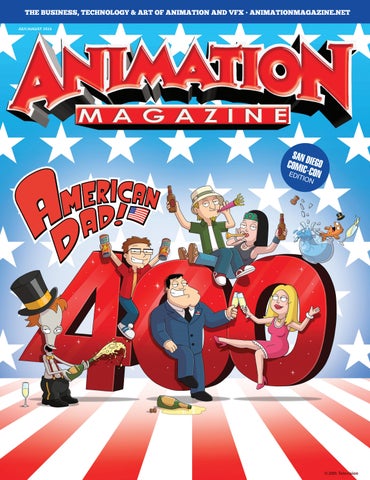
400 Episodes Later… - 30 American Dad! showrunner Matt Weitzman shares his thoughts on his popular show’s milestone episode and evolution over the past 21 years.
Tech Reviews - 46 Blender 5.0, Silhouette 2026, DaVinci Resolve 21.
ANIME
A Day in the Life - 48 We follow Eric Lewald and Julia Lewald, exec producers of X-Men ’97.
FEATURES
Beep Beep! He’s Finally on the Big Screen! - 10 Director Dave Green offers new insights about his hybrid feature Coyote vs. Acme which finally makes it to theaters thanks to Ketchup Entertainment which releases it in August. Lights, Cameras, Bananas! - 12 Oscar-nominated writer-director Pierre Coffin talks to us about Illumination’s summer blockbuster Minions & Monsters, which pays homage to Hollywood’s Golden Age. Island of Lost Pup - 16 Go behind the scenes of Paramount’s PAW Patrol: The Dino Movie, the third cinematic saga featuring Spin Masters’ popular pups directed by Cal Brunker. A Handmade Future - 20 We speak to three of LAIKA studio’s newest generation of makers about the studio’s eagerly anticipated fall feature Wildwood. Timeless Tips - 24 Pixar Veteran Andrew Gordon shares some evergreen advice on thriving in the animation business.
animationmagazine.net
Rebirth of a Tezuka Heroine - 32 How director Yūki Igarashi and his team at Twin Engine brought the classic manga to animated life in The Ribbon Hero. SHORTS
Days of Future Shock - 36 This year’s SIGGRAPH confab in L.A. offers a useful snapshot of how new technologies and innovations are impacting the animation and vfx worlds. Reflections of Racism - 39 First-time director Pola Maneli recalls the creative journey of making his SIGGRAPH prize-winning short, Apart. One from the Heart - 42 How 18 Months directors Paulo Garcia and Natália Gouvea turned a landmark story about gay parenthood into an award-winning stopmotion short.
CLOSING SHOT
COVER A: Batman : Caped Crusader, Season 2 premieres on Pr ime Video on Ju ly 31. COVER B: Ketch up Entertainmen t brings Coyote vs. Acme to U.S. theaters on Aug. 28. COMIC-CON Cove r: American Dad’s milestone 400th episode pr emieres on FOX in September. SIGGRAPH WrapAround: LAIKA’s Wildwood premieres in thea ters on Oct. 23.
July/August 2026
zine • 1
• Animation Maga
FROM THE EDITOR
Animation Keeps the Lights On! AS WE ENTER THE FIERY, DOG days of summer in Southern California and prepare for the two-headed confab beast of Comic-Con and SIGGRAPH in our backyard, animated movies continue to rule the box office. As veteran producer Bonnie Arnold (Toy Story, How to Train Your Dragon movies) reminded the audience at Annecy last month during her Women in Animation master class, “Our films make more money than their films. It keeps the lights on,” referring to how animated movies continue to perform strongly at the box office worldwide.” By the end of June, we had three stellar performers in the global top 10 chart (The Super Mario Galaxy Movie, Toy Story 5 and Hoppers with over $1.008 billion, $6 million and $372
million, respectively), with Illumination’s Minions & Monsters poised to make $170 million in its opening weekend. Let’s not forget Paramount’s PAW Patrol: The Dino Movie, which is bound to bring in lots of family fans to theaters when it opens on August 14. But moving beyond the simple mathematics of the appeal of animation in theaters, we must also celebrate the massive popularity of last months’ Annecy Festival in France. Not only was the event a huge hit in terms of its record number of attendees
— according to organizers, it drew 19,100 accredited animation fans and professionals from 118 countries — it also reflected the artistic health and diversity of styles, techniques and genres available in the medium today. Premieres and sneak peeks of features such as Netflix’s Ray Gunn and Steps, DreamWorks’ Forgotten Island, Pixar’s Gatto, WildBrain’s Snoopy Unleashed and LAIKA’s Wildwood kept everyone optimistic about the quality of animation coming out of studios. Meanwhile, international indies such as the top Cristal prize-winning The Violinist, Iron Boy, In Waves and Tangles are signs that more beautifully crafted projects could be strong contenders for the Best Animated Feature Oscar this year, along with the big titles from the majors. In this issue, we have great stories about midsummer’s hottest movies: Illumination’s Minions & Monsters, Paramount’s PAW Patrol: The Dino Movie and Ketchup Ent.’s Coyote vs. Acme. We go behind the scenes of the second season of Prime Video’s acclaimed Warner/ DC series Batman: Caped Crusader and catch up with Matt Weitzman, the showrunner and exec producer of FOX’s American Dad!. We also interview director Yūki Igarashi about his new take on Tezuka’s enigmatic heroine in The Ribbon Hero. All in all, a great way to plunge in the cool waters of animation when the temperature outside is too high to handle anything else!
Ramin Zahed Editor in Chief ramin@animationmagazine.net
QUOTE OF THE MONTH “I think that with all of the change that’s happening and all the things that are competing for people’s attention, now is a moment in time for everybody who loves cinema to really champion it. That means everything from making great movies to being enthusiasts for it and reminding people of just the joy and impact that you can have all gathering together.” ILLUMINATION FOUNDER AND CEO CHRIS MELEDANDRI 2 • Animation Magazine • July/August 2026
July/August 2026 Vol. 40, Issue 6, No. 360 info@animationmagazine.net President & Publisher: Jean Thoren Accounting: Jan Bayouth EDITORIAL Editor in Chief: Ramin Zahed Multimedia Editor: Mercedes Milligan Webmaster: Damaso Abrajan Asst. Webmaster: Lucy Abrajan Tech Reviews Editor: Todd Sheridan Perry Copy Editor: Jason Sanchez Contributors: Andrew Gordon, Trevor Hogg, Karen Idelson, Tom McLean, Charles Solomon, Jeff Spry, Ellen Wolff edit@animationmagazine.net ADVERTISING SALES Phone: 818-883-2884 Fax: 818-883-3773 Director of Advertising: Sam Selvaggio sam@animationmagazine.net EVENTS Director: Kim Derevlany kim@aniwmationmagazine.net CREATIVE Art Director: Francis Klaess ACCOUNTING/CIRCULATION Circulation Director: Jan Bayouth circ@animationmagazine.net TO SUBSCRIBE For the U.S., the rate is $60 for 1 year or $95 for 2 years. Rates for Canada and Mexico are US$75 for 1 year or US$120 for 2 years delivered by foreign airmail. Foreign rates are US$90 for 1 year or US$145 for 2 years delivered by foreign airmail. Please allow six to eight weeks for initial delivery. Also available in a digital version for $36 for 1 year or $60 for 2 years. Changes, renewals, cancellations, questons or comments: anics@magserv.com SUBSCRIPTION CUSTOMER SERVICE Animation Magazine PO BOX 202 Congers, NY 10920-0202 845-719-3124 animation@cambeywest.com ANIMATION MAGAZINE (USPS 015-877/ISSN 1041-617X) Published monthly except for combined issues of June/ July and September/October, by Animation Magazine 24943 Kit Carson Road Calabasas, CA 91302. Periodicals postage paid at Woodland Hills Post Office CA, and additional mailing offices. Postmaster: send address changes to mailing address: Animation Magazine 26500 W. Agoura Rd. Ste. 102-651 Calabasas, CA 91302 Prior written approval must be obtained to duplicate any and all contents. The copyrights and trademarks of images featured herein are the property of their respective owners. Animation Magazine acknowledges the creators and copyright holders of the materials mentioned herein, and does not seek to infringe on those rights. Animation Magazine ©2026 Animation Magazine
FRAME-BY-FRAME
ANIMATION PLANNER: JULY/AUGUST 2026 The Last Blossom
PAW Patrol: The Dino Movie
JULY
AUGUST
19
The SIGGRAPH conference & expo takes over the L.A. Convention Center this week, featuring the cutting-edge Computer Animation Festival. s2026.siggraph.org
20
Bobby and Connie finally become an official couple in King of the Hill S15! Hulu
21
GKIDS kicks off its Evangelion 30th anniversary celebrations with theatrical engagements for Evangelion: Death (True)² & Rebirth today and The End of Evangelion tomorrow.
23
San Diego transforms into the pop culture & fandom capital of the world during ComicCon this week.
26
Fresh chaos from the Rick and Morty universe unfolds in President Curtis, premiering tonight at 11:30. Adult Swim
3
Grab a Slurm and tune in for Futurama S14. Hulu
7
Ricky Gervais goes fully feral in the new adult animated comedy Alley Cats. Netflix
8
Studio Ghibli Fest continues with Tales from Earthsea back in theaters today, Only Yesterday (8/9) and Castle in the Sky (8/22). GKIDS/Fathom Ent.
Tales from Earthsea
FESTIVALS
14
Anibar Animation Festival Peja, Kosovo anibar.org
28
Anima Latina Buenos Aires, Argentina animalatina.com.ar
30
Hollyshorts Festival Los Angeles, CA hollyshorts.com
Preschool pup heroes are bark in action in PAW Patrol: The Dino Movie. Paramount/Spin Master At long last, Coyote vs. Acme brings hybrid live-action/ Looney Tunes mayhem to the big screen! Ketchup Ent. Baku Kinoshita’s feature debut The Last Blossom centers on a wistful ex-yakuza convict and his only friend, a talking flower. Two night engagement. GKIDS
Imaginaria Conversano, Italy imaginaria.eu PFCAT Portland, OR pdxfestofcinema.com San Diego Int’l Kids’ Film Festival San Diego, CA sdkidsfilm.org
Alley Cats
Coyote vs. Acme
Futurama
Turku Animated Film Festival Turku, Finland taff.fi
To get your company’s events and products listed in this monthly calendar, please email edit@animationmagazine.net King of the Hill
The End of Evangelion
4 • Animation Magazine • July/August 2026
President Curtis
animationmagazine.net
PRINT OR DIGITAL NEVER MISS AN ISSUE! ANIMATIONMAGAZINE.NET/SUBSCRIBE THE BUSINESS, TECHNOLOGY & ART OF ANIMATION AND VFX • ANIMATIONMAGAZINE.NET JUNE 2026
THE BIG SUMMER PREVIEW ISSUE!
THE BUSINESS,
TECHNOLOGY
& ART OF ANIMA
TION AND VFX
JUNE 2026
• ANIMATIONM
AGAZINE.NET
THE BIG SUMM PREVIEW ISSU ER E!
PIXAR’S TOY STORY 5 NETFLIX’S MATING SEASON THE BEST OF ANNECY GLOBAL SUMMER MOVIE SPOTLIGHT
LET TH $7.95 U.S. 0 9>
0
74470 82258
5
E GAM
ES BEG
LA CHOUET DRAGON STRIKER TE’S KICKS OFF ON DISNEY XD, DISNEY+ & HUL U
IN!
UETTE/ LA CHO ’S DISNEYN STRIKER O DRAG
T THE BESECY OF ANN ER L SUMM GLOBA SPOTLIGHT MOVIE
TOYS MEET TECH
IT’S PLAYTIME FOR PIXAR’S TOY STORY 5
You can now read all our daily news stories on our website in
10 DIFFERENT LANGUAGES!
Visit animationmagazine.net to check out this great new feature.
FRAME-BY-FRAME
The Must-Have List BOOKS
By Mercedes Milligan
The Art of Cartoon Saloon: 25 Years Explore the first quarter century of artistic achievement at Cartoon Saloon, the awardwinning Irish studio behind The Secret of Kells, Song of the Sea, Puffin Rock and Wolfwalkers. Through this art book, fans get a full color creative history of the four-time Oscar-nominated Kilkenny animation house, founded by Tomm Moore, Nora Twomey and Paul Young. Animation Magazine contributor Charles Solomon authored the book, which features a foreword by former President of Ireland Michael D. Higgins. Abrams / $50 Boisterous Beasts & Deadly Dragons: The Art of Nico Marlet This spotlight on the work of world-renowned character designer Nico Marlet is sure to illuminate animation fans and artists alike with its creative spark. Filled with beloved characters from How to Train Your Dragon, Kung Fu Panda, Balto, Duck Tales and Monsters, Inc. as well as never-before-seen personal illustrative and sculptural pieces, the book weaves Marlot’s art with quotes from industry luminaries like Pete Docter, Dean DeBlois, Jeffrey Katzenberg and Bonnie Arnold. Written by art book pro Tracey Miller-Zarneke with foreword by Jack Black and preface by DeBlois. Abrams / $40 6 • Animation Magazine • July/August 2026
The Art of Marvel Animation’s Your Friendly Neighborhood Spider-Man Explore the popular show’s unique fusion of vintage comicbook aesthetics and a modern vision of Peter Parker’s New York in this lushly illustrated collector’s item. The book, penned by Animation Magazine’s Ramin Zahed, is packed with photos and interviews with key creatives alongside development sketches, storyboards, character and costume designs, animation cels and other production goodies. Creator/showrunner Jeff Trammell wrote the foreword, with intro by EP Brad Winderbaum and afterword by supervising director Mel Zwyer. Abrams / $50 Voice-A-Versa: Finding My Voice(s) Behind the Mic One of the most accomplished, admired and quotable voice actors working today, Billy West’s new memoir delves into his circuitous route to Hollywood’s recording booths and his remarkable life in show biz, while not shying away from the darker periods and childhood trauma that molded him into the memorable performer known to fans across toondom. From Stimpy to Bugs Bunny, Doug Funnie to Woody Woodpecker, Philip J. Fry to Popeye, chances are West’s voice has been a part of your life, and now he shares his with us. Abrams / $30
100 Essential Anime: A Definitive Guide to the Most Influential Anime Series Ever Made Spanning the early 1970s through to the 2020s, this hardcover dive from AnimeLand magazine offers a history of contemporary episodic anime through a curated tour of the most popular and influential titles, including landmarks like Dragon Ball Z, Pokémon and My Hero Academia. Through dedicated and well-illustrated entries, the book explores the themes and artistry that make each stand out, and seeks to answer questions like, why is Neon Genesis Evangelion so popular? And, what made Knights of the Zodiac so revolutionary? Insight / $40 Final Space: The Final Chapter After working for two years to secure the license for his hit animated series Final Space, creator Olan Rogers has finally been able to deliver the epic conclusion to fans of the canceled show, illustrated by Aussie artist Daz Tibbles. This self-published graphic novel, which runs to 570 pages (much more with extended chapters) picks up where the show left off, throwing readers into a critical endgame as Team Squad are all that is left between the escaped Invictus and the death of the universe. finalspaceends.com / $125 animationmagazine.net
All You Need Is Kill A time-twisting sci-fi story about destruction and resurrection. Bonus features: Director (Ken’ichiro Akimoto) scene breakdowns, director & cast discussion, storyboards with director commentary, art gallery, teasers & trailer. Shout! / $30 BD Genndy Tartakovsky’s Primal: The Complete Third Season Spear is shockingly resurrected in a new form, and battles through savage landscapes towards an emotional, explosive reunion. Warner / $30 Masters of the Universe: Revelation/Revolution SteelBook Join He-Man and his allies in the battle for Castle Grayskull as brought to life in Kevin Smith’s animated saga. Mill Creek / $48 Colorful Stage! The Movie: A Miku Who Can’t Sing This Hatsune Miku anime follows high school students finding their true
feelings through music in an alternate world called Sekai. Bonus features: 20 after show concerts, unit 2D music videos, non-credits opening, teasers & trailers. Isla Monstro: Collector’s Edition A washed up loser turns a secret government island full of mutant super soldiers into a tourist destination. Bonus features: Commentary with director Steven Shea, lead James Schrader & composer Rob Reider; How We Made an Indie Animated Feature; “The Love Theme from Isla Monstro” sing-along MV; Comic-Con 2024 panel; Nightmare Weekend 2025 panel; deleted scenes; gag reel; trailers. Abyssmal / $25 BD Hotori: Simply Wishing for Hope Ryousuke Takahashi’s poignant anime exploring friendship, loss and memory gets a fresh 4K restoration and new English dub. MediaOCD / $20 BD Dastardly & Muttley in Their Flying Machines: The Complete Series Dick Dastardly and his canine co-pilot Muttley plot to stop that pigeon aboard their World War I flying machines in this HannaBarbera spin-off of Wacky Races. Warner Archive / $25 BD
SUMMER FUN Families can fly in style with Away Travel’s line of Toy Story 5-inspired kids’ carry-on suitcases, with designs based on Buzz, Woody, Jessie and the claw machine aliens. (awaytravel.com / $278) And don’t forget to pack your favorite TS5 toys, like Hasbro’s Bop It! Buzz Lightyear Edition game figure. ($20) Gru’s henchmen are taking over Hollywood (and your credit card statement)! BoxLunch has launched a fun collection of apparel, accessories and goodies for the debut of Minions & Monsters (youth tee, $21), where you can also find new Funko Pop! figures inspired by James, the Minion artiste, and new adorable villain, Goomi. ($12) A full year later, the world is still obsessed with KPop Demon Hunters. Why not build a tribute to its golden success with the new Derpy Tiger and Sussie Bird LEGO Set? (lego.com / $70 pre-order, ships Aug. 1) It’s always good to spend time with Aang and the bender gang; the new fast-paced, 1v1 battler Avatar Legends: The Fighting Game releases this month from Gameplay Group and Paramount Games across Microsoft Store, PlayStation Store and Steam. ($30 / $50 Deluxe Edition) animationmagazine.net
July/August 2026 • Animation Magazine • 7
DISCS
A Magnificent Life Oscar-nominated director Sylvain Chomet brings to life the story of one of France’s greatest storytellers, writer and filmmaker Marcel Pagnol. Sony / $31 BD, $24 DVD
BEEP
BEEP
FEATURES
HE’S FINALLY ON THE BIG SCREEN
DIRECTOR DAVID GREEN LOOKS BACK AT THE ROLLER-COASTER RIDE OF BRINGING THE POPULAR LOONEY TUNES CHARACTER TO THE BIG SCREEN IN COYOTE VS. ACME. BY JEFF SPRY
C
oyote vs. Acme’s somewhat rocky road to the silver screen is nearing the finish line this month. The big kid in all of us is thrilled that Looney Tunes’ self-proclaimed genius, Wile E. Coyote, will soon be presenting his case against Acme Corp. in the new live-action/animation hybrid feature directed by David Green. The high-energy film stars Will Forte as an uninspired Albuquerque attorney who files a lawsuit for Wile E. against the notoriously shoddy supplier and their defective product line so often employed by our Carnivorous Vulgaris predator to try and ensnare the skinny bird Road Runner in the Southwestern desert. Co-starring John Cena, Lana Condor and Luis Guzmán (and the voices of Jeff Bergman and Eric Bauza), it’s an old-fashioned charmer that should delight children, their families and anyone who grew up watching Looney Tunes cartoons. “When I first started pitching this film and talking about it, I was really interested in extremes and how far we could push [the] tone,” Green tells Animation Magazine.“We wanted to obviously keep the cartoon joy and ebullience of the Looney Tunes but also counterbalance it with courtroom thrillers and courtroom dramas that would act as a kind of grounding agent.”
in the movie version. The gold standard to me in hybrid animation is Who Framed Roger Rabbit. One of the things that makes Roger Rabbit work so well is that balance of stupid and smart, that total mixture of darkness and brightness. The cartoon reality mashed up with the noir universe of that movie was hugely inspirational.” Since the Coyote and the Road Runner first tangled in the Chuck Jones-directed 1949 Looney Tunes classic Fast and Furry-ous, this entertaining pair have been elevated to the vaunted position of all-time favorites, featured prominently in nearly 50 different cartoon shorts over the decades. Green says he loves the final cast of characters that ended up in the project.“In making this movie I’d felt that they’d made several Looney Tunes movies that were ensemble films, that were really about a giant cast of characters who travel and participate in events almost as one body,” the director notes. “At times they even acknowledge themselves as the Looney Tunes and they have an awareness of who they are as a gang. I felt like they had made The Avengers version of Looney Tunes several times, but they had not ever made the Iron Man version of Looney Tunes. What we were really excited to do was to tell one character’s story as a character study and deeply get into what Wile E. Coyote wants and feels and thinks, and study the The Troubled Road to Theaters way this character ticks.” Back in 2023, it looked like the curtain had come down for the In designing the movie and closely working with screenwriter Samy movie when Warner Bros. Discovery put the finished project on the Burch, Green and his creative crew looked at the entire Looney Tunes chopping block as a $30 million tax write-down and seemingly shelved ensemble as more of a collection of characters who could be cast indiit permanently without a streaming or theatrical release. Then in 2025, vidually with specificity more in line with what The Muppets had done. Ketchup Entertainment (The Day the Earth Blew Up) agreed to acquire “When you see a Muppet in one of the Muppet movies, they might and distribute Coyote vs. Acme for $50 million in a triumphant deal that carry with them their character traits, just like an actor would walk delivered instant smiles to the animation faithful worldwide. through the door with their own personality,” adds Green. “We could “Tone was one of my biggest buy-ins, and I was aware of the Ian Frazier then cast that actor into a role that would service the story. Daffy is New Yorker article called Coyote v. Acme, which is about Wile E. Coyote still somewhat out of his mind, but he’s perfect in his role in the movie suing Acme,” Green explains. “That piece, which was heavily satirical, where, plot-wise, he has to be out of his mind because of what hapsuper smart, dry, funny and straightforward, was something that I was pened to him. So that was really our goal, to cast the Looney Tunes in hugely drawn to. I felt like the article was laugh-out-loud funny, and fresh and surprising cameo roles that serviced the story and the plot.” I wondered how we could honor that same straight-faced approach Always an Optimist The director points out that Wile E. is defined by the fact that every Chasing the Dream: Looney Tunes’ famous wild canine brings his case single morning he not only wants and expects to chase the Road against the mail-order Acme Corp. in David Green’s eagerly anticipated Runner, but also thinks he’s going to capture the bird and make Road summer movie Coyote vs. Acme, which was saved from sitting in the vaults by the heroic Ketchup Entertainment. Runner stew that night. “That goal and singular focus makes him the
animationmagazine.net
July/August 2026 • Animation Magazine • 9
most optimistic character I can think of, and not only in the Looney Tunes world,” explains Green.“The movie for us, thematically, became about the spirit of the chase and about Wile E.’s want and his passion really being chasing. Once we started talking about that, it cracked open a larger nugget that ended up applying to all of the characters. Like what does Kevin Avery, played by Will Forte, want and can his want be cracked open, and what is he chasing?”
what Wile E. would be doing in the scene in physical space. He was there for eyeline and interaction with the actors. Then in post, we did the whole process again with a sketch-vis process with 2D artists drawing on now our live footage and informing posing, body language and expression. From there, we brought it to our 3D team at DNEG, who had a brilliant team of animators. They brought those poses and those expressions to life, of course honoring
“What we were really excited to do was to tell one character’s story as a character study and deeply get into what Wile E. Coyote wants and feels and thinks, and study the way this character ticks.” DIRECTOR DAVID GREEN For Green, Coyote vs. Acme’s animation development starts and ends with a 2D process. “Because Wile E. Coyote doesn’t exist, producer Chris DeFaria said early on in the process that he’s the one actor that’s not going to show up and be able to have a conversation with you,” he recalls. “He recommended this story process where we draw out the entire movie in animatic and previs form and draw every single character. I’d have meetings with my story artists where they’d draw Wile E., and we’d have conversations about what he’d want and think and feel in each scene.” Green adds,“He’s a nonverbal character so he really expresses himself through expressions and body language. From there, we shot the film with a puppeteer who showed up on set, Dave Barclay, who’d worked in the [Jim] Henson universe for years and years and worked on Roger Rabbit. He was there to show the actors 10 • Animation Magazine • July/August 2026
all of the expressions and posing we’d seen in the original legacy cartoons.” The team at DNEG provided their broad range of professional skill sets to the project, which included lighting, shadow, compositing and emotional interactivity. Green offers, “What you’re seeing in the finished movie is a combination of techniques. Some of them are pure 2D animation. Some of it is 3D that’s been guided by a sketch-vis process, highly sophisticated compositing tools that help Wile E. sit in these scenes and have his lighting feel interactive, and then finally film grain on top of the whole thing to make it feel cohesive.” A long-standing tradition in Looney Tunes cartoons is the cameos from celebrities like Clark Gable or Bing Crosby who would be recognizable to audiences catching a double feature in the movie palaces of the ’40s and ’50s. Actor Peter Lorre’s distinctive likeness has
a history of fun roles in these older cartoons, so here he was a natural fit to portray Acme’s head scientist. Celebrating a Deep-Cut Character “He was part of the casting process,” Green adds.“I think we’d stumbled across Looney Tunes shorts where Peter Lorre was in a lab coat or dealing with Gossamer and at certain points kind of a doctor. We were trying to figure out who would be the ultimate Acme whistleblower, and we ended up on him because we grew up with animated Peter Lorre as a deep-cut character. He had cameo roles in Tiny Toon Adventures and Pinky and the Brain. I even have a book on my shelf called The Animated Peter Lorre that’s filled with a list of all the cartoon characters he’s had over time. I hope one day they update that book with his inclusion in Coyote vs. Acme.” When Green looks back at the roller-coaster journey that Coyote vs. Acme endured, there’s a supreme sense of relief and gratification for his film to now be getting the showcase it deserves. “This is an absolute surprise blast and miracle that this has happened and that Ketchup has come to this movie’s rescue,” he says. “It really speaks to the power of the audience, and it’s incredible that so many people rallied for the project and spoke out on our behalf. It’s really a miracle and I can’t believe it. I feel lucky to have been able to play in the Looney Tunes sandbox. These are things that I grew up watching and loving and being a fan of. I love the subversive, irreverent, sarcastic voice of what Looney Tunes has always been. I was thrilled to play with all those toys.” n Ketchup Entertainment releases Coyote vs. Acme in theaters on Aug. 28. animationmagazine.net
THE GLOBAL ACCELERATOR FOR KIDS AND FAMILY CONTENT.
10 -11 October Palais des Festivals, Cannes. More information www.mipjunior.com
12 • Animation Magazine / July 2026
animationmagazine.net
U FEAT
RES
Oscar-nominated writer-director Pierre Coffin takes us behind the scenes of Illumination’s summer blockbuster Minions & Monsters, which pays homage to Hollywood’s Golden Age. By Karen Idelson inema’s most adorable pill-shaped henchmen will paint the big screen canary yellow this summer when they return with a fresh story that takes audiences back to the golden era of filmmaking. Directed by Pierre Coffin and written by Coffin and Brian Lynch, Minions & Monsters is a prequel that follows friends James and Henry as they try to summon monsters to make a great movie. The film brings together Coffin, Lynch and longtime Minions producer Chris Meledandri as well as producer Bill Ryan (The Super Mario Bros. Movie). John Powell, a two-time Academy Award nominee for his work on How to Train Your Dragon and Wicked, scored this installment of the Illumination franchise. Altogether, there have been six feature films across the Minions and Despicable Me universe since it debuted more than 15 years ago. It’s the first animated franchise to cross the $5 billion mark, grossing approximately $5.6 billion worldwide. An Offer He Couldn’t Resist Coffin, who directed three Minions movies and also provides the voices of the creatures, was not immediately interested in directing another film in the series. But Meledandri’s pitch convinced him to jump back into the world of the Minions. “Chris [Meledandri] called me about making this movie, and animationmagazine.net
I was on the fence [about] making a movie with Minions again because I had done my trilogy,” says Coffin. “Chris told me he thought I would say no, but he had pitched me the idea of the Minions making movies and making a movie about monsters that they would summon or create. The monster would be a danger to the Minions and to the Earth and to the universe, and then the rest of the movie would be about them trying to save the world, basically.” The talented French director had a lot of questions and decided that if the movie were to be set in the Golden Age of cinema, it would be wonderful. “So, as soon as Chris ended his pitch, I was thinking about all the things we could do, and then he said sort of yes to everything,” he recalls. “He wasn’t expecting it. And I wasn’t expecting to be so excited. Then, I asked him if he would mind if I wrote just a quick outline, and three weeks later, I just sent him the building blocks of what the movie is right now. After reading it, he told me, ‘OK, let’s go.’” Coffin was inspired by the idea of the Minions inhabiting a beloved era in 1920s Hollywood and then struggling as silent films become “talkies,” which leads to their undoing because audiences can’t understand their signature gibberish. The movie Golden Silence: The new installment in the Minions saga finds the lovable little guys working in Hollywood, making silent pictures in the 1920s, allowing the filmmakers to pay homages to the comedies of Charlie Chaplin, Harold Lloyd and Buster Keaton. July/August 2026 • Animation Magazine • 13
FEATURES contains many Easter eggs and references to memorable silent films. And while the director loved the idea of having his stars run through a less technologically advanced era, current cutting-edge tech is what made this movie possible. A three-year production timeline along with advances in rendering power freed the director to push his vision and to place dozens of these beings onscreen.
“We’re really at a time where I think anything is possible. In the past, I wouldn’t have tried to have so many Minions in the chase sequences, but now we can.” WRITER-DIRECTOR PIERRE COFFIN
“We’re really at a time where I think anything is possible,” says Coffin. “In the past, I wouldn’t have tried to have so many Minions in the chase sequences, but now we can.” With the broad appeal of these stories, it’s no surprise that the film also attracted a large
group of A-list actors. movies and monster films of the past. Their The voice cast includes Allison Janney, favorites included The Day the Earth Stood Christoph Waltz, Jeff Bridges, Jesse Eisenberg, Still, Forbidden Planet, The Blob, The Fly, Invaders Zoey Deutch and animation icon Trey Parker, from Mars, It Came from Outer Space, Earth vs. co-creator of South Park. The film also features the Flying Saucers, This Island Earth, When Bobby Moynihan, Phil LaMarr and, Worlds Collide, Plan 9 from Outer drumroll please, Star Wars helmer Space and Godzilla. George Lucas! After looking at all those films Parker impressed Coffin with his for inspiration, they came up with enthusiasm for voicing the film’s Irene — perhaps the most fearvillain and being willing to contort some of the monsters. She also himself to get the voice the characpresented the most challenges. As ter needed. Despite being a villain, a giant, orange, gelatinous creaChris Meledandri, his cute appearance required a producer ture that oozes her way through kind of sinister intent cloaked in the film and even absorbs James toddler-like pronunciation. and Henry at moments, she was not easy to “When we had the idea to ask Trey [Parker] bring to life. to play [the villain Goomi], we wanted him to “It took us a year,” says Coffin. “We had to be an evil villain but in a very sweet and cute keep trying things. There was a long time way, and it was funny because he delivered all when we weren’t sure how we would manage those lines with all his fingers in his mouth to have her do the things we wanted to show so he could get the right sound for Goomi’s in the film. But the last year of making these voice,” laughs Coffin. “It was a fun image of films is always a panic.” him doing that to make the voice sound the While Irene is a technological wonder, Lynch, way we wanted it to.” a veteran of many Minions and Illumination projects, grew most attached to Goomi. For Beautiful Monsters him, it was about the contrast between his The villains of Minions & Monsters make evil intentions and soft, rounded appearance. for some of the most interesting scenes in “No offense intended to the other villains the film. Their appearances took months to that have been in the other movies or this perfect and many animators to complete. But one, but this is a villain that is as appealing Coffin and Lynch love what emerged. as the Minions,” says Lynch. “I think he’s so Before they finalized their approach to the sweet and so funny. The goal for Pierre is to monsters, they revisited classic science-fiction make the make the audience want to watch
Goomi as much as they want to watch the Minions. I hope we succeeded. Kids seem to like Goomi already, which is great. Making Goomi as interesting as the Minions, that was my whole purpose. When the villains are human, they’re just not as much fun as Minions. But with this it’s different because we have these monsters that have been summoned. So the fact that we have Goomi and Irene, [who] are just full-on monsters, and we worked to make them appealing characters, even as they’re destroying the world, I think this is what will make it fun for the audience. The fact that they’re monsters who look different and have these different personalities means kids aren’t going to be bored, the audience isn’t going to be bored. It’s hard to compete with the Minions because they’re always so much fun to watch.” Friends to the Bitter End! Fans of the previous films may remember Kevin, Stuart and Bob as the Minions who always lead the action. But this time the filmmakers chose to focus on two new Minions, James and Henry, who share a passion for filmmaking. Their arguments and disagreements can be as big as you’d expect between two Minions but, in the end, they come back to supporting each other. And that’s all by Coffin and Lynch’s design. “The core of the movie for me is this friendship between these two guys,” says Coffin. “And Brian [Lynch] and I treated it like this
“No offense intended to the other villains that have been in the other movies or this one, but [Goomi] is a villain that is as appealing as the Minions.” WRITER BRIAN LYNCH
sort of romantic buddy comedy thing where they meet, they are the best buddies, and then they become real friends, and then the passion of one for making a movie a certain way just kills that friendship. But they really care about each other, so they get together again, and eventually they save Earth and the universe. This kind of friendship is the sort of
thing that everyone wants, every kid wants to find. When you have a friend who cares about you and accepts you for who you are, you have everything.” n After premiering at Annecy, Universal/ Illumination’s Minions & Monsters was released in theaters on July 1.
FEATURES
Director Cal Brunker and his team unleash the popular pooches’ third big-screen adventure, PAW Patrol: The Dino Movie. By Ramin Zahed f you were to dream up a perfect storyline for young moviegoers this summer, you really couldn’t do better than “the PAW Patrol rescue pooches visit a mysterious dinosaur island!” That’s precisely the premise of the third chapter in the PAW Patrol cinematic saga, which opens in theaters on Aug. 14. Directed and co-written by the talented Cal Brunker, who also helmed the two previous features, PAW Patrol: The Dino Movie finds series regulars Chase, Marshall, Skye, Rubble, Rocky,
Prehistoric Playmates: PAW Patrol: The Dino Movie finds the popular canines stranded on a mysterious island, where they meet some new friends. The voice cast includes Paris Hilton, Jennifer Hudson, Terry Crews, Snoop Dogg and Bill Nye, and the soundtrack features a new song by the Backstreet Boys!
Marshall, Zuma and Everest on an exciting adventure after their ship gets lost in a storm and they discover a lost world of dinosaurs. Brunker’s longtime collaborator Bob Barlen co-wrote the screenplay, which is based on the hit preschool animated show created by Keith Chapman and introduced in 2013. The voice cast includes Carter Young, Mckenna Grace, Terry Crews, Meredith MacNeill, Ron Pardo, Jennifer Hudson, Rain Janjua, Hayden Chemberlen, Fortune Feimster, Jameela Jamil, Bill Nye, Paris Hilton and Snoop Dogg.
E!
SKY Perseverance Pays Off “I think this one is the best of the three movies,” Brunker tells Animation Magazine in a recent interview. “It’s also my favorite because I’m somebody who has loved dinosaurs all my life. It’s been a dream to get to make a movie with the pups and dinosaurs together.” The director, whose credits also include The Nut Job 2, Escape From Planet Earth, Son of Bigfoot and Bigfoot Family, explains that each PAW Patrol movie is really based on a different genre. “They each give us a new playground to play [in],” he notes. “The first movie was a trip to the city, while the second feature was a superhero movie, and now, with the third one, we have a dinosaur/jungle theme going on. Obviously, the show has played around with Rex and dinosaurs before, so when that possibility came up I just jumped at it.” The new adventure began about three and half years ago, when Brunker and his team at Montreal’s Mikros Animation, which also worked on the previous movies, got the greenlight. “We have an incredible team at Mikros, and they’re my favorite studio in the whole world to work with,” says Brunker. “I think this is the best work they’ve done, and everyone’s really proud of how the movie looks.”
One of the team’s biggest goals was making the jungle backgrounds look dynamic and not simply generic and noisy like in many other children’s animated fare. “We didn’t want it to look like flat wallpaper, so we worked very closely with our production designer, Peter Chan, and our art director, Pierre-Antoine Moelo, for a more designed and intentional feel,” says Brunker. “When you look back at some of the classic Disney 2D jungle backgrounds, you notice that they always had these great shapes. They weren’t just this mess of a repetitive green background. We had this big technical ask from Mikros to create a moving jungle. They really bent over backwards to make the whole setting look really alive and
immersive so it really pulls the audience in.” Designing the giant Jurassic beasts was another major challenge for the filmmakers. “As someone who has always loved dinosaurs and grew up loving Jurassic Park, I knew we needed to make dinosaurs that fit in the world of the pups, but I also wanted them to be majestic. We needed to keep that sense of wonder for kids, so they couldn’t look goofy and cartoony. Rhubarb, the baby pink dinosaur, is fun and playful, but the bigger ones are not expressive with their faces in a cartoony way. They needed to be grounded and believable so that we could hang on to that sense of awe and wonder that you get from dinosaurs.” Art director Pierre-Antoine Moelo, who also worked as a visual development artist on the first film, says one thing that sets the dinosaurs in this feature apart from other movie depictions is their color. “The dinosaurs in Jurassic Park are mostly gray and a bit more muted in terms of colors and tint,” he points out.“One of my main focuses on this movie was to find interesting colors for them. They could
!
ARB
B RHU
LEARNING TO ROAR
One of the big scene-stealers of the third movie is a very cute pink dinosaur named Rhubarb. “He is certainly a favorite character of mine,” says director Cal Brunker. “We wanted to explore what would happen if a puppy got a puppy! So, in this case, it’s the team’s Marshall meeting this new baby T. rex, who is very playful, but he hasn’t found his roar yet. So, that’s a bit of his journey as the pups try and teach him how to road. I won’t give away too much, but Rhubarb is a ton of fun, and he and Marshall have a very heartfelt relationship.”
animationmagazine.net
July/August 2026 • Animation Magazine • 17
be bright and colorful, but not too much because we didn’t want them to overtake the main characters. We have about 10 different species, but each one had two or three variances and different colors, which helped us populate the island. In terms of design, we had to include enough details and complexity for their skin pores and scales to create believability because they are huge characters and take a lot of space on the screen.” Brunker says the studio used a mostly Maya-based pipeline. “We used that in combination [with] other software that helped us do all kinds of cool things like scattering the moss and flowers on the jungle floor,” says the director. “We were able to [do] things in The Dino Movie that we couldn’t have done on the previous two. Not only is it the advancements in technology, it’s also the ability of the crew. Our core team has been
together through multiple movies, so we’re getting better and able to move more efficiently and getting more of those dollars on the screen instead of bumping heads. We’re all pulling in the same direction.”
“I would watch the show with my own kids and could see how engaged they were by these characters. What I love about PAW Patrol is that it’s a really non-cynical, heartfelt family property. In the movies, we try to offer some kind of takeaway for the kids that also resonates with adults.” WRITER-DIRECTOR CAL BRUNKER
The Parent Trap When our conversation turns to the enduring appeal of the animated dogs, Brunker says that he used to watch the show with his kids, who were two and five when he began working on the third movie. “I could see how engaged they were by these characters,” he recalls. “I understood, from watching it with them, how to approach them. What I love about PAW Patrol is that it’s a really non-cynical, heartfelt family property. In the movies, we try to offer some kind of takeaway for the kids that also resonates with adults. The third movie is about the power of perseverance. We have Marshall, the clumsy pup who never gives up. I tell my own kids too that they have to learn to try stuff, and when they get things wrong, they have to keep going.” Brunker says his favorite feedback about the movies has come from parents who went in the theater expecting to be checking their phones. “Then they actually get swept up in the story,” he says. “And they’re like, ‘Wait! Why am I emotionally moved by this?’ That means we’ve done our job!” n Paramount releases PAW Patrol: The Dino Movie in theaters nationwide on Aug. 14. animationmagazine.net
NOV. 16-18, 2026 THE GARLAND, NORTH HOLLYWOOD CALIFORNIA
A FUN GATHERING OF THE TOP CREATIVES IN OUR INDUSTRY!
FEATURES
A HANDMADE FUTURE As LAIKA begins the countdown to the Oct. 23 global release of its biggest film yet — Wildwood — we spoke to three of the award-winning studio’s newest generation of makers.
A
nyone who works in animation knows the personality: the person who must create something with their hands. Whether artists, fabricators, model makers, hair specialists, pattern makers — these are individuals whose need to make something from nothing took hold of their souls long before they joined LAIKA. But now, they have the opportunity to bring that compulsion to create to a studio and an artistic community dedicated to human-made cinema. We recently spoke with three of the Portland studio’s new generation of creative animators. LAIKA’s sixth feature Wildwood will begin its run in theaters on Oct. 23.
20 • Animation Magazine / July/August 2026
animationmagazine.net
Guillem Ignasi BauzA Cabot / Stop-Motion Animator Time at LAIKA: I worked on Wildwood for three years and 10 months. When did you first realize you wanted to make things? Growing up, I was always drawn to making little things, whether it was building miniatures, LEGO sets, or sculpting little characters out of clay. I was also the kid who took apart small items, like pencil sharpeners and Tipp-Ex rollers, just to see how the mechanics inside moved. Nowadays, I am still very into creating little guys with crafts like whittling and wood carving. When I discovered stop motion, it felt like the next level — giving all those characters life, and making them move, breathe and dance. What do you love about Wildwood? What I love about Wildwood is how layered and complex it is. The film moves between fragile, emotional moments and huge, epic battle sequences, showing that when it comes to the people we love, we are capable of both the best and the worst. What spoke to me personally is the idea that the biggest risks we take in life are often driven by love. Most of us have done something we never thought
we would do for the people we care about. I think everyone will find something in this story that resonates with them. Why do you think the movie is going to raise the bar for animation? This movie is going to raise the bar in a big way. It’s hard to believe that most of what you’re seeing on screen was created through stop motion. The level of detail is extraordinary, and the film represents the work of hundreds of some of the most talented artists in the world. On a personal note, I love that LAIKA is back after years of quietly working on something so ambitious, and with a darker story. I’ve always enjoyed the darker edge in LAIKA’s films, and Wildwood embraces that spirit. It’s a film full of contrasts — just like life — and I don’t think it will leave anyone indifferent. The most challenging aspect of this project: One of the biggest challenges was simply the scale of the production. Maintaining such a large crew for so many years while working at the highest level of detail is incredibly demanding and exhausting, but we all believed in the project and made
it happen. For me personally, the biggest challenge was animating a character whose puppet was smaller than my pinky with my fat animator fingers. The animated movie or TV show that changed your life? I have many favorites, but I remember watching the credits of Wreck-It Ralph and realizing for the first time that a movie like that was the work of hundreds of people. I thought, “Wait, maybe I could do that too!” Later I realized that computers and I would never be best friends, so I decided to play
with puppets instead. What is the best part of working at LAIKA? The best part is being surrounded by incredibly talented people every day. It’s hugely motivating and constantly pushes you to do your best work. What I love most is that many people have amazing talents completely unrelated to their role at LAIKA. You’ll find painters who are incredible musicians, VFX artists who write novels in their spare time, and even an animator whose hobby is making what might be the best ice cream in the world. n
Tilly Fidler / Stop-Motion Animator Time a LAIKA: Four years When did you first realize you wanted to make things? My parents are both creative and I was inspired by that from a very young age. My dad is a hat designer, and I grew up with him working amongst towers of hats and piles of ribbons at the table at home. My mum, a textile designer, will always have multiple extravagant creative projects on the go simultaneously. As an artistic family, we’ve spent a lot of time animationmagazine.net
making things together ever since I can remember; drawing, painting, making our own little toys and costumes, and playing musical instruments. I also danced and was excited by theater and performance. What do you love about Wildwood? How did the project speak to you personally? I love the design and atmosphere of the world. Wildwood is such a rich feast for the eyes. It’s been a privilege to witness July/August 2026 • Animation Magazine • 21
FEATURES
and contribute to this film being meticulously constructed at the studio. The tone feels very much like stories I would get drawn into as a kid, and being able to live on a stage that is a miniature version of that world for days or weeks as I animate a shot has been truly magical. While animating I would often find music or soundscapes to listen to that further heightened the sensory experience of working on these beautiful sets. In a way, I feel a love and protection of the puppets we work with because, as animators, we really have to empathize with our characters. We tend to develop a connection with them that extends outside the barriers of the narrative in order to produce believable performances. I’m an older sister, like Prue in our movie, and am very protective of my little
sister. I understand the feeling of responsibility towards a loved one, especially a younger sibling. She’s my best friend. I could also empathize with Prue entering new and unknown challenges in life. Wildwood was my first job on a feature film and walking into LAIKA for the first time four years ago was as intimidating as it was enchanting. Having these experiences in mind while animating and filming live-action videos (LAVs) as Prue meant I could get into her headspace across the emotional arc of the film. Why do you think the movie is going to raise the bar for animation? As a stop-motion feature, it is a huge project. The ambitious scale of the film has meant that LAIKA has had to push the boundaries of what is possible in the medium across all departments. The animation team
specifically was creating increasingly subtle and naturalistic animation throughout the project. I was constantly aware that the level of artistry demanded from Wildwood is beyond anything LAIKA has done to date. What was the most challenging aspect of this project? Wildwood is the first feature film I have worked on, so it has been a huge learning experience for me. A more specific aspect that comes to mind is the Prue puppet’s hair and costume. They are all absolutely stunning and crafted so that they are animatable, but it is tricky to give them weighted and believable performances in straight-ahead puppet animation. I learned so many tips and tricks from fellow animators to garner more control of these elements.
The animated movie or TV show that changed your life? It’s hard to choose just one. The animated short film Duet, by Glen Keane, was one of the first films that made me want to animate. It broadened my idea of what animation was and could be, and got me excited about the potential of communication through feeling, movement, energy and visual design. Best part of working at LAIKA: The amazing people I work with. Everyone here is so excited about art, what makes something work, and diving into the minute details that go into the art form of animation, particularly stop-motion animation. Also, the incredible tools available to artists here to push ourselves and create our best work. It’s very special to have those resources. n
Tom Carey / Stop-Motion Animator
Time at LAIKA: Four years What do you love about Wildwood? Moving from London to Portland to work on Wildwood was quite a big leap for me, coming straight out of university. I loved working on the project because I was exploring both the fantastical and real-life versions of Portland
22 • Animation Magazine • July/August 2026
simultaneously. A lot of my very first shots on the film were set in downtown Portland, so I was introduced to all the best parts of the city through my work in miniature. Being so far away from my family was hard, but the film taught me how I can learn to find a new sense of home when exploring a brand new place! Why do you think the movie is going to raise the bar for animation? It is clear that no stop-motion feature film has been created on this scale before, but I think it’s also the technical feats of this movie that make it something really special. Just the ingenuity of The General golden eagle puppet alone is something that has massively moved the art form forward. What was the most challenging aspect of this project? For me it was fighting the imposter syndrome. I came to the studio as a fresh intern and was surrounded by the world’s best animators, so finding ways to grow in confidence and doing my best to meet the
high bar was definitely a journey! The animated movie or TV show that changed your life? Fantasia (1940) — to this day it remains one of my biggest inspirations What is the best part of working at LAIKA? The sense of community. I got to meet so many incredible and supportive people from all over the world, who shared the same passion and love for stop motion. What were you making as a child? I was always eager to create characters and stories as a kid. I was obsessed with Bionicle action figures and would take them out into the garden to make little short films with my digital camera. When I was in my final year of elementary school, we did a class project using plasticine to make short claymation films. I distinctly remember feeling so excited by how easy it was to sculpt a character and make a whole movie with just a series of still images: It was this moment that sparked my curiosity and passion for stop motion. n
animationmagazine.net
THE GATEWAY TO GLOBAL STORYTELLING & MEDIA
12 - 15 October 2026 Palais des Festivals, Cannes. In the business of building businesses
More information www.mipcom.com
FEATURES
Pixar Veteran Andrew Gordon offers some evergreen advice on thriving in the ever-changing world of animation.
TIMELESS TIPS! When asked to give five evergreen tips for a solid career in animation, I had to really think hard as the world of animation is so different now from when I entered it almost 30 years ago. But I do still think that the same principles apply and are, in essence, timeless. When I began my career, or more importantly when I was learning animation, mostly there were books. Ollie Johnston and Frank Thomas’ The Illusion of Life was a sort of bible, containing so many things that helped me understand how to animate. I would say that from my 20 years at Pixar and many other years working other places, I learned a few things. So here it goes:
1. BE A SPONGE
When I first came to Pixar, I was in awe of the legendary place it already was. It was a smaller place, and it was very much a place you could tell attracted the best. So I, of course, very quickly found out who the best animators were, and I bothered them. I would ask them to look at my work, to tell me how they did a shot. I would even interview them, which led me to start a podcast at Pixar called Spline Doctors. I would sometimes even open their animation files to see how they structured their work and look under the hood at anything I could learn. So, the point here is, you need to constantly find the people around you who are better than you. It may be story, it may be animation or polish. They all have their superpowers, and you should steal it all. I do realize that even though I sponged off some of my animation idols such as Doug Sweetland and John Kahrs, I still had my filter of how I animated. Ultimately, their great work just made me want to elevate mine.
24 • Animation Magazine • July/August 2026
2. SPECIFICITY This word can apply to so many things. It really has to do with making your work stand out and not be generic. It may be how you gesture, how you have a character walk, how you pick something up. Or it may be a story idea. For example, when I was animating Mike Wazowski in Monsters, Inc. and Monsters University, I wanted him to have a specific way of walking and talking that reminded me of the people I grew up with. I also remember animating his eyeblinks in a certain way that made them feel fleshy. Ultimately, the best animation comes from the small stuff and the stuff that makes you feel for the character. So just remember that word … specificity: how they move, talk, walk, act and think.
animationmagazine.net
3. TRUST THE PROCESS
4. TELL STORIES YOU KNOW
Yes, you’ve heard this one before, I’m sure. But it sort of applies to many things in life. All it means is that your first work is not going to be as good unless you poke it, change it, get notes and redo it. There is a real danger to thinking it’s good enough. You will get used to being afraid of notes. Notes on your work take time to digest. They hurt at first, but you need to prescribe the correct creative medicine to address the note. I saw many times when people would not address a note. What happened was bad. The film was sometime shut down, or a shot redone. Ultimately, we have deadlines in animation, and you can only address so many things, but you must know going into your work that trusting the process will make your work better. You have many stages to make it better — in story, layout, animation, lighting, effects. This is again a danger with current technologies that give you everything at once. But the process of iterating on ideas does make the work better if directed well.
I think many filmmakers and animators have so many great stories in them. But we all have a handful of stories that really resonate with us somehow. They are the ones that keep coming up in our lives. They keep bubbling up to the surface. Recognize those stories and develop them. They have been cooking inside you for a long time, and if you try, you can tell that story in a way nobody has ever seen. That’s what we all look for: Something different, something that hits a chord or a theme that we relate to. Story is no doubt very hard, but like anything you must just do it to be good at it. Reading books about it will only get you so far. You must suffer through the process. So, if you are going to suffer, pick a story that resonates with you.
5. LIVE YOUR LIFE AND HAVE FUN! Many animators want to animate a character, but they lack real-world experiences that make their characters special. To be blunt, they are boring. They have nothing underneath that makes them stand out. In order to animate life, you need to go out and live life. Travel, get experiences, have heartbreaks, fall in love, be scared, take acting classes, paint or just animate yourself! I remember having so much fun while working in animation, and the reason for this is, if you have fun at work, and you create a great environment, then that fun comes
out on the screen in the end. I really tried hard to push the boundaries of the animation culture. I had secret rooms, I set up a bar at a place I worked, I had fun times with my interns, and I believe that that culture was so important in helping make the work special. We work in an industry that is meant to be fun and playful. The child in us should come out. So always push those boundaries of fun at your workplace but also know where the line is. You will see that, sometimes, when all the right things align, you get lightning in a bottle.
ANDREW GORDON is a former Pixar animation director who played a key role on some of the studio’s most beloved films such as Toy Story 2, Monsters, Inc., Finding Nemo, WALL-E, The Incredibles, and many others. He currently works for EyeTell, a startup innovating with using artificial intelligence for the purpose of creating human-made original films. His recently completed animated short Epic Yarn premiered at the Animayo festival in May. animationmagazine.net
July/August 2026 • Animation Magazine • 25
Tales o f Gotha m: The scripts
for Sea son 2 focus, a of Batman: Ca nd the ped Cru crew w sader re as free r to esta quired a lase rlike blish co ntinuit y and d evelo
p a nov el-like
structu
re.
TV/STREAMING
How the team behind Batman: Caped Crusader delved deeper into the shadows for the sophomore season of the acclaimed show.
VINTAGE
NOIR REVISITED BY TOM MCLEAN
W
hen you’ve successfully reimagined a classic like Batman: The Animated Series — as Bruce Timm and Warner Bros. Animation did with 2024’s Batman: Caped Crusader — how do you top yourself when it’s time for Season 2? The answer: You crank up the action and go deeper into the shadows. “The second season is a little bit, I would say, darker, a little more action-heavy, but leaning into the aspects we liked from the things that inspired us in the first place — more film noir influences, more horror and more action,” says executive producer and character designer James Tucker, a veteran of DC animation projects. “It’s of a piece with the first season, but it’s also an escalation,” adds Geoffrey Thorne, executive producer and incoming head writer for Season 2. “We really wanted to get more into the 1930s versions of a lot of these characters and their original forms. We really did deep dives on a lot of that.” The result is 10 noir-infused episodes, all premiering July 31 on Prime Video. The Joker’s Wild Thorne says the new set of toons shows a Batman who’s moved past the “Year One and a Half” phase of Season 1 to become slightly — and only slightly — more emotionally available. At the same time, the level of villainy Batman has to face is growing increasingly extreme as events push him toward a confrontation with a deadly version of the Joker. Executive producers on the series include J.J. Abrams, Matt Reeves, Timm, Tucker, Thorne, Sarah Geismer, Rachel Rusch Rich and Sam Register. The series stars the voices of Hamish Linklater as Batman, Jason Watkins as Alfred, Eric Morgan Stuart as Jim Gordon, Krystal Joy Brown as Barbara Gordon and Michelle C. Bonilla as Renee Montoya. While Prime Video picked up the first season of the show as is, Tucker says the streamer and the producers at Warner Bros. Animation took the opportunity to adjust July/August 2026 • Animation Magazine • 27
TV/STREAMING
Season 2 just enough to make sure everyone got what they wanted. “I like drawing people in trenchcoats and hats,” says Tucker, who’s taken on more of a supervisory role on Season 2 as Timm’s focus moves to other projects.“My influences are the old Batman artists like Jerry Robinson and Dick Sprang. I’m a huge Dick Tracy fan, so Chester Gould too. The comic book versions of film noir, I’m very steeped in, and so those are the kind of references I pulled from.” First-season head writer and executive producer Ed Brubaker bowed out of Season 2 to produce Prime Video’s adaptation of Criminal, the iconic crime comic that he writes and veteran Sean Phillips draws. That left a gap that Thorne, a former actor turned film and comic writer, was more than happy to fill. “We had a murderer’s row of great writers, so it wasn’t that big of a job,” he says. As head writer, Thorne says he supervises all scripts and does rewrites as needed. “If there’s
“Batman: The Animated Series is a classic. It’ll never be overshadowed or anything. It stands on its own as its own thing, but there were ideas [Bruce Timm] wanted to bring to the show that had to get watered down or just not focused on because of the broad appeal the show had to have.” EXEC PRODUCER/CHARACTER DESIGNER JAMES TUCKER
anything Warners doesn’t like, or Amazon doesn’t like, or one of the two big production companies wants changed, it is my job to implement those changes, or to battle against them, depending on what they might be.” Thorne brings his own experience and love for the Dark Knight and film noir to the project. “I really liked [Season 1], and I’m knowledgeable about comics — I have 50,000 comics — so it was very much a shorthand conversation getting me into the chair.” Tucker, Timm and Thorne all got on the same page in terms of mining veins of film noir and Golden Age Batman comics. Tucker says he brought those noir and horror influences to the character designs, which also incorporated the look of Golden Age comic books and strips. That opened the door to going all the way back to what made Batman such a hit in 1938 when he debuted in the pages of Detective Comics #27. “Bruce and James [said], let’s go where
Dark Knight Redux: The key creatives on Batman: Caped Crusader wanted to return to the character’s 1930s noir detective roots, with fewer high-tech toys and grittier stakes.
Batman didn’t have all the super gadgets, he didn’t have an army of allies, his fight was much more visceral, less superhero-y,” Thorne says.“Let’s go back to Detective #27. Let’s really go back to deep dives on that, and how can we make that for a more modern audience?” Refining the animation was also a goal for Season 2, Tucker says.“I like to think we upped the quality of the animation a bit from Season 1,” he says. Most of the improvements came from experience, seeing what worked and what wasn’t quite there the first time around. The show also used more rigged animation. Vendors included South Korea’s Studio Grida, which worked on Season 1, and newcomer Doghead Animation out of Italy. Visually, more emphasis was put on shadows and vignettes, usually executed in postproduction, “because it’s kind of hard to art direct shadows into a pipeline of animations,” Tucker says. Another update was the return of title cards for each episode, a feature suggested by fans who missed it from the days of BTAS. It also was another way to connect the show to vintage noir and horror pics, as well as the Golden Age of Hollywood. “Our title cards are basically title cards that you would see in an old black-and-white movie from 1940,” Tucker says. “I think that animationmagazine.net
really grounds the show, and it’s definitely making the statement of what the show is intended to be.” Comparisons to the beloved Batman: The Animated Series are inevitable. It has been more than 30 years since the iconic show debuted in a decidedly different world. As Thorne remembers, the show launched in daily syndication on the Fox Kids Network, largely in support of the Tim Burton features, the most recent at that point being Batman Returns. It was primarily there to help sell toys, T-shirts, posters, comics and other merch — none of which is required of Caped Crusader. “BTAS is a classic,” Tucker says. “It’ll never be overshadowed or anything. It stands on its own as its own thing, but there were ideas [Timm] wanted to bring to the show that had to get watered down or just not focused on because of the broad appeal the show had to have.” Animation production and distribution in 2026 differ from what they were in the early 1990s, but time and money remain constant constraints. And while there is more freedom to push the envelope and appeal to an older audience, Season 2 of Caped Crusader runs 10 episodes compared with the initial 65 produced for BTAS. With a shorter run, the scripts for Season 2 required a laserlike focus, and stories were cut to the bone, Thorne says. On the other hand, the show is freer to establish continuity and takes on a novel-like structure. “Even though it can come off a bit episodic, each episode is a chapter in that novel.” Despite the changes, Thorne says he doesn’t
censor what he asks for. “I always tell my writing staff, ‘Write your scripts fast, let us trim it. It’s better for you not to, in advance, capitulate to what you think the restrictions might be,’” he says. If what they come up with isn’t possible, revisions can be made to fit what is. So far, Thorne says he’s gotten what he’s asked for. A small number of fans criticized the first season for changing some characters’ races or genders. While not a part of that decision, Thorne says the show always had a vague sense of time and place — it may or may not be set before World War II in a city that no one can drive to or pinpoint on a map because Gotham City isn’t a real city. An Undiscovered World “We’re making sure you understand that this is not any version of this character
and this universe that you’ve ever seen,” Thorne says. While it hasn’t been announced yet, Season 3 could take things even further, Tucker says. That could mean leaning even more into the noir aspect, being less traditional with setups and using more silhouettes. “I think there’s room for that because, again, we took inspiration from German Expressionism and film noir. They’re all intertwined in the DNA of the show, so there’s still room to push it even further.” “If anything, you might call it a bridge between pure film noir and moving into sort of movie serials action,” Thorne adds. “It isn’t that yet, but you could conceive of a Season 3 where it would become that.” n Season 2 of Batman: Caped Crusader premieres on Prime Video on July 31.
TV/STREAMING
400 EPISODES LATER… American Dad! showrunner Matt Weitzman shares his thoughts on his popular show’s milestone episode and evolution over the past 21 years.
Matt Weitzman
By Ramin Zahed
T
his September, FOX’s long-running animated series American Dad! celebrates a major milestone, as it premieres its 400th episode. The show, which was created by Seth MacFarlane, Mike Barker and Matt Weitzman, first debuted in February of 2005. Fans all over the world soon warmed up to the weekly shenanigans of the dysfunctional Smith family, their goldfish Klaus and the strange grey alien Roger who shares their home. Earlier this year, American Dad! returned to FOX after running on TBS for over a decade (Oct. 2014-March 2025). This time around the show, which features the voices of MacFarlane, Wendy Schaal, Scott Grimes, 30 • Animation Magazine • July/August 2026
Rachael MacFarlane, Dee Bradly Baker and Jeff Fischer, has been given a four-year renewal. Recently, we were lucky enough to catch up with the series’ talented, three-time Emmy-nominated executive producer and showrunner Matt Weitzman, who gave us the scoop on the plans for the big episode and the upcoming season of the popular show: First of all, congrats on the show’s big 400th episode milestone, which will air on Sept. 13, followed by the Season 20 finale. Matt Weitzman: Thank you. I have to say it’s tricky to talk about it, because I don’t want to give too much away. Well, I will say that Stan is going on his 400th mission. Then,
something happens on this mission, and he’s thought to be dead. But he arrives home to discover that there’s a clone of himself living there. In order to keep things going, they are replacing people with clones for themselves. But things devolve in many ways. We have all kinds of surprises in store, and it’s a lot of fun and pretty insane. It’s a pretty insular, so we don’t have a lot of guest stars. There’s always Patrick Stewart, who plays a major role. And then, the finale episode is an anthology, which goes outside of what we normally do! We are putting our characters in a very different situation, a space western if you will. And we’re showing these stories at Comic-Con! We’re going to see Roger as a space priest living on Mars, looking for a congregation, and Principal Lewis shows up so he tries to convert him. These are all different versions animationmagazine.net
of space. Let’s just say that you should expect the unexpected. We also have Jeff and Tuttle as characters working in a mine on an asteroid, and Klaus is a big mechanized robot who is charge of beating the hell out of them to make sure they keep working. Then, their friendship is challenged in that environment, In the third chapter, we discover that Stan and the family are cooks on this huge spaceship. Something has happened to Earth, so now they’re trying to find a new planet to survive. It’s a 500-year journey, but at some point there’s a problem in the main part of the ship, and they have to investigate the rest of the ship! It all comes back to the fact that we’re lucky to have these sci-fi elements in our show, and we’ve come to embrace that and find funny ways of exploring life and that world that keeps everything pretty fresh. You have mentioned that the show kept getting weirder with each passing season. Why do you think that happened? I don’t know. I mean maybe life just got weirder or maybe the people we hired got weirder or we all just kind of embraced the weirdness that was already inside of us. Obviously, the show started out to be much more of a political vehicle, but we kind of learned relatively early on that that kind of stuff doesn’t stay in the world for that long. Since we had such a long production schedule, we would break a story and then it would take a little over a year to to get it finally animated and done, then, it wouldn’t air for a little while after that — then people did things that were seemingly very important a year and a half earlier. Maybe that Ruth Bader Ginsburg joke that we thought was so funny way back became less funny as time when by. So we transitioned to more of a family show with evergreen stories about conflict. Maybe it kicked off with “The Golden Turd” episode where we were able to discover more fantastic elements, and people really embraced
it. That allowed us to bear into that world a little more and before we knew it, we were doing comedic versions of The Twilight Zone. So, it has all been a really fun ride. Having those different shows within the show has kept the spark alive on a creative level. Earlier this year, you returned to your home planet of FOX after spending 10 seasons on TBS. How is that all working for you and the team? Mostly, it has been really good. You know, the shows, I don’t think that there’s been a huge change as far as the subject matter goes. You know, there’s stuff that I miss getting away with that had a little bit more edge. But, you know, everybody has been really supportive. Nobody has ever said, “Oh you can’t tell that kind of a story.” In fact, we have an episode in the new season of the show which is pretty raunchy where Stan and Roger and Francine become erotica authors. My jaw drops at times as I watch it now, and I hope it stays the same when the show airs on FOX later this year. So, what’s the secret sauce. How do you keep the creative juices going after so
many episodes? I think mostly, I am lucky enough to have people on the team who just care about the entire process. Everybody on the show, between the writers and the artists, they all put in so much effort and love. Everyone wants to do their best and wants the show to be really good. The show is so many people’s creative outlet, and we give them the freedom to really explore their creative ideas. That’s why we end up with unexpected things, and the entire process becomes a little more joyful because everyone wants to bring their best to the show. I know it’s a very different world now than when you first started in animation, but some lessons are timeless. What kind of advice do you give newbies in the business these days? I’m a big believer in perseverance. So, if this is what you want to do, then you can’t really imagine yourself doing anything else. For me, it was the idea of making people laugh. I’m not the funniest guy in the world, by any stretch. But I do enjoy doing that, and having those moments, so I was just determined to find a way to make it happen, so now I’m here. All I can say is that if you know what you want, you can’t let anybody tell you no. There will be many times when you’re going to question it along the way and ask yourself, “Is it really worth it?” I was scared to death to run the show. My old partner Mike [Barker] kept telling me, “Yes, we can do this!” So now, here I am, making a show that people are happy to watch after so many years. So, don’t let anyone tell you that you can’t do something, because nobody knows anything. n American Dad!’s 400th episode will premiere on FOX on Sept. 13, followed by the show’s Season 20 finale. July/August 2026 • Animation Magazine • 31
ANIME
Rebirth of a Tezuka Heroine How director Yūki Igarashi and his team at Twin Engine brought the classic mangato animated life in The Ribbon Hero. By Charles Solomon
T
he manga Princess Knight (Ribon no Kishi) was one of Osamu Tezuka’s early successes. The story must have had a special meaning for him, as he created four versions of it, beginning with a serial in Shōjo Club magazine in 1953 and concluding with a retelling that appeared in Shōjo Friend in 1967. (Tezuka later wrote that the final reworking was just a tie-in to the 52-episode animated series that “didn’t go well: I only contributed the story to this version, and it was drawn by other artists at Mushi Production.”) Princess Sapphire must wrestle with a divided identity, as she was mistakenly given
both the “blue heart of a brave boy” and the “red heart of a graceful girl” in heaven before her birth. The princess is raised as a prince so she can inherit her parents’ kingdom. She’s taught sword fighting and horseback riding. She swaggers about in public in boots and a cape, but she secretly dons a wig and a flowing gown to dance and fall in love with the handsome prince of a neighboring kingdom. A Brave Fighter Princess Knight marked a turning point in shōjo (girls’) manga: Tezuka introduced not only a sustained narrative but a more independent, active heroine — the first so-called “fighting princess.” The changes in the storytelling and the cinematic visual style raised
“My goal was to create something that, even if only in an ‘inspired by’ form, would get people to engage with Tezuka’s works again — and to help them rediscover that many of the stories we enjoy today are, in a sense, the ‘children’ of what he created.” DIRECTOR YŪKI IGARASHI
32 • Animation Magazine • July/August 2026
the status of shōjo manga, which had been widely dismissed as trite and insignificant. Almost 75 years later, the artists at Twin Engine have remade Princess Knight as The Ribbon Hero, which premieres on Netflix this summer. Director Yūki Igarashi, whose previous work includes Star Wars: Visions, discussed the project in a recent interview conducted via email. He confessed that he was initially daunted at the prospect of reworking a story by Tezuka, whom the Japanese still refer to as “The God of Comics.” “Working with Tezuka-sensei’s story comes with an enormous sense of pressure,” Igarashi says. “In particular, taking on such an important early work in the history of shōjo manga and remaking it for the present day felt like a huge responsibility. As a man directing this project, I kept questioning whether I was truly the right person for the role, and I continued to struggle with that doubt all the way through the production.” The Ribbon Hero is less a retelling of the original story than a complete reworking that focuses more on action and adventure and less on romance and gender identity. Princess Sapphire is forced to flee when her home kingdom of Silverland is devastated animationmagazine.net
Brave Shōjo: The Ribbon Hero follows Sapphire, the princess of the fallen kingdom of Silverland who wants to defend her homeland against a strange calamity known as the Nergal. The movie is based on a 1953 manga created by Japanese master Osamu Tezuka.
by a powerful monster known as the Nergal (the name of the Babylonian god of the underworld). She arrives in Goldland, hoping to establish a modest, peaceful life. When Nergal assaults Goldland, Sapphire is forced to battle the formidable creature that resembles a mutant fossil fish. “When Twin Engine first approached me, they specifically requested ‘a bold reinvention of Princess Knight,’ and asked that it be turned into an action-oriented work,” Igarashi explains. “Princess Knight is often regarded as the title that helped to give birth to the genre of fighting heroines. At the time, that concept was quite radical in Japan and really challenged the social norms of its day. “However, in today’s world, simply showing a girl fighting gracefully is no longer enough to surprise anyone,” he continues. animationmagazine.net
“When we began production, I felt there was also a global movement to rethink what modern heroes — including female heroes — could look
like. I wanted to express what a female hero could be from a present-day Japanese perspective, and that desire shaped the way we created this work.” Igarashi studied the first three versions of Princess Knight but focused primarily on Tezuka’s original vision of the story, preserving some elements of the manga. “Because I drew on many small details here and there, it’s hard to single out each specific reference,” he recalls. “That said, the fairytale-like opening, which begins almost as if the story is being read aloud, the theater-like staging of the world, the curtain-wipe transitions between chapters, and the sequences done in paper-cutout style animation were all strongly inspired by the atmosphere of the 1953 Shōjo Club version.” Igarashi also wanted to ensure that the finished film would reflect the influence of the Takarazuka Revue, an all-female theater troupe that performs elaborate musical and dramatic shows. The Revue remains popular in Japan, especially with young women, and the actresses who perform the male roles enjoy huge fan followings. Tezuka grew up July/August 2026 • Animation Magazine • 33
ANIME
in Takarazuka and often cited the Revue as an influence on his work. “I believe Tezuka-sensei once said his mother loved the Takarazuka Revue, and that he created these works after the war with a kind of nostalgia for it,” Igarashi points out.“Tezuka-sensei himself also lived in Takarazuka City from his childhood through his mid-20s. “It’s not just the Takarazuka Revue itself that influenced me,” he continues, “but also the broader connections: Tezuka-sensei and Takarazuka City, Tezuka-sensei and his mother, and the way the Revue and the town of Takarazuka link those relationships together. I’ve been deeply inspired by that larger network of ties and history.”
Osamu Tezuka
Tezuka was born in 1928, and Igarashi hopes The Ribbon Hero will bolster the artist’s reputation among younger audiences in Japan as his centennial approaches. The God of Comics Rediscovered “Since Twin Engine encouraged us to ‘radically reinvent’ the work, we began with the question of how to change it,” he says thoughtfully. “My impression is that Tezuka’s works are being read less and less by people in their teens and 20s in Japan today. I think there are more and more young people who haven’t even heard his name. To me, that’s a very serious issue for Japanese culture.” He adds, “So my first goal was to create something that, even if only in an ‘inspired by’ form, would get people to engage with Tezuka’s works again — and to help them rediscover that many of the stories we enjoy today are, in a sense, the ‘children’ of what Tezuka created.
For that reason, we developed the designs for Ribbon Hero with a clear focus on viewers who are interested in today’s manga and anime but don’t know much about Tezuka-sensei himself.” When asked about the growing popularity of anime outside Japan and the enthusiastic reception The Ribbon Hero is enjoying in the West, Igarashi replies, “I’ve come to feel there is now, in some ways, more interest in Tezuka-sensei and his work from fans overseas than in Japan. That realization is both a little sad and very encouraging at the same time, although it’s something I had anticipated. I’m truly honored by this attention, and I strongly feel that the current manga and anime culture is sustained in large part thanks to the passionate support from audiences around the world.” n The Ribbon Hero premieres on Netflix on Aug. 8.
September 23-25 industry talks and networking Poster by Seth
IN YOUR NEXT ISSUE OF
Take a Tour of DreamWorks’ Beautiful Forgotten Island Revisit Shaun the Sheep in The Beast of Mossy Bottom The Best of the Ottawa Festival & Cartoon Forum Highlights of the Fall Streaming Season animationmagazine.net
July/August 2026 • Animation Magazine • 35
EVENTS
Days of Future Shock This year’s SIGGRAPH confab in L.A. offers a useful snapshot of how new technologies and innovations are impacting the animation and VFX. By Ellen Wolff
F
or nearly a half-century, the SIGGRAPH conference has been a ritual gathering place for computer graphics devotees to share their latest innovations. As they convene in Los Angeles this year, the term “computer graphics” seems too quaint to describe the growing interests and abilities of the artists and scientists presenting their work there. Today’s SIGGRAPH attendees include experts in AI and virtual production pipelines, alongside VR gurus, simulation virtuosos and interactive game designers. We’ve come a long way from the days when a realistically rendered teapot was the star of the show. As conference Chair Christopher Redmann observes, “Historically, the conference has been a research venue for academics on one side, and a spectacular showcase for production pipelines and VFX on the other. For a long time, computer vision and machine learning acted as a quiet bridge between 36 • Animation Magazine • July/August 2026
those worlds. Today, with the explosive advancement of AI, that bridge has become a way to connect these two groups.” Redmann, an Apple software engineer, has a deep technical appreciation for the trends that are evident at this year’s conference. “The boundary between computer vision (understanding images) and computer graphics (generating them) has been dissolving,” he asserts. “One of the major themes of research at the Christopher Redmann, conference right now Conference Chair addresses neural rendering and complex scene reconstruction around generative 3D world models, and it lives squarely in that merged space. You’ll see neural techniques infusing themselves into nearly every corner of the show, far beyond just the Technical Papers and Talks. They are driving conversations in the Art Gallery,
altering workflows in Production Sessions, and redefining real-time interaction.” Games Without Frontiers SIGGRAPH will also host a Game Day focused on interactive projects, and major motion pictures will get their close-ups in several Production Sessions that offer insight into the range of techniques being used in feature filmmaking. Oscar-winning visual effects artists from Industrial Light & Magic and Wētā FX will detail their state-ofthe-art work on The Mandalorian and Grogu and Avatar: Fire and Ash, which are case studies in the huge challenges presented by today’s VFX-driven features. Redmann, whose résumé includes work for Netflix, DreamWorks and Tippett, thinks that the evolving state of in-camera visual effects and creature work demonstrates that virtual production techniques are evolving into a disciplined craft. He also notes that physics simulation is now being scaled to previously impossible complexities. “When it animationmagazine.net
Beyond Words
comes to making simulations run faster, we are seeing a massive shift towards bypassing traditional computational bottlenecks,” he says. Another trend that Redmann sees is the diverse stylistic range in fully animated films like Disney’s Zootopia 2 and Pixar’s Toy Story 5. “The way studios are handling stylization is shifting,” he says. “There’s a broader trend towards building multiple rendering and shading modes within a single pipeline, rather than forcing a production to commit to one unified look.” They’re Alive! The future of computer character animation will also be on display in a talk that explores how Framestore is approaching
anatomy simulation. As Redmann explains, “Instead of rigging artists meticulously hand-building muscle, bone and skin systems deformation by deformation, Framestore’s Anatomy Toolkit uses geometric labeling to automatically infer anatomical structures from geometry and simulate them from end to end. This completely collapses the wall between rigging and creature effects, moving us toward a future where digital characters are physically simulated organisms rather than manually sculpted puppets.” The cross-industry collaborations on display at SIGGRAPH point to a future where AI scientists from Google’s DeepMind mix it up with Pixar-trained animators (in the animated short Dear Upstairs Neighbors) and special-venue artists from Magnopus
(for The Wizard of Oz at Sphere). As Redmann observes, “Seeing a premier AI research lab and a top-tier creative studio share the stage to talk about Marina Antunes, Computer Animation an active production Festival Chair signals a brand-new era of collaboration.” The final proof of all these efforts is unveiled at SIGGRAPH when the lights dim and the screen fills with the juried selections chosen for the Electronic Theater — always the hottest ticket. In addition to the “ET” show, SIGGRAPH 2026 will host four additional programs that comprise the Computer Animation Festival. Grouped under the headings “Adventure Time,” “Open Worlds,” “Historically Speaking” and “The Other Side of Quiet,” these screenings provide a showcase for images from around the world. It’s an especially valuable forum for indie filmmakers without major studio support, since SIGGRAPH is a qualifying festival for Oscar short film consideration. Communal Experiences As Computer Animation Festival Chair Marina Antunes observes, “Online distribution has changed things, since everybody can watch films at home. But there’s nothing July/August 2026 • Animation Magazine • 37
EVENTS
Hoppers
like sharing a space with 2,000 people and feeling the energy in the room. It’s a communal experience, just like filmmaking.” Antunes, who’s long been associated with Canada’s Spark Animation Festival, recalls extensive back-and-forth discussions among her seven jury members about the themes of this year’s submissions, as well as their styles and tools. “Filmmakers — especially students — are conscious of the social aspects of what’s happening in the world,” she notes. “They’re very plugged-in and focusing on messages that are important to them.”
Utah Teapot
Given the pace of change and social upheaval today, it’s probably not surprising that the top two prizewinners at this year’s SIGGRAPH explore highly sensitive subjects: racial apartheid and the adoption of children by same-sex couples. The Best in Show prize went to Apart, co-written by American director Spike Lee and directed by South African artist Pola Maneli. It chronicles the heartbreaking challenges to interracial friendship in a dazzling mix of 2D, 3D and 2.5D, and reflects the work of 250 artists. The Jury’s Choice award went to 18 Months, which evokes the
Avatar: Fire and Ash
38 • Animation Magazine / July 2026
Dear Upstairs Neighbor
true story of two men who build a life as parents after finding an abandoned child. Stop-motion artists Paulo Garcia and Natalia Gouvea fashioned their poignant tale using minimal software assists, which is a striking accomplishment for a tech-heavy competition like SIGGRAPH. Impressive Cloth and Fur Sims For the Best Student Project, the jury chose Beyond Words from France’s Creative Seeds. Eleven students oversaw this Viking adventure using a proprietary pipeline, and they delivered complex facial animation for six characters, alongside 130 shots featuring fur and cloth simulation. Antunes thinks the film reflects an interesting trend in the increasingly sophisticated films being produced by modern animation schools. She says,“It’s like they’re building mini studios, with lighting leads and story leads and tech leads. Their films are microcosms of the industry.” One thing you will not see in the Electronic Theater this year is any film generated wholly by AI. In fact, the filmmakers behind Apart stressed they did not use it in their film. As Antunes points out, “It was required that filmmakers advise the jury if they used AI. It was used generally in a supportive role — like for some prerendering tasks. Nobody has yet made it into our festival screenings with a film made completely in AI. We’re not there yet.” But there will be a reminder at this year’s SIGGRAPH of how far the CG field has come. In a flashback session celebrating 50 years of CG, industry pioneers James Blinn and Martin Newell will revisit their creations of the iconic “Utah teapot,” which was a symbol of computer graphics for decades. Nothing says progress like reflecting on the images that were generated back when CG could barely produce anything at all. n To learn more about this year’s event, visit s2026.siggraph.org.
Apartheid in the Rear-View Mirror: Two boys find their friendship crushed by the racist world around them in Pola Maneli’s prize-winning short Apart, which was produced by Spike Lee.
Reflections of Racism First-time director Pola Maneli recalls the creative journey of making his SIGGRAPH prize-winning short, Apart.
T
he buzz around the SIGGRAPH Best in Show prize-winning short Apart began building in June, when the short, written and produced by Spike Lee, premiered at Tribeca. Directed by graphic artist and poster illustrator Pola Maneli, the beautifully animated short centers on the ill-fated friendship between two boys growing up in 1980s apartheid-era South Africa. “I was just really taken in and excited by the possibility of telling a story that felt really emotionally resonant and deep, without dismissing the various aspects of it,” Maneli tells Animation Magazine. “I really like the fact that it doesn’t shy away from either of those two kinds of perspectives, which is something that I’ve always tried to explore in my own personal work prior to directing as well, in terms of, you know, just finding stories that highlight both of those seeming contradictions. What I liked about this story is that it had the potential to offer these incredibly tender and heartfelt moments of love and joy and imagination
animationmagazine.net
whilst also acknowledging the grounded reality of that part of that time of history.” An Army of Artists The ambitious production combines four distinct animation techniques: traditional 2D frame-to-frame, cut-out, 3D and 2.5D, resulting in a layered visual style. It features 12 minutes and 30 seconds of frame-to-frame animation in total, complemented by 1 minute and 16 seconds of cut-out animation and 1 minute and 33 seconds of 3D animation. Created over approximately 600 days using 14 different software tools, the project brought together a team of 266 professionals, including 157 animation artists and 50 members of the art department, whose expertise spanned production design, art direction, concept art, storyboarding and motion design. Maneli was first hired as an illustrator, but he was gradually able to take on more responsibilities in terms of art direction and character design as well. “After really sinking my teeth into the material and building a strong connection with the world that we’d
been creating, I was lucky enough to become the director,” he recalls.“That was back in 2024!” “We had 50 animators working on the project throughout the entire course of the
July/August 2026 • Animation Magazine • 39
EVENTS / SIGGRAPH
production, and that’s not counting the people who worked on the sound design and concept art, etc.” says the director who was raised and lives in South Africa himself.“We sourced talent from all across the world, but the production studio Social Popcorn itself is based in Brazil.” According to Maneli, Spike Lee came on board the project after being presented with the project after its incubation phase.“It really
and established for such a long time, we take for granted how experienced and skilled he is at a lot of the storytelling decisions I think a less experienced writer might take multiple drafts to get to the point, but he’s metabolized all of that stuff to an extent that he’s able to arrive at those solutions swiftly. It was really incredible and impressive to watch him identify what the story wants to be and
“What I liked about this story is that it had the potential to offer these incredibly tender and heartfelt moments of love and joy and imagination whilst also acknowledging you know the grounded reality of that part of that time of history.” DIRECTOR POLA MANELI resonated with him, so he wanted to jump on board and apply his signature storytelling expertise and craft to it. From there on, everything just kind of got rolling.” Collaborating with such a master filmmaker and storyteller was a wonderful experience for Mareli. “I had really, really high expectations, and he exceeded all of them, to be honest!” he admits. “I think it’s because he’s been around
slowly just lure that out.” Discussing the animation tools used in the short, Maneli says, “Honestly, I think we used everything, whatever worked for us. Personally, I like doing everything. I like starting on paper, and that was a really important part of the creative process, whether it’s storyboarding or the character designs. All of those things you know started with studies and sketches
on paper, even the initial concept designs for the worlds and the backgrounds and the settings. From that point on, we had a host of various software, from Photoshop to Blender to whatever kind of 3D application you can think of. It ran the gamut.” Most of the choices regarding the animation styles used in Apart was informed by Maneli’s general sensibilities as an established illustrator and visual artist. “What I really wanted to do was make sure that the short’s visual style felt appropriate to a story that was told through the eyes of a child,” he explains. “So, I wanted to make sure the colors felt vibrant without feeling obnoxious.” Clarity of Vision He also points out that the slight learning curve was really just about trusting himself initially. “I came into it with confidence in my ability to tell the story and with a deep relation to the world that the story was set in, and to the characters as well. There was this clarity of purpose. In terms of leading the team and being strong, it was important to properly communicate what that vision was. I was a little bit nervous about that in the beginning, but what really helped me was talking to all the artists, and realizing quickly that artists all actually speak the same language regardless of whatever field we work in. We all understand this weird kind of abstract language about what we’re trying to get across. This search for visual honesty was the one constant that I found throughout the process, and I was really confident about that.” As more audiences get to experience the short at festivals, Maneli says he’s very excited about his labor of love reaching the public after four years. “First and foremost, I hope that audiences walk away from the short with a memorable experience. Secondarily, I hope that they can identify themselves within all of the characters, to whatever extent that might be, and think about the ways we create these arbitrary distinctions between ourselves and other people in our day-to-day life without even being aware of it. Hopefully, they’ll ruminate a little bit on what we lose in the process of doing that, and what kind of possibilities we lose by closing ourselves off to people based on nothing really.” n To learn more about the short, visit apartanimatedshort.com.
animationmagazine.net
SHORTS
One from the Heart How 18 Months directors Paulo Garcia and Natália Gouvea turned a landmark story about gay parenthood into an awardwinning stop-motion short.
By Ramin Zahed
A
bout 26 years ago, Danny Stewart and his partner, Pete Mercurio, discovered an abandoned newborn in a Union Square subway station in New York City. After a family court judge asked if they wanted to adopt him, the couple fostered and officially adopted the baby. Now, a lovingly crafted stop-motion short titled 18 Months brings their experience to animated life. Directed by the husband-and-wife team of Paulo Garcia and Natália Gouvea (co-founders of Portugal’s award-winning Zombie Studio), the short took the top prize at Animayo and the Jury’s Choice award at SIGGRAPH this year. “The project began when screenwriter Amy Fortunato came across their story while looking for narratives that could challenge outdated ideas of family and celebrate the many paths to parenthood, especially for adoptive and LGBTQ+ families,” says Garcia in a recent interview with Animation Magazine. “Together with Rich Levy, Bernardo Romero and Andrea Lillis, she developed the script and eventually brought it to Natália and me animationmagazine.net
to direct, knowing our history of telling stories with emotional weight, messages that stay with people beyond the screen.” Beyond Narrow Definitions Garcia mentions that the story felt particularly meaningful to him and his team. “Today, in many parts of the world, love and family are too often being reduced to narrow definitions or turned into political arguments,” he explains. “Pete and Danny’s story reminds us that family is not defined by a single model. It is defined by care, commitment, presence, and the decision to love someone fully. For us the most powerful ideas in the script was to frame their adoption journey through the language of pregnancy and gestation, not to compare experiences, but to reinforce that parenthood can take many forms, and that all of those forms are valid. The name of the short — 18 Months — is linked with the time Dan and Pete had from the moment they found the baby until they finally would be allowed to adopt him.” The filmmakers began work on the project in early 2025. Once production officially started,
the complete process took about six months, from pre-production through post-production. “Natália and I brought together a group of artists who had collaborated with us on previous projects — people who immediately believed in the film and in the strength of
July/August 2026 • Animation Magazine • 41
SHORTS
“We hope the film can be received as a story about love and about refusing to surrender to the dogmas and stigmas that are being amplified in many parts of the world, often by the very institutions meant to protect people.” DIRECTOR PAULO GARCIA
Pete and Danny’s story,” says Garcia “Across production, concept art, stop-motion animation, set building, CGI, compositing, sound and post-production, more than 200 people were involved in bringing 18 Months to life. It was a highly collaborative effort, and every artist played an essential role in finding the right balance between craft, emotion and the technical precision we were looking for. “ Working in stop motion has always been a fascinating experience for Garcia and Gouvea “We have always valued craft in its purest form, and we believe that stop motion is profoundly human,” Garcia says.“You can feel the art in the making of it: in the construction of the sets, the details of the puppets, the stitching of the clothes, the hand-painted surfaces, and even the smallest elements like a tiny garbage bag on a street. Every detail is physically made, touched, adjusted and photographed. It is so a meticulous process, but also so human.” “For us, in a moment when so much content is becoming increasingly digitalized, and when AI-generated production is entering the industry at such scale, human craft feels more meaningful than ever,” he adds. “We are not against technology, but we believe there is A Bundle of Joy: Paul Garcia and Natália Gouvea’s prize-winning 18 Months uses beautifully crafted stop-motion animation to tell the true story of a gay couple who adopted an abandoned baby they found in the New York subway.
something irreplaceable in seeing the trace of human hands making real art.” The short required nine puppets in total: four versions of Pete, three of Danny, two babies and two puppets for the judge and the reporter. Ten physical sets, packed with miniature props, textures and small narrative elements were also built for the production. “For us a key part of the visual language was the use of real pages from pregnancy books,” notes Garcia. “These books often present a very narrow, conventional image of what a family looks like. We wanted to recontextualize those pages, scattering them through the environments and giving them new meaning through small phrases and references hidden within the scenes.” One of the project’s biggest creative challenges was finding the right balance between emotional honesty and visual stylization. “We were telling a real and deeply personal story, so every choice had to feel respectful to Pete and Danny while still allowing the film to become something universal,” says Garcia. “We also faced a very practical challenge: we did not have the time or budget to create a much larger number of puppets, yet the story takes place in New York, one of the most populated and dense cities in the world. We kept asking ourselves: how do you tell a story in that setting without showing the life around the characters? How do you make the city feel alive without losing focus
on Pete and Danny?” That limitation led to one of the film’s most beautiful solutions: the projected 2D shadows. “They helped populate the scenes, but they also gave the film a unique and poetic visual language,” notes the director. “The shadows could be anyone, not a specific or recognizable character, but almost a reflection of society moving around Pete and Danny.” Garcia wished to avoid adding those shadows digitally in post-production. “Instead, we animated them in 2D and developed a process to physically project and synchronize them with each stop-motion frame,” he says. “That required extensive research, precise timing, and a great deal of care with the lighting, so the projector would not interfere with the cinematography of the scene. In the end, that is often what happens in animation: the constraints become part of the language. What begins as a problem can become the thing that gives a film its identity!” Moving Images The filmmakers were quite moved when they witnessed Pete and Danny’s own reactions to their story told in in their animated short. “Watching them revisit such a defining chapter of their lives but now told through so many visual layers and metaphors designed to express what they felt in each moment, that was deeply moving for all of us,” recalls Garcia. “It was also remarkable to see their story return to the spotlight more than two decades later, through interviews, television appearances and press coverage around the film. To us, that speaks not only to the beauty of their journey, but also to people’s real desire to hear stories that offer hope, empathy and inspiration.” Garcia points out that while their short is rooted in a particular story, its emotional core is universal.“We hope the film can be received as a story about love and about refusing to surrender to the dogmas and stigmas that are being amplified in many parts of the world, often by the very institutions meant to protect people,” he concludes. “Pete and Danny’s journey is a powerful example of unconditional love and resilience. At a moment when the meaning of family is once again being questioned and narrowed, their story reminds us that love does not need permission to be real our exist.” n For more info, visit 18monthsfilm.com. animationmagazine.net
VFX & TECH
Up Close With the Bounty Hunter and the Baby Director Jon Favreau and his VFX team revisit the effects created for their summer movie The Mandalorian and Grogu. By Trevor Hogg
W
hen Season 4 of The Mandalorian had to be scrapped due to the actors’ strike, the producers decided to take the cinematic route and work on a feature version of the popular franchise for the summer of 2026. Of course, the narrative had to be entirely reworked and rewritten to factor in the time period and the new runtime, which went from eight episodes down to two hours and 12 minutes. “We’re telling a story that hopefully delivers on what people are excited about the continuing story of these characters,” the film’s writer-director Jon Favreau tells Animation Magazine.“But also to engage with an audience that might not know anything beyond who the Mandalorian and Grogu are, allow them to understand their dynamic and still enjoy it just as much.” An Ever-Evolving Chess Game Fans of the original Star Wars trilogy welcomed the holochess creatures’ return to the
44 • Animation Magazine • July/August 2026
big screen.“That was an idea that I had floating in my head for a long time,” recalls Favreau. “I thought it would be great if it was a live-action version that is what inspired the chess game, or vice versa, in the Star Wars galaxy. It’s like you’re getting to play with your Star Wars toys except you’re doing it on such a grand scale with all of these amazing technicians, technologists and artists. What’s great is that
Hal Hickel, animation John Knoll, visual supervisor effects supervisor
everybody who is involved is having a blast, so we all attack it with an enthusiasm. We have inspired versions of what I’m asking for as well as new ideas that emerge and evolve over time. Because there are so many visual effects, they can also evolve and change
over time, so what you’re seeing in the final product has definitely evolved from what was originally planned.” Grogu’s abilities are expanded upon in this film, which sees him going on a side mission and taking a swim. “That’s the folks at Legacy FX and a team of puppeteers,” says Favreau. “Everybody had connected so much with the aesthetic of the puppeted version of Grogu that we wanted to have him doing things that you had never seen before. There were different puppets that had to be built for different use cases, like your normal puppet can’t go underwater because there are too many servos! They built a rod-puppet version that could go underwater. Each season we get to have new ones, and in this one, we were pushing his capabilities even further. That’s what is fun about Star Wars: People can connect with a puppeted character all the way back to the original film and Yoda in The Empire Strikes Back.” One of the film’s principal characters is Rotta the Hutt (voiced by actor Jeremy Allen White), who has an entirely different physique than animationmagazine.net
his father, Jabba. “There are a lot of animals that look fat but are powerful and strong, like hippos, rhinos and sea elephants,” says Favreau.“We watched the way that the weight distribution shifts around. The modeling and the artwork that our production designer, Doug Chiang, oversaw was compelling, but ultimately, it didn’t move in a believable way. Hal Hickel [animation supervisor] and the team of animators and John Knoll [visual effects supervisor] worked with tech animation and muscle simulations, all of that helped to bring all of it to a level of reality that makes all of it plausible. But the notion of a Hutt that is [a] top physical specimen took a lot of exploration.” ILM, Image Engine, Hybride Technologies and Important Looking Pirates were responsible for 2,200 visual effects shots, most of which featured new worlds. “We go to Nevarro again, where Mando has his homestead,” notes Knoll. “But we also go to Nal Hutta, the planet of the Hutts. It’s a fun, swampy, gloomy world that the Hutts call home. We travel to Shakari, which is a planet in perpetual night. Nal Hutta is a combination of practical set builds and volume work. Shakari was the one we shot at the SCS Warehouse with art department extensions. There’s a big, long street that we spend some time on, and rather than at this warehouse putting a bluescreen at the end of the street, we put a big LED screen there. One of the things that animationmagazine.net
Jon has felt ... gives away volume work is sets that are the shape of the volume [and] that are about 100 feet across and circular in their nature. In order to break that up, we were moving away from that and did as much in the street practically as possible. We then put a great, big LED screen at the back of that, tracked the camera and generated a perspective-correct extension down at the far end. It worked well.” Some of the spacecrafts in the movie were not done in CG. “We did get a chance to scale up some of our miniature work on the show,” says Knoll. “It’s fairly well known that we built a two-foot-long model of the Razor Crest for the TV show. People think of it being destroyed. We did additional models of the Light Cruiser, which we built for Season 2. We also built a miniature for Ahsoka’s T-6 shuttle. On Skeleton Crew we built the Onyx Cinder model. Doing some of that practical miniature work is a fun thing. We kept that going on the feature. We built a 48-inch model of the Razor Crest, so one that was twice as big with better detail on it. Those shots have turned out well.” A mini volume stage with a motion-control camera was also set up for the project.“I have a 12-axis crane, which is fun to shoot with, and it opened up some of the shot designs that we used,” says Knoll. “The Razor Crest is a highly reflective model, so on the TV show I was mostly doing shots in space because it’s a stylized lighting environment. I tended to avoid doing shots when we were in the atmosphere because I couldn’t do good-looking reflections on the stage. You need a volume for
“Everybody had connected so much with the aesthetic of the puppeted version of Grogu that we wanted to have him doing things that you had never seen before.” WRITER-DIRECTOR JON FAVREAU
that. We built a mini eight-foot-by-eight-foot square volume and did a number of shots of the 48-inch Razor Crest miniature there. We were happy with that technique.” The Magnificent Nine Animation supervisor Hal Hickel points out that there were no shortage of animation tasks. “We had so much to do on this,” he says. “It’s what I consider to be the usual mix of Star Wars tasks for an animation supervisor like myself. I generally think of it as spaceships and vehicles, droids, creatures and characters. We had six speaking characters. Zeb, twin brother and sister, the Ardennian fry cook that Mando gets information from, Rotta, and Gatori, this alligator-dragon swamp creature that Grogu meets on Nal Hutta. Grogu is our hero CG character, but he doesn’t have lines. All in, about nine hero CG characters that had big roles, and six of them were speaking parts.” Rotta the Hutt proved the biggest challenge for the animation team. “When Rotta is pumped up and fighting, his pecs and abs get more defined. However, there’s plenty of jiggle, sliding of flesh and fat over muscle. Then he’s got a fat layer not as pronounced as his dad’s and a little cleft chin to remind you of Jabba but dialed down. The other thing was, in an effort to make him look handsome and younger, we had gone too far. We had to steer back towards Jabba in terms of the kinds of wrinkles and things that make him look like a Hutt even though it’s a younger Hutt. It was a whole journey. It took quite a while, but it was worth it to tear up the tracks at a certain point and say,‘This is not good enough. Let’s get back in there and reimagine it.’” n Disney released The Mandalorian and Grogu in theaters on May 22. As of July 1, the movie has grossed over $382.2 million worldwide.
VFX & TECH
Tech Reviews By Todd Sheridan Perry
Blender 5.0
B
lender 5.0 has been trying to earn something for years now. Not market share, not awards, but the trust — the specific, hard-won trust of the production pipeline, where color space mismatches cost money and integration failures cost time. That kind of credibility does not come from a single headline feature. It accumulates. The most significant work in the latest release of the free, open-source software (best known for being used on Oscar-winning feature Flow) happens in the color pipeline. Improved HDR support, expanded color management options and continued development of the AgX view transform are not the kind of improvements that get a standing ovation at
a product launch. But they matter enormously to anyone trying to hand off Blender renders to a Nuke compositor or round-trip plates through a DaVinci Resolve grade. For years, “close enough” was the answer to questions about Blender’s color behavior. Version 5.0 is trying to make that answer unnecessary. Cycles gets faster. That sentence has appeared in Blender release notes for several versions now, but it remains true and worth saying. GPU optimization and physically based rendering refinements keep the renderer competitive with better volume rendering, more accurate subsurface scattering and expanded shading capabilities. Eevee continues its own quiet evolution, moving further from
preview-mode stopgap toward a real-time renderer that artists might actually choose on its own merits. Geometry Nodes is where Blender’s ambitions are most visible. The procedural system has been expanding version after version, pulling the software toward a way of working — nondestructive, modular, repeatable — that Houdini made famous and that more artists want access to. The difference is that Blender arrives at that philosophy without the price tag and without the assumption that the user has already committed years to learning a deeply particular way of thinking. The ceiling is lower, but the floor is much more accessible. The surrounding infrastructure keeps pace: compositing improvements, better USD support, viewport performance gains and interoperability refinements that make moving between applications feel less like translation and more like handoff. Blender 5.0 is not trying to be everything. It is trying to be something that fits cleanly alongside the tools that already are. For studios that have been watching Blender from a professional distance, wondering when “open source” stops being the asterisk next to every recommendation — this is a release worth reassessing. The gap is closing, and it is closing in the right places. n Website: blender.com
Boris FX’s Silhouette 2026
R
oto work has a specific quality of misery when it goes wrong. Not dramatic misery — no explosions, no catastrophic failures. Just the slow accumulation of frames, edge problems, temporal flickering and the particular frustration of watching a shape that was working perfectly in the middle of a shot fall apart at both ends. Silhouette 2026 is a release that understands this misery specifically and addresses it without pretending the problem can be automated away. The expanded AI tool set updates to FaceML, Depth Map ML, Mask ML, Matte Assist ML and Matte Refine ML — are built around a realistic premise: Artists still need to drive the process, but the repetitive parts of that process should not require the same attention as the creative ones. The improvements show up in edge 46 • Animation Magazine • July/August 2026
quality, in motion-blur handling, in temporal consistency across frames. They show up in the shots that used to send roto artists into a second or third hour of cleanup work. Tracking in Silhouette has always been functional. In 2026, it becomes genuinely useful on difficult shots. Point Track ML handles occlusions and reentries with more stability than previous tools allowed. Object Tracker can identify and generate tracked layers automatically, which means the setup work that used to precede roto sessions can now run concurrently with the artist’s first pass. The time saved is not dramatic per shot. But across a sequence, it adds up quickly. The 3D workflow additions are where Silhouette 2026 moves most decisively into territory it did not previously occupy. Head Track ML generates a tracked 3D head mesh with expressions and animationmagazine.net
pose data. The new Unwrap and Rewrap nodes connect that 3D information to 2D paint and roto work in ways that previously required moving between applications. For facial replacement, digital makeup and beauty work at high standards, this creates a more continuous pipeline inside a tool that artists already have open. The 3D Scene improvements — powered by Boris FX SynthEyes
technology — include a Refine Solve workflow that lets artists improve existing camera solves without throwing them out and starting over. This sounds like a small thing. Ask anyone who has had to re-solve a camera because a late element got added to the shot and it stops sounding small. Paint artists get Healing Brush improvements and enhanced cloning tools that make everyday tasks faster. These are not headline features. They are the kind of refinements that only people who do paint work for a living will fully appreciate, which is exactly the right audience for Silhouette to be paying attention to. Pipeline integration improvements — stronger Cryptomatte support, faster playback on AI-heavy tasks, RPC and Python automation hooks — point toward a version of Silhouette that fits more naturally into larger studio environments without requiring workarounds. n Website: borisfx.com/products/silhouette Price: $103 (monthly subscription); $44.42 per month (annual subscription); $1,195 (permanent license)
Blackmagic Design’s DaVinci Resolve 21
T
here is a version of DaVinci Resolve’s history where it stays a color suite, and it’s extremely good at one thing and respected by colorists, used exclusively in finishing bays. That version of the story ended years ago, and DaVinci Resolve 21 is further proof that Blackmagic Design continues to evolve with the growing needs of the industry. The new Photo page is the most attention-grabbing addition, and it earns the attention. Bringing Resolve’s node-based color pipeline to still images — with RAW support, LUT application, Resolve FX and full grading controls — makes sense in a way that feels inevitable once you see it. Photographers who may have been applying cinematic grades to stills through workarounds now have a tool designed for it. For artists who move fluidly between motion and stills, it removes the context-switching that used to require a separate application. The AI tool set in Resolve 21 is worth close examination, because Blackmagic has been more careful than most about how it frames these features. IntelliSearch, AI Cinefocus, Face Age Transformer, Face Reshaper, UltraSharpen, Motion Deblur — these are not pitched as replacements for skilled work. They are aimed at the specific hours of production where the skilled work is being blocked by repetitive tasks. A tool that automates tedious cleanup is a different proposition than one that claims to make expertise optional. Fusion gets a substantial expansion through the addition of the Krokodove tool set — more than 70 new graphic tools that expand motion graphics and make it easier to build reusable design elements. Combined with improvements to macros, text workflows, Todd Sheridan Perry is an awardwinning VFX supervisor and digital artist whose recent credits include I’m a Virgo, For All Mankind and Black Panther. He can be reached at todd@teaspoonvfx.com.
animationmagazine.net
USD support and animation controls, Fusion is increasingly capable of holding its own alongside dedicated compositing and motion design environments. The question of whether artists should be doing effects work inside their NLE is becoming less interesting than the question of whether they even need to go elsewhere. The Edit and Cut pages receive the kind of improvements that rarely make the press release but define whether a tool is actually enjoyable to use under pressure. Better keyframing, cleaner curve editing, more flexible timeline controls. These are accumulated refinements — the type that tend to reveal themselves only when you realize you have stopped fighting the software. Colorists get improvements to the node graph organization, MultiMaster trim workflows, and color management updates that reinforce Resolve’s already strong position in finishing. That these updates feel incremental is not a criticism — when the foundation is this solid, incremental is the right pace. Resolve 21 does not announce itself. It expands steadily, department by department, user case by user case — in the manner of software that has decided what it is trying to become and is not in a hurry about it. n Website: blackmagicdesign.com/products/davinciresolve Price: Free (basic); $295 (Studio 21 version) July/August 2026 • Animation Magazine • 47
C LOS I N G SHOT
A DAY IN THE LIFE X-Men ’97, whose and Julia Lewald, exec producers of This month we follow Eric Lewald le writing on the whi on July 1. The duo met while second season premiered on Disney+ comic-book was then hired to develop a Marvel classic Disney Afternoon shows. Eric all five seasons, ed as story editor/showrunner for property called X-Men for TV! He serv show (1992-1997). while Julia wrote episodes for the
The script for the final episode of X-Men: The Animated Series, that aired on September 20, 1997. We loved working on that show so much we stored all the scripts and storyboards above our garage, which came in surprisingly handy when we were contacted over 20 years later about a “mystery project.”
Two years later, we fly into JFK for the premiere of the second season of X-Men ’97 at the Tribeca Festival. Together with Larry Houston, we served as consulting producers on the first season. We’re all exec producers for the second season.
We soak in the sunny morning on the rooftop patio with Larry Houston before we head off to the Tribeca Film Festival.
Our first stop is the Portrait Studio with photographer Andrew Walker. Larry’s wife Alexandra joins us for some smiles. Julia honors the ’90s-vibe with a jacket she bought in 1989.
Brad Winderbaum, head of Marvel TV, Animation, Comics & Franchise, joins us for a post-screening discussion with Liam Crowly from Screen Rant. 48 • Animation Magazine • July/August 2026
Writing is a solitary kind of work. That’s why it’s especially sweet when we can interact with so many folks in the X-Men ’97 family.
Everyone heads over to historic Walker’s pub for the event after-party.
Eric and Julia take one last picture with Marvel boss Brad Winderbaum. (Oh, and later that night, the Knicks win!) n animationmagazine.net
Image courtesy of Disney/Pixar’s Toy Story 5 (2026)
VISIT OUR PAST ARCHIVES AND ORDER YOUR COPIES.
WHICH ONE DID YOU MISS? THE BUSINESS, TECHNOLOGY & ART OF ANIMATION AND VFX • ANIMATIONMAGAZINE.NET
THE BUSINESS, TECHNOLOGY
JANUARY 2026
& ART OF ANIMATION AND
VFX • ANIMATIONMAGAZINE.NET
JUNE 2026
THE BIG SUMMER PREVIEW ISSU E!
AVAS T
YE!
THE SPONGEBOB MOVIE: SEARCH FOR SQUAREPANTS MAKES A BIG SPLASH THIS MONTH!
A MAGNIFICENT LIFE ENDLESS COOKIE DOG OF GOD 26 PICS TO CATCH IN ‘26 THE VFX MAGIC OF WICKED: FOR GOOD AND MUCH, MUCH MORE!
THE BUSINESS, TECHNOLOGY & ART OF ANIMATION AND VFX • ANIMATIONMAGAZINE.NET
THE BUSINESS, TECHNOLOGYTECHNOLOGY & ART OF ANIMATION VFX • ANIMATIONMAGAZINE.NET THE BUSINESS, & ART AND OF ANIMATION AND VFX
THE BUSINESS, TECHNOLOGY & ART OF ANIMATION AND VFX • ANIMATIONMAGAZINE.NET
MAY/JUNE 2025
DECEMBER 2025
+
KPOP DEMON HUNTERS MAYA, GIVE ME A TITLE PHINEAS AND FERB’S BIG COMEBACK HOW TO TRAIN YOUR DRAGON (LIVE ACTION) THE BEST OF ANNECY ’25 AND MUCH, MUCH MORE!
FURTHER ADVENTURES IN EXANDRIA:
OUT OF THIS WORLD!
THE MIGHTY NEIN SHINES ON PRIME VIDEO
ELIO, PIXAR’S INTERGALACTIC ADVENTURE, BLASTS OFF!
S
ALEX WOO’
R DREAMS IN YOU INAL FANTASY AN ORIG ON NETFLIX SPARKLES
LITTLE AMELIE OR THE CHARACTER OF RAIN ARCO SCARLET DECORADO DISNEY’S ZOOTOPIA 2 STAR WARS: VISIONS S3 KPOP DEMON HUNTERS: EXCLUSIVE NEW ART
BAT-FAM
ANNUAL AWARD SEASON KICK-OFF ISSUE
THE TWITS I AM FRANKELDA THE SISTERS GRIMM TOM CLANCY’S SPLINTER CELL
THE BUSINESS, TECHNOLOGYTECHNOLOGY & ART OF ANIMATION VFX • ANIMATIONMAGAZINE.NET THE BUSINESS, & ART AND OF ANIMATION AND VFX MONTH/MONTH 2024 SEPTEMBER/ OCTOBER 2025
THE BUSINESS, TECHNOLOGY & ART OF ANIMATION AND VFX • ANIMATIONMAGAZINE.NET JUNE 2026
TE/ LA CHOUET DISNEY’S STRIKER DRAGON THE BESTCY OF ANNE MMER GLOBAL SU OTLIGHT MOVIE SP
THE BIG SUMMER PREVIEW ISSUE!
MEET THE MESOAMERICAN DARK KNIGHT:
AZTEC BATMAN: CLASH OF EMPIRES Studio 4°C’s ChaO Haunted Hotel Eyes of Wakanda Women Wearing Shoulder Pads
EVENTS
Pixelatl OIAF Cartoon Forum MIPJunior
PIXAR’S TOY STORY 5 NETFLIX’S MATING SEASON THE BEST OF ANNECY GLOBAL SUMMER MOVIE SPOTLIGHT
LET THE GA
MES BEGIN
LA CHOUETTE’S DRAGON STRIKER KICKS OFF ON DISNEY XD, DISNEY+ & HULU
!
TOYS MEET TECH
IT’S PLAYTIME FOR PIXAR’S
TOY STORY 5
ANIMATION HIGHLIGHTS AT YOUR COMMAND! animationmagazine.shop/collections/all-products Subscribe: animationmagazine.net/subscribe-now
Introducing Fusion Studio 21!
Now with over 70 new graphics, support for Lottie animations, updated macro editor and more! Fusion has been used to create the visual effects and motion graphics on thousands of Hollywood blockbuster movies and television shows. Fusion Studio 21 adds over 70 new graphics via the powerful Krokodove toolset, an updated macro editor and Lottie animations! That’s everything you need to create exciting broadcast graphics, dramatic titles and major feature film visual effects!
Upgraded USD Toolset
Krokodove Motion Graphics
Deep Image Compositing
Fusion now proudly features Krokodove, the popular and ever-growing library of motion graphics. The collection ranges from utility tools that improve productivity, to essential vector and data tools, to customizable 2D and 3D graphic templates that can be used throughout DaVinci Resolve.
Fusion offers deep image compositing tools, so you can access the depth data found in deep image EXR files. A range of new nodes allows you to merge, transform, resize, crop, recolor, and generate holdouts. Render from Fusion’s 3D environment and export deep EXR’s with the Fusion saver node.
Macro Editor Inspector View
Multi Layer Pipeline
Building Fusion tools and templates is now even easier with the updated macro editor. Significant interface improvements make developing custom tools and templates faster and more intuitive. Use the newly supported inspector view to effortlessly set up, format and publish macros for immediate use.
Fusion supports multi-layer images across all nodes. Fusion can read multi-layer EXRs or photoshop files, preview the layers in the viewer, and access and manipulate any layer in any node. Artists have seamless layer interaction without needing independent renders of a source file.
HTML Graphics and Lottie Support Native support for OGraf HTML graphics and Lottie animations means that you can now drag .json and .lottie files directly into the media pool, where they will be treated like fully rendered animation clips. Alpha channels are recognized, allowing you to layer graphics and titles over video tracks.
Learn more at www.blackmagicdesign.com
The USD toolset has been updated to USD SDK 25.11 with Hydra 2.0 API for the Storm renderer. This gives VFX artists an improved Fusion USD environment, with support for 3D matte objects and textures, USD Texture Projector and Catcher, plus global in and out controls for the USD loader.
DaVinci Resolve 21 with Fusion...................... Free Fusion Studio 21 .............................................................. $295