Sounds S A R A S O TA J A Z Z
Fall 2026
Inside
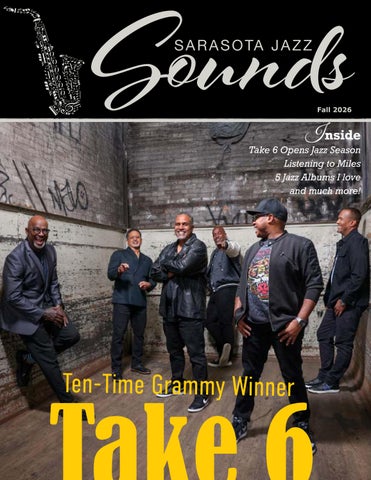
Take 6 Opens Jazz Season Listening to Miles 5 Jazz Albums I love and much more!
Ten-Time Grammy Winner
CONTENTS
03 04 06 12 14 20 28
Presidents Note By Ed Linehan
Take Six Listening to Miles By Neal M. Cohen and Joe Petito
5 Jazz Albums I love By Michael Ross
Scholarship News By Michael Ross
Unforgettable Kurt Elling Performances By Roxanne Baker
Photo Gallery honors the Work of Jazz Club Photographer Carol LoRicco By Chris Angermann
Board of Directors Ed Linehan* - President George McLain - Vice President Cathy Gibbons - Secretary Paul Toliver - Treasurer Directors Brian Callahan Perette DeJean-Cannady Rosemary Heller John Hill Ron Kushner Fred Nowicki Charley Rich Nancy Roucher* Nik Walker Honorary Board Members Dick Hyman Bob Seymour* *Life Members Staff Jane Doernberg Office Manager Danielle La Senna Director of Development Susan Leavis Marketing/Sounds Editor Carline Ash* Special Projects Michael Ross Scholarship Committee Chair Brad LoRicco Media Support Chris Angermann Sounds Follow us on Instagram at jazzclubsarasota Like us on Facebook facebook.com/Edjazzclub 2000 Webber Street, Suite 140 Sarasota FL 34239 941.260.9951 www.jazzclubsarasota.org
From the President of The Jazz Club Dear Members/Friends of the Jazz Club of Sarasota, As we welcome a new year—and the first issue of Sarasota Sounds—the Jazz Club of Sarasota is entering an exciting chapter. After 46 years of weathering change and championing America’s original musical art form, we are building on remarkable membership growth, increasing community interest, and a renewed commitment to jazz’s future in our region. Our Strategic Plan, shaped by board members, staff, volunteers, musicians, students, donors, and community partners, centers on three priorities: engaging broader audiences, expanding community support and strengthening our organization for long-term sustainability. We will add professional staff, modernize communications, enhance governance, and prepare for a capital campaign to establish a permanent home for performances, education, and jazz jams. Our programming will grow as well. We plan to elevate the annual festival with outstanding artists and citywide events, bring jazz to more locations, and embrace styles from straight-ahead and Latin jazz to fusion, smooth, and pop jazz. Expanded youth education and new adult learning opportunities will invite more people to experience, understand, and enjoy this vibrant music. The year ahead will be ambitious, welcoming, and filled with music. Jazz and Sarasota are evolving, and the Jazz Club is ready to lead—honoring our roots while creating new opportunities. The next chapter begins now. Warm regards,
Ed Linehan, President 3
Season Opener 10.17.26 10 Grammy Awards. 10 Dove Awards. Gospel Music Hall of Famers. And more. Click
Dave Thomas
Alvin Chea
Khristian Dentley
M
Take 6, heralded by Quincy Jones as the “baddest vocal cats on the planet,” is the quintessential a cappella group and the model for vocal genius. They are the preeminent and best a capella group in the world. With 10 Grammy Awards, 10 Dove Awards, a Soul Train Award, and as Members of the Gospel Music Hall of Fame, this musical phenomenon has six virtuosic voices united in crystal clear harmony, against a backdrop of syncopated rhythms, innovative arrangements, and funky grooves that bubble into an intoxicating brew of gospel, jazz, R&B, and pop. With collaborations and praise from such luminaries as Ray Charles, Stevie Wonder, Brian Wilson, Ella Fitzgerald and Whitney Houston, the multi-platinum selling sextet has toured across the globe, collaborated across genres, and is recognized as the pre-eminent a cappella group in the world.
Photo courtesy of John Abbott
Claude McKnight
For Tickets and Information jazzclubsarasota.org/events
Mark Kibbie
Joel Kibbie
MILES DAVIS SARASOTA JAZZ
6
FALL 2026
Sounds
Listening to
MILES by Neal M. Cohen and Joe Petito
erbie Hancock, who played with Miles Davis from 1963 to 1968, recounts the story of Miles admonishing in that deep, gravel-toned voice, “Don’t play the butter notes.” Some say Miles really said “bottom,” not “butter,” but in Miles’ lexicon, both words make sense. “Butter,” though, better defines Miles’ distinct approach to jazz. Take away the fat, let the music stew its own juices, and then use the ingredients that you are given to blend, shape, and cook. May 26th of this year marked the Centennial of Miles Davis’ birth. Unlike many jazz greats of his time, he was born into an affluent
African American family in Alton, Illinois. His father, Dr Miles Dewey Davis, was a successful dental surgeon, and his mother, Cleota, was a music teacher and violinist. His family moved to East St Louis when Miles was still very young. His first teacher, Elwood Buchanan, was a trumpeter on Mississippi River boats
son music lessons. Miles credited Buchanan with persuading his parents to buy him a trumpet at age 13, rather than a violin, which Miles' mother preferred he play. Buchanan was known for playing a light tone with no vibrato, a style Miles adopted and which defined his entire career.
Herbie Hancock, who played with Miles Davis from 1963 to 1968, recounts the story of Miles admonishing in that deep, gravel-toned voice, “Don’t play the butter notes.” Some say Miles really said “bottom,” not “butter,” but in Miles’ lexicon, both words make sense. “Butter,” though, better defines Miles’ distinct approach to jazz. and ultimately became a high school music teacher in East St. Louis. He became a patient of Miles’ father, who asked him to give his
While still in high school, Miles was also coached by legendary trumpet player Clark Terry. Born in St. Louis, Terry was close continued
941.260.9951 • www.jazzclubsarasota.org
FALL 2026
7
Miles Davis continued
friends with Buchanan. Though only six years older than Miles, he taught him how to better manipulate his trumpet valves for more control and quicker execution. Terry’s lyrical use of space, technical virtuosity, and melodic warmth were reflected in Miles’ music throughout his career. Though Terry and Miles pursued separate paths, with Terry anchoring the big bands of Duke Ellington and Count Basie, they became close friends, often crossed paths, and appeared on a few historic recordings. Later in his life, when Miles battled a severe heroin addiction, Terry took him into his home to help him get back on his feet.
of that scene and took on young Miles as a protégé, helping him land club gigs and introducing him to the major jazz players of the day. When Dizzy Gillespie dropped out of his quintet, Parker invited Davis to join.
Later that year, when he turned 18, Miles moved to New York City to study classical music at the prestigious Juilliard School, but he dropped out and immersed himself in the Harlem jazz scene. Charlie Parker was at the center
come through boot camp led by Charlie Parker, Dizzy Gillespie and the fathers of bebop. Having survived addiction and self-doubt, Miles then began his lifelong pattern of forging fresh territory, starting with the Birth of the Cool, and
At the time, Parker was the force behind bebop, a style known for its lightningfast tempos, improvisation and complex harmonic lines. Davis replaced Gillespie, who also had a quick style, but Miles’ style was different. He utilized a sparse, economically phrased lower and middle register that relied on phrasing and silence. It was the perfect complement to Parker’s high-speed, fiery saxophone playing. During his early years, Miles The following years, from played in high school groups 1945 through 1948, Parker and local bands, eventually and Davis, often backed getting good enough to sit by famous drummer Max in with professional touring Roach, recorded a string of bands. His first big break historic tracks. (They can be came at age 17 in 1944. He found on compilations like was invited to play with jazz The Complete Savoy & Dial legends Dizzy Gillespie and Master Takes, The Best of Charlie ‘Bird’ Parker as part the Dial Years, and RCA’s of the Billy Eckstine Band Bluebird label. touring in St. Louis after When you begin listening the band’s regular trumpet to Miles Davis, start with player became ill. early Miles when he had
8
investigating modal jazz in his partnership with a young John Coltrane. Their 1959 album Kind of Blue is considered by many the greatest jazz recording of all time, and it has sold more copies - 6.4 million worldwide– than any other jazz album. At each juncture, Miles generated something new and refreshing as he
Valentine. It’s a show tune and best to get to know it first by hearing it sung. Try a version by Frank Sinatra or Ella Fitzgerald to understand how jazz appropriated this marvelous Rodgers and Hart Broadway musical classic (from Babes in Arms). Frank and Ella sing with yearning and hope in their voices as each explains how beauty is in
In his partnership with a young John Coltrane, their 1959 album "Kind of Blue" is considered by many the greatest jazz recording of all time, and it has sold more copies 6.4 million worldwide — than any other jazz album. pushed past the boundaries set by other artists. He absorbed the melodic but complex charts written by Gil Evans, including classical explorations like Sketches of Spain. He embraced fusion jazz, combining electric instruments and rock with In a Silent Way and Bitches Brew and explored funk further in On the Corner. Late in his life, he even turned to hiphop in his posthumously released Doo-Bop. And at every marker, Miles stripped the fat away — always listening, adjusting, and surprising. To understand Miles’ approach, let’s focus on the song My Funny
the eye of the beholder as the strings accent their heartfelt words. Now turn to Miles’s version of this Broadway classic. Start with his take from Cookin’, a 1957 album with Red Garland on piano, John Coltrane on tenor sax, Paul Chambers on bass and Philly Joe Jones on drums. Miles uses his horn to tell his story just as beautifully as Frank’s and Ella's vocals sang the words. Red Garland starts the piece and weaves his piano notes among the horns just as the strings did with the vocalists. And as jazz does so well, the band expands the sound, takes us somewhere new to witness continued
9
Miles Davis continued
new band at a club called the Plugged Nickel in Chicago. Herbie Hancock is in the band along with Wayne Shorter on tenor saxophone, Ron Carter on bass and Tony Williams on drums. The band consists of players who understand where silence can reward and fat can be stripped away to embellish the whole.
and experience, and then returns to a more familiar place. After Garland's bright and loving solo midway through, Miles picks up the chorus again only to slow the pace as if he wants to make sure we see what he sees. He even drops out a few bars and waits for us to join him looking at his valentine. Silence is the key with Miles, and his last few bars have silent moments which cause us to lean in more to hear his clear, soft, melodic notes better. As he said, “it’s not the notes you play, it’s the notes you don’t play.” Miles practiced what he preached. Now jump ahead to 1965 and listen to Miles play My Funny Valentine with a
10
Listen to Hancock start the piece. The notes that Garland played with spirit and lushness sound sparse and not slavish to the melody. You can almost hear Miles listening, surprised by the notes jotting in and out, Hancock
Silence is the key with Miles... As he said, “it’s not the notes you play, it’s the notes you don’t play.” almost ignoring what drove the 1957 version. Miles then acknowledges the spacing and the gaps with his own notes. Hancock keeps playing the show tune but a bit off-kilter as Davis starts moving outside the melodic structure. Together they take us to unfamiliar places. Miles is always listening to his
bandmates -- sometimes leading, then following, but always shifting and recasting the melody. Frank and Ella couldn’t sing this version. Rodgers and Hart might not even recognize their song anymore. But at its conclusion, we’re still left hopeful and yearning for our funny valentine. Those two versions of the same song remind us that Miles always evolved, challenged and never rested. He didn’t see boundaries. He listened, improvised, and embraced the silence offered by notes not played. He knew the sound of jazz when the butter is stripped away. Neal Cohen is a former corporate communications executive living in New York. When not listening to live jazz, he scours used record stores looking to add to his jazz LP collection— now numbering over 1460 albums. Retired from Pricewaterhouse Coopers, where he led the firm’s public policy activities, Joe P. Petito enjoys classic jazz and writing. He sits on the Board of the Women’s Project (WP) Theater, the nation’s oldest and largest theater dedicated to advancing women directors, and producers, located in Manhattan, NY. He spends summers at his family beach house in Delaware, where he paints landscapes and scampers after his two baby granddaughters, Audrey and Sienna.
Oct 17
Nov 21
Dec 19
Take 6
Nilson Matta Brazilian Voyage
Nicole Henry
Feb 20
Mar 17
Apr 10
Dave Bennett with Swing Dance Night (Wed of Festival) La Lucha The Venue @ LEC 3650 17th Street, Sarasota, FL 34235 Doors Open 6pm - Performance 7pm FREE Valet Parking
Barbara King
Jan 16
Halie Loren &
Sarasota Jazz Project
May 15
Diego Figueiredo & Chiara Izzi
For Tickets and Information www.JazzClubSarasota.org 11
5 JAZZ ALBUMS I LOVE by Michael Ross 12
Bassist and composer Michael Ross has been a prominent presence on the Florida jazz scene for more than three decades. He has performed with such jazz greats as Nat Adderley, Jimmie Cobb, Nathen Page, Herbie Mann, Larry Willis, and Buster Cooper, and has appeared with artists throughout Florida and the southeastern United States. As a bandleader, Ross has fronted two long-standing Florida-based ensembles — Liquid Bebop and the Michael Ross Quartet — and has released five recordings: Doghouse (2000), Dog Eat Dog (2002), Year of the Dog (2004), Ginger (2013), and Giraffe (2023), the last, a collection of original compositions and imaginative arrangements of jazz classics.
Sounds asked him to share some of his favorite jazz
bass players’ albums.
This One’s for Blanton
Duke Ellington and Ray Brown Two masters at work in a beautifully recorded, superswinging, relaxed duo session from 1972 that was inspired by duo recordings Ellington made in 1940 with Jimmy Blanton, the father of modern bass playing – his innovative approach elevated the bass from being a mere “timekeeper” in the rhythm section to a solo instrument in its own right. Ray Brown puts on an absolute clinic, and this recording—with no drums—will tell you all you need to know about the rare combination of beauty and power in his playing.
Oscar Pettiford Volume 2 Oscar Pettiford
The Charlie Parker of the double bass, Oscar Pettiford was known for his incredible, horn-like bebop solos, years ahead of his time. This recording from 1955 features a few of his classics, including Bohemia After Dark, Minor 7th Heaven, and his beautiful solo rendition of Stardust. The album also features a few tracks with Oscar playing cello, as well as some nice “small big band” arrangements by the bandleader.
State of the Tenor, Vol. 1 Joe Henderson
Of the 2,200 albums you can choose from that feature Ron Carter, this 1985 recording is the one I keep coming back to. Without a piano to get in the way, you can hear the full range of Ron’s harmonic palette, and his creativity knows no bounds here. Check him out on Thelonious Monk’s Friday the Thirteenth, a simple four-bar piece built on a descending bass line, and notice how the bass part never repeats! The bass and drums (Al Foster) are totally locked in and swinging, and Henderson plays beautifully throughout.
Jasmine
Keith Jarrett and Charlie Haden A subdued collection of mostly ballads, torch songs, and love songs, recorded at Keith Jarrett’s home studio in 2007 and released in 2010. This album is heartbreakingly beautiful. Jarrett and Charlie Haden had not played together in more than thirty years, and this would be the last time. * Haden’s masterful simplicity, incredible sound, and deep love of melody are on full display here. The best musicians evolve, change, and hopefully become more interesting as they age. This is an excellent example. * Another album, Last Dance, using material from the same 2007 recording session was released in June of 2014. Hayden died a month later.
Out Here
Christian McBride Trio I’ve always loved piano trios led by bass players. Although this group is somewhat reminiscent of the Ray Brown Trio recordings, it clearly has a 21st-century vibe. Christian McBride has a ton of young bassplayer followers, but the warmth, swing, and joyfulness in his playing are impossible to replicate. This album, recorded in 2013, features a young Christian Sands on piano and Ulysses Owens Jr. on drums—McBride’s working band at the time. The trio swings like crazy. * Christian McBride will be performing as the Saturday night headliner at the 2027 Sarasota Jazz Festival.
13
Scholarship SARASOTA JAZZ
Sounds
News
or more than three decades The Jazz Club of Sarasota has been awarding financial support to deserving students studying jazz music. Students apply from Sarasota and surrounding counties. The 2026 Scholarship Award Winners were celebrated in a special concert on Sunday, May 31st at Fogartyville Media & Arts Center. Photos from the May 31, 2026 Concert courtesy of Paul Toliver
14 14
FALL2026 2026 FALL
Special Named Awards The Matt Bokulic Scholarship commemorates a true icon of the Tampa Bay music scene. Matt was born in Springfield, MA and attended Berklee School of Music and the University of South Florida. He moved to Tampa in 1995. He soon became an area favorite pianist, composer, and educator. He taught piano for more than 20 years at the Players School of Music, recorded with many luminaries and wrote three books about music theory. The Blake Bennett Scholarship was established by the scholarship committee after Blake tragically died in a traffic accident just five months after graduation. He was an accomplished trumpet player who had received scholarships from the Jazz Club for all four years of undergraduate work at Florida State University. His plans included graduate work at FSU. The Jazz Club Scholarship Committee has decided to continue to award deserving students this distinguished scholarship in Blake’s memory. The Robert H Weitz Scholarship is in memory of Bob Weitz, past chairman of the Jazz Club scholarship committee. For over 14 years, Bob spent many happy hours attending musical events at high schools across SW Florida as he searched for students showing exceptional talent. He encouraged them to focus their interest on jazz and he recommended that they apply to the Jazz Club for scholarships. So grew the tradition of supporting young talent. A dear friend and champion for the kids, we proudly make this an annual scholarship in Bob’s memory. (See details on the 2026 scholarship winners on next 3 pages.)
Thank you for supporting the future of Jazz! From the Jazz Club of Sarasota Scholarship Committee Michael Ross, Chair Danielle La Senna David Pate
941.260.9951 • www.jazzclubsarasota.org
Frank Williams Ronan Cowan Edris Weiss
Judy Jones Vern Weitz
FALL 2026
15
The Jazz Club of Sarasota
Scholarship Recipients for 2026 The Matt Bukolic Award
Maxwell Haman will be a
el
lH
am
an
sophomore at Vanderbilt University. He has participated in numerous jazz and classical music ensembles and performed his original piece “Waited Too Long” to an audience of 2,000 in the famed Berklee Performance Center. Maxwell has since written, arranged and released 3 singles and a full length album under the band “Moonberry”.
M
ax
w
The Blake Bennett Award
Robert Langdon will be a junior
at Florida State University and is a Jazz Performance major. Robbie recently got the honor of playing in the house set that hosted a jam session at the great n o Scotty Barnhart’s house for d g the Count Basie Orchestra. an L He is looking forward to t r continuing his studies and finding e b his place in the larger jazz scene. o
R
The Robert H. Weitz Award
W ad
e
R ic
ha
rd
s
Wade Richards has attended
Blake High School for the past 4 years and will be starting at Berklee College of Music in the fall! I have been a Youngarts recipient for the last two years and have attended Brevard Jazz Institute and the Grammy Camp in New York. I am extremely grateful to receive the Sarasota Jazz Club award and have the opportunity to play with other amazing musicians!
Merit winners:
William Stenberg will be a
sophomore at Vanderbilt University, majoring in Jazz Studies and Business. He is both a classical percussionist and a jazz drummer. William was selected for the Florida All State Jazz Band two years in a row, and as a sophomore was a percussionist in the All State Orchestra. He has attended music camps such as Interlochen and Brevard, and has been selected for an all county ensemble, both classical and jazz, 8 times. A highlight of his musical career was performing with the Gainesville Symphony.
rg
e
am
i ill W
Evangelyn Rodriguez is a 2026
graduate of Blake HS of the Performing Arts in Tampa. She is currently a freshman majoring in Jazz Performance at FAMU in Tallahassee.
e nb
n ly
z
e gu
i
r od
St
R
e
g an
Ev
Jack Fletcher
will be a sophomore at University of South Florida majoring in Jazz Performance. He started playing drums at the age of 5. At Braden River High School his band competed and placed 1st in the Jazz Club of Sarasota competition; additionally, he joined the school’s marching band that placed 1st in the state in 2025 for their division. He has been touring on the East Coast of the U.S. alongside tribute bands including Sweet Fleet, ABBA Nova and Hell on Heels, and is part of the original alternative-rock project Nowincolor.
k
c Ja
et
Fl
FALL 2026
r
e ch
17
Scholarship Recipients for 2026 Merit winners:
Demetrious Johnson
Za
ne
N
ew
el
l
D
em
et
rio us
Jo hn s
on
attends Hillsborough Community College majoring in Trumpet Performance. Music has been a core part of his life for as long as he can remember and he is committed to making it his career. where he studied jazz with Dr. Pete Carney. Jayden (coBandleader of the Barker Project) is a freelance trumpet player and composer. He plays various genres, including Jazz, fusion, R&B, Soul, Contemporary Free Jazz, and more. Jayden has played at a number of venues in the Sarasota and St. Petersburg area.
Zane Newell is going
C
ol
e
W
he el
er
to FSU this summer for a jazz performance major. Throughout high school I have made all-state on clarinet in 2024 and 2026, and in high school I served as section leader and band captain.
1818 FALL 2026
Cole Wheeler will be a
senior at the University of Central Florida in the Jazz Studies Program. He is a drummer and percussionist. Cole stated his goal is “to build a career around playing, teaching and otherwise interacting with music.”
a Member and save on Don't miss out! Become most events plus be a part of special, active community. Become a Jazz Club this Help make Jazz an even more Member today! vital part of life in Sarasota. The Jazz Club of Sarasota has over 1000 Members and is Growing! MEMBER BENEFITS INCLUDE: • Up to $500+ savings in reduced TICKETS • Weekly E blasts of Jazz Events • Issues of "Sarasota Jazz Sounds” Magazine • Member Support from JCS Office • Opportunities to serve on committees to plan, promote and manage events • Free Luxury Bus Transportation to and from The Jazz Cruise
Lifetime $1000
Individual $80
One time payment No annual renewal One discounted ticket for most events Jazz at Two Free
Annual renewal 12 full months One discounted ticket for most events Jazz at Two 25% disc
Couples $140
Student $15
Annual renewal 12 full months Two discounted tickets for most events Two people in same household Jazz at Two 25% disc
Musician $45
Annual renewal 12 full months
Working musicians
One discounted ticket for most events Jazz at Two 25% disc
Duo/Guest $140
Annual renewal Annual renewal 12 full months 12 full months For HS or College Two discounted tickets students up to 22 yrs for most events One discounted ticket One person plus a guest for most events Jazz at Two 25% disc Jazz at Two Free 19
A four-time Grammy winner and 15-time Grammy nominee.
Unforgettable
Kurt Elling Performances
20
By Roxanne Baker
A fun thought experiment is to rummage through your brain's archives and recall the most unforgettable moments from your favorite live concerts. I've been obsessed with various musicians as a teen and as an adult, but I believe I found my forever musical home in the voice of Kurt Elling. If you're not already in the know: Kurt is a four-time Grammy winner and 15time Grammy nominee. You can sample the songs I mention below on YouTube and Spotify. Fair warning, though: once you've fallen under the spell of his angelic voice, you're liable to spend some hard-earned dough on concert tickets. I have, whenever possible. I've seen Kurt Elling six times, four times with jazz bassist Tim Larson, my friend of more than 20 years. We’ve logged enough jazz concerts to qualify for frequentlistener miles. Every concert was memorable, but Kurt's performances somehow manage to occupy their own orbit.
The Classic
walk. Then it traversed to Ulysses Owens’ tender drum massage before a Hobgood piano solo so exquisite it transformed our bleacher-style seats into what felt like plush velvet banquettes. And Elling's vocals didn't merely fill the room; they upholstered it.
Our first Kurt Elling concert was in Corning, New York, at the renowned Corning Museum of Glass—a fitting venue, since Kurt's voice can be as transparent, as brilliant, and considerably less fragile than glassware on display. His performance posture erect as a crystal cathedral, his vocals The Waking just as reflective. For Kurt’s 2013 Rochester That evening, Kurt was International Jazz Festival accompanied by Grammyperformance in Kilbourn winning pianist, composer, Hall at the Eastman arranger, and longtime School of Music, Tim and musical director Laurence I had more comfortable Hobgood. Hobgood seating than glorified gym collaborated with Elling bleachers, which turned out from 1995 through 2013 and later won a Grammy for to be fitting. I experienced producing Dedicated to You: one of those moments in my life when I thought, Kurt Elling Sings the Music “If I died right now, I'd be of Coltrane and Hartman. the most grateful human on Earth.” (If you say one What I remember most of two, you will leave the from that concert was reader hanging on what the title track from that was the other one?) album. The arrangement of Coltrane’s classic The song was The Waking, “Dedicated to You” began Kurt's breathtaking melodic with the string quartet adaptation of Theodore ETHEL’s gentle bird-like
The arrangement of Coltrane’s classic “Dedicated to You” began with the string quartet ETHEL’s gentle bird-like walk. Then it traversed to Ulysses Owens’ tender drum massage before a Hobgood piano solo so exquisite it transformed our bleacher-style seats into what felt like plush velvet banquettes. 21
Roethke's Pulitzer Prizenominated poem exploring the bittersweet cycle of life and death, and I sat there, spellbound. As Elling wrapped Roethke's words inside his soaring melody, it felt as though poetry had discovered oxygen. Music rarely suspends time; Kurt somehow convinced it to stop altogether.
One highlight was “Esperanto,” built on Vince Mendoza's infectious melody. Its delightfully philosophical lyrics ask us about what bees feel – can love be conjured, or is love just instinctual?
The Boot
Fortunately, Pérez's elegant piano and Chico Pinheiro's guitar kept me buoyant, even if my orthopedic boot felt as heavy a midsize SUV.
A standing ovation followed. Since I was sitting in the front row, I don’t know if I started it or just sprang to my feet with unbounded enthusiasm. Either way, nobody complained.
Front Row
Charlie Hunter, dressed in his trademark lumberjack chic, grinned from ear to ear, and laughed whenever Kurt launched into one of his wonderfully offthe-cuff remarks. It was impossible to tell who was enjoying the concert more: the audience or the musicians themselves.
In 2024, we saw Kurt perform with Danilo Perez at Da Camera's Cullen Theater in Houston, Texas. At the time, I was wearing a medical boot for a metatarsal stress fracture. As an addicted distance runner, I viewed this not as an obstacle but as an especially rude plot twist. Nevertheless, I happily clomped up and down Texas Avenue, sounding like a one-woman percussion section because there was no way I was missing Kurt Elling. The concert featured music from Kurt’s and Danilo’s Grammynominated collaboration and was probably the most adventurous program I'd heard Kurt perform. Thankfully, the empty seats in front of us allowed me to elevate my throbbing foot—a rare concert where both my spirits and my leg were lifted. 22
Meanwhile, I had my own pressing existential questions: Will I ever run again? If so...how far, where, and when?
The Parkway Theater in Minneapolis concert remains my favorite performance and overall experience of "the man, the myth, the legend." Tim and I scored front-row seats for Kurt's SuperBlue performance with guitarist Charlie Hunter, drummer Corey Fonville and keyboardist DJ Harrison. What a night! They played “Endless Lawns.” Kurt performed the song in a stance reminiscent of Rodin’s “The Thinker” statue, a compact crescent moon as he rose to the song's conclusion. His voice climbed higher and higher until the song exploded into something that felt less like a concert and more like a collective ascension.
Afterward, Tim and I wandered next door to Brit's Pub to decompress after having our musical circuitry completely rewired. Then, as if the evening needed one final encore, Kurt Elling himself walked in with a small entourage. Determined not to become "that fan," I nevertheless gathered enough courage to introduce myself. My vocabulary had temporarily
abandoned me, so I settled for expressing my admiration in something approximating complete sentences. Kurt was exactly as I'd hoped— warm, gracious, and genuinely kind. I forgot to ask for a photo. Some people meet Grammy winners and think, “Selfie!” I meet Grammy winners and think, “Words are hard."
Spotify, and Checks&Exes on Instagram.) When Liam lived in NYC, I visited him many times for fun Broadway shows and finally, in 2015, a Kurt Elling Birdland concert promoting his Passion World album. At this venue, Kurt stood within handshaking distance from the audience, like a ringmaster. His powerful voice was the only thing needed to tame lions or tigers.
They played “Endless Lawns.” Kurt performed the song in a stance reminiscent of Rodin’s “The Thinker” statue, a compact crescent moon as he rose to the song's conclusion. His voice climbed higher and higher until the song exploded into something that felt less like a concert and more like a collective ascension. My Son, the ‘Son’shine of My Life’ My son Liam was literally born into music as I demanded the gospel duo of CeCe and BeBe Winans be piped in during his birth. As he grew, I continued the serenade, taking him to several concerts, including Aretha Franklin, Bob Dylan, Ringo Starr, and Fleetwood Mac. And guess what? He became a singer! (Feel free to support his endeavors with either band he’s been the lead singer for: The Climactics, available on
One of Kurt’s many gifts (a forte tends to be one specialty) is his ability to re-inspire classic tunes. (“Norwegian Wood” and my recent favorite, ELO’s “Turned to Stone”). On this tour, he not only sang U2’s “A Street with No Name,” but began this show with Bob Dylan’s “A Hard Rain’s A-gonna Fall.” The song starts out with Dylan’s passionate lyrics in search of his son. Perfect synchronicity, considering my undying love for Liam, and not just because he’s a
fantastic singer, but because the music in his soul springs from his sensitive, caring nature. This show is special to me for that reason.
The Dancing Incident Seven years after I moved to Sarasota, the 2023 Sarasota Jazz Festival booked Kurt Elling. The evening before his performance, I was strolling downtown when—lo and behold—there sat Kurt, his wife, and his daughter having dinner at a so-so Mexican restaurant that shall remain nameless. I was aghast that a two-time Grammy winner appeared to be dining at what could generously be described as a culinary way station. My profound sympathy for Kurt's questionable restaurant selection awakened the retired English teacher in me and ultimately gave birth to Short and Shrewdly Specific: A Sarasota Dining Guide (available on Amazon). Should you be kind enough to read it, you'll find the entire Kurt Elling-inspired saga in the foreword. That year's festival was held beneath a Big Top tent at Benderson Park. And what a circus it proved to be.
23
Photo courtesy of Keshia Eugene
come lyrics every anxious woman longs to hear—calm, confident reassurance that somehow everything will be all right, with an interpolation of the beloved African American spiritual, “He’s Got the Whole World in His Hands.” The lyrics land with both familiarity and comfort, reminding us that even when life resembles a threering circus, someone infinitely more competent is running the show.
Humans Connection a Clear Winner
I persuaded my friend Rick to accompany me—a man who is so busy, wearing more hats than a milliner with a shopping addiction. Fortunately, he also possesses impeccable musical taste. Before the concert began, I issued Rick a warning. “If Kurt performs either ‘Manic Panic’ or “Can't Make It with Your Brain,” I relinquish all responsibility for my behavior.” This was not hyperbole. It was a medical disclaimer. Should either tune commence, I would be vertical, gyrating, and blissfully oblivious to public opinion. 24
Rick, bless him,
accepted these terms. Sure enough, the unmistakable opening of “Manic Panic” filled the tent, and I launched myself into undulating action. As I bounced enthusiastically among an ocean of firmly seated retirees, Kurt actually noticed me and pointed in my direction. Whether the gesture meant, "You go, girl!" or "Could someone please notify security?" remains one of life's mysteries. “Manic Panic” begins with an almost meditative keyboard groove before this band’s incarnation, drummer Nate Smith, eased into the mix. Then
Two months ago, I went to Kurt Elling’s August 2026 concert at the Springfield Ohio Jazz and Blues Festival. As I left the end of his fastpaced 90-minute set, a fellow attendee compared Kurt to Martin Luther King Jr. Hyperbolic? Perhaps. But watching Kurt deliver a scat-and-rap-fueled sermon while bouncing like a fit high diver about to launch into “Manic Panic,” the comparison suddenly made sense. His message was simple: let’s get out of our houses, mingle, look one another in the eye, and restore our faith in humanity. The crowd went wild, me included, recognizing that endless
couch-scrolling through social media offers mostly FOMO (fear of missing out), depression, and divisive echo-chamber pessimism.
and gratitude. I also wanted to respect his mealtime. My one regret? Not saying hello to his son. Former teacher that I am, I miss kid time.
And Kurt practices what he preaches.
Still, the point stands: Kurt is a gracious man of the people, unafraid of a random fan and, true to his later sermon, happy to be among other jazz-loving humans.
Four hours earlier, during Jolie Demesmin and Chris Andrews’ brilliant tribute to Nancy Wilson and
Later, at the Mother Stewart Brewery Stage, Kurt’s SuperBlue band featured longtime collaborator and guitar extraordinaire Charlie Hunter, Grammy-winning drummer and Newport Jazz Festival Artistic Director Nate Smith, and keyboardist Kenny Banks Jr.
Cannonball Adderley, I spotted Kurt and his son casually heading toward a bench with some foodtruck fare. Dressed in a blue short-sleeved buttondown and jeans, he looked like Matt Damon’s unpretentious older brother. Having already had the good fortune to meet him in Minneapolis, you’d think I would have been more eloquent. Nope. I pulled a Lucille Ball: a quick gushing about how far I’d traveled, along with my admiration
After his impassioned jazz chant, Kurt encouraged us to wiggle our hips—even from our folding chairs if necessary—leading by example with his compact-body/enthusiasticderriere-wiggle technique. His regular-Joe persona radiated a welcoming “you don’t have to be perfect; give it a try” vibe. Then came my all-time favorite, “Endless Lawns.” I audibly gushed, prompting the superfan beside me to point toward her transfixed husband and whisper, “That’s his favorite, too!” Hearing Kurt sing the sexy lyrics about lying on dewy grass beneath Orion’s Belt, swimming in stars, I
felt like I’d achieved lowaltitude flight—hovering somewhere between my folding chair and the moon. The show closed with a rousing “Wrap It Up,” sending everyone onto the astro-turf dance floor, followed by a lullaby-like jazz arrangement of the Eagles’ “Desperado.” We all walked away buoyant—not just from the music, but from the simple joy of being together. Out in nature. IRL (in real life). Looking one another in the eye. Turns out Kurt Elling’s sermon was pretty good advice.
Roxanne Baker's origin story included a 30-year career as an English Teacher and High School Guidance Counselor in the bucolic Finger Lakes area of New York. Her inner palm tree brought her to Sarasota, where she is a bookseller at BookStore1. Beyond traveling to Kurt Elling concerts, she moderates community film talks for the Sarasota Film Society and maintains a film review blog on Letterboxd under the moniker GetRoxy.
25
oran
Kitt M
Michae
l Ross
a King
Barbar
Season 2026 - 2027
James
Jan 29
James Suggs & Friends
Feb 05
Len Pierro Quartet
Feb 12
Mark Moultrup Music
Feb 19
Kitt Moran Quartet
Feb 26
Foot Note Jazz Sextet
Mar 05*
Eddie Tobin and Friends
Scholarship Concert
Mar 12
Anne/Mark Burnell Quartet
Jan 08
Isaac Mingus Quartet
Apr 02
Skip Conkling’s Dixie Mix
Jan 15
Pete Carney Quartet
Apr 09
Robert Nissim Trio
Jan 22
Barbara King Quartet
Apr 16
Paul Gormley Quartet
Apr 23
Kevin Celebi Septet
Oct 23
Sarasota Jazz Project
Nov 06
Michael Ross Trio
Nov 20
Ruffus 4-tet
Dec 04
Hot Club SRQ
Dec 11
Scotty Wright and Friends
Dec 18
Barbara Jordan Quartet
Dec 30 Wed
Suggs
$15 JCM / $20 Non-Member Unitarian Universalists of SRQ 3975 Fruitville Rd, Sarasota
* Location for Eddie Tobin is First
Presbyterian Church, 2050 Oak St, Sarasota Photos courtesy of Carol LoRicco
OUR VOLUNTEERS.
We could not do it without you.
26
Sep 2026 - Mar 2027
Sep 07: Sep 14: Oct 05: Oct 19: Nov 09: Nov 30: Dec 07: Dec 21:
Stretch Bruyn
Overjoyed: A tribute to Stevie Wonder
Jeremy Carter Quartet
Jan 04:
The music of Keith Jarrett
John Coltrane Tribute
Carl Fischer and Sunshine City Brass Rebecca Richardson Quartet
Tribute to the ladies of song
Jan 18: Feb 01: Feb 22 :
James Suggs Quartet
Miles Davis Tribute
The Paul Gavin Freedom Band Anne and Mark Burnell
I’m Hip - The music of Blossom Dearie and Dave Frishberg
Greg Diaz Art of Imagination Quartet Modern Standards
Len Pierro Quartet
The Music of Sonny Rollins & Stan Getz
Mar 01:
Pete Carney Quartett
Mar 29:
From Memphis to ChiTown to Motown
Holiday Jazz With Bryan J Hughes and the Crew
All Seats Reserved Series & Single Event Tickets More Information on website www.jazzclubsarasota.org
Michael Ross Trio with Anthony Aldissi
Full Bar and Dinner Menu 6:30 PM Open for Dinner 7:30 PM Performance
Scott Dickenson Quartet
Art of the Trumpet
Bob Boguslaw and The Way
John C. Court Cabaret Florida Studio Theatre 1st Street & Cocoanut Ave Box Office - 941-366-9000 27
Photo Gallery honors the Work of Jazz Club Photographer
Carol LoRicco By Chris Angermann
s
the Work of Jazz Club Photographer Carol LoRicco isit the Sarasota Jazz Club office at Webber and the Tamiami Trail, and you’ll see a gallery of 29 photographs featuring national and local jazz artists, including bass player John Lamb, guitarists John Pizzarelli and Diego Figueiredo, saxophonist Houston Person, trumpeter Terell Stafford, singer Synia Carroll, pianist Dick Hyman and more. A plaque to the lower left provides a key to the names of all the singers and musicians. The display is a tribute to the work of Carol LoRicco, who has been taking pictures of Jazz Club events for the past 15 years as a volunteer and official photographer. During that time, she has attended well over 1,000 concerts and events and shot over 30,000 live action photographs. Carol began her journey after she and her husband Brad moved to Sarasota from Hoboken, New Jersey. Because Brad’s brother had lived in Port Charlotte since the mid-1970s, they had visited the area since before I-75 was built, driving over the old Skyway Bridge and traveling south on Route 41 through Bradenton. They sometimes stopped overnight in Sarasota and quickly realized that there was a lot of culture, from musical events at the Van 28
FALL 2026
Wezel to theater to art galleries. When they retired, they first checked out the East Coast but decided to make Sarasota their home. Longtime music fans – Carol has written about going to see Frank Sinatra in concert many times in a previous Sounds issue (a Hoboken native, he is her favorite singer) – she and Brad started to attend jazz events. At the time, the Sarasota Jazz Club held threehour concerts on Saturday afternoon at Holley Hall. Then it moved to the Bayshore Center across the street behind the Civic Center on Friday afternoons. Soon, Carol brought her camera along.
for the moment when singers or instrumentalists light up. Afterwards, she cropped the pictures with Photoshop and, if there was a little glare, sharpened them, but tried to leave them be as much as possible to reveal their essence. As the Jazz Club expanded, what started as 60 or so events grew to more than 100 annually. In the process, she and Brad got to know some of the performers. “We considered Ken Peplowski a friend,” said Brad.” We could walk with him, talk to him, and we just loved seeing him and listening to him.”
Carol liked nature and had started to take photographs of birds in Myakka State Park. When she and Brad came to jazz concerts, she thought, “Well, maybe I’ll try to take some pictures here as well,” and brought her camera along.
One of their most memorable events was guitarists Bucky Pizzarelli and his son John playing together at the 2000 Jazz Festival. Carol and Brad had seen them already several times in New Jersey, and attending their performance in Sarasota, under a tent because the Van Wezel was being remodeled at the time, was a real treat.
At first, she only shot photos of people she knew, friends who were musicians, but soon she decided to take pictures of all performers.
Part of what Carol likes about taking photographs is that she can enjoy looking at them and remembering what was going on at the time.
Around 2010 or so, Brad became a volunteer for the jazz club, helping to publicize events. He created flyers, using pictures Carol had taken of the musicians, and put them out on tables at “Jazz at Two” concerts. He also kept the club’s Facebook page updated, utilizing her photographs.
While she and Brad will continue to go to concerts to enjoy the music, Carol’s photography days are likely to be limited because she has macular degeneration and can’t focus the way she used to. However, she leaves behind an impressive body of work that shares the deep love and appreciation for the musicians she has met and captured with her camera.
The artists liked her work. According to Brad, they told her, “Thank you for taking pictures. They’re really good. Sometimes people take pictures and they’re just pictures. But there’s something about your photos. You seem to capture what we’re doing up on stage.” Some asked if they could use them to promote their own concerts and on the covers of their CDs. Carol always said yes and never asked for compensation. For her, it was a labor of love. Sometimes the musicians would give her a copy of their CD in return. Carol always respected the performers and audiences. “You see a lot of photographers who are running around the facility. They’re off by the stage, standing in front of people,” she said. “I never did that.”
On May 2 this year, the Jazz Club held a reception in their new offices on Webber Street to unveil Carol’s photographs and honor her more than 20-year contribution. Brad continues to help out with promotions, and they plan to continue to attend shows. As Jazz Club president Ed Linehan wrote about the reception held earlier this year to unveil Carol’s photographs at the Jazz Club office and to honor her and her splendid contribution:
This permanent installation will forever welcome our guests as they visit the office. Carol’s fine eye represented collectively in these photographs Instead, she stayed off to the side so as not to beautifully captures the spirit and energy of the Jazz interfere. She didn’t use the flash on her digital camera Club…It is a wonderful photographic snapshot of the but worked with the lighting that was there, waiting Jazz Club’s history. 29
The Jazz Club of Sarasota and The Scholarship Fund Present
Benefit Concert
THE VENUE @ LEC 7:30
Click
26TH
FEB 2027
JazzClubSarasota.org 30