OUR MISSION Inspired by the love of Jesus, we are building the kingdom of heaven, where differing people live in community, serving God and each other.
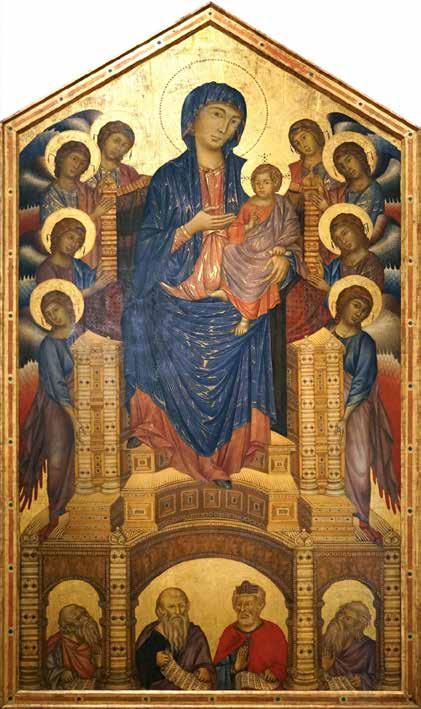
SANTA TRINITA MAESTA | Cimabue, 1280s
If you have been raised with Christ, seek the things that are above, where Christ is, seated at the right hand of God. Set your minds on the things that are above, not on things that are on earth…
~ Paul’s Letter to the Colossians 3:1-2
DEAR CATHEDRAL,
I discovered yoga when I was in my forties, and for the first time in my life, I came to love exercise. As a child, I aspired to be a ballerina, but alas, God clearly did not call me to that profession. My feet wouldn’t point enough, my turnout was terrible, and I usually played the boy in the recitals. My very strict Russian ballet teacher did not restrain her criticisms of my abilities. Over the years, I began to associate exercise with feeling like a failure.
But yoga has no mirrors. The teacher told us we were all made beautifully and that there was no right way of doing any posture. I was free to just be present, to feel my breath, and to rejoice in the movements and the music. It seemed like in every class I attended, I learned something new – a lesson for both the body and the mind.
The greatest lesson, one which we returned to again and again, was about balance. When you try to balance on one foot, the first thing that you must do is focus on a spot in front of you. If your focus breaks and your eyes wander around, you will fall. Focus is the first and most important part of balance.
The same is true of our spiritual lives. If we focus on Christ, on what Jesus was like, how much he loves us and what he might be asking of us, we will find balance in life. But the moment we take our eyes off Christ, the moment we begin to focus on other things: ourselves, our anxieties, the people we love, the news of the world – we begin to lose balance. And we will fall.
If we set our minds on God and God’s purpose for our lives, all else will begin to still.
When I balance on one foot, that foot is always moving. It is constantly adjusting from one side to the other. But while these movements are going on, if my eyes remain fixed on my focal point, I reman upright.
Where is your focus in life? Are you saying clear prayers of thanksgiving at the end of every day? Are you speaking the name of God aloud in your mind? Are you focusing on the love of Christ? If you focus your mind on God, anything is possible. Anything.
In Christ’s love,
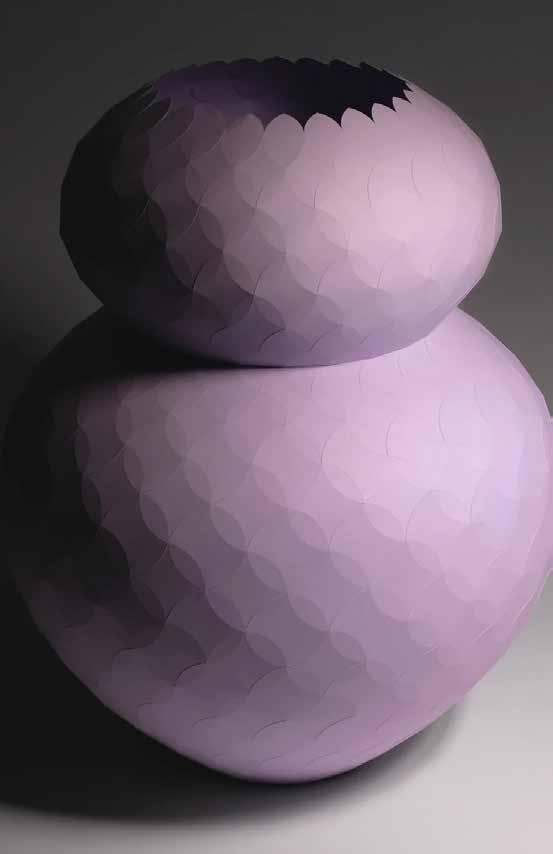
MURMUR DOUBLE VESSEL (PAPER) | Matthew Shlian
BALANCE
by Alice Fogel
Balance is everything, is the only way to hold on.
I’ve weighed the alternatives, the hold as harbor: It isn’t safe to let go. But consider the hover, choices made, the moment between later and too late. Hesitation is later, regret too late. You can’t keep turning and turning, or expecting to return. This earth
is not a wheel, it is a rock that erodes, mountain by mountain. And I have been too soft, like sandstone, but there is a point where I stand without a story, immutable and moved, solid as a breath in winter air.
I have seen my death and I know it is my neighbor, my brother, my keeper. In my life I am going to keep trying for the balance,
remembering the risks and the value of extremes, and that experience teaches the length of allowable lean; that it is easier — and wiser — to balance a stone as if on one toe though it weigh a hundred pounds than to push it back against the curve of its own world.
Excerpts from WISDOM DISTILLED FROM THE DAILY: LIVING THE RULE OF ST. BENEDICT TODAY
by Joan Chittister
With the invention of the light bulb, balance became a myth. Now human beings could extend the day and deny the night. Now human beings could break the natural rhythm of work and rest and sleep. Now human beings could begin to destroy the framework of life and turn it into one eternal day, with, ironically, no time for family, no time for reading, no time for prayer, no time for privacy, no time for silence, no time for time . . . Our time gets totally out of balance. We spend it all on friends, or we spend none of it there. We spend it all on work, or we spend it all on our compulsions. We spend it all on the body, or we spend none of it on the body. We spend it all talking, or we spend none of it talking . . . We wake up one day and realize we haven’t heard from old friends for years; we haven’t been to see our ageing relatives for months; we don’t know the names of our cousins’ children anymore; we haven’t written a personal letter for years; we haven’t sat in a large easy chair and read a good novel for ages . . . and life is flying by. All skewed.
We all tell ourselves that things are just too hectic, that what we really need is play, not holy leisure. We all say we’ll do better tomorrow and then do not. We all say that the schedule is too crowded and the children are too noisy and the exhaustion is too deep. But, if we do nothing to change it, the schedule just gets worse and the noise gets more unrelenting and the fatigue goes deeper into the bone. The fact is that it is our souls, not our bodies, that are tired. The fact is that we are so over-stimulated and so underenergized that the same old things stay simply the same old things, always.
People with a sense of Benedictine balance see that life is a medley of multiple dimensions, each of which must be developed. They have become
more than either their work or their play. Nothing consumes them and everything taps something new in them. They walk through life smelling the flowers. They need enough money, some play, good work, steady friends, spiritual growth, intellectual stimulation, and harmony with nature . . . they make time for every facet of life. They live a rhythm of life that includes the natural, the spiritual, the social, the productive, the physical, and the personal. They can tell you each week what they have done in each area.
They live life well. They are in fact fully alive.
THE WEAVER’S SECRET
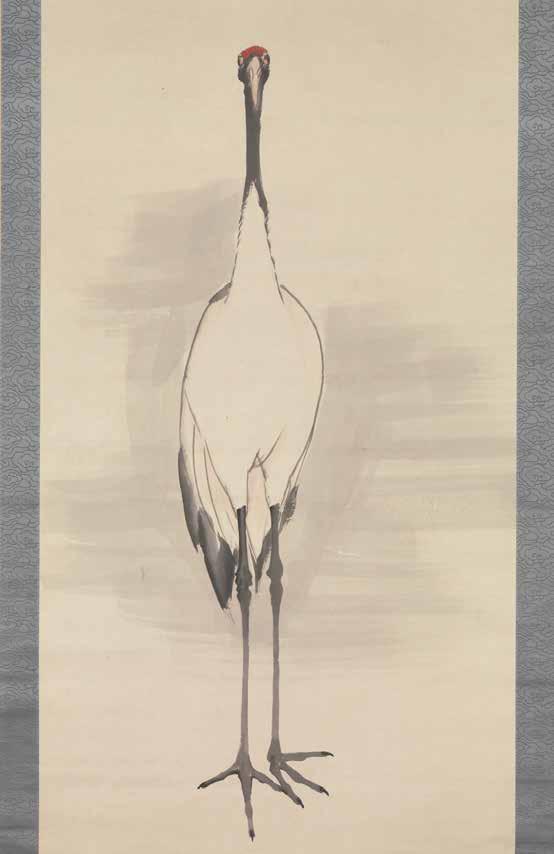
A Chinese tale < CRANES | Nagasawa Rosetsu, late 1780s
Old Master Jian was the finest silk weaver in the village, his tapestries shimmering with impossible light. Yet he seemed frail, often leaning on his gnarled stick. His apprentice, Lin, was strong and swift, working tirelessly. But his silks were dull, lacking Jian’s magic. Lin, frustrated, asked, “Master, how do you weave such life into your cloth?”
Jian smiled, gesturing to a nearby pond where a lone crane stood, one leg lifted, perfectly still. “See the crane, Lin? It does not fight the water; it finds its center within the ripples. I weave the same way.”
Lin practiced, trying to mimic the crane. But his movements were jerky, his focus split between his loom and the bird. One day, a sudden gust of wind swept through the workshop, scattering his threads. Lin panicked, but Jian calmly gathered them, saying, “You focused on being still, Lin, but true balance isn’t stillness; it’s allowing the wind to blow and still finding your place.” He pointed to the crane, now dipping its beak to drink. “It moves with the water, not against it.”
Lin finally understood. His strength wasn’t in brute force, but in yielding. In finding the space between the threads, the rhythm of his own breath, and the gentle pull of the silk. He let go of trying to be balanced and simply was—and his next tapestry glowed with the quiet, resilient magic of the crane at the water’s edge, embodying life’s beautiful, intricate balance.
EVENING
by Jeremy Radin
Another word I love is evening for the balance it implies, balance being something I struggle with. I suppose I would like to be more a planet, turning in & out of light It comes down again to polarities, equilibrium. Evening. The moths take the place of the butterflies, owls the place of hawks, coyotes for dogs, stillness for business, & the great sorrow of brightness makes way for its own sorrow. Everything dances with its strict negation, & I like that. I have no choice but to like that. Systems are evening out all around us— even now, as we kneel before a new & ruthless circumstance. Where would I like to be in five years, someone asks—& what can I tell them? Surrendering with grace to the evening, with as much grace as I can muster to the circumstance of darkness, which is only something else that does not stay.
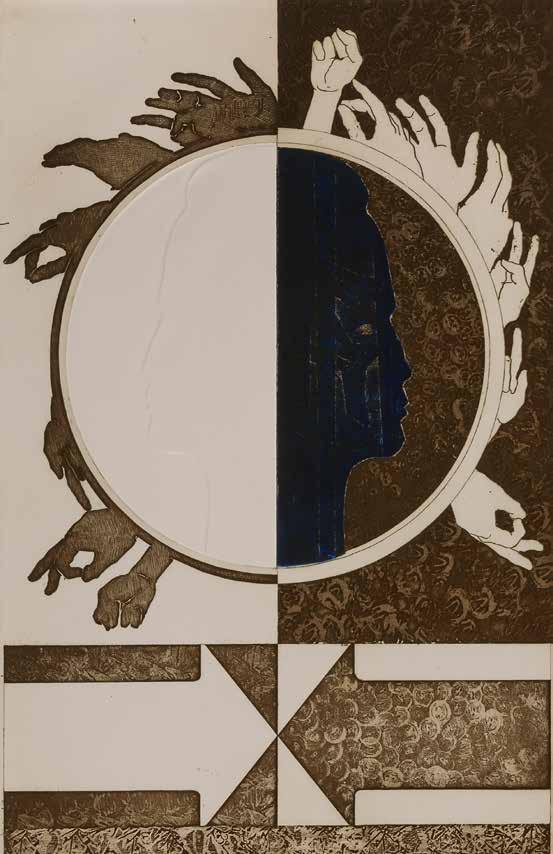
YINGYANG | Marion Epting, 1971
SERMON 2023, TRINITY EPISCOPAL CATHEDRAL, OMAHA NE
by Dean Vanessa Clark
Is there only one way to be a Christian?
Answering the question, “YES!” is attractive. You see, having a sense of certainty provides a foundation upon which you can build a fortress of protection. A narrow definition of faith beats back fear of vulnerability. A fortress closes its doors to change, self-reflection, and discovery. That foundation, however, is built on sand because it requires twisting Jesus’s teachings.
Take this statement Jesus says to Nicodemus in talking about the flesh versus the spirit: “I tell you, no one can enter the kingdom of God without being born of water and Spirit.”
The flesh is a birth into a particular family or tribe. It is a restricted identity that ties you to the way you look, your culture, and the geography of your kin. If it is the flesh that grants access to relationship with God, then entry to the kingdom of God is pretty narrow. But if it is the spirit that yearns for relationship which knits you into the life of God, then God’s banquet table is limitless.
Those Christian churches that cling to human certainty over the nuanced wisdom of scripture try to restrict that divine guest list. They read the verse like this:
“No one (outside our group) can enter the kingdom of God without being born of water (the way WE define baptism) and Spirit (as conferred according to our rules).” That birth in the Spirit must use specific language of shame, adhering to a narrow theology of petty judgment.
Not exactly a life-giving perspective.
Is there only one way to be a Christian? Being raised a Roman Catholic, I thought the correct answer was “Yes!” The pope in Vatican City was keeper of The One True Church and the only authority on who could be at Christ’s banquet. Many of my friends in a variety of Christian communities had the same answer to that question. Our church leaders taught we excluded each other from joy. Is it any wonder most of them have abandoned the Church all together?
Blessedly, my husband introduced me to the Episcopal Church.
Is there only one way to be a Christian? The Anglican answer is, “No, the Church is a diverse collection of spiritual journeys knitted into the mystical unity of Christ’s Body.” The Anglican perspective places common worship in open-hearted relationship to one another in balance with church teaching. We call it the via media, or middle way. Members have a lot of spiritual breathing room to take divergent ways toward being Christian.
The Episcopal Church structure and worship spring from Western traditions and are regularly reformed using holy revelation and consensus building. Along with an interpretive tradition of Holy Scripture, The Book of Common Prayer communicates our foundational theology. This balance between strong institutional structures and flowing theology in worship can be slow, messy, and complex.
Embracing that dismantles fortresses of faith that shut out change and are reinforced by fear. Those communities abuse another verse from our Gospel John 3:16 – possibly the most welcoming passage in the New Testament: “God so loved the world that he gave his only Son, so that everyone who believes in him may not perish but may have eternal life.”
JONATHAN PENDLETON | Unsplash
Rather than shouting out “God loved the entire world! God sent a precious messenger! EVERYONE is invited!” — those clinging to certainty turn it into a threat. Only people who believe their Christianity can have eternal life; questions and doubt are sin. That is wrong.
John 3:16 is part of a radical invitation to participate in the eternal joy of God’s commonwealth of peace. Our Creator so adored the universe that a part of God’s own self was loosed upon us, setting our hearts afire and drawing us into radiant existence. That’s the gospel. The message for all of us to share with the world.
But when you’re in a faith crisis and are despairing, journeys that are slow, messy, and complex can be a stumbling block. Can we make the Christian spiritual journey easy? No, but as a priest tending the souls sent to me, I can make it simple.
Is there only one way to be a Christian? “YES” and that is the Way of Love that Jesus commanded:
“Love the Lord your God with all your heart, with all your soul, with all your mind, and with all your strength. The second is this: Love your neighbor as yourself.” (Mark 12:30-31, BCP 1979)
Our journeys may be slow, messy, and complex, but this really is a simple faith. Simple, not easy. Amen.
The threefold sources of authority in Anglicanism are scripture, tradition, and reason. These three sources uphold and critique each other in a dynamic way. Scripture is the normative source for God’s revelation and the source for all Christian teaching and reflection. Tradition passes down from generation to generation the church’s ongoing experience of God’s presence and activity. Reason is understood to include the human capacity to discern the truth in both rational and intuitive ways. It is not limited to logic as such. It takes into account and includes experience. Each of the three sources of authority must be perceived and interpreted in light of the other two.
~Sources of Authority, from The Episcopal Church glossary~
DAVID CASHBAUGH | Unsplash
THE SPIRITUAL MEANING OF BALANCE
by Vinita Hampton Wright
When most people refer to balance, they envision a successful juggling act. A balanced life is one in which, simultaneously, I keep all my projects going and all my relationships healthy. I achieve this balance by sheer strategy and willpower.
In Christian spirituality, balance has more to do with temperance, which means that we allow our deepest principles to hold our passions in check. As Paula Huston explains in her book By Way of Grace, temperance has been misconstrued in popular language to mean an unhealthy denial of life’s pleasures. But from earliest times, Christians have valued spiritual balance.
St. Ignatius spoke of people having “disordered affections”—being ruled by desires rather than free to make wise choices. When we don’t practice temperance, eventually our affections will become disordered. A temperate person honors her desires and passions as gifts from God, but she does not constantly rearrange her life according to the ongoing flux of those desires and passions.
I’ve discovered that whenever I feel pushed, desperate, or hurried, that’s a signal that I need to apply some temperance. When I am driven to act—by my fear, my need to impress, or my own impossible expectations—I allow my perfectly good passions to run away with me. Passions themselves are not bad, but they were never meant to be in charge either.
Most of us can relate to Paula’s story; her desire to give her daughter the perfect wedding led to weeks of frenzy and overwork. One time, when my sister and brother-in-law were visiting, we’d had a full day of sightseeing and had returned home to cook a nice dinner. At about 8 p.m., I started pulling out ingredients to make an apple pie, and my sister stopped me: “Are you on speed?” she asked, laughing at my insistence on providing a homemade dessert. I decided that it was more important to relax and watch a movie with my family than slave over a pie we were too tired to eat anyway.
As an editor, I have to practice temperance; otherwise I would never finish making a manuscript “perfect.” As a writer I practice temperance when I decide that, no, a 16th rewrite of that scene is not necessary.
Parents must practice temperance when it’s time to let go of children, even though we know we could help them organize their lives or choose their friends. Our good desire to help those we love must be tempered by wisdom.
One of the best gifts of temperance is that it frees us to enjoy our loves. When I write, I can throw myself into it completely. And when temperance tells me it’s time to stop writing and do something else, I can put down my work and enter the next thing wholeheartedly.
Identify situations in which you feel pushed, or hurried, or desperate. Can you describe what’s going on, and how you might apply some temperance?
THE WEIGHING
by Jane Hirshfield
The heart’s reasons seen clearly, even the hardest will carry its whip-marks and sadness and must be forgiven.
As the drought-starved eland forgives the drought-starved lion who finally takes her, enters willingly then the life she cannot refuse, and is lion, is fed, and does not remember the other.
So few grains of happiness measured against all the dark and still the scales balance.
The world asks of us only the strength we have and we give it. Then it asks more, and we give it.
ALOFT | Tinka Jordy
WHEN CAUGHT
by Mark Nepo
When you are taken away by the raven of your pain, I will offer something warm for you to hold. When you fall into that long river of regret, I will be there with tokens of your kindness to remind you of all you have given.
And when you are caught in the endless whys of life, I will cook your favorite meal, just as you like it, so that how can quiet why.
There is no answer to the ways life throws us under, only the unassuming love that softens our return.
UGLY CRY
by Scott Erickson
Paintings of newly born babies rarely reflect what they actually look like. Admittingly, it takes a particular palette type to want a painting of an alien. They emerge from months of being in a sac of fluid, pushed through the birth canal to emerge naked, slimy, with smooshed-together faces.
And then they cry.
It’s not necessarily out of pain but more of their first breaths into this world calling to be reunited with their mother.
But it is an ugly cry.
With that birth canal face and vulnerable first-time try with their voice box…it’s a scene often not gracing the halls of art galleries.
Christ emerged into the world with an ugly cry.
Now I know, through posting these meditations, that some traditions don’t believe Mary experienced any pain and Jesus didn’t cry when he was born…which I have to say, nodding to the title of this book, feels a bit dishonest. What’s the fear in experiencing discomfort? What’s the fear in crying? I guess the argument is that it becomes evidence against the miraculousness of Christ’s incarnation…that somehow discomfort would usurp the narrative of God’s goodness. But I believe the discomfort speaks directly to it.
“Live to the point of tears,” said French philosopher Albert Camus. I have this hanging in my studio. It’s a reminder that the most memorable things of life are on the spectrum of tears of joy and tears of pain. It’s what you remember the most about your life. The moments that you were really there. That you were fully participating, versus the humdrum numbness of just passing the time.
Often when we protect ourselves from deep grief, we also stifle the experience of deep joy. They are symbiotic in a way…the tears of joy and grief…one emerging from the other. Tears…no matter how uncomfortable…mean you care. They are the evidence that you are showing up to the invitation to be alive. We’re all skeptical of the tearless in heartfelt moments.
Look, I have faith in the Christ story because of the Resurrection, but I mostly have faith because of the shortest verse in the Bible: “Jesus wept.” Because if there was a story about a Divine Creator incarnating as its own creation, partaking in what it means to be fully human, and in that story he didn’t eventually end up crying at his friend’s funeral – like you and I have done – then I wouldn’t believe it. It wouldn’t be an honest story. It would be a story of the Divine insulating itself from some of the hardest parts of being human…The ugly cry parts.
I can’t begin to answer why a human life has so much suffering. That is a question women and men have been contemplating since the beginning. But let us not forget the question of why a human life has so much unexpected joy – the kind that brings you to your knees in gratitude at the magic of it all.
One of our meditations is to contemplate the Divine participation in the ugly cry of being human.
Embedded in the Trinity are the memories of the ugly cry…the memories of the pain and the joy of being human. All the conversations of a human life are known intimately by the Almighty. Because of this, endless grace, comfort, and solidarity are offered when you find yourself nakedly vulnerable, slimy with flowing mucus and a tear-lined puffy face, with the evidence of fully participating in a human life.
May you live to the point of tears.
We balance our needs with faith in the one who carries us.
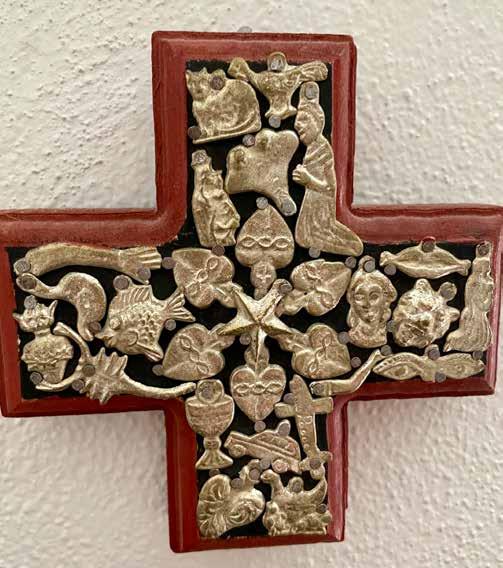
MILAGROS CROSS | The Guggenheim Museum
BIRDWINGS
by Rumi
Your grief for what you’ve lost lifts a mirror up to where you’re bravely working.
Expecting the worst, you look, and instead, here’s the joyful face you’ve been wanting to see. Your hand opens and closes and opens and closes. If it were always a fist or always stretched open, you would be paralyzed.
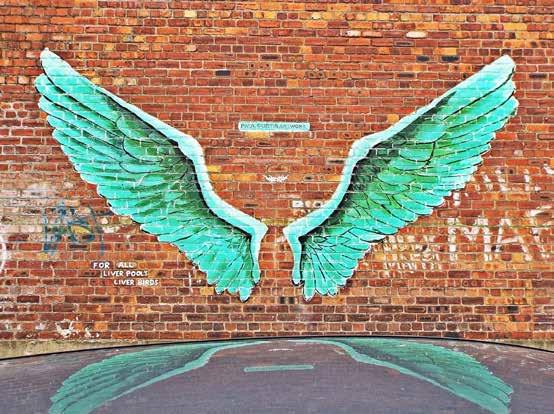
Your deepest presence is in every small contracting and expanding, the two as beautifully balanced and coordinated as birdwings.