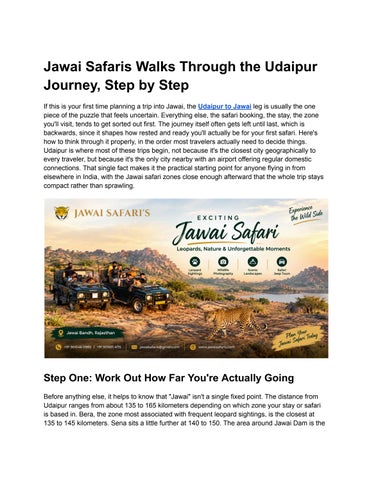
Jawai Safaris Walks Through the Udaipur Journey, Step by Step If this is your first time planning a trip into Jawai, the Udaipur to Jawai leg is usually the one piece of the puzzle that feels uncertain. Everything else, the safari booking, the stay, the zone you'll visit, tends to get sorted out first. The journey itself often gets left until last, which is backwards, since it shapes how rested and ready you'll actually be for your first safari. Here's how to think through it properly, in the order most travelers actually need to decide things. Udaipur is where most of these trips begin, not because it's the closest city geographically to every traveler, but because it's the only city nearby with an airport offering regular domestic connections. That single fact makes it the practical starting point for anyone flying in from elsewhere in India, with the Jawai safari zones close enough afterward that the whole trip stays compact rather than sprawling.
Step One: Work Out How Far You're Actually Going Before anything else, it helps to know that "Jawai" isn't a single fixed point. The distance from Udaipur ranges from about 135 to 165 kilometers depending on which zone your stay or safari is based in. Bera, the zone most associated with frequent leopard sightings, is the closest at 135 to 145 kilometers. Sena sits a little further at 140 to 150. The area around Jawai Dam is the
longest stretch, at 150 to 165 kilometers, while Maad and the Temple zone fall in between at roughly 145 to 160. Regardless of which zone applies to you, plan for around 3 to 3.5 hours of driving. The differences between zones rarely change this by more than 15 to 20 minutes either way.
Step Two: Decide How You're Covering the Road Once you know roughly how far you're going, the next decision is how. The standard route runs from Udaipur through Gogunda and Pindwara along NH27, continuing to Jawai Bandh. This stretch climbs into the Aravalli hills almost immediately, passing small towns, fuel stops, and roadside dhabas that make good break points, particularly around Gogunda or Pindwara if you want chai or breakfast along the way. The highway portion stays in good condition for most of the drive. What changes near the end is the shift onto narrower village roads leading directly into the safari zones, a stretch that's noticeably less forgiving if you're unfamiliar with it, especially once the sun goes down. Three realistic options exist for this leg. A private taxi offers flexibility without requiring you to navigate yourself. Self-driving works fine if you're confident and plan to arrive before dark. Arranged pickup through Jawai Safaris, bundled with your safari booking, puts a local driver in charge who already knows every turn on that final stretch, removing the guesswork entirely.
Step Three: Consider Whether You Have Time for Ranakpur If your schedule allows for it, routing through Ranakpur adds a stop at the Ranakpur Jain Temple, a site known across Rajasthan for its elaborate carved marble pillars, over a thousand of them, no two identical. This isn't a major increase in travel distance, but actually walking through the temple does take real time, so it only makes sense if you're not racing to make a same-day safari slot.
Step Four: Check Whether Train Travel Fits Your Plans For travelers coming from Udaipur specifically, train isn't really a practical option, there's no reliable direct service on this route. Where rail makes more sense is for visitors arriving from farther cities like Mumbai, Ahmedabad, Jaipur, or Delhi, who can get off at Falna, Jawai Bandh, or Mori Bera station before completing the final leg by road. Jawai Bandh station is the most convenient of the three when it fits your route, sitting just 15 to 20 kilometers from most zones. Falna is more commonly served but involves a longer 30 to 40 kilometer transfer. Mori Bera rounds out the options depending on your specific destination zone.
If train travel is part of your plan, build in a habit of rechecking IRCTC schedules closer to your actual travel date rather than relying on information gathered months in advance, since timings on routes like this shift periodically.
Step Five: Weigh Flying Into Udaipur if You're Coming From Further Away Travelers starting their trip outside Rajasthan entirely usually get the best outcome by flying into Udaipur's Maharana Pratap Airport first. With regular connections to Delhi, Mumbai, and other major cities, this gets you into the region quickly, after which the road journey takes the same 3 to 3.5 hours as everyone else making this trip. For most people coming from outside the state, this beats cobbling together a long train journey or multi-leg road trip from somewhere farther out.
Step Six: Pick the Season That Suits You October through March is when this entire trip, from the drive itself to the safari conditions once you arrive, works best. Cooler temperatures make the Aravalli stretch genuinely comfortable to drive through, and this period overlaps with peak leopard activity in the region, so you're not trading one for the other. Traveling outside this window, particularly during the hottest months from April through June, is still workable but requires more deliberate timing around the heat of the day.
Step Seven: Plan Your Arrival Timing Around Your First Safari This is the step travelers most often skip, and it's arguably the one that affects their experience the most. Arriving the same day as your first safari, especially if it's a sunrise slot, usually means starting that safari tired after hours on the road, with attention and energy already spent before you've even reached the jeep. Jawai Safaris consistently recommends building in an evening to arrive, settle into your stay, and rest properly before your first scheduled safari. Travelers who follow this pattern tend to describe a noticeably sharper, more engaged first outing than those who try to compress the drive and the safari into the same stretch of hours.
Step Eight: Decide Between a Two-Day and Three-Day Trip
A two-day structure typically starts with leaving Udaipur in the late morning, optionally stopping at Ranakpur, and arriving in Jawai by early-to-mid afternoon. After checking in and resting, an evening safari rounds out the first day. Day two opens with a sunrise safari, followed by breakfast and downtime, before heading back to Udaipur in the early afternoon. If your schedule allows, stretching this to three days means you can fit in both a sunrise and sunset safari, often across two separate zones, which meaningfully raises your overall chances of a genuine leopard sighting rather than relying on a single outing to deliver.
Why Getting Local Help Changes the Experience Every step above becomes simpler with someone who's handled this exact route repeatedly. Jawai Safaris has operated in the Jawai region since 2011, and the pickup-and-drop service offered as part of safari bookings draws directly on that experience, the specific turns near the safari zones that confuse first-timers, the realistic timing needed to arrive comfortably, and the coordination that comes from booking transport and your safari together rather than managing separate arrangements with a taxi company, a booking platform, and a resort.
Questions Travelers Ask While Planning This Trip Does the route change depending on which safari zone I'm staying in? The main highway portion stays largely the same regardless of zone; it's only the final village-road stretch that differs slightly based on your specific destination. Is it worth arriving a day early just to rest? Yes, particularly if your first safari is a sunrise slot. Arriving the evening before consistently produces a better first safari experience than a same-day arrival. Can I adjust my pickup time if my flight into Udaipur is delayed? Arranged pickups through Jawai Safaris can typically accommodate reasonable schedule shifts, so it's worth flagging any flight changes as soon as you're aware of them. Are there toll roads on this route? NH27 includes standard toll sections common to most Indian national highways, generally a minor cost relative to the overall trip. What's the biggest mistake first-time travelers make on this route? Underestimating the final village-road stretch and attempting it after dark without local guidance, which is avoidable with proper timing or an arranged pickup. Does the Ranakpur detour require a separate entry ticket? The temple itself may involve a nominal entry fee depending on current policy, so it's worth confirming details closer to your visit date.
Get in Touch Working through your own Udaipur to Jawai plan and want help with timing, pickup, or safari slots? Jawai Safaris is available daily to assist. ● ● ● ●
Visit Us: Jawai Safaris Call Us: +91 9610460985 / +91 9216014115 Email Us: jawaisafaris@gmail.com Working Hours: Mon – Sun: 6:00 AM – 9:00 PM (Safari desk open daily)
Conclusion Worked through step by step, the Udaipur to Jawai leg of your trip stops feeling like an uncertain gap between booking and arrival and starts looking like a manageable, even enjoyable, part of the journey itself. Whether you drive it yourself, add the Ranakpur stop, transfer by train through Falna or Jawai Bandh, or fly into Udaipur first, the details that matter most are timing your arrival sensibly and getting local help for the final stretch. Jawai Safaris handles exactly that through its pickup-and-drop service, leaving you free to focus on what the trip was actually about, a genuine shot at spotting a wild leopard in its natural habitat.