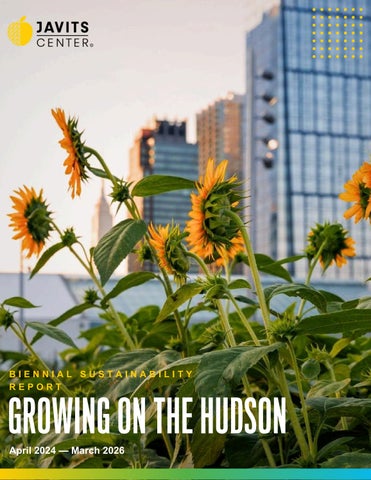
BIENNIAL SUSTAINABILITY REPORT
GROWING ON THE HUDSON April 2024 — March 2026
TABLE OF CONTENTS 1) Letter from the CEO
3
2) Introduction
5
a. Our Story b. Our Sustainability Journey c. Path to Net Zero
3) Our Performance
11
4) Our Planet
13
a. Energy and Infrastructure b. Biodiversity c. Food & Beverage d. Waste Management
5) Our People
31
a. Javits Team b. Local Community c. Global Community
6) Glossary
41
7) Acknowledgements
43
8) Sustainability Team
44
LETTER FROM THE CEO
At Javits Center, sustainability is a core pillar of our values, our operations and our mission. It is part of how we operate, how we serve our customers, how we support our community, and how we prepare for the future. You have heard me say that we are betting big on people, culture and operations. Sustainability touches all three. By investing and being intentional in our operations, we are more efficient, responsible, and resilient. It is about building a culture where every decision considers the impact we can make beyond our walls. It is about our people—our employees, our customers, our neighbors, and the generations who will inherit the choices we make today. At Javits, we believe that leadership means being willing to go first. That means being bold, taking risks, and putting our energy behind our values. We do not simply respond to challenges; we look for solutions that can fundamentally change how our industry operates. That mindset has transformed our campus. Our green roof, solar array, rooftop farm, energy initiatives, waste diversion programs, and JavitsCares donation program demonstrate that a convention center can be a strategic asset with environmental and community impact. But leadership is not about keeping good ideas to yourself. True transformation happens when innovation becomes a model others can learn from and build upon. We are proud to be the blueprint our industry and community can follow as we build a more sustainable future. And we are not finished. This report reflects the progress we have made, but more importantly, it represents where we are going and our continued commitment to sustainability.
03
Joyce Leveston President & CEO of Javits Center
INTRODUCTION INTRODUCTION
OUR STORY The theme of this edition is "Growing on the Hudson," which captures the heart of Javits. Sustainable growth at Javits is measured in roots, relationships and results. On Manhattan's West Side, Javits Center's campus spans 3.4 million square feet, including a one-acre farm and a 6.75-acre green roof - the largest in New York State. That green roof is also home to 80+ species of birds and 2,006 solar panels capable of generating 10% of building power: proof that scale and integrity grow together. Sustainability is embedded into the "why" behind our operations where we prioritize the wellbeing of our people, the health of our planet and the prosperity of our business. Sustainability at Javits Center is not defined by individual initiatives, but by a long-term commitment to innovation, cross-functional collaboration, and measurable impact. Together, they sculpt the three pillars of this report: Our Performance: the measurable impact of our program. Our Planet: our environmental work across energy, biodiversity, food and beverage, and waste. Our People: the employees, partners, and communities who move us forward. We are a signatory of the Net Zero Carbon Events Pledge, committed to net zero emissions by 2050, and participate in New York State's GreenNY Council, advancing Executive Order 22's goals. This report covers April 2024 through March 2026.
06
OUR SUSTAINAB 2015
2015 Achieve LEED Silver certification. JavitsCares program launches. Beehives installed on our roof.
1986 Javits Center opens as a 2.1M sq ft campus along the Hudson River.
2019 Second Sustainability Report published.
2017 2009-14 Building undergoes renovation adding 6.75-acre green roof and 5,000+ panels of birdfriendly glass. Bird monitoring begins with 15 species identified on our roof.
First Sustainability Report published.
ILITY JOURNEY 2025 2021 1.2M sq ft expansion completed and certified LEED Gold. Net Zero Carbon Events pledge signed.
Solar panels activated. Harvest bag initative begins. BuildSmart25 Goal 100% met.
2020
2026
30 MW microgrid opens with a new power management system.
Carbon emissions baselines established. Fourth report published.
2023 Third Sustainability Report. Path to Net Zero plan published.
PATH TO NET ZERO In 2021, ahead of COP26, Javits Center signed the Net Zero Carbon Events Pledge, committing to a 50% reduction in greenhouse gas (GHG) emissions by 2030 and net zero by 2050.
In 2025, we completed our Scope 1 and 2 emissions calculations in accordance with the GHG Protocol, establishing our first GHG baseline. Our public reporting baseline is 2015 to align with New York State's Executive Order 22 and our target setting baseline is 2023 to reflect our operations following our expansion.
Scope 1 & 2 Emissions
Year
Total metric tons CO2e
Intensity (kgCO2e/sf)
2015
14,289
6.50
2023
17,220
5.06
Our NZCE commitment and 2030 target are based on a year-over-year emissions reduction from our 2023 baseline. We have also completed a Scope 3 screening and materiality assessment. Building our full Scope 3 strategy is the next phase.
Producing clean power on site is a strategy to reduce our emissions. Our rooftop solar array, 2,006 panels generating 906.3 kW, has been producing power since 2025. Our vision is simple and ambitious: reach net zero across all campus operations by 2050.
10
O U R People 3,500 PREPARED MEALS DONATED
20+
167
LOCAL ORGANIZATIONS SUPPORTED
TOURS CONDUCTED
400
197
HARVEST BAGS TO EMPLOYEES
TONS OF FOOD DONATED
6 EMPLOYEE RESOURCE GROUPS LAUNCHED
334
TONS OF LEFTOVER ITEMS DONATED TO THE NYC COMMUNITY WITH JAVITSCARES
P E R F O R M A N C E Planet 60+ CROP VARIETIES GROWN
81
1,056,058.63 kWH
BIRD SPECIES SPOTTED
SOLAR ENERGY GENERATED
37,500 POUNDS
45%
OF PRODUCE GROWN
AVERAGE WASTE DIVERSION RATE
340 POUNDS
HONEY HARVESTED
$2,076,871 GENERATED VIA DEMAND RESPONSE
OUR
The health of the environment around us and the strength of our business are interwoven. Progress here depends on a workforce whose expertise touches every corner of this campus, across our infrastructure, operations, and partnerships, shaping a more sustainable future for our venue and the communities we serve.
PLANET
This work is ultimately about preserving resources for the generations that come after us. Our environmental work spans energy, biodiversity, food and beverage, and waste, four interconnected systems that reduce our footprint and restore the ecosystem around us.
ENERGY & INFRASTRUCTURE Energy and infrastructure have long been central to Javits Center's sustainability strategy. Over the past two years, we've continued investing in systems that improve building performance, reduce our environmental impact, and strengthen our role within New York City's broader energy grid. Energy Audit In 2025, we collaborated with NORESCO, an independent third-party firm, to conduct an ASHRAE Level 2 energy audit aimed at identifying further efficiency opportunities and in alignment with Executive Order 22 requirements. Findings: our energy use performs better than average among similar-sized facilities with comparable operations. BuildSmart Energy Goal: 100% addressed, with 64,022.90 MMBtu in logged savings against a 51,717.85 MMBtu target (FY 2014/15 baseline). Solar Power In 2025, we activated more than 2,000 solar panels across our campus, designed to offset approximately 10% of our electricity consumption. Generated since activation: 1,056,058.63 kWh Performance: 95% Demand Response We participate in New York's Demand Response program, reducing our energy consumption during periods of peak grid demand to support system-wide reliability. kWh reduced since 2014: 1,511,139 Incentives earned since 2014: $7,014,158
Building Automation Our building management infrastructure, including platforms like Desigo, allows our team to monitor performance and remotely control HVAC and temperature systems in real time. Through this system, we operate efficiently without compromising the experience our exhibitors and guests expect. Battery Energy Storage In 2025, we completed installation of a 3.5 MWh Battery Energy Storage System (BESS), adding another layer of resilience and flexibility to how we manage energy across the campus. Together, these investments reflect an energy strategy built for more than reducing consumption: infrastructure that adapts to the needs of our facility and the city around it.
Looking Ahead Javits is working toward activating its new 3.5 MWh Battery Energy Storage System by the end of 2026. The system is designed to store electricity for use during periods of peak demand, helping reduce reliance on the grid and strengthen the facility’s energy resilience.
17
BIODIVERSITY Javits Center's rooftop habitat is a living demonstration of how urban infrastructure can support biodiversity, resilience, and environmental stewardship. Green Roof At 6.75 acres, Javits Center's green roof is among the largest single-building extensive green roofs in the United States. The green roof is comprised of 11 species of sedum, providing multiple environmental benefits: Stormwater: absorbs and diverts approximately 7 million gallons of rainwater annually, more than 80 million gallons diverted since installation. Energy: functions as natural insulation for the building, improving heating and cooling efficiency year-round. Heat island: has reduced the intensity of the urban heat island around the Hudson-area campus by nearly 1°C (1.8°F).
Birds Bird-friendly glass throughout the building has reduced bird collisions by more than 90% since 2014. This served as a model for the city, state, and global events industry, providing the data behind New York City's Local Law 15, which now requires bird-friendly glass on new construction citywide, and inspiring other convention centers to follow suit.
More than 80 bird species stop on the Javits roof to forage and rest as they travel along the Atlantic Flyway migration route. The herring gull colony on our green roof sees higher hatch and chick survival rates than ground-level colonies in the wild. Herring gulls are a species in decline, and active management of our roof supports the population while protecting our own infrastructure. Banded chicks have returned to the Javits roof as adults to raise their own young so generations of the same gull families call our roof home.
PBS Spotlight In April 2025, the Javits Center's bird-friendly transformation was featured in Building for Birds, part of PBS's Wild Hope series, spotlighting our herring gull colony and the shift from one of the city's most dangerous buildings for birds to one of its safest. Arthropods: hundreds of thousands of insects, including moths and butterflies, support the roof's food web for birds and bats. Bat species: all 5 found in New York City, drawn especially to the food forest. Bees: 9 hives with about 100,000 bees per hive at peak season.
Rooftop Farm and Food Forest One-acre rooftop farm, established 2021, including a 3,500 sq ft greenhouse and a 10,000+ sq ft food forest. Renamed the Steel Farm in 2025, honoring former President and CEO Alan Steel. Practices: fully organic, NYS Good Agricultural Practices (GAP) certified. Crops: 60+ varieties, A to Z from apples to zucchini, including hops, started in 2025. Our Asian pear tree fruited for the first time since installation in 2025. The farm operates as a zero-waste operation: organic matter left behind after harvest is composted on the roof and spread back through the farm to support healthy soil and future harvests. Drexel University collaboration (2024 - 25): studied the roof's microclimates, including how sun and shade zones across the farm and orchard interact and affect soil and crop conditions. Together, this living roof is more than a collection of sustainable highlights. It is an interconnected ecosystem where plants, pollinators, birds, bats, and people all thrive together, a living example of biodiversity at the heart of New York City.
29
FOOD & BEVERAGE Sustainable food and beverage operations remain an important component of Javits Center's broader sustainability strategy. Through our close partnership with CULTIVATED, Javits Center's in-house catering and hospitality provider, and its parent company, Levy, we continue to identify opportunities to reduce the environmental impact of food service while maintaining the quality and experience expected by our guests, exhibitors, and employees.
Procurement and Menus All produce is sourced from farms throughout the New York region, prioritizing ingredients within 200 miles of Javits Center. We expanded plant-forward menu options across bowls, salads, and vegan and vegetarian offerings. The 50cut program blends ground beef with 50% locally grown mushrooms, offsetting emissions while offering a familiar menu favorite. Our procurement standards, set with partners Compass and Foodbuy, prioritize cage-free eggs, fair-trade and eco coffee, higherwelfare pork, rBGH-free milk and yogurt, reduced-antibiotic chicken and turkey, and sustainable seafood - all tracked through a monthly sustainability spend scorecard.
24
Serviceware A three-tier serviceware system guides event organizers toward more sustainable choices, from china at the top tier to bamboo and post-consumer recycled paper, down to standard post-consumer recycled (PCR) plastic and paper options. All on-site paper cups are made from fully recycled paper, while plastic cups and utensils are made from PCR material. Our culinary team continues to offer strawless lids, letting guests skip the straw entirely. A client sustainability guide walks event organizers through these practices when booking the Center so they can make the best selection for their event. We maintain that commitment internally as well. In summer 2025, we launched a reusable silverware pilot at Jake's, the employee cafeteria, cutting down on single-use utensils in daily staff dining. From Farm to Table Close collaboration with our rooftop farmers keeps produce within the building, bringing it directly from the roof to meals served at events. The full growing season is planned in advance with the farmers, Sustainability and culinary teams to align crops with the event calendar. Many of the herbs grown on the farm are also used in beverages, including infused water served in place of bottled water. These efforts demonstrate how thoughtful procurement, menu planning, and serviceware choices can reduce food miles and minimize our environmental footprint.
Looking Ahead We are introducing a bottle reuse program through Boomerang Water which provides a closed-loop, onsite bottling system that washes, sanitizes, and refills reusable bottles with purified water.
WASTE MANAGEMENT At Javits Center, waste is treated as a resource that reduces our environmental footprint while growing our social handprint through our donations program. Waste Diversion Average diversion rate, April 2024 through March 2026: 45% Javits diverts 16 streams from the landfill, including: Cardboard
Grease
Construction and demolition debris
Electronic waste
Metal
Vinyl
Mixed recycling
Lanyards
Soft plastics
JavitsCares items
Organics, including coffee grounds
Farm produce
Food donations
Alma carpet
Diesel disposal
Farm compost
Diversion is a collective effort that stretches to our attendees. A three-bin system in front-of-house areas lets attendees separate landfill waste, bottles and cans, and food scraps at the point of disposal. In July 2025, we completed our first formal waste audit, giving us a detailed look at our waste composition and helping inform the wider rollout of organics collection across the facility.
28
Looking Ahead Javits Center is pursuing TRUE Precertification, which recognizes facilities, events, and construction sites that have established the foundational policies and practices needed to pursue zero waste.
JavitsCares JavitsCares is our community donation program, redirecting usable items and surplus food left behind after events to organizations serving New Yorkers in need. Donated items have gone on to furnish public school classrooms, local theaters, and support immigrant families and survivors of human trafficking and domestic abuse. Nonprofit and community organizations reached: 20+ Donations, April 2024 through March 2026: Items: 334 tons Food, including farm-grown produce: 197 tons Combined: 531 tons Our Diversion Goals Javits Center’s commitment to waste diversion is reinforced through multiple diversion goals: Javits Organizational Goal: 50% waste diversion by the end of FY 2026 Net Zero Carbon Events Pledge: 75% waste diversion by 2030, 100% by 2050 Executive Order 22: 60.66% by FY29, 76.66% by FY37 From the show floor to every event we host, our waste diversion efforts keep materials in circulation while protecting the planet and supporting our community.
Highlights Following the 2025 NYC Marathon, more than 35,000 hangers were recovered and redirected to community organizations instead of the landfill. Additionally, through a partnership with City Harvest, approximately 154,000 lbs of surplus food from the 2025 Summer Fancy Food Shows were rescued for redistribution across New York City.
O U R
Behind every metric in this report is a person.
PEOPLE Our people are the reason our programs work.
JAVITS TEAM Sustainability at Javits Center is woven into our culture, thread by thread, and carried by everyone who works here, from the show floor and kitchens to the rooftop and behind the scenes. Every thread matters, and together they create a culture our people embrace with pride. In 2026, that commitment became a core pillar of the Javits Center brand: Sustainability with Heart.
34
Embracing Sustainability Starts with Supporting Each Other: Harvest Bags support employee well-being by connecting our team with fresh, seasonal produce grown on the Steel Farm. The program distributed more than 400 bags during its 2025 pilot and expanded to a 75-participant subscription season in 2026. Honey harvested from our nine rooftop hives is bottled by employees and shared across the team and with guests. Our Sustainability Team trains employees on waste sorting and stream separation. Bird and bat handling training prepares staff across multiple teams to safely respond when wildlife enters the building, with annual engagement events held around Earth Day since 2025. In 2025, we launched six Employee Resource Groups, supported by more than 50 ERG executive leaders, and hosted eight events to build community and connection across Javits Center. Through our collaboration with Rethink Food and CULTIVATED, we prepare and distribute meals in the community using ingredients grown on our rooftop farm. This initiative has provided more than 3,500 meals for New Yorkers in need since 2024.
36
LOCAL COMMUNITY JavitsCares redirects usable leftover items from events to more than 20 nonprofit and community organizations across New York City, supporting classrooms, local theaters, and families and individuals in need. From 2024 through 2026: Reusable items donated: 334 tons Food donated, handled in accordance with local food safety regulations: 197 tons Meals prepared with Rethink Food and CULTIVATED using surplus food recovered from Javits events: August 2024: more than 2,000 meals distributed to Covenant House August 2025: more than 1,500 meals distributed to Alliance for Positive Change In collaboration with NYC Bird Alliance, the Javits Center became the founding partner of the Biodiversity District in 2025: Builds a coordinated urban habitat network across Manhattan's Lower West Side Connects nearly 25 public, private, and nonprofit organizations Community tours of the Javits Center: Showcase our sustainability initiatives firsthand 167 tours given
38
GLOBAL COMMUNITY Through our employees, community partnerships, and international collaborations, our sustainability impact extends far beyond Javits Center, turning commitments into shared action that strengthens our organization, community, and industry. Signatory of the Net Zero Carbon Events Pledge since 2021 Addresses 10 of the UN's 17 Sustainable Development Goals Javits Sustainability Team participates in international working groups, including the Net Zero Carbon Events (NZCE) Working Group, to advance industry sustainability standards Hosts NEST during NYC Climate Week, drawing 10,000+ global attendees to showcase initiatives and exchange ideas Engaged with UFI (Global Association of the Exhibition Industry), including presenting at the 2025 92nd UFI Global Congress in Hong Kong Participates in international speaking engagements to share sustainability work with industry peers
40
G L O S S
Net Zero: A target of completely negating greenhouse gas emissions produced, achieved by reducing emissions and investing in carbon-absorption methods.
Carbon Neutral: Offsetting the same amount of carbon dioxide emitted through investment in emissions-reduction projects.
Waste Diversion: Minimizing solid waste sent to landfill through source reduction, recycling, reuse, and composting.
Green Roof: A roof partially or completely covered with vegetation and a growing medium over a waterproofing membrane.
UN SDGs: The United Nations Sustainable Development Goals include 17 universal calls to action to end poverty, protect the planet, and ensure prosperity for all by 2030.
A R Y
GHG Protocol: The Greenhouse Gas Protocol, the most widely used international accounting standard for measuring and managing greenhouse gas emissions, used as the basis for Javits Center's emissions calculations. Scope 1 Emissions: Direct greenhouse gas emissions from sources owned or controlled by an organization, such as fuel combustion in on-site equipment or company-owned vehicles. Scope 2 Emissions: Indirect greenhouse gas emissions from the generation of purchased electricity, steam, heating, or cooling consumed by an organization. Scope 3 Emissions: All other indirect greenhouse gas emissions that occur in an organization's value chain, both upstream and downstream, such as purchased goods and services, business travel, and waste disposal. COP: Conference of the Parties, the annual United Nations climate change conference where signatory nations negotiate and review progress on global climate commitments. COP26, referenced in this report, was held in Glasgow in 2021.
ACKNOWLEDGEMENTS
This report reflects the work of many partners, consultants, and community organizations who make our sustainability program possible. Thank you to:
43
Brooklyn Grange
New York Power Authority
WSP
Recycle Track Systems
NuEnergen
NYC Bird Alliance
ConEdison
Materials for the Arts
Siemens
Silvermine Apiaries
Drexel University
Levy Restaurants
NYC Housing Association
Cisco
NY Department of Sanitation
911 Cellphone Bank
SUSTAINABILITY TEAM Yashi Dadhich Senior Director of Energy and Sustainability
Eli Dryer Event Sustainability Lead
Yasmin Yusuff Sustainability Solutions Coordinator
GET IN TOUCH Have a question about this report or our sustainability program? Reach out to our team at sustainability@javitscenter.com
44
Every root, hive, and hand at Javits Center is part of one connected system where the health of our planet, our people, and our business grow together. This report is that story.