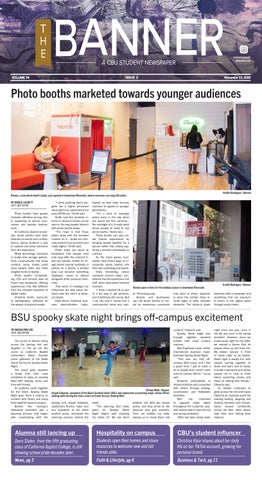
T H E
BANNER A CBU STUDENT NEWSPAPER ISSUE 2
VOLUME 74
@cbulancermedia cbubanner.com
November 13, 2026
Photo booths marketed towards younger audiences
Arielle Rodriguez | Banner
Revela, a new photo booth studio, just opened in downtown Riverside, where everyone can enjoy $6 prints. BY GRACE LUCKETT ASST. B&T EDITOR
Photo booths have gained renewed attention among Gen Z, appearing at events, businesses and popular destinations. At California Baptist University, photo booths have been featured at events such as Barn Dance, giving students a way to capture and keep memories from the experience. While technology continues to shape how younger generations communicate and share content, some trends point back toward older and more tangible forms of media. Photo booths, scrapbooking, CDs and records have all found new audiences, offering experiences that feel different from the constant presence of digital media. Christine Smith, instructor of photography, reflected on the appeal of physical media.
“I think anything that’s tangible has a higher perceived value right now, especially since post-COVID era,” Smith said. Smith said the renewed interest in physical media can be seen in the way people interact with photo booths today. “The hope is that those photo strips with the branded content on it... would be ironically posted to social media and made digital,” Smith said. Photo strips can serve as keepsakes that people hold onto long after the moment itself has passed. Unlike an image stored among hundreds of photos on a phone, a printed strip can become something displayed, saved or placed alongside other personal memories. That sense of nostalgia has influenced the way some students view the return of physical media. Drew Kerns, freshman business administration major,
shared on why older formats continue to appeal to younger generations. “It’s a kind of nostalgia where back in the day when you would use film cameras... the nostalgia of it is really what drives people to want to use photo booths,” Kerns said. Photo booths can also create shared experiences by bringing people together for a picture rather than simply capturing a moment individually on a phone. As the trend grows, businesses have found ways to incorporate photo booths into their own marketing and events. Emily Ehrenberg, senior computer science major, considered how the experience can shift when businesses become involved. “I think it started off as sort of a fun way to get pictures, and it definitely still can be. But I can see how it turned into a consumerism trend very easi-
Arielle Rodriguez | Banner
Revela open in time for the holiday season in downtown Riverside. ly,” Ehrenberg said. Brands and businesses can use photo booths to create an experience customers
may want to share, especially when the printed strips include logos or other branded elements. The physical photo
becomes both a keepsake and something that can eventually return to the digital space through social media.
BSU spooky skate night brings off-campus excitement BY MADALYNN COX ASST. A&E EDITOR
The sound of wheels rolling across the skating rink and laughter in the air set the scene as California Baptist University’s Black Student Union gathered at Cal Skate Grand Terrace for Spooky Skate Night. The event gave students a break from their class schedules to enjoy an evening filled with skating, music and time with friends. As students came together for the event, Spooky Skate Night gave them a chance to connect with others and enjoy time together beyond campus. Behind the evening’s Halloween festivities was a planning process that began with coordinating with the
Shirley Wells | Banner Asiyah Edwards, president of the Black Student Union (BSU) and sophomore accounting major, shows off her skating skills during the club’s event at Grand Terrace Skating Rink. skating rink. Asiyah Edwards, sophomore finance major and vice president of the black student union, described the planning process behind the
event. “The planning that takes place for Spooky Skate Night begins with emailing Cal Skate GT. We ask them
whether the date we choose works, and they email us the discount they give students. Then we solidify our date, leaving us to create flyers and
content,” Edwards said. Spooky Skate Night also brought together students outside their usual campus routines. Nya Angelique Lucas, senior international business major, attended Spooky Skate Night. “This was my first offcampus BSU event, and I had a great time. I got to meet a lot of people that I hadn’t seen around campus before,” Lucas said. Students participated in shared activities and connected with others through skating, conversation and Halloween festivities. BSU has continued to organize skate nights throughout the academic year, with events held in both the fall and spring semesters. “BSU has been doing skate
night since last year, once in the fall and once in the spring semester. However, since we chose skate night for the 29th, we wanted a theme that let people dress up and have fun. We added ‘spooky’ in front of ‘skate night’ to be festive. Skate night is always fun, with people coming together to skate and learn how to skate. It builds community and allows people not to have to think about upcoming exams and focus on skating with friends,” Edwards said. As wheels continued to glide across the rink and music filled the air, students spent the evening skating, laughing and sharing moments with friends. Some moved confidently across the floor, while others took their time finding their balance.
Alumna still lancing up
2F302F Hospitality on campus
CBU’s student influncer
Doris Slaten, from the fifth graduating class of California Baptist College, is still showing school pride decades later.
Students open their homes and share resources to welcome new and old friends alike.
Christina Viyar shares about her daily life on her TikTok account, growing her personal brand.
News, pg 3
Faith & Lifestyle, pg 6
Business & Tech, pg 11
NEWS
2
November 13, 2026 · Volume 74 · Issue 2
THE BANNER STAFF PRINT Editor-in-Chief Cayanna Ligon Acting Managing Editor Cadyn Eades Creative Director Lorelei Arriola Asst. Design Editor Aubrie Marie Landolt Illustrators Sophia Sunga Abi Frisbee Photo Editor Vanessa Ruezga Asst. Photo Editor Keegan Hartley F&L Editor Arianna Bultsma
Asst. F&L Editors Elizabeth Harshbarger Lydia Larson
Asst. A&E Editors Madalynn Cox Eden Rothwilson
Asst. S&W Editors Benjamin Harlan Austin Litteral Oscar Sotelo
Asst. News Editors Lizzy Livingston Isabella Sykeh
Asst. B&T Editors Abby Abarcas Grace Luckett
ONLINE Editor-in-Chief Cayanna Ligon Acting Managing Editor Cadyn Eades Photo Editor Vanessa Ruezga Director of Student Publications, Print & Online Dr. Casey Maldonado
ABOUT THE BANNER The Banner, a student-run newspaper, serves the CBU community with accurate, timely and factual reporting on significant aspects of university life, Riverside life and subjects of interest or concern to its readers. The Banner’s content is produced by the student staff and does not necessarily reflect the opinions or interests of the university. Students, faculty, staff, administrators and others in the university are encouraged to react to published material or to comment on matters of concern. The Banner retains the right to edit your letter upon publication based on grammar and word count. Send letters to Cayanna Ligon, editor-in-chief of The Banner at CayannaElizabeth.Ligon@calbaptist.edu. If you have a story idea for The Banner, please let us know. If a business would like to advertise in The Banner, please contact Erica Dennis at EricaPatrice.Dennis@calbaptist.edu. The newsroom is located in the James Building in Room 060 and can be reached at 951-343-4787. Thanks for reading!
STAY CONNECTED
US citizens vote during midterm elections BY ISABELLA SYKEH ASST. NEWS EDITOR
Voters across the United States cast their ballots Nov. 3, 2026. The election allowed citizens to vote on ballot measures and candidates for government positions. This particular election was a midterm election, which occurs every four years at the midpoint between presidential elections. Midterm elections give voters the opportunity to decide which political party controls the majority of the House of Representatives and Senate. In California, voters also cast ballots for a new governor, a position held by Gavin Newsom since 2019. The two major candidates for governor were Xavier Becerra, the Democratic candidate, and Steve Hilton, the Republican candidate. Dr. Chase Porter, chair of the department of history and government and associate professor of political science, gave context for the election.
“There tends to be a lot of back-and-forth in modern politics regarding congressional control and which party controls the different chambers of Congress,” Porter said. “This often leads to divided government.” Porter considered what changes in congressional control could mean at the federal level. “The only way this election could have a truly significant impact at the federal level would be if Democrats somehow gained control of both chambers of Congress, meaning the House of Representatives and the Senate, with substantial majorities,” Porter said. “That would allow them to pass legislation that President Trump could not veto. That’s when you would start to see some additional movement on the legislative front.” Students at CBU also shared their views on the election. Jaya Richardson, junior history and political science double major, spoke
Photo Illustration by Keegan Hartley | Banner Riverside County voting information documents. about the election. “Voting is really important because it determines how future policies work, like affordable housing, environmental issues or capital issues,” Richardson said. “I think voting is necessary to control your future.” Richardson focused on the act of voting, while other students considered the election from a different point
in the process. Nathanael Zamora, junior environmental science and political science double major, considered what comes after Election Day. “I think it’s always good to stay updated after the election because you see what kind of candidates have actually been elected and you [can] prepare yourself for the future,” Zamora said.
Friendships built during visits at The Post BY ISABELLA SYKEH ASST. NEWS EDITOR
Mail and Shipping Services at California Baptist University, commonly known as The Post, offers more than a convenient place for students to pick up packages. Behind the counter, students and employees build relationships, share conversations and foster a sense of community in a place that might otherwise be overlooked. Employees at The Post make an effort to get to know one another and the students who visit to collect their packages. Jennifer Mayorquin, office manager for print and mail services, discussed what working at The Post looks like behind the counter. “The student workers’ job is a team effort because one of us can start a task and we are all trained so that if someone steps away, the next person can pick right up where they’ve left off. There’s a lot of communication that takes place because we are moving a lot of packages... and so it requires a lot of communication and a lot of teamwork,” Mayorquin said.
Beyond teamwork among employees, regular interactions give the CBU community opportunities to become familiar with one another.
The number of students visiting The Post can also change throughout the day, especially when students are already nearby. “Specifically, on chapel
Hevin Blankenship | Banner Kailey Keating, senior early childhood studies major, picks up a large package from The Post. “We interact with a lot of students at the front counter when students come to pick up their items, so there’s a lot of interaction there. We become familiar with names, familiar with faces,” M ayorquin said.
days, we’ll get a lot of traffic after chapel, because a lot of students are already on kind of this side of campus,” Mayorquin said. Even the lobby provides opportunities for connection. Mayorquin pointed to student
photography displayed throughout the space as another possible conversation starter. “I know we have photos hung up in our lobby area that are student work, [from] photography students, so some of them might even recognize that, and that might start a conversation amongst them as well,” Mayorquin said. Students have also found that The Post can provide an easy way to interact with others. Seraphina Poliakon, senior exercise science major, shared how she starts conversations while waiting in line. “I just ask people in line how their day is going and I ask them what they ordered,” Poliakon said. CBU alumnus, Titus Rehard, said his interactions at The Post extended beyond package pickups and became familiar connections around campus. “When I went to [The Post], I ended up talking to a lot of the people working, and they were super sweet. Then, when I would see them around campus, we’d say hi,” Rehard said.
The people making CBU food possible BY EDEN ROTHWILSON ASST. A&E EDITOR
College students often miss home-cooked meals, but at California Baptist University, dining services provide students with meals throughout the day. Behind those meals are employees working both at the counter and behind the scenes to keep dining locations running. Ashley Virgin, sophomore business administration major and employee at El Monte, highlighted the importance of CBU service workers, especially those who aren’t on the front lines. “I think if students knew all the hard work, they would approach it differently, because there are so many people involved in prep,” Virgin said. “Our roles are important, especially for the Provider [Contract Food] Service because they prep all the food and make the meals that get you by every single day.” That work continues across
CBU’s dining locations, where many employees contribute in ways students may not always see. Dalila Romero, senior journalism major and employee at the Alumni Dining Commons, acknowledged those working behind the scenes to make each meal possible. “In the back kitchen, we have like 20 cooks where they’re working all day, every day, making everything; they are the real troopers,” Romero said. Romero noted that student employees balance work with their education and credited shift leads for helping accommodate class schedules and other scheduling challenges. Gwen Nelson, shift lead and coordinator at Chick-fil-A Express on campus, spoke about how student schedules are balanced with the demands of the job. Recently appointed as a shift lead, Nelson has also seen firsthand the dedication employees bring to their work. “The amount of work that everybody puts in here is in-
credible,” Nelson said. Nelson expressed how students can contribute to a positive dining experience. Students may go in and out of dining areas while trying to fit meals into their busy schedules, but much of the work that keeps those locations running happens behind the scenes. From food prepara-
tion to scheduling and serving, employees take on different roles throughout CBU’s dining services. A simple thank you or conversation with a Provider Food Contract Service employee can be one way students recognize the work happening across campus dining locations.
Briaira Townsend | Banner A Chick-fil-A employee prepares meals for students placing mobile orders during the rush.
NEWS
3
November 13, 2026· Volume 74 · Issue 2
Weekend trips home bring comfort BY LIZZY LIVINGSTON ASST. NEWS EDITOR
Traveling away to attend a university may not have been as much of a life change for some students at California Baptist University who still live close to home. While living on campus gave them the chance to be part of a new community with fellow students, having the option to return home on weekends allowed some students to remain connected to their communities outside CBU. Often referred to as a “suitcase campus,” the term describes a university where some students return home on weekends. At CBU, stu-
dents who live close enough to campus may have the opportunity to spend weekends at home before returning for the next week. Savanna Houde, sophomore exercise science major, talked about her experience going home while living on campus. “I feel like I’m constantly thinking of school while I’m at school,” Houde said. “It’s nice to wind down and not have to think about it.” Having a dedicated place at home to reset was helpful for Houde. Traveling home allowed her that space while balancing her home and on-campus life. Olivia Rodriguez, sophomore communication studies
major, described how returning home fits into her college experience. “When I go home, I benefit by catching up on any extra homework I may have, catching up on sleep is a big one [too]… Seeing friends who I don’t see often to catch up with them, and of course, hanging with my family and going to church on Sundays as well,” Rodriguez said. Having a foot in both worlds allowed Rodriguez to be part of a community on campus while maintaining the one she had already created at home. Dr. Julie Goodman-Bowling, professor and program coordinator of an-
Photo Illustration by Olivia Berry | Banner Ava Moen, junior social work major, loads her car as she gets ready to head home for the weekend.
thropology and chair of the division of family and culture in the college of behavioral and social sciences, offered a broader perspective on why students may choose to return home. “Students may find that going home helps them to ground themselves. To go home and be in familiar surroundings functions as a recharge,” Goodman-Bowling said. “A home-cooked meal, sharing about school experiences with one’s parents or siblings or a visit to one’s home church may provide the grounding students need to come back to CBU ready for a new week.” Rodriguez and Houde both described going home as more than simply leaving campus for the weekend. Their experiences also included spending time with the people and communities they knew at home. Weekend experiences at CBU can vary depending on whether students choose to return home or remain on campus. “There’s probably some novelty in that for students who remain on campus over the weekends. A sense of quiet and peace can be good and healthy… I also think this is why it’s so important to find a home church for students. This can provide [a] great family-like atmosphere while one is away from their [family],” Goodman-Bowling said.
Campus celebrates Knight Before Halloween BY LIZZY LIVINGSTON ASST. NEWS EDITOR
Costumes, candy and Halloween-themed activities brought students together at California Baptist University’s “Knight Before Halloween” event at the Hawthorne House in The Colony on Oct. 30. Students walked around, visiting various trunks as part of the trunk-or-treat, stopping by booths handing out food and participating in activities ranging from trivia to caricature portraits. Elayna Cheney, junior criminal justice and intercultural studies double major, served as a resident assistant and was part of the planning committee for the event. While working as a gnome, drawing portraits for students and handing out candy from a trunk, she reflected on seeing the event come together. “[It] was so fun to make people feel more involved,” Cheney said. “When you plan an event,
especially to be there and be able to see people having fun, and it’s people with friends, community forming and see the fruit of the work of your hands is so cool.” Having been a key part of the event’s activity planning, Cheney was able not only to work and help things run smoothly but also to attend later in the night and experience the event alongside other students. Justus Tieche, senior business administration major, reflected on the work that went into planning the event. “I feel like [they] do a great job. It just shows that Rez Life cares about the students, and they put on special events that try and build community,” Tieche said. Events such as Knight Before Halloween require planning and coordination from Residence Life staff and student leaders to create opportunities for students to spend time together
outside the classroom. Those who helped organize and produce the event offered a variety of activities for students to enjoy. Erica Echeverria, senior early childhood studies major, said her personal favorites were the trunk-or-treat and the slime station. “I think it’s really fun that they’re calling the glue and all the materials fun names, and it’s really fun to get your hands messy,” Echeverria said. Students could participate in activities alone or with friends while taking in the Halloween atmosphere. Fog machine and other decorations were placed throughout the area to help set the scene. Beyond the activities and decorations, the event created opportunities for students to spend time together. Cheney reflected on the social side of Knight Before Halloween. “Community is so easily formed by people, whether
you’re there and you meet people and community forms that way, or you’re like, hey, do you want to go to this event together?” Cheney said.
NEWS briefs BY CADYN EADES
FLEMING’S OPENS IN RIVERSIDE Fleming’s Prime Steakhouse, founded in 1998, opened its downtown Riverside location Nov. 9. The restaurant, led by Chef Partner Ryan Wong, features steak, seafood and vegetarian options. Fleming’s is open Monday through Friday from 11 a.m.-10 p.m., Saturday from 4-10 p.m. and Sunday from 4-9 p.m.
NASA ACCEPTING NEXT GENERATION ASTRONAUT APPLICATIONS The National Aeronautics and Space Administration is accepting applications for its next class of astronauts, which will train as NASA prepares for future missions to the moon and Mars. Applicants must meet education and professional experience requirements, including a qualifying advanced STEM or medical degree. Applications are due Dec. 3.
CBU LEADS IN CROSSTOWN SHOWDOWN AGAINST UCR California Baptist University leads the University of California, Riverside in the newly established rivalry. CBU has earned wins over UCR in soccer, volleyball and cross country. Students look forward to upcoming matchups in basketball, golf, softball and baseball. The current record for the inaugural Crosstown Showdown is CBU 6, UCR 0.
CRISTIANO RONALDO ANNOUNCES INTERNATIONAL RETIREMENT After 23 years representing Portugal, Cristiano Ronaldo announced his retirement from international soccer Nov. 5. Ronaldo shared the news in a video message reflecting on his career with the national team. He is not retiring from soccer entirely and will continue playing for Saudi club Al Nassr, where his contract runs through June 2027.
Resident advisors hand out treats at Knight Before Halloween event.
Evie Brown | Banner
Doris Slaten, still lancing up after graduating from fifth CBU class BY ARIANNA BULTSMA F&L EDITOR
Before California Baptist University became the campus students know today, Doris Slaten was among the graduates of 1958. As a sociology major and member of the university’s fifth graduating class, Slaten experienced CBU during its earliest years, when the university community was much smaller and the university was known as California Baptist College. Nearly seven decades later, at 90 years old, Slaten still lives just minutes from campus, carrying memories of a time when the university community was small enough for everyone to know one another. “We did everything we needed to do in that James Build-
ing,” Slaten said. “That’s where we slept, studied, ate.” Slaten first attended CBC in 1954 when the college was still located in El Monte, Calif., before moving with the school to Riverside. She recalled sharing living quarters with four other women, attending classes and working various campus jobs. During those years, tuition was $8.50 per unit before increasing to $10 when the college relocated to Riverside. Slaten remembers her college experience fondly, especially the close-knit community she found there. “But they were such good days,” Slaten said. “Like I say, you knew everybody.” Among her favorite memories were singing alongside two close friends in a trio that per-
formed at churches throughout California to promote the college. She was also part of the
school’s first choral group, traveling to different congregations to share music and introduce
Shirley Wells | Banner Doris Slaten, alumna who was part of California Baptist College’s fifth graduating class.
others to the growing institution. Slaten has watched the university and its students change over the decades. “I just think, you know, the students are so much more confident now,” Slaten said. Slaten also spoke about what she hopes current students take from their time at CBU. “The wonderful education they’re getting, for one thing, and the friendships that are formed that last a lifetime like mine,” Slaten said. After graduating, Slaten continued her education at the University of Redlands, where she earned her teaching credential. She went on to teach elementary school in Rubidoux for 29 years, a career she also viewed
as an opportunity to serve others through her faith. Although her time as a student ended decades ago, Slaten continues to visit campus and attend university events. “Every time I drive by, I think, who would have ever thought that it would come to this?” Slaten said. Slaten had advice for graduating seniors as they enter new seasons of life. “My faith has gotten me through so much,” Slaten said. “I would just tell them to still keep the faith and keep trusting God to get them through.” After nearly seven decades of watching the university grow, Slaten remains grateful to have been part of its beginnings. “I’m just very proud and very thankful,” Slaten said.
VISION
4
November 13, 2026 · Volume 74 · Issue 2
Tiers of
Peace Life can bring seasons of uncertainty, and in the midst of them, peace can sometimes feel difficult to find. Peace with God is the foundation, peace
with ourselves is an inward expression of it, peace with others is an outward expression of it, peace with authority calls for humility and discernment and peace with our circumstances can be a demonstration of trust in Him and His greater plan. Perhaps we do not need to understand everything or have total control to experience peace. Peace is not simply the absence of conflict, but the presence of harmony. This vision spread explores what peace can look like in different areas of life: peace with God, peace with ourselves, peace with others, peace with authority and peace with our circumstances.
SPIRITUAL: Peace with God BY BENJAMIN HARLAN ASST. S&W EDITOR
Christians believe God gives believers His Spirit when they put their faith in Him. Many lean on God for peace, looking to Him as a constant through the different circumstances of life. Dr. Thomas Donavan, associate professor of psychology, spoke about his own experience of finding peace with God. Donavan said the first step was to “just stop fighting God” and become open to Him and His influence. Donavan described surrender as an important part of allowing God to work in his life. Rather than resisting or trying to control everything on his own, he learned to become
more open to God and His influence. That process can also require believers to recognize the areas of life they may be trying to manage on their own. Making space for prayer, reflection and time with God can provide opportunities to slow down and refocus during busy or uncertain seasons. Donavan uses time in nature as an opportunity to reflect on God and His creation. Stepping outside of his everyday routine gives him another way to consider his circumstances from a broader perspective. “Being reminded of the vastness of nature and space,” Donavan said. “[It] reminds me that I'm not fighting on my own.”
PERSONAL: Peace with the Self BY JAVID BECERRA
ASST. CREATIVE DIRECTOR The word “peace” can bring an array of thoughts to mind. One example could be peace from war, a state of calm within an environment of chaos. In a chaotic world, people may also seek a sense of peace within themselves. Dr. Tim Mosteller, professor of philosophy, described inner peace through what he called a “justice of the soul.” “The idea of peace within the soul would be something like having my soul properly ordered. I think of it as a harmony of the parts of the self,” Mosteller said. Mosteller explained that these parts include the intellect, will and body, which he connected to the Christian understanding of humanity being made in the image of God. “Peace within the self would be having those parts of us operate in the right order,” Mosteller said.
Mosteller connected this order of the soul to the pursuit of righteousness and a deeper sense of peace within oneself. Practices such as prayer, reflection through Scripture and developing a relationship with God can give Christians opportunities to examine their lives and seek that sense of spiritual order. That process can also involve slowing down long enough to reflect on what may feel out of balance. Making space for prayer, Scripture and self-reflection can help people
become more aware of the areas of their lives that may need greater attention or growth. Within this perspective, peace does not necessarily come from removing every
challenge or distraction. Instead, it can involve understanding oneself, growing in faith and allowing different areas of life to become more aligned with God.
INTIMATE: Peace with Loved Ones BY MADALYNN COX ASST. A&E EDITOR
Silence is not the only way to discover peace. Often, it begins with conversations, a sincere apology or openness to hearing what a loved one has to say. In the closeness of a home or college dorm, relationships are shaped by everyday moments. Sharing a space, balancing responsibilities and learning how to communicate with one another can strengthen even the closest connections. These moments also provide opportunities to practice patience, understanding and forgiveness. College can bring students into close relationships with
roommates, friends and classmates who may have different personalities, habits and ways of communicating. Learning how to understand those differences can become an important part of building healthy relationships with the people around them. Licensed Marriage and Family Therapist Sandra Nunez emphasized the value of understanding and communication in sustaining healthy connections with others. “Maintaining peace in our closest relationships requires intentional effort. Disagreements are a natural part of any relationship, but how we respond to them is important.
When we listen, communicate honestly, and respect one another’s boundaries, we create an environment that makes people feel safe and understood. Peace does not mean perfect it means choosing to approach one another with love and understanding during difficult moments,” Nunez said. Maintaining peace can involve addressing differences with empathy and recognizing the effort each person brings to a relationship. Communication can give loved ones opportunities to express their feelings, establish healthy boundaries and better understand one another. Healthy communication can
also begin with simple choices, such as listening before responding, being willing to apologize and giving another person the opportunity to explain their perspective. These actions can create space for people to better understand one another rather than allowing small misunderstandings to grow. Relationships with friends, family members and roommates can also provide opportunities to practice grace and forgiveness. Approaching one another with patience and respect can help those relationships continue to grow through the everyday experiences people share.
VISION
5
November 13, 2026 · Volume 74 · Issue 2
SOCIAL: Peace with Peers BY ABBY ABARCAS ASST. B&T EDITOR
In a world where disagreements and differences can create division, finding peace with others can be challenging. However, peace begins with how people choose to treat one another, even when they do not share the same beliefs or opinions. Dr. Amy Stumpf, professor of religion and society, shared that fear and selfishness can prevent people from building peaceful relationships. “Kind of the opposite of peace is fear,” Stumpf said. She explained that people may feel challenged or uncomfortable when others have different opinions or beliefs, which can
make it harder to listen to one another or approach conversations with understanding. One way to practice peace is by recognizing the value of every person. “You cannot dehumanize a person without insulting God,” Stumpf said. Stumpf explained that Christians are called to see others beyond labels or disagreements. Respecting another person does not require agreeing with everything they believe, but it can shape the way people speak to and treat one another. Stumpf also talked about the importance of humility, kindness and forgiveness, referencing 1 Corinthians 13. “A little humility would help civility,” Stumpf said. Approaching
disagreements with humility and goodwill can give people space to listen, communicate and respect one another without necessarily having to agree. Peace can also begin through smaller, intentional choices in everyday relationships. Listening before responding, being willing to apologize and giving others the opportunity to explain their perspective can help people better understand one another. Stumpf pointed to prayer as one way college students can approach their relationships with others. “It’s hard to hate people we pray for,” Stumpf said.
INSTITUTIONAL: Peace with Authority BY LORELEI ARRIOLA CREATIVE DIRECTOR
As children, many young people longed for adulthood and the freedom it would bring from household rules and classroom expectations. However, adulthood brings its own authorities, responsibilities and institutional expectations. Learning how to navigate those relationships can require humility, discernment and respect. Pastor Jim DeVore of Cornerstone Church in Littlerock began his professional career as a journalist before entering ministry. Drawing on his experience, he encouraged young people to approach authority with humility and a commitment to both peace and truth. Reflecting on Ephesians 6, DeVore emphasized hard work, kindness and integrity as ways believers can represent Christ in the workplace, school and community. He encouraged believers to practice contentment in different circumstances while also using discernment when ques-
tions of faith and conviction arise. DeVore also encouraged believers to seek counsel from other Christians when navigating difficult situations and to communicate concerns through appropriate channels. Reflecting on Romans 13, he emphasized the importance of approaching authority with wisdom, respect and a desire to represent Christ well. Personal preferences and moral concerns can also require different levels of attention. DeVore noted that learning to recognize the difference can help people focus their energy on what matters most
while maintaining peace in their relationships with those in authority. DeVore’s missions experience also shaped his perspective on how relationships with authority can differ depending
on a person’s circumstances. He encouraged believers to respond with patience, gentleness and Christlike character while trusting God through situations they may not fully understand or control.
Through those relationships, DeVore emphasized that peace with authority ultimately begins with remembering where a believer’s greatest trust is placed. “God is our ultimate au-
thority and there is no situation that we are involved in that He is not aware of,” DeVore said.
EXISTENTIAL: Peace with Circumstances BY ISABELLA SYKEH ASST. NEWS EDITOR
Life often brings unexpected challenges, including loss, rejection and adversity, many of which are beyond people’s control. These experiences can bring emotions such as uncertainty, disappointment or grief. Even during difficult seasons, people can still seek peace and find ways to move forward. Dr. Christine Oh Diab, instructor within the college of
behavioral and social sciences, encouraged people to seek peace in God during life’s challenges rather than waiting for difficult circumstances to pass. “Even when we're leaning into our emotions, including anxiety, heartache, or grief, and understand that it can get uncomfortable, if we put our faith in God, that is when we're able to reframe and really see that this is really more about surrender and really being able to give it to God,” Diab said.
Difficult circumstances can bring emotions that may be uncomfortable to face. Diab encouraged people to acknowledge those emotions while continuing to rely on their faith. Seeking peace can also involve slowing down and making space for reflection. Practices such as prayer, reading Scripture and journaling can give people opportunities to process what they are experiencing and refocus their attention on God.
Support from others can also be part of navigating challenging seasons. Spending time with friends, family or members of a faith community can provide encouragement while people work through uncertainty and change. Diab’s perspective points to peace as something that can be practiced even when circumstances are not completely resolved.
PHOTOS AND DESIGN BY LORELEI ARRIOLA CREATIVE DIRECTOR
6
FAITH & LIFESTYLE November 13, 2026 · Volume 74 · Issue 2
Midterm season ends, time to recharge BY ISABELLA SYKEH ASST. NEWS EDITOR
Midterm season can be a busy time as students spend extra time studying and preparing for exams. Once midterms are completed, students can take time to recharge by taking a nap, going for a walk or spending time with friends. McKynlie Salvatore, sophomore psychology and philosophy double major, said she and her friends like to go out and treat themselves. “We’ll take each other out thrifting, or we’ll get lunch and have a little shopping day,” Salvatore said. “Or, if we don’t want to actually go out, sometimes we’ll take the time to just chill out and relax
together, like have a movie night or go to Trader Joe’s and get a bunch of snacks.” Students may choose different ways to spend the time after midterms depending on their schedules and priorities. Josiah Greer, freshman business administration major, reflected on how he plans to spend the time after midterms. “Some of my friends and I from my discipleship group are going to meet up and get dinner later this week, so I think that just taking that time after midterms to hang out with people is just a good refresh,” Greer said. Celebrating after midterms can also take students beyond campus, where nearby activities offer another way to spend time together.
Miranda Chiprez, front desk associate at Arlington Lanes, shared why bowling can be a fun way to celebrate the completion of midterms. Its nearby location gives students a place to spend time with friends, enjoy food and add some friendly competition. “You could just come here if you’re bored, if you don’t have anything to do, and it’s close by. And if you have a big group of friends, because it is a group activity, I feel like it’s better if you come in a group,” Chiprez said. With food, bowling and space for groups of friends, Arlington Lanes was one of several nearby options students could turn to once midterms were behind them.
Photo Illustration by Mikayla Ybarra | Banner Ennis “EJ” Lennear and Avianna Carballo, sophomore architecture majors, enjoy a sweet treat at Dairy Queen to celebrate finishing their midterms.
What a road trip with Jesus could reveal
Illustration by Abi Frisbee BY LYDIA LARSON ASST. F&L EDITOR
Road trips are a great opportunity to share fun experiences with friends or
family and make connections. People fill the long hours in a car with conversations, music and pit stops at famous landmarks or attractions. Most of the time, it’s the
people along for the ride that make the trip exciting. Imagining what it would be like to go on a road trip with Jesus can bring a different perspective to the experience. Rose Dadlez, senior history major, explained what kind of road trip she would want to take with Jesus. “I personally would want Him to take me to some of those niche places, you know, those not tourist trap places,” Dadlez said. “Maybe like a family restaurant that’s really good, or maybe a national park that’s really beautiful, like Yosemite. Somewhere peaceful.” Dadlez related going to those lesser-known places to the humility and humanity Jesus demonstrated through His ministry. She also expressed that letting Jesus take the wheel of her life can be nerve-wracking and difficult.
“I feel like at first it might be scary. Obviously, when you’re not in control, it’s a scary thing. But I feel like, as you get used to it, or once you get comfortable, I think it’d get better,” Dadlez said. Dadlez connected the idea of giving up control to the trust her faith requires. Kyle Taylor, senior business administration major, described where he would want Jesus to take him. “I would hope He would take me through the landmarks of the Bible. Maybe He would drive me through His walk from Galilee to Jerusalem. Hopefully, we would stop and be like, ‘this is where this happened’ [or] ‘this is the house where the man was lowered from the ceiling’... that’s what I’d hope to see,” Taylor said. Taylor said walking through places connected to Jesus’ ministry would be an amazing
experience and would help him better understand Jesus’ life. Questions are inevitable on a long car ride, and Taylor said there are some he would want the opportunity to ask Jesus. “I guess the first [question] that came to mind was, am I doing a good job? Is [this] the life that you have planned out for me? Am I doing a good job pursuing it?” Taylor said. Taylor explained that he sometimes thinks about whether he is doing a good job of following God. He said he would give up things that pull him farther away from Jesus so he could be more intentional in his relationship with God. Taylor also explained the comfort he finds in knowing Jesus is in control. “I feel like it brings me a lot more comfort [because] if we get lost, Jesus has the wheel.
If I feel like I’m off course, Jesus has the wheel,” Taylor said. “We get those ruts in life where it might seem like you’re off course or you took a wrong exit. But you can find comfort in the fact that Jesus has it covered... He’s there with you in the trenches just like He is when you’re in the mountains.” Taylor described himself as not being overly anxious about life because he believes God is in control and will be with him wherever he ends up. Dr. Catherine Leach, associate professor of social work, said car rides have been a way to connect with her friends and family while driving up the coast or a time to reflect on her own while driving to work. “In the car, sometimes you’re with family and friends, sometimes you’re by yourself. I know in the car for me... [it] was always my time to really pray,” Leach said.
Hospitality begins with an intentional welcome BY ELIZABETH HARSHBARGER ASST. F&L EDITOR
Sometimes the most comforting feeling is to be welcomed. There is nothing like being invited into a place with open arms, knowing you will be accepted and loved. In Scripture, the concept of hospitality appears in several places. Hebrews 13:2 urges believers to show hospitality to strangers. 1 Peter 4:9 also encourages hospitality without complaining. In Romans 12:13, Paul urges believers to meet each other’s needs and show hospitality to fellow believers. These verses point to the role hospitality can play in the Christian life. But what is
hospitality, and what does it look like practically? Dr. Dan Wilson, professor of biblical studies, discussed the meaning of hospitality in Scripture and its use throughout the Bible. “In this Biblical terminology, hospitality is not just kindness to or welcoming of people in general [as it is most often used in our culture], but as kindness to, reception of, welcoming of strangers,” Wilson said. The idea of hospitality can extend beyond friends or acquaintances to the way believers interact with people they may not already know. “We have experienced God’s abundant grace and kindness, [so] we are expected to show
abundant grace and kindness, even to people who haven’t earned or who don’t deserve it,” Wilson said. Hospitality can also take different forms depending on the resources a person has. This could look like hosting hangouts in one’s dorm, offering to drive others who don’t have a ride or being available for a quick phone call. Lindsay Lee, senior nursing major, has hosted a variety of hangouts for friends. “The principle behind welcoming the stranger is defined only by Jesus. There’s no reason for us to value others apart from Christ, who gives immanent value to everybody,” Lee said. Hospitality can also be found
in smaller interactions and the way people make others feel noticed. Vanessa Taylor, sophomore pre-radiology and Christian studies double major and resident advisor for tower hall, reflected on her experience welcoming students. “Being intentional with them and calling them out by name and remembering a previous conversation and asking about a test that you talked to them about a week ago and saying, ‘How did that go?’,” Taylor said. Hospitality doesn’t have to look like hosting a big event. Small moments of connection can also create opportunities for people to feel welcomed.
Hevin Blankenship | Banner Students demonstrate hospitality by opening their dorm to friends for a night of games, laughter and fellowship.
Finding peace beyond academic performance
Photo Illustration by Olivia Berry | Banner A student taking time to reflect in the book of Psalms. BY ELIZABETH HARSHBARGER ASST. F&L EDITOR
As the semester winds down, grades become a large part of students’ lives. Projects, exams
and presentations all contribute to the pressure to succeed. When grades occupy students’ lives, it can become easy to tie grades with identity. Doing poorly on an assignment
may seem to show laziness or a lack of care, while good grades may seem to represent responsibility and good character. Christian faith offers another perspective on where believers can find their identity. Rather than placing their worth in accomplishments, followers of Christ can look to what God says about them. Dr. John Gill, professor of Christian studies, discussed the pressure to find identity in accomplishments. “We live in a culture and society where success in academics, jobs, and wealth are frequently pushed as the highest goal and how we
determine our personal value,” Gill said. Gill encouraged believers to look beyond those standards when considering their identity. “Believers should find their ongoing identity in the Lord... Seek God first (and last), not something else beyond him,” Gill said. Gill connected this idea to the Christian understanding of salvation through faith in Christ rather than personal accomplishments. From this perspective, a believer’s identity is not something earned through academic success. Shifting away from a perfection mindset can also involve slowing down and
recentering on God. Jessica Minert, senior creative writing major, shared about how she approaches academic pressure. “As I slow down, that’s when I’m able to sit in the presence of God and realize He’s there,” Minert said. Students may also turn to prayer when academic pressures begin to feel overwhelming. Daphne Larios, freshman pre-nursing major, described what helps her recenter on Christ in academics. “Whenever I feel lost or just stuck or anxious about my grades, I pray, and I just ask God to allow me to stay positive
and to just really focus on the plan He has for my life, and for His will,” Larios said. Finding identity outside of grades does not mean students cannot still pursue excellence in their academic work. Colossians 3:23 says, “Whatever you do, work heartily, as for the Lord and not for men” (ESV). Gill connected academic effort to the way Christians can approach their work and relationships with others. “Christians should seek to reflect God’s righteousness in all they do. For students, this can include having integrity in their work and showing care and concern to others,” Gill said.
FAITH & LIFESTYLE
7
November 13, 2026 · Volume 74 · Issue 2
Extending grace in everyday relationships
Illustration by Sophia Sunga BY ARIANNA BULTSMA F&L EDITOR
Giving grace tends to feel easy when it costs nothing. But what about when someone leaves you feeling misunderstood? In moments like those, the grace Christ freely gives can become one of the hardest gifts to offer others.
Ephesians 4:32 says, “Instead, be kind to each other, tenderhearted, forgiving one another, just as God through Christ has forgiven you” (NLT). The verse reminds believers to be kind, compassionate and forgiving toward others. At California Baptist University, the call to love one’s
neighbor extends beyond the classroom and into everyday conversations, friendships and even disagreements. As students navigate different relationships and moments of conflict, practicing Christlike grace can shape how they respond to one another. Bryan Thrane, adjunct professor of communication
studies, discussed what extending grace can look like during difficult interactions. “When we’re frustrated with someone, it’s easy to focus on what they did wrong or how their actions affected us. But extending grace means taking a moment to consider what that person might be going through and recognizing that we don’t always know the full story,” Thrane said. Moments of frustration can cause people to make assumptions about someone else’s intentions without fully understanding their circumstances. Thrane considered how people approach those moments. “I think grace challenges us to slow down, listen and seek understanding before jumping to conclusions,” Thrane said. Reflecting Christ’s grace can be found in everyday interactions and relationships. Delaney Donahue, senior digital media communication major, reflected on how faith influences her approach to others. “Going above and beyond to serve them, meeting them with patience and humility, especially choosing to be patient maybe when I’m
frustrated,” Donahue said. “Instead of reacting to a situation, choosing to reflect and think about how Jesus would respond.” Extending grace does not necessarily mean overlooking hurtful behavior. Relationships can involve difficult conversations and accountability. “Grace and accountability aren’t opposites. In fact, I believe they work together,” Thrane said. “We can approach someone with kindness while still being honest about how their actions have affected us.” Grace can also appear in smaller moments rather than grand gestures. “For me, reflecting Christ’s grace in everyday communication can be as simple as responding with kindness when someone is rude, choosing patience when someone makes a mistake, or being willing to apologize when we’re wrong,” Thrane said. Those everyday interactions can give students opportunities to consider how their faith influences the way they treat others. Ava Amirhamzeh, sophomore biomedical sciences major, shared an
experience from her own life. “One time I was able to extend grace when my sister was having a hard week with her schoolwork, and because of that, she was in a sour mood and kept snapping at my family and I,” Amirhamzeh said. “But because I knew what she was going through, I was able to more easily extend grace to her rather than responding in anger.” Amirhamzeh explained how grace can shape everyday relationships. “Sometimes it can be so easy to slip into the perspective of you have to follow your own time schedule, but making time for others and giving them your full attention is how you be a supportive friend and also show Christ through that,” Amirhamzeh said. Thrane returned to the challenge of extending grace when circumstances make it more difficult. “It’s easy to show grace when everything is going well. The real challenge is showing it when someone disappoints us, frustrates us, or treats us unfairly. Those are often the moments when we have the greatest opportunity to reflect Christ,” Thrane said.
How weather connects to memory, comfort BY LYDIA LARSON ASST. F&L EDITOR
As the weather changes and seasons come and go, people find a sense of peace in different seasons. Some prefer colder weather so they can dress cozily and stay warm, while others love being in the sun and playing outside. No matter their preference, the weather can affect people’s moods, the activities they participate in and how they enjoy their day-to-day lives. Dr. Helen Jung, professor of civil engineering and construction management, explained that her favorite type of weather is rain. “My coffee tastes better in the rain. I’m from Oregon, so it makes me think about home,” Jung said. “The rain is something different that doesn’t come often [in California], so you get to appreciate it more... the sound of rain, smell of rain, everything’s so good about the
rain.” Jung expressed that she feels comforted and at peace when it rains. She has also found a new appreciation for the rain because of how uncommon it is in California. “I love the greenery that it brings after the rain. Everything is sprouting and [there’s] new life,” Jung said. “Coffee and then the sound [of rain] just makes you [feel] like you’re in a cabin in the forest and [feel] very cozy.” Rain can bring different feelings for different people, and looking at it from another perspective can change the way it is experienced. Ellie Romanini, freshman nutrition and food science major, stated that her favorite weather is when it is sunny and bright. “I just love the sun... I think it’s so beautiful,” Romanini said. “I like to go on morning walks every day, and so watching the sunrise or sunset is such
Students take advantage of a sunny day after a week of rain. a good reminder of God’s provision in my life.” While Jung enjoys the rain,
Romanini finds that same enjoyment in sunny weather. Samantha Moses, freshman
Vanessa Ruezga | Banner communication studies major, shared what she enjoys about the winter season.
“I like to be bundled up all the time. I love blankets and I love sweatshirts and sweaters. It’s by far my favorite,” Moses said. “I love puzzles during the winter. My grandma visits over winter and she loves puzzles, so we always have a puzzle going during winter break.” Winter provides a different atmosphere for people to spend time together. During the winter season, people may gather together to sing songs, drink hot chocolate or sit down by the fire to watch a movie. Peter Smith, junior business administration and philosophy double major, connected colder weather with memories from his childhood. “There’s just something comforting about the first time the cold wind hits after the hot season,” Smith said. “It just reminds me of the nostalgic holiday season as a kid... the comfort of home and family.”
Familiar spaces help ease the college transition BY LYDIA LARSON ASST. F&L EDITOR
Many students at California Baptist University have had to make CBU their home for several months. Creating an environment that feels as comfortable and familiar as home can look different for everyone. Some students bring their favorite stuffed animals to school, and others bring their family’s favorite recipes to make over the weekend. Whatever the case, people want their space to feel like home, but the way they do so looks different for everyone. Jonah Zamora, freshman health science major, reflected on what home feels like to him. “I always kind of associate home with like a homecooked meal because I would come home from school and my mom would have a meal for me. So, I’ve always just associated [home] with good food and comfort,” Zamora said.
Zamora explained that food was almost nostalgic for him and reminded him of home. Brittany Castillo, sophomore radiography major, shared what makes home feel comfortable to her. “It’s very comfortable [and I] can be myself. I feel like you have to be so performative sometimes in society, like you have to put on this image. So [at home] I just like not having to worry about that,” Castillo said. Castillo said being able to go home and relax with her family or be in her own space helps her feel less stressed. Castillo also encouraged students who aren’t local to explore the area to feel more familiar and at home while at college. “Explore Riverside. I love Riverside, like the trees and just driving around and getting to know the streets,” Castillo said. “I used to live in Arizona for a year, so I guess making that my home was just getting to know the city for myself and really learning to love where I
am.” Castillo expressed that getting to know the area can help it feel less unfamiliar. Dr. Thomas Donavan, assistant professor of psychology, described how personal items can help create a sense of home. “Having things that remind me of why I’m here or having decor or reminders of where I’ve been and having a connection to my own history... helps me feel more at home where I’m at,” Donavan said. Donavan has souvenirs from his mission trips, which remind him of his friends and ministry. He also encouraged students who aren’t local to CBU to get involved in the surrounding community. “I had a friend of mine... he treated every place that he was at like that was the place he was going to live indefinitely,” Donavan said. “He got to know people, he developed relationships.”
A student’s bedroom setup, designed to feel more like home.
Photo Illustration by Evie Brown | Banner
8
PERSPECTIVES November 13, 2026 · Volume 74 · Issue 2
Coffee culture continues to grow across Riverside 1
2
3
4
5
1. Arcade Coffee Roasters has three locations across Riverside, including its downtown location. The company roasts its own coffee beans weekly and has become a familiar name in Riverside’s coffee scene. 2. The Notebook Cafe, located on Ninth Street, provides a place for customers to study, work or catch up with friends. The cafe is preparing for an expansion in 2027 as it continues to serve as a local gathering spot. 3. Coffeecito House is located in a historic home built in 1900 near 12th Street. The two-story space offers Latin-inspired coffee, bites and specialty drinks. 4. Mikey G’s has made a name for itself through creative and engaging marketing. Its first brick-andmortar location is on Elizabeth Street, bringing fresh-baked bagels, specialty coffee and matcha to Riverside. 5. Back to the Grind has been part of Riverside for 30 years, making it a staple in downtown Riverside. Beyond serving coffee and food, the shop hosts gatherings, live music and events.
Photos by Vanessa Ruezga, Erica Dennis
9 November 13, 2026 · Volume 74 · Issue 2
LANCER ON THE STREET When do you start celebrating Christmas?
Drew Hopkins, senior nursing major, expressed what he believes to be the proper time to begin celebrating Christmas. “I usually wait until after Thanksgiving because it feels more appropriate once that holiday has finished to start with Christmas.”
Marcus Naioto, freshman aviation flight major, shared when he enjoys starting the Christmas season. “I would say around Black Friday, like Dec. 1 is when I really get into the holiday spirit.”
Melanie Gomez Morales, senior exercise science and Christian studies double major, described when her and her family begin Christmas traditions. “We start celebrating about a week before Christmas. We have a tradition to decorate the house with pine leaves, do shopping and make food as a family.”
William Klein, junior mechanical engineering major, reflected on when his family’s first Christmas tradition takes place. “Usually after Thanksgiving we have a tradition called Thanks-Mas. Which is like an in-between of Thanksgiving and Christmas.”
Elizabeth Zamora, sophomore pre-nursing major, explained when she enjoys beginning the holiday season. “Right after Halloween.”
Disclaimer: Any opinions, findings, conclusions or recommendations expressed in this material do not necessarily reflect the views of California Baptist University.
Finding new, unique hobbies while balancing work and school
BY LYDIA LARSON ASST. F&L EDITOR
I think in life, people struggle to find a good work-life balance. Either they work so much and so hard that they don’t have
time for friends or hobbies, or they’re enjoying their hobbies and maybe struggle with getting by. Whatever the case, I think there’s importance in balancing your hobbies and your work. I know this idea of having a balanced work life is discussed often and sometimes overdone. But I think there’s another layer to finding harmony between working and doing things that you enjoy. It’s a chance to explore new opportunities, learn some new skills and still be able to work productively to support yourself. I remember hearing this
perspective a few years back: If you work a desk job and you don’t get to move a lot during the day, in your free time, try and find something active to do like a sport or Pilates. Likewise, if your job is constantly being on your feet and moving, during your downtime, find something mentally stimulating or creative like painting or music. For example, I’m a civil engineering major here at California Baptist University. My classes are mostly math, physics and things like structural design, which include more math and physics. But when I have free time, I’m in the music
building playing piano, at my dorm writing my next novel or at the gym. Most of the time, those hobbies help me wind down from a whole day of classes and let me get my creative urges out. I like the idea of exercising my mind both mathematically and creatively. The brain uses different areas to process things like reasoning, language, emotions and creativity. Rather than depending on only one side of the brain, these areas often work together as we think and complete different tasks. Even our brains rely on different areas working
together rather than depending on one side for everything. Can you imagine if our brains were made only for critical thinking, mathematics and statistics? Or imagine if we only thought in terms of art, daydreaming and intuition. I think there is value in using both practical and creative skills to live our lives well and to the fullest. The main idea is to find the balance between working hard but also still enjoying life. How many people do you know who are stuck in the ruts of life, just working 24/7? Doesn’t sound fun, does it? I think being able
to balance fun, creative things with practical work in our lives can help develop better life management skills and find joy in life again. I believe so many people feel lost nowadays because they’re overwhelmed by work, debt and taxes. But finding ways to integrate fun new hobbies or routines that shake up your life a bit can be the little jolt of joy you’re missing. So, try new things. If you’re a construction worker, try painting. If you’re a music major, try pickleball. There are endless opportunities if you’re willing to try.
Choosing matcha over coffee: it’s not just a trend
BY ABBY ABARCAS ASST. B&T EDITOR
The matcha trend seems to be never-ending. It’s been seen on TikTok, Instagram and all over social media. The bright green drink has been popular in recent years, and it has often been associated with aesthetic cafés,
cute cups and lifestyle content. Sometimes, it seems like matcha has become more of a prop than an actual drink. But matcha can also be more than just another social media trend. As someone who says matcha is my go-to drink, I believe it’s more than just a trend. The drink has become part of my daily routine, a hobby I enjoy and a way I get to spend time with my people. Like many college students, I like having something to sip on while doing my homework or studying. While coffee is another popular option, I tend to opt for matcha instead. I enjoy its earthy taste, its umami flavor and the caffeine boost it gives me. Having a drink
beside my laptop gives me the motivation boost I need to get my work done. Sometimes, it can even serve as a reward after a long day. Aside from making matcha at home, I also enjoy going to different cafés to try their matcha. Every café has its own way of preparing it. Some serve sweeter, nuttier or even earthier options. I enjoy trying different flavors and versions of matcha, especially when I get to do it with my friends. However, some of my favorite matcha experiences happen right inside my college apartment. I have my own little corner where I keep my supplies and ingredients. I even have a specific recipe whenever
I make one. From measuring to whisking to adding milk and different flavors, I enjoy the entire process. I also like
that we all enjoy. Whether we are just hanging out, catching up or doing homework together, making an iced matcha latte gives us another reason to
“
“It’s not just about the drink itself but also about the experiences that come with it. experimenting and making my own homemade fruit purées to create different combinations. It’s fun to try new recipes and see which ones turn out the best. What makes it even more enjoyable is sharing it with my friends. I always look forward to making matcha together, as it has become a simple activity
spend time together. This is one of the reasons I have grown to appreciate matcha so much. It’s not just about the drink itself but also about the experiences that come with it. Sometimes, it’s about the conversations we have and the laughs we share while making our drinks.
College life can get a little crazy with multiple responsibilities, so having simple activities like these makes everyday life more enjoyable. It’s beautiful to see that something as simple as making a drink can also be a way to build friendships and bring people closer. For me, matcha has become more than just an alternative to coffee. It’s something I look forward to during study sessions, something I enjoy making at home and something I get to share with the people around me. Maybe matcha started as a trend for some, but for me, it has become a small but meaningful part of my college life.
Beyond rhyme and meter: rekindling a love for poetry
BY ELIZABETH HARSHBARGER ASST. F&L EDITOR
I was first introduced to poetry in grade school. There was a piece I had to memorize and present about a squirrel, and I hated it. Something about poetry rubbed me the wrong way.
As someone who loves creative writing, I didn’t understand the constraining nature of poetry. Words were limited, the rhyme and flow had to be concise and there were too many expectations placed on structure. Once the poetry section was done in school, I didn’t give it a second thought. Poetry didn’t hold any significance in my life, so I devoted my full attention to writing my fictional stories. This continued into my later years, and only in the last few years has that changed. There wasn’t a specific moment when my skepticism of poetry faded away. Rather, it
was exposure to poetry outside of school that made me take a second look. In my hometown, there is a yearly fall fair at a senior living community where people set up booths and sell handcrafted items. One of my favorite booths sells used books, stacking them on tables according to their topic. As an avid lover of books, those two days per year are like heaven. Due to the Christian nature of the community, there are so many wonderful books for sale. New books as well as very old books are found on the tables. Theology, history, science, politics, technology, the list goes on.
I believe it was my second year of going that I noticed the poetry section. On the very last table, there was an assortment of poetic works. As much as I didn’t like poetry in school, there was still something fascinating about it. I ended up purchasing a collection of classic poetry, as well as a larger book of Christian poems. That book greatly increased my appreciation for poetry. It was organized by section, talking about faith and providence, loss, joy, heaven and more. It was astonishing how much imagery and emotion
could be packed into those poems. In reading them, I could experience the depth of the authors’ thoughts and relate to their human experiences. Now, some of the limitations I once hated about poetry add to its beauty. Fewer words don’t mean less is communicated. Quite the opposite, actually. Fewer words make the author choose the ones that convey their sentiments most clearly and concisely. Poems of a few paragraphs have moved me more than entire novels. Also, poetry isn’t limited to specific rhyming structures. There is so much freedom, as well as fun, that comes from
writing in a way that flows from sentence to sentence. Those who can follow strict structures are very talented, but such structure is not necessary to write good poetry. I myself started composing pieces in the last few years as a way to wrestle my thoughts out of my brain and onto paper. For anyone else who may be skeptical about poetry, I would suggest that you take a closer look. Find a topic that matters to you and look up poetry on it. You may find that poetry puts your thoughts and feelings into words better than you can. Or maybe, pick up a pen and give it a try yourself.
10
BUSINESS & TECH November 13, 2026 · Volume 74 · Issue 2
Reba Machado: CBU alumna, CEO and founder of Raincross Family Counseling BY ABBY ABARCAS ASST. B&T EDITOR
What started as a career focused on helping people eventually became something bigger for California Baptist University alumna Reba Machado. Today, she is the founder and CEO of Raincross Family
Counseling, a group practice that has grown from an individual counseling practice into an organization with approximately 40 clinicians serving communities throughout Riverside, Corona and the Los Angeles area. However, becoming a business owner was not
Photo Courtesy of Raincross Family Counseling | Banner Reba Machado is a therapist at Raincross Family Counseling.
always part of Machado’s plan. Machado attended the University of California, Riverside, where she initially studied civil engineering. After taking a psychology class, she discovered a new interest that eventually shaped her career. She decided to change her major to psychology, realizing that the field better aligned with her passion for understanding and helping people. She later continued her studies at CBU, where she completed the marriage and family therapy program. Her connection to the university continued after graduation as she began teaching and supervising developing clinicians at the school. Although Machado initially wanted to focus on becoming a good therapist, her professional experiences eventually introduced her to entrepreneurship. After obtaining her California license in 2013, she established Machado Family Counseling and initially served as the practice’s sole licensed clinician. As her experience and family grew, so did her business. Machado eventually recognized an opportunity to support
other therapists who needed professional development and guidance after completing their education. “I realized that if I could build a practice where clinicians felt supported and had opportunities to grow, and even had opportunities to supervise themselves, and really had good clinical training, then I could reach so many more people than just me by myself with a 40-hour work week,” Machado said. This vision eventually led to the development of Raincross Family Counseling as a group practice around 2021. What started as a plan to hire a few therapists grew into a business with approximately 40 clinicians. However, growing a business also came with challenges. Machado explained that learning the administrative and financial responsibilities of running a practice required her to develop skills beyond her clinical training. Understanding insurance, finances and business operations became part of her responsibilities.
As the practice continues to grow, Machado emphasizes creating an environment where her employees can develop professionally and provide their best work. “My job isn’t just to be a good therapist anymore. It’s also to really create an environment w h e r e all of my therapists and staff can Reba Machado, do their very work.” Founder of Raincross Family Counseling best Machado said. F o r one of the supervisor and mother also Machado, required adjustments. One of most rewarding parts of her biggest lessons was that she entrepreneurship is watching did not have to do everything other therapists develop their herself and needed to trust her skills and eventually establish team with more responsibilities. their own practices. She sees “Just because Reba can their growth as an extension of do something, Reba can do the impact she can have on the everything, but it doesn’t community. “I’m building people, and necessarily mean that I should be the person doing it,” I’m building something that continues to make a difference Machado said. Today, she works alongside beyond me,” Machado said. Her journey shows how an administrative team that experience, helps manage daily operations, professional and a including billing and scheduling. entrepreneurship This allows her to focus on commitment to helping others supervising clinicians, teaching can come together to build and providing counseling something that reaches beyond one individual. services. Reflecting on the process of learning how to run a business Machado said “I just had to go do it you know, and no one taught me.” Balancing her work as a therapist, business owner,
“I realized that if I could build a practice where clinicians felt supported and had opportunities to grow...then I could reach so many more people.
“
A look at CBU’s virtual counseling services BY ABBY ABARCAS ASST. B&T EDITOR
College students often have to balance many responsibilities. Some of these include academics, work and personal relationships, all while navigating life. Managing all of these can sometimes feel overwhelming. To help students get the
support they need, California Baptist University offers inperson and virtual counseling services through its Counseling Center. Dr. Lisa Peredia, director for the counseling center, said the center provides counseling at no additional cost to students enrolled in courses. Students have the choice between in-person and virtual
appointments, including sameday and walk-in options. “What matters the most to me is helping create a place where students feel welcomed, understood and comfortable asking for support,” Peredia said. Alongside in-person counseling, the Counseling Center offers virtual appointments through WebEx
CBU’s Wellness Center, located off Monroe street, welcomes students who may be seeking support.
for eligible students located in California. Sttudents can also access WellTrack Boost at no additional cost using their Lancer email. The app provides wellness tools and resources students can use at their own pace. “Technology gives students more ways to connect with support that fits their needs and circumstances,” Peredia said.
Olivia Berry | Banner
Students can also request counseling services through LancerLink, call the Counseling Center or send an email to inquire about scheduling and appointments. Peredia said virtual counseling can make appointments more accessible for students with different schedules and responsibilities. Sofia Delayco, junior nursing major, shared her perspective on the value of counseling services for college students. “I believe that there are times that everyone goes through difficult times and using that option would help take off the burden from students,” Delayco said. Delayco reflected on the demands students in medical-related majors may face while balancing their coursework and other responsibilities. “I would say for convenience and time students can access the virtual counseling resource from home which is better for students that are commuting or aren’t nearby,” Delayco said. Sierra Chavez, senior marketing major, discussed the value of counseling resources for college students. “Sometimes you just need someone outside of your
everyday life to listen and help you work through things,” Chavez said. The format of counseling can also influence how students choose to access support. “You don’t have to worry about driving somewhere or finding extra time to make an in-person appointment. You can get support from wherever you’re comfortable,” Chavez said. While virtual options can make counseling more accessible, Peredia emphasized the importance of students feeling comfortable seeking support when they need it. “We are not meant to walk through life alone, and you do not have to wait until things feel unmanageable to reach out,” Peredia said. Students who would like to learn more about available counseling and support options can request an appointment through the Student Portal on LancerLink, call the CBU Counseling Center at 951-343-5050 or email counselingcenter@calbaptist. edu. The Counseling Center can help students explore available services and determine what support may be helpful for them.
11
BUSINESS &TECH November 13, 2026 · Volume 74· Issue 2
AI usage for sermons sparks controversy BY GRACE LUCKETT ASST. B&T EDITOR
Illustration by Aubrie Marie Landolt
In a world of progressing technology, artificial intelligence (AI) is becoming more common in everyday use, raising questions about where people should draw the line. AI has become increasingly difficult to avoid as it is implemented in different areas of daily life. People are having to be more intentional with what they consume and aware of when the content they are consuming has been influenced by AI. AI can help with things such as medical diagnoses, academic work and even answering more mundane or day-to-day questions. According to an article by the U.S. Government Accountability Office, there are both possibilities and concerns surrounding the rapid growth of AI and how it could be used in different aspects of life.
“Advanced chatbots, virtual assistants, and language translation tools are examples of generative AI systems in widespread use. As news headlines indicate, this technology continues to gain global attention for its benefits. But there are concerns too, such as how it could be used to replicate work from authors and artists,” the article said. More recently, AI has made its way into another area of people’s lives: their churches. Some pastors have started to implement AI into their sermons, with some using it to revise their own work and others using it to help draft content. The use of AI in sermons has raised questions about what role the technology should have in church teaching. Jessica Lopez, freshman psychology major, spoke about what she believes could be lost when AI is used in sermons. “There’s something about passion and showing emotion that artificial intelligence
cannot replicate. Pastors connect to the audience by invoking a sense of realization that is diminished when AI comes along,” Lopez said. Lopez explained that removing the human aspect from teaching can affect the value she sees in a sermon. She believes emotion and passion are important parts of communicating faith that AI cannot replicate. Other students have also thought about where churches should create boundaries around the use of AI. Victoria Nunez, freshman political science and commercial performance double major, shared her perspective on the use of AI in church teaching. “If AI is used to do sermons, it takes away so much from the Bible and just integrity that the pastor has with the church. You go to listen to God’s word exactly from the Bible, and I feel like AI removes that whole experience,” Nunez said.
ADC experience expands dining options on campus BY GRACE LUCKETT ASST. B&T EDITOR
The Alumni Dining Commons and Provider Dining App are a big part of many students’ lives while living on campus. California Baptist University provides a variety of places to eat, as well as spaces where students can study and spend time with friends and peers. Students have different experiences when navigating how they choose to use dining options like the ADC and Provider Dining App. Jayden Lugo, freshman biomedical engineering major, spoke about how campus dining fits into his daily routine. “I really do think that the Provider Dining App gives a vast variety of options to the menu, especially with the caf menu. It provides many diverse entrees for the students to pick,” Lugo said. Lugo commented on how
the app has made it easier for him to get food. This has been accomplished through allowing him, as well as other students, to see specific times when restaurants open and close. The app also allows students to view what kinds of meals the ADC and other food spots have to offer. Other students have had different experiences navigating CBU’s dining options. Sky Vollan, freshman preradiologic sciences major, said her dietary restrictions led her to opt out of a meal plan after discussing cross-contamination concerns with the university. Vollan clarified that her experience was not a reflection of the dining staff. “It’s nothing to do with the staff, the staff are amazing,” Vollan said. “It’s just that... nowhere is going to be 100% allergy free.” Students’ dining experiences
can vary depending on their dietary needs and how they use the options available on campus. Lisa Cabrera, chef de cuisine at the ADC, oversees daily food operations, kitchen staff and food production. She explained some of the steps that go into preparing food for students. “There’s a lot that goes into making balanced menus, making sure that we are keeping in mind the dietary and allergen components of the students,” Cabrera said. Cabrera also discussed how staff respond to students with specific dietary needs. “We try to be open for questions if any students have allergies and things like that. We might order manufactured things that come from other places so we check and make sure that they match specific accommodations,” Cabrera said.
Keegan Hartley | Banner Keira Martinez (left), senior business administration major, and Brooklyn Boyle, sophomore triple major in English, philosophy, and Christian studies, sit and enjot a meal at the Alumni Dining Commons.
Student influencer grows her brand BY GRACE LUCKETT
ASST. B&T EDITOR
Documenting everyday college life began as a way to save memories, but it soon opened the door to something more. Christina Viyar, junior elementary education major, began creating “day-in-the-life” videos during her freshman year, sharing what her life as a student typically looked like on TikTok. Her content eventually led to promotions, brand partnerships and opportunities in influencer marketing. “I’ve always loved social media,” Viyar said. She started using social media in middle school and has enjoyed taking pictures, editing videos and documenting memories ever since. When she arrived at California Baptist University, she began sharing her daily life and routines on campus. As her videos gained attention, the university reached out and asked her to create a day in the life as a Lancer video for promotional use, giving viewers a firsthand look at student life. Viyar’s first brand ambassadorship came during her freshman year with Bubble, a skin care brand. After applying to its college program and completing challenges to earn products, she created an unboxing video featuring her first package.
“I learned by just watching other people and kind of mimicking what they were doing, then seeing what worked for me,” Viyar said. In January 2026, she was accepted into the Poppi College Program, where she creates promotional videos and hosts two sponsored events each month. She also produces three videos monthly, such as product unboxings and “taste-testing” new flavors. Through these partnerships, Viyar learned that content cre-
ation is much more than filming and editing videos. It requires meeting deadlines, adhering to brand requirements and creating content that people at the same stage of life can relate to. She also participates in influencer campaigns through Her Campus Media and works with White Fox, an Australian clothing brand. As Viyar’s partnerships have grown, so have her responsibilities. With White Fox, Viyar chooses 10 clothing items monthly and produces four Tik-
Shirley Wells | Banner Christina Viyar, junior elementary education major, shines as both a future educator and a popular influencer.
Tok videos and two Instagram feed posts, each accompanied by an Instagram story. “I was used to posting for myself, but now it’s an actual job,” Viyar said. Balancing brand commitments with 19 academic units and four campus jobs has made content creation more challenging. Still, she views these opportunities as valuable professional experience. “I really try my hardest to be authentic and real,” Viyar said. Her videos feature her getting ready, making coffee, going through her college routine and, for the most part, doing the relatable things college students do, like leaving their beds messy from time to time. Beyond sharing her college experience, Viyar hopes her content reflects her faith and represents the Lord well. “I don’t do it for the followers, I just think it’s super cool because I am able to build a community,” Viyar said. Viyar’s long-term goal is to become a special education teacher. She still plans to continue content creation, potentially shifting from her daily college life to life after graduation as a first-year teacher. What began as a way to keep her memories intact has blossomed into a personal brand that revolves around authenticity, realness and her
Banner Christina Viyar, junior elementary education major, grew her following on TIkTok by being consistent and authentic. Christian faith. Viyar’s experience shows how sharing everyday college moments on social media can
develop into a personal brand, connect creators with businesses and open doors to professional opportunities.
12
ARTS & ENTERTAINMENT November 13, 2026· Volume 74 · Issue 2
Sustainable fashion grows in popularity BY ARIANNA BULTSMA F&L EDITOR
Fashion trends are everchanging, and with that comes the pressure to keep buying more. Balancing personal style with affordability and sustainability can be a challenge. Through thrifting, clothing swaps and more intentional shopping habits, students have opportunities to rethink how they consume fashion. Sustainable fashion goes beyond simply purchasing clothing from environmentally conscious brands. It encourages individuals to consider how often they shop, how long they keep their clothes and what happens to those pieces once they are no longer wanted. As fast fashion makes trendy clothing more easily accessible, finding ways to extend the lifespan of existing pieces can be one way to reduce waste. Isabella Salazar, senior environmental science major and president of the environmental science club, offered her perspective on reusing clothing. “The fashion industry uses a lot of resources, including water and energy, so even something as simple as wearing secondhand clothing can help reduce the demand for new production,” Salazar said. While fast fashion allows consumers to keep up with the latest trends at affordable prices, the constant production and disposal of clothing can contribute to environmental waste. Liesel Young, junior
Mission Galleria, located in downtown Riverside, provides students with an opportunity to purchase sustainable fashion. environmental sciences major and social media representative for the environmental science club, discussed the relationship between fast fashion and secondhand shopping. “Production goes up, and quality goes down,” Young said. “Thrift stores allow people to purchase clothes at a lower price, but not necessarily lower quality or value.” Shopping secondhand is more than a sustainable alternative. It is a practice that can shape their personal style and relationship with clothing from an early age.
Abby Doherty, junior marketing major, grew up thrifting with her mother and developed an appreciation for finding affordable, unique pieces. “I have a lot of different styles because I’ve been thrifting for so long,” Doherty said. “I love western, but I love beachy and I also love streetwear.” Through thrifting, Doherty has been able to experiment with different styles while finding clothing that reflects her personality. She said her wardrobe has also become a way to connect with others,
as her outfits often spark conversations. Her time spent shopping secondhand has also changed the way she views clothing from previous fashion seasons. “As I go thrifting, I see all of the fast fashion items that were in last season,” Doherty said. The experience has also influenced how Doherty approaches her own wardrobe and spending habits. “Thrifting has taught me that I do not need a lot of clothes,” Doherty said. Sustainable fashion habits can take different forms, including thrifting
Juhye Kim | Banner
and exchanging clothes with friends. “I also think they help show that sustainability can be fun and doesn’t always require spending more money,” Salazar said. Clothing swaps offer another way for students to participate in sustainable fashion. “Clothing swaps on campus would not only reduce waste but also encourage community,” Young said. “Not only are connections made between the students, but awareness spreads between them, inspiring each other to avoid overconsumption.”
The Environmental Science Club encourages students to incorporate sustainability into their everyday lives through small, practical changes. At its recent Totes, Treats & Trinkets event, students had the opportunity to decorate reusable tote bags and participate in crafts that emphasized creativity and the reuse of materials. “Our club events put the concept of sustainability into practice, demonstrating everyday habits that can be implemented into a student’s routine,” Young said. Through activities like these, the club hopes to show students that sustainable living does not have to be expensive or complicated. Instead, it can begin with everyday decisions, including how students shop for, care for and reuse their clothing. Young also offered advice for students considering their next clothing purchase. “Consider how often you will wear this item,” Young said. “If you’ll only wear it a few times a year, it likely isn’t worth buying.” Doherty echoed this perspective, explaining that choosing timeless, quality pieces and finding new ways to style existing clothing can reduce the need to constantly shop for something new. “I think it’s important for students to understand that they don’t have to completely change their lifestyles to be more sustainable,” Salazar said. “Small changes are a great place to start, and when more people participate, those efforts can add up.”
Pop Ensemble concert introduces student bands BY EDEN ROTHWILSON ASST. A&E EDITOR
Music, community and student talent took center stage as California Baptist University hosted a pop concert at the Lancer Plaza on Nov. 5. The event brought together students, faculty, staff and guests for an afternoon of live performances and fellowship, celebrating the musical talent within the CBU community. The lineup featured CBU students and a young girl group with members as young as 12, bringing performers from beyond the CBU community to the stage. Anthony Ochoa, junior studio production major and a performer, reflected on the role music plays in his life. “Music provides an outlet for me to express myself in every way,” Ochoa said. Ochoa also encouraged students interested in music to seek opportunities and
Sophia McGilvray | Banner
Performing Arts students take the stage for their pop ensemble concert.. experiences to get involved in the musical scene. “I think if you feel like you’re gifted and you’re not already in the music space, it is
completely in your will to try it,” Ochoa said. The concert also drew students who came to support friends performing on stage.
Aubrey Finnley, senior elementary education major, shared what brought her to the event. “I had a couple friends
performing, so I thought I had to come see them,” Finnley said. Finnley reflected on the atmosphere created by live
music. “Everyone being able to dance and groove to the music creates connection in its own way,” Finnley said. The concert offered students more than one way to experience the event. That sense of connection was one part of the experience students took away from the evening. Debora Long, sophomore political science major, reflected on what gatherings like this can offer students. “At events like these, it is something people can take their minds off things; it’s like stress relief,” Long said. Long viewed the concert as a space where students had an opportunity to step outside their routines and form new connections on campus while enjoying the performances. As music is often entertainment, it is also an opportunity to showcase talent.
Making music allows individuals to collaborate creatively BY EDEN ROTHWILSON ASST. A&E EDITOR
Albert Einstein once said, “If I were not a physicist, I would probably be a musician. I often think in music. I live my daydreams in music. I see my life in terms of music.” Nearly every student at California Baptist University interacts with music on a daily basis. Whether it’s walking to class with your headphones in, cleaning your dorm while humming, or opening a window to hear the birds chirping. Music is the universal language.
Student bands at CBU give musicians a space to create and express themselves through music. Daniel Houghton, sophomore psychology major, said that not only playing music, but writing music also provided him with another way to turn personal experiences into art. “At the end of the day, the music you’re making is important, and it should be important to you. It shouldn’t be just one person making it all,” Houghton said. That collaborative process
can also bring together musicians with different strengths and perspectives. Janelle Lim, sophomore early childhood studies major, spoke about her experience being part of a band. “Being in a band where we can all collaborate, and put in our own talents together to make music that I genuinely enjoy listening to is super fulfilling and brings so much joy,” Lim said. Although independent student-led bands operate differently from university music programs, the
importance of collaboration and shared musical experiences applies to both. Guy Holliday, director of athletic bands and associate professor, offered a broader perspective on what university pep bands and smaller student bands have in common. “The common thing that can be drawn across all bands is the music; music has an effect on us, on our hearts and our minds; there’s power in that; there’s an emotional connection we make with music,” Holliday said.
Blake Grimmett | Banner Diego Mejia, junior music education major, practices the flute.
ARTS & ENTERTAINMENT
13
November 13, 2026 · Volume 74 · Issue 2
TikTok For You Page shaped by students’ interests BY CAYANNA LIGON EDITOR-IN-CHIEF
TikTok has become a popular app for entertainment, education and even marketing. The TikTok For You Page curates content based on users’ preferences, whether that’s sports, “get ready with me” videos, the latest Apple products or point-of-view (POV) videos. Victoria Guidry, instructor of digital & social media marketing, shared her insights on utilizing marketing skills through a popular app like TikTok. She explained the benefits of marketing products and highlighting businesses to younger audiences. “For individuals who use the app, like consuming the content, I would say it is very influential,” Guidry said. “I think the short-form content is very addictive, and leveraging influencers is a key strategy now.” As there are many things to do on TikTok, Guidry noticed specific ways that TikTok can influence individuals to make decisions. “All of that together, this idea of trust, seeing yourself as a part of a group just because you are purchasing
Nathan Frye, freshman applied theology major, opens TikTok to begin scrolling through his For You Page. a product, relying on the recommendations of others, kind of builds this powerful influencing machine that TikTok has where now people are going on there to shop,” Guidry said. Guidry explained how people can identify with a specific group once they associate themselves with a product. “Our self is called selfactualization… like if you
acquire this product or you do what this influencer said, you are also part of that group,” Guidry said. “There’s a lot from a consumer’s perspective in that.” While individuals use TikTok for purchasing products, others use it to get suggestions on where to go or what to do. Hannah Ramos, senior exercise science major, spends at least an hour on TikTok a day. During her time away from
Photo Illustration by Evie Brown | Banner
schoolwork, she uses TikTok for entertainment that best suits her preferences. “Currently, it’s like outfit stuff or like music,” Ramos said. “I try to find songs through TikTok, or if I need a good laugh.” In other instances, she uses TikTok to find studying tips. “I follow this one account where it’s all anatomy and it’s like really interesting,” Ramos said. “It helps me remember
things that I probably have forgotten.” Other students use their leisure time differently. Ivette Rodriguez, senior business administration major, also uses TikTok every day. Her TikTok daily screen time averages around 1 hour and 20 minutes. Rodriguez believes that although TikTok is primarily for entertainment, it can also be used for many other things that people may find useful.
“It literally has everything,” Rodriguez said. “You could search up anything, and that specific thing will show up. It’s like Google but in video form.” The ability to find entertainment in a way that appeals to an individual remains captivating for audiences. The TikTok For You Page is unique for each user, depending on their interests and preferences. Rodriguez spends a lot of time watching true crime shortform videos on her lunch break at work. After searching for that content, she noticed how her For You Page changed to match her preference. “I get a lot of true crime videos like podcasts that summarize cases. I get that a lot, maybe because at work, I put it on and I’m like doing my work and everything, so I think it’s just because that’s what I’ve been on constantly,” Rodriguez said. “It just shows up for me more.” She uses TikTok to search for real estate-based videos that can help her study as she works toward her goal of becoming a real estate agent. “It [TikTok] gives me YouTubers that have helped other people pass their exam with the videos they put out there,” Rodriguez said.
Balancing coursework, recreational reading to explore different stories, interests and ideas on their own time. The question remains: Do CBU students find time to read for pleasure alongside the reading they complete for their courses? Gianna Norton, senior architecture major, reflected on the role reading plays in her college “ experience. “Most of the time, the books that my professors assign for reading are serious topics” Norton said. Norton said reading for her major often consists of architectural history, including books on Greek and Roman architecture. Outside of her coursework, she has found an interest in exploring stories through manga. “I like reading manga on the side because it’s something I’m interested in, like the storyline
and characters. I spend most of my time in the architecture building making projects, so it’s nice to read something I really like,” Norton said. Recreational reading offers students a different experience when they are able to choose material based on their own interests.
Gheewala said. Finding time for personal hobbies can be challenging as students balance classes, work, activities and relationships. “Because there’s not enough time for personal hobbies when there are assignments to be done, it can be exhausting for students to read when working a parttime job. There’s not enough time to socialize either, so it is hard to find that balance,” Gheewala said. Ava Turner, senior psychology major, discussed how reading currently fits into her schedule. “I mostly read when it’s required for class. I have a lot of assignments and studying to do, and I don’t have the time or motivation to read a book for fun,” Turner said. The next book a student opens may be for a class, a favorite series or simply a few quiet minutes between their different responsibilities.
Because there’s not enough time for personal hobbies when there are assignments to be done, it can be exhausting for students to read while working a part-time job. Kesha Gheewalar, senior nursing major
Illustration by Aubrie Marie Landolt
BY MADALYNN COX ASST. A&E EDITOR
Reading takes many forms throughout a college student’s day. Required textbooks and assigned chapters support students’ academic work,
while recreational reading can offer a different experience outside the classroom. Between coursework, activities and social lives, finding time to get lost in a captivating story can sometimes be difficult.
Some students at California Baptist University make time for books outside of their coursework, while others focus most of their reading on their academic responsibilities. Recreational reading can give students an opportunity
Kesha Gheewala, senior nursing major and student worker at the Annie Gabriel Library, has seen how reading can extend beyond the classroom through her work at the library. “Reading helps with general knowledge, and it helps keep you calm. It gives you time to take a break between classes and responsibilities to focus on something you enjoy,”
“
Physical cameras remind students of living in the moment BY CADYN EADES
ACTING MANAGING EDITOR Within the past few years, more people have shown interest in using cameras separate from their phones. Whether it be a Polaroid, digital camera or something more niche, California Baptist University students have joined the trend of setting down their phones and picking up a camera instead. Christine Smith, instructor of photography, discussed different forms of photography that have drawn interest from students. “Analog photography has a tactile component that you lose with any digital format,” Smith said. “It’s not a difference of good or bad. It’s a difference of making.” Smith continued by describing how this style of photography can change the way users are present with
their subject. “On most, if not all, analog cameras, there’s not the same number of buttons and menus and blinking, flashing things that are trying to call for your attention... It really forces you to focus on what you’re actually seeing through the viewfinder,” Smith said. This experience with cameras has not been limited to professionals, as students at CBU have also explored different forms of photography. Micah Thomas, senior photography major, talked about his senior project focused on traveling to national parks across California. Thomas described the project as “making the national parks seem new and undiscovered.” He did so using 120 mediumformat film and a Yashica Mat124G. Thomas explained why he chose to use this camera rather than something more
convenient. “You can take thousands of photos on one SD card... and because of that you can just overshoot. And it kind of takes you out of the environment a bit. There’s not a whole lot of intentionality... [and] I really love the process of slowing down and developing the film,” Thomas said. Students outside of the photography program have also been drawn to the appeal of using something other than their phones for photos. Wilsun Weir, senior songwriting major, owns both a digital camera and a Polaroid. She described what drew her to using them. “A camera and a Polaroid are so timeless and so in the moment. I think it’s really easy to be in our phone to take a photo, just be in our phone scrolling,” Weir said. “But when you have a camera you’re intentionally trying to freeze a
Shirley Wells | Banner Students preserve a moment of genuine smiles and friendship, capturing the joy of their shared college experience. moment.” Weir said she has pulled out her camera at events ranging from engagement parties to a school trip to Italy. “It just makes me kind of
slow down in my mind a little bit when I look at it... and I just feel happier. Like, ‘Oh, that was a good moment,’” Weir said. That desire to slow down and be more intentional with
photography will also be explored in the classroom. In spring 2027, Smith is teaching PHOT1200, a fine art photography course that will incorporate film photography. She encouraged students interested in what she called “older technology of photography” to register.. Thomas also offered encouragement to students who may be nervous about handling a camera because of cost or inexperience. “If you’re really wanting to get into photography, then the easiest way to do it is just pick up whatever camera you may have access to,” Thomas said. “Find the things that you think are really interesting, that you really want to show people, and just get shooting.” So take the time to go outside and capture a photo whether it’s on a trip, or to make memories with the people we love.
SPORTS & WELLNESS
14
November 13, 2026 · Volume 74 · Issue 2
New courts give campus recreation a fresh look
Shirley Wells | Banner Kaedin Vizitiu, sophomore business administration major, and Josh Hitchcock, sophomore history and philosophy double major, enjoy the new pickleball courts on campus. BY LIZZY LIVINGSTON ASST. NEWS EDITOR
As pickleball has grown in popularity among college students, the sport has become a
more active part of campus life. California Baptist University has renovated existing courts and added new pickleball and basketball courts,
giving students more opportunities to play and connect with one another. Fady Baskhayroun, sophomore mechanical engineering major and member of the
pickleball club, spoke about the impact of the new courts as both a club member and pickleball player. Last year, the club and its members had to find creative ways to play
without official courts of their own. “Before the courts were there, we would play on the basketball courts,” Baskhayroun said. “My friends had nets, and they would come and set it up and just play all night.” With the addition of pickleball courts on campus, students now have a designated space to play without having to set up makeshift courts each time. Students can still borrow paddles from the Recreation Center while using the new courts for pickleball and basketball. Nathan Stevenson, sophomore music for worship arts and ministry major, discussed how sports can bring students together. “Sports as a whole function, serve to deepen the community... [So] go and just have an enjoyable time,” Stevenson said. Beyond having a new area to play games together, students have another place to see one another outside of class. The renovated spaces provide a setting where students can spend time together while staying active. “It’s just a good community to have, you know? And
after you’re done with classes, after doing homework, you relieve the stress, you get your mind off of work,” Baskhayroun said. As students began using the renovated courts, attention also turned to the planning and design behind the new space. Tate Spilman, senior sports analytics major, shared his perspective as president of the pickleball club. He commented on the work that went into designing the basketball and pickleball courts for CBU students. “They clearly put a lot of time and effort into not just making them but planning [them],” Spilman said. “They really did their research and didn’t just throw things together, which I’m really grateful for.” The remodel added more options for students interested in playing either pickleball or basketball on campus. Stevenson also shared what stood out to him about the renovated courts. “I think it just improves the overall feel of the campus more than anything. Which is definitely worth investing in,” Stevenson said.
Lancer Madness tips off a new basketball season BY BENJAMIN HARLAN ASST. S&W EDITOR
California Baptist University kicked off its basketball season with Lancer Madness. Students and community members got to meet the new men’s and women’s basketball teams ahead of the season, which began in early November. Lancer Madness was hosted in the Dale E. and Sarah Ann Fowler Events Center, featuring pyrotechnics, a DJ and glow sticks. Students like Yaleesa Cintron, freshman biomedical sciences major, enjoyed the large production. “Tonight’s energy, it was crazy hype. I loved all the fire and all the students were having a good time,” Cintron said. Along with the large production, Lancer Madness featured several activities that gave the teams a chance to take the court. “My favorite part was the skills contest. I love seeing both the men and women work together,” Cintron said. “Between
Student partcipates in a free-throw challenge for a chance to win a year’s worth of Raising Cane’s. the layups and the 3-point [shots] and especially the halfcourt shots.” The competitions continued throughout the night, giving students several moments to
react to the teams on the court. Svetlana Makarian, senior nursing major, took in the event from the crowd. “I really liked their dunking competition because we got to
see the slow-mo and playbacks and that stuff was so cool,” Makarian said. The event brought community members and students together, as well as the men’s and
Vanessa Ruezga | Banner women’s teams. CBU fans were introduced to the new teams ahead of the season. Derek Hofius, freshman business administration and Christian studies double major,
looked ahead to the basketball season. “It was absolutely electric it was so much fun being around everyone,” Hofius said. “I’m really excited to watch this team and the success they have this year.” Each player on both teams had the chance to walk through the student section onto the court and interact with students, creating another opportunity for players and fans to connect. Student workers also contributed behind the scenes at Lancer Madness. Carolyn Louis, sophomore pre-nursing major, was among the students working the event. “I’m part of the fan engagement assistant team, so basically just keeping the crowd really hype and rowdy, organizing everything and make sure everything goes smoothly,” Louis said. Working the event also gave Louis a different way to experience Lancer Madness alongside her coworkers and peers.
Creating healthier routines despite busy schedules BY BENJAMIN HARLAN ASST. S&W EDITOR Many students at California Baptist University manage varying levels of work and stress. Burnout can occur when those demands become overwhelming and begin to affect a student’s wellbeing. Cara Hitchcock, junior art therapy studies major, experienced burnout from both the type of work she was doing and the amount. “I wasn’t happy with what I was studying,” Hitchcock explained. “I think switching was a great choice because now I’m very content in what I’m doing now.” She added that switching her major helped her fulfill CBU’s motto, “Live Your Purpose,” and that enjoying the work can relieve some of that stress. When it comes to general burnout, Hitchcock shared a few things she does for herself. “Remembering why I’m
here,” Hitchcock said. “Then grounding myself and then giving myself grace for whatever I’m stressed out with.” Students can take a step back not just from an assignment that’s due, but by looking at the bigger picture and remembering to be patient with themselves.
“
God, in his wisdom, told us that we needed rest.
Dr. Erica Roth, associate professor of psychology
Dr. Erica Roth, associate professor of psychology, offered a psychological perspective on stress and burnout. “When we rest, our bodies recuperate; we’re better able to function,” Roth said. “Our cortisol is elevated; that, too, affects immunity, affects our sleep, weight gain. Even our muscle development or loss
of muscle memory, attention, learning, all of that is affected by stress.” Stress can affect students both mentally and physically. Roth also connected the role of rest to spiritual well-being. “God, in his wisdom, told us that we needed rest. He told us to take a full day of rest,” Roth said. Roth connected the conversation around burnout to faith. “We think we have to do everything, and we don’t trust God that if we take the rest, we’re still going to be able to get everything done,” Roth shared. For some students, faith becomes another lens for responding to the pressures of school and daily life. John Rall, junior architecture major, described how burnout has shaped his college experience. “A big thing that they do in that program is cram due dates super close together to force you to not focus so much on
making things perfect but just getting some kind of product out. A lot of the time that can make things really stressful,” Rall said. With that stress, Rall has found ways to handle it by changing how he views his work. “I’ve learned how to not be so stressed over due dates,” Rall shared. “At the end of the day, [due dates] are superfluous when looking at them compared to our faith and looking at God.” God is greater than the struggles students face, especially in school. “You can’t change your circumstances, but you can change your response,” Rall said. How students respond can make all the difference when struggling to balance the workload of school, work and social life. Although the amount of work may not change, people can find a new approach that can shift the outcome.
Arielle Rodriguez | Banner Elisha Cadaing, sophomore Christian studies and business administration double major, and Micah Hendley, sophomore graphic design and visual experience business administration double major, study in preparation for upcoming exams.
SPORTS & WELLNESS
15
November 13, 2026 · Volume 74 · Issue 2
Sports analytics prepares students to improve athletic performance BY CAYANNA LIGON EDITOR-IN-CHIEF
Sports analytics uses data, statistics and computational methods to better understand athletic performance. Students majoring in sports analytics learn to analyze data to understand how the human body functions and how athletes perform. Dr. Esther Lee, professor of statistics, teaches students how to work with data and analyze statistics to identify patterns using specific methods and data analysis tools. “They learn statistics and gain hands-on experience with R, Python, and Tableau to organize data, analyze performance, build predictive models, and create interactive dashboards,” Lee said. Working with data offers many opportunities in the real world. Those opportunities can include working for a specific sports team, helping with audience data or collecting data with sports technology.
Lee encourages students to begin gaining experience through internships and other opportunities outside the classroom. “For example, students gain experience by volunteering as soccer referees or collecting baseball data while watching games. Collecting that data gives them a foundation for analyzing player and team performance using the tools they learn in class,” Lee said. Sports analytics is a broad field with different paths for students interested in working with data and sports. Tate Spilman, senior sports analytics major, discussed how sports analytics differs from computer science. “Although I’d say the key difference is that computer science is basically telling the computer what to do, and the computer does it. Data science is more like sports analytics instead, telling the computer, ‘this is what I’m looking for,’ the computers giving you the data,
and then you deciding for yourself, ‘this is the best decision to make.’ So I’d say it requires a lot of critical thinking,” Spilman said. Artificial intelligence is also becoming part of conversations surrounding sports analytics and other data-driven professions. “That’s part of the reason I’m not worried about AI taking over sports analytics because while AI will help a ton in the coding process and gathering information processing, AI can’t really make the decisions needed,” Spilman said. Sports analytics can also extend beyond athletic performance and game statistics into organizational decision-making. Jacob Gonzalez, senior sports analytics major, described how those different areas can come together within the field. “Sports analytics is the ability to use data and statistics to understand player perfor-
Vanessa Ruezga | Banner Dr. Esther Lee, professor of statistics, teaching students about applied statistical computing. mance, improve team strategies, and support organizational decisions that can affect performance and finances,” Gonzalez said.
Gonzalez considered where his sports analytics background could take him after college. “I plan to apply what I have learned in professional,
semi-professional, or collegiate sports by helping teams use data to improve performance and make better decisions,” Gonzalez said.
Evolving safety rules changes the game of American football BY AUSTIN LITTERAL ASST. S&W EDITOR
American football has come a long way from its beginnings on college campuses in the 1800s. What started as a rough game influenced by rugby and soccer has transformed into one of the most popular sports in the United States. From changes in rules and player safety to the creation of professional leagues, football has continued to evolve into the game millions of fans watch today. According to the Pro Football Hall of Fame, the history of American football dates back to Nov. 6, 1869, when Rutgers and Princeton played what is recognized as
the first intercollegiate football game. At the time, the sport looked very different from what it is today, with rules that more closely resembled soccer. As the sport developed, Walter Camp, often called the “Father of American Football,” helped introduce several changes that shaped the modern game. His influence helped establish the line of scrimmage and the system of downs. In 1906, the forward pass was legalized, creating new offensive opportunities and changing how teams moved the ball. However, football’s early popularity came with serious risks. In 1905, the sport faced national scrutiny after numerous player deaths and injuries. Concerns about player
safety helped lead to reforms, including changes that made the forward pass legal and encouraged a less dangerous style of play. Today, player safety remains a major focus of the NFL. Modern helmets, improved shoulder pads, concussion protocols and penalties for dangerous tackles have changed how players approach the game. Recent kickoff rule changes and equipment innovations, including Guardian Caps, are also part of the league’s efforts to reduce injuries. California Baptist University students have noticed several of these changes in football over the years. Brayden McBride, sophomore psychology major, said rule changes have played an important role in making
the game safer. He pointed to recent kickoff rule changes and equipment improvements, including Guardian Caps, as examples of how the NFL is working to prevent injuries. “I think the game is much safer than it was in the past,” Brayden said. Mihiretu Greene, sophomore computer science major, also believes football has become safer, although he has noticed a difference in how the game is played. “The game has definitely gotten softer in the rules,” Greene said. He explained that stricter tackling rules have been introduced to reduce concussions and other injuries. Greene also pointed to the targeting rule, which penalizes certain helmetfirst hits, and the league’s
crackdown on taunting as efforts to reduce injuries and fights between players. Both students also recognized the importance of the NFL’s entertainment value and its connection with fans. Greene said the league’s success comes from “all the crazy plays and big-name celebrities.” He added that the sport inspires passion among fans, creating “a lot of regional loyalty.” While the game itself changed, the leagues organizing it also developed. According to the Pro Football Hall of Fame, the American Professional Football Association was founded in 1920 and became the National Football League in 1922. Decades later, the American Football League
began playing in 1960, challenging the NFL for players, fans and television attention. The rivalry between the two leagues eventually led to a merger agreement in 1966. The first AFL-NFL Championship Game between the Green Bay Packers and Kansas City Chiefs, later known as the Super Bowl, was played in January 1967. The leagues officially merged in 1970, creating the foundation of the modern NFL. Since then, television broadcasts, college football traditions and the growth of the Super Bowl have helped make football a major part of American culture. The NFL has also expanded its reach internationally, introducing the sport to new audiences.
Nourishing the body and soul becomes vital for a healthy life
Illustration by Sophia Sunga BY LYDIA LARSON ASST. F&L EDITOR
Food is an essential part of life as it sustains the body and
nourishes the soul. In the Bible, a symbol of God’s provision and nourishment to the Israelites was the promised land “flowing with milk and honey.” The
image represents provision for both physical and spiritual needs. Rebekah Kula, senior Christian behavioral science major, explained the importance of feeding the soul in addition to the body. “Ultimately, we’re not just physical beings. We are spiritual and have a soul, and whether we know it or not, we’re feeding our bodies and our minds and our spirits with something,” Kula said. Nourishing both the body and soul is important, but Kula also discussed the importance of understanding what people consume. “If we’re not feeding it with Christ and his word and prayer and things of God, then the world is filling us with things, whether that’s through the media or things we read,” Kula
said. “Ultimately, when we don’t feed ourselves spiritually, we’re going to be easily tossed to and fro by the ideas of this world and by our flesh because our flesh is so innately not of God.” Just as milk and honey represent abundance in the Bible, Kula explained the importance of filling her soul with things that strengthen her relationship with God. She expressed that worship was an important “food” she used to nourish her soul. “I think worship should be something that takes priority over other music in our lives because it does nourish us so deeply,” Kula said. “If we’re only listening to secular music, it affects us whether we realize it or not.” Avery Leatherwood, senior composition for stage and screen major, expressed that
he is intentional about what he eats so he can be healthy and productive in his studies and personal life. “Obviously, we need food every day. I’m careful about what I eat because I notice that if I don’t eat well, I feel bad about myself and my life kind of falls apart. Which I think ties into the more spiritual aspect of nourishing the soul,” Leatherwood said. Leatherwood explained how the body can be connected to the soul and how caring for one can affect the other. “I think we have to be so careful about what we let into our lives and notice how it impacts us,” Leatherwood said. “Our physical state reflects the concept of our bodies being a temple for Christ. If we’re not maintaining a healthy body, then it has an impact on how
we act or how we think. I think it also has a huge impact on our spiritual state.” Leatherwood connected this idea to 1 Corinthians 6 and the concept of the body being a temple. Dr. Daniel Szeto, professor of biology and biochemistry, discussed the connection between caring for the body and the soul. “How you nurture the inside manifests on the outside, [like] your physical body... when our soul is weak, our body is also weak,” Szeto said. Szeto also shared what nourishing his soul means and what it looks like in his own life. “I think for me, soul food is the word of God. It’s the light to our path and serves as a lot of comfort, like the psalms. A lot of times we need encouragement when we are discouraged,” Szeto said.
Making time for movement during the holiday season BY AUSTIN LITTERAL ASST. S&W EDITOR
As the final weeks of the semester wind down, the shift in campus rhythm is noticeable. Lecture halls empty out, study sessions push past midnight and the familiar daily routine of walking across campus, hitting the Recreation Center and grabbing quick meals between classes dissolves into winter break. The transition can also bring changes to students’ physical activity. Surrounded by holiday
meals, travel schedules and hometown downtime, staying active can feel like an all-ornothing proposition. Students who regularly use the campus gym during the semester may find their routines disrupted once the Rec Center closes for break. Without the usual equipment or structured schedule, maintaining the same routine can become difficult. Shifting the focus from aggressive progress to sustainable maintenance can offer another approach. Taking a break from a stan-
dard gym routine does not necessarily mean losing all the progress made during the semester. Maintaining physical activity over the break can look different depending on the time, equipment and resources students have available. According to health guidelines from UChicago Medicine AdventHealth, incorporating simple daily habits, such as taking brisk neighborhood walks or short runs, can help people remain active over the break. Adapting a training routine to fit holiday schedules can be-
come more difficult when specialized equipment or campus facilities are out of reach. Regular gym-goers may need to get creative with whatever resources are available at home. “I have an at-home gym, so I change my workout routine based on what it has to offer,” said Elijah Anderson, sophomore illustration and entertainment design major. “If it lacks the machine that I want to use, then I will just use free weights.” When equipment is completely out of the equation, stu-
dents may also turn to different workout styles. “My personal go-to workout when I am at home and short on time is to focus on calisthenics, so bodyweight workouts, especially if I am short on equipment,” said Joseph Karsemeyer, freshman electrical engineering major. Calisthenics, dumbbell variations or other forms of movement can give students options when their normal workout routines are unavailable. Shorter workouts can also offer another way to stay
active when holiday schedules become busy. Bodyweight movements such as squats, push-ups, lunges and plank variations can be completed without gym equipment. Nutrition can also require flexibility during the holidays. Staying hydrated and incorporating nutrient-dense foods can allow students to maintain some of their normal habits while still enjoying seasonal traditions. Keeping track of one’s nutrients is essential for living a healthy life.
16 November 13, 2026 · Volume 74 · Issue 2
LETTING GO
COMIC BY LORELEI ARRIOLA AND AUBRIE MARIE LANDOLT
CLAYMORE IS CURIOUS
• What does peace feel like for you? • Think back to a time in your life that you felt truly at peace. • What does it mean to trust God and let go of control in your life? • How can wisdom and discernment lead to a sense of peace? • What are some practical ways you can make time to rest?
Issue Blessed is the one who finds wisdom, and the one who gets understanding... Her ways are ways of pleasantness, and all her paths are peace.
Come to me, all who labor and are heavy laden, and I will give you rest. Take my yoke upon you, and learn from me, for I am gentle and lowly in heart, and you will find rest for your souls. For my yoke is easy, and my burden is light. Matthew 11:28-30 (ESV)
a cucumber."
of the
te of shallow
Verses
10. something we follow
7. sky and sea have this in common 5. homophone of peace
4. a wooden crossbeam placed across the shoulders of two draft animals
Proverbs 3:13, 17 (ESV)
3. main topic of Proverbs
ing you can only see in winter from the Latin originates from the Latin re, meaning "to look inward"
2. "I need a breath of ___ air!"
Crossword Answer Key
1. Stillness, ease, calm
3 W 6 I s d 8 C o m
Down
1 R 2 e F 4 5 s Y r P n t r o s p e c t i o n k s e 7 B r e a t h c 9 o l D e e 10P u a e t h
Puzzle Peaceful Puzzle
Peaceful Puzzle
1
Down
1. Stillness, ease, calm
2 3
Across
Peaceful
2. “I need a breath of ___ air!”
4
5
3. Main topic of Proverbs 4. A wooden crossbeam placed across the
6
shoulders of two draft animals 5. Homophone of peace 7. Sky and sea have this in common
7 8
10. Something we follow
9
Across
10
6. Derived from the Latin introspicere, meaning “to look inward” 7. Something you can only see in the cold 8. “___ as a cucumber.” 9. Opposite of shallow
Across tranquil
tunes
the Latin originates from the Latin aning "to look inward"
Enjoy this playlist of chill, contemplative vibes. With a mix of folk, dream pop and u can ‘80s only seeit provides in winter post-punk, a nostalgic, calming atmosphere for a study session or late-night drive. umber."
hallow
Down 1. Stillness, ease, calm 2. "I need a breath of ___ air!" 3. main topic of Proverbs 4. a wooden crossbeam placed across the shoulders of two draft animals