T H E VOLUME 74
BANNER A CBU STUDENT NEWSPAPER ISSUE 1
@cbulancermedia cbubanner.com
October 9, 2026
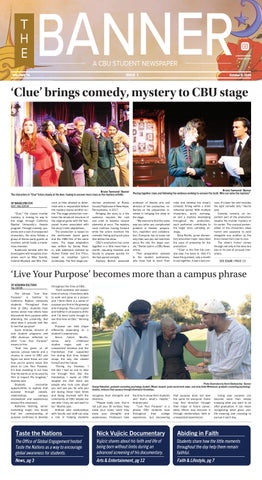
‘Clue’ brings comedy, mystery to CBU stage
Briaira Townsend | Banner The characters in “Clue” listen closely at the door, hoping to uncover more clues as the mystery unfolds. BY MADALYNN COX ASST. A&E EDITOR
“Clue,” the classic murder mystery, is making its way to the stage through California Baptist University’s theatre program. Through comedy, suspense and a cast of unexpected characters, the story follows a group of dinner-party guests as murders unfold inside a mysterious mansion. Audiences familiar with the board game will recognize characters such as Miss Scarlet, Colonel Mustard and Mrs. Pea-
cock as they attempt to determine who is responsible before the mystery claims another victim. The stage production combines the whodunit structure of the original game with the fastpaced humor associated with the story’s later adaptations. The production is based on the well-known board game and the 1985 film of the same name. The stage adaptation was written by Sandy Rustin, with additional material by Hunter Foster and Eric Price, based on Jonathan Lynn’s screenplay. The first stage pro-
duction premiered at Bucks County Playhouse in New Hope, Pennsylvania, in 2017. Bringing the story to a live audience requires the cast and crew to balance several elements at once. The mystery must continue moving forward while the actors maintain the comedic timing and quick pace that define the show. CBU’s production has come together in a little more than a month, requiring students and faculty to prepare quickly for the fast-paced comedy. Zachary Bortot, associate
Briaira Townsend | Banner Piecing together clues and following the evidence working to uncover the truth. Who can solve the mystery? professor of theatre arts and director of the production, reflected on the preparation involved in bringing the show to the stage. “We overcome that the same way you solve any complicated problem in theater: preparation, repetition and collaboration. Everyone has to know not only their own job, but how their piece fits into the larger puzzle,” Bortot said in a CBU News article. That preparation extends to the student performers, who have had to learn their
roles and develop the show’s comedic timing within a short rehearsal period. With multiple characters, quick exchanges and a mystery developing throughout the production, each performer contributes to the larger story unfolding onstage. Sidra Roche, junior elementary education major, described the pace of preparing for the production. “‘Clue’ is the first full comedy play I’ve been in. And it’s been the quickest, only a month to put together; it was a fast pro-
cess. It’s been fun and includes the right comedic bits,” Roche said. Comedy remains an important part of the production despite the murder mystery at its center. The unusual personalities of the characters allow humor and suspense to exist alongside one another as the story moves from clue to clue. The show’s humor comes through not only in the story but also in its cast of unusual characters.
SEE CLUE | PAGE 13
‘Live Your Purpose’ becomes more than a campus phrase BY ARIANNA BULTSMA F&L EDITOR
The phrase “Live Your Purpose” is familiar to California Baptist University students. Throughout their time at CBU, students hear stories about how others have discovered their purpose while attending the university. But what does it actually look like to live that purpose? Gavin Andrew, director of new student programs and CBU alumnus, reflected on what “Live Your Purpose” means to him. “God has given us all special, unique talents and a chance to come to CBU and figure out what those are and how you’re gonna leave this place to Live Your Purpose. It’s God revealing in our lives how He wants us to be used by Him to impact His kingdom,” Andrew said. Students encounter opportunities to explore that purpose through classes, relationships, campus involvement and experiences beyond the classroom. Adrienne Venning, senior marketing major, has found that her understanding of purpose continues to develop
throughout her time at CBU. “Each semester and season here at school, I have been able to walk and grow as a person and I think there is a sense of purpose you find in the growing and changing. The Lord is good and faithful in all seasons of life and I’ve been lucky enough to see that here at CBU,” Venning said. Purpose can take shape differently depending on a student’s experiences. Sierra Catzin Murillo, senior early childhood studies major, said an unexpected breakup and the friendships that supported her during that time helped shape the way she viewed herself and her future. “During my breakup, I felt like I had no one to help me through that. But the friendships I made at CBU showed me that there are people who truly care about you and see you for who you are during those hard times and being involved with the community at CBU helped me see who I truly am and want to be,” Murillo said. Andrew said relationships with faculty and staff can play a role in helping students
Photo Illustration by Hevin Blankenship | Banner George Ndoumbe, graduate counseling psychology student, Mikyla Jacquet, junior social work major, and Lesly Andy-Mekwunye, graduate counseling psychology student, embrace their purpose through intentional friendships. recognize their strengths and direction. “People really care. You’re not just your ID number, they know your name [and] they know your strengths and weaknesses. Professors take
the time to know their students and that’s what’s helpful,” Andrew said. “Live Your Purpose” is a phrase CBU students hear throughout their college experience, but discovering
that purpose does not look the same for everyone. Some may find direction through their major or future career, while others may discover it through relationships, faith or unexpected experiences.
Living your purpose can become more than simply knowing what you want to do after graduation. It can mean recognizing what gives your life meaning and choosing to pursue it each day.
Taste the Nations
2F302F Nick Vujicic Documentary
Abiding in Faith
The Office of Global Engagement hosted Taste the Nations as a way to encourage global awareness for students.
Vujicic shares about his faith and life of being born without limbs during an advanced screening of his documentary.
Students share how the little moments throughout the day help them remain faithful.
News, pg 3
Arts & Entertainment, pg 12
Faith & Lifestyle, pg 7
NEWS
2
October 9, 2026 · Volume 74 · Issue 1
THE BANNER STAFF PRINT Editor-in-Chief Cayanna Ligon Acting Managing Editor Cadyn Eades Creative Director Lorelei Arriola
CBU’s Jazz Night Under the Stars BY MADALYNN COX ASST. A&E EDITOR
California Baptist University hosted Jazz Night Under the Stars at Lancer Plaza, bringing students together for an evening of live music, conversation and time with friends. Students gathered around tables and throughout the plaza as jazz music created a relaxed atmosphere on campus. Joanna Aguiluz, commuter and freshman sports performance psychology and Christian studies double major,
attended Jazz Night as her first campus event. “I think I’m excited, I feel like as commuters it’s hard to stay connected here, so I wanna meet new people and have fun,” Aguiluz said. Campus events can give commuter students opportunities to spend more time at CBU outside the classroom and experience another side of campus life. Amanda Lim, freshman pre-nursing major, attended Jazz Night after spending much of her week focused on academics.
“I’ve mostly been at school all day, so today I have a free day to hang out with friends, meet new people, and get more connected to the CBU community,” Lim said. Lim’s experience reflected the balance students often navigate between academics, responsibilities and opportunities to spend time with others. Brian Atsma, senior architecture major and community life student worker, shared his perspective on the event and its place on campus. “I think CBU hosting this
new event was definitely an amazing opportunity to really bring the community on campus together. It was a great turnout, and we will be hosting more live music events here at Lancer Plaza,” Atsma said. Jazz Night Under the Stars gave students a chance to enjoy live music and spend time together outside the classroom. As the semester continues, events like Jazz Night can provide another way for students to connect with the CBU community and enjoy campus beyond their academic routines.
Asst. Design Editor Aubrie Marie Landolt Illustrators Sophia Sunga Abi Frisbee Photo Editor Vanessa Ruezga Asst. Photo Editor Keegan Hartley F&L Editor Arianna Bultsma
Asst. F&L Editors Elizabeth Harshbarger Lydia Larson
Asst. A&E Editors Madalynn Cox Eden Rothwilson
Asst. B&T Editor Abby Abarcas
Asst. News Editor Lizzy Livingston
Asst. S&W Editor Benjamin Harlan
ONLINE Editor-in-Chief Cayanna Ligon Acting Managing Editor Cadyn Eades Photo Editor Vanessa Ruezga Director of Student Publications, Print & Online Dr. Casey Maldonado
ABOUT THE BANNER The Banner, a student-run newspaper, serves the CBU community with accurate, timely and factual reporting on significant aspects of university life, Riverside life and subjects of interest or concern to its readers. The Banner’s content is produced by the student staff and does not necessarily reflect the opinions or interests of the university. Students, faculty, staff, administrators and others in the university are encouraged to react to published material or to comment on matters of concern. The Banner retains the right to edit your letter upon publication based on grammar and word count. Send letters to Cayanna Ligon, editor-in-chief of The Banner at CayannaElizabeth.Ligon@calbaptist.edu. If you have a story idea for The Banner, please let us know. If a business would like to advertise in The Banner, please contact Erica Dennis at EricaPatrice.Dennis@calbaptist.edu. The newsroom is located in the James Building in Room 060 and can be reached at 951-343-4787. Thanks for reading!
GET INVOLVED WRITE PHOTOGRAPH DESIGN
School of Performing Arts hosted an evening filled with jazz under the stars.
Hevin Bankenship | Banner
New late-night menu at Wanda’s BY LIZZY LIVINGSTON ASST. NEWS EDITOR
As the fall semester began, California Baptist University introduced several campuswide changes, including a new Late Night Menu at Wanda’s. Available from 9 p.m. until close Monday through Thursday, the menu features a variety of snacks and late-night offerings. The menu includes hot wings, pizza, sweet cream pretzels, funnel cake fries and other snacks designed for students looking for something to eat after classes or while
spending time on campus. Eric De Costa, director of food services, reflected on the role food can play in the student experience in a Letter from the Director. “It’s not just about the food but the joy we get from serving others,” De Costa said. The later hours give students another place to stop for food after evening classes, activities on campus or to take a break after studying. Charlie Kelly, senior fine art major, shared her perspective on the timing of the menu. “I think it does open at a
good time for being a little snack menu,” Kelly said. The variety of sweet and savory items gives students different choices depending on what they are looking for. Lauryn Hall, senior fine art major, shared her thoughts on the variety offered through the Late Night Menu. “The menu is cool,” Hall said, “but sometimes I do want a meal and not a sweet treat.” Hall enjoyed several of the dessert options, including the churros, while Kelly considered other flavors that could
complement the menu. “I was excited to see the pretzel, [but] then I was kind of sad that it was sweet,” Kelly said. Kelly said she would enjoy seeing the menu continue to expand with additional savory options, such as a traditional pretzel with cheese. Wanda’s Late Night Menu gives students another place to grab food, spend time with friends and enjoy campus later in the evening. With a mix of sweet and savory options, the menu adds a new element to CBU’s latenight dining experience.
Commute becomes part of life at Magnolia Crossing BY LIZZY LIVINGSTON ASST. NEWS EDITOR
Magnolia Crossing sits outside the main gates of California Baptist University, giving residents a different route to campus than students living on campus in other residence areas. Students travel between Magnolia Crossing and the main campus by walking, driving or taking the university shuttle. For some residents, the trip has become part of their daily routine and offers time to reflect, connect with others and prepare for the day. Kiera Frazier, sophomore political science and public relations double major, preferred driving to campus from Magnolia Crossing. During the warmer weather at the beginning of the semester, Frazier said driving gave her time to cool down and prepare for the day. “I love to just get in my car and sing. You know, music and singing, to have a little moment to myself before I’m in class,” Frazier said. Other Magnolia Crossing residents preferred using their commute as an opportunity to spend time outdoors.
Mikayla Ybarra | Banner Nevada Wilson, senior social work and Christian studies double major, and Hope Edmunds, junior psychology and Christian studies double major, appreciate different parts of campus life as they walk from Magnolia Crossing to main campus. Kate Fenn, sophomore political science and intercultural studies double major, preferred walking to campus. She said the walk gave her time to reflect and appreciate her surroundings. “I think it’s a good way to start my morning out… [and] I benefit so much from nature,” Fenn said. The walk also gave Fenn time to enjoy the trees and greenery along the path while appreciating parts of campus
life that might otherwise be overlooked. While some students choose to drive or walk from Magnolia Crossing, others use the university shuttle to travel to the main campus. The shuttle has a variety of stops for students. Mike Shanahan, shuttle driver, said one of the most meaningful parts of his job is connecting with students during the ride. “When you get out, and you
start talking with people, it’s just amazing,” Shanahan said. Shanahan said small interactions, including greeting students by name, can help create a welcoming experience. Whether students walk, drive or take the shuttle, traveling from Magnolia Crossing gives residents opportunities to reflect, connect with others and experience more of the CBU campus on the way to class.
NEWS
3
October 9, 2026 · Volume 74 · Issue 1
California rolls out new license plate sequence BY CAYANNA LIGON EDITOR-IN-CHIEF
After 46 years, California has changed the sequence used for standard license plates. The previous format, which began in 1980, consisted of one number, three letters and three numbers. The California Department of Motor Vehicles began producing a new reverse configuration in 2026 after exhausting the previous sequence. The new format consists of three numbers, three letters and one number. The change has caught the attention of some California Baptist University students who are beginning to notice the new plates on the road. Marissa Castro, junior exercise science major, reflected on the transition to the new license plate format. “I guess it’s kind of odd, but I guess if it makes it easier on their end then why not,” Castro
said. The new format also changes what drivers are accustomed to seeing on California plates. “I think it would be pretty hard because most of them are kind of just in the same sequence range,” Castro said. The change also raised questions among students about how California will continue accommodating newly registered vehicles in the future. Eric Hunter, sophomore prenursing major, considered what future changes to the license plate system could look like. “They’re going to keep making cars [and] they’re going to keep making license plates. People are going to keep needing cars so they’re going to keep finding a new system,” Hunter said. Others explored how the new sequence could affect options such as personalized plates. Dr. Carnell Borden, assistant
professor of business analytics, offered another perspective on how the new sequence could affect California drivers. “I mean if we think in terms of vanity plates, it probably creates more opportunities to get a vanity plate that you want at least in the short term,” Borden said. Borden reflected on the history of license plate changes in California. “Well, I’m old enough that I’ve personally encountered it twice since I’ve been a licensed adult, because it happened in 1980. It’s happened four times altogether in our state,” Borden said. California’s new license plate sequence marks another shift in a system that has changed several times throughout the state’s history. As the new configuration becomes more common, drivers will begin seeing a different combination of numbers and letters on newly issued plates.
Aubrie Marie Landolt | Banner
Rushing for community BY LIZZY LIVINGSTON
NEWS BRIEFS
ASST. NEWS EDITOR
The Fall Club Fair gave students an opportunity to explore campus organizations, meet club leaders and learn more about ways to get involved. Clubs set up tables to showcase their activities, interests and goals to prospective members. Rowan Kelley, junior psychology and Christian behavioral science double major, serves as president of the Nertz Club. Nertz is a fastpaced card game that combines elements of solitaire and speed. Kelley became involved with the club through her interest in the game and has seen how campus organizations can bring together students with shared interests. “It’s a great way to not only provide for those who have a niche interest but also to provide for those who are leading things and get them to meet people who are in similar boats,” Kelley said. Kelley said clubs can give students opportunities to connect through shared interests outside their classes or majors. The Nertz Club focuses on fellowship, community and having fun through the game. Other clubs also use activities and events to help students build relationships. Asiyah Edwards, sophomore
BY ERICA DENNIS GRADUATE ASST.
CASTLE PARK PAUSING RIDE OPERATIONS Castle Park will pause Ride Park operations starting November 2 as it works to create a reimagined experience for the community. Mini Golf and the Arcade will remain open throughout the year, while Buccaneer Cove will resume operations when seasonal operations begin.
CALIFORNIA HEAT WAVE CONTINUES Jack Lonac | Banner ASL Club members connect with students and share their love of American Sign Language at the Fall Club Fair. accounting major and vice president of the Black Student Union, said the organization has helped her connect with others on campus. “I’m really focused on having fun with my friends, making new friends and just learning about different people as well,” Edwards said. BSU hosts events that give students opportunities to gather and participate in activities together. “One of the events that BSU does is that we collaborate with Cal State Fullerton and they give students a discount on tickets to get in,” Edwards said. Other campus organizations
build connection through shared interests and skill development. Megan Cota, junior communication sciences and disorders major and vice president of the American Sign Language Club, said the organization gives students opportunities to learn more about ASL and practice communicating with others. “It’s more designed to let hearing people learn about the language and communicating. In the club, we really try to focus on the basic signs and basic communication or conversation,” Cota said.
As vice president, Cota has also had opportunities to improve her own signing skills while helping other students practice basic communication. Cota also reflected on what makes club involvement appealing to students. “The nice part about clubs is that it’s not a commitment like class. So you can try it, and if you don’t like it, you don’t have to go back,” Cota said. Club involvement gives students room to explore interests, build relationships and find community beyond the classroom.
California is currently experiencing an extreme heat wave caused by a heat dome sitting over the western United States. Temperatures are expected to be 5–15 degrees above average. Residents are advised to stay hydrated, remain in air-conditioned spaces as much as possible, wear lightweight clothing and schedule outdoor activities for cooler parts of the day.
COSTS CLIMB AS MORTGAGE RATES RISE Mortgage rates in the United States are rising, making it more expensive for people to buy homes. The average 30-year fixed mortgage rate has increased to about 7.3%. Higher rates mean homebuyers may have larger monthly payments and could make some people decide to wait before buying a home. Changes in inflation and the economy are contributing to the increase.
Taste the Nations brings global cultures to campus BY CADYN EADES
ACTING MANAGING EDITOR
Vanessa Ruezga | Banner Student pins the correct country during a game at Taste the Nations.
California Baptist University embraced its core value of being globally minded by hosting its annual Taste the Nations event in Harden Square on Oct. 6. Students were encouraged to visit booths representing different regions of the world, sampling foods from South Asian samosas to South American candies while hearing about their peers’ experiences in different countries. The Great Commission in Matthew 28:19 calls Christians to make disciples of all nations. CBU reflects that global emphasis through opportunities across campus, including International Service Projects through Spiritual Life and events hosted by the Office
of Global Engagement, such as Taste the Nations. Elivia Harper, coordinator of global community, helped organize the event and reflected on what her team hoped students would gain from the experience. “We want to help students know how they can interact with the world around them and learn about opportunities to do that through CBU. We hope that a little bit of food, fun snacks and boba can get them here,” Harper said. Along with a vartiety of student ran booths, local boba shop Tim Boba partnered with the Office of Global Enagement to bring the originally Taiwanese drink to CBU. Students moved between the boba station and booths decorated to represent different regions, where
international students and third culture kids volunteered and shared food connected to their experiences and cultures. Annika Carey, sophomore art education major and third culture kid, was one of the students who helped bring the event to life by volunteering at the Africa booth. “I asked a lot of people who came to the booth if they had been to Africa. So many people had and I got to hear some really cool stories,” Carey said. The conversations at the booths gave students opportunities to share their own international experiences while learning about places they may not have encountered personally. Jayden Yi, senior elementary education major, brought his own international background to the event after growing up
overseas. “I have a heart for the nations...and [the event] gave insight into the countries that I haven’t visited, such as Africa and Europe. The food and people that host the booths definitely give me a window into what it’s like and the hospitality that culture provides,” Yi said. With students at CBU coming from different parts of the world, Taste the Nations created an opportunity for attendees to experience unfamiliar foods, hear different perspectives and learn more about cultures beyond their own. Through food, conversation and shared experiences, the event encouraged students to step outside what was familiar and engage with the global community represented both at CBU and beyond campus.
VISION
4
October 9, 2026 · Volume 74 · Issue 1
Alyssa Lockwood BY ARIANNA BULTSMA F&L EDITOR
Alyssa Lockwood, senior behavioral science major, took a leap of faith four years ago when she committed to California Baptist University. Lockwood spent her life in a small town in Indiana, where everyone knew each other. Moving to Southern California in 2023 marked a new chapter, but CBU quickly became a second home even with everything familiar nearly 2,000 miles away. One of Lockwood’s first sources of comfort at CBU
came from meeting her freshman roommates, who became like family in California. “Right from the get-go, my freshman year, meeting my roommates. Sometimes, you don’t get so fortunate. I was really fortunate that God gave me the girls that I had my freshman year; they stuck with me through the past four years. We truly became much more than roommates, they are basically my sisters now,” Lockwood said. Lockwood developed a passion for travel during her teenage years. During her sophomore year, Brock Brenneman, director of education abroad,
became an important part of her experience as she prepared to study abroad. “I got the opportunity to study abroad, Brock was a very substantial part of that. He, Vicki and the whole team in [Global Engagement] were very considerate, thoughtful and helpful during the whole process, while I was there and
even after,” Lockwood said. CBU became a place where Lockwood found lifelong friendships, stepped outside her comfort zone and pursued a passion that took her across the world. What began as a leap of faith from a small town in Indiana became four years of experiences that helped shape who she is today.
Matthew Poonoosamy BY LYDIA LARSON ASST. F&L EDITOR
California Baptist University is a place many students come to call home. Longterm friendships can grow through classes, residence life and campus involvement, including clubs that bring students together through shared interests. From engineering and sports to the arts and service, clubs give students opportunities to connect with others while doing something they
enjoy. Matthew Poonoosamy, junior biomedical engineering major, became involved with CBU’s Swing Dance Club during his freshman year. “My freshman year, when I got into second semester, swing dance club was a little bit on the smaller side... So, just a small, very intentional group showing up every Thursday. We just come together to do something that they wanted to, purely out of the joy of dance, rather than any sort of obligation,” Poonoosamy said.
The club’s smaller size gave Poonoosamy opportunities to build relationships with students he may not have met otherwise. Those connections have continued beyond weekly meetings. “When I walk past them or see them in the day-to-day, it's [refreshing] to see these people because we’ve interacted so personally but also casually,” Poonoosamy said. Poonoosamy said finding community required him to become involved and remain open to new experiences
during his first year at CBU. “Out of all the things that I did, joining a club was one of the greatest ways to expand the network of who I know at CBU,” Poonoosamy said. College provides opportunities to learn in the classroom while building relationships outside of it. Clubs can give students space to try something new, meet people with similar interests and develop friendships that become part of their college experience.
Sho Misener Nadyne Zuniga BY BENJAMIN HARLAN ASST. S&W EDITOR
California Baptist University gives students many opportunities to work on campus. Several of these positions allow students to serve others and grow as leaders. That was the goal for Sho Misener, sophomore Christian studies and music for worship arts and ministry double major. “I missed the deadline for FYE. I did the RA interview... results come back, I didn’t get it,” Misener said. The setback did not stop Misener from continuing to pursue opportunities on campus. He trusted that God would lead him where he needed to go. “He gave me something greater... one of my friends calls me and it’s like 10:40 p.m... and he’s like, ‘Hey Sho, you want a job?’ And I’m like,
‘Yeah.’ He’s like, ‘It starts with three letters, FYE... there’s an open spot for this position,’” Misener said. An opportunity opened for Misener after he continued praying and trusting God. The process came with another unexpected challenge when he had his wisdom teeth removed the day before his interview. Two weeks later, Misener received the position. “I can completely see how God just planned and ordained this moment... to be in a position where I can like share the gospel with students is the most incredible blessing that I’ve ever asked for,” Misener said. Misener’s experience gave him the opportunity he had hoped for while allowing him to serve the CBU community and share his faith with other students.
BY CAYANNA LIGON EDITOR-IN-CHIEF
Nadyne Zuniga, senior psychology major, transferred to California Baptist University two years ago from Mt. San Antonio College. She will be the first in her family to graduate from CBU and has come to appreciate the sense of community and connection she has found on campus. “Even though I do not know everyone here, I feel like just seeing familiar faces definitely allows me to be more comfortable,” Zuniga said. Her second year at CBU has helped Zuniga become more familiar with the campus and its surroundings. “I feel like CBU has a lot of little pockets of scenery, and I feel like there’s a lot of nature. That definitely helps with regulating myself sometimes in comparison to me being sur-
rounded by buildings all the time,” Zuniga said. In her free time, Zuniga enjoys spending time outdoors and journaling, a habit she began over the summer. Writing has given her another way to reflect on her thoughts and emotions. “This past summer I feel like it definitely opened my eyes a little bit more to the joys journaling brings,” Zuniga said. Zuniga has continued the habit by making time to write regularly, even when she does not have a full journal entry in mind. “Sometimes they’re not full entries; sometimes if I just have a thought that’s not leaving my head, I just go to write it down because that’s my way of [saying] ‘Oh, I just need to get it out there,’” Zuniga said. Through her time at CBU, Zuniga has found comfort in the campus community, its surroundings and the routines that help her reflect on her experiences.
VISION
October 9, 2026 · Volume 74 · Issue 1
Abigail Hough BY LIZZY LIVINGSTON ASST. NEWS EDITOR
As a Christian institution, California Baptist University incorporates faith into the classroom and campus life while supporting students through everyday challenges. Abigail Hough, sophomore elementary education major, reflected on how her faith has shaped the way she understands joy during
difficult seasons. “When trials come, I think that’s where you see true joy,” Hough said. Hough said difficult moments have encouraged her to rely more deeply on God and look to her faith for comfort. The phrase “joy comes in the morning” has become meaningful to Hough as she reflects on periods of struggle and the healing that followed. “I think when things are hard,
and feel like things aren’t going right, that is where you can truly trust the Lord, and He can bring you that comfort and joy when you feel like there is none,” Hough said. Hough’s experience has shown her that faith can provide a sense of peace and stability when circumstances feel uncertain. In difficult moments, she continues to turn to God as a source of comfort and direction.
Caroline Houck
BY CADYN EADES
ACTING MANAGING EDITOR
Caroline Houck, senior English and philosophy double major, reflected on the friendships that have shaped her college experience. One memory in particular stood out from a moment when Houck walked away from a test feeling uncertain about how she had performed. “I thought I had just failed my test, and I was walking back and saw my sweet friend Alexis,” Houck said. “She was sit-
ting out by the chairs near the Colony fireplace, and she just comforted me because I started crying.” The moment became meaningful to Houck because of the way her friend responded when she was feeling vulnerable. “It made me feel like she saw me in a more human way. Not just surface level, but she saw my faults, and it didn’t change her opinion of me,” Houck said. Experiences like that have helped Houck recognize the value of friendships
that extend beyond everyday conversations and allow people to support one another through difficult moments. As Houck enters her senior year, the relationships she has built at California Baptist University have become an important part of what she hopes to carry with her after graduation. Along with earning a degree, she will leave with friendships that have encouraged, supported and guided her throughout her college experience.
CREDITS CUTOUTS BY DAMINI GHANSHYANI DESIGN BY LORELEI ARRIOLA ILLUSTRATIONS BY ABI FRISBEE | AUBRIE MARIE LANDOLT | LORELEI ARRIOLA PHOTOS BY KEEGAN HARTLEY
5
6
FAITH & LIFESTYLE October 9, 2026 · Volume 74 · Issue 1
Daily routines spark fulfillment in everyday life BY ARIANNA BULTSMA F&L EDITOR
Each day begins with familiar routines, from making coffee to getting ready for class. For college students balancing classes, work, friendships and other responsibilities, those small habits can provide a sense of comfort and consistency. Daily routines can become more than tasks to complete. They can give students opportunities to slow down, reset and find meaning in ordinary moments. Miah Baro, senior finance major, said her morning routine helps set the tone for the rest of her day. “In the morning, I always start by making my bed, which is a way of telling myself, the day has officially started. After that, I typically like to make myself an iced vanilla latte, turn
on some music and get ready. I usually make an iced vanilla latte because it tastes good and helps me ease into the morning in a way that feels slow and sweet rather than feeling rushed,” Baro said. The routine also gives Baro time to feel more prepared and confident before starting the day. “Following with some music, I’ll do my hair and makeup because it gives me a sense of accomplishment and confidence. I see it almost like a little form of art, while it’s fun to take the time to make myself feel put together while sipping on the latte I made prior,” Baro said. The meaning behind routines is not always obvious at first. Repeated actions can begin to create structure and help people become more intentional about how they move through the day.
Dr. Sam Welbaum, associate professor of philosophy and director of the honors and philosophy programs, said routines can help people focus their attention and create meaning. “What was the routine ritual that seemed inconsequential was actually a series of actions that were giving things meaning,” Welbaum said. “The importance of the ritual is that it helps focus your attention and mindset on something. Without it, things begin to feel very untethered.” Daily habits can take many forms, from reading the Bible to preparing a favorite drink. Alyssa Lockwood, senior behavioral science major, has built one of her favorite routines around the start of her morning. “Every morning when I wake up, the first thing I look forward to is making my cup of coffee. My morning coffee
routine is essential for me to have a good day. This simple delicacy has found a way to become a routine in my everyday life in the mornings, and is considerably something I could not live without,” Lockwood said. While students often look ahead to weekends, breaks or new semesters, everyday routines can provide moments of consistency between larger milestones. Making coffee, getting ready in the morning or setting aside time for reflection can become meaningful parts of daily life. Ordinary routines can also give students space to recognize fulfillment in the present instead of always looking toward what comes next. Those quiet moments can also become opportunities to reflect on faith, gratitude and the meaning found in everyday life.
Evie Brown | Banner Alyssa Lockwood, senior behavioral science major, pours espresso over milk and ice for her morning routine.
The beauty of baptism, growth through faith BY ELIZABETH HARSHBARGER ASST. F&L EDITOR
Lorelei Arriola | Banner
Baptism has held an important role throughout church history and the Christian faith. While practices can vary across denominations, baptism continues to represent a public expression of faith for many believers. One of the earliest examples of baptism in the New Testament appears in Matthew 3, when John the Baptist baptized people as part of his ministry of repentance and preparation for Jesus. Jesus was later baptized by John, and after his death and resurrection, his disciples were instructed to baptize others as they made disciples. Dr. Adamson Co, professor of theology, provided a theological perspective on baptism. “In its most basic sense, it
symbolizes the washing away of sin. In going into the water of baptism, it symbolizes that the person’s life now is buried with Christ as He died on the cross, and then as he comes out of the water, Jesus rose to life, resurrected life, so is the believer’s. It’s a beautiful symbolism of our union with Christ,” Co said. Baptism is a personal decision through which believers publicly express their commitment to Christ in front of friends, family and members of their church community. Patience Taft, senior elementary education major, described baptism as an important step in her faith. “To me personally, I feel like it was a public statement of my faith. Just being able to publicly get baptized and so many people being a witness to that,” Taft said. The experience can also
represent an ongoing process of spiritual growth. Alyssa Dias, freshman pre-nursing major, also shared her experience with baptism. “My baptism was a declaration that I wanted to give my all to Christ, but it was also the proclamation of what Christ had already done and was going to continue to do,” Dias said. Dias also reflected on the growth that continued after her baptism. “I wasn’t perfect going into it, I certainly wasn’t perfect after... but I still got the opportunity to tell everyone around me, ‘Look at who God is,’” Dias said. Baptism can represent different parts of a believer’s faith journey, from publicly declaring faith to recognizing spiritual growth and identification with Christ. It also provides an opportunity to share that testimony with others.
It takes a Colony, community in campus dorming BY CAYANNA LIGON EDITOR-IN-CHIEF
The Colony is the largest residential living area on campus and is known for its spacious rooms, community events and opportunities for fellowship. For many California Baptist University students, living in Colony has provided opportunities to build friendships while enjoying the independence of upperclassman housing. Ayden Moreland, senior kinesiology major and resident adviser for the men’s Colony living area, said community events help residents connect with one another. “I think it’s cool to have those kinds of events inside your living area,” Moreland said. Moreland said the size of Colony also gives students more opportunities to build relationships. “I think for upperclassmen living, it’s very close-knit. There is a lot of community building because it’s the largest living
area, so I think that allows for the most connection,” Moreland said. While some students enjoy the sense of community Colony provides, others appreciate the additional living space. Kayla Logan, junior prenursing major, is living in the Colony for a second year. Her experience has given her a different perspective on what the living area offers upperclassmen. “You can live with multiple people and still have your own privacy. The kitchen, the bathroom, and the rooms are very spacious too,” Logan said. Logan also built connections through the Box, a gathering place in Colony. “It’s taught me that it’s okay to go into a new area to make new friends,” Logan said. Living in Colony also encouraged some students to become more mindful of their schedules and daily routines because of the walking distance to other areas of campus.
Megan Metzler, senior marketing major, previously lived in Colony for two years before moving to The Point, another living area on campus. Metzler said the distance between the Colony and her job with athletics required her to plan ahead. “I had to be more aware of the commute and as far as walking distance,” Metzler said. The experience also helped Metzler become more intentional about managing her time between classes and work. “I had to be more prompt and aware of my time because I work with athletics. So I have to make sure I’m on time for work,” Metzler said. For students such as Moreland, Logan and Metlzer living in Colony has provided more than additional space. The living area offers opportunities to build community, develop independence and learn how to balance responsibilities while living on campus.
Students gather for activities and games during the Colony Carnival on Sept. 29.
Caleb Smalley | Banner
7 FAITH & LIFESTYLE Slow down for what matters most in life October 9, 2026 · Volume 74 · Issue 1
BY LYDIA LARSON ASST. F&L EDITOR
Working from nine to five, and sometimes longer, has become a familiar part of American life. Between work, school and other responsibilities, downtime can sometimes feel difficult to find. Life moves quickly, and it can seem as though there is always something else that needs to be done. How many times do people think to themselves, “I wish I had more time to…”? Busy schedules can make rest feel like something that has to be earned rather than something people need. Over time, constantly moving from one responsibility to the next can leave little room to slow down. One thing is clear: Rest still matters. Remija Serrano, operations manager for the division of social work, reflected on how American culture can influence the way people think about work and achievement. “I think that it has started since we have adopted that modality and mindset of the American dream of just achieving everything that you dream of, and in order to get that… we have to work work work to get there,” Serrano said. The pressure to stay productive can make it easy to overlook basic needs such as eating
well, getting enough sleep and taking time to recharge. But what happened to that childlike mentality of “just five more minutes”? Five more minutes to play. Five more minutes to sleep in. Five more minutes to talk to Jesus in the morning. What could happen if people took even five minutes to do something they enjoy instead of immediately moving on to the next responsibility? Alexa Comingdeer, junior Christian studies major, has experienced the challenge of balancing different areas of her life while in college. “But there’s like three main things in college: one’s schoolwork, one’s sleep, and one’s friends. I think oftentimes or not, one of those will always be sacrificed… for me, personally, that’s sleep. And in turn, sleep affects everything else. So then in the mornings I’m slower and I just can’t feel like I’m putting all of what I can into a certain thing,” Comingdeer said. The pressure of balancing multiple responsibilities can leave students with little time to slow down and process everything happening around them. Busy schedules can affect more than productivity. They can influence the time people have to think, process and connect with others. “It just doesn’t give our minds that space of rest and
that time to slow down to think or process what’s going on. At the same time, just being busy 24/7 doesn’t really give you the opportunity to make connections and think about how you are impacting the people around you or how they impact you in turn,” Comingdeer said. Between classes, extracurricular activities and other responsibilities, students may have fewer opportunities to spend meaningful time with friends or family. Being busy, however, is not always negative. Ulrik Strøm, freshman business administration major, has found that staying active throughout the day can challenge him in a positive way. “It absolutely can be a good thing. Coming over here [to America], you feel that you have much more energy when you’re active throughout the whole day … and you feel that you’re able to take your body to lengths you didn’t think were possible,” Strøm said. Activity can create opportunities to learn new skills, pursue goals and stay engaged with school, work and relationships. The challenge comes when there is no room left for rest. Strøm reflected on the importance of making space for both. “Even if you’re not a student athlete, taking time to focus on yourself and have in your routine that you need some rest,
Sophia Sunga | Banner I think is very very important,” Strøm said. Rest has significance beyond physical recovery. In Scripture, God rested after creating the world, providing an example of rest as part of a healthy rhythm rather than something to feel guilty about. Serrano returned to the idea of balance, emphasizing that productivity does not have to come at the expense of peace.
“Having a full schedule and being very busy can seem inevitable... that you’re held captive to it, but I believe just as strongly that if you can treat rest and peace as crucial and important as whatever that busy thing is... then you can find ways to prioritize your peace. And I think it’s just as important, if not more important, to do that in those times when you’re the busiest,” Serrano said.
Life can feel busy and unavoidable at times. Work, school, hobbies and relationships all have value, but rest deserves a place within that routine too. Being productive and being rested do not have to compete with one another. Sometimes the healthiest thing a person can do is recognize when it is time to keep going and when it is time to slow down.
Abiding in faith through every moment on campus
Lorelei Arriola | Banner
BY ELIZABETH HARSHBARGER ASST. F&L EDITOR Daily routines can provide students with opportunities to
stay connected to their faith in simple and meaningful ways. Bible study, prayer, chapel, Spiritual Life nights and discipleship groups can provide
opportunities for spiritual growth while helping students stay connected with God throughout a full schedule. Dr. Joe Slunaker, associate professor of Old Testament and director of the bachelor of applied theology program, said abiding in the Lord begins with recognizing that faith extends into every part of life. “I think the first step in abiding in the Lord on a weekly level is recognizing that everything we are belongs to Him; all of our time belongs to Him, and all of our actions belong to Him, and if we can start there, we can do some really cool things that are comprehensive with our life,” Slunaker said. Connection with God does not have to be limited to extended Bible study or designated prayer time. Smaller
moments throughout the day can also create opportunities for reflection and worship. “I have found in my life that short, simple prayers, short, simple, to-the-point Bible reading, short, simple, to-thepoint worship, these are the kind of things that punctuate all manners of different points during the day, and that’s a good way to stay focused all day,” Slunaker said. The idea of abiding in the Lord also appears in John 15, where Jesus describes himself as the vine and his followers as the branches. “I am the vine; you are the branches. Whoever abides in me and I in him, he it is that bears much fruit, for apart from me you can do nothing,” John 15:5 (ESV). Staying connected with God involves bringing prayer into
ordinary moments throughout the day. Janelle Lancaster, sophomore psychology and philosophy double major, said she often talks to God while walking to class. “I don’t really see many people when I go out to class that I know, so He becomes like my best friend. I’ll just be walking to my class going ‘Oh wow, I have to go to this class God; please give me memory so that I remember what I’m learning,’” Lancaster said. Other students also use short prayers to remain intentional about their faith throughout the day. Leah Pendleton, junior political science major, said prayer helps her remain aware of God’s presence in different parts of her routine. “A way that I’m able to stay
really close with the Lord and just seek His presence and abide in Him throughout the day is honestly with prayer. I do a bunch of mini prayers throughout the day where I will just invite Him into whatever I’m doing,” Pendleton said. Pendleton also encouraged students to make use of brief periods of free time. “Use the fifteen minutes before class if you get there to open up your Bible... Take advantage of the small moments,” Pendleton said. Small moments of prayer, Scripture reading and reflection can give students opportunities to reconnect with their faith throughout a busy day. Rather than limiting spiritual growth to scheduled activities, everyday routines can also create space to remain aware of God’s presence.
Listening to God’s direction through faith and opportunity BY LYDIA LARSON ASST. F&L EDITOR
In a world where so many things compete for people’s attention, it can be difficult to slow down and listen for God’s direction. People may wrestle with where they should go, what they are supposed to do or what their purpose is. Scripture describes believers as being called for a purpose. The Bible describes this calling in 1 Peter 2:9 (ESV): “But you are a chosen race, a royal priesthood, a holy nation, a people for his own possession, that you may proclaim the excellencies of him who called you out of darkness into his marvelous light.” The passage describes a calling to proclaim God’s work, but understanding what an individual calling looks like can take time. California Baptist University emphasizes the idea that each person was created for a purpose and encourages students to explore what that purpose may look like in their lives. Some students arrive at CBU
with a clear idea of what they want to pursue, while others discover that their direction changes along the way. Jayden Chi, freshman exercise science major, originally believed his future would involve music production before other opportunities caused him to reconsider. “I always wanted to work with athletes but wasn’t sure how yet. Then I started coaching kids and refereeing... and I realized it brought me joy to teach other kids how to play sports and just care for them,” Chi said. Chi’s interests in sports and working with children eventually came together as he began considering what he wanted his future to look like. “[I want to] facilitate an environment where kids can grow in their love of sports and athletics at a young age and continue to train and get better so that they can look forward to that in a career,” Chi said. Other students find their sense of direction unfolding over time through different experiences and opportunities. Karyn Sanner, sophomore
digital media communication major, remembers considering several different careers while growing up. “I didn’t know what I wanted to do in my life. Growing up, I wanted to be a bus driver, but then I was like, ‘Oh, I want to be a veterinarian.’ But I never knew what that path was,” Sanner said. Sanner’s interests became clearer after she began pursuing photography in high school and recognized ways she could use those skills to serve others. The process of choosing a direction, however, still came with uncertainty. “It was nerve-wracking at first, because I have no idea what I’m doing with this [major], where is this going to take me in life... And now I’m here in college, and I’m like, ‘OK, yeah, CBU is where I’m meant to be,’” Sanner said. Sanner originally planned to attend a different university, but her experience at CBU has given her opportunities to build friendships and continue pursuing her interests. While students may think
Arielle Rodriguez | Banner Kathleen Granger, sophomore mechanical engineering major, works through an equation on the board, pursuing her passions. about calling in terms of majors and careers, Christian teaching can define purpose more broadly. Annalisa Williams, discipleship staff member in spiritual life, explained that she believes Christians share a larger calling to glorify God and make disciples. “If someone is a believer, I think the clear calling is that our lives are used to glorify God...
the verse continues and says, ‘All authority has been given to me, go therefore and make disciples.’ So if you’re a believer, I think our purpose on this earth is to make disciples who make disciples,” Williams said. Finding a specific direction may not happen immediately. Students may discover their interests through classes, relationships, unexpected opportunities or experiences that
change the plans they once had. Calling can look different from one person to another. Some students may recognize a direction early, while others may need more time to understand where their interests, abilities and faith intersect. For Christians, that process can include listening to God, seeking him and remaining willing to follow where he leads.
8
PERSPECTIVES October 9, 2026 · Volume 74 · Issue 1
Campus landmarks reflect CBU history and tradition 1
2
3
14
5
1. The Bronze Lancer statue, unveiled in 2017, stands in front of the Dale E. and Sarah Ann Fowler Events Center as a symbol of Lancer Nation. 2. The Lady Fortuna statue, built in 1927, stands in front of the W.E. James Building. 3. The Kugel, a floating granite globe sculpture, is located in the Ronald L. and Jane D. Ellis Great Commission Plaza at the main entrance to the Eugene and Billie Yeager Center. It is a symbol of Christ’s Great Commission. and CBU’s commitment to preparing students to live with purpose as they follow Christ’s call to make disciples. 4. The 2007 class ring sculpture, surrounded by freshly planted flowers in Stamps Courtyard. 5. The granite University Seal, donated by the class of 2003, sits inside the Eugene and Billie Yeager Center.
Photos by Keegan Hartley
OPINION
9
October 9, 2026 · Volume 74 · Issue 1
LANCER ON THE STREET What is something that brought you joy today?
Kellyn Haggerty, junior nursing major, found joy in the simple moments of the day. “The weather is so beautiful today, so grateful for that and time with my friends.”
Kevin McLain, senior marketing major, reflected on a typical start to his day. “Waking up, hanging out with the roommates, and then getting to class.”
Emma Workman, junior psychology and Christian studies double major, shared a moment from her day that stood out to her. “Being outside and the beautiful weather. It’s just so beautiful to hear the water, hear people laughing, and the sounds of nature.”
Colt Nelson, sophomore business management and communication studies double major, reflected on what has made his experience on campus meaningful. “It’s definitely just the people here. It makes anyone’s day.”
Sina Smith, freshman commercial performance major, reflected on how she approached the day. “Starting off my day, the word definitely helped with a mindset of gratitude.”
Disclaimer: Any opinions, findings, conclusions or recommendations expressed in this material do not necessarily reflect the views of California Baptist University.
Where did all the iconic journalist character go?
BY ARIANNA BULTSMA F&L EDITOR
Growing up, I was a big movie fan. No matter the genre, one thing always seemed to stay consistent: an iconic journalist character. Whether they were the main character, like Andie Anderson in “How to Lose a Guy in 10 Days,” or a smaller side character, there was something
about watching someone run around a big city with a looming deadline that made journalism seem like the coolest career. Characters like Andie Anderson lit a spark in me that never really left. Now, here I am four years later, writing for my university’s newspaper. These characters made writing for a living look exciting, glamorous at times and, most importantly, meaningful. The far-fetched lifestyle of designer wardrobes that their journalism salaries probably could not support did not matter to me. What mattered was that they made journalism feel like a career worth dreaming about. Today, as someone pursuing journalism myself, I cannot help but wonder where the iconic journalist character went. It was never necessarily
about how accurately these characters portrayed journalism. What made them feel so iconic was how they made the career feel. Journalism was more than a job to them. It was part of who they were. They were curious and constantly chasing their next story. You had Anderson navigating the magazine scene in New York City, searching for her next idea and trying to make her mark as a writer. How could you not find that exciting? Their careers opened doors to people, places and experiences they otherwise may never have encountered. They made interviews, deadlines and even demands from editors seem exciting. Even if their lives were romanticized for the screen, the adventurous way they portrayed journalism felt special as
a viewer. They showed that being curious and knowing how to tell a story could take you almost anywhere. This version of media feels much harder to find on screen today. A journalist running through a newsroom trying to meet a deadline has slowly been replaced by influencers and social media personalities. Instead of a character dreaming about pitching their next big story, we often see someone focused on building a personal brand. In some ways, that shift reflects what the media industry looks like today. Newspapers have moved online, and social media has created entirely new ways to tell stories. Somewhere in that transition, though, I believe we lost some of the magic
that made fictional journalists so memorable. What I miss most is watching a character believe that finding and telling someone else’s story is exciting enough to become the story itself. That is what made those characters stand out to me. Their success was not always measured by how much attention they received personally, but by the people they interviewed, the stories they discovered and the words they put on the page. There is nothing necessarily wrong with the way media has changed. The industry is evolving, and the way we receive stories is changing with it. But I miss watching characters who were fascinated by people other than themselves. There was something so ex-
citing about watching someone come up with a story with little more than a notebook and curiosity. The journalist did not need to be the most interesting person in the room. Their job was to figure out who was. Although I have yet to have a “How To” column for a magazine in New York City, that was never what made these characters matter so much to me. What mattered was how they made journalism feel exciting. I know now that journalism is not always as glamorous as movies and television made it seem, but the spark those characters gave me is still there. At the end of the day, I just hope future generations get their own Andie Anderson, a character who makes them want to pick up a notebook, ask questions and never stop being curious.
MLB needs compromise in these times, not disruption
BY BENJAMIN HARLAN ASST. SPORTS EDITOR
Major League Baseball viewership has grown significantly in recent years. In 2023, rule changes such as the pitch clock and bigger bases helped update the game and contrib-
uted to renewed interest in the sport. According to an MLB press release, “Viewership for Major League Baseball games nationally, locally, on MLB. TV and in Japan all increased over last year, with most platforms achieving double-digit percentage increases for their audiences.” More viewership, however, means more money is involved. MLB and the MLB Players Association are currently negotiating the next Collective Bargaining Agreement, which helps determine how the league operates financially and how revenue is distributed between players and owners. As viewership and revenue
have increased, there is more at stake in those negotiations. This is a good problem for MLB to have, especially after it felt like the league was beginning to take a back seat to other professional sports. One of the biggest issues in the negotiations is a proposed salary cap and floor system. Leagues such as the NFL and NBA already operate with salary caps, while MLB does not. “The salary cap and floor proposal levels the playing field, allowing us greater flexibility to address longstanding player priorities while sharing baseball revenue with the players 50/50,” MLB spokesman Glen Caplin said in an AP News article.
MLB currently has no hard salary cap, which has led to major differences in how much teams spend on their rosters. Larger-market teams such as the Los Angeles Dodgers are able to spend significantly more than many other clubs. A salary cap sounds great in theory because it could create more balance between teams. It could make team-building matter more instead of allowing the richest organizations to spend the most money on players. I just do not think it is feasible anymore. Would it be great? Absolutely. Having teams operate within a more balanced spending system and watching different
organizations succeed would be exciting. However, I do not see MLB and the players agreeing to a hard salary cap without significant compromise. MLB has operated without a salary cap for too long to make such a drastic change easily. Baseball has a history stretching back into the 1800s, and its financial structure has developed differently from other major professional leagues in the United States. At this point, carrying the momentum MLB has built is more important than creating a labor stoppage over a salary cap. The league is in one of its strongest positions in years, so risking a lockout that could af-
fect the 2027 season does not seem worth it. The problem is that MLB cannot resolve the issue on its own because the next agreement must be negotiated between the owners and the players. The league has gone through plenty of growing pains and changes in recent years. Having this much money and attention involved in the negotiations is, in some ways, an indicator of MLB’s success. However, the players are the core of the league. I expect the final agreement to involve compromise from both sides rather than the introduction of a hard salary cap exactly as owners have proposed it.
Music makes the world go round and memories come alive
BY LIZZY LIVINGSTON ASST. NEWS EDITOR
It is not an overstatement to say that music has deep roots in our daily lives. It enhances social interaction, allows us to develop and express emotions and gives us the gift of memories connected to a song. We need music.
In my life, I have listened to songs that bring back memories from deep in my mind. The song “Sweet Caroline” by Neil Diamond, as crazy and odd as it may sound, evokes camaraderie and nostalgia from my own memories. It takes me back to singing along in crowded stadiums and the winning celebrations that typically followed. A different song may be equally impactful but evoke different memories, such as “Sol Del Sur” by Sun Room, which takes me back to joyful times at the beach. Everyone has a song or two that reminds them of the past, a person or simply a memory they had forgotten. The unique thing about music is that it sounds different to everyone
and can hold different layers of meaning depending on the individual. Aside from memories, music has deep roots in personal interaction, as a single song or artist can bring people together. Sitting next to a stranger and bringing up music taste can connect two people on a deeper level than a simple observation. Having different music tastes from a roommate or best friend can allow for individuality and compromise. This can open both people up to more genres, songs and opportunities for connection. In this way, music can become an important part of social interaction. In worship, music is another way to connect with God and
allows for communication between God and ourselves. We give thanks to Him, share our burdens with Him and, in return, He comforts and guides us. This form of connection is deeply impactful, as it resonates not only with your ears but with your soul. I believe God gave music as a gift for us to connect not only with Him but with ourselves, and the reach, scope and breadth of music are a testament to that. There are times when a conversation with someone is simply unpleasant or awkward. One way to alleviate that awkwardness is to use music as a soundtrack to help guide the flow of conversation. I often catch myself trying
to fill every awkward gap with a sarcastic remark or question just to keep the conversation from falling silent. Having a song or playlist playing in the background fills some of that silence and allows time to reflect on what the other person is saying. It takes some of the pressure off those interacting by removing the need to constantly speak and allows conversation to flow without fear of the dreaded awkward silence, which I try to avoid. I find that the best way to improve my mood after a long day of classes is to relax with a good playlist. Depending on which song I choose and the genre it comes from, it can either make or break my mood
between classes. I find that music is most beneficial after a rough day, helping take away unpleasant emotions and lift people up when they need it most. While songs may help change the mood currently affecting someone, they can also be a way to express it. Allowing music to communicate emotions can be beneficial for identifying what those emotions are and letting the listener lean into them. A song’s ability to create nostalgia and ease the tension in a conversation is both an incredible phenomenon and a blessing. I am immensely glad to have music in my life and to have Neil Diamond’s voice memorialized on Spotify.
BUSINESS & TECH
10
October 9, 2026 · Volume 74 · Issue 1
Smartphone convenience comes with unexpected distractions BY LYDIA LARSON ASST. F&L EDITOR
What is widely considered the first cell phone emerged in the early 1990s, changing expectations for mobile technology and the way people communicated. Small, portable devices made it easier for people to stay connected wherever they went. Today, when access to the internet can fit in a person’s back pocket. Phones have greatly improved since the 1980s, but how far is too far when it comes to technology? Has society reached a point where advanced technology can sometimes hurt people more than it helps? Some students at California Baptist University said they would consider switching from their modern smartphones to simpler phones. One reason is the decrease in distractions compared with smartphones, where apps such as YouTube, Instagram and TikTok are constantly available. Slade Watson, sophomore aviation flight major, reflected on what students could gain from using a simpler phone. “I think the best benefit would obviously be no social media. So you have that less addictive side of the phone. And
it’s people just using the phone more to connect and actually talk to people than scroll endlessly all day,” Watson said. Without the same access to social media and other apps, basic cellphone offer fewer opportunities for digital distractions. Maylani Cruz, junior prenursing major, believes smartphones have not only distracted people from school and work but have also affected the way people interact with one another. “I definitely feel that there has been a lack of social skills that are being used nowadays. I think just even the simple, ‘hi,’ ‘bye,’ ‘please’ and ‘thank you’ has really gone away and I think its because most people now are uncomfortable with the thought of a conversation. And many can’t hold one because everything’s just text or online,” Cruz said. Cruz believes people have fewer reasons to practice face-to-face communication because so many everyday tasks can now be completed digitally. People can text, call or email instead of meeting in person, while activities such as grocery shopping, searching for books and scheduling appointments can all be done online. Smartphones, however,
have provided benefits as well. “Our smartphones are beneficial. They do make life on a day to day easier, for contacts or searching things up online. For maps we don’t have to use paper maps anymore or stop at a gas station and ask for directions,” Cruz said. Smartphones have made many aspects of daily life more convenient. People can communicate across long distances, search for information and access entertainment from almost anywhere. The challenge is finding a balance between using phones as productive tools and allowing them to become constant distractions. Rebecca Vilas, clinical coordinator for the master of counseling psychology program, offered a broader perspective on how people interact with technology. “I would just encourage people to be more mindful about their phone usage and understand that we were made for connections and relationships. So if there’s any opportunity to build upon that, absolutely put the phone down,” Vilas said. Smartphones are unlikely to disappear anytime soon. While they have made
Photo Illustration by Cayanna Ligon | Banner The evolution of cell phones increased accessibility to communication with unanticipated effects on social interactions and productivity. everyday life more convenient, students recognize that the technology can come
with drawbacks. Phones were created to help people communicate, and finding a
healthy balance can allow them to remain tools for connection rather than distractions from it.
Written by Cayanna Ligon | Designed by Lorelei Delgado
The hidden resource demands behind artificial intelligence BY CAYANNA LIGON EDITOR-IN-CHIEF
Artificial intelligence has become a common tool in schools, workplaces and technology. As its use continues to grow, questions have also emerged about the amount of water and electricity required to power the data centers that support AI systems. Some students believe AI can continue to benefit society while its environmental impact is addressed. Vivian Verdin, senior business administration major, considered how society could respond to the growing use of AI. “I don’t think we should prevent it. I think we could find ways to structure it,” Verdin said. Verdin also considered the broader effects of frequent AI use. “Since we’re using it so often, it definitely causes a lot of environmental concerns happening around us. A lot of us are not very aware of it too,” Verdin said. AI systems rely on data
centers that require water for cooling and electricity to operate. Tools such as ChatGPT and Gemini are among the platforms supported by this infrastructure. Korey Kemper, sophomore biology major, said the environmental effects of AI could extend beyond technology itself. “I just think it’ll definitely negatively affect society if AI is taking water from like the farmers,” Kemper said. Kemper also considered how increased competition for resources could affect consumers. “If it’s a major impact, I’m sure food prices would probably go up because of that. Maybe even water bottles from the store would probably be more expensive as well,” Kemper said. Data centers also require significant amounts of electricity to operate. The Lincoln Institute of Land Policy cited data from the International Energy Agency when examining the energy demands of conventional and AI-focused data centers. “A conventional data
“
center... draws as much electricity as 10,000 to 25,000 households,” according to the Lincoln Institute of Land Policy, citing the International Energy Agency. “But a newer, AI-focused ‘hyperscale’ data center can
use as much power as 100,000 homes or more.” Amid general environmental concerns, water consumption is another concern associated with data center operations. “Even a mid-sized data center consumes as much
water as a small town, while larger ones require up to 5 million gallons of water every day, as much as a city of 50,000 people,” according to the Lincoln Institute of Land Policy. As AI continues to develop, its growing demand for resources
has raised questions about how the technology can be used more sustainably. Students such as Verdin see an opportunity to consider ways AI can continue to be used while addressing its environmental impact.
Aubrie Marie Landolt | Banner
BUSINESS & TECH
11
October 9, 2026 · Volume 74 · Issue 1
Refinery Pilates turns local idea into fitness community space BY ARIANNA BULTSMA F&L EDITOR The Refinery Pilates Studio, located in Riverside, has become a growing part of the local fitness community since opening in August 2025. The studio offers a variety of fitness classes, including hot Pilates, traditional mat Pilates, sculpt and more.
Bella Luna, owner and founder of The Refinery, has lived in Riverside her entire life. After graduating from college in 2024, Luna began working in real estate before realizing she wanted to pursue a different path. Her experience with Pilates in college and longtime interest in fitness eventually inspired her to open a studio of her own.
“I wanted to create a space where people could meet, connect, have fun, and do something they genuinely loved,” Luna said. Building the studio came with challenges, but Luna has watched relationships develop among the people who walk through its doors. Community has remained an important part of The Refinery since its
Photo Courtesy of The Refinery Pilates Studio The Refinery Pilates Studio owner, Bella Luna, and her father, Michael Luna, sharing a moment to embrace the impact the studio has on the Riverside community.
opening. “What truly sets The Refinery apart from other studios is our sense of community. We want it to feel like a place where people can connect, not just come in for a workout,” Luna said. That focus has extended beyond the studio through e v e n t s involving the wider Riverside community. In July, The Refinery hosted its first Refinery Invitational Charity Golf To u r n a m e n t , b r i n g i n g t o g e t h e r golfers, sponsors, volunteers and local businesses while supporting the CHP 840 Squad Club and the Riverside Police Department Nonprofit Foundation. The relationships formed through The Refinery can be seen among its staff as well. Mackenzie Hopkins, instructor at The Refinery, reflected on the people who have shaped her experience
“
“I loved the whole vibe of the studio. Everything was very clean and it was so good to see a studio where I felt comfortable in to open up nearby,” Prieto said. Since opening just over a year ago, The Refinery has grown into more than a place to work out. The studio’s presence in Riverside shows how a local idea can develop into a space where Bella Luna, people build relationships, The Refinery owner support the community identity, choosing innovation and pursue fitness together. That impact was recognized over imitation while continually creating new resources for on Oct. 6 during a Riverside City people striving to become Council meeting, where The the healthiest version of Refinery received the Riverside Prospers Success Recognition themselves.” The recognition The studio’s reach has Award. extended to members of the marked another milestone for a business that began with CBU community as well. Kataleyna Prieto, senior Luna’s desire to create a place nursing major, reflected on where people could connect her first impressions of The and has since become part of the wider Riverside community. Refinery. there. “There’s a quote that says, ‘I don’t have a favorite place, I have favorite people,’ and that’s exactly how I feel about The Refinery and everyone who works and works out here,” Hopkins said. “The Refinery stays true to its authentic
What truly sets The Refinery apart from other studios is our sense of community. We want it to feel like a place where people can connect, not just come in for a workout.
Erica Dennis | Banner
Digital textbooks reshape how students access course materials BY CADYN EADES
ACTING MANAGING EDITOR As digital media becomes increasingly present in everyday life, its influence extends beyond social interaction. Schools, universities and educators have adapted to a changing digital environment, and the market for educational materials has changed along with it. Students now have more ways to access course materials, from traditional print textbooks to digital editions and lower-cost online resources. A 2019 Wired article reported that textbook prices had increased 183% over the previous 20 years, citing data from the Bureau of Labor Statistics. Rising textbook costs have given students another factor to consider when deciding how to access materials for their classes. Hannah Micu, senior business administration and art therapy double major, considers several factors when
choosing between physical and digital textbooks. “I don’t usually let preference dictate [my choice] too much. I’m a price-sensitive buyer; I’m a college student,” Micu said. Other students have developed their own approaches to deciding when and how to purchase course materials. Emely Murillo-Vega, senior biochemistry and molecular biology major, shared how she approaches required textbooks. “You can find an online version [for cheaper]...I think I paid about $5 for a book once,” Murillo-Vega said. Digital textbooks can provide features beyond portability and price. Micu and Murillo-Vega said tools such as highlighting, note-taking and keyword search functions influence their decisions when choosing between digital and physical formats. As digital course materials become more common, the shift raises questions about the place physical textbooks will
continue to hold for publishers, universities and readers. Micu’s choices between digital and physical formats depend on how she plans to use the material. “I love hard copies. Especially if I’m reading the text for content instead of study or memorization... I just love the physical book,” Micu said. Even with her preference for physical books in some situations, Micu often chooses digital textbooks for her coursework. Price, convenience and personal preference continue to shape how students access the materials they need for class. Digital textbooks offer affordability and useful tools for some, while physical books continue to provide a reading experience others prefer. As course materials continue to evolve, physical and digital textbooks may each maintain a place in higher education, leaving students to decide which format best fits their classes, budgets and learning preferences.
Photo Illustration by Keegan Hartley | Banner From traditional textbooks to affordable digital resources, convenience, cost and personal preference all shape how students learn.
12
ARTS & ENTERTAINMENT October 9, 2026 · Volume 74 · Issue 1
‘No Limbs, No Limits’ explores faith, adversity and purpose BY MADALYNN COX ASST. A&E EDITOR
Nick Vujicic, evangelist and motivational speaker, has built his ministry around sharing how faith shaped his perspective on life after being born without limbs. His story has become the focus of a new documentary exploring faith, adversity and purpose. California Baptist University students were invited to an advance screening of “No Limbs, No Limits: The Nick V Story” on Sept. 14. Before the screening, Vujicic spoke about his story and the message behind the film. The documentary explores Vujicic’s childhood, faith and decision to share his experiences with audiences around the world. “I think what people need to understand at CBU is that God can use you. So whatever gifts
and talents you have and whatever job you actually have, in the end, it’s always a ministry,” Vujicic said. Vujicic reflected on the role faith played during difficult periods in his life. “When circumstances are way beyond you, but that’s where you see God, his shoulder, you being able to lean on him and him breaking through those clouds for you one day at a time,” Vujicic said. The film gave students an opportunity to reflect on their own faith and how they approach challenges. Nathan Aguilar, senior finance major, reflected on the message he took away from the film. “The film has helped shape my morals and ethics in anything I do, whether it comes to my personal life or work life. I strive to be as Christ-like as possible. Giving people the
grace and kindness God has shown me, Nick Vujicic encouraged me to approach life with greater passion,” Aguilar said. The film’s message resonated with students in different ways, including through their own experiences with faith and perseverance. Samantha Frias, junior psychology major, connected the film’s message to her own experiences with faith. “During difficult times, my faith has pushed me to overcome trials because I have the knowledge and comfort that the one who defeated death and overcame it all is with me and will not leave me. Even during a season where I feel far from God, He is right by me,” Frias said. “No Limbs, No Limits: The Nick V Story” explores more than Vujicic’s experiences living with a physical disability.
Photo Courtesy of Quinne Morris Nick Vujicic shares his story of faith and perseverance with the CBU community during an advance screening of his documentary. The documentary follows his childhood, the challenges he faced growing up and the experiences that shaped his faith.
Vujicic’s story presents audiences with a message centered on faith, determination and purpose. His visit encour-
aged students to reflect on how their own experiences and abilities can be used to serve others.
Old media offers a return to simpler moments BY EDEN ROTHWILSON ASST. A&E EDITOR
Amid busy routines, ever-changing schedules and constant growth, we all crave comfort. We try to find that reassurance in mnay forms, but what better way to discover it than by remembering the good old days? Nostalgia is its own unique feeling, a bittersweet memory so vivid and tangible that it pairs the good with the bad and the past with the present. If nostalgia can bring both sadness and comfort, why do we keep going back? Dr. Yvonne Thai, professor of sociology, explained that nostalgia can be about more than simply missing an old movie or favorite stuffed-animal. She described the idea of “reflective nostalgia,” a concept associated with theorist Svetlana Boym. “[Reflective] nostalgia is not just being homesick, it’s not just longing, but it is deeper than that… It is an aching for those good feelings and a simpler past,” Dr. Thai said. The concept involves longing for the feelings and experiences of the past while recognizing that those moments are gone.
Photo Illustration by Briaira Townsend | Banner Old childhood favorites resurface, bringing back the memories, comfort and nostalgia of simpler days. When people return to childhood movies, music or other forms of old media, they may be trying to reconnect with the emotions associated with those experiences, not jut the media itself. As younger generations encounter increasing amounts of digital content, Thai said
they may seek simplicity by rediscovering traditional hobbies and forms of entertainment associated with previous generations. This can come in the form of watching movies that students associate with their parents or even longing to go to places that were popular during a different
time. Isabelle Frank, sophomore nursing major, returns to nostalgic media to reconnect with childhood memories. Many of those memories are tied to music and the people she grew up with. Frank recounted times of listening to the Goo Goo Dolls and other music groups
in the car with her mom. “You return to nostalgic things to remember a better time in your life. Or just loneliness, when you are feeling lonely, you do want to go back to better times. People often return to nostalgic memories when lonely or in need of comfort,” Frank said. Music can arguably be considered one of the quickest ways to access memories, as it became a source of nostalgia for other students as well. Khymora Edralin-Cody, freshman interior design major, has found a similar sense of comfort in revisiting media from her childhood. She remembers dancing to music from Disney’s “Frozen” and songs from the early 2010s when childhood felt carefree. Revisiting those memories allows her to reconnect with some of those feelings and reminsence on who she was with. “Feeling like a little kid is a little sad. It is comforting, though, like a sweet sadness,” Edralin-Cody said. Nostalgia’s comforting effect may extend beyond the memories connected to old media. Unlike newer forms of media that often encourage users to in-
teract, create, scroll and respond, movies and television traditionally allowed audiences to consume content more passively. Thai explained that sitting down to watch an old film can offer a leisurely experience without the constant switching between different forms of content that often comes with digital media. “New media is more interactive. You are not passively consuming the content; you are creating it. We are now both producers and consumers. New media is different; it requires us to engage,” Thai said. Ultimately,revisiting the past can bring a mix of emotions, but it can also provide a unique kind of comfort. Finding bittersweet or sentimental items won’t always stir up the fondest feelings, but that doesn’t mean there can’t be a sense of reassurance that comes with it. Moments of longing for the past can coexist with times of enjoying the present. Nostalgia allows people to reconnect with moments, people and experiences that once mattered to them. What was meaningful in the past can continue to shape who we are in the present.
Wordle offers entertainment, cognitive benefits remain unclear
Abi Frisbee | Banner
BY EDEN ROTHWILSON ASST. A&E EDITOR
Wordle and other New York Times games have become a daily habit for people looking for a quick mental challenge, a break from schoolwork or a sense of accomplishment. For some students, a morning routine includes more than
coffee and begins with solving a five-letter word in six attempts. The popularity of games such as Wordle raises a question about whether they provide cognitive benefits or simply offer an entertaining daily routine. While the game requires players to recognize patterns, recall vocabulary and
narrow down possible answers, the experience can serve different purposes depending on the person playing. Jake Katz, junior psychology and Christian studies double major, regularly plays Wordle as part of his morning routine. “It gets my dopamine and brain going. It gets me ready
to actually work instead of just being groggy in the morning,” Katz said. Beyond giving Katz something to complete at the beginning of the day, Wordle has exposed him to unfamiliar words that he can later recognize or incorporate into writing assignments. The game has become part of his family routine as well. Katz’s parents play Wordle, giving them a shared activity they can compare and discuss throughout the day. Daily games can become meaningful for reasons beyond the challenge itself, especially when they create small opportunities for connection. Will Schaap, sophomore biology major, has incorporated Wordle into his routine as well. “I feel like it helps me get my brain working and feel more productive after, I feel like I’m learning,” Schaap said. The feeling of being mentally engaged can make games such as Wordle seem productive, particularly when they involve vocabulary, logic and problem-solving. Feeling challenged, however, does not necessarily mean those skills
carry over into broader areas of cognition. Research on the cognitive benefits of brain games has changed over time. Dr. Erica Roth, associate professor of psychology, reflected on how researchers’ understanding of those benefits has developed. “I will say this: we used to think brain games improved cognitive abilities, including memory, or at the very least, delayed further impairment for certain diagnoses,” Roth said. “Unfortunately, more recent research does not bear this out.” Wordle challenges players to think about spelling, vocabulary and word patterns, but becoming better at those specific tasks does not necessarily translate into broader improvements in memory or cognitive ability. That does not mean the games are without value. Completing a puzzle can still provide a short mental break, create a sense of accomplishment or become a familiar part of someone’s routine. The appeal of these games may be connected to the re-
ward players feel when they solve a puzzle or complete a daily challenge. Roth said dopamine could play a role in why people continue returning to games on their devices. “I suspect there is a link between dopamine activation and playing games, especially games on one’s device. Dopamine is the pleasure neurotransmitter. It’s thought to be responsible for addictive behaviors,” Roth said. For players like Katz and Schaap, Wordle has become more than simply guessing a word. It can mark the beginning of the day, provide a brief challenge or create something to share with other people. Whether Wordle provides a mental challenge, a break from responsibilities or simply a satisfying routine, the game has become a small but consistent part of the day for some students. Its value may be less about making someone cognitively stronger and more about the enjoyment, connection and sense of accomplishment found in solving one puzzle at a time.
ARTS & ENTERTAINMENT
13
October 9, 2026 · Volume 74 · Issue 1
Music brings comfort, focus and connection
Photo Illustration by Sophia McGilvray | Banner Listening to vinyl brings a sense of comfort and creates space for quiet reflection.
BY MADALYNN COX ASST. A&E EDITOR
California Baptist University students balance classes, assignments and other responsibilities throughout the week. For some, music provides a brief source of comfort during a busy day.
Students listen to music for different reasons, from connecting with memories to staying focused while completing their coursework. A song can become part of a morning commute, a study session or a moment to unwind between responsibilities. Sarah Jenkins, senior song-
writing major, said music has been an important part of her life for years. “Growing up, gospel music was what me and my family listened to a lot going to and from church,” Jenkins said. Those early experiences connected music with memories of family and faith. As Jen-
kins has grown older, music has remained part of her everyday life while taking on a larger role in her future. “Music is involved in everything I do. I’m listening to music on my way home from school while driving. It plays a very big role because that’s what I’m studying and that’s what I want to get good at, but it’s also what brings me the most joy at the end of the day,” Jenkins said. Jenkins’ experience shows how music can move beyond something playing in the background. It can become connected to memories, routines and the goals someone chooses to pursue. Music can serve a different role when the focus shifts from creative expression to academic work. Emma Escobar, senior architecture major, often incorporates music into the time she spends studying. “When I do my architecture projects, I like to listen to heavy metal because it helps me fo-
cus on the task at hand. It takes a lot to focus, and I listen to music while I’m studying,” Escobar said. The genres people choose may vary depending on what they are doing, but music can become part of the routines they create around schoolwork. Escobar’s preference for heavy metal differs from the gospel music Jenkins remembers from childhood, showing how personal those listening habits can be. Research has examined why music can create such strong emotional responses. A 2011 study published in Nature Neuroscience by researchers at McGill University found that listening to pleasurable music can trigger dopamine release in areas of the brain involved in reward. Researchers found that the brain responded differently during the anticipation of an enjoyable moment in music and during the experience of peak pleasure itself. The study con-
nected anticipation with activity in the caudate and peak emotional responses with activity in the nucleus accumbens. The findings help provide context for why a favorite song can become more than background noise. Music can become tied to anticipation, emotion and the enjoyment listeners experience while hearing something meaningful to them. Jenkins and Escobar use music in different ways, but both have incorporated it into the rhythms of their daily lives. One connects music with family, joy and a future career, while the other uses it as part of the routine that helps her work through academic projects. Music can become part of everyday routines in ways that are both personal and practical. Whether connected to a memory, played during a drive or incorporated into time spent studying, it can provide moments of enjoyment, focus and comfort throughout a busy schedule.
Early 2000s style brings nostalgia back to campus BY MADALYNN COX ASST. A&E EDITOR
As green leaves begin to fade into shades of yellow and orange, fall is approaching and nostalgia is in the air. Temperatures are dropping, and fashion trends inspired by the early 2000s are making a comeback. Students are looking back at styles from that era and finding new ways to incorporate them into their own wardrobes. Early 2000s fashion included boot-cut jeans, baby tees, low-rise jeans, cargo pants and UGG-style boots. The Y2K aesthetic was especially visible in teen magazines, celebrity culture and popular media. Today, many of those styles are resurfacing with a modern twist. Social media gives younger generations quick access to past trends, while thrift stores and online resale platforms make it easier to find pieces that reflect earlier decades. Fall can provide even more opportunities to experiment with those looks through layering, denim, boots and other seasonal pieces.
That influence can still be seen today as younger generations revisit styles associated with the early 2000s. Aubre Finley, senior elementary education major, has experimented with several trends from the era and connects them with memories from childhood. “The early 2000s fashion reminds me of my childhood because it’s what I remember my brother and mom wearing at the time,” Finley said. For some students, the appeal of Y2K fashion comes from more than the clothing itself. The style can carry memories and associations from an earlier time. Clothing often becomes connected to specific periods of life, people and experiences. Revisiting a familiar trend can bring back memories even when the person wearing it experienced the style in a different way the first time around. Dr. Cynthia Boes, professor of communication, reflected on the way older trends can return with new meaning. “All fashion comes back, and to some degree I think looking back at a time in the past brings back comfort,
LMG Archives | Banner
Y2K-inspired fashion brings early 2000s trends back into modern style. but also there might be other things that we associate with it,” Boes said. Boes’ perspective points to the way fashion can become part of a larger cycle. Styles that once seemed outdated can return years later and feel new again, especially when younger generations adapt them to fit their own preferences. Not every student engages
with Y2K fashion in the same way. Chima Zayniepoo, junior finance major, shared his perspective on the trend. “I don’t think I wear any Y2K clothing, but I know about the scene because my two friends dress like it consistently. I’d want to see more people dress like it here,” Zayniepoo said. Even for those who do not personally wear Y2K-in-
spired clothing, the trend can still be noticeable through friends, social media and the broader fashion culture surrounding campus. The return of early 2000s fashion shows how trends can take on new life across generations. For some students, revisiting those styles is simply about fashion. For others, it can bring back
Actors bringing the board game, “Clue”, to the Wallace Theatre stage.
“Clue” Continued from Page 1
Cayanna Ligon | Banner
Ava Hill, junior theatre major, plays the Singing Telegram Girl, a smaller role that contributes to the production’s comedic tone. “I’m playing the Singing Telegram Girl, and she’s definitely one of the funnier characters. She has a really important moment in the story even with such a small role but she gets a chance to shine,” Hill said. Even smaller characters become part of the larger mystery, requiring audiences to pay attention as new information is revealed and the suspects attempt to piece together what
happened inside the mansion. While individual characters help bring out the show’s comedy, the production still depends on the audience following the mystery as it unfolds. Micah Hebert, sophomore theatre and creative writing double major, shared his perspective on the production and the experience audiences can expect. “They should expect to be engaged in the story. For someone who hasn’t seen it before, they will figure out the story through the characters,” Hebert said. Part of the appeal of “Clue” comes from allowing the audience to participate in the mystery from their seats. As characters reveal information and the
memories tied to childhood, family and a different time in their lives. As fall brings cooler weather and new opportunities to experiment with personal style, Y2K fashion continues to blend nostalgia with the present. What once belonged to an earlier generation can become something new again through the way students choose to wear it today.
Briaira Townsend | Banner story shifts from one possibility to another, viewers can form their own guesses about what happened and who may be responsible. CBU’s production brings together the familiarity of the board game, the humor of the film and the energy of live theatre. For the cast and crew, the short preparation period has required collaboration to make each piece of the production fit together before opening night. “Clue” opens Oct. 9 at Wallace Theatre, with additional performances scheduled for Oct. 10, 16, 17 and 18. The production brings the familiar murder mystery to the CBU stage through a combination of suspense, comedy and fast-paced storytelling.
14
SPORTS & WELLNESS October 9, 2026 · Volume 74 · Issue 1
Hands-on learning in athletic training BY BENJAMIN HARLAN ASST. S&W EDITOR
California Baptist University athletics has continued to evolve as teams enter new conferences and compete at higher levels. As athletics grows, students preparing to work with athletes are gaining experience through CBU’s kinesiology and athletic training programs. CBU’s Master of Science in Athletic Training program prepares students for careers working with athletes and other patients through classroom instruction and clinical experience. Dr. Jolene Dickert, clinical coordinator for athletic training, helps prepare students for the professional responsibilities they will encounter after graduation. “The whole program is geared towards preparing them for the real world. We really expose them to what is most up to date,” Dickert said. Clinical experiences are a significant part of the program and give students opportunities to apply what they learn in the classroom. “They do six to eight clinical experiences [...] about a total of 1,200 to 1,500 hours during their six semesters,” Dickert said. The program also
incorporates CBU’s faithbased mission into students’ preparation for working with patients. “One of the other things I really want my students to get out of my classes is obviously about their faith and how they integrate that into their clinical practice and how they look at the patient as a whole person and not just that injury that occurred, but how does that injury affect all of their aspects,” Dickert said. Students in the program have opportunities to apply that approach through their clinical experiences and career preparation. Ofaloto Kinukumaanu Pinomi, graduate student, received his bachelor’s degree in kinesiology from CBU in 2025 before continuing into the athletic training program. “I heard about CBU’s athletic training program, and I knew I wanted to come here for my bachelor’s so I could hopefully continue into the master’s program,” Pinomi said. Pinomi said the variety of experiences within the program has shaped his development as a student. “Getting to work with different athletes and in different settings has definitely helped me become more comfortable and confident as a
Dongnyeuch Seo, graduate kinesiology student, participates at the Kinesiology clinic at Martin Luther High School to help student-athletes. future athletic trainer,” Pinomi said. Students in kinesiology can also apply what they learn in careers beyond athletic training. Anthony Rivera, senior kinesiology major and personal trainer, has developed an
interest in working with a range of clients. “My biggest interest is actually working with the general population through personal training and online fitness coaching,” Rivera said. Rivera said his time at CBU has influenced his growth both
personally and professionally. “CBU has helped me learn how to interact with people in a way that integrates my faith with the way I work and serve others,” Rivera said. The kinesiology and athletic training programs give students opportunities
LMG Archives | Banner
to develop professional skills, gain hands-on experience and explore different career paths. Faith integration also encourages students to consider how they can care for and serve the people they work with beyond their immediate physical needs.
CBU esports expands opportunities for competition
Aaron Kooistra, freshman engineering major, throws out an ability in the game League of Legends. BY BENJAMIN HARLAN ASST. S&W EDITOR
Esports events have become a growing part of campus recreation at California Baptist University. Organized through the Recreation Center, this fall’s six esports events range from casual gaming nights during Welcome Weekend to organized tournaments with prizes. Last semester, CBU
hosted four esports events. These events give students opportunities to find common ground and connect through competition without the physical activity involved in traditional intramural sports. Scott Brashear, intramural coordinator, helps organize esports events and create opportunities for students to get involved. “I find great joy helping
create a space for students to come and build community they otherwise wouldn’t have,” Brashear said. Esports gives students a chance to compete and connect in person through a shared interest in video games. Brashear believes the in-person environment adds something different to the gaming experience. “It’s one thing to play with random people on-
LMG Archives | Banner line... but to have a close intense game come down to the wire in person just adds another level of excitement,” Brashear said. Unlike playing online, in-person esports events allow students to experience competition alongside others, creating opportunities for shared excitement and interaction. Brashear works with student leaders to plan and or-
ganize the events. Nathan Richardson, junior aviation management major and recreation center student worker, helps decide which events to host and how they will be organized. “[This] experience has been fun to interact with students,” Richardson said. Richardson has enjoyed helping bring students together while participating in the community himself. He hopes to see the esports program continue to develop. “I see the future is bright as we attract more students and integrate esports more into the university,” Richardson said. Expanding the number of games and events could give students more opportunities to participate, particularly those balancing busy schedules. Offering different gaming experiences may encourage new students to attend and returning participants to stay involved. Peter Smith, junior business administration major, has attended several esports events and has a personal connection
to gaming. “I was super pumped when I saw the Smash Bros one my freshman year because I played a bunch of Super Smash Bros growing up with my brothers,” Smith said. For Smith, esports provides a way to connect with others through an interest he has enjoyed since childhood. He has seen how these events bring together students with different personalities and experiences. “Doing something that they love and they’re passionate about, and its super fun to just kind of see them come out of their shells in that environment,” Smith said. The shared interest in gaming creates opportunities for students to interact, compete and build relationships. Intramural esports continues to provide another avenue for students to get involved on campus. As the program expands its games and events, more students may have opportunities to connect with others and find community through gaming.
Design by Lorelei Arriola Illustrations by Sophia Sunga
SPORTS & WELLNESS
15
October 9, 2026 · Volume 74 · Issue 1
CBU, UC Riverside launch citywide rivalry
Sophia Sunga | Banner BY ARIANNA BULTSMA F&L EDITOR
A new rivalry is taking center stage in Riverside, Calif. Announced during a Good
Morning, Riverside meeting by Mayor Patricia Lock Dawson, California Baptist University and the University of California, Riverside have launched a yearlong competition called
the Crosstown Showdown. With CBU now competing in the Big West Conference alongside UC Riverside, the two neighboring universities will face each other through-
out the academic year. Each win earns a point toward the Crosstown Showdown, with the university earning the most points at the end of the year taking home the championship trophy. The competition incorporates Riverside history through the Raincross bell, which will be rung following rivalry matchups as part of the new tradition. Beyond competition between the two universities, Lock Dawson said the Crosstown Showdown provides another way to connect the Riverside community with its local colleges. “We know people are going to be wearing their jerseys on game day, at the restaurant, the store [and] they’ll see somebody and either [hand signal] lance up or r, either one. Bringing our students together and bringing people out to the games,” Lock Dawson said. Nicholas Adcock, president and CEO of the Greater Riverside Chambers of Commerce, has looked forward to developing a rivalry between the two universities since CBU announced its move to the Big West. “The beauty about Riverside
is we have so many college students that call Riverside home and to be able to connect to the universities and the community, [to] have some community pride and pick a side and root for your favorite team is the beauty of this rivalry series. I’m excited to really build that relationship and really just have fun,” Adcock said. The Crosstown Showdown creates a new dynamic for both athletic departments as CBU and UC Riverside compete as conference opponents within the same city. Dr. Micah Parker, vice president for athletics at CBU, sees the rivalry as another opportunity to introduce the university’s athletic programs to the Riverside community. “It means more exposure, it’s really exciting to get more people involved. We have amazing student athletes and the best facilities in the Inland Empire. Lancer Nation shows up to our games and they are fun. It’s another opportunity for us to show what we do at CBU,” Parker said. The Crosstown Showdown is bringing both athletic departments into the same citywide conversation.
Greg Paules, director of intercollegiate athletics at UC Riverside, reflected on the significance of having a conference opponent only a few miles away. “Conference games mean a lot; this one means a lot more. The fact that we can have fans travel to both very easily, it’ll be nice to be at both venues and really support your team and have pride in the school you support. I’m looking forward to it,” Paules said. The rivalry is generating excitement among students as well. Jillian Prince, senior nursing major and sports fan, shared her perspective on the new rivalry. “As someone who loves sports, this is a very exciting competition, and I can’t wait to see the outcome,” Prince said. As the Crosstown Showdown begins its first year, CBU and UC Riverside have an opportunity to build more than another competition. The rivalry creates a new tradition between two universities that share the same city, giving Riverside another reason to show up, pick a side and celebrate its college community.
Finding warmth in the moments that matter BY CAYANNA LIGON EDITOR-IN-CHIEF
California Baptist University students find happiness in different ways, from spending time with others to volunteering, listening to music and practicing their faith. While happiness can come from many experiences, chemicals in the brain, including serotonin, play a role in regulating mood. Serotonin is a neurotransmitter involved in several functions throughout the body, including sleep, appetite, memory and mood. It is often associated with happiness, but its role in the body is more complex than simply causing someone to feel happy. According to the National Library of Medicine, serotonin plays a significant role in the nervous system and influences mood. “In the brain, serotonin changes mood, anxiety, and happiness by increasing nerve stimulation and electrical impulses,”
according to the National Library of Medicine. Students have their own ways of finding moments of happiness and calm in their daily lives. Leia Toki, junior music major, finds happiness through activities that help her connect with others and step outside herself. “What I do is, I also volunteer at a lot of church events, hospitals, or community events,” Toki said. Toki also spends time reading her Bible and listening to music when she needs an opportunity to step away from distractions. “I feel like my mind is very loud at times, and it’s hard to separate myself from the world, especially in church. Like it’s hard to forget about certain things and just allow yourself to be in control of your own emotions and your mind. And I think music does that,” Toki said. For other students, happiness comes from the relationships they have with the people around them.
Nohealani Gutierrez, freshman kinesiology major, enjoys spending time with friends who bring positivity into her life. “We’re very creative and they’re super outgoing, and they always bring a smile to my face no matter what they say or do. I’m always just so happy to be around them,” Gutierrez said. Gutierrez also values finding ways to show care for the people in her life. “I gave my mom flowers because it’s her year of being free from trigeminal neuralgia. So she had surgeries, and it was rough to see her go through that, especially during my senior year,” Gutierrez said. For students such as Toki and Gutierrez, happiness can be found through relationships, service, music, faith and small acts of kindness. While serotonin plays a role in regulating mood, students experience happiness through the people, activities and moments that bring meaning to their daily lives.
Aubrie Marie Landolt | Banner
Intramural sports create space for teamwork, friendship
Josiah Alvarado | Banner The competition on the court heats up as players hit the ball back and forth trying to score point after point toward a win. BY BENJAMIN HARLAN
ASST. S&W EDITOR
California Baptist University’s intramural season kicked off with volleyball and flag football, giving students opportunities to compete, stay
active and connect with others on campus. Volleyball offers a coed noncompetitive league and a championship league, while flag football offers separate men’s and women’s championship leagues. The
different levels of competition allow students with a range of experience to participate. Marnie Kavern, assistant director of intramurals and esports, helps organize and oversee the programs. “Students who have come
to the Recreation Center during Welcome Weekend, the first week of school have all been very excited to jump in and try new things,” Kavern said. Intramurals can provide an early opportunity for firstyear students to become involved on campus and meet other students. Kavern said participation can also help students develop skills beyond the sport itself. “There are many skills that can be gained such as teamwork, communication and time management. But I would say that our hope is for them to make connections and feel like they are known,” Kavern said. For Brooklyn Branch, junior exercise science major, joining intramural volleyball offered a way to return to a sport she played before college. “I joined intramural sports because it is a good way to
get connected with students and I played volleyball in high school, which I miss so it’s a good way to still be involved in sports,” Branch said. Playing with new teammates has also encouraged Branch to challenge herself both on and off the court. “I would like to learn to broaden my volleyball skills by playing with different teams than I’m used to. I’d also like to learn to be more extroverted and introduce myself to new people,” Branch said. Other students return to intramurals after building friendships through previous seasons. Annika Grace De Bie, junior elementary education major, returned to play with Rush Hour after competing with the team last year. “I love my team, Rush Hour. I met a lot of the girls on my team last year, and I’m super excited to keep building
relationships with them and meet new people,” De Bie said. Rush Hour reached Fortuna Bowl, the championship game for intramural flag football, last season, and De Bie hopes the team can build on that experience this year. Her involvement in intramurals has also influenced her life outside competition. “I have met some of my closest friends through intramural teams, and I even met one of my current roommates through intramural flag football last year,” De Bie said. Students have found connection through intramurals in different ways, from returning to a sport they played in high school to building lasting friendships while competing for a championship. Intramural sports bring students together through competition, shared experiences and community on campus.
16 October 9, 2026 · Volume 74 · Issue 1
Joy in the Desert
COMIC BY LORELEI ARRIOLA CREATIVE DIRECTOR
CLAYMORE IS CURIOUS • What do you think joy means? • What do you think it means to find true fulfillment? • How is the joy of the Lord different from worldly pleasures?
Verse of the
Issue
“For my people have committed two evils: they have forsaken me, the fountain of living waters, and hewed out cisterns for themselves, broken cisterns that can hold no water.” - Jeremiah 2:13 (ESV)
Crossword Answer Key
COZY CROSSWORD
Down
Across
1. Grandma sews fabric together to make a ___
6. Rhymes with book, and might be fun to read one in!
2. “I’m not sunburned, I’m just ___.”
7. Something we feel about the early 2000s.
3. Soft like a puppy’s ear or rose petals
8. Cheerfully optimistic, or a beautiful blushy red
4. Feeling like a warm slice of bread
9. “____ hour is my favorite time of day.”
5. Number six on the list in Philippian’s 4:8
10. Weather that Goldilocks would approve of
no peak
ing!